
Key West City Zoning Code
ARTICLE V
- SUPPLEMENTARY DISTRICT REGULATIONS
DIVISION 7. - TRANSIENT LIVING ACCOMMODATIONS IN RESIDENTIAL DWELLINGS[21]
Editor's note— Ord. No. 02-06, § 2, adopted Feb. 20, 2002, pertained to transient living accommodations in residential dwellings—regulations, designated as § 2-7.21. In order to conform to the numbering system used in this Code, such provisions were redesignated herein as div. 7, § 122-1371 by the editor with the concurrence of the city. Sec. 4 of Ord. No. 02-06 provides that: "All Ordinances or parts of Ordinances of said City in conflict with the provisions of this Ordinance are hereby superseded to the extent of such conflict."
DIVISION 10. - WORK FORCE HOUSING[22]
Editor's note— Section 1 of Ord. No. 05-27, adopted Oct. 18, 2005, amended the title of Div. 10, Affordable Housing to read as herein set out.
Cross reference— Fair housing, § 38-26 et seq.
DIVISION 11. - RETAIL SALES IN HISTORIC DISTRICTS[23]
Cross reference— Historic preservation, ch. 102.
Sec. 122-1076.- Applicability.
The city land development regulations shall apply uniformly to each district, class or kind of structure or land except as provided. In interpreting and applying land development regulations, all sections shall be held to be the minimum requirements, adopted to protect the public health, safety, and welfare. Whenever the requirements of the land development regulations are in conflict with requirements of other lawfully adopted rules, regulations, or laws of other governments having jurisdiction in the subject issue, the most restrictive or that imposing the highest standard shall govern.
(Ord. No. 97-10, § 1(2-7.1), 7-3-1997)
Sec. 122-1077. - Conformance required.
No building, structure or land shall be used or occupied, and no building or structure or part thereof shall be erected, constructed, reconstructed, moved or structurally altered unless in conformity with all of the regulations specified in this subpart B.
(Ord. No. 97-10, § 1(2-7.2), 7-3-1997)
Sec. 122-1078. - Restrictions on buildings and structures, including entryways.
No building or other structure shall be erected or altered to exceed the height; to accommodate or house a greater number of families; to occupy a greater percentage of building site area; or to have narrower or smaller rear yard setbacks, front yard setbacks, side yard setbacks or other open spaces than specified in the land development regulations or in any other manner contrary to the land development regulations. All habitable space shall be accessible from the interior of exterior walls.
(Ord. No. 97-10, § 1(2-7.3), 7-3-1997)
Cross reference— Buildings and building regulations, ch. 14.
Sec. 122-1079. - Lots of record less than minimum size.
Any legally platted lot of record, which conformed with the regulations and procedures governing subdivision of lots, at the time of the adoption of the ordinance from which this section derives which contains less lot area or width than required in the district in which it is located may be used for a use permitted in such district. The provision shall not be construed to permit more than one dwelling unit on a lot with less area per family than required for the district in which such lot is located. However, if the substandard lot adjoins other land under the same ownership which if used could correct the nonconforming lot area or width:
(1)
The substandard lot shall not be permitted a vested development right unless the nonconformity is remedied; and
(2)
Any subsequent sale or ownership transfer of the substandard lot, adjoining lot, or portion thereof shall not result in a vested development right in the subject substandard lot unless the transaction corrects deficiencies in the substandard lot.
(Ord. No. 97-10, § 1(2-7.4), 7-3-1997)
Sec. 122-1080. - Street and road setbacks.
(a)
Where right-of-way lines are established for streets, roads or highways, the front yards of lots and side yards of corner lots shall be measured from such right-of-way lines, effective on the date such right-of-way lines are officially established.
(b)
Existing and proposed rights-of-way for street, road, and highway construction may be defined on a major street plan map and such other documents and materials as are necessary. These maps and documents may be adopted by the city for the purpose of establishing rights-of-way and setback lines.
(Ord. No. 97-10, § 1(2-7.5), 7-3-1997)
Sec. 122-1081. - Erection of more than one principal structure on lot.
In any district, more than one structure accommodating a permitted or permissible principal use may be erected on a single lot, provided that yard and other requirements of zoning shall be met for each such structure.
(Ord. No. 97-10, § 1(2-7.6), 7-3-1997)
Sec. 122-1111.- Table of land use by districts.
(a)
The table of land use by districts as set forth in this section stipulates the permitted and conditional uses by district.
(b)
Permitted uses are uses allowed by right, provided all applicable sections within the land development regulations are satisfied as well as all other applicable laws and administration regulations. Conditional uses are allowable only if approved by the city pursuant to administrative procedures found in article III of this chapter. The applicant requesting a conditional use must demonstrate compliance with conditional use criteria set forth in article III of this chapter.
(c)
No permitted use or conditional use shall be approved unless a site plan for such use is first submitted by the applicant. The applicant shall bear the burden of proof in demonstrating compliance with all applicable laws and ordinances during the site plan review process. The site plan review process is set forth in article II of chapter 108.
TABLE OF LAND USE BY DISTRICT
Footnotes:
(Ord. No. 97-10, § 1(2-5.8), 7-3-1997; Ord. No. 10-05, § 3, 1-5-2010; Ord. No. 12-33, § 3, 9-18-2012; Ord. No. 13-25, § 3, 12-3-2013; Ord. No. 18-04, § 3, 2-7-2018; Ord. No. 19-15, § 2, 5-21-2019; Ord. No. 19-39, § 2, 12-3-2019; Ord. No. 21-06, § 2, 2-18-2021)
Sec. 122-1112. - Table of permitted and conditional commercial retail uses by district.
(a)
The following words, terms and phrases, when used in this section, shall have the meanings ascribed to them in this subsection, except where the context clearly indicates a different meaning:
Low intensity means commercial retail uses that generate less than 50 average daily trips per 1,000 square feet.
Medium intensity means commercial retail uses that generate between 50 and 100 average daily trips per 1,000 square feet.
High intensity means commercial retail uses that generate above 100 average daily trips per 1,000 square feet.
(b)
The table of permitted and conditional commercial retail uses by district shall be as follows:
TABLE OF PERMITTED AND CONDITIONAL COMMERCIAL RETAIL USES BY DISTRICT
Note: The total area as stated above includes both sales area under roof and any outside sales area.
(Ord. No. 97-10, § 1(2-5.8(A)), 7-3-1997; Ord. No. 21-06, § 2, 2-18-2021)
Sec. 122-1141.- Minimum lot or site requirements for all uses.
The table in section 122-1151 incorporates required size and dimension regulations which shall be applicable within each respective zoning district, and these standards shall be maintained in perpetuity. All developments shall have a total land area sufficient to satisfy all standards stipulated within the land development regulations, including but not limited to the following:
(1)
Minimum lot, setback, and lot coverage requirements as provided in divisions 2 through 14 of article IV of this chapter and division 2 of this article and this division;
(2)
Open space, buffers, and landscaping as provided in articles V and VI of chapter 108 and article VI of chapter 110;
(3)
Surface water management and flood damage prevention as provided in article VIII of chapter 108;
(4)
Public facilities requirements as provided in chapter 94;
(5)
Access, internal circulation and off-street parking as provided in articles IV and VII of chapter 108;
(6)
Wetland protection as provided in articles III, IV, V, VII and VIII of chapter 110;
(7)
Soil erosion and sedimentation control standards as provided in division 3 of article III of chapter 110;
(8)
Exterior appearance and structural quality as provided in sections 108-278 through 108-288;
(9)
Shoreline protection as provided in article IV of chapter 110;
(10)
Preservation of upland vegetation as well as marine, fishery and wildlife habitats, especially those supporting endangered flora and fauna species as provided in article IV of chapter 110;
(11)
Preservation of historical and archaeological resources as provided in chapter 102 and article II of chapter 110; and
(12)
Nuisance abatement criteria as provided in article III of chapter 106.
(Ord. No. 97-10, § 1(2-5.9(A)), 7-3-1997)
Sec. 122-1142. - Density and intensity of land use.
(a)
The density and intensity shall be consistent with the comprehensive plan. Refer to the table in section 122-1151 for specific density and intensity maximums by type of land use. The density and intensity expressed in the table in section 122-1151 is the maximum density/intensity which can be achieved. However, the maximum density/intensity is not guaranteed by right and shall be subject to the performance criteria set forth in the land development regulations.
(b)
Maximum gross residential density shall be determined by dividing the maximum allowable units by the gross acres of land (i.e., dwelling units/gross land area). Maximum gross density for hotel, motel and transient facilities shall be determined by dividing the maximum allowable units by the gross acres of land (i.e., dwelling units/gross land area). Units within hotels, motels, and other transient facilities shall be defined as any room accommodating beds, including conventional beds as well as sofa beds, Murphy beds, or other types of beds with unique multipurpose or space saving designs, which can be locked and keyed from the exterior of the premises or from a common hallway, foyer, or other common area and can be held out to the public as distinct sleeping quarters for overnight lodging or for a longer period of time.
(c)
All residential densities stipulate the maximum gross densities. Gross land area shall be defined as those contiguous land areas under common ownership proposed for residential development. When developable land abuts wetlands, waters of the state or other environmentally sensitive land, including but not limited to those lands within state and/or federal jurisdiction, the boundary shall be delineated as established in section 110-88 or as established by the state or federal government.
(d)
The applicant shall bear the burden of proof in determining that development shall not adversely impact wetlands, yellow heart hammocks, and other environmentally fragile natural systems. Where the state and federal governments have jurisdiction, the applicant for development must obtain all necessary permits, including but not limited to a dredge and fill permit, prior to requesting a determination of development rights from the city. Maximum density in the conservation district shall not exceed one unit per ten acres. In addition, site alteration shall be limited to ten percent of the entire site. Such determinations shall be based on physical and biological data obtained from specific site investigations. These determinations shall be predicated on findings rendered by professionals competent in producing data and analyses necessary to support impact assessments, including findings regarding the impacts of potential development on the physical and biological value and function of environmentally sensitive lands. This section shall not prevent, as a minimum, a single-family home from being built on a legal lot of record where state and federal agencies having jurisdiction approve such development.
(e)
In reviewing applications/site plans for development of particular building sites, the specific residential density approved by the city shall meet all applicable performance criteria of chapters 94, 102 and 106; articles I and III through IX of chapter 108; and chapters 110 and 114, as well as other applicable land development regulations.
(f)
The maximum intensity stipulated for nonresidential activities is stated in terms of floor area ratio as defined in section 86-9.
(g)
The city shall reserve the power to mandate changes in the site plan as well as mandate reductions in the density and/or intensity of development proposed by an applicant/developer if the city finds that the proposed site plan does not satisfy provisions of the comprehensive plan and/or the land development regulations. The maximum floor area ratios are further restricted by quantitative and qualitative criteria included in the land development regulations, including but not limited to such factors as the following:
(1)
Minimum open space.
(2)
Concurrency management and level of service standards for traffic circulation.
(3)
Stormwater management and other public facilities and services.
(4)
Off-street parking and internal circulation.
(5)
Height restrictions.
(6)
Landscaping.
(7)
Other required on-site improvements and design amenities required to achieve land use compatibility.
(h)
Furthermore, the calculations of floor area ratios for determining allowable intensity in mixed use developments on sites greater than one-half acre at the time of adoption of the comprehensive plan (January 1994) shall apply the following specific procedures to avoid excessive intensity. Upon adoption of the comprehensive plan, where common ownership exists on contiguous parcels, applicants for development must aggregate the land under common ownership into a single site plan.
_____
(i)
The maximum number of residential units which may be allocated to the residential component of a mixed use development shall be determined by following the procedures below:
(j)
The maximum square footage which may be allocated to the commercial component of a mixed use development shall be determined by following the procedures as follows:
(Ord. No. 97-10, § 1(2-5.9(B)), 7-3-1997; Ord. No. 00-04, § 13, 2-1-2000)
_____
Sec. 122-1143. - Impervious surface requirements for all uses.
(a)
Definition; scope. The term "impervious surface" is defined as that portion of the land which is covered by buildings, pavement, nonporous fill, or other cover through which water cannot penetrate. The impervious surface ratio requirement controls the intensity of development, by restricting the amount of the land covered by any type of impervious surface. The areas beneath elevated structures shall not be considered impervious, so long as those areas beneath the elevated structures are maintained fully permeable. Any skirting enclosing crawlspaces must be a fully permeable metal mesh or other material approved by the City Engineer. For the calculation of impervious surface, properties with structures that have overhangs and/or eaves may consider the areas beneath the overhangs and/or eaves, as pervious, so long as these areas remain otherwise free of buildings, pavement, nonporous fill, or other cover through which water cannot penetrate.
(b)
Calculation. The impervious surface ratio (ISR) is calculated for the gross site by dividing the total impervious surface by the gross site area. Waterbodies are impervious and shall be included as such in the ISR calculation.
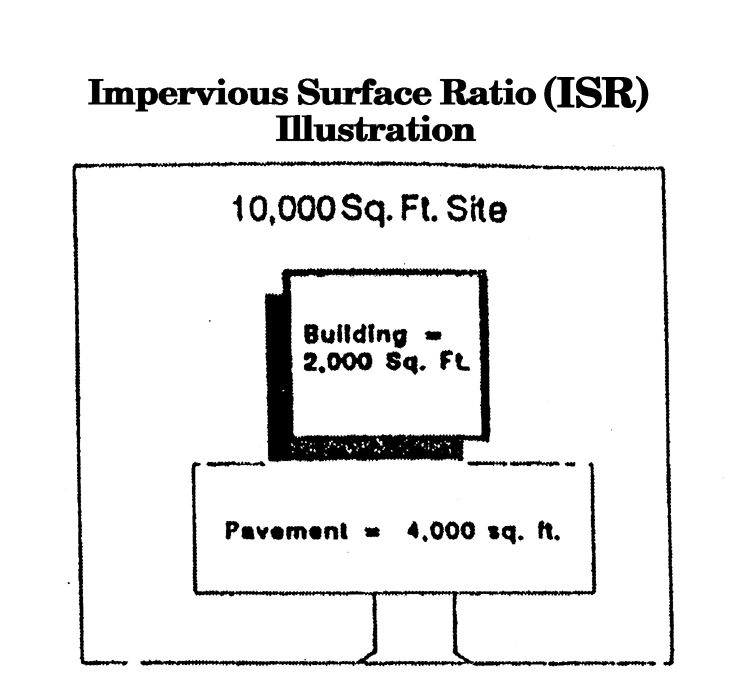
Impervious Surface Ratio (ISR) Illustration
ISR = Total Impervious Surface / Total Lot Area = 2,000 + 4,000 / 10,000 = 60%
Cluster development or other site design alternatives may result in individual lots exceeding the ISR, while other lots may be devoted entirely to open space. The city may require, as a condition of approval, deed restrictions or covenants which guarantee the maintenance of such open space in perpetuity. The ISR requirement shall not be bypassed or reduced. However, the intent is to allow maximum flexibility through calculating ISR on the gross site, and not on a lot-by-lot basis.
(c)
Use of porous material. Porous concrete, porous asphalt, turf block, or similar materials may be used subject to approval of the city engineer.
(d)
Compliance with ISR. All proposed development shall comply with the standards given in the table of impervious surface ratios in the table in section 122-1151. Where a proposed development is donating or dedicating land based on a plan approved by the city, the gross site before dedication or donation shall be used to calculate ISR. This does not relieve the applicant from providing all required on-site buffers, landscaping, stormwater management areas, minimum, and other required project amenities.
(Ord. No. 97-10, § 1(2-5.9(C)), 7-3-1997; Ord. No. 22-25, § 2, 8-16-2022)
Sec. 122-1144. - Building setbacks.
The table in section 122-1151 provides minimum building setbacks for all zoning districts within the city. The minimum building setback shall be measured from the subject lot lines of the building site.
(Ord. No. 97-10, § 1(2-5.9(D)), 7-3-1997)
Sec. 122-1145. - Required yards.
(a)
Purpose, use and maintenance of yards. The purpose of yards required in the land development regulations is to provide open space around and between structures for health, safety and aesthetic purposes. The purpose is also to prevent the location of structures within dedicated easements. All required yards and landscaped areas shall be planted and maintained in lawn, sod, or landscaping, including flower beds, shrubs, hedges or other generally accepted landscaping material approved by the city. Landscaping material, including trees, shall not obstruct the vision of the motoring public. The landscape requirements of article VI of chapter 108 shall further regulate development within all zoning districts, excepting single-family zoned districts.
(b)
General encroachments into required yards. Encroachments into required yards shall be in compliance with the following:
(1)
Projections and obstructions. Every part of every required yard shall be open and unobstructed from the ground to the sky except as follows or as otherwise permitted in divisions 2 through 14 of article IV of this chapter or in division 2 of this article or in this division:
a.
Movable awnings may project not over three feet into a required yard, provided that where the yard is less than five feet in width the projection shall not exceed one-half the width of the yard.
b.
Awnings, canopies, or marquees outside the historic district may not project over three feet into a required yard. The location of exterior open stairs must be approved by the building department, and such exterior open stairs can be no closer than 30 inches to an adjacent property line.
c.
Fences, walls and hedges shall be permitted in required yards subject to the land development regulations.
d.
Accessory parking may be located in a required front, rear or side yard.
e.
For the calculation of building coverage, properties with structures that have overhangs and/or eaves may reduce building coverage by the width of the overhangs and/or eaves.
f.
Gutters and downspouts shall not be considered building coverage and shall be permitted to protrude into any setbacks as long as they remain within the property lines of the applicable parcel.
g.
Encroachments into required yards are permitted to allow necessary improvements to a lawfully-existing dwelling unit being retrofitted by elevating the unit to meet or exceed design flood elevation. Setback, building coverage, and open space requirements are waived to allow necessary improvements. Necessary improvements are limited to:
1.
Ingress/egress structures (stairs, ramps, landings, elevators, and similar.) The waiver provided shall be the minimum necessary to provide access to the structure that is in compliance with fire code requirements.
2.
Accessory elevated platforms above base flood for equipment (mechanical, plumbing and electrical systems, appliances and components) situated at least five (5) feet from the rear and side property lines, or the minimum required setback for the zoning district, whichever is less. Accessory elevated platforms are limited to non-habitable space and shall not include elevated decks, patios, and similar structures.
3.
The improvements shall be constructed to avoid off-site discharge of stormwater from the subject parcel in accordance with Article VIII of Chapter 108.
This provision shall not function to permit the construction alteration of any structure or improvement that obstructs clear and free passage of emergency responders or that otherwise conflicts with fire safety Code.
(2)
Exceptions. Typical play equipment, wires, lights, mailboxes, ornamental entry columns and gates, and outdoor furniture are not considered as encroachments.
(c)
Yards. A yard shall be defined as an open space at grade between a building and the adjoining lot lines, unoccupied, open to the sky and unobstructed by any portion of a structure from the ground upward, except as otherwise provided in the land development regulations. In measuring a yard for the purpose of determining the width of a side yard, the depth of a front yard or the depth of a rear yard, the minimum horizontal distance between the lot line and the structure shall be used (a driveway or off-street parking area may be a portion of a "yard").
(1)
Front yard. Front yards shall be defined as the yard abutting a street (i.e., street frontage lot). The depth of required front yards shall be measured in such a manner that the yard established is a strip of at least the minimum width required by district regulations with its inner edge parallel with the front lot line. Such yard shall be measured from the nearest point of the building, including the roof, to the front (street frontage) property line. The front yard regulations shall apply to all lots fronting on a street.
(2)
Rear yard. A rear yard is a yard extending across the rear of a lot between the side lot lines and which is the minimum horizontal distance between the rear of the main building or any projections thereof other than projections or encroachments specifically provided for in the land development regulations. For all corner lots, the rear yard shall be as indicated in subsection (c)(4) of this section for corner lots. The depth of required rear yards shall be measured in such a manner that the yard established is a strip of at least the minimum width required by district regulations with its inner edge parallel with the rear lot line. Such yard shall be measured from the nearest point of the building, including the roof, to the rear property line.
(3)
Side yard. A side yard is a yard between the main building and the sideline of the lot and extending from the front lot line to the rear yard, which is the minimum horizontal distance between a side lot line and the side of the main building or any projections thereof. For all corner lots, the side yard shall be as indicated in subsection (c)(4) of this section. The width of required side yards shall be measured in such a manner that the yard established is a strip of at least the minimum width required by district regulations with its inner edge parallel with the side lot line. Such yard shall be measured from the nearest point of the building, including the roof, to the side property line.
(4)
Determining yards on corner lot. On corner lots abutting two intersecting streets, the setbacks shall be measured as described in subsections (c)(1) through (3) of this section with the front, side and rear lot lines being determined as follows:
a.
One street frontage shall be declared a front yard.
b.
The other street frontage shall be a street side yard.
c.
The rear yard shall be the yard opposite the declared front yard.
d.
The remaining yard shall be the interior side yard.
(Ord. No. 97-10, § 1(2-5.9(E)), 7-3-1997; Ord. No. 22-25, § 2, 8-16-2022; Ord. No. 24-31, § 1, 11-14-2024)
Sec. 122-1146. - Yard and building site requirements.
Yards or building sites created after the effective date of the ordinance from which the land development regulations derive shall meet or exceed the minimum requirements established in the schedule of district regulations located in divisions 2 through 14 of article IV of this chapter, in division 2 of this article and in this division. No yard or building site existing on the effective date of the ordinance from which this section derives shall be reduced in dimension or area below the minimum requirements set forth.
(Ord. No. 97-10, § 1(2-5.9(F)), 7-3-1997)
Sec. 122-1147. - Independent yard or open space.
No part of a yard or other open space or off-street parking or loading space required in connection with any building or site for the purpose of complying with the land development regulations shall be included as part of a yard, open space or off-street parking or loading space similarly required for any other building or site.
(Ord. No. 97-10, § 1(2-5.9(G)), 7-3-1997)
Sec. 122-1148. - Coastal construction control line.
(a)
No building or other structure shall be constructed:
(1)
Within 50 feet of the mean high water along the Atlantic Ocean, southwest from the Cow Key Channel Bridge to the southeast corner of the Truman Annex property, inclusive of the Fort Taylor State Park, which fronts on the Atlantic Ocean; or
(2)
Within 30 feet of the mean high water along the main ship channel, Key West Harbor, Garrison Bight, and the Bay of Florida, which shoreline is generally described as running north and east from the southeast corner of Truman Annex property, inclusive of the Fort Taylor State Park property which fronts on the Bay of Florida, to the north end of the Cow Key Channel Bridge and also extending along the entire outer limits of North Stock Island.
(b)
Restrictions set forth in subsection (a) of this section shall not be applicable to any pier, dock, seawall, or other water-dependent use, or to any construction on property not within the jurisdiction of the city.
(c)
If any portions or applications of subsection (a) of this section are judicially determined to be legally improper or unconstitutional, such holding shall not affect the remaining portions or applications thereof.
(Ord. No. 97-10, § 1(2-5.9(H)), 7-3-1997)
Sec. 122-1149. - Height.
(a)
The term "building height" as used in the land development regulations shall mean the vertical distance from the crown of the nearest adjacent street to the highest point of the proposed building.
(b)
Height limitations contained in the schedule of district regulations located in divisions 2 through 14 of article IV of this chapter, in division 2 of this article and in this division shall apply to all construction unless otherwise stated herein below and/or in section 122-1151.
(c)
These height regulations may be waived subject to the variance criteria found in section 90-391 in order to accommodate nonhabitable hardware and utility structures typically associated with the principal structure, including spires, belfries, cupolas, antennas, water tanks, ventilators, chimneys, or other appurtenances usually required to be placed above the roof level and not intended for human occupancy or use.
(d)
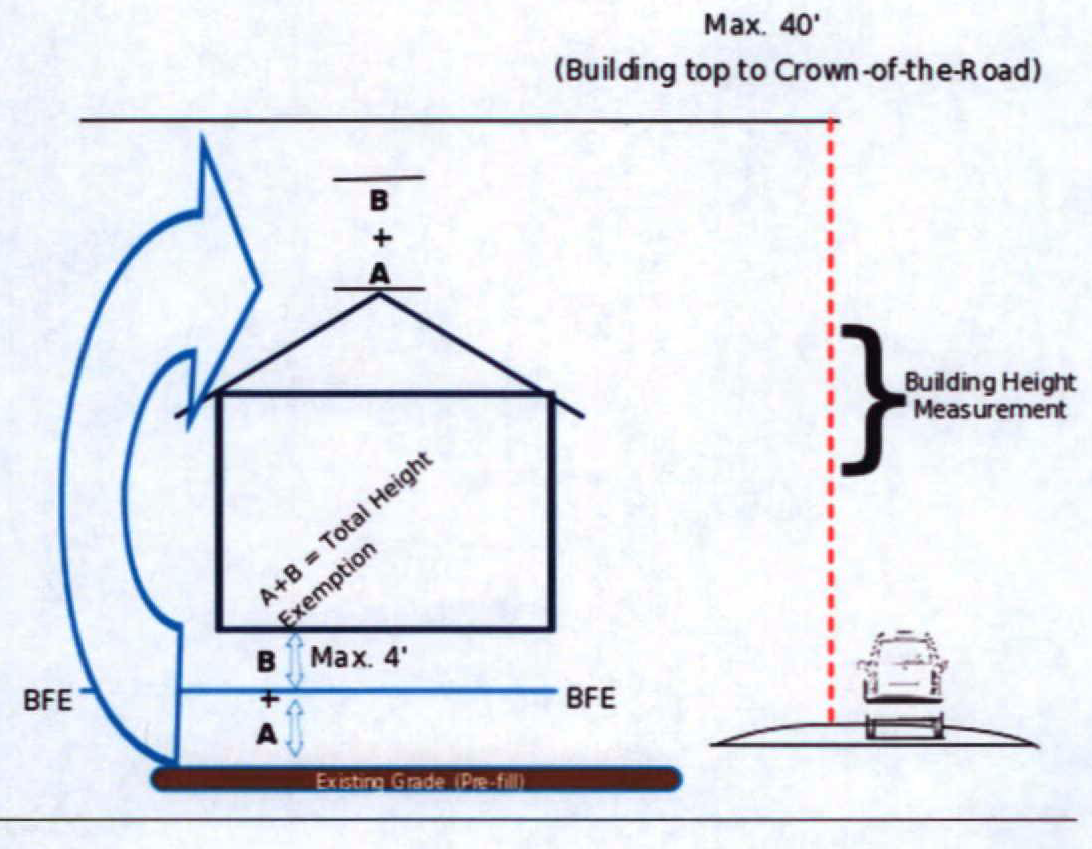
Flood Protection Building Height Exception: An exception to the building height regulations as referenced in subsection (b) above, may be permitted in cases where a building is raised above ground to meet or exceed FEMA established base flood elevation levels under the following conditions:
1.
Only the equivalent measure of distance from the existing ground level, prior to infill, to the required base flood elevation of the building, and up to a maximum of four (4) feet above the base flood elevation, may exceed the building height regulations.
2.
No exception shall result in a building height that would exceed 40 feet.
(Ord. No. 97-10, § 1(2-5.9(I)), 7-3-1997; Ord. No. 15-07, § 1, 4-7-2015)
Sec. 122-1150. - Structures to have access.
Every building erected or moved after the effective date of the ordinance from which this section derives shall be on a lot adjacent to a public street or with access to an approved private street, and all structures shall be so located on lots as to provide safe and convenient access for servicing, fire protection, and required off-street parking.
(Ord. No. 97-10, § 1(2-5.9(J)), 7-3-1997)
Sec. 122-1151. - Size and dimension.
Size and dimension regulations for zoning districts shall be as follows:
TABLE OF SIZE AND DIMENSION REGULATIONS
Footnotes:
(Ord. No. 97-10, § 1(2-5.9), 7-3-1997; Ord. No. 09-06, §§ 3—5, 4-7-2009; Ord. No. 10-04, §§ 20, 21, 1-5-2010; Ord. No. 12-33, § 4, 9-18-2012; Ord. No. 13-25, § 3, 12-3-2013; Ord. No. 18-04, § 4, 2-7-2018; Ord. No. 19-15, § 2, 5-21-2019; Ord. No. 21-06, § 2, 2-18-2021)
Sec. 122-1181.- Permitted and restricted uses.
Accessory uses or structures as defined in section 86-9 shall be allowed in all districts. Such accessory uses or structures shall be permitted by right in a subject district if the principal use is a permitted use; however, the accessory use or structure shall be a conditional use if the principal use is a conditional use. No accessory uses or structure shall be erected in any required front or side yard, and the accessory uses or structure shall not cover more than 30 percent of any required rear yard. No separate accessory structures shall be erected less than five feet of any lot line. Accessory buildings must be constructed simultaneously with, or following, the construction of the main building and shall not be used until after the principal structure has received a certificate of occupancy. Erection of tents is prohibited. Hot tubs, whether fixed or movable, shall be considered accessory structures for the purpose of setbacks.
(Ord. No. 97-10, § 1(2-7.7), 7-3-1997)
Sec. 122-1182. - Carports.
An open carport may be erected adjacent to interior lot lines within one foot of the front and side property lines. Rooftop runoff shall be contained on the subject site.
(Ord. No. 97-10, § 1(2-7.8), 7-3-1997)
Sec. 122-1183. - Walls and fences.
(a)
Definition. For the purpose of the land development regulations, the term "fence" shall be used to describe a manmade structure erected for separation, security or privacy purposes through the means of intermittent posts supporting vertical or horizontal members made of wood, metal, chain link, or barbed wire. While the opacity may vary, the height and location are dictated by the regulations within this subpart B. A wall may be erected for the same purposes but shall include only those structures with continuous footers. The main structure of the wall may be constructed with brick, stone or concrete block. The latter may be used in combination with decorative veneers of brick, rock, stone, stucco or any other material meeting accepted aesthetic performance criteria. Any wall or fence erected within the city shall meet professionally accepted building standards and the regulations cited in this section.
(b)
Building permit; review. Notwithstanding other sections of the land development regulations, fences, walls, hedges, landscaped berms, and minor structures such as lampposts (standards) or flagpoles (permanent type) may be permitted in any district subject to issuance of a building permit. Fences in the historic district shall also be subject to review by the historic architectural review commission as part of the permitting process.
(c)
Application procedure. Application for approval of any fence should be made in the same manner as for authorization of a building permit with a full description of materials to be used and dimensions and placements clearly stated on the plans. The building official will inspect the area and judge the application on the basis of the guidelines for fences and other minor structures set forth in subsection (d) of this section.
(d)
Standards for fences and hedges. Fences shall be erected on the lot of the applicant and shall not extend into a public right-of-way. The fence may abut but shall not be located on any property line. It shall be unlawful for any person to erect a fence within the city except in accordance with the following:
(1)
In the city's residential areas the following restrictions as to fence height and construction shall apply:
a.
Solid or open fences not exceeding four feet in height constructed of wood, rock, concrete block, chain link or wrought iron may be permitted on the front, rear and side yard property lines of any parcel of land.
b.
If there are located utility electrical transformer banks, water towers or other facilities owned or leased by a public utility in residential zones which require the fencing of such for safety precautions, the fence around such facilities shall be at least six feet in height, and barbed wire may be used on the top of such six-foot fence.
c.
Fences up to six feet in height may be constructed on the front, rear and side yard property lines of any parcel of land, provided that the upper two feet of such six-foot fence has openings of at least 50 percent or more in the construction of the fence. Solid fences up to six feet in height may be constructed on rear and side yard property lines of any parcel of land provided such solid six-foot fence is not constructed on property lines intersecting at street corners and that the adjoining property owners file their written consent with the building department consenting to the construction of such six-foot solid fence.
d.
Solid fences up to six feet in height may be constructed on the front property line of a residential property in the single family residential (SF) and medium density residential (MDR) zoning districts, provided:
(1)
All adjoining property owners file their written consent; and
(2)
First Floor Property owners whose properties face the proposed fence file their written consent; and
(3)
The Chief Building Official determines that the proposed solid six-foot fence is in harmony with the surrounding properties and otherwise satisfies Florida's building code.
(4)
Any interested party may appeal the Chief Building Official's decision in favor of or against a proposed six-foot solid front fence directly to the Board of Adjustment, as provided in Section 90-430 and 90-431.
e.
All fences in residential areas shall be located so as to avoid interference with traffic visibility pursuant to section 122-1406.
(2)
In nonresidential areas of the city, wire-mesh or chainlink fences may be constructed at any height on any property lines, and barbed wire may be used on such fences, provided the barbed wire portion of the fence does not extend outside and beyond the property line of such property, and such fence is at least six feet high.
(3)
Hedges and landscaped berms located within a front yard shall be maintained so as not to obstruct the view of vehicular traffic at intersections.
(Ord. No. 97-10, § 1(2-7.9), 7-3-1997; Ord. No. 19-12, § 1, 5-21-2019)
Sec. 122-1184. - Air conditioning and heating units in residential districts.
In all residential districts, the exhaust or mechanical part of any air conditioning or heating unit, other than window units, shall not be placed or installed within five feet of any side or rear property line. No air conditioning or heating unit shall be placed or installed in a front yard. Where feasible, air conditioning units should be baffled for noise.
(Ord. No. 97-10, § 1(2-7.10), 7-3-1997; Ord. No. 02-18, § 1, 7-2-2002)
Sec. 122-1185. - Swimming pools.
Prior to commencing construction of swimming pools, a building permit must be obtained. The following shall be enforced in regulating construction of swimming pools:
(1)
Application. The building department will receive and act on applications for a building permit. The application shall be accompanied by detailed pool plans, illustrating the location of mechanical equipment and also safety barriers, fences, screening, or other improvements to be constructed. The plans shall comply with the Standard Swimming Pool Code.
(2)
Setbacks for in-ground swimming pools. Setback requirements for in-ground swimming pools are five feet from all property lines.
(3)
Setbacks for aboveground swimming pools and spas. Aboveground swimming pools and spas are considered structures and shall meet the setback requirements of the land development regulations. An aboveground pool or spa is defined as any pool or spa structure which extends more than 30 inches above the existing ground level. Setback requirements are five feet for the side and rear yards. Additionally, there shall be a minimum setback from the principal structure on the lot of five feet.
(4)
Required fencing. All swimming pools shall be completely enclosed with a fence or wall at least four feet high and so constructed as to not be readily climbable by small children.
(5)
Gates and doors. Every gate or door providing access to the pool area shall be equipped with a self-closing and self-latching device installed on the pool side for keeping the gate or door securely closed at all times when the pool area is not in actual use, except that the door of any dwelling which forms a part of the enclosure need not be so equipped.
(6)
Lighting. Lighting for swimming pools shall be shielded in a manner that will confine illumination to the area of the pool.
(7)
Wastewater. Elimination of wastewater from such swimming pools shall be arranged in a manner which will avoid septic tanks and/or drainfields, contamination of adjacent bodies of water or the flooding of adjacent bodies of water or the flooding of adjacent properties owned by others.
(Ord. No. 97-10, § 1(2-7.11), 7-3-1997)
Sec. 122-1186. - Waterways, watercraft and marine-related structures.
(a)
Regular mooring of watercraft. As used in this subsection, the term "regularly moored" shall mean moored to the shoreline or a shoreline structure in the same general area at least eight hours a day for ten days in any month. Watercraft shall not be regularly moored along any shore without the consent of the riparian landowner. Regularly moored watercraft shall not be used as dwellings, except in public marinas or on private sites. Watercraft shall not be permitted as business offices or other related commercial enterprises unless located within a duly permitted marina. This subsection shall not preclude the regular mooring of watercraft used for fishing operations, charters and other water-dependent uses, provided such mooring is at a commercial marina. Regularly moored watercraft shall be kept in seaworthy condition when not in a permitted repair area.
(b)
Maximum permitted projection of waterfront structures. Docks, piers, or wharves shall not be permitted without approval by the U.S. Army Corps of Engineers and/or any other agency having appropriate jurisdiction. Such structures shall only be permitted where a continuous channel having a mean low water depth of four or more feet is available and links the structure with deep water. Deep water shall be defined as greater than four feet. Refer to sections 122-132 through 122-143.
(Ord. No. 97-10, § 1(2-7.12), 7-3-1997)
Cross reference— Waterways, ch. 82.
Subdivision II. - Group Homes And Foster Care Facilities[19]
Cross reference— Businesses, ch. 18.
Subdivision IV. - Home Occupations[20]
Cross reference— Businesses, ch. 18.
Sec. 122-1336.- Purpose.
The purpose of this division is to provide for the transfer of existing transient units and transient licenses in order to reduce noncomplying density, structures and uses; remove legal nonconforming transient uses from zoning districts that now prohibit them; encourage permanent residential housing by relocating transient licenses; provide for the conversion of transient units to single-family dwellings by the transfer of units; allow for redevelopment without increasing the population requiring evacuation during emergencies or increasing other public services; protect environmentally sensitive lands; and encourage redevelopment under the existing rate of growth ordinance ("ROGO") that limits the allowable number of residential and transient units. This division is only for the purpose of the transfer of transient units and shall not be construed to create new residential or transient units.
(Ord. No. 99-26, § 1, 12-7-1999; Ord. No. 02-05, § 1, 2-5-2002; Ord. No. 05-09, § 1, 4-19-2005)
Sec. 122-1337. - Definitions.
The following words, terms and phrases, when used in this division, shall have the meanings ascribed to them in this section, except where the context clearly indicates a different meaning:
Affordable housing shall mean housing as defined in section 122-1466 of the land development regulations (LDRs) and amendments thereto.
Receiver site shall mean the property where the unit or license is desired to be transferred and relocated pursuant to this division.
Residence or residential unit shall mean a single-family, multifamily, accessory, or affordable housing unit.
Sender site shall mean the property where the transient unit or license is currently located and recorded prior to application for transfer.
Transient unit shall mean a transient living accommodation as defined in section 86-9 of the LDRs.
(Ord. No. 99-26, § 1, 12-7-1999; Ord. No. 02-05, § 1, 2-5-2002; Ord. No. 05-09, § 2, 4-19-2005)
Cross reference— Definitions generally, § 1-2.
Sec. 122-1338. - Transfer of transient units.
(1)
The unit being transferred must currently be counted as a unit for purposes of calculating evacuation time under the hurricane model set forth in the comprehensive plan, and must have been obtained in accordance with all applicable regulations, including building permits, at the time of approval or have been otherwise validly obtained if unbuilt at the time of transfer. A transfer pursuant to this division shall not cause a net increase of units in the city.
(2)
Transient use must be an allowed zoning use on the receiver site, unless the units are to be converted into non-transient units as contemplated by subsection (3) of this section. Further, no transient unit shall be recognized for transfer purposes, regardless of whether it will be used transiently or non-transiently, unless accompanied by a business tax receipt duly issued pursuant to section 66-109(10). When units are transferred for non-transient use, the licenses will be extinguished.
(3)
Transient units may be converted to residential units at the appropriate exchange rate as determined by the comprehensive plan so as not to increase hurricane evacuation time. Where a residential unit is created by the transfer of a transient unit and the new residential unit is 600 square feet or less, the transient unit may be transferred at its .58 ROGO unit equivalency into a residential unit with transient use prohibited.
(4)
The transferred units shall not operate to increase density of the receiver site above the maximum allowed density.
(5)
Unless the planning board determines that special conditions exist at the receiver site that warrant otherwise, the transient unit may not include more than two rooms, excluding bathrooms, and excluding porches and decks that are clearly not enclosed or habitable.
(6)
At the sender site, any remaining transient units that are remodeled or combined may not increase the existing number of rooms, excluding bathrooms. All such units shall not have "lockout" capacity.
(7)
There shall be no transfer of units into a "V" zone as depicted on the most current flood insurance rate map, if the transfer would produce new construction.
(8)
Existing nonconforming buildings may receive units providing their nonconforming aspects are not increased.
(9)
Development plans for both sites shall be processed as provided in the LDRs, according to the magnitude and type of development.
(10)
No building permit shall be granted for the receiver site until the city has verified that the transient use at the sender site unit(s) has been extinguished. A person or entity who has lawfully terminated or extinguished legal transient units existing as of January 1, 1999, may preserve the right to transfer the units and then transfer such units pursuant to this section, provided the transient licenses have been maintained. Furthermore, the city shall conduct on-site inspections at both the sender site and receiver site to verify that the terms of this ordinance are being met in the proposed transfer application.
(Ord. No. 99-26, § 1, 12-7-1999; Ord. No. 02-05, § 1, 2-5-2002; Ord. No. 05-09, § 3, 4-19-2005; Res. No. 06-292, § 1, 9-6-2006; Ord. No. 11-06, § 1, 3-15-2011)
Sec. 122-1339. - Transfer of transient business tax receipt.
(a)
A business tax receipt for transient use of a unit may itself be transferred from an area where transient uses are prohibited to a receiver site without the accompanying transfer of the unit. In addition, licenses may be transferred from the HNC-1 and HNC-3 zoning districts. A transfer of a license under this section shall not result in a loss of affordable housing at the receiver site.
(b)
Where a license alone is transferred, the planning board shall consider whether the receiver site is suitable for transient use in the zoning district, shall consider the relative size of the unit from which the license is transferred, and shall consider the room configuration of both sites to maintain approximately the same or less net number of occupants.
(Ord. No. 99-26, § 1, 12-7-1999; Ord. No. 02-05, § 1, 2-5-2002; Ord. No. 05-09, § 4, 4-19-2005; Res. No. 06-292, § 1, 9-6-2006)
Sec. 122-1340. - Development review committee and planning board review.
The development review committee (DRC) shall review each application for transfer. The planning board will receive comments from the DRC and the recommendation of the planning department and may deny an application on the grounds of inconsistency with the purpose of the ordinance or a violation of the specific provisions of the ordinance. When approving an application, the planning board may impose conditions, including but not limited to: physical modifications and the filing of deed restrictions, in order to assure the continuation of permanent residential housing, the preservation of community character and that the transfer advances the purposes of this division. The decision of the planning board shall be final.
(Ord. No. 99-26, § 1, 12-7-1999; Ord. No. 02-05, § 1, 2-5-2002; Ord. No. 05-09, § 5, 4-19-2005)
Sec. 122-1341. - Compliance with codes.
All structures proposed to be used on a transient basis must comply with codes and requirements of the building department, fire department, and all other regulatory agencies.
(Ord. No. 02-05, § 1, 2-5-2002; Ord. No. 05-09, § 6, 4-19-2005)
Sec. 122-1342. - Historic structures.
Proposals to change the interior of contributing or altered historic structures located within the historic district shall be subject to the review of the historic architectural review commission (HARC) for the proposed interior renovations. If the receiver site is an historic structure, the planning board may consider retaining the room layout (notwithstanding sections 122-1338(5) and 122-1339(b) hereof), and may further consider all guidelines adopted by the historic architectural review commission.
(Ord. No. 02-05, § 1, 2-5-2002; Ord. No. 05-09, § 7, 4-19-2005)
Sec. 122-1343. - Tracking system; enforcement.
The city manager shall establish a tracking system for all sender sites and receiver sites. On an annual basis, the building department shall certify that each such site is being put to the use(s) represented in the transfer application.
(Ord. No. 99-26, § 1, 12-7-1999; Ord. No. 02-05, § 1, 2-5-2002; Ord. No. 05-09, § 8, 4-19-2005)
Sec. 122-1344. - Application, notice and fees.
Applications for transient unit transfer and transient license transfer may be obtained from the planning department and must be completed in the form and manner required by the department. Notice of any such transfer shall be given for the planning board meeting at which the transfer will be considered, pursuant to section 90-60 of the LDRs. Notices shall be sent to the property owners at both the sender and receiver sites. An appropriate fee schedule shall be established by resolution. The amount of the fee shall take into consideration, among other things, the cost of the tracking system and the cost of enforcement of this ordinance. The transfer must occur within 18 months of planning board approval, although the applicant may apply to the planning board for an extension(s).
(Ord. No. 99-26, § 1, 12-7-1999; Ord. No. 02-05, § 1, 2-5-2002; Ord. No. 05-09, § 9, 4-19-2005)
Sec. 122-1345. - Consent by mortgagee and condominium/homeowner's association.
When a sender site is subject to a mortgage that references the transient license or use, the application must be accompanied by a consent executed by the mortgagee. If the receiver site is governed either by a condominium association or a homeowners' association, such association must approve the transfer by a majority vote as defined by the governing documents of the association. Proof of approval shall accompany the application for transfer.
(Ord. No. 02-05, § 1, 2-5-2002; Ord. No. 05-09, § 10, 4-19-2005)
Sec. 122-1346. - Reserved.
Editor's note— Section 1 of Ord. No. 11-06, adopted March 15, 2011, deleted § 122-1346, which had contained sunset provisions, and derived from Ord. No. 99-26, adopted Dec. 7, 1999; Ord. No. 02-05, adopted Feb. 5, 2002; Ord. No. 05-09, adopted April 19, 2005; and Ord. No. 10-08, adopted April 6, 2010.
Sec. 122-1371.- Transient living accommodations in residential dwellings; regulations.
(a)
Intent. These regulations apply only to the transient use of residential dwellings. In 1986, the city enacted former zoning code section 35.24(44) which provided the following definition of a transient living accommodation: "Commercially operated housing principally available to short-term visitors for less than twenty-eight (28) days." (This definition shall hereinafter be referred to as the "former transient definition.") Some property owners and developers interpreted the former transient definition to mean that an owner could rent his or her residential dwelling for less than half the year without the dwelling losing its residential status, and therefore without the need for a city-issued transient license (so long as state licensing requirements were met). This interpretation went unchallenged by the city. Three categories of transient use of residential dwellings resulted: (1) some owners obtained a transient license allowing unrestricted transient use; (2) some owners followed the former transient definition and, accordingly, rented their properties less than half the year; and (3) some owners put their residences to a transient use without city or state license and without regard to existing regulations. In addition, many residential dwelling owners never put their properties to a transient use and they no longer have the opportunity to do so under the city's current rate of growth ordinance.
The city commission finds that short-term or transient rentals affect the character and stability of a residential neighborhood. The home and its intrinsic influences are the foundation of good citizenship; although short-term tenants no doubt are good citizens generally, they do not ordinarily contribute to activities that strengthen a community.
Therefore, the city intends by these regulations to establish a uniform definition of transient living accommodations, and to halt the use of residences for transient purposes in order to preserve the residential character of neighborhoods. The city has provided only a brief phase-out period in recognition that in many instances investment expectations have already been met either through rental income or rising market value.
Finally, certain guest houses currently hold a number of the city's category 10C business tax receipt which denotes transient use of a residential property. The city intends to develop a uniform guest house business tax receipt category, and then to redesignate all 10C licenses held by guest houses accordingly.
(b)
Unlicensed residential transient use; prohibition. Except as provided in section 122-1372, all unlicensed transient rental use of residential dwellings is prohibited.
(c)
Application. The holder of a business tax receipt allowing residential transient use must annually provide or comply with the following information:
(1)
The complete street address and RE number of the property.
(2)
Proof of ownership, including the name, address and phone number of each person or entity with an ownership interest in the property.
(3)
An approved inspection report of the fire marshal verifying compliance with the fire marshal's criteria for a residential dwelling transient lodging use.
(4)
The gross square footage of the property, including the number of rooms, bedrooms, kitchens and on-site parking spaces attributable to transient lodging use.
(5)
A valid and current federal employer tax identification number (or Social Security number) for the owner(s) of the property.
(6)
A valid and current Florida Department of Revenue sales tax identification number under Chapter 212, Florida Statutes, and a valid and current license under Chapter 509, Florida Statutes.
(7)
The name, address and 24-hour phone number of the person who will be operating the property's transient accommodations.
(8)
The application shall bear the signatures of all owners, authorized agents and authorized property managers.
(d)
General regulations. The following regulations shall pertain to transient lodging use of or within a residential dwelling.
(1)
Except as provided herein, each residential property where transient lodging use is in effect shall prominently display on the outside of the property a medallion alerting the public of the transient use. The medallion and instructions for its posting shall be issued by the licensing division.
(2)
A contact person must be available 24-hours per day, seven days per week for the purpose of responding promptly to complaints regarding the conduct of the occupants of the residential dwelling transient lodging. The name and phone number of the contact person must be posted on exterior of the dwelling in a place accessible to the public.
(3)
As a condition of application approval, the fire marshal shall conduct an inspection of each dwelling unit and issue to the applicant written approval based on applicable life safety criteria.
(4)
Occupancy of individual units shall conform to the occupancy limits of the Florida Building Code. Units shall comply with the Americans with Disabilities Act, as applicable.
(5)
The owner or manager shall maintain a tenant and vehicle registration which shall include the name and address of each unit's tenant, and the make, year and tag number of the tenant's vehicle.
(6)
Parking. The owner shall provide one off-street parking space per residential dwelling transient lodging unit, except where the unit is in the city's historic district; provided, however, that the owner or manager must instruct all tenants of the historic district's residential parking program and if the vehicle is not eligible to park on the street, then the owner or manager shall ensure that the tenant is directed to a lawful and appropriate parking space.
(7)
There shall be a written lease between a residential dwelling owner and a tenant, and it shall contain the tenant's agreement to the regulations contained in this section.
(8)
It shall be a violation of these regulations to enter into a long-term lease with a mutual intent to subvert the regulatory goals of this section. It shall also be a violation of these regulations for a property owner to lease space to "roommates" for a period of less than 30 days or one calendar month when not licensed as provided hereunder. For the purposes of enforcement, a rebuttable presumption shall exist that roommates use a common entrance to a dwelling.
(9)
It shall be unlawful for any owner, tenant, broker, realtor, agent or other representative of the owners to hold out or advertise a residential dwelling for transient rental if the property is not permitted, as provided hereunder. A broker or realtor who is found in violation of this regulation shall be subject to business tax receipt revocation.
(10)
Nothing in this section is intended to exclude the application of any ordinance of the City of Key West.
(e)
Fees; application schedule.
(1)
A person or entity who holds a transient rental business tax receipt shall pay the customary annual business tax receipt fee, plus an annual inspection and enforcement fee upon the filing of the application set forth in subsection (c). Annual inspection and enforcement fees associated with this program are hereby established by City Commission Resolution and may be amended from time to time. All transient medallion licenses are due and payable on or before September 30th of the succeeding year. If September 30th falls on a weekend or holiday, the tax is due and payable on or before the first working day following September 30th. Transient medallion licenses that are not renewed when due and payable are delinquent and subject to a delinquency penalty of ten percent for the month of October, plus an additional five percent penalty for each subsequent month of delinquency until paid. However, the total delinquency penalty may not exceed 25 percent of the annual fee for the delinquent establishment.
(2)
Fee revenues raised under this section shall be used to fund a position in the code enforcement division, and to provide enforcement and processing personnel as needed. The officer holding this position shall have as his or her primary responsibility the enforcement of the terms and conditions of this ordinance, and other city regulations relating to the transient use of properties.
(3)
For a period of 90 days after the effective date of this section [September 22, 2003], the licensing division will receive initial applications pursuant to subsection (c), and related fees. There shall be a $25.00 per dwelling unit late fee payable to the city upon application filing. In all subsequent years after the initial application, annual processing fees shall be paid at the same time as the business tax receipt. The city manager may determine to pro-rate the initial processing fee.
(4)
Upon sale of a property which holds a transient medallion license, the transient medallion license may be transferred to the new owner of the property upon payment of a transfer fee of ten percent of the annual license tax and presentation of evidence of the sale and the original license upon the filing of the application set forth in subsection (c).
(f)
Enforcement; penalties. A violation of this section shall be punishable as a misdemeanor and by a fine of up to $500.00 per day, per unit, per violation. The code enforcement division may also enforce the terms of this section by bringing a case to the code enforcement special master pursuant to its authority under law and ordinance. In addition, any license or permission granted hereunder may be revoked for cause, upon notice and opportunity to be heard, by the city commission. In addition to any other remedy available to the city, the city or any adversely affected party may enforce the terms of this section in law or equity. Any citizen of Key West may seek injunctive relief in a court of competent jurisdiction to prevent a violation of this section. The city, by and through its code enforcement division, may apply for an administrative search warrant to enter upon the premises of any residence subject to this section.
(Ord. No. 02-06, § 2, 2-20-2002; Ord. No. 05-11, § 1, 5-17-2005; Res. No. 06-292, § 1, 9-6-2006; Ord. No. 22-02, § 1, 1-19-2022)
Sec. 122-1372. - Transient living accommodations in residential dwellings—Truman Annex.
(a)
Findings. In Rollison v. City of Key West, the Third District Court of Appeal ruled that a unit owner in the Truman Annex established a legal nonconforming use of Shipyards unit 271 as a transient rental, subject to the "50% Rule," because the property was put to a transient use before the city changed the law in 1998. In particular, the city of Key West enacted Ordinance No. 97-20, which was approved by the Florida Department of Community Affairs and became effective on December 26, 1997 (Because the Court identified 1998 in its Opinion, subsection (b) hereof sets a January 1, 1998 date for application eligibility).
Ordinance No. 97-20 established the current definition of "Transient Living Accommodation" and thereby terminated the ability of Truman Annex property owners to rely on the "50% Rule." This rule, a creation of the developers and marketers of the Truman Annex in the early 1990's, provided that a property owner in the Truman Annex could rent his or her unit for fewer than 26 weeks per year, maintaining its residential status and obviating the need for a city-issued transient rental license. The creators of the "50% Rule" based it on their reading of the definition of "transient housing" set forth in section 35.07(14)(b) of the former Key West zoning code, which applied to the Truman Annex development (the "planned redevelopment district").
The city commission finds that it is fair and reasonable to extend the Rollison ruling to other property owners in the Truman Annex. Accordingly, it hereby establishes an application process to determine similarly situated properties.
(b)
Application. All owners of eligible residential units in the HPRD zoning district may apply to the city of Key West for a "Truman Annex residential transient rental permit." An application for eligibility of a unit hereunder shall be filed with the city of Key West only one time. The following regulations pertain to this application.
i.
An eligible residential unit is one whose owner used it as a transient rental between the date of its original sale and January 1, 1998 (hereinafter the "Eligibility Period").
ii.
The current property owner shall file an application with the Key West city attorney's office. The application must include the following information; name of owner; address; owner's telephone number; date of purchase; purchase price; copy or copies of Monroe County transient rental business tax receipt(s) during the Eligibility Period; copy or copies of State of Florida Department of Business and Professional Regulation, Division of Hotel and Restaurant ("DBPR") lodging license(s) during the Eligibility Period; State of Florida sales tax records during the Eligibility Period; and a sworn affidavit of the current market short-term rental rate(s) for the unit. If a property owner intends to provide a blanket DBPR transient license roster for a real estate broker that includes the owner's address, then the owner shall supplement it with an agreement between the property owner (at the time) and the real estate broker for the year(s) of the blanket DBPR lodging license.
iii.
All applications shall be bound and paginated, and contain a table of contents.
iv.
The deadline for receipt by the city of a completed application is ninety (90) days from the effective date of this ordinance.
v.
Shipyards unit 271 was established as legally nonconforming by a court of law on April 14, 2004. On April 20, 2005, the city of Key West confirmed that the owner was entitled to rent the unit on a transient basis within the scope of the "50% Rule."
vi.
If an application is denied for any reason by the city, the property owner may appeal to the code enforcement special magistrate. The appeal must be filed with the code enforcement clerk within ten (10) days of receipt of the denial. The special magistrate shall conduct a public hearing, give notice and opportunity to be heard, receive evidence, and issue written findings and an order.
(c)
Once a unit is determined to be legally nonconforming under the procedures set forth in this section 122-1372, the property owner shall be entitled to rent the unit on a transient basis cumulatively for less than a total of twenty-six (26) weeks per year. The city of Key West cedes to each Truman Annex homeowners' association management responsibility of the 26-week cap; provided, however, that the city of Key West shall retain enforcement responsibility.
(d)
The property owner of each unit determined to be legally nonconforming hereunder shall be subject to the general regulations set forth in section 122-1371(d)(1)—(7) and the fee schedule set forth in section 122-1371(e)(1). The medallion required in section 122-1371(d)(1) must be removed on any day that the unit is not within its lawful rental period.
(e)
The cost of a "Truman Annex residential transient rental permit" shall be the equivalent of that of a business tax receipt per section 66-109(10)c., as amended.
(Ord. No. 05-11, § 2, 5-17-2005; Res. No. 06-292, § 1, 9-6-2006)
Sec. 122-1406.- Obstructions to visibility.
(a)
Obstruction to traffic and traffic visibility. There shall be no structure or planting which materially obstructs traffic and traffic visibility.
(b)
Corner lots. In any district where a corner or front yard setback is required, no structure, fence, planting or sign shall be located so as to interfere with traffic visibility across a corner between a height of 2½ and ten feet above the average grade within a triangle bounded by the curblines adjacent to the corner lot lines and a straight line drawn between points on each such curbline 20 feet from the intersection of such curblines or extension thereof.
(c)
Public right-of-way. There shall be no structure or planting on city or public right-of-way without prior approval of the planning board and city commission, and then only after due consideration is given to the type, height and size of such structure and planting.
(d)
Vision clearance. Notwithstanding any part of the land development regulations or any permit granted or variance granted by the city, no type of structure, vehicle, tree, planting, vegetation, sign or fence or any type of obstacle or any portion thereof shall be placed or retained in such a manner which would create a traffic hazard or would obstruct vision clearance at corners, curb cuts or railroad crossings in any zone.
(Ord. No. 97-10, § 1(2-7.13), 7-3-1997)
Sec. 122-1407. - Division of land.
No tract, parcel, or lot shall be divided or split into two or more parcels, lots, or other subunits of land without first complying with the city's subdivision regulations. No person shall divide any land in a manner that would result in any portion of such land failing to meet the minimum requirements established in the land development regulations for the zone in which such land is located. Any subdivision of land shall comply with the land development regulations, including chapter 118. All subdivisions shall be required to obtain approval from the city planning office as to compliance with applicable land development regulations in the form of a signed approved subdivision plan.
(Ord. No. 97-10, § 1(2-7.14), 7-3-1997)
Sec. 122-1408. - Land excavation or fill.
(a)
No site work which: (i) impacts the 100-year floodplain or which impacts a designated conservation area; or (ii) redirects and/or increases or reduces off-site natural drainage or runoff from a site shall be undertaken without prior development plan approval based on recommendations of the city engineer. The city shall require plans prepared by a state-registered engineer and other competent professionals as may be required which shall demonstrate compliance with the city's surface water management performance criteria in article VIII of chapter 108. In addition, the plans for land excavation or fill shall demonstrate that the proposed site alterations shall include mitigation techniques designed to comply with performance criteria addressing the following:
(1)
Native habitat protection as provided in articles III, IV, V and VII of chapter 110;
(2)
Site reclamation, including restoration of vegetative cover within disturbed upland open space; planting and stabilizing banks of drainageways with vegetation which is tolerant to anticipated changes in water levels, including hydric conditions as provided in articles III, IV, V and VII of chapter 110;
(3)
Sedimentation and soil erosion control as provided in division 3 of article III of chapter 110;
(4)
Protection of freshwater lens as provided in division 4 of article III of chapter 110;
(5)
Flood damage prevention as provided in article VIII of chapter 108; and
(6)
Tree and native vegetation protection as provided in article VI of chapter 108 and article VI of chapter 110.
(b)
The city shall not permit borrow pits or mining activities. Borrow pits and mining activities may cause adverse impacts to the city's freshwater lens and/or adversely impact water quality, surface water management, and flood damage prevention.
(Ord. No. 97-10, § 1(2-7.15), 7-3-1997)
Sec. 122-1409. - Construction of driveways, swales and other improvements affecting drainage.
The design of new or existing driveways or other elements of the circulation system potentially impacting drainage shall be approved by the city engineer prior to commencement of construction or excavation activity. Review by the city engineer is necessary in order to ensure that: (i) new driveways and other elements of the circulation system provide adequate drainage, swales, ditches or similar stormwater channels; and (ii) improvements to existing driveways or other elements of the circulation system are designed to protect and/or enhance existing or planned drainage improvements, as deemed appropriate by the city engineer. Culverts shall be designed to meet accepted engineering standards. The city engineer shall administer this section based on best management principles and practices.
(Ord. No. 97-10, § 1(2-7.16), 7-3-1997)
Sec. 122-1436.- Airport height limitations.
No structure shall be erected within the approach zones of an active runway on the Key West International Airport with a height in excess of those permitted by the Federal Aviation Administration or by the city commission. All structures shall comply with the city comprehensive plan and this division.
(Ord. No. 97-10, § 1(2-7.23), 7-3-1997)
Sec. 122-1437. - Definitions.
The following words, terms and phrases, when used in this division, shall have the meanings ascribed to them in this section, except where the context clearly indicates a different meaning:
Airport means Key West International Airport.
Airport elevation means the highest point of the airport's usable landing area measured in feet above sea level.
Airport hazard means any structure, street, or use of land which would exceed the federal obstruction standards as contained in 14 CFR 77.21, 77.23, 77.25 and 77.28, revised March 4, 1972, or which obstructs the airspace required for landing or takeoff at the airport or which is otherwise hazardous to the flight of aircraft.
Control zone means airspace extending upward from the surface of the earth which may include one or more airports and which is normally a circular area of five statute miles in radius, with extension where necessary to include instrument approach and departure paths.
Decision height means the height at which decision must be made, during an instrument landing system (ILS) approach, to either continue the approach or to execute a missed approach.
Height. For the purpose of determining the height limits in all zones set forth in this division, the datum shall be mean sea level elevation unless otherwise specified.
Instrument runway means a runway having an existing or planned instrument procedure utilizing air navigation facilities or area-type navigation equipment.
Landing area means the area of the airport used for the landing, takeoff, or taxing of aircraft.
Minimum descent altitude means the lowest altitude, expressed in feet above mean sea level, to which descent is authorized on final approach or during circle-to-land maneuvering in execution of a standard instrument approach procedure, where no electronic glide slope is provided.
Minimum en route altitude means the altitude in effect between radio fixes which ensures acceptable navigational signal coverage and meets obstruction clearance requirements between those fixes.
Minimum obstruction clearance altitude means the specified altitude in effect between radio fixes on visual omnirange (VOR) airways, off-airway routes, or route segments which meet obstruction clearance requirements for the entire route segment and which ensures acceptable navigational signal coverage only within 22 miles of a VOR.
Runway means the defined area of an airport prepared for aircraft landing/takeoff along its length.
Visual runway means any runway other than an instrument runway.
Zoning administrator means the administrative office or agency responsible for administering land development regulations within the city.
(Ord. No. 97-10, § 1(2-7.23(A)), 7-3-1997)
Cross reference— Definitions generally, § 1-2.
Sec. 122-1438. - Airport zones and airport height limitations.
In order to carry out this division, there are created and established certain zones which are depicted on the airport height restriction zoning maps on file in the city clerk's office, Zoning Map A, Key West International and NAS Key West. An area located in more than one zone of the described zones is considered to be only in the zone with the more restrictive height limitation. The various public civil airport height zones and limitations are established and defined as follows:
(1)
Primary zone. The area longitudinally centered on a runway, extending 200 feet beyond each end of that runway with the width so specified for each runway for the most precise approach existing or planned for either end of the runway. No structure will be permitted within the primary zone that is not part of the landing and takeoff area that is a greater height than the nearest point on the runway centerline. The width of the primary zone for runway 09/27 at Key West International is 500 feet.
(2)
Horizontal zone. The area encompassing the runways, primary zone, approach zones and transitional zone of each airport with the boundary formed by swinging arcs of specified radii from the center of each end of the primary zone of each runway and connecting adjacent arcs by lines tangent to those arcs. The radius specified for Key West International is 10,000 feet. No structure will be permitted in the horizontal zone that is higher than 150 feet above the established airport elevation.
(3)
Conical zone. The area extending outward and upward from the periphery of the horizontal zone for a distance of 4,000 feet. Height limitations for structures in the conical zone are 150 feet above airport elevation at the inner boundary of the zone with permitted height increasing one foot vertically for every 20 feet of horizontal distance measured outward from the inner boundary of the zone to a height of 350 feet above airport elevation at the outer boundary of the zone.
(4)
Approach zone. The area longitudinally centered on the extended runway centerline and proceeding outward from each end of the primary surface for a specified distance as follows: Key West International runway 9, 5,000 feet and runway 27, 10,000 feet. The width of that approach zone is the same at the inner boundary as the primary zone it adjoins and expands uniformly to a width at the outer boundary as follows: Key West International runway 9, 1,500 feet and runway 27, 3,500 feet. Permitted height limitations within the approach zones for runway 9 at Key West International are the same as the height of the runway end at the inner boundary and increase at the rate of one foot vertically for every 20 feet horizontal distance. Permitted height limitations within the approach zone for runway 27 at Key West International are the same as the runway end at the inner boundary and increase one foot vertically for every 34 feet horizontally.
(5)
Transitional zone. The area extending outward from the sides of the primary zones and approach zones connecting them to the horizontal zone. Height limits within the transitional zone are the same as the primary zone or approach zone at the boundary line where it adjoins and increases at a rate of one foot vertically for every seven feet horizontally, with the horizontal distance measured at right angles to the runway centerline and extended centerline, until the height matches the height of the horizontal zone, which forms the outer boundary.
(6)
Other zones. In addition to the height limitations imposed in subsections (1) through (5) of this section, no structure will be permitted that exceeds 500 feet above airport elevation within ten nautical miles of the Key West International Airport, and no structure will be permitted within the city that would cause a minimum obstruction clearance altitude, a minimum descent altitude or a decision height to be raised.
(Ord. No. 97-10, § 1(2-7.23(B)), 7-3-1997)
Sec. 122-1439. - Airport land use restrictions.
(a)
Notwithstanding any other section of this division, no use may be made of land or water within the city in such a manner as to interfere with the operation of an airborne aircraft. The following special requirement shall apply to each permitted use:
(1)
All lights or illumination used in conjunction with street, parking, signs, or use of land and structures shall be arranged and operated in such a manner that it is not misleading or dangerous to aircraft operating from a public airport or in the vicinity thereof.
(2)
No operations from any use shall produce smoke, glare or other visual hazards within three statute miles of any usable runway of a public airport.
(3)
No operations from any use in the city shall produce electronic interference with navigation signals or radio communication between an airport and an aircraft.
(b)
Notwithstanding sections 122-1436 through 122-1438 and subsection (a) of this section, the owner of any structure over 200 feet above ground level must install on that structure lighting in accordance with Federal Aviation Administration Advisory Circular 70-7460-ID and any amendments thereto. Additionally, any structure exceeding 749 feet above mean sea level must install on that structure high intensity white obstruction lights. The high intensity white obstruction lights must be in accordance with Federal Aviation Administration Advisory Circular 70-7460-ID and any amendments thereto.
(c)
Any permit or variance granted may be so conditioned as to require the owner of the structure or growth in question to permit the city at its own expense to install, operate, and maintain thereto such markers and lights as may be necessary to indicate to pilots the presence of an airspace hazard.
(Ord. No. 97-10, § 1(2-7.23(C)), 7-3-1997)
Sec. 122-1440. - Administration.
It shall be the duty of the zoning administrator to administer and enforce this division within the territorial limits over which the political subdivision the administrator represents has zoning authority. For any violation of this division, the person responsible for such violation shall be given notice in writing by the zoning administrator. Such notice shall indicate the nature of the violation and the necessary action to correct or abate the violation. A copy of such notice shall be sent to the city planning board. An administrative official shall order discontinuance of use of the land or building; removal of trees to conform with height limitations set forth in this division; removal of buildings, additions, alterations or structures; discontinuance of any work being done; or shall take any or all other actions necessary to correct violations and obtain compliance with all the sections of this division.
(Ord. No. 97-10, § 1(2-7.23(D)), 7-3-1997; Ord. No. 08-04, § 28, 5-20-2008)
Sec. 122-1465.- Intent.
It is the intent of this division to create affordable housing categories to facilitate the development and redevelopment of housing designed and priced to meet the needs of people employed by the local economy in a manner that reflects the percentage of the workforce at each income level and mixes people of all incomes together and does not create high and low-income enclaves.
(Ord. No. 05-27, § 2, 10-18-2005; Ord. No. 19-11, § 2, 5-7-2019)
Sec. 122-1466. - Definitions.
The following words, terms and phrases, when used in this division, shall have the meanings ascribed to them in this section, except where the context clearly indicates a different meaning:
Affordable housing shall be defined as provided in the following classifications:
Affordable housing (very low income) for a rental dwelling unit shall mean a dwelling unit whose monthly rent, not including utilities, does not exceed 25 percent of that amount which represents 60 percent of the monthly median household income (adjusted for family size). For an owner-occupied dwelling unit, affordable housing (very low income) shall mean a dwelling unit whose sales price shall not exceed one and one-half times the annual median household income (adjusted for family size) for Monroe County, in accordance with section 122-1472.
Affordable housing (low income) for a rental dwelling unit shall mean a dwelling unit whose monthly rent, not including utilities, does not exceed 25 percent of that amount which represents 80 percent of the monthly median household income (adjusted for family size). For an owner-occupied dwelling unit, affordable housing (low income) shall mean a dwelling unit whose sales price shall not exceed two and one-half times the annual median household income (adjusted for family size) for Monroe County, in accordance with section 122-1472.
Affordable housing (median income) for a rental dwelling unit shall mean a dwelling unit whose monthly rent, not including utilities, does not exceed 25 percent of that amount which represents 100 percent of the monthly median household income (adjusted for family size) for Monroe County. For an owner-occupied dwelling unit, affordable housing (median income) shall mean a dwelling unit whose sales price shall not exceed three and one-half times the annual median household income (adjusted for family size) for Monroe County, in accordance with section 122-1472. The definition of "affordable housing (median income)" applies to and encompasses all affordable housing under construction or built pursuant to this ordinance prior to July 1, 2005, for which deed restrictions are required.
Affordable housing (middle income) for a rental dwelling unit shall mean a dwelling unit whose monthly rent, not including utilities, does not exceed 25 percent of that amount which represents 140 percent of the monthly median household income (adjusted for family size) for Monroe County. For an owner-occupied dwelling unit, affordable housing (middle income) shall mean a dwelling unit whose sales price shall not exceed six and one-half times the annual median household income (adjusted for family size) for Monroe County, in accordance with section 122-1472.
Affordable housing (moderate income) for a rental dwelling unit shall mean a dwelling unit whose monthly rent, not including utilities, does not exceed 25 percent of that amount which represents 120 percent of the monthly median household income (adjusted for family size) for Monroe County. For an owner-occupied dwelling unit, affordable housing (moderate income) shall mean a dwelling unit whose sales price shall not exceed five times the annual median household income (adjusted for family size) for Monroe County, in accordance with section 122-1472.
Affordable work force housing shall include very low income, low income, median income, moderate income and middle income housing.
Affordable work force housing trust fund shall mean the trust fund established and maintained by the city for revenues from fees in lieu of constructing affordable work force housing, and revenues from any other source earmarked for the trust fund by land development regulation, ordinance or donation.
Annual Household Income means all amounts, monetary or not, which are received by any family member of the household, except income from employment of children (including foster children) under the age of 18 years. Family shall include the traditional family, (married or not) as well as domestic partnerships.
Development or redevelopment, for purposes of this section, shall mean any development or redevelopment that increases the size of a unit(s), the number of units, or the need for additional affordable workforce housing as evidenced by additional services or intensity.
Median household income shall mean the median household income published for Monroe County on an annual basis by the U.S. Department of Housing and Urban Development.
(Ord. No. 98-18, § 1, 6-3-1998; Ord. No. 02-08, § 1, 2-20-2002; Ord. No. 05-27, § 3, 10-18-2005; Ord. No. 17-09, § 1, 8-16-2017; Ord. No. 18-13, § 2, 7-3-2018; Ord. No. 19-11, § 2, 5-7-2019; Ord. No. 21-09, § 1, 3-2-2021)
Cross reference— Definitions generally, § 1-2.
Sec. 122-1467. - Requirements of affordable work force housing.
(1)
(a)
Housing units. At least ten percent of all units developed or redeveloped each year shall be low income affordable housing of at least 400 square feet each, as defined herein and 20 percent shall be affordable housing (median income) housing of at least 400 square feet each, as defined herein. Residential or mixed use projects of less than ten residential or mixed use units shall be required to develop or redevelop at least 30 percent of units of at least 400 square feet each as affordable (median income), but may contribute a fee in lieu for each unit to the affordable work force housing trust fund, if approved by the city commission. The per unit fee shall be $200,000.00 (representing construction cost, less land cost, of a 400 square foot unit). The 30 percent affordability requirement shall be determined on a project by project basis and not on a city-wide basis. Vested units shall be subject to this subsection if not otherwise governed by law or agreement. For every required affordable housing (median income) unit, a developer may increase the sales or rental rates to affordable housing (middle income) so long as another unit's sales or rental rate is decreased to affordable housing (low income).
(b)
Linkage of projects. Two development or redevelopment projects may link to allow the affordable housing requirement of one development or redevelopment project to be built at the site of another project, so long as the affordable housing requirement of the latter development or redevelopment is fulfilled as well. Written proof of the project linkage shall be supplied by the developer to the city commission at the time of the first site plan approval. The project containing the affordable units must be built or rebuilt either before or simultaneously with the project without, or with fewer than, the required affordable units. In addition, if a developer builds or rebuilds more than the required number of affordable units at a development site, this development or redevelopment project may be linked with a subsequent development or redevelopment project to allow compliance with the subsequent development's affordable unit requirement. Written proof of the linkage must be supplied by the developer to the city commission at the time of the subsequent development's site plan approval. Linkage shall not be available if either development is entirely or in part to be constructed by public funds. Finally, all linkages under this subsection may occur within the city or on a site within the city and on a site on Stock Island in the unincorporated part of the county.
(c)
Affordable work force housing. The maximum total rental and/or sales price for all affordable work force housing units in a single development shall be based on each unit being affordable housing (moderate income). The rental and/or sales price may be mixed among affordable housing (low income), (median income), (middle income) and (moderate income) in order that the total value of rental and/or sales does not exceed ten percent of the rental and/or sales of all the units at affordable housing (moderate income).
(d)
Demonstration of continuing affordability. Demonstration of continuing affordability shall be by deed restriction or any other mutually acceptable method that effectively runs with the land and is binding on owners, successors in ownership, or assigns. The deed restriction shall be in a form provided by the city and shall be for a period of at least 50 years. It shall be recorded in the county records. During the final year of the deed restriction, the city commission may act by Resolution to renew the affordability restriction for an additional 50-year term.
(e)
Reporting requirements. Owners of affordable work force housing projects or units shall furnish the city manager or his designee with annual information necessary to ensure continued compliance with affordability criteria, beginning one year after the date of building permit issuance and on each anniversary date thereafter. Reporting requirements shall include sworn tenant household verification information. Property owners subject to this subsection may contract with the Key West Housing Authority to perform annual tenant eligibility verification.
(f)
Compliance with antidiscrimination policy. All property owners offering housing under this division shall comply with the antidiscrimination policy of article II of chapter 38.
(2)
Exemptions and waivers.
(a)
The following uses shall be exempt from the inclusionary housing requirements set forth in subsection (1)(a) of this section: affordable workforce housing, nursing homes, or assisted care living facilities.
(b)
The city commission may reduce, adjust, or waive the requirements set forth in this subsection where, based on specific findings of fact, the commission concludes, with respect to any developer or property owner, that:
1.
Strict application of the requirements would produce a result inconsistent with the comprehensive plan or the purpose and intent of this subsection;
2.
Due to the nature of the proposed development, the development furthers comprehensive plan policies and the purpose and intent of this subsection through means other than strict compliance with the requirements set forth herein;
3.
The developer or property owner demonstrates an absence of any reasonable relationship between the impact of the proposed development and requirements of this subsection (b); or
4.
The strict application with the requirements set forth herein would improperly deprive or deny the developer or property owner of constitutional or statutory rights.
(c)
Any developer or property owner who believes that he may be eligible for relief from the strict application of this section may petition the city commission for relief under this subsection (b)(3) of this section. Any petitioner for relief hereunder shall provide evidentiary and legal justification for any reduction, adjustment or waiver of any requirements under this section.
(Ord. No. 98-18, § 1, 6-3-1998; Ord. No. 02-08, § 1, 2-20-2002; Ord. No. 05-27, § 4, 10-18-2005; Ord. No. 19-11, § 2, 5-7-2019)
Editor's note— Ord. No. 19-11, § 2, adopted May 7, 2019, amended § 122-1467 and in doing so changed the title of said section from "Requirements of affordable work force housing; ratio of new construction" to "Requirements of affordable work force housing," as set out herein.
Sec. 122-1468. - Affordable work force housing trust fund.
(a)
The affordable work force housing trust fund (referred to as the "trust fund") is established. The trust fund shall be maintained with funds earmarked for the trust fund for the purpose of promoting affordable work force housing in the city and its immediate environs. Monies received by the trust fund shall not be commingled with general operating funds of the city. The trust fund shall be in a separate dedicated fund used only for the following:
(1)
Financial aid to developers as project grants for affordable housing (low income) to (moderate income) construction;
(2)
Financial aid to eligible homebuyers of affordable housing (low income) to (moderate income) as mortgage assistance;
(3)
Financial incentive for the conversion of transient units to affordable housing (low income) to (moderate income) residential units;
(4)
Direct investment in or leverage to housing affordability through site acquisition, housing development and housing conservation; or
(5)
Other affordable work force housing purposes from time to time established by resolution of the city commission.
(b)
Except as provided in section 122-1471, the city commission shall determine all expenditures from the trust fund upon the advice of the city manager.
(Ord. No. 98-18, § 1, 6-3-1998; Ord. No. 02-08, § 1, 2-20-2002; Ord. No. 05-27, § 5, 10-18-2005)
Sec. 122-1469. - Applicant eligibility requirements.
The following eligibility requirements shall be required of households or persons to qualify for affordable work force housing units to the extent lawful:
(1)
The household or person shall derive at least 70 percent of its or his/her total income from gainful employment in the county. This section shall not disqualify an individual previously and continuously qualified who reaches the age of retirement, or becomes disabled, and is otherwise income qualified.
(2)
At the time of sale or lease of an affordable housing (low income) unit, the total income of eligible household or persons shall not exceed 80 percent of the median household income for the county (adjusted for family size).
(3)
During occupancy of any an affordable housing (low income) rental unit, a household's income may increase to an amount not to exceed 120 percent of the median household income for the county (adjusted for family size). In such event, the tenant's occupancy shall terminate at the end of the existing lease term.
(4)
At the time of sale or lease of an affordable housing (median income) unit, the total income of eligible households or persons shall not exceed 100 percent of the median household income for the county (adjusted for family size).
(5)
During occupancy of any affordable housing (median income) rental unit, a household's annual income may increase to an amount not to exceed 140 percent of median household income for the county (adjusted for family size). In such event, the tenant's occupancy shall terminate at the end of the existing lease term.
(6)
At the time of sale or lease of an affordable housing (moderate income) unit, the total income of eligible households or persons shall not exceed 120 percent of the median household income for the county (adjusted for family size).
(7)
During occupancy of an affordable housing (moderate income) rental unit, a household's annual income may increase to an amount not to exceed 160 percent of median household income for the county (adjusted for family size). In such event, the tenant's occupancy shall terminate at the end of the existing lease term.
(8)
At the time of sale or lease of an affordable housing (middle income) unit, the total income of eligible households or persons shall not exceed 140 percent of the median household income for the county (adjusted for family size).
(9)
During occupancy of an affordable housing (middle income) rental unit, a household's annual income may increase to an amount not to exceed 180 percent of median household income for the county (adjusted for family size). In such event, the tenant's occupancy shall terminate at the end of the existing lease term.
(10)
Eligibility is based on proof of legal residence in the county as demonstrated by a valid State of Florida driver license or identification card, voter registration card if eligible, and an employer verification form signed by the employer or sufficient evidence, satisfactory to the City or its designee, demonstrating income qualification through self-employment.
(11)
Priority shall be given to families of four or more members for larger sized affordable work force housing units.
(12)
The applicant shall execute a sworn affidavit stating the applicant's intention to occupy the dwelling unit.
(13)
The income of eligible households shall be determined by counting the full amount, before any payroll deductions, of wages, salaries, overtime pay, commissions, fees, tips, bonuses, Social Security, annuities, insurance policies, retirement funds, pensions, disability or death benefits, unemployment compensation, disability compensation, worker's compensation, severance pay and any net income from the operation of a business or profession of all household members. Expenditures for business expansion or amortization of capital indebtedness shall not be used as deductions in determining net income from operation of a business or profession. Unrelated adults may be qualified individually for rental purposes provided the total lease payment to the Owner does not exceed the rent limits established by the City.
(14)
In the event that a tenant's income shall exceed the maximum allowable income under this section and such shall occur for the first time during the last three months of a tenancy, then the landlord and tenant may extend a lease for a period of one year at the affordable rental rate.
(15)
The planning board may review a household's income and unique circumstances to determine eligibility and conformance with the intent of this ordinance to assure that people in need are not excluded and people without need are not included.
(Ord. No. 98-18, § 1, 6-3-1998; Ord. No. 02-08, § 1, 2-20-2002; Ord. No. 05-27, § 6, 10-18-2005; Ord. No. 08-04, § 29, 5-20-2008; Ord. No. 17-09, § 2, 8-16-2017)
Sec. 122-1470. - Accessory unit infill.
(a)
In all mixed use zoning districts of the city, the city shall encourage the addition of affordable work force housing on the same site as commercial properties and institutions to promote employee housing. Such development shall be known as accessory unit infill. Tenants shall be eligible persons under section 122-1469. Applicants under this section may provide two bicycle or scooter parking spaces per unit as an alternative to applying to the planning board for parking variances. Provided that units of 600 square feet or less are treated as an 0.78 equivalent unit and all units provided must be made available through the city's building permit allocation system.
(b)
The maximum total rental and/or sales price for accessory unit infill in a single development or redevelopment shall be based on each unit being affordable housing (moderate income). The rental and/or sales price may be mixed among affordable housing (low income), (median income), (middle income) and (moderate income) in order that the total value in rental and/or sales does not exceed ten percent of the rental and/or sales of all the units at affordable housing (moderate income).
(Ord. No. 98-18, § 1, 6-3-1998; Ord. No. 02-08, § 1, 2-20-2002; Ord. No. 05-27, § 9, 10-18-2005; Ord. No. 08-04, § 30, 5-20-2008; Ord. No. 13-19, § 3, 11-6-2013; Ord. No. 19-11, § 2, 5-7-2019)
Sec. 122-1471. - Community housing development organization.
The city commission may promote the establishment of a nonprofit community housing development organization (CHDO), pursuant to federal regulations governing such organizations, to serve as developer of affordable workforce housing units on city-owned property located in both the city and in the community redevelopment areas, including excessed U.S. Navy property, or located in Key Haven and Stock Island in the unincorporated part of the county, upon interlocal agreement. In such event, the city may delegate to the community housing development organization all or partial administration of the affordable housing trust fund.
(Ord. No. 98-18, § 1, 6-3-1998; Ord. No. 02-08, § 1, 2-20-2002; Ord. No. 05-27, § 10, 10-18-2005)
Sec. 122-1472. - Family size.
When establishing a rental or sales amount, one shall assume family size as indicated in the table below. This section shall not be used to establish the maximum number of individuals who actually live in the unit.
(Ord. No. 02-08, § 1, 2-20-2002; Ord. No. 05-27, § 11, 10-18-2005)
Sec. 122-1473. - Affordable workforce liveaboard vessels.
Notwithstanding the permitted and conditional uses of Chap. 122. Art. IV. Land Use Districts, liveaboard vessels within duly permitted marinas/docking facilities subject to the provisions of the affordable workforce housing requirements of sections 122-1465, 122-1466, 122-1467, and 122-1469 may be allowed as a conditional use. Schedule of off-street parking requirements by use generally per Sec. 108-572(6) Marinas and offshore activities is 1 space per liveaboard boat. Any owner or his authorized agent may submit an application for a variance to off-street parking requirements, upon which the planning board shall hold a public meeting in accordance with the procedures cited in section 90-393.
(Ord. No. 18-26, § 1, 10-16-2018)
Sec. 122-1501.- Definitions.
The following words, terms and phrases, when used in this division, shall have the meanings ascribed to them in this section, except where the context clearly indicates a different meaning:
Adult entertainment business. See division 12 of this article.
Combination business means a licensed business offering for retail sale items of adult entertainment, discount jewelry, electronics merchandise, camera merchandise, or T-shirts, which items in combination total 30 percent or more of inventory on the premises, as measured by dimensions of display area, including but not limited to floors, walls, ceiling, counters, doors, windows, and panel displays.
Discount jewelry store means a licensed business offering for retail sale jewelry, over 30 percent of which, as measured by dimensions of display area, including but not limited to floors, walls, ceiling, counters, doors, windows, and panel displays, is not fashioned of 14 karat or higher grade gold. Any business advertising or holding itself out as a discount jewelry store shall be presumptively included in this category.
Electronics/camera store means a licensed business offering for retail sale merchandise, over 30 percent of which, as measured by dimensions of display area, including but not limited to floors, walls, ceiling, counters, doors, windows, and panel displays, consists of electronic and camera merchandise.
Parcel of land means any quantity of land capable of being described with sufficient particularity that its location and boundaries may be established, including those areas designated with real estate numbers in the records of the county and also including those areas falling within the definition of the term "lot, zoning" set forth in section 86-8.
T-shirt shop means a licensed business offering for retail sale merchandise where inventory content on the premises, as measured by dimensions of display area, including but not limited to floors, walls, ceiling, counters, doors, windows, and panel displays, consists of over 30 percent T-shirts, sweatshirts, muscle shirts, or similar apparel featuring logos, decals, transfers, appliques, iron-on designs, or other designs applied to the surface of such garment or wearing apparel. The following are not included in this definition: apparel featuring embroidery or silk screened designs and licensed businesses whose sales consist, as measured by annual gross sales figures, of 70 percent or greater of either sales to other retailers for resale or quantity sales (at least 12 items per sale) to individuals and groups or both.
(Ord. No. 97-10, § 1(2.7.27(A)), 7-3-1997; Ord. No. 01-13, § 2, 9-18-2001)
Cross reference— Definitions generally, § 1-2.
Sec. 122-1502. - Location criteria.
Within the HRCC, HRCC-1, HRCC-2, and HRCC-3 districts (when the uses are permitted or conditional), the location of the following retail activities shall be governed by the criteria listed:
(1)
Discount jewelry store. No discount jewelry store is permitted on a parcel of land located within 200 feet of any parcel of land upon which another discount jewelry store is located.
(2)
Electronics/camera store. No electronics/camera store is permitted on a parcel of land located within 200 feet of any parcel of land upon which another electronics/camera store is located.
(3)
T-shirt shop. No T-shirt shop is permitted on a parcel of land located within 200 feet of any parcel of land upon which another T-shirt shop is located. As of March 21, 1995, no new T-shirt shops shall be located in the HRCC, HRCC-1, HRCC-2, and HRCC-3 districts. A T-shirt shop licensed by the city and in operation in the HRCC, HRCC-1, HRCC-2, or HRCC-3 district as of March 21, 1995 may continue in existence as a nonconforming use. A change in ownership of an existing T-shirt shop shall not affect such nonconforming use status. If an existing T-shirt shop is enlarged or is increased in size or undergoes a structural alteration that exceeds 50 percent of the value of its building or structure as shown on the county tax assessment records or is abandoned in use as a T-shirt shop for a period of six months, its nonconforming use status shall terminate, and the use of the building or structure shall conform to this division and the restrictions of the HRCC, HRCC-1, HRCC-2, and HRCC-3 districts. The requirements of this subsection shall supersede conflicting requirements, if any, of section 122-1504.
(4)
Combination business. No combination business is permitted on a parcel of land located within 200 feet of any parcel of land upon which another combination business is located or upon which a business is located which offers for retail sale any component of the combination business; merchandise regulated in this division (i.e., one or more of the following: discount jewelry store, electronic/camera store, or T-shirt shop, as defined by section 122-1501).
(Ord. No. 97-10, § 1(2.7.27(B)), 7-3-1997; Ord. No. 01-13, § 2, 9-18-2001; Ord. No. 03-05, § 5, 1-7-2003; Ord. No. 04-14, § 3, 7-7-2004)
Sec. 122-1503. - Measurements of distance.
For purposes of this division, distance between business locations shall be measured by airline measurement from property line to property line, using the closest property lines of the parcels of land involved.
(Ord. No. 97-10, § 1(2.7.27(C)), 7-3-1997)
Sec. 122-1504. - Grandfather clause.
Any business use that predates these regulations and otherwise would be in violation of this division may continue to operate and be licensed as a legal nonconforming use; provided, however, that the business location of the use shall not be enlarged or increased in size or abandoned in use for a period of more than 30 days. In such event, the nonconforming use shall cease and the business shall conform in all respects to the provisions of this division. All material and equipment associated with the abandoned nonconforming use shall be completely removed from the premises by its owner. Abandonment shall occur when the property owner has an intent to abandon the property's nonconforming use either by an act or a failure to act that indicates the owner retains no interest in the use. Wherever this division is in conflict with article II of this chapter this division shall take precedence.
(Ord. No. 97-10, § 1(2.7.27(D)), 7-3-1997; Ord. No. 01-13, § 3, 9-18-2001)
Sec. 122-1531.- Adult entertainment establishments—Findings.
(a)
The city commission's recital (the whereas clauses) is hereby incorporated by reference and made a part of this division.
(b)
The purpose of this division is to regulate adult entertainment establishments for the health, safety, morals and welfare of the residents and visitors of Key West; and to establish reasonable regulations for adult entertainment establishments currently located and to be located in Key West, in order to eliminate or reduce adverse secondary effects of such establishments upon both residents and visitors. Unless there is a determination of obscenity or other illegality, nothing herein shall be construed to prohibit constitutionally protected expression or speech or to deny access by adults to sexually oriented materials or performances that are protected by the First Amendment. These regulations shall be construed consistently with Florida's obscenity law, chapter 847, Florida Statutes. Finally, nothing herein is intended to prohibit or to regulate works of serious artistic or literary value.
(Ord. No. 97-10, § 1(2-7.28(A)), 7-3-1997; Ord. No. 04-14, § 4, 7-7-2004)
Sec. 122-1532. - Definitions.
The following words, terms and phrases, when used in this division, shall have the meanings ascribed to them in this section, except where the context clearly indicates a different meaning:
Adult entertainment establishment means any commercial activity, whether conducted intermittently or full time, that involves either the sale, display, exhibition, or viewing of adult material or an adult performance, distinguished or characterized by an emphasis on matter depicting, describing or relating to specified sexual or sexually oriented activities or specified anatomical areas. The term "adult entertainment establishment" includes but is not limited to adult bookstores, adult-themed merchandise stores, adult performance establishments, adult motion picture theaters, limited adult cabarets and adult businesses, or any combination thereof. These terms shall have the following meanings:
(1)
Adult bookstore/video store means an establishment having at least 25 percent of its stock in trade, for sale, rent, lease, inspection, or viewing, books, films, videocassettes, compact discs, magazines, or other adult material that is distinguished or characterized by its emphasis on matter depicting, describing or relating to specified sexual activities and/or specified anatomical areas.
(2)
Adult performance establishment means any establishment where any worker (an employee or independent contractor) engages in a private performance, acts as an adult model, or displays or exposes any specified anatomical areas to a customer, regardless of whether the worker engages in dancing or any particular activity; or wears and displays to a customer any covering, tape, pasties, or other device that simulates or otherwise gives the appearance of the display or exposure of any specified anatomical areas, regardless of whether the worker actually engages in performing or dancing; or offers, solicits, or contracts to dance or perform with or for a customer and accepts any consideration, tip, remuneration or compensation from or on behalf of that customer.
(3)
Adult-themed merchandise store means a commercial establishment in which at least ten percent of the unused individual items publicly displayed in the establishment as stock in trade, for sale or rent, constitute adult material.
(4)
Adult motion picture theater means an enclosed building used for presenting films and/or videos which are distinguished or characterized by their emphasis on matter depicting, describing or relating to specified sexual activities and/or specified anatomical areas, for observation by patrons therein.
(5)
Adult business means a commercial enterprise that offers or provides for any form of consideration, physical contact between persons of the opposite sex or of the same sex in the form of a massage or rubdown or washing or scrubbing, where one or more of the persons is in a state of nudity or is seminude; provided, however, that a massage therapist licensed by the State of Florida pursuant to chapter 480, Florida Statutes, or a person licensed by the State of Florida as a physician, nurse, physical therapist or athletic trainer are not deemed to be engaged in an adult business. An adult business shall also mean any other similar adult entertainment establishment not specifically described herein, including but not limited to: a business whose customers are or are invited to be in a state of nudity for sexually oriented purposes (but not for mere sunbathing), and a business that offers the use of adult booths.
(6)
Limited adult cabaret means an adult performance establishment where live performers provide adult-themed entertainment and do so either clothed or seminude, without exposing specified anatomical areas and without engaging in specified sexual activities.
Adult booth means a separate booth inside an adult entertainment establishment accessible to any person, regardless of whether a fee is charged for access. The term "adult booth" includes, but is not limited to, a "peep show" booth or arcade; or a booth used to view "adult material" or engage in adult performance; or a booth used for sexual contact between persons in a public location.
Adult material means one or more of the following, regardless of whether it is new or used:
(a)
Books, magazines, periodicals, or other printed matter, photographs, films, motion pictures, videotapes, video cassettes, compact disks, slides, computer digital graphic recordings, or other visual representations, tape recordings, disks or other audio matter, which have as their primary or dominant theme matters depicting, illustrating, describing or relating to specified sexual activities or specified anatomical areas; or
(b)
Instruments, novelties, devices, merchandise or paraphernalia which are designed for use in connection with specified sexual activities; provided, however, that adult material shall not be interpreted to include bona fide birth control devices.
Nudity means the showing of the human male or female genitals, pubic area, or buttocks with less than a full opaque covering; the showing of the female breast with less than a full opaque covering of any portion thereof below the top of the areola; or the depiction of covered male genitals in a discernibly turgid state.
Parcel means any quantity of land capable of being described with such definiteness that its location and boundaries may be or are established. See also the definition of "Lot" in section 86-9.
Seminude means a state of dress in which clothing covers no more than the genitals, pubic region, and/or areolae of the female breast, as well as portions of the body covered by supporting straps or devices.
Specified anatomical areas means:
(1)
Less than completely opaquely covered human genitals, pubic region, buttocks, female breasts below a point immediately above the top of the areola; and/or
(2)
Human male genitalia in a discernibly turgid state even if completely and opaquely covered.
Specified sexual activities means:
(1)
Human genitals, covered or uncovered, in a state of sexual stimulation or arousal;
(2)
Acts of human masturbation, sexual intercourse, simulated sexual intercourse, sexual bestiality, sadomasochistic abuse, or sodomy;
(3)
Fondling or other erotic touching of human genitals, pubic regions, buttocks, or female breasts.
(4)
Any act or conduct constituting sexual battery.
(Ord. No. 97-10, § 1(2-7.28(B)), 7-3-1997; Ord. No. 01-13, § 3, 9-18-2001; Ord. No. 04-14, § 5, 7-7-2004)
Cross reference— Definitions generally, § 1-2.
Sec. 122-1533. - General regulations.
(a)
The purpose of this section is to limit the number of adult entertainment establishments within the corporate boundaries of Key West in order to address their adverse secondary effects. The city commission finds the potential and actual adverse secondary effects to be: The incidence of crime inside and around adult entertainment establishments (the city commission reaches no conclusion as to whether adult entertainment establishments cause a disproportionate increase to crime); detrimental effects on minors; the potential deterioration of a preserved historic district; pornographic litter; an increase in the incidence of obscenity; an increase in the incidence of disease; and land use incompatibilities. Regarding the latter, due to the small geographic size of Key West, there is no commercial district that does not also contain residences and houses of worship; therefore, the city commission recognizes that there can be no substantial separation between these amiable uses and adult entertainment establishments.
(b)
As of May 1, 2004, there are nine* adult entertainment establishments in the HRCC-1 zoning district. This number establishes a cap in HRCC-1. An existing adult entertainment business may move its location within HRCC-1 so long as it complies with section 122-1535. The city shall extinguish any surrendered adult entertainment licenses so that, by attrition, only five of them shall remain in the HRCC-1 zoning district. Thereafter, the city shall re-issue a surrendered license via a lottery devised by the city manager, so long as the winning applicant for the license is capable of complying and does comply with all federal, state and local regulations.
Note— *As of the effective date of this Ordinance No. 04-14, the proprietor of a tenth location —507 Southard Street— is in litigation with the City of Key West. If the plaintiff prevails, then the city will license it as the tenth location in HRCC-1.
(c)
An adult entertainment establishment that either is not located in the HRCC-1 zoning district** or does not comply with the separation requirements set forth in section 122-1535 is legally nonconforming and is subject to the regulations set forth in chapter 122, article II; provided, however, that the abandonment of an adult entertainment use shall occur when such use has ceased for a period of 120 days. Section 122-30 shall be interpreted consistent herewith. Nothing in this subsection is intended to alter nonconformities previously established.
** As of the effective date of this Ordinance No. 04-14, the City of Key West and the property owner of 1125 Duval Street are engaged in determining whether zoning supports partial use of the property as a cabaret. If it does then the property may obtain a limited adult cabaret license.
(d)
Within 60 days after the effective date of this Ordinance No. 04-14, all adult entertainment establishments existing in Key West shall provide the licensing division with a drawing showing the dimensions of the adult entertainment use on the parcel as of May 1, 2004. If the adult entertainment use occupies a portion of a parcel, the total floor area devoted to adult entertainment use shall not be increased above the floor area in use as of May 1, 2004, but may be relocated within the parcel. Except as provided in subsection (e), the operator of an adult entertainment establishment may change the adult entertainment use at the parcel. The operator shall notify the licensing division and the business tax receipt shall be reclassified accordingly. Any proposed change of adult entertainment use at a parcel is subject to all applicable codes and laws.
(e)
An adult-themed merchandise store, adult bookstore, adult business or limited adult cabaret shall not be entitled to change to another classification of adult entertainment establishment and shall not obtain licensing therefor.
(f)
If an existing adult entertainment establishment is operating pursuant to a set of conditions, either imposed by a governmental agency or bargained for in a contract, those conditions shall remain in effect to the extent that they are consistent with sections 122-1531 through 122-1536.
(g)
An adult entertainment establishment of any classification shall not display or exhibit any adult material on the exterior of the premises, including in doors and windows.
(h)
No adult entertainment establishment licensed hereunder shall be permitted to allow specified sexual activities to occur on the premises.
(i)
This section 122-1533 shall sunset automatically, and the city commission shall enact new adult entertainment regulations consistent with the First Amendment of the United States Constitution, when there exist no functioning adult entertainment establishments in the HRCC-1 zoning district.
(Ord. No. 97-10, § 1(2-7.28(C)), 7-3-1997; Ord. No. 01-13, § 3, 9-18-2001; Ord. No. 04-14, § 6, 7-7-2004; Res. No. 06-292, § 1, 9-6-2006)
Sec. 122-1534. - Licensing.
(a)
The owner or operator of an adult entertainment establishment shall obtain a business tax receipt pursuant to section 66-87. The licensing official shall notate the license as "adult entertainment establishment: _______," filling in this blank by reference to the following classifications: adult bookstore/video store, adult-themed merchandise store, adult performance establishment, limited adult cabaret, adult motion picture theater or adult business.
(b)
Adult entertainment businesses existing and recognized by the city as of May 1, 2004, are granted a de facto temporary license to continue in operation while they comply with the terms of section 122-1533.
(c)
Any applicant aggrieved by a decision of the licensing official, either by the choice of adult entertainment classification(s) or by the refusal to license a business as adult entertainment, may appeal the decision to a special master (other than the code enforcement special master) appointed by the city commission. The appeal shall be made in writing not later than ten days from the date the decision of the licensing official is rendered to the applicant. The special master shall conduct a hearing at the earliest mutually convenient time, giving notice and opportunity to be heard to the applicant. The applicant may be represented by counsel. The special master shall issue a written decision within ten days of the hearing. The decision of the special master shall constitute final administrative agency action.
(d)
All city licensing approvals shall be provided to an owner of an adult entertainment establishment not later than 45 days from the date of application for a business tax receipt and the applicant's compliance with all building codes.
(e)
In addition to the business tax set forth in section 66-109(1), the owner of an adult entertainment establishment shall pay to the city on or before each October 1 an annual fee of $200.00 to defray the expense of regulation.
(Ord. No. 01-13, § 3, 9-18-2001; Ord. No. 04-14, § 7, 7-7-2004; Res. No. 06-292, § 1, 9-6-2006)
Sec. 122-1535. - Separation requirements.
(a)
Except as provided in subsection (b), an adult entertainment establishment in the HRCC-1 zoning district shall not be located within 250 feet of any parcel upon which any of the following uses is located:
i.
Any public park or playground;
ii.
Any public or private school;
iii.
Any licensed day care facility;
iv.
Any church, synagogue or other place that is used primarily for purposes of religious worship.
v.
Any publicly owned building, including but not limited to a government building and a library.
vi.
Any other adult entertainment establishment.
(b)
The separation requirement for an adult-themed merchandise store only shall be 150 feet from the uses set forth in subsection (a).
(c)
The separation requirements set forth above shall be measured by following the shortest route of ordinary fare from the nearest point of the parcel of the proposed or existing adult entertainment establishment to the other parcel (as listed above).
(Ord. No. 01-13, § 3, 9-18-2001; Ord. No. 04-14, § 8, 7-7-2004)
Sec. 122-1536. - Judicial review.
Any person or entity denied licensing for an adult entertainment establishment may apply, in the manner provided by law, to the circuit court for relief from such decision.
(Ord. No. 04-14, § 9, 7-7-2004)
Sec. 122-1541.- Tattoo establishments—Purpose.
The purpose of this division is to regulate tattoo establishments for the health, safety, and welfare of the residents and visitors of the City of Key West; and to establish reasonable regulations for tattoo establishments to be located in Key West, in order to eliminate or to reduce secondary effects of such establishments upon both residents and visitors. These regulations shall be construed consistently with F.S. chs. 458 and 459, or 466.
(Ord. No. 07-14, § 2, 9-18-2007)
Sec. 122-1542. - Definitions.
The following words, terms and phrases, when used in this division, shall have the meanings ascribed to them in this section, except where the context clearly indicates a different meaning:
(1)
Tattooing means the creation of an indelible mark, figure, word, or graphic illustration upon a human body by the insertion of pigment under the skin or by the production of scars. This definition does not include the application of henna tattoos.
(2)
Tattoo establishment means any commercial activity, whether conducted intermittently or full-time, that involves the application of permanent tattoo material.
(3)
Tattoo artist means a person that applies an indelible mark, figure, work, or graphic by the insertion of pigment under the skin or by the production of scars. This term shall also apply to body illustrations.
(Ord. No. 07-14, § 2, 9-18-2007)
Sec. 122-1543. - Separation requirements.
(a)
The proposed site shall be at least 500 feet from any other such use.
(b)
The proposed site shall be at least 500 feet from the nearest house of worship, school (public or private), child care center, library, or public park. The beach area adjacent to the Atlantic Ocean shall not be considered a public park for the spacing criteria.
(c)
The separation requirements set forth above shall be measured by following the shortest route of ordinary fare from the nearest point of the parcel of the proposed tattoo establishment to the other parcel (as listed above) in subsections (a) and (b).
(Ord. No. 07-14, § 2, 9-18-2007; Ord. No. 25-08, § 1, 2-4-2025)
Editor's note— Ord. No. 25-08, § 1, adopted Feb. 4, 2025, repealed the former §§ 122-1543, 122-1544, and 122-1546, which pertained to general regulations, licensing, and additional policies and procedures, respectively, and derived from Ord. No. 07-14, § 2, 9-18-2007. The former §§ 122-1545 was subsequently renumbered as § 122-1543.
Sec. 122-1547.- Pain management clinics—Purpose.
The purpose of this ordinance [division] is to regulate pain management clinics for the health, safety, and welfare of the citizens, residents, and businesses of the City of Key West: and to establish reasonable regulations for pain management clinics to be located in Key West.
The State of Florida has implemented a prescription drug monitoring program (PDMP) throughout the state and in Key West to be an effective tool to reduce successful doctor shopping, multiple prescriptions, and multiple fillings of pharmacy prescriptions and dispensing of potentially dangerous opiate drugs requiring local physicians to carefully check the state database before prescribing potentially dangerous opiate drugs.
(Ord. No. 13-12, § 3, 7-2-2013)
Sec. 122-1548. - Definitions.
The following words, terms and phrases, when used in this article, shall have the meanings ascribed to them in this section, except where the context clearly indicates a different meaning:
Acute pain is the normal, predicted physiological response to an adverse chemical, thermal or mechanical stimulus and is associated with surgery, trauma, or illness. It is generally short-lived. Acute pain responses may vary between patients and between pain episodes within an individual patient. Acute pain episodes may be present in patients with chronic pain.
Chronic pain means pain, which includes one or more of the following characteristics:
(a)
The pain persists beyond the usual course of a disease that is the cause of the pain;
(b)
The pain persists beyond the expected time for healing from an injury or trauma that is the cause of the pain; and
(c)
The pain is associated with a long-term incurable or intractable medical illness or disease and is not amenable to routine pain control methods.
Controlled substance means a controlled substance listed in Schedule II, Schedule III, or Schedule IV in Section 893-03, Fla. Stat., recognized as effective for pain relief such as, but not limited to, buprenophine, butorphenol, codeine, hydrocodone, hydromorphone, levorphanol, methadone, morphine, oxycodone, propoxyphene, and fentanyl.
Health care physician or physician means any practitioner who is subject to licensure or regulation by the Florida Department of Health under Chapters 458 (physician) or 459 (osteopathic physician) of the Florida Statutes.
Pain means an unpleasant sensory and emotional experience associated with actual or potential tissue damage or described in terms of such damage. Categories of pain include acute pain or chronic pain.
Pain management means the use of pharmacological and non-pharmacological interventions to control the patient's identified pain. Pain management often extends beyond pain relief, encompassing the patient's quality of life, ability to work productively, to enjoy recreation, and to function normally in family and society.
Pain management clinic and/or pain clinic means a privately owned pain management clinic, facility or office, whatever its title, including, but not limited to, a "wellness center," "urgent care facility," or "detox center," which engages in pain management and holds itself out as providing, or advertises in any medium as providing, any type of pain management services and that the primary business purpose of such clinic, medical office, or practitioners' office is to prescribe or dispense pain medication including, but not limited to, opioids, including fentanyl, hydrocodone, morphine, and oxycodone, to individuals for payment by cash, check or charge; and includes an entity that employs a physician who is primarily engaged in the treatment of pain by prescribing or dispensing controlled substance medications, and is required to register with the Florida Department of Health pursuant to § 458.309(4) or § 459.005(3), Fla. Stat. (2009), or any successor state law.
In determining whether a clinic, medical facility, practitioner's office, or pharmacy is a pain clinic or pain management clinic, the city manager may also consider the following: whether it employs one or more physicians licensed under Chapter 458 or 459, Florida Statutes, who, in a single day, issues in excess of twenty-five (25) prescriptions for controlled substances for the treatment of pain; whether major medical insurance is accepted; whether the owner/operator is a physician; whether the medical director is board certified in pain medicine and; whether the owner/operator has been convicted of or has pled guilty or nolo contendere to an offense that constitutes a felony or a misdemeanor.
Permit shall mean a certificate issued by the City of Key West acknowledging the submission and accurate completion of the pain management clinic registration forms required in order to conduct business in the City of Key West as a pain management clinic.
Pharmacy shall mean the same as that term is defined in Section 465.003, Fla. Stat., as may be amended from time to time, and includes community pharmacy, internet pharmacy, and special pharmacy, but does not include institutional pharmacy or nuclear pharmacy, as each of those terms are used in that section.
Pill mill is an entity employing a doctor, clinic, or pharmacy that is prescribing or dispensing controlled substances inappropriately, unlawfully, or for nonmedical reasons. Its operations and practices do not comply with the requirements of federal law, Florida Statutes and regulations, or this article.
Surgical services shall mean the practice that deals with the diagnosis and treatment of oral health, injury, deformity, and disease in which part of the body is entered by puncture or incision and treatment takes place through manual and instrumental means. This includes interventional pain management procedures such as spinal injections, spinal cord stimulators, intrathecal pumps, and similar procedures.
(Ord. No. 13-12, § 4, 7-2-2013)
Sec. 122-1549. - General regulations.
(a)
The purpose of this section is to limit the number of pain management clinics within the corporate boundaries of Key West in order to address their adverse secondary effects.
(b)
A physician shall be designated as responsible for complying with all requirements related to operation of the pain management clinic. The designated physician, and all other persons operating the pain management clinic, shall ensure compliance with the following regulations. Failure to so comply shall be deemed a violation of this ordinance and shall be punishable as provided in section 122-1553.
(c)
All licensed pain management clinics shall be subject to the supplemental regulations provided in this subsection.
(d)
Prescription drug monitoring program (PDMP): All physicians licensed under Chapters 458 and 459, Fla. Stat., shall, prior to the prescribing of a controlled substance, request a "patient advisory report" from the PDMP, review its contents, and shall document same by placing a printout of the report in each patient's file. A copy of that printout shall be made available for inspection by law enforcement officers or code enforcement officers.
(e)
All new pain management clinics shall be subject to a review coordinated with the Key West Police Department. The police department shall provide a written confirmation to the planning department that it has reviewed the conditional use application.
(f)
Any pain management clinic shall be validly registered with the State of Florida, if required, and with the city, and shall prominently display in a public area near its main entrance copies of all state licenses, Monroe County license, and city business tax receipt, and the name of the owner and designated physician responsible for compliance with state and city law.
(g)
A pain management clinic may operate only Monday through Friday and only during the hours of 7:00 a.m. to 7:00 p.m. unless surgical procedures are being performed.
(h)
For the purpose of studying the patterns of health and illness and prescriptions issued within the City of Key West, and to verify that a pain management clinic is operating in compliance with the requirements of federal law, Florida Statues, and this article, pain management clinics shall make and maintain monthly operational records for a period of two (2) years. Operational records shall consist of a monthly register of the following information for the previous calendar month:
1.
The total number of prescriptions written for controlled substances listed separately by each physician;
2.
The total number of persons seen by the pain management clinic;
3.
The state of residence of each person to whom controlled substances were prescribed or dispensed;
4.
A log of all attempts, whether successful or unsuccessful, to access and review the state-maintained prescription drug monitoring program.
Copies of this monthly register shall be made available to any law enforcement and/or code compliance officer upon demand.
(i)
Pain management clinics shall maintain personnel records for all owners, operators, employees, and volunteers on site for each pain management clinic, and make them available during any inspection. Personnel records shall, at a minimum, contain the following information: (a) the person's full name and title; (b) current home address, telephone number, and date of birth; (c) a list of all criminal convictions whether misdemeanor or felony; and (d) a copy of a current driver's license or a government issued photo identification.
(j)
A pain management clinic shall at all times be in compliance with all federal and state laws and regulation and the Key West Code.
(Ord. No. 13-12, § 5, 7-2-2013)
Sec. 122-1550. - Requirements for new pain management clinics.
Notwithstanding any other provision of the Code of Ordinances that allow medical clinics, doctor's offices, or pharmacies as a permitted use in any other zoning district, pain management clinics, as defined in section 122-1548, in existence prior to the effective date of the Zoning in Progress established by Ordinance 12-35, shall be deemed to have a valid conditional use approval as required by section 122-61. The establishment of any new pain management clinic use shall require a conditional use approval, and may be established only within the commercial general (CG) zoning district, and shall be prohibited as a home occupation. Following the granting of a conditional use approval as required by this division and its satisfaction of sections 122-61 through 122-65, any new pain management clinic applicant shall complete the appropriate building permit or business tax receipt and submit these application(s) to the city building division for review and approval prior to issuance of any permits.
(Ord. No. 13-12, § 6, 7-2-2013)
Sec. 122-1551. - Separation requirements.
(a)
The proposed site of a pain management clinic shall be at least 500 feet from any other pain management clinic.
(b)
The proposed pain management clinic shall be at least 500 feet from the nearest house of worship, school (public or private), pharmacy, and child care center.
(c)
A pain management clinic shall not co-locate on the same property as a preexisting pharmacy, nor shall a pain management clinic be allowed to co-locate on the same parcel as a proposed pharmacy, nor shall a pain management clinic be allowed within 500 feet of a proposed pharmacy.
(d)
The separation requirements set forth above shall be measured by following the shortest route of ordinary fare from the nearest point of the parcel of the proposed pain management clinic to the other parcel (as listed above) in subsections (a) and (b).
(Ord. No. 13-12, § 7, 7-2-2013)
Sec. 122-1552. - Licensing.
(a)
All city licensing approvals shall be provided to an owner of a pain management clinic no later than 45 days from the date of the submittal of a complete application for a business tax receipt and the applicant's compliance with all building codes following the effective date of conditional use approval.
(b)
In addition to the business tax set forth in section 66-109(1), the owner of a pain management clinic shall pay to the city, on or before each October 1, an annual fee of $2,000.00 to defray the expense of regulation.
(Ord. No. 13-12, § 8, 7-2-2013)
Sec. 122-1553. - Penalty.
Violations of this article shall be subject to prosecution and fine under the civil citation procedures of sections 2-676 through 2-680, or section 1-15 of the Key West Code.
(Ord. No. 13-12, § 9, 7-2-2013)
Sec. 122-1216. - Adverse impacts of development on historic or archaeological sites.
For the purposes of this section, refer to chapter 102 and article II of chapter 110. Within any historic preservation district, prior to obtaining a building permit, an applicant for development shall comply with the city's historic architectural review commission's Design Guidelines in Key West's Historic District, as well as the U.S. Secretary of the Interior's Standards for Rehabilitation, pursuant to procedures stipulated in chapter 102.
(Ord. No. 97-10, § 1(2-7.19), 7-3-1997)
Sec. 122-1246. - State licensed homes; site standards.
(a)
Consistent with F.S. ch. 419, a group home of six or fewer residents licensed as a community residential home by the state department of children and families shall be deemed a single-family unit and shall be allowed in single-family or multifamily zoning districts, provided that such home shall not be located within a radius of 1,000 feet of another existing duly licensed group home of six or fewer residents. Similarly foster care facilities duly licensed by the state department of children and families shall be allowed in both single-family and multifamily zoning districts. Pursuant to F.S. ch. 419, measurements stated in this section shall be structure to structure, except for the 500-foot restriction, where the measurements shall be from structure to boundary.
(b)
A group home duly licensed by state department of children and families as a community residential care facility which has from seven to 14 unrelated residents operating as a family, including supportive staff as defined in F.S. § 419.001, shall be allowed wherever multifamily residential structures are allowed unless the city finds that the group home siting as proposed:
(1)
Does not otherwise conform to existing zoning regulations applicable to other multifamily uses in the city.
(2)
Does not meet applicable licensing criteria established and determined by the state department of children and families, including requirements that the home be located and designed to ensure the safe care and supervision of all clients in the home.
(3)
Would result in excessive concentration of community residential homes. A home that is located within a radius of 1,200 feet of another existing community residential home in a multifamily area shall be an overconcentration of such homes that substantially alters the nature and character of the area. A home that is located within a radius of 500 feet of an area of single-family zoning substantially alters the nature and character of the area.
(c)
All sites for foster care and group care facilities shall contain requisite infrastructure including potable water, adequate surface water management, an approved system of wastewater disposal, and an adequate system for solid waste collection and disposal. The sites shall also be free of safety hazards, and all structures shall comply with city ordinances and applicable state laws including applicable state licensing and program requirements.
(Ord. No. 97-10, § 1(2-7.18), 7-3-1997)
Sec. 122-1276. - Standards.
Manufactured housing may be permitted in the city if the units comply with the following standards:
(1)
The city's adopted building codes;
(2)
The state building standards of F.S. chs. 320 and 553;
(3)
U.S. Department of Housing and Urban Development Manufactured Home Construction and Safety Standards of 1974 (i.e., F.S. § 320.823);
(4)
All applicable provisions of the comprehensive plan and land development regulations;
(5)
Adopted city fire codes; and
(6)
All manufactured housing shall be designed in a manner compatible with conventional housing including roofline, fenestration, foundation and similar features impacting compatibility. The finished floor elevation for manufactured housing shall be designed with site improvements necessary to preserve compatibility with surrounding structures.
(Ord. No. 97-10, § 1(2-7.17), 7-3-1997)
Sec. 122-1306. - Conditions.
Home occupations shall only be allowed, provided the following specified conditions are met:
(1)
Character of use. In any district where a home occupation is allowed, it shall be clearly incidental and secondary to the use of the dwelling for dwelling purposes and shall not change the character thereof or the character of the neighborhood. When permitted to qualify as a home occupation, a use must demonstrate compliance with each and all of the following criteria:
a.
No person other than the members of the family residing on the premises shall be engaged in such occupation. No persons other than permanent residents of the subject premises shall be engaged in such occupation.
b.
There shall be no display of goods visible from any street.
c.
There shall be no change in the outside appearance of the building or premises or other visible evidence of the conduct of such home occupation from any right-of-way, except that a nonilluminated nameplate, not exceeding two square feet in area, may be displayed providing the nameplate is affixed against the exterior surface at a position not more than two feet from the main entrance to the residence.
d.
No home occupation shall occupy more than 20 percent of the total living area of the residence, exclusive of the area of any open porch or attached garage or similar space not suited for or intended for occupancy as living quarters. No rooms which have been constructed as an addition to the residence, nor any attached garage or porch which has been converted into living quarters, shall be considered as floor area until two years after the date of completion thereof.
e.
No home occupation shall be conducted in an accessory building; such occupation must be conducted in the principal of the proprietor.
f.
No motorized power other than electric motors shall be used in conjunction with home occupations. The total horsepower of such motors shall not exceed three horsepower, or one horsepower for any single motor.
g.
No equipment or process shall be used in such home occupation which creates noise, vibration, glare, fumes, odors, or electrical interference detectable to the normal senses off the lot, if the occupation is conducted in a single-family residence, or outside the dwelling unit, if conducted in other than a single-family residence. For electrical interference, no equipment or process shall be used which creates a visual or audible interference in any radio or television receivers off the premises or causes fluctuations in line voltage off the premises.
h.
No occupation shall generate traffic exceeding volumes normally expected in a residential neighborhood. Occupations which rely on client contact at the premises are not permitted.
i.
No home occupation shall include the following: cosmetology, barbering, or beauty shop; restaurant; retail sales; fortunetelling or clairvoyance; food processing for sale; kennels; animal grooming; radio or television repair; furniture repair, refinishing or building; cabinet making; boatbuilding; automobile or other vehicle servicing; rebuilding or repair shops; metal fabrication or other similar activity, including use of welding or cutting torches; funeral homes; medical or dental laboratories; showroom or display area; or any activity similar to any of the listed activities.
(2)
Application. Any person desiring to conduct a home occupation in a district where such use is permitted shall first apply to the building department for a home occupation. Such application shall be on a form prepared by the building department and shall include but not be limited to the following data:
a.
Name of the applicant and an affidavit from the owner of the premises expressing that the owner is aware of the applicant's request for a home occupation and has no objection to the home occupation being sought. Each applicant shall submit to the city building department a sworn application on a standard form and a recent photo of the residence showing the entire front yard and all driveways and carports, if any.
b.
Location of residence wherein the home occupation, if approved, will be conducted.
c.
Total floor area of the residence.
d.
Area of the room to be utilized for the conduct of the home occupation.
e.
A sketch showing the floor plan and the area thereof to be utilized for the conduct of the home occupation.
f.
The nature and character of the home occupation sought to be approved and equipment to be used in operations associated with the occupation.
(3)
Standards. Each home occupation will be evaluated on the basis of its meeting the criteria, and once approved must adhere to the following standards:
a.
A home occupation shall be subject to all applicable city business tax receipts and other business taxes.
b.
If any home occupation requires a license or permit from the state or any agency thereof, the applicant for a home occupation permit shall provide the building official with a current, valid copy of any such permit or license before any such occupation shall be conducted. Any such license or permit from the state of any agency thereof shall be kept active and current.
c.
Failure to continuously comply with this division and all other sections of the land development regulations applicable to conditional uses generally and all conditions of any permit or license issued by the state or any agency thereof shall be grounds for revocation of the home occupation permit by the building official after due notice and a public hearing.
d.
The city may attach reasonable conditions to a permit granting approval of a home occupation permit in order to protect the public health, safety, and welfare and to preserve the stability and tranquility of residential areas. Such conditions may include but are not limited to placing limits on the hours of operation. Such permit shall be renewable annually.
e.
A permit for a home occupation shall be granted to the occupant of the premises and shall not run with the land and shall not be transferable. If the applicant granted a home occupation vacates the premises, the home occupation permit shall automatically expire.
(Ord. No. 97-10, § 1(2-7.20), 7-3-1997; Res. No. 06-292, § 1, 9-6-2006)
Sec. 122-1307. - Issuance of permit.
Upon compliance with the procedure described in section 122-1306, the building official shall issue a home occupation permit. Any such permit may be revoked by the building inspector at any time when it has been determined that the home occupation has become a public nuisance.
(Ord. No. 97-10, § 1(2-7.20), 7-3-1997)

