- ZONE REGULATIONS
5.10.01. General description. This zone provides only for residential areas with low population densities. These areas are intended to be defined and protected from the encroachment of uses not performing a function necessary to the low density residential environment.
5.10.02. Uses permitted.
A.
Houses.
B.
Accessory uses and buildings.
C.
Gardening and horticulture, but not on a commercial basis.
D.
Public utilities, such as transmission lines, substations, railroad lines, bus loading or waiting platforms, dams, water treatment plants, including water filtration and storage facilities, and other similar public service uses and buildings, and also such other buildings and structures, as are used by utility and sanitary districts in the performance of services in which they are authorized to engage.
E.
Demolition landfills less than one (1) acre in size subject to article 4, "Supplementary regulations," subsection 4.80.01.A, "Demolition landfills" (on site generated waste).
F.
Yard sales and rummage sales.
G.
Wireless communications facilities, subject to the provisions of article 4, section 4.92.
5.10.03. Uses permitted on review.
A.
Public Safety Facilities, subject to the standards of section 4.107.
5.10.04. Area regulations. All buildings shall be set back from street or road right-of-way lines and lot lines to comply with the following yard requirements.
5.10.05. Front yard. For dwellings the minimum depth of the front yard shall be thirty-five (35) feet and in no case shall an accessory building be located to extend into the front yard.
5.10.06. Side yard.
A.
For single-story dwellings, located on interior lots, side yards shall be not less than eight (8) feet in width.
B.
For dwellings of more than one (1) story there shall be side yards of not less than twelve (12) feet each.
C.
For unattached buildings of accessory use there shall be a side yard of not less than eight (8) feet; provided, however, that unattached one-story buildings of accessory use shall not be required to set back more than five (5) feet from an interior side lot line when all parts of the accessory building are located more than ninety (90) feet behind the front property line.
5.10.07. Reserved.
5.10.08. Rear yard.
A.
For main buildings there shall be a rear yard of not less than twenty-five (25) feet.
B.
Unattached buildings of accessory use shall not be located closer to any rear lot line than five (5) feet.
5.10.09. Lot width.
A.
Where dwellings are served by a sanitary sewer system there shall be a minimum lot width of seventy-five (75) feet at the front building line.
B.
Where dwellings are not served by a sanitary sewer system there shall be a minimum lot width of one hundred (100) feet at the front building line.
5.10.10. Intensity of use.
A.
Not more than one (1) house shall be permitted on any lot.
B.
For each dwelling, and buildings accessory thereto, served by a sanitary sewer system there shall be a lot area of not less than ten thousand (10,000) square feet.
C.
For each dwelling and buildings accessory thereto, not served by a sanitary sewer system, there shall be a minimum lot area of twenty thousand (20,000) square feet; however, a greater lot area may be required based on recommendations by the county health department.
D.
For those dwellings and buildings accessory thereto not served by a public water supply a minimum lot area as prescribed in the Knoxville-Knox County Minimum Subdivision Regulations, shall be provided.
5.10.11. Maximum lot coverage. Main and accessory buildings shall cover not more than thirty (30) percent of the lot area.
5.10.12. Height regulations. No main building shall exceed three (3) stories or thirty-five (35) feet in height. Accessory buildings shall not exceed eighteen (18) feet in height; provided, however, the eighteen (18) feet height limitation may be exceeded to conform the pitch of the accessory building roof to the pitch of the roof of the principal use. In no case shall the bottom chord of the roof truss or the bottom of the ceiling joist of an accessory building exceed eighteen (18) feet in height.
5.10.13. Off-street parking. As regulated in section 3.50, "Off-street parking requirements," of these regulations.
(Ord. No. O-96-5-102, § 1, 6-21-96; Ord. No. O-98-12-101, § 1(Exh. A), 1-25-99; Ord. No. O-00-8-101, § 1(Exh. A), 9-25-00; Ord. No. O-06-7-101, § 1(Exh. A), 8-28-06; Ord. No. O-12-9-102, § 1(Exh. A), 10-22-12; Ord. No. O-17-10-101, § 1(Exh. A), 11-20-17; Ord. No. O-19-5-101, § 1(Exh. A), 6-24-19)
5.11.01. General description. This residential zone provides for residential areas with low population densities. These areas are intended to be defined and protected from encroachment of uses not performing a function necessary to the residential environment.
5.11.02. Uses permitted.
A.
Houses.
B.
Accessory buildings.
C.
Churches, schools, libraries, and museums.
D.
(Deleted August 17, 1971.)
E.
Gardening and horticulture.
F.
Mobile homes.
G.
Public golf courses, public parks and playgrounds; swimming pools, and other associated recreational facilities, none of which shall be used for commercial purposes.
H.
Public utilities, such as transmission lines, substations, railroad lines, bus loading or waiting platforms, dams, water treatment plants, including water filtration and storage facilities, and other similar public service uses and buildings, and also such other buildings and structures, as are used by utility and sanitary districts in the performance of services in which they are authorized to engage.
I.
Uses customarily incidental to any of the above uses, including home occupation, as regulated by section 4.90, "Home occupations."
J.
Demolition landfills less than one (1) acre in size subject to article 4, "Supplementary regulations," subsection 4.80.01.A, "Demolition landfills" (on site generated waste).
K.
Yard sales and rummage sales.
L.
Day care homes and group day care homes, if the provider lives in the home, subject to the following conditions:
1.
The total lot area shall not be less than ten thousand (10,000) square feet.
2.
The building must provide thirty (30) square feet per child of usable indoor play space, not including halls, kitchen, or office space.
3.
A fenced play area of not less than two thousand five hundred (2,500) square feet shall be provided. No portion of the fenced play area shall be closer than thirty-five (35) feet to any public right-of-way. The minimum height of the fence shall be four (4) feet.
4.
Off-street parking, as regulated in section 3.50, "Off-street parking requirements." In addition, parking and loading areas shall be designed for safe off-street loading and unloading of children, as well as safe and convenient ingress and egress to and from the site. The off-street parking and circulation plan shall be designed to meet the requirements of the department of engineering and public works.
M.
Wireless communications facilities, subject to the provisions of article 4, section 4.92.
5.11.03. Uses permitted on review.
A.
Garage apartments.
B.
Duplexes.
C.
Group day care homes, if the provider does not live on site, provided they meet the requirements of section 4.91, "Requirements for child day care centers and group day care homes, when considered as uses permitted on review," and child day care centers, provided they meet the requirements of section 4.91, "Requirements for child day care centers and group day care homes, when considered as uses permitted on review."
D.
Private golf courses, swimming clubs, country clubs, and tennis clubs.
E.
Nonprofit public and private sports playing fields, none of which shall be used for commercial purposes.
F.
Adult day care centers, provided they meet the requirements of section 4.98, "Requirements for adult day care centers, when considered as uses permitted on review."
G.
Rural retreats, subject to standards of section 4.104.
H.
Public Safety Facilities, subject to the standards of section 4.107.
5.11.04. Area regulations. All buildings shall be set back from street or road right-of-way lines and lot lines to comply with the following yard requirements.
5.11.05. Front yard.
A.
For dwellings the minimum depth of the front yard shall be thirty-five (35) feet and in no case shall an accessory building be located to extend into the front yard.
B.
Churches and other main and accessory buildings, other than dwellings, shall have a front yard set back of thirty-five (35) feet.
5.11.06. Side yard.
A.
For single-story dwellings, located on interior lots, side yards shall be not less than eight (8) feet in width.
B.
For dwellings of more than one (1) story there shall be side yards of not less than twelve (12) feet each.
C.
For unattached buildings of accessory use there shall be a side yard of not less than eight (8) feet; provided, however, that unattached one-story buildings of accessory use shall not be required to set back more than five (5) feet from an interior side lot line when all parts of the accessory building are located more than ninety (90) feet behind the front property line.
D.
Churches and other main and accessory buildings, other than dwellings, and buildings accessory to dwellings, shall set back from all side lot lines a distance of not less than twenty-five (25) feet.
5.11.07. Rear yard.
A.
For main buildings, other than garage apartments, there shall be a rear yard of not less than twenty-five (25) feet.
B.
A garage apartment may be located in the rear yard of houses, but shall not be closer than ten (10) feet to the rear lot line. Unattached buildings of accessory use shall not be located closer to any rear lot line than five (5) feet.
5.11.08. Lot width.
A.
Where dwellings are served by a sanitary sewer system there shall be a minimum lot width of seventy-five (75) feet at the front building line.
B.
Where dwellings are not served by a sanitary sewer system there shall be a minimum lot width of one hundred (100) feet at the front building line.
5.11.09. Intensity of use.
A.
Not more than one (1) dwelling unit shall be permitted on any lot except as provided in subsection 5.11.03, "Uses permitted on review," of these regulations and not more than two (2) dwelling units shall be permitted on any lot under the provisions of this subsection.
B.
For each house and building accessory thereto served by a sanitary sewer system, there shall be a lot area of not less than ten thousand (10,000) square feet.
C.
Where two (2) dwelling units and buildings accessory thereto are located on the same lot served by a sanitary sewer system, there shall be a lot area of not less than twelve thousand (12,000) square feet.
D.
There shall be a lot area of not less than twelve thousand (12,000) square feet where a garage apartment is located on the same lot with a house served by a sanitary sewer.
E.
For each house and buildings accessory thereto, not served by a sanitary sewer system, there shall be a minimum lot area of twenty thousand (20,000) square feet; however, a greater area may be required based on recommendations by the health department.
F.
There shall be a lot area of not less than twenty thousand (20,000) square feet where a garage apartment is located on the same lot with a house not served by a sanitary sewer system. However, a greater area may be required based on recommendations of the health department.
G.
Where two (2) dwelling units and buildings accessory thereto are located on the same lot not served by a sanitary sewer system, there shall be a minimum lot area of twenty thousand (20,000) square feet; however, a greater area may be required based on recommendation by the health department.
H.
For those dwellings and buildings accessory thereto not served by a public water supply, there shall be a minimum lot area as prescribed in the Minimum Subdivision Regulations for Knoxville and Knox County, Tennessee.
I.
For churches and other main and accessory buildings, other than dwellings and buildings accessory to dwellings, the lot area shall be adequate to provide the yard areas required by this section and the off street parking areas required in section 3.50, "Off-street parking requirements," of these regulations; provided, however, that the lot area for a church shall not be less than thirty thousand (30,000) square feet.
5.11.10. Maximum lot coverage. Main and accessory buildings shall cover not more than thirty (30) percent of the lot area.
5.11.11. Height regulations. No main building shall exceed three (3) stories or thirty-five (35) feet in height. Accessory buildings shall not exceed eighteen (18) feet in height; provided, however, the eighteen (18) feet height limitation may be exceeded to conform the pitch of the accessory building roof to the pitch of the roof of the principal use. In no case shall the bottom chord of the roof truss or the bottom of the ceiling joist of an accessory building exceed eighteen (18) feet in height.
5.11.12. Off-street parking. As regulated in section 3.50, "Off-street parking requirements," of these regulations.
5.11.13. Signs. As permitted by section 3.90.
(Ord. No. O-96-3-101, § 1, 4-22-96; Ord. No. O-96-5-102, § 1, 6-21-96; Ord. No. O-97-7-101, § 1, 8-25-97; Ord. No. O-98-12-101, § 1(Exh. A), 1-25-99; Ord. No. O-98-12-102, § 1(Exh. A), 1-25-99; Ord. No. O-00-8-101, § 1(Exh. A), 9-25-00; Ord. No. O-01-2-103, § 1(Exh. A), 3-26-01; Ord. No. O-06-7-101, § 1(Exh. A), 8-28-06; Ord. No. O-12-9-102, § 1(Exh. A), 10-22-12; Ord. No. O-17-8-101, § 1(Exh. A), 9-25-17; Ord. No. O-17-10-101, § 1(Exh. A), 11-20-17; Ord. No. O-19-5-101, § 1(Exh. A), 6-24-19)
5.12.01. General description. This residential zone provides for medium population density. The principal uses of land may range from houses to multi-dwelling structures or developments. Certain uses which are more compatible functionally with intensive residential uses than with commercial uses are permitted. Other related uses in keeping with the residential character of the zone may be permitted on review by the planning commission.
5.12.02. Uses permitted.
A.
Accessory buildings.
B.
Churches, schools, libraries, and museums.
C.
Garage apartments.
D.
Gardening and horticulture, but not on a commercial basis.
E.
Nonprofit public golf courses, public parks and playgrounds; swimming pools, and other associated recreational facilities, none of which shall be used for commercial purposes.
F.
Mobile homes.
G.
Multi-dwelling structures or developments, provided that the development density shall be less than twelve (12) dwelling units per acre.
H.
Nurseries and greenhouses for the propagating and cultivating of plants, but not on a commercial basis.
I.
Public utilities, such as transmission lines, substations, railroad lines, bus loading or waiting platforms, dams, water treatment plants, including water filtration and storage facilities, fire stations, and other similar public service uses and buildings, and also such other buildings and structures, as are used by utility and sanitary districts in the performing of the services in which they are authorized to engage.
J.
Houses and duplexes.
K.
Uses customarily incidental to any of the above uses including home occupation subject to section 4.90, "Home occupations."
L.
Demolition landfills less than one (1) acre in size subject to article 4, "Supplementary regulations," subsection 4.80.01.A, "Demolition landfills" (on site generated waste).
M.
Yard sales and rummage sales.
N.
Day care homes and group day care homes, if the provider lives on site, subject to the following conditions:
1.
The total lot area shall not be less than ten thousand (10,000) square feet.
2.
The building must provide thirty (30) square feet per child of usable indoor play space, not including halls, kitchen, or office space.
3.
A fenced play area of not less than two thousand five hundred (2,500) square feet shall be provided. No portion of the fenced play area shall be closer than thirty-five (35) feet to any public right-of-way. The minimum height of the fence shall be four (4) feet.
4.
Off-street parking, as regulated in section 3.50, "Off-street parking requirements." In addition, parking and loading areas shall be designed for safe off-street loading and unloading of children, as well as safe and convenient ingress and egress to and from the site. The off-street parking and circulation plan shall be designed to meet the requirements of the department of engineering and public works.
O.
Wireless communications facilities, subject to the provisions of article 4, section 4.92.
5.12.03. Uses permitted on review.
A.
Multi-dwelling structures and developments at a density of twelve (12) to twenty-four (24) dwelling units per acre, provided they meet the administrative requirements of subsection 5.13.15, "Administrative procedure for a planned residential development," and the requirements of subsections 4.10.14 through 4.10.19, "Development standards for uses permitted on review," and section 6.50, "Procedures for authorizing uses permitted on review."
B.
Mobile home parks and mobile home subdivisions subject to all requirements set forth in sections 4.20, "Mobile home parks," and 6.50, "Procedures for authorizing uses permitted on review," of these regulations.
C.
Retail business or service establishments may be permitted within multi-dwelling structures and developments only as a use-on-review in accordance with the provisions of section 6.50, "Procedures for authorizing uses permitted on review," of these regulations, and subject to the following requirements:
1.
There shall be no entrance to such place of business except from inside the building.
2.
There shall be no show window, sign, or other advertising matter visible from outside the building.
3.
Such uses shall be conducted for the convenience of the occupants of the building only and shall not cater to outside trade.
4.
The planning commission shall determine the compatibility of such establishments based on the nature, size and number proposed with respect to the number of dwelling units to be served and the availability of similar services in the vicinity.
5.
Detailed plans shall be submitted with the application for use-on-review giving the nature, exact size and location of each such use within the building, the location of all entrances to such use and the exact location of all building ground floor entrances and exits.
D.
Group day care homes, if the provider does not live on site, provided they meet the requirements of section 4.91, "Requirements for child day care centers and group day care homes when considered as uses permitted on review," and child day care centers, provided they meet the requirements of section 4.91, "Requirements for child day care centers and group day care homes when considered as uses permitted on review."
E.
Private golf courses, swimming clubs, country clubs, and tennis clubs.
F.
Assisted living facilities.
G.
Hospitals and sanitariums.
H.
Private or nonprofit sports playing fields, none of which shall be used for commercial purposes.
I.
Adult day care centers, provided they meet the requirements of section 4.98, "Requirements for adult day care centers, when considered as uses permitted on review."
J.
Rural retreats, subject to standards of section 4.104.
K.
Public Safety Facilities, subject to the standards of section 4.107.
5.12.04. Area regulations. All buildings shall be set back from street or road right-of-way and lot lines to comply with the following yard requirements.
5.12.05. Front yard.
A.
For houses, duplexes and multi-dwelling structures and developments the minimum depth of the front yard shall be thirty-five (35) feet and in no case shall an accessory building be located to extend into the front yard. The planning commission may approve a reduction of the front yard if it finds such reduction consistent with section 6.50, "Procedures for authorizing uses permitted on review," and the administrative standards for approval.
B.
Churches and other main and accessory buildings, other than dwellings, shall have a front yard set back of thirty-five (35) feet.
5.12.06. Side yard.
A.
For single-story dwellings, located on interior lots, side yards shall be not less than eight (8) feet in width.
B.
For two- and three-story dwellings there shall be side yards of not less than twelve (12) feet each.
C.
For buildings more than three (3) stories in height, one (1) foot additional side yard on each side of the main building shall be added for each additional two (2) feet in excess of thirty-six (36) feet in height.
D.
For unattached buildings of accessory use there shall be a side yard of not less than eight (8) feet; provided, however, that unattached one-story buildings of accessory use shall not be required to set back more than five (5) feet from an interior side lot line when all parts of the accessory building are located more than ninety (90) feet behind the front property line.
E.
Churches and other main and accessory buildings, other than dwellings, and buildings accessory to dwellings, shall set back from all side lot lines a distance of not less than twenty-five (25) feet.
5.12.07. Rear yard.
A.
For main buildings of three (3) stories in height and less, other than garage apartments, there shall be a rear yard of not less than twenty-five (25) feet.
B.
For all main buildings more than three (3) stories in height, there shall be a rear yard of not less than thirty (30) feet.
C.
A garage apartment may be located in the rear yard of another dwelling, but shall not be located closer than ten (10) feet to the rear lot line. Unattached buildings of accessory use shall not be located closer to any rear lot line than five (5) feet.
5.12.08. Lot width.
A.
For houses and duplexes served by a sanitary sewer system there shall be a minimum lot width of seventy-five (75) feet at the front building line. For houses and duplexes not served by a sanitary sewer system there shall be a minimum lot width of one hundred (100) feet at the front building line.
B.
For multi-dwelling structures and developments there shall be a minimum lot width of one hundred (100) feet at the front building line.
5.12.09. Intensity of use.
A.
The appropriate development density of each multi-dwelling structure or development project having a density of twelve (12) dwelling units or more per acre shall be determined by the planning commission, but shall not exceed twenty-four (24) dwelling units per acre.
B.
For each house, and buildings accessory thereto, served by a sanitary sewer system there shall be a lot area of not less than ten thousand (10,000) square feet.
C.
For each duplex served by a sanitary sewer system there shall be a lot area of not less than twelve thousand (12,000) square feet.
D.
For multi-dwelling structures and developments of one (1) and two (2) stories served by a sanitary sewer system, the lot area requirements shall be not less than nine thousand (9,000) square feet plus an additional one thousand five hundred (1,500) square feet for each dwelling unit.
E.
For those residential structures exceeding two (2) stories served by a sanitary sewer system, the minimum lot area requirements shall be as follows:
For those structures which provide off-street parking within the main building, the lot area requirement may be reduced two hundred (200) square feet per such parking space.
F.
Usable open space areas and recreation uses for multi-dwelling developments and structures may include a community center, a golf course, a swimming pool, or parks, playgrounds or other public recreational uses. Any structures involved in such uses, including lighted tennis courts and swimming pools, shall have a 35-foot setback from all periphery boundary lines. For developments with a density of twelve (12) dwelling units per acre or more, the amount of land set aside for usable open space and recreational uses shall not be less than fifteen (15) percent of the gross development area for a multi-dwelling structure or development occupying twenty (20) or more acres, or ten (10) percent for a multi-dwelling structure or development occupying more than eight (8) but less than twenty (20) acres.
G.
There shall be a lot area of not less than twelve thousand (12,000) square feet where a garage apartment is located on the same lot with a house served by a sanitary sewer. Where a garage apartment is located in the rear yard of a duplex or multi-dwelling structure or development served by a sanitary sewer, the lot area shall not be less than one thousand five hundred (1,500) square feet more than is required for the duplex or multi-dwelling structure or development.
H.
There shall be a lot area of not less than twenty thousand (20,000) square feet where a garage apartment is located on the same lot with a house not served by a sanitary sewer system. When a garage apartment is located in the rear yard of a duplex or multi-dwelling structure or development, not served by a sanitary sewer system, the lot area shall not be less than five thousand (5,000) square feet more than is required for the duplex or multi-dwelling structure or development.
I.
For those houses and buildings accessory thereto, not served by a sanitary sewer system, there shall be a minimum lot area of twenty thousand (20,000) square feet; however, a greater area may be required based on recommendations by the health department.
J.
For duplexes and buildings accessory thereto, not served by a sanitary sewer system, there shall be a minimum lot area of twenty thousand (20,000) square feet; however, a greater area may be required based on recommendations by the health department.
K.
For multi-dwelling structures and developments not served by a sanitary sewer system, there shall be a lot area of not less than twenty thousand (20,000) square feet for the first two (2) units, plus two thousand five hundred (2,500) square feet for each additional dwelling unit. Where off-street parking is provided within the main structure the lot area requirement may be reduced one hundred fifty (150) square feet per such parking space. However, in any case a greater lot area than herein specified may be required based on recommendations by the health department.
L.
For those dwellings and buildings accessory thereto not served by a public water supply there shall be a minimum lot area as prescribed in the minimum subdivision regulations for Knoxville and Knox County, Tennessee.
M.
For churches and other main and accessory buildings, other than dwellings and buildings accessory to dwellings, the lot area shall be adequate to provide the yard areas required by this section and the off-street parking areas required in section 3.50, "Off-street parking requirements," of these regulations; provided, however, that the lot area for a church shall not be less than thirty thousand (30,000) square feet.
5.12.10. Maximum lot coverage. The maximum lot area which may be covered by main buildings shall be as follows:
5.12.11. Height regulations. Houses and duplexes shall not exceed thirty-six (36) feet in height. The height of multi-dwelling structures approved as a use-on-review by the planning commission shall be determined by the planning commission. The height of other main buildings shall be unlimited. Accessory buildings shall not exceed eighteen (18) feet in height; provided, however, the eighteen (18) feet height limitation may be exceeded to conform the pitch of the accessory building roof to the pitch of the roof of the principal use. In no case shall the bottom chord of the roof truss or the bottom of the ceiling joist of an accessory building exceed eighteen (18) feet in height.
5.12.12. Off-street parking. As regulated in section 3.50, "Off-street parking requirements," of these regulations, except as provided for in subsection 5.12.09, "Intensity of use," above.
5.12.13. Signs. As permitted by section 3.90.
(Ord. No. O-96-3-101, § 1, 4-22-96; Ord. No. O-96-5-102, § 1, 6-21-96; Ord. No. O-97-7-101, § 1, 8-25-97; Ord. No. O-97-10-101B, § 1, 11-17-97; Ord. No. O-96-11-104, § 1, 3-23-98; Ord. No. O-98-12-101, § 1(Exh. A), 1-25-99; Ord. No. O-98-12-102, § 1(Exh. A), 1-25-99; Ord. No. O-00-8-101, § 1(Exh. A), 9-25-00; Ord. No. O-01-2-103, § 1(Exh. A), 3-26-01; Ord. No. O-06-7-101, § 1(Exh. A), 8-28-06; Ord. No. O-12-9-102, § 1(Exh. A), 10-22-12; Ord. No. O-17-8-101, § 1(Exh. A), 9-25-17; Ord. No. O-17-10-101, § 1(Exh. A), 11-20-17; Ord. No. O-19-5-101, § 1(Exh. A), 6-24-19; Ord. No. O-22-2-101, § 1, 3-28-22)
5.13.01. General description. The regulations established in this zone are intended to provide optional methods of land development which encourage more imaginative solutions to environmental design problems. Residential areas thus established would be characterized by a unified building and site development program, open space for recreation and provision for commercial, religious, educational, and cultural facilities which are integrated with the total project by unified architectural and open space treatment.
Each planned unit development shall be compatible with the surrounding or adjacent zones. Such compatibility shall be determined by the planning commission by review of the development plans.
A planned unit development occupying not less than twenty (20) acres may contain commercial uses as hereinafter provided.
5.13.02. Permitted uses.
A.
The following dwelling units are permitted:
1.
Houses and attached houses, not including mobile homes.
2.
Duplexes.
3.
Multi-dwelling structures and developments.
B.
Accessory uses, buildings and structures.
C.
Commercial uses in a planned unit development occupying not less than twenty (20) acres only. Commercial uses shall include marinas and boat liveries, provided they meet the requirements of section 4.30, "Standards for marina and boat livery development," of these regulations. One (1) acre of commercial uses may be permitted for each one hundred (100) units in the project provided that twenty-five (25) percent of the total units proposed shall be ready for occupancy prior to any commercial building permit being issued. Such commercial uses shall conform with the use and parking requirements of the Shopping Center Zone as regulated in section 5.34, "Shopping Center Zone (SC)," of these regulations.
D.
Recreation uses. Recreation uses may include a community center, a golf course, a swimming pool, or parks, playground or other public recreational uses. Any structures involved in such uses, including lighted tennis courts, and swimming pools, shall have a 35-foot set back from all periphery boundary lines. The amount of land set aside for usable open space and recreational use shall be not less than fifteen (15) percent of the gross development area for a planned unit development occupying twenty (20) or more acres or ten (10) percent for a planned unit development occupying more than eight (8) but less than twenty (20) acres.
E.
Education uses.
F.
Community facilities uses such as churches and other religious institutions and nonprofit clubs such as country clubs, swimming and/or tennis clubs.
G.
Other uses, deemed compatible with the proposed development by the planning commission, including home occupations subject to section 4.90, "Home occupations."
H.
Demolition landfills less than one (1) acre in size subject to article 4, "Supplementary regulations," subsection 4.80.01.A, "Demolition landfills" (on site generated waste).
I.
Yard sales and rummage sales.
J.
Day care homes and group day care homes, if the provider lives on site, subject to the following conditions:
1.
The total lot area shall not be less than ten thousand (10,000) square feet.
2.
The building must provide thirty (30) square feet per child of usable indoor play space, not including halls, kitchen, or office space.
3.
A fenced play area of not less than two thousand five hundred (2,500) square feet shall be provided. No portion of the fenced play area shall be closer than thirty-five (35) feet to any public right-of-way. The minimum height of the fence shall be four (4) feet.
4.
Off-street parking, as regulated in section 3.50, "Off-street parking." In addition, parking and loading areas shall be designed for safe off-street loading and unloading of children, as well as safe and convenient ingress and egress to and from the site. The off-street parking and circulation plan shall be designed to meet the requirements of the department of engineering and public works.
K.
Wireless communications facilities, subject to the provisions of article 4, section 4.92.
5.13.03. Uses permitted on review.
A.
Group day care homes, if the provider does not live on site, provided they meet the requirements of section 4.91, "Requirements for child day care centers and group day care homes, when considered as uses permitted on review," and child day care centers, provided they meet the requirements of section 4.91, "Requirements for child day care centers and group day care homes, when considered as uses permitted on review."
B.
Assisted living facilities.
C.
Adult day care centers, provided they meet the requirements of section 4.98, "Requirements for adult day care centers, when considered as uses permitted on review."
D.
Rural retreats, subject to standards of section 4.104.
E.
Public Safety Facilities, subject to the standards of section 4.107.
5.13.04. Area regulations. All buildings and structures shall be set back from street or road right-of-way lines and from the periphery of the project to comply with the following requirements.
5.13.05. Front yard.
A.
Houses, twenty (20) feet.
B.
All other as determined by the planning commission with the setback being increased in proportion to structure height, but not less than fifteen (15) feet from a street or road right-of-way.
5.13.06. Periphery boundary. All buildings shall be set back from the periphery boundary not less than thirty-five (35) feet unless adjacent to A, Agricultural, RA, Low Density Residential, RB, General Residential, RAE, Exclusive Residential, PR, Planned Residential, OS, Open Space, E, Estates, or TC, Town Center zone districts, where the planning commission may reduce this set back to not less than fifteen (15) feet.
5.13.07. Side yard.
A.
As determined by the planning commission but not greater than fifteen (15) feet unless this setback is also the periphery boundary.
B.
Where side yards are reduced to zero (0) the development site plans and restrictive covenants which provide for the privacy of such units and the right of maintenance of exterior walls facing adjacent properties shall be submitted to the planning commission.
5.13.08. Rear yard.
A.
As determined by the planning commission but the planning commission may not require a setback greater than thirty-five (35) feet.
5.13.09. Default minimum setbacks. For situations when there are no building setbacks specified on approved development plans and when not controlled by a periphery boundary setback, the minimum setbacks for main structures will be as follows:
Front: Not less than twenty (20) feet.
Side: Not less than five (5) feet.
Rear: Not less than fifteen (15) feet.
Accessory structures, when not controlled by the periphery boundary setback, shall be subject to the minimum accessory structure setbacks of the RA, Low Density Residential zoning district.
5.13.10. Lot area and size.
A.
Developments which subdivide and transfer property with the sale of individual units but which do not provide common open space controlled and maintained by a public body or a duly established homeowners association shall provide lot areas which are not less than three thousand (3,000) square feet in size and which shall average four thousand (4,000) square feet per lot for the entire development.
B.
Developments which subdivide and transfer property with the sale of individual units and which provide common open space controlled and maintained by a duly established home owners association in accordance with state law shall be permitted to create lots less than three thousand (3,000) square feet in size subject to planning commission approval of a site plan, consistent with the intent as stated in the general description of this section.
5.13.11. Maximum site coverage.
A.
The maximum area which may be covered by buildings shall be fifty (50) percent of the gross acreage of the site.
5.13.12. Height regulations.
A.
Houses and duplexes shall not exceed three (3) stories.
B.
Height of all others shall be as determined by the planning commission.
5.13.13. Population density.
A.
The appropriate development density of each project shall be determined by the planning commission but shall not exceed twenty-four (24) dwelling units per acre excluding areas set aside for churches, schools, or commercial uses.
5.13.14. Off-street parking. As regulated in section 3.50, "Off-street parking requirements," of these regulations.
5.13.15. Administrative procedure for a planned residential development.
A.
The planning commission may recommend establishment of a PR, Planned Residential Zone or an application may be made to the planning commission for rezoning to PR, Planned Residential in accordance with the regulations set forth in section 6.30, "Amendments," of this resolution.
B.
No building permit shall be issued for development of any property within a PR, Planned Residential Zone until a written application for review and approval of the development plan has been filed with the planning commission. This same requirement shall apply to multi-dwelling structures and developments as required under the RB, General Residential Zone, when the density of the development is twelve (12) dwelling units per acre or greater. Said application shall be made in conformity with section 6.50, "Procedure for authorizing uses permitted on review," of these regulations and shall be accompanied by the following information:
1.
The application must be accompanied by an overall development plan showing the use or uses, dimensions and locations of proposed streets, parks, playgrounds, school sites, and other open spaces, with such other pertinent information as may be necessary to determine the contemplated arrangement or use which makes it desirable to apply regulations and requirements different from those ordinarily applicable under these regulations.
2.
The proposed development plan shall be prepared by and have the seal of an architect or engineer duly registered to practice in the state.
3.
The planning commission shall review the conformity of the proposed development and shall recognize principles of good civic design, land use planning and landscape architecture. The planning commission and county board of commissioners may impose conditions regarding layout, circulation, and performance of the proposed development and may require that appropriate deed restrictions be filed.
4.
Applications considered under the planned residential zoning must be filed by the property owner or their designated representative, by an appropriate governmental agency, or the county board of commissioners.
(Ord. No. O-96-3-101, § 1, 4-22-96; Ord. No. O-96-5-102, § 1, 6-21-96; Ord. O-97-10-101B, § 1, 11-17-97; Ord. No. O-96-11-104, § 1, 3-23-98; Ord. No. O-99-9-101, § 1, 10-25-99; Ord. No. O-01-2-103, § 1(Exh. A), 3-26-01; Ord. No. O-05-6-103, § 1(Exh. A), 7-25-05; Ord. No. O-06-7-101, § 1(Exh. A), 8-28-06; Ord. No. O-11-2-101, § 1(Exh. B), 3-28-11; Ord. No. O-12-9-102, § 1(Exh. A), 10-22-12; Ord. No. O-17-8-101, § 1(Exh. A), 9-25-17; Ord. No. O-17-10-101, § 1(Exh. A), 11-20-17; Ord. No. O-19-5-101, § 1(Exh. A), 6-24-19; Ord. No. O-22-2-101, §§ 1, 2, 3-28-22)
5.20.01. General description. This open space preservation zone is established to provide areas in which the principal use of land is devoted to open space and/or the preservation and protection of park and recreation lands, wilderness areas, beach and shoreline areas, scenic routes, wild and scenic rivers, historical and archeological sites, watersheds and water supply areas, hiking, cycling and equestrian trails and fish and wildlife and their habitats. Property classified under this zone shall meet the criteria set forth in the open space plan approved by the county, and only property so zoned shall be considered as open space for the purposes of property assessment under the Agricultural, Forest and Open Space Land Act of 1976, provided the other conditions for inclusion under the act are satisfied.
5.20.02. Uses permitted.
A.
The following agricultural uses: Horticulture, floriculture, forests and woods and home gardens, but not dairying, the commercial raising and maintaining of poultry and other livestock, feed lots, the raising of fur bearing animals, fish or minnow hatcheries, riding academies, livery or boarding stables or dog kennels.
B.
Houses.
C.
Park and recreation uses including: Parks, playgrounds, golf courses, cycling, hiking and equestrian trails, parkways, country clubs (excluding primary and accessory structures) hunting preserves, camps and resorts, fishing lakes, scenic routes and wild or scenic river or streams.
D.
Conservation areas including: Watershed protection areas, public water supply points, lakes and reservoirs, wildlife management areas and significant natural areas.
E.
Historic and archeological areas.
F.
Home occupation subject to section 4.90, "Home occupations."
G.
Accessory uses incidental to the primary use of the property when located on the same lot including parking of not more than two (2) commercial vehicles and/or trailers used by the residents in their home occupation.
H.
Demolition landfills less than one (1) acre in size subject to article 4, "Supplementary regulations," subsection 4.80.01.A, "Demolition landfills" (on site generated waste).
I.
Yard sales and rummage sales.
J.
Wireless communications facilities, subject to the provisions of article 4, section 4.92.
5.20.03. Uses permitted on review.
A.
Duplexes and multi-dwelling structures or developments at a gross density of not more than twelve (12) units per acre.
B.
Marinas and boat liveries, subject to the standards of section 4.30, "Standards for marina and boat livery development," of these regulations.
5.20.04. Area regulations. All buildings shall be set back from the street right-of-way lines and property lines to comply with the following yard requirements.
5.20.05. Front yard. The minimum depth of the front yard shall be fifty (50) feet.
5.20.06. Side yard. For single-story main and accessory structures side yards shall be not less than twenty (20) feet and an additional four (4) feet shall be provided on each side yard for each additional story, or part thereof, for structures exceeding one (1) story.
5.20.07. Rear yard.
A.
There shall be a rear yard for main buildings of not less than fifty (50) feet.
B.
Unattached buildings of accessory use shall not be located closer to any rear lot line than twenty (20) feet.
5.20.08. Lot width. No lot shall be less than two hundred (200) feet wide at the front building line.
5.20.09. Intensity of use. No parcel of land shall be reduced in area to provide separate lots or building sites containing less than three (3) acres.
5.20.10. Maximum lot coverage. All manmade structures or features, excluding earthwork which has been seeded or otherwise returned to its natural condition, shall cover not more than five (5) percent of the lot area.
5.20.11. Height regulations. No manmade structure or feature shall exceed two and one-half (2 ½) stories or thirty-five (35) feet in height, except as provided in subsection 3.20.03, "Height" (exceptions).
5.20.12. Off-street parking. As regulated in section 3.50, "Off-street parking requirements," of these regulations.
5.20.13. Administration. Any request for development for other than one (1) house on the site shall require site plan approval by the planning commission through the use-on-review process.
(Ord. No. O-99-9-101, § 1, 10-25-99; Ord. No. O-06-7-101, § 1(Exh. A), 8-28-06; Ord. No. O-12-9-102, § 1(Exh. A), 10-22-12; Ord. No. O-17-10-101, § 1(Exh. A), 11-20-17; Ord. No. O-22-2-101, § 2, 3-28-22)
5.21.01. General description. This zone is for residential areas at very low population densities and for other uses compatible with the residential environment. These areas are intended to be defined and protected from encroachment of uses not compatible with residences.
5.21.02. Uses permitted.
A.
Houses and duplexes.
B.
Accessory buildings.
C.
Churches, schools, libraries, and museums.
D.
Garage apartments.
E.
Gardening and horticulture.
F.
Public golf courses, public parks and playgrounds; swimming pools, and other associated recreational facilities, none of which shall be used for commercial purposes.
G.
Mobile homes.
H.
Public utilities, such as transmission lines, substations, railroad lines, bus loading or waiting platforms, dams, water treatment plants, including water filtration and storage facilities, and other similar public service uses and buildings, and also such other buildings and structures, as are used by utility and sanitary districts in the performance of services in which they are authorized to engage.
I.
Home occupation subject to section 4.90, "Home occupations."
J.
Uses customarily incidental to any of the above uses, including parking of not more than two (2) commercial vehicles and/or trailers used by the residents in their home occupation.
K.
Farming, including all types of agriculture and horticulture, but not on commercial basis.
L.
Demolition landfills less than one (1) acre in size subject to article 4, "Supplementary regulations," subsection 4.80.01.A, "Demolition landfills" (on site generated waste).
M.
Yard sales and rummage sales.
N.
Wireless communications facilities, subject to the provisions of article 4, section 4.92.
5.21.03. Uses permitted on review.
A.
Private golf courses, swimming clubs, country clubs, and tennis clubs.
B.
Rural retreats, subject to standards of section 4.104.
C.
Public Safety Facilities, subject to the standards of section 4.107.
5.21.04. Height. No main building shall exceed three (3) stories or thirty-five (35) feet in height. Accessory buildings shall not exceed eighteen (18) feet in height; provided, however, the eighteen (18) feet height limitation may be exceeded to conform the pitch of the accessory building roof to the pitch of the roof of the principal use. In no case shall the bottom chord of the roof truss or the bottom of the ceiling joist of an accessory building exceed eighteen (18) feet in height.
5.21.05. Lot area. The minimum requirements shall be two (2) acres for either a house or a duplex and no building or buildings shall occupy more than thirty (30) percent of its lot area.
5.21.06. Lot width. No lot shall be less than two hundred (200) feet wide at the front building line.
5.21.07. Setback. No building shall be located closer than fifty (50) feet to the road line.
5.21.08. Side yards. There shall be side yard on each side of every building, the minimum width of which shall be ten (10) feet and the least sum of the widths of both side yards shall be twenty-five (25) feet; and no accessory building shall be located within or so as to project into either side yard.
5.21.09. Rear yard. There shall be a rear yard on every lot, which rear yard shall have a minimum depth of fifty (50) feet; and no accessory building shall be located closer to any rear lot line than five (5) feet.
5.21.10. Off-street parking. As regulated in section 3.50, "Off-street parking requirements" of these regulations.
(Ord. No. O-96-5-102, § 1, 6-21-96; Ord. No. O-97-7-101, § 1, 8-25-97; Ord. No. O-98-12-101, § 1(Exh. A), 1-25-99; Ord. No. O-00-8-101, § 1(Exh. A), 9-25-00; Ord. No. O-06-7-101, § 1(Exh. A), 8-28-06; Ord. No. O-12-9-102, § 1(Exh. A), 10-22-12; Ord. No. O-17-8-101, § 1(Exh. A), 9-25-17; Ord. No. O-17-10-101, § 1(Exh. A), 11-20-17; Ord. No. O-19-5-101, § 1(Exh. A), 6-24-19)
5.22.01. General description. This zone provides for a wide range of agricultural and related uses as well as residential uses with low population densities and other compatible uses which generally require large areas or open spaces.
5.22.02. Uses permitted.
A.
Houses and duplexes.
B.
Churches, schools, libraries and museums.
C.
Farming, including all types of agriculture and horticulture; commercial dairies; rabbit, goat and other animal or fish and minnow raising farms; egg-producing ranches and farms devoted to the hatching, raising, fattening and butchering of chickens, pigeons, turkeys and other poultry; and hog and other feeding for commercial purposes.
D.
Garage apartments.
E.
Mobile homes, but not mobile home parks.
F.
Portable sawmills.
G.
Roadside stands.
H.
Signs as permitted by section 3.90, "Signs, billboards, and other advertising structures," of this resolution.
I.
Public utilities, such as transmission lines, substations, railroad lines, bus loading or waiting platforms, dams, water treatment plants, including water filtration and storage facilities, and other similar public service uses and buildings, and also such other buildings and structures, as are used by utility and sanitary districts in the performance of services in which they are authorized to engage.
J.
Home occupation subject to section 4.90, "Home occupations."
K.
Uses customarily incidental to any of the above uses, including parking of not more than two (2) commercial vehicles and/or trailers used by the residents in their home occupation.
L.
Demolition landfills less than one (1) acre in size subject to article 4, "Supplementary regulations," subsection 4.80.01.A, "Demolition landfills" (on site generated waste).
M.
Yard sales and rummage sales.
N.
Day care homes and group day care homes, if the provider lives on site, subject to the following conditions:
1.
The total lot area shall not be less than ten thousand (10,000) square feet.
2.
The building must provide thirty (30) square feet per child of usable indoor play space, not including halls, kitchen, or office space.
3.
A fenced play area of not less than two thousand five hundred (2,500) square feet shall be provided. No portion of the fenced play area shall be closer than thirty-five (35) feet to any public right-of-way. The minimum height of the fence shall be four (4) feet.
4.
Off-street parking, as regulated in section 3.50, "Off-street parking requirements." In addition, parking and loading areas shall be designed for safe off-street loading and unloading of children, as well as safe and convenient ingress and egress to and from the site. The off-street parking and circulation plan shall be designed to meet the requirements of the department of engineering and public works.
O.
Wireless communications facilities, subject to the provisions of article 4, section 4.92.
5.22.03. Uses permitted on review.
A.
Aircraft landing fields, hangars and equipment.
1.
The general intent of this subsection is to insure the development of aircraft landing fields, hangars, equipment and local traffic patterns in agricultural zones, which will also afford some protection to residences in the area and which will hereby promote the public health, safety, morals and general welfare of the citizens of the county.
a.
Before a landing field can be located in an agricultural zone, plans for the run-ways, local traffic pattern, hangars and other incidental uses of the airport shall be submitted to the planning commission for approval.
b.
Where airport landing fields and hangars are already established in the county, plans for the expansion of additional buildings, run-ways, hangars, or where local traffic pattern has been changed because of expansion, or where additional uses are added such as the sale of planes, flight schools, or eating establishments (except vending machines) shall be submitted to the planning commission for approval.
2.
The planning commission shall have the power to authorize the issuance of a permit after the plans have been approved and certified by the county board of commissioners, and before a permit can be issued by the director of the code administration and enforcement department for an addition to an existing operation or the location of a new airport, if the planning commission finds that the conditions are such that the location or expansion will not:
a.
Increase the hazard from planes flying over houses.
b.
Diminish value of land and buildings throughout the surrounding area within one thousand (1,000) feet of the airport.
c.
Increase the congestion or traffic hazards in the public streets and highways adjacent to the airport.
d.
Otherwise impair the public health, safety, comfort, morals and general welfare of the inhabitants of the county.
3.
Then the planning commission may impose such conditions as will lessen any injury to the character of the area and shall submit their recommendations to the county board of commissioners.
4.
Administration. The planning commission shall approve or disapprove the plans, and if approved, shall submit the plans to the county board of commissioners who shall hold a public hearing thereon, the time and place of which shall be given by one (1) publication in a newspaper of general circulation in the county (T.C.A. §§ 13-404 and 13-405). Such notice shall state the place at which the text and maps as certified by the planning commission may be examined.
B.
Sanitary landfill subject to meeting all requirements set forth in section 4.70, "Sanitary landfills," and section 6.50, "Procedure for authorizing uses permitted on review," of these regulations.
C.
Boat liveries, subject to the standards of section 4.30, "Standards for marina and boat livery development," of these regulations.
D.
Cemeteries.
E.
Dog kennels.
F.
Golf courses and public, private, and commercial golf driving ranges.
G.
Indoor storage.
H.
Livery stables.
I.
Lodging and boarding houses.
J.
Rifle ranges.
K.
The following uses may be permitted provided that, no such use shall be located nearer than three hundred (300) feet to a public park, school, church, hospital, sanitarium, residential zone or land subdivided and restricted to residential uses, except as otherwise provided in section 4.50, "Standards for mining and mineral extraction," of these regulations.
1.
Mining and mineral extraction subject to all requirements set forth in section 4.10, "Supplementary regulations applying to a specific, to several, or to all zones," and section 4.50, "Standards for mining and mineral extraction," of these regulations.
L.
Demolition landfills, off-site, subject to article 4, "Supplementary regulations," subsection 4.80.01.B, "Demolition landfills," (off-site generated waste).
M.
Veterinary clinics and animal hospitals meeting the following standards:
1.
No animals shall be kept outdoors within one hundred (100) feet of any residence other than that of the owner or user of the property.
2.
The applicant shall demonstrate that the use of the property will not create nuisance conditions for adjoining properties due to noise, odor, or lack of adequate sanitation.
N.
Group day care homes, if the provider does not live on site, provided they meet the requirements of section 4.91, "Requirements for child day care centers and group day care homes, when considered as uses permitted on review," and child day care centers, provided they meet the requirements of section 4.91, "Requirements for child day care centers and group day care homes, when considered as uses permitted on review."
O.
Public parks and playgrounds and public, private and commercial sports playing fields.
P.
Commercial mulching operation, consistent with the requirements of subsections 4.10.14 through 4.10.19, "Development standards for uses permitted on review," section 4.96, "Standards for the use-on-review approval of commercial mulching operations," and section 6.50, "Procedure for authorizing uses permitted on review," of these regulations.
Q.
Composting facility, consistent with the requirements of subsections 4.10.14 through 4.10.19, "Development standards for uses permitted on review," section 4.95, "Standards for the use-on-review approval of solid waste processing facilities," and section 6.50, "Procedure for authorizing uses permitted on review," of these regulations.
R.
Marinas, subject to the standards of section 4.30, "Standards for marina and boat livery development," of these regulations.
S.
Indoor and outdoor paintball airsoft ranges, subject to the requirements of article 4, "Supplementary Regulations," section 4.97, "Standards for the approval of indoor and outdoor paintball/airsoft ranges."
T.
Adult day care centers, provided they meet the requirements of section 4.98, "Requirements for adult day care centers, when considered as uses permitted on review."
U.
Storage of school buses under contract to a public or private school system. See article 3, "General provisions," section 3.54, "Storage of school buses" for facility development criteria.
V.
Retail sales of agricultural products grown on site, or acquired elsewhere and then maintained on the site, subject to the following restrictions:
1.
There shall be a minimum lot area of ten (10) acres.
2.
Sales area and related facilities, including parking area, shall not occupy more than four (4) acres of the property. The sales area shall be subordinate and incidental in scope and size to the principal agricultural use of the property.
a.
"Sales area" is defined as the area where the purchase of agricultural products takes place and where certain fertilizer, herbicides, fungicides, irrigation equipment and landscape supplies are stored or displayed.
b.
"Related facilities" is defined as non-connected buildings, sheds, coverings or awnings used for storage of equipment or material that is used in the business. Greenhouses are not considered related facilities.
3.
The majority of retail inventory must be grown on site. Items for sale must be limited to those produced through farming as described under subsection 5.22.02 C. above; nursery products such as trees, shrubs, flowers, bedding plants, and other plant stock; and mulch, compost, fertilizer, irrigation equipment, herbicides, fungicides and other landscape materials, not produced on site.
4.
The retail sales area shall be open to the public only between 7:00 a.m. and 9:00 p.m.
5.
Any proposed signage shall comply with section 3.90.06, "Agricultural Zones," of these regulations and shall be approved with the site plan.
6.
The retail operation shall be screened from adjoining property by a landscaping screen, provided that the planning commission finds that the screening is necessary to protect adjoining properties from visual and noise impacts of the sales area.
7.
The retail sales area, including the building layout, parking area, and signage, shall be designed to minimize its impact on the character of the surrounding area.
W.
Rural retreats, subject to standards of section 4.104.
X.
Public Safety Facilities, subject to the standards of section 4.107.
5.22.04. Area regulations. All buildings shall be set back from street or road right-of-way lines and lot lines to comply with the following yard requirements.
A.
Front yard.
1.
For dwellings the minimum depth of the front yard shall be forty (40) feet and in no case shall an accessory building, other than accessory farm buildings, be located between the principal structure and the street.
2.
Churches and other main and accessory buildings, other than dwellings, shall have a front yard setback of fifty (50) feet.
B.
Side yard.
1.
For single-story dwellings, located on interior lots, side yards shall be not less than ten (10) feet in width.
2.
For unattached buildings of accessory use there shall be a side yard of not less than ten (10) feet provided, however, that unattached one-story buildings of accessory use shall not be required to set back more than eight (8) feet from an interior side lot line when all parts of the accessory building are located more than ninety (90) feet behind the front property line.
3.
Churches and other main and accessory buildings, other than dwellings, and buildings accessory to dwellings, shall set back from all side lot lines a distance of not less than thirty-five (35) feet.
C.
Rear yard.
1.
For main buildings, other than garage apartments, there shall be a rear yard of not less than thirty-five (35) feet.
2.
A garage apartment may be located in the rear yard of another dwelling, but shall not be located closer than fifteen (15) feet to the rear lot line. Unattached buildings of accessory use shall not be located closer to any rear lot line than eight (8) feet.
D.
Lot width. No lot shall be less than one hundred (100) feet wide at the building line.
E.
Intensity of use.
1.
For residential development, there shall be a lot area of not less than one (1) acre per dwelling, as follows:
a.
For each house or mobile home, and buildings accessory thereto, there shall be a minimum lot area of not less than one (1) acre.
b.
For each duplex, and buildings accessory thereto, there shall be a minimum lot area of not less than two (2) acres.
c.
For each multi-dwelling development, and buildings accessory thereto, up to two (2) dwelling units (two (2) houses or a house with a garage apartment) may be located on a recorded lot that is two (2) acres or more.
2.
For uses other than residential development, the lot area shall be adequate to provide the yard areas required by this section and the off-street parking areas required in section 3.50, "Off-street parking requirements," of these regulations; provided, however, that the lot area for a church shall not be less than one (1) acre.
F.
Maximum lot coverage. Main and accessory buildings shall cover not more than thirty (30) percent of the lot area.
5.22.05. Height regulations. No main building shall exceed three (3) stories or thirty-five (35) feet in height. Accessory buildings shall not exceed eighteen (18) feet in height; provided, however, the eighteen (18) feet height limitation may be exceeded to conform the pitch of the accessory building roof to the pitch of the roof of the principal use. In no case shall the bottom chord of the roof truss or the bottom of the ceiling joist of an accessory building exceed eighteen (18) feet in height.
5.22.06. Off-street parking. As regulated in section 3.50, "Off-street parking requirements," of these regulations.
(Ord. No. O-96-3-101, § 1, 4-22-96; Ord. No. O-96-5-102, § 2, 6-21-96; Ord. No. O-98-12-102, § 1(Exh. A), 1-25-99; Ord. No. O-99-8-101, § 1, 9-27-99; Ord. No. O-99-9-101, § 1, 10-25-99; Ord. No. O-00-8-101, § 1(Exh. A), 9-25-00; Ord. No. O-00-11-106, § 1(Exh. A), 1-4-01; Ord. No. O-01-2-102, § 1(Exh. A), 3-26-01; Ord. No. O-01-2-103, § 1(Exh. A), 3-26-01; Ord. No. O-01-1-101, § 1(Exh. A), 4-23-01; Ord. No. O-01-8-101, § 1(Exh. A), 9-24-01; Ord. No. O-07-4-102, § 1(Exh. A), 5-29-07; Ord. No. O-11-4-101, § 1(Exh. A), 5-23-11; Ord. No. O-12-9-102, § 1(Exh. A), 10-22-12; Ord. No. O-13-11-101, § 1(Exh. A), 1-27-14; Ord. No. O-17-7-102, § 1(Exh. A), 8-28-17; Ord. No. O-17-8-101, § 1(Exh. A), 9-25-17; Ord. No. O-17-10-101, § 1(Exh. A), 11-20-17; Ord. No. O-19-5-101, § 1(Exh. A), 6-24-19)
5.23.01. General description. The rural preservation zone is provided to help insure the continued production of agricultural commodities by encouraging preservation of productive agricultural lands and the open space, wildlife habitat, and scenic corridor value that productive agricultural lands provide. Uses allowed within the district are intended to be limited to uses which are compatible with the long-term agricultural productivity of lands. The general intent of the district is to encourage farming without undue burden on the landowner. Applications for Rural Preservation zoning shall be reviewed for:
A.
Preservation of agricultural and forest lands and activities;
B.
Water supply protection; and/or
C.
Conservation of natural, scenic or historic resources.
Note: Certain agricultural uses are permissible by Tennessee state law under the Right to Farm Act and other regulations. These uses, if permissible and deemed in compliance with state regulations, are exempt from planning commission review.
5.23.02. Uses permitted.
A.
Agricultural production.
B.
One office incidental to the primary agricultural use.
C.
Detached dwellings.
D.
Roadside stands for sale of agricultural products grown on the same site.
E.
Operation, at any time, of machinery used in farm production or the primary processing of agricultural products.
F.
Home occupations, as regulated by section 4.90.
G.
Employee housing necessary to maintain an active agricultural operation.
H.
Natural conservation areas.
I.
Agritourism.
J.
Animal feed and sales yards, agricultural processing plants, agricultural products storage plants and yards.
K.
Recreational uses, such as horseback riding, bike and walking trails and other uses which do not require new construction of a structure.
5.23.03. Uses permitted on review.
A.
Rural retreat, as regulated by section 4.104.
B.
Facilities for electric, gas, telecommunication or water transmission, other than connections to existing facilities and agricultural irrigation, which are permitted uses.
C.
Churches.
D.
Dog kennels.
E.
Bed and breakfast style lodging facilities.
F.
Public Safety Facilities, subject to the standards of section 4.107.
5.23.04. Area regulations.
A.
Front yard setback: Fifty (50) feet for all permanent structures.
B.
Side yard setback: Fifty (50) feet for all permanent structures.
C.
Rear yard setback: Fifty (50) feet for all permanent structures.
D.
Lot Width: Minimum lot frontage is two hundred and fifty (250) feet at the front building line.
E.
Intensity of Use: For residential development, there shall be a lot area of not less than fifteen (15) acres per dwelling.
F.
Maximum Lot Coverage: Main and accessory buildings shall cover not more than ten (10) percent of the total lot area.
5.23.05. Height regulations. No structure may exceed thirty-five (35) feet in height, with the exception of silos and other structures necessary for production and storage of agricultural products.
5.23.06. Off-street parking. As regulated in section 3.50, "Off-Street Parking Requirements," of this zoning ordinance.
5.23.07. Signs. As regulated by section 3.90, "Signs, Billboards and Other Advertising Structures," of this zoning ordinance.
(Ord. No. O-18-1-101, § 1(Exh. A), 2-26-18; Ord. No. O-19-5-101, § 1(Exh. A), 6-24-19; Ord. No. O-22-2-101, § 2, 3-28-22)
5.31.01. General description. This zone is for general retail business and services but not for manufacturing or for processing materials other than farm products, except that portable sawmills are allowed.
5.31.02. Uses permitted.
A.
Houses, duplexes, attached dwellings, multi-dwelling structures and developments, and upper-level dwellings at a density of up to twelve (12) dwelling units per acre.
1.
For mixed use developments and upper-level dwellings, density shall be calculated based on the total acreage including areas set aside for any uses permitted or uses permitted on review in the CA zone; however, the overall residential density shall not exceed the maximum residential densities set forth in section 5.31.11 below.
2.
A Type A landscape screen shall be provided along property lines adjacent to single-family residential uses, in accordance with section 4.10.11 as if the multi-dwelling structure or development were a commercial use.
B.
Aircraft landing fields, hangars, and equipment.
C.
Armories, undertaking establishments, and assembly halls.
D.
Signs as permitted by section 3.90, "Signs, billboards and other advertising structures," of this resolution.
E.
Canneries.
F.
Churches, schools, libraries and museums.
G.
Dry cleaning shops, except that such use shall not include fabric dyeing.
H.
Farming, including all types of agriculture and horticulture, except as noted below under subsection 5.31.03, "Uses permitted on review," subsection I.
I.
Garage apartments.
J.
Hotels, motels, and transient mobile home parks, provided that water and sewage disposal plans meet the requirements of the county health department.
K.
Lodging and boarding houses.
L.
Mobile homes, but not mobile home parks.
M.
Motor vehicles and bicycle service and repair shops, skating rinks, dance halls and establishments selling beer for consumption on the premises.
N.
Offices, banks, theaters, indoor and outdoor, except that in any outdoor theater the screen of such shall be so erected or located that its face, or that side upon which the motion picture image is projected, shall not be visible from any state highway, studios, photograph galleries, barber shops, police and fire stations, service stations, restaurants, cafes and lunch rooms, grocery, clothing or shoe stores, and other retail business or commercial enterprise which is similar in character and not injurious to adjacent premises or occupants thereof by the emission of dust, fumes, smoke, odor, noise, or vibration.
O.
Portable sawmills.
P.
Retail poultry business, provided that the enterprise is conducted in strict compliance with the regulations of the health department, and that adjacent premises or the occupants thereof are not injured by reason of the emission of dust, odors, or noise.
Q.
Roadside stands.
R.
Demolition landfills less than one (1) acre in size subject to article 4, "Supplementary regulations," subsection 4.80.01.A, "Demolition landfills" (on site generated waste).
S.
Yard sales, rummage sales and flea markets.
T.
Wireless communications facilities, subject to the provisions of article 4, section 4.92.
U.
Indoor paintball ranges.
V.
Storage of school buses under contract to a public or private school system. (See article 3, "Supplementary regulations," section 3.54, "Storage of school buses," for development criteria for school bus storage facilities.)
W.
Public Safety Facilities.
X.
Vehicle Repair/Service.
Y.
Clinics, medical offices, dental offices and other medical uses of a similar nature and size.
Z.
Drive-through facilities on properties with frontage on an arterial street as categorized by the Major Road Plan most recently adopted by the Knoxville-Knox County Planning Commission, subject to article 4, "Supplementary Regulations," section 4.108, "Standards for Drive-Through Facilities."
5.31.03. Uses permitted on review.
A.
Veterinary clinics and animal hospitals.
B.
Child day care centers, provided they meet the requirements of section 4.91, "Requirements for child day care centers and group day care homes, when considered as uses permitted on review."
C.
Self-service storage facilities.
D.
Commercial mulching operation, consistent with the requirements of subsections 4.10.14 through 4.10.19, "Development standards for uses permitted on review," section 4.96, "Standards for the use-on-review approval of commercial mulching operations," and section 6.50, "Procedure for authorizing uses permitted on review," of these regulations.
E.
Composting facility, consistent with the requirements of subsections 4.10.14 through 4.10.19, "Development standards for uses permitted on review," section 4.95, "Standards for the use-on-review approval of solid waste processing facilities," and section 6.50, "Procedure for authorizing uses permitted on review," of these regulations.
F.
Marinas and boat liveries, subject to the standards of section 4.30, "Standards for marina and boat livery development," of these regulations.
G.
Adult day care centers, provided they meet the requirements of section 4.98, "Requirements for adult day care centers, when considered as uses permitted on review."
H.
Commercial dairies; commercial kennels, rabbit, goat, and other animal or fish and minnow raising farms; egg producing ranches and farms devoted to the hatching, raising, fattening, and butchering of chickens, pigeons, turkeys and other poultry; and hog and other livestock feeding for commercial purposes, subject to the requirements of article 4, "Supplementary regulations," section 4.99, "Requirements for certain agricultural uses, when considered as uses permitted on review in CA, General Business and CB, Business and Manufacturing Zones."
I.
Contractor's storage yard.
J.
Indoor self-service storage facilities.
K.
Houses, duplexes, attached dwellings, multi-dwelling structures and developments, and upper-level dwellings at a density between twelve (12) to twenty-four (24) dwelling units per acre.
a.
For mixed use developments and upper-level dwellings, density shall be calculated based on the total acreage including areas set aside for any uses permitted or uses permitted on review in the CA zone; however, the overall residential density shall not exceed the maximum residential densities set forth in section 5.31.11 below.
b.
A Type A landscape screen shall be provided along property lines adjacent to single-family residential uses, in accordance to section 4.10.11 as if the multi-dwelling structure or development were a commercial use.
L.
Drive-through facilities, on properties with frontage on a major collector street as categorized by the most recently adopted Major Road Plan, and on properties with frontage on a minor collector street as categorized by the most recently adopted Major Road Plan that are not in the County's Rural Area per the Growth Policy Plan, subject to article 4, "Supplementary Regulations," section 4.108, "Standards for Drive-Through Facilities."
5.31.04. Storage. Outdoor storage of material and equipment is prohibited unless it is fully screened on all sides by an opaque screen and is located in the rear of the principal permitted use or structure. This shall not apply to the display for sale of new or used vehicles in working condition, unless otherwise provided for in these regulations. These requirements also shall not apply to materials and equipment stored on a construction site where such materials or equipment are to be used, or to the storage of commercial vehicles.
5.31.05. Height. No building shall exceed forty-five (45) feet or three (3) stories in height. For multi-dwelling structures or developments, forty-five (45) feet or four (4) stories in height. Building height is to be measured from the groundline to the roof height, with the average being the applicable height to accommodate buildings on a slope with a different number of stories on each side. Buildings are measured to the midpoint of the roof in the case of pitched roofs.
5.31.06. Lot area. The minimum requirements for every building or portion of a building used as a dwelling shall be as follows:
A.
Houses and duplexes: Seven thousand five hundred (7,500) square feet for the first household, and five thousand (5,000) square feet of lot area for each additional household.
B.
Attached dwellings: The minimum lot area shall be two thousand (2,000) square feet overall per dwelling.
C.
Multifamily structures or developments: See Article 5.31.11.
D.
Above-ground dwellings: Lot area shall be determined by the ground-floor use and the size of the dwelling units shall meet minimum building code requirements.
E.
Hotels, motels, and transient mobile home parks: The minimum lot area shall be one (1) acre and in addition to the seven thousand five hundred (7,500) square feet of lot area required for the owner or operator there shall be at least one thousand eight hundred (1,800) square feet of lot area for each sleeping accommodation provided for transient guests of the hotel, motel or transient mobile home park, and the building area of such hotel, motel or transient mobile home park shall be not greater than fifty (50) percent of the lot area.
5.31.07. Setback. For nonresidential structures, no building shall be located closer than twenty (20) feet to the road line; no building or portion of a building used as a dwelling shall be located closer than twenty-five (25) feet to the road line; and no hotel or tourist court shall be located closer than fifty (50) feet to the road line. For residential structures and accessory structures on residential lots, the provisions of the RB, General Residential zone, shall apply.
5.31.08. Side yards. For nonresidential structures, there shall be a side yard on each side of every building or portion of a building used as a dwelling, which side yard shall have a minimum width of five (5) feet, increased by two (2) feet for each story above the first story. For residential structures and accessory structures on residential lots, the provisions of the RB, General Residential zone, shall apply.
5.31.09. Rear yard. For nonresidential structures, there shall be a rear yard on every lot, which rear yard shall have a minimum depth of sixteen (16) feet for a one-story building, twenty (20) feet for a two-story building, and twenty-four (24) feet for a three-story building. For residential structures and accessory structures on residential lots, the provisions of the RB, General Residential Zone shall apply.
5.31.10. Off-street parking. As regulated in section 3.50.
5.31.11 Maximum Residential Density. Residential densities for multifamily in the CA zone shall not exceed the following:
A.
Up to one (1) dwelling unit per acre (du/ac) in the Rural Areas, or up to two (2) du/ac if the property meets the criteria for 2 du/ac in the Rural Areas as defined in the Growth Policy Plan.
B.
Up to five (5) du/ac in Planned Growth Areas along minor collector or local streets.
C.
Up to twelve (12) du/ac in Planned Growth Areas along arterial or major collector streets.
D.
Up to twenty-four (24) du/ac in Urban Growth Areas.
E.
If a property is developed for residential uses and subsequently subdivided, then:
1.
The maximum allowable density for the subdivided properties cannot exceed the density that would have been permitted prior to the subdivision of the properties, and a note to that effect shall be provided on the plat.
2.
The remaining density after the subdivision, if any, shall be noted on the plat at the time of subdivision.
(Ord. No. O-95-3-102, § 1, 4-24-95; Ord. No. O-96-3-101, § 1, 4-22-96; Ord. No. O-96-5-102, § 2, 6-21-96; Ord. No. O-98-10-102, § 1(Exh. A), 11-16-98; Ord. No. O-99-8-101, § 1, 9-27-99; Ord. No. O-99-9-101, § 1, 10-25-99; Ord. No. O-00-8-101, § 1(Exh. A), 9-25-00; Ord. No. O-00-11-106, § 1(Exh. A), 1-4-01; Ord. No. O-01-2-103, § 1(Exh. A), 3-26-01; Ord. No. O-01-1-101, § 1(Exh. A), 4-23-01; Ord. No. O-02-11-101, § 1(Exh. A), 12-16-02; Ord. No. O-06-7-101, § 1(Exh. A), 8-28-06; Ord. No. O-09-12-101, § 1(Exh. A), 1-25-10; Ord. No. O-11-7-103, § 1(Exh. A), 8-22-11; Ord. No. O-12-9-102, § 1(Exh. A), 10-22-12; Ord. No. O-13-8-103, § 1(Exh. A), 9-23-13; Ord. No. O-17-10-101, § 1(Exh. A), 11-20-17; Ord. No. O-18-10-102, § 1(Exh. A), 11-19-18; Ord. No. O-19-5-101, § 1(Exh. A), 6-24-19; Ord. No. O-20-1-101, § 1(Exh. A), 2-24-20; Ord. No. O-24-5-102, § 1, 7-15-24; Ord. No. O-24-9-101, § 1, 10-21-24)
5.32.01. General description. This zone provides for a wide range of business and manufacturing uses. The nature of such businesses is to attract large volumes of automobile and truck traffic and to have adverse effects on surrounding properties. Hence, they are not properly associated with, nor compatible with residential or institutional uses or with other uses that require an environment free of noise, odors and congestion. Uses permitted in the CB, Business and Manufacturing Zone are intensive users of roads, sewers and other public facilities.
5.32.02. Uses permitted.
A.
Houses, duplexes, attached dwellings, multi-dwelling structures, and upper-level dwellings at a density of up to twelve (12) dwelling units per acre.
1.
For mixed use developments and upper-level dwellings, density shall be calculated based on the total acreage including areas set aside for any uses permitted or uses permitted on review in the CB zone; however, the overall residential density shall not exceed the maximum residential densities set forth in section 5.32.10 below.
2.
A Type A landscape screen shall be provided along property lines adjacent to single-family residential uses, in accordance with section 4.10.11 as if the multi-dwelling structure or development were a commercial use.
B.
Aircraft landing fields, hangars, and equipment.
C.
Amusement resorts.
D.
Armories, undertaking establishments, and assembly halls.
E.
Signs as permitted by Section 3.90, "Signs, billboards, and other advertising structures," of this resolution.
F.
Book bindery.
G.
Bottling or packaging works.
H.
Building contractors', building, electrical, and plumbing supply establishments.
I.
Canneries.
J.
Churches, schools, libraries, and museums.
K.
Creamery.
L.
Dry cleaning shops, except that such use shall not include fabric dyeing.
M.
Electrical appliances and equipment assembly.
N.
Electronic equipment assembly and manufacturing.
O.
Engraving and/or printing plant.
P.
Farming, including all types of agriculture and horticulture, except as noted below under subsection 5.32.03, "Uses permitted on review," subsection L.
Q.
Furniture manufacturing.
R.
Garage apartments.
S.
Hotels, motels, and transient mobile home parks, provided that water and sewage disposal plans meet the requirements of the county health department.
T.
Ice manufacture or storage of not more than twenty (20) tons of ice.
U.
Instrument and meter manufacturing.
V.
Laundry and dry cleaning establishments.
W.
Leather goods fabrication.
X.
Lodging and boarding houses.
Y.
Lumber yards for sale, storage or distribution, but not manufacturing.
Z.
(Deleted May 5, 1970.)
AA.
Monument engraving and sales, but no stone cutting, grinding or polishing.
BB.
Motor vehicles and bicycle service and repair shops, skating rinks, dance halls and establishments selling beer for consumption on the premises.
CC.
Offices, banks, theaters, indoor and outdoor except that in any outdoor theater the screen of such shall be so erected or located that its face, or that side upon which the motion picture image is projected, shall not be visible from any state highway, studios, photograph galleries, barber shops, police and fire stations, service stations, restaurants, cafes and lunch rooms, grocery, clothing or shoe stores, and other retail business or commercial enterprise which is similar in character and not injurious to adjacent premises or occupants thereof by the emission of dust, fumes, smoke, odor, noise, or vibration.
DD.
Optical goods manufacturing.
EE.
Paper products fabrication.
FF.
Produce markets.
GG.
Portable sawmills.
HH.
Public utility service yard or electrical receiving or transforming station.
II.
Retail poultry business, provided that the enterprise is conducted in strict compliance with the regulations of the Health Department, and that adjacent premises or the occupants thereof are not injured by reason of the emission of dust, odors, or noise.
JJ.
Roadside stands.
KK.
Sporting goods manufacturing.
LL.
The manufacturing, compounding, processing, packaging and treatment of bakery goods, candy, and food products.
MM.
Wholesale, warehousing, or distribution enterprise.
NN.
Any other retail, wholesale, or light industrial use similar in nature to those described.
OO.
Truck, tractor, and heavy equipment sales, but not motor freight terminals.
PP.
Demolition landfills less than one (1) acre in size subject to article 4, "Supplementary regulations," subsection 4.80.01.A, "Demolition landfills" (on site generated waste).
QQ.
Yard sales, rummage sales and flea market.
RR.
Wireless communications facilities, subject to the provisions of article 4, section 4.92.
SS.
Commercial mulching operation, subject to the requirements of article 4, "Supplementary regulations," section 4.96, "Standards for the use on review approval of commercial mulching operations."
TT.
Indoor paintball ranges.
UU.
Storage of school buses under contract to a public or private school system. See article 3, "Supplementary regulations," section 3.54, "Storage of school buses," for development criteria for school bus storage facilities.
VV.
Contractor's storage yard.
WW.
Public safety facilities.
XX.
Vehicle repair/service.
YY.
Clinics, medical offices, dental offices and other medical uses of a similar nature and size.
ZZ.
Drive-through facilities located on an arterial or major collector street as categorized by the most recently adopted Major Road Plan, subject to article 4, "Supplementary Regulations," section 4.108, "Standards for Drive-Through Facilities."
5.32.03. Uses permitted on review.
A.
Houses, duplexes, attached dwellings, multi-dwelling structures, or developments, and upper-level dwellings at a density between twelve (12) to twenty-four (24) dwelling units per acre.
1.
For mixed use developments and upper-level dwellings, density shall be calculated based on the total acreage including areas set aside for any uses permitted or uses permitted on review in the CB zone; however, the overall residential density shall not exceed the maximum residential densities set forth in section 5.32.10 below.
2.
A Type A landscape screen shall be provided along property lines adjacent to single-family residential uses, in accordance to section 4.10.11 as if the multi-dwelling structure or development were a commercial use.
B.
Sanitary landfill subject to meeting all requirements set forth in sections 4.70, "Sanitary landfills," and 6.50, "Procedure for authorizing uses permitted on review," of these regulations.
C.
The following uses may be permitted, provided that, no such use shall be located nearer than three hundred (300) feet to a public park, school, church, hospital, sanitarium, residential zone or land subdivided and restricted to residential uses, except as otherwise provided in sections 4.10, "Supplementary regulations applying to a specific, to several, or to all zones," and 4.50, "Standards for mining and mineral extraction," of these regulations.
1.
Mining and mineral extraction subject to all requirements set forth in sections 4.10, "Supplementary regulations applying to a specific, to several, or to all zones," and 4.50, "Standards for mining and mineral extraction," of these regulations.
D.
Demolition landfills, off-site, subject to article 4, "Supplementary regulations," subsection 4.80.01.B, "Demolition landfills," (off-site generated waste).
E.
Veterinary clinics and animal hospitals.
F.
Child day care centers, provided they meet the requirements of section 4.91, "Requirements for child day care centers and group day care homes when considered as uses permitted on review."
G.
Self-service storage facilities.
H.
Composting facility, consistent with the requirements of subsections 4.10.14 through 4.10.19, "Development standards for uses permitted on review," section 4.95, "Standards for the use-on-review approval of solid waste processing facilities," and section 6.50, "Procedure for authorizing uses permitted on review," of these regulations.
I.
Marinas and boat liveries subject to the requirements set forth in section 4.30, "Standards for marina and boat livery development," of these regulations.
J.
Outdoor paintball ranges, subject to the requirements of article 4, "Supplementary regulations," section 4.97, "Standards for the approval of indoor and outdoor paintball ranges."
K.
Adult day care centers, provided they meet the requirements of section 4.98, "Requirements for adult day care centers, when considered as uses permitted on review."
L.
Commercial dairies; commercial kennels, rabbit, goat, and other animal or fish and minnow raising farms; egg producing ranches and farms devoted to the hatching, raising, fattening, and butchering of chickens, pigeons, turkeys and other poultry; and hog and other livestock feeding for commercial purposes, subject to the requirements of article 4, "Supplementary regulations," section 4.99, "Requirements for certain agricultural uses, when considered as uses permitted on review in CA, General Business Zones, and CB, Business and Manufacturing Zones."
M.
Indoor self-service storage facilities.
N.
Drive-through facilities, on properties with frontage on a minor collector street as categorized by the most recently adopted Major Road Plan that are not in the County's Rural Area per the Growth Policy Plan, subject to article 4, "Supplementary Regulations," section 4.108, "Standards for Drive-Through Facilities."
5.32.04. Height. No building may be built to a height exceeding twice the width of the road upon which the building abuts; buildings may exceed this height limit providing the portion of the building higher than twice the width of the road is set back from every road and lot line one (1) foot for each three (3) feet of height in excess of twice the road width. For multifamily structures or developments, no building shall exceed forty-five (45) feet or four (4) stories in height as measured from the road.
5.32.05. Lot area. The minimum requirements for every building or portion of a building used as a dwelling shall be as follows:
A.
Houses and duplexes: Seven thousand five hundred (7,500) square feet for the first household, and five thousand (5,000) square feet of lot area for each additional household.
B.
Attached dwellings: The minimum lot area shall be two thousand (2,000) square feet overall per dwelling.
C.
Multifamily structures or developments: See Article 5.31.11.
D.
Above-ground dwellings: Lot area shall be determined by the ground floor use and the size of the dwelling units shall meet minimum building code requirements.
E.
Hotels, motels, and transient mobile home parks: One (1) acre.
5.32.06. Setback. For nonresidential structures, no building shall be located closer than twenty (20) feet to the road line; no building or portion of a building used as a dwelling shall be located closer than twenty-five (25) feet to the road line; and no hotel or tourist court shall be located closer than fifty (50) feet to the road line. For residential structures and accessory structures on residential lots, the provisions of the RB, General Residential zone, shall apply.
5.32.07. Side yards. For residential structures and accessory structures on residential lots, the provisions of the RB, General Residential zone, shall apply.
5.32.08. Rear yard. For nonresidential structures, there shall be a rear yard on every lot, which rear yard shall have a minimum depth of sixteen (16) feet for a one-story building, twenty (20) feet for a two-story building, and twenty-four (24) feet for a three-story building. For residential structures and accessory structures on residential lots, the provisions of the RB, General Residential zone, shall apply.
5.32.09. Off-street parking. As regulated by section 3.50.
5.32.10. Maximum Residential Density. Residential densities for multifamily in the CB zone shall not exceed the following:
A.
Up to one (1) dwelling unit per acre (du/ac) in the Rural Areas, or up to two (2) du/ac if the property meets the criteria for two (2) du/ac in the Rural Areas as defined in the Growth Policy Plan.
B.
Up to five (5) du/ac in Planned Growth Areas along minor collector or local streets.
C.
Up to twelve (12) du/ac in Planned Growth Areas along arterial or major collector streets.
D.
Up to twenty-four (24) du/ac in Urban Growth Areas.
E.
If a property is developed for residential uses and subsequently subdivided, then:
1.
The maximum allowable density for the subdivided properties cannot exceed the density that would have been permitted prior to the subdivision of the properties, and a note to that effect shall be provided on the plat.
2.
The remaining density after the subdivision, if any, shall be noted on the plat at the time of subdivision.
(Ord. No. O-96-1-102, § 1, 2-26-96; Ord. No. O-96-3-101, § 1, 4-22-96; Ord. No. O-96-5-102, § 2, 6-21-96; Ord. No. O-98-10-102, § 1(Exh. A), 11-16-98; Ord. No. O-99-8-101, § 1, 9-27-99; Ord. No. O-99-9-101, § 1, 10-25-99; Ord. No. O-00-8-101, § 1(Exh. A), 9-25-00; Ord. No. O-00-11-106, § 1(Exh. A), 1-4-01; Ord. No. O-01-2-103, § 1(Exh. A), 3-26-01; Ord. No. O-01-1-101, § 1(Exh. A), 4-23-01; Ord. No. O-02-11-101, § 1(Exh. A), 12-16-02; Ord. No. O-09-12-101, § 1(Exh. A), 1-25-10; Ord. No. O-11-7-103, § 1(Exh. A), 8-22-11; Ord. No. O-12-9-102, § 1(Exh. A), 10-22-12; Ord. No. O-13-8-103, § 1(Exh. A), 9-23-13; Ord. No. O-17-10-101, § 1(Exh. A), 11-20-17; Ord. No. O-18-10-102, § 1(Exh. A), 11-19-18; Ord. No. O-19-1-102, § 1(Exh. A), 2-25-19; Ord. No. O-19-5-101, § 1(Exh. A), 6-24-19; Ord. No. O-20-1-101, § 1(Exh. A), 2-24-20; Ord. No. O-24-5-102, § 1, 7-15-24; Ord. No. O-24-9-101, § 1, 10-21-24)
5.33.01. General description. The PC, Planned Commercial Zone, is intended for a unified grouping of commercial buildings which do not require or desire a central business district location. It is the objective of this zone to achieve the highest quality site design, building arrangement, landscaping and traffic circulation patterns possible.
5.33.02. Uses permitted. It is not the intent of this zone to restrict potential development by limiting uses. In general, uses permitted shall include office, commercial services and light distribution centers. Child day care centers shall also be permitted, provided they meet the requirements of section 4.91, "Requirements for child day care centers and group day care homes, when considered as uses permitted on review." Marinas and boat liveries shall also be permitted, provided they meet the requirements of section 4.30, "Standards for marina and boat livery development," of these regulations. As per the requirements of 4.107, "Standards for use-on-review approval of public safety facilities." Since some permitted uses may be incompatible with others the developer of a planned commercial complex shall provide the planning commission with a list of uses permitted in the development which shall be compatible with each other and neighboring uses as authorized under restrictive covenants. Demolition landfills less than one (1) acre in size subject to article 4, "Supplementary regulations," subsection 4.80.01.A, "Demolition landfills" (on site generated waste), shall also be permitted. Wireless communications facilities shall be a permitted use, subject to the provisions of article 4, section 4.92.
5.33.03. Uses permitted on review. (None)
5.33.04. Appropriate size. The intent of the PC, Planned Commercial Zone is to provide the best design and coordinated arrangement of commercial buildings. It is not likely therefore, that a planned commercial development would contain less than twenty (20) acres. However, if in the opinion of the planning commission the functional design of a building grouping meets the intent of these regulations the commission may approve a planned commercial development of less than twenty (20) acres.
5.33.05. Periphery boundary. All buildings shall be set back at least fifty (50) feet from any peripheral boundary of the project, or any public street or road existing prior to the PC, Planned Commercial Zone.
5.33.06. Lot coverage. Any project divided into individual lots or building sites shall specify yard and lot coverage requirements in its protective covenants provided however, that no buildings shall cover more than fifty (50) percent of its lot at its ultimate expansion potential.
5.33.07. Height. In general, height shall be limited to forty-five (45) feet. However, to permit the greatest flexibility of design the planning commission may approve greater heights provided such height is an integral part of the building grouping and enhances the design of the entire project.
5.33.08. Parking and loading.
A.
Parking and loading requirements shall be specified in the restrictive covenants governing the development but in no case may they be less than the requirements specified in section 3.50, "Off-street parking requirements," of these regulations.
B.
No parking shall be permitted in the front yard of any structure constructed on an individual lot unless such parking area is landscaped with trees, shrubs, and grass islands to prevent the appearance of an open parking lot.
5.33.09. Storage. Outdoor storage shall be prohibited unless fully screened on all sides by an opaque ornamental screen.
5.33.10. Landscaping.
A.
A landscape plan for the entire development shall be prepared and presented to the planning commission for approval. This plan shall show the type and location of plantings, locate and show the purpose of visual screens and establish a means to insure the accomplishment of the landscape plan.
B.
The landscaping plan shall include but not be limited to approaches to building entrances, appropriate visual screens and any parking areas.
5.33.11. Access. Access to the planned commercial complex shall be designed to minimize conflicts in traffic. Insofar as possible all lots shall be designed to front on streets within the commercial development. Lots should not have direct access to existing streets, roads, or highways, except as may otherwise be approved by the planning commission.
5.33.12. Signs. As permitted by section 3.90, "Signs, billboards and other advertising structures," of this resolution.
5.33.13. Administration.
A.
A development plan for the planned commercial complex shall be submitted to the planning commission for approval as a use permitted on review.
B.
Protective covenants. All development plans shall include protective covenants for the planned commercial development. These covenants shall indicate the use and design of structures in the planned complex as well as establishing measures to protect occupants of the development from incompatible uses and structures. These covenants shall include but not be limited to:
1.
A statement of the purpose and function of the planned complex.
2.
A statement identifying the type of operations permitted listing uses permitted or performance standards required in the development. If performance standards are proposed as the criteria, a firm means of enforcing such standards must be included in the covenants.
3.
A list of uses prohibited in the commercial park, or a list of the type of uses or operations which would generally be considered to be incompatible with the purpose and function of the proposed development.
4.
Site requirements, including minimum lot size, maximum site coverage and any front, side and rear yard requirements for the development.
5.
Parking and loading requirements of the development insuring a standard at least equal to the minimum specified in section 3.50, "Off-street parking requirements," of these regulations.
6.
Restrictions on outdoor storage.
7.
Landscaping requirements.
8.
Building construction and design standards which establish specific building standards, either by construction material or performance standards, and establish criteria as well as a means of enforcing the requirements. An architect or engineer for the development or an architectural review board should approve such designs and construction plans.
9.
Any other consideration which may be established to better insure that the development is in accordance with the stated purpose and intent of the development.
C.
The development plan shall show all streets and suggested lots. The plan shall meet all the requirements of the minimum regulations for the subdivision and development of land in the county. All streets in any planned commercial development shall have as a minimum standard, the standards for minor collectors.
D.
A revised development plan shall be submitted to the planning commission for approval of any changes, alterations, amendments, or extensions to the development plan. Approval of such changes may be granted if, in the opinion of the planning commission, the requested changes would be in keeping with the intent and provisions of this resolution.
E.
No building permit shall be issued for construction of any building on the land until the planning commission has approved the development plan and a statement of approval has been affixed.
F.
The building permit shall be revoked if construction of any part, or phase, of the development is not in compliance with the approved plans.
(Ord. No. O-96-1-102, § 1, 1-22-96; Ord. No. O-96-3-101, § 1, 4-22-96; Ord. No. O-99-9-101, § 1, 10-25-99; Ord. No. O-11-7-103, § 1(Exh. A), 8-22-11; Ord. No. O-12-9-102, § 1(Exh. A), 10-22-12; Ord. No. O-13-8-103, § 1(Exh. A), 9-23-13; Ord. No. O-17-10-101, § 1(Exh. A), 11-20-17; Ord. No. O-19-5-101, § 1(Exh. A), 6-24-19; Ord. No. O-22-2-101, § 1, 3-28-22)
5.34.01. General description. The general intent of this section is to encourage and insure the development of unified retail shopping centers which will promote the public health, safety, morals, and general welfare for the citizens of the county. The purposes of these subsections are:
A.
To promote safe and efficient movement of traffic within the site of the shopping center and in connection with adjacent access streets.
B.
To lessen the adverse effects which such shopping centers might have on the uses of adjacent land.
C.
To prohibit the development of uses of a heavy repair, wholesaling, industrial, and residential character in SC, Shopping Center Zones.
5.34.02. Uses permitted. The list below specifies the uses which shall be permitted in SC, Shopping Center Zones. In addition to these uses, the planning commission may recommend the inclusion of other uses of a related nature, provided that the intent of this resolution is maintained. Uses permitted:
A.
Appliance, radio and television store.
B.
Art supply store.
C.
Bakery (retail).
D.
Bank.
E.
Barber shop.
F.
Camera store.
G.
Candy store.
H.
Clinic (not veterinary).
I.
Clothing and clothing accessory store.
J.
Delicatessen.
K.
Demolition landfills less than one (1) acre in size subject to article 4, "Supplementary regulations," subsection 4.80.01.A, "Demolition landfills" (on site generated waste).
L.
Restaurants.
M.
Department store.
N.
Drug store.
O.
Film exchange.
P.
Five and ten cent store.
Q.
Radio or television repair shop.
R.
Shoe repair shop.
S.
Flower shop.
T.
Furniture store.
U.
Gift shop.
V.
Grocery store.
W.
Hardware store.
X.
Hobby store.
Y.
Ice cream parlor.
Z.
Jewelry store.
AA.
Laundry and dry cleaning establishments.
BB.
Meat market.
CC.
Music store.
DD.
Notion or variety store.
EE.
Photographic studio.
FF.
Business and professional offices.
GG.
Shoe store.
HH.
Sporting goods store.
II.
Stationery store.
JJ.
Toy store.
KK.
Gasoline service station provided that such gasoline service station is designed as an integral part of the shopping center building group.
LL.
Yard sales and rummage sales.
MM.
Wireless communications facilities, subject to the provisions of article 4, section 4.92.
NN.
Public Safety Facilities.
5.34.03. Uses permitted on review.
A.
Adult-oriented establishments subject to meeting all requirements of section 4.60, "Adult-oriented establishments," of this resolution.
B.
Child day care centers, provided they meet the requirements of section 4.91, "Requirements for child day care centers and group day care homes, when considered as uses permitted on review."
C.
Adult day care centers, provided they meet the requirements of section 4.98, "Requirements for adult day care centers, when considered as uses permitted on review."
5.34.04. Height. No building shall exceed three (3) stories or forty (40) feet in height.
5.34.05. Yards.
A.
Where the SC, Shopping Center Zone abuts a lot which is residential in zoning classification no building shall be constructed less than fifty (50) feet from any lot line.
Where the SC, Shopping Center Zone abuts any street right-of-way buildings shall be constructed not less than sixty (60) feet from such right-of-way.
B.
Buildings may be constructed less than fifty (50) feet from any lot line:
1.
Where the SC, Shopping Center Zone abuts a lot which is nonresidential in zoning classification.
2.
Where the SC, Shopping Center Zone abuts any street right-of-way when parking is not to be provided between the right-of-way of such street and buildings, in which case there shall be a minimum setback requirement of twenty (20) feet.
C.
On the sides of a SC, Shopping Center Zone facing streets the development plan shall include planted parkways of not less than ten (10) feet in width. The presence of these parkways will aid in the integration of shopping centers into adjacent areas, and they will aid in keeping vehicular entrance and exit points to a minimum.
D.
On the sides of SC, Shopping Center Zones facing residential properties adequate screening shall be provided whereby the noise, light, and possible unsightliness of the developed center will be held to a minimum. A plan for screening shall be included as a part of the development plan for the shopping center.
5.34.06. Divided zones. For the purpose of calculating the zone width, lot dimensions, floor area ratios, percentage of lot covered by building, yard requirements and parking ratios, a single shopping center cannot lie on two (2) sides of a major public street. Any area designated as being zoned a SC, Shopping Center Zone and lying on both sides of a public street shall be deemed to be two (2) SC, Shopping Center Zones, and all minimum requirements shall be met by buildings on each side of said public street as separate zones. This requirement is included to prevent large movement of shoppers across a major street from parking areas to shopping areas.
5.34.07. Health department approval. The development plan shall not be approved until the planning commission has a statement from the health department that the disposal system for sewage abides by standards of the health department.
5.34.08. Signs. As permitted by section 3.90, "Signs, billboards, and other advertising structures," of this resolution.
5.34.09. Off-street parking. As regulated by section 3.50, "Off-street parking requirements."
5.34.10. Administration.
A.
A development plan of the shopping center shall be submitted to the planning commission for approval as a use permitted on review.
B.
A revised development plan shall be submitted to the planning commission for approval of any changes, alterations, amendments, or extensions to the development plan. Approval of such changes may be granted if, in the opinion of the planning commission, the requested changes would be in keeping with the intent and provisions of this resolution.
C.
No building permit shall be issued for construction of any building on the land until the planning commission has approved the development plan and a statement of approval has been affixed.
D.
The building permit shall be revoked if construction of any part, or phase, of the development is not in compliance with the approved plans.
E.
Application for review and approval of WCF shall be subject to the provisions of article 4, section 4.92.
(Ord. No. O-96-1-102, § 1, 1-26-96; Ord. No. O-96-7-101, § 1, 8-26-96; Ord. No. O-01-2-103, § 1(Exh. A), 3-26-01; Ord. No. O-11-7-103, § 1(Exh. A), 8-22-11; Ord. No. O-12-9-102, § 1(Exh. A), 10-22-12; Ord. No. O-13-8-103, § 1(Exh. A), 9-23-13; Ord. No. O-17-10-101, § 1(Exh. A), 11-20-17; Ord. No. O-19-5-101, § 1(Exh. A), 6-24-19; Ord. No. O-22-2-101, § 1, 3-28-22)
5.35.01. General description. The CH, Highway Commercial Zone, is established to provide areas in which the principal use of land is devoted to commercial establishments which cater specifically to the needs of the highway user or tourist. The intent here is to reserve lands which because of particular location and natural features are adapted for such uses, and to encourage the development of these locations with such uses and in such a manner as to minimize traffic hazards and interference with other uses in the vicinity.
5.35.02. Uses permitted. The following uses shall be permitted in the CH, Highway Commercial Zone:
A.
Hotels, motels and restaurants including lounge, but excluding all types of drive-in establishments serving food or drink outside the building or catering to take-out trade.
B.
Gasoline service stations and transient mobile home parks, provided that a solid wall, fence, or evergreen hedge, is erected and maintained between such use and any adjoining residential zone.
C.
Souvenir, curio, novelty and candy shops only when operated in conjunction within a motel, restaurant, or service station.
D.
Signs as permitted by section 3.90, "Signs, billboards, and other advertising structures," of this resolution.
E.
Buildings, structures, and uses accessory and customarily incidental to any of the above uses when located on the same lot with the principal building.
F.
Clinics, professional buildings, and general business offices.
G.
Demolition landfills less than one (1) acre in size subject to article 4, "Supplementary regulations," subsection 4.80.01.A, "Demolition landfills" (on site generated waste).
H.
Yards sales, rummage sales and flea markets.
I.
Wireless communications facilities, subject to the provisions of article 4, section 4.92.
J.
Public Safety Facilities.
5.35.03. Uses permitted on review.
A.
Sanitary landfill subject to meeting all requirements set forth in sections 4.70, "Sanitary landfills," and 6.50, "Procedure for authorizing uses permitted on review," of these regulations.
B.
Adult-oriented establishments subject to meeting all requirements of section 4.60, "Adult-oriented establishments," of this resolution.
5.35.04. Area regulations. The following requirements shall apply to all uses permitted in this zone.
5.35.05. Lot area. Lot area shall be sufficient to meet both minimum setback and yard requirements contained herein and county health department requirements for the proposed use.
5.35.06. Set back. All buildings shall be set back from all road right-of-way lines not less than thirty-five (35) feet.
5.35.07. Side yard. The width of any side yard which abuts a residential zone shall be not less than fifty (50) feet. In all other cases each side yard shall be not less than twelve (12) feet.
5.35.08. Rear yard. The depth of any rear yard which abuts a residential zone shall be not less than fifty (50) feet. In all other cases the rear yard shall be not less than ten (10) feet.
5.35.09. Height restrictions. No building or structure shall exceed forty-five (45) feet in height except as provided in section 3.20, "General exceptions," of these regulations.
5.35.10. Off-street parking. As regulated in section 3.50, "Off-street parking requirements," of these regulations.
(Ord. No. O-96-1-102, § 1, 1-26-96; Ord. No. O-96-5-102, § 2, 6-21-96; Ord. No. O-00-8-101, § 1(Exh. A), 9-25-00; Ord. No. O-11-7-103, § 1(Exh. A), 8-22-11; Ord. No. O-12-9-102, § 1(Exh. A), 10-22-12; Ord. No. O-13-8-103, § 1(Exh. A), 9-23-13; Ord. No. O-17-10-101, § 1(Exh. A), 11-20-17; Ord. No. O-19-5-101, § 1(Exh. A), 6-24-19)
5.36.01. Intent. The general intent of this section is to insure the development of land adjacent to residential areas into a T, Transition Zone, between other types of commercial and residential classifications and which will promote the public health, safety, morals, and general welfare of the citizens of the county. The purpose of this section is:
A.
To allow types of commercial use which are not major traffic generators, and would not open the area to objectionable types of commercial uses.
B.
To have a T, Transition Zone, that will be compatible with adjacent residential areas.
5.36.02. Uses permitted. The list below specifies the uses which shall be permitted in a T, Transition Zone. In addition to these uses the planning commission may recommend the inclusion of other uses of a related nature, provided the intent of this resolution is maintained. Uses permitted:
A.
Apartments.
B.
Accessory buildings.
C.
Churches, schools, libraries, and museums.
D.
Garage apartments.
E.
Gardening and horticulture, but not on a commercial basis.
F.
Public golf courses, public parks and playgrounds; swimming pools, and other associated recreational facilities, none of which shall be used for commercial purposes.
G.
Hospitals and sanitariums, but not for contagious diseases, nor for the care of epileptics or drug or alcoholic patients, nor for the care of the insane or feeble minded.
H.
Nurseries and greenhouses for the propagating and cultivating of plants, but not on a commercial basis.
I.
Public utilities, such as transmission lines, substations, railroad lines, bus loading or waiting platforms, dams, water treatment plants, including water filtration and storage facilities, and other similar public service uses and buildings, and also such other buildings and structures, as are used by utility and sanitary districts in the performing of the services in which they are authorized to engage.
J.
Houses and duplexes.
K.
Tourist homes (as defined in article 2).
L.
Clinics, professional buildings, general business offices, institutions of an educational or a philanthropic nature. Private clubs, fraternities, sororities, excepting those the chief activity of which is a service customarily carried on as a business. Accessory uses customarily incidental to any of the above uses when located in the same building.
M.
Demolition landfills less than one (1) acre in size subject to article 4, "Supplementary regulations," subsection 4.80.01.A, "Demolition landfills" (on site generated waste).
N.
Yard sales and rummage sales.
O.
Wireless communications facilities, subject to the provisions of article 4, section 4.92.
P.
Public Safety Facilities.
5.36.03. Uses permitted on review.
A.
Child day care centers, provided they meet the requirements of section 4.91, "Requirements for child day care centers and group day care homes, when considered as uses permitted on review."
B.
Private golf courses, swimming clubs, country clubs, and tennis clubs.
C.
Assisted living facilities.
D.
Marinas and boat liveries, subject to the standards of section 4.30, "Standards for marina and boat livery development," of these regulations.
E.
Adult day care centers, provided they meet the requirements of section 4.98, "Requirements for adult day care centers, when considered as uses permitted on review."
F.
Rural retreats, subject to standards of section 4.104.
G.
Recovery housing.
5.36.04. Height. No building or structure shall exceed forty-five (45) feet, except that the planning commission may approve a greater height during plan review where the following conditions are met:
A.
The petitioner can show that such increase in height is compatible with surrounding development and is clearly within the intent of this section.
B.
Required depth of all yards is increased one (1) foot for each foot of building height permitted in excess of forty-five (45) feet. No variance to this requirement shall be permitted.
5.36.05. Lot area. Main and accessory buildings shall not occupy more than thirty (30) percent of the lot area.
5.36.06. Front yards. No building shall be located closer than thirty-five (35) feet to the front property line and no tourist court shall be located closer than fifty (50) feet to the front property line except the office of the tourist court may be located within thirty-five (35) feet, and no accessory buildings shall be located within or so as to project into the front yard. Planted parkways, with curbs, shall be provided between driveways in front of buildings and the street so that they will aid in keeping vehicular entrance and exit points to a minimum.
5.36.07. Side and rear yards. The side and rear yards of every main building shall have a minimum width of thirty (30) feet when adjoining a residentially zoned district, and fifteen (15) feet when adjoining a commercial zone. On corner lots the building shall be located in accordance with article 3, "General provisions," subsection 3.30.01.
5.36.08. Health department approval. The development shall not be approved until the planning commission has a statement from the health department that the disposal system for sewage abides by standards of the health department.
5.36.09. Signs. As permitted by section 3.90, "Signs, billboards, and other advertising structures," of this resolution.
5.36.10. Parking. As regulated by section 3.50.
5.36.11. Administration.
A.
The developer of any property in a T, Transition Zone shall submit a development plan to the planning commission for approval as a use permitted on review.
B.
A revised development plan shall be submitted to the planning commission for approval of any changes, alterations, amendments or extension of the development plan. Approval of such changes may be granted if, in the opinion of the planning commission, the requested changes would be in keeping with the intent and provisions of this resolution.
C.
No building permit shall be issued for construction of any building on the land until the planning commission has approved the development plan and a statement of approval has been affixed.
D.
The building permit shall be revoked if construction of any part, or phase, of the development is not in compliance with the approved plans.
(Ord. No. O-96-7-101, § 1, 8-26-96; Ord. No. O-97-10-101B, § 1, 11-17-97; Ord. No. O-97-7-101, § 1, 8-25-97; Ord. No. O-99-9-101, § 1, 10-25-99; Ord. No. O-01-2-103, § 1(Exh. A), 3-26-01; Ord. No. O-06-7-101, § 1(Exh. A), 8-28-06; Ord. No. O-11-1-103, § 1(Exh. A), 2-28-11; Ord. No. O-12-9-102, § 1(Exh. A), 10-22-12; Ord. No. O-17-8-101, § 1(Exh. A), 9-25-17; Ord. No. O-17-8-102, § 1(Exh. A), 9-25-17; Ord. No. O-17-10-101, § 1(Exh. A), 11-20-17; Ord. No. O-19-5-101, § 1(Exh. A), 6-24-19; Ord. No. O-22-2-101, § 1, 3-28-22)
5.37.01. General description. This commercial zoning district provides the opportunity to locate limited retail and service uses in a manner convenient to outlying rural areas. It is intended to provide for the recurring shopping and personal service needs of nearby rural residential areas. This zoning should be placed on properties that are located at or near intersections of arterial and/or collector streets in order to maximize accessibility from surrounding areas. The range of permitted uses is limited to those which are generally patronized on a frequent basis by area residents. Development performance standards are included to maximize compatibility between commercial uses and surrounding rural areas, and to maintain the rural character of these areas.
5.37.02. Uses permitted. Only the following uses shall be permitted by right in the CR, Rural Commercial, zoning district. Where North American Industry Classification System (NAICS) codes are indicated after permitted uses, the businesses listed under that classification in the United States Office of Management and Budget North American Industry Classification Manual, 1997 edition, shall be permitted providing all other requirements of this ordinance are fulfilled. All uses permitted are subject to article 6, "Administration, enforcement and interpretation," section 6.70, "Administrative site plan review:"
A.
Retail sales limited to:
1.
Farm equipment and supplies.
2.
Plant nurseries (NAICS 444220).
3.
Soils and mulch.
4.
Grocery stores (NAICS 4451).
5.
Household supplies.
6.
Clothing/shoes/jewelry (NAICS 448).
7.
Garden and lawn supplies (NAICS 4442).
8.
Fueling service stations with or without convenience stores (NAICS 447110).
9.
Drugs and medicine (NAICS 446110).
10.
Small appliance sales (NAICS 44311) and repair (NAICS 811412).
11.
Baked goods (NAICS 445291).
12.
Specialty foods (NAICS 4452).
13.
Newsstands/bookstores (NAICS 45121).
14.
Produce (NAICS 445230) (including roadside produce stands).
15.
Florists (NAICS 453110).
16.
Gift shops (NAICS 453220).
17.
Arts/crafts (NAICS 453920).
18.
Antiques.
19.
Sporting goods (NAICS 451110).
20.
Hardware (NAICS 44413).
21.
Fabric/upholstery shops.
22.
Video sales and rentals (NAICS 532230).
B.
Business and personal services limited to:
1.
Barber and beauty shops (NAICS 8121).
2.
Tailor/shoe repair (NAICS 811430).
3.
Laundry and dry cleaning (drop-off/pick-up stations only).
4.
Banks and similar institutions (NAICS 522).
5.
Laundromats limited to self-service facilities (NAICS 812310).
6.
Copying services (NAICS 56143).
7.
Restaurants (NAICS 722).
8.
Service and repair of farm equipment.
9.
Equipment rental (excluding vehicles intended for highway use) (NAICS 532).
10.
Instructional schools (limited to dancing, music, arts, crafts, or sports) (NAICS 611610, 611620).
11.
Exercise/fitness centers (NAICS 713940).
C.
Business and professional offices, which provide direct services to customers limited to:
1.
Travel agencies (NAICS 561510).
2.
Outpatient medical (NAICS 621).
3.
Dental (NAICS 6212).
4.
Real estate (NAICS 531).
5.
Finance and accounting (NAICS 523, 5412).
6.
Architect/engineering (NAICS 5413).
7.
Insurance (NAICS 524).
8.
Legal services (NAICS 5411).
9.
Local, state and federal government offices and programs.
D.
Veterinary clinics and animal hospitals (NAICS 541940).
E.
Accessory buildings and uses customarily incidental to the above uses such as: Parking facilities subject to section 3.50, "Off-street parking requirements," and signs subject to section 3.90, "Signs, billboards, and other advertising structures."
F.
Wireless communications facilities, subject to the provisions of article 4, section 4.92.
G.
Residential uses may be located on the second floor and above of a business. Dwellings may also be located on the same site only if an accessory use to the primary use for a business.
H.
Uses similar to the uses listed as "uses permitted" may be considered for appropriateness by the planning commission under the use determination public hearing process. If the requested use is approved, it may be located in this zoning district.
I.
Demolition landfills less than one (1) acre in size subject to article 4, "Supplementary regulations," subsection 4.80.01.A, "Demolition landfills" (on site generated waste).
J.
Public Safety Facilities.
5.37.03. Uses permitted on review.
A.
Child day care centers, provided they meet the requirements of section 4.91, "Standards for child day care centers and group day care homes, when considered as uses permitted on review."
B.
Adult day care facilities, provided they meet the requirements of section 4.98, "Standards for adult day care centers, when considered as uses permitted on review."
C.
Any use listed under permitted uses above, which includes drive-through or drive-in facilities. Drive-through facilities shall be subject to article 4, "Supplementary Regulations," section 4.108, "Standards for Drive-Through Facilities."
D.
Outdoor storage of materials, product, equipment, etc.
E.
Self-service storage facilities, provided they meet the requirements of section 4.93, "Standards for self-service storage facilities."
F.
Self-service car wash facilities (non-automated) (NAICS 811192).
G.
Dog kennels/animal boarding facilities.
H.
Contractor's storage yard.
I.
Indoor self-service storage facilities.
5.37.04. Building size regulations.
A.
No building shall exceed thirty-five (35) feet in height.
B.
No individual building or commercial establishment shall have a floor area exceeding twenty thousand (20,000) square feet.
5.37.05. Lot area. The building lot must be a minimum of one (1) acre and a maximum of four (4) acres in size.
5.37.06. Front yard setbacks and landscaping requirements. All buildings shall be set back from the street right-of-way lines not less than thirty-five (35) feet. Parking may not be located within the front setback area. The required front yard must contain a minimum of one (1) native shade tree, capable of reaching fifty (50) feet in height at maturity, per every fifty (50) feet or portion thereof of linear street frontage. The native shade trees must be spaced a minimum of fifty (50) feet apart at the time of planting. One (1) ornamental tree is required per every twenty-five (25) feet or portion thereof of linear street frontage, to be placed between and among the shade trees, with a minimum of fifteen (15) feet spacing from the shade trees.
5.37.07. Side yard setbacks and landscaping requirements.
A.
Where the side yard is adjacent to a residential or agricultural zone, the building setback shall be not less than twenty-five (25) feet. The side yard must be landscaped with a minimum of one (1) evergreen tree per every twenty-five (25) feet or portion thereof of side yard property depth outside of required front and rear yards. The evergreen trees must be spaced a minimum of thirty (30) feet apart at the time of planting. Shrubs and/or ground cover plantings must cover the remainder of the side yard, except for the space within ten (10) feet from the base of the evergreen trees.
B.
Where the side yard is not adjacent to a residential or agricultural zone, the building setback shall be not less than ten (10) feet. The side yard must be landscaped with a minimum of one (1) native shade tree per every sixty (60) feet or portion thereof of side yard property depth outside of required front and rear yards. The native shade trees must be spaced a minimum of fifty (50) feet apart at the time of planting. One (1) ornamental tree is required per every twenty-five (25) feet or portion thereof of side yard property depth (portion outside of required front and rear yards), to be placed between and among the shade trees, with a minimum of fifteen (15) feet spacing from the shade trees.
C.
Parking may not be located in the required side yard.
5.37.08. Rear yard setbacks and landscaping requirements.
A.
Where the rear yard is adjacent to a residential or agricultural zone, the building setback shall be not less than thirty-five (35) feet. The required rear yard must be landscaped with a minimum of one (1) evergreen tree per every twenty-five (25) linear feet or portion thereof of rear yard property length. The evergreen trees must be spaced a minimum of thirty (30) feet apart at the time of planting. Shrubs and/or ground cover plantings must cover the remainder of the rear yard, except for within ten (10) feet from the base of the evergreen trees.
B.
Where the rear yard is not adjacent to a residential or agricultural zone, the building setback shall be not less than ten (10) feet. The rear yard must be landscaped with a minimum of one (1) native shade tree per every sixty (60) feet or portion thereof of rear yard property length. The native shade trees must be spaced a minimum of fifty (50) feet apart at the time of planting. One (1) ornamental tree is required per every twenty-five (25) feet or portion thereof of rear yard property length, to be placed between and among the shade trees, with a minimum of fifteen (15) feet spacing from the shade trees.
C.
Parking may not be located in the required rear yard.
5.37.09. Additional landscaping and site development standards.
A.
Parking areas:
1.
All parking lots of twenty (20) or more spaces shall contain within the interior of the parking lot not less than one (1) native shade tree, capable of reaching fifty (50) feet in height at maturity for every ten (10) spaces or fraction thereof. In no case shall more than ten (10) parking spaces be located in a row without a planting island a minimum of nine (9) feet in width containing at least one (1) native shade tree surrounded by shrubs and groundcovers.
2.
Where parking abuts the building, there must be a sidewalk of at least five (5) feet in width between the parking spaces and the building.
3.
At the end of any parking row, there must be a terminal planting island a minimum of five (5) feet in width containing at least one (1) native shade tree surrounded by shrubs and groundcovers.
4.
At least fifty (50) percent of the length of the exterior walls of the building must have a landscaping strip of at least four (4) feet in width.
B.
Any pre-existing, healthy, applicable landscaping on a proposed site may be counted toward meeting any of the landscaping requirements of this zoning district.
5.37.10. Off-street parking. As regulated in article 3, "General provisions," section 3.50, "Off-street parking requirements," of this resolution.
5.37.11. Signs. As permitted by section 3.90, "Signs, billboards, and other advertising structures," of this resolution.
5.37.12. Health department approval. The development shall not be approved until the county department of code administration has been notified in writing by the county health department that the disposal system for sewage abides by all applicable standards.
5.37.13. Utilities. All utility transmission lines serving individual uses shall be placed underground.
5.37.14. Site lighting. Lighting of all types shall be directed away from all residential or agricultural zones and any public rights-of-way.
5.37.15. Administration. For uses listed as permitted uses within the CR, Rural Commercial zoning district, no building or structure shall be erected or altered until and unless a plan for such development has been filed with and approved by the county department of code administration. The plan shall be filed in accordance with the requirements of article 6, "Administration, enforcement and interpretation," section 6.70, "Administrative site plan review," of this zoning ordinance.
(Ord. No. O-03-2-103, § 1(Exh. A), 3-24-03; Ord. No. O-09-12-101, § 1(Exh. A), 1-25-10; Ord. No. O-11-4-101, § 1(Exh. A), 5-23-11; Ord. No. O-12-9-102, § 1(Exh. A), 10-22-12; Ord. No. O-17-10-101, § 1(Exh. A), 11-20-17; Ord. No. O-18-10-102, § 1(Exh. A), 11-19-18; Ord. No. O-19-5-101, § 1(Exh. A), 6-24-19; Ord. No. O-24-9-101, § 1, 10-21-24)
5.38.01. General description. This commercial zoning district provides the opportunity to locate limited retail and service uses in a manner convenient to and yet not disruptive to established residential neighborhoods. It is intended to provide for the recurring shopping and personal service needs of nearby residential areas. Development should be compatible with the character of the adjacent neighborhood. This zoning should generally be placed at street intersections that include either a collector or arterial street, as close to the edge of the neighborhood as possible. The range of permitted uses is limited to those that are generally patronized on a frequent basis by neighborhood residents. Development performance standards are provided to maximize compatibility between commercial uses and adjacent residential uses.
5.38.02. Uses permitted. Only the following uses shall be permitted by right in the CN, Neighborhood Commercial, zoning district. Where North American Industry Classification System (NAICS) codes are indicated after permitted uses, the businesses listed under that classification in the United States Office of Management and Budget North American Industry Classification Manual, 1997 edition, shall be permitted providing all other requirements of this ordinance are fulfilled. All uses permitted are subject to article 6, "Administration, enforcement and interpretation," section 6.70, "Administrative site plan review."
A.
Retail sales limited to:
1.
Grocery stores (NAICS 4451).
2.
Household supplies.
3.
Clothing, shoes and jewelry (NAICS 448).
4.
Garden and lawn supplies (NAICS 4442).
5.
Drugs and medicine (NAICS 446110).
6.
Small appliance sales (NAICS 44311) and repair (NAICS 811412).
7.
Baked goods (NAICS 445291).
8.
Delicatessen goods.
9.
Newsstands/bookstores (NAICS 45121).
10.
Florists (NAICS 453110).
11.
Gift shops (NAICS 453220).
12.
Arts/crafts (NAICS 453920).
13.
Antiques.
14.
Hardware (NAICS 44413).
15.
Fabric/upholstery shops.
16.
Video sales and rentals (NAICS 532230).
B.
Business and personal services limited to:
1.
Barber and beauty shops (NAICS 8121).
2.
Tailor/shoe repair (NAICS 811430).
3.
Laundry and dry cleaning drop-off/pick-up stations only.
4.
Banks and similar institutions (NAICS 522).
5.
Laundromats limited to self-service facilities (NAICS 812310).
6.
Copying services (NAICS 56143).
7.
Equipment rental (excluding vehicles for highway use) (NAICS 532).
C.
Business and professional offices, which provide direct services to customers limited to:
1.
Travel agencies (NAICS 561510).
2.
Outpatient medical (NAICS 621).
3.
Dental (NAICS 6212).
4.
Real estate (NAICS 531).
5.
Finance and accounting (NAICS 523, 5412).
6.
Architect/engineering (NAICS 5413).
7.
Insurance (NAICS 524).
8.
Legal services (NAICS 5411).
9.
Local, state and federal government offices and programs.
D.
Veterinary clinics and animal hospitals, with no boarding of animals (NAICS 541940).
E.
Accessory uses to the principal use such as: Parking facilities subject to section 3.50, "Off-street parking requirements," indoor storage areas, signs subject to section 3.90, "Signs, billboards, and other advertising structures."
F.
Wireless communications facilities, subject to the provisions of article 4, section 4.92.
G.
Residential uses may be located on the second floor and above of a business. Dwellings may also be located on the same site only if an accessory use to the primary use for a business.
H.
Uses similar to the uses listed as "uses permitted" may be considered for appropriateness by the planning commission under the use determination public hearing process. If the requested use is approved, it may be located in this zoning district.
I.
Demolition landfills less than one (1) acre in size subject to article 4, "Supplementary regulations," subsection 4.80.01.A, "Demolition landfills" (on site generated waste).
J.
Public Safety Facilities.
5.38.03. Uses permitted on review.
A.
Child day care centers, provided they meet the requirements of section 4.91, "Requirements for child day care centers and group day care homes, when considered as uses permitted on review."
B.
Adult day care facilities, provided they meet the requirements of section 4.98, "Requirements for adult day care centers, when considered as uses permitted on review."
C.
Restaurants (NAICS 722).
D.
Fueling service stations with or without convenience stores (NAICS 447110).
E.
Any permitted use listed above, which includes drive-through or drive-in facilities. Drive-through facilities shall be subject to article 4, "Supplementary Regulations," section 4.108, "Standards for Drive-Through Facilities."
F.
Outdoor storage of materials, products, or equipment.
G.
Self-service storage facilities, provided they meet the requirements of section 4.106, standards for the use-on-review approval of self-service storage facilities in the CN zoning district.
H.
Vehicle Repair/Service, provided the use meets the requirements of section 4.106, standards for the use-on-review approval of vehicle repair/service in the CN Neighborhood Commercial Zone.
5.38.04. Building size regulations.
A.
No building shall exceed thirty-five (35) feet in height.
B.
No individual building or commercial establishment shall have a floor area exceeding five thousand (5,000) square feet.
5.38.05. Lot area. The building lot must be a minimum of ten thousand (10,000) square feet in size.
5.38.06. Front yard setbacks and landscaping requirements. All buildings shall be setback from the street right-of-way lines not less than thirty-five (35) feet. Parking must be setback a minimum of ten (10) feet. The parking setback area must contain a minimum of one (1) native shade tree, capable of reaching fifty (50) feet in height at maturity, per every sixty (60) feet or portion thereof of linear street frontage. The native shade trees must be spaced a minimum of fifty (50) feet apart at the time of planting. One (1) ornamental tree is required per every twenty-five (25) feet or portion thereof of linear street frontage, to be placed between and among the shade trees, with a minimum of fifteen (15) feet spacing from the shade trees.
5.38.07. Side yard setbacks and landscaping requirements.
A.
Where the side yard is adjacent to a residential zone, the building setback shall be not less than twenty (20) feet. The required side yard must be landscaped with a minimum of one (1) evergreen tree per every thirty (30) feet or portion thereof of side yard property depth outside of required front and rear yards. The evergreen trees must be spaced a minimum of thirty (30) feet apart at the time of planting. Shrubs and/or ground cover plantings must cover the remainder of the side yard, except for the space within ten (10) feet from the base of the evergreen trees.
B.
Where the side yard is not adjacent to a residential or agricultural zone, the building setback shall be not less than ten (10) feet. The side yard must be landscaped with a minimum of one (1) native shade tree per every sixty (60) feet or portion thereof of side yard property depth outside of required front and rear yards. The native shade trees must be spaced a minimum of fifty (50) feet apart at the time of planting. One (1) ornamental tree is required per every twenty-five (25) feet or portion thereof of side yard property depth (portion outside of required front and rear yards), to be placed between and among the shade trees, with a minimum of fifteen (15) feet spacing from the shade trees.
5.38.08. Rear yard setbacks and landscaping requirements.
A.
Where the rear yard is adjacent to a residential or agricultural zone, the building setback shall be not less than twenty-five (25) feet. The required rear yard must be landscaped with a minimum of one (1) evergreen tree per every twenty-five (25) linear feet or portion thereof of rear yard property length. The evergreen trees must be spaced a minimum of thirty (30) feet apart at the time of planting. Shrubs and/or ground cover plantings must cover the remainder of the rear yard, except for within ten (10) feet from the base of the evergreen trees.
B.
Where the rear yard is not adjacent to a residential or agricultural zone, the building setback shall be not less than ten (10) feet. The rear yard must be landscaped with a minimum of one (1) native shade tree per every sixty (60) feet or portion thereof of rear yard property length. The native shade trees must be spaced a minimum of fifty (50) feet apart at the time of planting. One (1) ornamental tree is required per every twenty-five (25) feet or portion thereof of rear yard property depth to be placed between and among the shade trees, with a minimum of fifteen (15) feet spacing from the shade trees.
5.38.09. Additional landscaping and site development standards.
A.
Parking areas:
1.
All parking lots of twenty (20) or more spaces shall contain within the interior of the parking lot not less than one (1) native shade tree, capable of reaching fifty (50) feet in height at maturity for every ten (10) spaces or fraction thereof. In no case shall more than ten (10) parking spaces be located in a row without a planting island a minimum of nine (9) feet in width containing at least one (1) native shade tree surrounded by shrubs and groundcovers.
2.
Where parking abuts the building, there must be a sidewalk of at least five (5) feet in width between the parking spaces and the building.
3.
At the end of any parking row, there must be a terminal planting island a minimum of five (5) feet in width containing at least one (1) native shade tree surrounded by shrubs and groundcovers.
4.
At least fifty (50) percent of the length of the exterior walls of the building must have a landscaping strip of at least four (4) feet in width.
B.
Any pre-existing, healthy, applicable landscaping on a proposed site may be counted toward any of the landscaping requirements of this zoning district.
5.38.10. Off-street parking. As regulated in article 3, "General provisions," section 3.50, "Off-street parking requirements," of this resolution.
5.38.11. Signs. As permitted by section 3.90, "Signs, billboards, and other advertising structures," of this resolution.
5.38.12. Health department approval. The development shall not be approved until the county department of code administration has been notified in writing by the county health department that the disposal system for sewage abides by all applicable standards.
5.38.13. Utilities. All utility transmission lines serving individual uses shall be placed underground.
5.38.14. Site lighting. Lighting of all types shall be directed away from all residential or agricultural zones and any public rights-of-way.
5.38.15. Administration. For uses listed as permitted uses within the CN, Neighborhood Commercial zoning district, no building or structure shall be erected or altered until and unless a plan for such development has been filed with and approved by the county department of code administration. The plan shall be filed in accordance with the requirements of article 6, "Administration, enforcement and interpretation," section 6.70, "Administrative site plan review," of this zoning ordinance.
5.38.16. Sidewalks. Pedestrian sidewalks must be provided on each site to allow access to the adjacent neighborhood. If adjacent properties have a sidewalk, the sidewalk must connect with it. If adjacent properties are vacant, then the developer must post a bond with the county department of engineering and public works to guarantee installation of a sidewalk at the time of development of adjacent properties. Sidewalks must be paved with a minimum width of four (4) feet.
(Ord. No. O-03-2-102, § 1(Exh. A), 3-24-03; Ord. No. O-11-4-101, § 1(Exh. A), 5-23-11; Ord. No. O-12-9-102, § 1(Exh. A), 10-22-12; Ord. No. O-17-8-103, § 1(Exh. A), 9-25-17; Ord. No. O-17-10-101, § 1(Exh. A), 11-20-17; Ord. No. O-19-5-101, § 1(Exh. A), 6-24-19; Ord. No. O-20-1-101, § 1(Exh. A), 2-24-20; Ord. No. O-24-9-101, § 1, 10-21-24)
5.40.01. General description. This zone is intended to provide for orderly development of office parks so that structures, access road improvements, utility distribution, landscaping, pedestrian circulation, waste disposal and related elements are complementary and allow orderly sequential development through initial coordination of utilities and other services. To create a zone which is compatible with surrounding residential areas and serves as a transitional area from residential to other less compatible land uses.
5.40.02. Uses permitted.
A.
Professional, business, and governmental offices in which no activity is carried on catering to retail trade with the general public, and no stock of goods is maintained for sale to customers. These shall include, but not be limited to, offices for lawyers, architects, engineers, insurance and real estate agents.
B.
Clinics, medical, and dental offices.
C.
Radio, TV, and recording studios.
D.
Art gallery and museums.
E.
Public and private schools, excluding residences.
F.
Telegraph message center.
G.
Barber and beauty shops.
H.
Accessory buildings and uses customarily incidental and subordinate to permitted uses and structures.
I.
Recreational uses associated with and maintained primarily for the uses permitted above.
J.
Demolition landfills less than one (1) acre in size subject to article 4, "Supplementary regulations," subsection 4.80.01.A, "Demolition landfills" (on site generated waste).
K.
Yard sales and rummage sales.
L.
Wireless communications facilities, subject to the provisions of article 4, section 4.92.
M.
Public Safety Facilities.
5.40.03. Uses permitted on review.
A.
Child day care centers, provided they meet the requirements of section 4.91, "Requirements for child day care centers and group day care homes, when considered as uses permitted on review."
B.
Adult day care centers, provided they meet the requirements of section 4.98, "Requirements for adult day care centers, when considered as uses permitted on review."
C.
Methadone treatment clinic or facility.
D.
Pain management clinic.
5.40.04. Area regulations. The following requirements shall apply to all uses permitted in this zone.
5.40.05. Front yard. Twenty-five (25) feet.
5.40.06. Side yard. Twenty (20) feet where adjacent to a RAE, Exclusive Residential, or RA, Low Density Residential Zone. In all other cases the same as required in the zone it adjoins, or twenty (20) feet, whichever is less.
5.40.07. Rear yard. Twenty (20) feet (where adjacent to a RAE, Exclusive Residential or RA, Low Density Residential Zone. In all other cases the same as required in the zone it adjoins, or twenty (20) feet, whichever is less.
5.40.08. Maximum lot coverage. Main and accessory buildings shall cover not more than thirty-five (35) percent of the lot area.
5.40.09. Height regulations. No building or structure shall exceed thirty-five (35) feet, except as provided in section 3.20, "General exceptions."
5.40.10. Landscaping regulations.
A.
Any required yard shall be landscaped with live vegetation of a nature normally found in residential areas.
B.
Parking areas.
1.
Parking areas shall contain five hundred (500) square feet of landscaping for every twenty thousand (20,000) square feet, or fraction thereof, of paved parking area.
2.
Parking areas located closer than fifty (50) feet to public right-of-way or adjacent property lines shall be screened by evergreen planting that will obtain a minimum height of five (5) feet at maturity.
3.
For each five thousand (5,000) square feet of parking area a tree shall be provided that will obtain a minimum height of forty (40) feet at maturity.
C.
Open spaces.
1.
That area designated as open space situated between the site boundary and the nearest building line shall be landscaped or left to remain in natural vegetation.
2.
For each five thousand (5,000) square feet of open space a tree shall be provided that will obtain a minimum height of forty (40) feet at maturity.
5.40.11. Utilities. All utility transmission lines serving individual uses shall be placed underground.
5.40.12. Signs. Signs as permitted by section 3.90, "Signs, billboards, and other advertising structures," of this resolution.
5.40.13. Off-street parking. As regulated in section 3.50, "Off-street parking requirements," except that parking shall not be permitted in the required front yard, or, the required side yards adjacent to any RAE, Exclusive Residential, or RA, Low Density Residential Zone.
(Ord. No. O-96-5-102, § 2, 6-21-96; Ord. No. O-96-7-101, § 1, 8-26-96; Ord. No. O-00-8-101, § 1(Exh. A), 9-25-00; Ord. No. O-01-2-103, § 1(Exh. A), 3-26-01; Ord. No. O-04-4-101, § 1(Exh. A), 5-24-04; Ord. No. O-06-7-101, § 1(Exh. A), 8-28-06; Ord. No. O-11-11-102, § 1(Exh. A), 12-19-11; Ord. No. O-12-9-102, § 1(Exh. A), 10-22-12; Ord. No. O-17-10-101, § 1(Exh. A), 11-20-17; Ord. No. O-19-5-101, § 1(Exh. A), 6-24-19)
5.41.01. General description. This zone is intended to provide areas for professional and business offices and related activities that require separate buildings and building groups surrounded by landscaped yards and open areas. The intent herein is to provide centralized, compact locations for business offices, clinics, medical, and dental offices near residential neighborhoods.
5.41.02. Uses permitted.
A.
Any use permitted and as regulated in the RB, General Residential Zone, except that height shall be as regulated in subsection 5.41.09, "Height regulations."
B.
Professional and business offices in which no activity is carried on catering to retail trade with the general public, and no stock of goods is maintained for sale to customers. These shall include, but not be limited to, offices for lawyers, architects, engineers, insurance, real estate agents and beauty shops.
C.
Hospital, clinics, and medical and dental offices.
D.
Undertaking establishments and funeral homes.
E.
Hotels, motels, (including dining room facilities) excepting those containing retail sales for other than the convenience of guests in the building.
F.
Private clubs and lodges.
G.
Art gallery and museums.
H.
Business colleges.
I.
Public and private schools and colleges with student residence and dormitories associated therewith.
J.
Commercial parking lot or garage.
K.
Accessory buildings and uses customarily incidental and subordinate to permitted uses and structures.
L.
Recreational uses associated with and maintained primarily for the uses permitted above and for the benefit and use of the occupants and their guests.
M.
Establishments rendering business service associated with the uses listed above including but not limited to the sale of office supplies and business forms and machines.
N.
Signs as permitted by section 3.90, "Signs, billboards, and other advertising structures," of this resolution.
O.
Other uses similar in character to those enumerated above, and which in the opinion of the planning commission will not be injurious to the zone.
P.
Demolition landfills less than one (1) acre in size subject to article 4, "Supplementary regulations," subsection 4.80.01.A, "Demolition landfills" (on site generated waste).
Q.
Yard sales and rummage sales.
R.
Wireless communications facilities, subject to the provisions of article 4, section 4.92.
S.
Public Safety Facilities.
5.41.03. Uses permitted on review.
A.
Child day care centers, provided they meet the requirements of section 4.91, "Requirements for child day care centers and group day care homes, when considered as uses permitted on review."
B.
Assisted living facilities.
C.
Adult day care centers, provided they meet the requirements of section 4.98, "Requirements for adult day care centers, when considered as uses permitted on review."
D.
Methadone treatment clinic or facility.
E.
Pain management clinic.
F.
Recovery housing.
5.41.04. Area regulations. The area requirements for dwellings, and buildings accessory thereto, shall be the same as the area requirements for the RB, General Residential Zone. The following requirements shall apply to all other uses permitted in this zone.
5.41.05. Front yard. All buildings shall set back from the street right-of-way line to provide a front yard having not less than twenty-five (25) feet in depth.
5.41.06. Side yard. Side yard requirements for residential uses shall be the same as in the RB, General Residential Zone. Where a side yard is adjacent to a residential zone, no nonresidential building shall be located closer than twenty (20) feet to the side lot line. In all other cases no building shall be located closer than fifteen (15) feet to the side lot line.
5.41.07. Rear yard. No building shall be located closer than twenty (20) feet to the rear lot line.
5.41.08. Maximum lot coverage.
A.
The maximum lot area which may be covered by residential structures shall be the same as required in the RB, General Residential Zone.
B.
Other main and accessory buildings shall cover not more than thirty-five (35) percent of the lot area.
5.41.09. Height regulations. No building or structure shall exceed four (4) stories or forty-five (45) feet in height, except:
A.
As provided in section 3.20 "General exceptions."
B.
The planning commission may approve, as a use permitted on review, an increase in height above forty-five (45) feet and may, as a condition of such approval, require an increase in set back and/or yard requirements where appropriate.
5.41.10. Off-street parking. As regulated in section 3.50, "Off-street parking requirements," except that parking shall not be located in the required front yard.
(Ord. No. O-96-5-102, § 2, 6-21-96; Ord. No. O-96-7-101, § 1, 8-26-96; Ord. No. O-97-10-101B, § 1, 11-17-97; Ord. No. O-00-8-101, § 1(Exh. A), 9-25-00; Ord. No. O-01-2-103, § 1(Exh. A), 3-26-01; Ord. No. O-04-4-101, § 1(Exh. A), 5-24-04; Ord. No. O-06-7-101, § 1(Exh. A), 8-28-06; Ord. No. O-11-11-102, § 1(Exh. A), 12-19-11; Ord. No. O-12-9-102, § 1(Exh. A), 10-22-12; Ord. No. O-17-8-102, § 1(Exh. A), 9-25-17; Ord. No. O-17-10-101, § 1(Exh. A), 11-20-17; Ord. No. O-19-5-101, § 1(Exh. A), 6-24-19)
5.42.01. General description. The OC, Civic and Institutional, zoning district and regulations are intended to provide a zoning classification for specified religious, governmental, recreational, and institutional uses where a separate zoning district is appropriate. These regulations are intended to minimize any conflicts or adverse impacts on other properties, public roads or facilities. Locations for civic and institutional uses should be on arterial or major collector streets.
5.42.02. Uses permitted.
A.
Churches, synagogues, mosques, temples, and other similar places of worship, except as permitted under subsection 5.42.03, "Uses permitted on review."
B.
The following uses when they are accessory to the main uses listed above, subject to the conditions and requirements listed below: Religious book stores and gift shops; health and fitness clubs, including those offering memberships to persons outside the congregation; denominational offices; food pantries; parish housing; and thrift shops and stores selling second-hand or used merchandise.
1.
Accessory uses shall occupy no more that forty (40) percent of the total developed floor space of the main use.
2.
Accessory structures and buildings shall be designed and constructed according to the regulations and requirements for area, landscaping, lighting, signage, and off-street parking described for civic and institutional uses.
C.
Public and private elementary and secondary schools, excluding residences.
D.
Private clubs, lodges, and fraternal organizations.
E.
Libraries, museums and art galleries.
F.
Local, state and federal government facilities, excluding correctional facilities.
G.
Public utilities.
H.
Philanthropic, charitable and service organizations.
I.
Public parks, playgrounds and recreation facilities.
J.
Demolition landfills less than one (1) acre in size subject to article 4, "Supplementary regulations," subsection 4.80.01.A, "Demolition landfills" (on site generated waste).
K.
Wireless communications facilities, subject to the provisions of article 4, section 4.92.
L.
Public Safety Facilities.
5.42.03. Uses permitted on review.
A.
Public and private elementary and secondary schools, with residences.
B.
Junior colleges, colleges, universities, and business and trade schools, including residences.
C.
Hospitals, sanitariums and nursing homes.
D.
Child day care centers, provided they meet the requirements of section 4.91, "Requirements for child day care centers and group day care homes, when considered as uses permitted on review."
E.
Adult day care centers, provided they meet the requirements of section 4.98, "Requirements for adult day care centers, when considered as uses permitted on review."
F.
Assisted living facilities.
G.
Developments requiring waivers as allowed under the following site development standards:
1.
Landscaping, subsection 5.42.06, "Landscaping requirements."
5.42.04. Area regulations.
A.
Height regulations.
1.
No building shall be built to a height exceeding forty-five (45) feet at the minimum required setback line.
2.
No building shall exceed a height of thirty-five (35) feet, if located within one hundred (100) feet of a residential zone. However, for each additional foot of setback from the minimum setback line, the building height may be increased by one (1) foot to a maximum of forty-five (45) feet.
B.
Setback requirements.
1.
Front yard setback: A minimum of thirty-five (35) feet.
2.
Side yard setback: A minimum of twenty-five (25) feet.
3.
Rear yard setback: A minimum of twenty-five (25) feet.
4.
Front, side or rear yard setback, when abutting a residential or agricultural zone: A minimum of fifty (50) feet.
5.42.05. Maximum lot coverage. Main and accessory buildings shall not cover more than fifty (50) percent of the lot area.
5.42.06. Landscaping requirements.
A.
A landscaping plan shall be submitted as a part of any application for administrative site plan approval. The following minimum standards shall apply:
1.
Any required yard shall be landscaped with live vegetation of a nature normally found in residential areas.
B.
Parking areas.
1.
Parking areas shall contain one thousand (1,000) square feet of landscaping for every twenty thousand (20,000) square feet, or fraction thereof, of paved parking area.
2.
For every five thousand (5,000) square feet of parking area, a tree shall be provided that will obtain a minimum height of forty (40) feet at maturity.
C.
Buffer yards.
1.
Within the required building setback, a buffer yard shall be established along any property line that abuts a residential or agricultural zoning district. The planning commission may waive or reduce this requirement when there is no principal residential structure within two hundred (200) feet of said property line.
2.
The following standards shall apply in buffer yards:
Minimum width: Fifteen (15) feet.
Landscaping and screening: A screen, opaque to a height of six (6) feet and consisting of any combination of a fence, wall, evergreen plants, or earth berms shall be provided in the buffer yard.
D.
The planning commission may approve a landscaping plan that differs from the minimum standards if the commission finds that such plan meets the intent of this section.
E.
The department of code administration shall verify the installation of landscaping as shown on the approved landscaping plan prior to the issuance of a certificate of occupancy. Installation of planting materials may be delayed until the next planting season, in the event that literal compliance with the above standard would require plants to be installed at a time when they would not survive. In such cases, a certificate of occupancy can be issued prior to the installation of landscaping with the posting of a bond with the county department of engineering and public works to guarantee such installation.
5.42.07. Lighting. Lighting of all types shall be directed away from all residential or agricultural zoning districts, or any public rights-of-way.
5.42.08. Sign regulations. Signage shall comply with the requirements of section 3.90, "Signs, billboards, and other advertising structures," including subsection 3.90.08, "Office and Transition Zones."
5.42.09. Off-street parking regulations. Off-street parking shall comply with the requirements of section 3.50, "Off-street parking requirements."
5.42.10. Administration.
A.
For uses listed as permitted uses in the OC, Civic and Institutional zoning district, no building or structure shall be erected or altered until and unless a plan for such development has been filed with and approved by the county department of code administration. The plan shall be filed in accordance with the requirements of article 6, "Administration, enforcement and interpretation," section 6.70, "Administrative site plan review," of this zoning ordinance.
B.
In administratively reviewing plans for specific sites, the department of code administration shall approve any site plan that complies with the above referenced design standards and the requirements of the county zoning and subdivision regulations. Anyone aggrieved by a decision of the department of code administration may appeal such decision to the board of zoning appeals, pursuant to article 6, "Administration, enforcement and interpretation," section 6.60, "Board of zoning appeals," of these regulations.
C.
The planning commission shall approve, approve with conditions, or deny applications for uses on review, as described in section 4.42.03, "Uses permitted on review," and in compliance with relevant county zoning and subdivision regulations.
(Ord. No. O-03-4-103, § 1(Exh. A), 5-27-03; Ord. No. O-04-1-102, § 1(Exh. A), 2-23-04; Ord. No. O-12-9-102, § 1(Exh. A), 10-22-12; Ord. No. O-17-10-101, § 1(Exh. A), 11-20-17; Ord. No. O-19-5-101, § 1(Exh. A), 6-24-19; Ord. No. O-22-2-101, § 1, 3-28-22)
5.50.01. General description. This zoning district is intended to provide for a wide range of land uses which are generally categorized in business, industrial and/or office classifications of use, whether in the public or private sectors. The permitted land uses are intended to include those businesses which require building spaces characterized by offices, research and development, manufacturing, and/or combinations of such uses. The permitted uses include, but are not limited to, those which reflect particular emphasis on scientific and engineering applications in product and/or process. The on-site and off-site impacts of such uses are typically similar in kind and degree to such uses located within other zoning districts which allow such uses. Potential impacts are addressed within this district through site-specific planning and design, consistent with the regulations contained herein specific to, but not limited to: Area requirements, maximum lot coverage and building height limits, landscaping, utilities, signs, and off-street parking regulations.
The intended and desired effect of the site regulations is to create an attractive park-like setting for the businesses which locate within the park. The planning and design for the park is intended to accomplish an aesthetic environment which is complementary to site features and the surrounding environment. Site features and infrastructure are to be consistent with the park-like design theme.
The BP, Business and Technology Park, zoning district shall be located only within the designated TO, Technology Overlay Zone, subject to the jurisdiction and development review of the Tennessee Technology Corridor Development Authority or its successor, and the planning commission.
5.50.02. Minimum size of zone. In order to achieve the above intent an area of sufficient size to permit a spacious design and coordinated arrangement of buildings and facilities is necessary. Therefore, no BP Business and Technology Park Zone may be created which has an area of less than five (5) acres.
5.50.03. Uses permitted. The following uses may be permitted by approval of a development plan that indicates they are within the intent of this zone as described in subsection 5.50.01, "General description," above, that they comply with the development plan standards of subsection 5.50.13, and that they will meet the performance standards of section 4.10, "Supplementary regulations applying to a specific, to several, or to all zones." These performance standards, like all other provisions of this ordinance are continuing obligations and all uses must continue to operate in compliance with the standards. Where SIC codes are indicated after permitted uses, the businesses listed under that classification in the U.S. Department of Commerce Standard Industrial Classification Manual, 1987 Edition, shall be permitted, providing all other requirements of this ordinance are fulfilled.
All of the uses permitted under this section shall have their primary operations conducted entirely within enclosed buildings, and shall not emit any obnoxious dust or smoke, or noxious odor or fumes outside of the building housing the operation or produce any noise level occurring on the adjacent street. Operations shall cause no radiation or radioactivity at any exterior wall and no electrical radiation that affects any operation or equipment other than those of the creator of the radiation. All storage shall be confined to the interior of buildings.
A.
Professional, business, governmental and medical offices in which no activity is carried on catering to retail trade with the general public, and no stock of goods is maintained for sale to customers.
B.
Hospitals, clinics, medical and dental offices, medical and dental laboratories, and veterinary clinics.
C.
Assembly of electrical appliances, electronic instruments and devices, radios and phonographs.
D.
Research, development, experimental, or testing laboratories.
E.
The manufacturing, compounding, processing, packaging, treatment, or fabrication of ceramics, instruments, optical goods and pharmaceuticals.
F.
The manufacturing, compounding, assembling, or treatment of articles of merchandise from prepared materials.
G.
Manufacture of electronic components and accessories (SIC 367).
H.
Manufacture or assembly of measuring, analyzing, controlling, photographic, and optical instruments (SIC 38).
I.
Motion picture production and allied services (SIC 781).
J.
Manufacture of miscellaneous electrical parts, including automotive (SIC 369).
K.
Manufacture of motor vehicle parts and accessories including mechanical, electrical and electronic parts, components and subassemblies, such as braking systems, safety devices, pollution control mechanisms, and electronically controlled fuel systems.
L.
Manufacture of musical instruments (SIC 393).
M.
Manufacture of computer and office equipment (SIC 357).
N.
Manufacturing electrical switchgear and switchboard apparatus (SIC 3613).
O.
Manufacturing relays and industrial controls (SIC 3625).
P.
Manufacture of household audio and video equipment and audio recordings (SIC 365).
Q.
Manufacture of communications equipment (SIC 366).
R.
Other assembly or limited manufacturing uses, of a similar nature, when located and arranged according to a plan providing for aesthetic or other conditions in harmony with the neighborhood, and approved by the planning commission.
S.
Retail commercial uses may be approved as part of the overall development proposal, subject to the following conditions:
1.
Minimum parcel size for the total development plan shall be twenty (20) acres.
2.
Retail uses shall not exceed ten (10) percent of the total floor areas of the approved development plan.
3.
Only the following retail uses shall be permitted, provided that there shall be no sales, display or storage of merchandise outside of a fully enclosed building:
a.
Banks and credit unions.
b.
Barber shops and beauty salons.
c.
Book stores.
d.
Camera and photography supply stores, including film processing.
e.
Clothing stores.
f.
Drug stores.
g.
Dry cleaners.
h.
Employment services.
i.
Florists.
j.
Food stores, including convenience stores without gasoline pumps.
k.
Gift stores.
l.
Toy stores.
m.
Jewelers.
n.
Restaurants, without drive-through facilities.
o.
Sales of office supplies, office equipment, and computers.
p.
Sporting goods stores.
q.
Accessory uses customarily incidental to any of the above uses, including recreational uses associated with and maintained primarily for the uses permitted above.
4.
Retail commercial locations within the development shall be approved as part of the overall development proposal.
5.
Building permits for retail commercial development may not be issued until certificates of occupancy have been granted for non retail uses equal to ten (10) percent of the total floor area of the approved development.
T.
Demolition landfills less than one (1) acre in size subject to article 4, "Supplementary regulations," subsection 4.80.01.A, "Demolition landfills" (on site generated waste).
U.
Yard sales and rummage sales.
V.
Churches.
W.
Utility substations, easements, transportation rights-of-way, and alleys.
X.
Order processing centers for goods and services, including television home shopping networks, call centers and internet and catalog order processing centers, corporate and business offices, order fulfillment operations and related receiving, warehousing and distribution of goods for sale to customers and incidental on premises sales, subject to the following conditions:
1.
Floor areas devoted to on premises, over-the-counter sales to walk-in customers shall not exceed ten (10) percent of the total floor area of the approved development plan.
2.
On premises sales may be permitted at special events no more than five (5) times during any calendar year.
Y.
Wireless communications facilities, subject to the provisions of article 4, section 4.92.
Z.
Public Safety Facilities.
5.50.04. Uses permitted on review.
A.
Houses may be permitted by the planning commission as a use-on-review in accordance with the provisions of section 6.50, "Procedure for authorizing uses permitted on review," of this resolution.
B.
Child day care centers, provided they meet the requirements of section 4.91, "Requirements for child day care centers and group day care homes, when considered as uses permitted on review."
C.
Adult day care centers, provided they meet the requirements of section 4.98, "Requirements for adult day care centers, when considered as uses permitted on review."
5.50.05. Nonconforming uses (exception to section 3.60, "Nonconforming uses," of the county zoning ordinance). Nonconforming churches, houses, agricultural lots and structures existing immediately preceding a change of zoning to the BP, Business and Technology Park Zone shall be allowed to continue, expand, construct or replace structures and other improvements to the property provided that the proposed improvement complies with the requirements of the A, Agricultural Zone.
5.50.06. Area requirements. The following requirements shall apply to all parcels within a BP, Business and Technology Park Zone, and to all uses permitted in this zone:
A.
Peripheral boundary. All buildings or structures shall be set back from the peripheral boundary of a BP, Business and Technology Park Zone, not less than fifty (50) feet. Where the peripheral boundary abuts a residential zone, all buildings and structures shall be set back from that residential zoning line not less than seventy-five (75) feet.
B.
Front yard. All buildings shall set back from all street right-of-way lines not less than fifty (50) feet.
C.
Side yard. No building shall be located closer than forty (40) feet to a side yard lot line.
D.
Rear yard. No building shall be located closer than thirty (30) feet to the rear lot line.
The depth of any rear yard which abuts a residential district shall be not less than fifty (50) feet, provided, however, that no rear yard is required where the lot abuts on an existing or proposed railroad right-of-way or spur.
E.
Minimum parcel size. The minimum parcel size shall be one (1) acre and shall conform to the Tennessee Technology Corridor Design Guidelines as adopted by the Tennessee Technology Corridor Development Authority.
5.50.07. Maximum lot coverage and height of building. The maximum area of site permitted to be covered by structures shall be governed by a ground area coverage (GAC) ratio, and the height of structures shall be governed by a floor area ratio (FAR). The GAC is defined as the number of square feet of ground area covered by the building, divided by the square feet of lot area. The FAR is defined as the number of square feet of floor area in a building, divided by the square feet of lot area. The GAC and FAR for any area zoned BP, Business and Technology Zone shall be established at the time of zoning or site plan review upon a recommendation of the planning commission that takes into account the topography, size, accessibility and surroundings of the site and planning policy for the area. In no case shall the GAC exceed twenty-five (25) percent nor shall the FAR exceed thirty (30) percent.
5.50.08. Landscaping regulations. The following requirements shall apply in this zone:
A.
Required yard. Any required yard shall be landscaped with live vegetation of a nature normally found in residential areas. All yard areas required under this section and other yards and open spaces existing around buildings shall be landscaped and maintained in such a manner as to provide a park-like setting for the district.
B.
Parking areas. Parking areas shall contain five hundred (500) square feet of landscaping for every twenty thousand (20,000) square feet, or fraction thereof, of paved parking area.
Parking areas located closer than fifty (50) feet to public rights-of-way or adjacent property lines shall be screened by evergreen planting that will obtain a minimum height of five (5) feet at maturity.
For each five thousand (5,000) square feet of parking area a tree shall be provided that will obtain a minimum height of forty (40) feet at maturity.
5.50.09. Utilities. All utility transmission lines serving individual uses shall be placed underground.
5.50.10. Signs. As permitted by section 3.90, "Signs, billboards, and other advertising structures," of this resolution.
5.50.11. Off-street parking. As regulated in section 3.50, "Off-street parking requirements," except that parking shall not be permitted in the required front yard, or the required side yards.
5.50.12. Application procedures for business and technology park developments. Within the BP, Business and Technology Park Zone, no building or structure shall be erected or altered until and unless there shall have been filed with and approved by the planning commission a written application for approval of a plan for the contemplated development within said zone. The application shall be accompanied with the following information:
A.
A description of all operations proposed in sufficient detail to show that the proposed uses are within the intent of the BP, Business and Technology Park Zone, as described in subsection 5.50.01, "General description," and to indicate the effects of those operations in production of excessive auto and traffic congestion or problems of noise, glare, odor, sewerage, air pollution, water pollution, fire or safety hazards, or other factors detrimental to the health, safety, and welfare of the area. See section 1, "Performance standards for commercial and industrial uses," in section 4.10, "Supplementary regulations applying to a specific, to several, or to all zones."
B.
A development plan indicating the following: Location of present and proposed buildings, loading docks, driveways, parking lots, other accessory uses, existing wooded areas, proposed landscaping, and trash disposal areas.
C.
Preliminary architectural plans for the proposed building or buildings.
D.
An estimate of the maximum number of employees contemplated for the proposed development and the number of employees per shift.
E.
A storm drainage plan which includes accurate existing and proposed water courses; the system of open channels, pipes, culverts, drains, inlets, catch basins, and similar facilities designed to handle storm water in times of rainstorms, the calculations used in the design of such systems and the easements required in the construction and maintenance of the drainage system and meeting all requirements of section 6.11, "Grading permit."
F.
Other engineering and architectural plans for the handling of any problems of the type outlined in subsection 5.50.12.A above, including a designation of sewers to be used and necessary plans for controlling smoke or other nuisances.
G.
Any other information the planning commission may need to adequately consider the effect that the proposed uses may have upon their environment and on the cost of providing public services to the area. All sewage disposal systems and land requirements for such systems must be approved before a building permit is issued.
5.50.13. The planning commission may approve an overall development plan for a business park comprising an area of twenty (20) acres or more subject to administrative review and approval of plans for development of individual sites or parcels within the park by the planning commission staff.
A.
In lieu of site specific plans as referenced in subsections 5.50.12.B and 5.50.12.C, the overall development plan shall provide design standards for landscaping and architectural features in sufficient detail to allow the planning commission to determine that the development would comply with the intent of the BP Business and Technology Park Zone.
B.
In administratively reviewing plans for specific sites, the staff shall approve any site plan that complies with the above-referenced design standards, the overall development plan approved by the planning commission, and the requirements of the county zoning and subdivision regulations. Planning commission staff decisions may be appealed to the planning commission. Anyone aggrieved by a decision of the planning commission may appeal such decision to the board of zoning appeals, pursuant to article 6, "Administration, enforcement and interpretation," section 6.60, "Board of zoning appeals," of these regulations.
5.50.14. The planning commission shall approve, approve with conditions, or deny the development plan based on the following standards:
A.
Roads, driveways, parking lots and curb cuts are designed so as to promote safe and efficient movement of vehicular traffic.
B.
The development will comply with all applicable requirements of section 1, "Performance standards for commercial and industrial uses," in section 4.10, "Supplementary regulations applying to a specific, to several, or to all zones."
C.
The development will comply with all dimensional and area requirements and requirements for landscaping, parking, signs and utilities contained in this section.
5.50.15. Application for review and approval of WCF shall be subject to the provisions of article 4, section 4.92.
(Ord. No. O-96-1-102, § 1, 1-26-96; Ord. No. O-96-3-101, § 1, 4-22-96; Ord. No. O-97-8-104, § 1, 9-22-97; Ord. No. O-98-3-102, § 1(Exh. A), 4-27-98; Ord. No. O-98-12-101, § 1(Exh. A), 1-25-99; Ord. No. O-00-8-101, § 1(Exh. A), 9-25-00; Ord. No. O-01-2-103, § 1(Exh. A), 3-26-01; Ord. No. O-04-1-102, § 1(Exh. A), 2-23-04; Ord. No. O-05-3-101, § 1(Exh. A), 4-25-05; Ord. No. O-06-7-101, § 1(Exh. A), 8-28-06; Ord. No. O-11-4-101, § 1(Exh. A), 5-23-11; Ord. No. O-11-7-103, § 1(Exh. A), 8-22-11; Ord. No. O-12-9-102, § 1(Exh. A), 10-22-12; Ord. No. O-13-8-103, § 1(Exh. A), 9-23-13; Ord. No. O-17-10-101, § 1(Exh. A), 11-20-17; Ord. No. O-19-5-101, § 1(Exh. A), 6-24-19; Ord. No. O-22-2-101, §§ 1, 2, 3-28-22)
5.51.01. General description. This zoning district is intended to encourage development of business parks and other employment centers that will contribute to the future economic well being of the county; to provide standards and procedures that will minimize any conflicts or adverse impacts of these developments with other properties, public roads or facilities; to provide a zoning district for use in areas meeting the locational standards for industrial parks and technology based development contained in the Knoxville-Knox County General Plan; and to provide a zoning district for business and technology park development that requires site plan review and complies with the requirements of the Farragut-Knoxville-Knox County Growth Policy Plan.
5.51.02. Uses permitted. Only the following uses may be permitted in this zone. Where North American Industry Classification System (NAICS) codes are indicated after permitted uses, the businesses listed under that classification in the United States Office of Management and Budget North American Industry Classification System Manual, 1997 edition, and any subsequent edition, may be permitted providing all other requirements of this ordinance are fulfilled. The permitted uses in any proposal for development shall be identified through the process outlined in subsection 5.51.05, "Administration":
A.
Construction and contracting, including:
1.
Building, developing and general contracting (NAICS 233).
2.
Heavy construction (NAICS 234).
3.
Special trades contractors (NAICS 235).
B.
Manufacturing, including:
1.
Food manufacturing (NAICS 311), excluding slaughter of animals and fat rendering.
2.
Beverage and tobacco product manufacturing (NAICS 312).
3.
Textile mills (NAICS 313).
4.
Textile product mills (NAICS 314).
5.
Apparel manufacturing (NAICS 315).
6.
Leather and allied product manufacturing (NAICS 316).
7.
Wood product manufacturing (NAICS 321).
8.
Printing and related support activities (NAICS 323).
9.
Pharmaceutical and medicine manufacturing (NAICS 3254).
10.
Plastics and rubber products manufacturing (NAICS 326).
11.
Fabricated metal product manufacturing (NAICS 332).
12.
Machinery manufacturing (NAICS 333).
13.
Computer and electronic product manufacturing (NAICS 334).
14.
Electrical equipment, appliance and component manufacturing (NAICS 335).
15.
Transportation equipment manufacturing (NAICS 336).
16.
Furniture and related product manufacturing (NAICS 337).
17.
Miscellaneous manufacturing (NAICS 339).
C.
Wholesale trade, including:
1.
Wholesale trade, durable goods (NAICS 421).
2.
Wholesale trade, non-durable goods (NAICS 422).
D.
Transportation and warehousing, including:
1.
Air transportation (NAICS 481).
2.
Rail transportation (NAICS 482).
3.
Water transportation (NAICS 483).
4.
Truck transportation (NAICS 484).
5.
Transit and ground passenger transportation (NAICS 485).
6.
Pipeline transportation (NAICS 486).
7.
Scenic and sightseeing transportation (NAICS 487).
8.
Support activities for transportation (NAICS 488).
9.
Postal service (NAICS 491).
10.
Couriers and messengers (NAICS 492).
11.
Warehousing and storage (NAICS 493).
E.
Information, including:
1.
Publishing industries (NAICS 511).
2.
Motion picture and sound recording industries (NAICS 512).
3.
Broadcasting and telecommunications (NAICS 513).
4.
Information services and data processing services (NAICS 514).
F.
Finance and insurance, including:
1.
Monetary authorities and banks (NAICS 521).
2.
Credit intermediation and related activities (NAICS 522).
3.
Securities, commodity contracts and other financial investments (NAICS 523).
4.
Insurance carriers and related activities (NAICS 524).
5.
Funds, trusts and other financial vehicles (NAICS 525).
G.
Real estate and rental and leasing, including:
1.
Real estate (NAICS 531).
2.
Rental and leasing services (NAICS 532).
3.
Lessors of other nonfinancial intangible assets, except copyrighted works (NAICS 533).
H.
Professional, scientific and technical services (NAICS 541).
I.
Management of companies and enterprises, including:
1.
Management of companies and enterprises (NAICS 551).
2.
Administrative and support services (NAICS 561).
J.
Educational services, excluding elementary and secondary schools (NAICS 611).
K.
Health care and social assistance, including hospitals (NAICS 622).
L.
Other services, except public administration, including:
1.
Support activities for agriculture and forestry (NAICS 115).
2.
Support activities for mining (NAICS 213).
3.
Repair and maintenance (NAICS 811).
M.
Public administration, including:
1.
Local, state and federal government offices and programs.
2.
Space research and technology (NAICS 927).
3.
National security and international affairs (NAICS 928).
N.
Wireless communications facilities, subject to the provisions of article 4, section 4.92.
O.
In an EC Employment Center Zone development, twenty (20) percent of the land area may be set aside for retail commercial development, subject to the following conditions and requirements:
1.
The overall EC Employment Center Zone development must include a minimum of twenty (20) acres.
2.
Only the following retail commercial uses shall be permitted, provided that there shall be no sales, display or storage of merchandise outside of a fully enclosed building.
a.
Drug stores.
b.
Convenience stores, without gasoline pumps.
c.
Restaurants, without drive-through facilities.
d.
Sales of office supplies, office equipment and computers.
e.
Employment services.
f.
Hotels and motels.
g.
Accessory uses customarily incidental to any of the commercial uses listed in this section.
3.
The locations of commercial uses shall be integrated by means of access within the EC Employment Center Zone development.
P.
Other uses of the same general character as those listed in this section as permitted uses and deemed appropriate by the planning commission.
Q.
Child day care centers, consistent with the requirements of section 4.91, "Requirements for child day care centers and group day care homes, when considered as uses permitted on review," of these regulations.
R.
Adult day care centers, consistent with the requirements of section 4.98, "Requirements for adult day care centers, when considered as uses permitted on review," of these regulations.
S.
Outdoor storage, subject to the following requirements:
1.
Outdoor storage shall be fully screened on all sides by an opaque, ornamental or vegetative screen.
2.
Outdoor storage must be an accessory use to a principal use on the same site.
T.
Demolition landfills less than one (1) acre in size subject to article 4, "Supplementary regulations," subsection 4.80.01.A, "Demolition landfills" (on site generated waste).
U.
Public Safety Facilities.
5.51.03. Area regulations. The following requirements shall apply to all uses permitted in this zone:
A.
Minimum size requirements.
1.
Minimum size of an EC Employment Center Zone: Five (5) acres, providing that smaller areas may be rezoned when they directly abut EC Employment Center zoning, regardless of ownership.
2.
Minimum lot size: One (1) acre.
B.
Height regulations.
1.
No building shall be built to a height exceeding forty-five (45) feet, at the minimum required setback line.
2.
No building shall exceed a height of thirty-five (35) feet, if located within one hundred (100) feet of a residential zone. However, for each additional foot of setback from the minimum setback line, the building height may be increased by one (1) foot to a maximum of forty-five (45) feet.
C.
Setback requirements.
1.
Front yard setback: A minimum of fifty (50) feet.
2.
Side yard setback: A minimum of fifty (50) feet.
3.
Rear yard setback: A minimum of fifty (50) feet.
D.
Maximum lot coverage. Main and accessory building footprints and loading platforms shall not cover more than fifty (50) percent of the lot area.
5.51.04. Site development standards. The following standards will guide development in the EC Employment Center Zone:
A.
Off-street vehicle parking, bicycle parking and sidewalks.
1.
As a supplement to the off-street parking requirements of section 3.50, "Off-street parking requirements," the following shall apply:
a.
No parking shall be located closer than fifty (50) feet from any public right-of-way, twenty-five (25) feet from any side property line, or twenty-five (25) feet from any rear property line. Parking for commercial uses as described in subsection 5.51.02.O may be located no closer than twenty-five (25) feet from any public right-of-way. The areas between roads and parking lots shall be landscaped with ground cover and one (1) medium or large maturing tree for every fifty (50) feet of the length of the road or lot line. Tree species lists are available through the planning commission.
b.
The dimensions for required off-street parking spaces may be less than that required under section 3.50, "Off-street parking requirements," provided that those dimensions are approved in the development plan and established through the variance process.
c.
Where the business is located within a one-quarter (¼) mile walk via sidewalks of a Knoxville Area Transit (KAT) stop, the number of required parking spaces may be reduced by fifteen (15) percent.
d.
All other provisions of section 3.50, "Off-street parking requirements," shall apply.
2.
Bicycle parking spaces on bicycle racks or in bicycle lockers, as defined by the Knoxville Regional Bicycle Plan, shall be located near the entrances to all buildings within the park or development.
3.
Any EC Employment Center Zone development that is accessed by interior streets or easements shall include at a minimum sidewalks along one (1) side of all streets or easements within the development.
B.
Loading and unloading areas.
1.
All loading docks shall be located at the rear or side of buildings. Truck and trailer parking shall also be located at the rear or side of buildings. Where the size and/or shape of the building and property, or some physical characteristic of the property (i.e., topography, wetlands, sinkholes, etc.), make it infeasible to locate a loading dock at the rear of a building, the loading dock may be located at the side of a building providing that landscaping is used to screen the loading dock from neighboring properties and public rights-of-way.
2.
All loading docks shall be set back and permanently screened, either by landscaping, berming or architectural screens, from neighboring properties and public view to minimize the effect of their appearance from neighboring building sites.
3.
Vehicle maneuvering for loading and unloading shall not be permitted on abutting rights-of-way.
C.
Landscaping.
1.
A landscaping plan shall be submitted as a part of any application for use-on-review/development plan approval. The species lists for recommended trees are available at the planning commission, or on its website (www.knoxplanning.org). The following minimum standards shall apply:
a.
Any required yard shall be landscaped with various sizes of native trees. One (1) large maturing tree and one (1) medium or small maturing tree shall be provided per acre of required yard spaces.
b.
Grass or other natural ground cover shall be used in the required yard spaces. The majority of the area around buildings shall be landscaped with shrubs, and yards shall be maintained in such a manner as to provide a park-like setting for the district.
2.
Parking areas.
a.
Parking areas shall contain one thousand (1,000) square feet of landscaping for every twenty thousand (20,000) square feet, or fraction thereof, of paved parking area.
b.
For each five thousand (5,000) square feet of parking area, or fraction thereof, a tree shall be provided that will obtain a minimum height of forty (40) feet at maturity.
3.
Buffer yards and other screening.
a.
Within the required building setback, a buffer yard shall be established along any property line that abuts a residential or agricultural zoning district. The planning commission may consider buffer yards in relation to other zones as the site plan is considered.
b.
The following standards shall apply in buffer yards:
Minimum width: One hundred (100) feet adjacent to residential zones and fifty (50) feet adjacent to agricultural and open space zones.
Landscaping and screening: A combination of medium and large evergreen trees and evergreen shrubs, which will provide an eighty (80) percent screen at maturity from adjoining properties to a height of forty-five (45) feet, shall be planted in the buffer yard.
c.
Other sight obscuring screens shall be provided with the following minimum heights:
Refuse collection: One (1) foot height higher the refuse container.
Loading areas: Eight (8) feet.
Outdoor storage (where permitted): Six (6) feet.
For these operations, adequate screening can be either natural or architectural material which obscures the line of sight from vehicles, pedestrians, and first story windows. Storage, loading and refuse container screening shall be of a material and design compatible with the overall architecture of the associated structure. The trees and shrubs shall cover a minimum of fifty (50) percent of the fence or architectural material in order to soften the screen.
d.
Berms, which have a minimum height of three (3) feet at any point, are strongly encouraged as a technique to screen on-site activities and to provide a buffer between those activities and adjacent properties. Berms should vary in height to provide interest. The plan materials previously identified should be used in landscaping berms.
e.
Existing trees that shall be conserved to create the buffer and other screening shall be identified on the landscaping plan.
4.
The planning commission may approve a landscaping plan that differs from the minimum standards if the commission finds that such plan meets the intent of this section.
5.
The department of code administration shall verify the installation of landscaping as shown on the approved landscaping plan prior to the issuance of a certificate of occupancy. Installation of planting materials may be delayed until the next planting season, in the event that literal compliance with the above standard would require plants to be installed at a time when they would not survive. In such cases, a certificate of occupancy can be issued prior to the installation of landscaping with the posting of a bond with the county department of engineering and public works to guarantee such installation.
D.
Lighting. Lighting of all types shall be directed away from all residential or agricultural zoning districts, or any public rights-of-way. Locate lights to avoid glare or excessive light spillover on adjacent sites and direct exterior lighting away from adjacent properties. Cut-off luminaries shall be used for all parking, road and security lights to reduce the amount of glare and light spillover.
E.
Signage. Signs shall comply with the requirements of subsection 3.90.12, "Employment center zones."
5.51.05. Administration. Within the EC Employment Center Zone, no building or structure shall be erected or altered until and unless a written application and development plan for the contemplated development within said district has been filed with and approved by the planning commission. The plan and application shall include the following:
A.
In consideration of the difference in the scale of potential uses and their impact on the environment and the surrounding area, a list of the permitted uses shall be approved by the planning commission and recorded with the county register of deeds prior to the issuance of any permits for the approved EC Employment Center Zone development.
B.
Architectural, landscaping, lighting and signage plans for the proposed development. These plans may be in the form of a design guideline document that is approved with the development plan and is used, via covenants, in developing individual sites or parcels.
C.
A development plan indicating the following: Location of present and proposed buildings, loading docks, driveways, parking lots, other accessory uses, existing wooded areas, proposed landscaping, building and free-standing signs, and trash disposal areas.
D.
An estimate of the maximum number of employees contemplated for the proposed development and the number of employees per shift.
E.
A storm drainage plan which includes accurate existing and proposed water courses; the system of open channels, pipes, culverts, drains, inlets, catch basins, and similar facilities designed to handle storm water in times of rainstorms; the calculations used in the design of such systems; and the easements required in the construction and maintenance of the drainage system, consistent with the requirements of section 6.11, "Grading permit."
F.
Any other information the planning commission may need to adequately consider the effect that the proposed uses may have upon the environment and on the cost of providing services to the area.
5.51.06. Following the approval of a development plan by the planning commission, the planning commission staff may approve plans for individual sites or parcels. In administratively reviewing plans for specific sites or parcels, the staff shall approve any site plan that complies with the above referenced design guidelines document, the overall development plan approved by the planning commission, and the requirements of the county zoning and subdivision regulations. Planning commission staff decisions may be appealed to the planning commission. Anyone aggrieved by a decision of the planning commission may appeal such decision to the board of zoning appeals, pursuant to article 6, "Administration, enforcement and interpretation," section 6.60, "Board of zoning appeals," of these regulations.
5.51.07. The planning commission shall approve, approve with conditions, or deny applications for uses on review, as described in this section and in compliance with relevant county zoning and subdivision regulations.
5.51.08. Application for review and approval of WCF shall be subject to the provisions of article 4, section 4.92.
(Ord. No. O-03-2-101, § 1(Exh. A), 3-24-03; Ord. No. O-04-1-102, § 1(Exh. A), 2-23-04; Ord. No. O-07-4-101, § 1(Exh. A), 5-29-07; Ord. No. O-11-7-103, § 1(Exh. A), 8-22-11; Ord. No. O-12-9-102, § 1(Exh. A), 10-22-12; Ord. No. O-13-8-103, § 1(Exh. A), 9-23-13; Ord. No. O-17-10-101, § 1(Exh. A), 11-20-17; Ord. No. O-19-5-101, § 1(Exh. A), 6-24-19; Ord. No. O-22-2-101, §§ 1, 2, 3-28-22)
5.60.01. General description. The intent of this zone is to provide areas in which the principal use of land is for processing, storage, packaging, wholesaling, distribution, light manufacturing, and restricted retailing. In order to achieve compatibility in transition of property in the same or neighboring zones, performance standards are applied at lot lines. Landscaping and buffering requirements are intended to augment the transition of this zone with neighboring residential areas.
5.60.02. Uses permitted. The following uses may be permitted in the LI, Light Industrial Zone, providing they can meet the performance standards set forth in section 4.10, "Supplementary regulations applying to a specific, to several, or to all zones."
The primary operation of all uses permitted in this zone, except nurseries, shall be conducted within a completely enclosed building.
Any article or material used in the primary operation, or the finished product of any operation permitted in this zone may be stored outside provided such outside storage is screened from view from any public right-of-way. Such screening shall be located at or inside any required setbacks.
A.
Warehousing, provided all materials are stored indoors.
B.
Manufacturing of products from previously prepared paper, metal, plastic, leather, wood, cloth, grains, food products, glass and similar products.
C.
Retail sales, provided that sales of products not produced on the site shall be indoors.
D.
Processing of food products from previously slaughtered and dressed animals, fowl, and fish; or dairy products.
E.
Assembling or packaging of any products which can be manufactured on the site.
F.
Repair of any product which can be manufactured under the provisions of this zone.
G.
Wholesaling, provided all materials are stored indoors.
H.
Accessory buildings incidental to permitted uses and including residences for security personnel.
I.
Demolition landfills less than one (1) acre in size subject to article 4, "Supplementary regulations," subsection 4.80.01.A, "Demolition landfills" (on site generated waste).
J.
Yard sales and rummage sales.
K.
Wireless communications facilities, subject to the provisions of article 4, section 4.92.
L.
Self-service storage facilities.
M.
Commercial mulching operation, subject to the requirements of article 4, "Supplementary regulations," section 4.96, "Standards for the use-on-review approval of commercial mulching operations."
N.
Storage of school buses under contract to a public or private school system. See article 3, "General provisions," section 3.54, "Storage of school buses," for development criteria for school bus storage facilities.
O.
Contractor's storage yard.
P.
Public Safety Facilities.
5.60.03. Uses permitted on review.
A.
Sanitary landfill subject to meeting all requirements set forth in sections 4.70, "Sanitary landfills," and 6.50, "Procedure for authorizing uses permitted on review" of these regulations.
B.
Demolition landfills, off-site, subject to article 4, "Supplementary regulations," subsection 4.80.01.B, "Demolition landfills," (off-site generated waste).
C.
Child day care centers, provided they meet the requirements of section 4.91, "Requirements for child day care centers and group day care homes, when considered as uses permitted on review."
D.
Composting facility, consistent with the requirements of subsections 4.10.14 through 4.10.19, "Development standards for uses permitted on review," section 4.95, "Standards for the use-on-review approval of solid waste processing facilities," and section 6.50, "Procedure for authorizing uses permitted on review," of these regulations.
E.
Marinas and boat liveries, subject to the standards of section 4.30, "Standards for marina and boat livery development," of these regulations.
F.
Adult day care centers, provided they meet the requirements of section 4.98, "Requirements for adult day care centers, when considered as uses permitted on review."
G.
Indoor self-service storage facilities.
5.60.04. Height. No building shall be built to a height exceeding thirty-five (35) feet at the required setback line, however, for each additional foot of setback from the required distance the building height for that portion of the building may be increased by one (1) foot to a maximum of seventy-five (75) feet.
5.60.05. Lot area. No minimum lot area shall be required except as required in referenced sections.
5.60.06. Setbacks. No building shall be located closer than fifty (50) feet to any street right-of-way line or lot line which abuts a residential or agricultural zone. Setbacks of buildings adjoining any other zoning district shall be equal to the adjoining district.
5.60.07. Maximum lot coverage. Main and accessory buildings and loading platforms shall not cover more than fifty (50) percent of the lot area.
5.60.08. Off-street parking. Off-street parking shall comply with the following requirements:
A.
All requirements set forth in section 3.50, "Off-street parking requirements," of this resolution.
B.
No parking areas shall be located within any required set back.
C.
Parking areas shall contain five hundred (500) square feet of landscaping for every twenty thousand (20,000) square feet, or fraction thereof, of paved parking area.
D.
For each five thousand (5,000) square feet of parking area a tree shall be provided that will obtain a minimum height of forty (40) feet at maturity.
5.60.09. Landscaping. Ornamental vegetation shall be continually maintained in the required setbacks. In addition along all property lines adjacent to residential districts ornamental vegetation shall be provided which will reach a minimum height of fifteen (15) feet at maturity and provide cover to within one (1) foot of the ground.
5.60.10. Signs. As permitted by section 3.90, "Signs, billboards, and other advertising structures," of this resolution.
5.60.11. Exterior lighting. Exterior lighting of any site shall be oriented in such a manner as not to cause direct lighting to be cast onto any residentially zoned property.
5.60.12. Utilities. All utility transmission lines serving individual uses shall be placed underground.
(Ord. No. O-96-3-101, § 1, 4-22-96; Ord. No. O-96-5-102, § 2, 6-21-96; Ord. No. O-98-10-102, § 1(Exh. A), 11-16-98; Ord. No. O-99-8-101, § 1, 9-27-99; Ord. No. O-99-9-101, § 1, 10-25-99; Ord. No. O-00-8-101, § 1(Exh. A), 9-25-00; Ord. No. O-01-2-103, § 1(Exh. A), 3-26-01; Ord. No. O-01-1-101, § 1(Exh. A), 4-23-01; Ord. No. O-09-12-101, § 1(Exh. A), 1-25-10; Ord. No. O-12-9-102, § 1(Exh. A), 10-22-12; Ord. No. O-17-10-101, § 1(Exh. A), 11-20-17; Ord. No. O-18-10-102, § 1(Exh. A), 11-19-18; Ord. No. O-19-5-101, § 1(Exh. A), 6-24-19)
5.61.01. General description. This zone provides areas in which the principal use of land is for manufacturing, assembling, fabrication and for warehousing and other uses which have heavy impacts and adverse effects on surrounding property. These uses do not depend primarily on frequent personal visits of customers or clients, but usually require good accessibility to major rail, air, or street transportation routes. Such uses are not properly associated with, nor compatible with residential, institutional and retail commercial uses.
5.61.02. Uses permitted. The following uses are permitted provided that they meet the performance standards of section 4.10, "Supplementary regulations applying to a specific, to several, or to all zones." These performance standards, like all other provisions of this ordinance are obligations and all uses must operate in compliance with the standards. Where North American Industry Classification System (NAICS) codes are indicated after permitted uses, the businesses listed under that classification in the United States Office of Management and Budget North American Industry Classification System Manual, 1997 edition, and any subsequent edition, may be permitted providing all other requirements of this ordinance are fulfilled.
A.
Construction related uses, including:
1.
Contractor's storage yard.
2.
Building, developing and general contracting (NAICS 233).
3.
Construction and contracting.
4.
Heavy construction (NAICS 234).
5.
Special trades contractors (NAICS 235).
B.
Finance related uses, including:
1.
Administrative and support services (NAICS 561).
2.
Credit intermediation and related activities (NAICS 522).
3.
Educational services, excluding elementary and secondary schools (NAICS 611).
4.
Finance and insurance, including funds, trusts and other financial vehicles, monetary authorities and banks (NAICS 521) (NAICS 525).
5.
Health care and social assistance, including hospitals, clinics, medical and dental offices, medical and dental laboratories, and veterinary clinics (NAICS 622).
6.
Insurance carriers and related activities (NAICS 524).
7.
Lessors of other nonfinancial intangible assets, except copyrighted works (NAICS 533).
8.
Local, state and federal government offices and programs.
9.
Management of companies and enterprises (NAICS 551).
10.
Real estate and rental and leasing, including rental and leasing services (NAICS 531,532).
11.
Repair and maintenance (NAICS 811).
12.
Securities, commodity contracts and other financial investments (NAICS 523).
13.
Space research and technology (NAICS 927).
C.
Manufacturing and assembly uses, including:
1.
Apparel manufacturing (NAICS 315).
2.
Beverage and tobacco product manufacturing (NAICS 312).
3.
Communications equipment manufacture (NAICS 334).
4.
Computer, office equipment and electronic product manufacturing (NAICS 357).
5.
Electrical equipment, appliance and component manufacturing (NAICS 335).
6.
Fabricated metal product manufacturing (NAICS 332).
7.
Furniture and related product manufacturing (NAICS 337).
8.
Food manufacturing (NAICS 311), excluding slaughter of animals and fat rendering.
9.
Leather and allied product manufacturing (NAICS 316).
10.
Machinery manufacturing (NAICS 333).
11.
Motor vehicle parts and accessories including mechanical, electrical and electronic parts, components and subassemblies, such as braking systems, safety devices, pollution control mechanisms, and electronically controlled fuel systems manufacture (NAICS 336).
12.
Musical instruments manufacture (NAICS 339).
13.
Measuring, analyzing, controlling, photographic, and optical instruments manufacture or assembly (NAICS 334).
14.
Manufacturing electrical switchgear and switchboard apparatus (NAICS 335).
15.
Manufacturing relays and industrial controls (NAICS 335314).
16.
Manufacturing, compounding, assembling, or treatment of articles of merchandise from prepared materials.
17.
Manufacturing, compounding, processing, packaging, treatment, or fabrication of ceramics, instruments, optical goods and pharmaceuticals.
18.
Manufacturing, including miscellaneous manufacturing (NAICS 339).
19.
Pharmaceutical and medicine manufacturing (NAICS 3254).
20.
Plastics and rubber products manufacturing (NAICS 326).
21.
Wood product manufacturing (NAICS 321).
D.
Mining related uses, including:
1.
Mining and mineral extraction subject to all requirements set forth in sections 4.10, "Supplementary regulations applying to a specific, to several, or to all zones," and 4.50, "Standards for mining and mineral extraction," of these regulations.
2.
Support activities for mining (NAICS 213).
3.
Support activities for agriculture and forestry (NAICS 115).
E.
Warehouse and distribution uses, including:
1.
Air transportation, including landing fields, hangars, and equipment (NAICS 481).
2.
Broadcasting and telecommunications (NAICS 513).
3.
Couriers and messengers (NAICS 492).
4.
Information services and data processing services (NAICS 514).
5.
Motion picture production and allied services and sound recording industries (NAICS 512).
6.
National security and international affairs (NAICS 928).
7.
Order processing centers for goods and services, including television home shopping networks, call centers and internet and catalog order processing centers, corporate and business offices, order fulfillment operations and related receiving, warehousing and distribution of goods for sale to customers and incidental on premises sales.
8.
Pipeline transportation (NAICS 486).
9.
Postal service (NAICS 491).
10.
Printing and related support activities (NAICS 323).
11.
Professional, scientific and technical services (NAICS 541).
12.
Publishing industries (NAICS 511).
13.
Research, development, experimental, or testing laboratories.
14.
Retail commercial uses.
15.
Rail transportation (NAICS 482).
16.
Scenic and sightseeing transportation (NAICS 487).
17.
Support activities for transportation (NAICS 488).
18.
Transit and ground passenger transportation (NAICS 485).
19.
Transportation and warehousing, including transportation equipment manufacturing (NAICS 336).
20.
Truck transportation (NAICS 484).
21.
Utility substations, easements, transportation rights-of-way, and alleys.
22.
Water transportation, including marinas, subject to section 4.30, "Standards for marina and boat livery development" (NAICS 483).
F.
Waste handling uses, including:
1.
Demolition landfills, off-site, subject to article 4, "Supplementary regulations," subsection 4.80.01.B.
2.
Solid or liquid waste transfer station.
3.
Commercial mulching operation, subject to the requirements of article 4, "Supplementary regulations," subsection 4.96.01, "Minimum requirements."
G.
Wholesale trade uses, including:
1.
Warehousing and storage (NAICS 493).
2.
Wholesale trade, including durable goods (NAICS 421) and non-durable goods (NAICS 422).
3.
Textile mills (NAICS 313).
4.
Textile product mills (NAICS 314).
5.
Self-service storage facilities.
6.
Indoor self-service storage facilities subject to the provisions of section 4.93.03.
H.
Indoor paintball ranges.
I.
Other uses of the same general character as those listed in this section as permitted uses and deemed appropriate by the planning commission.
J.
Demolition landfills less than one (1) acre in size subject to article 4, "Supplementary regulations," subsection 4.80.01.A, "Demolition landfills" (on site generated waste).
K.
Wireless communications facilities, subject to the provisions of article 4, section 4.92.
L.
Public Safety Facilities.
5.61.03. Uses permitted on review. The following uses may be permitted, provided, that no such use shall be located nearer than three hundred (300) feet to a public park, school, church, hospital, sanitarium, residential zone, or subdivided land restricted to residential uses, except as otherwise provided in section 4.50, "Standards for mining and mineral extraction," of these regulations.
A.
Adult day care centers, provided they meet the requirements of section 4.98, "Requirements for adult day care centers, when considered as uses permitted on review."
B.
Asphalt manufacture, refining or mixing plants.
C.
Automobile race tracks.
D.
Automobile wrecking, junk and salvage yards, as regulated above and in section 4.40, "Standards for automobile, wrecking, junk and salvage yards, and similar uses," of this resolution.
E.
Cement, lime, plaster of paris, and gypsum manufacture.
F.
Child day care centers, provided they meet the requirements of section 4.91, "Requirements for child day care centers and group day care homes, when considered as uses permitted on review."
G.
Manufacture or storage of explosives.
H.
Oil refining.
I.
Outdoor paintball ranges, subject to the requirements of article 4, section 4.97, "Standards for the approval of indoor and outdoor paintball ranges."
J.
Sanitary landfill, subject to meeting all requirements set forth in sections 4.70, "Sanitary landfills," and 6.50, "Procedure for authorizing uses permitted on review," of these regulations.
K.
Slaughter houses or slaughtering of animals other than poultry.
L.
Solid waste processing facility and composting facility, consistent with the requirements of subsections 4.10.14 through 4.10.19, "Development standards for uses permitted on review," section 4.95, "Standards for the use-on-review approval of solid waste processing facilities," and section 6.50, "Procedure for authorizing uses permitted on review," of these regulations.
M.
Stock yards.
N.
Sulfurous, sulfuric, nitric, or hydrochloric acid manufacture.
O.
Demolition landfills, off-site, subject to article 4, "Supplementary regulations," subsection 4.80.01.B, "Demolition landfills," (off-site generated waste).
5.61.04. Height. No building may be built to a height exceeding twice the width of the road upon which the building abuts. Buildings may exceed this height limit providing the portion of the building higher than twice the width of the road is set back from every road and lot line one (1) foot for each three (3) feet of height in excess of twice the road width.
5.61.05. Lot area. No minimum lot area shall be required except as required in referenced sections.
5.61.06. Set back. No building shall be located closer than twenty (20) feet to the road line.
5.61.07. Side yards. There shall be a side yard on each side of every building or portion of a building which side yard shall have a minimum width of five (5) feet, increased by two (2) feet for each story above the first story.
5.61.08. Rear yard. There shall be a rear yard on every lot, which rear yard shall have a minimum depth of sixteen (16) feet for a one-story building, twenty (20) feet for a two-story building, and twenty-four (24) feet for a three-story building.
5.61.09. Off-street parking. As regulated in section 3.50 of these regulations.
5.61.10. Signs. Signs as permitted by section 3.90 of this resolution.
(Ord. No. O-96-1-102, § 1, 1-26-96; Ord. No. O-96-3-101, § 1, 4-22-96; Ord. No. O-96-5-102, § 2, 6-21-96; Ord. No. O-98-10-102, § 1(Exh. A), 11-16-98; Ord. No. O-99-8-101, § 1, 9-27-99; Ord. No. O-99-9-101, § 1, 10-25-99; Ord. No. O-00-11-106, § 1(Exh. A), 1-4-01; Ord. No. O-01-2-103, § 1(Exh. A), 3-26-01; Ord. No. O-08-8-102, §§ 1, 2, 9-22-08; Ord. No. O-09-12-101, § 1(Exh. A), 1-25-10; Ord. No. O-11-4-101, § 1(Exh. A), 5-23-11; Ord. No. O-12-9-102, § 1(Exh. A), 10-22-12; Ord. No. O-17-10-101, § 1(Exh. A), 11-20-17; Ord. No. O-18-10-102, § 1(Exh. A), 11-19-18; Ord. No. O-19-5-101, § 1(Exh. A), 6-24-19)
5.70.01. General description. The F, Floodway Zones, are established for the purpose of meeting the needs of the streams to carry floodwaters of a five hundred (500) year frequency flood and protecting the river, creek channels and floodplains from encroachment so that flood heights and flood damage will not be increased; to provide the necessary regulations for the protection of the public health and safety in areas subject to flooding; and to reduce the financial burdens imposed on the community by floods and the overflow of lands.
5.70.02. Uses permitted. The following open-type uses are permitted in the F, Floodway Zones, subject to approval of the county engineer and to such conditions the county engineer may specify to protect the public interest.
A.
Adjacent to agricultural, residential, and estate zones.
1.
Agricultural uses including crop, nursery stock, and tree farming, truck gardening, livestock grazing and other agricultural uses which are of the same or a closely similar nature.
2.
Railroads, streets, bridges, and public utility wire and pipe lines for transmission and local distribution purposes.
3.
Public parks and playgrounds, and outdoor private clubs including but not limited to country clubs, swimming clubs and tennis clubs, provided that no principal building is located in the floodway.
4.
Recreational camp, campgrounds, and camp trailer parks, provided that restroom facilities shall be located and constructed in accordance with the health department requirements.
5.
Commercial excavation of natural materials and improvements of a stream channel.
6.
Yard sales and rummage sales.
B.
Adjacent to commercial and shopping center zones.
1.
Any of the above permitted uses.
2.
Archery range, drive-in theaters, miniature golf courses, and golf driving ranges.
3.
Loading and unloading areas, parking lots, used car lots.
C.
Adjacent to an industrial zone.
1.
Agricultural uses including crop, nursery stock, and tree farming, truck gardening, livestock grazing, and other agricultural uses which are of the same or closely similar nature.
2.
Storage yards for equipment and material not subject to major damage by flood, provided such use is accessory to a use permitted in an adjoining district.
3.
Parking lots.
4.
Railroads, streets, bridges, and utility lines.
5.
Yard sales and rummage sales.
5.70.03. Uses permitted on review.
A.
Marinas and boat liveries, subject to the standards of section 4.30, "Standards for marina and boat livery development," of these regulations.
B.
Accessory uses similar to those permitted in the adjoining zones.
5.70.04. County engineer approval.
A.
No permit shall be issued for the construction of any building or structure including railroads, streets, bridges, and utility lines or for any use within a F, Floodway Zone, until the plans for such construction or use have been submitted to the county engineer and approval is given in writing for such construction or use.
B.
In the review of plans submitted, the county engineer shall be guided by the following standards, keeping in mind that the purpose of this zone is to prevent encroachment into the floodway which will increase flood heights and endanger life and property.
1.
Any structures or filling of land permitted shall be of a type not appreciably damaged by floodwaters, provided no structures for human habitation shall be permitted.
2.
Any use permitted shall be in harmony with and not detrimental to the uses permitted in the adjoining zone.
3.
Any permitted structures or the filling of land shall be designed, constructed, and placed on the lot so as to offer the minimum obstruction to and effect upon the flow of water.
4.
Any structure, equipment or material permitted shall be firmly anchored to prevent it from floating away and thus damaging other structures and threatening to restrict bridge openings and other restricted sections of the stream.
5.
Where in the opinion of the county engineer topographic data, engineering, and other studies are needed to determine the effects of flooding on a proposed structure or fill on the flow of water, the county engineer may require the applicant to submit such data or other studies prepared by competent engineers and other technical people.
6.
The granting of approval of any structure or use shall not constitute a representation, guarantee, or warranty of any kind or nature by the county or by any officer or employee thereof, of the practicality or safety of any structure or use proposed and shall create no liability upon or cause action against such public body, officer, or employee for any damage that may result pursuant thereto.
5.70.05. Limited rezoning. Property in an F, Floodway Zone, may be rezoned to any requested zoning classification; provided however, that such rezoning, if otherwise appropriate, shall be granted subject to all requirements, conditions and regulations relating to grading, filling, drainage and general site preparations established by and placed on said property by the planning commission, the county engineer or the county commission. The resolution approving such limited rezoning shall become effective when the above mentioned conditions and requirements have been fully satisfied and written approval of same is transmitted from the executive director of the planning commission to the supervisor of the county department of code administration and inspection. No building permits shall be issued for and no construction shall commence on any such rezoned property until all the conditions, requirements and regulations hereinabove mentioned have been fully and completely satisfied and the aforesaid written approval of the executive director of the planning commission has been received by the supervisor of the county department of code administration and inspection.
5.70.06. Off-street parking. As regulated in section 3.50 of these regulations.
5.70.07. Signs. Signs as permitted by section 3.90 of this resolution.
(Ord. No. O-99-9-101, § 1, 10-25-99; Ord. No. O-12-9-102, § 1(Exh. A), 10-22-12; Ord. No. O-22-2-101, § 1, 3-28-22)
5.80.01. General description.
The HZ, Historical Overlay Zone, designates areas and structures of sufficient historical and cultural significance to warrant public protection. It is the intent to preserve and protect such structures in their present location or to provide for their moving to a special HZ, Historical Overlay Zone, location, and to require that new construction, alteration or use shall be appropriate to their character. It is not intended that the use of these structures shall be regulated by this zone.
5.80.02. Uses permitted. Property and buildings in an HZ, Historical Overlay Zone shall be used for purposes permitted in the zone in effect at the time of historic zoning or subsequent general zone regulations legislatively approved for the property.
5.80.03. Nonconforming uses and structures. The historical zoning commission may permit the remodeling or rebuilding of a nonconforming structure for the purpose of continuing a use which was lawfully existing at the time any HZ, Historical Overlay Zone, was created; provided, however, that any such remodeling or rebuilding shall be done in a manner so that the design and appearance of the remodeled or rebuilt structure is, in the opinion of the historic zoning commission, in keeping with the historical and cultural character of the district.
5.80.04. Area regulations, height regulations and off-street parking. To be in accordance with the zone requirements in effect at the time of historic classification, or subsequent amendments, and any recommendations of the historic zoning commission, as set forth by general findings in the particular case.
5.80.05. Area boundary. The historic zoning commission may recommend establishing a zone boundary around structures warranting public protection which includes adjoining property having a conspicuous visual relationship to the historic structure and which boundary may extend up to one-quarter (¼) mile from the property line of the land pertaining to any such historic structure.
5.80.06. Historic zoning commission: Creation; appointment of members; term of office; jurisdiction and powers. For the purpose of enforcing the historic zoning regulations, a historic zoning commission is hereby established, and said commission shall consist of five (5) members, to be appointed by the county mayor, subject to confirmation by the county board of commissioners.
The membership of the commission shall consist of a representative of a local patriotic or historical organization; an architect, if available; a person who is a member of the local planning commission at the time of such person's appointment; and the remainder shall come from the community in general. Each member shall serve for a term of five (5) years, except, in constituting this body, four (4) members will serve terms from one (1) to four (4) years so that the term of one (1) member will expire each year, with their successors to serve a full term. All members shall serve without compensation. The commission may adopt rules and regulations not inconsistent with T.C.A. Title 13 concerning public planning and housing.
5.80.07. Permits: Procedure; criteria. All applications for permits for construction, alterations, repair, moving or demolition to be carried on within the HZ, Historical Overlay Zones shall be referred by the building inspector to the historic zoning commission who shall have broad powers to request detailed construction plans and related data pertinent to thorough review of the proposal. The historic zoning commission shall within sixty (60) days following the availability of permit application, direct the granting of the permit with or without attached conditions, or direct the refusal of the permit, and shall state the grounds for refusal in writing. Upon review of the application for the permit, the historic zoning commission shall give prime consideration to:
A.
Historical and/or architectural value of the present structure.
B.
The relationship of the exterior architectural features of such structure to the rest of the structure and to the surrounding area.
C.
The general compatibility of exterior design, arrangement, texture, and materials proposed to be used.
D.
And to any other factor, including aesthetic, which it deems to be pertinent.
Exclusive jurisdiction relating to historical matters is placed in the five (5) member historic zoning commission. Anyone who may be aggrieved by any final order or judgment of the commission may have said order or judgment reviewed by courts by the procedure of statutory certiorari as is provided for in T.C.A. 27-902 and 27-903 [now T.C.A. §§ 27-9-102 and 27-9-103].
(Ord. No. O-96-2-101, § 1, 3-25-96; Ord. No. O-12-9-102, § 1(Exh. A), 10-22-12; Ord. No. O-12-9-103, § 1(Exh. A), 10-22-12)
5.90.01. General description. The TO, Technology Overlay Zone, is established to provide for physical development review in the Tennessee Technology Corridor area of the county by the Tennessee Technology Corridor Development Authority (TTCDA). Within the TO, Technology Overlay Zone, no base zoning may be changed, no variance from the provision of the zoning ordinance may be granted and no building or grading permit may be issued prior to the issuance of a certificate of appropriateness by the TTCDA except for a residential or agricultural use or any use within the Town of Farragut or City of Knoxville defined by the jurisdictional boundaries at the time of enactment of Private Chapter No. 148, Senate Bill No. 1230 of the Private Acts of 1983, hereafter referred to as the Act unless otherwise set forth below.
5.90.02. Permitted uses. Property and buildings in the TO, Technology Overlay Zone, shall be used for purposes permitted by the base zoning in effect at the time of TO, Technology Overlay zoning, or as permitted by subsequent base zones approved by the county commission.
5.90.03. Area regulations, height regulations, signs, landscaping, parking and other requirements. Unless set forth below, requirements for yards, set backs, lot area, maximum lot coverage, height of structures, signs, landscaping, parking, exterior lighting, utilities, loading, storage and all other requirements are to be in accordance with any recommendation of the TTCDA pursuant to its adopted design guidelines and with base zoning district requirements in effect at the time of TO, Technology Overlay zoning or as subsequently amended.
5.90.04. Prohibited uses and structures. Junk yards, billboards and movable or portable advertising or business signs including signs mounted upon trailers, not securely affixed to the ground or to any building are prohibited in the TO, Technology Overlay Zone.
5.90.05. Pellissippi Parkway access. Access to properties fronting on Pellissippi Parkway shall be from an existing roadway or from a new public road constructed according to the officially adopted Tennessee Technology Corridor Comprehensive Development Plan, or from a private road constructed according to that plan or a development plan approved by the TTCDA according to this ordinance. No new median cuts shall be provided.
5.90.06. Minimum parcel size.
A.
Minimum parcel size for areas within nonresidential zones shall be one (1) acre, except as permitted by an approved development plan. Floor area ratios (FAR) shall not exceed thirty (30) percent and ground area coverage (GAC) shall not exceed twenty-five (25) percent. Parcels zoned BP, Business and Technology Park that are smaller than five (5) acres shall be treated as substandard parcels by the Tennessee Technology Corridor Design Guidelines Technology Corridor Design Guidelines.
B.
Minimum parcel size for residential zones shall be regulated by the regulations of each base zone.
5.90.07. Signs. As permitted by section 3.90, "Signs, billboards, and other advertising structures," of this ordinance.
5.90.08. Certificate of appropriateness.
A.
Certificate required. No rezoning or variance to zoning provisions shall be granted, nor shall construction, alteration, repair, rehabilitation or relocation of any building, structure or other improvement to real property situated within the TO, Technology Overlay Zone, be performed without the issuance of a certificate of appropriateness by the TTCDA. No building permit issuing authority in the county shall issue any such permit for a new structure or improvements within the TO, Technology Overlay Zone, without issuance of a certificate of appropriateness by the TTCDA or by the county commission on appeal.
B.
Excluded areas. The structures, facilities and land uses identified herein shall not be required to apply for a certificate of appropriateness from the TTCDA.
1.
Agricultural uses and structures or appurtenances located in an A, Agricultural Zone, and used solely for the production of products for sale to wholesale or retail markets and not part of or functionally related to manufacturing, commercial, or industrial enterprises within the TO, Technology Overlay Zone.
2.
Residential structures when such structures are located within subdivisions approved by local planning commissions or otherwise permitted by the general law. Medium and high density residential developments, as defined by the Knoxville-Knox County General Plan, or its successors, shall not be exempt.
3.
All uses within incorporated areas of Farragut and Knoxville defined by the jurisdictional boundaries at the time of enactment of the Act. Areas annexed by any municipality subsequent to enactment of the Act shall not be exempt.
5.90.09. Application procedures. All applications for rezoning, variance, and building or grading permit shall be reviewed by the TTCDA or TTCDA staff for compliance with the adopted Tennessee Technology Corridor Comprehensive Development Plan and Tennessee Technology Corridor Design Guidelines. The TTCDA shall within a reasonable time period, but in no case more than sixty (60) days following initial consideration of an application by the authority meeting in regular session, grant a certificate of appropriateness with or without attached conditions, or deny the certificate, and shall state in writing its reason for approval or denial. Failure by the TTCDA to act upon an application within the required time period shall constitute approval of the certificate, unless an extension is granted by request of the applicant. Approval of a certificate of appropriateness for rezoning does not constitute an amendment of the zoning. Approval of a certificate of appropriateness for a variance does not constitute approval of the variance. Approval of a certificate of appropriateness for a building permit does not constitute issuance of a building permit.
A.
Minimum data requirements.
1.
Rezoning. The minimum submission for a certificate of appropriateness for zoning shall be a copy of the application for rezoning submitted to the planning commission.
2.
Variance. The minimum submission for a certificate of appropriateness for a variance is all information needed to show that the variance is necessary, due to unique circumstances not created by the applicant, to relieve the applicant of undue hardship created by the requirements of the TO, Technology Overlay Zone or the base zoning district; that the variance is the minimum necessary to allow the use of the land in the same way as other land in the same zone; and that the relief sought may be granted without substantially impairing the intent of the TO, Technology Overlay Zone, the base zone or the Tennessee Technology Corridor Comprehensive Development Plan.
3.
Building permit or grading permit. A development plan for an entire parcel, even when development phasing is being considered, must be submitted to the TTCDA for approval prior to the TTCDA issuance of a certificate of appropriateness for a building or grading permit. The development plan shall meet all the requirements of the minimum regulations for the subdivision of land in the county and shall be accompanied with information required by the adopted procedures of TTCDA.
B.
Supplemental data. Dependent upon the nature of the development proposal, supplemental data, as described below, may be required by the TTCDA. For all planned zones, including PR, Planned Residential, PC, Planned Commercial, BP, Business and Technology Park, SC, Shopping Center, T, Transition, and OS, Open Space, the same data and the same guidelines used by the TTCDA will be applied by the planning commission in addition to the planning commission's data and guidelines, which shall also be applied. All plans must be prepared by a registered engineer or architect.
1.
A description of all operations proposed in sufficient detail to indicate the effects of those operations in production of excessive auto and traffic congestion or problems of noise, glare, odor, sewerage, smoke, air pollution, water pollution, fire or safety hazards, or other factors detrimental to the health, safety, and welfare of the area. See section 4.10, "Supplementary regulations applying to a specific, to several, or to all zones," section 1, "Performance standards for commercial and industrial uses."
2.
A plot plan indicating the location of present and proposed buildings, driveways, parking lots, landscaping and signs, other necessary uses, and any development phasing.
3.
Preliminary architectural plans showing elevations, areas, height, materials and other information necessary to evaluate proposed building(s).
4.
An estimate of the maximum number of employees contemplated for the proposed development and the number of employees per shift.
5.
A storm drainage plan which includes accurate existing and proposed water courses; the system of open channels, pipes, culverts, drains, inlets, catch basins, and similar facilities designed to handle storm water in times of rainstorms, the calculations used in the design of such systems and the easements required in the construction and maintenance of the drainage system. Erosion and sediment control measures suggested in the Knox County Erosion and Sediment Control Handbook, 1981, or subsequent editions, shall be utilized.
6.
Other engineering and architectural plans including a designation of sewers to be used and plans for abating any effects described in subsection 1., above, or any other nuisances. All sewage disposal systems and land requirements for such systems must be approved by the county health department before a certificate of appropriateness can be issued.
7.
Any other information the TTCDA may need to adequately consider the effect that the proposed uses may have upon their environment and on the cost of providing public services to the area.
5.90.10. Stop order. A stop order will be issued if construction of any part, or phase, of the development is not in compliance with the approved plans.
5.90.11. Revisions of development plans. A revised development plan shall be submitted to the TTCDA for approval of any changes, or extensions to the development plan. This shall include previously approved certificates of appropriateness for building, grading or sign permits. TTCDA may approve revised development plans which are consistent with this resolution and with Tennessee Technology Corridor Design Guidelines. Minor revisions to development plans may be approved by the TTCDA executive director, or designee, provided such changes:
A.
Do not alter the basic relationship of the proposed development to adjacent property or streets and roads.
B.
Do not alter the uses permitted.
C.
Do not increase the area of development by more than five (5) percent of the previously approved square footage.
D.
Do not require the approval of a waiver to the Tennessee Technology Corridor Design Guidelines, or a variance to the zoning ordinance for the county.
5.90.12. Appeal of authority actions. Any interested party who is aggrieved by any action of the TTCDA including the approval or denial of a certificate of appropriateness may appeal its decision to the county board of commission by filing an appeal on the designated form and paying such filing fees as may be required within thirty (30) days of the action of the TTCDA. The action that is appealed may be overruled by an affirmative majority vote of the county board of commission. All appeals shall be heard within sixty (60) days of filing of application for appeal. Appeal from the action of the county board of commission shall be by writ of certiorari as provided in the general law and shall be filed within thirty (30) days of such action.
(Ord. No. O-06-1-101, § 1(Exh. A), 2-27-06; Ord. No. O-11-7-104, § 1(Exh. A), 8-22-11; Ord. No. O-12-9-102, § 1(Exh. A), 10-22-12; Ord. No. O-22-2-101, § 2, 3-28-22)
5.91.01. General description. The purpose of the TC, Town Center Zone, is to encourage the creation of pedestrian-oriented, mixed-use developments, providing shopping, employment, housing and business and personal services. These developments are intended to promote an efficient, compact land use pattern; encourage use of public transportation; reduce reliance on private automobiles; promote a more functional and attractive community through use of recognized principles of urban design; and to preserve historic structures and allow developers considerable flexibility in land use and site design. As an incentive, this zone offers flexible land use and development standards. A high level of attention to site and building design is required to promote attractive, functional development that is more compatible with residential and office uses than conventional commercial development.
These regulations are intended to prohibit excessive impacts of large-scale development on the district, which depends upon walkability and viable mixed-use development to enhance air and water quality, reduce traffic congestion, promote safety from traffic accidents, and enhance a pedestrian oriented land use plan. The regulations regarding height and front entrance orientation to a sidewalk and street necessitate that large retail enterprises be creatively designed. Considerations for such design include a height of two (2) or more stories, breaking up the facades of large retail space with other uses that are predominantly two (2) or more stories and maintaining larger retail space within the confines of the block dimensions that are required in this zone.
5.91.02. General requirements. It is necessary that a development plan be approved by the planning commission in order to pursue the development of a TC, Town Center Zone. The zone shall be established adjacent to an arterial or collector street. The zone shall contain a core area and a peripheral area. The general requirements for these areas are:
The core area. Pedestrian-oriented uses are required on the ground floor. Upper-story uses can include dwellings, offices, studios or other permitted uses identified in subsection 5.91.03, "Uses permitted." The minimum area shall be two (2) acres. The core area should be created along a main street or public square as shown in the following examples.
The peripheral area. This area can include a mix of uses on the various floors of buildings or a mix of single-purpose buildings, such as attached houses, apartments and office buildings. Subsection 5.91.03, "Uses permitted," provides a list of permitted uses. The maximum extension from the core area shall be one thousand two hundred (1,200) feet.
The intensity of uses in the core and peripheral areas may be limited by the planning commission, based upon adopted plans, surrounding land use, transportation and environmental impacts or other factors that the commission finds to be relevant.
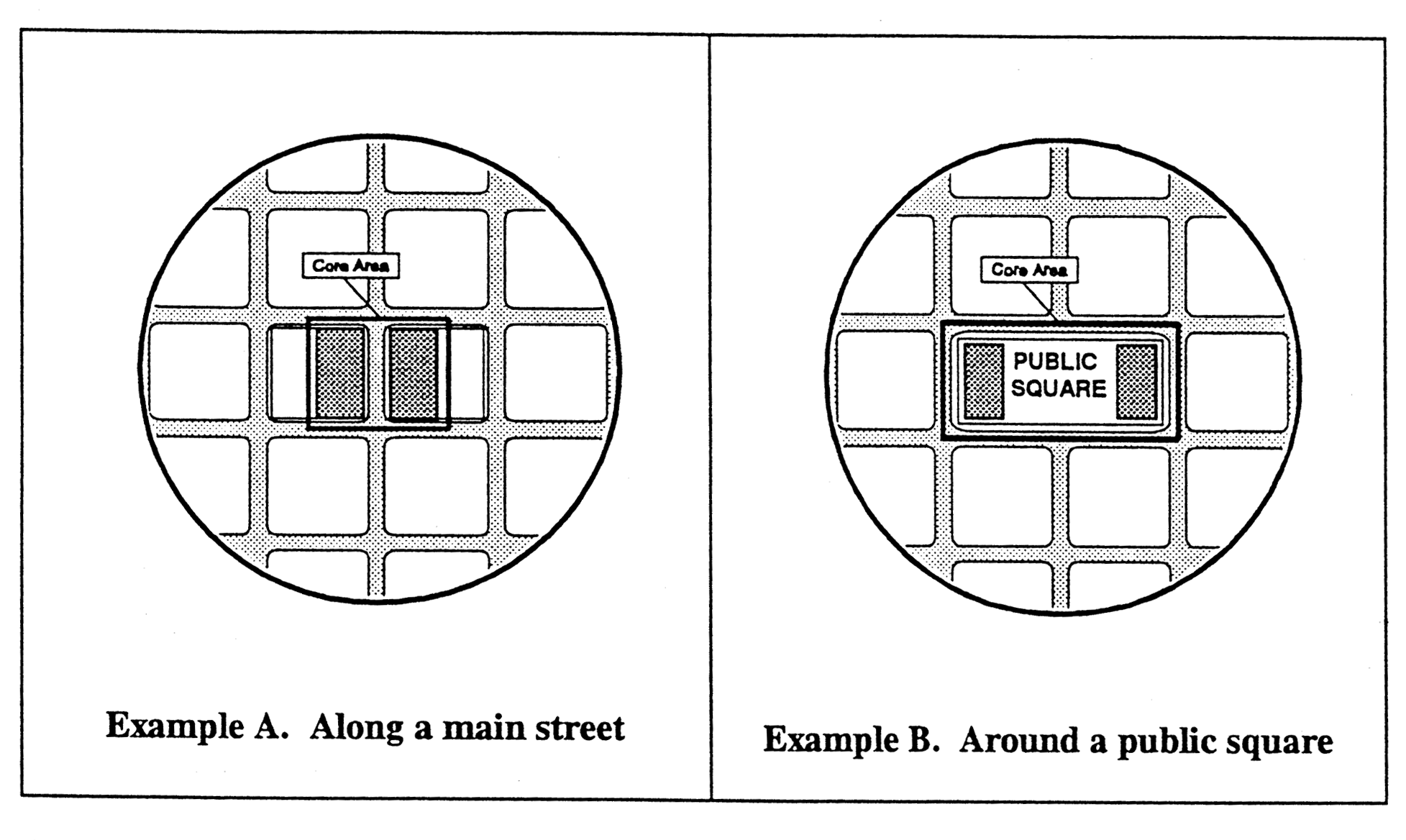
5.91.03. Uses permitted. Only the following uses shall be permitted in the TC, Town Center Zone:
* To be considered as part of development plan review.
**Drive-through facilities are subject to subsection 5.91.04.D that follows, and section 4.108, Standards for Drive-Through Facilities.
5.91.04. Uses permitted on review and regulations regarding those uses.
A.
Private day nurseries and kindergartens, subject to the following standards:
1.
Total building area shall equal seventy (70) square feet of usable play area per child. At least thirty-five (35) square feet of this area per child shall be designated for large motor skill activities.
2.
There shall be a minimum of fifty (50) square feet of usable outdoor play area for each child on the playground at one (1) time with the maximum number of children to be permitted on the playground at one (1) time to be established by the state department of human services at the time of licensing.
3.
As an alternative to subsections 1. and 2. above, the following minimum requirements may be used:
a.
The total lot area shall not be less than ten thousand (10,000) square feet.
b.
The building must provide thirty (30) square feet per child of usable indoor play space, not including halls, kitchen, or office space.
c.
A fenced play area of not less than two thousand five hundred (2,500) square feet for the first twenty (20) children shall be provided. For every additional child, an additional one hundred (100) square feet shall be provided.
4.
The outdoor play area shall be fenced to a minimum height of four (4) feet.
5.
The fenced play area shall be thirty-five (35) feet from any public street. Where the 35-foot setback cannot be met, the applicant may have the option of installing a vehicle barrier that will meet the objectives of separation and safety. The barrier alternative shall be subject to approval by the department of engineering and public works.
6.
Asphalt, concrete, and other non-resilient surfaces shall be prohibited under and around outdoor play equipment where children could possibly fall more than one (1) foot. This includes:
a.
At least two (2) feet around any climbing apparatus.
b.
At least four (4) feet beyond the end of any slide.
c.
At least two (2) feet beyond the end of the arc of any swing.
B.
Marinas, subject to the standards in section 4.30, "Standards for marina and boat livery development."
C.
Parking structures, provided that retail, office or other nonresidential uses are established at ground level along seventy (70) percent of street-oriented facades.
D.
Drive-through facilities:
1.
Banks, each of which may have two (2) drive-through lanes
2.
Pharmacies, each of which may have one (1) drive-through lane.
3.
All drive-through facilities must be designed in similar architectural style to the main building and be located to the rear of the bank or pharmacy. They should be separated from parking areas with at least six (6) feet of continuous landscaped space, planted with similar trees and shrubbery that is used in other portions of the parking lot; the exit from the drive-through shall be back to the alley or parking area exit to minimize vehicle/pedestrian conflicts. Landscaping should not block sight distance to driveways, alley or streets.
5.91.05. Prohibited uses and structures. All uses and structures not of a nature specifically permitted herein are prohibited in the TC, Town Center Zone.
5.91.06. Area regulations.
A.
Minimum size of a TC, Town Center Zone:
1.
Four (4) acres when adjacent to an existing, medium density residential development of four (4) or more acres, which includes pedestrian connections to the town center;
2.
Otherwise, eight (8) acres with a minimum core area of two (2) acres.
The zone shall include the area of streets, alleys, squares and other public places.
B.
Maximum size of a TC, Town Center Zone: the edge of the peripheral area shall not exceed a distance of one thousand two hundred (1,200) feet from the core area.
C.
Area regulations for houses, attached houses, and duplexes are as follows:
(a)
The minimum number of stories in an attached house shall be two (2).
(b)
The maximum front yard setback may be extended to forty (40) feet for all houses on a block to address such constraints as topography, utility easements and tree conservation, provided that the concepts and the need for the greater setbacks are set forth in the development plan.
(c)
Outdoor porches may extend ten (10) feet into the front yard space. Porch steps may extend up to an additional eight (8) feet into the front yard setback. For privacy, the ground level of attached houses should be at least eighteen (18) inches above sidewalks.
(d)
Garages shall be located behind houses, attached houses, and duplexes. When access is provided from alleys, there shall be at least ten (10) feet of separation between the alley pavement and the garage. The garage shall be separated from the residence with a yard or patio area that has a minimum length of eighteen (18) feet.
_____
D.
Area regulations for other uses are as follows:
1.
Front yard: To be determined by the planning commission through approval of a master development plan.
2.
Minimum side yard:
a.
Exterior lots: Same as abutting zoning district.
b.
Corner lots: Same as article 3, "General provisions," subsection 3.30.01.
c.
Interior lots: None.
3.
Minimum rear yard: To be determined by the planning commission through approval of a master development plan.
4.
The maximum site coverage is:
a.
With all parking under the building, ninety (90) percent.
b.
With a parking structure of two (2) or more levels on the same lot, seventy-five (75) percent.
c.
With surface parking on the same lot, fifty (50) percent.
5.
The maximum length of a block is three hundred (300) feet unless buildings on the block are separated by a pedestrian plaza or similar outdoor space that has a minimum of width of thirty (30) feet in which case the length of the block shall not exceed six hundred (600) feet. A minor portion of the pedestrian space can be covered as in the case of such features as an entrance gate or clock tower.
E.
Build-to lines: To be determined by the planning commission through approval of a master development plan.
5.91.07. Building height and number of stories in the core area.
A.
Minimum. Two (2) stories, with the following exceptions and limitations:
1.
One (1) story and one and one-half (1½) story construction is acceptable for new buildings with a ground floor of seven thousand (7,000) square feet or less.
2.
One (1) story grocery stores, not to exceed thirty thousand (30,000) square feet. One (1) story grocery stores that exceed thirty thousand (30,000) square feet must have two (2) story liner buildings, with a use on each floor, that face the most prominent adjacent street(s) as determined in the development plan approval process.
3.
Theatres, churches and other places of worship, and such public facilities as auditoriums may be based on one-story-construction, which the planning commission finds to be compatible in height with other buildings on the street.
4.
Other one (1) story retail uses provided that each block face that contains those buildings has a majority of multi-story buildings. Two (2) or greater story liner buildings, as defined in article 2, "Definitions," may be used to meet this requirement.
5.
The ground floor area of all one (1) story buildings and one and one-half (1½) story buildings shall not exceed twenty-five (25) percent of the total ground floor area of all buildings in the development plan or in any phase of the development plan.
B.
Maximum to be determined by the planning commission through approval of a development plan as required in subsection 5.91.12, "Development plan and standards," with the following exceptions:
1.
Buildings at the edge of a TC Town Center Zone shall not exceed two and one-half (2½) stories and thirty-five (35) feet when abutting a low density residential area as identified in the applicable sector plan.
2.
The overall density of residential development in the peripheral area shall not exceed twelve (12) dwelling units per acre.
5.91.08. Parking. Off-street, surface parking in the core area shall be located behind buildings, with the exception of one (1) aisle as outlined in subsection 5.91.13, "Standards for specific improvements." Off-street parking for nonresidential uses in the peripheral area shall be located behind or to the side of buildings.
On-street parking is to be provided. The number of on-street parking spaces that are created adjacent to the street frontage of a building shall be subtracted from the number of required off-street parking spaces. The planning commission may prohibit on-street parking on arterial or collector streets or on existing streets that cannot, as determined by the director of the department of engineering and public works, be reasonably reconstructed to include on-street parking.
Off-street surface parking for retail uses shall be based on a minimum of seventy (70) percent and a maximum of ninety (90) percent of the required spaces in subsection 3.50.10. There is no maximum for parking spaces when the off-street parking is contained in a parking structure.
Off-street surface parking for other uses shall be based on providing a maximum of ninety (90) percent of the required spaces in subsection 3.50.10, with the following exceptions:
A.
When the core area of the TC Town Center Zone is within a one-quarter (¼) mile walk via sidewalks of a Knoxville Area Transit stop, an additional reduction may be requested of or may be required by the planning commission.
B.
Residential off-street parking shall be provided as follows:
1.
One (1) space for each house or attached house; two (2) spaces for each duplex.
2.
One (1) space for each efficiency or one-bedroom unit in an apartment.
3.
One and one-half (1½) spaces for the first twenty (20) dwelling units of two (2) or more bedrooms in an apartment building and one (1) space for each dwelling unit exceeding twenty (20) units.
Other than houses, attached houses, and duplexes, the number of off-street, surface parking spaces cannot exceed the preceding requirements. All off-street residential parking is to be located off alleys unless the planning commission finds that the extent of existing development or topographic conditions limit such access provisions.
C.
Shared parking arrangements are encouraged and shall be identified in the development plan. An agreement for the use of shared parking shall be submitted with the development plan.
D.
Parking structures that are constructed within the zone may be used to meet the preceding requirements, provided that the development plan identifies the number of spaces that are to be created and the land uses that are to be served by the structure.
5.91.09. Loading and storage of refuse.
A.
Loading. Loading space shall be accommodated to the rear of buildings and shall not include alley or driveway areas.
B.
Storage of refuse. Commercial units shall maintain a separate refuse storage container from that used by residents. It shall be clearly marked for commercial use only and use by residential tenants is prohibited. Refuse storage containers shall be screened on all sides from ground-level view and shall be of the same finishing material used on the principal building.
5.91.10. Landscaping.
A.
Native shade trees that grow to a minimum height of forty (40) feet at maturity shall be planted along all streets at a maximum average spacing of forty (40) feet on center. For the purposes of this requirement, alleys and unimproved rights-of-way are not to be considered streets.
B.
Parking lots containing more than five thousand (5,000) square feet shall be designed and landscaped as follows:
1.
To foster attractive community appearance and to provide for orderly, safe, and systematic circulation within parking areas, off-street parking areas constructed on grade shall meet the following site improvement standards:
a.
Perimeter landscaped buffers shall be provided between the parking lot and alleys, buildings, sidewalks, and other edges of the parking area.
b.
Interior landscaped areas and parking aisles shall be arranged so as to channel traffic and minimize vehicular and pedestrian conflicts within parking areas. The maximum distance between perimeter landscaped buffers and interior landscaped aisles shall be one hundred twenty (120) feet.
c.
Terminal islands shall be provided at the end of all parking aisles and an interior landscaped island shall be provided for every ten (10) parking spaces.
d.
The width of landscaped buffers, aisles and islands shall be a minimum of seven (7) feet. A combination of native shade, evergreen and under-story trees and shrubbery shall be planted in the landscaped areas.
C.
For monument or ground-mounted shingle signs: Appropriately sized shrubbery or flowers shall be planted around the base of the sign.
D.
Along building foundations: For those buildings with front, side or rear yard space, eighty (80) percent of the exterior wall exclusive of doors, loading docks and similar entrances to a building shall be landscaped with shrubbery. This provision does not apply to the front of buildings that meet a sidewalk.
5.91.11. Signs.
A.
A master signage plan shall be part of the development plan. After approval of a master signage plan by the planning commission, the planning commission staff may approve minor changes to the signage plan administratively. For the purpose of these regulations, minor changes include:
1.
An increase in the size of any sign by up to ten (10) percent provided this does not exceed the maximum sizes permitted below.
2.
Changing the text, message, design or material of any sign shall not require approval by the planning commission or planning commission staff, providing that the sign is consistent with the standards contained in the master signage plan.
B.
Types of signs permitted, subject to approval of master signage plan.
1.
Monument signs. Surface area not to exceed twenty (20) square feet on lots with a frontage of one hundred (100) feet or less and thirty (30) square feet on other lots within the zone. Monument signs that are used at entrances to identify the overall zone may be up to one hundred (100) square feet. Monument signs may have two (2) sides.
2.
Shingle signs. Surface area not to exceed twelve (12) square feet on lots with a frontage of one hundred (100) feet or less and eighteen (18) square feet on other lots within the zone. Height shall not exceed six (6) feet.
3.
Directional signs.
4.
Wall signs including projected and face mounted signs.
5.
Window signs, not exceeding ten (10) percent of that window space.
C.
Advertising signs, billboards, and ground signs, with the exception of monument signs, are prohibited.
5.91.12. Development plan and standards. The purpose of the development plan and standards is to create buildings that are of varied design yet complementary to each other. Consistency is expected in establishing setbacks, sidewalks, landscaping, lighting and related features. The development plan must address the features that are outlined below. Design guidelines already approved for a HZ, Historical Overlay Zone may be accepted in fulfillment of this requirement to the extent that the features listed below are addressed.
If the development plan does not include the entire area of the conceptual site plan that was approved at the time of rezoning, then a phasing plan must be submitted for planning commission approval. A phasing plan must include the minimum and maximum square feet and minimum and maximum height of the proposed uses, as well as the projected open space, pedestrian and road systems.
A.
Architectural features.
1.
Building type (for example, slot commercial buildings constructed to sidewalk, attached houses).
2.
Building facade.
3.
Exterior features.
4.
Building height, set backs and build-to line standards.
5.
Roofs and rooftops.
6.
Exterior materials.
7.
Exterior colors.
8.
Permitted signs.
9.
Prohibited signs.
10.
Sign design standards.
B.
On-site and off-site improvements.
1.
Fences and walls.
2.
Main street, square or plaza.
3.
Landscaping.
4.
Special pavement and sidewalk treatments.
(a)
Sidewalks.
(b)
Accent patterns at street intersections.
5.
Setbacks and sidewalk easements.
6.
Street lighting.
7.
Street furniture.
8.
Parking standards.
9.
Refuse storage.
10.
Utilities. All utility lines shall be placed underground with the exception of redevelopment areas in which this provision may be waived by the planning commission.
A plan for the maintenance of the preceding improvements, including appropriate agreements, may be required by the planning commission.
5.91.13. Standards for specific improvements.
A.
Where public transit is available: Loading/unloading space and appropriate shelter shall be provided when the planning commission finds that the zone is large enough to warrant such a facility.
B.
Sidewalks are to be established throughout the zone as follows:
1.
Core area minimum standards.
a.
Ten-foot-wide sidewalks with street trees in tree wells, when one and one-half-story and/or two-story buildings compose the area. A yard space may be established between the buildings and the sidewalk.
b.
Twelve-foot-wide sidewalks for two-story buildings, constructed to the edge of the sidewalk with street trees to be established in tree wells.
c.
Fourteen-foot-wide sidewalks for buildings higher than two (2) stories, constructed to the edge of the sidewalk with street trees to be established in tree wells.
2.
Peripheral area minimum standards.
a.
Five-foot-wide sidewalks with a seven-foot planting strip measured from the street-side edge of the curb when at least five (5) feet of yard space is provided between buildings and sidewalks.
b.
Twelve-foot-wide sidewalks when buildings are established to the edge of the sidewalk with street trees to be established in tree wells.
The planning commission may approve different sidewalk configurations if it finds that the intent of preceding standards which is safe, comfortable pedestrian circulation can be realized through another design. The commission may waive the preceding dimensional requirements in areas with preexisting sidewalks.
C.
The provision of public open space, including squares, plazas, greens and parks shall be required by the planning commission. The amount of required open space(s) shall not exceed ten (10) percent of the area within the zone. Yards, planting strips and landscaped road medians are not to be considered in fulfilling this requirement.
D.
Provisions for block size, building orientation and functional entrances:
1.
Each side of a block shall be no longer than three hundred (300) feet in the core area, unless broken by a pedestrian corridor.
2.
All buildings and liner buildings must front on and have front entrances that are oriented to a street with the exception in subsection 5.91.13.D.3 below.
3.
One (1) aisle of off-street parking with two (2) rows of parking may be considered in front of buildings that are not in the mixed use, "main street" portion of the core area which is the retail mixed use "main street core;" this would allow, for instance, a location for parking that would not compete with a natural feature that is on the site such as parking between a water body and a building.
4.
Functioning entry door(s) shall be provided along ground story facades at intervals not greater than fifty (50) linear feet for retail uses.
5.91.14. Administrative procedures. A TC, Town Center Zone shall be established through a two-step procedure:
A.
Rezoning, including a conceptual site plan, depicting (1) the configuration of streets, public spaces, core area and, if applicable, peripheral area, and (2) the general location, intensity and mix of uses.
B.
Approval of a development plan, subject to the requirements of section 6.50, "Procedures for authorizing uses permitted on review;" section 4.10, "Supplementary regulations applying to a specific, to several, or to all zones," section 2, "Development standards for uses permitted on review," and the additional requirements of this section. The development plan shall include:
1.
A site plan showing compliance with the requirements of the zoning ordinance and other applicable county ordinances.
2.
A landscaping plan.
3.
A master signage plan.
4.
Architectural design guidelines for new development and any changes to the exterior of buildings visible from public roads. Architectural elevation drawings drawn to scale and showing materials to be used may be substituted for architectural design guidelines.
5.
A schedule of permitted uses, including the proposed residential densities. The applicant may ask for approval for all uses listed in subsection 5.91.03, "Uses permitted," above, or the schedule of permitted uses may exclude some of the uses listed in subsection 5.91.03, "Uses permitted." The schedule may also limit the size of individual buildings.
6.
Specific operational standards for permitted hours of operation for any business, delivery of stock in trade or supplies for any business, permitted levels of noise, including amplified sound, from any business or entertainment event, and other such operating restrictions needed to promote compatible coexistence of mixed uses in the development.
7.
If a certificate of appropriateness for the design of buildings, signs, landscaping or parking lots has been approved by the historic zoning commission or their designee, then the planning commission may accept this approval in lieu of a development plan for these project elements.
8.
As part of the development plan, the owner or owners of property within the zone may voluntarily establish a design review committee and enter into covenants or binding agreements to enforce design standards and provide for design review. Documents outlining the committee's responsibilities and review procedures shall be filed with the development plan.
C.
Alternative compliance may be permitted under use-on-review by the planning commission. The purpose of alternative compliance is to foster innovative, high quality, environmentally-sustainable development that meets the intent of this pedestrian-oriented, mixed use zone that would not otherwise be allowed by a strict interpretation of the zone regulations.
D.
After consideration of the development plan, the planning commission may approve, deny, or approve the plan subject to conditions or modifications.
E.
It is the intention of these TC, Town Center Zone regulations that after approval of a development plan, new construction, changes of tenants or land uses, and changes in signage, landscaping or parking layout may be approved administratively by planning commission staff, providing that the executive director certifies that these changes comply with the standards of this ordinance and the approved development plan.
(Ord. No. O-01-6-101, § 1(Exh. A), 7-23-01; Ord. No. O-06-7-101, § 1(Exh. A), 8-28-06; Ord. No. O-09-10-101, § 2(Exh. A), 11-16-09; Ord. No. O-11-1-103, § 1(Exh. A), 2-28-11; Ord. No. O-12-9-102, § 1(Exh. A), 10-22-12; Ord. No. O-19-5-101, § 1(Exh. A), 6-24-19; Ord. No. O-22-2-101, § 2, 3-28-22; Ord. No. O-24-9-101, § 1, 10-21-24)

- ZONE REGULATIONS
5.10.01. General description. This zone provides only for residential areas with low population densities. These areas are intended to be defined and protected from the encroachment of uses not performing a function necessary to the low density residential environment.
5.10.02. Uses permitted.
A.
Houses.
B.
Accessory uses and buildings.
C.
Gardening and horticulture, but not on a commercial basis.
D.
Public utilities, such as transmission lines, substations, railroad lines, bus loading or waiting platforms, dams, water treatment plants, including water filtration and storage facilities, and other similar public service uses and buildings, and also such other buildings and structures, as are used by utility and sanitary districts in the performance of services in which they are authorized to engage.
E.
Demolition landfills less than one (1) acre in size subject to article 4, "Supplementary regulations," subsection 4.80.01.A, "Demolition landfills" (on site generated waste).
F.
Yard sales and rummage sales.
G.
Wireless communications facilities, subject to the provisions of article 4, section 4.92.
5.10.03. Uses permitted on review.
A.
Public Safety Facilities, subject to the standards of section 4.107.
5.10.04. Area regulations. All buildings shall be set back from street or road right-of-way lines and lot lines to comply with the following yard requirements.
5.10.05. Front yard. For dwellings the minimum depth of the front yard shall be thirty-five (35) feet and in no case shall an accessory building be located to extend into the front yard.
5.10.06. Side yard.
A.
For single-story dwellings, located on interior lots, side yards shall be not less than eight (8) feet in width.
B.
For dwellings of more than one (1) story there shall be side yards of not less than twelve (12) feet each.
C.
For unattached buildings of accessory use there shall be a side yard of not less than eight (8) feet; provided, however, that unattached one-story buildings of accessory use shall not be required to set back more than five (5) feet from an interior side lot line when all parts of the accessory building are located more than ninety (90) feet behind the front property line.
5.10.07. Reserved.
5.10.08. Rear yard.
A.
For main buildings there shall be a rear yard of not less than twenty-five (25) feet.
B.
Unattached buildings of accessory use shall not be located closer to any rear lot line than five (5) feet.
5.10.09. Lot width.
A.
Where dwellings are served by a sanitary sewer system there shall be a minimum lot width of seventy-five (75) feet at the front building line.
B.
Where dwellings are not served by a sanitary sewer system there shall be a minimum lot width of one hundred (100) feet at the front building line.
5.10.10. Intensity of use.
A.
Not more than one (1) house shall be permitted on any lot.
B.
For each dwelling, and buildings accessory thereto, served by a sanitary sewer system there shall be a lot area of not less than ten thousand (10,000) square feet.
C.
For each dwelling and buildings accessory thereto, not served by a sanitary sewer system, there shall be a minimum lot area of twenty thousand (20,000) square feet; however, a greater lot area may be required based on recommendations by the county health department.
D.
For those dwellings and buildings accessory thereto not served by a public water supply a minimum lot area as prescribed in the Knoxville-Knox County Minimum Subdivision Regulations, shall be provided.
5.10.11. Maximum lot coverage. Main and accessory buildings shall cover not more than thirty (30) percent of the lot area.
5.10.12. Height regulations. No main building shall exceed three (3) stories or thirty-five (35) feet in height. Accessory buildings shall not exceed eighteen (18) feet in height; provided, however, the eighteen (18) feet height limitation may be exceeded to conform the pitch of the accessory building roof to the pitch of the roof of the principal use. In no case shall the bottom chord of the roof truss or the bottom of the ceiling joist of an accessory building exceed eighteen (18) feet in height.
5.10.13. Off-street parking. As regulated in section 3.50, "Off-street parking requirements," of these regulations.
(Ord. No. O-96-5-102, § 1, 6-21-96; Ord. No. O-98-12-101, § 1(Exh. A), 1-25-99; Ord. No. O-00-8-101, § 1(Exh. A), 9-25-00; Ord. No. O-06-7-101, § 1(Exh. A), 8-28-06; Ord. No. O-12-9-102, § 1(Exh. A), 10-22-12; Ord. No. O-17-10-101, § 1(Exh. A), 11-20-17; Ord. No. O-19-5-101, § 1(Exh. A), 6-24-19)
5.11.01. General description. This residential zone provides for residential areas with low population densities. These areas are intended to be defined and protected from encroachment of uses not performing a function necessary to the residential environment.
5.11.02. Uses permitted.
A.
Houses.
B.
Accessory buildings.
C.
Churches, schools, libraries, and museums.
D.
(Deleted August 17, 1971.)
E.
Gardening and horticulture.
F.
Mobile homes.
G.
Public golf courses, public parks and playgrounds; swimming pools, and other associated recreational facilities, none of which shall be used for commercial purposes.
H.
Public utilities, such as transmission lines, substations, railroad lines, bus loading or waiting platforms, dams, water treatment plants, including water filtration and storage facilities, and other similar public service uses and buildings, and also such other buildings and structures, as are used by utility and sanitary districts in the performance of services in which they are authorized to engage.
I.
Uses customarily incidental to any of the above uses, including home occupation, as regulated by section 4.90, "Home occupations."
J.
Demolition landfills less than one (1) acre in size subject to article 4, "Supplementary regulations," subsection 4.80.01.A, "Demolition landfills" (on site generated waste).
K.
Yard sales and rummage sales.
L.
Day care homes and group day care homes, if the provider lives in the home, subject to the following conditions:
1.
The total lot area shall not be less than ten thousand (10,000) square feet.
2.
The building must provide thirty (30) square feet per child of usable indoor play space, not including halls, kitchen, or office space.
3.
A fenced play area of not less than two thousand five hundred (2,500) square feet shall be provided. No portion of the fenced play area shall be closer than thirty-five (35) feet to any public right-of-way. The minimum height of the fence shall be four (4) feet.
4.
Off-street parking, as regulated in section 3.50, "Off-street parking requirements." In addition, parking and loading areas shall be designed for safe off-street loading and unloading of children, as well as safe and convenient ingress and egress to and from the site. The off-street parking and circulation plan shall be designed to meet the requirements of the department of engineering and public works.
M.
Wireless communications facilities, subject to the provisions of article 4, section 4.92.
5.11.03. Uses permitted on review.
A.
Garage apartments.
B.
Duplexes.
C.
Group day care homes, if the provider does not live on site, provided they meet the requirements of section 4.91, "Requirements for child day care centers and group day care homes, when considered as uses permitted on review," and child day care centers, provided they meet the requirements of section 4.91, "Requirements for child day care centers and group day care homes, when considered as uses permitted on review."
D.
Private golf courses, swimming clubs, country clubs, and tennis clubs.
E.
Nonprofit public and private sports playing fields, none of which shall be used for commercial purposes.
F.
Adult day care centers, provided they meet the requirements of section 4.98, "Requirements for adult day care centers, when considered as uses permitted on review."
G.
Rural retreats, subject to standards of section 4.104.
H.
Public Safety Facilities, subject to the standards of section 4.107.
5.11.04. Area regulations. All buildings shall be set back from street or road right-of-way lines and lot lines to comply with the following yard requirements.
5.11.05. Front yard.
A.
For dwellings the minimum depth of the front yard shall be thirty-five (35) feet and in no case shall an accessory building be located to extend into the front yard.
B.
Churches and other main and accessory buildings, other than dwellings, shall have a front yard set back of thirty-five (35) feet.
5.11.06. Side yard.
A.
For single-story dwellings, located on interior lots, side yards shall be not less than eight (8) feet in width.
B.
For dwellings of more than one (1) story there shall be side yards of not less than twelve (12) feet each.
C.
For unattached buildings of accessory use there shall be a side yard of not less than eight (8) feet; provided, however, that unattached one-story buildings of accessory use shall not be required to set back more than five (5) feet from an interior side lot line when all parts of the accessory building are located more than ninety (90) feet behind the front property line.
D.
Churches and other main and accessory buildings, other than dwellings, and buildings accessory to dwellings, shall set back from all side lot lines a distance of not less than twenty-five (25) feet.
5.11.07. Rear yard.
A.
For main buildings, other than garage apartments, there shall be a rear yard of not less than twenty-five (25) feet.
B.
A garage apartment may be located in the rear yard of houses, but shall not be closer than ten (10) feet to the rear lot line. Unattached buildings of accessory use shall not be located closer to any rear lot line than five (5) feet.
5.11.08. Lot width.
A.
Where dwellings are served by a sanitary sewer system there shall be a minimum lot width of seventy-five (75) feet at the front building line.
B.
Where dwellings are not served by a sanitary sewer system there shall be a minimum lot width of one hundred (100) feet at the front building line.
5.11.09. Intensity of use.
A.
Not more than one (1) dwelling unit shall be permitted on any lot except as provided in subsection 5.11.03, "Uses permitted on review," of these regulations and not more than two (2) dwelling units shall be permitted on any lot under the provisions of this subsection.
B.
For each house and building accessory thereto served by a sanitary sewer system, there shall be a lot area of not less than ten thousand (10,000) square feet.
C.
Where two (2) dwelling units and buildings accessory thereto are located on the same lot served by a sanitary sewer system, there shall be a lot area of not less than twelve thousand (12,000) square feet.
D.
There shall be a lot area of not less than twelve thousand (12,000) square feet where a garage apartment is located on the same lot with a house served by a sanitary sewer.
E.
For each house and buildings accessory thereto, not served by a sanitary sewer system, there shall be a minimum lot area of twenty thousand (20,000) square feet; however, a greater area may be required based on recommendations by the health department.
F.
There shall be a lot area of not less than twenty thousand (20,000) square feet where a garage apartment is located on the same lot with a house not served by a sanitary sewer system. However, a greater area may be required based on recommendations of the health department.
G.
Where two (2) dwelling units and buildings accessory thereto are located on the same lot not served by a sanitary sewer system, there shall be a minimum lot area of twenty thousand (20,000) square feet; however, a greater area may be required based on recommendation by the health department.
H.
For those dwellings and buildings accessory thereto not served by a public water supply, there shall be a minimum lot area as prescribed in the Minimum Subdivision Regulations for Knoxville and Knox County, Tennessee.
I.
For churches and other main and accessory buildings, other than dwellings and buildings accessory to dwellings, the lot area shall be adequate to provide the yard areas required by this section and the off street parking areas required in section 3.50, "Off-street parking requirements," of these regulations; provided, however, that the lot area for a church shall not be less than thirty thousand (30,000) square feet.
5.11.10. Maximum lot coverage. Main and accessory buildings shall cover not more than thirty (30) percent of the lot area.
5.11.11. Height regulations. No main building shall exceed three (3) stories or thirty-five (35) feet in height. Accessory buildings shall not exceed eighteen (18) feet in height; provided, however, the eighteen (18) feet height limitation may be exceeded to conform the pitch of the accessory building roof to the pitch of the roof of the principal use. In no case shall the bottom chord of the roof truss or the bottom of the ceiling joist of an accessory building exceed eighteen (18) feet in height.
5.11.12. Off-street parking. As regulated in section 3.50, "Off-street parking requirements," of these regulations.
5.11.13. Signs. As permitted by section 3.90.
(Ord. No. O-96-3-101, § 1, 4-22-96; Ord. No. O-96-5-102, § 1, 6-21-96; Ord. No. O-97-7-101, § 1, 8-25-97; Ord. No. O-98-12-101, § 1(Exh. A), 1-25-99; Ord. No. O-98-12-102, § 1(Exh. A), 1-25-99; Ord. No. O-00-8-101, § 1(Exh. A), 9-25-00; Ord. No. O-01-2-103, § 1(Exh. A), 3-26-01; Ord. No. O-06-7-101, § 1(Exh. A), 8-28-06; Ord. No. O-12-9-102, § 1(Exh. A), 10-22-12; Ord. No. O-17-8-101, § 1(Exh. A), 9-25-17; Ord. No. O-17-10-101, § 1(Exh. A), 11-20-17; Ord. No. O-19-5-101, § 1(Exh. A), 6-24-19)
5.12.01. General description. This residential zone provides for medium population density. The principal uses of land may range from houses to multi-dwelling structures or developments. Certain uses which are more compatible functionally with intensive residential uses than with commercial uses are permitted. Other related uses in keeping with the residential character of the zone may be permitted on review by the planning commission.
5.12.02. Uses permitted.
A.
Accessory buildings.
B.
Churches, schools, libraries, and museums.
C.
Garage apartments.
D.
Gardening and horticulture, but not on a commercial basis.
E.
Nonprofit public golf courses, public parks and playgrounds; swimming pools, and other associated recreational facilities, none of which shall be used for commercial purposes.
F.
Mobile homes.
G.
Multi-dwelling structures or developments, provided that the development density shall be less than twelve (12) dwelling units per acre.
H.
Nurseries and greenhouses for the propagating and cultivating of plants, but not on a commercial basis.
I.
Public utilities, such as transmission lines, substations, railroad lines, bus loading or waiting platforms, dams, water treatment plants, including water filtration and storage facilities, fire stations, and other similar public service uses and buildings, and also such other buildings and structures, as are used by utility and sanitary districts in the performing of the services in which they are authorized to engage.
J.
Houses and duplexes.
K.
Uses customarily incidental to any of the above uses including home occupation subject to section 4.90, "Home occupations."
L.
Demolition landfills less than one (1) acre in size subject to article 4, "Supplementary regulations," subsection 4.80.01.A, "Demolition landfills" (on site generated waste).
M.
Yard sales and rummage sales.
N.
Day care homes and group day care homes, if the provider lives on site, subject to the following conditions:
1.
The total lot area shall not be less than ten thousand (10,000) square feet.
2.
The building must provide thirty (30) square feet per child of usable indoor play space, not including halls, kitchen, or office space.
3.
A fenced play area of not less than two thousand five hundred (2,500) square feet shall be provided. No portion of the fenced play area shall be closer than thirty-five (35) feet to any public right-of-way. The minimum height of the fence shall be four (4) feet.
4.
Off-street parking, as regulated in section 3.50, "Off-street parking requirements." In addition, parking and loading areas shall be designed for safe off-street loading and unloading of children, as well as safe and convenient ingress and egress to and from the site. The off-street parking and circulation plan shall be designed to meet the requirements of the department of engineering and public works.
O.
Wireless communications facilities, subject to the provisions of article 4, section 4.92.
5.12.03. Uses permitted on review.
A.
Multi-dwelling structures and developments at a density of twelve (12) to twenty-four (24) dwelling units per acre, provided they meet the administrative requirements of subsection 5.13.15, "Administrative procedure for a planned residential development," and the requirements of subsections 4.10.14 through 4.10.19, "Development standards for uses permitted on review," and section 6.50, "Procedures for authorizing uses permitted on review."
B.
Mobile home parks and mobile home subdivisions subject to all requirements set forth in sections 4.20, "Mobile home parks," and 6.50, "Procedures for authorizing uses permitted on review," of these regulations.
C.
Retail business or service establishments may be permitted within multi-dwelling structures and developments only as a use-on-review in accordance with the provisions of section 6.50, "Procedures for authorizing uses permitted on review," of these regulations, and subject to the following requirements:
1.
There shall be no entrance to such place of business except from inside the building.
2.
There shall be no show window, sign, or other advertising matter visible from outside the building.
3.
Such uses shall be conducted for the convenience of the occupants of the building only and shall not cater to outside trade.
4.
The planning commission shall determine the compatibility of such establishments based on the nature, size and number proposed with respect to the number of dwelling units to be served and the availability of similar services in the vicinity.
5.
Detailed plans shall be submitted with the application for use-on-review giving the nature, exact size and location of each such use within the building, the location of all entrances to such use and the exact location of all building ground floor entrances and exits.
D.
Group day care homes, if the provider does not live on site, provided they meet the requirements of section 4.91, "Requirements for child day care centers and group day care homes when considered as uses permitted on review," and child day care centers, provided they meet the requirements of section 4.91, "Requirements for child day care centers and group day care homes when considered as uses permitted on review."
E.
Private golf courses, swimming clubs, country clubs, and tennis clubs.
F.
Assisted living facilities.
G.
Hospitals and sanitariums.
H.
Private or nonprofit sports playing fields, none of which shall be used for commercial purposes.
I.
Adult day care centers, provided they meet the requirements of section 4.98, "Requirements for adult day care centers, when considered as uses permitted on review."
J.
Rural retreats, subject to standards of section 4.104.
K.
Public Safety Facilities, subject to the standards of section 4.107.
5.12.04. Area regulations. All buildings shall be set back from street or road right-of-way and lot lines to comply with the following yard requirements.
5.12.05. Front yard.
A.
For houses, duplexes and multi-dwelling structures and developments the minimum depth of the front yard shall be thirty-five (35) feet and in no case shall an accessory building be located to extend into the front yard. The planning commission may approve a reduction of the front yard if it finds such reduction consistent with section 6.50, "Procedures for authorizing uses permitted on review," and the administrative standards for approval.
B.
Churches and other main and accessory buildings, other than dwellings, shall have a front yard set back of thirty-five (35) feet.
5.12.06. Side yard.
A.
For single-story dwellings, located on interior lots, side yards shall be not less than eight (8) feet in width.
B.
For two- and three-story dwellings there shall be side yards of not less than twelve (12) feet each.
C.
For buildings more than three (3) stories in height, one (1) foot additional side yard on each side of the main building shall be added for each additional two (2) feet in excess of thirty-six (36) feet in height.
D.
For unattached buildings of accessory use there shall be a side yard of not less than eight (8) feet; provided, however, that unattached one-story buildings of accessory use shall not be required to set back more than five (5) feet from an interior side lot line when all parts of the accessory building are located more than ninety (90) feet behind the front property line.
E.
Churches and other main and accessory buildings, other than dwellings, and buildings accessory to dwellings, shall set back from all side lot lines a distance of not less than twenty-five (25) feet.
5.12.07. Rear yard.
A.
For main buildings of three (3) stories in height and less, other than garage apartments, there shall be a rear yard of not less than twenty-five (25) feet.
B.
For all main buildings more than three (3) stories in height, there shall be a rear yard of not less than thirty (30) feet.
C.
A garage apartment may be located in the rear yard of another dwelling, but shall not be located closer than ten (10) feet to the rear lot line. Unattached buildings of accessory use shall not be located closer to any rear lot line than five (5) feet.
5.12.08. Lot width.
A.
For houses and duplexes served by a sanitary sewer system there shall be a minimum lot width of seventy-five (75) feet at the front building line. For houses and duplexes not served by a sanitary sewer system there shall be a minimum lot width of one hundred (100) feet at the front building line.
B.
For multi-dwelling structures and developments there shall be a minimum lot width of one hundred (100) feet at the front building line.
5.12.09. Intensity of use.
A.
The appropriate development density of each multi-dwelling structure or development project having a density of twelve (12) dwelling units or more per acre shall be determined by the planning commission, but shall not exceed twenty-four (24) dwelling units per acre.
B.
For each house, and buildings accessory thereto, served by a sanitary sewer system there shall be a lot area of not less than ten thousand (10,000) square feet.
C.
For each duplex served by a sanitary sewer system there shall be a lot area of not less than twelve thousand (12,000) square feet.
D.
For multi-dwelling structures and developments of one (1) and two (2) stories served by a sanitary sewer system, the lot area requirements shall be not less than nine thousand (9,000) square feet plus an additional one thousand five hundred (1,500) square feet for each dwelling unit.
E.
For those residential structures exceeding two (2) stories served by a sanitary sewer system, the minimum lot area requirements shall be as follows:
For those structures which provide off-street parking within the main building, the lot area requirement may be reduced two hundred (200) square feet per such parking space.
F.
Usable open space areas and recreation uses for multi-dwelling developments and structures may include a community center, a golf course, a swimming pool, or parks, playgrounds or other public recreational uses. Any structures involved in such uses, including lighted tennis courts and swimming pools, shall have a 35-foot setback from all periphery boundary lines. For developments with a density of twelve (12) dwelling units per acre or more, the amount of land set aside for usable open space and recreational uses shall not be less than fifteen (15) percent of the gross development area for a multi-dwelling structure or development occupying twenty (20) or more acres, or ten (10) percent for a multi-dwelling structure or development occupying more than eight (8) but less than twenty (20) acres.
G.
There shall be a lot area of not less than twelve thousand (12,000) square feet where a garage apartment is located on the same lot with a house served by a sanitary sewer. Where a garage apartment is located in the rear yard of a duplex or multi-dwelling structure or development served by a sanitary sewer, the lot area shall not be less than one thousand five hundred (1,500) square feet more than is required for the duplex or multi-dwelling structure or development.
H.
There shall be a lot area of not less than twenty thousand (20,000) square feet where a garage apartment is located on the same lot with a house not served by a sanitary sewer system. When a garage apartment is located in the rear yard of a duplex or multi-dwelling structure or development, not served by a sanitary sewer system, the lot area shall not be less than five thousand (5,000) square feet more than is required for the duplex or multi-dwelling structure or development.
I.
For those houses and buildings accessory thereto, not served by a sanitary sewer system, there shall be a minimum lot area of twenty thousand (20,000) square feet; however, a greater area may be required based on recommendations by the health department.
J.
For duplexes and buildings accessory thereto, not served by a sanitary sewer system, there shall be a minimum lot area of twenty thousand (20,000) square feet; however, a greater area may be required based on recommendations by the health department.
K.
For multi-dwelling structures and developments not served by a sanitary sewer system, there shall be a lot area of not less than twenty thousand (20,000) square feet for the first two (2) units, plus two thousand five hundred (2,500) square feet for each additional dwelling unit. Where off-street parking is provided within the main structure the lot area requirement may be reduced one hundred fifty (150) square feet per such parking space. However, in any case a greater lot area than herein specified may be required based on recommendations by the health department.
L.
For those dwellings and buildings accessory thereto not served by a public water supply there shall be a minimum lot area as prescribed in the minimum subdivision regulations for Knoxville and Knox County, Tennessee.
M.
For churches and other main and accessory buildings, other than dwellings and buildings accessory to dwellings, the lot area shall be adequate to provide the yard areas required by this section and the off-street parking areas required in section 3.50, "Off-street parking requirements," of these regulations; provided, however, that the lot area for a church shall not be less than thirty thousand (30,000) square feet.
5.12.10. Maximum lot coverage. The maximum lot area which may be covered by main buildings shall be as follows:
5.12.11. Height regulations. Houses and duplexes shall not exceed thirty-six (36) feet in height. The height of multi-dwelling structures approved as a use-on-review by the planning commission shall be determined by the planning commission. The height of other main buildings shall be unlimited. Accessory buildings shall not exceed eighteen (18) feet in height; provided, however, the eighteen (18) feet height limitation may be exceeded to conform the pitch of the accessory building roof to the pitch of the roof of the principal use. In no case shall the bottom chord of the roof truss or the bottom of the ceiling joist of an accessory building exceed eighteen (18) feet in height.
5.12.12. Off-street parking. As regulated in section 3.50, "Off-street parking requirements," of these regulations, except as provided for in subsection 5.12.09, "Intensity of use," above.
5.12.13. Signs. As permitted by section 3.90.
(Ord. No. O-96-3-101, § 1, 4-22-96; Ord. No. O-96-5-102, § 1, 6-21-96; Ord. No. O-97-7-101, § 1, 8-25-97; Ord. No. O-97-10-101B, § 1, 11-17-97; Ord. No. O-96-11-104, § 1, 3-23-98; Ord. No. O-98-12-101, § 1(Exh. A), 1-25-99; Ord. No. O-98-12-102, § 1(Exh. A), 1-25-99; Ord. No. O-00-8-101, § 1(Exh. A), 9-25-00; Ord. No. O-01-2-103, § 1(Exh. A), 3-26-01; Ord. No. O-06-7-101, § 1(Exh. A), 8-28-06; Ord. No. O-12-9-102, § 1(Exh. A), 10-22-12; Ord. No. O-17-8-101, § 1(Exh. A), 9-25-17; Ord. No. O-17-10-101, § 1(Exh. A), 11-20-17; Ord. No. O-19-5-101, § 1(Exh. A), 6-24-19; Ord. No. O-22-2-101, § 1, 3-28-22)
5.13.01. General description. The regulations established in this zone are intended to provide optional methods of land development which encourage more imaginative solutions to environmental design problems. Residential areas thus established would be characterized by a unified building and site development program, open space for recreation and provision for commercial, religious, educational, and cultural facilities which are integrated with the total project by unified architectural and open space treatment.
Each planned unit development shall be compatible with the surrounding or adjacent zones. Such compatibility shall be determined by the planning commission by review of the development plans.
A planned unit development occupying not less than twenty (20) acres may contain commercial uses as hereinafter provided.
5.13.02. Permitted uses.
A.
The following dwelling units are permitted:
1.
Houses and attached houses, not including mobile homes.
2.
Duplexes.
3.
Multi-dwelling structures and developments.
B.
Accessory uses, buildings and structures.
C.
Commercial uses in a planned unit development occupying not less than twenty (20) acres only. Commercial uses shall include marinas and boat liveries, provided they meet the requirements of section 4.30, "Standards for marina and boat livery development," of these regulations. One (1) acre of commercial uses may be permitted for each one hundred (100) units in the project provided that twenty-five (25) percent of the total units proposed shall be ready for occupancy prior to any commercial building permit being issued. Such commercial uses shall conform with the use and parking requirements of the Shopping Center Zone as regulated in section 5.34, "Shopping Center Zone (SC)," of these regulations.
D.
Recreation uses. Recreation uses may include a community center, a golf course, a swimming pool, or parks, playground or other public recreational uses. Any structures involved in such uses, including lighted tennis courts, and swimming pools, shall have a 35-foot set back from all periphery boundary lines. The amount of land set aside for usable open space and recreational use shall be not less than fifteen (15) percent of the gross development area for a planned unit development occupying twenty (20) or more acres or ten (10) percent for a planned unit development occupying more than eight (8) but less than twenty (20) acres.
E.
Education uses.
F.
Community facilities uses such as churches and other religious institutions and nonprofit clubs such as country clubs, swimming and/or tennis clubs.
G.
Other uses, deemed compatible with the proposed development by the planning commission, including home occupations subject to section 4.90, "Home occupations."
H.
Demolition landfills less than one (1) acre in size subject to article 4, "Supplementary regulations," subsection 4.80.01.A, "Demolition landfills" (on site generated waste).
I.
Yard sales and rummage sales.
J.
Day care homes and group day care homes, if the provider lives on site, subject to the following conditions:
1.
The total lot area shall not be less than ten thousand (10,000) square feet.
2.
The building must provide thirty (30) square feet per child of usable indoor play space, not including halls, kitchen, or office space.
3.
A fenced play area of not less than two thousand five hundred (2,500) square feet shall be provided. No portion of the fenced play area shall be closer than thirty-five (35) feet to any public right-of-way. The minimum height of the fence shall be four (4) feet.
4.
Off-street parking, as regulated in section 3.50, "Off-street parking." In addition, parking and loading areas shall be designed for safe off-street loading and unloading of children, as well as safe and convenient ingress and egress to and from the site. The off-street parking and circulation plan shall be designed to meet the requirements of the department of engineering and public works.
K.
Wireless communications facilities, subject to the provisions of article 4, section 4.92.
5.13.03. Uses permitted on review.
A.
Group day care homes, if the provider does not live on site, provided they meet the requirements of section 4.91, "Requirements for child day care centers and group day care homes, when considered as uses permitted on review," and child day care centers, provided they meet the requirements of section 4.91, "Requirements for child day care centers and group day care homes, when considered as uses permitted on review."
B.
Assisted living facilities.
C.
Adult day care centers, provided they meet the requirements of section 4.98, "Requirements for adult day care centers, when considered as uses permitted on review."
D.
Rural retreats, subject to standards of section 4.104.
E.
Public Safety Facilities, subject to the standards of section 4.107.
5.13.04. Area regulations. All buildings and structures shall be set back from street or road right-of-way lines and from the periphery of the project to comply with the following requirements.
5.13.05. Front yard.
A.
Houses, twenty (20) feet.
B.
All other as determined by the planning commission with the setback being increased in proportion to structure height, but not less than fifteen (15) feet from a street or road right-of-way.
5.13.06. Periphery boundary. All buildings shall be set back from the periphery boundary not less than thirty-five (35) feet unless adjacent to A, Agricultural, RA, Low Density Residential, RB, General Residential, RAE, Exclusive Residential, PR, Planned Residential, OS, Open Space, E, Estates, or TC, Town Center zone districts, where the planning commission may reduce this set back to not less than fifteen (15) feet.
5.13.07. Side yard.
A.
As determined by the planning commission but not greater than fifteen (15) feet unless this setback is also the periphery boundary.
B.
Where side yards are reduced to zero (0) the development site plans and restrictive covenants which provide for the privacy of such units and the right of maintenance of exterior walls facing adjacent properties shall be submitted to the planning commission.
5.13.08. Rear yard.
A.
As determined by the planning commission but the planning commission may not require a setback greater than thirty-five (35) feet.
5.13.09. Default minimum setbacks. For situations when there are no building setbacks specified on approved development plans and when not controlled by a periphery boundary setback, the minimum setbacks for main structures will be as follows:
Front: Not less than twenty (20) feet.
Side: Not less than five (5) feet.
Rear: Not less than fifteen (15) feet.
Accessory structures, when not controlled by the periphery boundary setback, shall be subject to the minimum accessory structure setbacks of the RA, Low Density Residential zoning district.
5.13.10. Lot area and size.
A.
Developments which subdivide and transfer property with the sale of individual units but which do not provide common open space controlled and maintained by a public body or a duly established homeowners association shall provide lot areas which are not less than three thousand (3,000) square feet in size and which shall average four thousand (4,000) square feet per lot for the entire development.
B.
Developments which subdivide and transfer property with the sale of individual units and which provide common open space controlled and maintained by a duly established home owners association in accordance with state law shall be permitted to create lots less than three thousand (3,000) square feet in size subject to planning commission approval of a site plan, consistent with the intent as stated in the general description of this section.
5.13.11. Maximum site coverage.
A.
The maximum area which may be covered by buildings shall be fifty (50) percent of the gross acreage of the site.
5.13.12. Height regulations.
A.
Houses and duplexes shall not exceed three (3) stories.
B.
Height of all others shall be as determined by the planning commission.
5.13.13. Population density.
A.
The appropriate development density of each project shall be determined by the planning commission but shall not exceed twenty-four (24) dwelling units per acre excluding areas set aside for churches, schools, or commercial uses.
5.13.14. Off-street parking. As regulated in section 3.50, "Off-street parking requirements," of these regulations.
5.13.15. Administrative procedure for a planned residential development.
A.
The planning commission may recommend establishment of a PR, Planned Residential Zone or an application may be made to the planning commission for rezoning to PR, Planned Residential in accordance with the regulations set forth in section 6.30, "Amendments," of this resolution.
B.
No building permit shall be issued for development of any property within a PR, Planned Residential Zone until a written application for review and approval of the development plan has been filed with the planning commission. This same requirement shall apply to multi-dwelling structures and developments as required under the RB, General Residential Zone, when the density of the development is twelve (12) dwelling units per acre or greater. Said application shall be made in conformity with section 6.50, "Procedure for authorizing uses permitted on review," of these regulations and shall be accompanied by the following information:
1.
The application must be accompanied by an overall development plan showing the use or uses, dimensions and locations of proposed streets, parks, playgrounds, school sites, and other open spaces, with such other pertinent information as may be necessary to determine the contemplated arrangement or use which makes it desirable to apply regulations and requirements different from those ordinarily applicable under these regulations.
2.
The proposed development plan shall be prepared by and have the seal of an architect or engineer duly registered to practice in the state.
3.
The planning commission shall review the conformity of the proposed development and shall recognize principles of good civic design, land use planning and landscape architecture. The planning commission and county board of commissioners may impose conditions regarding layout, circulation, and performance of the proposed development and may require that appropriate deed restrictions be filed.
4.
Applications considered under the planned residential zoning must be filed by the property owner or their designated representative, by an appropriate governmental agency, or the county board of commissioners.
(Ord. No. O-96-3-101, § 1, 4-22-96; Ord. No. O-96-5-102, § 1, 6-21-96; Ord. O-97-10-101B, § 1, 11-17-97; Ord. No. O-96-11-104, § 1, 3-23-98; Ord. No. O-99-9-101, § 1, 10-25-99; Ord. No. O-01-2-103, § 1(Exh. A), 3-26-01; Ord. No. O-05-6-103, § 1(Exh. A), 7-25-05; Ord. No. O-06-7-101, § 1(Exh. A), 8-28-06; Ord. No. O-11-2-101, § 1(Exh. B), 3-28-11; Ord. No. O-12-9-102, § 1(Exh. A), 10-22-12; Ord. No. O-17-8-101, § 1(Exh. A), 9-25-17; Ord. No. O-17-10-101, § 1(Exh. A), 11-20-17; Ord. No. O-19-5-101, § 1(Exh. A), 6-24-19; Ord. No. O-22-2-101, §§ 1, 2, 3-28-22)
5.20.01. General description. This open space preservation zone is established to provide areas in which the principal use of land is devoted to open space and/or the preservation and protection of park and recreation lands, wilderness areas, beach and shoreline areas, scenic routes, wild and scenic rivers, historical and archeological sites, watersheds and water supply areas, hiking, cycling and equestrian trails and fish and wildlife and their habitats. Property classified under this zone shall meet the criteria set forth in the open space plan approved by the county, and only property so zoned shall be considered as open space for the purposes of property assessment under the Agricultural, Forest and Open Space Land Act of 1976, provided the other conditions for inclusion under the act are satisfied.
5.20.02. Uses permitted.
A.
The following agricultural uses: Horticulture, floriculture, forests and woods and home gardens, but not dairying, the commercial raising and maintaining of poultry and other livestock, feed lots, the raising of fur bearing animals, fish or minnow hatcheries, riding academies, livery or boarding stables or dog kennels.
B.
Houses.
C.
Park and recreation uses including: Parks, playgrounds, golf courses, cycling, hiking and equestrian trails, parkways, country clubs (excluding primary and accessory structures) hunting preserves, camps and resorts, fishing lakes, scenic routes and wild or scenic river or streams.
D.
Conservation areas including: Watershed protection areas, public water supply points, lakes and reservoirs, wildlife management areas and significant natural areas.
E.
Historic and archeological areas.
F.
Home occupation subject to section 4.90, "Home occupations."
G.
Accessory uses incidental to the primary use of the property when located on the same lot including parking of not more than two (2) commercial vehicles and/or trailers used by the residents in their home occupation.
H.
Demolition landfills less than one (1) acre in size subject to article 4, "Supplementary regulations," subsection 4.80.01.A, "Demolition landfills" (on site generated waste).
I.
Yard sales and rummage sales.
J.
Wireless communications facilities, subject to the provisions of article 4, section 4.92.
5.20.03. Uses permitted on review.
A.
Duplexes and multi-dwelling structures or developments at a gross density of not more than twelve (12) units per acre.
B.
Marinas and boat liveries, subject to the standards of section 4.30, "Standards for marina and boat livery development," of these regulations.
5.20.04. Area regulations. All buildings shall be set back from the street right-of-way lines and property lines to comply with the following yard requirements.
5.20.05. Front yard. The minimum depth of the front yard shall be fifty (50) feet.
5.20.06. Side yard. For single-story main and accessory structures side yards shall be not less than twenty (20) feet and an additional four (4) feet shall be provided on each side yard for each additional story, or part thereof, for structures exceeding one (1) story.
5.20.07. Rear yard.
A.
There shall be a rear yard for main buildings of not less than fifty (50) feet.
B.
Unattached buildings of accessory use shall not be located closer to any rear lot line than twenty (20) feet.
5.20.08. Lot width. No lot shall be less than two hundred (200) feet wide at the front building line.
5.20.09. Intensity of use. No parcel of land shall be reduced in area to provide separate lots or building sites containing less than three (3) acres.
5.20.10. Maximum lot coverage. All manmade structures or features, excluding earthwork which has been seeded or otherwise returned to its natural condition, shall cover not more than five (5) percent of the lot area.
5.20.11. Height regulations. No manmade structure or feature shall exceed two and one-half (2 ½) stories or thirty-five (35) feet in height, except as provided in subsection 3.20.03, "Height" (exceptions).
5.20.12. Off-street parking. As regulated in section 3.50, "Off-street parking requirements," of these regulations.
5.20.13. Administration. Any request for development for other than one (1) house on the site shall require site plan approval by the planning commission through the use-on-review process.
(Ord. No. O-99-9-101, § 1, 10-25-99; Ord. No. O-06-7-101, § 1(Exh. A), 8-28-06; Ord. No. O-12-9-102, § 1(Exh. A), 10-22-12; Ord. No. O-17-10-101, § 1(Exh. A), 11-20-17; Ord. No. O-22-2-101, § 2, 3-28-22)
5.21.01. General description. This zone is for residential areas at very low population densities and for other uses compatible with the residential environment. These areas are intended to be defined and protected from encroachment of uses not compatible with residences.
5.21.02. Uses permitted.
A.
Houses and duplexes.
B.
Accessory buildings.
C.
Churches, schools, libraries, and museums.
D.
Garage apartments.
E.
Gardening and horticulture.
F.
Public golf courses, public parks and playgrounds; swimming pools, and other associated recreational facilities, none of which shall be used for commercial purposes.
G.
Mobile homes.
H.
Public utilities, such as transmission lines, substations, railroad lines, bus loading or waiting platforms, dams, water treatment plants, including water filtration and storage facilities, and other similar public service uses and buildings, and also such other buildings and structures, as are used by utility and sanitary districts in the performance of services in which they are authorized to engage.
I.
Home occupation subject to section 4.90, "Home occupations."
J.
Uses customarily incidental to any of the above uses, including parking of not more than two (2) commercial vehicles and/or trailers used by the residents in their home occupation.
K.
Farming, including all types of agriculture and horticulture, but not on commercial basis.
L.
Demolition landfills less than one (1) acre in size subject to article 4, "Supplementary regulations," subsection 4.80.01.A, "Demolition landfills" (on site generated waste).
M.
Yard sales and rummage sales.
N.
Wireless communications facilities, subject to the provisions of article 4, section 4.92.
5.21.03. Uses permitted on review.
A.
Private golf courses, swimming clubs, country clubs, and tennis clubs.
B.
Rural retreats, subject to standards of section 4.104.
C.
Public Safety Facilities, subject to the standards of section 4.107.
5.21.04. Height. No main building shall exceed three (3) stories or thirty-five (35) feet in height. Accessory buildings shall not exceed eighteen (18) feet in height; provided, however, the eighteen (18) feet height limitation may be exceeded to conform the pitch of the accessory building roof to the pitch of the roof of the principal use. In no case shall the bottom chord of the roof truss or the bottom of the ceiling joist of an accessory building exceed eighteen (18) feet in height.
5.21.05. Lot area. The minimum requirements shall be two (2) acres for either a house or a duplex and no building or buildings shall occupy more than thirty (30) percent of its lot area.
5.21.06. Lot width. No lot shall be less than two hundred (200) feet wide at the front building line.
5.21.07. Setback. No building shall be located closer than fifty (50) feet to the road line.
5.21.08. Side yards. There shall be side yard on each side of every building, the minimum width of which shall be ten (10) feet and the least sum of the widths of both side yards shall be twenty-five (25) feet; and no accessory building shall be located within or so as to project into either side yard.
5.21.09. Rear yard. There shall be a rear yard on every lot, which rear yard shall have a minimum depth of fifty (50) feet; and no accessory building shall be located closer to any rear lot line than five (5) feet.
5.21.10. Off-street parking. As regulated in section 3.50, "Off-street parking requirements" of these regulations.
(Ord. No. O-96-5-102, § 1, 6-21-96; Ord. No. O-97-7-101, § 1, 8-25-97; Ord. No. O-98-12-101, § 1(Exh. A), 1-25-99; Ord. No. O-00-8-101, § 1(Exh. A), 9-25-00; Ord. No. O-06-7-101, § 1(Exh. A), 8-28-06; Ord. No. O-12-9-102, § 1(Exh. A), 10-22-12; Ord. No. O-17-8-101, § 1(Exh. A), 9-25-17; Ord. No. O-17-10-101, § 1(Exh. A), 11-20-17; Ord. No. O-19-5-101, § 1(Exh. A), 6-24-19)
5.22.01. General description. This zone provides for a wide range of agricultural and related uses as well as residential uses with low population densities and other compatible uses which generally require large areas or open spaces.
5.22.02. Uses permitted.
A.
Houses and duplexes.
B.
Churches, schools, libraries and museums.
C.
Farming, including all types of agriculture and horticulture; commercial dairies; rabbit, goat and other animal or fish and minnow raising farms; egg-producing ranches and farms devoted to the hatching, raising, fattening and butchering of chickens, pigeons, turkeys and other poultry; and hog and other feeding for commercial purposes.
D.
Garage apartments.
E.
Mobile homes, but not mobile home parks.
F.
Portable sawmills.
G.
Roadside stands.
H.
Signs as permitted by section 3.90, "Signs, billboards, and other advertising structures," of this resolution.
I.
Public utilities, such as transmission lines, substations, railroad lines, bus loading or waiting platforms, dams, water treatment plants, including water filtration and storage facilities, and other similar public service uses and buildings, and also such other buildings and structures, as are used by utility and sanitary districts in the performance of services in which they are authorized to engage.
J.
Home occupation subject to section 4.90, "Home occupations."
K.
Uses customarily incidental to any of the above uses, including parking of not more than two (2) commercial vehicles and/or trailers used by the residents in their home occupation.
L.
Demolition landfills less than one (1) acre in size subject to article 4, "Supplementary regulations," subsection 4.80.01.A, "Demolition landfills" (on site generated waste).
M.
Yard sales and rummage sales.
N.
Day care homes and group day care homes, if the provider lives on site, subject to the following conditions:
1.
The total lot area shall not be less than ten thousand (10,000) square feet.
2.
The building must provide thirty (30) square feet per child of usable indoor play space, not including halls, kitchen, or office space.
3.
A fenced play area of not less than two thousand five hundred (2,500) square feet shall be provided. No portion of the fenced play area shall be closer than thirty-five (35) feet to any public right-of-way. The minimum height of the fence shall be four (4) feet.
4.
Off-street parking, as regulated in section 3.50, "Off-street parking requirements." In addition, parking and loading areas shall be designed for safe off-street loading and unloading of children, as well as safe and convenient ingress and egress to and from the site. The off-street parking and circulation plan shall be designed to meet the requirements of the department of engineering and public works.
O.
Wireless communications facilities, subject to the provisions of article 4, section 4.92.
5.22.03. Uses permitted on review.
A.
Aircraft landing fields, hangars and equipment.
1.
The general intent of this subsection is to insure the development of aircraft landing fields, hangars, equipment and local traffic patterns in agricultural zones, which will also afford some protection to residences in the area and which will hereby promote the public health, safety, morals and general welfare of the citizens of the county.
a.
Before a landing field can be located in an agricultural zone, plans for the run-ways, local traffic pattern, hangars and other incidental uses of the airport shall be submitted to the planning commission for approval.
b.
Where airport landing fields and hangars are already established in the county, plans for the expansion of additional buildings, run-ways, hangars, or where local traffic pattern has been changed because of expansion, or where additional uses are added such as the sale of planes, flight schools, or eating establishments (except vending machines) shall be submitted to the planning commission for approval.
2.
The planning commission shall have the power to authorize the issuance of a permit after the plans have been approved and certified by the county board of commissioners, and before a permit can be issued by the director of the code administration and enforcement department for an addition to an existing operation or the location of a new airport, if the planning commission finds that the conditions are such that the location or expansion will not:
a.
Increase the hazard from planes flying over houses.
b.
Diminish value of land and buildings throughout the surrounding area within one thousand (1,000) feet of the airport.
c.
Increase the congestion or traffic hazards in the public streets and highways adjacent to the airport.
d.
Otherwise impair the public health, safety, comfort, morals and general welfare of the inhabitants of the county.
3.
Then the planning commission may impose such conditions as will lessen any injury to the character of the area and shall submit their recommendations to the county board of commissioners.
4.
Administration. The planning commission shall approve or disapprove the plans, and if approved, shall submit the plans to the county board of commissioners who shall hold a public hearing thereon, the time and place of which shall be given by one (1) publication in a newspaper of general circulation in the county (T.C.A. §§ 13-404 and 13-405). Such notice shall state the place at which the text and maps as certified by the planning commission may be examined.
B.
Sanitary landfill subject to meeting all requirements set forth in section 4.70, "Sanitary landfills," and section 6.50, "Procedure for authorizing uses permitted on review," of these regulations.
C.
Boat liveries, subject to the standards of section 4.30, "Standards for marina and boat livery development," of these regulations.
D.
Cemeteries.
E.
Dog kennels.
F.
Golf courses and public, private, and commercial golf driving ranges.
G.
Indoor storage.
H.
Livery stables.
I.
Lodging and boarding houses.
J.
Rifle ranges.
K.
The following uses may be permitted provided that, no such use shall be located nearer than three hundred (300) feet to a public park, school, church, hospital, sanitarium, residential zone or land subdivided and restricted to residential uses, except as otherwise provided in section 4.50, "Standards for mining and mineral extraction," of these regulations.
1.
Mining and mineral extraction subject to all requirements set forth in section 4.10, "Supplementary regulations applying to a specific, to several, or to all zones," and section 4.50, "Standards for mining and mineral extraction," of these regulations.
L.
Demolition landfills, off-site, subject to article 4, "Supplementary regulations," subsection 4.80.01.B, "Demolition landfills," (off-site generated waste).
M.
Veterinary clinics and animal hospitals meeting the following standards:
1.
No animals shall be kept outdoors within one hundred (100) feet of any residence other than that of the owner or user of the property.
2.
The applicant shall demonstrate that the use of the property will not create nuisance conditions for adjoining properties due to noise, odor, or lack of adequate sanitation.
N.
Group day care homes, if the provider does not live on site, provided they meet the requirements of section 4.91, "Requirements for child day care centers and group day care homes, when considered as uses permitted on review," and child day care centers, provided they meet the requirements of section 4.91, "Requirements for child day care centers and group day care homes, when considered as uses permitted on review."
O.
Public parks and playgrounds and public, private and commercial sports playing fields.
P.
Commercial mulching operation, consistent with the requirements of subsections 4.10.14 through 4.10.19, "Development standards for uses permitted on review," section 4.96, "Standards for the use-on-review approval of commercial mulching operations," and section 6.50, "Procedure for authorizing uses permitted on review," of these regulations.
Q.
Composting facility, consistent with the requirements of subsections 4.10.14 through 4.10.19, "Development standards for uses permitted on review," section 4.95, "Standards for the use-on-review approval of solid waste processing facilities," and section 6.50, "Procedure for authorizing uses permitted on review," of these regulations.
R.
Marinas, subject to the standards of section 4.30, "Standards for marina and boat livery development," of these regulations.
S.
Indoor and outdoor paintball airsoft ranges, subject to the requirements of article 4, "Supplementary Regulations," section 4.97, "Standards for the approval of indoor and outdoor paintball/airsoft ranges."
T.
Adult day care centers, provided they meet the requirements of section 4.98, "Requirements for adult day care centers, when considered as uses permitted on review."
U.
Storage of school buses under contract to a public or private school system. See article 3, "General provisions," section 3.54, "Storage of school buses" for facility development criteria.
V.
Retail sales of agricultural products grown on site, or acquired elsewhere and then maintained on the site, subject to the following restrictions:
1.
There shall be a minimum lot area of ten (10) acres.
2.
Sales area and related facilities, including parking area, shall not occupy more than four (4) acres of the property. The sales area shall be subordinate and incidental in scope and size to the principal agricultural use of the property.
a.
"Sales area" is defined as the area where the purchase of agricultural products takes place and where certain fertilizer, herbicides, fungicides, irrigation equipment and landscape supplies are stored or displayed.
b.
"Related facilities" is defined as non-connected buildings, sheds, coverings or awnings used for storage of equipment or material that is used in the business. Greenhouses are not considered related facilities.
3.
The majority of retail inventory must be grown on site. Items for sale must be limited to those produced through farming as described under subsection 5.22.02 C. above; nursery products such as trees, shrubs, flowers, bedding plants, and other plant stock; and mulch, compost, fertilizer, irrigation equipment, herbicides, fungicides and other landscape materials, not produced on site.
4.
The retail sales area shall be open to the public only between 7:00 a.m. and 9:00 p.m.
5.
Any proposed signage shall comply with section 3.90.06, "Agricultural Zones," of these regulations and shall be approved with the site plan.
6.
The retail operation shall be screened from adjoining property by a landscaping screen, provided that the planning commission finds that the screening is necessary to protect adjoining properties from visual and noise impacts of the sales area.
7.
The retail sales area, including the building layout, parking area, and signage, shall be designed to minimize its impact on the character of the surrounding area.
W.
Rural retreats, subject to standards of section 4.104.
X.
Public Safety Facilities, subject to the standards of section 4.107.
5.22.04. Area regulations. All buildings shall be set back from street or road right-of-way lines and lot lines to comply with the following yard requirements.
A.
Front yard.
1.
For dwellings the minimum depth of the front yard shall be forty (40) feet and in no case shall an accessory building, other than accessory farm buildings, be located between the principal structure and the street.
2.
Churches and other main and accessory buildings, other than dwellings, shall have a front yard setback of fifty (50) feet.
B.
Side yard.
1.
For single-story dwellings, located on interior lots, side yards shall be not less than ten (10) feet in width.
2.
For unattached buildings of accessory use there shall be a side yard of not less than ten (10) feet provided, however, that unattached one-story buildings of accessory use shall not be required to set back more than eight (8) feet from an interior side lot line when all parts of the accessory building are located more than ninety (90) feet behind the front property line.
3.
Churches and other main and accessory buildings, other than dwellings, and buildings accessory to dwellings, shall set back from all side lot lines a distance of not less than thirty-five (35) feet.
C.
Rear yard.
1.
For main buildings, other than garage apartments, there shall be a rear yard of not less than thirty-five (35) feet.
2.
A garage apartment may be located in the rear yard of another dwelling, but shall not be located closer than fifteen (15) feet to the rear lot line. Unattached buildings of accessory use shall not be located closer to any rear lot line than eight (8) feet.
D.
Lot width. No lot shall be less than one hundred (100) feet wide at the building line.
E.
Intensity of use.
1.
For residential development, there shall be a lot area of not less than one (1) acre per dwelling, as follows:
a.
For each house or mobile home, and buildings accessory thereto, there shall be a minimum lot area of not less than one (1) acre.
b.
For each duplex, and buildings accessory thereto, there shall be a minimum lot area of not less than two (2) acres.
c.
For each multi-dwelling development, and buildings accessory thereto, up to two (2) dwelling units (two (2) houses or a house with a garage apartment) may be located on a recorded lot that is two (2) acres or more.
2.
For uses other than residential development, the lot area shall be adequate to provide the yard areas required by this section and the off-street parking areas required in section 3.50, "Off-street parking requirements," of these regulations; provided, however, that the lot area for a church shall not be less than one (1) acre.
F.
Maximum lot coverage. Main and accessory buildings shall cover not more than thirty (30) percent of the lot area.
5.22.05. Height regulations. No main building shall exceed three (3) stories or thirty-five (35) feet in height. Accessory buildings shall not exceed eighteen (18) feet in height; provided, however, the eighteen (18) feet height limitation may be exceeded to conform the pitch of the accessory building roof to the pitch of the roof of the principal use. In no case shall the bottom chord of the roof truss or the bottom of the ceiling joist of an accessory building exceed eighteen (18) feet in height.
5.22.06. Off-street parking. As regulated in section 3.50, "Off-street parking requirements," of these regulations.
(Ord. No. O-96-3-101, § 1, 4-22-96; Ord. No. O-96-5-102, § 2, 6-21-96; Ord. No. O-98-12-102, § 1(Exh. A), 1-25-99; Ord. No. O-99-8-101, § 1, 9-27-99; Ord. No. O-99-9-101, § 1, 10-25-99; Ord. No. O-00-8-101, § 1(Exh. A), 9-25-00; Ord. No. O-00-11-106, § 1(Exh. A), 1-4-01; Ord. No. O-01-2-102, § 1(Exh. A), 3-26-01; Ord. No. O-01-2-103, § 1(Exh. A), 3-26-01; Ord. No. O-01-1-101, § 1(Exh. A), 4-23-01; Ord. No. O-01-8-101, § 1(Exh. A), 9-24-01; Ord. No. O-07-4-102, § 1(Exh. A), 5-29-07; Ord. No. O-11-4-101, § 1(Exh. A), 5-23-11; Ord. No. O-12-9-102, § 1(Exh. A), 10-22-12; Ord. No. O-13-11-101, § 1(Exh. A), 1-27-14; Ord. No. O-17-7-102, § 1(Exh. A), 8-28-17; Ord. No. O-17-8-101, § 1(Exh. A), 9-25-17; Ord. No. O-17-10-101, § 1(Exh. A), 11-20-17; Ord. No. O-19-5-101, § 1(Exh. A), 6-24-19)
5.23.01. General description. The rural preservation zone is provided to help insure the continued production of agricultural commodities by encouraging preservation of productive agricultural lands and the open space, wildlife habitat, and scenic corridor value that productive agricultural lands provide. Uses allowed within the district are intended to be limited to uses which are compatible with the long-term agricultural productivity of lands. The general intent of the district is to encourage farming without undue burden on the landowner. Applications for Rural Preservation zoning shall be reviewed for:
A.
Preservation of agricultural and forest lands and activities;
B.
Water supply protection; and/or
C.
Conservation of natural, scenic or historic resources.
Note: Certain agricultural uses are permissible by Tennessee state law under the Right to Farm Act and other regulations. These uses, if permissible and deemed in compliance with state regulations, are exempt from planning commission review.
5.23.02. Uses permitted.
A.
Agricultural production.
B.
One office incidental to the primary agricultural use.
C.
Detached dwellings.
D.
Roadside stands for sale of agricultural products grown on the same site.
E.
Operation, at any time, of machinery used in farm production or the primary processing of agricultural products.
F.
Home occupations, as regulated by section 4.90.
G.
Employee housing necessary to maintain an active agricultural operation.
H.
Natural conservation areas.
I.
Agritourism.
J.
Animal feed and sales yards, agricultural processing plants, agricultural products storage plants and yards.
K.
Recreational uses, such as horseback riding, bike and walking trails and other uses which do not require new construction of a structure.
5.23.03. Uses permitted on review.
A.
Rural retreat, as regulated by section 4.104.
B.
Facilities for electric, gas, telecommunication or water transmission, other than connections to existing facilities and agricultural irrigation, which are permitted uses.
C.
Churches.
D.
Dog kennels.
E.
Bed and breakfast style lodging facilities.
F.
Public Safety Facilities, subject to the standards of section 4.107.
5.23.04. Area regulations.
A.
Front yard setback: Fifty (50) feet for all permanent structures.
B.
Side yard setback: Fifty (50) feet for all permanent structures.
C.
Rear yard setback: Fifty (50) feet for all permanent structures.
D.
Lot Width: Minimum lot frontage is two hundred and fifty (250) feet at the front building line.
E.
Intensity of Use: For residential development, there shall be a lot area of not less than fifteen (15) acres per dwelling.
F.
Maximum Lot Coverage: Main and accessory buildings shall cover not more than ten (10) percent of the total lot area.
5.23.05. Height regulations. No structure may exceed thirty-five (35) feet in height, with the exception of silos and other structures necessary for production and storage of agricultural products.
5.23.06. Off-street parking. As regulated in section 3.50, "Off-Street Parking Requirements," of this zoning ordinance.
5.23.07. Signs. As regulated by section 3.90, "Signs, Billboards and Other Advertising Structures," of this zoning ordinance.
(Ord. No. O-18-1-101, § 1(Exh. A), 2-26-18; Ord. No. O-19-5-101, § 1(Exh. A), 6-24-19; Ord. No. O-22-2-101, § 2, 3-28-22)
5.31.01. General description. This zone is for general retail business and services but not for manufacturing or for processing materials other than farm products, except that portable sawmills are allowed.
5.31.02. Uses permitted.
A.
Houses, duplexes, attached dwellings, multi-dwelling structures and developments, and upper-level dwellings at a density of up to twelve (12) dwelling units per acre.
1.
For mixed use developments and upper-level dwellings, density shall be calculated based on the total acreage including areas set aside for any uses permitted or uses permitted on review in the CA zone; however, the overall residential density shall not exceed the maximum residential densities set forth in section 5.31.11 below.
2.
A Type A landscape screen shall be provided along property lines adjacent to single-family residential uses, in accordance with section 4.10.11 as if the multi-dwelling structure or development were a commercial use.
B.
Aircraft landing fields, hangars, and equipment.
C.
Armories, undertaking establishments, and assembly halls.
D.
Signs as permitted by section 3.90, "Signs, billboards and other advertising structures," of this resolution.
E.
Canneries.
F.
Churches, schools, libraries and museums.
G.
Dry cleaning shops, except that such use shall not include fabric dyeing.
H.
Farming, including all types of agriculture and horticulture, except as noted below under subsection 5.31.03, "Uses permitted on review," subsection I.
I.
Garage apartments.
J.
Hotels, motels, and transient mobile home parks, provided that water and sewage disposal plans meet the requirements of the county health department.
K.
Lodging and boarding houses.
L.
Mobile homes, but not mobile home parks.
M.
Motor vehicles and bicycle service and repair shops, skating rinks, dance halls and establishments selling beer for consumption on the premises.
N.
Offices, banks, theaters, indoor and outdoor, except that in any outdoor theater the screen of such shall be so erected or located that its face, or that side upon which the motion picture image is projected, shall not be visible from any state highway, studios, photograph galleries, barber shops, police and fire stations, service stations, restaurants, cafes and lunch rooms, grocery, clothing or shoe stores, and other retail business or commercial enterprise which is similar in character and not injurious to adjacent premises or occupants thereof by the emission of dust, fumes, smoke, odor, noise, or vibration.
O.
Portable sawmills.
P.
Retail poultry business, provided that the enterprise is conducted in strict compliance with the regulations of the health department, and that adjacent premises or the occupants thereof are not injured by reason of the emission of dust, odors, or noise.
Q.
Roadside stands.
R.
Demolition landfills less than one (1) acre in size subject to article 4, "Supplementary regulations," subsection 4.80.01.A, "Demolition landfills" (on site generated waste).
S.
Yard sales, rummage sales and flea markets.
T.
Wireless communications facilities, subject to the provisions of article 4, section 4.92.
U.
Indoor paintball ranges.
V.
Storage of school buses under contract to a public or private school system. (See article 3, "Supplementary regulations," section 3.54, "Storage of school buses," for development criteria for school bus storage facilities.)
W.
Public Safety Facilities.
X.
Vehicle Repair/Service.
Y.
Clinics, medical offices, dental offices and other medical uses of a similar nature and size.
Z.
Drive-through facilities on properties with frontage on an arterial street as categorized by the Major Road Plan most recently adopted by the Knoxville-Knox County Planning Commission, subject to article 4, "Supplementary Regulations," section 4.108, "Standards for Drive-Through Facilities."
5.31.03. Uses permitted on review.
A.
Veterinary clinics and animal hospitals.
B.
Child day care centers, provided they meet the requirements of section 4.91, "Requirements for child day care centers and group day care homes, when considered as uses permitted on review."
C.
Self-service storage facilities.
D.
Commercial mulching operation, consistent with the requirements of subsections 4.10.14 through 4.10.19, "Development standards for uses permitted on review," section 4.96, "Standards for the use-on-review approval of commercial mulching operations," and section 6.50, "Procedure for authorizing uses permitted on review," of these regulations.
E.
Composting facility, consistent with the requirements of subsections 4.10.14 through 4.10.19, "Development standards for uses permitted on review," section 4.95, "Standards for the use-on-review approval of solid waste processing facilities," and section 6.50, "Procedure for authorizing uses permitted on review," of these regulations.
F.
Marinas and boat liveries, subject to the standards of section 4.30, "Standards for marina and boat livery development," of these regulations.
G.
Adult day care centers, provided they meet the requirements of section 4.98, "Requirements for adult day care centers, when considered as uses permitted on review."
H.
Commercial dairies; commercial kennels, rabbit, goat, and other animal or fish and minnow raising farms; egg producing ranches and farms devoted to the hatching, raising, fattening, and butchering of chickens, pigeons, turkeys and other poultry; and hog and other livestock feeding for commercial purposes, subject to the requirements of article 4, "Supplementary regulations," section 4.99, "Requirements for certain agricultural uses, when considered as uses permitted on review in CA, General Business and CB, Business and Manufacturing Zones."
I.
Contractor's storage yard.
J.
Indoor self-service storage facilities.
K.
Houses, duplexes, attached dwellings, multi-dwelling structures and developments, and upper-level dwellings at a density between twelve (12) to twenty-four (24) dwelling units per acre.
a.
For mixed use developments and upper-level dwellings, density shall be calculated based on the total acreage including areas set aside for any uses permitted or uses permitted on review in the CA zone; however, the overall residential density shall not exceed the maximum residential densities set forth in section 5.31.11 below.
b.
A Type A landscape screen shall be provided along property lines adjacent to single-family residential uses, in accordance to section 4.10.11 as if the multi-dwelling structure or development were a commercial use.
L.
Drive-through facilities, on properties with frontage on a major collector street as categorized by the most recently adopted Major Road Plan, and on properties with frontage on a minor collector street as categorized by the most recently adopted Major Road Plan that are not in the County's Rural Area per the Growth Policy Plan, subject to article 4, "Supplementary Regulations," section 4.108, "Standards for Drive-Through Facilities."
5.31.04. Storage. Outdoor storage of material and equipment is prohibited unless it is fully screened on all sides by an opaque screen and is located in the rear of the principal permitted use or structure. This shall not apply to the display for sale of new or used vehicles in working condition, unless otherwise provided for in these regulations. These requirements also shall not apply to materials and equipment stored on a construction site where such materials or equipment are to be used, or to the storage of commercial vehicles.
5.31.05. Height. No building shall exceed forty-five (45) feet or three (3) stories in height. For multi-dwelling structures or developments, forty-five (45) feet or four (4) stories in height. Building height is to be measured from the groundline to the roof height, with the average being the applicable height to accommodate buildings on a slope with a different number of stories on each side. Buildings are measured to the midpoint of the roof in the case of pitched roofs.
5.31.06. Lot area. The minimum requirements for every building or portion of a building used as a dwelling shall be as follows:
A.
Houses and duplexes: Seven thousand five hundred (7,500) square feet for the first household, and five thousand (5,000) square feet of lot area for each additional household.
B.
Attached dwellings: The minimum lot area shall be two thousand (2,000) square feet overall per dwelling.
C.
Multifamily structures or developments: See Article 5.31.11.
D.
Above-ground dwellings: Lot area shall be determined by the ground-floor use and the size of the dwelling units shall meet minimum building code requirements.
E.
Hotels, motels, and transient mobile home parks: The minimum lot area shall be one (1) acre and in addition to the seven thousand five hundred (7,500) square feet of lot area required for the owner or operator there shall be at least one thousand eight hundred (1,800) square feet of lot area for each sleeping accommodation provided for transient guests of the hotel, motel or transient mobile home park, and the building area of such hotel, motel or transient mobile home park shall be not greater than fifty (50) percent of the lot area.
5.31.07. Setback. For nonresidential structures, no building shall be located closer than twenty (20) feet to the road line; no building or portion of a building used as a dwelling shall be located closer than twenty-five (25) feet to the road line; and no hotel or tourist court shall be located closer than fifty (50) feet to the road line. For residential structures and accessory structures on residential lots, the provisions of the RB, General Residential zone, shall apply.
5.31.08. Side yards. For nonresidential structures, there shall be a side yard on each side of every building or portion of a building used as a dwelling, which side yard shall have a minimum width of five (5) feet, increased by two (2) feet for each story above the first story. For residential structures and accessory structures on residential lots, the provisions of the RB, General Residential zone, shall apply.
5.31.09. Rear yard. For nonresidential structures, there shall be a rear yard on every lot, which rear yard shall have a minimum depth of sixteen (16) feet for a one-story building, twenty (20) feet for a two-story building, and twenty-four (24) feet for a three-story building. For residential structures and accessory structures on residential lots, the provisions of the RB, General Residential Zone shall apply.
5.31.10. Off-street parking. As regulated in section 3.50.
5.31.11 Maximum Residential Density. Residential densities for multifamily in the CA zone shall not exceed the following:
A.
Up to one (1) dwelling unit per acre (du/ac) in the Rural Areas, or up to two (2) du/ac if the property meets the criteria for 2 du/ac in the Rural Areas as defined in the Growth Policy Plan.
B.
Up to five (5) du/ac in Planned Growth Areas along minor collector or local streets.
C.
Up to twelve (12) du/ac in Planned Growth Areas along arterial or major collector streets.
D.
Up to twenty-four (24) du/ac in Urban Growth Areas.
E.
If a property is developed for residential uses and subsequently subdivided, then:
1.
The maximum allowable density for the subdivided properties cannot exceed the density that would have been permitted prior to the subdivision of the properties, and a note to that effect shall be provided on the plat.
2.
The remaining density after the subdivision, if any, shall be noted on the plat at the time of subdivision.
(Ord. No. O-95-3-102, § 1, 4-24-95; Ord. No. O-96-3-101, § 1, 4-22-96; Ord. No. O-96-5-102, § 2, 6-21-96; Ord. No. O-98-10-102, § 1(Exh. A), 11-16-98; Ord. No. O-99-8-101, § 1, 9-27-99; Ord. No. O-99-9-101, § 1, 10-25-99; Ord. No. O-00-8-101, § 1(Exh. A), 9-25-00; Ord. No. O-00-11-106, § 1(Exh. A), 1-4-01; Ord. No. O-01-2-103, § 1(Exh. A), 3-26-01; Ord. No. O-01-1-101, § 1(Exh. A), 4-23-01; Ord. No. O-02-11-101, § 1(Exh. A), 12-16-02; Ord. No. O-06-7-101, § 1(Exh. A), 8-28-06; Ord. No. O-09-12-101, § 1(Exh. A), 1-25-10; Ord. No. O-11-7-103, § 1(Exh. A), 8-22-11; Ord. No. O-12-9-102, § 1(Exh. A), 10-22-12; Ord. No. O-13-8-103, § 1(Exh. A), 9-23-13; Ord. No. O-17-10-101, § 1(Exh. A), 11-20-17; Ord. No. O-18-10-102, § 1(Exh. A), 11-19-18; Ord. No. O-19-5-101, § 1(Exh. A), 6-24-19; Ord. No. O-20-1-101, § 1(Exh. A), 2-24-20; Ord. No. O-24-5-102, § 1, 7-15-24; Ord. No. O-24-9-101, § 1, 10-21-24)
5.32.01. General description. This zone provides for a wide range of business and manufacturing uses. The nature of such businesses is to attract large volumes of automobile and truck traffic and to have adverse effects on surrounding properties. Hence, they are not properly associated with, nor compatible with residential or institutional uses or with other uses that require an environment free of noise, odors and congestion. Uses permitted in the CB, Business and Manufacturing Zone are intensive users of roads, sewers and other public facilities.
5.32.02. Uses permitted.
A.
Houses, duplexes, attached dwellings, multi-dwelling structures, and upper-level dwellings at a density of up to twelve (12) dwelling units per acre.
1.
For mixed use developments and upper-level dwellings, density shall be calculated based on the total acreage including areas set aside for any uses permitted or uses permitted on review in the CB zone; however, the overall residential density shall not exceed the maximum residential densities set forth in section 5.32.10 below.
2.
A Type A landscape screen shall be provided along property lines adjacent to single-family residential uses, in accordance with section 4.10.11 as if the multi-dwelling structure or development were a commercial use.
B.
Aircraft landing fields, hangars, and equipment.
C.
Amusement resorts.
D.
Armories, undertaking establishments, and assembly halls.
E.
Signs as permitted by Section 3.90, "Signs, billboards, and other advertising structures," of this resolution.
F.
Book bindery.
G.
Bottling or packaging works.
H.
Building contractors', building, electrical, and plumbing supply establishments.
I.
Canneries.
J.
Churches, schools, libraries, and museums.
K.
Creamery.
L.
Dry cleaning shops, except that such use shall not include fabric dyeing.
M.
Electrical appliances and equipment assembly.
N.
Electronic equipment assembly and manufacturing.
O.
Engraving and/or printing plant.
P.
Farming, including all types of agriculture and horticulture, except as noted below under subsection 5.32.03, "Uses permitted on review," subsection L.
Q.
Furniture manufacturing.
R.
Garage apartments.
S.
Hotels, motels, and transient mobile home parks, provided that water and sewage disposal plans meet the requirements of the county health department.
T.
Ice manufacture or storage of not more than twenty (20) tons of ice.
U.
Instrument and meter manufacturing.
V.
Laundry and dry cleaning establishments.
W.
Leather goods fabrication.
X.
Lodging and boarding houses.
Y.
Lumber yards for sale, storage or distribution, but not manufacturing.
Z.
(Deleted May 5, 1970.)
AA.
Monument engraving and sales, but no stone cutting, grinding or polishing.
BB.
Motor vehicles and bicycle service and repair shops, skating rinks, dance halls and establishments selling beer for consumption on the premises.
CC.
Offices, banks, theaters, indoor and outdoor except that in any outdoor theater the screen of such shall be so erected or located that its face, or that side upon which the motion picture image is projected, shall not be visible from any state highway, studios, photograph galleries, barber shops, police and fire stations, service stations, restaurants, cafes and lunch rooms, grocery, clothing or shoe stores, and other retail business or commercial enterprise which is similar in character and not injurious to adjacent premises or occupants thereof by the emission of dust, fumes, smoke, odor, noise, or vibration.
DD.
Optical goods manufacturing.
EE.
Paper products fabrication.
FF.
Produce markets.
GG.
Portable sawmills.
HH.
Public utility service yard or electrical receiving or transforming station.
II.
Retail poultry business, provided that the enterprise is conducted in strict compliance with the regulations of the Health Department, and that adjacent premises or the occupants thereof are not injured by reason of the emission of dust, odors, or noise.
JJ.
Roadside stands.
KK.
Sporting goods manufacturing.
LL.
The manufacturing, compounding, processing, packaging and treatment of bakery goods, candy, and food products.
MM.
Wholesale, warehousing, or distribution enterprise.
NN.
Any other retail, wholesale, or light industrial use similar in nature to those described.
OO.
Truck, tractor, and heavy equipment sales, but not motor freight terminals.
PP.
Demolition landfills less than one (1) acre in size subject to article 4, "Supplementary regulations," subsection 4.80.01.A, "Demolition landfills" (on site generated waste).
QQ.
Yard sales, rummage sales and flea market.
RR.
Wireless communications facilities, subject to the provisions of article 4, section 4.92.
SS.
Commercial mulching operation, subject to the requirements of article 4, "Supplementary regulations," section 4.96, "Standards for the use on review approval of commercial mulching operations."
TT.
Indoor paintball ranges.
UU.
Storage of school buses under contract to a public or private school system. See article 3, "Supplementary regulations," section 3.54, "Storage of school buses," for development criteria for school bus storage facilities.
VV.
Contractor's storage yard.
WW.
Public safety facilities.
XX.
Vehicle repair/service.
YY.
Clinics, medical offices, dental offices and other medical uses of a similar nature and size.
ZZ.
Drive-through facilities located on an arterial or major collector street as categorized by the most recently adopted Major Road Plan, subject to article 4, "Supplementary Regulations," section 4.108, "Standards for Drive-Through Facilities."
5.32.03. Uses permitted on review.
A.
Houses, duplexes, attached dwellings, multi-dwelling structures, or developments, and upper-level dwellings at a density between twelve (12) to twenty-four (24) dwelling units per acre.
1.
For mixed use developments and upper-level dwellings, density shall be calculated based on the total acreage including areas set aside for any uses permitted or uses permitted on review in the CB zone; however, the overall residential density shall not exceed the maximum residential densities set forth in section 5.32.10 below.
2.
A Type A landscape screen shall be provided along property lines adjacent to single-family residential uses, in accordance to section 4.10.11 as if the multi-dwelling structure or development were a commercial use.
B.
Sanitary landfill subject to meeting all requirements set forth in sections 4.70, "Sanitary landfills," and 6.50, "Procedure for authorizing uses permitted on review," of these regulations.
C.
The following uses may be permitted, provided that, no such use shall be located nearer than three hundred (300) feet to a public park, school, church, hospital, sanitarium, residential zone or land subdivided and restricted to residential uses, except as otherwise provided in sections 4.10, "Supplementary regulations applying to a specific, to several, or to all zones," and 4.50, "Standards for mining and mineral extraction," of these regulations.
1.
Mining and mineral extraction subject to all requirements set forth in sections 4.10, "Supplementary regulations applying to a specific, to several, or to all zones," and 4.50, "Standards for mining and mineral extraction," of these regulations.
D.
Demolition landfills, off-site, subject to article 4, "Supplementary regulations," subsection 4.80.01.B, "Demolition landfills," (off-site generated waste).
E.
Veterinary clinics and animal hospitals.
F.
Child day care centers, provided they meet the requirements of section 4.91, "Requirements for child day care centers and group day care homes when considered as uses permitted on review."
G.
Self-service storage facilities.
H.
Composting facility, consistent with the requirements of subsections 4.10.14 through 4.10.19, "Development standards for uses permitted on review," section 4.95, "Standards for the use-on-review approval of solid waste processing facilities," and section 6.50, "Procedure for authorizing uses permitted on review," of these regulations.
I.
Marinas and boat liveries subject to the requirements set forth in section 4.30, "Standards for marina and boat livery development," of these regulations.
J.
Outdoor paintball ranges, subject to the requirements of article 4, "Supplementary regulations," section 4.97, "Standards for the approval of indoor and outdoor paintball ranges."
K.
Adult day care centers, provided they meet the requirements of section 4.98, "Requirements for adult day care centers, when considered as uses permitted on review."
L.
Commercial dairies; commercial kennels, rabbit, goat, and other animal or fish and minnow raising farms; egg producing ranches and farms devoted to the hatching, raising, fattening, and butchering of chickens, pigeons, turkeys and other poultry; and hog and other livestock feeding for commercial purposes, subject to the requirements of article 4, "Supplementary regulations," section 4.99, "Requirements for certain agricultural uses, when considered as uses permitted on review in CA, General Business Zones, and CB, Business and Manufacturing Zones."
M.
Indoor self-service storage facilities.
N.
Drive-through facilities, on properties with frontage on a minor collector street as categorized by the most recently adopted Major Road Plan that are not in the County's Rural Area per the Growth Policy Plan, subject to article 4, "Supplementary Regulations," section 4.108, "Standards for Drive-Through Facilities."
5.32.04. Height. No building may be built to a height exceeding twice the width of the road upon which the building abuts; buildings may exceed this height limit providing the portion of the building higher than twice the width of the road is set back from every road and lot line one (1) foot for each three (3) feet of height in excess of twice the road width. For multifamily structures or developments, no building shall exceed forty-five (45) feet or four (4) stories in height as measured from the road.
5.32.05. Lot area. The minimum requirements for every building or portion of a building used as a dwelling shall be as follows:
A.
Houses and duplexes: Seven thousand five hundred (7,500) square feet for the first household, and five thousand (5,000) square feet of lot area for each additional household.
B.
Attached dwellings: The minimum lot area shall be two thousand (2,000) square feet overall per dwelling.
C.
Multifamily structures or developments: See Article 5.31.11.
D.
Above-ground dwellings: Lot area shall be determined by the ground floor use and the size of the dwelling units shall meet minimum building code requirements.
E.
Hotels, motels, and transient mobile home parks: One (1) acre.
5.32.06. Setback. For nonresidential structures, no building shall be located closer than twenty (20) feet to the road line; no building or portion of a building used as a dwelling shall be located closer than twenty-five (25) feet to the road line; and no hotel or tourist court shall be located closer than fifty (50) feet to the road line. For residential structures and accessory structures on residential lots, the provisions of the RB, General Residential zone, shall apply.
5.32.07. Side yards. For residential structures and accessory structures on residential lots, the provisions of the RB, General Residential zone, shall apply.
5.32.08. Rear yard. For nonresidential structures, there shall be a rear yard on every lot, which rear yard shall have a minimum depth of sixteen (16) feet for a one-story building, twenty (20) feet for a two-story building, and twenty-four (24) feet for a three-story building. For residential structures and accessory structures on residential lots, the provisions of the RB, General Residential zone, shall apply.
5.32.09. Off-street parking. As regulated by section 3.50.
5.32.10. Maximum Residential Density. Residential densities for multifamily in the CB zone shall not exceed the following:
A.
Up to one (1) dwelling unit per acre (du/ac) in the Rural Areas, or up to two (2) du/ac if the property meets the criteria for two (2) du/ac in the Rural Areas as defined in the Growth Policy Plan.
B.
Up to five (5) du/ac in Planned Growth Areas along minor collector or local streets.
C.
Up to twelve (12) du/ac in Planned Growth Areas along arterial or major collector streets.
D.
Up to twenty-four (24) du/ac in Urban Growth Areas.
E.
If a property is developed for residential uses and subsequently subdivided, then:
1.
The maximum allowable density for the subdivided properties cannot exceed the density that would have been permitted prior to the subdivision of the properties, and a note to that effect shall be provided on the plat.
2.
The remaining density after the subdivision, if any, shall be noted on the plat at the time of subdivision.
(Ord. No. O-96-1-102, § 1, 2-26-96; Ord. No. O-96-3-101, § 1, 4-22-96; Ord. No. O-96-5-102, § 2, 6-21-96; Ord. No. O-98-10-102, § 1(Exh. A), 11-16-98; Ord. No. O-99-8-101, § 1, 9-27-99; Ord. No. O-99-9-101, § 1, 10-25-99; Ord. No. O-00-8-101, § 1(Exh. A), 9-25-00; Ord. No. O-00-11-106, § 1(Exh. A), 1-4-01; Ord. No. O-01-2-103, § 1(Exh. A), 3-26-01; Ord. No. O-01-1-101, § 1(Exh. A), 4-23-01; Ord. No. O-02-11-101, § 1(Exh. A), 12-16-02; Ord. No. O-09-12-101, § 1(Exh. A), 1-25-10; Ord. No. O-11-7-103, § 1(Exh. A), 8-22-11; Ord. No. O-12-9-102, § 1(Exh. A), 10-22-12; Ord. No. O-13-8-103, § 1(Exh. A), 9-23-13; Ord. No. O-17-10-101, § 1(Exh. A), 11-20-17; Ord. No. O-18-10-102, § 1(Exh. A), 11-19-18; Ord. No. O-19-1-102, § 1(Exh. A), 2-25-19; Ord. No. O-19-5-101, § 1(Exh. A), 6-24-19; Ord. No. O-20-1-101, § 1(Exh. A), 2-24-20; Ord. No. O-24-5-102, § 1, 7-15-24; Ord. No. O-24-9-101, § 1, 10-21-24)
5.33.01. General description. The PC, Planned Commercial Zone, is intended for a unified grouping of commercial buildings which do not require or desire a central business district location. It is the objective of this zone to achieve the highest quality site design, building arrangement, landscaping and traffic circulation patterns possible.
5.33.02. Uses permitted. It is not the intent of this zone to restrict potential development by limiting uses. In general, uses permitted shall include office, commercial services and light distribution centers. Child day care centers shall also be permitted, provided they meet the requirements of section 4.91, "Requirements for child day care centers and group day care homes, when considered as uses permitted on review." Marinas and boat liveries shall also be permitted, provided they meet the requirements of section 4.30, "Standards for marina and boat livery development," of these regulations. As per the requirements of 4.107, "Standards for use-on-review approval of public safety facilities." Since some permitted uses may be incompatible with others the developer of a planned commercial complex shall provide the planning commission with a list of uses permitted in the development which shall be compatible with each other and neighboring uses as authorized under restrictive covenants. Demolition landfills less than one (1) acre in size subject to article 4, "Supplementary regulations," subsection 4.80.01.A, "Demolition landfills" (on site generated waste), shall also be permitted. Wireless communications facilities shall be a permitted use, subject to the provisions of article 4, section 4.92.
5.33.03. Uses permitted on review. (None)
5.33.04. Appropriate size. The intent of the PC, Planned Commercial Zone is to provide the best design and coordinated arrangement of commercial buildings. It is not likely therefore, that a planned commercial development would contain less than twenty (20) acres. However, if in the opinion of the planning commission the functional design of a building grouping meets the intent of these regulations the commission may approve a planned commercial development of less than twenty (20) acres.
5.33.05. Periphery boundary. All buildings shall be set back at least fifty (50) feet from any peripheral boundary of the project, or any public street or road existing prior to the PC, Planned Commercial Zone.
5.33.06. Lot coverage. Any project divided into individual lots or building sites shall specify yard and lot coverage requirements in its protective covenants provided however, that no buildings shall cover more than fifty (50) percent of its lot at its ultimate expansion potential.
5.33.07. Height. In general, height shall be limited to forty-five (45) feet. However, to permit the greatest flexibility of design the planning commission may approve greater heights provided such height is an integral part of the building grouping and enhances the design of the entire project.
5.33.08. Parking and loading.
A.
Parking and loading requirements shall be specified in the restrictive covenants governing the development but in no case may they be less than the requirements specified in section 3.50, "Off-street parking requirements," of these regulations.
B.
No parking shall be permitted in the front yard of any structure constructed on an individual lot unless such parking area is landscaped with trees, shrubs, and grass islands to prevent the appearance of an open parking lot.
5.33.09. Storage. Outdoor storage shall be prohibited unless fully screened on all sides by an opaque ornamental screen.
5.33.10. Landscaping.
A.
A landscape plan for the entire development shall be prepared and presented to the planning commission for approval. This plan shall show the type and location of plantings, locate and show the purpose of visual screens and establish a means to insure the accomplishment of the landscape plan.
B.
The landscaping plan shall include but not be limited to approaches to building entrances, appropriate visual screens and any parking areas.
5.33.11. Access. Access to the planned commercial complex shall be designed to minimize conflicts in traffic. Insofar as possible all lots shall be designed to front on streets within the commercial development. Lots should not have direct access to existing streets, roads, or highways, except as may otherwise be approved by the planning commission.
5.33.12. Signs. As permitted by section 3.90, "Signs, billboards and other advertising structures," of this resolution.
5.33.13. Administration.
A.
A development plan for the planned commercial complex shall be submitted to the planning commission for approval as a use permitted on review.
B.
Protective covenants. All development plans shall include protective covenants for the planned commercial development. These covenants shall indicate the use and design of structures in the planned complex as well as establishing measures to protect occupants of the development from incompatible uses and structures. These covenants shall include but not be limited to:
1.
A statement of the purpose and function of the planned complex.
2.
A statement identifying the type of operations permitted listing uses permitted or performance standards required in the development. If performance standards are proposed as the criteria, a firm means of enforcing such standards must be included in the covenants.
3.
A list of uses prohibited in the commercial park, or a list of the type of uses or operations which would generally be considered to be incompatible with the purpose and function of the proposed development.
4.
Site requirements, including minimum lot size, maximum site coverage and any front, side and rear yard requirements for the development.
5.
Parking and loading requirements of the development insuring a standard at least equal to the minimum specified in section 3.50, "Off-street parking requirements," of these regulations.
6.
Restrictions on outdoor storage.
7.
Landscaping requirements.
8.
Building construction and design standards which establish specific building standards, either by construction material or performance standards, and establish criteria as well as a means of enforcing the requirements. An architect or engineer for the development or an architectural review board should approve such designs and construction plans.
9.
Any other consideration which may be established to better insure that the development is in accordance with the stated purpose and intent of the development.
C.
The development plan shall show all streets and suggested lots. The plan shall meet all the requirements of the minimum regulations for the subdivision and development of land in the county. All streets in any planned commercial development shall have as a minimum standard, the standards for minor collectors.
D.
A revised development plan shall be submitted to the planning commission for approval of any changes, alterations, amendments, or extensions to the development plan. Approval of such changes may be granted if, in the opinion of the planning commission, the requested changes would be in keeping with the intent and provisions of this resolution.
E.
No building permit shall be issued for construction of any building on the land until the planning commission has approved the development plan and a statement of approval has been affixed.
F.
The building permit shall be revoked if construction of any part, or phase, of the development is not in compliance with the approved plans.
(Ord. No. O-96-1-102, § 1, 1-22-96; Ord. No. O-96-3-101, § 1, 4-22-96; Ord. No. O-99-9-101, § 1, 10-25-99; Ord. No. O-11-7-103, § 1(Exh. A), 8-22-11; Ord. No. O-12-9-102, § 1(Exh. A), 10-22-12; Ord. No. O-13-8-103, § 1(Exh. A), 9-23-13; Ord. No. O-17-10-101, § 1(Exh. A), 11-20-17; Ord. No. O-19-5-101, § 1(Exh. A), 6-24-19; Ord. No. O-22-2-101, § 1, 3-28-22)
5.34.01. General description. The general intent of this section is to encourage and insure the development of unified retail shopping centers which will promote the public health, safety, morals, and general welfare for the citizens of the county. The purposes of these subsections are:
A.
To promote safe and efficient movement of traffic within the site of the shopping center and in connection with adjacent access streets.
B.
To lessen the adverse effects which such shopping centers might have on the uses of adjacent land.
C.
To prohibit the development of uses of a heavy repair, wholesaling, industrial, and residential character in SC, Shopping Center Zones.
5.34.02. Uses permitted. The list below specifies the uses which shall be permitted in SC, Shopping Center Zones. In addition to these uses, the planning commission may recommend the inclusion of other uses of a related nature, provided that the intent of this resolution is maintained. Uses permitted:
A.
Appliance, radio and television store.
B.
Art supply store.
C.
Bakery (retail).
D.
Bank.
E.
Barber shop.
F.
Camera store.
G.
Candy store.
H.
Clinic (not veterinary).
I.
Clothing and clothing accessory store.
J.
Delicatessen.
K.
Demolition landfills less than one (1) acre in size subject to article 4, "Supplementary regulations," subsection 4.80.01.A, "Demolition landfills" (on site generated waste).
L.
Restaurants.
M.
Department store.
N.
Drug store.
O.
Film exchange.
P.
Five and ten cent store.
Q.
Radio or television repair shop.
R.
Shoe repair shop.
S.
Flower shop.
T.
Furniture store.
U.
Gift shop.
V.
Grocery store.
W.
Hardware store.
X.
Hobby store.
Y.
Ice cream parlor.
Z.
Jewelry store.
AA.
Laundry and dry cleaning establishments.
BB.
Meat market.
CC.
Music store.
DD.
Notion or variety store.
EE.
Photographic studio.
FF.
Business and professional offices.
GG.
Shoe store.
HH.
Sporting goods store.
II.
Stationery store.
JJ.
Toy store.
KK.
Gasoline service station provided that such gasoline service station is designed as an integral part of the shopping center building group.
LL.
Yard sales and rummage sales.
MM.
Wireless communications facilities, subject to the provisions of article 4, section 4.92.
NN.
Public Safety Facilities.
5.34.03. Uses permitted on review.
A.
Adult-oriented establishments subject to meeting all requirements of section 4.60, "Adult-oriented establishments," of this resolution.
B.
Child day care centers, provided they meet the requirements of section 4.91, "Requirements for child day care centers and group day care homes, when considered as uses permitted on review."
C.
Adult day care centers, provided they meet the requirements of section 4.98, "Requirements for adult day care centers, when considered as uses permitted on review."
5.34.04. Height. No building shall exceed three (3) stories or forty (40) feet in height.
5.34.05. Yards.
A.
Where the SC, Shopping Center Zone abuts a lot which is residential in zoning classification no building shall be constructed less than fifty (50) feet from any lot line.
Where the SC, Shopping Center Zone abuts any street right-of-way buildings shall be constructed not less than sixty (60) feet from such right-of-way.
B.
Buildings may be constructed less than fifty (50) feet from any lot line:
1.
Where the SC, Shopping Center Zone abuts a lot which is nonresidential in zoning classification.
2.
Where the SC, Shopping Center Zone abuts any street right-of-way when parking is not to be provided between the right-of-way of such street and buildings, in which case there shall be a minimum setback requirement of twenty (20) feet.
C.
On the sides of a SC, Shopping Center Zone facing streets the development plan shall include planted parkways of not less than ten (10) feet in width. The presence of these parkways will aid in the integration of shopping centers into adjacent areas, and they will aid in keeping vehicular entrance and exit points to a minimum.
D.
On the sides of SC, Shopping Center Zones facing residential properties adequate screening shall be provided whereby the noise, light, and possible unsightliness of the developed center will be held to a minimum. A plan for screening shall be included as a part of the development plan for the shopping center.
5.34.06. Divided zones. For the purpose of calculating the zone width, lot dimensions, floor area ratios, percentage of lot covered by building, yard requirements and parking ratios, a single shopping center cannot lie on two (2) sides of a major public street. Any area designated as being zoned a SC, Shopping Center Zone and lying on both sides of a public street shall be deemed to be two (2) SC, Shopping Center Zones, and all minimum requirements shall be met by buildings on each side of said public street as separate zones. This requirement is included to prevent large movement of shoppers across a major street from parking areas to shopping areas.
5.34.07. Health department approval. The development plan shall not be approved until the planning commission has a statement from the health department that the disposal system for sewage abides by standards of the health department.
5.34.08. Signs. As permitted by section 3.90, "Signs, billboards, and other advertising structures," of this resolution.
5.34.09. Off-street parking. As regulated by section 3.50, "Off-street parking requirements."
5.34.10. Administration.
A.
A development plan of the shopping center shall be submitted to the planning commission for approval as a use permitted on review.
B.
A revised development plan shall be submitted to the planning commission for approval of any changes, alterations, amendments, or extensions to the development plan. Approval of such changes may be granted if, in the opinion of the planning commission, the requested changes would be in keeping with the intent and provisions of this resolution.
C.
No building permit shall be issued for construction of any building on the land until the planning commission has approved the development plan and a statement of approval has been affixed.
D.
The building permit shall be revoked if construction of any part, or phase, of the development is not in compliance with the approved plans.
E.
Application for review and approval of WCF shall be subject to the provisions of article 4, section 4.92.
(Ord. No. O-96-1-102, § 1, 1-26-96; Ord. No. O-96-7-101, § 1, 8-26-96; Ord. No. O-01-2-103, § 1(Exh. A), 3-26-01; Ord. No. O-11-7-103, § 1(Exh. A), 8-22-11; Ord. No. O-12-9-102, § 1(Exh. A), 10-22-12; Ord. No. O-13-8-103, § 1(Exh. A), 9-23-13; Ord. No. O-17-10-101, § 1(Exh. A), 11-20-17; Ord. No. O-19-5-101, § 1(Exh. A), 6-24-19; Ord. No. O-22-2-101, § 1, 3-28-22)
5.35.01. General description. The CH, Highway Commercial Zone, is established to provide areas in which the principal use of land is devoted to commercial establishments which cater specifically to the needs of the highway user or tourist. The intent here is to reserve lands which because of particular location and natural features are adapted for such uses, and to encourage the development of these locations with such uses and in such a manner as to minimize traffic hazards and interference with other uses in the vicinity.
5.35.02. Uses permitted. The following uses shall be permitted in the CH, Highway Commercial Zone:
A.
Hotels, motels and restaurants including lounge, but excluding all types of drive-in establishments serving food or drink outside the building or catering to take-out trade.
B.
Gasoline service stations and transient mobile home parks, provided that a solid wall, fence, or evergreen hedge, is erected and maintained between such use and any adjoining residential zone.
C.
Souvenir, curio, novelty and candy shops only when operated in conjunction within a motel, restaurant, or service station.
D.
Signs as permitted by section 3.90, "Signs, billboards, and other advertising structures," of this resolution.
E.
Buildings, structures, and uses accessory and customarily incidental to any of the above uses when located on the same lot with the principal building.
F.
Clinics, professional buildings, and general business offices.
G.
Demolition landfills less than one (1) acre in size subject to article 4, "Supplementary regulations," subsection 4.80.01.A, "Demolition landfills" (on site generated waste).
H.
Yards sales, rummage sales and flea markets.
I.
Wireless communications facilities, subject to the provisions of article 4, section 4.92.
J.
Public Safety Facilities.
5.35.03. Uses permitted on review.
A.
Sanitary landfill subject to meeting all requirements set forth in sections 4.70, "Sanitary landfills," and 6.50, "Procedure for authorizing uses permitted on review," of these regulations.
B.
Adult-oriented establishments subject to meeting all requirements of section 4.60, "Adult-oriented establishments," of this resolution.
5.35.04. Area regulations. The following requirements shall apply to all uses permitted in this zone.
5.35.05. Lot area. Lot area shall be sufficient to meet both minimum setback and yard requirements contained herein and county health department requirements for the proposed use.
5.35.06. Set back. All buildings shall be set back from all road right-of-way lines not less than thirty-five (35) feet.
5.35.07. Side yard. The width of any side yard which abuts a residential zone shall be not less than fifty (50) feet. In all other cases each side yard shall be not less than twelve (12) feet.
5.35.08. Rear yard. The depth of any rear yard which abuts a residential zone shall be not less than fifty (50) feet. In all other cases the rear yard shall be not less than ten (10) feet.
5.35.09. Height restrictions. No building or structure shall exceed forty-five (45) feet in height except as provided in section 3.20, "General exceptions," of these regulations.
5.35.10. Off-street parking. As regulated in section 3.50, "Off-street parking requirements," of these regulations.
(Ord. No. O-96-1-102, § 1, 1-26-96; Ord. No. O-96-5-102, § 2, 6-21-96; Ord. No. O-00-8-101, § 1(Exh. A), 9-25-00; Ord. No. O-11-7-103, § 1(Exh. A), 8-22-11; Ord. No. O-12-9-102, § 1(Exh. A), 10-22-12; Ord. No. O-13-8-103, § 1(Exh. A), 9-23-13; Ord. No. O-17-10-101, § 1(Exh. A), 11-20-17; Ord. No. O-19-5-101, § 1(Exh. A), 6-24-19)
5.36.01. Intent. The general intent of this section is to insure the development of land adjacent to residential areas into a T, Transition Zone, between other types of commercial and residential classifications and which will promote the public health, safety, morals, and general welfare of the citizens of the county. The purpose of this section is:
A.
To allow types of commercial use which are not major traffic generators, and would not open the area to objectionable types of commercial uses.
B.
To have a T, Transition Zone, that will be compatible with adjacent residential areas.
5.36.02. Uses permitted. The list below specifies the uses which shall be permitted in a T, Transition Zone. In addition to these uses the planning commission may recommend the inclusion of other uses of a related nature, provided the intent of this resolution is maintained. Uses permitted:
A.
Apartments.
B.
Accessory buildings.
C.
Churches, schools, libraries, and museums.
D.
Garage apartments.
E.
Gardening and horticulture, but not on a commercial basis.
F.
Public golf courses, public parks and playgrounds; swimming pools, and other associated recreational facilities, none of which shall be used for commercial purposes.
G.
Hospitals and sanitariums, but not for contagious diseases, nor for the care of epileptics or drug or alcoholic patients, nor for the care of the insane or feeble minded.
H.
Nurseries and greenhouses for the propagating and cultivating of plants, but not on a commercial basis.
I.
Public utilities, such as transmission lines, substations, railroad lines, bus loading or waiting platforms, dams, water treatment plants, including water filtration and storage facilities, and other similar public service uses and buildings, and also such other buildings and structures, as are used by utility and sanitary districts in the performing of the services in which they are authorized to engage.
J.
Houses and duplexes.
K.
Tourist homes (as defined in article 2).
L.
Clinics, professional buildings, general business offices, institutions of an educational or a philanthropic nature. Private clubs, fraternities, sororities, excepting those the chief activity of which is a service customarily carried on as a business. Accessory uses customarily incidental to any of the above uses when located in the same building.
M.
Demolition landfills less than one (1) acre in size subject to article 4, "Supplementary regulations," subsection 4.80.01.A, "Demolition landfills" (on site generated waste).
N.
Yard sales and rummage sales.
O.
Wireless communications facilities, subject to the provisions of article 4, section 4.92.
P.
Public Safety Facilities.
5.36.03. Uses permitted on review.
A.
Child day care centers, provided they meet the requirements of section 4.91, "Requirements for child day care centers and group day care homes, when considered as uses permitted on review."
B.
Private golf courses, swimming clubs, country clubs, and tennis clubs.
C.
Assisted living facilities.
D.
Marinas and boat liveries, subject to the standards of section 4.30, "Standards for marina and boat livery development," of these regulations.
E.
Adult day care centers, provided they meet the requirements of section 4.98, "Requirements for adult day care centers, when considered as uses permitted on review."
F.
Rural retreats, subject to standards of section 4.104.
G.
Recovery housing.
5.36.04. Height. No building or structure shall exceed forty-five (45) feet, except that the planning commission may approve a greater height during plan review where the following conditions are met:
A.
The petitioner can show that such increase in height is compatible with surrounding development and is clearly within the intent of this section.
B.
Required depth of all yards is increased one (1) foot for each foot of building height permitted in excess of forty-five (45) feet. No variance to this requirement shall be permitted.
5.36.05. Lot area. Main and accessory buildings shall not occupy more than thirty (30) percent of the lot area.
5.36.06. Front yards. No building shall be located closer than thirty-five (35) feet to the front property line and no tourist court shall be located closer than fifty (50) feet to the front property line except the office of the tourist court may be located within thirty-five (35) feet, and no accessory buildings shall be located within or so as to project into the front yard. Planted parkways, with curbs, shall be provided between driveways in front of buildings and the street so that they will aid in keeping vehicular entrance and exit points to a minimum.
5.36.07. Side and rear yards. The side and rear yards of every main building shall have a minimum width of thirty (30) feet when adjoining a residentially zoned district, and fifteen (15) feet when adjoining a commercial zone. On corner lots the building shall be located in accordance with article 3, "General provisions," subsection 3.30.01.
5.36.08. Health department approval. The development shall not be approved until the planning commission has a statement from the health department that the disposal system for sewage abides by standards of the health department.
5.36.09. Signs. As permitted by section 3.90, "Signs, billboards, and other advertising structures," of this resolution.
5.36.10. Parking. As regulated by section 3.50.
5.36.11. Administration.
A.
The developer of any property in a T, Transition Zone shall submit a development plan to the planning commission for approval as a use permitted on review.
B.
A revised development plan shall be submitted to the planning commission for approval of any changes, alterations, amendments or extension of the development plan. Approval of such changes may be granted if, in the opinion of the planning commission, the requested changes would be in keeping with the intent and provisions of this resolution.
C.
No building permit shall be issued for construction of any building on the land until the planning commission has approved the development plan and a statement of approval has been affixed.
D.
The building permit shall be revoked if construction of any part, or phase, of the development is not in compliance with the approved plans.
(Ord. No. O-96-7-101, § 1, 8-26-96; Ord. No. O-97-10-101B, § 1, 11-17-97; Ord. No. O-97-7-101, § 1, 8-25-97; Ord. No. O-99-9-101, § 1, 10-25-99; Ord. No. O-01-2-103, § 1(Exh. A), 3-26-01; Ord. No. O-06-7-101, § 1(Exh. A), 8-28-06; Ord. No. O-11-1-103, § 1(Exh. A), 2-28-11; Ord. No. O-12-9-102, § 1(Exh. A), 10-22-12; Ord. No. O-17-8-101, § 1(Exh. A), 9-25-17; Ord. No. O-17-8-102, § 1(Exh. A), 9-25-17; Ord. No. O-17-10-101, § 1(Exh. A), 11-20-17; Ord. No. O-19-5-101, § 1(Exh. A), 6-24-19; Ord. No. O-22-2-101, § 1, 3-28-22)
5.37.01. General description. This commercial zoning district provides the opportunity to locate limited retail and service uses in a manner convenient to outlying rural areas. It is intended to provide for the recurring shopping and personal service needs of nearby rural residential areas. This zoning should be placed on properties that are located at or near intersections of arterial and/or collector streets in order to maximize accessibility from surrounding areas. The range of permitted uses is limited to those which are generally patronized on a frequent basis by area residents. Development performance standards are included to maximize compatibility between commercial uses and surrounding rural areas, and to maintain the rural character of these areas.
5.37.02. Uses permitted. Only the following uses shall be permitted by right in the CR, Rural Commercial, zoning district. Where North American Industry Classification System (NAICS) codes are indicated after permitted uses, the businesses listed under that classification in the United States Office of Management and Budget North American Industry Classification Manual, 1997 edition, shall be permitted providing all other requirements of this ordinance are fulfilled. All uses permitted are subject to article 6, "Administration, enforcement and interpretation," section 6.70, "Administrative site plan review:"
A.
Retail sales limited to:
1.
Farm equipment and supplies.
2.
Plant nurseries (NAICS 444220).
3.
Soils and mulch.
4.
Grocery stores (NAICS 4451).
5.
Household supplies.
6.
Clothing/shoes/jewelry (NAICS 448).
7.
Garden and lawn supplies (NAICS 4442).
8.
Fueling service stations with or without convenience stores (NAICS 447110).
9.
Drugs and medicine (NAICS 446110).
10.
Small appliance sales (NAICS 44311) and repair (NAICS 811412).
11.
Baked goods (NAICS 445291).
12.
Specialty foods (NAICS 4452).
13.
Newsstands/bookstores (NAICS 45121).
14.
Produce (NAICS 445230) (including roadside produce stands).
15.
Florists (NAICS 453110).
16.
Gift shops (NAICS 453220).
17.
Arts/crafts (NAICS 453920).
18.
Antiques.
19.
Sporting goods (NAICS 451110).
20.
Hardware (NAICS 44413).
21.
Fabric/upholstery shops.
22.
Video sales and rentals (NAICS 532230).
B.
Business and personal services limited to:
1.
Barber and beauty shops (NAICS 8121).
2.
Tailor/shoe repair (NAICS 811430).
3.
Laundry and dry cleaning (drop-off/pick-up stations only).
4.
Banks and similar institutions (NAICS 522).
5.
Laundromats limited to self-service facilities (NAICS 812310).
6.
Copying services (NAICS 56143).
7.
Restaurants (NAICS 722).
8.
Service and repair of farm equipment.
9.
Equipment rental (excluding vehicles intended for highway use) (NAICS 532).
10.
Instructional schools (limited to dancing, music, arts, crafts, or sports) (NAICS 611610, 611620).
11.
Exercise/fitness centers (NAICS 713940).
C.
Business and professional offices, which provide direct services to customers limited to:
1.
Travel agencies (NAICS 561510).
2.
Outpatient medical (NAICS 621).
3.
Dental (NAICS 6212).
4.
Real estate (NAICS 531).
5.
Finance and accounting (NAICS 523, 5412).
6.
Architect/engineering (NAICS 5413).
7.
Insurance (NAICS 524).
8.
Legal services (NAICS 5411).
9.
Local, state and federal government offices and programs.
D.
Veterinary clinics and animal hospitals (NAICS 541940).
E.
Accessory buildings and uses customarily incidental to the above uses such as: Parking facilities subject to section 3.50, "Off-street parking requirements," and signs subject to section 3.90, "Signs, billboards, and other advertising structures."
F.
Wireless communications facilities, subject to the provisions of article 4, section 4.92.
G.
Residential uses may be located on the second floor and above of a business. Dwellings may also be located on the same site only if an accessory use to the primary use for a business.
H.
Uses similar to the uses listed as "uses permitted" may be considered for appropriateness by the planning commission under the use determination public hearing process. If the requested use is approved, it may be located in this zoning district.
I.
Demolition landfills less than one (1) acre in size subject to article 4, "Supplementary regulations," subsection 4.80.01.A, "Demolition landfills" (on site generated waste).
J.
Public Safety Facilities.
5.37.03. Uses permitted on review.
A.
Child day care centers, provided they meet the requirements of section 4.91, "Standards for child day care centers and group day care homes, when considered as uses permitted on review."
B.
Adult day care facilities, provided they meet the requirements of section 4.98, "Standards for adult day care centers, when considered as uses permitted on review."
C.
Any use listed under permitted uses above, which includes drive-through or drive-in facilities. Drive-through facilities shall be subject to article 4, "Supplementary Regulations," section 4.108, "Standards for Drive-Through Facilities."
D.
Outdoor storage of materials, product, equipment, etc.
E.
Self-service storage facilities, provided they meet the requirements of section 4.93, "Standards for self-service storage facilities."
F.
Self-service car wash facilities (non-automated) (NAICS 811192).
G.
Dog kennels/animal boarding facilities.
H.
Contractor's storage yard.
I.
Indoor self-service storage facilities.
5.37.04. Building size regulations.
A.
No building shall exceed thirty-five (35) feet in height.
B.
No individual building or commercial establishment shall have a floor area exceeding twenty thousand (20,000) square feet.
5.37.05. Lot area. The building lot must be a minimum of one (1) acre and a maximum of four (4) acres in size.
5.37.06. Front yard setbacks and landscaping requirements. All buildings shall be set back from the street right-of-way lines not less than thirty-five (35) feet. Parking may not be located within the front setback area. The required front yard must contain a minimum of one (1) native shade tree, capable of reaching fifty (50) feet in height at maturity, per every fifty (50) feet or portion thereof of linear street frontage. The native shade trees must be spaced a minimum of fifty (50) feet apart at the time of planting. One (1) ornamental tree is required per every twenty-five (25) feet or portion thereof of linear street frontage, to be placed between and among the shade trees, with a minimum of fifteen (15) feet spacing from the shade trees.
5.37.07. Side yard setbacks and landscaping requirements.
A.
Where the side yard is adjacent to a residential or agricultural zone, the building setback shall be not less than twenty-five (25) feet. The side yard must be landscaped with a minimum of one (1) evergreen tree per every twenty-five (25) feet or portion thereof of side yard property depth outside of required front and rear yards. The evergreen trees must be spaced a minimum of thirty (30) feet apart at the time of planting. Shrubs and/or ground cover plantings must cover the remainder of the side yard, except for the space within ten (10) feet from the base of the evergreen trees.
B.
Where the side yard is not adjacent to a residential or agricultural zone, the building setback shall be not less than ten (10) feet. The side yard must be landscaped with a minimum of one (1) native shade tree per every sixty (60) feet or portion thereof of side yard property depth outside of required front and rear yards. The native shade trees must be spaced a minimum of fifty (50) feet apart at the time of planting. One (1) ornamental tree is required per every twenty-five (25) feet or portion thereof of side yard property depth (portion outside of required front and rear yards), to be placed between and among the shade trees, with a minimum of fifteen (15) feet spacing from the shade trees.
C.
Parking may not be located in the required side yard.
5.37.08. Rear yard setbacks and landscaping requirements.
A.
Where the rear yard is adjacent to a residential or agricultural zone, the building setback shall be not less than thirty-five (35) feet. The required rear yard must be landscaped with a minimum of one (1) evergreen tree per every twenty-five (25) linear feet or portion thereof of rear yard property length. The evergreen trees must be spaced a minimum of thirty (30) feet apart at the time of planting. Shrubs and/or ground cover plantings must cover the remainder of the rear yard, except for within ten (10) feet from the base of the evergreen trees.
B.
Where the rear yard is not adjacent to a residential or agricultural zone, the building setback shall be not less than ten (10) feet. The rear yard must be landscaped with a minimum of one (1) native shade tree per every sixty (60) feet or portion thereof of rear yard property length. The native shade trees must be spaced a minimum of fifty (50) feet apart at the time of planting. One (1) ornamental tree is required per every twenty-five (25) feet or portion thereof of rear yard property length, to be placed between and among the shade trees, with a minimum of fifteen (15) feet spacing from the shade trees.
C.
Parking may not be located in the required rear yard.
5.37.09. Additional landscaping and site development standards.
A.
Parking areas:
1.
All parking lots of twenty (20) or more spaces shall contain within the interior of the parking lot not less than one (1) native shade tree, capable of reaching fifty (50) feet in height at maturity for every ten (10) spaces or fraction thereof. In no case shall more than ten (10) parking spaces be located in a row without a planting island a minimum of nine (9) feet in width containing at least one (1) native shade tree surrounded by shrubs and groundcovers.
2.
Where parking abuts the building, there must be a sidewalk of at least five (5) feet in width between the parking spaces and the building.
3.
At the end of any parking row, there must be a terminal planting island a minimum of five (5) feet in width containing at least one (1) native shade tree surrounded by shrubs and groundcovers.
4.
At least fifty (50) percent of the length of the exterior walls of the building must have a landscaping strip of at least four (4) feet in width.
B.
Any pre-existing, healthy, applicable landscaping on a proposed site may be counted toward meeting any of the landscaping requirements of this zoning district.
5.37.10. Off-street parking. As regulated in article 3, "General provisions," section 3.50, "Off-street parking requirements," of this resolution.
5.37.11. Signs. As permitted by section 3.90, "Signs, billboards, and other advertising structures," of this resolution.
5.37.12. Health department approval. The development shall not be approved until the county department of code administration has been notified in writing by the county health department that the disposal system for sewage abides by all applicable standards.
5.37.13. Utilities. All utility transmission lines serving individual uses shall be placed underground.
5.37.14. Site lighting. Lighting of all types shall be directed away from all residential or agricultural zones and any public rights-of-way.
5.37.15. Administration. For uses listed as permitted uses within the CR, Rural Commercial zoning district, no building or structure shall be erected or altered until and unless a plan for such development has been filed with and approved by the county department of code administration. The plan shall be filed in accordance with the requirements of article 6, "Administration, enforcement and interpretation," section 6.70, "Administrative site plan review," of this zoning ordinance.
(Ord. No. O-03-2-103, § 1(Exh. A), 3-24-03; Ord. No. O-09-12-101, § 1(Exh. A), 1-25-10; Ord. No. O-11-4-101, § 1(Exh. A), 5-23-11; Ord. No. O-12-9-102, § 1(Exh. A), 10-22-12; Ord. No. O-17-10-101, § 1(Exh. A), 11-20-17; Ord. No. O-18-10-102, § 1(Exh. A), 11-19-18; Ord. No. O-19-5-101, § 1(Exh. A), 6-24-19; Ord. No. O-24-9-101, § 1, 10-21-24)
5.38.01. General description. This commercial zoning district provides the opportunity to locate limited retail and service uses in a manner convenient to and yet not disruptive to established residential neighborhoods. It is intended to provide for the recurring shopping and personal service needs of nearby residential areas. Development should be compatible with the character of the adjacent neighborhood. This zoning should generally be placed at street intersections that include either a collector or arterial street, as close to the edge of the neighborhood as possible. The range of permitted uses is limited to those that are generally patronized on a frequent basis by neighborhood residents. Development performance standards are provided to maximize compatibility between commercial uses and adjacent residential uses.
5.38.02. Uses permitted. Only the following uses shall be permitted by right in the CN, Neighborhood Commercial, zoning district. Where North American Industry Classification System (NAICS) codes are indicated after permitted uses, the businesses listed under that classification in the United States Office of Management and Budget North American Industry Classification Manual, 1997 edition, shall be permitted providing all other requirements of this ordinance are fulfilled. All uses permitted are subject to article 6, "Administration, enforcement and interpretation," section 6.70, "Administrative site plan review."
A.
Retail sales limited to:
1.
Grocery stores (NAICS 4451).
2.
Household supplies.
3.
Clothing, shoes and jewelry (NAICS 448).
4.
Garden and lawn supplies (NAICS 4442).
5.
Drugs and medicine (NAICS 446110).
6.
Small appliance sales (NAICS 44311) and repair (NAICS 811412).
7.
Baked goods (NAICS 445291).
8.
Delicatessen goods.
9.
Newsstands/bookstores (NAICS 45121).
10.
Florists (NAICS 453110).
11.
Gift shops (NAICS 453220).
12.
Arts/crafts (NAICS 453920).
13.
Antiques.
14.
Hardware (NAICS 44413).
15.
Fabric/upholstery shops.
16.
Video sales and rentals (NAICS 532230).
B.
Business and personal services limited to:
1.
Barber and beauty shops (NAICS 8121).
2.
Tailor/shoe repair (NAICS 811430).
3.
Laundry and dry cleaning drop-off/pick-up stations only.
4.
Banks and similar institutions (NAICS 522).
5.
Laundromats limited to self-service facilities (NAICS 812310).
6.
Copying services (NAICS 56143).
7.
Equipment rental (excluding vehicles for highway use) (NAICS 532).
C.
Business and professional offices, which provide direct services to customers limited to:
1.
Travel agencies (NAICS 561510).
2.
Outpatient medical (NAICS 621).
3.
Dental (NAICS 6212).
4.
Real estate (NAICS 531).
5.
Finance and accounting (NAICS 523, 5412).
6.
Architect/engineering (NAICS 5413).
7.
Insurance (NAICS 524).
8.
Legal services (NAICS 5411).
9.
Local, state and federal government offices and programs.
D.
Veterinary clinics and animal hospitals, with no boarding of animals (NAICS 541940).
E.
Accessory uses to the principal use such as: Parking facilities subject to section 3.50, "Off-street parking requirements," indoor storage areas, signs subject to section 3.90, "Signs, billboards, and other advertising structures."
F.
Wireless communications facilities, subject to the provisions of article 4, section 4.92.
G.
Residential uses may be located on the second floor and above of a business. Dwellings may also be located on the same site only if an accessory use to the primary use for a business.
H.
Uses similar to the uses listed as "uses permitted" may be considered for appropriateness by the planning commission under the use determination public hearing process. If the requested use is approved, it may be located in this zoning district.
I.
Demolition landfills less than one (1) acre in size subject to article 4, "Supplementary regulations," subsection 4.80.01.A, "Demolition landfills" (on site generated waste).
J.
Public Safety Facilities.
5.38.03. Uses permitted on review.
A.
Child day care centers, provided they meet the requirements of section 4.91, "Requirements for child day care centers and group day care homes, when considered as uses permitted on review."
B.
Adult day care facilities, provided they meet the requirements of section 4.98, "Requirements for adult day care centers, when considered as uses permitted on review."
C.
Restaurants (NAICS 722).
D.
Fueling service stations with or without convenience stores (NAICS 447110).
E.
Any permitted use listed above, which includes drive-through or drive-in facilities. Drive-through facilities shall be subject to article 4, "Supplementary Regulations," section 4.108, "Standards for Drive-Through Facilities."
F.
Outdoor storage of materials, products, or equipment.
G.
Self-service storage facilities, provided they meet the requirements of section 4.106, standards for the use-on-review approval of self-service storage facilities in the CN zoning district.
H.
Vehicle Repair/Service, provided the use meets the requirements of section 4.106, standards for the use-on-review approval of vehicle repair/service in the CN Neighborhood Commercial Zone.
5.38.04. Building size regulations.
A.
No building shall exceed thirty-five (35) feet in height.
B.
No individual building or commercial establishment shall have a floor area exceeding five thousand (5,000) square feet.
5.38.05. Lot area. The building lot must be a minimum of ten thousand (10,000) square feet in size.
5.38.06. Front yard setbacks and landscaping requirements. All buildings shall be setback from the street right-of-way lines not less than thirty-five (35) feet. Parking must be setback a minimum of ten (10) feet. The parking setback area must contain a minimum of one (1) native shade tree, capable of reaching fifty (50) feet in height at maturity, per every sixty (60) feet or portion thereof of linear street frontage. The native shade trees must be spaced a minimum of fifty (50) feet apart at the time of planting. One (1) ornamental tree is required per every twenty-five (25) feet or portion thereof of linear street frontage, to be placed between and among the shade trees, with a minimum of fifteen (15) feet spacing from the shade trees.
5.38.07. Side yard setbacks and landscaping requirements.
A.
Where the side yard is adjacent to a residential zone, the building setback shall be not less than twenty (20) feet. The required side yard must be landscaped with a minimum of one (1) evergreen tree per every thirty (30) feet or portion thereof of side yard property depth outside of required front and rear yards. The evergreen trees must be spaced a minimum of thirty (30) feet apart at the time of planting. Shrubs and/or ground cover plantings must cover the remainder of the side yard, except for the space within ten (10) feet from the base of the evergreen trees.
B.
Where the side yard is not adjacent to a residential or agricultural zone, the building setback shall be not less than ten (10) feet. The side yard must be landscaped with a minimum of one (1) native shade tree per every sixty (60) feet or portion thereof of side yard property depth outside of required front and rear yards. The native shade trees must be spaced a minimum of fifty (50) feet apart at the time of planting. One (1) ornamental tree is required per every twenty-five (25) feet or portion thereof of side yard property depth (portion outside of required front and rear yards), to be placed between and among the shade trees, with a minimum of fifteen (15) feet spacing from the shade trees.
5.38.08. Rear yard setbacks and landscaping requirements.
A.
Where the rear yard is adjacent to a residential or agricultural zone, the building setback shall be not less than twenty-five (25) feet. The required rear yard must be landscaped with a minimum of one (1) evergreen tree per every twenty-five (25) linear feet or portion thereof of rear yard property length. The evergreen trees must be spaced a minimum of thirty (30) feet apart at the time of planting. Shrubs and/or ground cover plantings must cover the remainder of the rear yard, except for within ten (10) feet from the base of the evergreen trees.
B.
Where the rear yard is not adjacent to a residential or agricultural zone, the building setback shall be not less than ten (10) feet. The rear yard must be landscaped with a minimum of one (1) native shade tree per every sixty (60) feet or portion thereof of rear yard property length. The native shade trees must be spaced a minimum of fifty (50) feet apart at the time of planting. One (1) ornamental tree is required per every twenty-five (25) feet or portion thereof of rear yard property depth to be placed between and among the shade trees, with a minimum of fifteen (15) feet spacing from the shade trees.
5.38.09. Additional landscaping and site development standards.
A.
Parking areas:
1.
All parking lots of twenty (20) or more spaces shall contain within the interior of the parking lot not less than one (1) native shade tree, capable of reaching fifty (50) feet in height at maturity for every ten (10) spaces or fraction thereof. In no case shall more than ten (10) parking spaces be located in a row without a planting island a minimum of nine (9) feet in width containing at least one (1) native shade tree surrounded by shrubs and groundcovers.
2.
Where parking abuts the building, there must be a sidewalk of at least five (5) feet in width between the parking spaces and the building.
3.
At the end of any parking row, there must be a terminal planting island a minimum of five (5) feet in width containing at least one (1) native shade tree surrounded by shrubs and groundcovers.
4.
At least fifty (50) percent of the length of the exterior walls of the building must have a landscaping strip of at least four (4) feet in width.
B.
Any pre-existing, healthy, applicable landscaping on a proposed site may be counted toward any of the landscaping requirements of this zoning district.
5.38.10. Off-street parking. As regulated in article 3, "General provisions," section 3.50, "Off-street parking requirements," of this resolution.
5.38.11. Signs. As permitted by section 3.90, "Signs, billboards, and other advertising structures," of this resolution.
5.38.12. Health department approval. The development shall not be approved until the county department of code administration has been notified in writing by the county health department that the disposal system for sewage abides by all applicable standards.
5.38.13. Utilities. All utility transmission lines serving individual uses shall be placed underground.
5.38.14. Site lighting. Lighting of all types shall be directed away from all residential or agricultural zones and any public rights-of-way.
5.38.15. Administration. For uses listed as permitted uses within the CN, Neighborhood Commercial zoning district, no building or structure shall be erected or altered until and unless a plan for such development has been filed with and approved by the county department of code administration. The plan shall be filed in accordance with the requirements of article 6, "Administration, enforcement and interpretation," section 6.70, "Administrative site plan review," of this zoning ordinance.
5.38.16. Sidewalks. Pedestrian sidewalks must be provided on each site to allow access to the adjacent neighborhood. If adjacent properties have a sidewalk, the sidewalk must connect with it. If adjacent properties are vacant, then the developer must post a bond with the county department of engineering and public works to guarantee installation of a sidewalk at the time of development of adjacent properties. Sidewalks must be paved with a minimum width of four (4) feet.
(Ord. No. O-03-2-102, § 1(Exh. A), 3-24-03; Ord. No. O-11-4-101, § 1(Exh. A), 5-23-11; Ord. No. O-12-9-102, § 1(Exh. A), 10-22-12; Ord. No. O-17-8-103, § 1(Exh. A), 9-25-17; Ord. No. O-17-10-101, § 1(Exh. A), 11-20-17; Ord. No. O-19-5-101, § 1(Exh. A), 6-24-19; Ord. No. O-20-1-101, § 1(Exh. A), 2-24-20; Ord. No. O-24-9-101, § 1, 10-21-24)
5.40.01. General description. This zone is intended to provide for orderly development of office parks so that structures, access road improvements, utility distribution, landscaping, pedestrian circulation, waste disposal and related elements are complementary and allow orderly sequential development through initial coordination of utilities and other services. To create a zone which is compatible with surrounding residential areas and serves as a transitional area from residential to other less compatible land uses.
5.40.02. Uses permitted.
A.
Professional, business, and governmental offices in which no activity is carried on catering to retail trade with the general public, and no stock of goods is maintained for sale to customers. These shall include, but not be limited to, offices for lawyers, architects, engineers, insurance and real estate agents.
B.
Clinics, medical, and dental offices.
C.
Radio, TV, and recording studios.
D.
Art gallery and museums.
E.
Public and private schools, excluding residences.
F.
Telegraph message center.
G.
Barber and beauty shops.
H.
Accessory buildings and uses customarily incidental and subordinate to permitted uses and structures.
I.
Recreational uses associated with and maintained primarily for the uses permitted above.
J.
Demolition landfills less than one (1) acre in size subject to article 4, "Supplementary regulations," subsection 4.80.01.A, "Demolition landfills" (on site generated waste).
K.
Yard sales and rummage sales.
L.
Wireless communications facilities, subject to the provisions of article 4, section 4.92.
M.
Public Safety Facilities.
5.40.03. Uses permitted on review.
A.
Child day care centers, provided they meet the requirements of section 4.91, "Requirements for child day care centers and group day care homes, when considered as uses permitted on review."
B.
Adult day care centers, provided they meet the requirements of section 4.98, "Requirements for adult day care centers, when considered as uses permitted on review."
C.
Methadone treatment clinic or facility.
D.
Pain management clinic.
5.40.04. Area regulations. The following requirements shall apply to all uses permitted in this zone.
5.40.05. Front yard. Twenty-five (25) feet.
5.40.06. Side yard. Twenty (20) feet where adjacent to a RAE, Exclusive Residential, or RA, Low Density Residential Zone. In all other cases the same as required in the zone it adjoins, or twenty (20) feet, whichever is less.
5.40.07. Rear yard. Twenty (20) feet (where adjacent to a RAE, Exclusive Residential or RA, Low Density Residential Zone. In all other cases the same as required in the zone it adjoins, or twenty (20) feet, whichever is less.
5.40.08. Maximum lot coverage. Main and accessory buildings shall cover not more than thirty-five (35) percent of the lot area.
5.40.09. Height regulations. No building or structure shall exceed thirty-five (35) feet, except as provided in section 3.20, "General exceptions."
5.40.10. Landscaping regulations.
A.
Any required yard shall be landscaped with live vegetation of a nature normally found in residential areas.
B.
Parking areas.
1.
Parking areas shall contain five hundred (500) square feet of landscaping for every twenty thousand (20,000) square feet, or fraction thereof, of paved parking area.
2.
Parking areas located closer than fifty (50) feet to public right-of-way or adjacent property lines shall be screened by evergreen planting that will obtain a minimum height of five (5) feet at maturity.
3.
For each five thousand (5,000) square feet of parking area a tree shall be provided that will obtain a minimum height of forty (40) feet at maturity.
C.
Open spaces.
1.
That area designated as open space situated between the site boundary and the nearest building line shall be landscaped or left to remain in natural vegetation.
2.
For each five thousand (5,000) square feet of open space a tree shall be provided that will obtain a minimum height of forty (40) feet at maturity.
5.40.11. Utilities. All utility transmission lines serving individual uses shall be placed underground.
5.40.12. Signs. Signs as permitted by section 3.90, "Signs, billboards, and other advertising structures," of this resolution.
5.40.13. Off-street parking. As regulated in section 3.50, "Off-street parking requirements," except that parking shall not be permitted in the required front yard, or, the required side yards adjacent to any RAE, Exclusive Residential, or RA, Low Density Residential Zone.
(Ord. No. O-96-5-102, § 2, 6-21-96; Ord. No. O-96-7-101, § 1, 8-26-96; Ord. No. O-00-8-101, § 1(Exh. A), 9-25-00; Ord. No. O-01-2-103, § 1(Exh. A), 3-26-01; Ord. No. O-04-4-101, § 1(Exh. A), 5-24-04; Ord. No. O-06-7-101, § 1(Exh. A), 8-28-06; Ord. No. O-11-11-102, § 1(Exh. A), 12-19-11; Ord. No. O-12-9-102, § 1(Exh. A), 10-22-12; Ord. No. O-17-10-101, § 1(Exh. A), 11-20-17; Ord. No. O-19-5-101, § 1(Exh. A), 6-24-19)
5.41.01. General description. This zone is intended to provide areas for professional and business offices and related activities that require separate buildings and building groups surrounded by landscaped yards and open areas. The intent herein is to provide centralized, compact locations for business offices, clinics, medical, and dental offices near residential neighborhoods.
5.41.02. Uses permitted.
A.
Any use permitted and as regulated in the RB, General Residential Zone, except that height shall be as regulated in subsection 5.41.09, "Height regulations."
B.
Professional and business offices in which no activity is carried on catering to retail trade with the general public, and no stock of goods is maintained for sale to customers. These shall include, but not be limited to, offices for lawyers, architects, engineers, insurance, real estate agents and beauty shops.
C.
Hospital, clinics, and medical and dental offices.
D.
Undertaking establishments and funeral homes.
E.
Hotels, motels, (including dining room facilities) excepting those containing retail sales for other than the convenience of guests in the building.
F.
Private clubs and lodges.
G.
Art gallery and museums.
H.
Business colleges.
I.
Public and private schools and colleges with student residence and dormitories associated therewith.
J.
Commercial parking lot or garage.
K.
Accessory buildings and uses customarily incidental and subordinate to permitted uses and structures.
L.
Recreational uses associated with and maintained primarily for the uses permitted above and for the benefit and use of the occupants and their guests.
M.
Establishments rendering business service associated with the uses listed above including but not limited to the sale of office supplies and business forms and machines.
N.
Signs as permitted by section 3.90, "Signs, billboards, and other advertising structures," of this resolution.
O.
Other uses similar in character to those enumerated above, and which in the opinion of the planning commission will not be injurious to the zone.
P.
Demolition landfills less than one (1) acre in size subject to article 4, "Supplementary regulations," subsection 4.80.01.A, "Demolition landfills" (on site generated waste).
Q.
Yard sales and rummage sales.
R.
Wireless communications facilities, subject to the provisions of article 4, section 4.92.
S.
Public Safety Facilities.
5.41.03. Uses permitted on review.
A.
Child day care centers, provided they meet the requirements of section 4.91, "Requirements for child day care centers and group day care homes, when considered as uses permitted on review."
B.
Assisted living facilities.
C.
Adult day care centers, provided they meet the requirements of section 4.98, "Requirements for adult day care centers, when considered as uses permitted on review."
D.
Methadone treatment clinic or facility.
E.
Pain management clinic.
F.
Recovery housing.
5.41.04. Area regulations. The area requirements for dwellings, and buildings accessory thereto, shall be the same as the area requirements for the RB, General Residential Zone. The following requirements shall apply to all other uses permitted in this zone.
5.41.05. Front yard. All buildings shall set back from the street right-of-way line to provide a front yard having not less than twenty-five (25) feet in depth.
5.41.06. Side yard. Side yard requirements for residential uses shall be the same as in the RB, General Residential Zone. Where a side yard is adjacent to a residential zone, no nonresidential building shall be located closer than twenty (20) feet to the side lot line. In all other cases no building shall be located closer than fifteen (15) feet to the side lot line.
5.41.07. Rear yard. No building shall be located closer than twenty (20) feet to the rear lot line.
5.41.08. Maximum lot coverage.
A.
The maximum lot area which may be covered by residential structures shall be the same as required in the RB, General Residential Zone.
B.
Other main and accessory buildings shall cover not more than thirty-five (35) percent of the lot area.
5.41.09. Height regulations. No building or structure shall exceed four (4) stories or forty-five (45) feet in height, except:
A.
As provided in section 3.20 "General exceptions."
B.
The planning commission may approve, as a use permitted on review, an increase in height above forty-five (45) feet and may, as a condition of such approval, require an increase in set back and/or yard requirements where appropriate.
5.41.10. Off-street parking. As regulated in section 3.50, "Off-street parking requirements," except that parking shall not be located in the required front yard.
(Ord. No. O-96-5-102, § 2, 6-21-96; Ord. No. O-96-7-101, § 1, 8-26-96; Ord. No. O-97-10-101B, § 1, 11-17-97; Ord. No. O-00-8-101, § 1(Exh. A), 9-25-00; Ord. No. O-01-2-103, § 1(Exh. A), 3-26-01; Ord. No. O-04-4-101, § 1(Exh. A), 5-24-04; Ord. No. O-06-7-101, § 1(Exh. A), 8-28-06; Ord. No. O-11-11-102, § 1(Exh. A), 12-19-11; Ord. No. O-12-9-102, § 1(Exh. A), 10-22-12; Ord. No. O-17-8-102, § 1(Exh. A), 9-25-17; Ord. No. O-17-10-101, § 1(Exh. A), 11-20-17; Ord. No. O-19-5-101, § 1(Exh. A), 6-24-19)
5.42.01. General description. The OC, Civic and Institutional, zoning district and regulations are intended to provide a zoning classification for specified religious, governmental, recreational, and institutional uses where a separate zoning district is appropriate. These regulations are intended to minimize any conflicts or adverse impacts on other properties, public roads or facilities. Locations for civic and institutional uses should be on arterial or major collector streets.
5.42.02. Uses permitted.
A.
Churches, synagogues, mosques, temples, and other similar places of worship, except as permitted under subsection 5.42.03, "Uses permitted on review."
B.
The following uses when they are accessory to the main uses listed above, subject to the conditions and requirements listed below: Religious book stores and gift shops; health and fitness clubs, including those offering memberships to persons outside the congregation; denominational offices; food pantries; parish housing; and thrift shops and stores selling second-hand or used merchandise.
1.
Accessory uses shall occupy no more that forty (40) percent of the total developed floor space of the main use.
2.
Accessory structures and buildings shall be designed and constructed according to the regulations and requirements for area, landscaping, lighting, signage, and off-street parking described for civic and institutional uses.
C.
Public and private elementary and secondary schools, excluding residences.
D.
Private clubs, lodges, and fraternal organizations.
E.
Libraries, museums and art galleries.
F.
Local, state and federal government facilities, excluding correctional facilities.
G.
Public utilities.
H.
Philanthropic, charitable and service organizations.
I.
Public parks, playgrounds and recreation facilities.
J.
Demolition landfills less than one (1) acre in size subject to article 4, "Supplementary regulations," subsection 4.80.01.A, "Demolition landfills" (on site generated waste).
K.
Wireless communications facilities, subject to the provisions of article 4, section 4.92.
L.
Public Safety Facilities.
5.42.03. Uses permitted on review.
A.
Public and private elementary and secondary schools, with residences.
B.
Junior colleges, colleges, universities, and business and trade schools, including residences.
C.
Hospitals, sanitariums and nursing homes.
D.
Child day care centers, provided they meet the requirements of section 4.91, "Requirements for child day care centers and group day care homes, when considered as uses permitted on review."
E.
Adult day care centers, provided they meet the requirements of section 4.98, "Requirements for adult day care centers, when considered as uses permitted on review."
F.
Assisted living facilities.
G.
Developments requiring waivers as allowed under the following site development standards:
1.
Landscaping, subsection 5.42.06, "Landscaping requirements."
5.42.04. Area regulations.
A.
Height regulations.
1.
No building shall be built to a height exceeding forty-five (45) feet at the minimum required setback line.
2.
No building shall exceed a height of thirty-five (35) feet, if located within one hundred (100) feet of a residential zone. However, for each additional foot of setback from the minimum setback line, the building height may be increased by one (1) foot to a maximum of forty-five (45) feet.
B.
Setback requirements.
1.
Front yard setback: A minimum of thirty-five (35) feet.
2.
Side yard setback: A minimum of twenty-five (25) feet.
3.
Rear yard setback: A minimum of twenty-five (25) feet.
4.
Front, side or rear yard setback, when abutting a residential or agricultural zone: A minimum of fifty (50) feet.
5.42.05. Maximum lot coverage. Main and accessory buildings shall not cover more than fifty (50) percent of the lot area.
5.42.06. Landscaping requirements.
A.
A landscaping plan shall be submitted as a part of any application for administrative site plan approval. The following minimum standards shall apply:
1.
Any required yard shall be landscaped with live vegetation of a nature normally found in residential areas.
B.
Parking areas.
1.
Parking areas shall contain one thousand (1,000) square feet of landscaping for every twenty thousand (20,000) square feet, or fraction thereof, of paved parking area.
2.
For every five thousand (5,000) square feet of parking area, a tree shall be provided that will obtain a minimum height of forty (40) feet at maturity.
C.
Buffer yards.
1.
Within the required building setback, a buffer yard shall be established along any property line that abuts a residential or agricultural zoning district. The planning commission may waive or reduce this requirement when there is no principal residential structure within two hundred (200) feet of said property line.
2.
The following standards shall apply in buffer yards:
Minimum width: Fifteen (15) feet.
Landscaping and screening: A screen, opaque to a height of six (6) feet and consisting of any combination of a fence, wall, evergreen plants, or earth berms shall be provided in the buffer yard.
D.
The planning commission may approve a landscaping plan that differs from the minimum standards if the commission finds that such plan meets the intent of this section.
E.
The department of code administration shall verify the installation of landscaping as shown on the approved landscaping plan prior to the issuance of a certificate of occupancy. Installation of planting materials may be delayed until the next planting season, in the event that literal compliance with the above standard would require plants to be installed at a time when they would not survive. In such cases, a certificate of occupancy can be issued prior to the installation of landscaping with the posting of a bond with the county department of engineering and public works to guarantee such installation.
5.42.07. Lighting. Lighting of all types shall be directed away from all residential or agricultural zoning districts, or any public rights-of-way.
5.42.08. Sign regulations. Signage shall comply with the requirements of section 3.90, "Signs, billboards, and other advertising structures," including subsection 3.90.08, "Office and Transition Zones."
5.42.09. Off-street parking regulations. Off-street parking shall comply with the requirements of section 3.50, "Off-street parking requirements."
5.42.10. Administration.
A.
For uses listed as permitted uses in the OC, Civic and Institutional zoning district, no building or structure shall be erected or altered until and unless a plan for such development has been filed with and approved by the county department of code administration. The plan shall be filed in accordance with the requirements of article 6, "Administration, enforcement and interpretation," section 6.70, "Administrative site plan review," of this zoning ordinance.
B.
In administratively reviewing plans for specific sites, the department of code administration shall approve any site plan that complies with the above referenced design standards and the requirements of the county zoning and subdivision regulations. Anyone aggrieved by a decision of the department of code administration may appeal such decision to the board of zoning appeals, pursuant to article 6, "Administration, enforcement and interpretation," section 6.60, "Board of zoning appeals," of these regulations.
C.
The planning commission shall approve, approve with conditions, or deny applications for uses on review, as described in section 4.42.03, "Uses permitted on review," and in compliance with relevant county zoning and subdivision regulations.
(Ord. No. O-03-4-103, § 1(Exh. A), 5-27-03; Ord. No. O-04-1-102, § 1(Exh. A), 2-23-04; Ord. No. O-12-9-102, § 1(Exh. A), 10-22-12; Ord. No. O-17-10-101, § 1(Exh. A), 11-20-17; Ord. No. O-19-5-101, § 1(Exh. A), 6-24-19; Ord. No. O-22-2-101, § 1, 3-28-22)
5.50.01. General description. This zoning district is intended to provide for a wide range of land uses which are generally categorized in business, industrial and/or office classifications of use, whether in the public or private sectors. The permitted land uses are intended to include those businesses which require building spaces characterized by offices, research and development, manufacturing, and/or combinations of such uses. The permitted uses include, but are not limited to, those which reflect particular emphasis on scientific and engineering applications in product and/or process. The on-site and off-site impacts of such uses are typically similar in kind and degree to such uses located within other zoning districts which allow such uses. Potential impacts are addressed within this district through site-specific planning and design, consistent with the regulations contained herein specific to, but not limited to: Area requirements, maximum lot coverage and building height limits, landscaping, utilities, signs, and off-street parking regulations.
The intended and desired effect of the site regulations is to create an attractive park-like setting for the businesses which locate within the park. The planning and design for the park is intended to accomplish an aesthetic environment which is complementary to site features and the surrounding environment. Site features and infrastructure are to be consistent with the park-like design theme.
The BP, Business and Technology Park, zoning district shall be located only within the designated TO, Technology Overlay Zone, subject to the jurisdiction and development review of the Tennessee Technology Corridor Development Authority or its successor, and the planning commission.
5.50.02. Minimum size of zone. In order to achieve the above intent an area of sufficient size to permit a spacious design and coordinated arrangement of buildings and facilities is necessary. Therefore, no BP Business and Technology Park Zone may be created which has an area of less than five (5) acres.
5.50.03. Uses permitted. The following uses may be permitted by approval of a development plan that indicates they are within the intent of this zone as described in subsection 5.50.01, "General description," above, that they comply with the development plan standards of subsection 5.50.13, and that they will meet the performance standards of section 4.10, "Supplementary regulations applying to a specific, to several, or to all zones." These performance standards, like all other provisions of this ordinance are continuing obligations and all uses must continue to operate in compliance with the standards. Where SIC codes are indicated after permitted uses, the businesses listed under that classification in the U.S. Department of Commerce Standard Industrial Classification Manual, 1987 Edition, shall be permitted, providing all other requirements of this ordinance are fulfilled.
All of the uses permitted under this section shall have their primary operations conducted entirely within enclosed buildings, and shall not emit any obnoxious dust or smoke, or noxious odor or fumes outside of the building housing the operation or produce any noise level occurring on the adjacent street. Operations shall cause no radiation or radioactivity at any exterior wall and no electrical radiation that affects any operation or equipment other than those of the creator of the radiation. All storage shall be confined to the interior of buildings.
A.
Professional, business, governmental and medical offices in which no activity is carried on catering to retail trade with the general public, and no stock of goods is maintained for sale to customers.
B.
Hospitals, clinics, medical and dental offices, medical and dental laboratories, and veterinary clinics.
C.
Assembly of electrical appliances, electronic instruments and devices, radios and phonographs.
D.
Research, development, experimental, or testing laboratories.
E.
The manufacturing, compounding, processing, packaging, treatment, or fabrication of ceramics, instruments, optical goods and pharmaceuticals.
F.
The manufacturing, compounding, assembling, or treatment of articles of merchandise from prepared materials.
G.
Manufacture of electronic components and accessories (SIC 367).
H.
Manufacture or assembly of measuring, analyzing, controlling, photographic, and optical instruments (SIC 38).
I.
Motion picture production and allied services (SIC 781).
J.
Manufacture of miscellaneous electrical parts, including automotive (SIC 369).
K.
Manufacture of motor vehicle parts and accessories including mechanical, electrical and electronic parts, components and subassemblies, such as braking systems, safety devices, pollution control mechanisms, and electronically controlled fuel systems.
L.
Manufacture of musical instruments (SIC 393).
M.
Manufacture of computer and office equipment (SIC 357).
N.
Manufacturing electrical switchgear and switchboard apparatus (SIC 3613).
O.
Manufacturing relays and industrial controls (SIC 3625).
P.
Manufacture of household audio and video equipment and audio recordings (SIC 365).
Q.
Manufacture of communications equipment (SIC 366).
R.
Other assembly or limited manufacturing uses, of a similar nature, when located and arranged according to a plan providing for aesthetic or other conditions in harmony with the neighborhood, and approved by the planning commission.
S.
Retail commercial uses may be approved as part of the overall development proposal, subject to the following conditions:
1.
Minimum parcel size for the total development plan shall be twenty (20) acres.
2.
Retail uses shall not exceed ten (10) percent of the total floor areas of the approved development plan.
3.
Only the following retail uses shall be permitted, provided that there shall be no sales, display or storage of merchandise outside of a fully enclosed building:
a.
Banks and credit unions.
b.
Barber shops and beauty salons.
c.
Book stores.
d.
Camera and photography supply stores, including film processing.
e.
Clothing stores.
f.
Drug stores.
g.
Dry cleaners.
h.
Employment services.
i.
Florists.
j.
Food stores, including convenience stores without gasoline pumps.
k.
Gift stores.
l.
Toy stores.
m.
Jewelers.
n.
Restaurants, without drive-through facilities.
o.
Sales of office supplies, office equipment, and computers.
p.
Sporting goods stores.
q.
Accessory uses customarily incidental to any of the above uses, including recreational uses associated with and maintained primarily for the uses permitted above.
4.
Retail commercial locations within the development shall be approved as part of the overall development proposal.
5.
Building permits for retail commercial development may not be issued until certificates of occupancy have been granted for non retail uses equal to ten (10) percent of the total floor area of the approved development.
T.
Demolition landfills less than one (1) acre in size subject to article 4, "Supplementary regulations," subsection 4.80.01.A, "Demolition landfills" (on site generated waste).
U.
Yard sales and rummage sales.
V.
Churches.
W.
Utility substations, easements, transportation rights-of-way, and alleys.
X.
Order processing centers for goods and services, including television home shopping networks, call centers and internet and catalog order processing centers, corporate and business offices, order fulfillment operations and related receiving, warehousing and distribution of goods for sale to customers and incidental on premises sales, subject to the following conditions:
1.
Floor areas devoted to on premises, over-the-counter sales to walk-in customers shall not exceed ten (10) percent of the total floor area of the approved development plan.
2.
On premises sales may be permitted at special events no more than five (5) times during any calendar year.
Y.
Wireless communications facilities, subject to the provisions of article 4, section 4.92.
Z.
Public Safety Facilities.
5.50.04. Uses permitted on review.
A.
Houses may be permitted by the planning commission as a use-on-review in accordance with the provisions of section 6.50, "Procedure for authorizing uses permitted on review," of this resolution.
B.
Child day care centers, provided they meet the requirements of section 4.91, "Requirements for child day care centers and group day care homes, when considered as uses permitted on review."
C.
Adult day care centers, provided they meet the requirements of section 4.98, "Requirements for adult day care centers, when considered as uses permitted on review."
5.50.05. Nonconforming uses (exception to section 3.60, "Nonconforming uses," of the county zoning ordinance). Nonconforming churches, houses, agricultural lots and structures existing immediately preceding a change of zoning to the BP, Business and Technology Park Zone shall be allowed to continue, expand, construct or replace structures and other improvements to the property provided that the proposed improvement complies with the requirements of the A, Agricultural Zone.
5.50.06. Area requirements. The following requirements shall apply to all parcels within a BP, Business and Technology Park Zone, and to all uses permitted in this zone:
A.
Peripheral boundary. All buildings or structures shall be set back from the peripheral boundary of a BP, Business and Technology Park Zone, not less than fifty (50) feet. Where the peripheral boundary abuts a residential zone, all buildings and structures shall be set back from that residential zoning line not less than seventy-five (75) feet.
B.
Front yard. All buildings shall set back from all street right-of-way lines not less than fifty (50) feet.
C.
Side yard. No building shall be located closer than forty (40) feet to a side yard lot line.
D.
Rear yard. No building shall be located closer than thirty (30) feet to the rear lot line.
The depth of any rear yard which abuts a residential district shall be not less than fifty (50) feet, provided, however, that no rear yard is required where the lot abuts on an existing or proposed railroad right-of-way or spur.
E.
Minimum parcel size. The minimum parcel size shall be one (1) acre and shall conform to the Tennessee Technology Corridor Design Guidelines as adopted by the Tennessee Technology Corridor Development Authority.
5.50.07. Maximum lot coverage and height of building. The maximum area of site permitted to be covered by structures shall be governed by a ground area coverage (GAC) ratio, and the height of structures shall be governed by a floor area ratio (FAR). The GAC is defined as the number of square feet of ground area covered by the building, divided by the square feet of lot area. The FAR is defined as the number of square feet of floor area in a building, divided by the square feet of lot area. The GAC and FAR for any area zoned BP, Business and Technology Zone shall be established at the time of zoning or site plan review upon a recommendation of the planning commission that takes into account the topography, size, accessibility and surroundings of the site and planning policy for the area. In no case shall the GAC exceed twenty-five (25) percent nor shall the FAR exceed thirty (30) percent.
5.50.08. Landscaping regulations. The following requirements shall apply in this zone:
A.
Required yard. Any required yard shall be landscaped with live vegetation of a nature normally found in residential areas. All yard areas required under this section and other yards and open spaces existing around buildings shall be landscaped and maintained in such a manner as to provide a park-like setting for the district.
B.
Parking areas. Parking areas shall contain five hundred (500) square feet of landscaping for every twenty thousand (20,000) square feet, or fraction thereof, of paved parking area.
Parking areas located closer than fifty (50) feet to public rights-of-way or adjacent property lines shall be screened by evergreen planting that will obtain a minimum height of five (5) feet at maturity.
For each five thousand (5,000) square feet of parking area a tree shall be provided that will obtain a minimum height of forty (40) feet at maturity.
5.50.09. Utilities. All utility transmission lines serving individual uses shall be placed underground.
5.50.10. Signs. As permitted by section 3.90, "Signs, billboards, and other advertising structures," of this resolution.
5.50.11. Off-street parking. As regulated in section 3.50, "Off-street parking requirements," except that parking shall not be permitted in the required front yard, or the required side yards.
5.50.12. Application procedures for business and technology park developments. Within the BP, Business and Technology Park Zone, no building or structure shall be erected or altered until and unless there shall have been filed with and approved by the planning commission a written application for approval of a plan for the contemplated development within said zone. The application shall be accompanied with the following information:
A.
A description of all operations proposed in sufficient detail to show that the proposed uses are within the intent of the BP, Business and Technology Park Zone, as described in subsection 5.50.01, "General description," and to indicate the effects of those operations in production of excessive auto and traffic congestion or problems of noise, glare, odor, sewerage, air pollution, water pollution, fire or safety hazards, or other factors detrimental to the health, safety, and welfare of the area. See section 1, "Performance standards for commercial and industrial uses," in section 4.10, "Supplementary regulations applying to a specific, to several, or to all zones."
B.
A development plan indicating the following: Location of present and proposed buildings, loading docks, driveways, parking lots, other accessory uses, existing wooded areas, proposed landscaping, and trash disposal areas.
C.
Preliminary architectural plans for the proposed building or buildings.
D.
An estimate of the maximum number of employees contemplated for the proposed development and the number of employees per shift.
E.
A storm drainage plan which includes accurate existing and proposed water courses; the system of open channels, pipes, culverts, drains, inlets, catch basins, and similar facilities designed to handle storm water in times of rainstorms, the calculations used in the design of such systems and the easements required in the construction and maintenance of the drainage system and meeting all requirements of section 6.11, "Grading permit."
F.
Other engineering and architectural plans for the handling of any problems of the type outlined in subsection 5.50.12.A above, including a designation of sewers to be used and necessary plans for controlling smoke or other nuisances.
G.
Any other information the planning commission may need to adequately consider the effect that the proposed uses may have upon their environment and on the cost of providing public services to the area. All sewage disposal systems and land requirements for such systems must be approved before a building permit is issued.
5.50.13. The planning commission may approve an overall development plan for a business park comprising an area of twenty (20) acres or more subject to administrative review and approval of plans for development of individual sites or parcels within the park by the planning commission staff.
A.
In lieu of site specific plans as referenced in subsections 5.50.12.B and 5.50.12.C, the overall development plan shall provide design standards for landscaping and architectural features in sufficient detail to allow the planning commission to determine that the development would comply with the intent of the BP Business and Technology Park Zone.
B.
In administratively reviewing plans for specific sites, the staff shall approve any site plan that complies with the above-referenced design standards, the overall development plan approved by the planning commission, and the requirements of the county zoning and subdivision regulations. Planning commission staff decisions may be appealed to the planning commission. Anyone aggrieved by a decision of the planning commission may appeal such decision to the board of zoning appeals, pursuant to article 6, "Administration, enforcement and interpretation," section 6.60, "Board of zoning appeals," of these regulations.
5.50.14. The planning commission shall approve, approve with conditions, or deny the development plan based on the following standards:
A.
Roads, driveways, parking lots and curb cuts are designed so as to promote safe and efficient movement of vehicular traffic.
B.
The development will comply with all applicable requirements of section 1, "Performance standards for commercial and industrial uses," in section 4.10, "Supplementary regulations applying to a specific, to several, or to all zones."
C.
The development will comply with all dimensional and area requirements and requirements for landscaping, parking, signs and utilities contained in this section.
5.50.15. Application for review and approval of WCF shall be subject to the provisions of article 4, section 4.92.
(Ord. No. O-96-1-102, § 1, 1-26-96; Ord. No. O-96-3-101, § 1, 4-22-96; Ord. No. O-97-8-104, § 1, 9-22-97; Ord. No. O-98-3-102, § 1(Exh. A), 4-27-98; Ord. No. O-98-12-101, § 1(Exh. A), 1-25-99; Ord. No. O-00-8-101, § 1(Exh. A), 9-25-00; Ord. No. O-01-2-103, § 1(Exh. A), 3-26-01; Ord. No. O-04-1-102, § 1(Exh. A), 2-23-04; Ord. No. O-05-3-101, § 1(Exh. A), 4-25-05; Ord. No. O-06-7-101, § 1(Exh. A), 8-28-06; Ord. No. O-11-4-101, § 1(Exh. A), 5-23-11; Ord. No. O-11-7-103, § 1(Exh. A), 8-22-11; Ord. No. O-12-9-102, § 1(Exh. A), 10-22-12; Ord. No. O-13-8-103, § 1(Exh. A), 9-23-13; Ord. No. O-17-10-101, § 1(Exh. A), 11-20-17; Ord. No. O-19-5-101, § 1(Exh. A), 6-24-19; Ord. No. O-22-2-101, §§ 1, 2, 3-28-22)
5.51.01. General description. This zoning district is intended to encourage development of business parks and other employment centers that will contribute to the future economic well being of the county; to provide standards and procedures that will minimize any conflicts or adverse impacts of these developments with other properties, public roads or facilities; to provide a zoning district for use in areas meeting the locational standards for industrial parks and technology based development contained in the Knoxville-Knox County General Plan; and to provide a zoning district for business and technology park development that requires site plan review and complies with the requirements of the Farragut-Knoxville-Knox County Growth Policy Plan.
5.51.02. Uses permitted. Only the following uses may be permitted in this zone. Where North American Industry Classification System (NAICS) codes are indicated after permitted uses, the businesses listed under that classification in the United States Office of Management and Budget North American Industry Classification System Manual, 1997 edition, and any subsequent edition, may be permitted providing all other requirements of this ordinance are fulfilled. The permitted uses in any proposal for development shall be identified through the process outlined in subsection 5.51.05, "Administration":
A.
Construction and contracting, including:
1.
Building, developing and general contracting (NAICS 233).
2.
Heavy construction (NAICS 234).
3.
Special trades contractors (NAICS 235).
B.
Manufacturing, including:
1.
Food manufacturing (NAICS 311), excluding slaughter of animals and fat rendering.
2.
Beverage and tobacco product manufacturing (NAICS 312).
3.
Textile mills (NAICS 313).
4.
Textile product mills (NAICS 314).
5.
Apparel manufacturing (NAICS 315).
6.
Leather and allied product manufacturing (NAICS 316).
7.
Wood product manufacturing (NAICS 321).
8.
Printing and related support activities (NAICS 323).
9.
Pharmaceutical and medicine manufacturing (NAICS 3254).
10.
Plastics and rubber products manufacturing (NAICS 326).
11.
Fabricated metal product manufacturing (NAICS 332).
12.
Machinery manufacturing (NAICS 333).
13.
Computer and electronic product manufacturing (NAICS 334).
14.
Electrical equipment, appliance and component manufacturing (NAICS 335).
15.
Transportation equipment manufacturing (NAICS 336).
16.
Furniture and related product manufacturing (NAICS 337).
17.
Miscellaneous manufacturing (NAICS 339).
C.
Wholesale trade, including:
1.
Wholesale trade, durable goods (NAICS 421).
2.
Wholesale trade, non-durable goods (NAICS 422).
D.
Transportation and warehousing, including:
1.
Air transportation (NAICS 481).
2.
Rail transportation (NAICS 482).
3.
Water transportation (NAICS 483).
4.
Truck transportation (NAICS 484).
5.
Transit and ground passenger transportation (NAICS 485).
6.
Pipeline transportation (NAICS 486).
7.
Scenic and sightseeing transportation (NAICS 487).
8.
Support activities for transportation (NAICS 488).
9.
Postal service (NAICS 491).
10.
Couriers and messengers (NAICS 492).
11.
Warehousing and storage (NAICS 493).
E.
Information, including:
1.
Publishing industries (NAICS 511).
2.
Motion picture and sound recording industries (NAICS 512).
3.
Broadcasting and telecommunications (NAICS 513).
4.
Information services and data processing services (NAICS 514).
F.
Finance and insurance, including:
1.
Monetary authorities and banks (NAICS 521).
2.
Credit intermediation and related activities (NAICS 522).
3.
Securities, commodity contracts and other financial investments (NAICS 523).
4.
Insurance carriers and related activities (NAICS 524).
5.
Funds, trusts and other financial vehicles (NAICS 525).
G.
Real estate and rental and leasing, including:
1.
Real estate (NAICS 531).
2.
Rental and leasing services (NAICS 532).
3.
Lessors of other nonfinancial intangible assets, except copyrighted works (NAICS 533).
H.
Professional, scientific and technical services (NAICS 541).
I.
Management of companies and enterprises, including:
1.
Management of companies and enterprises (NAICS 551).
2.
Administrative and support services (NAICS 561).
J.
Educational services, excluding elementary and secondary schools (NAICS 611).
K.
Health care and social assistance, including hospitals (NAICS 622).
L.
Other services, except public administration, including:
1.
Support activities for agriculture and forestry (NAICS 115).
2.
Support activities for mining (NAICS 213).
3.
Repair and maintenance (NAICS 811).
M.
Public administration, including:
1.
Local, state and federal government offices and programs.
2.
Space research and technology (NAICS 927).
3.
National security and international affairs (NAICS 928).
N.
Wireless communications facilities, subject to the provisions of article 4, section 4.92.
O.
In an EC Employment Center Zone development, twenty (20) percent of the land area may be set aside for retail commercial development, subject to the following conditions and requirements:
1.
The overall EC Employment Center Zone development must include a minimum of twenty (20) acres.
2.
Only the following retail commercial uses shall be permitted, provided that there shall be no sales, display or storage of merchandise outside of a fully enclosed building.
a.
Drug stores.
b.
Convenience stores, without gasoline pumps.
c.
Restaurants, without drive-through facilities.
d.
Sales of office supplies, office equipment and computers.
e.
Employment services.
f.
Hotels and motels.
g.
Accessory uses customarily incidental to any of the commercial uses listed in this section.
3.
The locations of commercial uses shall be integrated by means of access within the EC Employment Center Zone development.
P.
Other uses of the same general character as those listed in this section as permitted uses and deemed appropriate by the planning commission.
Q.
Child day care centers, consistent with the requirements of section 4.91, "Requirements for child day care centers and group day care homes, when considered as uses permitted on review," of these regulations.
R.
Adult day care centers, consistent with the requirements of section 4.98, "Requirements for adult day care centers, when considered as uses permitted on review," of these regulations.
S.
Outdoor storage, subject to the following requirements:
1.
Outdoor storage shall be fully screened on all sides by an opaque, ornamental or vegetative screen.
2.
Outdoor storage must be an accessory use to a principal use on the same site.
T.
Demolition landfills less than one (1) acre in size subject to article 4, "Supplementary regulations," subsection 4.80.01.A, "Demolition landfills" (on site generated waste).
U.
Public Safety Facilities.
5.51.03. Area regulations. The following requirements shall apply to all uses permitted in this zone:
A.
Minimum size requirements.
1.
Minimum size of an EC Employment Center Zone: Five (5) acres, providing that smaller areas may be rezoned when they directly abut EC Employment Center zoning, regardless of ownership.
2.
Minimum lot size: One (1) acre.
B.
Height regulations.
1.
No building shall be built to a height exceeding forty-five (45) feet, at the minimum required setback line.
2.
No building shall exceed a height of thirty-five (35) feet, if located within one hundred (100) feet of a residential zone. However, for each additional foot of setback from the minimum setback line, the building height may be increased by one (1) foot to a maximum of forty-five (45) feet.
C.
Setback requirements.
1.
Front yard setback: A minimum of fifty (50) feet.
2.
Side yard setback: A minimum of fifty (50) feet.
3.
Rear yard setback: A minimum of fifty (50) feet.
D.
Maximum lot coverage. Main and accessory building footprints and loading platforms shall not cover more than fifty (50) percent of the lot area.
5.51.04. Site development standards. The following standards will guide development in the EC Employment Center Zone:
A.
Off-street vehicle parking, bicycle parking and sidewalks.
1.
As a supplement to the off-street parking requirements of section 3.50, "Off-street parking requirements," the following shall apply:
a.
No parking shall be located closer than fifty (50) feet from any public right-of-way, twenty-five (25) feet from any side property line, or twenty-five (25) feet from any rear property line. Parking for commercial uses as described in subsection 5.51.02.O may be located no closer than twenty-five (25) feet from any public right-of-way. The areas between roads and parking lots shall be landscaped with ground cover and one (1) medium or large maturing tree for every fifty (50) feet of the length of the road or lot line. Tree species lists are available through the planning commission.
b.
The dimensions for required off-street parking spaces may be less than that required under section 3.50, "Off-street parking requirements," provided that those dimensions are approved in the development plan and established through the variance process.
c.
Where the business is located within a one-quarter (¼) mile walk via sidewalks of a Knoxville Area Transit (KAT) stop, the number of required parking spaces may be reduced by fifteen (15) percent.
d.
All other provisions of section 3.50, "Off-street parking requirements," shall apply.
2.
Bicycle parking spaces on bicycle racks or in bicycle lockers, as defined by the Knoxville Regional Bicycle Plan, shall be located near the entrances to all buildings within the park or development.
3.
Any EC Employment Center Zone development that is accessed by interior streets or easements shall include at a minimum sidewalks along one (1) side of all streets or easements within the development.
B.
Loading and unloading areas.
1.
All loading docks shall be located at the rear or side of buildings. Truck and trailer parking shall also be located at the rear or side of buildings. Where the size and/or shape of the building and property, or some physical characteristic of the property (i.e., topography, wetlands, sinkholes, etc.), make it infeasible to locate a loading dock at the rear of a building, the loading dock may be located at the side of a building providing that landscaping is used to screen the loading dock from neighboring properties and public rights-of-way.
2.
All loading docks shall be set back and permanently screened, either by landscaping, berming or architectural screens, from neighboring properties and public view to minimize the effect of their appearance from neighboring building sites.
3.
Vehicle maneuvering for loading and unloading shall not be permitted on abutting rights-of-way.
C.
Landscaping.
1.
A landscaping plan shall be submitted as a part of any application for use-on-review/development plan approval. The species lists for recommended trees are available at the planning commission, or on its website (www.knoxplanning.org). The following minimum standards shall apply:
a.
Any required yard shall be landscaped with various sizes of native trees. One (1) large maturing tree and one (1) medium or small maturing tree shall be provided per acre of required yard spaces.
b.
Grass or other natural ground cover shall be used in the required yard spaces. The majority of the area around buildings shall be landscaped with shrubs, and yards shall be maintained in such a manner as to provide a park-like setting for the district.
2.
Parking areas.
a.
Parking areas shall contain one thousand (1,000) square feet of landscaping for every twenty thousand (20,000) square feet, or fraction thereof, of paved parking area.
b.
For each five thousand (5,000) square feet of parking area, or fraction thereof, a tree shall be provided that will obtain a minimum height of forty (40) feet at maturity.
3.
Buffer yards and other screening.
a.
Within the required building setback, a buffer yard shall be established along any property line that abuts a residential or agricultural zoning district. The planning commission may consider buffer yards in relation to other zones as the site plan is considered.
b.
The following standards shall apply in buffer yards:
Minimum width: One hundred (100) feet adjacent to residential zones and fifty (50) feet adjacent to agricultural and open space zones.
Landscaping and screening: A combination of medium and large evergreen trees and evergreen shrubs, which will provide an eighty (80) percent screen at maturity from adjoining properties to a height of forty-five (45) feet, shall be planted in the buffer yard.
c.
Other sight obscuring screens shall be provided with the following minimum heights:
Refuse collection: One (1) foot height higher the refuse container.
Loading areas: Eight (8) feet.
Outdoor storage (where permitted): Six (6) feet.
For these operations, adequate screening can be either natural or architectural material which obscures the line of sight from vehicles, pedestrians, and first story windows. Storage, loading and refuse container screening shall be of a material and design compatible with the overall architecture of the associated structure. The trees and shrubs shall cover a minimum of fifty (50) percent of the fence or architectural material in order to soften the screen.
d.
Berms, which have a minimum height of three (3) feet at any point, are strongly encouraged as a technique to screen on-site activities and to provide a buffer between those activities and adjacent properties. Berms should vary in height to provide interest. The plan materials previously identified should be used in landscaping berms.
e.
Existing trees that shall be conserved to create the buffer and other screening shall be identified on the landscaping plan.
4.
The planning commission may approve a landscaping plan that differs from the minimum standards if the commission finds that such plan meets the intent of this section.
5.
The department of code administration shall verify the installation of landscaping as shown on the approved landscaping plan prior to the issuance of a certificate of occupancy. Installation of planting materials may be delayed until the next planting season, in the event that literal compliance with the above standard would require plants to be installed at a time when they would not survive. In such cases, a certificate of occupancy can be issued prior to the installation of landscaping with the posting of a bond with the county department of engineering and public works to guarantee such installation.
D.
Lighting. Lighting of all types shall be directed away from all residential or agricultural zoning districts, or any public rights-of-way. Locate lights to avoid glare or excessive light spillover on adjacent sites and direct exterior lighting away from adjacent properties. Cut-off luminaries shall be used for all parking, road and security lights to reduce the amount of glare and light spillover.
E.
Signage. Signs shall comply with the requirements of subsection 3.90.12, "Employment center zones."
5.51.05. Administration. Within the EC Employment Center Zone, no building or structure shall be erected or altered until and unless a written application and development plan for the contemplated development within said district has been filed with and approved by the planning commission. The plan and application shall include the following:
A.
In consideration of the difference in the scale of potential uses and their impact on the environment and the surrounding area, a list of the permitted uses shall be approved by the planning commission and recorded with the county register of deeds prior to the issuance of any permits for the approved EC Employment Center Zone development.
B.
Architectural, landscaping, lighting and signage plans for the proposed development. These plans may be in the form of a design guideline document that is approved with the development plan and is used, via covenants, in developing individual sites or parcels.
C.
A development plan indicating the following: Location of present and proposed buildings, loading docks, driveways, parking lots, other accessory uses, existing wooded areas, proposed landscaping, building and free-standing signs, and trash disposal areas.
D.
An estimate of the maximum number of employees contemplated for the proposed development and the number of employees per shift.
E.
A storm drainage plan which includes accurate existing and proposed water courses; the system of open channels, pipes, culverts, drains, inlets, catch basins, and similar facilities designed to handle storm water in times of rainstorms; the calculations used in the design of such systems; and the easements required in the construction and maintenance of the drainage system, consistent with the requirements of section 6.11, "Grading permit."
F.
Any other information the planning commission may need to adequately consider the effect that the proposed uses may have upon the environment and on the cost of providing services to the area.
5.51.06. Following the approval of a development plan by the planning commission, the planning commission staff may approve plans for individual sites or parcels. In administratively reviewing plans for specific sites or parcels, the staff shall approve any site plan that complies with the above referenced design guidelines document, the overall development plan approved by the planning commission, and the requirements of the county zoning and subdivision regulations. Planning commission staff decisions may be appealed to the planning commission. Anyone aggrieved by a decision of the planning commission may appeal such decision to the board of zoning appeals, pursuant to article 6, "Administration, enforcement and interpretation," section 6.60, "Board of zoning appeals," of these regulations.
5.51.07. The planning commission shall approve, approve with conditions, or deny applications for uses on review, as described in this section and in compliance with relevant county zoning and subdivision regulations.
5.51.08. Application for review and approval of WCF shall be subject to the provisions of article 4, section 4.92.
(Ord. No. O-03-2-101, § 1(Exh. A), 3-24-03; Ord. No. O-04-1-102, § 1(Exh. A), 2-23-04; Ord. No. O-07-4-101, § 1(Exh. A), 5-29-07; Ord. No. O-11-7-103, § 1(Exh. A), 8-22-11; Ord. No. O-12-9-102, § 1(Exh. A), 10-22-12; Ord. No. O-13-8-103, § 1(Exh. A), 9-23-13; Ord. No. O-17-10-101, § 1(Exh. A), 11-20-17; Ord. No. O-19-5-101, § 1(Exh. A), 6-24-19; Ord. No. O-22-2-101, §§ 1, 2, 3-28-22)
5.60.01. General description. The intent of this zone is to provide areas in which the principal use of land is for processing, storage, packaging, wholesaling, distribution, light manufacturing, and restricted retailing. In order to achieve compatibility in transition of property in the same or neighboring zones, performance standards are applied at lot lines. Landscaping and buffering requirements are intended to augment the transition of this zone with neighboring residential areas.
5.60.02. Uses permitted. The following uses may be permitted in the LI, Light Industrial Zone, providing they can meet the performance standards set forth in section 4.10, "Supplementary regulations applying to a specific, to several, or to all zones."
The primary operation of all uses permitted in this zone, except nurseries, shall be conducted within a completely enclosed building.
Any article or material used in the primary operation, or the finished product of any operation permitted in this zone may be stored outside provided such outside storage is screened from view from any public right-of-way. Such screening shall be located at or inside any required setbacks.
A.
Warehousing, provided all materials are stored indoors.
B.
Manufacturing of products from previously prepared paper, metal, plastic, leather, wood, cloth, grains, food products, glass and similar products.
C.
Retail sales, provided that sales of products not produced on the site shall be indoors.
D.
Processing of food products from previously slaughtered and dressed animals, fowl, and fish; or dairy products.
E.
Assembling or packaging of any products which can be manufactured on the site.
F.
Repair of any product which can be manufactured under the provisions of this zone.
G.
Wholesaling, provided all materials are stored indoors.
H.
Accessory buildings incidental to permitted uses and including residences for security personnel.
I.
Demolition landfills less than one (1) acre in size subject to article 4, "Supplementary regulations," subsection 4.80.01.A, "Demolition landfills" (on site generated waste).
J.
Yard sales and rummage sales.
K.
Wireless communications facilities, subject to the provisions of article 4, section 4.92.
L.
Self-service storage facilities.
M.
Commercial mulching operation, subject to the requirements of article 4, "Supplementary regulations," section 4.96, "Standards for the use-on-review approval of commercial mulching operations."
N.
Storage of school buses under contract to a public or private school system. See article 3, "General provisions," section 3.54, "Storage of school buses," for development criteria for school bus storage facilities.
O.
Contractor's storage yard.
P.
Public Safety Facilities.
5.60.03. Uses permitted on review.
A.
Sanitary landfill subject to meeting all requirements set forth in sections 4.70, "Sanitary landfills," and 6.50, "Procedure for authorizing uses permitted on review" of these regulations.
B.
Demolition landfills, off-site, subject to article 4, "Supplementary regulations," subsection 4.80.01.B, "Demolition landfills," (off-site generated waste).
C.
Child day care centers, provided they meet the requirements of section 4.91, "Requirements for child day care centers and group day care homes, when considered as uses permitted on review."
D.
Composting facility, consistent with the requirements of subsections 4.10.14 through 4.10.19, "Development standards for uses permitted on review," section 4.95, "Standards for the use-on-review approval of solid waste processing facilities," and section 6.50, "Procedure for authorizing uses permitted on review," of these regulations.
E.
Marinas and boat liveries, subject to the standards of section 4.30, "Standards for marina and boat livery development," of these regulations.
F.
Adult day care centers, provided they meet the requirements of section 4.98, "Requirements for adult day care centers, when considered as uses permitted on review."
G.
Indoor self-service storage facilities.
5.60.04. Height. No building shall be built to a height exceeding thirty-five (35) feet at the required setback line, however, for each additional foot of setback from the required distance the building height for that portion of the building may be increased by one (1) foot to a maximum of seventy-five (75) feet.
5.60.05. Lot area. No minimum lot area shall be required except as required in referenced sections.
5.60.06. Setbacks. No building shall be located closer than fifty (50) feet to any street right-of-way line or lot line which abuts a residential or agricultural zone. Setbacks of buildings adjoining any other zoning district shall be equal to the adjoining district.
5.60.07. Maximum lot coverage. Main and accessory buildings and loading platforms shall not cover more than fifty (50) percent of the lot area.
5.60.08. Off-street parking. Off-street parking shall comply with the following requirements:
A.
All requirements set forth in section 3.50, "Off-street parking requirements," of this resolution.
B.
No parking areas shall be located within any required set back.
C.
Parking areas shall contain five hundred (500) square feet of landscaping for every twenty thousand (20,000) square feet, or fraction thereof, of paved parking area.
D.
For each five thousand (5,000) square feet of parking area a tree shall be provided that will obtain a minimum height of forty (40) feet at maturity.
5.60.09. Landscaping. Ornamental vegetation shall be continually maintained in the required setbacks. In addition along all property lines adjacent to residential districts ornamental vegetation shall be provided which will reach a minimum height of fifteen (15) feet at maturity and provide cover to within one (1) foot of the ground.
5.60.10. Signs. As permitted by section 3.90, "Signs, billboards, and other advertising structures," of this resolution.
5.60.11. Exterior lighting. Exterior lighting of any site shall be oriented in such a manner as not to cause direct lighting to be cast onto any residentially zoned property.
5.60.12. Utilities. All utility transmission lines serving individual uses shall be placed underground.
(Ord. No. O-96-3-101, § 1, 4-22-96; Ord. No. O-96-5-102, § 2, 6-21-96; Ord. No. O-98-10-102, § 1(Exh. A), 11-16-98; Ord. No. O-99-8-101, § 1, 9-27-99; Ord. No. O-99-9-101, § 1, 10-25-99; Ord. No. O-00-8-101, § 1(Exh. A), 9-25-00; Ord. No. O-01-2-103, § 1(Exh. A), 3-26-01; Ord. No. O-01-1-101, § 1(Exh. A), 4-23-01; Ord. No. O-09-12-101, § 1(Exh. A), 1-25-10; Ord. No. O-12-9-102, § 1(Exh. A), 10-22-12; Ord. No. O-17-10-101, § 1(Exh. A), 11-20-17; Ord. No. O-18-10-102, § 1(Exh. A), 11-19-18; Ord. No. O-19-5-101, § 1(Exh. A), 6-24-19)
5.61.01. General description. This zone provides areas in which the principal use of land is for manufacturing, assembling, fabrication and for warehousing and other uses which have heavy impacts and adverse effects on surrounding property. These uses do not depend primarily on frequent personal visits of customers or clients, but usually require good accessibility to major rail, air, or street transportation routes. Such uses are not properly associated with, nor compatible with residential, institutional and retail commercial uses.
5.61.02. Uses permitted. The following uses are permitted provided that they meet the performance standards of section 4.10, "Supplementary regulations applying to a specific, to several, or to all zones." These performance standards, like all other provisions of this ordinance are obligations and all uses must operate in compliance with the standards. Where North American Industry Classification System (NAICS) codes are indicated after permitted uses, the businesses listed under that classification in the United States Office of Management and Budget North American Industry Classification System Manual, 1997 edition, and any subsequent edition, may be permitted providing all other requirements of this ordinance are fulfilled.
A.
Construction related uses, including:
1.
Contractor's storage yard.
2.
Building, developing and general contracting (NAICS 233).
3.
Construction and contracting.
4.
Heavy construction (NAICS 234).
5.
Special trades contractors (NAICS 235).
B.
Finance related uses, including:
1.
Administrative and support services (NAICS 561).
2.
Credit intermediation and related activities (NAICS 522).
3.
Educational services, excluding elementary and secondary schools (NAICS 611).
4.
Finance and insurance, including funds, trusts and other financial vehicles, monetary authorities and banks (NAICS 521) (NAICS 525).
5.
Health care and social assistance, including hospitals, clinics, medical and dental offices, medical and dental laboratories, and veterinary clinics (NAICS 622).
6.
Insurance carriers and related activities (NAICS 524).
7.
Lessors of other nonfinancial intangible assets, except copyrighted works (NAICS 533).
8.
Local, state and federal government offices and programs.
9.
Management of companies and enterprises (NAICS 551).
10.
Real estate and rental and leasing, including rental and leasing services (NAICS 531,532).
11.
Repair and maintenance (NAICS 811).
12.
Securities, commodity contracts and other financial investments (NAICS 523).
13.
Space research and technology (NAICS 927).
C.
Manufacturing and assembly uses, including:
1.
Apparel manufacturing (NAICS 315).
2.
Beverage and tobacco product manufacturing (NAICS 312).
3.
Communications equipment manufacture (NAICS 334).
4.
Computer, office equipment and electronic product manufacturing (NAICS 357).
5.
Electrical equipment, appliance and component manufacturing (NAICS 335).
6.
Fabricated metal product manufacturing (NAICS 332).
7.
Furniture and related product manufacturing (NAICS 337).
8.
Food manufacturing (NAICS 311), excluding slaughter of animals and fat rendering.
9.
Leather and allied product manufacturing (NAICS 316).
10.
Machinery manufacturing (NAICS 333).
11.
Motor vehicle parts and accessories including mechanical, electrical and electronic parts, components and subassemblies, such as braking systems, safety devices, pollution control mechanisms, and electronically controlled fuel systems manufacture (NAICS 336).
12.
Musical instruments manufacture (NAICS 339).
13.
Measuring, analyzing, controlling, photographic, and optical instruments manufacture or assembly (NAICS 334).
14.
Manufacturing electrical switchgear and switchboard apparatus (NAICS 335).
15.
Manufacturing relays and industrial controls (NAICS 335314).
16.
Manufacturing, compounding, assembling, or treatment of articles of merchandise from prepared materials.
17.
Manufacturing, compounding, processing, packaging, treatment, or fabrication of ceramics, instruments, optical goods and pharmaceuticals.
18.
Manufacturing, including miscellaneous manufacturing (NAICS 339).
19.
Pharmaceutical and medicine manufacturing (NAICS 3254).
20.
Plastics and rubber products manufacturing (NAICS 326).
21.
Wood product manufacturing (NAICS 321).
D.
Mining related uses, including:
1.
Mining and mineral extraction subject to all requirements set forth in sections 4.10, "Supplementary regulations applying to a specific, to several, or to all zones," and 4.50, "Standards for mining and mineral extraction," of these regulations.
2.
Support activities for mining (NAICS 213).
3.
Support activities for agriculture and forestry (NAICS 115).
E.
Warehouse and distribution uses, including:
1.
Air transportation, including landing fields, hangars, and equipment (NAICS 481).
2.
Broadcasting and telecommunications (NAICS 513).
3.
Couriers and messengers (NAICS 492).
4.
Information services and data processing services (NAICS 514).
5.
Motion picture production and allied services and sound recording industries (NAICS 512).
6.
National security and international affairs (NAICS 928).
7.
Order processing centers for goods and services, including television home shopping networks, call centers and internet and catalog order processing centers, corporate and business offices, order fulfillment operations and related receiving, warehousing and distribution of goods for sale to customers and incidental on premises sales.
8.
Pipeline transportation (NAICS 486).
9.
Postal service (NAICS 491).
10.
Printing and related support activities (NAICS 323).
11.
Professional, scientific and technical services (NAICS 541).
12.
Publishing industries (NAICS 511).
13.
Research, development, experimental, or testing laboratories.
14.
Retail commercial uses.
15.
Rail transportation (NAICS 482).
16.
Scenic and sightseeing transportation (NAICS 487).
17.
Support activities for transportation (NAICS 488).
18.
Transit and ground passenger transportation (NAICS 485).
19.
Transportation and warehousing, including transportation equipment manufacturing (NAICS 336).
20.
Truck transportation (NAICS 484).
21.
Utility substations, easements, transportation rights-of-way, and alleys.
22.
Water transportation, including marinas, subject to section 4.30, "Standards for marina and boat livery development" (NAICS 483).
F.
Waste handling uses, including:
1.
Demolition landfills, off-site, subject to article 4, "Supplementary regulations," subsection 4.80.01.B.
2.
Solid or liquid waste transfer station.
3.
Commercial mulching operation, subject to the requirements of article 4, "Supplementary regulations," subsection 4.96.01, "Minimum requirements."
G.
Wholesale trade uses, including:
1.
Warehousing and storage (NAICS 493).
2.
Wholesale trade, including durable goods (NAICS 421) and non-durable goods (NAICS 422).
3.
Textile mills (NAICS 313).
4.
Textile product mills (NAICS 314).
5.
Self-service storage facilities.
6.
Indoor self-service storage facilities subject to the provisions of section 4.93.03.
H.
Indoor paintball ranges.
I.
Other uses of the same general character as those listed in this section as permitted uses and deemed appropriate by the planning commission.
J.
Demolition landfills less than one (1) acre in size subject to article 4, "Supplementary regulations," subsection 4.80.01.A, "Demolition landfills" (on site generated waste).
K.
Wireless communications facilities, subject to the provisions of article 4, section 4.92.
L.
Public Safety Facilities.
5.61.03. Uses permitted on review. The following uses may be permitted, provided, that no such use shall be located nearer than three hundred (300) feet to a public park, school, church, hospital, sanitarium, residential zone, or subdivided land restricted to residential uses, except as otherwise provided in section 4.50, "Standards for mining and mineral extraction," of these regulations.
A.
Adult day care centers, provided they meet the requirements of section 4.98, "Requirements for adult day care centers, when considered as uses permitted on review."
B.
Asphalt manufacture, refining or mixing plants.
C.
Automobile race tracks.
D.
Automobile wrecking, junk and salvage yards, as regulated above and in section 4.40, "Standards for automobile, wrecking, junk and salvage yards, and similar uses," of this resolution.
E.
Cement, lime, plaster of paris, and gypsum manufacture.
F.
Child day care centers, provided they meet the requirements of section 4.91, "Requirements for child day care centers and group day care homes, when considered as uses permitted on review."
G.
Manufacture or storage of explosives.
H.
Oil refining.
I.
Outdoor paintball ranges, subject to the requirements of article 4, section 4.97, "Standards for the approval of indoor and outdoor paintball ranges."
J.
Sanitary landfill, subject to meeting all requirements set forth in sections 4.70, "Sanitary landfills," and 6.50, "Procedure for authorizing uses permitted on review," of these regulations.
K.
Slaughter houses or slaughtering of animals other than poultry.
L.
Solid waste processing facility and composting facility, consistent with the requirements of subsections 4.10.14 through 4.10.19, "Development standards for uses permitted on review," section 4.95, "Standards for the use-on-review approval of solid waste processing facilities," and section 6.50, "Procedure for authorizing uses permitted on review," of these regulations.
M.
Stock yards.
N.
Sulfurous, sulfuric, nitric, or hydrochloric acid manufacture.
O.
Demolition landfills, off-site, subject to article 4, "Supplementary regulations," subsection 4.80.01.B, "Demolition landfills," (off-site generated waste).
5.61.04. Height. No building may be built to a height exceeding twice the width of the road upon which the building abuts. Buildings may exceed this height limit providing the portion of the building higher than twice the width of the road is set back from every road and lot line one (1) foot for each three (3) feet of height in excess of twice the road width.
5.61.05. Lot area. No minimum lot area shall be required except as required in referenced sections.
5.61.06. Set back. No building shall be located closer than twenty (20) feet to the road line.
5.61.07. Side yards. There shall be a side yard on each side of every building or portion of a building which side yard shall have a minimum width of five (5) feet, increased by two (2) feet for each story above the first story.
5.61.08. Rear yard. There shall be a rear yard on every lot, which rear yard shall have a minimum depth of sixteen (16) feet for a one-story building, twenty (20) feet for a two-story building, and twenty-four (24) feet for a three-story building.
5.61.09. Off-street parking. As regulated in section 3.50 of these regulations.
5.61.10. Signs. Signs as permitted by section 3.90 of this resolution.
(Ord. No. O-96-1-102, § 1, 1-26-96; Ord. No. O-96-3-101, § 1, 4-22-96; Ord. No. O-96-5-102, § 2, 6-21-96; Ord. No. O-98-10-102, § 1(Exh. A), 11-16-98; Ord. No. O-99-8-101, § 1, 9-27-99; Ord. No. O-99-9-101, § 1, 10-25-99; Ord. No. O-00-11-106, § 1(Exh. A), 1-4-01; Ord. No. O-01-2-103, § 1(Exh. A), 3-26-01; Ord. No. O-08-8-102, §§ 1, 2, 9-22-08; Ord. No. O-09-12-101, § 1(Exh. A), 1-25-10; Ord. No. O-11-4-101, § 1(Exh. A), 5-23-11; Ord. No. O-12-9-102, § 1(Exh. A), 10-22-12; Ord. No. O-17-10-101, § 1(Exh. A), 11-20-17; Ord. No. O-18-10-102, § 1(Exh. A), 11-19-18; Ord. No. O-19-5-101, § 1(Exh. A), 6-24-19)
5.70.01. General description. The F, Floodway Zones, are established for the purpose of meeting the needs of the streams to carry floodwaters of a five hundred (500) year frequency flood and protecting the river, creek channels and floodplains from encroachment so that flood heights and flood damage will not be increased; to provide the necessary regulations for the protection of the public health and safety in areas subject to flooding; and to reduce the financial burdens imposed on the community by floods and the overflow of lands.
5.70.02. Uses permitted. The following open-type uses are permitted in the F, Floodway Zones, subject to approval of the county engineer and to such conditions the county engineer may specify to protect the public interest.
A.
Adjacent to agricultural, residential, and estate zones.
1.
Agricultural uses including crop, nursery stock, and tree farming, truck gardening, livestock grazing and other agricultural uses which are of the same or a closely similar nature.
2.
Railroads, streets, bridges, and public utility wire and pipe lines for transmission and local distribution purposes.
3.
Public parks and playgrounds, and outdoor private clubs including but not limited to country clubs, swimming clubs and tennis clubs, provided that no principal building is located in the floodway.
4.
Recreational camp, campgrounds, and camp trailer parks, provided that restroom facilities shall be located and constructed in accordance with the health department requirements.
5.
Commercial excavation of natural materials and improvements of a stream channel.
6.
Yard sales and rummage sales.
B.
Adjacent to commercial and shopping center zones.
1.
Any of the above permitted uses.
2.
Archery range, drive-in theaters, miniature golf courses, and golf driving ranges.
3.
Loading and unloading areas, parking lots, used car lots.
C.
Adjacent to an industrial zone.
1.
Agricultural uses including crop, nursery stock, and tree farming, truck gardening, livestock grazing, and other agricultural uses which are of the same or closely similar nature.
2.
Storage yards for equipment and material not subject to major damage by flood, provided such use is accessory to a use permitted in an adjoining district.
3.
Parking lots.
4.
Railroads, streets, bridges, and utility lines.
5.
Yard sales and rummage sales.
5.70.03. Uses permitted on review.
A.
Marinas and boat liveries, subject to the standards of section 4.30, "Standards for marina and boat livery development," of these regulations.
B.
Accessory uses similar to those permitted in the adjoining zones.
5.70.04. County engineer approval.
A.
No permit shall be issued for the construction of any building or structure including railroads, streets, bridges, and utility lines or for any use within a F, Floodway Zone, until the plans for such construction or use have been submitted to the county engineer and approval is given in writing for such construction or use.
B.
In the review of plans submitted, the county engineer shall be guided by the following standards, keeping in mind that the purpose of this zone is to prevent encroachment into the floodway which will increase flood heights and endanger life and property.
1.
Any structures or filling of land permitted shall be of a type not appreciably damaged by floodwaters, provided no structures for human habitation shall be permitted.
2.
Any use permitted shall be in harmony with and not detrimental to the uses permitted in the adjoining zone.
3.
Any permitted structures or the filling of land shall be designed, constructed, and placed on the lot so as to offer the minimum obstruction to and effect upon the flow of water.
4.
Any structure, equipment or material permitted shall be firmly anchored to prevent it from floating away and thus damaging other structures and threatening to restrict bridge openings and other restricted sections of the stream.
5.
Where in the opinion of the county engineer topographic data, engineering, and other studies are needed to determine the effects of flooding on a proposed structure or fill on the flow of water, the county engineer may require the applicant to submit such data or other studies prepared by competent engineers and other technical people.
6.
The granting of approval of any structure or use shall not constitute a representation, guarantee, or warranty of any kind or nature by the county or by any officer or employee thereof, of the practicality or safety of any structure or use proposed and shall create no liability upon or cause action against such public body, officer, or employee for any damage that may result pursuant thereto.
5.70.05. Limited rezoning. Property in an F, Floodway Zone, may be rezoned to any requested zoning classification; provided however, that such rezoning, if otherwise appropriate, shall be granted subject to all requirements, conditions and regulations relating to grading, filling, drainage and general site preparations established by and placed on said property by the planning commission, the county engineer or the county commission. The resolution approving such limited rezoning shall become effective when the above mentioned conditions and requirements have been fully satisfied and written approval of same is transmitted from the executive director of the planning commission to the supervisor of the county department of code administration and inspection. No building permits shall be issued for and no construction shall commence on any such rezoned property until all the conditions, requirements and regulations hereinabove mentioned have been fully and completely satisfied and the aforesaid written approval of the executive director of the planning commission has been received by the supervisor of the county department of code administration and inspection.
5.70.06. Off-street parking. As regulated in section 3.50 of these regulations.
5.70.07. Signs. Signs as permitted by section 3.90 of this resolution.
(Ord. No. O-99-9-101, § 1, 10-25-99; Ord. No. O-12-9-102, § 1(Exh. A), 10-22-12; Ord. No. O-22-2-101, § 1, 3-28-22)
5.80.01. General description.
The HZ, Historical Overlay Zone, designates areas and structures of sufficient historical and cultural significance to warrant public protection. It is the intent to preserve and protect such structures in their present location or to provide for their moving to a special HZ, Historical Overlay Zone, location, and to require that new construction, alteration or use shall be appropriate to their character. It is not intended that the use of these structures shall be regulated by this zone.
5.80.02. Uses permitted. Property and buildings in an HZ, Historical Overlay Zone shall be used for purposes permitted in the zone in effect at the time of historic zoning or subsequent general zone regulations legislatively approved for the property.
5.80.03. Nonconforming uses and structures. The historical zoning commission may permit the remodeling or rebuilding of a nonconforming structure for the purpose of continuing a use which was lawfully existing at the time any HZ, Historical Overlay Zone, was created; provided, however, that any such remodeling or rebuilding shall be done in a manner so that the design and appearance of the remodeled or rebuilt structure is, in the opinion of the historic zoning commission, in keeping with the historical and cultural character of the district.
5.80.04. Area regulations, height regulations and off-street parking. To be in accordance with the zone requirements in effect at the time of historic classification, or subsequent amendments, and any recommendations of the historic zoning commission, as set forth by general findings in the particular case.
5.80.05. Area boundary. The historic zoning commission may recommend establishing a zone boundary around structures warranting public protection which includes adjoining property having a conspicuous visual relationship to the historic structure and which boundary may extend up to one-quarter (¼) mile from the property line of the land pertaining to any such historic structure.
5.80.06. Historic zoning commission: Creation; appointment of members; term of office; jurisdiction and powers. For the purpose of enforcing the historic zoning regulations, a historic zoning commission is hereby established, and said commission shall consist of five (5) members, to be appointed by the county mayor, subject to confirmation by the county board of commissioners.
The membership of the commission shall consist of a representative of a local patriotic or historical organization; an architect, if available; a person who is a member of the local planning commission at the time of such person's appointment; and the remainder shall come from the community in general. Each member shall serve for a term of five (5) years, except, in constituting this body, four (4) members will serve terms from one (1) to four (4) years so that the term of one (1) member will expire each year, with their successors to serve a full term. All members shall serve without compensation. The commission may adopt rules and regulations not inconsistent with T.C.A. Title 13 concerning public planning and housing.
5.80.07. Permits: Procedure; criteria. All applications for permits for construction, alterations, repair, moving or demolition to be carried on within the HZ, Historical Overlay Zones shall be referred by the building inspector to the historic zoning commission who shall have broad powers to request detailed construction plans and related data pertinent to thorough review of the proposal. The historic zoning commission shall within sixty (60) days following the availability of permit application, direct the granting of the permit with or without attached conditions, or direct the refusal of the permit, and shall state the grounds for refusal in writing. Upon review of the application for the permit, the historic zoning commission shall give prime consideration to:
A.
Historical and/or architectural value of the present structure.
B.
The relationship of the exterior architectural features of such structure to the rest of the structure and to the surrounding area.
C.
The general compatibility of exterior design, arrangement, texture, and materials proposed to be used.
D.
And to any other factor, including aesthetic, which it deems to be pertinent.
Exclusive jurisdiction relating to historical matters is placed in the five (5) member historic zoning commission. Anyone who may be aggrieved by any final order or judgment of the commission may have said order or judgment reviewed by courts by the procedure of statutory certiorari as is provided for in T.C.A. 27-902 and 27-903 [now T.C.A. §§ 27-9-102 and 27-9-103].
(Ord. No. O-96-2-101, § 1, 3-25-96; Ord. No. O-12-9-102, § 1(Exh. A), 10-22-12; Ord. No. O-12-9-103, § 1(Exh. A), 10-22-12)
5.90.01. General description. The TO, Technology Overlay Zone, is established to provide for physical development review in the Tennessee Technology Corridor area of the county by the Tennessee Technology Corridor Development Authority (TTCDA). Within the TO, Technology Overlay Zone, no base zoning may be changed, no variance from the provision of the zoning ordinance may be granted and no building or grading permit may be issued prior to the issuance of a certificate of appropriateness by the TTCDA except for a residential or agricultural use or any use within the Town of Farragut or City of Knoxville defined by the jurisdictional boundaries at the time of enactment of Private Chapter No. 148, Senate Bill No. 1230 of the Private Acts of 1983, hereafter referred to as the Act unless otherwise set forth below.
5.90.02. Permitted uses. Property and buildings in the TO, Technology Overlay Zone, shall be used for purposes permitted by the base zoning in effect at the time of TO, Technology Overlay zoning, or as permitted by subsequent base zones approved by the county commission.
5.90.03. Area regulations, height regulations, signs, landscaping, parking and other requirements. Unless set forth below, requirements for yards, set backs, lot area, maximum lot coverage, height of structures, signs, landscaping, parking, exterior lighting, utilities, loading, storage and all other requirements are to be in accordance with any recommendation of the TTCDA pursuant to its adopted design guidelines and with base zoning district requirements in effect at the time of TO, Technology Overlay zoning or as subsequently amended.
5.90.04. Prohibited uses and structures. Junk yards, billboards and movable or portable advertising or business signs including signs mounted upon trailers, not securely affixed to the ground or to any building are prohibited in the TO, Technology Overlay Zone.
5.90.05. Pellissippi Parkway access. Access to properties fronting on Pellissippi Parkway shall be from an existing roadway or from a new public road constructed according to the officially adopted Tennessee Technology Corridor Comprehensive Development Plan, or from a private road constructed according to that plan or a development plan approved by the TTCDA according to this ordinance. No new median cuts shall be provided.
5.90.06. Minimum parcel size.
A.
Minimum parcel size for areas within nonresidential zones shall be one (1) acre, except as permitted by an approved development plan. Floor area ratios (FAR) shall not exceed thirty (30) percent and ground area coverage (GAC) shall not exceed twenty-five (25) percent. Parcels zoned BP, Business and Technology Park that are smaller than five (5) acres shall be treated as substandard parcels by the Tennessee Technology Corridor Design Guidelines Technology Corridor Design Guidelines.
B.
Minimum parcel size for residential zones shall be regulated by the regulations of each base zone.
5.90.07. Signs. As permitted by section 3.90, "Signs, billboards, and other advertising structures," of this ordinance.
5.90.08. Certificate of appropriateness.
A.
Certificate required. No rezoning or variance to zoning provisions shall be granted, nor shall construction, alteration, repair, rehabilitation or relocation of any building, structure or other improvement to real property situated within the TO, Technology Overlay Zone, be performed without the issuance of a certificate of appropriateness by the TTCDA. No building permit issuing authority in the county shall issue any such permit for a new structure or improvements within the TO, Technology Overlay Zone, without issuance of a certificate of appropriateness by the TTCDA or by the county commission on appeal.
B.
Excluded areas. The structures, facilities and land uses identified herein shall not be required to apply for a certificate of appropriateness from the TTCDA.
1.
Agricultural uses and structures or appurtenances located in an A, Agricultural Zone, and used solely for the production of products for sale to wholesale or retail markets and not part of or functionally related to manufacturing, commercial, or industrial enterprises within the TO, Technology Overlay Zone.
2.
Residential structures when such structures are located within subdivisions approved by local planning commissions or otherwise permitted by the general law. Medium and high density residential developments, as defined by the Knoxville-Knox County General Plan, or its successors, shall not be exempt.
3.
All uses within incorporated areas of Farragut and Knoxville defined by the jurisdictional boundaries at the time of enactment of the Act. Areas annexed by any municipality subsequent to enactment of the Act shall not be exempt.
5.90.09. Application procedures. All applications for rezoning, variance, and building or grading permit shall be reviewed by the TTCDA or TTCDA staff for compliance with the adopted Tennessee Technology Corridor Comprehensive Development Plan and Tennessee Technology Corridor Design Guidelines. The TTCDA shall within a reasonable time period, but in no case more than sixty (60) days following initial consideration of an application by the authority meeting in regular session, grant a certificate of appropriateness with or without attached conditions, or deny the certificate, and shall state in writing its reason for approval or denial. Failure by the TTCDA to act upon an application within the required time period shall constitute approval of the certificate, unless an extension is granted by request of the applicant. Approval of a certificate of appropriateness for rezoning does not constitute an amendment of the zoning. Approval of a certificate of appropriateness for a variance does not constitute approval of the variance. Approval of a certificate of appropriateness for a building permit does not constitute issuance of a building permit.
A.
Minimum data requirements.
1.
Rezoning. The minimum submission for a certificate of appropriateness for zoning shall be a copy of the application for rezoning submitted to the planning commission.
2.
Variance. The minimum submission for a certificate of appropriateness for a variance is all information needed to show that the variance is necessary, due to unique circumstances not created by the applicant, to relieve the applicant of undue hardship created by the requirements of the TO, Technology Overlay Zone or the base zoning district; that the variance is the minimum necessary to allow the use of the land in the same way as other land in the same zone; and that the relief sought may be granted without substantially impairing the intent of the TO, Technology Overlay Zone, the base zone or the Tennessee Technology Corridor Comprehensive Development Plan.
3.
Building permit or grading permit. A development plan for an entire parcel, even when development phasing is being considered, must be submitted to the TTCDA for approval prior to the TTCDA issuance of a certificate of appropriateness for a building or grading permit. The development plan shall meet all the requirements of the minimum regulations for the subdivision of land in the county and shall be accompanied with information required by the adopted procedures of TTCDA.
B.
Supplemental data. Dependent upon the nature of the development proposal, supplemental data, as described below, may be required by the TTCDA. For all planned zones, including PR, Planned Residential, PC, Planned Commercial, BP, Business and Technology Park, SC, Shopping Center, T, Transition, and OS, Open Space, the same data and the same guidelines used by the TTCDA will be applied by the planning commission in addition to the planning commission's data and guidelines, which shall also be applied. All plans must be prepared by a registered engineer or architect.
1.
A description of all operations proposed in sufficient detail to indicate the effects of those operations in production of excessive auto and traffic congestion or problems of noise, glare, odor, sewerage, smoke, air pollution, water pollution, fire or safety hazards, or other factors detrimental to the health, safety, and welfare of the area. See section 4.10, "Supplementary regulations applying to a specific, to several, or to all zones," section 1, "Performance standards for commercial and industrial uses."
2.
A plot plan indicating the location of present and proposed buildings, driveways, parking lots, landscaping and signs, other necessary uses, and any development phasing.
3.
Preliminary architectural plans showing elevations, areas, height, materials and other information necessary to evaluate proposed building(s).
4.
An estimate of the maximum number of employees contemplated for the proposed development and the number of employees per shift.
5.
A storm drainage plan which includes accurate existing and proposed water courses; the system of open channels, pipes, culverts, drains, inlets, catch basins, and similar facilities designed to handle storm water in times of rainstorms, the calculations used in the design of such systems and the easements required in the construction and maintenance of the drainage system. Erosion and sediment control measures suggested in the Knox County Erosion and Sediment Control Handbook, 1981, or subsequent editions, shall be utilized.
6.
Other engineering and architectural plans including a designation of sewers to be used and plans for abating any effects described in subsection 1., above, or any other nuisances. All sewage disposal systems and land requirements for such systems must be approved by the county health department before a certificate of appropriateness can be issued.
7.
Any other information the TTCDA may need to adequately consider the effect that the proposed uses may have upon their environment and on the cost of providing public services to the area.
5.90.10. Stop order. A stop order will be issued if construction of any part, or phase, of the development is not in compliance with the approved plans.
5.90.11. Revisions of development plans. A revised development plan shall be submitted to the TTCDA for approval of any changes, or extensions to the development plan. This shall include previously approved certificates of appropriateness for building, grading or sign permits. TTCDA may approve revised development plans which are consistent with this resolution and with Tennessee Technology Corridor Design Guidelines. Minor revisions to development plans may be approved by the TTCDA executive director, or designee, provided such changes:
A.
Do not alter the basic relationship of the proposed development to adjacent property or streets and roads.
B.
Do not alter the uses permitted.
C.
Do not increase the area of development by more than five (5) percent of the previously approved square footage.
D.
Do not require the approval of a waiver to the Tennessee Technology Corridor Design Guidelines, or a variance to the zoning ordinance for the county.
5.90.12. Appeal of authority actions. Any interested party who is aggrieved by any action of the TTCDA including the approval or denial of a certificate of appropriateness may appeal its decision to the county board of commission by filing an appeal on the designated form and paying such filing fees as may be required within thirty (30) days of the action of the TTCDA. The action that is appealed may be overruled by an affirmative majority vote of the county board of commission. All appeals shall be heard within sixty (60) days of filing of application for appeal. Appeal from the action of the county board of commission shall be by writ of certiorari as provided in the general law and shall be filed within thirty (30) days of such action.
(Ord. No. O-06-1-101, § 1(Exh. A), 2-27-06; Ord. No. O-11-7-104, § 1(Exh. A), 8-22-11; Ord. No. O-12-9-102, § 1(Exh. A), 10-22-12; Ord. No. O-22-2-101, § 2, 3-28-22)
5.91.01. General description. The purpose of the TC, Town Center Zone, is to encourage the creation of pedestrian-oriented, mixed-use developments, providing shopping, employment, housing and business and personal services. These developments are intended to promote an efficient, compact land use pattern; encourage use of public transportation; reduce reliance on private automobiles; promote a more functional and attractive community through use of recognized principles of urban design; and to preserve historic structures and allow developers considerable flexibility in land use and site design. As an incentive, this zone offers flexible land use and development standards. A high level of attention to site and building design is required to promote attractive, functional development that is more compatible with residential and office uses than conventional commercial development.
These regulations are intended to prohibit excessive impacts of large-scale development on the district, which depends upon walkability and viable mixed-use development to enhance air and water quality, reduce traffic congestion, promote safety from traffic accidents, and enhance a pedestrian oriented land use plan. The regulations regarding height and front entrance orientation to a sidewalk and street necessitate that large retail enterprises be creatively designed. Considerations for such design include a height of two (2) or more stories, breaking up the facades of large retail space with other uses that are predominantly two (2) or more stories and maintaining larger retail space within the confines of the block dimensions that are required in this zone.
5.91.02. General requirements. It is necessary that a development plan be approved by the planning commission in order to pursue the development of a TC, Town Center Zone. The zone shall be established adjacent to an arterial or collector street. The zone shall contain a core area and a peripheral area. The general requirements for these areas are:
The core area. Pedestrian-oriented uses are required on the ground floor. Upper-story uses can include dwellings, offices, studios or other permitted uses identified in subsection 5.91.03, "Uses permitted." The minimum area shall be two (2) acres. The core area should be created along a main street or public square as shown in the following examples.
The peripheral area. This area can include a mix of uses on the various floors of buildings or a mix of single-purpose buildings, such as attached houses, apartments and office buildings. Subsection 5.91.03, "Uses permitted," provides a list of permitted uses. The maximum extension from the core area shall be one thousand two hundred (1,200) feet.
The intensity of uses in the core and peripheral areas may be limited by the planning commission, based upon adopted plans, surrounding land use, transportation and environmental impacts or other factors that the commission finds to be relevant.
5.91.03. Uses permitted. Only the following uses shall be permitted in the TC, Town Center Zone:
* To be considered as part of development plan review.
**Drive-through facilities are subject to subsection 5.91.04.D that follows, and section 4.108, Standards for Drive-Through Facilities.
5.91.04. Uses permitted on review and regulations regarding those uses.
A.
Private day nurseries and kindergartens, subject to the following standards:
1.
Total building area shall equal seventy (70) square feet of usable play area per child. At least thirty-five (35) square feet of this area per child shall be designated for large motor skill activities.
2.
There shall be a minimum of fifty (50) square feet of usable outdoor play area for each child on the playground at one (1) time with the maximum number of children to be permitted on the playground at one (1) time to be established by the state department of human services at the time of licensing.
3.
As an alternative to subsections 1. and 2. above, the following minimum requirements may be used:
a.
The total lot area shall not be less than ten thousand (10,000) square feet.
b.
The building must provide thirty (30) square feet per child of usable indoor play space, not including halls, kitchen, or office space.
c.
A fenced play area of not less than two thousand five hundred (2,500) square feet for the first twenty (20) children shall be provided. For every additional child, an additional one hundred (100) square feet shall be provided.
4.
The outdoor play area shall be fenced to a minimum height of four (4) feet.
5.
The fenced play area shall be thirty-five (35) feet from any public street. Where the 35-foot setback cannot be met, the applicant may have the option of installing a vehicle barrier that will meet the objectives of separation and safety. The barrier alternative shall be subject to approval by the department of engineering and public works.
6.
Asphalt, concrete, and other non-resilient surfaces shall be prohibited under and around outdoor play equipment where children could possibly fall more than one (1) foot. This includes:
a.
At least two (2) feet around any climbing apparatus.
b.
At least four (4) feet beyond the end of any slide.
c.
At least two (2) feet beyond the end of the arc of any swing.
B.
Marinas, subject to the standards in section 4.30, "Standards for marina and boat livery development."
C.
Parking structures, provided that retail, office or other nonresidential uses are established at ground level along seventy (70) percent of street-oriented facades.
D.
Drive-through facilities:
1.
Banks, each of which may have two (2) drive-through lanes
2.
Pharmacies, each of which may have one (1) drive-through lane.
3.
All drive-through facilities must be designed in similar architectural style to the main building and be located to the rear of the bank or pharmacy. They should be separated from parking areas with at least six (6) feet of continuous landscaped space, planted with similar trees and shrubbery that is used in other portions of the parking lot; the exit from the drive-through shall be back to the alley or parking area exit to minimize vehicle/pedestrian conflicts. Landscaping should not block sight distance to driveways, alley or streets.
5.91.05. Prohibited uses and structures. All uses and structures not of a nature specifically permitted herein are prohibited in the TC, Town Center Zone.
5.91.06. Area regulations.
A.
Minimum size of a TC, Town Center Zone:
1.
Four (4) acres when adjacent to an existing, medium density residential development of four (4) or more acres, which includes pedestrian connections to the town center;
2.
Otherwise, eight (8) acres with a minimum core area of two (2) acres.
The zone shall include the area of streets, alleys, squares and other public places.
B.
Maximum size of a TC, Town Center Zone: the edge of the peripheral area shall not exceed a distance of one thousand two hundred (1,200) feet from the core area.
C.
Area regulations for houses, attached houses, and duplexes are as follows:
(a)
The minimum number of stories in an attached house shall be two (2).
(b)
The maximum front yard setback may be extended to forty (40) feet for all houses on a block to address such constraints as topography, utility easements and tree conservation, provided that the concepts and the need for the greater setbacks are set forth in the development plan.
(c)
Outdoor porches may extend ten (10) feet into the front yard space. Porch steps may extend up to an additional eight (8) feet into the front yard setback. For privacy, the ground level of attached houses should be at least eighteen (18) inches above sidewalks.
(d)
Garages shall be located behind houses, attached houses, and duplexes. When access is provided from alleys, there shall be at least ten (10) feet of separation between the alley pavement and the garage. The garage shall be separated from the residence with a yard or patio area that has a minimum length of eighteen (18) feet.
_____
D.
Area regulations for other uses are as follows:
1.
Front yard: To be determined by the planning commission through approval of a master development plan.
2.
Minimum side yard:
a.
Exterior lots: Same as abutting zoning district.
b.
Corner lots: Same as article 3, "General provisions," subsection 3.30.01.
c.
Interior lots: None.
3.
Minimum rear yard: To be determined by the planning commission through approval of a master development plan.
4.
The maximum site coverage is:
a.
With all parking under the building, ninety (90) percent.
b.
With a parking structure of two (2) or more levels on the same lot, seventy-five (75) percent.
c.
With surface parking on the same lot, fifty (50) percent.
5.
The maximum length of a block is three hundred (300) feet unless buildings on the block are separated by a pedestrian plaza or similar outdoor space that has a minimum of width of thirty (30) feet in which case the length of the block shall not exceed six hundred (600) feet. A minor portion of the pedestrian space can be covered as in the case of such features as an entrance gate or clock tower.
E.
Build-to lines: To be determined by the planning commission through approval of a master development plan.
5.91.07. Building height and number of stories in the core area.
A.
Minimum. Two (2) stories, with the following exceptions and limitations:
1.
One (1) story and one and one-half (1½) story construction is acceptable for new buildings with a ground floor of seven thousand (7,000) square feet or less.
2.
One (1) story grocery stores, not to exceed thirty thousand (30,000) square feet. One (1) story grocery stores that exceed thirty thousand (30,000) square feet must have two (2) story liner buildings, with a use on each floor, that face the most prominent adjacent street(s) as determined in the development plan approval process.
3.
Theatres, churches and other places of worship, and such public facilities as auditoriums may be based on one-story-construction, which the planning commission finds to be compatible in height with other buildings on the street.
4.
Other one (1) story retail uses provided that each block face that contains those buildings has a majority of multi-story buildings. Two (2) or greater story liner buildings, as defined in article 2, "Definitions," may be used to meet this requirement.
5.
The ground floor area of all one (1) story buildings and one and one-half (1½) story buildings shall not exceed twenty-five (25) percent of the total ground floor area of all buildings in the development plan or in any phase of the development plan.
B.
Maximum to be determined by the planning commission through approval of a development plan as required in subsection 5.91.12, "Development plan and standards," with the following exceptions:
1.
Buildings at the edge of a TC Town Center Zone shall not exceed two and one-half (2½) stories and thirty-five (35) feet when abutting a low density residential area as identified in the applicable sector plan.
2.
The overall density of residential development in the peripheral area shall not exceed twelve (12) dwelling units per acre.
5.91.08. Parking. Off-street, surface parking in the core area shall be located behind buildings, with the exception of one (1) aisle as outlined in subsection 5.91.13, "Standards for specific improvements." Off-street parking for nonresidential uses in the peripheral area shall be located behind or to the side of buildings.
On-street parking is to be provided. The number of on-street parking spaces that are created adjacent to the street frontage of a building shall be subtracted from the number of required off-street parking spaces. The planning commission may prohibit on-street parking on arterial or collector streets or on existing streets that cannot, as determined by the director of the department of engineering and public works, be reasonably reconstructed to include on-street parking.
Off-street surface parking for retail uses shall be based on a minimum of seventy (70) percent and a maximum of ninety (90) percent of the required spaces in subsection 3.50.10. There is no maximum for parking spaces when the off-street parking is contained in a parking structure.
Off-street surface parking for other uses shall be based on providing a maximum of ninety (90) percent of the required spaces in subsection 3.50.10, with the following exceptions:
A.
When the core area of the TC Town Center Zone is within a one-quarter (¼) mile walk via sidewalks of a Knoxville Area Transit stop, an additional reduction may be requested of or may be required by the planning commission.
B.
Residential off-street parking shall be provided as follows:
1.
One (1) space for each house or attached house; two (2) spaces for each duplex.
2.
One (1) space for each efficiency or one-bedroom unit in an apartment.
3.
One and one-half (1½) spaces for the first twenty (20) dwelling units of two (2) or more bedrooms in an apartment building and one (1) space for each dwelling unit exceeding twenty (20) units.
Other than houses, attached houses, and duplexes, the number of off-street, surface parking spaces cannot exceed the preceding requirements. All off-street residential parking is to be located off alleys unless the planning commission finds that the extent of existing development or topographic conditions limit such access provisions.
C.
Shared parking arrangements are encouraged and shall be identified in the development plan. An agreement for the use of shared parking shall be submitted with the development plan.
D.
Parking structures that are constructed within the zone may be used to meet the preceding requirements, provided that the development plan identifies the number of spaces that are to be created and the land uses that are to be served by the structure.
5.91.09. Loading and storage of refuse.
A.
Loading. Loading space shall be accommodated to the rear of buildings and shall not include alley or driveway areas.
B.
Storage of refuse. Commercial units shall maintain a separate refuse storage container from that used by residents. It shall be clearly marked for commercial use only and use by residential tenants is prohibited. Refuse storage containers shall be screened on all sides from ground-level view and shall be of the same finishing material used on the principal building.
5.91.10. Landscaping.
A.
Native shade trees that grow to a minimum height of forty (40) feet at maturity shall be planted along all streets at a maximum average spacing of forty (40) feet on center. For the purposes of this requirement, alleys and unimproved rights-of-way are not to be considered streets.
B.
Parking lots containing more than five thousand (5,000) square feet shall be designed and landscaped as follows:
1.
To foster attractive community appearance and to provide for orderly, safe, and systematic circulation within parking areas, off-street parking areas constructed on grade shall meet the following site improvement standards:
a.
Perimeter landscaped buffers shall be provided between the parking lot and alleys, buildings, sidewalks, and other edges of the parking area.
b.
Interior landscaped areas and parking aisles shall be arranged so as to channel traffic and minimize vehicular and pedestrian conflicts within parking areas. The maximum distance between perimeter landscaped buffers and interior landscaped aisles shall be one hundred twenty (120) feet.
c.
Terminal islands shall be provided at the end of all parking aisles and an interior landscaped island shall be provided for every ten (10) parking spaces.
d.
The width of landscaped buffers, aisles and islands shall be a minimum of seven (7) feet. A combination of native shade, evergreen and under-story trees and shrubbery shall be planted in the landscaped areas.
C.
For monument or ground-mounted shingle signs: Appropriately sized shrubbery or flowers shall be planted around the base of the sign.
D.
Along building foundations: For those buildings with front, side or rear yard space, eighty (80) percent of the exterior wall exclusive of doors, loading docks and similar entrances to a building shall be landscaped with shrubbery. This provision does not apply to the front of buildings that meet a sidewalk.
5.91.11. Signs.
A.
A master signage plan shall be part of the development plan. After approval of a master signage plan by the planning commission, the planning commission staff may approve minor changes to the signage plan administratively. For the purpose of these regulations, minor changes include:
1.
An increase in the size of any sign by up to ten (10) percent provided this does not exceed the maximum sizes permitted below.
2.
Changing the text, message, design or material of any sign shall not require approval by the planning commission or planning commission staff, providing that the sign is consistent with the standards contained in the master signage plan.
B.
Types of signs permitted, subject to approval of master signage plan.
1.
Monument signs. Surface area not to exceed twenty (20) square feet on lots with a frontage of one hundred (100) feet or less and thirty (30) square feet on other lots within the zone. Monument signs that are used at entrances to identify the overall zone may be up to one hundred (100) square feet. Monument signs may have two (2) sides.
2.
Shingle signs. Surface area not to exceed twelve (12) square feet on lots with a frontage of one hundred (100) feet or less and eighteen (18) square feet on other lots within the zone. Height shall not exceed six (6) feet.
3.
Directional signs.
4.
Wall signs including projected and face mounted signs.
5.
Window signs, not exceeding ten (10) percent of that window space.
C.
Advertising signs, billboards, and ground signs, with the exception of monument signs, are prohibited.
5.91.12. Development plan and standards. The purpose of the development plan and standards is to create buildings that are of varied design yet complementary to each other. Consistency is expected in establishing setbacks, sidewalks, landscaping, lighting and related features. The development plan must address the features that are outlined below. Design guidelines already approved for a HZ, Historical Overlay Zone may be accepted in fulfillment of this requirement to the extent that the features listed below are addressed.
If the development plan does not include the entire area of the conceptual site plan that was approved at the time of rezoning, then a phasing plan must be submitted for planning commission approval. A phasing plan must include the minimum and maximum square feet and minimum and maximum height of the proposed uses, as well as the projected open space, pedestrian and road systems.
A.
Architectural features.
1.
Building type (for example, slot commercial buildings constructed to sidewalk, attached houses).
2.
Building facade.
3.
Exterior features.
4.
Building height, set backs and build-to line standards.
5.
Roofs and rooftops.
6.
Exterior materials.
7.
Exterior colors.
8.
Permitted signs.
9.
Prohibited signs.
10.
Sign design standards.
B.
On-site and off-site improvements.
1.
Fences and walls.
2.
Main street, square or plaza.
3.
Landscaping.
4.
Special pavement and sidewalk treatments.
(a)
Sidewalks.
(b)
Accent patterns at street intersections.
5.
Setbacks and sidewalk easements.
6.
Street lighting.
7.
Street furniture.
8.
Parking standards.
9.
Refuse storage.
10.
Utilities. All utility lines shall be placed underground with the exception of redevelopment areas in which this provision may be waived by the planning commission.
A plan for the maintenance of the preceding improvements, including appropriate agreements, may be required by the planning commission.
5.91.13. Standards for specific improvements.
A.
Where public transit is available: Loading/unloading space and appropriate shelter shall be provided when the planning commission finds that the zone is large enough to warrant such a facility.
B.
Sidewalks are to be established throughout the zone as follows:
1.
Core area minimum standards.
a.
Ten-foot-wide sidewalks with street trees in tree wells, when one and one-half-story and/or two-story buildings compose the area. A yard space may be established between the buildings and the sidewalk.
b.
Twelve-foot-wide sidewalks for two-story buildings, constructed to the edge of the sidewalk with street trees to be established in tree wells.
c.
Fourteen-foot-wide sidewalks for buildings higher than two (2) stories, constructed to the edge of the sidewalk with street trees to be established in tree wells.
2.
Peripheral area minimum standards.
a.
Five-foot-wide sidewalks with a seven-foot planting strip measured from the street-side edge of the curb when at least five (5) feet of yard space is provided between buildings and sidewalks.
b.
Twelve-foot-wide sidewalks when buildings are established to the edge of the sidewalk with street trees to be established in tree wells.
The planning commission may approve different sidewalk configurations if it finds that the intent of preceding standards which is safe, comfortable pedestrian circulation can be realized through another design. The commission may waive the preceding dimensional requirements in areas with preexisting sidewalks.
C.
The provision of public open space, including squares, plazas, greens and parks shall be required by the planning commission. The amount of required open space(s) shall not exceed ten (10) percent of the area within the zone. Yards, planting strips and landscaped road medians are not to be considered in fulfilling this requirement.
D.
Provisions for block size, building orientation and functional entrances:
1.
Each side of a block shall be no longer than three hundred (300) feet in the core area, unless broken by a pedestrian corridor.
2.
All buildings and liner buildings must front on and have front entrances that are oriented to a street with the exception in subsection 5.91.13.D.3 below.
3.
One (1) aisle of off-street parking with two (2) rows of parking may be considered in front of buildings that are not in the mixed use, "main street" portion of the core area which is the retail mixed use "main street core;" this would allow, for instance, a location for parking that would not compete with a natural feature that is on the site such as parking between a water body and a building.
4.
Functioning entry door(s) shall be provided along ground story facades at intervals not greater than fifty (50) linear feet for retail uses.
5.91.14. Administrative procedures. A TC, Town Center Zone shall be established through a two-step procedure:
A.
Rezoning, including a conceptual site plan, depicting (1) the configuration of streets, public spaces, core area and, if applicable, peripheral area, and (2) the general location, intensity and mix of uses.
B.
Approval of a development plan, subject to the requirements of section 6.50, "Procedures for authorizing uses permitted on review;" section 4.10, "Supplementary regulations applying to a specific, to several, or to all zones," section 2, "Development standards for uses permitted on review," and the additional requirements of this section. The development plan shall include:
1.
A site plan showing compliance with the requirements of the zoning ordinance and other applicable county ordinances.
2.
A landscaping plan.
3.
A master signage plan.
4.
Architectural design guidelines for new development and any changes to the exterior of buildings visible from public roads. Architectural elevation drawings drawn to scale and showing materials to be used may be substituted for architectural design guidelines.
5.
A schedule of permitted uses, including the proposed residential densities. The applicant may ask for approval for all uses listed in subsection 5.91.03, "Uses permitted," above, or the schedule of permitted uses may exclude some of the uses listed in subsection 5.91.03, "Uses permitted." The schedule may also limit the size of individual buildings.
6.
Specific operational standards for permitted hours of operation for any business, delivery of stock in trade or supplies for any business, permitted levels of noise, including amplified sound, from any business or entertainment event, and other such operating restrictions needed to promote compatible coexistence of mixed uses in the development.
7.
If a certificate of appropriateness for the design of buildings, signs, landscaping or parking lots has been approved by the historic zoning commission or their designee, then the planning commission may accept this approval in lieu of a development plan for these project elements.
8.
As part of the development plan, the owner or owners of property within the zone may voluntarily establish a design review committee and enter into covenants or binding agreements to enforce design standards and provide for design review. Documents outlining the committee's responsibilities and review procedures shall be filed with the development plan.
C.
Alternative compliance may be permitted under use-on-review by the planning commission. The purpose of alternative compliance is to foster innovative, high quality, environmentally-sustainable development that meets the intent of this pedestrian-oriented, mixed use zone that would not otherwise be allowed by a strict interpretation of the zone regulations.
D.
After consideration of the development plan, the planning commission may approve, deny, or approve the plan subject to conditions or modifications.
E.
It is the intention of these TC, Town Center Zone regulations that after approval of a development plan, new construction, changes of tenants or land uses, and changes in signage, landscaping or parking layout may be approved administratively by planning commission staff, providing that the executive director certifies that these changes comply with the standards of this ordinance and the approved development plan.
(Ord. No. O-01-6-101, § 1(Exh. A), 7-23-01; Ord. No. O-06-7-101, § 1(Exh. A), 8-28-06; Ord. No. O-09-10-101, § 2(Exh. A), 11-16-09; Ord. No. O-11-1-103, § 1(Exh. A), 2-28-11; Ord. No. O-12-9-102, § 1(Exh. A), 10-22-12; Ord. No. O-19-5-101, § 1(Exh. A), 6-24-19; Ord. No. O-22-2-101, § 2, 3-28-22; Ord. No. O-24-9-101, § 1, 10-21-24)
