
La Porte City Zoning Code
CHAPTER 106
ZONING1
Editor's note— Ord. No. 2014-3551, § 1, adopted November 10, 2014, amended chapter 106 in its entirety to read as herein set out. The absence of a history note indicates that the provision remains unchanged from Ord. No. 2014-3551. The previously existing chapter 106 pertained to similar subject matter and originally derived from Ord. No. 1501. See the Code Comparative Table for complete derivation.
Charter reference— Authority of city commission relative to zoning, § 2.10c.
Cross reference— Alcoholic beverages, ch. 6; regulation of places of business, § 10-76 et seq.; kennels and pet establishments, § 22-156 et seq.; secondhand metals dealers, junk dealer and scrap metal processors, § 22-351 et seq.; rates and charges for residential solid waste collection, § 58-106; taxicab terminals, § 78-159; mobile homes and mobile home parks, ch. 98; standards for a mobile home park, § 98-91 et seq.
State Law reference— Zoning, V.T.C.A., Local Government Code § 211.001 et seq.
Sec. 106-1. - Definitions.
The following words, terms and phrases, when used in this chapter shall have the meanings ascribed to them in this section, except where the context indicates a different meaning:
Abutting means having property or district lines in common, or two objects in immediate contact.
Access means of approaching or entering a property, includes a right of passage to and from an adjacent street.
Accessory structure means a detached, subordinate structure, the use of which is clearly incidental and related to that of the principal structure or use of the land, and which is located on the same lots as that of the principal structure or use.
Accessory use means a use that is incidental and subordinate to the principal use, located on the same lot as the principal use, and which does not change the character thereof.
Administratively complete means an application required under this chapter that (1) contains fully complete and properly executed application forms; (2) includes all required supporting documents and exhibits; (3) reflects receipt of payment of all required fees; (4) conforms to all applicable standards required by any ordinance, checklist, law, or regulation governing the application; and (5) includes any additional items, amendments and revisions deemed necessary by the director or their designee to properly evaluate and process the application.
Alley means a public way which, when at least 16 feet in width, may be used for vehicular service access to the back or side of properties otherwise abutting on a street or highway.
Apartment. See dwelling, multifamily.
Artisan Shop means a micro-manufacturing facility designed for creation and retailing products.
Artisan means a skilled worker who makes items that may be functional or strictly decorative, including but not limited to furniture, sculpture, clothing, jewelry, household items, tools, and handmade machines such as a watch.
Bed and breakfast means a building, the primary use of which is a single-family residence, in which sleeping rooms are available for overnight rental, subject to the restrictions in section 106-744 (Bed and breakfast).
Boardinghouse means a building, built and/or used for residential purposes, where meals for five or more persons are served for compensation.
Buildable area means the area of the building site left to be built upon after the required yard area has been provided.
Building means any structure built for the support, shelter, or enclosure of persons, chattels or property of any kind and which is affixed to the land.
Building articulation means the division of a building façade into distinct sections; the materials, patterns, textures, and colors that add visual interest to a building or façade.
Building codes means all building regulations referred to in the City Code of Ordinances.
Building inspector means the designated chief building official of the city or his/her designated representatives. Also see enforcing officer.
Building line. See setback line.
Building permit means an instrument in writing signed by the building inspector authorizing described construction on a particular lot. Refer to the City Code of Ordinances for additional information.
Business frontage means the linear measurement of the side of the building which contains the primary entrance of the building.
Caliper means the diameter of the main stem or trunk of a tree measured at six inches above the ground.
Carport means a roofed structure, freestanding or attached to another structure designed to provide covered parking for vehicles. A carport shall have no enclosing walls. A structure shall not be considered to be a carport unless it is located directly over a driveway.
Clinic means an institution, public or private, or a station for the examination and treatment of patients by an individual or group of doctors, dentists, or other licensed members of a human health care profession.
Commercial amusement or recreation means an enterprise whose main purpose is to provide the general public with an amusing or entertaining activity, where tickets are sold or fees collected at the gates of the activity. Commercial amusements include zoos, carnivals, expositions, miniature golf courses, driving ranges, arcades, fairs, exhibitions, athletic contests, rodeos, tent show, Ferris wheels, children's rides, roller coasters, skating rinks, ice rinks, traveling shows, bowling alleys, pool parlors, and similar enterprises.
Commercial motor vehicle means 1) a vehicle or combination of vehicles with an actual gross weight, a registered gross weight, a gross weight rating or any combination in excess of 26,000 pounds; 2) a farm vehicle or combination of farm vehicles with an actual gross weight, a registered gross weight, or a gross weight rating of 48,000 pounds or more when operating intrastate; 3) a vehicle transporting hazardous materials requiring a placard; 4) a motor carrier transporting household goods for compensation in commerce in a vehicle not defined in Texas Transportation Code, Section 548.001(1); 5) a foreign commercial motor vehicle that is owned or controlled by a person or entity that is domiciled in or a citizen of a country other than the United States; or 6) a contract carrier transporting the operating employees of a railroad on a road or highway of the State of Texas in a vehicle designed to carry 15 or fewer passengers.
Common property means a parcel or parcels of land, together with the improvements thereon, the use and enjoyment of which are shared by the owners and occupants of the individual building sites.
Condominium means two or more dwelling units on a lot with individual ownership of a unit rather than a specific parcel of real property; together with common elements. See City's Code of Ordinances.
Conservation area means a designation on the land use and zoning maps representing an area of natural undeveloped land, characterized by scenic attractiveness. When so designed, all conservation areas require a minimum setback of all buildings to be 20 feet from the edge of the stream or bayou bank, right-of-way line, or other natural features.
Controlled access highway means any thoroughfare which is a high volume freeway (without signalization on principal lanes) designed for four to eight main lanes and four service lanes with a right-of-way capacity that allows two to four additional lanes.
Controlled access highway corridor means a corridor extending 500 feet to either side of the right-of-way of a controlled access highway as designated on the city's land use map.
Notes:
The definition of Controlled Access Highway (with some minor rephrasing) was taken from Volume One, Section 1.3 of the city's comprehensive plan.
Controlled access highway corridors are established on the city's land use map and designated by a cross hatched highlight. State Highway 225 and New State Highway 146 are the only thoroughfares within the city presently designated as controlled access highways.
Interim sign regulations. Signs located within a controlled access highway corridors shall be limited to a maximum height of 65 feet.
Convalescent home means any structure used or occupied by three or more persons recovering from illness or receiving geriatric care for compensation.
Convenience store means a small store that is open long hours and that typically sells staple groceries, snacks, and sometimes gasoline and diesel.
Corner lot means a lot abutting upon two or more existing or proposed street rights-of-way at their intersections.
Curb means a restraint located upon the edge of a parking lot, not necessarily continuous, that restrains automobiles or other vehicles from access to an adjoining street, sidewalk, alley way, adjacent property, or other adjoining use. As defined in this chapter, the term "curb" includes a generic precast concrete curb stop.
Density means the measure of a degree to which land is filled with units designed to accommodate a particular use as such use is set forth in this chapter. Measurements allow inclusion of internal streets and public ways required to be dedicated in calculating density per acre. Streets dedicated, improved and accepted prior to platting or the property shall not be counted.
Developed site area means that area which is being developed as per definition by the development ordinance.
Development ordinance means the city development ordinance, being Ordinance No. 1444, together with any amendments thereto.
Director means that person holding the position of director of the planning department for the city or his designated representative.
District means a zoning district which is a part of the city wherein regulations of this chapter are uniform.
Dormitory means a space in a unit where group sleeping accommodations are provided with or without meals for persons not members of the same family group in one room or in a series of closely associated rooms under joint occupancy and single management, as in college dormitories, fraternity houses, military barracks, and ski lodges.
Duplex means a building built for, occupied by, or intended for the occupancy of two families, and containing two dwelling units.
Dwelling means a building or portion thereof other than manufactured housing or recreational vehicles, designed and used exclusively for residential occupancy, including one-family dwellings, two-family dwellings, and multi-family dwellings, but not including hotels, motels or lodging houses.
Dwelling, attached means a dwelling which is joined to another dwelling at one or more sides by party wall or walls.
Dwelling, detached means a dwelling which is entirely surrounded by open space on the same building lot.
Dwelling, single-family means a residential building, other than manufactured housing or recreational vehicles designed for occupancy for one family only.
Dwelling, multi-family means a residential building designed for occupancy of more than four families, with the number of families not to exceed the number of dwelling units.
Dwelling, two-family. Refer to duplex.
Dwelling unit means a single unit providing complete, independent living facilities for one or more person including permanent provisions for living, sleeping, eating, cooking and sanitation.
Efficiency apartment means an apartment without a bedroom separate from other living quarters.
Enforcing officer means the chief building official of the city or his designated representative.
Façade, primary means that portion or portions of a wall of any permanent structure that is visible from any public right-of-way.
Façade, secondary means that portion or portions of a wall of any permanent structure that is not considered the primary façade.
Façade, tri-partite means a façade that consist of a base, middle, and capitol (or cornice).
Family means any number of related persons or, not more than four unrelated persons living as a single housekeeping unit.
Fence means a manmade structural barrier erected on or around a piece of property or any portion thereof.
Floor area means the sum total area of all floors as calculated from measurements to the outside walls.
Foundation system means an assembly of materials constructed below, or partially below-grade, not intended to be removed from its installation site, which is designed to support the structure and engineered to resist the imposition of exterior natural forces, as defined by the Standard Building Code. Such foundation system shall be skirted or enclosed with wood, or masonry to give the appearance of a solid foundation, if one is not provided, compatible with the appearance of adjacent housing.
Fowl means any goose, chicken, peacock, guinea, duck, turkey, and/or other member of the bird family.
Freestanding sign means an outdoor sign supported by uprights or braces placed in or upon the ground, or mounted on a vehicle, trailer, or mobile structure principally used for the purpose of advertising or display of information. For the purpose of this chapter, a portable sign shall be considered to be a freestanding sign.
Garage, private means an accessory building designed or used for the storage of motor vehicles owned and used by the occupants of the building to which it is an accessory.
Garage, public means a building or portion thereof, other than a private or storage garage, designed or used for servicing, repairing, equipping, hiring, selling, or storing motor driven vehicles.
Gasoline station with convenience stores means an establishment engaged in retailing automotive fuels (e.g., diesel fuel, gasoline) in combination with convenience store or food mart merchandise. Such establishments are prohibited from providing the following uses and/or features:
(1)
Dispensing of motor fuels and petroleum via high capacity nozzles;
(2)
Separate fuel canopy for diesel only pumps;
(3)
Overnight accommodation (hotel/motel room rental);
(4)
Shower/laundry facilities; commercial motor vehicle servicing/repair;
(5)
Truck scales;
(6)
Overnight truck parking.
Glare means emitted light which exceeds 60 footcandles.
Grade means a referenced plane representing the average of finished ground level adjoining the building and all exterior walls.
Grand opening means the formal offering by a new business of its goods, wares, merchandise, service, entertainment, or activity.
Grazing livestock means domestic livestock (including but not limited to cattle, horses, sheep, goats, swine etc.) that are intended to be pasture animals that can sustain themselves under normal circumstances in concentration defined herein in this chapter.
Greenway corridor means a publicly owned system of trails and walkways, patterned in the open space and pedestrian system plan, and is designated on the land use map, park zone map, and zoning map of the city, that link existing and proposed neighborhood, community, and regional parks with each other and other proposed activity areas of the city. These trails and walkways, are in their majority within existing right-of-way, but may be within proposed right-of-way to be acquired by the city. Greenway corridors are a special use site, as said special use site is defined in the city's development ordinance, section 12.07.
Group care facilities means residential facilities designed to provide a transition from traditional treatment facilities to normal daily living for special populations such as the mentally retarded, physically handicapped, or substance users. These facilities include but are not limited to half-way houses and group homes.
Hardship means a determination made by the zoning board of adjustment in hearing a variance request in accordance with section 106-192 (Variance).
Height of building means the vertical distance from grade to the highest finished roof surface in the case of flat roofs, or to a point at the average height of roofs having a pitch of more than 2.5/12; height of a building in stories does not include basements and cellars, except as specifically provided otherwise.
Heavy truck means any motor vehicle or towed vehicle with a gross vehicle weight rating (GVWR), Registered Gross Vehicle Weight (RGVW), or an actual weight, whichever is greater, of 26,001 lbs. or more or any combination of vehicles where the gross combined weight rating, total registered gross vehicle weight or the actual weight of the combination is 26,001 lbs. or more.
High frequency truck road means a road designated by the city intended to accommodate heavy truck uses corresponding to eligible uses under the North American Industry Classification System (NAICS) and referenced in section 106-746 of this chapter (Location of heavy truck uses).
Home occupation means an occupation limited to custom production, repairing, and servicing, conducted at a dwelling unit, provided it conforms to the requirements in section 106-749 (Home Occupation), and provided that said occupation does not involve general retail sales.
Home owners association means an incorporated, nonprofit organization operating under recorded land agreements through which (a) each lot and/or homeowner in a planned unit or other described land area is automatically a member, (b) each lot is automatically subject to charge for a proportionate share of the expenses for the organization's activities, such as maintaining a common property, and (c) the charge, if unpaid, becomes a lien against the property.
Hospital, sanitarium, nursing or convalescent homes mean a building or portion thereof, used or designed for the housing or treatment of sick, aged, mentally ill, injured, convalescent or infirm persons; provided that this definition shall not include rooms in any residential dwelling, hotel, or apartment hotel ordinarily intended to be occupied by said persons.
Identification sign means any sign which carries only the firm, business or corporate name, the major enterprise on the premises, or the principal products offered for sale on the premises.
Industrial housing and buildings means a residential or commercial structure that is constructed in one or more modules or constructed using one or more modular components, built to the specifications of the Texas Department of Licensing and Regulation (T.D.L.R.) Rules and Regulations and designed to be placed on a permanent foundation system consistent with the above requirements. Such industrialized house or building must bear a T.D.L.R. approved decal or insignia permanently affixed to each transportable section or component of each industrialized house or building to indicate compliance with the state standards. An industrialized house or building is not a mobile or manufactured home as defined herein.
Landscape buffers means use of landscaping to provide separation between dissimilar land uses. Width is based on the zoning of the development and abutting property and adjoining streets.
Landscaped means adorned or improved by contouring land and placing thereon live flowers, shrubs, trees, grass, wood, stone, and ponds or streams.
Light truck means any truck, as defined in this chapter, with a limited manufacturers rated carrying capacity. This definition is intended to include those trucks with such rated carrying capacity being not in excess of one ton, panel delivery trucks and carryall trucks.
Loading berth means a parking area provided for commercial motor vehicles, designed for the receipt or distribution by such vehicles of materials or merchandise to or from the use to which such parking area is accessory.
Loading dock means a recessed bay in a building or facility where trucks are loaded and unloaded. They are commonly found on commercial and industrial buildings and warehouses in particular. Loading docks may be exterior, flush with the building envelope, or fully enclosed. They are part of a facility's service or utility infrastructure, typically providing direct access to staging areas, storage rooms, and freight elevator.
Lot area per dwelling unit means the lot area required for each dwelling unit located on a building lot.
Lot, corner means a building lot situated at the intersection of two existing or proposed street rights-of-way, the interior angle of such intersection not exceeding 135 degrees.
Lot coverage means the area under roof on any given lot.
Lot, depth means the mean horizontal distance between the front lot line and the rear lot line of the building lot measured within the lot boundary.
Lot, interior means a building lot other than a corner lot.
Lot line means a boundary of a building lot.
Lot line, front means that boundary of a building lot which is the line of an existing or dedicated street. Upon corner lots either street line may be selected as the front lot line providing a front and rear yard are provided adjacent and opposite, respectively to the front lot line.
Lot line, rear means that boundary of a building lot which is most distant from and is, or is most nearly parallel to the front lot line.
Lot line, side means any boundary of a building lot which is not a front lot line or a rear lot line.
Lot of record means an area of land designated as a lot on a plat of a subdivision recorded pursuant to statutes of the state with the county clerk or an area of land held in single ownership described by metes and bounds upon a deed recorded or registered with the county clerk.
Lot, residential large means a home site for a single-family home that is comprised of at least one acre (43,560 square feet). Minimum lot width shall be 90 feet.
Lot, single-family dwelling, special means any residential lot for single-family dwelling purposes with an area of less than 6,000 square feet, but greater than 4,500 square feet.
Lot, through means a building lot not a corner lot, both the front and rear lot lines of which adjoin street lines. On a through lot both street lines shall be deemed front lot lines.
Lot, width means the minimum distance measured in a straight line between the side lot lines of a building lot along a straight line, which shall be on the side of the building.
Manufactured housing means a structure, transportable in one or more sections, which in the traveling mode is eight body feet or more in width or 40 feet in length, or, when erected on-site, is 320 or more square feet in size and which is built on a permanent chassis and designed to be used as a dwelling with or without a foundation system when connected to the required utilities, and includes the plumbing, heating, air conditioning, and electrical systems contained therein. Such manufactured housing may or may not be constructed under H.U.D. specifications.
Manufactured housing parks means a development under single ownership intended for the rental or leasing only of manufactured housing units and recreational vehicles.
Manufactured housing subdivision means a subdivision designed and/or intended for the sale of lots for residential occupancy by manufactured housing meeting H.U.D. specifications as established under the National Manufactured Housing Construction and Safety Act.
Mixed use district means a zoning district intended to allow for residential and limited commercial uses or a mix of residential and commercial uses scaled in such a manner as to complement the immediate neighborhood.
Mobile home means a structure that was constructed before June 15, 1976, transportable in one or more sections, which, in the traveling mode, is eight body feet or more in width or 40 body feet or more in length, or, when erected on site, is 320 or more square feet, and which is built on a permanent chassis and designed to be used as a dwelling with or without a permanent foundation when connected to the required utilities, and includes the plumbing, heating, air-conditioning, and electrical systems.
Multi-family residential development means the use of a lot for more than ten dwelling units, within one or more structures. This includes an apartment complex.
North American Industry Classification System (NAICS) divides the economy into twenty sectors - brings together those activities that transform information into a commodity that is produced and distributed, and activities that provide the means for distributing those products, other than traditional wholesale-retail distribution channels.
National Manufactured Housing Construction and Safety Act of 1974 means the federal act which governs the standards for construction, design, and performance of manufactured homes or mobile homes built in the United States since June 15, 1976 defined as homes meeting H.U.D. specifications.
New business means a project or undertaking which involves the use of any property, building, or structure, permanent or temporary, for the primary purpose of conducting in such building or structure or on such property a legitimate commercial enterprise or other nonresidential use, in compliance with all ordinances and regulations of the city and when such project or undertaking is new to the premises. Provided however, a change in ownership of at least 50 percent of the ongoing project or undertaking shall constitute a new business, for the purposes herein and, provided further, expansion of an existing building or structure shall constitute a new business if such expansion increases the size of the area devoted to primary use, in building floor square footage, by not less than 50 percent.
Nonconforming Lot, Use, or Structure means the one which does not conform to the regulations of this chapter.
Occupancy means any utilization of property.
Office trailer means a structure, transportable in one or more sections which is built on a permanent chassis and intended to be used for office space or storage with or without a permanent foundation system and with or without utility connections.
Off-premises sign means any sign which directs attention to any business, commodity, service or entertainment offered elsewhere than on the premises where such sign appears.
On-premises sign means any sign which directs attention to a business, commodity, service or entertainment offered on the same premises where such sign appears.
Open space means the area, excluding parking, street, alley, service walk or other service areas, but including any side, rear, or front yard or any unoccupied space on a lot that is unobstructed to the sky, except for the ordinary projections of cornices, eaves, porches or trellises. Developed open space shall be defined as recreational space developed with facilities for either active or passive recreation not within any required yard.
Outdoor storage means the stockpiling, collection, or display of any products, materials, equipment, appliances, vehicles not in service and/or personal property of any kind, typically not in a fixed position and capable of rearrangement. This does not include in-service vehicles that are on display in association with a vehicle sales, rental or leasing facility.
Parking space means a surfaced area, designed to control dust and moisture, enclosed or unenclosed, sufficient in size to store one automobile together with a surfaced driveway connecting the parking space with the street or alley permitting ingress and egress of an automobile. A parking space or any requisite maneuvering area incidental thereto shall not occupy any public right-of-way.
Party wall means a fire wall on an interior lot line, used or adapted for joint service between two buildings.
Planned unit development means a land area characterized by a unified site design which (a) has individual building sites and provides common open spaces, and (b) is designed to be capable of satisfactory use and operation as a separate entity without necessarily having the participation of other building sites or other common property. The ownership of the common property may be either public or private. It may be a single planned unit development as initially designed; or as expanded by annexation of additional land area; or a group of contiguous planned unit developments, as separate entities or merged into a single consolidated entity.
Pole trailer means every vehicle without motive power designed to be drawn by another vehicle by means of a reach, or pole, or by being boomed or otherwise secured to the towing vehicle, and ordinarily used for transportation of long or irregularly shaped loads such as poles, pipes, or structural members capable, generally, of sustaining themselves as beams between the supporting connections.
Political sign means a temporary sign announcing, supporting or opposing political candidates, dates or issues in connection with any national, state or local election.
Portable sign means a sign which is not permanently and rigidly affixed or attached to the ground and is designed or constructed to be easily moved from one location to another, including signs mounted upon or designed to be mounted on a trailer, wheeled carrier, or other non-motorized mobile structure. This definition shall also include any vehicle or trailer parked so as to be visible from a public right-of-way for the primary purpose of advertisement of products or directing people to a business or activity located on the same or nearby property or any other premises.
Principal or primary building means a building or buildings in which the permitted and/or principal use of the lot on which such use is situated is conducted.
Public improvements criteria manual (P.I.C.M.) means the set of standards set forth by the director of planning and approved by the city council to determine the specific technical requirements for construction to public improvements. The manual may be acquired from the community development department, and is on file in the city secretary's office.
Public parks means any publicly owned park, playground, beach, parkway, or railroad within the jurisdiction and control of the city.
Public service sign means the following types of signs and no others shall be considered to be public service signs.
(1)
Signs identifying and naming the location of churches, schools and other nonprofit organizations;
(2)
Signs identifying and naming the location of public facilities; and
(3)
Community information signs which provide information regarding community functions and activities.
Signs which display commercial advertising in conjunction with public service information shall not be considered to be public service signs except that a person, firm, or organization who donates or otherwise provides a public service sign may be identified on such sign in a means which is clearly incidental to the primary message.
Quadraplex means four single-family dwelling units joined by common sidewalls, and/or common floors/ceilings.
Ranch trailer means a vehicle with or without motive power other than a pole trailer designed for carrying livestock, ranch implements, or other moveable personal property attendant to the business or recreational use of the raising of livestock or crops.
Reader panel means any and all portions of any sign on which text, graphics or pictures are displayed. In the case of double faced reader panels, only one side shall be considered in the calculation of sign size.
Recreational livestock means domestic livestock (including but not limited to cattle, horses, sheep, goats, swine etc.) that are intended to be housed in a barn or similar structure, requiring supplemental feed and care in order to be kept in concentration defined in this chapter.
Recreational vehicle means a camp car, motor home, trailer, or tent trailer with or without motive power, designed for human habitation or recreational occupation, having less than 320 square feet.
Rest home or nursing home means a private home for the care of the aged or infirmed or a place of rest for those suffering bodily disorders. Such homes do not contain facilities for surgical care or the treatment of disease or injury.
Roofline means the height above finished grade of the upper beam, rafter, ridge or purlin of any building.
Semi-trailer means every vehicle, with or without motive power, other than a pole trailer or ranch trailer, designed for carrying persons or property and for being drawn by a motor vehicle and so constructed that some part of its weight and that of its load rests upon or is carried by another vehicle.
Setback line means the closest point to any property line or utility easement which may be occupied by a structure.
Setback, sign measurement means the closest point to any property line which may be occupied by any sign, as defined by this chapter. This point shall be determined by measuring perpendicularly from adjacent property lines.
Sexually oriented business means an adult arcade, adult bookstore or adult video store, adult cabaret, adult motel, adult motion picture theater, adult theater, escort agency, nude model studio or sexual encounter center.
Shall is always mandatory; may is always permissive.
Shipping container means an article of transportation equipment or storage, whether or not carried on a chassis, that is strong enough to be suitable for repeated use and is designed to facilitate the transportation of goods by one or more means of transportation and includes but is not limited to intermodal shipping containers as well as portable on-demand storage containers; but does not include a motor vehicle.
Shopping center or integrated development means a development consisting of two or more interrelated business establishments using common driveways and on-site parking facilities.
Sign means any word, number, figure, device, design or trademark by which anything is made known, as used to designate an individual, firm, profession, business, or a commodity and which is visible from any public street. Refer to City's Code of Ordinances for additional definitions. For the purpose of this chapter, a sign is a structure.
Single-family residential development means a grouping of single-family dwelling units (attached or detached). This includes single-family residential subdivisions.
Single-family residential, large lot means any single tract or lot comprised of at least 43,560 square feet of property, whose primary use is for a single-family dwelling unit.
Site area per unit means the total area, including public and private streets, for a proposed development divided by the total number of units proposed. Used to determine the maximum density permitted for a development.
Site plan, certified means, in the case of all uses, a scaled drawing showing the use of the land to include locations of buildings, drives, sidewalks, parking areas, drainage facilities, and other structures to be constructed in relationship to surveyed boundaries. Such site plan shall be certified by a registered engineer or surveyor, licensed as such in the state. Under the terms of the Development Ordinance Number 1444 on file in the city secretary's office, when a development site plan is required, such development site plan shall be prepared in accordance with the terms of such ordinance and shall be accepted as a certified site plan as required herein.
Sound wall means a permanent, solid barrier constructed of concrete, masonry, or similarly durable material designed specifically to block or reduce noise transmission between properties or from a roadway, railway, or other commercial/industrial areas to adjacent land uses.
Special exception means only those exceptions provided for under section 106-191 (Special Exceptions).
Street, private means a vehicular access way, under private ownership and private maintenance, providing access to buildings containing residential dwelling units without direct access to an approved public street right-of-way, or a public right-of-way, however designated, dedicated or acquired, which provides vehicular access to adjacent properties. Alleys, parking lots, and private driveways within shopping centers, commercial areas, or industrial developments shall not be considered as streets.
Street, public means a public right-of-way, however designated, dedicated, or acquired, which provides vehicular access to adjacent properties.
Street, thoroughfare means a public street designed for heavy traffic and intended to serve as a traffic artery of considerable length and continuity throughout the community and so designated on the city's thoroughfare plan.
Structure means that which is built or constructed.
Structure, principal means the principal structure which fulfills the purpose for which the building plot is intended.
Substantial improvements means any repair, reconstruction, or improvement of a structure, the cost of which equals or exceeds 50 percent of the market value of the structure as determined by a licensed appraiser, either (a) before the improvement is started, or (b) if the structure has been damaged and is being restored, valuation before the damage occurred. Substantial improvement is started when the first alteration of any structural part of the building commences.
Temporary sign means a sign not to exceed 18 inches by 24 inches in size which is intended for a limited period of display.
Townhouse means one of a group of no less than three nor more than 12 attached dwelling units constructed in a series or group of attached units with property lines separating such units.
Trailer means every vehicle, with or without motive power, other than a pole trailer or ranch trailer, designed for carrying persons or property and for being drawn by a motor vehicle and so constructed that no part of its weight rests upon the towing vehicle.
Truck means any motor vehicle designed, used or maintained primarily for transportation of more than nine persons or property.
Truck stop means a commercial/industrial use of property on one site for the refueling, maintenance and/or servicing of trucks and commercial motor vehicles and which may provide additional amenities for such vehicles and their drivers. Such establishments are authorized to have a maximum of any two of the following uses and/or features on site:
(1)
Dispensing of motor fuels and petroleum via high capacity nozzles;
(2)
Separate fuel canopy for diesel only pumps;
(3)
Restaurant or cafe;
(4)
Shower/laundry facilities;
(5)
Truck servicing/repair;
(6)
Truck scales.
Overnight truck parking is permitted only when in conjunction with truck servicing/repair use on site.
Truck tractor means every motor vehicle designed and used primarily for drawing other vehicles and not so constructed as to carry a load other than a part of the weight of the vehicle and load so drawn.
Used or occupied, as applied to any land or buildings, shall be construed to include the words "intended, arranged or designed to be used or occupied."
Visibility triangle means a right angle triangle formed at an intersection by intersecting curb lines and the hypotenuse joining the curb lines. The horizontal plane of the triangle is formed by a motorist's view of oncoming traffic at the intersection of two or more public streets. The motorist's eye is assumed to be at a point fifteen (15) feet from the edge of the roadway. Traffic must be visible for a distance of ten (10) times the speed limit on either side of the vehicle parallel to the intersecting roadway. The vertical plane of the triangle is measured from 3 feet above the curb flow line to 10 feet above the curb flow line.
Yard means an open space on the same building lot with a building, unoccupied and unobstructed by any portion of a structure from the ground upward, except as otherwise provided. In measuring a yard for the purpose of determining the width of a side yard, the depth of a rear yard, and the depth of a front yard, the minimum horizontal distance between the building site and the lot line shall be used. A yard extends along the lot line and at right angles or radial to such lot line to a depth of width specified in the yard regulations of the zoning district in which such building lot is located.
Yard, front means a yard extending along the whole of the front lot line between the side lot lines, and being the minimum horizontal distance between the front lot line and the front of the principal building or any projections thereof other than stairs, unenclosed balconies, or unenclosed porches. In the case of the lots directly adjacent to the shoreline of Galveston Bay, the front yard shall be the yard extending along the whole of the lot line directly adjacent to the shoreline of Galveston Bay, and along the horizontal distance between the front lot line and the front of the principal building or any projections thereof, other than steps, unenclosed balconies, or unenclosed porches.
Yard, rear means a yard extending across the rear of a lot between the side lot lines and being the minimum horizontal distance between the rear lot line and the rear of the principal building or any projections thereof other than steps, unenclosed balconies or unenclosed porches.
Yard, side means a yard extending along the side lot line from the front yard to the rear yard, being the minimum horizontal distance between any building or projections thereof except steps and the side lot line.
Zoning district map means the map or maps incorporated into this chapter as a part hereof by reference thereto.
Zoning permit means a written instrument signed by the enforcing officer authorizing a use described in this chapter, in conformance with section 106-142 (Zoning Permits).
Words or phrases not defined in this section shall have their ordinarily accepted meaning as the context may imply.
(Ord. No. 2015-3588, § 1, 7-13-15; Ord. No. 2017-3674, § 1, 4-24-17; Ord. No. 2018-3723, § 1, 9-24-18; Ord. No. 2020-3770, §§ 1, 2, 1-13-20; Ord. No. 2023-3911, § 1, 1-9-23; Ord. No. 2025-5001, § 1, 9-22-25; Ord. No. 2025-5005, §§ 1, 4, 10-27-25)
Sec. 106-2. - Purpose.
The zoning regulations and districts as herein established have been made in accordance with a comprehensive plan for the purpose of promoting health, safety, morals, and the general welfare of the city. They have been designed to lessen congestion in the streets, to secure safety from fire and panic and other dangers, to provide adequate light and air, to prevent overcrowding of land, to avoid undue concentration of population, and to facilitate the adequate provision of transportation, water, sewerage, schools, parks and public facilities. They have been made to reasonable consideration, among other things, for the character of the district, its peculiar suitability for particular uses, and with a view of conserving the value of building and encouraging the most appropriate use of land throughout the city.
Sec. 106-3. - Relationship to comprehensive plan.
It is the policy of the city that the enforcement, amendment, and administration of this chapter be accomplished with due consideration of the recommendations contained in the comprehensive plan as developed and amended from time to time by the planning and zoning commission and the city council of the city. The commission recognizes the comprehensive plan as the policy established by the city planning and zoning commission and the city council, respectively, to regulate land use and developments in accordance with the policies and purposes herein set forth.
Sec. 106-4. - Conflict with other requirements.
It is not the intent of this chapter to repeal, abrogate, annul or in any way impair or interfere with existing provision or other laws or ordinances, except as the same may be specifically repealed by the terms of this chapter, or with private restrictions placed upon property by covenant, deed easement, or other private agreement. Where the conditions imposed by any provisions of this chapter are either more or less restrictive than comparable conditions imposed by another ordinance, rule or regulation of the city or private agreement, the ordinance, rule or regulation which imposes the more restrictive condition, standard, or requirements shall prevail.
Sec. 106-5. - Minimum requirements.
When interpreting and applying the provisions of this chapter, such provisions shall be held to be the minimum requirements, for the promotion of the public health, safety, convenience, comfort, prosperity, and general welfare.
Sec. 106-6. - Penalties for violations.
(a)
Any person, firm or corporation in violation of any of the provisions of this chapter shall be deemed guilty of a misdemeanor and upon conviction thereof shall be fined in a sum not more than $2,000.00. Each day such violation continues shall constitute a separate offense.
(b)
In case any building or structure erected, constructed, reconstructed, altered, repaired, converted or maintained, or any building, structure, or land is used in violation of the general law or the terms of this chapter, the city, in addition to imposing the penalty above provided, may institute any appropriate action or proceedings in court to prevent such unlawful erection, construction, reconstruction, alteration, repair, conversion, maintenance or use, to restrain, correct or abate such violation, or to prevent the occupancy of such violation, or to prevent the occupancy of such building, structure or land, to prevent the illegal act, conduct, business or use, in or about such land; and the definition of any violation of the terms of this chapter as a misdemeanor, shall not preclude the city from revoking the civil remedies given it by law in such cases, including collection or reasonable attorney fees and court costs, but same shall be cumulative of and in addition to the penalties prescribed for such violation.
DIVISION 4. - FENCING AND LANDSCAPING REQUIREMENTS[2]
Editor's note— Ord. No. 2020-3770, § 4, adopted Jan. 13, 2020, amended Div. IV in its entirety to read as herein set out. Former Div. IV, §§ 106-789—106-830, pertained to the same subject matter, and derived from Ord. No. 2015-3609, §§ 1—3 adopted Oct. 26, 2015; and Ord. No. 2019-3736, § 3, adopted April 8, 2019.
Sec. 106-831. - Purpose.
(a)
The regulation of off-street parking spaces in these zoning regulations is to alleviate or prevent congestion of the public right-of-way and to promote the safety and general welfare of the public, by establishing minimum requirements for off-street parking of motor vehicles in accordance with the utilization of various parcels of land or structures.
(b)
In parking lots comprised of 25 or more spaces, a maximum of eight percent of required parking spaces may be developed as landscape islands, subject to the requirements of section 106-800(c) (Landscaping). These islands shall count towards the total percentage of landscaping required in sections 106-333 (Table B, residential area requirements), 106-443 (Table B, commercial area requirements), and 106-522 (Table B, industrial area requirements).
Sec. 106-832. - Application of these regulations to all zoning districts; exception for Main Street overlay district.
(a)
The regulations and requirements set forth in this article shall apply to all off-street parking facilities in all of the zoning districts of the city, with the exception of the Main Street overlay district, which said parking regulations are as set forth below.
(b)
Main Street overlay district parking regulations. In the Main Street overlay district, parking is required for new buildings for employees only, with a minimum of two spaces being required. In said district applicable streets and/or alleys are allowed to count as the driving aisle or access to said parking spaces. For new buildings in the Main Street overlay district, no parking lots are allowed to be developed in front of said new buildings.
Sec. 106-833. - Site plan drawing.
All applications for a building or a zoning permit in all zoning districts shall be accompanied by a certified site plan drawn to scale and dimensioned indicating the compliance with the requirements set forth in this article.
Sec. 106-834. - General provisions.
(a)
Floor area. The term "floor area" for the purpose of calculating the number of off-street parking spaces required shall be determined on the basis of the exterior floor area dimensions of the buildings, structure or use times the number of floors, minus 15 percent.
(b)
Reduction of existing off-street parking space or lot area. Off-street parking spaces and loading spaces or lot area existing upon the effective date of this chapter shall not be reduced in number or size unless said number or size exceeds the requirements set forth in this article for a similar new use.
(c)
Nonconforming structures. Should a nonconforming structure or use be damaged or destroyed by fire, it may be reestablished if elsewhere permitted in these zoning regulations, except that in doing so, all off-street parking or loading spaces shall meet the requirements of this chapter.
(d)
Change of use or occupancy of land. No change of use or occupancy of land already dedicated to a parking area, parking spaces, or loading spaces shall be made, nor shall any sale of land, division or subdivision of land be made which reduces area necessary for parking, parking stalls, or parking requirements below the minimum prescribed by these zoning regulations.
(e)
Change of use or occupancy of buildings. Any change of use of occupancy of any building or buildings including additions thereto requiring more parking area shall not be permitted until there is furnished such additional parking spaces as required by these zoning regulations.
(f)
Garage requirement. Every single-family dwelling unit hereafter erected shall be so located on the lot so that at least a two-car garage, either attached or detached, can be located and accessed on said lot.
(g)
Residential use. Off-street parking facilities accessory to residential use shall be utilized solely for the parking of licensed and operable passenger automobiles. Under no circumstances shall required parking facilities accessory to residential structures be used for the storage of commercial motor vehicles or equipment, pole trailers, semitrailers, shipping containers, trailers, trucks, or truck tractors. Boat or recreational vehicles, are not subjected to the restrictions imposed by this section.
(h)
Calculating space.
(1)
When determining the number of off-street parking spaces results in a fraction, each fraction of one-half or more shall constitute another space.
(2)
In stadiums, sport arenas, churches and other places of public assembly in which patrons or spectators occupy benches, pews or other similar seating facilities, each 22 inches of such seating facilities shall be counted as one seat for the purpose of determining parking requirements.
(3)
Should a structure contain two or more types of use, each use shall be calculated separately for determining the total off-street parking space required.
Sec. 106-835. - Design standards (also see Figures 10-1, 10-2 and 10-3).
(a)
Parking space size. Each standard parking space shall not be less than nine feet wide and 18 feet in length, and each accessible parking space shall be designed in accordance with ADA/Texas Accessibility Standards (TAS).
(b)
Within structures. The off-street parking requirements may be furnished by providing a space so designed within the principal building of one structure attached thereto; however, unless provisions are made, no building permit shall be issued to convert such parking structure into a dwelling unit or living area or other activity until other adequate provisions are made to comply with the required off-street parking provisions of this chapter.
(c)
Circulation.
(1)
Except in the case of single-family, two-family and townhouse dwellings, parking areas shall be designed so that circulation between parking bays or aisles occurs within the designated parking lot and does not depend upon a public street or alley. Except in the case of single-family, two-family and townhouse dwellings, parking area design which requires backing into the public street is prohibited.
(2)
All multi-family developments must include an area designated for accommodation of school buses and the loading and unloading of passengers. Wherever possible said pick up/drop off sites should be located such that the passengers can be protected from the elements. Such areas must comply with minimum standards necessary for the efficient ingress, egress, and maneuvering of school buses for the loading and unloading of passengers as set by the La Porte Independent School District. A copy of these standards can be obtained from the school district.
(3)
In the case of off-street parking facilities located within multi-family developments all non-adjacent garage structures divided by parking bays or access aisles shall be separated by no less than 28 feet.
(4)
Maneuvering aisle. A minimum of a 25-foot maneuvering aisle is required for 90-degree parking. A minimum of a 18-foot maneuvering aisle is required for 60- and 45-degree parking.
(d)
Parallel parking spaces. In all cases, parallel parking spaces shall be 22 feet in length. Except in the case of single-family, two-family and townhouse dwellings, parking areas and their aisles shall be developed in compliance with the standards contained in Figures 10-1 and 10-3.
(e)
"Head-in" parking spaces. In the case of off-street parking facilities located within multiple-family developments exclusively serving "senior" age individuals, all 90° or "head-in" parking is prohibited.
FIGURE 10-1
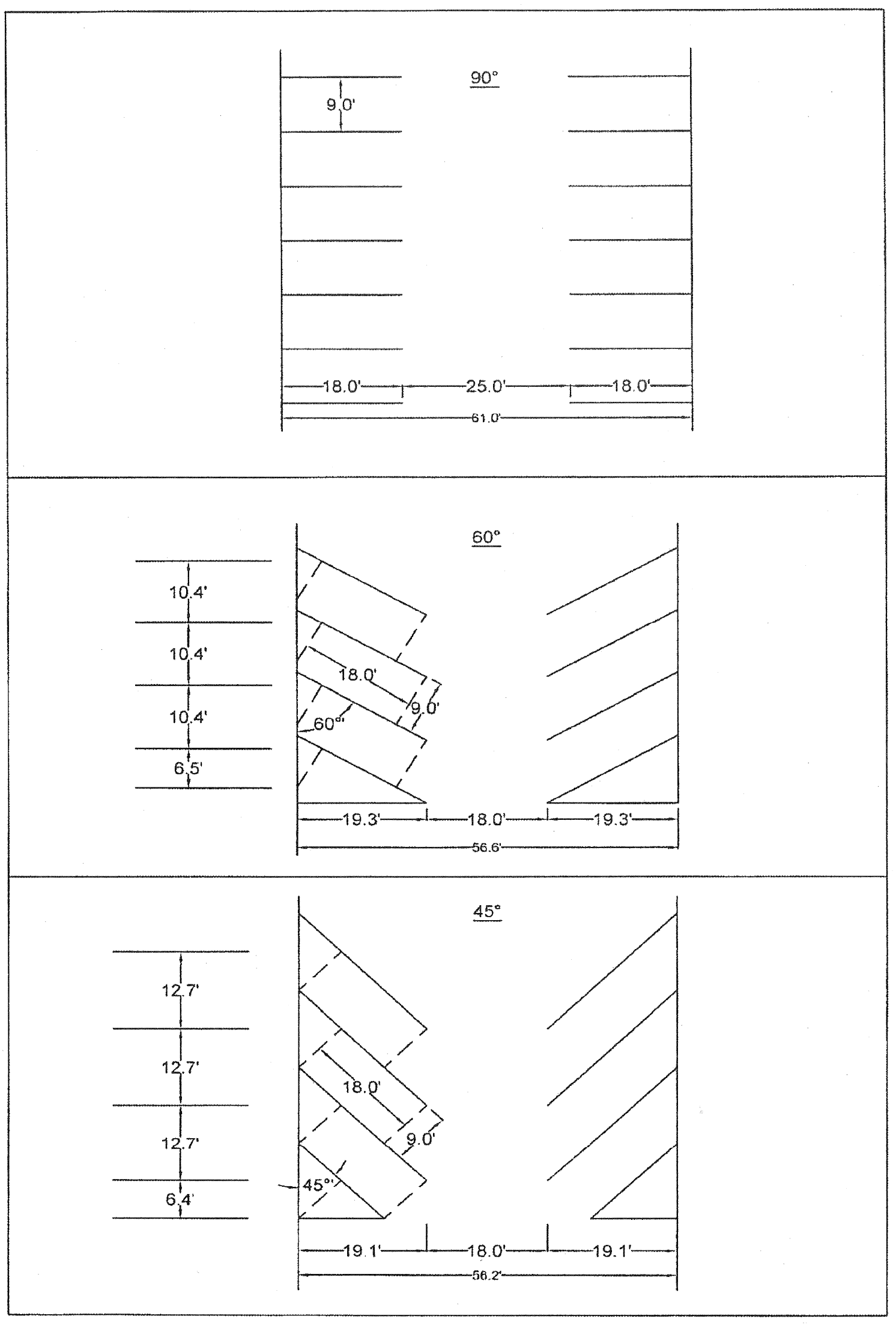
FIGURE 10-2
CURB AND DRIVEWAY CRITERIA, RESIDENTIAL DISTRICTS (R-1, R-2, R-3, LL, MH)
* This distance shall be measured from the intersection of property lines common with street right-of-way lines.
FIGURE 10-3
CURB AND DRIVEWAY CRITERIA COMMERCIAL AND INDUSTRIAL DISTRICTS (MU, MS, NC, GC, BI,
LI, HI)
* The distance shall be measured from the intersection of property lines common with the street right-of-way lines.
(e)
Driveway approaches. Driveway approaches shall be a minimum two feet from the side property line in residential districts, and ten feet from the side property line in business or industrial districts, or R-3 residential districts.
(f)
Surfacing. All areas for parking space and driveways shall be surfaced with materials suitable to control dust and drainage. Except in the case of single-family and two-family dwellings, driveways and stalls shall be surfaced with standard concrete, hot-mix asphalt, or chip seal (TxDOT Standard 316 surface treatment) in conformance with the public improvements criteria manual (PICM).
(g)
Striping. Except for single-family, two-family and townhouse dwellings, all parking stalls shall be marked with painted lines not less than four inches wide.
(h)
Lighting. Any lighting used to illuminate an off-street parking area shall be so arranged as to reflect the light away from adjoining property, abutting residential uses and public right-of-way. Reference Section 106-310(a).
(i)
Curbing. Except for single-family, two-family and townhouse dwellings, all open off-street parking shall have a curb barrier. When determined to be necessary to maintain landscaping structure and retain water runoff.
(j)
Required screening. Any screening required shall consist of the following:
(1)
A planting strip shall consist of evergreen groundcover, and shall be of sufficient width and density to provide an effective screen. The planting strip shall contain no structures or other use. Such planting strip shall not be less than six feet in height. Earth mounding or berms may be used, but shall not be used to achieve more than two feet of the required screen.
(2)
Standards:
a.
Width of planting strip: Four feet.
b.
Type of planting: Evergreen.
c.
Size of plants: Minimal height of four feet at time of planting. Must reach a height of six feet within two years.
d.
Planting density: Such that within two years of normal growth, a solid screen will be formed to a height of at least six feet above adjacent grade.
(3)
Screening will be required in the following situations:
a.
Parking areas for recreational buildings, community centers, religious, and private and public educational institutions.
b.
Manufactured housing parks and subdivisions shall be screened from abutting uses.
(4)
Required screening will count toward the required percentage of landscaping.
(k)
Parking lot screening. A landscape buffer shall be maintained between all open, nonresidential off-street parking areas of five or more spaces abutting residential districts. Landscape buffers shall be a minimum of four feet in width. Plantings should consist of trees and low evergreen shrubs. Planting plans shall be approved by the director.
(Ord. No. 2016-3631, § 11, 5-23-16)
Sec. 106-836. - Maintenance.
It shall be the joint and several responsibility of the lessee and owner of the principal use, uses or building to maintain, in a neat and adequate manner, the parking spaces, access ways, striping, landscaping, and required fences.
Sec. 106-837. - Location.
All accessory off-street parking facilities required by this chapter shall be located and restricted as follows:
(1)
Required accessory off-street parking shall be on the same lot under the same ownership as the principal use being served, except under the provisions of subsections 106-444(e) and (f) (Commercial use performance standards).
(2)
Except for single-family, two-family and townhouse dwellings, head-in parking, directly off of and adjacent to a public street, with each stall having its own direct access to the public street, shall be prohibited.
(3)
There shall be no off-street parking within 15 feet of any street surface.
(4)
The boulevard portion of the street right-of-way shall not be used for parking.
(5)
Setback area. Required accessory off-street parking shall not be provided in front yard setbacks or in side yard setbacks in the case of a corner lot, in R-1 and R-2 districts.
(6)
In the case of single-family, two-family, and townhouse dwellings, parking shall be prohibited in any portion of the front yard except designated driveways or one open, surfaced space located on the side of a driveway, away from the principal use. Such extra space shall be surfaced with concrete or bituminous material, with the exception of those properties in the Large Lot District which may be unpaved.
Sec. 106-838. - Use of required area.
Required accessory off-street parking spaces in any district shall not be utilized for open storage, sale or rental of goods, or storage of inoperable vehicles as regulated by the junk vehicle requirements in section 34-166 et seq.
Sec. 106-839. - Number of spaces required.
The following minimum number of off-street parking spaces shall be provided and maintained by ownership, easement and/or lease for and during the life of the respective uses hereinafter set forth. Such required parking shall include the required number of handicapped parking spaces as regulated by the city building code, and the City's Code of Ordinances.
Footnotes:
• These numbers are the minimum required regardless of building or use size.
• Product inventory cannot utilize required parking per the provisions of this section.
• Parking requirements of this section must be accommodated on-site and may not include street parking, with the exception of uses in the Main Street District with Overlay and Mixed Use District.
(Ord. No. 2018-3723, § 7, 9-24-18; Ord. No. 2022-3907, § 3, 12-12-22; Ord. No. 2025-5001, § 9, 9-22-25)
Sec. 106-840. - Off-street loading berth requirements.
(a)
Purpose. The regulation of loading spaces in these zoning regulations is to alleviate or prevent congestion of the public right-of-way and so to promote the safety and general welfare of the public. By establishing minimum requirements for off-street loading and unloading from motor vehicles in accordance with the utilization of various parcels of land or structures.
(b)
Location.
(1)
All required loading berths shall be off-street and located on the same lots as the building or use to be served.
(2)
All loading berth curb cuts shall be located at minimum 50 feet from the intersection of two or more street rights-of-way. This distance shall be measured from the property lines common with the right-of-way lines.
(3)
No loading berth area shall be closer than 30 feet from a residential district unless within a structure.
(4)
Loading berths shall not occupy the front yard setback or side yard setback if adjacent to a street right-of-way.
(5)
Each loading berth shall be located with appropriate means of vehicular access to a street or public alley in a manner which will cause the least interference with traffic.
(c)
Surfacing. All loading berths and access ways shall be surfaced in conformance with the public improvements criteria manual to control the dust and drainage according to a plan submitted and subject to the approval of the planning director.
(d)
Accessory use, parking and storage. Any space allocated as a required loading berth or access drive so as to comply with the terms of these zoning regulations shall not be used for the storage of goods, or inoperable vehicles and shall not be included as part of the space necessary to meet the off-street parking area requirements.
(e)
Screening. Except in the case of multiple dwellings all loading areas shall be screened and landscaped from abutting and surrounding residential uses in compliance with the following:
(1)
A planting strip shall consist of evergreen groundcover, and shall be of sufficient width and density to provide an effective screen. The planting strip shall contain no structures or other use. Such planting strip shall not be less than six feet in height. Earth mounding or berms may be used, but shall not be used to achieve more than two feet of the required screen.
(2)
Standards:
a.
Width of planting strip: Four feet.
b.
Type of planting: Evergreen.
c.
Size of plants: Minimal height of four feet at time of planting. Must reach a height of six feet within two years.
d.
Planting density: Such that within two years of normal growth, a solid screen will be formed to a height of at least six feet above adjacent grade.
(3)
Screening will be required in the following situations:
a.
Parking areas for recreational buildings, community centers, religious, and private and public educational institutions.
b.
Manufactured housing parks and subdivisions screened from abutting uses.
(4)
Required screening will count toward the required percentage of landscaping.
(f)
Size. Unless otherwise specified in these zoning regulations the first loading berth shall be not less than 55 feet in length and additional berths required shall be not less than 30 feet in length and all loading berths shall be not less than ten feet in width and 14 feet in height, exclusive of aisle and maneuvering space.
(g)
Number of loading berths required. The number of required off-street loading berths shall be as follows:
(1)
Manufactured, fabrication, processing, warehousing, storing, retail sales, schools and hotels. For such a building 10,000 to 100,000 square feet of floor area, one loading berth 55 feet in length, and one additional berth for each additional 50,000 square feet or fraction thereof.
(2)
Auditorium, convention hall, exhibition hall, sports arena or stadium. 10,000 to 100,000 square feet of floor area, one loading berth; for each additional 100,000 square feet of floor area or fraction thereof, one additional loading berth.
(3)
Public or semi-public recreational buildings, community centers, private and public educational institutions, religious institutions, hospital, clinics, professional and commercial offices. One off-street loading and service entrances shall be provided, sized to meet the needs of the facility.
(4)
Nursing homes and similar group housing serving in excess of 16 persons. One off-street loading space, sized to meet the needs of the facility.
Sec. 106-871. - General provisions.
(a)
All signs shall be erected, displayed and maintained in compliance with the requirements of this article and all other applicable state laws and city ordinances. If there is a conflict between the regulations of this article and a state law, city ordinance, or codes adopted by ordinance, the most restrictive standard applies and controls. All signs not expressly allowed by this chapter are prohibited.
(b)
No sign nor part of any sign may have lights which flash, move or rotate in such a manner as to be confused with traffic control signals or emergency vehicle signals, or in a manner that confuses, misleads or distracts traffic motorists. Beacons may not be placed on any sign or be made a part of any sign. Additionally, no sign that resembles an official traffic control sign, signal or device or that bears the words stop, go slowly, caution, danger, detour, or other wording for traffic control signs or devices may be used within the city.
(c)
All signs shall be properly and continuously maintained so as not to become a safety hazard or detract from the appearance of adjoining properties.
(d)
All areas immediately below and within a radius of 15 feet shall be properly maintained. This includes maintenance of all vegetation to the standards set forth in section 34-126 et seq.
(e)
With the exception of permitted temporary signs, no sign may be placed on or over a public right-of-way, whether used or unused, a utility easement, or on utility poles.
(f)
Placement of signs shall be in accordance with the visibility triangle requirements of section 106-311 (Visibility triangle).
(g)
Any sign in violation of any provisions of this chapter is subject to immediate removal by the city.
Sec. 106-872. - Portable signs.
(a)
Portable signs may be located in the high density residential (R-3), manufactured housing (MH), commercial recreation (CR), neighborhood commercial (NC), general commercial (GC), business industrial (BI), light industrial (LI), and heavy industrial (HI) zoning districts.
(b)
A portable sign may not stand on any premise for more than 30 consecutive days at a time or for more than 60 days in any calendar year without a period of at least 20 intervening days.
(c)
Lighted portable signs shall be constructed and installed in accordance with the requirements of the city's electrical code. Portable signs with red, yellow, amber, green, or blue lights or with lights that flash, blink, or vary in intensity are prohibited.
(d)
Portable signs must comply with the setback requirements that would apply to on-premises signs in the zoning district in which the portable sign is to be located. Portable signs may not be placed on public right-of-way and may not be placed in such a manner as to create a hazard to traffic.
(e)
A portable sign must be tied down or secured in a manner prescribed by the building official to ensure the safe installation of said sign.
(f)
A portable sign, during the required intervening periods, must be completely removed from public view. Removal of the lettering is not considered to be in compliance with this section.
(g)
All damaged portable signs must be removed within 48 hours of notification by the city until such sign has been repaired.
(h)
Portable signs shall be used for on-premises use only.
(i)
Nothing in this section shall apply to political advertising.
(j)
Portable signs are to be permitted through the building official of the city consistent with the provisions of this chapter. Permitted portable signs shall have securely affixed and plainly visible a sticker, in form prescribed by the city showing the date the permit was issued, and the date the permit is to expire. Portable signs shall also contain on both faces the date of expiration of the current permit.
(k)
Portable signs located on premises in violation of any of the provisions of this chapter, including the requirement that portable signs have attached a validly issued, current permit from the city are subject to immediate removal by the city.
(l)
Portable signs removed by the city in accordance with this article shall be safely and securely stored by the city. Portable signs removed and stored by the city may be redeemed by their owner upon the payment of a storage fee established by the city council and listed in appendix A. Signs not redeemed from storage may be sold by the city in accordance with laws regulating sale of abandoned property.
(m)
Nothing in this article shall be construed as a waiver by the city on the penal enforcement of this chapter. The remedies provided in this article shall be in addition to, and not cumulative of, other remedies the city might have as allowed in this chapter and state law.
Sec. 106-873. - Political signs.
Temporary political signs placed for the duration of an election campaign shall not be subject to the requirements of this chapter except that:
(1)
No political sign shall be placed within a sight triangle or in a manner which will otherwise create a traffic hazard.
(2)
No political sign shall be placed on or over a public right-of-way, whether used or unused, a utility easement or on utility poles.
(3)
All portable signs used for political advertising shall be anchored in a manner which will prevent their being blown about by a strong wind.
(4)
All political signs shall be removed no later than ten days after the election for which they were placed. In the case of run-off elections, political signs may remain in place no longer than ten days following the run-off.
Sec. 106-874. - On-premises signs.
(a)
Freestanding on-premises signs.
(1)
General provisions.
a.
These regulations shall apply to freestanding signs only.
b.
Multiple reader panels mounted on a single base shall be considered to be a single sign.
c.
For the purposes of this section, a multitenant building shall be considered to be a single establishment and shall be restricted to freestanding advertising signage in accordance with the regulations governing such signs.
d.
Separate buildings located on a single piece of property may be considered to be separate business establishments with each building being eligible for freestanding advertising in accordance with these regulations.
e.
The number of on-premises freestanding nonadvertising signs intended to direct traffic and not exceeding six square feet in size shall not be limited by this section.
f.
On-premises real estate signs are allowed and shall be exempt from all other provisions of section 106-874 (On premises signs).
(2)
R-1, R-2, R-3, LL and MH districts.
a.
One freestanding identification sign is permitted for townhouses, multi-family developments, group care facilities (not located within a residential neighborhood), subdivisions, education and religious facilities.
b.
For a bed and breakfast facility one sign not exceeding three square feet in area and nonilluminated shall be allowed. This sign may be either mounted on the building or located in a landscaped portion of the yard.
c.
For a home occupation facility one sign not exceeding two square feet in area and nonilluminated shall be allowed. This sign shall be mounted flat against the wall of the principal building.
d.
The size of the sign may not exceed 150 square feet.
e.
There are no minimum yard setbacks.
f.
The maximum height is 45 feet.
(3)
CR, NC, and GC districts.
a.
One freestanding advertising sign shall be permitted for each side of a commercial establishment which fronts on a developed right-of-way.
b.
The following size limitations apply:
1.
Freestanding signs for single tenant buildings: 150 square feet.
2.
Freestanding signs for single tenant buildings in a controlled access corridor: 300 square feet.
3.
Freestanding signs for multitenant buildings: 350 square feet.
c.
The following minimum yard setbacks apply:
1.
When not adjacent to residentially zoned property, there are no minimum setbacks.
2.
When adjacent to residentially zoned property, there are minimum side and rear yard setbacks of five feet.
d.
The following height limitations apply:
1.
Freestanding signs: 45 feet.
e.
Freestanding signs in a controlled access corridor: 65 feet.
(4)
MS district and overlay.
a.
Pre-existing, nonconforming signs listed at the following locations within the overlay and Main Street District existing as of the effective date of this ordinance are considered legal, grandfathered, and may continue as such in accordance with the specifications, regulations, and conditions of this ordinance. The city accepts no liability for any damages to any signs within public right-of-way or easement. The city also reserves the rights to enter into, maintain, and utilize all common use public utility easements and public rights- of-way to promote the health, safety, morals or general welfare of the community and the safe, orderly, and healthful development of the city.
1.
101 E. Main.
2.
201 E. Main.
3.
115 W. Main.
4.
208 W. Main.
5.
306 W. Main.
6.
521 W. Main.
7.
616 W. Main.
8.
718 W. Main.
9.
820 W. Main.
10.
*107 N. 8th.
11.
*105 Highway 146 S.
12.
*117 Highway 146 S.
13.
*120 Highway 146 N.
b.
Pre-existing, nonconforming signs listed in subsection (a) above are exempted from the terms, conditions, and effects of section 106-262 (Nonconforming structures). An inventory of such pre-existing signs will be required to document existing specifications, i.e. height, face, size, and other dimensional measurements.
i.
Pre-existing signs may be repaired, maintained, and/or replaced, but may not be enlarged.
ii.
All signs and sign support structures shall be maintained at all times in a state of good repair. The sign components shall be reasonably free of rust, painted if needed, and structurally sound.
iii.
*Controlled access corridor signs on properties within the Main Street District/Overlay that have frontage along State Highway 146 shall be maintained as per provisions of section 106-874(a)(3)a., b., and e. (On-premise signs). In addition, signs on other properties within Main Street District/Overlay between SH 146 and 8th Street shall be maintained as per provisions of section 106-874(a)(3)a., b., and d. (On-premise signs).
c.
Any new on-premises freestanding signs, which shall only be permitted on those properties where a building is already existing and is setback from the front property line, shall be a ground sign that is a minimum height of 10 feet from the bottom of the sign and a maximum height of 14 feet and cannot exceed 24 square feet in area. (Note: In accordance with section 106-878(b)(2), sign not exceeding eight feet in height do not have to be engineered.)
d.
A city permit shall be required prior to any new signage.
e.
A city approved sign design may be eligible for city participation under the Main Street Incentive Reimbursement Grant Funds.
(6)
BI, LI, and HI districts.
a.
One freestanding advertising sign shall be permitted for each side of a commercial establishment which fronts a developed right-of-way.
b.
The following size limitations apply:
1.
Freestanding signs for single tenant buildings: 150 square feet.
2.
Freestanding signs for single tenant buildings in controlled access corridors: 300 square feet.
3.
Freestanding signs for multitenant buildings: 350 square feet.
c.
The following minimum yard setbacks apply:
1.
When not adjacent to residentially zoned property, there are no minimum setbacks.
2.
When adjacent to residentially zoned property, there are minimum side and rear setbacks of five feet.
d.
The following height limitations apply:
1.
Freestanding signs: 45 feet.
2.
Freestanding signs in controlled access corridors: 65 feet.
(b)
Attached on-premises signs.
(1)
General provisions.
a.
One attached sign per building wall may be displayed for each occupant or use on the premises.
b.
These regulations do not apply to building addresses or supplemental signs for the purpose of identifying the apartment buildings or units.
(2)
R-1, R-2, R-3, LL and H districts.
a.
The size of the sign may not exceed three square feet.
b.
No portion of the sign may have a luminous greater than 200 foot-candles and may not move, flash, rotate or change illumination.
(3)
CR, NC, GC, BI, LI, and HI districts.
a.
The cumulative size of the signs may not exceed 15 percent of the wall area.
b.
If located closer than 50 feet to an R-1, R-2, or MH district, the sign may not flash and must be designed so that it does not shine or reflect light into adjacent residences.
c.
One attached canopy sign may be displayed. Such sign shall not exceed 30 percent of the canopy area. Such sign must be contained within the physical limits of the canopy and shall not extend above or below the canopy.
(4)
MS districts.
a.
Signage shall not exceed 1.5 square feet for every one-foot of façade width.
b.
If located closer than 50 feet to an R-1, R-2, or MH district, the sign may not flash and must be designed so that it does not shine or reflect light into adjacent residences.
c.
Internal illumination and back lighted signs are not permitted.
d.
Window signage shall be limited to 20% coverage of the total glass area of the window.
e.
Exposed fluorescent lighting, internal illumination, and back lighted signs are not permitted. Neon and other tubular illumination may be utilized in a limited amount.
(5)
MU district.
a.
One sign is permitted not to exceed 32 square feet.
b.
No portion of the sign may have a luminous greater than 200 foot-candles and may not move, flash, rotate or change illumination.
c.
If located closer than 100 feet to an R-1, R-2, or MH district, the sign may not flash and must be designed so that it does not shine or reflect light into adjacent residences.
d.
Exposed fluorescent lighting, neon and other tubular illumination, internal illumination, and back lighted signs are not permitted.
Sec. 106-875. - Off-premises signs.
(a)
Off-premises freestanding advertising signs may be erected in the BI, LI, and HI zoning districts.
(b)
Off-premises freestanding public service signs may be erected in the GC, BI, LI, and HI zoning districts.
(c)
Off-premises signs within the right-of-way may be attached to the face of the building and project into the West Main Street portion of Main Street Overlay as follows:
(1)
Maximum six-foot encroachment/projection into the right-of-way.
(2)
Maximum of one projection sign per business allowed.
(3)
Completed right-of-way license agreement with the city.
(d)
The following size limitations shall apply to all off-premises freestanding signs:
(1)
In controlled access corridors, the size limitations shall be set by the Texas Highway Beautification Act.
(2)
On all other streets, the maximum size shall be 300 square feet and may not have more than two sign faces.
(e)
An off-premises sign must be located at least 50 feet from an existing freestanding on-premises sign.
(f)
Off-premises signs, when illuminated, must be constructed with upward shielded directional illumination.
(g)
The following height limitations shall apply:
(1)
Off-premises public service signs: 18 feet.
(2)
Off-premises advertising signs: 45 feet.
(h)
All off-premises freestanding advertising signs shall be spaced in intervals of not less than 1,000 feet.
Sec. 106-876. - Subdivision marketing signs.
(a)
For the purpose of marketing a recorded subdivision, one on-premises freestanding sign of not more than 150 square feet for each road abutting the respective subdivision shall be permitted, provided that such sign shall not be placed within any required yard nor within 25 feet of any property line abutting a street or road right-of-way, and further provided that such sign shall not exceed 20 feet in height.
(b)
For the purpose of marketing a recorded subdivision, one off-premises sign of not more than 150 square feet may be permitted for each recorded subdivision in any zoning district. Such sign shall not be placed within 25 feet of any property line and shall not exceed 20 feet in height. The permit for such sign shall expire, unless renewed, two years after the date of issuance of such permit, and provided that each request for permit shall be accompanied by a license and permit fee posted by the respective sign hanger in the amount of $300.00 for the purpose of ensuring proper location, maintenance, and removal of the respective sign.
(c)
Must be in compliance with visibility triangle requirements specified in section 106-805 (Visibility triangles).
Sec. 106-877. - Temporary signs.
(a)
Subject to the provision of this section, temporary signs are prohibited except in the following instances:
(1)
Temporary signs shall be a maximum of 18 inches by 24 inches in size and constructed of all-weather corrugated plastic sheeting with a wooden stake or greater as support.
(2)
Temporary signs may only be placed between the hours of 5:00 p.m. on Friday and 7:00 p.m. on the following Sunday.
(3)
Temporary signs shall be free of balloons, banners, or streamers.
(b)
Location of temporary signs:
(1)
Temporary signs shall not be placed in a manner that will interfere with a visibility triangle or otherwise create a traffic hazard as referenced in section 106-805 (Visibility triangles).
(2)
Temporary signs may not be located within five feet of the edge of any pavement.
(3)
Temporary signs may only be placed at the following locations within the city, with a maximum of two temporary signs permitted at any one time at any specified intersection:
SH 146 at Fairmont (northeast, southwest and southeast corners)
SH 146 at Wharton Weems (northeast and southeast corners)
SH 146 at McCabe (northeast corner and feeder and southeast corner of northbound SH 146 and McCabe)
SH 225 at Underwood (southwest corner of Underwood eastbound lane and southeast corner of Underwood eastbound lane of SH 225)
SH 225 at Sens (northwest and northeast corners SH 225 and southwest corner of SH 225 on westbound feeder on Sens)
Spencer at Sens (northwest and northeast corners SH 225 and southwest corner of SH 225 on westbound feeder on Sens)
Spencer at Sens (northwest and southeast corners)
Spencer at Valleybrook (southeast corner)
Spencer at Driftwood (southeast corner)
Spencer at Luella (southeast corner)
Fairmont at Luella (northwest corner Luella, eastbound lane W. Fairmont)
Fairmont at Driftwood (northwest corner westbound on Fairmont)
S. Broadway at Fairmont (northwest and southwest corners)
S. Broadway at Wharton Weems (northwest and southwest corners)
N. "L" at Underwood (northeast and southeast corners)
Bay Area Blvd. at Fairmont (northwest corner of Bay Area Blvd. and eastbound lane on W. Fairmont and southeast corner of Bay Area Blvd. eastbound lane on W. Fairmont)
(c)
Temporary sign permits:
(1)
No temporary sign may be erected within the city limits of the City of La Porte without a permit first having been obtained from the building official.
(2)
Application for temporary sign permits shall be made upon forms provided by the building official, and shall contain and be accompanied by information sufficient to identify the location of the proposed sign, consistent with the location criteria established in subsection (b)(2) above.
(3)
No person shall be issued a temporary sign permit under this section until such person has filed with the city secretary a bond or insurance policy, or both, in the amount of $200.00 per sign approved, in form approved by the city attorney, such bond or policy to be conditioned on the placement of temporary signs in accordance with the provisions of this article, the other ordinances of the City of La Porte, and further providing for the indemnification of the city for any and all damages or liability that may accrue to or against the city by reason of the placement, maintenance, alteration, repair or removal, or defects in any temporary sign erected by or under the direction of such applicant, and further providing for the indemnification of any person who shall, while on public property or public right-of-way of the City of La Porte, incur damages for which the person erecting any such temporary sign is legally liable by reason of his act or omission in regard to erection of such temporary signage.
(4)
No permit issued under this chapter shall be transferable.
(d)
Number of temporary sign permits: No permittee for a temporary sign may obtain a permit for placement of more than two temporary signs at any one particular location specified in section 106-877(b) (Temporary signs) above with a maximum of ten temporary signs per permittee, and a maximum of two temporary signs per permittee per location.
(e)
Further limitations on permit: No permittee may obtain permits for location of temporary signs for more than four consecutive weeks. Upon the expiration of four consecutive weeks of permits for a particular permittee, no permit shall be issued by the city for any temporary signs for 30 days following said four consecutive week period.
(f)
Revocation of permit: Upon learning of any violation of this article or the ordinances of the City of La Porte by any temporary sign permit holder, the building official shall give notice of said violation to the responsible permit holder. Two or more violations of this article, or other ordinances of the City of La Porte shall result in denial of future temporary sign permits to the responsible permittee by the City of La Porte.
Sec. 106-878. - Permits.
(a)
Any person desiring to erect or place a freestanding, attached or portable sign on any property shall first apply to the building official for a permit. With the exception of temporary sign permits as specified above, permits are not required for signs less than five square feet in area. Permits are not required for signs less than five square feet in area.
(b)
Any person applying to erect or place a freestanding sign on any property shall submit to the building official the following information:
(1)
A survey of the property which indicates the proposed sign location.
(2)
An engineered design for signs greater than eight feet in height.
(3)
A design of the sign and its support member for signs less than eight feet in height.
(c)
Permit fees shall be established by the city council and listed in appendix A.
Sec. 106-879. - Enforcement.
Any violation of this article shall be subject to the penalties provided in section 106-6 (Penalties for violations).
Sec. 106-890. - Definitions.
[The following words, terms and phrases, as used in this article, shall have the meanings respectively ascribed to them in this section, unless the context clearly indicates otherwise:]
Antenna support structure means any building or structure other than a tower which can be used for location of telecommunications facilities.
Applicant means any person that applies for a tower development permit.
Application means the process by which the owner of a parcel of land within the city submits a request to develop, construct, build, modify, or erect a tower upon such parcel of land. Application includes all written documentation, verbal statements, and representations, in whatever form or forum, made by an applicant to the city concerning such a request.
Engineer means any engineer licensed by the State of Texas.
Owner means any person with fee title or a long-term (exceeding ten years) leasehold to any parcel of land within the city who desires to develop, or construct, build, modify, or erect a tower upon such parcel of land.
Person is any natural person, firm, partnership, association, corporation, company, or other legal entity, private or public, whether for profit or not for profit.
Site plan review committee means a committee composed of staff members of the city, responsible for reviewing and recommending plans submitted pursuant to this article, including individuals designated by the director of planning (usually being the chief building official and the city engineer), the fire marshal, and the director of public works. The building official is responsible for chairing meetings of the site plan review committee, and making reports of the results of said meetings. Duly designated representatives of the members of the site plan review committee may serve in the stead of the aforementioned members of the committee.
Stealth means any tower or telecommunications facility which is designed to enhance compatibility with adjacent land uses, including, but not limited to, architecturally screened roof-mounted antennas, antennas integrated into architectural elements, and towers designed to look other than like a tower such as light poles, power poles, and trees. The term stealth does not necessarily exclude the use of uncamouflaged lattice, guyed, or monopole tower designs.
Telecommunications facilities means any cables, wires, lines, wave guides, antennas, and any other equipment or facilities associated with the transmission or reception of communications which a person seeks to locate or has installed upon or near a tower or antenna support structure. However, telecommunications facilities shall not include:
(1)
Any satellite earth station antenna two meters in diameter or less which is located in an area zoned industrial or commercial; or
(2)
Any satellite earth station antenna one meter or less in diameter, regardless of zoning category.
Tower means a self-supporting lattice, guyed, or monopole structure constructed from grade which supports telecommunications facilities. The term tower shall not include amateur radio operators' equipment, as licensed by the FCC.
Sec. 106-891. - Purpose.
The general purpose of this article is to regulate the placement, construction, and modification of towers, antennas, support structures and telecommunications facilities in order to protect the health, safety, and welfare of the public, while at the same time not unreasonably interfering with the development of the competitive wireless telecommunications marketplace in the city.
Specifically, the purposes of this article are:
(a)
To regulate the location of towers and telecommunications facilities in the city;
(b)
To protect residential areas and land uses from potential adverse impact of towers and telecommunications facilities;
(c)
To minimize adverse visual impact of towers and telecommunications facilities through careful design, siting, landscaping, and innovative camouflaging techniques;
(d)
To promote and encourage shared use/collocation of towers and antenna support structures as a primary option rather than construction of additional single-use towers;
(e)
To promote and encourage utilization of technological designs that will either eliminate or reduce the need for erection of new tower structures to support antenna and telecommunications facilities;
(f)
To avoid potential damage to property caused by towers and telecommunications facilities by ensuring such structures are soundly and carefully designed, constructed, modified, maintained, and removed when no longer used or are determined to be structurally unsound; and
(g)
To ensure that towers and telecommunications facilities are compatible with surrounding land uses.
Sec. 106-892. - Development of towers.
(a)
A tower shall be a permitted use of land in zoning district HI. No person shall build, erect, or construct a tower upon any parcel of land within a zoning district designated HI unless a development permit shall have been issued by the site plan review committee of the city. Application shall be made to the site plan review committee in the manner provided in this chapter.
(b)
A tower shall be a conditional use of land in zoning districts BI and LI. No person shall build, erect, or construct a tower upon any parcel of land within any zoning district set forth above unless a development permit shall have been issued by the site plan review committee of the city and approval of the city planning and zoning commission is obtained.
(c)
Towers are exempt from the maximum height restrictions of the districts where located. Towers shall be permitted to a height of 150 feet. Towers may be permitted in excess of 150 feet in accordance with section 106-906 (Criteria for site plan development modifications).
(d)
No new tower shall be built, constructed, or erected in the city unless the tower is capable of supporting another person's operating telecommunications facilities comparable in weight, size, and surface area to the telecommunications facilities installed by the applicant on the tower within six months of the completion of the tower construction.
(e)
An application to develop a tower shall include:
(1)
The name, address, and telephone number of the owner and lessee of the parcel of land upon which the tower is situated. If the applicant is not the owner of the parcel of land upon which the tower is situated, the written consent of the owner shall be evidenced in the application.
(2)
The legal description, folio number, and address of the parcel of land upon which the tower is situated.
(3)
The names, addresses, and telephone numbers of all owners of other towers or usable antenna support structures within a one-half mile radius of the proposed new tower site, including city-owned property.
(4)
A description of the design plan proposed by the applicant in the city. Applicant must identify its utilization of the most recent technological design, including microcell design, as part of the design plan. The applicant must demonstrate the need for towers and why design alternatives, such as the use of microcell, cannot be utilized to accomplish the provision of the applicant's telecommunications services.
(5)
An affidavit attesting to the fact that the applicant made diligent, but unsuccessful, efforts to obtain permission to install or collocate the applicant's telecommunications facilities on city-owned towers or usable antenna support structures located within a one-half mile radius of the proposed tower site.
(6)
An affidavit attesting to the fact that the applicant made diligent, but unsuccessful, efforts to install or collocate the applicants telecommunications facilities on towers or usable antenna support structures owned by other persons located within a one-half mile radius of the proposed tower site.
(7)
Written technical evidence from an engineer(s) that the proposed tower or telecommunications facilities cannot be installed or collocated on another person's tower or usable antenna support structures owned by other persons located within one-half mile radius of the proposed tower site.
(8)
A written statement from an engineer(s) that the construction and placement of the tower will not interfere with public safety communications and the usual and customary transmission or reception of radio, television, or other communications services enjoyed by adjacent residential and nonresidential properties.
(9)
Written, technical evidence from an engineer(s) that the proposed structure meets the standards set forth in section 106-894 (Structural requirements), of this article.
(10)
Written, technical evidence from a qualified engineer(s) acceptable to the fire marshal and the building official that the proposed site of the tower or telecommunications facilities does not pose a risk of explosion, fire, or other danger to life or property due to its proximity to volatile, flammable, explosive, or hazardous materials such as LP gas, propane, gasoline, natural gas, or corrosive or other dangerous chemicals.
(11)
In order to assist city staff and the planning and zoning commission in evaluating visual impact, the applicant shall submit color photo simulations showing the proposed site of the tower with a photo-realistic representation of the proposed tower as it would appear viewed from the closest residential property and from adjacent roadways.
(12)
The act gives the FCC sole jurisdiction of the field of regulation of RF emissions and does not allow the city to condition or deny on the basis of RIF impacts the approval of any telecommunications facilities (whether mounted on towers or antenna support structures) which meet FCC standards. In order to provide information to its citizens, the city shall make available upon request copies of ongoing FCC information and RF emission standards for telecommunications facilities transmitting from towers or antenna support structures. Applicants shall be required to submit information on the proposed power density of their proposed telecommunications facilities and demonstrate how this meets FCC standards.
(f)
The site plan review committee may require an applicant to supplement any information that the committee considers inadequate or that the applicant has failed to supply. The committee may deny an application on the basis that the applicant has not satisfactorily supplied the information required in this subsection. Applications shall be reviewed by the city in a prompt manner and all decisions shall be supported in writing setting forth the reasons for approval or denial.
(Ord. No. 2016-3631, § 12, 5-23-16)
Sec. 106-893. - Setbacks.
(a)
All towers up to 100 feet in height shall be set back on all sides a distance equal to the underlying setback requirement in the applicable zoning district. Towers in excess of 100 feet in height shall be set back one additional foot per each foot of tower height in excess of 100 feet.
(b)
Setback requirements for towers shall be measured from the base of the tower to the property line of the parcel of land on which it is located.
(c)
Setback requirements may be modified, as provided in section 106-906(b)(1) (Criteria for site plan development modifications) when placement of a tower in a location which will reduce the visual impact can be accomplished. For example, adjacent to trees which may visually hide the tower.
Sec. 106-894. - Structural requirements.
All towers must be designed and certified by an engineer to be structurally sound and, at minimum, in conformance with the building code, and any other standards outlined in this article. All towers in operation shall be fixed to land.
Sec. 106-895. - Separation of buffer requirements.
For the purpose of this section, the separation distances between towers shall be measured by drawing or following a straight line between the base of the existing or approved structure and the proposed base, pursuant to a site plan of the proposed tower. Tower separation distances from residentially zoned lands shall be measured from the base of a tower to the closest point of residentially zoned property. The minimum tower separation distances from residentially zoned land and from other towers shall be calculated and applied irrespective of city jurisdictional boundaries.
(a)
Towers shall be separated from all residentially zoned lands by a minimum of 200 feet or 200 percent of the height of the proposed tower, whichever is greater.
(b)
Proposed towers must meet the following minimum separation requirements from existing towers or towers which have a development permit but are not yet constructed at the time a development permit is granted pursuant to this Code:
(1)
Monopole tower structures shall be separated from all other towers, whether monopole, self-supporting lattice, or guyed, by a minimum of 750 feet.
(2)
Self-supporting lattice or guyed tower structures shall be separated from all other self-supporting or guyed towers by a minimum of 1,500 feet.
(3)
Self-supporting lattice or guyed tower structures shall be separated from all monopole towers by a minimum of 750 feet.
Sec. 106-896. - Method of determining tower height.
Measurement of tower height for the purpose of determining compliance with all requirements of this section shall include the tower structure itself, the base pad, and any other telecommunications facilities attached thereto which extend more than 20 feet over the top of the tower structure itself. Tower height shall be measured from grade.
Sec. 106-897. - Illumination.
Towers shall not be artificially lighted except as required by the Federal Aviation Administration (FAA). Upon commencement of construction of a tower, in cases where there are residential uses located within a distance which is 300 percent of the height of the tower from the tower and when required by federal law, dual mode lighting shall be requested from the FAA.
Sec. 106-898. - Exterior finish.
Towers not requiring FAA painting or marking shall have an exterior finish which enhances compatibility with adjacent land uses, as approved by the site plan review committee.
Sec. 106-899. - Landscaping.
All landscaping on a parcel of land containing towers, antenna support structures, or telecommunications facilities shall be in accordance with the applicable landscaping requirements in the zoning district where the tower, antenna support structure, or telecommunications facilities are located. The city may require landscaping in excess of the requirements in the City Code in order to enhance compatibility with adjacent land uses. Landscaping shall be installed and maintained on the outside of any fencing.
Sec. 106-900. - Access.
A parcel of land upon which a tower is located must provide access to at least one paved vehicular parking space on-site.
Sec. 106-901. - Stealth design.
All towers which must be approved as a conditional use shall be of stealth design.
Sec. 106-902. - Telecommunications facilities on antenna support structures.
Any telecommunications facilities which are not attached to a tower may be permitted on any antenna support structure at least 50 feet tall, regardless of the zoning restrictions applicable to the zoning district where the structure is located. Telecommunications facilities are prohibited on all other structures. The owner of such structure shall, by written certification to the zoning administrator, establish the following at the time plans are submitted for a building permit:
(a)
That the height from grade of the telecommunications facilities shall not exceed the height from grade of the antenna support structure by more than 20 feet;
(b)
That any telecommunications facilities and their appurtenances, located above the primary roof of an antenna support structure, are set back one foot from the edge of the primary roof for each one foot in height above the primary roof of the telecommunications facilities. This setback requirement shall not apply to telecommunications facilities and their appurtenances, located above the primary roof of an antenna support structure, if such facilities are appropriately screened from view through the use of panels, walls, fences, or other screening techniques approved by the city. Setback requirements shall not apply to stealth antennas which are mounted to the exterior of antenna support structures below the primary roof, but which do not protrude more than 18 inches from the side of such an antenna support structure.
Sec. 106-903. - Modification of towers.
(a)
A tower existing prior to the effective date of this article, which was in compliance with the city's zoning regulations immediately prior to the effective date of this article, may continue in existence as a nonconforming structure. Such nonconforming structures may be modified or demolished and rebuilt without complying with any of the additional requirements of this section, except for sections 106-895 (Separation of buffer requirements) section 106-904 (Certification and inspections) and section 106-905 (Maintenance), provided:
(1)
The tower is being modified or demolished and rebuilt for the sole purpose of accommodating, within six months of the completion of the modification or rebuild, additional telecommunications facilities comparable in weight, size, and surface area to the discrete operating telecommunications facilities of any person currently installed on the tower.
(2)
An application for a development permit is made to the site plan review committee which shall have the authority to issue a development permit without further approval. The grant of a development permit pursuant to this section allowing the modification or demolition and rebuild of an existing nonconforming tower shall not be considered a determination that the modified or demolished and rebuilt tower is conforming.
(3)
The height of the modified or rebuilt tower and telecommunications facilities attached thereto do not exceed the maximum height allowed under this article.
(b)
Except as provided in this section, a nonconforming structure or use may not be enlarged, increased in size, or discontinued in use for a period of more than 180 days. This article shall not be interpreted to legalize any structure or use existing at the time this article is adopted which structure or use is in violation of the code prior to enactment of this article.
Sec. 106-904. - Certifications and inspections.
(a)
All towers shall be certified by an engineer to be structurally sound and in conformance with the requirements of the building code and all other construction standards set forth by the city's Code and federal and state law. For new monopole towers, such certification shall be submitted with an application pursuant to section 106-892 (Development of towers) of this article and every five years thereafter. For existing monopole towers, certification shall be submitted within 60 days of the effective date of this article and then every five years thereafter. For new lattice or guyed towers, such certification shall be submitted with an application pursuant to section 106-892 (Development of towers) of this article and every two years thereafter. For existing lattice or guyed towers, certification shall be submitted within 60 days of the effective date of this article and then every two years thereafter. The tower owner may be required by the city to submit more frequent certifications should there be reason to believe that the structural and electrical integrity of the tower is jeopardized.
(b)
The city or its agents shall have authority to enter onto the property upon which a tower is located, between the inspections and certifications required above, to inspect the tower for the purpose of determining whether it complies with the building code and all other construction standards provided by the city Code and federal and state law.
(c)
The city reserves the right to conduct such inspections at any time, upon reasonable notice to the tower owner. All expenses related to such inspections by the city shall be borne by the tower owner.
Sec. 106-905. - Maintenance.
(a)
Tower owners shall at all times employ ordinary and reasonable care and shall install and maintain in use nothing less than commonly accepted methods and devices for preventing failures and accidents which are likely to cause damage, injuries, or nuisances to the public.
(b)
Tower owners shall install and maintain towers, telecommunications facilities, wires, cables, fixtures, and other equipment in substantial compliance with the requirements of the National Electric Safety Code and all FCC, state, and local regulations, and in such manner that will not interfere with the use of other property.
(c)
All towers, telecommunications facilities, and antenna support structures shall at all times be kept and maintained in good condition, order, and repair so that the same shall not menace or endanger the life or property of any person.
(d)
All maintenance or construction of towers, telecommunications facilities, or antenna support structures shall be performed by licensed maintenance and construction personnel.
(e)
All towers shall maintain compliance with current RF emission standards of the FCC.
(f)
In the event that the use of a tower is discontinued by the tower owner, the tower owner shall provide written notice to the city of its intent to discontinue use and the date when the use shall be discontinued.
Sec. 106-906. - Criteria for site plan development modifications.
(a)
Notwithstanding the tower requirements provided in this article, a modification to the requirements may be approved by the planning and zoning commission as a conditional use in accordance with the following:
(1)
In addition to the requirement for a tower application, the application for modification shall include the following:
a.
A description of how the plan addresses any adverse impact that might occur as a result of approving the modification.
b.
A description of off-site or on-site factors which mitigate any adverse impacts which might occur as a result of the modification.
c.
A technical study that documents and supports the criteria submitted by the applicant upon which the request for modification is based. The technical study shall be certified by an engineer and shall document the existence of the facts related to the proposed modifications and its relationship to surrounding rights-of-way and properties.
d.
For a modification of the setback requirement, the application shall identify all parcels of land where the proposed tower could be located, attempts by the applicant to contract and negotiate an agreement for collocation, and the result of such attempts.
e.
The site plan review committee may require the application to be reviewed by an independent engineer under contract to the city to determine whether the antenna study supports the basis for the modification requested. The cost of review by the city engineer shall be reimbursed to the city by the applicant.
(2)
The planning and zoning commission shall consider the application for modification based on following criteria:
a.
That the tower as modified will be compatible with and not adversely impact the character and integrity of surrounding properties.
b.
Off-site or on-site conditions exist which mitigate the adverse impacts, if any, created by the modification.
c.
In addition, the commission may include conditions on the site where the tower is to be located if such conditions are necessary to preserve the character and integrity of the neighborhoods affected by the proposed tower and mitigate any adverse impacts which arise in connection with the approval of the modification.
(b)
In addition to the requirements of subparagraph (a) of this section, in the following cases, the applicant must also demonstrate, with written evidence, the following:
(1)
In the case of a requested modification to the setback requirement, section 106-893 (Setbacks), that the setback requirement cannot be met on the parcel of land upon which the tower is proposed to be located and the alternative for the person is to locate the tower at another site which is closer in proximity to a residentially zoned land.
(2)
In the case of a request for modification to the separation and buffer requirements from other towers of section 106-895 (Separation of buffer requirements) that the proposed site is zoned "industrial" or "heavy industrial" and the proposed site is at least double the minimum standard for separation from residentially zoned lands as provided for in section 106-895 (Separation of buffer requirements).
(3)
In the case of a request for modification of the separation and buffer requirements from residentially zoned land of section 106-895 (Separation of buffer requirements), if the person provides written technical evidence from an engineer(s) that the proposed tower and telecommunications facilities must be located at the proposed site in order to meet the coverage requirements of the applicant's wireless communications system and if the person is willing to create approved landscaping and other buffers to screen the tower from being visible to residentially zoned property.
(4)
In the case of a request for modification of the height limit for towers and telecommunications facilities or to the minimum height requirements for antenna support structures, that the modification is necessary to:
a.
Facilitate collocation of telecommunications facilities in order to avoid construction of a new tower; or
b.
To meet the coverage requirements of the applicant's wireless communications system, which requirements must be documented with written, technical evidence from an engineer(s) that demonstrates that the height of the proposed tower is the minimum height required to function satisfactorily, and no tower that is taller than such minimum height shall be approved.
Sec. 106-907. - Abandonment.
(a)
If any tower shall cease to be used for a period of 365 consecutive days, the city shall notify the owner, with a copy to the applicant, that the site will be subject to a determination by the city that such site has been abandoned. The owner shall have 30 days from receipt of said notice to show, by a preponderance of the evidence, that the tower has been in use or under repair during the period. If the owner fails to show that the tower has been in use or under repair during the period, the city shall issue a final determination of abandonment for the site. Upon issuance of the final determination of abandonment, the owner shall, within 75 days, dismantle and remove the tower.
(b)
To secure the obligation set forth in this section, the applicant [and/or owner] shall post a bond in an amount sufficient to secure the anticipated cost of removal of the abandoned tower, as determined by the city.

