
La Vernia City Zoning Code
ARTICLE IV
- SUPPLEMENTAL REGULATIONS
Sec. 38-401. - General area, height and building requirements.
(a)
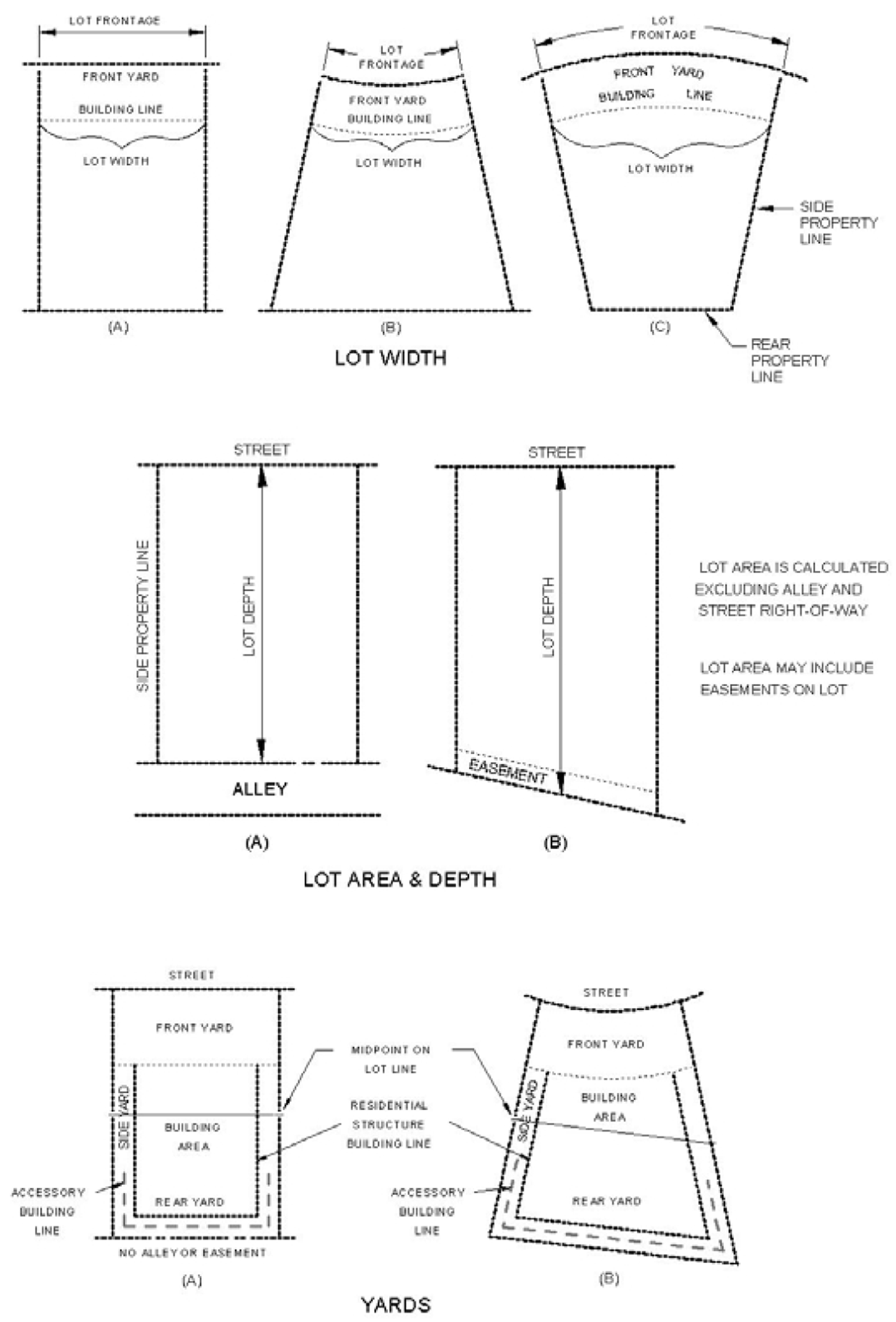
Measuring setbacks and lot dimensions. All setback and lot dimensions shall be measured in accordance with the following figure:
(b)
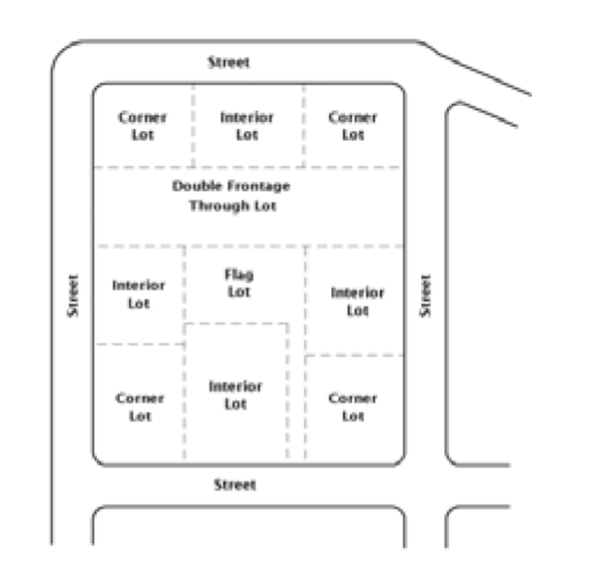
Configuration of lots. Flag lots (i.e., lots with minimal, or panhandle type, frontage) shall not be permitted. Double frontage lots in residential zoning districts shall only be permitted if access is limited to one street frontage. Lots shall be classified based on the following figure:
(c)
Building setbacks. Where a building setback line has been established by recorded plat, and the setback line requires a setback greater or lesser in depth than is prescribed by this chapter for the district in which the building is located, the required setback shall be the most restrictive setback line established either by plat or this chapter.
(d)
Front, side and rear yards.
(1)
On all corner lots, the front yard setback shall be observed along the frontage of both intersecting streets, unless approved specifically otherwise on a subdivision plat or development plat. Where lots have double frontage, extending from one street to another, a required front yard shall be provided.
(2)
The front of the primary building or structure on a lot shall not face the side or rear yard.
(3)
Where the frontage on one side of a street, between two intersecting streets, is divided by two or more zoning districts, the front yard shall comply with the requirements of the most restrictive district for the entire frontage.
(4)
The front yard shall be measured from the property line to the front face of the building, to the nearest supporting member of a covered porch or terrace, or to any attached accessory building.
(5)
Every part of a required front, side or rear yard shall be open and unobstructed except for the ordinary projections of window sills, belt courses, cornices, canopies and other architectural features not to exceed 12 inches into the required front, side or rear yard.
(6)
Roof eaves, roof extensions or an unenclosed, uncovered porch (no posts or columns) may project into the required front, side or rear yard for a distance not to exceed 48 inches.
(7)
Subsurface structures, platforms, enclosures or slabs may not project into the front, side or rear yard to a height greater than 30 inches above the average grade of the yard.
(8)
Where a future right-of-way line has been established for future widening or opening of a street or thoroughfare, upon which a lot abuts, then the front, side, or rear yard shall be measured from the future right-of-way line.
(9)
Air conditioning compressors and similar equipment are permitted in the side or rear yard, only.
(e)
Sight visibility. Visual clearance shall be provided in all zoning districts so that no fence, wall, architectural screen, earth mounding or landscaping 30 inches or higher above the street centerline obstructs the vision of a motor vehicle driver approaching any street, alley, or driveway intersection as follows:
(1)
At a street intersection, clear vision must be maintained for a minimum of 25 feet across any lot measured from the corner of the property line in both directions (along both streets).
(2)
At a street intersection with an alley, clear vision must be maintained for a minimum of ten feet across any lot measured from the corner of the property line in both directions (along both streets).
(3)
Shrubs and hedges that are typically less than 30 inches in height at maturity, as measured from the centerline of the street, may be located in the visual clearance areas of all districts but shall be maintained at a height of less than 30 inches.
(f)
Height.
(1)
For the purposes of calculating the overall height of a structure, slope shall be calculated from the highest point of the building at natural grade to the lowest point of the building at natural grade, or at the natural grade of the adjacent roadway, along a line that is, as close as possible, perpendicular to existing contours.
(2)
The height shall be measured from the highest parapet or roof ridge to natural grade or finish grade at the lowest point adjacent to the building exterior, whichever yields the greatest height.
(3)
In districts where the height of buildings is restricted to two or more stories, cooling towers may extend for an additional height not to exceed 40 feet above the average grade line of the building. Water stand pipes and tanks, church steeples, domes and spires, ornamental cupolas, city or school district buildings, and institutional buildings may be erected to exceed the height limit, as specified in the particular zoning district, provided that one additional foot shall be added to the front, side, or rear yard setback for each one foot that such structures exceed the zoning district height limit.
(Ord. No. 120910-01, § 1(ch. 5, § 1), 12-9-2010)
Sec. 38-402. - Off-street parking and loading requirements.
(a)
Purpose. To secure safety from fire, panic and other dangers; to lessen congestion in the streets; to facilitate the adequate provisions of transportation; to conserve the value of buildings; and to encourage the most appropriate use of land, minimum off-street parking and loading shall be provided as set forth in the schedules and provisions set out in this section.
(b)
General parking requirements.
(1)
In all zoning districts, off-street parking shall be provided in accordance with this section.
(2)
Required parking in residential districts must be located on the same lot or tract as the main use for which the parking is provided.
(3)
Required parking in nonresidential districts may be located on the same lot or tract as the main use for which the parking is provided or on a lot or tract in the same zoning district, within 300 feet of the building or structure constituting the main use.
(4)
A use lawfully existing on the date of the passage of the ordinance from which this chapter is derived need not provide parking as required by this section. Whenever a building or use constructed or established after the effective date of the ordinance from which this chapter is derived is changed or enlarged in floor area, number of dwelling units, seating capacity or otherwise, to create a need for an increase in the minimum number of required parking spaces, such spaces shall be provided to accommodate the enlargement or change. Existing off-street parking for a nonconforming use may not be reduced below the number of parking spaces required by this section.
(5)
If specific requirements for off-street parking result in a fraction of a parking space, the next larger whole number of spaces is required.
(6)
In computing the parking requirements for any building or development with multiple uses, the total parking requirements shall be the sum of the specific parking requirements for each individual use included in the building or development.
(c)
Size of space.
(1)
Each standard off-street surface parking space shall measure not less than ten feet by 18 feet, exclusive of access drives and aisles, and shall be of usable shape and condition.
(2)
Each parking space designed for parallel parking shall have a minimum dimension of eight feet by 22 feet.
(d)
Parking area standards.
(1)
Required off-street parking shall be on a paved concrete, asphalt, permeable, porous, or pervious pavement parking space surface, or other similar surfaces, as approved by the city administrator or his or her designee, Plastic permeable grids will not be allowed. Except for residential lots greater than one acre in size, all driveways shall be a paved concrete asphalt, permeable, porous, or pervious pavement surface, or other similar surfaces, as approved by the city administrator or his or her designee. All drive approaches shall be a paved concrete or asphalt surface.
(2)
All parking lots, parking spaces, fire lanes and pedestrian crosswalks shall be permanently and clearly delineated through the use of striping, buttons, tiles, curbs, barriers, or other approved methods. Nonpermanent type marking, such as paint, shall be regularly maintained to ensure continuous clear identification of the space.
(3)
Directional arrows shall be provided in all drive lanes and driveways.
(4)
To reduce the number of curb cuts and access driveways, the dedication of joint-use, private access driveway easements and cross lot access easements shall be required for all nonresidential development.
(e)
Schedule of off-street parking requirements.
(1)
Quantities. Off-street parking shall be provided in sufficient quantities to provide the following ratio of vehicle spaces for the uses specified in the districts designated:
(2)
New and unlisted uses. When a proposed land use is not classified in this section, the parking requirements will be based on the minimum requirements applicable to a similar use which is most closely related to the proposed land use, as determined by the administrative official.
(f)
Handicapped parking requirements. The number, size and design of parking facilities for handicap parking spaces required must follow the Federal Americans with Disabilities Act and Texas Accessibility Standards. The number of handicap parking spaces required is based on the total number of spaces provided.
(g)
Schedule of off-street loading requirements.
(1)
All nonresidential uses shall provide and maintain off-street facilities for receiving and loading merchandise, supplies and materials within a building or on the same lot or tract. Such off-street loading space may be adjacent to a public alley or private service drive or may consist of a truck berth within the structure. Such off-street loading space or truck berth shall consist of a minimum area of ten feet by 40 feet and the spaces or berths shall be provided in accordance with the following schedule:
(2)
Where adjacent to residential uses or zoning districts, off-street loading areas shall be screened from view of the residential uses or districts.
(h)
Stacking requirements for drive-through uses.
(1)
A stacking space shall be an area on a site measuring eight feet by 20 feet with direct forward access to a service window or station of a drive-through facility which does not constitute space for any other circulation driveway, parking space, or maneuvering area.
(2)
All stacking spaces shall be located entirely within the lot and shall be outside of any right-of-way, fire lane or similar access.
(3)
For financial institutions with drive-through facilities, each teller window or station, human or mechanical, shall be provided with a minimum of five stacking spaces.
(4)
For each service window of a drive-through restaurant, a minimum of eight stacking spaces shall be provided.
(5)
For kiosks, a minimum of three stacking spaces for each service window shall be provided.
(Ord. No. 120910-01, § 1(ch. 5, § 2), 12-9-2010; Ord. No. 05101203, § 1, 5-10-2012; Ord. No. 031413-03, § 1, 3-14-2013; Ord. No. 120822-01, § 1(Exh. C), 11-17-2022)
Sec. 38-403. - Landscaping standards.
(a)
Purpose. It is the purpose of this section to establish certain regulations pertaining to landscaping within the city. These regulations provide standards and criteria for new landscaping which are intended to:
(1)
Promote the value of property, enhance the welfare, and improve the physical appearance of the city;
(2)
Reduce the negative effects of glare, noise, erosion and sedimentation caused by expanses of impervious surfaces within the urban environment; and
(3)
Preserve and improve the natural and urban environment by recognizing that the use of landscaping elements can contribute to the processes of air purification, oxygen regeneration, groundwater recharge, abatement of noise, glare, and heat, provision of habitat for wildlife, and enhance the overall beauty of the city.
(b)
Landscaping applicable to nonconforming uses. This section establishes landscaping requirements in all zoning districts and for all uses. Land uses not previously subject to landscaping requirements shall comply with this section upon the occurrence of one of the following events:
(1)
A change in zoning;
(2)
Requirement of landscaping as a condition of a specific use permit;
(3)
Development of a vacant or undeveloped property;
(4)
Loss of legal nonconforming status.
(c)
General landscaping requirements.
(1)
Trees planted shall be a minimum of 2.5 inches in caliper measured 4.5 feet above the ground at the time of planting.
(2)
Shrubs, vines and ground cover planted pursuant to this article should be good, healthy nursery stock. Shrubs shall be a minimum of one-gallon container size at the time of planting.
(3)
Grass areas are required to be planted in species normally grown as permanent lawns in the city, including Bermuda, Buffalo Grass, Zoysia, or other drought-tolerant grass. Grass areas shall require the installation of solid sod.
(4)
The use of architectural planters may be permitted in fulfillment of landscape requirements subject to approval of the planning and zoning commission and city council at the time of site plan approval.
(5)
Developers and homebuilders are encouraged to use xeriscape plant materials to promote use of water-wise landscaping.
(6)
Landscape planting shall not be erected or installed in such a manner to interfere with traffic view or impose a safety hazard.
(7)
Landscapes should be designed to provide a natural appearance whenever possible. Design alternatives may include a variety of heights, clustering plant materials or other means that will achieve the desired effect.
(8)
All landscaping installed pursuant to this section shall be maintained in a healthy living condition. Any landscaping that is damaged or dies within two years of initial planting shall be replaced to ensure compliance with this section.
(d)
Landscape plan required.
(1)
A landscape plan is required to be submitted with each building permit for single-family residential uses or at the time of submittal of a site plan for all other uses. The landscape plan may be prepared by the applicant or the applicant's designee and is not required to be prepared by a registered or certified professional. A landscape plan illustrating compliance with the requirements of this section shall be provided and approved prior to the issuance of a building permit;
(2)
The landscape plan shall contain the following information:
a.
North arrow;
b.
Date of plan submittal;
c.
Location, size and species of all trees to be preserved;
d.
Location of all plants and landscaping material to be used including, but not limited to, paving, benches, screens, fountains, statues, ponds/lakes, or other landscape features;
e.
Topography;
f.
Size of all plant material to be used;
g.
Spacing of plant material where appropriate;
h.
Layout and description of irrigation, sprinkler or water system, including placement of water sources;
i.
Description of maintenance provisions of the landscape plan; and
j.
Persons responsible for the preparation of the landscape plan.
(e)
Landscaping required.
(1)
Fifteen percent of the total land area in any proposed multifamily residential or nonresidential development or construction that occurs for any use after the effective date of the ordinance from which this chapter is derived shall be landscaped.
(2)
All landscaping shall be completed and installed in accordance with the approved landscape plan within 90 days of a certificate of occupancy being granted. A one-time extension, not to exceed 90 days, may be granted upon approval of the administrative official.
(3)
Where the development is to be a multiphase development, only the area being developed in the current phase need to be subject to the landscape regulations; however, each phase will be required to meet the landscaping requirements as they are being developed.
(4)
The use of native and adapted, drought tolerant plants is encouraged to meet requirements of this section.
(5)
Artificial plants or turf are expressly prohibited.
(6)
An irrigation system must be provided or a hose bib connection be available within 100 feet of all landscape areas with all landscape plans for nonresidential developments.
(f)
Location of required landscaping.
(1)
Not less than 40 percent of the total landscaping requirement shall be located in the designated front yard. Parcels that are adjacent to more than one roadway may count the street yards towards satisfying the front yard requirement.
(2)
In the industrial zoning district, only 20 percent of landscaping shall be required to be located in the front yard.
(g)
Single-family residential landscaping requirements. All single-family residential lots shall provide, at a minimum, the following landscaping:
(1)
One tree to be located in the front yard.
(2)
Solid grass sod shall be provided in the front yard.
(h)
Multifamily and nonresidential landscaping requirements.
(1)
Requirement standards. The following standards shall apply to all multifamily and nonresidential properties. Standards that are set forth in this section for the provision of trees may be met by saving existing, on-site trees of six inches minimum caliper, measured 4.5 feet above grade, or by planting new trees.
(2)
Nonresidential and multifamily buffering and screening requirements.
a.
In addition to any screening requirements, when a nonresidential or multifamily use is established on a lot located adjacent to a residentially zoned property, the nonresidential or multifamily use shall provide a minimum ten-foot landscape buffer strip adjacent to the property line of the residentially zoned property. A minimum of one tree shall be planted for each 50 linear feet of landscape buffer. A minimum of ten shrubs shall be planted for each 50 linear feet of landscape buffer. All other areas within the landscape buffer shall be covered with grass or another solid vegetative cover approved at the time of site plan approval.
b.
When a nonresidential or multifamily use is established on a lot adjacent to a residentially zoned property, the nonresidential or multifamily use shall construct a solid screening fence constructed of wood, masonry or other material to a minimum of six feet in height, approved by the planning and zoning commission taking into consideration aesthetic value, light, air, or open space factors and accessibility and safety concerns at the time of site plan approval. The screen shall be located no closer to the street than the property line. Such screening fence shall be maintained in good condition.
(3)
Parking area landscaping and buffering requirements.
a.
Perimeter landscaping and screening.
1.
Any parking lot or portion thereof that fronts upon or is adjacent to a public or private street right-of-way and contains ten or more parking spaces shall provide a minimum ten-foot landscape buffer adjacent to the street right-of-way. A minimum of one tree shall be planted for each 50 linear feet of landscape buffer. A minimum of ten shrubs shall be planted for each 50 linear feet of landscape buffer. All other areas within the landscape buffer shall be covered with grass or another solid vegetative cover approved at the time of site plan approval.
2.
A landscaped berm or combination of berm and shrubs may be provided in lieu of required shrubs. The berm must be an average height of three feet, but in no case less than 18 inches, above the average grade of the street and parking lot curbs. A variation in height of the berm is encouraged. Shrubs may be grouped to provide variety in design.
b.
Interior landscaping.
1.
All parking areas shall provide a minimum of ten percent of the gross parking area devoted to landscaping. Interior landscape areas shall be protected from vehicular encroachment of overhang through appropriate wheel curbs, tire stops/parking blocks or similar barriers. A minimum of one tree shall be planted for each 400 square feet of required interior landscape area.
2.
Interior areas of parking lots shall contain planting islands, peninsulas, or medians located so as to best relieve the expanse of paving. Planter islands must be located no further apart than every 12 parking spaces and at the terminus of all rows of parking. Such islands shall be a minimum of 200 square feet. Planter islands shall contain a combination of trees, shrubs, lawn, ground cover and other appropriate materials provided such landscaping does not cause visual interference within the parking area.
c.
Distribution of landscaped areas. Required landscaped areas for parking lots shall be evenly distributed throughout the parking lot. Adjustments may be approved by the planning and zoning commission and city council at the time of site plan approval when the shape or size of the parking lot, the location of existing trees or other natural constraints reasonably prevent such distribution.
(4)
Dumpster screening and buffering requirements. All dumpsters or other solid waste collection facilities located on a nonresidential or multifamily property shall be located away from residential properties or uses and shall be enclosed on three sides by a minimum six-foot-tall masonry or other noncombustible material screening wall. Temporary dumpsters are exempt from this screening requirement. Temporary dumpsters must be removed upon completion of the event, construction, or demolition.
(Ord. No. 120910-01, § 1(ch. 5, § 3), 12-9-2010; Ord. No. 013014-01, § 1(Exh. A), 1-30-2014)
Sec. 38-404. - Exterior construction and architectural standards.
(a)
Building product or materials that are approved for use by a national model code published within the last three code cycles that applies to the construction, renovation, maintenance, or other alteration of the building.
(b)
Architectural design features:
(1)
All non-residential buildings shall be architecturally finished on all four sides with the same materials and detailing (e.g., tiles, moldings, cornices, wainscoting, etc.).
(2)
The rear façade of a building, which is not adjacent to or does not face a public right-of-way, park or residential district, shall not be required to comply with the above architecturally finished requirement.
(Ord. No. 120910-01, § 1(ch. 5, § 4), 12-9-2010; Ord. No. 051211-02, § 1, 5-12-2011; Ord. No. 013014-01, § 1(Exh. A), 1-30-2014; Ord. No. 033017-01, § 1, 3-30-2017; Ord. No. 091219-03, § 1(Exh. A), 9-12-2019)
Sec. 38-405. - Home occupation regulations.
(a)
Purpose and intent. It is the purpose of this section to:
(1)
Protect residential areas from the adverse impact of activities associated with home occupations.
(2)
Permit residents of the community a broad choice in the use of their homes as a place of livelihood and the production or supplementing of personal and family income.
(3)
Establish criteria and development standards for home occupations conducted in dwelling units.
(b)
Required conditions.
(1)
The area set aside for home occupations shall not exceed 20 percent of the total floor area of such residence. A specific use permit may be granted to allow for home occupations to exceed 20 percent of the total floor area of the residence.
(2)
A home occupation shall not have any interior or exterior business signs nor any display that will indicate from the exterior that the building is being utilized in part for any purpose other than that of a dwell, except a nameplate not more than one square foot in area is permitted on the exterior of the building.
(3)
No mechanical equipment is used except of a type that is similar in character to that normally used for purely domestic or household mechanical equipment as for hobby purposes in conjunction with the home occupation.
(4)
Retail sales shall be prohibited on the premises except for the retail sales of products and goods produced and fabricated on the premises as a result of the home occupation.
(5)
Only members of the immediate family permanently residing on the premises shall be employed in the home occupation. A specific use permit may be granted to allow for persons other than the immediate family permanently residing on the premises to be employed in the home occupation.
(6)
In no case shall a home occupation be open to the public at times earlier than 8:00 a.m. and no later than 10:00 p.m.
(7)
No more than one home occupation shall be permitted within any single dwelling unit.
(8)
A home occupation shall be carried on wholly within the principal building. No home occupation or any storage of goods, materials, or products connected with a home occupation shall be allowed in accessory buildings or garages, attached or detached, excluding paints and chemicals that may be used in the home occupation. A specific use permit may be granted to allow for the home occupation to operate outside of the principal building, including operating out of an accessory building.
(9)
There shall be no exterior indication of the home occupation or variation from the residential character of the principal building.
(10)
There shall be no exterior storage of materials to be used in conjunction with a home occupation. A specific use permit may be granted to allow for the exterior storage of materials used in conjunction with the home occupation.
(11)
A home occupation shall produce no offensive or obnoxious noise, vibration, smoke, electrical interferences, dust, odors, heat or other obnoxious conditions detectable beyond the property limits or beyond the walls of the dwelling unit. The judgment of the city's code enforcement officer pertaining to a violation under this section shall be considered decisive and final unless formally appealed to the board of adjustment within 30 days of the code enforcement officer's written determination.
(12)
A home occupation shall not create any increased traffic generation.
(13)
All home occupations may be subject to periodic inspections.
(14)
A home occupation shall not have any commodity sold on the premises.
(15)
A home occupation shall not use mechanical equipment except of a type that is similar in character to that normally used for purely domestic or household purposes.
(c)
Permits.
(1)
Purpose. To establish a method to allow the city to regulate and control nonresidential activities and maintain a record of the types and numbers of home occupations in the city.
(2)
Required. Each resident within the city that has, or desires to establish an authorized home occupation, is required to have a home occupation permit.
(3)
Application. The following provisions shall apply for a home occupation permit:
a.
Applicant shall apply to the administrative official for a home occupation permit.
b.
The administrative official or his designee may issue the permit if the home occupation meets all the requirements established in subsection (b) of this section.
c.
The decision of the administrative official or his designee may be appealed to the board of adjustment in accordance with article I of this chapter.
d.
The board of adjustment will be the final judgment on appeals which must be submitted to the board within 30 days of disapproval.
e.
Supporting documents:
1.
Signed statement. One type of supporting evidence that may be submitted to the board of adjustment for their consideration of an appeal is a signed statement by each property owner within 200 feet of the property on which the home occupation is to occur, stating that the property owner has no objection to the existence of the proposed home occupation. An example of such a statement is as follows:
"I (name) the property owner at (address) have been advised by (name of home occupation applicant) of the request to the city for a home occupation permit for the purpose of conducting (type of home occupation) and I have no objection to the home occupation permit being granted for the purpose reflected in this statement.
Signature of neighboring property owner and date"
2.
Statement from property owner. An applicant who is renting the property on which a home occupation permit is requested shall obtain a written statement from the owner of the property. The owner will state that he has no objection to the home occupation on the property.
3.
Persons with demonstrated physical handicaps. Persons with physical handicaps may be permitted special consideration. The applicant may request a waiver of a portion or all of one or more of the requirements for a home occupation.
4.
Granting of exception. It shall be the responsibility of the applicant to submit sufficient evidence to justify the granting of an exception to any of the requirements in subsection (b) of this section.
5.
Conditions applicable to home occupation permits.
(i)
Validation. A home occupation remains valid for a period of two years.
(ii)
Renewal. Permits shall be renewed every two years.
(iii)
Termination. When a home occupation is found in noncompliance with the requirements outlined in subsection (b) of this section, the permit will be terminated immediately.
(iv)
Renewal of terminated permits. The procedure for renewal of a terminated permit shall be the same as required for the issuance of a new permit under this chapter.
(Ord. No. 120910-01, § 1(ch. 5, § 5), 12-9-2010; Ord. No. 111424-02, § 1(Exh. A), 11-14-2024)
Sec. 38-406. - Temporary uses; construction yards, field offices and other temporary buildings.
(a)
Construction yards, field offices and other temporary buildings. Temporary permits for onsite and offsite construction yards, field offices, construction offices, and other temporary structures may be approved by the administrative official. The term of the temporary use shall be indicated in the permit. No extensions may be granted.
Upon due notice and a hearing before the city council, any such permit maybe revoked if the city council finds the use of the property or structure is contrary to the intent of this section or results in increased noise, traffic, or other conditions considered to be a nuisance or hazard.
(1)
No permits may exceed one year unless in association with on-going construction activities carried out pursuant to a valid building permit.
(2)
No storage of vehicles in excess of 30,000 pounds gross vehicle weight.
(3)
No sales related to the temporary use shall occur at the location. Model homes used for sales offices in a residential development are exempt from this regulation, but must be in compliance with all regulations regarding single family residential development as provided in this code.
(4)
As the use is temporary, pavement as required by Section 38-402, Off-street parking and loading requirements, and Section 38-407, Outdoor storage and display shall be waived.
(5)
No storage of hazardous materials is permitted unless in compliance with state and federal laws related to hazardous materials and storage thereof.
(6)
Upon completion or abandonment of construction or expiration of temporary use permit, such field offices, buildings, and construction materials and equipment shall be removed within 30 days.
(b)
Trailers and other mobile transport vehicles. For the purpose of this subsection, the term "trailer" includes, but is not limited to, a box van, semitrailer, contractor's trailer, utility trailer, a railroad box car or any other similar mobile transport vehicle not intended for permanent storage. A trailer may be used for storage pursuant to a valid building permit in use with on-going construction activities. A trailer may be used as a field office or claims adjusting office in connection with a natural disaster or similar event. The trailer must be permitted; the placement of the trailer shall not interfere with sight distance or on-site circulation; shall not cause a substantial adverse impact on the public right-of-way or adjoining properties; and may remain on site for 180 days. The administrative official may extend the permit based on information provided by the applicant and the extent of the event.
(1)
In zoning districts (RA) Single-Family Agriculture, (GP) General Professional, (C-1) Retail District, (R-2) General Residence, and (MH) Mobile Home Area a trailer shall not be used for permanent storage. If a trailer is used for storage for more than 180 days during any consecutive 12-month period, the use shall be deemed permanent and in violation of this code.
(2)
In zoning district (C-2) General Commercial, (I) Industrial, and (PI) Public Institutional, a "trailer" may be used as storage if it complies with the following regulations:
a.
The trailer is functional and in compliance with licensing and inspection as required by the state of issuance;
b.
The trailer is not parked in the required minimum parking spaces as regulated in Section 38-402;
c.
The trailer is not parked in a vehicular access, pedestrian facilities, or required landscape areas;
d.
The trailer is parked in a location that minimizes visual impact to surrounding properties and cannot be place in the front yard of a property, nor over any utility easement or setback lines; and
e.
The trailer may not be placed on a property or a lot without a primary use or building and the trailer shall not be used as a primary use.
(c)
Cargo containers. It is recognized that uncontrolled storage and placement of cargo containers may detract from the value of adjacent property, discourage commerce, and negatively impact the aesthetic quality of nonresidential property and adjacent residential property. The purpose of this section is to provide for regulations that protect the value of property and enhance the appearance, health, safety, and welfare of the city.
(1)
Commercial.
a.
(R-A) Single-Family Agricultural. (R-2) General Residence, (GP) General Professional, (C-1) Retail, (C-B) Central Business, (MH) Mobile Home Area, and (H) Historic
1.
Cargo containers shall not be placed on a lot without a primary use or building and shall not be used as a primary use.
2.
Cargo containers used for storage of construction equipment and materials used in the construction of the primary use are allowed pursuant to a valid building permit. The cargo container must be removed within 30 days upon completion of construction.
3.
Cargo containers shall not be placed on public streets, nor shall they be placed within 20 feet of any public street right-of-way, over any utility easement, or setback lines.
4.
Cargo containers shall not occupy any required off-street parking spaces, vehicular access, pedestrian facilities, or landscape areas for the site.
5.
Cargo containers shall be placed in a location that minimizes visual impact from surrounding streets and properties.
6.
Cargo containers shall not be used as signage and no signage may be attached to a cargo container.
7.
Cargo containers shall not be stacked.
8.
A cargo container may be permitted in an area visible to the public view for a maximum of 180 days during any consecutive 12-month period.
b.
(C-2) General Commercial, (I) Industrial and (PI) Public Institutional.
1.
Cargo containers shall not be placed on a lot without a primary use or building and shall not be used as a primary use.
2.
Cargo containers used for storage of construction equipment and materials used in the construction of the primary use are allowed pursuant to a valid building permit. The cargo container must be removed within 30 days upon completion of construction.
3.
Cargo containers shall not be placed on public streets, nor shall they be placed within 20 feet of any public street right-of-way, over any utility easement, or setback lines.
4.
Cargo containers shall not occupy any required off-street parking spaces, vehicular access, pedestrian facilities, or landscape areas for the site.
5.
Cargo containers shall be placed in a location that minimizes visual impact from surrounding streets and properties. They shall not be placed in the front yard of the property.
6.
Cargo containers shall not be used as signage and no signage may be attached to a cargo container.
7.
Cargo containers may not be stacked more than two high.
8.
Cargo containers used for as an integral part of the primary use of the property must be fenced and/or screened from the public view.
(2)
(R-1) Single-Family.
a.
A cargo container must be permitted by the administrative official.
b.
Cargo containers shall not be placed on a lot without a primary use or building and shall not be used as a primary use.
c.
Cargo containers are allowed for storage in the construction of or maintenance/repairs of the primary use pursuant to a valid building permit. The cargo container must be removed within 30 days upon completion of construction.
d.
Cargo containers shall not be placed on public streets, nor shall they be place within 20 feet of any public street right-of-way, over any utility easement, or setback lines. Cargo containers may be place on a driveway if they do not obstruct visibility at an intersection or encroach on a sidewalk.
e.
A cargo container may be permitted for a maximum of 180 days during any consecutive 12-month period.
(d)
Temporary classrooms. It is recognized that educational facilities often encounter increased enrollment that exceeds available classroom space. The city further recognizes that additional classroom space may require a long-range capital campaign, bond election, or other efforts to fund construction of permanent classroom facilities. Additionally, it is understood that increased enrollment may be a transient occurrence that may not necessitate the construction of permanent facilities. It is recognized that uncontrolled placement of temporary classrooms may detract from the value of adjacent property, discourage commerce, and negatively impact the aesthetic quality of nonresidential property and adjacent residential property. The purpose of this section is to provide for regulations that protect the value of property and enhance the appearance, health, safety, and welfare of the city. In this section, "educational facility" shall mean a facility used for the purpose of providing courses of instruction for students in one or more grades from prekindergarten through grade 12 and that is either operated by a governmental entity as defined by the laws of the state of Texas or is a private school as defined by the Texas Education Code.
a.
Temporary classroom buildings, additional temporary restroom facilities, and additional dining room facilities related to educational facilities may not be utilized unless a primary use or building(s) has been established on the property.
b.
Temporary classroom buildings, additional temporary restroom facilities, and additional dining room facilities related to educational facilities are permitted. A building permit shall only be issued for the construction of a temporary classroom building for an educational facility if the following criteria are met:
1.
The applicant establishes in the construction plans that all parking requirements established by this chapter will be complied with;
2.
The maximum occupancy of each temporary classroom facility shall comply with the most recent edition of the State Fire Code; and
3.
The applicant demonstrates a need for the temporary classroom building based on an enrollment of students that exceed the maximum allowed students per classroom and the number of temporary classroom buildings to be constructed will not exceed four temporary classroom buildings per campus.
c.
The temporary structures are to be placed on the property to minimize the visual impact on the surrounding properties and cannot be placed in the front yard of the primary structure.
d.
The temporary structures must be removed from the property within 90 days of discontinuation of use.
e.
Walkways of treated lumber, concrete, asphalt or other suitable materials must be provided for ingress and egress out of the temporary buildings.
f.
A fire resistant skirting shall be required around the bottom at the perimeter of the building.
g.
Masonry requirements of this code are waived for temporary classroom structures as they are deemed temporary in nature.
h.
All temporary classroom buildings shall adhere to the 2012 IBC.
i.
Any change in use of the temporary classrooms after issuance of the building permit that result in non-compliance with the criteria set forth in subsection (b) of this section shall be grounds for revocation of the building permit.
(Ord. No. 120910-01, § 1(ch. 5, § 6), 12-9-2010; Ord. No. 013014-01, § 1(Exh. A), 1-30-2014; Ord. No. 120921-01, § 1(Exh. A), 12-7-2021)
Sec. 38-407. - Outdoor storage and display.
(a)
Allowed in nonresidential districts. Outdoor display and storage shall be allowed in nonresidential districts in accordance with this section. Any merchandise, material or equipment situated outdoors in nonresidential districts shall be subject to the requirements of this section. This section shall not apply to large areas of outdoor storage that are an integral part of the primary use of the property and are fenced and screened from the public view.
(b)
Outdoor display. Outdoor display shall be classified as the display of items actively for sale. Outdoor display directly adjacent to a principal building wall shall extend a distance of no greater than ten feet from the wall. Outdoor display shall not be permitted to block windows, entrances or exits, and shall not impair the ability of pedestrians to use the building. Outdoor display of items principally utilized outdoors will be allowed.
(c)
Outdoor storage.
(1)
Outdoor storage shall be classified as the storage of goods and materials in individual packaging and not in storage containers. Organic materials stored on pallets may be considered outdoor storage.
(2)
Outdoor storage may extend from the primary building, but not for a distance greater than 50 feet, and not into a public right-of-way.
(3)
Outdoor storage shall not exceed more than 1,000 square feet in area or ten percent of the total site area, whichever is greater. Additional outdoor storage area may be approved by specific use permit.
(4)
Outdoor storage may not occupy more than 30 percent of the linear distance along any building wall facing a public right-of-way.
(5)
Areas intended for outdoor storage shall be paved and clearly marked to distinguish them from required off-street parking areas.
(6)
No outdoor storage shall be permitted in required off-street parking areas or parking spaces.
(7)
No outdoor storage shall be permitted within a required front or side yard setback.
(d)
Outdoor display and storage requirements.
(1)
All outdoor display and storage areas must be clearly shown in the site plan submitted for the property.
(2)
All outdoor storage and display shall be located outside of the public right-of-way and at least ten feet from the back edge of the curb or street pavement edge and outside of any required landscape area. Additionally, all outdoor display and storage shall only be on paved areas and shall be included in the maximum impervious cover limitations set forth within the applicable zoning district.
(e)
Exceptions.
(1)
Vehicles for sale within part of a properly permitted vehicle sales use (including boats and recreational vehicles) shall not be considered outdoor display or storage.
(2)
Such vehicles must be located and displayed on a paved vehicle use area, clearly indicated on the site plan, and screened under the same requirements for a parking lot.
(Ord. No. 120910-01, § 1(ch. 5, § 7), 12-9-2010)
Sec. 38-408. - Lighting and glare standards.
(a)
Purpose and intent. The purpose of this section is to regulate outdoor lighting in order to reduce or prevent light pollution in the city. New lighting technologies have produced lights that are extremely powerful, and these types of lights may be improperly installed so that they create problems of excessive glare, light trespass, and higher energy use. Light trespass reduces privacy, degrades the enjoyment of the night sky, and results in higher energy use and increased costs for everyone. Appropriately regulated, and properly installed, outdoor lighting will contribute to the safety and welfare of the residents, and will help preserve the historic and rural character of the city.
(b)
Applicability.
(1)
All outdoor lighting fixtures installed on private and public property within a new development or redevelopment within the city limits shall be required to comply with this section. This section does not apply to interior lighting; however, overly bright light emitted from a structure will be subject to this section if it is determined by the administrative official that it creates a nuisance or a potential safety hazard.
(2)
All outdoor lighting fixtures existing and legally installed and operating before the effective date of the ordinance from which this chapter is derived shall be exempt from this section unless they are determined to create a safety hazard. When existing lighting fixtures become inoperable, their replacements are subject to the provisions of this section.
(3)
Modifications to nonconforming lighting fixtures shall also comply with this section.
(4)
In the event of a conflict between this section and any other section of this chapter or any other regulation of the city, the more stringent requirements shall apply.
(c)
Exemptions. The following are exempt from the provisions of this section:
(1)
Publicly maintained traffic control devices.
(2)
Streetlights installed prior to the effective date of the ordinance from which this chapter is derived.
(3)
Temporary emergency lighting (fire, police, repair crews).
(4)
Lighting fixtures and illumination requirements imposed by the state department of transportation within state department of transportation right-of-way.
(5)
Moving vehicle lights.
(6)
Navigation lights (aircraft warning beacons on water towers and wireless transmission facilities) required by state or federal law.
(7)
Signs and associated lighting that conform to the city's sign regulations.
(8)
Seasonal decorations with lights in place no longer than 60 days.
(9)
Sports field lighting.
(10)
Other temporary uses approved by the city council (festivals, carnivals, fairs, nighttime construction).
(11)
Covered porch lighting on residences provided that each external light fixture does not exceed 150 watts (2,220 lumens).
(12)
Security lights of any output that are controlled by a motion sensor switch provided they do not exceed 0.25 footcandle at the property line and do not remain illuminated for a duration not to exceed ten to 12 minutes after activation.
(d)
Submittals. Applications for all building permits for new construction or redevelopment, including the installation of outdoor lighting fixtures, shall provide proof of compliance with this section. The following information shall be submitted as part of the site plan:
(1)
Plans indicating the location, type, and height of lighting fixtures including both building-mounted and ground-mounted fixtures;
(2)
A description of the lighting fixtures, including lamps, poles or other supports and shielding devices, which may be provided as catalog illustrations from the manufacturer;
(3)
Photometric data, which may be furnished by the manufacturer, showing the angle of light emission;
(4)
Detailed site lighting plan illustrating the footcandle power measured throughout the site; and
(5)
Additional information as may be required by the administrative official in order to determine compliance with this section.
(e)
General standards. The following standards shall apply to all outdoor lighting installed after the effective date of the ordinance from which this chapter is derived:
(1)
Outdoor lighting shall be designed to provide the minimum lighting necessary to ensure adequate safety, night vision, and comfort, and not create or cause excessive glare onto adjacent properties and public street rights-of-way.
(2)
Outdoor lighting must be hooded, shielded, and/or aimed downward.
(3)
The hood or shield must mask the direct horizontal surface of the light source. The light must be aimed so as to ensure that the illumination is only pointing downward onto the ground surface.
(4)
Any bright light shining onto an adjacent property or streets that would result in a safety hazard is not permitted. Light trespass beyond property boundaries or above the horizontal plane shall be considered noncompliant.
(5)
Existing fixtures may be adapted to comply with this section by adding a properly designed hood or shield, or by redirecting any upward mounted fixture downward onto the ground surface, sign, or illuminated structure.
(6)
All outdoor lighting fixtures shall be designed, located, and maintained to minimize light trespass and all direct illumination shall be kept within the boundaries of the property upon which the light fixture is positioned.
(7)
When approved, accent lighting shall be directed downward onto the structure or object and not toward the sky or adjacent properties. Direct light emissions shall not be visible above the roofline or beyond the building edge.
(8)
Spotlights on landscaping and foliage shall be limited to 150 watts output. The light shall be shielded and so as not to create a nuisance or safety hazard.
(f)
Specific nonresidential lighting requirements.
(1)
The maximum allowable intensity of lighting for any nonresidential use shall be 0.25 footcandles measured at the property line adjacent to any residentially zoned area or at the street right-of-way line when the residentially zoned area is separated by a public street right-of-way.
(2)
Light poles shall be placed on the site at a setback equal to their height from all adjacent residential property or street rights-of-way.
(3)
Light poles shall have a maximum height equal to the maximum height allowed for the main building in each zoning district or shall be equal in height to the tallest building located on the property in which the light is placed, whichever is less.
(Ord. No. 120910-01, § 1(ch. 5, § 8), 12-9-2010)
Sec. 38-409. - Performance standards.
(a)
Generally. All uses within the I (industrial) district shall be constructed, maintained and operated so as not to be injurious or offensive to the occupants of adjacent premises by reason of the emission or creation of noise, vibration, smoke, dust or other particulate matter, toxic or noxious waste materials, odors, fire, and explosive hazard or glare, more specifically in conformity with the standards set forth within this section.
(b)
Noise. Every use shall be so operated as to comply with the maximum performance standards governing noise as described herein. Objectionable noises due to intermittence, beat frequency or shrillness shall be muffled or eliminated so as not to become a nuisance to adjacent uses. Sound levels shall be measured with a sound level meter and associated octave band filter manufactured according to standards prescribed by the American Standards Association:
*Permissible sound level between 6:00 p.m. and 8:00 a.m. shall be decreased by three decibels in each of the octave bands.
(c)
Vibration. Every use shall be so operated that ground vibration inherently and recurrently generated is not perceptible, without instruments at any point on the property line of the property on which the use is located. No vibration at any time shall produce an acceleration of more than 0.1g or shall result in any combination of amplitudes and frequencies beyond the "safe" range of Table 7 U.S. Bureau of Mines Bulletin No. 442. The equations of said bulletin shall be used to determine the values for enforcement.
(d)
Smoke. Every use shall be so operated as to prevent the emission of smoke, from any source whatsoever, to a density greater than described as No. 1 on the Ringlemann Smoke Chart; provided, however, that smoke equal to, but not in excess of, that shade of appearance described as No. 2 on the Ringlemann Chart may be emitted for a period or periods totaling four minutes in any 30 minutes. For the purpose of grading the density of smoke, the Ringlemann Chart, as published and used by the United States Bureau of Mines, and which is hereby made, by reference, part of this section. All measurements shall be at the point of emission.
(e)
Dust and dirt. Every use shall be so operated as to prevent the emission into the air of dust or other solid matter which may cause damage to property and health of persons or animals at or beyond the lot line of the property on which the use is located.
(f)
Industrial sewage and waste. Every use shall be so operated as to prevent the discharge into any stream, lake or the ground, of any waste which will be dangerous or discomforting to persons or animals or which will damage plants or the like beyond the lot line of the property on which the use is located.
(g)
Odors. Every use shall be so operated as to prevent the emission of objectionable or offensive odors in such concentration as to be readily perceptible at any point at or beyond the lot line of the property on which the use is located. There is hereby established as a guide in determining the quantities of offensive odors, Table III, Chapter 5, "Air Pollution Abatement Manual" of the Manufacturing Chemists' Association, Inc., Washington, D.C.
(Ord. No. 120910-01, § 1(ch. 5, § 9), 12-9-2010)
Sec. 38-410. - Accessory structures.
(a)
Residential.
(1)
No accessory structure shall be permitted without a primary use or structure.
(2)
No accessory building shall be constructed or placed upon a lot until construction of the principal building has commenced. No accessory building shall be used or occupied until the principal building is completed and is being used or occupied except for barns, garages or other storage structures being utilized for the storage of materials and equipment associated with agricultural use of a property in the (R-A) Single-family Agricultural district.
(3)
The minimum separation between a main structure and a detached accessory structure other than a carport, patio cover, pergola, or gazebo (structures with a minimum of three open walls) shall be ten feet.
(4)
No accessory structures shall be located forward of the principal building on the lot.
(5)
Accessory buildings may be located in the required side or rear yard provided they are no closer than five feet to any property line and cannot encroach on any easement on the property.
(6)
Portable accessory buildings less than 120 square feet which are not placed on a permanent foundation shall be allowed in all residential districts with a maximum number of two per lot.
(7)
Mechanical equipment such as air conditioning compressors, swimming pool pumps and filters, and similar devices may be installed in the side yard at the maximum height of 60 inches above the ground level of the graded lot (except in areas of special flood hazard which requires units one foot above the base flood elevation). Mechanical equipment is not allowable under or opposite window, doors, or other openings of adjacent residences.
(b)
Commercial.
(1)
General Professional (GP), Commercial District (C-1), and Central Business District (C-B) shall comply with the following standards:
a.
No accessory structure shall be permitted without a primary use or structure.
b.
No accessory building shall be constructed or placed upon a lot until construction of the principal building has commenced.
c.
The minimum separation between a main building and a detached accessory structure other than a carport, patio cover, pergola, or gazebo (structures with a minimum of three open walls), or walk-in cooler shall be ten feet.
d.
Accessory buildings under 400 square feet are prohibited. Accessory buildings over 400 square feet require a specific use permit and the architecture and exterior finish must conform to the principal building.
e.
Cooling towers and other mechanical equipment shall be located as to minimize the visual exposure to the public right-of-way.
(2)
General Commercial (C-2) and Industrial (I).
a.
No accessory structure shall be permitted without a primary use or structure.
b.
No accessory building shall be constructed or placed upon a lot until construction of the principal building has commenced.
c.
No accessory building shall be located forward of the principal building on the lot.
d.
The minimum separation between a main building and a detached accessory structure other than a carport, patio cover, pergola, or gazebo (structures with a minimum of three open walls), or walk-in cooler shall be ten feet unless the structure is integral to the operations of the facility and must be placed within the ten feet.
(Ord. No. 120910-01, § 1(ch. 5, § 10), 12-9-2010; Ord. No. 013014, § 1(Exh. A), 1-30-2014)
Sec. 38-411. - Manufactured homes and mobile homes.
(a)
Mobile homes prohibited. Mobile homes, as defined in this chapter, are prohibited anywhere inside the city limits.
(b)
Manufactured homes located in a manufactured home park.
(1)
Only one manufactured home will be permitted per lot or space.
(2)
A manufactured home lot or space shall be not less than 3,750 square feet in area when used to accommodate manufactured homes over 40 feet in length and not less than 2,500 square feet when used to accommodate manufactured homes under 40 feet in length.
(3)
A minimum setback requirement from front, side, and rear yard property lines shall be a minimum ten feet. When a park boundary abuts upon a public street, no manufactured home lot or space shall be closer thereto than 20 feet.
(4)
At least one off-street parking space shall be provided for each manufactured home lot or space. In addition, an additional 150 square feet for each two manufactured home lots or spaces shall be provided in common areas for the storage of boats and for visitor parking.
(5)
Each manufactured home lot or space shall have adequate access to a public street. Internal streets shall be designed for safe and convenient access to all manufactured home lots or spaces and to facilities for the common use of park residents. All internal streets shall be dedicated for public use but shall be privately owned, built and maintained by the property owner. All entrance streets and collector streets within the park shall have minimum right-of-way width of 60 feet and a pavement width of 42 feet. Local residential streets within the park shall have a minimum right-of-way width of 50 feet and a pavement width of 30 feet. These minimum pavement widths may be reduced by two feet if an adjacent sidewalk is provided along one side of the street or by four feet if sidewalks are provided on both sides of the street.
(6)
All streets, driveways and parking areas shall be paved with an asphalt or concrete pavement surface.
(7)
A concrete walkway of a minimum of 30 inches in width for pedestrian access to each manufactured home from either the street or a driveway shall be constructed on each lot or space.
(8)
All manufactured homes must be connected to a public water supply system through mains and piping that comply with the Texas Commission on Environmental Quality standards and city's plumbing code.
(9)
Each manufactured home shall be connected to a sewer system approved by the state department of health and/or Texas Commission on Environmental Quality.
(10)
The manufactured home park shall be located and graded as to drain away all surface water in a safe and efficient manner and which does not adversely affect other surrounding properties.
(11)
All manufactured homes shall be installed and anchored in accordance with state department of labor and standards rules and regulations.
(12)
A fire-resistant skirting shall be required around the bottom at the perimeter of the manufactured home.
(13)
At least 100 square feet of recreation area shall be provided for each manufactured home, except no public recreation area shall have an area of less than 2,500 square feet.
(c)
Nonconforming mobile homes and manufactured homes.
(1)
The lawful use of any mobile home or manufactured home existing at the time of the enactment of the ordinance from which this section is derived may be continued although such use does not conform with the provisions of this section; provided, however, the right to continue such nonconforming use shall be subject to regulations prohibiting the creation of a nuisance and shall terminate when inappropriate use of the premises produces a condition which constitutes a nuisance and further, the right of nonconforming uses to continue shall be subject to such regulations as to the maintenance of the premises and conditions of operation as may, in the judgment of the board of adjustment, be reasonably required for protection of adjacent property and further, the right of nonconforming uses to continue shall be subject to the specific regulations herein contained.
(2)
Nonconforming mobile homes and manufactured homes outside of a manufactured housing district.
a.
A nonconforming mobile home or manufactured home may be occupied except as herein otherwise provided.
1.
Repairs and alterations may be made to a nonconforming mobile home or manufactured home, provided that no structural alteration shall be made, except those required by law or ordinance.
2.
A nonconforming mobile home or manufactured home shall not be added to or enlarged in any manner unless such addition and enlargements are made to conform to all the requirements of the district in which mobile home or manufactured home is located.
3.
No nonconforming mobile home or manufactured home shall be moved in whole or in part to any other location on the lot, or on any other lot.
4.
A nonconforming mobile home which is damaged or partially destroyed by fire or natural disaster, and if the cost of restoration equals or exceeds 50 percent of the replacement cost of the mobile home at the time such damage occurred, then said mobile home shall not be again restored or used for such purpose and may not be replaced with a mobile home or manufactured home. The property will revert to the appropriate zoning land use.
5.
An individual who owns a nonconforming mobile home or manufactured home at the time of the passage of the ordinance from which this section is derived and which is damaged or destroyed by means other than fire or natural disaster may replace said nonconforming mobile home or manufactured home, regardless of whether it has been previously replaced, with a manufactured home no older than ten years as calculated from the year of manufacture. Upon any transfer of ownership, the new owner is restricted to a one time replacement of the nonconforming home with a manufactured home no older than ten years as calculated from the year of manufacture. Said mobile home or manufactured home, if replaced, would still be considered a nonconforming use.
6.
An individual who owns a nonconforming mobile home or manufactured home at the time of passage of the ordinance from which this section is derived may replace said nonconforming mobile home or manufactured home, regardless of whether it has been previously replaced, with a manufactured home no older than ten years as calculated from the year of manufacture. Upon any transfer of ownership, the new owner is restricted to a one time replacement of the nonconforming home with a manufactured home no older than ten years as calculated from the year of manufacture. Said mobile home or manufactured home, if replaced, would still be considered a nonconforming use.
b.
Vacancies of nonconforming mobile homes or manufactured homes. A nonconforming mobile home or manufactured home lawfully placed on a lot which becomes vacant after the effective date of the ordinance from which this chapter is derived may be occupied and continued as a nonconforming structure, if so occupied within a period of six months after the mobile home or manufactured home becomes vacant.
c.
Abandonment. A nonconforming mobile home or manufactured home which has been abandoned shall not thereafter be returned to such nonconforming use. A nonconforming mobile home or manufactured home shall be considered abandoned:
1.
When the intention of the owner to discontinue the use is apparent;
2.
When the nonconforming mobile home or manufactured home has been removed from the lot and has not been replaced by a newer manufactured home at least as large in living space as the prior mobile home or manufactured home within six months of such removal;
3.
When a nonconforming mobile home or manufactured home is, or hereafter becomes, vacant and remains unoccupied or out of use for a continuous period of six months;
4.
When a sale or conveyance of the underlying property is completed and the nonconforming mobile home or manufactured home is not included in the sale or conveyance; or
5.
When it has been replaced by a conforming structure.
(Ord. No. 120910-01, § 1(ch. 5, § 11), 12-9-2010)
Sec. 38-412. - Refreshment stand.
An annual temporary use permit for a refreshment stand may be issued by the administrative official, subject to compliance with the following conditions:
(1)
It shall be the responsibility of the applicant to comply with all provisions of this section.
(2)
A deposit shall be established by resolution of the city council, and shall be required at the time the temporary permit for the refreshment stand is obtained to ensure the removal of the stand if the use is discontinued for a period not to exceed 90 consecutive days, and the stand is not removed from the site within ten days of the expiration, revocation, or an abandonment of the permit. Such a deposit will be refunded once the stand has been removed, and all other requirements have been met.
(3)
All other applicable permits must be obtained including a Food License.
(4)
A refreshment stand and all appurtenances thereto, shall comply with all applicable requirements of the district in which it is located. Such facility shall not be required, however, to meet the landscaping or exterior masonry of the applicable zoning district.
(5)
A refreshment stand may be located on parking spaces, provided that such spaces are not necessary to meet the minimum parking requirements of the cumulative uses on the lot or parcel.
(6)
The refreshment stand shall not be located within, nor encroach upon a fire lane, maneuvering aisle, vehicle stacking space or required landscaping areas of the lot or parcel upon which the facility is placed. The location of such facility shall comply with all visibility obstruction regulations of the city codes.
(7)
A site plan shall be submitted providing a well delineated "safety" area to keep vehicles from entering into the stand and table area; such a site plan shall be reviewed and approved by the administrative official.
(8)
The refreshment stand shall be located on an approved surface of either asphalt or concrete.
(9)
No drive thru service is allowed for refreshment stands.
(10)
The refreshment stand shall meet all health requirements promulgated by the state department of health and set forth in Chapter 16 of this code.
(11)
Employee restrooms.
a.
Refreshment stands shall have adequate, conveniently located and accessible toilet and lavatory facilities available at all times. If these facilities are not located within the establishment, they must be located with a 300-foot radius of the food establishment to be considered conveniently located.
(12)
Agreement for use of facilities.
a.
If liquid waste disposal facilities and toilet and lavatory facilities are located off-site, a notarized letter signed by the owners/operators of the establishment where the facilities are located, must be submitted with the permit application giving written permission for the food establishment personnel to use such facilities and that the facilities will be available for use at all times during the food establishment's hours of operation. Trash/garbage generated by the refreshment stand must be included in the written permission letter if the trash/garbage is to be disposed of in the trash of the off-site facilities.
(13)
Garbage. An easily cleanable, covered trash container shall be provided on the outside of the establishment.
(Ord. No. 013014-01, § 1(Exh. A), 1-30-2014)
Sec. 38-413. - Kiosk.
(a)
Exterior kiosk.
(1)
A free standing facility having a maximum floor area of 150 square feet. If a kiosk is to be occupied, it shall have a minimum floor area of 50 square feet.
(2)
The facility must meet the exterior masonry standards in subsections 38-404(c)(2) and (3).
(3)
The facility cannot have an axle or tongue attached for transportation.
(4)
Employee restrooms must be adequate and conveniently located and accessible during the hours of operation. If the restroom facilities are not located within the kiosk, they must be located with a 300 foot radius of the kiosk to be considered conveniently located. A notarized letter signed by the owners/operators of the establishment where the facilities are located authorizing the written permission for the kiosk personnel to use such facilities and that the facilities will be available for use at all times during the manned kiosk's hours of operation must be submitted to the city with the permit or certificate of occupancy application.
(5)
A kiosk can only offer drive-thru service if it's allowed according to the permitted use chart (section 38-302(b)) for the zoning district where the kiosk is located, or if the kiosk has obtained a special use permit in a district where such a permit is required. If the kiosk has a drive-thru service, the drive-thru must comply with the stacking requirements for drive-thru uses subsections 38-402(h)(5).
(6)
The kiosk is exempt from the landscaping standards section 38-403 if the exterior kiosk is a secondary use in a conforming approved primary use.
(7)
If the kiosk is built secondary to a primary use, the parking requirements for both uses must comply with minimum parking regulations and any drive-thru stacking requirements with the addition of the kiosk.
(b)
Interior kiosk.
(1)
A signed letter or contract authorizing the kiosk inside a primary use structure is required to be submitted with the building permit application and the application for a certificate of occupancy.
(2)
The interior kiosk is exempted from the parking requirements in section 38-402 if the primary use is in compliance with the parking regulations.
(3)
If the interior kiosk sells food products, a food license is required.
(Ord. No. 013014-01, § 1(Exh. A), 1-30-2014; Ord. No. 111424-02, § 1(Exh. A), 11-14-2024)
Sec. 38-414. - Small wind energy systems (WES).
The purpose of these regulations is to accommodate small wind energy systems in appropriate locations while protecting the public's health, safety and welfare, and to provide a permitting process for small wind energy systems to ensure compliance with the provisions of the requirements and standards established herein.
(1)
Site requirements.
a.
The tower structure of a small WES shall be located behind the main structure of the lot on which the system is located. The primary structure that is designed and used as a residential dwelling unit, or a nonresidential structure that is regularly occupied to conduct business or commerce must be erected before a WES is installed on the lot or parcel. The lot shall be platted and the plat filed at the Wilson County courthouse before installation of the WES.
b.
The tower for a small WES shall have a setback a distance equal to 1.5 times the tower height from all property lines, public rights-of-way, occupied buildings, and overhead utility lines.
c.
Only one tower shall be erected on a lot with only one turbine on such tower.
d.
No WES shall be permitted to operate within a building setback area.
e.
No portion of a WES shall encroach upon an easement unless authorized to do so in writing by the easement holder.
f.
Associated equipment, enclosures or other buildings and structures located on the same lot are subject to the otherwise applicable building setback requirements for accessory buildings of the district in which the facility is located.
g.
A lot on which a WES is constructed shall not be subdivided, unless such subdivision maintains the required height setback of the WES from any property lines, and the lot containing the WES must maintain the minimum area and setback requirements.
h.
A WES may not exceed the maximum allowable height for a primary structure of a zoning district in which the WES is proposed to be erected. Height extension requests are not allowed for WES. The system height is measured from the vertical distance from ground level to the tip of the wind generator blade or turbine when it is at its highest point.
i.
The tower height is subject to Federal Aviation Administration (FAA) regulations and restrictions.
j.
The minimum distance from the ground to the lowest reach of the blade or turbine shall be 12 feet.
k.
A clear zone of a minimum of 15 feet clearance shall be maintained around any WES.
l.
The WES shall be sited in a manner that does not result in significant shadow flicker or glint effect (a repeating pattern of light and shadow) when the rotating blades or turbines cast shadows on any inhabited structures (except for the owner's) or roadways. The applicant has the burden of proving that the significant shadow flicker will not have significant adverse impact on neighboring or adjacent uses. Potential shallow flicker will be addressed either through siting or mitigation measures, and systems found to be in violation of this condition shall be shut down until the flicker or glint problem is remedied. "Significant shadow flicker" is defined as more than 30 hours per year on abutting occupied buildings.
(Ord. No. 013014-01, § 1(Exh. A), 1-30-2014)
Sec. 38-415. - Individual solar energy systems.
The purposes of these regulations are to provide safe and orderly use of solar energy systems in appropriate locations while protecting the public's health, safety and welfare and to provide a permitting process for solar energy systems. The following regulations are not to include low voltage landscape lighting, single photo voltaic panel gate openers and other small solar systems that utilize direct current (DC) and do not incorporate an inverter in the system.
(1)
Individual solar energy system.
a.
Ground mounted solar energy systems shall comply with the following:
1.
Be located in the back one-half of residential lots and behind the front building line on commercial or multifamily lots.
2.
In residential zoning, the minimum lot size is one acre.
3.
In all commercial and multifamily lots, the ground mounted system must be integrated into the architectural design or landscaping.
4.
Ground mounted systems cannot exceed 20 feet in height unless authorized by a specific use permit (SUP). Ground mounted systems cannot be located within the building setback line, within easements, or on public rights-of-way.
5.
Cannot be portable or moveable.
b.
Roof mounted solar energy systems shall comply with the following:
1.
No system shall be installed greater than six inches between the panel and the roof.
2.
Cannot be portable or moveable.
(Ord. No. 013014-01, § 1(Exh. A), 1-30-2014)
Sec. 38-416. - Old Town Overlay District.
(a)
Purpose. The Old Town Overlay District is intended to provide a cohesive set of design and use standards for properties within its boundaries. The OT District recognizes the historical fabric of Old Town La Vemia and seeks to preserve the character, pedestrian scale, and architecture of the area's older and/or historically constructed homes. Additionally, it seeks to provide a pedestrian-oriented environment and flexibility for harmonious residential construction designs that capture and promote the historic nature of the homes that have been maintained in the area throughout the history of the city.
(b)
Zoning process and classification. This Section authorizes the establishment of the Old Town Overlay District; and the designate of the initial geographical area of said district shall be by separate section of the Ordinance adopting this Section. Expansion of the Old Town Overlay District shall be by separate ordinance.
(1)
The Old Town Overlay District is established as overlays to the regular base zoning districts.
(2)
The zoning designation for the Old Town Overlay District shall consist of a base zone symbol and the symbol Old Town Overlay District "OT" as a suffix. Section 3.
(c)
Development standards. Structures within the Old Town Overlay District shall be exempt from any masonry requirements that would otherwise apply within a base zoning district.
(Ord. No. 013014-01, § 1(Exh. A), 1-30-2014)

