Zoneomics Logo
search icon

Lagrange City Zoning Code

CHAPTER 25B

20.- CIVIC DESIGN

Sec. 25B-20-1.- Application.

The following standards shall apply to all zoning districts. When the requirements of these standards are more restrictive than other portions of the UDO, these standards shall prevail, unless expressly exempted.

(Ord. No. 21-10, § 1, 6-22-21)

Sec. 25B-20-2. - Building typology.

(a)

This section provides standards for a variety of building types. Building types provide many key dimensional standards for each zoning district. Not all accessory building types are listed in this section. Such other accessory building types may be approved if in compliance with the use and dimensional requirements provided elsewhere in the UDO.

(b)

Building types are applied to help reinforce the existing character and scale of the city. Note that these building types are for zoning purposes only and are not linked to the building code.

(c)

The following building types are permitted in the zoning districts delineated in the following chart. Allowable building types are indicated with a "P".

(d)

Building types are prohibited in zoning districts that are not indicated with a "P".

(e)

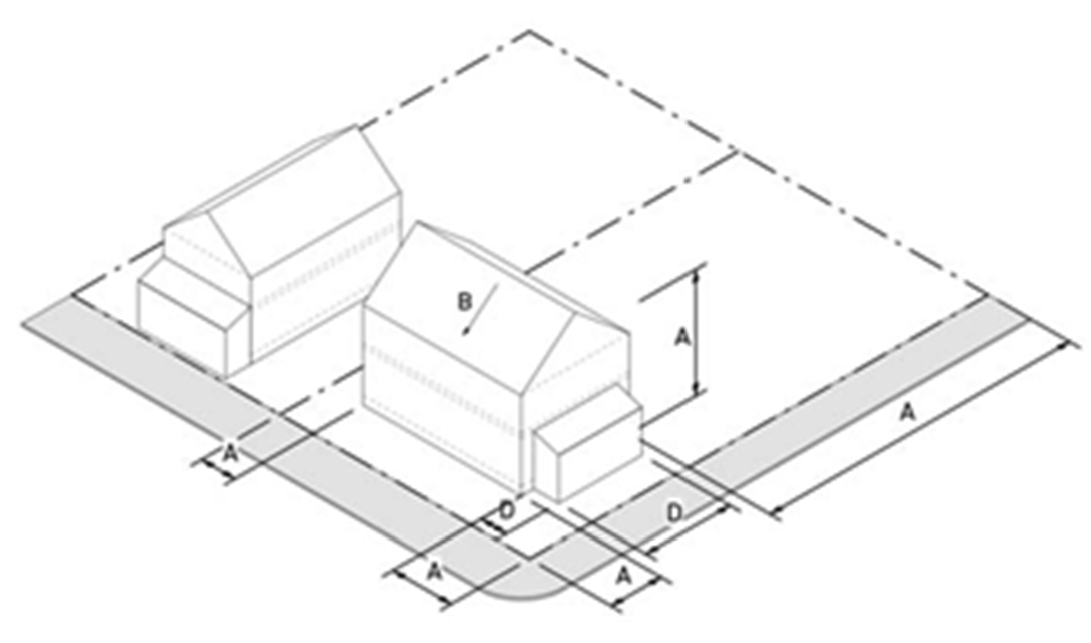
The illustrative drawings provided in this chapter do not represent required architectural elements, styles, or regulations and are intended to be informational only. Each building typology includes an illustration and additional building design regulations provided in charts for each building type. Notations provided on the corresponding illustrations in the form of letter designations such as "A" through "D" are further defined in each building typology chart.

Building Type
ES-R
SU-R
TN-R
TN-MR
TN-MX
CR-MR
CR-MX
AC-MR
AC-MX
DT-MX
CP-GB
CP-GI
CP-HI
SD-MH
Garage Apartment P P P P P P P P P
Backyard Cottage P P P P P P P P P
Cottage House P P P P P P 1 P
Detached House P P P P P P P P P
Cottage Court P P P P P P P
Two-Family Dwelling P P P P P P P
Attached House P P P P P P P
Townhouse P P P P P P P
Walk-up Flat P P P P P P P
Stacked Flat P P P P P P
Single-Story Shopfront P P P P P P P
Mixed Use Building P P P P
General Building P P P P P P P
Civic Building P P P P P
Manufactured Home P


(1)

Cottage houses within the designated zoning districts shall only be permitted within a cottage court development.

Garage Apartment
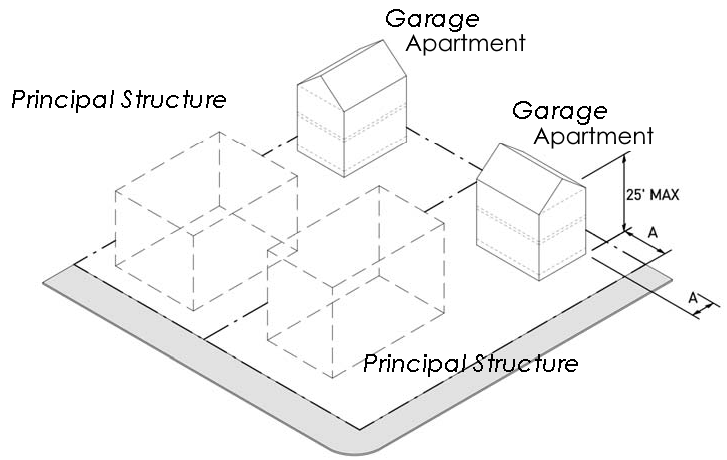
Garage Apartment

Garage Apartment
A building type designed to accommodate a small self-contained accessory dwelling unit located above a garage on the same lot as a principal structure for a detached single-family dwelling use.
Uses allowed in this building type: Accessory dwellings for a detached single-family dwelling only.
See section 25B-20-3 for additional architectural regulations.
See section 25B-30-3 for supplementary regulations for accessory dwellings.
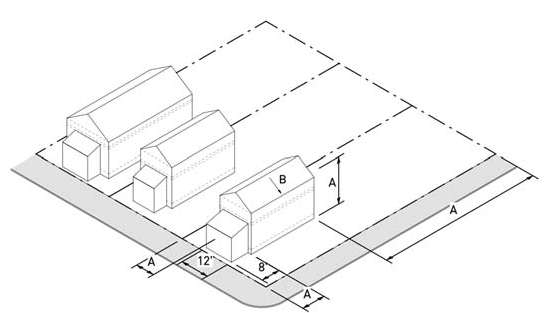
A See the Space Dimensions Table in section 25B-15-1 for maximum number of primary dwellings, building coverage, impervious surface area, lot size, front yard, side yard, street side yard, and rear yard requirements.
Maximum height: No taller than the principal structure, but never taller than 25'.
Maximum floor area: 1,000 square feet and 1,300 square feet including un-conditioned area.


Backyard Cottage
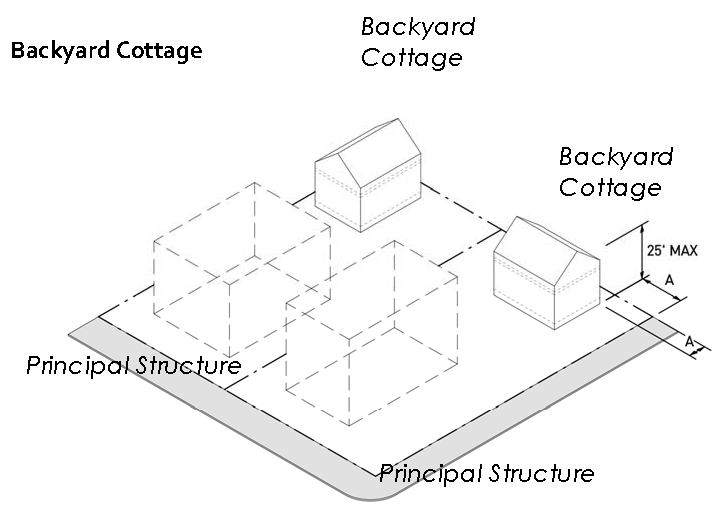
A building type designed to accommodate a small self-contained accessory dwelling unit located above a garage on the same lot as a principal structure for a detached single-family dwelling use.
Uses allowed in this building type: Accessory dwellings for a detached single-family dwelling only.
See section 25B-20-3 for additional architectural regulations.
See section 25B-30-3 for supplementary regulations for accessory dwellings.
A See the Space Dimensions Table in section 25B-15-1 for maximum number of primary dwellings, building coverage, impervious surface area, lot size, front yard, side yard, street side yard, and rear yard requirements.
Maximum height: No taller than the principal structure, but never taller than 25'.
Maximum floor area: 1,000 square feet.


Cottage House
Cottage House

Cottage House
A building type designed to accommodate 1 small dwelling unit on an individual lot or as part of a Cottage Court.
Minimum floor area shall be 750 square feet per dwelling.
Uses allowed in this building type: Accessory dwellings, single-family detached dwellings.
See section 25B-20-3 for additional architectural regulations.
A See the Space Dimensions Table in section 25B-15-1 for maximum number of primary dwellings, building coverage, impervious surface area, lot size, building height, side yard, street side yard, rear yard, and front yard requirements.
B Roof pitch for the primary roof structure shall be a minimum of 6:12. Roof materials shall be asphalt, fiberglass shingle, cedar, slate or standing seam metal. Gables, dormers, cornices, chimneys, and other design features shall be provided.
Front porches and/or stoops on the façade of the principal structure shall be required when such treatments are established by a majority of the dwellings on the block face. Front porches, when required, shall:
 1. Be a minimum of 50 square feet;
 2. Contain roofs, a minimum of 6-inch wide porch roof supports, and steps; and
 3. For parcels with more than 1 street frontage, the front porch requirements of this section shall only be required to be applied to the primary building façade.


Detached House
Detached House

Detached House
A building type designed to accommodate 1 dwelling unit on an individual lot with yards on all sides.
Minimum floor area shall be 1,200 square feet per dwelling.
Uses allowed in this building type: Accessory Dwellings, Single-Family Detached Dwellings.
See section 25B-20-3 for additional architectural regulations.
A See the Space Dimensions Table in section 25B-15-1 for maximum number of primary dwellings, building coverage, impervious surface area, lot size, building height, side yard, street side yard, rear yard, and front yard requirements.
B Roof pitch for the primary roof structure shall be a minimum of 6:12. Roof materials shall be asphalt, fiberglass shingle, cedar, slate or standing seam metal. Gables, dormers, cornices, chimneys, and other design features shall be provided.
Minimum floor area shall be 1,200 square feet per dwelling when located in ES-R, SU-R, TN-R, TN-MR, and CR-MR zoning districts. When located in MX districts the minimum floor area shall be 750 square feet per dwelling.
D Front porches and/or stoops on the façade of the principal structure shall be required when such treatments are established by a majority of the dwellings on the block face. Front porches, when required, shall:
1. Be a minimum of 30 square feet;
2. Contain roofs, a minimum of 6-inch wide porch roof supports, and steps; and
3. For parcels with more than 1 street frontage, the front porch requirements of this section shall only be required to be applied to the primary building façade.


Cottage Court
Cottage Court

Cottage Court
A building type designed to accommodate 5 to 12 dwelling units organized around a shared internal courtyard.
Uses allowed in this building type: Accessory Dwellings, Single-Family Detached Dwellings.
See section 25B-20-3 for additional architectural regulations.
Individual dwellings shall meet the requirements for the Cottage House building type.
For the larger parcel related to the development, see the Space Dimensions Table in section 25B-15-1 for maximum number of primary dwellings, building coverage, impervious surface area, lot size, building height, side yard, street side yard, rear yard, and front yard requirements that apply to the entire Cottage Court development.
The individual lots within the Cottage Court development, whether they be subdivided or not, are not required to meet the front yard, rear yard, and lot coverage requirements in Space Dimensions Table in section 25B-15-1 and may also be treated as fee-simple or condominium lots.
Cottage court development shall be designed to orient the units around a shared internal courtyard. Each unit shall have a direct entrance from the courtyard.
The minimum courtyard size shall be the sum of the number individual Cottages within the development multiplied by 400 square feet. A minimum of 70 percent of the courtyard shall consist of pervious material, of which a minimum of 50 percent of the courtyard shall be landscaped. Courtyards shall not be parked or driven upon except for emergency access and permitted temporary events.


Two-Family Dwelling
A building type designed to accommodate 2 dwelling units that share a common wall or floor/ceiling on a single individual lot.
Uses allowed in this building type: Accessory dwellings, two-family dwellings.
See section 25B-20-3 for additional architectural regulations.
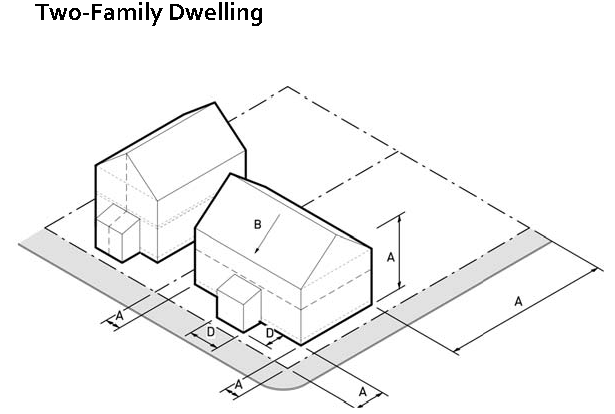
A See the Space Dimensions Table in section 25B-15-1 for maximum number of primary dwellings, building coverage, impervious surface area, lot size, building height, side yard, street side yard, rear yard, and front yard requirements. Side yard requirements do not apply to common walls permitted as part of this building type.
B Roof pitch for the primary roof structure shall be a minimum of 6:12. Roof materials shall be asphalt, fiberglass shingle, cedar, slate or standing seam metal. Gables, dormers, cornices, chimneys, and other design features shall be provided.
Minimum floor area shall be 1,200 square feet per dwelling when located in ES-R, SU-R, TN-R, TN-MR, and CR-MR zoning districts. When located in MX districts the minimum floor area shall be 750 square feet per dwelling.
D Front porches and/or stoops on the façade of the principal structure shall be required when such treatments are established by a majority of the dwellings on the block face. Front porches, when required, shall:
1. Be a minimum of 96 square feet;
2. Contain roofs, a minimum of 6-inch wide porch roof supports, and steps; and
3. For parcels with more than 1 street frontage, the front porch requirements of this section shall only be required to be applied to the primary building façade.


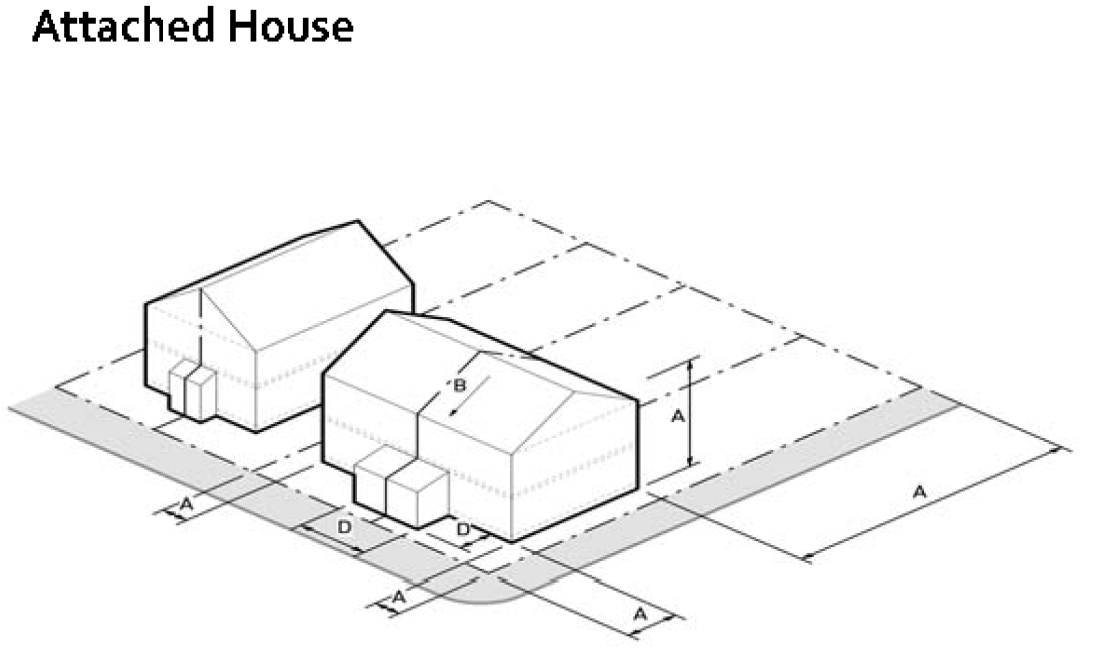
Attached House
A building type that accommodates 2 dwelling units that share a common wall along the lot line between 2 lots.
Uses allowed in this building type: Accessory dwellings, single-family attached dwellings.
See section 25B-20-3 for additional architectural regulations.
A See the Space Dimensions Table in section 25B-15-1 for maximum number of primary dwellings, building coverage, impervious surface area, lot size, building height, side yard, street side yard, rear yard, and front yard requirements. Side yard requirements do not apply to common walls permitted as part of this building type.
B Roof pitch for the primary roof structure shall be a minimum of 6:12. Roof materials shall be asphalt, fiberglass shingle, cedar, slate or standing seam metal. Gables, dormers, cornices, chimneys, and other design features shall be provided.
Minimum floor area shall be 1,200 square feet per dwelling when located in ES-R, SU-R, TN-R, TN-MR, and CR-MR zoning districts. When located in MX districts the minimum floor area shall be 750 square feet per dwelling.
Front porches and/or stoops on the façade of the principal structure shall be required when such treatments are established by a majority of the dwellings on the block face. Front porches, when required, shall:
1. Be a minimum of 96 square feet;
2. Contain roofs, a minimum of 6-inch wide porch roof supports, and steps; and
3. For parcels with more than 1 street frontage, the front porch requirements of this section shall only be required to be applied to the primary building façade.


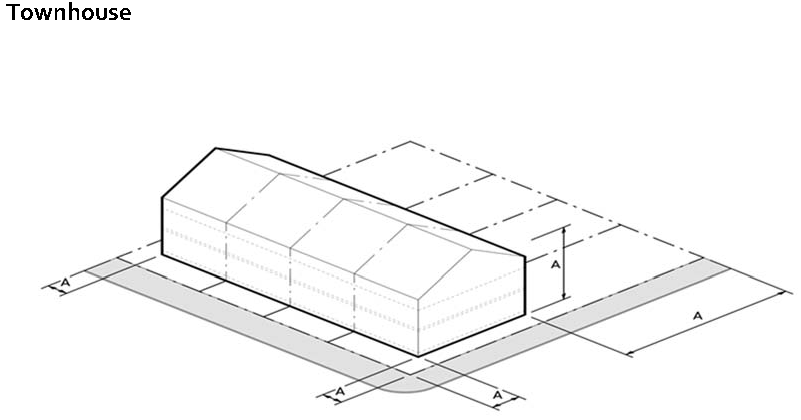
Townhouse
A building type designed to accommodate 3 to 6 dwelling units where each unit is separated by a common side wall. Units cannot be vertically mixed.
Uses allowed in this building type: Townhouse Dwellings.
See section 25B-20-3 for additional architectural regulations.
A See the Space Dimensions Table in section 25B-15-1 for maximum number of primary dwellings, building coverage, impervious surface area, lot size, building height, side yard, street side yard, rear yard, and front yard requirements. Side yard requirements do not apply to common walls permitted as part of this building type.
Gables, dormers, cornices, chimneys, and other design features shall be provided.
Each townhouse shall have a minimum of 200 square feet of private yard space in either the front or rear, not including driveways and alleys.
All townhouse buildings shall include a continuous sidewalk 5 feet in width connecting front entrances of all dwellings to each other.


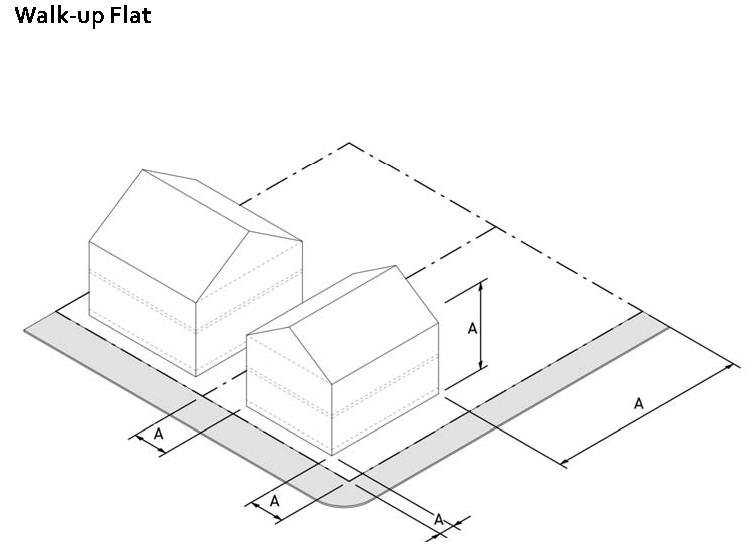
Walk-up Flat
A building type designed to accommodate 3 to 12 dwelling units vertically and horizontally integrated.
Uses allowed in this building type: Multi-family dwellings.
See section 25B-20-3 for additional architectural regulations.
A See the Space Dimensions Table in section 25B-15-1 for maximum number of primary dwellings, building coverage, impervious surface area, lot size, building height, side yard, street side yard, rear yard, and front yard requirements. Side yard requirements do not apply to common walls permitted as part of this building type.
Gables, dormers, cornices, chimneys, and other design features shall be provided.
Minimum floor area for multi-family dwelling units shall be as follows: studio: 450 square feet; 1 bedroom: 600 square feet; 2 bedrooms: 800 square feet; 3 bedroom: 1,000 square feet per unit. Existing buildings that are converted to contain multi-family dwelling uses shall not be required to meet these minimum floor area size standards for dwelling units.


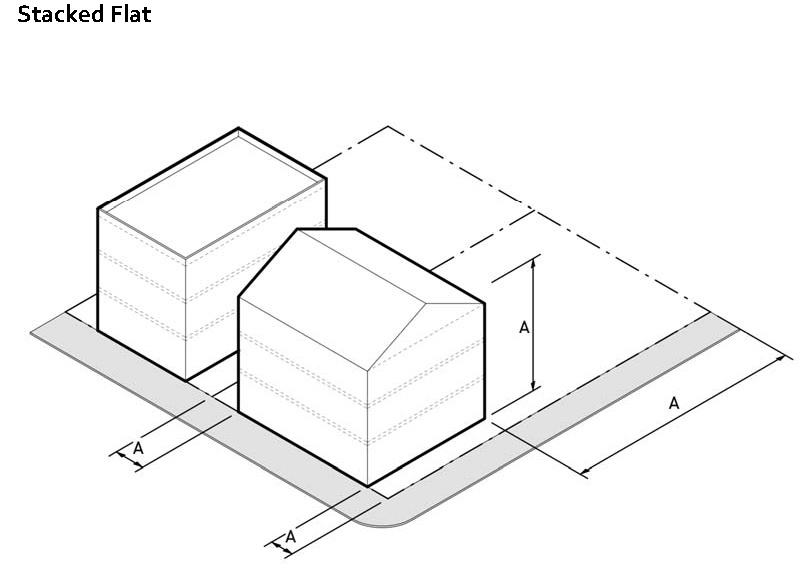
Stacked Flat
A building type designed to accommodate 13 or more dwelling units vertically and horizontally integrated.
Uses allowed in this building type: Multi-family dwellings.
See section 25B-20-3 for additional architectural regulations.
A See the Space Dimensions Table in section 25B-15-1 for maximum number of primary dwellings, building coverage, impervious surface area, lot size, building height, side yard, street side yard, rear yard, and front yard requirements. Side yard requirements do not apply to the common walls permitted as part of this building type.
Minimum floor area for multi-family dwelling units shall be as follows: studio: 450 square feet; 1 bedroom: 600 square feet; 2 bedrooms: 800 square feet; 3 bedroom: 1,000 square feet per unit.
Multi-family units shall provide a minimum of 60 percent of units with a balcony or porch that may be occupied. Existing buildings that are converted to contain multi-family dwelling uses shall not be required to meet these minimum floor area size standards for dwelling units.


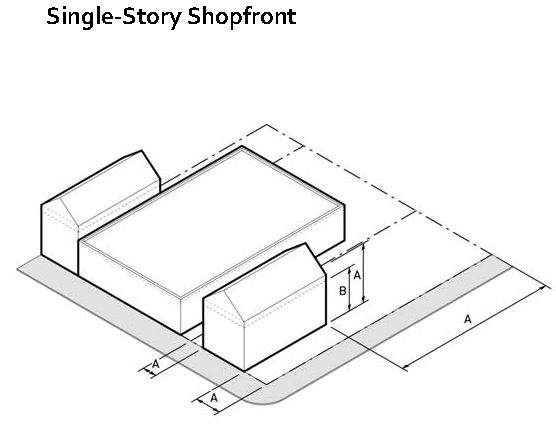
Single-Story Shopfront
A single-story building type designed to accommodate retail or commercial activity.
Uses allowed in this building type: Commercial uses; industrial uses; and public/institutional uses.
Cargo containers containing principal uses shall be permitted when meeting the requirement of this building type.
See section 25B-20-3 for additional architectural regulations.
A See the Space Dimensions Table in section 25B-15-1 for building coverage, impervious surface area, lot size, building height, side yard, street side yard, rear yard, and front yard requirements.
B Delineation of the building at the sidewalk level shall be executed through windows, belt courses, cornice lines or similar architectural detailing.
All buildings shall have their primary facade and pedestrian entrance directly fronting and facing a public or private street.
Every building shall reduce its perceived height and bulk by dividing the building mass into smaller scale components. Building walls exceeding 100 continuous horizontal linear feet shall utilize offsets, such as projections, recesses, and changes in floor level, to add architectural interest and variety, and to relieve the negative visual effect of a simple long wall.
Variation in the roofline of buildings and offsets in pitched roofs and gables shall be required. Parapets in building masses exceeding 100 continuous linear feet shall be varied in height and projection and shall use decorative elements such as crown moldings, dental, brick soldier courses, or similar detail.
See
Fenestration
Illustration
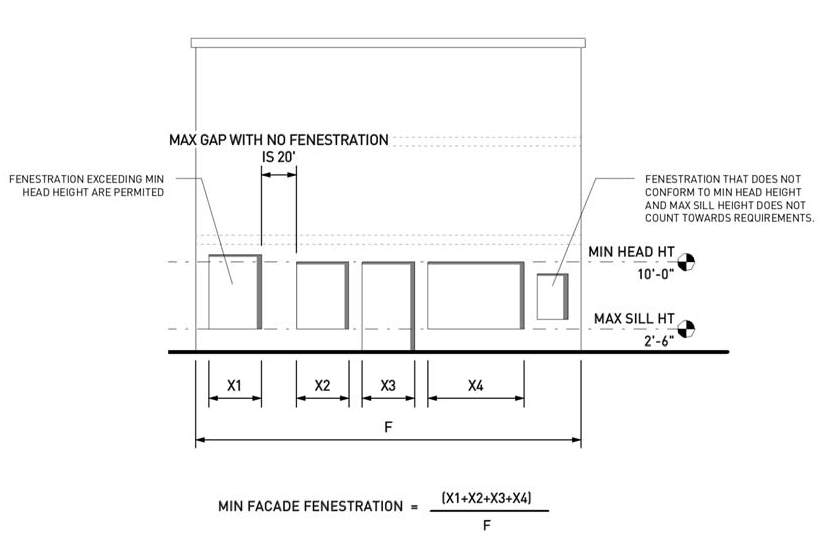
The length of facade without intervening fenestration for principal structures, architectural detailing or entryway shall not exceed 20 feet.
Fenestration treatment for principal structures shall be provided for a minimum of 65 percent of the length of all ground floor street frontages. Fenestration shall not utilize painted glass, reflective glass or other similarly treated or opaque windows.


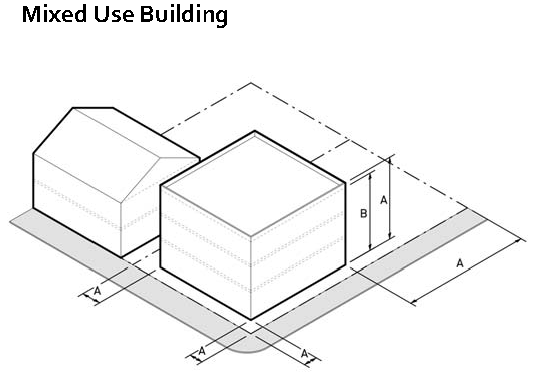
Mixed Use Building
A multi-story building type designed to accommodate ground floor residential, retail, office or commercial uses with upper-story residential or office uses.
Uses allowed in this building type: Commercial uses; industrial uses; public/institutional uses; and residential uses.
See section 25B-20-3 for additional architectural regulations.
Portions of buildings with multi-family uses shall meet the requirements for the stacked flat building type for such portions of building.
A See the Space Dimensions Table in section 25B-15-1 for maximum number of primary dwellings, building coverage, impervious surface area, lot size, building height, side yard, street side yard, rear yard, and front yard requirements.
B Delineation of building floors at the third story above sidewalk level and lower shall be executed through windows, belt courses, cornice lines or similar architectural detailing.
All buildings shall have their primary facade and pedestrian entrance directly fronting and facing a public or private street.
Every building shall reduce its perceived height and bulk by dividing the building mass into smaller scale components. Building walls exceeding 100 continuous horizontal linear feet shall utilize offsets, such as projections, recesses, and changes in floor level, to add architectural interest and variety, and to relieve the negative visual effect of a simple long wall.
Variation in the roofline of buildings and offsets in pitched roofs and gables shall be required. Parapets in building masses exceeding 100 continuous linear feet shall be varied in height and projection and shall use decorative elements such as crown moldings, dental, brick soldier courses, or similar detail.
See
Fenestration
Illustration
The length of facade without intervening fenestration for principal structures, architectural detailing or entryway shall not exceed 20 feet.
Fenestration treatment for principal structures shall be provided for a minimum of 65 percent of the length of all ground floor street frontages. Fenestration shall not utilize painted glass, reflective glass or other similarly treated or opaque windows.


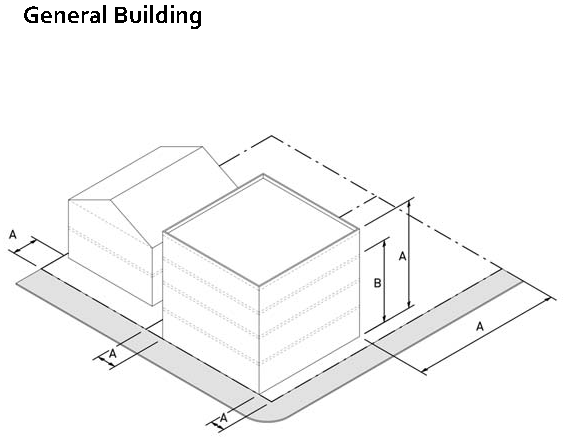
General Building
A building type designed to accommodate commercial, office or industrial activity. Not intended for retail sales or personal service uses.
Uses allowed in this building type: Agricultural uses; Commercial uses; Industrial uses; and Public/Institutional uses.
See section 25B-20-3 for additional architectural regulations.
A See the Space Dimensions Table in section 25B-15-1 for building coverage, impervious surface area, lot size, building height, side yard, street side yard, rear yard, and front yard requirements.
B Delineation of building floors at the third story above sidewalk level and lower shall be executed through windows, belt courses, cornice lines or similar architectural detailing.
All buildings shall have their primary facade and pedestrian entrance directly fronting and facing a public or private street.
Every building shall reduce its perceived height and bulk by dividing the building mass into smaller scale components. Building walls exceeding 100 continuous horizontal linear feet shall utilize offsets, such as projections, recesses, and changes in floor level, to add architectural interest and variety, and to relieve the negative visual effect of a simple long wall.
Variation in the roofline of buildings and offsets in pitched roofs and gables shall be required. Parapets in building masses exceeding 100 continuous linear feet shall be varied in height and projection and shall use decorative elements such as crown moldings, dental, brick soldier courses, or similar detail.


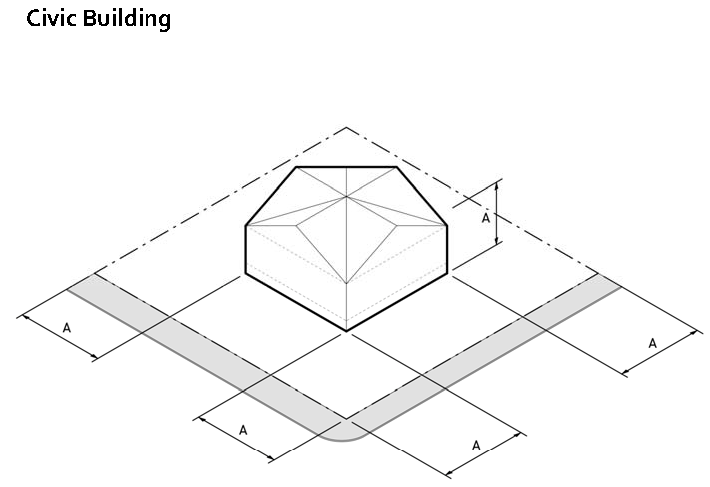
Civic Building
A building type designed to accommodate civic, institutional or public uses.
Uses allowed in this building type: Public/Institutional uses.
See section 25B-20-3 for additional architectural regulations.
A See the Space Dimensions Table in section 25B-15-1 for building coverage, impervious surface area, lot size, building height, side yard, street side yard, rear yard, and front yard requirements.


Single-Story Shopfront and Mixed Use Building Fenestration Illustration

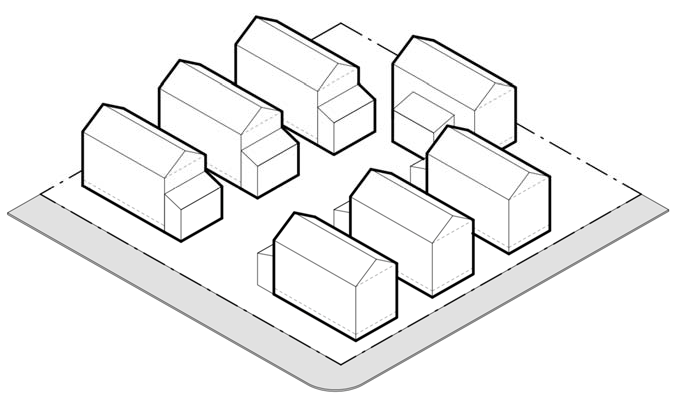
Garage Placement on Corner Lots or on Alleys Illustration
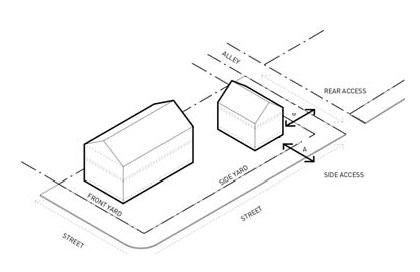

Garage Placement on Interior Lots Illustration
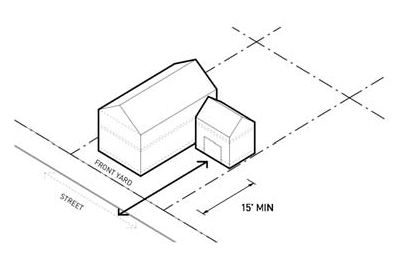

(Ord. No. 21-10, § 1, 6-22-21; Ord. No. 22-01, § 4, 1-25-22; Ord. No. 22-16, §§ 3—6, 12-13-22; Ord. No. 24-18, § 1, 6-27-24; Ord. No. 24-26, § 1, 9-10-24; Ord. No. 25-16, § 1(Att.), 7-22-25)

Sec. 25B-20-3. - Building architecture.

(a)

For all uses.

(1)

Exterior building materials, excluding architectural accents or metal split seam roofing, shall be primarily brick, glass, wood, hardy plank, stucco, textured concrete masonry, cementitious fiberboard, or stone for all building facades, the sides of buildings perpendicular to the building façade, and for all portions of buildings viewable from a public right-of-way.

(2)

Vinyl may be incorporated around the soffit, gables, eaves and window area for trim.

(3)

Cementitious fiberboard lap siding shall only be permitted on buildings less than four (4) stories.

(4)

For commercial or industrial buildings or developments, HVAC units shall be either physically located or screened with vegetative or fence buffer so as not to be visible from the right-of-way.

(5)

Residential dwellings with front doors set back from all or a portion of the primary building façade shall provide a horizontal structural awning a minimum depth of two (2) feet and a minimum length of ten (10) feet that connects the front door façade and area to the further extended primary building façade. Such structural awnings shall incorporate the roofing materiality of the principle structure, or a roofing material of similar or greater quality.

(6)

As part of a permitted existing residential exterior remodeling project, single-family detached homes, two-family dwellings, and attached homes as well as existing accessory structures located solely within the traditional neighborhood residential (TN-R) zoning district may utilize vinyl siding, provided that such siding has a verified thickness .42 or greater.

(b)

Additional standards for ES-R, SU-R, and TN-R zoning districts.

(1)

All utilities shall be underground.

(2)

Street lights shall be required in type and number as determined by city.

(3)

No duplicate exterior elevations (front facade designs) including similar massing shall be constructed on the same street within one hundred twenty-five (125) linear feet in either direction, measured from the center of the front property line. The developer/builder will be responsible for providing documentation certifying compliance with this requirement prior to issuance of any building permit.

(c)

Additional standards for drive-through service windows and drive-in facilities.

(1)

Shall not be located between a building and the adjacent public street; and

(2)

Shall only be permitted in the DT-MX district when located north of East Battle Street and a maximum distance of two hundred fifty (250) feet west of North Morgan Street.

(d)

Additional standards for CR-MR, CR-MX, AC-MR, and AC-MX zoning districts.

(1)

Structural steel or structural aluminum. Corrugated metal panels shall be permitted on a maximum of twenty-five (25) percent of front building facades or side exterior building facades. Aluminum composite material (ACM) panels are permitted without limitation.

(2)

All elevations of the building should be designed in a consistent and coherent architectural manner. Where a change in material, color, or texture along the exterior side of a building is proposed, the demarcation of the change shall occur a minimum of twenty (20) feet on both adjacent sides of the building or to the natural dividing point established by the physical plane of the building.

(3)

Roofs. Exposed roof materials for pitched roofs shall consist of asphalt shingles, standing seam metal roof or lap seam metal roofing panel, tile or similar roof materials.

(4)

Pre-engineered color coated wall panels. Pre-engineered color coated wall panels with a twenty (20) year color warranty shall be permitted on a maximum thirty-five (35) percent of exterior building facades, except for General Building structures within the CR-MX and AC-MX zoning classifications, for which the maximum coverage shall be sixty (60) percent of exterior building facades.

(e)

Additional standards for CP-GI zoning districts. No building shall be constructed with a wooden frame. The exterior finish of all buildings shall be common brick, concrete blocks, tile bricks, enamel metal siding, their equivalent or better, but no building thereon shall be covered with asbestos siding or galvanized sheet metal. If the exterior walls are constructed of concrete or concrete blocks, unless the exterior finish is stucco, gunite or their equivalent, the joints shall be rubbed down and the walls covered sufficiently with standard waterproofing paint.

(Ord. No. 21-10, § 1, 6-22-21; Ord. No. 22-01, §§ 5—8, 1-25-22; Ord. No. 23-16, § 1, 11-14-23; Ord. No. 24-22, § 1, 7-23-24; Ord. No. 25-15, § 1, 7-8-25)

Sec. 25B-20-4. - Transitional heights.

(a)

Transitional heights.

(1)

Transitional height planes. A transitional height plane is an imaginary plane having a vertical component and angular component specifically designed to restrict the maximum height of all parts of buildings or structures within CR-MR, CR-MX, AC-MR, AC-MX, DT-MX, CP-GB, CP-GI, and CP-HI zoning districts and their relationship to adjoining ES-R, SU-R, TN-R, TN-MR, TN-MX, and SD-MH districts. Transitional height planes shall comply with the following components and regulations:

a.

A vertical component measured at the required yard or buffer setback adjoining the common property line by a 40-foot vertical distance above the finished grade;

b.

An angular component extending inward over an adjoining CR-MR, CR-MX, AC-MR, AC-MX, DT-MX, CP-GB, CP-GI, and CP-HI district at an angle of forty-five (45) degrees;

c.

Such vertical and angular component calculations shall be made on a point-by-point basis and not average grade; and

d.

No portion of any structure shall protrude through the transitional height planes specified in subsection (a)(2) below.

(2)

Where CR-MR, CR-MX, AC-MR, AC-MX, DT-MX, CP-GB, CP-GI, and CP-HI zoning districts adjoin ES-R, SU-R, TN-R, TN-MR, TN-MX, and SD-MH districts without an intervening public street, height within this district shall be limited by the transitional height plane requirements.
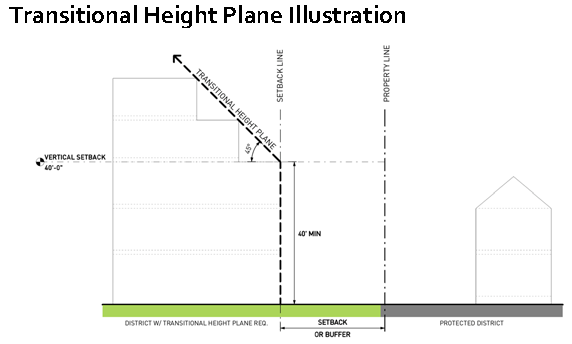
(Ord. No. 21-10, § 1, 6-22-21)

Sec. 25B-20-5. - Open space.

(a)

The following specified amounts of dedicated open space shall be required as part of future development:

(1)

Multi-family uses within CR and AC zoning districts — open space shall be provided at a minimum of five (5) percent of the total lot area of such use.

(2)

Any use or combination of uses that exceed one hundred thousand (100,000) square feet of floor area in a CP-GB zoning district — open space shall be provided at a minimum of ten (10) percent of the total lot area of such use.

(3)

A minimum of five (5) percent of the total land area of any major subdivision shall be provided as open space for all developments that include residential uses. The location of open space shall be submitted with the preliminary plan. See section 25C-15-37 for greenspace requirements for major residential subdivisions.

(b)

The required open space in subsection (a) above shall meet all of the following requirements:

(1)

Open space provided in excess of the minimum requirements of the UDO for yards, landscape zones and buffers shall be permitted to count towards the open space requirement of this section.

(2)

Common amenities including parks, plazas, courtyards, community greens, and town centers shall be permitted to count towards the open space requirement of this section.

(3)

Open space shall not include areas devoted to public or private vehicular access or parking, including required parking lot landscaping.

(4)

Water features, including stormwater management that are designed and fully landscaped as an amenity may be counted toward open space requirements.

(5)

All open space shall be fully implemented prior to occupancy and if not completed, a performance bond is required in accordance with chapter 25C-15. Maintenance bonds shall be issued in accordance with chapter 25C-15.

(6)

Open spaces shall be prominently located adjacent to residences and businesses and are to be focal points for the area surrounding the development. Open spaces shall provide appropriate fixtures such as benches, fountains, pathways, planting beds, lawn and/or playground equipment.

(c)

Relocation of minimum open space requirements: At the option of the property owner, up to fifty (50) percent of a development's required open space may be relocated to an off-site location provided:

(1)

The director has reviewed and approved the transfer request;

(2)

The receiving parcel(s) is located within one-fourth (¼) mile of the donating property;

(3)

The receiving parcel(s) is planned to be constructed and completed as a city park within one-fourth (¼) mile of the donating party within the next twelve (12) months;

(4)

The receiving parcel(s) contains the required amount of open space;

(5)

The open space shall be visible from public or private streets and sidewalks;

(6)

The open space shall provide for active or passive use by the public and include amenities such as fountains, pedestrian furniture, public art or other similar elements;

(7)

Open space on the receiving parcel shall not be counted for more than one (1) project; and

(8)

All other standards of open space are met.

(Ord. No. 21-10, § 1, 6-22-21)

Sec. 25B-20-6. - Outdoor lighting.

(a)

Purpose. The regulations of this section are intended to:

(1)

Permit reasonable uses of outdoor lighting for nighttime safety, utility, security, productivity, enjoyment and commerce;

(2)

Curtail and reverse the degradation of the nighttime visual environment and the night sky;

(3)

Preserve the dark night sky for astronomy;

(4)

Minimize glare, obtrusive light and artificial sky glow by limiting outdoor lighting that is misdirected, excessive or unnecessary;

(5)

Conserve energy and resources to the greatest extent possible; and

(6)

Help protect the natural environment from the damaging effects of night lighting from human-made sources.

(b)

General regulations. Outdoor lighting fixtures shall be located, aimed or shielded to minimize glare and stray light trespassing across lot lines and into the public right-of-way.

At Property Lines Including Rights-of-Way Maximum Footcandles
At property line abutting a residential or an agricultural use 0.5
At property line abutting an office or institutional use 1.0
At property line abutting all other uses 1.5


Off-Street Parking Lots Minimum
Footcandles
Average
Footcandles
Maximum
Footcandles
Agricultural uses None None 4.0
Residential uses 0.5 2.0—3.0 4.0
Office-professional uses 1.0 3.0—4.0 6.0
Industrial uses 1.0 4.0—5.0 8.0
All other uses 2.0 6.0—7.0 12.0


(c)

Parking areas. All lighting fixtures servicing parking lots must be directed downward and not towards buildings or other areas.

(d)

Specific lighting regulations in the DT-MX district.

(1)

The following are expressly prohibited:

a.

Aerial lasers;

b.

Searchlight-style lights;

c.

Light sources that exceed two hundred thousand (200,000) lumens or intensity in any direction of two million (2,000,000) candelas or more;

d.

Mercury vapor lamps;

e.

Low-sodium vapor lamps;

f.

LED light strips.

(2)

The following luminaries and lighting systems are expressly exempt from the regulations of this division:

a.

Underwater lighting used for the illumination of swimming pools and fountains;

b.

Temporary holiday lighting;

c.

Lighting required and regulated by the Federal Aviation Administration, or other authorized federal, state or local government agency;

d.

Emergency lighting used by police, fire, or medical personnel, or at their direction;

e.

All outdoor light fixtures producing light directly from the combustion of fossil fuels, such as kerosene and gasoline; and

f.

Security lighting controlled and activated by a motion sensor device for a duration of ten (10) minutes or less.

(Ord. No. 21-10, § 1, 6-22-21)

Sec. 25B-20-7. - Home garages.

(a)

This section provides residential attached and detached garage regulations for all residential dwellings. With the exception of subsection three (3), the following regulations shall not apply to properties with garages that are rear or side facing, or to properties with front-facing garage doors located twenty (20) feet or greater behind the primary building façade.

(b)

Garage doors shall provide architectural detailing with the appearance of multiple materials, textures, and hardware upon the door panels.

(c)

Front-facing, side facing, and rear facing garages shall be equipped with a garage door.

(d)

Front-facing garage doors shall not exceed a width equal to sixty percent (60%) of the width of the primary building façade.

(e)

Driveways providing access to front-facing garages must be located a minimum distance of ten (10) feet from any other driveways located on adjoining parcels.

(f)

Shared and combined driveways may be permitted along a shared property line with a maximum total driveway width of thirty (30) feet.

(g)

Dwellings with front-facing garages shall have a maximum primary building façade setback of one hundred ten (110) percent of the minimum front yard setback required for the zoning district as captured in the Space Dimensions Table.

(h)

For developments creating multiple adjacent dwellings with front-facing garages, the front yard setbacks of the garage facades shall be staggered and stepped back to achieve a minimum of three (3) feet in dimensional variation from adjacent front-facing garages.

(i)

For dwellings on lots with more than one (1) street frontage and with rear or side yards facing a street, a landscape strip shall be provided between a house and the street. Such landscape strips shall be provided in accordance with the standards specified in section 25B-15-8(c).

(j)

Townhome dwellings which front major thoroughfares and corridors must have rear loading garages. Townhome dwellings which front interior streets within a development project may have either no garage, a single front-loading garage or a rear-loading garage.

(Ord. No. 22-01, § 8, 1-25-22; Ord. No. 22-16, § 9, 12-13-22; Ord. No. 24-26, § 2, 9-10-24; Ord. No. 24-31, § 1, 12-10-24)