
Laguna Niguel City Zoning Code
ARTICLE 2
- COMPREHENSIVE ZONING CODE
Sec. 9-1-10.- Purpose and authority.
(a)
Title. This article shall be known as the "City of Laguna Niguel Zoning Code", the "zoning code" or, for purposes of this article, may be referred to by the short title "Code."
(b)
Purpose. The zoning code is intended to guide the development of the city in an orderly manner, implement the policies of the general plan, protect and enhance the quality of the natural and built environment, promote the public health, safety and general welfare by regulating the use of land and buildings and the location and basic form of structures, and provide the physical, environmental, economic, and social advantages that result from the orderly planned use of land resources.
(c)
Authority. The zoning code is enacted based on the authority vested in the City of Laguna Niguel and the State of California, including but not limited to the State Constitution, Planning and Zoning Law (California Government Code Section 65000 et seq.), the California Environmental Quality Act (public resources code section 21000 et seq.), and other applicable state laws. This code is also adopted pursuant to section 30000 et seq. of the public resources code for the purpose of complementing the city's local coastal program.
(d)
General requirements. Land or buildings may be used and structures may be erected or altered only in accordance with the regulations in this .
(Ord. No. 99-107, § 5, 2-2-99; Ord. No. 2021-210, § 3, 8-3-21)
Sec. 9-1-11. - Applicability of code.
(a)
Compliance required. Except as specifically provided in this zoning code, no uses or structures shall be established, substituted, expanded, constructed, altered, moved, maintained, or otherwise changed and no lot lines shall be created or changed except in conformity with this Code.
(b)
Applicability to property. This code shall apply to all land within the city except as otherwise provided by this section.
(c)
Applicability to road rights-of-way. Within dedicated public and private road right-of-way, only the following are subject to the land use regulations of this Code:
(1)
Signs not placed or maintained by public agencies. However, bus bench and bus shelter signs in road rights-of-way are regulated by et seq.
(2)
Walls or fences not erected or maintained by public agencies.
(3)
Landscaping.
Notwithstanding the preceding, all uses and structures within the coastal zone may be subject to a coastal development permit.
(d)
Applicability to land owned or leased by city. Except for road rights-of-way, land owned in fee by the city or land leased to or used by the city is exempt from all of the land use regulations of this Code.
(e)
Limitations on validity of permits. The issuance or granting of a permit or approval of plans and specifications shall not be construed to be an approval of any violation of any provision of this Code. The issuance of such a permit shall not prevent the city from thereafter requiring the correction of violations of this Code or of any other ordinance of the city.
(f)
General relationship to other codes. The regulations of this title and requirements or conditions imposed pursuant to this title shall not supersede any other regulations or requirements adopted or imposed by the city, the State of California, or any Federal agency that has jurisdiction by law over uses and development authorized by this title. All uses and development authorized by this title shall comply with all other such regulations and requirements. Where conflict occurs between the provisions of this title and any other city ordinance, title, chapter, resolution, guideline or regulation, the more restrictive provisions shall control, unless otherwise specified, nor shall any provision of this Code be deemed to repeal or amend the city's building regulations ().
(g)
Relationship to California Environmental Quality Act. When a project application pursuant to the provisions of the zoning regulations is determined to be subject to the provisions of the California Environmental Quality Act (CEQA), the application shall be reviewed in accordance with the provisions of the zoning regulations, CEQA (public resources code, section 21000 et seq.), the CEQA guidelines (title 14, California Code of Regulations, section 15000 et seq.), and any environmental guidelines and other applicable rules adopted by the city.
(h)
Effect of code on private agreements. This code is separate from and independent of any condition, covenant, restriction, easement, or other agreement between parties, except that where this Code is more restrictive or imposes a higher standard than that required by such agreement, this Code shall control.
(Ord. No. 99-107, § 5, 2-2-99; Ord. No. 2021-210, § 4, 8-3-21)
Sec. 9-1-12. - Prior agreements and approvals.
(a)
Development agreements. Notwithstanding any provision of this zoning code, any development agreement which is valid as of the effective date of this Code shall remain in full force and effect until expiration of said agreement. Permitted land uses, development standards, and other zoning provisions referred to in such a development agreement shall supersede the provisions of this Code.
(b)
Building permits. Any development project approved prior to the effective date of this Code for which a building permit has been issued within 180 days after the effective date of this Code may be constructed in accordance with the zoning regulations in effect at the time of its approval, provided all other regulations are satisfied. Any project for which a building permit has not been issued within 180 days after the effective date of this Code shall comply with this Code.
(c)
Nonconforming uses and lots. Any land use or lot approved prior to the effective date of this Code which does not conform to the provisions of this Code may nevertheless be established or recorded in accordance with approved plans or maps, provided all other regulations in effect at the time of approval are satisfied.
(d)
Approved vesting maps. Any vesting tentative tract or parcel map which was approved pursuant to earlier ordinances of the city which is now inconsistent with this Code may be continued and completed in accordance with the provisions of its approval, provided it is completed within the time limit in effect at the time of its approval without extension of time thereof and provided it complies with all other ordinances and laws in effect at the time of its approval.
(Ord. No. 99-107, § 5, 2-2-99)
Sec. 9-1-13. - General plan density and intensity.
Notwithstanding any provision of this zoning code, the limitations on density, unit counts, square footages, floor area ratios, and other similar measures established in the general plan shall constitute the upper limit of development intensity for all land in the city.
(Ord. No. 99-107, § 5, 2-2-99)
Sec. 9-1-14. - Code interpretations.
Interpretations of the provisions of this zoning code shall be made by the director. Such interpretations may be referred to the planning commission for review if the director determines on a case-by-case basis that the public interest would be better served by such referral.
(Ord. No. 99-107, § 5, 2-2-99)
Sec. 9-1-15. - Use of terms.
(a)
Rules for construction of language. The following general rules of construction shall apply to the textual provisions of this Code:
(1)
The specific shall supersede the general.
(2)
The word "shall" is mandatory. The word "may" is discretionary. The word "should" identifies a regulation or design guideline which must be followed in the absence of compelling opposing considerations identified by the city decision-making body.
(3)
In the case of any difference of meanings or implication between the text regarding a provision of the code and any title, heading, caption, or illustration, the text shall control.
(4)
Unless the context clearly indicates otherwise, words used in the present tense include the future, words used in the singular include the plural, and words used in the plural include the singular.
(5)
Unless the context clearly indicates otherwise, certain conjunctions shall be interpreted as follows:
a.
"And" indicates that all connected items or provisions shall apply.
b.
"Or" indicates that the connected items or provisions may apply singly or in any combination.
c.
"Either...or" indicates that the connected items or provisions shall apply, but not in combination.
(6)
Unless otherwise indicated, all public officials, bodies and agencies to which reference is made are those of the city.
(7)
"Director" means the community development director of the city or the director's authorized agent or representative.
(b)
Time periods. The use of the term "days" to describe a specific time period does not include the day the action was taken but does include all subsequent days unless the last day falls upon a Saturday, Sunday, or a legal city holiday, in which case the next business day shall be the last day of the time period.
(Ord. No. 99-107, § 5, 2-2-99)
Sec. 9-1-16. - Severability.
The city council hereby declares that each portion of this zoning code is separate, distinct, and independent and the invalidity of any portion shall not affect the validity of the remaining portions. The city council further declares that it would have enacted this Code and each portion thereof irrespective of the fact that any portion or portions are declared invalid or ineffective. Therefore, in the event that any map, diagram, regulation or other portion of this Code is declared by a court of competent jurisdiction to be invalid or ineffective in whole or in part, such decision shall not affect the validity of the remaining portions thereof.
(Ord. No. 99-107, § 5, 2-2-99)
Sec. 9-1-20.- Establishment of districts.
The city is hereby divided into zoning districts which are consistent with and implement the general plan. The following districts are established:
(1)
RS-1: Rural residential district;
(2)
RS-2: Residential estate district;
(3)
RS-3: Single-family district 3;
(4)
RS-4: Single-family district 4;
(5)
RP: Planned residential district;
(6)
RA: Attached residential district;
(7)
RM: Multifamily district;
(8)
CN: Neighborhood commercial district;
(9)
CC: Community commercial district;
(10)
CO: Office commercial district;
(11)
BP: Business park district;
(12)
PI: Public institutional district;
(13)
PR: Parks and recreation district;
(14)
OS: Open space district;
(15)
MC: Managed care overlay district;
(16)
FP: Floodplain overlay district;
(Ord. No. 99-107, § 5, 2-2-99)
Sec. 9-1-21. - Adoption of official zoning map.
(a)
Adoption of map. The boundaries of the zoning districts established in this zoning code shall be shown on that map entitled "City of Laguna Niguel Official Zoning Map" available for public examination at the city's community development department.
(b)
Interpretation of district boundaries. Where uncertainty exists regarding the precise boundaries of districts on the official zoning map, the following rules shall apply:
(1)
Boundaries indicated as approximately following the centerlines of streets shall be construed as congruent with such centerlines. Boundaries indicated as approximately following the right-of way lines of streets shall be construed as congruent with such right-of-way lines and shall further be construed as moving with such right-of-way lines.
(2)
Boundaries indicated as approximately following lot lines shall be construed as congruent with such lot lines.
(3)
Boundaries indicated as parallel to or extensions of the lines described in (1) and (2), preceding, shall be so construed. Distances not specifically indicated on the official zoning map shall be determined by the scale of the map.
(4)
Where any public right-of-way is officially vacated or abandoned, the zoning district regulations applied to abutting property shall thereafter extend to the centerline of such vacated or abandoned right-of-way.
(5)
In cases where uncertainty exists after application of rules (1) through (4) preceding, the director shall determine the district boundaries.
(Ord. No. 99-107, § 5, 2-2-99)
Sec. 9-1-22. - Special zoning symbols.
In any zoning district, the minimum lot size and setbacks and the maximum building height and floor area ratio may be different from that set forth in the district regulations if so specified on the official zoning map. Such alternate development standards shall supersede those in the district regulations and shall be specified by means of the following zoning map symbols:
(1)
A number following the district designation and connected by a colon (:) shall designate the minimum lot size. Where the number is greater than 100, it shall indicate the minimum size in square feet; where the number is less than 100, it shall indicate the minimum size in acres.
Example: "RS-2: 10,000" (min. lot size 10,000 sq. ft.) or "RS-2: 1" (min. lot size 1 acre)
(2)
Numbers following the district designation and enclosed by parentheses shall designate the minimum setbacks in feet. Within the parentheses, setbacks shall be separated by a slash (/) and shall be shown in the following order: (front/side/rear).
Example: "RS-2 (20/5/25)"
(3)
A number shown below and separated from the district designation by a horizontal line shall designate the maximum height of buildings or structures in feet.
Example:
"CC"
45
(4)
A number following the district designation and enclosed by brackets shall designate maximum floor area ratio (FAR, the ratio of building square footage to buildable site area).
Example: "CC [.35]"
(5)
The preceding symbols may be used in any combination to show minimum lot size, minimum setbacks, maximum floor area ratio, or maximum height.
Example:
"RS-2 (20/5/25) [.35]: 1"
45
(Ord. No. 99-107, § 5, 2-2-99)
Sec. 9-1-23. - Land uses not listed.
(a)
Use not listed is not allowed. If a use of land is not specifically listed in permitted uses section of the applicable zone the use shall not be allowed, except as provided below.
(b)
Director's determination. Because not every possible land use can be identified in this zoning code and because new land uses evolve over time, this section establishes the director's authority to determine if unlisted uses shall be permitted outright, permitted with a use permit, or not permitted in a zoning district. In order to determine that a use is permitted outright or with a minor use permit or use permit, the director shall ensure consistency with the following objectives:
(1)
The proposed use is consistent with the goals and policies of the general plan.
(2)
The proposed use is consistent with the purpose and intent of the district in which it is to be located.
(3)
The proposed use is similar to other uses which are permitted in the district in which it is to be located.
(4)
The proposed use will not adversely affect the health, safety or welfare of residents or other persons in the vicinity of the use.
Any determination on a proposed unlisted use may be referred to the planning commission for review if the director determines on a case-by-case basis that the public interest would be better served by such referral.
(Ord. No. 99-107, § 5, 2-2-99; Ord. No. 2021-210, § 5, 8-3-21)
Sec. 9-1-30.- Summary of district regulations.
(a)
Permitted uses. specifies the land uses allowed in each residential district.
(b)
Development standards. specifies the development standards for each district.
(c)
Supplemental regulations. Supplemental regulations for residential districts are as follows:
Parking and signs .....3-14
Fences and walls .....3-14
Accessory structures .....3-17
Garages, carports and driveways .....3-18
Swimming pools and spas .....3-20
Satellite dish and other antennas .....3-21
Second residential units .....3-24
Guest houses .....3-26
Garage sales .....3-27
Home occupations .....3-27
Horses and other animals .....3-29
Screening .....3-30
Landscaping and open area .....3-30
Tennis and other game courts .....3-32
Outdoor lighting .....3-33
Special outdoor events .....3-34
Manufactured housing and mobilehomes .....3-35
Child day care homes .....3-36
Residential care facilities .....3-38
Temporary construction and guard offices .....3-38
Relocatable buildings .....3-39
Trash and recyclable materials storage .....3-39
Noise control .....3-39
Model home complexes .....3-40
Gate-guarded neighborhoods .....3-42
(Ord. No. 99-107, § 5, 2-2-99)
Sec. 9-1-31. - Purpose and intent of districts.
Subsections included. All references to include through .
(Ord. No. 99-107, § 5, 2-2-99)
Sec. 9-1-31.1. - RS-1 rural residential district.
Purpose and intent. To provide for large-lot rural estates with abundant open space on each lot.
(Ord. No. 99-107, § 5, 2-2-99)
Sec. 9-1-31.2. - RS-2 residential estate district.
Purpose and intent. To provide for low density estates with ample setbacks.
(Ord. No. 99-107, § 5, 2-2-99)
Sec. 9-1-31.3. - RS-3 and RS-4 single-family districts.
Purpose and intent. To provide for the development and preservation of low and medium density neighborhoods with single-family residences on individual lots.
(Ord. No. 99-107, § 5, 2-2-99)
Sec. 9-1-31.4. - RP planned residential district.
Purpose and intent. To provide for the development and preservation of medium density planned unit developments with attached homes, detached homes, or a mixture of both. Setbacks and other development standards are to be tailored specifically to each project by means of a precise development plan which is approved with the project and incorporated into this zoning code as an appendix.
(Ord. No. 99-107, § 5, 2-2-99)
Sec. 9-1-31.5. - RA attached residential district.
Purpose and intent. To provide for the development and preservation of medium density neighborhoods composed primarily of attached development with each unit attached to another unit on only one side.
(Ord. No. 99-107, § 5, 2-2-99)
Sec. 9-1-31.6. - RM multifamily district.
Purpose and intent. To provide for the development and preservation of developments containing multiple dwelling units on each lot, consisting of either rental apartments or condominiums with individual ownership of units. Each project will have ample common open space and recreation facilities.
(Ord. No. 99-107, § 5, 2-2-99)
Sec. 9-1-32. - Permitted uses.
(a)
Development permits required. Table 3.1 of this section specifies whether a use or structure is permitted within a zoning district. In most cases development to establish a land use requires approval of a site development permit and/or other permits as set forth in subarticle 11 (Permits and amendments).
(b)
Uses not listed in table. Land uses which are not listed in table 3.1 are not permitted unless the community development director or the planning commission determines that such use is consistent with one of the permitted use categories listed preceding (e.g. principal use, conditional use, etc.) in accordance with (Land uses not listed).
(c)
Table of permitted uses. Table 3.1, "Permitted residential uses", following, specifies those uses and structures which are permitted within each residential district. The letters in the columns beneath the district designations mean the following:
(1)
"P" The use is permitted as a principal use within the district.
(2)
"A" The use is permitted only if accessory to the principal residential use on the site.
(3)
"U" The use is permitted as a principal or accessory use if a use permit is approved.
(4)
"M" The use is permitted as an accessory use if a minor use permit is approved.
(5)
"H" The home occupation is permitted if accessory to the principal residential use and if a home occupation permit is approved.
(6)
"T" The use is permitted on a temporary basis if a temporary use permit is approved.
(7)
"X" The use is prohibited in the district.
Table 3.1: PERMITTED RESIDENTIAL USES.
(Ord. No. 99-107, § 5, 2-2-99; Ord. No. 2004-134, § 3.A, 2-17-04; Ord. No. 2011-163, § 3, 5-3-11; Ord. No. 2016-184, § 2, 10-4-16; Ord. No. 2017-187 § 2, 6-6-17; Ord. No. 2018-194, § 2, 6-5-18; Ord. No. 2021-210, § 6, 8-3-21)
Sec. 9-1-33. - Residential development standards.
All references to this shall include through . These sections set forth standards for the development of property within residential districts, such as minimum setbacks, maximum structure heights, and minimum lot sizes.
(Ord. No. 99-107, § 5, 2-2-99)
Sec. 9-1-33.1. - Table of development standards.
Table 3.2, following, and figures 3.1 and 3.2 in specify standards for the development of property within residential districts. However, alternate standards different from those in table 3.2 shall apply if a building line plan has been adopted for a specific tract or project (see official zoning map and/or appendix A). RP district standards marked with an asterisk shall be established by means of an approved precise plan for each project and incorporated into this Code in appendix A. New or amended precise plans for RP projects shall be added to appendix A upon approval by the city.
TABLE 3.2: RESIDENTIAL DEVELOPMENT STANDARDS
* RP standards shall be as shown on approved precise plan for each project. See appendix A.
1 For setbacks for side-entry type garages, the front setback may be reduced to 10 feet for the garage portion only, in accordance with (Garages, carports and driveways).
2 Min. side setback = 10 feet adjacent to streets.
3 For RA attached dwellings, 0 feet on attached side and 5 feet min. on open side.
4 Where a rear yard abuts a street, the rear setback shall be a minimum 20 feet.
5 See for additional development standards for accessory structures.
6 Per , driveways for garages/carports must be min. 20 feet in length. See (Residential parking requirements) for minimum driveway widths.
7 In accordance with .
8 10 feet min. at any point; 25 feet min. average over the entire perimeter. Exception: Along scenic highways designated in the general plan, 25 feet min. at any point (measured from curbline) per .
(Ord. No. 99-107, § 5, 2-2-99; Ord. No. 2021-210, § 7, 8-3-21)
Sec. 9-1-33.2. - RP district precise plans.
RP district setbacks and other development standards shall be established by means of an approved precise plan for each project and incorporated into this Code in appendix A. New or amended precise plans for RP projects shall be added to appendix A upon approval by the city. Precise plans shall be processed via a site development permit.
(Ord. No. 99-107, § 5, 2-2-99)
Sec. 9-1-33.3. - Roof and wall projections.
(a)
Roof projections. Notwithstanding the height standards of , chimneys, roof vents, finials, spires, and similar architectural features not containing usable space are permitted to extend up to three feet above the maximum structure height set forth in table 3.2 preceding.
(b)
Wall projections. The following architectural projections are permitted to encroach into the required setbacks specified in table 3.2 preceding:
(1)
Roof overhangs, chimneys, awnings, canopies, and similar projections may encroach a maximum of two feet into any required setback provided such projections are no closer than three feet from any property line.
(2)
Cantilevered seating windows, ledges, and similar projections, which are located a minimum of one foot above the floor and do not increase a building's usable floor area, may encroach a maximum of two feet into any required setback provided such projections are no closer than three feet from any property line.
(3)
Subject to approval of a minor adjustment, second-story balconies, elevated decks, and exterior stairways may encroach a maximum of four feet into required front and rear setbacks provided such projections are no closer than three feet from any property line. Such projections shall not encroach into required side setbacks.
(Ord. No. 99-107, § 5, 2-2-99; Ord. No. 2021-210, § 8, 8-3-21)
Sec. 9-1-33.4. - Measurement of building height.
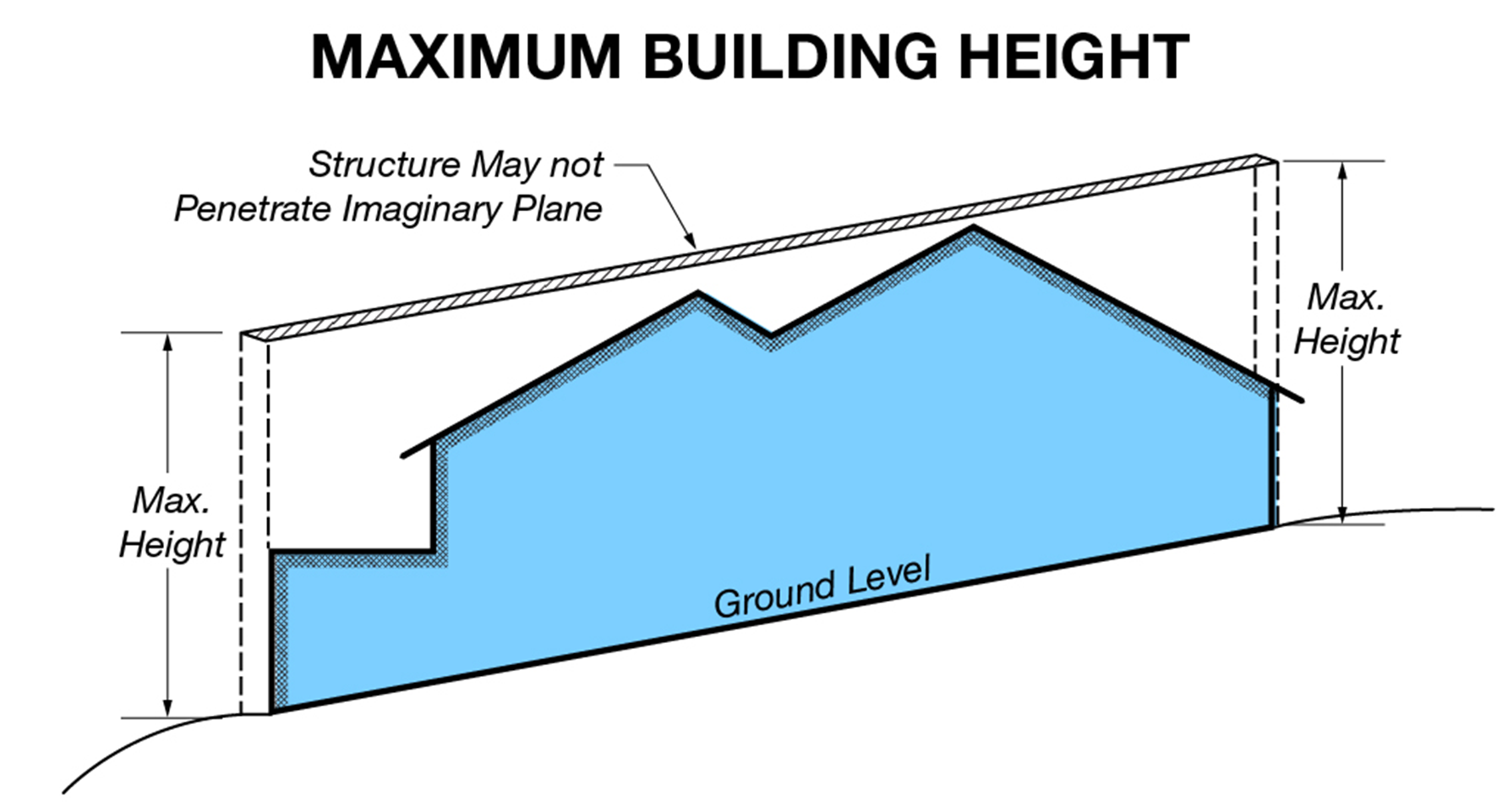
Unless specifically stated otherwise, for purposes of this Code the maximum height of buildings and other structures shall be defined as the vertical distance from the ground to an imaginary plane above and parallel to the ground. For residential districts, this imaginary plane shall be located at a vertical distance of 35 feet from ground level, and the building shall not penetrate that plane. "Ground level" shall be defined by the director as the lower of the following alternatives (i.e., that which is the lowest level above sea level):
(1)
The finish grades at the exterior walls of an existing or proposed building.
(2)
The existing grades on the site.
The preceding definition of maximum building height is illustrated on the next page:
FIGURE 3.1
(Ord. No. 99-107, § 5, 2-2-99)
Sec. 9-1-33.5. - Measurement of setbacks.
(a)
Measurement. "Setback" means the distance that a building or other structure or a parking lot or other facility must be located from a lot line, property line, or other specified boundary. Setbacks for residential development are specified in table 3.2, except where different setbacks are provided for special situations in this and following sections. Setbacks are measured along a line drawn at a 90-degree angle to whichever of the following results in the greatest setback:
(1)
Front setbacks: The front lot line or the ultimate street right-of-way.
(2)
Rear setbacks: The rear lot line or the ultimate street right-of-way.
(3)
Side setbacks: The side lot line or the ultimate street right-of-way.
(b)
Surface easements. Where a surface easement for recreation trail or vehicular access has been granted across any portion of a lot, the building setback shall be a minimum of five feet from the edge of that easement. Setbacks from utility access easements shall be zero.
(Ord. No. 99-107, § 5, 2-2-99; Ord. No. 2021-210, § 10, 8-3-21)
Sec. 9-1-33.6. - Setbacks from slopes.
Lots that have slopes which are 2:1 or steeper and over ten feet in height, require all structures to meet the following setbacks:
(1)
All main buildings and all accessory structures over 12 feet in height shall be set back a minimum of ten feet from the tops and toes of such slopes.
(2)
Accessory structures 12 feet in height or less shall be set back a minimum of three feet from the tops and toes of such slopes.
(3)
Accessory dwelling units shall be setback a minimum of four feet from the tops and toes of such slopes.
(4)
Adjustments. A main building, accessory dwelling unit, or accessory structure may be permitted on or cantilevered over such slopes if a minor adjustment is approved, provided the structure conforms to the accessory structure standards of and/or the accessory dwelling unit or junior accessory dwelling unit standards of and respectively. Notwithstanding other provisions of this Code regarding height measurement, height shall be measured via a plumb line from the top-most point of the structure to the finish grade directly below the top-most point. In addition to the findings required for approval of a minor adjustment, a finding shall be made that there are special circumstances on the property, such as unusual topography or lot configuration, which require the adjustment in order for the subject property to enjoy the same ability to accommodate the structure as other properties in the vicinity.
(Ord. No. 99-107, § 5, 2-2-99; Ord. No. 2021-210, § 11, 8-3-21)
Sec. 9-1-33.7. - Irregular lots.
(a)
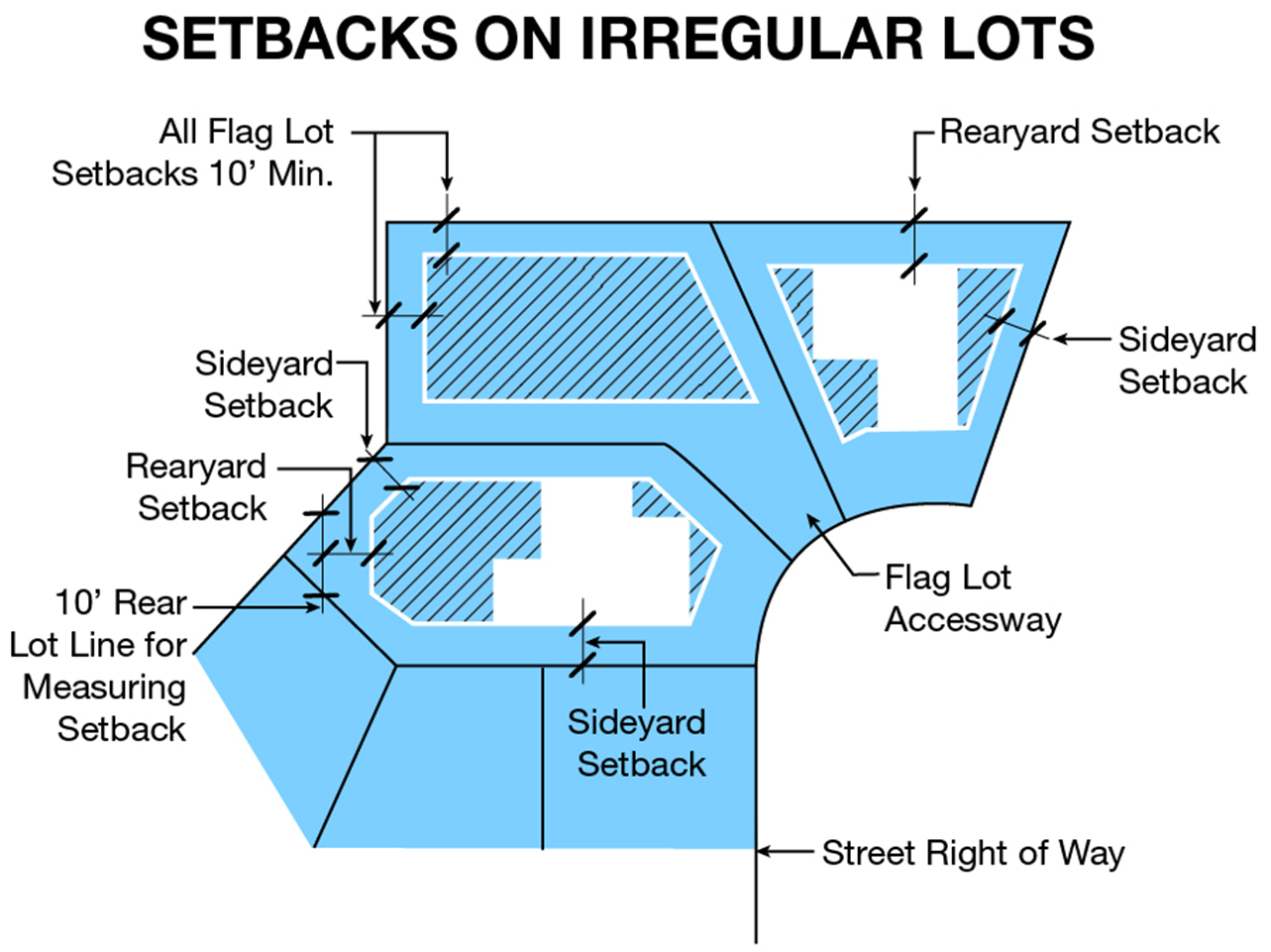
Purpose. The setbacks specified in table 3.2 are based on rectangular lots. Nonrectangular lots, lots with three sides or more than four sides, and other nonstandard lots require special measurement techniques in order to achieve the purpose of setback requirements (i.e., the appropriate separation of structures from streets and other properties). The purpose of this Section is to provide standards for the establishment and measurement of setbacks on irregular lots. (See subarticle 14 for definition of lot lines.)
FIGURE 3.2
(b)
Front setbacks. Front yard setbacks shall be measured from the ultimate right-of-way of the public or private street or easement from which the property takes access. However, if the property is a flag lot, the front setback shall be measured in accordance with paragraph (f) of this section.
(c)
Rear setbacks. The rear yard lot line is the lot line parallel to and most distant from the front lot line. In cases where the rear lot line is not clearly identifiable, an imaginary line shall be drawn for purposes of determining required setbacks and for interpretation of other provisions of this Code. The imaginary line shall measure ten feet in length, be parallel to and most distant from the front lot line, and connect the two side lot lines. If the community development director determines that placement of the imaginary rear lot line causes hardship or creates inconsistencies with adjoining properties, the director shall determine the rear yard setback.
(d)
Side setbacks. All lot lines which are not front or rear lot lines shall be considered side lot lines for the purpose of measuring setbacks.
(e)
Pie-shaped lot setbacks. Setbacks for pie-shaped lots shall be measured at the closest point between the building and angled lot line.
(f)
Panhandle or flag lot setbacks.
(1)
Definition. For purposes of this Code, "panhandle lot", "flag lot", "panhandle building site", and "flag building site" all mean the following: A lot having its only vehicular access by way of a narrow accessway which serves no other property and which is less than 40 feet wide and more than 20 feet long.
(2)
Setbacks. All building setbacks shall be a minimum of ten feet measured from property lines, except that the property line adjacent and most perpendicular to the "panhandle" portion of the lot shall be extended across that portion and serve as the basis for measuring setbacks in that area. No structures shall be permitted in the panhandle portion of the lot nor shall that portion be credited to minimum lot area requirements.
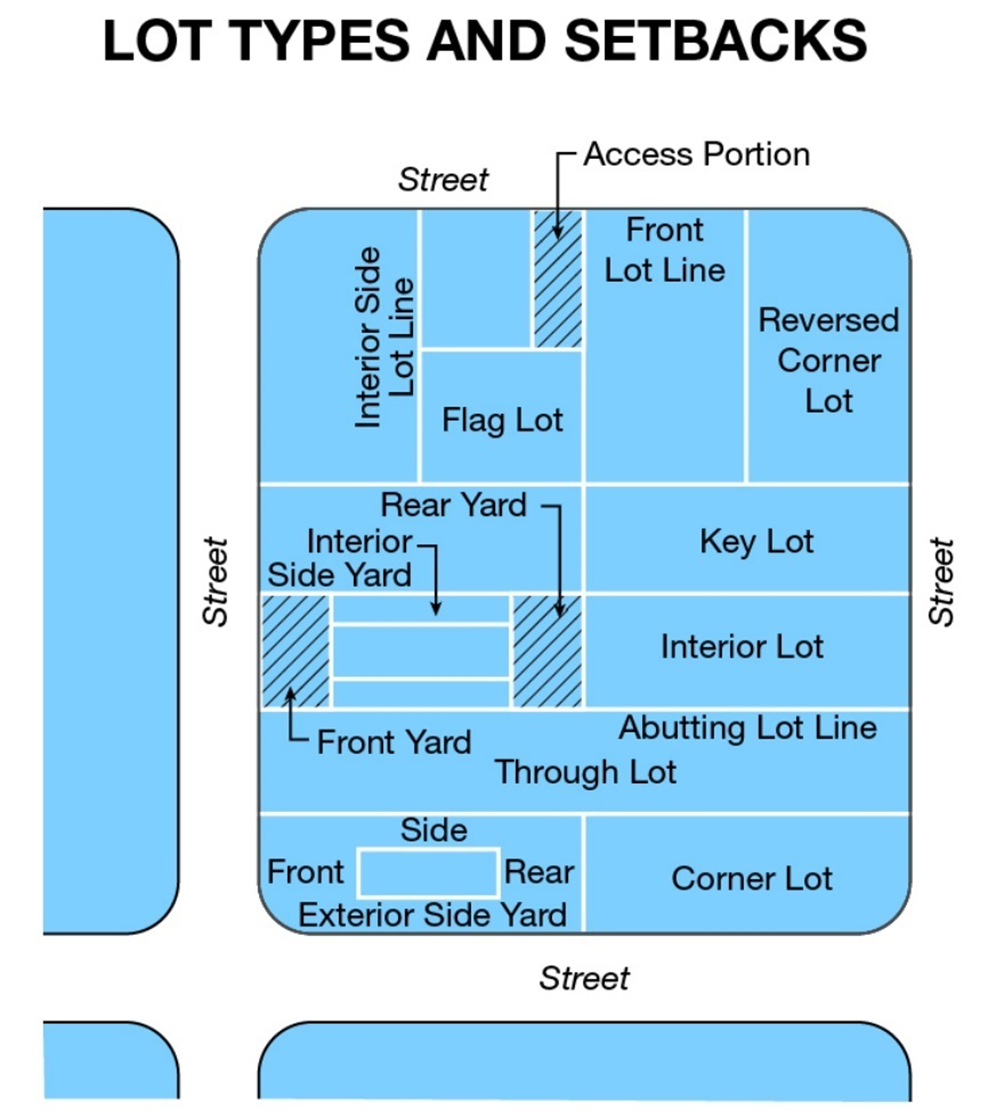
FIGURE 3.3
(g)
Determination by director. Where a building site is situated such that the front, side or rear property lines are not readily determinable by reference to the drawing at the right, required setbacks shall be as determined by the director in compliance with the following criterion: Required setbacks shall not permit the placement of buildings on the site in a manner that will constitute a grant of special privileges inconsistent with the limitations placed on other properties in the vicinity and incompatible with surrounding uses.
(Ord. No. 99-107, § 5, 2-2-99; Ord. No. 2021-210, § 12, 8-3-21)
Sec. 9-1-34. - Illustration of development standards, does not include setbacks from slopes per section 9-1-33.6.
FIGURE 3.4
DEVELOPMENT STANDARDS FOR RS DISTRICTS
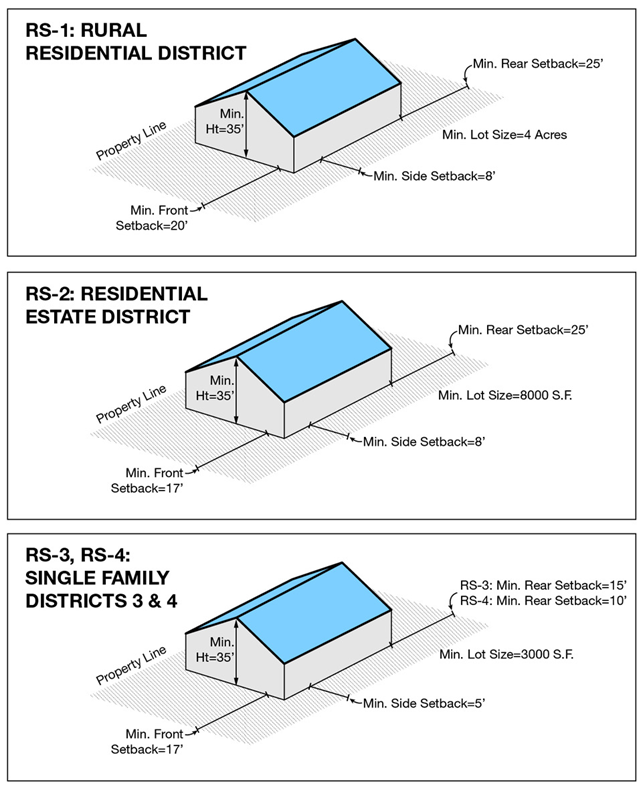
FIGURE 3.5
RESIDENTIAL DEVELOPMENT STANDARDS: RP, RA, AND RM DISTRICTS
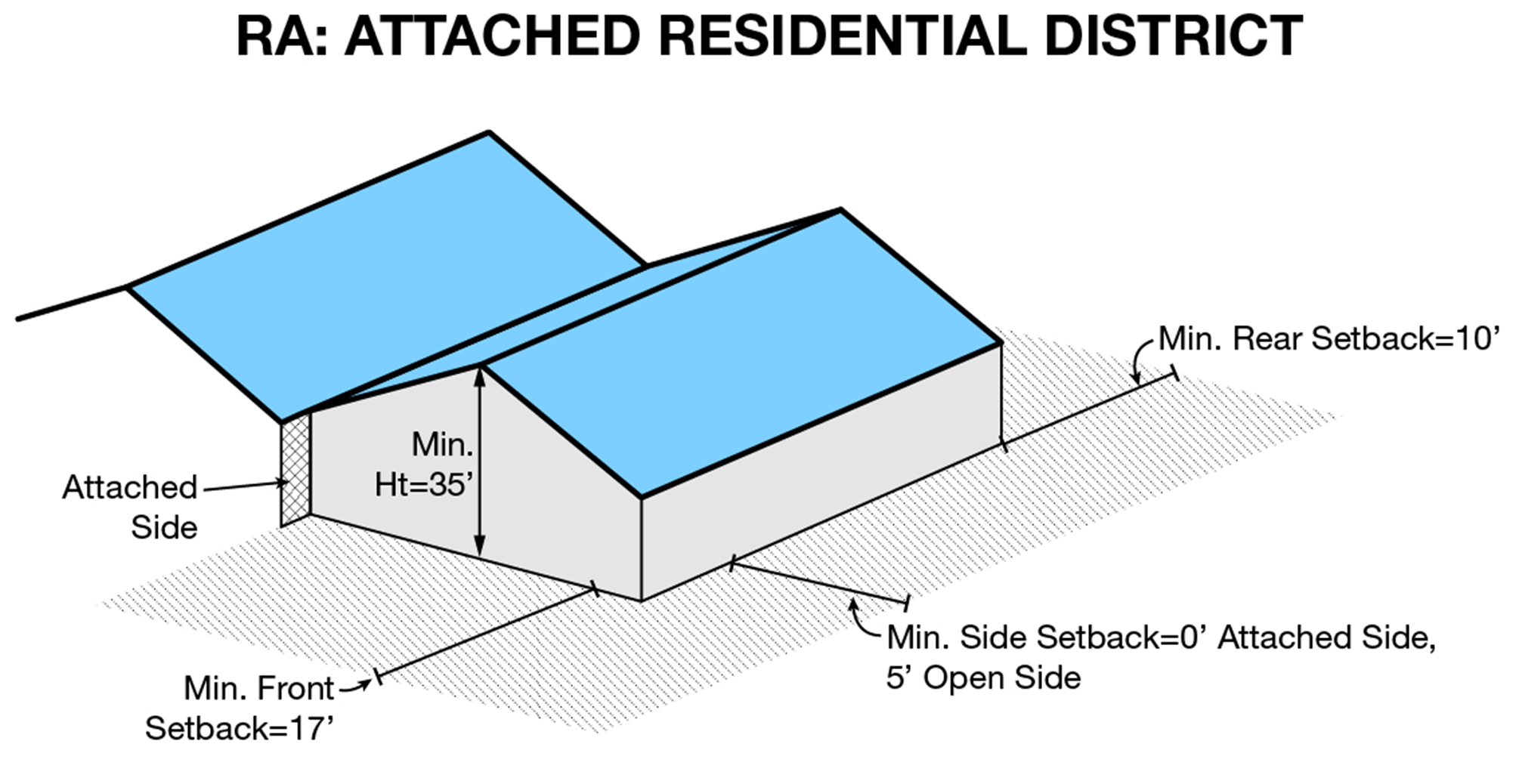
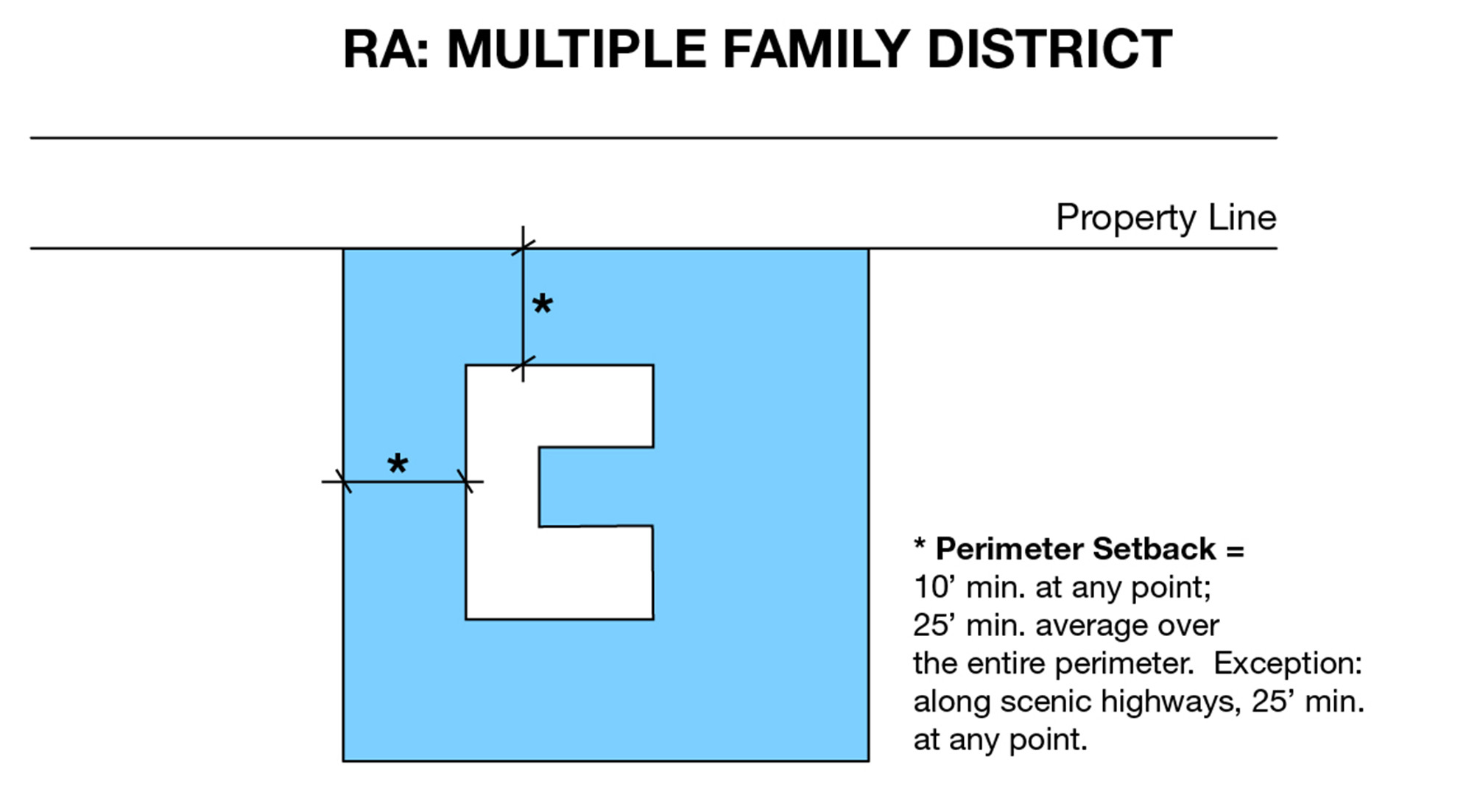
(Ord. No. 99-107, § 5, 2-2-99; Ord. No. 2021-210, § 13, 8-3-21)
Sec. 9-1-35. - Supplemental residential regulations.
All references to this shall include through . These sections set forth requirements for accessory structures, fences and walls, swimming pools, and other special aspects of land use in residential districts. These requirements are in addition to the other regulations for residential uses set forth in this subarticle and elsewhere in this zoning code.
(Ord. No. 99-107, § 5, 2-2-99)
Sec. 9-1-35.1. - Parking and signs.
Refer to subarticle 6 for parking regulations and subarticle 7 for sign regulations.
(Ord. No. 99-107, § 5, 2-2-99)
Sec. 9-1-35.2. - Fences and walls.
(a)
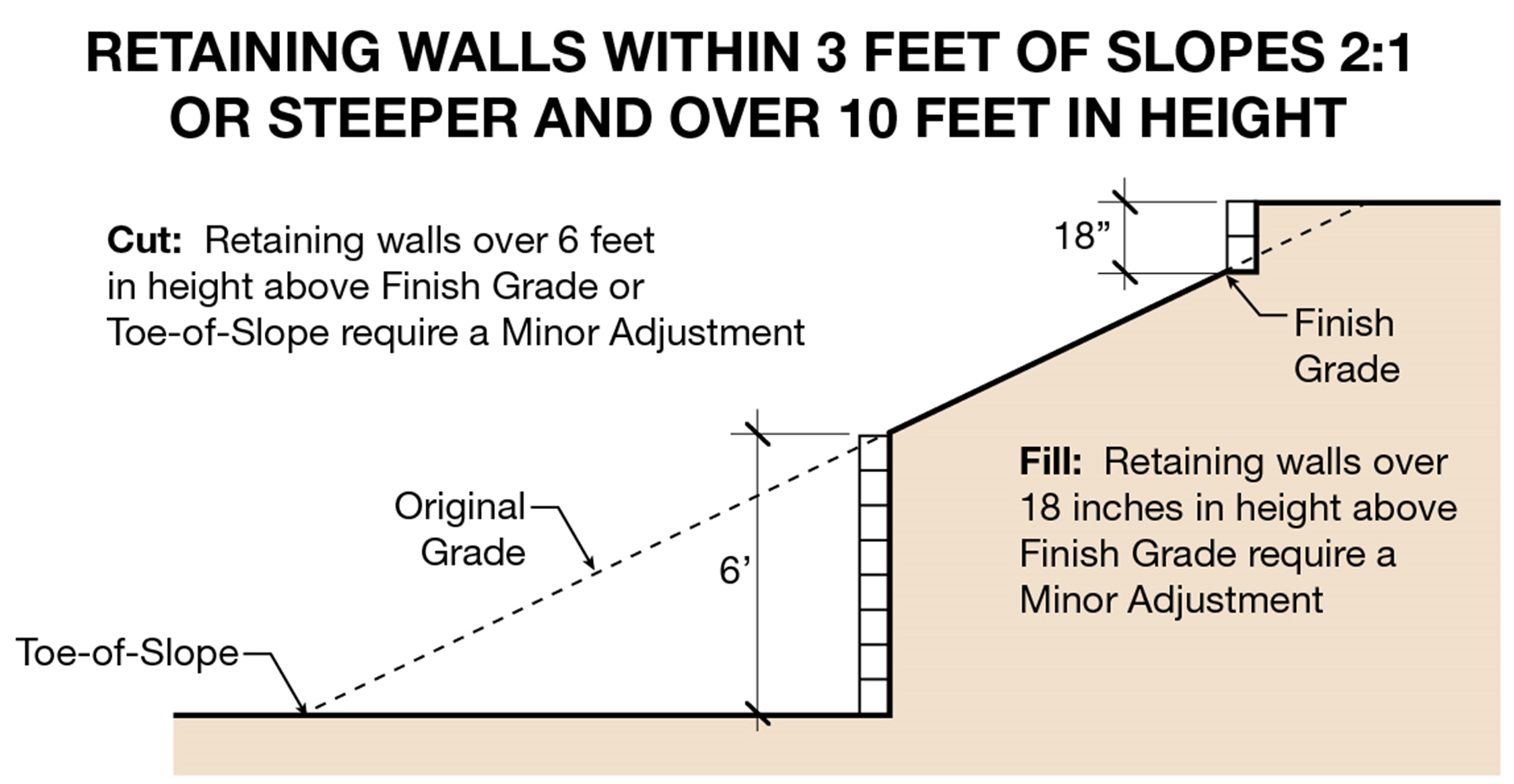
Definitions. For purposes of this section, "fence" or "wall" means any type of fence, wall, retaining wall, sound attenuation wall, screen, windscreen, hedge or thick growth of shrubs or trees, or any combination of these. A building wall shall not be considered a fence or wall for the purposes of this section. The terms "fence" and "wall" are used interchangeably in this section to mean any or all of the preceding structures or vegetation. "Hedge" or "thick growth of shrubs or trees" means vegetation at least 42 inches high which creates a screen blocking at least 50 percent of the view through the vegetation measured over a horizontal distance of five feet or greater. Exception: Retaining walls located on a slope that is 10 feet in height or over and has a grade of 2:1 or steeper are considered "unenclosed accessory structures" and are subject to .
(b)
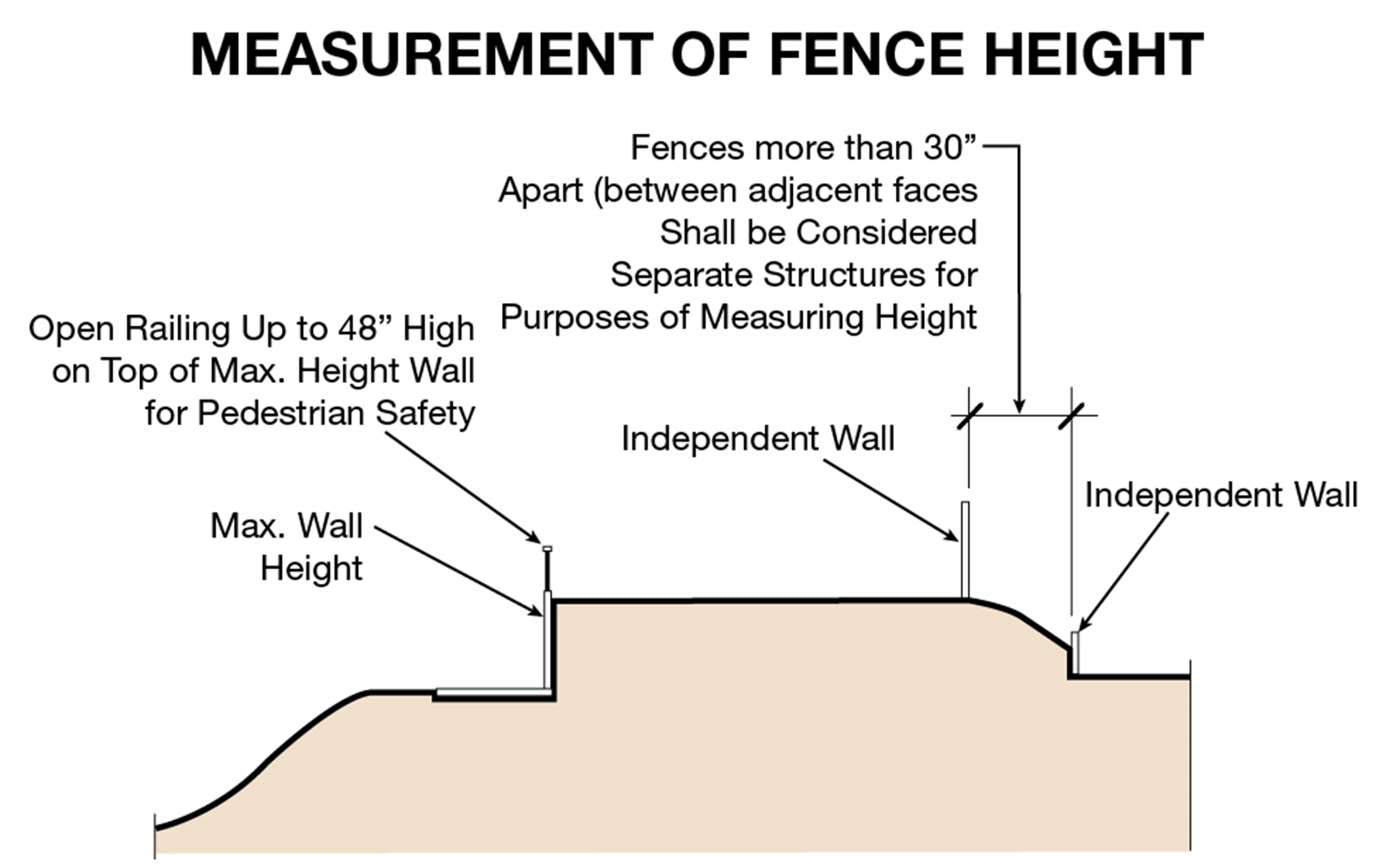
Measurement of fence height.
(1)
Fence heights shall be measured from finish grade at the base of the fence to the top on that side which results in the greatest height, except as otherwise specified in this section.
(2)
Fences separated by 30 inches or more (as measured between their closest surfaces) shall be considered separate structures and their heights shall be measured independently. Fences less than 30 inches apart shall be considered one structure and fence height shall be measured from the base of the lower fence to the top of the higher fence.
FIGURE 3.6
(c)
Fence Height Standards. The construction and installation of fences shall be in compliance with the following height and related standards:
(1)
Railings on top of retaining walls. Open railings, up to 48 inches high, placed on top of a retaining wall may extend beyond the permitted wall height limit for the purpose of pedestrian safety, with approval of the community development director. Approval shall only be granted in cases where pedestrian access is located adjacent to the wall and either the wall is existing and cannot be modified, or as a result of site constraints construction of the wall would result in the need for a railing which exceeds the wall height limit. This provision shall apply only to areas where fences are permitted over 42 inches in height.
(2)
Architectural features. For all fences, architectural features, such as pilasters, finials, and similar features, may extend an additional six inches above the maximum fence height, provided such features do not comprise more than ten percent of the horizontal length of the fence.
(3)
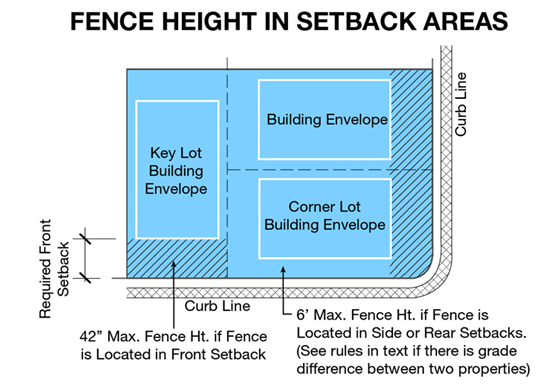
Within side and rear setbacks. The maximum fence height shall be six feet within any required rear or side setback area, except that where a difference in grade exists between two properties, the following rules shall apply:
a.
Fence height shall be determined independently for each property.
b.
No fence adjacent to a property line shall exceed eight feet in height as measured from the property on which it is located.
c.
No fence adjacent to a property line shall exceed six feet in height as measured from any adjacent property or street.
(4)
Within front setbacks.
a.
Maximum fence height shall be 42 inches if located within the front setback. In front yards and portions of street side yards, fences, walls, and hedges have a stricter height limit to maintain an open street scene, preserve the visibility of primary structures; enhance neighborhood character, and provide unobstructed views of traffic to and from driveways.
b.
Where, because of the orientation of the lots, a property line fence separates a front yard on one lot from a rear yard on an adjacent lot, the maximum fence height shall be six feet within the front setback area, except as limited by Paragraph (c)(6) of this section (Required sight distances).
c.
Any portion of a building site where vehicular access is taken shall conform to the requirements of paragraph (c)(6) of this section. (Required sight distances).
FIGURE 3.7
(5)
Within main building area. In the area of a lot where a main building may be constructed, the maximum fence height shall be 12 feet. Higher fences may be permitted if a minor adjustment is approved per paragraph (d) of this section.
(6)
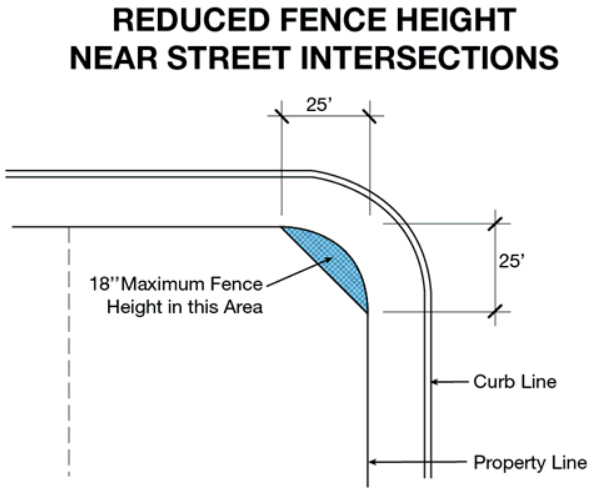
Required sight distances. In regulating fences, it is necessary to provide open "corner cutback" areas in order to preserve motorist sight distances. Therefore, notwithstanding other provisions of this section, maximum fence height shall be 18 inches within the triangular area formed by drawing a straight line as follows:
FIGURE 3.8
a.
Between two points located on the property line and (25 feet distant from the point of intersection of two ultimate street right-of-way lines.
b.
Within five feet from the intersection of an ultimate street or alley right-of-way and the edge of a driveway or another alley right-of-way.
(7)
Swimming pool fencing. Fences enclosing swimming pools shall conform to the height requirements of this section and to the provisions of (Swimming pools and spas).
(8)
Sound attenuation walls. City or state-required sound attenuation walls bordering freeways or arterial highways may exceed six feet in height, if approved by the director.
(9)
Prohibited fencing materials. Barbed wire and razor fences are prohibited in all zones, except when such materials are needed to restrict access to public utility requirements such as high voltage transformers. In residential zones chain link shall not be visible from the public right-of-way.
(d)
Increases in allowed height. Fences higher than the maximums set forth in this section may be permitted if a minor adjustment is approved by the director per . In addition to the findings required for approval of all site development permits, the following findings shall also be made in conjunction with approval of a fence height increase:
(1)
The height and location of the fence as proposed will not result in or create a traffic hazard; and,
(2)
The location, size, design and other characteristics of the fence will not result in a material adverse effect on adjacent residents or their properties, including but not limited to any views available to such residents prior to construction of the proposed "over-height" fence.
Any application for a fence height increase may be referred by the director to the planning commission for action if the director determines, on a case-by-case basis, that the public interest would be better served by such referral.
(e)
Fences adjacent to scenic highways. Adjacent to a scenic highway (as identified in the general plan) and along Niguel Road between Crown Valley Parkway and Alicia Parkway, fences shall not be placed below the top of slopes which have a slope ratio of 2:1 or steeper and measure over ten feet in height.
(Ord. No. 99-107, § 5, 2-2-99; Ord. No. 2021-210, § 14, 8-3-21)
Sec. 9-1-35.3. - Accessory structures.
(a)
Definition. For purposes of this section, "accessory structure" shall mean a building or structure, the use of which is subordinate and incidental to the main building or use on the same parcel. Accessory structures may be either attached to or detached from the main building and may be either enclosed or unenclosed. "Enclosed" accessory structures are those which are roofed and contained on all sides by walls pierced only by windows, vents or customary entrances and exits. All other accessory structures shall be considered "unenclosed." Accessory structures include, but are not limited to, open and solid patio covers, gazebos, trellises, arbors, play equipment, decks, patios, storage sheds, greenhouses, and other similar structures. Accessory structures do not include:
(1)
Second-story balconies or decks as they are considered part of the main dwelling,
(2)
Fences and walls as they are covered under , or
(3)
Accessory dwelling units or junior accessory dwelling units as they are covered under and , respectively.
(b)
Applicability. Accessory structures over six feet in height and patios and decks over 18 inches in height above finish grade are subject to the provisions of this section, except that free-standing fences and walls shall be regulated by . Exception: This section does not apply to Accessory Dwelling Units or Junior Accessory Dwelling Units which are regulated by and , respectively."
FIGURE 3.9
(c)
Location.
(1)
Accessory structures shall be located on the rear 50 percent of the building site, except that minor unenclosed accessory structures, such as arbors, trellises, porte-cocheres, gazebos, and similar minor structures may be located in the front yard setback on the front 50 percent of the building site. The distance between the front and rear property lines shall be the basis for determining the rear 50 percent of the property.
(2)
Accessory structures shall be located at least ten feet from any property line bordering a street.
(3)
Unenclosed accessory structures shall be located at least three feet from any property line not bordering a street and enclosed accessory structures shall be located at least five feet from any such property line.
(4)
Accessory structures shall be located at least three feet from the top or toe of any slope which has a grade of 2:1 or steeper and is over ten feet in height.
(d)
Height.
(1)
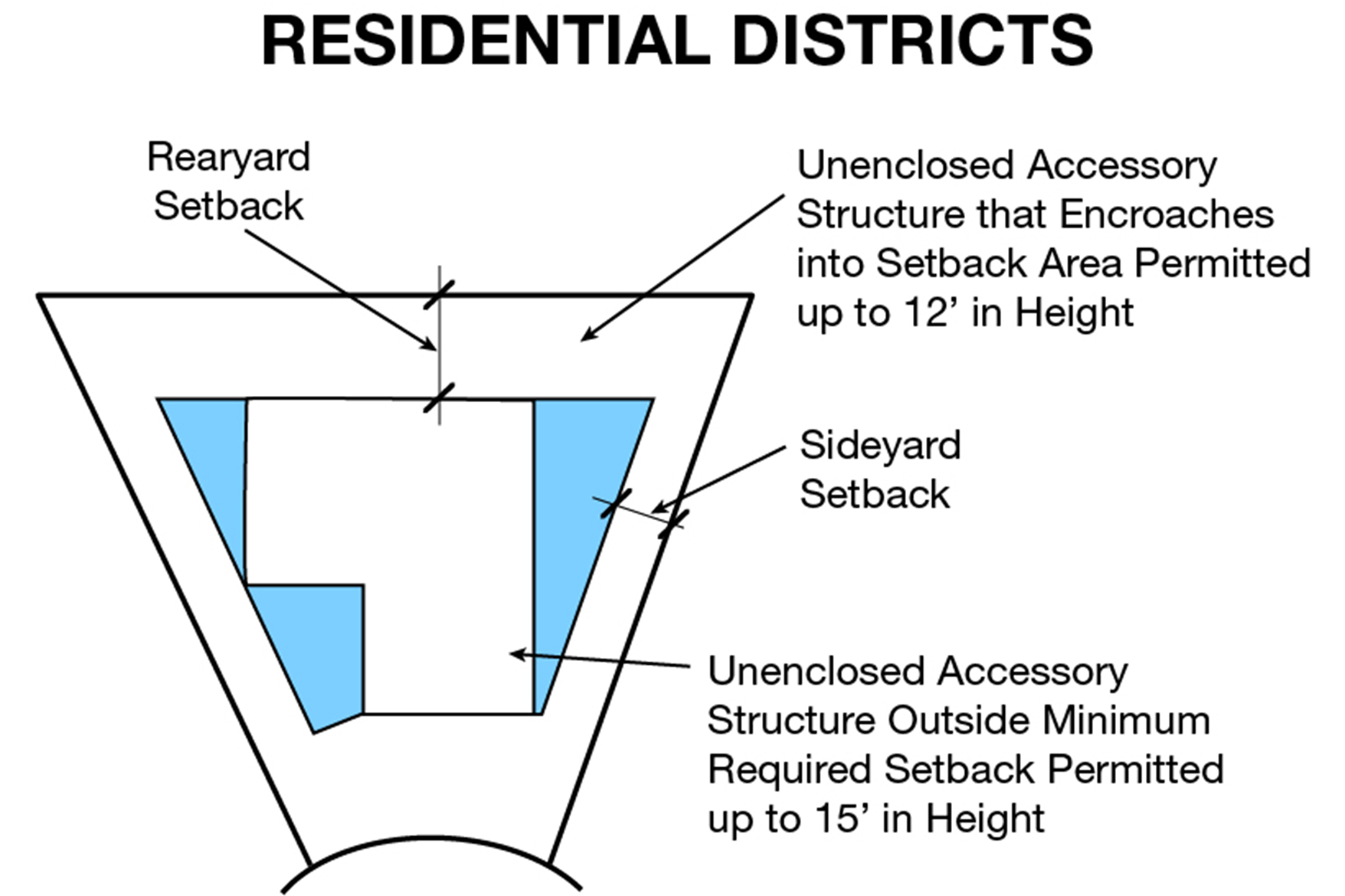
Unenclosed accessory structures that meet the minimum setback requirements for the main building are permitted up to 15 feet in height; for unenclosed accessory structures that encroach into the primary building minimum setbacks, structures shall not exceed 12 feet in height.
(2)
Enclosed accessory structures shall not exceed ten feet in height or 150 square feet in floor area.
FIGURE 3.10
(e)
Coverage. Enclosed accessory structures, whether attached or detached, shall not cover more than 50 percent of the rear yard setback area.
(f)
Adjustments. Modifications to the height, size, and location standards of this section may be permitted with approval of a minor adjustment processed in accordance with (refer to for applicable slope setback adjustment provisions). In addition to the findings required for approval of all such permits, approval of an accessory structure adjustment shall include the following findings:
(1)
The height, size, or location of the accessory structure will not be unsightly or incompatible with the character of or uses in the neighborhood; and
(2)
The height, size, or location of the accessory structure will not have negative visual impacts upon the street scene or obstruct views of traffic to and from driveways.
(Ord. No. 99-107, § 5, 2-2-99; Ord. No. 2019-197, § 3, 6-4-19; Ord. No. 2021-210, § 15, 8-3-21; Ord. No. 2021-211, § 6, 8-3-21)
Sec. 9-1-35.4. - Garages, carports and driveways.
(a)
Garage and carport placement. Garages and carports include attached or detached structures having direct access to a street or alley. Carports shall be permitted only upon approval of a minor adjustment per paragraph (b) of this section. Standards for the placement of garages and carports are set forth in table 3.3.
(1)
Except as otherwise specified, detached garages and carports shall conform to the development standards for main buildings.
(2)
Garages and carports shall not be located within any corner cutback areas for fences as set forth in .
TABLE 3.3: GARAGE/CARPORT DEVELOPMENT STANDARDS
* RP standards shall be as shown on approved precise plan for each project. See appendix A.
1 For side-entry type garages, the front setback may be reduced to 10 feet for the garage portion only if a minor adjustment is approved. However, no living space shall be permitted over such reduced-front setback garages.
2 Min. side setback = 10 feet adjacent to streets.
3 For RA attached dwellings, 0 feet on attached side and 5 feet min. on open side.
4 Measured from back of sidewalk.
(3)
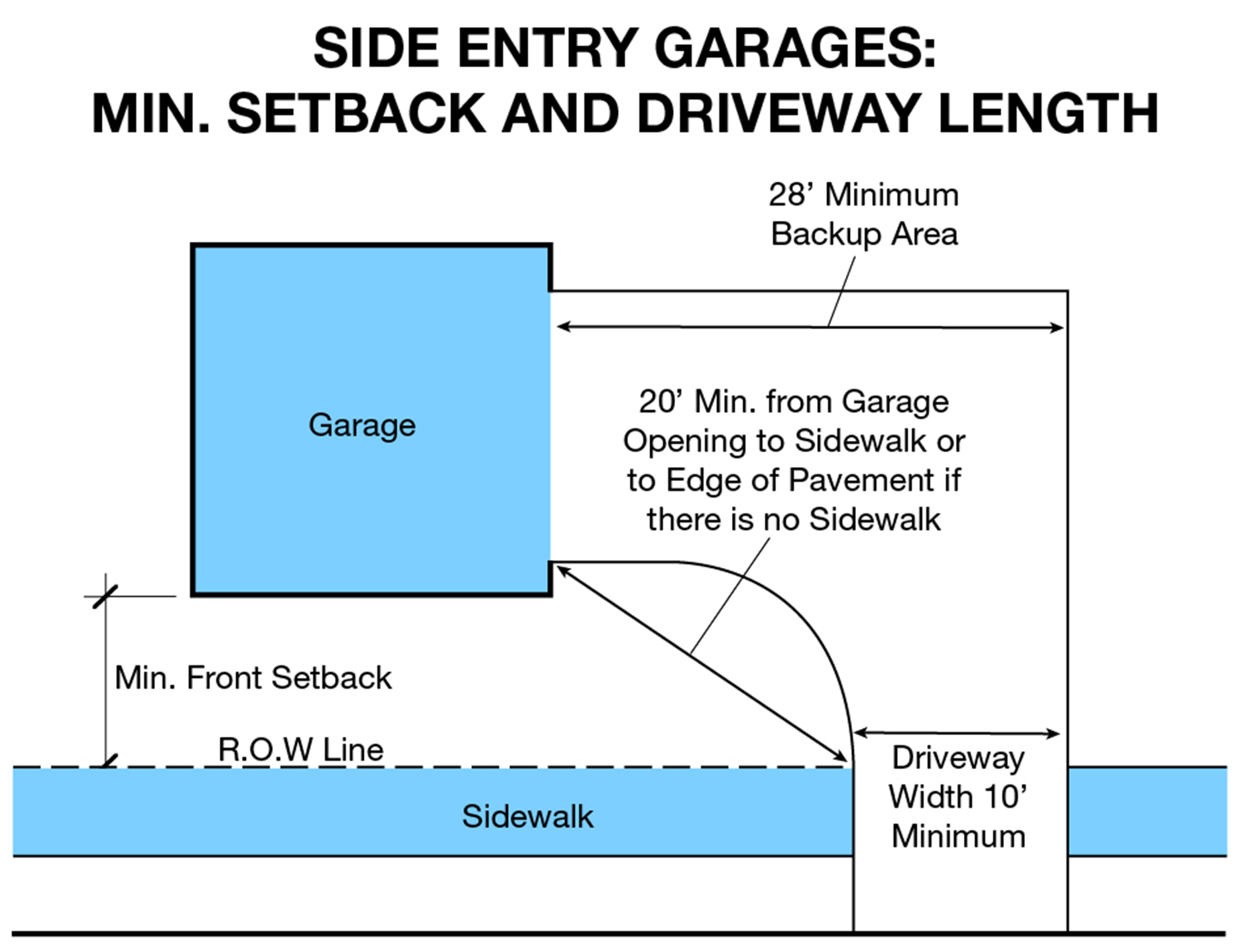
Upon approval of a minor adjustment, the minimum front building setback for a side-entry garage may be reduced to ten feet in all detached single-family residential districts except the RS-1 district. As shown in the illustration, such side entry garages shall provide a minimum of 20 feet from the garage opening to the sidewalk (or to the edge of street pavement if there is no sidewalk). No living space shall be permitted over such reduced-front setback garages.
FIGURE 3.11
(4)
When alleys, private streets or common driveways are provided specifically as vehicular access to garages and carports and when separate access and circulation systems are provided for pedestrians, guests and emergency vehicles, garages and carports may be placed up to a minimum of five feet from such alley, private street or common driveway.
(b)
Carport standards. Carports shall be permitted only upon approval of a minor adjustment and shall conform to the following additional standards:
(1)
Carports shall be constructed of materials and colors comparable to those of the main dwelling and/or garage.
(2)
Carports shall be located on the side of garages and shall not be located in front of (in-line with) garages.
(3)
Carports shall not be designed for side-entry.
(c)
Driveway standards. Residential driveways and maneuvering areas shall be provided in accordance with (Residential parking requirements).
(Ord. No. 99-107, § 5, 2-2-99; Ord. No. 2021-210, § 16, 8-3-21)
Sec. 9-1-35.5. - Swimming pools, spas, and other bodies of water.
(a)
Swimming pools. The provisions of this paragraph (a) shall apply to all swimming pools. Swimming pools are permitted as accessory uses in residential districts subject to the provisions of this paragraph.
(1)
Definition. "Swimming pool" means an artificial body of water containing or normally capable of containing water to a depth of 18 inches or more at any point, designed, constructed and used for swimming, dipping or immersion purposes by humans. This includes, but is not limited to, in-ground, above-ground, and on-ground pools, hot tubs, portable and non-portable spas, and fixed in-place wading pools.
(2)
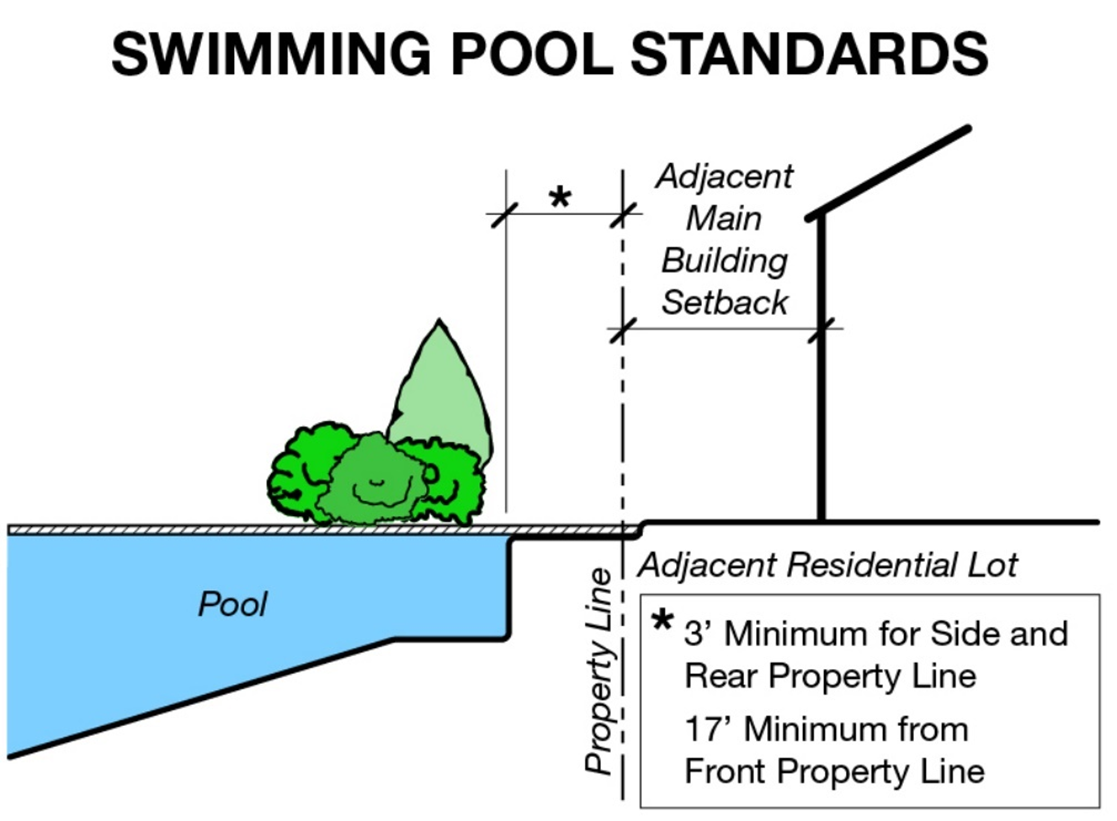
Location. Pools shall be located at least three feet (measured from water's edge) from any side or rear property line. In no case shall pools be located where the fence height is restricted to less than six feet by the provisions of unless, within the panhandle portion of a panhandle lot, or on slopes which are 2:1 or steeper and over ten feet in height.
FIGURE 3.12
(3)
Fencing and screening. All pools shall be fenced in accordance with the provisions of the city's building and safety code, state law and other applicable ordinances. All pool equipment shall be screened from view from the street.
(4)
Adjustments. Swimming pools may be located within the front yard setback with the approval of a minor adjustment per for the pool and the required fencing. In addition to the findings required for approval, the findings for increases in allowed fence height ((d)) must be made.
(Ord. No. 99-107, § 5, 2-2-99; Ord. No. 2021-210, § 17, 8-3-21)
Sec. 9-1-35.6. - Satellite dish and other antennas.
(a)
Accessory use. Antennas consistent with the design and location provisions of this section are permitted as accessory structures within any residential district.
(b)
Permitted noncommercial antennas. Noncommercial privately-owned television and/or radio antennas shall be contained entirely within a building, except for satellite dish antennas, amateur radio antennas, and other antennas which cannot function when completely enclosed by a building. Outdoor antennas shall comply with the following design standards and requirements, except for radio amateur antennas regulated per paragraph (c) of this section:
(1)
Number. No more than one of the following shall be permitted per residential lot: One television antenna or one satellite dish.
(2)
Location.
a.
Except for dish antennas with diameters of one meter or less, antennas shall be ground-mounted and shall not be visible from the street. Permitted antennas may be located within the rear yard or an interior side yard provided there is no encroachment into the required side yard setback. Antennas are prohibited from exterior street side yards unless not visible from the street.
b.
Dish antennas with diameters of one meter or less may be ground-mounted or building mounted anywhere on a lot except within the required front setback.
(3)
Height and Diameter. Satellite dish antennas shall not exceed eight feet in height measured from the grade at the base of the antenna and shall be no more than eight feet in diameter.
(4)
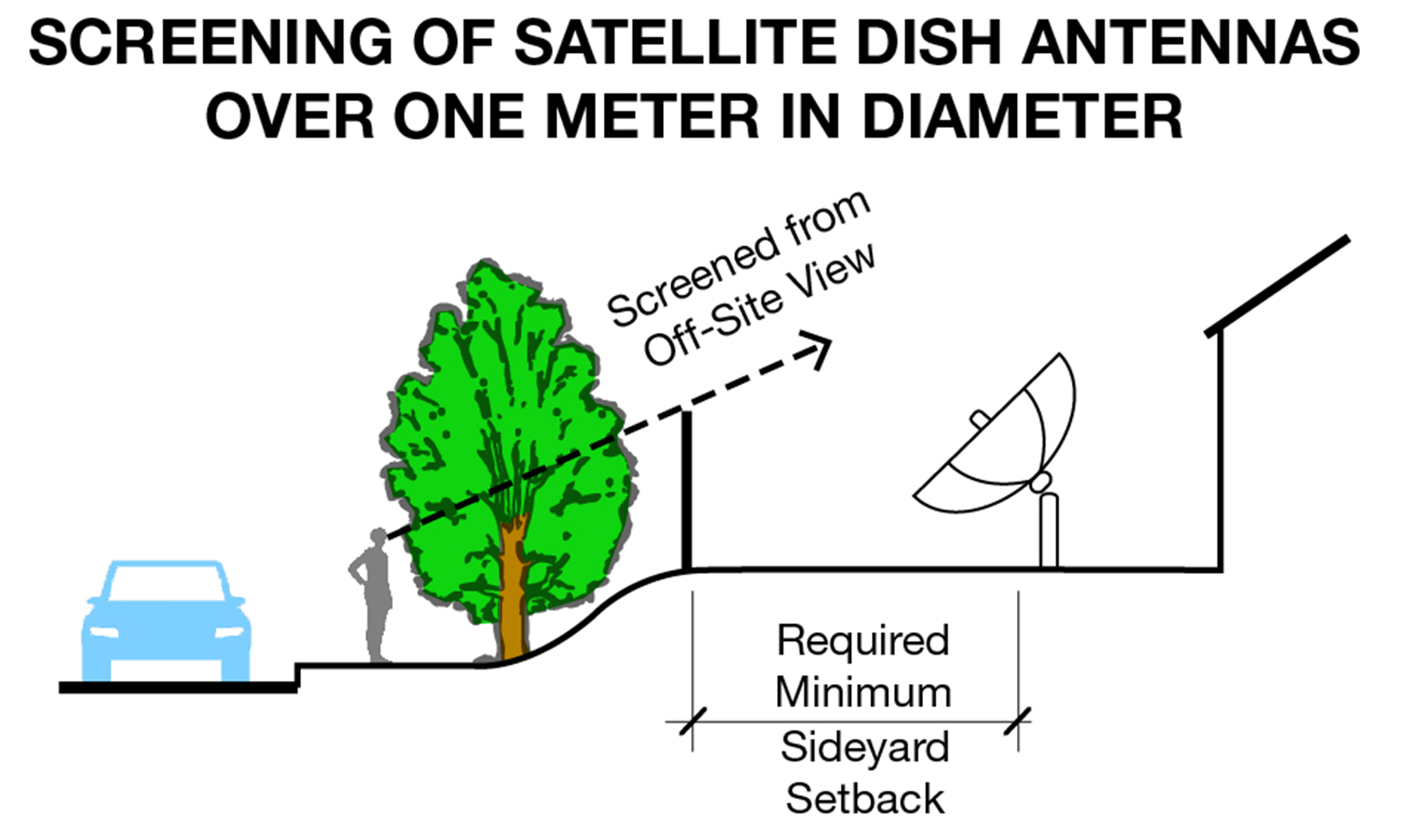
Screening. Satellite dish antennas over one meter in diameter and non-dish television antennas shall be screened from view, including views from adjacent yards, by landscaping or decorative structures (trellis, arbor, fence, etc.). The dish antenna shall be a single color that blends with its surroundings (e.g., dark green, brown, gray, or black).
FIGURE 3.13
(5)
Disguised antennas. An antenna which has the appearance of typical backyard furniture or equipment (e.g., satellite dish antenna manufactured to have the appearance of a patio umbrella) is not required to comply with the preceding location and screening standards but shall comply with height and size limits. Such an antenna may be placed on a patio or deck.
(c)
Amateur radio antennas. Antennas serving stations of noncommercial privately-owned and federally-licensed or recognized amateur radio operators shall comply with the following standards and requirements:
(1)
Amateur radio antennas permitted without a use permit. The following amateur radio antennas are permitted without approval of a use permit:
a.
Antennas completely enclosed within a building.
b.
A single antenna consisting of a wire one-fourth inch in diameter is permitted. Such wire antennas may be located in setback areas provided the antenna does not extend above the top of the roof of the primary residence on the site.
c.
A single vertical pole or whip antenna not exceeding 42 feet in height, measured from finish grade at the base of the antenna, and not located in any required side, rear or front yard, is permitted. Such antennas shall not be located in front of a residence or on the side of a residence facing a roadway. Guy wires and supports for such antennas shall conform to the following:
1.
Guy wires shall have a maximum outside diameter of one-eight of an inch and shall be a neutral color. A maximum of four guy wires mounted at a height of up to 30 feet may be installed. Guy wires shall not be located in required side yard setbacks or within five feet of the rear property line.
2.
Support structures or masts for pole or whip antennas shall conform to standards set forth in the Uniform Building Code. A building permit may be required for the support structure or mast.
(2)
Amateur radio antennas permitted with a use permit. Outdoor amateur radio antennas other than those listed in paragraph (c)(1), preceding, may be permitted if a use permit is approved. The following factors and findings shall be considered in the review of such use permits:
a.
Factors to be considered. The decision-making authority shall consider the following factors in reviewing use permit applications:
1.
The Federal Communications Commission (FCC) requires that local regulations provide reasonable accommodation for amateur radio communications.
2.
The City of Laguna Niguel desires to allow amateur radio antennas in a manner that reasonably accommodates amateur radio communications, while minimizing potential impacts on neighboring properties.
3.
The proposed height and design of the amateur radio station antenna, and the technological necessity of that height and design to engage in amateur radio service operations of the nature contemplated.
4.
The proximity of the proposed amateur radio station antenna to inhabited buildings and structures.
5.
The nature of existing uses on adjacent and nearby properties.
6.
The surrounding topography and landscaping, including trees and other foliage, and their effect on the proposed height and design of the amateur radio station antenna.
7.
The design of the proposed amateur radio station antenna, with particular reference to design features that provide for retraction of the antenna when not in use and design features that may reduce or eliminate visual obtrusiveness, particularly in residential zones.
b.
Required findings. In addition to the standard findings required for approval of a use permit, the decision-making authority shall make the following findings for approval of use permits for amateur radio antennas:
1.
The height, design, and configuration of the proposed antenna is technologically necessary to engage in amateur radio communications of the nature contemplated.
2.
Topographic or other constraints limit the feasibility of engaging in amateur radio communications with antennas permitted under paragraph (c)(1) of this section.
3.
The installation of the antenna is necessary to reasonably accommodate amateur radio communications.
4.
The placement and design of the antenna minimizes potential visual impacts on surrounding property owners to the extent possible while reasonably accommodating amateur radio communications.
(d)
No preemption of private covenants. No provision contained in this section shall preempt or void any more restrictive private covenant regulating outdoor antennas.
(Ord. No. 99-107, § 5, 2-2-99; Ord. No. 2021-210, § 18, 8-3-21)
Sec. 9-1-35.7. - Reserved.
Editor's note— Ord. No. 2021-211, § 3, adopted Aug. 3, 2021, repealed § 9-1-35.7, which pertained to second residential units and derived from Ord. No. 99-107, § 5, 2-2-99; Ord. No. 2004-134, § 3.B, 2-17-04.
Sec. 9-1-35.8. - Guest houses.
(a)
Purpose. This section provides standards and criteria for the establishment of guest houses within residential districts.
(b)
Definition. For the purposes of this Code, "guest house" means an attached or detached dwelling unit which has sanitary facilities, but no cooking facilities, and which is used primarily for sleeping purposes by members of the family occupying the main residence and their non-paying guests or domestic employees.
(c)
Limitations. Only one guest house may be established on any lot in addition to the primary residence.
(d)
Where permitted. A guest house may be constructed as an accessory use in the RS-1, RS-2, RS-3, and RS-4 districts subject to conformance with the standards of this section.
(e)
Guest house standards. All guest houses shall conform to the following standards:
(1)
Guest houses shall conform to all applicable building code standards and all development and design standards of the zoning district in which they are located. In addition, the height of the guest house shall not exceed the height of the primary residence.
(2)
Guest houses shall be architecturally compatible with the primary residence.
(3)
The floor area of a guest house shall not exceed 640 square feet.
(4)
Guest houses may contain independent access and sanitation facilities.
(5)
Guest houses shall not contain cooking facilities separate from the primary residence.
(6)
A guest house shall be used only by the occupants of the primary residence, their non-paying guests, or domestic employees. The guest house shall not be rented or otherwise occupied separately from the primary residence.
(7)
A minimum of one additional enclosed or unenclosed off-street parking space shall be provided for the guest house (see for residential parking space design standards). Tandem parking spaces shall not be credited toward meeting this requirement and no variance or other deviation shall be granted to allow substandard parking spaces or locations.
(8)
A deed restriction shall be required for recordation against the property to prohibit the use or conversion of the guest house to a rental unit or to a unit for sale.
(Ord. No. 99-107, § 5, 2-2-99; Ord. No. 2004-134, § 3.C, 2-17-04)
Sec. 9-1-35.9. - Garage sales.
(a)
Definition. Garage sales include the display of household goods for sale in the garage and/or driveway of a single dwelling unit. This section also applies to neighborhood or community garage sales.
(b)
Standards. Garage sales shall be permitted as temporary accessory uses in residential districts subject to the following regulations:
(1)
Garage sales may be conducted a maximum of eight days per calendar year per residence.
(2)
The hours of the sale shall be no earlier than 7:00 a.m. to no later than 8:00 p.m.
(3)
No item for sale shall obstruct the public right-of-way or any sidewalk, street, parkway or driveway.
(4)
It is unlawful for any person to exchange, barter, trade or sell any of the following at a garage sale: Firearms, ammunition, explosives, animals and livestock, any item of personal property from which the serial number has been removed, or any other item prohibited by city, county, state, or federal law.
(Ord. No. 99-107, § 5, 2-2-99; Ord. No. 2021-210, § 19, 8-3-21)
Sec. 9-1-35.10. - Home occupations.
(a)
Purpose. The regulations set forth in this section are provided so that certain incidental and accessory uses may be established in residential neighborhoods under conditions that will ensure their compatibility with the neighborhood.
(b)
Exemption for domestic employees. This section shall not apply to employees providing domestic help for the household, such as childcare, gardening, cooking, cleaning, medical, disability, or other personal assistance, or similar duties.
(c)
Permit required. Establishment and conduct of a home occupation shall require approval of a home occupation permit processed in accordance with . An application to conduct a home occupation shall be submitted to the community development department together with a fee established by the city council for this permit. Information shall be provided to ensure that the proposed home occupation complies with the requirements of this section. Additional information necessary to make the findings required for approval may be required by the director.
(d)
Approval of permit. The director shall approve an application for a home occupation permit for a home occupation if the director finds the permit application consistent with the performance and development standards listed in paragraph (e) of this section.
(e)
Standards. In addition to the requirements for each residential district, the following performance and development standards shall apply to the establishment and operation of home occupations in any district in which they are permitted:
(1)
The establishment and conduct of a home occupation shall be an incidental and accessory use and shall not change the principal character or use of the dwelling unit involved.
(2)
Only residents of the dwelling unit may be engaged in the home occupation.
(3)
A home occupation shall be conducted only within the enclosed living area of the dwelling unit or within the garage provided the home occupation does not limit or prevent the use of the garage for required off-street parking. The home occupation shall not occupy more than 25 percent of the combined floor area of the house and garage.
(4)
A home occupation shall not be conducted within a detached accessory structure, although materials may be stored in such a structure.
(5)
There shall be no signs, outdoor storage, parked customer vehicles, or other exterior evidence of the conduct of the home occupation. Neither the dwelling nor the lot shall be altered in appearance so that it appears other than a residence, either by color, materials, construction, lighting, sounds, vibrations, or other characteristics.
(6)
Electrical or mechanical equipment which creates interference in radio, television or telephone receivers or causes fluctuations in line voltage outside the dwelling unit shall be prohibited. Also, the home occupation shall not cause increased use of utilities or communication facilities beyond that normal to the use of the property for residential purposes.
(7)
The home occupation shall not include the storage of hazardous materials, nor shall it create dust, noise, glare, or odors in excess of that normally associated with residential use.
(8)
No sales activity shall be conducted from the dwelling except for mail order sales. The dwelling unit shall not be the point of customer pickup or delivery of products or services, nor shall a home occupation create greater vehicular or pedestrian traffic than normal for the district in which it is located.
(9)
The following uses are prohibited as home occupations:
a.
Medical, dental or similar occupations in which patients are seen in the home.
b.
Automotive repair or other automobile service or sales uses.
c.
Junkyards.
d.
Cleaning of major equipment.
e.
Food processing (excluding cottage food operations consistent with State law).
f.
Barber or beauty shops.
g.
Carpentry or cabinet making.
h.
Welding.
i.
Other occupations which do not meet the standards of this section.
(10)
All conditions of approval attached to the home occupation permit shall be fully complied with at all times.
(11)
Home occupations which provide instructional services to a limited number of students may be permitted, provided consent is obtained from adjacent neighbors and a minor use permit is approved.
(f)
Revocation or suspension of permit. The director may revoke or suspend any permit for a home occupation if the director determines that any of the performance and development standards listed in paragraph (d) of this section have been or are being violated, that the occupation authorized by the permit is or has been conducted in violation of any state statute or city law, or that the home occupation has changed or is different from that authorized when the permit was issued.
(g)
Permit nontransferable. No permit issued for a home occupation shall be transferred or assigned, nor shall the permit authorize any person other than that named in the permit, to commence or carry on the home occupation for which the permit was issued.
(Ord. No. 99-107, § 5, 2-2-99; Ord. No. 2021-210, § 20, 8-3-21)
Sec. 9-1-35.11. - Animals.
(a)
Purpose. This section regulates the keeping of animals within residential districts.
(b)
Household pets. Household pets shall be regulated pursuant to Laguna Niguel Municipal Code , pertaining to animals.
(c)
Horses. Horses are permitted in the RS-1 district as an accessory use and are permitted in the RS-2 district east of Street of the Golden Lantern, and the RP district on lots at least four acres in size, subject to approval of a use permit in accordance with . The following standards shall apply to the keeping of horses:
(1)
All pens, corrals, stables, barns, and other structures specifically for keeping horses overnight shall not encroach into the required setbacks for the main building and shall be located at least 75 feet from the buildable portion (main building envelope) of an adjoining lot.
(2)
Pastures, arenas, or any other areas for horses, which are not used to keep horses overnight, may extend to the property line.
(d)
Other animals. The types, number and manner in which pets and animals are kept shall be regulated pursuant to Laguna Niguel Municipal Code , pertaining to animals.
(Ord. No. 99-107, § 5, 2-2-99; Ord. No. 2021-210, § 21, 8-3-21)
Sec. 9-1-35.12. - Screening.
All projects within the RM district shall conform to the nonresidential screening requirements of .
(Ord. No. 99-107, § 5, 2-2-99)
Sec. 9-1-35.13. - Landscaping and open area.
(a)
Landscaping in the front yard setback of single-family zones. In order to maintain attractive front yards, all setback areas visible from a public street, with the exception of the minimum areas necessary for entry sidewalks, decorative hardscape, and parking (including required parking spaces and associated driveways) shall have a surface that remains permeable and is to be landscaped and permanently maintained.
(b)
RM and RP zoning district requirements.
(1)
Open area requirement. All projects within the RM and RP districts shall include common open area equal to at least 25 percent of the buildable project area. For purposes of this section, "buildable project area" means the horizontal area within the boundaries of a development project, less slope areas with a ratio of 2:1 or steeper and less perimeter rights-of-way and easements and areas set aside for public schools, parks, and other public uses.
(2)
Open area standards. Required common open area shall consist of passive landscaped and active recreation areas established and maintained in accordance with the following standards:
a.
Excluded areas. Rights-of-way, parking areas, private patios, private yards, and slopes steeper than 20 percent shall not be credited toward the common open area requirement.
b.
Passive landscaped area.
1.
Design guidelines. This section sets forth basic landscaping requirements. In addition, subarticle 9 (Community design guidelines) contains landscaping standards and guidelines relating to project entry landscaping, pedestrian area landscaping, tree preservation, plant selection, and other items.
2.
Landscaping standards. A landscape plan shall be prepared, approved, and implemented for all projects through the landscape review process. Landscaping consisting of trees, shrubs, vines, groundcover, water features, or any combination thereof shall be installed and maintained in accordance with the following standards:
i.
Height of landscaping along all streets and boundaries shall comply with (Fences and walls).
ii.
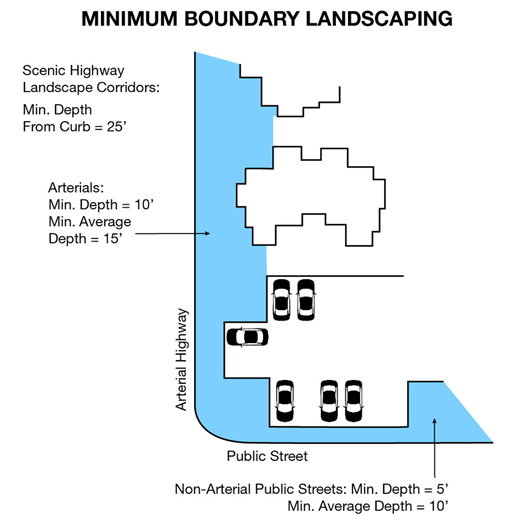
Boundary landscaping abutting arterial highways shall be required to an average depth of 15 feet with a minimum depth of ten feet, measured from the street right-of-way. However, along arterial highways designated as Scenic Highways in the general plan (i.e., Crown Valley Parkway, Alicia Parkway, La Paz Road, Moulton Parkway, Street of the Golden Lantern, Pacific Island Drive, Camino del Avion, and Niguel Road south of Crown Valley Parkway) plus Niguel Road north of Crown Valley Parkway, landscaping shall be provided to a minimum depth of 25 feet at all points, measured from the curb.
iii.
Boundary landscaping abutting public streets other than arterial highways shall be required to an average depth of ten feet with a minimum depth of five feet, measured from the street right-of-way.
iv.
All landscaped areas shall be separated from adjacent parking or vehicular areas by a curb or other barrier at least six inches higher than the parking or vehicular area to prevent vehicular damage to the landscaped area.
v.
Permanent automatic irrigation facilities shall be provided for all landscaped areas. All irrigation systems shall be maintained in proper operating condition. Waterline breaks, head/emitter ruptures, overspray or runoff conditions and other irrigation system failures shall be repaired immediately.
vi.
All landscaping shall be maintained in an orderly, attractive, and healthy condition, including proper pruning, mowing of lawns, weeding, removal of litter, fertilizing, replacement of plants (including trees) when necessary, and the regular application of appropriate quantities of water to all landscaped areas.
vii.
Modification to an approved landscape plan, or any significant modification to existing landscaped areas, removal, or substantial thinning of landscaping, shall first require the review and approval of a changed plan permit or a discretionary permit amendment as determined by the community development director.
FIGURE 3.14
(3)
Active recreation area requirement.
a.
Minimum area. At least ten percent of the buildable project area shallbe devoted to active recreational uses. This may be part of the required project common open area.
b.
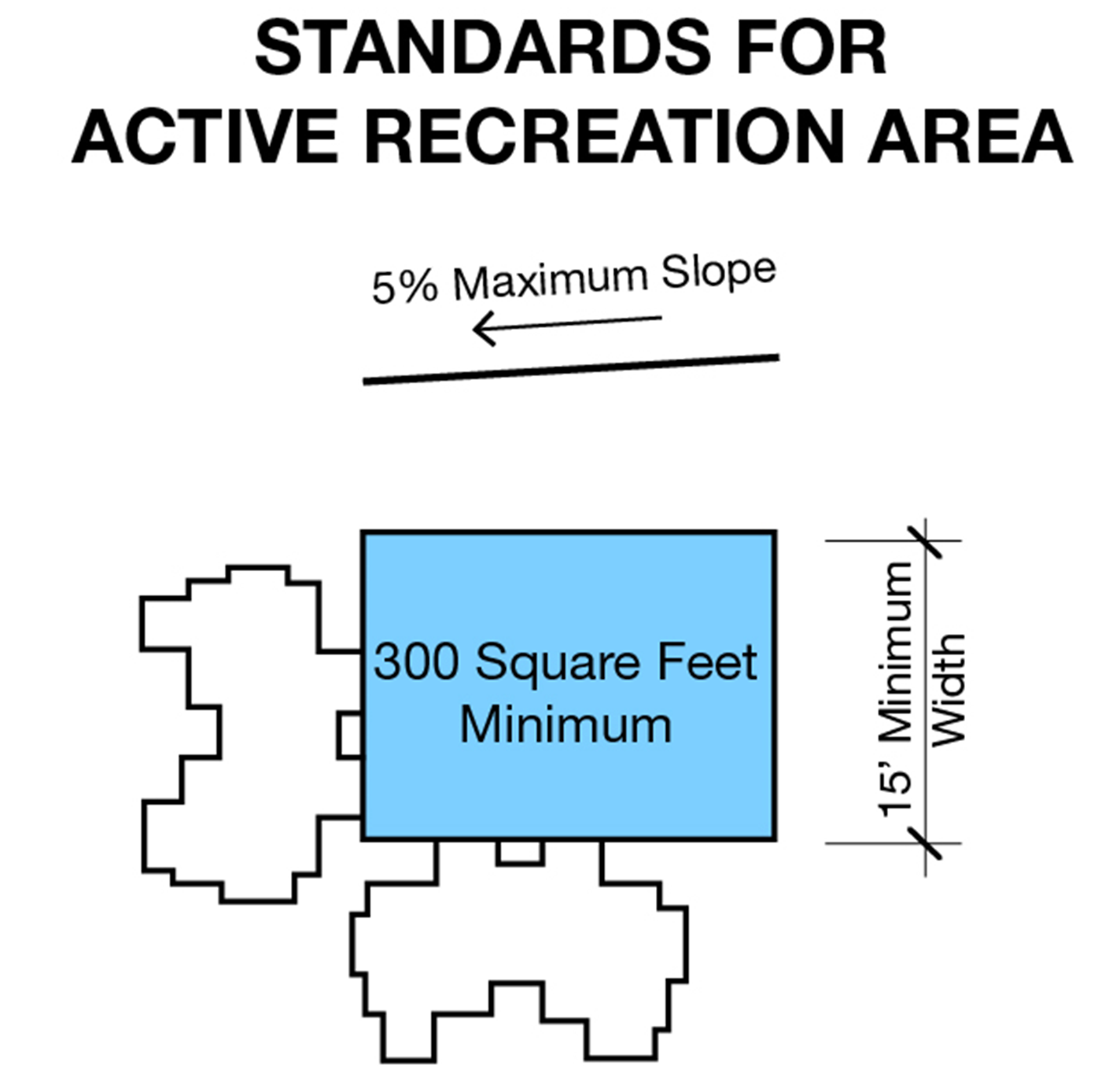
Size and slope standards. Active recreation area shall be at least 15 feet wide and 300 square feet in area, with slopes no greater than five percent.
c.
Recreation facilities. Facilities may include swimming pools, spas, and related facilities; clubhouses; tot lots with play equipment; court game facilities such as tennis, basketball, or racquetball; improved softball or other playfields; or similar facilities for active recreational use.
FIGURE 3.15
(Ord. No. 99-107, § 5, 2-2-99; Ord. No. 2021-210, § 22, 8-3-21)
Sec. 9-1-35.14. - Tennis and other game courts.
(a)
Permits required. Construction of tennis and other permanent game court facilities, including fencing, may be permitted subject to a finding by the director that the standards set forth in this section have been satisfied. All lighted tennis and other game courts shall require approval of a use permit by the planning commission processed in accordance with .
(b)
Hours of use. No tennis or game court shall be used before 7:00 a.m. or after 10:00 p.m.
(c)
Unlighted tennis courts. Unlighted tennis courts shall meet the following development standards:
(1)
Fences. A maximum 12-foot high fence (measured from the finished grade of the court) shall be allowed. Fences may be covered with a dark non-reflective screening material.
(2)
Setbacks. Tennis courts shall maintain setbacks equal to the setbacks for the main building for the applicable zoning district as defined in , except that side yard setbacks shall be ten feet in all zoning districts.
(3)
Landscaping. Landscaping shall be installed and maintained between the court fence and property line. A landscape plan shall be submitted, reviewed and approved by the city landscape architect, and implemented at the same time as court construction.
(d)
Other unlighted game courts. Other game courts include permanent facilities used in conjunction with a particular recreational activity, such as basketball, badminton, and other sports. Setbacks for such unlighted game courts shall be:
Front yard: 20 feet
Side yard: 10 feet
Rear yard: 10 feet
(1)
A maximum 12-foot-high fence (measured from the finished grade of the court) shall be allowed, provided the fence maintains the setbacks for the main building for the applicable zoning district as defined in .
(2)
Exception: One, unlighted, basketball standard, including backboard and rim, shall be permitted in the front yard, provided a setback of five feet is maintained from the front property line.
(e)
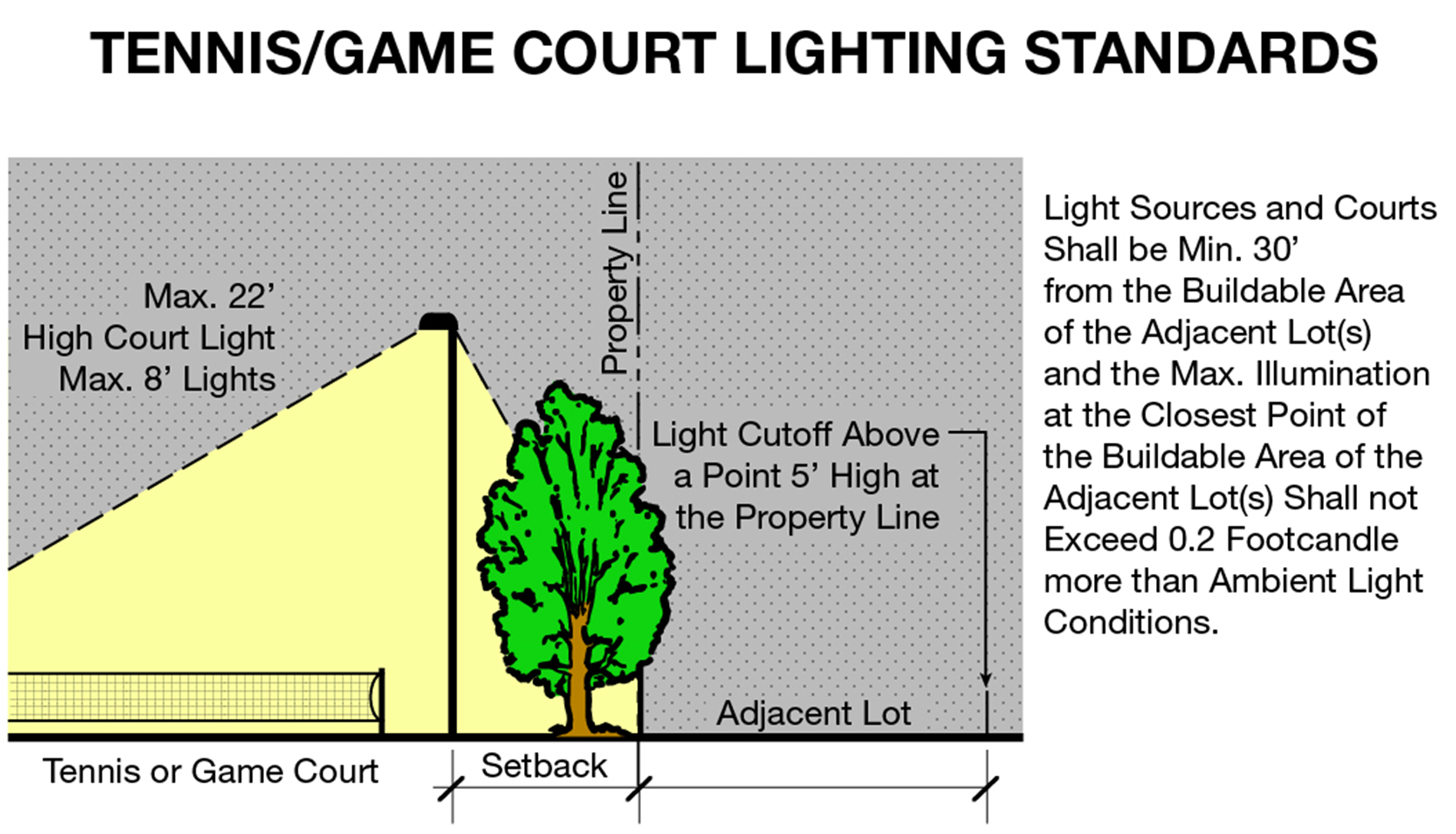
Lighted tennis and game courts. Lighted tennis and game courts shall require approval of a minor use permit. Such lighted courts shall conform to the preceding standards for unlighted courts and shall also meet the following standards:
(1)
Lighting design. A maximum of eight lights (i.e., eight individual light sources) are permitted, with mounting height not to exceed 22 feet. Prior to issuance of a building permit, all lights and lighting fixtures shall be certified by a qualified lighting engineer to be designed, constructed, and mounted such that:
a.
The light source and direct rays are not visible from any point five feet above grade at the lot line; and,
b.
The light sources and the tennis or game court is at least 30 feet from the buildable portion of the adjacent lot(s) and the maximum intensity of illumination attributable to the tennis or game court lighting measured at the closest point of the buildable portion of the adjacent lot(s) does not exceed 0.2 footcandle more than ambient light conditions.
FIGURE 3.16
(2)
Glare. The surface area of any game court shall be designed, painted, colored, and/or textured to reduce the reflection from any light source.
(Ord. No. 99-107, § 5, 2-2-99; Ord. No. 2021-210, § 23, 8-3-21)
Sec. 9-1-35.15. - Outdoor lighting.
(a)
Purpose. This section is intended to provide standards for outdoor lighting which allows adequate lighting for public safety while minimizing the adverse effects of excessive lighting on neighbors and the community.
(b)
Outdoor game courts. Any lighted outdoor recreation use shall be subject to the provisions of for lighted game courts.
(c)
Residential lighting requirements. All properties zoned for residential use shall be subject to the outdoor lighting standards of this section. The regulations apply to both security and purely decorative lighting. Outdoor lighting which complies with these standards shall be permitted as an accessory use while deviation from the standards shall require approval of a minor adjustment permit.
(d)
Intensity and design. Exterior lighting shall be shielded or recessed so that direct glare and reflections are contained within the boundaries of the parcel, and shall be directed downward and away from adjoining properties and public rights-of-way. No lighting shall be of unusually high intensity or brightness. All lighting fixtures shall be appropriate in scale, intensity and height to the use.
(e)
Height. Building-mounted lights shall be installed below the eave line. Pole or fence-mounted lights shall be located no more than eight feet above grade, except in residential parking lots.
(f)
Location. Lighting shall only be installed adjacent to buildings, walkways, driveways, or activity areas (decks, patios, spas and pools, and similar use areas), and focal landscape areas close to the residence or activity area.
(g)
Residential parking lots. The lighting intensity within parking lots and adjacent areas shall conform to the standards of subarticle 9 (Community design guidelines); that is, lighting intensity shall be at least 1.0 footcandle at all points, but shall not exceed an average of 3.0 footcandles over the entire parking lot. Overall height of light standards shall be no more than 22 feet above finish grade.
(h)
Common area lighting. For all new residential developments, lighting plans (including photometric analysis) may be required for common recreational areas and pedestrian walkways within common open space. Outdoor lighting in these areas should be the minimum needed to ensure safety and security so that impacts on surrounding residential areas are minimized. The director may require lighting plans for existing developments should concerns arise about the health, safety or welfare for residents of the area.
(i)
Holiday and decorative lighting. Lighting and decorations with lights which are related to a specific holiday period shall be permitted in residential districts. Decorative lighting not associated with a holiday period shall not be the type that flashes, blinks, moves, or otherwise draws attention.
(j)
Enforcement. If the director determines through complaints received and/or site visits that any outdoor lighting may not be designed consistent with the provisions of this section and may cause an adverse impact on neighboring properties, the director may require a photometric analysis by a licensed engineer, to allow continued use of the lighting.
(Ord. No. 99-107, § 5, 2-2-99; Ord. No. 2021-210, § 24, 8-3-21)
Sec. 9-1-35.16. - Special outdoor events.
(a)
Definition. Within residential districts, special outdoor events may include, but are not limited to, pageants, fairs, carnivals, religious or entertainment events, block parties, and neighborhood or community gatherings.
(b)
Requirements. Special outdoor events are permitted in all residential districts provided the following requirements are met:
(1)
Approval of a temporary use permit shall be required for all special outdoor events.
(2)
Activities conducted on property owned by or leased to the city or on public rights-of-way may require an encroachment permit issued by the public works director.
(3)
The event may be permitted for a period not to exceed ten consecutive days. Events conducted more than four times in a calendar year are not considered temporary and shall not be eligible for a temporary use permit.
(4)
A cash bond or other guarantee may be required to be posted with the city to ensure removal of the temporary use and cleanup and restoration of the activity site within seven days of the conclusion of the event.
(5)
Applications for permits or certificates required by this Section shall be referred by the community development department to other affected departments, cities or public agencies as may be appropriate for review and comment.
(6)
Related issues, including but not limited to police and security, food and water supply, use of tents and canopies, sanitation facilities, medical services, noise, signage, fire protection and traffic control, shall be satisfactorily addressed by the applicant, as required by the director, sheriff, fire chief or health officer in their administration of other city codes. Such other codes may require the applicant to obtain permits such as building, electrical, health, tent, and other permits.
(Ord. No. 99-107, § 5, 2-2-99; Ord. No. 2021-210, § 25, 8-3-21)
Sec. 9-1-35.17. - Manufactured housing and mobilehomes.
(a)
Definition. For the purposes of this zoning code, the terms "manufactured home" and "mobilehome" shall mean the same thing (i.e., a residential building transportable in one or more sections which has been certified under the National Manufactured Housing Construction and Safety Standards Act of 1974). For purposes of simplicity, the term mobilehome is used in this section.
(b)
Where permitted. Mobilehomes may be permitted on single-family lots within the RS-1, RS-2, RS-3, and RS-4 districts as permanent or temporary residences, subject to the requirements of this section and provided the mobilehome is certified under the National Manufactured Housing Construction and Safety Standards Act of 1974 and meets the requirements of the Manufactured Housing Act of 1980 (California Health and Safety Code for Manufactured Housing, section 18000).
(c)
Permanent mobilehome residence. Each mobilehome installed as a permanent residence on a single-family lot shall comply with the following standards:
(1)
District standards. The mobilehome shall conform to all setback, height and other standards of the district in which it is located.
(2)
Foundation. The mobilehome shall be placed on a solid concrete slab foundation.
(3)
Exterior siding. The exterior siding shall be wood or other material customarily used in conventionally built single-family dwellings.
(4)
Roofs. Roofs shall be constructed of fire-retardant composition shingles or tile. Roof pitch shall be similar to those of roofs of the same material on conventionally-built single-family dwellings in the neighborhood, but in no case less than a ratio of 3:12.
(5)
Roof overhangs. Roofs shall have eave and gable-end overhangs of not less than 12 inches, measured perpendicularly from the exterior wall.
(6)
Garages. Permanent mobilehomes shall have garages with the same minimum dimensions and number of parking spaces as required for single-family homes in .
(d)
Temporary mobilehome residence during construction. A mobilehome, motorhome, or travel trailer may be permitted as a temporary residence during the construction of an owner-built (custom) house within the RS-1, RS-2, RS-3, and RS-4 districts subject to approval of a temporary use permit and the following standards:
(1)
Time limitations. A temporary mobilehome may be located on the same lot as a permanent residence under construction. The temporary mobilehome may be maintained on the lot for a maximum of one year or until issuance of a certificate of use and occupancy for the permanent residence, whichever occurs first. During that time, the mobilehome may be occupied only by the owner of the subject lot and the owner's immediate family. The mobilehome shall be removed from the site on or before a date one year after its placement on the lot regardless of whether the permanent residence is completed.
(2)
Setbacks. The mobilehome shall be set back a minimum ten feet from all property lines.
(3)
Utility and health requirements. Temporary mobilehomes shall meet all health department standards for a permanent residence and shall be connected to electric, water, and sewer services in accordance with city and utility company standards.
(Ord. No. 99-107, § 5, 2-2-99; Ord. No. 2021-210, § 26, 8-3-21)
Sec. 9-1-35.18. - Child day care homes.
(a)
Purpose. The use of a residence as a small family day care home or large family day care home, shall be considered a residential use of property under this article and shall be permitted in a legal dwelling unit in any residential district. The purpose of this section is to provide standards for the establishment and operation of child day care homes within residential districts. These standards are intended to be consistent with chapters 3.4 and 3.6 of the state health and safety code and shall be so construed.
(b)
Small family day care homes. Small family day care homes are permitted in all residential districts. Small family day care homes shall provide care for six or fewer children. However, such small family day care homes may provide care for more than six and up to and including eight children, without an additional adult attendant, if all of the following conditions are met:
(1)
At least one child is enrolled in and attending kindergarten or elementary school and a second child is at least six years of age.
(2)
No more than two infants are cared for during any time when more than six children are cared for.
(3)
The licensee notifies each parent that the facility is caring for two additional school age children and that there may be up to seven or eight children in the home at one time.
(4)
The licensee obtains the written consent of the property owner when the family day care home is operated on property that is leased or rented.
(c)
Large family day care homes. Family day care homes are permitted in all residential districts. Large family day care homes may provide care for seven to 12 children. However, such large family day care homes may provide care for up to and including 14 children if all of the following conditions are met:
(1)
At least one child is enrolled in and attending kindergarten or elementary school and a second child is at least six years of age.
(2)
No more than three infants are cared for during any time when more than 12 children are cared for.
(3)
The licensee notifies each parent that the facility is caring for two additional school age children and that there may be up to 13 or 14 children in the home at one time.
(4)
The licensee obtains the written consent of the property owner when the family day care home is operated on property that is leased or rented.
(d)
Standards for family day care homes. Family day care homes shall conform to the following requirements:
(1)
All facilities shall be operated and maintained in accordance with state and local health, safety, and other regulations.
(2)
All parking and outdoor lighting shall comply with the applicable regulations set forth in and , respectively.
(3)
All facilities shall comply with the development standards of the residential district in which they are located, as set forth in .
(Ord. No. 99-107, § 5, 2-2-99; Ord. No. 2021-210, § 27, 8-3-21)
Sec. 9-1-35.19. - Reserved.
Editor's note— Ord. No. 2021-210, § 28, adopted Aug. 3, 2021, repealed § 9-1-35.19, which pertained to residential care facilities and derived from Ord. No. 99-107, § 5, 2-2-99.
Sec. 9-1-35.20. - Temporary construction and guard offices.
Construction offices, security quarters, storage yards, large containers, temporary fencing and similar structures on the site of an active construction project may be conditionally permitted with a temporary use permit, subject to the following regulations:
(1)
The temporary structure shall not be moved onto the site nor otherwise established until issuance of a precise grading permit or, if there is no grading permit, issuance of a building permit.
(2)
Any temporary structure shall be removed from the site prior to the issuance of a certificate of occupancy for the last new building on the site. If the associated project is for grading only, the office shall be removed within 30 days of expiration of the grading permit.
(3)
Any permanent structure or portion of a permanent structure devoted to temporary use as a construction or guard office shall be converted to a permanent permitted use prior to the issuance of a certificate of occupancy for the last new building on the site.
(4)
The office shall be supplied with an electric meter and sewer and water facilities.
(Ord. No. 99-107, § 5, 2-2-99; Ord. No. 2021-210, § 29, 8-3-21)
Sec. 9-1-35.21. - Relocatable buildings.
A relocatable building or trailer may be permitted as a temporary structure for any permitted nonresidential and noncommercial use in any residential district subject to the approval of a temporary use permit processed in accordance with and the following additional provisions:
(1)
The temporary use permit application shall include the following:
a.
A description of the proposed uses and operating characteristics for all uses on the site, both temporary and permanent.
b.
A plot plan showing the location of all uses and structures, both temporary and permanent.
c.
Supplementary exhibits, as required by the director to adequately review the proposal, such as building elevations, landscaping, grading, access, and utility service.
(2)
A temporary use permit for a relocatable building or trailer may be conditionally approved. Failure to comply with the required conditions shall be grounds for the revocation of the permit.
(3)
A cash bond of $500.00 per each relocatable building or trailer shall be posted with the director to guarantee removal of each from the site upon expiration of the temporary use permit.
(4)
A temporary use permit for a relocatable building or trailer shall be approved for a maximum of one year from the date of approval.
(Ord. No. 99-107, § 5, 2-2-99)
Sec. 9-1-35.22. - Trash and recyclable materials storage.
All townhome, condominium, and apartment projects shall conform to the nonresidential trash and recyclable materials storage requirements of .
(Ord. No. 99-107, § 5, 2-2-99)
Sec. 9-1-35.23. - Noise control.
Noise in residential districts shall be regulated by the city's noise control ordinance (div. 6-6 of this Code), which provides noise control standards for all districts in the city in order to prevent excessive sound levels which are detrimental to the public health, welfare and safety, or which are contrary to the public interest.
(Ord. No. 99-107, § 5, 2-2-99)
Sec. 9-1-35.24. - Model home complexes.
(a)
Model home complexes and sales offices. Temporary model home complexes, real estate sales offices and related signage may be established if a temporary use permit is approved in accordance with and the following requirements are satisfied:
(1)
The complex is used solely for the first sale of homes or the first rental of apartments in projects of 20 or more units.
(2)
The complex is located within the area of the project for which it is established. The temporary office shall not be located within 50 feet of an existing dwelling unit which is not a part of the new project.
(3)
Notwithstanding other provisions of this Code, the parcel of land on which a temporary real estate office is established is not required to be a building site provided the parcel is precisely described.
(4)
The following structures and facilities are permitted in conjunction with the establishment of a temporary real estate office in conformance with an approved temporary use permit:
a.
Model homes in compliance with the zoning regulations applicable to the properties that are being sold.
b.
Garages, attached and detached, in compliance with the zoning regulations applicable to the properties that are being sold.
c.
Temporary sales office buildings or relocatable buildings.
d.
Accessory buildings and structures in compliance with the zoning regulations applicable to the properties that are being sold.
e.
Recreational facilities that will become a permanent portion of the project in compliance with the zoning regulations applicable to the properties that are being sold.
f.
Permanent streets and driveways that will be part of the project after the closure of the real estate office use.
g.
Temporary children's playgrounds.
h.
Temporary and permanent fencing, walks, and structural amenities.
i.
Temporary vehicle parking and maneuvering areas to provide off-street parking as necessary for employees and guests.
j.
Temporary vehicular accessways.
(b)
Requirements for approval. Any approving action shall include those conditions and requirements deemed by the decision-making authority to be necessary or advisable to protect the public safety and the general welfare, together with adequate guarantees that the structures and facilities will be removed or made consistent with applicable zoning regulations within 90 days after the expiration of the permit. In addition to those findings required for the approval of an application, any approving action for a temporary real estate office shall also include the following findings:
(1)
The access, parking and circulation facilities will not result in excess traffic congestion or traffic safety hazards.
(2)
The operation of the real estate office and associated activities will not conflict with adjacent and nearby residential uses.
(c)
Time limitations. A temporary use permit for a real estate office may be approved for a maximum time period of two years from the date of approval.
(d)
Signs and flags. Signs and flags in connection with a temporary real estate office shall be permitted within a tract on the following conditions:
(1)
The sign copy shall be limited to matters relating to the project within which the signs are located.
(2)
Such signs shall have a time limit of existence concurrent with the use of the permitted temporary offices.
(3)
Temporary project identification signs up to 64 square feet in area and 10 feet in height are permitted at each street entrance, subject to the provisions of (Permitted temporary signs).
(4)
Additional signage exclusive of that permitted under paragraph (d)(3) preceding may be permitted, but shall not exceed a total of 100 square feet in area nor shall any sign exceed ten feet in height.
(5)
The number of flags permitted shall be two for the overall complex plus two per each model home, not to exceed a total of eight flags per model complex.
(6)
The following advertising devices or activities are expressly prohibited within or outside the project: Banners, balloons, portable trailer signs, or human indicators, except as specifically approved in a temporary use permit and in compliance with (Permitted temporary signs).
(Ord. No. 99-107, § 5, 2-2-99)
Sec. 9-1-35.25. - Gate-guarded neighborhoods.
(a)
Application for approval. A gate-guarded neighborhood for new or existing residential development areas may be established with the approval of a site development permit.
(b)
Required information for neighborhood plan. In addition to the required submittal items for a site development permit, any person or entity desiring a gate-guarded neighborhood shall submit a detailed gate-guarded neighborhood plan. The neighborhood plan shall include the following:
(1)
Evidence of identifiable area to be served. A proposed gate-guarded neighborhood submitted pursuant to this section shall present evidence demonstrating that the control gates will serve a well-defined neighborhood.
(2)
Evidence of neighborhood support.
a.
The plan shall include a survey evidencing majority support for the concept. As a minimum, signatures of 51 percent of the owners of property within the neighborhood establishing written support for the plan shall be utilized by the city in determining whether there is majority support for the plan, with each buildable lot or dwelling unit to be tabulated as one vote. This criterion shall not apply to new development, with the exception of those developments under construction for which 25 percent or more of the units have been sold.
b.
After receipt of the survey, city staff shall prepare a report which outlines all potential impacts of the action should it be implemented. The report shall also identify the city's current interest in any rights-of-way, easements or other property within the proposed gate-guarded neighborhood which would be vacated or otherwise affected by the approval and designate any such interest which is proposed to be transferred to the homeowners, either to an association or to individuals. If there is any question as to the city's ownership or interest in such facilities, the director may require the applicant to provide a title report on the property in question.
c.
The report prepared by city staff shall be circulated as a petition to all owners of record within the impacted neighborhood. The resultant tabulation of the petitions in support of the issue must total at least 75 percent of all of the property owners, with each buildable lot or dwelling unit to be tabulated as one vote.
d.
Utility/public facility coordination. The plan shall show the layout of adjacent utility and/or public facilities. Any facilities which are in conflict with the proposed gate system shall be relocated at the applicant's expense to locations approved by the affected utility and/or other public agency. The gate design, including the setback of all gates, shall be approved by the public works director.
e.
Financial plan. The plan shall include a financial analysis establishing that the gate-guarded facility shall be adequately maintained on a permanent basis. The financial plan shall also address maintenance funding for public facilities to be transferred to the homeowners (e.g., streets, sidewalks, curb and gutter, local drainage facilities, etc.).
f.
Access by contract services. The applicant submitting the plan shall contact all contract services, i.e., trash pickup and street cleaning, and provide assurance of access to the gated community to allow for continued service.
(c)
Design and access standards. Plans for establishment of a gate-guarded neighborhood shall incorporate the following design and access standards:
(1)
Key system for gates. The plan shall provide for the installation of a master key override switch system as prescribed by the city for emergency access or other public access. Keys shall be provided to the city in the event of approval. If the gate operates by way of a telephone system, a ring-through feature shall be provided in order that cars waiting at the gate entrance will not cause waiting or queuing problems should a telephone line be in use, or a pull-out area outside of traffic lanes shall be provided to allow telephoning without blocking access.
(2)
Gate setback. The setback of all gates shall be approved by the public works director. The setback shall be evaluated by considering the number of dwelling units within a gated neighborhood, internal and external traffic patterns, number of gated entries, the number of lanes at each entry point, type of gate control at each entry and type of street from which access is being taken.
(3)
Turnaround. There shall be a minimum of a 38-foot radius turnaround area located on the public street side of the gate to ensure unrestricted access to and from the gate area and public street system. This required turnaround area may include a rolled curb and sidewalk provide there are no obstructions to vehicles on the sidewalk. This requirement shall be treated as a general standard which may be modified based upon site and public health and safety considerations at the sole discretion of the city.
FIGURE 3.17
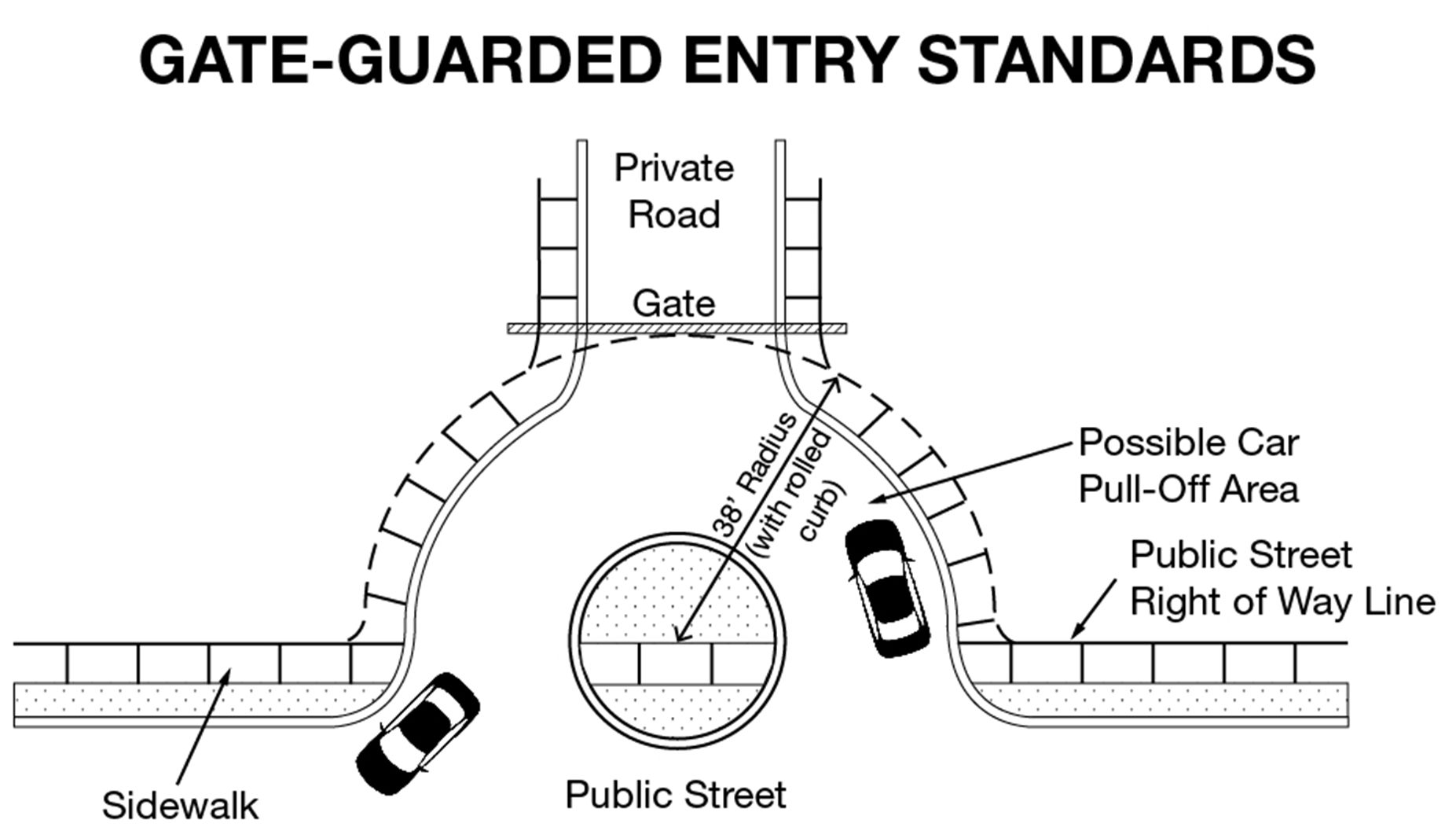
(4)
Review by Fire Authority. The Fire Authority shall be asked to make its review and recommendations on any proposed plan.
(5)
Other topographical considerations. The community development department shall review the plan for other site and topographical layout considerations to ensure that the design of the gate system does not create health and safety hazards.
(6)
Access to public facilities. The proposal shall not result in the blockage or inhibition of access by the public to public or quasi-public facilities, whether existing or planned, such as parks, schools, hiking and biking, and equestrian trails, etc., which serve more of the community than the proposed gated neighborhood.
(7)
Private streets. Any public streets proposed to be vacated within the neighborhood shall be maintained for access and parking as they were previously as public streets. All such streets shall be considered "public" for the purposes of implementing development standards such as setbacks, screening requirements, or other standards.
(d)
Exceptions to design standards. Notwithstanding the standards set forth in paragraph (c) preceding, the decision making authority may make exceptions to one or more of the design standards set forth above if it finds that:
(1)
There would be no health or safety hazard created by the waiver of the design standard; and
(2)
Unique topographical features, including size of the neighborhood, justify waiver of one or more of the design standards.
(e)
Plans entailing vacation of public streets.
(1)
Reservation of easements. The city shall reserve easements for franchised utility/service providers to allow access, maintenance, operation and placement of public utility and service systems.
(2)
Vacation procedure. Where a gate-guarded neighborhood plan includes a request that the city vacate a public street, the city's street vacation procedures, as stipulated in city council Resolution No. 90-71, shall address the following additional provisions:
a.
In determining whether to vacate a public street as a part of a gate-guarded neighborhood plan, the City Council will take into consideration the aesthetic and financial impact on the City and social impacts arising from the proposed vacation of the public streets, as part of the specified request under review.
b.
Prior to consideration by the city council, the planning commission shall review the vacation request and shall make a recommendation to the city council.
c.
In order to ensure consistency, street vacation requests shall be processed concurrently with the gate-guarded neighborhood plan and related site development permit.
(3)
Revocation of vacation of public streets. The city council reserves the right to conditionally approve a vacation of a public street in a manner that will allow the city to revoke the vacation of the street if the plan proponent fails to abide by conditions of approval, or the plan implementation is otherwise found to create a public health or safety hazard. If there is a revocation, the gates must be removed.
(f)
Review procedure. The gate-guarded neighborhood request shall be subject to review and approval of a site development permit, which shall be processed in accordance with . If the gate-guarded neighborhood request includes the proposed vacation of public streets or public easements, the administrative site development permit approval shall be conditioned upon city council approval of the proposed street or easement vacation, and recordation of the council resolution approving the vacation.
(Ord. No. 99-107, § 5, 2-2-99; Ord. No. 2021-210, § 30, 8-3-21)
Sec. 9-1-35.26. - Accessory dwelling units and junior accessory dwelling units.
(a)
Purpose. The purpose of this section is to allow and regulate accessory dwelling units (ADUs) and junior accessory dwelling units (JADUs) in compliance with Chapter 13 of Division 1 of Title 7 of the California Government Code.
(b)
Effect of conforming. An ADU or JADU that conforms to the standards in this section will not be:
(1)
Deemed to be inconsistent with the city's general plan and zoning designation for the lot on which the ADU or JADU is located.
(2)
Deemed to exceed the allowable density for the lot on which the ADU or JADU is located.
(3)
Considered in the application of any local ordinance, policy, or program to limit residential growth.
(4)
Required to correct a nonconforming zoning condition, as defined in subsection (c)(8) below. This does not prevent the city from enforcing compliance with applicable building standards in accordance with Health and Safety Code section 17980.12.
(c)
Definitions. As used in this section, terms are defined as follows:
(1)
Accessory dwelling unit or ADU means an attached or a detached residential dwelling unit that provides complete independent living facilities for one or more persons and is located on a lot with a proposed or existing primary residence. An accessory dwelling unit also includes the following:
a.
An efficiency unit, as defined by section 17958.1 of the California Health and Safety Code; and
b.
A manufactured home, as defined by section 18007 of the California Health and Safety Code.
(2)
Accessory structure means a structure that is accessory and incidental to a dwelling located on the same lot.
(3)
Complete independent living facilities means permanent provisions for living, sleeping, eating, cooking, and sanitation on the same parcel as the single-family or multifamily dwelling is or will be situated.
(4)
Efficiency kitchen means a kitchen that includes all of the following:
a.
A cooking facility with appliances.
b.
A food preparation counter and storage cabinets that are of a reasonable size in relation to the size of the JADU.
(5)
Junior accessory dwelling unit or JADU means a residential unit that satisfies all of the following:
a.
It is no more than 500 square feet of interior livable space in size.
b.
It is contained entirely within an existing or proposed single-family structure. An enclosed use within the residence, such as an attached garage, is considered to be a part of and contained within the single-family structure.
c.
It includes its own separate sanitation facilities or shares sanitation facilities with the existing or proposed single-family structure.
d.
If the unit does not include its own separate bathroom, then it contains an interior entrance to the main living area of the existing or proposed single-family structure in addition to an exterior entrance that is separate from the main entrance to the primary dwelling.
e.
It includes an efficiency kitchen, as defined in subsection (c)(4) above.
(6)
Livable space means a space in a dwelling intended for human habitation, including living, sleeping, eating, cooking, or sanitation.
(7)
Living area means the interior habitable area of a dwelling unit, including basements and attics, but does not include a garage or any accessory structure.
(8)
Nonconforming zoning condition means a physical improvement on a property that does not conform with current zoning standards.
(9)
Passageway means a pathway that is unobstructed clear to the sky and extends from a street to one entrance of the ADU or JADU.
(10)
Proposed dwelling means a dwelling that is the subject of a permit application and that meets the requirements for permitting.
(11)
Public transit means a location, including, but not limited to, a bus stop or train station, where the public may access buses, trains, subways, and other forms of transportation that charge set fares, run on fixed routes, and are available to the public.
(12)
Tandem parking means that two or more automobiles are parked on a driveway or in any other location on a lot, lined up behind one another.
(d)
Approvals. The following approvals apply to ADUs and JADUs created under this section:
(1)
Ministerial ADU and building permits required. Every ADU and JADU requires an ADU permit and a building permit. The city will review and approve permit applications in accordance with subsection (d)(3) below.
(2)
Processing fee. The city may charge a fee to reimburse it for costs incurred in processing ADU permits, including the costs of adopting or amending the city's ADU ordinance. The ADU-permit processing fee is determined by the director of community development and approved by the city council by resolution.
(3)
Process and timing.
a.
Completeness.
1.
Determination in 15 days. The city will determine whether an application to create or serve an ADU or JADU is complete and will provide written notice of the determination to the applicant within 15 business days after the city receives the application submittal.
2.
Incomplete items. If the city's determination under subsection (d)(3)a.1 above is that the application is incomplete, the city's notice must list the incomplete items and describe how the application can be made complete.
3.
Cure. After receiving a notice that the application is incomplete, the applicant may cure and address the items that were deemed by the city to be incomplete.
4.
Subsequent submittals. If the applicant submits additional information to address incomplete items, within 15 business days of the subsequent submittal the city will determine in writing whether the additional information remedies all the incomplete items that the city identified in its original notice. The city may not require the application to include an item that was not included in the original notice.
5.
Deemed complete. If the city does not make a timely determination as required by this subsection a, the application or resubmitted application is deemed complete for the purposes of subsection (d)(3)c below.
6.
Appeal of incompleteness. An applicant may appeal the city's determination that the application is incomplete by submitting a written appeal to the city clerk. The planning commission will review the written appeal and affirm or reverse the completeness determination and provide a final written determination to the applicant within 60 business days after receipt of the appeal.
b.
No discretion or hearing. Ministerial permits for an ADU or JADU are considered and approved without discretionary review or a hearing.
c.
Deadline to approve or deny ministerial approvals. The city must approve or deny an application to create an ADU or JADU within 60 days from the date that the city receives a complete application. If the city has not approved or denied the complete application within 60 days, the application is deemed approved unless either:
1.
The applicant requests a delay, in which case the 60-day time period is tolled for the period of the requested delay, or
2.
When an application to create an ADU or JADU is submitted with a permit application to create a new single-family or multifamily dwelling on the lot, the city may delay acting on the permit application for the ADU or JADU until the city acts on the permit application to create the new single-family or multifamily dwelling, but the application to create the ADU or JADU will still be considered ministerially without discretionary review or a hearing.
d.
Denial. If the city denies an application to create an ADU or JADU, the city must provide the applicant with comments that include, among other things, a list of all the defective or deficient items and a description of how the application may be remedied by the applicant. Notice of the denial and corresponding comments must be provided to the applicant within the 60-day time period established by subsection (d)(3)c above.
e.
Appeal of denial. An applicant may appeal the city's denial of the application by submitting a written appeal to the city clerk. The planning commission will review the written appeal and affirm or reverse the denial and provide a final written determination to the applicant within 60 business days after receipt of the appeal.
f.
Deadline to approve or deny CDP. Nothing in state ADU and JADU laws or this Code supersedes or in any way alters or lessens the effect or application of the California Coastal Act of 1976, except that:
1.
If a coastal development permit (CDP) is required for the ADU or JADU, a complete CDP application must be included for the ADU or JADU application to be complete; and
2.
The CDP application must be approved or denied within 60 days of receiving the complete application.
3.
If the city does not have a certified local coastal plan or program when the complete ADU or JADU application is received, the city will immediately notify the California Coastal Commission of the complete application.
g.
Concurrent review of demolition. A demolition permit for a detached garage that is to be replaced with an ADU is reviewed with the application for the ADU and issued at the same time.
(e)
Classes.
(1)
Class 1: Statutorily regulated. Class 1 ADUs and JADUs are approved under Government Code section 66323. If an ADU or JADU complies with each of the general requirements in subsection (f) below, it is allowed in each of the scenarios provided in this subsection (e)(1). An ADU and JADU approved under subsection (e)(1)a may be combined with an ADU approved under subsection (e)(1)b, and ADUs approved under subsection (e)(1)c may be combined with ADUs approved under subsection (e)(1)d.
a.
Converted on lot with single-family: One ADU as described in this subsection (e)(1)a and one JADU on a lot with a proposed or existing single-family dwelling on it, where the ADU or JADU:
1.
Is either: Within the space of a proposed single-family dwelling; within the existing space of an existing single-family dwelling; or (in the case of an ADU only) within the existing space of an accessory structure, plus up to 150 additional square feet if the expansion is limited to accommodating ingress and egress; and
2.
Has exterior access that is independent of that for the single-family dwelling; and
3.
Has side and rear setbacks sufficient for fire and safety, as dictated by applicable building and fire codes; and
4.
The JADU complies with the requirements of Government Code sections 66333 through 66339.
b.
Limited detached on lot with single-family: One detached, new-construction ADU on a lot with a proposed or existing single-family dwelling, if the detached ADU satisfies each of the following limitations:
1.
The side- and rear-yard setbacks are at least four feet.
2.
The total floor area is 800 square feet of livable space or smaller.
3.
The peak height above grade does not exceed the applicable height limit in subsection (f)(2) below.
c.
Converted on lot with multifamily: One or more ADUs within portions of existing multifamily dwelling structures that are not used as livable space, including but not limited to storage rooms, boiler rooms, passageways, attics, basements, or garages, if each converted ADU complies with state building standards for dwellings. Under this subsection (e)(1)c, at least one converted ADU is allowed within an existing multifamily dwelling, up to a quantity equal to 25 percent of the existing multifamily dwelling units.
d.
Limited detached on lot with multifamily: No more than two detached ADUs on a lot with a proposed multifamily dwelling, or up to eight detached ADUs on a lot with an existing multifamily dwelling, if each detached ADU satisfies all of the following:
1.
The side- and rear-yard setbacks are at least four feet. If the existing multifamily dwelling has a rear or side yard setback of less than four feet, the city will not require any modification to the multifamily dwelling as a condition of approving the ADU.
2.
The peak height above grade does not exceed the applicable height limit provided in subsection (f)(2) below.
3.
If the lot has an existing multifamily dwelling, the quantity of detached ADUs does not exceed the number of primary dwelling units on the lot.
(2)
Class 2: Locally Regulated. Class 2 ADUs are approved under Government Code sections 66314—66322. Except for Class 1 ADUs approved under subsection (e)(1) above, all ADUs are subject to the standards set forth in subsections (f) and (g) below.
(f)
General requirements. The following requirements apply to all Class 1 and Class 2 ADUs and JADUs:
(1)
Zoning.
a.
A Class 1 ADU approved under subsection (e)(1) may be created on a lot in a residential or mixed-use zone.
b.
A Class 2 ADU approved under subsection (e)(2) above may be created on a lot that is zoned to allow single-family dwelling residential use or multifamily dwelling residential use.
c.
In accordance with Government Code section 66333(a), a JADU may only be created on a lot zoned for single-family residences.
(2)
Height.
a.
Except as otherwise provided by subsections (f)(2)b and (f)(2)c below, a detached ADU created on a lot with an existing or proposed single-family or multifamily dwelling unit may not exceed 16 feet in height.
b.
A detached ADU may be up to 18 feet in height if it is created on a lot with an existing or proposed single-family or multifamily dwelling unit that is located within one-half mile walking distance of a major transit stop or high quality transit corridor, as those terms are defined in Section 21155 of the Public Resources Code, and the ADU may be up to two additional feet in height (for a maximum of 20 feet) if necessary to accommodate a roof pitch on the ADU that is aligned with the roof pitch of the primary dwelling unit.
c.
A detached ADU created on a lot with an existing or proposed multifamily dwelling that has more than one story above grade may not exceed 18 feet in height.
d.
An ADU that is attached to the primary dwelling may not exceed 25 feet in height or the height limitation imposed by the underlying zone that applies to the primary dwelling, whichever is lower. Notwithstanding the foregoing, ADUs subject to this subsection (f)(2)d may not exceed two stories.
e.
For purposes of this subsection (f)(2), height is measured from existing legal grade or the level of the lowest floor, whichever is lower, to the peak of the structure.
(3)
Fire sprinklers.
a.
Fire sprinklers are required in an ADU or JADU if sprinklers are required in the primary residence.
b.
The construction of an ADU or JADU does not trigger a requirement for fire sprinklers to be installed in the existing primary dwelling.
(4)
Rental term. No ADU or JADU may be rented for a term that is shorter than 30 days. This prohibition applies regardless of when the ADU or JADU was created.
(5)
No separate conveyance. An ADU or JADU may be rented, but, except as otherwise provided in Government Code section 66341, no ADU or JADU may be sold or otherwise conveyed separately from the lot and the primary dwelling (in the case of a single-family lot) or from the lot and all of the dwellings (in the case of a multifamily lot).
(6)
Septic system. If the ADU or JADU will connect to an onsite wastewater-treatment system, the owner must include with the application a percolation test completed within the last five years or, if the percolation test has been recertified, within the last ten years.
(7)
Owner occupancy.
a.
ADUs. ADUs are not subject to an owner-occupancy requirement.
b.
JADUs.
1.
Generally. As required by state law, JADUs are generally subject to an owner-occupancy requirement. A natural person with legal or equitable title to the property must reside on the property, in either the primary dwelling or JADU, as the person's legal domicile and permanent residence.
2.
Exceptions. The owner-occupancy requirement in this subsection (f)(7)b does not apply in either of the following situations:
i.
The JADU has separate sanitation facilities (i.e., does not share sanitation facilities with the existing primary dwelling unit structure).
ii.
The property is entirely owned by another governmental agency, land trust, or housing organization.
(8)
Deed restriction. Prior to issuance of a certificate of occupancy for an JADU, a deed restriction must be recorded against the title of the property in the county recorder's office and a copy filed with the director of community development. The deed restriction must run with the land and bind all future owners. The form of the deed restriction will be provided by the city and must provide that:
a.
The JADU may not be sold separately from the primary dwelling.
b.
The JADU is restricted to the approved size and to other attributes allowed by this section.
c.
The deed restriction runs with the land and may be enforced against future property owners.
d.
The deed restriction may be removed if the owner eliminates the JADU, as evidenced by, for example, removal of the kitchen facilities. To remove the deed restriction, an owner may make a written request of the director, providing evidence that the JADU has in fact been eliminated. The director may then determine whether the evidence supports the claim that the JADU has been eliminated. Appeal may be taken from the director's determination consistent with other provisions of this Code. If the JADU is not entirely physically removed, but is only eliminated by virtue of having a necessary component of an JADU removed, the remaining structure and improvements must otherwise comply with applicable provisions of this Code.
e.
The deed restriction is enforceable by the director or his or her designee for the benefit of the city. Failure of the property owner to comply with the deed restriction may result in legal action against the property owner, and the city is authorized to obtain any remedy available to it at law or equity, including, but not limited to, obtaining an injunction enjoining the use of the JADU in violation of the recorded restrictions or abatement of the illegal unit.
(9)
Building and safety.
a.
Must comply with building code. Subject to subsection (f)(9)b below, all ADUs and JADUs must comply with all local building code requirements.
b.
No change of occupancy. Construction of an ADU does not constitute a Group R occupancy change under the local building code, as described in Section 310 of the California Building Code, unless the building official or code enforcement division officer makes a written finding based on substantial evidence in the record that the construction of the ADU could have a specific, adverse impact on public health and safety. Nothing in this subsection (f)(9)b prevents the city from changing the occupancy code of a space that was uninhabitable space or that was only permitted for nonresidential use and was subsequently converted for residential use in accordance with this section.
(10)
Certificate of occupancy timing.
a.
Generally. No certificate of occupancy for an ADU or JADU may be issued before the certificate of occupancy is issued for the primary dwelling unit.
b.
Limited exception for state-declared emergencies. Notwithstanding subsection (f)(10)a above, a certificate of occupancy for an ADU may be issued before a certificate of occupancy for the primary dwelling if each of the following requirements are met:
1.
The county is subject to a proclamation of a state of emergency made by the California Governor on or after February 1, 2025.
2.
The primary dwelling was substantially damaged or destroyed by an event referenced in the governor's state of emergency proclamation.
3.
The ADU has been issued construction permits and has passed all required inspections.
4.
The ADU is not attached to the primary dwelling.
(g)
Specific ADU requirements. The following requirements apply only to Class 2 ADUs approved under subsection (e)(2) above. This subsection (g) does not apply to Class 1 ADUs or JADUs approved under subsection (e)(1) above.
(1)
Maximum size.
a.
The maximum size of a detached or attached ADU subject to this subsection (g) is 850 square feet of interior livable space for a studio or one-bedroom unit and 1,000 square feet of interior livable space for a unit with two or more bedrooms.
b.
An attached ADU that is created on a lot with an existing primary dwelling is further limited to 50 percent of the floor area of the existing primary dwelling.
c.
Application of other development standards in this subsection (g), such as FAR or lot coverage, might further limit the size of the ADU, but no application of the percent-based size limit in subsection (g)(1)b above or of an FAR, front setback, lot coverage limit, or open-space requirement may require the ADU have less than 800 square feet of interior livable space.
(2)
Setbacks.
a.
ADUs that are subject to this subsection (g) must conform to four-foot side and rear setbacks. ADUs that are subject to this subsection (g) must conform to 20-foot front setbacks, subject to subsection (g)(1)c above.
b.
No setback is required for an ADU that is subject to this subsection (g) if the ADU is constructed in the same location and to the same dimensions as an existing structure.
(3)
Passageway. No passageway, as defined by subsection (c)(9) above, is required for an ADU.
(4)
Parking.
a.
Generally. One off-street parking space is required for each ADU or bedroom, whichever is less. The parking space may be provided in setback areas or as tandem parking, as defined by subsection (c)(12) above.
b.
Exceptions. No parking under subsection (g)(4)a is required in the following situations:
1.
The ADU is located within one-half mile walking distance of public transit, as defined in subsection (c)(11) above.
2.
The ADU is located within an architecturally and historically significant historic district.
3.
The ADU is part of the proposed or existing primary residence or an accessory structure.
4.
When on-street parking permits are required but not offered to the occupant of the ADU.
5.
When there is an established car share vehicle stop located within one block of the ADU.
6.
When the permit application to create an ADU is submitted with an application to create a new single-family or new multifamily dwelling on the same lot, provided that the ADU or the lot satisfies any other criteria listed in subsections (g)(4)b.1 through 5 above.
c.
No replacement. When a garage, carport, covered parking structure, or uncovered parking space is demolished in conjunction with the construction of an ADU or converted to an ADU, those off-street parking spaces are not required to be replaced.
(5)
Architectural requirements.
a.
The materials and colors of the exterior walls, roof, and windows and doors must be the same as those of the primary dwelling.
b.
The roof slope must match that of the dominant roof slope of the primary dwelling. The dominant roof slope is the slope shared by the largest portion of the roof.
c.
The exterior lighting must be limited to down-lights or as otherwise required by the building or fire code.
d.
The ADU must have an independent exterior entrance, apart from that of the primary dwelling.
e.
The interior horizontal dimensions of an ADU must be at least ten feet wide in every direction, with a minimum interior wall height of seven feet.
f.
No window or door of the ADU may have a direct line of sight to an adjoining residential property. Each window and door must either be located where there is no direct line of sight or screened using fencing, landscaping, or privacy glass to prevent a direct line of sight.
g.
All windows and doors in an ADU less than 30 feet from a property line that is not a public right-of-way line must either be (for windows) clerestory with the bottom of the glass at least six feet above the finished floor, or (for windows and for doors) utilize frosted or obscure glass.
(6)
Landscape requirements. Evergreen landscape screening must be planted and maintained between the ADU and the public right-of-way as follows:
a.
At least one 15-gallon size plant must be provided for every five linear feet of exterior ADU wall. Alternatively, at least one 24-inch box size plant must be provided for every ten linear feet of exterior ADU wall.
b.
Plant specimens must be at least six feet tall when installed. As an alternative, a solid fence of at least six feet in height may be installed.
c.
All landscaping must be drought-tolerant.
d.
All landscaping must be from the city's approved plant list.
(7)
Historical protections. An ADU that is on or within 600 feet of real property that is listed in the California Register of Historic Resources must be located entirely behind the rear-most exterior wall of the primary dwelling and directly behind the primary dwelling.
(8)
Allowed stories. No ADU subject to this subsection (g) may have more than one story, except that an ADU that is attached to the primary dwelling may have the stories allowed under subparagraph (f)(2)d of this section.
(h)
Fees. The following requirements apply to all Class 1 ADUs and JADUs and Class 2 ADUs that are approved under subsections (e)(1) or (e)(2) above.
(1)
Impact fees.
a.
No impact fee is required for a JADU or for an ADU that has less than 750 square feet of interior livable space. For purposes of this subsection (h)(1), "impact fee" means a "fee" under the Mitigation Fee Act (Gov. Code § 66000(b)) and a fee under the Quimby Act (Gov. Code § 66477). "Impact fee" here does not include any connection fee or capacity charge for water or sewer service.
b.
A JADU or ADU with less than 500 square feet of interior livable space does not increase assessable space by 500 square feet for purposes of Education Code section 17620(a)(1)(C), and is therefore not subject to school fees under Education Code section 17620.
c.
Any impact fee that is required for an ADU that has 750 square feet or more of interior livable space must be charged proportionately in relation to the square footage of the primary dwelling unit. (E.g., the floor area of the ADU, divided by the floor area of the primary dwelling, times the typical fee amount charged for a new dwelling.)
(2)
Utility fees.
a.
If an ADU or JADU is constructed with a new single-family home, a separate utility connection directly between the ADU or JADU and the utility and payment of the normal connection fee and capacity charge for a new dwelling are required.
b.
Except as described in subsection (h)(2)a, JADUs and converted ADUs on a single-family lot that are created under subsection (e)(1)a above are not required to have a new or separate utility connection directly between the JADU or ADU and the utility. Nor is a connection fee or capacity charge required. Notwithstanding the rest of this paragraph, a direct utility connection is required for separate conveyance of an ADU when separate conveyance is allowed under this Code.
c.
Except as described in subsection (h)(2)a, all ADUs that are not covered by subsection (h)(2)b require a new, separate utility connection directly between the ADU and the utility for any utility that is provided by the city. All utilities that are not provided by the city are subject to the connection and fee requirements of the utility provider.
1.
The connection is subject to a connection fee or capacity charge that is proportionate to the burden created by the ADU based on either the floor area or the number of drainage-fixture units (DFU) values, as defined by the Uniform Plumbing Code, upon the water or sewer system.
2.
The portion of the fee or charge that is charged by the city may not exceed the reasonable cost of providing this service.
(i)
Nonconforming zoning code conditions, building code violations, and unpermitted structures.
(1)
Generally. The city will not deny an ADU or JADU application due to a nonconforming zoning condition, building code violation, or unpermitted structure on the lot that does not present a threat to the public health and safety and that is not affected by the construction of the ADU or JADU.
(2)
Unpermitted ADUs and JADUs constructed before 2020.
a.
Permit to legalize. As required by state law, the city may not deny a permit to legalize an existing but unpermitted ADU or JADU that was constructed before January 1, 2020, if denial is based on either of the following grounds:
1.
The ADU or JADU violates applicable building standards, or
2.
The ADU or JADU does not comply with state ADU or JADU law or this ADU ordinance (section ).
b.
Exceptions:
1.
Notwithstanding subsection (i)(2)a above, the city may deny a permit to legalize an existing but unpermitted ADU or JADU that was constructed before January 1, 2020, if the city makes a finding that correcting a violation is necessary to comply with the standards specified in California Health and Safety Code section 17920.3.
2.
Subsection (i)(2)a above does not apply to a building that is deemed to be substandard in accordance with California Health and Safety Code section 17920.3.
(j)
Nonconforming ADUs and discretionary approval. Any proposed ADU or JADU that would otherwise be allowed under this section but that does not conform to the objective design or development standards set forth in subsections (a) through (i) of this section may be allowed by the city with a site development permit for alternate development standards, in accordance with the other provisions of this title.
(Ord. No. 2021-211, § 4, 8-3-21; Ord. No. 2023-223, § 3, 6-20-23; Ord. No. 2024-232, § 3(Exh. 1), 1-21-25; Ord. No. 2026-239, § 4(Exh. A), 2-17-26)
Sec. 9-1-35.27. - Reserved.
Editor's note— Ord. No. 2026-239, § 4(Exh. A), adopted Feb. 17, 2025, repealed § 9-1-35.27, which pertained to junior accessory dwelling unit (JADU) and derived from Ord. No. 2021-211, § 5, 8-3-21; Ord. No. 2023-223, § 4, 6-20-23; Ord. No. 2024-232, § 3(Exh. 1), 1-21-25.
Sec. 9-1-35.28. - Transitional and supportive housing.
(a)
Transitional housing. In accordance with Government Code Section 65583(c)(3), transitional housing is considered a residential use of property and is subject to those restrictions that apply to other residential dwellings of the same type in the same zone.
(b)
Supportive housing.
(1)
Generally. In accordance with Government Code Section 65583(c)(3), supportive housing is considered a residential use of property and is subject to those restrictions that apply to other residential dwellings of the same type in the same zone.
(2)
In zones allowing multifamily. Supportive housing that complies with the requirements of California Government Code Section 65650 et seq. is considered a use by right in all zones where multifamily uses are permitted, including mixed-use zones. In accordance with Government Code Section 65651(b)(1), a supportive housing development must comply with all development standards and policies that apply to other multifamily developments within the same zone, unless preempted by state law.
(Ord. No. 2024-228, § 3(Exh. 1), 5-21-24)
Sec. 9-1-36. - Condominium conversions.
(a)
Purpose. The purpose of this section is to:
(1)
Provide standards and criteria for regulating the conversion of rental housing to residential condominium, community apartment or stock cooperative types of ownership and for determining when such conversions are appropriate;
(2)
Mitigate any hardship to tenants caused by their displacement;
(3)
Provide for the public health, safety and general welfare.
(b)
Applicability. The provisions of this section shall apply to all conversions of rental housing into condominiums, community apartments or stock cooperatives, notwithstanding any other provision of this zoning code or of any planned community ordinance.
(c)
Use permit and subdivision required. All conversion projects subject to this section shall require approval of a use permit in accordance with and approval of tentative and final subdivision maps.
(d)
Zoning and subdivision standards. Conversion projects shall conform to:
(1)
The applicable standards and requirements of the zoning district in which the project is located at the time of approval; and
(2)
The applicable provisions of the subdivision code.
(e)
Tenant notification. Applicants for conversion projects shall be responsible for notifying existing and prospective rental tenants as follows:
(1)
Existing tenants. At least 60 days prior to the filing of an application for conversion of rental or lease property, the applicant or the applicant's agent shall give notice of such filing in the form set forth in section 66452.9 of the state subdivision map act to each tenant of the subject property. Further, if the conversion project is approved, the applicant shall give all tenants a minimum of 180 days advance notice of the termination of their tenancy.
(2)
Prospective tenants. At least 60 days prior to the filing of an application for conversion of rental or lease property, the applicant or the applicant's agent shall give notice of such filing in the form set forth in section 66452.8 of the Subdivision Map Act to each person applying after such date for rental or lease of a unit of the subject property. Pursuant to the Subdivision Map Act, failure of an applicant to provide such notice shall not be grounds to deny the conversion but shall make the applicant subject to the penalties specified in section 66452.8 of the Subdivision Map Act.
(3)
Evidence of tenant notification. Each application for conversion shall include evidence to the satisfaction of the director that the notification requirements specified in (1) and (2) preceding have been or will be satisfied.
(f)
Tenant purchase option. The property owner shall provide tenants with a 90-day preemptive right to purchase a unit or a right of exclusive occupancy upon more favorable terms and conditions than those on which such unit or share will be initially offered to the general public. Such right shall be irrevocable for a period of 90 days after the commencement of sales and notification of the tenant of such right.
(g)
Application requirements. Each application for a conversion project shall be accompanied by the following in addition to the standard filing requirements for use permit and subdivision applications:
(1)
Engineering report. An engineering report on the general condition of all structural, electrical, plumbing and mechanical elements of the existing development, including noise insulation, and the estimated cost of repair or improvements, if any. The report shall be completed to the satisfaction of the director, signed and dated by the director, and made available to prospective buyers if the conversion is completed.
(2)
List of tenants. A complete mailing list of all tenants occupying the subject property and two corresponding sets of stamped addressed envelopes. Within ten days after the filing of the application, the director shall notify each tenant of the application, forward a copy of the engineering report required by paragraph (g)(1) of this section, and list the procedures to be followed. The director shall mail a notice of public hearing at least ten days before the hearing to each tenant on the mailing list.
(3)
Housing program. Each application for a conversion project shall be accompanied by a housing program. The program shall include but not be limited to the following:
a.
The means by which the provision of affordable rental housing will be achieved; (e.g. by maintaining affordable rental condominium units within the converted project or by providing affordable rental units elsewhere in the city.)
b.
A housing report addressing housing affordability within the general plan community profile area, including vacancy rates and other available housing of similar type and rent, the current rents and estimated monthly payments and fees of the units to be converted, and all improvements and renovations contemplated;
c.
A survey of existing tenants as to their length of occupancy and the number of those who express the intention of purchasing one of the units; and
d.
A relocation plan which identifies the steps which will be taken to ensure the successful relocation of each tenant if the conversion is completed. The relocation plan shall also state what specific relocation assistance existing tenants will be given, such as costs relating to physically moving tenants and their possessions, first months' rent in the tenant's new unit, security and cleaning deposits, and phone connection and utility deposits. Particular consideration shall be given to the needs of elderly and disabled individuals, families with children, and other tenants who may encounter difficulty in finding a new residence.
(h)
Affordable units in condominium conversions. The provision of affordable dwelling units in connection with the conversion of apartments to condominiums shall be governed by the provisions of this section and of .
(Ord. No. 99-107, § 5, 2-2-99)
Sec. 9-1-37. - Density bonuses and related affordable housing incentives.
The density bonuses and related affordable housing incentives required by state law, including but not limited to Government Code Section 65915 et seq., are available to applicants on the terms and conditions specified in state law.
(Ord. No. 99-107, § 5, 2-2-99; Ord. No. 2013-173, § 3, 2-19-13; Ord. No. 2024-228, § 3(Exh. 1), 5-21-24)
Sec. 9-1-38. - Group homes.
(a)
Purpose. The purposes of this section are to further the purposes of state and federal disability and fair-housing laws by, among other things: Accommodating the needs of the disabled in a manner that is reasonable and that facilitates the use and enjoyment of a dwelling the same as for non-disabled individuals; and to provide living environments that will enhance the opportunity for the disabled.
(b)
Standards for group homes. Group homes, which are distinguished from other boarding houses by the disabled status of their clientele, are permitted in all zones that allow residential uses subject to the following:
(1)
Structure. The structure in which and the lot on which a group home is established must comply with all standards that apply to a residential dwelling structure and lot in the same zone.
(2)
Group home permit. An application for a ministerial, streamlined administrative permit is submitted to the community development director or designee by the property owner and, if the owner is not also the operator, by the operator of the group home. The application must provide the following:
a.
The name, address, phone number, and driver's license number of the property owner, operator, and house manager.
b.
A copy of the group home rules and regulations, the maximum number of occupants (may not exceed two persons per legal bedroom, including the house manager), intake procedures, and relapse policy.
c.
A signed and notarized copy of the city's resident verification form, including affirmation by the operator that only residents (other than the house manager) who are disabled as defined by state and federal law shall reside at the group home.
d.
If the operator is not the property owner, a signed and notarized copy of the city's property owner consent form for operation of a group home at the property.
e.
Blank copies of all forms that all residents and potential residents are required to complete.
f.
A fee for the cost of processing the application as set by resolution of the city council.
g.
No person shall open a group home or begin employment with a group home until this information has been provided and such persons shall be responsible to for updating any of this information to keep it current.
h.
A detailed and labeled floor plan that clearly shows all bedrooms and areas intended for common use.
(3)
Occupant rental agreements shall be no less than 30 days. Agreements of less than 30 days shall constitute short term rental, a prohibited use in all residential zones that has been determined to be contrary to the purpose and intent of such zones and detrimental to the character of single-family residential neighborhoods specifically.
(4)
The group home shall not be located in an accessory second residential unit unless the primary dwelling unit is used for the same purpose.
(5)
The group home has a house manager who resides at the group home and who is responsible for the day-to-day operation of the group home.
(6)
The operator shall provide to the city a 24-hour emergency contact that will respond, on-site if requested, to complaints about the condition, operation, or conduct of residents or their guests. Prior to any change to the 24-hour emergency contact, a revised group home permit application shall be submitted to the Community Development Director, or designee, for approval.
(7)
All garage and driveway spaces associated with the dwelling unit shall, at all times, be available for the parking of vehicles. Vehicles associated with the facility, shall be operable, parked off-street, and currently used as a primary form of transportation for a resident of the group home.
(8)
Occupants must not require and operators must not provide "care and supervision" as those terms are defined by Health and Safety Code Section 1503.5 and Section 80001 (c)(3) of title 22, California Code of Regulations.
(9)
Integral group home facilities are not permitted. Applicants shall declare, under penalty of perjury, that the group home does not operate as an integral use/facility.
(10)
The home shall comply with all applicable codes regarding fire, building construction and safety, and all other relevant laws, regulations and ordinances. The city's failure to inspect the home does not constitute a waiver of its right to perform future inspections.
(11)
The group home shall not locate within 1000 feet, as measured from the closest property lines, of any other group home or state licensed residential care facility.
(12)
In instances of occupant eviction or involuntary termination of residency in a group home, the operator shall:
a.
At the time of occupant departure from the home, make available transportation to the address listed on the occupant's driver's license, state issued identification card, or permanent address provided on the occupant's application or referral to the group home. This obligation shall not be satisfied by providing payment to the occupant for the cost of transportation.
b.
At least 24 hours prior to eviction or involuntary termination, notify the occupant's emergency contact or contact of record that the occupant is no longer a resident of the home; contact the Orange County Health Care Agency's OC Links Referral Line to determine what services, if any, might be available to the resident; any information obtained shall be shared with the occupant prior to their release.
c.
To the extent permitted by state and federal law regarding confidentially of health care information, maintain records for a period of one year following eviction or involuntary termination to document compliance with these notice provisions.
(13)
For the purpose of inspection or audit to determine that the objectives and conditions of this section are being fulfilled, upon request of the Community Development Director or designee, the operator shall provide access to the group home or to records related to the use and occupancy of the home.
(14)
In addition to the regulations outlined above, the following shall also apply to sober living homes
a.
All occupants, other than the house manager, shall be actively participating in legitimate recovery programs, including, but not limited to, Alcoholics Anonymous or Narcotics Anonymous and the sober living home must maintain current records of meeting attendance. Under the sober living home's rules and regulations, refusal to actively participate in such a program shall be cause for eviction.
b.
The sober living home's rules and regulations shall prohibit the use of any alcohol or any non-prescription drugs at the sober living home or by any recovering addict either on- or off-site. Regular drug testing or some equivalent alternative shall be conducted to ensure that tenants are not currently using drugs or alcohol. The sober living home shall also have a written policy regarding the possession, use and storage of prescription medications. The facility cannot dispense medications but must make them available to the residents. The possession or use of prescription medications is prohibited except for the person to whom they are prescribed, and in the amounts/dosages prescribed. These rules and regulations shall be posted on-site in a common area inside the dwelling unit. Any violation of these rules shall be cause for eviction under the sober living home's rules for residency and the violator cannot be re-admitted for at least 90 days. Any second violation of these rules shall result in permanent eviction. Alternatively, the sober living home must have provisions in place to remove the violator from contact with the other residents until the violation is resolved.
c.
The number of occupants subject to the sex offender registration requirements of Penal Code Section 290 shall not exceed the limit set forth in Penal Code Section 3003.5 and shall not violate the distance provisions set forth in Penal Code Section 3003.
d.
The sober living home shall have a written visitation policy that shall preclude any visitors who are under the influence of any drug or alcohol, are probationers, or parolees. No visitors shall be permitted to spend the night or stay past 10:00 p.m. and a house manager shall be present during visitations.
e.
The sober living home shall have a good neighbor policy that shall direct occupants to be considerate of neighbors, including refraining from engaging in smoking outdoors and excessively loud, profane or obnoxious behavior that would unduly interfere with a neighbor's use and enjoyment of their dwelling unit. The good neighbor policy shall establish a written protocol for the house manager/operator to follow when a neighbor complaint is received.
f.
The sober living home shall not provide any of the following services as they are defined by Section 10501(a)(6) of Title 9, California Code of Regulations: Detoxification; educational counseling; individual or group counseling sessions; and treatment or recovery planning.
(15)
An applicant may seek relief from the strict application of this section by submitting an application to the Community Development Director or designee setting forth specific reasons as to why accommodation over and above this Section is necessary under state and federal laws, pursuant to Section 9-1-39.
(c)
The group home permit shall be issued by the Community Development Director or designee as a ministerial matter if the applicant is in compliance or has agreed to comply with the provisions of this section. The group home permit shall be denied, and if already issued, shall be revoked, upon a hearing by the Director under any of the following circumstances:
(1)
Any owner/operator or staff person has provided materially false or misleading information on the application or omitted any pertinent information.
(2)
Any owner/operator or staff person has an employment history in which he or she was terminated during the past two years because of physical assault, sexual harassment, embezzlement or theft; falsifying a drug test; and selling or furnishing illegal drugs or alcohol.
(3)
Any owner/operator or staff person has been convicted of or pleaded no contest, within the last seven to ten years, to any of the following offenses:
a.
Any sex offense for which the person is required to register as a sex offender under California Penal Code Section 290 (last 10 years).
b.
Arson offenses - violations of Penal Code Sections 451-455 (last seven years); or
c.
Violent felonies, as defined in Penal Code Section 667.5, which involve doing bodily harm to another person (last ten years).
d.
The unlawful sale or furnishing of any controlled substances (last seven years).
(4)
Any owner/operator or staff person is on parole or formal probation supervision on the date of the submittal of the application or at any time thereafter.
(5)
The owner/operator accepts residents, other than a house manager, who are not disabled as defined by the FHAA and FEHA.
(6)
A group home permit for a sober living home shall also be denied, and if already issued, shall be revoked, upon a hearing by the Director under any of the following additional circumstances:
a.
Any owner/operator or staff person of a sober living home is a recovering drug or alcohol abuser and upon the date of application or employment has had less than one full year of sobriety.
b.
The owner/operator of a sober living home fails to immediately take measures to remove any resident who uses alcohol or illegally uses prescription or non-prescription drugs, or who is not actively participating in a legitimate recovery program from contact with all other sober residents.
c.
The sober living home, as measured by the closest property lines, is located within 1000 feet of any other sober living home or state licensed residential care facility. If a state licensed facility moves within 1000 feet of an existing sober living home this shall not cause the revocation of the sober living home's permit or be grounds for denying a transfer of such permit.
(7)
For any other significant or repeated violations of this section or any other applicable laws or regulations.
(8)
Revocation shall not apply to any group home, which otherwise would cause it to be in violation of this Ordinance, that has obtained a reasonable accommodation pursuant to section 9-1-139.
(Ord. No. 2018-194, § 2, 6-5-18; Ord. No. 2024-228, § 3(Exh. 1), 5-21-24)
Sec. 9-1-39. - Reasonable accommodation.
(a)
Purpose. It is the city's policy to provide reasonable accommodation in accordance with federal and state fair housing laws (42 USC § 3600 et seq. and Government Code § 12900 et seq.) for persons with disabilities seeking fair access to housing in the application of the city's zoning laws. The term "disability" as used in this article shall have the same meaning as the terms "disability" and "handicapped" as defined in the federal and state fair housing laws. The purpose of this article is to establish the procedure by which a person may request reasonable accommodation, and how the request is to be processed.
(b)
Applicability. Any person seeking approval to construct and/or modify residential housing for person(s) with disabilities, and/or operate a residential care facility, group home, or referral facility, which will substantially serve persons with disabilities may apply for a reasonable accommodation to obtain relief from a Zoning Code provision, regulation, policy, or condition which causes a barrier to equal opportunity for housing.
(c)
Application required. An application for a reasonable accommodation shall be filed and processed with the Planning Division. The application shall be made in writing and shall include the following information and be subject to the determinant factors required by this section.
(1)
The zoning code provision, regulation, policy, or condition from which accommodation is being requested.
(2)
The basis for the claim that the individuals are considered disabled under state or federal law, and why the accommodation is necessary to provide equal opportunity for housing and to make the specific housing available to the individuals.
(3)
Any other information that the director reasonably determines is necessary for evaluating the request for reasonable accommodation.
(4)
Documentation that the applicant is an individual with a disability; applying on behalf of one or more individuals with a disability; or a developer or provider of housing for one or more individuals with a disability.
(5)
The specific exception or modification to the zoning code provision, regulation, policy, or condition requested by the applicant.
(6)
Documentation that the specific exception or modification requested by the applicant is necessary to provide one or more individuals with a disability an equal opportunity to use and enjoy the residence.
(7)
Any other information that the Hearing Officer reasonably concludes is necessary to determine whether the findings required by section (g) can be made, so long as any request for information regarding the disability of the individuals benefited complies with fair housing law protections and the privacy rights of the individuals affected.
(d)
Fees. No application fee is required.
(e)
Director action. Within 60 days of receipt of a completed application, the community development director shall issue a written determination to approve, conditionally approve, or deny a request for reasonable accommodation, and the modification or revocation thereof in compliance with this section. Any appeal to reasonable accommodation request denial or conditional approval shall be heard with, and subject to, the notice, review, approval, and appeal procedures prescribed for any other discretionary permit.
(f)
Grounds for reasonable accommodation. The following factors shall be considered in determining whether to grant a reasonable accommodation:
(1)
Is the requested accommodation necessary to afford a disabled person an equal opportunity to use and enjoy a dwelling? To determine whether the accommodation is necessary, the director may consider, among other things: The nature of the disability including the special needs created by the disability, the physical attributes and setting of the property and structures, the potential benefit that can be accomplished by the requested accommodation, and alternative accommodations that may provide a comparable level of benefit.
(2)
Is the requested accommodation reasonable? A requested accommodation is not reasonable if it would impose an undue financial or administrative burden on the city. It is also not reasonable if it would fundamentally alter a city program, such as the city's zoning scheme. In considering the financial or administrative burden on the city, the director may consider, among other things, the extent to which the city would have to dedicate resources, such as staff time and funds, to grant the request and other requests like it. In considering the potential alteration to a city program, such as the city's zoning scheme, the director may consider, among other things, whether granting the request would be consistent with the city's general plan, with the purpose and nature of the particular zoning district, and with nearby uses. The director may also consider whether the requested accommodation would potentially have adverse external impacts on properties in the vicinity.
(g)
Findings. The written decision to approve, conditionally approve, or deny a request for reasonable accommodation shall be based on the following findings, all of which are required for approval. In making these findings, the Director may approve alternative reasonable accommodations which provide an equivalent level of benefit to the applicant.
(1)
The requested accommodation is requested by or on the behalf of one or more individuals with a disability protected under the fair housing laws.
(2)
The requested accommodation is necessary to provide one or more individuals with a disability an equal opportunity to use and enjoy a dwelling.
(3)
The requested accommodation will not impose an undue financial or administrative burden on the city, as "undue financial or administrative burden" is defined in fair housing laws and interpretive case law.
(4)
The requested accommodation is consistent with whether or not the residents would constitute a single housekeeping unit.
(5)
The requested accommodation will not, under the specific facts of the case, result in a direct threat to the health or safety of other individuals or substantial physical damage to the property of others.
(6)
The requested accommodation is necessary to make facilities of a similar nature or operation economically viable in light of the particularities of the relevant market and market participants.
(7)
The existing supply of facilities of a similar nature and operation in the community is sufficient to provide individuals with a disability an equal opportunity to live in a residential setting.
(8)
The requested accommodation will not result in a fundamental alteration in the nature of the city's zoning program.
(h)
Additional considerations. The city may consider, but is not limited to, the following factors in determining whether the requested accommodation would require a fundamental alteration in the nature of the city's zoning program.
(1)
Whether the requested accommodation would fundamentally alter the character of the neighborhood.
(2)
Whether the accommodation would result in a substantial increase in traffic or insufficient parking.
(3)
Whether granting the requested accommodation would substantially undermine any express purpose of either the city's general plan or an applicable specific plan.
(4)
Whether the requested accommodation would create an institutionalized environment due to the number of and distance between facilities that are similar in nature or operation.
(5)
Any other factors that would cause a fundamental alteration in the city's zoning program, as may be defined in the Fair Housing Law.
(Ord. No. 2018-194, § 2, 6-5-18)
Sec. 9-1-40.- Summary of nonresidential regulations.
(a)
Permitted uses. specifies the land uses allowed in each nonresidential district.
(b)
Development standards. specifies development standards for nonresidential districts.
(c)
Supplemental regulations. Supplemental regulations for nonresidential districts are as follows:
Parking and signs .....4-16
Fences and walls .....4-16
Landscaping .....4-16
Screening .....4-17
Detached accessory structures .....4-20
Satellite dish and other antennas .....4-21
Christmas tree sales .....4-22
Halloween pumpkin sales .....4-22
Produce Stands .....4-23
Outdoor vendors .....4-24
Permanent outdoor display and storage .....4-24
Sidewalk sales and center-wide events .....4-26
Special outdoor events .....4-28
Outdoor lighting .....4-28
Caretaker residences .....4-29
Temporary construction and guard offices .....4-30
Relocatable buildings .....4-31
Vending machines and recycling facilities .....4-31
Trash and recyclable materials storage .....4-33
Noise control .....4-35
Operational standards for nonresidential uses .....4-35
Hazardous waste and materials .....4-36
Service station standards .....4-38
Child day care centers .....4-39
Single room occupancy (sro) hotels .....4-40
Bus stop benches and shelters .....4-40
(Ord. No. 99-107, § 5, 2-2-99)
Sec. 9-1-41. - Purpose and intent of districts.
All references to include through .
(Ord. No. 99-107, § 5, 2-2-99)
Sec. 9-1-41.1. - CN Neighborhood commercial district.
Purpose and intent. To provide for the development and maintenance of small-scale commercial centers, generally between one and ten acres in size, which provide day-to-day convenience goods and services for surrounding residential neighborhoods.
(Ord. No. 99-107, § 5, 2-2-99)
Sec. 9-1-41.2.CC - Community commercial district.
Purpose and intent. To provide for the development and maintenance of medium and large scale commercial areas located on arterial highways and serving the entire community. The CC district is intended to serve a greater trade area than neighborhood centers and provide a broader range of goods and services, including retail, office, service, lodging and entertainment uses.
(Ord. No. 99-107, § 5, 2-2-99)
Sec. 9-1-41.3. - CO Office commercial district.
Purpose and intent. To provide for the development and maintenance of office uses such as professional offices, corporate headquarters, and administrative offices, plus limited retail and service businesses which are compatible with and complimentary to office development.
(Ord. No. 99-107, § 5, 2-2-99)
Sec. 9-1-41.4. - BP Business park district.
Purpose and intent. To provide for the development and maintenance of office, research, wholesaling, light industrial, and associated support uses within well-landscaped master planned projects.
(Ord. No. 99-107, § 5, 2-2-99)
Sec. 9-1-41.5. - PI public institutional district.
Purpose and intent. To allow a wide range of public, semi-public and special-purpose private facilities in order to provide a variety of government and social services to the community.
(Ord. No. 99-107, § 5, 2-2-99)
Sec. 9-1-41.6. - Mixed-use town center.
Purpose and intent. To provide for the development and maintenance of community serving commercial uses within the town center area. To further expand and support local business opportunities, the MU-TC District allows for potential additive multifamily residential development where baseline commercial thresholds have been achieved. The resulting mixed-use district character is intended to add to the city's housing stock and create pedestrian activity and a vibrant city center featuring a range of shopping, restaurant, service, employment, civic, and entertainment and leisure activities and uses.
(Ord. No. 2022-216, § 4, 7-19-22)
Sec. 9-1-42. - Permitted uses.
(a)
Development permits required. Table 4.1 in this section specifies whether a use or structure is permitted within a zoning district. In most cases, development to establish a land use requires approval of a site development permit and/or other permits as set forth in subarticle 11.
(b)
Uses not listed in table. Land uses which are not listed in Table 4.1 are not permitted unless the community development director or the planning commission determines that such use is consistent with one of the permitted use categories listed (e.g. principal use, conditional use, etc.) in accordance with .
(c)
Table of permitted uses. Table 4.1, "Permitted nonresidential uses", following, specifies those uses and structures which are permitted within each nonresidential district. If a use or structure is not listed as permitted, it is prohibited unless specifically determined to be permitted in accordance with . All uses listed shall be conducted within a completely enclosed building unless specifically provided otherwise in this subarticle. The letters in the columns beneath the district designations mean the following:
(1)
"P" The use is permitted as a principal use within the district.
(2)
"A" The use is permitted only if accessory to the principal use on the site.
(3)
"U" The use is permitted as a principal or accessory use if a use permit is approved.
(4)
"M" The use is permitted as a principal or accessory use if a minor use permit is approved.
(5)
"T" The use is permitted on a temporary basis if a temporary use permit is approved.
(6)
"X" The use is prohibited in the district.
(Ord. No. 99-107, § 5, 2-2-99)
TABLE 4.1: PERMITTED NONRESIDENTIAL AND MIXED USES
(Ord. No. 99-107, § 5, 2-2-99; Ord. No. 2011-163, § 3, 5-3-11; Ord. No. 2016-184, § 2, 10-4-16; Ord. No. 2018-194, § 2, 6-5-18; Ord. No. 2019-197, § 3, 6-4-19; Ord. No. 2021-210, § 31, 8-3-21; Ord. No. 2022-216, § 2, 7-19-22; Ord. No. 2024-228, § 3(Exh. 1), 5-21-24)
Sec. 9-1-43. - Nonresidential development standards.
All references to this shall include through . These sections set forth standards for the development of property within nonresidential districts, such as minimum setbacks, maximum structure heights, and minimum lot sizes.
(Ord. No. 99-107, § 5, 2-2-99; Ord. No. 2021-210, § 32, 8-3-21)
Sec. 9-1-43.1. - Table of development standards.
Table 4.2, following, and figures 4.1 and 4.2 in set forth standards for development of property within nonresidential districts (See for setbacks for irregular-shaped lots.)
TABLE 4.2: NONRESIDENTIAL DEVELOPMENT STANDARDS
(Ord. No. 99-107, § 5, 2-2-99; Ord. No. 2022-216, § 4, 7-19-22)
Sec. 9-1-43.2. - Roof and wall projections.
(a)
Architectural projections. The following architectural projections are permitted to encroach into the required setbacks specified in table 4.2 preceding: Roof overhangs, chimneys, awnings and canopies may encroach a maximum of two feet into any required setback provided such projections do not extend over the property line. Seating windows, balconies, exterior stairways, and similar features shall not encroach into required setbacks.
(b)
Roof projections. Notwithstanding following, architectural features not containing usable space, such as chimneys, towers, gables, and spires, are permitted to extend ten feet above the maximum structure height set forth in Table 4.2, preceding, if approved as part of a site development permit. Satellite dish or other antennas shall not extend above the maximum structure height specified in table 4.2 (see for other antenna regulations).
(Ord. No. 99-107, § 5, 2-2-99)
Sec. 9-1-43.3. - Measurement of building height.
Unless specifically stated otherwise, for purposes of this Code the maximum height of buildings and other structures shall be defined as the vertical distance from the ground to an imaginary plane above and parallel to the ground. This imaginary plane shall be located at a vertical distance equal to the maximum height for the district measured from ground level, and the building shall not penetrate that plane. "Ground level" shall be defined by the director as that of the following alternatives which results in the imaginary plane being located at the lowest elevation above sea level:
(1)
The finish grades at the exterior walls of an existing or proposed building.
(2)
The existing grades on the site.
The preceding definition of maximum building height is illustrated below:
FIGURE 4.1
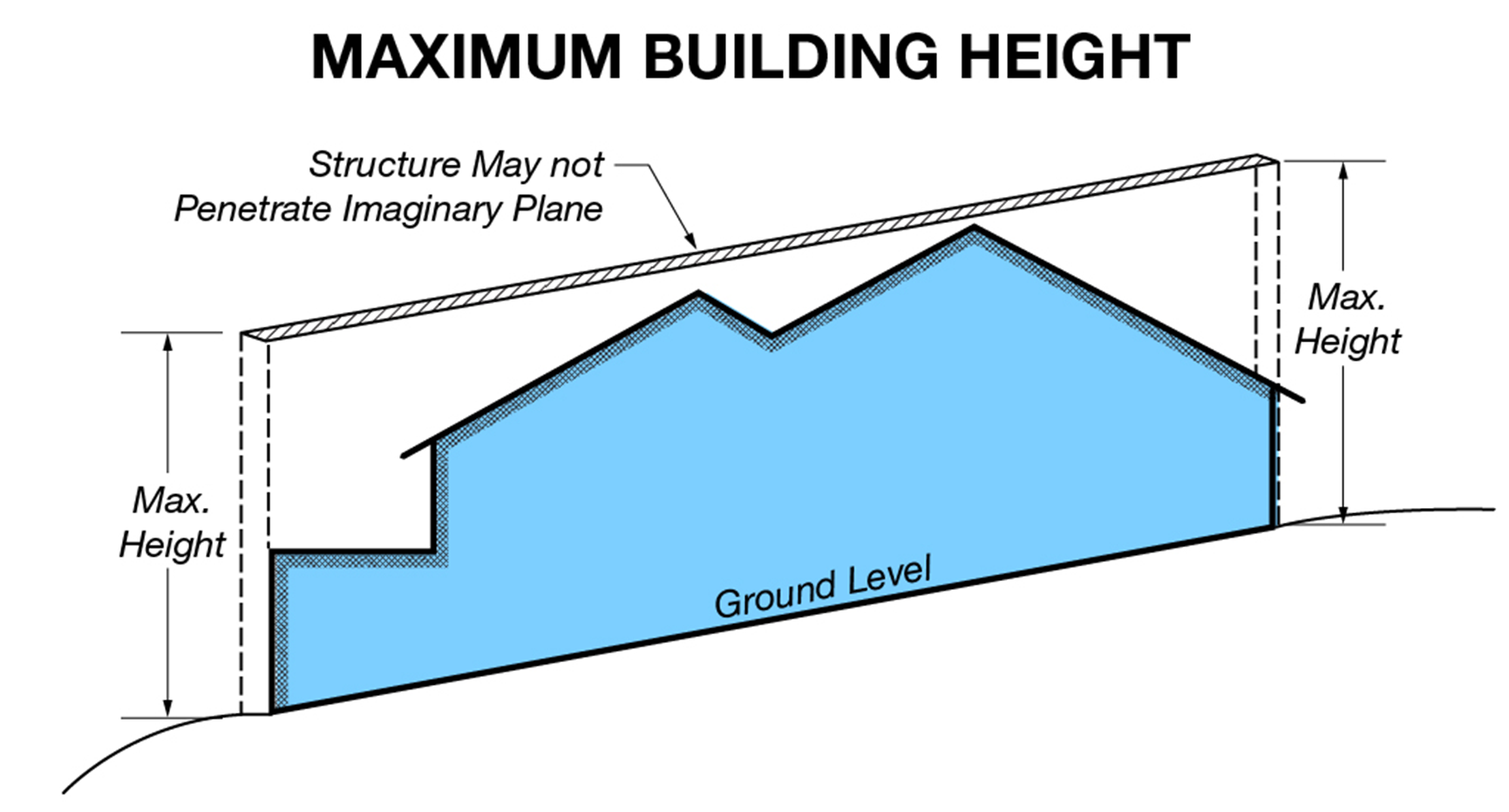
(Ord. No. 99-107, § 5, 2-2-99; Ord. No. 2021-210, § 33, 8-3-21)
Sec. 9-1-43.4. - Irregular lots.
The setback distances specified in are based on rectangular lots. Nonrectangular lots, lots with three sides or more than four sides, and other nonstandard lots require special measurement of setbacks in order for the purpose of setback requirements, i.e. the separation of structures from streets and other properties, to be achieved. Rules for measurement of nonstandard lots in nonresidential districts shall be the same as those for residential districts as set forth in .
(Ord. No. 99-107, § 5, 2-2-99)
Sec. 9-1-44. - Illustration of development standards.
FIGURE 4.2
DEVELOPMENT STANDARDS: CN AND CC DISTRICTS
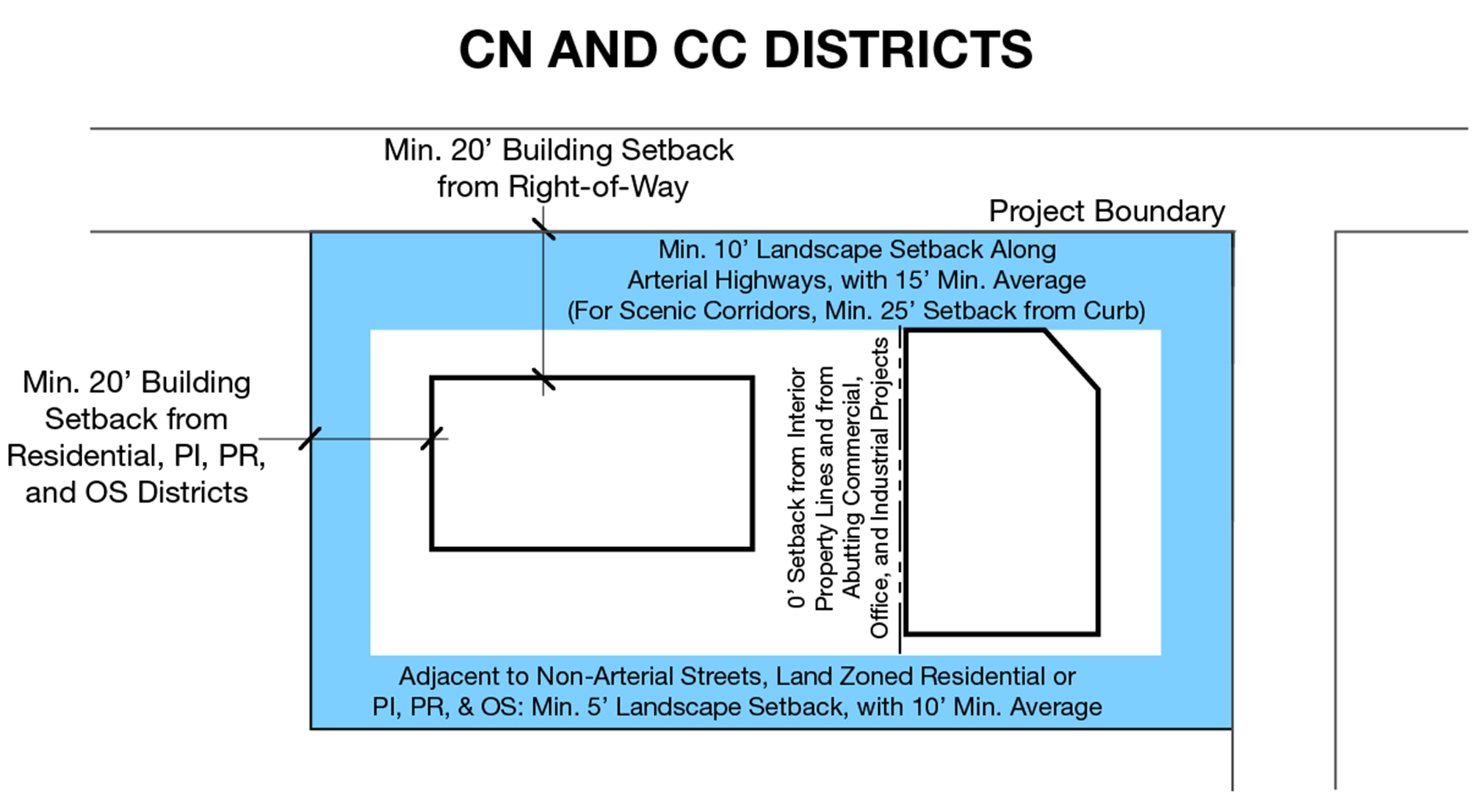

FIGURE 4.3
DEVELOPMENT STANDARDS: CO, BP, AND PI DISTRICTS
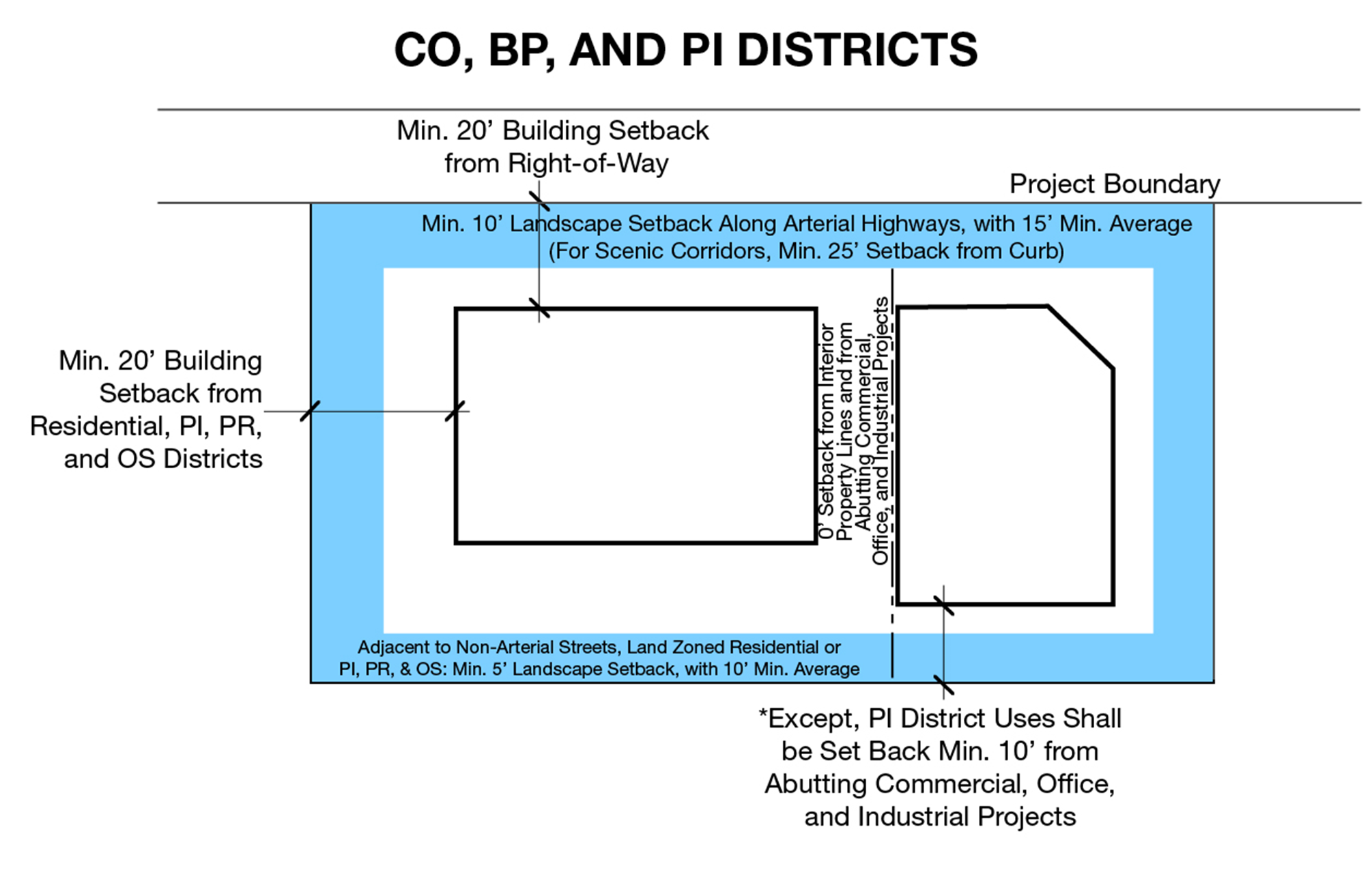

(Ord. No. 99-107, § 5, 2-2-99; Ord. No. 2021-210, § 34, 8-3-21)
Sec. 9-1-45. - Supplemental nonresidential regulations.
All references to this shall include through . These sections set forth requirements for specialized aspects of land use in nonresidential districts such as fences and walls, sidewalk sales, service stations, etc. These requirements are in addition to the other regulations set forth in this subarticle.
(Ord. No. 99-107, § 5, 2-2-99)
Sec. 9-1-45.1. - Parking and signs.
Refer to subarticle 6 for parking regulations and subarticle 7 for sign regulations.
(Ord. No. 99-107, § 5, 2-2-99)
Sec. 9-1-45.2. - Fences and walls.
Fence regulations for nonresidential districts shall be the same as those for residential districts as set forth in .
(Ord. No. 99-107, § 5, 2-2-99)
Sec. 9-1-45.3. - Landscaping and open area.
(a)
Landscape plans. A landscape plan shall be prepared, approved, and implemented for all development projects. Landscaping shall consist of trees, shrubs, vines, groundcover, or a combination thereof.
(b)
Design guidelines. This section contains basic landscaping requirements. In addition, subarticle 9 (Community Design Guidelines) contains landscaping standards and guidelines relating to project entry landscaping, pedestrian area landscaping, tree preservation, plant selection, and other items.
(c)
Landscaping standards. Landscaping shall be installed and maintained in accordance with the following standards:
(1)
Height of landscaping along all streets and boundaries shall comply with . (Fences and walls).
(2)
Boundary landscaping abutting arterial highways shall be provided to a minimum average depth of 15 feet with a minimum depth of 10 feet, measured from the street right-of-way. However, along arterial highways designated as Scenic Highways in the General Plan (i.e., Crown Valley Parkway, Alicia Parkway, La Paz Road, Moulton Parkway, Street of the Golden Lantern, Pacific Island Drive, Camino del Avion, and Niguel Road south of Crown Valley Parkway) plus Niguel Road north of Crown Valley Parkway, landscaping shall be provided to a minimum depth of 25 feet, measured from the curb.
FIGURE 4.4
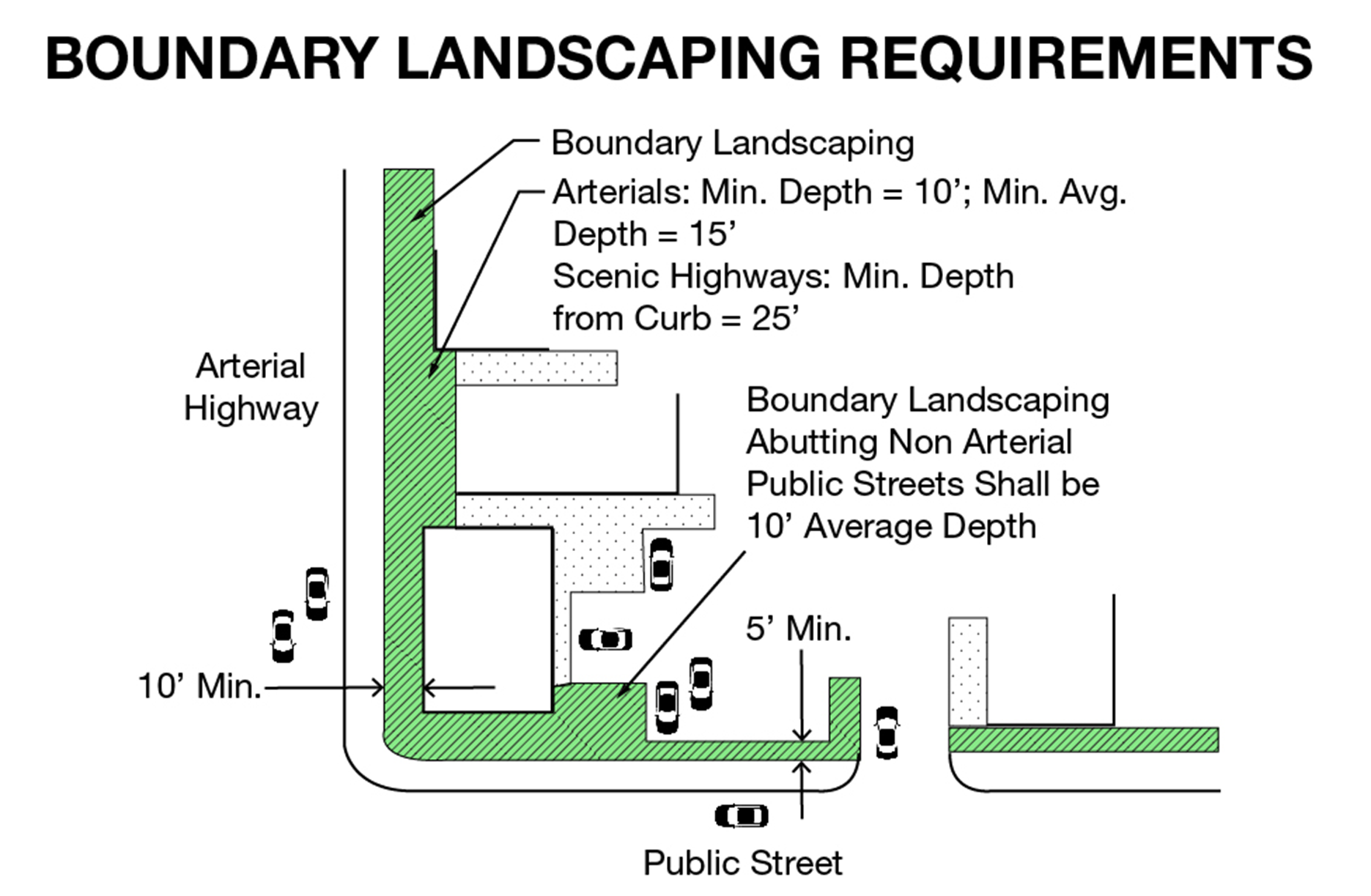
(3)
Boundary landscaping abutting public streets other than arterial highways and abutting land zoned for residential use or PR, PI, or OS shall be provided to a minimum average depth of ten feet with a minimum depth of five feet, measured from the street right-of-way.
(4)
Interior landscaping shall be provided over at least five percent of the buildable project area (i.e., area of parcel remaining after deducting all required setbacks and meeting any requirements regarding maximum lot coverage or minimum open area). At least half that amount (minimum of 2.5 percent) shall be located in parking areas. The remainder shall be located in other interior portions of the project such as next to buildings. Boundary landscaping shall not be credited toward the interior landscaping requirement.
FIGURE 4.5
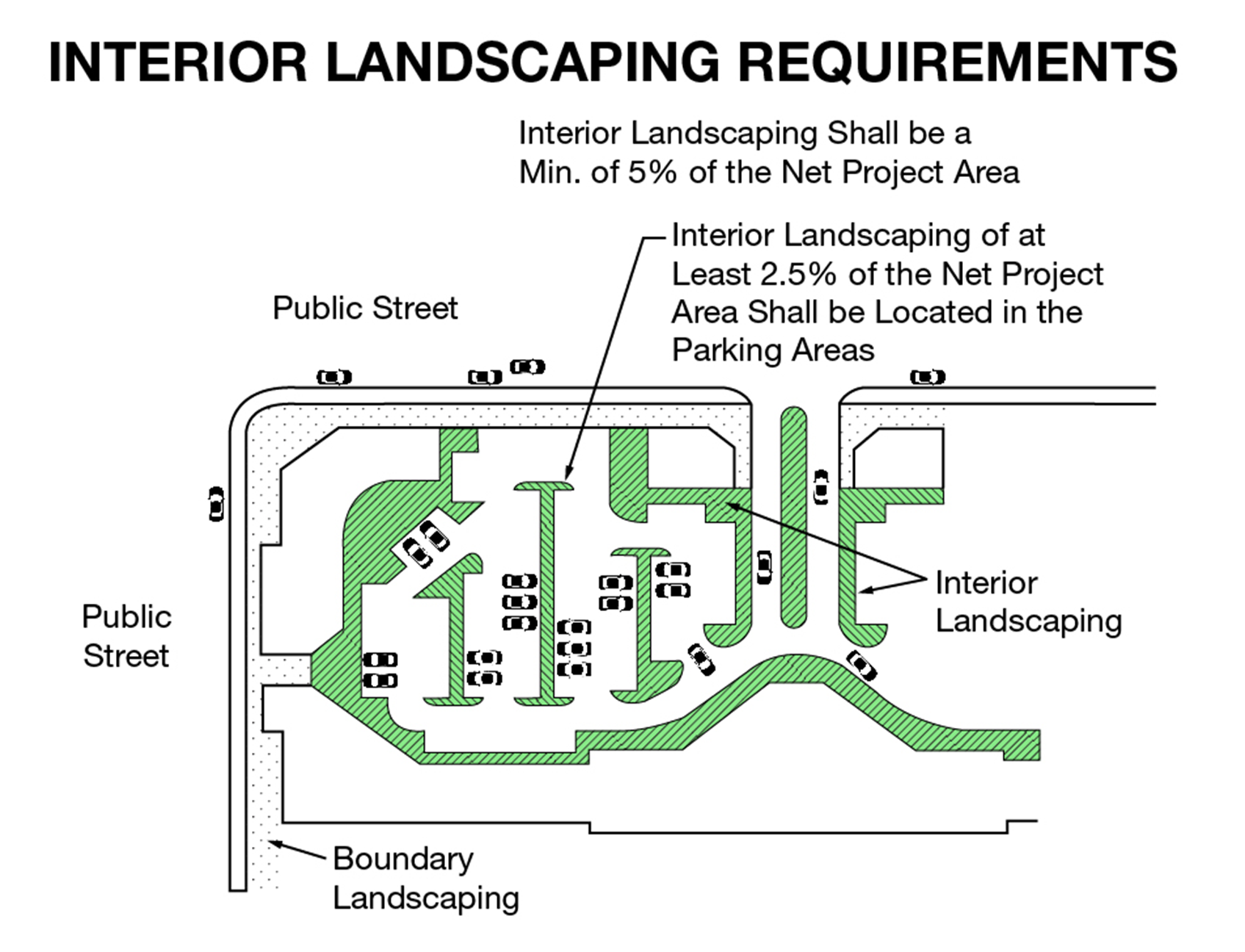
(5)
All landscaped areas shall be separated from adjacent parking or vehicular areas by a curb at least six inches higher than the parking or vehicular area to prevent damage to the landscaped area.
(6)
Permanent automatic irrigation facilities shall be provided for all landscaped areas. All irrigation systems shall be maintained in proper operating condition. Waterline breaks, head/emitter ruptures, overspray or runoff conditions and other irrigation system failures shall be repaired immediately.
(7)
All landscaping shall be maintained in an orderly, attractive, and healthy condition, including proper pruning, mowing of lawns, weeding, removal of litter, fertilizing, replacement of plants (including trees) when necessary, and regular application of appropriate quantities of water to all landscaped areas.
(8)
Modification to an approved landscape plan, or any significant modification to existing landscaped areas, removal, or substantial thinning of landscaping, shall first require the review and approval of a changed plan permit or a discretionary permit amendment as determined by the community development director.
(d)
Mixed-use town center zoning district additional requirements.
(1)
Mixed-use town center landscape requirements. Mixed-use town center development projects shall contain an additional ten percent of landscaping for the entire buildable project area. For purposes of this section, "buildable project area" means the horizontal area within the boundaries of a development project, less slope areas with a ratio of 2:1 or steeper and less minimum boundary landscape requirements.
(2)
Active and/or passive recreation area requirements. Active recreation and/or passive leisure space shall be provided for each mixed-use project containing residential uses. The required minimum amount of qualifying space for a mixed-use project is 300 square feet per residential unit. The usable open space may be common space accessible to more than one dwelling unit or may be private space for the exclusive use of individual units, subject to the following:
a.
Private outdoor living area. Private usable open space at ground level (e.g., fenced yards, patios) or above ground level (e.g., balconies) shall have a minimum area of 50 square feet and shall have no dimension less than five feet. Private open space must be directly accessible from the individual dwelling.
b.
Common active and/or passive recreation area. Common active and/or passive recreation areas for residents located on the ground level shall be no less than 15 feet wide and 300 square feet in area, with slopes no greater than five percent. Common upper-story decks shall be no less than ten by ten feet in dimension. Roof decks shall be no less than 15 by 15 feet in dimension. No more than 20 percent of the total area required for active and/or passive recreation area may be provided on a roof.
c.
Recreation facilities. Facilities may include swimming pools, spas, and related facilities; clubhouses; tot lots with play equipment; court game facilities such as tennis, basketball, or racquetball; improved softball or other playfields; fitness/gym facilities; or similar facilities for active recreational use.
d.
Outdoor passive leisure space. In order for outdoor passive leisure space to qualify toward the minimum square footage requirement, these outdoor common areas must include resident amenities, such as shaded seating areas or dining courtyards, gathering space with outdoor barbeques, firepits and/or fireplaces, or other similar improvements to enhance the outdoor environment of the development.
(Ord. No. 99-107, § 5, 2-2-99; Ord. No. 2021-210, § 35, 8-3-21; Ord. No. 2022-216, § 3, 7-19-22)
Sec. 9-1-45.4. - Screening.
(a)
Screening required. Screening shall be provided for all nonresidential uses in accordance with this section. The decision making authority may also require screening beyond that required in this section as a condition of approval for a development project if it determines that such measures are necessary to mitigate adverse visual impacts created by the project.
(b)
Definitions. For purposes of this section, "fence" or "wall" means any type of fence, wall, retaining wall, sound attenuation wall, screen, windscreen, hedge or thick growth of shrubs or trees, other than a building wall. The terms "fence" and "wall" are used interchangeably in this section to mean any or all of the preceding structures or vegetation. "Hedge" or "thick growth of shrubs or trees" means vegetation at least 42 inches high which creates a screen blocking at least 50 percent of the view through the vegetation measured over a horizontal distance of five feet or greater.
(c)
Screening of property. Screening of property shall be installed in accordance with the following standards:
(1)
Height standards. All fence and wall screening shall comply with the height standards of (Fences and walls).
(2)
Abutting residential and open space areas. Screening shall be installed along all building site boundaries where the premises abut areas zoned for residential or open space uses. Such screening shall be sufficient to provide adequate visual buffering as determined by the director.
(3)
Parking along public streets. Screening shall be installed to shield views of parking areas from public streets. Screening walls or fences may include open portions (tubular steel, wrought iron, etc.) if the decision-making authority determines that the desired screening of parking and circulation areas is still achieved. Screening shall be at least three feet in height at all points but shall be no more than 3.5 feet in height where required for sight distance safety at entries and intersections.
FIGURE 4.6
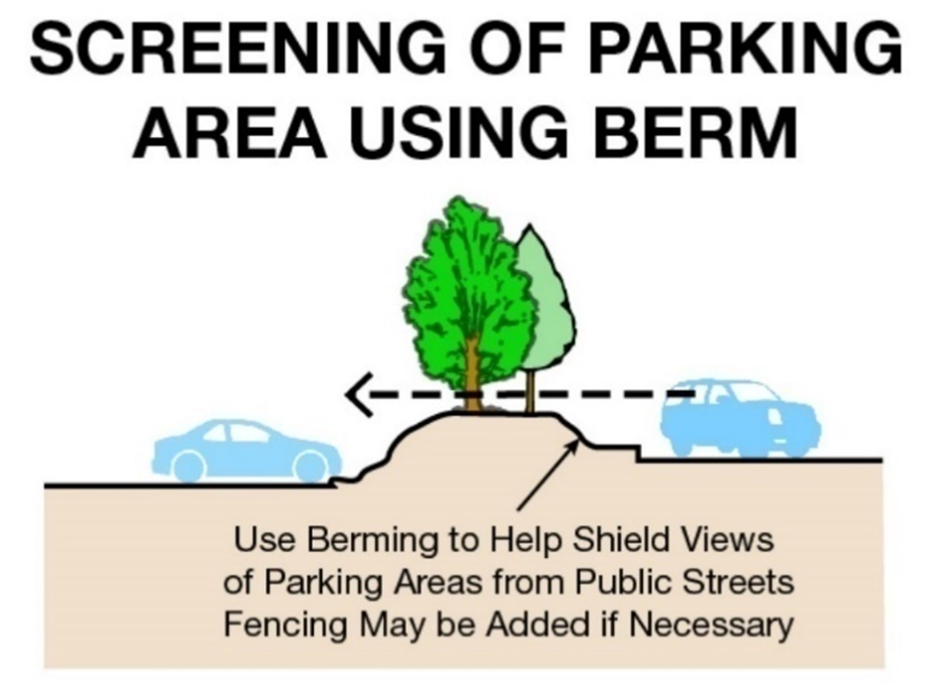
(4)
Allowance for grade differential. In order to take into account the effect of grade differentials on visibility, the city decision-making authority may require increased or decreased screening than that set forth in this section if the finished elevation of the adjacent property within five feet of the site boundary is different from that of the building site.
FIGURE 4.7
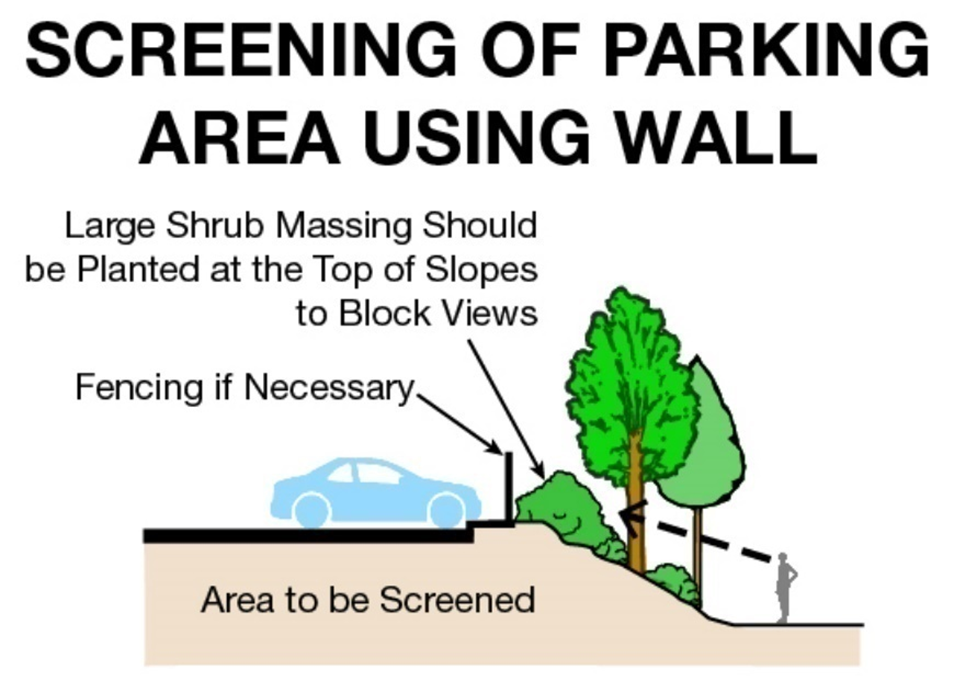
(5)
Wall articulation. Long straight stretches of wall or fence shall be avoided because of the resulting monotonous appearance and lack of visual interest. Walls and fences shall be varied by the use of such design features as offsets (i.e., jogs), open panels (e.g., containing wrought iron) at selected locations, periodic variations in materials, texture, or colors, and similar measures.
(6)
Wall planting. Shrubs and/or vines shall be planted on one or both sides of perimeter walls to add visual softening except where determined infeasible or unnecessary by the decision-making authority. Plant spacing shall be appropriate to the growth habits of the selected plant species and shall be designed to provide interest and variety along the wall rather than creating a complete covering of the entire wall surface. Where the decision-making authority determines that screening is not required, walls may incorporate tubular steel, wrought iron, or other open design.
(7)
Screening materials. Screening shall consist of one or a combination of the following types:
a.
Walls. A wall shall consist of concrete, stone, brick, tile or similar type of solid masonry material a minimum of six inches thick. Walls shall utilize durable materials, finishes, and colors consistent with project buildings.
b.
Solid fences. A solid fence shall be constructed of wood or other materials with a minimum nominal thickness of two inches and shall form an opaque screen. Fences shall be painted or otherwise weather-treated with colors consistent with project buildings.
c.
Open fences. An open weave or mesh-type fence shall be combined with plant materials to form an opaque screen.
d.
Plant screens. Plant materials, when used as a screen, shall consist of compact evergreen plants. Such planting shall be of a kind or used in such a manner so as to provide screening with a minimum thickness of two feet within 18 months after initial installation. Permanent automatic irrigation shall be provided. If, 18 months after installation, plant materials have not formed an opaque screen or if an opaque screen is not maintained, a wall, solid fence, berms, or other landscaping shall be installed.
e.
Berms. A berm shall not be more than 20 feet in width at the base. It shall be constructed of earthen materials, and it shall be landscaped.
(8)
Signs. No signs or sign supports except those specifically allowed in subarticle 7 (Signs) shall be permitted on any required screening.
(d)
Screening of facilities and equipment. Facilities and equipment shall be screened as follows:
(1)
Storage areas. All storage, including cartons, containers, materials, or equipment shall be screened from public view as required by (Permanent outdoor display and storage).
(2)
Trash areas. All outdoor trash and waste bins shall be enclosed by a solid wall not less than six feet in height in accordance with (Nonresidential site planning). Decorative overhead structures such as trellises shall be integrated into the enclosure design if the trash area is visible from higher terrain.
(3)
Loading areas. Loading platforms and areas shall be screened from view from adjacent streets and residential, open space and recreation areas.
(4)
Mechanical equipment. Roof-mounted mechanical equipment such as air conditioning, heating or ventilating units or ducting shall be screened from a horizontal line of sight. Also, if the building roof is visible from surrounding hillside areas, all roof equipment shall be screened from above. Such screening shall be an integral part of the roof design and not appear as an afterthought. For flat roofs, a screened enclosure behind the parapet wall may be used if it is made to appear as an integral part of the building.
(Ord. No. 99-107, § 5, 2-2-99; Ord. No. 2021-210, § 36, 8-3-21)
Sec. 9-1-45.5. - Detached accessory structures.
(a)
Permitted accessory structures. Detached accessory structures are permitted on nonresidential parcels containing a principal use subject to the requirements of this section.
(b)
Height and placement. Except as specified in subsection (c) of this section, detached accessory structures shall not exceed 15 feet in height and shall not be placed or constructed in the following locations:
(1)
Within a required setback;
(2)
Accessory structures shall be located on the rear 50 percent of the building site, except that minor unenclosed accessory structures, such as arbors, trellises, porte-cocheres, gazebos, and similar minor structures may be located on the front 50 percent of the building site. The distance between the front and rear property lines shall be the basis for determining the rear 50 percent of the property;
(3)
Where fences and walls are limited to a maximum height of 3½ feet as specified in (Fences and walls);
(4)
Within the panhandle portion of a panhandle building site.
(c)
Setback reductions. The perimeter setback from abutting commercial, office or industrial property for a detached accessory structure may be reduced to five feet if the structure is screened from both street and public parking area views subject to the following requirements:
(1)
Height. The height limit for buildings which are less than ten feet from the property line shall be ten feet.
(2)
Screening. The accessory structure shall be screened from adjacent properties so that there is adequate visual buffering as determined by the director.
(Ord. No. 99-107, § 5, 2-2-99)
Sec. 9-1-45.6. - Satellite dish and other antennas.
(a)
Permits required. The following permit requirements apply to antennas in nonresidential districts:
(1)
All antennas require issuance of a building permit.
(2)
Any antenna which is the principal use on a lot shall comply with the district setback standards for main buildings and shall require a use permit.
(3)
Any ground-mounted antenna which does not exceed eight feet in height, meets the setback requirements for a main building and the screening and color requirements of subsection (b) of this section may be permitted as an accessory structure without a use permit. All other antennas require approval of a use permit.
(b)
Development standards. Antennas within nonresidential districts may be ground-mounted or building-mounted provided the following requirements are met:
(1)
A ground-mounted antenna which is an accessory use shall be located within the rear yard or may be located within a side yard if not within the required side yard setback. Ground-mounted antennas are prohibited from exterior (street) side yards unless not visible from the street.
(2)
Antennas, including roof-mounted antennas, shall not exceed the building height standards for the district in which they are located.
(3)
All antennas shall be screened from both horizontal and vertical line of sight. Decorative overhead structures such as trellises may be required if the antenna is visible from surrounding higher terrain.
(4)
Antennas shall be a single color that blends with the immediate surroundings (e.g., off-white, dark green, brown, gray, or black).
FIGURE 4.8
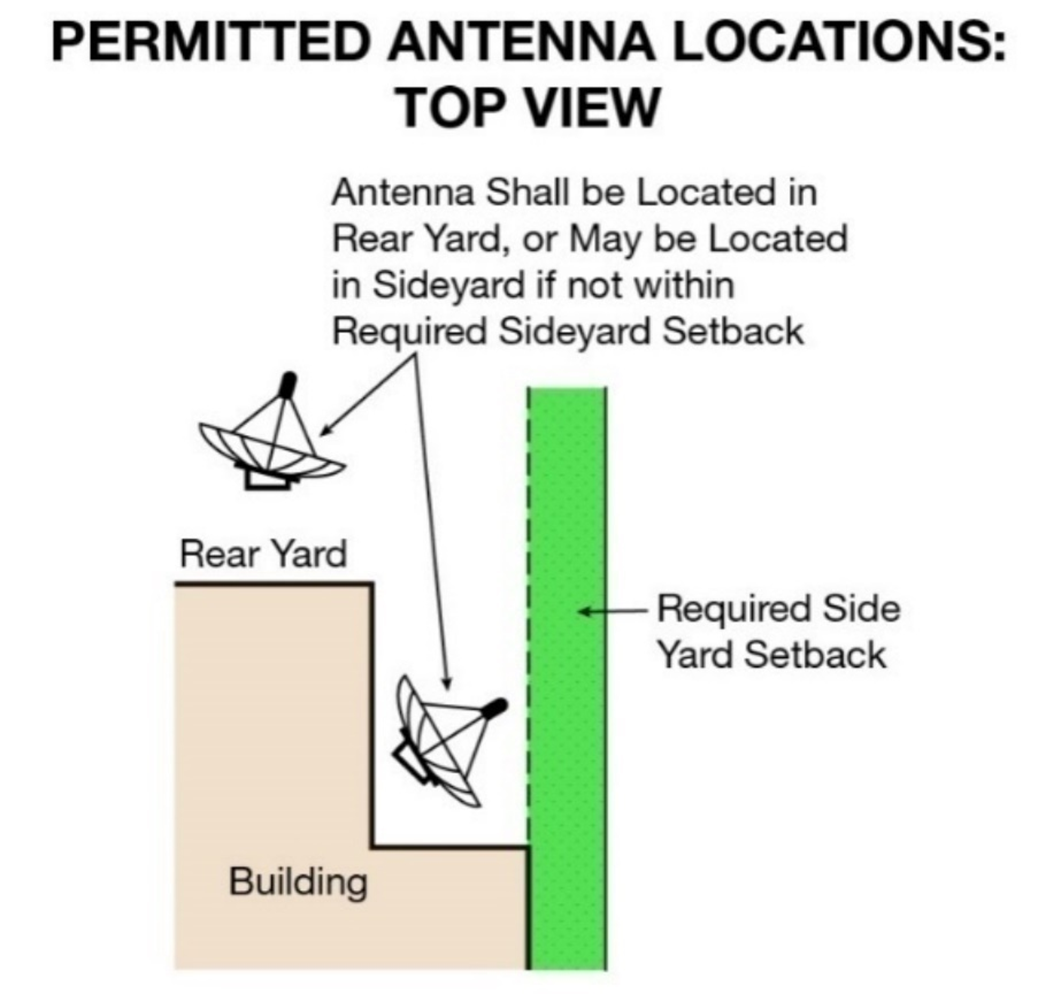
FIGURE 4.9
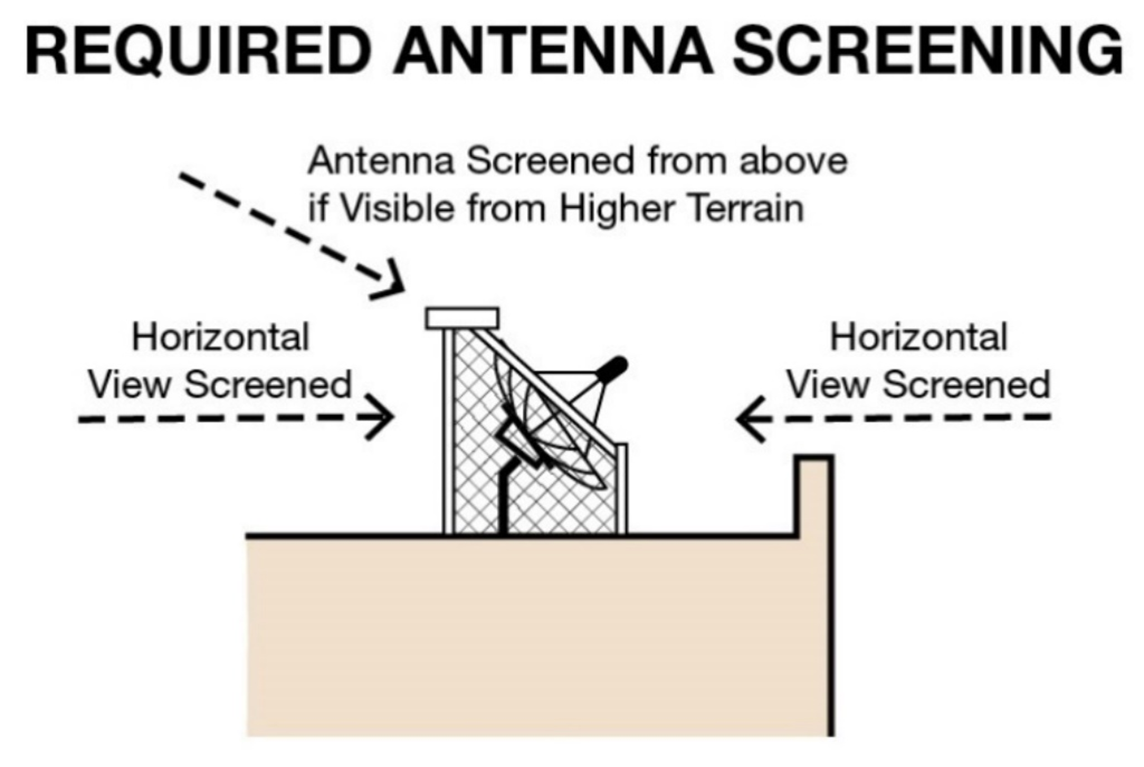
(Ord. No. 99-107, § 5, 2-2-99; Ord. No. 2021-210, § 37, 8-3-21)
Sec. 9-1-45.7. - Christmas tree sales.
A temporary Christmas tree sales facility may be permitted subject to the approval of a temporary use permit and the following requirements:
(1)
The facility shall not be opened for business prior to the day after Thanksgiving in any calendar year, and no structure shall be installed on the site more than ten days before such opening for business.
(2)
Such a facility shall not engage in the sale of any merchandise not directly associated with Christmas trees and Christmas decorations.
(3)
The applicant shall secure an electrical permit if the facility is to be energized.
(4)
The facility shall be removed and the premises shall be cleared of all debris and restored to the condition existing prior to the establishment of the facility by the January 8 following the applicable Christmas holiday. A cash bond or other guarantee may be required to be posted prior to establishment of the facility to ensure cleanup.
(5)
Each facility shall comply with fire prevention standards as approved and enforced by the fire chief.
(6)
Off-street parking and vehicular access shall be provided to the satisfaction of the director.
(7)
Signs shall be restricted to one banner sign per street frontage, each sign not exceeding 32 square feet. Other signs and advertising devices such as pennants, flags, A-frame signs, are prohibited.
(Ord. No. 99-107, § 5, 2-2-99; Ord. No. 2021-210, § 38, 8-3-21)
Sec. 9-1-45.8. - Halloween pumpkin sales.
A temporary Halloween pumpkin sales facility may be permitted subject to the approval of a temporary use permit and the following requirements:
(1)
The facility shall not be opened for business prior to October 1 in any calendar year, and no structure shall be installed on the site more than ten days before such opening for business.
(2)
Such a facility shall not engage in the sale of any merchandise not directly associated with pumpkins and Halloween decorations.
(3)
The applicant shall secure an electrical permit if the facility is to be energized.
(4)
The facility shall be removed and the premises shall be cleared of all debris and restored to the condition existing prior to the establishment of the facility by the November 14 following the applicable Halloween holiday. A cash bond or other guarantee may be required to be posted prior to establishment of the facility to ensure cleanup.
(5)
Each facility shall comply with fire prevention standards as approved and enforced by the fire chief.
(6)
Off-street parking and vehicular access shall be provided to the satisfaction of the director.
(7)
Signs shall be restricted to one banner sign per street frontage, each sign not exceeding 32 square feet. Other signs and advertising devices such as pennants, flags, A-frame signs, are prohibited.
(Ord. No. 99-107, § 5, 2-2-99; Ord. No. 2021-210, § 39, 8-3-21)
Sec. 9-1-45.9. - Produce stands.
A temporary fresh produce sales facility may be permitted during the harvest season subject to the approval of a temporary use permit and the following requirements:
(1)
A fresh produce sales facility shall be open for business only during the season when locally grown produce is harvested and available for sale. The temporary use permit for a fresh produce stand shall include permitted dates of operation, up to a maximum of 90 days.
(2)
Such a facility may not sell items not directly associated with fresh produce.
(3)
The applicant shall secure an electrical permit if the facility is to be energized.
(4)
The facility shall be removed and the premises cleared of all debris and restored to the condition prior to the establishment of the facility by the date indicated on the temporary use permit. A cash bond or other guarantee shall be posted prior to establishment of the facility to ensure cleanup.
(5)
Each facility shall comply with fire prevention standards as approved and enforced by the fire chief.
(6)
Off-street parking and vehicular access shall be provided to the satisfaction of the director.
(7)
Signs shall be restricted to one banner sign per street frontage, each sign not exceeding 32 square feet. Other signs and advertising devices such as pennants, flags, A-frame signs, and light strings are prohibited.
(Ord. No. 99-107, § 5, 2-2-99)
Sec. 9-1-45.10. - Outdoor vendors.
(a)
Definition. Outdoor vendors include flower stands, hotdog stands, ice cream carts, and similar retail uses which utilize a movable or relocatable stand or cart for walk-up sales. The stand or cart must be of a size and design which does not interfere with pedestrian movement, vehicle parking or site circulation. This section applies to outdoor venders on private property only, for outdoor venders on public property please refer to municipal code , division 7.
(b)
Use permit required. An outdoor vendor use may be established where permitted per (Permitted uses) upon approval of a use permit or minor use permit pursuant to . All such uses shall comply with the following standards:
(1)
The location of the outdoor vending use shall not interfere with access to adjacent buildings or with pedestrian circulation. No portion of the vending use shall be located in a parking lot, street, or other area intended for vehicular parking, access or circulation.
(2)
The outdoor vending site shall not exceed 150 square feet. The vending site includes all areas separated from pedestrian access and used for vending activities, including storage.
(3)
The operator/owner shall obtain other necessary licenses and permits required for such activities by city ordinances.
(Ord. No. 99-107, § 5, 2-2-99; Ord. No. 2021-210, § 40, 8-3-21)
Sec. 9-1-45.11. - Permanent outdoor display and storage.
(a)
Purpose. This section provides regulations for outdoor display and storage in nonresidential districts.
(b)
Where permitted. The display and/or storage of any items outside of an enclosed building is prohibited except where permitted in accordance with this section, (Permitted uses), (Outdoor vendors), (Sidewalk sales and center-wide events), where permitted by a use permit, or where otherwise permitted by this Code.
(c)
Incidental retail displays. Incidental outdoor displays associated with retail businesses may be permitted in the CN, and CC districts subject to the following requirements:
(1)
A minor use permit shall be approved per prior to the establishment of any outdoor display.
(2)
Displays shall focus primarily on decorative items which assist in the identification of a retail business to the public as opposed to the presentation of merchandise for sale. For example, a bookstore's display of selected individual books on a small ornamental handcart might be approvable under this section, but a table of books for sale would not. (The latter type of display might instead be permitted under the temporary sidewalk sale provisions of .)
(3)
Signs associated with the outdoor display may be allowed in addition to the identification signs permitted in subarticle 7, but only if approved as part of the minor use permit. Such signs shall:
a.
Be integrated into the display;
b.
Not exceed four feet in height or 12 square feet in aggregate area; and
(c)
Be illuminated only if specifically approved as part of the minor use permit. Signs shall conform to the sign design criteria of .
(4)
Displays shall be small-scale and pedestrian-oriented; that is, a maximum of five feet in height and 20 square feet in area.
(5)
Displays shall not impede pedestrian or handicap circulation or access and shall not be located in any parking area, driveway, or vehicular circulation area.
(6)
Displays shall be attractive in appearance and well-maintained, using, for example, ornamental carts, pots, artwork, and similar decorative elements. Displays shall not include clothes racks, cardboard boxes, card tables, or large items such as furniture, mattresses, washers, dryers, refrigerators, or other large appliances.
(d)
Nurseries and similar uses. Permanent outdoor sales areas in conjunction with retail uses such as nurseries and stores with garden supply and similar "outdoor" departments shall comply with the following requirements:
(1)
Fencing. The outdoor sales and display area shall be enclosed by a permanent wall or fence at least four feet high. The color and materials used to fence the area shall be complementary to the color and materials used in buildings on-site. Chain link fencing is not permitted.
(2)
Building design. When the outdoor sales area is an extension of retail uses within an adjacent building, it shall be enclosed by a wall which is, by exterior appearance, an extension of the adjacent building. The design of the building and outdoor area shall appear as a single structure.
(e)
Equipment, lumber and storage yards. Any uncovered equipment and/or materials storage area, including vehicle storage, shall comply with the following regulations:
(1)
Use permit. The establishment of any outdoor equipment or materials storage use shall require approval of a use permit pursuant to .
(2)
Location. An equipment, material or storage yard use shall only be located where a main building is permitted by the applicable district regulations.
(3)
Screening. Outdoor storage yards shall be screened whenever they abut the boundary of the building site or are located between a building and an abutting street. The screening materials shall be not less than five feet high and shall be in compliance with (Fences and walls). Screening may consist of one or a combination of the following types:
a.
Walls. A wall shall consist of concrete, stone, brick, tile or similar type of solid masonry material a minimum of four inches thick.
b.
Solid fences. A solid fence shall be constructed of wood or other materials to form an opaque screen.
c.
Open fences. An open-weave or mesh-type fence shall be combined with plant materials to form an opaque screen.
d.
Planting. Plant materials, when used as a screen, shall consist of compact evergreen plants. They shall be of a kind, or used in such a manner, as to provide screening having a minimum thickness of two feet within 18 months after initial planting.
(f)
Vehicle sales. The outdoor display and sales of vehicles shall be subject to the approval of a use permit in accordance with . The use permit shall establish standards for each such facility.
(Ord. No. 99-107, § 5, 2-2-99)
Sec. 9-1-45.12. - Sidewalk sales and center-wide events.
(a)
Purpose. This section provides regulations for:
(1)
Special outdoor center-wide events within commercial center; and
(2)
The temporary outdoor sale of merchandise by individual retail businesses.
(b)
Center-wide events. Special center-wide events include the temporary outdoor display and sale of merchandise, arts and crafts shows, fairs, entertainment, or similar events within a commercial center. Commercial centers may conduct such events subject to the following requirements:
(1)
Events may be held up to four times a year over a maximum of three consecutive days per event. Centers may apply for approval for each event on an individual basis, approval of more than one event on a single application, or approval of an ongoing "special events program" specifying the dates, activities and signage for each event throughout the year.
(2)
Events shall be subject to approval of a temporary use permit. Applications shall be submitted by the commercial center owner or manager.
(3)
The application shall include provision for removal of temporary facilities and cleanup and restoration of the activity site within 24 hours of the conclusion of the event, unless another time limit is specified in the temporary use permit. The city may require a cash bond or other guarantee to be posted to ensure cleanup within the specified time limit.
(4)
The application shall be reviewed by the fire chief and the event shall comply with fire prevention standards and emergency access requirements as specified by the fire chief.
(c)
Sidewalk sales by individual businesses.
(1)
Sidewalk or parking lot sales include the temporary outdoor display and sale, by a retail business, of merchandise which is normally displayed indoors at the same location as the outdoor sale. These sale events are separate from the permanent outdoor display of merchandise provided for in .
(2)
In addition to the center-wide events provided for elsewhere in this section, individual businesses may conduct sidewalk or parking lot sales. Subject to prior written consent of the center management (if applicable) and approval of a temporary use permit, such sales may be conducted up to six times a year over a maximum of three consecutive days per sale. However, in no case shall the combined total of center-wide events plus individual sales for any business exceed six during any calendar year. Businesses may apply for approval of more than one event on a single application or for each event on an individual basis.
(d)
Signs. Temporary signs for special center-wide events and sidewalk/parking lot sales may be permitted as part of the temporary use permit as follows:
(1)
Placement. Signs shall be building-mounted, unless otherwise approved by the director as part of the temporary use permit.
(2)
Center-wide events. For center-wide events, non-illuminated special event signs advertising the special event are permitted with a total aggregate sign area of up to 30 square feet. Signs shall be displayed no longer than ten days per approved event.
(3)
Individual sales. For sidewalk sales by individual businesses, non-illuminated special event signs advertising the sale are permitted with a total aggregate sign area of up to 12 square feet. Signs shall be displayed only on the three days allowed for each approved sale.
(4)
Sign copy. Special event signs shall relate only to the business being conducted on the premises where they are placed.
(e)
General requirements. Sidewalk sales and special center-wide events are permitted only with approval of a temporary use permit and compliance with the following provisions:
(1)
The application for a temporary use permit for a sidewalk sale or a special center-wide event shall specify the location of the temporary uses and show provision for adequate parking, site circulation, and emergency access.
(2)
Adequate pedestrian and vehicular access shall be maintained around merchandise or displays placed on a sidewalk, walkway, or in parking areas.
(3)
All signs and other materials placed in outdoor areas shall be removed within 24 hours after the close of business on the last day of the event, unless otherwise specified by the director in the temporary use permit. The temporary use permit shall specify the event's expiration date and the removal date of all associated materials.
(4)
Flood, laser, or search lights are not permitted unless approved as part of the temporary use permit.
(Ord. No. 99-107, § 5, 2-2-99)
Sec. 9-1-45.13. - Special outdoor events.
(a)
Definition. Special outdoor events are events of a predominantly noncommercial nature including, but not limited to, pageants, fairs, carnivals, religious or entertainment events, and large community gatherings in temporary outdoor facilities.
(b)
General requirements. Special outdoor events are permitted in all nonresidential districts provided the following requirements are met:
(1)
Activities conducted on property owned by or leased to the city and on public road rights-of-way may require an encroachment permit issued by the public works director.
(2)
Events shall not to exceed ten consecutive days. Events recurring more than four times in a calendar year are not considered temporary and shall not be eligible for a temporary use permit.
(c)
Temporary use permit for large events. A temporary use permit shall be required for special outdoor events of 200 people or more, including spectators and participants.
(1)
Applications for temporary use permits shall be referred by the community development department to other affected departments or public agencies for review and comment. Issues including, but not limited to, security, food and water supply, use of tents and canopies, sanitation facilities, medical services, noise, signage, fire protection and traffic control, shall be satisfactorily addressed by the applicant, as required by director, police chief, fire chief or health officer in their administration of other city regulations. Such other regulations may require the applicant to obtain permits such as building, electrical, health and tent permits.
(2)
A cash bond or other guarantee for removal of the temporary use and cleanup and restoration of the activity site within seven days of the activity conclusion may be required as a condition of the temporary use permit.
(Ord. No. 99-107, § 5, 2-2-99)
Sec. 9-1-45.14. - Outdoor lighting.
(a)
Purpose. This section provides standards for outdoor lighting which allow adequate lighting for public safety while minimizing the adverse effects of excessive lighting on adjacent properties and the community. Any artificial lighting installed for any purpose shall be arranged to substantially confine all direct illumination to the subject property and away from streets and adjacent properties.
(b)
Outdoor recreation uses. Any lighted outdoor recreation use shall be subject to the provisions of for lighted recreational courts.
(c)
Nonresidential uses. All properties zoned for nonresidential use shall be subject to the outdoor lighting standards of this section. The regulations apply to both security and purely decorative lighting. Outdoor lighting which complies with the following standards shall be permitted as an accessory use. Lighting plans shall include a photometric analysis demonstrating compliance with these lighting intensities and shielding standards. Deviation from the following standards shall require approval of a minor adjustment:
(1)
Intensity. The proposed lighting plan shall represent a minimum level of illumination necessary to meet the aesthetic and security needs of the property. The lighting intensity within parking lots and adjacent areas shall be at least 1.0 footcandle (FC) at all points but shall not exceed an average of 3.0 FC over the entire parking lot, consistent with (Nonresidential site planning).
(2)
Height. Building-mounted lights shall be installed below the eave line; pole or fence mounted lights shall be located no more than 24 feet above finish grade.
(3)
Location. Lighting shall only be installed adjacent to buildings, walkways, driveways, or activity areas (fountains, patios, seating areas, etc.) and focal landscape areas close to the building entrance or activity area.
(4)
Shielding. All light sources shall be shielded or recessed so that direct glare and reflections are contained within the boundaries of the parcel, and shall be directed downward and away from adjoining properties and public rights-of-way. All light sources shall be designed, constructed, mounted, and maintained such that the maximum intensity of illumination, measured 20 feet beyond the project boundary does not exceed 0.2 footcandle more than ambient conditions.
FIGURE 4.10
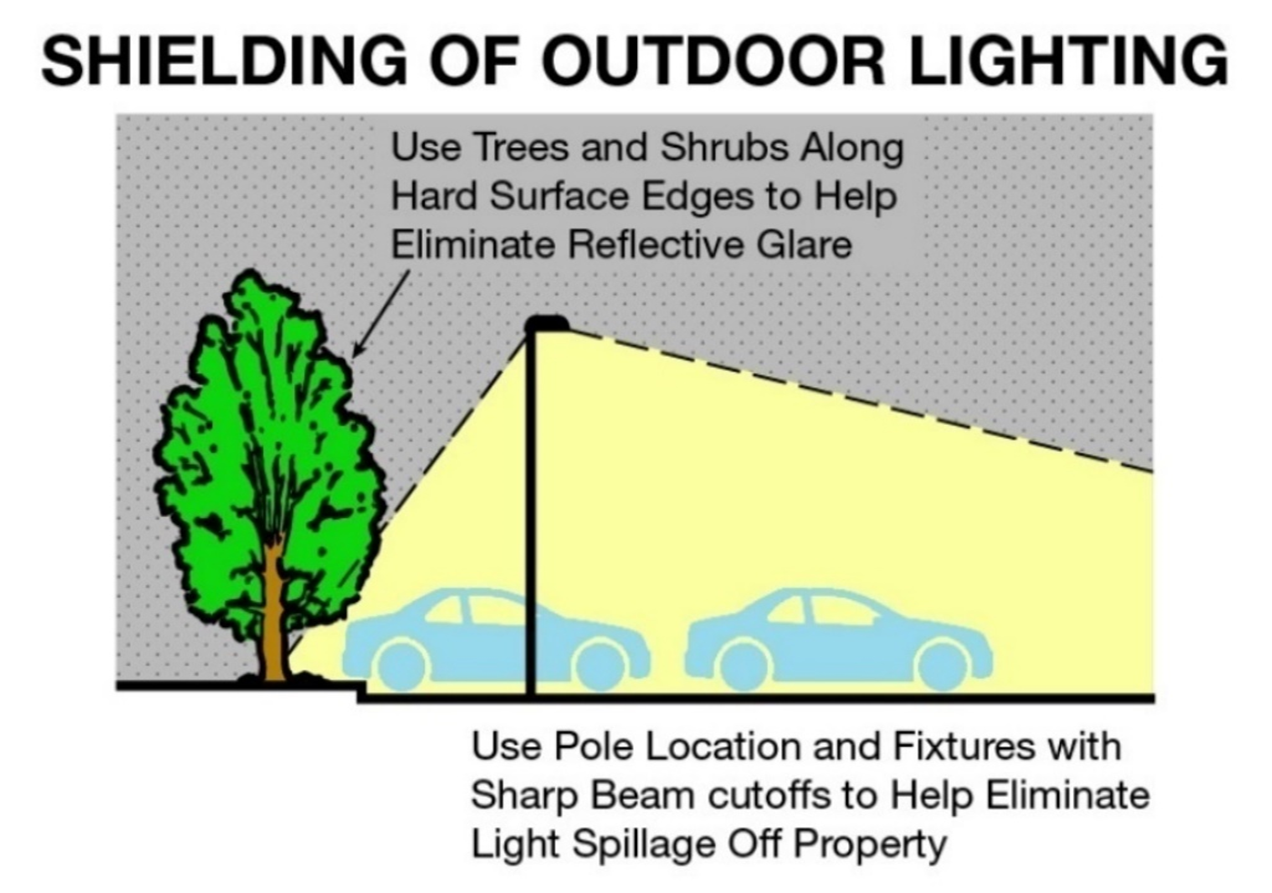
(Ord. No. 99-107, § 5, 2-2-99; Ord. No. 2021-210, § 41, 8-3-21)
Sec. 9-1-45.15. - Caretaker residences.
Caretaker residences may be developed in any nonresidential district for the exclusive use of personnel employed for the maintenance and security of the principal use subject to the approval of a minor use permit pursuant to and the following standards:
(1)
The caretaker residence shall be located in a building which complies with all building setbacks established for the district in which it is located.
(2)
The residence shall be no more than 800 square feet in floor area.
(3)
The residence may be a portion of a building primarily devoted to nonresidential uses or may be a separate building. If it is a separate building, the location, design and materials of the residence shall be consistent and integral with the site plan and building design for the principal use.
(4)
Two off-street parking spaces shall be provided in addition to the parking required for the principal use(s).
(Ord. No. 99-107, § 5, 2-2-99)
Sec. 9-1-45.16. - Temporary construction and guard offices.
Construction offices, security quarters, storage yards, large containers, temporary fencing and similar structures on the site of an active construction project may be conditionally permitted with a temporary use permit, subject to the following regulations:
(1)
Placement. The temporary structures shall not be moved onto the site nor otherwise established until issuance of a precise grading permit or, if there is no grading permit, issuance of the building permit.
(2)
Removal. Any trailer or temporary building or structure shall be removed from the site prior to the issuance of a certificate of use and occupancy for the last new building on the site. If the associated project is for grading only, the office shall be removed within 30 days of expiration of the grading permit.
(3)
Conversion. Any permanent structure or portion of a permanent structure devoted to temporary uses shall be converted to a permitted use prior to the issuance of a certificate of use and occupancy for the last new building on the site.
(4)
Use of existing building during construction. The use of an existing lawfully established building may continue during construction or relocation of another building on the same building site upon approval of a temporary use permit and compliance with the following provisions:
a.
Prior to occupancy of a new building, the existing building shall be brought into conformity with any additional regulation rendered applicable by the placement of any new building on the site. Conformity shall be accomplished by removal, reconstruction, relocation, conversion, change of use or any combination thereof.
b.
The director shall require the landowner to provide a guarantee, which may include a bond, to ensure full compliance with the zoning regulations upon completion of the new building or sooner if, in the director's opinion, work pertaining to the completion of all facilities required by law is not being diligently pursued.
(5)
Utilities. The office shall be supplied with an electric meter and sewer and water facilities.
(Ord. No. 99-107, § 5, 2-2-99; Ord. No. 2021-210, § 42, 8-3-21)
Sec. 9-1-45.17. - Relocatable buildings.
A relocatable building or trailer may be permitted to serve as any use permitted in the applicable zoning district subject to the approval of a temporary use permit application and the following additional provisions:
(1)
The temporary use permit application shall include the following:
a.
A description of the proposed uses and operating characteristics for all uses on the site, both temporary and permanent.
b.
A plot plan showing the location of all uses and structures, both temporary and permanent.
c.
Supplementary exhibits, as required by the director to adequately review the proposal, such as building elevations, landscaping, grading, access, and utility service.
(2)
A temporary use permit for a relocatable building or trailer may be conditionally approved and failure to comply with the required conditions shall be grounds for the revocation of the permit.
(3)
A cash bond for each relocatable building or trailer shall be posted with the director to guarantee removal of each coach from the site upon expiration of the temporary use permit.
(4)
A temporary use permit for a relocatable building shall be approved for a maximum of two years from date of approval.
(Ord. No. 99-107, § 5, 2-2-99)
Sec. 9-1-45.18. - Vending machines and recycling facilities.
(a)
Vending machines and reverse vending machines. Vending machines for the dispensing of soft drinks, bottled water, candy, and other items, and reverse vending machines for the collection of non-hazardous household materials (e.g. cans, bottles, paper, etc.) for recycling purposes may be established as accessory uses to existing principal uses in any nonresidential district. If located outside of a building, a minor use permit, approved pursuant to , shall be required for all such machines in all districts. All such outdoor facilities shall comply with the following standards:
(1)
Machines shall be located adjacent to the main building on the site and shall not obstruct pedestrian or vehicular circulation.
(2)
Machines shall not occupy any parking spaces required by the principal use.
(3)
Reverse vending machines shall be clearly signed to identify the type of material to be deposited, operating instructions, and the identity and phone number of the operator or responsible person to call, if the machine is inoperative. Sign area shall be limited to four square feet per machine, located on the machine.
(4)
Reverse vending machines shall be maintained on a daily basis and kept free of litter, odor, and other nuisances. A trash receptacle shall be located adjacent to the machine(s) for disposal of containers used to carry materials to the facility and materials unacceptable for recycling. Trash and recyclables shall be collected from the recycling facility at least once every week.
(b)
Drop-off bins. Drop-off bins for the collection of non-hazardous household materials (e.g. cans, bottles, paper, etc.) for recycling purposes may be established as an accessory use to an existing principal use in any nonresidential district. If located outside of a building, a minor use permit, approved pursuant to , shall be required for drop-off bins in the CN, CC, and CO districts. All such outdoor facilities shall comply with the following standards:
(1)
The drop-off facility shall be no larger than 500 square feet, not including space that is periodically used to remove materials or replace containers. It shall comply with the building setbacks for the district and shall not occupy parking spaces required by the principal use.
(2)
The facility shall be screened from view from public streets, primary parking areas, and property zoned for residential use.
(3)
The facility shall not obstruct pedestrian, vehicular, and emergency access.
(4)
The containers (bins) shall be constructed and maintained with durable waterproof and rustproof materials, covered and secured from unauthorized entry or removal of materials when the facility is closed, and shall be large enough to accommodate the materials collected and the collection schedule. Any deposit or storage of materials outside of the containers is prohibited.
(5)
The installation shall be maintained on a daily basis and kept free of litter, odor, and other nuisances. A trash receptacle shall be located adjacent to the drop-off facility for disposal of containers used to carry materials to the facility and materials unacceptable for recycling. Trash and recyclables shall be collected from the drop-off facility at least once a week.
(6)
Facilities within 100 feet of a property zoned or occupied by residential uses shall operate only between the hours of 9:00 a.m. and 7:00 p.m.
(7)
Containers shall be clearly marked to identify the type of materials which may be deposited; the facility shall be clearly identified with the name and telephone number of the operator and hours of operation, and display a notice that no material shall be left outside the recycling enclosure or containers. Total signage shall not exceed 16 square feet and shall not be illuminated.
(c)
Recycling collection centers. Recycling collection centers may be permitted in the BP district with approval of a use permit pursuant to . Such facilities may accommodate non-hazardous recyclable materials collection and packaging for bulk transport only. Any activity involving hazardous materials or waste shall be subject to the provisions of (Hazardous waste and materials). No reprocessing or recycling of materials into new products shall be permitted. All such facilities shall comply with the following standards:
(1)
The collection center shall be screened from public view via placement in an enclosed building or a screened outdoor yard on a site which complies with the screening standards of .
(2)
The facility shall comply with the setback requirements of the base zoning district pursuant to .
(3)
All exterior storage of materials shall be in sturdy containers and the facility shall be secured from unauthorized entry or removal of materials when the facility is closed. Any containers provided for after-hours drop-off shall comply with the standards for drop-off facilities set forth in paragraph (b) of this section.
(4)
The facility shall be maintained free of odor, litter and other nuisances at all times.
(5)
If the facility accommodates public drop-off of materials, separate access routes and parking/unloading areas shall be provided for public drop-off and for commercial truck traffic.
(Ord. No. 99-107, § 5, 2-2-99)
Sec. 9-1-45.19. - Trash and recyclable materials storage.
(a)
Purpose. This section is intended to implement the provisions of state public resources code section 42900 et seq which requires local jurisdictions to provide regulations governing adequate areas for collection and loading of recyclable materials in multiple family residential and nonresidential development projects. This section also addresses the related subject of common trash areas in such projects.
(b)
Recycling containers required. In addition to standard trash receptacles, recyclable materials receptacles of sufficient volume to meet the needs of the project shall be provided by the following developments:
(1)
Any new multiple family residential with five or more units and a common solid waste collection area;
(2)
Any new single-family residential area with a common solid waste collection area serving five or more units;
(3)
Any new nonresidential project; and,
(4)
Any existing multiple family project of five or more units, or nonresidential project which expands by 30 percent or more in floor area.
(c)
Recycling plan required. Each nonresidential development which is required to provide recycling containers under the provisions of this section shall submit a recycling plan to be processed in conjunction with the site development permit pursuant to . The recycling plan shall include a description of the anticipated materials and volumes to be recycled and a description of the facilities to be provided for collecting general refuse and recyclable materials.
(d)
Trash enclosure required. Attached and multifamily residential projects with common trash areas and nonresidential developments shall locate trash and recyclable materials containers within a solid covered and enclosed area. Enclosures for trash and recycling containers shall comply with the following standards:
(1)
Enclosure placement. Separate receptacles shall be provided for all required trash and recyclable materials in all districts. All enclosures shall be:
a.
Located within 250 feet of all businesses or dwelling units served by the enclosure.
b.
Located substantially away from public view, pedestrian and vehicle circulation areas unless determined infeasible by the decision-making authority; and,
c.
Directly available to collection vehicles via alleys or driveways to avoid the necessity of substantial hand carrying of containers or hand pushing of dumpsters.
FIGURE 4.11
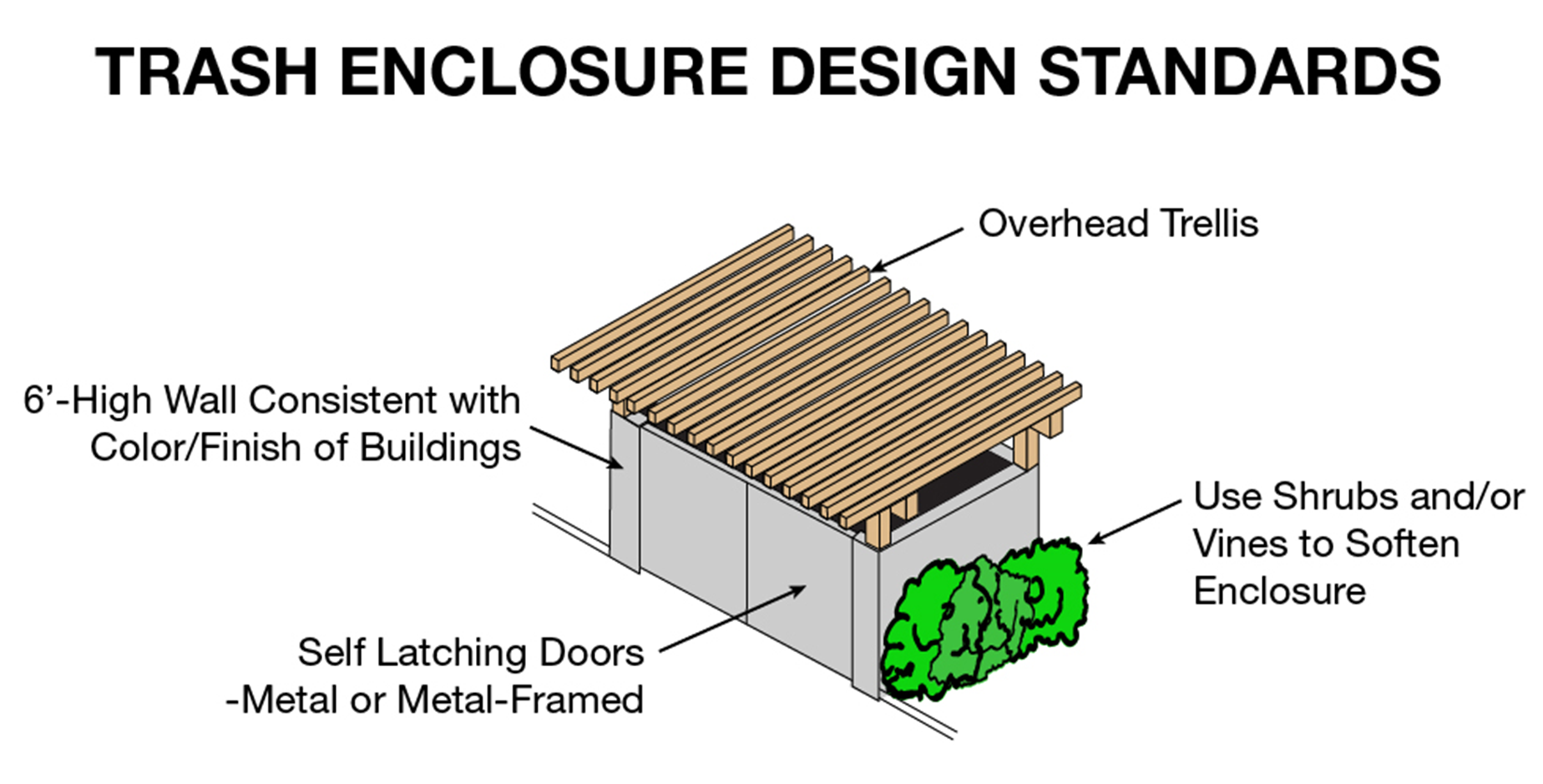
(2)
Enclosure design. Enclosures shall be constructed on a concrete pad and be of an adequate size to accommodate the containers they enclose per disposal company standards. Access to the containers for collection shall also meet disposal company requirements. Enclosure walls shall be at least six feet high and shall be made of strong durable materials consistent with the colors and finishes of nearby buildings. Doors shall be self-latching, metal or metal-framed, and of heavy duty construction sufficient to withstand hard usage. Interior concrete or metal curbs shall be included to prevent damage to the enclosures walls from dumpsters or other containers. Enclosures shall be visually softened by means of vine and/or shrub plantings. Decorative overhead structures such as trellises shall be integrated into the design if the enclosure is visible from higher terrain.
(e)
Weather protection. Each enclosure or individual container shall be designed and maintained so that deposited materials are contained during windy periods. Enclosures or containers designated for recyclable materials which could be damaged or be rendered unmarketable by rain or other environmental conditions shall provide adequate protection against such conditions.
(f)
Maintenance. Each enclosure shall be maintained to preserve its appearance and function and to minimize litter, odor and other nuisances. Trash and recyclables shall be collected regularly.
(Ord. No. 99-107, § 5, 2-2-99; Ord. No. 2021-210, § 43, 8-3-21)
Sec. 9-1-45.20. - Noise control.
Noise shall be regulated in nonresidential districts by the city's noise control ordinance (section 6-6 of this Code), which provides noise control standards for all districts in the city in order to prevent excessive sound levels which are detrimental to the public health, welfare and safety, or which are contrary to the public interest.
(Ord. No. 99-107, § 5, 2-2-99)
Sec. 9-1-45.21. - Operational standards for nonresidential uses.
All uses and developed properties within any nonresidential district shall comply with the following standards for development, operation and maintenance.
(1)
Equipment. All ground mounted mechanical equipment, including heating and air conditioning units and trash receptacle areas, shall be completely screened from surrounding properties.
(2)
Utilities. All utility connections shall be designed to coordinate with the architectural elements of the site so as not to be exposed except where required by utility provider.
(3)
Electrical disturbance, heat and cold, glare. No use except a temporary construction operation shall be permitted which creates changes in temperature or direct glare, detectable by the human senses without the aid of instruments, beyond the boundaries of the site. No use shall be permitted which creates electrical disturbances that affect the operation of any equipment beyond the boundaries of the lot.
(4)
Fire and explosive hazard. All storage of and activities involving flammable and explosive materials shall be provided with adequate safety and fire fighting devices to the specifications of the uniform fire code. All incineration is prohibited. Smoke detectors shall be installed in all new construction as required by city code.
(5)
Radioactivity. In all nonresidential districts, the use of radioactive materials shall be limited to measuring, gauging and calibration devices, and medical x-ray diagnostic equipment.
(6)
Vibration. No use except a temporary construction operation shall be permitted which generates inherent and recurrent ground vibration perceptible, without instruments, at the boundary of the lot on which the use is located.
(7)
Energy conservation. Buildings shall be located on the site to provide adjacent buildings adequate sunlight for solar access when practical.
(8)
Toxic materials. No land or building shall be used or occupied in any manner which creates an unhealthful, dangerous, noxious or otherwise objectionable condition due to the use, storage or proximity to toxic materials.
(9)
Liquid or solid waste. No discharge of liquid or solid wastes, at any point into public sewer, private sewage system, stream, storm drain or into the ground shall be permitted, except in accordance with the standards approved by the state department of health and/or specified by the sewage utility provider. No materials or wastes shall be deposited on any property in such form or manner that they may be transferred off the property by natural causes or forces, such as wind or rain. Any wastes which could be attractive to rodents or insects shall be stored outdoors only in closed containers.
(Ord. No. 99-107, § 5, 2-2-99; Ord. No. 2021-210, § 44, 8-3-21)
Sec. 9-1-45.22. - Hazardous waste and materials.
(a)
Hazardous materials. In addition to the requirements for each zoning district, the following requirements apply to the land uses listed in subsection (b) of this section:
(1)
Hazardous materials disclosure requirements. Prior to issuance of a certificate of occupancy for any land use listed in paragraph (2) of this subsection, the applicant shall comply with , division 3, article 4 of this Code in a manner approved by the fire chief.
(2)
Hazardous waste management. Prior to issuance of a certificate of occupancy for any land use listed in paragraph (2) of this subsection, the applicant shall provide plans or identify measures to comply with health and safety code section 25100 et seq. and administrative code title 22 in a manner approved by the health care agency and sewering agency.
(3)
Underground storage tanks. Prior to issuance of a certificate of occupancy for any land use which includes underground tanks to store any hazardous materials, the applicant shall provide plans or identify measures to comply with health and safety code section 25280 et seq. and administrative code title 23 in a manner approved by the health care agency.
(b)
Applicability. The requirements of subsection (a) pertaining to hazardous materials shall apply to the following land uses:
(1)
Automotive and vehicle maintenance, repair or painting.
(2)
Chemical and commercial cleaning product distribution or sales.
(3)
Cleaners, self-service laundries and vehicle washes.
(4)
Home improvement product, lumber and hardware sales.
(5)
Manufacturing.
(6)
Medical facilities.
(7)
Metal plating.
(8)
Mining and extraction.
(9)
Nurseries.
(10)
Oil and gas exploration and extraction.
(11)
Paint and finishing product sales.
(12)
Photo processing.
(13)
Recreation facilities such as golf courses, yacht clubs and amusement parks.
(14)
Recycling or resource recovery with potential for contact with hazardous materials.
(15)
Research, laboratory and testing facilities.
(16)
Service stations.
(17)
Transportation service facilities.
(18)
Utilities.
(19)
Waste disposal and treatment operations.
(20)
Wrecking and salvage facilities.
(21)
Other generation of hazardous waste, including materials to be disposed of by sanitary sewer.
(c)
Offsite hazardous waste facilities.
(1)
Offsite hazardous waste facilities may be established in the BP district if a use permit is approved in accordance with . Such facilities shall be subject to the requirements of subsection (c) of this section. In addition, all such facilities shall comply with the siting standards and approval procedures established by the Orange County hazardous waste management plan and shall be subject to the provisions of section 25135 et seq. of the state health and safety code.
(2)
Definition. For the purposes of this section, the term "offsite hazardous waste facility" means any structures, other appurtenances or improvements on land and all contiguous land serving more than one producer of hazardous waste, used for the treatment, transfer, storage, resource recovery, disposal, or recycling of hazardous waste, including but not limited to:
a.
Incineration facilities (i.e. rotary kiln, fluid bed, etc.);
b.
Residual repository (i.e. receiving only residuals from hazardous waste treatment facilities);
c.
Stabilization/solidification facilities;
d.
Chemical oxidation facilities;
e.
Neutralization/precipitation facilities; or
f.
Transfer/storage facilities.
(d)
Authority to suspend operations approval of any hazardous waste treatment, storage, disposal or transfer facility as a use consistent with the purpose and intent of any zoning district shall be subject to the requirement that continuing authority be vested in the fire department or health care agency to suspend operations for public safety reasons.
(Ord. No. 99-107, § 5, 2-2-99)
Sec. 9-1-45.23. - Service station standards.
(a)
Use permit required. All gas and service stations shall require approval of a use permit and comply with the use and design standards of this section. All uses to be placed on the service station site (e.g., mini-market, sale of alcoholic beverages, etc.) must be specifically included in the use permit approval.
(b)
Signs. Service station signage shall be in accordance with subarticle 7.
(c)
Hazardous materials. All service stations shall comply with the requirements of pertaining to hazardous materials and underground storage tanks.
(d)
Standards for service stations without repair facilities.
(1)
Permitted uses. Permitted uses include sale of petroleum products, including fuel and oil, related automotive accessories, and similar retail uses. The following are specifically prohibited: Sale of tires and batteries, and similar products for which necessary facilities for installation and disposal of used materials are not present; automobile or equipment repair, storage, or renting. All retail uses except petroleum dispensing shall occur within a building and all service uses shall occur in a specific location designated in the approved use permit.
(2)
Storage and display. All merchandise shall be stored and displayed within the service station building.
(3)
Screening. An opaque screen at least six feet in height shall be installed along all site boundaries which abut residentially zoned properties. Screening along all street boundaries shall be a minimum of 36 in. high, including any site elevation difference. Screening shall consist of a wall, retaining walls, an earthen berm with landscaping or any combination thereof. All screening shall comply with the height standards of pertaining to walls and fences.
FIGURE 4.12
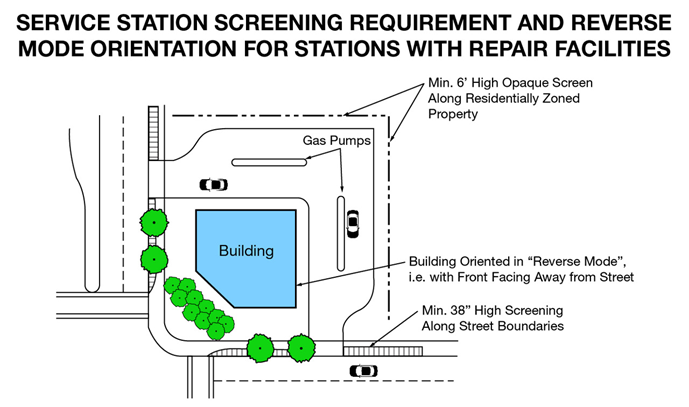
(e)
Standards for service stations with repair facilities.
(1)
Additional uses permitted. Permitted uses include those for service stations without repair facilities plus minor vehicle service and repair (e.g., tune-up, lubrication, battery and tire sales and service). The following uses are specifically prohibited: Major repair and rebuilding, transmission repair, auto body repair or painting, automobile or equipment storage or renting. All retail and repair uses except petroleum dispensing shall occur within a building and all non-repair service uses shall occur in a specific location designated in the approved use permit.
(2)
Storage and display. All merchandise shall be stored and displayed within the service station building.
(3)
Reverse mode required. All service stations which include service bays shall be designed in the "reverse" or "backup" mode, i.e., service bay openings oriented away from streets.
(4)
Screening. Screening requirements shall be the same as for service stations without service bays.
(f)
Removal of abandoned stations. Any service station which is closed for more than 12 consecutive months shall be deemed abandoned and shall be removed from the site at the expense of the property owner including the removal of buildings and structures and all underground storage tanks and any necessary site remediation due to tank leakage or other aspects of the service station use.
(Ord. No. 99-107, § 5, 2-2-99; Ord. No. 2021-210, § 45, 8-3-21)
Sec. 9-1-45.24. - Child day care centers.
Child day care centers or preschools in nonresidential districts shall conform to the following requirements regardless of the number of children served by the facility:
(1)
A use permit shall be required to establish a child day care center in accordance with . In addition, all facilities shall comply with this section and with any additional requirements imposed as part of the use permit or by any other applicable permit.
(2)
All facilities shall be operated in accordance with state and local health, safety, and other regulations.
(3)
Outdoor activities shall be limited to the hours between 8:30 a.m. and 7:00 p.m.
(4)
All facilities shall provide an onsite pickup/dropoff area. In addition, there shall be an onsite vehicle turnaround or alternatively, separate vehicle entrance and exit points.
(5)
All parking, signs, and outdoor lighting shall comply with the applicable regulations set forth in subarticles 6 and 7 and , respectively.
(6)
All facilities shall comply with the development standards of the district in which they are located, as set forth in .
(Ord. No. 99-107, § 5, 2-2-99)
Sec. 9-1-45.25. - Single room occupancy (SRO) hotels.
Single room occupancy hotels (SRO's) shall conform to the following requirements:
(1)
Occupancy shall be limited to maximum two persons per unit. Minimum unit sizes (not including toilet compartment) shall be:
a.
One person: 150 square feet.
b.
Two persons: 175 square feet.
(2)
Each SRO unit shall be provided with the following minimum amenities:
a.
Kitchen sink with garbage disposal.
b.
A toilet and sink located in a separate room within the unit that is a minimum 20 sq/ft.
c.
One closet per person.
d.
Telephone and cable TV hookups.
(3)
If full bathrooms are not provided in each unit, shared showers shall be provided on each floor at a ratio of one per seven occupants or fraction thereof on the same floor, with doors lockable from the inside.
(4)
If full kitchens are not provided in each unit, shared kitchen facilities shall be provided on each floor consisting of a range, sink with garbage disposal, and refrigerator.
(5)
If laundry facilities are not provided in each unit, common laundry facilities shall be provided, with one washer and one dryer for every 25 units for the first 100 units and one washer and one dryer for every 50 units over 100.
(6)
Elevators shall be required for SRO's of two or more stories.
(7)
A manual fire alarm system and a fully automatic fire suppression system, including a central monitoring system, alarm and fire annunciator, shall be designed and installed to the satisfaction of the fire chief.
(Ord. No. 99-107, § 5, 2-2-99)
Sec. 9-1-45.26. - Bus stop benches and shelters.
The erection, placement, construction and maintenance of bus benches and bus shelters are regulated by et seq. of this Code.
(Ord. No. 99-107, § 5, 2-2-99)
Sec. 9-1-45.27. - Emergency shelters.
(a)
Purpose and intent. The overall design, construction, appearance, operation and maintenance of the emergency shelter facility should provide an environment that is safe, secure, functional, and compatible with the surrounding community
(b)
Requirements. The emergency shelter shall comply with the following:
(1)
Structure. The structure in which and the lot on which an emergency shelter is established must comply with all standards that apply to a structure and lot in the same zone, unless preempted by state law.
(2)
Emergency shelter permit. A ministerial, streamlined administrative permit is required to operate an emergency shelter under this section. The applicant must complete the form provided by the city and pay the fee to cover the city's cost of processing the application and administering the permit program as established by council resolution.
(3)
Maximum number of persons/beds. The shelter may serve no more than ten persons per night unless state law requires a different limitation greater than ten, in which case the shelter may serve no more than the number of persons required by state law.
(4)
Parking ratio. Subject to Government Code Section 65583(a)(4)(A)(ii), on-site parking shall be supplied at a ratio of not less than one space for every employee in the largest shift.
(5)
Management and operational standards. Emergency shelters shall be managed and operated in conformance with the following objective standards:
a.
No shelter is permitted within 300 feet of another.
b.
No resident may stay for more than 180 nights in a calendar year.
c.
Hours of operation. The emergency shelter may only operate between 5:00 p.m. and 8:00 a.m. daily.
d.
The emergency shelter shall provide the following mandatory facilities: A separate interior intake area of no less than 250 square feet; an exterior on site waiting area of no less than 200 square feet and screened from all public right-of-way areas with landscaping to the extent feasible; office areas for administrative purposes; restrooms; and general storage.
e.
Lighting. Outdoor lighting shall be provided in active pedestrian areas, including sidewalks, pathways, and driveways. All lighting must be stationary and permanent. Outdoor lighting must otherwise comply with all applicable general standards set forth in .
f.
Onsite facility management shall include the following:
1.
The facility shall prepare and file a management plan with the City that includes operational rules and standards, including, but not limited to, provisions for staff training; neighborhood outreach; screening of residents; eligibility and admission procedures; operating schedule; rules regarding smoking, access to the facility, visitors, and guests; and a written policy outlining the consequences of rules and violations.
2.
There shall be at least one qualified on-site manager and one security guard for every ten occupants during all hours when the emergency shelter is in operation. The on-site manager shall have the authority to enforce the management plan and all rules set forth therein, and to ensure compliance with all development and management standards.
3.
The facility shall clearly post written eligibility and admission policies and procedures as well as dates, times, and services available, and shall make a copy available for inspection by the City or any member of the public upon request.
(Ord. No. 2024-228, § 3(Exh. 1), 5-21-24)
Sec. 9-1-45.28. - Low barrier navigation centers.
(a)
Purpose. The purpose of this section is to comply with California Government Code Section 65660 et seq. regarding Low Barrier Navigation Centers (hereafter referred to as "LBNCs," and each singularly an "LBNC").
(b)
Allowed zones. LBNCs that comply with the provisions of subsection (c) below are permitted by right in areas that are zoned for mixed use and in nonresidential zones that permit multifamily uses.
(c)
Operational and development standards. LBNCs must comply with all of the following:
(1)
Structure. The structure in which and the lot on which an LBNC is established must comply with all standards that apply to a structure and lot in the same zone, unless preempted by state law.
(2)
Streamlined administrative review procedures. A streamlined administrative LBNC permit is required to establish or operate an LBNC. An application for an LBNC permit is reviewed and processed ministerially, without discretionary review or a hearing. The Director of Community Development or the Director's designee will notify an applicant whether the application is complete within 30 days of submittal. Action on the application be taken within 60 days of when the application is determined to be complete.
a.
Separation. No LBNC may be established or operated at any location that is less than 300 feet from another LBNC or emergency shelter.
b.
Operational services. As required by Government Code Section 65662, each LBNC must satisfy each of the following:
1.
It offers services to connect people to permanent housing through a services plan that identifies services staffing.
2.
It links to a coordinated entry system, so that staff in the interim facility or staff who co-locate in the facility may conduct assessments and provide services to connect people to permanent housing. "Coordinated entry system" means a centralized or coordinated assessment system developed pursuant to Section 576.400(d) or Section 578.7(a)(8), as applicable, of Title 24 of the State Code of Federal Regulations, as those sections read on January 1, 2020, and any related requirements, designed to coordinate program participant intake, assessment, and referrals.
3.
It complies Chapter 6.5 (commencing with Section 8255) of Division 8 of the State Welfare and Institutions Code.
4.
It has a system for entering information regarding client stays, client demographics, client income, and exit destination through the local Homeless Management Information System as defined by Section 578.3 of Title 24 of the State Code of Federal Regulations.
c.
On-site personnel. There shall be at least one qualified on-site manager and one security guard for every ten occupants during all hours when the LBNC is in operation. The on-site manager shall have the authority to enforce the management plan and all rules set forth therein, and to ensure compliance with all development and management standards.
d.
Maximum number of persons/beds. The LBNC may serve no more than ten persons per night unless state law requires a different limitation greater than ten, in which case the LBNC may serve no more than the number of persons required by state law.
(d)
Sunset.
(1)
Subject to subsection (e)(2) below, this section remains in effect until January 1, 2027, and as of that date is repealed.
(2)
If the Legislature amends Government Code Section 65668 to extend the effective date of Government Code Section 65660 et seq., then this section remains in effect until the date on which Government Code Section 65660 et seq. is repealed.
(Ord. No. 2024-228, § 3(Exh. 1), 5-21-24)
Sec. 9-1-50.- Purpose and intent.
All references to include through . These sections set forth the purpose and intent of each of the special purpose districts and regulations.
(Ord. No. 99-107, § 5, 2-2-99)
Sec. 9-1-50.1. - PR parks and recreation district.
Purpose and intent. To provide for the development and preservation of public and private parks and associated recreation facilities within open space areas.
(Ord. No. 99-107, § 5, 2-2-99)
Sec. 9-1-50.2. - OS open space district.
Purpose and intent. To preserve and protect open space areas for the purposes of passive recreation, visual enhancement, and resource conservation.
(Ord. No. 99-107, § 5, 2-2-99)
Sec. 9-1-50.3. - MC managed care overlay district.
Purpose and intent. To provide for and regulate specialized housing providing a range of managed care to meet the physical and social needs of senior citizens and persons requiring specialized care or assistance.
(Ord. No. 99-107, § 5, 2-2-99)
Sec. 9-1-50.4. - FP floodplain overlay district.
Purpose and intent. To protect life and property from flood flows and to establish criteria for land use consistent with state law and with the criteria promulgated by the Federal Emergency Management Agency.
(Ord. No. 99-107, § 5, 2-2-99)
Sec. 9-1-50.5. - Adult-oriented business regulations.
Purpose and intent. As set forth in subsection (a).
(Ord. No. 99-107, § 5, 2-2-99)
Sec. 9-1-50.6. - Fuel modification regulations.
Purpose and intent. To limit danger to life and property from wildland fires by reducing combustible vegetation and imposing additional construction standards for areas at risk.
(Ord. No. 99-107, § 5, 2-2-99)
Sec. 9-1-51. - Types of special purpose districts and regulations.
(a)
Base districts. The PR and OS districts are base districts designed to provide for park, recreation, and open space land uses.
(b)
Overlay districts. The MC and FP districts are overlay districts. These overlay districts are to be used in combination with a base district (such as RS, CC, PR, OS, etc.) in order to regulate certain special aspects of land use in the interests of public safety and environmental protection. In cases where there is a conflict between the regulations of an overlay district and its underlying base district, the overlay district regulations shall control.
(c)
Overlay zoning designations. When an overlay district is used, the zoning designation shall consist of the base district symbol followed by the applicable overlay district symbol(s) enclosed in parentheses. For example: RS (MC) (FP).
(Ord. No. 99-107, § 5, 2-2-99)
Sec. 9-1-52. - Permitted uses.
(a)
Development permits required. Table 5.1 of this section specifies whether a use or structure is permitted within a zoning district. In most cases, development to establish a land use requires approval of a site development permit and/or other permits as set forth in subarticle 11.
(b)
Table of permitted uses. Table 5.1, "Permitted uses in special purpose districts", following, specifies those uses and structures which are permitted within each special purpose district. The letters in the columns beneath the district designations mean the following:
(1)
"P" The use is permitted as a principal use within the district.
(2)
"A" The use is permitted only if accessory to the principal use on the site.
(3)
"U" The use is permitted as a principal or accessory use if a use permit is approved.
(4)
"T" The use is permitted on a temporary basis if a temporary use permit is approved.
(5)
"X" The use is prohibited in the district.
(c)
Compatibility with base district uses. Overlay districts shall be located on the official zoning Map only in areas where the land uses permitted by the overlay district are compatible with existing uses in the area where the overlay is applied.
TABLE 5.1. PERMITTED USES IN SPECIAL PURPOSE DISTRICTS.
* As permitted in the underlying base district, subject to the additional requirements of the overlay district.
** Adult-oriented businesses are permitted only with approval of an adult-oriented business regulatory permit per Municipal code et seq.
*** Managed care projects are permitted only with the "MC" overlay designation and approval of a use permit.
(Ord. No. 99-107, § 5, 2-2-99; Ord. No. 2011-163, § 3, 5-3-11; Ord. No. 2016-184, § 2, 10-4-16; Ord. No. 2021-210, § 46, 8-3-21)
Sec. 9-1-53. - Special purpose development standards.
Table 5.2, following, contains standards for development of property within special purpose districts:
TABLE 5.2: SPECIAL PURPOSE DEVELOPMENT STANDARDS
* As provided in the applicable base district, subject to the additional requirements of the overlay district.
** Minimum landscaped setback from any scenic highway curbline = 25 feet.
(Ord. No. 99-107, § 5, 2-2-99)
Sec. 9-1-54. - Supplemental special purpose regulations.
All references to this shall include through . These sections set forth requirements for specialized aspects of land use in areas regulated by this subarticle, such as flood and fire hazard reduction measures, adult-oriented businesses, etc. These requirements are in addition to the other regulations set forth in this subarticle.
(Ord. No. 99-107, § 5, 2-2-99)
Sec. 9-1-54.1. - Parks and recreation and open space districts.
The permitted uses and development standards for the PR parks and recreation and the OS open space districts are set forth in sections and . Where the two districts are adjacent, the boundaries between the two on the official zoning map shall be considered approximate in order to provide flexibility for the placement of open space and recreational areas and facilities.
(Ord. No. 99-107, § 5, 2-2-99)
Sec. 9-1-54.2. - MC managed care overlay district.
(a)
Boundaries of MC overlay district. The boundaries of the MC overlay district are as shown on the official zoning map. The MC overlay district may be applied only in combination with the RM multifamily, CN neighborhood commercial, CC community commercial, and PI public institutional districts.
(b)
Locational criteria. The MC district shall be applied as an overlay within the preceding base districts, only to properties or areas where managed care projects will be compatible with surrounding uses in terms of noise, traffic, visual impacts, living environment for managed care residents, and the ability of nearby nonresidential uses to carry on normal activities necessary to their viability.
(c)
Applicability. The MC overlay district is intended to provide for specialized housing which offers a range of managed care to meet the physical and social needs of senior citizens and persons requiring specialized care or assistance. "Managed care" projects or facilities include the following:
(1)
Assisted living facilities: Facilities providing care on a monthly basis or longer which are the primary residences of the people served. Such facilities provide services to residents such as the following: Dining, housekeeping, security, medical, transportation and recreation. Any commercial services provided are for the exclusive use of the occupants of the facility. Such facilities may be located in more than one building and/or on contiguous parcels within the building site.
(2)
Convalescent hospitals: Facilities licensed by the state department of health services which provide bed and ambulatory care for seven or more patients with postoperative convalescent, chronic illness or dietary problems and persons unable to care for themselves, including persons undergoing psychiatric care and treatment both as inpatients and outpatients, but not including persons with contagious diseases or afflictions. A "convalescent hospital" may also be known as a nursing home, convalescent home, rest home, or home for the aged.
(3)
Residential care facilities for the elderly: Facilities defined in section 1569.2 of the state health and safety code, plus Alzheimer's care facilities.
(d)
Use permit required. Managed care projects within the MC overlay district shall require approval of a use permit by the planning commission in accordance with .
(e)
Requirements. Managed care projects shall meet the following requirements:
(1)
The housing facility shall be specially designed to provide the care described in paragraph (c) of this section and to meet the physical and social needs of senior citizens and persons requiring specialized care or assistance.
(2)
The housing facility shall provide a useable multipurpose room where communal activities, including but not limited to, dining may be conducted.
(3)
The housing facility shall provide emergency alert systems in each unit to notify the on-site staff that assistance is needed.
(4)
A housing facility staff member shall be on-site at all times to assist residents in emergencies.
(5)
The facility management shall coordinate social services for residents which includes meals and transportation. The service may be provided by the facility management or an outside agency.
(6)
The on-site facility management shall maintain current records pertaining to the resident's doctor and emergency contacts.
(7)
All managed care projects located within the MC overlay district shall comply with the development standards of the base zoning district and shall comply with the design guidelines of subarticle 9.
(8)
Projects proposed within the MC overlay district shall include a parking analysis to determine the parking demand for the specific project.
(f)
Local park code exemption. Managed care projects located within the MC overlay district are exempt from the regulations set forth in the city's local park code.
(g)
Use classification. Managed care projects shall not be considered a residential use for the purpose of allocating dwelling units within the land use element of the general plan.
(Ord. No. 99-107, § 5, 2-2-99; Ord. No. 2021-210, § 47, 8-3-21)
Sec. 9-1-54.3. - FP floodplain overlay district.
(a)
Boundaries of FP overlay district. The FP district shall include all areas within the city that are designated as "special flood hazard areas inundated by 100-year flood" on the flood insurance rate maps (FIRM) provided by the Federal Emergency Management Agency (FEMA). These include the "A", "AE", "AH", "AO", and "A99" flood hazard zones. The boundaries of the FP district are as shown on the official zoning map.
(b)
Prohibition of construction in floodways. Floodway areas shown on FIRM maps are special flood hazard areas which carry high velocity flood waters, debris, and erosion potential. Therefore, except for necessary public improvements, no fill, structures, or other development shall be permitted within floodways.
(c)
Flood hazard reduction requirements. The following flood hazard reduction measures shall be required of all construction within the FP district:
(1)
Impact on 100-year flood elevations. New construction shall not increase the water surface elevation of the projected 100-year flood more than one foot at any point. Also, new construction shall not create nor exacerbate erosive velocities within special flood hazard areas. The city may require certification by a registered professional engineer that these requirements are met.
(2)
Finish floor elevation. The finish floor elevation of the lowest floor of all new buildings shall be at least one foot above the 100-year or base flood elevation shown on the FIRM map. If no base flood elevation is shown on the FIRM map, the city may require certification by a registered professional engineer that the finish floor elevation requirement is satisfied.
(3)
Anchoring. All new structures shall be anchored to prevent collapse, flotation, or lateral movement from hydrostatic and hydrodynamic loading.
(4)
Water and sewer systems. All new and replacement water supply and sanitary sewer systems shall be designed to minimize or eliminate infiltration of flood waters into the system and discharge from systems into flood waters.
(5)
Electrical, plumbing, and heating systems. All new and replacement electrical, plumbing and heating equipment shall be designed and located so as to prevent water from entering or accumulating within the components during conditions of flooding.
(6)
Drainage. On slopes, adequate drainage paths shall be provided to guide floodwaters around and away from proposed structures.
(d)
Permit procedures. Proposed construction within the FP district shall require approval of a site development permit in accordance with and any other permits required by the base district regulations. In addition, the following requirements shall be satisfied:
(1)
Plans and studies. Site development permit applications shall be accompanied by detailed studies and plans sufficient to show to the satisfaction of the public Works director that proposed structures are safe from flood flows, that there will be no resulting increase in base flood elevation, and that all other requirements of subsection (c), preceding, have been or will be satisfied.
(2)
Requirements of other public agencies. The application shall include evidence of compliance with applicable requirements of federal and other agencies, such as the U.S. Army Corps of Engineers and the Orange County flood control district.
(Ord. No. 99-107, § 5, 2-2-99)
Sec. 9-1-54.4. - AB adult-oriented business regulations.
(a)
Purpose and intent. It is the intent of this section to prevent community-wide adverse economic impacts, increased crime, decreased property values, and the deterioration of neighborhoods which can be brought about by the concentration of adult-oriented businesses in close proximity to each other or proximity to other incompatible uses such as schools for minors, churches, and residentially zoned districts or uses. The city council finds that it has been demonstrated in various communities that the concentration of adult-oriented businesses causes an increase in the number of transients in the area, and an increase in crime and, in addition to the effects described above, can cause other businesses and residents to move elsewhere. It is therefore the purpose of this section to establish reasonable and uniform regulations to prevent the concentration of adult-oriented businesses or their close proximity to incompatible uses, while permitting the location of adult-oriented businesses in certain areas.
(b)
Definitions.
(1)
Establishment of an adult-oriented business. As used herein, to "establish" an adult-oriented business shall mean and include any of the following:
a.
The opening or commencement of any adult-oriented business as a new business;
b.
The conversion of an existing business, whether or not an adult-oriented business, to any adult-oriented business defined herein;
c.
The addition of any of the adult-oriented businesses defined herein to any other existing adult-oriented business; or
d.
The relocation of any such adult-oriented business.
(2)
Specified anatomical areas. As used herein, "specified anatomical areas" shall mean and include any of the following:
a.
Less than completely and opaquely covered human:
1.
Genitals or pubic region;
2.
Buttocks; and
3.
Female breasts below a point immediately above the top of the areola;
b.
Human male genitals in a discernibly turgid state, even if completely and opaquely covered;
c.
Any device, costume or covering that simulates any of the body parts included in subdivisions (a) or (b) above.
(3)
Specified sexual activities. As used herein, "specified sexual activities" shall mean and include any of the following, whether performed directly or indirectly through clothing or other covering:
a.
The fondling or other erotic touching of human genitals, pubic region, buttocks, anus, or female breast;
b.
Sex acts, actual or simulated, including intercourse, oral copulation, or sodomy;
c.
Masturbation, actual or simulated;
d.
Excretory functions as part of or in connection with any of the other activities described in subdivision (1) through (3) of this subsection.
(4)
Adult-oriented businesses. As used herein, "adult-oriented businesses" means any one of the following:
a.
Adult arcade. The term "adult arcade" as used in this section, is an establishment where, for any form of consideration, one or more still or motion picture projectors, or similar machines, for viewing by five or fewer persons each, are used to show films, computer generated images, motion pictures, video cassettes, slides or other photographic reproductions 30 percent or more of the number of which are distinguished or characterized by an emphasis upon the depiction or description of specified sexual activities or specified anatomical areas.
b.
Adult bookstore. The term "adult bookstore" as used in this section, is an establishment that has 30 percent or more of its stock in books, magazines, periodicals or other printed matter, or of photographs, films, motion pictures, video cassettes, slides, tapes, records or other form of visual or audio representations which are distinguished or characterized by an emphasis upon the depiction or description of specified sexual activities and/or specified anatomical areas, or of adult merchandise.
c.
Adult cabaret. The term "adult cabaret" as used in this section, means a nightclub, restaurant, or similar business establishment which:
1.
Regularly features live performances which are distinguished or characterized by an emphasis upon the display of specified anatomical areas or specified sexual activities;
2.
Which regularly features persons who appear semi-nude; and/or
3.
Shows films, computer generated images, motion pictures, video cassettes, slides, or other photographic reproductions 30 percent or more of the number of which are distinguished or characterized by an emphasis upon the depiction of specified sexual activities or specified anatomical areas.
d.
Adult hotel/motel. The term "adult hotel/motel" as used in this section, means a hotel or motel or similar business establishment offering public accommodations for any form of consideration which:
1.
Provides patrons with closed-circuit television transmissions, films, computer generated images, motion pictures, video cassettes, slides, or other photographic reproductions 30 percent or more of the number of which are distinguished or characterized by an emphasis upon the depiction or description of specified sexual activities or specified anatomical areas; and
2.
Rents, leases, or lets any room for less than a six-hour period, or rents, leases, or lets any single room more than twice in a 24-hour period.
e.
Adult merchandise store. The term "adult merchandise store" as used in this section, is an establishment for which 30 percent or more of its merchandise is adult-oriented merchandise.
f.
Adult motion picture theater. The term "adult motion picture theater" as used in this section, is a business establishment where, for any form of consideration, films, computer generated images, motion pictures, video cassettes, slides or similar photographic reproductions are shown, and 30 percent or more of the number of which are distinguished or characterized by an emphasis upon the depiction or description of specified sexual activities or specified anatomical areas.
g.
Adult theater. The term "adult theater" as used in this section, means a theater, concert hall, auditorium, or similar establishment which, for any form of consideration regularly features live performances which are distinguished or characterized by an emphasis on the display of specified anatomical areas or specified sexual activities.
h.
Modeling studio. The term "modeling studio" as used in this section, means a business which provides, for pecuniary compensation, monetary or other consideration, hire or reward, figure models who, for the purposes of sexual stimulation of patrons, display "specified anatomical areas" to be observed, sketched, photographed, painted, sculpted or otherwise depicted by persons paying such consideration. "Modeling studio" does not include schools maintained pursuant to standards set by the state board of education. "Modeling studio" further does not include a studio or similar facility owned, operated, or maintained by an individual artist or group of artists, and which does not provide, permit, or make available "specified sexual activities."
(5)
Adult-oriented merchandise. The term "adult-oriented merchandise" shall mean sexually oriented implements, paraphernalia, or novelty items, such as, but not limited to: Dildos, auto sucks, sexually-oriented vibrators, benwa balls, inflatable orifices, anatomical balloons with orifices, simulated and battery operated vaginas, and similar sexually-oriented devices which are designed or marketed primarily for the stimulation of human genital organs or sado-masochistic activity or distinguished or characterized by their emphasis on matter depicting, describing or relating to "specified sexual activities" or "specified anatomical areas."
(6)
Church. The term "church" as used in this section, is a structure which is used primarily for religious worship and related religious activities.
(7)
Distinguished or characterized by an emphasis upon. As used in this article, the term "distinguished or characterized by an emphasis upon" shall mean and refer to the dominant or essential theme of the object described by such phrase. For instance, when the phrase refers to films "which are distinguished or characterized by an emphasis upon" the depiction or description of specified sexual activities or specified anatomical areas, the films so described are those whose dominant or predominant character and theme are the depiction of the enumerated sexual activities or anatomical areas. See Pringle v. City of Covina (1981) 115 Cal.App.3d 151.
(8)
Regularly features. The term "regularly features" with respect to an adult theater or adult cabaret means a regular and substantial course of conduct. The fact that live performances which are distinguished or characterized by an emphasis upon the display of specified anatomical areas or specified sexual activities occurs on two or more occasions within a 30-day period; three (3) or more occasions within a 60-day period; or four or more occasions within a 180-day period, shall to the extent permitted by law be deemed to be a regular and substantial course of conduct.
(9)
Park. The term "park" as used in this section, means the areas and facilities of parks that are used by children for recreational activities, including, but not limited to, baseball, softball, and soccer fields, other areas used for playing fields, basketball and volleyball courts, tot lots with playground equipment, similar facilities, and hiking and walking trails.
(10)
School. The term "school" as used in this section, is any child or day care facility, or an institution of learning for minors, whether public or private, offering instruction in those courses of study required by the state education code and maintained pursuant to standards set by the state board of education. This definition includes a nursery school, kindergarten, elementary school, middle or junior high school, senior high school, or any special institution of education, but it does not include a vocational or professional institution of higher education, including a community or junior college, college, or university.
(11)
Semi-nude. Means a state of dress in which clothing covers no more than the genitals, pubic region, buttocks, areola of the female breast, as well as portions of the body covered by supporting straps or devices.
(c)
Zoning and minimum proximity requirements.
(1)
No adult-oriented business shall be established or located in any zoning district, zone or area in the city except for commercially-zoned areas north of Aliso Creek Road and west of Moulton Parkway and except for those areas designated for commercial and industrial uses in planning areas A13, A14, B5, and U1 of the Laguna Niguel Planned Community. Notwithstanding the previous sentence, no adult-oriented business shall be established on the parcel identified as 28100 and 28150 Cabot Road and otherwise known as the Mission Equities Restaurant site which is in planning area B5 of the Laguna Niguel Planned Community.
(2)
In addition to the zoning requirements set forth herein, no adult-oriented business shall be established or located within certain distances of certain specified land uses or zones as set forth below:
a.
No such business shall be established or located within 1,000 feet of any other adult-oriented business.
b.
No such business shall be established or located within 500 feet of any existing residential zone or use.
c.
No such business shall be established or located within 1,000 feet of any existing park, church, or school utilized by minors.
d.
The distances set forth above shall be measured as a radius from the primary entrance of the adult-oriented business to the property lines of the property so zoned or used without regard to intervening structures, except as for parks, the distances shall be measured to the location of the active areas of the parks.
(3)
No adult-oriented business shall be established, located, operated or maintained in any zoning district, zone or area in which such businesses are allowed unless and until the permits for such businesses that are required by division 5 of ( et seq.) of this Code have been obtained.
(Ord. No. 99-107, § 5, 2-2-99)
Sec. 9-1-54.5. - Fuel modification regulations.
(a)
Applicability. The fuel modification regulations set forth in this section shall apply whenever a fuel modification plan has been required as a condition of development approval or through other requirements.
(b)
Review requirements. Fuel modifications plans, and revisions to fuel modification plans, shall be reviewed and approved by the fire authority and director.
(c)
Fuel modification requirements. Areas where fuel modification is required shall consist of the following fuel modification zones:
(1)
A substantially flat "setback zone" with no combustible construction.
(2)
Beyond the setback zone, a permanently landscaped and irrigated "wet zone."
(3)
Beyond the wet zone, one or more "thinning zones" in which natural vegetation is thinned and dead or dying vegetation is removed.
(d)
No encroachment into fuel modification zones. Fuel modification zones established on an approved fuel modification plan shall have the same force and effect as regulations set forth in the text of this zoning code.
(1)
No structure shall be placed within any fuel modification zone, except approved fencing, unless a minor adjustment is approved in accordance with for encroachment.
(2)
If such a minor adjustment is approved, such conditions of approval shall be imposed as may be deemed necessary to mitigate wildland fire hazard. Such conditions may include, but are not limited to, those listed under paragraph (j) of this section.
(3)
In addition to the required findings set forth in , approval of a minor adjustment shall require a finding by the director that the adjustment is necessary for the preservation of a substantial property right possessed by other properties in the same vicinity and zoning district and otherwise denied to the subject property.
(e)
Location of fuel modification zones. In all cases, fuel modification zones shall be located within the tract or other property being protected. Further, where feasible, "wet" and "thinning" zones shall be located on common lots owned by the applicable homeowners association or similar entity. In addition, the substantially flat "setback" zones are encouraged to also be located on such common lots as opposed to individual private lots.
(f)
Width of fuel modification zones. The width of fuel modification zones shall be established on each fuel modification plan as required by individual site conditions. The combined width of all zones described under paragraph (b) of this section shall be a minimum of 120 feet. Exception, modifications to this width standard may be permitted with the approval of a minor adjustment and review and approval by the fire authority. If such minor adjustment is approved, conditions of approval necessary to mitigate wildfire hazard shall be imposed. Such conditions may include, but are not limited to, those listed under paragraph (j) of this section.
(g)
Preparation of fuel modification plans. Fuel modification zones, plant materials, thinning measures, and other details shall be shown on individual fuel modification plans approved for each affected subarea. Fuel modification plans shall be prepared by a licensed landscape architect.
(h)
Fuel modification maintenance program. A fuel modification maintenance program providing for continuous maintenance of fuel modification areas shall be prepared and implemented. The maintenance program shall be included as part of each fuel modification plan and shall include the maintenance of irrigation systems and landscaping, the periodic re-thinning of vegetation, and other measures needed to keep fuel modification zones in a fire safe condition.
(i)
Fuel modification plan approval.
(1)
A preliminary fuel modification plan meeting the requirements of this section shall be approved by both the fire authority and the community development director prior to the first discretionary action on the project.
(2)
A final fuel modification plan shall be approved by both the fire authority and the community development director as being in substantial compliance with the preliminary fuel modification plan and with this section prior to issuance of a grading permit or prior to issuance of a building permit if there is no grading permit.
(3)
Fuel modification measures shall be completed to the satisfaction of the fire authority prior to issuance of a building permit.
(4)
Proposed amendments to fuel modification plans shall be reviewed and approved in the same manner as the original plan.
(5)
Fire hazard reduction measures in addition to those of this Section may be required as conditions of approval of any project or any fuel modification plan.
(j)
Alternate construction methods. Construction methods to reduce fire hazards may be required within fire hazard areas if the City determines in an individual case that: (1) the measures are necessary as conditions of approval of a fuel modification plan or minor adjustment in order to provide adequate reduction of wildland fire danger, and/or (2) if no adequate fuel modification plan has been implemented for the affected area. Such possible construction methods may include, but are not limited to, the following:
(1)
Excluding openings, all exterior walls to be rated by the uniform building code as one-hour fire resistant.
(2)
All glass facing the wildland edge to be double-paned, meeting uniform building code requirements.
(3)
All roof coverings to be noncombustible.
(4)
The underside of all roof overhangs to be enclosed with assemblies rated by the uniform building code as one-hour fire resistant.
(5)
Open ends of tile roofs to be capped with non-ignitable material in order to prevent placement of bird nests or other combustible material within the roof structure.
(6)
No attic air vents to be placed facing the wildland edge.
(7)
All attic air vents to be covered by corrosion resistant wire mesh.
(8)
Roof-mounted turbine air vents to be prohibited.
(9)
All exposed roof and wall piping, vents, flashing and other penetrations and appendages to be constructed of noncombustible materials.
(10)
All chimneys to be equipped with spark arresters constructed of 12-gauge wire screen with ½ inch openings. Spark arresters to be mounted in a vertical position visible from the ground.
(11)
All garage doors facing the wildland edge to be constructed of noncombustible materials.
(12)
Patio covers facing the wildland edge and their structural supports to be constructed of or encased with noncombustible materials.
(13)
The exposed undersides of wood decks to be encased with noncombustible materials.
(14)
All fencing to be constructed of noncombustible materials.
(15)
An automatic fire suppression system to be installed as required by the fire marshall.
(k)
Fire suppression systems. New residential buildings in fire hazard areas may be required to be provided with an automatic fire suppression system in order to decrease the spread of fire. Need for and design of suppression systems shall be determined by the fire marshall in each individual case.
(Ord. No. 99-107, § 5, 2-2-99; Ord. No. 2021-210, § 48, 8-3-21)
Sec. 9-1-54.6. - SMC senior managed care overlay district.[4]
(a)
Purpose and intent. The purpose and intent of the senior managed care (SMC) overlay district is to regulate specialized housing designed to meet the physical and social needs of senior citizens by providing a range of managed care.
(b)
Boundaries of senior citizens overlay district. Senior managed care overlay district may be applied to the following zoning districts:
(1)
Mixed use and local commercial;
(2)
Community facility;
(3)
Mixed use and commercial;
(4)
Industrial;
(5)
Office/commercial/retail;
(6)
Professional and administrative office;
(7)
Local and community commercial;
(8)
Town center;
(9)
Visitor serving commercial;
(10)
Industrial park;
(11)
Neighborhood commercial;
(12)
C1 local business district;
(13)
CC commercial community district;
(14)
CN commercial neighborhood district; and
(15)
M1 light industrial district zones as outlined in the planned community texts and zoning code of the city. The boundaries of the SMC overlay district are as shown on the official zoning map.
(c)
Definitions. For the purposes of this section, senior managed care shall include: Managed care for seniors ranging from assisted care with varying degrees of medical care to minimum care which does not include any medical care. For the purposes of the section this definition also includes congregate care and convalescent care as defined in through of the city zoning code limited to seniors, residential care facilities for elderly as defined in 1569.2 of the health and safety code, and Alzheimer's care facilities limited to seniors.
(d)
Use permit standards. Development of a senior managed care project within the SMC overlay district requires approval of a use permit by the planning commission. In addition the use permit shall require compliance with the following standards:
(1)
The housing facility shall be specially designed to meet the physical and social needs of senior citizens. The housing facility shall preserve and restrict occupancy to senior citizen tenants to the degree allowable by law.
(2)
The housing facility shall provide a useable multipurpose room where communal activities including dining may be hosted.
(3)
The housing facility shall provide emergency alert systems in each unit to notify the on-site staff that assistance is needed.
(4)
A housing facility staff member shall be on-site 24 hours a day every day to assist tenant in emergencies.
(5)
The facility management shall coordinate social services for tenants which includes meals and transportation. The service may be provided by the facility management or an outside agency.
(6)
The on-site facility management shall maintain current records pertaining to the tenant's doctor and emergency contacts.
(7)
All senior housing projects located within the SMC overlay district shall comply with the development standards of the base zoning district.
(8)
All senior housing projects located within the SMC overlay district shall comply with the design guidelines.
(9)
Projects proposed within the SMC overlay district shall include a parking analysis to determine the parking demand for the specific project.
(e)
Local park code exemption. Senior managed care projects that is located within the senior managed care (SMC) overlay district shall be exempt from the regulations set forth in the local park code found in through of the city zoning code.
(f)
Application to planned communities. This housing type shall not be considered a residential use for the purpose of allocating dwelling units within the Country Village, Laguna Niguel, Colinas De Capistrano, Beacon Hill, Bear Brand and Bear Brand Hill planned communities.
(Ord. No. 98-102, § 2, 6-16-98)
Editor's note— See editor's note at section 9-1-112.
Sec. 9-1-54.7. - Landscaping and vegetation regulations.
(a)
Purpose and intent. The purpose and intent of this section is to establish procedures necessary to achieve and maintain the benefits of landscaped and vegetated areas, including aesthetic, soil stability, ecological, and air quality benefits landscaping and vegetation provides citywide.
(b)
Design guidelines. This section sets forth basic landscaping requirements. In addition, subarticle 9 (Community design guidelines) contains landscaping standards and guidelines relating to project entry landscaping, pedestrian area landscaping, tree preservation, plant selection, and other items.
(c)
Maintenance of landscaping and vegetation. All existing landscaped and vegetated areas visible from public roadways within the OS and PR zoning districts shall be maintained in an orderly, attractive, and healthy condition, including proper pruning, mowing of lawns, weeding, removal of litter, fertilizing, replacement of plants (including trees) when necessary, and the regular application of appropriate quantities of water to all landscaped areas.
(d)
Modification of landscaping and vegetation. Any significant modification or removal to existing landscaped areas (including trees) visible from public roadways within the OS and PR zoning districts shall first require the review and approval of a changed plan permit or a discretionary permit amendment as determined by the community development director. If the existing landscaped areas were originally established as a subdivision condition of approval, the submittal and approval of a landscape plan by the planning division shall be required. Unregulated removal of trees along street frontages in particular can detract from the health, safety and general welfare of the city. This includes the aesthetic, soil stability, ecological, and air quality benefits landscaping provides citywide.
(Ord. No. 2021-210, § 49, 8-3-21)
Sec. 9-1-55. - Marijuana dispensing, delivery and cultivation.
All references to include through inclusive. The purpose and intent of this section is to prohibit all marijuana activities, including, but not limited to, operating a dispensary, dispensing, distribution, cultivation, and delivery of marijuana.
(Ord. No. 2016-184, § 2, 10-4-16)
Sec. 9-1-55.1. - Prohibited activities.
(a)
Commercial use. The establishment or operation of any business of commercial marijuana activity is prohibited in all zoning districts of the city. No use permit, variance, building permit, or any other entitlement or permit, whether administrative or discretionary, shall be approved or issued for the establishment or operation of any such business or operation. No person shall establish or operate any such businesses or operations, including but not limited to:
(1)
The transportation, delivery, storage, distribution, dispensing or sale of marijuana, marijuana products, or marijuana accessories;
(2)
The cultivation of marijuana;
(3)
The manufacturing or testing of marijuana, marijuana products, or marijuana accessories; or
(4)
Any other business licensed by the state or other government entity under of the California Business & Professions Code, as it may be amended from time to time.
(b)
Medical use.
(1)
The establishment or operation of any medical marijuana collective, cooperative, dispensary, delivery service, operator, establishment, or provider is prohibited in all zoning districts of the city. No use permit, variance, building permit, or any other entitlement or permit, whether administrative or discretionary, shall be approved or issued for the establishment of any collective, cooperative, dispensary, delivery service, operator, establishment, or provider in any zoning district. No person shall establish or operate such businesses or operations in any zoning district.
(2)
Cultivation of medical marijuana pursuant to Section 11362.77 of the California Health & Safety Code is subject to the cultivation requirements laid out in subsection (c) of this section.
(c)
Personal use.
(1)
For purposes of this subsection, personal recreational use, possession, purchase, transport, or dissemination of marijuana is unlawful in all areas of the city, except to the extent California law specifically prohibits cities from prohibiting such use.
(2)
Outdoor cultivation. No person shall plant, cultivate, harvest, dry, or process marijuana plants outdoors in any zoning district of the city. No use permit, building permit, variance, or any other permit or entitlement, whether administrative or discretionary, shall be approved or issued for any such use or activity.
(3)
Indoor cultivation.
(i)
To the extent a complete prohibition on indoor cultivation is not permitted under California law, a person may not possess, plant, cultivate, harvest, dry, or process more than six marijuana plants inside a private residence, or inside an accessory structure to a private residence located upon the grounds of a fully enclosed private residence. Also, a person may not plant, cultivate, harvest, dry, or process marijuana plants inside any enclosed structure within any zoning district of the city which is not either a private residence or an accessory structure to a private residence located upon the grounds of a private residence.
(ii)
To the extent prohibition on indoor cultivation is not prohibited under state law, then indoor cultivation is completely prohibited in the city.
(Ord. No. 2016-184, § 2, 10-4-16)
Sec. 9-1-55.2. - Violations.
No person, whether as principal, agent, employee or otherwise, shall violate, cause the violation of, or otherwise fail to comply with any of the requirements of . Every act prohibited or declared unlawful, and every failure to perform an act made mandatory by , shall be a misdemeanor or an infraction, at the discretion of the city attorney or the district attorney.
(Ord. No. 2016-184, § 2, 10-4-16)
Sec. 9-1-55.3. - Public nuisance.
In addition to the penalties provided in , any use or condition caused or permitted to exist in violation of any of the provisions of is hereby declared a public nuisance and may be abated as provided in this Code or under state law.
(Ord. No. 2016-184, § 2, 10-4-16)
Sec. 9-1-55.4. - Civil penalties.
In addition to any other enforcement permitted by , the city attorney may bring a civil action for injunctive relief and civil penalties pursuant to this Code against any person or entity that violates . In any civil action brought pursuant to , a court of competent jurisdiction may award reasonable attorneys' fees and costs to the prevailing party.
(Ord. No. 2016-184, § 2, 10-4-16)
Sec. 9-1-55.5. - Housing element site inventory.
(a)
Purpose. The purpose of this section is to codify the statutory requirements found in California Government Code Section 65583.2(c) that apply to sites identified in Appendix B of the City of Laguna Niguel's Housing Element Residential Land Inventory. The Housing Element Site Inventory includes a list of potential sites to accommodate a portion of the City's unmet Regional Housing Needs Allocation ("RHNA)."
(b)
Applicability. This section applies to any vacant site identified in two or more consecutive housing element planning periods or nonvacant sites identified in a prior planning period to accommodate the lower-income RHNA provided that at least 20 percent of the dwelling units are available to lower-income households.
(c)
Relationship to other regulations. Residential development eligible under subsection (b) shall also comply with , including, but not limited to, applicable standards within the underlying zoning district and objective development and design standards in accordance with of this Code. Where there is a conflict between the requirements in the Zoning Code and this section, this section prevails.
(d)
Residential development eligible under subsection (b) shall comply with the following additional standards:
(1)
The minimum residential density is 30 dwelling units per net acre;
(2)
Owner-occupied and rental multifamily residential uses are permitted by right and do not require a discretionary review or approval for residential developments in which 20 percent or more of the units are affordable to lower income households (as defined by Health and Safety Code Section 50079.5); and
(3)
An applicant for a project under this section may apply for a density bonus in accordance with Government Code Section 65915 and section 9-1-37 of this Code.
(Ord. No. 2024-228, § 3(Exh. 1), 5-21-24)
Sec. 9-1-60.- Purpose and intent.
These regulations are established to provide for off-street parking of motor vehicles attracted by the various land uses in the city. It is intended that the provisions of these regulations result in properly designed parking areas with adequate numbers of parking spaces in order to reduce traffic congestion, promote business and enhance public safety.
(Ord. No. 99-107, § 5, 2-2-99)
Sec. 9-1-61. - General requirements.
(a)
Modifications to parking facilities. No existing parking facility shall be restriped or modified with respect to layout, aisle width, numbers or sizes of spaces, street access, or any other physical characteristic without prior review by the community development director. The director shall determine if discretionary review is required for the modification pursuant to Subarticle 9 (Community design guidelines) or subarticle 11 (Permits and amendments).
(b)
Location of offstreet parking.
(1)
Required parking facilities shall be located on the same building site and conveniently proximate to the uses they serve except as otherwise provided in (Alternative parking regulations) and subsection (j) (Joint use of parking facilities).
(2)
Property within the ultimate right-of-way of a street, either public or private, shall not be included in provision of the minimum parking.
(c)
Accessibility. All required offstreet parking spaces shall be designed, located, constructed and maintained so as to be fully and independently usable and accessible at all times.
(d)
Usability.
(1)
The required offstreet parking facilities and driveways shall not be used for any purpose which at any time would preclude the use of the area for the temporary storage of motor vehicles.
(2)
Unless otherwise provided by an approved discretionary permit, no owner or tenant shall lease, rent or otherwise make unavailable to intended users any offstreet parking spaces required by this Subarticle.
(e)
Access to arterial highways.
(1)
Wherever access to a parking area is off an arterial highway designated on the master plan of arterial highways, parking spaces, driveways and maneuvering areas shall be designed so that motor vehicles may enter the arterial highway traveling in a forward direction.
(2)
Vehicular access to arterial highways designated on the master plan of arterial highways will be permitted only in accordance with specifically approved driveway locations and access design.
(f)
Maximum grades.
(1)
Whenever access is taken from a street, alley or driveway to an offstreet parking area serving four or less dwelling units, the driveway or other vehicular accessway shall have a maximum grade of plus 15 percent or minus six percent, measured from the street, alley or driveway grade along the driveway centerline, for a distance of not less than 18 feet from the street, alley or driveway right-of-way line.
(2)
Whenever access is taken from a street, alley or driveway to an offstreet parking area serving industrial, commercial or professional uses, public or community facilities, or five or more dwelling units, the driveway or other vehicular accessway shall have a maximum grade of plus 15 percent or minus two percent, measured from the street, alley or driveway grade along the driveway centerline, for a distance of not more than 18 feet from the street, alley or driveway right-of-way line.
(3)
The maximum grades specified in subsections (e)(1) and (e)(2) preceding will generally provide adequate sight distance at street level and prevent vehicles from dragging on extreme grade breaks. Minor adjustments may be approved by the community development director, in accordance with , where physical design prevents such extreme grade breaks and provides safe sight distance.
(4)
Offstreet parking spaces and the abutting parking aisles shall have a maximum grade of two percent for retail commercial and five percent for all other uses. The grade shall be measured across the parking space and the abutting parking aisle in any direction. (See figure 6.3)
(5)
For both residential and non-residential uses, ramps or driveways providing vehicular access within the interior of an offstreet parking area located beyond 18 feet from the ultimate right-of-way line of a street, alley or driveway shall have a maximum slope of plus or minus 20 percent. When such ramp or driveway slopes exceed plus or minus ten percent, the ramp or driveway design shall include transitions, not less than eight feet in length, having a slope equal to one-half the ramp slope. (See figure 6.3). When parking is provided on a ramp, the maximum slope shall not exceed six percent.
(g)
Parking area notices and directional instructions. Notwithstanding the regulations of any district, parking area notices, each not to exceed two square feet in area, and directional instructions lettered on the paved surface of driveways and parking areas are permitted for parking facilities serving industrial, commercial or professional uses, public or community facilities, and five or more residential dwelling units. Such parking notices may contain the name of the owner or occupant of the property and only such words and symbols that are directly related or essential to parking, enforcement or the direction of vehicular traffic within the parking area.
(h)
Paving. All permanent parking spaces, driveways and maneuvering areas shall be paved and permanently maintained with asphaltic concrete, cement concrete or other all-weather, non-erodable hard surfacing. Temporary parking spaces, driveways and maneuvering areas may use decomposed granite or other stable, all-weather surfacing.
(i)
Lighting. Any lights used to illuminate the parking spaces or driveways shall be designed and located so that direct rays are confined to the property.
(j)
Change or increase in use of property. Whenever the occupancy or use of any premises which is not in compliance with offstreet parking requirements is changed to a different use, or the existing use is altered, enlarged, expanded or intensified, parking to meet the requirements of this subarticle shall be provided for the new use or occupancy. This provision shall not apply to the addition of rooms or other alterations of a single-family dwelling which do not increase the total floor area more than 50 percent.
(k)
Fractional parking spaces. Whenever the computation of the number of offstreet parking spaces required by this section results in a fractional parking space, one additional parking space shall be required for one-half or more fractional parking space, and any fractional space less than one-half of a parking space shall not be counted.
(l)
Parking facilities for the physically handicapped. Disabled accessible parking spaces shall be provided as required by title 24 of the California State Building Standards Code. The Americans with Disabilities Act (ADA) also contains parking regulations. For information regarding these standards, please refer to the city's building division.
(Ord. No. 99-107, § 5, 2-2-99; Ord. No. 2021-210, § 50, 8-3-21)
Sec. 9-1-62. - Alternative parking regulations.
Alternative standards to any of those set forth in this subarticle 6 may be permitted subject to approval of a site development permit in compliance with the provisions of . No such application shall be approved unless the approving authority makes the following findings in addition to the standard findings for approval of a site development permit set forth in :
(1)
Applicable offstreet parking requirements are excessive or inappropriate due to the nature of the specific use involved or because of special circumstances applicable to the property; and
(2)
The proposed offstreet parking facilities comply with the intent of these regulations as specified by .
(Ord. No. 99-107, § 5, 2-2-99)
Sec. 9-1-63. - Residential parking requirements.
(a)
Applicability. Offstreet parking facilities shall be provided for all residential uses in compliance with this section and other applicable sections in this subarticle.
(b)
If Number of spaces not specified. If no provisions for the required number of offstreet parking spaces are set forth in this section or the provisions are not clear, the community development director shall determine the number of offstreet parking spaces required.
(c)
Number of required parking spaces. Table 6.1 provides the minimum number of offstreet parking spaces required for each category of residential use.
TABLE 6.1: RESIDENTIAL PARKING SPACES
(1)
Alternative parking plans. It is recognized that unusual single- and multiple-family projects may warrant alternative parking schemes. In cases where the applicant proposes an alternative parking design or allocation, a parking allocation plan shall be prepared and processed via a site development permit in accordance with the provisions of .
(2)
RV parking in garages. For single-family dwellings, one garage space may be occupied by a recreation vehicle, provide the vehicle is maintained in working condition at all times.
(d)
Size of parking spaces.
(1)
Each required covered offstreet parking space for single-family dwellings shall be in a garage or carport a minimum of ten feet in width and 20 feet in length of unobstructed area. In garages or carports containing two or more side-by-side parking spaces, the required minimum width may include the exterior walls or supports of the structure, provided minimum unobstructed dimensions of nine feet in width and 18 feet in length are met.
(2)
Uncovered offstreet parking spaces shall be a minimum of nine feet in width and 18 feet in length. In measuring the length of paving required for uncovered parking spaces, allowance may be made for vehicular overhang beyond the bumper or tire stop if such overhang does not interfere with screening or pedestrian use, except as provided under subsection (i)(3) of this section.
(3)
When a side of any space abuts a building, fence, support column or other obstruction which interferes in any way with access to a motor vehicle, the space shall be a minimum of two feet wider than otherwise required by this section.
(4)
Uncovered parallel parking spaces adjoining private accessways shall be not less than eight feet in width and 18 feet in depth, with a minimum of eight feet separating each pair of such parking spaces as shown in figure 6-1.
(e)
Driveway widths.
(1)
Single-family residence driveways shall be paved to a minimum of ten feet in width from the access street or alley to the garage maneuvering area.
(2)
Driveways providing access to garages, carports and uncovered parking areas serving two dwelling units shall be paved to a minimum of 16 feet wide, except when a wider width is required for maneuvering area in front of the garages, carports or uncovered parking spaces.
(3)
Driveways providing access to garages, carports and uncovered parking areas serving three or four dwelling units shall be paved to a minimum of 20 feet wide, except when a wider width is required for maneuvering area in front of the garages, carports or uncovered parking spaces.
(4)
Driveways providing access to garages, carports and uncovered parking areas serving five or more dwelling units shall be paved to a minimum of 24 feet wide, except when a wider width is required for maneuvering area in front of the garages, carports or uncovered parking spaces. Additional width may be required as necessary to provide transition to a driveway approach.
(f)
Maneuvering areas. Maneuvering areas for access into and out of garages, carports and uncovered parking spaces shall have minimum widths as follows:
(1)
Garages and carports shall have 28 feet of unobstructed area, measured from the garage or carport entry.
(2)
Uncovered parking shall have 24 feet of unobstructed area, measured from the outward end of the parking stall.
(g)
Location of residential parking spaces.
(1)
Assigned spaces shall be located within the development project area they serve.
(2)
A parking allocation plan demonstrating guest parking location in relation to the unit served may be required as part of the site development permit.
(h)
Roadway widths for single-family dwellings.
(1)
Table 6.2, following, shows required roadway widths for single-family dwellings:
TABLE 6.2: REQUIRED RESIDENTIAL ROADWAY WIDTHS
(2)
Roadways less than 36 feet wide shall allow on-street parking on one side of the roadway only. Roadways must be 36 feet wide or greater to allow on-street parking on both sides of the roadway.
(3)
There shall be a minimum separation of two feet between any side property line and any driveway, including the driveway flair.
(4)
Other roadway and driveway details shall conform to the latest edition of the City of Laguna Niguel Standard Plans.
(i)
Design of common parking areas. Common off-street parking areas, including multiple garages and carports serving five or more dwelling units, shall comply with the following:
(1)
The off-street parking area shall be designed so that a vehicle within the parking area will not have to enter a street to move from one location to any other location within that parking area.
(2)
Parking and maneuvering areas, including garages and carports, shall be designed so that any vehicle can leave the parking area and enter into the nearest street traveling in a forward direction.
(3)
Curbs or tire stops shall be provided at the end of each uncovered parking space along any property line abutting a public walkway, street or alley, except where screening is positioned, to ensure that the motor vehicle will not extend into the public right-of-way.
(j)
Location of driveway on corner lot. When a building site abuts two intersecting streets, the driveway approach shall be located within the half of either street frontage that is farthest from the intersection of the two streets. If one of the intersecting streets is an arterial highway, the driveway approach shall be off the other street.
(k)
Screening. Uncovered residential parking facilities containing five or more spaces shall be screened in accordance with the nonresidential screening requirements of .
(Ord. No. 99-107, § 5, 2-2-99; Ord. No. 2021-210, § 51, 8-3-21)
Sec. 9-1-64. - Parking facility design standards.
(a)
Parking design illustrations.
FIGURE 6.1
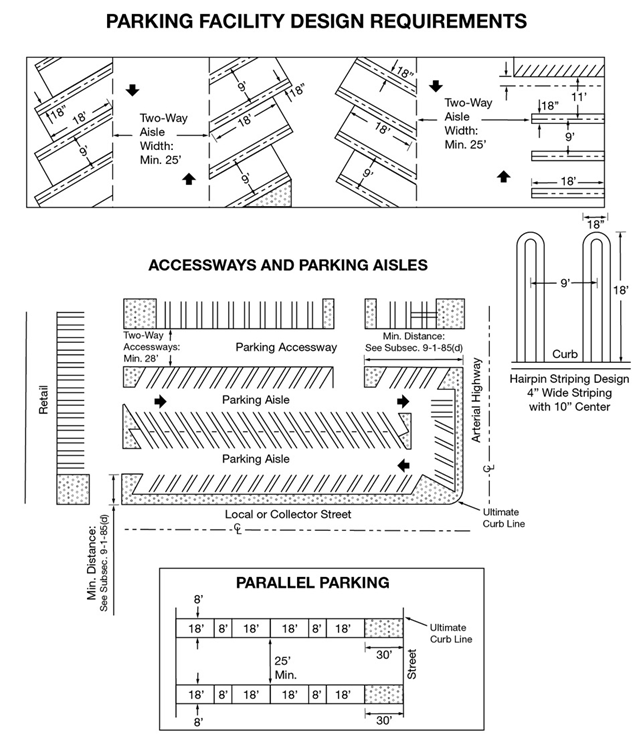
FIGURE 6.2
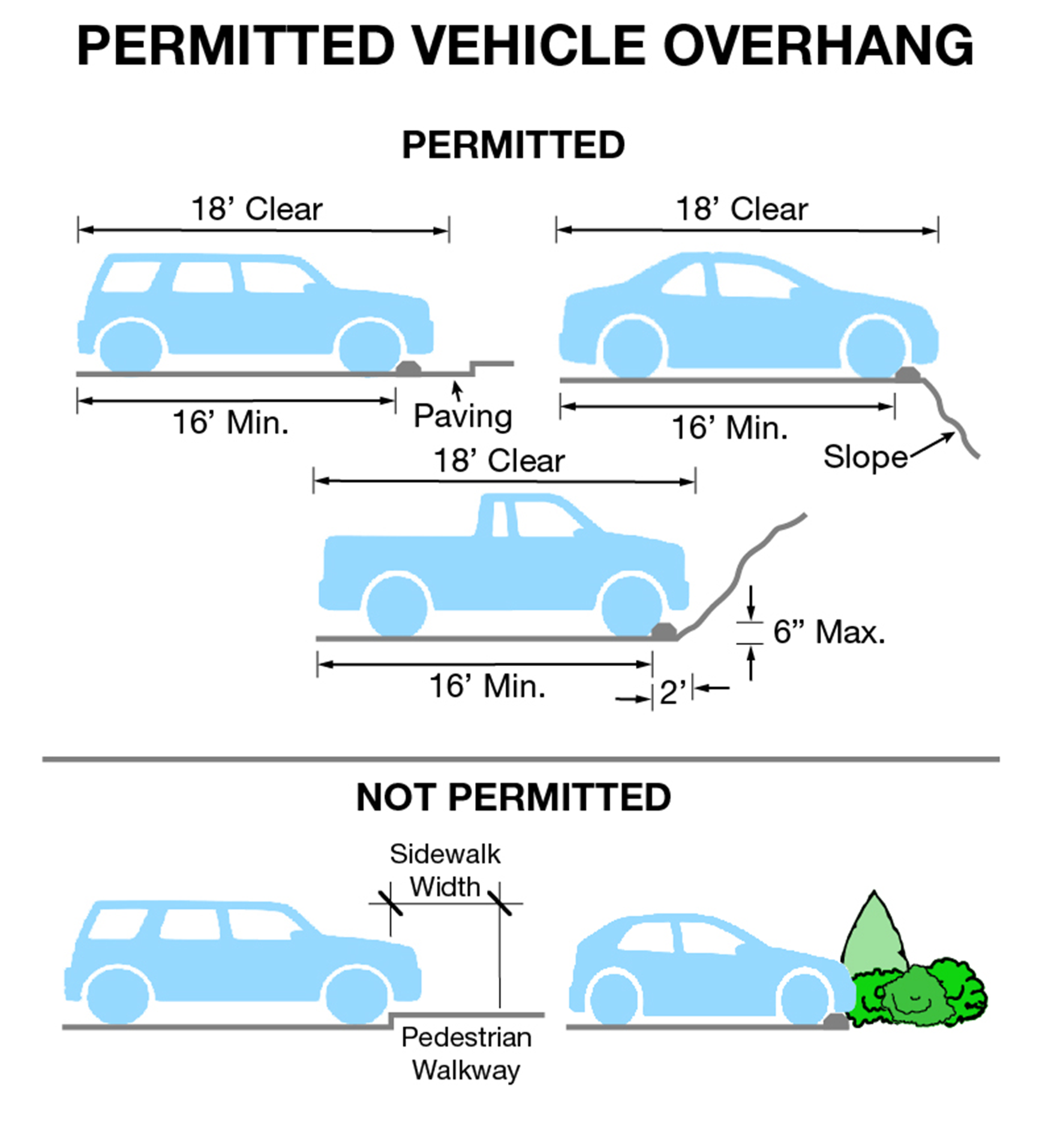
FIGURE 6.3
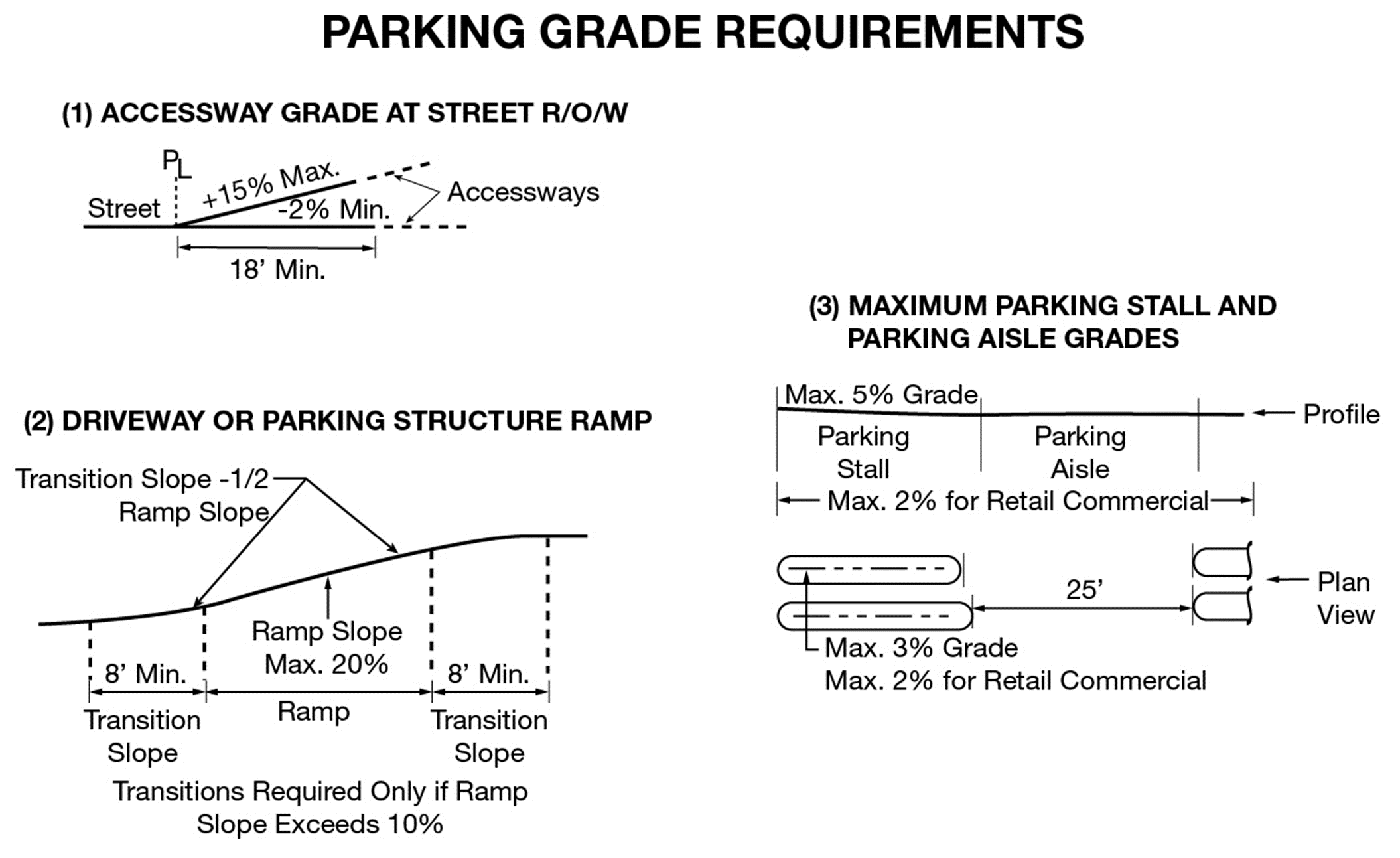
(b)
Minimum parking aisle width for one-way traffic.
TABLE 6.3: MINIMUM PARKING AISLES FOR ONE-WAY TRAFFIC
(c)
Minimum parking aisle width for two-way traffic. For two-way traffic, aisle widths and maneuvering areas shall be a minimum of 25 feet wide.
(Ord. No. 99-107, § 5, 2-2-99; Ord. No. 2021-210, § 52, 8-3-21)
Sec. 9-1-65. - Nonresidential parking requirements.
(a)
Applicability. The following offstreet parking requirements are applicable to all uses other than the residential uses set forth in , and are in addition to the general requirements set forth in :
(b)
Size of parking spaces.
(1)
All covered or uncovered offstreet parking spaces, except as otherwise noted in this subsection, shall be a minimum clear unobstructed nine feet in width and 18 feet in length.
(2)
Parking spaces parallel to a curb may be eight feet in width and 18 feet in length, with a minimum of eight feet separating each pair of such parking spaces.
(3)
When a side of any space abuts a building, fence, support column or other obstruction which interferes in any way with access to a motor vehicle, the space shall be a minimum of two feet wider than the standard required width.
(4)
In measuring the length of paving required for uncovered parking spaces, allowance may be made to accommodate vehicular overhang beyond a continuous, unbroken concrete curb, if such overhang does not interfere with screening or pedestrian use, except as provided under paragraph (c)(4) of this section (also, see figure 6.2 for examples of permitted overhang).
(c)
Parking facility design.
(1)
Offstreet parking facilities shall be designed so that a car within a facility will not have to enter a street to move from one location to any other location within that parking facility. On industrial or office sites, separate noncontiguous parking facilities may be provided with independent entrances for employee and visitor parking, provided the designated use is clearly identified on all plot plans or site plans submitted for permits.
(2)
Parking and maneuvering areas shall be arranged so that any vehicle can leave the parking area and enter into an adjoining vehicular right-of-way traveling in a forward direction.
(3)
Dead-end parking aisles shall have a designated turn around area, or hammer head to allow a three-point turn for exiting.
(4)
Continuous, unbroken concrete curbs shall be provided along any abutment to a pedestrian walkway, access or driveway, street or alley, except where screening is positioned, to ensure that the motor vehicle will not extend into these areas.
(5)
The point of exit or entry from any offstreet parking space shall not be closer than 20 feet from the curb face of the ultimate curbline at a street opening.
(6)
All paved parking stalls, except parallel spaces, which may use a single line, shall be clearly outlined with double or hairpin lines or special paving techniques on the surface of the parking facility. (See figure 6.1).
(7)
All parking spaces shall be located so as to be within proximity to the use they are intended to serve. Distribution of parking in multitenant centers should be in reasonable proximity to the uses they are intended to serve. As a general guideline the spaces should not be located greater than 500 feet from the use served. It is recognized that for larger retail buildings and centers this guideline may not be met.
(d)
Parking accessways. Parking accessways are those driveways that provide ingress or egress from a street to the parking aisles, and those driveways providing interior circulation between parking aisles. No parking is permitted on an accessway. Accessways shall conform to the following standards:
(1)
All parking facilities taking access from a major, primary or secondary arterial shall have a parking accessway between the arterial and the parking aisles.
(2)
Parking accessways from arterial highways shall not have parking spaces taking direct access therefrom and shall not be intersected by a parking aisle or another parking accessway for a minimum distance of 30 feet for projects with zero to 200 parking spaces, 50 feet for projects with 201 to 350 spaces, 70 feet for projects with 351 to 450 spaces, and 90 feet for projects with 451 spaces or more. All distances shall be measured from the curb face of the ultimate curbline of the adjacent street.
(3)
Parking accessways from nonarterial highways shall be not less than 20 feet in length from the ultimate curbline of the adjacent street.
(4)
One-way accessways shall have a minimum width of 15 feet, unless the accessway is a fire lane, which requires a minimum of 20 feet.
(5)
Two-way accessways shall have a minimum width of 28 feet.
(e)
Parking aisles. Parking aisles are driveways which provide direct access to parking spaces. Parking aisles shall have a minimum width of 14 feet as provided in table 6.3. In no case shall the parking aisles for two-way traffic be less than 25 feet in width.
(f)
Number of required parking spaces.
(1)
The minimum number of offstreet parking spaces required shall be in compliance with the listed requirements set forth for each category of land use in .
(2)
Whenever any commercial or industrial use is located on a building site that is also used for residential purposes, parking facilities shall be provided for the residential use as required, in addition to the parking required for the nonresidential use or uses.
(g)
Landscaping. Landscaping of parking areas shall be provided in accordance with the provisions of the applicable land use district regulations. In all cases, space within the offstreet parking area not utilized for driveways, maneuvering areas, parking stalls or walkways shall be landscaped. Landscaped areas shall be separated from paved driveways, parking space and maneuvering areas by a minimum six-inch-high barrier.
(h)
Screening. Open parking spaces and parking structures shall be screened in accordance with . Screening shall be located adjacent to the inside edge of any required boundary landscaping and to the outside edge of the paved parking area when there is no landscaping.
(i)
Vehicular access. Any site development permit, use permit or coastal development permit for development in nonresidential districts shall be in substantial conformity with the following:
(1)
The first street opening from an intersection should be a minimum of 110 feet from the point of intersection of the ultimate right-of-way lines of the abutting streets.
(2)
The second street opening should be a minimum of 300 feet from the point of intersection of the ultimate right-of-way lines of the abutting streets.
(3)
Any additional street openings should be a minimum of 300 feet, from center to center, from any other street opening.
(4)
There should be a minimum distance of 22 feet, measured at the ultimate property line, between a street opening in these districts and any existing street opening in any other district.
(j)
Joint use of parking facilities. Land uses on abutting building sites may share common parking facilities, provided the following requirements are met:
(1)
Parking facilities shall be within the same or contiguous shopping center, or within 300 feet of the entry point of the uses they serve, and a pedestrian pathway shall be provided as a means for pedestrian linkage between adjacent land uses and uses within the parking facility.
(2)
A detailed parking plan, showing all common parking facilities, building square footage, and tenant spaces participating, shall be approved by the Community Development Director.
(3)
Adequate assurance shall be provided to guarantee that required parking will continue to be maintained in compliance with the applicable provisions of this section.
(4)
If the abutting building sites are in separate ownerships, the common parking plan and guarantee of parking availability required by this paragraph (j) shall be recorded with the county recorder.
(5)
For shopping centers, please refer to (b) and (c) for shared parking provisions.
(k)
Motorcycle parking facilities. Motorcycle parking areas shall be provided at a rate of 50 square feet per space. Motorcycle parking areas shall be provided for all nonresidential uses at the following rate:
(1)
Uses with 25-99 automobile parking spaces shall provide one designated area for use by motorcycles.
(2)
Uses with more than 100 automobile parking spaces shall provide motorcycle parking areas at the rate of one motorcycle parking area for every 100 automobile parking spaces or fraction thereof provided.
(3)
Motorcycle parking areas required by this paragraph (l) shall count toward fulfilling automobile parking requirements.
(l)
Bicycle parking facilities. The minimum bicycle parking requirements for uses in the city are as follows:
(1)
Land uses that are required to provide bicycle parking equal to three percent of the total required parking spaces, as set forth in , include: Video and game arcades, bowling alleys, cinemas/movie theaters, commercial recreation, health clubs, libraries, schools, and skating rinks.
(2)
Land uses that are required to provide five bicycle parking spaces include: Banks, churches, clubs/halls, hospitals, restaurants (all categories).
(3)
Land uses that are required to provide bicycle parking equal to one space for each 25,000 square feet of gross floor area include all office uses (governmental, general, medical, financial).
(4)
In addition to the preceding requirements, retail centers shall provide five bicycle parking spaces for each major tenant having over 20,000 square feet of gross floor area. The spaces shall be provided at or near the major tenant's main entry.
(Ord. No. 99-107, § 5, 2-2-99; Ord. No. 2019-197, § 3, 6-4-19; Ord. No. 2021-210, § 53, 8-3-21)
Sec. 9-1-66. - Nonresidential spaces required by use.
(a)
Minimum requirements. All land uses shall provide offstreet parking in compliance with the requirements of this section, unless modified by the provisions contained in , Alternative parking regulations. The offstreet parking requirements listed in table 6.5, following, are the minimum requirements for each specific use. It shall be the responsibility of the developer, owner or operator of any specific use to provide adequate offstreet parking even though such parking may be in excess of the minimum requirements set forth in this section. The decision-making authority may impose such additional parking requirements if it finds that a parking study or other empirical data has demonstrated that additional parking spaces are required for a specific use or mix of uses.
(b)
Major shopping centers (shared parking model). Notwithstanding the individual parking space requirements identified in Table 6.5, it is recognized that the parking demand for major shopping centers, centers with 400 parking spaces or more and a mix of three or more commercial uses (e.g., office, restaurant, retail, service, fitness, cinema, etc.), typically varies between individual businesses, and that the total demand typically decreases as development size increases. In these situations, allowing for "shared parking" results in fewer total parking spaces needed when compared to the total number of spaces needed for each land use or business independently. Recognizing this, the following provisions apply:
(1)
If the overall parking space requirement for a major shopping center, per table 6.5, is greater than the cumulative number of spaces provided, a discount of up to 25 percent of the required overall number is permitted.
(2)
Parking discounts in excess of 25 percent for a major shopping center require the approval of a site development permit pursuant to the provisions of , Alternative parking regulations.
(c)
Neighborhood centers. For shopping centers with less than 400 parking spaces, if the overall parking space requirement, per table 6.5, is greater than the cumulative number of spaces provided, then an application may be made for a site development permit pursuant to the provisions of , Alternative parking regulations.
(d)
If number of spaces not specified. If no provisions for the required number of offstreet parking spaces are set forth in the table 6.5 following, or the provisions are not clear for any use, the community development director shall determine the number of offstreet parking spaces required.
TABLE 6.5: NONRESIDENTIAL PARKING SPACES BY LAND USE
(Ord. No. 99-107, § 5, 2-2-99; Ord. No. 2019-197, § 3, 6-4-19; Ord. No. 2021-210, § 54, 8-3-21)
Sec. 9-1-67. - Electric vehicle charging stations.
(a)
An application for the installation of electric vehicle charging stations shall be processed, reviewed, and permitted in accordance with - Building Regulations, Division 1, Article 12 of this Code.
(b)
Each EV charging space provided in a parking area counts as one space toward the minimum number of parking spaces required in and , provided that each EV charging space complies with the following design and development standards:
(1)
Each EV charging space shall include a posted sign and painted curb, or ground markings, indicating that the space is exclusively for EV charging purposes.
(2)
EV charging equipment shall not obstruct any Americans with Disabilities Act (ADA) compliant sidewalk, entrance, curb-cut, or ramp, while in use or otherwise.
(3)
Sufficient lighting shall be provided, at a minimum illumination level of two (2) footcandles (fc) and a maximum of three (3) fc, to enable the EV charging equipment to be used at night. The lighting height and shielding shall conform to LNMC (2) and (4), respectively.
(4)
The EV charging station shall not exceed a maximum height of eight (8) feet tall and maximum width of four (4) feet.
(5)
All cables and conduits shall be installed, laid, or otherwise placed beneath the ground surface. Above-ground cables and conduits are prohibited.
(6)
EV charging equipment shall be free of any commercial signage, animated or flashing screens, or other displays utilized for advertising purposes.
(7)
EV charging stations, including dispensers and ancillary equipment, shall comply with the following location and aesthetic requirements:
a.
EV charging stations shall be installed, located, or otherwise positioned in such a manner as to ensure that they are not visibly obtrusive as viewed from any public rights-of-way, including public streets and sidewalks.
b.
Ground equipment shall be fully concealed within a solid wall enclosure that is located outside of the designated boundary landscape areas and painted and designed in a manner that complements and harmonizes with the adjacent building structures. Small ground equipment, less than 20 square feet in footprint area and not exceeding a maximum height of four feet, shall be exempt from the requirement to be concealed within an enclosure. The square footage of the equipment footprint area shall be calculated by drawing a single contiguous shape around all proposed ground equipment.
c.
The applicant may propose an alternative to the wall enclosure for screening purposes, subject to the approval of the community development director. Such a request may be considered when it is assessed that the dimensions or location of the wall enclosure could result in increased visual intrusion, and diligent efforts are made to conceal or visually minimize ground equipment through alternative screening measures.
(Ord. No. 2024-228, § 3(Exh. 1), 5-21-24)
Sec. 9-1-70.- Purpose and intent.
The purpose of this subarticle is to implement the goals and policies of the general plan by:
(1)
Encouraging sound signing practices to provide business and directional information to the public;
(2)
Providing for signs which effectively identify businesses and other establishments via a limited number of clear readable signs, while preventing excessive and confusing sign displays;
(3)
Providing for signs which focus on identifying businesses by name and/or type of establishment (such as "John's Market") as opposed to goods or services offered (such as "beer, wine", etc.);
(4)
Reducing traffic hazards and promoting the public health, safety and welfare by minimizing visual competition among signs;
(5)
Providing for signs which incorporate high quality design and materials and which harmonize with surrounding buildings and streetscapes;
(6)
Providing minimum standards to safeguard and enhance property values and protect public and private investment in buildings and open spaces.
(Ord. No. 99-107, § 5, 2-2-99)
Sec. 9-1-71. - General provisions.
All references to this section shall include through . This section sets forth general provisions regulating such items as the placement, design, illumination, and measurement of signs.
(Ord. No. 99-107, § 5, 2-2-99)
Sec. 9-1-71.1. - General procedures.
(a)
Applicability. Signs in the city, including exempt, permanent, and temporary signs and holiday displays, are subject to the general procedures of this section. If the community development director determines that a staff-reviewed sign does not conform to one or more of the general provisions set forth in this section, the applicant shall be given the option of modifying the sign or applying for a minor adjustment.
(b)
Interpretation of provisions. Where a matter of interpretation arises regarding the provisions of this subarticle, the more specific definition or more rigorous standard shall prevail. Whenever the director determines that the application of any provision of this subarticle is uncertain, the interpretation shall be referred to the planning commission for determination.
(c)
Maintenance. Any sign displayed within the city, together with supports, braces, guys, anchors, and electrical components, shall be maintained in good physical condition, including the replacement of defective parts. Exposed surfaces shall be kept clean, in good repair, and painted where paint is required. The director may order the repair or removal of any sign determined by the director to be unsafe, defective, damaged, or substantially deteriorated.
(d)
Changes to existing signs. Changes in the sign face and/or sign copy of any existing sign, other than normal maintenance, shall be approved by the community development director to ensure that the new sign face and/or sign copy is consistent with the sign design criteria set forth in and any applicable sign program.
(e)
Inspection. All sign owners and users shall permit the periodic inspection of their signs by the city upon ten days notice.
(f)
Specific plan standards to apply. Signs to be located within the boundaries of a specific plan or other special design approval area shall comply with any criteria established by such plan or area.
(g)
Non-commercial signs. Signs shall be permitted in the city in accordance with this subarticle. In each instance and under the same conditions in which this subarticle permits any sign, a non-commercial sign constructed to the same physical dimensions and characteristics shall be permitted in lieu of that sign.
(1)
The foregoing notwithstanding, signs containing ideological, political or other non-commercial messages shall not be permitted in lieu of a directional, warning, or informational signs required by or authorized by law or by a governmental authority and traffic control signs on private property with messages, such as "Stop" and "Yield," and similar signs, the face of which meet California Department of Transportation standards and bear no commercial message of any sort.
(2)
For purposes of this subarticle, non-commercial means a sign containing an ideological, political, or other message not relating to a commercial transaction.
(Ord. No. 99-107, § 5, 2-2-99; Ord. No. 2024-229, § 2, 5-21-24)
Sec. 9-1-71.2. - Purpose of signs to be identification.
Commercial signs shall serve primarily to identify the name of the business or other activity on the premises rather than to advertise any product, service, or brand name. Brand names shall only be included in sign copy if the decision-making authority determines that such a name is integral to identification of the business (for example, a sign for an auto dealership).
(Ord. No. 99-107, § 5, 2-2-99)
Sec. 9-1-71.3. - Sign placement.
(a)
Traffic safety. No sign shall be located or designed in such a manner as to obstruct free and clear vision of pedestrian and vehicular traffic.
(b)
Corner cutoff setback. In order to preserve sight lines for safety purposes, free-standing signs shall not be located within a corner cutoff area for fences as identified in .
(c)
Off-premise signs. All signs shall be located on the same premises as the land use or activity identified by the sign unless specifically permitted to be off-premise in this subarticle.
(d)
Utility lines. No sign shall be located closer to overhead utility lines than the distance prescribed by state law or by the rules promulgated by agencies of the state or by the applicable public utility.
(e)
Public right-of-way. No sign shall be located within, over, or across a public right-of-way unless specifically permitted in this subarticle.
(Ord. No. 99-107, § 5, 2-2-99)
Sec. 9-1-71.4. - Sign design criteria.
The following design criteria shall be used in reviewing sign applications to determine compliance with the purpose and intent of this subarticle:
(1)
Colors. Sign colors shall complement the colors used for the buildings and the project as a whole. Colors or color combinations which interfere with legibility of the sign copy or which interfere with viewer identification of other signs shall not be used. Fluorescent, "day-glo," and similar colors shall not be used.
(2)
Materials. Signs shall be made of durable materials which are compatible in kind and/or appearance to the building facades supporting or identified by the sign. Such materials may include, but are not limited to, tile, sandblasted wood, individual channel and reverse channel ("halo" lighted) letters, "push-through" lettered signs, and concrete or stucco monument signs with recessed or raised lettering.
(3)
Plastic-faced signs. Except for individually-mounted channel letters or changeable copy signs such as theater marquees, internally-lighted translucent plastic-faced can signs shall not be used. However, such plastic-faced signs may be approved if existing similarly-situated and sized signs on the same building are also plastic-faced. In such cases, light-colored letters on a dark or opaque background shall be used. In addition, can signs with opaque backgrounds, such as those with fiberglass faces, may be used for individual project tenants if approved by the decision-making body.
(Ord. No. 99-107, § 5, 2-2-99; Ord. No. 2000-115, § 3, 7-5-00)
Sec. 9-1-71.5. - Sign illumination.
(a)
General limitation. Illumination from or upon any sign shall be shaded, shielded, directed, or reduced so as to avoid undue brightness and limit glare or reflection of light onto residential property in the surrounding area. "Undue brightness" means illumination in excess of that which is reasonably necessary to make the sign readable to the average person. Externally-illuminated signs shall be lighted by screened or hidden light sources.
(b)
Building-mounted signs. Building-mounted identification signs shall be externally illuminated except for individually-mounted channel and reverse channel letters and permitted changeable copy signs, such as theater marquees. Translucent plastic-faced can signs shall not be used.
(c)
Free-standing signs. Free-standing identification signs shall be externally illuminated except for individually-mounted channel and reverse channel letters, "push-through" letters, opaque background signs which give the appearance of individual channel letters, and permitted changeable copy signs, such as theater marquees. Translucent plastic-faced can signs shall not be used.
(d)
Neon. Neon illumination may be used for building-mounted signs if consistent with the design and architecture of the building. Neon shall not be used on freestanding signs, except in conformity with an approved sign program. Also, 60 milliamp transformers shall not be used on neon-lighted signs within 200 feet of residentially-zoned property.
(Ord. No. 99-107, § 5, 2-2-99)
Sec. 9-1-71.6. - Logos and graphics.
Corporate logos and graphics may be used in conjunction with wall signs, up to a maximum of 25 percent of the permitted sign area, if the decision-making authority determines that the design of the logo provides for individual channel-type construction and that such logos are harmonious in scale, form, materials, and colors with project buildings, walls, and other structures. All copy and graphics within the logo shall be individual letters or forms.
(Ord. No. 99-107, § 5, 2-2-99)
Sec. 9-1-71.7. - Landscaping of free-standing signs.
As part of their design, all free-standing signs shall include landscaping and/or hardscaping around the base of the sign, at a minimum ratio of two sq. ft. for every square foot of sign area, so as to protect the sign from vehicles, improve the appearance of the installation, and screen light fixtures and other appurtenances. The sign owner shall maintain all landscape areas in a healthy and viable condition.
(Ord. No. 99-107, § 5, 2-2-99)
Sec. 9-1-71.8. - Measurement of sign height and area.
(a)
Measurement of sign height. Sign height shall be measured as follows:
(1)
Building-mounted signs. The height of a building-mounted sign shall be measured at the sign's mid-point, from finish grade to the top of the sign.
(2)
Free-standing signs. The height of a free-standing sign shall be measured at the sign's mid-point, from finish grade to the top of the sign. However, in cases where the director determines that the visibility of a free-standing sign is impeded due to its placement below the elevation of the street to which it is oriented, the director may measure maximum sign height from the top of curb of the street (or the edge of pavement of such street where there is no curb) or from such other appropriate reference point as determined by the director.
(b)
Measurement of sign area. Sign area shall be measured as follows:
(1)
Basic rule. Sign size or area shall be defined as the total area of the sign face, including non-structural perimeter trim but excluding structures or uprights on which the sign is supported.
(2)
Window signs. Window sign area shall be considered to be the entire area of any sign placed on or inside a window which is not painted directly on the glass. For signs painted directly on the glass, area measurement shall be the same as that for individually-lettered wall signs, following.
(3)
Wall signs. The area of signs composed of individual letters affixed to a building, garden, retaining, or other wall shall be defined as the area which encloses all copy, logos and graphics on the wall with four, six or eight perpendicular lines.
(4)
Double-faced signs. If a sign is double-faced with only one face visible from any ground position at one time, its sign area shall be considered to be the area of either face taken separately. Thus, if the maximum permitted sign area is 20 sq. ft., a double-faced sign may have an area of 20 sq. ft. per face.
(5)
Three-dimensional signs. If a sign has three or more faces, its sign area shall be considered to be the sum of the areas of each individual face. Thus, if a sign has four faces and the maximum permitted sign area is 20 sq. ft., the maximum area for each face shall be limited to five sq/ft.
(6)
Separated-panel signs. The sign area of open, separated panel, or "ladder" signs, i.e. those signs having empty spaces between copy panels, shall be considered to be the entire area encompassed by the sign face, including the empty spaces between panels.
(Ord. No. 99-107, § 5, 2-2-99)
Sec. 9-1-72. - Permitted signs in nonresidential districts.
(a)
Permitted signs. Signs identified in table 7-1 following are permitted in nonresidential districts subject to the provisions of this section.
(b)
Tenant or building frontage. For the purposes of this subarticle, tenant or building frontage means the side of a building facing a parking lot, public or private street, driveway entrance, or freeway right-of-way.
(c)
Awning signs. For the purposes of this subarticle, any signage incorporated into an awning shall be considered a building-mounted sign.
TABLE 7-1. PERMANENT SIGNS PERMITTED IN NONRESIDENTIAL DISTRICTS WITH A SIGN PERMIT
Note: Signs not visible from any street or parking lot are exempt from the limitations
set forth below.
ID means identification sign.
Signs required by law shall be allowed at the minimum size specified by such law.
(Ord. No. 99-107, § 5, 2-2-99; Ord. No. 2000-115, § 3, 7-5-00; Ord. No. 2012-171, § 3, 7-17-12)
Sec. 9-1-73. - Permitted signs in residential districts.
Signs identified in table 7-2 following are permitted in residential districts subject to the provisions of this section.
TABLE 7-2. PERMANENT SIGNS PERMITTED IN RESIDENTIAL DISTRICTS WITH A SIGN PERMIT
Note: Signs not visible from any street or parking lot are exempt from the limitations
set forth below.
ID means identification sign.
Signs required by law shall be allowed at the minimum size specified by such law.
(Ord. No. 99-107, § 5, 2-2-99; Ord. No. 2000-115, § 3, 7-5-00; Ord. No. 2012-171, § 4, 7-17-12)
Sec. 9-1-74. - Permitted temporary signs.
(a)
No sign permit required. Temporary signs permitted per this section are exempt from the sign permit requirements set forth in this subarticle, unless otherwise stated herein.
(b)
Special event signs. Temporary special event signs and banners are allowed for commercial uses in nonresidential districts in accordance with (Sidewalk sales and center-wide events), subject to approval of a temporary use permit.
(c)
Grand opening and similar signs. Temporary non-illuminated building-mounted signs up to 20 sq. ft. in area, reading "Grand Opening", "Going out of Business", or "Under New Ownership", may be permitted for a period of up to 30 days if a temporary use permit is approved.
(d)
Temporary ID signs. In addition to the temporary grand opening and similar signs allowed per paragraph (c) of this section, new businesses may display a temporary identification sign during the interim period while a permanent identification sign is being approved, constructed and installed, provided that the size of the sign does not exceed the maximum size permitted for the permanent wall signs per . Such temporary business identification signs are permitted for a period of 30 days, subject to the approval of a temporary use permit, and may be extended up to an additional 30 days if approved by the community development director.
(e)
Window signs. Temporary non-illuminated window signs, in conjunction with a commercial center or business, shall be permitted subject to the following requirements:
(1)
Total sign area shall not exceed 20 percent of the aggregate window area per building frontage.
(2)
Total number of signs shall be limited to one window sign for every ten feet of linear window frontage.
(3)
Fluorescent, neon or "day-glo" sign colors are prohibited.
(f)
Residential real estate signs. Temporary non-illuminated on-premise real estate signs advertising the sale, rent, or lease of the property and the identification of the person or firm handling the sale, lease or rent, shall be permitted on any building site subject to the following:
(1)
For residential building sites with four or less units, total aggregate sign area, including riders, shall not exceed six square feet per sign face. For residential building sites with five or more units, total aggregate sign area, including riders, shall not exceed 20 square feet.
(2)
If located in a window, the real estate sign shall not cover more than 20 percent of the window or window pane in which it is placed.
(3)
Maximum height for free-standing signs shall be six feet and one sign is permitted per street or golf course frontage up to a maximum of two signs per building site.
(4)
No part of any sign shall be placed between the back of the curb and the sidewalk. Also, signs shall not be placed within a public right-of-way or in areas adjacent to designated scenic corridors.
(5)
Signs shall be removed within five days after close of escrow, lease or rent.
(g)
Residential off-premise open house directional signs. Temporary non-illuminated off-premise open house directional signs shall be permitted subject to the following:
(1)
A maximum of two signs are permitted, each with a maximum area of four square feet per sign face and a maximum height of four feet.
(2)
Signs are permitted only when the premises are open for inspection and when an owner or owner's agent is on the premises and shall be installed no earlier than 8:00 a.m. and removed no later than sunset.
(3)
No part of any sign shall be placed between the back of the curb and the sidewalk. Also, signs shall not be placed within a public right-of-way. Signs may be posted on private property with the prior consent of the property owner.
(4)
Signs may be located only in the immediate vicinity of street intersections and shall not be located mid-block, unless topography, landscaping, and/or other physical constraints interfere with sign visibility, in which case the sign may be located more distant from the intersection. The intent of the foregoing provision is to prohibit unnecessary multiple open house signs located mid-block.
(h)
Non-residential real estate signs. Temporary non-illuminated on-premises, non-residential real estate signs advertising the sale, rent, or lease of the property and the identification of the person or firm handling the sale, lease or rent, shall be permitted on any building site subject to the following:
(1)
One free-standing sign is permitted per street frontage.
(2)
For free-standing signs, total aggregate sign area, including riders, shall not exceed 22 square feet.
(3)
Maximum height for free-standing signs shall be seven feet and maximum width shall be four feet.
(4)
No part of any free-standing sign shall be placed between the back of the curb and the sidewalk. Where a sidewalk is present, signs shall be placed a minimum of two feet behind the back of sidewalk. Where no sidewalk is present, signs shall be placed a minimum of five feet behind the back of curb. Signs shall not interfere with sight distance restrictions.
(5)
For lease spaces and individual suites, one window sign is permitted per building frontage. The real estate sign shall not cover more than 20 percent of the window or window pane in which it is placed.
(6)
For lease spaces and individual suites over 5,000 square feet or stand-alone single-tenant buildings, one wall sign is permitted per street frontage, provided that the size of the wall sign(s) does not exceed the maximum size permitted for the permanent wall signs per and/or any approved sign program as appropriate.
(7)
Signs shall be removed within five days after close of escrow, lease or rent.
(i)
New residential projects. Sign programs may be approved per the standards of and the procedures of for off-premise directional signs, model home complex signs, and other temporary signs associated with a new residential development. Such programs may allow modified standards from those set forth in this section provided the required findings for sign programs are met.
(j)
Holiday window displays. Temporary signs and displays, in the nature of decorations, may be placed in or painted on windows if incidental to and customarily associated an official state or federal holiday. Such displays shall not advertise the business name or products. The display of animated "chase" lights is permitted only in the month of December and only in association with Christmas.
(k)
Construction signs. For nonresidential and tract-residential, one construction sign, unlit and non-illuminated, stating the names of those individuals or firms directly connected with the construction or development of the project and their addresses and telephone numbers, shall be permitted on any building site, subject to the following:
(1)
Total aggregate sign area shall not exceed 32 square feet, and the maximum height shall be six feet.
(2)
No rider may be attached to the sign.
(3)
No part of any sign shall be located within the area between the back of curb and the sidewalk.
(l)
Construction entrance signs. One sign, unlit and non-illuminated, identifying the construction entrance for a project, shall be permitted on any building site, subject to the following:
(1)
Total aggregate sign area shall not exceed 24 square feet, and the maximum height shall be six feet.
(2)
No rider may be attached to the sign.
(3)
No part of the sign shall be located within the area between the back of curb and the sidewalk.
(m)
Seasonal temporary non-commercial signs. Seasonal temporary non-commercial signs shall be permitted, subject to the following:
(1)
Each sign shall not exceed four square feet in area and a maximum height of three feet.
(2)
Signs shall be placed no earlier than 45 days before a forthcoming federal, state, or local election in which Laguna Niguel voters participate.
(3)
Signs must be removed no later than five days after said election. If an election sign is not removed within five days after said election, the city may recover costs for removal.
(Ord. No. 99-107, § 5, 2-2-99; Ord. No. 2000-115, § 3, 7-5-00; Ord. No. 2012-171, § 5, 7-17-12; Ord. No. 2024-229, § 3, 5-21-24)
Sec. 9-1-75. - Signs exempt from permit requirements.
The signs listed in table 7-3, following, do not require a sign permit, nor shall their area and number be included in the aggregate area or number of signs permitted for any premises or use. However, this exemption shall not be construed as relieving the sign owner of the responsibility of:
(1)
Obtaining any building or other permits required for sign erection, if any;
(2)
Proper sign maintenance; or
(3)
Compliance with applicable provisions of this subarticle or of any other law or ordinance. Exempt signs shall not be placed within any public right-of-way unless specifically permitted in this section.
TABLE 7-3. SIGNS NOT REQUIRING A SIGN PERMIT
(Ord. No. 99-107, § 5, 2-2-99; Ord. No. 2000-115, § 3, 7-5-00)
Sec. 9-1-76. - Sign programs.
(a)
Purpose. Sign programs are intended to provide incentive and latitude in order to achieve variety, effective identification, attractive appearance, and coordinated design for multi-tenant centers and other applicable projects.
(b)
Modifications to standards. The standards of this subarticle relating to sign number, placement, size, and height may be modified for signs in an approved sign program provided all requirements of this section are satisfied.
(c)
Applicability. Sign programs shall be required for all shopping centers, office complexes, business parks, and similar projects. In addition, freestanding business uses over 10,000 square feet in gross floor area, multiple centers or building sites sharing a common access, and other projects identified in this Code are also eligible for approval of sign programs.
(d)
Procedures.
(1)
Sign programs shall be approved via a site development permit per . All permanent signs subject to an approved sign program shall be consistent with that sign program. In cases where a sign program has not been adopted, individual signs shall be subject to approval of a sign permit per .
(2)
The decision-making authority, upon completion of its review, may attach appropriate conditions to any sign program approval.
(3)
The following findings are required for approval of a sign program in addition to the other findings required for approval of a site development permit:
a.
The sign program is consistent with the purpose and intent of this subarticle;
b.
All signs within the sign program are visually coordinated via the incorporation of several common design elements such as materials, letter style, colors, illumination, sign type or sign shape.
c.
The signs within the sign program relate visually to the buildings, storefronts, or tenant spaces they identify. This may be accomplished by utilizing materials, colors, or design motif of the building being identified.
(e)
Pre-1990 sign programs. For any sign program adopted prior to January 1, 1990, the community development director shall determine if new signs or sign modifications subject to the program are consistent with the sign regulations in this subarticle. Upon submittal of an application for a sign permit, the director shall determine if the sign is of superior design and if it meets the intent of these regulations. If the director determines that the proposed sign is not consistent, the sign(s) shall be permitted only upon approval of a site development permit per .
(f)
Submission materials. Applications for a sign program shall be accompanied by the following plans in addition to other applicable site development permit application materials:
(1)
Site plan. A plan, drawn to scale, delineating the site proposed to be included with the sign program.
(2)
Building elevations. Drawings and/or sketches indicating the exterior surface details of all structures on the site.
(3)
Identification signs. Drawings, to scale, indicating the sign copy size, method and intensity of illumination, height, sign area and location of all signs.
(4)
Ancillary signs. The sign program submission shall include all ancillary signs, such as interior directional and traffic control signs, handicap parking signs, liability disclosure signs, address number, etc., and shall show size, location and design of each such sign.
(Ord. No. 99-107, § 5, 2-2-99)
Sec. 9-1-77. - Prohibited signs.
The signs and displays listed in this section are prohibited in the city. Such signs are subject to removal by the city at the owner's or user's expense. Prohibited signs include the following:
(1)
Any sign not in accordance with the provisions of this subarticle;
(2)
Painted wall signs;
(3)
Abandoned signs;
(4)
Rotating, revolving, or otherwise moving signs;
(5)
Automobile, truck, trailer and other signs affixed to vehicles which advertise, identify or provide direction to a use or activity not related to making of deliveries or rendering services which are used exclusively or primarily for advertising, unless specifically permitted;
(6)
Flags, balloons, pennants, streamers, spinners, festoons, windsocks, valances, or similar displays, unless specifically permitted via a site development permit or other applicable permit;
(7)
Animated or flashing signs;
(8)
Portable signs, unless specifically permitted in this subarticle;
(9)
Off-premise signs, unless specifically permitted in this subarticle;
(10)
Billboards or outdoor advertising signs;
(11)
Signs which identify or advertise activities which are illegal under federal, state, or local laws in effect at the location of such signs or activities;
(12)
Building-mounted signs placed on or above the roof or above the eave line of any structure;
(13)
Signs which, by reason of their size, location, movement, content, coloring, or manner of illumination may be confused with or construed as a traffic-control sign, signal, or device, or the light of an emergency vehicle, or which obstruct the visibility of any traffic or street sign or signal device;
(14)
Signs that create a potential safety hazard by obstructing clear views of pedestrian or vehicular traffic;
(15)
Signs located upon or projecting over public streets, sidewalks, or rights-of-way unless the sign meets the criteria of this subsection 15(a);
a.
Seasonal temporary non-commercial signs in designated public rights-of-way. Seasonal temporary non-commercial signs shall only be permitted in the public rights-of-way depicted in Figure 7.1 subject to the following requirements:
1.
Signs shall be securely affixed and positioned in a manner that ensures public safety and prevents any risk of accidents or hazards.
2.
Notwithstanding (m)(1), total aggregate sign area shall not exceed four square feet in area and a maximum height of three feet.
3.
Signs must comply with the requirements of (m)(2)—(3).
4.
No more than three signs with the same message may be permitted for each designated area.
5.
No part of any sign shall be placed between the back of the curb and the sidewalk when the sidewalk abuts the curb.
6.
Signs and sign placement shall not cause damage to the site, including landscaping, irrigation, or City property.
7.
Signs shall not be affixed to any utility at the site, including hydrant, street, traffic signs, utility poles, wires, boxes, or any landscaping, including trees, shrubs, tree stakes, or protective guards.
8.
Signs shall not obscure visibility or access to fire hydrants, traffic signs, or traffic signals, block motorists' line of sight, or otherwise inhibit or interfere with vehicular or pedestrian traffic.
9.
Signs shall not block any safety sign or notice or official or legal notices issued by any court or public body or officer in the performance of a public duty.
10.
No flags, pennants, balloons, or other attention-attracting devices shall be affixed to or otherwise displayed in conjunction with the sign.
11.
The foregoing notwithstanding, (15) shall not apply to directional, warning, or informational signs required by or authorized by law or by a governmental authority, including signs necessary for the operation and safety of public utility uses.
12.
The City makes no representations about the conditions, from time to time, of the identified signage locations and hereby puts all persons on notice that the conditions of the property is uncertain and all persons' use of the property is at their sole risk. The City notes that soil conditions, traffic conditions, weather conditions, and the acts of third parties may put person(s) and property placed pursuant to this section at risk and further, that the person(s), groups, and supporters of any person, group, or entity does so at their own risk and, for themselves, their heirs and assigns, releases, waives, and indemnifies, and hold harmless the city, including its elected officials, officers, staff, employees, and contractors from all damages, awards, payments, claim, or reimbursement, of all types and nature, that may, from time to time, arise while utilizing this section and the rights accorded herein and pursuant to this section.
(16)
Signs attached to utility poles or stop signs or other municipal sign structure;
(17)
Balloon signs, inflatable animal or other figures, or other inflatable displays, whether tethered or not, except as otherwise permitted by a temporary or special outdoor event permit;
(18)
Signs located closer to overhead utility lines than the minimum distance prescribed by state law, or by the rules duly promulgated by agencies of the state or by the applicable public utility;
(19)
"For Sale" signs affixed to vehicles parked on public right-of-way or on any vacant property;
(20)
Neon signs, except those specifically approved as an activity's major identification sign;
(21)
Signs drawn or painted onto or otherwise affixed to trees or rocks unless specifically permitted in this subarticle;
(22)
Advertising statuary;
(23)
Any temporary sign or banner, unless specifically permitted in this subarticle.
(24)
External displays, other than temporary decorative holiday lighting or holiday displays, which consist of unshielded light bulbs or festoons and strings of open lightbulbs.
(25)
Persons or animals used for advertising purposes to attract attention to a use or activity on public or private property.
(Ord. No. 99-107, § 5, 2-2-99; Ord. No. 2000-115, § 3, 7-5-00; Ord. No. 2024-229, § 3(Exh. 1), 5-21-24)
Figure 7.1: Approved Public Right-of-Way for Seasonal Placement of Temporary Non-Commercial
Signs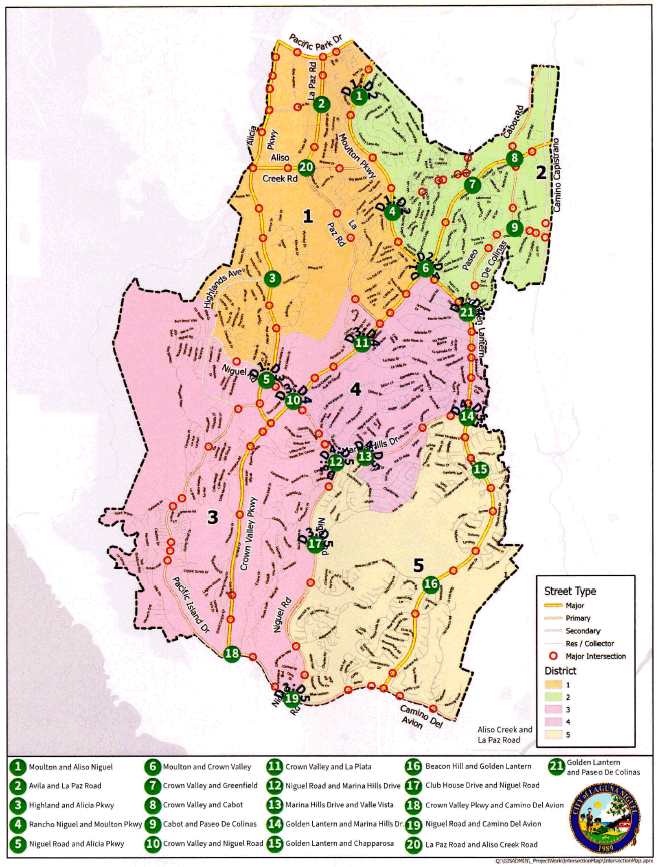
Sec. 9-1-78. - Administration.
All references to this section shall include through . This section provides regulations and procedures for administering the approval of signs and rules governing the continuation and/or abatement of nonconforming, illegal and abandoned signs.
(Ord. No. 99-107, § 5, 2-2-99)
Sec. 9-1-78.1. - Sign permits.
(a)
Sign permit required. Sign permit approval is required prior to obtaining a building permit for the placing, erecting, moving, reconstructing, altering, or displaying any sign on private property within the city, unless the sign is exempt from permit requirements per or other provisions of this subarticle. The director may integrate required sign permits into the building permit application and process or into other applicable permit process.
(b)
Existing signs. Signs legally existing prior to the effective date of the ordinance codified in this subarticle shall not require a sign permit until such time as the sign is moved, structurally altered, changed or relocated; at which time, the review and approval provisions of this section shall apply before a sign permit and/or building permit is issued.
(c)
Submission materials. Plans, application forms, and other submission materials for sign permit applications shall be as specified by the community development director.
(d)
Review procedures. The director shall review sign applications and shall determine to either approve, approve with modification, or deny the application. No sign permit application shall be approved unless the director finds that the proposed sign conforms to the provisions of this subarticle.
(Ord. No. 99-107, § 5, 2-2-99)
Sec. 9-1-78.2. - Nonconforming signs.
(a)
Continuation of nonconforming signs. A nonconforming sign is any permanent or temporary sign which was legally established and maintained in conformance with the provisions of all applicable laws in effect at the time of original installation but which does not comply with the provisions of this subarticle. Such nonconforming signs may be continued and maintained provided:
(1)
The sign is properly maintained and does not constitute a danger to the public; and
(2)
The sign was covered by a valid permit or variance or complied with all applicable laws on the date of adoption of the ordinance codified in this subarticle.
(b)
Rules. A nonconforming sign shall not be:
(1)
Changed to another nonconforming sign or removed and then replaced as the same nonconforming sign;
(2)
Expanded or altered unless such alteration is designed to bring the sign into full conformance with all current provisions of this subarticle;
(3)
Relocated to another site on the same property or any other property; or
(4)
Re-established after abandonment as defined in .
(c)
Damage or destruction. Any nonconforming sign which is damaged or destroyed beyond 50 percent its value shall be removed or brought into conformity with the provisions of this chapter. The determination whether a sign is damaged or destroyed beyond such 50 percent of value shall rest with the community development director and shall be based upon the actual cost of replacing said sign.
(d)
Burden on owner. The burden of establishing a sign as legally nonconforming under this section rests upon the person or persons, firm or corporation claiming legal status for a sign.
(Ord. No. 99-107, § 5, 2-2-99)
Sec. 9-1-78.3. - Enforcement and abatement.
(a)
Enforcement responsibility. It shall be the duty of the director or the director's authorized representative to enforce the provisions of this subarticle.
(b)
Illegal signs. Any sign which does not have a required permit or which otherwise violates applicable provisions of this subarticle shall be deemed illegal. If the director determines a sign to be illegal, the director may order the property owner and/or sign owner to remove the sign or may require other actions to ensure compliance with this subarticle.
(c)
Abandoned signs. Any sign located on property which becomes vacant or unoccupied or which pertains to any occupant or business unrelated to the premises' present occupant or business, or which pertains to a time, event or purpose which no longer applies shall be deemed abandoned. Such signs shall be removed, along within any footings, poles, and ground or wall supports, within 30 days after the associated enterprise or occupant has vacated the premises or within 30 days after the time, event, or purpose associated with the sign has ended. Any such sign not removed within the required period shall constitute a nuisance and shall be subject to immediate removal. In the event that an internally-lighted "can" type sign is abandoned, the director may allow the can portion to remain, provided a blank opaque sign face, with a color consistent with other can-type signs within the project, is installed within the preceding 30-day time frame.
(d)
Expired temporary signs. A temporary sign which remains posted beyond the time limits set per shall be removed immediately upon notification of the applicable business owner or property owner by the director.
(e)
Abatement and removal of signs. Any illegal or abandoned sign may be deemed to be a public nuisance that poses an immediate danger to the health, safety and welfare of the community. The owner of the sign shall be responsible and liable for the removal and disposal of the sign.
(f)
No city liability. Neither the city nor any of its agents shall be liable for any damage to a sign which is removed under this section.
(g)
Legal action by city. In response to any violation of the provisions of this subarticle, the city may elect to file a criminal complaint against the violator, issue a citation to the violator for an "infraction" pursuant to state government code section 36900, or institute a civil action in a court of competent jurisdiction.
(Ord. No. 99-107, § 5, 2-2-99)
Sec. 9-1-79. - Sign definitions.
For the purposes of this subarticle, words and phrases pertaining to signs shall be defined as follows:
(1)
Abandoned sign means a sign which is located on property which becomes vacant or unoccupied or which pertains to any occupant or business unrelated to the premises' present occupant or business, or a sign which pertains to a time, event or purpose which no longer applies.
(2)
Accessory sign means a sign whose copy refers to the products, facilities, or services available on the premises and/or pricing information, phone numbers, or hours of operation.
(3)
Advertising statuary means an imitation or representation of a person or thing which is sculptured, molded, modeled, or cast in any solid or plastic substance, material, or fabric and used to identify or advertise a product or service.
(4)
Advertising vehicles means any vehicle or trailer on a public right-of-way or public property or on private property so as to be visible from a public right-of-way which has attached thereto, or located thereon, any sign or advertising device for the basic purpose of providing advertisement of products or directing people to a business or activity located on the same or nearby property or any other premises. This provision is not to be construed as prohibiting the identification of a firm or its principal products on a vehicle operating during normal course of business. Public buses or taxis are exempt from this prohibition.
(5)
Animated sign means any sign which includes action or motion or the optical illusion of action or motion, or color changes of all or any part of the sign facing, requiring electrical energy, or set in motion by movement of the atmosphere. Excluded from the definition are public service message center signs and flags.
(6)
Attraction board means a sign capable of supporting copy which is readily changeable without the use of tools, such as a theater marquee, and which refers to products, services, or coming events on the premises.
(7)
Banner or banner sign means a sign hung either with or without frames, possessing written communication applied to nonrigid paper, plastic or fabric of any kind.
(8)
Billboard means an off-premise sign with changing advertising copy or other changing copy.
(9)
Bulletin board means a board, kiosk, or wall area on which are affixed personal notices, lost-and-found notices, business cards, and similar small informal notices referring to products, services, activities, or other items not offered on the same premises. The term bulletin board shall not include business identification signs or attraction boards.
(10)
Building-mounted sign means a sign affixed to a building, painted directly on a wall, or erected against the wall of a building. Building-mounted signs include awning signs, fascia signs, mansard roof signs, wall signs, window signs, projecting signs, and under-canopy signs.
(11)
Business means a commercial, office, institutional, or industrial establishment.
(12)
Canopy means a fixed structure of any material and any length, projecting from and connected to a building and/or columns and posts from the ground, or supported by a frame extending from the building and/or posts from the ground.
(13)
Construction sign or future facility construction sign means a sign containing information pertaining to a future development on the site where the sign is located, including the name of the project, the developer, contractor, financing source, future occupant(s), and other information directly related to the development.
(14)
Copy or sign copy means any words, letters, numbers, figures, designs, or other symbolic representations incorporated onto the face of a sign.
(15)
Directional sign means any sign which is designed and erected solely for the purpose of traffic or pedestrian direction and which is placed on the property to which or on which the public is directed. Such a sign contains no advertising copy. (Examples are: "One-way," "entrance," "exit," "parking in rear," "15 miles per hour," "no left turn").
(16)
Director or community development director means the community development director for the city or the director's authorized agent or representative.
(17)
Electronic message board sign means a sign with a fixed or changing display composed of a series of lights..
(18)
Exempt sign means a sign which is designated in this Code as not subject to certain regulations.
(19)
Face of building wall means the outer surface of any main exterior wall or foundation of a building, including windows and store fronts.
(20)
Flag means a visual display device without copy, made of flexible material, usually cloth, paper, or plastic.
(21)
Flashing sign means any sign which contains an intermittent or flashing light source or which includes the illusion of intermittent or flashing light by means of animation or an externally mounted intermittent light source. Excluded from the definition are public service message center signs.
(22)
Free-standing sign means a sign supported upon the ground and not attached to any building. This definition includes monument signs and ground signs.
(23)
Garage sale sign (i.e., yard sales, moving sales, patio sales) means a sign used to announce sale of a used item or items.
(24)
Identification sign or ID signmeans a sign which serves to identify only the name of a building, business, office, establishment, person, activity, or lawful use of the premises upon which it is located and which does not include goods or services available, pricing information, phone numbers, or hours of operation. "Identification sign" may include brand names if such names are integral to the name of the business (e.g. "Tom Jones Ford").
(25)
Illumination means the method by which a sign is lighted so as to be readable at night. The following types of illumination are provided for in this subarticle:
a.
External illumination means the lighting of an opaque sign face from a light source mounted in front of the face.
b.
Internal illumination means the lighting of the sign face from behind so that the light shines through translucent sign copy or lighting via neon or other gases within translucent tubing incorporated onto or into the sign face.
(26)
Logo means a trademark or symbol of an organization.
(27)
Mansard roof sign means any sign attached to or supported by a mansard roof. A "mansard roof" is a roof having two slopes, the lower steeper than the upper, and having a slope of sixty degrees or greater with the horizontal plane.
(28)
Monument sign means a free-standing sign mounted on a low-profile solid base or a fence, or a free-standing wall, as distinguished from support by poles.
(29)
Multi-tenant building means a development in which there exists a number of separate activities, in which there are appurtenant shared facilities (such as parking or pedestrian mall), and which is designed to provide a single area in which the public can obtain varied products and services. Distinguishing characteristics of a multi-tenant building may, but need not, include common ownership of the property upon which the center is located, common-wall construction, and multiple-occupant use of a single building.
(30)
Neon sign means a sign which utilizes neon or other gases within translucent tubing in or on any part of the sign structure.
(31)
Off-premise sign means a which is not appurtenant to the use of the property where the sign is located or a product sold or a service offered upon the property where the sign is located, and which does not identify the place of business where the sign is located as a purveyor of the merchandise or services advertised upon the sign. Some temporary signs are not defined as off-premises signs as used within this subarticle.
(32)
On-premise sign means a sign referring to a person, establishment, merchandise, service, event, or entertainment which is located, sold, produced, manufactured, provided, or furnished on the premises where the sign is located.
(33)
Parapet wall means a wall extending above the roof plane of the building.
(34)
Permanent sign means any sign which is intended to be and is so constructed as to be a lasting and enduring condition, remaining unchanged in character, condition (beyond normal wear) and position and in a permanent manner affixed to the ground, wall or building, provided the sign is listed as a permanent sign in this subarticle.
(35)
Political campaign sign or political sign means a sign indicating the name and/or picture of an individual seeking election to a public office, or relating to a forthcoming public election, referendum, initiative, or to the advocating by persons, groups or parties of political views or policies.
(36)
Portable sign or mobile sign means a sign made of any material, which, by its design, is readily movable and is equipped with wheels, casters or rollers or which is not permanently affixed to the ground, structure or building, or a sign upon a vehicle or trailer used as a stationary advertising display, the primary purpose of which is to serve as a base or platform for the sign. (Also includes sidewalk or sandwich board signs).
(37)
Projecting sign means any sign with two parallel faces no more than 18 inches apart projecting 12 inches or more from the wall or eaves of a building. No guy wires, braces, or secondary supports are visible.
(38)
Private property means any property other than public property.
(39)
Public property means any real or personal property in which the city or any other governmental entity or any publicly regulated utility company possesses an ownership interest. Public property shall include, without limitation, any street, sidewalk, curb, curbstone, street lamp post, hydrant, tree, tree stake or guard, railroad trestle, electric light, power, telephone or telegraph wire, pole or appurtenance thereof, any fixture of a fire alarm or police telephone or telegraph system, any lighting system, public bridge or wall, drinking fountain, life buoy, life preserver, lifesaving equipment, street, sign, traffic sign or signal, street median, public park, or other publicly owned property or structure.
(40)
Real estate sign means a sign advertising the sale, lease or rent of the property upon which it is located and the identification of the person or firm handling such sale, lease or rent.
(41)
Roof sign means any sign erected upon or above a roof or parapet wall of a building or placed above the apparent flat roof or eaves of a building.
(42)
Seasonal sales sign means a sign used to advertise a business or merchandise held seasonally for a limited interval, all or most of whose business is conducted or whose merchandise is displayed in an outdoor area.
(43)
Sign means any medium for visual communication, including but not limited to words, symbols and illustrations, together with all parts, materials, frame and background, which is used or intended to be used to attract attention to, identify, or advertise an establishment, product, service, activity or location, or to provide information.
(44)
Sign area is defined in of this subarticle.
(45)
Sign face means the exterior surface of a sign exclusive of structural supports, on which is placed the sign copy.
(46)
Sign height, height of sign, or height is defined in of this subarticle.
(47)
Sign permit means an entitlement from the city to place or erect a sign.
(48)
Sign structure means the structural supports, uprights, and bracing for a sign.
(49)
Special event sign means a sign used to announce a special commercial event such as a sale, sidewalk sale, or parking lot sale, or a community event such as a circus, carnival, festivals or similar event.
(50)
Under-canopy sign means a sign suspended beneath a projecting canopy, walkway cover, awning, ceiling, or marquee.
(51)
Wall sign means a sign attached to, erected on, painted on or otherwise affixed to the exterior wall of a building or structure in such a manner that the face of the sign is approximately parallel to the exterior wall of the building and exposed to the exterior side of the building. Signs or advertising displays in or on windows are not considered wall signs.
(52)
Window sign means any sign painted on or attached to a window or located inside within a distance equal to the greatest dimension of the window (either width or height) and designed to be viewed from the outside of the building in which the window is located.
(Ord. No. 99-107, § 5, 2-2-99)
Sec. 9-1-80.- Short title.
This subarticle may be cited and referred to as "the hillside protection ordinance" or "the HPO."
(Ord. No. 99-107, § 5, 2-2-99)
Sec. 9-1-81. - Hillside protection regulations.
(a)
Purpose and goals. The purpose of the hillside protection regulations contained in this subarticle is to achieve the following goals:
(1)
To protect the public health and safety by preserving very steep hillsides in open space and by minimizing geologic hazards, erosion and other potential dangers associated with hillside areas.
(2)
To minimize impacts in hillside areas to endangered, threatened or rare species of flora and fauna.
(3)
To ensure that any permitted hillside development conforms to the character of the natural topography and that the visual impacts of grading are softened by requiring designs which incorporate slope undulation, blending and other features to reflect the natural terrain.
(b)
Hillside protection policies. City policies aimed at achieving the hillside protection goals set out in subsection (a) of this section shall be as follows:
(1)
Development restrictions in steep areas. Development should be restricted in steep areas in order to ensure development safety and limit the amount of grading required for development.
(2)
Limitations on earth movement. The amount of earth movement for hillside development should be limited both in quantities moved within a site, in order to limit landform alteration, and quantities imported or exported, in order to limit dirt hauling on city streets.
(3)
Contouring of manufactured slopes. Manufactured slopes should be designed to resemble natural hillside contours and should blend with natural terrain where the two join in order to visually integrate development into the natural hillside.
(4)
Slope and retaining wall heights. The height of manufactured slopes and retaining walls should be restricted in order to limit the size and accompanying visual impacts of manmade slopes and structures on the hillside.
(5)
Landscaping and other visual mitigation. Intensive slope landscaping and other mitigation measures should be required in order to screen and soften the intrusive appearance of hillside building and grading.
(6)
Protection of biological resources. Development impacts to endangered, threatened or rare species of flora and fauna and sensitive biological habitats should be avoided or mitigated, consistent with state and federal definitions and regulations, in order to preserve environmental quality and diversity.
(c)
Hillside protection standards. In order to control and soften the visual impacts of hillside development, ensure the safety and stability of such development and implement the hillside protection policies set forth in subsection (b) of this section, the following standards shall apply to all projects subject to this section. The planning commission shall use its assessment of overall compliance with these hillside protection standards as the primary criterion for determining if a project complies with the hillside protection policies of subsection (b). The applicable hillside protection policy is shown preceding the standards which directly support that policy.
Policy. Development restrictions in steep areas.
Standard no. 1: Grading on steep slopes. Grading on slopes with a gradient of 30 percent or more shall be prohibited unless the planning commission approves an exception pursuant to subsection (d) of this section. Such an exception shall be approved only if the planning commission finds, after review of a geotechnical study by a professional engineer or engineering geologist registered in the state, that:
a.
Such increased grading is necessary in order to utilize the most feasible development locations on the property (for purposes of this standard, the term "feasible" means capable of attaining the project's objectives at reasonable cost and within a reasonable length of time); or
b.
Such increased grading is necessary to implement corrective measures so as to ensure safe and stable development of the developable portions of the property, and project design alternatives, such as relocation of development areas or reduction in the size of the project, are not sufficient to eliminate the need for the corrective grading.
For purposes of determining the extent of slope areas over 30 percent, slope gradients shall be averaged over horizontal 100-foot intervals measured perpendicular to the contour lines (see sketch).
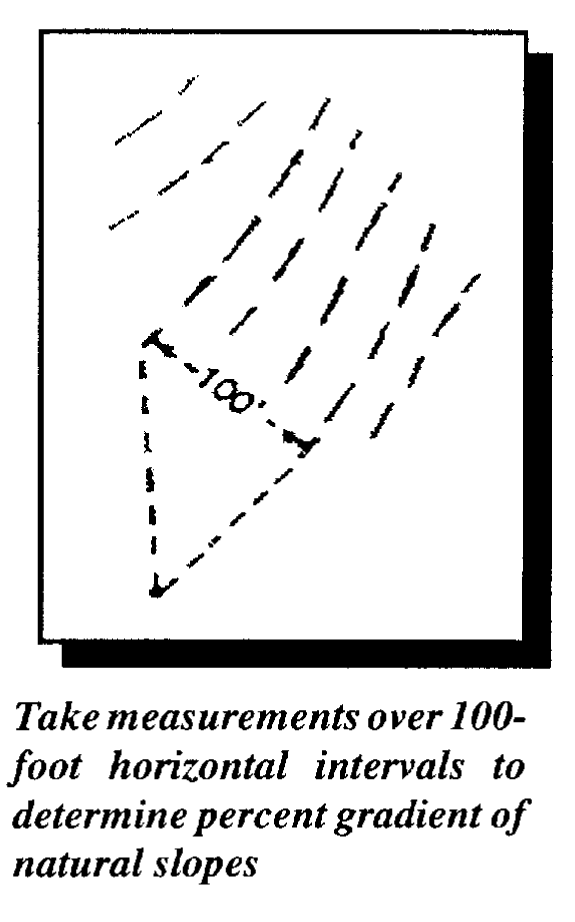
Policy. Limitations on earth movement.
Standard no. 2: Grading quantities. Grading quantities, both within a site and in cubic yards imported or exported, shall be the minimum that the planning commission determines is needed to:
(1)
Accommodate reasonable development of the site; and
(2)
Facilitate conformance of the project with the other hillside protection standards contained in this section.
Policy. Contouring of manufactured slopes.
Standard no. 3: Blending. The tops and toes of manufactured slopes shall be contoured and landscaped to blend into adjacent terrain. A smooth gentle transition shall be made where the planes of manufactured and natural slopes intersect (see figures 8.1, 8.2).
Standard no. 4: Undulation. Manufactured slopes over six feet in height shall be designed to reflect the appearance of the surrounding natural hillsides and to avoid long flat-planed surfaces. This shall be achieved by means of slope undulation, i.e., by curving both the tops and toes of slopes and varying the slope gradient from the 2:1 maximum steepness on some portions to flatter ratios such as 5:1 on others (see figures 8.1, 8.2).
Standard no. 5: Street alignment. Where streets and driveways are approved to cross areas of over 30 percent slope gradient, they shall be aligned to conform to natural grades as much as possible consistent with emergency access acceptable to the fire department.
Policy. Slope and retaining wall heights
Standard no. 6: Height of slopes. Manufactured slopes shall not exceed 60 feet in vertical height, nor shall more than one terrace drain be used on such slopes. In addition, slopes 30 to 60 feet in height may be tiered one above the other only if there is a minimum horizontal separation of 100 feet (at less than ten percent gradient) between the top of the lower slope and the toe of the slope above it (see figure 8.1).
Standard no. 7: Height of retaining walls. Retaining walls and crib walls shall not exceed six feet in height and shall be planted with vines and/or other landscape screening. Where the planning commission finds that greater retaining is needed, it may approve a tier of up to three such walls (up to six feet high each) placed one above the other, provided a minimum of six feet of horizontal landscaped terrace is placed between each pair of walls (see figure 8.1).
FIGURE 8.1. ILLUSTRATION OF HILLSIDE PROTECTION STANDARDS
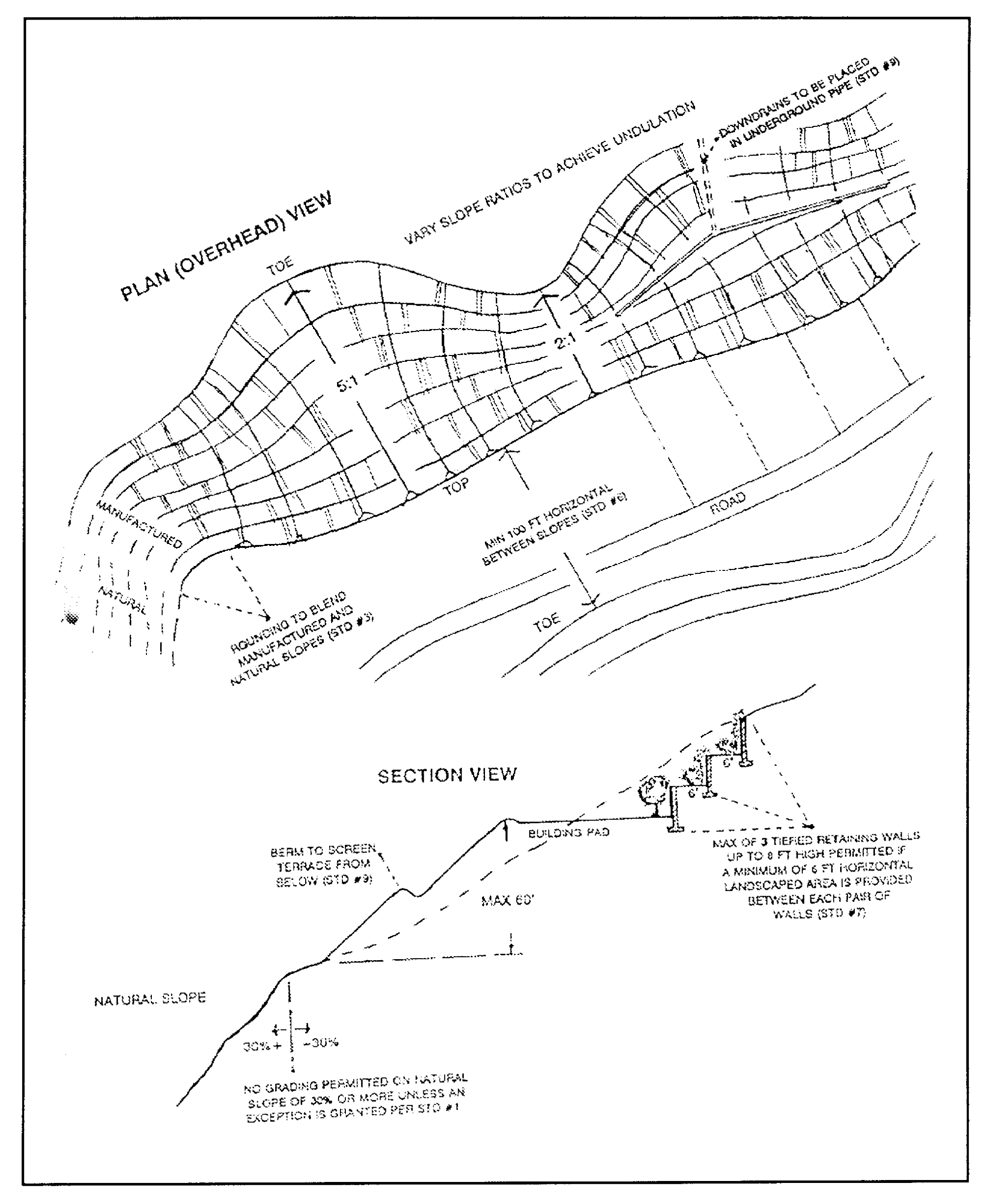
FIGURE 8.2. CONTOURING DO'S AND DON'T'S
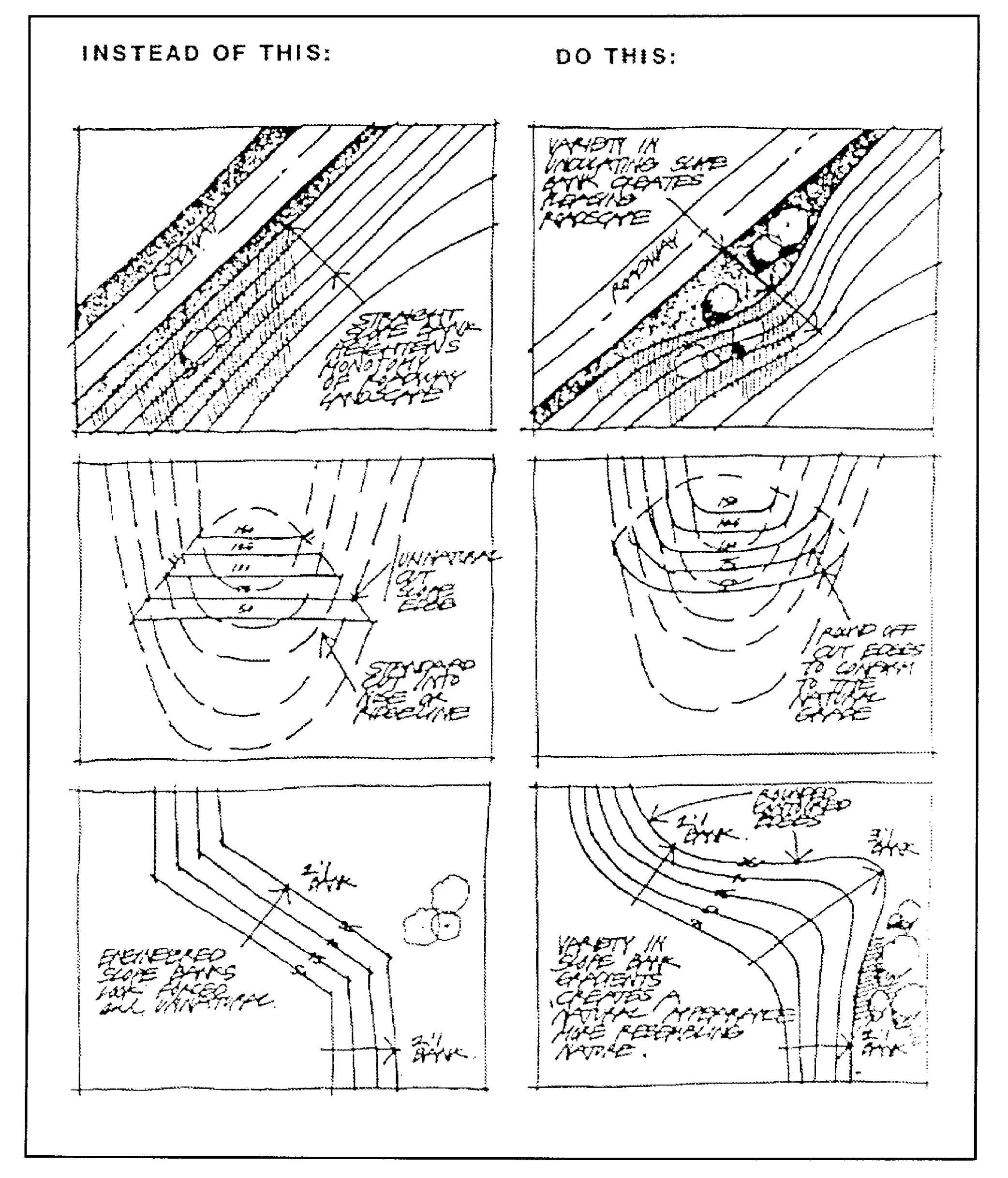
Policy. Landscaping and other visual mitigation
Standard no. 8: Landscaping. Landscaping of greater intensity than that normally required for non-hillside projects shall be incorporated into all hillside projects to soften the visual impacts of both grading and building. Landscaping plans shall be of predominantly drought tolerant varieties and shall include, where determined appropriate by the planning commission, the use of:
(1)
Native species; and/or
(2)
Reclaimed water for irrigation.
In addition, landscape planting on manufactured slopes shall conform to the following minimum standards:
Trees: Minimum size five-gallon, with at least 30 percent to be a minimum of ten feet high (not including container height). Minimum density: Average 25 feet on center.
Shrubs: Minimum size one-gallon, with at least 30 percent to be five-gallon. Minimum density, average ten feet on center.
Vines: As required to augment ground cover and provide screening for retaining walls.
Ground cover: Hand-planted plugs with minimum density of one foot on center, or other density as approved by the community development director, or hydroseeding utilizing seed mixture approved by the director. Either of the preceding methods or a combination of the two shall be sufficient, in the director's judgment, to meet a goal of 100 percent slope coverage within one year of planting.
Standard No. 9: Terraces and downdrains. The visual impacts of drainage terraces and downdrains shall be lessened by the use of river rock, colored gunite, colored concrete or other treatments which produce a softened natural appearance. Terrace benches shall be of sufficient width to provide for visual screening of terrace drains by means of berming or similar design measures.
Standard no. 10: Outdoor lighting. The quantity and intensity of street, pedestrian and other outdoor lighting shall, subject to minimum pedestrian and traffic safety standards, be less than that normally required for nonhillside projects and shall be shielded to focus only on the street, sidewalk or other area to be illuminated.
Policy. Protection of biological resources.
Standard no. 11: Preservation of existing vegetation. Hillside development shall accommodate the preservation of existing vegetation on those portions of the site to be preserved in open space wherever such preservation is determined by the planning commission to be consistent with:
(1)
Fire safety requirements; and
(2)
The other hillside protection standards contained in this section.
Standard no. 12: Impacts on flora and fauna. Development impacts to endangered, threatened or rare species of flora and fauna and sensitive biological habitats shall be thoroughly identified and analyzed during the environmental review process for a project. Identified impacts shall be avoided or mitigated to the greatest extent feasible. For purposes of this standard, the term "feasible" means capable of being accomplished in a successful manner within a reasonable period of time taking into account economic, environmental, legal, social and technological factors (CEQA section 21061.1 and CEQA guidelines section 15364).
(d)
Exceptions to hillside standards.
(1)
Findings for approval. In reviewing a project application, the planning commission may grant relief from full compliance with one or more of the hillside protection standards set forth in subsection (c) of this section, by means of an exception. In so doing, the planning commission must make the following findings:
a.
General findings. All of the following general findings:
1.
Consistency with hillside protection policies. Notwithstanding the exception granted, the resulting project will nevertheless be substantially consistent with the hillside protection policies set forth in subsection (b) of this section.
2.
Consistency with general plan. The use or project proposed in conjunction with the exception is consistent with all adopted and applicable general and specific plans of the city.
3.
Consistency with zoning code. The use and improvements proposed in conjunction with the exception are consistent with the provisions of this article.
4.
Consistency with CEQA standards. The approval of the exception is in compliance with the requirements of the California Environmental Quality Act.
5.
Compatibility. The location, size, design and operating characteristics of the use proposed in conjunction with the exception will not create significant noise, traffic or other conditions or situations that may be objectionable, detrimental or incompatible with other permitted uses in the vicinity.
6.
Preservation of general welfare. Approval of the exception will not result in conditions or circumstances contrary to the public health, safety and general welfare.
7.
No special privileges. Approval of the exception will not constitute a grant of special privileges to the subject property which, even after all conditions attached to the approval are complied with, is inconsistent with the limitations placed upon other properties subject to the same hillside protection regulations.
b.
Specific findings. One or more of the following findings specific to the exception being requested:
1.
Reasonable use of property. The strict application of the standard would deny any reasonable use of the property in question and thereby deprive the subject property of privileges enjoyed by other properties subject to the same hillside protection regulations;
2.
Result inconsistent with hillside protection goals and policies. The strict application of the standard would produce a result inconsistent with or opposite from the goals of this section set forth in subsection (a) of this section, or the hillside protection policies set forth in subsection (b) of this section;
3.
Competing standards. The strict application of the standard would impair compliance with another standard, or the exception is necessary to achieve a balance between competing standards in the interests of overall conformance with the policies set forth in subsection (b) of this section;
4.
Purpose of standard already achieved. The purpose of the standard is being achieved by other aspects of a project's design; or
5.
Other findings. Other findings specified for a particular hillside protection standard in subsection (c) of this section.
(2)
Compensating increase in other standards. In approving an exception to a hillside protection standard, the planning commission may require a compensating increase in the degree of compliance with other standards.
(3)
Variances not permitted. The variance provisions of shall not apply to this section, and no variances to the standards contained in this section shall be considered.
(4)
Procedures. Application for exceptions shall be made on forms provided by the community development director. Planning commission review shall require a public hearing in accordance with . Exceptions shall be reviewed in conjunction with review of the overall project.
(e)
Projects subject to section. The hillside protection regulations in this section shall apply to the following types of projects:
(1)
Development of existing parcels having an average slope gradient of ten percent or more wherein proposed grading quantities are greater than 5,000 cubic yards.
(2)
All tentative tract and tentative parcel maps on parcels with an average slope gradient of ten percent or more.
In cases where parcels already possess development entitlements such as development agreements, the city shall apply these regulations within the framework of such entitlements.
(f)
Projects exempt from section. Notwithstanding subsection (e) of this section, the hillside protection regulations of this section shall not apply to the following types of projects:
(1)
Modifications to existing structures. This section shall not apply to modifications to existing structures.
(2)
Repair of damaged homes. This section shall not apply to repair or reconstruction of homes damaged or destroyed by fire or other cause.
(3)
Existing permits. This section shall not apply to projects for which a grading or building permit was issued prior to the effective date of this section, which permit was still valid as of such effective date.
(4)
New home construction. This section shall not apply to new home construction on existing lots unless both the cubic yard grading and average slope gradient thresholds of subsection (e)(1) of this section are exceeded.
(5)
Emergency grading. This section shall not apply to grading to correct a slope failure or other ground failure if such correction is deemed by the community development director or the director's authorized city representative to be an emergency, i.e., a situation where life or property is threatened. Such corrections might include buttressing or replacement of a slope failure, repair of earthquake damage, removing a slide from a roadway or similar actions.
(6)
Other projects. This section shall not apply to any other project not specified in subsection (e) of this section.
(7)
Bear brand hillside estates area. Notwithstanding subsection (e) of this section, the hillside protection regulations of this section shall not apply to a portion of the area lying between the Bear Brand Ranch planned community and the City of San Juan Capistrano, shown on figure 8.3, because of the following findings:
a.
Subdivision of the area is substantially complete.
b.
Deed restrictions have been imposed on most parcels within the area severely limiting further parcelization.
c.
All utilities have already been provided to the area.
d.
All access easements have been set.
e.
The major ridgeline within the area is already preserved as permanent open space.
f.
The area is effectively within an integrated planned community with an established development pattern.
g.
The area is already regulated by conditions, covenants and restrictions administered by a homeowners association, which include strict design review requirements to control the appearance and visual impacts of development within the area.
h.
Development of parcels within the area require approval of individual site development permits.
i.
Prior tract and parcel map approvals already provide for input from the City of San Juan Capistrano regarding development proposals visible from that city.
FIGURE 8.3. EXEMPT BEAR BRAND HILLSIDE ESTATES AREA
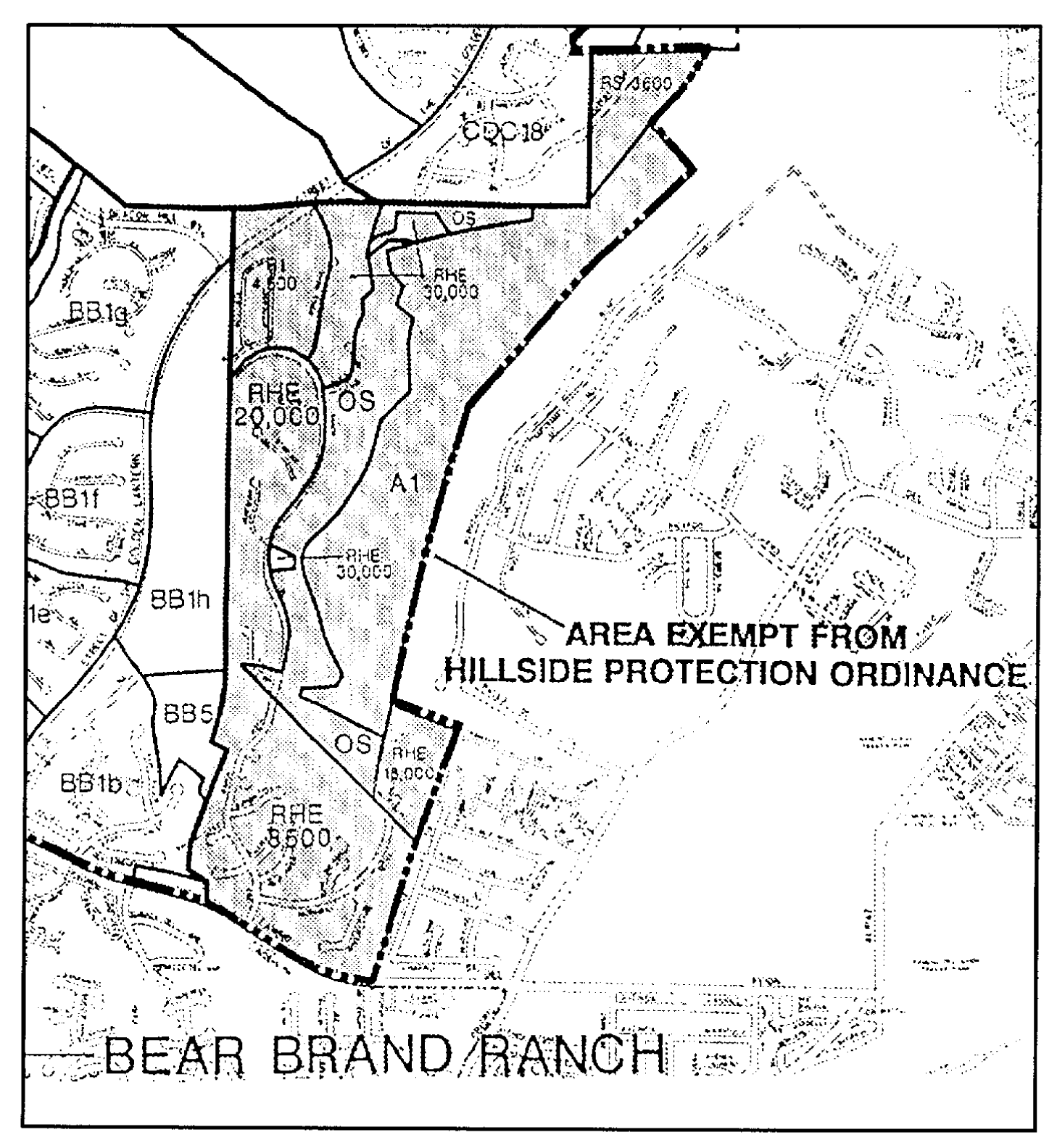
(g)
Site development permit required.
(1)
Proposed projects subject to this section shall require the approval of a site development permit by the planning commission in accordance with . The planning commission shall approve such a permit only if it finds that the project is in substantial conformance with the hillside protection policies set forth in subsection (b) of this section.
(2)
Grading plans for development of existing single parcels subject to this section shall be reviewed concurrently with building plans. Grading plans for subdivisions subject to this section shall be reviewed concurrently with the tentative maps. Building plans shall also be reviewed concurrently with the tentative map unless the subdivider warrants that the subdivision is a lot sale project only.
(h)
Information to be submitted with project applications. In addition to the standard materials required to be submitted with project applications, the following items shall be submitted for review of any project subject to this subarticle:
(1)
A topographic map showing existing terrain at a scale no smaller than one inch equals 100 feet and a contour interval of no greater than two feet for slopes up to 20 percent, no greater than five feet for slopes between 20 percent and 35 percent, and no greater than ten feet for slopes over 35 percent.
(2)
A view analysis of the proposed project showing conformance with the hillside protection standards of subsection (c) of this section. Viewpoints shall include scenic highways from which the site is visible, or other viewpoints as approved by the community development director.
(3)
Cross-sections through selected portions of the site at locations approved by the community development director.
(i)
Environmental review. Environmental documentation for all projects subject to this section shall disclose the extent to which each project conforms to the standards contained in this section.
(j)
Open space easements. As a condition of a tentative map approval or other entitlement, the city may require the dedication to the public of open space easements over undeveloped portions of a site to ensure permanent preservation of such undeveloped portions in open space.
(k)
Effect of other regulations. The regulations in this section shall be in addition to other regulations in this zoning code, the subdivision code and other applicable land use ordinances and the engineering, stability, drainage and other provisions of the Grading code and the associated grading manual. In cases of conflict between this section and such other regulations, the planning commission shall apply that which it determines to be more rigorous.
(l)
Definitions. For purposes of this section, certain terms shall have the following meanings:
Average slope gradient means the vertical distance between the highest and lowest points on a parcel, divided by the longest horizontal dimension of the parcel, with the result expressed as a percentage average for the entire parcel; e.g., "the parcel has a 20 percent average slope gradient" See also, "Slope gradient."
Development means alteration to existing land by means of:
(1)
Grading other than that needed for geotechnical or other testing; or
(2)
The building of a structure or structures.
Endangered species means a species of plant or animal listed as endangered by the federal government or the state in accordance with their respective endangered species acts.
Exception: see "Exception" in subarticle 14 (Definitions).
Existing structures means structures which received a certificate of use and occupancy, or final inspection approval if such a certificate is not applicable, prior to the submission of plans to the city for modifications thereto.
Grading quantity means amount of earthwork in a grading plan; more specifically, the larger of cut, including any export, or fill, including any import.
Manufactured slope means a manmade slope created by grading.
Paragraph or subsection means a portion of this section beginning immediately after a lower case letter in parentheses, e.g., (a), and extending to the next such lower case letter in parentheses, e.g., (b).
Proposed development area means that area shown on a site development plan, grading plan, tentative tract map, or tentative parcel map which is within the limits of grading for the project.
Rare species means a species of plant or animal which, though not presently threatened with extinction, is existing in such small numbers throughout all or a significant portion of its range that it may become endangered if its environment worsens (CEOA Guidelines section 15380 and state fish and game code section 1801).
Sensitive biological habitat means:
(1)
The specific areas within the geographical area occupied by a threatened or endangered species, at the time such geographical area is listed as critical in accordance with the provisions of section 4 of the federal Endangered Species Act, on which are found those physical or biological features essential to the conservation of such species and which may require special management considerations or protection; and
(2)
Specific areas outside the geographical area occupied by a threatened or endangered species at the time such geographical area is listed as critical in accordance with the provisions of section 4 of the federal Endangered Species Act, upon a determination by the secretary of the interior that such areas are essential for the conservation of the species.
Slope gradient means the vertical distance between two points on a slope divided by the horizontal distance between the same two points, with the result expressed as a percentage; e.g., "the slope has a 20 percent gradient" (usually used to describe natural, as opposed to manufactured, slopes). See also "Average slope gradient" for proposed development areas, preceding.
Slope ratio means the steepness of a slope expressed as a ratio of horizontal run to vertical rise corresponding to the horizontal run; e.g., 2:1 (usually used to describe manufactured as opposed to natural, slopes).
Threatened species means a species of plant or animal listed as threatened by the federal government or the state in accordance with their respective endangered species acts.
(Ord. No. 99-107, § 5, 2-2-99; Ord. No. 2021-210, § 55, 8-3-21)
Sec. 9-1-91.- General provisions.
All references to this section shall include through .
(Ord. No. 99-107, § 5, 2-2-99)
Sec. 9-1-91.1. - Purpose.
This subarticle is a statement of city policy regarding physical design in the city. It provides architectural, landscape, site planning, and sign criteria for the design and review of proposed commercial, office, industrial, attached residential, and other development within the city.
(Ord. No. 99-107, § 5, 2-2-99)
Sec. 9-1-91.2. - Goal and supporting objectives.
(a)
Goal. The overall goal of this subarticle is to enhance the quality of the manmade environment in the city.
(b)
Objectives. In order to advance the goal in paragraph (a) of this section, the following objectives are hereby adopted:
(1)
To create a set of explicit design standards to be used by city reviewing bodies to help guide decisions for approval or denial of proposed development projects and thereby protect the general welfare of the community.
(2)
To create a set of explicit high quality design standards to be used by prospective developers and their site planners, architects, landscape architects, and engineers in designing proposed development projects.
(3)
To encourage new development projects which:
a.
Utilize a variety of architectural styles and site designs;
b.
Incorporate quality design features;
c.
Are both inviting and user-friendly to people;
d.
Offer pleasing and interesting views to pedestrians, motorists, and neighbors; and
e.
Are architecturally distinctive yet in harmony with the surrounding natural and manmade environments. (4) To provide a consistent approach to site planning, building design, signs, graphics, color, materials, lighting, landscaping, and other design elements.
(5)
To provide for city review of exterior modifications to commercial, industrial, office, and multiple-family residential projects which were in existence prior to the establishment of these Guidelines, while at the same time providing for ease in processing of such review with a minimum of cost and time to the applicant.
(Ord. No. 99-107, § 5, 2-2-99)
Sec. 9-1-91.3. - Role of guidelines in project review.
(a)
Guidelines to be considered as qualitative standards.
(1)
Guidance for decision makers. Although the design guidelines in this subarticle are to be followed by developers, project designers, and city decision makers in the design and review of development projects, they are not precise zoning regulations with black-and-white allowances and standards. Instead, the provisions of this subarticle are to be considered qualitative standards of good design to assist city decision-makers in their discretionary judgments to approve or deny projects. This subarticle should therefore motivate design efforts toward meeting the city's quality standards, either prior to project submission or via design modifications during project review.
(2)
Project character. In reviewing individual projects, the decision-making authority shall tailor the application of the guidelines in this subarticle to the scale and character of the project. That is, the decision-making authority may grant relief from a policy guideline (i.e., identified by the word "should" per paragraph (b) of this section) if it determines that, due to unusual project characteristics or small scale, no useful purpose would be served by the guideline in terms of advancing the goal and objectives set forth in . For example, the decision-making authority might determine that the provisions promoting pedestrian links to offsite areas is not appropriate for a discount warehouse surrounded by arterials and non-pedestrian land uses. In addition, similar relief for "shall" or mandatory guidelines may be granted by means of an exception as provided in .
(b)
Mandatory versus policy regulations. As a set of qualitative rather than either or standards, the guidelines in this subarticle provide for levels of discretion by city decision-making authorities in their application of different standards. Terms used to differentiate these levels are as follows:
(1)
The words "will" and "shall" identify mandatory design or procedural requirements which the city determines to be essential to achieving the goal and objectives of these guidelines. Such requirements shall not be modified or waived unless an exception (per ) is approved by the decision-making authority.
(2)
The word "should" identifies a policy guideline which must be followed in the absence of compelling opposing considerations identified by the city decision-making authority.
(3)
The words "may," "encouraged," "discouraged," and "be considered" identify optional, though highly recommended, guidelines.
(c)
Effect of other regulations. The design guidelines in this subarticle are intended to augment the other provisions of this zoning code, applicable planned community ordinances and specific plans, and other relevant regulations controlling land use or development. In case of conflict or discrepancy between this subarticle and any other regulations, the decision-making authority shall apply that which it determines to be more rigorous.
(Ord. No. 99-107, § 5, 2-2-99)
Sec. 9-1-91.4. - Applicability of design guidelines.
The design guidelines in this subarticle shall apply as set forth in (Applicability of nonresidential guidelines) and (Applicability of residential guidelines).
(Ord. No. 99-107, § 5, 2-2-99)
Sec. 9-1-91.5. - Text references.
All references herein to chapters, sections, subsections, paragraphs, and similar text divisions shall be to this subarticle unless some other document is specifically identified.
(Ord. No. 99-107, § 5, 2-2-99)
Sec. 9-1-92. - Guidelines for nonresidential projects.
All references to this section shall include through .
(Ord. No. 99-107, § 5, 2-2-99)
Sec. 9-1-92.1. - Applicability of nonresidential guidelines.
(a)
Site planning and landscape architecture. The nonresidential site planning and landscaping guidelines contained in this subarticle shall apply to all nonresidential projects and to all projects which are predominantly nonresidential but which may also contain some residential uses, such as residential units above retail stores.
(b)
Architecture.
(1)
Commercial guidelines. The commercial architectural guidelines of . shall apply to the following projects:
a.
Freestanding retail buildings, shopping centers, restaurants, and other commercial development.
b.
Civic centers.
c.
Institutional buildings, such as churches, libraries, museums, schools, and colleges.
d.
Small-scale hotels and hospitals, three stories or less.
e.
Mixed-use projects which are predominantly commercial but which also include other uses within the same building or cluster of buildings (e.g. residential units above retail stores or professional offices within a commercial building or shopping center).
(2)
Office-industrial guidelines. The office-industrial architectural guidelines of shall apply to the following projects:
a.
Office and industrial buildings and parks.
b.
Utility substations.
c.
Large-scale hotels and hospitals, four stories or above.
d.
Mixed-use projects which are predominantly office or industrial but which also contain small incidental commercial uses, such as a sandwich shop.
(3)
Office or industrial buildings proposed for commercial areas. Notwithstanding the guidelines contained in paragraphs (b)(1) and (b)(2) of this section, in order to promote consistent design quality within the community's retail commercial areas, the city shall have the discretion of applying the commercial architectural guidelines of to office, industrial, or other buildings proposed for such commercial areas. Determinations to apply such commercial architectural guidelines shall be in accordance with the provisions of paragraph (c) of this section.
(c)
Alterations to existing nonresidential buildings or projects.
(1)
Alterations are subject to guidelines. Exterior alterations to existing nonresidential buildings or projects shall be subject to the Design Guidelines set forth in this subarticle if such alterations require a site development permit per .
(2)
Significant exterior alterations. For significant alterations which meet the findings criteria set forth in paragraphs (2)(a) and (2)(b) following, the decision-making authority shall have the option of also requiring alterations to other portions of a building or project not proposed for alteration in order to bring the overall building or project into conformity with the design guidelines set forth in this subarticle. Such alterations include changes to buildings, other than building painting or similar maintenance, and to non-building project improvements, such as parking, driveways, landscaping, etc. For such review, the decision-making authority shall make the following findings:
a.
In the case of buildings, the alterations exceed ten percent of the value of the building or involve more than ten percent of either the exterior wall or exterior roof area. In the case of projects, the improvements to be altered cover more than ten percent of the project site.
b.
Such alterations are necessary to maintain or enhance the design integrity of the building or project and to advance the goal and objectives set forth in .
(3)
Minor exterior alterations.
a.
Definition. A minor exterior alteration consists of changes to the exterior of a building or a project which are not so extensive as to meet the standards of paragraph (c)(2) of this section for extending review to an entire building or project for compliance with these guidelines. Minor exterior alterations generally include changes to architectural features, exterior lighting, mechanical equipment screening, site landscaping, including tree removal, or repainting the exterior of a structure with different colors. A minor exterior alteration does not include repainting of a building with the existing colors or replacing existing landscaping with the same or similar plants.
b.
Changed plan required. A minor exterior alteration, as defined in this subsection, shall not be made to an existing building or project until it is administratively reviewed and approved by a changed plan processed in accordance with . The director may refer such a proposed changed plan to the planning commission for review and approval if the director determines that the public interest would be better served by planning commission review of the proposed changed plan. Review of a proposed minor exterior alteration shall be limited to the proposed alteration and shall not be a basis for or allow review of the entire building or project for compliance with the provisions of these guidelines.
(d)
Determinations of applicability. In cases where it is uncertain which of the nonresidential site planning, landscaping, or architectural guidelines apply to a proposed project, the community development director shall decide based on his assessment of the overall character of the project and its proposed land use or mix of uses. However, in cases where the director concludes that, because of the large scale and/or prominent location of a project, the determination will materially affect achievement of the goal and objectives set forth in , the determination of applicability shall be referred to the planning commission.
(e)
Effect of other regulations. The community design guidelines set forth in this subarticle are intended to augment the circulation, access, parking, site planning, landscaping, architectural, and other design standards of this zoning code and the Orange County transportation planning division's "development plan review guidelines, criteria, and standards" adopted by the city. In case of conflict between any of the preceding regulations and this subarticle, the decision-making authority shall apply that which it determines to be more rigorous.
(Ord. No. 99-107, § 5, 2-2-99)
Sec. 9-1-92.2. - Nonresidential site planning.
(a)
Project access.
(1)
Project identification. Identification signs should be provided for all projects. Such signs shall conform to the sign regulations of subarticle 7 of this Code pertaining to limitations on size, height, and placement set forth elsewhere in this zoning code. The project name shall be approved by the decision-making authority in order to ensure appropriateness, to aid in identification for emergency services, and to avoid duplication with other projects in the city.
Note: All sketches in this subarticle are intended as examples only. They are not to be taken as the only acceptable design solution for each situation.
(2)
Project entry location. Project entries shall be limited in number and located as far as possible from intersections in order to minimize congestion and conflicts. For projects on major or primary arterials or where otherwise determined necessary by the city, full street-intersection-type entries should be used instead of "dustpan"-type driveways.
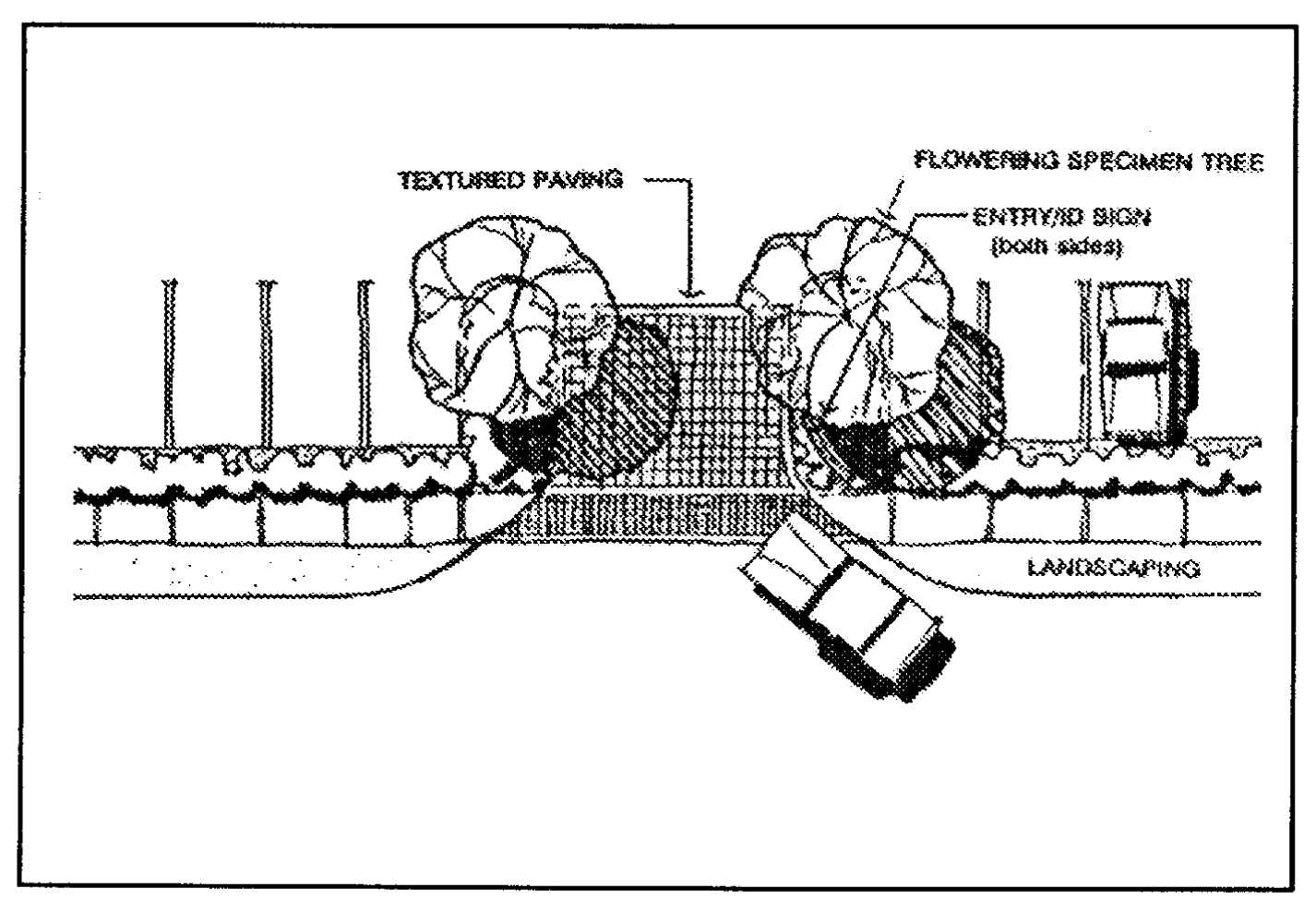
Project entries should be inviting and distinctive
(3)
Project entry design. Major project entries shall be designed as special statements reflective of the character of the project. The goal should be to establish a distinctive and inviting image for the project. (Entry landscape improvements shall conform to the guidelines of ).
(4)
Pedestrian access. Commercial, office, and related site plans shall be designed to physically and visually link the site to the street sidewalk as an extension of the internal pedestrian circulation system in order to effectively separate pedestrian and vehicular traffic and invite pedestrian access into the project. Also, provision should be made for direct pedestrian links between the project and adjoining projects and residential areas.
(5)
Bicycle access. Bicycle usage shall be encouraged by the provision of bikeway access to nonresidential projects and bike racks at convenient locations near building entries.
(6)
Jogging trails. Projects of appropriate scale or location may incorporate jogging trails within the project boundaries and/or provide access to trails outside the project.
(7)
Bus stops. Where bus stops are located on a project's frontage, provision should be made for buses to stop out of the flow of traffic. Therefore, bus stop turnouts should be incorporated into the design of site and street improvement plans. (standards of the Orange County transportation authority shall be taken into consideration in the design of such turnouts.) In addition, a waiting bench should be provided and overhead shelters are encouraged. Any proposed bus stop amenities shall be included as part of the project's design details.
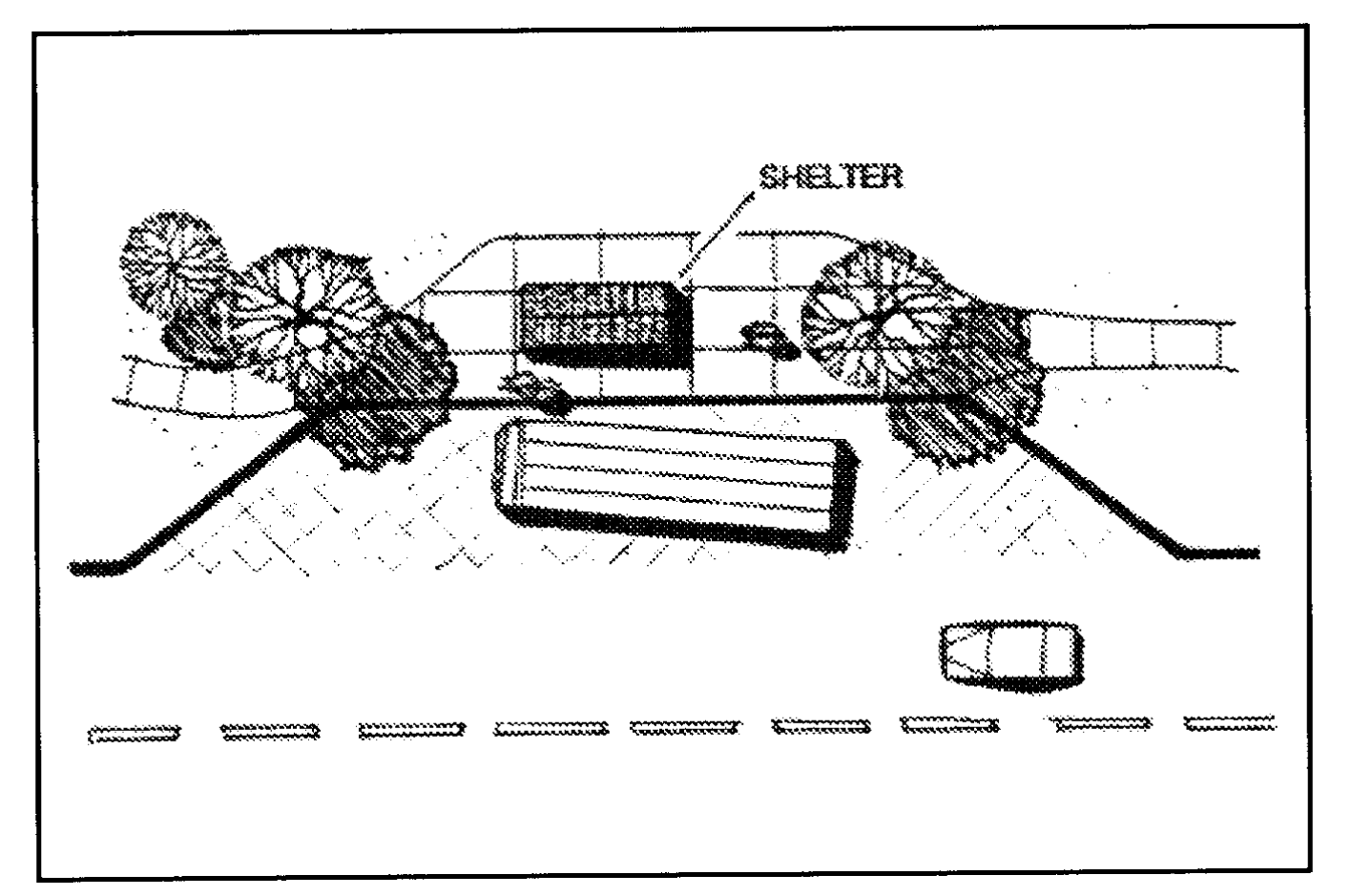
Example of bus stop turnout design
(b)
Parking.
(1)
Goal. Since entries and parking lots establish a patron's first impression of a project, the goal of parking lot design should be to create a friendly and inviting arrival courtyard rather than just a pavement-covered area to park cars.
(2)
Parking standards. Parking ratios (e.g., spaces per square foot of building area, etc.), minimum aisle and space dimensions, and similar requirements are contained in the parking regulations portion of this zoning code. The design standards in this section are intended to supplement those standards.
(3)
Queuing setbacks from street entries. To minimize conflicts between entry traffic and parking, parking spaces and parking aisles shall be set back from the street entry in accordance with standards set forth in the parking regulations portion of this zoning code.
(4)
Parking lot interconnections. The parking and circulation layouts of adjoining developments should be coordinated and interconnected wherever possible to allow for reciprocal vehicular and pedestrian access without reentering the street.
(5)
Internal circulation. Parking lots shall have an internal circulation system which interconnects parking aisles without requiring street reentry. Also, dead-end driveways or aisles should be avoided whenever possible. In any case, all dead-end aisles serving more than five consecutive parking spaces shall have a turnaround area at the dead-end.
(6)
Parking segmentation. Where parking lots must accommodate over 30 cars, they should be broken up into segments or modules of less than 30 spaces by means of intervening landscaping, access drives, or buildings in order to avoid large unbroken expanses of paved area.
(7)
Parking stall striping. In order to help maintain adequate separation between parked cars, stalls should be marked by double or hairpin stripes. Other parking lot striping requirements shall be in accordance with the provisions contained in the parking regulations portion of this zoning code.
(8)
Parking lot screening. Parking and circulation areas shall be screened from the street and from adjacent properties of dissimilar zoning by means of boundary landscape architectural elements in accordance with the provisions contained elsewhere in this zoning code and the landscape guidelines of in order to shield views of cars and paving while promoting views of buildings on the site.
(9)
Interior parking lot landscaping. In order to mitigate the visual impact of large expanses of paved areas, parking lots shall include interior parking lot landscaping in addition to boundary landscaping in accordance with the landscape guidelines of .
(10)
Buffer strips next to buildings. There should be a landscaped buffer area of at least seven feet between buildings and parking areas or driveways in order to avoid placing paved vehicular areas next to building walls. No credit shall be given toward satisfying this guideline to vehicle overhang areas.
(11)
Use of continuous curbs as wheel stops. In order to enhance visual continuity and minimize clutter, a continuous unbroken concrete curb should be used as the front wheel stop for adjacent parking stalls within a row rather than individual wheel stops for each parking stall. Also, where stalls are perpendicular to walkways or landscaped areas, such walkways or landscaped areas shall be made at least two feet wider than the standard width in order to accommodate cars' front overhangs. This additional overhang width should be of a different color, texture, and/or material than the remainder of the walkway to distinguish it from the pedestrian portion.
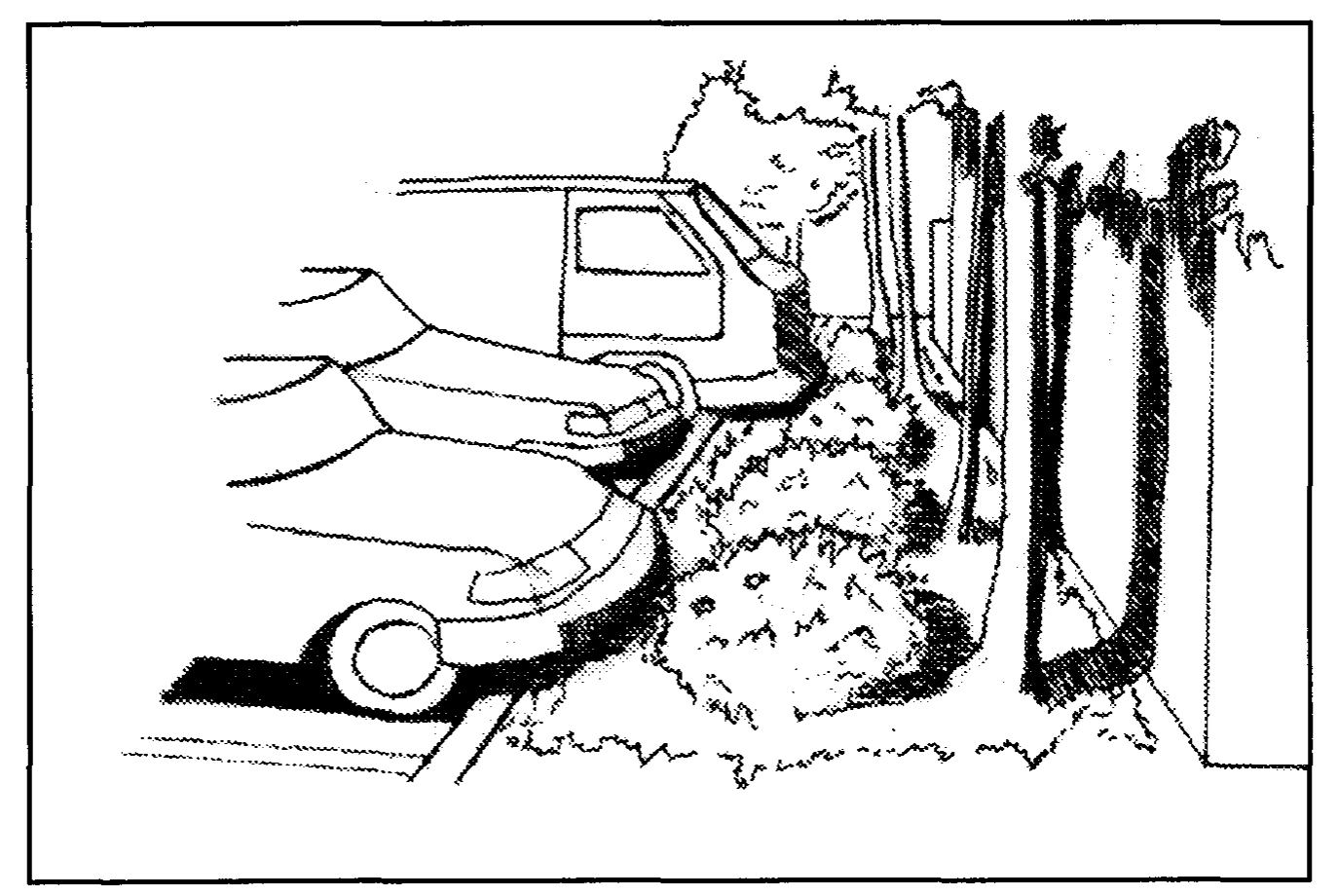
Continuous curbs avoid the clutter of individual wheel stops and serve as useful separations
between parking and landscaped areas. In this case, the landscape buffer separates
the parking area from the building.
(c)
Outdoor lighting.
(1)
Intensity. Parking lot and other outdoor lighting should be the minimum needed to ensure safety and security so that impacts on surrounding residential areas are minimized. The lighting intensity within parking lots and adjacent areas should be at least 1.0 footcandle at all points, but should not exceed an average of 3.0 footcandles over the entire parking lot. (Lower illumination levels may be used from one hour after the close of all businesses served by the parking facility until dawn.) In addition, the intensity of light spillover beyond a distance of 20 feet from any project boundary should not exceed 0.2 footcandle.
(2)
Photometric analysis. In order to assess compliance of proposed projects with lighting intensity and spillover limitations, the city may require a photometric site plan analysis to show lighting intensities within the site and light spillover beyond the site boundaries.
(3)
Lighting and landscaping. Outdoor lighting shall be coordinated with parking lot and frontage tree planting plans in order to satisfy both the lighting intensity parameters of paragraph (c)(1) of this section and the interior project landscaping requirements of .
(4)
Light fixture design. Decorative fixtures with full cutoff shields to direct light downward should be used for parking lot lighting in order to minimize offsite glare. Bollard or other low-height lighting should be used whenever possible for pedestrian areas. Light fixture design should harmonize with and enhance the character of the project. Building-mounted outdoor light fixtures should be integrated into the overall building design.
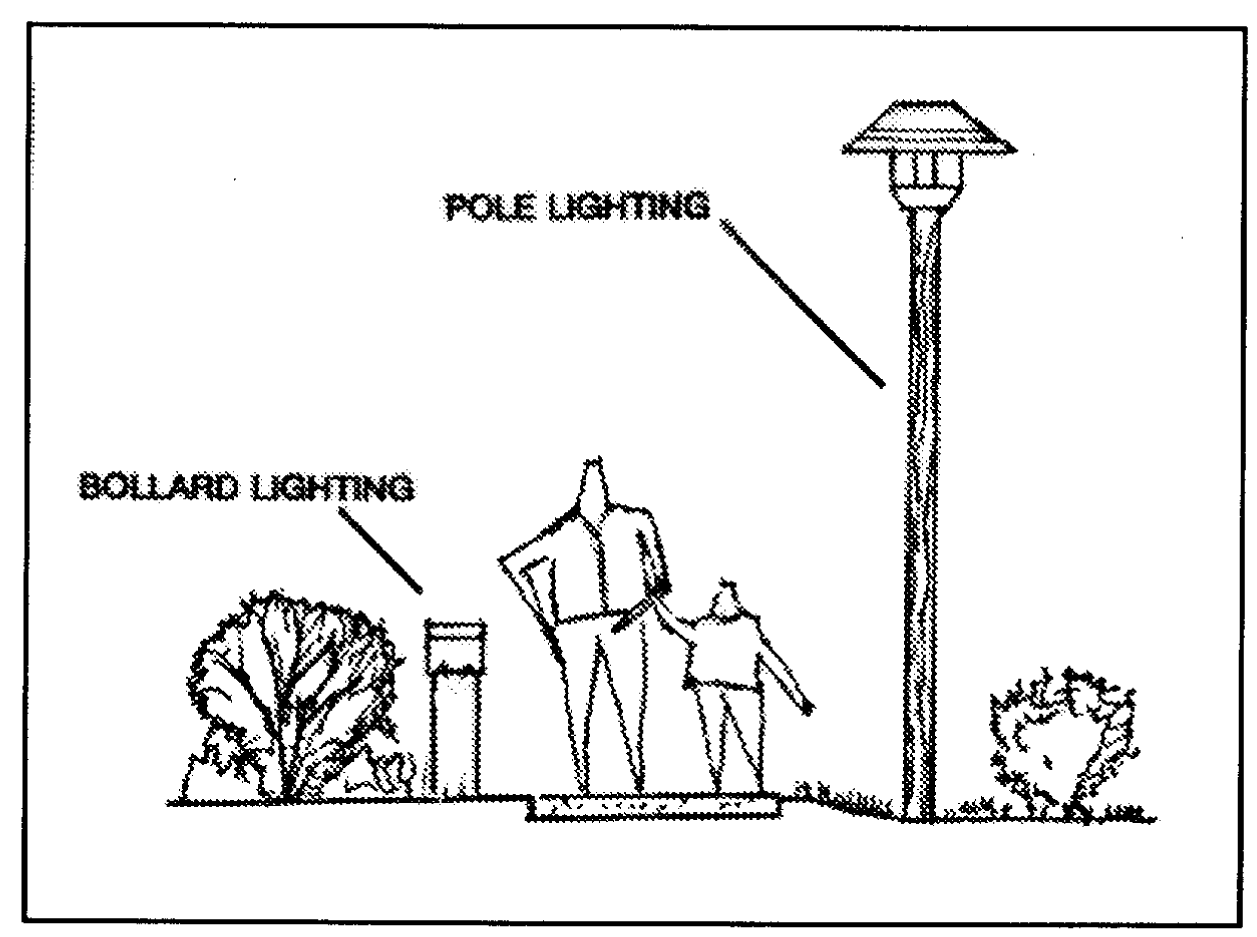
Decorative low-height lighting should be used for pedestrian areas
(5)
Building illumination. Any building illumination or architectural lighting shall be indirect, with no light source visible from abutting streets. Architectural lighting should serve to emphasize building entries and particular building details.
(6)
Sign illumination. Illumination of signs shall conform to subarticle 7 of this Code.
(d)
Pedestrian spaces and walkways.
(1)
Pedestrian links to offsite areas and facilities. Commercial, office, and related site plans shall be designed to physically and visually link the site to the street sidewalk as an extension of the internal pedestrian circulation system in order to effectively separate pedestrian and vehicular traffic and invite pedestrian access into the project. Also, provision should be made for direct pedestrian links between the project and adjoining projects and residential areas.
(2)
Internal pedestrian connections. Internally, projects should include a system of pedestrian walkways which interconnect building entries with each other and with appropriate parking areas, while minimizing conflicts between pedestrians and vehicles. Also, whenever determined feasible by the planning commission, site plans shall be designed so that walkways connect individual buildings within a project directly without forcing pedestrians to mix with vehicular traffic.
(3)
Pedestrian-friendly walkways. Walkway layout should anticipate pedestrians' desired movements and should provide direct routes for them. For example, walkways should allow pedestrians to "cut the corner" in order to change direction without wearing an ad hoc pathway over adjacent grass or groundcover. Also, meandering sidewalks or walkways should contain only shallow curves to avoid frustrating pedestrians with unnecessary detours.
(4)
Walkway treatment. Walkways should be well-marked by means of low-level signage, pedestrian scale lighting, such as bollard lights, and distinctive paving and landscape planting treatments. Where feasible, trellises, arbors, arcades, or similar features should be used to cover walkways and give a feeling of enclosure and security. Also, where textured paving is used, it should not be so rough or irregular as to make walking difficult, especially in high heels, or discourage the use of baby strollers or wheelchairs.
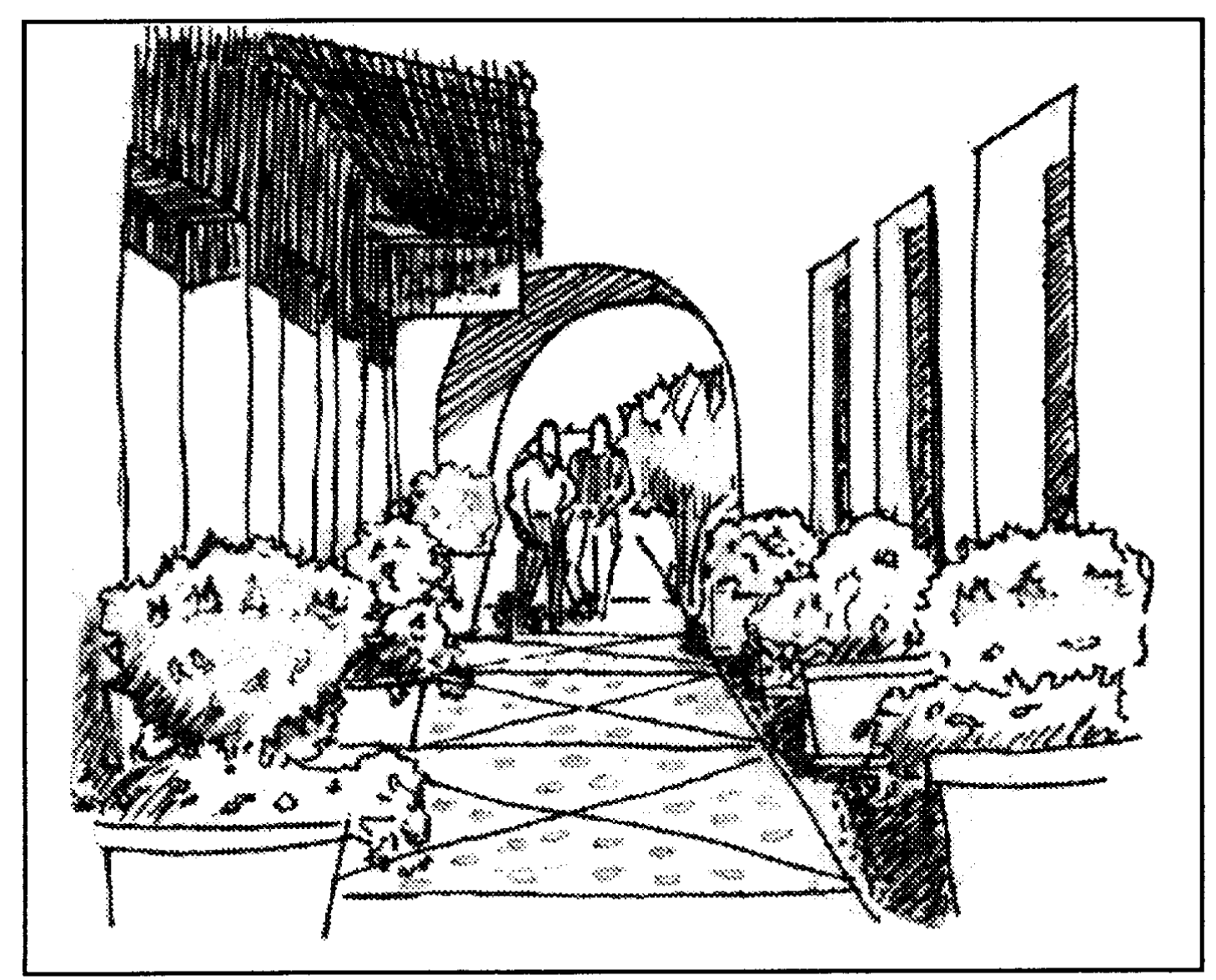
Covered arcades, potted plants, and distinctive paving give a feeling of intimacy
and enclosure to walkways
(5)
Creation of people spaces. Commercial, office, and related projects should incorporate outdoor amenity areas such as atriums, plazas, courtyards, and outdoor cafes. These features should be combined with architectural elements, such as arched entries, to create an inviting layering of spaces, in which surrounded outdoor spaces, such as courtyards, are visible from other outdoor spaces. In addition, these people spaces should:
a.
Be comfortable and human-scale;
b.
Include such amenities as fountains, benches, seating walls, and landscape plants; and
c.
Provide moderate protection from the elements.
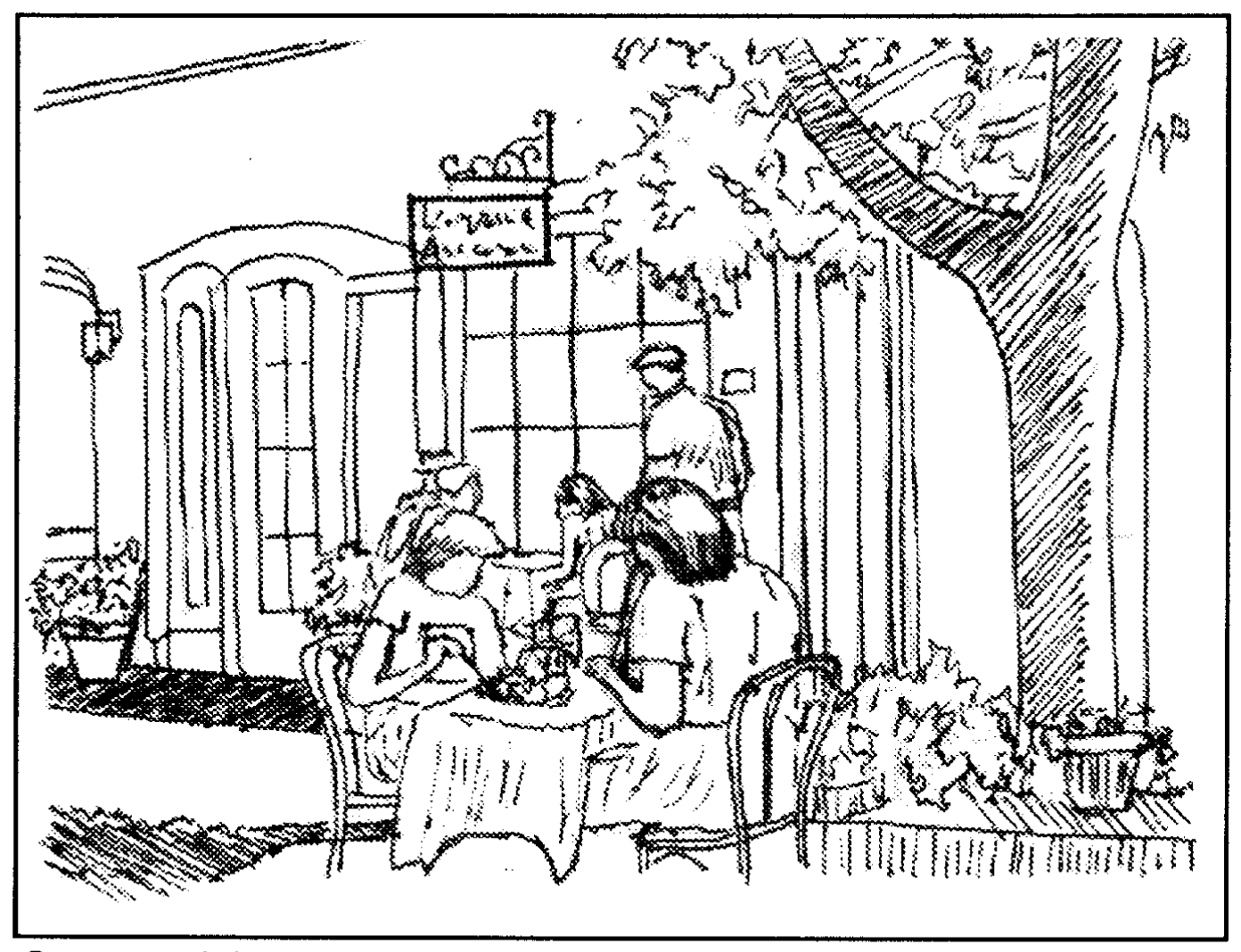
Commercial and office projects should include inviting outdoor spaces such as promenades,
outdoor cafes, courtyards, plazas, and similar features
(6)
Variations in building footprints. Site plans should be designed so that building footprints are articulated in accordance with the architectural guidelines of and . That is, buildings should incorporate variations composed of insets, entries, corners, and jogs integrated with adjacent outdoor areas in order to create intricate and inviting pedestrian spaces.
(7)
Sidewalks within parkways. On arterial frontages, sidewalks should be placed within the landscaped parkway rather than adjacent to the curb so that there is a landscaped buffer on both sides of the sidewalk (see also subsection (c) re frontage landscaping). Parkways should be of sufficient width to accommodate both the sidewalk and the street tree root zones. This sidewalk placement should be used notwithstanding county standard plans for sidewalks.
(e)
Preservation of views; project design. Because of its beautiful setting and hilly topography, the city enjoys unsurpassed view opportunities. Therefore, project site planning should carefully consider access to views by both project patrons and the general public. Projects should be oriented and site planned so that panoramic and mid-range views are promoted, both from within a project and from the adjacent streets and neighborhoods. Further, projects should be conceived and designed to protect, to the greatest extent feasible, existing vistas and panoramas of open space, major landforms, ocean, and special landmarks.
(f)
Hillside grading.
(1)
Hillside protection ordinance. Nonresidential projects subject to the provisions of subarticle 8, (hillside protection), shall conform to the grading and other standards of that section.
(2)
Retaining walls. Because of the rugged topography in the city, retaining walls are often proposed to create pad area for the large space needs of commercial, office, and industrial projects. Therefore, whether a project is subject to the provisions of subarticle 8 or not, the visual impacts of retaining walls should be mitigated. Thus, retaining walls and crib walls should not exceed six feet in height and should include irrigated planting consisting of vines and/or other landscape screening. Where the decision-making authority finds that greater retaining is warranted, it may approve a tier of up to three such walls, up to six feet high each, placed one above the other, provided a minimum of six feet of horizontal permanently irrigated planted terrace is placed between each pair of walls.
(3)
Terraces and downdrains. The visual impacts of drainage terraces and downdrains should be softened by the use of river rock, colored gunite, colored concrete, or other treatments which produce a more natural appearance than standard drainage devices. Terrace benches should be of sufficient width to provide for visual screening of terrace drains by means of berming or similar design measures. Unless determined necessary by the decision-making authority, downdrains should not be placed at visually prominent locations such as at street intersections. However, if such a prominent downdrain location is determined necessary, the downdrain should be placed in an underground pipe.
(g)
Loading, storage, and trash areas.
(1)
Loading and storage areas. Loading and storage areas shall be screened from public view by means of solid walls or fences and/or plantings in accordance with the provisions of . Loading areas should be separated from public vehicular and pedestrian areas and should have direct connections to the businesses they serve.
(2)
Trash enclosure placement. Trash enclosure placement shall conform to the provisions of . In addition, trash enclosures shall be:
a.
Located near to the businesses they serve;
b.
Directly accessible to trash trucks via alleys or driveways so as to avoid the necessity of substantial hand carrying of trash containers or hand pushing of dumpsters; and
c.
Located substantially away from public viewscape, pedestrian, and circulation areas unless determined infeasible by the decision-making authority.
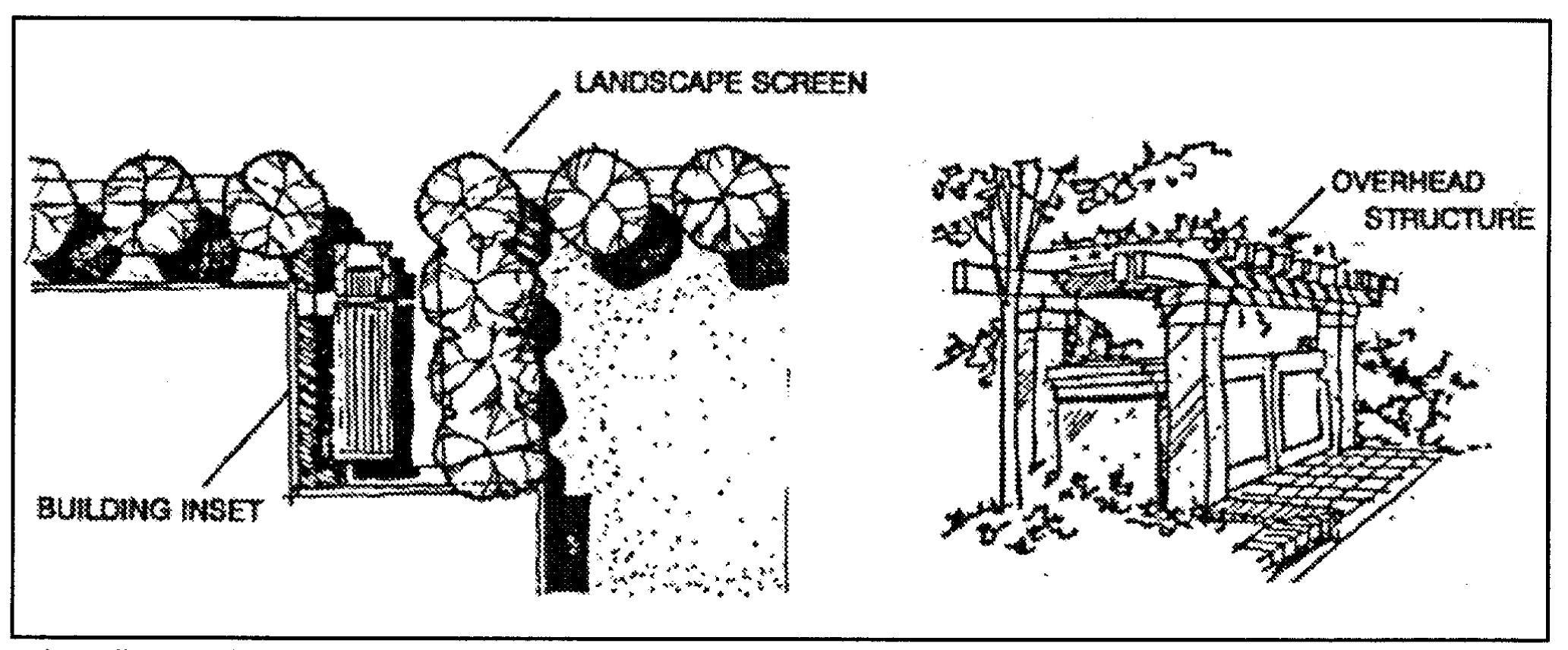
Loading and trash areas should be screened by a combination of walls and landscape
planting
(3)
Trash enclosure design. Enclosures shall be constructed on a concrete pad and shall conform to the provisions of and disposal company standards. Enclosure walls shall be at least six feet high and shall be made of strong durable materials consistent with the colors and finishes of nearby buildings. Doors shall be self-latching, metal or metal framed, and of heavy duty construction sufficient to withstand hard usage. Interior concrete or metal curbs shall be included to prevent damage to the enclosure walls. Decorative overhead structures such as trellises should be integrated into the design, especially where the trash enclosure is visible from above. Where exposed to public view, trash enclosures should also be screened by vines, shrubs and/or trees. Trash enclosures shall be large enough to provide space for at least two 90-gallon recycling toters per each dumpster bin.
Note: All sketches in this subarticle are intended as examples only. They are not to be taken as the only acceptable design solution for each situation.
(Ord. No. 99-107, § 5, 2-2-99)
Sec. 9-1-92.3. - Nonresidential landscaping.
(a)
Overall landscape architectural design. Landscape plans shall utilize the various elements of landscape architecture (e.g. planting, walkways, water features, lighting, outdoor furniture, etc.) to accomplish the following objectives:
(1)
To visually emphasize prominent design elements and vistas, while screening undesirable views.
(2)
To provide a harmonious transition between adjacent land uses and between development and open space.
(3)
To be varied enough to provide interest and emphasis, but not so obtrusive as to distract the viewer.
(4)
To provide an overall unifying influence, enhancing the visual continuity of the project.
(b)
General requirements.
(1)
Deep root barriers. Trees planted within 15 feet of walls or pavement shall be installed with deep root barriers to help prevent foundation or pavement damage.
(2)
Tree grates. Tree grates should be installed around trunks where trees are planted within sidewalks or other paved pedestrian areas.
(c)
Project frontage landscaping.
(1)
Parkways along streets.
a.
Project street frontages are highly visible to both patrons and motorists. As the first design feature seen by people entering a project, street frontages establish the visual image for both the project and the streetscape. Because of these considerations, street frontage parkways shall be of ample width and generously landscaped. Landscape plans shall treat this parkway, including any portion within the public street right-of-way, as one integrated greenbelt. Such frontage landscape design shall also conform to the more specific requirements of .
b.
Parkway frontage landscape design should include sidewalks and/or bicycle-pedestrianways, and planting consisting of trees, shrubs, and either grass (drought-resistant varieties) or groundcover. Frontage landscape treatment shall be of low height near project entries so as to preserve sight lines and ensure traffic safety.
(2)
Scenic corridors. Landscaping and other standards for scenic corridors shall be provided in accordance with the applicable scenic corridor plan. If no plan has been adopted for a given scenic corridor, landscape architectural design shall be generally consistent with the concepts contained in the adopted Crown Valley Parkway Scenic Corridor specific plan.
(d)
Project entry landscaping.
(1)
Entries as special statements. Project entries shall be designed as special statements reflective of the character of the project in order to establish identity for tenants, visitors, and patrons. Flowering accent planting and specimen trees should be used to reinforce the entry statement. Landscape treatment shall utilize such measures as low height plantings at the corners to preserve sight lines and ensure traffic safety.
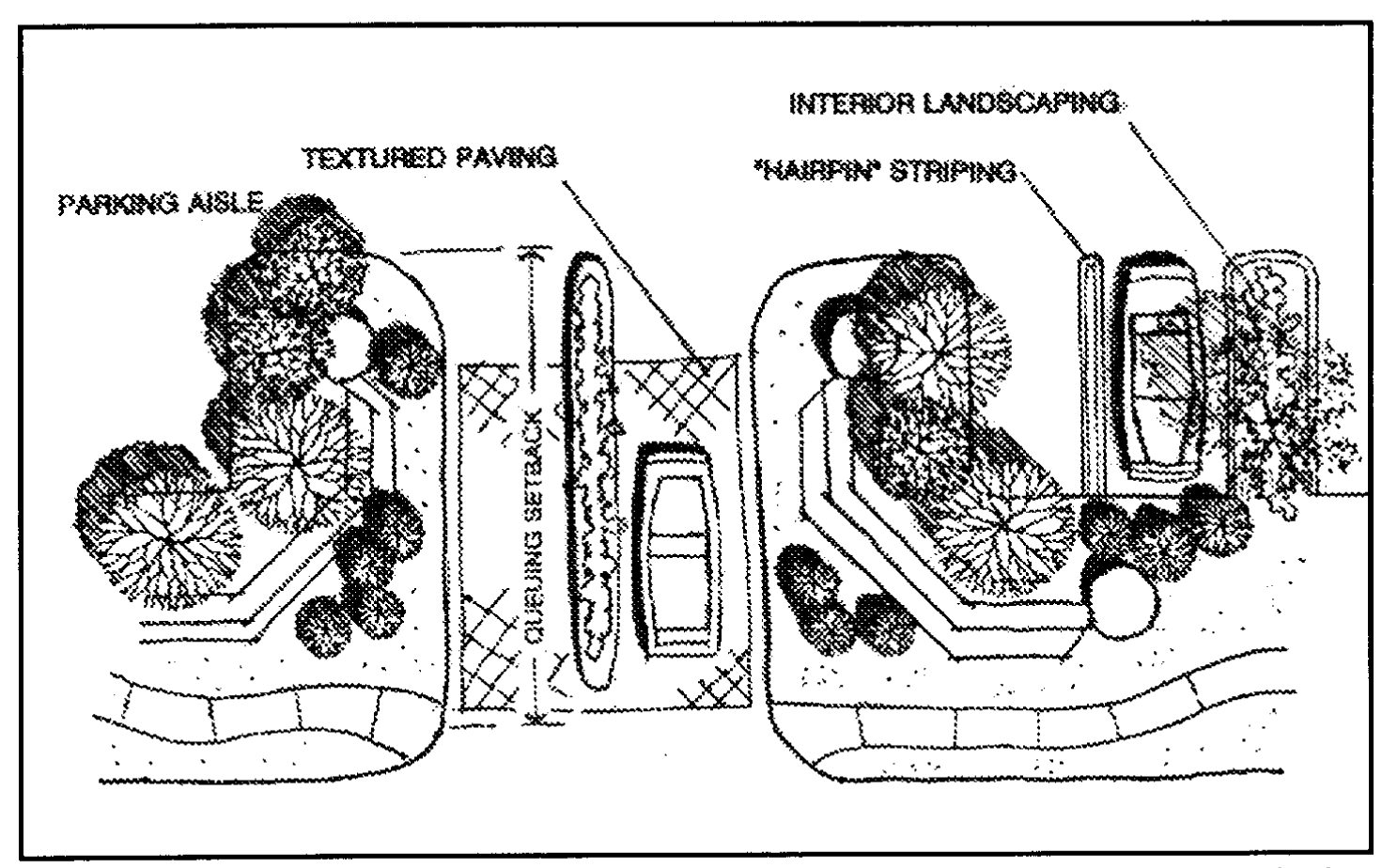
Generous entry landscape treatment adds a softening effect and helps to establish
a project's identity
(2)
Textured paving. Textured or enriched paving treatments, such as interlocking pavers, stamped concrete, etc., shall be used at project entries. Textures should be selected which:
a.
Give a feeling of transition;
b.
Discourage high speeds by providing slightly rougher pavement under the wheels;
c.
Do not become slippery when wet; and
d.
Are not so rough or irregular as to make walking difficult (especially in high heels) or discourage the use of baby strollers or wheelchairs (also see re walkway treatment).
(3)
Entry signs. Project identification signs shall conform to the sign regulations contained in subarticle 7 of this Code. Other aspects of entry design and identification shall be in accordance with the nonresidential site planning guidelines of .
(e)
Boundary and interior project landscaping.
(1)
Goal. For almost all projects, both the first impression and the departing memory are created by the parking lot and adjacent spaces. Therefore, these areas should be regarded as landscaped open space, and the goal of site and landscape plans should be to create inviting garden rooms, with trees, shrubs, groundcover, and areas of enriched paving.
(2)
Boundary landscaping. All projects shall conform to the basic parking lot landscaping/screening requirements contained in . In addition, parking and circulation areas shall be screened from:
a.
Streets by means of parkway landscaping and berming or, in cases where the planning commission determines that berming is not feasible or desirable, by means of a combination of landscaping and low screening walls; and
b.
From adjacent properties of dissimilar zoning by means of landscape strips and/or walls or fences.
More specific guidelines regarding screening walls and fences are contained in .
(3)
Interior project landscaping. In order to ensure sufficient landscaping around buildings and to soften the visual impact of large paved areas, at least five percent of the net usable area of the project site should be landscaped, with at least half of that landscaping located in areas devoted to parking. Required frontage and boundary landscaping shall not count toward this interior landscaping guideline unless such landscaping is in excess of the minimum required by .
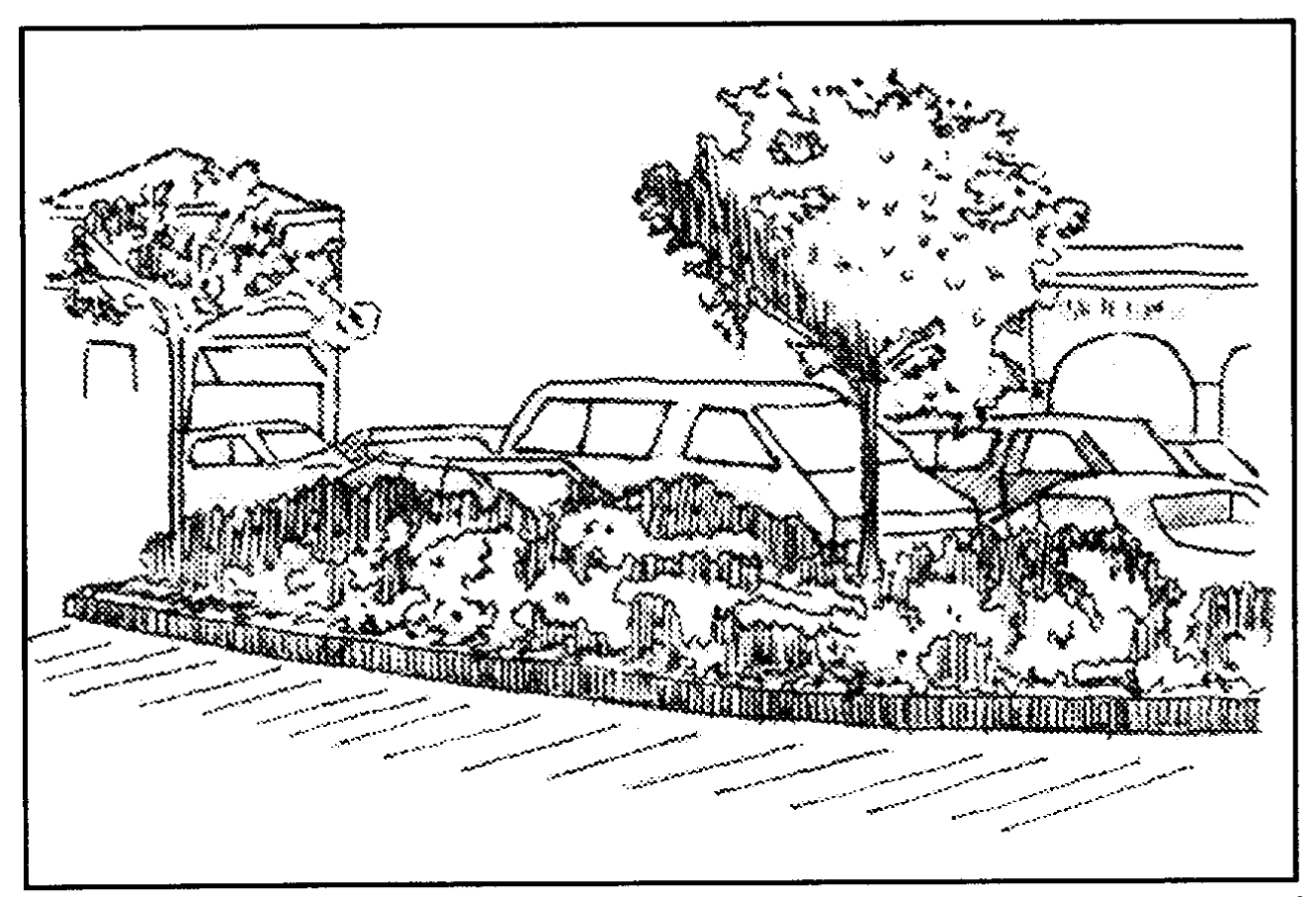
Interior parking lot landscaping breaks up large paved areas and helps to screen rows
of parked cars
(f)
Pedestrian area landscaping.
(1)
Use of small scale plant materials. Planting adjacent to walkways and within plazas and other pedestrian spaces should include smaller species of shrubs and trees in keeping with the intent to maintain an intimate human scale in these areas.
(2)
Landscaping amenities. Pedestrian spaces should be enhanced by planting accents such as trees, shrubs, and/or vines espaliered against wall surfaces, flower beds, window boxes, and hanging pots with flowers and vines.
(g)
Landscaping and utilities.
(1)
Coordination of landscaping and utilities. Project civil engineers and landscape architects shall consult during the preparation of street improvement, grading and landscape architectural plans to coordinate the placement and installation of utilities, irrigation systems, and landscape planting.
(2)
Placement of utility boxes.
a.
Unless determined infeasible by the community development director, street improvement plans shall be designed so that:
1.
Street lights are placed off of sidewalks; and
2.
Irrigation controllers, power transformers, telephone and cable TV junction boxes, and other similar facilities are placed underground.
b.
If underground placement is determined infeasible, such facilities shall not be placed on sidewalks, other walkways, or bikeways unless the community development director determines further that there is no other feasible location for the facility. The director may refer determinations of feasibility under this subsection to the planning commission in cases where the director concludes that the facility's proposed location might interfere with the goal and objectives stated in .
(3)
Screening of utility boxes. Utility boxes such as power transformers, irrigation controllers, telephone connection boxes, etc., not placed underground shall be effectively screened by means of shrubs or other landscape treatment.
(4)
Landscaping and outdoor lighting. Project electrical and civil engineers and landscape architects shall consult with each other during the preparation of outdoor lighting, parking lot, and tree planting plans in order to satisfy both the lighting intensity parameters of and the parking lot landscaping requirements of .
(h)
Tree preservation. New projects shall be designed to preserve existing trees to the greatest extent possible. Landscape, grading, and site plans should incorporate these trees into the overall project design, including measures to protect the existing trees during and after construction. Such measures shall be clearly indicated in both preliminary and final construction drawings. In conjunction with such efforts, the applicant may be required to engage a properly credentialed arborist to submit evaluations and recommendations for saving, transplanting, or removing existing trees. If the decision-making authority determines that significant existing trees cannot be saved, it may require their replacement with new specimen-size trees having a cumulative trunk diameter of up to two times the cumulative trunk diameter of the trees to be removed. Trunk diameters shall be measured three feet above the base.
(i)
Plant selection guide.
(1)
Criteria for selection of plant materials. Plant materials shall be chosen on the basis of both functional and visual characteristics. On manufactured slopes, consideration shall be given to reducing landscape maintenance and water consumption, adaptability to adverse soil conditions present in many parts of the city, low fire-fuel content in transition areas between development and open space, and enhancement of slope stability and erosion control. Where soil and other environmental conditions permit, species native to coastal southern California may be incorporated into the landscape plan.
(2)
Tree species. It is not the purpose of this subarticle to dictate project-specific design details. Therefore, although this subsection identifies tree species which are generally encouraged, it is not to be taken as an exhaustive list of all acceptable species. Examples of species which may be used in different areas of a project are listed on the following pages. Most of these species are drought tolerant. In keeping with the nontechnical nature of these guidelines, common instead of botanical names are used. ("(D)" denotes deciduous species, "(E)" evergreens.)
ENTRY AND ACCENT TREES
(j)
Planting sizes and densities.
(1)
Planting sizes and densities for flat areas. For all landscaped areas other than manufactured slopes over six feet in height, landscape planting shall conform to the following minimum size and planting density standards:
a.
Trees.
1.
Minimum size: Six feet high (measured from the top of container) with at least 20 percent to be minimum 24-inch box size.
2.
Maximum spacing in parkways, entry drives, street medians, parking lot planter strips, and project boundary strips: Average 30 feet. Trees may be planted either in irregular clusters or at equal intervals provided the preceding average spacing is achieved.
b.
Shrubs.
1.
Minimum size: One gallon minimum with at least 30 percent to be five-gallon.
2.
Maximum spacing: Average ten feet.
(2)
Planting sizes and densities for manufactured slopes. On manufactured slopes over six feet in height, landscape planting shall conform to the following minimum size and planting density standards:
a.
Trees.
1.
Minimum size: Five-gallon, with at least 30 percent to be minimum ten feet high, measured from the top of container.
2.
Maximum spacing: Average 25 feet.
b.
Shrubs.
1.
Minimum size: One-gallon minimum with at least 30 percent to be five-gallon.
2.
Maximum spacing: Average ten feet.
c.
Vines. As required to augment groundcover and/or provide screening for retaining walls.
d.
Groundcover. Hand-planted plugs with minimum density of one foot on center, or other density as approved by the community development director, or hydroseeding utilizing seed mixture approved by the director. Either of the preceding methods or a combination of the two shall be sufficient, in the director's judgment, to meet a goal of 100 percent slope coverage within one year of planting.
(k)
Walls and fences.
(1)
Height and placement. Limitations on height and placement of walls and fences shall be per the provisions of or applicable planned community text or specific plan.
(2)
Frontage walls. Walls located along project street frontages shall conform to the provisions of and shall effectively screen parked cars (see also re boundary landscaping). Such walls should generally be solid but may include open portions (tubular steel, wrought iron, etc.) if the decision-making authority determines that the desired screening of parking and circulation areas is still achieved.
(3)
Perimeter and screening walls. Non-street perimeter walls and walls screening service, loading, or similar areas should be of masonry, stucco, or other solid material. Shrubs and/or vines should be planted on one or both sides of such walls to add visual softening, except where determined infeasible or unnecessary by the decision-making authority. Plant spacing should be appropriate to the growth habits of the selected plant species but should be designed to provide interest and variety along the wall rather than creating a complete covering of the entire wall surface. Where the decision-making authority determines that screening is not required, walls may incorporate tubular steel, wrought iron, or other open design. In any case, there should be an intervening landscape buffer between perimeter walls and walkways.
(4)
Materials and colors. Walls should utilize durable materials, finishes, and colors consistent with project buildings. However, wood fences are discouraged because of maintenance problems and lack of durability. Also, chain link, wire mesh, barbed wire, or similar materials should not be used because of their unattractive appearance unless the decision-making authority determines that the fence will not be visible to the public or is otherwise consistent with the goal and objectives set forth in . In such cases, vinyl-clad chain link is encouraged.
(5)
Wall/fence articulation. Long straight stretches of wall or fence should be avoided because of the resulting monotonous appearance and lack of visual interest. Walls and fences should be varied by the use of such design features as offsets (i.e. jogs), open panels (e.g. containing wrought iron) at selected locations, periodic variations in materials, texture, or colors, the inclusion of landscape plantings, and similar measures.
(6)
RV lot screening. Recreation vehicle storage lots in nonresidential areas shall conform to the residential screening requirements contained in .
(Ord. No. 99-107, § 5, 2-2-99)
Sec. 9-1-92.4. - Commercial architecture.
(a)
Applicability.
(1)
General applicability. The commercial architectural guidelines of this section shall apply to the following projects:
a.
Freestanding retail buildings, shopping centers, restaurants, and other commercial development.
b.
Civic centers.
c.
Institutional buildings, such as churches, libraries, museums, schools, and colleges.
d.
Small-scale hotels and hospitals, three stories or less.
e.
Mixed-use projects which are predominantly commercial but which also include other uses within the same building or cluster of buildings, e.g. residential units above retail stores or professional offices within a commercial building or shopping center.
(2)
Office or industrial buildings proposed for commercial areas. In order to promote consistent design quality within the community's retail commercial areas, the city shall have the discretion of applying the commercial architectural guidelines of this section to office or industrial buildings proposed for such commercial areas. Determinations to apply such commercial architectural guidelines shall be in accordance with the provisions of .
(b)
Architectural style and harmony.
(1)
Diversity of styles. No single architectural style predominates for commercial buildings in the city. Indeed, one of the strengths of the city's built environment is the variety and interest provided by the diversity of styles in its different commercial areas. Maintenance of this lively mix of styles is encouraged in new commercial projects within the framework of this subarticle.
(2)
Compatibility with existing development. Although architectural diversity is encouraged in commercial projects, it is not to be achieved at the expense of harmony with existing development. Thus, though new projects need not imitate the design of surrounding buildings, they nevertheless should be visually compatible with that development. This compatibility can be achieved by incorporating some of the design features of existing development such as materials; colors; architectural details, such as door and window design; and roof design, etc. In addition, the space needs of a commercial project should be balanced against the countervailing need to avoid projects so massive as to overwhelm the scale of surrounding residential development.
(3)
Compatibility with natural setting. The natural setting should also be respected in the design of new projects. This can be achieved by designing split-level buildings with step-down hillside sites rather than large single pads requiring massive cuts and fills (see subarticle 8, Hillside Protection, for useful design measures). Also, colors, materials, and styles which harmonize with the natural setting should be used. As an example of the preceding criterion, the construction of large reflective glass buildings on prominent hillsides would be discouraged.
(c)
Building mass and form.
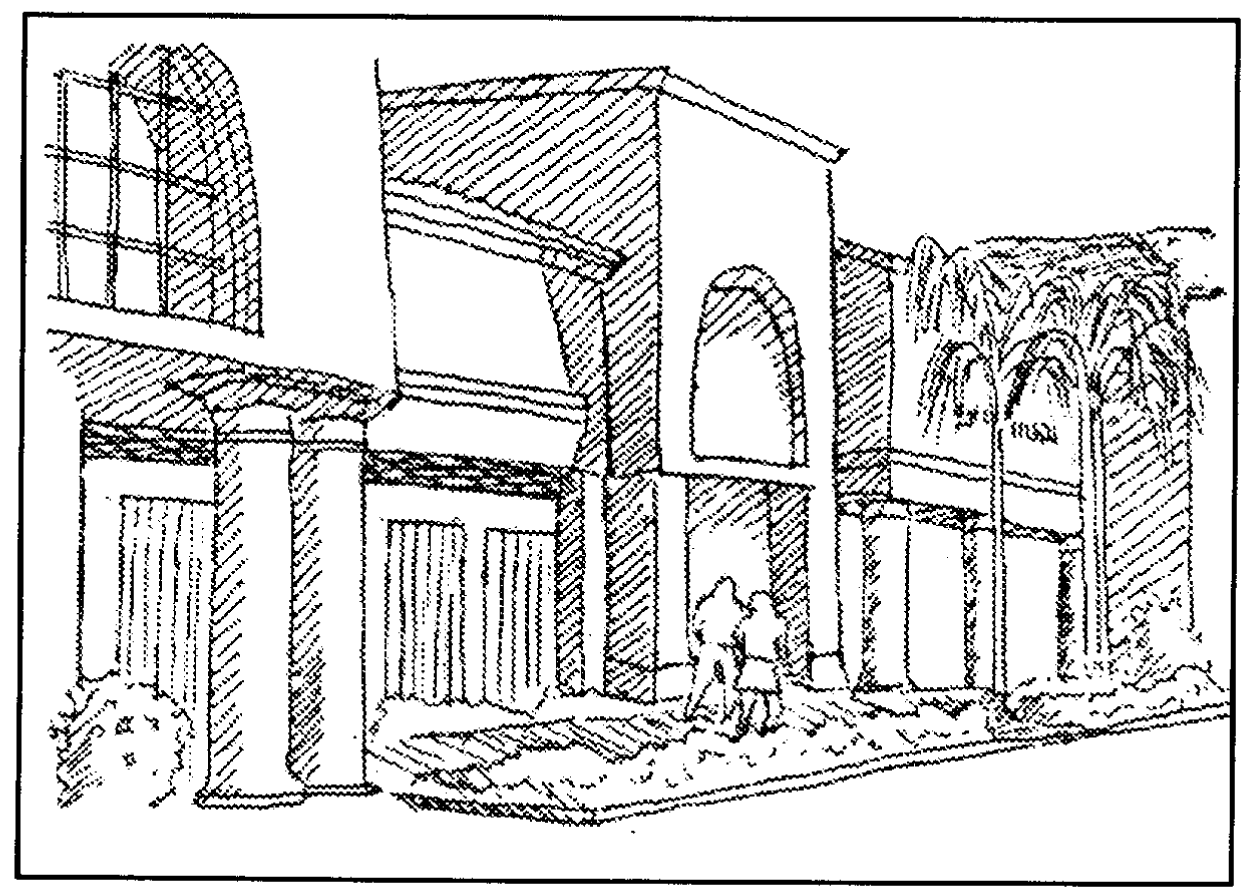
Building articulation (i.e., offsets, projections, and recesses) creates interesting
facades and inviting pedestrian spaces
(1)
Single-story and multistory elements. A combination of one-story and two-story elements should be created within the overall form of commercial buildings in order to provide a variety of scale and reduce the perceived building mass. Any building mass above the second story should be substantially set back and reduced in size.
(2)
Perimeter mass. The ends of large building masses should be stepped down with subelements in order to create a more human scale for the pedestrian.
(3)
Articulation. The apparent mass of buildings should be reduced by means of articulation, i.e., the varying of wall planes in depth and/or direction. This also creates visual interest and human-scale outdoor spaces such as patios and terraces. Large blank single-planed walls should be avoided.
(4)
Use of architectural elements. Elements such as canopies, awnings, porches, arcades, and balconies may be used to add wall articulation and provide a varied transition of building mass from ground level to roof.
(5)
Parking structures. Although parking structures are sometimes necessary in dense commercial areas they tend to be massive and overwhelming. The following design measures are aimed at softening their impacts:
a.
The design and materials of parking structures should be consistent with and should complement the buildings they serve.
b.
On elevations exposed to public view, the concrete sides should be textured and colored or faced with brick or other material consistent with the structure's associated buildings. Exposed uncolored concrete sides should be avoided.
c.
Substantial buffer landscaping should be included along all sides of the structure exposed to public view similar to the surface parking lot boundary landscaping required by .
d.
Landscaping on the top level should receive interior landscaping equal to at least one-half of the interior landscaping required of surface parking lots as specified in .
e.
Linear planters and/or trellises with cascading shrubs or vines should be added along the outside edge of each parking level, especially the upper levels, for visual softening and interest.
f.
Upper levels of the structure should be stepped back further than the lower levels.
g.
One or more parking levels may be placed underground.
h.
The inclusion of street-level retail or office space is encouraged.
(d)
Building elevations.
(1)
Unified treatment. Commercial building design should incorporate a simple, unified architectural treatment or style which provides a framework for storefronts and signage.
(2)
Rhythm. Multi-tenant buildings should express a harmonizing rhythm by means of repeated architectural elements such as doors, windows, signing, and the structural frame of the overall building.
(3)
Wall tops. The tops of exterior walls should be terminated by a cornice, gable roof projection, or parapet which reinforces the rhythm of the building storefronts.
(4)
Building entrances. Entrances should be oriented toward walkways but should be designed to minimize conflicts between people going past and people entering or leaving the store. This can be done, for example, by recessing entrances which open onto walkways less than ten feet wide into the facade storefront.
(5)
Ground floor interest. Commercial and office buildings should be designed so that the ground floor presents an interesting and varied appearance to pedestrians and motorists. This can be achieved by the liberal use of windows, arcades, architectural detailing, wall murals, artwork, and similar design features.
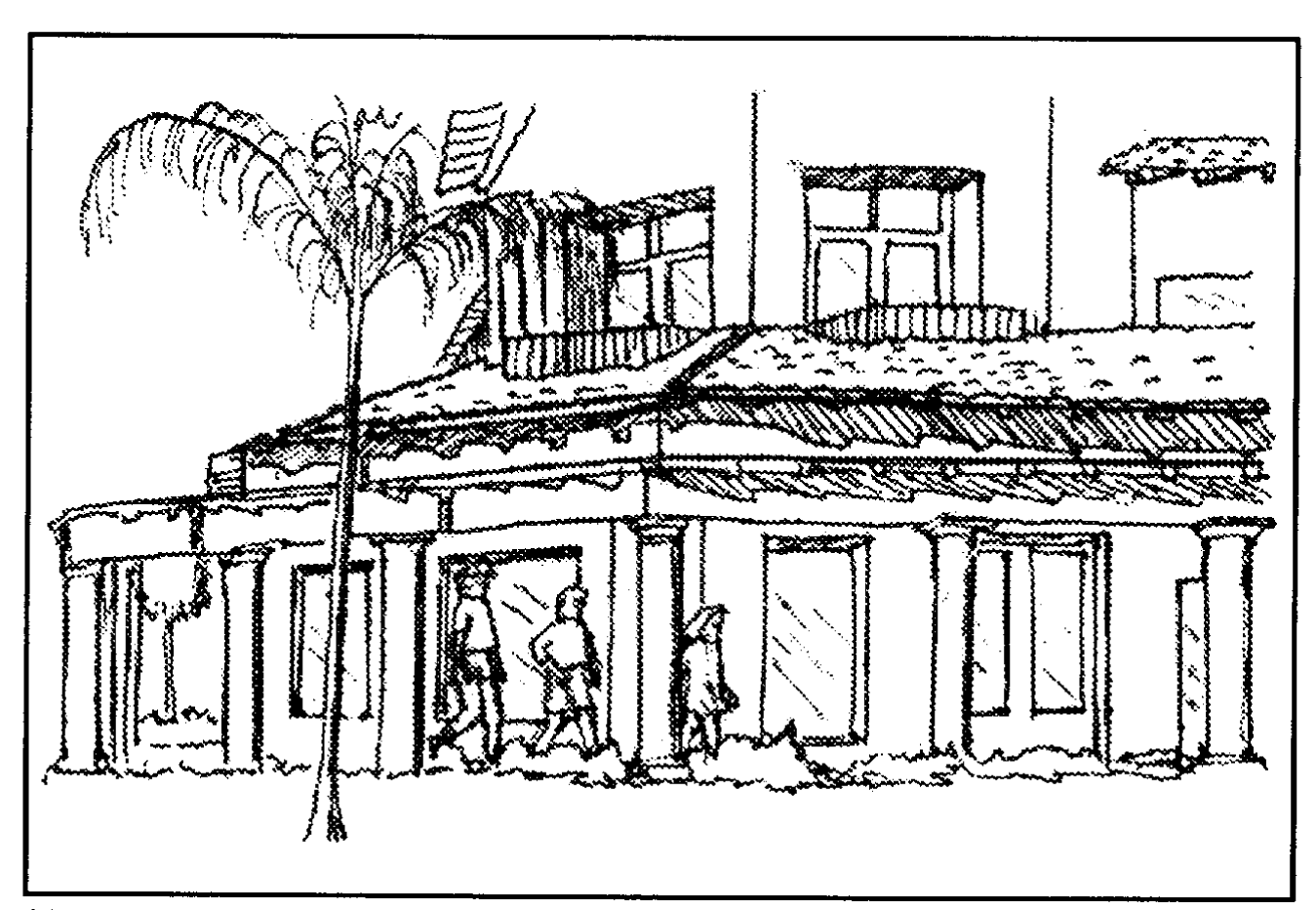
Windows, arcades, and balconies add interest to commercial buildings
(6)
Balconies and galleries. Balconies should be recessed, cantilevered, or can be supported on columns to form a veranda below. When covered to form a gallery, the balcony contributes an attractive indoor-outdoor element.
(7)
Verandas, pergolas and arcades.
a.
These attached ground floor covered walkways are encouraged for commercial and other pedestrian-intensive uses because:
1.
They add variety and interest to otherwise monotonous wall planes;
2.
They add partially protected exterior space to a building; and
3.
They provide pedestrian pathways and transitions to indoor spaces.
b.
The veranda roof and the pergola's open rafters should be supported on a concrete, stone, or plastered masonry colonnade or on heavy wooden posts. In Spanish styles, the walkway's spanning members consist of arches and the structure is referred to as an arcade. For such arcades, use of the barrel arch is appropriate while use of the pointed or parabolic arch is discouraged.
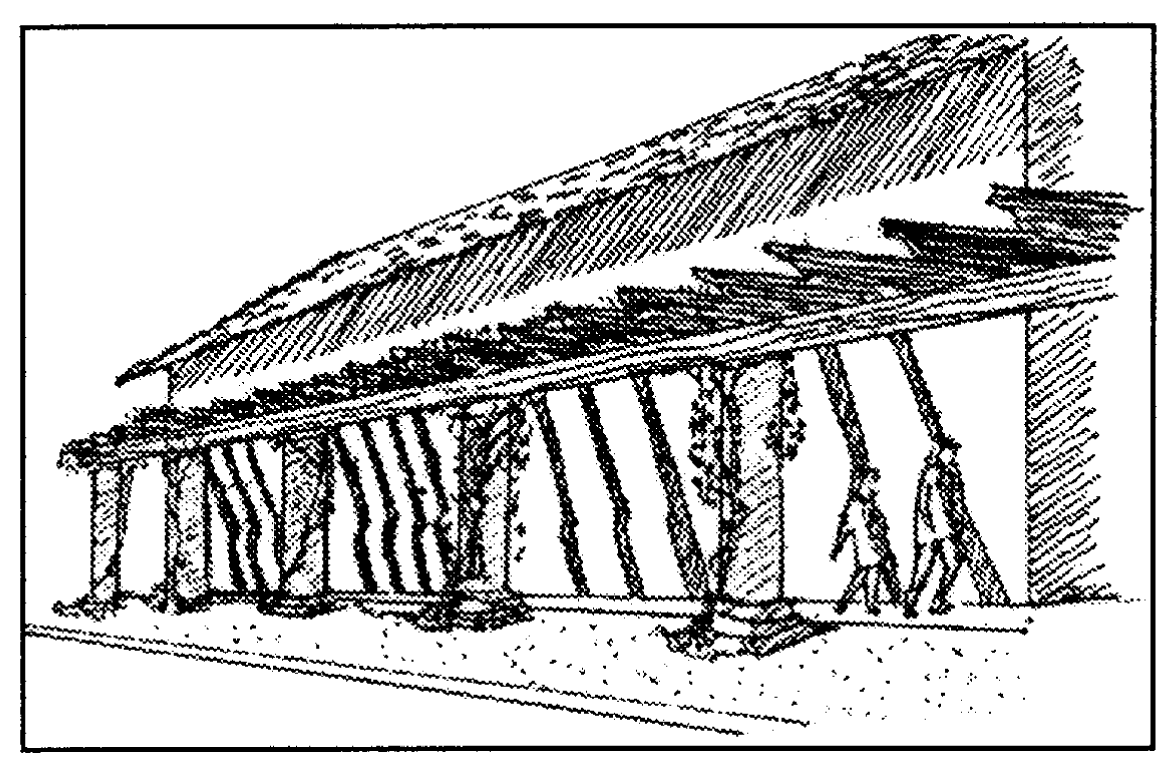
Yes: Blank walls can be made more appealing by such features as pergolas (trellis-covered
walkways)
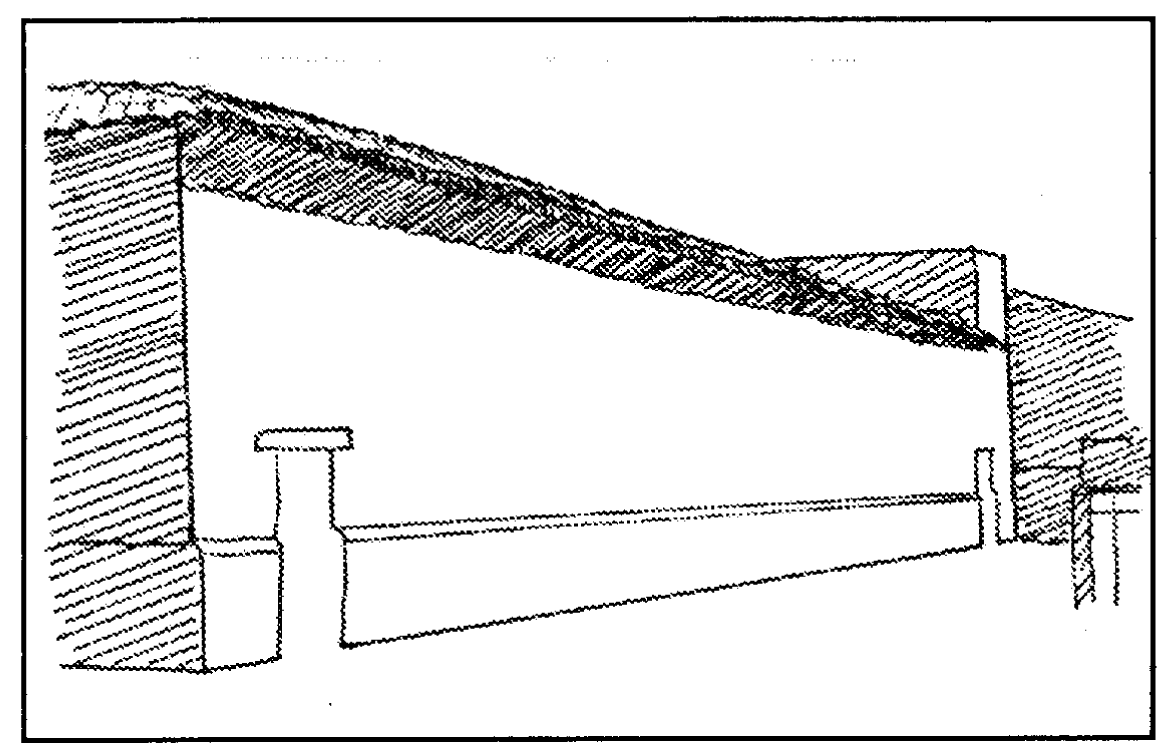
No: Unrelieved blank walls are barren and unfriendly
(8)
Wall relief. Trellises, frameworks, wood or tile details, artwork, and other features should be designed into otherwise blank walls to avoid sterility and visual monotony.
(e)
Roofs.
(1)
Pitched roofs. Pitched roofs are encouraged for commercial buildings in the city. They may be gable, hip, or shed type, but in all cases should either be full-pitched or should appear so from the street. Any flat portions, such as for equipment wells, should be relatively small and hidden. On larger commercial buildings, pitched roofs should generally be multiplaned to avoid large expanses of monotonous single-planed roofs.
(2)
Flat roofs. Though not encouraged, flat roofs may be approved for larger commercial buildings such as discount warehouses, or when the decision-making authority determines that a project's overall design is amenable to flat roofs and is otherwise consistent with the goal and objectives set forth in . When flat roofs are used, there should be a screening parapet topped with a coping, cornice, or, if determined appropriate to the project's style by the decision-making authority, a modified mansard. Such mansards should maintain the same roof pitch as surrounding buildings and should be both high and deep enough to create the illusion of being a true roof. Small steeply pitched mansard eyebrows are generally discouraged.
(3)
Roof materials. Materials should be fire resistant, such as clay or concrete tile on pitched roofs, and composition materials on flat roofs. Standing-seam metal roofs may also be used if the decision-making authority determines that such a roof is consistent with the character and style of the building. Potentially combustible roof coverings such as wood shakes or shingles shall not be used.
(4)
Spanish tile. Two-piece clay or concrete barrel tile should generally be used. However, one-piece "S" tile may be used when the decision-making authority determines that such tile is compatible with the overall building style, e.g. "S" tile is not compatible with traditional Spanish styles but may be so with more contemporary styles. For both tile types, tile should generally be a mixture of lighter and darker colors, producing the appearance of natural variation. Also, tiles should be stacked, i.e., doubled, triplex, and quadrupled, at the eaves and randomly elsewhere over the roof surface to add texture and richness. With two-piece tiles, mud grouting should be placed between the stacked tiles.
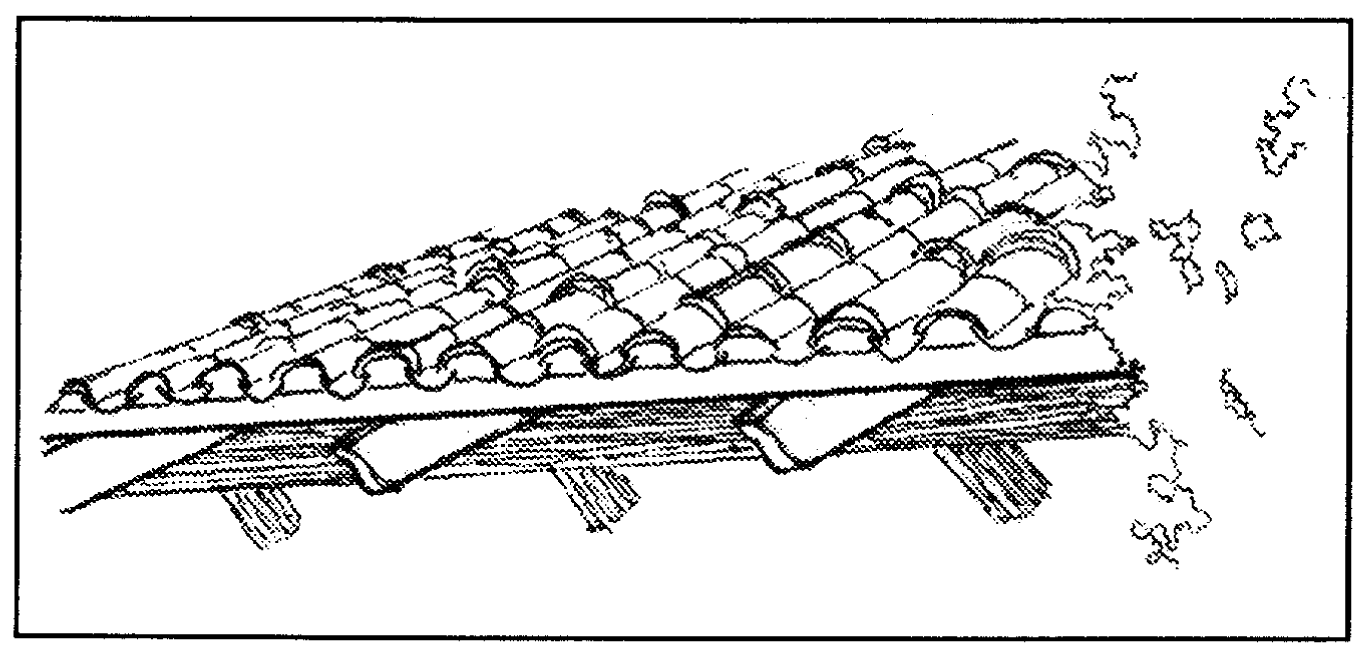
Random stacking (doubling, tripling, quadrupling) of Spanish tiles provides a rich
textured appearance
(5)
Screening of roof equipment. All roof-mounted equipment (e.g. air conditioning, heating, ventilation, and associated vents and exhausts) shall be completely screened from a horizontal line of sight. Also, if the building roof is visible from surrounding hillside areas, all roof equipment shall be screened from above as well. Such screening shall be architecturally consistent with the building and an integral part of the roof design so as not to appear as an architectural "afterthought." For flat roofs, an architecturally consistent screen enclosure behind the parapet wall may be used if it is made to appear as an integral part of the building. The ground-mounting of mechanical equipment, with appropriate wall or landscape screening, as an alternative to roof mounting is encouraged.
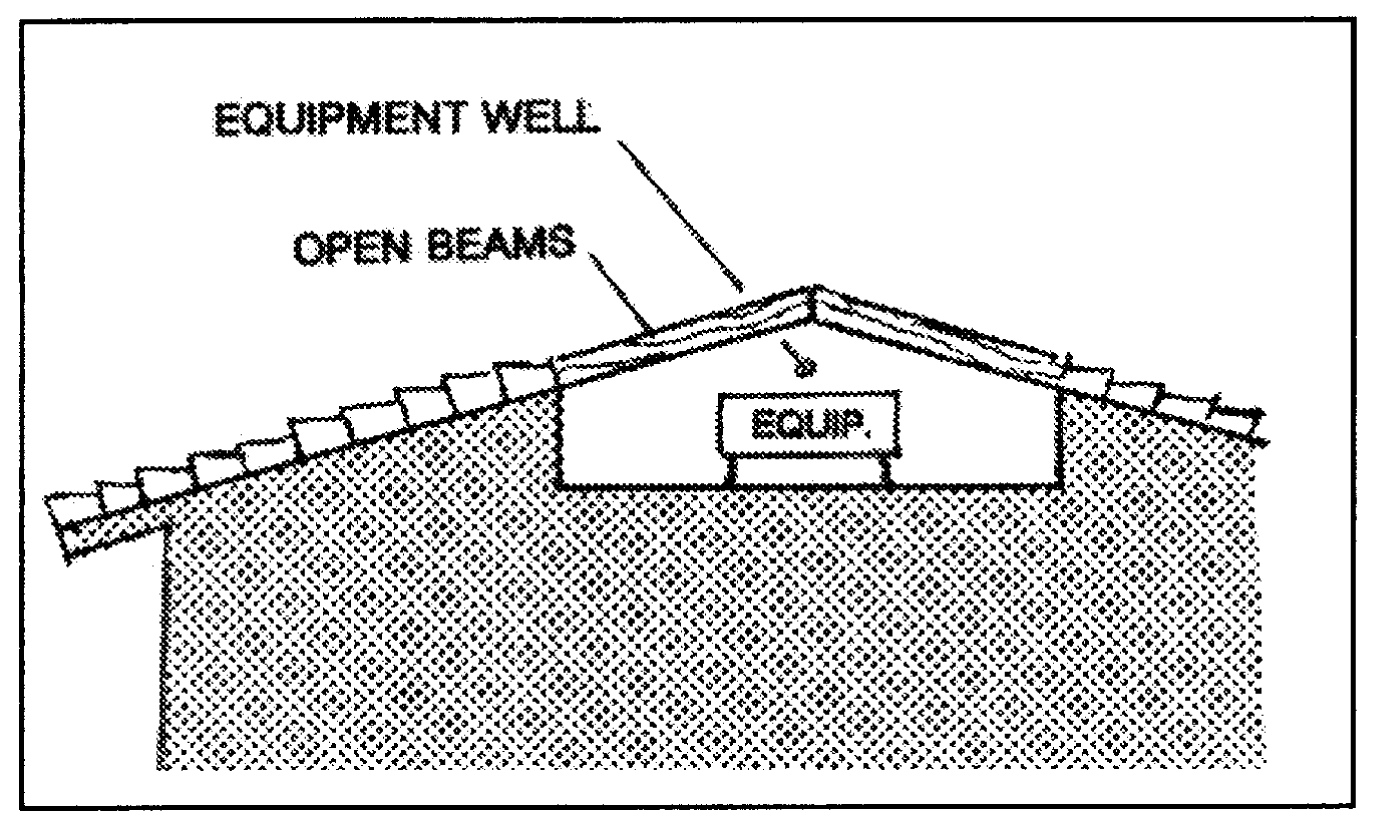
For pitched roofs, equipment wells integrated into the roof design should be used
to screen equipment
(f)
Doors and windows.
(1)
Doors. Entry doors may be of many materials and types but should be consistent with the overall building architecture and should generally be of human scale. They should also be inset into the wall as part of an easily understandable building or store entry statement. Porches, canopies, and porte-cocheres may be added as part of the overall entry where space and building use allow.
(2)
Windows. Windows may be of various types but should usually be rectangular or roundheaded. They should be recessed into the wall or at least give the appearance of being recessed in order to add articulation to the facade.
(3)
Awnings and canopies. Awnings, canopies, and porte-cocheres may be used to mark entrances and windows and provide protection from sun and rain. However, care must be taken to ensure that such elements are tasteful accents and not gaudy distractions (e.g. a green-and-orange striped awning on a Victorian style building) and that they are consistent with the architectural character of the building.
(g)
Materials and colors.
(1)
Number of materials. The number and variety of materials on commercial buildings should be limited to avoid confusion and dissonance.
(2)
Roof materials. Refer to paragraph (e) of this section.
(3)
Acceptable wall materials. Stucco, wood, masonry, river rock veneer, or other durable high quality materials may be used. If stucco, a smooth, sand, or light lace finish should be used. If wood, highly protective/preservative paints, stains, or other coatings shall be used to ensure attractive appearance over time. If the wall is masonry, then brick, slumpstone, split-face block, or other decorative block may be used.
(4)
Unacceptable wall materials. Untextured concrete block should not be used on any exterior wall open to public view. Also, glass with a reflectivity factor of over 30 percent, on the outside surface, shall not be used for commercial buildings.
(5)
Wall colors. One dominant color should be used for the building walls. Although subdued colors, such as beige, tan, cream, sand, light gray, etc., usually work best as the dominant wall color, bolder colors may be used if the decision-making authority determines they are consistent with the character of the project and would not have an adverse impact on surrounding properties or the streetscape. Also where possible, materials with integral color, such as brick, should be left natural. Metal may be used as wall trim if the decision-making authority determines it is consistent with the style and character of the project.
(6)
Color accents. Accent colors bolder than those used for walls may be used on doors, window surrounds, awnings, light fixtures, and surfaces such as cornices and soffits.
(7)
Wall graphics. Painted wall graphics may be used for accent and visual integration provided they do not overwhelm other design features in the opinion of the decision-making authority.
(h)
Focal elements.
(1)
Purpose. The use of focal points in a commercial complex is desirable to provide both orientation and organization. These focal points create a visual counterpoint to the massing of nearby buildings. Examples of important focal elements include fountains, courtyards, and towers.
(2)
Courtyards. Courtyards and patios may be used to add amenity and interest to individual buildings and to integrate and harmonize adjacent buildings. Also, courtyards, as human-scale outdoor rooms, can contribute greatly to advancing the guideline objective of , creating projects which are both inviting and user-friendly to people. These spaces, when combined with inviting design embellishments such as awnings and balconies, encourage movement and act as an interface between semiprivate and public spaces. For commercial and related uses, courtyards can act as an entry or as a transition point in a larger pedestrian circulation system. They become locations for people-gathering, meeting points, and entertainment, or simply rest stops for shoppers.
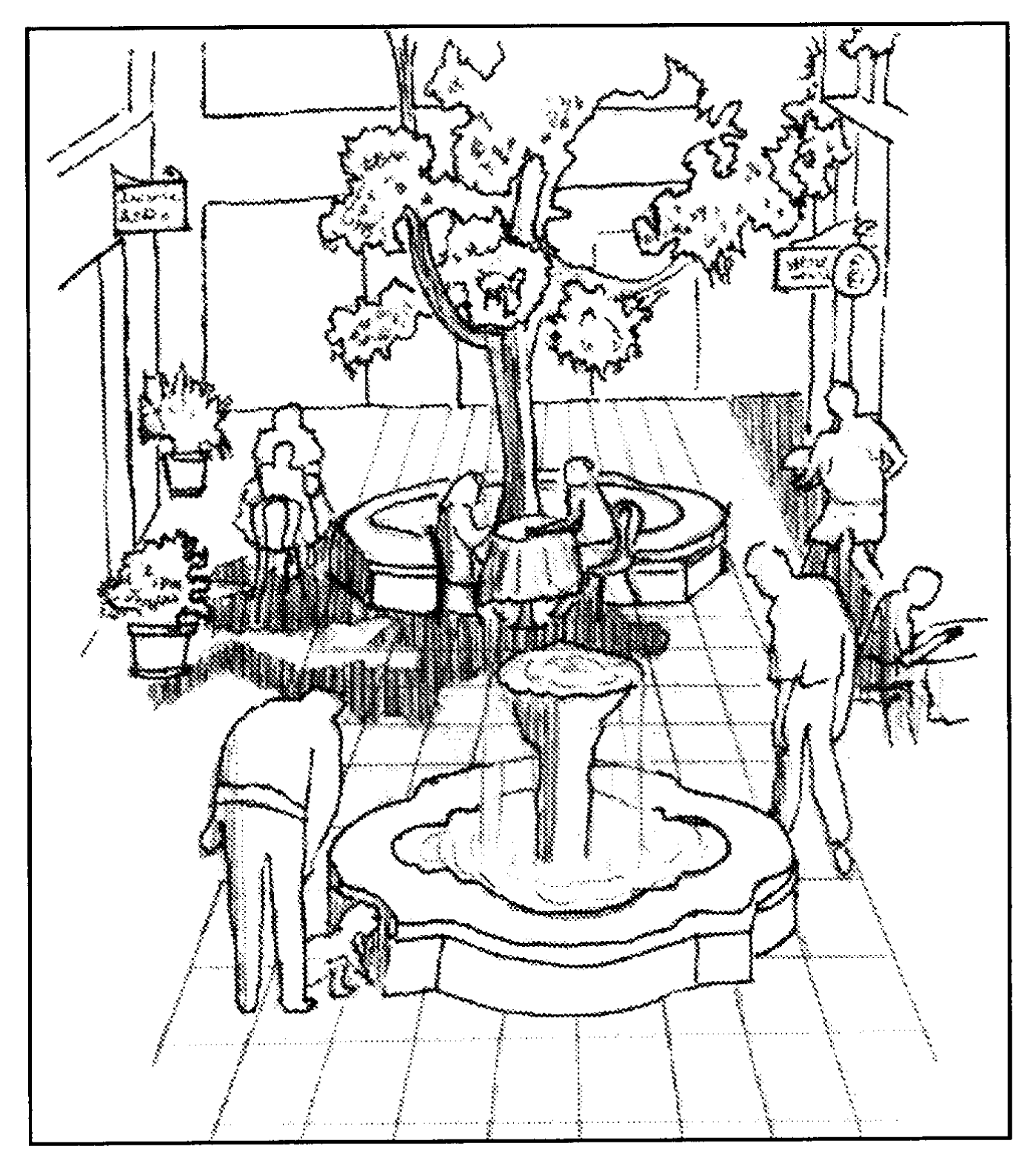
Courtyards become enjoyable people places when enhanced by fountains, outdoor cafes,
planters, and other amenities
A higher degree of architectural detail should be provided in courtyards in comparison to other spaces. Also, furnishings (seating, pottery, lighting), paving, and plantings should be emphasized and richly detailed. Seating choices and paving patterns directly impact the way the courtyard space is perceived and its overall success as a human space. Therefore, seating choices (low walls, benches, chairs) should be offered in both shaded and sunny areas and paving should be enriched (e.g. pavers, brick, or stamped concrete, though not so rough or irregular as to discourage the use of baby strollers, wheelchairs, or high heels).
(3)
Fountains. Fountains provide visual interest and auditory relief and should be considered for all projects with semi-enclosed outdoor spaces such as courtyards. When used, fountains may vary greatly in scale and design and may be freestanding or wall-mounted. They may be constructed of carved stone, cast concrete, or other materials and may be enriched by ceramic tile inserts or other detailing. Low-evaporation, water-conserving designs are encouraged.
(4)
Towers. Towers serve numerous practical and symbolic functions:
a.
They create a vivid visual and mental image for a project, providing identity and differentiation from other projects.
b.
They become the actual or symbolic center and gathering point for a project.
c.
They maintain a sense of orientation within a grouping of buildings.
d.
They can serve to terminate a vista or circulation system.
e.
They can provide vertical circulation when used as a stairway or lookout point.
f.
They can serve as a gateway or point of arrival for a project.
Notwithstanding the preceding list of benefits, towers should not violate the scale of a project by being too tall or massive for the size of the other structures or for the size of the site. In any case, towers shall conform to the provisions of (Nonresidential development standards).
(Ord. No. 99-107, § 5, 2-2-99)
Sec. 9-1-92.5. - Office and industrial architecture.
(a)
Applicability.
(1)
General applicability. The office-industrial architectural guidelines of this section shall apply to the following projects:
a.
Office and industrial buildings and parks.
b.
Utility substations.
c.
Large-scale hotels and hospitals (four stories or above).
d.
Mixed-used projects which are predominantly office or industrial but which also contain small incidental commercial uses, such as a sandwich shop.
(2)
Office or industrial buildings proposed for commercial areas. Notwithstanding paragraph (a)(1) of this section, in order to promote consistent design quality within the community's retail commercial areas, the city shall have the discretion of applying the commercial architectural guidelines of to office or industrial buildings proposed for such commercial areas. Determinations to apply such commercial architectural guidelines shall be in accordance with the provisions of subsection (d).
(b)
Architectural style and harmony. The guidelines in subsection (b), architectural style and harmony for commercial projects, shall apply equally to office projects.
(c)
Building mass, form, and elevations.
(1)
Building mass. Massing should be simple and possess strongly integrated geometric forms. The massing should relate to the internal function and nature of the space it is intended to enclose.
(2)
Solid-void relationships. Office and industrial buildings should have strong contrast between the solid mass of facade and the lighter elements of the glazing and entry. The facade should clearly identify the entry and direct people to it. Also, the creation of strong shadow lines via recesses and projections is highly encouraged.
(3)
Articulation. The degree and scale of articulation between office and administrative functions and storage and industrial spaces should not vary within a single building. Also, one-sided architecture, where only the dominant street frontage possesses articulation, should be avoided or should be mitigated by the use of such structures as pergolas and trellises.
(4)
Lower floors. The first two or three floors of taller buildings are experienced by pedestrians and motorists at close range. Therefore, design of these lower floors shall reflect the fact that they belong to the streetscape and not the skyline. Design solutions should emphasize color, texture, and other treatments which provide visual interest. Specific elements which may generate this interest include colonnades, awnings, windows, and enriched design details such as tiling. Unrelieved curtain walls used for upper stories should not extend down to these lower floors.
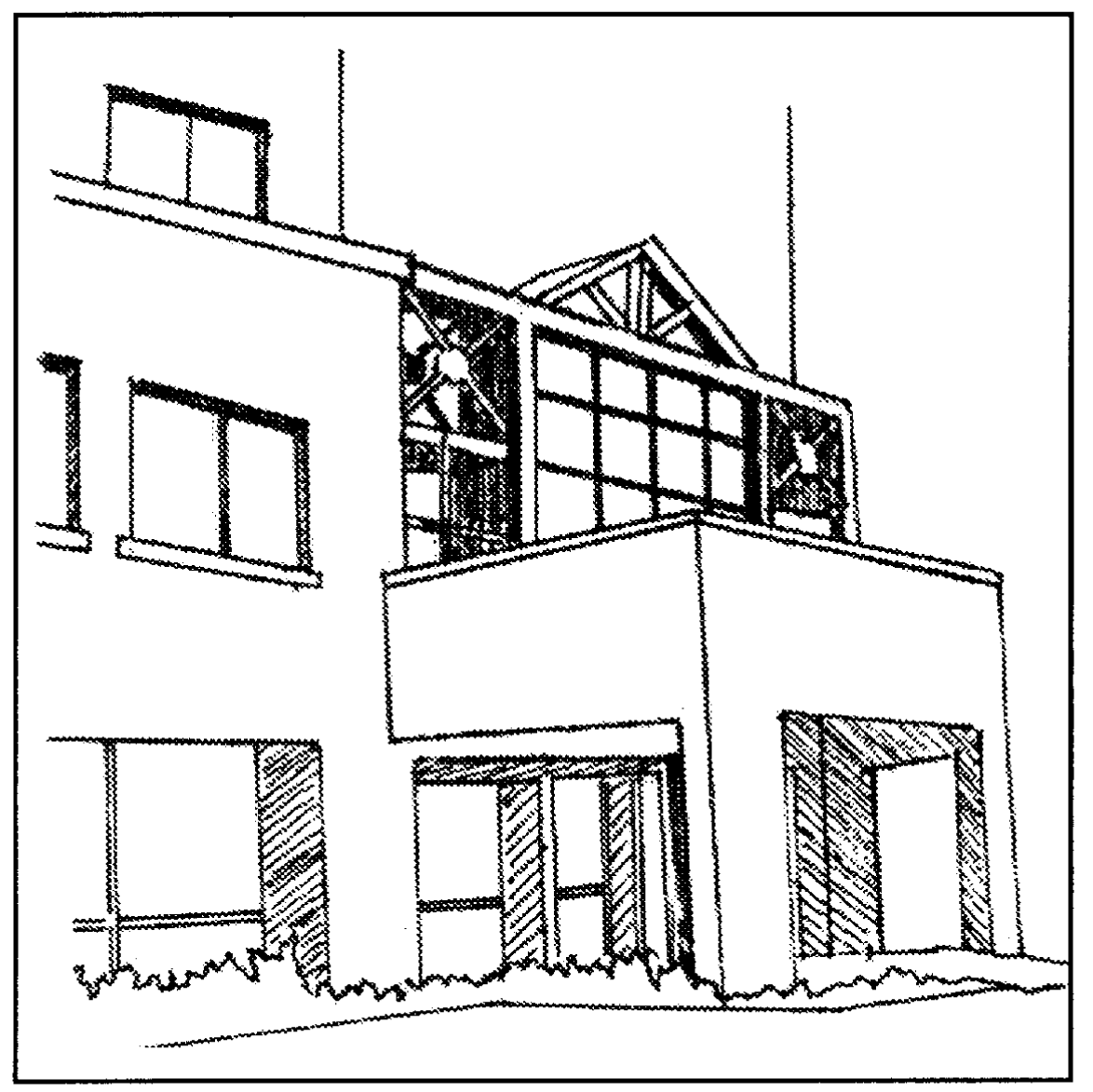
The lower floors of multistory buildings should contain design details, such as windows
and canopies, to enrich the streetscape view
(5)
Concrete walls. The surfaces of tilt-up and other concrete walls should be embellished by means of texturing, the use of exposed aggregate, fenestration (wall openings such as doors and windows), variations in wall color, wall graphics, insets and overhangs to create shadow lines, and similar design features to add interest and relief.
(6)
Parking structures. Parking structures are sometimes necessary in denser areas where land is at a premium. However, they tend to be massive and overwhelming. Therefore, the design measures aimed at softening their impacts on commercial areas described in shall also apply to office and industrial parking structures.
(d)
Entries and other elements.
(1)
Entries. The main public entrance should be readily visible from the parking area or pedestrian connection. Emphasis on the entry can be achieved by concentrating a secondary material at the entry with a major projection or recess. Architectural elements such as a porte-cochere, framework, or skylight may be used to emphasis the entry/lobby areas.
(2)
Drainage and utility structures. Exterior wall drainage, utilities, cabinets, and other systems shall be integrated into the building design.
(3)
Exterior building lighting. Exterior building lighting should consciously reinforce the architectural design by emphasizing entry and design features in addition to providing illumination for security purposes.
(e)
Roofs.
(1)
Roof types. Roofs of smaller buildings may be flat or pitched while those of larger buildings will generally be flat, with the minimum slope necessary for adequate drainage. Flat roofs shall be surrounded by a parapet which is a continuation of the facade material. The screening elements behind the parapet should be constructed of the same material as the facade.
(2)
Roof materials. Materials should be fire resistant, such as clay or concrete tile or composition shingles on pitched roofs, and composition materials on flat roofs. Standing-seam metal roofs may also be used if the decision-making authority determines that such a roof is consistent with the character and style of the building. Potentially combustible roof coverings such as wood shakes or shingles shall not be used. Spanish tile should conform to the standards of subsection (e) (Commercial Building Roof Design and Materials).
(3)
Screening of roof equipment. All roof equipment shall be completely screened from both horizontal and vertical view. If the building roof is visible from surrounding hillside areas, special care shall be taken to screen roof equipment from above. Such screening shall be an integral part of the roof design and not appear as an afterthought. For flat roofs, a screen enclosure behind the parapet wall may be used if it is made to appear as an integral part of the building. The ground-mounting of mechanical equipment, with appropriate wall or landscape screening, as an alternative to roof-mounting is encouraged.
(f)
Materials and colors.
(1)
Wall materials. Allowable wall materials may be divided into two categories: Dominant materials which will usually comprise over 70 percent of total wall surface, and secondary materials which cover the remainder and serve as accents or to emphasize entry focal points.
a.
Dominant materials:
1.
Stucco.
2.
Brick.
3.
Split-faced or other decorative block.
4.
Glass.
5.
Wood.
6.
Textured concrete.
b.
Secondary materials:
1.
Any dominant materials from paragraph (f)(1)a. of this section.
2.
Metal.
3.
Tile.
4.
Plaster.
5.
Glass block.
6.
Stone.
(2)
Roof materials. Refer to paragraph (e) of this section.
(3)
Glass. Glass should not be used over more than 70 percent of the wall surface per elevation and should have a reflective factor of 30 percent or less, on the outside surface.
(4)
Concrete. Concrete tilt-up construction should not be used for office or mixed-use projects. When used for exclusively industrial or warehouse buildings, the exterior surfaces of tilt-up walls should be textured and colored per paragraph (c) of this section.
(5)
Colors. Colors of dominant materials should generally be subdued or earthtone shades (e.g. grays, off-white, tans, beige, and similar) and relatively light. Secondary material colors should complement and be a tasteful accent to the dominant material color. Color palettes should be kept simple, with one dominant color per building and accent colors on doors, window surrounds, address numbers, light fixtures, and architectural details such as cornices and soffits. Bolder and/or more varied colors may be used if the decision-making authority determines they are consistent with the character of the project and would not have an adverse impact on surrounding properties or the streetscape.
(6)
Wall graphics. Painted wall graphics, other than signs, may be used for accent and visual integration provided they do not overwhelm other design features in the opinion of the decision-making authority. Wall signs shall be regulated by subarticle 7 of this Code.
(g)
Focal elements. Focal elements, such as courtyards, fountains, and towers, are encouraged for office and industrial projects under the same standards and limitations described for commercial projects in subsection (h).
(Ord. No. 99-107, § 5, 2-2-99)
Sec. 9-1-92.6. - Cultural depictions.
(a)
Purpose. The purpose of the cultural depiction program is to provide for the incorporation of representations of the city's physical and cultural heritage into the everyday life of the community by encouraging such representations within larger-scale commercial, office, institutional, and mixed-use projects.
(b)
Description. As used in this subarticle, the term "cultural depiction" refers to a representation of physical, archaeological, paleontological, or historic artifacts, features, or events which are characteristic of the city. Examples of such depictions might include artwork, such as sculptures, mosaics, or murals; displays containing artifacts found on or near the development site; plaques, commemorating historical events or pointing out exceptional vistas or physical features of the location; or similar representations.
(c)
Applicability. Cultural depictions are encouraged for the following development projects if over one acre in size:
(1)
Commercial projects.
(2)
Office projects.
(3)
Institutional projects such as civic centers, hospitals, and private schools.
(4)
Mixed-use projects which are predominantly commercial, office, and/or institutional but which may also contain industrial, or other uses.
(d)
Exemptions. Notwithstanding paragraphs (a) through (c) of this section, the planning commission may exempt an otherwise eligible project from the cultural depiction program if it determines that any of the following apply:
(1)
Because of the unusual character of the project, its location, or other factors, the project will attract, unusually, traffic in terms of both employees and patrons; or
(2)
There is no reasonably prominent onsite location in which to place the depiction and there is no appropriate alternative offsite location; or
(3)
No useful purpose would be served by imposing the cultural depiction requirement in terms of advancing the goal and objectives set forth in .
(e)
Appropriateness and cost. Proposed depictions shall be reviewed, not on the basis of cost, but on cultural or physical authenticity, and appropriateness to the character of the city. However, as a reference for project developers, the cost of a project's cultural depictions should approximate one percent of the project's building permit valuation.
(f)
Location. The depiction shall be placed in a prominent location within the project and should be oriented primarily to pedestrian, as opposed to motorist, viewing. Generally, the depiction should be at an outdoor location but may be placed indoors in unusual circumstances if the decision-making authority determines that the indoor location is superior in terms of pedestrian traffic and/or preservation of the depiction. Also, if the decision-making authority determines that there is no appropriate location within the project, it may approve an offsite location, such as on public property or on separate private property, upon mutual concurrence of the developer and the other property owner.
(g)
Review procedures. Preliminary plans and site locations for cultural depictions shall be reviewed in conjunction with the site development or use permit for the overall project pursuant to .
(Ord. No. 99-107, § 5, 2-2-99)
Sec. 9-1-93. - Guidelines for attached residential projects.
All references to this section include through .
(Ord. No. 99-107, § 5, 2-2-99)
Sec. 9-1-93.1. - Applicability of residential guidelines.
(a)
Attached residential projects.
(1)
General Rule. The design guidelines contained in through shall apply to all attached residential projects, but shall not apply to single-family detached homes or to single-family remodels.
(2)
Minor exterior alterations.
a.
Definition. Minor exterior alterations generally include changes to architectural features, exterior lighting, mechanical equipment screening, site landscaping, including tree removal, or repainting the exterior of a structure with different colors. A minor exterior alteration does not include repainting of a building with the existing colors or replacing existing landscaping with the same or similar plants.
b.
Changed plan required. Except for townhomes, duplexes, or patio homes, no minor exterior alteration, as defined in this subsection, shall be made to an existing multifamily building or project, until it is administratively reviewed and approved by a changed plan processed in accordance with . The director may refer such a proposed changed plan to the planning commission for review and approval if the director determines that the proposed minor exterior alteration is significant and that the public interest would be better served by planning commission review of the proposed changed plan. Review of a proposed minor exterior alteration shall be limited to the proposed alteration and shall not be a basis for or allow review of the entire building or project for compliance with the provisions of these Guidelines.
(b)
Determinations of applicability. In cases of uncertainty over the applicability of any of the guidelines within this to a proposed project, the community development director shall decide based on the director's assessment of the overall character of the project and its proposed land use or mix of uses. However, in cases where the director concludes that, because of the large scale and/or prominent location of a project, the determination will materially affect achievement of the goal and objectives stated in , the determination of applicability shall be referred to the planning commission.
(c)
Effect of other regulations. These design guidelines contained in this subarticle are intended to augment the circulation, access, parking site planning, landscaping, architectural, and other design standards of this zoning code, applicable planned community and specific plan texts, and the Orange County transportation planning division's "development plan review guidelines, criteria, and standards" adopted by the city. In case of conflict between any of the preceding other regulations and this subarticle, the decision-making authority shall apply that which it determines to be more rigorous.
(Ord. No. 99-107, § 5, 2-2-99)
Sec. 9-1-93.2. - Residential site planning.
(a)
Access and circulation.
(1)
Alternate access routes. More than one access should be provided to residential projects in order to ensure safe emergency access into and out of a neighborhood and to provide alternate routes for drivers and pedestrians.
(2)
Connections to existing streets. Street systems for new neighborhoods should connect to existing abutting streets and to nearby parks, community centers, and shopping areas. However, these connections shall be configured so that nonlocal traffic through neighborhoods is discouraged.
(3)
Circulation system to be user-friendly. Attached residential developments should have a comprehensible circulation system that can be readily understood by residents and visitors alike. Safe and convenient automobile, pedestrian, and bicycle circulation should be provided both to and within all such developments.
(4)
Project identification. Identification signs should be provided for all attached residential projects. Such signs shall conform to the limitations on size, height, and placement set forth in subarticle 7 of this Code. The project name shall be approved by the decision-making authority in order to ensure appropriateness, aid in identification for emergency services, and avoid duplication with other projects in the city.
(5)
Project entry location. Project entries shall be located as far as possible from intersections in order to minimize congestion and conflicts. Full curb return street-inter-section-type entries should be used for multiple-family projects instead of dustpan-type driveways.
(6)
Project entry design. Major entries shall be designed as special statements reflective of the character of the project in order to establish identity for residents and visitors. Entry landscape treatment shall be in accordance with the landscape guidelines of .
(7)
Gate-guarded entries. Gate-guarded entries shall be regulated in accordance with city regulations governing gate-guarded neighborhoods as set forth in .
(8)
Bus stops. Where transit or school bus stops are located on a project's arterial frontage, provision should be made for buses to stop out of the flow of traffic. Therefore, bus stop turnouts should be incorporated into the design of site and street improvement plans. Standards of the Orange County transportation authority and the Capistrano unified school district should be taken into consideration in the design of such turnouts. In addition, a waiting bench should be provided and overhead shelters are encouraged. However, bus stop advertising structures are discouraged. The preceding bus stop amenities should be included as part of the project's design details.
(b)
Streets, driveways, and setbacks.
(1)
Use of curvilinear streets. Streets should be gently curving in order to conform to the topography and provide visual relief. Long straight streets should be avoided.
(2)
Setbacks and streetscape variation. Front yard setbacks should be varied substantially and/or individual buildings should be turned and oriented in a variety of ways so as to create visual interest, variety, and individuality along the street. However, minimum required setbacks should not be reduced to achieve this variation.
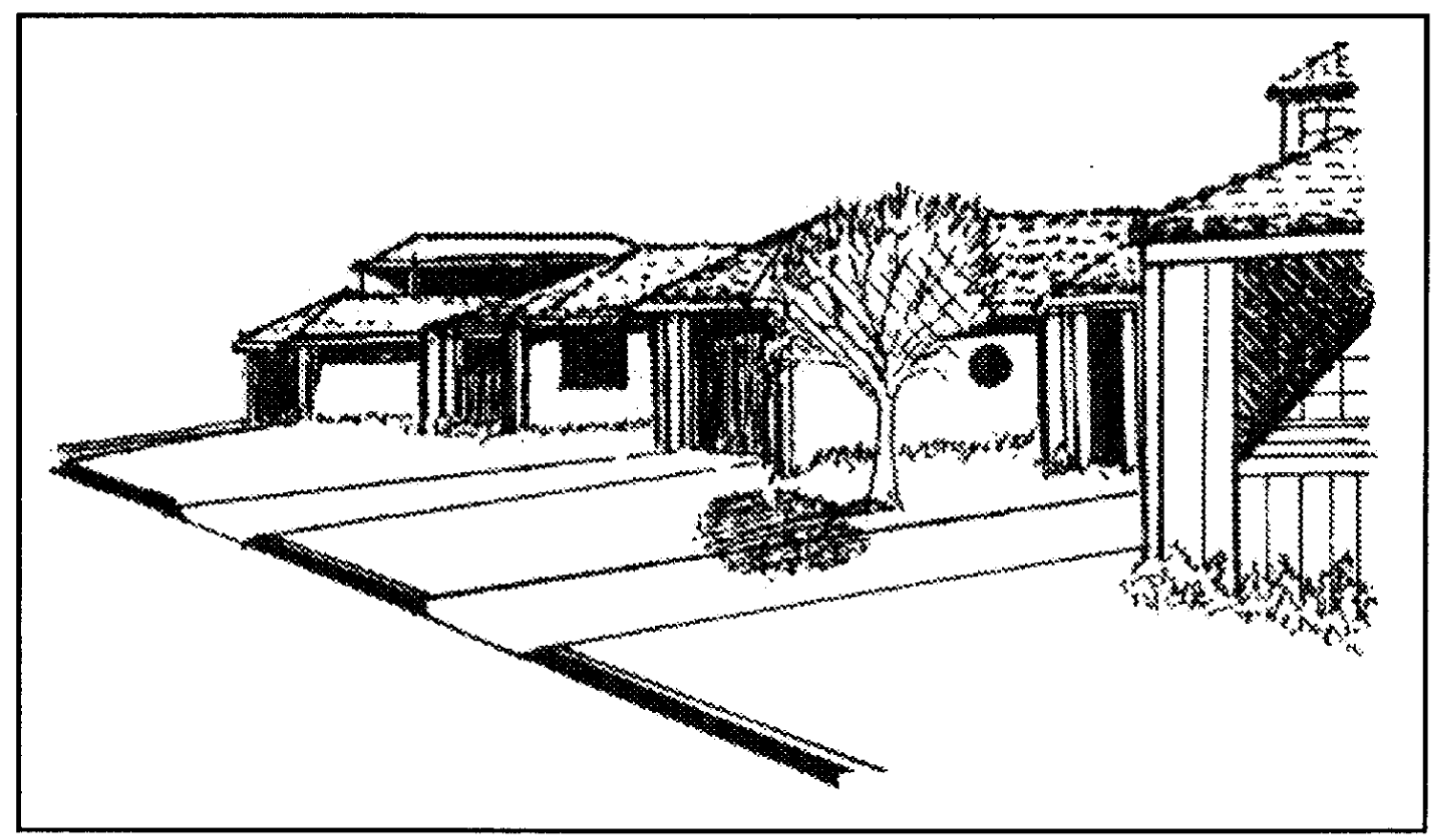
Front setbacks and driveway lengths should be varied along residential streets to
provide interest and avoid monotony
(3)
Driveway length. Intermediate driveway lengths of between five and 20 feet should be avoided because cars will nevertheless be parked in such driveways, resulting in cars extending over the sidewalk and into the street.
(4)
Driveway width. For three-car and four-car garages, whenever the decision-making authority determines that there is sufficient garage setback, driveway width should narrow from full-width at the garage down to a substantially smaller width at the curb. This will reduce the amount of front yard paving and the width of curb cuts.
(c)
Parking and outdoor lighting.
(1)
On-street parking. On-street parallel parking may be permitted on local residential streets if streets are wide enough per the city's subdivision code and applicable street design standards.
(2)
Off-street parking layout. Long lines of garage doors, carports, or uncovered parking unrelieved by planting or other design elements are discouraged. Also, the use of parking drives around the entire perimeter of attached projects is discouraged because they tend to:
a.
Isolate project residents from surrounding neighborhoods; and
b.
Create an unattractive fortress appearance from outside the project.
Architectural guidelines for residential garages and carports are contained in .
(3)
Offstreet parking bays. If onstreet parking is not permitted, offstreet visitor parking bays should be provided in accordance with the ratios set forth in (Residential parking requirements). These bays should be buffered from the street and/or adjacent driveways by substantial landscape planting.
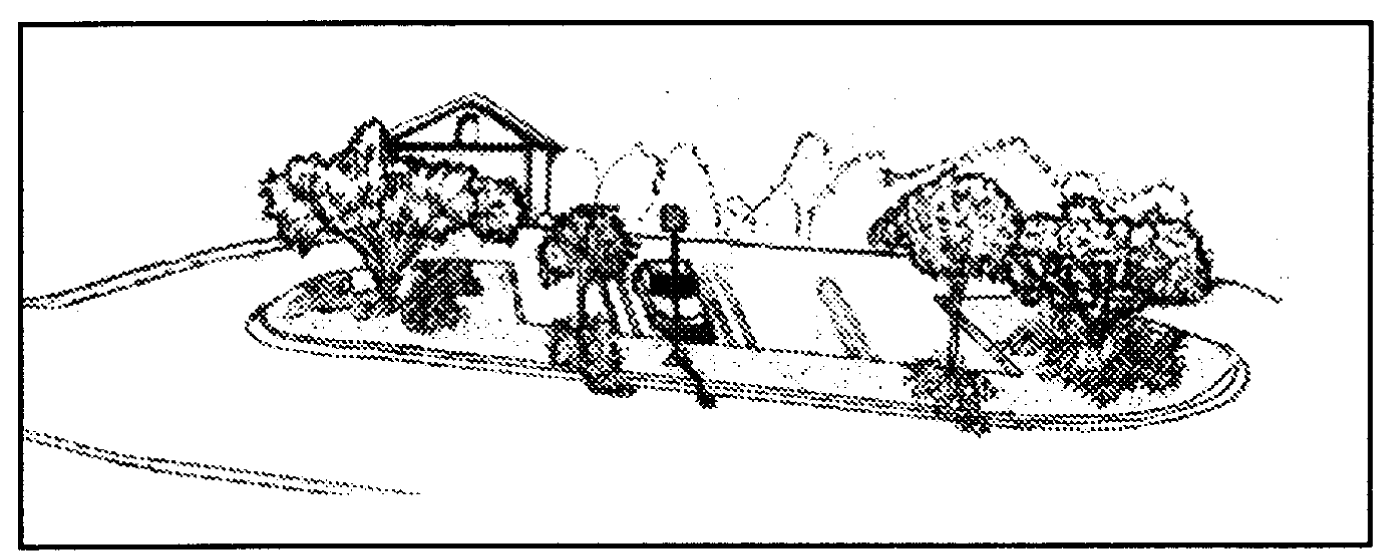
Parking bays should be separated from streets via landscape buffers
(4)
Offstreet parking lots. Small single-aisle parking courts for 20 cars or less are encouraged for attached projects requiring off-street parking lots. For other design aspects of residential parking lots not addressed above, the guidelines for nonresidential parking contained in shall apply.
(5)
Recreation vehicle storage. In order to avoid the parking conflicts and unsightliness associated with the ownership of recreation vehicles in medium and high density areas, offstreet recreational vehicle storage facilities should be provided for developments over five units per gross acre. This recreation vehicle storage lot should provide spaces of varying sizes at a ratio of one space per every seven homes. Affordable housing projects are exempt from this requirement. Recreation storage lots shall be screened via landscape planting and walls or fences in accordance with .
(6)
Street lights. On local residential streets, the use of ornamental street lights, smaller in scale than standard street lights, should be considered. The decision-making authority may approve such lights if it determines that they are consistent with safety and security requirements.
(7)
Other outdoor lighting. Parking lot and other outdoor lighting shall conform to the guidelines for nonresidential projects contained in section 9-2-92.2.
(d)
Pedestrian circulation.
(1)
Pedestrian access. Project designs often wall off residents from otherwise convenient uses that are within comfortable walking distance by project fencing or landscape planting. For this reason, desirable routes for pedestrians should be anticipated and incorporated into the original project design. Consideration should be given to direct and convenient routes for pedestrians that may be needed apart from the local street system. Where feasible, landscaped pathways, stairways, and sidewalks should connect to important locations within a neighborhood, such as parks or community pools. They should also connect to other desired destinations just outside the neighborhood such as the supermarket, post office, or elementary school.
(2)
Sidewalk requirements. Sidewalks should normally be constructed on both sides of residential streets and integrated into the street landscape design. The decision-making authority may approve the elimination of sidewalks from one or both sides where it determines that alternate pedestrian pathways have been provided or that sidewalks would serve no useful purpose.
(3)
Sidewalk placement. On local streets, sidewalks may be placed adjacent to the curb. However, on arterials sidewalks should be set back away from the curb by a landscaped parkway to create a more comfortable buffer between pedestrians and automobiles (see also , re frontage landscaping).
(4)
Pedestrian-friendly walkways. Walkway layout should anticipate pedestrians' desired movements and should provide direct routes for them. For example, walkways should allow pedestrians to cut the corner to change direction without wearing an ad hoc pathway over adjacent grass or groundcover. Also, meandering sidewalks or walkways should contain only shallow curves to avoid frustrating pedestrians with unnecessary detours.
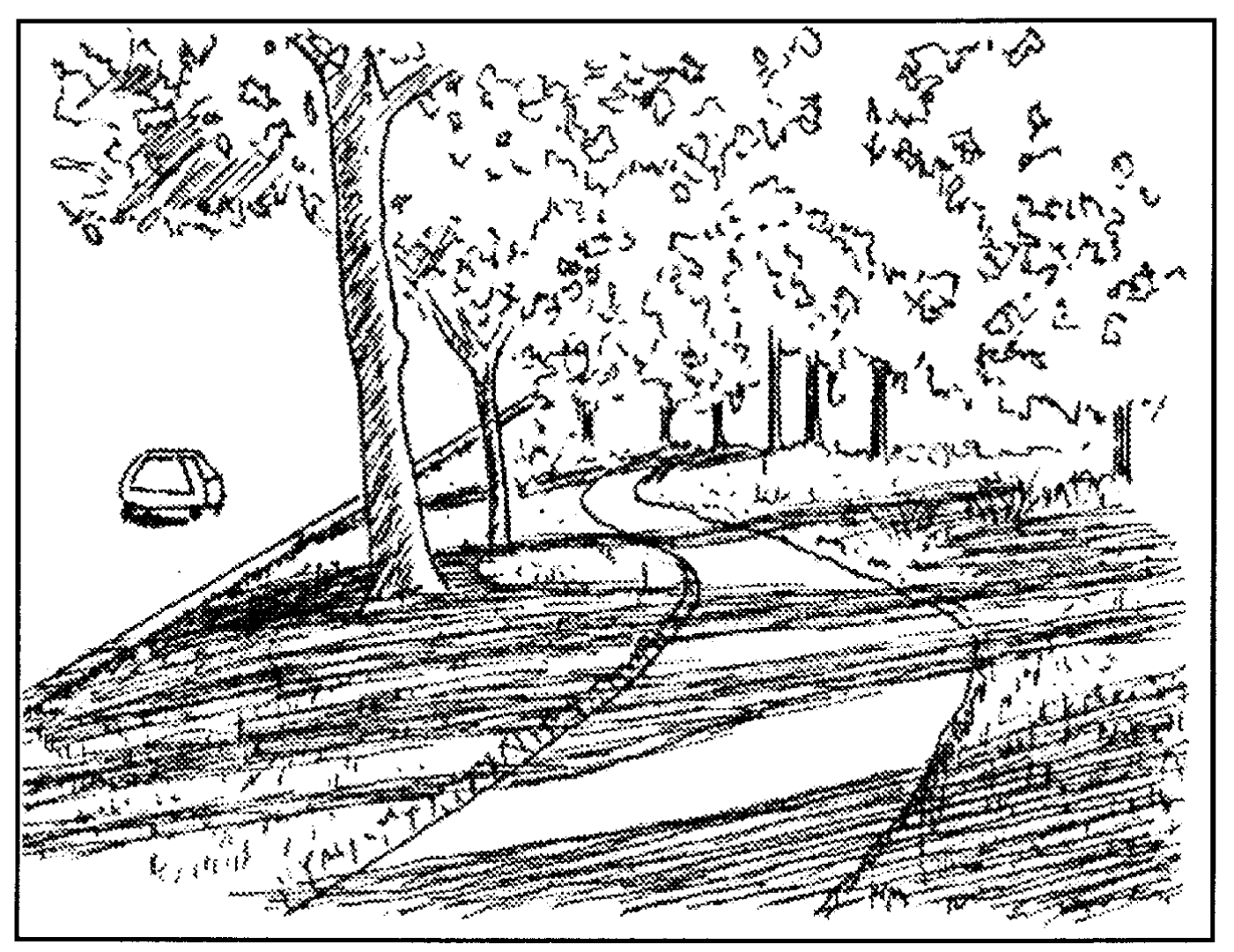
Sidewalks should be separated from arterial highways by means of a landscaped parkway.
Also, meandering sidewalks should have flowing, gentle curves
(5)
Walkway treatment. Walkways should be easily identified and well-lighted by means of pedestrian-scale fixtures, such as vandal-resistant bollard lights. Also, where textured paving is used, it should not be so rough or irregular as to make walking difficult, especially in high heels, or discourage the use of baby strollers or wheelchairs.
(e)
Bikeways and equestrian trails. Bikeways and equestrian/hiking trails should be provided in conjunction with each residential project in accordance with this Code, the subdivision code, or other applicable plans or ordinances. Where an off-road bikeway is adjacent to a street, it should be a dual-purpose bikeway/sidewalk unless the decision-making authority determines that bicycle and pedestrian traffic densities warrant the construction of separate bikeways and sidewalks. Also, on arterial street frontages, bikeways and equestrian/hiking trails should be placed within the landscaped parkway rather than adjacent to the curb so that there is a landscaped buffer on both sides of the bikeway or trail.
(f)
Parks and open space.
(1)
Public parks. Land dedication or in-lieu fees for public parks shall be provided as a condition of residential development approval in accordance with the provisions of the city's local park code.
(2)
Common open space and recreation facilities. Common open space and recreational facilities serve the social and recreational needs of the local residents and help make each neighborhood unique. Therefore, in addition to public parkland contributions, attached residential projects should provide usable common open space.
(3)
Design and location of common facilities. The city places a high value on the provision of usable open space and recreation facilities, both public and private. Such usable open space should be carefully landscaped and flat enough to accommodate both passive and active recreation. Active recreation facilities included within common areas may consist of swimming pools, spas, cabanas, tennis or other game courts, tot lots, free play areas, game rooms, and similar facilities. Common open space and recreation facilities should be:
a.
Located in special places in order to create neighborhood focal points;
b.
Accessible from all residences via the project's own pedestrian circulation system;
c.
Situated to take advantage of solar orientation; and
d.
Screened from prevailing winds and noise from adjacent streets and land uses.
(4)
Views of open areas. Attached residential projects should be planned to maximize the feeling of common open space areas within the development. Design methods to achieve this include curving streets and the alignment of a sharply curving or right-angled street toward open areas and views.
(5)
Individual dwelling unit open space. Attached residential projects should provide usable private open space exclusive to each dwelling unit. This space may consist of a yard, patio, deck, or, in the case of multistory projects, a balcony. Private open space must be directly accessible from the individual dwelling and should be at least partially screened from other nearby units.
(g)
Grading.
(1)
Hillside projection ordinance. Residential projects subject to the provisions of subarticle 8, (Hillside Protection), shall conform to the grading, landscaping, and other standards of that subarticle.
(2)
Retaining walls. Whether a residential project is subject to the provisions of subarticle 8, (Hillside Protection) or not, the visual impacts of retaining walls should be mitigated. Therefore, retaining walls and crib walls should not exceed six feet in height and should include irrigated planting consisting of vines and/or other landscape screening. Where the planning commission finds that greater retaining is needed, it may approve a tier of up to three such walls, up to six feet high each, placed one above the other, provided a minimum of six feet of horizontal irrigated landscaped terrace is placed between each pair of walls.
(3)
Terraces and downdrains. The visual impacts of drainage terraces and downdrains should be lessened by the use of river rock, colored gunite, colored concrete, or other treatments which produce a softened natural appearance. Terrace benches should be of sufficient width to provide for visual screening of terrace drains by means of berming or similar design measures. Unless determined necessary by the decision-making authority, downdrains should not be placed at visually prominent locations such as at street intersections. However, if such a prominent downdrain location is determined necessary, the downdrain should be placed in an underground pipe.
(4)
Slope blending. The tops and toes of manufactured slopes should be contoured and landscaped to blend into adjacent terrain. A smooth gentle transition should be made where the planes of manufactured and natural slopes intersect.
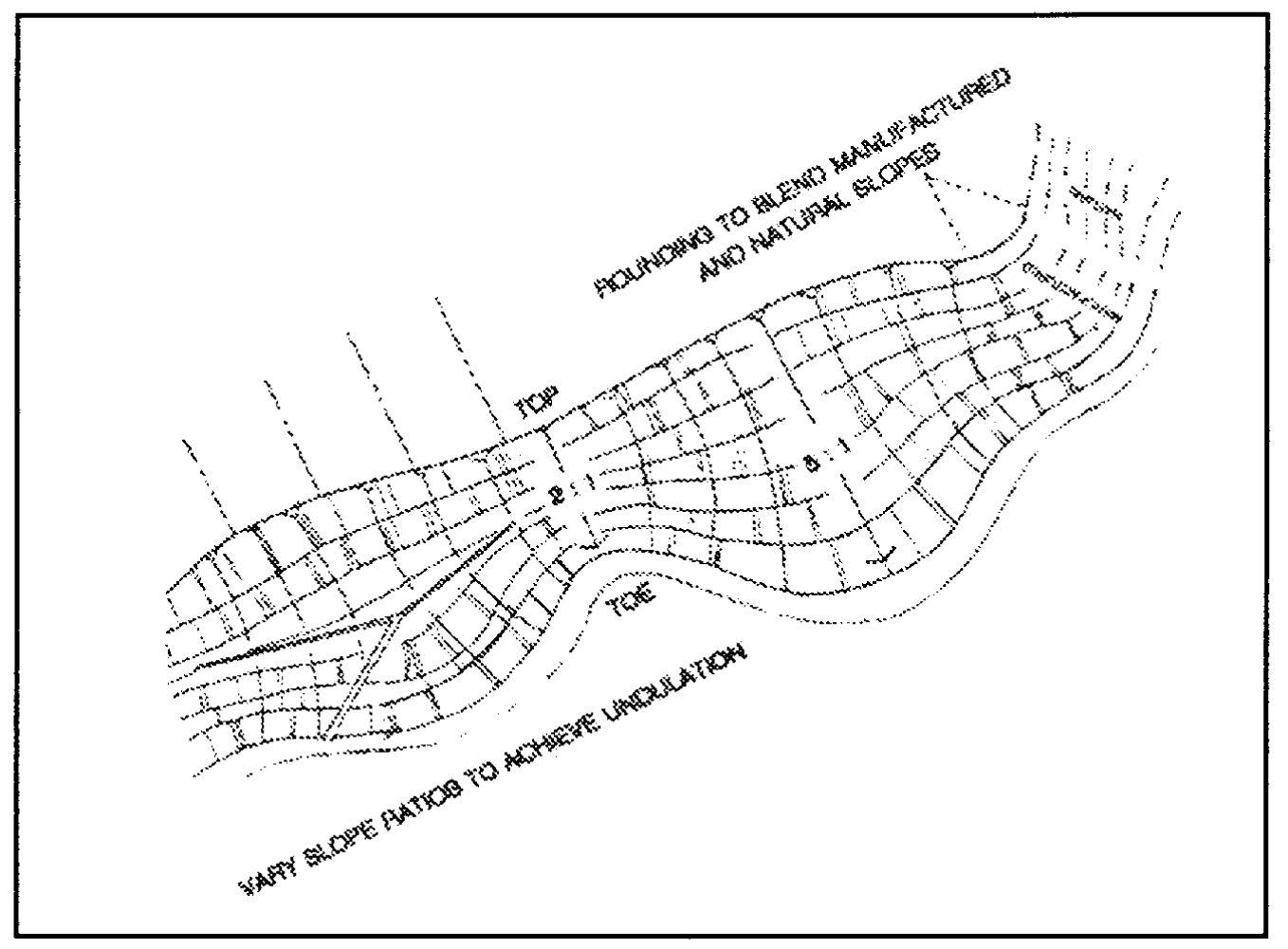
Slope blending and undulation
(5)
Slope undulation. Manufactured slopes over six feet in height should be designed to reflect the appearance of the surrounding natural hillsides and to avoid long flat-planed surfaces. This should be achieved by means of slope undulation, i.e., by curving both the tops and toes of slopes and varying the slope gradient from the 2:1 maximum steepness on some portions to flatter ratios such as 5:1 on others.
(h)
Preservation of views. Because of its beautiful setting and hilly topography, the city enjoys unsurpassed view opportunities. Therefore, project site planning should carefully consider access to views by project residents and visitors. Projects should be oriented and site planned so that panoramic and midrange views are preserved and promoted, both from within a project and from adjacent streets and neighborhoods. Further, projects should be conceived and designed to preserve, to the greatest extent feasible, existing vistas and panoramas of open space, major landforms, the ocean, and manmade landmarks.
(i)
Trash areas and enclosures.
(1)
Placement. For attached residential projects utilizing common trash areas, trash enclosure placement shall conform to the zoning code. In addition, trash enclosures shall be:
a.
Located near to the residences they serve;
b.
Directly accessible to trash trucks via alleys or driveways so as to avoid the necessity of substantial hand carrying of trash containers or hand-pushing of dumpsters; and
c.
Located substantially away from public viewscape, pedestrian, and circulation areas unless determined infeasible by the decision-making authority.
(2)
Enclosure design. Enclosures shall be constructed on a concrete pad and shall conform to and applicable disposal company standards. Enclosure walls shall be at least six feet high and shall be made of strong, durable materials consistent with the colors and finishes of nearby buildings. Doors shall be self-latching, metal or metal-trained, and of heavy duty construction sufficient to withstand hard usage. Interior concrete or metal curbs shall be included to prevent damage to the enclosure walls. Decorative overhead structures such as trellises should be integrated into the design, especially where the trash enclosure is visible from above. Where exposed to public view, trash enclosures should also be screened by vines, shrubs and/or trees. Trash enclosures shall be large enough to provide space for at least two 90-gallon recycling toters per each dumpster bin.
(Ord. No. 99-107, § 5, 2-2-99)
Sec. 9-1-93.3. - Residential landscaping.
(a)
Overall landscape architectural design.
(1)
Purpose. Landscape architecture is as important as building architecture in creating attractive and comfortable neighborhoods. Landscape treatments can be used to create outdoor rooms and special places, ranging from parks and common recreation areas to beautifully designed residential yards. Landscaping features are also useful for screening parking, softening walls and fencing, and beautifying the street.
(2)
Objectives. Landscaped plans shall utilize the various elements of landscape architecture (e.g. planting, walkways, water features, lighting, outdoor furniture, etc.) to accomplish the following objectives:
a.
To visually emphasize prominent design elements and vistas, while screening undesirable views.
b.
To provide a harmonious transition between adjacent land uses and between development and open space.
c.
To be varied enough to provide interest and emphasis, but not so obtrusive as to distract the viewer.
d.
To provide an overall unifying influence, enhancing the visual continuity of the project.
(b)
General requirements.
(1)
Deep root barriers. Trees planted within 15 feet of walls or pavement shall be installed with deep root barriers to help prevent foundation or pavement damage.
(2)
Tree grates. Tree grates should be installed around trunks where trees are planted within sidewalks or other paved pedestrian areas.
(c)
Use of nonresidential landscaping guidelines. Project frontage, entry, boundary/interior, and pedestrian area landscaping, and coordination of landscaping and utilities, shall follow the nonresidential landscaping guidelines contained in .
(d)
Tree preservation. Attached residential projects shall be designed to preserve existing trees to the greatest extent possible. Landscape, grading, and site plans should incorporate these trees into the overall project design, including measures to protect the existing trees during and after construction. Such measures shall be clearly indicated in both preliminary and final construction drawings. In conjunction with such efforts, the applicant may be required to engage a properly credentialed arborist to submit evaluations and recommendations for saving, transplanting, or removing existing trees. If the decision-making authority determines that significant existing trees cannot be saved, it may require their replacement with new specimen-size trees having a cumulative trunk diameter of up to two times the cumulative trunk diameter of the trees to be removed. Trunk diameters shall be measured three feet above the base.
(e)
Street trees.
(1)
Purpose. By providing shade and greenery, street trees are the single most effective way to beautify a street and create a pleasant environment for both pedestrians and motorists. When mature, street trees provide rhythm and identity for a street and act as a soft counterpoint to the hard surfaces of sidewalk and roadway. For these reasons, street trees should be provided on all streets within and adjacent to attached projects.
(2)
Planting plans. Size and species selection shall follow the nonresidential landscaping guidelines of . Also, in accordance with the requirements of , the installation of street trees shall be carefully coordinated with the placement of under-ground and aboveground utilities so that both are accommodated.
(f)
Plant selection and sizes.
(1)
Criteria for selection of plant materials. Plant materials shall be chosen on the basis of both functional and visual characteristics. On manufactured slopes, consideration shall be given to reducing landscape maintenance and water consumption, adaptability to adverse soil conditions present in many parts of the city, low fire-fuel content in transition areas between development and open space, and enhancement of slope stability and erosion control. Where soil and other environmental conditions permit, species native to coastal southern California may be incorporated into the landscape plan.
(2)
Species, sizes, and densities. Plant sizes and densities and suggested tree species shall be in accordance with the Nonresidential Landscaping guidelines, .
(g)
Landscaping of hillside development.
(1)
Hillside protection ordinance. Attached residential projects subject to the provisions of subarticle 8 (Hillside Protection) shall conform to that subarticle's grading, landscaping, and other standards.
(2)
Hillside landscape design. For hillside development, whether subject to the provisions of subarticle 8 or not, special attention should be given to the planting of trees and shrubs at the base of walls on the downhill side in order to lessen the apparent wall height and soften the overall visual impact of hillside construction. In addition, canopy-type trees should be added between buildings to smooth out the harsh edges of rooflines as viewed from below or across the valley. Careful landscape designs can achieve these objectives while, at the same time, framing and preserving views from the hillside residences.
(h)
Walls and fences.
(1)
Height and placement. Limitations on height and placement of walls and fences shall be per the provisions of or applicable planned community text or specific plan.
(2)
Preferred substitutes for walls and fences. Walls and fences are often necessary for security, privacy, and property demarcation. However, such barriers can also obstruct vistas and create claustrophobic neighborhoods and streetscapes. When used along project perimeters, they can create isolated residential enclaves, cut off from adjoining neighborhoods. Therefore, consideration of alternative design features are encouraged. These might include wide landscape buffers perhaps coupled with open view fencing. Where a denser screen is essential, living fences such as hedges or tree lines should be considered.
(3)
Perimeter walls. Where perimeter walls cannot be avoided, they should be of masonry, stucco, or other solid material. Wood or chain link fences should not be used. However, where the decision-making authority determines that an opaque screen is not required, walls may incorporate tubular steel, wrought iron, or other open design. Shrubs and/or vines should be planted on one or both sides of perimeter walls to add visual softening, except where determined infeasible or unnecessary by the decision-making authority. Plant spacing should be appropriate to the growth habits of the selected plant species but should be designed to provide interest and variety along the wall rather than creating a complete covering of the entire wall surface. There should also be an intervening landscape buffer between perimeter walls and sidewalks. Gates or other openings in the wall or landscaping should be provided at appropriate points to allow pedestrian access to nearby stores and community facilities.
(4)
Front yard fences. High fences and walls in front yards are discouraged because they tend to create a stockade-like appearance along the street. If front yard fences are used, they should be of low height (maximum 3.5 feet per the zoning code) and open design, such as wrought iron, tubular steel, or wood lattice. Chain link is discouraged. In general, front yard fences should contribute to a sense of entry to the home and should match its scale and size. In all cases, front yard fence height and placement shall conform to the provisions of .
(5)
Side and rear yard fences. For new residential projects, side and rear yard fencing should be installed by the developer in accordance with a comprehensive wall/fence plan approved by the city.
(6)
Parking and recreational vehicle lot screening. Common parking or recreation vehicle storage lots in attached projects should be screened by means of walls or fences augmented by landscape planting. Such walls and fences shall conform to the provisions of and shall effectively screen parked cars (see also regarding boundary and interior parking lot landscaping). Interior landscaping may be required for recreational vehicle storage lots if the decision-making authority determines that the lot will be highly visible from development above. Screening walls or fences should generally be solid but may include open portions (tubular steel, wrought iron, etc.) if the decision-making authority determines that the desired screening is still achieved.
(7)
Materials and colors. Walls and fences for individual dwellings which are visible from the street or from a common area should be treated as an integral part of the residential building's architecture. Materials, colors, finishes, and detailing should draw from the buildings they surround or adjoin. In general, walls and fences within residential projects should utilize durable masonry, stucco, or wood materials, with finishes and colors consistent with the overall project architecture. Chain link, wire mesh, barbed wire, or similar materials should not be used because of their unattractive appearance unless the decision-making authority determines that the subject fence will not be visible to the public or is otherwise consistent with the goal and objectives set forth in . In such cases, vinyl-clad chain link is encouraged.
(8)
Wall and fence articulation. Long straight stretches of wall or fence should be avoided because of their monotonous appearance and lack of visual interest. Walls should be varied by the use of such design features as offsets (i.e. jogs), open panels (e.g. containing wrought iron) at selected locations, periodic variations in materials, texture, or colors, and similar measures. Landscape planting, as described in paragraph (h)(3) of this section, may be used to augment this wall articulation.
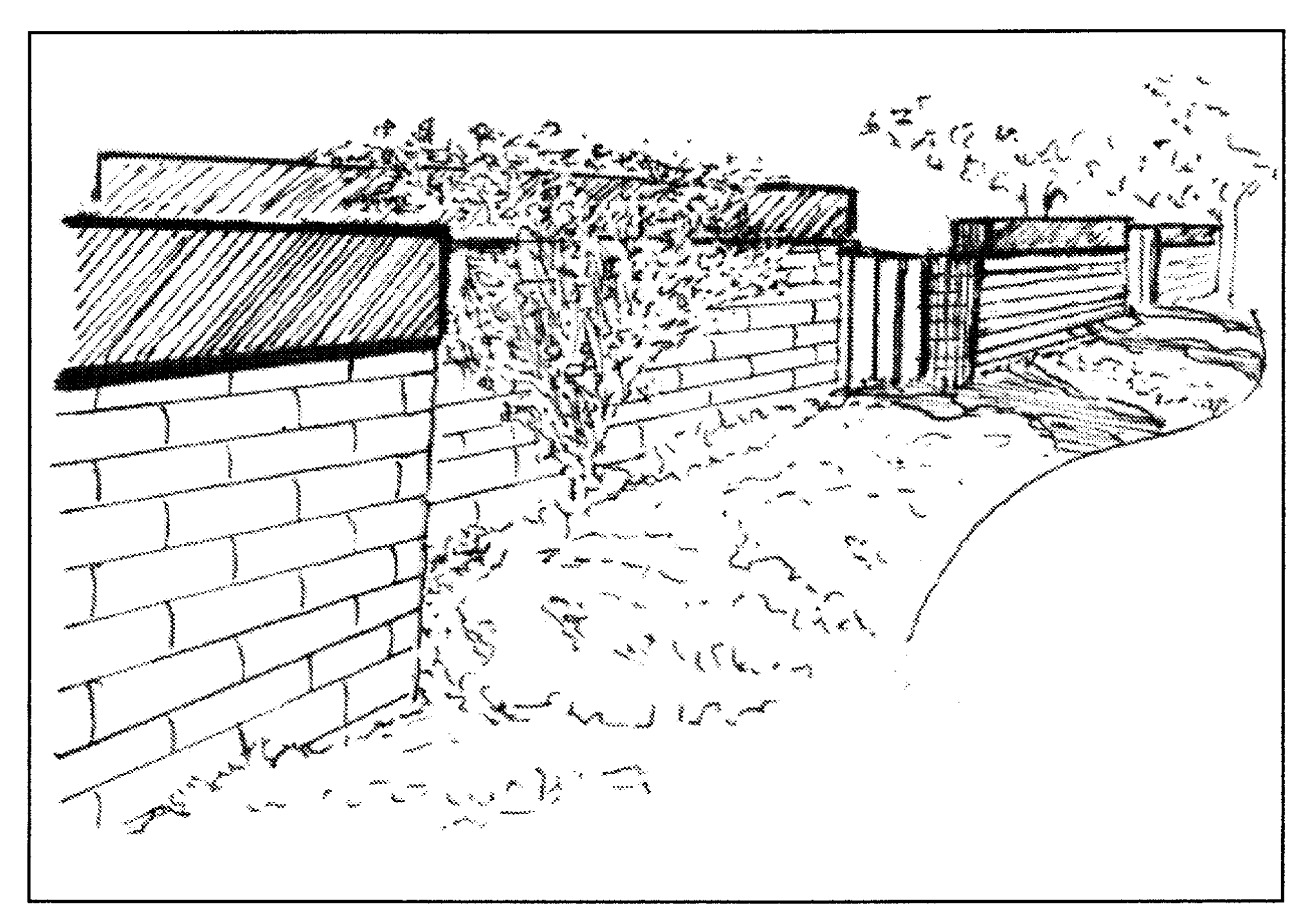
Offsets and landscape planting, such as vines and shrubs, serve to break up long freestanding
walls
(Ord. No. 99-107, § 5, 2-2-99)
Sec. 9-1-93.4. - Residential architecture.
(a)
Architectural style and harmony.
(1)
Architectural style. Although the city contains many residential styles, the predominant ones are ranch, modern, and Mediterranean. While these architectural guidelines seek to incorporate the strongest elements of those styles, such as the blending of indoor and outdoor spaces, they do not insist on rigid adherence to them or to any other particular style. To do so could create a community which soon would become visually dated or one with a repetitious and monotonous appearance. Rather, our objective is to promote both visual diversity and compatibility in new attached residential development. This will be achieved through architectural innovation and the use of the design principles contained in this section.
(2)
Compatibility with existing development. As in the case of commercial development, proposed attached residential projects will be judged on how they respect their natural and manmade settings. That is, attached projects should be architecturally distinctive yet in harmony with the surrounding natural and manmade environments as stated in . Thus, though new projects need not imitate the design of surrounding buildings, they nevertheless should be visually compatible with that development. This compatibility can be achieved by incorporating some of the design features of existing development such as materials; colors; architectural details, such as door and window design; roof design, etc.
(3)
Compatibility with natural setting. The natural setting should also be respected in the design of new projects. This can be achieved by designing split-level homes which step down hillside sites rather than large single pads requiring massive cuts and fills. See subarticle 8 (Hillside Protection) for useful design measures. Also, colors, materials, and styles which harmonize with the natural setting should be used.
(b)
Building mass and form.
(1)
Building mass and corner lots. Exterior mass and form can be arranged to improve the visual impact of attached residential buildings on corner lots. Thus, buildings on street corners should be either single-story or should have a significant single-story element on the exterior (street) side of the building.
(2)
Adjacent one- and two-story buildings. Variety and interest can be achieved within an attached residential project by varying building heights. This can be done by utilizing both one- and two-story buildings. To provide a harmonious visual relationship between adjacent one- and two-story buildings, however, it is desirable to introduce an intermediate transition between them. This transition can be accomplished by:
a.
The introduction of a composite one- and two-story unit between the two buildings; or
b.
The use of a single-story element as part of the two-story building on the side next to the one-story building.
(3)
Mixed-height elements in attached residential buildings. By including single-story units or elements in a two-story attached building, the apparent building size can be reduced. When the single-story portion is an end unit, the visual impact of the building is reduced both at the nearby pedestrian distance and from further away. Alternately, reducing the height of an interior unit helps to visually break the buildings mass into smaller elements.
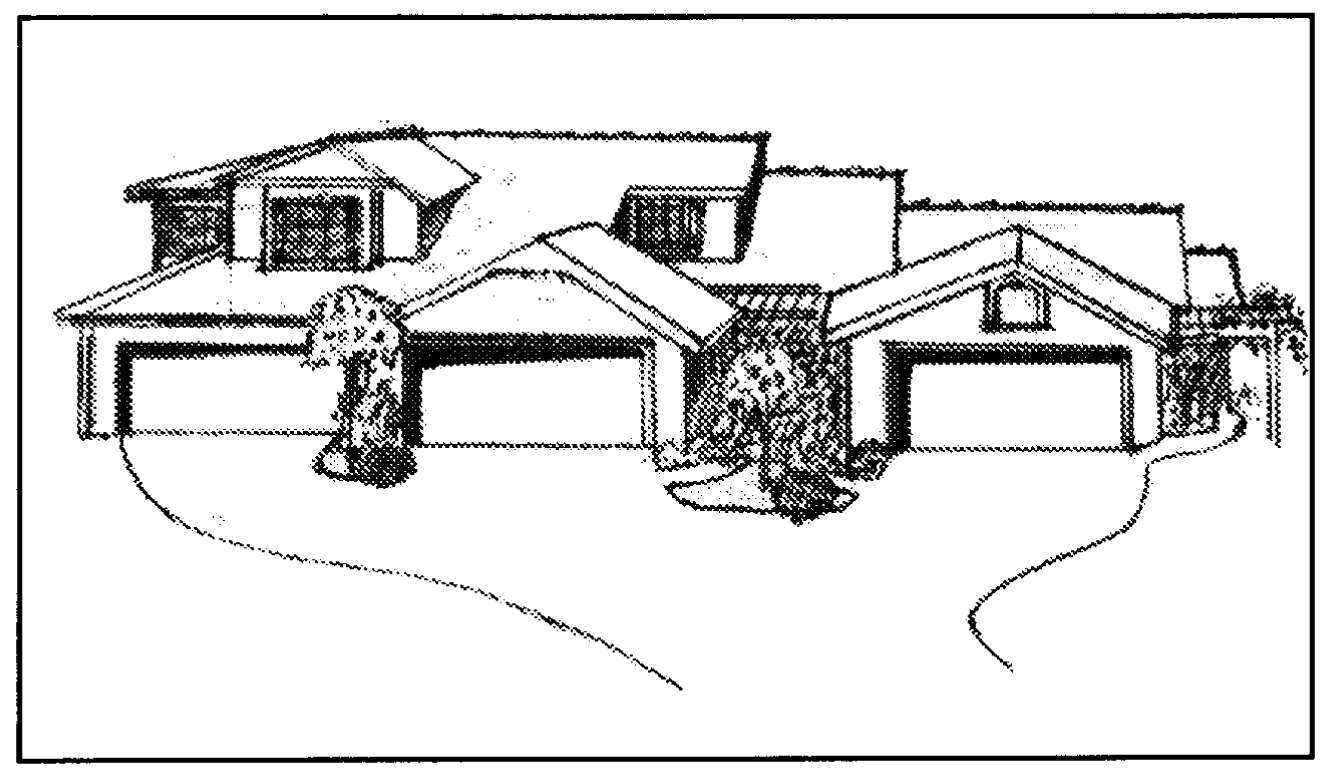
Single-story elements within a two-story building help to reduce apparent building
mass
(c)
Building elevations.
(1)
Articulation. Articulation, the creation of jogs and insets in building walls, adds interest, richness, and intricacy to all buildings. In addition, these changes in plane and height and the use of such design features as porches, bay windows, dormers, and chimneys serve to break up blank walls and avoid the "row-of-boxes" appearance of many attached residential projects. Therefore, highly articulated residential buildings are strongly encouraged.
(2)
Side and rear elevations. Because of high land costs and other factors, permissible building envelopes are often totally filled up in order to achieve the maximum yield. This practice often results in monotonous flat-planed side and rear elevations. This problem may be avoided by stepping down two-story attached residential buildings to one-story units on the ends and/or providing wall articulation on the sides and rear of buildings comparable to that on the front. This is especially important on hillside, corner, and through lots where the side and rear elevations are directly visible from a street or from residences above or below.
(3)
Light and shadow. The effect of sunlight on a building and the resulting play of light and shadow over its surfaces determine how a building is experienced by the viewer. Because of this, significant recesses are encouraged for attached buildings. These can be created by means of substantial door and window reveals, eave overhangs, and wall offsets. The resulting strong shadow lines will give the building a feeling of both depth and substance.
(4)
Creation of shade. In consideration of the city's warm, dry climate, homes should be designed to provide ample shade for outdoor spaces, entries, and windows. This can be achieved by the use of trellises, verandas, awnings, wide eave overhangs, and the combination of careful site planning and building insets, i.e., the two working together so that the building walls themselves provide afternoon shade for outdoor living areas.
(5)
Entries. Entries, whether on the side or front, should be designated as a focal point of the elevation and should be immediately identifiable to the viewer. Entries should be inviting in appearance and covered or inset to provide weather protection. Entries should also be given varying design treatments to establish individuality and identity for each residential unit.
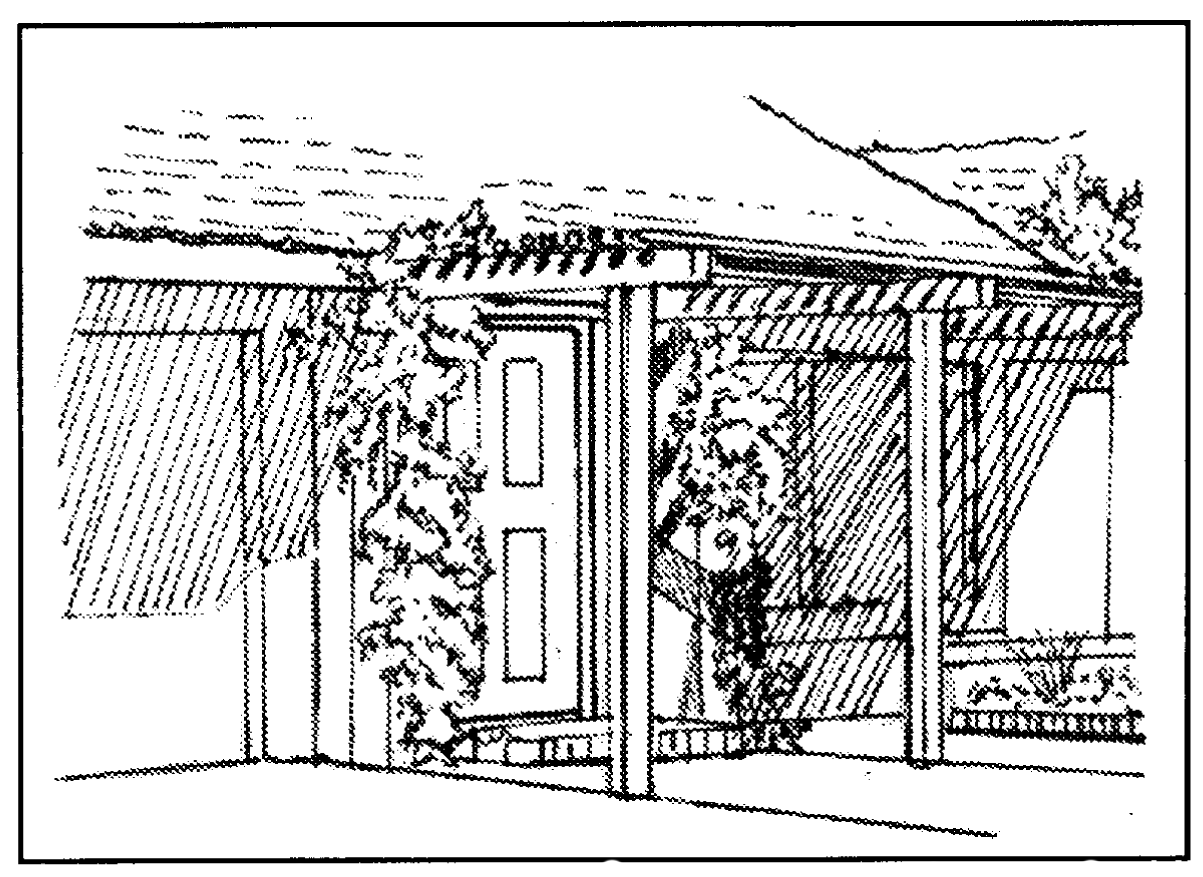
Insets add focus to the front entry while overhead structures give depth by varying
light and shadow on wall surfaces
(6)
Wall materials. Wood, stucco, stone, or brick are encouraged, while metal siding is discouraged. For wood, smooth, resawn, or rough sawn finishes may be used. For stucco, smooth, light sand, and light lace finishes may be used. Brick and stone finishes should be left natural.
(7)
Wall colors. For wood or stucco, bright colors such as orange or bright white, or intense primary colors such as scarlet red should not be used. In general, pastels, such as off-white or light gray, or light earthtone colors, such as tan or beige, are encouraged for wood or stucco. Brick and stone should be left in its natural color.
(d)
Roofs.
(1)
Form. Roofs are highly visible in any residential project, especially in the city because of its hilly topography and the prevalence of views from uphill areas. Viewed from the street, roofs are as powerful as front elevations in determining the visual quality of the streetscape. A harmonious diversity of roof forms can add variety and interest to a residential street, while roof uniformity can create monotony and lack of street identity. Therefore, roof forms should be varied along each street. One method of doing this is to create different hip and gable-end roof treatments for the same floor plan in production attached residential projects. Visual interest can be further achieved by varying the rooftop ridges so that some are perpendicular and some are parallel to the street.
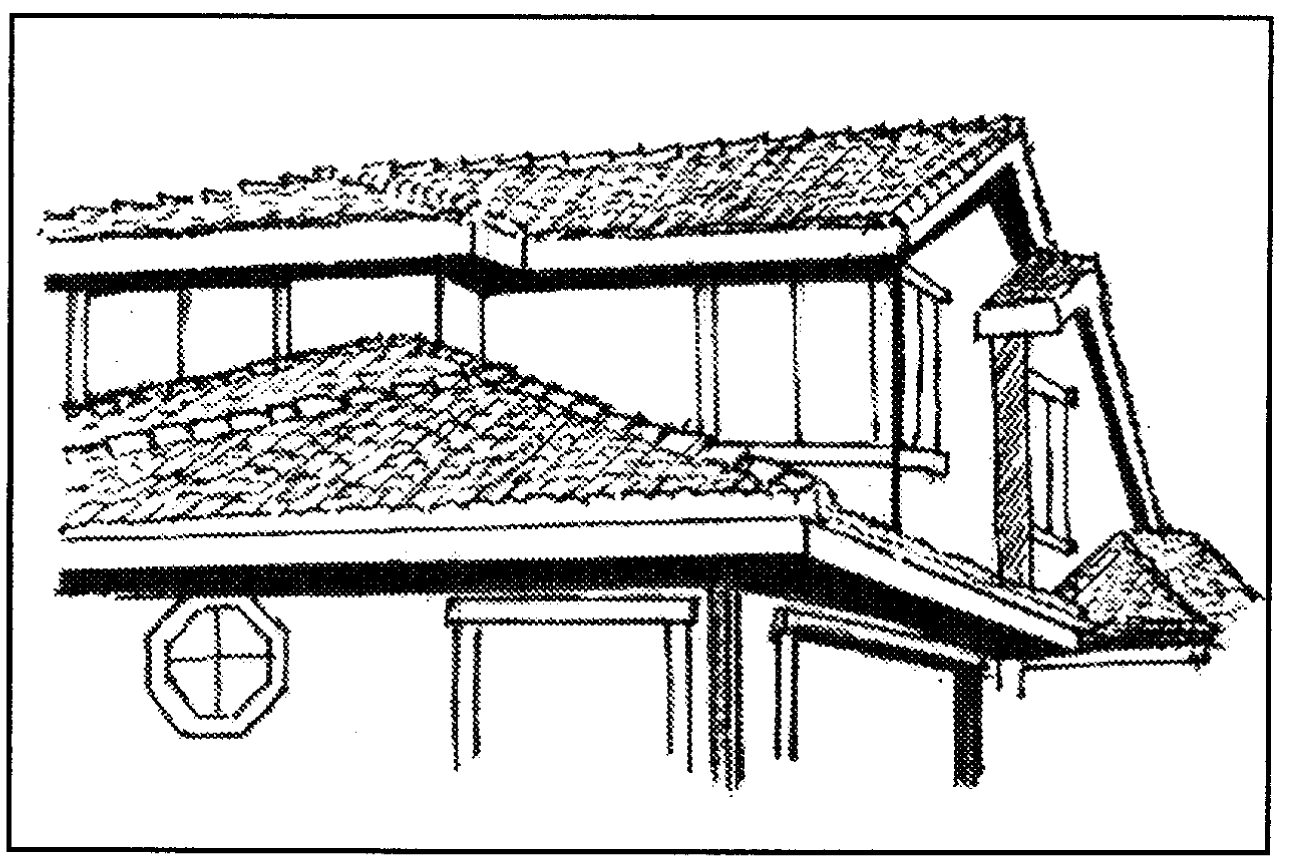
A careful mixture of roof types can add variety to residential buildings and reduce
apparent building mass. Tile or other noncombustible materials are required
(2)
Type. Pitched roofs, either gable, shed, or hip are encouraged. Shallow pitches should be used where it is necessary to de-emphasize the apparent building mass. Mansard roofs may be used if consistent with the building style and part of an overall project theme. Flat roofs are discouraged because they tend to produce a bland, uninteresting streetscape and do not contribute to an overall sense of quality. However, when flat roofs are used, they should not cover more than 50 percent of the building's footprint.
(3)
Materials.
a.
Clay or concrete tile or similarly appearing fire-resistant tile is encouraged.
b.
Composition shingles may be used only on roofs that the decision-making authority determines have little or no visibility from off-site.
c.
Composition sheet materials should be limited to flat roofs only.
d.
Wood shakes or other wood materials shall not be used.
(4)
Colors. A variety of roof colors may be used within an attached residential project to enhance diversity of roof appearance. Colors should generally be neutral, dark, or earthtone shades (e.g., tans, browns, terra cotta, light gray, charcoal gray) and should complement wall and fascia colors. However, intense colors which might, in the judgment of the decision-making authority, overwhelm the facade or the streetscape should not be used. Examples of such colors include bright white, orange, ceramic blue, etc. Vents and other roof equipment should be painted the same color as the roof itself.
(5)
Solar collectors. Though desirable from the point of view of energy conservation, solar collectors can be very unattractive. Whenever possible, they should be ground-mounted or placed on side- or rear-facing roofs away from street view. If, because of sun orientation, it is necessary for a solar collector to be roof-mounted and visible from the street, it should be visually integrated with the roof by design features such as a frame around the collector of the same color and, if possible, the same material as the roof itself.
(6)
Antennas. Television, dish, amateur radio, and other antennas shall comply with the provisions of .
(e)
Doors, windows, and trim.
(1)
Doors and windows. Deeply recessed doors and windows are encouraged to provide shadow lines and wall relief. All door and window surrounds must be wide enough to match the scale and architectural style of the building.
(2)
Trim materials and colors. Both wood and stucco trim is encouraged for doors and windows. All wood fascia boards, window and door surrounds, and other trim material should be 2x or greater. Smooth, resawn, or rough sawn finishes may be used. Unfinished silver aluminum window frames without trim should not be used on elevations visible from the street. Trim colors should be chosen to complement the wall and roof colors.
(3)
Glass. Clear or tinted glass may be used in windows and doors. Mirrors or other highly-reflective glass should not be used.
(4)
Awnings. Fabric awnings may be used to provide window shade and colorful accents if consistent with the architectural character of the building and if awning colors are carefully chosen to complement wall and roof appearance. Metal or other materials may be considered if determined consistent with the building's architecture and materials by the decision-making authority.
(f)
Garages and carports.
(1)
Purpose. In today's auto-oriented society, substantial space must be given over to the storage of personal automobiles. In attached residential areas, this means garages and carports with access onto local streets. It also means garage doors or parked cars which tend to dominate the streetscape. The purpose of this subsection is to offer design features to lessen this dominance and mitigate the attendant visual monotony.
(2)
Low-density attached projects. In lower density attached projects, such as duplexes and townhouse developments, garages and garage doors are often the most visible architectural feature on the street. Therefore, it is important to avoid the appearance of an unbroken line of garage doors with dwelling units attached as an afterthought. Some or all of the following techniques should be used to do this:
a.
Create a variety of floor plans with different garage orientations and setbacks, including some turn-in garages with garage doors perpendicular to the street.
b.
Provide three single doors in some of the three-car garage plans.
c.
Recess garage doors deeply into the front wall in order to create strong shadow lines and visual relief.
d.
Utilize a variety of garage door colors.
e.
Add trim moldings onto the door, especially over plywood joints, to break up the otherwise blank expanse and add visual interest.
f.
Provide sectional rollup doors to maximize the usable driveway length for parking.
g.
Wood garage doors are encouraged. Doors of metal or other materials may be used if they give the appearance of wood via texturing, raised panels, etc.
(3)
High-density attached projects. Apartment, condominium, and other higher-density attached projects often require concentrated parking facilities such as carports and detached garages. These can result in long lines of parked cars or blank garage doors. Therefore, the site planning guidelines of and the following architectural guidelines should be followed to mitigate the visual impact of residential parking facilities:
a.
Although carports may be permitted by this zoning code, garages are encouraged with direct access into units where possible. This will provide increased security and allow mitigation of visual impacts via use of the applicable garage guidelines listed in paragraph (f)(2) of this section.
b.
Carport support posts should be substantial in appearance, such as heavy timber or stucco columns. Four-by-four wood or unadorned steel posts should not be used. Though flat roofs may be used, pitched roofs are encouraged when roofs are visible from outside the project. Back walls exposed to street view should be heavily screened with landscaping. Overall design should be compatible with the architecture of the residences and other accessory structures such as recreation buildings and cabanas.
(g)
Accessory elements.
(1)
Balconies and patios. In consideration of southern California lifestyles, residential units in the city should provide strong indoor-outdoor relationships. Therefore, extensions of the indoor living area such as balconies, patios, and decks should be designed into home plans. It is important to ensure that building floor plans allow space for the later addition of patio covers within the permitted setbacks.
(2)
Patio covers. Patio covers, trellises, pergolas and other exterior structures should reflect the character, color and materials of the building to which they are related.
(3)
Mailboxes. Projects should provide mailboxes for the residences as part of their design details. Individual mailboxes, mailbox clusters, and group mailbox structures should reflect the architectural detailing of the residences or the project's overall streetscape theme. Mailbox locations should minimize visual impacts while providing easy accessibility.
(4)
Trash enclosures. Trash enclosures shall conform to the guidelines of .
(Ord. No. 99-107, § 5, 2-2-99)
Sec. 9-1-94. - Design review procedures.
All references to this section shall include through .
(Ord. No. 99-107, § 5, 2-2-99)
Sec. 9-1-94.1. - Applicability of design guidelines to projects.
(a)
Projects subject to design review.
(1)
Projects which involve building construction and also require a site development or use permit shall be subject to design review under the provisions of this subarticle.
(2)
The types of projects requiring site development or use permits shall be in accordance with subarticle 11 (Permits and Amendments). Generally, however, they include all nonresidential development projects and all attached residential projects.
(3)
Projects which involve only minor exterior alterations and for which neither building construction is required nor a site development permit or use permit is required shall be subject to review and approval in accordance with the provisions of subsection (c)(3) or (a)(2). However, as to such projects, only the proposed alteration shall be subject to review and approval and it shall not be a basis for or allow review of the entire building or project for compliance with the provisions of these guidelines.
(b)
Projects not subject to design review. The following projects are not subject to design review:
(1)
Land use applications which do not involve building construction.
(2)
Construction or remodeling of single-family homes.
(c)
Determinations regarding applicability. When it is not immediately apparent whether a proposed project is subject to the provisions of this subarticle under the categories listed in paragraphs (a) and (b) of this section, the community development director shall decide. The director's decision shall be based on his determination of the most applicable category of the project and the goal and objectives set forth in . However, in cases where the director concludes that, because of unusual project characteristics, the determination may materially affect achievement of the aforesaid goal and objectives, the determination of applicability shall be referred to the planning commission.
(Ord. No. 99-107, § 5, 2-2-99)
Sec. 9-1-94.2. - Application for design review.
Application for design review shall be made in conjunction with the project's associated site development or use permit on forms provided by the community development director. The following is a list of information and materials which shall be required unless determined to be not relevant to the particular application by the director:
(1)
Preliminary site, grading, and landscape plans.
(2)
Schematic architectural elevations, roof plans, and floor plans.
(3)
A conceptual signing plan, including approximate sign sizes, heights, locations, colors, and materials.
(4)
Drawings of design details such as mailboxes, outdoor lighting fixtures, walls and fences, trash enclosures, etc.
(5)
A photometric analysis showing footcandle contours both within the site and beyond the site boundaries.
(6)
A sample board containing samples of proposed colors, materials, finishes, etc.
(7)
A drawing and site location for any cultural depiction, per .
(8)
Other information or materials deemed necessary by the director.
The community development director may permit certain of the preceding application materials to be submitted after initial review of the site development permit. For minor exterior alterations, as defined in (c)(3), an application for a changed plan shall be required. The application for such a changed plan shall be provided by the director and shall include requirements for information, plans, and material samples as deemed necessary by the director.
(Ord. No. 99-107, § 5, 2-2-99)
Sec. 9-1-94.3. - Project review.
(a)
Planning commission review. The planning commission shall carry out design review of all projects subject to the guidelines set out in this subarticle except those reviewed by the community development director in accordance with subarticle 11 (Permits and Amendments). Design review shall be done as part of the commission's review of the project's associated site development or use permit. Design review shall not be considered complete until both of the following have occurred:
(1)
Final action on the project's associated site development or use permit;
(2)
Expiration of any required appeal period (pursuant to the zoning code) or final action on any appeal filed.
(b)
Approval or denial of projects. Consistent with , this subarticle is to be used to assist city decision-makers in their discretionary judgments to approve or deny projects. Per paragraph (a) of this section, a proposed project's associated site development or use permit application shall be the vehicle for the design review process. Therefore, the city decision-making authority must make a finding that the project is consistent with the overall goal and objectives set forth in in approving the project's associated site development or use permit application. Conversely, a finding that a project is not consistent with the goal and objectives shall constitute grounds for denial.
(c)
Cultural depictions. Cultural depictions are encouraged for larger commercial, office, institutional, and mixed-use projects in the city per . Preliminary plans and site locations for such depictions should be approved in conjunction with the site development permit for the overall project.
(d)
Staff review of construction documents. Final construction documents (working drawings) shall conform to preliminary plans (schematic elevations, preliminary site and landscape plans, etc.) approved by the planning commission as part of design review. The community development director shall determine such conformity prior to the building permit plan check. If the director determines that construction documents are not in conformance with approved preliminary plans, the director shall give the project proponent the option of revising the construction documents to conform, or of applying to the planning commission for approval of a plan amendment.
(Ord. No. 99-107, § 5, 2-2-99)
Sec. 9-1-94.4. - Appeals.
Any decision relating to design review made by the community development director may be appealed to the planning commission, and any similar decision made by the planning commission may be appealed to the city council. Appeals shall be filed and processed in accordance with subarticle 11 (Permits and Amendments).
(Ord. No. 99-107, § 5, 2-2-99)
Sec. 9-1-94.5. - Exceptions.
The planning commission may grant relief from full compliance with one or more of the mandatory guidelines set forth in this subarticle (that is, guidelines identified by the word "will" or "shall," as defined in ) by means of an exception. In approving such an exception, the planning commission shall find that, notwithstanding the exception:
(1)
The resulting project is consistent with the goal and supporting objectives of ; and
(2)
The granting of the exception will result in an equivalent or better project in terms of overall design quality. Also, in approving an exception, the commission may require compensating enhancement to other project design features or amenities.
(Ord. No. 99-107, § 5, 2-2-99)
Sec. 9-1-95. - Multifamily and mixed-use residential objective development and design standards.
(a)
Purpose and intent. The purpose of the objective development and design standards of this section is to provide the development community, design professionals, general public, and city personnel with objective criteria for eligible new multifamily and mixed-use residential development in the city. These criteria include, for example, objective standards related to site planning, building form, landscaping, and architectural design based on Laguna Niguel's character, aesthetics, and the quality of the built environment. Consistent with existing state law, objective standards are those that involve no personal or subjective judgment by a public official and are uniformly verifiable by reference to an external and uniform benchmark or criterion available and knowable by both the development applicant and the public official prior to submittal. The intent is to promote the construction of new housing and further City goals in yielding development projects that feature elevated design and architecture and foster an enhanced quality of life through the built environment.
(b)
Applicability and review. The provisions of apply to all new multifamily and mixed-use residential projects that qualify for streamlined ministerial review under state law. If a project is subject to development and design review and is not required by state law to be reviewed only against objective standards, it is subject to discretionary design review and findings, as prescribed in subarticle 9 and subarticle 11 of this Code.
(c)
Relationship to other regulations. Eligible housing projects that qualify for streamlined ministerial review under state law must comply with these objective development and design standards and with all applicable development standards in the city's regulatory documents, including but not limited to the Laguna Niguel Municipal Code, and applicable specific plans. Where standards conflict, the more restrictive shall apply.
(d)
Objective development and Design Standards Manual. The City of Laguna Niguel's Objective Development and Design Standards Manual ("the manual") is hereby adopted and incorporated by reference into this as if fully set forth herein. If a provision is inconsistent with state law, it does not impact any other standards.
(1)
Accessibility. The manual shall be maintained on file with the City of Laguna Niguel Community Development Department ("department"). Additionally, the Manual shall be made freely accessible to the public and shall be posted on the official City of Laguna Niguel website.
(2)
Amendments. The manual may be amended in accordance with the following:
a.
The director may initiate amendments to the manual. All proposed amendments shall be reviewed for compliance with state law and any amendment determined to be in violation of state law shall be rejected.
b.
If a change in state law renders an existing portion of the manual noncompliant, state law will govern and the director shall initiate an amendment to bring the manual into compliance as expeditiously as possible.
c.
No amendment to the manual will be effective until it is approved by the city council in accordance with the procedures set forth in (Zoning Code Amendments).
d.
All amendments shall be properly documented, and a revision history shall be maintained by the department. The most current version of the manual, along with its revision history, shall be available to the public through the city's website and upon request at the department.
(Ord. No. 2023-225, § 3, 12-5-23)
Sec. 9-1-100.- Purpose.
This subarticle 10 is intended to meet the requirements of government code section 65089(b)(3), which requires development of a trip reduction and travel demand element to the congestion management program, and government code section 65089.3(a)(2), which requires adoption and implementation of a trip reduction and travel demand management ordinance. Additionally, it is the intent of this subarticle to complement air quality management district standards as much as possible.
(Ord. No. 99-107, § 5, 2-2-99)
Sec. 9-1-101. - Policy.
New commercial, industrial, mixed use development may adversely impact existing transportation and parking facilities, resulting in increased motor vehicle emissions, deteriorating levels of service, and possibly significant additional capital expenditures to augment and improve the existing transportation system. In order to more efficiently utilize the existing and planned transportation system and to reduce vehicle emission, it is the policy of the city to:
(1)
Promote and encourage the use of alternate transportation modes such as ride sharing, carpools, vanpools, public bus and rail transit, bicycles and walking;
(2)
Provide facilities, such as bicycle lanes and trails and transit waiting areas, necessary to encourage alternate methods of transportation;
(3)
Utilize existing local mechanisms and procedures for project review and permit processing to achieve reductions in vehicle trips; and
(4)
Promote coordinated implementation of strategies on a countywide basis to reduce transportation demand.
(Ord. No. 99-107, § 5, 2-2-99)
Sec. 9-1-102. - Applicability.
This subarticle shall apply to all new nonresidential developments with 250 or more employees located on a site during a given shift. A new development is a project, either multi-tenant or single employer, for which any level of discretionary zoning approval for any portion of the project has not been granted prior to the effective date of this subarticle. If the development is a retail shopping center, this subarticle applies to the center as a whole and shall include all tenants and satellite pads. In cases where additional zoning approval is necessary for additional developments, even though previous zoning approval was granted for the entire project prior to the effective date of this subarticle, additional development of 250 or more employees is subject to the requirements of this subarticle. Developments located within areas subject to a development agreement shall comply with the regulations described in this subarticle.
(Ord. No. 99-107, § 5, 2-2-99; Ord. No. 2002-121, § 3, 10-15-02)
Sec. 9-1-103. - Programs to be implemented by developer.
(a)
All property owners, or their designee, of developments subject to this subarticle, must submit a trip reduction/TDM strategy plan prior to the issuance of permits for the project. The trip reduction/TDM strategy plans shall be reviewed and approved by site development permit pursuant to . This plan shall identify initially proposed programs and strategies based on initial occupancy levels. The trip reduction/TDM strategy plan shall be designed to attain the goal of an average vehicle ridership (AVR) of 1.5. AVR is the total employee population reporting to a site divided by the number of motor vehicles driven by employees to the site during the peak traffic hours of 6:00 a.m. to 10:00 a.m., Monday through Friday. Reporting employees includes telecommuters and those on alternate work weeks. At any time at which the air quality management district requirement for developer participation is changed from 250 employees, or the AVR goal is changed from 1.5, the employee threshold and desired AVR of this subarticle shall also be changed to be consistent with air quality management district requirements without the requirement of a public hearing.
(b)
After review of the trip reduction/TDM strategy plan developed by the property owner, the city may require, but not be limited to, one or all of the following programs. The city shall take into consideration the nature of the project, such as multitenant developments, when reviewing the TDM strategy plan. The city will determine the desired AVR and necessary programs as part of the permit approval process.
(1)
Preferential parking for carpool vehicles.
a.
A percentage of the employee parking spaces shall be reserved and designated for carpool vehicles by marking such spaces "Carpool Only." A suggested percentage is 15 percent of employee parking to be designated for carpool parking.
b.
Carpool spaces shall be used only by carpool vehicles in which at least two of the persons will be employees or tenants of the proposed project.
c.
Such carpool spaces shall be located near the building's employee entrances or at other preferential locations within the employee parking areas as approved by the community development director.
d.
The following chart shall be used as a guide to determine the total number of employee parking spaces:
TABLE 10.1. EMPLOYEE PARKING SPACES.
(2)
Bicycle parking and shower facilities. Bicycle parking and locker and shower facilities shall be provided in a secure location for use by employees or tenants who commute to the site by bicycle. A suggested number of facilities to be provided shall be at the rate of at least one locker for men and women for each 20 employees and one shower for men and women for each 50 employees for developments over 50 employees.
(3)
Information on transportation alternatives.
a.
A commuter information area shall be provided that offers employees appropriate information on available transportation alternatives to the single-occupancy vehicle. This area shall be centrally located and accessible to all employees or tenants.
b.
Information in the area shall include but not be limited to the following:
1.
Current maps, routes and schedules for public transit.
2.
Ride sharing match lists.
3.
Available employee incentives.
4.
Ride sharing promotional material supplied by commuter-oriented organizations.
(4)
Vanpool vehicle accessibility.
a.
The design of all parking facilities shall incorporate provisions for access and parking of vanpool vehicles.
b.
Where applicable, vanpool vehicle accessibility shall include a minimum of eight feet two inches vertical clearance for those parking spaces and ramps to be used by such vehicles.
c.
Vanpool parking spaces shall be located near the building's employee entrances or other preferential locations as approved by the community development director.
d.
A suggested number of accessible vanpool parking spaces shall be calculated at three spaces per 100 total employee parking spaces. The number of total employee parking spaces shall be calculated using table 10.1.
(5)
Monetary incentives.
a.
The employer shall purchase or subsidize the purchase of Orange County transit district bus passes.
b.
The employer shall subsidize the cost of parking for employees who carpool.
c.
The employer shall provide incentives for the employee to carpool or vanpool, use public transportation or use alternative means of transportation to commute to work. Incentives shall include but not be limited to monetary incentives, additional vacation time, etc.
(6)
Flex time and alternate work weeks. The employer shall implement plans designed to have the employee work an alternative work schedule. This schedule shall include but not be limited to flex time, staggered work hours or a compressed work week designed to schedule the employees to commute during nonpeak hours. Peak hours are 6 a.m. to 10 a.m., Monday through Friday.
(7)
Telecommuting. The employer shall establish and help subsidize telecommuting for its employees.
(Ord. No. 99-107, § 5, 2-2-99; Ord. No. 2002-121, § 3, 10-15-02)
Sec. 9-1-104. - Implementation and monitoring.
For the purposes of determining whether applicable developments are complying with the provisions of this subarticle, the city shall monitor such compliance in a manner it deems appropriate and reasonable. Monitoring mechanisms include but are not limited to the following:
(1)
Review of developer's proposed trip reduction/TDM strategy plan. Review of the plan is required:
a.
Within three months from the date a certificate of use and occupancy permit is issued;
b.
When employment in the development increases by 30 percent; and
c.
Annually.
For each review of the TDM strategy plan the developer shall survey its employees to determine the method of transportation each employee uses to commute to work, use the results of this survey to calculate the average vehicle ridership for that site, and submit the survey and AVR calculations to the city.
(2)
The city shall compare the actual AVR to the projected AVR determined for that particular project. If the site does not meet the projected AVR, the city may impose any additional programs deemed necessary for the developer to reach the projected AVR.
(3)
The city shall verify compliance with required trip reduction programs through review and approval of site development permits, field inspections and building permit inspections.
(Ord. No. 99-107, § 5, 2-2-99)
Sec. 9-1-105. - Enforcement and penalties.
(a)
For purposes of ensuring that applicable developments comply with the provisions of this subarticle 10, the city shall, following written notice to subject property owners, initiate enforcement actions against such property owners or designees, which may include but shall not be limited to the following:
(1)
Withholding approval of a discretionary permit, such as a site development permit, or withholding issuance of building permits or certificates of use and occupancy.
(2)
Issuance of a stop work order.
(3)
Initiation of proceedings to revoke the site development permit or other discretionary action.
(b)
The city may require the developer or property owner to establish an association with city-approved CC&R regulations designed to enforce the provisions of this subarticle.
(Ord. No. 99-107, § 5, 2-2-99)
Sec. 9-1-106. - Fees.
Filing fees shall be paid in accordance with .
(Ord. No. 99-107, § 5, 2-2-99; Ord. No. 2002-121, § 3, 10-15-02)
Sec. 9-1-107. - Appeals.
Appeals to decisions on site development permits shall be reviewed in accordance with .
(Ord. No. 99-107, § 5, 2-2-99; Ord. No. 2002-121, § 3, 10-15-02)
Sec. 9-1-110.- Discretionary actions.
(a)
Definition of discretionary action. A discretionary action is an action which the city has the right to either approve, approve subject to conditions, or disapprove. This subarticle sets forth the procedures for processing discretionary and other applications, and the criteria and conditions necessary so that an appropriate decision may be made by the city on each such application. For the purposes of this subarticle, certain "ministerial" actions, which require little or no discretionary judgment (such as the issuance of a certificate of occupancy), are included within the term "discretionary action."
(b)
Persons who may file applications. An application for a discretionary permit or other discretionary action such as a zone change or general plan amendment may be submitted only by a property owner of the subject property, by an agent with notarized written authorization from the property owner, or by a public agency.
(c)
Application filing. Applications for discretionary permits or other discretionary actions shall be filed with the community development department, on forms prescribed by the director, together with: (1) all maps, plans, documents and other materials required by the director, and (2) all required fees per . The director shall provide the necessary forms plus written filing instructions specifying all materials and fees required to any requesting person at no charge.
(d)
Determinations regarding applicability. When it is not immediately apparent which type of discretionary action applies to a proposed project, the director shall decide. The director's decision shall be based on the director's determination of the characteristics of the project and the purpose of each discretionary action as set forth in this subarticle. In cases where the director concludes that the determination may materially affect achievement of the objectives of this zoning code, as stated in , or if the director determines on a case-by-case basis that the public interest would be better served by such referral, the director shall refer the determination of applicability to the planning commission.
(e)
Combined applications. Applications for a number of requests for one project may be combined and processed concurrently, as long as all applicable processing requirements are satisfied. The purpose of allowing concurrent review is to consolidate final action on the project with the highest review authority responsible for making a decision on the applications for a project. The following shall apply to concurrently processed applications:
(1)
Public hearing and nonpublic hearing applications. When an application requiring a public hearing is combined with an application that does not require a public hearing, the combined applications shall require a public hearing.
(2)
City council and/or planning commission as highest review authority. When city council and/or planning commission review is required for at least one of the applications for a project, the final decision on all applications shall be made by the highest review authority.
(3)
Recommendations. When the city council is the highest review authority for a project, all review by other bodies with approval authority over the applications shall be in the form of a recommendation to the city council.
(f)
Legal actions. Any action or proceeding to challenge, attack, review, set aside, void or annul any discretionary action described in this subarticle shall be governed by the applicable provisions of the state planning and zoning law.
(Ord. No. 99-107, § 5, 2-2-99; Ord. No. 2021-210, § 56, 8-3-21)
Sec. 9-1-111. - Discretionary review authority.
(a)
Decision-making authority. Table 11.1, following, specifies the decision-making authority for each of the various discretionary actions described in this subarticle. The letters in the table specify the decision-making authority assigned to the official or body at the top of the column for the type of application at the far left:
(1)
A "D" means decision-making authority.
(2)
A "PH" means that a public hearing is required before action is taken.
(3)
An "R(PH)" means that the planning commission is responsible for holding a public hearing and forwarding a recommendation to the city council.
(4)
An "A" means that the application is reviewed administratively by the director, usually without a public hearing.
(5)
An "M" means that the permit review is "ministerial." That is, the action is taken using fixed standards, with little or no personal judgment or "discretion" regarding approval or denial. (For the purposes of this subarticle, certain "ministerial" actions, such as the issuance of a certificate of occupancy, are included within the term "discretionary action.")
(b)
Referral by director. Any application for which the director has decision-making authority may be referred by the director to the planning commission for review if the director determines on a case-by-case basis that the public interest would be better served by such referral. In such cases, the director shall also determine if a public hearing is required. In addition, per , the planning commission may elect to call up and review any decision of the director regarding an action by the director taken on a discretionary application.
(c)
Administrative actions. The discretionary permits to be acted upon administratively by the director per table 11.1, following, are those which are relatively minor in nature and with relatively little potential for adverse impacts on the surrounding community or the environment. A public hearing or public notification is not required for administrative actions, although the director may notify residents or property owners near the subject property if the director determines on a case-by-case basis that the public interest would be served by such notification.
(d)
Public hearings. Public hearings shall be noticed and held in accordance with for those applications shown in table 11.1 as requiring a hearing.
TABLE 11.1. DISCRETIONARY REVIEW AUTHORITY.
(Ord. No. 99-107, § 5, 2-2-99; Ord. No. 2018-194, § 2, 6-5-18; Ord. No. 2021-210, § 57, 8-3-21)
Sec. 9-1-112. - Hearings and appeals.
All references to this section shall include through . The provisions of this section shall apply to the conduct of public hearings, appeals, and call-up review of all discretionary actions regulated by this subarticle, except where additional or modified provisions are set forth for coastal development permits in .
(Ord. No. 99-107, § 5, 2-2-99; Ord. No. 2021-210, § 58, 8-3-21)
Editor's note— Ord. No. 98-102, § 2, adopted June 6, 1998, added a new section 9-1-112, pertaining to senior managed care facilities. To avoid duplication of sections, the section added by Ord. No. 98-102, § 2 has been redesignated as section 9-1-54.6 at the discretion of the editor.
Sec. 9-1-112.1. - Public hearings.
(a)
Applicable state law. Public hearings required for discretionary actions shall be carried out in accordance with the procedures set forth in this section. It is intended that the provisions of this section shall be fully consistent and in full compliance with section 65090 et seq of the state government code and that such provisions shall be so construed.
(b)
Failure to receive notice. Pursuant to state government code section 65093, the failure of any person to receive notice shall not constitute grounds for any court to invalidate the action of the decision-making authority.
(c)
Conduct of hearings. Public hearings shall be noticed in accordance with paragraph (d) of this section and then held by the decision-making authority to take public testimony prior to action on the relevant application. After close of the public hearing, the decision-making authority may take one of the actions described in , or may continue the application to a specified date or table the application per .
(d)
Noticing requirements. Notice of public hearings shall be given pursuant to applicable provisions of state law, including but not limited to government code sections 65090 and 65091, and this title, including all the following requirements which must be completed at least ten days prior to public hearing:
(1)
Noticing content. Notice of a public hearing shall include, but not be limited to:
a.
The date, time, and place of the hearing.
b.
The project name and case number (if applicable).
c.
The identity of the hearing body.
d.
A general explanation of the matter to be considered and a general description in text or by diagram of the location of the real property that is the subject of the hearing.
e.
If a proposed negative declaration or an environmental impact report has been prepared for the project pursuant to the California Environmental Quality Act (CEQA), the hearing notice shall include a statement that the hearing body will also consider approval/certification of such document(s).
(2)
Method of notice distribution. Notice of a public hearing shall be mailed or delivered as follows:
a.
The owner of the subject real property.
b.
The owner's authorized agent, if any.
c.
The project applicant.
d.
Each local agency expected to provide water, sewage, street, roads, schools or other essential facilities or services to the project, whose ability to provide those facilities and services may be significantly affected.
e.
All owners of real property as shown on the last equalized assessment roll, or records of the county assessor which contain more recent information, within 300 feet of the subject real property. If the number of owners to whom notice would be mailed is greater than 1,000, the city may instead place a display advertisement of at least one-eighth page in a newspaper of general circulation at least ten days prior to the hearing; and
f.
Whenever a hearing is held regarding a discretionary permit or a legislative action for a drive-thru facility, the city shall incorporate, where necessary, notice procedures to the blind, aged, and disabled communities in order to facilitate their participation in the hearing process per government code sections 65091.
(3)
Publish a legal notice in a newspaper of general circulation or post a notice in at least three public places within the boundaries of the city, including one public place in the area directly affected by the proceeding.
(e)
Other notice. The city shall also provide any other notice required by law and may give notice of the hearing in any other manner it deems necessary or desirable in addition to the notice required by this section.
(Ord. No. 99-107, § 5, 2-2-99; Ord. No. 2021-210, § 59, 8-3-21)
Sec. 9-1-112.2. - Appeals and call-up review.
(a)
Appealable decisions. Any discretionary action by the director may be appealed to the planning commission and any discretionary action by the planning commission may be appealed to the city council in compliance with the provisions of this section.
(b)
Appeal period. Appeals must be submitted and call-up review must be initiated during the "appeal period", which shall be defined as prior to 5:00 p.m. on the 15 th consecutive calendar day after the date of the action being appealed, see (b) for the definition and counting of days. Per of this title, the actual date of the decision shall not be counted in the 15 calendar days; rather, the day following shall be counted as day number one. Any subsequent appeal or call-up review to a higher authority must also be made within 15 days of the decision. However, if the 15 th day is not a business day for the city, the appeal period shall extend to 5:00 p.m. on the next city business day. No appeal or call-up review shall be accepted after the appeal period has expired. This appeal period shall not apply to coastal development permits or subdivision maps, which have appeal periods specified in of this Code and the city's subdivision code, respectively.
(c)
Designation of board of appeals. The planning commission shall constitute the board of appeals for decisions by the community development director and the city council shall constitute the board of appeals for decisions by the planning commission.
(d)
Issues to be considered. The board of appeals may refuse to consider any issues which were not raised by the appellant or another person either by verbal testimony or written correspondence made at or before the time the decision-making authority took action. When reviewing a decision-making authority's decision via its own call-up review, the board of appeals may raise and consider any issue it deems appropriate to the project application.
(e)
Call-up review procedures. The board of appeals (either the planning commission or the city council), on its own motion adopted by a majority vote of its total membership, may elect to call up and review any action taken on a discretionary application. The board of appeals' call-up review may be exercised at any time within the appeal period identified in paragraph (b) of this section and shall be processed in accordance with paragraph (f) of this section. If the board of appeals exercises its right of call-up review, the applicant shall be responsible to pay for the costs associated with the appeal pursuant to the fee requirements of .
(f)
Stay pending appeal or call-up review. Timely filing of a written appeal or a request for a call-up review shall automatically stay all actions, and put in abeyance all approvals or permits which may have been granted; and neither the applicant nor any enforcing agency may rely upon the decision, approval, or denial or other action that is the subject of the appeal or call-up review, until the appeal or call-up review process has terminated or been completed.
(g)
Appeal procedures.
(1)
Persons who may appeal. Any interested person may appeal a decision of the director or the planning commission regarding the action taken on a discretionary application upon submission of the required documents and information and the payment of the required fee.
(2)
Filing of appeals. Appeals shall be filed with the community development department within the appeal period defined in paragraph (b) of this section.
(3)
Required documents. Each appeal, except for call-up reviews initiated by a board of appeals on its own motion, shall be in writing and shall include all grounds for the appeal and sufficient information so as to make it clear to the board of appeals the substance of each of the grounds for appeal. The director may require that the written appeal be accompanied by such other documents and information that the director determines to be necessary to adequately explain and provide proper notification for the appeal. No appeal shall be accepted if it fails to contain the grounds for the appeal and the description of the grounds.
(4)
Forwarding of records. When an appeal has been received, the director shall forward to the board of appeals all documents and information on file pertinent to the appeal together with the minutes or official action of the decision-making authority and a report on the basis of the decision.
(5)
Public hearing requirements. If the original approving action did not require a public hearing, the appeal review shall not require a public hearing. If the original approving action required a public hearing, the appeal review shall also require a public hearing. Notice and scheduling requirements for an appeal hearing shall be the same as those for an original hearing as described in .
(6)
Action on appeal. Not later than 60 calendar days, or as soon as possible thereafter, after an appeal has been received and accepted by the director, the board of appeals shall consider the appeal and take one of the following actions:
a.
Take action to sustain, reverse or modify the original decision. If an original decision to approve a project is modified, the board of appeals may modify permitted land uses, place additional or different conditions of approval on the project, direct that revisions be made to project plans, or require other project modifications.
b.
Continue the appeal for further consideration.
c.
Refer the application back to the original decision-making authority with directions.
(7)
Majority vote. Action by the board of appeals to reverse or modify an appealed decision shall require a majority vote of appeal board members present. If there is a tie vote, the original decision shall stand.
(Ord. No. 99-107, § 5, 2-2-99; Ord. No. 2021-210, § 60, 8-3-21)
Sec. 9-1-113. - General procedures.
All references to this section shall include through . The provisions of this section shall apply to the processing of all discretionary and other applicable permits, except where additional or modified provisions are set forth for coastal development permits in .
(Ord. No. 99-107, § 5, 2-2-99)
Sec. 9-1-113.1. - General provisions.
(a)
Definition of discretionary permit. A discretionary permit is a discretionary action which applies to a specific property and which authorizes a specified land use or uses and/or a specified development on the property.
(b)
Applicable state law. It is intended that the provisions of this subarticle 11 shall be fully consistent and in full compliance with section 65920 et seq. of the state government code (referred to as "The Permit Streamlining Act") and other applicable sections of the government code, and that such provisions shall be so construed.
(c)
Applicability of permits to property. All rights granted by the approval of a discretionary permit remain with the affected property unless the permit has expired pursuant to the provisions of . All conditions and requirements of a discretionary permit shall be passed on to the new property owner when there is a change of ownership.
(d)
Permit constitutes precise plan. Upon approval, a discretionary permit constitutes a precise development plan. Therefore, all development authorized under a discretionary permit and any land uses associated with the permit shall be in compliance with the plans, specifications, and conditions of approval shown on and/or attached to the approved permit.
(e)
Enforceability of permit provisions. All conditions, requirements and standards specified either in writing or graphically as part of any approved discretionary permit granted by authority of this subarticle shall have the same force and effect as this zoning code. Any land use or development established as a result of an approved discretionary permit which is not in compliance with all such conditions, requirements or standards shall be in violation of this subarticle. The provisions of subarticle 13 (Code Enforcement) shall also apply.
(Ord. No. 99-107, § 5, 2-2-99)
Sec. 9-1-113.2. - Permit applications.
Submittal and acceptance of applications. A property owner, an agent with notarized written authorization from the property owner, or a public agency may submit an application for a discretionary permit. Within 30 days of receipt of the application, the director shall determine whether the application is complete and shall transmit such determination to the applicant. If the application is determined not to be complete, the director shall specify in writing those parts of the application which are incomplete and shall indicate the manner in which they can be made complete.
(Ord. No. 99-107, § 5, 2-2-99; Ord. No. 2021-210, § 61, 8-3-21)
Sec. 9-1-113.3. - Actions by decision-making authority.
(a)
Permit Streamlining Act. This section is intended to be fully consistent and in full compliance with the time limits and other provisions of section 65920 et seq of the state government code (referred to as "The Permit Streamlining Act"), and shall be so construed.
(b)
Possible actions. The decision-making authority may take one of the following actions on each application for a discretionary permit:
(1)
Approval. An application may be approved with no conditions or requirements other than the design features and other elements incorporated within the application and accompanying plans. After the action's effective date, as defined in paragraph (f) of this section, and after approval of any required plan revisions per paragraph (g) of this section, the proposed land use or development may be established in compliance with all applicable regulations and the approved project plans and specifications.
(2)
Conditional approval. An application may be approved subject to compliance with conditions. Conditions may require the dedication of land, installation of improvements, limitations on operational characteristics, the posting of financial security to guarantee performance, or other conditions necessary to achieve the objectives of the general plan and this zoning code. After the action's effective date, as defined in paragraph (f) of this section, and after approval of any required plan revisions per paragraph (g) of this section, the proposed land use or development may be established in compliance with all applicable regulations, the approved project plans and specifications, and the requirements of the conditions of approval.
(3)
Denial.
a.
The decision-making authority may deny an application if it finds that approval of a discretionary permit would create conditions materially detrimental to the public health, safety and general welfare or injurious to or incompatible with other properties or land uses in the vicinity, or that other "required findings" for approval specified in cannot be made.
b.
When a discretionary application has been denied, a new application on the same property shall not thereafter be accepted for a period of one year from the date of final determination, unless the Director determines that there are substantial changes to the proposed project design and/or operational characteristics or unless the decision-making authority has specified that this time limitation shall not apply. This time limitation on re-submittal of applications is not applicable to other discretionary permits.
(4)
Continuances and tabling. Any hearing may be continued, and no further public notice shall be required unless the hearing is not continued to a specific date/time, in which case the hearing shall be re-noticed.
(c)
Findings. For discretionary permits, the decision-making authority shall adopt "required findings", as specified in , in conjunction with approval or conditional approval of such a permit. A determination by the decision-making authority that one or more required findings cannot be made shall constitute grounds for denial of a discretionary permit.
(d)
Withdrawal of application. A discretionary permit application may be withdrawn at the request of the applicant. When an application is withdrawn, such action is effective immediately and is not subject to appeal. Thereafter, such application shall be null and void and the subject property shall have the same status as if no application had been filed.
(e)
Action in writing. The decision on each application, including any required findings and any other reasons that serve to explain the determination plus all conditions of approval shall be in writing. A copy of the written determination shall be forwarded to the applicant following the date of final determination and shall be made available at cost to any person requesting such a copy.
(f)
Effective date. The determination of the decision-making authority shall be effective 15 consecutive days after the date the decision is made or after all appeals, if any, have been acted on. However, when an application accompanies or relies on the approval of a coastal development permit or subdivision approval, the determination of such application shall not be effective until the coastal development permit or subdivision approval is effective in compliance with the provisions of of this Code or the subdivision code, respectively.
(g)
Plan revisions per condition of approval. When the decision-making authority approves an application for any discretionary permit in a manner that is different from that which was presented to it, it may require revised plans to be submitted as a condition of approval. No building or grading permits or certificates of use and occupancy authorized by a discretionary permit shall be issued until such revised plans are submitted to the community development department and found by the director to be consistent with the action of the decision-making authority. If such revision is not submitted within 60 days after the action's effective date or within a time otherwise specified by the decision-making authority, the permit approval shall thereafter be null and void. However, prior to the expiration of this period, the director may grant one extension of time of an additional 60 days if it is requested and justified by the applicant.
(h)
Tie votes. If there is a tie vote on a discretionary permit application by the decision-making authority, such vote shall constitute denial of the:
(1)
Discretionary permit;
(2)
Coastal development permit;
(3)
Appeal of an action on a discretionary permit pursuant to . That is, a tie vote allows the original decision to stand;
(4)
Proposed permit revocation pursuant to . That is, a tie vote allows the permit to remain valid.
(i)
Use of more restrictive standards. In conjunction with approval of a discretionary permit, the decision-making authority may impose more restrictive site development standards than set forth in this Code in order to make the required findings for each type of permit as specified in this subarticle.
(Ord. No. 99-107, § 5, 2-2-99; Ord. No. 2021-210, § 62, 8-3-21)
Sec. 9-1-113.4. - Time limits on processing applications.
Discretionary permits shall be processed within the time limits specified in chapter 4.5 of the state planning and zoning law (government code section 65920 et seq.). Time periods specified in regarding actions on appeals shall be in addition to the preceding government code time limits.
(Ord. No. 99-107, § 5, 2-2-99)
Sec. 9-1-113.5. - Permit establishment and expiration.
(a)
Period of validity. The period of validity for a discretionary permit shall begin on the permit's effective date as set forth in . The period of validity shall expire two years from the effective date, or for such longer period of time determined by the decision-making authority, unless that permit or use is established pursuant to paragraph (b) of this section.
(b)
Establishment. A discretionary permit shall be deemed established if the following actions occur within two years of the permit's effective date or within such other time period designated by the permit approval:
(1)
In the case of a discretionary permit providing for construction, a building permit has been issued for a component of the approved project and actual construction and inspections have commenced. (For purposes of this section, "actual construction" shall mean the placing of construction materials in their permanent position fastened in a permanent manner, except that where a basement, subterranean room or garage, swimming pool, or spa is being excavated, such excavation shall be deemed to be actual construction, providing in all cases that actual construction work be diligently carried on until the completion of the entire building or structure involved.)
(2)
In the case of a discretionary permit where no construction is involved, the use authorized by the permit has been established and a certificate of occupancy has been issued (if applicable).
(c)
Expiration. A discretionary permit shall expire and be of no further force or effect if:
(1)
The permit is not established within two years of the permit's effective date or such other time period designated by the permit approval, by state law, or by this Code; or
(2)
After establishment, the use or activity for which the permit was approved is discontinued or abandoned for a period of one year.
(d)
Time extensions. When a discretionary permit is due to expire, the director shall have the authority to extend the period of validity of the discretionary permit for up to two additional years. The property owner or authorized agent must request an extension in writing at least 30 days prior to the expiration date, must provide a deposit or fee as set forth by resolution of the city council, and must provide a letter of justification explaining how the following objectives can be made:
(1)
All elements of the discretionary permit continue to be consistent with the city's original findings and there have been no code or other city policy changes that would substantially affect the application.
(2)
All significant environmental effects of the project were analyzed at the time of discretionary permit approval. There are no new and previously unknown or undisclosed negative environmental impacts.
The director shall approve or deny the extension based upon his or her concurrence with and verification of the above objectives. One subsequent extension may be requested to extend the period of validity of the discretionary permit for an additional two years (six years total from original approval date), subject to the requirements above. Subsequent extensions shall require the filing of a new discretionary permit application. A decision by the director of may be appealed to the planning commission using the same procedure as that specified in .
(Ord. No. 99-107, § 5, 2-2-99; Ord. No. 2021-210, § 63, 8-3-21)
Sec. 9-1-113.6. - Review of multiphase projects.
(a)
Purpose. Projects such as large shopping centers, business parks, etc. often incorporate development phases submitted subsequent to approval of the main project. This section sets forth procedures for review of such phased projects.
(b)
Master site development permit. When a multiphase project is submitted, a master site development permit (SDP) case number shall be assigned. This master SDP will cover review of the following:
(1)
Buildings, development details, and other improvements within the initial phase.
(2)
Land uses, approximate pad locations and sizes, and related information for all subsequent development phases.
(c)
Subsequent phases. If the master SDP is approved, applications for subsequent development phases shall be processed under separate site development permits (and other permits if required), or as otherwise provided for by the master SDP.
(d)
Director's authority. The director may vary from the preceding procedures in individual cases if the director determines that public review of the project will be enhanced or that the public interest will otherwise be better served.
(Ord. No. 99-107, § 5, 2-2-99)
Sec. 9-1-113.7. - Changed plans permit.
(a)
Plan changes by applicant. Plans changed at the initiative of the applicant from those approved by the decision-making authority may be submitted to the director.
(b)
Procedures. If the director determines that the proposed plan change is minor, will not result in a significant change in the project approved by the decision-making authority, and complies with the spirit and intent of the original approving action, the director may approve the changed plan without further compliance with this section. If the director determines that the changed plan may result in a significant change in the project, an amendment to the approved discretionary permit is required per .
(Ord. No. 99-107, § 5, 2-2-99; Ord. No. 2021-210, § 64, 8-3-21)
Sec. 9-1-113.8. - Amendments to discretionary permits.
(a)
Discretionary permit amendments. Amendments are required for proposed revisions to discretionary permit conditions of approval, project characteristics, or approved plans that are more substantial than the "changed plan" modifications provided for in preceding, new or additional land uses, or similar major changes.
(b)
Procedures. A discretionary permit may be amended any number of times by the approval of a subsequent application. All permit amendments shall be for the same parcel or property for which a discretionary permit was previously approved. Amendments shall be filed in compliance with the same filing procedures and payment of the same filing fee required for an original application. Amendments shall be processed in the same manner as an original application. Exception, the director may approve a site development amendment administratively regardless of the original decision making authority if he/she determines that the proposed modifications would not otherwise require review and approval by the original approving body.
(Ord. No. 99-107, § 5, 2-2-99; Ord. No. 2021-210, § 65, 8-3-21)
Sec. 9-1-113.9. - Permit revocation.
(a)
Grounds for revocation. Any discretionary permit may be revoked by the decision-making authority or by the city council pursuant to the provisions of this section on any of the following grounds:
(1)
Such approval was based on inaccurate or misleading information.
(2)
One or more of the conditions upon which such approval was granted or extended have been violated.
(3)
A change in conditions occurring after the original grant of the approval or the continuation of the use as approved is contrary to public health, safety or general welfare, or is detrimental or incompatible with other permitted uses in the vicinity.
(4)
The findings which were the basis for the original permit approval can no longer be made.
(5)
After establishment, there was a significant change in the operational characteristics of the use which was not provided for in the approved permit.
(6)
Other grounds as set forth elsewhere in this Code such as but not limited to those for adult-oriented business regulatory permits (ref. Municipal code et seq.).
(b)
Procedure. Prior to any revocation action, the decision-making authority shall hold a public hearing noticed and held in accordance with , except that the permittee shall be given not less than 15 days notice. The notice shall state the causes for which the revocation is to be considered.
(c)
Action by decision-making authority. Following the hearing, the decision-making authority may revoke the permit or revoke the permit subject to reinstatement upon compliance with the conditions of the original permit.
(d)
Amortization. If a revocation of any permit is ordered, the decision-making authority may at the same time provide for a reasonable period of time to amortize any lawful existing uses on the site. Extensions of this time period may be granted for good cause shown on later application to the decision-making authority by any affected person.
(e)
Appeal. Any action by the decision-making authority pursuant to this section may be appealed as set forth in .
(f)
New decision-making authority. If the decision-making authority which granted a permit is no longer in existence or no longer issues such permits, the authority which would issue such permit at the time revocation is to be considered shall be the decision-making authority as that term is used in this section.
(Ord. No. 99-107, § 5, 2-2-99)
Sec. 9-1-113.10. - Withdrawal of inactive applications.
(a)
Applicability. The community development director has the authority to deem the application withdrawn if the application is inactive for 180 days or more due to inactivity. Applications are inactive when requested materials, funds, or other information necessary to proceed with the processing of an application is not submitted.
(b)
Withdrawal procedures. When an application is inactive for 90 days or more, a letter is sent via certified mail to inform applicants that they have 90 days to submit requested materials, funds, or other information necessary to proceed with the processing of an application. If requested materials or funds are not received within the 90 days (a total of 180 calendar days since an application begins to be inactive), then the community development director has the authority to deem the application withdrawn and refund unused deposit account funds in accordance with , if applicable.
(Ord. No. 2021-210, § 66, 8-3-21)
Sec. 9-1-114. - Discretionary permit procedures.
All references to this section shall include through . This section provides specific procedures for the review of individual types of discretionary permits, such as site development permits, use permits, and others.
(Ord. No. 99-107, § 5, 2-2-99)
Sec. 9-1-114.1. - Site development permits.
(a)
Purpose. The purpose of a site development permit is to ensure that the development and design standards of this zoning code, including, but not limited to permitted uses, development standards, supplemental regulations and community design guidelines, are satisfied. The site development permit process provides a means of achieving this purpose through city review of detailed plans for proposed development projects.
(b)
Site development permit. For purposes of this Code, site, architectural, landscaping and related development plans are included within the term "site development permit."
(c)
Applicability. A site development permit is required for all projects which involve the construction of or alteration to any structure or as otherwise required in the zoning code, except for the following:
(1)
Construction of or alterations to single-family homes or associated accessory structures, unless a site development permit is required by another applicable discretionary permit or by a specific provision of this zoning code.
(2)
Individual signs (requires sign permit per ), other than sign programs or other sign approvals which require approval of a site development permit per subarticle 7.
(3)
Temporary uses (requires temporary use permit per ).
(4)
Where the director determines that another type of permit, (such as a use permit, minor adjustment, etc.) serves the same purpose.
(d)
A site development permit shall also be required for alterations to buildings or non-building project improvements identified in subsection (c) (Alterations to existing nonresidential buildings or projects) per the community design guidelines of this Code.
(e)
A site development permit shall also be required for qualifying grading and excavation operations per .
(f)
Decision-making authority. The director shall determine, on a case-by-case basis, whether the public interest would be better served by review of the permit by the director or by the planning commission and whether a public hearing is required for review by the planning commission.
(g)
Design review. In addition to applicable zoning standards contained in this Code, site development permits shall be reviewed under the community design guidelines contained in subarticle 9.
(h)
Precise development plan. Upon approval, a site development permit constitutes a precise development plan. Therefore, all development authorized under a site development permit and any land uses associated with the development shall be in compliance with the plans, specifications, and conditions of approval shown on and/or attached to the approved permit.
(i)
Alternate development standards. Development standards, such as for setbacks, height, parking, and signs, are contained in subarticles 3 through 7 of this Code. However, alternative standards may be proposed in conjunction with a site development permit application. No project with such alternative development standards shall be approved unless the decision-making body makes the following finding in addition to the standard findings for approval of a site development permit set forth in paragraph (h) of this section:
"The use of the alternate development standards will result in a project design superior to that under the baseline development standards in this Code, or will result in public benefit(s) which would not have been realized under the baseline standards."
The burden of proof for the alternative standards shall be on the applicant to justify the preceding finding. If the decision-making body determines that the preceding finding cannot be made, it shall deny the site development permit.
(j)
Required findings. All of the following findings shall be made by the decision-making authority in conjunction with the approval of a site development permit:
(1)
Consistency with general plan. The project is consistent with the general plan.
(2)
Consistency with zoning code. The project is consistent with the provisions of this zoning code.
(3)
Compliance with CEQA. Processing and approval of the permit application are in compliance with the requirements of the California Environmental Quality Act.
(4)
Consistency with design standards. The project is consistent with the goal and objectives of the community design standards as set forth in .
(5)
Surrounding uses. Approval of the application will not create conditions materially detrimental to the public health, safety and general welfare or injurious to or incompatible with other properties or land uses in the vicinity.
(k)
Appeals. Appeals to decisions on site development permits shall be reviewed in accordance with .
(l)
Establishment and time extensions. Per , a site development permit shall expire if the development is not established within two years from the permit's effective date, or within such other time period as set by the decision-making authority. Time extensions may be granted pursuant to .
(m)
Amendments. Amendments to site development permits shall be processed pursuant to .
(n)
Staff review of construction plans. Prior to issuance of a building permit, the director shall determine that final construction plans substantially conform to preliminary plans (schematic elevations, preliminary site and landscape plans, etc.) approved as part of the site development permit.
(Ord. No. 99-107, § 5, 2-2-99; Ord. No. 2021-210, § 67, 8-3-21)
Sec. 9-1-114.2. - Use permits and minor use permits.
(a)
Purpose. The purpose of a use permit or minor use permit is to provide for individual approval or denial of land uses requiring such a permit under this Code. Such uses have potential for adverse impacts on surrounding properties, residents, or businesses. Therefore, when such uses are approved, conditions are placed on their establishment and operation to mitigate or eliminate such impacts.
(b)
Applicability. A use permit or a minor use permit is required for all land uses identified as requiring such a permit in this Code.
(c)
Decision-making authority. Use permits shall be reviewed by the planning commission in conjunction with a public hearing held per . Minor use permits shall be processed administratively by the community development director per unless the director determines on a case-by-case basis that the public interest would be better served by a public hearing before the planning commission.
(d)
Design review. If a use permit or minor use permit is combined with a site development permit, the community design guidelines of subarticle 9 shall apply.
(e)
Precise permit. The establishment and operation of any land use authorized under a use permit or minor use permit and any development associated with the permit shall be in compliance with the approved permit and any plans, specifications, and conditions of approval shown on and/or attached to the permit at all times.
(f)
Required findings. All of the following findings shall be made by the decision-making authority in conjunction with the approval of a use permit or minor use permit:
(1)
Consistency with general plan. The use is consistent with the general plan.
(2)
Consistency with zoning code. The use is consistent with the provisions of this zoning code.
(3)
Compliance with CEQA. Processing and approval of the permit application are in compliance with the requirements of the California Environmental Quality Act.
(4)
Consistency with design standards. If development is provided for under the use permit, the project is consistent with the goal and objectives of the community design guidelines as set forth in subarticle 9.
(5)
Surrounding Uses. Approval of the application will not create conditions materially detrimental to the public health, safety and general welfare or injurious to or incompatible with other properties or land uses in the vicinity.
(g)
Appeals. Appeals to decisions on use permits shall be reviewed in accordance with .
(h)
Establishment and time extensions. Per , a use permit shall expire if the use is not established within two years from the permit's effective date, or within such other time period as set by the decision-making authority. Time extensions may be granted pursuant to .
(i)
Amendments. Amendments to use permits shall be processed pursuant to .
(j)
Staff review of construction plans. If development is provided for under the use permit or minor use permit, prior to issuance of a building permit the director shall determine that final construction plans substantially conform to preliminary plans (schematic elevations, preliminary site and landscape plans, etc.) approved as part of the use permit or minor use permit.
(Ord. No. 99-107, § 5, 2-2-99; Ord. No. 2021-210, § 68, 8-3-21)
Sec. 9-1-114.3. - Variances.
(a)
Purpose. The purpose of a variance permit is to provide for deviations from applicable standards of this zoning code such as the development standards set forth in subarticles 3 and 4.
(b)
Applicability. A variance permit is required for any development which is not consistent with applicable development standards or other regulations of this Code and which is not eligible for consideration as an exception or a minor adjustment.
(c)
Decision-making authority. Variances shall be reviewed by the planning commission in conjunction with a public hearing held pursuant to .
(d)
Design review. If a variance permit is combined with a site development permit, the community design guidelines of subarticle 9 shall apply.
(e)
Conditions of approval. If a variance is approved, conditions may be placed on the permit to mitigate or eliminate adverse impacts on surrounding properties, residents, or businesses.
(f)
Precise development plan. Upon approval, a variance permit constitutes a precise development plan. Therefore, any development or other activity authorized under such a permit shall be in compliance with the plans, specifications, and conditions of approval shown on and/or attached to the approved permit.
(g)
Required findings. All of the following findings shall be made by the decision-making authority in conjunction with the approval of a variance permit:
(1)
Consistency with general plan. The project is consistent with the general plan.
(2)
Consistency with zoning code. Except for the specific deviation(s) from the code allowed by the variance, the project is consistent with the provisions of this zoning code.
(3)
Compliance with CEQA. Processing and approval of the permit application are in compliance with the requirements of the California Environmental Quality Act.
(4)
Surrounding Uses. Approval of the application will not create conditions materially detrimental to the public health, safety and general welfare or injurious to or incompatible with other properties or land uses in the vicinity.
(5)
Special circumstances. There are special circumstances applicable to the subject property, including size, shape, topography, location, or surroundings, which, when the zoning regulations are strictly applied, deprive the property of privileges enjoyed by other properties in the vicinity subject to the same zoning regulations. The special circumstances shall be specified in the adopted finding.
(6)
Preservation of property rights. The granting of the variance is necessary for the preservation of a substantial property right possessed by other properties in the same vicinity and zoning district and otherwise denied to the subject property.
(7)
No special privileges. The variance permit's required conditions of approval assure that the adjustment authorized will not constitute a grant of special privileges which are inconsistent with the limitations placed upon other properties in the vicinity subject to the same zoning regulations.
(8)
No use variance. The approval does not authorize a land use or activity which is not permitted in the applicable zoning district.
(h)
Appeals. Appeals to decisions on variance permits shall be reviewed in accordance with .
(i)
Establishment and time extensions. Per , a variance permit shall expire if not established within two years from the permit's effective date or within such other time period as set by the decision-making authority. Time extensions may be granted pursuant to .
(j)
Amendments. Amendments to variance permits shall be processed pursuant to .
(k)
Staff review of construction plans. If development is provided for under the variance permit, prior to issuance of a building permit the director shall determine that final construction plans conform to preliminary plans (schematic elevations, preliminary site and landscape plans, etc.) approved as part of the variance permit.
(Ord. No. 99-107, § 5, 2-2-99)
Sec. 9-1-114.4. - Exceptions to hillside protection and other standards.
(a)
Purpose. The purpose of an exception permit is to provide for limited and specific deviations from the hillside protection standards of subarticle 8, the community design guidelines of subarticle 9, or the gate-guarded neighborhood design standards of . Deviations resulting from exceptions are more limited and circumscribed than those resulting from variances, and have low potential for adverse impacts on the surrounding community.
(b)
Applicability. Exceptions shall apply only to relief from the hillside protection standards, community design guidelines, or gate-guarded neighborhood design standards set forth in the applicable sections referenced preceding.
(c)
Decision-making authority. Exceptions shall be reviewed by the planning commission in conjunction with a public hearing held pursuant to .
(d)
Conditions of approval. If an exception is approved, conditions may be placed on the permit to mitigate or eliminate adverse impacts on surrounding properties, residents, or businesses.
(e)
Precise development plan. Upon approval, an exception permit constitutes a precise development plan. Therefore, any development authorized under such a permit shall be in compliance with the plans, specifications, and conditions of approval shown on and/or attached to the approved permit.
(f)
Required findings. Findings required for approval of exceptions to gate-guarded neighborhood design standards, hillside protection standards, or community design guidelines shall be as specified in (d), (d), and , respectively.
(g)
Appeals. Appeals to decisions on exception permits shall be reviewed in accordance with .
(h)
Establishment and time extensions. Per , an exception permit shall expire if not established within two years from the permit's effective date, or within such other time period as set by the decision-making authority. Time extensions may be granted pursuant to .
(i)
Amendments. Amendments to exception permits shall be processed pursuant to .
(j)
Staff review of construction plans. Prior to issuance of a building permit, the director shall determine that final construction plans substantially conform to preliminary plans (schematic elevations, preliminary site and landscape plans, etc.) approved as part of the exception permit.
(Ord. No. 99-107, § 5, 2-2-99; Ord. No. 2021-210, § 69, 8-3-21)
Sec. 9-1-114.5. - Minor adjustments.
(a)
Purpose. The purpose of a minor adjustment permit is to provide for certain minor deviations from certain specific development standards set forth in this Code. Minor adjustments have little or no potential for adverse impacts on the surrounding community and are reviewed administratively.
(b)
Applicability. A minor adjustment permit may be approved for the following deviations from standards:
(1)
Up to 20 percent increase in maximum structure heights for nonresidential structures only.
(2)
Up to 20 percent increase in maximum sign size and height.
(3)
Up to 20 percent reduction in minimum setbacks in order to allow a setback encroachment already prevalent on other properties in the same zoning district and vicinity.
(4)
Modification or enlargement to a nonconforming portion of a residential structure if the current construction valuation of the alterations does not exceed 50 percent of the current construction valuation of the entire structure (see ).
(5)
Increases in maximum fence height (see ).
(6)
Encroachment of balconies, elevated decks, and exterior stairways into front or rear setback, (see ).
(7)
Other deviations as set forth in this zoning code or determined by the director to be consistent with the purpose of this section.
Deviations not provided for in the preceding listing shall require consideration of a variance pursuant to .
(c)
Decision-making authority. Minor adjustments shall be reviewed administratively by the director pursuant to unless referred to the planning commission by the director or combined with another application which requires discretionary review by the planning commission or city council pursuant to this subarticle. A public hearing or public notification is not required for administrative actions, although the director may notify residents or property owners near the subject property if the director determines on a case-by-case basis that the public interest would be served by such notification.
(d)
Conditions of approval. If a minor adjustment is approved, conditions may be placed on the permit to mitigate or eliminate adverse impacts on surrounding properties, residents, or businesses.
(e)
Precise development plan. Upon approval, a minor adjustment permit constitutes a precise development plan. Therefore, any development authorized under such a permit shall be in compliance with the plans, specifications, and conditions of approval shown on and/or attached to the approved permit.
(f)
Required findings. All of the following findings shall be made by the decision-making authority in conjunction with the approval of a minor adjustment permit:
(1)
Consistency with general plan. The project is consistent with the general plan.
(2)
Consistency with zoning code. Except for any deviation(s) from the code allowed by the minor adjustment, the project is consistent with the provisions of this zoning code.
(3)
Compliance with CEQA. Processing and approval of the permit application are in compliance with the requirements of the California Environmental Quality Act.
(4)
Better design. Approval of the minor adjustment will result in a project design which is equivalent to or better than a project without the adjustment.
(5)
Surrounding uses. Approval of the application will not create conditions materially detrimental to the public health, safety and general welfare or injurious to or incompatible with other properties or land uses in the vicinity.
(g)
Appeals. Appeals to decisions on minor adjustments shall be reviewed in accordance with .
(h)
Establishment and time extensions. Per , a minor adjustment permit shall expire if not established within two years from the permit's effective date, or within such other time period as set by the decision-making authority. Time extensions may be granted pursuant to .
(i)
Amendments to minor adjustment permits. Amendments to minor adjustments shall be processed pursuant to .
(j)
Staff review of construction plans. Prior to issuance of a building permit, the director shall determine that final construction plans conform to preliminary plans (schematic elevations, preliminary site and landscape plans, etc.) approved as part of the minor adjustment.
(Ord. No. 99-107, § 5, 2-2-99)
Sec. 9-1-114.6. - Temporary use permits.
(a)
Purpose. The purpose of a temporary use permit is to regulate certain temporary land uses and activities identified in this Code so as to ensure that adverse impacts on surrounding properties, residents, and businesses are minimized, that the time limitations for temporary uses are specified and complied with, and that the site of the temporary use is restored to its condition prior to establishment of the use.
(b)
Applicability. A temporary use permit is required for temporary uses permitted in residential, nonresidential, and special purpose districts (under subarticles 3, 4, and 5, respectively). In cases where it is not immediately apparent if a use is eligible for consideration as a temporary use, the director shall decide.
(c)
Decision-making authority. Temporary use permits shall be reviewed administratively by the director pursuant to unless referred to the planning commission by the director. A public hearing or public notification is not required for administrative actions, although the director may notify residents or property owners near the subject property if the director determines on a case-by-case basis that the public interest would be served by such notification.
(d)
Conditions of approval. If a temporary use is approved, conditions may be placed on the permit to mitigate or eliminate adverse impacts on surrounding properties, residents, or businesses.
(e)
Precise development plan. Upon approval, a temporary use permit constitutes a precise development plan. Therefore, any use or development authorized under such a permit shall be in compliance with the plans, specifications, and conditions of approval shown on and/or attached to the approved permit.
(f)
Required findings. All of the following findings shall be made by the decision-making authority in conjunction with the approval of a temporary use permit:
(1)
Consistency with general plan. The use is consistent with the general plan.
(2)
Consistency with zoning code. The use is consistent with the provisions of this zoning code.
(3)
Compliance with CEQA. Processing and approval of the permit application are in compliance with the requirements of the California Environmental Quality Act.
(4)
Surrounding uses. Approval of the application will not create conditions materially detrimental to the public health, safety and general welfare or injurious to or incompatible with other properties or land uses in the vicinity.
(5)
Compliance with standards. The standards set forth in the applicable section of this Code specifying regulations for the use have been satisfied. If no standards are specified, the director may establish such standards as conditions of approval for the particular temporary use proposed.
(Ord. No. 99-107, § 5, 2-2-99)
Sec. 9-1-114.7. - Home occupation permits.
(a)
Purpose. The purpose of a home occupation permit is to regulate certain incidental and accessory home enterprises in residential neighborhoods under conditions that will ensure their compatibility with the neighborhood. Regulations for home occupations are set forth in .
(b)
Applicability. A home occupation permit is required for home occupations conducted within a residence which are accessory to the main residential use of the dwelling and which are permitted pursuant to . In cases where it is not immediately apparent if a use is eligible for consideration as a home occupation, the director shall decide.
(c)
Decision-making authority. Home Occupation permits shall be reviewed administratively by the director pursuant to unless referred to the planning commission by the director. A public hearing or public notification is not required for administrative actions, although the director may notify residents or property owners near the subject property if the director determines on a case-by-case basis that the public interest would be served by such notification.
(d)
Conditions of approval. If a home occupation is approved, conditions may be placed on the permit to mitigate or eliminate adverse impacts on surrounding properties, residents, or businesses.
(e)
Compliance with permit. Any use or activity authorized under a home occupation permit shall be in compliance with the specifications and conditions of approval shown on and/or attached to the approved permit. Failure to comply with such specifications and conditions of approval may result in revocation of the permit.
(f)
Required findings. Findings required for approval of a home occupation permit shall be deemed to have been made if the director determines that the standards set forth in for home occupations have been satisfied.
(Ord. No. 99-107, § 5, 2-2-99)
Sec. 9-1-114.8. - Grading permits.
(a)
Grading code. Grading and excavation operations are permitted in all districts in compliance with the regulations of the city's grading and excavation code.
(b)
Site development permit. In addition to the requirements of the grading and excavation code, grading and excavation operations are subject to the approval of a site development permit per , except for the following:
(1)
When such operations involve the excavation or relocation of less than 5,000 cubic yards. The total number of cubic yards shall be the larger of cut, including any export, or fill, including any import.
(2)
Grading and excavation conducted in compliance with a building permit when limited to the area within the perimeter (footprint) of the structure, e.g., basement or foundation.
(3)
Emergency grading to correct damage resulting from recent acts of nature, as determined by the director.
(4)
Other exemptions as defined in , Grading and excavation code, required permits.
(c)
Hillside Protection Ordinance. Grading and excavation operations shall conform to the provisions of the Hillside Protection Ordinance (HPO) in subarticle 8.
(Ord. No. 99-107, § 5, 2-2-99; Ord. No. 2021-210, § 70, 8-3-21)
Sec. 9-1-114.9. - Certificates of use and occupancy.
(a)
Terminology. For purposes of this zoning code, the term "certificate of occupancy" shall mean the same as "certificate of use and occupancy."
(b)
Certificate required. The following uses and events require prior issuance of a certificate of occupancy therefor by the director:
(1)
Any use or structure as required by the California Building Code.
(2)
The use or occupation of a building or other structure previously posted as uninhabitable.
(3)
A change in use of a parcel, structure, or tenant space.
(4)
A change in name of a business.
(c)
Application to occupy building. Application for a certificate of occupancy for a new building or for an existing building which has been altered, moved, or previously posted as uninhabitable shall be made in compliance with the provisions of the Uniform Building code as adopted by the city council.
(d)
Administration. No certificate of occupancy shall be issued until the director finds that the building or proposed use of the building or land complies with all applicable zoning regulations, the conditions and requirements of any applicable discretionary permit, the Uniform Building code, and all other applicable laws and regulations. A record of all certificates of occupancy shall be kept on file permanently in the community development department and copies shall be furnished on request to any person having a proprietary or tenancy interest in the building or land affected.
(Ord. No. 99-107, § 5, 2-2-99; Ord. No. 2021-210, § 71, 8-3-21)
Sec. 9-1-114.10. - Signs.
Signs, either permanent or temporary, permitted under subarticle 7 may be erected if a sign permit is approved for the sign. The director may integrate required sign permits into the building permit application and process or into other applicable permit processes.
(Ord. No. 99-107, § 5, 2-2-99)
Sec. 9-1-115. - Adult-oriented business permits.
Adult-oriented business regulatory permits shall be processed in accordance with municipal code et seq.
(Ord. No. 99-107, § 5, 2-2-99)
Sec. 9-1-116. - Coastal development permits.
All references to this section shall include through . This section sets forth procedures for discretionary review within the city's coastal zone pursuant to the city's certified local coastal programs (LCP's). The city's two LCP's, included as part of this zoning code by reference as appendixes B and C, are the South Laguna specific plan/LCP and the Aliso Creek planning unit LCP. These LCP's provide zoning, land use, and development standards for land within the coastal zone. In cases where an LCP is silent on a land use, development, or other zoning issue, the provisions of this Code shall apply.
(Ord. No. 99-107, § 5, 2-2-99)
Sec. 9-1-116.1. - Coastal zone definitions.
The following definitions shall apply to all areas within the coastal zone. In case of a conflict between the definitions contained in this section and those contained in subarticle 14 of this Code, the definitions contained in this section shall prevail within the coastal zone.
Aggrieved person means any person who, in person or through a representative, appeared at a public hearing regarding a coastal development permit; or who, prior to action on a coastal development permit, informed the city in writing of his concerns about an application for such permit; or who for good cause was unable to do either and objects to the action taken on such permit and wishes to appeal such action to a higher authority.
Appealable development means any coastal development permit application that may be appealed to the state coastal commission pursuant to the Coastal Act of 1976, as amended.
Certified local coastal program means a plan for the use of property within the coastal zone, together with the zoning ordinance, zoning district maps and other necessary implementing actions, which has been adopted by the city and certified by the state coastal commission pursuant to the public resources code.
Coastal bluff means:
(1)
Any bluff where the toe of the slope is now or within the past 200 years has been subject to marine erosion.
(2)
Any bluff where the toe of the slope is not now or was not historically subject to marine erosion, but the toe of which lies within an area otherwise identified in public resources code section 30603(a)(1) or (a)(2).
Coastal commission means the state coastal commission established pursuant to the California Coastal Act (public resources code § 30000 et seq.).
Coastal development permit means a permit issued by the city or the Coastal Commission which is an approval of a use subject to the provisions of this and the Coastal Act.
Coastal zone means that area of land and water extending seaward to the state's outer limit of jurisdiction and within the city specified on a coastal zone map adopted by the state legislature as adjusted by the coastal commission pursuant to the requirements of the California Coastal Act.
Decision-making authority means any person, committee, commission or board authorized by the applicable zoning or specific plan regulations, or by the provisions of this section, to approve, conditionally approve or disapprove a coastal development permit application or project.
Development means, on land, or in or under water, the placement or erection of any solid material or structure: Discharge or disposal of any dredged material or of any gaseous, liquid, solid or thermal waste; grading, removing, dredging, mining or extraction of any materials; change in the density or intensity of use of land, including but not limited to subdivision pursuant to the Subdivision Map Act, and any other division of land, including lot splits, except where the land division is brought about in connection with the purchase of such land by a public agency for public recreational use; change in the intensity of use of water, or of access thereto; construction, reconstruction, demolition or alteration of the size of any structure, including any facility of any private, public or municipal utility; and the removal or harvesting of major vegetation other than for agricultural purposes, and kelp harvesting.
Development project means any of the uses, activities or structures listed under the definition of "development" in this section when carried out, undertaken or established individually or independently of any other such use, activity or structure; or any group or combination of the listed uses, activities or structures which combine to form or are a component part of an integrated project.
Energy facility means any public or private processing, producing, generating, storing, transmitting or recovering facility for electricity, natural gas, petroleum, coal or other source of energy.
Estuary means all areas within the mean high tide line of any coastal water body subject to tidal action, usually semi-enclosed by land, having open, partially obstructed or intermittent exchange with the open sea and in which ocean water is at least occasionally diluted by freshwater runoff from the land.
First public road paralleling the sea.
(1)
First public road paralleling the sea means the inland right-of-way line of that street or highway nearest to the sea which is generally parallel to the sea and which:
a.
Is lawfully open and suitable for uninterrupted use by the public;
b.
Is maintained by a public agency;
c.
Is an improved all-weather road open to motor vehicle traffic in at least one direction;
d.
Is not subject to any restrictions on use by the public except during an emergency or for military purposes; and
e.
Connects with other public roads providing a continuous access system and generally parallels and follows the shoreline of the sea so as to include all portions of the sea where the physical features such as bays, lagoons, estuaries and wetlands cause the waters of the sea to extend landward of the generally continuous coastline.
(2)
Whenever no public road can be designated which conforms to all provisions of subsections (1) a. through e. of this definition, and a public road does exist which conforms to all provisions of subsections (1) a. through d. of this definition, the effect of designating the first public road paralleling the sea shall be limited to the following:
a.
All parcels between the Pacific Ocean and such other public road; and
b.
Those parcels immediately adjacent to the sea and inland of such other public road.
Inland extent of the beach means the rocky shoreline to the toe of the bluff, and all wet and dry sand area to the seaward vegetation line, to the toe of the bluff, or to a linear feature such as a seawall, a road or other permanent structures.
Local coastal program. See "Certified local coastal program."
Major energy facility means any energy facility exceeding $50,000.00, or such minimum as may be adopted by the state, in actual or estimated cost of construction.
Major public works project means any public works project exceeding $50,000.00, or such other minimum as may be adopted by the state, in actual or estimated cost of construction.
Person means any individual, organization, partnership or other business association or corporation, including any utility and any federal, state or local government or special district, or an agency thereof.
Principal permitted use means the permitted main use that is designated specifically in the zoning district or specific plan regulation district of each specific certified local coastal program segment.
Public trust lands means all lands subject to the Common Law Public Trust for commerce, navigation, fisheries, recreation and other public purposes, including tidelands, submerged lands, beds of navigable lakes and rivers, and historic tidelands and submerged lands that are presently filled or reclaimed and which were subject to the public trust at any time.
Public works means:
(1)
All production, storage, transmission and recovery facilities for water, sewerage, telephone and other similar utilities owned or operated by any public agency or by any utility subject to the jurisdiction of the public utilities commission, except for energy facilities.
(2)
All public transportation facilities, including streets, roads, highways, public parking lots and structures, ports, harbors, airports, railroads, and mass transit facilities and stations, bridges, trolley wires and other related facilities.
(3)
All publicly financed recreational facilities, all projects of the state coastal conservancy, and any development by a special district.
(4)
All community college facilities.
Sea means the Pacific Ocean and all harbors, bays, channels, estuaries, salt marshes, sloughs and other areas subject to tidal action through any connection with the Pacific Ocean, excluding nonestuarine rivers, streams, tributaries, creeks and flood control and drainage channels.
Stream means a natural watercourse identified as a stream on a map adopted pursuant to a certified local coastal program, or as designated by a solid line or a ________... symbol on the USGS 7.5 minute quadrangle series map. The bank of the stream shall be defined as the watershed and relatively permanent elevation or acclivity at the outer line of the stream channel which separates the bed from the adjacent upland, whether valley or hill, and serves to confine the water within the bed and to preserve the course of the stream. In areas where the stream has no discernible bank, the boundary shall be measured from the line closest to the stream where riparian vegetation is permanently established. Channelized streams not having significant habitat value should not be considered.
Structure includes, but is not limited to, any building, road, pipe, flume, conduit, siphon, aqueduct, telephone line, and electrical power transmission and distribution line.
Submerged lands means lands which lie below the line of mean low tide.
Tidelands means lands which are located between the line of mean high tide and mean low tide.
Wetland means lands within the coastal zone which may be covered periodically or permanently with shallow water, including saltwater marshes, freshwater marshes, open or closed brackish water marshes, swamps, mud flats and fens.
(Ord. No. 99-107, § 5, 2-2-99)
Sec. 9-1-116.2. - Coastal zone boundaries and permit requirements.
(a)
Boundaries of coastal zone. The boundaries of the coastal zone are as shown on the official zoning map. The areas contained within the coastal zone include the South Laguna LCP and the Aliso Remainder LCP. Where uncertainty exists as to the exact location of the coastal zone boundary, the following rules shall apply:
(1)
When a portion of a building site lies or appears to lie partially within the coastal zone, the entire building site shall be considered to be within the coastal zone.
(2)
When a portion of a street or highway lies partially within the coastal zone, the entire width of said street or highway portion shall be considered to be within the coastal zone.
(b)
Permit required. Except for exempted projects specified in , no tentative tract or parcel map, building permit, grading permit, encroachment permit, or other development entitlement shall be issued for land within the coastal zone unless a coastal development permit or amended permit is first approved pursuant to this .
(c)
Combined applications. It is the intent of the coastal zone regulations to minimize the number of times a development project will be required to secure a coastal development permit. Whenever a proposed development project includes more than one development, as defined in , it is intended that, where feasible, the developments be integrated into one development project and that the coastal development permit application be processed at the most appropriate stage of the project. Any such coastal development permit application shall include such information and details as necessary to permit an appropriate decision to be made for all stages or phases of the development project.
(Ord. No. 99-107, § 5, 2-2-99)
Sec. 9-1-116.3. - Exemptions.
Development projects listed in this section are exempt from the requirement for having an approved coastal development permit from the city. A current record of all categorically exempted developments shall be available for public and coastal commission review and shall include the following information for each: Name of applicant, location of the project, and a brief description of the project. Exempt projects include the following:
(1)
Development projects included in any categorical exclusion list adopted pursuant to the certified local coastal program and to public resources code § 30610(e).
(2)
Improvements to an existing structure, except the following, which are not exempt:
a.
Improvements to any structure located on a beach or wetland, or seaward of the mean high tide line, or where the dwelling or proposed improvement would encroach within 50 feet of the edge of a coastal bluff.
b.
Improvements on any structure located between the sea and the first public road paralleling the sea or within 300 feet of the inland extent of a beach or of the mean high tide line of the sea where there is no beach, whichever is the greater distance, or within significant scenic resources areas as designated by the certified local coastal program or the coastal commission when such improvements would constitute or result in any of the following:
1.
An increase of ten percent or more of the internal floor area of the existing structures on the building site.
2.
An increase in the floor area in any amount when the structure has previously been improved in compliance with these exemptions.
3.
The construction of an additional story or a loft.
4.
The construction, placement or establishment of any detached structure.
c.
Any significant alteration of land form, or removal or placement of vegetation, on a beach, wetland or sand dune, within 100 feet (50 feet for single-family dwellings) of the edge of a coastal bluff, or in an area of natural vegetation designated by the coastal commission as significant natural habitat.
d.
Expansion or construction of a water well or septic system.
e.
Improvements in an area which the coastal commission has determined to have a critically short water supply that must be maintained for the protection of coastal resources or public recreational use, when such improvement would be a major water user not essential to residential use, including but not limited to swimming pools and landscape irrigation systems.
f.
Any improvement when the coastal development permit issued for the original structure indicated that future additions would require a coastal development permit.
g.
Improvements to any structure or change in occupancy which would result in an increase in the intensity of the uses on the building site.
h.
Improvements pursuant to a conversion of existing structures from a multiple-unit rental use or visitor-serving commercial use to a condominium, stock cooperative or timeshare project.
i.
Public works facility.
(3)
Maintenance dredging of existing navigation channels or moving dredged material from such channels to a disposal area outside the coastal zone, pursuant to a permit from the United States Army Corps of Engineers.
(4)
Repair or maintenance activities that do not result in an addition to, or enlargement or expansion of, the object of such repair or maintenance activities; except the following, which are not exempt:
a.
Repair or maintenance of a seawall revetment, bluff retaining wall, breakwater, groin, culvert, outfall or similar shoreline work which involves substantial alteration of the foundation, including pilings and other surface and subsurface structures.
b.
The placement, whether temporary or permanent, of riprap, or artificial berms of sand, or any other form of solid material, on a beach or in coastal waters, streams, wetlands or estuaries, or on shoreline protective works.
c.
The replacement of 20 percent or more of the materials of an existing structure with materials of a different kind.
d.
The presence, whether temporary or permanent, of mechanized construction equipment or construction materials on any sand area or bluff or within 20 feet of coastal waters or streams.
e.
Any method of routine maintenance dredging that involves the dredging of 100,000 cubic yards or more within a 12-month period; or the placement of dredged spoils of any quantity on any sand area within 50 feet of the edge of a coastal bluff or environmentally sensitive habitat area, or within 20 feet of coastal waters or streams; or the removal, sale or disposal of dredged spoils of any quantity that would be suitable for beach nourishment in an area the coastal commission has declared by resolution to have a critically short sand supply that must be maintained for protection of structures, coastal access or public recreational use.
f.
Any repair or maintenance to facilities or structures or work located in any sand area within 50 feet of the edge of a coastal bluff or environmentally sensitive habitat area, or within 20 feet of any coastal waters or streams, that includes:
1.
The placement or removal, whether temporary or permanent, of riprap, rocks, sand or other beach materials or any other forms of solid materials.
2.
The presence, whether temporary or permanent, of mechanized equipment or construction materials.
(5)
The installation, testing and placement in service or the replacement of any necessary utility connection between an existing service facility and any development approved within the coastal zone.
(6)
The replacement of any structure, other than a public works facility, destroyed by natural disaster, provided such replacement structure conforms to applicable current zoning regulations, is designed and intended for the same use as the destroyed structure, does not exceed the floor area, height or bulk of the destroyed structure by more than ten percent, and is sited in the same location on the same building site as the destroyed structure.
(7)
Development projects on tidelands, on submerged lands or on public trust lands, whether filled or unfilled, when such projects are permitted pursuant to a coastal development permit issued by the coastal commission.
(8)
Projects normally requiring a coastal development permit but which are undertaken by a public agency, public utility or person performing a public service as emergency measures to protect life and property from imminent danger or to restore, repair or maintain public works, utilities and services during and immediately following a natural disaster or serious accident; provided the director of community development and the executive director of the coastal commission are notified within three days after the disaster or discovery of the danger regarding the type and location of the emergency measures to be performed. This exemption does not apply to the erection, construction or placement of any structure with an estimated cost or market value in excess of $25,000.00 in a permanent location.
(9)
Ongoing routine repair and maintenance activities of local governments, state agencies and public utilities such as railroads, involving shoreline works protecting transportation roadways, as specified in Orange County resolution No. 82-1917, adopted on 12/22/82.
(Ord. No. 99-107, § 5, 2-2-99)
Sec. 9-1-116.4. - Coastal development permit procedures.
(a)
General procedures. Each coastal development permit application shall be processed in compliance with the requirements for use permits per , unless otherwise stated in this section. The decision-making authority for coastal development permits shall be the planning commission.
(b)
Application requirements. Each application for a coastal development permit shall be filed in the form and number prescribed by the director and shall be accompanied by:
(1)
Payment of a fee set by resolution of the city council.
(2)
A location map showing the area to be developed in relation to nearby lots, streets, highways and major natural features such as the ocean, beaches, wetlands and other major landforms.
(3)
A plan, drawn to scale, in sufficient detail to indicate compliance with the certified local coastal program.
(4)
Any additional information determined by the director to be necessary for evaluation of the proposed development.
(c)
Referral of application. It shall be the duty of the director to:
(1)
Forward applications for comment to other reviewing officials and/or agencies as may be required by local coastal program policies; and
(2)
Forward each application for a coastal development permit, together with his recommendation thereon, to the decision-making authority for its action.
Any person may submit written comments on an application for a coastal development permit, or on a coastal development permit appeal, at any time prior to the close of the applicable public hearing. Written comments shall be submitted to the director, who shall forward them to the decision-making authority or to the board of appeals.
(d)
Public notice.
(1)
Required. A notice shall be mailed or delivered by the director at least ten calendar days before the public hearing on coastal development permit applications to the following persons and agencies:
a.
The applicant.
b.
All persons owning property within 300 feet from the exterior boundaries of the premises to which the application pertains.
c.
All persons residing on a building site within 100 feet from the exterior boundaries of the premises to which the application pertains.
d.
The coastal commission.
e.
Any board or committee as provided in the certified local coastal program.
f.
Public agencies which, in the judgment of the director, may have an interest in the project.
g.
All persons who have submitted a written request for public notice of all coastal development permit applications or who have submitted a written request for public notice for any development of the subject property, and who have submitted self-addressed, stamped envelopes.
(2)
Contents. Contents of the notice shall be as follows:
a.
A statement that the development is within the coastal zone.
b.
The date of filing of the application and the name of the applicant.
c.
The number assigned to the application.
d.
A brief description of the development and its proposed location.
e.
The date, time and place at which the application will be heard by the local decision-making authority.
f.
A brief description of the general procedure of the conduct of the hearing and possible actions.
g.
The system for city and Coastal Commission appeals.
h.
The fee for filing appeals.
(3)
Notice of continued public hearing. If a hearing on a coastal development permit is continued to a time which has not been stated in the initial notice or stated at the public hearing, notice of the continued hearing shall be provided in the same manner and within the same time limits as required in paragraphs (b)(1) and (2) of this section.
(e)
Findings. A coastal development permit application may be approved only after the decision-making authority has made the findings required in and the following findings:
(1)
Compliance with local coastal program. The finding shall be made that the development project proposed by the application conforms with the certified local coastal program.
(2)
Variances to comply with land use plan. In addition to the findings required for a variance by , the following finding shall also be made: "Approval of the application will result in no modification to the requirements of the certified land use plan."
(f)
Notice of decision. On or before the seventh calendar day following the date of decision, notice of the decision, including findings for approval and conditions, if any, and the procedures for appeal of the decision, shall be mailed to the following persons:
(1)
The applicant.
(2)
All persons who have submitted a written request for notification of action on this specific permit and who have submitted self-addressed, stamped envelopes.
(3)
The coastal commission.
(4)
Any board or committee as provided by the certified local coastal program.
(g)
Appeals. A decision regarding any coastal development permit application may be appealed in compliance with the provisions of subject to the following modifications and additional provisions:
(1)
Appealable decisions. A decision by the city council regarding an application for a coastal development permit for an appealable development may be appealed to the coastal commission in compliance with the coastal commission appeal procedures.
(2)
Notice of final appeal action. Within seven calendar days following the date of decision on an appeal, the director or the city Clerk, as appropriate, shall forward by first class mail a copy of the written decision to the appellant, the applicant, any board or committee as provided in the certified local coastal program and the coastal commission, and shall make such decision available at cost to any other person desiring a copy of such decision.
(3)
Appeal procedures.
a.
An appeal of a decision by the city council may be filed by the applicant, by an aggrieved person, or by any two members of the coastal commission.
b.
An appeal of a decision by the city council shall be filed within 21 calendar days from the date of the council's decision.
c.
Any appealable development may be appealed directly to the coastal commission without exhausting the appeal procedures specified by this section and , provided such appeal complies with the adopted regulations of the coastal commission.
(4)
Appealable developments. A decision by the city council regarding a coastal development permit application for any of the following projects may be appealed to the coastal commission:
a.
Development projects approved by the city located within any appealable area, as follows:
1.
All area between the sea and the first public road paralleling the sea, or within 300 feet of the inland extent of any beach or the mean high tide line of the sea where there is no beach, whichever is the greater distance.
2.
All area within 100 feet of any wetland, estuary or stream, and all area within 300 feet, both seaward and landward, of the top of the seaward face of any coastal bluff.
b.
Any development project approved by the city that is not designated as the principal permitted use as defined in the zoning code or official zoning map.
c.
Any development project which constitutes a major public works project or a major energy facility.
(h)
Effective date of decision. The city's final decision on an application for an appealable development shall become effective after the ten-working-day appeal period to the coastal commission has expired or after the 21st calendar day following the final local action, unless any of the following occur:
(1)
An appeal is filed pursuant to paragraph (g) of this section.
(2)
The notice of final city action does not meet the requirements of paragraph (f) of this section.
(3)
The notice of final city action is not received in the Coastal Commission office and distributed to interested parties in time to allow for the ten-working-day appeal period within the 21 days after the local decision.
(i) Final determination. The city's decision on an application shall be deemed final when the decision on the application has been made and all required findings have been made in compliance with paragraph (e) of this section, including specific factual findings supporting the conclusions that the proposed development is or is not in conformity with the certified local coastal program, and, where applicable, with the public access and recreation policies of chapter 3 of the Coastal Act, and when all legal rights of appeal have been exhausted as defined in paragraph (g) of this section.
(Ord. No. 99-107, § 5, 2-2-99)
Sec. 9-1-116.5. - Enforcement provisions.
The purpose of this section is to provide regulations and procedures which will ensure compliance with the California Coastal Act and with the requirements of all certified local coastal programs and the provisions of this district.
(1)
Violations. Notwithstanding the provisions of subarticle 13, the following provisions are applicable within the coastal zone: A violation of a certified local coastal program may be prosecuted by the city in the name of the people of the state, or may be redressed by civil action. Any person who violates any provision of the local coastal program shall be subject to a civil fine of not to exceed $10,000.00. In addition to any other penalties, any person who intentionally and knowingly performs any development in violation of the local coastal program shall be subject to a civil fine of not less than $50.00 and not more than $5,000.00 per day for each day in which such violation occurs.
(2)
Revocation of permit.
a.
Failure of any person to abide by and faithfully comply with any and all conditions that may be attached to the approval of a permit issued pursuant to the provisions pertaining to this district shall constitute grounds for the revocation of the permit by the city council.
b.
The failure of any coastal development permit application to be processed in compliance with the requirements and procedures pertaining to this district shall constitute grounds for revocation by the city council for any permit approved resultant to such noncompliance.
(3)
Judicial review. Any violation of this section within the coastal development district shall also constitute a violation of public resources code section 30000 et seq., and shall be subject to the remedies, fines and penalties provided in public resources code section 30800 et seq.
(Ord. No. 99-107, § 5, 2-2-99)
Sec. 9-1-117. - Other discretionary actions.
(a)
Applicability. All references to this section shall include through . The provisions of this section shall apply to the processing of applications for discretionary actions other than discretionary permits. These applications include: Zone changes and prezoning, zoning code text amendments, general plan amendments, specific plans, subdivisions, and development agreements.
(b)
Continuances and tabling. Discretionary applications described in this section may be continued or tabled, provided such actions are in compliance with requirements of state law regarding processing time limits:
(1)
Continuance. Review of discretionary applications may be continued from time to time to a specified date. If a public hearing is required for the application, further testimony may be heard and further evidence may be presented at the specified date without the holding of a new public hearing.
(2)
Tabling. Discretionary applications may be tabled without setting a specified date for further review. A tabled application may later be rescheduled for the purpose of further review and action. If a public hearing is required for the application, further testimony may be heard and further evidence may be presented regarding such an application only if a new public hearing is held in compliance with .
(c)
Tie votes. If there is a tie vote by the decision-making authority, such vote shall constitute denial of the discretionary application.
(Ord. No. 99-107, § 5, 2-2-99)
Sec. 9-1-117.1. - General plan amendments.
(a)
Purpose. Adoption of or amendment to the city's general plan, including changes to the text or any map or diagram in the general plan, are discretionary actions of the city council.
(b)
Applicable state law. It is intended that the provisions of this section shall be fully consistent and in full compliance with section 65350 et seq of the state government code and that such provisions shall be so construed.
(c)
Who may apply:
(1)
The owner of property in the city or the owner's agent (with notarized authorization from the owner) may apply for a general plan amendment on said owner's property.
(2)
The city council, by majority vote, may initiate consideration of a new general plan or a general plan amendment.
(3)
The planning commission, by majority vote, may initiate consideration of a general plan amendment.
(4)
The community development director may initiate consideration of a general plan amendment.
(d)
Referral of proposed amendments. A proposed new general plan or general plan amendment shall be referred to the persons and agencies specified in section 65352 of the state government code.
(e)
Frequency of general plan amendments.
(1)
General plan elements specified as mandatory in the state government code shall be amended no more than four times during each calendar year. Each such amendment may include more than one change to the general plan.
(2)
The limitation on frequency of amendments to the general plan set forth in paragraph (e)(1) of this section does not apply to residential development projects with at least 25 percent of the dwelling units to be occupied by persons or families of low or moderate income.
(f)
Review procedures.
(1)
A new general plan or a general plan amendment shall be approved, approved with modifications, or denied by resolution of the city council after receipt of testimony at a public hearing held pursuant to . Approval or approval with modifications shall require an affirmative vote of a majority of the total membership of the council.
(2)
Prior to city council review, the planning commission shall hold a public hearing, review the proposal, and forward a recommendation to the council.
(3)
If the council contemplates a modification to the proposal not previously considered by the planning commission, the proposed modification shall be referred to the commission for report back to council. A public hearing shall not be required for such commission review.
(g)
Required findings. The following finding shall be made by the city council in conjunction with the approval of a general plan amendment:
(1)
The amendment is internally consistent with the goals, objectives, and policies of the general plan which are not being amended.
(2)
The proposed amendment will not adversely affect the public health, safety, and general welfare.
(h)
Hearings and appeals. Public hearings shall be noticed and held in accordance with . Appeals shall be reviewed in accordance with .
(Ord. No. 99-107, § 5, 2-2-99; Ord. No. 2021-210, § 72, 8-3-21)
Sec. 9-1-117.2. - Specific plans.
(a)
Purpose. A specific plan is a detailed plan covering a selected area of the city for the purpose of implementation of the general plan. When deemed by the city council to be necessary for the orderly implementation of the city's general plan and in the public interest, the city council may adopt a specific plan by ordinance. Preparation and processing of specific plans shall be in compliance with the provisions of the state government code and this section.
(b)
Applicable state law. It is intended that the provisions of this section shall be fully consistent and in full compliance with section 65450 et seq of the state government code and that such provisions shall be so construed.
(c)
Relationship to other regulations. An adopted specific plan may either supplement or supersede land use regulations applicable to the subject property, including all previously adopted ordinances, standards and guidelines, and shall contain such standards deemed to be necessary for the orderly and systematic implementation of the general plan.
(d)
Who may apply. A specific plan or specific plan amendment application may be initiated by the city council, or in the case of amendment to an existing specific plan, by a property owner within the specific plan boundaries or the owner's authorized agent (with notarized authorization from the owner). In addition, the planning commission, by majority vote, may recommend that the city council initiate a specific plan or specific plan amendment application.
(e)
Review procedures. Specific plans shall be prepared, adopted, and amended in the same manner as the general plan, except that a specific plan shall be adopted by ordinance.
(f)
Required findings. The following finding shall be made by the city council in conjunction with the approval of a specific plan or specific plan amendment:
(1)
The plan or amendment is consistent with the goals, objectives, and policies of the general plan.
(2)
The proposed amendment will not adversely affect the public health, safety, and general welfare.
(g)
Hearings and appeals. Public hearings shall be noticed and held in accordance with . Appeals shall be reviewed in accordance with .
(h)
Designation on zoning map. Upon adoption of a specific plan, the director shall cause the subject property to be shown on the official zoning map not with individual zoning districts but with the letters "SP" followed by the name of the adopted specific plan. Thereafter, all land use, development, and improvements shall conform to the provisions of the adopted specific plan.
(Ord. No. 99-107, § 5, 2-2-99; Ord. No. 2021-210, § 73, 8-3-21)
Sec. 9-1-117.3. - Zone changes and prezoning.
(a)
Purpose. A zone change is a discretionary action by the city council to change the zone designation of a property or properties on the official zoning map. A prezoning is the zoning of property outside the city's boundaries in anticipation of annexation into the city. For purposes of this Code, "prezoning" is included within the term "zone change."
(b)
Applicable state law. It is intended that the provisions of this section shall be fully consistent and in full compliance with section 65853 et seq of the state government code and that such provisions shall be so construed.
(c)
Who may apply:
(1)
Any owner of property in the city or the owner's agent (with notarized authorization from the owner) may apply for a zone change on said owner's property.
(2)
The city council, by majority vote, may initiate consideration of a zone change.
(3)
The planning commission, by majority vote, may initiate consideration of a zone change.
(4)
The community development director may initiate consideration of a zone change.
(d)
Review procedures.
(1)
Zone changes shall be approved, approved with modifications, or denied by ordinance of the city council after receipt of testimony at a public hearing held pursuant to .
(2)
Prior to city council review, the planning commission shall hold a public hearing, review the application, and forward a recommendation to the council.
(3)
If the council contemplates a modification to the application not previously considered by the planning commission, the proposed modification shall be referred to the planning commission for report back to council. A public hearing shall not be required for such planning commission review.
(e)
Required finding. The following finding shall be made by the city council in conjunction with the approval of a zone change:
(1)
The zone change is consistent with the goals, objectives, and policies of the general plan.
(2)
The proposed amendment will not adversely affect the public health, safety, and general welfare.
(f)
Hearings and appeals. Public hearings shall be noticed and held in accordance with . Appeals shall be reviewed in accordance with .
(Ord. No. 99-107, § 5, 2-2-99; Ord. No. 2021-210, § 74, 8-3-21)
Sec. 9-1-117.4. - Zoning code amendments.
(a)
Purpose. A zoning code amendment is a discretionary action by the city council to change the text and/or graphics within this zoning code.
(b)
Applicable state law. It is intended that the provisions of this section shall be fully consistent and in full compliance with section 65853 et seq. of the state government code and that such provisions shall be so construed.
(c)
Who may apply:
(1)
Any resident of or owner of property in the city or the owner's agent (with notarized authorization from the owner) may request that the city council initiate consideration of a code amendment.
(2)
The city council, by majority vote, may initiate consideration of a code amendment.
(3)
The planning commission, by majority vote, may recommend that the city council initiate consideration of a code amendment.
(4)
The community development director may recommend that the city council initiate consideration of a code amendment.
(d)
Review procedures and findings. code amendments shall be reviewed under the same procedures and required findings as zone changes, per .
(e)
Hearings and appeals. Public hearings shall be noticed and held in accordance with . Appeals shall be reviewed in accordance with .
(Ord. No. 99-107, § 5, 2-2-99)
Sec. 9-1-117.5. - Subdivisions.
Tract maps, parcel maps and related subdivision applications shall be processed in accordance with the city's subdivision code (article 3 of division 1 of of this Code) and manual.
(Ord. No. 99-107, § 5, 2-2-99)
Sec. 9-1-117.6. - Development agreements.
Development agreements shall be prepared, reviewed, adopted, and maintained in accordance with section 65864 of the state government code.
(Ord. No. 99-107, § 5, 2-2-99)
Sec. 9-1-118. - Environmental review.
(a)
Definition. "Environmental review" means all actions and procedures required of the city and of applicants by the California Environmental Quality Act ("CEQA", California Public Resources Code, Section 21000 et seq.), the CEQA Guidelines (Title 14, Section 15000 et seq., California Code of Regulations), and the City's environmental review procedures.
(b)
Procedures. All discretionary applications shall be evaluated in compliance with CEQA the CEQA guidelines, and the city's environmental review procedures to determine the proposal's potential impacts.
(Ord. No. 99-107, § 5, 2-2-99; Ord. No. 2021-210, § 75, 8-3-21)
Sec. 9-1-119. - Fees.
(a)
Filing fees. A filing fee, or filing fee deposit, to defray the cost of processing and notification for each application for a discretionary permit or other discretionary action shall be paid by applicant, the property owner, or the owner's authorized agent at the time the application is accepted. Such fees shall be pursuant to the fee schedule currently in effect as adopted by resolution of the city council.
(b)
Combined projects. When different types of permits are combined per , the applicable fee shall be deposited in accordance with the current fee schedule.
(c)
Appeal fees. In order to defray the cost of processing and notification, a filing fee for each appeal shall be paid by the appellant at the time the appeal application is accepted, and a fee deposit shall be submitted by the project proponent. Such fees shall be pursuant to the current fee schedule.
(d)
Waiver of fees. Filing fees may be waived upon a finding of good cause by the city council or by the director.
(e)
Refund of fees. The city council may refund a filing fee in whole upon a determination that the application was erroneously required or filed. A pro rata fee, based on the cost of processing the application, may be refunded if the application is withdrawn prior to a decision thereon.
(Ord. No. 99-107, § 5, 2-2-99; Ord. No. 2021-210, § 76, 8-3-21)
Sec. 9-1-120.- Purpose.
The purpose of this subarticle is to promote the public health, safety, and welfare by regulating land uses, lots, and structures which were lawfully established but which do not conform to the provisions of this zoning code. This subarticle is further intended to regulate the expansion of nonconforming uses and structures and to establish criteria under which the nonconforming uses and structures may be continued.
(Ord. No. 99-107, § 5, 2-2-99)
Sec. 9-1-121. - Definitions.
For the purposes of this subarticle and this Code, certain words and terms shall be defined as follows:
(1)
Nonconformity. A land use, lot or structure which was lawful when established or constructed but, due to subsequent ordinance changes, is not in conformance with this zoning code. The term nonconformity does not include uses, lots, or structures which were not lawful when established or constructed.
(2)
Nonconforming use. A land use which was lawful and in conformance with applicable zoning regulations when established but which, due to subsequent ordinance changes, is not currently permitted in the zoning district in which it is located or is permitted only upon the approval of a use permit and no use permit has been approved.
(3)
Nonconforming lot. A lot or parcel which was lawful and in conformance with applicable zoning regulations when established but which, due to subsequent ordinance changes, does not conform to the current lot standards applicable to the zoning district in which it is located.
(4)
Nonconforming structure. A structure which was lawful and in conformance with applicable zoning regulations when constructed but which, due to subsequent ordinance changes, does not conform to the current development standards applicable to the zoning district in which it is located.
(5)
Intensity. The level of development or activity associated with a land use, as measured by one or more of the following:
a.
The amount of parking required for the use per subarticle 6.
b.
The operational characteristics of the use such as hours of operation, the inclusion of dancing or live entertainment as part of the use, or similar characteristics.
c.
The floor area occupied by the use.
d.
The percentage of the building site occupied by the use or by the structure containing the use.
(Ord. No. 99-107, § 5, 2-2-99)
Sec. 9-1-122. - Continuation of nonconforming uses.
(a)
Applicability. Nonconforming uses may be continued subject to the restrictions of this section.
(b)
Discontinued nonconforming uses. If the nonconforming use is discontinued for a period of one year, it shall not be reestablished and any new use of the premises shall conform to the applicable district regulations of this Code.
(c)
Intensification of nonconforming uses. A nonconforming use may be increased in intensity provided the intensification of the use is consistent with the development standards of the applicable zoning district and if a site development permit is approved. If a nonconforming use also contains a nonconforming structure, alterations to that structure are regulated by .
(d)
Alteration of structures containing nonconforming uses. A structure containing a nonconforming use shall not be altered except in accordance with the provisions of .
(e)
Restoration of nonconforming uses. Restoration of nonconforming uses occupying structures which are damaged, destroyed or demolished shall be regulated by .
(f)
Change in ownership. Changes in ownership, tenancy, proprietorship, or management of a nonconforming use shall not affect its nonconforming status provided that the use or the intensity of use does not change.
(Ord. No. 99-107, § 5, 2-2-99)
Sec. 9-1-123. - Continuation of nonconforming lots.
Legally established nonconforming lots may be developed and used in accordance with this Code provided all code requirements other than those relating to the lot's conformity are met.
(Ord. No. 99-107, § 5, 2-2-99)
Sec. 9-1-124. - Continuation of nonconforming structures.
(a)
Applicability. Nonconforming structures may be continued and maintained subject to the restrictions of this section.
(b)
Maintenance and repairs. Ordinary maintenance and repairs may be made to all nonconforming structures, such as painting, patching, window repair, re-roofing, re-siding, re-plastering, and replacement of incidental nonstructural elements.
(c)
Restoration of nonconforming structures. Restoration of nonconforming structures which are damaged, destroyed or demolished shall be regulated by .
(d)
Alterations to nonconforming portions of structures. Interior or exterior structural alterations shall not be made to the nonconforming portion of a structure unless the following requirements are met and discretionary approvals granted:
(1)
Requirements. The structure may be modified or enlarged horizontally equal to the limits of the existing nonconformity, provided such increase does not result in an increase in height of any nonconformity nor an increase in any existing setback encroachment. (For example, if a portion of a building encroaches two feet into a required setback, that portion may be expanded provided it does not result in an encroachment greater than the existing two feet nor an increase in the height of the nonconforming portion.)
(2)
Discretionary approvals. Discretionary approval shall be required for alterations to the nonconforming portions of structures as follows:
a.
Small residential alterations. Approval of a minor adjustment is required for alteration or enlargement of the nonconforming portion of residential structures when the current construction valuation of the alterations is less than 50 percent of the current construction valuation of the entire structure.
b.
Nonresidential and large residential alterations. Approval of a site development permit by the planning commission is required for alteration or enlargement of the nonconforming portion of:
1.
Any nonresidential structure; and
2.
Any residential structure when the current construction valuation of the alterations is 50 percent or more of the current construction valuation of the entire structure.
c.
Required findings. In addition to the standard required findings, the following findings shall be made by the decision-making authority in conjunction with the discretionary approvals described in a. and b. preceding:
1.
Enlargement of the nonconforming condition will provide for reasonable use of the property and preserve a substantial property right.
2.
Enlargement of the nonconforming condition is consistent with the buildings and architecture of the surrounding neighborhood.
3.
The enlargement is necessary to provide continuity of usable space in the structure.
4.
The enlargement is physically attached to or architecturally compatible with the existing nonconformity.
(e)
Alterations to conforming portions of structures. Except for a residential garage, the conforming portion of a structure that contains a nonconformity may be modified or added to if such alteration is consistent with applicable development standards and does not increase the degree of the existing nonconformity nor create a new nonconformity, except as allowed in paragraph (d) preceding.
(f)
Residential garages. Residential garages may be modified or enlarged, for garage purposes only, to the extent equal to the limits of an existing nonconformity, consistent with the provisions of this section.
(g)
When variance required. Any structural alteration which increases the extent of a nonconformity, other than provided for in this section, and any structural alteration which creates a new nonconformity shall require approval of a variance in accordance with .
(Ord. No. 99-107, § 5, 2-2-99)
Sec. 9-1-125. - Destruction and restoration.
(a)
Safety of structures. Nothing in this section shall be construed to prevent the strengthening or restoration to a safe condition of any structure declared to be unsafe by an officer of the city charged with protecting the public safety upon order of such officer.
(b)
Damage to nonconforming structures. The following provisions shall govern the restoration of nonconforming structures damaged or destroyed by fire, explosion, flood, earthquake, landslide, or similar causes other than voluntary demolition by the owner.
(1)
A nonconforming structure which is damaged or destroyed to less than 50 percent of the current construction valuation of the entire structure may be restored to the limits of the pre-existing nonconformity without discretionary approval.
(2)
A nonconforming structure which is damaged or destroyed to 50 percent or more of the current construction valuation of the entire structure shall conform to applicable development standards, except that such structures may be restored to the limits of the pre-existing nonconformity if a minor site development permit is approved with the following findings in addition to the findings required for approval of all site development permits per :
a.
Replacement of the nonconforming structure is necessary to maintain reasonable use of the property and preserve a substantial property right.
b.
Replacement of the nonconforming condition is necessary to preserve consistency among the buildings and architecture of the surrounding neighborhood.
(c)
Voluntary demolition of nonconforming structures. The following provisions shall govern the restoration of nonconforming structures voluntarily demolished by the owner.
(1)
A nonconforming structure which is demolished to less than 50 percent of the current construction valuation of the entire structure may be restored to the limits of the pre-existing nonconformity if a minor site development permit is approved per .
(2)
A nonconforming structure which is demolished to 50 percent or more of the current construction valuation of the entire structure shall conform to applicable development standards, except that such structures may be restored to the limits of the pre-existing nonconformity if the planning commission approves a site development permit with the following findings in addition to the findings required for approval of all site development permits per :
a.
Replacement of the nonconforming structure is necessary to maintain reasonable use of the property and preserve a substantial property right.
b.
Replacement of the nonconforming condition is necessary to preserve consistency among the buildings and architecture of the surrounding neighborhood.
(d)
Damage to structures containing nonconforming uses. A nonconforming use occupying a structure which is damaged or destroyed by fire, explosion, flood, earthquake, landslide, or similar causes other than voluntary demolition by the owner may be reestablished provided:
(1)
Restoration of the structure is consistent with the provisions of .
(2)
Application for a building permit is submitted within one year of the damage or destruction and construction is commenced and completed according to the city's building and safety codes and regulations.
(e)
Voluntary demolition of structures containing nonconforming uses. If a structure containing a nonconforming use is voluntarily demolished by the owner of the structure, the nonconforming use shall not be restored unless a site development permit is approved. In addition to the standard required findings, the following findings shall be made by the decision-making authority in conjunction with the approval of such a site development permit:
(1)
The nonconforming use is compatible with nearby land uses in the vicinity.
(2)
The restored use and structure will substantially improve the physical appearance of the area in which they are located.
(Ord. No. 99-107, § 5, 2-2-99)
Sec. 9-1-126. - Plans previously approved.
Uses, lots, or structures approved prior to the effective date of this zoning code which are nonconforming under this Code shall be processed in accordance with (Prior agreements and approvals).
(Ord. No. 99-107, § 5, 2-2-99)
Sec. 9-1-127. - Illegal uses and structures.
Nothing in this subarticle shall be construed so as to allow for the continuation of illegal land uses or structures, i.e. uses or structures which did not comply with the zoning ordinance(s) in effect when they were established. Such illegal uses or structures shall be subject to the enforcement provisions of subarticle 13 and shall be removed immediately.
(Ord. No. 99-107, § 5, 2-2-99)
Sec. 9-1-128. - Nonconforming signs.
The abatement, continuation, and restoration of nonconforming signs shall be regulated by subarticle 7.
(Ord. No. 99-107, § 5, 2-2-99)
Sec. 9-1-130.- Purpose.
This subarticle shall be known as the zoning code enforcement provisions. The purpose of these provisions is to ensure compliance with this zoning code. They shall apply to the enforcement of this zoning code but shall not be deemed to exclude other remedial measures.
(Ord. No. 99-107, § 5, 2-2-99)
Sec. 9-1-131. - Enforcement responsibilities.
(a)
Community development director. It shall be the duty of the Community Development director, or the director's designated agent, to enforce the provisions of this zoning code pertaining to the use of land and the erection, construction, reconstruction, moving, conversion or alteration of or addition to any building or structure.
(b)
Health officer. It shall be the duty of the health officer, or the officer's designated agent, to enforce the provisions of this zoning code pertaining to the use and maintenance of property, structures and buildings so far as matters of health are concerned.
(c)
Other city officers. All other officials, employees, agencies and departments of the city vested with the authority to issue permits, certificates or licenses shall comply with this zoning code and shall issue no permits, certificates or licenses in conflict with this zoning code. The issuing of a permit which is in conflict with applicable provisions of this zoning code shall not constitute a waiver of such provisions.
(Ord. No. 99-107, § 5, 2-2-99)
Sec. 9-1-132. - Inspection to ensure compliance.
Whenever the director suspects a violation of any provision of this zoning code, determines it necessary to investigate either an application for granting, extension or modification, or an action to suspend or revoke a discretionary permit, or determines it necessary to investigate an application for a discretionary permit or other approval, the director or the director's designated agents may, for the purpose of investigation:
(1)
Enter onto any land in accordance with section 65105 of the state government code, provided that such entry does not interfere with the use of the land by those persons lawfully entitled to the possession thereof; or
(2)
Enter any building or structure after permission from the owner or occupant, provided the entry is in a lawful manner. If the owner or occupant refuses to grant such permission, the director may obtain a search warrant for entrance onto the premises.
(Ord. No. 99-107, § 5, 2-2-99)
Sec. 9-1-133. - Abatement of violations.
(a)
Violations to constitute misdemeanor. All violations of this zoning code committed by any person, whether as agent, employee, officer, principal or otherwise, shall be a misdemeanor.
(b)
Prohibited actions. Every person who knowingly provides false information on any type of zoning code related application or map filed with the community development department shall be guilty of a misdemeanor. Every person who fails to stop work when so ordered by the community development director because of an apparent violation of this zoning code shall be guilty of a misdemeanor. Every person who, having received notice to appear in court to answer a related charge, willfully fails to appear, shall be guilty of a misdemeanor.
(c)
Penalties. A misdemeanor may be prosecuted by the city in the name of the people of the state or may be redressed by civil action. Each violation is punishable by a fine or imprisonment as provided by state law.
(d)
Each violation a separate offense. Every person found guilty of a violation shall be deemed guilty of a separate offense for every day during any portion of which the violation is committed, continued or permitted by such person.
(e)
Abatement of public nuisance.
(1)
Any building or structure erected, constructed, moved, altered or maintained and any use of property contrary to the provisions of this zoning code is hereby declared to be unlawful and a public nuisance and any failure, refusal or neglect to obtain a permit as required by the terms of this zoning code shall be prima facie evidence of the fact that a public nuisance exists.
(2)
The city may commence an appropriate civil action to abate a public nuisance and to collect a civil penalty. Any civil action shall be preceded by a finding by the city council, the director, or the director's designee that a violation of this zoning code has occurred. The civil penalty shall not exceed $250.00 for each day on which such violation occurs. In addition, the civil penalty for violation of an abatement order shall be $500.00.
(3)
The abatement of a public nuisance may be made at the expense of the owner of the property on which the nuisance is located. If the city abates the public nuisance, the costs of such abatement shall be charged to the owner of the premises involved. The director may apply to the city council to cause costs for such work to be paid and levied as a special assessment against the property and collected in the manner provided for special assessments.
(f)
Threats to health or safety. The abatement of threats to public health or safety other than public nuisances may also be made at the expense of the owner of the property on which the nuisance is located. If the city abates the threat, the costs of such abatement shall be charged to the owner of the premises involved. The director may apply to the city council to cause costs for such work to be paid and levied as a special assessment against the property and collected in the manner provided for special assessments.
(g)
Injunction. This zoning code may also be enforced by injunction issued by the superior court upon suit by the city.
(h)
Permit revocation. Failure to abide by and faithfully comply with any and all conditions that may be attached to the granting of any discretionary permit pursuant to the provisions of this zoning code shall constitute grounds for the revocation of the permit in accordance with .
(i)
Failure to pay fees or obtain permit. Failure to pay fees and obtain applicable permits shall be deemed a violation of this zoning code. Violation shall result in the assessment of double permit fees prior to permit issuance. Payment of a double fee shall not relieve any person from fully complying with the requirements of this zoning code or from any other of the penalties prescribed in this zoning code.
(j)
Remedies cumulative. All of the remedies described in this section shall be cumulative and not exclusive except when otherwise provided.
(Ord. No. 99-107, § 5, 2-2-99; Ord. No. 2011-163, § 3, 5-3-11; Ord. No. 2016-184, § 2, 10-4-16)
Sec. 9-1-140.- Purpose and applicability.
(a)
References. All references to this subarticle shall also include the definitions set forth in individual subarticles of this Code pertaining to matters specific to that subarticle.
(b)
Purpose. This subarticle shall be known as the zoning code definitions. The purpose of these provisions is to promote consistency and precision in the interpretation of this Code. The meaning and construction of words and phrases as set forth shall apply throughout this Code except where the context of such words or phrases clearly indicates a different meaning or construction.
(Ord. No. 99-107, § 5, 2-2-99)
Sec. 9-1-141. - Use of terms.
(a)
Rules for construction of language. The following general rules of construction shall apply to the textual provisions of this Code:
(1)
The specific shall supersede the general.
(2)
The word "shall" is mandatory. The word "may" is discretionary. The word "should" identifies a regulation or design guideline which must be followed in the absence of compelling opposing considerations identified by the city decision-making authority.
(3)
In the case of any difference of meanings or implication between the text regarding a provision of the code and any title, heading, caption, or illustration, the text shall control.
(4)
Unless the context clearly indicates otherwise, words used in the present tense include the future, words used in the singular include the plural, and words used in the plural include the singular.
(5)
Unless the context clearly indicates otherwise, certain conjunctions shall be interpreted as follows:
a.
"And" indicates that all connected items or provisions shall apply.
b.
"Or" indicates that the connected items or provisions may apply singly or in any combination.
c.
"Either...or" indicates that the connected items or provisions shall apply, but not in combination.
(6)
Unless otherwise indicated, all public officials, bodies and agencies to which reference is made are those of the city.
(b)
Time periods. The use of the term "days" to describe a specific time period does not include the day the action was taken but does include all subsequent days unless the last day falls upon a Saturday, Sunday, or a legal city holiday, in which case the next business day shall be the last day of the time period.
(Ord. No. 99-107, § 5, 2-2-99)
Sec. 9-1-142. - Definition of terms.
Abandoned means a building or use the development or operation of which has been ceased or suspended.
Abutting or adjacent means two or more parcels sharing a common boundary at one or more points.
Accessory building or structure means a building or structure, the use of which is subordinate and incidental to the main building or use on the same parcel or building site. For accessory dwelling units see definition for accessory dwelling unit or junior accessory dwelling unit.
Accessory dwelling unit(ADU) means an attached or detached residential dwelling unit that provides complete independent living facilities for one or more persons and is located on a lot with a proposed or existing primary residence. It shall include permanent provisions for living, sleeping, eating, cooking, and sanitation, subject to California Building Code requirements, and shall be located on the same parcel as the single-family or multifamily dwelling is or will be situated. An accessory dwelling unit also includes an efficiency unit and a manufactured home, as defined in Section 18007 of the Health and Safety Code.
Accessory use means a land use subordinate and incidental to the principal use on the same parcel.
Actual construction means the placing of construction materials in their permanent position fastened in a permanent manner, except that where a basement, subterranean room or garage, swimming pool, or spa is being excavated, such excavation shall be deemed to be actual construction, or where demolishing or removal of an existing building or structure has begun, such demolition or removal shall be deemed to be actual construction, providing in all cases that actual construction work be diligently carried on until the completion of the entire building or structure involved.
Administrative office means a place of business for the rendering of service or general administration, but not including retail sales.
Adult business or adult-oriented business. See .
Advertising statuary or vehicles. See sign definitions, .
Alley means a public or private way permanently reserved as a secondary means of access to abutting property.
Alteration means any physical change in the internal or external composition of a building or other structure.
Animal hospital or animal clinic. See veterinary clinic.
Antenna means a device for transmitting or receiving radio, television, satellite, microwave, or any other transmitted signal.
Apartment means a dwelling unit within an apartment building or project, designed and used for occupancy by one family, typically on a rental basis.
Apartment building or apartment project means a building or group of buildings in a single ownership with three or more dwelling units per building and, typically, with units occupied on a rental basis.
Area, buildable lot or site. Buildable lot area or buildable site area means, consistent with the land use element of the general plan, the net lot or site area less any slope areas with a ratio of 2:1 or steeper.
Area, buildable project. Buildable project area means the net site area within a development project less any slope areas with a ratio of 2:1 or steeper.
Area, lot or site. Lot area or site area means the horizontal area within a lot or site expressed in square feet, acres, or other area measurement.
Area, net lot or site. Net lot area or net site area means the horizontal area within the boundaries of a lot or site less perimeter rights-of-way and easements and areas set aside for public schools, parks, and other public uses.
Assisted living facility. See managed care facility.
Attached ADU. An ADU that shares at least one common wall with the primary dwelling.
Attached structures means two or more structures which are physically connected with a wall, roof, deck, floor, architectural features or any other connection that exceeds 30 inches in height above the finished grade and is a minimum 48 inches in width. Also, for the purposes of zoning, structures separated by 30 inches or less shall be considered attached whether they are joined by any physical connection or not.
Attached dwelling or attached residential. See dwelling, attached.
Automobile repair specialty shop means a retail and service place of business engaged primarily in light repair and sale of goods and services for motor vehicles, including brake, muffler and tire shops and their accessory uses. Heavier automobile repair such as major body and paint work, transmission repair, or engine repair are not included in this definition.
Automobile service station. See service station or gas station.
Automobile wrecking or automobile dismantling means the storage or taking apart of damaged or wrecked vehicles or the sale of such vehicles or their parts.
Awning means a roof-like cover that is attached to and projects from the wall of a building for the purpose of decoration and/or providing shielding from the elements.
Basement means any floor level below the first story in a building, except that a floor level in a building having only one floor level shall be classified as a basement unless such floor level qualifies as a first story, as defined in this subarticle (see also first story).
Bed and breakfast or "B & B" means an establishment primarily engaged in providing temporary lodging (i.e. less than 30 days) for the general public with access typically provided through a common entrance to guest rooms having no cooking facilities. Meals may or may not be provided.
Bedroom means any habitable room other than a kitchen, bathroom, hallway, dining room, or living room, containing four walls and provides privacy.
Berm means a mound or embankment of earth.
Billboard. See sign definitions, .
Boarding house, large means any building or portion thereof with access typically provided through a common entrance to guest room(s) having no cooking facilities and accommodating three or more tenants. Guest rooms are rented for a period of 30 consecutive calendar days or more under separate written or oral rental agreements, leases or subleases or a combination thereof, whether or not the owner, agent or rental manager resides on site.
Boarding house, small means any dwelling or portion thereof with access typically provided through a common entrance to guest room(s) having no cooking facilities and accommodating a total of two or fewer tenants. Guest rooms are rented for a period of 30 consecutive calendar days or more under separate written or oral rental agreements, leases or subleases or a combination thereof, whether or not the owner, agent or rental manager resides on site.
Buildable portion means the area of a parcel remaining after deducting all required setbacks and meeting any requirements regarding maximum lot coverage or minimum open area.
Building means an enclosed structure having a roof supported by columns or walls.
Building height means the height of a building relative to the surrounding ground area. The measurement of maximum building height is described in and .
Building, main means the building containing the main or principal use of the premises.
Building, relocatable means a building which is not placed on a permanent foundation and is designed to be movable from one location to another without the need for a special permit such as that required to move a conventional house. Relocatable buildings include but are not limited to mobile homes, construction trailers, and modular buildings.
Building site means a parcel or contiguous parcels of land established in compliance with the development standards for the applicable zoning district and the city's subdivision code. The terms site and building site are interchangeable for the purposes of this Code.
Building site area. See definitions under area.
Building site coverage means the relationship between the ground floor area of the buildings and the buildable site area. Carports and parking structures shall constitute ground floor area for purposes of this definition, but unenclosed post-supported roofs over patios and walkways, unenclosed post-supported eave overhangs and swimming pools shall not so constitute ground floor area.
Building site, panhandle or flag. See definitions under lot.
Building site, through means a building site having frontage on two parallel or approximately parallel streets. [see "lot, through"]
Business park. See Industrial park.
Caretaker means a person who lives on the premises for the purposes of managing, operating, maintaining or guarding the principal use or uses permitted on the premises.
Carport means a roofed structure or a portion of a building which is open on one or more sides, with no door and no through vehicular access, for the parking of automobiles belonging to the occupants of the property.
Certificate of occupancy or certificate of use and occupancy means a permit issued by the city prior to occupancy of a structure or the establishment of a land use to assure that the structure or parcel is ready for occupancy or use and that all ordinance requirements and project conditions of approval are fulfilled.
Child day care center or preschool means a child day care facility operated by a person, corporation or association used primarily for the provision of daytime care, training or education of children at any location other than their normal place of residence. The maximum number of children accommodated is determined by state licensing provisions and city use permit conditions.
Child day care facility means, consistent with section 1596.750 of the state health and safety code, a facility which provides nonmedical care to children under 18 years of age in need of personal services, supervision, or assistance essential for sustaining the activities of daily living or for the protection of the individual on less than a 24-hour basis. Child day care facility includes both child day care centers and child day care homes.
Child day care home or family day care home means, consistent with section 1596.78 of the state health and safety code, a child day care facility which regularly provides care, protection and supervision of 12 or fewer children in the provider's own home, including children under the age of ten years who reside at the home. However, a child day home also includes facilities which provide care for up to and including 14 children if at least two of the children are at least six years of age and no more than three infants are cared for during any time when more than 12 children are cared for.
City means the City of Laguna Niguel and the Laguna Niguel community services district.
City council means the city council of the city.
Cleaning plant or laundry plant means a central processing facility for dry cleaning or laundering of clothing and fabrics collected from and returned to patrons and dry cleaning and laundry agencies.
Clinic, medical means an organization of medical doctors providing physical or mental health service and medical or surgical care of the sick or injured, but not including inpatient or overnight care.
Club means an association of persons for some common purpose, but not including organizations which provide goods or services and which are customarily carried on as businesses.
Code means this zoning code unless another code, ordinance or law is specified.
Commercial means operated or conducted on a frequent basis for the purpose of financial gain.
Commercial center. See shopping center.
Commercial marijuana activity includes the cultivation, possession, manufacture, distribution, processing, storing, laboratory testing, labeling, transportation, dispensing, distribution, delivery or sale of marijuana or marijuana products.
Commercial recreation means any use or activity where the primary intent is to provide amusement, pleasure or sport but which is operated for financial gain. It includes establishments where food and beverages are sold as a secondary or ancillary use, but does not include restaurants, nightclubs and cocktail lounges.
Commercial vehicle means a vehicle customarily used as part of a business for the transportation of goods or people.
Commission means the planning commission of the city unless another commission is indicated.
Community apartment project means a project in which an undivided interest in the land is coupled with the right of exclusive occupancy of any apartment located thereon.
Condominium means, consistent with section 1351 of the state civil code, an undivided interest in common in a portion of real property coupled with a separate interest in space in a residential, industrial or commercial building on such real property, such as an office or store or multifamily dwelling. A condominium may include, in addition, a separate interest in other portions of such real property.
Convalescent hospital. See managed care facility.
Conversion project means an apartment house or multiple or group dwelling which is existing, under construction or for which building permits have been issued, and which is proposed for conversion to a residential condominium, community apartment, residential stock cooperative or planned development.
Coop apartment or cooperative apartment means a dwelling unit within a stock cooperative (see stock cooperative).
Corner lot. See definitions under lot.
County means the County of Orange unless another county is indicated.
Cultivation means any activity involving the planting, growing, harvesting, drying, curing, grading, or trimming of marijuana.
Day care center. See child day care center.
Decision-making authority or decision-making body means a person or group of persons charged with making decisions on proposals, applications, or other items brought before the city.
Delivery means the commercial transfer of marijuana or marijuana products to a customer. Delivery also includes the use by a retailer of any technology platform owned and controlled by the retailer, or independently licensed under California law that enables customers to arrange for or facilitate the commercial transfer by a licensed retailer of marijuana or marijuana products.
Density means the number of dwelling units per gross acre, unless another area measurement is specified.
Detached ADU. An ADU that is constructed as a separate structure form an existing or proposed single-family dwelling or multifamily dwelling. An accessory dwelling unit attached to the primary structure via a roof, breezeway or covered walkway shall be considered a detached ADU.
Detached structure means a structure which is not an attached structure (see the definition of attached structure).
Development means, on land or in or under water: The placement or erection of any solid material or structure; discharge or disposal of any dredged material or of any gaseous, liquid, solid or thermal waste; grading, removing, dredging, mining or extraction of any materials; change in the density or intensity of use of land, including but not limited to subdivision pursuant to the Subdivision Map Act, and any other division of land, including lot splits, except where the land division is brought about in connection with the purchase of such land by a public agency for public recreational use; change in the intensity of use of water, or of access thereto; construction, reconstruction, demolition or alteration of the size of any structure, including any facility of any private, public or municipal utility; and the removal or harvesting of major vegetation other than for agricultural purposes.
Director or community development director means the community development director of the city or the director's authorized agent or representative.
Disabled shall have the same meaning as handicapped.
Dispensary means a facility or location, whether fixed or mobile, where marijuana, marijuana products or devices for the use of marijuana are offered, made available to, or provided, either individually or in any combination, with or without enumeration, for medical, recreation or other purposes.
Distribution means the procurement, sale, and transport of marijuana and marijuana products between entities for commercial use purposes.
District. See zoning district.
District, nonresidential. See nonresidential district.
District, residential. See residential district.
District, special purpose. See special purpose district.
Drive-in or drive-thru means designed or operated so as to enable persons to receive a service or purchase or consume goods while remaining within a motor vehicle.
Driveway means a vehicular passageway providing access from a public or private street to a structure or parking area or, in the case of residences, to a garage, carport, or legal parking space. A driveway is not a street.
Driveway approach means a designated area between the curb or traveled way of a street and the street right-of-way line that provides vehicular access to abutting properties. When vehicular access to a building site is provided by way of a common driveway, the driveway approach is the line of intersection where the individual driveway abuts the common driveway.
Duplex means a permanent building containing two dwelling units on a single lot.
Dwelling means a building or portion thereof designed and used for residential occupancy, but not including hotels or motels.
Dwelling, attached means a main dwelling unit attached to one or more other main dwelling units by means of a roof or common interior wall.
Dwelling, main or primary residence means the dwelling unit permitted as the principal use of a parcel, either by itself or with other dwelling units (as in multifamily buildings).
Dwelling, multifamily means a building containing three or more dwelling units on a single lot or building site.
Dwelling, multifamily additive means a building containing three or more dwelling units on a single lot or building site that is allowed with a discretionary permit when the baseline commercial thresholds have been achieved for the building site pursuant to the general plan designation.
Dwelling, single-family means one main dwelling unit on a single parcel or building site.
Dwelling, single-family detached means a single-family dwelling not attached to any other main dwelling.
Dwelling, patio home means a single-family detached dwelling shifted to one side of the lot; i.e. placed on the lot so that one side setback is zero or nearly zero and the other side setback is larger than if both side setbacks were approximately equal.
Dwelling, townhome means a main dwelling unit attached typically to two or more other main dwelling units by means of a roof and/or interior wall, with each dwelling unit occupying its own lot.
Dwelling unit means one or more rooms, including a bathroom and kitchen, designed and used for occupancy by a single housekeeping unit for living and sleeping purposes.
Dwelling unit, second. See accessory dwelling unit.
Easement means a recorded right or interest in the land of another which entitles the holder thereof to some use, privilege or benefit in, on, over or under such land.
Educational institution means a private or public elementary or secondary school, college or university qualified to give general academic instruction equivalent to the standards prescribed by the state board of education.
Efficiency kitchen shall include a cooking facility with appliances and a food preparation counter and storage cabinets that are of reasonable size in relation to the size of the dwelling unit.
Efficiency unit means a dwelling for occupancy by no more than two persons which has a minimum floor area of 150 square feet, and which may also have partial kitchen or bathroom facilities. Efficiency unit has the same meaning as defined in Section 17958.1 of the Health and Safety Code.
Elevation means the vertical distance above sea level.
Emergency shelter is defined by California Health and Safety Code Section 50801(e) as housing with minimal supportive services for homeless persons that is limited to occupancy of six months or less by a homeless person. No individual or household may be denied access to an emergency shelter because of an inability to pay. Should this Code's definition conflict with Health and Safety Code Section 50801(e), the Health and Safety Code definition prevails.
Employee's quarters means quarters, with or without cooking facilities, for the housing of domestic employees and located upon the same building site occupied by their employer.
Enclosed means roofed and contained on all sides by walls which are pierced only by windows, vents or customary entrances and exits.
Exception means a city-approved deviation from a development standard based on the following types of findings by the decision-making authority:
(1)
A general finding such as that notwithstanding the exception, the resulting project will still be consistent with the goals and/or policies underlying the development standard; and
(2)
One or more specific findings justifying the particular exception requested.
Fair housing laws means the Federal Fair Housing Act (FFHA), the Americans with Disabilities Act (ADA), and the California Fair Employment and Housing Act (FEHA), as each statute may be amended from time to time, and each statute's implementing regulations.
Family day care home. See child day care home.
First story means the lowest story of a building which qualifies as a story, as defined in this subarticle, except that a floor level in a building having only one floor level shall be classified as a first story, provided such floor level is not more than four feet below grade for more than 50 percent of the total perimeter of the building or not more than eight feet below grade at any point (see also basement).
Flag. See sign definitions, .
Flag lot or panhandle lot. See definitions under lot.
Flood means a general and temporary condition of partial or complete inundation of land areas from the overflow of inland and tidal waters, the rapid accumulation of runoff of surface waters from any source, or mudslides (i.e., mudflows) which are proximately caused or precipitated by accumulations of water on or under the ground.
Flood insurance rate map (FIRM) or Flood boundary and floodway map mean the official maps provided by the Federal Emergency Management Agency (FEMA) which delineate the areas of special flood hazard, the risk premium zones and the floodways applicable to the city.
Floodplain means the land area adjacent to a watercourse and other land areas susceptible to being inundated by water.
Floodproofing means any combination of structural and nonstructural additions, changes or adjustments to structures which reduce or eliminate flood damage to real estate or improved real property, water and sanitary facilities, structures and their contents.
Floodway means the channel of a river or other watercourse and that part of the floodplain reasonably required to discharge the base flood without cumulatively increasing the water surface elevation more than one foot.
Floor area, gross means the total square footage of all floors and mezzanines of a building, including the exterior walls thereof but excluding courtyards and other outdoor areas.
Floor area ratio means the numerical value obtained by dividing the gross floor area of all buildings, except parking structures, located on a building site by the buildable site area.
Free-standing sign. See sign definitions, .
Front lot line. See definitions under lot line.
Gas station means the same as service station, but without auto repair or tune-up services.
Garage means a building or portion of a building used primarily for the parking of motor vehicles.
General plan means the general plan of the city.
Government code means the California Government Code.
Grade, average means the elevation determined by averaging the highest and lowest elevations of a parcel, building site, or other defined area of land.
Grade, average finish means the elevation determined by averaging the highest and lowest elevations of a parcel, building site, or other defined area of land after final grading.
Grade, finish means the ground elevation at any point after final grading.
Grading means the filling, excavation or other movement of earth for any purpose.
Gross acreage means the land area, expressed in acres, within a parcel or group of contiguous parcels minus any right-of-way for arterial highways not including collector streets. Each acre so determined is a gross acre.
Gross density. See density.
Gross floor area. See floor area, gross.
Gross lot or parcel area. See lot area, gross.
Group home means a dwelling or portion thereof that is being used as a supportive living environment for persons who are considered disabled under state or federal law. Group homes shall not include the following: (1) state licensed residential care facilities; (2) any group home that operates as a single housekeeping unit.
Guest house means an attached or detached dwelling unit which has sanitary facilities, but no cooking facilities, and which is used primarily for sleeping purposes by members of the family occupying the main residence and their non-paying guests or domestic employees.
Habitable area means the interior area of a dwelling unit which may be occupied for living purposes by humans, including basements and attics (if permitted). Habitable area does not include a garage or any accessory structure.
Habitable room means any room usable for living purposes, which includes working, sleeping, eating, cooking or recreation, or a combination thereof. A room designed and used only for storage purposes is not a habitable room.
Handicapped means, as more specifically defined under the fair housing laws, a person who has a physical or mental impairment that limits one or more major life activities, a person who is regarded as having that type of impairment, or a person who has a record of that type of impairment, not including current, illegal use of a controlled substance.
Hazardous waste means a waste or combination of wastes which, because of its quantity, concentration, toxicity, corrosiveness, mutagenicity, or flammability, or its physical, chemical, or infectious characteristics, may:
(1)
Cause or significantly contribute to an increase in mortality or an increase in serious irreversible or incapacitating reversible illness; or
(2)
Pose a substantial present or potential hazard to human health or the environment when improperly treated, stored, transported, disposed of, or otherwise managed.
Home for the aged. See convalescent home.
Home occupation means an occupation or activity conducted as an accessory use within a dwelling unit incidental to the residential use of the property. See .
Hospital means a facility licensed by the state department of health services providing clinical, temporary or emergency service of a medical, obstetrical, surgical or mental health nature to human patients.
Hotel means any establishment with access provided through a common entrance, lobby or hallway to guest rooms each having a private bath attached thereto which are typically rented on a daily basis for the purpose of providing overnight lodging to the general public for compensation.
Household means all the people occupying a dwelling unit.
Household pet means a domesticated animal, such as a dog, cat, bird, rodent (including a rabbit), fish or turtle, that is traditionally kept in the home for pleasure rather than for commercial purposes.
Identification sign. See sign definitions, .
Industrial park, business park, or office park means a nonresidential development wherein the permitted uses are planned, developed, managed and maintained as a single project, with landscaping, amenities, and common offstreet parking provided to serve all uses on the property.
Integral facilities means any combination of two or more group homes which may or may not be located on the same or contiguous parcels of land, that are under the control and management of the same owner, operator, management company or licensee or any affiliate of any of them, and are integrated components of one operation shall be referred to as integral facilities and shall be considered one facility for purposes of applying federal, state and local laws to its operation. Examples of such integral facilities include, but are not limited to, the provision of housing in one facility and recovery programming, treatment, meals, or any other service or services to program participants in another facility or facilities or by assigning staff or a consultant or consultants to provide services to the same program participants in more than one licensed or unlicensed facility.
Integral uses means any two or more residential care programs commonly administered by the same owner, operator, management company or licensee, or any affiliate of any of them, in a manner in which participants in two or more care programs participate simultaneously in any care or recovery activity or activities so commonly administered. Any such integral use shall be considered one use for purposes of applying federal, state and local laws to its operation.
Intensity means the level of development or activity associated with a land use, as measured by one or more of the following:
(1)
The amount of parking required for the use per this Code.
(2)
The operational characteristics of the use such as hours of operation, the inclusion of dancing or live entertainment as part of the use, or similar characteristics.
(3)
The floor area occupied by the use.
(4)
The percentage of the building site occupied by the use or by the structure containing the use.
Interior lot line. See definitions under lot line.
Junior accessory dwelling unit (JADU) means a unit that is no more than 500 square feet in size and contained entirely within a single-family residence. A junior accessory dwelling unit may include separate sanitation facilities or may share sanitation facilities with the existing structure.
Kennel or animal shelter means any property where four or more dogs, four or more cats, or other small animals over the age of four months, are kept or maintained for any purpose except veterinary clinics and hospitals.
Kitchen means any room all or part of which is designed and/or used for the cooking or other preparation of food.
Land use. See use.
Land use intensity. See intensity.
Landfill, sanitary means an area designed and used for the disposal of solid waste on land by spreading it in layers, compacting it and covering it daily with soil or other approved cover material.
Laundry plant. See cleaning and laundry plant.
Livable space means a space in a dwelling intended for human habitation, including living, sleeping, eating, cooking, or sanitation.
Live entertainment means any act, play, revue, pantomime, scene, dance, or song, or any combination of the foregoing performed in person either indoors or outdoors by one or more persons, with or without compensation for their performance.
Living Area. See habitable area.
Lodging house. See boardinghouse.
Lot means an area of land under one ownership which is identified as a lot or parcel on a recorded final map, parcel map, record of survey recorded pursuant to an approved division of land, certificate of compliance, or lot line adjustment. The terms lot and parcel are interchangeable for purposes of this Code. Types of lots and their definitions are as follows:
■ Corner lot means a lot abutting two streets intersecting at an angle of not more than 135 degrees. If the angle of intersection is more than 135 degrees, the lot is an "interior lot."
■ Flag or panhandle lot or building site means a lot or building site having its only vehicular access by way of a narrow accessway which serves no other property and which is less than 40 feet wide and more than 20 feet long.
■ Interior lot means a lot abutting only one street or abutting two streets which intersect at an angle greater than 135 degrees.
■ Key lot means a lot with a side lot line that abuts the rear lot line of one or more adjoining lots.
■ Reverse corner lot means a corner lot, the rear of which abuts the side of another lot.
■ Through lot means a lot with frontage on two parallel or approximately parallel streets.
■ Lot area. See definitions under Area.
■ Lot frontage means the length of the front lot line.
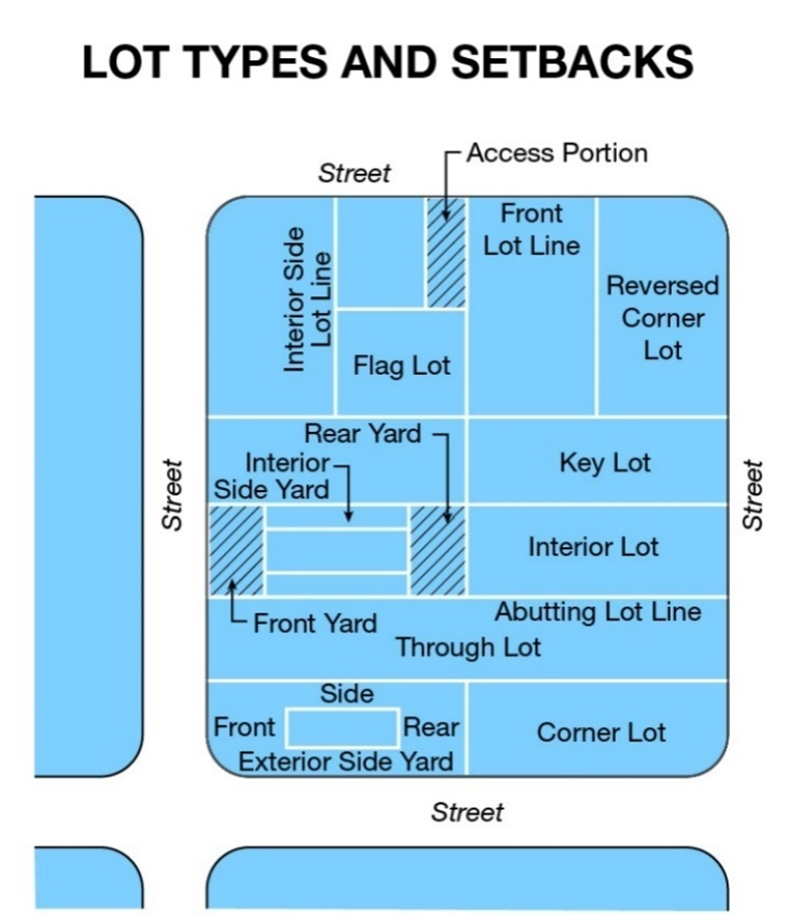
Lot line or property line means any boundary of a lot. The classifications of lot lines and their definitions are as follows:
■ Front lot line means:
• on an interior lot, the line separating the lot from the street;
• on a corner lot, the shorter line abutting a street. (If the lot lines are equal or approximately equal, the Director shall determine the front lot line.)
• on a through lot, the lot line abutting the street providing primary access to the lot.
■ Interior lot line means any lot line not abutting a street.
■ Rear lot line means a lot line which does not intersect the front lot line and which is most distant from and most parallel to the front lot line. In the case of an irregularly shaped lot or a lot bounded by only three lot lines, the rear lot line is a ten-foot long line parallel to and most distant from the front lot line for the purposes of determining setbacks and other provisions of this Code.
■ Side lot line means any lot line which is not a front or rear lot line.
Low barrier navigation center is defined by California Government Code Section 65660(a) as a housing-first, low-barrier, service-enriched shelter focused on moving people into permanent housing that provides temporary living facilities while case managers connect individuals experiencing homelessness to income, public benefits, health services, shelter, and housing. 'Low barrier' means best practices to reduce barriers to entry, including, without limitation: Allowing pets, permitting partners to share living space, and providing storage for residents' possessions. Should this Code's definition conflict with the California Government Code section definition of this term, the Government Code definition prevails.
Lowest floor means, with regard to flood protection, the lowest floor of the lowest enclosed area, including a basement or cellar. An unfinished or flood-resistant enclosure, usable solely for parking of vehicles, building access or storage in an area other than a basement area, is not considered a building's lowest floor provided that such enclosure is not built so as to render the structure in violation of the applicable design requirements of the FP overlay district, .
Main building means the building containing the principal use on the premises.
Main dwelling. See dwelling, main
Managed care facility or project means and includes the following:
(1)
Assisted living facilities. Facilities providing care on a monthly basis or longer which are the primary residence of the people served. Such facilities provide services to residents such as the following: Dining, housekeeping, security, medical, transportation and recreation. Any commercial services provided are for the exclusive use of the occupants of the facility. Such facilities may be located in more than one building and/or on contiguous parcels within the building site.
(2)
Convalescent hospitals. Facilities licensed by the state department of health services which provide bed and ambulatory care for seven or more patients with postoperative convalescent, chronic illness or dietary problems and persons unable to care for themselves, including persons undergoing psychiatric care and treatment both as inpatients and outpatients, but not including persons with contagious diseases or afflictions. A "convalescent hospital" may also be known as a nursing home, convalescent home, rest home, or home for the aged.
(3)
Residential care facilities. Facilities licensed by the state to provide living and treatment facilities on a monthly or longer basis for seven or more of the following: Wards of the juvenile court, elderly persons, mentally disordered persons, developmentally disabled persons, persons undergoing treatment for alcohol or drug abuse, handicapped persons, or dependent and neglected children. Such a facility is permitted in all types of residences by operation of state law.
Manufacture means to compound, blend, extract, infuse, or otherwise make or prepare a marijuana product.
Manufactured home. See mobile home.
Marijuana means any or all parts of the plant Cannabis sativa Linnaeus, Cannabis indica, or Cannabis ruderalis, whether growing or not; the seeds thereof; the resin or separated resin, whether crude or purified, extracted from any part of the plant; and every compound, manufacture, salt, derivative, mixture, or preparation of the plant, its seeds, or resin, including marijuana infused in foodstuff or any other ingestible or consumable product containing marijuana. The term "marijuana" shall include "medical marijuana" as such phrase is used in the August 2008 Guidelines for the Security and Non-Diversion of Marijuana Grown for Medical Use, as may be amended from time to time, that was issued by the office of the Attorney General for the State of California, or for the purposes set forth in California Health & Safety Code Sections 11362.7 to 11362.83 (Medical Marijuana Program Act).
Marijuana accessories means any equipment, products or materials for use in planting, propagating, cultivating, growing, harvesting, manufacturing, compounding, converting, producing, processing, preparing, testing, analyzing, packaging, repackaging, storing, smoking, vaporizing, or containing marijuana, or for ingesting, inhaling, or otherwise introducing marijuana or marijuana products into the human body.
Marijuana activity means any commercial marijuana activity, cultivation of marijuana, delivery of marijuana, distribution of marijuana, dispensing marijuana, manufacture of marijuana, sale of marijuana, the personal use and medical use of marijuana to the extent prohibited by , and the operation or establishment of a medical marijuana cooperative, dispensary, delivery service, operator, or provider.
Marijuana products means marijuana that has undergone a process whereby the plant material has been transformed into a concentrate, including, but not limited to, concentrated cannabis, or an edible or topical product containing marijuana or concentrated cannabis and other ingredients.
Master plan of arterial highways means a component of the circulation element of the city's general plan designating adopted and proposed routes for all commuter, secondary, primary and major highways within the city.
Master plan of drainage means an engineering report outlining the drainage facilities needed for the proper development of the city.
Median means a paved or planted area separating a street or highway into opposite-direction travel lanes.
Medical clinic. See clinic, medical.
Mini-storage facility means a building containing various size storage compartments not exceeding 500 square feet each, wherein each compartment is offered for rent or lease to the general public for the private storage of materials excluding materials sold at the facility or delivered directly to customers.
Minor use permit. See .
Mobile home or manufactured home means a residential building transportable in one or more sections which has been certified under the National Manufactured Housing Construction and Safety Standards Act of 1974.
Mobile home park or mobile home development means any area or tract of land used to accommodate mobile homes for human habitation, including pads for mobile homes, clubhouses, recreation facilities, and other ancillary structures and facilities. The term includes mobile home parks and mobile home subdivisions. See .
Monument sign. See sign definitions, .
Motel means an establishment containing guest rooms with most or all guest rooms gaining access from an exterior walkway on a daily basis for the purpose of providing overnight lodging to the general public for compensation.
Multifamily dwelling or residence. See dwelling, multifamily.
Net lot area. See definitions under area.
Net project area or net site area. See definitions under area.
Noncommercial coach means a vehicle, with or without motive power, designed and equipped for human occupancy for classrooms and other nonresidential and noncommercial uses.
Nonconformity. See .
Nonconforming use. See .
Nonconforming lot. See .
Nonconforming structure. See .
Nursery, day care. See child day care facility.
Nursing home. See convalescent home.
Office park. See industrial park.
Official zoning map. See zoning map.
Offsite hazardous waste facility means any structures, other appurtenances or improvements on land used for the treatment, transfer, storage, resource recovery, disposal, or recycling of hazardous waste, including but not limited to:
(1)
Incineration facilities (i.e. rotary kiln, fluid bed, etc.);
(2)
Residual repository (i.e. receiving only residuals from hazardous waste treatment facilities);
(3)
Stabilization/solidification facilities;
(4)
Chemical oxidation facilities;
(5)
Neutralization/precipitation facilities; or
(6)
Transfer/storage facilities.
Open space means, consistent with the open space component of the general plan, an area of land, creek, river, pond, or lake, public or private, which is used predominantly for passive forms of recreation but may also allow some active recreation use. Open space includes open space corridors, greenbelt areas, landscaped slopes, and conservation areas, and may also include bikeways and riding and hiking trails.
Open space, useable means open space which is predominately level (i.e. slopes less than five percent) but which may contain some steeper land (i.e. with slopes up to 20 percent) which has utility for picnicking or passive recreation activities and which complements surrounding usable open space. Usable open space is a minimum of 15 feet in width and 300 square feet in area and may include structures and impervious surfaces such as tot lots, swimming pools, basketball courts, tennis courts, picnic facilities, walkways, or bicycle trails.
Operator means a company, business or individual who provides residential services, i.e., the placement of individuals in a residence, setting of house rules, and governing behavior of the residents as residents. Operator does not include a property owner or property manager that exclusively handles real estate contracting, property management and leasing of the property and that does not otherwise meet the definition of operator.
Paragraph means a portion of this zoning code beginning immediately after a lower case letter enclosed by parentheses, e.g. (a), and extending to the next such lower case letter, e.g. (b). (Usage example: "...as stated in paragraph (a) of this section...") (see also section and subsection.)
Parcel means an area of land under one ownership which is identified as a lot or parcel on a recorded final map, parcel map, record of survey recorded pursuant to an approved division of land, certificate of compliance or lot line adjustment. The terms lot and parcel are interchangeable for purposes of this Code.
Panhandle lot or flag lot. See definitions under lot.
Parking accessway means a vehicular passageway that provides access and circulation from a street access point into and through a parking lot to parking aisles and between parking areas.
Parking structure means a structure which is open or enclosed and is used for the parking of motor vehicles.
Parkway means the area of a public street that lies between the curb and the adjacent property line or physical boundary, such as a fence or wall, which is used for landscaping and/or passive open space.
Patio home. See dwelling, patio home
Permitted use means a land use allowed within a zoning district under this zoning code and subject to the applicable provisions of this Code.
Person includes any individual, firm, co-partnership, joint venture, association, corporation, limited liability company, estate, trust, business trust, receiver, syndicate, or any other group or combination acting as a unit, and the plural as well as the singular.
Planned unit development means a residential, commercial, office, industrial or other type of development characterized by comprehensive planning for the entire project, the clustering of buildings to preserve open space and natural features, and provision for the maintenance and use of open space and other facilities held in common by the property owners within the project.
Portable sign. See sign definitions, .
Precise plan or Precise plan of development means the plan or plans for a project, development, or other entitlement approved by the decision-making authority. A precise plan may include site, grading, architecture, landscaping plans and may also include a plan text describing the project design, development phasing, and other characteristics.
Precise plan of highway alignment means a plan, supplementary to the master plan of arterial highways, which establishes the highway centerline and the ultimate right-of-way lines and may establish building setback lines.
Primary residence. See main dwelling.
Principal use means the primary or predominant use of any parcel or structure.
Private residence means a house, an apartment unit, a mobile home, or other similar dwelling.
Projecting sign. See sign definitions, .
Property line means a lot line or parcel boundary.
Proposed dwelling means a dwelling that is the subject of a permit application and that meets the requirements for permitting.
Public agency means the United States, the state, the county or any city within the county, or any political subdivision or agency thereof.
Public transit means a location, including, but not limited to, a bus stop or train station, where the public may access buses, trains, subways, and other forms of transportation that charge set fares, run on fixed routes, and are available to the public.
Rear lot line. See definitions under lot line.
Recreational vehicle means:
(1)
Any vehicle or trailer designed and used for temporary habitation, including motorhomes, travel trailers, and pick-up trucks with camper shells;
(2)
Components or accessories to a vehicle designed and used for temporary habitation, such as camper shells and cab-over campers;
(3)
Boats and other watercraft;
(4)
Vehicles not permitted for street use, such as dune buggies and off-road motorcycles; and
(5)
All trailers, including but not limited to trailers designed to transport other recreational vehicles, and all other utility trailers.
Recycling means the process by which waste products are reduced to raw materials and transformed into new products.
Referral facility means a residential care facility or a group home where one or more person's residency in the facility is pursuant to a court order or directive from an agency in the criminal justice system.
Relocatable building. See building, relocatable.
Residential care facility means a residential facility licensed by the state where care, services, or treatment is provided to six or fewer persons living in a supportive community residential setting. Residential care facilities include but may not be limited to the following: Intermediate care facilities for the developmentally disabled; community care facilities; residential care facilities for the elderly; residential care facilities for the chronically ill; alcoholism and drug abuse facilities; pediatric day health and respite care facilities; residential health care facilities, including congregate living health facilities; family care home, foster home, group home for the mentally disordered or otherwise disabled persons or dependent and neglected children. (see also managed care facility)
Residential, multifamily. See dwelling, multifamily.
Residential, single-family. See dwelling, single-family.
Restaurant means an establishment where food and/or beverages are offered, with 11 or more seats. Examples include fine dining, casual sit-down dining, fast food establishments, and other uses deemed to be similar by the community development director.
Restaurant, drive-thru means a restaurant with one or more automobile lanes which allow for the ordering and dispensing of food and beverages to patrons who remain in their vehicles.
Rest home. See convalescent home.
Retail means the selling of goods or merchandise directly to the ultimate consumer.
Retail food means an establishment where food and/or beverages are offered and primarily intended for off-premise consumption, with ten or fewer seats, and with no alcohol sales. Examples include ice cream shops, delicatessens, baked good establishments, and other uses deemed to be similar by the community development director.
Reverse vending machine means a machine which accepts recyclable materials, such as aluminum cans, newspapers, or other materials, from the public and dispenses money in return.
Riding and hiking trail means a trail or way designed for and used by equestrians, pedestrians and cyclists using nonmotorized bicycles.
Right-of-way means an area or strip of land, either public or private, on which an irrevocable right of passage has been recorded for the use of vehicles or pedestrians or both.
Roof sign. See sign definitions, .
Sale includes any transaction whereby, for any consideration, title to marijuana is transferred from one person to another, and includes the delivery of marijuana or marijuana products pursuant to an order placed for the purchase of the same and soliciting or receiving an order for the same, but does not include the return of marijuana or marijuana products by a licensee to the licensee from whom such marijuana or marijuana product was purchased.
Satellite dish antenna means an apparatus capable of receiving communications from a manmade satellite.
Scenic highway means any highway designated a scenic highway by an agency of the city, state or federal government.
Section means a portion of this zoning code beginning immediately after a four- to seven-digit number beginning with "9-1", e.g. 9-1-12 or 9-1-161.2, and extending to the next such four- to seven-digit number, e.g. 9-1-162. (See also subsection and paragraph.)
Senior citizen means a person 55 years of age or older.
Senior citizen residence means a residential care facility which is licensed by the state to provide living and treatment facilities on a monthly or longer basis for six or fewer senior citizens.
Service means an act or any result of useful labor which does not in itself produce a tangible commodity.
Service station means a retail place of business engaged primarily in the sale of motor fuels and supplying those incidental goods and services which are required in the day-to-day operation of motor vehicles, including light auto repair and tune-up. A convenience store accessory to the automotive use may be included in the definition of service station. However, though other auto-oriented uses such as car washes and fast food restaurants may share the same site with service stations, these are not included within the service station definition. Also see gas station.
Setback means the distance that a building or other structure or a parking lot or other facility must be located from a lot line, property line, or other specified boundary. (See also yard.)
Shopping center or commercial center means a commercial area or group of commercial establishments, planned, developed, managed and maintained as a unit, with common landscaping, amenities, and offstreet parking provided to serve all uses on the property.
Short-term rental means the use of any dwelling unit or portion thereof for a period of less than 30 consecutive calendar days in exchange for compensation, financial or otherwise.
Side lot line. See definitions under lot line.
Sidewalk sale or parking lot sale means the temporary outdoor display and sale by a retail business of merchandise which is normally displayed indoors at the same location as the outdoor sale. (See also special commercial event.)
Sign. See sign definitions, .
Single-family dwelling or residence. See dwelling, single-family.
Single housekeeping unit means that the occupants of a dwelling unit have established ties and familiarity with each other, jointly use common areas, interact with each other, share meals, household activities, and expenses and responsibilities; membership in the single housekeeping unit is fairly stable as opposed to transient, members have some control over who becomes a member of the household, and the residential activities of the household are conducted on a nonprofit basis. There is a rebuttable presumption that integral facilities do not constitute single housekeeping units. Additional indications that a household is not operating as a single housekeeping unit include but are not limited to: The occupants do not share a lease agreement or ownership of the property; members of the household have separate, private entrances from other members; members of the household have locks on their bedroom doors; members of the household have separate food storage facilities, such as separate refrigerators.
Single room occupancy (SRO) facility or SRO hotel means a residential facility which is rented on a weekly or longer basis and which provides living and sleeping facilities for one or two persons per unit. Each unit contains a toilet and sink. Shower, kitchen, and laundry facilities may be shared.
Site. See building site.
Site coverage. See building site coverage.
Site development permit or development permit. See .
Slope or slope gradient means the vertical distance between two points on a slope divided by the horizontal distance between the same two points, with the result expressed as a percentage; e.g., "the slope has a 20 percent gradient" (usually used to describe natural as opposed to manufactured, slopes).
Slope ratio means the steepness of a slope expressed as a ratio of horizontal distance to the vertical rise over that horizontal distance; e.g., 2:1 (usually used to describe manufactured as opposed to natural, slopes).
Sober living home means a group home for persons who are recovering from a drug and/or alcohol addiction and who are considered disabled under state or federal law. Sober living homes shall not include the following: (1) state licensed residential care facilities; (2) any sober living home that operates as a single housekeeping unit.
Special center-wide event means the temporary outdoor display and sale of merchandise, or arts and crafts shows, fairs, entertainment, or similar events within a commercial center. (See also sidewalk sale).
Specific plan means a plan consisting of text, maps, and other documents and exhibits regulating development within a defined area of the city, consistent with the general plan and state government code section 65450 et seq.
Stock cooperative means a corporation which is formed primarily for the purpose of holding title to, either in fee simple or for a term of years, improved real property, if all or substantially all of the shareholders of such corporation receive a right of exclusive occupancy in a portion of the real property, title to which is held by the corporation, which right of occupancy is transferable only concurrently with the transfer of the shares of stock or membership certificate in the corporation held by the person having such right of occupancy.
Storage means a place where goods, materials, and/or personal property is placed for more than 24 hours.
Story means that portion of a building included between the surface of any floor and the surface of the floor immediately above it or if there is no floor above, then the space between the floor and the ceiling above it.
Street means a public or private vehicular right-of-way other than an alley or driveway, including both local streets and arterial highways.
Structure means anything that is erected or constructed having a fixed location on the ground or attached to something on the ground and which extends more than 30 inches above the finish grade. A mobile home or relocatable building, except when used as a temporary use with its weight resting at least partially upon its tires, is a structure for the purposes of this definition. (Note: For the coastal zone only, defines the term structure differently.)
Subsection means a portion of a section of this zoning code designated by a section number followed immediately by a lowercase letter; for example, "subsection 9-1-165.1(a)." (see also section and paragraph.)
Supportive housing is defined by California Government Code Section 65650(a) as housing with no limit on length of stay, that is occupied by the target population, and that is linked to on-site or off-site services that assist the supportive housing resident in retaining the housing, improving their health status, and maximizing their ability to live and, when possible, work in the community. Should this Code's definition conflict with the California Government Code section definition of this term, the Government Code definition prevails.
Surgicenter means a medical establishment or clinic in which patients are examined and treated on an outpatient basis only.
Swimming pool means an artificial body of water containing or normally capable of containing water to a depth of 18 inches or more at any point, designed, constructed and used for swimming, dipping or immersion purposes by humans. This includes, but is not limited to, in-ground, above-ground, and on-ground pools, hot tubs, portable and non-portable spas, and fixed in-place wading pools.
Tandem parking means that two or more automobiles are parked on a driveway or in any other location on a lot, lined up behind one another.
Temporary use means a land use established for a specified period of time and which is discontinued at the end of such specified time.
Townhome. See dwelling, townhome.
Transient basis means for a continuous period of two weeks or less.
Transitional housing is defined by California Government Code Section 65582(j) as buildings configured as rental housing developments, but operated under program requirements that require the termination of assistance and recirculating of the assisted unit to another eligible program recipient at a predetermined future point in time that shall be no less than six months from the beginning of the assistance. Should this Code's definition conflict with the California Government Code section definition of this term, the Government Code definition prevails.
Two-unit attached dwelling. See dwelling, two-unit attached.
Ultimate right-of-way means the right-of-way shown as ultimate on an adopted precise plan of highway alignment or the street right-of-way shown within the boundary of a recorded tract map, a recorded parcel map or a recorded planned community development plan. The latest adopted or recorded document in such cases shall take precedence. If none of these exist, the ultimate right-of-way is the right-of-way required by the highway classification as shown on the master plan of arterial highways.
Use or land use means the purpose for which a structure or land is occupied, arranged, designed or intended, or for which either a structure or land is or may be occupied or maintained.
Use permit or conditional use permit. See .
Variance. See .
Vehicular accessway means a private, nonexclusive vehicular easement affording access to abutting properties.
Veterinary clinic means a place where animals no larger than the largest breed of dogs are given medical and surgical treatment, primarily on an outpatient basis, and where the boarding of animals under treatment is incidental to the principal clinic use.
Wall sign. See sign definitions, .
Yard means an open space on a parcel of land unobstructed and unoccupied from the ground upward except for wall projections permitted by this Code. Yards are classified as follows:
Front yard means a yard extending across the full width of the lot between the front lot line or the ultimate street right-of-way line and a setback line within the lot. The depth of the front yard is equal to the setback established in the development standards for the applicable zoning district and is measured along a line drawn at a 90-degree angle to whichever of the following results in the greatest setback: The front lot line or its tangent or the ultimate street right-of-way or its tangent.
Rear yard means a yard extending across the full width of the lot between the rear lot line and a setback line within the lot. The depth of the rear yard is equal to the setback established in the development standards for the applicable zoning district and is measured along a line drawn at a 90-degree angle to whichever of the following results in the greatest setback: The rear lot line or its tangent or the ultimate street right-of-way or its tangent.
Side yard means a yard extending from the front setback line to the rear setback line. The depth of the side yard is equal to the setback established in the development standards for the applicable zoning district and is measured along a line drawn at a 90-degree angle to whichever of the following results in the greatest setback: The side lot line or its tangent or the ultimate street right-of-way or its tangent.
Zoning code or code means the zoning code of the city, i.e. division 1 of article 2 of of the city municipal code, including the official zoning map and other maps and graphics incorporated in the zoning code text or included therein by reference.
Zoning district or district means an area of the city designated on the official zoning map and subject to a uniform set of permitted land uses and development standards.
Zoning map or official zoning map means a map incorporated into this Code by reference which covers the entire land area of the city and is divided into zoning districts for the purpose of specifying for each such land area the uses permitted, development standards required, and other applicable provisions of this Code.
(Ord. No. 99-107, § 5, 2-2-99; Ord. No. 2011-163, § 3, 5-3-11; Ord. No. 2016-184, § 2, 10-4-16; Ord. No. 2017-187 § 2, 6-6-17; Ord. No. 2018-194, § 2, 6-5-18; Ord. No. 2019-197, § 3, 6-4-19; Ord. No. 2021-210, §§ 77—80, 8-3-21; Ord. No. 2021-211, §§ 7, 8, 8-3-21; Ord. No. 2022-216, § 5, 7-19-22; Ord. No. 2022-216, § 5, 7-19-22; Ord. No. 2023-223, § 5, 6-20-23; Ord. No. 2024-228, § 3(Exh. 1), 5-21-24)
Appendix A. - Precise plans for "RP" district.
Approved precise plans for each project within the RP planned residential district. Per , all setbacks and other development standards within each project shall conform to its applicable precise plan.
(Ord. No. 99-107, § 5, 2-2-99)
Editor's note— Appendix A, Precise plans for "RP" district, is included herein by reference. Copies of said appendix A are on file in the city community development department.
Appendix B. - South Laguna specific plan/local coastal program.
(Ord. No. 99-107, § 5, 2-2-99)
Editor's note— Appendix B, South Laguna specific plan/local coastal program, is included herein by reference. Copies of said appendix B are on file in the city community development department.
Appendix C. - Aliso Creek planning unit local coastal program.
(Ord. No. 99-107, § 5, 2-2-99)
Editor's note— Appendix C, Aliso Creek planning unit local coastal program, is included herein by reference. Copies of said appendix C are on file in the city community development department.

