
Lake Hamilton City Zoning Code
ARTICLE V
- DEVELOPMENT DESIGN STANDARDS
Sec. 16-323.- Purpose.
The purpose of this article is to provide development design and improvement standards applicable to all development activity within the town.
(Land Development Code 1995, § 3.01.01)
Sec. 16-324. - Responsibility for improvements.
Unless otherwise specifically provided, all improvements required by this article shall be designed, installed, and paid for by the developer.
(Land Development Code 1995, § 3.01.02)
Sec. 16-325. - Principals of development design.
The provisions of this article are intended to ensure functional and attractive development. Development design shall first take into account the protection of natural resources. All development shall be designed:
(1)
To avoid unnecessary impervious surface cover;
(2)
To provide adequate access to lots and sites; and
(3)
To avoid adverse effects of shadow, glare, noise, odor, traffic, drainage, and utilities on surrounding properties.
(Land Development Code 1995, § 3.01.03)
Sec. 16-326. - Sidewalks, bikeways and footpaths.
(a)
Required.
(1)
Projects abutting collector or arterial facilities shall provide sidewalks adjacent to such roadways. Location of sidewalks shall be consistent with planned roadway improvements.
(2)
Sidewalks shall be provided on both sides of all residential streets where the average lot width at the street is 60 feet or less.
(3)
Sidewalks shall be provided on one side of all residential streets where the average lot width at the street is greater than 60 feet, but less than 150 feet.
(4)
Where a proposed development includes improvements or new construction of a collector or arterial facility designs shall include provision for sidewalks and bikeways within the right-of-way.
(5)
Residential projects adjacent to or in the immediate vicinity of commercial, office, service, or recreation activities shall provide pedestrian and bicycle access from the development to the activity center.
(6)
Pedestrian ways or crosswalks, not less than ten feet wide with a sidewalk meeting the requirements of this section, may be required to be placed in the center of blocks more than 800 feet long where deemed necessary to provide circulation or access to schools, playgrounds, shopping centers, transportation and other community facilities.
(b)
Design and construction standards. Design and construction of sidewalks, bikeways, or other footpaths shall conform to all applicable engineering requirements adopted by the town, including provisions for access by physically handicapped persons.
(Land Development Code 1995, §§ 3.02.01, 3.02.02)
Sec. 16-327. - Reserved.
Editor's note— Ord. No. 2013-09, § 1, adopted December 3, 2013, renumbered § 16-327 as § 16-176(f)(3). Former § 16-327 pertained to drive-up facilities and was derived from Land Development Code 1995, div. 3.03.
Sec. 16-328. - Junkyards and storage areas; screening; buffer.
(a)
Storage of materials.
(1)
Material that is not salvageable shall not be permitted to accumulate, except in bins or containers, and shall be disposed of in an approved sanitary landfill. The period of accumulation is limited to two months.
(2)
In no case shall material that is not salvageable be buried or used as fill.
(3)
Any items which can be recycled or salvaged shall be accumulated in bins or containers to be sold or donated to a recycling firm.
(4)
Recyclable material which cannot be stored in bins or containers may be stored in the open.
(5)
Junkyard operators shall be responsible for compliance with all applicable federal and state regulations pertaining to the handling, storage, and disposal of waste fluids. In no case shall disposal of waste fluids be permitted on-site, except with the express approval of the Florida Department of Environmental Protection (FDEP).
(6)
In any open storage area, it shall be prohibited to keep any icebox, refrigerator, deep-freeze locker, clothes washer, clothes dryer, or similar airtight unit having an interior storage capacity of 1.5 cubic feet or more from which the door has not been removed.
(7)
There shall be no stacking or piling of materials higher than eight feet.
(b)
Screening. All junkyards shall comply with the following screening requirements:
(1)
All outdoor storage facilities shall be surrounded by a substantial continuous masonry, wood or metal fence (not including chainlink fences), or a wall, any of which shall be a minimum of eight feet in height without openings of any type except for one entrance and/or exit which shall not exceed 25 feet in width.
(2)
Gates at entrance or exit shall be of a material without openings.
(3)
The screen shall be constructed of the noncorrosive material throughout.
(4)
Screens shall be maintained and in good repair at all times.
(c)
Buffer in lieu of screening. Where an outdoor storage facility does not abut a public street or highway, a vegetative buffer may be permitted in lieu of screening. Such buffer may be approved by the town council after a finding that the proposed buffer would provide screening equivalent to that required in subsection (b) of this section.
(Land Development Code 1995, div. 3.12)
Sec. 16-329. - Reserved.
Editor's note— Ord. No. 2013-09, § 1, adopted December 3, 2013, renumbered § 16-329 as § 16-176(f)(1). Former § 16-329 pertained to swimming pools and was derived from Land Development Code 1995, div. 3.13.
Sec. 16-330. - Side yard on corner lots.
The side yard adjacent to the secondary street on a corner lot shall provide a setback of 20 feet for the rear portion of the lot within 50 feet of the rear lot line, and at least 12 feet for the remainder of the lot to the front building line.
(Land Development Code 1995, div. 3.14)
Sec. 16-331. - Boat slips and docks.
In any district in which they are permitted, private boat slips and docks may be constructed by the owner on any lot bordering any public or private canal, waterway or lake, provided such uses comply with the following:
(1)
Extension into waterway. Docks shall not extend into the waterway or lake for a distance greater than 50 feet measured from the water line which may be established by the town council on any lake which is not a meandering lake, and from the government survey line on any meandering lake.
(2)
Restriction on boathouse. In R-1 districts, no boathouse or permanent covering shall be provided over the dock or boat slip which is located beyond the water line of any waterway, which may be established by the town council or by a government survey line on any meandering lake.
(3)
Permit by town council exclusively. No permit shall be issued for a boat ramp, dock, slip or boathouse, except by the town council. The applicant shall provide to the building inspector complete plans, specifications and details, at least 30 days prior to the town council meeting at which it is to be considered. The building inspector shall determine if such plans meet all requirements of this chapter, any state, county or other governmental rules or regulations, and transmit his findings to the town council. The applicant shall post a cash or surety bond, as the town council may determine, to ensure that the work proposed will be completed in a manner not inconsistent with the public interest.
(Land Development Code 1995, div. 3.15)
Sec. 16-332. - Indoor amusement enterprises.
The following provisions apply to indoor amusement enterprises:
(1)
Enclosed structure. All activities shall be conducted entirely within an enclosed structure.
(2)
Setback. No structure shall be located within 50 feet of any property line.
(3)
Bowling alley and skating rink. No bowling alley or skating rink shall be maintained or operated within 300 feet of a school, library, church, hospital, child care center, nursing home, or other similar public or semipublic institution.
(4)
Lighting. Lighting to illuminate buildings, open areas or advertising shall be designed so as to shine only on the subject property, and shall be directed away from any public street or residential area.
(Land Development Code 1995, div. 3.16)
Sec. 16-333. - Reserved.
Editor's note— Ord. No. 2013-09, § 1, adopted December 3, 2013, renumbered § 16-333 as § 16-176(f)(2). Former § 16-333 pertained to home occupations and was derived from Land Development Code 1995, div. 3.17.
Sec. 16-334. - Reserved.
Editor's note— Ord. No. O-22-14, § 1, adopted May 3, 2022, repealed § 16-334, which pertained to signs and derived from Land Development Code 1995, divs. 3.18, 3.19.
Sec. 16-335. - Compatibility, landscaping and buffering standards.
(a)
Purpose and intent. The town council finds that landscaping makes important contributions to the public safety and the general welfare of the town. The purpose and intent of this section is to set forth requirements and standards for the provision of canopy trees and buffer yards, the conservation of native plants and trees, and the conservation of water resources in the town. Specifically, it is intended that buffer yards will aid in reducing the potential negative impacts caused by glare, noise, dust, dirt, litter, odors and view of various land uses on adjacent properties. It is further intended that the planting of canopy trees will aid in lowering the ambient temperature of the air through increased shading; in conserving water; in enhancing the appearance of properties; in improving property values; and generally in protecting the health, safety and welfare of the public through the improvement of the quality of the human environment. As part of the development approval process, the town shall ensure that all new development is properly buffered to prevent adverse impacts on surrounding land uses.
(b)
Applicability and exemptions.
(1)
Applicability. Except as specifically excluded in the exemptions below, the requirements and regulations of this section shall apply to the following:
a.
The construction of any new building or improvements that require off-street parking and other impervious surfaces to be constructed on the site;
b.
The alteration of existing structures or improvements where the alteration adds usable floor area that requires additional off-street parking and other impervious surfaces to be constructed on the site;
c.
The construction or expansion of off-street parking and loading areas;
d.
The paving of any existing unpaved off-street parking and/or loading areas; and
e.
Any change of use which results in the property becoming a higher impact/higher intensity use.
(2)
Exemptions. The development, redevelopment, reconfiguration, expansion or change of use of any site requiring review by the town must comply with all elements of this section, unless any of the following exemptions apply:
a.
Enlargement or repair of a single family or duplex residence unless specifically stated otherwise.
b.
New single family and duplex development on individual residential lots are exempt from all provisions of this section, except the requirement of two large or medium sized trees per residential lot, or one tree per attached unit.
c.
Bona fide agriculture.
d.
Buildings and structures are not counted as impervious surface for the purpose of calculating the areas that must be shaded with canopy trees.
e.
Swimming pools and the area specifically designed to be the deck or pool apron abutting the pool are exempt from canopy requirements.
f.
Docks, piers, seawalls, boardwalks and other improvements designed to serve pedestrians near the water or in the use of boats are exempt from canopy requirements. Paved areas abutting a seawall, dock or pier are exempt to a maximum width of ten feet.
g.
Paved surfaces within the supporting cables of a radio, television or microwave tower or a cable television satellite receiver, are exempt from canopy requirements.
h.
Land developed in the central business district or other properties where existing buildings have reduced or no setbacks from property lines, which are physically unable to comply with buffer yard and/or canopy requirements.
(c)
Landscape plans and permits. Prior to issuance of a development permit, a landscape plan shall be submitted to the town planner, or his or her designee, showing canopy tree and buffer yard information required by this section. The landscape plan may be submitted separately, but shall be a part of a site development plan submission, where site development plan submission is required.
When landscaping is required under this section, no building, grading or site preparation shall be allowed until the landscape plan has been approved by the town planner, or his or her designee. The plan shall be dated and stamped approved by the town and only these plans and the requirements of this section shall govern the construction of the site landscaping and subsequent maintenance inspections. A permit shall be obtained for the project within 12 months of the approval date of the approved landscape plan or the plan shall become invalid, unless granted an extension.
(d)
Landscaping. Landscaping shall include the conservation of native plants and trees; the selection and planting of trees to shade vehicular use areas, sidewalks and other paved surfaces; and the design, selection of trees and shrubbery, and the planting of landscape materials to establish buffer yards.
(1)
Selection of new trees and shrubs; site conditions. All plants identified in this section are "Florida friendly" plants for the county, and are well suited to the environment in the town. A Florida friendly landscape is designed to reduce impacts to the environment through the selection of the right plant for the right location, thereby reducing the need for greater landscape maintenance and irrigation.
All new living plant material to be installed shall be nursery grown and root pruned stock, free of insects, disease and defects, and shall satisfy the requirements of this section and be state grade no. 1 or better as defined in the most current edition of grades and standards for nursery plants, state department of agriculture and consumer services, state division of plant industry. All plants installed on the site shall be in accordance with the plans stamped approved by the town.
(2)
Preservation of existing trees and shrubs. Existing trees and shrubs shall be preserved whenever possible provided the plants are all healthy species and are not listed as an exotic and/or nuisance plant in the most recent invasive plant list of the state exotic pest plant council. In these instances the plant material shall be acceptable to the Town and may be maintained in its natural setting and incorporated into the required landscaping areas to fulfill the intent of this section. Landscape plans shall identify those existing plant materials credited toward the town landscape requirements.
Areas of existing vegetation to remain on site and as noted on landscape plans shall not be encroached upon or damaged during construction by any or all activities above or below ground. Visible barricades shall be placed around these areas and shall be kept clear of all construction materials, traffic and debris. Areas that have been damaged or removed shall be replanted and refurbished to restore the area as much as possible to its original condition.
The following methods and procedures shall be followed when preserving trees:
a.
The use of hand labor may be necessary to clear vegetation within the drip line of those trees to be preserved.
b.
The area within the drip line of any tree to be preserved shall remain undisturbed; no materials, machinery, and soil shall be placed within the drip line.
c.
Materials, wires, signs or nails shall not be attached to any tree unless such materials are used to preserve the tree.
d.
All felled material shall be promptly and carefully removed from the site in order to avoid potential damage to remaining trees and vegetation.
e.
Visible barricades shall be erected around those trees to be preserved. These barricades shall be at the drip line of the tree(s) and no closer than ten feet to the trunk of the tree.
f.
All efforts shall be made through the grading and drainage plan to maintain the natural drainage to those trees to be preserved.
(3)
Exotic and nuisance plants. The use of exotic and nuisance plants is prohibited and shall not be accepted as part of an approved landscape plan. For purposes of this section, exotic and nuisance plants shall be those provided in the most recent invasive plant list of the state exotic pest plant council.
(4)
Minimum tree planting height, planting area and distance from pavement.
All newly planted trees shall be staked and guyed immediately after installation and shall remain supported until the root systems have established themselves to adequately support the tree.
(5)
Minimum shrub planting requirements. Shrubs shall be a minimum of one-foot tall at the time of planting, except where they are to act as required screening for residential uses and districts, in which case they shall be a minimum of three feet in height at the time of planting and maintained at a minimum height of five feet at maturity. One-foot high shrubs shall be spaced no closer than 30 inches on center and three-foot high shrubs shall be spaced no closer than 36 inches on center. The Town may authorize alternate spacing for species which have especially broad coverage.
(6)
Ground covers. Ground covers shall be spaced no greater than 18 inches on center and may be planted in lieu of lawn grass. A list of recommended ground cover species is provided in Table 6.04.09 E.
(7)
Lawn grass. Grass may be sodded, plugged, sprigged or seeded except that solid sod shall be used in swales or other areas subject to erosion (generally slopes steeper than ten to one). Grassed areas that are installed by methods other than sod shall attain a full grassed coverage within three months of the date of installation. A list of lawn grass species and their characteristics, including drought tolerance level, soil type, light requirements, wear tolerance and plant maintenance, are provided in Table 6.04.09 F. The selection of lawn grasses shall be based upon the species and characteristics which are most appropriate for the site.
(8)
Mulch. Planting beds shall be mulched with standard accepted mulch materials to:
a.
Prevent the invasion of other plant species;
b.
To absorb moisture for the benefit of the plants; and
c.
To present a neat and orderly appearance of the landscaped area.
The mulched bed shall have a uniform coverage and a minimum depth of two inches. Mulched areas around trees should be at least eight feet in diameter. The use of cypress mulch is discouraged.
(9)
Planting beds. The planting bed for all landscaping materials shall be free of weeds, debris, and nuisance/invasive materials and shall consist of a healthy plant growth medium. The planting bed soil shall provide adequate support, drainage, and nutrients for the plants.
(10)
Landscaping for decorative and masonry walls. Residential subdivisions and commercial and industrial developments may have decorative entrance and screening walls. Landscaping (a combination of trees and shrubbery) shall be installed within the property setback/buffer yard area. If there are no specific buffer yard requirements for the development, one tree shall be planted for each 50 linear feet of wall. Buffer yard trees and shrubs required by this section shall be planted on the street side of the wall.
(11)
Tree requirements for residential properties. Trees for new residential development shall be provided at a rate of two large or medium sized trees per residential lot or one tree per attached unit. Existing trees may be used to satisfy this requirement on individual development parcels provided they are not specifically listed as an invasive species in the most recent invasive plant list of the state exotic pest plant council.
(12)
Encroachments.
a.
Structures. Accessory uses, buildings, and dumpster pads shall not encroach upon or conflict with required landscaped areas.
b.
Parking stalls. No more than two feet of vehicular overhang shall be allowed into a landscape area and no trees and shrubs shall be planted within the area of encroachment.
(e)
Canopy coverage and tree species.
(1)
Trees providing canopy coverage shall be required for the purpose of shading vehicular use areas, sidewalks and other paved surfaces associated with all development in the town. Buildings and structures shall not be counted as impervious surface for the purpose of calculating the areas that must be shaded with canopy trees.
a.
Canopy trees shall be selected from Table 16.335.9 A.
b.
Canopy coverage trees shall be interspersed throughout all vehicular use areas rather than restricted in any way to only a portion of the site. This allows for flexibility and creative design opportunities.
c.
Trees located in buffer yards may receive partial credit in meeting vehicular use areas interior landscaping canopy requirements.
d.
Planting areas under trees shall be planted with shrubs and/or ground covers which are compatible with site conditions.
(2)
Vehicular use areas interior landscaping and canopy requirements. The standard for canopy is 35 percent coverage over all vehicular use areas associated with all land uses subject to these requirements.
(f)
Buffer Yards. A buffer yard is an area containing plant material, fences, walls and/or berms which provide a visual screen and physical separation between incompatible land uses. The purpose of this section is to establish minimum buffer yard widths and landscaping requirements, in order to ensure compatibility between adjacent properties and land uses. The minimum required width of the buffer yard is therefore based on the potential degree of incompatibility between two abutting land uses.
(1)
Buffer yards between proposed and abutting land uses and vacant property. The town provides four different category types of buffer yards, identified as types A, B, C and D. Table 6.04.06 A, establishes the type of buffer yard required between proposed and existing land uses. When property adjacent to a proposed development is vacant, the need for a buffer yard is determined by the zoning classification of the vacant site as provided in Table 6.04.06 B.
(2)
Buffer yards along rights-of-way. In addition to the standards set forth in this section regarding landscape requirements between proposed and abutting land uses and vacant property, provisions shall also be made to buffer land uses from adjacent public streets or rights-of-way as follows:
a.
Arterial roadways. Land uses, excluding agriculture, located along arterial roadways are required to provide a landscape strip at least ten feet wide with a minimum of three trees for each 100 linear feet of right-of-way frontage, or fraction thereof. In addition, five shrubs per tree shall be planted within the landscape strip.
b.
Collector roadways. Land uses, excluding agriculture, located along collector roadways are required to provide a landscape strip at least ten feet wide with a minimum of one tree and seven shrubs for each 50 linear feet of right-of-way frontage, or fraction thereof.
c.
Residential street. New residential developments, excluding individual single-family home sites, individual duplex units and individual infill lot development, located along a residential street, shall provide a landscape strip at least five feet wide with at least one tree per lot. Any trees within this buffer yard may count towards the two tree requirement per section 6.04.04.11 [subsection (d)(11)].
d.
Setbacks for vision clearance. Buffer yards shall not be planted in any portion of the visibility triangle.
(3)
Buffer yards for free standing or satellite parking lots. Buffer yards for free standing or satellite parking lots shall meet the following requirements:
a.
Residential zoning districts. Standing or satellite parking lots located in residential zoning districts, which serve adjacent zoned businesses, shall meet the following requirements.
1.
Site plan approval by the town council is required;
2.
Where the parking lot is contiguous to side lot lines of residentially zoned property, a side yard at least ten feet in width shall be provided;
3.
The parking area shall be provided with a continuous, unpierced masonry wall six feet in height adjacent to all required yards. All such walls shall be smoothly finished and shall not be used for any sign;
4.
All yard spaces between the required wall and lot lines shall be landscaped with at least one hedgerow of hardy shrubs, not less than five feet in height, placed next to the walls, and the remainder of the yard spaces shall be lawn. All such landscaping shall be maintained in a healthy, growing condition, neat and orderly in appearance, and yard spaces shall be kept free of refuse or debris;
5.
Where the parking lot is separated from residentially zoned property by a street, a buffer yard at least ten feet in width shall be provided along the street frontage;
6.
Where the parking is located upon a street upon which residentially zoned properties front and abut in the same block, a front yard shall be provided at least 25 feet in depth. Where one or both of the lots contiguous to and on each side of the parking lot are developed with residential structures having front yards greater than 25 feet in depth, the front yard on the parking lot shall be not less in depth than the deeper of these existing front yards.
b.
All other zoning districts. Standing or satellite parking lots located in zoning districts other than residential shall be designed in accordance with the following requirements.
1.
The parking area shall be provided with a buffer yard at least ten feet in width along all property lines and streets on which the off-street parking area is located.
2.
See subsection (f)(2), buffer yards along rights-of-way, for landscape buffer requirements adjacent to public rights-of-way.
3.
Relief of the buffer yard requirements may be granted by the town council along property lines where adjoining businesses wish to share a common lot. Where this is the case, site plan approval by the town council is required.
c.
Site plan review. The town council may consider specific site plan requests under this section. The council may accept or reject the original request, or it may impose conditions or safeguards on the request which is finds necessary to uphold the public purpose and the intent of the this Code. Approval shall be in the form of a resolution.
TABLE 16.335.6 A
BUFFER YARD REQUIREMENTS BETWEEN PROPOSED AND ABUTTING LAND USES
N = No buffer yard required.
A through D = Type of buffer yard required (see subsection (f)(4) for illustrated examples of buffer yard designs).
TABLE 16.335.6 B
BUFFER YARD REQUIREMENTS BETWEEN PROPOSED LAND USE AND VACANT PROPERTY
N = No buffer required.
A through D = Type of buffer yard required (see subsection (f)(4) for illustrated examples of buffer yard designs).
(4)
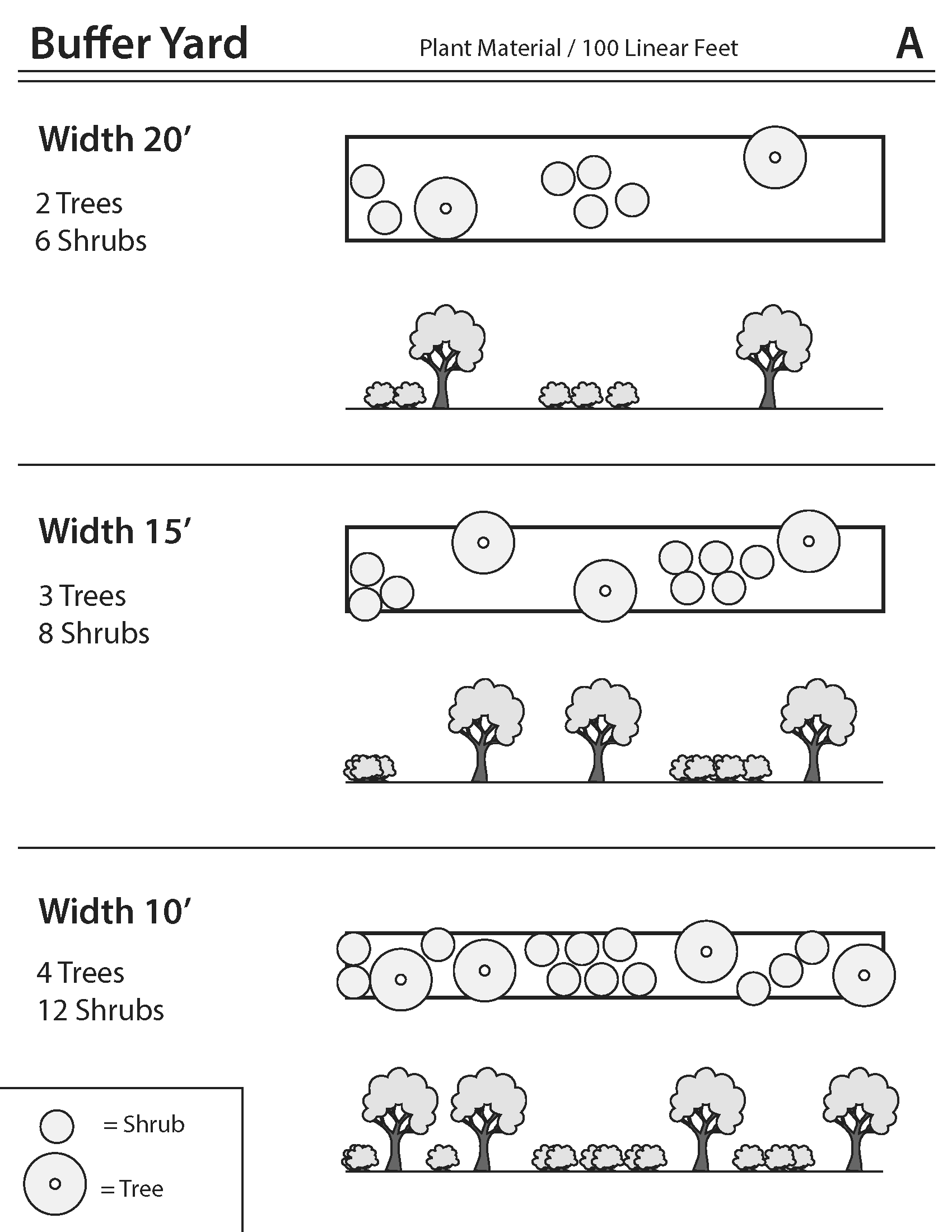
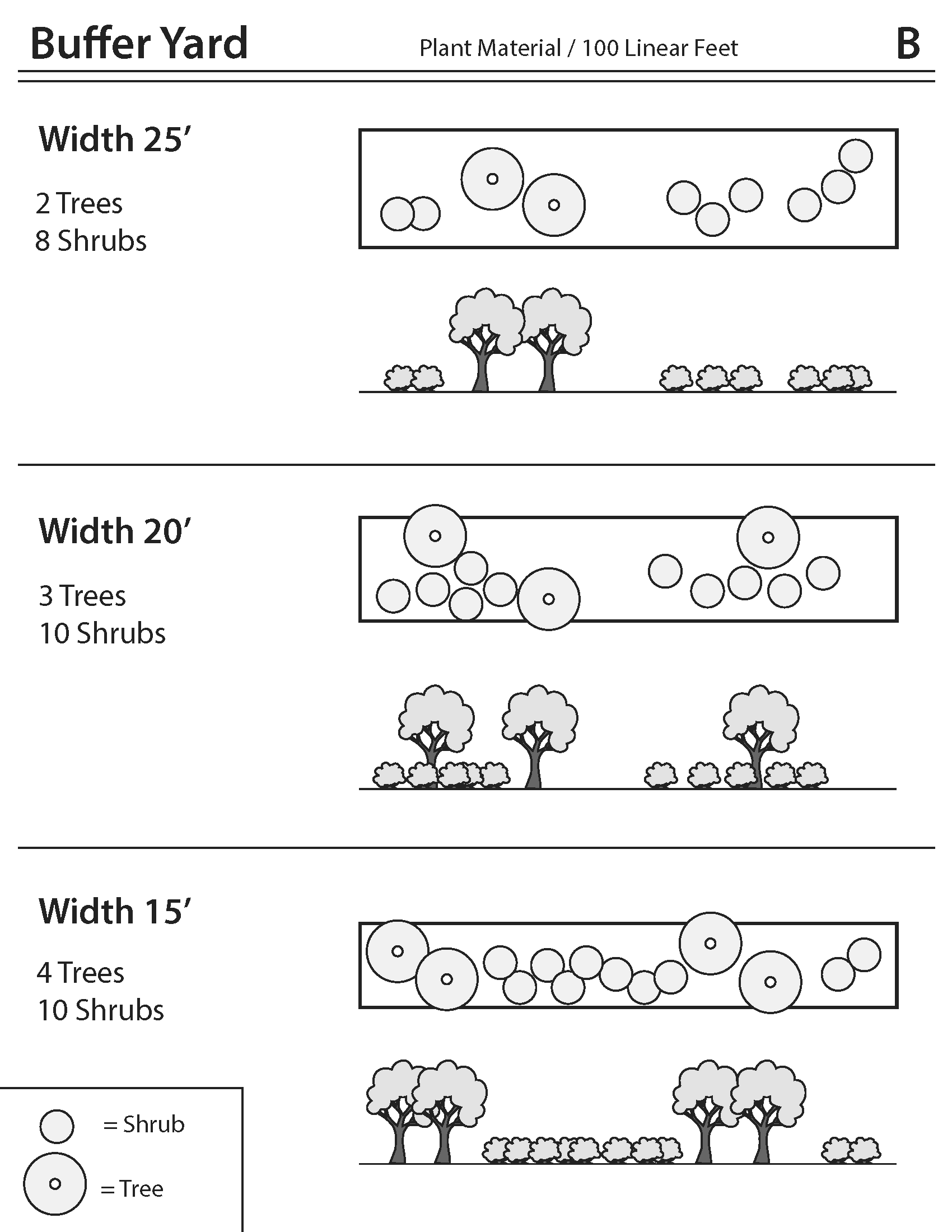
Buffer yard diagrams. Upon determining the type of buffer yard required for a property (type A, B, C, or D), the yard width and number of plantings shall be calculated. Three options are offered within each buffer yard type, allowing a buffer yard which best fits the constraints and features of the site. Any of the options within a particular buffer yard type will fulfill the buffer yard requirement. For example, if a buffer yard A is required, there are three options to choose from; a ten-foot wide buffer, a 15-foot wide buffer or a 20-foot wide buffer. The number of trees and shrubs to be planted within the buffer yard area is dependent upon the buffer yard width chosen; a wider buffer yard requires less plant material.
The diagrams specify the number of each type of plant required per 100 linear feet, excluding any driveway access. The plant material does not need to be equally spaced and may be placed in any configuration, or grouped to best display the plant material within the required buffer yard area. When natural plant material is present, it may be counted towards the total buffer yard requirement for trees and shrubs provided the existing material is generally consistent with the intent of this section.


(5)
Buffer yards, utilities and utility easements. Utility easements in a buffer yard do not prohibit the planting of shrubs in the area of the easement of an underground utility, but no tree shall be planted within 12 feet of a buried utility. Tree planting restrictions in relation to overhead power lines are identified in Tables 6.04.09 A, and 6.04.09 B. Large and medium sized trees should not be planted closer than 15 feet to any light pole.
(g)
Installation, irrigation, inspection, certificate of occupancy/completion and maintenance. All plants shall be "Florida Grade No. 1" or better, shall be healthy and free of diseases and pests, and shall be of nursery stock in two-gallon containers.
(1)
Installation.
a.
Plants shall be installed during the period of the year most appropriate for planting the particular species. If this requirement results in the planting of some or all of the landscaping subsequent to development approval, a performance bond shall be posted prior to the issuance of a certificate of occupancy, in an amount sufficient to insure that the required landscaping is installed.
b.
The developer shall provide an appropriate planting soil medium for required plants and shall irrigate plant materials to sustain healthy growth of all plants to maturity.
c.
Areas on any development site not used for buildings, including single family and duplex development on individual lots, paved surfaces, or other landscape improvements shall be sodded or seeded prior to the issuance of a certificate of occupancy/completion.
d.
Areas within public rights-of-way, and areas off-site which have been disturbed by construction activity, shall be cleaned of all debris, re-graded to the proper elevations, and sodded so as to restore the area to a stabilized and planted state.
(2)
Irrigation.
a.
No irrigation system shall be required where existing natural plant communities are maintained.
b.
All new landscaped areas shall be provided with an appropriate irrigation system, consistent with the needs of the plants contained therein and water conservation efficient.
c.
An irrigation system shall be designed to provide full coverage of all landscape areas without over spraying onto impervious surfaces including pavement, vehicular or pedestrian areas and/or adjacent properties.
d.
The irrigation system shall be operational prior to the issuance of any certificate of occupancy/completion for the property.
(3)
Inspection and certificate of occupancy/completion. The town planner, or building official, shall inspect the landscaping installation to ensure that it is in conformance with the requirements set forth in this section and with the approved landscape plan.
(4)
Maintenance. Landscape areas shall be maintained in good condition so as to present a healthy, neat and orderly appearance and shall be kept free from refuse and debris.
(h)
Violations and penalties.
(1)
All plant material which dies shall be replaced with plant material of required variety and size within 30 days from the date of official notification.
(2)
Consistent with subsection (h)(1), if a restoration plan is presented and differs from the original approved plan, three copies of such restoration plan shall be submitted and approved by the town planner, or his or her designee. The town planner, or his or her designee, shall re-inspect the property for compliance after the restoration is complete.
(3)
Each failure to comply with any of the provisions of this section shall constitute an individual violation. Failure to maintain viable landscaping consistent with the approved landscape plan shall constitute a violation subject to penalties and shall be subject to code enforcement action by the town.
(i)
Plant species list. Plants species identified in this section include "Florida friendly" native and non-native plants. Any new plant material, which will serve to meet the town's minimum landscape requirements, shall be selected from the following plant species tables.
In calculating canopy requirements, each existing tree to be preserved, and each new tree to be planted shall be credited with its mature canopy, as provided in this section. If an on-site preserved tree is not listed as an invasive plant in the most recent invasive plant list of the state exotic pest plant council, and its actual canopy exceeds the canopy area identified in this section, the greater canopy area may be used in calculating canopy coverage.
TABLE 16.335.9 A
LARGE TREES
Table 16.335.9 B
Medium and Small Trees
TABLE 16.335.9 C
LARGE SHRUBS
TABLE 16.335.9 D
SMALL SHRUBS
TABLE 16.335.9 E
GROUND COVERS
TABLE 16.335.9 F
LAWN GRASS SPECIES
(Ord. No. 2013-08, § 1, 12-3-2013)

