
Lake Jackson City Zoning Code
ARTICLE VI
SUPPLEMENTARY REGULATIONS
Sec. 110-161.- Customary home occupations.
(a)
Definitions.
Answering service means the receiving and relaying of telephone messages by a human operator. Answering service does not include telemarketing or soliciting business or the purchase of goods and/or services by telephone.
Community home means a personal care facility licensed under V.T.C.A., Health and Safety Code ch. 247, provided that the exterior structure retains compatibility with the surrounding residential dwellings. No more than six (6) persons with disabilities can reside in a community home and the principal resident/owner must reside in the home. The aforementioned is subject to reasonable building occupancy limits as may be required of the building official and/or fire marshal. A community home may not keep, either on the premises of the home or on a public right-of-way adjacent to the home, motor vehicles in numbers that exceed the number of bedrooms in the home.
Customary home occupation means an occupation which may be conducted in the home without changing the character of the residential use and which is incidental and secondary to the residential use.
Daycare facility means a facility that is licensed or registered with the state which regularly provides care for persons less than twenty-four (24) hours a day.
Demand responsive transport services means a service that offers on-demand call-up door-to-door service from any origin to any destination in a service area.
Kennel means any lot, building, structure, enclosure or premises where animals are kept wherein any person engages in the business of boarding, breeding, buying, letting for hire, training for a fee, or selling dogs, cats or other animals.
Limousine means a motor vehicle with a lengthened wheelbase.
Person with a disability means a person whose ability to care for himself, perform manual tasks, learn, work, walk, see, hear, speak, or breathe is substantially limited because the person has:
(1)
An orthopedic, visual, speech, or hearing impairment;
(2)
Alzheimer's disease;
(3)
Pre-senile dementia;
(4)
Cerebral palsy;
(5)
Muscular dystrophy;
(6)
Multiple sclerosis;
(7)
Epilepsy;
(8)
Cancer;
(9)
Heart disease;
(10)
Diabetes;
(11)
Mental retardation;
(12)
Autism; or
(13)
Emotional illness.
Service representative means an occupation whereby a service is provided. Service representative includes but is not limited to electrician, plumber, interior decorator, accountant, air conditioning repair, small appliance repair, janitorial service, pool service, lawn and landscape service, real estate appraiser and similar occupation.
(b)
Customary home occupations may be conducted in the home within the limits of the following:
(1)
Uses permitted Customary home occupations include home office for a salesman, sales or service representative, manufacturer representative, studio of an artist, musician, music teacher, etiquette teacher, photographer, writer, tailor, architect, dressmaker, launderer, registered family homes, agency homes, community home for the disabled, daycare facilities for twelve (12) or fewer persons, caterers licensed by the city, the transfer of firearms, demand responsive transport services, answering service, or other similar occupations.
(a)
Under this subsection, firearms may only be transferred by a person who holds a federal firearms license and may only be transferred to a person who already owns, but does not yet possess, the firearm. Commercial selling or trading of firearms is prohibited. Maintaining stock or inventory of firearms is prohibited.
(b)
Under this subsection, the operator of a demand responsive transport service must comply with the following:
1.
Only one (1) vehicle may be used for the occupation;
2.
The vehicle may not be more than thirty-five (35) feet in length;
3.
The vehicle may not be a limousine or any other vehicle listed in subsection 98-154(b);
4.
The vehicle cannot be a 15-person passenger van or bus;
5.
The vehicle shall be parked on a concrete pad;
6.
The vehicle shall be parked completely behind the sidewalk; or within a five-foot setback from the curb edge if there is no sidewalk;
7.
The vehicle shall not be operated on a fixed route;
8.
The operator shall not deviate from a route to pick up or discharge other passengers unless at the request of the customer that initiated the call; and
9.
The operator shall obtain a permit from the city on which all drivers of the vehicle are listed as well as the license plate number and the vehicle identification number of the vehicle. The city manager may revoke or suspend the permit for any violations of this section.
(2)
Uses not permitted. Uses not considered customary home occupations include, but are not limited to, barbershops, beauty parlors, animal hospitals, kennels, carpenter shops, electrical shops, plumbing shops, radio shops, tin shops, auto repair, auto paint and body repair shops, furniture repairing shops, clinics, doctor offices, hospitals, real estate offices, insurance agent offices, health studios, palm readers, day care centers or day care facilities which care for more than twelve (12) persons, taxi and limousine services, garage/yard sales (except that as many as two (2) garage/yard sales may be held per year), major appliance repair shops, dance studios or other similar occupations.
(3)
Use restrictions. In addition to the requirements of the appropriate section of this chapter, a home occupation shall comply with the following restrictions.
a.
No home occupation shall cause, by reason of its existence, a significant increase in the number of vehicles traveling to and from the home or on the public streets surrounding or abutting the home, nor shall the home occupation receive regular deliveries from delivery trucks.
b.
A home occupation shall in no way destroy, restrict or interfere with the primary use of the home as a place of residence.
c.
No stock in trade shall be displayed or sold on the premises except that which is custom made to order.
d.
The home occupation shall be conducted entirely within the principal dwelling unit or accessory structure, and in no event shall such use be visible from any other residential structure or public way.
e.
There shall be no outdoor storage of equipment or material used in the home occupation.
f.
No mechanical, electrical or other equipment which produces noise, electrical or magnetic interference, vibration, heat, glare or other annoyance outside the residential or accessory structure shall be used.
g.
No home occupation shall be permitted which is noxious or offensive to a person of ordinary sensitivity or hazardous by reason of vehicular traffic, generation or emission of noise, vibration, smoke, dust, or other particulate matter, odorous matter, heat, humidity, glare, refuse, radiation or other objectionable emission.
h.
No person other than members of the family residing on the premises shall be engaged in the home occupation unless required by licensing requirements or where such engagement is occasional and incidental to the occupation.
(4)
Advertising. No sign advertising the home occupation shall be allowed on or off the premises.
(5)
Preexisting day care facilities. Day care facilities operating prior to June 1, 1992, which are permitted for more than twelve (12) persons may continue to exist or operate, provided that such facilities do not modify the terms and conditions of their current license with regard to owner and number of clients.
(6)
Penalty. Any person who violates this section shall be subject to a fine of not more than two thousand dollars ($2,000.00) for each violation for each day that the violation continues.
(Ord. No. 92-1201, § 1, 6-15-92; Code 1958, § 25-4.1; Ord. No. 99-1603, § 1, 7-6-99; Ord. No. 01-1653, § 1, 3-26-2001; Ord. No. 03-1735, § 1, 10-6-2003; Ord. No. 08-1876, § 1, 2-18-2008; Ord. No. 12-1989, § 1, 7-16-2012; Ord. No. 13-2021, § 1, 10-7-2013; Ord. No. 14-2048, § 1, 8-4-2014)
State Law reference— Industrial homework, V.T.C.A., Health and Safety Code § 143.001 et seq.
Sec. 110-162. - Parking requirements.
(a)
Off-street parking facilities must conform to the table of parking requirements when:
(1)
A building is erected;
(2)
The building's number of dwelling units, dimensions, or seating capacity is increased;
(3)
The building is moved;
(4)
The type of use changes;
(5)
When a site with multiple businesses adds one (1) or more restaurants; or
(6)
When a mobile food service vendor is added to a mobile food service vendor court.
(b)
In addition to the table of parking requirements, businesses shall provide one (1) parking space per the greatest number of staff on duty at any time.
(c)
Exceptions to the table of parking requirements are:
(1)
Downtown buildings (Area J) do not need a specific number of spaces. Instead, the following shall be used as a guide: each use shall be given credit for the spaces abutting the use as well as one-half (½) of the spaces in the center of the street where there is center parking;
(2)
A site with two (2) or more businesses that will share off-street parking. Shared off-street parking must comply with subsection (i) of this section.
(d)
The planning commission may approve an alternative parking plan that is not in strict compliance with the requirements of this section. The alternative plan must meet the objective and purposes of this section. In making the determination, the planning commission may consider whether the alternative plan will preserve existing trees, the shape and size of the property, industry parking standards, and any other information the planning commission finds helpful.
(e)
Off-street parking or stacking for uses not specified in the table of parking requirements shall be determined by the planning commission.
(f)
The parks and recreation board is responsible for designating the number of off-street parking spaces needed for parks.
(g)
All off-street parking and stacking spaces must be a minimum of nine (9) feet by eighteen (18) feet.
(h)
For businesses with a drive-through or passenger drop-off/pickup area, a stacking lane shall be at least nine (9) feet wide and shall not constitute space for any other circulation aisle, parking space, or maneuvering area. The required length of stacking lanes is in the table of parking requirements. The stacking lane shall not be curbed or, if it is curbed, shall have a curb cut to allow vehicles to leave the stacking lane.
(i)
All off-street parking spaces required in this section shall be located on the same lot with the building or use served, except as follows:
(1)
Where an increase in number of spaces is required by a change or enlargement of use or where such spaces are provided collectively or used jointly by two (2) or more buildings or establishments, the required off-street parking spaces may be located no more than three hundred (300) feet from an institutional building served and no more than five hundred (500) feet from any other nonresidential building served.
(2)
The planning commission may allow a business, commercial or institutional use to share off-street parking spaces with another use to meet the required number of off-street parking spaces. The developer must present a site plan and calculations to show that sharing the parking will not cause a shortage of parking spaces or congestion.
(3)
All shared off-street parking arrangements must be acknowledged in a written agreement executed by all involved parties and approved by the city attorney as to form. The agreement shall be filed with the application for a building permit.
(j)
Any head-in parking or parking on public right-of-way where street width is less than forty-eight (48) feet is prohibited.
(k)
No off-street parking shall be allowed in city parkway, including downtown (Area J).
(l)
All other parking requirements in this chapter shall be followed.
TABLE OF PARKING REQUIREMENTS
(This table is meant only to give the required ratio of spaces. All other parking requirements in this chapter must be followed.)
(Ord. No. 259, 7-17-61; Ord. No. 69-397, § 5, 7-7-69; Ord. No. 73-506, § 1, 9-10-73; Ord. No. 81-780, § 1, 2-23-81; Ord. No. 90-1143, § 3, 12-3-90; Code 1958, § 25-7; Ord. No. 11-1964, § 2, 7-5-2011; Ord. No. 15-2067, §§ 1, 2, 6-1-2015; Ord. No. 17-2124, § 2, 2-6-2017; Ord. No. 22-2249, §§ 5, 6, 6-6-2022)
Sec. 110-163. - Loading requirements.
(a)
On the same premises with every building devoted to retail trade, retail and wholesale food markets, warehouses, supply houses, wholesale and manufacturing trade, hotels, hospitals, laundry, dry cleaning establishments or other buildings where large amounts of goods are received or shipped, erected in any zone after July 17, 1961, shall provide loading and unloading space as follows:
(1)
Buildings of less than ten thousand (10,000) square feet of floor area must provide at the rear of each establishment a loading and unloading space which is adequate for the particular type of business.
(2)
Buildings of ten thousand (10,000) square feet of floor area and over must provide one (1) off-street loading and unloading space within minimum dimensions of ten (10) feet by twenty-five (25) feet by fifteen (15) feet overhead clearance, plus one (1) additional such space for each additional fifteen thousand (15,000) square feet of floor space or major fraction thereof.
(3)
Loading space being maintained in connection with any existing building on the effective date of the ordinance from which this provision derives shall thereafter be maintained so long as such building remains, unless an equivalent number of such spaces are provided conforming to the requirements of this section; provided, however, that this regulation shall not require the maintenance of more loading space than is required for a new building.
(b)
Supervised living facilities and other health care institutions or other buildings where large amounts of goods are received or shipped, erected in any zone after December 3, 1990, shall provide loading and unloading space as follows:
(1)
Off-street facilities shall be provided and maintained for receiving and loading of merchandise, supplies and materials within a building or on the premises.
(2)
Required off-street loading facilities may be adjacent to a public alley or private service drive, or may consist of a berth within a structure.
(3)
No portion of a loading facility may extend into a public right-of-way.
(4)
The off-street loading spaces or truck berths shall provide maneuvering areas on site to prevent any blockage of public right-of-way.
(Ord. No. 259, 7-17-61; Ord. No. 90-1143, § 4, 12-3-90; Code 1958, § 25-8)
Sec. 110-164. - Mining, excavation, soil removal.
No mining, excavation, or soil removal except in connection with construction covered by building permit.
(Ord. No. 259, 7-17-61; Code 1958, § 25-4(1))
Sec. 110-165. - Number of main buildings—Residential.
Only one (1) principal building may be located upon an R-1, R-2, R-2A, or R-3 lot. The principal building shall be habitable.
(Ord. No. 259, 7-17-61; Code 1958, § 25-4(2); Ord. No. 10-1951, § 9, 12-6-2010)
Sec. 110-166. - Same—Nonresidential.
Where a lot is used for retail, commercial, industrial or a combination of same, more than one (1) main building may be located upon the lot but only when such building conforms to all the open space, parking and density requirements applicable to the uses and zones and when all such main buildings face upon a street.
(Ord. No. 259, 7-17-61; Code 1958, § 25-4(3))
Sec. 110-167. - Same—Facing streets.
Whenever two (2) or more main buildings, or portions thereof, are placed upon a single lot and such buildings will not face upon a street, the same may be permitted when the site plan for such development is approved by the city planning commission so as to comply with the normal requirements for platting.
(Ord. No. 259, 7-17-61; Ord. No. 85-969, § 1, 3-4-85; Code 1958, § 25-4(5))
Sec. 110-168. - Screening.
Screening consisting of either masonry, or berms with adequate trees or shrubs, or chainlink fencing with adequate trees or shrubs shall be required when a business, commercial or industrial building backs up to either a major city street or a state highway and there are garbage receptacles, work vehicles and other common but unsightly operational or back-door materials visible. Such screening must be thick or dense enough to hide the unsightly items up to a height of at least six (6) feet.
(Ord. No. 259, 7-17-61; Ord. No. 85-969, § 1, 3-4-85; Code 1958, § 25-4(4))
Sec. 110-169. - Permits for multiple buildings.
Whenever an area or tract of land under one (1) or several ownerships is proposed for development with more than one (1) main building, permits may be issued for housing projects, shopping centers, institutions, industrial development, or a combination development of two (2) or more uses when the same is issued with the approval of the planning commission.
(Ord. No. 259, 7-17-61; Ord. No. 85-969, § 1, 3-4-85; Code 1958, § 25-4(6))
Sec. 110-170. - Height restrictions generally.
No structure shall be built with a height of more than one hundred forty (140) feet within ten thousand (10,000) feet of the center of an airport. No structure shall be built with a height of more than one hundred (100) feet within three (3) miles of either end of and in a line with any runway of an airport.
(Ord. No. 259, 7-17-61; Ord. No. 85-969, § 1, 3-4-85; Code 1958, § 25-4(7))
Sec. 110-171. - Sight-obstruction at intersections.
On any corner lot on which front and side yards are required, no fence, structure, sign, tree, shrub or hedge may be maintained within a twenty-five-foot isosceles triangle formed by the lot lines on the corner, as to cause danger to traffic by obstructing the view.
(Ord. No. 259, 7-17-61; Ord. No. 84-914, § 2, 2-20-84; Ord. No. 85-969, § 1, 3-4-85; Code 1958, § 25-4(9))
Sec. 110-172. - Reserved.
Editor's note— Ord. No. 14-2038, § 1, adopted Apr. 21, 2014, repealed § 110-172, which pertained to fences—when required and derived from Ord. No. 259, adopted July 17, 1961; Ord. No. 80-764, § 1, adopted Nov. 17, 1980; Ord. No. 85-969, § 1, adopted Mar. 4, 1985; and Code 1958, § 25-4(8).
Cross reference— Fence required for swimming pools, § 14-272.
Sec. 110-173. - Fences—Construction permits required.
(a)
It shall be unlawful for any person, business, partnership, corporation, or other entity, to commence the construction, enlargement, extension or relocation of a fence without first obtaining a permit from the building official for such work.
(1)
Application. Application for a fence construction permit shall be made to the building official on forms provided for that purpose.
(2)
Requirements. The building official shall require that every application for a fence construction permit be accompanied by one (1) copy of a plan or plot drawn to scale and showing the following in sufficient detail to enable the building official to ascertain whether the proposed fence and its placement is in accordance with this chapter:
a.
Lot dimensions and corners. The actual shape, proportion and dimensions of the lot to be built upon and satisfactory evidence that actual corners of the lot are known and are identified by stakes or rods and established on the ground. The proposed fence should be within the property line of the lot seeking the permit.
b.
Existing yards. The dimensions of all yards and such other information concerning the lot or adjoining lots as may be essential for determining whether the provisions of this chapter are being observed.
c.
Proposed structures.
1.
The shape, height, type, quality, fabric, and location of all fences on a lot shall be consistent.
2.
All nails or fasteners shall be of nonrusting, noncorrosive metal such as hot dipped galvanized steel. All nails or fasteners shall be of the type (such as screw shank, ring shank, or divergent point staples) that when properly driven, will not work free, due to wind, vibration or shrinkage of members.
3.
All materials shall be securely fastened, vertical boards to horizontal stringers, stringers to vertical posts, top rail, to ensure an ongoing attractive appearance and safe condition, free from rust, rot, vandalism, and other sources of decay.
(3)
Issuance. If the proposed fence as set forth in the application is in conformity with the provisions of this chapter, the building official shall issue a fence permit.
(4)
Disapproval. If an application for a fence permit is not approved, the building official shall state in writing on the application the reasons for such disapproval.
(Ord. No. 259, 7-17-61; Ord. No. 84-914, § 2, 2-20-84; Ord. No. 85-969, § 1, 3-4-85; Code 1958, § 25-4(10); Ord. No. 93-1253, § 1, 8-2-93; Ord. No. 96-1399, § 1, 11-4-96; Ord. No. 13-2008, § 8, 4-15-2013; Ord. No. 14-2038, § 2, 4-21-2014; Ord. No. 18-2173, § 1, 12-3-2018)
Sec. 110-173.1. - Same—Height, location, and maintenance.
(a)
No fence or enclosure shall exceed a height of seven (7) feet measured from the ground directly below the fence, with the following exceptions:
(1)
The side of the property abutting an arterial street or state highway may have fences up to eight and one-half (8½) feet in height.
(2)
Business properties in business, commercial and manufacturing zones (B-1 through M-2) may, for security purposes, have fences up to ten (10) feet in height.
(3)
Multi-family, business, commercial or industrial uses that abut a single-family residence zone on any side or the rear must be screened with a fence that is at least six (6) feet but no more than ten (10) feet in height. If the fence is to exceed eight (8) feet in height, the applicant must prove a specific need to the planning commission and the applicant must submit a site plan or landscape plan that depicts the fence.
(4)
Applicants for uses in business, commercial and industrial zones may have a fence that exceeds seven (7) feet in height if the applicant proves a specific need to the planning commission. The applicant must submit a site plan or landscape plan that depicts the fence.
(b)
The planning commission may grant an applicant's request not to have a fence if the applicant proves that there is a physical need related to the property to omit the fence.
(c)
No fence or enclosure shall extend closer to any street right-of-way line than the building line in front (see section 110-2 building line definition, being the front of the building) and the point of intersection of the building line with the property line on the side, except that when the lot is at least one (1) acre or more, ornamental see-thru (spaces six (6) inches to eighteen (18) inches in width) iron or steel fences with brick pillars may be erected up to and along the minimum setback line in front and on the property line on the side to its intersection with the minimum setback line in front.
(d)
All fences shall be maintained by the property owner/lessee and shall be kept clean, free from all hazards such as, but not limited to faulty and loose fastenings, nails, boards, so as not to be detrimental to the public health and safety.
(Ord. No. 14-2038, § 3, 4-21-2014)
Sec. 110-174. - Surfacing of off-street parking areas.
All off-street parking areas shall be graded and paved with an all weather type pavement, either concrete, asphaltic concrete or other surfacing material.
(Ord. No. 259, 7-17-61; Ord. No. 85-969, § 1, 3-4-85; Code 1958, § 25-4(11))
Sec. 110-175. - Lot widths.
For the purpose of determining the minimum required width of the lot for building purposes, the width required may be measured at either the front line or the building line, whichever is greater, as long as either the front line or the building line meets the minimum requirement for the frontage of the lot or site under this Code for the particular zone and the lot meets the total square footage requirement of the Code for that zone.
(Ord. No. 259, 7-17-61; Ord. No. 84-929, § 1, 5-21-84; Ord. No. 85-969, § 1, 3-4-85; Code 1958, § 25-4(12))
Sec. 110-176. - Tents in business and commercial zones.
The time period for which a business or other entity may erect or have a tent on their premises in business and commercial zones for the purpose of housing materials, providing cover from the elements, providing for an outside sale area, providing for entertainment, conventions or any other social, business or commercial purpose shall not exceed thirty (30) days total for a calendar year.
(Ord. No. 93-1262, § 1(25-4(13)), 11-1-93)
Sec. 110-177. - Screen enclosures.
(a)
Interpretation of the definition of a screen enclosure shall be the duty of the building official.
(b)
Appeals of the definition may be made to the zoning board of adjustments through the building official. The decision of the zoning board of adjustments shall be final if no challenge suit is filed in district court within fifteen (15) days after the decision.
(c)
Screen enclosures shall not be counted toward total percentage of allowable structures on any lot. This subsection shall apply to all those structures existing on February 17, 1997, as well as those that are erected after that date.
(d)
Additionally, screen enclosures shall:
(1)
Be designed and stamped by an engineer to meet Texas windstorm standards;
(2)
Not encroach onto any easements or setback requirement;
(3)
Be considered a structure and a permit is required;
(4)
Be exempted from the percentage of lot allowed for buildings or structures; and
(5)
Be subject to all other requirements for buildings or structures and those requirements shall be enforced.
(Ord. No. 97-1412, § 1, 2-17-97; Ord. No. 10-1951, § 10, 12-6-2010)
Sec. 110-178. - Design limitations.
(a)
The following design limitations shall apply after March 1, 2000, when a B-1A, B-2, C-1, C-2, M-1 or M-2 zone lot line is within sixty (60) feet of single-family residential area lot lines:
(1)
All garbage storage shall be screened and located no closer than ten (10) feet from a single-family residential zone and may not be located between the front of the structure and any street right-of-way.
(2)
All lots zoned for business, commercial, or industrial uses shall be screened in accordance with section 110-180 if the lot line is within sixty (60) feet of a single-family residential area lot line.
(3)
Hours of operation shall be limited to 5:00 a.m. to 12:00 midnight unless planning commission review determines alternative hours will not adversely impact the neighborhood residents outside normal hours of operations, all external lighting except that necessary for security purposes shall be secured.
(4)
No structure shall be located nearer to any single-family residential property than a distance equal to one and one-half (1½) times the height of the exterior walls of such building or structure. But those businesses built prior to March 1, 2000, are excepted from this requirement.
(5)
No mechanical, electrical or other equipment which produces noise, electrical or magnetic interference, vibration, heat, glare or other annoyance at nearby residential lot lines shall be permitted. Mechanical and electrical equipment shall be designed and installed to minimize noise impact on surrounding residential property. Additionally, no external amplified sound for other than safety or security purposes is allowed.
(6)
Uses that typically and inherently produce significant noise such as tire shops, muffler shops and car wash facilities are not allowed unless design features are present to eliminate noise that would intrude on the neighborhood.
(7)
All exterior signage, both temporary and permanent, shall meet the conducive color standards of section 110-72(17) and is subject to a design review and placement study by the planning commission. All signage detached from buildings/structures shall meet the requirements of a monument sign as defined in section 78-10 of this Code.
(8)
All storage, both temporary and permanent, of materials, pending customer work (i.e., vehicles), freight/deliveries or products intended for sale/lease shall be within the building or structure.
(b)
The following performance standards shall be used after March 1, 2000 for the purpose of evaluating the development proposals when a B-1A, B-2, C-1, C-2, M-1 or M-2 zone lot line is within sixty (60) feet of single-family residential area lot line:
(1)
New development shall be designed to be compatible with neighboring residential areas. This shall require that materials used on the outside of the buildings be of earth tone colors or colors conducive to colors in the surrounding residential area.
a.
Colors of awnings should be muted, natural or earth toned and related to major materials of the building.
b.
Window frames may be of an accent color to complement the major wall material.
c.
Paint shall be flat or semi-gloss.
d.
Metal roofs grey, natural green, rust or brown.
e.
Metal canopies dark anodized or black or to match roof.
This shall involve the preservation of the character of the character and integrity of residential areas and the maintaining of an appropriate visual and functional interrelationship between residential and commercial uses. Potential intrusive design elements such as traffic circulation and light and glare shall be designed to avoid interference with the residence environment.
(2)
The height, scale, mass and bulk of buildings shall not be overbearing in relation to neighboring residential structures. Height, scale, mass and bulk shall also be a function of their proximity to residential structures, with buildings in close proximity made to adhere to a similar scale of development. Potential view impediments shall also be considered.
(3)
Architectural styles and features shall be compatible with and complementary to neighborhood residential structures to the extent commercial and residential structures share a visual relationship.
(Ord. No. 00-1626, § 2, 3-20-2000; Ord. No. 13-2008, § 9, 4-15-2013)
Sec. 110-179. - Cinerariums.
(a)
[Definition.] For purposes of this section, building means a free standing occupiable structure, exclusive of any other structure connected to the building by breezeways, walkways, or other types of attachment.
(b)
All cinerariums. The following regulations shall apply to all cinerariums.
(1)
Only a church or religious institution that owns and uses the property on which the cinerarium shall sit may install and use a cinerarium.
(2)
Only one (1) cinerarium is allowed per church or religious institution.
(3)
Only one (1) cinerarium is allowed per lot.
(4)
A cinerarium shall contain no more than one hundred fifty (150) niches, with each niche measuring no more than twelve (12) inches by twelve (12) inches by twelve (12) inches.
(5)
Each niche shall only contain the cremains of one (1) person at a time.
(6)
No sign permit shall be issued that identifies an area as a cinerarium.
(7)
Cinerariums may not occupy more than three hundred (300) square feet. This three hundred (300) square foot limitation includes the niches as well as the concrete slab or wall that contains the niches.
(8)
The church or religious institution must maintain a current list of those interred in the cinerarium.
(9)
The church or religious institution must file a plat with the county clerk showing the layout or plan of the cinerarium. The church must file an amended plat if the number of niches in the cinerarium changes.
(c)
Interior cinerariums. The following regulations shall apply to all interior cinerariums.
(1)
The cinerarium may only be inside of a building and it must adjoin and be a part of the building that houses the main sanctuary.
(2)
Niches may only be accessible and viewed from the interior of the building.
(3)
If the sanctuary is moved, then the cinerarium must also be moved so that all requirements in this section are met.
(d)
Exterior cinerariums. The following regulations shall apply to all exterior cinerariums.
(1)
The cinerarium shall consist of an in-ground concrete slab with niches constructed in the slab for placement of urns or other suitable containers for cremains.
(2)
The cinerarium must adjoin the building that houses the main sanctuary on the church or religious institution's campus.
(3)
The cinerarium must be constructed so that the niches do not collect water.
(4)
The top surface of the cinerarium, including the niche covers, cannot be higher than the top elevation of the building's foundation to which the cinerarium adjoins.
(5)
All niches shall have a uniform cover.
(6)
The cinerarium shall be built so that no items such as ornaments, flower vases, or other memorials that extend above the surface of the cinerarium are accommodated.
(7)
The cinerarium may be enclosed within a wall. The wall either must be made from masonry materials or must consist of a hedge that completely screens the cinerarium. Wooden fences may not be used to screen the cinerarium. The wall may not contain niches.
(8)
If the sanctuary is moved, then the cinerarium must also be moved so that all requirements in this section are met.
(e)
Removal of cremains.
(1)
Once the property ceases to be used for a church or religious institution or if the property is deemed to be a nuisance, the property owner shall be responsible for the removal of all cremains.
(2)
If the property owner does not remove the cremains, the city shall remove and dispose of the cremains as allowed by state law. The city shall document the place and manner of disposal and shall keep such documentation as a permanent record.
(Ord. No. 11-1960, § 3, 6-6-2011)
Sec. 110-180. - Screening and fencing materials.
(a)
Unsightly features. When a business, commercial or industrial use backs up to a major city street or a state highway and there are garbage receptacles, work vehicles and other common but unsightly operational or back-door materials visible, the unsightly area may be required to have at least a six-foot screen consisting of:
(1)
Masonry walls;
(2)
Wood fencing;
(3)
Chain link fencing with trees or shrubs thick or dense enough to hide the unsightly items; or
(4)
Berms with adequate trees or shrubs thick or dense enough to hide the unsightly items.
(b)
Abutting single-family residential zones. Where a multi-family, business, commercial or industrial use abuts a single-family residence zone on any side or the rear, the fence must be solid enough to prevent light penetration.
(c)
Fencing materials. Fencing materials for fences that are over two (2) feet and are not installed to fence agricultural uses may only consist of:
(1)
Chain link;
(2)
Wood that is decay resistant;
(3)
Iron or steel ornamental;
(4)
Chain link with vinyl slats;
(5)
Masonry;
(6)
Wrought iron;
(7)
Solid stone;
(8)
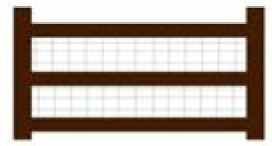
Galvanized welded wire with a minimum thickness of at least wire gauge 14 if used as a backing fabric in conjunction with wood, masonry, stone, or otherwise approved fencing. The fence shall be constructed with adequate frame and rail structure so that the wire does not sag, does not become misshapen when a person or animal climbs over the fence or pushes against the fence, and the mesh opening does not permit the passage of a sphere with a diameter of four (4) inches. This does not include woven or knotted wire fabric similar to commercial rural field fence products. (See Fig. 1)
(d)
Barbed wire. Fences surrounding commercial and industrial uses may contain barbed wire on the top of the fencing if the use is not adjacent to a residential zone. Barbed wire may be used in E-1 residential zones.
(Ord. No. 13-2008, § 10, 4-15-2013; Ord. No. 14-2038, § 4, 4-21-2014)

