
Lancaster City Zoning Code
ARTICLE IV
- CONDITIONAL USES AND SPECIAL EXCEPTION USES
Sec. 44-78. - Difference between conditional and special exception uses.
(a)
A conditional use is permitted by right in a zoning district subject to the requirements contained in this article for that particular use being met. These requirements are in addition to all other requirements contained in this chapter. Plans for conditional uses shall be reviewed by the building inspections department prior to the use being located on a site to make sure the use meets all of these standards.
(b)
A special exception use is permitted in a zoning district subject to the requirements contained in this article for that particular use being met. These requirements are in addition to all other requirements contained in this chapter. However, unlike conditional uses which are reviewed by the building inspections department, special exception uses shall be reviewed by the board of zoning appeals after a properly advertised public hearing is held on the request.
(Code 1991, § 31-51)
Sec. 44-99. - Purpose for conditional uses.
Due to the nature and potential impact of uses listed in this division, such uses shall only be allowed within the city if all of the listed conditions pertaining to each use are met. If all of the listed conditions pertaining to each use are met, no further review is required. Variances from these minimum requirements shall not be approved unless the applicant can demonstrate a hardship would occur if the chapter is applied to the site as written.
(Code 1991, § 31-52)
Sec. 44-100. - How to measure separation requirements.
The distance for separation requirements is measured by following a straight line from the closest point of the lot line of the lot which contains the use which the conditional or special exception use is to be separated from to the closest point where the proposed conditional or special exception use is to be located on the site. For example: A commercial kennel is to be located at least 500 feet from a religious institution. See diagram below.
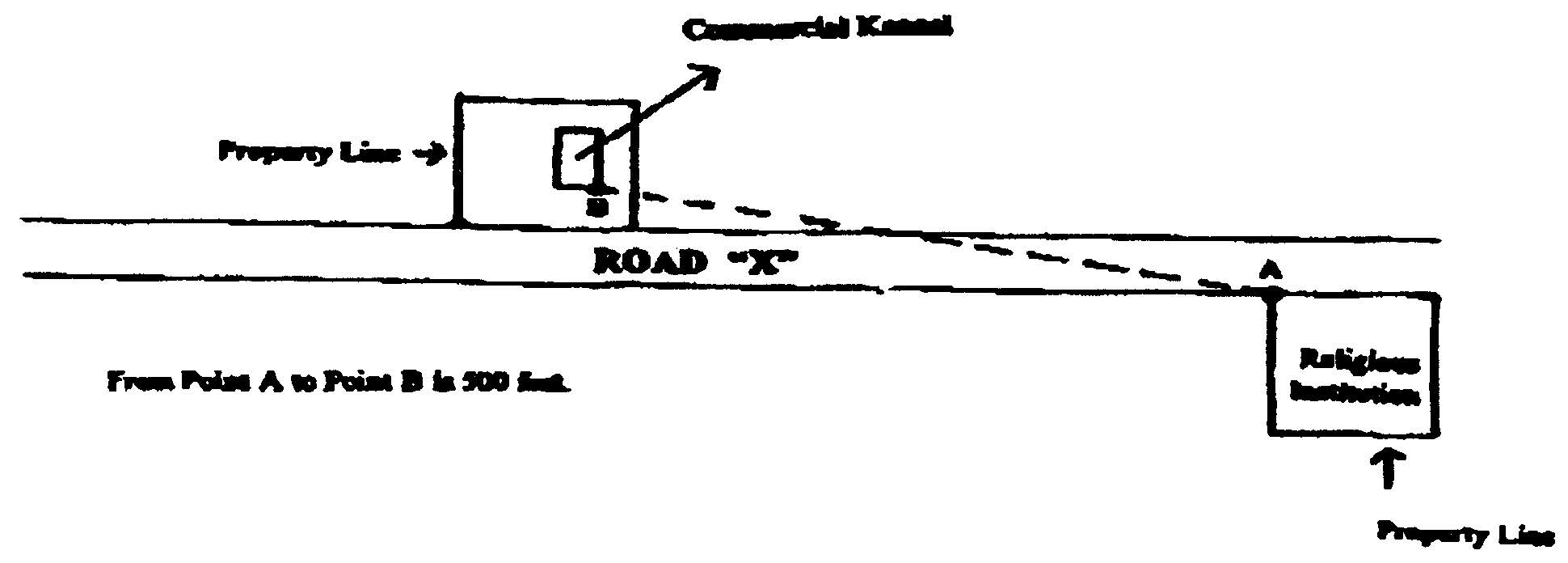
(Code 1991, § 31-53)
Sec. 44-101. - Festivals, bazaars, outdoor sale events, carnivals, circuses, revivals and temporary promotions.
(a)
Festivals, bazaars, outdoor sale events, carnivals, circuses, revivals and temporary promotions are permitted in any district; provided, however, that any such use shall require the building official's determination with regard to the adequacy of the parcel size, parking provisions, traffic access and the absence of undue adverse impact on adjacent properties. Such use shall be limited to a period not to exceed 14 days. Such use need not comply with the yard requirements of this chapter except that structures or equipment that might block the view of operations of motor vehicles on any public or private street shall not be located within the sight distance triangle. Such use need not comply with the maximum height requirements of this chapter. The concessionaire responsible for the operation of any such festival, bazaar, outdoor sale event, carnival, circus, revival or temporary promotion shall submit at least ten calendar days in advance of the event date a site layout displaying adequate ingress and egress plan for emergency vehicles with no dead-end aisles.
(b)
Tents are permitted in all zoning districts. No tent shall be allowed to remain for a period of more than two days longer than the period during which the use with which it is associated is allowed to remain or, in the absence of any such period, ten days. Unless waived in writing by the building official, every tent shall comply with the bulk and yard requirements of the district in which it is located.
(Code 1991, § 31-54)
Sec. 44-102. - Hotel/motel.
Motels and hotels are permitted, provided that:
(1)
The lot size is a minimum of one acre;
(2)
The sole means of ingress and egress shall be via an arterial road;
(3)
The property shall have a minimum 200-foot frontage on an arterial road;
(4)
Any building on the site must be a minimum of 200 feet from any residential district;
(5)
When adjacent to residentially used or zoned property, outdoor lighting is required to be installed so that light shall not shine or reflect directly onto the adjacent property; and
(6)
When adjacent to residentially used or zoned property, a continuous visual screen shall be provided and maintained along the property line. The screen shall be a wall, fence or compact evergreen hedge or other type of evergreen foliage, or a combination of fence and shrubbery at least six feet in height.
(Code 1991, § 31-55)
Sec. 44-103. - Junkyards.
Junkyards, scrap processors and automobile wreckers may be permitted in the IND Industrial District subject to the following requirements:
(1)
Site size. All junkyards, scrap processors and automobile wreckers shall be located on a site of at least two acres.
(2)
Location. No junkyard, scrap processor or automobile wrecker shall be located within 500 feet of any residential district existing at the time business operations are started.
(3)
Screening. Open storage shall be enclosed by a continuous visual screen provided and maintained along that property line. The screen shall be a wall, fence or compact evergreen hedge or other type of evergreen foliage, or a combination of fence and shrubbery at least six feet in height.
(Code 1991, § 31-56)
Sec. 44-104. - Manufactured homes.
(a)
Except as otherwise provided in this section, manufactured homes shall be permitted only in a manufactured home park as prescribed in article II of this chapter. Manufactured home parks in existence on July 18, 1983, may be enlarged when such enlargement is in conformance with all design requirements of this section, with the exception of subsection (e)(2) of this section.
(b)
In the event of an emergency caused by fire or storm damage, the building official shall have the authority, upon proper application outlining good reason therefor, to issue a temporary permit, for a period of not more than 90 days, for the placement of a manufactured home in other than a manufactured home park. Such a temporary permit may not be renewed without approval by the board of zoning appeals and then for a period of not more than 90 days.
(c)
In the event of action taken by the city which requires an occupied residential structure to be vacated for repairs or demolition, the building official shall have the authority, upon proper application outlining good reason therefor, to issue a temporary permit, for a period of not more than 120 days, for the placement of a manufactured home in other than a manufactured home park.
(d)
A multi-wide manufactured home may be placed on a single lot in any residential zoned district (except R-15) permitting single-family dwellings, provided such dwelling has a minimum dimension of 24 feet by 40 feet; is designed and constructed to comply with the federal manufactured home construction and safety standards, and the state uniform standards code for manufactured housing and regulations; has a minimum three-inch to 12-inch roof pitch; a minimum six-inch overhang at soffits and gable ends, roof coverings must be composition shingles, exterior wall covering must be of masonry veneer or wood siding or other materials assuring a favorable comparison with neighboring site built dwellings; and is permanently affixed to a foundation wall enclosing the entire perimeter of the structure and supporting the loadbearing framework of the structure. Such manufactured home shall have its wheels, axles, transportation lights and towing apparatus removed to prevent the structure from being moved from time to time at the convenience of the owner. Manufactured homes shall be oriented on the site so that the front door faces the road from which the site has its access.
(e)
Scope and jurisdiction.
(1)
Sworn law enforcement personnel of the city shall assist the building inspections department in the enforcement of all applicable requirements of this section and chapter upon reasonable request and notification.
(2)
Upon notice from the building official, placement of a manufactured home contrary to the provisions of this section shall be immediately ceased. Such notice shall be in writing and shall be transmitted to the mover of the manufactured home in violation. Notice shall state the violation and the conditions under which the violation shall be corrected. Written notice shall be sufficient if mailed by registered mail, hand delivered, or accepted by an agent or relative of the owner of the manufactured home in violation.
(3)
It shall be unlawful for any public utility to provide service to any manufactured home where a permit is required under this section prior to the issuance of required permit or to maintain any such service upon notification by the building official that such violation was made against the provisions of this section. This service restriction includes temporary connections for installation purposes.
(f)
Permit administration.
(1)
It shall be unlawful for any person to place a manufactured home on a lot without filing an application with the building inspections department and obtaining the necessary permit. Each application for a permit shall be made on a form required by the building inspections department.
(2)
The building inspections department shall make every reasonable effort to assist an applicant in completing the application forms; however, the applicant for such a permit is fully responsible for supplying and entering complete and accurate information on the application forms. If the application is deemed incomplete, inaccurate, or nonconforming to the provisions of this chapter or other pertinent ordinances, the building inspections department may reject such application in writing and indicate what action the applicant must take to comply with these regulations.
(g)
Permit fees established and from time to time modified by action of city council.
(1)
No permit shall be issued by the building inspections department until the appropriate fee is paid for the placement/setup/moving of any manufactured home or for moving any manufactured home out of the city.
(2)
When, as a result of incomplete applications, violations, or errors of permit holder/applicant, additional inspections must be performed, the permit holder/applicant shall pay an additional fee as determined by city council for each additional inspection thereafter.
(3)
Where any activity regulated by this section is commenced prior to issuance of the required permits, the applicable permit fee shall be doubled.
(4)
The county school district shall be exempt from paying the fees established by this subsection (g) only.
(5)
If a manufactured home is located on a parcel without meeting all the regulations contained in this section, then the mover of the manufactured home (not the property owner) shall be fined accordingly, and it shall be the responsibility of the mover to correct the situation. Such a mover may also be fined for any other reason the building official believes is the responsibility of the mover.
(Code 1991, § 31-57)
Sec. 44-105. - Manufactured home parks.
The following regulations shall apply to all manufactured home parks:
(1)
Plan approval.
a.
Prior to construction of a manufactured home park or enlargement of a manufactured home park existing prior to July 18, 1983, a development plan shall be approved by the state department of health and environmental control and the city planning commission. The plan shall be drawn to a scale of not less than 100 feet to one inch and shall contain the following information:
1.
The location of the proposed park and the nature of the surrounding land uses.
2.
The location and dimensions of streets, rights-of-way, drives, parking spaces and walks (see section 44-420(a)).
3.
The location and size of manufactured home plots.
4.
The location and size of service buildings and areas and recreation areas.
5.
The location and type of screening, fences or hedges.
6.
The names and addresses of abutting property owners and developers.
b.
Any manufactured home, service building or recreation area located in any manufactured home park shall be placed in accordance with an approved development plan.
(2)
Design requirements.
a.
Park size. The minimum manufactured home park size shall be three acres.
b.
Plot size. Each manufactured home shall be on a plot not less than 5,000 square feet in area, have an average width of not less than 50 feet, and an average length of not less than 100 feet.
c.
Setbacks. No manufactured home shall be located closer than 50 feet to the right-of-way line of a street or highway and not closer than 15 feet from side and rear property lines. Each manufactured home shall be set back at least 15 feet from the front, side, and rear lines of the plot on which it is located.
d.
Off-street parking. A minimum of two automobile parking spaces surfaced with four inches of gravel shall be provided adjacent to each manufactured home space, but shall not be located within any public right-of-way or public easement or within any street.
e.
Access. No manufactured home shall have direct access to a public street or highway. All manufactured home plots shall have access to an interior roadway which is not less than 30 feet in width, having a paved surface not less than 20 feet in width.
f.
Screening. Where any property line of a manufactured home park abuts land zoned for or occupied by a residential use, there shall be provided and maintained along the property line of the manufactured home park a continuous visual screen not less than six feet in height. The screen shall be a wall, fence or compact evergreen hedge or other type of evergreen foliage or a combination of fence and shrubbery.
g.
Utility requirements. Each manufactured home space in a manufactured home park shall be provided with water and sewer service approved by the state department of health and environmental control.
h.
Recreation areas. Recreation space of not less than 15 percent of the park site shall be provided in the manufactured home park.
i.
Operating requirements. The operator of each manufactured home park shall comply with all state department of health and environmental control rules and regulations governing the sanitation and operation of manufactured home parks.
j.
Construction standards. Water system, sewer system, storm drainage, streets and site work must comply with the construction standards and specifications for the city.
k.
Application to technical codes. Manufactured homes in manufactured home parks shall comply with applicable standards as found in the International Building Code, International Plumbing Code, International Mechanical Code, and the National Electrical Code.
l.
Streetlights at intersections. All on-site roadway intersections shall be provided with a streetlight and one interior light shall be provided for each 400 feet of street length.
m.
Distance. Each manufactured home shall be at least 30 feet from any other stand or property line and at least 30 feet from the edge of any drive which provides common circulation. Accessory buildings shall be at least ten feet from any manufactured home other than the home to which the building is accessory and only one accessory structure shall be permitted per manufactured home.
n.
Utilities. All utilities shall be either overhead or underground.
o.
Underpinning. The manufactured home shall be completely underpinned at the time the last inspection is conducted and prior to the final power permit being issued. If this is not complete, the certificate of completion shall not be issued by the building inspections department.
(Code 1991, § 31-58)
Sec. 44-106. - Manufactured home and recreation vehicle sales and service.
Manufactured home and recreation vehicle sales/service facilities shall conform with the following requirements:
(1)
Units offered for sale or stored on site shall be located outside the district required front setback and no closer than five feet to side or rear lot lines.
(2)
Units offered for sale or stored on site shall be separated, one from another, by a distance of no less than five feet.
(3)
Units offered for sale or stored on site shall be located along adequately maintained paved or stone surface access ways of sufficient dimension to provide unimpeded ingress and egress for fire apparatus and other appropriate vehicular circulation.
(Code 1991, § 31-59)
Sec. 44-107. - Mini-warehouses.
Due to the need to better integrate mini-warehouses into the fabric of the community, all such uses shall meet the following requirements:
(1)
Mini-warehousing sites shall be at least two acres but not more than ten acres in size.
(2)
Lot coverage of all structures shall be limited to 50 percent of the total area.
(3)
Vehicular ingress/egress shall be limited to one point for each side of property abutting on a street lot line.
(4)
No business activities conducted by tenants other than rental of storage units shall be permitted on the premises.
(5)
There shall be no outside storage of materials.
(6)
None of the side walls of the structure shall be over 12 feet in height.
(7)
All outdoor lighting shall be installed so as not to exceed ten feet in height and shall not shine or reflect directly onto any surrounding properties.
(8)
There shall be provided and maintained along the property line (abutting a street right-of-way) a continual visual screen not less than six feet in height. The screen shall be a wall, fence or compact evergreen hedge or other type of evergreen foliage, or combination of fence and evergreen shrubbery.
(9)
Individual storage units may be used for the storage of goods which are associated with any office, retail, or other business use. However, no business shall be allowed to operate from an individual storage unit.
(10)
The storage of radioactive materials, explosives, or flammable or hazardous chemicals shall be prohibited.
(11)
No parking spaces or drive aisles are allowed in any required side or rear yard.
(12)
The minimum drive aisle width shall be 24 feet in width and the entrance shall be set back a minimum of 75 feet from the right-of-way or easement line of the street from which the site has access.
(13)
The entrance to the site shall have a gate. The gate shall be set back a minimum of 75 feet from the right-of-way or easement line of the adjacent street. This space is required to allow for one tractor trailer and one automobile to be stacked while waiting to open the front gate.
(14)
The storage of vehicles on a temporary basis is only allowed to the rear of all the buildings on site.
(Code 1991, § 31-60)
Sec. 44-108. - Multiple-family development.
A multiple-family development consists of residential housing development consisting of one or more multiple-family dwellings or two or more two-family dwellings located on a single tract of land developed under an approved site plan in a single development operation or a definitely programmed series of development operations.
(1)
Plan approval. Prior to construction of a multiple-family development or enlargement of a multiple-family development existing at the time of the adoption of the ordinance from which this section is derived, a development plan shall be approved by the building inspections department. The plan shall be drawn to a scale of not less than 100 feet to one inch and shall contain the following information:
a.
The location of the proposed development and the nature of the surrounding land uses.
b.
The location, orientation and dimensions of all proposed structures.
c.
The location and dimensions of streets, rights-of-way, drives, and parking areas.
d.
The location and size of service buildings and areas and recreational areas.
e.
The location and type of screening, fences, and hedges.
f.
Existing uses of land throughout the development.
g.
Delineation of the units or phases to be constructed in progression.
h.
The zoning district in which the development is to be located.
(2)
Design requirements.
a.
Size of development. The minimum area requirements for a multiple-family development shall conform to article V of this chapter.
b.
Building setbacks.
1.
Exterior. Buildings located along the outer boundaries of the multiple-family development shall conform to article V of this chapter.
2.
Interior. Within a multiple-family development, no structure shall be located less than 16 feet from an adjacent structure.
c.
Off-street parking.
1.
Off-street parking shall be provided in accordance with the provisions set forth in article XI of this chapter.
2.
All dwelling units within the multiple-family development shall be no more than 300 feet from off-street parking.
d.
Access.
1.
All streets within a multiple-family development shall have a minimum width of 40 feet with a minimum paved width of 20 feet.
2.
Streets within a multiple-family development shall be sufficient to provide adequate access to dwelling units within the development only.
3.
No street within a multiple-family development may be used to provide sole access to property outside the multiple-family development. Furthermore, no street within a multiple-family development may be connected with a road outside the development when substantial through traffic may be generated.
e.
Sanitation.
1.
Bulk refuse container pads shall be provided by the developer in accordance with the specifications of the city sanitation department.
2.
All streets and parking areas to be utilized by the city sanitation vehicles for refuse collection shall be designed to accommodate the excessive turning radius requirements as well as the excessive pavement loading of the sanitation vehicles.
f.
Utilities.
1.
Water. All water lines within a multiple-family development shall be designed, constructed and maintained by the owner of such multiple-family development. All water meters in the multiple-family development will be installed and maintained by the city or someone authorized by the city administrator for such installation and maintenance.
2.
Sewer. All sewerage within a multiple-family development shall be designed, constructed and maintained by the owner of such multiple-family development.
3.
Electricity and telephone lines. All electric and telephone lines shall be located underground except where underlying rock or other features would make this provision impractical.
g.
Screening. Where any property line of a multiple-family development abuts land zoned for or occupied by a residential use, there shall be provided and maintained along the property line of the multiple-family development a continual visual screen not less than six feet in height. The screen shall be a wall, fence or compact evergreen hedge or other type of evergreen foliage, or a combination of fence and evergreen shrubbery.
h.
Recreation space. Adequate and suitable recreation areas designated and intended for small children shall be provided at a ratio based on the number of bedrooms per multiple-family dwelling unit as established in the following schedule:
Type Multiple-Family
Minimum Amount of Recreation Space to Dwelling Unit Be Provided Per Unit
(By Number of Square Feet)
Such areas shall be reasonably located to assure safe and convenient access and maximum usability. The areas shall have a minimum dimension of 30 feet and a minimum area of 900 square feet. Developments which would accrue less than 900 square feet of recreational area according to the above schedule shall be exempt from this requirement.
i.
Lighting. All streets and parking areas shall be sufficiently lighted to provide for the safety and security of residents of the multiple-family development. The cost of installation, operation and maintenance of such lighting shall be the responsibility of the property owner.
j.
Height. No structure shall exceed the height limitations of the zoning district in which it is located.
(Code 1991, § 31-61)
Sec. 44-109. - Religious institutions.
A church may be permitted in R-15, R-10 and R-6 districts, subject to the requirements of the district and the following requirements:
(1)
Lot area. The minimum lot area shall be 40,000 square feet.
(2)
Setback requirements. All buildings shall be set back from the front, side and rear property lines a minimum of 50 feet.
(3)
Off-street parking. Off-street parking shall be provided in accordance with the provisions set forth in article XI of this chapter.
(Code 1991, § 31-62)
Sec. 44-110. - Video game machine establishments.
The term "video game machine establishment" shall mean any establishment or use of property where one or more video game machines in which credits can be redeemed for cash or prizes are located. The placement or location of a video game machine establishment or use shall meet the following criteria:
(1)
No such video game machine establishment or use shall be located within 300 feet of another video game machine establishment or use.
(2)
No such video game machine establishment or use shall be permitted within 500 feet of any religious institution, day care center, public or private educational facility, public library, playground, park, recreational facility or other public facility.
(3)
No more than one video game machine establishment or use shall be located on a parcel or in the same building, structure or portion thereof.
(Code 1991, § 31-64)
Sec. 44-111. - Tattooing, body piercing/branding establishments.
(a)
Principal intended uses of property for body piercing/branding occupancies shall comply with the following:
(b)
The use shall not be located closer than 500 feet from any:
(1)
Adult day care facility.
(2)
Child day care facility.
(3)
Educational institution (public or private).
(4)
Public facility (library, park, playground, recreational facility, etc.).
(5)
Religious institution.
(6)
Residential zoning district or any property used for residential purposes.
(7)
Another body piercing/branding establishment.
(Code 1991, § 31-65)
Sec. 44-112. - Fireworks sales.
(a)
Fireworks sales in the B-3 zoning district are allowed only within the principal structure of an existing and properly licensed place of business. No outside sales or sales from detached structures are allowed. This restriction does not apply to firework sales in the industrial zoning district.
(b)
Proper placement of fireworks within a building is regulated by the local fire marshal.
(c)
Local regulations do not affect the burden of a proprietor, owner or agent to comply with applicable state and federal regulations pertaining to the display, sale and storage of fireworks. Notice of compliance with provisions of the state board of pyrotechnic safety must be submitted to local authorities.
(Code 1991, § 31-66)
Sec. 44-138. - Permits issued by board of zoning appeals; grounds for permit issuance.
(a)
The board of zoning appeals may issue permits for special exceptions which are in accordance with the provisions of this chapter, particularly the applicable provisions of this division and the specific conditions set forth.
(b)
Special exceptions are so classified because they dominate the areas in which they are located more intensely than do other uses permitted in the district. These land uses present problems with respect to their location and relationship to other uses which make them undesirable in certain districts without controls to regulate their effects. Variances from the established minimum requirements should not be approved unless the applicant can demonstrate a hardship would occur if the chapter is applied to the site as written. Based on the table of permissible uses, some of the uses listed in this section are conditional uses in some zoning districts. When this occurs, the use shall meet all of the requirements listed for that use in this division. However, the building inspections department, not the board of zoning appeals, shall review the proposal to make sure all of the listed requirements are met.
(c)
The board of zoning appeals may review and grant or deny a request for a special exception after conducting a public hearing upon a written request submitted by an applicant. The board shall fix a reasonable time for hearing the request, give at least 15 days public notice in a newspaper of general circulation in the community thereof, provide due notice to the parties in interest, and decide the same within a reasonable time. The notice of request shall be conspicuously posted on or adjacent to property affected, with at least one such notice being visible from each public thoroughfare that abuts the property. Public notice must also be posted at city hall.
(d)
If the request is granted, the board of zoning appeals shall determine and explain in writing that:
(1)
The use meets all required conditions.
(2)
The use is reasonably necessary for the public health or general welfare.
(3)
The use is appropriately located with respect to transportation facilities, water supply, fire and police protection, waste disposal and similar services.
(4)
The use will not violate neighborhood character so that it does not adversely affect surrounding land uses.
(Code 1991, § 31-71)
Sec. 44-139. - Special exception permits.
(a)
An application for a special exception permit shall be submitted to the board of zoning appeals by filing a copy of the application with the building inspections department.
(b)
The board of zoning appeals shall issue the requested permit unless it concludes, based upon the information submitted at the hearing, that:
(1)
The requested permit is not within its jurisdiction according to the table of permissible uses;
(2)
The application is incomplete;
(3)
If completed as proposed in the application, the development will not comply with one or more requirements of this chapter (not including those the applicant is not required to comply with under the circumstances specified in article IX of this chapter); or
(4)
If completed as proposed, the development:
a.
Will materially endanger the public health or safety;
b.
Will injure the value of neighboring property (except that if the board concludes that the use is a public necessity, a finding that it will injure the value of neighboring property shall not preclude the board from issuing the permit); or
c.
Will not be in compliance with the comprehensive plan for the physical development of the city, as embodied in this chapter or other plans or policies officially adopted by the city council.
(Code 1991, § 31-72)
Sec. 44-140. - Appeal.
(a)
An appeal for a special exception shall be submitted to the board of zoning appeals by filing an application with the building inspections department. Applications shall be handled in the same manner as indicated in section 44-139.
(b)
The board of zoning appeals shall review and evaluate each application with respect to all applicable development standards contained herein and elsewhere in this chapter, the requirements of section 44-139(b) and shall consider the following in its deliberations:
(1)
The impact of the proposed use on the street system, with particular reference to automotive and pedestrian safety and convenience, traffic generation, flow and control, and access in case of fire or catastrophe, such as not to be detrimental to existing or anticipated uses, either adjacent to or in the vicinity of the proposed use;
(2)
The impact of the proposed use on nearby property;
(3)
The suitability of the affected site in terms of size, shape, and topographic conditions to accommodate the proposed use, building, or project and to ensure environmental compatibility.
(c)
In granting special exceptions, the board of zoning appeals may impose such reasonable conditions as will ensure that the use of the property to which the special exception applies will be as compatible as practicable with the surrounding properties.
(d)
The special exception and any conditions attached to it shall be entered on the face of the zoning permit (or the zoning permit shall note the issuance of a special exception and refer to the written record of the special exception for further information). All such conditions are enforceable in the same manner as any other applicable requirement of this chapter.
(e)
When a special exception is granted, it is approved for the piece of property it was applied for. Therefore, the approval stays with the property, not the property owner.
(Code 1991, § 31-73)
Sec. 44-141. - Burden of presenting evidence; burden of persuasion.
(a)
The burden of presenting a complete application (as described in section 44-220(d)) to the board of zoning appeals shall be upon the applicant. However, unless the board informs the applicant at the hearing in what way the application is incomplete and offers the applicant an opportunity to complete the application (either at that meeting or at a continuation hearing) the application shall be presumed to be complete.
(b)
The burden of persuasion on the issue of whether the application should be turned down for any of the reasons set forth in section 44-139 rests on the parties urging that the requested permit be denied, unless the information presented by the applicant in his application and at the public hearing is sufficient to conclude that a reason exists for denying the application as provided in section 44-139(b)(1), (3) or (4).
(c)
The burden of persuasion on the issue of whether the development, if completed as proposed, will comply with the requirements of this chapter remains at all times on the applicant.
(Code 1991, § 31-74)
Sec. 44-142. - Recommendations on permit applications.
(a)
When presented to the board of zoning appeals at the hearing, the application for a special exception permit shall be accompanied by a report setting forth the building inspections department's findings concerning the application's compliance with section 44-220(d) and the other requirements of this chapter, as well as any staff recommendations for additional requirements to be imposed by the board of zoning appeals.
(b)
If the staff makes finding or conclusion that the application fails to comply with section 44-220(d) or any other requirements of this chapter, it shall identify the requirement in question and specifically state supporting reasons for the proposed findings or conclusions.
(Code 1991, § 31-75)
Sec. 44-143. - Board of zoning appeals action on permit applications.
In considering whether to approve an application for a special exception permit, the board of zoning appeals shall proceed according to the following format:
(1)
The board shall consider whether the application is complete. If no member moves that the application is found incomplete (specifying either the particular type of information lacking or the particular requirement with respect to which the application is incomplete), then this shall be taken as an affirmative finding by the board that the application is complete.
(2)
The board shall consider whether the application complies with all of the applicable requirements of this chapter. If a motion to this effect passes, the board need not make further findings concerning such requirements. If such a motion fails or is not made, then a motion shall be made that the application fails to comply with one or more of the requirements of this chapter. Such a motion shall specify the particular requirements the application fails to meet. Separate votes shall be taken with respect to each requirement not met by the application. It shall be conclusively presumed that the application complies with all requirements not found by the board to be unsatisfied through this process.
(3)
If the board concludes that the application fails to comply with one or more requirements of this chapter, the application shall be denied. If the board concludes that all such requirements are met, it shall issue the permit unless it adopts a motion to deny the application for one or more of the reasons set forth in section 44-139. Such a motion shall propose specific findings, based upon the evidence submitted, justifying such a conclusion.
(Code 1991, § 31-76)
Sec. 44-144. - Additional requirements on permits.
(a)
Subject to subsection (b) of this section, in granting a special exception permit, the board of zoning appeals shall attach to the permit such reasonable requirements in addition to those specified in this chapter as shall ensure that the development in its proposed location:
(1)
Shall not endanger the public health or safety;
(2)
Shall not injure the value of adjacent or abutting property;
(3)
Will not be in compliance with the comprehensive plan for the physical development of the city, as embodied in this chapter or other plans or policies officially adopted by the city council.
(b)
The board shall not attach additional conditions that modify or alter the specific requirements set forth in this chapter unless the development in question presents extraordinary circumstances that justify the variation from the specified requirements.
(c)
Without limiting the foregoing, the board may attach to a permit a condition limiting the permit to a specified duration.
(d)
All additional conditions or requirements shall be entered on the permit.
(e)
All additional conditions or requirements authorized by this section are enforceable in the same manner and to the same extent as any other applicable requirement of this chapter.
(Code 1991, § 31-77)
Sec. 44-145. - Reconsideration of action.
Whenever the board of zoning appeals disapproves an application for a special exception permit or a variance request on any basis other than the failure of the applicant to submit a complete application, such action shall not be reconsidered by the board for a period of at least six months unless the applicant clearly demonstrates that:
(1)
Circumstances affecting the property that is the subject of the application have substantially changed;
(2)
The application is changed in some substantial way; or
(3)
New information is available that could not with reasonable diligence have been presented at a previous hearing.
(Code 1991, § 31-78)
Sec. 44-146. - Authorizing use, occupancy, or sale before completion of development under permit.
In cases when, because of weather conditions or other factors beyond the control of the special exception permit recipient (exclusive of financial hardship), it would be unreasonable to require the permit recipient to comply with all of the requirements of this chapter (including any conditions imposed under section 44-144 and exclusive of safety-related requirements) before commencing the intended use of the property or occupying any buildings, the board of zoning appeals may authorize the commencement of the intended use or the occupancy of buildings (insofar as the requirements of this chapter are concerned) if the permit recipient provides a performance bond, letter of credit or other security satisfactory to the board to ensure that all of these requirements will be fulfilled within a reasonable period not to exceed six months.
(Code 1991, § 31-79)
Sec. 44-147. - Expiration of permits.
(a)
Special exception permits shall expire automatically if, within one year after the issuance of such permits:
(1)
The use authorized by such permits has not commenced.
(2)
Less than ten percent of the total cost of all construction, erection, alteration, excavation, demolition, or similar work on any development authorized by such permits has been completed on the site.
(b)
If, after some physical alteration to land or structures begins to take place, such work is discontinued for a period of one year, then the permit authorizing such work shall immediately expire. However, expiration of the permit shall not affect the provisions of section 44-145.
(c)
The permit-issuing authority may extend for a period of up to one year the date when a permit would otherwise expire pursuant to subsections (a) and (b) of this section if it concludes that the permit has not yet expired, the permit recipient has proceeded with due diligence and in good faith, and conditions have not changed so substantially as to warrant a new application. Successive extensions may be granted for periods of up to one year upon the same findings. All such extensions shall be granted without resorting to the formal processes and fees required for a new permit.
(d)
For purposes of this section, a permit is issued when a copy of the fully executed permit is delivered to the permit recipient, and delivery is accomplished when the permit is hand delivered or mailed to the permit applicant.
(e)
Notwithstanding any of the provisions of article IX of this chapter, this section shall be applicable to permits issued prior to the effective date of the ordinance from which this chapter is derived.
(Code 1991, § 31-80)
Sec. 44-148. - Effect of permits on successors and assigns.
Special exception permits authorize the permittee to make use of the land and structures in a particular way. Such permits are transferable. However, so long as the land or structures or any portion thereof covered under a permit continues to be used for the purposes for which the permit was granted, then:
(1)
No person (including successors or assigns of the person who obtained the permit) shall make use of the land or structures covered under such permit for the purposes authorized in the permit except in accordance with all the terms and requirements of that permit;
(2)
The terms and requirements of the permit apply to and restrict the use of land or structures covered under the permit, not only with respect to all persons having any interest in the property at the time the permit was obtained, but also with respect to persons who subsequently obtain any interest in all or part of the covered property and wish to use it for or in connection with purposes other than those for which the permit was originally issued.
(Code 1991, § 31-81)
Sec. 44-149. - Amendments to and modifications of permits.
(a)
Subject to subsection (e) of this section, insignificant deviations from the permit (including approved plans) issued by the building inspections department are permissible, and the building inspections department shall authorize such insignificant deviations. A deviation is insignificant if it has no discernible impact on neighboring properties, the general public, or those intended to occupy or use the proposed development.
(b)
Subject to subsection (e) of this section, minor design modifications or changes in permits (including approved plans) are permissible with the approval of the permit-issuing authority. Unless it is requested by the permit-issuing authority, no public hearing shall be required for such minor modification. For purposes of this section, minor design modifications or changes are those that have no substantial impact on neighboring properties, the general public, or those intended to occupy or use the proposed development.
(c)
Subject to subsection (e) of this section, all other requests for changes in approved plans shall be processed as new applications. These requests are required to be acted upon by the board of zoning appeals, and new conditions may be imposed in accordance with section 44-142.
(d)
The building inspections department shall determine whether amendments to and modifications of permits fall within the categories set forth above in subsections (a) through (c) of this section.
(e)
An applicant requesting a change in approved plans shall point out to the building inspections department, specifically and in writing, what deviations or changes are requested. The building inspections department shall respond in writing. No changes shall be authorized except in conformity with this section.
(Code 1991, § 31-82)
Sec. 44-150. - Adult day care.
Adult day care is permitted, provided that:
(1)
No sign exceeding four square feet in area shall be permitted and all signs shall be nonilluminated;
(2)
The lot size shall be no less than 6,000 square feet; and
(3)
The construction and operation of such facilities shall comply with all applicable federal, state or local codes.
(Code 1991, § 31-83)
Sec. 44-151. - Bed and breakfast.
Bed and breakfasts are permitted, provided that:
(1)
The bed and breakfast shall be operated in a principal structure constructed before the effective date of the ordinance from which this chapter is derived and not in any accessory structure.
(2)
No exterior additions or alterations shall be made for the express purpose of creating or maintaining a bed and breakfast.
(3)
The owner of the bed and breakfast or full-time manager shall reside in the structure.
(4)
The use of the dwelling unit for the bed and breakfast shall be clearly incidental and subordinate to its use as a principal residence.
(5)
The structure must contain one full bathroom for the exclusive use of the owner or resident manager and other members of the immediate household.
(6)
The guest rooms shall be offered primarily to transient persons for rental or lease by the day or week. Maximum length of stay is limited to 14 days in any 30-day period of time. The property owner or full-time manager shall keep a current guest register including names, addresses, and dates of occupancy of all guests. These records shall be available for inspection by the building and zoning official.
(7)
For bed and breakfast establishments, one off-street parking space for the owner/manager and one space per guest room shall be required. The required off-street parking may be located on the lot containing the bed and breakfast provided that it is not located in the front yard.
(8)
Not more than one sign advertising the existence of a bed and breakfast operation may be erected on the lot where such use is located. No side of this sign may exceed four square feet in surface area. The sign may not be internally illuminated.
(Code 1991, § 31-84)
Sec. 44-152. - Cluster development.
A cluster development is a tract of land, at least three acres in area, under single, corporation, firm, partnership or association ownership, planned and developed as an integral unit, in a single development operation or a definitely programmed series of development operations and according to an approved development plan for cluster development.
(1)
Purpose. The purpose of the cluster development is to encourage the development of planned residential neighborhoods and communities that provide a full range of residential types. It is recognized that only through ingenuity, imagination and high-quality design can residential developments be produced which are keeping with the intent of this section while departing from the strict application of the dimensional requirements of the zoning district. The cluster development will provide a voluntary alternate development procedure which will:
a.
Permit creative approaches to the development of residential land, reflecting changes in the technology of land development.
b.
Accomplish a more desirable environment than would otherwise be possible, providing a variety of housing types, designs and arrangements.
c.
Provide for an efficient use of land, which can result in smaller networks of utilities and streets and thereby lower housing costs.
d.
Enhance the appearance of neighborhoods through the preservation of natural features, the provision of underground utilities, and the provision of recreational and open space areas.
e.
Provide an opportunity for new approaches to home ownership.
f.
Provide an environment of stable character, compatible with surrounding residential areas.
(2)
Dimensional requirements. Dimensional requirements for cluster development shall be in accordance with the following:
a.
Single-family.
1.
Lot area. The minimum single-family lot area in a cluster development shall be 6,000 square feet.
2.
Front yard. No structure in a cluster development shall be located less than 20 feet from a street as measured from the outermost edge of the pavement, exclusive of paving.
3.
Side yard. Except as provided in subsection (2)b of this section, the minimum side yard required in a cluster development shall be six feet on one side and eight feet on the other.
4.
Minimum spacing between principal structures. The minimum spacing between principal structures in a cluster development shall be as follows:
(i)
Front to front: 50 feet.
(ii)
Front to side: 50 feet.
(iii)
Side to side: 14 feet.
(iv)
Rear to front: 100 feet.
(v)
Rear to side: 14 feet.
(vi)
Rear to rear: 14 feet.
b.
Two-family and multiple-family dwellings; other lot requirements. Notwithstanding other provisions of this article, lots within cluster developments are not subject to minimum lot widths, lot frontage, or requirements concerning access to public or private streets.
c.
Two-family and multiple-family dwellings; minimum development standards. Established minimum development standards for the district in which two-family and multiple-family dwellings are located shall apply.
d.
Yards forming the outer boundary. Yards forming the outer boundary of a cluster development or abutting a public right-of-way shall be in conformance with conventional minimum requirements of the zoning district within which the development is located.
e.
Zero side yards for single-family dwellings. A zero side yard, where the side building line is on the side lot line, may be permitted on one side of each lot subject to the following provisions:
1.
Any wall constructed on the side lot line shall be a solid, windowless wall. If there is an offset of the wall from the lot line, such offset shall be at least six feet.
2.
A five-foot maintenance easement and a maximum eave encroachment easement of two feet within the maintenance easement shall be established in the deed restrictions and covenants of the adjoining lot and shall ensure ready access to the lot line wall at reasonable periods of the day for normal maintenance.
3.
Subdivision sketch plans, submitted to the board of zoning appeals, shall indicate the proposed location of and configuration of dwellings, driveways, and parking arrangements for each lot. In addition, a draft of proposed encroachment and maintenance easements shall be submitted for review and approval.
4.
Zero side yards so established shall be continuous, with either the lot line wall or an opaque fence or wall at least five feet in height, extending from the corner of the lot line wall closest to the front building line back to the corner of the lot line wall closest to the rear building line.
(3)
Development area density.
a.
The development area density in a cluster development shall not exceed the following requirements for the zoning district in which it is located:
1.
R-15: One dwelling unit per 15,000 square feet.
2.
R-10: One dwelling unit per 10,000 square feet.
3.
R-6: One dwelling unit per 6,000 square feet.
b.
Areas under paved roadways shall be subtracted from the total development area for purposes of determining development area density.
(4)
Minimum area. The minimum total gross area of a cluster development shall be three acres.
(5)
Off-street parking. In a cluster development, a minimum of two parking spaces per dwelling unit must be provided either on individual lots or special parking areas of four spaces or more under common ownership and no more than 300 feet from the dwelling to which they are assigned.
(6)
Phase development. When phase development is permitted by the planning commission, each phase of development shall conform to all requirements of this division with the exception of the minimum area requirements of subsection (4) of this section.
(7)
Interior streets. Streets within the cluster development shall conform to the following standards:
a.
Minimum pavement width shall be 22 feet.
b.
The circulation plan shall be sufficient to provide adequate access to property within the cluster development only.
c.
No street outside the cluster development may be connected to a street within the cluster development when sole access to property along such a street could only be obtained through the cluster development street system or if such connection would promote excessive through traffic.
d.
All streets within the cluster development shall be owned and maintained by the association of homeowners for the cluster development.
e.
All lots shall abut on at least one side either a street or a strip of common open space at least 20 feet wide, which abuts on a street. When such strip of common open space is provided, it shall contain a continuous walkway at least ten feet in width connecting all lots abutting such strip with the street.
(8)
Building height. No building shall exceed the height limitation of the zoning district in which it is to be located.
(9)
Development standards.
a.
External relationships. Site planning in the proposed development shall provide protection of the development from potentially adverse surrounding influences, and protection of surrounding areas from potentially adverse influences within the development. Consideration will be given to the location of uses, screening, setbacks, and street design and arrangement in the evaluation of the relationship of the development to its surrounding areas.
b.
Internal relationships.
1.
Service and emergency access. Access and circulation shall adequately provide for firefighting equipment, service deliveries and refuse collection.
2.
Underground utilities. Cluster development shall provide for underground installation of utilities, including telephone and power in both public and private rights-of-way, except when extreme conditions of underlying rock or other conditions make this requirement unreasonable. Provisions shall be made for acceptable design and construction of storm sewer facilities including grading, gutters, piping, and treatment of turf to handle stormwaters, and prevent erosion and formation of dust.
3.
Walkways for pedestrians; use by service vehicles. Walkways shall form a logical, safe and convenient system for pedestrian access to all dwelling units, project facilities and principle off-site pedestrian destinations. Walkways to be used by substantial numbers of children as play areas or routes to schools or other destinations shall be so located and safeguarded as to minimize contact with normal automotive traffic. Street crossing shall be held to a minimum. On such walkways, where appropriately located, designed and constructed, they may be combined with other easements and used by emergency or other service vehicles, but shall not be used by other automotive traffic.
4.
Common open space. The term "common open space" means a parcel of land or an area of water or a combination of both land and water within the site designated for a cluster development and designated and intended for the use and enjoyment of residents of the proposed development or the general public, not including streets or off-street parking areas. Common open space shall be substantially free of structures but may contain such improvements as are in the plan as finally approved and are appropriate for the benefit of residents.
(i)
All area not contained in private lots or under streets or parking areas shall be set aside as common open space; a maximum of one-half may be areas covered by water.
(ii)
A maximum of five percent of the area designated as common open space may be covered by structures clearly ancillary to the recreational use of the area.
(iii)
The location, shape and character of the common open space must be suitable for the proposed development.
(iv)
Common open space shall be used only for amenity or recreational (active or passive) purposes of a nonprofit nature. However, this does not preclude a monetary charge for recreational purposes, such as a tennis court, when such uses are primarily for the residents of the cluster development. The uses authorized for the common open space must be appropriate to the scale and character of the development, considering its size, density, expected population, topography and the number and type of dwellings to be provided.
(v)
Common open space must be suitably improved for its intended use, but common open space containing natural features clearly worthy of preservation may be left unimproved. The buildings, structures and improvements which are permitted in the common open space must be appropriate to the uses which are authorized for the common open space and must conserve and enhance the amenities of the area having regard to its topography and unimproved condition.
(vi)
The development schedule which is part of the development plan must coordinate the provision and improvement of the common open space and the construction of residential dwellings in the cluster development so that at no time shall actual dwelling density per acre exceed permitted overall dwelling density per acre.
5.
Conveyance and maintenance of common open space. All land shown on the final plat as common open space must be conveyed under the following guidelines:
(i)
Common open space must be conveyed to the trustees provided in an indenture establishing an association of homeowners;
(ii)
The common open space must be conveyed to the trustees subject to covenants and easements to be approved by the board of zoning appeals, which restrict the common open space to the uses specified on the final plat, and which provide for the maintenance of the common open space in a manner which assures its continuing use for its intended purpose;
(iii)
The developer of the cluster development shall file a declaration of covenants and restrictions that will govern the association, to be submitted with the application for sketch plan approval;
(iv)
The provisions shall include, but not be limited to, the following:
A.
The homeowners association shall be established before the homes or lots are sold.
B.
Membership shall be mandatory for each property owner and any successive property owner.
C.
The homeowners association shall be responsible for liability, local taxes, and the maintenance of recreational and other facilities.
D.
Any sums levied by the homeowners association that remain unpaid shall become a lien on the individual property.
E.
The homeowners association shall be able to adjust the assessment to meet changed needs.
(10)
Application procedure. Application for cluster development shall include the following data, and any other reasonable information the board of zoning appeals may require in its investigation of the application:
a.
The location and size of the site.
b.
The nature of the landowner's interest in the land proposed to be developed.
c.
The density of land use proposed for various parts of the sites.
d.
The location and size of common open space.
e.
Proposed means of dedication of common open space areas and organizational arrangements for the ownership, maintenance and preservation of common open space.
f.
Use and height, bulk and location of buildings and other structures.
g.
A copy of covenants, grants of easements, and other restrictions proposed to be imposed upon the use of land, buildings and structures, including proposed easements or grants for public utilities.
h.
The location and width of proposed streets, other public ways, and private drives, and provisions for parking vehicles.
i.
Delineation of the units or phases to be constructed in progression.
j.
A sketch plat of the proposed cluster development, which has been approved by the planning commission.
(11)
Grounds for approval. In evaluating an application for a cluster development, the board of zoning appeals shall consider:
a.
That each individual phase of development, as well as the total development, can exist as an independent unit capable of creating an environment of sustained desirability and stability or that adequate assurance will be provided that such objectives will be attained.
b.
That the uses proposed will not be detrimental to present and potential surrounding uses.
c.
That the preliminary streets and thoroughfares proposed are suitable and adequate to carry anticipated traffic, and increased densities will not generate traffic in such amounts to overload the street network outside the cluster development.
d.
That any exception from the standard ordinance requirements is warranted by the design and amenities outlined in the development proposal.
e.
That the area surrounding such development can be planned and zoned in coordination and substantial compatibility with the proposed development.
f.
That the cluster development is in conformance with the comprehensive plan.
g.
That existing or proposed utility services are adequate for the population densities proposed.
(12)
Permits. No building permits shall be issued in a cluster development until a final subdivision plat is obtained from the board of zoning appeals and recorded in the office of the county clerk of court.
(Code 1991, § 31-85)
Sec. 44-153. - Child care centers or day care centers.
Child care centers may be permitted in the PO, R-15, R-10 and R-6 districts subject to the district regulations, the state department of public welfare rules and regulations relating to licensing day care facilities and child care centers, and the following requirements:
(1)
Area.
a.
Indoor area. The building shall contain a minimum of 35 square feet of floor area for each child present.
b.
Outdoor area. At least 75 square feet of outdoor play area shall be available for each child present.
(2)
Fencing. The entire play area shall be enclosed by a fence having a minimum height of four feet constructed to provide maximum safety to the children.
(3)
Off-street parking. Off-street parking shall be provided in accordance with the provisions set forth in article XI of this chapter.
(4)
Compliance with state and federal regulations. Child care centers must comply with applicable state and federal regulations prior to opening for business.
(Code 1991, § 31-86)
Sec. 44-154. - Commercial kennels.
Commercial kennels shall be sited to meet the following requirements:
(1)
Such uses shall be set back a minimum of 100 feet (measured in a straight line) from the property line on which the use is located.
(2)
Such uses shall be located a minimum of 500 feet (measured structure to structure) from any religious institution, school, historical place, park, residential use, or day care center.
(3)
To minimize any potential negative impacts from this type of use, noise abatement techniques shall be used in the construction of such facilities.
(4)
There shall be provided and maintained along the property line (not abutting a street right-of-way) a continual visual screen not less than six feet in height. The screen shall be a wall, fence or compact evergreen hedge or other type of evergreen foliage, or a combination of fence and evergreen shrubbery.
(Code 1991, § 31-87)
Sec. 44-155. - Condominium development.
(a)
Condominium structures shall conform to normal use and development requirements of this chapter for the zoning district within which the structure is located.
(b)
Condominium ownership may be created by an owner or the co-owners of a building by an express declaration of their intention to submit such property to the provisions of the Horizontal Property Act of South Carolina (S.C. Code 1976, § 27-31-10 et seq.) which declaration shall be prepared in strict compliance with the Horizontal Property Act, reviewed and approved by the planning commission and recorded in the office of the clerk of the court.
(Code 1991, § 31-88)
Sec. 44-156. - Pistol/firing ranges.
Pistol/firing ranges, if located within a completely enclosed structure, shall meet the following requirements: Areas subject to shooting shall be soundproofed and all state and federal regulations pertaining to the operation of an indoor shooting range shall be met. Such a use if located outdoors shall meet the following requirements:
(1)
The site upon which the use is proposed shall be suitable in size and topography to ensure the safety of area residents.
(2)
The range shall have a natural earth embankment a minimum of ten feet in height placed behind all targets within the shooting range.
(3)
The use shall be oriented away from inhabited areas.
(Code 1991, § 31-90)
Sec. 44-157. - Private or public recreation areas (lighted or unlighted).
A private recreation area, golf course, driving range or country club may be permitted in the R-15, R-10 and R-6 districts subject to the requirements of the district in which it is located and the following requirements:
(1)
Lot area. A private recreation area shall be located on a site not less than two acres in area.
(2)
Setback requirements. All buildings, game courts, tees, swimming pools and similar facilities shall be set back from front, side and rear property lines a minimum of 50 feet.
(3)
Food and entertainment. The provisions of food and entertainment for members and guests may be permitted, provided that such provision will not cause a nuisance in the district.
(4)
Light. No light shall shine on adjacent residences.
(Code 1991, § 31-91)
Sec. 44-158. - Public utility buildings and uses.
Public utility buildings and uses, including, but not limited to, sewage treatment facilities, sewage lift stations, pumping stations, electrical substations and telephone equipment buildings, which are not detrimental to other uses permitted in the district, may be permitted in the district. Such uses shall be enclosed within a building or by a suitable fence providing protection and screening against light, noise, fumes or unsightliness. Open areas on the premises shall be appropriately landscaped.
(Code 1991, § 31-92)
Sec. 44-159. - Wireless communications tower and antenna.
(a)
Definitions. The following words, terms and phrases, when used in this section, shall have the meanings ascribed to them in this subsection, except where the context clearly indicates a different meaning:
Antenna means a device, dish or array used to transmit or receive communications signals. The term "antenna" does not include antennae used for space-based services less than one meter in diameter for residences or less than two meters in diameter used in nonresidential areas; or antennae legally operated by FCC-licensed amateurs.
Communications tower means a tower, pole, or similar structure more than 20 feet in height erected on the ground or on a building or other structure, used primarily for the support of one or more antennae.
Height of a communication tower means the distance from the base of the tower to the top of the tower, which shall include any antenna that extends above the top of the tower.
(b)
General provisions.
(1)
Expansion of wireless communications technology has resulted in an increasing need for antennae and the towers that support them. Development of this technology in a way that promotes competition, consumer access and lower prices is found to be in the public interest. Development and deployment of communications technology require the careful balancing of public and private interests, costs and benefits. The following provisions are intended to achieve a reasonable balance between public safety, health, convenience and appearance considerations, and the need to encourage flexible and efficient delivery of communications services.
(2)
All applicable health, nuisance, noise, fire, building, and safety code requirements shall apply in addition to the provisions of this section. All zoning code provisions except those specifically superseded by this section shall also apply.
(3)
A communication tower used exclusively for noncommercial purposes (e.g., amateur radio) up to 40 feet in height, mounted on the ground, may be erected in any zoning district as an accessory use to a legal principal structure upon issuance of a building permit. Such tower shall be located no closer than 50 percent of its height from any property line and shall be located no closer to any public street than any part of the principal structure.
(c)
Permitted conditional uses and special exceptions.
(1)
A communications tower or antenna may be approved by the zoning administrator as a permitted conditional use as indicated below without further review upon determination that all requirements of subsections (d) and (e) of this section are met.
a.
PO, B-1, B-3 commercial districts. Freestanding or guyed tower with height not exceeding 200 feet or structure-mounted tower with height not exceeding 30 feet above the structure.
b.
IND Industrial District. Freestanding or guyed towers with height not exceeding 400 feet or structure mounted towers with height not exceeding 30 feet above the structure.
c.
PDD Planned Development District. Tower with height and other conditions specified in the approved PDD master plan.
d.
Setbacks in commercial and industrial districts. District setbacks plus 20 percent of tower height from property lines adjacent to nonresidential districts or uses; or district setbacks plus 40 percent of tower height from property lines adjacent to residential districts or uses.
(2)
A communications tower or antenna as set out below or a modification to requirements in subsection (d) of this section as specifically indicated may be approved by the board of zoning appeals as a special exception. Consideration of a special exception by the board of zoning appeals is subject to all provisions of this division. Applicant must demonstrate that any special exception applied for is necessary for valid technical reasons and improved service and will not adversely impact adjacent properties or the purpose and intent of this section.
a.
R-6, R-10, R-15, MF, MHP, B-2 residential districts. Freestanding tower with height not exceeding 100 feet or structure-mounted tower with height not exceeding 30 feet above the structure, provided no such tower used for commercial purposes may be an accessory use on property where use of the principal structure is residential. Setbacks shall be district setbacks plus 20 percent of tower height from property lines adjacent to nonresidential districts or uses; or district setbacks plus 40 percent of tower height from property lines adjacent to residential districts or uses. An applicant for a special exception for a commercial tower in a residential district must demonstrate that the area cannot be adequately served by a facility placed in a nonresidential district for valid technical reasons.
b.
Height in commercial or industrial districts. Height may be increased to no more than 150 percent of height limits established for a tower permitted as a conditional use.
c.
Setbacks in commercial or industrial districts. Setbacks may be reduced to no less than underlying district requirements plus ten percent of tower height.
(d)
Conditions.
(1)
The following conditions apply to the location of any communications tower and may not be modified except where specifically indicated by special exception:
a.
Applicant must demonstrate the proposed communications tower or accessory structure will be placed in a reasonably available location which will minimize the visual impact on the surrounding area, allow the facility to function in accordance with the minimum standards imposed by applicable communications regulations and adhere to the applicant's technical design requirements.
b.
Applicant must demonstrate that a proposed tower and related improvements cannot be accommodated and function as required by applicable regulations and will not meet the applicant's technical design requirements without unreasonable modifications on any existing structure or tower under the control of applicant.
c.
Prior to consideration of a permit for location on private property which must be acquired, the applicant must demonstrate that available publicly owned sites (based on information provided by the city or otherwise reasonably available), and available privately owned sites occupied by a compatible use, are unsuitable for operation of the facility under applicable communications regulations and cannot meet the applicant's technical design requirements or are otherwise not reasonably available.
d.
Applicant shall specify its own immediate and projected needs in terms of the number of antennae to be placed on a new tower and shall certify that the tower is designed to accommodate twice that number of antennae. A report from a structural engineer showing the tower antenna capacity by type and number, and a certification that the tower is designed to withstand winds in accordance with ANSI/EIA/TIA 222 (latest revision) standards shall be provided. Applicant shall make excess capacity not reserved for its own use available at fair market value. A special exception modifying this requirement may be granted by the board of zoning appeals.
e.
Communications towers shall be a blending color such as light gray, unless otherwise required by the Federal Aviation Administration. A properly maintained and unpainted galvanized steel surface shall meet this requirement.
f.
Communications towers shall not be lighted unless required by the Federal Aviation Administration. When required, lights will be strobe in daytime, and red after dark and before dawn.
g.
No communications tower used for TV/radio broadcast, cellular telephone or cable TV reception purposes may be located less than 2,460 feet (as measured in a straight line) from an existing tower. A special exception modifying this requirement may be granted by the board of zoning appeals provided the applicant certifies the existing tower does not meet applicant's structural specifications and the applicant's technical design requirements, or that a co-location agreement could not be obtained in a reasonable timeframe or at fair market value.
h.
Applicant must demonstrate that the proposed facility will contain only equipment meeting applicable FCC regulations.
i.
Applicant shall have or shall obtain prior to construction of a tower or placement of any antenna a valid business license. A business license will not be required for tower/antennae used exclusively for noncommercial purposes.
j.
A single sign, no greater than two square feet in size, shall be placed in a visible location on any tower used for commercial purposes identifying the owner, date of construction and an all-hours emergency telephone number.
k.
Applicant must meet all applicable health, nuisance, noise, fire, building and safety code requirements, and provide such certification or substantiation to that effect as may be required by the zoning administrator.
(2)
Prior to issuing a permit, the zoning administrator may make use of technical services of any competent source of such services to determine that all required standards are met.
(e)
Application requirements. A conditional use or special exception application for a communications tower shall include the following elements together with an application fee established and from time to time modified by action of the city council. The fee shall be in addition to any other building or permit fees. The application fee shall not apply to towers/antennae used exclusively for noncommercial purposes. The zoning administrator may waive portions of application elements found to be inapplicable to a particular tower/antenna installation.
(1)
A site plan showing property boundaries, all zoning district boundaries in the area, and required setbacks, existing structures, latitude/longitude, use of adjacent properties, the proposed tower location, site elevation, tower height, guy anchors, driveway/parking, fencing and landscaping.
(2)
Plans and specifications for the proposed tower including foundation, wind and ice loading, antennae and accessories, and any accessory structures.
(3)
A current map, or update for an existing map on file, showing the locations of all the applicant's antennae, facilities, existing towers, and proposed towers which are reflected in public records, serving any property within the city.
(4)
Identification of the owners of all antennae and equipment to be located on the site; written authorization from the site owner for the application; evidence that a valid FCC license for the proposed activity, if applicable, has been applied for; and a copy of FCC form 854 (application for antenna structure registration), if applicable.
(5)
Any additional information as may be required by the zoning administrator to determine that all applicable regulations will be met, including certifications by the applicant or other documentation evidencing compliance with provisions of this section.
(6)
Addition or change of antennae to communications towers.
a.
This subsection (e)(6) applies for towers used for commercial purposes when an antenna is to be added to an existing tower by a communications provider not previously using such tower; or prior to transfer of ownership of an existing antenna to a provider not already using the tower; or prior to installation/substitution of an antenna which exceeds current structural or wind load calculations.
b.
Any person subject to this subsection (e)(6) shall submit an application which shall include only the information required by this subsection in addition to any building or other permit application.
c.
Application shall include, as applicable, any information required by subsection (d) of this section, to the extent that such information has changed from previous submittals, information showing that additional loading on the tower or structure shall not exceed its design and what changes will be made to the tower or structure to accommodate additional antenna.
(7)
Removal of unused towers. If any communications tower, including any such tower erected prior to the effective date of the ordinance from which this section is derived, is not used for a period of more than 90 days, then, upon notice in writing provided to the owner or owner's agent by the zoning administrator, the tower shall be removed if use is not resumed within 120 days of such notice. The board of zoning appeals may grant additional time to the tower owner.
(8)
Appeals and variances. If the zoning administrator has denied an application or failed to act thereon within 60 days, unless extended by mutual agreement, the applicant may appeal to the board of zoning appeals. Such appeals, other appeals concerning interpretation or administration of this section, and appeals for a variance from provisions of this section may be made pursuant to the provisions of article VIII of this chapter. In addition to the authority and obligations conferred by the aforementioned sections, the board of zoning appeals in considering a variance shall conform to the provisions of section 4 of the Telecommunications Act of 1996 requiring "substantial evidence contained in a written record," and shall require that an applicant satisfy all provisions of this section except requirements for which a variance is approved and may impose additional conditions deemed necessary for public health and safety and protection of adjacent property.
(Code 1991, § 31-93)
Sec. 44-160. - Ambulance services.
(a)
Property used for such must have a minimum of one-half acre in area.
(b)
Access for ambulance services shall be from a collector street or a major thoroughfare.
(c)
Screening and buffer yards shall be provided as required in article XVI of this chapter for properties adjacent to land zoned or used for residential purposes.
(Code 1991, § 31-94)
Sec. 44-161. - Manufacturing/processing uses.
(a)
Purpose. The purpose of this section is to prevent land or buildings from being used or occupied in any manner so as to create any dangerous, injurious, noxious or otherwise objectionable or hazardous condition. Toward this end, the operational characteristics of all nonresidential uses shall be measured for conformance with the limitations of this section.
(b)
Level of vibration permitted. No vibration shall be produced which is transmitted through the ground and is discernable without the aid of instruments or at any point beyond the lot line; nor shall any vibration produced exceed the following particle velocity levels, measured with a vibration monitor in inches per second at the nearest:
Nighttime limits shall be considered to prevail from 7:00 p.m. to 7:00 a.m. local time.
(c)
Fire and explosives. All activities and all storage of flammable and explosive materials at any point shall be provided with adequate safety devices against the hazards of fire and explosion, including adequate firefighting and fire suppression equipment.
(d)
Air pollution. The emission of visible smoke, dust, dirt, fly ash, particulate matter from any pipes, vents, or other openings, or from any other source into the air, shall comply with the regulations of the state pollution control authority. Air pollution emanating from construction activities between 7:00 a.m. and 7:00 p.m. shall be exempt from these requirements. There shall be no emission of odorous gases or other odorous matter in such quantities as to be offensive at the property line. Any process which may involve the creation or emission of any such odor shall be provided with both a primary and a secondary safeguard system so that control may be maintained in the event of failure of the primary safeguard system.
(e)
Glare. There shall be no direct or sky reflected glare, whether from floodlights, high temperature processing, combustion, welding, or otherwise, so as to be visible in any residence.
(f)
Heat, cold, dampness or movement of air. Activities which could produce any adverse effect on the temperature, motion, or humidity of the atmosphere beyond the lot line shall not be permitted.
(g)
Toxic matter. The measurement of toxic matter shall be at ground level or habitable elevation and shall be the average of any 24-hour sampling period. The release of any airborne toxic matter shall not exceed the quantities permitted for those toxic materials currently listed in threshold limit values, adopted by the American Conference of Governmental Industrial Hygienists. If a toxic substance is not contained in said listing, the applicant shall satisfy the planning commission that the proposed levels will be safe to the general population.
(h)
Exterior illumination. All operations, activities and uses shall be conducted so as to comply with the performance standards governing exterior illumination prescribed below. In general, the pattern of light pooling from each light source shall be carefully considered to avoid throwing light onto adjacent properties. Light sources visible in residential or medical areas shall comply with light intensities indicated in column A below. Light sources visible in commercial or industrial areas shall comply with light intensities indicated in column B below.
Illumination shall be measured from any point outside the property. Illumination levels shall be measured with a photoelectric photometer having a spectral response similar to that of the human eye, following the standard spectral luminous efficiency curve adopted by the International Commission on Illumination.
(i)
Buffering. Screening and buffer yards shall be provided in accordance with the requirements of article XVI of this chapter.
(j)
Outdoor storage. No outdoor storage is allowed in the buffer yard or in any required front, side or rear setback.
(Code 1991, § 31-97; Ord. No. O09-06, 4-28-2009)
Sec. 44-162. - Heliport.
Private use and public use heliports may be permitted in the PO, IND, and PDD districts if found to be compatible with nearby existing and planned land uses. Compatibility must include such factors as safety, noise, and the impact of proposed flight paths on nearby existing and planned land uses with the intent to prevent adverse effects on noise sensitive land uses.
(1)
Application. All applications for heliport must contain the following information:
a.
An aerial photograph showing the primary impact area of 2,000 feet of the location of the proposed helipad; the approach and departure routes and altitudes within the primary impact area; the location of all residences, schools, churches, hospital, areas used for open assembly of people, and other noise sensitive areas.
b.
Information concerning the type of rotorcraft facility proposed; the nature of use (public use/private use); type, weight, and noise characteristics of rotorcraft that would use the facility; the proposed number of operations and approximate time of day that landings and departures would occur for each type of rotorcraft; and the facility's proposed operating hours.
c.
A site plan showing the existing conditions and proposed developments.
d.
A detailed noise analysis showing how operations at the proposed heliport are designed both to minimize noise exposure contained in subsection (2).
e.
For elevated facilities, an architectural drawing must be submitted which has been certified by a structural engineer licensed by the state of South Carolina as demonstration that the structure will support the static and dynamic loads of rotorcraft proposed to use the facility, and that fire safety regulations and any other regulations in effect at the time of application have been satisfied.
f.
In addition to the above requirements, the board may required any additional information and analyses that may be relevant as the evidence of record and the public interest shall require.
(2)
Noise. All applications for heliports must provide noise analysis sufficient to make a finding of noise compatibility at noise-sensitive locations around the primary impact area. The noise analysis must include a description of detail operational procedures to minimize noise levels affecting sensitive land uses. Based on use of these procedures and worst-day noise scenario with peak usage of the facility, projected rotorcraft noise level must be developed using models approved by the Federal Aviation Administration.
(3)
Monitoring operations. Operators of approved heliport must maintain an accurate log of all rotorcraft operations, specifying each operation that occurs including the type of rotorcraft and the date and time of the operations. This log must be available for inspection by the building official.
(4)
Compliance with state and federal regulations. Heliports must comply with all heliport design guideline recommendation in the Federal Aviation Administration Heliport Design Guide and all other applicable state and federal regulations.
(Ord. No. O23-21, § 1, 9-12-2023)

