
Lebanon City Zoning Code
ARTICLE X
- SOLAR ENERGY
Sec. 36-907.- Definitions.
The following words and terms, whenever they occur in this chapter, shall be construed as defined in this section:
Photovoltaic system means an active solar energy system comprised of photovoltaic modules or panels that converts solar energy directly into electricity.
Solar array means an number of photovoltaic modules or panels connected together to provide a single electrical output.
Solar collector means an assembly concentrating, structure, and associated equipment and housing, designed for gathering, concentrating, or absorbing direct and indirect solar energy for which the primary purpose is to convert or transform solar radiant energy into thermal, mechanical, chemical, or electrical energy.
Solar collector total height means the height of the solar collector system from grade to the highest point of the system that may be achieved when in operation.
Solar energy means radiant energy received from the sun that can be collected in the form of heat or light by a solar collector.
Solar energy farm means a commercial facility comprised of at least ten acres that converts sunlight into electricity, whether by photovoltaics (PV), concentrating solar thermal devices (CST), or other conversion technology, for the primary purpose of wholesale sales of generated electricity. A solar farm is the principal land use for the parcel on which it is located.
Solar energy system (SES) means all components required to become a complete assembly or structure that will convert solar energy into electricity for use.
(Ord. No. 1593, § 2, 10-28-2024)
Sec. 36-908. - Solar energy farms.
Scope. This section applies to all solar energy farm installations in the City of Lebanon.
(1)
Purpose. The purpose of this section is to provide regulations for the permitting of solar farms as a special use within districts zoned for industrial. This section provides for the preservation, protection of natural resources such as forests, tributaries, and habitat while also providing restrictions for the development to aid in the quality of life for the adjacent property owners and general aesthetic qualities for the city while preventing detriment to the public health, safety and welfare of the city as a whole. This article shall not be deemed to nullify any provisions of local, state, or federal law.
(2)
Filing requirements for a special use of a solar energy farm. Submittal packets for a special use for the construction of a solar energy farm shall contain the following:
a.
Application. The applicant for a solar farm shall adhere to the provisions of article VIII, division 2 special use permits of this chapter.
In addition, every solar farm application shall include the following information and documentation:
1.
Host agreement. An executed host agreement must be appended to, and included as part of, any solar farm special use application filed with the city.
2.
Applicant information. The applicant shall describe itself, its legal standing as to whether it is a corporation, limited liability company, individual, or other legal entity and shall identify its officers and directors, shareholders, and members. It shall also identify its parent and subsidiary companies. The same information shall be provided for all owners and operators of the solar farm system. In addition, the applicant shall identify the property owners that have entered into leases or agreements with the applicant and proof must be included that the applicant has the legal authority to bring this application in the name of such property owners.
3.
Project description. The applicant shall provide a general description of the project, including its total generating capacity; the equipment manufacturer, the type and model of solar collectors proposed, the number of solar collectors, the nameplate generating capacity of each solar collector, the proposed height of each solar collector and overall dimensions thereof, a power transmission plan which details the point at where electricity generated on the site connects to electric utility lines/facilities (and any related easements), and a statement as to which utility company the electricity generated on the site will be supplied.
4.
Site plan.
i.
All proposed setback dimensions.
ii.
All proposed structures on the property, including, but not limited to, solar collectors, substations, and service roads.
iii.
Topographic site information for the subject property and the adjacent properties within a quarter mile of the property line of the subject property indicating contours in five-foot intervals.
iv.
Existing structures on subject property and properties within a quarter mile of the property.
v.
All existing and proposed underground and aboveground utilities.
vi.
All rights-of-way, wetlands, wooded areas, and public conservation lands.
vii.
Location of transitional buffer yard in conformance with section 36-908(3)f. with statement on the site plan that all screening will be properly maintained, including a schedule indicating when and how diseased or dead trees/shrubs will be removed and replaced.
viii.
Ingress and egress from the site as proposed during construction and thereafter, which indicates:
a)
Proposed road surface and cover.
b)
Dust control.
c)
Width and length of access route and location of ingress.
d)
Road maintenance progress or schedule for proposed use of land.
e)
Certified easements, contracts, waivers, and option agreements for proposed use of the land.
f)
Utility interconnection details and a copy of written notification to the utility company requesting the proposed interconnection.
g)
Fire protection plan for the construction and the operation of the facility, and emergency access to the site.
h)
Revegetation or reclamation plan of the areas that will be disturbed.
i)
Drainage plan and erosion control plan.
j)
Description of hours of operation for construction and maintenance of the facility, numbers of employees and type of traffic expected to be generated from the site.
k)
Public road routes.
(3)
Design and installation requirements.
a.
Setbacks. The solar array and all components of the solar collector system in a solar energy farm shall be set back a minimum of the greater of the following:
1.
Seventy-five feet from all property lines;
2.
One hundred fifty feet from public parks, public conservation lands, and/or the high water mark of all navigable waterways.
b.
Height. The total height of the solar collectors shall not exceed 20 feet in height when oriented at a maximum tilt.
c.
Electrical components. All electrical components of a solar energy farm shall conform to all applicable local utility standards and national electric codes. All electrical wires and lines that are used in conjunction with the solar energy farm, including all electrical control wiring and connections to power lines, shall be installed underground unless specifically allowed otherwise by the mayor or the mayor's designee.
d.
Environmental impact. In all undeveloped areas, the solar energy developer will be required to complete a consultation with both the Illinois Historic Preservation Agency (IHPA) and the Illinois Department of Natural Resources (IDNR) through the department's online EcoCat Program (or equivalent review process). The cost of this consultation shall be at the developer's expense. The final certificate from EcoCat (or equivalent process) shall be provided to the mayor or the mayor's designee before a special use permit application will be considered by the city council.
e.
Warning signage. Signs warning of the high voltage associated with the solar farm shall be posted at every entrance to the facility, at the base of all pad mounted transformers, and all substations. A sign that provides emergency contact information, such as phone number, shall be posted near the tower and the operations and maintenance building.
f.
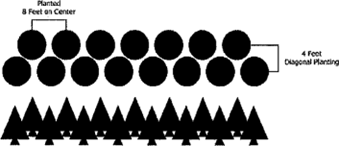
[Transitional buffer yards.] A transitional buffer yard (TBY) shall be used to screen solar electricity farms from adjacent properties and adjacent public rights-of-way. The TBY shall be located within the required 75-foot setback area. The TBY must achieve a 100 percent screen through the use of either landscape berms or trees to a minimum height of eight feet within two years of installation. To achieve this appearance with trees, a staggered spacing approach with trees on eight-foot centers, should be utilized as shown below. All TBY landscaping shall be evergreen trees. Trees and/or landscape berms may be placed on either the inside or outside of any required fencing. The TBY must be kept in excellent condition, with dead or diseased trees removed and replaced on an annual basis, or as otherwise required in writing by the mayor or the mayor's designee.
g.
Federal and state requirement compliance. The solar collecting system shall meet or exceed any standards and regulations of any agency of the state or federal government with the authority to regulate solar energy farms.
h.
Points of access and interior roadways. Points of access to solar energy farms and interior private access roads shall be of sufficient width to accommodate access by emergency response vehicles, including fire-fighting apparatus as deemed necessary. Access points and interior roads shall be shown on a general site layout that is approved by the mayor or the mayor's designee at the time of special use permit application. An "after-hours" access plan shall be included and approved by the city council. Once approved, access points and roadways shall be appropriately maintained.
i.
Exterior roads. All routes that will be used for the construction and maintenance purposes shall be identified on the site plan. All routes for either egress or ingress need to be shown.
j.
Complaint resolution. The applicant shall develop a process to resolve any complaints that may arise from neighboring property owners during the construction and operation of the solar farm. The process may use an independent mediator or arbitrator and shall include a time limit for acting on a complaint that is received. The process shall not preclude the local government from acting on a complaint. The applicant shall provide to the nearby residents a phone number of the project manager during the construction of the facility if a problem should arise.
k.
Waste disposal. All solid waste generated from supplies, equipment, parts, packaging or operation of the facility shall be removed from the site immediately and disposed of in an appropriate manner. Any hazardous waste that is generated by the facility, including, but not limited to, lubricating materials, shall be removed consistent with all local, state and federal rules and regulations.
l.
Drainage. The plan shall state that any damage to waterways, drainage ditches, field tiles or any other infrastructures caused by the construction or maintenance of the solar farm shall be completely repaired to near original condition and so as not to impede the natural flow of water. All repairs shall be completed within a reasonable amount of time.
The solar farm owner is to notify the mayor or the mayor's designee that the construction of any part of the project encounters any underground field drainage tiles. A plan sufficient to provide remediation shall be submitted, reviewed and subject to the approval of the mayor or the mayor's designee. All existing drainage tiles that will be crossed by private access roads shall be removed and replaced with load resistant tiles as specified by the city engineer. This shall be done before the private access roads are used for construction purposes. The load resistant tiles shall extend a minimum of 30 feet across the private access roads and shall be of the same diameter of the existing tiles. To ensure that all drainage tiles are located, reasonable measures shall be made to locate all existing tiles in the vicinity of the private access roads by exploratory trench or other appropriate methods. All drainage tiles that are encountered during construction shall be noted on the site plan. Financial assurances in the form of cash or an escrow account, surety bond or a letter of credit in a form and amount acceptable to the city inspector/code enforcer shall be posted to assure compliance with this section.
m.
Conformance to industry and code standards/engineer certification. The solar farm shall comply with all applicable codes for the electrical, mechanical and structural components of the facility. All documents provided for review shall be stamped and signed by a professional engineer. All solar collection system panels shall be certified by the solar collector and certification corporation (SRCC).
n.
Fencing. Perimeter fencing having a minimum of eight feet in height shall be installed around the boundary of the solar farm. The fence shall contain appropriate warning signage that is posted such that it is clearly visible on the site.
o.
Reflective coating. Solar energy system components shall be designed with an antireflective coating. Verification shall be provided that verifies that the components of the solar energy system have this quality.
p.
Reflection angles. Reflection angles for solar collectors shall be oriented such that they do not direct glare toward residential users on adjacent properties including roadways. Verification shall be provided by the applicant that reflection angles have been taken into account for both fixed position and pivoting solar collectors as well as for all seasonal changes to sun angles.
q.
Lot area. Solar farms and components thereof shall be located on a parcel that is a minimum of ten acres in size.
r.
Vegetation control. A vegetation and weed control plan, which includes details of how frequently the site will be mowed, shall be provided that protects against the creation of a prey habitat and/or aesthetic impacts to the surrounding area. As the site shall be screened with a transitional buffer yard (TBY), mayor or the city council may allow grass/vegetation heights to exceed the city's established maximum growth heights as required elsewhere in the city.
s.
Cleaning supplies and solvents. Cleaning chemicals and solvents used during the operation or maintenance of the solar energy farm facility shall consist of biodegradable products and shall be low in volatile organic compounds.
t.
Equipment and capacity upgrades. Any change to equipment and/or increase in overall peak electrical capacity for solar energy farms shall require a revised special use permit which shall be reviewed and approved by the city council. However, administrative review of an equipment change and/or capacity increase may occur by unanimous agreement of an administrative panel comprised of the mayor or the mayor's designee if all of the following are met:
1.
The cumulative increase in overall peak electrical capacity as compared to the original amount approved in the special use permit is less than 20 percent;
2.
The cumulative increase in the overall number of solar collectors as compared to the original amount approved in the special use permit is less than 20 percent;
3.
At the time of application for an upgrade, there are no standing or unresolved complaints from surrounding property owners per the complaint resolution provision in section 36-908(3);
4.
The mayor or the mayor's designee has verified that there are no standing or unresolved issues with regard to the design and installation requirements contained within this section 36-908(3).
5.
Applicant contact information. The applicant shall keep on file with the mayor or mayor's designee current contact information, including mailing.
6.
Daytime telephone number(s), and emergency contact information of the property owner(s) and the solar collector operator(s). In addition, the applicant shall provide written information as to frequency of site and equipment inspections.
(4)
Decommissioning or abandonment of the solar farm. Prior to receiving a special use of the solar farm, the operator/owner shall provide for a decommissioning plan for the anticipated service life of the facility or in the event that the facility is abandoned or has reached its life expectancy. If the solar farm is out of service or not producing electrical energy for a period of 90 days, it will be deemed nonoperational and decommissioning and removal of that facility will need to commence according to the decommissioning plan provided and approved. The decommissioning plan shall be updated every ten years from the date of approval of the special use permit and provided to the mayor or the mayor's designee as an informational item. The decommissioning plan shall provide the following information:
a.
Removal of the following within nine months:
1.
All solar collectors and components, aboveground improvements and outside storage.
2.
Foundations, pads and underground electrical wires and reclaim the site to a depth of four feet below the surface of the ground.
3.
Hazardous material from the property and dispose of in accordance with federal and state law.
4.
A cost estimate for the decommissioning of the facility shall be prepared by a professional engineer or contractor who has expertise in the removal of the solar farm. The decommissioning cost estimate shall explicitly detail the cost before considering any projected salvage value of the out of service solar farm. The decommissioning cost shall be made by cash, surety bond or irrevocable letter of credit before any construction commences.
5.
A restoration plan shall be provided for the site.
(5)
Liability insurance. The owner or operator of the solar farm shall maintain a current general liability policy covering bodily injury and property damage and name the City of Lebanon as an additional insured with limits of at least $3,000,000.00 per occurrence $5,000,000.00 in the aggregate with a deductible of no more than $5,000.00.
Such insurance may be provided pursuant to a plan of self-insurance, by a party with a net worth of $20,000,000.00 or more. The city shall be named as an individual insured on the policy to the extent the city is entitled to indemnification.
(6)
Administration and enforcement. The mayor's designee, a qualified inspector, shall enforce the provisions of this section through an inspection of the solar farm every year. The mayor or the mayor's designee are hereby granted the power and authority to enter upon the premises of the solar farm at any time by coordinating a reasonable time with the operator/owner of the facility. Any person, firm or corporation who violates, disobeys, omits, neglects, refuses to comply with, or resists enforcement of any of the provisions of this section shall, upon conviction, be fined not less than $75.00 nor more than $500.00 for each offense. Each tower, solar array, or any other component of the solar energy farm shall be the subject of a separate violation and further each week that a violation is permitted to exist shall constitute a separate offense. Other actions may be taken by law or in equity to prevent or to remedy any violation of this section and these remedies shall be in addition to any other remedies, damages or penalties.
(Ord. No. 1593, § 2, 10-28-2024)

