
Lebanon City Zoning Code
ARTICLE II
- USE REGULATIONS
Sec. 48-31. - Applicability.
Buildings and premises in the districts set forth in this division shall be used only for the purposes indicated in this division.
(Ord. No. 6886, § 1, 2-26-2024)
Sec. 48-32. - Permissive and Conditional Use Table.
P = Permissive
C = Conditional Use
(Ord. No. 6886, § 1, 2-26-2024)
Sec. 48-33. - RU-1 rural district.
(a)
Permissive and conditional uses. (See section 48-32, Permissive and Conditional Use Table.)
(b)
Property must be properly platted for any new construction.
(c)
Access requirements. (See section 48-7.)
(d)
Site design requirements, surface or underground stormwater. (See section 48-8.)
(e)
Maximum height. 35 feet. (See article III, division 2, height.)
(f)
Minimum yards. (See article III, division 3, yard).
(1)
Front: 50 feet.
(2)
Side: 20 feet.
(3)
Rear: 50 feet.
(g)
Minimum lot area and width. (See article III, division 4, density.)
(1)
Lot width: 150 feet.
(2)
Lot area: 43,560 square feet.
(3)
Lot area per family: 43,560 square feet.
(h)
Minimum required parking spaces. (See article IV, off-street parking and loading.)
(Ord. No. 6886, § 1, 2-26-2024)
Sec. 48-34. - RU-2 rural district, including cemetery.
(a)
Permissive and conditional uses. (See section 48-32, Permissive and Conditional Use Table.)
(b)
Property must be properly platted for any new construction.
(c)
Must meet state standards and requirements.
(d)
Access requirements. (See section 48-7.)
(e)
Site design requirements, surface or underground stormwater. (See section 48-8.)
(Ord. No. 6886, § 1, 2-26-2024)
Sec. 48-35. - RS-1 residential district.
(a)
Permissive and conditional uses. (See section 48-32, Permissive and Conditional Use Table.)
(b)
Property must be properly platted for any new construction.
(c)
Maximum height. 35 feet. (See article III, division 2, height.)
(d)
Minimum yards. (See article III, division 3, yard.)
(1)
Front: 30 feet.
(2)
Side: Ten feet.
(3)
Rear: 30 feet.
(e)
Minimum lot area and width. (See article III, division 4, density.)
(1)
Lot width: 90 feet.
(2)
Lot area: 12,000 square feet.
(3)
Lot area per family: 12,000 square feet.
(f)
Minimum living space requirements:
(1)
Nine hundred sixty square feet.
(g)
Minimum building width:
(1)
Twenty-eight feet.
(h)
Minimum required parking spaces. (See article IV, off-street parking and loading.)
(Ord. No. 6886, § 1, 2-26-2024)
Sec. 48-36. - RS-2. residential district.
(a)
Permissive and conditional uses. (See section 48-32, Permissive and Conditional Use Table.)
(b)
Property must be properly platted for any new construction.
(c)
Maximum height. (See article III, division 2, height.)
(1)
Single-family and two-family dwellings: 35 feet.
(2)
Multi-family: 45 feet.
(d)
Minimum yards. (See article III, division 3, yard.)
(1)
Front: 25 feet.
(2)
Side: Ten feet.
(3)
Rear: 25 feet.
(e)
Minimum lot area and width. (See article III, division 4, density.)
(1)
Lot width: 75 feet.
(2)
Lot area: 7,500 square feet.
a.
Single-family dwelling: 7,500 square feet.
b.
Two-family dwelling: 3,750 square feet.
c.
Multiple dwelling: 1,500 square feet.
(f)
Minimum living space requirements:
(1)
Single-family dwelling: 840 square feet.
a.
Minimum building width: 28 feet wide.
(2)
Two-family dwelling: 480 square feet per family.
(3)
Townhouse and condos: 480 square feet per family.
(4)
Multiple dwelling: 240 square feet per family.
(g)
Minimum required parking spaces. (See article IV, off-street parking and loading.)
(Ord. No. 6886, § 1, 2-26-2024)
Sec. 48-37. - RS-3 residential—Duplexes, condominiums, townhouses.
(a)
Permissive and conditional uses. (See section 48-32, Permissive and Conditional Use Table.)
(b)
Property must be properly platted for any new construction.
(c)
Maximum height. (See article III, division 2, height.)
(1)
Single-family and two-family dwellings: 35 feet.
(2)
Multi-family: 45 feet.
(d)
Minimum yards. (See article III, division 3, yard; see section 6 for exceptions.)
(1)
Front: 25 feet.
(2)
Side: Ten feet or zero feet with a two-hour fire wall between units.
(3)
Rear: 25 feet.
(e)
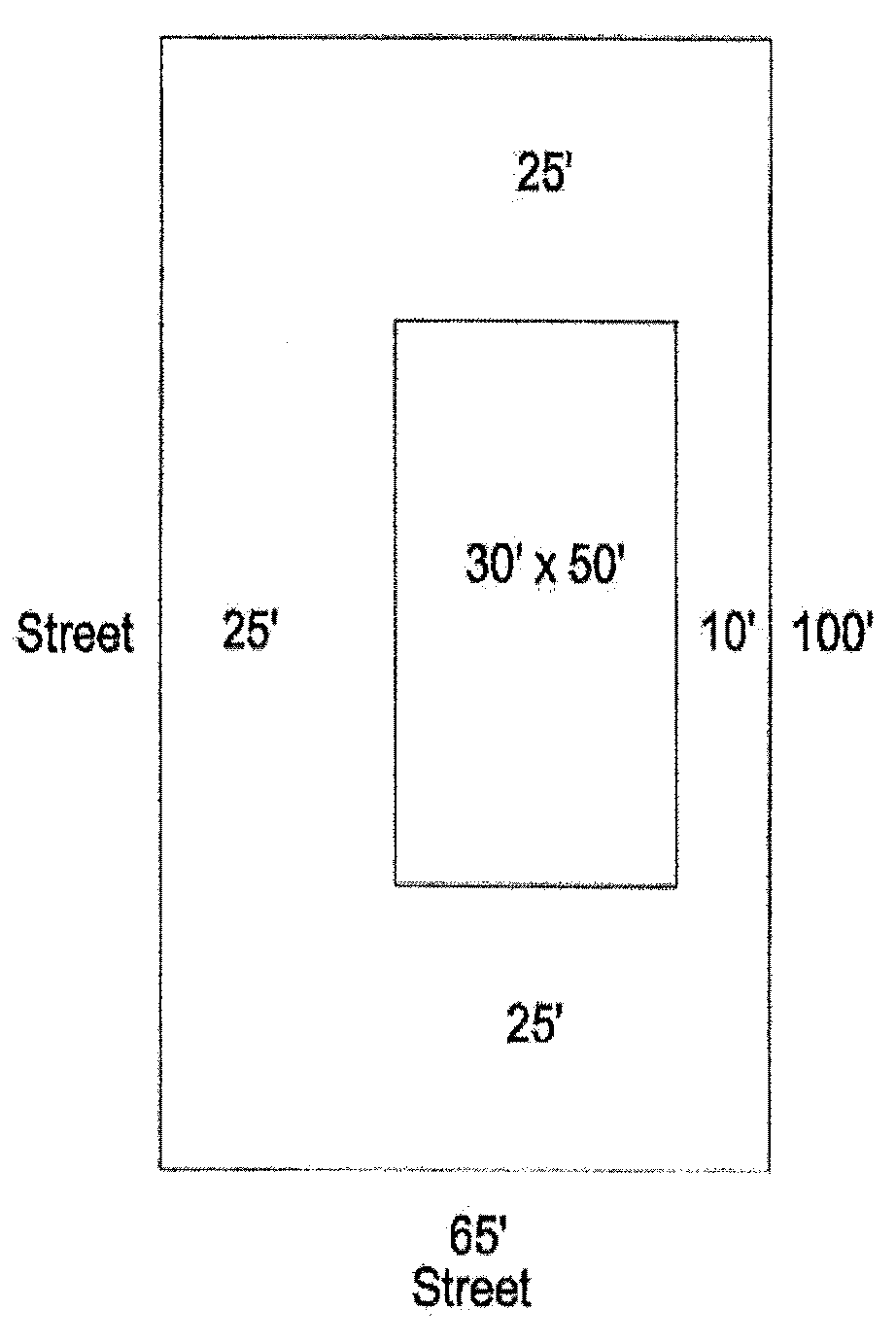
Minimum lot area and width single-family dwelling on corner lot. (See article III, division 4, density; see section 48-37, Figure 1.1.)
(1)
Lot width: 65 feet.
(2)
Lot depth: 100 feet.
(3)
Lot area: 6,500 square feet.
a.
Minimum living space requirements:
1.
Single-family dwelling: 840 square feet.
Figure 1.1
Minimum Lot Size
Single Family
On a Corner Lot
(f)
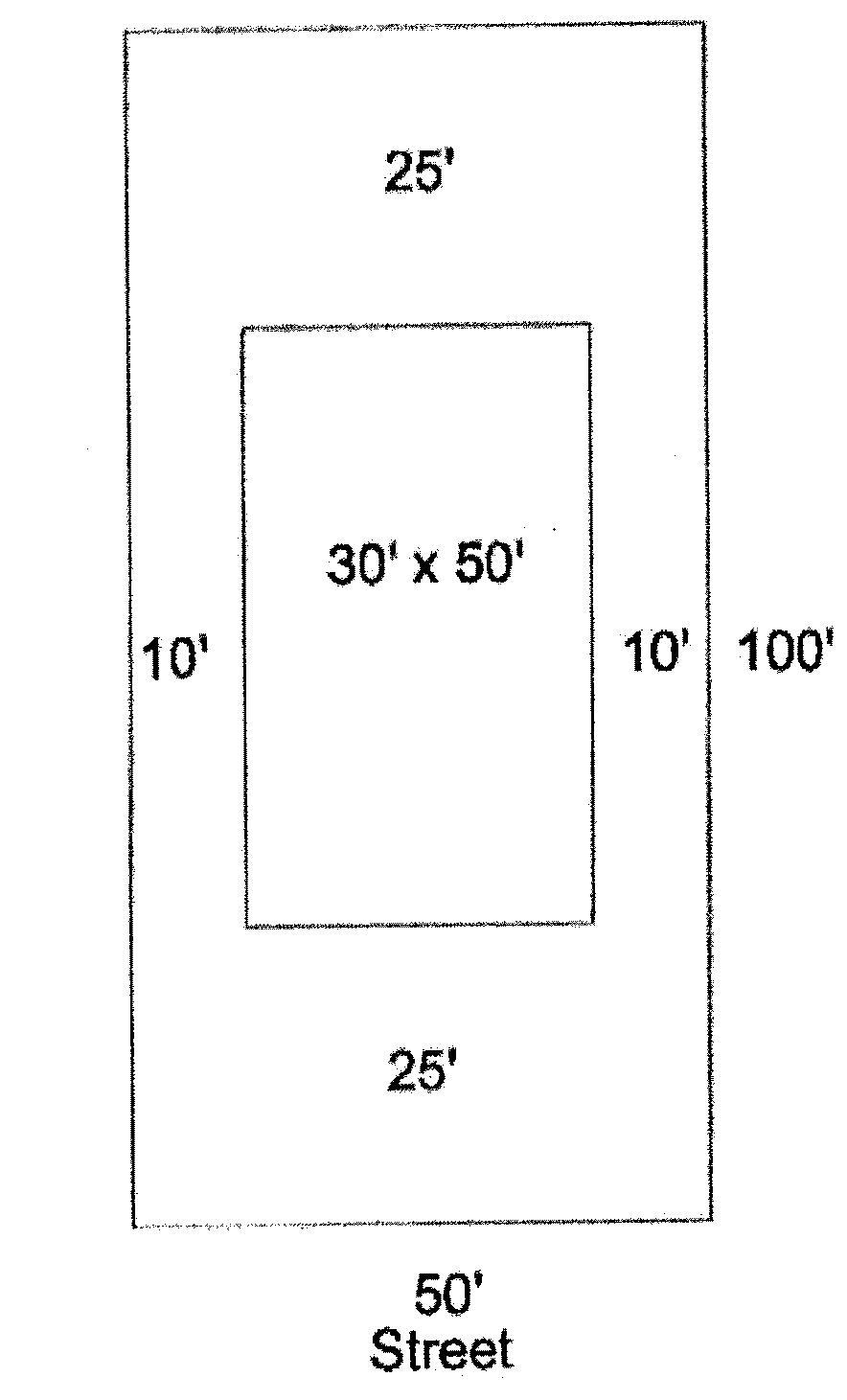
Minimum lot area and width single-family dwelling on center lot. (See article III, division 4, density; see section 48-37, Figure 1.2.)
(1)
Lot width: 50 feet.
(2)
Lot depth: 100 feet.
(3)
Lot area: 5,000 square feet.
a.
Minimum living space requirements:
1.
Single-family dwelling: 840 square feet.
Figure 1.2
Minimum Lot Size
Single Family
On a Center Lot
(g)
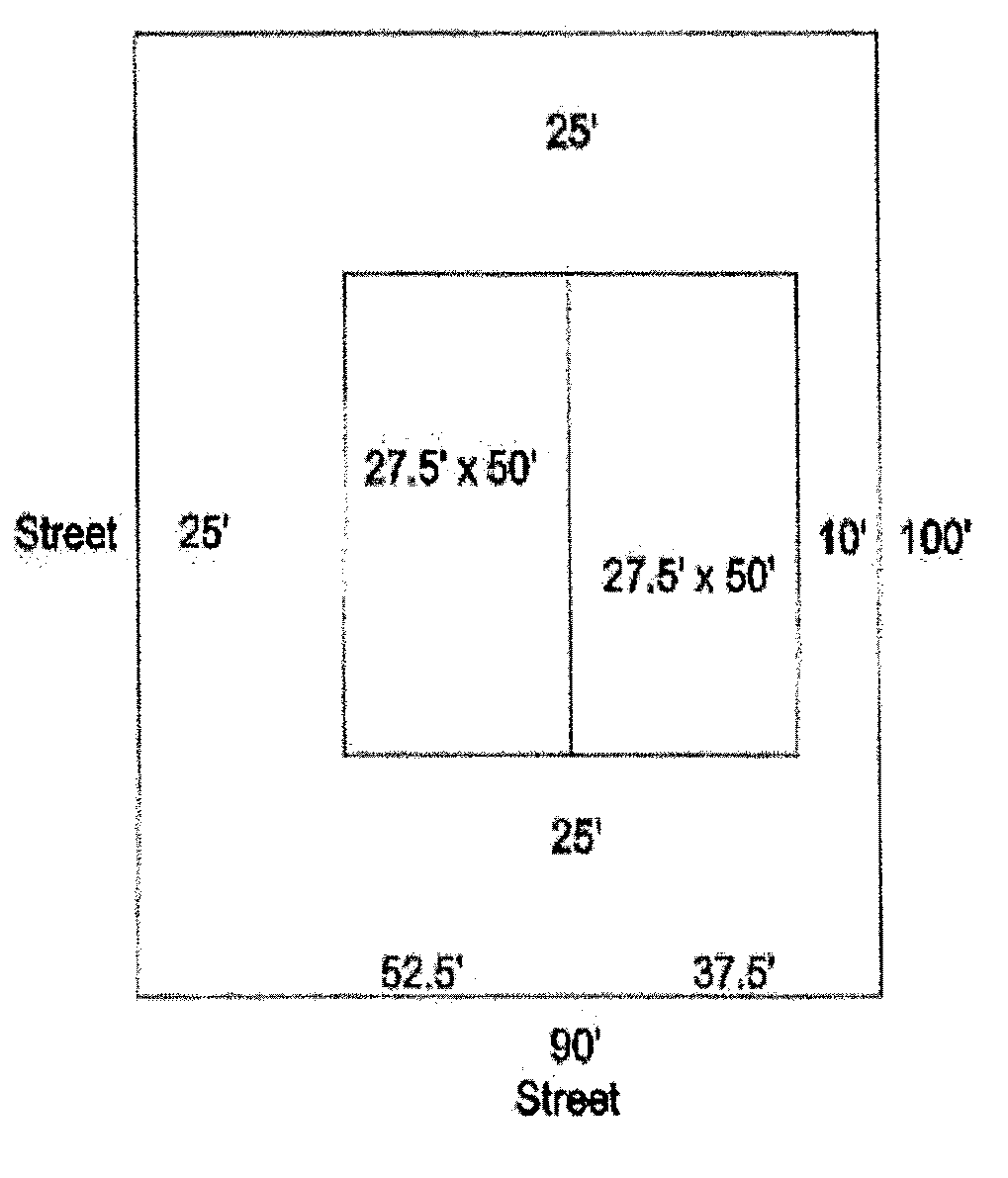
Minimum lot area and width for a duplex on corner lot. (See article III, division 4, density; see section 48-37, Figure 1.3.)
(1)
Two unit duplex on corner lot (one building on one lot):
a.
Lot width: 90 feet.
b.
Lot depth: 100 feet.
c.
Lot area: 9,000 square feet.
d.
Minimum living space requirements:
1.
Two family dwelling: 480 square feet per family.
Figure 1.3
Minimum Lot Size
Duplex
On a Corner Lot
(h)
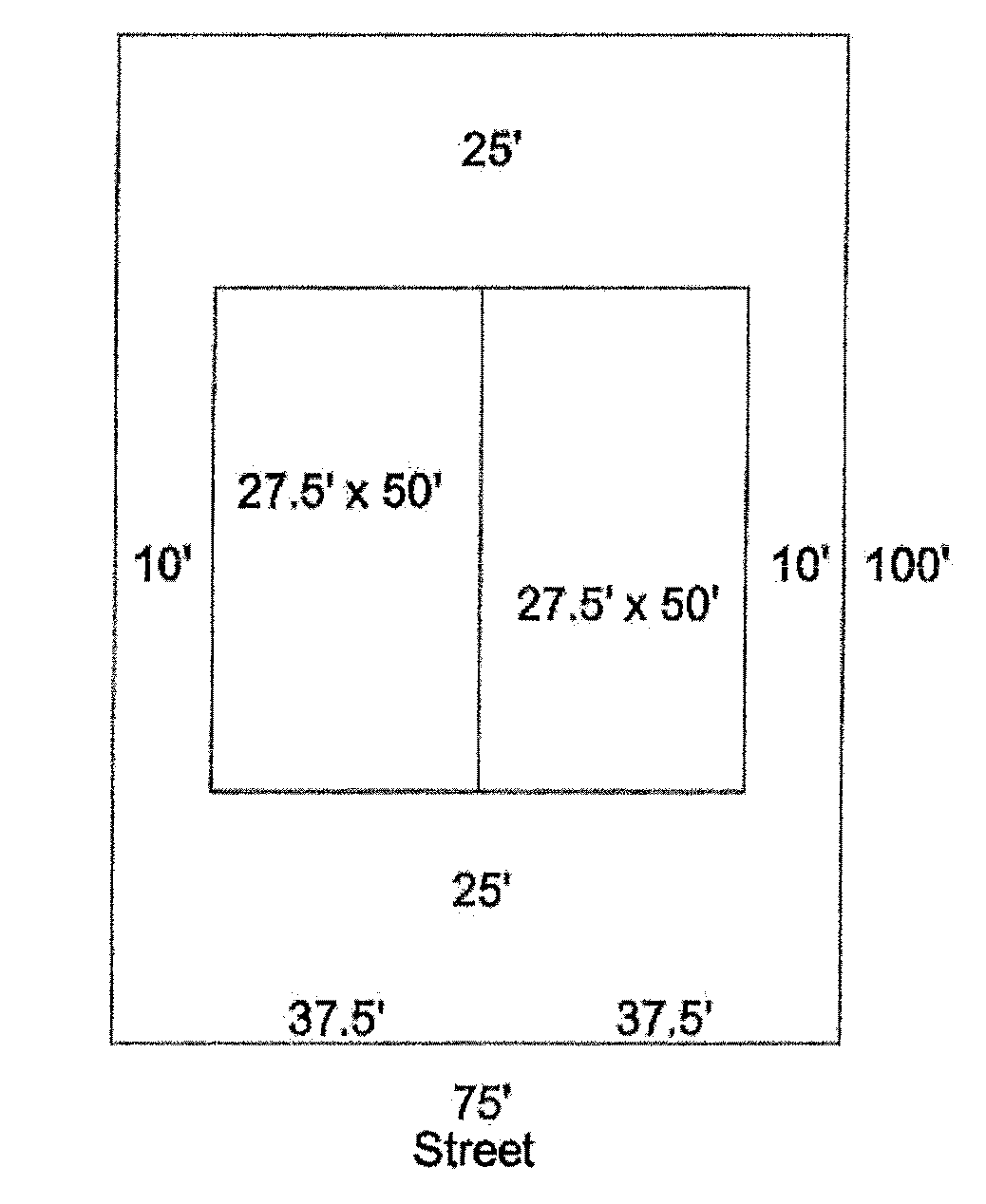
Minimum lot area and width for a duplex on center lot. (See article III, division 4, density; see section 48-37, Figure 1.4.)
(1)
Two unit duplex on center lot (one building on one lot):
a.
Lot width: 75 feet.
b.
Lot depth: 100 feet.
c.
Lot area: 7,500 square feet.
d.
Minimum living space requirements:
1.
Two family dwelling: 480 square feet per family.
Figure 1.4
Minimum Lot Size
Duplex
On a Corner Lot
(i)
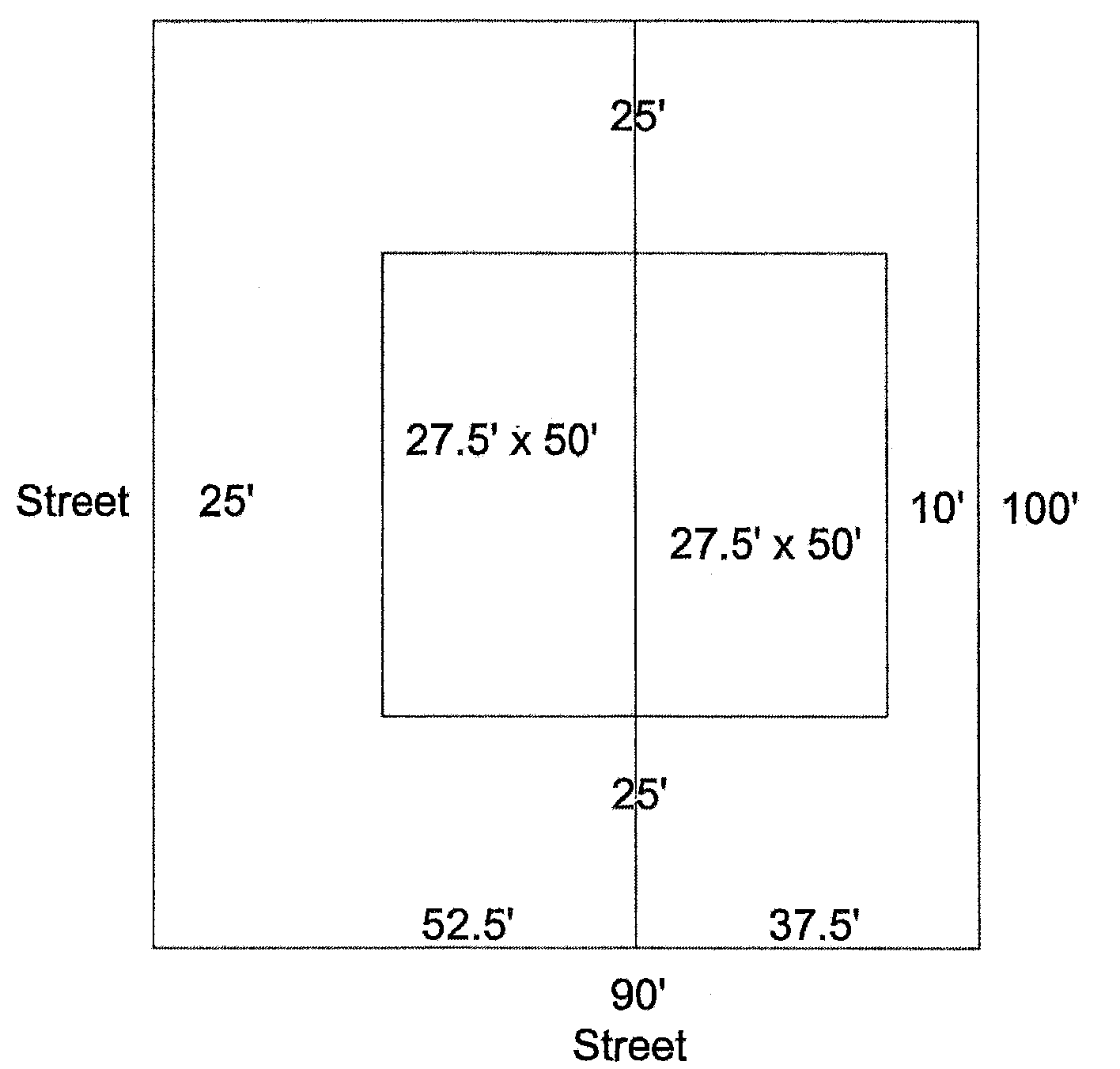
Minimum lot area and width for a split duplex on corner lot. (See article III, division 4, density; see section 48-37, Figure 1.5.)
(1)
Lot width: 52.5 feet.
(2)
Lot depth: 100 feet.
(3)
Lot area: 5,250 square feet.
a.
Minimum living space requirements:
1.
Two family dwelling: 480 square feet per family.
Figure 1.5
Minimum Lot Size
Split Duplex
On a Corner Lot
(j)
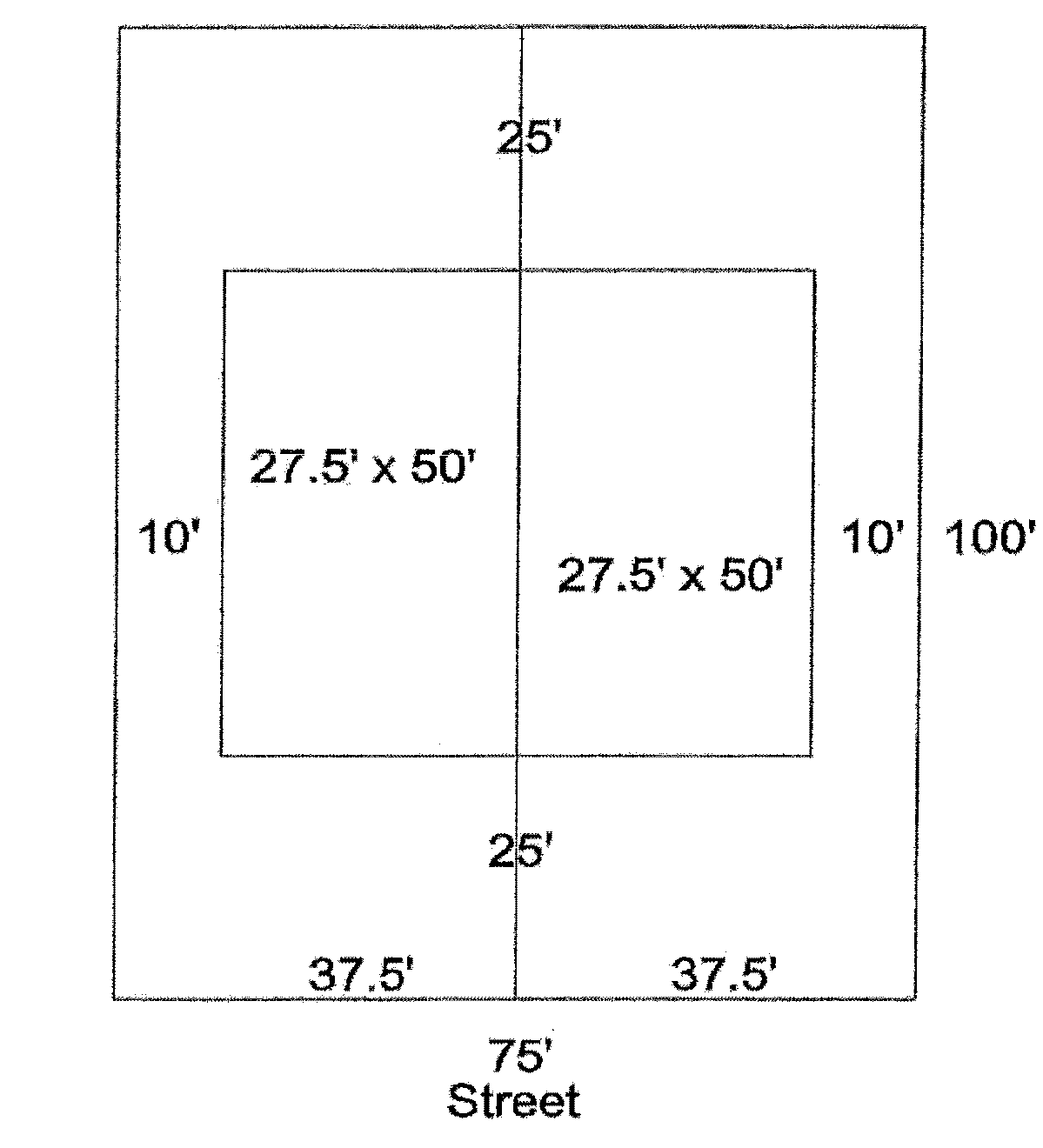
Minimum lot area and width for a split duplex on center lot. (See article III, division 4, density; see section 48-37, Figure 1.6.)
(1)
Lot width: 37.5 feet.
(2)
Lot depth: 100 feet.
(3)
Lot area: 3,750 square feet.
a.
Minimum living space requirements:
1.
Two family dwelling: 480 square feet per family.
Figure 1.6
Minimum Lot Size
Split Duplex
On a Center Lot
(k)
Minimum lot area and width for a townhouse/condo. (See article III, division 4, density; see section 48-37, Figure 1.7 and 1.8.)
(1)
Maximum height. (See article III, division 2, height.)
a.
Multi-family: 45 feet.
(2)
Minimum yards. (See section 6 for exceptions; see article III, division 3, yard.)
a.
Front: 25 feet.
b.
Side: Ten feet or 0 feet with a two-hour fire wall between units.
c.
Rear: 25 feet.
(l)
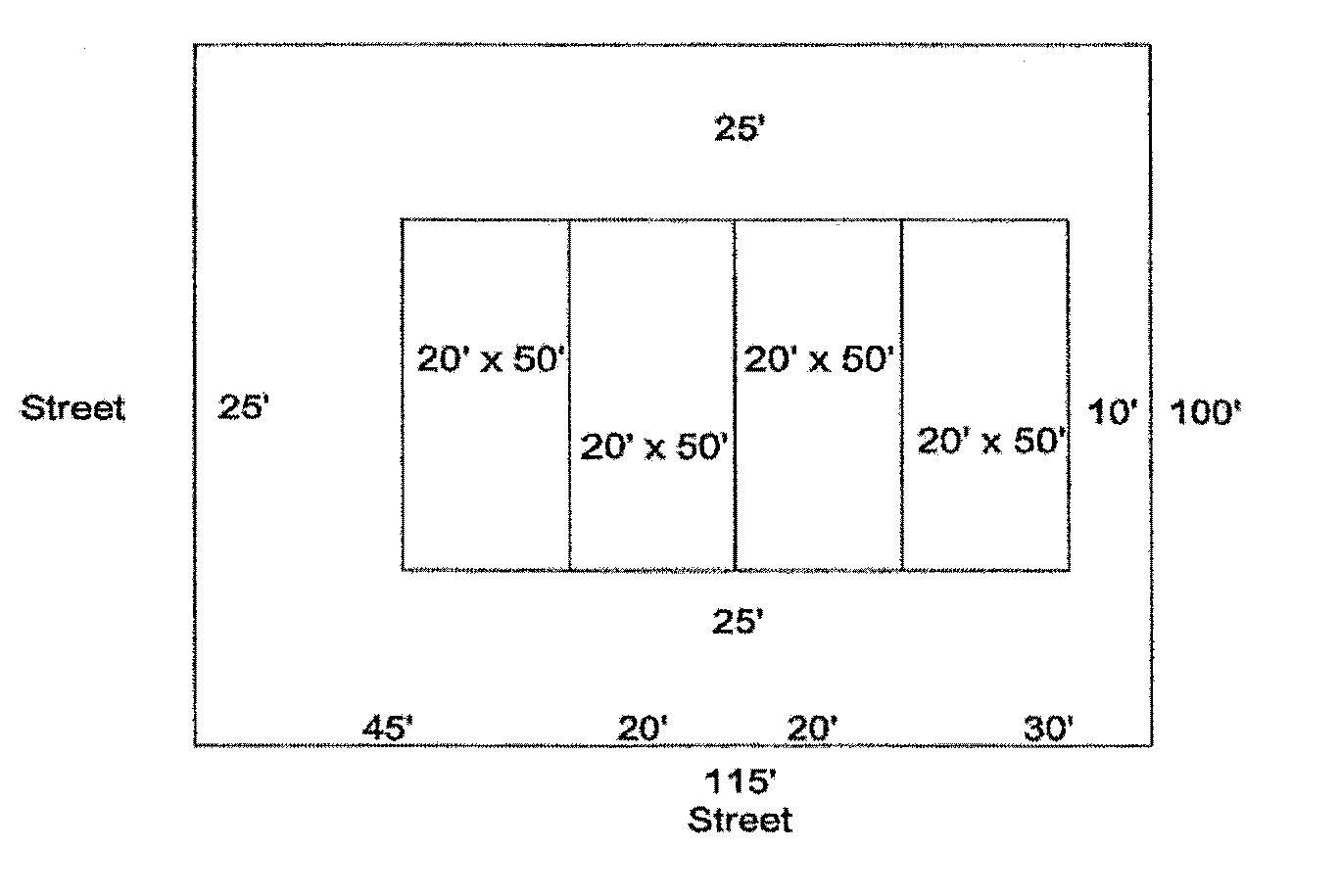
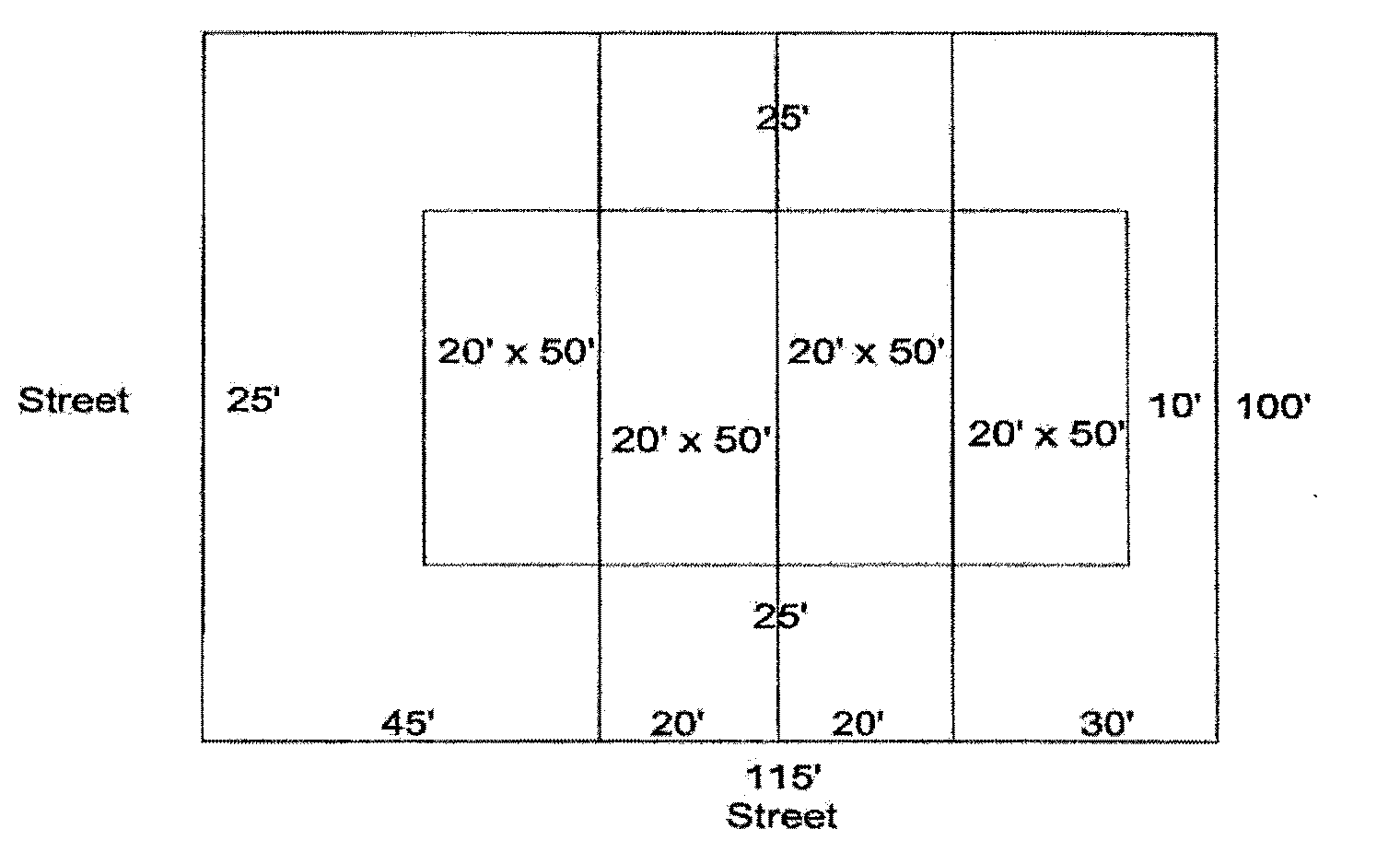
Minimum lot area and width for a townhouse/condo on corner lot. (See article III, division 4, density; see section 48-37, Figure 1.7.)
(1)
Four unit townhouse/condo on corner lot (one building on one lot):
a.
Lot width: 115 feet.
b.
Lot depth: 100 feet.
c.
Lot area: 11,500 square feet.
d.
Minimum living space requirements:
1.
Townhouse/condo: 480 square feet per family.
Figure 1.7
Minimum Lot Size
Townhouse or Condo
On a Corner Lot
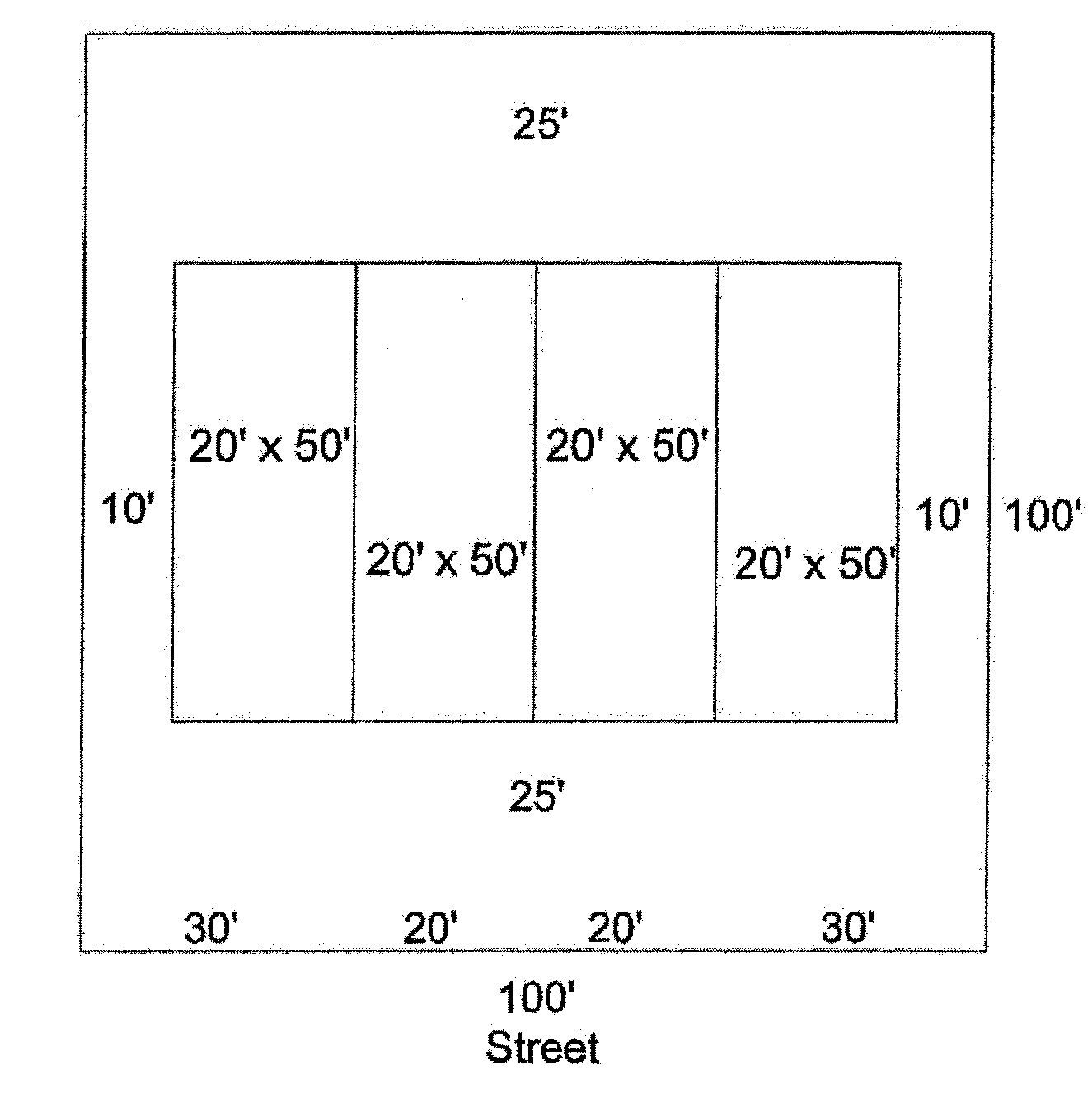
Minimum lot area and width for a townhouse/condo on center lot. (See article III, division 4, density; see section 48-37, Figure 1.8.)
(1)
Four unit townhouse/condo on corner lot (one building on one lot):
a.
Lot width: 100 feet.
b.
Lot depth: 100 feet.
c.
Lot area: 10,000 square feet.
d.
Minimum living space requirements:
1.
Townhouse/condo: 480 square feet per family.
Figure 1.8
Minimum Lot Size
Townhouse or Condo
On a Center Lot
(m)
Minimum lot area and width for a split townhouse/condo on corner lot. (See article III, division 4, density; see section 48-37, Figure 1.9.)
(1)
Split townhouse/condo on corner lot (the end corner building next to the street):
a.
Lot width: 45 feet.
b.
Lot depth: 100 feet.
c.
Lot area: 4,500 square feet.
d.
Minimum living space requirements:
1.
Townhouse/condo: 480 square feet per family.
Figure 1.9
Minimum Lot Size
Split Townhouse or Condo
On a Corner Lot
(n)
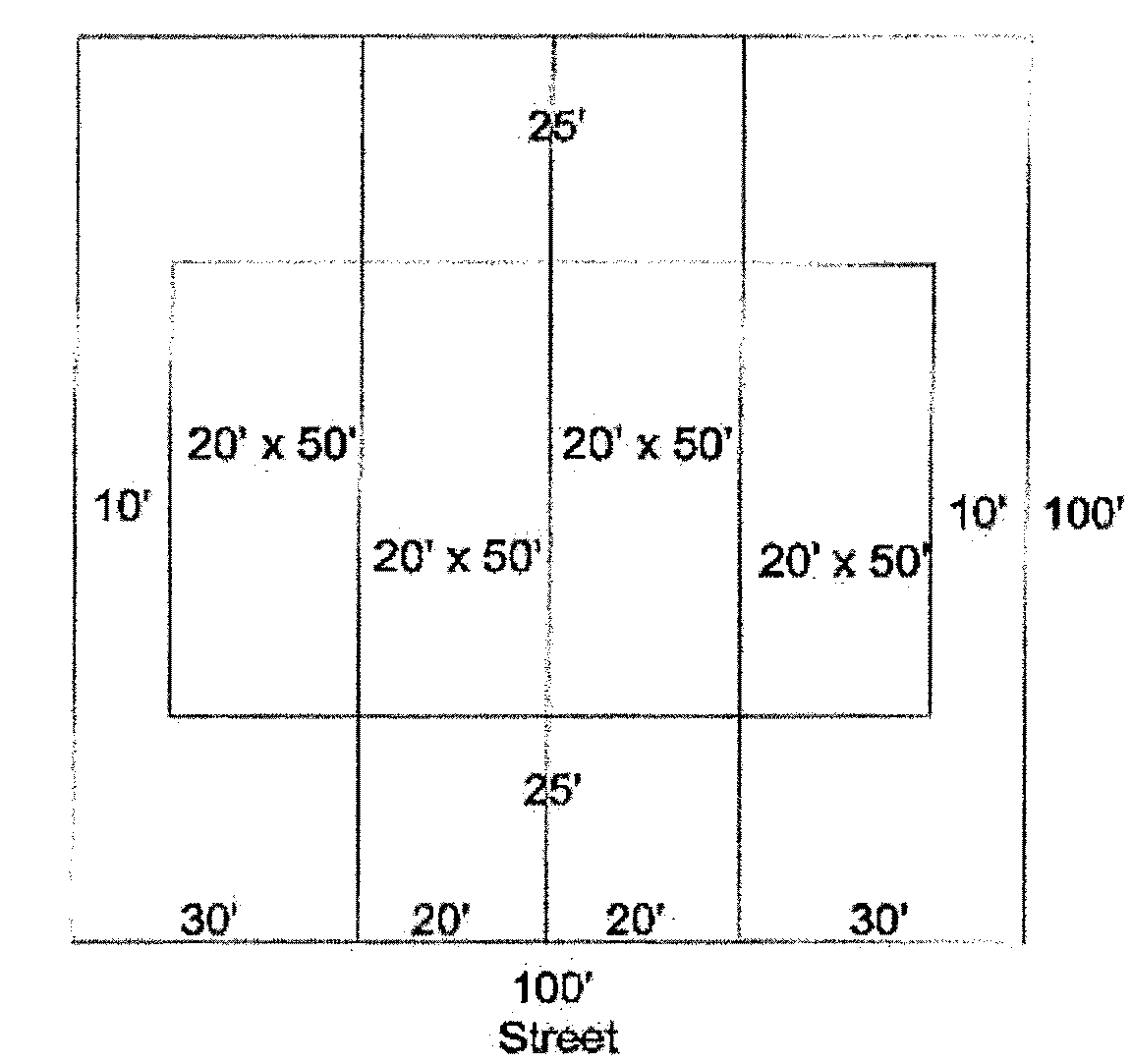
Minimum lot area and width for a split townhouse/condo on a center lot. (See article III, division 4, density; see section 48-37, Figure 1.10.)
(1)
Split townhouse/condo on a center lot (this is the center unit with a townhouse/condo unit on each side):
a.
Lot width: 20 feet.
b.
Lot depth: 100 feet.
c.
Lot area: 2,000 square feet.
d.
Minimum living space requirements:
1.
Townhouse/condo: 480 square feet per family.
Figure 1.10
Minimum Lot Size
Split Townhouse or Condo
On a Center Lot
(o)
Minimum lot area and width for a split townhouse/condo unit with side setback. (See article III, division 4, density.)
(1)
Split townhouse/condo unit with the side setback (this is the end unit with a townhouse/condo unit on one side and a ten-foot side setback):
a.
Lot width: 30 feet.
b.
Lot depth: 100 feet.
c.
Lot area: 3,000 square feet.
d.
Minimum living space requirements:
1.
Townhouse and condo: 480 square feet per family.
(p)
A conditional use will be required by zoning and planning commission to split a duplex, townhouse, or condo. A plat must be submitted to the commission for its review and approval. The commission must review the HOA agreement to assure the HOA agreement has all the information required per this chapter. The commission shall review the plat for set-back distances from adjoining property. The commission shall have the power to require additional set back requirements (not to exceed 50 percent of the otherwise required set-back for the district), construction of fencing, planting of trees and/or other similar requirements to reduce any harmful effects on the adjoining property. In reviewing the site plan, the commission shall consider all factors it deems relevant including the use of the adjoining property and the district classification of the adjoining property. The commission shall review the plat and make its requirements and including parking. If any, as a part of the permit application procedure.
(q)
All conditional uses must be submitted to the commission as provided in section 48-326.
(r)
Any reduction in access or design site requirements must be submitted to the board of appeals provided for in section 48-325.
(s)
Firewall will be required between adjoining units.
(1)
Two-hour firewall — Sheetrock or block wall, from grade to roof deck.
(2)
Should the firewall go through the roof? It must be in the HOA agreement for maintenance of roof cap.
(t)
Utilities: Water, sewer and electric services must be contained on respective property.
(1)
Utility easement must be shown on the plat and be part of the HOA agreement, (maintenance and use) if applicable.
(u)
Each unit must have its own crawl space access and attic space entrance.
(v)
A walk door cannot exist between adjoining units.
(w)
HOA agreement must be agreed upon concerning any building repairs that may be required at some time, i.e., roof, driveway, utilities, siding, porches, etc. These are items that will be shared between the owners.
(x)
A homeowners association (HOA) is required for split duplex owners and must be recorded and be part of the plat.
(Ord. No. 6886, § 1, 2-26-2024)
Sec. 48-38. - RS-4 residential, Class B, manufactured and mobile homes without foundation.
(a)
Purpose. It is the purpose and intent of this subsection to allow the placement of manufactured homes, within a manufactured home subdivision. The placement of manufactured homes will be permitted subject to the requirements and procedures set forth herein.
(b)
Preliminary procedure. Manufactured homes shall not be placed or occupied in the city, until such time as the proposed location has been zoned RS-4, city subdivision regulations have been complied with, and a building permit issued pursuant to the city building code. No area less than ten acres in size shall be considered for RS-4 residential district.
(c)
Use regulations. All buildings and land within an RS-4 district shall be limited to the following uses:
(1)
Each manufactured home shall be occupied only as a single-family dwelling.
(2)
Each manufactured home shall be a minimum of 14 body feet wide and at least 40 body feet long.
(3)
Accessory buildings; are customarily incidental and subordinate to the use of manufactured homes. Accessory buildings must be installed in the following required setbacks. Accessory buildings cannot be installed in or on an easement.
a.
Side setback — Five feet
b.
Rear setback — Ten feet
c.
Must be more than ten feet from the main structure.
d.
Front setback — 30 feet (under certain lot circumstances code administration may approve a closer setback; it cannot be closer than 15 feet to the front property line).
(d)
District design standards.
(1)
A manufactured home district shall consist of no less than ten contiguous acres. A manufactured home district may be developed in phases; however, each phase shall consist of no less than 20 manufactured home spaces.
(2)
Each manufactured home in a manufactured home district shall occupy a designated space having at least 5,250 square feet of lot area.
(3)
Each manufactured home space shall have a width of at least 50 feet.
(4)
Each manufactured home shall have two off-street parking spaces of asphalt or concrete with a minimum size of 18 feet by 25 feet or 12 feet by 50 feet.
(5)
At least 200 square feet of recreation space for each manufactured home shall be reserved within each manufactured home district, as common recreation space for the residents of the district.
(6)
No manufactured home or other structure within a manufactured home district shall be closer to each other than 20 feet, except that a storage or other auxiliary structures for the exclusive use of the manufactured home may be no closer to another home than ten feet.
(7)
Each manufactured home shall be set back a distance of at least 12.5 feet from the street in the district.
(8)
Each manufactured home shall be set back a distance of at least 12.5 feet from the rear property line.
(9)
No manufactured home shall be located closer than 30 feet to the exterior boundary of the district or an exterior bounding street right-of-way. Buildings used for laundry or recreation purposes shall be located no closer than 40 feet to the exterior boundary of the district or an exterior bounding street right-of-way.
(10)
The manufactured home district must conform to the city's subdivision regulations. Plats must be approved by the zoning and planning commission and city council. All lots within the district must be owned by the owner of the manufactured home district. All streets within the manufactured home district must be dedicated to the city.
(11)
At least 100 square feet of fenced storage area for each manufactured home shall be reserved within each manufactured home district to accommodate storage for boats, RVs, etc.
(12)
All manufactured homes shall be skirted with noncombustible material.
(13)
All manufactured homes must be located in an RS-4 district that has been approved by the city.
(14)
All utilities must be underground from the main transmission line to the manufactured home.
(15)
All manufactured homes shall be manufactured or constructed under the authority of 42 USC 5401, and bear a seal used by the public service commission in compliance with the provisions of RSMo 700.015.
(16)
All manufactured homes shall be anchored and tied down in accordance with and otherwise comply with the standards promulgated by the state public service commission pursuant to the provisions of RSMo 700.010—700.115.
(e)
Exception. Nothing in this section shall be deemed to preclude the construction and occupation of conventionally built single-family dwellings but such homes shall conform to the applicable use, siting, height, living space, construction, and design requirements of this section.
(f)
There must be a minimum of a three-foot by three-foot landing and stairs with a handrail at the front door. If the front door is larger than 36 inches the landing in the direction of egress must match the door size. There must be stairs and handrails installed at all other doors.
(g)
Foundations and or footings must be installed per the approved City of Lebanon engineered drawings.
(h)
Anchoring systems must be installed per manufacturer recommendations.
(1)
Maximum height. (See section 48-5 for exceptions.)
a.
Single-family manufactured and mobile homes: 750 feet.
(2)
Minimum yards. (See section 48-6 for exceptions.)
a.
Front: 12.5 feet.
b.
Side: Ten feet.
c.
Rear: 12.5 feet.
See section 48-38, RS-4 residential, Class B; subsection (d)(9).
(3)
Minimum lot area and width. (See article III, division 4, density.)
a.
Lot width: 50 feet.
b.
Lot area: 4,500 square feet.
(4)
Minimum living space requirements.
a.
Single-family manufactured and mobile homes: 560 feet.
(5)
Minimum required parking space. (See section 48-38. RS-4 residential, Class B; subsection (d)(4).)
(Ord. No. 6886, § 1, 2-26-2024)
Sec. 48-39. - RS-5 residential, Class A, manufactured and mobile homes with foundation.
(a)
Purpose. It is the purpose and intent of this subsection to allow the placement of manufactured homes/mobile homes within this district to increase the options available for low- to moderate-income households in select residential areas of the city. The placement of manufactured homes/mobile homes will be permitted subject to the requirements and procedures set forth herein. Manufactured homes/mobile homes that do not conform to the requirements of this subsection shall only be permitted in RS-4 residential, subject to the provisions of section 48-38, RS-4, Class B, or mobile home parks subject to the provisions of section 48-105. The owner of a lot in this district must demonstrate that he either owns or will own the manufactured home/mobile homes which is to be placed on the lot before a building permit will be issued and in no case shall a manufactured home/ mobile homes site or lot be rented out in this district.
(b)
Preliminary procedure and lot size restrictions. Manufactured homes/mobile homes shall not be placed or occupied in the city, until such time as the proposed location has been zoned RS-5, city subdivision regulations have been complied with, and a building permit issued pursuant to city building regulations; each lot in the district shall conform to the lot area and width requirements of section 48-273. No area shall be considered for RS-5 residential zoning unless the size of the area to be developed will accommodate a minimum of ten lots.
(c)
Use and siting requirements. Each manufactured home/mobile homes placed on an individual lot:
(1)
Shall be occupied only as a single-family dwelling.
(2)
Shall conform to the setback requirements of section 48-244.
(d)
Maximum height. No manufactured home/mobile homes shall exceed 35 feet in height.
(e)
Minimum living space requirements. Each home shall be at least 20 feet wide and shall consist of at least 750 square feet of living space. This standard is intended to require homes to consist of multiple sections which are brought to the site in parts.
(f)
Construction requirements.
(1)
The roof of each home must be a gable or hip roof type and covered with material that is residential in appearance, including, but not limited to, approved wood, asphalt composition or fiberglass shingles, but excluding corrugated aluminum, corrugated fiberglass or metal roofs. Except for permitted deck areas, all roof structures shall provide an eave projection including guttering of not less than six inches but no greater than 30 inches.
(2)
The exterior siding, covering and window treatments of each home shall be of a type, quality and appearance that is customarily used on conventionally built residential homes in the area and shall be architecturally compatible with those of neighboring properties.
(3)
Each manufactured home/mobile home shall be set up according to the manufacturer's set up manual and tied down per state laws and shall meet all manufacturer's specifications for support. The perimeter must be of continuous concrete block, brick, or poured concrete in lieu of skirting.
(4)
Each home shall have a minimum of 18 inches of crawl space under the entire living area of the home and the tongue and running gear, including axles, shall be removed.
(5)
Each home shall have permanent steps or decks set at all exits. There must be a minimum of a three-foot by three-foot landing and stairs with handrail at the front door. If the front door is larger than 36 inches the landing in the direction of egress must match the door size.
(6)
The owner of each manufactured home/mobile home is required to declare the home as real estate pursuant to the provisions of RSMo 700.111.
(g)
Exception. Nothing in this section shall be deemed to preclude the construction and occupation of conventionally built single-family dwellings but such homes shall conform to the applicable use, siting, height, living space, construction, and design requirements of this section. (See section 48-32, permissive and conditional use.)
(1)
Property must be properly platted for any new construction.
(2)
Maximum building height. (See subsection (5) for exceptions): 35 feet.
(3)
Minimum yards. (See subsection (6) for exceptions):
a.
Front: 25 feet.
b.
Side: Ten feet.
c.
Rear: 25 feet.
(4)
Minimum lot area and width:
a.
Lot width: 100 feet.
b.
Lot area: 12,000 square feet.
c.
Lot area per family: 12,000 square feet.
(5)
Minimum required parking spaces. (See subsection (8).)
(6)
Minimum lot area per family for residential:
a.
Single-family dwelling: 7,500 square feet.
b.
Two-family dwelling: 3,750 square feet.
c.
Multiple dwelling: 1,500 square feet.
(7)
Minimum living space requirements for residential:
a.
Single-family dwelling: 750 square feet per family.
(Ord. No. 6886, § 1, 2-26-2024)
Sec. 48-40. - NC neighborhood commercial district.
(a)
No open storage of materials. No part of any lot shall be used for the open or unenclosed display and storage of commercial materials, equipment, merchandise, or supplies. This restriction shall apply to both permissive and conditional uses of lots in NC neighborhood commercial district.
(b)
Hours of operation. The hours of operation for all businesses permissive and conditional shall be between the hours of 7:00 a.m. and 9:00 p.m., except for bed and breakfasts.
(c)
Access and parking lot requirements.
(1)
All commercial parking shall only be allowed behind the required front setback line. Parking can be in the required rear setback and extend on the sides up to the front of the building. There shall be no on-street parking without a variance. All parking areas must be hard surfaced.
(2)
All entrances to public streets and roads shall be hard surfaced with Portland cement concrete or hot-mixed asphalt, which includes the area extending from existing public street black top, or back of existing curb, to the public street right-of-way line. All entrances shall be designed with a minimum radius of three feet. If the street is improved with barrier-type curb and gutter, then the existing curb and gutter shall be removed and replaced with a five-foot-wide entrance slab including three feet curbed radii.
(3)
All developed parcels shall provide ingress and egress with a provision for circulation of vehicles. All parking areas and parking lots shall have Portland cement concrete curbs and guttering built according to city specifications and continuous around the perimeter thereof. All parking areas and parking lots shall be hard surfaced with Portland cement concrete, hot-mix asphalt, or permanently installed pavers.
(4)
All entrances to public streets and roads and all parking areas using a portion of the public right-of-way shall be maintained by the private property owner or other person responsible.
(d)
Site design requirements.
(1)
The front yard distances as required hereunder, such distance being a minimum of 15 feet must be a mandatory green space.
(2)
All utilities are underground.
(3)
Surface or underground storm drainage facilities shall be provided for all roads and drives and parking areas. All storm drainage shall be directed into established surface and underground storm drainage facilities. Stormwater retention structures shall be provided if, in the opinion of the public works director, unrestricted runoff will cause increased drainage problems downstream. A structurally sound wall, curb or other abutment shall be installed around each side of the parking area to ensure that no part of any motor vehicle extends over or is capable of accidentally rolling across the property line of the parking area.
(4)
All conditional uses must be submitted to the commission as provided in section 48-326.
(5)
No reduction in access or site design requirements shall be allowed except as follows:
(e)
On-street parking may be counted in the required number of parking spaces if the board of adjustment grants a variance.
(f)
Parking on an adjoining vacant lot under the same ownership can be granted upon a variance being issued by the board of adjustment and the parking shall be behind the required front setback which is 15 feet.
(g)
Signs. Signs must be property specific.
(h)
Permanent detached signs. Each premises shall be allowed one permanent detached sign.
(1)
The detached sign shall be of monument style, not exceeding 30 square feet nor more than six feet in overall height.
(2)
The detached sign cannot be located on the public right-of-way or extend over the public right-of-way and must be a minimum of six feet from the property line.
(3)
The detached sign shall have no flashing lights, animation, no search lights or strobe lights attached.
(4)
Sign illumination shall be designed, located, and constructed to eliminate or significantly reduce glare and shall not increase the lighting intensity upon adjoining premises not under the same ownership and control.
(5)
The premises must be utilized as a business location to have one permanent detached sign. Residential uses, single-family and duplex, shall not be allowed a detached sign. An apartment complex, three or more units will be allowed one detached sign per complex. Any sign substantially and permanently attached to, applied on, structurally connected to, painted on, engraved in, etched on, or supported by, any part of a building including being connected to an electrical outlet shall be considered an attached sign.
(i)
Each business shall be allowed wall signs on any wall.
(j)
Wall signs shall not extend beyond the wall edge.
(k)
Wall signs shall not do any advertising beyond merely identifying the business and giving the times it is open.
(l)
The total effective area of all wall signs allowed for a business shall be 16 square feet.
(m)
Sign illumination shall be designed, located, and constructed to eliminate or significantly reduce glare and shall not increase the lighting intensity upon adjoining premises not under the same ownership and control.
(n)
Wall signs shall have no flashing lights, animation, no search lights or strobe lights.
(o)
Residential uses, single-family and duplex, shall not be allowed wall signs other than those for addresses or name identification or identification of a home occupation per the city zoning ordinance, codified in this chapter.
(p)
No attached signs shall be located on the roof.
(q)
Temporary signs. There shall be no temporary signs allowed.
(r)
Maximum building height. Forty-five feet.
(s)
Minimum yards for setback.
(1)
Front: 25 feet.
(2)
Side: X feet.
(3)
Rear: X feet.
(t)
Minimum lot area and width.
(1)
Lot width:
a.
Fifty feet on existing platted lots of record.
b.
Seventy-five feet on newly platted or subdivided lots.
(2)
Lot area:
a.
Five thousand square feet on existing platted lots of record.
b.
Seven thousand five hundred square feet on newly platted or subdivided lots.
(u)
Minimum required parking spaces. (See article IV of this chapter.)
(v)
Minimum lot area per family for residential.
(1)
Single-family dwelling: 7,500 square feet.
(2)
Two-family dwelling: 3,750 square feet.
(3)
Multiple dwelling: 1,500 square feet.
(w)
Minimum living space requirements for residential.
(1)
Single-family dwelling: 750 square feet per family.
(2)
Two-family dwelling: 480 square feet per family.
(Ord. No. 6886, § 1, 2-26-2024)
Sec. 48-41. - C-L—Limited commercial.
(a)
No open storage of materials. No part of any lot shall be used for the open or unenclosed display and storage of materials, equipment, merchandise or supplies. This restriction shall apply to both permissive and conditional uses of lots in the C-L limited commercial district.
(b)
Applicability of access, parking, site design, height, yard, parking and loading provisions. The requirements in this section regarding access, parking, site design, maximum height, minimum yards, minimum required parking spaces and minimum required loading spaces shall apply to all conditional uses of lots in the C-L limited commercial district.
(c)
Access and parking lot requirements.
(1)
All entrances to public streets and roads shall be hard surfaced with Portland cement concrete or hot-mixed asphalt, which includes the area extending from existing public street black top, or back of existing curb, to the public street right-of-way line. All entrances shall be designed with a minimum radius of three feet. If the street is improved with barrier-type curb and gutter, then the existing curb and gutter shall be removed and replaced with a five-foot-wide entrance slab including three foot curbed radii.
(2)
All developed parcels shall provide ingress and egress with a provision for circulation of vehicles. All parking areas and parking lots shall have Portland cement concrete curbs and guttering built according to city specifications and continuous around the perimeter thereof. All parking areas and parking lots shall be hard surfaced with Portland cement concrete or hot-mix asphalt.
(3)
All entrances to public streets and roads and all parking areas using a portion of the public right-of-way shall be maintained by the private property owner or other person responsible.
(d)
Site design requirements.
(1)
The front yard distances as required hereunder, such distance being a minimum of 50 feet, may be used for parking area but no structures or buildings shall be located thereon.
(2)
All utilities are underground.
(3)
The additional yard requirements of subsections 48-245(1) through (6), (8), and (10) shall apply to the limited commercial district. The requirements of subsections 48-245(7) and (9) shall not apply.
(4)
A site design which pertains to the construction of new improvements or an addition to an existing improvement that constitutes an addition which exceeds 30 percent of the original building or structure shall be submitted to the commission for its review and approval before issuance of the building permit. Any such addition that is 30 percent or less of the original building or structure may be submitted to and approved by the city administrator and the code administrator so long as all other requirements of the code are complied with. The site design must show compliance with all requirements of this C-L limited commercial district, including, but not limited to, the following:
a.
The location and size of all utilities on the site.
b.
The location of all parking areas.
c.
The location of all buildings and structures.
(5)
Site designs which pertain to the construction of new improvements or an addition to an existing improvement shall be submitted to the city for its review and approval before issuance of the building permit.
a.
The site plan will be submitted to the code administrator. If it is determined, by the code administrator that the site plan meets all the rules, regulations, and ordinances of the city and that no variances or conditional use is required, then the code administrator along with the city administrator and public works director may approve the site plan.
b.
The site plan will be forwarded to the chairman of the zoning and planning commission for approval. The city will notify the owner within five working days if the site plan has been approved or if the site plan must go before the zoning and planning commission at their regular monthly meeting.
c.
The code administrator will report each month to the zoning and planning commission, by mail, all site plans that have been approved, or by report at the next regularly scheduled meeting, which meeting is held the second Thursday of each month.
d.
The commission shall have the power to require additional setback requirements (not to exceed 50 percent of the otherwise required setback for the district), construction of fencing, planting of trees or other similar requirements to reduce any harmful effects on the adjoining property.
e.
In reviewing the site design, the commission shall consider all factors it deems relevant including the use of the adjoining property and the district classification of the adjoining property.
f.
No notice or hearing shall be required, and the commission shall review the site design and make its requirements, if any, as a part of the permit application procedure.
g.
The approval of the site plan by the commission shall be void after a 12-month period if no permit is issued and in the event a change in the code requirements occurs during the 12-month period, the site plan must be modified to conform to the new rules and resubmitted to the commission.
(6)
Surface or underground storm drainage facilities shall be provided for all roads and drives and parking areas. All storm drainage shall be directed into established surface and underground storm drainage facilities. Stormwater retention structures shall be provided if, in the opinion of the public works director, unrestricted runoff will cause increased drainage problems downstream. A structurally sound wall, curb or other abutment shall be installed around each side of the parking area to ensure that no part of any motor vehicle extends over or is capable of accidentally rolling across the property line of the parking area.
(7)
All conditional uses must be submitted to the commission as provided in section 48-326.
(8)
No reduction in access or site design requirements shall be allowed.
(9)
Maximum height. (See division 2 of article III of this chapter for exceptions) Forty-five feet.
(10)
Minimum yards. (See division 3 of article III of this chapter for exceptions):
a.
Front: 50 feet.
b.
Side: Ten feet.
c.
Rear: 25 feet; except where the lot abuts a commercial or industrial zone the minimum yard requirement shall be limited to ten feet.
(e)
Minimum required parking spaces. (See article IV of this chapter.)
(f)
Minimum required loading spaces. (See article IV of this chapter for exceptions.)
(1)
Retail or service establishment or wholesale commercial use. One space for each 2,000 to 20,000 square feet of gross floor area; two spaces for each 20,000 to 100,000 square feet of gross floor area; one additional space for each 75,000 square feet of gross floor area above 100,000 square feet.
(2)
Additional maneuvering space. In all cases where the off-street loading space is located in a manner that a truck must back directly from a major street into a loading space, a maneuvering space of not less than 50 feet shall be provided on the lot on which the industrial use is located.
(Ord. No. 6886, § 1, 2-26-2024)
Sec. 48-42. - C-1—General commercial.
(a)
Property must be properly platted for any new construction.
(b)
Access requirements.
(1)
All entrances to public streets and roads shall be hard surfaced with Portland concrete or hot-mixed asphalt, which includes the area extending from existing public street black top, or back of existing curb, to the public street right-of-way line.
(2)
All entrances shall be designed with a minimum radius of three feet. If the street is improved with barrier type curb and gutter, then the existing curb and gutter shall be removed and replaced with a five-foot-wide entrance slab including three foot curbed radii.
(3)
All developed parcels shall provide ingress and egress at both ends of each parking bay or parking lot with a provision for circulation of vehicles. Parking areas that utilize a portion of public street right-of-way shall be paved with Portland cement or hot-mixed asphalt, and if the public street is improved with curb and gutter, then curb and gutter shall be continuous around perimeter of parking area. (City administrator, public works director and code administrator may approve an alternate parking lot design.) These access requirements shall apply to permits issued after the effective date of the ordinance from which this chapter is derived.
(4)
All entrances to public streets and roads and all parking areas using a portion of the public right-of-way shall be maintained by the private property owner or other person responsible.
(c)
Site design requirements.
(1)
Where any parcel within the district abuts any residential district, a ten-foot-wide landscaped buffer shall be provided along all property lines of the parcel where it abuts a residential district.
(2)
Surface or underground storm drainage facilities shall be provided for all roads and drives and parking areas. All storm drainage shall be directed into established surface and underground storm drainage facilities. Stormwater retention structures shall be provided if, in the opinion of the public works director, unrestricted runoff will cause increased drainage problems downstream. A structurally sound wall, curb or other abutment shall be installed around each side of the parking area to ensure that no part of any motor vehicle extends over or is capable of accidentally rolling across the property line of the parking area.
(3)
Site designs which pertain to the construction of new improvements or an addition to an existing improvement shall be submitted to the city for its review and approval before issuance of the building permit as follows:
a.
The site plan will be submitted to the code administrator. If it is determined, by the code administrator that the site plan meets all the rules, regulations, and ordinances of the city and that no variances or conditional use is required, then the code administrator along with the city administrator and public works director may approve the site plan.
b.
The site plan will be forwarded to the chairman of the zoning and planning commission for approval. The city will notify the owner within five working days if the site plan has been approved or if the site plan must go before the zoning and planning commission at their regular monthly meeting.
c.
The code administrator will report each month to the zoning and planning commission, by mail, all site plans that have been approved, or by report at the next regularly scheduled meeting, which meeting is held the second Thursday of each month.
d.
The commission shall have the power to require additional setback requirements (not to exceed 50 percent of the otherwise required setback for the district), construction of fencing, planting of trees or other similar requirements to reduce any harmful effects on the adjoining property.
e.
In reviewing the site design, the commission shall consider all factors it deems relevant including the use of the adjoining property and the district classification of the adjoining property.
f.
No notice or hearing shall be required, and the commission shall review the site design and make its requirements, if any, as a part of the permit application procedure.
g.
The approval of the site plan by the commission shall be void after a 12-month period if no permit is issued and in the event a change in the code requirements occurs during the 12-month period, the site plan must be modified to conform to the new rules and resubmitted to the commission.
(4)
All conditional uses must be submitted to the commission as provided in section 48-326.
(5)
Any reduction in access or site design requirements must be submitted to the board of adjustment provided for in section 48-325.
(d)
Maximum height. (See division 2 of article III of this chapter for exceptions) Forty-five feet.
(e)
Minimum yards. (See division 3 of article III of this chapter for exceptions):
(1)
Front: 25 feet.
(2)
Side: None.
(3)
Rear: Ten feet; except where the lot abuts an alley: None.
(f)
Minimum lot area and width. (See division 4 of article III of this chapter for exceptions.) Lot area per family when converting commercial to residential or increasing the number of dwelling units:
(1)
Single-family dwelling: 7,500 square feet.
(2)
Two-family dwelling: 3,750 square feet.
(3)
Multiple dwelling: 1,500 square feet.
a.
Minimum required parking spaces. (See article IV of this chapter.)
b.
Minimum required loading spaces. (See article IV of this chapter for exceptions.)
(g)
Retail or service establishment or wholesale commercial use. One space for each 2,000 to 20,000 square feet of gross floor area; two spaces for each 20,000 to 100,000 square feet of gross floor area; one additional space for each 75,000 square feet of gross floor area above 100,000 square feet.
(h)
Manufacturing or industrial use. One space for each 10,000 square feet of floor area or fraction thereof in excess of 5,000 square feet.
(i)
Additional maneuvering space. In all cases where the off-street loading space is located in a manner that a truck must back directly from a major street into a loading space, a maneuvering space of not less than 50 feet shall be provided on the lot on which the industrial use is located.
(Ord. No. 6886, § 1, 2-26-2024)
Sec. 48-43. - DTBD—Downtown business district.
(a)
Property must be properly platted for any new construction.
(b)
Access requirements.
(1)
All entrances to public streets and roads shall be hard surfaced with Portland concrete or hot-mixed asphalt, which includes the area extending from existing public street black top, or back of existing curb, to the public street right-of-way line.
(2)
All entrances shall be designed with a minimum radius of three feet. If the street is improved with barrier type curb and gutter, then the existing curb and gutter shall be removed and replaced with a five-foot-wide entrance slab including three foot curbed radii.
(3)
All developed parcels shall provide ingress and egress at both ends of each parking bay or parking lot with a provision for circulation of vehicles. Parking areas that utilize a portion of public street right-of-way shall be paved with Portland cement or hot-mixed asphalt, and if the public street is improved with curb and gutter, then curb and gutter shall be continuous around perimeter of parking area. These access requirements shall apply to permits issued after the effective date of the ordinance from which this chapter is derived.
(4)
All entrances to public streets and roads and all parking areas using a portion of the public right-of-way shall be maintained by the private property owner or other person responsible.
(c)
Site design requirements.
(1)
Where any parcel within the district abuts any residential district, a ten-foot-wide landscaped buffer shall be provided along all property lines of the parcel where it abuts a residential district.
(2)
Surface or underground storm drainage facilities shall be provided for all roads and drives and parking areas. All storm drainage shall be directed into established surface and underground storm drainage facilities. Stormwater retention structures shall be provided if, in the opinion of the city engineer, unrestricted runoff will cause increased drainage problems downstream. A structurally sound wall, curb or other abutment shall be installed around each side of the parking area to ensure that no part of any motor vehicle extends over or is capable of accidentally rolling across the property line of the parking area.
(3)
Site designs which pertain to the construction of new improvements or an addition to an existing improvement shall be submitted to the city for its review and approval before issuance of the building permit as follows:
a.
The site plan will be submitted to the code administrator. If it is determined, by the code administrator that the site plan meets all the rules, regulations, and ordinances of the city and that no variances or conditional use is required, then the code administrator along with the city administrator and public works director may approve the site plan.
b.
The site plan will be forwarded to the chairman of the zoning and planning commission for approval. The city will notify the owner within five working days if the site plan has been approved or if the site plan must go before the zoning and planning commission at their regular monthly meeting.
c.
The code administrator will report each month to the zoning and planning commission, by mail, all site plans that have been approved, or by report at the next regularly scheduled meeting, which meeting is held the second Thursday of each month.
d.
The commission shall have the power to require additional setback requirements (not to exceed 50 percent of the otherwise required setback for the district), construction of fencing, planting of trees or other similar requirements to reduce any harmful effects on the adjoining property.
e.
In reviewing the site design, the commission shall consider all factors it deems relevant including the use of the adjoining property and the district classification of the adjoining property.
f.
No notice or hearing shall be required, and the commission shall review the site design and make its requirements, if any, as a part of the permit application procedure.
g.
The approval of the site plan by the commission shall be void after a 12-month period if no permit is issued and in the event a change in the code requirements occurs during the 12-month period, the site plan must be modified to conform to the new rules and resubmitted to the commission.
(d)
All conditional uses must be submitted to the commission as provided in section 48-326.
(e)
Any reduction in access or site design requirements must be submitted to the board of adjustment provided for in section 48-325.
(f)
Maximum height. (See division 2 of article III of this chapter for exceptions) Forty-five feet.
(g)
Maximum yards. (See division 3 of article III of this chapter for exceptions):
(1)
Front: None.
(2)
Side: None.
(3)
Rear: None.
(h)
Minimum lot area and width. (See division 4 of article III of this chapter for exceptions.) Lot area per family when converting commercial to residential or increasing the number of dwelling units:
(1)
Single-family dwelling: 7,500 square feet.
(2)
Two-family dwelling: 3,750 square feet.
(3)
Multiple dwelling: 1,500 square feet.
(i)
Minimum required parking spaces. (See article IV of this chapter.)
(j)
Minimum required loading spaces. (No loading requirements.)
(Ord. No. 6886, § 1, 2-26-2024)
Sec. 48-44. - C-2 downtown commercial district.
(a)
Property must be properly platted for any new construction.
(b)
Access requirements.
(1)
All entrances to public streets and roads shall be hard surfaced with Portland concrete or hot-mixed asphalt, which includes the area extending from existing public street black top, or back of existing curb, to the public street right-of-way line.
(2)
All entrances shall be designed with a minimum radius of three feet. If the street is improved with barrier type curb and gutter, then the existing curb and gutter shall be removed and replaced with a five-foot-wide entrance slab including three foot curbed radii.
(3)
All developed parcels shall provide ingress and egress at both ends of each parking bay or parking lot with a provision for circulation of vehicles. Parking areas that utilize a portion of public street right-of-way shall be paved with Portland cement or hot-mixed asphalt, and if the public street is improved with curb and gutter, then curb and gutter shall be continuous around perimeter of parking area. (City administrator, public works director and code administrator may approve an alternate parking lot design.) These access requirements shall apply to permits issued after the effective date of the ordinance from which this chapter is derived.
(4)
All entrances to public streets and roads and all parking areas using a portion of the public right-of-way shall be maintained by the private property owner or other person responsible.
(c)
Site design requirements.
(1)
Where any parcel within the district abuts any residential district, a ten-foot-wide landscaped buffer shall be provided along all property lines of the parcel where it abuts a residential district.
(2)
Surface or underground storm drainage facilities shall be provided for all roads and drives and parking areas. All storm drainage shall be directed into established surface and underground storm drainage facilities. Stormwater retention structures shall be provided if, in the opinion of the city engineer, unrestricted runoff will cause increased drainage problems downstream. A structurally sound wall, curb or other abutment shall be installed around each side of the parking area to ensure that no part of any motor vehicle extends over or is capable of accidentally rolling across the property line of the parking area.
(3)
Site designs which pertain to the construction of new improvements or an addition to an existing improvement shall be submitted to the city for its review and approval before issuance of the building permit as follows:
a.
The site plan will be submitted to the code administrator. If it is determined, by the code administrator that the site plan meets all the rules, regulations, and ordinances of the city and that no variances or conditional use is required, then the code administrator along with the city administrator and public works director may approve the site plan.
b.
The site plan will be forwarded to the chairman of the zoning and planning commission for approval. The city will notify the owner within five working days if the site plan has been approved or if the site plan must go before the zoning and planning commission at their regular monthly meeting.
c.
The code administrator will report each month to the zoning and planning commission, by mail, all site plans that have been approved, or by report at the next regularly scheduled meeting, which meeting is held the second Thursday of each month.
(d)
The commission shall have the power to require additional setback requirements (not to exceed 50 percent of the otherwise required setback for the district), construction of fencing, planting of trees or other similar requirements to reduce any harmful effects on the adjoining property.
(e)
In reviewing the site design, the commission shall consider all factors it deems relevant including the use of the adjoining property and the district classification of the adjoining property.
(f)
No notice or hearing shall be required, and the commission shall review the site design and make its requirements, if any, as a part of the permit application procedure.
(g)
The approval of the site plan by the commission shall be void after a 12-month period if no permit is issued and in the event a change in the code requirements occurs during the 12-month period, the site plan must be modified to conform to the new rules and resubmitted to the commission.
(h)
All conditional uses must be submitted to the commission as provided in section 48-325.
(i)
Any reduction in access or site design requirements must be submitted to the board of adjustment provided for in section 48-325.
(j)
Maximum height. (See division 2 of article III of this chapter for exceptions.)
(1)
45 feet.
(k)
Maximum yards. (See division 3 of article III of this chapter for exceptions.)
(1)
Front: 25 feet.
(2)
Side: None.
(3)
Rear: Ten feet, or zero feet where the lot abuts an alley.
(l)
Minimum lot area and width. (See division 4 of article III of this chapter for exceptions.) Lot area per family when converting commercial to residential or increasing the number of dwelling units:
(1)
Single-family dwelling: 7,500 square feet.
(2)
Two-family dwelling: 3,750 square feet.
(3)
Multiple dwelling: 1,500 square feet.
(m)
Minimum required parking spaces. (See article IV of this chapter.)
(n)
Minimum required loading spaces. (No loading requirements.)
(Ord. No. 6886, § 1, 2-26-2024)
Sec. 48-45. - M-1 light industrial district.
(a)
All entrances to public streets and roads shall be hard surfaced with Portland concrete or hot-mixed asphalt, which includes the area extending from existing public street black top, or back of existing curb, to the public street right-of-way line.
(b)
All entrances shall be designed with a minimum radius of three feet. If the street is improved with barrier type curb and gutter, then the existing curb and gutter shall be removed and replaced with a five-foot-wide entrance slab including three foot curbed radii.
(c)
All developed parcels shall provide ingress and egress at both ends of each parking bay or parking lot with a provision for circulation of vehicles. Parking areas that utilize a portion of public street right-of-way shall be paved with Portland cement or hot-mixed asphalt, and if the public street is improved with curb and gutter, then curb and gutter shall be continuous around perimeter of parking area. (City administrator, public works director and code administrator may approve an alternate parking lot design.) These access requirements shall apply to permits issued after the effective date of the ordinance from which this chapter is derived.
(d)
All entrances to public streets and roads and all parking areas using a portion of the public right-of-way shall be maintained by the private property owner or other person responsible.
(e)
Site design requirements.
(1)
Where any parcel within the district abuts any residential district, a ten-foot-wide landscaped buffer shall be provided along all property lines of the parcel where it abuts a residential district.
(2)
Surface or underground storm drainage facilities shall be provided for all roads and drives and parking areas. All storm drainage shall be directed into established surface and underground storm drainage facilities. Stormwater retention structures shall be provided if, in the opinion of the public works director, unrestricted runoff will cause increased drainage problems downstream. A structurally sound wall, curb or other abutment shall be installed around each side of the parking area to ensure that no part of any motor vehicle extends over or is capable of accidentally rolling across the property line of the parking area.
(3)
Site designs which pertain to the construction of new improvements or an addition to an existing improvement shall be submitted to the city for its review and approval before issuance of the building permit as follows:
a.
The site plan will be submitted to the code administrator. If it is determined, by the code administrator that the site plan meets all the rules, regulations, and ordinances of the city and that no variances or conditional use is required, then the code administrator along with the city administrator and public works director may approve the site plan.
b.
The site plan will be forwarded to the chairman of the zoning and planning commission for approval. The city will notify the owner within five working days if the site plan has been approved or if the site plan must go before the zoning and planning commission at their regular monthly meeting.
c.
The code administrator will report each month to the zoning and planning commission, by mail, all site plans that have been approved, or by report at the next regularly scheduled meeting, which meeting is held the second Thursday of each month.
d.
The commission shall have the power to require additional setback requirements (not to exceed 50 percent of the otherwise required setback for the district), construction of fencing, planting of trees or other similar requirements to reduce any harmful effects on the adjoining property.
e.
In reviewing the site design, the commission shall consider all factors it deems relevant including the use of the adjoining property and the district classification of the adjoining property.
f.
No notice or hearing shall be required, and the commission shall review the site design and make its requirements, if any, as a part of the permit application procedure.
g.
The approval of the site plan by the commission shall be void after a 12-month period if no permit is issued and in the event a change in the code requirements occurs during the 12-month period, the site plan must be modified to conform to the new rules and resubmitted to the commission.
h.
All conditional uses must be submitted to the commission as provided in section 48-325.
i.
Any reduction in access or site design requirements must be submitted to the board of adjustment provided for in section 48-325.
(f)
Maximum height. (See division 2 of article III of this chapter for exceptions.)
(1)
Forty-five feet.
(g)
Minimum yards. (See division 3 of article III of this chapter for exceptions.)
(1)
Front: 25 feet.
(2)
Side: None, except where the lot abuts a residential district, the side yard shall be 25 feet.
(3)
Rear: 25 feet.
(h)
Minimum required parking spaces. (See article IV of this chapter.)
(i)
Minimum required loading spaces. (See article IV of this chapter for exceptions.)
(1)
Retail or service establishment or wholesale commercial use. One space for each 2,000 to 20,000 square feet of gross floor area; two spaces for each 20,000 to 100,000 square feet of gross floor area; one additional space for each 75,000 square feet of gross floor area above 100,000 square feet.
(2)
Manufacturing or industrial use. One space for each 10,000 square feet of floor area or fraction thereof in excess of 5,000 square feet.
(3)
Additional maneuvering space. In all cases where the off-street loading space is located in a manner that a truck must back directly from a major street into a the lot on which the industrial use is located.
(Ord. No. 6886, § 1, 2-26-2024)
Sec. 48-46. - M-2 general industrial district.
(a)
Access requirements.
(1)
All entrances to public streets and roads shall be hard surfaced with Portland concrete or hot-mixed asphalt, which includes the area extending from existing public street black top, or back of existing curb, to the public street right-of-way line.
(2)
All entrances shall be designed with a minimum radius of three feet. If the street is improved with barrier type curb and gutter, then the existing curb and gutter shall be removed and replaced with a five-foot-wide entrance slab including three-foot curbed radii.
(3)
All developed parcels shall provide ingress and egress at both ends of each parking bay or parking lot with a provision for circulation of vehicles. Parking areas that utilize a portion of public street right-of-way shall be paved with Portland cement or hot-mixed asphalt, and if the public street is improved with curb and gutter, then curb and gutter shall be continuous around perimeter of parking area. (City administrator, public works director and code administrator may approve an alternate parking lot design.) These access requirements shall apply to permits issued after the effective date of the ordinance from which this chapter is derived.
(4)
All entrances to public streets and roads and all parking areas using a portion of the public right-of-way shall be maintained by the private property owner or other person responsible.
(b)
Site design requirements.
(1)
Where any parcel within the district abuts any residential district, a ten-foot-wide landscaped buffer shall be provided along all property lines of the parcel where it abuts a residential district.
(2)
Surface or underground storm drainage facilities shall be provided for all roads and drives and parking areas. All storm drainage shall be directed into established surface and underground storm drainage facilities. Stormwater retention structures shall be provided if, in the opinion of the city engineer, unrestricted runoff will cause increased drainage problems downstream. A structurally sound wall, curb or other abutment shall be installed around each side of the parking area to ensure that no part of any motor vehicle extends over or is capable of accidentally rolling across the property line of the parking area.
(3)
Site designs which pertain to the construction of new improvements or an addition to an existing improvement shall be submitted to the city for its review and approval before issuance of the building permit as follows:
a.
The site plan will be submitted to the code administrator. If it is determined, by the code administrator that the site plan meets all the rules, regulations, and ordinances of the city and that no variances or conditional use is required, then the code administrator along with the city administrator and public works director may approve the site plan.
b.
The site plan will be forwarded to the chairman of the zoning and planning commission for approval. The city will notify the owner within five working days if the site plan has been approved or if the site plan must go before the zoning and planning commission at their regular monthly meeting.
c.
The code administrator will report each month to the zoning and planning commission, by mail, all site plans that have been approved, or by report at the next regularly scheduled meeting, which meeting is held the second Thursday of each month.
d.
The commission shall have the power to require additional setback requirements (not to exceed 50 percent of the otherwise required setback for the district), construction of fencing, planting of trees or other similar requirements to reduce any harmful effects on the adjoining property.
e.
In reviewing the site design, the commission shall consider all factors it deems relevant including the use of the adjoining property and the district classification of the adjoining property.
f.
No notice or hearing shall be required, and the commission shall review the site design and make its requirements, if any, as a part of the permit application procedure.
g.
The approval of the site plan by the commission shall be void after a 12-month period if no permit is issued and in the event a change in the code requirements occurs during the 12-month period, the site plan must be modified to conform to the new rules and resubmitted to the commission.
(c)
All conditional uses must be submitted to the commission as provided in section 48-326.
(d)
Any reduction in access or site design requirements must be submitted to the board of adjustment provided for in section 48-325.
(1)
Maximum height. (See division 2 of article III of this chapter for exceptions.)
a.
45 feet.
b.
Minimum yards. (See division 3 of article III of this chapter for exceptions.)
1.
Front: 25 feet.
2.
Side: None, except where the lot abuts a residential district, the side yard shall be 25 feet.
3.
Rear: 25 feet.
(e)
Minimum required parking spaces. (See article IV of this chapter.)
(f)
Minimum required loading spaces. (See article IV of this chapter for exceptions.)
(1)
Retail or service establishment or wholesale commercial use. One space for each 2,000 to 20,000 square feet of gross floor area; two spaces for each 20,000 to 100,000 square feet of gross floor area; one additional space for each 75,000 square feet of gross floor area above 100,000 square feet.
(2)
Manufacturing or industrial use. One space for each 10,000 square feet of floor area or fraction thereof in excess of 5,000 square feet.
(3)
Additional maneuvering space. In all cases where the off-street loading space is located in a manner that a truck must back directly from a major street into a loading space, a maneuvering space of not less than 50 feet shall be provided on the lot on which the industrial use is located.
(Ord. No. 6886, § 1, 2-26-2024)
Sec. 48-73. - Purpose.
The purpose of the planned unit development is to allow:
(1)
Greater flexibility than is permitted by standard district regulations for tracts and lands where the planned development would better utilize the topographic and natural character of the site and would produce a more economic and stable development;
(2)
Permanent preservation of common open space and provision of recreational facilities;
(3)
A creative approach to the use of land and related physical facilities that results in better development and design and the construction of aesthetic amenities;
(4)
Developments which will have a more beneficial effect upon the health, safety, general welfare, and stability of the city than development under strict conformity with district regulations; and
(5)
Innovations in residential, commercial, and industrial development so that growing demands of population may be met by greater variety in type, design and layout of buildings and by the conservation and more efficient use of open space ancillary to the buildings.
(Ord. No. 6886, § 1, 2-26-2024)
Sec. 48-74. - Procedure.
(a)
Pre-petition meeting. Prior to official submittal of an application for consideration of a planned unit development, the petitioner shall submit a letter of intent to the commission. Such letter shall be submitted to the code administrator The code administrator shall forward copies of such letter of intent to the commission and the letter shall be included in the agenda of the next meeting of the commission. The commission shall select a date, and, upon the selection of such date, the petitioner shall meet with the commission and discuss the scope and nature of the proposed development, and the design requirements of the commission concerning this proposal. Any pre-petition meeting of the commission may be a part of the regularly scheduled meeting, shall be open to the public, and shall be included in the agenda in advance of the meeting. A preapplication meeting is required; however, it is not binding, and it does not require formal application, fee, or filing of a planned unit development plat. A pre-petition conference may be repeated by mutual agreement.
(b)
Application. Following the pre-petition meeting with the planning commission, application may be made, which application shall be in accordance with procedures set forth in the following sections:
(1)
An application and development plan for a planned unit development shall be filed with the code administrator and thereafter entered into the records of the first meeting of the council.
(2)
A copy of such application shall thereafter be forwarded by the code administrator to the commission with a request to hold a public hearing and submit to the council a report of its findings and recommendations. The commission shall fix a reasonable time, not to exceed 60 days, for the hearing of the request for planned unit development and give due notice in the same manner as provided in this article.
(3)
Such public hearings shall be held upon such notice, and findings and recommendations of the commission shall be submitted to the council not later than 60 days following the conclusion of the public hearing.
(4)
The council, upon report of the commission and without further public hearing, may grant or deny any proposed planned unit development or may refer it back to the commission for further consideration. The approval by the council shall not be effective unless the petitioner complies with requirements of this chapter.
(5)
In case a written protest against any proposed planned unit development signed and acknowledged by owners of 20 percent of the frontage proposed to be altered, or by the owners of 20 percent of the frontage immediately adjoining or across the alley therefrom, or by owners of 20 percent of the frontage directly opposite the frontage to be altered, is filed with the city clerk, the approval of the planned unit development cannot be passed except on the favorable vote of two-thirds of all members of the council.
(6)
Any variation granted in the course of processing planned unit development shall be considered a part of the commission's duties and a hearing by the zoning board of adjustment shall not be required; instead, the commission, after its public hearing, shall recommend all variations so desired, as part of the overall recommendation on the project.
(Ord. No. 6886, § 1, 2-26-2024)
Sec. 48-75. - Approval by city.
(a)
When a planned unit development is approved by the council, the developer shall guarantee the implementation of the conditions established as part of the development plan in a manner satisfactory to the council. The plan, as authorized by the council, shall not be modified unless the modification is processed as a new application under these provisions, except that a pre-petition meeting is not required, and except changes of use to other uses permitted in the district in which the planned development is located are permitted provided commission's recommendations and the council's approval for such change is obtained. Failure to comply with the conditions and regulations as herein established and as specifically made applicable to a specific project development shall be cause for termination of the approval for the project. At least 15-days' notice shall be given to the developer to appear before the plan commission and answer any such charge of noncompliance. The commission shall report its findings and recommendations to the council. The council may terminate the project's approval if the noncompliance is not satisfactorily adjusted within a specified period.
(b)
Zoning map. An approved planned unit development shall be delineated and designated by number on the zoning map. A file, available for inspection by the public, shall be maintained by the code administrator for each planned development so designated. The file shall contain a record of the approved development plan and all use exceptions allowed.
(c)
The approval of the project shall be automatically terminated, and the previous zoning shall apply if construction, in accordance with the project plan, is not completed within four years of the time of its approval as herein provided.
(Ord. No. 6886, § 1, 2-26-2024)
Sec. 48-76. - General standards.
(a)
Minimum size. A planned unit development is under single ownership or unified control. A planned unit development shall not be less than ten acres for residential, two acres for commercial, and six acres for industrial in gross land area, and the average width of the site shall not be less than 150 feet. Any part of the land required for dedication for street rights-of-way in the process of the planned unit development shall be considered as part of the above-stated gross land acreage.
(b)
Comprehensive plan. All plans, designs, or proposals for a planned development shall be in general conformance with the comprehensive plan of the city.
(c)
Use exceptions. Uses permitted by exception as provided in this article shall be necessary or desirable and appropriate with respect to the primary purpose of the development, and not of such a nature, or so located, as to exercise a detrimental influence on the surrounding neighborhood.
(d)
Development plan and specifications. The design features and standards of development of the planned unit development shall, in addition to the regulations set forth in this chapter, conform to a development plan, including details and specifications as may be required. Eight sets of development plans shall be submitted with the application. The development plan shall include, as a minimum, the following materials, except for any items waived by the commission at the pre-petition meeting:
(1)
An accurate topographic and boundary line map of the project area and a location map showing its relationship to surrounding properties;
(2)
The pattern of public and private roads, driveways, and parking facilities, and intended design standards;
(3)
The size, arrangement, and location of lots or of proposed building groups;
(4)
Location, type and size of proposed landscaping;
(5)
The use, type, size, and location of structures;
(6)
The location and size of sewer and water facilities.
(7)
Architectural drawings and sketches illustrating the design and character of proposed structures, including floor plans and other similar information as may be deemed necessary by the code administrator.
(8)
The location of recreational and open space areas and areas reserved or dedicated for public uses such as school and park sites, and open space to be owned and maintained by a property owners' association.
(9)
Existing topography and storm drainage pattern and proposed storm drainage system showing basic topographic changes.
(10)
Statistical data on total size of project area, density computation, proposed number of residential units by type, and any other similar data pertinent to a comprehensive evaluation of the proposed development.
(11)
Impact of the proposed project on the surrounding land and the properties, including, but not limited to, the following:
a.
Impact on the traffic flow on the streets surrounding the subject property, and evidence that adequate measures have been or will be taken to provide ingress and egress, so designed to minimize traffic congestion in the public streets; and
b.
The economic impact on the surrounding property values, and on the city government, local school districts, and the park district serving the area.
(12)
A copy of the intended organizational structure related to property owners' association, protective covenants, and provision of services;
(13)
The petitioner shall show sufficient evidence of capability to implement the general type of development proposed. An economic justification or market analysis of the proposed uses shall be submitted when requested by the commission;
(14)
The maintenance of common open space and provisions related to the future use of private property (additions, expansions, changes in use, etc.) shall also be included.
(e)
Underground utilities. All planned developments shall provide for underground installation of utilities.
(Ord. No. 6886, § 1, 2-26-2024)
Sec. 48-77. - Residential planned developments.
(a)
Permitted uses. Uses in a planned residential development must conform to that in the underlying zoning district.
(b)
Lot size. No minimum lot area is required for individual buildings, except that individual lots for single-family detached dwellings which may be provided within the overall planned development shall not be less than what is listed in each zoning district or approved by board of adjustments.
(c)
Gross density.
(1)
In the RU-1 district: Not more than 0.8 dwellings per acre.
(2)
In the RU-2 district: No dwellings permitted.
(3)
In the RS-1 district: Not more than 3.3 dwellings per acre.
(4)
In the RS-2 district: Not more than 6.7 dwellings per acre.
(5)
Zoning and planning may approve more density.
(d)
Gross density incentives. The maximum gross densities for residential planned developments specified above, may be increased if recommended by the commission and approved by the council, but not greater than 50 percent above the gross density otherwise permitted in the district, the 50 percent in accordance with the following standards:
(1)
In no case shall the gross density premium increase the density in any district in excess of ten dwelling units per gross acre.
(2)
For planned developments which abut a public park which is ten acres or more in area, not more than ten percent.
(3)
For the dedication of public recreational and educational sites recommended in the comprehensive plan, equal to the number of dwelling units that would otherwise have been permitted upon the lands so dedicated.
(4)
For the provision of unique design features such as golf courses and lakes, swimming pools, underground parking and other similar features within the planned development which require unusually high development costs and which achieve an especially attractive and stable development, as determined by the commission.
(5)
When a planned unit development provides for greater number of dwelling units per acre than would be permitted by the zoning regulations otherwise applicable to the site, the developer has the burden to show that such increase will not have an undue and adverse impact on existing public facilities and on the reasonable enjoyment of neighborhood property. The commission in determining the reasonableness of a proposed increase in the number of dwelling units per acre, shall recognize that increased density may be compensated for by additional private amenities and by increased efficiency in public services to be achieved by:
a.
The amount, location and proposed use of common open space; and
b.
The location, design and type of dwelling units.
The commission may, in its determination, also consider that the physical characteristics of the site may make increased densities appropriate in the particular location.
(e)
Lot width. The requirements of the prevailing district may be waived by the zoning and planning commission.
(f)
Yards. The requirements of the prevailing districts are applicable to exterior boundaries of the planned development only.
(g)
Distance between buildings. In the parts of planned unit development containing dwelling types other than single-family detached dwellings, the spacing between buildings shall not be less than that set forth in the respective underlying district.
(h)
Building height. The building height requirements of the prevailing district may be waived; however, the height of any building in any planned unit development shall not exceed 60 feet.
(i)
Off-street parking and off-street loading. In accordance with the regulations set forth in article IV of this chapter.
(Ord. No. 6886, § 1, 2-26-2024)
Sec. 48-78. - Commercial planned development.
A commercial planned development may be proposed for a single zoning lot located with any business district to promote the cooperative development of shopping centers and integral parking facilities and common access points into thoroughfares, to limit the ingress and egress points and to reduce congestion on the thoroughfares to separate pedestrian and automobile traffic, to develop shopping centers of size and location compatible with market potential and adjoining land use, and to encourage harmonious architecture between adjacent commercial structures.
(1)
Permitted uses. Uses permitted in a commercial planned development may include uses other than those permitted in the underlying district in which the development is located, provided the inclusion of such uses are recommended by the commission and approved by the council. The commission is recommending the inclusion of such uses other than those permitted by the underlying district, shall find that the uses permitted by such exception are necessary or desirable and are appropriate with respect to the primary purpose of the development.
(2)
Activities shall be enclosed. Retail sales and services, including storage of materials, shall be conducted or stored entirely within a wholly and permanently enclosed building or buildings which shall be of an architectural design compatible with surrounding uses and structures, unless otherwise recommended by the commission and approved by the council.
(3)
Lot size. No minimum lot area is required for individual buildings; however, the gross land area within the commercial planned development shall be not less than the minimum area specified above.
(4)
Building coverage. Building and structures shall not cover more than 30 percent of the lot area exception; the downtown business district.
(5)
Usable open space. At least ten percent of the total lot area of the commercial planned development shall be provided for landscaped and usable open space purposes.
(6)
Building height. The building height requirements of the prevailing district may be waived; however, the height of any building in any commercial planned development shall not exceed 60 feet.
(7)
Off-street parking facilities. Off-street parking facilities for commercial planned developments shall be in accordance with the requirements of article IV of this chapter.
(8)
Off-street loading facilities. Off-street loading facilities shall be provided for each use as required by article IV of this chapter; however, the architectural design of the project shall provide for common access routes and loading areas, so the loading and unloading operation can be conducted efficiently and be sufficiently curtailed from the view of the neighboring properties.
(9)
Design standards.
a.
Where a commercial planned development adjoins the boundaries of residential, public open space, schools, churches or other similar uses, the development shall be adequately screened by fencing or landscaping or both.
b.
Ingress and egress shall be designed so as to minimize traffic congestion in the public streets.
c.
Outside lighting shall be designed so as not to be disturbing to adjacent residential areas.
(Ord. No. 6886, § 1, 2-26-2024)
Sec. 48-79. - Manufactured planned developments.
For planned developments located in the M-1 and M-2 manufacturing districts, exceptions may be made in the use and bulk regulations of the district as follows:
(1)
Permitted uses.
a.
Uses specified as permitted uses in the underlying zoning district.
b.
Uses specified as special uses in the underlying zoning district when approved as a part of the development plan.
c.
In manufacturing planned developments occupying over 50 acres of land and having not less than 800 feet of frontage on a major street, uses permitted in the commercial districts may be permitted, provided that the area devoted to such uses and their accessory uses such as off-street parking shall not exceed 50 percent of the total area of the manufacturing planned development.
(2)
Lot area. Individual lots which may be provided within the overall planned development shall not be less than one acre in area.
(3)
Yards. The requirements of the respective underlying district area applicable to the exterior boundaries of the planned development only.
(4)
Spacing between buildings. Where a transfer of ownership of a part of a manufacturing planned development is contemplated, spacing between principal buildings shall be at least equivalent to such spacing as would be required between buildings similarly developed under the terms of the underlying district regulations.
(5)
Lot coverage. No more than 60 percent of the property may be covered by structures.
(6)
Off-street parking. In accordance with the requirements of Article IV of this chapter.
(7)
Off-street loading. In accordance with the requirements of article IV of this chapter.
(Ord. No. 6886, § 1, 2-26-2024)
Sec. 48-102. - Driveway requirements; utility requirements; accessory buildings and uses.
(a)
In the RU-1, RU-2, RS-1, RS-2, RS-3, RS-4 and RS-5 districts, a paved driveway is required on each lot. The driveway must be not less than 12 feet wide and must be 25 feet in length or must go to the front line of the improvements, or structure whichever distance is greater. It is required that the driveway be constructed of asphalt or concrete. In a NC, DTBD, CL, C1, C2, M1, and M2 districts, a paved driveway is required on each lot. Driveways must go to the front line of the improvements, or structure whichever distance is greater. Driveways must extend 100 feet beyond the property line.
(b)
In the RU-1, RU-2, RS-1, RS-2, RS-3, RS-4 and RS-5 districts, underground public utilities, including cable television service, shall be required on all lots.
(c)
Accessory buildings and uses are permitted but are limited to:
(1)
A noncommercial greenhouse that does not exceed in floor area 25 percent of the ground floor area of the main building.
(2)
A private residential detached garage used only for the housing of noncommercial passenger automobiles and with a concrete floor. The accessory structure must not exceed 50 percent of the total square feet of the ground floor dwelling unit. No garage shall exceed 1,000 square feet nor house more than five such automobiles.
(3)
Home occupation.
(4)
Cemetery, accessory buildings and mausoleums.
(5)
Vegetable or flower garden.
(6)
Tennis court, swimming pool, garden house, pergola, ornamental gate, barbecue oven, fireplace, and similar uses customarily accessory to residential uses.
(7)
The outdoor storage of boats, travel trailers, camper bodies or recreational vehicles shall be limited to one per lot. Such vehicles must be parked within the setbacks of the lot. No mobile home may be stored or parked in any residential district except in an approved mobile home park.
(d)
In the commercial and industrial districts, there may also be:
(1)
Parking lots and garages conforming with the requirements of article IV of this chapter.
(2)
No accessory building may be erected in front of a main building unless the accessory building is attached to the main building by a common wall.
(3)
Accessory buildings may not be used for dwelling purposes.
(Ord. No. 6886, § 1, 2-26-2024)
Sec. 48-103. - Fences.
(a)
Fences constructed within the city limits shall comply with the provisions of this section and be constructed in workmanlike fashion.
(b)
General. All materials, including fasteners, supports, ornamental decorations, etc., used in construction of fences and walls as defined herein, shall be resistant to the elements.
(c)
No fence more than 30 percent solid or more than three feet high may be located within 30 feet of a street intersection. Code administration must approve fence location and fence height.
(d)
Except as provided in subsection (a) of this section, fences not more than four feet high may be located on any part of a lot.
(e)
Except as provided in subsection (a) of this section, fences not more than six feet high may be erected on those parts of a lot that are as far back or farther back from the street than the main building behind the front set back. (This will also apply to any setbacks for a corner lot.)
(f)
Prohibited. The following materials shall be prohibited in the construction or use with fences as defined herein:
Woven wire.
Razor wire (concertina wire).
Barbed wire: exceptions can be used for agricultural purposes and in a commercial district with approval from code administration.
Chicken wire or any other similar material that is intended for agricultural purposes.
Electric.
Cattle panels: exceptions can be used for agricultural purposes with approval from code administration.
Cinder block: must have approval from board of adjustments.
Tires, pallets, or other material not specifically designed to be used as a fence.
A post or a T-post cannot be used for a fence post in the front yard. code administration must approve a T-post for a permanent fence in the rear or side yard. The post must be painted to match the fence. Code administration can approve a temporary fence with T-post.
(g)
When a fence is erected on the property line where an easement is located, a minimum ten-foot gate must be installed so crews can access a utility easement. If a gate is not installed to access the utility easement the City of Lebanon shall remove the fence to gain access and will not reinstall the fence.
(Ord. No. 6886, § 1, 2-26-2024)
Sec. 48-104. - Satellite receiving antenna (dish).
In any R district, an antenna shall be located on the roof of the main dwelling or the accessory structure or must be located in the rear or side yard and no closer than five feet to any lot line.
(Ord. No. 6886, § 1, 2-26-2024)
Sec. 48-105. - Manufactured homes, mobile homes or trailers and mobile home parks.
(a)
All manufactured homes, mobile homes or trailers inhabited for residential use shall be located in a mobile home park which complies with the mobile home and trailer ordinance of the city.
(b)
Temporary mobile homes or trailers used for nonresidential uses in a C-1, C-2, M-1 or M-2 district may be connected to utilities, provided that such trailer is not used for residential purposes, provided that such mobile home or trailer is used for a period not to exceed 12 months, and, provided that such trailer is issued in connection with the business on the same premises. A permit for temporary use of a mobile home or trailer shall be issued by the code administrator.
(c)
Any existing mobile home park may be expanded onto real estate located adjacent and contiguous with the existing mobile home park if the real estate is owned by the owner of the mobile home park on or before June 1, 1997, and if the following conditions are met:
(1)
In the existing mobile home park:
a.
All streets shall be at least 20 feet wide and paved with Portland concrete or hot mix asphalt;
b.
Each lot shall have two paved parking spaces; and
c.
Five hydrants that flow a minimum of 750 gpm at 20 psi shall be installed and located so that the hydrants are no more than 500 feet from any improvement.
(2)
In the expanded mobile home park:
a.
All requirements set out in subsection 48-75(1) shall be complied with;
b.
The number of lots in the expanded area shall not exceed 30 percent of the number of lots in the existing mobile home park;
c.
Street and utility layouts shall be designed by a certified engineer, conform to the city Code and approved by the city;
d.
Lot widths shall be a minimum of 50 feet wide;
e.
Residential structure set back distances shall be minimum of 30 feet in front and 30 feet in back from other district boundaries;
f.
All homes must be at least 20 feet apart; and
g.
Both mobile homes and manufactured homes shall be permitted in the mobile home park.
(Ord. No. 6886, § 1, 2-26-2024)
Sec. 48-106. - Other noncategorized uses.
Whenever there is an intended use which does not exactly fit into an existing permissive or conditional use category, under this district, the intended use shall be classified under the use category to which it is most similar in nature. In such case, the zoning and planning commission shall have the authority to further condition the operation of the intended use such that there can be no changes or alterations in the intended use.
(Ord. No. 6886, § 1, 2-26-2024)
Sec. 48-107. - Towers, antennas, poles.
Towers, antennas, poles shall be limited in residential district to a height of not more than six feet above the roof ridge line. The tower, antenna, pole must be attached to the structure.
(1)
It must have a minimum setback of ten feet from the property line for all structures, supports, wires, cables, coaxial, and guy wire anchors.
(2)
It must be located in the rear yard.
(3)
No more than one structure may be erected on any one lot.
(4)
The tower, antenna, pole shall have the least practicable adverse visual effect on the district.
(Ord. No. 6886, § 1, 2-26-2024)
Sec. 48-126. - Purpose.
The purpose of these requirements is to allow marijuana facilities while minimizing any possible adverse effects of such uses on the surrounding neighborhood.
(Ord. No. 6886, § 1, 2-26-2024)
Sec. 48-127. - Facility standards.
Marijuana facilities as defined shall follow the regulations of this article.
(1)
Facilities must develop, implement, and maintain an odor control plan, which shall address odor mitigation practices, including, but not limited to, engineering controls, such as system design and operational processes, which shall be reviewed and certified by a professional engineer or a certified industrial hygienist as sufficient to effectively mitigate odors for all odor sources. No use shall emit an odor that creates a nuisance in violation of this Code.
(2)
No cultivation, infused products manufacturing, Type 1, or testing facility shall be sited, at the time of application for zoning approval, within 1,000 feet of any then-existing elementary or secondary school, child day-care center, or church.
(3)
No dispensary or infused products manufacturing, Type 2 shall be sited, at the time of application for zoning approval, within 300 feet of any then-existing elementary or secondary school, child day-care center, or church.
a.
In the case of a freestanding facility, the distance between the facility and the school, day-care, or church shall be measured from the property line of the facility to the closest point of the property line of the school, child day-care center, or church.
b.
In the case of a facility that is part of a larger structure, such as an office building or strip mall, the distance between the facility and the school, day-care, or church shall be measured from the property line of the school, child day-care center, or church to the facility's entrance or exit closest in proximity to the school, child day-care center, or church.
c.
Measurements shall be made along the shortest path between the demarcation points that can be traveled by foot by public right-of-way.
d.
For the purposes of this section, the term "child day-care center" means a facility licensed by the state.
(4)
All marijuana facilities shall be closed to the public between the hours of 10:00 p.m. and 6:00 a.m., no persons not employed by the business shall be on the premises, and no sales or distribution of marijuana shall occur upon the premises during that time.
(5)
No marijuana business shall be located in a building that contains a residence.
(6)
No marijuana may be smoked, ingested, or otherwise consumed on the premises of a marijuana establishment.
(7)
All operations and all storage of materials, products, or equipment shall be within a fully enclosed building. No outdoor operations or storage shall be permitted.
(8)
All other provisions of this Code shall apply.
(Ord. No. 6886, § 1, 2-26-2024)
Sec. 48-153. - Nonconforming use of land.
Upon the effective date of the ordinance from which this chapter is derived, districts where open land is being used as a nonconforming use, and such use is the principal use and not accessory to the main use conducted in a building, such use shall be allowed to continue in its then existing form, provided that it otherwise conforms to all other provisions of this chapter, provided that it is not a nuisance as provided in city nuisance regulations and, provided that it conforms to all other ordinances, regulations and laws applicable thereto.
(Ord. No. 6886, § 1, 2-26-2024)
Sec. 48-154. - Nonconforming use of buildings.
Except as otherwise provided herein, the lawful use of a building, mobile home, or modular home existing at the effective date of the ordinance from which this chapter is derived, April 23, 1984, may be continued although such use does not conform to the provision hereof. A nonconforming use of a building, mobile home, or modular home may be changed to another nonconforming use of the same or of a more restricted classification. Whenever a nonconforming use has been changed to a more restricted use or to a conforming use, such use shall not thereafter be changed to a less restricted use. The nonconforming use of a building, mobile home, or modular home may be hereafter extended throughout those parts of a building, mobile home, or modular home which were lawfully and manifestly arranged or designed for such use at the time of the enactment of the ordinance from which this chapter is derived.
(Ord. No. 6886, § 1, 2-26-2024)
Sec. 48-155. - Expansion and other changes.
(a)
The zoning and planning commission may, upon petition and after public notice and hearing as provided by law, approve or disapprove the following:
(1)
The expansion of or construction of structural changes to any nonconforming use building, other than structural changes to a one- and two-family residence which can be approved by the code administrator, provided the expansion meets all requirements in subsections (b)(1) through (3) hereafter;
(2)
The construction of an additional nonconforming use building;
(3)
The construction of a replacement building of a smaller size, the same size, or a larger size; or
(4)
The expansion of a nonconforming use of land to include a larger area of land.
(b)
The application for approval of the proposed change, addition or expansion shall be made the same as for a conditional use permit as provided in section 48-326. In reviewing the application, the zoning and planning commission shall follow the provisions set forth in subsection 48-326(e), except subsection 48-326(e)(6), and the zoning and planning commission shall further determine that the proposed change, addition or expansion:
(1)
Shall conform to all provisions of this chapter applicable to the district in which it exists, or the district in which it would be lawfully permitted, whichever requirements are greater, so that the nonconforming use will be the only deviation from this chapter;
(2)
Shall not be a nuisance as provided in the city ordinance applicable to nuisances; and
(3)
Shall conform to all other ordinances, regulations and laws applicable thereto.
(Ord. No. 6886, § 1, 2-26-2024)
Sec. 48-156. - Discontinuance of nonconforming uses.
No land, building, mobile home, manufactured home or modular home or portion thereof used in whole or in part for a nonconforming use in any district, which remains idle or unused for a continuous period of one year, whether or not the equipment or fixtures are removed, shall again be used except in conformity with the regulations of the district in which it is located.
(Ord. No. 6886, § 1, 2-26-2024)
Sec. 48-157. - Destruction of a nonconforming use.
If a nonconforming use building is damaged or destroyed, it may be repaired or reconstructed and used as before the time of damage or destruction, provided that such repairs or reconstruction be substantially completed within 12 months of the date of such damage.
(Ord. No. 6886, § 1, 2-26-2024)
Sec. 48-158. - Intermittent use.
The casual, intermittent, temporary, or illegal use of land or buildings shall not be sufficient to establish the existence or continuance of a nonconforming use and the existence of a nonconforming use on the part of a lot or tract shall not be construed to establish a nonconforming use on the entire lot or tract.
(Ord. No. 6886, § 1, 2-26-2024)
Sec. 48-159. - Existence of a nonconforming use.
Whether a nonconforming use exists shall be a question of fact and shall be decided by the zoning and planning commission after public notice and hearing and in accordance with the rules of the board.
(Ord. No. 6886, § 1, 2-26-2024)
Sec. 48-160. - Nonconforming uses not validated.
A nonconforming use in violation of a provision of an ordinance which this chapter repeals shall not be validated by the adoption of this chapter.
(Ord. No. 6886, § 1, 2-26-2024)
Sec. 48-161. - Replacement of manufactured homes, mobile homes and modular homes.
If a nonconforming manufactured home, mobile home or modular home is removed from the land on which it exists, the manufactured home, mobile home or modular home, or a newer or improved manufactured, mobile or modular home may be placed on the land and used as before the time of the removal thereof, provided that such manufactured home, mobile home or modular home be placed on such land within three months of the date of the removal of the nonconforming manufactured home, mobile home or modular home.
(Ord. No. 6886, § 1, 2-26-2024)
Sec. 48-162. - Nonconforming manufactured homes, mobile homes, or modular homes.
All nonconforming manufactured homes, mobile homes or modular homes, without exception, shall comply with all laws, ordinances and regulations, including those provisions of this chapter, which apply to manufactured homes, mobile homes and modular homes.
(Ord. No. 6886, § 1, 2-26-2024)

