
Lee County Unincorporated
City Zoning Code
City Zoning Code
ARTICLE III
GENERAL PROVISIONS
Sec. 70-75.- Applicability.
Except as hereinafter specifically provided, the regulations of this article shall apply.
(Ord. of 12-2-2002, § 70-75)
Sec. 70-76. - Conflicting regulations.
Whenever any provision of this article imposes more stringent requirements, regulations, restrictions or limitations than are imposed or required by any other county ordinance this article shall govern.
(Ord. of 12-2-2002, § 70-76)
Sec. 70-77. - Scope.
No building or structure, as defined herein, or part thereof, shall hereinafter be erected, constructed, reconstructed, or altered and maintained, and no new use or change in use shall be made or maintained of any building, structure or land, or part thereof, except in conformity with the provisions of this article.
(Ord. of 12-2-2002, § 70-77)
Sec. 70-78. - Only one principal building per lot.
Except as herein provided, there shall be no more than one principal building per lot other than within a planned unit development.
(1)
In residential zoning districts an "in-law suite" may be allowed. When such a second accessory dwelling is constructed, the following rules shall apply:
a.
The in-law suite shall not be larger than 75 percent of the footprint of the primary dwelling, with a maximum square footage of 1,500 square feet.
b.
The in-law suite shall be used for housing family members only. No in-law suite shall be rented to non-family members. No commercial use of the in-law suite shall be permitted.
c.
The in-law suite shall meet all building setback requirements for the zoning district in which it is located.
d.
Each in-law suite shall be so defined by permanent physical markers as to be given a numerical address and location designation.
e.
Each in-law suite shall receive approval from the county health authorities as to its suitability as a site for an effective sanitary sewage disposal system designed to accommodate wastes generated by the user of that land site.
f.
An acceptable domestic water supply shall be available to such dwelling and such water supply shall meet local public requirements as administered by the county health authorities.
g.
Each in-law suite shall be accessible either by private drive or public roadway to the public thoroughfare system.
h.
Each in-law suite established under this section shall meet the requirements of local construction and use codes established by the local governing authority.
i.
Building permits for construction will not be issued prior to the approval of each of the aforementioned conditions by the planning director, or his designee.
(Ord. of 12-2-2002, § 70-78; Res. No. Z05-036, 9-23-2005)
Sec. 70-79. - Substandard lots.
Any lot which was of record at the time of the adoption of the ordinance from which this chapter derives that does not meet the requirements of this chapter for yards or other area or open space, may be utilized for a use for which it is zoned, provided that all applicable health and safety standards are observed. The purpose is to permit utilization of recorded lots, which lack adequate width or depth as long as reasonable living or working standards can be provided. Substandard lots under the same ownership shall be combined where possible, to make standard lots, or to make the lots as close to being standard as possible.
(Ord. of 12-2-2002, § 70-79)
Sec. 70-80. - Substandard lots resulting from public dedication or condemnation.
In the event that a lot of record is reduced in size through an act of public dedication or condemnation for public purposes the development standards contained in the zoning ordinance of the county, for width, depth, or area may be waived by the county planning director and such property may be utilized for all permitted and, where authorized, conditional uses. Said waiver is permissible only if the county health department determines that the health and general welfare of the lot owner and the county will not be affected by the intended use. Undeveloped lots of record in single ownership, which are affected by the public dedication or condemnation for public purposes, shall be recombined where possible, to standard lots.
(Ord. of 12-2-2002, § 70-80)
Sec. 70-81. - Lot frontage.
Every new residential lot shall abut a public street. No building shall be erected on a parcel that does not abut a public street, or road, except as otherwise provided for herein. If a property, residential or commercial, that was recorded prior to the date of adoption of this chapter does not abut a public road, the lots shall be recombined or redivided to provide the required road frontage access, if possible, or a legal easement shall be recorded and a recorded copy submitted with the permit application before a building permit may be issued.
(Ord. of 12-2-2002, § 70-81)
Sec. 70-82. - Site distance at intersections.
In all districts, no fence, wall, hedge, shrub planting, or other plant or structure, which obstructs the site lines at elevations between two and 12 feet above the roadways shall be placed or permitted to remain on any corner lot within the triangular area formed by the street property lines and a line connecting them at points 25 feet from the intersection of the street lines, or in the case of a rounded property corner, from the intersection of the street property lines extended. No trees shall be permitted to remain within such distances of such intersections unless the foliage line is maintained to comply with the above site lines.
(Ord. of 12-2-2002, § 70-82)
Sec. 70-83. - Reduction of lot area prohibited.
No lot shall be reduced in size so that the yard, lot width, lot area or other requirements of this chapter are not maintained, except in cases where the size of a lot of record is reduced as a result of public dedication or condemnation for public uses and where such size reduction has been approved by the planning director. This includes lots of record at the time of the adoption of this chapter.
(Ord. of 12-2-2002, § 70-83)
Sec. 70-84. - Accessory buildings.
Accessory buildings, except as otherwise permitted in this chapter shall be subject to the following regulations:
(1)
Where the accessory building is structurally attached to a main building, it shall be subject to and must conform to all regulations of this chapter applicable to principal buildings.
(2)
Accessory buildings, except garages, may be erected in any required yard except a front yard, providing further that in no instance shall such a building be nearer than ten feet to any adjoining side lot line or rear lot line.
(3)
In residential districts, accessory buildings shall comply with either of the standards below:
a.
House-based size of accessory building: An accessory building shall not exceed two stories in height and the square footage of the footprint of the accessory building, or combination of accessory buildings, shall not exceed the square footage of the ground floor area of the principal building; or
b.
Lot-based size of accessory building: An accessory building shall not exceed the standards below for the maximum number of structures and the maximum number of total floor area:
It is the intent of this subsection that a proposed accessory building in a residential district shall only be required to comply with the house-based limitations stated above or the lot-based limitations stated above.
(4)
No detached accessory building shall be located closer than 15 feet to any principal building.
(5)
In the case of corner lots, accessory buildings shall observe front yard requirements on both street frontages.
(6)
Garages. In any residential zone, no garage shall be erected closer to the side lot line than the permitted distance for the dwelling.
(7)
Carport. In any residential zone, no carport shall be erected, constructed or altered closer to the side lot line than the permitted distance for the dwelling, nor beyond the front line of the house to which it is attached.
(8)
Manufactured homes, mobile homes or tractor-trailers shall not be used as accessory buildings.
(Ord. of 12-2-2002, § 70-84; Ord. No. 2014-02, 8-26-2014; Ord. of 6-11-2024)
Sec. 70-85. - Prohibited in all residential districts.
(a)
It shall be prohibited in all residentially zoned districts to park or store in the open power driven construction equipment, used lumber or metal, or any other miscellaneous scrap or salvageable material in quantity.
(b)
Vehicles larger than a regularly maintained pickup or panel truck of 7,500 pounds, or greater, gross vehicle weight capacity, tractor-trailer combinations, tractors, or trailers shall not be placed, parked, or stored in residentially zoned districts except on lots five acres or greater and shall be located in the rear yard. Vehicles so allowed shall not exceed one in number per lot. Trucks used, or intended for use, for commercial purposes, less than 7,500 pounds gross vehicle weight capacity shall be limited to no more than one per lot and shall be located in the rear yard, behind the principal building.
(c)
Kennels.
(Ord. of 12-2-2002, § 70-85)
Sec. 70-86. - Landscaping and screening.
(a)
Landscape maintenance.
(1)
All landscape installed in accordance with this section shall be maintained for a two-year period (hereinafter referred to as the "maintenance period" from the issuance date of the certificate of occupancy (CO).
(2)
The procedures for administering the inspections for landscapes are as follows:
a.
The zoning administrator shall make three inspections of the landscape improvements on a six-month interval basis. If any deficiencies exist, a written report outlining the deficiencies shall be prepared by the zoning administrator and given to the owner. The owner shall make any necessary repairs or modifications required by the report of the zoning administrator.
b.
Forty-five days prior to the expiration date of the maintenance period, the zoning administrator shall make inspections for final landscape approval. If any deficiencies exist, a written report outlining the deficiencies shall be made and given to the owner. The owner shall make any necessary repairs or modifications required by the report of the zoning administrator.
(3)
Failure to maintain landscape for the required two-year maintenance period or to make repairs reported by the zoning administrator shall be deemed to be a violation of the Zoning Code and shall subject the owner of the property to the penalties provided for such a violation.
(b)
Purpose and intent. The following regulations are designed to promote the health, safety, order, aesthetics and general welfare by protecting incompatible uses of land, providing for a more attractive urban environment, assuring adequate open space, and reducing noise, night lighting, odor, objectionable view, loss of privacy and other adverse impacts and nuisances through the use of buffers and landscaping.
(c)
Submittal of landscape plans. A landscape plan shall be submitted to the planning and development department together with the site development plan if one is required. If a site development plan is not required by the land development chapter, then landscape plans must still be submitted to the planning and development department before a building permit may be issued. The following information shall be shown on the required landscape plan:
(1)
Calculation of net site area showing all existing and proposed structures, parking and access, other paved areas, and all required buffer yard areas pursuant to this Section;
(2)
Calculation of required landscape area;
(3)
Location and dimensions of areas to be landscaped and total amount of landscaped area;
(4)
Location of all trees larger than 24 inches in caliper.
(d)
Landscape area required.
(1)
Calculation of landscape area: The area to be landscaped shall be calculated using the amount of disturbed area delineated in any type of development.
(2)
Commercial or institutional uses: A minimum of ten percent of net site area shall be landscaped. In addition:
a.
For every 500 square feet, or fraction thereof, of required landscape area, one tree of three-inch caliper or larger is required. Up to 50 percent of the required number of trees may be replaced by five-gallon shrubs at the rate of one tree equals ten shrubs.
b.
For every 50 square feet, or fraction thereof, of required landscape area, one shrub a minimum of five gallons in size is required. Up to 50 percent of the required number of shrubs may be replaced by three-inch caliper trees at the rate of ten shrubs equals one tree.
(3)
Industrial uses: A minimum of four percent of net site area, or, at the option of the developer, a landscape area of at least 30 feet in depth along the property frontage on all public rights-of-way adjacent to the property. In addition:
a.
For every 500 square feet, or fraction thereof, of required landscape area, one tree of three-inch caliper or larger is required. Up to 50 percent of the required number of trees may be replaced by five-gallon shrubs at the rate of one tree equals ten shrubs.
b.
For every 50 square feet, or fraction thereof, of required landscape area, one shrub a minimum of five gallons in size is required. Up to 50 percent of the required number of shrubs may be replaced by three-inch caliper trees at the rate of ten shrubs equals one tree.
(4)
Landscape strip required: All properties except those containing single-family detached or attached residences, or two-family residences, shall provide landscape strips, as herein defined, of ten feet in width along the developed portion of side and rear property lines. This landscape area may account for up to 25 percent of the landscape area required by subsection (d). It shall be the responsibility of the property owner of a lot to be used or built upon to install the required landscape strips. Installation of landscape strips may be phased in accordance with approved building plans.
(e)
Street trees. Trees shall be required along all parkways and roads built within a development. These trees shall be planted outside the right-of-way.
The street tree requirement shall be one tree with a minimum three-inch caliper for every 30 linear feet of roadway. The trees may be placed in a linear pattern or be clustered to create a more natural effect.
(f)
Parking lot landscape requirements. Landscaping shall be required in all commercial, institutional, or industrial developments. A minimum of five percent of net parking area shall be landscaped. In addition:
(1)
For every 100 square feet, or fraction thereof, of required landscape area, one tree of three-inch caliper or larger is required. Up to 50 percent of the required number of trees may be replaced by five-gallon shrubs at the rate of one tree equals ten shrubs.
(2)
For every 50 square feet, or fraction thereof, of required landscape area, one shrub a minimum of five gallons in size is required. Up to 50 percent of the required number of shrubs may be replaced by three-inch caliper trees at the rate of ten shrubs equals one tree.
(g)
Acceptable material. If a wall or fence is not used pursuant to this section then the following must apply:
(1)
Multiple-family residential and non-residential property abutting single-family residential property. Where non-residential property abuts property zoned for residential use, landscaping shall be provided along the side and rear property lines so that a solid screen five feet in height when planted is formed and will, within a year, grow to six feet. If deemed necessary by the planning director, or his designee, due to topographical changes between the multiple-family residential or non-residential and residential property, the minimum height may be increased to eight feet. At a minimum, materials shall consist of 25 percent evergreen trees a minimum of six feet tall, 25 percent ornamental and/or shade trees with a minimum three-inch caliper or in small groups of ornamental and/or shade trees six feet tall having the same effect of a three-inch caliper ornamental and/or shade tree, and 50 percent evergreen and deciduous shrubs, provided that no more than 25 of the shrubbery may be deciduous. When planted, this landscaping shall form a continuous screen that is at least six feet in height.
(2)
Ground cover: Except where occupied by planting beds, all perimeter-landscaping areas shall be sodden or seeded. If seeded, grass shall be established through proper watering and fertilization as needed.
(h)
Preservation of trees. In order to encourage the preservation of existing trees, the area within the drip line of trees of 12 to 24 caliper inches that is protected by fencing during grading and construction and is included in the required landscape area shall receive double credit toward the required landscape area. If the tree is in the buffer area, such credit can be given in the buffer area as long as the desired buffer zone effect is accomplished. Otherwise, the credit shall be given to other areas, not located in the buffer area.
Any tree 24 caliper inches or over shall be preserved, unless approved for removal by the planning director, or his designee where removal of such tree is mandated by development constraints that cannot reasonably be altered. If such tree is approved for removal, the tree must be replaced by a tree, or cluster of trees, that, when planted, has an overall caliper of at least six inches.
Preservation of Trees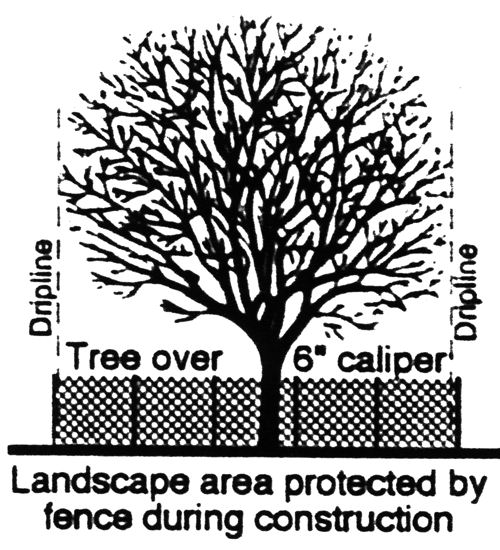
(i)
Exemptions from landscape requirements. The following are not subject to these landscape requirements:
(1)
Structures that do not create or expand building square footage and temporary structures such as job shacks or trailers associated with construction activities;
(2)
Change in existing structure, unless the structure is expanded in accordance with subsection (a) above;
(3)
Temporary buildings in place for a maximum of five years and erected as accessory buildings for elementary and secondary schools and institutions of higher education.
(j)
Installation and maintenance. The owner and/or user of the property shall be responsible for installing all required landscaping and maintaining them in a neat and orderly appearance. This includes irrigating or watering, fertilizing, pruning and replanting where necessary. Where fences or walls are involved, this also includes any and all necessary maintenance and/or repair.
Necessary trimming and maintenance shall be the responsibility of the property owner or user of the property to maintain the health of all plant and landscaping materials, to provide an aesthetically pleasing appearance, and to assure that all screening actually serves the purpose for which it is intended. In cases of noncompliance, the planning director, or his designee, shall be empowered to take action as provided by law to ensure maintenance of all plant and landscaping materials.
(k)
Miscellaneous requirements.
(1)
All required landscape areas adjacent to vehicle use areas shall be protected by wheel stops, curbs, or other physical barriers.
(2)
All required landscape areas shall be located outside the exterior perimeter of the footprint of a building or structure.
(3)
With the exception of landscaping required in the side and rear yards, a minimum of 75 percent of all remaining required landscape areas shall be located in the front yard between the building line and the front property line. For lots with multiple street frontages, the minimum percentage to be placed on either frontage shall be determined by the planning director, or his designee.
(4)
No artificial plants, trees, ground cover or other artificial vegetation may be installed.
(5)
Unless otherwise specified by this section, any walls constructed pursuant to the requirements of this section shall be a minimum of six feet in height and constructed of brick, stone, or concrete block textured or coated with an architectural finish (paint, stucco, etc.). Walls shall be located in a manner that accomplishes the purposes of this section.
(6)
When fencing is provided pursuant to this section, the finished surface of the fence shall face externally to the project. Fences shall be located in a manner that accomplishes the purposes of this section and shall be constructed of solid wood or other approved material that achieves the desired visual and acoustical screening.
(7)
Areas reserved for storm water detention/retention are not permitted within buffers of landscape strips. However, exceptions may be granted by the planning director, or his designee, if, after consultation with the manager of development services, no reasonable alternatives are available or undue hardship is shown.
(l)
Modification of landscape requirements. The planning director, or his designee, may approve minor variations in the location of required landscape materials due to unusual topographic restraints, sight restrictions, siting requirements, preservation of existing stands of native trees or similar conditions, or in order to maintain consistency of established front yard setbacks. These minor changes may vary the location of landscape materials, but may not reduce the amount of required landscape area or the required amount of landscape materials. The landscape plan shall be submitted and specify the modifications requested and present a justification for such modifications.
(1)
Acceptable tree types: The following is a list of example tree types that are indigenous to the area and tend to grow well. This list is not all-inclusive.
Shade trees: Black Tupelo, Bald Cypress, Florida or Southern Sugar Maple, Gingko or Maiden Tree, Live Oak, Overcup Oak, Scarlet Oak, Swamp Chestnut Oak, White Oak, American Beech, American Holly, Chinafir, Dawn Redwood, Deodar Cedar, Green Ash, Japanese Crytomeria, Japanese Pagodatree, Laurel or Darlington Oak, Loblolly Pine, Longleaf Pine, Red Cedar, Red Maple, River Birch, Sawtooth Oak, Shumar Oak, Slash Pine, Southern Magnolia, Sweetgum, Tulip Tree or Yellow Poplar, Water Oak, White Ash, Willow Oak.
Ornamental Trees: Bradford Pear, Cabbage Palmetto, Carolina Laurel Cherry, Cassine Holly, Caste Tree, Chinese Pistache or Pistachio, Chinese Tallowtree, Crepe Myrtle, Croonenburg Holly, Dogwood, Fringe-Tree or Grancy Graybeard, Goldenrain Tree, Hybrid Holly, Japanese Evergreen Oak, Japanese Flowering Apricot, Japanese Maple, Japanese or Saucer Magnolia, Leyland Cypress, Lost Gordonia, Nellie R. Stevens Holly, Purpleleaf Plum, Redbay Persea, Redbud or Judas Tree, Savannah Holly, Sassafras, Sweetbay Magnolia, Trident Maple, Virginia Pine, Yaupon Holly, Weeping Yaupon Holly, Weeping Willow.
Shrubbery: Clayeria, Euonymus, Japanese Privet, California Privet, European Privet, Southern Waxmyrtle, Northern Bayberry, Pittsporum, Japan Yew, and Red Tip Photinia.
(Ord. of 12-2-2002, § 70-86; Ord. of 1-3-2005(2); Res. No. Z05-037, 9-23-2005)
Sec. 70-87. - Animals in residential districts.
It is the intent of this section to permit certain uses in residential zoning districts which involve the keeping of limited numbers of domestic animals or pets where it is recognized that such areas are changing from agricultural to suburban residential in character. This section is further intended to minimize problems that may arise from such animal uses and to provide suitable standards for protection of health, safety, welfare and preservation of residential districts from indiscriminate raising of animals.
(1)
Animals shall be allowed only where the primary dwelling exists already and is on the same lot.
(2)
These permitted use provisions for animals in residential districts are meant to apply only outside of the residence on an individual lot and are not intended to restrict the type or number of animals within a residence.
(3)
Uses permitted.
a.
Domestic pets. Cats, dogs, rabbits or other generally recognized domestic pets may be kept by persons residing on the property for their use and enjoyment.
b.
Unless otherwise specified, horses may be kept in R-1L and R-3L residential zoning districts, provided that the lot is not less than five acres total, that the area where the horses are kept is not less than 50,000 square feet per every three such animals and that the area shall be fenced and maintained at least 25 feet from any property line. Up to three horses may be kept per each 50,000 square feet of fenced area.
c.
No keeping of livestock, fowl or domestic pets shall become a nuisance as defined in the county nuisance ordinance.
(4)
Conditional uses. Upon conditional use permit being granted by the county board of commissioners in certain zoning districts.
a.
Livestock. Unless otherwise specifically stated, Horses, cows, ponies, donkeys and other domestic livestock may be kept, raised or bred for home use and enjoyment; provided that only three such animals shall be permitted for each 50,000 square feet of land area not to include the front and side yards of the principal dwelling and all livestock shall be adequately contained by fence within that property at least 25 feet from any property lines.
b.
Fowl. Ducks, quail, chickens, turkeys, pigeons, pheasants, etc., may be raised for home use, provided such fowl are adequately contained within that property in the rear yard and at least 25 feet from any property lines.
(5)
Uses prohibited. The keeping, breeding or training of any animals or fowl for monetary gain or profit shall be deemed a commercial business and is expressly prohibited in all residential districts except where such operations may qualify as a non-conforming use as defined in this chapter.
(Ord. of 12-2-2002, § 70-77)
Sec. 70-89. - Conditional uses.
Before a building permit shall be issued for a conditional use, application shall be made to the planning commission which, after careful review of any applicable sections of this chapter, may recommend to the county commission the issuance of such permit or approval if in the judgment of the planning commission it will not be detrimental to the health, safety and general welfare of the county.
An application to establish a conditional use shall be approved following a review by the planning commission and a determination by the board of commissioners that:
(1)
The proposed use shall not be contrary to the purpose of this article.
(2)
The proposed use shall not be detrimental to the use or development of adjacent properties or the general neighborhood nor affect adversely the health and safety of residents and workers.
(3)
The proposed use shall not constitute a nuisance or hazard because of the number of persons who will attend or use such facility, vehicular movement, noise or fume generation or type of physical activity.
(4)
The proposed use shall not be affected adversely by the existing uses; and the proposed use will be placed on a lot of sufficient size to satisfy the space requirements of said use.
(5)
The parking and all development standards set forth for each particular use for which a permit may be granted can be met.
(6)
Provided, that the county commission may impose or require such additional restrictions and standards as may be necessary to protect the health and safety of workers and residents in the community, and to protect the value and use of property in the general neighborhood; and provided that wherever the county commission shall find, in the case of any permit granted pursuant to the provisions of these regulations that any term, conditions or restrictions upon which such permit was granted are not being complied with, said commission shall rescind and revoke such permit after giving due notice to all parties concerned and granting full opportunity for a public hearing.
(7)
Conditional uses shall not be transferable except upon written approval of the county commission and shall be executed within a period of 12 months from the time the use is granted or become null and void and subject to procedures for resubmission as established above and are subject to all other applicable laws and regulations.
(Ord. of 12-2-2002, § 70-89)
Sec. 70-90. - Variances.
(a)
The board of commissioners shall authorize, after review of the planning commission, in specific cases such variances from the terms of this chapter as will not in its opinion, be contrary to the public interest, where owing to special conditions, a literal enforcement of this chapter will in an individual case, result in unnecessary hardship. Such variance may be granted in such individual cases of unnecessary hardship upon consideration of the following criteria:
(1)
There are extraordinary and exceptional conditions pertaining to the particular piece of property in question because of its size, shape or topography, and;
(2)
The application of the chapter to this particular piece of property would create an unnecessary hardship, and;
(3)
Such conditions are peculiar to the particular piece of property involved, and;
(4)
Release if granted, would not cause substantial detriment to the public interest or impair the purposes and intent of this chapter, provided, however, that no variance may be granted for a use of land or building which is prohibited by this article. The county will control the actual use of properties through zoning and conditional uses and not through variance.
(b)
In exercising the above powers, the board of commissioners shall not consider any nonconforming use of neighboring lands, structures or buildings in the same district and no permitted use of lands, structures, or buildings in other districts as grounds for the issuance of a variance.
(c)
If the board of commissioners grants a variance the reason for such variance must be put forth clearly in the minutes of the meeting at which the variance was granted.
(d)
Notwithstanding the foregoing provisions of this section, in the event that all criteria set out in subsections (a)(1) through (a)(4) above are met, the county manager, or his designee, shall be authorized to grant such variances without the necessity of approval by the board of commissioners in those circumstances where the requested variance would not exceed ten percent from existing building set-back requirements in the applicable zoning district.
(Ord. of 12-2-2002, § 70-90; Ord. of 6-23-2015(2))
Sec. 70-91. - Site plan review.
(a)
In order to assure that the requirements of this chapter are complied with, all applications for a building permit shall be accompanied by a building site plan which shall conform to the following list of requirements and which shall be reviewed by the county planner, or his duly authorized representative, to determine compliance with this article before a building permit is issued. A building permit application shall not be issued for proposed site plans that do not meet all of the following requirements:
(1)
The site plan shall be drawn to scale. The planning director, or his designee, may request that the plan be drawn by a registered engineer or surveyor certified to work in Georgia if questions of flood zone locations exist within the property for which a building permit is being sought.
(2)
The plan shall show the complete outline of each proposed building at the location it is proposed to be built. The plan shall also show the actual size of the building to be erected. The plan shall also show all existing structures located on the property and their exact dimensions.
(3)
The plan shall show all property lines. The plans shall also show the actual dimensions of the lot to be built upon.
(4)
The plan shall show all required property set back lines. No part of any permanent structure shall encroach upon or violate any required setback.
(5)
The plan shall show the exact location of all easements on the property. No part of any permanent structure shall encroach upon any easement.
(6)
The plan shall show all parking, driveways, well location, septic tank location, drainfield location, trees larger than 24 inches in caliper and landscape buffers and all other requirements as set out in this chapter.
(7)
The plan shall show all other structures on adjacent lots within ten feet of the appropriate property line.
(8)
The plan shall show front, side, and rear elevations indicating the building height from finished grade.
(b)
After the county planner or his duly authorized representative has approved the site plan such approval shall be noted on the permit application.
(c)
Before construction begins, the builder shall locate and clearly mark all lot corners.
(d)
At the time the building inspector conducts the foundation inspection, he may undertake whatever measurements he may deem appropriate including, but not limited to, measurements from the property lines to the proposed outermost edge of the building, so as to assure compliance with the approved site plan.
(Ord. of 12-2-2002, § 70-91; Res. No. Z05-029, 9-23-2005)
Sec. 70-92. - Reserved.
Editor's note— Res. No. Z05-031, adopted Sept. 23, 2005, repealed § 70-92, which pertained to recreation areas. See also the Code Comparative Table.
Sec. 70-93. - Flag lots.
Flag lots shall be subject to the following regulations:
(1)
Flag lots shall be measured from the mid-point between two opposite lot lines of the flag portion of the lot.
(2)
When calculating lot area the pole portion shall not be counted.
(3)
The minimum required lot area shall be the same as that required in the zoning district in which it is located.
(4)
The access pole must be part of the flag lot and must be under the same ownership as the flag portion. An easement shall not be allowed as a means of access to a flag lot.
(5)
Flag lots shall not be permitted whenever their effect would be to increase the number of driveways taking access to a collector or arterial road. Shared driveways shall be used to eliminate additional points of access. This criterion prohibits one of the most common abuses, the use of flag lots to avoid the developmental costs of roads. These sites are best developed without flag lots, even if the cost of the lots is thereby increased, since controlling access reduces congestion on major roads.
(6)
Any land division that creates one or more lots, flag or otherwise, with or without common access shall be a minor subdivision and shall meet all applicable regulations of the county subdivision ordinance.
(7)
All applicable regulations of chapter 38 of the Code must be met.
(8)
Flag lots have required building setbacks that must meet the requirements in the zoning district in which it is located. The pole portion shall not be considered when determining required building setbacks.
(9)
The access pole shall have a minimum width of 30 feet and shall not be greater than or equal to the minimum required width for building in the applicable zoning district. The purpose of this maximum width criterion is to prevent an abuse of flag lots in order to circumvent the county's length versus width requirement in the subdivision of lots. The maximum length of the pole of the lot shall be no more than five times the lot width of the flag portion.
(Ord. of 12-2-2002, § 70-93)
Sec. 70-94. - Land conservation.
(a)
In order to protect open green space and to reduce the cost of development of a residential subdivision, this chapter establishes density neutral development requirements by establishing the total number of units a specified amount of developable land will yield. This total yield must not include undevelopable areas such as storm water management ponds, and similar areas. In order to protect significant natural areas, wetlands and other similar areas may be used to meet the greenspace requirement. Wetland areas may also be used to meet stormwater management requirements in accordance with Chapter 38 of this Code. In order to do this, where the property is to be developed as a major subdivision, the following process must be followed:
(1)
Delineate all unbuildable lands such as steep slopes, storm water retention areas, etc.
(2)
Then, out of the remaining buildable land, determine the number of dwelling units desired, provided that the maximum density allowed by this chapter is not exceeded.
(3)
Once subsection (2) is done, where the property is to be developed as a major subdivision with at least a county provided water system or a county provided sewer system, unless otherwise specified, a minimum of 25 percent of the remaining developable land shall be preserved. Where the property is to be developed with wells and septic tanks, a minimum of ten percent of the developable land shall be preserved. Preservation under this section shall be accomplished by delineating any potential conservation areas such as significant tree stands, fields, historic or cultural areas. These areas shall be preserved as a common area for the residents of the subdivision. Unless the conservation area is conveyed to and accepted by the county, a legal entity such as, a homeowner's association, or trust for maintenance and care must be established and evidence thereof provided to the county and filed with the subdivision files. Such legal entity must have perpetual existence and be responsible for the continued preservation of the preserved land. Whenever an adjacent development has already preserved greenspace, all greenspace areas must be connected among the different developments in order to provide a connected greenspace "belt."
(4)
Once potential conservation areas noted in subsection (3) are delineated, the next step is to locate potential house sites on the remaining land.
(5)
Once potential house sites are located, streets should be aligned with the houses. Trails, separate from public roads, may also be used to connect the house sites to allow neighborhood connectivity.
(6)
The final step is to draw in lot lines. These cannot include unbuildable lands noted in subsection (1) or land delineated as conservation areas per subsection (3).
Unless the entire property consists of buildable lands, both subsection (1) or subsection (3) requirements must be complied with by the developer; provided, however, that in no event shall less than 25 percent of the total tract be preserved in developments where wells and septic tanks are not to be used, and no less than ten percent of the total tract shall be preserved in developments where wells and septic tanks are to be used.
(b)
The requirements of subparagraph (a) of this section shall not be applicable in R-1L, R-3L or when the governing body has required a minimum building lot size greater than allowed for the zoning density.
(Ord. of 12-2-2002, § 70-94; Res. No. Z05-022, 9-19-2005)
Sec. 70-95. - Buffers in residential districts.
(a)
Applicability. This section shall apply to all new residential subdivision developments and additions thereto, where preliminary plat plans have not been approved prior to November 15, 2004. New phases that are being developed under a previously approved general development plan will have to meet this requirement for all phases that have not received preliminary plat approval prior to November 15, 2004.
(b)
Purpose and intent. The following regulations are designed to promote the health, safety, order, aesthetics and general welfare by protecting incompatible uses of land, providing for a more attractive residential environment, to promote desirable living conditions and the sustained stability of neighborhoods, assuring adequate open space, and reducing noise, night lighting, odor, objectionable view, loss of privacy and other adverse impacts and nuisances through the use of residential buffers and landscaping.
(c)
Submittal of buffer plans. A buffer plan shall be submitted to the planning and development department together with the preliminary plat. The buffer plan may be included on the preliminary plat. The following information shall be shown on the required plan:
(1)
Clearly state what level of service will be provided to the development and what level of service will be provided to adjacent residential developments.
(2)
Location and dimensions of areas to be buffer area.
(3)
Delineation of buffer area as restricted easement of private lots or dedicated to the county.
(d)
Level of service. Buffer areas shall be required between all developments served by a different level of public utilities. The levels of service of public utilities that may be provided are:
(1)
Level 1—Individual well and septic system.
(2)
Level 2—County water system and individual septic system.
(3)
Level 3—County water system and county sewer system.
(e)
Buffer area required. A minimum 20-foot natural or landscape-enhanced buffer shall be provided along side and rear property lines of development with differing levels of service. This buffer area may account for the land conservation area required by section 70-94 of this chapter. It is the responsibility of the developer to provide the required buffer area prior to final acceptance of the development by the county board of commissioners.
(f)
Acceptable buffer.
(1)
Natural buffer. In cases where the natural vegetation is mature enough to provide a solid visual buffer there should be no disturbance within the buffer area. If the buffer area is included within a private lot, a restrictive easement shall be recorded with the lot indicating the area of easement, restricting use of the easement, and requiring the easement to remain undisturbed. The restrictive easement shall state that failure to leave the buffer undisturbed shall result in the property owner being required to bring the buffer area into compliance with the following subsection (2).
(2)
Landscape-enhanced buffer. In cases where the natural vegetation is not adequate to provide a solid visual buffer between developments then landscaping shall be required to supplement the natural vegetation. This landscaped buffer area shall consist of trees and shrubs that are indigenous to the area and tend to grow well. All existing vegetation shall not be disturbed.
(g)
Installation and maintenance. The owner and/or user of the property shall be responsible for installing all required buffers and maintaining them in a neat and orderly appearance. Necessary trimming and maintenance shall be the responsibility of the property owner or user of the property to maintain the health of all plants, to provide an aesthetically pleasing appearance, and to assure that all buffers actually serve the purpose for which they were intended. In cases of noncompliance, the planning director, or his designee, shall be empowered to take action as provided by law to ensure maintenance of all plants and buffer areas.
(h)
Miscellaneous requirements.
(1)
No artificial plants, trees, ground cover or other artificial vegetation may be installed.
(2)
Areas reserved for storm water detention/retention are not permitted within buffer areas. However, exceptions may be granted by the planning director, or his designee, if, after consultation with the manger of development services, no reasonable alternatives are available or undue hardship is shown.
(i)
Modification of buffer requirements. The planning director, or his designee, may approve minor variations to the buffer requirement due to unusual topographic restraints, sight restrictions, siting requirements, preservation of existing stands of native trees or similar conditions. The buffer plan shall be submitted and specify the modifications requested and present a justification for such modifications.
(Ord. of 12-6-2004(6))
Sec. 70-97. - Fences.
Walls or fences shall be permitted in any zoning district and are not subject to setback requirements, except that in a residential zoning district:
(1)
No wall or fence shall exceed eight feet in height within a side yard or rear yard.
(2)
Any wall or fence that extends into the front yard shall not exceed four feet in height, except fences enclosing stormwater facilities that may not exceed six feet in height. Any wall or fence that extends into the front yard shall not encroach upon the right-of-way.
(3)
Fences enclosing tennis courts may not exceed 12 feet in height.
(4)
No wall or fence constructed of woven wire or metal fabric (hog wire, barbed wire, or similar types of fencing.) shall extend into a front yard, except fences enclosing stormwater facilities that may be vinyl coated chain link. No wall or fence shall be constructed of exposed concrete block, tires, junk, wooden pallets, or other discarded materials. Chain link fences are expressly allowed in front yards.
(5)
Any wall or fence that extends into the required front yard shall be ornamental or decorative and constructed of brick, stone, wood, stucco, wrought iron, split rail, or similar material.
(6)
Any subdivision entrance, wall or fence shall not exceed eight feet in height and shall be subject to approval of the director of planning.
(7)
Above-ground electric and barb wire fences shall be prohibited in residential districts except on lots that meet or exceed the minimum requirements for the raising and keeping of livestock (five acres) and then must only be located in the rear yard.
(8)
For the purpose of measuring the height of a fence under this section, such measurements shall be made from the ground directly below the fence and not from the bottom of the fence itself.
(Res. No. Z05-026, 9-23-2005)
Sec. 70-98. - Sidewalks.
(a)
Sidewalks shall be located:
(1)
Along the street frontage of all non-residential developments. The planning director may waive the installation of sidewalks if the development is agricultural or located on a rural road section.
(2)
Along the street frontage of all developments within a one-half mile radius of any public school.
(2)
Along the interior streets of all residential developments with a minimum lot size of three-quarters acre or smaller.
(b)
Sidewalks shall be installed on one side of the street if there are fewer than 100 homes in the entire development. Sidewalks shall be installed on both sides of the street if there are more than 100 homes in the entire development. The total number of lots in a development shall be calculated using all phases of the development, including phases already completed, phases included on the approved general development plan, and phases completed by other developers with the same subdivision name.
(c)
Sidewalks in subdivisions shall be continued to the nearest arterial street.
(d)
Sidewalks shall be constructed in accordance with Chapter 38, Land Development, section 38-331.
(e)
The home builder shall install sidewalks along the entire frontage of each permitted dwelling prior to the certificate of occupancy (CO) being issued for the residence. Prior to commence of construction of the residential development, the developer of the residential subdivision shall post a bond in the estimated amount of 125 percent of the total cost of the sidewalk construction and installation for a period of two years from the date that such bond that such bond is posted. At the expiration of the two-year period, sidewalks shall be constructed by the developer in front of any lots where sidewalks have not already been installed by the home builder. Any damage to existing sidewalks caused by the developer or the home builder, or their respective agents or subcontractors, during construction on individual lots shall be repaired by the individual lot permit holder prior to a certificate of occupancy being issued for the residence being constructed. All repairs shall be in accordance with section 38-331.
(Res. No. Z05-027, 9-23-2005)

