
Leon Valley City Zoning Code
DIVISION 6
DISTRICTS, BOUNDARIES, AND USE REGULATIONS
Sec. 15.02.301 - Districts
The city is hereby divided into 13 zoning districts and boundaries as follows:
"R-1" Single-Family Dwelling District
"R-2" Two-Family Dwelling District
"R-3" Multiple-Family Dwelling District
"R-3A" Multiple-Family Retirement Community District
"R-4" Townhouse Dwelling District
"R-5" Manufactured Home Dwelling District
"R-6" Garden House District
"MX-1" Mixed Use Development
"O-1" Office District
"B-1" Small Business District
"B-2" Retail District
"B-3" Commercial District
"I-1" Industrial District
(1972 Code, sec. 30.601; 2008 Code, sec. 14.02.301)
Sec. 15.02.302 - Boundaries
(a)
General. The boundaries of these districts are indicated on the zoning map of the city, which is on file in the official office of the city.
(b)
Interpretation. Where uncertainty exists with respect to the boundaries of any of the following districts as shown on the zoning map, the following rules shall apply:
(1)
Where district boundaries are indicated as approximately following the centerline of streets or highways, street lines or highway right-of-way lines, such centerlines, street lines, or highway right-of-way lines shall be construed to be said boundaries;
(2)
Where district boundaries are so indicated that they approximately follow the lot lines, such lot lines shall be construed to be said boundaries;
(3)
Where district boundaries are so indicated that they are approximately parallel to the centerlines or street lines of streets, or the centerlines or right-of-way lines of highways, such district boundaries shall be construed as being parallel thereto and at such distance therefrom as indicated on the zoning map. If no distance is given, such dimension shall be determined by the use of the scale on said zoning map;
(4)
In property which is not subdivided, the district boundary lines on the zoning map shall be determined by use of scale appearing on the map, or by more detailed descriptions that may be available in the official records of the city;
(5)
In the case of a district boundary line dividing a property into two parts, the district boundary line shall be determined by use of the scale appearing on the zoning map, or by more detailed descriptions that may be available in the official records of the city;
(6)
Where the streets or alleys on the ground differ from the streets or alleys as shown on the zoning map, the streets or alleys on the ground shall control; and
(7)
Where conflict exists between the official zoning map of the city and the official records of the city, the records shall control.
(1972 Code, sec. 30.602; 2008 Code, sec. 14.02.302)
Sec. 15.02.303 - Annexation zoning
(a)
"Temporary R-1" zoning established. All territory annexed to the city shall be automatically classified as "temporary R-1" single-family dwelling district and the only uses which shall be permitted therein are those permitted in the permanent "R-1" district. If within six months from annexation such property has not been permanently zoned, the city shall appropriately zone such property on behalf of the property owner.
(b)
Permanent zoning upon annexation. The owner or owners of property being annexed to the city upon petition (as provided in chapter 43, of the Texas Local Government Code) may apply at the time of annexation for a permanent zoning on the land being annexed and such application shall be processed as any other request for zoning. If timely filed and the proper notice and hearing procedures have been followed prior to the council meeting in question, the city council can give such territory its permanent zoning at the same meeting at which it is annexed.
(1972 Code, sec. 30.603; 2008 Code, sec. 14.02.303)
Sec. 15.02.304 - Description and purpose of districts
(a)
Purpose. It is the purpose of this section:
(1)
To protect the character of the residential areas by regulating the placement of certain uses and any unenclosed activities or uses which could intrude upon the lifestyle of the community through inappropriate lighting, noise, vibration, smoke, dust, or pollutants; and
(2)
To protect the character of the business community by allowing certain incidental uses appropriate to certain zoning districts which would not intrude upon the character of the residential areas.
(b)
Purpose of overlay districts and applicability.
(1)
Purpose of overlay district standards. It is the purpose of the Sustainability, Gateway and Commercial/Industrial Overlay District standards:
(A)
To establish standards to protect and improve the character of business areas in the city, and to guide the appropriate mixing of residential and nonresidential uses where permitted within the overlay districts.
(2)
Applicability of overlay district standards. The overlay district standards shall apply to all areas currently zoned R-3, R-3A, R-4, R-5, MX-1, O-1, B-1, B-2, B-3, and I-1 within the city limits.
(1972 Code, sec. 30.604; Ordinance 10-049, sec. 1, adopted 11-16-10; 2008 Code, sec. 14.02.304)
Sec. 15.02.305 - Regulations for all districts
(a)
Use. No land shall be used for and no building shall be erected for or converted to any use other than provided in the regulations prescribed for the district in which it is located, except as hereinafter provided.
(b)
Height. No building shall be erected, constructed, extended, enlarged, reconstructed or structurally altered to exceed the height limit herein established for the district in which such building is situated, with the following exceptions:
(1)
Those exceptions listed in the definition of height found in this article;
(2)
In any district any main structure may be erected or altered to a height in excess of that specified for the district in which the structure is located provided that each required side and rear yard is increased one foot for each two feet of such excess height.
(c)
Area. No lot shall be reduced or diminished so that the yards or other open spaces shall be smaller than as prescribed in this article, nor shall the density of population be increased in any manner except in conformity with the area regulations established herein. Side yard areas, used to comply with minimum requirements of this article, for a building, shall not be included as a part of the required areas of any other building. Every building hereafter erected shall be located on a lot as herein defined and in no case shall there be more than one main structure/building on a lot in the "R-1", "R-2" or "B-1" districts, or as otherwise provided herein, and in no case shall any building be hereafter erected on more than one lot.
(d)
Vision clearance.
(1)
On any corner lot on which a front yard is required by this article, no wall, fence or other structure shall be erected and no hedge, shrub, tree or other growth shall be maintained within the triangular area formed by the intersecting street lines and a straight line connecting such street lines at points 25 feet from the point of intersection, measured along such street lines.
(2)
On any corner lot on which front and side yards are required, no wall, fence, structure, sign, tree, shrub, or hedge may be maintained as to cause danger to traffic by obstructing the view, and when topography prevents a clear view, this obstruction shall be removed.
(e)
Front yard. The front yard heretofore required shall be adjusted in the following cases:
(1)
Where 40 percent or more of frontage on one side of a street between two intersecting streets is developed with buildings that have observed, with a variation of five feet or less, a front yard greater or lesser in depth than herein required, new buildings shall not be erected closer to the street than the building line so established by the existing buildings, however, this regulation shall not be interpreted as requiring a building line of more than 50 feet.
(2)
Open and unenclosed terraces or porches, carports, patios, eaves, and roof extensions may project into the required front yard for a distance not to exceed four feet, with the exception of a carport in an R-1 Single Family Dwelling Zoning District, which is allowed to project into the required front yard area for a distance not to exceed 15 from the front property line. The carport must be permanently attached to the existing residential structure at the roof line.
(f)
Side and rear yard.
(1)
Every part of the required side or rear yard shall be open and unobstructed except for accessory buildings as permitted herein and the ordinary projection of window sills, belt courses and other ornamental features projecting not to exceed 12 inches. Eaves and awnings on main residential structures may project to within three feet of a side lot line.
(2)
Noncombustible accessory buildings may be built in the rear yard except that when such accessory building is combustible or located closer than 15 feet to the main building, it shall observe the same side yard as required of the main building.
(3)
Open or lattice-enclosed fire escapes, fireproof outside stairways, balconies opening upon fire towers, and ordinary projections of chimneys and flues into rear yard may project in the side or rear yard for a distance not to exceed four feet.
(4)
Terraces, uncovered porches, platforms, and ornamental features which do not extend more than three feet above the ground (first) floor level of the building may project into a required side yard provided such projections not be erected closer than two feet from the side lot line.
(g)
Lot area. On any lot separately platted as of September 21, 1965, a single-family house may be erected even though of less area than required by these regulations, with the requirement that it be connected to a public sewage disposal system.
(h)
Location of dwellings and buildings. Only one main building for single- or two-family use, with permitted accessory buildings, may be located upon a lot.
(i)
Outer courts. Whenever an outer court in a building used or intended to be used for dwelling purposes is formed by three exterior walls of the building in which are located any openings, windows or doors for light, access, air or ventilation, the mean depth of the court measured from the base wall to a line projected from the outer edge of one protruding wall shall not be greater than 1½ times the distance between the two protruding walls. Whenever the depth of the court equals or exceeds 50 percent of the distance between the protruding walls, the minimum width of an outer court shall be 12 feet for one standard story buildings, 20 feet for two standard story buildings, 30 feet for three standard story buildings, and for buildings exceeding three standard stories in height, the width of an outer court shall be increased one foot for each (2) feet the building exceeds three standard stories.
(j)
Fences.
(1)
Fences shall be required to be in compliance with article 3.05 of this Code, as amended, with the following exception which is intended to take precedence over and govern any conflict with article 3.05 of this Code:
(A)
In I-1 districts, not fronting residential or commercial districts, and not located to adversely affect site distance at street and/or alley intersections, there shall be no limitation as to fence height.
(k)
Summary of height, area and yard requirements.
(1)
The requirements for height, yard and area set out in this article are intended to protect the health, safety and welfare of property owners by establishing minimum standards. These standards are outlined for the individual districts in table format. In some cases, additional details regarding height, yard and area standards are provided for certain districts in the sections below. This section is intended to be interpreted in its entirety as it relates to the specific requirements for each zoning district.
(2)
In the case of any lot or land parcel, it is hereby required that such lot or parcel must front onto a public street and be provided with public utilities and fire protection.
(l)
Residence in nonresidential zone. It is the intention of this article that no residential use of any type occur in the B-2, B-3 or I-1 zones and that R-3 uses not occur in any other zoning district and that R-5 uses not occur in any other zoning district, unless:
(1)
The use provides a residence for a caretaker residing on the premises in the B-2, B-3 or I-1 zones; or
(2)
The use is constructed as a part of, and provides a residence used in conjunction with, the nonresidential use.
(3)
The use is a part of an approved mixed use development (MX-1 district).
(m)
Overlay districts. The Sustainability, Gateway and Commercial/Industrial Overlay Districts incorporate additional requirements which may supersede certain requirements of the following divisions of this article and article 3.04 (signs), as follows;
(1)
Division 6, districts, boundaries and use regulations.
(2)
Division 7, permitted use table.
(3)
Division 8, parking regulations.
(4)
Division 9, landscaping.
(1972 Code, sec. 30.605; Ordinance 10-049, sec. 2, adopted 11-16-10; 2008 Code, sec. 14.02.305; Ord. No. 2022-8, § 1, 3-1-2022)
Sec. 15.02.306 - "R-1" single-family dwelling
(a)
Purpose and description.
(1)
This district provides areas for low density single-family uses which provide a buffer between agricultural and higher density areas of the city. Minimum lot size requirements are provided in order to allow for market and design flexibility while preserving neighborhood character. The district regulations are designed to encourage a suitable neighborhood environment for family life by including among the permitted uses such facilities as schools, libraries, and neighborhood recreation centers. The district regulations are designed to: (1) protect the residential character of the areas by prohibiting commercial and industrial activities; (2) encourage a suitable neighborhood environment; and (3) preserve the openness of the area by requiring that certain minimum yard and area standard requirements are met.
(2)
The R-1 district implements the following policies of the master plan:
(A)
Encourage patterns of urban development that provide a full range of housing choices and promote a sense of community, urban vitality and the efficient provision of infrastructure.
(B)
Encourage connectivity throughout the city.
(b)
Lot regulations.
(1)
Area. Lots must have a minimum area of 8,400 square feet.
(2)
Frontage. Minimum frontage of 70 feet along a public right-of-way.
(3)
Depth. Minimum of 120 feet.
(4)
Floor space. Minimum floor space of 1200 square feet of heated living space shall be provided in each one-story dwelling, 1400 square feet for each two-story dwelling.
(5)
Height. Maximum of 2-1/2 stories allowed.
(c)
Setback requirements.
(1)
Front yard. There shall be a front yard having a minimum of 25 feet from front property line to main structure.
(2)
Rear yard. There shall be a rear yard of not less than 30 feet from rear property line to rear of main structure.
(3)
Side yard. There shall be a side yard of not less than five feet from side property line to main structure. On corner lots the external side yard shall be not less than ten feet. See article 10.02 (subdivision ordinance) for garage setbacks.
(4)
Corner lot. Where lots abut on two intersecting or intercepting streets, where the interior angle of intersection or interception does not exceed 135 degrees, a side yard shall be provided on the street side equal to the front yard.
(5)
Reverse frontage. On corner lots, where interior lots have been platted or sold, fronting on the side street, a side yard shall be provided on the street side equal to the front yard on the lots in the rear. No accessory building on said corner lot shall project beyond the front line of the lots in the rear.
(d)
Other.
(1)
Accessory buildings. Shall be allowed but shall be located no closer than five feet from any property line and must be located in the side or rear yard. In no case shall an accessory building occupy more than 30 percent of the total open space in the rear yard; with the following exceptions:
a.
No setback shall be required for accessory buildings located within a side or rear yard which abuts an alley with a minimum 20 feet of public rights-of-way; or
b.
No setback shall be required for accessory buildings located within a side or rear yard, which were constructed prior July 7, 2021, and are located a minimum of ten feet from the nearest structure on an abutting property.
(2)
Landscaping. The use of drought tolerant turf grasses, such as zoysia or buffalo tif or combination, or other drought tolerant plantings and hardscape is strongly recommended.
(3)
Lighting. All outdoor lighting shall be hooded and all light emissions shielded, and shall be oriented such that light is directed towards the property and does not trespass onto surrounding properties. Lights affixed to the buildings shall be mounted no higher than the eaves of said building. Lights affixed to a pole shall be mounted no higher than 40 percent of the distance from the front property line to the main structure.
(4)
Masonry required. A minimum of 75 percent of total overall exterior walls shall be constructed of masonry, or other similar noncombustible materials.
(5)
Nonconforming dwellings. The provisions of floor space and masonry above shall not be applicable to nonconforming dwellings in existence on the date of the adoption thereof or to dwellings built hereafter on the same lot to replace such nonconforming dwellings as may be destroyed by fire, windstorm or other involuntary cause.
(6)
Parking. Two off-street parking spaces shall be provided for each residential structure.
(7)
Public facilities. Each lot shall be connected to the city's public water and sewer system, and shall have appropriate sidewalks and fire protection. See article 10.02 (subdivision ordinance).
(8)
Storage. Outside storage is not allowed in the R-1 district, with the exception of vehicles, trailers, recreational vehicles and boats in accordance with article 3.05 and article 12.03 of the Leon Valley City Code. All items to be stored must be completely contained in either the main structure, garage or an accessory building.
Figure 1 (R-1 Single-Family Dwelling)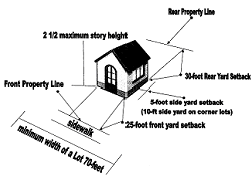
(1972 Code, sec. 30.606; Ordinance 07-033 adopted 8-8-07; 2008 Code, sec. 14.02.306; Ord. No. 2021-33, § 1, 8-3-2021; Ord. No. 2023-35, § 1, 9-19-2023)
Sec. 15.02.307 - "R-2" two-family dwelling
(a)
Purpose and description.
(1)
This district provides areas for low and medium density one- and two-family dwelling uses, which provide a buffer from agricultural and single-family districts and the higher density areas of the city. Minimum lot size requirements are provided in order to allow for market design and flexibility while preserving the neighborhood character. The district regulations are designed to: (1) protect the residential character of the area by prohibiting commercial and industrial activities, apartments and manufactured homes; (2) encourage a suitable neighborhood environment; and (3) preserve the openness of the area by requiring that certain minimum yard and area standard requirements are met. The district regulations are designed to encourage a suitable neighborhood environment for family life by including among the permitted uses such facilities as schools, libraries, and neighborhood recreation centers.
(2)
The R-2 district implements the following policies of the master plan:
(A)
Encourage patterns of urban development that provide a full range of housing choices and promote a sense of community, urban vitality and the efficient provision of infrastructure.
(B)
Encourage connectivity throughout the city.
(b)
Lot regulations.
(1)
Area. A minimum lot area of 10,200 square feet shall be provided.
(2)
Depth. A minimum depth of 120 feet, shall be provided, except as hereinafter provided.
(3)
Floor space. Must provide a living area in each one-story structure of not less than 1,600 square feet; and in each two-story structure of not less than 1,800 square feet; and shall be heated living space as in the R-1 (single-family dwelling) district.
(4)
Frontage. Minimum frontage of the lot shall be 85 feet along a public right-of-way.
(5)
Height. A maximum of 2-1/2 stories allowed.
(c)
Setbacks.
(1)
Front yard. There shall be a minimum front yard of 20 feet shall be provided.
(2)
Rear yard. There shall be a minimum of 30 feet shall be provided.
(3)
Side yard. There shall be a minimum of five feet shall be provided on each side, except on corner lots the external side shall be not less than 20 feet.
(4)
Corner lot. Where lots abut on two intersecting or intercepting streets, where the interior angle of intersection or interception does not exceed 135 degrees, a side yard shall be provided on the street side equal to the front yard.
(5)
Reverse frontage. On corner lots, where interior lots have been platted or sold, fronting on the side street, a side yard shall be provided on the street side equal to the front yard on the lots in the rear. No accessory building on said corner lot shall project beyond the front line of the lots in the rear.
(d)
Other.
(1)
Accessory buildings. Accessory buildings are allowed, but shall be located no closer than five feet from any property line and shall not occupy more than 25 percent of the open space in the rear yard of each unit. In no case is an accessory building allowed in the front yard.
(2)
Landscaping. The use of drought tolerant turf grasses, such as zoysia or buffalo tif or combination, or other drought tolerant plantings and hardscape is strongly recommended.
(3)
Lighting. All outdoor lighting shall be hooded and all light emissions shielded, and shall be oriented such that light is directed towards the property and does not trespass onto surrounding properties. Lights affixed to buildings shall be mounted no higher than the eaves of said buildings. Lights affixed to a pole shall be mounted no higher than 40 percent of the distance from the front property line to the main structure.
(4)
Masonry required. Masonry or other similar noncombustible materials to the extent of not less than 75 percent of overall exterior walls.
(5)
Nonconforming structures. The provisions of floor space and masonry above shall not be applicable to nonconforming dwellings in existence on the date of the adoption thereof or to dwellings built hereafter on the same lot to replace such nonconforming dwellings as may be destroyed by fire, windstorm or other involuntary cause.
(6)
Parking. Two off-street parking spaces shall be provided for each separate unit in the structure.
(7)
Public facilities. Each lot shall be connected to the city's public water and sewer system and shall have appropriate sidewalks and fire protection. See article 10.02 (subdivision ordinance).
(8)
Storage. Outside storage is not allowed in the R-2 district, with the exception of vehicles, trailers, recreational vehicles and boats in accordance with article 3.05 and article 12.03 of the Leon Valley City Code. Items to be stored must be completely contained in either the main structure, garage or an accessory building.
Figure 2 (R-2 Two-Family Dwelling)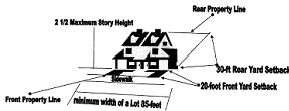
(1972 Code, sec. 30.607; 2008 Code, sec. 14.02.307)
Sec. 15.02.308 - "R-3" multiple-family dwelling district
(a)
Purpose and description.
(1)
The R-3 district is composed of areas containing multiple-family dwellings. The district regulations are designed to: (1) protect the residential character of the area by prohibiting commercial and industrial activities and manufactured homes; (2) encourage a suitable neighborhood environment; (3) prevent overcrowding of the land by requiring certain minimum yard and other open spaces for all buildings; (4) avoid excessive population density by requiring a certain minimum building site area for each building unit; and (5) provide a buffer between retail and single-family dwelling areas.
(2)
The R-3 district implements the following policies of the master plan:
(A)
Encourage patterns of urban development that provide a full range of housing choices and promote a sense of community, urban vitality and the efficient provision of infrastructure.
(B)
Encourage connectivity throughout the city.
(b)
Lot regulations.
(1)
Area. A lot on which there is erected or converted a multiple-family dwelling shall contain an area of not less than 10,400 square feet for the first three units and 1,200 square feet for each additional unit.
(2)
Depth. Minimum of 120 feet.
(3)
Floor space. Minimum of 600 square feet.
(4)
Frontage. A minimum frontage of 95 feet is required along a public right-of-way.
(5)
Height. A maximum of three stories is allowed in the R-3 district.
(6)
Density. None.
(c)
Setback requirements.
(1)
Front yard. There shall be a front yard having a minimum of 20 feet from the property line to the building structure.
(2)
Rear yard. There shall be a rear yard having a minimum of 25 feet from the structure to the rear property line.
(3)
Side yard. There shall be a side yard having a minimum of ten feet from the structure to the side property line.
(4)
Vision clearance area. On any corner lot no wall, fence or other structure shall be erected and no hedge, shrub, tree or other growth shall be maintained within the triangular area formed by the intersecting street lines and a straight line connecting such property lines at points 25 feet from the point of intersection, measured along such street lines.
(5)
Building distance. The required space between buildings is 15 feet.
(d)
Other.
(1)
Accessory buildings. Accessory buildings shall in no case consist of more than 20 percent of the total lot area.
(2)
Landscaping. A total of 35 percent of the total overall area must be landscaped and not less than five percent of the R-3 area shall be covered by plantings and amenities other than sod, subject to the approval of the city. The use of drought tolerant turf grasses, such as zoysia or buffalo tif or combination, or other drought tolerant plantings and hardscape is strongly recommended. See appendix A for a list of trees, shrubs and plants suitable for the region. Also see Landscaping, division 9 of this article, for other applicable regulations.
(3)
Lighting. All outdoor lighting shall be hooded and all light emissions shielded, and shall be oriented such that light is directed towards the property and does not trespass onto surrounding properties. Lights affixed to the buildings shall be mounted no higher than the eaves of said building. Lights affixed to a pole shall be mounted no higher than 40 percent of the distance from the front property line to the main structure.
(4)
Masonry required. Multiple-family dwellings shall be constructed of masonry or similar noncombustible materials to the extent of not less than 75 percent of overall exterior walls.
(5)
Nonconforming structures. The provisions of subsection (b) above shall not be applicable to nonconforming dwellings in existence on the date of the adoption thereof or to dwellings built hereafter on the same lot to replace such nonconforming dwellings as may be destroyed by fire, windstorm or other involuntary cause.
(6)
Parking. A minimum of one space for each one-bedroom unit, two spaces for each two-bedroom unit and one space for each additional unit shall be provided.
(7)
Public facilities. Each lot shall be connected to the city's public water and sewer system and shall have appropriate sidewalks and fire protection. See article 10.02 (subdivision ordinance).
(8)
Storage. Outside storage is not allowed in the R-3 district, with the exception of vehicles, trailers, recreational vehicles and boats in accordance with article 3.05 and article 12.03 of the Leon Valley City Code. Items to be stored must be completely contained in either the apartment units, garages or accessory buildings.
015_CHAPTER_15__ZONING.txt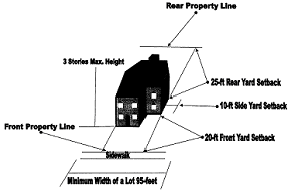
(1972 Code, sec. 30.608; Ordinance 07-033 adopted 8-8-07; 2008 Code, sec. 14.02.308)
Sec. 15.02.309 - "R-3A" multiple-family retirement district
(a)
Purpose and description. The R-3A multiple-family retirement district is designed for more planned developments consisting of at least five acres, containing one or more residential clusters of cottages or apartment houses or a combination thereof, and appurtenant common areas, intended for rental or leasing to individuals of retirement age (seniors). The R-3A district implements the policies of the master plan by 1) protecting the residential character of the area by prohibiting commercial and industrial activities and manufactured homes; 2) encourage a suitable neighborhood environment; 3) prevent overcrowding of the land by requiring certain minimum square footage standards for all buildings; 4) avoiding excessive population density by requiring a certain minimum site area for each retirement community; and 5) protecting the community resources in light of increased housing demands for seniors.
(b)
Lot regulations.
(1)
Area. Not less than five acres will be zoned or used for an R-3A multiple-family retirement community. Except that 100 percent of the area zoned R-3A may be used for R-1 or R-6, to the extent that either: 1) all of the R-3A area is used, or 2) no less than 5 acres of R-3A area remains for use as R-3A.
(2)
Density. In any cottage area of the R-3A zone, the number of units per acre shall not exceed ten. For apartment house areas of the R-3A zone, the requirement of R-3 multifamily dwellings shall apply. Apartment house areas shall in no case consist of more than 20 percent of the total lot area.
(3)
Depth. A minimum of 120 feet.
(4)
Floor space. For cottages there shall be a heated living area of not less than 850 square feet and not more than 1,500 square feet per unit.
(5)
Frontage. There shall be a minimum lot frontage of 95 feet on a public right-of-way.
(6)
Reverse frontage. On corner lots where interior lots have been platted or sold, fronting on the side streets, a side yard shall be provided on the side street equal to the front yard on the lots in the rear. No accessory building on said corner lot shall project beyond the front line of the lots in the rear.
(7)
Double frontage. Where lots have double frontage, running through from one street to another, the required front yard shall be provided on both streets.
(8)
Height. No cottage shall exceed one standard story in height. No apartment buildings shall exceed three standard stories in height.
(c)
Setback requirements.
(1)
Front yard. There shall be a front yard having a minimum depth of 30 feet, except as hereinafter provided.
(2)
Rear yard. There shall be a rear yard having a minimum depth of 30 feet.
(3)
Side yard. There shall be a side yard on each side of all lots of not less than ten feet.
(4)
Corner lot. On corner lots the external side yard shall be not less than 20 feet.
(5)
Building distance. The required space between buildings is 15 feet.
(d)
Other.
(1)
Accessory buildings. Accessory buildings shall in no case consist of more than 20 percent of the total lot area.
(2)
Landscaping. A total of not less than 35 percent of the total overall area, and not less than five percent of the R-3A area shall be covered by plantings and amenities other than sod, subject to the approval of the city, must be landscaped [sic]. The use of drought tolerant turf grasses, such as zoysia or buffalo tif or combination, or other drought tolerant plantings and hardscape is strongly recommended. See appendix A for a list of trees, shrubs and plants suitable for the region. Also see division 9 of this article of the landscaping regulations for other applicable regulations.
(3)
Lighting. All outdoor lighting shall be hooded and all light emissions shielded, and shall be oriented such that light is directed towards the property and does not trespass onto surrounding properties. Lights affixed to the buildings shall be mounted no higher than the eaves of said building. Lights affixed to a pole shall be mounted no higher than 40 percent of the distance from the front property line to the main structure.
(4)
Masonry required. Cottages shall be constructed of masonry to the extent of not less than 75 percent of overall exterior walls.
(5)
Nonconforming structures. The provisions of the above shall not be applicable to nonconforming dwellings in existence on the date of the adoption thereof or to dwellings built hereafter on the same lot to replace such nonconforming dwellings as may be destroyed by fire, windstorm or other involuntary cause.
(6)
Parking. A minimum of two spaces for each two-bedroom unit and one for each additional bedroom unit shall be provided.
(7)
Public facilities. All R-3A developments shall be connected to the city's water and sewer system and shall provide sidewalks and fire protection. See article 10.02 (subdivision ordinance).
(8)
Storage. Outside storage is not allowed in the R-3A district, with the exception of vehicles, trailers, recreational vehicles and boats in accordance with Leon Valley City Code. Items to be stored must be completely contained in either a living unit, garage or an accessory building.
Figure 4 (R-3A Multiple-Family Retirement)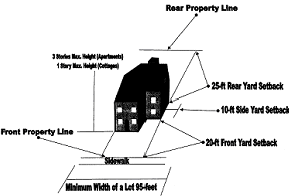
(1972 Code, sec. 30.609; 2008 Code, sec. 14.02.309)
Sec. 15.02.310 - "R-4" townhouse district
(a)
Purpose and description. The R-4 district is composed mainly of areas suitable for townhouse dwellings. The R-4 townhouse district implements the policies of the master plan by 1) protecting the residential character of the areas by prohibiting commercial and industrial activities; 2) encouraging a suitable neighborhood environment for family life; 3) preserving the openness of the area and the unique residential design of a townhouse, by requiring that certain minimum yard and area standards and building construction standard requirements are met; 4) recognizing that land is a valuable resource and is in short supply within the city; 5) encouraging a level of growth that provides housing opportunities to meet the different housing needs of all income types of the city's present and future populations.
(b)
Lot regulations.
(1)
Area. See density requirements.
(2)
Density. No development shall exceed a density of more than 20 units per acre, nor contain less than 10,000 square feet. The total dwelling units in any group of attached dwellings shall not be less than three.
(3)
Depth. The minimum depth of the lot shall be 120 feet.
(4)
Floor space. There shall be a total heated living area in each townhouse unit of not less than the following: One-story - 1,000 square feet; two- or three-story - 1,400 square feet.
(5)
Frontage. There shall be a minimum of 45 feet per lot of frontage on a public right-of-way.
(6)
Height. A maximum of three stories shall be allowed in the R-4 district.
(c)
Setback requirements.
(1)
Front yard. There shall be a front yard having a minimum depth of 30 feet, except as hereinafter provided.
(2)
Rear yard. A rear yard setback of 25 feet is required. A rear yard shall not be required when the townhouse lot abuts an alley or access easement having a minimum width of 24 feet which is used to provide ingress and egress to such townhouse development, except that a 25-foot setback is required if a garage entry is used. For townhouse lots that abut at the rear, an alley or access easement having a minimum width of 24 feet shall be required.
(3)
Side yard. A minimum of ten feet, or 25 feet if garage entry is used, shall separate any townhouse or garage structure from the property line that parallels the curb. Each corner lot shall have a side yard of at least 25 feet. No portion of a townhouse or accessory structure in, or related to, one group of contiguous townhouses shall be closer than ten feet to any portion of a townhouse or accessory structure related to another group. In cases of reversed frontage, a side yard equal, at least, to the depth of the front yard required for a structure fronting the side street shall be required. A side yard of ten feet shall be provided when townhouse lots abut a side lot line outside of the development.
(4)
Corner lot. Where lots abut on two intersecting or intercepting streets, where the interior angle of intersection or interception does not exceed 135 degrees, a side yard shall be provided on the street side equal to the front yard.
(5)
Reverse frontage. On corner lots, where interior lots have been platted or sold, fronting on the side street, a side yard shall be provided on the street side equal to the front yard on the lots in the rear. No accessory building on said corner lot shall project beyond the front line of the lots in the rear.
(d)
Other.
(1)
Accessory buildings. Shall be allowed, but shall be located no closer than five feet from any property line, and must be located in the rear yard. In no case shall an accessory building occupy more than 25 percent of the total open space in the rear yard.
(2)
Firewall. A two-hour rated firewall of materials and construction, as required by the currently adopted versions of the International building and fire codes, shall separate each adjacent townhouse unit. The firewall is to be constructed so as to be continuous from the foundation to the roof deck.
(3)
Landscaping. A total of 35 percent of street yard area must be landscaped. The use of drought tolerant turf grasses, such as zoysia or buffalo tif or combination, or other drought tolerant plantings and hardscape is strongly recommended. See appendix A for a list of trees, shrubs and plants suitable for the region. Also see division 9 of this article for other landscaping regulations.
(4)
Lighting. All outdoor lighting shall be hooded and all light emissions shielded, and shall be oriented such that light is directed towards the property and does not trespass onto surrounding properties. Lights affixed to the buildings shall be mounted no higher than the eaves of said building. Lights affixed to a pole shall be mounted no higher than 40 percent of the distance from the front property line to the main structure.
(5)
Masonry required. Townhouses shall be constructed of masonry or other similar noncombustible materials to the extent of not less than 75 percent of overall exterior walls.
(6)
Nonconforming dwellings. The provisions of this section shall not be applicable to nonconforming dwellings in existence on the date of the adoption thereof or to dwellings built hereafter on the same lot to replace such nonconforming dwellings as may be destroyed by fire, windstorm or other involuntary cause.
(7)
Parking. Two off-street parking spaces shall be provided for each separate townhouse unit. Garage areas shall not be counted as off-street parking areas. Each townhouse unit shall have at least one street curb parking area 20 feet long.
(8)
Public facilities. All townhouse developments shall be connected to the city's water and sewer system and shall be provided sidewalks and fire protection. See article 10.02 (subdivision ordinance).
(9)
Storage. Outside storage is not allowed in the R-4 district, with the exception of vehicles, trailers, recreational vehicles and boats in accordance with article 3.05 and article 12.03 of the Leon Valley City Code. Items to be stored must be completely contained in either the townhouse units, garage or an accessory building.
Figure 5 (R-4 Townhouse)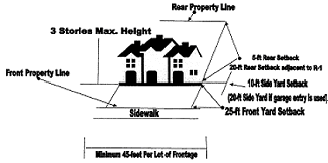
(1972 Code, sec. 30.610; 2008 Code, sec. 14.02.310)
Sec. 15.02.311 - "R-5" manufactured home district
(a)
Purpose and description. The R-5 district is composed of areas suitable for manufactured homes and manufactured home parks. The R-5 district implements the policies of the master plan by 1) providing adequate protection for both the manufactured home sites and surrounding developments; 2) protecting the residential character of the areas by prohibiting commercial and industrial activities; 3) encouraging a suitable neighborhood environment for family life; 4) providing alternative housing solutions; and 5) preserving the openness of the area and the unique residential design of a manufactured home development, by requiring that certain minimum yard and area standards are met.
(b)
Restrictions.
(1)
No land shall be used and no building shall be erected for or converted to any use other than manufactured home parks as defined and regulated in article 3.07 (manufactured home parks) of the Leon Valley City Code.
(2)
Reference is hereby made to article 3.07 (manufactured home parks) of the Leon Valley City Code (as cited above), and particularly to division 4 thereof, for other regulations pertaining to manufactured home parks. Area and other regulations applicable to permitted uses in this district, other than manufactured homes, shall be the same as provided for the R-3 district, as set out in this article.
(c)
Lot requirements.
(1)
Area. The total area of a manufactured home park shall be not less than four acres, with served manufactured home spaces.
(2)
Space requirements. Each manufactured home space shall provide a minimum area of 3,200 square feet, however, no manufactured home space shall have dimensions of less than 40 feet on the narrow dimension, nor 80 feet on the long dimension.
(d)
Setback requirements.
(1)
General. No manufactured home shall be closer than ten feet to any property line, nor closer than 25 feet to the property line adjoining a public or private street.
(2)
Front yard. A minimum of ten feet shall be provided, from the nearest corner of the manufactured home to the front line of the manufactured home space. For other structures on each space, a minimum front yard of ten feet shall be provided.
(3)
Rear yard. A minimum of 25 feet shall be provided.
(4)
Side yard. A minimum of 20 feet at any point shall be provided between each manufactured home. If the lot abuts on two streets, a side yard of ten feet shall be provided.
(5)
Corner lot. Where lots abut on two intersecting or intercepting streets, where the interior angle of intersection or interception does not exceed 135 degrees, a side yard shall be provided on the street side equal to the front yard.
(e)
Other.
(1)
Accessory buildings. Accessory buildings are allowed, but shall in no case consist of more than 20 percent of the total manufactured home space.
(2)
Landscaping. A total of 25 percent of street yard area must be landscaped. The use of drought tolerant turf grasses, such as zoysia or buffalo tif or combination, or other drought tolerant plantings and hardscape is strongly recommended. See appendix A for a list of trees, shrubs and plants suitable for the region. Also see division 9 of this article for other landscaping regulations.
(3)
Lighting. All outdoor lighting shall be hooded and all light emissions shielded, and shall be oriented such that light is directed towards the property and does not trespass onto surrounding properties. Lights affixed to the buildings and manufactured homes shall be mounted no higher than the eaves of said buildings or homes. Lights affixed to a pole shall be mounted no higher than 40 percent of the distance from the front property line to the main structure.
(4)
Masonry. Not required for a manufactured home, but that any permanent office, laundry or other facility shall consist of 75 percent masonry of overall exterior walls.
(5)
Parking. Two off-street parking spaces shall be provided for each manufactured home space, two spaces provided for each office, and five spaces for each laundry or other facility.
(6)
Public facilities. All R-5 developments shall be connected to the city's water and sewer system and shall provide sidewalks and fire protection, except as provided in article 10.02 (subdivision ordinance).
(7)
Recreational area. Not less than five percent of the total park area of the manufactured home park shall be devoted to recreational facilities.
(8)
Storage. Outside storage is not allowed in the R-5 district, with the exception of vehicles, trailers, recreational vehicles and boats in accordance with article 3.05 and article 12.03 of the Leon Valley City Code. All items to be stored must be completely contained in either a manufactured home, garage or other building.
Figure 6 (R-5 Manufactured Home)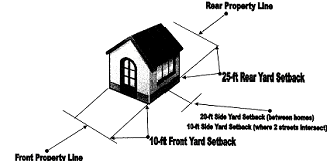
(1972 Code, sec. 30.611; 2008 Code, sec. 14.02.311)
Sec. 15.02.312 - "R-6" garden house district
(a)
Purpose and description. The R-6 district is composed mainly of areas containing single-family dwellings. The R-6 district regulations implement the policies of the master plan by 1) protecting the residential character of the areas by prohibiting commercial and industrial activities, apartments, two-family dwellings and manufactured homes; 2) encouraging a suitable neighborhood environment; 3) preserving the openness of the area by requiring that certain minimum yard and area standard requirements be met, however, with greater density being permitted than in the R-1 district.
(b)
Lot regulations.
(1)
Area of total development. Not less than three lots with common side lot lines will be zoned for "R-6" garden house. When facing on the same street within the same block, "R-1" single-family dwellings and "R-6" garden houses will not be mixed. However, this does not preclude "R-1" on one side of a street with an "R-6" on the opposite side of the street within the same block or different blocks.
(2)
Area of each lot. 4,500 square feet.
(3)
Depth. A minimum of 100 feet.
(4)
Floor space. There shall be a heated living area in each garden house of not less than the following: one story - 1,000 square feet; two story - 1,400 square feet; two and one-half story - 1,800 square feet. When "R-6" is mixed with "R-1" in the same subdivision, the average heated living area of "R-6" housing shall be at least 75 percent of the average size of the "R-1" structures, but in no event shall the minimum square footage be less than as described above.
(5)
Frontage. A minimum of 45 feet on a public right-of-way is required.
(6)
Height. A maximum of 2-1/2 stories is allowed.
(c)
Setback requirements.
(1)
Front yard. There shall be a front yard having a minimum depth of 20 feet, except as hereinafter provided.
(2)
Rear yard. There shall be a rear yard having a minimum depth of 15 feet except where the garage is entered from the rear in which case the minimum rear yard shall be 25 feet exclusive of the area used as a garage. Total square footage of accessory buildings exclusive of a detached garage shall not exceed 150 square feet.
(3)
Side yard. There shall be a side yard on each side of all lots of not less than five feet, except on corner lots on which external side yard shall not be less than ten feet. Alternatively, one side yard may be reduced to zero feet provided the other side yard is increased to ten feet. However, in no event shall the outside walls of a structure be closer than ten feet to the outside walls of a structure built on an adjacent lot.
(4)
Zero lot line exterior wall. When a structure is built with a side yard of zero feet, no windows or doors will be built into an exterior side wall so situated. In addition, a six-foot privacy fence will be constructed and maintained by the owner from the rear-most point of such an exterior wall to the rear lot line of the property.
(5)
Corner lot. Where lots abut on two intersecting or intercepting streets, where the interior angle of intersection or interception does not exceed 135 degrees, a side yard shall be provided on the street side equal to the front yard.
(6)
Double frontage. Where lots front upon two parallel streets or front upon two streets that do not intersect at the boundaries of the lot, a rear yard shall be provided on the street side equal to the front yard.
(7)
Reverse frontage. On corner lots, where interior lots have been platted or sold, fronting on the side street, a side yard shall be provided on the street side equal to the front yard on the lots in the rear. No accessory building on said corner lot shall project beyond the front line of the lots in the rear.
(d)
Other.
(1)
Accessory building. Shall be allowed, but shall be located no closer than five feet from any property line, and must be located in the rear yard. In no case shall an accessory building occupy more than 20 percent of the total open space in the rear yard.
(2)
Landscaping. A total of 35 percent of street yard area must be landscaped. The use of drought tolerant turf grasses, such as zoysia or buffalo tif or combination, or other drought tolerant plantings and hardscape is strongly recommended.
(3)
Lighting. All outdoor lighting shall be hooded and all light emissions shielded, and shall be oriented such that light is directed towards the property and does not trespass onto surrounding properties. Lights affixed to the buildings shall be mounted no higher than the eaves of said building. Lights affixed to a pole shall be mounted no higher than 40 percent of the distance from the front property line to the main structure.
(4)
Masonry required. Garden houses shall be constructed of masonry or other similar noncombustible materials to the extent of not less than 75 percent of overall exterior walls.
(5)
Nonconforming dwellings. The provisions above shall not be applicable to nonconforming dwellings in existence on the date of the adoption thereof or to dwellings built hereafter on the same lot to replace such nonconforming dwellings as may be destroyed by fire, windstorm or other involuntary cause.
(6)
Parking. A total of two off-street parking spaces shall be provided.
(7)
Public facilities. "R-6" garden houses are permitted only on lots that are connected to the city's water and public sewage disposal system and must conform to the regulations in article 10.02 (subdivision ordinance).
(8)
Storage. Outside storage is not allowed in the R-6 district, with the exception of vehicles, trailers, recreational vehicles and boats in accordance with article 3.05 and article 12.03 of the Leon Valley City Code. Items to be stored shall be completely contained in either the main structure, garage or an accessory building.
Figure 7 (R-6 Garden Home)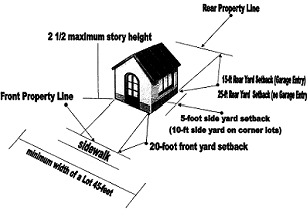
(1972 Code, sec. 30.612; 2008 Code, sec. 14.02.312)
Sec. 15.02.313 - "R-7" single-family medium density dwelling
(a)
Purpose and description.
(1)
This district provides areas for other forms of medium density single-family uses which provide a buffer between agricultural and higher density areas of the city. Minimum lot size requirements are provided in order to allow for market and design flexibility while preserving neighborhood character. The district regulations are designed to encourage a suitable neighborhood environment for family life by including among the permitted uses such facilities as libraries, and neighborhood recreation centers. The district regulations are designed to: (1) protect the residential character of the areas by prohibiting commercial and industrial activities; (2) encourage a suitable neighborhood environment; and (3) preserve the openness of the area by requiring that certain minimum yard and area standard requirements are met.
(2)
The R-7 district implements the following policies of the master plan:
(A)
Encourage patterns of urban development that provide a full range of housing choices and promote a sense of community, urban vitality and the efficient provision of infrastructure.
(B)
Encourage connectivity throughout the city.
(b)
Lot regulations.
(1)
Area. Lots must have a minimum area of 6,050 square feet.
(2)
Frontage. Minimum frontage of 55 feet along a public right-of-way.
(3)
Depth. Minimum of 110 feet.
(4)
Floor space. Minimum floor space of 1,200 square feet of heated living space shall be provided in each one-story dwelling, 1,400 square feet for each two-story dwelling.
(5)
Height. Maximum of 2-1/2 stories allowed.
(c)
Setback requirements.
(1)
Front yard. There shall be a front yard having a minimum of 20 feet from front property line to main structure.
(2)
Rear yard. There shall be a rear yard of not less than 15 feet from rear property line to rear of main structure.
(3)
Side yard. There shall be a side yard of not less than five feet from side property line to main structure. On corner lots the external side yard shall be not less than ten feet, unless there is a side entry garage, then the side setback shall be 20 feet.
(4)
Corner lot. Where lots abut on two intersecting or intercepting streets, where the interior angle of intersection or interception does not exceed 135 degrees, a side yard shall be provided on the street side equal to the front yard.
(5)
Reverse frontage. On corner lots, where interior lots have been platted or sold, fronting on the side street, a side yard shall be provided on the street side equal to the front yard on the lots in the rear. No accessory building on said corner lot shall project beyond the front line of the lots in the rear.
(d)
Other.
(1)
Accessory buildings. Shall be allowed, but shall be located no closer than five feet from any property line, and must be located in the rear yard. In no case shall an accessory building occupy more than 25 percent of the total open space in the rear yard.
(2)
Landscaping. The use of drought tolerant turf grasses, such as zoysia or buffalo tif or combination, or other drought tolerant plantings and hardscape is strongly recommended. See division 9 of this article for other landscaping requirements.
(3)
Lighting. All outdoor lighting shall be hooded and all light emissions shielded, and shall be oriented such that light is directed towards the property and does not trespass onto surrounding properties. Lights affixed to the buildings shall be mounted no higher than the eaves of said building. Lights affixed to a pole shall be mounted no higher than 40 percent of the distance from the front property line to the main structure.
(4)
Masonry required. A minimum of 75 percent of total overall exterior walls shall be constructed of masonry, or other similar noncombustible materials.
(5)
Parking. Two off-street parking spaces shall be provided for each residential structure.
(6)
Public facilities. Each lot shall be connected to the city's public water and sewer system, and shall have appropriate sidewalks and fire protection. See article 10.02 (subdivision ordinance).
(7)
Storage. Outside storage is not allowed in the R-7 district, with the exception of vehicles, trailers, recreational vehicles and boats in accordance with article 3.05 and article 12.03 of Leon Valley City Code. All items to be stored must be completely contained in either the main structure, garage or an accessory building.
(Ordinance 07-054, sec. 3, adopted 11-5-07; 2008 Code, sec. 14.02.313)
Sec. 15.02.314 - Residential use table
P - Allowed by right
X - Not allowed
(1972 Code, sec. 30.613; 2008 Code, sec. 14.02.314; Ordinance 2018-89 adopted 12-4-18; Ord. No. 2021-20, § 1, 4-20-2021; Ord. No. 2021-30, § 1, 7-20-2021; Ord. No. 2021-61, § 1, 12-7-2021)
Editor's note— Ord. No. 2021-61, § 2, adopted December 7, 2021, amended the Code by adding "accessory dwelling unit" to section 15.02.381. Instead, said provisions have been added to section 15.02.314 at the discretion of the editor.
Sec. 15.02.315 - Home occupations
(a)
Purpose and description.
Home occupation regulations.
(1)
General. Home occupations shall be permitted in all residential zoning districts, provided the home occupation is clearly and obviously subordinate to the main use or dwelling unit for residential purposes. Home occupations shall be conducted wholly within the primary structure or existing accessory building which is on the premises.
(2)
Conditions.
(A)
Area. Not to exceed 25 percent of the floor area of the primary structure or 50 percent of all accessory buildings on the premises.
(B)
Personnel. Other than those related by blood, marriage or adoption, no more than one person, other than the owner, can be employed in the home occupation;
(C)
Inventory and supplies. Shall not occupy more than 50 percent of the area permitted to be used as a home occupation;
(D)
Outside display/storage. None allowed;
(E)
Signage. The home occupation shall not involve the use of advertising signs on the premises or any other advertising media which calls attention to the fact that the dwelling unit is being used for a home occupation, with the exception of a telephone number listing and one nameplate, not exceeding one square foot in area, provided the nameplate is nonilluminated and attached flat to the dwelling unit or visible through a window;
(F)
Prohibited home occupations. Auto repair or maintenance, beauty culture schools, beauty parlors, barbershops, electricians, plumbers, sheetmetal shops, furniture repair, sexually oriented commercial enterprises, catering or other similar uses, shall not be allowed. The use of electrical or mechanical equipment that would change the fire rating of the dwelling or create visible or audible interference in radio or television receivers or cause fluctuations in line voltage outside the dwelling unit is prohibited; and/or the home occupation shall not involve the use of commercial vehicles for delivery of materials to and from the premises, nor shall any commercial vehicles be stored at the residence;
(G)
Child care facilities. The care for payment of more than six unrelated children shall require a specific use permit;
(H)
Parking. Sales and services to patrons shall be arranged by appointment and scheduled so that not more than one patron vehicle is on the premises at the same time; two additional parking spaces shall be provided on the premises, except only one need be provided if the home occupation does not have an employee;
(I)
Appearance. The dwelling unit shall not be altered nor shall the home occupation be conducted in a manner which would cause the premises to differ from its residential character either by the use of colors, materials, construction, lighting, signs, increased traffic or the emission of odors, sounds or vibrations.
(1972 Code, sec. 30.614; 2008 Code, sec. 14.02.315)
Sec. 15.02.316 - Child care facilities
Child care is allowed by right in residential zoning districts, if the number of children being cared for does not exceed six children. Various options are hereby adopted which shall apply partially or totally to the operation of a child care facility, nursery or kindergarten, in a residential zone. The following conditions are adopted:
(1)
No construction features shall be permitted which would place structure out of character with the surrounding neighborhood;
(2)
The child care facility shall be registered and/or licensed and the operator shall be approved by the Texas Department of State Health Services (TDSHS) when such licensing and/or approval is available from TDSHS. Proof of said licensing/approval by TDSHS and any other state agency which regulates child care operators is a requirement for obtaining a permanent certificate of occupancy;
(3)
A specific use permit "SUP" is required for the operation of any child care facility in residential districts if the number of children being cared for is more than six (see table of permitted uses).
(4)
A certificate of occupancy is required for operation of a child care facility in a residence where more than six children are being cared for, for a fee;
(5)
In residential districts, the child care facility will be clearly incidental to the residential use of the dwelling and shall not change the essential residential character of the dwelling (refer to home occupation regulations);
(6)
In residential districts, the operator of the child care facility must reside on subject property;
(7)
In residential districts, hours of operation shall not be permitted before 6:30 a.m. or after 7:30 p.m.;
(8)
In residential districts, the child care facility shall be located within the main structure on the lot, and the lot [the facility] shall not utilize more than 75 percent of the gross floor area of the main structure.
(1972 Code, sec. 30.615; 2008 Code, sec. 14.02.316)
Sec. 15.02.317 - Adult care facilities
Adult care facilities are allowed by right in residential zoning districts, if the number of adults being cared for does not exceed six persons. Various options are hereby adopted which shall apply partially or totally to the operation of an adult care facility in a residential zone. The following conditions are adopted:
(1)
No construction features shall be permitted which would place structure out of character with the surrounding neighborhood;
(2)
The adult care facility shall be registered and/or licensed and the operator shall be approved by the Texas Department of State Health Services (TDSHS) when such licensing and/or approval is available from TDSHS. Proof of said licensing/approval by TDSHS and any other state agency which regulates adult care operators is a requirement for obtaining a permanent certificate of occupancy;
(3)
A specific use permit "SUP" is required for the operation of any adult care facility in residential districts if the number of adults being cared for is more than six (see table of permitted uses).
(4)
A certificate of occupancy is required for operation of an adult care facility;
(5)
In residential districts, the adult care facility will be clearly incidental to the residential use of the dwelling and shall not change the essential residential character of the dwelling (refer to home occupation regulations);
(6)
In residential districts, the operator of the adult care facility must reside on subject property;
(7)
In residential districts, hours of operation shall not be permitted before 6:30 a.m. or after 7:30 p.m.;
(8)
In residential districts, the adult care facility shall be located within the main structure on the lot, and the lot [the facility] shall not utilize more than 75 percent of the gross floor area of the main structure.
(1972 Code, sec. 30.616; 2008 Code, sec. 14.02.317)
Sec. 15.02.318 - "MX-1" mixed use district
(a)
Purpose and description. The purpose of the MX-1 district is to concentrate various mixed uses into an area such that residential housing related to the allowed business activities is within a reasonable walking distance from the job opportunity. It is intended that the district have a unique character created by the mix of zoning uses allowed together with identifiable pedestrian, social, recreational and green space areas. Another unique character intended is the absence (or reduction) of on-site parking areas and the use of common parking areas. The mixed uses may be created vertically in a multi-story building or spaced horizontally. This special district may be created altogether new or by proximity to existing structures and uses. Municipal participation may be created as a central recreational or promotional feature in the district.
(b)
Locational criteria. An MX district may be designated for areas:
(1)
With an existing mix of retail, office, service and residential uses located within one-quarter mile of each other; or
(2)
On a tract or parcel of at least five acres in size, for which a mixed-use development is proposed.
(c)
Sub-areas. The site shall be divided into the following sub-areas:
(1)
A "center" consisting of retail, civic, professional office; service and multifamily uses.
(A)
The center shall have a minimum area of 3,000 square feet.
(B)
The center shall be located on a commercial standard street.
(C)
Each center shall face or surround a community gathering area (plaza).
(D)
The center shall be connected to adjacent streets, crosswalks or lanes that provide access to dwelling units.
(2)
A "neighborhood" or series of neighborhoods, consisting of multifamily or single-family uses, small-scale retail and service uses, and public outdoor gathering areas. Each multifamily unit containing more than 250 units shall have not less than 600 square feet per dwelling unit. All areas of a neighborhood should be within a ten-minute walk from edge to edge. A neighborhood shall not be less than five nor more than ten acres in size.
(3)
Parks and open spaces, including a plaza and a greenbelt area shall be provided. The plaza shall serve as a community focal point and public gathering area. The greenbelt shall provide an identifiable edge to the district, open space for residents and natural areas. Stormwater management must be considered.
(4)
Landscaping, using drought tolerant, hard and softscape materials shall be provided for each of the uses in the district.
(d)
Density. The application for a MX-1 mixed use district shall include a master development plan layout that shall set forth the number of units per gross residential acre and the total number of dwelling units. The development plan shall show all uses intended and features such as landscape, sidewalks, lanes and streets that demonstrate that the plan accomplishes the purposes and intentions of this document. The development plan shall be subject to review by the fire marshal, city engineer and building inspector and shall otherwise conform to the codes and ordinances of the city.
(e)
Abutting uses. Subject to review by the city engineer, different uses may abut on the side or rear lot lines, or face across streets or parks, regardless of whether they are in the same or different land use category. Retail or service uses may abut single-family uses only where the retail or service use is located at the intersection of a main street, boulevard or avenue.
(f)
Use matrix. The use matrix is not applicable to the MX-1 district provided that no building permit shall be issued unless the requested use conforms to a master development plan approved as a part of rezoning to an MX-1 district. If an MX-1 district is not approved pursuant to a rezoning request, permitted uses shall abide by the individual zoning district regulations.
Figure 8 (MX Mixed Use)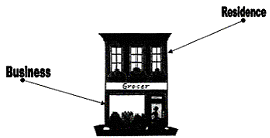
(1972 Code, sec. 30.617; 2008 Code, sec. 14.02.318)
Sec. 15.02.319 - "O-1" office district
(a)
Purpose and description. The O-1 district is composed mainly of land and structures occupied by, or suitable for, office uses, while excluding offices which are incidental to a primary use. The district regulations are designed to protect the character of the residential areas by regulating unenclosed activities or uses, which could intrude upon the lifestyle of the community through inappropriate lighting, noise, vibration, smoke, dust, or pollutants. The district regulations implement the policies of the master plan by the following:
(1)
Protecting residential areas; and
(2)
Encouraging the transitional character of certain land parcels by permitting a limited group of office uses that are compatible with adjoining residential properties.
(b)
Height, area and lot regulations.
(1)
Lot area. Except as hereinafter provided, all structures hereafter erected, enlarged, relocated, reconstructed, or converted, shall be located upon lots containing the following areas: A lot on which there is erected or converted an office shall contain an area of not less than 8,400 square feet for one unit, 10,000 square feet for the first two units and 1,200 square feet for each additional unit.
(2)
Lot frontage. There shall be a minimum frontage of 70 feet along a public right-of-way.
(3)
Minimum depth. Minimum of 120 feet.
(4)
Floor space. None.
(5)
Masonry required. Office buildings shall be constructed of masonry or similar noncombustible materials to the extent of not less than 75 percent of overall exterior walls.
(6)
Height. There shall be a maximum of 2-1/2 stories allowed in the O-1 district.
(c)
Setback requirements.
(1)
Front yard. There shall be a front yard having a minimum of 20 feet from the property line to the building structure.
(2)
Rear yard. There shall be a rear yard having a minimum of 25 feet from the structure to the rear property line.
(3)
Side yard. There shall be a side yard having a minimum of ten feet from the structure to the side property line.
(4)
Corner lot. On any corner lot on which a front yard is required by this article, no wall, fence or other structure shall be erected and no hedge, shrub, tree or other growth shall be maintained within the triangular area formed by the intersecting street lines and a straight line connecting such street lines at points 25 feet from the point of intersection, measured along such street lines.
(5)
Landscaping. The use of drought tolerant turf grasses, such as zoysia or buffalo tif or combination, or other drought tolerant plantings and hardscape is strongly recommended. Building(s) for which 60 percent or more of the available interior space is used or proposed to be used for office shall provide 20 percent.
(6)
Lighting. All outdoor lighting shall be hooded and all light emissions shielded, and shall be oriented such that light is directed towards the property and does not trespass onto surrounding properties. Lighting facilities shall be arranged so as to reflect the illumination away from any residentially zoned property. All lighting facilities shall be placed, masked or otherwise arranged such that illumination or glare shall not create a hazard to motorists on any street, alley or other public way. Lights affixed to the buildings shall be mounted no higher than the eaves of said building. Lights affixed to a pole shall be mounted no higher than 40 percent of the distance from the front property line to the main structure.
(7)
Nonconforming structures. The provisions above shall not be applicable to nonconforming dwellings in existence on the date of the adoption thereof or to structures built hereafter on the same lot to replace such nonconforming structures as may be destroyed by fire, windstorm or other involuntary cause.
(8)
Public facilities. Each lot shall be connected to the city's public water and sewer system and shall have appropriate sidewalks and fire protection. See article 10.02 (subdivision ordinance).
(9)
Outside storage. There shall be no outside display or storage of any retail merchandise, equipment, or other business related items, all business activities must be conducted within an enclosed structure, there shall be no outside service or repair of any kind or nature, and there shall be no outside entertainment.
Figure 9 (O-1 Office)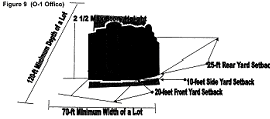
(1972 Code, sec. 30.618; 2008 Code, sec. 14.02.319)
Sec. 15.02.320 - "B-1" small business district
(a)
Purpose.
(1)
The B-1 district is composed of land and structures occupied or suitable for such uses as offices, light service, and light retail. B-1 uses are usually located between residential areas and business areas, and there is no outside storage allowed. The district regulations implement the policies of the master plan by 1) protecting and encouraging the transitional character of certain areas by permitting a limited group of uses of an office, service or retail nature to provide goods and services to surrounding residential districts; and 2) protecting surrounding districts by requiring certain minimum yard and area standard requirements that are compatible with those essential in residential districts.
(2)
A B-1 small business is a completely enclosed business not exceeding 3,000 square feet of gross floor area (GFA), where the primary use specifically meets one or more of the following, and no ancillary use conflicts herewith:
(A)
A retail facility for the purpose of the sale or lease of personal, novelty, or household items, not including the sale of, appliances, firearms, vehicles, vehicle parts, or wholesale items;
(B)
A repair facility for the purpose of repair or maintenance of personal, novelty, or household items, not including vehicles, machinery, or appliances;
(C)
A service facility for the purpose of providing a service to surrounding districts, but not including vehicle, cremation, embalming, or any service in which there may be disposal, storage, or use of any federally or state regulated chemical, even if incidental to the primary use.
(D)
Professional offices.
(E)
Low density residential uses are allowed in B-1 (small business) districts.
(b)
Height, area and lot regulations.
(1)
Structures. Every building hereafter erected shall be located on a lot as herein defined and in no case shall there be more than one building on one lot in the "R-1", "R-2" or "B-1" districts, or as otherwise provided herein, and in no case shall any building be hereafter erected on more than one lot.
(2)
Lot area. There shall be a minimum area of 8400 square feet.
(3)
Lot frontage. There shall be a minimum frontage of 70 feet along a public right-of-way.
(4)
Minimum depth. There shall be a minimum of 120 feet.
(5)
Floor space. A minimum floor space of 1,200 square feet of heated living space shall be provided in each one-story structure and 1,400 square feet for each two-story structure. In no case shall there be any structure with over 3,000 square feet in the B-1 district.
(6)
Masonry required. A minimum of 75 percent of total overall exterior walls shall be constructed of masonry, or other similar noncombustible materials.
(7)
Height. There shall be a maximum of 2-1/2 stories allowed.
(c)
Setback requirements.
(1)
Front yard. There shall be a front yard having a minimum of 25 feet from the front property line to the structure.
(2)
Rear yard. There shall be a rear yard of not less than 30 feet from rear property line to rear of main structure.
(3)
Side yard. There shall be a side yard of not less than ten feet from side property line to structure.
(4)
Corner lot. Where lots abut on two intersecting or intercepting streets, where the interior angle of intersection or interception does not exceed 135 degrees, a side yard shall be provided on the street side equal to the front yard.
(5)
Reverse frontage. On corner lots, where interior lots have been platted or sold, fronting on the side street, a side yard shall be provided on the street side equal to the front yard on the lots in the rear. No accessory building on said corner lot shall project beyond the front line of the lots in the rear.
(6)
Accessory buildings. Shall be allowed, but shall be located no closer than five feet from any property line, and must be located in the rear yard. In no case shall an accessory building occupy more than 25 percent of the total open space in the rear yard.
(7)
Landscaping. The use of drought tolerant turf grasses, such as zoysia or buffalo tif or combination, or other drought tolerant plantings and hardscape is strongly recommended. Landscaping shall consist of 20 percent of the street yard. Refer to division 9 of this article, "Landscaping," for other regulations regarding site landscaping requirements.
(8)
Lighting. All outdoor lighting shall be hooded and all light emissions shielded, and shall be oriented such that light is directed towards the property and does not trespass onto surrounding properties. Lighting facilities shall be arranged so as to reflect the illumination away from any residentially zoned property. All lighting facilities shall be placed, masked or otherwise arranged such that illumination or glare shall not create a hazard to motorists on any street, alley or other public way. Lights affixed to the buildings shall be mounted no higher than the eaves of said building. Lights affixed to a pole shall be mounted no higher than 40 percent of the distance from the front property line to the main structure.
(9)
Nonconforming structures. The provisions of floor space and masonry above shall not be applicable to nonconforming structures in existence on the date of the adoption thereof or to structures built hereafter on the same lot to replace such nonconforming structures as may be destroyed by fire, windstorm or other involuntary cause.
(10)
Parking. Refer to parking table and site requirements.
(11)
Public facilities. Each lot shall be connected to the city's public water and sewer system, and shall have appropriate sidewalks and fire protection. See article 10.02 (subdivision ordinance).
(12)
Outside storage. There shall be no outside display or storage of any retail merchandise, equipment, or other business related items, all business activities must be conducted within an enclosed structure, there shall be no outside service or repair of any kind or nature, and there shall be no outside entertainment.
Figure 10 (B-1 Small Business)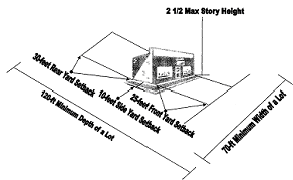
(1972 Code, sec. 30.619; 2008 Code, sec. 14.02.320)
Sec. 15.02.321 - "B-2" retail district
(a)
Purpose and description.
(1)
The B-2 district is composed of land and structures occupied by or suitable for the furnishing of retail goods and services to surrounding residential areas. The B-2 district is intended to allow a limited amount of outside storage of retail merchandise. The district regulations implement the policies of the master plan by 1) promoting the offering of goods and services which are appropriate for surrounding business districts; 2) protecting surrounding residential districts by requiring certain minimum yard and area standards are met; 3) encouraging economic viability and stability within the city.
(2)
A general description of a "B-2" retail use is a business where the primary use specifically meets one or more of the following, and no ancillary use conflicts herewith:
(A)
A retail facility the purpose of which is the sale or lease of personal, novelty, food, alcohol or household items, not including the sale or lease of vehicles, firearms, or wholesale items, with incidental alcohol consumption allowed on-site;
(B)
A repair facility the purpose of which is the repair or maintenance of personal, novelty, or household items, including minor appliances, but not including vehicles, machinery or major appliances; and/or
(C)
A service facility the purpose of which is providing a service to surrounding districts, including food services if incidental to the primary use, but not including vehicle, cremation, embalming, or any service in which there may be disposal, storage, or use of any federally or state regulated chemical, even if incidental to the primary use.
(b)
Outside storage regulations.
(1)
There shall be no outside storage of any retail or nonretail merchandise, equipment, or other business related items, specifically including six or more business related vehicles and/or any customer vehicles which remain on the property beyond the normal business hours of operation.
(2)
A limited amount of outside display is allowed in the B-2 district, including display of plants for sale, display of lawn furnishings for sale, and occasional display of new goods for sale. These items are to be on display for retail purposes only, and shall only be displayed at such times as the store is actually open for business;
(3)
There shall be no outside service or repair allowed in the B-2 district, except for food services, and alcohol services if ancillary to food services, but these must meet the requirements of article 3.05 of the Leon Valley City Code regarding screening requirements.
(c)
Height, area and lot requirements.
(1)
Lot area. There shall be a minimum area of 9,000 square feet.
(2)
Lot frontage. There shall be a minimum frontage of 70 feet along a public right-of-way.
(3)
Minimum depth. There shall be a minimum of 130 feet.
(4)
Masonry required. None.
(5)
Height. There shall be a maximum of three stories allowed.
(d)
Setback requirements.
(1)
Front yard. There shall be a front yard having a minimum of 25 feet from the front property line to the structure.
(2)
Rear yard. None, except in those instances where the retail lot adjoins residential zoning to the rear, a rear yard of 25 feet or 20 percent of the average depth of the lot (whichever is less) shall be provided. In both cases, if the two districts are separated by an alley, said alley is not to be used for purposes of calculating the required setback and the building setbacks are required as if the lots adjoined the residential zoning district.
(3)
Side yard. None, except in those instances where the property adjoins a residential property to the side, then a side yard of 20 feet shall be provided.
(4)
Corner lot. Where lots abut on two intersecting or intercepting streets, where the interior angle of intersection or interception does not exceed 135 degrees, a side yard shall be provided on the street side of 20 feet.
(5)
Landscaping. The use of drought tolerant turf grasses, such as zoysia or buffalo tif or combination, or other drought tolerant plantings and hardscape is strongly recommended. Landscaping shall consist of 20 percent of the street yard. Refer to landscaping section (section 15.02.501) for other regulations regarding site landscaping requirements.
(6)
Lighting. All outdoor lighting shall be hooded and all light emissions shielded, and shall be oriented such that light is directed towards the property and does not trespass onto surrounding properties. Lighting facilities shall be arranged so as to reflect the illumination away from any residentially zoned property. All lighting facilities shall be placed, masked or otherwise arranged such that illumination or glare shall not create a hazard to motorists on any street, alley or other public way.
(7)
Parking. Refer to parking table for site parking requirements.
(8)
Public facilities. Each lot shall be connected to the city's public water and sewer system, and shall have appropriate sidewalks and fire protection. See article 10.02 (subdivision ordinance).
(9)
Nonconforming structures. The provisions of floor space and masonry above shall not be applicable to nonconforming structures in existence on the date of the adoption thereof or to structures built hereafter on the same lot to replace such nonconforming structures as may be destroyed by fire, windstorm or other involuntary cause.
Figure 11 (B-2 Retail)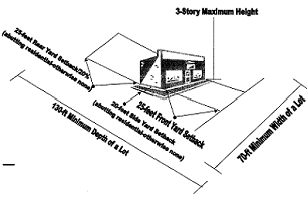
(1972 Code, sec. 30.620; 2008 Code, sec. 14.02.321)
Sec. 15.02.322 - "B-3" commercial district
(a)
Purpose and description.
(1)
The B-3 district is composed of land and structures used to furnish commercial needs, wholesale services, and some light assembling of goods, in addition to most of the uses found in the B-2 district. The B-3 district regulations are designed to protect the character of the residential areas by regulating unenclosed activities or uses, which could intrude upon the lifestyle of the community through inappropriate lighting, noise, vibration, smoke, dust, or pollutants. The district regulations implement the policies of the master plan by 1) permitting the development of districts for the purpose of providing commercial and wholesale uses; 2) protecting surrounding and abutting areas by requiring certain minimum yard and area standards are met; and 3) encouraging economic viability and stability in the city.
(2)
A B-3 use is a business where the primary use specifically meets one or more of the following, and no ancillary use conflicts herewith:
(A)
A retail facility the purpose of which is the sale or lease of personal, novelty, food, household, or business items, including wholesale;
(B)
A repair facility the purpose of which is the repair or maintenance of personal, novelty, or household items, including appliances and vehicles; and/or
(C)
A service facility the purpose of which is providing a service to surrounding districts.
(D)
Although it may occur in certain instances, it is not intended that the B-3 district abut R-1, R-2, R-4 or R-6 districts.
(b)
Outside storage regulations.
(1)
Outside display of retail merchandise is allowed in a B-3 district.
(2)
Outside storage of retail merchandise is allowed in a B-3 district only if such merchandise is screened in accordance with article 3.05 of the Leon Valley City Code.
(3)
Outside storage of nonretail equipment, vehicles, including the vehicles of any customers which remain on the property beyond the normal hours of operation, or other business related items, or any hazardous or toxic chemicals or substances shall be allowed in the B-3 district, only with a specific use permit.
(4)
A limited amount of outside repair or service is allowed in the B-3 district, but only with a specific use permit, except that food services shall not require a specific use permit, however, they must meet the requirements of article 3.05 of the Leon Valley City Code regarding screening requirements.
(c)
Lot requirements.
(1)
Lot area. There shall be a minimum lot area of 9,100 square feet.
(2)
Lot frontage. There shall be a minimum frontage of 70 feet along a public right-of-way.
(3)
Minimum depth. There shall be a minimum of 130 feet.
(4)
Masonry required. None.
(5)
Height. None.
(d)
Setback requirements.
(1)
Front yard. There shall be a front yard having a minimum of 25 feet from the front property line to the structure.
(2)
Rear yard. None, except in those instances where the retail lot adjoins residential zoning to the rear, a rear yard of 25 feet or 20 percent of the average depth of the lot (whichever is less) shall be provided. In both cases, if the two districts are separated by an alley, said alley is not to be used for purposes of calculating the required setback and the building setbacks are required as if the lots adjoined the residential zoning district.
(3)
Side yard. None, except in those instances where the property adjoins a residential property to the side, then a side yard of 20 feet shall be provided.
(4)
Corner lot. Where lots abut on two intersecting or intercepting streets, where the interior angle of intersection or interception does not exceed 135 degrees, a side yard shall be provided on the street side of 20 feet.
(5)
Landscaping. The use of drought tolerant turf grasses, such as zoysia or buffalo tif or combination, or other drought tolerant plantings and hardscape is strongly recommended. Landscaping shall consist of 20 percent of the street yard. Refer to landscaping section (section 15.02.501) for other regulations regarding site landscaping requirements.
(6)
Lighting. All outdoor lighting shall be hooded and all light emissions shielded, and shall be oriented such that light is directed towards the property and does not trespass onto surrounding properties. Lighting facilities shall be arranged so as to reflect the illumination away from any residentially zoned property. All lighting facilities shall be placed, masked or otherwise arranged such that illumination or glare shall not create a hazard to motorists on any street, alley or other public way.
(7)
Parking. Refer to parking table for site parking requirements.
(8)
Public facilities. Each lot shall be connected to the city's public water and sewer system, and shall have appropriate sidewalks and fire protection. See article 10.02 (subdivision ordinance).
(9)
Nonconforming structures. The provisions of floor space and masonry above shall not be applicable to nonconforming structures in existence on the date of the adoption thereof or to structures built hereafter on the same lot to replace such nonconforming structures as may be destroyed by fire, windstorm or other involuntary cause.
Figure 12 (B-3 Commercial)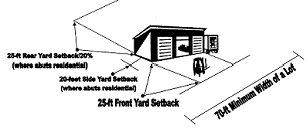
(1972 Code, sec. 30.621; 2008 Code, sec. 14.02.322)
Sec. 15.02.323 - "I-1" industrial district
(a)
Purpose and description.
(1)
The I-1 district is composed of land and structures used for assembling, manufacturing or wholesaling where the use and its operation do not affect abutting and/or surrounding uses. The district regulations are designed to allow a wide range of industrial activities subject to limitations designed for mutual protection of land use. The I-1 district includes retail and commercial uses; however, I-1 districts are to be separated from residential areas by business areas or natural and/or man-made barriers. The district regulations implement the policies of the master plan by 1) protecting the character of the business and residential areas by regulating unenclosed activities or uses, which could intrude upon the lifestyle of the community through inappropriate lighting, noise, vibration, smoke, dust, or pollutants; 2) encouraging economic viability and stability in the city.
(2)
An I-1 business is a business where the primary use specifically meets one or more of the following, and no ancillary use conflicts herewith:
(A)
A repair facility the purpose of which is the repair and maintenance of goods, including vehicles;
(B)
A service facility the purpose of which is providing a service to surrounding districts including vehicle and alcohol services; and/or
(C)
A facility the purpose of which is the assembling, manufacturing, compounding, processing, packaging or testing of goods or equipment within an enclosed area, serviced by trucks or vans and imposing a negligible impact on the surrounding environment by noise, vibration, smoke, dust or pollutants.
(b)
Outside display and storage regulations.
(1)
Outside display of retail merchandise is allowed in an I-1 district.
(2)
Outside storage of retail merchandise is allowed in an I-1 district only if such merchandise is screened in accordance with article 3.05 of the Leon Valley City Code.
(3)
Outside storage of nonretail equipment, vehicles, or other business related items, shall be allowed as long as the requirements of article 3.05 of this Code are met.
(4)
Any business activity not conducted in an enclosed structure must have appropriate screening, as required by article 3.05 of the Leon Valley City Code.
(c)
Lot requirements.
(1)
Lot area. There shall be a minimum area of 10,500 square feet.
(2)
Lot frontage. There shall be a minimum frontage of 70 feet along a public right-of-way.
(3)
Minimum depth. There shall be a minimum of 150 feet in depth of the lot.
(4)
Masonry required. None.
(5)
Height. No limit to height in this district.
(d)
Setback requirements.
(1)
Front yard. There shall be a front yard having a minimum of 25 feet from the front property line to the structure.
(2)
Rear yard. None, except in those instances where the retail lot adjoins residential zoning to the rear, a rear yard of 25 feet or 20 percent of the average depth of the lot (whichever is less) shall be provided. In both cases, if the two districts are separated by an alley, said alley is not to be used for purposes of calculating the required setback and the building setbacks are required as if the lots adjoined the residential zoning district.
(3)
Side yard. None, except in those instances where the property adjoins a residential property to the side, then a side yard of 20 feet shall be provided.
(4)
Corner lot. Where lots abut on two intersecting or intercepting streets, where the interior angle of intersection or interception does not exceed 135 degrees, a side yard shall be provided on the street side of 20 feet.
(5)
Landscaping. The use of drought tolerant turf grasses, such as zoysia or buffalo tif or combination, or other drought tolerant plantings and hardscape is strongly recommended. Landscaping shall consist of 12 percent of the street yard. Refer to landscaping section (section 15.02.501) for other regulations regarding site landscaping requirements.
(6)
Lighting. All outdoor lighting shall be hooded and all light emissions shielded, and shall be oriented such that light is directed towards the property and does not trespass onto surrounding properties. Lighting facilities shall be arranged so as to reflect the illumination away from any residentially zoned property. All lighting facilities shall be placed, masked or otherwise arranged such that illumination or glare shall not create a hazard to motorists on any street, alley or other public way.
(7)
Parking. Refer to parking table and regulations for site parking requirements.
(8)
Public facilities. Each lot shall be connected to the city's public water and sewer system, and shall have appropriate sidewalks and fire protection. See article 10.02 (subdivision ordinance).
(9)
Nonconforming structures. The provisions of floor space and masonry above shall not be applicable to nonconforming structures in existence on the date of the adoption thereof or to structures built hereafter on the same lot to replace such nonconforming structures as may be destroyed by fire, windstorm or other involuntary cause.
Figure 13 (I-1 Industrial)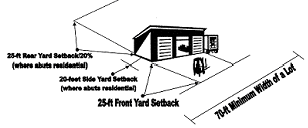
(1972 Code, sec. 30.622; 2008 Code, sec. 14.02.323)
Sec. 15.02.324 - Table of minimum requirements
(a)
In all cases regarding minimum standards set forth in the following table, the table is intended to be used in conjunction with the area requirements set forth in the zoning district sections of this article.
* Refer to appropriate zoning district of [for] district height, yard and area requirements.
** In those instances where the retail, commercial or industrial lot adjoins on the side of a residential zoning district, a side yard of 20 feet shall be provided. Where the retail, commercial or industrial lot adjoins residential zoning to the rear, a rear yard of 25 feet or 20 percent of the average depth of the lot (whichever is less) shall be provided. In both cases, if the two districts are separated by an alley, said alley is not to be used for purposes of calculating the required setback and the building setbacks are required as if the lots adjoined the residential zoning district.
*** Refer to development regulations, section 15.02.305, "Height" for allowed exceptions to the minimum height requirement.
(b)
Procedural regulations for use classification.
(1)
Divisions 6 and 7 of this article shall be utilized in determining use classification, permitted zoning district(s), and restrictions regarding uses.
(2)
When specified in the permitted use table, a use shall be allowable in the zoning district(s) as shown, unless further restrictions make such use(s) in that zone impermissible.
(3)
When not specified in the permitted use table or section 15.02.382, the use shall be subject to the rules applicable to nonspecified uses, found elsewhere in this article, unless every aspect of the use is consistent with the intent of this article, and such use meets the criteria of the district categories.
(4)
Whether a use falls under a table or category shall be determined by the zoning administrator.
(5)
Where a site has more than one use, the primary use shall override. In cases where each use is equal, the use which has the most restrictive zoning district and regulations shall override.
(6)
Any wholesale use not specifically denoted as such in the permitted use table shall be classified as a wholesale facility.
(1972 Code, sec. 30.623; 2008 Code, sec. 14.02.324)
Sec. 15.02.325 - Non-chartered financial institution regulations
(a)
Non-chartered financial institutions shall be subject to the following regulations:
(1)
Animated, moving, flashing, blinking, reflecting, revolving or similar type on-premises signs are prohibited.
(2)
May not be located within 500 feet from the following land uses: residentially zoned parcels, any state or federally chartered bank, savings association, credit union, or industrial loan company, religious institutions, school or day care facility, bar or liquor store, and pawnshops.
(3)
Storefronts shall have glass or transparent glazing in the window and doors and as prescribed by article 3.04 shall have no more than ten percent of any window or door area covered by signs, banners or opaque coverings of any kind.
(4)
Animated, moving, flashing, blinking, reflecting, revolving or similar type on-premises signs are prohibited.
(5)
May only operate within a freestanding building and may not operate in the same structure as any other use of the same type.
(Ordinance 14-02, sec. II(B), adopted 4-14-14; Ordinance 2019-9, ex. B, adopted 2-19-19)
Sec. 15.02.326 - "RE-1" residential estate district
(a)
Purpose and description.
(1)
This district provides areas for low density single-family uses which provide a buffer between agricultural and higher density areas of the city. Minimum lot size requirements are provided in order to allow for market and design flexibility while preserving neighborhood and rural character. The district regulations are designed to encourage a suitable neighborhood environment for family life by including among the permitted uses such facilities as schools, libraries, and neighborhood recreation centers. The district regulations are designed to: (A) protect the residential character of the areas by prohibiting commercial and industrial activities; (B) encourage a suitable neighborhood environment; and (C) preserve the openness of the area by requiring that certain minimum yard and area standard requirements are met.
(2)
The R-1L [sic] district implements the following policies of the master plan:
(A)
Encourage patterns of urban development that provide a full range of housing choices and promote a sense of community, urban vitality and the efficient provision of infrastructure.
(B)
Encourage connectivity throughout the city.
(b)
Lot regulations.
(1)
Area. Lots must have a minimum area of 43,560 square feet.
(2)
Frontage. Minimum frontage of 150 feet along a public right-of-way.
(3)
Depth. Minimum of 150 feet.
(4)
Height. Maximum of 2-1/2 stories allowed.
(c)
Setback requirements.
(1)
Front yard. There shall be a front yard having a minimum of 50 feet from front property line to main structure.
(2)
Rear yard. There shall be a rear yard of not less than 50 feet from rear property line to rear of main structure.
(3)
Side yard. There shall be a side yard of not less than twenty (25) [sic] feet from side property line to main structure. On corner lots the external side yard shall be not less than 50 feet. See article 10.02 (subdivision ordinance) for garage setbacks.
(4)
Corner lot. Where lots abut on two intersecting or intercepting streets, where the interior angle of intersection or interception does not exceed 135 degrees, a side yard shall be provided on the street side equal to the front yard.
(5)
Reverse frontage. On corner lots, where interior lots have been platted or sold, fronting on the side street, a side yard shall be provided on the street side equal to the front yard on the lots in the rear. No accessory building on said corner lot shall project beyond the front line of the lots in the rear.
(d)
Other.
(1)
Accessory buildings. Shall be allowed, but shall be subject to the setback requirements applicable to the main structure.
(2)
Landscaping. The use of drought tolerant turf grasses, such as zoysia or buffalo tif or combination, or other drought tolerant plantings and hardscape is strongly recommended.
(3)
Lighting. All outdoor lighting shall be hooded and all light emissions shielded, and shall be oriented such that light is directed towards the property and does not trespass onto surrounding properties. Lights affixed to the buildings shall be mounted no higher than the eaves of said building. Lights affixed to a pole shall be mounted no higher than 40 percent of the distance from the front property line to the main structure.
(4)
Masonry required. A minimum of 75 percent of total overall exterior walls shall be constructed of masonry, or other similar noncombustible materials.
(5)
Nonconforming dwellings. The provisions of floor space and masonry above shall not be applicable to nonconforming dwellings in existence on the date of the adoption thereof or to dwellings-built hereafter on the same lot to replace such nonconforming dwellings as may be destroyed by fire, windstorm or other involuntary cause.
(6)
Parking. Two off-street parking spaces shall be provided for each residential structure.
(7)
Public facilities. Each lot shall be connected to the city's public water and sewer system, and shall have appropriate sidewalks and fire protection. See article 10.02 (subdivision ordinance).
(e)
Storage. Outside storage is not allowed in the RE-1 district, with the exception of vehicles, trailers, recreational vehicles and boats in accordance with article 3.05 and article 12.03 of the city Code. All items to be stored must be completely contained in either the main structure, garage or an accessory building.
(Ordinance 2018-90, ex. A, adopted 12-4-18)
Sec. 15.02.327 - "PD" planned development district
(a)
Purpose. The purpose of a planned development ("PD") zoning district is to facilitate a specific development project, in accordance with a PD project plan, that may include uses, regulations and other requirements that vary from the provisions of other zoning districts. PD districts are intended to generally implement the following:
(1)
Flexible and creative planning;
(2)
The goals, objectives, and maps of the city's comprehensive plan, including but not limited to, the city's future land use plan;
(3)
Economic development;
(4)
Compatibility of land uses;
(5)
Innovative planning concepts;
(6)
Higher quality development for the community than would result from the use of the city's standard zoning districts; and
(7)
Expansion of uses with buildings constructed prior to the adoption of the sustainability overlay district on December 1, 2009, that may be difficult to re-purpose.
(b)
Applicability. A PD district shall only be established in one or more of the following circumstances:
(1)
The land is proposed for development as a mixed-use development or a traditional neighborhood development requiring more flexible and innovative design standards;
(2)
The land is located in close proximity to established residential neighborhoods where standard zoning classifications may not adequately address neighborhood concerns regarding the quality or compatibility of the adjacent development, and where it may be desirable to the neighborhood, the developer, or the city to develop and implement mutually-agreed, enforceable development standards;
(3)
The land serves as transition between different and seemingly incompatible land uses;
(4)
The land, or adjacent property that would be impacted by the development of the land, has sensitive or unique environmental features requiring a more flexible approach to zoning and clustering of uses, or special design standards, in order to afford the best possible protection of the unique qualities of the site or the adjacent property;
(5)
To provide for the expansion of a lawfully operating nonconforming uses under the conditions that follow:
(A)
Prior to December 1, 2009, the lawfully operating nonconforming use was both:
(i)
Fully conforming with the then applicable zoning regulations;
(ii)
Located within an existing development or building(s), which were specifically designed, both functionally and aesthetically, for its presently legally nonconforming use; and
(iii)
Rezoning the land on which the lawfully operating nonconforming use operates to a standard zoning district or classification, which would allow the expansion of the nonconforming use as a matter of right, may cause the zoning district designation of the land to be determined to be incompatible with the surrounding uses and zoning districts.
(c)
Nature of the district. Each PD district shall be unique and tailored to the specific site and proposed development project. Each PD district shall be governed by "base zoning" comprised of a zoning district specified within section 15.02.301 of this chapter 15 and any additional overlay districts if appropriate. Each PD district shall also be governed by a PD project plan, as well as any other items specific to the ordinance adopting the PD district as specified in section 15.02.327(d) below.
(d)
Items specific to the ordinance. The adopting ordinance establishing a PD district shall set forth the following:
(1)
Base zoning district. The adopting ordinance shall specify a base zoning district by which use and development standards shall be applied to subsequent development permits for land within the PD district; unless specifically excepted according to the provisions of this section. The base zoning district specified shall conform to the provisions of the city's comprehensive master plan, including the city's future land use plan.
(2)
Permitted or prohibited uses.
(A)
The adopting ordinance shall specify any uses not allowed in the base zoning district and applicable overlay districts that shall be permitted in the PD district, provided that such uses do not conflict with any provisions of the city's comprehensive plan.
(B)
The adopting ordinance shall specify any uses permitted in the base district and any uses permitted in the applicable overlay districts that shall be prohibited in the PD district.
(3)
Development standards.
(A)
The adopting ordinance shall specify any supplemental design or development standards not required by the base zoning district that shall be applied to subsequent development permits for land within the PD district.
(B)
The adopting ordinance shall specify any development standards required by the base zoning district and applicable overlay districts that shall be varied for subsequent development permits for land within the PD district.
(C)
Standards that may be varied include but are not limited to the following:
(i)
Residential density.
(ii)
Building setbacks.
(iii)
Building height.
(iv)
Lot coverage.
(v)
Parking and access.
(vi)
Landscaping and buffering.
(vii)
Streetscape design.
(viii)
Architecture.
(D)
Varied standards may increase or decrease the requirements otherwise applicable to particular uses.
(E)
Any graphic depictions used to illustrate such standards, unless otherwise provided in the PD district regulations, shall be considered standards that apply to subsequent development applications.
(4)
PD project plan. No PD district may be established without approval of a project plan, containing the documents and minimum information specified in section 15.02.327(e) below.
(5)
Additional items. The adopting ordinance may also specify the following if necessary:
(A)
Required dedications of land or public improvements;
(B)
A phasing schedule for the project, where applicable, setting forth the dates for submittal of site development plans and the timing of performance by the developer for dedications of land or public improvements and satisfaction of any conditions in relation to the phasing of development, where applicable;
(C)
Any variations from the city's subdivision or utilities standards pertaining to provision of roadway and drainage facilities provided such variance is justified by a city approved traffic impact study, drainage study, or other type of applicable engineering study, which may be required as a prerequisite for approving a PD district. Otherwise, all facilities or improvements within public rights-of-way shall be provided in accordance with design standards set forth within the city subdivision regulations;
(D)
Identification of the levels of the deviation allowed between the PD project plan and subsequent development applications that may be approved by the planning and zoning director; and
(E)
Such additional conditions as are established by the council to assure that the PD district is consistent with the city's comprehensive plan.
(e)
PD project plan requirements. No PD district may be established without approval of a PD project plan. The PD project plan shall be adopted with the ordinance establishing the PD district and shall be construed in conjunction with the authorized uses and development standards set forth within the PD district.
(1)
Required documents. The following documents shall be required to be included in a PD project plan. For smaller projects the following documents may be combined into one or more documents at the discretion of the planning and zoning director.
(A)
Land use plan.
(B)
Site plan.
(C)
Landscape plan.
(D)
Traffic impact analysis (TIA).
(E)
Drainage analysis.
(2)
Additional documents. Additional documents may be required to be submitted as part of a PD project plan, including but not limited to the following.
(A)
Building elevations.
(B)
Parking plan.
(C)
Signage plan.
(D)
Phasing plan.
(E)
Site or building material specifications.
(3)
Form of documents. All required and additional documents shall be fully dimensioned and drawn to scale.
(4)
Content of documents. Required PD project plan documents shall include but not be limited to the existing and proposed site features such as the following:
(A)
Topography.
(B)
Floodplain information.
(C)
Adjacent properties.
(D)
Ingress/egress.
(E)
Existing buildings.
(F)
Parking and loading bays.
(G)
Landscaping.
(H)
Large tree groupings.
(I)
Fire lanes and hydrants.
(J)
Trash receptacle locations.
(K)
Lots.
(L)
Building materials.
(M)
Facade features.
(N)
Street rights-of-way, curblines, widths, and street names.
(O)
Screening fences or walls.
(5)
Consistency required. All development applications within the PD district shall be consistent with the incorporated PD project plan. Failure of a subsequent development application to conform to the approved PD project plan for the PD district shall result in denial of the application, unless the PD district regulations are first amended through incorporation of a PD project plan with which the development application is consistent. The degree of conformity required between the project plan and subsequent development applications shall be set forth in the adopting ordinance.
(6)
Location and arrangement of uses. The location and arrangement of all authorized uses in the PD district shall be consistent with the PD project plan approved with the PD district.
(7)
Deviations from approved PD project plan.
(A)
Minor deviations. In determining whether development applications are consistent with the PD project plan, minor deviations from the PD project plan may be approved by the planning and zoning director. Unless otherwise specified in the adopting ordinance, minor deviations are limited to the following:
(i)
Corrections in spelling, distances, and other labeling that does not affect the overall development concept.
(ii)
Change in building layout, when shown, that is less than a ten percent increase in size.
(iii)
Changes in the proposed property lines internal to the PD district, as long as the originally approved district boundaries are not altered.
(iv)
Changes in parking layouts as long as the number of required spaces is not decreased and the general original design is maintained.
(B)
Major deviations from the approved PD project plan. All major deviations from the approved PD project plan shall be submitted to the planning and zoning commission for recommendation and city council for approval as an amendment to the PD district.
(f)
Procedures for establishment.
(1)
Steps for approval. The review process for a PD district application shall include but not be limited to the following steps:
(A)
Pre-application conference;
(B)
Application submittal;
(C)
Project plan review by the planning and zoning director or designees;
(D)
Preliminary feedback from the planning and zoning commission;
(E)
Recommendation from the planning and zoning commission;
(F)
Final approval from city council.
(2)
Application requirements. No application for a PD district shall be accepted by the city until the following items have been submitted to the city by the applicant.
(A)
A completed city zone change application, including all requirements as stated on the application form;
(B)
A statement from the property owner giving authorization to the applicant to file the request for rezoning shall be required as part of the rezoning application, if necessary;
(C)
A legal description of the property under consideration;
(D)
A PD project plan;
(E)
A description of any uses and development standards requested to be modified or varied from those in the base zoning district, as well as the purpose of the variation (i.e., why they are necessary);
(F)
A description of how the proposed PD district fulfills the goals and objectives of the city's adopted comprehensive plan or any other formally adopted city planning document;
(G)
A development schedule outlining a timetable for completion of the entire project;
(H)
A copy of all agreements, provisions, or covenants which govern the use, maintenance, and continued protection of the PD district and any of its common areas, if applicable;
(I)
The required application fee.
(g)
Criteria for approval of PD districts. No PD district shall be established which does not meet all of the following criteria:
(1)
The land covered by the proposed PD district fits one or more of the special circumstances warranting a PD district classification;
(2)
The proposed PD district furthers the policies of the city's adopted comprehensive plan (as amended) and other formally adopted city planning documents;
(3)
The proposed PD district demonstrates a more superior development than could be achieved through standard zoning classifications;
(4)
The proposed PD district demonstrates the resolution of compatibility issues with surrounding development;
(5)
The proposed uses and the configuration of uses depicted in the PD project plan are compatible with existing and planned adjoining uses;
(6)
The proposed PD district demonstrates consistency with adopted public facilities plans, including those related to water, wastewater, transportation, drainage and other public facilities; and
(7)
The proposed PD district (if a mixed-use or traditional neighborhood project) demonstrates the provision of open space and recreational amenities within the development that provides for a superior living environment and enhanced recreational opportunities for residents of the district and for the public generally.
(h)
Conditions for approval. The city council may impose such conditions to the PD district regulations and project plan as are necessary to assure that the purpose of the PD district is implemented.
(i)
Subsequent development applications. The development standards for a PD district shall be applied to the authorized uses through a plat, site development plan, general site plan, or other development applications as set forth in the adopting ordinance.
(j)
Documentation of PD districts. All PD districts approved after adoption of this Code section, as may be amended, shall be prefixed by a "PD" designation and assigned a unique identification number (e.g., PD-1, PD-2, PD-3, and so on), and shall also be shown on the zoning map.
(k)
Expiration of a planned development district.
(1)
Except for the base zoning, including any applicable overlay districts established by a PD district ordinance, all provisions of PD district, including the project plan, shall initially be valid for a period of 24 months.
(2)
If a building permit has not been issued or construction begun on the detail plan within the 24 months, the PD district shall automatically expire and no longer be valid, and the zoning of the property shall automatically convert to the base zoning specified.
(3)
The city council may, prior to the 24 month expiration, for good cause shown, extend for up to 24 additional months; during which time all provisions of the original PD district ordinance may remain valid. Only one extension may be granted.
(4)
Following both the issuance and commencement of progress pursuant to the adopted PD project plan, all provisions of the PD district shall remain effective without expiration.
(Ordinance 2019-58 adopted 11-19-19)

