
Lexington City Zoning Code
ARTICLE II
APPLICATION OF REGULATIONS
Where there exists a conflict between any standards in Chapters 154, 155, or 156, the more stringent standard shall apply.
DIVISION 155.04. - SPECIFIC AREA AND USE REQUIREMENTS PERTAINING TO COMMERCIAL AND INDUSTRIAL ACTIVITIES
In addition to the general requirements listed in Division 1 of Article II, the following specific requirements pertain to commercial and industrial uses.
§ 155.03.01 - CLASSIFICATION OF USES
The provisions of this division shall be known as the "Schedule of Permitted Uses." The purpose of these provisions is to classify uses into a number of specially defined types on the basis of common functional characteristics and similar compatibility with other uses, thereby providing a basis for the regulation of uses in accordance with criteria which are directly relevant to the public interest. These provisions shall apply throughout the Ordinance. In the event of conflicting interpretations, or uncertain references to a particular use, the Zoning Administrator shall assign uses to the most appropriate activity category. Any person aggrieved by an interpretation may appeal such to the Board of Zoning Appeals for review.
(Ord. 2022-3, § 1(Att.), passed 3-7-22)
§ 155.03.02 - DESCRIPTION OF PRINCIPAL ACTIVITIES
All uses are listed in § 155.03.05. Vacant land, itself, shall not constitute a use.
(Ord. 2022-3, § 1(Att.), passed 3-7-22)
§ 155.03.03 - CORRECT ZONING DISTRICT
In order for an activity to be allowed on a particular parcel, both the zoning district of the parcel and the road classification of the road(s) from which the parcel obtains access must allow the use. See the charts in § 155.03.05 for the zoning districts in which and the road classifications on which each use is allowed.
(A)
Zoning districts. In order to implement the provisions of this Ordinance, the following zoning districts are hereby established:
(1)
Regular districts.
(a)
Protected.
(i)
Protected Residential (PR): In order to benefit the public health, safety, and general welfare, this district is designed to protect single-family homes that are not part of a cluster development (a development in which homes are tightly clustered together) from incompatible and disruptive activities.
(ii)
Protected Residential Two (PR2): In order to benefit the public health, safety, and general welfare, this district is designed to protect single-family homes that are part of a cluster development (a development in which homes are tightly clustered together) as well as low-density residential multiple (under certain circumstances) or townhouse communities and duplexes from incompatible and disruptive activities.
(iii)
High-Density Residential (HDR): In order to benefit the public health, safety, and general welfare, this district is designed to protect the residents of apartments or residential multiple, townhouses, and condominiums from incompatible and disruptive activities.
Notes:
The location of homes for the mentally and/or physically handicapped shall be governed by S.C. Code § 6-29-770. However, the location of other types of group homes, such as but not limited to hospice facilities and halfway houses, shall follow the requirements of this Ordinance regarding those activities.
All church-related activities shall be allowed in all zoning districts per S.C. Code § 6-7-15.
All Town-owned property shall be treated as if protected regardless of the associated zoning districts of particular Town-owned property.
Areas in and near the Downtown Overlay may have different standards.
(b)
Unprotected.
(i)
Office Commercial (OC): This district is designed to allow medical and office uses in locations where such uses benefit the public health, safety, and general welfare.
(ii)
Neighborhood Commercial (NC): This district is designed to allow nonintensive commercial uses near residential communities for the primary use of that community in such a way that benefits the public health, safety, and general welfare; examples include a corner store or a neighborhood school.
(iii)
Limited Commercial (LC): This district is designed to allow some nonintensive limited commercial uses in locations where such uses benefit the public health, safety, and general welfare.
(iv)
General Commercial (GC): This district is designed to allow most commercial uses in locations where such uses benefit the public health, safety, and general welfare.
(v)
Industrial (IND): This district is designed to allow industrial uses in locations where such uses benefit the public health, safety, and general welfare.
(2)
Special overlay districts.
(a)
Planned Development (PD) Special Overlay District: By providing for variations from the Town's land use ordinances concerning use, setbacks, lot size, density, bulk, and other requirements, Planned Developments accommodate flexibility in the arrangement of uses that result in improved design, character, and quality for the general purpose of promoting and protecting the public health, safety, and general welfare.
(b)
Drainage and Floodplain (FP) Special Overlay District: The purpose of this district is to protect the lives and property of people who live near floodplain areas and to preserve the natural drainageways for the public health, safety, and general welfare.
(c)
Downtown (DT) Special Overlay District: The purpose of this district is to establish special requirements for the designed downtown area that recognize its special nature and that encourage development therein that benefits the public health, safety, and general welfare.
(d)
Industrial Special Overlay Districts: The purpose of these districts is to accommodate industrial uses in locations where such uses benefit the public health, safety, and general welfare. These are the districts referred to in the landscaping and tree ordinance as the Industrial District.
(i)
Railroad Industrial Special Overlay District: The purpose of this district is to accommodate industrial uses along the railroad corridor, where such uses benefit the public health, safety, and general welfare.
(ii)
Reserved for future industrial districts.
(e)
Commercial Corridors (CC) Special Overlay District:
(i)
The purpose of this district is to allow for enforcement of the Architectural and Appearance Standards Ordinance. The district includes all parcels that are in the Town of Lexington at the time of the enactment of this Ordinance that have any portion of the lot fronting on or accessing any of the following roads:
A)
Highway 1
B)
Highway 6
C)
Highway 378
D)
Old Cherokee Road
E)
Old Chapin Road
F)
Gibson Road
G)
Park Road
H)
Ginny Lane
I)
Mineral Springs Road
J)
Saluda Springs Road
K)
Saluda Pointe Drive
L)
Whiteford Way
M)
Caughman Farm Lane
N)
Corley Mill Road
(ii)
Moreover, as parcels on these roads that have any portion of the lot fronting on or accessing any of the above-named roads that are not in the Town of Lexington at the time of enactment of this Ordinance are annexed into the Town of Lexington, they also shall become part of the Commercial Corridors Special Overlay District.
(f)
Preservation Corridor (PC) Special Overlay District:
(i)
The purpose of this district is to preserve right-of-way in areas that either are or may be impacted by growth. Within this corridor, the buffer shall be twenty feet (20'), and the building setback shall be thirty feet (30'); but where the use of the property dictates larger buffers and setbacks as designated elsewhere in this Zoning Ordinance, those larger buffers and setbacks shall apply. The district includes all parcels that are in the Town of Lexington at the time of the enactment of this Ordinance that have any portion of the lot fronting on or accessing any of the following roads:
A)
US Highway 1 excluding the portion from the intersection of Fort Street to 3rd Avenue
B)
SC Highway 6 excluding the portion from the intersection of Maiden Lane to Gant Street
C)
Highway 378
D)
Old Cherokee Road
E)
Old Chapin Road
F)
Gibson Road
G)
Park Road
H)
Ginny Lane
I)
Mineral Springs Road
J)
Corley Mill Road
K)
Hope Ferry Road
(ii)
Moreover, as parcels on these roads that have any portion of the lot fronting on or accessing any of the above-named roads that are not in the Town of Lexington at the time of enactment of this Ordinance are annexed into the Town of Lexington, they also shall become part of the Commercial Corridors Special Overlay District.
(3)
Several Town ordinances, specifically but not limited to Title XV—Land Usage, Chapter 159—Sign Ordinance, and Chapter 156—Landscaping and Tree Ordinance, refer to outdated zoning districts. The Approving Authority shall have the discretion to determine how the outdated zoning districts correspond with the current zoning districts, using the following as a guideline:
(a)
IDD (Intense Development District) generally shall mean IND (Industrial), GC (General Commercial) or HDR (High-Density Residential), but may also mean OC (Office Commercial), NC (Neighborhood Commercial), or LC (Limited Commercial).
(b)
RDD (Restricted Development District) generally shall mean OC (Office Commercial), NC (Neighborhood Commercial), or LC (Limited Commercial), but also may mean IND (Industrial), GC (General Commercial), HDR (High-Density Residential), PR (Protected Residential) or PR2 (Protected Residential 2).
(c)
PRD (Protected Residential District) shall mean PR (Protected Residential).
(d)
PRD2 (Protected Residential District 2) shall mean PR2 (Protected Residential 2).
(e)
The determination how an outdated district corresponds to a current district shall not be arbitrary but shall be based on an assessment of the intent of the outdated zoning district compared to the intent of the current zoning district in the particular circumstance.
(B)
Street classifications. In order to implement the provisions of this Ordinance, the following street classifications are hereby established:
(1)
Arterial (A): A freeway, expressway, street or highway that is used or intended to be used for moving either heavy vehicular traffic volumes or high-speed traffic, or both.
(2)
Collector (C): A street that is used or intended to be used for moving traffic from minor streets to major thoroughfares, including the principal entrance and sometimes the circulation street or streets of a development.
(3)
Local (L): A street that is used or intended to be used to provide access to other streets from individual properties. The following subcategories of local streets are established to handle the special circumstances described:
(a)
Residential Local Six (RL6): A street within a residential development that generally is intended to accommodate residential activities at six (6) dwelling units per gross acre. Access shall generally be limited to residential development and allowed home occupations or accessory activities.
(b)
Residential Local Four (RL4): A street within a residential development that generally is intended to accommodate residential activities at four (4) dwelling units per gross acre. Access shall generally be limited to residential development and allowed home occupations or accessory activities.
(c)
Residential Local Two (RL2): This type of street generally is intended to accommodate residential activities at two (2) dwelling units per gross acre. Access shall generally be limited to residential development and allowed home occupations or accessory activities.
(d)
Limited Local (LL): A street that contains a location or design flaw that limits traffic movements or volumes. The conditions of the problem should be unlikely to be improved. Access to this type of street will be limited. These may also include alleys, a public or private right-of-way primarily designed to serve as secondary access to the side or rear of those properties whose principal frontage is on some other street.
Whenever new streets or portions of streets are added within the Town by virtue of annexation, such new streets shall be classified by Ordinance of the Town Council in the manner set forth in § 155.20.09 of this Ordinance. Whenever new streets or portions of streets are added within the Town by virtue of new construction, such new streets shall be classified by the Administrative Official in the manner set forth in § 155.20.09 of this Ordinance.
(Ord. 2022-3, § 1(Att.), passed 3-7-22)
§ 155.03.04 - THE EFFECT OF OTHER ZONING RESTRICTIONS
In order for an activity to be allowed on a particular parcel, it must meet all of the requirements within the Town of Lexington's ordinances that pertain to that use unless the Board of Zoning Appeals grants a variance that lessens one or more of these requirements with respect to the activity.
Moreover, if the activity is located within a special overlay district, the activity must meet the regulations pertaining to the special overlay district unless the Board of Zoning Appeals grants a variance that lessens one or more of these requirements with respect to the activity. See Article IV of this Ordinance for overlay district regulations.
(Ord. 2022-3, § 1(Att.), passed 3-7-22)
§ 155.03.05 - CHART OF PERMITTED USES
(1)
Chart organization.
(a)
The first column lists and defines the uses allowed in the Town of Lexington.
(b)
The second column describes the use.
(c)
The third column lists the road classifications that are required to support a particular use. See also §155.03.03(B).
(d)
The following eight columns list the districts where the use is permitted (denoted by a "P"), provided that the use meets all other criteria. If a cell is blank, the use is not permitted.
(e)
The last column lists notes that pertain to the use.
(2)
Mixed uses.
(a)
Where a project mixes both residential and commercial activities, the Approving Authority will apply the rules of interpretation that govern the commercial activities in § 155.03.05 as if the residential activities did not exist.
(b)
Where a project mixes both residential and commercial activities, the Approving Authority will review the project based on its ability to meet the following criteria:
(i)
Whether the location is reasonable for such a project.
(ii)
Whether the intent of the zoning district supports such a project.
(iii)
Whether the existing or proposed transportation network is able to support such a project.
(iv)
Whether the proposed uses are compatible.
(v)
Whether setbacks and buffers between mixed-use project and adjacent parcels are reasonable.
(vi)
Whether the amount of proposed parking is reasonable to support the intended uses.
(vii)
Whether any potential or proposed structure heights are reasonable in relation to the heights of adjacent and nearby parcels.
(viii)
Whether the project encourages pedestrian access to businesses.
(ix)
Whether the businesses will be able to restrict deliveries to the hours of seven (7:00) a.m. to seven (7:00) p.m.
(c)
The Approving Authority has the authority to reject proposals for mixed-use projects based on the inability of the project to meet these criteria in such a way that would negatively affect the public health, safety, or welfare.
(d)
Home occupations are not considered a mixed use.
(e)
Where an activity is not listed in § 155.03.05 as "allowed by right" in an office park, commercial center, or multitenant commercial building, and where the activity cannot meet the regular requirements associated with that activity as listed in § 155.03.05, the person who is proposing the activity may petition the Board of Zoning Appeals for a variance to allow them to operate within the office park, commercial center, or multitenant commercial building.
(3)
Special Overlay Districts. Where a parcel is located in a Special Overlay District, the rules associated with that district supersede and prevail where there is a conflict between the rules. See Article IV.
On parcels that are zoned Industrial (IND), whether or not those parcels are located in an Industrial Special Overlay district, the Approving Authority has the discretion to allow not only the uses that are expressly listed in the chart of permitted uses as being allowed on parcels that are zoned IND but also any commercial activity that is permitted by the chart. The decision whether to allow a particular commercial activity on a parcel zoned IND shall be based on criteria that include but are not limited to:
•
Whether the location is reasonable for such use;
•
Whether the intent of the zoning district supports such a use;
•
Whether the intent of the road classification supports such a use;
•
Whether the proposed use is compatible with existing adjacent and nearby uses;
•
Whether the proposed use is likely to be compatible with future industrial uses on adjacent or nearby parcels;
•
Whether the setbacks and buffers between the proposed use an existing adjacent use is reasonable;
•
Whether the height ratio is reasonable in relation to the heights of adjacent and nearby uses; and
•
Whether the activity is in the best interest of the public health, safety and general welfare.
(Ord. 2022-3, § 1(Att.), passed 3-7-22; Ord. 2022-35, § 1, passed 12-5-22; Ord. No. 2023-9, § 1(Att.), passed 4-3-23; Ord. 2023-27, § 1(Att.), passed 10-2-23)
§ 155.03.06 - HEIGHT REQUIREMENTS
(A)
Height regulations are based upon the establishment of a height control plane that cannot be penetrated. They differ depending on whether the particular parcel must follow the "intensive" rules or the "restrictive" rules.
(B)
See the chart to determine the initial structure height allowed at the setback based on the zoning district.
(1)
For every additional foot of setback from a restrictive property line, a building may be constructed an additional half-a-foot higher, up to the maximum building height of the district.
(2)
For every additional foot of setback from an intensive property line, a building may be constructed an additional one-and-a-half feet higher, up to the maximum building height of the district.
(3)
This may result in "stepped" buildings where parts of the building more interior to the site are taller.
(C)
The following diagrams illustrate the nature of the height control plane. Regarding the second diagram, see the chart in this section for the specific ratios of the principal activities or districts.
(D)
Properties adjacent to the Downtown Special Overlay District are allowed an additional ten feet (10') of building height, to a maximum of four (4) stories.
(E)
Properties within the Downtown Special Overlay District are limited to one story higher (max. twelve (12) additional feet) than their tallest neighbor.
(F)
Where a development abuts a PR or PR2 district with single family residential, the structures are limited to thirty-five feet (35') tall or one story higher (max. ten (10) additional feet) than their tallest neighbor, whichever is greater.
(Ord. 2022-3, § 1(Att.), passed 3-7-22)
§ 155.03.07 - REQUIRED SETBACKS
(A)
A setback is an area of land in which passive activities are allowed, as well as accessory activities such as parking unless superseded by a required buffer or otherwise governed by § 155.05.05. Buildings or other structures comprising the principal activity shall not encroach upon the setback area.
(B)
Setback areas vary depending upon the zoning district of the parcel, the nature of the activity proposed, and the nature of the activities of adjacent parcels.
(C)
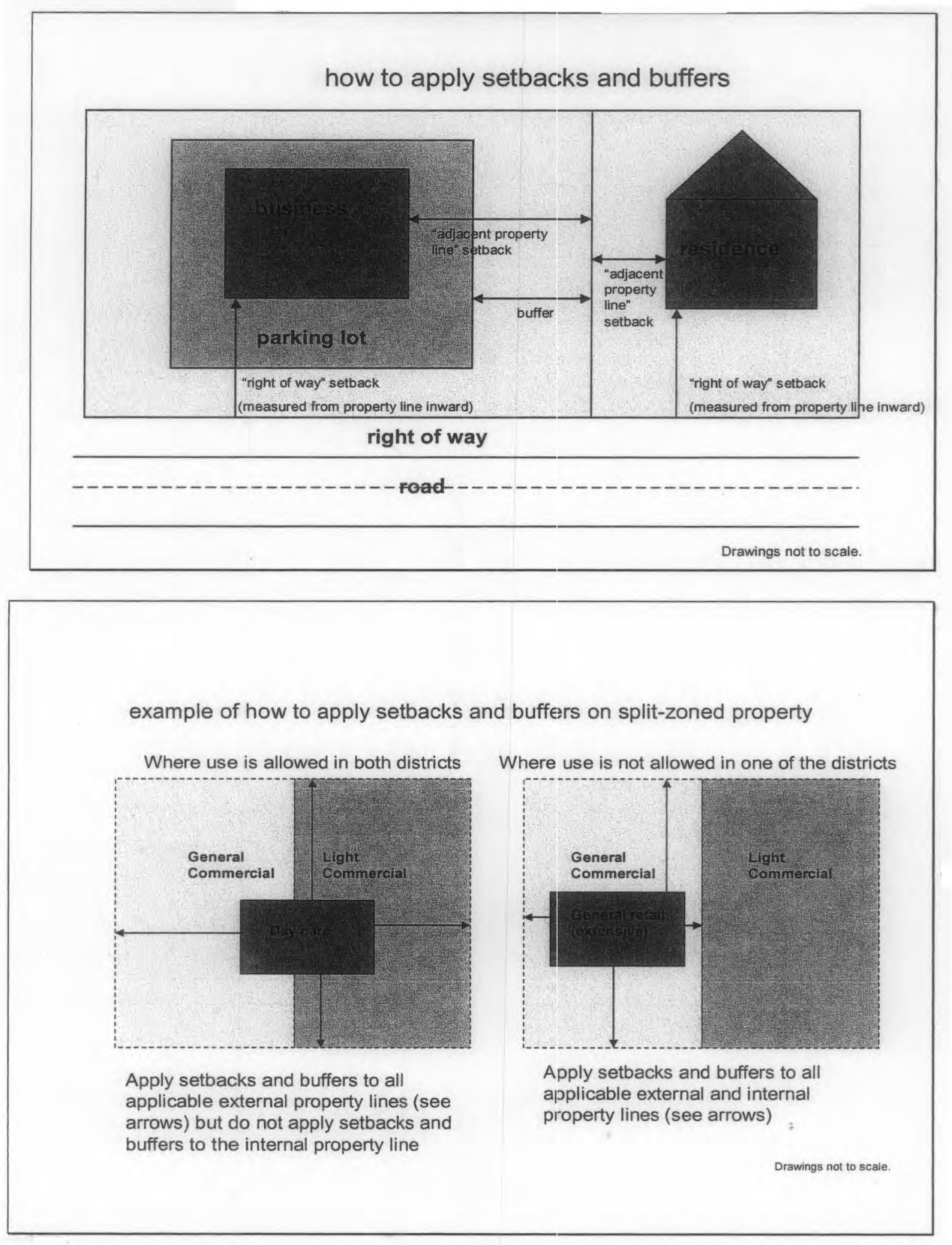
Where the parcel in question meets the right-of-way of a road, railroad, or utility, or a body of water, the setback area is measured from the point that the property line meets the right-of-way or body of water inward. In other words, setbacks shall not be measured from across roads, railroads, and utility rights-of-way or bodies of water where those exist adjacent to the property line in question. Where the parcel in question meets a property line of an adjacent parcel that is not a road, railroad, utility, or body of water, the setback area is measured from the property line inward. See below for illustration of how to apply setbacks (and buffers); assume that all parcels shown are located in the Town of Lexington.
(D)
If a property is split-zoned, distances will only apply to the adjacent property sides and not to the district zone line through the property unless the intended activity is not allowed in one of the split-zoned districts, as shown by the illustration below.
(E)
The charts in this section list the required setbacks for each activity.
(F)
Except in the Downtown Overlay, residential uses abutting arterials and collector streets shall be required to provide an additional twenty feet (20') to the setback. Appropriately designed common areas meeting this standard can fulfill this requirement.
(G)
Residential uses. On parcels with a "protected" zoning designation, apply the listed requirements regardless of the activity of the adjacent parcels.
(H)
If a use or structure is proposed that will straddle a split-zone in a parcel, the owner shall apply for either a rezoning of the affected area or a subdivision of the parcel or other remedy such that the proposed use or structure would meet the setbacks and other standards of this ordinance without straddling the split-zone.
(Ord. 2022-3, § 1(Att.), passed 3-7-22; Ord. 2022-28, § 1(Att.), 10-3-22)
§ 155.03.08 - REQUIRED BUFFERS
(A)
A buffer is an area of land in which no activity is permitted other than a passive activity. Parking is permitted in the buffer area and may not occur within ten feet (10') of the property line, or the distance of the required buffer, whichever is lesser. Driveways, sidewalks, and other travelways may cross the buffer to provide access to the activity conducted on the parcel.
(B)
Buffer areas vary depending upon the zoning district of the parcel, the nature of the activity proposed, and the nature of the activities of adjacent parcels.
(C)
Buffers are measured from the property line inward; however, buffers may be measured from across roads, railroads, and utility rights-of-way as well as from across bodies of water where those exist adjacent to the property line from which the buffer is being measured. See § 155.03.07 for illustration of how to apply buffers (and setbacks); assume that all parcels shown are located in the Town of Lexington.
(D)
If a property is split-zoned, distances will only apply to the adjacent property sides and not to the district zone line through the property unless the intended activity is not allowed in one of the split-zoned districts. See § 155.03.07 for illustration of how to apply setbacks and buffers on split-zoned property.
(E)
The charts in this section list the required perimeter buffers.
(F)
In addition to the required buffers listed, a 100-foot buffer shall be measured from all residential or otherwise protected property lines that are adjacent to a golf course. This buffer would automatically come into effect at such time as the golf course or any portion of it ceases to exist and any other activity begins on the property formerly occupied by the golf course. In the buffer area, any other activities more intense than passive recreation are prohibited. Driveways may cross into the buffer area but not roads. The additional buffer shall not apply to "regulated areas," including but not limited to Utility Easements, Flood Plains and wetlands. It shall apply and be measured as to areas abutting a tee box, fairway or green of the subject golf course.
(G)
For the purpose of this section, "protected" refers to protected zoning districts as described in § 155.03.03 as well as the note to that section that classifies as protected all Town-owned property regardless of the zoning district of the particular Town-owned property.
(H)
Unless otherwise stated, nothing within this section shall allow lesser buffer widths than those required by other portions of this Chapter or other ordinances, especially Chapter 154 (Land Development Regulations) or Chapter 156 (Landscaping and Trees). Unless otherwise stated, the more stringent standard shall apply.
(Ord. 2022-3, § 1(Att.), passed 3-7-22)
§ 155.03.09 - CHART OF COMPATIBILITY BUFFER TYPES
Landscaping buffer types are described below - see also Chapter 156, Landscaping and Trees.
(Ord. 2022-3, § 1(Att.), passed 3-7-22)
§ 155.03.10 - REQUIRED PARKING
(A)
The charts in this section and § 155.03.11 list the required number of parking spaces for each activity. When an activity on a parcel is comprised of two (2) or more separate uses, the parking ratios for each separate activity shall be calculated and applied in the aggregate for the entire parcel.
(B)
An automotive parking space is defined to consist of a space no less than:
(1)
Nine feet (9') by eighteen feet (18') for standard size vehicles;
(2)
Seven feet (7') by fifteen feet (15') for compact vehicles;
(3)
Nine feet (9') by eighteen feet (18') for handicapped-accessible parking with cars; and
(4)
Twelve feet (12') by eighteen feet (18') for handicapped-accessible parking with vans.
(C)
Unless the percentage is further modified for a particular activity by the charts in § 155.03.11, no more than ten percent (10%) of the parking requirements of this Ordinance may be satisfied by the designation of compact spaces.
(D)
The allocation of handicapped spaces shall be in accord with applicable State and Federal laws for such as well as the building codes adopted by the Town of Lexington.
(E)
When determining parking area requirements, portions of the public right-of-way including the street cannot be considered as permissible for maneuvering incidental to parking.
(F)
Parking areas shall be clearly defined.
(G)
When parking abuts a pedestrian travelway, wheel stops shall be provided to prevent vehicle overhang or an additional two feet (2') of sidewalk shall be provided. When the parking is parallel, the additional two feet (2') of paved area is required.
(H)
Exceptions:
(1)
Where use is a residential activity on road that is classified as Local or as one of the Local subcategories.
(2)
Where activity is in the Downtown Special Overlay District.
(3)
Within the Downtown Special Overlay District and including abutting parcels and parcels directly across a public right-of-way from the Downtown Special Overlay District:
(a)
When necessary to fulfill the requirements of the minimum parking required by this ordinance, on-street parking spaces that occur on the same side of the street and fully within the extended side property lines of the parcel or use in question may be counted toward meeting any requirements for parking by the directly abutting use. This does not preclude using parking in other places to meet the minimum parking requirements.
(b)
The use of on-street parking to meet these requirements does not establish any obligation by the Town or transfer of ownership or interest of any public right-of-way for exclusive use by any entity.
(I)
Kiosks are allowed as an accessory activity in a commercial center if all of the following conditions are met:
(1)
The number of remaining parking spaces meets the Town's minimum parking requirements.
(2)
The parking lot is marked for traffic flow around the kiosk.
(3)
The kiosk does not interfere with the Town's landscaping requirements.
(4)
The kiosk is constructed and installed to meet the current international building code.
(5)
If food and/or drinks are provided, a DHEC health department approval is obtained.
(6)
The operator of the kiosk provides the Town with proof that the landlord agrees to remove the kiosk within thirty (30) days of the kiosk being vacated.
(7)
The operator of the kiosk provides proof that a bathroom is available within a maximum travel distance of five hundred feet (500').
(8)
A normal business license is obtained (not a peddler's license).
(9)
The kiosk is not larger than eight feet (8') by eight feet (8').
(10)
Signs meet all of the requirements of the Town's sign ordinance.
(11)
The parking lot is in a General Commercial District.
(12)
The kiosk is provided with an additional four queuing parking spaces plus one space directly at the kiosk.
(J)
Whenever a structured parking deck fronts on public street, the ground floor facing that right-of-way shall be wrapped with nonresidential space that can be occupied and used as such.
(K)
Administrative modifications.
(1)
Strict adherence to the parking standards contained herein may result in inadequate or excessive parking; therefore, the Administrator shall permit modifications from the requirements of up to twenty-five percent (25%) upon written request and a parking study certified by an engineer showing that:
(a)
Any such modification shall not reduce the required number of accessible parking spaces.
(b)
No reduction shall be granted for residential uses.
(2)
All modifications shall be noted on associated permits for the development.
(Ord. 2022-3, § 1(Att.), passed 3-7-22)
§ 155.03.11 - CHART OF PARKING REQUIREMENTS
(Ord. 2022-3, § 1(Att.), passed 3-7-22)
§ 155.04.01 - ACCESSORY ACTIVITIES
(A)
Each principal activity in § 155.03.05 shall be deemed to include activities customarily associated with and appropriate, incidental and subordinate to the principal activity when located on the same parcel. Such accessory activities include, but are not limited to:
(1)
Those listed for specific activities in the charts in § 155.03.05, and
(2)
If the facilities involved are reserved for the patrons, employees, or other persons participating in the principal activity, the following:
(a)
Off-street parking, driveways and dumpsters.
(b)
Operation of a cafeteria.
(c)
Temporary accessory activities relating to construction, grading or demolition that are necessary and incidental to the development of a principal activity. The temporary condition shall last only as long as the construction of the principal activity is in progress.
(d)
Plazas, playgrounds, parks, outdoor seating, gardens, and the like.
(e)
Special events that have permit issued by Town.
(f)
Video game machines.
(B)
Accessory activities shall be controlled in the same manner as its associated principal activity except as otherwise provided in this Ordinance.
(C)
Tattooing is not permitted as an accessory activity.
(Ord. 2022-3, § 1(Att.), passed 3-7-22)
§ 155.04.02 - TEMPORARY BUILDING OR STRUCTURE
A temporary building or structure shall not be permanently erected.
(A)
A temporary building may be allowed only under one of the following conditions:
(1)
A temporary building or structure may be used as a construction office on a construction project but only as long as the construction permit remains valid; the temporary building or structure must be removed when the project is completed.
(2)
A temporary building or structure may be used as a sales office on a construction project but only as long as fewer than ninety percent (90%) of the lots or condominiums, apartments, or townhouses have been sold; in other words, the temporary building or structure must be removed when ninety percent (90%) of the lots or condominiums, apartments, or townhouses have been sold.
(3)
Tractor-trailers are allowed for use as a temporary building for construction purposes only if they are used to store construction equipment and are located on the construction site; such trailers shall be removed at the end of the project.
(B)
A temporary building or structure may be used as a business in a General Commercial District provided that all of the following conditions are met:
(1)
The approval process has been initiated to construct a new structure or to enlarge an existing structure.
(2)
A statement is signed by the owner that the temporary business building will be removed by the termination date agreed to in accordance with § 155.04.02(1)(b).
(3)
[Reserved.]
(4)
The building will not interfere with the construction of the permanent facility.
(5)
The temporary building must be inspected for and remain in compliance with all applicable building codes, and must have a permit from the Town.
(6)
The permit shall remain valid for no longer than one year. However, the applicant may reapply for up to one additional year if all the other conditions can continue to be met.
(C)
Shipping or storage containers may be used for temporary storage in a General Commercial District by businesses provided that all of the following conditions are met:
(1)
A permit is obtained.
(2)
The property/business must be free of containers for one hundred eighty (180) consecutive days per calendar year. The time period starts the day the first permit is issued for the container(s). All containers must be removed by the end of the time period.
(3)
The containers must be free of rust and all painted the same neutral color.
(4)
The containers cannot be placed closer to any street than the primary structure(s) on the parcel.
Shipping or storage containers may be used for temporary storage in the regular Industrial zoning district or in the Railroad Industrial Special Overlay District without time constraint provided that the conditions of § 155.04.02(3)(a), (c) and (d) are met.
(Ord. 2022-3, § 1(Att.), passed 3-7-22)
§ 155.04.03 - COMMUNICATIONS TOWER AND ANTENNA
For radio and television towers, see "radio and television towers" portion of chart in § 155.03.05. For small antennas such that would be normally used in a residential setting, see § 155.05.05. For all other communication towers and antennas, the below applies:
(A)
Definitions.
"Antenna" means a device, dish or array used to transmit or receive telecommunications signals.
"Communications tower" means a tower, pole, or similar structure that supports a telecommunications antenna operated for commercial purposes above ground in a fixed location, freestanding, guyed, or on a building.
"Height of communications tower" means the distance from the base of the tower to the top of the structure.
"Telecommunications" as defined in the federal Telecommunications Act of 1996, means the transmission, between or among points specified by the user, of information of the user's choosing, without change in the form or content of the information as sent and received.
(B)
Conditional use. Communications towers and antennae are permitted as conditional use. A communications tower and/or antennae may be permitted by the Approving Authority without further review upon determination that all of the applicable conditions in this Ordinance are met. Access road classification will not be a reason to deny the conditional use. Communications towers are permitted in the following districts with the following height limitations:
The applicant for a conditional use zoning permit for construction of a communications tower or placement of a commercial telecommunication antenna on an existing structure other than a tower previously permitted must file with the Approving Authority an application accompanied by a fee of two hundred dollars ($200.00) and the following documents, if applicable:
(1)
One copy of typical specifications for proposed structures and antennae, including description of design characteristics and material;
(2)
A site plan drawn to scale showing property boundaries, tower location, tower height, guy wires and anchors, existing structures, photographs or elevation drawings depicting typical design of proposed structures, parking, fences, landscape plan, and existing land uses on adjacent property; [site plan not required if antenna is to be mounted on an approved existing structure];
(3)
A current map, or update for an existing map on file, showing locations of applicant's antennae, facilities, existing towers, and proposed towers which are reflected in public records, serving any property within the Town;
(4)
A report from a structural engineer registered in South Carolina showing the tower antenna capacity by type and number, and a certification that the tower is designed to withstand winds in accordance with ANSI/EIA/TIA 222 (latest revision) standards;
(5)
Identification of the owners of all antennae and equipment to be located on the site;
(6)
Written authorization from the site owner for the application;
(7)
Evidence with a valid FCC license for the proposed activity has been issued;
(8)
A line-of-sight analysis showing the potential visual and aesthetic impacts on adjacent residential districts;
(9)
A written agreement to remove the tower and/or antenna within one hundred eighty (180) days after cessation of use;
(10)
Evidence that applicable conditions in subsection (D) are met; and
(11)
Additional information required by the Approving Authority for determination that all applicable zoning regulations are met.
(C)
[Reserved.]
(D)
Conditions. Applicant must show that all applicable conditions are met.
(1)
The proposed communications tower, antenna or accessory structure will be placed in a reasonably available location which will minimize the visual impact on the surrounding area and allow the facility to function in accordance with minimum standards imposed by applicable communications regulations and applicant's technical design requirements.
(2)
Applicant must show that a proposed antenna and equipment cannot be accommodated and function as required by applicable regulations and applicant's technical design requirements without unreasonable modifications on any existing structure or tower under the control of applicant.
(3)
Applicant for a permit in a residential district must show that the area cannot be adequately served by a facility placed in a nonresidential district for valid technical reasons.
(4)
Prior to consideration of a permit for location on private property which must be acquired, applicant must show that available publicly owned sites, and available privately owned sites occupied by a compatible use, or unsuitable for operation of the facility under applicable communications regulations and applicant's technical design requirements.
(5)
Applicant must show that a new tower is designed to accommodate additional antennae equal in number to applicant's present and future requirements.
(6)
Applicant must show that all applicable health, nuisance, noise, fire, building and safety code requirements are met.
(7)
A communications tower must not be painted or illuminated unless otherwise provided by state or federal regulations.
(8)
A permit for a proposed tower site within one thousand feet (1,000') of an existing tower shall not be issued unless the applicant certifies that the existing tower does not meet applicant's structural specifications and applicant's technical design requirements, or that a collocation agreement could not be obtained.
(9)
Must show by certificate from a registered engineer that the proposed facility will contain only equipment meeting FCC rules, and must file with the Approving Authority a written indemnification of the municipality and proof of liability insurance or financial ability to respond to claims up to one million dollars ($1,000,000.00) in the aggregate which may arise from operation of the facility during its life, at no cost to the municipality, in form approved by the municipal attorney.
(10)
Land development regulations, visibility, fencing, screening, landscaping, parking, access, lot size, exterior illumination, sign, storage, and all other general zoning district regulations except setback and height, shall apply to the use. Setback and height conditions in this section apply.
(11)
A tower must be a minimum distance equal to one-half (½) the height of the tower from property designated historic or architecturally significant, and must be set back from all lot lines distances based on a height ratio of 4:1 or twenty-five percent (25%) of the tower height, whichever is greater. (Example: For historical property using a tower height of one hundred feet (100'), the setbacks would be as follows: ½ of tower height = 50'; based on height ratio = 45'; based on the 25% rule = 25'. The greater figure of fifty feet (50') will be used. The fifty feet (50') will be from the tower footprint, which includes guy wires.)
Prior to issuing a permit, the Approving Authority shall make use of technical services of the Municipal Association of South Carolina to determine that the standards in subsection (D)(2), (3), (4), (5), (7), and (9) of this section are met.
(E)
[Reserved.]
(F)
Special exceptions. A tower, pole or antenna may be permitted by special exception granted by the Board of Zoning Appeals after public hearing and findings of fact based on the following criteria:
(1)
All application requirements and conditions imposed by subsection (D) of this section for conditions uses are met except height limitations and setbacks.
(2)
If additional tower height is requested, total tower height will not exceed one hundred fifty percent (150%) of the maximum height permitted in the district as a conditional use.
(3)
Applicant has demonstrated that additional height above that permitted by conditional use regulations is necessary for service to occupants of an area within the municipality.
(4)
Setback requirements and such additional conditions are established by the Board as it deems necessary to remove danger to health and safety, and to protect adjacent property.
(5)
Prior to approving a permit by special exception or on appeal from action of the Approving Authority on an application for a conditional use, the Board shall make use of technical services of the Municipal Association of South Carolina to determine that the standards in subsection (D)(2), (3), (4), (5), (6), (8), and (9) of this section are met.
(6)
The Telecommunications Act of 1996 requires that a denial of a permit be supported by substantial evidence.
(7)
The Board may not grant a variance from the standards imposed for a communications tower or antenna in connection with granting a special exception, except as permitted.
(Ord. 2022-3, § 1(Att.), passed 3-7-22)
§ 155.05.01 - DENSITY OF RESIDENTIAL DEVELOPMENT
The allowable density of residential development shall be based upon the zoning classification. Adequate access must be provided as described in §154.05.02 "Streets".
(Ord. 2022-3, § 1(Att.), passed 3-7-22)
§ 155.05.02 - SPECIAL REQUIREMENTS FOR CERTAIN TYPES OF RESIDENTIAL DEVELOPMENTS
(Ord. 2022-3, § 1(Att.), passed 3-7-22)
§ 155.05.04 - ACCESSORY USES
Each principal activity in § 155.03.05 shall be deemed to include activities customarily associated with and appropriate, incidental and subordinate to the principal activity when located on the same parcel. Such accessory activities include, but are not limited to, (a) those listed for specific activities in the charts in § 155.03.05, and (b) if the facilities involved are reserved for residents of the principal activity, the following:
(A)
Residential occupancy in connection with a principal nonresidential activity on the same parcel.
(B)
Temporary one-day sale of goods from a residential dwelling or other principal activity provided such sale is not repeated more often than four (4) times in any given year at the same location.
(C)
Storage of watercraft, boats or boat-trailers on property developed for residential use.
(D)
A bed and breakfast inn is an accessory activity that is performed within the dwelling unit. A bed and breakfast inn can be conducted provided that all of the following conditions are met:
(1)
The proposed use of the property will not adversely affect the immediate neighborhood.
(2)
The proposed use of the property will not create noise, light, or traffic conditions detrimental to the neighboring residents.
(3)
No exterior alterations, other than those necessary to assure safety of the structure, shall be made to any building for the purpose of providing a bed and breakfast.
(4)
Meals may be served to registered guests only.
(5)
The resident owner shall keep a current guest register including names, addresses and dates of occupancy of all guests.
(6)
The resident owner shall comply with all tax, business licenses and revenue collection ordinances of the Town of Lexington and the State of South Carolina.
(7)
The building shall comply with all requirements for dwellings included in the Town-adopted building codes.
(8)
The resident owner shall provide one off-street parking space for each guestroom.
(9)
The principal use of any such structure or structures shall be residential.
(10)
No outdoor advertising of any kind shall be permitted and no walk-in guests shall be permitted.
(E)
Accessory dwelling units (ADUs).
(1)
Accessory dwelling units may be permitted only in the following districts if lot size and setback capabilities can accommodate such a use:
(a)
In the PR district, one ADU is allowed per lot provided that the resulting density of the parcel is not greater than one hundred seventy-five percent (175%) of the district maximum.
(2)
Use and design standards. ADUs are permitted with the following requirements:
(a)
May be attached or detached from the primary structure, but must be within the primary structure setbacks;
(b)
ADUs are only permitted to be used for residential purposes or for purposes accessory to the primary use;
(c)
ADUs shall have permanent access to utilities;
(d)
All ADUs must be on a permanent foundation and be consistent with the materials of primary structure;
(e)
Square footage is no greater than fifty percent (50%) of the square footage of the primary residence with a maximum of eight hundred (800) square feet;
(f)
The ADU may not be taller than the primary residence when measured at the highest point, unless the ADU is located on an upper floor attached to the primary structure;
(g)
Two (2) additional off-street parking spaces are required per ADU in addition to the parking required for the primary residence;
(h)
Must be accessible from an existing driveway and may not have its own driveway;
(i)
An ADU may not be sold separately from its principal dwelling unit.
(F)
Home occupations.
(1)
A home occupation is an accessory activity of a nonresidential nature that is performed within a dwelling unit, or within a garage accessory thereto. It shall not occupy more than twenty-five percent (25%) of the total floor area of such dwelling unit and in no event occupy more than seven hundred fifty (750) square feet of floor area. A home occupation shall not include the manufacture or repair of transportation-related equipment and shall be subject to the performance standards contained within this Ordinance as applicable.
(2)
The following shall not be permitted under the definition of a home occupation:
(a)
Exterior displays, displays of goods or chattels visible from the outside, or exhibited on the premises by any method which would indicate from the exterior that the dwelling unit, or accessory building, is being utilized in whole or in part as a home occupation;
Exception: One freestanding or one wall sign will be allowed if the home is not located in an organized residential development, is zoned Office Commercial, Neighborhood Commercial, Limited Commercial, General Commercial, or Industrial, and fronts on an arterial road.
(b)
Use, in connection with the home occupation, of any mechanical, chemical or electrical device that would pose a potential hazard to the residential setting, and that may be considered to be an unusual piece of equipment in the residential environment;
(c)
Storage of materials, goods, chattels, etc., outside of a principal or accessory building or other structure;
(d)
External structural alterations not customary in residential buildings;
(e)
Traffic generation in excess of twenty (20) trips per day;
(f)
Traffic generation of a vehicle type not normally expected in a residential setting (over eight thousand five hundred (8,500) pounds gross weight);
(g)
Teaching of more than six (6) pupils simultaneously; or
(h)
Employment by the home occupation of a person other than a resident of the dwelling unit.
(G)
Temporary accessory activities including construction, grading or demolition activities that are necessary and incidental to the development of a principal activity. The temporary condition lasts as long as the construction of the principal activity is in progress.
(1)
A temporary building or structure may be used as a construction office on a construction project but only as long as the construction permit remains valid; the temporary building or structure must be removed when the project is completed.
(2)
A temporary building or structure may be used as a sales office on a construction project but only as long as fewer than ninety percent (90%) of the lots or condominiums, apartments, or townhouses have been sold; in other words, the temporary building or structure must be removed when ninety percent (90%) of the lots or condominiums, apartments, or townhouses have been sold.
(3)
Tractor-trailers are allowed for use as a temporary building for construction purposes only if they are used to store construction equipment and are located on the construction site; such trailers shall be removed at the end of the project.
(H)
Special events with permits from the Town.
(I)
Religious ceremonies.
(J)
One boat dock per residential parcel.
(K)
Community amenities for the use of either the residents of the community only or residents of the community and others, including but not limited to swimming pools, tennis courts, basketball courts, gazebos, golf courses and associated retail shops, and clubhouses with or without food service.
(Ord. 2022-3, § 1(Att.), passed 3-7-22)
§ 155.05.05 - ACCESSORY STRUCTURES
(A)
Number of accessory structures.
(1)
Maximum of two (2) per residential lot, or three (3) if one is a pool (and associated mechanicals, etc.).
(2)
Individual accessory structures may not be larger in area or more than ten feet (10') taller than the primary structure, except for farm-related accessory structures (barns, etc.). HAM radio towers are exempt.
(B)
Location of accessory structures.
(1)
Accessory structures where the primary activity is Residential Single or must meet the following setback requirements:
(2)
Accessory structures where the primary activity is Residential Cluster or Residential Zero-Lot Line, Condominium/Townhouse, are not allowed any closer to the street than the house or building and must be set five feet (5') from the rear property line. Exception: Where the accessory structure is a clubhouse or its associated activities, the structure and its associated activities must meet the usual requirements for the primary use. For particular requirements regarding clubhouses and associated activities as well as antennas and nonportable storage sheds or containers, see comments in chart above.
(3)
Accessory structures where the primary activity is Residential Multiple must meet the following setback requirements on the external property lines:
(C)
Portable storage containers. Portable storage containers such as but not limited to PODS, Big Red Boxes, and UNITS, shall be permitted for use in a residential setting for moving household contents or remodeling purposes provided that all of the following conditions are met:
(1)
The company placing the portable storage unit or the resident shall notify the Zoning Administrator in writing prior to placement of a portable storage unit at any residence within the Town of Lexington. If the company fails to notify the Zoning Administrator in writing prior to the placement of a portable storage unit at a residence within the Town of Lexington, the penalty for noncompliance shall constitute a misdemeanor punishable upon conviction with the following:
(a)
First offense: One hundred dollar ($100.00) fine.
(b)
Second offense: Two hundred dollar ($200.00) fine.
(c)
Third offense: Five hundred dollar ($500.00) fine.
(d)
Fourth offense: Initiation of process to terminate the company's Town of Lexington business license as set forth in Title 1 (General Provisions) Chapter 111 (Business Licenses) of the Town of Lexington Code of Ordinances.
These penalties are in addition to those available in Chapter 4 (Enforcement).
(2)
Each residence may have only one portable storage unit at any one time. Each residence may have the portable storage unit for no more than thirty (30) days or thirty (30) days. If the company fails to remove a portable storage unit within thirty (30) days after its placement upon the property, the penalty for noncompliance shall constitute a misdemeanor punishable upon conviction with the following:
(a)
First offense: One hundred dollar ($100.00) fine.
(b)
Second offense: Two hundred dollar ($200.00) fine.
(c)
Third offense: Five hundred dollar ($500.00) fine.
(d)
Fourth offense: Initiation of process to terminate the company's Town of Lexington business license as set forth in Title 1 (General Provisions) Chapter 111 (Business Licenses) of the Town of Lexington Code of Ordinances.
These penalties are in addition to those available in Chapter 4 (Enforcement).
(3)
If the Zoning Administrator or Building Official or their designee determines that the portable storage container has been placed such that it creates a safety hazard in terms of automobile traffic or otherwise, it shall be relocated to a location approved by the Zoning Administrator or Building Official or their designee.
(D)
Fences. Fences on all property that is being used residentially shall meet the following requirements: Fencing located within the thirty-foot setback area from the right-of-way shall not exceed a height of forty-eight inches (48") including foundation walls and ornamentation. Access gates, columns, and posts to support such gates, columns, and posts needed to tie together sections of fence no less than five feet (5') in length may exceed the height restriction by no more than twenty-four inches (24") to include ornamentation. Fencing not located within the thirty-foot setback area from the right-of-way shall not exceed eight feet (8') in height to include columns, posts and ornamentation.
(Ord. 2022-3, § 1(Att.), passed 3-7-22)
§ 155.05.06 - MINIMUM BUILDING SEPARATION
Minimum building separation on a lot shall be in accordance with the building codes adopted by the Town of Lexington at the time of construction. With the exception of a residential parcel and the Downtown Special Overlay District, buildings shall not be located on a parcel in such a way as to impair access to emergency vehicles, meaning that:
(A)
Fire trucks must have one hundred fifty feet (150') of access to all parts of the building unless otherwise approved by the Building Official and/or Fire Marshal.
(Ord. 2022-3, § 1(Att.), passed 3-7-22)

