
Liberty City Zoning Code
ARTICLE VII
GENERAL PROVISIONS
Section 700.- Water and Air Pollution.
All uses must satisfactorily comply with the requirements of the State Board of Health and the Pickens County Board of Health regarding the protection of waterways from pollution by dust, smoke, or other waste materials.
Section 701. - Street Access.
Except as herein provided, no building shall be erected, constructed, moved, or relocated on a lot not located on a publicly dedicated, publicly accepted or publicly maintained street with a right-of-way of not less than thirty (30) feet.
Section 702. - Corner Lots.
On lots having frontage on more than one street at an intersection, the minimum street side yard requirement shall be equal to the minimum front yard requirement.
Section 703. - Location of Buildings on Lots and Residential Limitations.
Every building or use hereafter erected or established shall be located on a Lot of Record, and every one- and two-family residential structure, except as herein provided, shall be located on an individual Lot of Record. In all cases, the principal buildings on a lot shall be located within the area formed by the building lines at outer boundaries, and in no case shall such buildings infringe beyond the building lines into the respective front, side, rear yard, or other setbacks required for the district in which the lot is located.
Section 704. - Double Frontage Lots.
On lots having frontage on two streets, but not located on a corner, the minimum front yard shall be provided on each street in accordance with the provisions of this Ordinance. On lots having frontage on more than two streets, the minimum front yard shall be provided in accordance with the regulations set forth in this Ordinance on all of the street frontages.
Section 705. - Front Yard Requirements.
The setback requirements of this Ordinance shall not apply to any lot where the average setback on already built upon lots, located wholly or in part within one hundred (100) feet of each such lot and within the block and zoning district and fronting on the same street as such lot, is less than the minimum required setback. In such cases, the setback on such a lot may be less than the required setback but not less than the average of the existing setbacks on the developed lots. However, in no case shall setbacks be less than fifteen (15) feet.
Section 706. - Measurement of Front, Side, Rear Yards; Determination of Buildable Area.
The required front, side, and rear yards for individual lots, as set forth for the particular Zoning District within which a given lot is located, shall be measured inward toward the center of said lot from all points along the respective front, side, and rear property lines of the lot. Once the yard areas of a given lot have been established, the remaining area of the lot which is not included in any required front, side, or rear lot shall be know as the "Buildable Area."
Section 707. - Nonconforming Buildings or Uses.
Nonconforming buildings or uses are declared by this Ordinance to be incompatible with permitted uses in the districts involved. However, to avoid undue hardship, the lawful use of any building or land use at the time of the enactment of this Ordinance may be continued even though such use does not conform to the provisions of this Ordinance. However, in the event that any of the following shall occur, the nonconforming status shall terminate, and the parcel, building, structure, or land, shall only be used in full compliance with the requirements of this Ordinance for the zoning district in which the use is located, as well as any other town, county, state, or federal regulation, law, or statute.
(1)
changed to another nonconforming use;
(2)
reused or reoccupied after discontinuance of use or occupancy for a period exceeding twelve (12) months;
(3)
re-established, reoccupied, or replaced with the same or similar building, or land use after physical removal or relocation from its specific site location;
(4)
repaired, rebuilt, or altered after damage exceeding seventy-five (75) percent of its replacement cost at the time of destruction;
(5)
enlarged or altered in a way which increases its nonconformity except for single-family homes which are considered exempt.
Nothing in this section shall be meant to prevent the strengthening or restoring to a safe condition of any building or part thereof declared to be unsafe by any official lawfully charged with protecting the public safety, upon order of such official.
Section 708. - Nonconforming Building or Use Discontinuance.
Notwithstanding other provisions of this Ordinance, certain nonconforming building or land uses, after this Ordinance is enacted into law, shall be discontinued, and/or shall be torn down, altered or otherwise made to conform with this Ordinance within the periods of time set forth below.
Section 709. - Home Occupation.
A home occupation shall be permitted in any residential district, provided such occupation:
(1)
shall have no employees other than members of the family residing on the premises report for work at the residence;
(2)
utilizes not more than fifty percent (50%) of the total floor area of the principal building (such use may be conducted in a garage or accessory structure, so long as such structure is compatible with the residential character of the area);
(3)
produces no alteration or change in the character or exterior appearance of the principal building from that of a dwelling;
(4)
no display of products shall be visible from the street and only articles made on the premises may be sold; except that nondurable articles (consumable products) that are incidental to a service, which service shall be the principle use in the home occupation, may be sold on the premises;
(5)
creates no disturbing or offensive noise, vibration, smoke, dust, odor, heat, glare, traffic hazard, unhealthy or unsightly condition;
(6)
is not visibly evident from outside the dwelling except for a sign of three (3) square feet or smaller in size and mounted against a wall of the principal building;
(7)
provides off-street parking commensurate with its occupation type as cited in Article VII, Section 712.
(8)
a home occupation permit is obtained from the Zoning Administrator. Home occupation permits may be issued for periods not to exceed twenty-four (24) months. An unlimited number of renewals are permitted; however, the issuance in no way obligates the City to issue additional permits.
a.
If the Zoning Administrator denies the issuance of a home occupation permit based on a determination that the proposed activity does not meet one or more of the requirements of this section, the denial may be appealed to the Board of Adjustments.
Section 710. - Accessory Uses.
In addition to the principal uses, each of the following uses is considered to be a customary accessory use, and as such may be situated on the same lot with the principal use or uses to which it serves as accessory.
710.1 Uses Customarily Accessory to Dwellings.
a)
Private garage not to exceed the following storage capacities: one- or two-family dwelling — 4 automobiles; multi-family dwelling — 2 automobiles per dwelling unit; board house — 1.5 automobiles per dwelling unit.
b)
Open storage space or parking area for motor vehicles provided that such space does not exceed the maximum respective storage capacities listed under Subsection 710.1(a) above; and provided that such space shall not be used for more than one (1) commercial vehicle licensed as one ton or less in capacity per family residing on the premises.
c)
Shed or tool room for the storage of equipment used in grounds or building maintenance.
d)
Private kennels. Kennels used for commercial purposes are prohibited.
e)
Private swimming pool and bathhouse or cabana.
f)
Structures designed and used for purposes of shelter in the event of man-made or natural catastrophes.
g)
Noncommercial flower, ornamental shrub or vegetable garden, greenhouse or slat house not over eight (8) feet in height.
710.2 Uses Customarily Accessory to Church Building.
a)
Religious education buildings.
b)
Parsonage, pastorium or parish house, together with any use accessory to a dwelling as listed under Subsection 710.1.
c)
Off-street parking area for the use, without charge, of members and visitors of the church.
710.3 Uses Customarily Accessory to Retail Businesses, Office Use and Commercial Recreation Facilities.
a)
Off-street parking or storage area for customer, client, or employee owned vehicles.
b)
Completely enclosed building for the storage of supplies, stock, or merchandise.
c)
Light manufacturing and/or repair facility incidental to the principal use provided that dust, odor, smoke, noise, vibration, heat, or glare produced as a result of such manufacturing or repair operation is not perceptible from any boundary line of the lot on which said principal and accessory uses are located and provided such operation is not otherwise specifically prohibited in the district in which the principal use is located.
Section 711. - Setback and Other Yard Requirements for Accessory Uses.
The minimum front setback of the zoning district in which the parcel is located shall serve as the minimum front setback for accessory uses. For accessory structures of not greater than six hundred (600) square feet in area, or fifteen (15) feet in height and swimming pools, the minimum rear setback shall be ten (10) feet and the minimum side setback shall be ten (10) feet, except that in the RM zoning district the minimum side setback shall be eight (8) feet, and in the CBD district the minimum side and rear setbacks shall be five (5) feet. The accessory use shall occupy not more than thirty (30) percent of the required rear and side yard. For any accessory use of greater than six hundred (600) square feet in area or fifteen (15) feet in height, except swimming pools, the minimum setbacks of the zoning district in which the use is located shall apply, except that in the CBD district the minimum setback shall be five (5) feet.
Section 712. - Off-Street Parking.
Areas suitable for parking or storing automobiles in off-street locations shall hereafter be required in all zoning districts, except in the CC, Core Commercial Zone, at the time of the initial construction or any principal building producing an increase in dwelling units, guest rooms, floor area, seating or bed capacity, or when a conversion in use occurs. Each individual parking space shall have unobstructed access either directly to a street or alley or to a street or alley through interior drive lanes. No parking space shall be designed or laid out in a manner so that it is completely blocked from access to a public street or alley by other parking spaces. Parking spaces shall be provided and maintained in accordance with the following requirements:
Section 713. - Parking Space Area Requirements.
Parking lot design shall conform to the following standards.
a)
b)
All parking areas except those within Agricultural Districts shall be paved.
Section 714. - Location on Other Property.
If the required automobile space cannot reasonably be provided on the same lot on which the principal use is conducted, such spaces may be provided on other off-street property provided such property lies within four hundred (400) feet of the main entrance to such principal use. Such automobile parking space shall be associated with the principal use and shall not thereafter be reduced or encroached upon in any manner.
Section 715. - Common Off-Street Parking Areas.
Two or more principal uses may utilize a common area in order to comply with off-street parking requirements, providing that the total number of individual spaces available in such common area is not less than the sum of the spaces required for the individual uses as separately computed in accordance with the provisions of this section, and provided that the owner of said lot relinquish his development rights over the property until such time as parking space is provided elsewhere. If activities sharing combined parking are not in operation at the same time, each parking space may be counted for each activity.
Section 716. - Use of Public Rights-of-Way for Maneuvering.
When determining parking area requirements for uses other than residential, portions of the public right-of-way on streets may not be considered as permissible for maneuvering incidental to parking. Parking facilities shall provide space outside the public rights-of-way for maneuvering incidental to parking.
Section 717. - Extension of Parking Space Into a Residential District.
Required parking space may extend up to one hundred twenty (120) feet into a residential zoning district, provided that: (1) the parking space adjoins a commercial or industrial district; (2) has its only access to, or fronts upon, the same street as the property in the commercial or industrial district for which it provides the required parking space; and (3) is separated from abutting properties in the residential district by a ten (10) foot wide evergreen buffer strip.
Section 718. - Spacing Requirements for Curb Cuts.
Curb cuts for service drives, entrances, exits and similar facilities shall not be located closer than fifty (50) feet to the intersection of any public street right-of-way lines. Private curb cuts shall be no greater than forty (40) feet in width and shall be placed no closer than ten (10) feet to any property or lot line.
Section 719. - Off-Street Loading and Unloading Spaces.
Except in CC Core Commercial District every lot on which a business, trade, or industry is hereafter established, shall provide space as indicated herein for the loading and unloading of vehicles off the street. Such space shall have access to an alley, or if there is no alley, to a street. For the purpose of this section an off-street loading space shall have minimum dimensions of twelve (12) feet by forty (40) feet and be clear and free of obstructions at all times. Required space shall be considered as follows:
1.
Retail Business: One (1) space for each five thousand (5,000) square feet of gross floor area.
2.
Wholesale, industrial, governmental and institutional uses, including public assembly places, hospitals, and educational institutions: One (1) space for the first twenty-five thousand (25,000) square feet of total floor space area. For anything in excess of twenty-five thousand (25,000) square feet, such uses shall provide loading spaces according to the following schedule:
3.
Multi-family residences with ten (10) or more dwelling units: One (1) space.
Section 720. - Visibility at Street Intersections.
In all zoning districts established by this Ordinance, except the CC Core Commercial District, no fence, wall, terrace, sign, shrubbery, planting or other structure or object capable of obstructing driver vision between the heights of three (3) and ten (10) feet above the finished street level shall be permitted on a corner lot within twenty-five (25) feet of the point formed by the intersection of the street right-of-way lines (or such lines extended in case of a rounded corner) which bound said lot.
Section 721. - Visibility at Private Drives and Entrances Intersecting with Public Streets.
At the intersection of any private drive or entrance or exit with a public street, no fence, wall, hedge, or other planting or sign forming a material impediment to visibility between a height of two and one-half (2-1/2) feet and seven (7) feet shall be erected, planted, placed or maintained within fifteen (15) feet of the intersection.
Section 722. - Exceptions to Height Limits.
The height limitations of this Ordinance shall not apply to church spires, belfries, cupolas and domes not intended for human occupancy; monuments, water towers, observation towers, transmission towers, silos, chimneys, smokestacks, conveyors, roof signs, flag poles, masts and aerials, provided evidence from appropriate authorities is submitted to the effect that such building or structure will not interfere with any airport approach zones or flight patterns.
Section 723. - Parking, Storing or Use of Campers or Other Major Recreational Equipment.
No recreational equipment shall be parked or stored on any lot in a residential neighborhood or core commercial district closer to the street than the principal building of the lot fronting on that street, provided, however, that such equipment may be parked anywhere on residential premises for a period not to exceed 48 hours during loading or unloaded. The parking of such equipment shall be in observance of all set back, yard, and other requirements set forth within the district in which they are located. No such equipment shall be used for living, sleeping, housekeeping purposes when parked or stored on a residential lot. No such equipment shall be parked in any location when not registered, operable or not approved for such use. No recreational vehicle over 36 feet in length shall be parked on any lot zoned for residential purposes.
(Ord. No. 18-0212-3, 2-26-2018)
Section 724. - Parking and Storage of Certain Vehicles.
It shall be unlawful for any person, partnership, corporation, or other legal entity to permit, park or store a truck, automobile vehicle or trailer of any kind or type, on any property within municipal corporate limits: (1) that is not operable; and (2) that does not display a lawful and current license tag; and (3) does not have current liability insurance thereon. These vehicles must be stored in a completely enclosed building or in a rear yard behind an approved minimum 6' solid fence or not visible from the road or any neighboring building. Storage areas of such vehicles or trailers shall be kept in a neat and sanitary condition at all times, in a manner that will not disturb the use or enjoyment of neighboring lots due to odor or other adverse environmental impact. If property is used for commercial purposes the above rules apply except these vehicles may also be stored in the side yard.
724.1 Parking, storage of vehicles, trailers or equipment. No vehicles, trailers or equipment shall be parked or stored on any lot in a residential neighborhood or core commercial district closer to the street than the principal building of the lot fronting on that street, provided, however, that such equipment may be parked anywhere on residential premises during loading or unloading. The parking of such equipment shall be in observance of all setback, yard, and other requirements set forth within the district in which they are located. No such equipment shall be parked in any location not approved for such use. No vehicle, trailer or equipment over 20 feet in length shall be parked on any lot zoned for residential purposes.
724.2 Exceptions:
1.
Passenger vehicles.
2.
Construction equipment and vehicles on a permitted site.
(Ord. No. 18-0212-4, 2-26-2018)
Section 725. - Manufactured Home Standards.
Manufactured Homes (allowed if 20 years old or less): factory built homes with standardized part construction, transported, and affixed to the land, not usually on a foundation. They are built after 1976 and follow the HUD building codes for manufactured homes, which are not the same as stick built codes.
Modular Homes (allowed): Modular homes are partially constructed in a factory and pieced together at the site. They are placed on a permanent foundation and are built with repeated sections called modules. They must comply with local building codes and standards.
Manufactured homes will only be allowed on the 504 District and existing manufactured homes parks. Modular homes will be allowed in all residential zones.
725.1
A manufactured home cannot be more than 20 years old. Manufactured homes must receive a moving permit from Pickens County. A zoning compliance form must be received from the City of Liberty before allowing the manufactured home to be placed.
725.2
Manufactured Home Standards. No Certificate of Occupancy shall be issued for any manufactured home originally brought into the City of Liberty or relocated within the City subsequent to the adoption of this ordinance unless a Certificate of Zoning Compliance shall have been issued by the Zoning Administrator, to certify that the manufactured home is in full compliance with this ordinance.
All manufactured homes subject to this ordinance shall meet or exceed the construction standards promulgated by the US Department of Housing and Urban Development, as well as the South Carolina Manufactured Housing Board, including:
a.
A permanent landing and steps with handrails are required for each outside doorway. The structure must include steps that lead to ground level. The landing, handrails, and steps must meet the requirements below:
1.
A minimum 3 ft. by 3 ft. landing shall be required outside of each exit door.
a.
The landing shall not be more than 8½ inches below the threshold.
b.
Steps shall be 8¼ inches maximum in height. Treads shall be a minimum of 9 inches wide.
c.
All wood components in contact with the ground must be treated and approved for ground contact.
d.
If steps are 30 inches or greater in height, permanent handrails are to be installed.
2.
The pitch of the roof must have a minimum vertical rise of 2½ feet for every twelve feet of horizontal run, and the roof must be finished with a type of shingle that is commonly used in conventional residential site-built dwellings.
3.
The exterior siding shall consist of wood, hardboard, or vinyl comparable in composition, appearance and durability to the exterior siding commonly used in conventional residential site built dwellings. Has exterior siding, comparable in composition, appearance and durability to the exterior siding commonly used in standard residential construction, consisting of one or more of the following:
a)
Vinyl siding whose reflectivity does not exceed that of flat white paint;
b)
Cedar or other wood siding;
c)
Wood grain;
d)
Stucco siding; or
e)
Brick or stone siding.
4.
Skirting or a curtain wall, un-pierced except for required ventilation and access door, must be installed and maintained so that it encloses the area under manufactured multi-section homes and modular porches, decks, or other additions to ground level. The foundation skirting or curtain wall may be of brick, masonry, or vinyl or similar materials designed and manufactured for permanent outdoor installation. Materials used for skirting should be erected so as not to create a fire hazard and shall be maintained in a state of good repair. The skirting or curtain wall must be installed before a Certificate of Occupancy may be issued.
5.
The home must be placed upon footings and piers that meet the requirements of the Manufacturer's Installation Manual. Should the manufacturer's instructions not be available, this following shall apply:
a.
Footings - The base of all piers shall be comprised of solid masonry block at least 3,000 psi strength. Piers less than 80" in height shall use blocks 16" x 16" x 4" in size. Piers more than 80" in height shall use blocks 24" x 24" x 6" in size.
b.
Piers - Piers less than 36" in height shall use 8" x 16" concrete block with open cells vertical.
i.
The piers shall be covered with a 2" x 8" x 16" wood or 4" masonry cap.
ii.
All piers between 36" and 80" in height and all corner piers must be double blocked (8" x 16" blocked inter-locked) and capped with a 4" x 16" x 16" pressure treated pier cap or a 4" masonry cap.
iii.
Piers over 80" in height require engineering.
iv.
Each manufactured home shall be anchored according to the HUD regulations of the National Manufactured Housing Construction and Safety Standards Act or the Manufacturer's Installation Manual. Should the manufacturer's instructions not be available, the table below shall be used.
6.
A manufactured home that is more than 20 years old that is in existence will be grandfathered in but must meet all codes mentioned above and building code as well. If the non conforming manufactured home is removed from the property, a new one can be replaced but it must be less than 20 years old and meet all codes and regulations.
(Ord. No. 2022-08, § I, 9-12-2022; Ord. No. 2023-03, § 1, 3-13-2023)
Section 726. - Bufferyards.
726.1 Purpose. The purpose of the bufferyard is to ameliorate the relationship between adjacent land uses including (1) minimizing nuisances and (2) promoting compatibility.
The bufferyard offers several options, each of which will buffer to an equivalent degree by varying distance (setback) and/or density (mass).
726.2 Definition. A bufferyard is a permanent unit of land, together with planting, fences, berms, walls, and other screening devices required thereon.
726.3 Location. Bufferyards shall be located on the outer perimeter of a lot or parcel, extending to the lot or parcel boundary line. Bufferyards shall not be located on any portion of an existing public or private right-of-way.
726.4 Determination of Bufferyard Requirements. To determine the bufferyard required between two adjacent parcels, the following procedure shall be followed:
(1)
Identify the proposed land use;
(2)
Identify the use of lands adjacent to the proposed use;
(3)
Determine the bufferyard required on each boundary (or segment thereof) of the proposed land use by referring to the Table of Bufferyard Requirements and Illustrations contained in Appendix B, which specify the bufferyard options required between a proposed use and the existing adjacent uses.
726.5 Responsibility for Bufferyard/Screening. A buffer shall be required along any property line that borders a property of less intense zoning, as specified in Appendix B.
726.6 Bufferyard Specifications. The illustrations in Appendix B specify the type and quantity of plant materials required by each bufferyard. The requirements are stated in terms of width of the bufferyard and the number of plants required per 100 feet of bufferyard. The requirements of a bufferyard may be specified by any one of the options illustrated. The "plant unit multiplier" is a factor by which the basic number of plant materials required for a given bufferyard is determined given a change in the width of that yard. Each illustration depicts the total bufferyard required between two uses. Whenever a wall, fence, or berm is required within a bufferyard, these are shown as "structures" in the following illustrations wherein their respective specifications also are shown.
The exact placement of required plants shall be the decision of the developer except that evergreen (or conifer) plant materials shall be planted in clusters rather than singly in order to maximize their chances of survival and increase screening. All bufferyard areas shall be seeded with lawn grass or suitable ground cover.
726.7 Minimum Plant Size. Plants shall be sufficiently sized to ensure buffering and screening at the time of installation. Where the Bufferyard Illustration indicate a mass or line of plants parallel the length of the property line, the plant materials shall be sufficiently sized to ensure obscurity at the time of installation. However, seeding plants may be used where berms or structures are required as part of the bufferyard.
Minimum Plant Sizes
726.8 Bufferyard Substitutions.
(1)
Any existing healthy, well-formed plant materials which are greater than or equal to the recommended buffer and which otherwise satisfy the requirements of this section may be counted towards satisfying all such requirements.
(2)
Structures, where required, may be substituted with approval of the Planning Commission.
726.9 Use of Bufferyards. A bufferyard may be used for passive recreation; however, no plant material may be removed and such use shall not be a nuisance.
726.10 Containers and Dumpsters. All exterior dumpsters or exterior garbage containers (excluding containers of groups of containers with a combined capacity of less than six cubic yards) shall be screened on all but one side by a fence or wall, intensive landscaping, or other suitable opaque enclosure. The average height of the enclosure shall be one (1) foot more than the height of the container but shall not be required to exceed eight (8) feet in height. The open side shall not be visible from the street.
726.11 Fences and Walls - Appearance. All fences and walls used as part of the bufferyard requirements must have a finished side facing adjoining property. The interior side of the fence or wall may be finished as the owner deems appropriate. Where fences or walls are applicable bufferyard requirements, they shall be established along the inside line of the bufferyard, toward the proposed use, except for ornamental fences, which may be built on the property line.
726.12 Berms. Where required, berms may be located anywhere within the bufferyard, provided they parallel the property line.
726.13 Required Maintenance. The maintenance of required bufferyards shall be the responsibility of the property owner. And all such yards shall be properly maintained so as to assure continued buffering. Failure to do so is a violation of this Ordinance, and may be remedied in the manner prescribed for violations.
APPENDIX B
Bufferyard Table
BUFFERYARD 1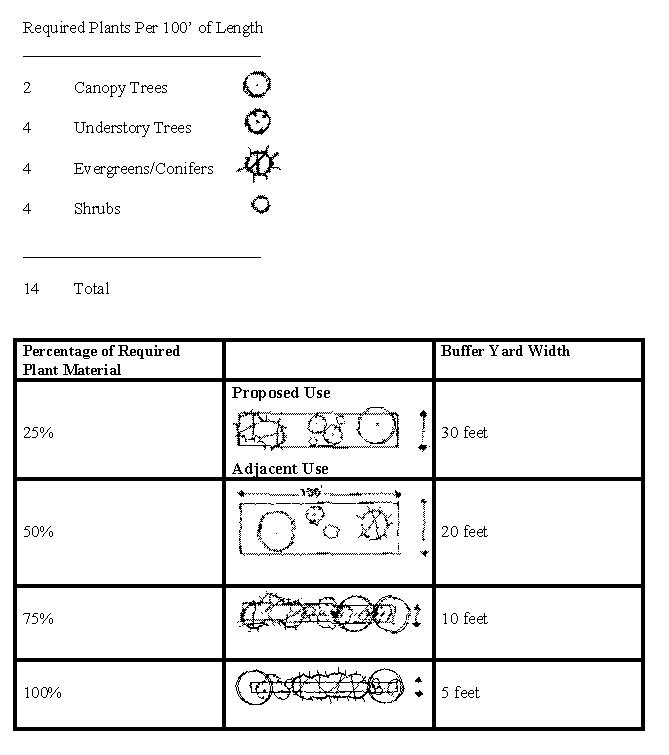
BUFFERYARD 2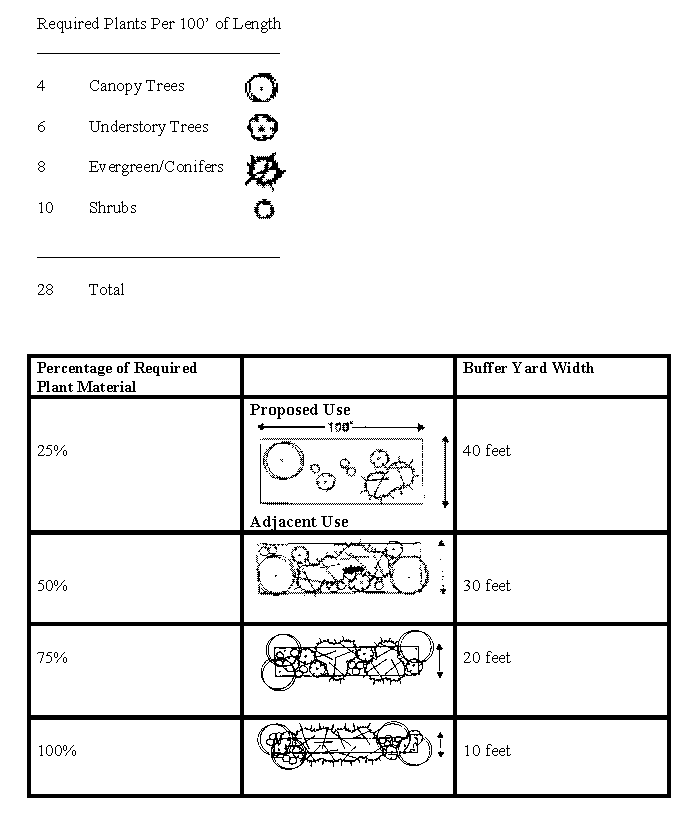
BUFFERYARD 3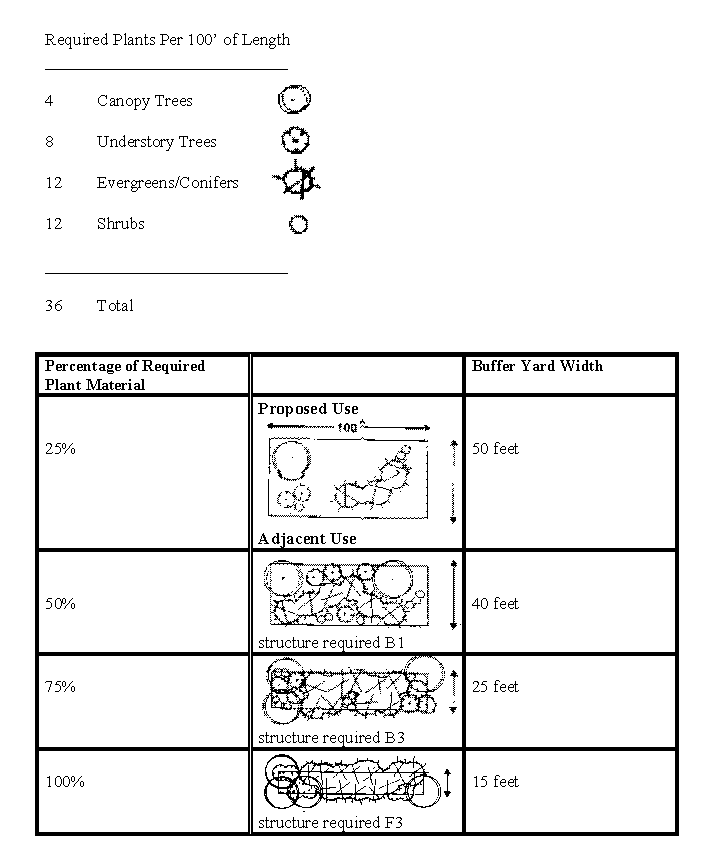
BUFFERYARD 4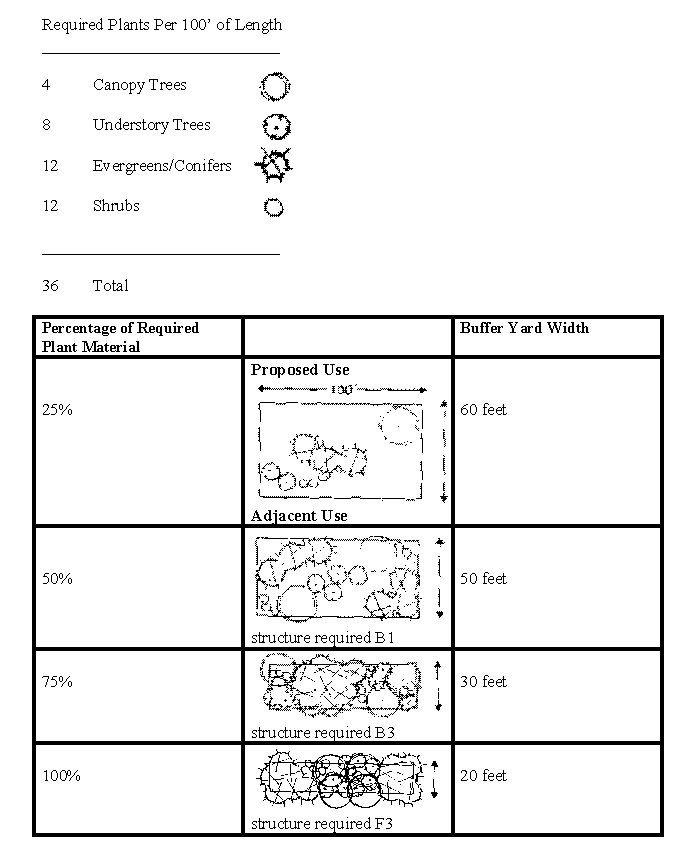
BUFFERYARD 5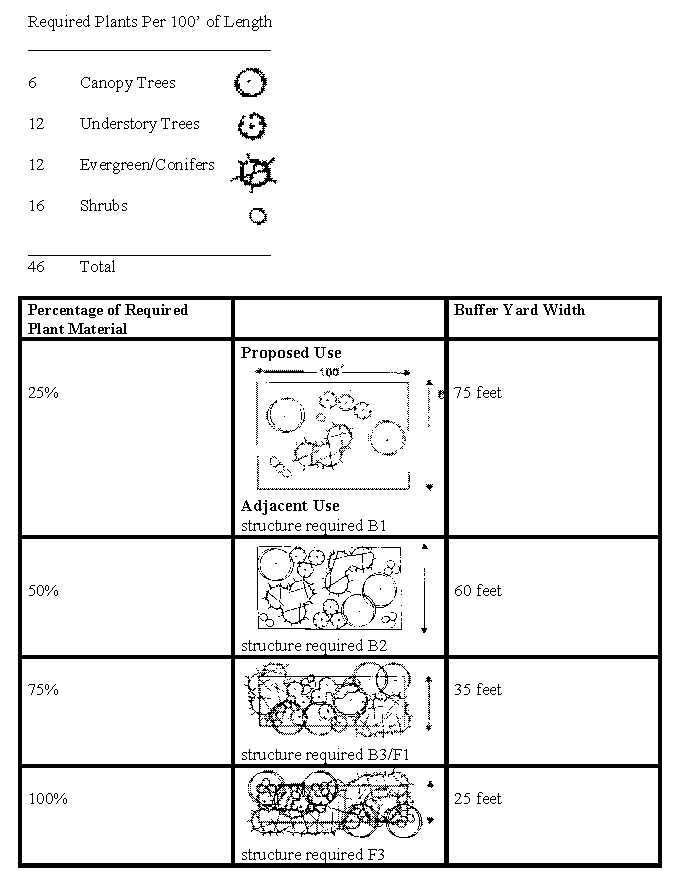
BUFFERYARD 6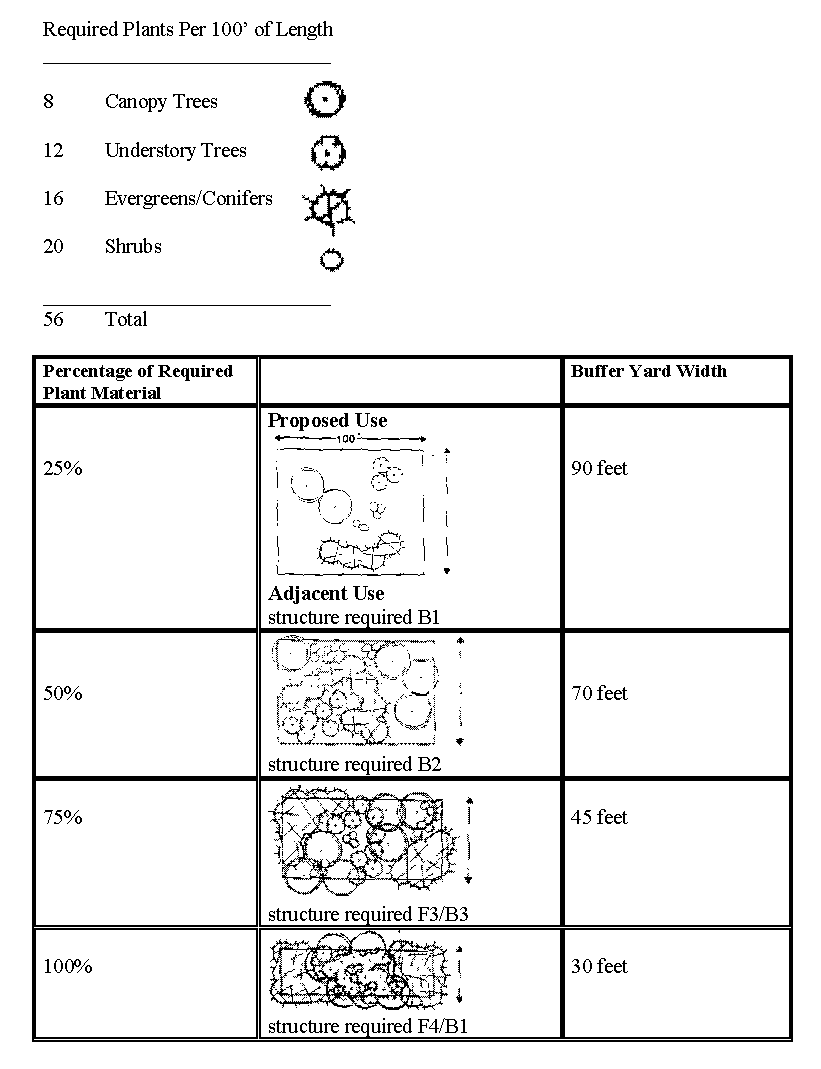
STRUCTURE ILLUSTRATIONS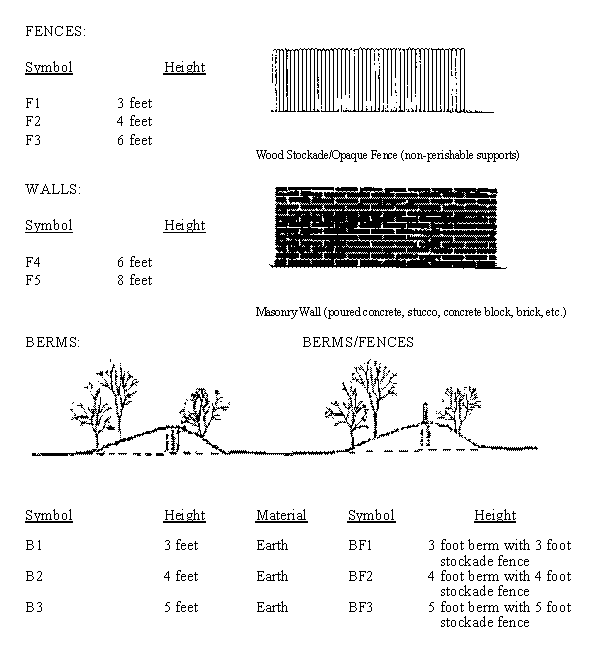
Section 727. - Communication Towers.
Communication towers shall be permitted in the following zoning districts, in accordance with the height specified, upon a finding by the Zoning Board of Appeals that the tower is compatible with the surrounding area.
727.1 Other Requirement. Unless otherwise specified elsewhere in this Ordinance, communication towers permitted within the City of Liberty shall be required to conform to the following standards:
a)
Minimum Front Setback: Fifty (50) percent of the height of the proposed communication tower.
b)
Minimum Rear Setback: Fifty (50) percent of the height of the proposed communication tower.
c)
Minimum Side Setback: Fifty (50) percent of the height of the proposed communication tower.
d)
Fencing: A solid stockade type fence or wall of at least six (6) feet in height, constructed of treated wood, masonry, or stone or a chain link fence of at least six (6) feet in height must be installed to secure the premises.
Section 728. - Nuisance Abatement of Conditions Creating a Threat to the Public Health and Safety.
(1)
It shall be the duty of the Zoning Administrator to enforce this Article. He may enforce the provisions of this Article by the inspection of the property, investigation of complaints and observance of persons who violate any of its provisions. He may enter at any reasonable time upon public or private property to investigate conditions related to the matters covered by this chapter.
(2)
The Zoning Administrator shall be empowered to issue a written notice when any provisions of this Article have been violated. Such notice shall allow ten (10) days from its receipt for performance of any act it requires, shall specify the manner in which the violation may be corrected, and shall state that noncompliance may result in further legal action, provided, however, that where it appears that the same owner, occupant, or person responsible has been given notice for the same violation at the same location within the previous one hundred eighty (180) days, such requirements of a ten (10) day waiting period may be waived and action commenced immediately.
(3)
Within five (5) days following receipt of the notice, any person receiving such notice, believing that the literal application of this Article will cause undue hardship or has been misconstrued, may file a written appeal with the Construction, Maintenance and Aesthetic Board of Appeals for such relief as may grant, by way of a reasonable extension of time or relief from strict compliance with the provisions of this Article. The circumstances justifying such findings are:
(a)
inability to immediately comply due to severe financial distress;
(b)
the non-availability of services or equipment with which to comply, without fault of the applicant; or
(c)
other extenuating circumstances showing a good faith intention on the part of the applicant.
(4)
In the event that any person receiving such notice fails or refuses to correct the violation within the time prescribed, such person shall be deemed in violation of this Article.
(5)
Such violation shall be a misdemeanor, punishable by penalty as prescribed herein. In the event such violation has not been corrected within ten (10) days as set forth above, the City of Liberty, or its agents, may go upon the property to correct the violation and the City of Liberty shall bill the owner directly for such costs (including inspection, administration, labor and equipment costs), and if not paid in full within ninety (90) days, the City shall obtain a judgment against the property owner or add the costs to the ad valorem taxes on such property.
728.1 Notification of Violators. Service of notice to violators shall be as follows:
(1)
by delivering personally to one or more of the following: the owner of the property, or the person responsible;
(2)
by depositing the notice in the U.S. postal service addressed to the owner or person responsible at his last known address with the postage prepaid thereon, and certified; and
(3)
in the event service of notice cannot be obtained in either of the above methods, by posting and keeping posted for 24 hours a copy of the notice in a conspicuous place on the premises where the violation has occurred and published once a week for three (3) weeks in a newspaper of general circulation in the City such information as is necessary to inform an owner or person responsible of the location of the premises and type of offense.
728.2 Nuisance Abatement of Conditions Creating Peril to Public Health and Safety. Whenever the Zoning Administrator shall determine that a public nuisance is such an imminent peril to the health or safety of the public or to public or private property and that the time required to follow the procedures outlined in Section [728] would seriously threaten the health or safety of the public or create injury to public or private property, the Zoning Administrator may order forthwith the abatement of such nuisances in the form of public nuisance, requiring that the public nuisance be eliminated within 72 hours, or else the party or parties responsible shall be guilty of a misdemeanor. The City may use city forces or it may employ contractors when, after 72 hours, the party or parties responsible have not acted in accordance with the City's notice. Thereafter, all proceedings required by Section [728] shall be held. The City may at its option bill the owner directly for such costs (including inspections, administration, labor and equipment costs) and if not paid in full within ninety (90) days, a judgment against the property owner may be obtained.
728.3 Immunity. No person carrying out the provisions of this Article shall be held to answer in any civil or criminal action.
Section 729. - Property Appearance.
729.1 Purpose. It is the intent of the City of Liberty to provide for uniform prohibition throughout the City of all litter on all public or public property, and to curb thereby the desecration of the beauty of the City and harm to the health, welfare, and safety of its citizens caused by individuals who litter. It is further the purpose of this Section to ensure to the greatest extent possible that all lands of the City of Liberty shall be maintained in a clean condition that shall be defined herein as having no litter.
729.2 Definition. Litter includes but is not limited to sand, gravel, slag, brickbats, rubbish, waste materials, including but not limited to tin or aluminum cans, refuse, garbage, rash, debris, dead animals, bottles, scrap glass, scrap metal, junk, junk vehicles, junk vehicle parts, scrap paper, disposable packages, or containers and all other similar materials and any substance of any kind or nature whatsoever and discarded materials of every kind and description that creates a public health, safety, or fire hazard or a public nuisance, defined as interference with the enjoyment and use of property.
729.3 Requirements. All residential, commercial, institutional and vacant properties are required to be kept free of litter by the owners, managers, tenants, or agents. Such areas shall include but are not limited to:
1)
Sidewalks, driveways, yards, and parking areas must be kept clean by owners, tenants, agents, and managers.
2)
Garbage container areas must be maintained in a clean condition.
3)
Construction sites must be kept clean.
Section 730. - Zoning Requirements for Food Truck Vendors.
730.1 Purpose. City Council hereby finds that the unrestricted sale or distribution of food and beverage from mobile food vendors, when not regulated, may pose a danger to health, safety, and general welfare. The purpose of this section is to regulate mobile food vendors in a manner that protects the public health, safety, and general welfare, while also accommodating entrepreneurial activity, as well as an active and social pedestrian environment within appropriate areas of the City of Liberty.
730.2 Application requirements. It shall be unlawful to engage in business as a food truck vendor within the City of Liberty without first obtaining approval by the City. The City Planner or City Administrator are authorized and shall establish an application from and submittal requirements for food truck vendors.
730.3 Operational Requirements. Food truck vendors may be permitted in the following zoning districts as a conditional use:
Central Business District
General Business District
Neighborhood Business District
Research Industrial District
General Industrial District
As long as the following conditions are met:
A.
The approved food truck vendor permit, proof of liability insurance as a motor vehicle, and the DHEC inspection report shall be prominently displayed to the public in the food handling areas of the vehicle during operation.
B.
Permits shall then be renewed on an annual basis in accordance with the renewal schedule for business licenses for the City.
C.
Written consent to operate on the property must be obtained from the private property owner(s) of the specific location and submitted with the permit application and prominently displayed to the public on the vehicle.
D.
Approved hours of operation shall be between 8:00 a.m. and 10:00 p.m.
E.
No alcoholic beverages shall be sold.
F.
Selling of non-food items from a food truck vendor shall be prohibited with the exception of merchandise displaying the food truck vendor logo and/or branding.
G.
Operations shall only occur on the property for which a permit was issued and shall not reduce the required parking area below the minimum requirements for any other use on the lot. The operation shall also not interfere with the normal operation of any other permitted use of the property.
H.
Operations shall not obstruct the visibility of motorists, interfere with parking lot circulations, block access to a public street, alley or sidewalk, or result in customer queuing that obstructs building entries or public walkways.
I.
Operations shall not cause interference with the movement of vehicular or pedestrian traffic to such an extent that adequate police, fire, or other emergency services cannot be provided.
J.
Structures, canopies, seating, outdoor tables, grills and similar accessory facilities are prohibited.
K.
Only signs permanently affixed to or painted on the vehicles shall be permitted.
L.
Food truck vendors shall not produce any offensive or loud noise to attract customers or advertise products.
M.
Operators shall provide trash receptacles and be responsible for the storage and daily disposal of all trash, refuse, and litter.
N.
The vehicle cannot be left unattended or left at a sale site overnight.
O.
The owner will collect and remit Hospitality Taxes using the City of Liberty Hospitality Remittance Form in the same manner as other food service enterprises.
P.
Food Truck Vendors shall properly store all fat, grease, oil, or waste water and shall dispose of all such waste only at locations designated and will not dispose in the sanitary sewer or storm water system.
Q.
Food Truck Vendors shall not solicit or conduct business with persons in motor vehicles. The Food Truck vendor shall not operate the Food Truck as a drive-thru window.
R.
A list of possible locations must be included with the application with all private property owners information. A Food Truck Vendor cannot move or use a different location not listed on the application without permission from the city.
S.
Food truck vendors can only set in residential areas for a private event.
T.
Catered events, special events, and mobile food vendors that fall under a special event permit are exempt from the requirements as long as a valid special event permit has been issued.
U.
Any food truck vendor that has been issued a notice of health violation by any department or agency of the state of South Carolina, which remains uncorrected upon subsequent inspection, shall have its food vendor permit revoked.
V.
Any Food Truck Vendor that violates any of the regulations listed above will have its food vendor permit revoked and will not be allowed to be renewed for one year.
(Ord. No. 2022-12, § I, 9-12-2022)

