
Lindsay City Zoning Code
18.14 Home
Occupations; Temporary Subdivision Signs And Sales Offices; Mobile Parks; Signs And Outdoor Advertising Structures; Manufactured And Second House Units
18.14.010 Home Occupations
- Procedure. Home occupations shall be permitted only in accordance with the regulations in Chapter 18.16 and this section.
- Standards. Before approving an application for a home occupation in accordance with the provisions of Chapter 18.16 and this section, the director of community development shall determine that the proposed home occupation will comply with the following standards:
- A home occupation within a dwelling unit shall be clearly incidental to the use of the structure as a dwelling.
- A home occupation shall not be conducted in any accessory structure, other than a garage, and there shall be no storage of equipment or supplies in any accessory structure, other than a garage or outside the dwelling.
- No one other than a resident of the dwelling shall be employed in the conduct of the home occupation.
- Sales of goods on the premises shall be limited to the products of the home occupation, and no merchandise or goods shall be sold, kept or displayed for the purposes of sale on the premises.
- Merchandise not produced on the premises may be kept and stored for purposes of sale at locations off the premises; provided, that such merchandise is limited to small articles such as jewelry, cosmetics and similar items of merchandise which can be carried by one person in a case. For purposes of this standard, contracting services such as plumbing, heating, air conditioning, electrical, carpentry and landscaping are not included within the meaning of the phrase "small articles."
- A home occupation may involve the performance of business and professional services in which goods, wares and merchandise are not commercially created, sold or exchanged, but shall not include beauty salons, barber shops, medical offices, tattoo parlors, fortunetellers, palm readers or similar services.
- A home occupation shall not involve the performance of any repair services on the premises other than the repair of small appliances and equipment or other small objects which normally are capable of being carried by one person without the aid of mechanical equipment or devices.
- A home occupation shall not involve the use of any material or mechanical equipment not recognized as being part of normal household or hobby uses.
- No motor power other than electrically operated motors shall be used in connection with a home occupation.
- A home occupation shall not create any radio or television interference or noise audible beyond the walls of the dwelling.
- There shall be no external alteration of the appearance of a dwelling in which a home occupation is conducted.
- The existence of a home occupation shall not be apparent beyond the boundaries of the site except for one nonilluminated nameplate affixed to the dwelling not exceeding two square feet in area.
- The number of customers of a home occupation who must travel to the site of the home occupation shall not exceed four persons per day.
- Not more than one truck of not more than one ton capacity and no semitrailers incidental to a home occupation shall be kept on the site.
- A home occupation shall not be permitted until an application for administrative approval shall be made in the manner prescribed under Chapter 18.16.
- The city council may also place other conditions deemed necessary to make the home occupation compatible with the neighborhood.
Upon approval of a permit for a home occupation, the community development department shall attach the above standards to the notice of approval as conditions which must, in all cases, be met by the applicant, together with such additional conditions as may be prescribed under the administrative approval process of Chapter 18.16.
- Modification and Revocation. A permit for a home occupation may be modified in the same manner as originally applied for by the applicant. A permit for a home occupation may be revoked in the manner prescribed under Section 18.16.060.
(Ord. 486 § 8, 1997; Ord. 437 § 1 (part), 1989)
18.14.020 Temporary Subdivision Signs And Sales Offices
Temporary subdivision signs and sales offices may be located within subdivisions for a period not to exceed two years from the date of recording of the subdivision. Subdivision signs and sales offices shall be removed at the expense of the owner, unless, prior to the expiration of two years, a renewal of time is granted by the city council. Upon expiration of such renewal period, subdivision signs and sales offices shall be removed at the expense of the owner. Subdivision signs shall be governed by the regulations prescribed in Section 18.14.040 of this chapter. A temporary subdivision sales office shall not be permitted until an application for a subdivision sales office permit shall be made to and approved by the city council in the manner prescribed in Chapter 18.17.
(Ord. 437 § 1 (part), 1989)
18.14.030 Mobile Home Parks
- Occupancy. No mobile home shall be occupied or used for living or sleeping purposes, or be parked, other than in a mobile home sales yard or in an approved storage area within a CS, CH or I district, unless it is located within a licensed mobile home park; provided, that a mobile home may also be used as follows: as an office for a construction project, circus or carnival; as a residence of a watchman on the site of a construction project or an industrial use; or to provide temporary living quarters for circus or carnival personnel in accordance with the provisions of an approved conditional use permit; or as a single-family dwelling when set on a permanent foundation within any RA, R, RM or PO district.
- Location and Access. For purposes of this title, mobile home parks are considered to require the same considerations in their location as do other types of multifamily dwellings under medium density policies of the general plan. Mobile home parks shall be located only within RM districts, with access from elements of the arterial or collector street system to be considered as a condition of approval.
- Development Standards—Mobile Home Parks.
- Park Area, Density and Site Area.
- The minimum area of a mobile home park shall be five acres. The first phase of mobile home park development shall be not less than five acres and shall include all required recreational and service amenities.
- The maximum density shall be eight mobile home sites per gross acre.
- Each mobile home site shall be not less than three thousand square feet in area, including pad, parking, private access, landscaping and private storage areas.
- No mobile home site shall be less than thirty feet in width.
- Clearances, Setbacks and Yard Spaces.
- Mobile home park:
Front yard 20 ft. Interior side yard 10 ft. Street side yard 10 ft. Interior rear yard 10 ft. Street rear yard 20 ft. - Mobile home sites within the park:
Front yard 10 ft. Side yard 5 ft. Rear yard 10 ft. - No mobile home shall be located in any required yard space, except that tow bars may extend into such yard space, and other incidental structures may be located in accordance with the provisions of Section 18.08.050(F).
- Mobile home park:
- Patios and Pads.
- Each mobile home site shall have a hard surfaced patio area of not less than two hundred square feet. A permanent porch greater than twenty square feet in area may be counted as part of the required patio area.
- Each mobile home site shall have a support pad of concrete or asphalt concrete laid over a compacted surface base which, in combination, will be adequate to support the mobile home on a level plane.
- Parking.
- Not less than two off-street parking spaces shall be provided within each mobile home site, one of which may be tandem to the other.
- Not less than one guest parking space shall be provided for each mobile home site at a location central to each four contiguous mobile home sites; provided, that guest parking shall not be required for mobile home sites along a collector street constructed to the width prescribed under subsection (C)(5), of this section.
- Parking shall be provided for central recreation buildings, park offices and other similar buildings at a ratio of one parking space for each four hundred square feet of gross floor space.
- Supplemental parking for pleasure boats, recreation vehicles and nonoccupied travel trailers shall be provided at a ratio of one parking occupied travel trailers shall be provided at a ratio of one parking space for each ten mobile home sites, and shall be used only by mobile home park tenants. Said parking shall be clustered, easily accessible via interior drives, and shall be screened from view by means of a solid ornamental fence or wall and landscaping.
- All parking areas and spaces shall be designed and constructed in accordance with the provisions of Chapter 18.13 of this title.
- Streets.
- Entrance streets shall be located to assure safe access to and from the public street system.
- Minor streets within the mobile home park shall be a minimum of thirty feet of paved width; collector streets shall be a minimum of thirty-six feet of paved width. Paving shall be to city standards.
- Streets shall be constructed to effect positive drainage, including concrete curbs and gutters constructed to city standards.
- Parallel parking shall be permitted on both sides of a collector street and on only one side of a minor street. Such on-street parking shall be in addition to off-street parking requirements of this Section.
- Driveways, Street Signs, Lighting, Storm Drainage, Water and Sewer Systems. Driveways for individual mobile home sites, street signs, interior street lighting, storm drainage facilities and water and sewer systems shall be installed subject to approval of the director of public works.
- Underground Utilities. All public utilities shall be installed underground, including electrical, telephone, street lighting cable, community television antenna connections and ducts for cable television. A community television antenna with underground ducts and connections to each mobile home site shall be provided.
- Recreation Areas and Pedestrian Ways.
- Common recreation area in an aggregate total equal to ten percent of the gross area of the mobile home park shall be provided at a location or locations which are easily accessible and convenient to park residents.
- Recreation areas shall be landscaped and maintained, with all landscaped areas to be irrigated by an automatic underground system.
- Pedestrian ways shall be provided throughout the mobile home park, connecting all mobile home sites with each other and with common recreation areas. Such pedestrian ways shall be provided where possible at locations away from the interior street system to avoid conflict in pedestrian and vehicle traffic.
- The calculation of common recreation areas shall not include yard areas, pedestrian ways, management offices, laundry and tenant storage areas and parking areas.
- Signs. No more than one identification sign shall be erected displaying the name of the mobile home park. Such signs shall be located near the park entrance drive and shall not exceed thirty-two square feet in total readable surface area, or eight feet in height. Such sign shall be installed within the front yard area of the mobile home park, parallel to the abutting street, with landscaping at its base. Additional directional and identification signs may be installed within the mobile home park subject to the approval of the community development director.
- Landscaping and Screening. Mobile home parks shall provide permanently maintained landscaped areas and site screening as follows:
- A landscaped border along the entire street frontage yard area and along the rear yard if such yard is adjacent to a public street.
- Ornamental screen wall or fencing, seven feet in height, along all interior side property lines, along all rear property lines which do not abut a public street, and along street side yard and street front yard setback lines.
- Other Requirements.
- Each mobile home park shall provide: (1) a laundry building equipped for clothes washing and drying; (2) an outdoor clothes drying area screened from view from other areas of the mobile home park by an ornamental screen fence or wall and landscaped area; and (3) trash enclosures at locations along the interior street system which are convenient to all residents and to municipal refuse trucks, integrated with parking areas.
- Applications for mobile home parks shall he subject to site plan review under the provisions of Chapter 18.18.
- Placement and Sale of Mobile Homes.
- At the time of placement on the site, all mobile homes shall be fitted with appropriate skirts to obscure stands, pads, and under-carriage equipment.
- Mobile homes may be displayed and sold within a mobile home park similar to the sale of model homes within a residential subdivision; provided, that such mobile homes are not sold for delivery to any location other than within the mobile home park in which sold, and that all mobile homes are placed on mobile home sites and connected to all utility services. No more than four mobile homes shall be offered for sale at any one time, and advertising for sale shall be limited to one nonilluminated sign not exceeding eight square feet in area on the site of each mobile home offered for sale.
- Park Area, Density and Site Area.
(Ord. 437 § 1 (part), 1989)
18.14.050 Regulation Of Manufactured Housing Within Residential Districts
- Application. The provisions of this section shall apply to all single family dwellings and mobile homes on permanent foundations listed as permitted uses within UR, RA, R, RM and PO districts.
- Developmental/Architectural Standards. All single-family dwellings and mobile homes on permanent foundations shall meet the following developmental/architectural standards:
- Garages or Carports. A garage or carport shall be provided for every dwelling located on a lot which is not a part of a mobile home subdivision.
- Minimum Floor Area. The minimum floor area for every dwelling located which is not a part of a mobile home subdivision, shall be eight hundred square feet, excluding the area of the garage or carport.
- Roof Overhang. All main buildings shall have a pitched roof with a minimum twelve-inch roof overhang on each of the dwelling's perimeter walls such that the overhang is architecturally integrated into the design of the dwelling unit.
- Roofing Material. All main buildings, and all detached garages and carports located on the front half of the lot shall have a roof constituted of either wood shakes, asphalt, composition or wood shingles, clay, tile, concrete or metal tile, slate or built-up asphalted-gravel materials.
- Siding Material. All main buildings and all detached garages located on the front half of the lot shall have exterior siding material consisting of either wood, masonry, concrete, stucco, Masonite or metal lap. The exterior siding material shall extend to ground level, except that when a solid concrete or masonry perimeter foundation is used, the siding material need not extend below the top of the foundation.
- Foundations. All main buildings shall be placed on a permanent foundation which meets applicable building code requirements and/or the provisions of Section 18551 of the California Health and Safety Code, such that the floor elevation of the dwelling is reasonably compatible with the floor elevations of the surrounding dwelling units.
- Minimum Width. The minimum width of a dwelling located on a lot outside of a mobile home subdivision shall be twenty feet.
- Surrender of Registration. Subsequent to applying for a building permit, and prior to occupancy of a mobile home on a permanent foundation, the owner shall request a certification of occupancy be issued by the building official pursuant to Section 18557(a)(2) of the California Health and Safety Code. Thereafter, any vehicle license plate, certificate of ownership and certificate of registration issued by a state agency is to be surrendered to the issuing state agency. Any mobile home on a permanent foundation must bear a California insignia or Federal label pursuant to Section 18550(b) of the California Health and Safety Code.
- Tow Bars, Wheels and Axles. All mobile home tow bars, wheels and axles shall be removed when the dwelling is installed on a residential lot.
- Deviations. The community development director may approve deviations from one or more of the standards of this section on the basis of a finding that the architectural style proposed provides compensating design features and that the proposed dwelling will be compatible and harmonious with existing structures in the vicinity. The determination of the director may be appealed to the city council in accordance with the provisions of Section 18.16.050 of this code.
(Ord. 437 § 1 (part), 1989)
18.14.060 Second Dwelling Units
A. Purpose. The purpose of this chapter is to prescribe development and site regulations that apply, except where specifically stated, to accessory dwelling units (“ADUs”) and junior accessory dwelling units (“JADUs”), as required by and in compliance with Government Code Sections 65852.2 and 65852.22, as either may be amended from time to time. The standards established by this section shall be interpreted and applied consistent with the standards set forth in Government Code Sections 65852.2 and 65852.22. Implementation of this section is meant to expand housing opportunities by increasing the number of smaller units available within existing neighborhoods.
ADUs and JADUs shall not be subject to any deed restrictions, nor may any HOA or third-party entity influence approval of an ADU or JADU permit application (Gov. Code § 66315, § 66317(c)).
B. Applicability. The provisions of this section shall apply to all accessory dwelling units approved on or after the effective date of the ordinance codified in this section. This section provides standards by which the city shall evaluate building permit applications for permitted accessory dwelling units in the UR, RA, R, RM, MXU, and PO zoning districts. Accessory dwelling units shall be permitted ministerially in any zone that permits residential uses, including mixed use zones, regardless of density (Gov. Code § 65852.2(a)).
All applications for ADUs/JADUs shall be approved ministerially within 60 days of a completed application submission (Gov. Code § 66317(a), § 66335(2)).
C. Definitions. As used in this article, the following terms are defined in this section:
"Principal dwelling unit" means a single- or multi-family dwelling unit situated on a residential lot in the UR, RA, R, RM, MXU, and PO zones to which an accessory dwelling unit as defined by this article has been or is proposed to be added.
"Accessory dwelling unit" means an additional dwelling unit up to 1200 sq ft for detached ADUs and up to 50% of the primary dwelling for attached ADUs, in compliance with State law, with separate kitchen, sleeping, and sanitation facilities constructed or adopted within, onto, or detached from a primary dwelling on a residential lot in the UR, RA, R, RM, MXU, and PO zones.
“Junior accessory dwelling unit” or “JADU” means a dwelling unit that is no more than five hundred (500) square feet in size and contained entirely within a single-family residence that includes a separate entrance, may share sanitation facilities with the primary residence, and includes an efficiency kitchen consisting of a cooking facility with appliances, a food preparation counter, and storage cabinets of reasonable size in relation to the size of the unit.
"Living area" means the interior habitable area of a dwelling unit including basements and attics but does not include a garage or an accessory structure.
D. Lot Requirements. An accessory dwelling unit shall be permitted on a lot or parcel that meets the following:
1. Contains an existing or proposed single-family or multi-family dwelling.
2. Minimum lot size shall not restrict ADU creation (Gov. Code § 65852.2(a)(1)).
3. ADUs may be permitted on lots served by septic systems, consistent with applicable health standards. Lots may contain both an ADU and a JADU as permitted by State law..
E. Development Standards. All accessory dwelling units may be established by the conversion of an attic, basement, garage, or other portion of a principal dwelling unit. A detached accessory dwelling unit may be established by the conversion of an accessory structure or maybe new construction Manufactured homes may be used as ADUs and shall not be subject to standards that exceed those required for any other ADU under State law.
All applications for accessory dwelling units, must comply with the following standards:
1. Parcel Size –Minimum lot size shall not prevent ADU creation.
2. Floor Area. Detached ADUs shall not exceed one thousand two hundred (1,200) square feet; attached ADUs ≤50% of primary dwelling or 1,200 sq ft, whichever is greater; manufactured home ≥800 sq ft; ADUs/JADUs ≥220 sq ft; JADUs ≤500 sq ft.
3. Quantity. Single-family: one attached or detached ADU and one JADUper lot. Multi-family: up to two detached ADUs plus at least one conversion ADU within existing non-livable space, and up to 25% of existing units may be converted. (Gov. Code § 66323).
4. Setbacks – A setback of four (4) feet from the side and rear lot lines is required for an ADU, unless the ADU is constructed within an existing primary structure.
5. ADUs and JADUs shall not exceed a single story and eighteen feet (18') in height, with an additional 2 feet for pitched roofs. Up to 25 feet must be allowed when attached to or replacing a portion of an existing dwelling with equal or greater height (Gov. Code § 66323(a)(2))
6. No architectural review or subjective design standards shall be applied to ADUs or JADUs. Only objective standards permitted by State law may be imposed.
7. Safety – Accessory dwelling units shall be subject to all applicable building, fire, health and safety codes and may not have adverse impacts on any real property that is listed in the California Register of Historic Places.
8. Access – Entrance location shall not be restricted.
9. Parking. Up to one off street parking space may be required unless exempt under Gov. Code § 65852.2(a)(1)(D). No on street parking availability test shall be applied. No parking may be required for JADUs, including garage conversions (Gov. Code § 65852.2(a)(1)(D)(xi)).
Parking exemptions include:
a. The accessory dwelling unit is located within one-half (0.5) miles of public transit.
b. The accessory dwelling unit is located within an architecturally and historically significant historic district.
c. The accessory dwelling unit is part of the existing primary residence or an existing accessory structure.
d. When a garage, carport, or covered parking structure is demolished in conjunction with the construction of an ADU, or converted to an ADU, the local agency shall not require that those off-street parking spaces for the primary unit be replaced. No parking may be required for JADUs, including garage conversions (Gov. Code, § 65852.2, subd. (a)(1)(D)(xi).
10. Utility Services. Accessory dwelling units shall be provided with water, sewer, and other utilities as determined by the building official. A separate connection from the main dwelling is not required.
11. Process. The City shall ministerially approve compliant ADU/JADU applications without discretionary review or appeal.
12. A permit must be obtained for the construction or installation of an ADU or JADU as a Ministerial review only; no discretionary review or hearings permitted.
13. Deed Restrictions - ADU/JADU development is exempt from deed restrictions and may not be blocked by HOA rules; owner-occupancy is not required (Gov. Code § 66315).
14. Impact Fees - ADUs ≤750 sq ft exempt from impact fees; larger ADUs may be charged proportionally (Gov. Code § 66324(c)).
15. Pre-2020 ADUs/JADUs - Legalization must follow Gov. Code § 66332.
16. State Law - State law supersedes any conflicting provisions; noncompliant ordinance provisions are null and void (Gov. Code § 66316).
17. Conveyance - Separate conveyance as condominium allowed (Gov. Code §§ 66340–42, 66341).
(Ord. 514 § 13, 2004: Ord. 437 § 1 (part), 1989)
Amended by Ord. 578 on 8/27/2019
Amended by Ord. 703 on 1/13/2026
18.14.110 Purpose
- The purpose of this chapter is to regulate signs as an information system that preserves and enhances the aesthetic character and environmental values of the City of Lindsay. Specifically, these regulations are intended to implement the General Plan and to:
- Provide minimum standards to safeguard life, health, property, public welfare, and traffic safety by controlling the design, quality of materials, construction, illumination, size, location, and maintenance of signs and sign structures;
- Preserve and enhance the visual attractiveness of the city;
- Protect and enhance property values and community appearance by encouraging signs that are compatible with the architectural style, character, and scale of the building to which they relate and with adjacent buildings and businesses;
- Restrict signs that may create visual clutter or a nuisance to nearby properties, violate privacy, create hazards or unreasonable distractions for pedestrians and drivers, or interfere with vehicular ingress and egress;
- Provide adequate opportunity for the exercise of the free speech by display of a message or image on a sign, while balancing that opportunity with other community and public interests;
- Ensure that commercial signs are accessory or auxiliary to a principal business or establishment on the same premises, rather than functioning as general advertising for hire.
- It is the City’s policy to regulate signs in a constitutional manner that is content neutral as to noncommercial messages which are within the protections of the First Amendment to the U.S. Constitution and the corollary provisions of the California Constitution.
(Ord 579, 2019)
18.14.120 Applicability And Severability
This chapter regulates signs that are located or mounted on private property within the jurisdictional boundaries of Lindsay. The provisions in this Chapter apply in all Zoning Districts within the city. No sign within the regulatory scope of this Chapter shall be erected or maintained anywhere in the city except in conformance with this Chapter. If any part, section, subsection, paragraph, subparagraph, sentence, phrase, clause, term, or word in this chapter is declared invalid, such invalidity shall not affect the validity or enforceability of the remaining portions of the chapter.
(Ord. 579, 2019)
18.14.130 No Discrimination Against Noncommercial Speech
Subject to the property owner’s consent, a noncommercial message of any type may be substituted, in whole or in part, for any commercial message or any other noncommercial message provided that the sign structure or mounting device is legal without consideration of message content. Such substitution of message may be made without any additional approval or permitting. This provision prevails over any more specific provision to the contrary within this title. The purpose of this provision is to prevent any inadvertent favoring of commercial speech over noncommercial speech or favoring of any particular noncommercial message over any other noncommercial message. This provision does not create a right to increase the total amount of signage on a parcel, nor does it affect the requirement that a sign structure or mounting device be properly permitted.
(Ord. 579, 2019)
18.14.140 Exempt Signs
- The following signs are exempt from the permit requirements of this chapter and do not count toward the total sign area limit for a site, if they conform to applicable standards:
- One nameplate per residence or business premises, not exceeding two (2) square feet in area, identifying the owner, address and/or business hours of the property.
- Barber poles, not exceeding 18 inches in height, located in a non-residential zone district and containing no lettering.
- Signs on vehicles, provided that the message pertains to the establishment of which the vehicle is an instrument or tool, and the sign does not utilize changeable copy or special illumination.
- Holiday and cultural observance decorations on private property that do not include commercial advertising. This exemption includes strings of lights associated with a holiday decoration.
- Official notices issued by a court or public agency and posted in the performance of a public duty; notices posted by a utility or other quasi-public agency; signs erected by a governmental agency to direct or regulate pedestrian or vehicular traffic; noncommercial bus stop signs erected by a public transit agency, or other signs required or authorized by law. This exemption also covers signs and banners for special civic events erected by the City, which may be displayed in public rights-of-way.
- Signs that are located entirely within a building or enclosed structure and are not visible from the public right-of-way.
- Signs located on a private area of a lot that is not accessible by the general public, such as a backyard, and are not visible from the public right-of-way.
- Signs and menu display boards fixed to mobile vending carts, up to a maximum of eight (8) square feet of sign area, plus a menu display board.
- Signs that are part of a vending machine, gas pump, or similar device.
- Signs mounted on carrier vehicles such as buses, taxicabs, and limousines that legally pass through the city.
- Window signs that conform to the standards of Chapter 18.14.
- Exempt signs that have electrical connections or engineered supports shall obtain the appropriate building permit, as required by the California Building Code.
(Ord. 579, 2019)
18.14.150 Prohibited Signs
- The following signs shall be prohibited in all zones:
- Signs that it could reasonably be perceived to interfere with, or be confused with any official traffic control device, traffic signal, or official directional guide sign.
- Signs placed within 30 feet of the intersecting curb lines of a street, except for signs erected by a governmental agency to direct or regulate pedestrian or vehicular traffic.
- Signs so located as to prevent free ingress and egress from any door or fire escape.
- Signs extending above or beyond the face of the building, the fascia of the roof, the peak of a pitched roof, or the parapet line of a flat roof.
- Glaring, flashing, sparkling, glittering, twinkling, or shimmering signs.
- Signs with open letters that can be viewed from the reverse side.
- Streamers, mylar balloons, and blimps secured with a rope or string, unless specifically permitted with a temporary use permit.
- Signs located, placed, or erected in or upon any public right-of-way, except as specifically allowed by this chapter.
- Signs located, placed or attached upon any tree, utility pole, or fence, except as specifically allowed by this chapter.
- Signs placed on private property without permission of the property owner.
- Nonconforming signs and sign structures associated with an activity, business, product, or service that has not been sold, produced, provided, or conducted on the premises for a period of 90 days.
- Signs that revolve or are animated, except public service signs, such as time and temperature units and barber poles.
- Signs containing statements, words, symbols, or characters of an obscene nature.
- Signs emitting sound.
- Murals that contain commercial speech or logos.
- Signs located within five (5) feet of a fire hydrant, street sign, or traffic signal.
- Signs on gas pump canopies facing residential zone districts shall not be illuminated.
(Ord 579, 2019)
18.14.160 Permits Required
- No permanent sign shall be erected, altered, reconstructed, or relocated without a sign permit unless the sign is specifically exempted from the permit requirements. A permit is not required for ordinary maintenance and repairs to signs and for temporary signs on private property that conform to the standards of this chapter. The City Manager, or designee will review all applications for sign permits for consistency with this chapter.
- Signs that have electrical connections or engineered supports shall obtain the appropriate building permit, as required by the California Building Code.
- Signs that project over or extend into a public street or sidewalk shall also require approval of an encroachment permit by the City Engineer pursuant to the provisions of Title 12 of the Municipal Code.
- Consent of the property owner and business owner is required before any sign permit may be approved.
(Ord. 579, 2019)
18.14.170 Rules For Sign Measurement
- For the purposes of this chapter, lot frontage shall be calculated as follows:
- If a lot fronts on two streets, both frontages may be used to determine the allowable sign area.
- If a lot fronts on three or more streets, the length of only two contiguous sides shall be added together to determine allowable sign area.
- The building frontage shall be the building facade in which main customer access is provided to the establishment. A building's frontage is considered continuous if projections or recesses in the building facade do not exceed 15 feet in any direction. For buildings with two or more frontages, the length of the wall and allowable sign area shall be calculated separately for each building frontage.
- The area of an individual sign shall be calculated as follows.
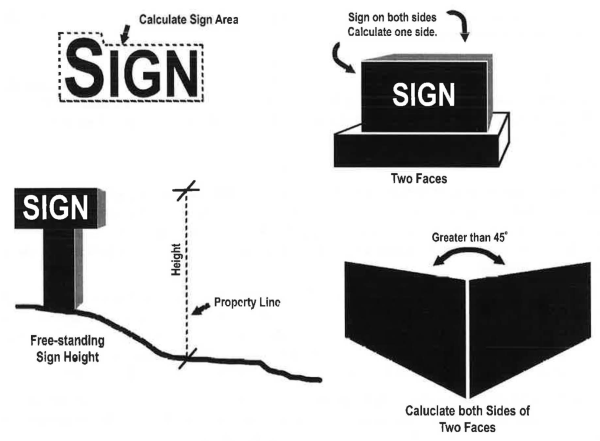
- Sign area shall include the entire area within a single continuous perimeter composed of squares or rectangles that enclose the extreme limits of all sign elements, including, but not limited to, sign structures or borders, written copy, logos, symbols, illustrations, and color. Supporting structures such as sign bases and columns are not included in sign area if they contain no lettering or graphics.
- Where two faces of a double-faced sign are located two (2) feet or less from one another at all points or located at an interior angle of 45 degrees or less from one another, the sign area shall be calculated as the area of one (1) face. Where the two (2) faces are not equal in size, the larger sign face shall be used. Where two (2) faces of a double-faced sign are located more than two (2) feet or 45 degrees from one another, both sign faces shall be counted toward sign area.
- On a three-faced sign, where at least one interior angle is 45 degrees or less, the sign area shall be calculated as the sum of the largest and the smallest face. In all other situations involving a sign with three or more sides, sign area shall be calculated as the sum of all faces.
- Three-Dimensional Signs. The size of signs that consist of, or have attached to them, one or more three-dimensional objects (i.e., balls, cubes, clusters of objects, sculpture, or statue-like trademarks), shall be calculated as the sum of the square footage of the two adjacent sides of the smallest theoretical cube that would encompass the sign.
- The height of a sign shall be calculated as follows.
- The height of a sign that is not a freestanding sign shall be the vertical distance measured from the ground level directly beneath the sign to the highest point at the top of the sign including any structural or architectural components of the sign.
- The height of a freestanding sign shall be measured as the vertical distance from grade at the edge of the right-of-way along which a freestanding sign is placed to the highest point of the freestanding sign, including any structural or architectural components of the sign. When the grade at the edge of the right-of-way is higher than the site on which the sign is placed, that portion of the sign below the grade at the edge of the right-of-way shall not be included in determining the freestanding sign's overall height. Freestanding signs oriented towards a freeway shall be measured from the site's finished grade or pad, whichever is lower.
- Sign clearance shall be measured as the smallest vertical distance between finished grade and the lowest point of the sign, including any framework or other embellishments.
- For the purpose of determining the allowed number and size of signs, an integrated shopping center shall be considered us one site.
Adopted by Ord. 579 on 9/10/2019
18.14.180 Sign Regulations On Developed Sites By Zone District
For the purpose of this section, signs are grouped into four types: building signs, freestanding signs, temporary building signs, and temporary freestanding signs.
This section establishes standards for the number of signs, size of signs, placement of signs, and illumination of signs for developed sites based on the zone district in which the signs are located. Table 18.14.180(A) establishes specific regulations by zone district for building signs, and freestanding signs. Table 18.14.080(B) establishes specific regulations by zone district for temporary building signs and temporary freestanding signs. Signs shall not be placed on private property except in conformance with Table 18.14.180(A) and Table 18.14.080(B).
Table 18.14.180(A)
Number and Size of Permanent Signs by
Zone | ||
Zone District | Permanent Building Signs | Permanent Freestanding Signs |
| R-A, R, and RM districts with 4 or less residences per site | 1 sign per residence maximum. 4 sq.ft. maximum size per sign. Placement a maximum 8 feet high. External illumination only. | None allowed. |
R-A, R, and RM districts with 5 or more residences per site or with non-residential uses on site | 1 sign per street frontage maximum. 30 sq.ft. maximum size per sign. Placement a minimum 5 feet below roofline. External illumination only. | 1 sign per frontage maximum. 20 sq.ft. maximum size. 6 feet high maximum. External illumination only. |
PO districts | 2 sq.ft. per 1 lineal foot of building frontage up to 60 sq.ft. on primary
frontage. 1 sq.ft. per 1 lineal foot up to 30 sq.ft. on secondary frontage. | 1 monument sign per street frontage: Less than 50 feet of frontage: 20 sq.ft., 6 feet high maximum 50-150 feet of street frontage: 36 sq.ft., 6 feet high maximum 150-300 feet of street frontage: 64 sq.ft., 8 feet high maximum 5-foot minimum setback from property line |
CN, CS, and CH districts | Number of signs per business establishment limited to 6. Allowed square footage per building frontage is cumulative. Primary building frontage: 2 sq.ft. per 1 lineal foot up to a maximum 350 sq.ft. along primary frontage. 50 sq.ft. allowed regardless of frontage length. Secondary building frontage: 1 sq.ft. per lineal foot up to a maximum 200 sq.ft. per secondary frontage. 35 sq.ft. allowed regardless of frontage length. | 1 sign per establishment maximum. 60 sq.ft. maximum sign face size. 20 feet high maximum if set back 10 feet of more from property line. 10 feet high maximum if set back 5 to 10 feet from property line. Sites with an integrated shopping center: 1 additional freestanding sign up to 200
sq.ft. Maximum height not greater than
the average height of the buildings. 5-foot setback minimum from front lot line 15-foot setback minimum from side or rear line |
CC districts | 2 sq.ft. per 1 lineal foot of building frontage up to 60 sq.ft. on primary
frontage. 1 sq.ft. per 1 lineal foot up to 30 sq.ft. on secondary frontage. | Shopping centers only: 1 freestanding sign per frontage based on the following: Less than 50 feet of frontage: 20 sq.ft., 10 feet high maximum 50-150 feet of street frontage: 40 sq.ft., 15 feet high maximum 150-300 feet of street frontage: 65 sq.ft., 20 feet high maximum 5-foot setback minimum from property line |
I district | No limit to number of signs per business establishment. 1 sq.ft. per lineal foot of property line adjoining a street, or 100 sq.ft. per acre of site area in use, whichever is greater, to a maximum of 600 sq. ft. of sign face. | 1 sign per frontage maximum. 60 sq.ft. maximum sign face size. 20 feet high maximum. 5-foot setback from front lot line 15-foot setback from side lot line |
RCO district | 1 sign per street frontage maximum. 30 sq.ft. maximum size per sign. External illumination only. | 1 sign per site maximum. 20 sq.ft. maximum size. 6 feet high maximum. External illumination only. 5-foot
setback from all lot lines. |
Table 18.14.180(B)
Number and Size of Temporary Signs by Zone | ||
Zone
District | Temporary
Building Signs | Temporary
Freestanding Signs |
R-A, R, and RM districts with 4 or less residences per site | 1 sign per site 12 sq.ft. maximum per sign. Placement a maximum 15 feet high. No illumination. | Up to 4 per site maximum. 32 cumulative sq.ft. maximum sign size. First sign maximum 5 feet high, all other signs maximum 3 feet high. No illumination. |
R-A, R, and RM districts with 5 or more residences per site or with non-residential uses on site | 1 sign per street frontage. 32 sq.ft. maximum size per sign. Placement a minimum 3 feet below roofline. No illumination. | Up to 4 per site maximum. 32 cumulative sq.ft. maximum sign size. First sign maximum 5 feet high, all other signs maximum 3 feet high. No illumination. |
|
PO district | 1 sign per establishment. 10 sq.ft. plus an additional 1 sq.ft. per 2 lineal feet of primary building frontage maximum size. Placement a minimum 3 feet below roofline. No illumination. | 1 sign per site, plus 1 additional sign for every 300 lineal feet of street frontage, rounded down to the nearest whole number. 16 sq.ft. maximum sign size. 6 feet high maximum. No illumination. |
CN district | 1 sign per establishment. 10 sq.ft. plus an additional 1 sq.ft. per 2 lineal feet of primary building frontage maximum size. Placement a minimum 3 feet below roofline. No illumination. | 1 sign per site, plus 1 additional sign for every 300 lineal feet of street frontage, rounded down to the nearest whole number. half of signs, 16 sq.ft. maximum sign size. 6 feet high maximum. No illumination. |
CC, CS, and CH districts | 1 sign per establishment. 10 sq.ft. per establishment, plus an additional 1 sq.ft. per 2 lineal feet of primary building frontage maximum size. No illumination. | 1 sign per site. 10 sq.ft. maximum sign size. No illumination. Freestanding banners are not allowed. |
I district | 1 sign per street frontage. 32 sq.ft. maximum size per sign. Placement a minimum3 feet below roofline. No illumination. | Up to 4 per site maximum. 32 cumulative
sq.ft. maximum sign size. First sign maximum 5 feet high, all other signs maximum 2 feet high. No illumination. |
RCO district | None allowed. | Up to 4 per site maximum. 32 cumulative sq.ft. maximum sign size. No illumination. |
18.14.190 Sign Regulations On Undeveloped Or Developing Sites
- Undeveloped sites shall be allowed a maximum one temporary freestanding sign of a maximum size of 32 square feet. Illumination of the sign is prohibited. The maximum height shall be 10 feet.
- Developing sites, i.e. construction sites, shall be allowed a maximum two temporary freestanding signs of a maximum size of 32 square feet each. Illumination is prohibited. Temporary signs that are not visible from any public right-of-way shall not be counted in the maximum number or size of signs. The maximum height shall be 10 feet
- Developing residential subdivision sites where ten (10) or more new residences will be offered for sale shall be allowed one temporary sign of a maximum size of 32 square feet. Illumination of the sign is prohibited. The sign may be mounted on a building or may be a freestanding temporary sign of a maximum height of 12 feet. Additional temporary signs, temporary freestanding signs, and flags may be maintained within the boundaries of a residential subdivision if they are not visible from outside the residential subdivision.
(Ord. 579, 2019)
18.14.200 Offsite Temporary Signs For Residential Subdivisions
- Residential subdivision sites where ten (10) or more new residences are offered for sale shall be allowed up to four (4) offsite temporary freestanding signs with a size not to exceed 32 square feet and a height not to exceed eight (8) feet per residential subdivision. Signs shall be located on private, non-residential zoned parcels, or on private, residential zoned parcels that are unoccupied, vacant and otherwise free from any structures or buildings. Signs shall not be made or constructed from cloth, bunting, plastic, paper or similar material. Banners and flags with or without an advertising message shall not be permitted offsite.
- In addition to any sign permitted pursuant to Subsection A. above, up to four (4) nonilluminated offsite temporary freestanding signs in an A-frame configuration, with a size not to exceed 12 square feet per face or four (4) feet in height, may be permitted per residential subdivision. A-frame signs shall be located on private, non-residential property or on public property behind any existing sidewalks, and in such a manner to not to create a safety hazard by obstructing the clear view of, or otherwise hinder or impede, pedestrian and vehicular traffic. A-frame signs may only be displayed during the operating hours for the residential subdivision sales office and shall be located no further than 1,500 feet from the subject residential subdivision entry.
(Ord. 579, 2019)
18.14.210 Flags And Flagpoles
- Flags on flagpoles shall not count toward the maximum sign area.
- Flagpoles shall not be located within any required side or rear building setback areas. Flagpoles may be mounted on the ground or on the roof or wall of a building.
- The maximum height of a flagpole shall be as follows:
- Flagpoles located in the C or I zones shall have a maximum height of 50 feet or a maximum height equal to twice the distance from the base of the pole to the closest lot line, to a maximum of 100 feet, whichever is greater.
- Flagpoles located in the R-A, R, or RM zones shall have a maximum height of 30 feet.
Adopted by Ord. 579 on 9/10/2019
18.14.220 Search Lights And Klieg Lights
Search lights and klieg lights are prohibited, except when used for public safety purposes or when specifically approved with a special event permit for a special event.
(Ord. 606, 2023)
Adopted by Ord. 579 on 9/10/2019
18.14.230 Signs In Public Rights-Of-Way
The following signs are allowed in the public right-of-way:
- Building signs in the CC zone that project into the public right-of-way, provided that the projecting width of the projecting sign is a maximum of three (3) feet, and that the bottom of the sign is seven (7) feet above the finished grade.
- Building signs located on or under awnings in the CC zone that meet the provisions of this chapter.
- Temporary freestanding signs placed on the sidewalk in the CC zone that meet the provisions of this chapter and when a minimum 4-foot wide clear path of travel is provided.
- Signs placed by a public agency for a public purpose, such as traffic signs.
- Signs specifically authorized by the City Manager or the City Services Director that do not negatively impact public health or safety.
- Temporary non-commercial signs that are placed at locations pre-specified by City Council with the size of sign, sign materials, and dates/times of posting approved by the City Manager.
- Temporary freestanding signs not larger than 8 square feet when approved along with a temporary use permit.
(Ord. 579, 2019)
18.14.240 Temporary Sign Standards
- Temporary signs shall require a temporary sign permit.
- Temporary freestanding signs in non-residential zones shall not be located:
- In any public right-of-way, except as provided in Section 18.14.130;
- In parking lot driving lanes, aisles or spaces;
- On multi-use trails or sidewalks if they would block a four-foot wide pedestrian path of travel;
- At any location where they would block pedestrian access;
- Within one 100 feet on either side, or in front of a permanent freestanding sign;
- Within 20 feet from any other temporary freestanding sign; or
- Within 30 feet from a drive approach (driveway entrance) or intersection of two streets.
- Temporary building signs shall be removed after a period of 90 days. After removal, no temporary building sign may be placed on the site for a period of 365 days.
- Banners shall not be used as permanent signs for more than 60 days.
- Banners and feather banners shall be constructed of durable, weather-resistant materials not subject to rapid deterioration or fading and shall be professional in appearance. Acceptable materials include but are not limited to vinyl, nylon reinforced vinyl, polyethylene or polyester-like materials, or durable fabric. Only one banner is permitted be business or establishment.
- Temporary freestanding signs shall be affixed to supporting structures made of a durable, rigid material such as, wood, plastic or metal. Freestanding signs placed on hard surfaces in conformance with this chapter are exempt from this subsection if they have a weight and mass that makes them not inadvertently movable and they do not block a four-foot wide pedestrian path of travel.
- Temporary signs in addition to those allowed in Section 18.14.180 may be conditionally allowed as part of a permit issued for a temporary use.
- New businesses may apply for one temporary sign permit, free of charge, within their first year of business. The permit fee waiver will only apply for one sign.
(Ord 611, 2023)
18.14.250 Size Of Signs On Windows
Window signs shall not be counted toward the maximum allowable sign area. Signs affixed to windows may cover up to 100% of each window provided they meet the following standards:
- No handwritten signs shall be displayed.
- No newspaper, magazine paper, or any non-durable materials that may be subject to rapid deterioration.
- Signs shall be maintained to appear presentable and professional.
Smoke shops, cannabis retail, and establishments that sell liquor shall follow the mandated regulations provided by State law for window visibility and general advertisement.
Adopted by Ord. 579 on 9/10/2019
Amended by Ord. 611 on 10/10/2023
18.14.260 Signs With Non-Electronic Changeable Copy
Non-electronic changeable copy shall represent no more than 20% of the total allowable sign area. Changeable copy shall not be changed more than once every 24 hours.
(Ord. 579, 2019)
18.14.270 Signs With Electronic Changeable Copy
- Electronic copy that will change more than once per day is allowed as a display medium on freestanding signs in the commercial zone districts upon issuance of a Conditional Use Permit, issued pursuant to Chapter 18.17.
- Signs with electronic changeable copy shall meet the following standards:
- The electronic sign face shall be directed in a manner that is not visible from the front or side of residential properties located in a residential zone district.
- The electronic sign face shall be an integral part of the remainder of the sign area.
- Electronic copy shall be limited to no more than 30 lumens output, measured at ten (10) feet from the sign face.
- No portion of the electronic sign face shall change more frequently than once every six (6) seconds.
- The electronic sign shall not emit any audible sound, buzz, or noise.
- The electronic sign shall be operative only during the hours of operation of the associated business establishment.
- Sign copy or electronic picture displays shall be limited to commercial advertising related to the use(s) on the premises on which the freestanding sign is located, except for message substitution, as allowed in Section 18.14.130.
- No change of lighting intensity may occur during a display or between displays except to respond to a change in ambient lighting conditions.
(Ord. 579, 2019)
18.14.280 Illumination Of Signs
The illumination of signs, from either an internal or external source, must be designed to avoid negative impacts on surrounding rights-of-way and properties. The following standards apply to all illuminated signs:
- Sign lighting shall not be of an intensity or brightness that will create a nuisance for residential uses in a direct line of sight to the sign. Illuminated signs located adjacent to any residential area shall be controlled by a rheostat or other acceptable method to reduce glare.
- Internally illuminated signs shall be designed with an opaque, semi-opaque, or matte finish background on the sign face.
- Light sources for externally illuminated signs shall meet the following standards:
- Light sources shall be so arranged and maintained so that the light source is not directly visible from a public right-of-way or adjacent property.
- Light sources shall be fully shielded to minimize undesirable light into the night sky.
- Metal halide and fluorescent light sources shall be filtered. Most glass, acrylic, or translucent enclosures satisfy these filter requirements.
- Mercury vapor light sources shall be prohibited.
(Ord. 579, 2019)
18.14.290 Concealed Electrical Systems
External conduits, boxes, and other connections related to the function of a sign and associated lighting shall not be exposed.
(Ord. 579, 2019)
18.14.300 Master Sign Program
- The purpose of the master sign program provisions is to provide a coordinated and flexible design approach to signage for Lindsay’s commercial shopping districts, industrial districts, and office parks. A master sign program is required for any site that contains more than three (3) commercial establishments
- A master sign program shall be reviewed by the City Manager or designee as an administrative use permit. The City Council shall approve a master sign program when it is proposed with a development project that requires a conditional use permit.
- A master sign program shall not be used to grant a special privilege nor provide more visibility or exposure than is available to similarly situated properties.
- Master sign programs shall feature a unified and coordinated approach to the materials, color, size, type, placement, and general design of signs proposed for a project or property.
- Reasonable conditions of approval may be imposed to achieve the purposes of this section and ensure internal sign design consistency on the site.
- After approval of a master sign program, no sign shall be erected, placed, or maintained, except in conformance with such program, and such program shall be enforced in the same way as any provision in this section.
- The master sign program and all conditions of approval shall be attached to the lease agreements for all leasable space subject to the master sign program.
- Approval of a master sign program does not waive the permit requirements for individual signs that are subject to the program.
- The City Manager or designee may approve minor amendments to a master sign program that are in substantial conformance with the original approval. All other amendments, including amendments to conditions of approval, shall be processed as a new application. Proposed amendments shall include written concurrence by the property owner.
(Ord. 579, 2019)
18.14.310 Variances And Minor Deviations
A variance or an administrative adjustment to the standards in this chapter may be granted in accordance with Chapter 18.21.
(Ord. 579, 2019)
18.14.320 Wall Mural Placement And Design Criteria
- “Wall mural” or “mural” means an art form consisting of paint applied to a wall surface. Wall murals must fit thematically into the City of Lindsay either historically, culturally, or through depictions of local scenery. A wall mural is to be public art, not for the purpose of identifying, advertising, or drawing attention to a particular business, service, or economic activity.
- Words and/or images that reflect business, product, and/or services or economic activity may only be incorporated within the by order or variance.
- A business and/or entity that sponsors an artist or mural painting may only include their logo on the corner of the mural through a variance. The logo shall only occupy [percentage % to be established by City Council] of the entire mural.
- Wall murals must be painted directly onto an exterior wall surface or a flat material permanently attached to the wall, such as aluminum composite sheet. Wall murals may occupy an entire single wall on which the mural is applied. The wall mural must be architecturally incorporated into the building so that it does not appear to be a sign attached to the building or have the appearance that the structure is ancillary to the mural. The wall mural may not be mounted on the building roof or extend above the cornice of a flat roof or above the roof eave of a gable or mansard roof.
- A wall mural must be completed within 90 days after the date painting commences. The final anti-graffiti protective clear-coat must be applied within this 90-day period. Time extensions may be granted by the City Manager or designee in 30-day increments up to a maximum of 60 days upon a showing of good cause.
- Maintenance of the wall mural is the responsibility of the property owner. It shall be the property owner’s responsibility to remove the wall mural if it is not maintained as required. Proper maintenance shall include periodic painting so that the wall mural does not exhibit chipping, pealing, or fading and other required maintenance as identified in conditions of approval issued by the City Manager or designee. Wall murals not maintained as required shall be deemed a nuisance. In addition to its other remedies, the City shall have the right to require removal of the wall mural and if the wall mural is not removed within the time period designated by the City, the City shall have the right to remove the wall mural at the property owner’s expense.
- No person shall paint a wall mural on the exterior of any structure or change any existing mural on the exterior of any structure prior to the issuance of a wall mural permit issued by the City Council. An application for a wall mural permit shall be submitted on the form prescribed by the City Manager and shall include a colored detailed drawing or sketch of the mural plus any other information as prescribed on the application form. The application must be made by the owner of the structure or include the written consent of the owner of the structure consenting to the painting of the wall mural on the structure consistent with the mural identified in the application.
- The City Council shall identify conditions of approval to the issuance of a wall mural permit.
- As a condition of approval of any wall mural permit, the applicant, the owner of the structure, and the artist shall agree pursuant to language prepared by the City to indemnify, defend, and hold the City of Lindsay its officials, officers, employees, and agents harmless from and against any and all damages or liabilities of whatever nature arising out of or in connection with the wall mural.
(Ord. 611, 2023)
18.14.330 Nonconforming Signs
A sign or outdoor advertising display of any character lawfully occupying a site prior to the adoption of this zoning code or on the effective date of applicable amendments to the zoning code that, as a result of the adoption or amendment to the zoning code, does not conform with the standards for subject matter, location, size, lighting, or movement prescribed for the district in which it is located, shall be deemed to be a nonconforming sign or outdoor advertising structure and may be displayed and maintained in said district, except as otherwise provided in this section.
(Ord. 579, 2019)
18.14.340 Maintenance Of Signs
- All signs and associated supporting structures shall be maintained in like-new condition, without rips, tears, fading, and similar damage that inevitably occurs as a result of normal wear and aging.
- All signs shall be reasonably free from deterioration, rot, rust, and loosening so that they do not create a hazard to persons or property or constitute a nuisance.
- Any sign or sign structure that is sagging, leaning, fallen, decayed, broken, deteriorated, ripped, torn, faded, or other deteriorating or dilapidated condition shall be promptly repaired to the satisfaction of the City or removed.
- Graffiti on a sign shall be removed within two (2) days of notice of its placement on such sign.
(Ord. 579, 2019)
18.14.350 Hazardous Signs
Whenever any sign, by virtue of its physical nature and condition, poses an immediate and serious threat to the public safety, the same may be removed by City personnel, or its physical deficiency cured, to the extent necessary to protect the public safety. The cost of such removal or repair shall be assessed against the sign owner.
(Ord. 579, 2019)
18.14.360 Abandoned Or Obsolete Signs
An on-premise sign advertising an activity, business, service, or product must be removed within 60 days following the actual discontinuance of the activity, business, service, or product. If the sign is not so removed, the City Manager or designee may have the sign removed in accordance with the public nuisance abatement provisions of this title. A sign structure is not required to be removed, however, the sign face shall be removed or replaced with a blank face or other sign face consistent with this chapter.
(Ord. 579, 2019)
18.14.370 Illegal Signs
Any sign, banner, or sign structure not erected, constructed, or located in conformance with this chapter and not classified as a legal nonconforming sign is an illegal sign and is subject to abatement in accordance with the public nuisance abatement procedures of the Lindsay Municipal Code.
(Ord. 579, 2019)
18.14.380 Other Signs And Advertising Structures
Any and all other signs not included in this ordinance shall be submitted for review to City Services and must obtain final approval by City Council.
(Ord. 611, 2023)
18.14.390 Enforcement
Signs which do not conform to the provisions of this chapter and are erected after its effective date and signs erected after the effective date of this chapter without obtaining a permit that is required are declared to be unlawful and a public nuisance. All signs declared to be unlawful by this chapter and all persons erecting or maintaining them shall be subject to the provisions of Lindsay Municipal Code. The City Manager shall take necessary actions or proceedings for the abatement, removal and enjoinment pursuant to the Lindsay Municipal Code.
(Ord 611, 2023)
18.14.400 Definitions
As used in this chapter, the following terms are defined in this section. The images are intended to illustrate some of the sign types that are defined in this section. “A-Frame sign” means a sign made of wood, plastic or other lightweight and rigid material having the capability to stand on its own support(s) and being portable and movable. "Animated sign" means a sign with action or motion, whether by flashing lights, color changes, wind, rotation, movement of any parts of the sign or letters or parts of the sign structure, or other motion. "Awning" means a shelter supported entirely from the exterior wall of a building and composed of a collapsible frame covered completely with nonrigid material. "Banner" means any flexible material, such as cloth, plastic, vinyl, paper, cardboard or thin metal, with or without a "message", attached outdoors to a building, structure or mounting device, or attached indoors to a building, structure or mounting device so as to be visible from the exterior of a building, or structure. This definition includes a pennant, flag, or bunting. "Business premises" means a specific business occupancy within a building or upon a parcel of land, typically having a specific address and discrete entrance(s) and exit(s) to maintain a specific business identity and location. "Changeable copy" refers to the display of a message that can change by means of moveable letters, slats, lights, light emitting diodes, or moveable background material. "Erect" means and includes erect, construct, place, relocate, enlarge, substantially alter, attach, suspend, paint, post, maintain and display. "Externally illuminated sign" means a sign which has light cast on its surface from an artificial exterior source installed for the purpose of illuminating the sign. “Feather banner” means a banner that is taller than it is wide and is attached to the ground by a single pole. "Freestanding sign" means a sign which is permanently supported on the ground by one or more uprights, braces, poles, or other similar structural components that are not attached to any building. This category includes both monument and pole signs. "Frontage, building" means the distance between the two most distant corners of a building measured in a straight line along the building face. "Frontage, street" means the distance between the two most distant corners of a site along a single street measured in a line along the street curb, including drive approaches, but excluding curb returns at street intersections. "Height" means the distance measured vertically from grade to the highest point or portion of the object to be measured. "Internally illuminated sign" means any sign whose illumination originates from within the structure of the sign and the source of which is not visible from the exterior of the sign. "Message" means any form of visual communication presented on any type of media. It is not material whether the communication has any logical, practical, literary, or artistic significance or not. It includes any form or combination of letters, graphics, symbols or designs. The term is not intended to include mono-color paint applied to the exterior, trim, fascia, or other architectural elements of a building for protection against the elements. "Mural" means a sign painted on the exterior wall of a building consisting of graphics or images, either alone or in combination with letters. "Outdoors" means a location on undeveloped property or to the exterior of a building or structure. "Outdoor advertising" refers to the placement of a message on signs or banners located outdoors or located indoors in a manner such that the message is visible from the exterior of a building or structure. "Outdoor advertising structure" means a structure erected or maintained for the main purpose displaying commercial outdoor advertising and located on a site other than the site on which the advertised commercial use is located or on which the advertised commercial product is produced. “Painted Sign” refers to a sign that comprises only paint applied on a building or structure. "Parapet wall" means an exterior wall which extends vertically above the roof line. "Parcels" or "property" or similar references or descriptions shall refer to parcels defined or delineated by assessor parcel numbers maintained by the County tax assessor or as defined in the Glossary of this Code. "Pedestrian access" means a doorway which has been designed for the primary use of the patrons or customers of that particular use. "Permanent sign" means a sign that is solidly attached to a building, structure, or the ground by means of mounting brackets, bolts, welds, or other combination of attachment methods, thereby rendering the sign non-moveable or difficult to reposition without the use of machinery, cutting devices, or mechanical devices. See also "temporary sign." "Placed" includes constructing, erecting, posting, painting, printing, tacking, nailing, gluing, sticking, carving or otherwise fastening, affixing, or making visible in any manner whatsoever. "Pole sign" means a permanently mounted, freestanding sign which is supported above the ground by one or more uprights, braces, poles, or other similar structural components. "Roof line" means the highest point of a parapet wall or the main roof structure or a highest point of a parapet wall other than such architectural features as cupolas, pylons, projections or raised portions of the roof. “Rooftop or roof-mounted sign” means a sign that extends above the ridgeline of the roof of a building or a sign attached to any portion of the roof of a building. Rooftop or roof-mounted signs are not allowed. "Shopping center" means a primarily retail commercial site with three or more separate businesses sharing common pedestrian and parking areas. "Sign" means any letter or symbol made of cloth, metal, paint, paper, wood or other material of any kind whatsoever placed for advertising, identification or other similar purposes on the ground or on any wall, post, fence, building, structure, vehicle or on any place whatsoever. "Sign area" means the geometric area of a sign including all elements such as board or frames, perforated or a solid background, ornamental embellishments, arrows or other sign media. For the purposes of a freestanding sign the structural elements necessary to support the sign are included in the sign area. "Sign copy" means any words, letters, numbers, figures, designs, or other symbolic representations incorporated into a sign face and/or its structure with the purpose of attracting attention to the subject matter. "Sign face" means the panel surface of a sign which carries the advertising, information, or identification message. "Sign structure" means any structure which supports or is capable of supporting any sign. A sign structure may or may not be an integral part of a building. For the purpose of a freestanding sign, the sign structure shall include the aggregate area of the sign including the sign copy and all structural elements of the sign. "Temporary sign" means a sign that is easily moveable, and which is not attached to a building, structure, or the ground in such a manner as to be rendered a permanent sign. (Ord. 579, 2019)

