
Litchfield City Zoning Code
CHAPTER 1278
- SUPPLEMENTARY REGULATIONS17
State Law reference— Zoning and planning in home rule cities - see M.C.L.A. Sec. 117.4i; Regulation of location of trades, buildings and uses by local authorities - see M.C.L.A. Sec. 125.581; Regulation of buildings; authority to zone - see M.C.L.A. Sec. 125.582; Regulation of congested areas - see M.C.L.A. Sec. 125.583; Uses of land or structures not conforming to ordinances; powers of legislative bodies; acquisition of property - see M.C.L.A. Sec. 125.583a; Effect of zoning ordinance on zoning decision in presence of demonstrated need for certain land use - see M.C.L.A. Sec. 125.592
1278.01 - MOBILE HOMES.
No mobile home shall be used other than as a single-family dwelling and in a duly licensed mobile home park, provided, however, that mobile homes shall be allowed in Residential Districts, subject to the other provisions of this Zoning Code, if they comply with the following standards:
(a)
Prior to locating a mobile home upon an individual site or lot within the City of Litchfield, a building permit shall be obtained.
(b)
Any mobile home placed within the City of Litchfield must have a model year or year of build within the previous five years;
(c)
Mobile homes shall have a minimum width of eighteen feet.
(d)
Mobile homes shall be installed pursuant to the manufacturer's set-up instructions and shall be secured to the premises by an anchoring system or device complying with the rules and regulations of the Michigan Mobile Home Commission.
(e)
Mobile homes not installed on a basement or a crawl space-type foundation shall be installed on a support system that includes a frost-free foundation and a concrete slab supported on the ground encompassing the area under the manufactured home.
(f)
When installed, mobile homes shall compare aesthetically to site-built housing located or allowed in this district.
(g)
No exposed wheels, towing mechanism, undercarriage, or chassis shall be permitted, and no storage shall be allowed in any crawl space or foundation area which is not a standard basement.
(h)
The skirting shall be compatible aesthetically with the appearance and construction of the manufactured home and shall be installed prior to the issuance of a certificate of occupancy. Skirting shall also be made of appropriate building material and said material shall be consistent around the entirety of the structure.
(i)
The dwelling must have no less than two exterior doors, with one being in either the rear or the side of the home, and must contain permanently attached steps connected to said exterior door area or to porches connected to said door area where a difference in elevation requires the same.
(j)
The dwelling must comply with all pertinent building, maintenance, plumbing, electrical, and fire codes.
(k)
Mobile homes and all accessory structures shall comply with all applicable sections of this Zoning Code relative to the district in which they are located, including but not limited to, lot size, yard space, setbacks, and all other pertinent requirements.
(l)
The foregoing standards shall not apply to a mobile home located in a mobile home park as provided in Section 1278.02, except to the extent required by State law or otherwise specifically required in the ordinances of the city of Litchfield pertaining to such parks.
(Ord. No. 2023-04. 8-15-23)
1278.02 - MOBILE HOME PARKS.
Mobile home parks shall comply with the following requirements:
(a)
Each mobile home site shall be not less than 5,000 square feet in area and not less than forty feet in width.
(b)
There shall be minimum side to side spacing of not less than thirty feet and no mobile home shall be placed less than twenty-five feet from the side lot line of a corner lot.
(c)
There shall be a minimum end-to-end spacing between mobile homes of not less than fifteen feet.
(d)
No mobile home shall be located closer than twenty-five feet from the right-of-way line of any public street nor any closer than twenty feet from any other boundary line of the mobile home park.
(e)
There shall be roadways in each park constructed under this Zoning Code reaching each mobile home lot therein, which roadways shall comply with standards established for local subdivision roads by the Hillsdale County Board of Road Commissioners.
(f)
No building or structure required by State law hereinafter erected or altered in a mobile home park shall exceed twenty-five feet in height.
(g)
One parking space shall be provided for each mobile home and dwelling unit or office, plus additional parking spaces equal to fifty percent of the number of mobile home spaces to provide for guest parking. Such parking shall be provided in a separate area within the park or as on-street parking, provided such parking will not interfere with safe automotive movement.
(h)
Each mobile home site shall be provided with a concrete apron no less than ten feet in width, forty-five feet in length and four inches in thickness, upon which the mobile home shall be located.
(i)
Enclosed canopies or skirting shall not be permitted on any mobile home except when uniformly adopted throughout a specific mobile home park. Such skirting and its method of installation shall first be approved by the Building Inspector. Each mobile home shall be supported in a safe and adequate manner as determined by the Building Inspector. No mobile home shall have its wheels removed (except for repairs) to be placed on blocks, posts, walls, or any other temporary or permanent foundation and no other buildings or foundations shall be attached to it other than one metal utility cabinet. This shall not prevent the use of an awning of aluminum, canvas, or fiberglass, which space may be screened in. The screened area shall not be greater than nine feet in width nor shall said area be enclosed or glassed in.
(j)
There shall be provided an area not less than 300 square feet for recreation for each mobile home space in the mobile home park, with a minimum area of not less than 5,000 square feet, which recreation area shall be no longer than two times its width. Such areas shall be developed and maintained by the management.
(k)
There shall be no storage of any kind underneath any mobile home.
(l)
Fences on individual home sites shall be uniform in height and shall not exceed thirty inches and shall be constructed in such a manner as to provide firefighters access to all sides of each mobile home.
(m)
Every lot shall be provided with a substantial flytight metal garbage depository.
(n)
All fuel, oil and gas tanks shall be located on each mobile home site in a uniform manner. All tanks shall be elevated on noncombustible stands placed on a concrete base if not of the underground type.
(o)
A greenbelt consisting of a single row of solid evergreen hedges, of not less than three feet in height at planting, and to be maintained at a height of not less than five feet nor more than six feet, or a five-foot high opaque ornamental fence, shall be located adjacent to all mobile home park boundary lines not bordering the street, with a lawn maintained in a neat manner on the setback area between the boundary line and the nearest mobile home location.
(p)
No business other than the offices of the mobile home park shall be conducted in any mobile home or building on the premises of a mobile home park.
(q)
The minimum area for a mobile home park shall be three acres.
1278.03 - HOME OCCUPATIONS.
A home occupation shall be clearly incidental and secondary to the use of the dwelling unit for residential purposes. Home occupations may include, but are not limited to: art studios; dressmaking; professional offices of physicians, dentists, lawyers, engineers, architects or accountants; or teaching, with musical instruction limited to one pupil at a time. However, a home occupation shall not be interpreted to include: barbershops; commercial stables and kennels; marihuana establishments, as defined in the Michigan Regulation and Taxation of Marihuana Act; real estate offices; restaurants; or repair services. The following additional conditions shall be observed:
(a)
The occupation shall be customarily carried on in a dwelling unit or in a structure or building accessory to a dwelling unit;
(b)
The occupation shall be carried on by a member of the family residing in the dwelling unit, with not more than one employee outside the family;
(c)
The occupation shall be carried on wholly within the principal structure or accessory structure;
(d)
There shall be no exterior display, no exterior sign other than as permitted by Chapter 1274, no exterior storage of material, and no other exterior indication of the home occupation or variation from the residential character of the principal structure; and
(e)
There shall be no commodities sold on the premises.
(Ord. 2019-01. Passed 3-19-19)
1278.04 - MULTIPLE-FAMILY DWELLINGS.
No multiple-family dwelling shall be permitted unless served by a public sewer system.
1278.05 - FENCES.
Fences shall be permitted, subject to the following conditions:
(a)
Fences on all lots of record in all Residential Districts which enclose property and/or are within a required side or rear yard, shall not exceed six feet in height, measured from the surface of the ground, and shall not extend toward the front of the lot nearer than the front of the house or the required minimum front yard, whichever is greater.
(b)
Fences on recorded lots having a lot area in excess of two acres and a frontage of at least 200 feet, and acreage or parcels not included within the boundaries of a recorded plat, in all Residential Districts, are excluded from these regulations.
(c)
On a corner lot, in all Residential Districts, no fence or other obstruction to vision above a height of three and one-half feet above the center line grades of the intersecting streets shall be erected, placed or maintained within the triangular yard space formed by the intersecting street lines and a line joining points on such street lines thirty feet from the point of the street lines.
(d)
Decorative fencing shall be allowed in Residential Districts within the required minimum front yard, or in the lot beyond the front of the house, if the following requirements are met:
(1)
No decorative fence shall exceed forty-two inches in height above the grade of the surrounding ground.
(2)
All decorative fencing shall be:
A.
Of wood (picket, split rail or the like), fiberglass, plastic or wrought iron construction, the area of which shall be not more than eighty percent solid, with the open space uniformly spread over the entire area of the fence; or
B.
Of brick or stone construction, the solid area of which shall not occupy more than sixty percent of the space between ground level and a height of forty-two inches above ground level.
(3)
No fence should be placed within any recognized road right of way without first securing authorization from the appropriate entity having jurisdiction over the road right of way.
(Adopting Ordinance. Ord. 2000-02. Passed 12-11-00)
1278.06 - TEMPORARY STRUCTURES.
Temporary structures used in conjunction with construction work shall be permitted only during the period that the construction work is in progress. Permits for temporary structures shall be issued for a six month period by the Zoning Board of Appeals. Residing in basement or foundation structures before completion of the total structure shall not be permitted.
1278.07 - JUNKYARDS, OPEN STORAGE AND SIMILAR STORAGE AREAS.
All junkyards shall be completely screened from roads or developed areas with a solid fence or wall six feet or more in height, maintained in good condition, and painted.
The open storage of any industrial equipment, vehicles and any other type of materials, including wastes, shall be screened from public view, from a public street and from adjoining properties by an enclosure consisting of a wall or solid fence not less than six feet in height and may, depending upon land usage, be required to be eight feet in height.
The fencing and screening requirements set forth herein shall not apply to raw material to be used in the manufacture of a company's product, or the finished product being stored before shipping.
1278.08 - TELECOMMUNICATION FACILITIES.
Telecommunication facilities may be allowed by the Planning Commission as a conditional use subject to the requirements of Chapter 1276 and subject to other reasonable conditions which in the opinion of the Planning Commission are necessary to provide adequate protection to the neighborhood and to abutting properties and subject to the following specific conditions:
(a)
Except as otherwise provided in this section, telecommunication facilities and buildings and structures associated with such uses shall meet the area and bulk requirements of the zoning district in which they are located. Set back requirements shall be established in each case at a distance equal to the fall zone for any tower proposed but in no event less than the set back otherwise required in the zoning district.
(b)
Telecommunication facilities shall be surrounded by a six foot chain link fence to prevent unauthorized access and vandalism.
(c)
The site shall meet city standards relating to drainage, lighting, landscaping, general safety and any other applicable standards.
(d)
Telecommunication facilities shall be designed to blend into the surrounding environment to the maximum extent possible.
(e)
Telecommunication towers shall be mono-poles unless satisfactory evidence is submitted to the Planning Commission that a tower of other design is required to provide the height or capacity necessary for the proposed telecommunication use.
(f)
Telecommunication facilities shall be constructed, maintained and operated in compliance with all applicable codes, laws, rules and regulations of any governing body or agency having jurisdiction over such uses.
(g)
Telecommunication facilities shall be designed and operated to prevent broadcast interference with any equipment located on nearby properties.
(h)
Lighting associated with telecommunication facilities shall comply with all applicable FAA regulations where tower lighting is required, it shall be shielded or directed to the maximum extent possible to minimize the amount of light that falls onto nearby properties.
(i)
A twelve foot access road constructed of materials approved by the city shall be provided and maintained in a good condition to provide access for service and emergency vehicles.
(j)
The site for telecommunication facilities shall be designed to maintain and enhance existing vegetation. The tower and ancillary buildings or structure shall be landscaped to minimize the visual impact of the telecommunication facilities on nearby properties. Telecommunication facilities shall be installed so as to enhance existing landscaping on the site, including trees, foliage and shrubs. Additional landscaping shall be planted as deemed necessary by the Planning Commission to provide screening or to minimize visual impact.
(k)
The owner or operator of a tower shall agree to permit other communication service providers, including local governmental agencies, to use the tower, upon reasonable terms and conditions (e.g. sharing the cost of constructing, maintaining and operating the tower, along with reimbursement for fees and costs incurred to obtain approval of the tower's location on the site). This obligation shall not require the owner or operator to permit access where doing so will interfere with the owner or operators ability to provide or receive signals.
(l)
The owner or operator of a telecommunications tower shall remove all improvements, including foundations and ground wires, within six months of cessation of use.
(Ord. 2001-02. Passed 4-9-01)
1278.09 - TEMPORARY OCCUPANCY OF MOTOR HOMES, TRAVEL TRAILERS, RECREATIONAL VEHICLES AND TENTS.
No motor home, travel trailer, recreational vehicle or tent shall be used or occupied as a permanent dwelling. Not more than one motor home, travel trailer, recreational vehicle or tent at a given time may be located upon an occupied residential lot with the permission of the lot owner and occupied temporarily for a period of not more than thirty days cumulative in a calendar year, provided that there are water and sanitary facilities accessible to the occupants of the motor home, travel trailer, recreational vehicle, or tent.
(Ord. 2008-02. Passed 3-11-08)
1278.10 - PROHIBITION OF MARIHUANA ESTABLISHMENTS.
(a)
Marihuana establishments, as authorized by and defined in the Michigan Regulation and Taxation of Marihuana Act (the "Act"), are prohibited in all zoning districts, and shall not be permitted as home occupations as defined in §§ 1260.11(24) and 1278.03, or as provided in any district use schedule contained in § 1266.06.
(b)
No use that constitutes or purports to be a marihuana grower, marihuana safety compliance facility, marihuana processor, marihuana micro business, marihuana retailer, marihuana secure transporter or any other type of marihuana related business authorized by the Act, that was engaged in prior to the enactment of this section, shall be deemed to have been a legally established use under the provisions of the Codified Ordinances of Litchfield, Michigan, and such use shall not be entitled to claim legal nonconforming status.
(c)
Violations of this section are subject to the penalties provided for in § 1262.06(a) and may be abated as nuisances pursuant to § 1262.06(b).
(d)
This section does not supersede rights and obligations with respect to the transportation of marihuana by marihuana secure transporters through the City of Litchfield to the extent provided by the Act.
(Ord. 2019-01. Passed 3-19-19)
Appendix I
Zoning Map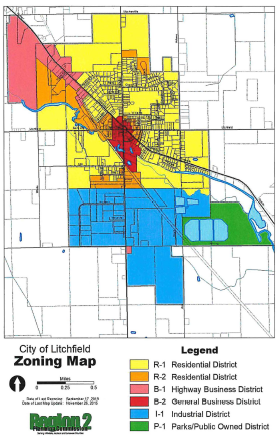
Appendix II
Zoning Map Changes
[18]
Editor's note— This Appendix has been established to provide a record of legislation pertaining to Zoning Map changes that post-date the adoption of the revised Zoning Map on February 8, 1982.

