
Livingston City Zoning Code
Title 125
ZONING REGULATIONS
Sec. 125.05.010. - Short title.
These regulations shall be known and may be cited as the "Comprehensive Zoning Regulations of the Town of Livingston in the State of Louisiana."
(Code 1978, § 12-5001; Ord. of 11-2011, § 5.1; Ord. of 7-9-2020)
Sec. 125.05.020. - Purpose and authority.
(a)
Purpose. These zoning regulations as herein set forth have been prepared for the town to safeguard the health, property and public welfare by controlling the design, location, use or occupancy of all buildings and structures through the regulated and orderly development of land and land uses within this jurisdiction.
(b)
Authority. The ordinance from which this title is derived is adopted pursuant to the Charter of the town, and the provisions of R.S. 33:4721 et seq., 33:101 et seq., and 25:731 et seq., and the constitution of the state in order to promote the public health, safety, morals and general welfare of the town.
(c)
Commission provisions.
(1)
Under authority of R.S. 33:101 et seq., the town maintains a municipal planning commission, to be known as the "Livingston Planning Commission" or the "planning commission" herein, whose administrative provisions are found in this code.
(2)
As per R.S. 33:4721 et seq., the municipal planning commission shall also serve as the municipal zoning commission, and shall have all of the powers conferred upon zoning commissions by law, and shall be known as the "Livingston Zoning Commission" or "zoning commission" herein. Administrative provisions for the zoning commission are found in this code.
(d)
Amendments. Any reference or citation made in this title to any duly enacted statute of the United States of America or of the state, any duly enacted ordinance of the parish or of the town, or any regulation enacted or promulgated by any department, agency, bureau or other institution or subdivision of the United States of America, the state, the parish or the town shall refer to the provisions of the cited or referenced statute, ordinance or regulation as of the date of the enactment of the ordinance from which this title is derived or as cited or referenced statute, ordinance or regulation may thereafter from time to time be amended, reenacted or redesignated.
(Code 1978, § 12-5002; Ord. of 11-2011, § 5.2; Ord. of 7-9-2020)
Sec. 125.05.030. - Jurisdiction.
(a)
These regulations shall apply to all the area located within the corporate limits of the town. All developments shall meet minimum standards and requirements of these regulations, as amended. This title, or any amendment thereto, shall not affect the validity of any building permit lawfully issued prior to the effective date of the ordinance from which this title is derived, or any amendment thereto, provided that the permit is valid upon the effective date of the adoption of the ordinance from which this title is derived or any amendment thereto, that construction authorized by such permit has commenced prior to the effective date of the ordinance from which this title is derived, or any amendment thereto, and provided that construction has and does continue without interruption until development is completed.
(b)
Any use established on the effective date of the ordinance from which this title is derived and which conforms with the conditional use provisions applicable in the zoning district in which the use is located shall be considered a lawful conditional use; provided that the use continues to conform with the provisions of this title.
(c)
This title, or amendment thereto, shall not affect the validity of variances granted by the planning commission prior to the effective date of the ordinance from which this title is derived, or amendment thereto. Said variances granted by the planning commission shall remain in effect after the effective date of the ordinance from which this title is derived and shall constitute variances to the applicable provisions of this title.
(Code 1978, § 12-5003; Ord. of 11-2011, § 5.3; Ord. of 7-9-2020)
Sec. 125.05.040. - Scope.
(a)
The provisions of this title shall apply to the construction, addition, alteration, moving, repair and use of any building, structure, parcel of land or sign within a jurisdiction, except work located primarily in a public way, public utility towers and poles and public utilities unless specifically mentioned in this title.
(b)
Where, in any case, different sections of this code specify different requirements, the more restrictive shall govern. Where there is conflict between a general requirement and a specific requirement, the specific requirement shall be applicable.
(c)
In fulfilling these purposes, this title is intended to benefit the public as a whole and not any specific person or class of persons. Although, through the implementation, administration and enforcement of this title, benefits and detriments will be enjoyed or suffered by specific individuals, such as merely a byproduct of the overall benefit to the whole community. Therefore, the town, its officers, agents and employees shall have qualified immunity against unintentional breaches of the obligation of administration and enforcement imposed on the jurisdiction hereby.
(d)
If any portion of this code is held invalid for any reason, the remaining herein shall not be affected.
(Code 1978, § 12-5004; Ord. of 11-2011, § 5.4; Ord. of 7-9-2020)
Sec. 125.05.050. - Fees.
The board of aldermen shall establish a schedule of fees, charges and expenses and a collection procedure for building permits, certificates of occupancy, appeals and other matter pertaining to this title. This schedule of fees shall be available from the mayor's office in the town and may be altered or amended only by the board of aldermen. No permit, certificate, special exemption or variance shall be issued unless or until such costs, charges, fees or expenses have been paid in full, nor shall any action be taken on proceedings before the planning commission unless or until preliminary charges and fees have been paid in full.
(Code 1978, § 12-5005; Ord. of 11-2011, § 5.5; Ord. of 7-9-2020)
Sec. 125.05.060. - Existing buildings and uses.
(a)
Lawfully established buildings and uses, lighting, landscaping, parking, building setbacks, and other site features in existence at the time of the adoption of the ordinance from which this title is derived shall be permitted to lawfully continue subject to the provisions of section 125.20.010 and other provisions of this title applicable to nonconformity with the provisions of this title, and; provided that such continued use is not dangerous to life or community.
(b)
All buildings or uses, both existing and new, and all parts thereof, shall be maintained. The owner or designated agent shall be responsible for the maintenance of buildings and parcels of land. To determine compliance with this section, the building official shall be permitted to order any structure or use to be inspected.
(c)
Buildings or structures moved into or within the jurisdiction shall comply with the provisions of this code for new buildings and structures. Temporary buildings, structures and uses such as reviewing stands and other miscellaneous structures, sheds, canopies or fences used for the protection of the public shall be permitted to be erected, provided a special approval is received from the building official for a limited time period. Temporary buildings or structures shall be completely removed upon the expiration of the time limit stated in the permit.
(d)
Illegal uses. Uses that are illegally established prior to the adoption of this code shall remain illegal.
(Code 1978, § 12-5006; Ord. of 11-2011, § 5.6; Ord. of 7-9-2020)
Sec. 125.05.070. - Procedures.
(a)
Common review procedures.
(1)
Generally. The following requirements are common to many of the following procedures, and apply to applications submitted under this title. Additional details may be included in the specific procedure.
(2)
Pre-application conference.
a.
Optional. Before submitting an application for development approval, an applicant may schedule a pre-application conference with the building official to discuss the procedures, standards and regulations required for approval. A pre-application conference is optional, except for the procedures listed below.
b.
Mandatory. Before submitting an application for the following types of review, an applicant must schedule a pre-application conference with the building official to discuss the procedures, standards and regulations required for approval in accordance with this title and other applicable town codes.
1.
Major subdivision.
2.
Major site plan review.
3.
Special use permit.
4.
Zoning map amendment.
5.
Residential diversity development.
6.
Zoning text amendment.
c.
Application.
1.
Initiation. Parties allowed to file an application are summarized below. More detailed information may be included with each specific procedure.
Table 1. Application Authority
2.
Application forms. Applications, containing all information requested on the application and any additional information required by a duly authorized representative of the town, must be submitted on forms an in such numbers as required by this title. All applications must be complete and sufficient for processing before they will be reviewed.
3.
Fees. As per section 125.05.050, no applications shall be reviewed, and no permit, certificate, or variance shall be issued unless or until such costs, charges, fees or expenses have been paid in full. When and application is submitted on behalf of the town, no fees shall be required.
4.
Complete applications. An application is complete when it contains all the information necessary to decide whether or not the development as proposed will comply with all of the requirements of this development code. Details for each application are included in the specific procedure section of this title. The presumption is that all of the information required in the application forms is necessary to satisfy the requirements of this development code. However, it is recognized that each application is unique, and more or less information may be required according to the needs of the particular case, the applicant may rely on the determination of the building official as to whether more or less information may be submitted.
5.
Concurrent applications. Applications may be filed and reviewed concurrently, at the option of the applicant. However, any application that also requires a variance shall not be eligible for final approval until the variance has been granted. Further, applications submitted concurrently are subject to approval of all other related applications; denial or disapproval of any concurrently submitted application shall stop consideration of any related applications until the denied or disapproved application is resolved.
6.
Modification of application. An application may be modified at the applicant's request following the approval of the building official or his duly authorized representative. Any modification after a hearing but prior to a final decision shall require a new hearing.
Table 2. Public Notice Requirements
(3)
Public notice and hearings.
a.
Public notice required. Required public notices are summarized above. More detailed information may be included with each specific procedure.
b.
Notice of public hearing. All notices for public hearing shall contain:
1.
The date, time and place of the hearing;
2.
The section of this title under which the subject matter of the hearing will be considered;
3.
The name of the applicant;
4.
A brief description of the location of any land proposed for development and the subject matter to be considered at the hearing;
5.
A statement that the application and supporting materials are available for public inspection and copying at the office of the town building official;
6.
A brief description of the appeal process, which is available by right after public hearing before the planning commission or any further automatic review by the board of aldermen.
c.
Written notice of public hearing. At least ten days prior to a public hearing, a good faith attempt to notify the owner of record shall be made by sending an official notice by U.S. mail of the time, place and subject matter of the hearing. Where more than ten parcels are to be initially zoned or rezoned, no written notice is required.
d.
Posted notice of public hearing. Posted notice in bold type shall be posted for at least ten consecutive days prior to a public hearing on signs not less than 11 inches by 17 inches, prepared, furnished and placed by the building official on each block of each street adjoining the area proposed for a change in zoning classification. The applicant shall remove posted notices from the subject area no more than ten days after the public hearing has been held.
e.
Published notice of public hearing. Notice of the time and place of a public hearing shall be published once a week in three different weeks in the official journal, if designated, or a newspaper of general circulation in the area. The first notice shall be published at least 15 days prior to the hearing.
(b)
Zoning permit.
(1)
When required.
a.
A zoning permit is required for the following:
1.
Building permits that do not require site plan review.
2.
Temporary uses.
3.
Sign permits.
b.
It shall be unlawful to begin moving, constructing, altering or repairing (except ordinary maintenance or repairs) any building or other structure on a site, including an accessory structure, until a zoning permit has been issued.
c.
No certificate of occupancy may be issued without a properly issued zoning permit, when applicable.
(2)
Application and fees.
a.
A pre-application conference is optional.
b.
All applications for administrative review shall be filed in writing with the building official.
c.
Application shall be made prior to, or concurrent with the application for a building permit.
(3)
Decision by building official.
a.
The building official may refer the application to other affected or interested agencies for review and comment.
b.
In deciding to approve, approve with conditions, or deny the proposed zoning request, the building official shall consider relevant comments of all interested parties and the review criteria in this section.
c.
The building official may attach any condition to the permit necessary to protect the health, safety and welfare of the town and minimize adverse impacts on adjacent properties.
(4)
Review criteria. The building official shall consider the following criteria in approving or denying a zoning permit:
a.
The proposed development is consistent with the pertinent elements of the town master plan and any other adopted plans;
b.
The proposed development meets the requirements of this development code;
c.
The proposed development will reinforce the existing or planned character of the neighborhood and the town.
(5)
Appeal. A final decision by the building official on a zoning permit may be appealed to the planning commission.
(6)
Expiration. A zoning permit expires after six months is a building permit application has not been filed.
(c)
Administrative adjustment.
(1)
When allowed. The administrative adjustment procedure allows the building official or his duly authorized representative to approve modest variations from the standards of this development code. Administrative adjustment is allowed for the following:
a.
A reduction of any required setback or yard by up to 15 percent.
b.
An increase in the maximum building height of any building by five feet or five percent, whichever is less.
c.
An increase in lot coverage by no more than five percent.
d.
Any other administrative adjustment authorized by a specific section of this development code.
(2)
Application and fees.
a.
A pre-application conference is optional.
b.
All applications for administrative review shall be filed in writing with the building official.
(3)
Decision by building official.
a.
The building official may refer the application to other affected or interested agencies for review and comment.
b.
In deciding to approve, approve with conditions, or deny the proposed zoning request, the building official shall consider relevant comments of all interested parties and the review criteria in this section.
c.
The building official may attach any condition to the permit necessary to protect the health, safety and welfare of the town and minimize adverse impacts on adjacent properties.
(4)
Review criteria. The building official shall consider the following criteria in approving or denying a zoning permit:
a.
The proposed development is consistent with the pertinent elements of the town master plan and any other adopted plans;
b.
The proposed development meets the requirements of this development code;
c.
The proposed development will reinforce the existing or planned character of the neighborhood and the town.
(5)
Appeal. A final decision by the building official on an administrative adjustment may be appealed to the planning commission.
(6)
Expiration. A zoning permit expires after six months is a building permit application has not been filed.
(d)
Variance.
(1)
When allowed. The planning commission shall have the authority to grant variances from the terms of this title, subject to terms and conditions fixed by the commission, where literal enforcement of the provisions of this title will result in practical difficulties or unnecessary hardship.
(2)
Application and fees.
a.
No pre-application conference is necessary.
b.
All applications for variance shall be filed in writing with the building official.
(3)
Review by building official. The building official may refer the application to other affected or interested agencies for review and comment.
(4)
Public hearing and decision by planning commission.
a.
Following notice and a public hearing as required by this section, the planning commission shall approve, approve with conditions, or deny the proposed zoning request, the building official shall consider relevant comments of all interested parties and the review criteria in this section.
b.
The commission may attach any condition to the permit necessary to protect the health, safety and welfare of the community and minimize adverse impacts on adjacent properties.
(5)
Review criteria. No variance shall be authorized unless the planning commission finds that all of the following conditions exist:
a.
That the variance will not authorize a use other than those uses allowed in the district;
b.
That, due to exceptional and/or extraordinary circumstances, literal enforcement of the provisions of this title will result in practical difficulties or unnecessary hardship;
c.
That the practical difficulties or unnecessary hardship were not created by the owner of the property or the applicant and are not due to or the result of general conditions in the district in which the property is located;
d.
That the practical difficulties or unnecessary hardship are not solely financial;
e.
That the variance will not substantially or permanently injure the allowed uses of adjacent conforming property;
f.
That the applicant has adequately addressed any concerns raised by the building official.
(6)
Appeal. A final decision by the planning commission on a variance may be appealed to the board of aldermen.
(7)
Expiration. A variance runs with the land and does not expire unless the planning commission or board of aldermen assigns an expiration date as a condition.
(e)
Appeal of administrative decision.
(1)
When allowed. Appeals to the board of aldermen may be filed by any person aggrieved, or by any official or department of the town affected by any decision of the building official. Appeals shall be made within 30 days of the decision.
(2)
Application and fees.
a.
No pre-application conference is necessary.
b.
All appeals of administrative decisions shall be filed in writing with the town clerk.
c.
The appellant shall provide a written statement citing the decision that is being appealed, and any reasons why the appeal should be granted.
(3)
Stay of proceedings. An appeal stays all proceedings in furtherance of the action appealed, unless the building official certifies to the board of aldermen after the notice of appeal has been filed, that a stay would cause imminent peril of life or property. In such case proceedings shall not be stayed except my restraining order that may be granted by the Louisiana 21st Judicial District Court.
(4)
Public hearing and decision by board of aldermen.
a.
Following notice and a public hearing as required by this section, the board of aldermen shall hear and decide appeals where it is alleged there is error in any order, requirement, decision, or determination made by the building official.
b.
The board may reverse or affirm, wholly or partly, or may modify the order, requirement, decision or determination appealed from and may make such order, requirement, decision or determination as ought to be made, and to that end shall have the powers of the building official.
c.
Any party may appear at the proceedings in person, by agent or by attorney.
(5)
Testimony and evidence. The board of aldermen shall limit testimony and other evidence to that contained in the record at the time that the administrator took final action on the administrative decision.
(6)
Review criteria. The board of aldermen shall consider the following criteria in deciding an appeal:
a.
Whether the decision by the building official was in accordance with the intent and requirements of this title;
b.
Whether the building official made erroneous findings based on the evidence and information presented in the original application, or failed to fully consider mitigating measures or revisions offered by the applicant that would have brought the proposed project into compliance; or
c.
Whether the building official acted arbitrarily or capriciously.
(7)
Appeal. A final decision by the board of aldermen on an administrative appeal may be appealed to the Louisiana 21st Judicial District Court.
(f)
Major and minor subdivisions.
(1)
Components of subdivision (plat) approval.
a.
Major subdivisions are subject to a two-step approval process:
1.
Approval of a preliminary plat by the planning commission; and
2.
Approval of a final plat by the building official.
b.
Minor subdivisions only require a one-step approval process: approval of a final plat by the building official.
(2)
When required.
a.
Major subdivision.
1.
Any subdivision of land not considered a minor subdivision or exempted below.
2.
The creation of any number of lots where:
(i)
New streets are created;
(ii)
Water or sewer lines are extended;
(iii)
Drainage improvements through one or more lots must be installed;
(iv)
Residential cluster options are exercised; or
(v)
A waiver of any subdivision standard is desired.
3.
No person may subdivide land except in accordance with this procedure and the standards of this title.
4.
Major subdivisions require preliminary plat approval by the planning commission and final plat approval by the building official.
b.
Minor subdivision.
1.
Minor subdivision review by the building official is required for the realignment or shifting of lot boundary lines, including removal, addition, alignment, or shifting of interior lot boundary lines, or the re-designation of lot numbers, provided the application meets the following requirements:
(i)
The action does not involve the creation of any new street or other public improvement except as otherwise provided in this section;
(ii)
The action does not involve more than two acres of land or eight lots of record;
(iii)
The action does not reduce a lot size below the minimum area or frontage requirements established by this title; and
(iv)
The action otherwise meets all of the requirements of this title.
Parcels of land where a portion has been expropriated or has been dedicated, sold, or otherwise transferred to the town, leaving a severed portion of the original property that requires a re-designation of lot number and establishment of new lot boundary lines, also requires minor subdivision review and approval by the building official.
2.
Minor subdivisions require only final plat approval. Final plat approval may provide for the dedication, acceptance, relocation or deletion of public utility servitudes, other than streets, or the deletion of gas, electric, cable or telephone utility servitudes on the property being re-subdivided.
3.
All minor plats approved or certified by an administrative procedure shall designate such fact on the plat. Any plat so approved shall have the same force, effect and legal status of a subdivision application approved by the established legislative process.
c.
No subdivision review required. No subdivision review is required for the public acquisition of land for roads, sewer or water infrastructure.
(3)
Application and fees.
a.
A pre-application conference is optional for minor subdivisions and mandatory for major subdivision.
b.
All applications for subdivision review shall be filed in writing with the building official.
c.
All major subdivision applications shall be prepared and sealed by a land surveyor licensed in the state.
(4)
Review by building official.
a.
The building official may refer the application to other affected or interested agencies for review and comment.
b.
The building official shall provide notice as outlined in this section.
(5)
Preliminary plat decision by planning commission.
a.
Following notice and public hearing as required by this section, the planning commission shall approve, approve with conditions, or deny the preliminary plat for a major subdivision within 60 days of filing of a complete application, except where such time period is extended by the applicant.
b.
In deciding, the planning commission shall consider the recommendation of the building official, relevant comments of all interested parties and the review criteria outlined in this section.
c.
The planning commission may attach conditions required to make the subdivision comply with this and other town ordinances, or as necessary to protect the health, safety and welfare of the town and to minimize adverse impacts to adjacent properties.
d.
Where the planning commission finds that unnecessary hardship results from strict compliance with this title, a variance may be granted. Any particular hardship shall be related to the physical surroundings, shape, or topographical conditions of the property, as distinguished from a mere inconvenience. No variance shall be granted based strictly upon financial consideration. The granting of a variance must not be detrimental to the public health, safety or welfare or injurious to other property or improvements.
e.
The planning commission shall consider the following criteria in approving or denying a subdivision:
1.
The proposed development is consistent with the pertinent elements of the town master plan and any other adopted plans.
2.
The proposed development meets the requirements of this development code.
3.
The proposed development will reinforce the existing or planned character of the neighborhood and the town.
4.
The subdivision demonstrates:
(i)
Compliance with any prior approvals;
(ii)
Subdivision design appropriate for and tailored the unique natural characteristics of the site;
(iii)
Adequate, safe and convenient arrangement of access, pedestrian circulation, bicycle facilities, roadways, driveways and off-street parking, stacking and loading spaces;
(iv)
Connectivity to surrounding neighborhoods and the town as a whole;
(v)
Adequate design of grades, paving, gutters, drainage and treatment of turf to handle stormwater; and
(vi)
Adequate access for disabled residents through the provision of special parking spaces, accessible routes between parking areas and buildings, passenger loading zones and access to other facilities.
5.
Any adverse impacts on adjacent properties have been minimized or mitigated.
(6)
Minor subdivision decision by building official.
a.
In deciding to approve, approve with conditions, or deny the proposed minor subdivision, the building official shall consider relevant comments of all interested parties and the review criteria below.
b.
The plat shall be approved or denied within 60 days of filing of a complete application, except where such time period is extended by the applicant.
c.
The building official may attach conditions required to make the subdivision comply with this title and other town ordinances, or as necessary to protect the health, safety and welfare of the town and to minimize adverse impacts to adjacent properties.
d.
A minor subdivision shall be approved in accordance with the requirements, including the review criteria, for the final plat as outlined in this section.
(7)
Final plat decision by the building official.
a.
The building official may approve, approve with conditions, or deny the final plat within 60 days of filing a complete application, except where such time period is extended by the applicant.
b.
If the final plat is denied, the building official shall specify in writing the provisions with which the plat does not comply.
c.
The final plat shall be approved where it:
1.
Is consistent with the pertinent elements of the town master plan and any other adopted plans;
2.
Meets the requirements of this development code;
3.
Is compliant with any prior approvals, including specifically the preliminary plat and any conditions.
d.
The approval of a final plat shall not be deemed to constitute the acceptance of the dedication of any street or other land, public utility or facility shown on the face of the plat. However, the board of aldermen may, by resolution, accept any dedication for streets, parks, public utility lines or facilities, or other public purposes.
(8)
Building permit. No building permit shall be issued for development requiring subdivision approval until the final plat has been approved.
(9)
Dedication and improvements.
a.
For development of property requiring subdivision approval under this title, the applicant must dedicate any additional right-of-way necessary to the width required by the town for streets adjoining the property, install curbs and gutters and pave all streets adjoining the property, and install sidewalks and street trees based on the standards of this title.
b.
The applicant shall bear the costs of installation of any on-site or off-site improvements required by this title, including provisions for stormwater management, paving and utilities.
c.
The town is not required to accept any dedication or improvements that do not meet local standards.
(10)
Construction drawings. Prior to construction of any improvement intended for public dedication, construction drawings that meet local standards for the specified improvement are required.
(11)
Improvement guarantee.
a.
Prior to the approval of any final plat, the applicant shall submit a cost estimate and time schedule for installation of each phase of subdivision improvements.
b.
A bond shall be required guaranteeing all on-site and off-site improvements. The bond shall be in an amount equal to 115 percent of the improvement cost estimate, and in a form approved by the town attorney.
c.
As each phase of improvements are installed and inspected by the building official or his duly authorized representative, the bond may be reduced by the cost of the installed improvements.
(12)
Inspection of improvements.
a.
The applicant shall grant the town the authority to inspect all construction of required improvements. Such right of inspection shall not constitute a duty to inspect, nor shall it guarantee final acceptance of the required improvements.
b.
Failure to perform the work to the town's standards shall free the town to liquidate the improvement guarantee in order to finance necessary repairs.
(13)
Maintenance bond. The town may require a two-year maintenance bond on any improvement constructed by a developer and dedicated to the town.
(14)
Recording of final plat. Any final plat shall be recorded with the parish clerk of courts and copied into the conveyance records of the parish, and a duplicate filed with the parish assessor.
(15)
Modification of approved subdivision. The building official is authorized to approve minor modifications to an approved subdivision. All modifications not listed as minor below shall be considered by the body that approved the original subdivision. The following modifications shall be considered minor:
a.
Additional or wider easements that do not affect the general placement of buildings or general location of roadways;
b.
Reduction of the number of lots;
c.
Reduction of the length of streets; or
d.
Modification of public utility service.
(16)
Appeal.
a.
A final decision by the building official on a minor subdivision may be appealed to the planning commission. The planning commission shall review the subdivision as a major subdivision.
b.
A final decision by the planning commission on a major subdivision may be appealed to the board of aldermen.
(17)
Expiration. A preliminary plat expires after one year where a final plat application has not been filed for all or part of said development. Each final plat for a phase of the preliminary plat extends the preliminary plat for an additional year. A final plat, once officially recorded, shall not expire.
(g)
Site plan review.
(1)
When required.
a.
Major site plan. Major site plan review by the planning commission is required for:
1.
Construction often or more residential units on a platted lot of record.
2.
Construction or expansion of 5,000 or more square feet of multifamily or mixed-use building type.
3.
Commercial or institutional over 20,000 square feet.
b.
Minor site plan. Minor site plan review by the building official is required for:
1.
Construction or expansion of up to 5,000 square feet of multifamily or mixed-use residential building type.
2.
Construction of more than two but less than ten residential units on a platted lot of record.
3.
Creation of more than 1,000 square feet of impervious surface (paving).
4.
Construction of accessory structures in nonresidential districts.
c.
No site plan review required. No site plan review is required for the following:
1.
Construction or expansion of one or two units in a single structure on a platted lot of record.
2.
Creation of more than 1,000 square feet of impervious surface (paving).
3.
Construction of accessory structures in nonresidential districts.
(2)
Application and fees.
a.
A pre-application conference is optional for minor site plan review and mandatory for major site plan review.
b.
All applications for subdivision review shall be filed in writing with the building official.
(3)
Review by building official.
a.
The building official may refer the application to other affected or interested agencies for review and comment.
b.
The building official shall provide notice as outlined in this section.
(4)
Minor site plan decision by building official.
a.
In deciding to approve, approve with conditions, or deny the proposed site plan, the building official shall consider relevant comments of all interested parties and the review criteria outlined in this section within 60 days of filing of a complete application.
b.
The building official may attach conditions required to make the subdivision comply with this title and other town ordinances, or as necessary to protect the health, safety and welfare of the town and to minimize adverse impacts to adjacent properties.
(5)
Major site plan decision by planning commission.
a.
Following notice and public hearing as required by this section, the planning commission shall approve, approve with conditions, or deny the major site plan within 60 days of filing of a complete application, except where such time period is extended by the applicant.
b.
In deciding to approve, approve with conditions, or deny the proposed minor subdivision, the planning commission shall consider the recommendation of the building official, relevant comments of all interested parties and the review criteria outlined in this section.
c.
The planning commission may attach conditions required to the site plan to comply with this and/or other town ordinances, or as necessary to protect the health, safety and welfare of the town and to minimize adverse impacts to adjacent properties.
(6)
Review criteria. The building official and the planning commission shall consider the following criteria in approving or denying a site plan:
a.
The proposed development is consistent with the pertinent elements of the town master plan and any other adopted plans;
b.
The proposed development meets the requirements of this development code;
c.
The proposed development will reinforce the existing or planned character of the neighborhood and the town;
d.
The site plan demonstrates:
1.
Compliance with any prior approvals;
2.
Site design and development intensity appropriate for and tailored to the unique natural characteristics of the site;
3.
Adequate, safe and convenient arrangement of access, pedestrian circulation, bicycle facilities, roadways, driveways and off-street parking, stacking and loading spaces;
4.
Connectivity to surrounding neighborhoods and the town as a whole;
5.
Adequate design of grades, paving, gutters, drainage and treatment of turf to handle stormwater; and
6.
Adequate access for disabled residents through the provision of special parking spaces, accessible routes between parking areas and buildings, passenger loading zones and access to other facilities;
e.
Any adverse impacts on adjacent properties have been minimized or mitigated.
(7)
Building permit. No building permit shall be issued for development requiring site plan until the site plan has been approved.
(8)
Dedication and improvements.
a.
For development of property requiring a site plan under this title, the applicant must dedicate any additional right-of-way necessary to the width required by the town for streets adjoining the property, install curbs and gutters and pave all streets adjoining the property, and install sidewalks and street trees based on the standards of this section.
b.
The applicant shall bear the costs of installation of any on-site or off-site improvements required by this title, including provisions for stormwater management, paving and utilities.
(9)
Improvement guarantee.
a.
Prior to the approval of any site plan, the applicant shall submit a cost estimate and time schedule for installation of each phase of subdivision improvements.
b.
A bond shall be required guaranteeing all on-site and off-site improvements. The bond shall be in an amount equal to 115 percent of the improvement cost estimate, and in a form approved by the town attorney.
c.
As each phase of improvements is installed and inspected by the building official or his duly authorized representative, the bond may be reduced by the cost of the installed improvements.
(10)
Modification of approved site plan. The building official is authorized to approve minor modifications to an approved site plan. All modifications not listed as minor below shall be considered by the body that approved the original site plan. The following modifications shall be considered minor:
a.
Up to a ten percent increase or any decrease in gross floor area of a single building;
b.
Up to a ten percent reduction or any increase in the approved setbacks from exterior property lines;
c.
Relocation of parking areas, internal streets or structures where such relocation occurs more than 100 feet for exterior property lines.
(11)
Appeal.
a.
A final decision by the building official on a minor site plan may be appealed to the board of aldermen.
b.
A final decision by the planning commission on a major site plan may be appealed to the board of aldermen.
(12)
Expiration. A site plan expires after one year where a final plat application has not been filed for all or part of said development.
(h)
Conditional use permit.
(1)
When required. A conditional use permit is required for any use or building type that requires particular considerations as to its proper location to adjacent, established or intended uses in a district, or to the planned growth of the community. More detailed information may be included with each specific section of this title that establishes the uses requiring a conditional use permit and the conditions controlling the location and operation of such conditional uses. Any change to a conditional use involving major structural alterations, enlargements, intensifications of use, or similar change must be approved in the same manner as the original conditional use.
(2)
Application and fees.
a.
A pre-application conference with the building official is necessary.
b.
All applications for a conditional use permit shall be filed in writing with the building official. The application shall include material necessary to demonstrate that the grant of a conditional use will be in harmony with the general intent and purpose of this title, will not be injurious to the neighborhood or to adjoining properties, or otherwise detrimental to the public welfare. Such material required may include, but is not limited to, the following, when applicable:
1.
Site and development plans at an appropriate scale showing proposed placement of structures on the property, provisions for ingress and egress, off-street parking and off-street loading access, refuse and service areas, and required yards and open spaces.
2.
Plans showing proposed locations for utilities hook-ups.
3.
Plans for screening, buffering and landscaping.
4.
Proposed signs and lighting, including type, dimensions and character.
(3)
Review by building official. The building official may refer the application to other affected or interested agencies for review and comment.
(4)
Public hearing and decision by planning commission.
a.
Following notice and a public hearing as required by this section, the planning commission shall recommend to approve, approve with conditions, or deny the proposed conditional use permit within 60 days of filing of a complete application, except where such time period is extended by the applicant.
b.
In making this recommendation, the planning commission shall consider the recommendation of the building official, relevant comments of all interested parties and the review criteria in this section.
c.
The commission may attach any condition to the permit necessary to protect the health, safety and welfare of the community and minimize adverse impacts on adjacent properties. These conditions may include, but are not limited to, the following:
1.
Stipulate the exact location as a means of minimizing hazards to life, limb, property damage, erosion or traffic;
2.
Increase the required lot size or yard dimension;
3.
Limit the height, size or location of buildings, structures and facilities;
4.
Control the location and number of vehicle access points;
5.
Increase the street width;
6.
Increase the number of required off-street parking spaces;
7.
Limit the number, size, location or lighting of signs;
8.
Require additional fencing, screening, landscaping or other facilities to protect adjacent or nearby property;
9.
Designate sites for open space;
10.
Provide ease of access to major roadways;
11.
Ensure that the degree of compatibility to the surrounding land use shall be maintained with respect to the particular use on the particular site and in consideration of other existing and potential uses within the general area in which the use is proposed to be located.
(5)
Public hearing and decision by the board of aldermen.
a.
Following notice and a public hearing as required by this section, the board of aldermen shall accept, accept with conditions, or deny the planning commission's recommendation on the conditional use permit within 30 days of the planning commission's final action.
b.
In making this recommendation, the board of aldermen shall consider the recommendations of the building official and the planning commission, relevant comments of all interested parties and the review criteria in this section.
c.
The board of aldermen may attach any condition to the permit necessary to protect the health, safety and welfare of the community and minimize adverse impacts on adjacent properties. Such conditions may include, but are not limited to, additional screening or buffering, limitations in scale or limitations to hours of operation.
d.
If the board of aldermen fails to act on the planning commission's recommendation, the Commission's recommendation shall stand as the final decision on the matter.
(6)
Review criteria. The planning commission and the board of aldermen shall consider the following criteria in approving or denying a conditional use permit:
a.
The proposed conditional use permit is consistent with the pertinent elements of the town master plan and any other adopted plans.
b.
The proposed development meets the requirements of this development code.
c.
The proposed development will reinforce the existing or planned character of the neighborhood and the town.
d.
The conditional use permit complies with any specific use standards or limitations in this section.
e.
Any adverse impacts on adjacent properties attributable to the conditional use have been minimized or mitigated.
(7)
Effect of denial. The denial of a conditional use permit application shall ban the subsequent application for the same or similar use at the same location for a period of 12 months.
(8)
Appeal. A final decision by the board of aldermen on a conditional use permit may be appealed to the Louisiana 21st Judicial District Court.
(9)
Expiration.
a.
A conditional use permit shall expire after 12 months if a building permit application has not been filed.
b.
Where conditional use has been granted but no substantial construction other than clearing and grubbing has been executed within 12 months from date of such conditional use permit, the property shall revert to its original state prior to such conditional use.
c.
Once the building is constructed and occupied, the conditional use permit shall expire after six months if the use is abandoned or discontinued. The property owner and/or business must apply for a new special use, or upgrade to meet all requirements of this title before occupancy.
d.
Buildings that are actively available for lease and occupancy, or are being remodeled pursuant to permit shall not have its use considered abandoned or discontinued for 12 months.
(10)
Revocation of conditional use permit. if any terms of a conditional use permit or other requirements of this title are violated, the board of aldermen may revoke the conditional use permit.
(i)
Zoning map amendment.
(1)
When allowed. The boundaries of zoning districts as shown on any zoning map may, from time to time, be amended or modified, as determined by the board of aldermen.
(2)
Application and fees.
a.
A pre-application conference with the building official is required.
b.
All applications for a zoning map amendment shall be filed in writing with the building official.
(3)
Review by building official. The building official may refer the application to other affected or interested agencies for review and comment.
(4)
Public hearing and decision by planning commission.
a.
Following notice and a public hearing as required by this section, the planning commission shall recommend to approve, approve with conditions, or deny the proposed zoning map amendment within 60 days of filing of a complete application, except where such time period is extended by the applicant.
b.
In making this recommendation, the planning commission shall consider the recommendations of the building official, relevant comments of all interested parties and the review criteria in this section.
(5)
Public hearing and decision by the board of aldermen.
a.
Following notice and a public hearing as required by this section, the board of aldermen shall accept, accept with conditions, or deny the planning commission's recommendation on the zoning map amendment within 30 days of the planning commission's final action.
b.
In making this recommendation, the board of aldermen shall consider the recommendations of the building official and the planning commission, relevant comments of all interested parties and the review criteria in this section.
c.
If the board of aldermen fails to act on the planning commission's recommendation, the commission's recommendation shall stand as the final decision on the matter.
(6)
Review criteria. The planning commission and the board of aldermen shall consider the following criteria in approving or denying a zoning map amendment:
a.
The proposed zoning map amendment is consistent with the pertinent elements of the town master plan and any other adopted plans;
b.
The proposed zoning map amendment is consistent with the adjacent zoning classifications and uses;
c.
The proposed zoning map amendment will reinforce the existing or planned character of the neighborhood and the town;
d.
The site is appropriate for the development allowed in the proposed district;
e.
There are substantial reasons why the property cannot be used according to existing zoning;
f.
Public facilities and services including schools, roads, recreation facilities, wastewater treatment, water supply, stormwater management, police and fire are adequate for the development allowed in the proposed district; and
g.
The zoning map amendment will not substantially or permanently injure the appropriate use of adjacent conforming properties.
(7)
Effect of denial. The denial of a zoning map amendment application shall ban the subsequent application for the same or similar use at the same location for a period of 12 months.
(8)
Appeal. A final decision by the board of aldermen on a zoning map amendment may be appealed to the Louisiana 21st Judicial District Court.
(9)
Expiration. A zoning map amendment shall not expire.
(j)
Residential diversity overlay/development.
(1)
Components of a residential diversity overlay/development.
a.
Approval of an overlay and concept plan by the board of aldermen; and
b.
Approval of subsequent subdivision plats and site plans consistent with the concept plan.
(2)
Intent of residential diversity overlay/development. A residential diversity overlay/development (RDO) is intended to encourage innovations in development techniques so that the growing demands of the community may be met with greater flexibility and variety in type, use, design and layout of sites and buildings, and by the conservation and more efficient use of open spaces and other amenities generally enhancing quality of life. RDOs are not intended to circumvent traditional zoning requirements, but rather enhance existing zoning to promote a harmonious variety of uses, and/or provide an economy of shared services and facilities to foster the creation of attractive, healthful, efficient and stable environments for living, shopping or working. The regulations contained within the overlay are intended to have enough flexibility to produce each of the following:
a.
Maximum housing choice in the types of living environments;
b.
Open space and recreational areas directly related to the intended users, and if permitted as part of the project, more convenience in the location of accessory commercial uses and services;
c.
A development pattern which preserves and utilizes natural topography, scenic vistas, trees and other vegetation, and prevents erosion and the disruption of natural drainage patterns;
d.
A stable development in character with the land use density, transportation facilities, and community facilities objectives of the town master plan;
e.
A higher quality site design than would be possible through the strict application of other available zoning districts.
(3)
Eligibility. The RDO is designed to allow an applicant to submit a proposal for consideration, for any uses or mixture of uses that are consistent with the comprehensive plan and allow the planning commission and board of aldermen to approve said proposal along with any conditions, requirements or limitations that are deems advisable. The approval of an RDO ultimately rests with the board of aldermen, but no approval shall be eligible for approval unless the following minimum conditions are met:
a.
The minimum area required for an application for an RDO is four acres;
b.
The tract of land for which the RDO is proposed shall be contiguous with sufficient width and depth to accommodate the proposed use;
c.
All land included for the purpose of development within an RDO shall be owned by or be under complete control of the applicant for such zoning designation, whether the applicant be an individual, partnership, corporation or other entity or agency. The applicant shall provide the town all of the necessary documents and information that may be required by the town attorney to assure that the development may be lawfully completed according to the plans sought to be approved. No application shall be considered until the requirements of this section have been met.
(4)
Application and fees.
a.
A pre-application conference with the building official is required.
b.
All applications for a zoning map amendment shall be filed in writing with the building official.
c.
The application shall include the following additional materials:
1.
A narrative explaining and tabulating the land uses by net acre, number of dwelling units by housing type, residential density, open space acreage, square footage of nonresidential uses per net acre, and the relationship of the proposed development to existing development in the area and other related development features.
2.
A concept plan schematically showing major streets, major utilities, land uses, access to existing streets, major open space and a conceptual drainage plan.
d.
The applicant may provide concurrent applications for site plan or subdivision review.
(5)
Review by building official. The building official may refer the application to other affected or interested agencies for review and comment.
(6)
Public hearing and decision by planning commission.
a.
Following notice and a public hearing as required by this section, the planning commission shall recommend to approve, approve with conditions, or deny the proposed overlay district and concept plan within 60 days of filing of a complete application, except where such time period is extended by the applicant.
b.
In making this recommendation, the planning commission shall consider the recommendations of the building official, relevant comments of all interested parties and the review criteria in this section.
(7)
Public hearing and decision by the board of aldermen.
a.
Following notice and a public hearing as required by this section, the board of aldermen shall accept, accept with conditions, or deny the planning commission's recommendation on the overlay district and concept plan within 60 days of the planning commission's final action.
b.
In making this recommendation, the board of aldermen shall consider the recommendations of the building official and the planning commission, relevant comments of all interested parties and the review criteria in this section.
c.
If the board of aldermen fails to act on the planning commission's recommendation, the Commission's recommendation shall stand as the final decision on the matter.
(8)
Review criteria. The planning commission and the board of aldermen shall consider the following criteria in approving or denying a zoning map amendment:
a.
The proposed development is consistent with the pertinent elements of the town master plan and any other adopted plans;
b.
The proposed development is consistent with the standards and uses of the underlying and adjacent zoning districts;
c.
The proposed zoning map amendment will reinforce the existing or planned character of the neighborhood and the town;
d.
The site is appropriate for the development proposed in the concept plan;
e.
The proposed development demonstrates a higher quality of site design than is possible under other available zoning districts, and is not used solely to avoid the requirements of the base zoning district;
f.
Public facilities and services including schools, roads, recreation facilities, wastewater treatment, water supply, stormwater management, police and fire are adequate for the development allowed in the proposed concept plan; and
g.
The proposed development will not substantially or permanently injure the appropriate use of adjacent conforming properties.
(9)
Action following approval. Approval of a residential diversity overlay/concept plan authorizes the submission of subdivision plats and site plans consistent with the concept plan approval.
(10)
Modification of a concept plan. The building official is authorized to approve minor modifications to an approved concept plan. The board of aldermen shall consider all modifications not listed as minor below, consistent with the original approval of the residential diversity overlay district/concept plan. The following modifications shall be considered minor:
a.
Up to ten percent increase or any decrease in gross floor area of a single building;
b.
Up to a ten percent reduction or any increase in the approved setbacks from exterior property lines;
c.
Relocation of parking areas, internal streets or structures where such relocation occurs more than 100 feet from exterior property lines.
(11)
Effect of denial. The denial of a residential diversity overlay/concept plan shall ban the subsequent application for the same or similar use at the same location for a period of 12 months.
(12)
Appeal. A final decision by the board of aldermen on a residential diversity overlay/concept plan may be appealed to the Louisiana 21st Judicial District Court.
(13)
Expiration. A residential diversity overlay district/concept plan expires after two years if no preliminary plat, site plan or building permit has been filed.
(k)
Zoning text amendment.
(1)
When allowed. The regulations of this title may, from time to time, be amended supplemented, changed, modified or repealed, as determined by the board of aldermen.
(2)
Application and fees.
a.
A pre-application conference with the building official is optional.
b.
All applications for a zoning map amendment shall be filed in writing with the building official.
(3)
Review by building official. The building official may refer the application to other affected or interested agencies for review and comment.
(4)
Public hearing and decision by planning commission.
a.
Following notice and a public hearing as required by this section, the planning commission shall recommend to approve or deny the proposed zoning text amendment within 60 days of filing of a complete application, except where such time period is extended by the applicant.
b.
In making this recommendation, the planning commission shall consider the recommendations of the building official, relevant comments of all interested parties and the review criteria in this section.
(5)
Public hearing and decision by the board of aldermen.
a.
Following notice and a public hearing as required by this section, the board of aldermen shall accept or deny the planning commission's recommendation on the zoning text amendment within 30 days of the planning commission's final action.
b.
In making this recommendation, the board of aldermen shall consider the recommendations of the building official and the planning commission, relevant comments of all interested parties and the review criteria in this section.
c.
If the board of aldermen fails to act on the planning commission's recommendation, the commission's recommendation shall stand as the final decision on the matter.
(6)
Review criteria. The planning commission and the board of aldermen shall consider the following criteria in approving or denying a zoning text amendment:
a.
The proposed zoning text amendment is consistent with the pertinent elements of the town master plan and any other adopted plans;
b.
The proposed zoning text amendment is consistent with the remainder of this title;
c.
The extent to which the zoning text amendment represents a new idea not considered in the existing code, or represents revisions necessitated by changing conditions over time, or whether or not the text amendment corrects an error in this title; and
d.
Whether or not the text amendment revises this title to comply with state or federal statutes or case law.
(7)
Appeal. A final decision by the board of aldermen on a zoning text amendment may be appealed to the Louisiana 21st Judicial District Court.
(8)
Expiration. A zoning text amendment shall not expire.
(l)
Development agreements.
(1)
When allowed. The town may enter into a development agreement with a public or private entity in accordance with this section.
(2)
Contents.
a.
A development agreement must specify the following:
1.
Definition of the parties involved in the agreement;
2.
A legal description of the piece of property scheduled for development;
3.
The duration of the agreement;
4.
The permitted uses of the property;
5.
The density or intensity of use;
6.
The maximum height and size of proposed buildings; and
7.
Provisions for reservation or dedication of land for public purposes.
b.
The development agreement may also include the following:
1.
Conditions, terms, restrictions and requirements for subsequent discretionary actions, provided that such conditions, terms, restrictions and requirements for subsequent discretionary actions shall not prevent development of the land for the uses and to the density or intensity of development set forth in the agreement.
2.
Provisions for the commencement, phasing and completion of construction and other obligations such as landscaping, parking and other site development regulations.
3.
Terms and conditions relating to financing of necessary public facilities by the applicant and subsequent reimbursement of the applicant over time.
(3)
Rules, regulations and official policies.
a.
Unless otherwise provided by the development agreement, the rules, regulations and official policies governing permitted uses of the land, density and design, improvement, and construction standards/specifications applicable to development of the property subject to the development agreement shall be those rules, regulations and official policies in force at the time of the agreement.
b.
A development agreement shall not prevent the town, in subsequent actions applicable to the property, from applying new rules, regulations and policies which do not conflict with those rules, regulations and policies applicable to the property as set forth herein.
c.
A development agreement shall not prevent the town from approving or denying any subsequent development project application on the basis of such existing or new rules, regulations and policies.
(4)
Public hearing and decision by planning commission. Following notice and a public hearing as required by this section, the planning commission shall recommend to approve, approve with conditions, or deny the proposed development agreement within 60 days of filing of a complete application, except where such time period is extended by the applicant.
(5)
Public hearing and decision by the board of aldermen.
a.
Following notice and a public hearing as required by this section, the board of aldermen shall approve, approve with conditions, or deny the planning commission's recommendation on the proposed development agreement within 30 days of the planning commission's final action.
b.
A development agreement shall be approved by ordinance by the board of aldermen.
c.
If the board of aldermen fails to act on the planning commission's recommendation, the commission's recommendation shall stand as the final decision on the matter.
(6)
Amendment or cancellation. A development agreement may be amended or cancelled in whole or in art by mutual consent between the parties or their successors in interest. Notice of intention to amend or cancel any portion of the agreement shall be given in the manner provided in this section.
(7)
Recording copy of agreement; effect. No later than ten days after the town enters into a development agreement, a copy of the agreement shall be filed with the parish clerk of courts, which shall describe the land subject to the agreement. From and after the time of such recordation, the agreement shall impart such notice to all persons as is afforded by the recording laws of the state. The burdens of the agreement shall be binding upon and the benefits of the agreement shall inure to all successors in interest to the parties of the agreement.
(8)
Modification or suspension. In the event that state of federal laws or regulations, enacted after a development agreement has been entered into, prevent or preclude compliance with one or more provisions of the development agreement, such provisions of the agreement shall be modified or suspended as may be necessary to comply with such state or federal laws or regulations.
(9)
Periodic review; termination or modification. Any development agreement shall provide for periodic review at least every 12 months, at which time the applicant or his successor in interest thereto shall be required to demonstrate good faith compliance with the terms of the agreement. If, as a result of such periodic review, the board of aldermen finds and determines, on the basis of substantial evidence, that the applicant or successor in interest thereto has not complied on good faith with the terms or conditions of the agreement, the board of aldermen may terminate or modify the agreement.
(10)
Enforcement. Unless amended, cancelled, modified or suspended, a development agreement shall be enforceable by any party to the agreement notwithstanding and change in any applicable general or specific plan, zoning, subdivision or building regulation adopted by the town entering the agreement which alters or amends the rules, regulations or policies specified in this title.
(11)
Restrictions on authority. Nothing in the procedure shall be construed to authorize property use contrary to existing zoning classifications or to authorize the reclassification of such zones.
(Code 1978, § 12-5007; Ord. of 11-2011, § 5.7; Ord. of 7-9-2020)
Sec. 125.05.080. - Violations.
(a)
Administration of enforcement. The provisions of these land use regulations shall be administered by the mayor, or his/her duly authorized representative, as designated herein, who shall have the power to make inspections of buildings or premises necessary to carry out their administrative duties in the enforcement of these regulations. The town police department shall enforce the provisions of these regulations. The mayor or his /her duly authorized representative may call upon the police to furnish the necessary personnel to carry out enforcement.
(b)
Violations and enforcement proceedings. In case any structure is erected or structurally altered or maintained, or any structure or land is used or altered or is not maintained, in violation of these regulations, any proper town official or his or her duly authorized representative may institute any appropriate action or proceedings to prevent such unlawful construction or alteration or use or other violations, to restrain, to correct or to prevent any illegal act, conduct any business or maintain any use in or about such premises. Furthermore, any resident of the community who believes that a violation of any of the provisions of these regulations is occurring may file a written complaint with the mayor. Such complaint shall fully set forth the acts or omissions constituting the alleged violation and the sites at which such violations are alleged to be occurring. The building official shall record properly such complaint, promptly investigate the allegations underlying said complaint, and take action on such complaint, as provided by these regulations.
(c)
Responsibility for violations. Whenever the building official, on the basis of a written complaint, has reason to believe that a violation of these regulations may exist, he may require any person owning the structure or land or operating a use thereon to provide, within 30 days of notification or the next available town court date, information as may be necessary, in his judgment, to determine the existence or extent of any violation.
(d)
Penalty. Any person violating any provision of these regulations shall be guilty of a misdemeanor, and deemed a public nuisance and, upon conviction, shall be punished for each separate offense by a fine not exceeding $500.00 or imprisonment for a term not exceeding 60 days. Each day any violation of any provision of these regulations shall continue shall constitute a separate offense.
(Code 1978, § 12-5008; Ord. of 11-2011, § 5.8; Ord. of 7-9-2020)
Sec. 125.05.090. - Rules of interpretation.
(a)
This title shall be constructed to achieve the purposes for which it is adopted.
(b)
In the event of a conflict between the provisions of this title and any other ordinance of the town, the provisions of this title shall control.
(c)
In the event of a conflict between the text of this title and any caption, figure, illustration, table or map, the text of this title shall control.
(Code 1978, § 12-5020; Ord. of 11-2011, § 5.20; Ord. of 7-9-2020)
Sec. 125.05.100. - Definitions.
The following words, terms and phrases, when used in this title, shall have the meanings ascribed to them in this section, except where the context clearly indicates a different meaning. The term "building" shall include the term "structure."
Abandonment means the cessation of the use of a property or of a particular use for at least six months. Also see Discontinuance.
Accessory dwelling unit means a self-contained residential unit, considered subordinate to the principal use, and built on the same lot as an existing single-family home.
Accessory structure means a building or structure detached from, but located on the same lot as, the principal structure and the use of which is clearly incidental and subordinate to the principal structure.
Accessory use means a use that is customarily incidental and subordinate to the principal use, and which is located on the same lot as the principle use.
Addition or enlargement means any construction that increases the size of a building or structure in terms of site coverage, height, length, width or floor area.
Adult business means an adult bookstore, adult motion picture theater, adult nightclub, or an adult massage business. Adult business also means any premises that sells or disseminates explicit adult sexual material. For purposes of this definition, the following terms shall have the following meanings:
Adult uses/materials means an establishment having a substantial or significant portion of its stock in trade in which, for any form of consideration, adult material is presented to or is available for exclusive viewing, rental or purchase by adults. As used in this title, adult material shall consist of movies, films, motion pictures, videotapes, video discs, slides, photographs, or other media of visual representation; or live performances, exhibitions or presentations; or books, papers, pamphlets, magazines, periodicals or publications which are characterized by an emphasis upon the depiction or description of any of the conduct or activities set forth and described in the provisions of R.S. title 14, chapter 1, part VI, subpart C (R.S. 14:103 et seq.), and in that portion thereof designated as R.S. 14:106(A)(2)(b), (3), or as such provisions may hereafter be amended, re-enacted or re-designated from time to time, or shall consist of any instruments, devices or paraphernalia that are designed or marketed for use in connection with any such conduct or activities. As used in these regulations, the term "adult material" shall be applied to any material that meets the definition set forth in this section whether or not, as a matter of law, such material is or could be classified as pornographic or obscene.
Agriculture means the use of land for the production of crops and/or livestock, including, but not limited to, farming, horticulture, floriculture, viticulture, dairying, animal and poultry husbandry, and the necessary accessory uses for storing such products.
Alcohol beverage outlet means an establishment for the primary purpose of which is the service of and on-premises consumption of alcoholic beverages.
Alley means a way that affords only a secondary means of access to property abutting thereon.
Alteration means any change, addition or modification in construction, use or occupancy.
Amateur (HAM) radio equipment means a radio station licensed as such by the Federal Communications Commission (FCC), including equipment, such as, but not limited to, a tower or alternative tower structure supporting a radiating antenna platform and other equipment.
Antenna means any structure or device for the purpose of collecting or transmitting electromagnetic waves, including, but not limited to, directional antennas, such as panels, microwave dishes, and satellite dishes, and omni-directional antennas, such as whip antennas.
Appurtenance means an architectural feature of a structure that is higher than the adjacent portion of the structure, such as a chimney, cupola, spire or parapet wall.
Array means a bundle of antennas arranged by a telecommunications service provider and place on a tower, structure or building at a given height to provide the desired directional characteristics.
Attic means the unfinished space below the roof of a structure.
Automotive repair, major, means an establishment primarily engaging in the repair or maintenance of motor vehicles, trailers and similar large mechanical equipment, including paint, body and fender, and major engine and engine part overhaul, which is conducted within a completely enclosed building.
Automotive repair, minor, means an establishment primarily engaging in the repair or maintenance of motor vehicles, trailers and similar large mechanical equipment, including brake, muffler, upholstery work, tire repair and change, lubrication, tune ups, and transmission work, which is conducted within a completely enclosed building.
Base flood elevation means the elevation shown on FEMA digital flood insurance rate maps (DFIRMs) for that indicates the water surface elevation resulting from a flood that has a one percent chance of equaling or exceeding that level in any given year.
Bed and breakfast means an owner-occupied residential structure, which provides sleeping rooms for overnight paid occupancy of up to seven nights. Common bathroom facilities may be provided rather than private bathrooms for each room. No cooking facilities are permitted in individual rooms.
Block means a parcel of land within a subdivision or development, which is bounded by streets or bounded by streets and the exterior boundary of the subdivision. For this definition, an alley is not considered a street but part of the block.
Block face means the front of a block along one side of the street.
Buffer means an area established in order to protect and separate one land use from another.
Buffer planting area means area of land, which is unpaved between the side or rear property lines and designated for the preservation and placement of plant materials.
Building means any structure, either temporary or permanent, having a roof and designed, intended or used for the sheltering or protection of persons, animals, chattels, or property of any kind.
Building code means the International Building Code promulgated by the International Code Council, as adopted by the state and the town.
Building line means the perimeter of that portion of a building or structure nearest a property line, but excluding open steps, terraces, cornices and other ornamental features projecting from the walls of the building or structure.
Building, main or principal, means a building in which is conducted the principal use of the lot on which it is situated. A dwelling shall be deemed to be the main building on the lot in all residential districts.
Building, temporary, means a building used temporarily for the storage of construction materials and equipment incidental and necessary to on-site permitted construction of utilities, or other community facilities, or used temporarily in conjunction with the sale of property within a subdivision under construction.
Canopy means a roofed structure constructed of fabric or other material supported by the building or by support extending to the ground directly under the canopy placed so as to extend outward from the building providing a protective shield for doors, windows and other openings.
Car wash means a commercial establishment engaged in the washing and cleaning of passenger vehicles, recreational vehicles or other light-duty equipment, whether automatic in an enclosed structure or by hand.
Carport means a shelter for an automobile consisting of a roof extended from the side of a building, similar to a garage but that has a part of the wall area open to the outside.
Cemetery means land used or dedicated for the burial of the dead, including crematoriums, mausoleums and necessary sales and maintenance facilities. Mortuaries and chapels may be included when operated within the boundary of said cemetery.
Co-location means placement of telecommunications equipment from one or more service provider on a single tower or site.
Commencement of construction means the physical improvement of land in accordance with a permit issued by the board of aldermen of the town, provided that the improvements are of a form and character which are not reasonably useable for development other than that authorized by the issued permit.
Commercial purposes means those related solely to the economic interests of the person on whose property or for whose benefit the sign is displayed, excluding signs which refer solely to the sale or lease of the premises upon which the signs are located.
Common structure means a structure, such as a garage, tool shed, or recreational facility used by more than one resident in a planned development or manufactured housing development.
Community center means a facility to be used as a place of meeting, recreation, or social activity, and not operated for profit, which is open to the community and designed to accommodate the surrounding neighborhood or the larger community.
Conditional use means a use that would become harmonious or compatible with neighboring uses through the application and maintenance of qualifying conditions, as outlined in section 125.05.070.
Condominium means a single-dwelling unit in a multiunit dwelling or structure, that is separately owned and may be combined with an undivided interest in the common areas and facilities of the property.
Contractor storage yard means any land or buildings used primarily for the storage of equipment, vehicles, machinery, or other building materials or construction contractor in the conduct of any building trade or craft.
DBH means the diameter of a tree, stem or trunk measured at breast height.
Day means one business day.
Day care center means an establishment for the care and nurture of children or adults during the school or workday.
Day care center, adult (large), means any place owned or operated for profit or not for profit, by a person, society, agency, corporation, institution, or any other group wherein are received, for a portion of a 24-hour day, ten or more functionally-impaired adults are not related to the owner or operator of the facility for the purposes of supervision or participation in a training program. This excludes alcohol and drug abuse clientele, former inmates of prisons or correctional institutions or former patients of mental institutions who have been found not guilty by reason of insanity. The day care services should take place on a regular basis for at least 12.5 hours in a continuous seven-day week and no overnight stays are permitted. All facilities caring for more than ten adults must be licensed by the state, and if the facility receives state or federal funding, directly or indirectly, it must be licensed regardless of the number of adults in its care.
Day care center, adult (small), means any place owned or operated for profit or not for profit, by a person, society, agency, corporation, institution, or any other group wherein are received, for a portion of a 24-hour day, fewer than ten functionally-impaired adults are not related to the owner or operator of the facility for the purposes of supervision or participation in a training program. This excludes alcohol and drug abuse clientele, former inmates of prisons or correctional institutions or former patients of mental institutions who have been found not guilty by reason of insanity. The day care services should take place on a regular basis for at least 12.5 hours in a continuous seven-day week and no overnight stays are permitted. Facilities caring for fewer than ten adults are not required to be licensed by the state, however if the facility receives state or federal funding, directly or indirectly, it must be licensed regardless of the number of adults in its care.
Day care center, child (large), means any place or facility operated by an institution society, agency, corporation, person, or any other group for the primary purpose of providing care supervision and guidance to a maximum of 50 children who are not within the immediate family of the care giver and are unaccompanied by parent or guardian, on a regular basis for at least 12.5 hours in a continuous seven-day week.
Day care center, child (small), means any place or facility operated by any institution, society, agency, corporation, person, or any other group for the primary purpose of providing care, supervision and guidance to a maximum of 15 children, who are not within the immediate family of the care giver and are unaccompanied by parent or guardian, on a regular basis for at least 12.5 hours in a continuous seven-day week.
Density means the number of dwelling units that are allowed on an area of land, which area of land shall be permitted to include dedicated streets contained within the development.
Detention/retention pond or bio-retention pond means a manmade basin designed to protect against flooding by storing stormwater for a limited period of time.
Development means the use of land including change or enlargement of any use or disturbance of any land and the performance of any building or mining operation.
Digital flood insurance rate map (DFIRM) means an official map of the community, on which the Administrator of the National Flood Insurance Program (NFIP) has delineated both the special hazard areas and the risk premium zones applicable to the community.
Discontinuance means the abandonment of a property or of a particular use for a period of at least six months. The determination of discontinuance for nonconforming uses or structures shall be supported by evidence, satisfactory to the building official (e.g., the actual removal of equipment, furniture, machinery, structures, or other components of the nonconforming use and not replaced, the turning off of the previously connected utilities, or where there are no business receipts/records or any necessary licenses available to provide evidence that the use is in continual operation). See Abandonment.
Drainage plan means a plan showing proposed site drainage features for controlling stormwater runoff and conveying it to public outfalls. A drainage plan shall also include runoff calculations for engineering review, evidence that the drainage plan has been submitted to and reviewed by the stormwater drainage authority with jurisdiction over the site, and that the drainage plan has been approved by said authority.
Drive-through establishment and drive-through facility mean premises used to provide or dispense products or services through an attendant, window or automated machine to persons remaining in their vehicle. A drive-through facility may be in combination with other uses such as a financial institution, a retail goods establishment or a restaurant. A car wash, gas station or motor vehicle service and repair shall not be considered a drive-through facility.
Driveway means a private access road, the use of which is limited to persons residing, employed, or otherwise using or visiting the parcel in which it is located.
Duly authorized representative means a person designated by the mayor and/or board of aldermen to check, review and comment on all submissions regarding their nonconformance to these regulations. These bodies may designate the town engineer or any other qualified persons or agency as the duly authorized representative.
Dwelling means any structure or portion thereof, which is designed or used for residential purposes.
Dwelling, multifamily, means a building or portion thereof designed for occupancy by three or more families living independently in which they may or may not share common entrances and/or other spaces. Individual dwelling units may be owned as condominiums, or offered for rent.
Dwelling, single-family, means an individual dwelling unit in a structure which is not physically connected with any other dwelling unit.
Dwelling, townhouse, means a structure consisting of no less than three dwelling units, with no other dwelling, or portion of any other dwelling, directly above or below, where each unit has a separate entrance and direct ground-level access to the outdoors. These units are connected to other dwelling units by a single party wall with no opening. The term "townhouse dwelling" shall not include the term "multifamily dwelling." The term "townhouse dwelling" refers to the construction not the ownership pattern of the individual units.
Dwelling, two-family, means a building designed or arranged to be occupied by two families living independently, with the structure having only two dwelling units.
Dwelling unit means any room or group of rooms located within a structure forming a single habitable unit with facilities which are used or intended to be used for living, sleeping, cooking, eating and sanitation by one family.
Easement means the right, granted by the property owner, to use a parcel of land for specified purposes, such as public utilities, drainage and other public purposes, the title of which shall remain with the property owner, subject to the right of use designated in the reservation of the easement. See Servitude.
Eave means the projecting sides of a roof overhanging the wall of a building.
Educational facility means any land used for educational facilities, including universities, colleges, elementary and secondary, and vocational schools. See Schools.
Educational facility, college/university, means a post-secondary institution for higher learning that grants associate or bachelor's degrees. The institution may also have research facilities and/or professional schools that grant master and doctoral degrees. The term "college/university educational facility" also includes post-secondary theological schools for training ministers, priests or rabbis.
Educational facility, elementary, means a public, private or parochial school offering instruction at the elementary, middle and/or junior high school level. Religious facilities with elementary educational facilities shall be considered elementary educational facilities.
Educational facility, secondary, means a public, private or parochial school offering instruction at the senior high school level. The term "secondary educational facility" also includes secondary schools for training ministers, priests or rabbis. Religious facilities with secondary educational facilities shall be classified as secondary educational facilities.
Educational facility, vocational school, means a school established to provide for the teaching of industrial, clerical, managerial or artistic skills. The term "vocational school educational facility" applies to schools that are owned and operated privately for-profit and that do not offer a complete educational curriculum.
Electrical sign means any sign containing electrical wiring and which is attached to an electrical energy source.
Encroachment means the extension or placement of any structure or component of a structure into a required yard.
Facade means the exterior wall of a building exposed to public view or that wall viewed by persons not within the building.
Family means one or more persons related by blood, marriage, adoption or guardianship, the occupants of a community or group home for mentally or physically challenged individuals or not more than four persons not so related occupying a dwelling unit and living as a single housekeeping unit shall be considered a family. Notwithstanding any other provisions of this section, this definition does not include individuals required to be assembled under one living unit for the purpose of drug or substance abuse rehabilitation or persons assigned to same as the result of criminal activity.
Fence means an artificially constructed barrier of wood, masonry, stone, wire, metal or other material erected to enclose, screen or separate uses.
Filter strip means a type of buffer strip that is in area of vegetation, generally narrow and long, that slows down the rate of stormwater runoff, allowing sediments and other pollutants that are being conveyed by the water to be removed by settling out.
Financial institution means a bank, savings and loan, credit union, mortgage office, or automated teller machine (ATM).
Finished grade means the completed surfaces of lawns, walks and roads brought to grade as shown on development plans relating thereto.
Floodplain or floodprone area means any land area susceptible to being inundated by floodwater as depended by FEMA.
Floodway means the channel of a river or other watercourse and the adjacent land areas that must be reserved in order to discharge the 100-year flood without cumulatively increasing the water surface elevation more than one foot at any point.
Floor area means the sum of the gross horizontal areas of the several floors of the main building but not including the area of roofed porches, terraces, or breezeways. All dimensions shall be measured between exterior faces of the walls.
Frontage means that portion of a lot abutting a street right-of-way measured along the property line of the public right-of-way and the private property.
Funeral home means an establishment in which the dead are prepared for burial or cremation. The facility shall be permitted to include a chapel for the conduct of funeral services and spaces for funeral services and informal gatherings, and/or display of funeral equipment. See Mortuary.
Gas station means a business where flammable or combustible liquids or gases used as fuel for motor vehicles are stored and dispersed from fixed equipment into the tanks of motor vehicles. Accessory activities shall be permitted to include automotive repair and maintenance, car wash service, and food sales.
Government facility means a building or structure owned, operated or occupied by a governmental agency to provide a governmental service to the public, and shall include public works and public safety facilities.
Grade means the lowest point of elevation of the existing surface of the ground, within the area between the building and a line five feet from the building.
Group home or community home means a single-family residential structure, licensed by the state, designed or adapted for occupancy by unrelated developmentally disabled persons.
Group or community home (large) means a residential facility located within a community, designed to serve children or adults with chronic disabilities. Large group homes may have 12 or fewer occupants who are mentally, physically or developmentally disabled, and two or more resident counselors/trained caregivers on staff 24 hours a day. A group home must be licensed by an agency of the state and/or a state-licensed child placement agency, as a group home, receiving home, or similar care facility. Alcohol and drug abuse clientele, former inmates of prisons or correctional institutions, or former patients of mental illness institutions who have been found not guilty of a criminal charge by reasons of insanity shall be excluded as occupants.
Group or community home (small) means a small, residential facility located within a community, designed to serve children or adults with chronic disabilities. Small group homes may have six or fewer occupants who are mentally, physically or developmentally disabled, and one or more resident counselors/trained caregivers on staff 24 hours a day. A small group home must be licensed by an agency of the state, the political subdivision, and/or a state-licensed child placement agency, as a group home, receiving home, or similar care facility. Alcohol and drug abuse clientele, former inmates of prisons or correctional institutions, or former patients of mental illness institutions who have been found not guilty of a criminal charge by reasons of insanity shall be excluded as occupants.
Heavy sales, rental and service means and includes retail, rental and/or service establishments that have permanent outdoor service or storage yards, or partially enclosed structures, including, but not limited to, large-scale home improvement centers with outdoor storage and rental components, lumberyards, playground equipment sales and rental, truck repair establishments, and uses with permanent outdoor service or storage areas for heavy equipment such as truck rental establishments, large-scale moving centers, and temporary storage container facilities.
Height means the vertical distance of a structure measured from the average elevation of the proposed finished grade to the highest point of the roof for flat roofs, to the deck line of the mansard roof, and to the mean height between eaves and ridges for gable, hip and gambrel roofs. No height limitation in this title shall apply to any of the following structures: silos, barns and other agricultural structures; church spires; cupolas; domes; monuments; water towers; smoke stacks; derricks; flag poles; masts; solar energy facilities; air conditioning equipment; elevator penthouses and similar structures required to be placed above the roof level and not intended for human occupancy.
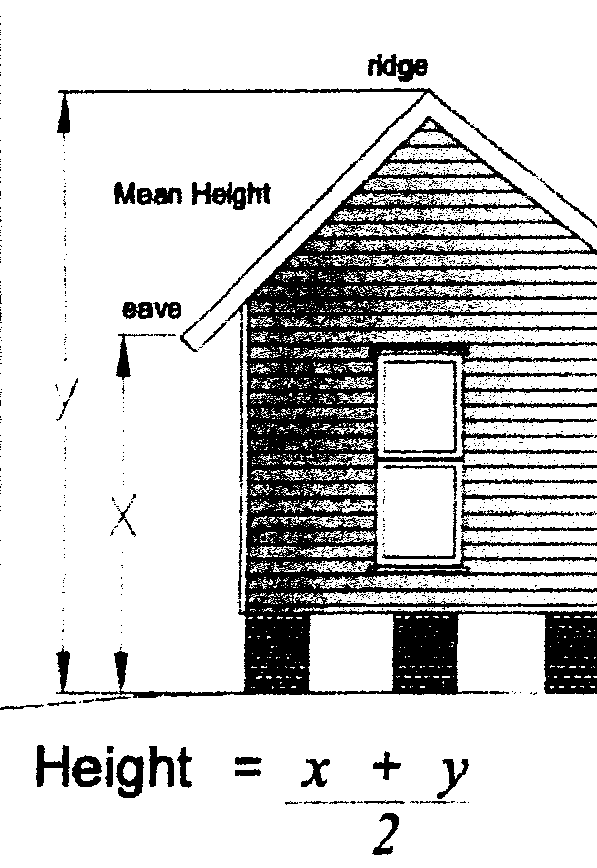
Hospital means an institution designed for the diagnosis, treatment and care of human illness or infirmity and providing health services, primarily for inpatients, and including as related facilities, laboratories, outpatient departments, training facilities and staff offices. A hospital may also include accessory uses such as retail goods establishments and restaurants, provided that such facilities are incidental and subordinate to the main use and part of the main structure.
Hotel or motel means an establishment providing, for a fee, sleeping accommodations and temporary living accommodations to the general public. Related ancillary uses may include, but shall not be limited to, conference and meeting rooms, restaurants and recreational facilities.
House of worship means a building where persons regularly assemble for religious worship and which building is maintained and controlled by a religious body organized to sustain religious expression.
Impervious coverage means the square footage or other area measurement by which all buildings and impervious surfaces cover a lot as measured in a horizontal plane to the limits of the impervious areas, such as surface areas, walkways, patios and plazas. All parking spaces and lots, buildings, roads, driveways, walkways, tennis courts, patios, decks and any other structure or on-site material or ground condition that does not permit the natural absorption of water shall be included in the computation of impervious coverage.
Impervious materials means materials that prevent precipitation from contacting the existing soil and do not allow water to penetrate the soil.
Incidental home occupation means a business, profession, occupation or trade conducted within the principle structure of a residential use by a resident of the dwelling which is incidental and secondary to the residential use of the dwelling, does not change the essentially residential character of the use, and which complies with the requirements of section 125.20.030.
Intensity means any factor such as square footage, number of dwelling units, or number of employees used as a basis for requiring parking or loading facilities.
Kennel means an establishment where pet animals owned by another person are temporarily boarded for pay or remuneration of any sort. The term "kennel" does not apply to animal hospitals operated by veterinarians duly licensed under state law where the boarding of animals is accessory to medical treatment.
Landscape area means a non-built-upon area of land in which landscape materials are placed, planted or maintained.
Landscape plan means the preparation of graphic and written criteria, specifications, and detailed plans to arrange and modify the effects of natural features such as planting ground and water forms, circulation, walks and other features to comply with the provisions of this title.
Landscaping means the installation of plant material or seed as a part of development.
Letter of understanding means a letter from the building official, or his duly authorized representative, setting out the substance of a pre-application conference.
Live/work dwelling means a structure combining a dwelling unit with a nonresidential use permitted in the zoning district where the structure is located, which is principally used by one or more of the residents. A live/work dwelling may also include the combination of a dwelling unit with arts-related activities, such as painting, photography, sculpture, music or film, and principally used by one or more of the residents.
Loading space means a space within a main building on the same lot as a main building, providing for the standing, loading or unloading of trucks.
Lot means a parcel of land having specific boundaries and having its principal frontage upon an officially approved street.
Lot area means the total horizontal areas within the lot lines of the lot.
Lot, corner, means a lot abutting two or more streets at their intersection.
Lot coverage means the area of the lot covered by a structure.
Lot depth means the average horizontal distance between the front and rear lot lines.
Lot, interior, means a lot other than a corner lot.
Lot lines means the lines forming the outer boundary of a lot.
Lot, through, means a lot having frontage on two approximately parallel streets or places.
Lot of record means a recorded, platted lot or a parcel of land lot, the map of which has been recorded in the office of the clerk of courts of the parish, or a lot described by metes and bounds, the description of which has been recorded in the office of the clerk of courts of the parish.
Lot width means the average horizontal distance between the side lot lines measured at the required front yard line and parallel to the front street line, or measured at the street lone if no front yard is required.
Mansard means a roof with two slopes on all four sides, the lower slope being nearly vertical and the upper nearly horizontal.
Manufacturing, heavy, means the assembly or fabrication of goods and materials which may include the storage of large volumes of highly flammable or toxic matter. Heavy manufacturing processes ordinarily have greater impacts than average impacts on the environment, or that ordinarily have significant impacts on the use and enjoyment of adjacent property in terms of noise, smoke, fumes, odors, glare or health and safety hazards.
Manufacturing, light, means the manufacturing from previously prepared materials of finished products or parts, including processing, fabrication, assembly, treatment and packaging of such products, and incidental storage, sales and distribution such products, providing all industrial activities are contained entirely within a building and noise, odor, smoke, heat, glare and vibration resulting from the industrial activity are confined within the building.
Medical/dental clinic means a facility operated by one or more physicians, dentists, chiropractors, psychiatrists or other licensed practitioners of the healing arts for the examination and treatment of persons solely on an outpatient basis.
Mini-warehouse means a structure that rents individual compartments for the purpose of storing personal property. Individual compartments shall not exceed 1,000 square feet.
Mortuary means an establishment in which the dead are prepared for burial or cremation. The facility shall be permitted to include a chapel for the conduct of funeral services and spaces for funeral services and informal gatherings, and/or display of funeral equipment. See Funeral home.
Motor vehicle dealership means an establishment that sells or leases new or used, functional automobiles, trucks, vans, trailers, recreational vehicles, boats, motorcycles or other motorized transportation vehicles. A motor vehicle dealership may contain an inventory of the vehicles for sale or lease either on-site or at a nearby location, and may provide on-site facilities for the repair and service of the vehicles sold or leased by the dealership.
Nonconforming lot of record means a platted lot which does not comply with the lot size requirements of the zoning district in which it is located, as outlined in section 125.20.010.
Nonconforming structure means any structure, which was lawful on the effective date of the ordinance from which this title is derived, but does not comply with all the standards and regulations of this title or any amendment thereto, as outlined in section 125.20.010.
Nonconforming use means any use of any land, building, or structure, which was lawful on the effective date of the ordinance from which this title is derived, but does not comply with all the standards and regulations of this title or any amendment thereto, as outlined in section 125.20.010.
Nursing home means a facility designed and intended to provide nursing service on a continuing basis to persons, the majority of whom require such service under trained professional nurses or physicians, and for whom medical records are maintained. The term "nursing home" shall include post-operative centers but shall not include any facility used for providing service to any inmate of any prison or other correctional institution.
Office means an establishment in which business, clerical, or professional activities are conducted.
Open space means that part of a lot, including all yards, which is open and unobstructed from grade level upward and is not occupied by off-street parking, streets, drives, or other surfaces for vehicles.
Outdoor storage yard means the storage of any material, as a principal use of the lot, or for a period of more than 24 hours, including items for sale, lease, processing and repair not in an enclosed structure. Items within an outdoor storage yard must be owned or leased by the owner of the storage yard.
Parapet wall means that portion of the wall that extends above the roofline.
Parcel means any quantity of land capable of being described with such definitiveness that its location and boundaries may be established and which is designed by its owner as land to be used as a unit.
Park/playground means a noncommercial facility designed to serve the recreational needs of the residents of the community, and shall include, but not be limited to, ball fields, basketball courts, skateboard parks, playgrounds and filed house which may have indoor recreation facilities.
Parking lot means an open, hard-surfaced area, other than a street or public way, used for the storage of operable passenger motor vehicles for limited periods of time. Parking may be available for residents, visitors, employees, clients, customers or similar users whether for compensation or at no charge.
Parking space, automobile, means a space within a building, private or public parking lot, exclusive of driveways, ramps, columns, office and work areas, for the parking of an automobile.
Party wall means a wall starting from the foundation and extending continuously through all stories to or above the roof that separates one building from another, but is in joint use by each building.
Penthouse, mechanical, means an enclosed structure above the roof of a building, other than a roof structure or bulkhead, that shelters mechanical equipment or vertical shaft openings in a roof.
Person means an individual, corporation, public agency, business, trust, partnership, association, two or more persons having a joint or common interest, or any other legal entity.
Personal services establishment means an establishment or place of business primarily engaged in the provision of frequent or recurrent services of a personal nature. Typical uses include, but are not limited to, beauty shops, barbershops, tanning salons, massage parlors, animal grooming, shoe repair, personal item repair shops, laundromats, dry cleaners, and tailors. Personal services establishments shall not include any adult uses.
Pervious materials means materials that permit water to enter the ground by virtue of their porous nature or by large spaces in the material.
Planned unit development (PUD) means a residential or commercial development guided by a total design plan in which one or more of the zoning or subdivision regulations, other than use regulations, shall be permitted to be waived or varied to allow flexibility and creativity in site and building design and location, in accordance with general guidelines.
Planning commission means the town planning commission created under R.S. 33:101 et seq., which shall have the powers provided for by state law and as may be provided for in this title.
Planting area means any area designed for landscape material installation having a minimum area of 25 square feet.
Plat means a map or plan of a parcel of land that is to be, or that has been, subdivided.
Prefabricated housing means any housing with structural or mechanical components manufactured and assembled away from the construction site. For purposes of this definition, the following terms shall have the following meanings:
Manufactured home community means a unified development of two or more manufactured home sites, plots or stands, arranged on a large tract usually under single ownership, meeting the area and yard requirements of this article, and designed to accommodate manufactured homes for a more or less permanent duration. Such term may include travel trailer accommodations, provided that no more than 25 percent of the park is used for such purpose.
Manufactured housing means dwelling units constructed primarily at a plant or facility on a production line basis and delivered to the site as an assembled unit or in modular form. Manufactured housing specifically refers to housing built under the Manufactured Home Construction and Safety Standards set by the U.S. Department of Housing and Urban Development (HUD).
Mobile home means prefabricated trailer-type housing units, built before June 15, 1976, that are semi-permanently attached to land, either the owner's fee land or leasehold, such as in a mobile-home park. A mobile home is a moveable or portable structure designed and constructed on its own chassis and intended for connection to utilities for year-round occupancy as a dwelling. Any dwelling unit that qualifies as a modular home according to the definition herein is not considered a mobile home. Furthermore, a travel trailer is not considered a mobile home.
Modular home means houses divided into multiple modules or sections, which are manufactured in a remote facility and delivered to their intended site of use. The modules are then assembled on a permanent foundation without a permanent chassis, into a single residential building. Unlike other prefabricated construction, modular homes conform to all state, local and regional codes (International Building Code standards) where the structure is to be located.
Travel trailer means a vehicular, portable structure built on a chassis, designed to be used as a temporary dwelling and may be hauled along a highway.
Principal building means a structure in which the primary use of the lot on which the building is located is conducted.
Principal use means the primary use and chief purpose of a lot or structure.
Prison means a facility for the detention, confinement, treatment or rehabilitation of persons located within a residential development that is limited to use by residents and their guests.
Property line means the lines forming the boundary of a lot, whether those lines are determined by metes and bounds, single lot or combination of lots or portions of lots of record.
Public improvement means any drainage ditch, storm sewer or drainage facility, sanitary sewer, water main, roadway, parkway, sidewalk, pedestrian way, tree lawn, off-street parking area, lot improvement or other facility for which the local government may ultimately assume the responsibility for maintenance and operation, or for which the local government responsibility is established.
Public services means uses operated by a unit of government to serve public needs, such as a police (with or without a jail), fire service ambulance, judicial court or government offices, but not including public utility stations or maintenance facilities.
Public use means any use operated by an agency of government which provides a direct service to the public including police, fire, library, schools whether operated by a public body or not and recreational services.
Public utility station means a structure or facility used by a pubic or quasi-public agency to store, distribute, and/or generate electricity, gas telecommunications and related equipment, or to pump or chemically treat water. This does not include storage or treatment of sewerage, solid waste or hazardous waste.
Public way means any street, alley or similar parcel of land essentially unobstructed from the ground to the sky, which is deeded, dedicated or otherwise permanently appropriated to the public for public use.
Quasi-public means essentially a public use, although under private ownership or control.
Quorum means a majority of authorized members of a board or commission.
Recreational facility means any facility that provides recreational opportunities such as tennis clubs, health clubs or golf clubs.
Recreational facility, indoor, means a commercial establishment providing completely enclosed recreation activities. Accessory uses shall be permitted to include the preparation and serving of food and/or sale of equipment related to the enclosed uses. Included in this definition shall be bowling, roller-skating or ice-skating, billiards, pool, motion picture theaters, and related amusements.
Recreational facility, outdoor, means an area free of buildings except for restrooms, dressing rooms, equipment storage, maintenance buildings, open-air pavilions and similar structures used primarily for commercial recreational activities.
Rehabilitative care center means a building other than an apartment hotel, hotel, small or large group home, rooming house, tourist home, motel or motor lodge, providing temporary lodging and board and a special program of specialized care and counseling on a full-time basis. Such a center includes, but is not limited to, centers that provide for alcohol and drug abuse clientele, former inmates of prisons or correctional institutions, or former patients of mental illness institutions. A rehabilitative care center must be licensed by an agency of the state as a rehabilitative or similar care facility and shall be operated by an entity that is similarly licensed by the state.
Residential care center means a building, other than an apartment, hotel, small or large group home, or rooming house, providing temporary lodging and board and a special program of specialized care and counseling on a full-time basis for 12 or more individuals who are displaced from their normal living environment. A residential care center must be licensed by an agency of the state as a residential or similar care facility and shall be operated by an entity that is similarly licensed by the state. Alcohol and drug abuse clientele, former inmates of prisons or correctional institutions, or former patients of mental institutions who have been found not guilty of a criminal charge by reasons of insanity shall be excluded as occupants.
Restaurant means any establishment whose primary purpose is the service of food for consumption on or off the premises. Restaurants shall be classified as follows:
Restaurant, fast food, means an establishment that sells food already prepared for consumption, packaged in paper, Styrofoam or similar materials, and may include drive-in or drive-up facilities for ordering.
Restaurant, full-service, means a restaurant with table service (order placement and delivery on-site) provided to patrons, also including cafeterias; carryout service, if any, shall be a limited portion of the facility and activity.
Restaurant, limited-service, means a restaurant without table service provided to patrons; walk-up counter and carryout trade is a primary portion of the facility; includes food delivery, carryout, public snack bars and delicatessens, but not specialty food or fast-food stores.
Retail goods establishment means a commercial enterprise that provides physical goods, products or merchandise directly to the consumer, where such goods are typically available for immediate purchase and removal from the premises by the purchaser. Retail goods establishments shall not include alcohol, unless "retail sales of alcohol" is allowed within the district and a separate approval is obtained for such use.
Retail sale of alcohol means retail sale of alcoholic beverages for consumption off-premises, when licensed by the town and the state.
Roofline means the highest continuous horizontal line of a roof. On a sloping roof, the roofline is the principal ridgeline, or the highest line common to one or more principal slopes of roof. On a flat roof, the roofline is the highest continuous line of the roof or parapet, whichever is higher.
Satellite dish antenna means a dish antenna designed for transmitting signals to a receiver or receiving station or for receiving television, radio, data, communication or other signals from other antennas, satellites or services.
School means any land used for educational facilities, including universities, colleges, elementary and secondary, and vocational schools. See Educational facility.
Servitude means the same as the term "easement."
Setback means the required minimum horizontal distance between any structure or projection and the related front, side, and rear property line.
Setback, building, means the required minimum horizontal distance between the building and the related front, side, and rear property line. For the purpose of this section, the setback will be measured to the nearest point of the foundation wall of the building. A roof overhang or projection not to exceed two feet will be allowed to project past the foundation wall.
Sidewalk means a paved pedestrian footpath between the curb lines or the lateral lines of a roadway and the adjacent property lines.
Sight triangle means the triangle at either side of an accessway or public right-of-way at its junction with a public street with sides of not less than ten feet in length each along the public right-of-way and/or accessway within which clear visibility of approaching vehicular or pedestrian traffic must be maintained in all directions.
Sign means a medium of communication, including its structure and component parts, which is used or intended to be used to attract attention to its subject matter or location usually for advertising purposes, including paint on the surface of a building. Each distinctive message painted or placed on a building or other structure shall be considered an individual sign.
Site plan or development plan means an accurate, scaled drawing showing the location of buildings, the landscaping, parking, circulation and such other features as floor plans and elevations to help describe the existing and proposed development of a specified area.
Social club or lodge means buildings and facilities or premises used or operated by an organization or association for some common purpose, such as, but not limited to, a fraternal, social, educational or recreational purpose, but not including clubs organized primarily for profit or to render a service that is customarily carried on as a business. Such organizations and associations shall be incorporated under the laws of the state as a non-profit corporation or registered with the Secretary of State of Louisiana.
Story means that portion of a building included between the surface of any floor and the surface of the floor next to it; or, if there is no floor above it, then the space between the floor and the ceiling above it.
Street means a public right-of-way or private thoroughfare, which provides vehicular and pedestrian access to adjacent properties. All streets will be within dedicated rights-of-way that have been properly processed, approved and recorded. The following shall be used to classify all streets:
Arterial street means a major street in the town's street system that serves as an avenue for the circulation of traffic into, out, or around the town and carries high volumes of traffic.
Collector street means a street whose principal function is to carry traffic between minor, local, and sub-collector streets and arterial streets but that may also provide direct access to abutting properties. A collector street serves or is designed to serve, directly or indirectly, more than 100 dwelling units and is designed to be used or is used to carry more than 800 trips per day.
Cul-de-sac means a street that terminates in a vehicular turnaround.
Dead-end street means a street having an outlet at one end only and terminated at the other end by undeveloped property. A dead-end street may or may not have facilities permitting vehicles to turn around.
Frontage road or marginal access street means a street adjacent or parallel to a freeway, expressway or an arterial street that is designed to provide access to abutting properties so that these properties are somewhat sheltered from the effects of the through traffic on the arterial street and so that the flow of traffic on the arterial street is not impeded by direct driveway access from a large number of abutting properties.
Local street means a street whose sole function is to provide access to abutting properties. A local street serves or is designed to serve at least ten, but no more than 25, dwelling units and is expected to or does handle between 75 and 200 trips per day.
Major state or interstate highways means those highways which have an average daily total of at least 25,000 vehicles at the intersection or section nearest to the use in question.
Private streets means streets which are owned by residents, and have a publicly recognized indenture, or covenant, that outlines governance and acts as a deed restriction. In order to create a private street, property owners must pay the fees to support upgrades and maintenance of said street. The town shall provide police and fire protection, as well as trash removal services. The residents shall pay for maintaining or paving sidewalks and street surfaces, maintaining or planting trees, and maintaining or installing street lights and entry gates. Private streets must meet minimum standards for drainage and stormwater regulations, pedestrian safety regulations, and fire/emergency vehicle requirements.
Public street means a road, thoroughfare, alley, highway, or bridge under the jurisdiction of a public agency.
Sub-collector means a street whose principal function is to provide access to abutting properties but is also designed to be used or is used to connect minor and local streets with collector or arterial streets, including residences indirectly served through connecting streets. A sub-collector street serves or is designed to serve at least 26, but no more than 100, dwelling units and is expected to or does handle between 200 and 800 trips per day.
Structure means a combination of materials constructed or erected with a fixed location on the ground, or attached to something having a fixed location on the ground, including, but not limited to, retaining walls in excess of four feet.
Subdivision means the division of a parcel of land into two or more lots, tracts, or parcels for the purpose, whether immediate or future, of sale, lease or building development, or if a new street is involved, any division of a parcel of land. The term "subdivision" includes re-subdivision and when appropriate to the context, shall relate to the process of subdivision or to the land subdivided.
Subdivision regulations means the town subdivision regulations.
Surveyor means a qualified registered land surveyor in good standing with the state board of registration.
Tattoo parlor means an establishment where services offered are tattooing, body piercing and non-medical body modification.
Telecommunications means as defined in the federal Telecommunications Act of 1996, means the transmission between or among points specified by the user, or information of the user's choosing, without change in the form or content of the information as sent and received.
Telecommunications antenna means a specific device, the surface of which is used to transmit and/or receive radio-frequency signals, microwave signals, or other signals transmitted to or from other antennas.
Telecommunications facility means an unstaffed structure used to house and protect the equipment necessary for processing telecommunications signals, which may include air conditioning equipment and emergency generators.
Telecommunications tower means any ground- or roof-mounted pole, spire, structure, or combination thereof taller than 15 feet, including lines, cables, wires, braces, and masts, intended primarily for the purposes of mounting an antenna, meteorological device, or similar apparatus above grade. Notwithstanding any other provision of this code, the height of a telecommunication tower is the distance from the base of the tower to the top of the structure.
Temporary use means a use that is authorized by this code to be conducted for a fixed period of time. Temporary uses are characterized by such activities as the sale of agricultural products, contractors' offices, equipment sheds, fireworks, carnivals flea markets, and garage sales.
Town planner means a person, appointed by the mayor, who is responsible for reviewing and providing recommendations on all zoning, rezoning, subdivision, re-subdivision, variance, and appeals requests to the town planning commission and the board of aldermen.
Tract means a parcel of land identified by letter or number the boundaries of which are shown on the recorded subdivision or development plat. A tract need not be suitable for development.
Traffic generation rates means the average daily trips generated per unit of land, as set forth by the Institute of Traffic Engineering or authenticated local figures for approval by the town engineer.
Trash/garbage storage area means that area of a development used for the storage and containment of refuse and refuse containers (i.e., dumpsters).
Truck-stop facility means those facilities as contemplated in R.S. 33:4862.1 et seq., which are designed primarily for serving 18-wheel tractor-trailer motor vehicles, but where no video draw-poker devices may be operated.
Use means the activity occurring on a lot or parcel, for which land or a building is arranged, designed or intended, or for which land or a building is or may be occupied, including all accessory uses.
Use, change of, means the change within the classified use of a structure or parcel.
Variance means a deviation from the height, bulk, setback, parking or other dimensional requirements established by this code.
Vehicle means any means of transport on land, especially on wheels (e.g., a car, bus, bicycle, etc.).
Vehicle, commercial, means those exceeding one ton in size with advertising or special equipment, which distinguish it from private automobiles. Any vehicle used for commercial purposes, except passenger vehicles used for to and from work. All vehicles with more than two axles, except motor homes used for recreation and not used in commerce. Note: A sign alone on a vehicle does not make the vehicle commercial.
Vehicle, recreational, means a vehicle designated for temporary living quarters for camping, traveling, or recreational use. It may have its own motive power, or be mounted on or pulled by another vehicle.
Vehicle storage yard means any land or buildings used primarily for the permanent or temporary storage of inoperable vehicles, machinery, or other equipment on a temporary or permanent basis.
Warehouse, wholesale or storage, means a building or premises in which goods, merchandise or equipment are stored for eventual distribution.
Yard means an open space at grade between a building and the adjoining lot lines, unoccupied and unobstructed by any portion of structure upward except as otherwise provided herein. In measuring a yard to determine the width of a yard, the minimum horizontal distance between the lot line and the maximum permissible main building shall be yard dimension.
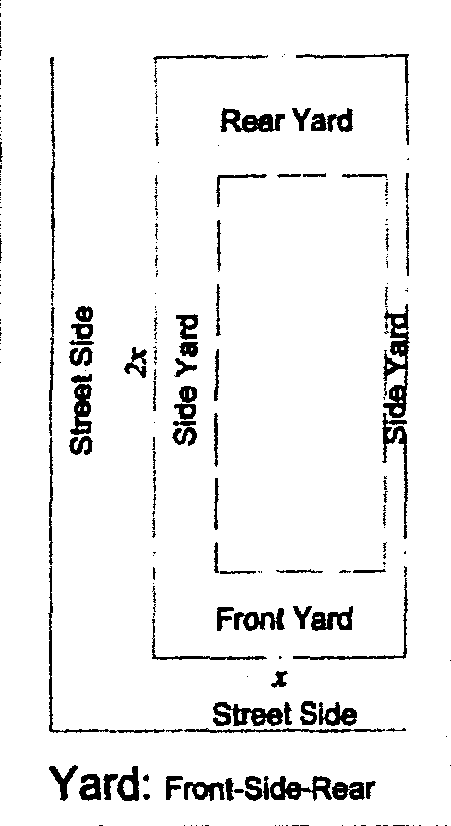
Yard, front, means a yard extending across the full width of a lot between the side lot lines and between the front property line and the front line of the building projected to the side lines of the building site. The depth of the front yard shall be measured between the front line of the building and the street line. On corner lots, the front yard shall be considered as parallel to the street upon which the lot has the least dimension. This space is considered open space.
Yard, rear, means a yard extending across the rear of the lot between the side lot lines and being the minimum horizontal distance between a rear lot line and the rear of the maximum main building. The rear yard shall be at the opposite end of the lot from the front yard. However, on through lots fronting two streets, two front yards shall be provided.
Yard, side, means a yard between the main building and the side lot line and extending from the front lot line to the rear lot line.
Zoning commission means the town zoning commission created under R.S. 33:4721 et seq., which shall have the powers provided for by state law and as may be provided for in this title.
(Code 1978, § 12-5021; Ord. of 11-2011, § 5.21; Ord. of 7-9-2020)
Sec. 125.10.010. - District classifications.
In order to classify, regulate and restrict the locations of uses and locations of buildings designated for specific areas; and to regulate and determine the areas of yards, courts and other open spaces within or surrounding such buildings, property is hereby classified into districts as prescribed in this chapter.
(Code 1978, § 12-5031; Ord. of 11-2011, § 5.31; Ord. of 7-9-2020)
Sec. 125.10.020. - Rules for interpretation of district boundaries.
(a)
Where uncertainties exist, such as approximately following the centerlines of streets, highways, or alleys, the boundaries shall be construed to follow such centerlines.
(b)
Boundaries indicated as approximately following platted lot lines shall be construed to follow such lot lines.
(c)
Boundaries indicated as approximately following town limits shall be construed as following town limits.
(d)
Boundaries indicated as following railroad lines shall be construed to be midway between the tracks.
(e)
Boundaries indicated as following shorelines shall be construed to follow such shoreline and, in the event of change in the shoreline, shall be construed as moving with the actual shoreline.
(f)
Boundaries indicated as parallel to or extensions of features indicated in subsections (a) through (e) of this section shall be so construed. The scale of the map shall determine distances not specifically indicated on the official zoning map.
(g)
Boundaries indicated following other boundary lines, watercourses, and other natural topographical features; such lines shall be construed to be such boundaries.
(h)
Where street or property layout existing on the ground is at variance with that shown on the official zoning map, or in other circumstances not covered by this section, the mayor or his/her duly authorized representative shall interpret the district boundaries, provided such adjustment does not exceed one acre in area.
(Code 1978, § 12-5032; Ord. of 11-2011, § 5.32; Ord. of 7-9-2020)
Sec. 125.10.030. - Applications of district regulations.
(a)
No building, structure, or land shall hereafter be used or occupied and no building or structure or part thereof shall hereafter be erected, constructed, reconstructed, moved, or structurally altered unless in conformity with all of the regulations herein specified for the district in which it is located.
(b)
No building or other structure shall hereafter be erected or altered:
(1)
To exceed the height;
(2)
To accommodate or house a greater number of families;
(3)
To occupy a greater percentage of lot area;
(4)
To have narrower or smaller rear yards, front yards, side yards, or other open spaces than herein required, or in any other manner contrary to the provisions of this title.
(c)
No part of a yard or other open space or off-street parking or loading space required about or in connection with any building for the purpose of complying with this title shall be included as part of a yard, open space, or off-street parking or loading space similarly required for any other building.
(d)
No yard or lot existing at the time of passage of this title shall be reduced in size or area below the minimum requirements set forth herein except where to do so would lead to lots that are less nonconforming than prior to the re-subdivision. Yards or lots created after the effective date of this title shall meet at least the minimum requirements established by this title.
(e)
Regulations of land under water. All lands within the town which are under water and are not shown as included within any district shall be subject to all the regulations of the district adjacent to the water area. If the water area adjoins two or more districts, the boundaries of each district shall be construed to extend into the water area in a straight line.
(f)
Location of streets and public ways. Whenever any street, alley, or other public way is vacated by official action of the governing body of the town, the zoning district adjoining each side of such street, alley, or public way shall automatically extend to the center of same and all area included therein shall then become subject to all appropriate regulations of the extended districts.
(Code 1978, § 12-5033; Ord. of 11-2011, § 5.33; Ord. of 7-9-2020)
Sec. 125.10.040. - Establishment of districts.
(a)
All land within the corporate limits of the town is hereby divided into the following five base zoning districts:
(b)
The five types of districts are further divided into the following specific base districts:
(1)
R-1 Rural Residential District (five-acre minimum).
(2)
R-2 Single-Family Residential District (15,000 square foot minimum).
(3)
R-3 Single-Family Residential District (6,000 square foot minimum).
(4)
R-4 Multifamily Residential District.
(5)
RX Business/Residential Mixed-Use District.
(6)
CN Neighborhood Commercial Corridor District.
(7)
CR Regional Commercial District.
(8)
ID Institutional District.
(9)
OS Open Space/Recreation District.
(10)
ML Light Industrial/Manufacturing District.
(c)
If, in accordance with the provisions of this title and statutes, changes are made in district boundaries or other matter portrayed on the official zoning map, such changes shall be made on this official zoning map quarterly after the board of aldermen has approved the amendment and attached to this title. Each such quarterly change of the map shall be dated, signed, and certified. However, amendments shall become effective when adopted by the board.
(1)
No change of any nature shall be made in this official zoning map or matter shown thereon except in conformity with the procedure set forth in this title. Any unauthorized changes of whatever kind, by any person, shall be considered a violation of this title and punishable under section 125.05.080.
(2)
The official zoning map, which shall be located in the town at the town hall, shall be the final authority as to the current zoning status of land, buildings, and other structures in the town. The mayor shall keep the map.
(d)
Classification of annexed territory.
(1)
All areas taken into the town limits of the town shall be classified in the zoning district of the town that most closely corresponds to the adjacent land uses as identified by the town master plan. The appropriate town zoning shall be recommended by the planning commission of the town and verified in writing before adoption of an annexation ordinance by the board of aldermen of the town. However, the said areas taken into the town may be classified as any district set forth in subsection (b) of this section, provided that:
a.
Application is made to the planning commission by an owner with the area to be annexed for whatever other classification or classifications that may be desired;
b.
A public hearing shall have been held by the planning commission meeting the requirements of section 125.05.070;
c.
The planning commission approves a district classification or classifications requested; and
d.
The board of aldermen approves by majority vote the district classification approved by the planning commission.
(2)
If the planning commission and board of aldermen do not act upon the application within 90 days from date of the application, it shall be deemed denied.
(Code 1978, § 12-5034; Ord. of 11-2011, § 5.34; Ord. of 7-9-2020)
Sec. 125.10.050. - Minimum area for base zoning districts.
The minimum areas that may constitute a separate or detached part of any of the following zoning districts on the zoning map or subsequent amendments to said zoning map shall be as shown in Table 3. When a nonresidential district is directly across the street from or abuts a district with the same or less restrictive classification, the area of the land directly across the street or abutting the property may be included in the calculations in meeting the minimum district size requirements.
Table 3. Minimum Areas for Zoning Districts
(Code 1978, § 12-5035; Ord. of 11-2011, § 5.35; Ord. of 7-9-2020)
Sec. 125.10.060. - Zoning map.
The boundaries of each zoning district are to be indicated upon the official zoning map as approved by the board of aldermen of the town. Said map and subsequent amendments thereto shall be considered as a part of this code.
(Code 1978, § 12-5036; Ord. of 11-2011, § 5.36)
Sec. 125.10.070. - R-1 Rural Residential District.
(a)
Purpose and intent. The purpose and intent of the R-1 Rural Residential District is to maintain the town's rural character, conserve natural areas and environmental quality, and ensure efficient public services and facilities to those areas outside of the historic core. These districts promote options for low-density rural development and agricultural/forestry activities while providing opportunities for a small-scale a rural economic base.
(b)
Permitted uses.
(1)
Residential.
a.
Bed and breakfast establishments of up to six rooms;
b.
Manufactured housing;
c.
Single-family detached dwellings, including modular homes;
d.
Small group or community homes;
e.
Two-family dwellings, including modular homes.
(2)
Nonresidential.
a.
Agricultural uses, horticultural and forestry activities, excluding aircraft landing strips;
b.
Cemeteries;
c.
Small day care centers, adult or child;
d.
Houses of worship, provided the building for use does not exceed 4,000 square feet;
e.
Public buildings, including firehouses and community centers;
f.
Public utilities, including telephone, telegraph and power distribution poles and lines and necessary appurtenant equipment and structures such as transformers, unit substations and equipment houses.
(3)
Accessory.
a.
Accessory buildings or structures customarily incidental to the aforementioned permitted uses;
b.
Incidental home occupations;
c.
Produce stands.
(c)
Conditional uses. Conditional uses are prohibited unless the town has processed an application for the use, and the planning commission has favorably approved such use. For all conditional uses, the plan approval process is that as set forth in section 125.05.070, regardless of lot size or conditional uses.
(1)
Kennels.
(d)
Property development standards.
(1)
Lot area: Every lot shall contain an area of not less than four acres.
(2)
Lot width: Every lot shall have a minimum width of 100 feet.
(3)
Standard yard requirements and development standards:
a.
Front yard setback: All uses shall have a front yard setback of 30 feet; however, there shall be no minimum yard setback for produce stands of no more than 300 square feet in area and no more than 16 feet in height.
b.
Side yard: All uses shall have a combined total side yard of 20 feet, but in no case shall any building be located closer than ten feet from the side property line.
c.
Rear yard: There shall be a rear yard of not less than 30 feet for all uses.
(4)
Maximum height limit: No building or structure shall exceed 35 feet above the base flood elevation as established in the current FEMA maps and guidelines, unless outlined in section 125.20.110.
(e)
Site and structure regulations for group/residential care homes.
(1)
To ensure safety and compatibility with surrounding use, site plan approval is required for any board, care and/or community home in this district.
(2)
For these uses, no more than four automobiles, vans, trucks, etc., shall be parked outside of home, and these must be parked in off-street parking spaces.
(3)
All requirements for certification, licensing and monitoring established by the laws of the state, including, but not limited to, R.S. 40:2151 et seq., relative to board and care homes must be complied with and maintained pursuant to this section.
(4)
All requirements for certification, licensing, and monitoring established by the laws of the state, including, but not limited to, R.S. 28:475 et seq., relative to group homes for handicapped persons must be complied with and maintained pursuant to this section.
(f)
Parking requirements. As provided for in section 125.15.010.
(Code 1978, § 12-5037; Ord. of 11-2011, § 5.37; Ord. of 7-9-2020)
Sec. 125.10.080. - R-2 Single-Family Residential District.
(a)
Purpose and intent. The purpose and intent of the R-2 Single-Family Residential District is to provide for the location and grouping of low-density, single-family residences with accompanying accessory uses that are protected from the adverse impacts of incompatible nonresidential land uses.
(b)
Permitted uses.
(1)
Residential.
a.
Single-family detached dwellings, including modular homes;
b.
Small group or community homes.
(2)
Nonresidential.
a.
Agricultural uses, horticultural and forestry activities, excluding aircraft landing strips;
b.
Houses of worship, provided the building for use does not exceed 4,000 square feet;
c.
Public buildings, including firehouses and community centers;
d.
Public utilities, including telephone, telegraph and power distribution poles and lines and necessary appurtenant equipment and structures such as transformers, unit substations and equipment houses.
(3)
Accessory.
a.
Accessory buildings or structures customarily incidental to the aforementioned permitted uses;
b.
Incidental home occupations.
(c)
Conditional uses. Conditional uses are prohibited unless the town has processed an application for the use, and the planning commission has favorably approved such use. For all conditional uses, the plan approval process is that as set forth in section 125.05.070, regardless of lot size or conditional uses.
(d)
Property development standards.
(1)
Lot area:
a.
Residential lots shall contain an area of not less than 15,000 square feet.
b.
Nonresidential lots shall contain an area not less than one acre.
(2)
Lot width: All lots shall have a minimum width of 100 feet.
(3)
Standard yard requirements and development standards:
a.
Front yard setback: All uses shall have a front yard setback of 30 feet.
b.
Side yard: All uses shall have a combined total side yard of 18 feet, but in no case shall any building be located closer than eight feet from the side property line.
c.
Rear yard: There shall be a rear yard of not less than 30 feet for all uses.
(4)
Maximum height limit: No building or structure shall exceed 35 feet above the base flood elevation as established in the current FEMA maps and guidelines, unless outlined in section 125.20.110.
(e)
Site and structure regulations for group/residential care homes.
(1)
To ensure safety and compatibility with surrounding use, site plan approval is required for any board, care and/or community home in this district.
(2)
For these uses, no more than four automobiles, vans, trucks, etc., shall be parked outside of a small group home. These must be parked in off-street parking spaces.
(3)
All requirements for certification, licensing and monitoring established by the laws of the state, including, but not limited to, R.S. 40:2151 et seq., relative to board and care homes must be complied with and maintained pursuant to this section.
(4)
All requirements for certification, licensing, and monitoring established by the laws of the state, including, but not limited to, R.S. 28:475 et seq., relative to group homes for handicapped persons must be complied with and maintained pursuant to this section.
(f)
Parking requirements. As provided for in section 125.15.010.
(Code 1978, § 12-5038; Ord. of 11-2011, § 5.38; Ord. of 7-9-2020)
Sec. 125.10.090. - R-3 Single-Family Residential District.
(a)
Purpose and intent. The purpose and intent of the R-3 Single-Family Residential District is to provide for the location and grouping of low-density, single-family residences with accompanying accessory uses in the historic core of the town that are protected from the adverse impacts of incompatible nonresidential land uses.
(b)
Permitted uses.
(1)
Residential.
a.
Single-family detached dwellings, including modular homes.
(2)
Nonresidential.
a.
Agricultural uses, horticultural and forestry activities, excluding aircraft landing strips;
b.
Houses of worship, provided the building for use does not exceed 4,000 square feet;
c.
Public buildings, including firehouses and community centers;
d.
Public utilities, including telephone, telegraph and power distribution poles and lines and necessary appurtenant equipment and structures such as transformers, unit substations and equipment houses.
(3)
Accessory.
a.
Accessory buildings or structures customarily incidental to the aforementioned permitted uses;
b.
Incidental home occupations.
(c)
Conditional uses. Conditional uses are prohibited unless the town has processed an application for the use, and the planning commission has favorably approved such use. For all conditional uses, the plan approval process is that as set forth in section 125.05.070, regardless of lot size or conditional uses.
(1)
Small group or community home.
(d)
Property development standards.
(1)
Lot area:
a.
Residential lots shall contain an area of not less than 6,000 square feet.
b.
Nonresidential lots shall contain an area not less than 12,000 square feet.
(2)
Lot width:
a.
All residential lots shall have a minimum width of 60 feet.
b.
Nonresidential lots shall have a minimum width of 100 feet.
(3)
Standard yard requirements and development standards:
a.
Front yard setback: All uses shall have a front yard setback of 25 feet.
b.
Side yard: All uses shall have a combined total side yard of 15 feet, but in no case shall any building be located closer than seven feet from the side property line.
c.
Rear yard: There shall be a rear yard of not less than 25 feet for all uses.
(4)
Maximum height limit: No building or structure shall exceed 35 feet above the base flood elevation as established in the current FEMA maps and guidelines, unless outlined in section 125.20.110.
(e)
Site and structure regulations for group/residential care homes.
(1)
To ensure safety and compatibility with surrounding use, site plan approval is required for any board, care and/or community home in this district.
(2)
For these uses, no more than four automobiles, vans, trucks, etc., shall be parked outside of a small group home. These must be parked in off-street parking spaces.
(3)
All requirements for certification, licensing and monitoring established by the laws of the state, including, but not limited to, R.S. 40:2151 et seq., relative to board and care homes must be complied with and maintained pursuant to this section.
(4)
All requirements for certification, licensing, and monitoring established by the laws of the state, including, but not limited to, R.S. 28:475 et seq., relative to group homes for handicapped persons must be complied with and maintained pursuant to this section.
(f)
Parking requirements. As provided for in section 125.15.010.
(Code 1978, § 12-5039; Ord. of 11-2011, § 5.39; Ord. of 7-9-2020)
Sec. 125.10.100. - R-4 Multifamily Residential District.
(a)
Purpose and intent. The purpose and intent of the R-4 Multifamily Residential District is to provide opportunities for low- to moderate-density residential neighborhoods with buildings on individual lots or for more than one building on one lot. The R-4 district shall accommodate single-family residences attached dwellings that have common walls, including townhouses, congregate and other cluster developments, as well as multifamily structures ranging from duplexes to apartment buildings.
(b)
Permitted uses.
(1)
Residential.
a.
Multifamily dwellings;
b.
Single-family detached dwellings, including modular homes;
c.
Townhouse dwellings;
d.
Two-family dwellings, including modular homes;
e.
Small or large group/community homes.
(2)
Nonresidential.
a.
Agricultural uses, horticultural and forestry activities, excluding aircraft landing strips;
b.
Large day care centers, adult or child;
c.
Small day care centers, adult or child;
d.
Houses of worship, provided the building for use does not exceed 4,000 square feet;
e.
Public buildings, including firehouses and community centers;
f.
Public utilities, including telephone, telegraph and power distribution poles and lines and necessary appurtenant equipment and structures such as transformers, unit substations and equipment houses.
(3)
Accessory.
a.
Accessory buildings or structures customarily incidental to the aforementioned permitted uses;
b.
Incidental home occupations.
(c)
Conditional uses. Conditional uses are prohibited unless the town has processed application for the use, and the planning commission has favorably approved such use. For all conditional uses, the plan approval process is that as set forth in section 125.05.070, regardless of lot size or conditional uses.
(d)
Property development standards.
(1)
Lot area:
a.
Single-family detached lots and group/community home shall contain an area of not less than 6,000 square feet.
b.
Two-family and lot shall have a minimum lot area of 7,000 square feet.
c.
Townhouse lots shall contain a minimum lot area of 1,800 square feet per unit, with a minimum of four units per development.
d.
Multifamily dwellings shall have a minimum lot area of 7,500 square feet or 2,000 square feet per unit, whichever is greater.
e.
All nonresidential lots shall contain an area not less than 12,000 square feet.
(2)
Lot width:
a.
Single-family lots shall have a minimum width of 60 feet.
b.
Two-family lots shall have a minimum width of 60 feet.
c.
Interior townhouse lots shall measure no less than 30 feet and corner townhouse lots shall measure no less than 40 feet.
d.
Minimum lot width for a multifamily development is 120 feet.
e.
Nonresidential lots shall have a minimum width of 100 feet.
(3)
Standard yard requirements and development standards:
a.
Front yard setback:
1.
All uses other than townhouses shall have a front yard setback of 25 feet.
2.
Front building lines shall be no closer than ten feet from the property line on lots that contain townhouses.
b.
Side yard:
1.
All uses other than townhouses and multifamily developments shall have a combined total side yard of 15 feet, but in no case shall any building be located closer than seven feet from the side property line.
2.
There shall be no minimum side yard requirement between lots that contain townhouses provided that in no case shall any townhouse be built located any closer than ten feet from the street side property line, and a ten-foot setback shall be provided where a lot containing a townhouse abuts a lot containing a separate residential structure.
3.
Multifamily developments shall have a minimum side yard of 20 feet, but in no case shall the building be any closer than ten feet from the property line.
c.
Rear yard: There shall be a rear yard of not less than 25 feet for all uses.
(4)
Maximum height limit: No building or structure shall exceed 35 feet above the base flood elevation as established in the current FEMA maps and guidelines, unless outlined in section 125.20.110.
(e)
Site and structure regulations for group/residential care homes.
(1)
To ensure safety and compatibility with surrounding use, site plan approval is required for any board, care and/or community home in this district.
(2)
For these uses, no more than four automobiles, vans, trucks, etc., shall be parked outside of a small group home, and no more than six automobiles shall be parked outside of a large group home. These must be parked in off-street parking spaces.
(3)
All requirements for certification, licensing and monitoring established by the laws of the state, including, but not limited to, R.S. 40:2151 et seq., relative to board and care homes must be complied with and maintained pursuant to this section.
(4)
All requirements for certification, licensing, and monitoring established by the laws of the state, including, but not limited to, R.S. 28:475 et seq., relative to group homes for handicapped persons must be complied with and maintained pursuant to this section.
(f)
Parking requirements. As provided for in section 125.15.010.
(g)
Landscaping requirements. As provided for in section 125.15.020.
(h)
Off-street loading requirements. Off-street loading requirements for this district shall be in accordance with the provisions of section 125.15.101.
Table 4. Residential Permitted and Conditional Uses
Table 5. Residential Property Development Standards
(Code 1978, § 12-5040; Ord. of 11-2011, § 5.40; Ord. of 7-9-2020)
Sec. 125.10.110. - RX Residential/Business Mixed-Use District.
(a)
Purpose and intent. The purpose of the RX Business/Residential Mixed-Use District is to provide for the location of small, low-impact retail, service and office uses within or next to primarily residential areas. The intent of the district is to protect established residential neighborhoods from the type of land uses associated with high levels of noise, illumination, traffic and visual blight that are more common in more intense commercial districts, while encouraging the convenient placement of such commercial uses for the benefits of residents in locations compatible with the type and impact of the use. Characteristics of this district generally include a mixture of land uses in close proximity to existing commercial/institutional development, where some existing homes or vacant land may be less suitable for residential purposes.
(b)
Permitted uses.
(1)
Residential.
a.
Bed and breakfast establishments of up to four rooms;
b.
Townhouse dwellings;
c.
Live/work dwellings;
d.
Multifamily dwellings, up to a maximum four dwelling units per structure;
e.
Single-family detached dwellings, including modular homes;
f.
Two-family dwellings, including modular homes.
(2)
Nonresidential.
a.
Animal hospitals;
b.
Art galleries, visual art and photographic studios;
c.
Large day care centers, adult or child;
d.
Small day care centers, adult or child;
e.
Financial institutions, provided the building does not have a drive-through facility;
f.
Houses of worship, provided the building for use does not exceed 4,000 square feet;
g.
Medical and dental clinics, up to three practitioners;
h.
Personal services establishments;
i.
Professional and business offices, provided the building for use does not exceed 5,000 square feet;
j.
Public buildings, including firehouses and community centers;
k.
Public utilities, including telephone, telegraph and power distribution poles and lines and necessary appurtenant equipment and structures such as transformers, unit substations and equipment houses;
l.
Restaurants, limited-service;
m.
Social clubs or lodges.
(3)
Accessory.
a.
Accessory buildings or structures customarily incidental to the aforementioned permitted uses;
b.
Incidental home occupations.
(c)
Conditional uses. Conditional uses are prohibited unless the town has processed application for the use, and the planning commission has favorably approved such use. For all conditional uses, the plan approval process is that as set forth in section 125.05.070, regardless of lot size or conditional uses.
(1)
Medical and dental clinics with more than three practitioners.
(2)
Professional and business offices over 5,000 square feet.
(d)
Property development standards.
(1)
Lot area:
a.
The minimum lot area requirement in the RX zone for nonresidential lots is 7,200 square feet.
b.
Residential uses shall meet all minimum area requirements in the R-4 Multifamily Residential District as per section 125.10.100.
c.
Bed and breakfast establishments shall have a minimum lot area of 12,000 square feet.
(2)
Lot width:
a.
There shall be a minimum lot width of 60 feet at the building line for nonresidential lots.
b.
Residential uses shall meet all minimum lot width requirements in the R-4 Multifamily Residential District as per section 125.10.100.
c.
Bed and breakfast establishments shall have a minimum lot width of 120 feet.
(3)
Standard yard requirements and development standards:
a.
Front yard setback:
1.
All nonresidential uses shall have a 25-foot minimum front yard setback.
2.
Residential uses shall meet all minimum front yard requirements in the R-4 Multifamily Residential District as per section 125.10.100.
3.
Bed and breakfast establishments shall have a 25-foot minimum front yard setback.
b.
Side yard:
1.
All nonresidential uses shall have a minimum side yard of 15 feet, but in no case shall the building be any closer than seven feet from the property line.
2.
All residential uses shall meet the side yard requirements outlined in section 125.10.100.
3.
Bed and breakfast establishments shall have a minimum side yard of 15 feet, but in no case shall the building be any closer than seven feet from the property line.
c.
Rear yard: There shall be a rear yard of not less than 25 feet for all uses.
(4)
Maximum height limit: No building or structure shall exceed 35 feet above the base flood elevation as established in the current FEMA maps and guidelines, unless outlined in section 125.20.110.
(e)
Site and structure regulations for group/residential care homes.
(1)
To ensure safety and compatibility with surrounding use, site plan approval is required for any board, care and/or community home in this district.
(2)
For these uses, no more than four automobiles, vans, trucks, etc., shall be parked outside of a small group home, and no more than six automobiles shall be parked outside of a large group home. These must be parked in off-street parking spaces.
(3)
All requirements for certification, licensing and monitoring established by the laws of the state, including, but not limited to, R.S. 40:2151 et seq., relative to board and care homes must be complied with and maintained pursuant to this section.
(4)
All requirements for certification, licensing, and monitoring established by the laws of the state, including, but not limited to, R.S. 28:475 et seq., relative to group homes for handicapped persons must be complied with and maintained pursuant to this section.
(f)
Site plan submission.
(1)
Site plan approval. To ensure proper development and compatibility within the RX district, all uses shall be reviewed as follows:
a.
Site plan review is not necessary for purely residential uses;
b.
Site plan approval is required for all commercial uses that will be developed under the RX guidelines for the first time;
c.
Site plan approval is required for any expansion or addition of 500 square feet or more onto a commercially used property;
d.
Site plan approval is required for the conversion of all or part of a residential use into a commercial use.
(2)
Plan approval process. When site plan approval is required, the following plan approval process is required by the planning commission:
a.
When a person applies for the permit, the planning commission shall hold a public hearing on the proposal.
b.
The site of the proposal shall be posted at least ten days prior to the public hearing.
c.
The petitioner shall submit the following:
1.
Site and development plans at an appropriate scale showing the proposed development scheme including location, proposed site layout, provisions of ingress and egress, off-street parking and off-street loading access, refuse and service areas, and required yards and open space.
2.
Plans showing proposed locations for utility hook ups.
3.
Plans for proposed screening, buffering, and landscaping.
4.
Proposed signs and lighting, including type, dimensions and character.
5.
Architectural drawings depicting front and side elevations for proposed buildings and the exterior renovation of existing structures.
d.
Submitted plans must bear the certification of a registered professional engineer, architect or land surveyor.
(g)
Parking requirements. Parking requirements for this district shall be in accordance with the provisions of section 125.15.010.
(h)
Fire marshal approval. As provided for in part I of this Code.
(i)
Landscape requirements. Landscaping requirements for this district shall be in accordance with the provisions of section 125.15.020.
(j)
Off-street loading requirements. Off-street loading requirements for this district shall be in accordance with the provisions of section 125.15.101.
Table 6. Mixed-Use Permitted and Conditional Uses
Table 7. Mixed-Use Property Development Standards
(Code 1978, § 12-5041; Ord. of 11-2011, § 5.41; Ord. of 7-9-2020)
Sec. 125.10.120. - CN Neighborhood Commercial Corridor District.
(a)
Purpose and intent. This commercial district is designed to accommodate commercial activities that draw from, provide services to, and would benefit from a location easily accessible to a state highway or arterial street. The zoning of commercial property in this district shall be for the purpose of encouraging and requiring appropriate development and redevelopment, the efficient use of small tracts, innovative and imaginative planning, and conservation of natural resources and minimum waste of land. Commercial areas are to be developed so as to result in attractive, viable and safe center and clusters. Control of vehicular access, circulation, landscaping and signs should soften the impact of development on any nearby residential neighborhoods and assure minimum adverse effects on the street system and other public services.
(b)
Permitted uses.
(1)
Residential.
a.
Live/work dwellings;
b.
Multifamily dwellings;
c.
Nursing homes;
d.
Residential care centers.
(2)
Nonresidential.
a.
Animal hospitals;
b.
Art galleries, visual art and photographic studios;
c.
Automotive repair, minor;
d.
Small day care centers, adult or child;
e.
Large day care centers, adult or child;
f.
Financial institutions with drive-through facility;
g.
Funeral homes;
h.
Gas stations;
i.
Government facilities;
j.
Houses of worship;
k.
Kennels;
l.
Medical and dental clinics;
m.
Personal services establishments;
n.
Professional and business offices;
o.
Public utilities, including telephone, telegraph and power distribution poles and lines and necessary appurtenant equipment and structures such as transformers, unit substations and equipment houses;
p.
Restaurants, all types;
q.
Retail sales establishments.
(3)
Accessory.
a.
Incidental home occupations;
b.
Accessory buildings or structures customarily incidental to the aforementioned permitted uses.
(c)
Conditional uses. Conditional uses are prohibited unless the town has processed an application for the use, and the planning commission has favorably approved such use. For all conditional uses, the plan approval process is that as set forth in section 125.05.070, regardless of lot size or conditional uses.
(1)
Rehabilitative care center;
(2)
Retail sales of alcohol.
(d)
Property development standards.
(1)
Lot area:
a.
Every nonresidential lot shall contain an area of not less than 7,200 square feet.
b.
Residential uses shall meet the minimum area requirements in the R-4 Multifamily Residential District as per section 125.10.100.
c.
Nursing homes and residential care centers shall contain an area of not less than one acre.
(2)
Lot width:
a.
There shall be a minimum lot width of 60 feet at the building line for nonresidential lots.
b.
Residential uses shall meet the minimum lot width requirements in the R-4 Multifamily Residential District as per section 125.10.100.
(3)
Standard yard requirements and development standards:
a.
Front yard setback:
1.
All nonresidential uses shall have a 25-foot minimum front yard setback.
2.
Residential uses shall meet all minimum front yard requirements in the R-4 Multifamily Residential District as per section 125.10.100.
b.
Side yard:
1.
All nonresidential uses shall have a minimum side yard of 15 feet, but in no case shall the building be any closer than seven feet from the property line.
2.
All residential uses shall meet the side yard requirements outlined in section 125.10.100.
c.
Rear yard: There shall be a rear yard of not less than 25 feet for all uses.
(4)
Maximum height limit: No building or structure shall exceed 35 feet above the base flood elevation as established in the current FEMA maps and guidelines, unless outlined in section 125.20.110.
(e)
Parking requirements. Parking requirements for this district shall be in accordance with the provisions of section 125.15.010.
(f)
Fire marshal approval. As provided for in part I of this Code.
(g)
Landscape requirements. Landscaping requirements for this district shall be in accordance with the provisions of section 125.15.020.
(h)
Screening. Any use that requires the outside storage of materials (i.e., sand, pipe, gravel, concrete products, iron, steel, septic tanks, or fiberglass products) shall be screened with a six-foot, 100 percent sight-obscuring fence. Not more than 50 percent of the total lot area shall be used for storage. The storage of material is not to exceed six feet in height.
(i)
Off-street loading requirements. Off-street loading requirements for this district shall be in accordance with the provisions of section 125.15.010.
(Code 1978, § 12-5042; Ord. of 11-2011, § 5.42; Ord. of 7-9-2020)
Sec. 125.10.130. - CR Regional Commercial District.
(a)
Purpose and intent. The regional commercial district is intended to accommodate a wide variety of commercial and retail uses, as well as offices, businesses and personal services that serve the needs of the community and the region. The intent is to provide for a mix of large-scale commercial uses that are typically land sensitive and are not well suited to being located in neighborhoods or smaller commercial corridors. This district is best suited along major arterial streets and interstate highway intersections.
(b)
Permitted uses.
(1)
Residential.
a.
Nursing homes;
b.
Residential care centers.
(2)
Nonresidential.
a.
Automotive repair, major;
b.
Automotive repair, minor;
c.
Financial institutions with drive-through facility;
d.
Funeral homes;
e.
Gas stations;
f.
Government facilities;
g.
Heavy sales, rental and service;
h.
Hotels or motels;
i.
Houses of worship;
j.
Medical and dental clinics;
k.
Mini-warehouses;
l.
Motor vehicle dealerships;
m.
Personal services establishments;
n.
Professional and business offices;
o.
Public utilities, including telephone, telegraph and power distribution poles and lines and necessary appurtenant equipment and structures such as transformers, unit substations and equipment houses;
p.
Recreation facilities, indoor or outdoor;
q.
Restaurant, all types;
r.
Retail sales establishments;
s.
Truck stop facilities.
(3)
Accessory.
a.
Accessory buildings or structures customarily incidental to the aforementioned permitted uses;
b.
Parking garages.
(c)
Conditional uses. Conditional uses are prohibited unless the town has processed an application for the use, and the planning commission has favorably approved such use. For all conditional uses, the plan approval process is that as set forth in section 125.05.070, regardless of lot size or conditional uses.
(1)
Alcohol beverage outlet.
(d)
Property development standards.
(1)
Lot area: No minimum lot area is required for nonresidential lots.
(2)
Lot width: No minimum lot width shall be required for nonresidential lots.
(3)
Lot depth: No minimum lot depth shall be required for nonresidential lots and bed and breakfasts.
(4)
Front yard:
a.
Front building lines shall be no closer than ten feet from the street right-of-way line.
b.
On corner or through lots, the required front yard will be provided on both streets.
(5)
Side yard: No side yard is required for nonresidential lots except on the sides of a lot abutting any adjacent existing dwelling or residential area or district in which case there shall be a side yard of not less than ten feet in depth.
(6)
Rear yard: No rear yard is required for nonresidential lots except where a lot abuts an existing dwelling or residential area or district, in which case there shall be a rear yard of not less than ten feet in depth.
(e)
Parking requirements. Parking requirements for this district shall be in accordance with the provisions of section 125.15.010.
(f)
Height requirements. No building or structure shall exceed 45 feet above the finished grade of the property or base flood elevation as established in the current FEMA FIRMs and guidelines, whichever is higher, subject to the provisions of section 125.20.110.
(g)
Fire marshal approval. As provided for in part I of this Code.
(h)
Landscape requirements. Landscaping requirements for this district shall be in accordance with the provisions of section 125.15.020.
(i)
Screening. Any use that requires the outside storage of materials (i.e., sand, pipe, gravel, concrete products, iron, steel, septic tanks, or fiberglass products) shall be screened with a six-foot, 100 percent sight-obscuring fence. Not more than 50 percent of the total lot area shall be used for storage. The storage of material is not to exceed six feet in height.
(j)
Off-street loading requirements. Off-street loading requirements for this district shall be in accordance with the provisions of section 125.15.010.
(k)
Traffic impact study. Those developments that meet or exceed the criteria outlined in section 125.20.050 shall be required to complete a traffic impact study (TIS).
(Code 1978, § 12-5043; Ord. of 11-2011, § 5.43; Ord. of 7-9-2020)
Sec. 125.10.140. - ID Institutional District.
(a)
Purpose and intent. The purpose of the institutional district shall be to accommodate uses of a civic, religious, educational or public nature in areas that provide maximum accessibility for the pubic to utilize the facilities, and to eliminate the ambiguity of maintaining public uses in unrelated districts.
(b)
Permitted uses.
(1)
Residential.
a.
Caretaker dwellings, including houses for faculty, watchmen and dormitories.
(2)
Nonresidential.
a.
Cultural facilities;
b.
Large day care centers, adult or child;
c.
Government facilities;
d.
Hospitals;
e.
Houses of worship;
f.
Military reservations;
g.
Public or private educational facilities;
h.
Public fairgrounds;
i.
Public utility services;
j.
Recreational facilities;
k.
Social clubs or lodges.
(3)
Accessory.
a.
Accessory buildings or structures customarily incidental to the aforementioned permitted uses;
b.
Parking garages.
(c)
Conditional uses. Conditional uses are prohibited unless the town has processed application for the use, and the planning commission has favorably approved such use. For all conditional uses, the plan approval process is that as set forth in section 125.05.070, regardless of lot size or conditional uses.
(1)
Alcohol and drug treatment centers;
(2)
Penal and correctional institutions provided the site is not less than five acres in area and does not abut a residential district;
(3)
Psychiatric and rehabilitative care centers.
(d)
Property development standards.
(1)
Lot area: Unless otherwise required in this title, the minimum lot area for each zoning lot shall be 10,500 square feet.
(2)
Lot width: Unless otherwise required in this title, there shall be a minimum lot width of 75 feet at the building line.
(3)
Lot depth: Unless otherwise required in this title, a minimum lot depth of 140 feet is required.
(4)
Front yard: Front building lines shall be no closer than ten feet from the property line.
(5)
Side yard:
a.
A minimum of five feet is required for side yards except on the side of a lot abutting any adjacent existing dwelling or residential area or district in which case there shall be a side yard of not less than ten feet in depth.
b.
On corner or through lots the required side yard shall be at least 15 feet.
(6)
Rear yard: There shall be a rear yard having a depth of not less than ten feet.
(e)
Site plan submission.
(1)
Site plan approval. To ensure safety and compatibility with surrounding uses, site plan approval is required for any new ID district building or addition to an existing building (but not for renovations to existing buildings unless the renovation increases the intensity of use) contains 20,000, or more, gross square feet of floor area. If construction is to take place in phases, a general schematic plan shall be submitted.
(2)
When site plan approval is required, the following plan approval process is required by the planning commission:
a.
When a person applies for the permit, the planning commission shall hold a public hearing on the proposal.
b.
The site of the proposal shall be posted at least ten days prior to the public hearing.
c.
The petitioner shall submit the following:
1.
Site and development plans at an appropriate scale showing proposed placement of structures on the property; provisions of ingress and egress, off-street parking and off-street loading access, refuse and service areas, and required yards and open space.
2.
Plans showing proposed locations for utility hook ups.
3.
Plans for proposed screening, buffering, and landscaping.
4.
Proposed signs and lighting, including type, dimensions and character.
5.
Architectural drawings depicting front and side elevations for proposed buildings and the exterior renovation of existing structures.
(f)
Height requirements. No building or structure shall exceed 35 feet above the finished grade of the property or base flood elevation as established in the current FEMA FIRMs and guidelines, whichever is higher, subject to the provisions of section 125.20.110.
(g)
Parking requirements. Parking requirements for this district shall be in accordance with the provisions of section 125.15.010.
(h)
Fire marshal approval. As provided for in part I of this Code.
(i)
Landscape requirements. Landscaping requirements for this district shall be in accordance with the provisions of section 125.15.020.
(j)
Off-street loading requirements. Off-street loading requirements for this district shall be in accordance with the provisions of section 125.15.010.
(k)
Traffic impact study. Those developments that meet or exceed the criteria outlined in section 125.20.050 shall be required to complete a traffic impact study (TIS).
(Code 1978, § 12-5044; Ord. of 11-2011, § 5.44; Ord. of 7-9-2020)
Sec. 125.10.150. - OS Open Space/Recreation District.
(a)
Purpose and intent. The open space/recreation district is intended to preserve and enhance public and private open, natural and improved park and recreational areas, as well as certain facilities generally associated with recreational uses. This includes providing opportunities for outdoor recreation protecting sensitive or fragile environmental areas, preserving scenic qualities, and providing pedestrian and bicycle transportation connections.
(b)
Permitted uses.
(1)
Residential.
a.
Caretaker dwellings, including houses for faculty and watchmen.
(2)
Nonresidential.
a.
Agricultural uses;
b.
Conservation uses, including forestry, reforestation and other activities connected with the conservation of soil and nature;
c.
Public parks/playgrounds;
d.
Recreation facilities;
e.
Public utility services;
f.
Paved or unpaved trails or pathway systems for use by hikers, bicyclists, pedestrians; including trailheads for such use.
(3)
Accessory.
a.
Accessory buildings or structures customarily incidental to the aforementioned permitted uses;
b.
Accessory food service for uses permitted in OS Open Space/Recreation District.
(c)
Conditional uses. Conditional uses are prohibited unless the town has processed an application for the use, and the planning commission has favorably approved such use. For all conditional uses, the plan approval process is that as set forth in section 125.05.070, regardless of lot size or conditional uses.
(d)
Property development standards.
(1)
Lot area:
a.
Every open space lot shall contain an area of not less than 2,000 square feet.
b.
Every buildable open space/recreation lot shall contain an area of not less than 10,000 square feet.
(2)
Lot width: There shall be a minimum lot width of 100 feet for buildable open space/recreation lots at the building line.
(3)
Lot depth: A minimum lot depth of 100 feet is required for buildable open space/recreation lots.
(4)
Building setbacks: All buildings must be set back from all property lines one foot for each foot of building height.
(5)
Facility setbacks: All outdoor activity facilities, such as playgrounds, swimming pools, basketball courts, tennis courts, or baseball fields must be set back 50 feet from any residentially zoned property.
(e)
Parking requirements. Parking requirements for this district shall be in accordance with the provisions of section 125.15.010.
(f)
Height requirements. No building or structure shall exceed 35 feet above the finished grade of the property or base flood elevation as established in the current FEMA FIRMs and guidelines, whichever is higher, subject to the provisions of section 125.20.110.
(g)
Fire marshal approval. As provided for in part I of this Code.
(h)
Landscape requirements. Landscaping requirements for this district shall be in accordance with the provisions of section 125.15.020.
(i)
Off-street loading requirements. Off-street loading requirements for this district shall be in accordance with the provisions of section 125.15.010.
(Code 1978, § 12-5045; Ord. of 11-2011, § 5.45; Ord. of 7-9-2020)
Sec. 125.10.160. - ML Light Industrial/Manufacturing District.
(a)
Purpose and intent. The purpose of the Light Industrial/Manufacturing District shall be to accommodate a wide range of enterprises, including those engaging in the manufacturing, processing, creating, repairing, renovating, painting, cleaning, or assembling of goods, merchandise or equipment. Other more intense industrial or manufacturing uses may also be permitted under specific conditions so as to limit the impact on adjacent areas especially in terms of lighting, signage, traffic, odor, noise, airborne particles and hours of operation.
(b)
Permitted uses.
(1)
Residential.
a.
Caretaker dwellings, including houses for faculty and watchmen.
(2)
Nonresidential.
a.
Adult uses;
b.
Business parks;
c.
Contractor companies and storage yards;
d.
Government facilities;
e.
Heavy sales, rental and service;
f.
Junkyards or auto wrecking yards;
g.
Manufacturing, light;
h.
Mini-warehouses;
i.
Outdoor storage yards;
j.
Tattoo parlors;
k.
Truck repair;
l.
Major utility transmission, including, but not limited to, electrical distribution centers and transformer stations, radio and television broadcasting tower facilities, telecommunication facilities and the like;
m.
Vehicle storage yards;
n.
Warehouses, wholesale or storage;
o.
Wholesale or storage of petroleum products and gas, provided that all above ground storage tanks are located a minimum of 150 feet from all property lines.
(3)
Accessory. Accessory buildings or structures customarily incidental to the aforementioned permitted uses.
(c)
Conditional uses. Conditional uses are prohibited unless the town has processed an application for the use, and the planning commission has favorably approved such use. For all conditional uses, the plan approval process is that as set forth in section 125.05.070, regardless of lot size or conditional uses.
(1)
Manufacturing, heavy.
(d)
Property development standards.
(1)
Lot area: No minimum lot area is required for industrial lots.
(2)
Lot width: No minimum lot width shall be required for nonresidential use.
(3)
Lot depth: No minimum lot depth shall be required for nonresidential use.
(4)
Front yard:
a.
Front building lines shall be no closer than ten feet from the street right-of-way line.
b.
On corner or through lots, the required front yard will be provided on both streets.
(5)
Side yard: No side yard is required for industrial uses except on the sides of a lot abutting any adjacent existing dwelling or residential area or district, in which case side buffer zones shall be provided as in section 125.15.020.
(6)
Rear yard: No rear yard is required for industrial uses except on the sides of a lot abutting any adjacent existing dwelling or residential area or district, in which case rear buffer zones shall be provided as in section 125.15.020.
(e)
Parking requirements. Parking requirements for this district shall be in accordance with the provisions of section 125.15.010.
(f)
Height requirements. No building or structure shall exceed 60 feet above the finished grade of the property or base flood elevation as established in the current FEMA FIRMs and guidelines, whichever is higher, except when a building abuts a residential district, in which case it shall not exceed the maximum height permitted in the residential district unless it is set back from all yard lines (abutting residential areas) by one foot for each foot of additional height in excess of the height so permitted.
(g)
Fire marshal approval. As provided for in part I of this Code.
(h)
Landscape requirements. Where an ML district abuts any adjacent existing residential or commercial district, buffer zones shall be provided as per section 125.15.020. All other landscaping requirements for this district shall be in accordance with the provisions of section 125.15.020.
(i)
Off-street loading requirements. Off-street loading zone requirements for this district shall be in accordance with the provisions of section 125.15.010.
(j)
Traffic impact study. Those developments that meet or exceed the criteria outlined in section 125.20.050 shall be required to complete a traffic impact study (TIS).
(k)
Additional ML light industrial/manufacturing requirements.
(1)
Access. ML districts shall be located on lots with street frontage on major arterial or collector streets only and shall not require travel through existing or proposed residential districts to access the ML district. Given the potential for traffic congestion created by uses within ML districts, traffic impact analysis may be required by the town prior to the issuance of permits for major industrial/commercial developments.
(2)
Special requirements adjacent to residential zones. When a nonresidential use abuts a lot or parcel in an RS-1, RS-2, RM-1, or RM-2 district, hereafter referred to as a residentially zoned lot or parcel, the following provisions shall apply:
a.
Outdoor speakers for drive-through goods or services shall not face a residentially zoned lot or parcel located within 150 feet of the speaker unless the speaker is screened by a solid masonry wall measuring at least 12 feet long by eight feet tall and located within 12 feet of the speaker;
b.
Other outdoor speakers are prohibited within 150 feet of a residentially zoned lot or parcel;
c.
Dumpsters shall be screened on all sides facing residentially zoned property in accordance with section 125.15.010 and shall not be located within 30 feet of a residentially zoned lot or parcel;
d.
All outdoor lighting must be in accordance with section 125.15.40, supplemental regulations for outdoor lighting.
(3)
Outside storage or display. There shall be no display or storage of goods outside of the principal structure or any accessory structures on the site except as specifically provided by these regulations for such uses as auto trailer and boat sales or storage.
(4)
Storage of waste materials. No waste materials that are the product of any research, testing or manufacturing activity may be stored on site.
(Code 1978, § 12-5046; Ord. of 11-2011, § 5.46; Ord. of 7-9-2020)
Sec. 125.15.010. - Off-street parking.
(a)
Generally. Off-street parking shall be provided in compliance with this section whenever any building is erected, altered, enlarged, converted or increased in size or capacity.
Table 8. Off-Street Parking Schedule
(b)
Parking space requirements. The off-street parking spaces required for each use permitted by this code will not be less than that found in Table 8, provided that any fractional parking space is computed as a whole.
(c)
Combination of uses. Two or more uses can satisfy the number of required parking spaces by providing the spaces in the same structure or lot. The number of spaces in the jointly used structure shall be equal to the sum of the requirements for each use set forth in Table 8.
(1)
Joint use up to 50 percent of required parking spaces may be permitted for two or more uses provided that the applicant for development approval can demonstrate that the uses will not substantially overlap in hours of operation.
(2)
If an applicant for development approval can demonstrate that employee parking facilities will be provided off-site, the total amount of required parking provided on-site or within 500 feet of the site, may be reduced up to 15 percent.
(d)
Location of required parking spaces. Required parking spaces shall be located as follows:
(1)
Single-family, two-family, and multifamily dwelling units: on same lot.
(2)
All other uses: The parking spaces shall be provided on the same lot as the use or where exclusive use of such is provided on another lot not more than 500 feet radially from the subject lot within the same or less-restrictive zoning district.
(3)
If the parking spaces are to be located on a lot other than the same lot of the principal building or use, a legal instrument ensuring the continued availability of those required parking spaces shall be approved by the town attorney and recorded prior to issuance of development approval.
(e)
Parking stall dimension.
(1)
Stall width. A minimum width of nine feet shall be provided for each parking stall.
(2)
Stall length. A minimum length of 18 feet shall be provided for each parking stall.
(3)
Exceptions.
a.
Up to 30 percent of required parking spaces may be designated for use by subcompact automobiles, provided that each space is clearly marked for such use and no space so designated is less than eight feet wide by 16 feet long;
b.
Parallel parking stalls shall be permitted to be eight feet wide and no less than 22 feet long.
(f)
Accessible spaces. Accessible parking spaces and passenger loading zones shall be provided in accordance with the International Building Codes. Passenger loading zones shall be designed and constructed in accordance with ICC A117.1.
(g)
Design of parking facilities. Parking structures shall be set back from the property line the same distance as required for the principal structure in the district in which it is located. This does not apply to driveway, parking lots or similar type surface improvements.
(1)
Driveway width. Every parking facility shall be provided with one or more access driveways, the width of which shall be at least nine feet for private driveways and 12 feet for one-way and 24 feet for two-way entrances to commercial uses.
(2)
Driveway ramps and slopes. The maximum slope of any driveway or ramp shall not exceed 20 percent.
(3)
Stall access. Sufficient maneuver and access aisle shall be provided to permit vehicles to enter and leave in a forward motion in accordance with detailed design standards on file with the town building official.
(4)
Compact-to-standard stall ratio. The maximum ratio of compact stalls to standard stalls in any parking area shall not exceed 1:2.
(5)
Screening. A three-foot-high buffer at the public way shall be provided for all parking areas of five or more spaces.
(6)
A bumper rail or wheel barrier shall be installed so that no part of parked automobiles can extend into the public right-of-way or into the landscaped area. A minimum of three feet shall be provided from the property line to the wheel guard.
(7)
If light is provided, it shall be installed so that it does not reflect on adjacent properties or interfere with traffic.
(h)
Off-street loading requirements.
(1)
Every hospital institution, hotel, commercial or industrial building or use having a gross floor area in excess of 20,000 square feet and requiring the receipt of distribution by vehicle of material and merchandise shall have at least one permanently maintained off-street loading space and so located as not to hinder the free movement of pedestrians and vehicles over sidewalks, streets, and alleys.
(2)
Additional off-street loading requirements shall be as follows:
a.
Less than 200,000 square feet: one.
b.
Over 200,000 square feet: two.
(3)
Retail operations, wholesale operation, and industrial operations with a gross floor area of less than 20,000 square feet shall provide sufficient off-street loading space (not necessarily full berth if shared by an adjacent establishment) so as not to hinder the free movement of pedestrians and vehicles over a sidewalk, street, or alley.
(4)
All required off-street loading spaces shall be at least 12 feet in width and at least 35 feet in length, exclusive of aisles and maneuvering space, and shall have a minimum vertical clearance of at least 14 feet.
(i)
Limitations. No parking lot or structure may be used for the servicing, repair, or washing of motor vehicles.
(Code 1978, § 12-5070; Ord. of 11-2011, § 5.70; Ord. of 7-9-2020)
Sec. 125.15.020. - Landscaping and screening.
(a)
Generally. The purpose of this section is to provide a process and definable standards for landscaping, buffering and screening of land uses within the town in order to preserve the livability of the community, aesthetically and environmentally; and to protect, maintain and enhance existing natural features and landscaped areas through the:
(1)
Use of plant materials to provide buffering and screening to mitigate the harmful effects of the sun, wind, rain, noise, lack of privacy and differing land uses;
(2)
Use of plant materials to define spaces, articulate the uses of specific areas, and unify elements of the site;
(3)
Encouragement of conservation of significant plant materials, including existing trees and other natural resources whenever possible; and
(4)
Maintenance of landscaped areas.
(b)
Applicability. The provisions of this section shall apply to all zoning districts other than R-1, R-2, R-3 and RX residential districts with the exception of the tree protection requirements, which apply to all zoning districts. Landscape regulations and tree planting requirements apply to all new building projects, public or private, in the town, regardless of location unless otherwise noted in this title. These requirements shall apply to existing properties where new construction or renovation substantial enough to require a building permit and submission of plans to the state fire marshal. This includes new or renovated parking lots.
(c)
Definitions. The following words, terms and phrases, when used in this section, shall have the meanings ascribed to them in this subsection, except where the context clearly indicates a different meaning:
Caliper means the diameter of a tree trunk measured at six inches above the ground up to and including four inches caliper size, and 12 inches above the ground for larger trees. Used for nursery stock and newly planted trees, and not for established trees.
Diameter breast height (DBH) means the diameter of a tree at breast height, or 4.5 feet above ground level, the accepted point of diameter measurement for most trees.
Drip line means the outer edge of the foliage of a tree extending in all directions parallel to the ground.
Mulch means any material that is used to cover the ground surface to prevent erosion, retain moisture and protect plant material.
Plant material means any plant including trees, vines, shrubs, ground covers and annuals or vegetation of any size, species or description.
Sight triangle means the triangle at either side of an accessway or public right-of-way with sides of a specific length each along the public right-of-way and/or accessway.
Tree means a woody perennial plant that has the potential to attain a height of 15 feet or greater and a DBH of three inches or greater.
Tree canopy means the land area covered by a tree crown or crowns, as measured in square feet. For a site or lot, it may be expressed as the percent of the land area covered by tree canopy and is calculated by dividing the tree canopy cover in square feet by the total land area of the site or lot.
Tree, Class A, means any self-supporting woody plant of a species which normally grows to an overall height of approximately 50 feet, usually with one main stem or trunk although some species may have multiple trunks, and with many branches. Class A trees shall be a minimum of three inches in caliper as measured 36 inches above the ground and seven feet in height at time of planting.
Tree, Class B, means any self-supporting woody plant of a species which normally grows to an overall height of approximately 25 feet, with one or more main stems or trunks and many branches. Class B trees shall be a minimum of one inch in caliper as measured 36 inches above the ground and five feet in height.
Tree topping means the severe cutting back of limbs of Class A trees larger than two inches in diameter or one inch of Class B trees within the tree crown thereby removing the normal tree canopy.
(d)
Landscape plan. In accordance with section 125.15.020, a landscape and tree preservation plan prepared and submitted to the building official, or his duly authorized representative, before any clearing or construction takes place and before any building permit is issued. Such plan will become part of the building permit application file and will be considered part of the building and site approval permit. The landscape and tree preservation plan shall be drawn by a landscape contractor or landscape architect licensed in the state, shall contain the following basic information, and shall be subject to the following:
(1)
Interest and ownership. The name, address, phone number and signature of the property owner and proof of ownership.
(2)
Zoning classification. The present zoning classification of the property and all property within 500 feet.
(3)
Site features. The location, including all dimensions and distances drawn to scale, of all street and buffer planting areas; all existing and proposed parking spaces or other vehicle areas, accessways, and driveways; and the location, size and description of all existing and proposed landscape materials, planting methods, fill and irrigation systems.
(4)
Utility rights-of-way. The location, including all dimensions and distances drawn to scale, of all utility rights-of-way.
(5)
Live oak trees. The location of all live oak trees that are ten inches DBH whether located on the property or within the rights-of-way shall be clearly identified.
(6)
Trees to be identified on plan. The location, number, and size of all existing trees six inches DBH or greater located in the required street planting area, required side or rear yard buffers and the street right-of-way shall be clearly identified on the plan. In addition, the applicant shall clearly label the trees that he/she seeks permits to remove.
(e)
Standards for landscaping materials. Location and size of all required planting areas as well as the quantity of trees or plants may be adjusted by the building official, due to the presence of overhead or underground utilities, upon appeal in writing from the owner. This shall not apply to the replacement of cut, dead or diseased trees as outlined in this chapter.
(f)
Installation.
(1)
All landscaping shall be installed in a sound, workmanlike manner and according to accepted good planting procedures.
(2)
All plant materials required for installation shall be certified disease- and insect-free.
(3)
Landscape work shall be completed as part of the total construction package and must be in place at final inspection of the building or site by the town building official. Site and landscaping improvements not installed according to the approved landscape plan may prevent approval of the applicant's occupancy of the building and site and may result in enforcement action.
(4)
Existing vegetation that is to be preserved in compliance with the requirements of this section shall be protected during the development process as per section 125.15.020.
(g)
Maintenance.
(1)
The owner shall be responsible for the maintenance of required landscaping in good condition so as to present a healthy, neat and orderly appearance; and said landscaped areas shall be kept free from refuse and debris.
(2)
Required planting materials that die or become diseased during or during the 18 months following completion of construction, are to be replaced with the same type and size of plant material originally specified on the landscape plan within six months.
(3)
Plant materials shall be pruned as required to maintain good health and character. However, tree topping is not permitted.
(4)
Plant beds shall be mulched to prevent weed growth and maintain soil moisture.
(5)
In all zoning districts, a tree-cutting permit shall be required prior to the removal of any tree larger than six inches DBH. The permit application shall include a site plan indicating the required yard setback, street and buffer planting areas, and the location, species, and size of any trees over six inches DBH that exist within these areas. The permittee shall removal all debris related to the cutting.
(h)
Tree preservation requirements. This subsection provides for the retention and protection of large trees when land is developed. In order to ensure better survival of existing trees, the developer shall heed the following:
(1)
The owner/developer shall try to preserve native trees and shrubs in the design and implementation of the landscape plan.
(2)
Retention and protection of large trees.
a.
Every development shall retain all existing trees 12 inches DBH or greater, and all live oak trees ten inches DBH or greater, regardless of zoning district.
b.
No excavation or other subsurface disturbance may be undertaken within the inner most two-thirds of the drip line of any tree 12 inches DBH or greater or of any live oak tree ten inches DBH or greater.
c.
If space that would otherwise be devoted to parking cannot be so used because of the requirements of subsection (h)(1) or (2) of this section, and as a result, the parking requirements set forth in this chapter cannot be satisfied, the number of required parking spaces may be reduced by the number of spaces lost up to a maximum of 15 percent of the required spaces.
d.
The retention or protection of trees 12 inches DBH or greater or of any live oak tree ten inches DBH or greater shall be deemed to unreasonably burden a development if, to accomplish such retention or protection, the desired location of improvements on a lot or the proposed activities on a lot would have to be substantially altered and such alteration would pose an unreasonable hardship upon the developer, or if the reasonable development of the lot results in substantial alterations to the tree's environment, the effect of which would require the sever pruning of the tree and thereby destroy its aesthetic and environmental qualities.
(3)
Protection of trees during construction.
a.
Trees shall be protected with fencing and armoring during the entire construction period. The fenced area shall enclose an area encompassing the entire drip zone of the tree. Failure to maintain the protective fencing shall result in a stop work order.
b.
During construction, planting or open ground areas surrounding preserved trees shall be protected sufficiently to prevent earth compaction of the root zone. In addition:
1.
No soil disturbance or compaction, stock piling of soil or other construction materials, vehicular traffic, or storage of heavy equipment is allowed in the tree and root protection areas, or within the drip line of trees to be retained.
2.
No ropes, signs, wires, unprotected electrical installation or other device or material, shall be secured or fastened around or through a tree or shrub.
3.
Toxic chemicals, gas, smoke, salt brine, oil or other injurious substances shall not be stored or allowed to seep, drain or empty within the drip line of trees or shrubs in the tree and root protection area.
4.
Except for sidewalks and curb and gutter, no paving with concrete, asphalt or other impervious material within the drip line of trees to be retained shall be allowed.
c.
Repair damaged roots and branches immediately. Exposed root should be covered with topsoil. Severed limbs should be painted. Whenever roots are damaged, a proportional amount of branches should be pruned so that the tree does not transpire more water than is takes in. Injured trees must thoroughly be irrigated to adequately repair damage.
d.
No tree shall be removed, mutilated or significantly pruned within a public right-of-way without the express approval of the building official pursuant to this chapter.
(i)
Compliance and performance assurance. Failure to comply with any of the provisions of this chapter shall result in a citation, or one of the following actions:
(1)
Stop work order. Upon notice from issuing authority or its duly authorized representative, work on any project that is being done contrary to the provisions of this chapter shall be immediately stopped. Such notice shall be in writing and shall be given to the owner of the property, his authorized agent or the person in charge of the activity on the property and shall state the conditions under which work may resume. In the case of an emergency, neither a written notice to comply nor a written notice to stop work is required.
(2)
Withholding of certificate of occupancy. If the person engaged in development activity fails to comply with a written notice to comply within the time specified, he shall be deemed in violation of this chapter and, in addition to other penalties, the administrator may request that the town building official refuse to issue a certificate of occupancy for the building or other improvements constructed or being constructed on the site until the measures necessary to achieve compliance with this chapter have been completed and all violations of this chapter have been brought into compliance.
(j)
Street trees.
(1)
Required street planting area. A minimum 15-foot street planting area is required adjacent to the right-of-way of any street. If the lot is a corner lot, all frontages will be required to observe the 15-foot street planting area. The required depth of the street planting area may be articulated to provide for a depth of greater than or less than the minimum 15-foot depth so long as the required area of the street planting area on that street frontage is maintained.
(2)
In calculating the required street planting area, the area of any utility servitude, either existing or proposed as part of the development permit, shall not be included as a part of the planting area.
(3)
For all developments, there shall be one Class A or two Class B trees planted in the street planting area for every 40 linear feet, or portion thereof, of street frontage. Trees may be grouped or clustered to facilitate site design.
(4)
When trees are to be planted to satisfy the requirement, responsibility shall be conveyed to the initial developers of the individual lots fronting on the street and the administrator shall approve trees that meet the standards set forth in section 125.15.020.
(5)
Necessary driveways from the public right-of-way shall be allowed through all required street planting areas in accordance with these regulations.
(6)
No tree shall be removed, mutilated or significantly pruned within the right-of-way of a dedicated street without the approval of the building official, or his duly authorized representative, pursuant to section 125.15.020.
(k)
Sidewalks. Except where sidewalks have been or are planned to be constructed in the street right-of-way near to, or adjacent to, the street planting area, a sidewalk shall be constructed within the street planting areas for all designated zoning districts.
(l)
Buffering and screening.
(1)
Bufferyards. When a buffer is required, as outlined in Table 9, the minimum bufferyard and screening requirements must be provided along with the minimum of one Class A tree or two Class B trees for every 40 linear feet or fraction thereof.
(2)
Screening of trash and garbage cans. Storage areas containing three or more refuse, garbage or rubbish containers or one or more dumpsters shall be screened on all sides with a six-foot-high, 70 percent sight-obscuring screen of living or 100 percent sight-obscuring screen of nonliving landscape material.
Table 9. Bufferyard Requirements
(m)
Parking and vehicular use areas. Within parking lots, landscape areas should be located to define parking areas and assist in clarifying appropriate circulation patterns.
(1)
General interior parking landscape requirements.
a.
Landscaping shall be required in parking lots with more than seven parking spaces or that are larger than 2,000 square feet.
b.
Planting areas shall be a minimum of ten percent of the paved parking area.
(2)
Specific interior parking landscape requirements.
a.
Landscaping within rows. Landscaping within rows shall be located evenly between every ten to 15 parking spaces. No more than 15 contiguous parking spaces shall be allowed without a minimum of one landscaped island or peninsula containing trees.
b.
Landscaping at end of rows. Every parking row shall terminate in a landscaped island containing trees. A landscape island shall not be required at the end of a parking row where the end of the parking row that abuts a street planting area or buffer planting area.
c.
Size of landscape island. Landscape islands shall be a minimum of nine feet in width and not less than 18 feet in length, or the length of the adjacent parking space, whichever is greater.
d.
A landscape island shall be located at the terminus of each parking row and should contain at least one tree. A monolithic curb shall protect all landscape areas or wheel stops and remain free of trash, litter, and car bumper overhangs.
e.
Planting requirements. A minimum of one Class B tree shall be planted for every seven parking spaces provided. Landscaped islands shall be surfaced with ground cover, grass and/or mulch. Credit will be given on a one-to-one basis for existing trees preserved and protected in the parking areas.
f.
The required trees for a parking lot with fewer than ten spaces may be located around its perimeter. Trees must be located within ten feet of the edge of the parking area pavement to be considered a required tree.
g.
Drainage. Parking lots shall be designed to drain through landscape filter areas. A filter area shall be provided where double loaded parking rows occur and a median is not required, and required medians shall also serve as filter areas. The filter area is to be a minimum of three feet in width and the full length of the parking row. Catch basins should be provided as needed to prevent overflow on the parking surface. The town engineer shall review all parking lot applications for adherence to stormwater best management practices.
1.
A portion of the drainage from the parking area may be drained through the street or buffer planting areas into grassed drainage swales. Catch basins should be provided as needed to prevent overflow onto the parking surface or sidewalk.
2.
Landscape filter areas are to be planted with groundcover and/or landscape material that will achieve 100 percent coverage when mature.
(n)
List of recommended trees. The following lists indicate plantings that will meet the screening and shading requirements of this chapter. Plants were selected for inclusion on these lists according to general suitability as identified by the Louisiana State University (LSU) Agricultural Center, which may be updated periodically and used as a guide in making landscape planting decisions.
Table 10. Recommended Class A Tree List
Table 11. Recommended Class B Tree List
(Code 1978, § 12-5071; Ord. of 11-2011, § 5.71; Ord. of 7-9-2020)
Sec. 125.15.030. - Accessory uses.
(a)
Authorization. Accessory uses and structures are permitted in any zoning district in connection with any principal use or structure lawfully existing within such district provided that all development standards and regulations are in compliance.
(b)
Development standards.
(1)
All detached accessory structures and uses in any residential or neighborhood district, other than fences, garages and carports used in conjunction with the main structure shall be located in the rear or side yard of the residential unit.
(2)
Except as provided in the development standards, fences may be located at any point on the lot provided it does not create a traffic hazard on any similar type problem to the surrounding area. No fence shall exceed ten feet in height. All fences shall be maintained in good condition so as not to create an eyesore, nuisance, or hazard to the surrounding area.
(3)
Commercial trash receptacles shall be considered as accessory structure. Large trash receptacles, dumpsters, and other containers for receiving residential or commercial waste shall be placed at least 15 feet from an adjoining property line, notwithstanding any other provision of this title. Any dumpster or other trash receptacle located closer than 15 feet to any property line or that is visible from any public street, shall be screened with a permanently installed buffer fence made of wood, chain-linked with slats, or masonry.
(Code 1978, § 12-5072; Ord. of 11-2011, § 5.72; Ord. of 7-9-2020)
Sec. 125.15.040. - Outdoor lighting regulations.
(a)
Purpose and intent. The purpose of this section is to preserve the nighttime character of the town through the establishment of standards for the use of outdoor lighting. The elimination of glare and light trespass will ensure public safety, as well as facilitate the harmonious use of adjacent commercial and residential land uses.
(b)
Applicability and permits. All nonresidential outdoor lighting and all outdoor lighting installed for multifamily residential properties of greater than four units in the town shall comply with the provisions of this section as of its effective date.
(1)
Submission contents. The applicant for any building permit from the town in connection with proposed work involving outdoor lighting shall submit evidence that the proposed outdoor lighting will comply with these regulations.
(2)
The applicant shall submit, as part of the permit application, a site plan indicating the location of outdoor lighting, the type of illuminating fixture and device utilized to prevent light spillage onto adjacent streets and properties, as well as, prevent upward light pollution.
(c)
Definitions. The following words, terms and phrases, when used in this section, shall have the meanings ascribed to them in this subsection, except where the context clearly indicates a different meaning:
Direct light means light emitted directly from the lamp, off of the reflector or reflector diffuser, or through the refractor or diffuser lens, of a lighting fixture.
Fixture means the assembly that houses the lamp or lamps and can include all or some of the following parts: a housing, a mounting bracket or pole socket, a lamp holder, a ballast, a reflector or mirror, and/or a refractor or lens.
Floodlight or spotlight means any light fixture or lamp that incorporates a reflector or a refractor to concentrate the light output into a beam directed in a particular manner.
Footcandle means a unit of measure for illuminance. A unit of illuminance on a surface that is everywhere one foot from a uniform point source of light of one candle and equal to one lumen per square foot.
Full cut-off type fixture means a light fixture that, by design of the housing, does not distribute any illumination above a 90-degree horizontal plane.
Fully shielded fixture means a lighting fixture constructed in such a manner that an opaque shield extends, on the top and all sides, below the lowest direct-light-emitting part (LDLEP) of the fixture. The lowest edge of such a shield shall surround the LDLEP and be level with the horizontal plane, regardless of the orientation of the fixture.
Glare means light emitting from a fixture with intensity great enough to reduce a viewer's ability to see. It is often accompanied by discomfort and, in extreme cases, causing momentary blindness.
Height of lighting fixture means the height of a lighting fixture shall be the vertical distance from the normal finished grade directly below the centerline of the fixture to the lowest direct light-emitting part of the fixture.
Horizontal illuminance means the measurement of brightness from a light source, usually measured in footcandles or lumens, which is taken through a light meter's sensor at a horizontal position.
Indirect light means direct light that has been reflected or has scattered off of other surfaces.
Lamp means the component of a lighting fixture that produces the actual light; as in the bulb.
Light trespass means the shining of light produced by a lighting fixture beyond the boundaries of the property on which it is located.
Lowest direct-light emitting part (LDLEP) means the lowest part of the lamp or lamps, the reflector or mirror and/or the refractor or lens.
Lumen means a unit of luminous flux. One footcandle is one lumen per square foot. For the purposes of this section, the lumen-output values shall be the initial lumen output ratings of a lamp.
Neon lighting means any white or tubular lighting of which the primary source of light is gaseous.
Outdoor lighting means the nighttime illumination of an outside area or object by any manmade device located outdoors that produces light by any means.
(d)
Lighting fixture design requirements and standards.
(1)
Generally. Exterior lights shall not be allowed to shine directly into the eyes of any occupant of any vehicle on any public or private road, onto adjacent property, or where the illumination interferes with the visibility or readability of any traffic signs or devices. Except for the lighting of businesses which remain open 24 hours a day, commercial signs and commercial lighting other than that necessary for security will be turned off at the later of closing time or 11:00 p.m.
(2)
Restrictions on illuminance. All lighting fixtures with a lamp or lamps rated at an average of more than 3,000 lumens (two 75-watt bulbs) shall be either:
a.
Full cutoff-type fixture with a single plane lens; or
b.
Fully shielded fixture.
(3)
Artificial lighting for parking lots and loading areas. Light source fixtures for parking lots shall conform to the following:
a.
All lighting used to illuminate any off-street parking or loading areas shall be confined within and directed onto the parking and loading area only. Light spillage not to exceed two footcandles at the property line.
b.
Light fixtures shall not exceed a height of 25 feet measured from the ground/pavement to the bottom/base of the fixture.
c.
Fixtures shall be limited to two per pole.
d.
Fixture lamps shall be quartz halogen, fluorescent, metal halide, mercury vapor, or high-pressure sodium.
(4)
Floodlights. Floodlights on all structures shall be shielded so that the light source is not visible from adjacent property.
(5)
Prohibitions. Electrical illumination of outdoor advertising off-site signs between the hours of 11:00 p.m. and sunrise is prohibited.
(6)
Measuring illuminance. Total footcandles measured at three feet above ground level with the measuring instrument held in the horizontal plane shall not exceed two footcandles at the property line unless it is a public street light within the right-of-way.
(e)
Lamps that emit 3,000 lumens or less. The following list of lamp types and corresponding units of wattage may be considered as a guide to selecting lamps that emit 3,000 lumens or less:
(1)
Incandescent lamps: 60 watts or less.
(2)
Quartz halogen lamps: 60 watts or less.
(3)
Florescent lamp: 35 watts or less.
(4)
Mercury vapor lamp: 75 watts or less.
(5)
Metal halide lamp: 40 watts or less.
(6)
High-pressure sodium lamp: 45 watts or less.
(7)
Low-pressure sodium lamp: 25 watts or less.
(f)
Exceptions to outdoor lighting requirements.
(1)
Police or fire departments or other emergency services. All emergency or permanent lighting required by the police or fire department or other emergency facilities or personnel.
(2)
Hospitals. All emergency or permanent lighting required by a hospital for emergency facilities or personnel.
(3)
Federal regulatory agencies. All outdoor lighting levels required under federal law is exempt from the requirements of this section, except where those requirements are less stringent than those contained herein.
(4)
Flags. Up-lighting for national, state or foreign nation flags located on poles independent of other structures are exempt from the requirements of this section.
(5)
Trees. Lighting of trees is exempt from the requirements of this section except that the maximum amount of lumens for such lighting shall be no greater than 3,000 lumens per fixture.
(6)
Street lighting. Public street lights are exempt from these requirements if they are in existence at the time this section becomes effective.
(7)
Holiday lighting. Exterior lights intended as holiday decorations are exempt from the restrictions of this chapter between Thanksgiving Day and January 6. Ground-mounted floodlights are permitted if they are shielded/hooded and lamp wattage does not exceed 100 watts.
(8)
Nonconformities. Lighting systems, fixtures and devices in place and operable immediately preceding the effective date of this title are exempt, but shall not be replaced, enlarged, altered nor improved except in conformity with the provisions and specifications of this title once it is in effect.
(g)
Outdoor lighting for signs.
(1)
Externally illuminated outdoor signs. Outdoor signs illuminated by top mounted or bottom mounted fixtures shall comply with the shielding requirement of this section. The maximum amount of lumens for lighting mounted on the sign structure shall be no greater than 3,000 lumens per fixture.
(2)
Internally illuminated outdoor signs. Outdoor signs wholly illuminated from within do not require shielding. The maximum amount of lumens for such lighting shall be no greater than 3,000 lumens per fixture.
(h)
Enforcement.
(1)
Maintenance of lighting, compliance, and penalties. Each lighting fixture that has been erected in accordance with the provisions of this lighting code shall be maintained in substantially the same condition as when constructed. Any person or entity that violates the provisions of this lighting code or any amendments thereto shall be subject to following fines in addition to those fines and penalties as may be provided for in this title.
(2)
Fines. Each day in violation of any provision or amendment of this overlay lighting code shall be considered a separate violation. Each violation shall be subject to the penalties described in section 1.05.170.
(3)
Officials responsible for administration. The building official or his duly authorized representative shall administer the provisions of this lighting code. The building official or his duly authorized representative shall have the power and authority to make inspections of lighting fixtures or property necessary to carry out their duties in the coordination and the enforcement of the provisions of the lighting code.
(Code 1978, § 12-5073; Ord. of 11-2011, § 5.73; Ord. of 7-9-2020)
Sec. 125.15.050. - Supplemental lot, yard and open space regulations.
(a)
More than one main institutional, public or semi-public or commercial or industrial building may be located on a single lot or tract in districts that permit such uses provided that no such building or portion thereof shall be located outside of the buildable area of the lot, and no building shall be closer than ten feet to any other building unless approved by the state fire marshal in conformance with all fire codes applicable.
(b)
Building setbacks are measured from the property line to the exterior wall of the structure. However, some items may project into the setbacks as follows:
(1)
Roof extensions, including overhangs, porch covers, cornices, canopies and eaves may project into front, rear or side yard setbacks, but in no case may any part of the projection extend closer than three feet to any property line.
(2)
Chimneys shall not project more than 24 inches into front, rear or side yard setbacks.
(3)
Windowsills shall not project more than 24 inches into front, rear or side yard setbacks.
(4)
Steps and raised landings, such landings not exceeding four feet by six feet in area, may project to the extent of four feet into front, rear or side yard setbacks if a minimum distance of three feet remains open to the sky between the farthest project of such steps or landing and any interior property line.
(5)
Accessory buildings.
a.
Except on comer lots, any nonresidential accessory building that is not part of the main building may be built in a required side yard, providing that such accessory building is not less than three feet from the nearest interior side lot line, ten feet from the rear lot line, and provided not more than one accessory building covers any part of the required side yard.
b.
On corner lots, accessory buildings are not permitted in required side yards on the side street side or within any portion of the rear yard area which lies between the side yard and the prolongation of the required side yard line into the rear yard area.
c.
A carport attached to or detached from the main building may be constructed in a required side yard and may be attached to an enclosed accessory building providing that no walls of such accessory building are less than 60 feet from the front lot line, nor less than three feet from the side lot line. Every part of the projection of such carport shall be at least three feet from the side lot line and ten feet from the rear lot line.
(6)
No structure shall be constructed or placed within the utility servitude without prior written approval of the affected utilities.
(7)
Fences have no front, rear or side setback requirements, however they may not be constructed or placed within the utility servitude. No fence along the sides or front edge of any front yard shall be over 2.5 feet in height unless landscape plans are filed for, and permission granted by the planning commission for such an exception. Height measurement shall be measured vertically from ground level in the adjacent yard. The use of tin, asbestos shingles or black tarpaper as fence construction materials is prohibited under this title.
(8)
An open, unenclosed, uncovered porch or terrace not exceeding the ground elevation by more than 12 inches, may project into a required front yard a distance ten feet or less, but in no case more than half the distance from the required building setback line to the front property line.
(c)
In all residential and RX districts, if significant and otherwise healthy live oak trees would be damaged or required to be removed by building in the buildable area of the site, the buildable area of the site may be shifted into the front, rear or side yard up to 30 percent so long as the area lost in one required yard is provided in the opposite yard and the total square footage of required yard and open space area of the site remains the same. This determination will be made by the building official, and shall not be considered a hardship in the future.
(Code 1978, § 12-5074; Ord. of 11-2011, § 5.74; Ord. of 7-9-2020)
Sec. 125.20.010. - Nonconforming uses.
(a)
Purpose and intent. The purpose of this section is to regulate the continued existence of uses, lots, and structures lawfully established prior to the effective date of the ordinance from which this title is derived or any amendment thereto which does not conform to the provisions of this title and which have not obtained special exception status. Further, it is the intent of this section to limit the continuation and expansion, and to encourage eventual replacement of nonconforming uses having potentially undesirable impacts on surrounding conforming uses. Nonconforming uses, structures and lots of record may continue in accordance with the provisions of this section.
(b)
General use requirements.
(1)
Ordinary repair and maintenance. Normal maintenance and repair of nonconforming uses may be performed.
(2)
Exceptions for repairs by public order. Nothing in this chapter shall be deemed to prevent the strengthening or restoring to a safe condition of any building or part thereof declared to be unsafe by any town official charged with protecting the public safety, upon order of such official. Repairs and alterations that restore a building to the same condition that existed prior to damage or deterioration, altering the building only in conformity with the provisions of this title in such a manner that does not extend or increase an existing nonconformity may be made with the same kind of materials as those of which the building is constructed.
(3)
Extensions and additions. Unless a variance is granted, nonconforming uses shall not be extended or enlarged. This prohibition is to prevent the enlargement of nonconforming uses by external additions to the structure in which nonconforming uses are located.
(4)
Relocation. A structure housing a nonconforming use may not be moved unless the use shall thereafter conform to the limitations of the district into which it is moved.
(5)
Change in use. A nonconforming use shall not be changed to any other use unless such use conforms to the provisions of this title. However, a nonconforming use may be changed to another nonconforming use provided the change of use is less intense in use with less impact on the surrounding area.
(6)
Termination.
a.
Abandonment or discontinuance.
1.
Subject to subsection (b)(6)b of this section, where a nonconforming use is discontinued or abandoned for six months or more, then such use may not be reestablished or resumed and any subsequent use must conform to the provisions of this title, unless a variance is granted.
2.
In construing whether a use has been discontinued or abandoned, the intention of the owner or anyone else to continue a nonconforming use shall not be considered; abandonment of a nonconforming use by a lessee shall not bind the owner, provided that the owner obtains legal control of the use within a reasonable time after abandonment by the lessee; abandonment due to institution of foreclosure proceedings shall not constitute abandonment under the provisions of this section until the mortgagee or purchaser at foreclosure sale takes possession or gains by a recorded legal transfer.
3.
When the building official has determined that the use has been discontinued, as per section 125.05.100, the burden of proof shall be in the property owner to prove that the use has not been discontinued or abandoned.
b.
Damage or destruction. If a structure housing a nonconforming use is damaged or destroyed by 50 percent or more of the fair market value of the structure, then the structure may not be restored unless its use thereafter conforms to the provisions of this title. When such damage is 50 percent or less of the fair market value of the structure as it existed immediately prior to such damage, such structure may be repaired and reconstructed and used for the same purposes it was before the damage or destruction, provided that such repair or reconstruction is commenced and substantially completed within 12 months of the date of such damage or destruction. For purposes of these regulations, the building official will accept the assessed value of the improvements as the fair market value or the value as determined by the planning commission on appeal of the building official's determination.
(7)
Nonconforming structures.
a.
Ordinary repair and maintenance. Normal maintenance and repair of nonconforming structures shall be performed.
b.
Relocation. A nonconforming structure which is moved shall thereafter conform to the regulations of the district in which it is located after such move.
c.
Termination.
d.
Abandonment. Where a nonconforming structure is abandoned for one year, then such structure shall be removed or converted to a conforming structure, unless a variance is granted.
e.
Damage or destruction. A nonconforming structure which is damaged or destroyed to the extent of 50 percent or more of the fair market value of said structure shall not be restored unless it conforms to the provisions of this chapter.
(8)
Nonconforming lots of record. Notwithstanding any other provision of this title, a nonconforming lot of record may be developed with a single-family dwelling.
(9)
Nonconforming accessory uses and structures. No nonconforming accessory use or structure shall continue after the principal structure or use shall have ceased or terminated unless such structure or use shall thereafter conform to the provisions of the district in which it is located, unless a variance is granted.
(Code 1978, § 12-5080; Ord. of 11-2011, § 5.80; Ord. of 7-9-2020)
Sec. 125.20.020. - Temporary uses.
(a)
Authority. Temporary uses are permitted in any zoning district, subject to the standards hereinafter established, provided that all temporary uses shall meet bulk regulations and parking requirements for the zoning district in which the use is located and provided that no temporary use shall be permitted to continue for such a length of time that it constitutes, in effect, a permanent use.
(b)
Particular temporary uses permitted. The following temporary uses are permitted:
(1)
Garage sales.
(2)
Indoor and outdoor art and craft shows, exhibits and sales.
(3)
Contractor's offices and equipment sheds, provided that such uses shall be limited to the period of actual construction and shall be terminated within 120 days of the completion of construction.
(4)
Sales of Christmas trees or other seasonal goods, provided that such sales are located on property with direct access to collector or arterial streets.
(5)
Religious revival tents.
(6)
Truck trailers used for the temporary storage of goods or equipment in connection with general retail sales and service establishments or industrial uses, provided that such use shall be limited to a nonrenewable period of 60 days.
(7)
Other temporary uses, which are, in the opinion of the building official, consistent with the provisions of this section.
(Code 1978, § 12-5081; Ord. of 11-2011, § 5.81; Ord. of 7-9-2020)
Sec. 125.20.030. - Home occupations.
(a)
Authority. Home occupations shall be permitted in any residential dwelling unit provided that the home occupation complies with the lot size, bulk regulations and parking requirements of the zoning district in which the home occupation is located.
(b)
Purpose. The regulations of this section are designed to protect and maintain the residential character of established neighborhoods while recognizing that particular professional and limited business activities are traditionally carried on in the home and are compatible with the long-term integrity of a residential neighborhood.
(c)
Permitted home occupations.
(1)
Homebound employment of a physically, mentally, or emotionally handicapped person who is unable to work away from home by reason of his disability.
(2)
Office facilities for salesperson, sales representatives, and manufacturer's representatives when no retail or wholesale sales are made or transacted on the premises.
(3)
Studio or laboratory of an artist, musician, photographer, crafter, writer, tailor, seamstress, or similar person provided that the existence of the home occupation will not increase the number of average daily automobile trips generated by the residence in which the home occupation is located.
(4)
Office facilities for accountants, architects, beauticians, brokers, doctors, engineers, lawyers, insurance agents, realtors and members of similar professions, provided that the existence of the home occupation will not increase the number of average daily automobile trips generated by the residence in which the home occupation is located.
(5)
Day care facilities provided that no more than nine children are on the premises at any time.
(d)
Use limitations. In addition to the requirements of the zoning district in which it is located, all home occupations shall comply with the following restrictions:
(1)
No stock in trade shall be displayed or sold on the premises.
(2)
The home occupation shall be conducted entirely within the enclosed principal structure and shall not be visible from any residential structure or a public way.
(3)
The home occupation shall not occupy more than 15 percent of the floor area of the dwelling unit.
(4)
There shall be no outdoor storage of equipment or materials used in the home occupation.
(5)
No mechanical, electrical, or other equipment, which produces noise, electrical or magnetic interference, vibration, heat, glare or other nuisance outside the residential or accessory structure, shall be used.
(6)
No home occupation shall be permitted which is noxious, offensive or hazardous by reason of vehicular traffic, generation or emission of noise, vibration, smoke, dust or other particulate matter, odorous matter, heat, humidity, glare, refuse, radiation or other objectionable emissions.
(7)
Only one employee shall be permitted other than a resident of the dwelling.
(8)
No sign shall advertise the presence or conduct of the home occupation, other than a non-illuminated name plate, which:
a.
Does not exceed one square foot; or
b.
Does not exceed two square feet if attached and mounted on the principal structure.
(Code 1978, § 12-5082; Ord. of 11-2011, § 5.82; Ord. of 7-9-2020)
Sec. 125.20.040. - Adult uses.
Adult use businesses shall be permitted by right in industrial districts only, granted they meet the following provisions:
(1)
No adult use business shall be located within 1,000 feet of a residential zone, park, school, day care center, library or religious or cultural activity.
(2)
No adult use business shall be located within 2,000 feet of any other adult use business.
(3)
Such distances shall be measured in a straight line without regard to intervening structures, topography and zoning.
(4)
Said business shall be located in industrial zones, and shall not be allowed as home occupations.
(Code 1978, § 12-5083; Ord. of 11-2011, § 5.83; Ord. of 7-9-2020)
Sec. 125.20.050. - Traffic impact studies.
(a)
There are certain uses of land which, by their location, nature or size and density, or by the accessory uses permitted or required in connection therewith, or by certain operational or design and engineering characteristics, tend to cause traffic and related impacts which are contrary to the public health, safety and general welfare in that they lead to, generate or exacerbate: danger and congestion in travel and transportation upon the public streets, parking problems, harmful air pollution, wasteful energy consumption, excess noise, and other adverse impacts upon public and private transportation facilities, environmental quality, historic areas and other qualities of the town which make it a desirable, prosperous and attractive residential and commercial community.
(b)
Definitions for traffic impacts. The following words, terms and phrases, when used in this section, shall have the meanings ascribed to them in this subsection, except where the context clearly indicates a different meaning:
Peak hour means the period of a single hour in the morning and the period of a single hour in the afternoon or evening during which the road system servicing the proposed use is most heavily utilized by motor vehicles other than those traveling to or from the proposed use.
Peak period means the period from 6:00 a.m. to 9:00 p.m. in the morning and the period from 3:00 p.m. to 7:00 p.m. in the afternoon and evening during which the road system servicing the proposed use is most heavily utilized by motor vehicles other than those traveling to or from the proposed use.
Projected trips, total number of, means the projected number of total person trips generated by the proposed use in a designated time period based upon the size, type and intensity of the use.
Proposed project means a proposed use that consists of more than one building or structure and which may be constructed in phases over time.
Proposed use means a use that is described in an application for a special use permit filed under this chapter.
Public transit means publicly provided and regularly scheduled transportation, usually by bus or rail, or a combination of both.
Ride sharing means the transportation of persons in a motor vehicle where such transportation is incidental to another purpose of the driver. The term "ride sharing" includes ride sharing arrangements known as carpools, vanpools and buspools.
Transportation management plan means a comprehensive, coordinated and continuously operated plan submitted as part of an application for a special use permit under this section which demonstrates the administrative activities, the physical facilities and the operational, financial and other commitments which will be undertaken at or in conjunction with a proposed use in order to reduce the traffic and related impacts of the proposed use.
Usable square feet means floor area of a proposed use, which shall be the sum of all gross horizontal areas under a roof or roofs of all buildings or structures comprising a proposed use, computed by measuring from the exterior faces of walls and from the eaves of all roofs where they extend party walls, and which shall include all space with a headroom of seven feet six inches or more, whether or not provided with a finished floor or ceiling. Excluded shall be elevator and stair bulkheads. No deduction shall be made for columns and projections necessary to the building structure.
Variable work hours means work schedules within which employees choose their arrival and departure times within management imposed limits (also known as flex time).
(c)
The following uses, when allowed as a permitted or conditional use by the regulations applicable in the zone in which located, shall require a traffic impact study (TIS):
(1)
Any individual building or structure that contains:
a.
40,000 or more usable square feet of commercial and/or professional office space;
b.
40,000 or more usable square feet of institutional space, including, but not limited to, educational facilities, houses of worship, hospitals, and governmental buildings;
c.
40,000 or more usable square feet of retail sales space;
d.
150,000 or more usable square feet of warehouse or industrial space;
e.
100 or more residential units; or
f.
Any combination of space which includes 40,000 or more usable square feet of commercial and/or professional office space, institutional use, or retail sales space, or 100 or more residential units.
(2)
Any project, complex or development which is or becomes the subject of common ownership or control, which is or becomes the subject of a common, concerted, coordinated or phased plan of development irrespective of ownership or control, or which is or becomes the subject of a common, concerted, coordinated or phased plan of lease, sale, marketing or operation irrespective of ownership or control, and which when completed or assembled involves two or more buildings or structures containing in the aggregate any of the dimensions outlined in this section.
(3)
All other uses shall be exempt from the requirements of this section.
(d)
The applicant shall defray the town's cost for the use of the town engineer or other traffic professional, who will participate in any required meetings and who will provide town officials with an independent assessment of the study.
(e)
A traffic impact study shall comply with the following requirements:
(1)
A qualified transportation planner or traffic engineer licensed by LAPELS, who shall meet and confer with the building official or his designee prior to undertaking the study to define and agree upon the study elements, shall conduct the traffic impact study. The extent of the required study will vary depending on the location of the site, the size and nature of the project, and may include some or all of the following elements:
a.
Executive summary.
b.
Table of contents, including:
1.
List of figures;
2.
List of tables.
c.
Introduction.
1.
Description of the proposed development;
2.
Location of the project;
3.
Project sponsor and contact person;
4.
Site plan including all direct and indirect access to all state highways, arterial roads and collector streets;
5.
Circulation network including all direct and indirect access to state highways, arterial roads and collector streets;
6.
Land use and zoning;
7.
Sequence of construction including proposed phases of project completion;
8.
References to other traffic impact studies;
9.
Summaries of alternative site configurations that were evaluated;
10.
The adequacy of available traffic and turning movement counts and the need for additional data.
d.
Traffic information.
1.
Clearly stated assumptions.
2.
Existing a.m. and p.m. peak period traffic volumes of the adjacent street. Some developments have peak traffic time periods that differ from the peak period of the adjacent street. In this case, in addition to the a.m. and p.m. peak period of the adjacent street, existing traffic counts taken during the peak traffic time periods of the proposed development must also be taken. All traffic counts will include turning movements, existing roadway geometry (including storage lengths and traffic controls such as signal phasing and multi-signal progression where appropriate).
3.
Existing plus generated a.m. and p.m. peak period traffic volumes of the adjacent street and if the development has peak time different than the adjacent street, the peak period of the traffic generator, (including turning movements) without roadway improvements. Also indicate existing roadway geometry including storage lengths and traffic controls such as signal phasing and multi-signal progression where appropriate).
4.
Existing plus generated a.m. and p.m. peak traffic volumes of the adjacent street and the peak period of the generator, with proposed roadway improvements (including turning movements), proposed roadway geometry including storage lengths and traffic controls such as signal phasing and multi-signal progression where appropriate).
5.
Project trip generation including references.
6.
Project generated trip distribution and assignment.
7.
Level of service (LOS) and warrant analyses; existing conditions, cumulative conditions, and full build of general plan conditions for all peak periods.
e.
Conclusions and recommendations.
1.
Level of service (LOS and appropriate measure of effectiveness (MOE) data, such as time delay in accordance with the latest LA DOTD traffic impact policy of impacted facilities with and without mitigation measures.
2.
Mitigation phasing plan including dates of proposed mitigation measures.
3.
Define responsibilities for implementing mitigation measures.
4.
Cost estimates for mitigation measures.
f.
Appendices.
1.
Description of traffic data and how data was collected;
2.
Description of methodologies and assumptions used in analyses;
3.
Worksheets used in analyses (i.e., signal warrant, LOS, traffic count information, etc.).
(2)
Unless otherwise directed by the designated town representative, the traffic impact study shall include the following information:
a.
All mutually agreed upon elements of the study identified in this section;
b.
A statement that the applicant has made a good faith effort to discuss the traffic and related impacts of the proposed use with the associations identified pursuant to this section, an identification of the associations with which discussions have occurred and a summary of the assessments by affected citizen and neighborhood associations of the traffic and related impacts of the proposed use; and
c.
Such additional information, diagrams and drawings as the building official or other duly authorized representative of the town may require considering and evaluating the impacts of the proposed use.
(f)
TIS review process. The town will review the TIS through the town engineer or other duly authorized representative. More than likely this will be an iterative process with the developer that may require multiple submittals until the developer proposes mitigation acceptable to the town.
(Code 1978, § 12-5084; Ord. of 11-2011, § 5.84; Ord. of 7-9-2020)
Sec. 125.20.060. - Telecommunication towers.
(a)
Purpose. The board of aldermen finds the regulations of this section are necessary in order to accommodate the communication needs of residents and businesses while protecting the public health, safety, and general welfare of the community.
(b)
General prohibition. No persons shall develop, install, locate or construct any tower in any district in the town except as expressly authorized in this section and in conformance with all other ordinances of the town.
(c)
Regulations of general applicability.
(1)
Co-location requirements. All wireless telecommunication towers erected, constructed, or located within the parish shall comply with the following requirements:
a.
Proposals for new wireless telecommunication service towers (exceeding 120 feet in height) shall not be approved unless the building official finds that the telecommunication equipment planned for the proposed tower cannot be accommodated on an existing or approved tower/building within a one mile radius.
b.
Proposals for new wireless telecommunication service tower (less than 120 feet in height) shall not be approved unless the building official finds that the proposed tower cannot be accommodated on an existing or approved tower/building within one-half-mile radius.
c.
Any wireless telecommunication service tower owner shall not prohibit any other wireless telecommunication service provider form co-locating on a tower owner's existing tower so long as the other wireless telecommunications service provider pays the tower owner reasonable compensation according to industry standards for space on the tower and pays for any and all costs, if any are required, to ensure that the existing tower is structurally safe according to industry engineering parameters to place additional antennas on the tower.
d.
All towers must be buffered for an intermediate difference in land use and meet the minimum landscaping requirements.
(2)
Tower setbacks. Towers shall be set back from all property lines by a minimum distance equal to one-half of the height of the tower including all antennas and attachments.
(3)
Tower lighting. Towers shall be illuminated by artificial means and not display strobe lights unless the Federal Aviation Administration or other federal or state authority for a particular tower specifically requires such lighting. When the FAA does not require tower lighting, red beacons shall be installed on towers greater than or equal to 100 feet in height.
(4)
Signs and advertising. The use of any portion of a tower for other than warning or equipment information signs is prohibited.
(5)
Utility buildings. All utility buildings and other structures located on the same lot as a tower shall be architecturally designed to blend in with the surrounding environment and shall meet the minimum setback requirements of underlying zoning district.
(6)
Abandoned towers.
a.
In the event the use of any communication tower has been discontinued for a period of six months, the tower shall be deemed abandoned. The building official who shall have the right to request documentation and/or affidavits from the communication tower owner/operator regarding the issue of tower usage shall make determination of the date of abandonment. Upon such abandonment, the owner/operator of the tower shall have an additional six months within which to:
1.
Reactivate the use of the tower or transfer the tower to another owner/operator who makes actual use of the tower; or
2.
Dismantle and remove the tower.
b.
Six months, plus from the date of abandonment without reactivation or upon the completion of dismantling and removal, any special exception and/or variance approval for the tower shall automatically expire.
(7)
Antennas mounted on roofs, walls, and existing towers. The placement of wireless telecommunication antennas on roofs, walls, and existing towers may be approved by the building official, provided the antennas meet the requirements of this code, after submittal of a final site and building plan and a prepared report by a qualified and licensed professional engineer indicating the existing structure of tower's suitability to accept the antenna, and the proposed method of affixing the antenna to the structure.
(8)
Additional submittal requirements. In addition to the information elsewhere in this chapter, development applications for towers shall include the following supplemental information:
a.
Applicant must submit plans and specifications certified by a professional engineer licensed in the state, that demonstrate compliance with the building code as adopted by the town.
b.
Identification of the owners of all antennas and equipment to be located on the site.
c.
Written authorization from the site owner for application.
d.
Additional information as required determining that all applicable zoning regulations are met.
e.
Evidence that a valid FCC license for the proposed activity has been issued.
f.
Documentation that the proposed tower complies with regulations administered by the Federal Aviation Administration.
g.
Documentation that all reasonable options for joint use have been exhausted.
h.
A current map, or update for an existing map on file, showing locations of applicant's antennas, facilities, existing towers, and proposed towers, which are reflected, in public records, serving any property within the town or parish.
i.
Documentation that all manufactured equipment to be installed on the structure meets or exceeds the FCC standards.
j.
Applicant must file with the building official a written indemnification of the municipality and proof of liability insurance or financial ability to respond to claims up to $1,000,000.00 in the aggregate which may arise from the operation of the facility during its life, at no cost to the municipality, in a form approved by the town attorney.
k.
Applicant must submit to the building official, structural integrity reports for the telecommunication tower on a biannual basis commencing two years after completion of such tower.
(Code 1978, § 12-5085; Ord. of 11-2011, § 5.85; Ord. of 7-9-2020)
Sec. 125.20.070. - Group/community homes and residential care centers.
(a)
Purpose and intent. It is the purpose and intent of this section to regulate the operation of group homes and residential care centers within the town in order to ensure that such establishments are operated in sanitary and orderly fashion, according to all federal, state and local regulations, and do not become a threat to public health, safety and general welfare.
(b)
License required. In addition to any zoning approvals, the state department of social services must license establishments subject to these standards.
(c)
Group home and residential care center development requirements. Group homes and residential care centers, as defined in section 125.05.100 and this section, shall be subject to the following general requirements:
(1)
A group home or residential care center shall only be permitted in a detached dwelling unit situated on a lot having a minimum area of 15,000 square feet.
(2)
A group home or residential care center shall have a minimum of 350 square feet of habitable floor area for each resident.
(3)
The maximum number of persons permitted to occupy a small group home is six excluding staff and personnel. The maximum number of persons permitted to occupy a large group home is 12 excluding staff and personnel.
(4)
Common kitchen and dining facilities may be provided; however, no cooking or dining facilities shall be provided in individual residents' rooms.
(5)
A group home or residential care center shall be affiliated with a parent organization that provides for the administration of the group home through the direction of a professional staff.
(6)
A group home or residential care center shall not be located within 1,320 feet of another group home.
(7)
A group home or residential care center shall comply with all applicable safety, fire and building codes as required by federal, state and local governments.
(8)
A minimum of four off-street parking spaces shall be provided.
(Code 1978, § 12-5086; Ord. of 11-2011, § 5.86; Ord. of 7-9-2020)
Sec. 125.20.080. - Manufactured housing.
(a)
Purpose and intent. It is the purpose and intent of this section to regulate manufactured housing within the town in order to ensure that such structures are installed and maintained in safe and quality condition.
(b)
Manufactured housing standards. Manufactured housing, as defined in section 125.05.100, shall be allowed and sited on all land zoned R-1 Rural Residential subject to the following general requirements:
(1)
Each lot shall contain no more than one manufactured housing unit and shall meet the minimum requirements of the underlying zoning district to which a conventional single-family residential dwelling on the same lot would be subjected.
(2)
No manufactured housing unit shall be occupied for dwelling purposes unless it is placed on a lot of record and connected to water, sanitary sewer, electrical and other facilities as may be necessary, prior to building official inspection and approval.
(3)
A manufactured home shall be used only as a single-family dwelling.
(4)
The manufactured home shall be multi-sectional and enclose a space of not less than 1,000 square feet.
(5)
The manufactured home shall be placed on an excavated and backfilled permanent foundation and enclosed with skirting at the perimeter to meet the following requirements:
a.
Individual manufactured housing units shall be skirted around the perimeter of the unit to conceal the underbody from view in a manner compatible with the appearance and construction of the manufactured housing unit.
b.
Skirting shall be vented and be manufactured of certified fire-resistant material.
c.
Skirting shall be installed in a manner to resist damage under normal weather conditions and shall be properly maintained.
d.
All skirting shall be installed before the issuance of a certificate of occupancy. In the event that such installation is delayed due to weather, or for other similar reasons, a temporary certificate of occupancy may be issued for a period not to exceed 90 days.
(6)
The manufactured home shall have a pitched roof, except that no standards shall require a slope of greater than a nominal three feet in height for each 12 feet in width.
(7)
The manufactured home shall have exterior siding and roofing which in color, material and appearance is similar to the exterior siding and roofing material commonly used on residential dwellings within the community or which is comparable to the predominant materials used on surrounding dwellings as determined by the building official.
(8)
Any manufactured housing placed upon a residential lot shall be of a manufacturing origin dated not earlier than 1994 and not having had prior occupancy.
(Code 1978, § 12-5087; Ord. of 11-2011, § 5.87; Ord. of 7-9-2020)
Sec. 125.20.090. - Bed and breakfast residences.
(a)
Purpose and intent. A bed and breakfast residence means a single-family, owner-occupied dwelling unit that provides no more than six rooms for rental to temporary guests. Bed and breakfast residences provide for paying guests on an overnight basis for periods not to exceed 14 days per guest with breakfast being provided by the owner/operator of the residence.
(b)
Bed and breakfast residence development requirements. Bed and breakfast residences, as defined in section 125.05.100 shall be subject to the following general requirements:
(1)
All of the required approvals shall be obtained prior to establishment of the use, including an occupational license, certificate of occupancy and health department approval.
(2)
Proof of owner-occupancy shall be established by submission of proof of a homestead exemption for the premises or similar proof of owner-occupancy.
(3)
Meals may be served to guests as part of the room fee, but in no case shall meals be served to persons not staying in a bed and breakfast room.
(4)
No cooking facilities are permitted in the individual guest rooms.
(5)
One off-street parking space shall be provided for each guest room required and a minimum of two off-street parking spaces shall be required for the resident family. The front yard shall not be used for off-street parking for temporary guests unless the parking area is screened and found compatible with the neighborhood.
(6)
One non-illuminated on-premises sign constructed of native material including wood, stone, or clay, not to exceed four square feet, may be erected in the front yard at least ten feet from the street right-of-way and shall conform to the general character of the surrounding neighborhood.
(7)
Not more than one non-family member of the owner shall be employed within the establishment.
(Code 1978, § 12-5088; Ord. of 11-2011, § 5.88; Ord. of 7-9-2020)
Sec. 125.20.100. - Day care centers.
(a)
Purpose and intent. Recognizing the growing need for adult and child day care facilities, it is the intent of the town to encourage the establishment of such facilities in a manner that will preserve the character of residential neighborhoods while meeting the operational and physical standards of the state department of social services (DSS). Day care facilities, operated within a residence, are not subject to the requirements for home occupations contained in section 125.20.030.
(b)
License required. In addition to any zoning approvals, the state department of social services must license establishments subject to these standards. In addition, all facilities must have an approved and currently valid license, which will be provided to the town every year.
(c)
General day care center development requirements. The following general provisions apply to all day care centers, as defined in this title, shall be subject to the following general requirements:
(1)
The center shall be used exclusively by the adults and/or children and center staff during operating hours. Areas licensed for use as a child care center shall not be dually licensed. A child care facility, except those located in a church or school, shall be physically separated from any other business or enterprise.
(2)
Fencing shall be provided to restrict children from hazardous areas, such as drainage ditches, wells, holes, and major and minor roads. Further, fencing with a minimum height of four feet shall physically contain children within the outdoor play area. Natural or physical barriers may be used in place of fencing so long as such barriers functionally restrict children from/within these areas.
(3)
Any outdoor play area, as required by DSS regulations, shall be provided for child day care centers, and shall not be located in the front yard.
(4)
Play equipment shall be located at least ten feet from an abutting property line.
(5)
All pedestrian pathways shall be adequately lit for safety if utilized during non-daylight hours. Specific areas for lighting are entranceways, pedestrian access to the outdoor play areas, sidewalks, drop-off areas, and all parking lots. Such lighting shall not produce objectionable glare on adjacent properties.
(6)
The operator of a day care center will allow appropriate representatives of the town to enter the property to inspect such use for compliance with the requirements of this title.
(Code 1978, § 12-5089; Ord. of 11-2011, § 5.89; Ord. of 7-9-2020)
Sec. 125.20.110. - Exceptions to height regulations.
(a)
Purpose and intent. The regulations and requirements relating to the height of buildings and structures shall be subject to the exceptions and additional regulations set forth in this section.
(b)
Exceptions. The height regulations and requirements as stated in this chapter shall not apply to:
(1)
Churches, schools, hospitals, sanitariums, public and semi-public service buildings and institutions. There shall be no restrictions on the height of such buildings, provided the front, side, and rear yards required in the district in which such building is to be located shall be increased an additional one foot for each foot of height that the building exceeds the maximum height permitted in such districts.
(2)
Barns, silos, and other farm structures when located on farms; belfries; cupolas; domes; flagpoles and monuments; water towers; transmission towers; windmills; chimneys; smokestacks; radio towers; waste and aerial conveyors; fire towers; and oil derricks.
(3)
Bulkheads, elevator penthouses; water tanks; cooling towers; scenery lofts; and similar structures, provided that such structure shall cover not more than 25 percent of the total roof area of the building on which such structure is located.
(Code 1978, § 12-5090; Ord. of 11-2011, § 5.90; Ord. of 7-9-2020)
Sec. 125.25.010. - General provisions.
(a)
Purpose. The purpose of this chapter is to ensure that signage in the town does not constitute a visual blight on the landscape and character of the town and poses no hazard to vehicular or pedestrian traffic.
(b)
General prohibition. No person shall develop, install, locate or construct any sign in any district except as expressly authorized in this section and in conformance with all other ordinances of the town. The requirements of this section shall not be varied or modified by any development approval granted under the provisions of this title.
(c)
Definitions. The following words, terms and phrases, when used in this chapter, shall have the meanings ascribed to them in this section, except where the context clearly indicates a different meaning:
Building sign means a sign that is attached to a building wall or structure.
Changeable sign means a sign with the capability of content change by means of manual or remote input, including signs that are:
Electrically activated means a changeable sign whose message copy or content can be changed by means of remote electrically energized on-off switching combinations of alphabetic or pictographic components arranged on a display surface. Illumination may be integral to the components, such as characterized by lamps or other light-emitting devices; or it may be from an external source designed to reflect off the changeable component display.
Manually activated means a changeable sign whose message copy or content can be changed manually.
Freestanding sign means a sign that is attached to, erected on, or supported by some structure (such as a pole, mast, frame, or other structure) that is not itself an integral part of a building or other structure whose principal function is something other than the support of a sign. A sign that stands without supporting elements, such as sandwich sign, is also a freestanding sign.
Off-premises sign means a sign that draws attention to or communicates information about a business, service, commodity, accommodation, attraction, or other activity that is conducted, sold or offered at a location other than the premises on which the sign is located.
Outdoor advertising sign (hereinafter otherwise occasionally referred to as "billboard") means any type of sign that is freestanding and is either affixed to the ground or to another structure, or that is placed or painted on a vertical surface, and is used for the lease of commercial advertising display space which directs the attention of the general public to a commercial activity conducted, a service rendered, or a commodity or product sold or produced which is not the primary activity, service, commodity or product provided on the premises on which the sign is located.
Temporary sign means a sign that is used in connection with a circumstance, situation, or event that is designed, intended or expected to take place or to be completed within a reasonably short or definite period after the erection of such sign, or is intended to remain on the location where it is erected or placed for a period of not more than 14 days. If a sign display area is permanent but the message displayed is subject to periodic changes, that sign shall not be regarded as temporary.
(d)
Permit required for signs.
(1)
Except as otherwise provided in subsections (e) and (f) of this section, no sign may be erected, moved, enlarged, or substantially altered except in accordance with and pursuant to:
a.
A zoning permit or conditional use permit if the sign is erected, moved, enlarged, or altered as part of development activity that requires such a permit; or
b.
A sign permit if the development activity does not involve a change in use and therefore no zoning or conditional use permit is required.
(2)
Zoning, conditional use or sign permits may be issued only if the plans submitted demonstrate that the signs, if constructed in accordance with those plans, will conform to all of the requirements of this chapter.
(e)
Exempt signs. The following signs shall not require a sign permit. No sign shall violate subsection (g) of this section.
(1)
Official notices authorized by a court, public body or public safety official.
(2)
Directional, warning or information signs authorized by federal, state or municipal governments.
(3)
Memorial plaques, building identification signs and building cornerstones when cut or carved into a masonry surface or when made of noncombustible material and made an integral part of the building or structure.
(4)
The flag of a government building or noncommercial institution, such as a school.
(5)
Religious symbols and seasonal decorations within the appropriate public holiday season.
(6)
Works of fine art displayed in conjunction with a commercial enterprise where the commercial enterprise does not receive direct commercial gain.
(7)
Street address signs and combination nameplate and street address signs that contain no advertising copy and which do not exceed six square feet.
(f)
Temporary signs.
(1)
The following temporary signs are permitted without a zoning, special use, conditional use, or sign permit. However, such signs shall conform to the requirements set forth in subsections (g) through (m) of this section.
a.
Signs containing the message that the real estate on which the sign is located (including buildings) is for sale, lease, or rent, together with information identifying the owner or agent. Such signs may not exceed six square feet in area and shall be removed immediately after sale, lease, or rental. For lots of less than five acres, a single sign on each street frontage may be erected. For lots of five acres or more in area and having a street frontage of more than 600 feet, a second sign not exceeding six square feet in area may be erected.
b.
Construction site identification signs. Such signs may identify the project, the owner or developer, architect, engineer, contractor and subcontractors, funding sources, and may contain related information. Not more than one such sign may be erected per site, and it may not exceed 32 square feet in area. Such signs shall not be erected prior to the issuance of a building permit and shall be removed within ten days after the issuance of the final occupancy permit.
c.
Signs attached temporarily to the interior of a building, window or glass door. Such signs, individually or collectively, may not cover more than 50 percent of the surface area of the transparent portion of the window or door to which they are attached. Such signs shall be removed within 30 days after placement.
d.
Displays, including lighting, erected in connection with the observance of holidays. Such signs shall be removed within ten days following the holidays.
e.
Signs, indicating that a special event such as a fair, carnival, circus, festival or similar happening is to take place on the lot where the sign is located. Such signs may be erected not sooner than two weeks before the event and must be removed not later than three days after the event.
(2)
Temporary signs, including those not covered in the foregoing categories, must meet the following restrictions:
a.
Not more than one such sign may be located on any lot.
b.
Temporary sign may not be displayed for longer than ten consecutive days nor more than 30 days out of any 365-day period.
c.
Temporary signs shall not be included in calculating the total amount of permitted sign area.
(g)
Prohibited signs. The following devices and locations shall be specifically prohibited:
(1)
Signs located in such a manner as to obstruct or otherwise interfere with an official traffic sign, signal or device, or obstruct or interfere with a driver's view of approaching, merging or intersecting traffic.
(2)
Except as provided for elsewhere in this Code, signs encroaching upon or overhanging the public right-of-way. No sign shall be attached to any utility pole, light standard, street tree or any other public facility located within the public right-of-way.
(3)
Signs that blink, flash or are animated by lighting in any fashion that would cause such signs to have the appearance of traffic safety signs and lights, or municipal vehicle warnings from a distance.
(4)
Vehicles and trailers are not used primarily as static displays, advertising a product or service, nor utilized as storage, shelter or distribution points for commercial products or services for the general public.
(h)
Signs in rights-of-way. No portion of any sign or sign structure shall be located within a distance of five feet from the right-of-way line or within 20 feet of the edge of pavement or roadway surface of any public street or highway. An on-premises sign may be located closer to a public street provided it does not project or extend closer than five feet to any public right-of-way and provided it meets the following conditions:
(1)
The pole of the sign is not larger than 12 inches in diameter; and
(2)
The bottom of said sign is no less than 8.5 feet above grade.
(i)
Projections over public ways. Signs projecting over public walkways shall be permitted to do so only subject to the projection and clearance limits either defined herein or, if not so defined, at a minimum height of eight feet from grade level to the bottom of the sign. Signs, architectural projections or sign structures projecting over vehicular access areas must conform to the minimum height clearance limitations imposed by this jurisdiction for such structures.
(j)
Computation of frontage. If a premises contains walls facing more than one property line or encompasses property frontage bounded by more than one street or other property usages, the sign area for each building wall or property frontage will be computed separately for each building wall or property line facing a different frontage. The sign area thus calculated shall be permitted to then be applied to permitted signs placed on each separate wall or property line frontage.
(k)
Animation and changeable messages. Animated signs, except as prohibited in subsection (g) of this section, are permitted only in commercial and industrial zones. Changeable signs, manually activated, are permitted for nonresidential uses in all zones. Changeable signs, electrically activated, are permitted in all nonresidential zones.
(l)
Maintenance, repair and removal. Every sign permitted by this chapter shall be kept in good condition and repair. When any sign becomes insecure, in danger of falling or is otherwise deemed unsafe by the building official, or if any sign shall be unlawfully installed, erected or maintained, the owner thereof or the person or firm using the same shall, upon written notice by the building official, make such sign conform to the provisions of this chapter within 30 days, or shall remove it. If within 30 days the order is not complied with, the building official shall be permitted to remove or cause such as sign to be removed at the expense of the owner and/or use of the sign.
(m)
Abandoned or obsolete signs. Any sign that no longer advertises or identifies use on the property on which said sign is erected must have the sign covered or removed within 30 days after written notice from the building official; and upon failure to comply with such notice, the building official is hereby authorized to cause removal of said sign, and any expense thereto shall be paid by the owner of the building, structure or ground on which the sign if located.
(n)
Nonconforming signs.
(1)
Any sign legally existing at the time of the passage of the ordinance from which this chapter is derived that does not conform in use, height, location or size with the regulations of the zone in which said sign if located shall be considered a legal nonconforming use or structure and shall be permitted to continue in such status until such a time as it is either abandoned or removed by its owner, subject to the following limitations:
a.
Structural alterations, enlargement or re-erection are permissible only where such alterations will not increase the degree of nonconformity of the signs.
b.
Any legal nonconforming sign shall be removed or rebuilt without increasing the existing height or area if it is damaged, or removed if allowed to deteriorate to the extent that the cost of repair or restoration exceeds 50 percent of the replacement cost of the sign as determined by the code official.
(2)
Signs that comply with either subsection (n)(1)a or b of this section need not be permitted.
(o)
Specific sign requirements.
(1)
Lighting. Lighting directed toward a sign shall be shielded so that it illuminates only the face of the sign and does not shine directly into a public right-of-way or residential premises.
(2)
Building signs.
a.
Subject to the other provisions of this section, the maximum building sign area permitted on a lot in a commercial or industrial district shall not exceed ten percent of the total surface area of the building wall on which the sign is located.
b.
The sign surface area of any building sign located on the wall of a structure where the closest element of the sign is 100 feet or more from the street centerline shall not exceed 15 percent of the total surface area of the building wall on which the sign is located, except when a sign is to be located on only one wall of a building having two or more adjoining walls eligible for signage, the total surface area shall not exceed 25 percent of the total surface area of the building wall on which the sign is to be located.
c.
No building sign may extend above any parapet or be place upon any roof surface, except for roof surfaces constructed at an angle of 75 degrees or more from horizontal shall be regarded as building wall. This section shall not apply to displays, including lighting, erected in connection with the observation of holidays on the roofs of structures.
d.
No building sign or supporting structure may be located in or over the traveled portion of any public right-of-way unless the sign is attached to a structural element of a building and the requirements of subsections (h) and (i) of this section have been met.
(3)
Freestanding signs.
a.
The provisions of this section shall apply to freestanding signs except for off-premises signs and outdoor advertising signs. For purposes of this section, a side of a freestanding sign is any plane or flat surface included in the calculation of the sign surface area as provided in subsection (j) of this section. While building signs generally have one side, freestanding signs typically have two sides.
b.
Except as authorized by this subsection, a single side of a freestanding sign may not exceed one square foot in surface area for every linear foot of street frontage along the street toward which such sign is primarily oriented.
c.
With respect to freestanding signs that have no discernable side, such as spheres or other shapes not composed of flat planes, no such freestanding sign may exceed one square foot in total surface area for every linear foot of street frontage along the street toward which such sign is primarily oriented. However, in no such case may such sign exceed 150 square feet in surface area.
d.
No part of a freestanding sign may exceed a height, measured from the adjacent ground level or mean centerline street grade, greater than 30 feet in the CR and ML districts, 20 feet in the CN and ID districts and 15 feet in all other districts.
e.
Except as authorized by the following, no development may have more than one freestanding sign:
1.
If a development is located on a corner lot that has at least 200 feet of frontage on each of the two intersecting public streets, then the development may have not more than one freestanding sign along each side of the development bordered by such streets.
2.
If a development is located on a lot that is bordered by two public streets that do not intersect at the lot's boundaries (double front lot), then the development may have not more than one freestanding sign on each side of the development bordered by such streets.
3.
If a development is located on a lot having a single public street frontage of at least 200 feet, a second sign may be permitted. The second sign, if permitted, shall not exceed 50 percent of the surface area permitted for a primary sign in its respective district with an overall height not to exceed 20 feet. The secondary sign must be located a minimum of 75 feet from the primary sign.
(4)
Permitted off-premises/outdoor advertising signs.
a.
A single side of an off-premises sign/outdoor advertising display may not exceed 400 square feet in surface area on interstate highways nor more than 96 square feet on all other arteries. However, in no case may the total surface area of three-dimensional and multi-sided signs exceed 800 square feet in surface area on interstate highways, nor more than 192 square feet on all other arteries.
b.
No off-premises sign/outdoor advertising display may be located closer to any other off-premises sign/outdoor advertising display on the same side of the highway than 500 feet for interstate highways and 2,000 feet for all other arteries.
c.
Off-premises signs/outdoor advertising displays shall observe the setback requirements established for buildings set forth in the appropriate zoning district.
d.
The maximum height of an off-premises sign/outdoor advertising display shall not exceed 50 feet on interstate highways nor more than 25 feet on all other arteries measured from the average finished grade at the sign or finished grade of the highway directly adjacent to the sign, whichever is higher, to the top of the sign/display.
e.
No off-premises sign/outdoor advertising display may be located closer than 200 feet to any residential use or district within the same block and on the same side of the street.
f.
Off-premises signs/outdoor advertising displays shall be supported solely by a steel monopole.
(5)
Subdivision and multifamily development entrance signs. At any entrance to a subdivision or multifamily development, there may be not more than two signs identifying such subdivision or development. A single side of any such sign may not exceed 32 square feet, nor may the total surface area of all such signs located at a single entrance exceed 64 square feet.
(Code 1978, § 12-5100; Ord. of 12-13-2018, § 6.0)

