
Loganville City Zoning Code
ARTICLE IV
DISTRICT REGULATIONS
Sec. 119-176. - Intent.
The regulations contained in this article are intended to:
(1)
Promote the orderly future development of the city;
(2)
Discourage the size and type of development which would create excessive requirements and costs for public services;
(3)
Discourage uses which because of their size or type would generate abnormal amounts of traffic on minor streets; and
(4)
Protect and promote a suitable environment for family life.
(Ord. of 9-18-2014(2))
Sec. 119-177. - Uses common to all residential districts.
There exist certain uses that are deemed to be compatible and acceptable when located in a residential district provided each use meets the space limits of the particular residential district. The following uses are allowed in all residential districts subject to the restrictions imposed by the district regulations.
(1)
Permitted uses.
a.
Existing single-family residences.
b.
Existing cemeteries.
c.
Local, state and federal government buildings.
(2)
Accessory uses.
a.
Accessory buildings and structures.
b.
Home occupations.
c.
Public parks, playgrounds and community buildings.
d.
Subdivision recreation areas owned, operated and maintained by homeowners associations exclusively for the use of residents and their guests.
e.
The parking of one unoccupied travel trailer, motor coach or pleasure boat, subject to provisions of this chapter.
(3)
Special uses.
a.
Public, parochial and private schools and colleges including dormitories, convents and monasteries when located on the same site as the school or college. The minimum site shall be three acres for such facilities.
b.
Communication towers: See article VIII of this chapter.
c.
All churches, synagogues, chapels, and other places of religious worship and instructions located in residential zoning districts shall have a minimum lot area of three acres and comply with all other building and lot standards, including, but not limited to, building setbacks, maximum impervious surface area, building sizes, etc., of the O and I - Office and Institutional District requirements stated in section 119-216 of the city's zoning ordinance.
d.
Country clubs, swim clubs, tennis clubs and neighborhood clubhouses, all of which shall be located on a site with not less than two acres and open to paid membership. Sleeping quarters for one caretaker, security guard, or manager shall be permitted.
e.
Power substations and pumping stations.
(Ord. of 9-18-2014(2); Ord. of 3-13-25, Art. I)
Sec. 119-208. - R-44 single-family rural residential district.
(a)
Scope and purpose. The provisions of this section apply to the R-44 single-family rural residential district. The R-44 single-family rural residential district is intended to provide suitable rurally-oriented open areas and other amenities for single-family detached dwellings at low densities, with access to public water and sewer.
(b)
Permitted uses.
(1)
Single-family detached dwellings, but not including mobile homes.
(2)
Customary residential accessory buildings or uses, provided such shall be permitted only in a the rear yard and shall be situated not less than ten feet from any property line; and further provided that in the case of corner lots such buildings or structures shall be set back at least 50 feet from any side street right-of-way line. These buildings shall not be used for home occupations.
(3)
Agriculture, horticulture, dairying, general and specialized farming, including poultry raising.
a.
No livestock, poultry or fowl shall be housed or kept on less than five acres of property. No building or pen shall be located closer than 100 feet from the property line.
b.
Roadside stands shall offer for sale only farm products produced on the premises, provided such stand is located not less than 50 feet from any property line.
(4)
Home occupations.
(5)
Riding stables and academies, provided that no structure or corral be located any closer than 100 feet from any property line and the lot contains a minimum of five acres with one horse plus one additional acre for each horse boarded on the premises.
(6)
Signs. See chapter 111.
(7)
Parking. See section 119-380.
(c)
Space limits. Following are the space limits for the R-44 single-family rural residential district:
(Ord. of 9-18-2014(2))
Sec. 119-209. - R-22 single-family suburban residential district.
(a)
Scope and purpose. The provisions of this section apply to the R-22 single-family suburban residential district. The R-22 single-family suburban residential district is intended to provide suitable open areas for single-family, detached dwellings located in a suburban setting at low to moderate densities, with access to public water and sewer.
(b)
Permitted uses.
(1)
Single-family detached dwellings, but not including mobile homes. Customary residential accessory buildings or uses, provided such shall be permitted only in the rear yard and shall be situated not less than ten feet from any property line; and further provided that in case of corner lots such buildings or structures shall be set back at least 40 feet from any side street right-of-way line.
(2)
Noncommercial horticulture or agriculture.
(3)
Home occupations.
(4)
Signs. See chapter 111.
(5)
Parking. See section 119-380.
(c)
Space limits. Following are the space limits for the R-22 single-family suburban residential district:
(Ord. of 9-18-2014(2))
Sec. 119-210. - R-16 single-family urban residential district.
(a)
Scope and purpose. The provisions of this section apply to the R-16 single-family urban residential district. The R-16 single-family urban residential district is intended to provide suitable open areas for single-family, detached dwellings located in a suburban setting at low to moderate densities, with access to public water and sewer.
(b)
Permitted uses.
(1)
Single-family detached dwellings, but not including mobile homes.
(2)
Customary residential accessory buildings or uses, provided such shall be permitted only in the rear yard and shall be situated not less than ten feet from any property line; and further provided that in case of corner lots such buildings or structures shall be set back at least 35 feet from any side street right-of-way line.
(3)
Noncommercial horticulture or agriculture.
(4)
Home occupations.
(5)
Signs. See chapter 111.
(6)
Parking. See section 119-380.
(c)
Space limits. Following are the space limits for the R-16 single-family urban residential district:
(Ord. of 9-18-2014(2))
Sec. 119-211. - RM-4 multifamily residential duplex district.
(a)
Scope and purpose. The provisions of this section apply to the RM-4 district. The RM-4 district is intended to provide suitable areas for one and two-family dwellings at low to medium densities with access to both public water and sewer.
(b)
Permitted uses.
(1)
Two-family dwelling units including townhomes and condominiums (attached and detached units).
(2)
Single-family detached dwellings, not including mobile homes so long as any portion of the parent parcel of the development prior to any subdivision is located within 2,640 feet from the centerline of the intersection of Main Street and Covington Street being measured by the shortest distance of direct measurement. In addition to all other requirements of this section, single-family detached dwellings must also meet the following requirements:
a.
Ten-foot front building setback from public right-of-way, green space, or access easements.
b.
Five-foot side building setback area between detached units.
c.
Ten-foot minimum setback between detached units.
d.
Parking in front or side yards is prohibited.
e.
Garages are optional, but if constructed, rear or alley-loaded garages are required.
f.
Alleys shall be a minimum of 15 feet wide.
g.
Dwellings shall have pitched roofs with a minimum of 8/12 pitch.
h.
Dwellings shall have roofing of an architectural-type asphalt shingle or metal roofing approved by the code office. Standard non-dimensional three-tab asphalt shingles are prohibited.
i.
Dwellings shall be constructed on crawl space foundations with foundation walls of brick veneer.
j.
Dwellings shall be constructed with wood, HardiPlank, or other similar type of masonry siding with all lap siding having a maximum exposure of five inches.
k.
Dwelling shall contain exterior door trim and shall be at least 3.5 inches wide on its face and all corner bards shall also be a minimum of 3.5 inches wide on its face and shall be utilized on both sides of dwelling unit corners.
l.
Dwellings shall contain frieze boards with a width of at least 5.5 inches and rake moldings shall be used on all dwelling units.
m.
No unpainted treated wood is allowed on any dwelling except on porch flooring.
n.
Window styles shall be consistent and proportional on each dwelling.
o.
Dwellings shall contain roof overhangs with a minimum dimension of 12 inches.
p.
Dwellings shall have a covered front entry with a minimum floor area of 60 square feet with no dimension measuring less than six feet in width or length the front of said covered front entrance must be located within 12 feet of the public right-of-way.
q.
Dwellings shall provide an area of private open space in both the front and rear yards. Private open space shall separate the main entrance to the dwelling from any common open space or right-of-way by use of small hedges, picket fences or other structural material to enable visual separation. The minimum usable private open space for each dwelling shall be no less than 200 square feet in size and no dimension measuring less than eight feet in width or length.
(3)
Home occupations.
(4)
Noncommercial horticulture or agriculture.
(5)
Signs. See chapter 111.
(6)
Off-street parking for two-family dwellings. See section 119-380.
(c)
Space limits. Following are the space limits for the RM-4 multifamily residential duplex district:
(Ord. of 9-18-2014(2); Ord. of 3-27-2024, § I)
Sec. 119-212. - RM-6 multifamily residential medium-density apartment district.
(a)
Scope and purpose. The provisions of this section apply to the RM-6 multifamily residential apartment district. The RM-6 multifamily residential apartment district is intended to provide suitable areas for two-family and multifamily dwellings at medium densities, with access to both public water and sewer.
(b)
Permitted uses.
(1)
Any use permitted in the RM-4 district except noncommercial horticulture or agriculture and home occupations.
(2)
Multifamily attached dwellings including townhomes and condominiums, but limited to four units in a single structure.
(3)
Fee-simple townhomes provided that each unit is separated by a one-hour firewall from the foundation to the roof decking. Each structure shall be limited to four units.
(4)
Signs. See chapter 111.
(5)
Off-street parking. See section 119-380.
(c)
Space limits. Following are the space limits for the RM-6 multifamily residential medium-density apartment district:
(Ord. of 9-18-2014(2))
Sec. 119-213. - RM-8 multifamily residential moderate density apartment district.
(a)
Scope and purpose. The provisions of this section apply to the RM-8 multifamily residential moderate density apartment district. The RM-8 multifamily residential apartment district is intended to provide suitable areas for multifamily dwellings at medium to high densities, with access to both public water and sewer.
(b)
Permitted uses. Within any RM-8 multifamily residential apartment district, the following uses shall be permitted:
(1)
Any use permitted in the RM-6 district except that up to six units per structure shall be allowed.
(2)
Signs. See chapter 111.
(3)
Off-street parking. See section 119-380.
(c)
Space limits. Following are the space limits for the RM-8 multifamily residential moderate density apartment district:
(Ord. of 9-18-2014(2))
Sec. 119-214. - CBD commercial central business district.
(a)
Scope and purpose. The provisions of this section apply to the CBD commercial central business district. The CBD commercial central business district is intended to protect and promote suitable areas for business and commercial uses that benefit from proximity to each other, to encourage the eventual elimination of uses inappropriate to central business area, and to encourage a centralized business center for the city.
(b)
Permitted uses.
(1)
Any use permitted in the O and I district, except hospitals, nursing homes and personal care homes, funeral homes, mortuaries, hospitals, and day care centers.
(2)
Bakeries, where the products are sold exclusively at retail on the premises.
(3)
Amusement and recreation centers.
(4)
Bus terminals and taxicab stands.
(5)
Business service establishments, such as blueprinting, duplicating and accounting.
(6)
Communication tower. See article VIII of this chapter.
(7)
Dry cleaning and laundry pick-up stations and dry cleaning plants having not more than 2,000 square feet of floor space and no emission of steam.
(8)
Newspaper offices and printing plants incidental to such offices.
(9)
Personal service establishments, such as barbershops and beauty shops, shoe repair shops and laundromats.
(10)
Parking. See section 119-380.
(11)
Radio and television stations, studios and offices, excluding transmission towers.
(12)
Radio, television and appliance repair shops.
(13)
Restaurants, grills, delicatessens and similar eating establishments, excluding drive-ins.
(14)
Retail stores or shops, including the making of products sold at retail on the premises, providing such manufacturing is incidental to the retail business or service, occupies less than 30 percent of the total floor area, and employs not more than five operators.
(15)
Service stations, provided that all pumps shall be located at least 15 feet from any public right-of-way or lot line; that all buildings and appurtenances are located at least 100 feet from any residential district line; and that all fuel is stored underground outside of any public right-of-way.
(16)
Signs. See chapter 111.
(17)
Tailor, dressmaking and millinery shops.
(18)
Telephone and telegraph offices.
(19)
Theaters, indoor.
Specifically excluded are:
(1)
Automobile, boat and farm implement sales.
(2)
Food stores involving the dressing or killing of animals or fowl.
(3)
Outside metal storage buildings.
(c)
Space limits. Following are the space limits for the CBD commercial central business district:
(d)
Materials for facings. Within any CBD district all building and structure faces must be finished with glass, wood, ceramics, or masonry, except for incidental metal trim, and must extend 20 feet toward the rear of building.
(Ord. of 9-18-2014(2))
Sec. 119-215. - CN commercial neighborhood district.
(a)
Scope and purpose. The provisions of this section apply to the CN commercial neighborhood district. The CN commercial neighborhood district is intended to provide suitable areas for the retailing of goods and services to surrounding residential neighborhoods. The regulations of the district are designed to reduce traffic and parking congestion to a minimum in order to protect surrounding residential areas.
(b)
Permitted uses.
(1)
Assembly hall and community center.
(2)
Banks and savings and loan associations, including drive-in banks, provided that both the tellers' cages and vehicles awaiting service are located completely off the public right-of-way and provision is made off-street to accommodate a minimum of five waiting vehicles per service window.
(3)
Bakeries, in which entire products are sold at retail on the premises.
(4)
Barbershops, beauty parlors and similar personal service establishments.
(5)
Boardinghouses or roominghouses.
(6)
Books, stationery and card shops.
(7)
Business and professional offices.
(8)
Clothes cleaning and laundry pick-up stations.
(9)
Clubs and lodges of a business character.
(10)
Communication tower. See article VIII of this chapter.
(11)
Confectionery stores.
(12)
Convenience stores.
(13)
Day care centers, nurseries and kindergartens.
(14)
Drug stores and apothecary shops.
(15)
Florist and gift shops.
(16)
Gift and card shops.
(17)
Grocery, fruit, vegetable, and meat market, including supermarkets, but no killing, eviscerating, skinning, plucking, or smoking of food products is permitted except as normally carried on by delicatessen and meat/seafood departments in chain grocery stores.
(18)
Laundromats.
(19)
Medical clinics.
(20)
Neighborhood shopping centers.
(21)
News and tobacco stores.
(22)
Parking. See section 119-380.
(23)
Personal service establishments such as barbershops and beauty shops and repair shops.
(24)
Photographers (including the sale of supplies and equipment).
(25)
Radio/television sales and service (including the sale of supplies and equipment).
(26)
Restaurants, cafeterias, including drive-ins.
(27)
Retail businesses selling convenience goods and primarily serving the adjacent neighborhood and its needs.
(28)
Service stations/convenience stores, provided that pumps or similar devices shall be located at least 15 feet from any public right-of-way or lot line; that all buildings and appurtenances are located at least 100 feet from any residential district line; that all fuel is stored underground outside of any public right-of-way; and that the sale of fuel is in association with and incidental to the sale of convenience goods.
(29)
Shoe repair shops.
(30)
Signs. See chapter 111.
(31)
Tailors and clothing shops.
(32)
Other uses as may be determined by the city manager or designee to be similar and compatible with the above-listed permitted uses.
No outside metal storage buildings are allowed.
(c)
Space limits. Following are the space limits for the CN commercial neighborhood district:
(d)
Materials for facings. In any CN district all building and structure faces must be finished with glass, wood, ceramics, or masonry except incidental metal trim and must extend down the side 20 feet toward the rear of building.
(Ord. of 9-18-2014(2))
Sec. 119-216. - O and I office and institutional district.
(a)
Scope and purpose. The provisions of this section apply to the O and I office and institutional district. The O and I office and institutional district is intended to encourage and provide suitable areas for business and professional offices, hospitals, medical and dental clinics and certain related activities, with a minimum of interference from traffic and conflicting uses.
(b)
Permitted uses.
(1)
Banks and financial institutions.
(2)
Business colleges, barber and beauty colleges, art schools, music and dance studios, and trade schools, provided that all activities shall be enclosed.
(3)
Business and professional offices, including medical, dental, legal, financial, architectural, providing that wholesale or retail merchandise is not offered for sale.
(4)
Churches and associated buildings.
(5)
Clubs and lodges catering exclusively to members and their guests.
(6)
Communication towers. See article VIII of this chapter. Special use approval required.
(7)
Day care centers, nurseries and kindergartens.
(8)
Funeral homes and mortuaries.
(9)
Governmental offices.
(10)
Hospitals.
(11)
Medical and dental offices.
(12)
Nursing homes.
(13)
Parking, off-street. See section 119-380.
(14)
Personal care homes.
(15)
Pharmacies, provided that merchandise is limited to drugs, medical supplies and devices when in association with a professional medical office.
(16)
Print shops limited to 2,000 square feet.
(17)
Public and governmental buildings and offices.
(18)
Retail uses normally appurtenant to office and institutional uses when located within an office building to include florist shops, cafeterias and snack shops located within office or medical buildings, pharmacies and gift shops, but excluding wholesale trade.
(19)
Signs. See chapter 111.
(20)
Other uses may be determined by the city manager or designee to be similar and compatible with the above-listed permitted uses.
No outside metal storage buildings are allowed.
(c)
Space limits. Following are the space limits for the O and I office and institutional district
(d)
Materials for facings. Within any O and I district all buildings and structure faces must be finished with glass, wood, ceramics or masonry, except for incidental metal trim, and must extend 20 feet toward the rear of building.
(Ord. of 9-18-2014(2))
Sec. 119-217. - CH commercial highway district.
(a)
Scope and purpose. The provisions of this section apply to the CH commercial highway district. The CH commercial highway district is intended to promote suitable areas for those business and commercial uses which primarily serve the traveling public and benefit from direct access to major streets.
(b)
Permitted uses.
(1)
General.
a.
Any use permitted in the CBD and CN districts.
b.
Antique shops.
c.
Animal hospitals or veterinary clinics, no open kennels and dog runs.
d.
Art and school supply stores.
e.
Art galleries.
f.
Automotive body repair shops.
g.
Automotive carwash (full-service or self-service).
h.
Automotive parts stores.
i.
Auto repair shops or tire stores including lubrication or tune-up centers (full-service and self-service).
j.
Automotive sales lots and associated service facilities (new).
Automotive sales lots and associated service facilities (used). No more than eight total automotive sales (used) facilities are permitted in the City of Loganville, regardless of zoning district.
k.
Automotive service stations, with or without fuel pumps.
l.
Bakeries.
m.
Banks or financial institutions; automatic teller as accessory or freestanding use.
n.
Barbershops and beauty shops.
o.
Bicycle shops.
p.
Blueprinting establishments.
q.
Boat sales establishments (new or used).
r.
Book or stationary stores.
s.
Building supply centers with outdoor lumberyards or storage areas, provided these areas are screened with a six-foot high, 100 percent opaque fence.
t.
Business colleges or business schools operated as a business enterprise.
u.
Clothing sales or rental stores.
v.
Communication towers (see article VIII of this chapter).
w.
Contractor's offices with outdoor storage of equipment or materials, provided the storage or equipment areas are screened with a six-foot high, 100 percent opaque fence.
x.
Convenience food stores with or without fuel pumps.
y.
Custom dressmaking and sewing shops.
z.
Dance studios.
aa.
Day care centers, provided the following conditions are met:
1.
At least 100 square feet of outdoor recreation area per child, and the outdoor play area is enclosed with a six-foot high fence.
2.
Comply with all state day care requirements.
3.
Comply with all health regulations.
bb.
Department stores.
cc.
Drive-in restaurants.
dd.
Drug stores.
ee.
Dry cleaning pickup and delivery stations with ten-foot pickup lane.
ff.
Electronic sales and service establishments.
gg.
Equipment rental, sales or service (including heavy equipment, farm equipment, bulldozers, backhoes, forklifts, cranes, etc.) enclosed by a six-foot high opaque fence.
hh.
Florists.
ii.
Food catering establishments.
jj.
Food stores or grocery stores.
kk.
Funeral homes and mausoleums.
ll.
Furniture rental, sales or service establishments.
mm.
Garages.
nn.
Garden supply centers and greenhouses (including accessory outdoor storage) enclosed with a six-foot high opaque fence.
oo.
Gift shops.
pp.
Group or congregate personal care homes.
qq.
Hardware stores.
rr.
Health clubs or spas.
ss.
Hobby shops.
tt.
Hotels, provided that:
1.
All guestrooms shall be accessed through an interior hallway only.
2.
Guestrooms shall not contain housekeeping facilities (i.e., kitchens or cooking units).
3.
Guestrooms shall not be occupied by a "permanent resident" as defined by the hotel/motel tax provisions of this Code.
uu.
Ice cream shops.
vv.
Instruction of fine arts.
ww.
Interior decorating shops.
xx.
Jewelry stores.
yy.
Kennels, provided no structure, which includes buildings, pens, or dog-runs, shall be located within 100 feet of any residential zoning and must abide by all county and state regulations.
zz.
Laundries and dry cleaning establishments including self-service laundries.
aaa.
Lawnmower repair shops.
bbb.
Locksmith shops.
ccc.
Log splitting and storage lots, provided splitting and storage areas are screened with a six-foot high, 100 percent opaque fence.
ddd.
Machine, welding, radiator or muffler repair shops.
eee.
Mobile buildings (temporary, while any of the permitted or special uses are under construction, but not to exceed six months).
fff.
Mobile home or mobile building leasing or sales lot (new or used).
ggg.
Museums and libraries.
hhh.
Music stores or studios.
iii.
Office/showroom facilities.
jjj.
Parking lots, enclosed with a six-foot high opaque fence.
kkk.
Pest control businesses.
lll.
Pet shops or grooming establishments.
mmm.
Photocopying and reproduction services.
nnn.
Photography shops and studios.
ooo.
Plant nursery sales facilities.
ppp.
Plumbing, electrical, pool and home building supply showrooms and sales centers.
qqq.
Radio and television repair shops.
rrr.
Record/video sales and rental stores.
sss.
Recreation facilities (indoor, such as bowling alleys, skating rinks, and movie theaters, and commercial outdoor, such as miniature golf courses, driving ranges, water slides or drive-in theaters).
ttt.
Recovered materials processing facility, principal, provided the following standards are met:
1.
Activities shall be limited to collection, sorting, compaction and shipping.
2.
Along the entire road frontage (except for approved access crossings), there shall be a three-foot high landscaped earthen berm with a maximum slope of three to one and/or a minimum six-foot high, 100 percent opaque, solid wooden fence or masonry wall. The fence/wall or berm must be located outside of any public right-of-way and interior to any landscaped strip. The finished side of a fence/wall shall face the exterior property lines.
3.
No such facility shall be located adjacent to or across the street from any property used for or zoned for residential use.
4.
Lighting for such facilities shall be placed in such a fashion as to be directed away from any nearby residential areas.
5.
All materials collected shall not be visible once deposited in a bin or bunker. All sorting and collection bins shall either be enclosed and have chutes available to the public or be located inside a fully enclosed building.
6.
Any outside storage areas shall be screened by a minimum six-foot high, opaque fence.
uuu.
Restaurants and lounges.
vvv.
Shoe stores and shoe repair shops.
www.
Small appliance repair shops.
xxx.
Sporting good stores.
yyy.
Tailor shops.
zzz.
Taxidermists.
aaaa.
Taxicab or limousine services.
bbbb.
Toy shops.
cccc.
Travel agencies.
dddd.
Vehicle rental establishments.
eeee.
Watch and clock repair shops.
ffff.
Weaving apparel shops.
gggg.
Yard trimmings composting facility, provided the following conditions are met:
1.
Composting materials shall be limited to tree stumps, branches, leaves and grass clippings or similar putrescent vegetative materials, not including animal products, inorganic materials such as bottles, cans, plastics, metals or similar products.
2.
Along the entire road frontage (except for approved access crossings), and along the side and rear property lines, there shall be a three-foot high landscape earthen berm with a maximum slope of three to one and/or a minimum six-foot high, 100 percent opaque, solid wooden fence or masonry wall. The fence/wall or berm must be located outside of any public right-of-way and interior to any landscape strip. The finished side of a fence/wall shall face the exterior property lines.
(2)
Office uses.
a.
Accounting offices.
b.
Architecture or engineering offices.
c.
Doctor, dentist or chiropractor offices.
d.
Insurance offices.
e.
Law offices.
f.
Medical clinics.
g.
Other public or professional offices.
h.
Real estate offices.
(3)
Public and semipublic uses.
a.
Churches, temples and synagogues.
b.
Clubs, lodges, fraternal institutions and meeting halls.
c.
Government offices.
d.
Post offices.
e.
Public or semipublic buildings and land uses, parks, playgrounds or community centers.
f.
Utility offices.
(4)
Residential.
a.
Caretaker or watchman quarters as an accessory use.
(c)
Accessory uses. No outside metal storage buildings allowed.
(d)
Special uses. Within the CH commercial highway district, the following uses may be permitted provided the applicant for such a development is approved as a special use by the city council after receiving recommendations from the director of planning and development and the planning commission and after a public hearing.
(1)
Any retail or service establishment not specifically permitted herein, but which is similar to the listed uses, compatible with uses on adjoining property and which meets the intent and purpose of the district.
(2)
Residential or community shelters.
(e)
Space limits. Following are the space limits for the CH commercial highway district:
(f)
Materials for facings. Within any CH district all building and structure faces must be finished with glass, metal composite materials, wood, ceramics, or masonry except for incidental metal trim (non-MCM) and must extend down each side 20 feet toward the rear of building.
(Ord. of 9-18-2014(2); Ord. of 7-9-2015, § 2; Ord. 8-9-2018(2), § 1)
Sec. 119-218. - LI light industrial district.
(a)
Scope and purpose. The provisions of this section apply to the LI light industrial district. The LI light industrial district is intended to protect and promote suitable areas for light industrial uses, including manufacturing assembling, processing, wholesaling and storage by providing access to major streets and adequate public utilities, and by discouraging uses incompatible with light manufacturing.
(b)
Permitted uses.
(1)
Any industrial use which involves manufacturing, processing or assembly operations or the storage and sale of heavy material, products or equipment, but not including junk or salvage yards or uses which may cause injurious or obnoxious noise, vibrations, smoke, gas, fumes, odor, dust, fire hazard, or other objectionable conditions to nearby areas.
(2)
Accessory uses and structures, customary, when located on the same lot as the main structure, excluding, however, open storage.
(3)
Animal hospitals or veterinary clinics, excluding open kennels and dog runs.
(4)
Apparel manufacturing plants.
(5)
Automotive sales lots and associated service facilities (new).
Automotive sales lots and associated service facilities (used). No more than eight total automotive sales (used) facilities are permitted in the City of Loganville, regardless of zoning district.
(6)
Bakeries and other establishments manufacturing prepared foods and miscellaneous food products.
(7)
Bottling plants.
(8)
Cabinet shops.
(9)
Cold storage, ice plants and freezer lockers.
(10)
Communications towers. See article VIII of this chapter.
(11)
Dairy bars and ice cream manufacturing,
(12)
Day care centers operated in direct association with adjoining industry.
(13)
Distribution of products and merchandise.
(14)
Dry cleaning and laundering establishments.
(15)
Electrical appliances and equipment, sales and repairs, but excluding open storage.
(16)
Electronics manufacturing and assembly plants.
(17)
Fabricating shops such as cabinets, upholstery and sheet metal shops.
(18)
Garages, repair shops and machine shops.
(19)
Kennels, provided no structure, including buildings, pens, or dog-runs shall be located within 100 feet of any residential zoning and must abide by all county and state regulations.
(20)
Mini-warehouses/storage lots. No sale of merchandise shall be conducted on the property.
(21)
Office/distribution facilities.
(22)
Office/warehouse facilities.
(23)
Parking. See section 119-380.
(24)
Plumbing shops.
(25)
Printing, publishing and reproducing establishments.
(26)
Processing and compounding of materials.
(27)
Residence for the exclusive use of a watchman or caretaker when located on the same tract as the industrial use.
(28)
Sales or service of boat trailers, manufactured homes, travel trailers, motor coaches and heavy equipment.
(29)
Scientific or research laboratories.
(30)
Service stations, provided that all pumps shall be located at least 15 feet from any public right-of-way or lot line, that all buildings and appurtenances are located at least 100 feet from any residential district line, and all fuel is stored underground outside of any public right-of-way.
(31)
Sign painting and fabricating shops.
(32)
Signs. See chapter 111.
(33)
Storage, inside.
(34)
Textile manufacturing plants.
(35)
Tile recapping and re-treading shops.
(36)
Truck and bus terminals.
(37)
Wholesaling or warehousing including mini-warehouse.
(c)
Space limits. Following are the space limits for the LI light industrial district:
(d)
Supplemental requirements.
(1)
All service drives and access roads and parking areas shall be paved and curbed.
(2)
All storage operations shall be enclosed with a six-foot opaque fence.
(3)
Provisions shall be made for the adequate lighting of all parking areas and service drives.
(4)
Any face of any building or structure fronting on a public right-of-way must have a full facade consisting of glass, wood, ceramics or masonry, except for incidental metal trim, and must extend 20 feet down the sides toward the rear of building.
(Ord. of 9-18-2014(2); Ord. of 7-9-2015, § 3; Ord. 8-9-2018(2), § 2)
Sec. 119-219. - HI heavy industrial district.
(a)
Scope and purpose. The provisions of this section apply to the HI heavy industrial district. The HI heavy industrial district provides a location for those industrial operations and processes that are not public nuisances and are not dangerous to the health, safety or general welfare of the inhabitants of the city. The heavy industrial district shall be located on or have ready access to a major street or state highway.
(b)
Permitted uses.
(1)
All uses permitted in the LI light industrial district.
(2)
Aircraft factory.
(3)
Alcoholic beverage plant/distillery.
(4)
Assembly plant (durable goods).
(5)
Communication towers. See article VIII of this chapter.
(6)
Concrete or masonry plant.
(7)
Chemical plant.
(8)
Crematory.
(9)
Die-casting works.
(10)
Feed processing plant.
(11)
Fertilizer plant.
(12)
Kennels provided no structure, including buildings, pens, or dog-runs, shall be located within 100 feet of any residential zoning and must abide by all county and state regulations.
(13)
Manufacturing, outdoor.
(14)
Metal smelting/forging works.
(15)
Mini-warehouse/storage lots.
(16)
Stadium/concert hall/amphitheater (county board of education schools excepted).
(17)
Rubber tire re-treading plants.
(18)
Sugar refinery.
(19)
Tannery—leather processing.
(20)
Wood chipping/shredding, and yard trimmings composting facility, provided the following conditions are met:
a.
Composting materials shall be limited to tree stumps, branches, leaves and grass clippings or similar putrescence vegetative materials, not including animal products, inorganic materials such as bottles, cans, plastics, metals or similar materials.
b.
Along the entire road frontage (except for approved access crossings), and along the side and rear property lines, a three-foot-high landscape earthen berm with a maximum slope of three to one and/or a minimum six-foot-high, 100-percent opaque, solid wooden fence or masonry wall. The fence/wall or berm must be located outside of any public right-of-way and interior to any landscape strip. The finished side of a fence/wall shall face the exterior property lines.
(21)
All other industrial uses that are not public nuisances and are not dangerous to the public health, safety or general welfare of the inhabitants of the city. In determining whether an industrial use meets these criteria, and whether the proposed use is appropriate for the specific site, the following criteria should be considered:
a.
The proximity of the proposed use to existing residential structures or residentially zoned property;
b.
Whether the proposed use will generate pollutants of the air or water and, if so, the method proposed by the applicant for insuring that the proposed use will comply with all state and federal environmental regulations;
c.
Whether the proposed use will generate excessive traffic, noise, vibration, smoke, dust, gas fumes, odors, radiation, or create a fire or explosion hazard which may be objectionable due to proximity to surrounding structures, or which will adversely affect the existing use or usability of adjacent or nearby property;
d.
How neighboring properties may be affected by the height of any proposed structure; and
e.
Whether the use would be consistent with the needs of the neighborhood or the community as a whole, would be compatible with surrounding land uses and would not be in conflict with the overall general objectives of the comprehensive land use plan.
(c)
Special uses.
(1)
The following criteria shall also be addressed for the grant of a special use within the HI heavy industrial district:
a.
The proximity of the proposed use to existing residential structures or residentially zoned property;
b.
Whether the proposed use will generate pollutants of the air or water and, if so, the method proposed by the applicant for insuring that the proposed use will comply with all state and federal environmental regulations;
c.
Whether the proposed use will generate excessive traffic, noise, vibration, smoke, dust, gas fumes, odors, radiation, or create a fire or explosion hazard which may be objectionable due to proximity to surrounding structures, or which will adversely affect the existing use or usability of adjacent or nearby property;
d.
How neighboring properties may be affected by the height of any proposed structure; and
e.
Whether the use would be consistent with the needs of the neighborhood or the community as a whole, would be compatible with surrounding land uses and would not be in conflict with the overall general objectives of the comprehensive land use plan.
(2)
Within HI heavy industrial district, the following uses may be permitted, provided the applicant for such development is granted special use approval by the city council after receiving recommendations from the city manager or designee and the planning commission and after a public hearing:
a.
Asphalt plant.
b.
Bulk storage tanks including natural gas or fuel storage stations. No above ground storage facilities may be located closer than 500 feet to a residential district. All storage is to be subject to approval of the city manager or designee.
c.
Composting facility.
d.
Explosives plant/storage.
e.
Landfills, provided the following conditions are met:
1.
A minimum 200-foot natural, undisturbed buffer shall be provided between all active waste burial areas and exterior property lines, except for approved perpendicular access and utility crossings.
2.
A minimum 75-foot natural, undisturbed buffer shall be provided between non-waste disposal operations and exterior property lines, except for approved perpendicular access and utility crossings.
3.
The limits of any 100-year floodplain or a stream buffer of 200 feet, whichever is greater, shall be preserved as natural, undisturbed areas, except for approved perpendicular access and utility crossings.
4.
The entire site shall be fenced with a minimum six-foot-high chainlink security fence.
5.
The landfill shall be located on or have direct private access to a major collector, minor arterial, major arterial or principal arterial.
6.
The applicant shall include with the special use application a report detailing the phasing of the landfill and plans for closure and reclamation.
7.
The following waste disposal/recycling facilities shall be permitted as accessory uses to landfills meeting the above standards:
(i)
Composting, municipal solid waste.
(ii)
Composting yard trimmings.
(iii)
Gas recovery/gas co-generation plant.
(iv)
Recovered materials processing facility.
(v)
Solid waste transfer stations.
f.
Paper/pulp mill.
g.
Petroleum refinery/processing plant.
h.
Quarry for the removal of minerals and other natural materials, together with necessary buildings, machinery and appurtenances thereto, provided that:
1.
Quarry area being excavated shall be entirely enclosed within a fence located at least ten feet back from the edge of any excavation and of such constructions and height as to be demonstrably able to exclude children and animals from the quarry area.
2.
The operators and owners of the quarry present to the council an acceptable comprehensive plan for the reuse of the property at the cessation of the quarry operations.
3.
A quarry shall not be located within 1,000 feet of a residential or commercial zoning district boundary line.
i.
Retail and service uses.
j.
Salvage operation and junkyard providing the following conditions are met:
1.
The junkyard is located no closer than 300 feet to a residential or commercial zoning district boundary line.
2.
The junkyard is completely enclosed with a solid fence not projecting into the right-of-way of any roadway adjoining said junkyard, not less than eight feet high and in no case less than such height as will effectively screen all storage and other operations from view.
3.
The junkyard is located no closer than 100 feet from the nearest edge of the right-of-way of any major arterial roadway, within the city limits, having a right-of-way of 80 feet or greater.
k.
Scrap tire processing plant.
l.
Solid waste transfer station.
m.
Waste incineration facility.
n.
Adult entertainment facility, provided the following standards are met:
1.
An adult entertainment facility shall be located no closer than 1,000 feet to another adult entertainment facility. The measurement of distance for purposes of this subsection (c)(2)n.1 shall be from property line to property line along the shortest possible course, regardless to any customary or common route or path of travel.
2.
An adult entertainment facility shall not be located on property that is within 1,000 feet of a residential district. The measurement of distance for purposes of this subsection (c)(2)n.2 shall be from property line to property line along the shortest possible course, regardless to any customary or common route or path of travel.
3.
An adult entertainment facility shall be located no closer than 1,000 feet from any governmental facility, church, residence, park, library, school ground, or college campus. The measurement of distance for purposes of this subsection (c)(2)n.3 shall be from property line to property line along the shortest possible course, regardless to any customary or common route or path of travel.
(d)
Space limits. Following are the space limits for the HI heavy industrial district:
(Ord. of 9-18-2014(2))
Sec. 119-220. - MHP manufactured home district.
(a)
Scope and purpose. The provisions of this section apply to the MHP manufactured home district. This zoning district is intended exclusively for the placement of manufactured homes in an environment that will provide pleasant and otherwise satisfactory living conditions and, at the same time, will not produce adverse effects upon neighboring properties.
(b)
Permitted uses. Lots are leased with no retail or service establishments allowed in this district.
(c)
Requirements.
(1)
Location. A manufactured home district development shall front, for a sufficient distance to provide safe access, upon a state highway or a major street and shall have access and egress only on such road.
(2)
Street access requirements. The entrance road to a manufactured home district development shall have a minimum right-of-way width of 50 feet with a minimum pavement width of 28 feet (back of curb to back of curb). The entrance road shall have a turning radius from the highway of at least 30 feet and the entrance road shall extend at least 100 feet into the manufactured home district development. No manufactured home site shall front on or access any fronting street outside of the manufactured home park.
(3)
Size. A manufactured home district development shall have a minimum buildable area of at least 25 contiguous acres.
(4)
Density. A manufactured home district development shall have a density of not more than four manufactured home lots per buildable acre.
(5)
Manufactured home lots. Each manufactured home shall be located on a separate manufactured home lot.
(6)
Prior approval. No site construction shall take place until preliminary subdivision plat and construction plans and specifications are approved. No site construction shall be undertaken and no permits shall be issued until a preliminary subdivision plat and construction plans and specifications that meet the requirements of the development regulations and the requirements of this zoning resolution have been given approval.
(7)
Certificates of occupancy. No certificate of occupancy for the placing of a manufactured home in a manufactured home park district development shall be issued until at least 20 manufactured home lots which have been developed in accordance with an officially approved and recorded final subdivision plat of that phase are ready for occupancy.
(8)
Skirting or underpinning. All manufactured homes shall be skirted or similar measures must be provided for on the manufactured home to fully enclose the space between the unit and the ground.
(9)
Separate utilities. All manufactured homes shall be metered individually for utilities, and each shall be individually connected to the sewer system.
(10)
Signs. See chapter 111.
(d)
Space limits. Following are the space limits for the MHP manufactured home district:
(Ord. of 9-18-2014(2))
Sec. 119-221. - PUV planned urban village district.
(a)
Scope and purpose.
(1)
The provisions of this section apply to the PUV planned urban village district.
(2)
The planned urban village (PUV) district is intended to encourage and accommodate high-quality, pedestrian oriented, unified design and combinations of retail, cultural, public and residential uses and facilities in accordance with an approved master plan. The district allows for flexibility and encourages creative, efficient and aesthetically desirable design and placement of buildings, open spaces, circulation patterns and parking facilities in order to best utilize special site features of topography, size or shape.
(3)
The PUV district is intended to:
a.
Promote more efficient and economic uses of land while respecting historic context and landscape features.
b.
Encourage land uses that reduce transportation need and that conserve energy and natural resources to the maximum extent possible.
c.
Encourage a pedestrian-friendly environment with emphasis on street level commercial and/or cultural activities.
d.
Encourage, cultural, retail and residential uses in a mixed-use, urban setting with uses in close proximity to maximize opportunities for pedestrian traffic, thereby reducing the need for automobile dependency and demand for parking.
e.
Preserve, to the greatest extent possible, and incorporate in harmonious fashion, mature trees and unique topographic and hydrologic features of the site.
f.
Create an atmosphere with wide sidewalks and associated public spaces and amenities, providing access to a variety of commercial, civic, residential, recreational and pedestrian uses and activities.
(b)
Applicability; eligibility. Properties proposed for designation as a PUV shall contain a minimum of 20 acres but in no case shall be larger than 250 acres. The proposed site must have a minimum of 100 feet of frontage on and access to at least one arterial or major collector road as classified by the City of Loganville.
(c)
Unified control/ownership. All land included for the purpose of development within a planned urban village district shall be owned by or under the complete control of the applicant for such zoning designation, whether the applicant is an individual, corporation, or other entity, group or agency. Unified control shall be maintained throughout the development and construction of all phases of the project. For purposes of this paragraph, the meaning of complete control shall include land use regulations, operational limitations, architectural design standards, mandatory reviews of plans, such as architectural elevations, site plans, or landscape designs, and/or other regulations or operational controls established in a declaration of covenants, property owners association, or other similar instrument.
(d)
Detailed master plan required.
(1)
Development in this district requires approval by the mayor and city council of a detailed master plan that shall become a condition of zoning approval. All development shall be in substantial conformance to the approved master plan. Substantial deviations from or modifications to the approved master plan, as determined by the director of planning and development, shall require mayor and city council approval.
a.
Infrastructure is the area included within the surrounding development or a portion thereof, excluding the area occupied by the buildable lot area, "infrastructure" (e.g., streets, right of ways, detention ponds, and other similar uses) shall not count toward the calculation of buildable lot area (i.e., units per acre or FAR-floor area ratio if used).
(2)
Building permit concurrency:
a.
Building permits in the PUV zoning classification will be issued in 25 percent increments of the total amount of proposed development of each of the three types of structures allowed in this classification (i.e., 25 percent of the total proposed commercial development; 25 percent of the total proposed single-family dwellings; and 25 percent of the total proposed townhomes). No additional building permits shall be issued until the previously permitted 25 percent of each type of structure has been fully completed and a certificate of occupancy has been issued for all of the structures subject to the previous permit. At that time, the developer may apply for a permit to build the next 25 percent of the total amount of proposed development of each of the three types of structures. Once the certificates of occupancy have been issued for that second 25 percent, the developer may apply to develop the next 25 percent of the total amount of proposed development of each of the three types of structures. This procedure shall apply for each 25 percent of the total proposed development until 100 percent of the development has been permitted. No building permit will be issued pursuant to this subsection unless and until certificates of occupancy have been issued for any and all structures that were previously permitted.
(3)
The detailed master plan shall contain, at a minimum, the following:
a.
Location of:
1.
Buildings and their principal uses;
2.
Public streets and private roadways;
3.
Parking areas;
4.
Open spaces, plazas, squares, courtyards, and other landscaped;
5.
Pedestrian and/or bicycle pathways;
6.
Stormwater facilities.
b.
Design guidelines that address:
1.
Overall architectural character illustrated through typical building elevations;
2.
Public plazas, open spaces and buffer areas;
3.
Relationship to adjacent properties;
4.
Pedestrian pathways and sidewalks;
5.
Construction materials and color themes;
6.
Coordinated signage and graphics;
7.
Streetscapes, including street trees and furniture such as benches and light standards;
8.
Parking area landscaping.
9.
Total buildable lot area in acres.
(e)
Permitted uses. Planned urban village developments shall contain at least three principal uses, including at least two residential type. The principal uses permitted in the district are:
(1)
Retail sales and services, including open-air markets;
(2)
Eating and drinking establishments;
(3)
Banking services;
(4)
Residential flats or lofts above the ground floor in a retail building;
(5)
Townhouses;
(6)
Spas/salons;
(7)
Indoor recreation and entertainment;
(8)
Craft shops, visual and performing artist studios and galleries, with accessory light manufacturing;
(9)
Religious facilities;
(10)
Theaters and performing arts uses;
(11)
Open space and public uses;
(12)
Single-family detached dwellings, but not including manufactured/mobile homes;
(13)
Accessory uses customary to any permitted use;
(14)
Parking structures.
(f)
Prohibited uses. The following uses are specifically prohibited in the district:
(1)
Automotive, boat, recreational vehicle, or equipment sales or rental;
(2)
Automotive, boat, recreational vehicle repair shops;
(3)
Personal services, dry cleaners, contractor's offices, etc. excluding 119-221(e);
(4)
Clubs, lodges or fraternal institutions;
(5)
Hotel and bed and breakfast inns;
(6)
Drive-through service windows;
(7)
Telecommunication towers;
(8)
Indoor or outdoor storage or warehousing;
(9)
Garden supply centers and greenhouses;
(10)
Group or congregate personal care homes;
(11)
Kennels;
(12)
Veterinary offices;
(13)
Medical and dental offices;
(14)
Machine, welding or small engine repair shops;
(15)
Recovered materials processing or composting;
(16)
Residential or community shelter;
(17)
Dance/gymnastic studios;
(18)
Health clubs/fitness centers;
(19)
Gas stations;
(20)
Tattoo parlors;
(21)
Vape shops;
(22)
Title loan/pawn.
(g)
Site design standards.
(1)
Proposed land use mix:
a.
Single-family detached: 45 percent
b.
Townhomes: 15 percent
c.
Commercial: 20 percent
d.
Open space: 20 percent
(2)
Nonresidential uses: Commercial uses shall constitute no more than 20 percent of the total project and for every 100 residential units, developer must provide 10,000 square feet of commercial space.
(3)
Single-family detached specs:
a.
Single-family detached shall constitute no more than 45 percent of the total project.
b.
3.1 units per acre maximum.
c.
Nine thousand square foot lots minimum.
(4)
Townhouses: Townhome specs shall constitute no more than 15 percent of the total project.
a.
Maximum 6 units per acre.
b.
Maximum 8 units per building.
c.
Guest parking shall be provided in off-street lots or dedicated on-street parallel spaces. Otherwise, no parking on the street.
(5)
Height of buildings (not including cupolas, towers or other roofline projections).
a.
Maximum height, townhouses: Two stories or 35 feet.
b.
Maximum height, single-family detached dwellings: Two stories or 35 feet.
c.
Maximum height, nonresidential or mixed use: Two stories or 35 feet.
d.
Where adjacent to property zoned for single-family use, buildings shall be set back from the property line 1.5 feet for each foot in height.
(6)
Minimum/maximum floor areas and building lengths.
a.
Residential.
1.
Multifamily "lofts" may be provided on one floor above commercial at a rate of 2:1 square feet. That is, if a single commercial building space totals 50,000 square feet, a maximum of 25,000 square feet of loft units could be provided on a single floor for that building.
Minimum loft unit square footages:
i.
One-bedroom: 800 square feet.
ii.
Two-bedroom: 1,000 square feet.
iii.
Three-bedroom: 1,200 square feet.
2.
Townhouses: Minimum 1,200 square feet. There shall be no more than eight units attached in an individual building.
3.
Single-family detached dwellings: Minimum 1,600 square feet.
b.
Nonresidential.
1.
Maximum building footprint: 25,000 square feet. No individual nonresidential or mixed-use building shall exceed 300 feet along its greatest length.
2.
A minimum of 10,000 square foot of commercial/office space must be built per 100 residential units or portion thereof.
(7)
Building placement and massing.
a.
Building location, design and orientation shall substantially conform to the approved master plan. Large parking lots in front of buildings along the street frontage are prohibited. Buildings fronting streets, principal drives or travel ways shall have no more than one row of parking in front of them.
b.
Site layout shall reinforce the street edge and create pedestrian-scaled open. The overall design for vehicular circulation shall be a modified grid pattern with the use of alleys where appropriate.
c.
Buildings shall be placed perpendicular and parallel to streets, drives and travel ways.
d.
Building fronts and entries shall be articulated and oriented toward streets, drives or travel ways and arranged to created courtyards, plazas and other human-scale spaces. Where possible, buildings shall be arranged to provide views and access to open spaces.
e.
Where public streets are included within the development, nonresidential buildings shall be located no more than 15 feet from the right-of-way.
(8)
Streetscape amenities.
a.
Within the project boundaries, public streets, drives and travel ways shall have provided street landscaping and furnishings such as lamps, bicycle racks, seating and other furniture, litter containers, etc.
b.
Landscaping shall include trees of a shade-producing variety in a number equal to at least one tree per 35 feet of length of public streets, drives and travel ways. Trees may be clustered to create a more natural appearance.
(9)
Open space and landscaping.
a.
A minimum of 20 percent of the total project area shall consist of open space and landscaping. Land area dedicated to the city, or other applicable governmental entity for use as a public park, open space, or other public purpose may count 50 percent towards requirement open space.
b.
Permanent water impoundments excluding on-site detention, wetlands and other environmentally sensitive areas may account for no more than 50 percent of the required open space.
c.
The required open space shall include at least one centrally located primary common space consisting of at least 20,000 square feet. Land area dedicated to the city, or other applicable governmental entity for use as a public park, open space, and other public purpose may count 50 percent towards requirement open space whether or not it is centrally-located.
d.
Where adjacent to single-family zoned property along the project exterior, a 30-foot buffer shall be provided. Otherwise, a landscape strip of at least ten feet in width is required.
e.
Buffers shall be natural and undisturbed except for supplemental planting where sparsely vegetated.
f.
Natural tree cover shall be preserved to the greatest extent possible.
g.
Landscape strips shall include trees of a shade-producing variety in a number equal to at least one tree per 35 feet of length along exterior boundaries. Trees may be clustered to create a more natural appearance.
(10)
Parking and loading.
a.
Parking shall be calculated for the development as a whole using on the ratios established in section 119-380. On-site parking shall be provided at a minimum of 80 percent of the calculated total for nonresidential uses and 100 percent of the total for residential uses.
b.
Parking located in front of buildings facing public streets, principal drives or travel ways may be either parallel or front-in.
c.
Required parking for residential uses must be located within 150 feet of the use served.
d.
Surface parking adjacent to public streets, principal drives or travel ways shall be screened by any combination of grade change, earthen berm, decorative fence/wall and vegetation to a height of 42 inches above the grade of the parking.
e.
Landscaped islands are required at the end of each parking aisle.
f.
A maximum of 12 parking spaces are permitted in a row before relieved by a landscaped island.
g.
Landscaped islands shall extend the full length of the parking stall. Landscaped strips between aisles shall be a minimum of six feet in width.
h.
Every landscaped island shall have at least one tree of a shade-producing variety. The total number of trees within an individual lot shall be equal to at least one tree per ten spaces.
i.
Off-street loading and service areas shall not face and must be screened from public streets, principal drives, travel ways and public spaces by walls at least six feet in height or evergreen plan materials capable of reaching a height of six feet within 18 months of installation.
(h)
Architectural guidelines.
(1)
Exterior building materials.
a.
A minimum of 90 percent of the exterior (excluding windows) of all buildings shall consist of two or more of the following materials:
1.
Brick, natural stone or tile;
2.
Genuine stucco, if placed at least ten feet above grade level;
3.
Cultured or cast stone;
4.
Architecturally finished block;
5.
Fiber cement board;
6.
LEED-certified materials.
7.
A brick or stone water table shall be provided on all four sides of all buildings which shall be at least as high as the bottom of the lowest first floor window.
b.
Accent materials shall not include aluminum or vinyl siding, unfinished concrete block, reflective glass (unless to comply with LEED) or galvanized steel.
c.
A minimum of two different materials shall be used on each building.
d.
Individual buildings shall present a consistent appearance on all elevations.
(2)
Roof design and materials.
a.
Roofs may be pitched or flat.
b.
Pitched roofs of nonresidential or mixed-use buildings shall have a minimum pitch of 4:12 and pitched roofs of residential buildings shall have a minimum pitch of 6:12; except that roofs covering porches are exempt from this requirement. Roofs with pitches between 4:12 and 6:12 shall have a projecting eave of not less than two feet measured horizontally from the vertical wall. Mansard roofs shall have a pitch of not less than 1:1.
c.
Flat roofs require parapet screening conforming to the vertical articulation requirements for the facade and cornice detailing.
d.
Materials for pitched roofs shall be of:
1.
Twenty-five-year dimensional asphalt or industry-approved synthetic shingle;
2.
Standing seam metal;
3.
Clay or concrete tile;
4.
Slate;
5.
LEED-certified materials.
e.
Rooftop equipment shall be screened from view at ground level on adjacent public streets, drives, travel ways or public spaces.
(3)
Design features for nonresidential and mixed-use buildings.
a.
All buildings shall incorporate a minimum of four of the following features. Buildings with a length of 200 feet or greater shall incorporate at minimum of six design features:
1.
Canopies, archways, covered walkways or porticos;
2.
Awnings;
3.
Arcades;
4.
Courtyards;
5.
Cupolas;
6.
Balconies;
7.
Tower elements;
8.
Recesses, projections, columns, pilasters projecting from the plane, offsets, or projecting ribs used to define architectural or structural bays;
9.
Varied roof heights;
10.
Articulated cornice line;
11.
Display windows, faux windows or decorative glass windows;
12.
Architectural details such as tile work, molding or accent materials integrated into the building facade;
13.
Integrated planters or wing walls that incorporate landscaping, seating areas or outdoor patios;
14.
Other similar features approved as part of the detailed master plan.
b.
All ground floor entrances shall be covered or inset.
c.
Buildings over 100 feet in length shall incorporate elements such as arcades, porticos, porches, alcoves or awnings for a minimum of 50 percent of the length of the building frontage along a street or travel way.
d.
Facades adjacent to or facing a street, travel way or public space shall include changes in relief through offsets, varied roof heights, columns, fenestration and materials, with at least one per distance equal to three times the building height.
e.
At least 40 percent but not more than 75 percent of each facade adjacent to and facing a street, travel way or public space shall contain windows or doorways. For mixed-use buildings, floors that contain only residential uses may have a minimum of 25 percent of the facade facing streets, travel ways and public spaces in windows and doorways.
f.
Ground floor retail, service and restaurant uses shall have large pane display windows above a lower wall section between 24 and 36 inches in height.
g.
Each residential unit in a mixed-use building shall have a balcony or bay.
(4)
Design features for townhouses and single-family detached dwellings.
a.
Buildings that consist of townhouse units shall utilize a minimum of four of the following design features:
1.
Dormers;
2.
Cupolas;
3.
Gables;
4.
Recessed entries;
5.
Balconies;
6.
Covered front porches of at least seven feet in depth and ten feet in length;
7.
Courtyards;
8.
Box windows;
9.
Exterior chimneys;
10.
Varied roof heights;
11.
Porticos;
12.
Shutters;
13.
Articulated cornice lines;
14.
Other similar features approved as part of the detailed master plan.
b.
All sides of a building will display a similar level of quality and architectural detailing. The majority of a building's architectural features shall not be limited to a single facade.
c.
Within each row or cluster, each unit shall be differentiated by two or more of the following methods:
1.
Use of distinct color variation between individual units;
2.
Use of distinct variations in materials between individual units;
3.
Use of distinct variations in architectural style or features, such as a porch or similar feature, between individual units;
4.
Use of distinct variations in roof form; or
5.
A variation in the plane of the front facade to provide a minimum three-foot variation between individual units.
d.
Garages:
1.
Side-loading garages shall provide windows or other architectural details that mimic the features of the living portion of the unit on the side of the garage in line with the front facade. Side-loading garage doors shall not exceed ten feet in width.
2.
Garage openings shall not occupy more than 45 percent of a unit's side facade.
3.
At least 25 feet of driveway shall be provided between garage openings and sidewalks.
(Ord. of 8-11-2022(1), § 1)
Editor's note— Ord. of 8-11-2022(1), § 1, repealed the former § 119-221, and enacted a new § 119-221 as set out herein. The former section pertained to similar subject matter and derived from Ord. of 9-18-2014(2).
Sec. 119-249. - Open space subdivision.
In the R-22 district, the minimum lot size, lot width and yards may be reduced upon special use approval by the city council for the development of a single-family, detached development that provides for the preservation, maintenance and restricted use of open space. The specific design standards for each development shall be established as conditions of special use approval by the city council, subject to the following minimum requirements:
(1)
Uses.
a.
Permitted principal uses: single-family detached dwellings, not including mobile homes, and principal uses common to all residential districts.
b.
Permitted accessory uses: accessory uses common to all residential districts.
c.
Special uses: special uses common to all residential districts upon approval by the city council.
(2)
Space limits. Following are the space limits for overlay districts:
(3)
Design criteria.
a.
Maximum density: 2.06 units per acre.
b.
Minimum heated floor area per dwelling unit: 2,000 square feet.
c.
Garage: Attached or detached garage for at least two automobiles is required.
d.
Exterior materials.
1.
Front exterior elevations shall have at least 75 percent of their surface clad in brick or stone.
2.
All other exterior elevations shall have at least 75 percent of their surface clad in brick or stone.
3.
Accent siding materials shall be of fiber cement type.
e.
Chimneys. When located on an exterior wall, chimneys shall extend to the ground and surface clad in brick or stone.
f.
Landscaping. All grassed areas shall be covered with sod.
g.
Trees.
1.
At least one over-story shade tree, two inches or greater in diameter as measured four feet from ground level, shall be planted or preserved in the front and rear yards of each lot.
2.
Trees shall not be planted closer than 13 feet from the back of curb along streets.
h.
Sidewalks. Sidewalks are required and shall be constructed in conformance with the development regulations of the city.
i.
Utilities.
1.
The development must be served by public water and sewer systems.
2.
All utilities must be placed underground.
j.
Open space.
1.
At least 25 percent of the development's gross area shall be preserved as open space.
2.
At least 90 percent of the minimum required open space shall remain natural and undisturbed.
3.
No more than five percent of the minimum required open space may be covered in impervious surface, including walking trails or play areas.
4.
No more than 50 percent of a lake or pond may be credited toward minimum open space requirements.
5.
Open space shall not include areas devoted to public or private streets, or any land that has been or is proposed to be conveyed to any public agency.
6.
Any land within a required recreation facility, utility easement or stormwater detention facility shall not be credited toward the minimum open space requirement.
7.
Open space shall not be less than 30 feet wide at any point.
8.
Open space shall be subject to permanent conservation restriction and legal title shall be held by a mandatory incorporated homeowners association or, in the case of natural and undisturbed areas within the open space, title to may be held by a land trust or conservation organization authorized for such purpose and recognized by the city.
k.
Homeowners association.
1.
A mandatory homeowners association shall be established for the maintenance of all stormwater detention facilities and for other common facilities and areas, including open spaces, to which it holds title.
2.
Prior to final plat approval, a copy of the articles of incorporation and bylaws of the association and the covenants to be recorded shall be provided to the city manager or designee.
(Ord. of 9-18-2014(2); Ord. of 11-14-2019, § 1)
Sec. 119-250. - Main Street overlay district.
(a)
Scope and purpose.
(1)
The provisions of this section apply to the Main Street overlay (MSO) district.
(2)
The Main Street overlay district is intended to encourage and accommodate high-quality, pedestrian oriented, unified design and combinations of retail, office, institutional, cultural, public and residential uses and facilities in accordance with an approved master plan. The district allows for flexibility and encourages creative, efficient and aesthetically desirable design and placement of buildings, open spaces, circulation patterns and parking facilities in order to best utilize special site features of topography, size or shape and to build upon downtown Loganville's strength, enhance its small town character, create a vibrant live, work, shop and play environment, and make a vibrant Main Street featuring restored and new buildings filled with unique shops, restaurants, offices and upper-story lofts that complements the historic core.
(3)
The MSO district is intended to:
a.
Promote more efficient and economic uses of land while respecting historic context and landscape features.
b.
Encourage land uses that reduce transportation need and that conserve energy and natural resources to the maximum extent possible.
c.
Encourage a pedestrian-friendly environment with emphasis on street level commercial and/or cultural activities.
d.
Encourage institutional, cultural, office, retail and residential uses in a mixed-use, downtown setting with uses in close proximity to maximize opportunities for pedestrian traffic, thereby reducing the need for automobile dependency and demand for parking.
e.
Preserve, to the greatest extent possible, and incorporate in harmonious fashion, mature trees and unique topographic and hydrologic features of the site.
f.
Create a "main street" atmosphere with wide sidewalks and associated public spaces and amenities, providing access to a variety of commercial, civic, residential, recreational and pedestrian uses and activities.
(b)
Applicability; eligibility. Properties proposed for the MSO shall be contained within the Main Street overlay map.
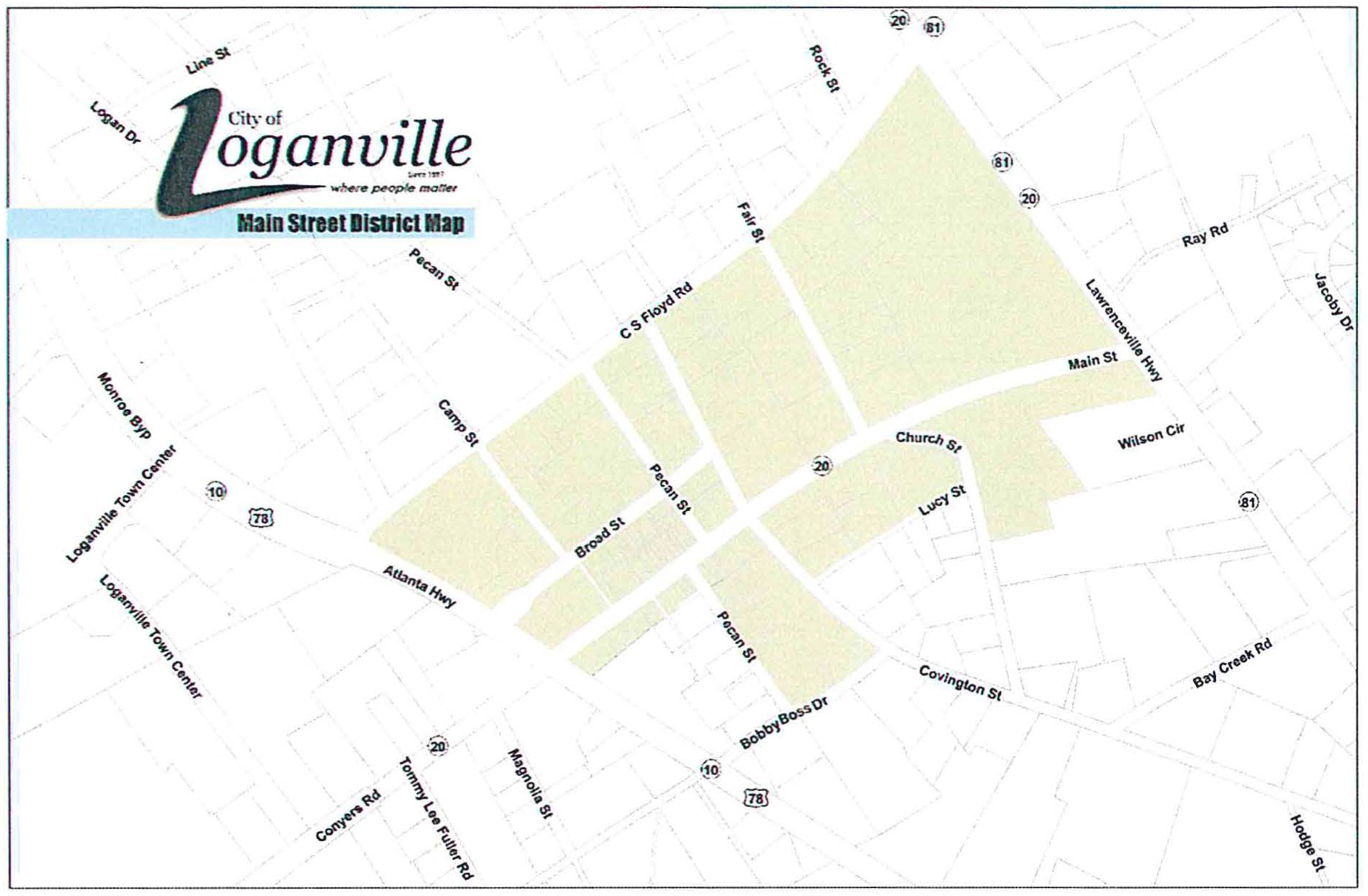
(c)
Unified control/ownership. All land included for the purpose of development within the Main Street overlay district shall be owned by or under the complete control of the applicant.
(d)
Detailed master plan required.
(1)
Development in this district requires approval by the mayor and council of a detailed master plan. All development shall be in substantial conformance to the approved master plan. Substantial deviations from or modifications to the approved master plan, as determined by the director of planning and development, shall require city council approval.
(2)
The detailed master plan shall contain, at a minimum, the following:
a.
Location of:
1.
Buildings and their principal uses;
2.
Public streets and private roadways;
3.
Parking areas;
4.
Open spaces, plazas, squares, courtyards, and other landscaped or green spaces;
5.
Pedestrian and/or bicycle pathways;
6.
Stormwater facilities.
b.
Design guidelines that address:
1.
Overall architectural character illustrated through typical building elevations;
2.
Public plazas, open spaces and buffer areas;
3.
Relationship to adjacent properties;
4.
Pedestrian pathways and sidewalks;
5.
Construction materials and color themes;
6.
Coordinated signage and graphics;
7.
Streetscapes, including street trees and furniture such as benches and light standards;
8.
Parking area landscaping.
(e)
Permitted uses. Main Street overlay developments shall contain at least three principal uses, including at least one residential type. The principal uses permitted in the district are:
(1)
Retail sales and services, including open-air markets;
(2)
Eating and drinking establishments;
(3)
Banks, financial and professional services;
(4)
Residential flats or lofts above the ground floor in a mixed-use buildings;
(6)
Business and professional offices;
(7)
Health clubs and spas;
(8)
Indoor recreation and entertainment;
(9)
Parking structures;
(10)
Craft shops, visual and performing artist studios and galleries, with accessory light manufacturing;
(11)
Hotel and bed and breakfast inns;
(12)
Religious facilities;
(13)
Theaters and performing arts uses;
(14)
Civic, cultural, open space and public uses;
(15)
Accessory uses customary to any permitted use.
(f)
Prohibited uses. The following uses are specifically prohibited in the district:
(1)
Automotive, boat, recreational vehicle, or equipment sales or rental;
(2)
Automotive body, radiator, muffler, or transmission repair shops;
(3)
Drive-through service windows;
(4)
Telecommunication towers;
(5)
Contractor's offices;
(6)
Indoor or outdoor storage or warehousing;
(7)
Garden supply centers and greenhouses;
(8)
Group or congregate personal care homes or day care centers;
(9)
Kennels;
(10)
Machine, welding or small engine repair shops;
(11)
Recovered materials processing or composting;
(12)
Residential or community shelter.
(g)
Site design standards.
(1)
Maximum floor area ratios (FAR).
a.
Nonresidential uses: 0.4.
b.
Residential uses: 0.2.
(2)
Height of buildings (not including cupolas, towers or other roofline projections).
a.
Minimum height, all buildings: Two stories or 25 feet, except that freestanding restaurants may be one story.
b.
Maximum height, nonresidential or mixed use: Six stories or 78 feet.
c.
Where adjacent to property zoned for single-family use, buildings shall be set back from the property line per zoning of property.
(3)
Minimum/maximum floor areas and building lengths.
a.
Residential.
1.
Flats or lofts: Minimum of 900 square feet with an average of 1,100 square feet. Residential units and nonresidential uses shall not occupy the same floor in a mixed-use building.
b.
Nonresidential.
(4)
Building placement and massing.
a.
Building location, design and orientation shall substantially conform to the approved master plan. Buildings fronting streets, principal drives or travel ways shall have no more than one row of parking in front of them.
b.
Site layout shall reinforce the street edge and create pedestrian-scaled open spaces. The overall design for vehicular circulation shall be a modified grid pattern with the use of alleys where appropriate.
c.
Buildings shall be placed perpendicular and parallel to streets, drives and travel ways.
d.
Building fronts and entries shall be articulated and oriented toward streets, drives or travel ways and arranged to created courtyards, plazas and other human-scale spaces. Where possible, buildings shall be arranged to provide views and access to open spaces.
(5)
Streetscape amenities.
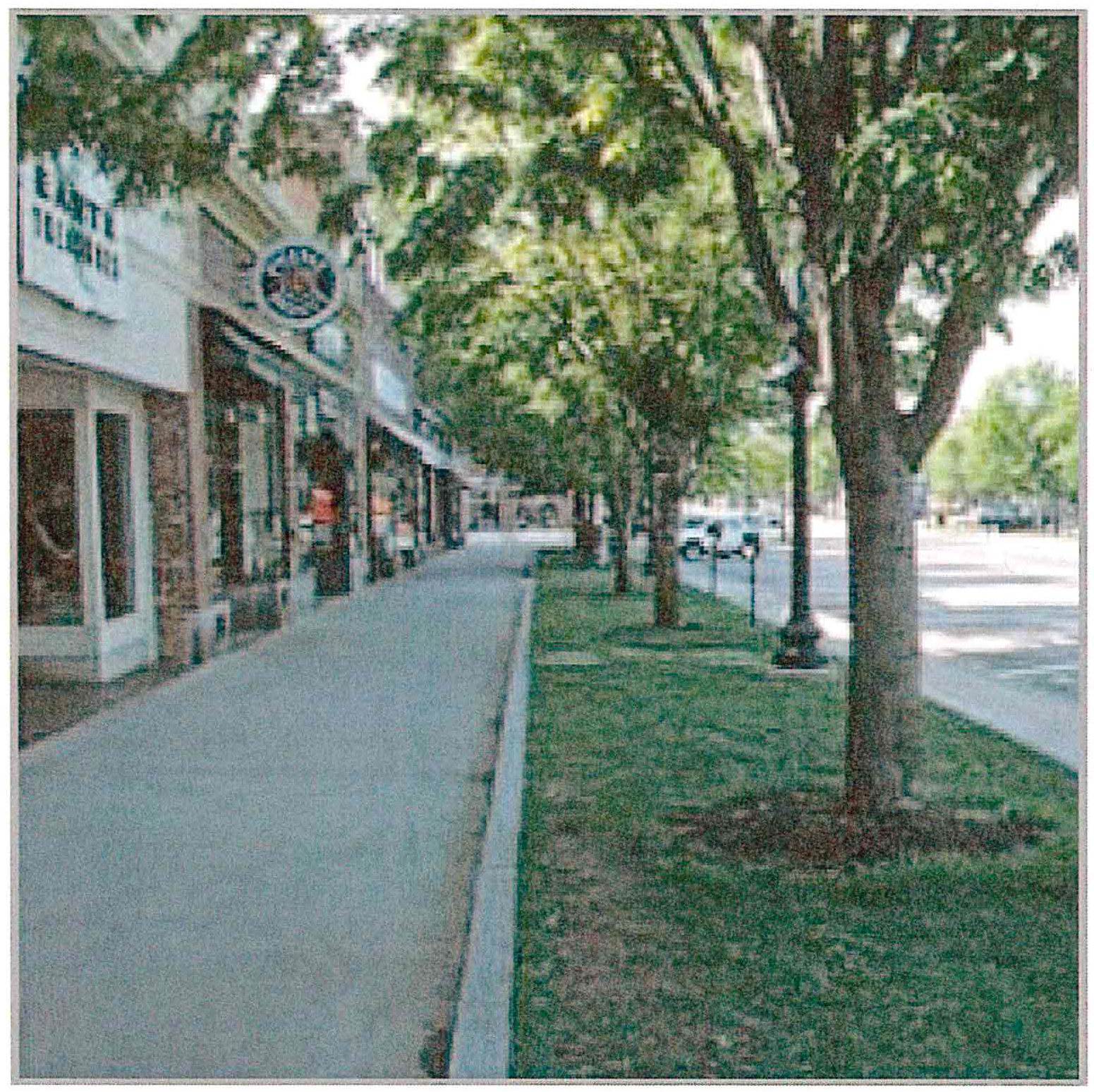
a.
Within the project boundaries, public streets, drives and travel ways shall have provided street landscaping and furnishings such as lamps, bicycle racks, seating and other furniture, litter containers, etc.
b.
Landscaping shall include trees of a shade-producing variety in a number equal to at least one tree per 35 feet of length of public streets, drives and travel ways. Trees may be clustered to create a more natural appearance.
(6)
Open space and landscaping.
a.
Where adjacent to single-family zoned property along the project exterior, a 30-foot buffer shall be provided. Otherwise, a landscape strip of at least ten feet in width is required.
b.
Buffers shall be natural and undisturbed except for supplemental planting where sparsely vegetated.
c.
Natural tree cover shall be preserved to the greatest extent possible.
d.
Landscape strips shall include trees of a shade-producing variety in a number equal to at least one tree per 35 feet of length along exterior boundaries. Trees may be clustered to create a more natural appearance.
(7)
Parking and loading.
a.
Parking shall be calculated for the development as a whole using on the ratios established in section 119-380 of the city zoning ordinance. On-site parking shall be provided at a minimum of 80 percent of the calculated total for nonresidential uses and 100 percent of the total for residential uses.
b.
Parking located in front of buildings facing public streets, principal drives or travel ways may be either parallel or front-in.
c.
Required parking for residential uses must be located within 150 feet of the use served.
d.
Landscaped islands are required at the end of each parking aisle.
e.
A maximum of 12 parking spaces are permitted in a row before relieved by a landscaped island.
f.
Landscaped islands shall extend the full length of the parking stall. Landscaped strips between aisles shall be a minimum of six feet in width.
g.
Every landscaped island shall have at least one tree of a shade-producing variety. The total number of trees within an individual lot shall be equal to at least one tree per ten spaces.
h.
Off-street loading and service areas shall not face and must be screened from public streets, principal drives, travel ways and public spaces by walls at least six feet in height or evergreen plan materials capable of reaching a height of six feet within 18 months of installation.
(h)
Architectural guidelines.
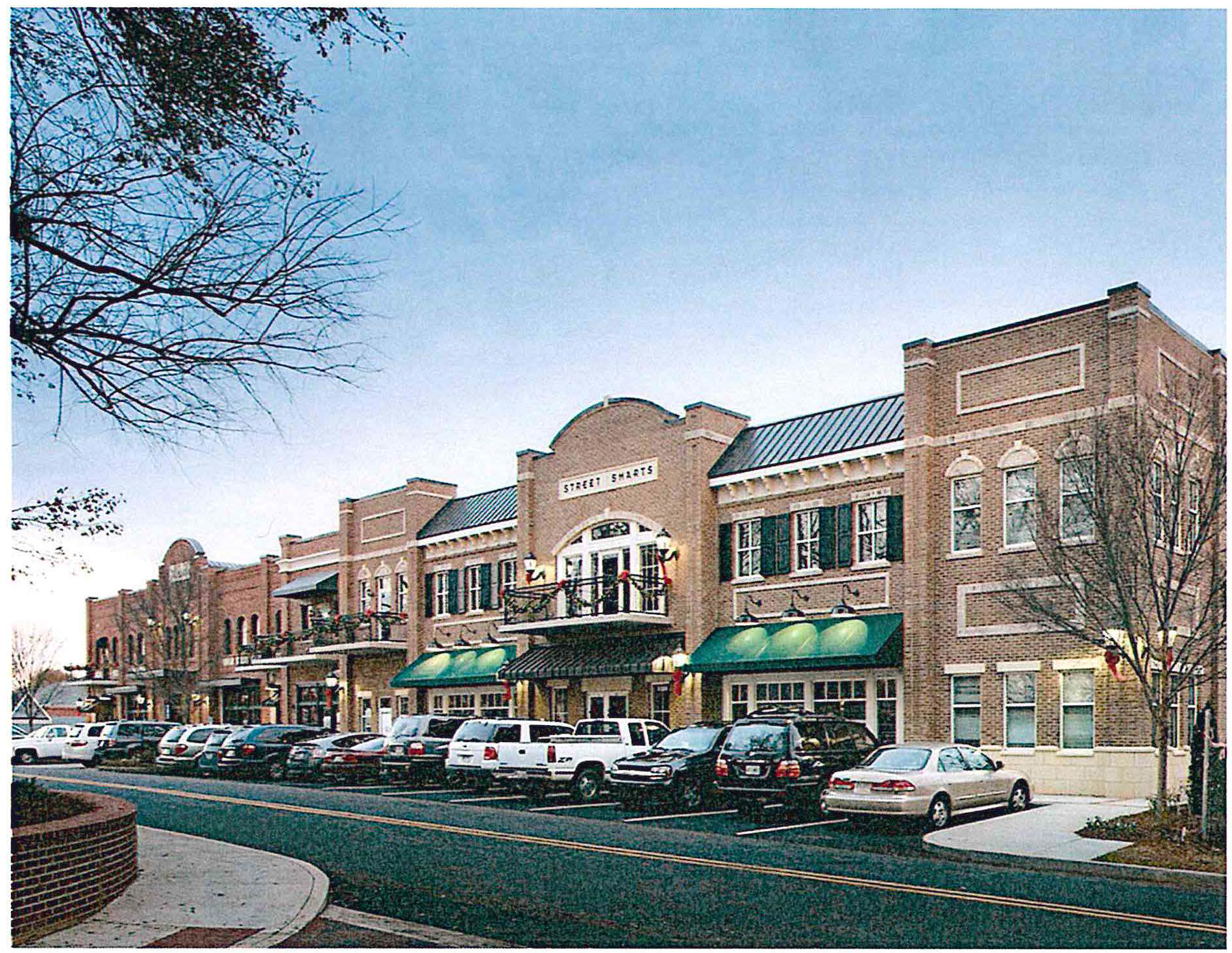
(1)
Exterior building materials.
a.
A minimum of 90 percent of the exterior (excluding windows) of all buildings shall consist of two or more of the following materials:
1.
Brick, natural stone or tile;
2.
Cultured or cast stone;
3.
Architecturally finished block;
4.
LEED-certified materials.
b.
Accent materials shall not include aluminum or vinyl siding, unfinished concrete block, reflective glass (unless to comply with LEED) or galvanized steel.
c.
A minimum of two different materials shall be used on each building.
d.
Individual buildings shall present a consistent appearance on all elevations.
(2)
Roof design and materials.
a.
Roofs may be pitched or flat.
b.
Pitched roofs of nonresidential or mixed-use buildings shall have a minimum pitch of 4:12 and pitched roofs of residential buildings shall have a minimum pitch of 6:12; except that that roofs covering porches are exempt from this requirement. Roofs with pitches between 4:12 and 6:12 shall have a projecting eave of not less than two feet measured horizontally from the vertical wall. Mansard roofs shall have a pitch of not less than 1:1.
c.
Flat roofs require parapet screening conforming to the vertical articulation requirements for the facade and cornice detailing.
d.
Materials for pitched roofs shall be of:
1.
Twenty-five-year dimensional asphalt or industry-approved synthetic shingle;
2.
Standing seam metal;
3.
Clay or concrete tile;
4.
Slate;
5.
LEED-certified materials.
e.
Rooftop equipment shall be screened from view at ground level on adjacent public streets, drives, travel ways or public spaces.
(3)
Design features for nonresidential and mixed-use buildings.
a.
All buildings shall incorporate a minimum of four of the following features. Buildings with a length of 200 feet or greater shall incorporate at minimum of six design features:
1.
Canopies, archways, covered walkways or porticos;
2.
Awnings;
3.
Arcades;
4.
Courtyards;
5.
Cupolas;
6.
Balconies;
7.
Tower elements;
8.
Recesses, projections, columns, pilasters projecting from the plane, offsets, or projecting ribs used to define architectural or structural bays;
9.
Varied roof heights;
10.
Articulated cornice line;
11.
Display windows, faux windows or decorative glass windows;
12.
Architectural details such as tile work, molding or accent materials integrated into the building facade;
13.
Integrated planters or wing walls that incorporate landscaping, seating areas or outdoor patios;
14.
Other similar features approved as part of the detailed master plan.
b.
All ground floor entrances shall be covered or inset.
c.
Buildings over 100 feet in length shall incorporate elements such as arcades, porticos, porches, alcoves or awnings for a minimum of 50 percent of the length of the building frontage along a street or travel way.
d.
Facades adjacent to or facing a street, travel way or public space shall include changes in relief through offsets, varied roof heights, columns, fenestration and materials, with at least one per distance equal to three times the building height.
e.
At least 40 percent but not more than 75 percent of each facade adjacent to and facing a street, travel way or public space shall contain windows or doorways. For mixed-use buildings, floors that contain only residential uses may have a minimum of 25 percent of the facade facing streets, travel ways and public spaces in windows and doorways.
f.
Ground floor retail, service and restaurant uses shall have large pane display windows above a lower wall section between 24 and 36 inches in height.
g.
Each residential unit in a mixed-use building shall have a balcony or bay.
h.
All sides of a building will display a similar level of quality and architectural detailing. The majority of a building's architectural features shall not be limited to a single facade.
(4)
Garages.
a.
Front-loading garages are prohibited.
b.
Side-loading garages shall provide windows or other architectural details that mimic the features of the living portion of the unit on the side of the garage in line with the front facade. Side-loading garage doors shall not exceed ten feet in width.
c.
Garage openings shall not occupy more than 45 percent of a unit's side facade.
d.
At least 20 feet of driveway shall be provided between garage openings and sidewalks.
(Ord. of 12-13-2018, § 1)

