


Louisa County Unincorporated
City Zoning Code
City Zoning Code
ARTICLE V
- SIGNS
Sec. 86-682.- Intent and purpose.
The purposes of these sign regulations are to encourage the effective use of signs as a means of communication in the county; to maintain and enhance the aesthetic environment and the county's ability to attract sources of economic development and growth; to minimize the possible adverse effect of signs on nearby public and private property; and to enable the fair and consistent enforcement of these sign restrictions. The sign ordinance is adopted under the general provisions of the zoning ordinance.
Signs are classified and regulated in this section by their purpose, physical type, location and characteristics and shall apply to all outdoor signs. Each sign is subject to this section and shall comply with all regulations applicable to that sign. Definitions may be found in sec. 86-13 of this chapter.
Where there is a discrepancy between the county and Virginia Department of Transportation sign regulations, the more stringent shall apply. Where the county sign regulations do not recognize a particular type of sign, Virginia Department of Transportation regulations shall apply. Approval shall be obtained from the Virginia Department of Transportation prior to submittal of a sign permit application to county.
Sec. 86-683. - General provisions.
(a)
Prohibited signs. The following types of signs are prohibited in all zoning districts:
(1)
Flashing signs; which include any illuminated sign on which the artificial light or lights are not constant in intensity and color at all times shall be prohibited. This prohibition shall not apply to signs solely giving public service information such as time, date, temperature, weather or similar information.
(2)
Any sign that obscures or interferes with a sign displayed by public authority for the purpose of giving traffic instructions or direction or other public information.
(3)
Any sign that uses the word "stop" or "danger" or otherwise presents or implies the need or requirement to stop or caution or the existence of danger, or which is a copy or imitation, or which for any reason is likely to be confused with any sign displayed by public authority.
(4)
Any sign that obstructs any window, door, fire escape, stairway, ladder, or opening intended to provide light, air, ingress or egress for any building, as required by law.
(5)
Any sign that violates any provision of any law of the state relative to outdoor advertising.
(6)
Political signs posted on county property.
(7)
Signs that violate state or federal laws, whether or not identified in this chapter as being permitted.
(8)
Signs determined by officials to create characteristics, including but not limited safety hazard. A sign whose to its construction, design, or location, are determined by a fire official, the building official, or a law enforcement officer, to create a safety hazard.
(b)
Exempt signs. The following types of signs, as defined in section 86-13, are exempt from the sign permit requirements in all zoning districts:
(1)
Advertising vehicle sign.
(2)
Agricultural product sign.
(3)
Auction sign.
(4)
Banner.
(5)
Commemorative plaque.
(6)
Commercial flag.
(7)
Construction sign.
(8)
Estate sign (residence sign).
(9)
Farm sign.
(10)
Flags (national or state).
(11)
Home occupation sign meeting the provisions in section 86-13.
(12)
Incidental sign.
(13)
Legal devices or warnings at railroad crossings.
(14)
Marquee (existing) message change.
(15)
Menu sign, when part of an approved restaurant, drive-in, not exceeding 30 square feet.
(16)
Noncommercial flag.
(17)
Political campaign signs and political non-campaign signs are permitted in the county in all zoning districts. Any such signs shall not unduly distract or obstruct the vision of motorists and pedestrians; shall not be structurally unsafe; and shall not, by their location, design or materials, create hazardous conditions for the public.
(18)
Private drive sign.
(19)
Public sign.
(20)
Special advertising sign.
(21)
Special decorative display.
(22)
Temporary directional sign.
(23)
Temporary sign.
(24)
Traffic and other signs erected and maintained by the Virginia Department of Transportation, the county or other governmental agencies, legal notices and all other similar signs required by law to be posted.
(25)
Real estate sign.
(26)
Residential sign.
(27)
Warning sign.
(28)
Window sign.
(c)
Illumination. No sign shall be located or illuminated in such a manner as to cause a traffic hazard. Where a permit is required, the permit shall not be issued until the location and illumination, if any, of the sign are approved by the zoning administrator.
(1)
Signs may be illuminated, either internally or externally, as permitted by this chapter, provided that the illumination is fully shielded and directed at the sign and not in a manner as to cause a traffic hazard.
(2)
All lighting must comply with dark sky lighting standards.
(3)
No light from any illuminated sign shall cause direct glare on any adjoining piece of property, right-of-way, or building other than the building to which the sign applies.
(d)
Projecting signs. No part of any sign projecting more than 12 inches from any wall or from any other support shall be less than ten feet above the level of the ground at that point. Signs projecting over vehicle travel lanes shall be not less than 14 feet above ground level.
(e)
Unsafe signs. Whenever a sign becomes structurally unsafe or endangers the safety of a structure or premises or the public, or is erected or maintained in violation of this article, the zoning administrator shall order such sign to be made safe or comply with this article, as the case may be, or be removed. Such order shall be sent by certified mail and shall be complied with within 12 days from the date of receipt of such order by the persons owning or responsible for the sign.
(f)
Setback. Signs shall be exempt from setback requirements in all zones; provided, however, that no sign shall be so located as to interfere with vehicular sight distances at intersections or to create a safety hazard.
(g)
Internally illuminated signs. Any internally illuminated sign must have U.L. label and the building inspector, upon issuance of an electrical building permit, must approve the electrical system. All lighting must comply with dark sky lighting standards.
(h)
Determining sign area.
(1)
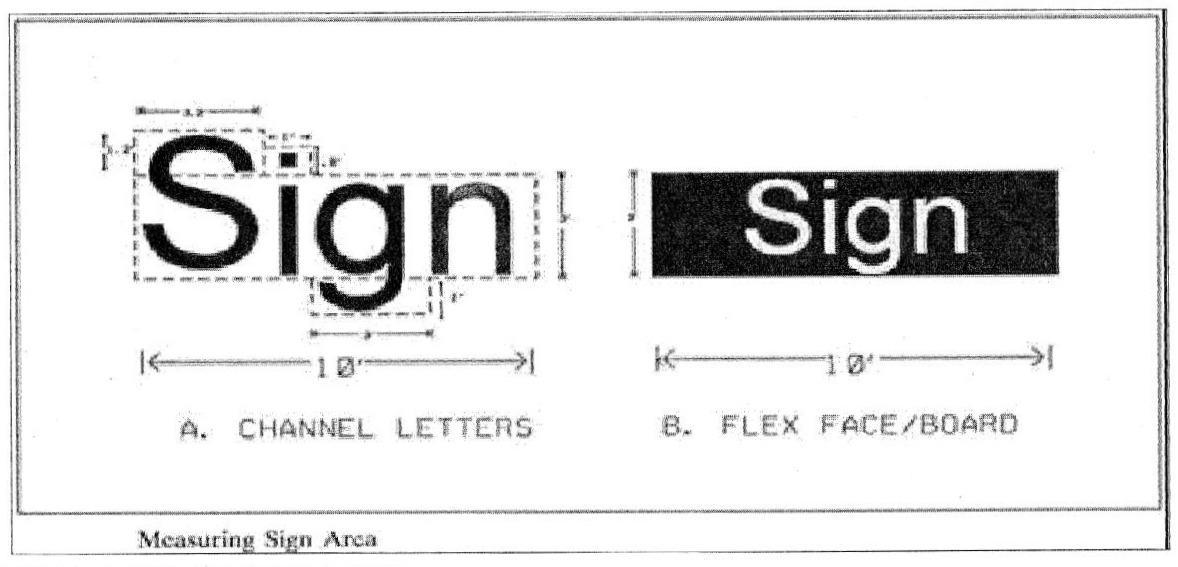
Measurement. The sign area shall be measured as the area of a sign face within the smallest area that encompasses the limits of the letters, figures, designs, devices, pictures, projected images, symbols, fixtures, logos, emblems or insignias, or any part of combination thereof, together with any materials or colors forming an integral part of the background of the sign face or used to differentiate the sign from the backdrop or structure against which it is placed. Two sided sign faces shall be counted as single sign face.
(2)
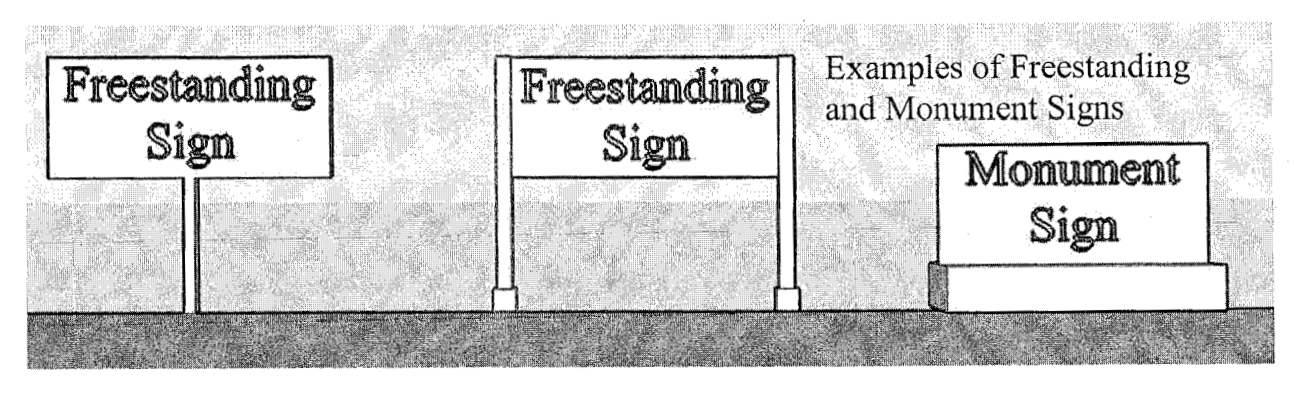
Area not included. The sign area shall not include any supporting framework, bracing or decorative fence or wall when such feature otherwise complies with the regulations and is clearly incidental to the sign itself. Sign supports, such as decorative pillars, walls, objects or ornamental design shall not be included in the maximum sign area; however, such supports may not exceed the maximum sign height for the type of sign being constructed.
(i)
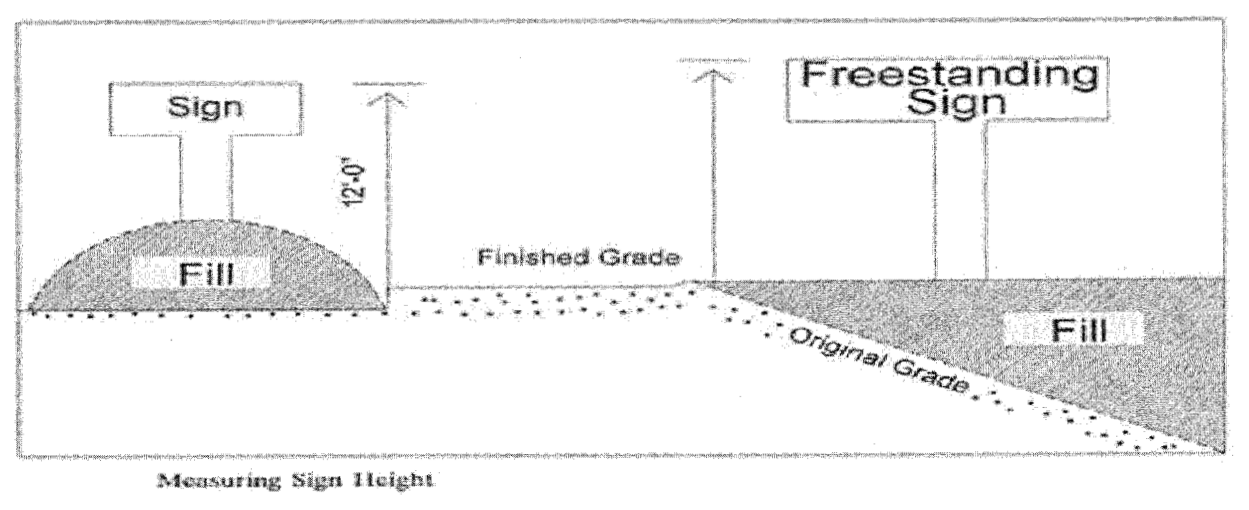
Determining sign height. The sign height shall be measured as the vertical distance from the normal grade directly below the sign to the highest point of the sign or sign structure, whichever is higher and shall include the sign base.
(j)
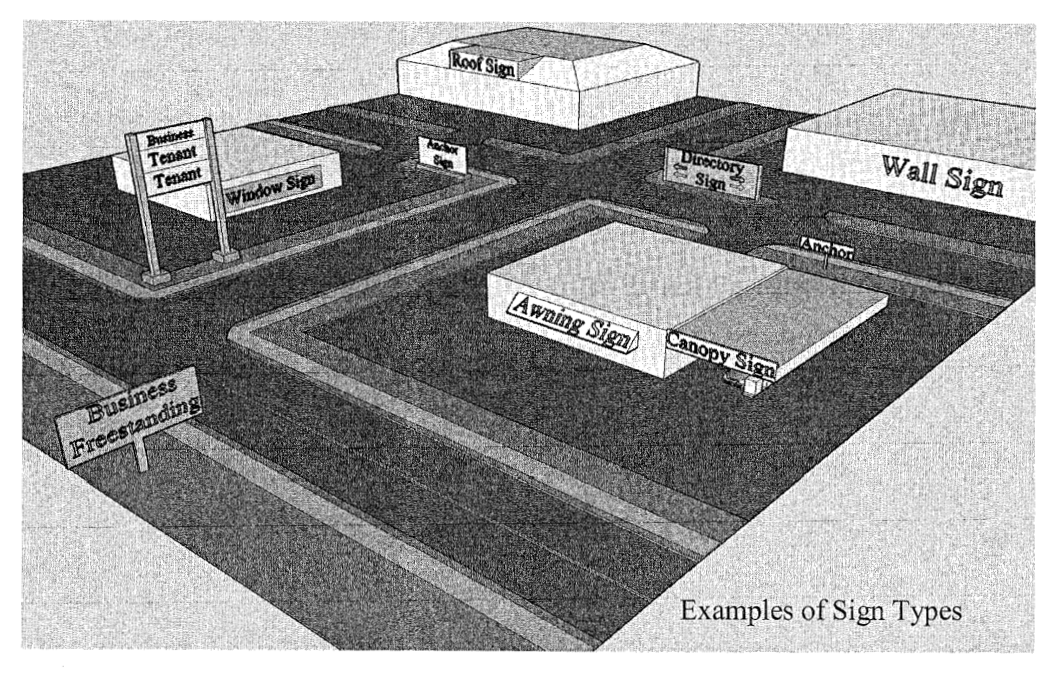
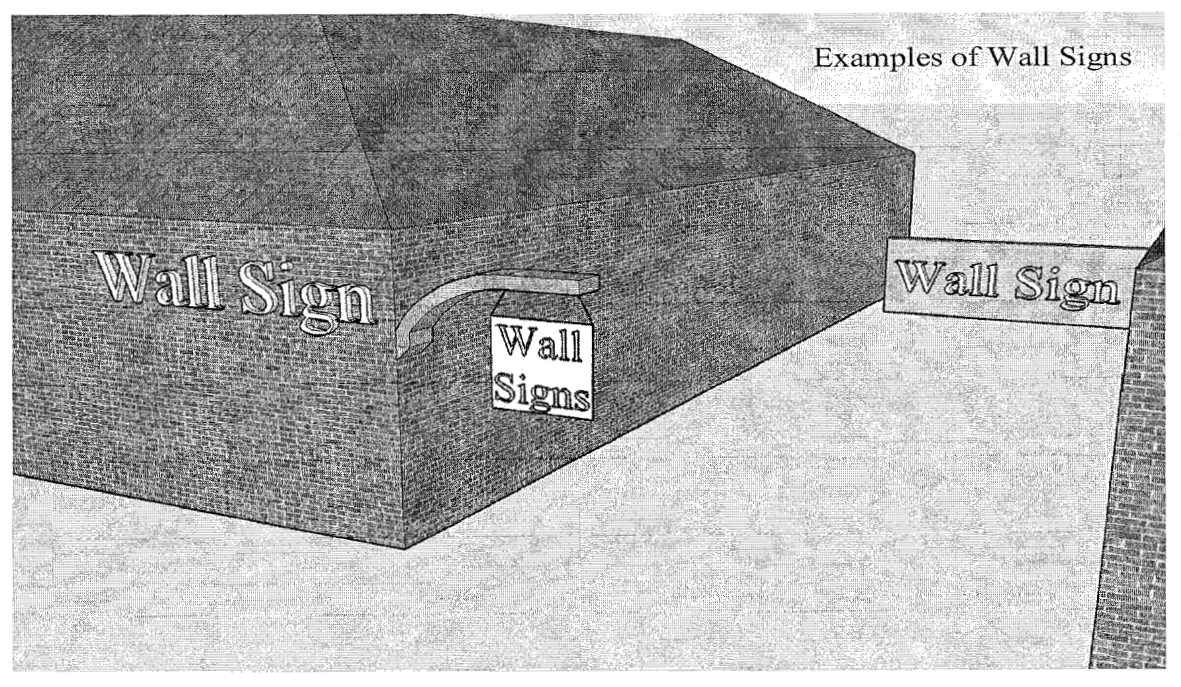
Sign types. Following is a diagram to be used as an example of some of the allowable sign types in this ordinance. In no way is this diagram intended to be all inclusive and final determination of proposed sign classification shall be made by the county zoning administrator or designee.
(k)
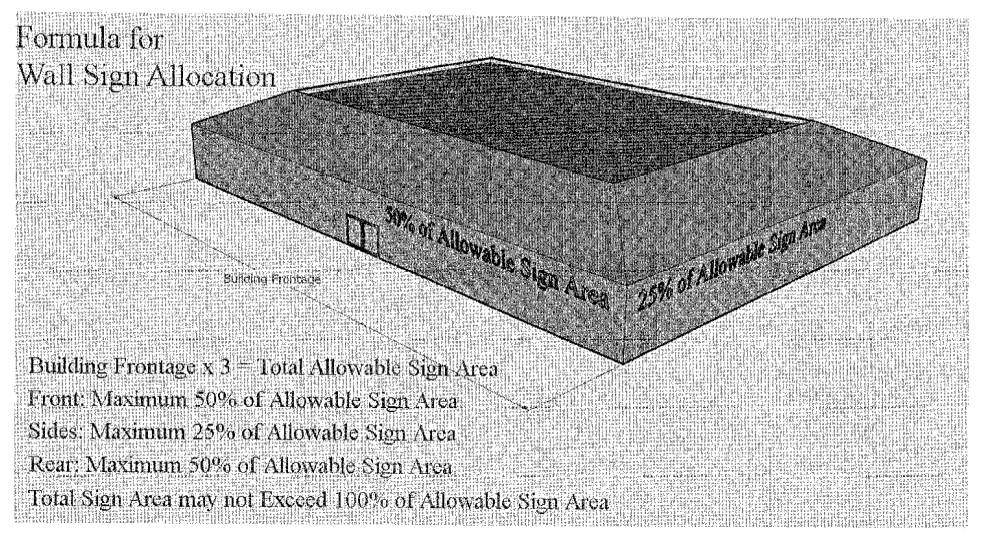
Determining structure frontage. The structure frontage shall be measured to calculate the permitted wall signage as provided herein.
(1)
Measurement. The structure frontage is the horizontal length of the outside structure wall of the establishment, in one plane, adjacent to a street. If the structure fronts on two or more streets, the horizontal length of the structure shall be along the main building frontage. If part of a multi-tenant structure (strip mall), the sign area is measured by the leased length of the outside structure wall.
(l)
Signs, electronic message. Allowed in all commercial, industrial, resort development, and planned unit development districts. In reviewing the application, the zoning administrator or designee, who may choose to send such application to the board of supervisors for review as a special exception (section 86-68), if staff determines that the proposed sign requires additional review and consideration. The zoning administrator may consider the following factors as well as other appropriate land use considerations; and may request the applicant submit additional information responsive to these items:
(1)
Proportion of the sign face to be used for the electronic message.
(2)
Use of colors in the electronic message.
(3)
Relationship to nearby residences.
(4)
Distance to other electronic message boards.
(5)
Speed limit of roadway and road classification.
(6)
General character of area.
(7)
Landscaping incorporated into sign package.
The following standards are required:
(1)
General requirements.
a.
Electronic message signs may not exceed 32 square feet in overall size and the electronic display may not be more than 50 percent of this area, and eight feet in height from normal ground level.
b.
Building and electrical permits and inspections are required.
c.
Sign cannot be located in a manner which could cause confusion with or from traffic signals.
d.
Messages must be static for 20 seconds or longer; with no animation, videos, flashing, or scrolling text.
e.
Only one electronic message sign is allowed per parcel.
(2)
Display.
a.
Messages cannot change less than once every 20 seconds.
b.
Transitions between messages can only be a black screen or an immediate transition; no flashing, fading, or scrolling text is permitted.
c.
In the event of a malfunction, the display must be changed to a dark screen.
d.
If the sign is two-sided, both sides must display the same message.
(3)
Brightness controls.
a.
All electronic message signs shall be equipped with a photocell, sensor or other device that automatically dims the sign based on ambient light and limits the brightness to a maximum of 100 NITS between sunset and sunrise, as set by the National Oceanic and Atmospheric Administration (NOAA), or that can be adjusted to comply with the maximum NIT level.
b.
Lighting cannot shine directly toward any dwelling.
c.
Prior to sign permit approval, the applicant must provide certification showing compliance with brightness controls, herein noted.
(Ord. of 6-16-2025(2025-9))
Sec. 86-684. - Signs permitted in the agricultural (A-1 and A-2) districts.
The following signs shall be permitted in the agricultural districts (A-1 and A-2):
Sec. 86-685. - Signs Permitted in the Residential (R-1 and R-2) Districts.
The following signs shall be permitted in the residential limited (R-1) and residential general (R-2) districts:
Sec. 86-686. - Signs permitted in the manufactured home parks and manufactured home park district (MHP).
The following signs shall be permitted in mobile home parks and the mobile home park district (MHP):
Sec. 86-687. - Signs permitted in commercial (C-1) and (C-2), industrial (IND, I-1 and I-2), resort development (RD) and planned unit development (PUD) districts.
The following signs shall be permitted in commercial (C-1 and C-2), industrial (IND, I-1 and I-2), resort development (RD), and planned unit development (PUD) districts:
(Ord. of 1-7-2025(2025-1))
Sec. 86-688. - Administration.
(a)
Permit requirements. Except as otherwise provided herein, no sign shall be erected, altered, refaced or relocated unless a sign permit has been approved by the zoning administrator.
(1)
Application. The application for a sign permit shall be filed with the zoning administrator on forms furnished by the county. The application shall contain the identification and address of the property on which the sign is to be erected; the name and address of the sign owner and of the sign erector; drawings showing the design, dimensions and location on the building/site of the sign. The zoning administrator may require other pertinent information to ensure compliance with the provisions of this ordinance and other applicable ordinances of the county.
(2)
Permit expiration. A sign permit shall expire and become null and void if the sign is not erected within a period of 12 months from the date of the permit.
(3)
Issuance. Sign permits shall be issued by the zoning administrator or designee.
(4)
Fee. A fee, as established by the county board of supervisors shall be paid prior to the issuance of a sign permit. Under no circumstances are permit fees refundable.
(5)
Permit number. Any sign erected under a permit issued by the county shall indicate in the lower right hand corner of the sign the number of the permit. The permit number shall be so affixed that it is legible from the ground.
(b)
Maintenance and removal.
(1)
All signs shall be constructed in compliance with the Virginia Uniform Statewide Building Code.
(2)
All signs and components thereof shall be maintained in good repair and in a safe, neat and clean condition.
(3)
The zoning administrator may cause to have remove or repaired immediately without written notice any sign which, in the zoning administrator's opinion, has become insecure, in danger of falling, or otherwise unsafe, and, as such, presents an immediate threat to the safety of the public. If such action is necessary to render a sign safe, the cost of such emergency removal or repair shall be at the expense of the owner or lessee thereof.
(4)
Any sign which is obsolete, because of discontinuance of the subject activity or any other reason which would cause the sign to be obsolete, shall be removed within 30 days.
(5)
Any sign located on property, which becomes vacant and is unoccupied for a period of two years or more shall be deemed abandoned. An abandoned sign shall be removed by the owner or lessee of the property. If the owner or lessee fails to remove the sign, the zoning administrator shall give the owner 15 days' written notice to remove it. Upon failure to comply with this notice, the zoning administrator may initiate such action as may be necessary to gain compliance with this provision.
(c)
Nonconforming signs.
(1)
No nonconforming sign shall be enlarged nor be worded so as to advertise or identify any use other than that in effect at the time it became a nonconforming sign.
(2)
Signs lawfully conform to the provisions of this article, and signs which are accessory to a nonconforming use shall be deemed to be nonconforming signs and may remain except as qualified below. Such signs shall not be enlarged, extended or structurally reconstructed or altered in any manner, except a sign face may be changed so long as the new face is equal to or reduced in height and/or sign area. The burden of establishing nonconforming status of signs and of the physical characteristics/location of such signs shall be that of the owner of the property. Upon notice from the zoning administrator, a property owner shall submit verification that sign(s) lawfully existed at time of erection. Failure to provide such verification shall be cause for order to remove sign(s) or bring sign(s) into conformance with the current ordinance existing on the effective date of this article or prior ordinances, which do not
(3)
Nothing in this section shall be deemed to prevent keeping in good repair a nonconforming sign; provided, however, that no nonconforming sign which has been declared by the zoning administrator to be unsafe because of its physical condition, as provided for in this ordinance, shall be repaired, rebuilt or restored unless such repair or restoration will result in a sign which conforms to all applicable regulations.
(4)
No nonconforming sign shall be moved for any distance on the same lot or to any other lot unless such change in location will make the sign conform to the provisions of this article.
(5)
If a nonconforming sign is removed, the subsequent erection of a sign shall be in accordance with the provisions of this article.
(6)
A nonconforming sign that is destroyed or damaged by any casualty to an extent not exceeding 50 percent of its replacement value may be restored within two years after such destruction or damage but shall not be enlarged in any manner. If such sign is so destroyed or damaged to an extent exceeding 50 percent, it shall not be reconstructed except for a sign, which would be in accordance with the provisions of this article.
(7)
A nonconforming sign, which is changed to or replaced, by a conforming sign shall no longer be deemed nonconforming, and thereafter such sign shall be in accordance with the provisions of this article.
(8)
A nonconforming sign shall be removed if the structure to which it is accessory is demolished or destroyed to an extent exceeding 50 percent of its appraised value.
(9)
The ownership of the sign or the property on which the sign is located shall not, in and of itself, affect the status of a non-conforming sign.
Sec. 86-689. - Waivers.
Notwithstanding the other regulations of this chapter, a waiver may be approved by staff (per section 86-119 of this chapter) to the regulations of this article that are specific to the number of allowed signs, the maximum sign area, and the sign height. In no circumstances shall a waiver increase the number, size, or height of a sign(s) by more than 100 percent of the ordinance standard. A waiver may only be granted if it can be demonstrated that the proposed standards, with conditions, better ensure that the intent of this article, as specified in section 86-682, will be met. Requests for a waiver to this article shall accompany a master plan of the entire development showing all proposed business signs. Standards for electronic message signs are not subject to increase through the waiver process. All requests for a variation to the standards for an electronic message sign would require a special exception in accordance with section 86-68, [and] be granted by the board of supervisors.
(Ord. of 6-16-2025(2025-9))