
Lynden City Zoning Code
CHAPTER 19
22 - RESIDENTIAL DESIGN STANDARDS6
Editor's note— Ord. No. 25-1708, § 1, adopted June 2, 2025, amended Ch. 19.22 in its entirety to read as herein set out. Former Ch. 19.22, §§ 19.22.010—19.22.050, pertained to similar subject matter, and derived from Ord. No. 1657, adopted Dec. 19, 2022; Prod. No. 23-1674, adopted Nov. 6, 2023.
19.22.010 - Establishment, relief, and purpose.
A.
Establishment and Relief. There is established therein residential design standards and regulation by which residential structures may be permitted and maintained.
1.
Relief from the required standards must be sought through the variance process.
2.
Variance requests which relate specifically to site design development standards described in Section 19.22.020, building setbacks, or building height shall be submitted to the hearing examiner consistent with Chapter 19.47 LMC.
3.
Waiver requests which relate specifically to the residential design criteria described in Section 19.22.030 through 19.22.050 and do not relate to building setbacks or building height shall be submitted to the Community Development Department on designated forms with supporting information that illustrates and addresses the criteria for approval outlined in LMC 19.22.060.
B.
Purpose.
1.
The essential purpose of the residential design standards to ensure that new developments meet and maintain a number of objectives that strive to promote orderly community growth and protect and enhance property values for the community as a whole.
a.
To soften and enhance the built environment using yards and green space, to incorporate inviting pedestrian scale elements into all residential construction, and to provide adequate parking areas.
b.
To create high-quality communities that have variation of architectural style and durable materials.
c.
To reduce the visual impact of the garage and accessory structures and emphasize the pedestrian environment.
d.
To enhance the aesthetics of communities through the installation of landscape and the screening of undesirable elements. Also, to enhance safety and function of residential properties through appropriate exterior lighting, addressing, and fencing.
2.
Residential design standards also seek to encourage low impact design (LID) techniques such as rain gardens, xeriscape, or pervious pavement to minimize adverse impacts on the natural environment.
(Ord. No. 25-1708, § 1, 6-2-2025)
19.22.015 - Administrative design review, authority and decision.
A.
Administrative design review will be conducted for all commercial or multi-family projects, waiver requests or remodels such as minor exterior updates, commercial additions, or accessory structures.
B.
Authority and Decision. The community development director or designee shall review each application for commercial and multi-family construction with the Lynden Municipal Code and Design Guidelines related to site layout, architecture, lighting, screening, and landscape and may grant, deny, or conditionally approve a building permit based on compliance with such guidelines.
C.
Conditional approval for exterior design, shall be noted by the building official.
D.
When granting the building permit, community development staff and the building official shall enforce the final conclusions of the administrative decision. In addition, all designs shall be subject to the International Building Code as well as all Lynden Municipal Codes.
E.
Approval shall not recommend conditions which are contrary to the requirements of any applicable development standards or building codes.
(Ord. No. 25-1708, § 1, 6-2-2025)
19.22.020 - Residential site design—Setbacks, yards, building orientation, and pedestrian connections.
Objective—To soften and enhance the built environment using yards and green space, to incorporate inviting pedestrian scale elements into all residential construction, and to provide adequate parking areas.
A.
Lot Coverage.
1.
Lot coverage is limited by zoning category.
2.
Lot coverage may be increased by one percent for each ten percent of the required off-street parking that is located beneath portions of the multiple-family dwelling units which are intended to be occupied by residents or used as hallways or meeting rooms.
B.
Building Orientation.
1.
On corner lots, the primary pedestrian entrance to the building shall be from the designated front yard. However, the primary pedestrian entrance and address may be oriented to the designated side yard if both side yard setbacks are fifteen feet from property line to living area.
2.
The side yard used for a driveway shall not be less than ten feet in width.
3.
All dwellings shall be oriented on the lot, so that the primary pedestrian entrance is obvious from the street or access easement which serves as its primary point of access.
C.
Setbacks. Minimum setbacks are outlined in each zoning category.
1.
All setbacks are measured from the property line to the foundation.
2.
Eaves and cantilevered architectural features such as bay windows may encroach into the setback a maximum of two feet.
3.
Structural permits with setbacks submitted prior to April 1, 2019 are considered conforming and not subject to LMC 19.35.030.
4.
Additional fire protection may be required for structures located within ten feet of each other.
5.
It is the property owner's responsibility to have the property lines clearly marked for inspection.
6.
On corner lots in the RS-72 zone, one of the corners may be considered as a side yard, provided that the yard considered as a side yard shall not be less than ten feet.
7.
On corner lots in all other residential zones, the side yard setback adjacent to the street must be a minimum of fifteen feet.
D.
Garage Setbacks from Property Lines.
1.
On any lot, the minimum distance between the garage door and the property line or access easement parallel to the garage door must be twenty-five feet.
2.
In all residential zones an attached garage may be built as close as the minimum zoning allowance to the side property line provided the living area setbacks total the requirement for that zoning category.
E.
Pedestrian Connection.
1.
Sidewalk connections must be provided in all residential zones.
2.
In all RM zones, primary sidewalks must be a minimum of five feet clear width without encroachment of vehicle overhang.
3.
In RM zones sites must include pedestrian walkways which provide connection to common green spaces and public sidewalks. Cross walks provided as needed in parking areas and along streets.
(Ord. No. 25-1708, § 1, 6-2-2025)
19.22.030 - Residential architecture and attached garages.
Objective—To create high-quality communities that have variation of architectural style and durable materials. To reduce the visual impact of the garage and accessory structures and emphasize the pedestrian environment.
A.
Residential Structure.
1.
All dwellings must be placed on a permanent foundation and the space between the foundation and the bottom of the home must be enclosed by concrete or approved concrete products.
2.
Eaves and gable ends must be a minimum of twelve inches. This is not applicable to re-roofing or additions to existing structures.
B.
Building Height.
1.
Building height is regulated by zoning category.
2.
On lots greater than ten thousand square feet in size, the height of a residential structure may be increased one foot for every two feet in increased setback distance beyond the minimum setback on both side yards and the front yard, to a maximum height increase of five feet, or total height of thirty-seven feet.
C.
Roofs.
1.
Roofing materials shall be wood shingle or shake, composition, asphalt laminate, clay or architectural metal.
2.
Exposed fastener corrugated metal or corrugated fiberglass roofing is not permitted.
3.
Using a membrane roof or built up roofing (BUR) for the primary roofing material is not permitted.
4.
The primary roof line must have a minimum of a 4:12 pitch. This is not applicable to re-roofing or additions to existing structures.
D.
Building Elevations and Finishes.
1.
Residential Elevations.
a.
The same architectural elevation shall be separated by a minimum of two other homes and may not be located directly across the street from each other.
b.
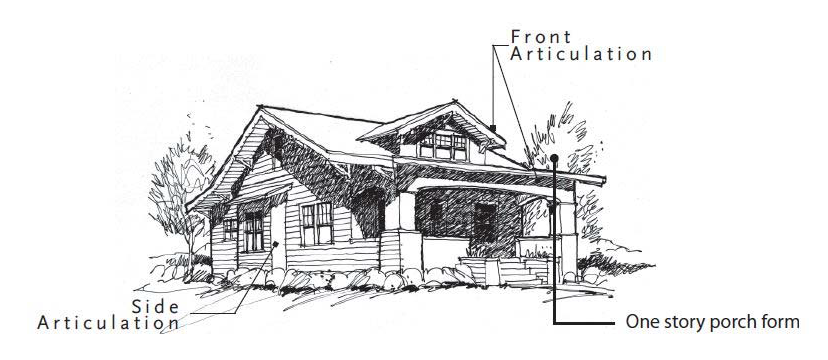
An articulation is an architectural element such as a one-story porch or bay window. One such element shall be used on all sides of the building that face toward a public street, shared access easement, or common green. The articulation shall be offset a minimum of twelve inches. A garage setback shall not count as an articulation.
2.
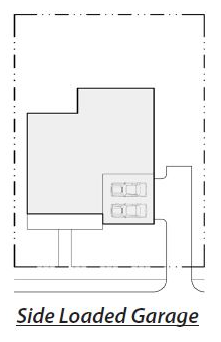
Garage Elevations. To promote an attractive, pedestrian-friendly streetscape, attached garages accessed from the front elevation of the building, with garage doors oriented toward the street or a shared parking lot of a multi-family complex are subject to the following standards:
a.
At the ground level, the garage façade shall not extend forward of the living space by more than twelve feet. Porches are not considered living space.
b.
The lineal frontage of the building elevation which can be occupied by garage doors is limited.
1.
In RS zones, no more than fifty percent of the building elevation can be garage doors.
2.
In RMD and RM zones, no more than sixty (percent of the total first floor building elevation length can be garage doors.
c.
Attached garages or attached carports which provide a third covered or enclosed space (all adjacent to one another) must be offset a minimum of two feet from the first two covered or enclosed spaces.
3.
Exterior Finishes.
a.
The exterior of the home must be finished with a minimum of two types of materials or variation in reveals.
b.
Exposed fastener metal siding is prohibited on residential buildings.
c.
Exposed ends of stone and masonry façades are not permitted and must be finished with trim or end caps.
d.
All garage sides that are visible from streets or shared access easements shall provide architectural details and trim consistent with the design of the home.
E.
Porches, Stoops, Decks, and Patios.
1.
General Provisions for Porches, Stoops, Decks, and Patios.
a.
All decks, porches, and patios much be included in calculations of maximum impervious lot coverage, as established in LMC 19.11.020.
b.
All decks, patios, porches, or similar must be designed so as not to drain to surrounding properties.
c.
No element of the deck or patio including footings may encroach into a neighboring property or an existing easement.
2.
Front Entries and Front Yards.
a.
Primary pedestrian entrances must include cover from the elements. Eave overhang alone does not constitute cover.
b.
Steps used to access front porches or stoops must be complimentary to the primary structure through the use of coordination materials or architectural elements.
c.
Stairs with open risers are not permitted on front porches or stoops.
d.
Front yard porches, decks and patios.
i.
Uncovered porches, decks, and patios may encroach into a front yard but must maintain a minimum setback of ten feet and shall not exceed eighteen inches above the natural grade.
ii.
Porches, decks, and patios that are covered or those that are uncovered but exceed eighteen inches above the natural grade must meet the front setback assigned to the primary structure.
3.
Uncovered Decks and Patios in Rear and Side Yards.
a.
Uncovered wood decks and patios are permitted within side and rear setbacks. Uncovered decks and patios not over twenty-four inches in height are permitted within six feet of the rear and side property lines.
b.
Patios and decks more than twenty-four inches above the natural grade must maintain a rear setback of eighteen feet and side setback of six feet.
4.
Covered decks and patios are subject to general provisions as well as the following standards described here. Covered decks and patios which are detached from a primary residence by six or more feet are regulated as accessory structures per LMC 19.22.040.
a.
Setbacks.
i.
Covered decks and patios may encroach into a rear yard but a minimum rear setback of eighteen feet must be maintained. This setback is measured from the property line to the farthest extent of the roof structure.
ii.
Roof structures may encroach into side yard setback as much as two feet.
b.
Enclosure. Covered decks and patios attached to a residence may be screened, secured, or enclosed to extend the usefulness of these outdoor spaces however, enclosures, whether conditioned or unconditioned, are not intended to become extensions of indoor living space unless the enclosure meets all setbacks applicable to the primary residence. Screening and enclosure of covered decks and patios encroaching into a rear yard setback is subject to the following regulations:
i.
Ventilation. Exterior edges of a covered deck or patio must include air gaps or screened openings that remain vented to the outdoors at all times. Walls, windows, and doors which can be made to seal the space are not permitted on any exterior edge. Vented openings must be present at the top and bottom of rigid enclosure walls. At a minimum, venting must include a gap equal to three and one half inches at floor level, horizontally running the full perimeter of the patio's exterior between vertical supports. Additionally, an area equivalent to this floor level ventilation must be provided at the top of rigid enclosure walls. Venting an enclosed attic (such as when a ceiling is present on a patio) will not be counted toward the ventilation required for the enclosed patio/deck space.
ii.
The portion of patio or deck enclosed with rigid and opaque screening materials may not occupy more than sixty percent of the total linear length of the rear façade.
iii.
Materials used to enclose or screen patios and decks that encroach into a rear yard may vary but the design must maintain the intent to provide ventilated outdoor, rather than indoor, living space. Examples of methods and materials include flexible and retractable opaque or transparent patio screens or sunshades; framed insect screening; railings, louvered or rigid windscreens, or privacy panels which are mounted with brackets to the floor, ceiling, or vertical supports; tinted or transparent glass or plexiglass may be used except that highly reflective or mirrored glazing is not permitted.
(Ord. No. 25-1708, § 1, 6-2-2025)
19.22.040 - Detached garages and accessory structures.
Objective—To reduce the visual impact of the garage and accessory structures and emphasize the pedestrian environment.
To be considered a "detached" structure, the minimum distance between two structures shall be six feet measured from foundation to foundation with no projections greater than twenty-four inches. Additional fire protection may be required for structures located within ten feet of each other.
A.
General Requirements.
1.
All accessory structures, whether defined in this title or not, shall conform to the requirements of the International Building Code. (Currently appears in MH bulk standards)
2.
Architectural style of a detached garage, shop, or shed must match the style of the primary structure. However, agriculturally themed structures such the roofline of a traditional barn may be permitted. Also, this standard is not applicable to greenhouses or open-sided structures intended only to cover recreational vehicles.
3.
All accessory structures, including carports, must utilize roofing material which is compatible with the primary structure.
4.
Any structure intended to be established and remain for more than seventy-two hours and, as outlined in LMC 15.04.010, exceeds one hundred twenty square feet in area must obtain a building permit.
B.
Accessory Structure Setbacks.
1.
Detached garages may be located a maximum of twelve feet forward of the first floor living space of the home but are subject to front setback required by the underlying zone. Storage sheds or other accessory structures not used as a garage are not permitted forward of the front façade of the home.
2.
A detached accessory structure or garden shed located in a rear may not be built closer than six feet to the side or rear property line including property lines abutting alleys with a maximum eave of twenty-four inches. Structures less than one hundred and twenty square feet must be setback a minimum of three feet from the side and rear property line.
3.
Accessory structures on corner lots which do not house an accessory dwelling unit (ADU) shall not be permitted nearer than fifteen feet to the side property line adjacent to the street. Refer to LMC 19.20 for ADU setbacks.
4.
Garages accessed from alleys with garage doors facing the alley must be setback a minimum of twenty-one feet in all RM zones and setback twenty-five feet in all RS zones.
C.
Accessory Structure Height.
1.
The maximum height for all accessory structures shall be twelve feet, except for detached garages and shops as noted below. Refer to LMC 19.20 for the height limitations of detached ADUs.
2.
The maximum height of any detached garage that is serving as the primary garage, a secondary garage, or shop with an overhead door shall be eighteen feet, provided however that:
a.
The setback shall be a minimum of six feet from the side and rear property line;
b.
Structures serving as secondary garages or shops are set behind the rear line of the house;
c.
The roof pitch and siding shall be consistent with the primary structure on the lot;
d.
There is no living space within the building except as permitted with a legal accessory dwelling unit (ADU) and larger setbacks as outlined in Chapter 19.20; and
e.
The height of the building does not exceed the height of the primary structure.
D.
Accessory Structure Area.
1.
In MH zones, no detached garage shall exceed one thousand square feet of inside floor area or exceed square footage of the primary structure.
2.
In RMD and RS zones, and on detached single-family residential lots within the RM-PC zone no detached garage or accessory building footprint shall exceed one thousand square feet or ten percent of the lot area, whichever is greater; provided however, that the floor area of the accessory building does not exceed the floor area of the primary residence or three thousand square feet, whichever is more restrictive
3.
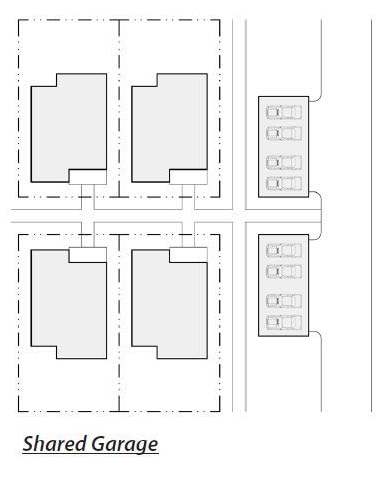
Shared attached garages and carports are permitted in RM and RM-PC zones. Shared garages shall have a maximum of four parking stalls and not exceed forty-four feet in width. (see graphic)
4.
Detached carports are permitted to accommodate no more than four vehicles and are limited to a maximum of forty-four feet in width.
(Ord. No. 25-1708, § 1, 6-2-2025)
19.22.050 - Landscape, fences, screening, and lighting.
Objective—To enhance the aesthetics of communities through the installation of landscape and the screening of undesirable elements. Also, to enhance safety and function of residential properties through appropriate exterior lighting, addressing, and fencing.
A.
Landscape, Fences and Screening.
1.
Landscape. Refer to Chapter 19.61 for full description of Residential Landscape Requirements.
2.
Fences.
a.
Fences shall not be built closer than three feet to the property owner's side of the sidewalk for front yards and for street side yards on corner lots. If there is no curb and/or sidewalk, the fence shall be set back a minimum of three feet from the front property line and the street side property line on corner lots. When solid privacy fencing is installed, landscape material, such as groundcover, shrubs, or hedge material must be planted and maintained within this three-foot setback.
b.
Refer to Chapter 19.63 for full description of Residential Fence Standards.
3.
Screening.
a.
In RMD and RS zones, and on detached single-family residential lots within the RM-PC zone trash and recycling containers shall be screened and stored within side or rear yards or within enclosed garages.
b.
In RM-1 through RM-4 zones, trash and recycling containers shall be stored within side or rear yards, or within enclosed garages, or in screened enclosures as approved during the design review or building permit review process.
c.
Except for public utilities, mechanical equipment shall not be located in front yards.
d.
All mechanical equipment, including roof mounted, must be screened so as not to be visible from the street, shared access easement, or common green spaces. Screening can be accomplished by fencing, architectural screening, or evergreen landscape material. Equipment to be screened includes, but is not limited to, heating and air conditioning units, venting associated with commercial grade cooking facilities, and any mechanical equipment associated with pools or hot tubs.
e.
In RS zones and on detached single-family residential lots within the RM-PC zone, the base of exterior mechanical equipment must not exceed a height of more than eighteen inches above the finished exterior grade.
f.
Recreational vehicles may only be stored on RS zoned properties consistent with LMC 19.15.030.
B.
Street Trees.
1.
Street trees are required at the time of plat as outlined in Chapter 18. Additionally, the installation or replacement of street trees may be required to this standard when building permits are sought for additions, decks, remodeling, or the construction of accessory structures.
2.
Street trees must be from the city's approved street tree list or an approved alternative.
3.
Street trees located under utility lines must be species which will not conflict with overhead lines even when reaching maturity.
4.
Street trees must be installed with root barrier protection as specified in the engineering design standards.
5.
Street trees shall be a minimum caliper of one and one-half inch at the time of installation except that small trees used under overhead lines shall be a minimum a caliper of one inch. Refer to the city of Lynden Engineering Design Standards for a full description of street tree requirements.
C.
Lighting.
1.
All front entry ways shall have an exterior light.
2.
In multi-family housing projects exterior lighting must be installed with a timer or sensors so that it operates automatically regardless of occupancy.
3.
Light that is broadcast beyond the intended area and illuminates neighboring windows or beyond the lot boundary is not permitted.
D.
Addressing. To facilitate first responders in the event of an emergency, address numerals on all residential structures must be located near exterior lighting and in an area which is plainly visible when approached from the primary access point.
E.
Front and Side Yard Uses.
1.
Front yards, not part of a paved driveway or designated parking area, shall be used for ornamental purposes only.
a.
No storage sheds, portable storage tents, temporary canopies or other similar structures may be located within the front yard; provided however that portable canopies or tent structures may be used during events or yard sales but must be removed within seventy-two hours of the sale or other event.
b.
Parking of vehicles or utility trailers on lawn or landscape areas of a front yard or a side yard adjacent to a public right-of-way is not permitted.
2.
Front yards may be used for low impact development (LID) infiltration best management practices (BMPs).
3.
Front yard setbacks may not be used for the storage of boats, campers, or any recreational vehicle. Refer to 19.31.020.
4.
To reduce the visual impact of parking areas in RM zones, including RMD, a minimum setback of three feet is required between any property line and the surface of a parking lot. This setback must be lawn or landscaped area. This applies to rear, side, and front yards.
(Ord. No. 25-1708, § 1, 6-2-2025)
19.22.060 - Design waiver criteria.
Plans submitted to the community development department for a waiver to the residential design criteria, processed as noted in Chapter 19.47 of the Lynden Municipal Code must meet the following criteria:
A.
Granting the waiver would not be inconsistent with privately recorded covenants, conditions or restrictions;
B.
The proposed structure would meet all building and fire codes as determined by the Building Official;
C.
The applicant is not varying more than two of the design criteria.
D.
Granting the waiver does not negatively impact the integrity of the overall design; Or, permanent mitigating elements will be included in the design to offset impacts created by the waiver. Mitigating elements must not include features which could be easily altered or removed or considered temporary in nature such as finish color or landscape.
E.
The purpose of the waiver is to support a specific design/architectural style and not simply to reduce construction costs. It is the burden of the applicant to demonstrate how the waiver, along with other design elements of the building and site, supports an identified architectural style.
The waiver decision shall be final, unless appealed within fourteen days to the Lynden City Council.
(Ord. No. 25-1708, § 1, 6-2-2025)

