
Lyra Township Blue Earth County
City Zoning Code
City Zoning Code
ARTICLE I
- IN GENERAL
Sec. 24-1. - Purpose of chapter.
(a)
This chapter is for the purpose of, and pursuant to the authority conferred by the state in Minn. Stats. § 394.21 et seq.:
(1)
To promote and protect the health, safety and general welfare. To prevent the overcrowding of the land and undue congestion of population, by providing adequate light, air and convenience of access to property, by regulating the use of land, buildings and the bulk of structures in relationship to surrounding properties.
(2)
To provide for the orderly development of the county. To protect and conserve the character and the social and economic stability of agricultural, residential, commercial, industrial and other use areas in the county and promote their orderly development.
(3)
To ensure the appropriate use of land. To secure the most appropriate use of land within the county.
(4)
To ensure adequate utilities and transportation. To facilitate adequate and economical provision of transportation, water supply and sewage disposal.
(5)
To ensure adequate public facilities. To provide for general location of schools, recreation facilities and other public requirements.
(6)
To ensure the conservation of natural resources. To provide policy and regulations to conserve the natural resources of the county.
(7)
To prevent pollution. To provide policy and regulations to minimize the potential for environmental pollution.
(b)
The purpose of this chapter is to promote the health, safety and general welfare of the unincorporated areas of the county by:
(1)
Regulating the use of land and building(s) for trade, commerce, industry, residence and other purposes;
(2)
Regulating water supply and sewage disposal facilities;
(3)
Ensuring that new development does not increase the runoff rate or degrade water quality leaving the property;
(4)
Establishing standards for the height and size of buildings, the size of yards, courts and other open spaces and the density of populations;
(5)
Creating districts for such purposes and establishing the boundaries thereof; by providing for changes in regulations, restrictions and boundaries of such districts; by defining certain terms used in this chapter; and
(6)
Providing for enforcement and administration, and imposing penalties for the violation of this chapter.
(Ord. of 2-28-2012)
Sec. 24-2. - Title and short title.
(a)
Title. Provided by Minn. Stats. §§ 394.21 to 394.37 inclusive, the board of commissioners ordains this chapter (the Blue Earth County Land Use Ordinance).
(b)
Short title. This chapter shall be known and may be cited and referred to as the "Blue Earth County Land Use Ordinance." When referred to in this chapter, it shall be known as this chapter.
(Ord. of 2-28-2012)
Sec. 24-3. - Definitions and word usage.
(a)
Word usage. The word "building" shall include the word "structure"; the word "lot" shall include the words "parcel" and "plot."
(b)
Definitions. The following words, terms and phrases, when used in this chapter, shall have the meanings ascribed to them in this section, except where the context clearly indicates a different meaning.
(c)
Unless otherwise noted in this section, words and phrases contained in Minn. Stats. § 342.01 and the rules promulgated pursuant to any of these acts shall have the same meanings in this section.
Accessory building means a building that is clearly incidental or accessory to the principal use of a lot or building located on the same lot.
Accessory use means a use clearly incidental or accessory to the principal use of a lot or building located on the same lot as the principal use.
Actively eroding bluff means a bluff with a visibly unstable slope including, but not limited to, slopes that are substantially devoid of vegetation, cracks, gullies or washouts in the soil, trees that are tipping, or trees with undercut, exposed roots.
Adaptive reuse project means the change of use of an existing, economically obsolete public or quasi-public building, into a new, more productive use.
Agent. See "applicant."
Agency means the Minnesota Pollution Control Agency as established in Minn. Stats. ch. 116.
Agriculture/agricultural use means a use primarily related to the cultivation of crops, horticulture, viticulture, forestry, logging, livestock production, aquaculture, bee keeping or other agricultural practices. The definition includes the sale of raw products, but not processing or sale of processed goods.
Agricultural building means a building used for an agricultural use.
Animal unit (A.U.) means a unit of measure used to compare differences in the production of animal manures that employs as a standard the amount of manure produced on a regular basis by a 1,000-pound slaughter steer or heifer as stated in chapter 6, article II, the Blue Earth County Livestock Manure Management Ordinance of this Code.
Applicant means a person, agent, corporation, or other legal entity recognized by law who applies for a variance, zoning permit, conditional use permit, or other land use permit.
Approved/approval means the formal authorization by a local government unit of an activity described in an application.
Attorney means an attorney employed or contracted by the county.
Bed and breakfast/inn means an owner-occupied single family dwelling unit in which not more than four rooms are rented on a nightly basis for a period of seven or fewer consecutive days. Food service shall be limited to breakfast.
Best management practices means the most effective and practicable means of erosion prevention and sediment control, and water quality management practices that are the most effective and practicable means to control, prevent, and minimize degradation of surface water, including avoidance of impacts, construction-phasing, minimizing the length of time soil areas are exposed, prohibitions, pollution prevention through good housekeeping, and other management practices published by state or designated area-wide planning agencies.
Biosolids means the nutrient-rich organic materials resulting from the treatment of sewage sludge (the name for the solid, semisolid or liquid untreated residue generated during the treatment of domestic sewage in a treatment facility). When treated and processed, sewage sludge becomes biosolids which can be safely recycled and applied as fertilizer to sustainably improve and maintain productive soils and stimulate plant growth.
Block means a tract of land consisting of one or more lots, as identified on the plat, and bounded by plat boundaries, public ways, outlots, parks, or bodies of water (Minn. Stats. § 505).
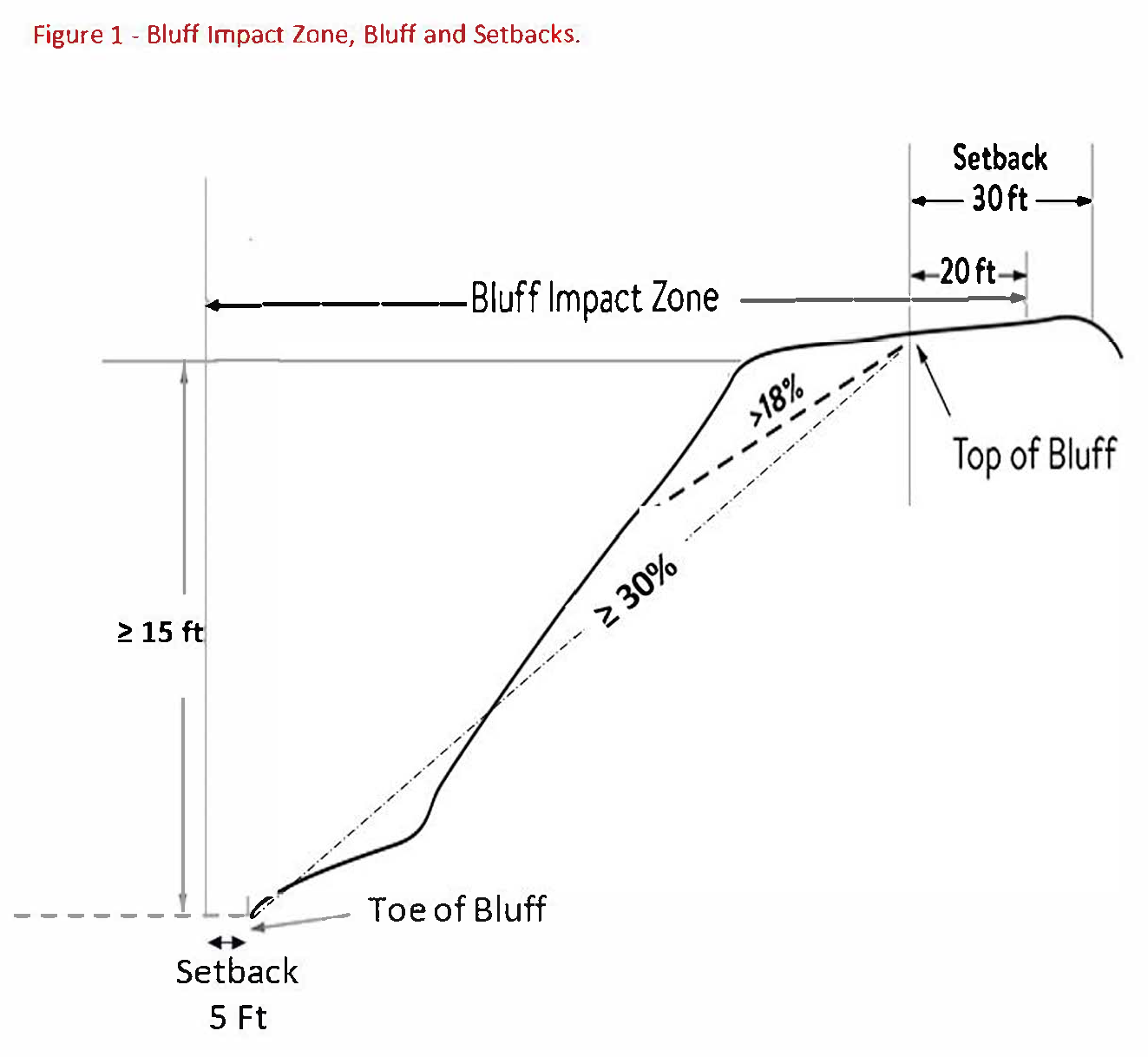
Bluff means a topographic feature such as a hill, cliff, or embankment meeting all of the following criteria.
(1)
The slope rises at least 15 feet from the toe of the bluff to the top of the bluff.
(2)
The grade of the slope from the toe of the bluff to the top of the bluff averages 30 percent or greater.
Bluff, toe means the lower point of a bluff where the slope averages less than 18 percent.
Bluff, top means the higher point of a bluff where the slope averages less than 18 percent.
Bluff impact zone means a bluff, land located within 20 feet of the top of a bluff, and land located within five feet from the toe of a bluff. See Figure 1 - Bluff Impact Zone, Bluff and Setbacks.
Board of adjustment means the county board of adjustment as described in Minn. Stats. ch. 394.
Board of commissioners, county board means the Blue Earth County Board of Commissioners.
Buildable area means a contiguous portion of a lot that is suitable for the location of the primary structure and that excludes all existing and proposed easements, setback areas for principal structures, wetlands, floodplains, flag lots or steep slopes that are unbuildable under this chapter, and other unbuildable areas.
Buildable lot means a lot of record, or other lot, tract or parcel legally recorded with the county recorder that meets the requirements of the code and which has frontage on an improved and maintained public road. An outlot is not a buildable lot for residential purposes.
Building means anything constructed or erected, which requires permanent or temporary location on the ground, for the shelter, support or enclosure of persons, animals, chattel or property of any kind.
Building height means the vertical distance from the average of the highest and lowest point of that portion of the lot covered by the building to the top of the highest beams on a flat or shed roof, to the deck level on a mansard roof, or to the mean height between eaves and ridge for all other roofs.
Building/structure setback line means a line within a lot defining the minimum distance between the building and any of the following: right-of-way, centerline of a road, bluff, water feature, feedlot, sewage treatment system, well(s) or property lines in which buildings or structures may not be placed.
Bulk and density controls means those regulations or controls which specify the setback lines, lot size, building height, maximum ground coverage, impervious surface, lot width and lot depth.
Campground means any area, whether privately or publicly owned, used on a daily, nightly, or longer basis for the placement of three or more camping units for the purpose of people occupying the unit on an overnight basis.
Camping unit(s) means any tent, trailer, cabin, lean-to, recreational vehicle, or similar structure established or maintained and operated in a campground as temporary living quarters for recreation, education, or vacation purposes.
Cannabis cultivation means a cannabis business licensed to grow cannabis plants within the approved amount of space from seed or immature plant to mature plant, harvest cannabis flower from mature plant, package and label immature plants and seedlings and cannabis flower for sale to other cannabis businesses, transport cannabis flower to a cannabis manufacturer located on the same premises, and perform other actions approved by the office of cannabis management.
Cannabis delivery businesses means a person, cooperative, or business licensed to conduct activities allowed by Minn. Stats. ch. 342 and perform other actions approved by the office of cannabis management.
Cannabis manufacturer businesses means a person, cooperative, or business licensed to conduct activities allowed by Minn. Stats. ch. 342 and perform other actions approved by the office of cannabis management.
Cannabis retail businesses means a retail location and the retail location(s) of a mezzobusinesses with a retail operations endorsement, microbusinesses with a retail operations endorsement, medical combination businesses operating a retail location, and lower-potency hemp edible retailers.
Cannabis retailer means any person, partnership, firm, corporation, or association, foreign or domestic, selling cannabis product to a consumer and not for the purpose of resale in any form.
Cannabis transportation businesses means a person, cooperative, or business licensed to conduct activities allowed by Minn. Stats. ch. 342 and perform other actions approved by the office of cannabis management.
Cemetery means a discrete, distinct or specific location that is known to contain or intended to be used for the internment of human and/or pet remains.
Certificate of zoning compliance means a letter from the Blue Earth County Zoning Department to the property owner stating that the specified use of the property conforms to the standards in the Blue Earth County Code of Ordinances.
Church/house of worship means a building where persons regularly assemble for religious service, and which is maintained and controlled by an organized group for worship.
Code means the Code of Ordinances, Blue Earth County, Minnesota, as designated in section 1-1.
Common interest community or condominium means contiguous or noncontiguous real estate within the state that is subject to an instrument which obligates persons owning a separately described parcel of the real estate, or occupying a part of the real estate pursuant to a proprietary lease, by reason of their ownership of occupancy, to pay for real estate taxes levied against; insurance premiums payable with respect to; maintenance of; or construction, maintenance, repair or replacement of improvements located on one or more parcels or parts of the real estate other than the parcel or part that the person owns or occupies (hereafter referred to as a "CIC").
(1)
Condominium. A CIC in which portions of the real estate are designated as units, the remainder of the real estate is designated for common ownership solely by the owners of the units, and undivided interests in the common elements are vested in the unit owners.
(2)
Cooperative. A CIC in which the real estate is owned by an association each of whose members is entitled by virtue of the member's ownership interest in the association to a proprietary lease.
(3)
Flexible CIC. A CIC to which additional real estate may be added.
(4)
Leasehold CIC. A CIC in which all or a portion of the real estate is subject to a lease the expiration of which will terminate the CIC or reduce its size.
(5)
Planned community. A CIC that is not a condominium or a cooperative. A condominium or cooperative may be part of a planned community.
Compost facility means a type of solid waste management facility that is used to compost or co-compost solid waste, including all structures or processing equipment used to control drainage, collect and treat leachate, and storage areas for the incoming waste, the final product, and residuals resulting from the composting process.
Composting means the controlled microbial degradation of organic waste to yield a humus like product.
Comprehensive plan means the policies, statements, goals and interrelated plans for public and private land and water use, transportation and community facilities, including recommendations for plan execution, documented in texts, ordinances and maps which constitute the guide for future development of the county or any portion of the county. The document is titled "Blue Earth County Land Use Plan", and was adopted June 30, 1998, as amended, or as hereafter revised or superseded by new comprehensive plans.
Conditional use means a land use as defined by this chapter that would not be generally appropriate, but may be allowed with restrictions which are site and use specific as provided by official controls upon finding that:
(1)
Certain conditions as detailed in this chapter exist.
(2)
The use or development conforms to the land use plan of the county.
(3)
The use is compatible with the existing neighborhood.
Conditional use permit means a permit issued by the board of commissioners in accordance with procedures specified in this chapter which would enable the board of commissioners to assign site specific conditions and dimensions to a proposed use.
Construction as-built plan means a report submitted by a licensed professional in the State of Minnesota, documenting a project was constructed according to the original design plan of the project. As-built reports shall include project modifications, field changes, and other design changes as approved by the licensed professional.
Construction permit means a permit issued by the zoning administrator pursuant to procedures specified in this chapter for the purpose of moving, altering or constructing a structure in the county.
County means the county, the board of commissioners, and its representatives who are authorized by the board of commissioners to administer and enforce this chapter.
County recorder means the Blue Earth County Recorder when referred to in this chapter.
Covenants means contracts entered into between private parties which constitutes a restriction on the use of all private property within a subdivision for the benefit of property owners to provide mutual protection against undesirable aspects of development which would tend to impair stability of values.
Crown of a county ditch means the top edge of the constructed channel or the crown of the leveled spoil bank, whichever is the greater for a public drainage ditch as described in Minn. Stats. § 103E.021, as amended. A cross section drawing of the crown described in Minn. Stats. § 103E.021 is available in the Minnesota Public Drainage Manual, as amended.
Cul-de-sac means a street with a single means of ingress/egress and having a turnaround at the end. A turnaround may be in the form of a circular "bubble" of an impervious surface or an internal "looped" street.
Daycare means a location licensed with the Minnesota Department of Human Services or Blue Earth County to provide the care of a child outside the child's own home for gain or otherwise, on a regular basis, for any part of a 24-hour day.
Deck means a horizontal, unenclosed platform with or without attached railings, seats, trellises or other features, attached or functionally related to a principal use or site, and at any point extending more than one foot above ground.
Delineated wetland boundary means wetland boundaries identified in a wetland delineation or investigation report approved by the Wetland Conservation Act (WCA) Local Government Unit. Only wetland boundaries that have been approved and issued a WCA Notice of Decision shall be acceptable for use in a site plan.
Demolition debris means solid waste resulting from the demolition of buildings, roads, and other structures including concrete, brick, bituminous concrete, untreated wood, masonry, glass, trees, rock, and plastic building parts. Demolition debris does not include asbestos wastes or hazardous wastes.
Demolition debris land disposal facility means a type of solid waste management facility that is used to dispose of demolition debris.
Depth of rear yard means the average horizontal distance between the rear line of the building and the centerline of an alley, where an alley exists, otherwise a rear lot line.
Development right means the right to construct a single-family dwelling.
District means a section of the county for which the regulations governing the height, area, density, bulk, and use of buildings and premises are the same as delineated on the land use district map.
Dwelling means a building or its portion, designed exclusively for residential occupancy; the term does not include hotels, motels, tents, tent trailers, travel trailers or recreational vehicles.
Dwelling, multiple means a dwelling designed exclusively for occupancy by two or more families living independently of each other. The term includes double bungalows, duplexes, triplex and quad units.
Dwelling, single-family means a detached building designed exclusively for occupancy by one family.
Easement means a grant by an owner of land for a specific use by persons other than the owner that must be recorded.
Electronic device(s) means any device containing a video display device (VDD), cathode ray tube (CRT) or (a) circuit board(s) as a major component of its primary functionality. Electronic devices include, but are not limited to: televisions, computer monitors, computers, computer accessory devices, VCR, DVR and DVD players, fax machines, audio equipment such as radios, stereos, record, tape and CD players, computer and video game terminals, and telecommunication equipment.
Electronic message sign means a sign whose message may be changed at intervals by electronic process or remote control and whose only movement is the periodic changing of information having a constant light level.
Essential services means overhead or underground electric, gas, communication, hydrocarbon, steam or water transmission or distribution systems and structures, by public utilities or governmental departments, or as are required for protection of the public health, safety or general welfare, including, poles, wires, mains, drains, sewers, pipes, conduits, cables, fire alarm boxes, police call boxes, and accessories in connection herewith, but not including buildings.
Excavation means any artificial alteration of the earth, excavated or made by the removal from the natural surface of the earth of soil, sand, gravel, stone or other matter.
Expansion, enlargement, or intensification means any increase in a dimension, size, area, volume, or height, any increase in the area of use, any placement of a structure or part thereof where none existed before, any addition of a site feature such as a deck, patio, fence, driveway, parking area, or swimming pool, any improvement that would allow the land to be more intensely developed, any movement of operations to a new location on the property, or any increase in intensity of use based on a review of the original nature, function or purpose of the non-conforming use, the hours of operation, traffic, parking, noise, exterior storage, signs, exterior lighting, types of operations, types of goods or services offered, odors, area of operation, number of employees, and other factors deemed relevant by the planning agency.
Extractive use means the use of land for surface or subsurface removal of sand, black dirt, clay, gravel, rock, industrial minerals, other nonmetallic minerals, and peat not regulated under Minn. Stats. §§ 93.44 to 93.51.
Family means any number of individuals related by blood, marriage, adoption or foster care, or not more than five persons not so related, maintaining a common household and using common cooking and kitchen facilities.
Farm means a tract of land used for agricultural activities such as the production of cash crops, livestock or poultry farming. Such farms may include agricultural dwellings and accessory buildings and structures necessary to the operation of the farm.
Farm winery means a winery operated by the owner of a Minnesota farm and producing table, sparkling, or fortified wines from grapes, grape juice, or other fruit bases, or honey with a majority of the ingredients grown or produced in Minnesota.
Feedlot means a lot or building, or combination of contiguous lots and buildings, intended for the confined feeding, breeding, raising or holding of animals, and specifically designed as a confinement area in which manure may accumulate, or where the concentration of animals is such that a vegetative cover cannot be maintained within the enclosure. For purposes of these parts, open lots used for feeding and rearing of poultry (poultry ranges) and barns, dairy farms, swine facilities, beef lots and barns, horse stalls, mink ranches and domesticated animal zoos, shall be considered to be animal feedlots. Pastures shall not be considered to be animal feedlots.
Filling means any soil, earth, sand, gravel, rock or any similar material deposited, placed, pushed, pulled or transported and shall include the conditions resulting there from.
Firing range, indoor means a target range used for target shooting, training, or for any other use involving the discharge of handguns or other firearms, which is open to members or the general public upon payment of a fee, and which is located within the confines of a building.
Firing range, outdoor, means a range used for target, trap or skeet shooting, training or for any other use involving the discharge of handguns or other firearms, which is open to members or the general public upon payment of a fee.
Flashing sign means any illuminated sign that has artificial light or color which is not maintained at a constant intensity or color when such sign is in use. A sign providing public service information, such as time, weather, date, temperature or similar information shall not be considered a flashing sign.
Flood means a temporary increase in the flow or stage of a stream or in the stage of a wetland or lake that results in inundation of normally dry areas.
Flood frequency means the frequency for which it is expected that a specific flood stage or discharge may be equaled or exceeded.
Flood fringe means that portion of the floodplain outside of the floodway.
Floodplain means the beds proper and the areas adjoining a wetland, lake or watercourse which have been or hereafter may be covered by the regional flood.
Floodproofing means a combination of structural provisions, changes or adjustments to properties and structures subject to flooding, primarily for the reduction or elimination of flood damages.
Floodway means the bed of a wetland or lake and the channel of a watercourse and those portions of the adjoining floodplain which are reasonably required to carry or store the regional flood discharge.
Golf course means a tract of land laid out for at least nine holes for playing the game of golf that may include a snack bar, pro shop, and practice facilities. This does not include dining facilities or a clubhouse.
Government lot means the fractional part of a section (public land survey) protracted by office procedures from field notes and designated by boundary limits, area and number on the township plat. A typical U.S. patent description could be: Government Lot 3 in Section 24 Township 109 North Range 26 West.
Grading means changing the natural or existing topography of the land.
Greenhouse means a building or structure whose roof and sides are made largely of glass or other transparent or translucent material and in which the temperature and humidity can be regulated for the cultivation of fragile or out-of-season plants.
Ground sign means a freestanding sign, including the structure that is needed to support it.
Hazardous waste/materials means any waste, materials or products that cannot be handled by routine management techniques due to the potential harm to human health or the environment. Categories include, but are not limited to, flammables, oxidizers, poisons, irritants and corrosives.
Hemp manufacturer means a person, cooperative, or business licensed to conduct activities allowed by Minn. Stats. ch. 342 and perform other actions approved by the office of cannabis management.
Home occupation means any occupation of a service character for others which is clearly secondary to the main use of the premises as a dwelling place and as set forth in section 24-326.
Home occupation, outdoor storage means an occupation of a service character for the seasonal or temporary storage of more than six licensed and operable vehicles and associated secondary business operations located on a property with a dwelling, as set forth in section 24-326.
Illuminated sign means a sign that is lighted by an exterior or interior light source.
Impervious surface means a constructed hard surface that either prevents or retards the entry of water into the soil and causes water to run off the surface in greater quantities and at an increased rate of flow than prior to development. Examples include rooftops, decks, sidewalks, patios, parking lots, storage areas, and concrete, asphalt or gravel driveways.
Improved road/street means any road or street that complies with state, county or township standards.
Interim use means a temporary use of property until a particular date, until the occurrence of a particular event, or until zoning regulations no longer permit it.
Interim use permit means a permit issued by the board of commissioners for a temporary use of a property in accordance with procedures specified in this chapter which would enable the board of commissioners to assign site specific conditions to a proposed use.
Joint identification sign means a sign which serves as common or collective identification for a group of persons or businesses operating on the same lot (e.g., shopping center, office complex, etc.). Such sign may name the persons or businesses.
Junkyard means land or buildings where waste, discarded or salvaged materials are bought, sold, exchanged, stored, cleaned, packed, disassembled or handled including, but not limited to, electronic devices, scrap metal, rags, paper, rubber products, glass products, lumber products, and products resulting from the wrecking of automobiles or other vehicles. The unenclosed storage of three or more inoperable and/or unlicensed vehicles or trailers; or any major appliances as defined by Minn. Stats. § 115A.03 subd. 17A; for a period of three months shall constitute a junkyard.
Kennel means a place where four or more dogs or four or more cats, or a combination of both, over four months of age are boarded, bred or offered for sale.
Land disposal facility means a type of solid waste management facility that means any tract or parcel of land, including any constructed facility, at which solid waste is disposed of in or on the land.
Land reclamation/land restoration means the process of reestablishing acceptable topography, (i.e. slopes, vegetative cover, soil stability) and conditions appropriate to the subsequent reuse of the land.
Land use development application means, but is not limited to, applications for the following: construction permits, demolition permits, shoreland alteration permits, vegetative alteration permits, topographic alterations permits, conditional use permits, interim use permits, amendments to this chapter, variances from the provisions of this chapter, and the subdivision of real estate. The application is not complete and will not be accepted by the zoning administrator unless all fees are paid, preliminary reviews and approvals completed, submitted with associated supporting information and documents, and such other information as required by the zoning administrator.
Large solar energy system means a solar array or system with a power capacity equal to or greater than 100 kilowatts.
Legal access means a recorded way or means of approaching or entering property without trespassing upon the property of another.
Linear frontage means that street frontage designated by the mailing address.
Logging means the cutting of timber on any private land of one acre or more for the major purpose of selling the timber for profit. This shall not include the selective cutting of trees by the property owner for the purpose of removing dead, dying or diseased trees or harvesting timber for firewood.
Lot means a designated parcel of land established by plat or subdivision adequate for occupancy by a use permitted in this chapter and providing sufficient area required for minimum open space and appurtenant facilities as required by this chapter (Minn. Stats. ch. 505).
Lot, corner means a lot situated at the junction of, and abutting, intersecting streets.
Lot, coverage means the area covered by the primary and all accessory buildings.
Lot, depth means the shortest horizontal distance between the front line and the rear lot line measured at a 90-degree angle from the street right-of-way and within the lot boundaries.
Lot, multiple frontage means a lot having frontage on two or more streets.
Lot, width means the shortest distance between the lot lines measured at the building setback line and right angles to the lot depth.
Lot area means the area located within the lot lines. The lot area must conform to lot area standards as stated in this chapter. Contiguous lot area must be free from rights-of-way, waterways, easements, ravines or other physical features which would preclude use of the required lot area.
Lot frontage, front means that portion of a lot boundary abutting the street right-of-way from which the lot is addressed.
Lot lines means the lines bounding a lot.
Lot of record means a lot that exists as shown or described on a plat or deed in the records of the local registry of deeds (Blue Earth County Taxpayer Services) as of a particular date.
Lower-potency hemp edible means as defined under Minn. Stats. § 342.01, subd. 50.
Manufactured home/mobile home means a structure, transportable in one or more sections, which in the transportable mode is eight feet or more in width or 40 feet or more in length, or when erected on a site, is 320 or more square feet, and which is built on a permanent chassis and designed to be used as a dwelling with or without a permanent foundation when connected to the required utilities, and includes the plumbing, heating, air conditioning, and electrical systems contained therein; except that the term includes any structure which meets the requirements with respect to which the manufacturer voluntarily files a certificate required by the secretary and complies with the standards established under Minn. Stats. ch. 327. The term does not include recreational vehicles.
Manufactured home, derelict means any pre-code manufactured home or manufactured home that no longer complies with the Minnesota Manufactured Home Code. This definition is applicable when said manufactured home is parked, stored, or abandoned and when it is no longer fit for (or being used for) human habitation.
Manufactured home park means a contiguous parcel of land which has been planned for the placement of two or more manufactured homes or manufactured home lots.
Marquee, awning and canopy signs means any message or identification which is affixed to or part of a marquee, awning or canopy.
Metes and bounds means a method of describing land by measure of length (metes) of the boundary lines (bounds). The most common method is to recite direction and length of each line as one would walk around the perimeter. In general the "metes" and "bounds" can be recited by reference to record, natural or artificial monuments at the corners; and record, natural or cultural boundary lines.
Motel/hotel means a building or group of buildings used primarily for the temporary residence of motorists or travelers.
Municipal solid waste combustor ash land disposal facility means a type of solid waste management facility that is used to dispose of municipal solid waste combustor ash in or on the land.
Municipal utilities means infrastructure required by a city when properties are annexed into a city, or infrastructure available from a township or other utility district such as a sanitary sewer district.
Noncompliant septic. As defined in the Blue Earth County Onsite Sewage Treatment Ordinance Chapter 6.
Nonconformity means any legal use, structure, or tract of land already in existence, recorded, or authorized before the adoption of official controls or amendments thereto that would not have been permitted to become established under the terms of the official controls as now written, if the official controls had been in effect prior to the date the nonconformity was established, recorded, or authorized.
Nonconforming lot of record means any lot of record that does not meet the requirements of the current Blue Earth County Code of Ordinances for minimum frontage, lot width and depth, and/or areas.
Nonconforming structure means any legally established use of land that does not comply with requirements of the current Blue Earth County Code of Ordinances.
Nonconforming use means any legally established use of land that does not comply with requirements of the current Blue Earth County Code of Ordinances.
Nonfarm uses means any use which is not an agricultural use as defined in this chapter or which is not accessory to an agricultural use.
Noxious weed means an annual, biennial, or perennial plant that the commissioner of the department of agriculture designates to be injurious to public health, the environment, public roads, crops, livestock, or other property.
Nursery, retail means the off-premises storage and sale of garden plants, flowers, trees, shrubs, and fertilizers, as well as, the sale of garden tools and similar accessory and ancillary products to the general public.
Off-premises sign means a sign advertising a business, commodity, service or entertainment conducted, sold or offered elsewhere other than upon the premises where the sign is maintained.
Off-sale means the sale of alcoholic beverages in original packages for consumption off the licensed premises only.
Office of cannabis management means the State of Minnesota Office of Cannabis Management, referred to as "OCM" in this section.
Official land use district map and official zoning map shall have the same meaning and force of law.
On-premises sign means a sign which advertises the business, commodity, service or entertainment, offered upon the same premises on which the sign is located.
On-sale means the sale of alcoholic beverages for consumption on the licensed premises only.
Open space means land areas which are undeveloped and left in a natural state.
Operator means any owner or lessee of mineral rights engaged in or preparing to engage in mining operations. The term also includes business operators or feedlot operators.
Ordinary high water level means the boundary of public waters and wetlands, and shall be an elevation delineating the highest water level which has been maintained for a sufficient period of time to leave evidence upon the landscape, commonly that point where the natural vegetation changes from predominately aquatic to predominantly terrestrial. For watercourses, the ordinary high water level is the elevation of the top of the channel's bank. For reservoirs and flowages, the ordinary high water level is the operating elevation of the normal summer pool.
Organized group camp means buildings and facilities owned and operated by a non-profit organization, that offers access to recreational or educational facilities for a limited period of time and that are not in conflict with permitted or conditional uses of the district. The term shall include such organizations as scouts, 4-H, YMCA, school groups, youth groups, church groups, and civic organizations.
Outlot means a remnant tract of land which may, at a future date, be replatted, or any lot that does not comply with local ordinances. Construction permits for outlots will not be issued until the outlot has been granted development authority by the board of commissioners via resubdivision and other required processes or approvals.
Outstanding violation means any ongoing or completed activity which is not permitted by the code or pursuant to state and federal land use regulations.
Owner or property owner means the fee owner of land, or the beneficial owner of land, whose interest is primarily one of ownership or possession and enjoyment in contemplation of ultimate ownership. The term includes, but is not limited to, mortgagees and vendees under a contract for deed.
Parcel generally means a contiguous quantity of land in the possession of an owner that is generally described by metes and bounds (Minn. Stats. § 505).
Person means any individual, firm, partnership, corporation, company, association, joint stock association or body politic. The term also includes any trustee, receiver, assignee or other similar representative thereof.
Photovoltaic solar energy system means a system of components that generates electricity from incident sunlight by means of the photovoltaic effect, whether or not the device is able to store the energy produced for later use.
Place of public accommodation means a business, accommodation, refreshment, entertainment, recreation, or transportation facility of any kind, whether licensed or not, whose goods, services, facilities, privileges, advantages, or accommodations are extended, offered, sold, or otherwise made available to the public.
Planned unit development means a large lot or tract of land developed as a unit rather than as individual development wherein two or more buildings, or compatible land uses, may be located in relationship to each other rather than to lot lines or land use district boundaries.
Planning agency means the organization of the planning commission and staff of the land use division of the county environmental services.
Planning commission means the county planning commission.
Planning director, land use and natural resources administrator, zoning administrator or planner means the county planning director.
Plat means a delineation of one or more existing parcels of land drawn to scale showing all data as required by this chapter, depicting the location and boundaries of lots, blocks, outlots, parks, and public ways (Minn. Stats. ch. 505).
Permitted use means a public or private use which of itself conforms with the purposes, objectives, requirements, regulations and performance standards of a particular land use district.
Practical difficulty means the property in question cannot be put to a reasonable use if used as required by this code; the plight of the landowner is due to circumstances unique to the property not created by the property owner; and the variance if granted will not alter the essential character of the locality. Economic considerations alone do not constitute a practical difficulty if a reasonable use for the property exists under this code.
Preliminary license approval means OCM pre-approval for a cannabis business license for applicants who qualify under Minn. Stat. § 342.17.
Principal structure or use means one which determines the predominant use as contrasted to accessory use or structure.
Private landing field means an area of land designed and set aside for the landing and take-off of aircraft, including all necessary facilities for the housing and maintenance of aircraft.
Projecting sign means a sign, other than a wall sign, which projects from and is supported by a building.
Public or quasi-public building means school, town hall, library, church or house of worship, post office, depot, commercial buildings, and similar structures as determined by the planning agency.
Public place means a public park or trail, public street or sidewalk; any enclosed, indoor area used by the general public, including, but not limited to, restaurants; bars; any other food or liquor establishment; hospitals; nursing homes; auditoriums; arenas; gyms; meeting rooms; common areas of rental apartment buildings, and other places of public accommodation.
Quarry means any pit or excavation made for the purpose of searching for or removal of any soil, earth, clay, sand, gravel, limestone or other nonmetallic minerals.
Quarter/quarter section means a division of a section of land according to the rules of the original United States Government Public Land Survey containing approximately 40 acres.
Reader board sign means a sign intended to display a message through the use of manually changed letters, that is permanently attached to a ground sign or affixed to a wall.
Real estate sign means a sign advertising the sale, rental or development of the premises upon which it stands, or directing attention to the opening or location of a new residential development.
Reception/banquet/meeting halls/retreat centers or facilities means the use of a building or land for receptions, banquets, meeting halls or retreats.
Reclamation plan means a document that details the activity which is to be taken during and following mining operation to return the area to a natural state as much as possible or take actions that would substantially reduce adverse environmental effects from occurring.
Recreation, commercial means all uses relating to outdoor recreation uses such as driving ranges, golf courses, gun clubs, paintball courses, hunting preserves, ATV courses or similar uses that are privately owned and operated with or without the intention of earning a profit by providing entertainment for the public. The definition does not include movie theaters, bowling alleys, lodging facilities, or campgrounds.
Recreational camping vehicle, means any of the following:
(a)
Any vehicular, portable structure built on a chassis, designed to be used as a temporary dwelling for travel, recreational, and vacation uses;
(b)
Any structure designed to be mounted on a truck chassis for use as a temporary dwelling for travel, recreation, and vacation;
(c)
Any portable, temporary dwelling to be used for travel, recreation, and vacation, constructed as an integral part of a self-propelled vehicle; and
(d)
Any folding structure, mounted on wheels designed for travel, recreation, and vacation use.
Recreational purpose means leisure activities, usually of a formal nature and often preformed with others, requiring equipment and taking place at prescribed places, sites, or fields by the owners of the parcel and/or their guests.
Recyclable materials means and refers to marketable materials that are separated from mixed municipal solid waste for the purpose of recycling, including paper, glass, plastics, metals, automobile oil, and batteries. Refuse-derived fuel or other material that is destroyed by incineration is not a recyclable material. For purposes of part 7035.2860, recyclable materials also refers to marketable materials separated from industrial solid wastes and construction and demolition debris. Recyclable materials may also be referred to as secondary materials.
Recycling means the process of collecting and preparing recyclable materials and reusing the materials in their original form or using them in manufacturing processes that do not cause the destruction of recyclable materials in a manner that precludes further use.
Recycling facility means a type of solid waste management facility where only recyclable materials are received and prepared for reuse in their original form or for use in manufacturing processes that do not cause the destruction of the materials in a manner that precludes further use. The recyclable materials must:
(a)
Fit the definition of mixed municipal solid waste prior to separation for recycling;
(b)
Not include items which have been prohibited by state law from disposal or placement in mixed municipal solid waste, unless approved by the commissioner;
(c)
Have been separated from other mixed municipal solid waste by the generator prior to collection; and
(d)
Not be hazardous as defined in chapter 7045, except for household hazardous waste. Recyclable materials that are defined as household hazardous waste in part 7045.0131, subpart 1, and Minn. Stats, 15A.96, subdivision 1, paragraphs (a) and (b), may be accepted at the facility for recycling if they are managed in accordance with part 7045.0310.
"Recycling facility" does not include an individual generator of recyclable materials, such as a homeowner, a business, or a government agency, and it does not include a manufacturer using recyclable materials as feedstock. A solid waste management facility aggregating recyclable materials as an activity incidental to their primary waste management activities is not a recycling facility.
Reflecting solar energy system means a solar energy system that includes a device to reflect light onto the collector surface for the purpose of increasing the energy production of the system.
Remodel means an alteration of the interior or exterior portion of the existing structure to include work performed on the interior of a structure (provided the work performed does not increase the number of bedrooms or increase water usage), maintenance, and adding windows and doors. Under no circumstances shall remodeling constitute the replacement of the main structural frame, walls, or changes in the exterior dimensions of the structure.
Replacement, reconstruction or restoration means construction that exactly matches pre-existing conditions or smaller.
Residential treatment facility means as defined under Minn. Stats. § 245.462, subdivision 23.
Resort means any buildings, structures or enclosures kept, used, maintained or advertised to the public to be an enclosure where sleeping accommodations are furnished to the public, primarily to those seeking recreation, for periods of one day or longer, and having for rent three or more cottages, rooms or enclosures.
Retail registration means an approved registration issued by Blue Earth County to a state-licensed cannabis retail business.
Right-of-way means the land covered by a public road or other land dedicated for public use or for certain private use such as a utility easement.
Road/street means any vehicular way that is:
(1)
An existing private, state, county, county state aid or municipal roadway;
(2)
Shown upon a plat approved pursuant to law;
(3)
Shown on a plat duly filed and recorded in the office of the county recorder;
(4)
Shown on the official map or adopted master plan.
It includes the land between the street lines, whether improved or unimproved.
Roofline means, in structures with a flat roof, the top line of the coping; in structures with pitched roofs, the intersection of the outside wall with the roof.
Roof sign means a sign permanently affixed upon the roof of a building.
Sanitary sewer means the area over which sanitary sewer is provided to all properties under the direction and jurisdiction of a sanitary sewer board. The district shall precisely describe the area over which it has jurisdiction and a description of service in a comprehensive plan adopted pursuant to requirements of the State of Minnesota.
School means a public school as defined under Minn. Stats. § 120A.05 or a nonpublic school that is required to meet the reporting requirements under Minn. Stats. § 120A.24.
Screening means the use of plant material, fences or earthen berm to partially conceal and separate a land use from the surrounding land uses.
Seasonal cabin means a dwelling unit that is not permanently occupied as a family residence during any entire year and that is designed to be used for only a few months each year.
Seasonal produce sales stands means a detached accessory structure used seasonally from which agricultural products are sold.
Self-service storage facilities (mini-storage) means a building or group of buildings containing separate, individual, and storage spaces for personal property available for lease or rent.
Septage means solids and liquids removed from an SSTS and includes solids and liquids from cesspools, seepage pits, other pits, or similar systems or devices that receive sewage. Septage also includes solids and liquids that are removed from portable, incinerating, composting, holding, or other toilets. Waste from Type III marine sanitation devices, as defined in Code of Federal Regulations, title 33, section 159.3, and material that has come into contact with untreated sewage within the past 12 months is also considered septage.
Setback means a line within a lot defining the minimum distance between the building and any one of the following: Right-of-way, centerline of a road, bluff, water feature, feedlot, sewage treatment system, well(s) or property line; in which buildings or structures may not be placed.
Shoreland means land located within the following distances from public waters:
(1)
One thousand feet from the normal high water mark of a lake, pond or flowage; and
(2)
Three hundred feet from a river or stream; or
(3)
The landward extension of a designated floodplain, whichever is greater.
The practical limits of shorelands may be less than the statutory limits whenever the waters involved are bounded by natural topographic divides which extend landward from the waters for lesser distances and when approved by the commissioner of the department of natural resources and the county commissioners.
Short-term rental unit means a commercial use of a dwelling, where sleeping quarters are furnished in exchange for compensation, for any period of time less than 30 days and is not a bed and breakfast.
Sign means any name, identification, description, display, illustration, structure, emblem or device which is affixed to, painted or represented upon a building, bench or other outdoor structure, vehicle or piece of land, which is intended to direct attention to an object, product, place, activity, person, organization or business. The structure supporting or intended to support a sign shall be considered part of that sign.
Sign area means the net geometric area enclosed by the display surface of the sign. Only one face of a multiple-faced sign shall be considered in determining the display surface area.
Sign height means the vertical distance measured from the lot elevation to the highest point of such sign.
Sign setback means the horizontal distance measured from a lot line and the nearest portion of a sign or its structure.
Site plan means the development plan for one or more lots on which is shown the existing and proposed conditions of the lot, including topography, vegetation, drainage, floodplains, wetlands, and waterways, landscaping and open spaces, walkways, means of ingress and egress, circulation, utility services, structures and buildings, signs and lighting, berms, buffers, and screening devices, surrounding development, wells, sewer line, septic systems and any other information that reasonably may be required in order for an informed decision to be made by the approving authority.
Small solar energy system means a solar array that is a minimum of 120 square feet in size with a power capacity of less than 100 kilowatts.
Solar array means any number of solar photovoltaic modules or panels connected together to provide a single electrical output.
Solar energy system means a set of devices whose primary purpose is to collect solar energy and convert and store it for useful purposes including heating and cooling buildings or other energy-using processes, or to produce generated power by means of any combination of collecting, transferring, or converting solar-generated energy.
Solid waste means garbage, refuse, sludge from a water supply treatment plant or air contaminant treatment facility, and other discarded waste materials and sludges, in solid, semisolid, liquid, or contained gaseous form, resulting from industrial, commercial, mining and agricultural operations, and from community activities, but does not include hazardous waste; animal waste used as fertilizer; earthen fill, boulders, rock; sewage sludge; solid or dissolved material in domestic sewage or other common pollutants in water resources, such as silt, dissolved or suspended solids in industrial waste water effluents or discharges which are point sources subject to permits under section 402 of the Federal Water Pollution Control Act, as amended, dissolved materials in irrigation return flows; or source, special nuclear, or by-product material as defined by The Atomic Energy Act of 1954, as amended.
Solid waste land disposal facility means a type of solid waste management facility that is used to dispose of solid waste in or on the land.
Solid waste management facility means a facility for the storage, collection, transportation, processing or reuse, conversion, or disposal of solid waste.
Solid waste landfill means a land disposal site employing an engineered method of disposing of solid waste in a manner that minimizes environmental hazards.
Solid waste transfer facility means a type of solid waste management facility in which solid waste from collection vehicles is compacted or rearranged for subsequent transport. A transfer facility may be fixed or mobile.
Source-separated organic material compost facility means a type of solid waste management facility that means:
(a)
A site used to compost source-separated organic material;
(b)
All structures or processing equipment used to compost source-separated organic material; and
(c)
All structures or equipment used to:
(1)
Control drainage;
(2)
Manage contact water;
(3)
Manage stormwater;
(4)
Manage incoming material;
(5)
Manage the finished product; or
(6)
Manage rejects and residuals resulting from the composting process.
Source-separated organic material means:
(a)
Source-separated compostable materials and yard waste, as defined under Minn. Stats. § 115A.03, except sanitary products and diapers;
(b)
Vegetative wastes generated from industrial or manufacturing processes that prepare food for human consumption; and
(c)
Compostable materials that meet the standards in ASTM D6400 and ASTM D6868, incorporated by reference under part 7035.0605.
Unless specifically permitted by the commissioner under part 7001.0150, source-separated organic material does not include:
(1)
Animal wastes such as manure or carcasses;
(2)
Fish wastes generated from industrial or manufacturing processes;
(3)
Meat by-products generated from industrial or manufacturing processes;
(4)
Sanitary products; or
(5)
Diapers.
"Source-separated organic material" also does not include:
(1)
Septage; or
(2)
Sewage sludge, as defined in part 7041.0100, subpart 49.
State license means an approved license issued by the OCM to a cannabis retail business.
Stockpiling, fill means to collect and store large amounts of fill to use at a later time, place and/or date.
Stormwater facility includes storage facilities (ponds, vaults, underground tanks, and infiltration systems); water quality facilities (wetponds, biofiltration swales, constructed wetlands, sand filters, and oil/water separators); and conveyance systems (ditches, pipes, and catchbasins).
Story means that portion of a building included between the surface of any floor and the surface of the next floor above it or, if there is no floor above it, the space between the floor and the ceiling. If the finished floor level directly above a basement or cellar or unused under floor space is more than six feet above grade for more than 50 percent of its perimeter, or is more than 12 feet above grade any point, such basement, cellar or unused under floor space is a story.
Structure means anything constructed or erected, which requires permanent or temporary location on the ground and shall include advertising devices or other construction or erection with special function or form, except fences, well(s) and walks.
Structural alterations means any change in the supporting members of a building, such as bearing walls, columns, beams, rafters or girders.
Substantial damage means damage of any origin sustained by a structure when the cost of restoring the structure to its undamaged condition would equal or exceed 50 percent of the market value of the structure before the damage occurred.
Substations means any electrical facility designed to convert electricity produced to a voltage for interconnection with transmission lines.
Table or sparkling wine means a beverage made without rectification or fortification and containing not more than 25 percent alcohol by volume and made by the fermentation of grapes, grape juice, other fruits or honey.
Temporary sign means any sign, but not including portable signs, banner, pennant, poster or advertising display which is intended to be displayed for a limited period of time and is not permanently affixed to the ground or a structure. Signs other than temporary signs shall be considered permanent signs.
Tower, commercial wireless communications means a structure, privately or publicly owned, used for commercial purposes, upon which radio, television, cellular telecommunications, personal communication services, or other communication antennas and/or equipment of a similar nature is mounted, excluding towers used for business band, citizen's band, amateur radio, personal television reception antennas, or other similar personal uses.
Trademark sign means any sign designating a design or emblem of a product or manufacturer.
Travel trailer means a vehicular portable structure built on a chassis, designed to be used as a temporary dwelling for travel, recreational and vacation uses, permanently identified as a travel trailer by the manufacturer of the trailer.
Urban use means uses typically related to residential, commercial, and industrial development at a density higher than otherwise permitted in the agricultural and conservation zoned district.
Use means the purpose for which land or premises or a building thereon is designated, arranged or intended, or for which it is or may be occupied or maintained.
Utilities means all utility services providers, whether the providers are government-owned facilities or furnished by private utility companies.
Vacation means the act of relinquishing a recorded dedication or easement as in a street right-of-way, utility easement, etc.
Variance means any modification or variation of official controls where it is determined that, by reason of exceptional circumstances, the strict enforcement of the official controls would cause undue hardship.
Wall sign means a sign affixed flush on a part of the exterior wall of a building.
Water management plan means the document titled Blue Earth County Water Management Plan dated November 18, 2008, as amended.
Wetland means lands transitional between terrestrial and aquatic systems where the water table is usually at or near the surface or the land is covered by shallow water. Wetlands must have a predominance of hydric soils, be inundated or saturated by surface water or groundwater at a frequency and duration sufficient to support a prevalence of hydrophytic vegetation typically adapted for life in saturated soil conditions, and under normal circumstances, support a prevalence of hydrophytic vegetation, as established in Minn. Stats. § 103G.005, subd. 19.
Wholesale cannabis businesses means a person, cooperative, or business licensed to conduct activities allowed by Minn. Stats. ch. 342 and perform other actions approved by the office of cannabis management.
Wind energy conversion system or WECS means any device, such as a wind charger, windmill, or wind turbine and associated facilities that convert wind energy to electrical energy.
Wind energy conversion system (WECS), commercial means a WECS or combination of WECS that is designed to have a capacity in excess of the amount needed for residential and agricultural uses and that has a combined nameplate capacity of 125 KW or more.
Wind energy conversion system (WECS), non-commercial means a WECS or combination of WECS that is designed to have a capacity for residential and agricultural uses and has a combined nameplate capacity of less than 125 KW.
Wine means a product made from the normal alcoholic fermentation of grapes including still wine, sparkling and carbonated wine, wine made from condensed grape must, wine made from other agricultural products than sound, ripe grapes, imitation wine, compounds sold as wine, vermouth, cider, perry and sake in each instance containing not less than one-half of one percent (0.5%) nor more than 24 percent alcohol by volume for nonindustrial use. Wine does not include distilled spirits.
Wine wholesaler means a person who sells alcoholic beverages to persons to whom sale is permitted under Minn. Stats. § 340A.310, from a stock maintained in a warehouse in the state.
Yard means any space in the same lot with a building open and unobstructed from the ground to the sky.
Yard, front, means the area extending across the front of the lot between the side yard lines and lying between the centerline of the road or highway, and the nearest line of the building.
Yard, rear, means a space unoccupied, except for an accessory building, between the rear lines of the principal building and the rear line of the lot, for the full width of the lot.
Yard, side, means an open unoccupied space on a lot between the main building and the side line of the lot, extending from the front to the rear of the main building.
Zoning administrator means the person designated by the county to administer and enforce this chapter.
Zoning ordinance and Land use ordinance shall have the same meaning and force of law.
(Ord. of 2-28-2012; Ord. of 2-16-2016; Ord. of 5-19-2020, Att. A; Ord. of 8-25-2020(1); Ord. of 8-25-2020(2); Ord. of 9-22-2020(1); Ord. of 1-19-2021(2), Att. A; Ord. of 4-27-2021, Att. A; Ord. of 8-24-2021(2), Att. A; Ord. of 1-25-2022(2), Att. A; Ord. of 6-21-2022(1), Att. A; Ord. of 1-24-2023(1), Att. 1; Ord. of 1-24-2023(2), Att. 1; Ord. of 6-25-2024, Att. 1; Ord. of 11-19-2024(1), Att. 1; Ord. of 2-25-2025(1), Att. 1; Ord. of 2-25-2025(2), Att. 1)
Cross reference— Definitions generally, § 1-2.
Sec. 24-4. - Jurisdiction of chapter provisions.
The jurisdiction of this chapter shall apply to all the areas of the county outside the incorporated limits of municipalities, and within the boundaries of any municipality which chooses to come under the jurisdiction of this chapter.
(Ord. of 2-28-2012)
Sec. 24-5. - Scope of chapter.
From and after June 8, 1996, no structure may be erected, constructed, enlarged, reconstructed or altered, and no structure or land may be used or occupied for any purpose, nor in any manner which is not in conformity with this chapter.
(Ord. of 2-28-2012)
Sec. 24-6. - Interpretation of chapter provisions.
When interpreting and applying the provisions of this chapter, they shall be held to be the minimum requirements for the promotion of the public health, safety and general welfare.
(Ord. of 2-28-2012)
Sec. 24-7. - Abrogation of greater restrictions.
Where the provisions of any statute, other ordinance or regulation impose greater restrictions than this chapter, the provisions of such statute, other ordinance or regulation shall be controlling.
(Ord. of 2-28-2012)
Sec. 24-8. - Relation to land use plan.
It is the policy of the board of commissioners that the enactment, amendment and administration of this chapter be accomplished with due consideration of the purposes and objectives of the county land use plan, as adopted or approved and amended from time to time by the board of commissioners. The board of commissioners recognizes that the land use plan is a guide for the future development of the county and the basis for the enactment of this chapter.
(Ord. of 2-28-2012)
Sec. 24-9. - General regulations.
(a)
Residential buildings. Buildings used as residential dwellings shall be designed for residential purposes and shall comply with other provisions of this chapter.
(b)
Required facilities. Single-family and multifamily dwellings, guestrooms, and congregate housing designed to be used for human occupancy shall be provided with the following facilities inside the living unit:
(1)
Heating facilities capable of maintaining a temperature of 70 degrees Fahrenheit (21 degrees Celsius) at a point three feet above the floor;
(2)
A potable drinking water supply from a well, individual or shared, which meets the requirements of the well ordinance, chapter 6, article III;
(3)
One bathroom type sink, one toilet, one kitchen type sink, and one bathtub or shower to meet basic requirements of sanitation and personal hygiene, connected to municipal sewer or subsurface soil treatment system meeting the requirements of the Blue Earth County SSTS Ordinance, chapter 6, article V;
(4)
A source of electricity meeting the requirements of, and approved by, the Minnesota State Board of Electricity.
(5)
All structures used for residential occupancy shall be affixed to a permanent foundation, frost footings or frost piers extending a minimum of 42 inches below grade. Manufactured homes shall be anchored according to the requirements of the manufacturer.
(c)
Occupancy. Residential buildings shall not be occupied until such residential building is connected to a source of potable drinking water, required sanitary facilities have been installed and connected to approved sewage treatment facilities, heating facilities are operational, and the electrical installation has received final approval from the Minnesota State Board of Electricity.
(d)
Seasonal cabins.Section 24-9(b)(1)—(b)(4) shall not apply to seasonal cabins used for recreational purposes. Water, sanitary facilities, and electricity, when provided, shall meet minimum requirements of this chapter, the Well Ordinance, Chapter 6, Article III, the Blue Earth County SSTS Ordinance, Chapter 6, Article V; the Blue Earth County Shoreland Ordinance, Chapter 14; and the Minnesota State Board of Electricity.
(Ord. of 2-28-2012)
Sec. 24-10. - Permitted uses.
(a)
Generally. Permitted uses of land or buildings as listed in this chapter shall be permitted in the districts indicated under the conditions specified. No building or land shall be devoted to any use other than a use permitted in this chapter in the land use district in which such building, structure or land shall be located, except for the exceptions in subsection (b) of this section.
(b)
Exceptions.
(1)
Uses lawfully established prior to June 8, 1996, in accordance with sections 24-307 and 24-308.
(2)
Conditional uses established in accordance with section 24-11.
(3)
Essential services erected, constructed, altered or maintained by public and private utilities or by governmental departments or commissions, subject to permit requirements of this chapter.
(Ord. of 2-28-2012)
Sec. 24-11. - Conditional uses.
Conditional uses of land or buildings, as listed in this chapter, may be allowed in the districts indicated, subject to the issuance of conditional use permits, in accordance with the provisions of article II of this chapter. Whenever a conditional use is named as a major category, it shall be deemed to include all and only those itemized uses listed. See article II, section 24-47 planning commission, for additional information.
(Ord. of 2-28-2012)

