
Macclenny City Zoning Code
ARTICLE I
- ZONING
Sec. 4-1. - Table of contents.
Sec. 4-2. - Generally.
This article establishes zoning districts and describes the uses that may occur within each district and establishes minimum and maximum building requirements.
Sec. 4-3. - Applicability.
The regulations within each district set by this article shall be minimum regulations and shall apply uniformly to each class or kind of structure on land, except as provided in this article.
(1)
Use. No building or structure or land shall hereafter be used or occupied and no building or structure or part thereof shall be erected, constructed, reconstructed, moved or altered except in conformity with the regulations specified in this article for the district in which it is located.
(2)
Height and density. No building or structure shall hereafter be erected, constructed, reconstructed or altered to:
a.
Exceed the limit heights [height limits] required in this article;
b.
House a greater number of families or occupy a smaller lot area per family than required in this article; or
c.
Have narrower or smaller front or side yards than are required in this article.
(3)
Lot size and occupancy. No lot, even though it may consist of one or more adjacent lots in the same ownership on March 15, 1989 shall be reduced in size so that lot width or size of yards or lot area per family or any other requirement of this article is not maintained. This subsection shall not apply when a portion of a lot is acquired for a public purpose.
(4)
Yards and other spaces. No part of a yard or other open space or the offstreet parking or loading space required about any building for the purpose of complying with the provisions of this article shall be included as a part of the yard or offstreet parking or loading space required for another building.
(5)
Limitation on number of principal buildings on lots in residential areas. Except as provided in this article, only one principal residential building, except for multifamily buildings and cluster developments, may hereafter be erected on any lot.
(6)
Public street frontage. No building shall be erected on a lot which does not abut for at least twenty-five (25) feet on a public street or other legal access.
Sec. 4-4. - Findings of fact.
The city commission finds that unrestricted use of land and uncontrolled development can reduce the quality of life for the residents and visitors to Macclenny and that the control of land uses and development promotes the public health, safety, and general welfare.
Sec. 4-5. - Purpose and intent.
The provisions of this article shall be implemented to achieve the following intentions and purposes of the city commission:
(1)
To regulate and limit the height and size of buildings;
(2)
To regulate and limit the intensity of the use of lot areas;
(3)
To provide for open space;
(4)
To classify, regulate, and restrict the location of trades and industries; and
(5)
To minimize the conflict between land uses.
Sec. 4-6. - Definitions.
The following words, terms, and phrases, when used in this article, shall have the meanings ascribed to them in this section, except where the context clearly indicates a different meaning:
Accessory use or structure means a use or structure of a nature customarily incidental and subordinate to the principal use or structure, and, unless otherwise provided, on the same premises. An essential service approved by a special zoning exception, or approved by the subdivision regulations, or are a part of an internal package system designed and intended to serve a single industrial or commercial use of complex, does not have to be on the same premises as the principal use.
Alley means a public or private way which affords only a secondary means of access to property abutting thereon.
Alteration means any change in the size, shape, occupancy, character or use of a building or structure.
Antenna means any device used for radiating or receiving radio waves, such as towers, wires or rod structures or dishes or discs.
Applicant means the record owner, or his authorized representative, of a tract of land which is the subject of a request for a change in zoning classification, an exception, a variance or an appeal.
Arterial road means a roadway that has been designated on the future traffic circulation map of the comprehensive plan.
Auditorium means the room, hall, building or part of a building used for public gatherings.
Automobile service or filling station. See Service station.
Automobile wrecking or storage yard means the dismantling or disassembling of used motor vehicles or trailers, or the storage, sale or dumping of dismantled, partially dismantled, obsolete or wrecked motor vehicles or trailers or their parts.
Bar, cocktail lounge, saloon or tavern means any establishment devoted primarily to the retailing and on-premises drinking of malt, vinous or other alcoholic beverages, or any place where any sign is exhibited or displayed indicating that alcoholic beverages are obtainable for consumption on the premises.
Boardinghouse means an establishment with lodging for four (4) or more persons, where meals are regularly prepared and served for compensation and where food is placed upon the table family-style, without service or ordering of individual portions from a menu.
Body shop means any enclosed structure used for the alteration, repairs, restoration and refinishing of the body parts or appurtenances of a motor vehicle body.
Building means any structure, either temporary or permanent, having a roof impervious to weather and used or built for the shelter or enclosure of persons, animals, chattels or property of any kind. This definition shall include tents, awnings, cabanas or vehicles situated on private property and serving in any way the function of a building, but does not include screened enclosures not having a roof impervious to weather.
Building area means the portion of developable land within a lot remaining after required yards, parking and landscaping areas have been provided. Buildings may be placed in any part of the buildable area, but limitations on percent of the lot which may be covered by buildings may require open space within the buildable area.
Building height means the vertical distance from the established grade at the center of the front of a building to the highest point of the roof or parapet.
Carport means an accessory structure or portion of a principal structure, consisting of a roof and supporting members such as columns or beams, unenclosed from the ground to the roof on at least two (2) sides, and designed or used for the storage of motor-driven vehicles owned and used by the occupants of the building to which it is accessory.
Certificate of occupancy means the official certification that a premises conforms to the provisions of the Macclenny land development regulations and the building code and may be used or occupied.
Change of occupancy means discontinuance of an existing use and the substitution of a different kind or class of use.
Church means a building or structure whose sole design and use is for religious worship and the religious program of the church.
Clinic/office, medical or dental means an establishment where patients who are not lodged overnight are admitted for examination and treatment by one person or a group of persons practicing any form of the healing arts, whether such persons be medical doctors, chiropractors, osteopaths, chiropodists, naturopaths, optometrists, dentists or any other such profession the practice of which is regulated by the State of Florida.
Club, night means a restaurant or dining room serving alcoholic beverages wherein paid floorshows or other forms of paid entertainment are provided for customers as a part of the commercial enterprise.
Club, private means an association or organization of a fraternal or social character, not operated or maintained for profit. The term "private club" shall not include casinos, nightclubs, bottle clubs or other establishments operated or maintained for profit.
Collector road means a roadway so designated on the future traffic circulation map of the comprehensive plan.
Completely enclosed building means a building separated on all sides from adjacent open space, or from other buildings or other structures, by a permanent roof, and by solid exterior walls or solid party walls which are pierced only by windows and normal entrance or exit doors.
Comprehensive plan. See definition in chapter 1.
Convenience store means a retail business establishment having a roofed floor space of no more than two thousand five hundred (2,500) square feet and engaged primarily in the sale of a limited line of high-volume grocery, beverage and housing products, and sundry items.
Day nursery or kindergarten means any service which during all or part of the day regularly gives care to six (6) or more children, not of common parentage, who are under six (6) years of age, whether or not it has stated educational purpose, and whether the service is known as a day care service, day nursery, day care agency, nursery school, kindergarten, play school, progressive school, or by any other name. The total number of children receiving care shall be counted, including children or foster children of the owner or person in charge, in determining the applicability of this definition.
Density means the number of residential dwelling units permitted per acre of land, exclusive of dedicated public rights-of-way, canals, and drainage ditches, lakes and rivers.
Developable land means all of a parcel of land except:
(1)
Lands lying within proposed public rights-of-way;
(2)
Marshlands, swamps, floodplains or other environmentally sensitive lands where local, state or federal regulations otherwise prohibit development; and
(3)
Bodies of water such as ponds, lakes and reservoirs, either natural or manmade.
District, base means all residential and nonresidential districts.
District, overlay means a geographically definable zoning district that places additional or different requirements or standards on property within the boundaries of said district than those that apply in the base district.
Drive-in or drive-through establishment means any place or premises where provision is made on the premises for the selling or dispensing of services or goods in vehicles on the premises, or in other than a completely enclosed building on the premises. A restaurant which provides drive-in facilities of any kind in connection with regular restaurant activities shall be deemed a drive-in restaurant. A barbecue stand or pit having the characteristics noted in this description shall be deemed a drive-in restaurant.
Dwelling means any building, or part thereof, occupied in whole or in part as the residence or living quarters of one or more persons permanently or temporarily, continuously or transiently.
Dwelling, multiple-family means a building containing three (3) or more dwelling units.
Dwelling, one-family or single-family means a building containing only one dwelling unit. The term includes conventional site-built homes and manufactured homes as defined in this code. The term is not to be construed as including mobile homes, travel trailers, housing mounted on self-propelled or drawn vehicles, tents, houseboats or other forms of temporary or portable housing.
Dwelling, two-family or duplex means a separate detached building containing two (2) dwelling units.
Dwelling unit means a room or rooms connected together, constituting a separate, independent housekeeping establishment for a single family, for owner occupancy or rental or lease on a weekly, monthly or longer basis, and physically separated from any other rooms or dwelling units which may be in the same structure, and containing sleeping facilities and one kitchen.
Easement. See definition in chapter 1.
Erected includes built, constructed, reconstructed, moved upon, or any physical operation on the premises required for building. Excavations, fill, drainage, demolition of any existing structure and the like shall be considered part of erection.
Essential services. Essential services are permitted uses in the Zoning Code and are hereby defined as and are limited to certain installations of water, stormwater, sewer, gas, telephone, radio, television and electric systems such as substations, lift stations, provided that it serves a single subdivision approved under subdivisions regulations, or are a part of an internal package system designed and intended to serve a single industrial or commercial use or complex. Essential services are permissible uses by special exception in all zoning districts and are limited to certain installations of water, stormwater, sewer, gas, telephone, radio, television, and electric or generating plants or water pumping or aeration facilities or cellular telephone towers or radio towers.
Family means an individual or two (2) or more persons related by blood, marriage or adoption living together; or a group of not more than six (6) persons unrelated by blood, marriage or adoption, but living together as a single housekeeping unit. In each case, the word "family" shall be deemed to include, in addition, the domestic employees.
Filling station. See Service station.
Flammable liquids means liquids having a flashpoint below two hundred (200) degrees Fahrenheit, closed cup tester, and class I flammable liquids (e.g., gasoline) having a flashpoint of twenty-five (25) to sixty-nine (69) degrees Fahrenheit.
Floor area. Except as may be otherwise specifically indicated in relation to particular districts and uses, floor area shall be construed as the sum of the gross horizontal areas of the several floors of a building measured from the exterior faces of the exterior walls or from the centerline of walls separating two (2) buildings, excluding attic areas with a headroom of less than seven (7) feet, unenclosed stairs or fire escapes, elevator structures, cooling towers, areas devoted to air conditioning, ventilating or heating or other building machinery and equipment, parking structures, and basement space where the ceiling is not more than an average of forty-eight (48) inches above the general finished and graded level of the lot.
Foster home means any establishment that provides care for less than five (5) children unrelated to the operator and which receives a payment, fee or grant for any of the children receiving care, wherever operated and whether or not operated for a profit.
Frontage of a lot. See Lot frontage.
Garage apartment means a building for the housing of persons, and means the same as dwelling, one-family or single-family, guesthouse or cottage or servant quarters.
Garage, parking means a building or portion thereof designed or used for temporary parking of motor vehicles, and within which gasoline and oils may be sold only to parking patrons of the garage.
Garage, repair means a building or portion thereof, other than a private residential garage, designed or used for repairing of equipment or servicing of motor vehicles.
Garage, storage means a building or portion thereof designed and used exclusively for the storage of motor vehicles, and within which temporary parking may also be permitted.
Group home means a facility occupied by eight (8) or more persons, whether operated for profit or not, which provides, for a period exceeding twenty-four (24) hours, one or more personal services for persons not related to the owner or administrator by law, blood, marriage or adoption, and not in foster care, who require such services. The personal services, in addition to housing and food services, may include but not be limited to personal assistance with bathing, dressing, housekeeping, adult supervision, emotional security and other related service, but not including medical services.
Hedge. See definition in chapter 1.
Home improvement center means an establishment whose principal business is the retail sale of merchandise customary to the repair, maintenance and improvement of residential and business structures, including repairs, maintenance and improvements of the properties on which these structures are located. For the purpose of this article, a home improvement center shall not be deemed a business which sells merchandise in large quantities to builders and/or contractors. All materials shall be stored in a completely enclosed structure with no outside display.
Home occupation means a vocation that is conducted on the same premises that are utilized for residential purposes by persons engaged in such vocation.
Hospital means a building or group of buildings having facilities for overnight care of one or more human patients, providing services to inpatients and medical care to the sick and injured, and which may include as related facilities laboratories, outpatient services, training facilities, central service facilities and staff facilities; provided, however, that any related facility shall be incidental and subordinate to principal hospital use and operation. Only those buildings licensed as a hospital under the laws of the State of Florida shall be included within this definition.
Hotel, motel, motor lodge or tourist court means a building or a group of buildings in which sleeping accommodations are offered to the public and intended primarily for rental to transients with a daily charge, as distinguished from multiple-family dwellings and roominghouses or boardinghouses, where rentals are for periods for a week or longer and occupancy is generally by residents rather than transients.
Housing for the elderly means a facility in the nature of multiple-family housing, with no provision for routine nursing or medical care. Where this article permits housing for the elderly, such housing shall be used only for this purpose; if housing for the elderly is changed to multiple-family use, then the provisions of this article shall be met before such multiple-family use is permitted.
Junkyard means a place, structure or lot where junk, waste, discarded, salvaged or similar materials such as old metals, wood, slush, lumber, glass, paper, rags, cloth, bagging, cordage, barrels, containers, etc., are brought, bought, sold, exchanged, baled, packed, disassembled, sorted or handled, including used lumber and building materials yards, housewrecking yards, heavy equipment wrecking yards and yards or places for the storage, sale or handling of salvaged housewrecking or structural steel materials. This definition shall not include automobile wrecking and automobile storage yards, or pawnshops and establishments for the sale, purchase or storage of secondhand cars, clothing, salvaged machinery, furniture, radios, stoves, refrigerators or similar household goods and appliances, all of which shall be usable, nor shall it apply to the processing of used, discarded or salvaged materials incident to manufacturing activity. However, establishments for the sale, purchase or storage of secondhand refrigerators, stoves, plumbing fixtures and similar merchandise shall be considered junkyards for the sole purpose of requiring that such establishments display their merchandise behind a visual barrier as required for junkyards by this article.
Kennel means any place or premises where four (4) or more dogs over four (4) months of age are kept for pay or for sale. This definition shall not apply to veterinarians operating under license from the State of Florida who board dogs on the same premises in conjunction with their practice incidental to observation and treatment.
Kindergarten. See Day nurseries.
Lot means a parcel of land of at least sufficient size to meet minimum zoning requirements for use, coverage and area, and to provide such yards and other open spaces as are required in this article (provided that certain nonconforming lots of record at the effective date of this code or its amendment are exempted from certain of its provisions under the terms of this article). Such lot shall have a frontage on a public or approved private street and may consist of:
(1)
A single lot of record;
(2)
A portion of a lot of record;
(3)
A combination of complete lots of record, or of portions of lots of record; or
(4)
A parcel of land described by metes and bounds;
provided that, in no case of division or combination shall any residual lot or parcel be created which does not meet the requirements of this article.
Lot coverage means that percentage of lot area that is or may be covered or occupied by buildings.
Lot frontage. The front of an interior lot shall be construed to be the portion nearest the street. For the purpose of determining yard requirements on corner lots and through lots, all sides of a lot adjacent to streets shall be considered frontage, and yards shall be provided as set out in this article.
Lot depth means the distance measured from the middle point of the front line to the middle point of the opposite rear line of the lot.
Lot of record means a lot whose existence, location and dimensions have been legally recorded as part of a subdivision or registered in a deed or on a plat which has been legally recorded in the office of the clerk of the circuit court of Baker County prior to the effective date of this code; except that any subdivision plat which has been completed, approved by the city consulting engineer and filed with the city building inspector prior to the effective date of this code may be approved by the city commission, and if the plat complies with the former zoning law of the city such plat may be recorded, after such approval by the city commission, in the office of the clerk of the circuit court of Baker County.
Lot width means the mean horizontal distance between the side lot lines, measured at right angles to its depth.
Manufactured housing means a detached dwelling unit that has the following features or characteristics:
(1)
Mass produced in a factory;
(2)
Designed and constructed for transportation to a site for permanent installation and use when connected to required facilities;
(3)
Has the appearance of a conventional dwelling unit when installed; and
(4)
Is not portable or temporary.
Miniwarehouse means a personal storage building which is subdivided by permanent partitions into spaces containing not more than three hundred (300) square feet and where each such space has an exterior independent entrance under the exclusive control of the tenant thereof.
Mobile home. See definition in chapter 1.
Mobile home park. See definition in chapter 1.
Mobile home subdivision means a parcel of land set aside where lots are sold to mobile home owners for the purpose of placing mobile homes thereon for living and sleeping purposes, including any land, building, structure or facilities used by occupants of mobile homes on such premises.
Motel. See Hotel, motel, motor lodge or tourist court.
Motor hotel or motor lodge. See Hotel, motel, motor lodge or tourist court.
Nonresidential district includes all zoning districts not primarily intended for residential uses.
Nursery school. See Day nurseries and kindergartens.
Nursing home means a public or private home, institution, building, residence or other place, profit or nonprofit, which undertakes through its ownership or management to provide, for a period exceeding twenty-four (24) hours, maintenance, personal care or nursing for three (3) or more persons not related by blood or marriage to the operator, who by reason of illness or physical infirmity or advanced age are unable to care for themselves; provided that this definition shall include homes offering services for less than three (3) persons when the homes are held out to the public to be establishments which regularly provide nursing and custodial services. Only those homes, building[s] or places licensed under the laws of the State of Florida as nursing homes shall be included within this definition.
Occupied. The word "occupied" includes arranged, designed, built, altered, converted to or intended to be used or occupied.
Office, business or professional means an office for such operations as accounting services, auditing and bookkeeping services, employment service agencies (permanent job placement), insurance offices, manufacturer's representative, mortgage broker, real estate offices, stockbroker's office, telephone answering and referral service, travel agency and the like; or an office for the use of a person or persons generally classified as professionals, such as architects, attorneys, clinics, chiropractors, dentists, doctors, engineering (including surveyors), interior designers, land planners, licensed masseurs, medical and dental laboratories, ophthalmologists, osteopaths, psychiatrists, psychologists and other mental health services, veterinarians (but not including treatment or boarding of animals on the premises) and the like. For the purpose of this article, a barbershop or beauty shop or bail bond agency shall not be deemed a business or professional office.
Open space means a parcel or parcels of land or an area of water, or a combination of land and water, clear to the sky, within a site, which shall include common recreation area, woodland areas, parks, playgrounds, golf courses, tennis courts, nature trails, lakes and swimming pools, camping facilities and other similar open space exclusive of streets, roads and parking area.
Package store or liquor store means a place where alcoholic beverages with an alcoholic content in excess of fourteen (14) percent are dispensed or sold in containers for consumption off the premises.
Party wall means a wall on an interior lot line, used or adapted for joint service between two (2) buildings.
Patio means an open courtyard used for either passive recreation or relaxation, located within the house or immediately adjoining the house.
Pet, household means any domestic animal normally owned or kept as a pet, including cats, dogs, rabbits, parrots and other animals deemed by the zoning administration to be appropriate as domestic pets. Poultry, including chickens, turkeys, ducks, geese, guineas or other fowl, hoofed animals of any type, predatory animals or any animal which is normally raised to provide food for people shall not be considered to be household pets.
Planned unit development means an area of land, controlled by a landowner, to be developed as a single entity for a number of specified uses, the plan for which does not correspond in lot size, bulk or type of dwelling or commercial use, density, lot coverage and required open space to the regulations established in any one or more districts created in this article.
Plot. See Lot.
Porch, enclosed and open. An enclosed porch is a roofed space attached to the outside of the outer wall of the building, open on one or more sides, which has railings or screened enclosures. An open or unenclosed porch is a roofed space attached to an outer wall of a building open on one or more sides without railing, glass, canvas, screen or similar materials on the open sides.
Private street means a street designed to serve more than one (1) property and which is privately owned and maintained on a recorded easement, and which has been approved by the city manager and appears on the approved private streets list kept with the City of Macclenny as an approved private street.
Residential district includes all residential zoning districts.
Restaurant. A restaurant is an establishment where meals or prepared food, including beverages and confections, are served to customers for consumption on or off the premises; an establishment engaged primarily in the service of food and non-alcoholic beverages, where the sale or service of alcoholic beverages is incidental to the sale and service of food and non-alcoholic beverages. The restaurant must have full kitchen facilities and food preparation staff capable of preparing and serving full course meals during all hours of operation. A restaurant must have the appropriate license issued by the state as well as all county and city permits required by law, and must meet all local zoning requirements for a restaurant. Restaurant includes cafes, coffee shops, donut shops, delicatessens, cafeterias, and other establishments of a similar nature.
Right-of-way. See definition in chapter 1.
Rowhouse. See Townhouse.
Sanitarium means a facility for the recuperation and treatment of physical or mental disorders, without provision for major surgery.
Service station means an establishment whose principal business is the dispensing at retail of gasoline and oil, and where grease, batteries, tires and automobile accessories may be supplied and dispensed at retail, principally for automobiles and not for trucks, or in connection with a private operation where the general public is excluded from the use of the facilities. This term shall exclude the following: repair garage, body shop or truck stop.
Setback means the horizontal distance between the frontmost line of the building, excluding steps, and the front line of the lot.
Shopping center, mall or urban center means a group of retail stores or service establishments planned and developed as a unit by one operator, owner, organization or corporation for sale or for lease for the site upon which they are built.
Sign. See definition in chapter 1.
Special exception. See definition in chapter 1.
Street frontage means the property line of a lot abutting the right-of-way line of public or approved private streets, excluding alleys to which such property has the legal right of access.
Street, approved private means a thoroughfare which is privately owned and maintained on a recorded easement which has been approved by the city manager and upon which lots fronting thereon are eligible for building permits.
Street, public means a thoroughfare which has been and is legally dedicated to public use and which has been accepted for maintenance by the city or other governmental entity and upon which lots fronting thereon are eligible for building permits.
Structure. See definition in chapter 1.
Swimming pool means any constructed pool used for swimming or bathing that is a minimum of twenty-four (24) inches in depth and has a surface area exceeding two hundred fifty (250) square feet.
Townhouse means a single-family dwelling constructed as part of a series of dwellings, all of which are either attached to the adjacent dwelling or dwellings by party walls, or are located immediately adjacent thereto with no visible separation between walls or roof.
Truckstop means an establishment where the principal use is primarily the refueling and servicing of trucks and tractor-trailer rigs. Such establishments may have restaurants or snack bars and sleeping accommodations for the drivers of such over-the-road equipment and may provide facilities for the repair and maintenance of such equipment.
Use means the purpose for which land or water or a structure thereon is designated, arranged or intended to be occupied or utilized, or for which it is occupied or maintained.
Use of land includes use of land, water surface and land under water to the extent covered by the zoning districts, and over which the City of Macclenny has jurisdiction.
Used car lot means a lot or group of contiguous lots used for the storage, display and sale of used automobiles and where the only reconditioning conducted on the premises shall be the cleaning, washing and polishing of the cars displayed and sold on the premises.
Variance. See definition in chapter 1.
Veterinary clinic means a facility that has been issued a premises permit to engage in the practice of veterinary medicine as provided for in F.S. ch. 474.
Visual barrier means a material object or set of objects, either living or manufactured, e.g., a fence or wall, which visually screens or materially impairs the view from offsite.
Yard means a required open space other than a court, unoccupied and unobstructed by any structures or portion of a structure from thirty (30) inches above the general ground level of the graded lot upward; provided, however, that fences, walls, poles, posts and other customary yard accessories, ornaments and furniture may be permitted in any yard subject to height limitations and requirements limiting obstruction of visibility.
Yard, front means a yard extending between side lot lines across the front of a lot adjoining a public or approved private street. In the case of through lots, unless the prevailing front yard pattern on adjoining lots indicates otherwise, front yards shall be provided on all frontages. Where one of the front yards that would normally be required on a through lot is not in keeping with the prevailing yard pattern, the city manager may waive the requirement for the normal front yard and substitute therefor a special yard requirement which shall not exceed the average of the yard provided on adjacent lots. In the case of corner lots, a front yard of the required depth shall be provided on one frontage and a front yard one-half the required depth shall be provided on the other.
Yard, rear means a yard extending across the rear of the lot between inner side yard lines. In the case of through lots and corner lots, there will be no rear yards, but only the front and side yards.
Yard, side means a yard extending from the rear line of the required front yard to the rear lot line, or, in the absence of any clearly defined rear lot line, to the point on the side lot line involved which is farthest from the intersection of such line with the public street. In the case of through lots, side yards shall extend from the rear lines of front yards required. In the case of corner lots, yards remaining after front yards have been established on both frontages shall be considered side yards.
(Ord. No. 06-18, § 1, 9-9-08; Ord. No. 09-22, § 1, 12-8-09; Ord. No. 11-03, § 1, 3-8-11)
Sec. 4-51. - Districts established.
(a)
In order to regulate and restrict the location of trades, industries, public and semipublic uses, residences and the location of buildings erected or offered for specific uses, the city is hereby divided into districts or zones as shown on the zoning map entitled "Zoning Map, City of Macclenny, Florida," and the map is hereby declared to be a part of this code.
(b)
The following base districts are established, with titles and abbreviations as indicated:
(c)
An overlay district is established for conservation areas with the following title and abbreviation: Conservation, CON.
Sec. 4-52. - Amendments to zoning map.
(a)
Amendments to the zoning map shall be made as set forth in chapter 3.
(b)
The city manager shall update the zoning map as soon as possible after the amendments to district boundaries or rezonings are adopted by the city commission and shall indicate on the map the date of revision.
(c)
The city clerk shall keep copies of superseded prints of the zoning map for historical reference as a public record.
(d)
Under no circumstance shall any district be established, combined, amended, or abolished that would be inconsistent with the comprehensive plan, until such time as the comprehensive plan is amended to allow such action.
Sec. 4-53. - Interpretation of district boundaries.
Where uncertainty exists as to the boundaries of districts as shown on the zoning map, the following rules shall apply:
(1)
Boundaries indicated as approximately following centerlines of streets, highways or alleys shall be construed to follow such centerlines.
(2)
Boundaries indicated as approximately following platted lot lines shall be construed as following such lot lines.
(3)
Boundaries indicated as approximately following city limits shall be construed as following such city limits.
(4)
Boundaries indicated as following railroad lines shall be construed to be midway between the main tracks.
(5)
Boundaries indicated as parallel to or an extension of features indicated in subsections (1) through (4) of this section shall be so construed. Distances not specifically indicated on the zoning map shall be determined by the scale of the map.
(6)
Where physical or cultural features existing on the ground are not in agreement with those shown on the zoning atlas, or in other circumstances not covered by subsections (1) through (5) of this section, the city commission shall interpret the district boundaries.
Sec. 4-54. - Division of lot of record by district boundary.
Where a district boundary line divides a lot which was in single ownership on March 15, 1989, the city commission may permit, as an exception, the extension of the regulations for either portion of the lot, not to exceed seventy-five (75) feet beyond the district line, into the remaining portion of the lot.
Sec. 4-71. - Residential, single-family: RS-1 and RS-2.
(a)
Intent. The purpose of the residential single-family districts, RS-1 and RS-2, is to provide for single-family residences with densities not to exceed 5 dwelling units per acre in those areas where public services, utilities and transportation facilities are adequate or may be made available; and to exclude uses not compatible with such low- and medium-density residential development, thereby preserving and protecting the characteristics of single-family neighborhoods.
(b)
Regulations. Regulations for the RS-1 and RS-2 districts are as follows:
(1)
Permitted uses and structures. Permitted uses and structures are as follows: Single-family dwellings.
(2)
Permitted accessory uses and structures. For permitted accessory uses and structures, see section 4-101.
(3)
Permitted uses by special exception. Special exceptions may be granted for the following uses according to the procedures and conditions as outlined in chapter 3 of this code:
a.
Duplexes.
b.
Garage apartments.
c.
Home occupations.
d.
Churches.
(4)
Minimum lot requirements. Minimum lot requirements are as follows:
a.
RS-1 district:
1.
Minimum lot width: 90 feet.
2.
Minimum lot area: 10,000 square feet.
b.
RS-2 district:
1.
Minimum lot width: 75 feet.
2.
Minimum lot area: 7,500 square feet.
(5)
Minimum yard requirements. Minimum yard requirements are as follows:
a.
Front yard:
1.
RS-1: 30 feet.
2.
RS-2: 25 feet.
b.
Side yard:
1.
RS-1: 10 feet.
2.
RS-2: 10 feet.
c.
Rear yard:
1.
RS-1: 15 feet.
2.
RS-2: 10 feet.
(6)
Building restrictions. Building restrictions are as follows:
a.
Maximum building height:
1.
RS-1: 35 feet.
2.
RS-2: 35 feet.
b.
Maximum lot coverage:
1.
RS-1: 35 percent.
2.
RS-2: 40 percent.
c.
Density:
1.
RS-1: 0—5 dwelling units per acre.
2.
RS-2: 0—5 dwelling units per acre.
Sec. 4-72. - Residential, general: RG.
(a)
Intent. The provisions of the RG district provide for single-family, duplexes, and multifamily residences at densities between 5.1 and 12 dwelling units per acre where it is desirable to encourage such development. Due to the higher than average concentrations of persons and vehicles, this district is situated where it can be served by public and commercial facilities and utilities and have convenient access to thoroughfares and collector streets. Site area requirements reflect the relative need for adequate open space for the various types of residences based on expected density of use.
(b)
Regulations. Regulations for the RG district are as follows:
(1)
Permitted uses and structures. Permitted uses and structures are as follows:
a.
Single-family dwellings.
b.
Duplexes and townhouses.
c.
Multiple-family dwellings.
d.
Housing for the elderly.
e.
Group home containing 8 or less residents requiring low intensity of care. Homes for delinquent youth or drug and alcohol abusers are not permitted.
f.
Roominghouses or boardinghouses.
g.
Churches, not to include temporary revival establishments.
h.
Foster homes.
(2)
Permitted accessory uses and structures. Permitted accessory uses and structures are as follows:
a.
See section 4-101.
b.
Signs as provided for in chapter 14 of this code.
(3)
Permitted uses by special exception. Special exceptions may be granted for the following uses according to the procedures and conditions as outlined in chapter 3 of this code:
a.
Nursing homes, convalescent homes, rest homes or homes for the aged or orphans, provided that no such facility shall have a lot area of less than one acre and that all other state and county regulations in regard to such establishment must be met.
b.
Monasteries, convents and similar uses.
c.
Group homes containing more than 8 residents, including homes for delinquent youths and drug and alcohol abusers.
d.
Home occupations.
e.
Funeral homes.
(4)
Minimum lot requirements. Minimum lot requirements are as follows:
a.
Single-family dwellings and duplexes:
1.
Minimum lot width: 75 feet.
2.
Minimum lot area: 7,500 square feet.
3.
Townhouses:
i.
Minimum lot area:
(a) Interior lot: 20 feet.
(b) Exterior lot: 30 feet.
ii.
Minimum lot area:
(a) Interior lot: 2,000 square feet.
(b) Exterior lot: 3,000 square feet.
iii.
Maximum density: 10 dwelling units per acre.
b.
Multiple-family dwellings and other permitted structures:
1.
Minimum lot width: 125 feet.
2.
Minimum lot area: 7,500 square feet. Minimum lot area shall be 7,500 square feet for the first family unit and 4,000 square feet for each additional unit, with gross density not more than 12 units per acre, exclusive of land dedicated or reserved for street rights-of-way, marshland and other similar open space as may be determined by the city commission in the site plan review.
(5)
Minimum yard requirements. Minimum yard requirements are as follows:
a.
Single-family dwellings and duplexes:
1.
Front yard: 25 feet.
2.
Side yard: 10 feet.
3.
Rear yard: 10 feet.
b.
Townhouses:
1.
Front yard: 25 feet.
2.
Side yard:
i.
Interior units: 0 feet.
ii.
Exterior units: 15 feet.
3.
Rear yard: 20 feet.
c.
Multiple-family dwellings and other permitted structures:
1.
Front yard: 25 feet.
2.
Side yard: 20 feet.
3.
Rear yard: 20 feet.
d.
Structures exceeding 35 feet or 3 stories in height shall increase the minimum side yard by 1 foot for every 2 feet of building height exceeding 35 feet.
(6)
Building restrictions. Building restrictions are as follows:
a.
Maximum building height:
1.
Single-family dwellings, duplexes and townhouses: 35 feet.
2.
Multiple-family dwellings and other permitted structures may exceed a height of 35 feet, subject to meeting all requirements specified in this section; provided that no structure shall exceed 85 feet or 7 stories.
b.
Maximum lot coverage:
1.
Single-family dwellings, duplexes and townhouses: 40 percent.
2.
Multiple-family dwellings exceeding 35 feet in height shall comply with the following lot coverage percentages:
i.
35 feet: 26 percent.
ii.
45 feet: 25 percent.
iii.
55 feet: 23 percent.
iv.
65 feet: 21 percent.
v.
75 feet: 19 percent.
vi.
85 feet: 17 percent.
c.
Maximum density: 5.1 to 12 dwelling units per acre.
(Ord. No. 08-21, § 1, 11-18-08)
Sec. 4-73. - Residential, mobile homes: RMH.
(a)
Intent. The provisions of the RMH district provide for the development of areas for individual mobile homes, parks and subdivisions for residents desiring the unique environment characteristics of mobile home living. Further, it is the purpose of this district to provide for these areas the community services deemed necessary for their orderly development. Single-family homes are allowed.
(b)
Regulations. Regulations for the RMH district are as follows:
(1)
Permitted uses and structures. Permitted uses and structures are as follows:
a.
Mobile homes on individual lots.
b.
Mobile home parks.
c.
Mobile home subdivisions.
d.
Single-family dwellings.
(2)
Permitted accessory uses and structures. Permitted accessory uses and structures are as follows:
a.
See section 4-101.
b.
Each mobile home park shall be permitted to display one identifying sign as provided for in chapter 14 of this code.
(3)
Establishment procedure for subdivisions and mobile home parks.
a.
New or revised mobile home subdivisions and single-family home subdivisions shall comply with the provisions of the subdivision regulations.
b.
Developers of mobile home parks shall file site plans for review as required in article II of this chapter. The site plan shall be supplemented with a legal description of the property and a sketch plan drawn to scale showing the intended overall development plan, mobile home spaces, open space, and recreational and other support facilities with all dimensions, together with a description of the manner in which the water and sewer facilities will be provided, with attached approval of the Baker County health department.
(4)
Permitted uses by special exception. Special exceptions may be granted for the following uses according to the procedures and conditions as outlined in chapter 3:
a.
Churches.
b.
Duplexes.
c.
Garage apartments.
d.
Home occupations.
e.
Funeral homes.
(5)
Minimum lot requirements. Minimum lot requirements are as follows:
a.
Mobile home park:
1.
Minimum site width:
(1)
100 feet at site ingress and egress points.
(2)
200 feet at the portion of the site used for mobile home stands.
2.
Minimum site area:
(1)
10 acres.
(2)
Maximum density of 8 mobile homes per gross acre.
b.
Mobile home subdivision or individual lot:
1.
Minimum lot width: 75 feet.
2.
Minimum lot area: 7,500 square feet.
(6)
Maximum lot coverage. Maximum lot coverage by all buildings and structures shall be 35 percent.
(7)
Minimum yard requirements. Minimum yard requirements are as follows:
a.
Mobile home park:
1.
Front yard: 25 feet from the boundary of the park to any mobile home stand or accessory building.
2.
Side and rear yards: 15 feet from any boundary of the park to any mobile home stand or accessory building.
3.
Each mobile home shall be located a minimum of 20 feet from all interior streets and at least 7½ feet from any side or rear lot line. In no case shall any mobile home be located closer than 15 feet to any other mobile home.
b.
Mobile home subdivision or individual lot:
1.
Front yard: 25 feet.
2.
Side yard: 10 feet.
3.
Rear yard: 10 feet.
c.
Single-family subdivisions shall meet the yard requirements defined in the RG district.
(8)
Streets, roads and parking, and skirting of mobile homes. Requirements for streets, roads, parking, and skirting of mobile homes are as follows:
a.
Mobile home parks:
1.
All interior streets and roads shall have a minimum right-of-way width of 50 feet with a minimum paved surface of 25 feet and shall meet the paving and drainage requirements of the subdivision regulations.
2.
Parking spaces shall be provided in accordance with the provisions in chapter 12 of this code.
b.
Mobile home subdivisions and individual lots. All streets and roads in mobile home subdivisions shall be constructed in accordance with the subdivision regulations.
c.
Single-family subdivisions and individual lots. All streets in single-family subdivisions shall be constructed in accordance with the subdivision regulations.
d.
Skirting. All mobile homes in subdivisions or on individual lots shall be skirted to conceal the underside of the unit.
(Ord. No. 08-21, § 2, 11-18-08)
Sec. 4-74. - Residential, professional office: RPO.
(a)
Intent. The RPO district is intended to provide for professional offices of low intensity and design criteria, which permits its location in close proximity to single-family districts. This district can serve as a transition district between low- or medium-density residential development and more intensive commercial development.
(b)
Regulations. Regulations for the RPO district are as follows:
(1)
Permitted uses and structures.
a.
Permitted uses and structures are as follows:
1.
Single-family dwellings and duplexes.
2.
Home occupations.
3.
Business offices such as real estate broker, insurance agent, stockbroker, manufacturer's agent, building trades contractor not requiring onsite storage of equipment, machinery, materials, vehicles and so forth, and similar uses.
4.
Medical and dental or chiropractor offices, but not including clinics or hospitals.
5.
Professional offices such as accountant, architect, attorney, engineer, land surveyor, optometrist and similar uses.
b.
All of the permitted uses in the RPO district are limited to the following conditions:
1.
No retail sales, display or storage of merchandise shall be permitted.
2.
No vehicles other than passenger automobiles or trucks of not more than three-quarter-ton capacity shall be used.
3.
No manufacture, repair or work of a mechanical nature of any kind shall be permitted, and no machinery shall be used other than normal office equipment such as typewriters, calculators, computers, bookkeeping machines, etc.
4.
All business shall normally be conducted during ordinary working hours.
(2)
Permitted accessory uses and structures. Permitted accessory uses and structures are as follows:
a.
See section 4-101.
b.
Signs as provided for in chapter 14 of this code.
(3)
Permitted uses by special exception. Special exceptions may be granted for the following uses according to the procedures and conditions as outlined in chapter 3 of this code:
a.
Special exceptions permitted in the RS-1, RS-2 and RG districts.
b.
Clubs, lodges, and fraternal organizations.
c.
Uses permitted in the RPO district which are excluded by limitations on such uses.
d.
Medical or dental clinic, hospital, sanitarium, child care center, church.
e.
Medical or dental laboratory; manufacture of prosthetic appliances, dentures, eyeglasses, hearing aids and similar products, including mercantile operations directly servicing the facility.
f.
Child care and learning centers.
g.
Churches.
h.
Schools, colleges and universities.
i.
Townhouses and multifamily.
j.
Funeral homes.
(4)
Minimum lot requirements. Minimum lot requirements are as follows:
a.
Single-family dwellings: As required in the RS-2 district.
b.
Multiple-family dwellings: As required in the RG district.
c.
Other permitted uses:
1.
Minimum required lot area: 6,000 square feet.
2.
Minimum required lot width: 50 feet.
3.
Minimum required front yard: 25 feet.
4.
Minimum required rear yard: 10 feet.
5.
Minimum required side yard: 7.5 feet, or 10 percent of the lot width, whichever is greater.
6.
Minimum lot coverage: 35 percent.
7.
Maximum structure height: 35 feet.
8.
Site development plan: Approval is required as outlined in section 4-39.
(Ord. No. 08-21, § 3, 11-18-08)
Sec. 4-75. - Commercial, neighborhood: CN.
(a)
Intent. The CN district is intended to apply to areas where small groups of selected establishments may be appropriately located to serve within convenient traveling distance from one or several neighborhoods. The commercial neighborhood district is not intended for use by major commercial or service establishments. However, professional and business offices and similar uses are encouraged.
(b)
Regulations. Regulations for the CN district are as follows:
(1)
Permitted uses and structures. Permitted uses and structures are as follows:
a.
Retail outlets for sale of food and drugs, wearing apparel, toys, sundries and notions, books and stationery, leather goods and luggage, jewelry (including watch repair but not pawnshop), art supplies, camera repair, sporting goods, hobby shops and pet shops (but not animal kennels), musical instruments, television and radio shops (including repairs), florist or gift shops, delicatessens, bake shops (but not wholesale bakeries), drugs and similar products.
b.
Service establishments such as barbershops or beauty shops, shoe repair shops, restaurants (but not drive-in restaurants), interior decorators, photographic studios, dance or music studios, reducing salons or gymnasiums, self-service laundries or dry cleaners, tailors or dressmakers, dry cleaning and laundry package plants in completely enclosed buildings using nonflammable liquids such as perchloroe- thylene and with no odor, fumes or steam detectable to normal senses from off the premises, and similar activities.
c.
Medical and dental offices and clinics; veterinary clinics, provided that no animals are permitted to be kept except in a completely enclosed and soundproofed structure.
d.
Churches, except temporary revival establishments, provided that the minimum parcel size shall be not less than 2 acres.
e.
Libraries.
f.
Convenience stores, without gas pumps.
(2)
Special restrictions. Special restrictions in the CN district are as follows:
a.
Sale, display, preparation and storage shall be conducted within a completely enclosed building and no more than 20 percent of floor space is to be devoted to storage.
b.
Products are to be sold only at retail.
c.
No sale, display or storage of secondhand merchandise is permitted except as incidental to sale of new merchandise.
d.
A visual barrier shall be required as stipulated in section 4-141.
(3)
Permitted accessory uses and structures. Permitted accessory uses and structures are as follows:
a.
Parking lots complying with chapter 12 and landscape provisions.
b.
On the same premises and in connection with permitted principal uses and structures, a single-family dwelling unit, only for occupancy by the owner or an employee thereof. The single-family dwelling unit may be attached or detached from the principal permitted use.
(4)
Permitted uses by special exception. Special exceptions may be granted for the following uses according to the procedures and conditions as outlined in chapter 3 of this code:
a.
Antique shops.
b.
Plant nurseries.
c.
Convenience store with gas pumps.
d.
Sale of alcoholic beverages with alcoholic content not more than 14 percent for consumption, either on-premises or off-premises, subject to chapter 3[4], Part II, Code of Ordinances.
e.
Gasoline dispensing facility containing not more than 1 pump island with not more than 3 gasoline and/or fuel pumps; provided no repairs or other automobile services are permitted.
f.
Multifamily dwelling, when located above a permitted principal use as listed in this section.
g.
Fraternal clubs, lodges and social and recreational clubs.
h.
Retail outlet sale of home furnishings, appliances, office equipment, and furniture.
i.
Mini-warehouses.
j.
Funeral homes.
(5)
Minimum lot requirements. Minimum lot requirements are as follows:
a.
Minimum lot width: 100 feet.
b.
Minimum lot area: 10,000 square feet.
(6)
Minimum yard requirements. Minimum yard requirements are as follows:
a.
Front yard: 25 feet.
b.
Rear yard: 20 feet.
c.
Side yard: 15 feet, except, where the commercial neighborhood district abuts a residential district, the minimum side yard shall be increased to 30 feet. No side yard shall be required where 2 or more commercial buildings adjoin side by side; however, in the case of a series of adjoining buildings of [or] lots of single and/or separate ownership abutting and paralleling a public right-of-way, a passage of not less than 30 feet in width shall be provided at grade levels at intervals not more than 400 feet apart where required for public access.
(7)
Building restrictions. Building restrictions are as follows:
a.
Maximum building height: 35 feet.
b.
Maximum lot coverage:
1.
Lot coverage by all buildings, including accessory buildings and structures, shall be not more than 50 percent of the lot.
2.
The minimum landscape area shall not be less than 10 percent of the total lot area.
(Ord. No. 94-07, § 1, 1-10-95; Ord. No. 00-09, § 1, 8-8-00; Ord. No. 08-21, § 4, 11-18-08)
Sec. 4-76. - Commercial, general: CG.
(a)
Intent. The provisions of the CG district are intended to designate areas for general commercial uses which will meet the retail sales and service needs of community residents. This district is intended to encourage the concentration of general commercial uses and not the extension of strip commercial areas. The areas designed in this district shall be readily accessible to the major road system. All permitted uses for retail outlets for the sale of food and to include sale of beer and wine shall be conducted within a completely enclosed building unless a special exception is approved.
(b)
Regulations. Regulations for the CG district are as follows:
(1)
Permitted uses and structures. Permitted uses and structures are as follows:
a.
Uses permitted in the commercial neighborhood district.
b.
Retail outlets for the sale of food and to include sale of beer and wine as defined by Florida Statues for off-premises consumption, pharmaceutical, wearing apparel, toys, sundries and notions, books and stationery, leather goods and luggage, jewelry (including watch repair), art, camera or photographic supplies (including camera repair), sporting goods, home furnishings and appliances (including repairs incidental to sales), office equipment or furniture, used merchandise, hardware and similar uses.
c.
Hobby and gift shops, delicatessens and bakeries (not wholesale bakeries), florist shops, antique shops and similar uses.
d.
Service establishments such as home equipment rentals, barbershops and beauty shops, shoe repair shops, reducing salons and gymnasiums, tailors or dressmakers, radio and television repair shops, travel agencies, laundry or dry cleaning establishments, pickup stations or package plants in completely enclosed buildings using nonflammable liquids such as perchloroethylene, with no odor, fumes or steam detectable to normal senses from off the premises, and other similar uses.
e.
Funeral homes.
f.
Convenience store with gas pumps, to include sale of beer and wine as defined by Florida Statues for off-premises consumption.
g.
Churches, except temporary revival establishments.
h.
Hotels and motels and commonly associated facilities.
i.
Palmists, astrologers, psychics, clairvoyants, phrenologists and similar uses.
j.
Libraries.
k.
Private clubs, fraternal organizations and lodge halls.
l.
Restaurants and commonly associated facilities and for sale of beer and wine for on-site consumption; provided, however, if a restaurant meets the criteria of § 561.20(2)(a)4, Florida Statutes, the sale of alcoholic beverages are permitted.
m.
Shopping centers.
n.
Commercial parking lots, automobile parking garages.
o.
Banks, loan companies, mortgage brokers, stockbrokers and similar financial institutions.
p.
Auto sales lots, new and used. Lots which are owned or operated by businesses specializing in the sale of new motor vehicles (such as licensed vehicle franchise dealers or other new vehicle dealers licensed under F.S. ch. 320). Sale of used motor vehicles may be allowed but only if the sale of used motor vehicles is incidental to the sale of new motor vehicles. Vehicle service and repair may be permitted in conjunction with the operation of a franchised dealership.
(2)
Permitted accessory uses. Permitted accessory uses are as follows:
a.
See section 4-101.
b.
On the same premises and in connection with permitted principal uses and structures, a single-family dwelling unit for occupancy by the owner or an employee thereof. The single-family dwelling unit may be attached or detached from the principal permitted use.
(3)
Permitted uses by special exception. Special exceptions may be granted for the following uses according to the procedures and conditions as outlined in chapter 3 of this code:
a.
Drive-in restaurants and theaters.
b.
Auto service stations and repair garages.
c.
Auto sales lots, used. Businesses that specialize in and are engaged in the buying, selling or dealing in used motor vehicles.
d.
Child care centers, church or private schools.
e.
Establishments or facilities selling alcoholic beverages for on-site or off-site premises consumption.
f.
Game rooms and video game parlors.
g.
Miniwarehouses.
h.
Limited manufacturing or assembly:
1.
All business shall normally be conducted during ordinary working hours.
2.
Business shall be conducted within a completely enclosed building.
3.
No outside storage, except that a six-foot privacy fence may be provided for each outside storage if approved by building official.
i.
Limited warehouse or storage.
1.
Maximum size of the building is fifteen thousand (15,000) square feet. All business shall normally be conducted during ordinary working hours.
2.
All warehousing or storage to be conducted in a completely enclosed building. There shall be no outside storage and no hazardous material stored on the site. There shall be no noise in excess of the residential noise limitation.
j.
Quasi-public.
1.
For uses in the welfare, wellbeing and interest of the public, colleges, schools, libraries, government-type institutions, and the like.
k.
Building trade contractor.
1.
Business shall be conducted within a completely enclosed building.
2.
No trucks over two-ton capacity.
3.
No parking or storage of construction equipment.
4.
No outside storage, except that a six-foot fence may be provided for each outside storage approved by the building official.
l.
Retail sales of fireworks, provided that the following conditions are complied with:
1.
Building does not exceed twelve thousand (12,000) square feet.
2.
Building is not more than one story in height.
3.
Building has a complete sprinkler system installed.
4.
There is no accessory building on the parcel of land. No temporary buildings or storage outside the main building at any time.
5.
The building is an only building on the parcel of land and there are no other occupants in the building.
6.
The building is at least fifty (50) feet in all directions to where another building could be constructed.
7.
The building complies with all building and fire prevention codes.
m.
Pawn shops.
(4)
Minimum lot requirements. Minimum lot area is ten thousand (10,000) square feet.
(5)
Minimum yard requirements. Minimum yard requirements are as follows:
a.
Front yard: Fifty (50) feet.
b.
Rear yard: Twenty-five (25) feet.
c.
Side yard: Five (5) feet, except, where the CG district abuts a residential district, the side yard shall be increased to thirty (30) feet. No side yard shall be required where two (2) or more commercial buildings adjoin side by side; however, in the case of a series of adjoining buildings or lots of single or separate ownership abutting and paralleling a public right-of-way, a passage of not less than thirty (30) feet in width shall be provided at grade level at intervals of not more than four hundred (400) feet apart as may be required for public access.
(6)
Building restrictions. Building restrictions shall be as follows:
a.
Maximum building height: None, providing that for structures exceeding thirty-five (35) feet or three (3) stories in height the minimum side yard shall be increased by one (1) foot for every two (2) feet of building height exceeding thirty-five (35) feet.
b.
The minimum landscape area shall not be less than ten (10) percent of the total lot area.
(Ord. No. 96-15, § 1, 9-10-96; Ord. No. 06-26, § 1, 8-8-06; Ord. No. 08-17, § 1, 9-9-08; Ord. No. 09-16, § 1, 7-14-09; Ord. No. 10-05, § 1, 5-11-10; Ord. No. 10-09, § 1, 8-11-10; Ord. No. 11-02, § 1, 2-8-11; Ord. No. 19-02, § 1, 4-9-19; Ord. No. 24-15, § 1, 7-9-24)
Sec. 4-77. - Commercial, central business district: CBD.
(a)
Intent. It is intended that the CBD district be applied only to that area which forms the center for financial, commercial, governmental, professional, cultural and associated activities. Regulations are designed to protect and enhance district suitability for these activities. Multiple-family structures are permitted.
(b)
Regulations. Regulations for the CBD district are as follows:
(1)
Permitted uses and structures. Permitted uses and structures are as follows:
a.
Retail outlets for sale of food and drugs, wearing apparel, toys, sundries and notions, books and stationery, leather goods and luggage, jewelry (including watch repair and pawnshop), art, cameras or photographic supplies (including camera repair), sporting goods, hobby shops and pet shops (but not including animal kennel or veterinarian), musical instruments, florist or gift shop, delicatessen, bakery, home furnishings and appliances (including repair incidental to sale), office equipment or furniture, antiques, second- hand merchandise in an enclosed building, hardware, sale of automobiles and similar uses, in completely enclosed buildings.
b.
Service establishments such as a barbershop or beauty shop; shoe repair shop; restaurant (but not drive-in restaurant), and for sale of beer and wine for on site consumption provided, however, if a restaurant meets the criteria of § 561.20(2)(a)4, Florida Statutes, the sale of alcoholic beverages are permitted; interior decorator; reducing salon or gymnasium; tailor or dressmaker; dry cleaning and laundry package plants in completely enclosed buildings using nonflammable liquids such as perchloroethylene and with no odor, fumes or steam detectable to normal senses from off the premises; radio and television broadcasting offices and studios; funeral home, blueprinting; job printing; newspaper; radio and television repair shop; travel agencies; employment offices and similar uses.
c.
Banks, loan companies, mortgage brokers, stockbrokers and similar financial institutions.
d.
All types of professional and business offices, employment offices, union halls and similar uses.
e.
Commercial recreational or entertainment facilities in a completely enclosed building, such as a billiard parlor, bowling alley, swimming pool, skating rink, dancehall and similar uses.
f.
Art gallery; museum; library; community center; convention center; dance, art or music studio; vocational, trade or business school; colleges and universities and similar uses.
g.
Wholesaling from sample stocks only, providing no manufacturing or storage for distribution is permitted on the premises.
h.
Commercial parking lots, automobile parking garages.
i.
Hotels and motels.
(2)
Permitted accessory uses. For permitted accessory structures and uses, see section 4-101.
(3)
Permitted uses by special exception. Special exceptions may be granted for the following uses according to the procedures and conditions as outlined in chapter 3 of this code:
a.
Automobile service station.
b.
Child care center, church or private school, all as provided in section 4-151. (incomplete sentence) [sic]
c.
Churches.
d.
Multiple dwellings, housing for the elderly, roominghouses or boardinghouses, and similar uses.
e.
Hospital, sanitarium, nursing home, home for the aged or orphans, and similar uses.
f.
Limited manufacturing or assembly which is incidental to the principal business, with the following conditions:
1.
All business shall normally be conducted during ordinary working hours.
2.
Business shall be conducted within a completely enclosed building.
3.
No outside storage, except that a six-foot privacy fence may be provided for each outside storage if approved by the building official.
g.
Establishments or facilities selling alcoholic beverages for onsite consumption.
h.
Auto sales, new and used with the following conditions:
1.
All parking areas for display and sale shall be provided with a pavement having an asphaltic or Portland cement binder and shall be so graded and drained as to dispose of all surface water accumulation.
2.
Turnouts shall be as required to insure safe ingress and egress from said lots.
3.
All structures shall meet the setback requirements of the district in which located.
4.
The standards as designated in [subsections] (1) and (3) above shall be applicable to any lot existing or proposed.
5.
Within sixty (60) days after notification, the owner or operator of an existing sales lot under this section shall comply with the regulations as designated above.
i.
Funeral homes.
j.
Building trades contractor.
1.
Business shall be conducted within a completely enclosed building.
2.
No trucks over two-ton capacity.
3.
No parking or storage of construction equipment.
4.
No outside storage, except that a six-foot fence may be provided for each outside storage approved by the building official.
(4)
Minimum lot requirements (width and area). Minimum lot requirements are as follows: None, except as specifically required for certain uses, except that where there exists a high-rise residential structure then the minimum lot area shall be seven hundred thirty-five (735) square feet for each family unit (gross density of approximately twenty (20) units per acre).
(5)
Maximum lot coverage. Maximum lot coverage for all buildings is as follows: None, except as specifically required for certain uses.
(6)
Minimum yard requirements. Minimum yard requirements are as follows: None, except as specifically required for certain uses.
(7)
Maximum height of structures. Maximum height of structures is as follows: None, except as specifically provided for certain uses.
(Ord. No. 96-15, § 2, 9-10-96; Ord. No. 08-17, § 2, 9-9-08; Ord. No. 08-21, § 5, 11-18-08; Ord. No. 10-05, § 2, 5-11-10; Ord. No. 15-03, § 1, 3-10-15)
Sec. 4-78. - Industrial, warehouse: IW.
(a)
"Light industrial" shall mean a use that involves the manufacturing, production, processing, fabrication, assembly, treatment, repair or packaging of finished products, predominantly from previously prepared or refined materials (or from raw materials that do not need refining). "Light industrial" shall mean uses such as the manufacture of electronic instruments, preparation of food products, pharmaceutical manufacturing, research and scientific laboratories, or the like. "Light industrial" shall not include uses such as mining and extracting industries, petrochemical industries, rubber refining, primary metal, concrete production, or related industries.
(b)
Regulations. Regulations for the IW district are as follows:
(1)
Permitted uses and structures. Permitted uses and structures are as follows:
a.
Wholesaling, warehousing, storage or distribution establishments and similar uses.
b.
Light manufacturing, processing (including food processing, but not slaughterhouses or concrete plants), packaging or fabricating.
c.
Printing, lithographing, publishing or similar establishments.
d.
Cemeteries.
e.
Vocational, technical, trade or industrial schools and similar uses.
f.
Medical clinics in connection with industrial activities.
g.
Bus, truck or other transportation terminals; commercial parking lots and garages; express offices and terminal facilities; telephone exchanges, repair or installation facilities; and similar uses.
h.
Radio or television broadcasting offices, studios and transmitters.
i.
Business and professional offices.
j.
Automobile and truck sales used and new.
k.
Adult entertainment and services activities.
(2)
Permitted accessory uses. Permitted accessory structures and uses are as follows:
a.
See section 4-101.
(3)
Permitted uses by special exception. Special exceptions may be granted for the following uses according to the procedures and conditions as outlined in chapter 3 of this code:
a.
Any industrial or commercial use which is not otherwise permitted and is not listed as a use by special exception in the heavy industrial district.
b.
Establishments for the retail or wholesale sale of all types of merchandise, including new or used vehicles of all kinds; mobile homes; automotive parts and accessories; heavy machinery and equipment; boats; farm equipment; machinery and supplies; lumber and building supplies; and similar uses.
c.
Establishments or facilities for the retail sale of beer or wine for either onsite or offsite consumption, or both.
d.
Any use which is potentially dangerous, noxious or offensive to neighboring uses or to the public in general by reason of smoke, odor, noise, glare, fumes, gas, vibration, threat of fire or explosion, emission of particulate matter or radiation.
e.
Bulk storage of petroleum products and other flammable liquids and acids.
f.
Residential facility, including not more than one (1) mobile home, located on the same premises as an industrial use, for the use of watchmen or caretakers whose employment requires residence on the premises.
g.
Funeral homes.
h.
Building trades contractors with outside storage yards and heavy construction equipment.
i.
Outdoor storage yards and lots, including automobile wrecking or storage yards and junkyards (but not scrap processing yards). Junkyards shall be completely screened by a fence or other suitable visual barrier at least six (6) feet in height and shall be located no closer than one hundred fifty (150) feet from a public right-of-way.
j.
Service establishments catering to commerce and industry, including linen supply, laundry, dry cleaning plants, freight movers, communications services, business machine services, restaurants (including drive-in restaurants), hiring and union halls, employment agencies, sign companies, automobile service stations and truck stops and similar uses.
(4)
Minimum lot requirements. Minimum lot requirements are as follows: None.
(5)
Minimum yard requirements. Minimum yard requirements are as follows:
a.
Front yard: Fifty (50) feet.
b.
Side yard: Twenty (20) feet.
c.
Rear yard: Twenty-five (25) feet.
(6)
Building restrictions. Building restrictions are as follows:
a.
Maximum building height: None, providing that, for structures exceeding thirty-five (35) feet or three (3) stories in height, the minimum side yard shall be increased by one (1) foot for every two (2) feet of building height exceeding thirty-five (35) feet.
b.
Maximum lot coverage:
1.
Maximum lot coverage is fifty (50) percent.
2.
A minimum of ten (10) percent of the total lot area shall be landscaped.
(Ord. No. 96-15, § 3, 9-10-96; Ord. No. 07-20, 5-8-07; Ord. No. 08-21, § 6, 11-18-08; Ord. No. 13-08, §§ 1, 2, 1-8-13; Ord. No. 15-03, § 2, 3-10-15)
Sec. 4-79. - Industrial, heavy: IH.
(a)
"Heavy industrial" shall mean a use engaged in the basic processing and manufacturing of materials or products predominantly from extracted or raw materials, or a use engaged in storage of or manufacturing processes using flammable or explosive materials, or storage of manufacturing processes that potentially involve hazardous or commonly recognized offensive conditions.
(b)
Regulations. Regulations for the IH district are as follows:
(1)
Permitted uses and structures. Permitted uses and structures are as follows:
a.
Any industrial, manufacturing, distribution or storage use which is otherwise lawful, except those uses which are permissible by special exception.
b.
Railroad switching facilities and repair and storage areas for railway equipment.
c.
Service establishments catering to commerce and industry, including linen supply, laundry, dry cleaning plant, freight movers, communications services, business machine services, restaurants (including drive-in restaurant), hiring and union halls, employment agency, sign company, automobile service station and truckstop and similar uses.
d.
Freight, trucking, shipping or other terminal.
e.
Outdoor storage yards and lots, including automobile wrecking or storage yards and junkyards, but not scrap processing yards.
(2)
Permitted accessory uses. Permitted accessory uses are as follows:
a.
See section 4-101.
(3)
Permitted uses by special exception. Special exceptions may be granted for the following uses according to the procedures and conditions as outlined in chapter 3 of this code:
a.
Scrap processing yards.
b.
Chemical and fertilizer manufacture.
c.
Explosives manufacturing or storage.
d.
Paint, oil (including linseed), shellac, turpentine, lacquer or varnish manufacture.
e.
Paper and pulp manufacture.
f.
Petroleum refining and bulk storage of petroleum products, including flammable liquids and acids.
g.
Stockyards or feeding pens, livestock auctions.
h.
Establishments for the retail or wholesale sale of all types of merchandise, including all types of new or used vehicles; mobile homes; automotive parts and accessories; heavy machinery and equipment; boats; farm equipment, machinery and supplies; lumber and building supplies; and similar uses.
i.
Any use which is potentially dangerous, noxious or offensive to neighboring uses or the public in general, by reason of smoke, odor, noise, glare, fumes, gas, vibration, threat of fire or explosion, emission of particulate matter or radiation.
j.
An establishment or facility for the retail sale and service of beer or wine either for consumption onsite or offsite, or both.
k.
Residential facility, including not more than 1 mobile home, located on the same premises as an industrial use, for the use of watchmen or caretakers whose employment requires residence on the premises.
l.
Funeral homes.
(4)
Minimum lot requirements. Minimum lot requirements are as follows: None.
(5)
Minimum yard requirements. Minimum yard requirements are as follows:
a.
Front yard: 50 feet.
b.
Side yard: 20 feet.
c.
Rear yard: 25 feet.
(6)
Building restrictions. Building restrictions are as follows:
a.
Maximum building height is as follows: None, providing that, for structures exceeding 35 feet or 3 stories in height, the minimum side yard shall be increased by 1 foot for every 2 feet of building height exceeding 35 feet.
b.
Maximum lot coverage:
1.
Maximum lot coverage is 50 percent.
2.
A minimum of 10 percent of the total lot area shall be landscaped.
(Ord. No. 07-19, § 1, 5-8-07; Ord. No. 08-21, § 7, 11-18-08)
Sec. 4-80. - Government use.
(a)
Intent. The GU district is intended to include uses which are particularly and peculiarly related to government functions. Such uses may be located in districts other than GU, provided that such uses conform with all provisions of the district in which they are located.
(b)
Regulations. Regulations for the district are as follows:
(1)
Permitted uses and structures: Permitted uses and structures shall include any lawful governmental activity, provided that the title to the land is vested in the government.
(2)
Permitted accessory uses. Permitted accessory uses shall include any lawful governmental activity, provided that the title to the land is vested in the government.
(3)
Permitted uses by special exception. Not applicable.
(4)
Minimum lot requirements. Minimum lot requirements are as follows: none.
(5)
Minimum yard requirements. Minimum yard requirements shall conform to the CG district.
(6)
Building restrictions. Building restrictions shall conform to the CG district.
(c)
Site plan review. All development shall be reviewed as provided for in chapter 3 of this code.
Sec. 4-81. - Conservation.
(a)
Intent. As an overlay district, the conservation district is intended to protect environmental features, while allowing the potential for development.
(b)
Regulations. All development shall conform to the provisions, conditions, and requirements of the base district.
(c)
Site plan review. All development shall be reviewed as provided for in chapter 3 of this code.
Sec. 4-82. - Enterprise corridor: EC.
(a)
Intent. The enterprise corridor ("EC") district is intended to discourage strip and other disorganized commercial development patterns along State Road 228 through the City of Macclenny. The EC district includes properties fronting State Road 228 from the Interstate 10 interchange and extending northwest to Lowder Street (see figure below). Mixed-use master-planned developments that employ innovative site planning and coordinated access management techniques are encouraged in the EC zoning district. Such development will create an attractive and inviting "gateway" into Macclenny that is compatible with interstate development nodes. The enterprise corridor plan proposes a safe and efficient transportation system containing limited joint use access driveways to a 120-foot right-of-way buffered by parallel service roads.
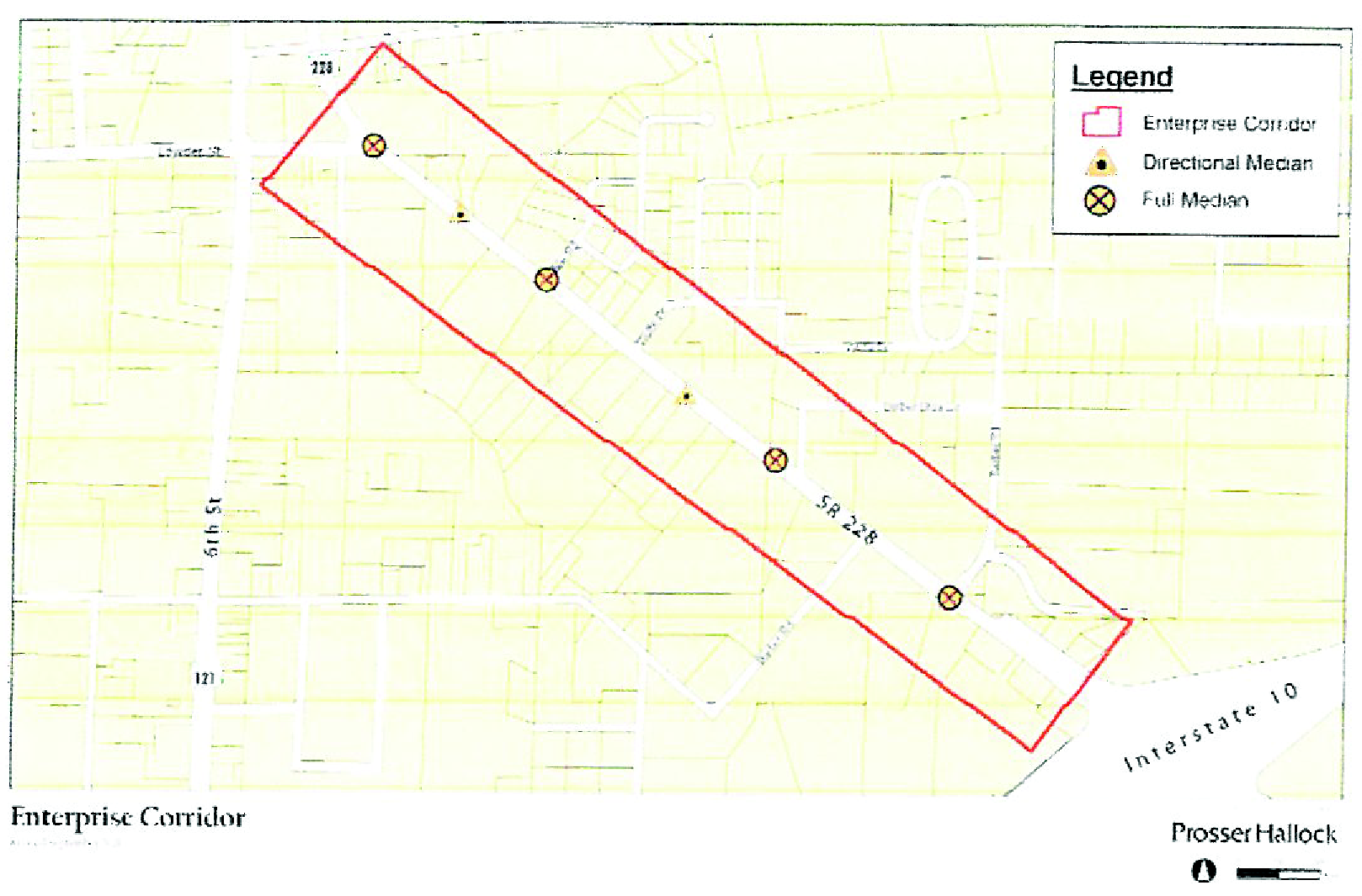
(b)
Regulations. Regulations for the EC district are as follows:
(1)
Permitted uses and structures. Those uses allowed by right are as follows:
a.
Reserved.
b.
Banks, loan companies, mortgage brokers, stockbrokers and similar financial institutions.
c.
Reserved.
d.
Reserved.
e.
Reserved.
f.
Child care centers.
g.
Churches, schools, community or club buildings, art gallery, museum, library, community center, convention center, vocational trade or business school and similar civic facilities.
h.
Commercial or retail uses, including offices and clinics.
i.
Convenience store with gas pumps to include the sale of beer and wine as defined by Florida Statutes for off-premises consumption.
j.
Hotels and motels and commonly associated facilities.
k.
Private clubs, fraternal organizations and lodge halls.
l.
Professional and business offices, employment offices, union halls and similar uses.
m.
Commercial recreational or entertainment facilities in a completely enclosed building, such as a billiard parlor, bowling alley, swimming pool, skating rink, dance hall and similar uses.
n.
Shopping centers and retail outlets including sporting goods, home furnishings and appliances, office equipment or furniture, used merchandise, hardware and similar uses.
o.
Restaurants, including drive-thrus, and commonly associated facilities.
p.
Service establishments such as home equipment rentals, barbershops and salons, tailors and dressmakers, radio and television repair, and laundry and dry cleaning.
q.
Hobby and gift shops, delicatessens and bakeries, florist shops, antique shops and similar uses.
r.
Reserved.
s.
Vocational, technical, trade or industrial schools and similar uses.
(2)
Permitted accessory uses. Residential uses may be permitted as accessory uses.
a.
Reserved.
b.
Where an accessory building is attached to a main structure by a breezeway, passage or otherwise, it shall comply with the dimensional requirements of the main building.
c.
A detached accessory building shall not be closer than ten (10) feet to the main building and not less than five (5) feet from any rear lot line and ten (10) feet from any side lot line.
d.
No detached accessory building or use shall be located in the required front yard or side yard.
e.
Reserved.
(3)
Permitted uses by special exception. Special exceptions may be granted for the following uses according to the procedures and conditions outlined in chapter 3 of this Code:
a.
Auto service stations and repair garages.
b.
Automobile and truck sales used and new.
c.
Funeral homes.
(4)
Minimum lot requirements (width and area). Ten thousand (10,000) square feet.
(5)
Building restriction area. Minimum setback requirements from the perimeter of the site are listed below for buildings up to thirty-five (35) feet in height. Buildings that exceed thirty-five (35) feet shall increase all required setbacks listed below by one (1) foot for every three (3) feet in additional building height above thirty-five (35) feet. Parcels that front public rights-of-way on two (2) sides shall be required to have two (2) front yards; however, the one not fronting State Road 288 may be reduced up to fifty (50) percent of the minimum setback listed below. Parking areas are permissible within required building restriction areas.
a.
Front: Eighty (80) feet.
b.
Side: Twenty (20) feet.
c.
Rear: Twenty-five (25) feet.
d.
All buildings must be set back a minimum of eighty (80) feet from State Road 228 to accommodate an unobstructed access easement to be created parallel to State Road 228. This access easement will minimize ingress and egress points from State Road 228 while providing for internal traffic circulation among properties within the Enterprise Corridor. The access easement shall be located within the required eighty-foot setback from State Road 228. This easement shall be twenty-four (24) feet in width and shall be separated from State Road 228 by a fifteen-foot section that may contain landscaping, common signage and shared access points to State Road 228.
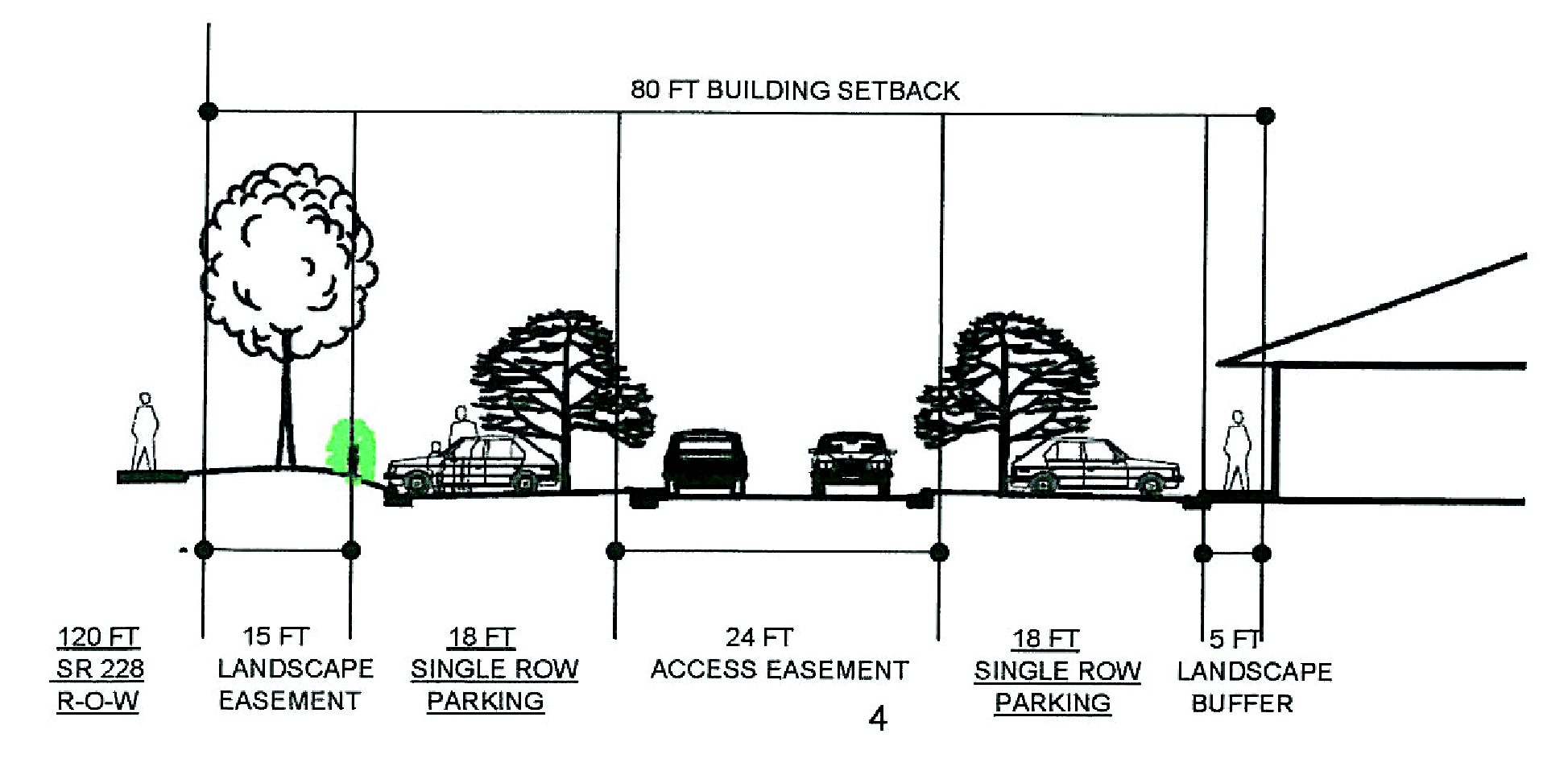
(6)
Building restrictions. Building restrictions shall be as follows:
a.
Maximum building height: Fifty (50) feet.
b.
A minimum of ten (10) percent of the total lot area shall be landscaped.
c.
A fifteen-foot landscaped easement shall be required between State Road 228 and the unobstructed access easement and parking area. This landscape easement area shall contain shrubs and Live Oaks.
d.
Live Oaks of five-inch caliber DBH shall be planted at forty (40) feet on-center at an elevation equal to one foot (1') above the adjacent crown of State Road 228.
e.
Shrubbery shall be of a type that will grow to a height of five (5) feet within the first year of planting. The shrubbery shall be planted within five (5) feet of the interior side of the landscape easement. It shall be planted and maintained to screen parked vehicles from view from the adjacent crown of State Road 228.
f.
Every seven (7) parking spaces within the eighty-foot building setback shall be landscaped with terminal islands not less than ten (10) feet wide with a planted and maintained specimen tree of not less than five-inch caliber DBH.
g.
All utilities shall be located underground within the EC zoning district.
(7)
Review and approval procedures.
a.
The applicant is required to confer with the city manager or his designee in order to review the general character of the intended plan of development, on a basis of a tentative land use sketch, if available, and to obtain information on projected programs. The plan must contain provisions that assure compatibility with adjacent uses through a unified plan of development.
b.
Access management. Development within the EC district shall employ such access management techniques as shared site access from State Road 228, cross-access easements and connectivity with adjacent parcels. The enterprise corridor shall contain no more than four (4) signalized full medians and two (2) directional medians spaced consistent with FDOT access management standards.
c.
Access corridor. All applications must identify provision for an access corridor parallel to State Road 228 that minimizes access points from State Road 228 while providing for internal traffic circulation among properties. The application must identify consistency with the access corridor requirements listed in section 4-82(b)(6)d.
d.
Interconnectivity. Connections between adjacent parcels shall be provided where feasible. Such connections shall provide for pedestrian, bicycle and motor vehicle travel within the enterprise corridor.
e.
Landscaping. At a minimum, landscaping within the EC district shall comply with the requirements of Chapter 8 of the Macclenny Unified Land Development Regulations.
f.
Signage. Temporary sign permits may be issued in conjunction with temporary FDOT access permits. Such temporary signs will be replaced with common signage at shared access points along State Road 228. Signage at these shared access points shall be monument signs. In addition to the requirements contained within Chapter 14 of the Macclenny Unified Land Development Regulations, pylon-mounted signs shall be prohibited within the EC district.
(8)
Dedication of right-of-way. To accommodate future widening of State Road 228 to a one hundred twenty-foot right-of-way, owners of EC zoned property must dedicate a ten-foot-wide tract of land along the property's entire perimeter fronting State Road 228 to the city. Dedication of this right-of-way to the city must occur at the time of issuance of any city development permits.
(Ord. No. 07-29, § 1, 9-11-07; Ord. No. 08-21, § 8, 11-18-08; Ord. No. 12-04, § 1(exh. A), 5-8-12)
Sec. 4-101. - Location of accessory buildings and uses.
(a)
Where an accessory building is attached to a main structure by a breezeway, passage or otherwise, it shall comply with the dimensional requirements of the main building.
(b)
A detached accessory building shall not be closer than ten (10) feet to the main building and not less than three (3) feet from any rear lot line and three (3) feet from any side lot line.
(c)
No detached accessory building or use shall be located in the required front yard or side yard except where the uses and location had been approved by special exception or by subdivision regulations [and] are a part of internal package system designed and intended to serve a single industrial or commercial use or complex.
(d)
Accessory structures for the housing of persons, such as guesthouses or servant quarters, shall not be located in any required yard.
(e)
Parcels five (5) acres or more without a primary structure shall be allowed to have an accessory building.
(Ord. No. 08-25, § 1, 12-9-08; Ord. No. 11-03, § 2, 3-8-11; Ord. No. 22-07, § 1, 5-10-22)
Sec. 4-102. - Swimming pools.
(a)
No swimming pool shall be located, designed, operated or maintained so as to interfere with the rights of the adjoining property owner. Lights used to illuminate any swimming pool shall be so arranged and shadowed as to reflect light away from adjoining premises. Swimming pools shall be classed as an accessory use and shall be subject to all yard requirements of accessory uses.
(b)
All swimming pools shall be completely enclosed with a fence or wall or equivalent barrier at least four (4) feet high, and so constructed as to not be readily climbable by small children. All gates and doors providing access to the pool area shall be equipped with a self-closing or self-latching device installed on the pool side for when the pool area is not in actual use, except that the door of any dwelling which forms a part of the enclosure need not be so equipped. The gate or door shall be kept securely closed at all times when the pool area is not in actual use.
(c)
No overhead electric wiring shall be permitted within twenty-five (25) feet from the water's edge unless by special permission of the city manager. The distance shall be measured horizontally from the water's edge to the point on the ground directly below such wires. All wiring shall be in strict conformance with the National Electrical Code and the local electrical code.
Sec. 4-103. - Satellite dish antenna.
All satellite dish antennas installed after the effective date of this code and satellite dish antenna lawfully installed prior to the enactment of this code that are moved or replaced shall comply with the following conditions:
(1)
The satellite dish antenna shall be considered a structure requiring a building permit to be issued prior to installation. Subsequent to installation, the antenna shall be maintained in compliance with all applicable building and electrical codes.
(2)
The satellite dish antenna installation and any part thereof shall maintain vertical and horizontal clearances from any electric lines and shall conform to the National Electrical Safety Code.
(3)
The satellite dish antenna installation shall meet all FCC (Federal Communications Commission) and manufacturer specifications, rules, and requirements.
(4)
The satellite dish antenna shall be of a nonreflective surface material and shall be made, to the maximum extent possible, to conform and blend, taking into consideration color and location, with the surrounding area and structures.
(5)
The satellite dish antenna shall contain no advertising or signage of any type.
(6)
The installer of any satellite dish antenna, prior to installation, shall submit detailed blueprints/drawings of the proposed satellite dish antenna installation and foundation which shall be certified by the manufacturer or a professional engineer.
(7)
The satellite dish antenna installation shall be permitted to be placed in side and rear areas of the main dwelling or commercial structure only.
(8)
The satellite dish antenna shall, to the maximum extent possible, be screened from view from any public right-of-ways.
(9)
A satellite dish antenna shall be considered an accessory structure to the main dwelling structure and shall not constitute the principal use of the property.
(10)
The satellite dish antenna installed pursuant to this subsection shall not be used for any commercial purposes. It shall only provide service to the main dwelling structure.
(11)
Satellite dish antenna installations shall be limited to one installation per residential lot.
(12)
The maximum size of the satellite dish antenna shall not exceed twelve (12) feet in diameter.
(13)
A satellite dish antenna shall not be permitted to be installed on the roof of any main dwelling structure.
(14)
The satellite dish antenna shall not be portable.
Sec. 4-104. - Fences, walls and hedges.
(a)
On residentially zoned property, fences, walls, or hedges may be located in all front, side and rear yard setback areas, subject to the following conditions:
(1)
Height of fences, walls, or hedges. Fences, walls, or hedges shall not exceed four (4) feet in height when placed in the front yard or six (6) feet in height when placed in the side or rear yard.
(2)
Any fence located adjacent to a public right-of-way or private road shall be placed with the finished side facing that right-of-way.
(3)
No fence, wall, or hedge shall be located in the clear visibility triangle, as provided for in chapter 8.
(4)
No fence, wall, or hedge shall be constructed or installed in such a manner as to interfere with drainage on the site.
(5)
All fences shall be of sound construction, and not distracting from the surrounding area and comply with building codes.
(6)
No barbed wire, field fence wire, sharp objects, or electrically charged fences shall be erected, provided however the building department may permit such a fence if the property is of sufficient size as to allow livestock under City of Macclenny Ordinances.
(b)
Point of reference for measurement. The point of reference for determining the height of a fence, wall, or hedge shall be the natural lay of the land along the fence, wall, or hedge.
(c)
Exception to height limitation and building materials. A fence required for safety and protection of hazard by another public agency may not be subject to height limitations above. Approval to exceed minimum height and building material standards may be given by the city manager upon receipt of satisfactory evidence of the need to exceed height standards or to deviate from prescribed building materials.
(d)
Permit required. The erection of new fences in the city shall require the issuance of a permit. The City of Macclenny Building Department shall approve such permits based upon the materials and design of the fence. The permit application must have attached a plan to show how the fence will be built and a list of materials to be used. Approval is based on the city building department approving such design, plans and materials.
(Ord. No. 00-03, § 1, 3-14-00; Ord. No. 08-03, § 1, 2-13-08)
Sec. 4-105. - Home occupations.
(a)
The operation of a home occupation shall be clearly subordinate and incidental to the residential neighborhood. A home occupation is not intended for large-scale manufacturing, shipping, storage or other commercial uses.
(b)
Home occupations are a permissible use by exception in any district which does not include such occupation as a permitted use, subject to all the following conditions:
(1)
No person other than members of the family residing on the premises shall be engaged in such occupation.
(2)
The use of the premises for such home occupation shall be clearly incidental and subordinate to its use for residential purposes and shall under no circumstances change the residential character thereof.
(3)
There shall be no change in the outside appearance of the building or premises, or other visible evidence of the conduct of such home occupation.
(4)
No traffic shall be generated by such home occupation in greater volumes than would normally be expected in a residential neighborhood.
(5)
No equipment or process shall be used in such home occupation which creates noise, vibration, glare, fumes, odors or electrical interference detectable to the normal senses off the lot. In the case of electrical interference, no equipment or process shall be used which creates visual or audible interference in any radio or television receivers off the premises, or causes fluctuations in line voltage off the premises.
(6)
The giving of art, music or other instructions or lessons shall not exceed four (4) persons at any one time.
(7)
Fabrication of articles such as are commonly classified under the terms of arts and handicraft may be deemed a home occupation, subject to other terms and conditions of this section, and providing no retail sales are made at the dwelling unit.
(8)
Outdoor storage of materials shall not be permitted.
(9)
The following shall not be considered as home occupations under any circumstance: beauty shops, barbershops, public dining facility or tearoom, antique or gift shops, photographic studio, fortunetelling or similar activity, outdoor repair, food processing, retail sales, nursery school, or kindergarten.
(10)
A home occupation shall be subject to all applicable occupational licensing requirements, fees, and other business taxes.
Sec. 4-121. - Disaster shelters.
(a)
Disaster shelters for unlimited occupancy are permitted as a principal or accessory structure in any business or industrial district.
(b)
Fallout shelters operated by a local, state or federal governmental agency may be located in any district.
(c)
Aboveground shelters intended for occupancy by not more than two (2) families are permitted in any district as an accessory structure subject to the requirements of section 4-101.
(d)
Underground shelters intended for occupancy by more than two (2) families are permitted at any location in any yard notwithstanding other provisions of this code provided the structure or its overburden does not exceed thirty (30) inches above the natural grade of the yard.
(e)
Disaster shelters intended for occupancy by more than two (2) families may be permitted as conditional uses in accordance with this section in cases where such use would not be damaging or injurious to surrounding land use.
(f)
Nothing in this article shall be construed to prohibit the multiple use of a disaster shelter with other permitted uses of the district in which it is located.
Sec. 4-122. - Day nurseries.
Day nurseries, including kindergartens and child care centers, shall be a permissible use by exception in all districts except RS-1 and RS-2, subject to all the following conditions:
(1)
Minimum lot area shall be not less than six thousand (6,000) square feet, and lot width in the portion used for fenced play area shall be not less than sixty (60) feet.
(2)
A fenced outdoor play area of not less than six hundred (600) square feet shall be provided in the area yard.
(3)
All facilities, operation and maintenance shall meet all applicable city or state regulations for such use.
(4)
An application for exception, where required, shall state the maximum number of children to be accommodated, and in no case shall the number of children approved in the grant of exception be exceeded.
(5)
Offstreet parking, loading and unloading areas shall be maintained as provided in the site plan approved with the exception or permit for such use.
Sec. 4-123. - New and secondhand car and boat sales lots.
New and secondhand car and boat sales lots shall meet the following standards:
(1)
All parking areas for display and sale shall be provided with a pavement having an asphaltic or Portland cement binder and shall be so graded and drained as to dispose of all surface water accumulation.
(2)
Turnouts shall be as required to ensure safe ingress and egress from the lots.
(3)
All structures shall meet the setback requirements of the district in which located.
(4)
Vehicles for display and sale shall maintain a ten-foot setback.
(5)
The standards as designated in subsections (1) through (4) of this section shall be applicable to any lot, existing or proposed.
(6)
Within sixty (60) days after notification, the owner or operator of an existing sales lot under this section shall comply with the regulations designated in this section.
Sec. 4-124. - Planned unit developments.
(a)
Intent. It is the intent of this section to:
(1)
Encourage the development of large tracts of land as planned neighborhoods or communities.
(2)
Encourage flexible and creative concepts of site planning.
(3)
Preserve the natural amenities of the land by encouraging scenic and functional open areas within residential areas.
(4)
Accomplish a more desirable environment than would be possible through the strict application of minimum requirements of this article.
(5)
Provide for an efficient use of land resulting in a smaller network of utilities and streets and thereby lower development and housing costs.
(6)
Provide an environment of stable character compatible with surrounding residential areas.
Within the planned unit, a variety of housing types may be permitted in an orderly relation to one another and to existing land uses, with due regard to the comprehensive planning policies of the city.
(b)
Permitted uses. The uses permitted within this district shall be primarily residential in character, and include the following:
(1)
Single-family detached dwellings.
(2)
Single-family attached dwellings.
(3)
Mobile homes, provided they meet the following criteria:
a.
The location is appropriate in relation to surrounding land uses;
b.
Adequate standards are included to ensure that the placement and design of such uses do not detract from the surrounding neighborhood; and
c.
Skirting is provided consistent with section 4-73(b)(8)d.
(4)
Townhouses.
(5)
Multifamily dwellings, including high-rise apartment buildings.
(6)
Churches, schools, community or club buildings and similar public or semipublic facilities.
(7)
Commercial or retail uses, including offices and clinics, provided that they meet the following criteria:
a.
The location is appropriate in relation to other land uses.
b.
The proposed commercial or office uses are primarily for the purpose of serving the needs of the residents of the PUD or reflect the need for commercial or office needs according to the comprehensive plan.
(c)
Requirements and standards for approval.
(1)
A parcel which is proposed for a planned unit development must contain a minimum area of five (5) contiguous acres in single ownership or control to be considered a large-scale development; a small-scale development will consist of less than five (5) acres.
(2)
The city commission shall consider the following in its review of the proposed development plan:
a.
Adherence to the planning policies of the city.
b.
The proper relation between the proposed development and surrounding uses, and the effect of the plan upon comprehensive planning for the city.
c.
The adequacy of existing and proposed streets, utilities and other public services to serve the development.
d.
The character, design and appropriateness of the proposed land uses and their adequacy to encourage desirable living conditions, to provide separation and screening between uses where desirable, and to preserve the natural amenities of the land.
e.
The adequacy of open space areas and recreation facilities included within the development.
(3)
Approval of the proposed PUD shall be accompanied by a report stating the reasons for approval of the application and specific evidence and facts showing that the proposed planned unit development will not adversely affect the property adjacent to the area included in the plan.
(4)
Final approval of the planned unit development shall not be granted until the owner or owners of the property give written notice of their consent to the proposed development.
(d)
Review and approval procedures.
(1)
Preapplication conference. Prior to filing of a formal application as a planned unit development, the applicant is required to confer with the city manager or his designee in order to review the general character of the plan, on a basis of a tentative land use sketch if available, and to obtain information on projected programs.
(2)
Development plan.
a.
An applicant shall file a petition with the city manager for the approval of a planned unit development. This application shall be supported by a development plan and a written summary of intent and shall show the relation between the proposed development and the surrounding area, both existing and proposed. This supportive material shall be submitted to the city commission for approval.
b.
The following information shall be presented:
1.
A general location map.
2.
Existing topographic conditions, including contour intervals of one (1) foot based on field surveys or photogrammetric methods.
3.
The existing and proposed land uses and the approximate location of all buildings and structures.
4.
The approximate location of existing and proposed streets and roadways.
5.
The approximate location of all existing and proposed utilities, including a preliminary utility and drainage plan.
6.
The present zoning pattern in the area.
7.
A legal description of the subject property.
8.
The location and use of existing and proposed public, semipublic or community facilities, such as schools, parks and open areas. This will include areas proposed to be dedicated or reserved for community or public uses.
9.
If a proposed development creates special problems or involves unusual circumstances, additional information may be required in order to properly evaluate the proposal as follows:
i.
An offstreet parking and loading plan.
ii.
An economic feasibility report or market analysis.
iii.
A traffic study of the area, and a circulation plan within the development and to and from existing streets and roadways.
iv.
Other information as may be required.
c.
The written statement submitted with the development plan shall include the following information:
1.
A statement of the present ownership of all land within the proposed development.
2.
An explanation of the character of the proposed development, including a summary of acres, dwelling units and other uses, and gross density by type of land use. The statement shall include minimum standards for lot size and yard and spacing requirements.
3.
A general statement of the proposed development schedule and progression of unit division or staging.
4.
Agreements, provisions and covenants which govern the use, maintenance and protection of the development of common or open areas.
d.
Approval.
1.
An application for approval of a planned unit development will be considered administratively as a petition for rezoning, and will be subject to the procedures established in chapter 3.
2.
After review and public hearing, the city commission may disapprove the plan, approve the plan or approve the plan with modification, after receiving the recommendations of the city manager.
3.
If the development plan is approved as submitted, the city clerk will cause the official zoning map to be changed to indicate the planned unit development. If the plan is approved with modifications, the applicant shall file a written notice of consent to the modification and a properly revised site plan with the city manager prior to changing the zoning map. The site plan and supporting information of any approved plan shall be properly identified and permanently filed with the city clerk.
(3)
Subdivision approval.
a.
At the option of the applicant, a preliminary subdivision plat may be filed with the development plan in order that tentative approval of the subdivision by the city commission may be granted.
b.
In no case shall subdivision approval precede approval of the development plan.
(4)
Building and occupancy permits. The building official shall issue building permits for the structures in the area covered by the approved development plan if they are in substantial conformity with the approved development plan, the development schedule and other applicable regulations.
(5)
Revision of development plan. Any major or substantial change in the approved development plan which affects the intent and character of the development, the density or land use pattern, the location or dimensions of streets or similar substantial changes shall be reviewed and approved by the city commission subsequent to receipt of the recommendation of the city manager. A request for the revision of the development plan shall be supported by a written statement of why the revisions are necessary or desirable.
(6)
Expiration of approval. Approval of the city commission shall be in effect for at least a two-year period; however, if no construction has begun within two (2) years after approval of the development plan, or if the applicant fails to maintain the approved development plan schedule, the approval of the development plan shall lapse and be of no further effect. At its discretion and for good cause, the city commission may extend for one (1) additional year the period for beginning construction. If the approval of a development plan lapses under this provision, the city commission shall take the necessary rezoning action to remove the planned unit development from the official zoning map, file a notice of revocation with the recorded development plan, and reinstate the zoning district and regulations which were in effect prior to the approval of the development plan.
(e)
Development requirements.
(1)
Relation to zoning districts. An approved planned unit development shall be considered to be a separate zoning district in which the development plan, as approved, establishes the restrictions and regulations according to which development shall occur. Upon approval, the official zoning map will be changed to indicate the area as a planned unit development.
(2)
Regulations limiting height, bulk, density and area by land use.
a.
Where the area proposed for a planned unit development abuts an existing one-family district, no structures over two (2) stories in height shall be permitted within three hundred (300) feet of the abutting one-family district.
b.
The permitted density within any planned unit development shall not exceed the maximum number of dwelling units per acre permitted by housing type in the RG district. Public streets, nonresidential use areas such as businesses and offices, and subaqueous or submerged bottomland of lakes or streams, except as provided in subsection (e)(2)c of this section, shall be excluded in computing the area of the parcel and, therefore, the related density.
c.
Subaqueous or submerged bottomland of lakes or streams shall be excluded in computing the area of a parcel, except that, where the lands abutting the lakes or streams are developed in park or open space for the use of residents of the neighborhood, the surface area of the lakes or streams may be used to compute density at a ratio of one (1) acre of submerged land to one (1) acre of park land.
d.
Height, density and floor area standards used in the planned unit development shall conform to the requirements of the district.
e.
Every attached single-family dwelling shall have access to a public street, court, walkway or other area dedicated to a public use. The location of all proposed structures shall be as shown on the development plan, subject to minimum lot size, setback lines, and lot coverage or floor area specified in the approved plan. The proposed location and arrangement of structures shall not be detrimental to existing or proposed adjacent dwellings or to development of the neighborhood.
(3)
Access. All access streets, courts and parking areas shall be designated to effectively relate with the future traffic circulation map of the comprehensive plan and goals, objectives, and policies of the traffic circulation element. Private streets are to be allowed within the planned unit development if they meet city construction standards and are of a design which meets with the approval of the city engineer.
(4)
Offstreet parking. Offstreet parking shall be provided in accordance with chapter 12 of this code.
(5)
Control of area following completion.
a.
After completion of a planned unit development, the use of land and construction, modification or alteration of any building or structure within the area covered by the plan shall be regulated by the approved development plan.
b.
No changes may be made in the approved plan except as provided below:
1.
Minor extensions, alterations or modifications of existing buildings or structures may be permitted after review and approval of the city manager or his designee, provided they are substantially consistent with purposes and intent of the development plan.
2.
Substantial change in permitted uses, location of buildings or other specifications of the development plans may be permitted following public hearing and approval by the city commission upon receipt of the recommendations of the city manager.
(Ord. No. 00-08, § 1, 8-8-00; Ord. No. 09-06, § 1, 5-12-09)
Sec. 4-125. - Group housing projects.
Plans for proposed group housing projects containing two (2) or more buildings which are located on a parcel of land not subdivided into the customary streets and lots, or which contain a building not oriented so that the main entrances directly face a street, shall be presented to the city manager for review. The city manager shall make certain the proposed development meets the following requirements:
(1)
The proposed development shall be compatible with the requirements and intent of the subdivision regulations relative to access, drainage, utilities and major streets.
(2)
Sidewalks not less than four (4) feet wide are required in the project area leading from all front and rear doors to streets.
(3)
Offstreet parking spaces shall be provided in accordance with chapter 12 of this code.
(4)
The density controls of the district in which the development is located shall apply.
Sec. 4-126. - Townhouses.
All townhouse developments shall make efficient, economical, comfortable and convenient use of land and open space and serve the public purpose of zoning by means of alternative to conventional arrangements of yards and buildable areas. All townhouse developments shall meet the following requirements:
(1)
Yard requirements for townhouse developments shall be the same as required in the RG district.
(2)
Each townhouse shall have its own lot area, with one yard private and reasonably secluded from the view of streets or neighboring property.
(3)
Each townhouse shall have a direct automotive access from the offstreet parking space to a public street. No portion of a group of contiguous townhouses shall be closer than twenty (20) feet to any portion of a townhouse in another group.
Sec. 4-127. - Utility plants and substations.
Water, sewage, electric, gas or other utility plants and substations are permitted in any zone as a conditional use after a public hearing and after it has been determined that the proposed use is consistent with the long range development plan of the city.
Sec. 4-128. - Service stations.
(a)
Permissible activities. The following services may be rendered and sales made, and no other:
(1)
Sales and servicing of sparkplugs, batteries and distributors and distributor parts.
(2)
Tire servicing and repair, but not recapping or regrooving; with all tires and wheels stored within an enclosed structure.
(3)
Replacement of water hoses, fan belts, brake fluid, lightbulbs, fuses, floor mats, seat covers, windshield wipers and wiper blades, grease retainers, wheel bearings, mirrors and the like.
(4)
Radiator cleaning and flushing; provision of water, antifreeze and the like.
(5)
Washing and polishing and sale of automotive washing and polishing materials.
(6)
Providing and repairing fuel pumps and lines.
(7)
Minor servicing and repair of carburetors.
(8)
Emergency wiring repairs.
(9)
Adjusting and emergency repair of brakes.
(10)
Minor motor adjustments not involving removal of the head or crankcase.
(11)
Greasing and lubrication.
(12)
Sales of cold drinks, package goods, tobacco and similar convenience goods for service station customers, but only as accessory and incidental to the principal business operation.
(13)
Provision of road maps and other informational material to customers; provision of restroom facilities.
(14)
Rental of luggage or utility trailers or trucks but not rental of automobiles.
(b)
All such allowed serving shall be done in an enclosed building; however, minor adjustments and replacements of minor parts, e.g., replacing a windshield wiper blade, shall be permitted while a vehicle is being serviced at a pump island.
(c)
Uses permissible at a service station do not include major mechanical and body work, straightening of frames or body parts, steam cleaning, painting, welding, storage of automobiles not in operating condition, operation of a commercial parking lot or commercial garage as an accessory use, or other work involving undue noise, glare, fumes, smoke or other characteristics to an extent greater than normally found in service stations.
Sec. 4-129. - Sexually oriented businesses—Rationale and findings.
(a)
Purpose. It is the purpose of this section and section 4-129.5 to regulate sexually oriented businesses in order to promote the health, safety, and general welfare of the citizens of the city, and to establish reasonable and uniform regulations to prevent the deleterious secondary effects of sexually oriented businesses within the city. The provisions of this section and section 4-129.5 have neither the purpose nor effect of imposing a limitation or restriction on the content or reasonable access to any communicative materials, including sexually oriented materials. Similarly, it is neither the purpose nor effect of this section 4-129 and section 4-129.5 to restrict or deny access by adults to sexually oriented materials protected by the First Amendment, or to deny access by the distributors and exhibitors of sexually oriented entertainment to their intended market. Neither is it the purpose nor effect of section and section 4-129.5 to condone or legitimize the distribution of obscene material.
(b)
Findings and rationale. Based on evidence of the adverse secondary effects of adult uses presented in hearings and in reports made available to the city commission, and on findings, interpretations, and narrowing constructions incorporated in numerous cases, including, but not limited to: City of Littleton v. Z.I. Gifts D-4, L.L.C., 541 U.S. 774 (2004); City of Los Angeles v. Alameda Books, Inc., 535 U.S. 425 (2002); City of Eric v. Pap's A.M., 529 U.S. 277 (2000); City of Renton v. Playtime Theatres, Inc., 475 U.S. 41 (1986); Young v. American Mini Theatres, 427 U.S. 50 (1976); Barnes v. Glen Theatre, Inc., 501 U.S. 560 (1991); FW/PBS, Inc. v. City of Dallas, 493 U.S. 215 (1990); California v. LuRue, 409 U.S. 109 (1972); as well as in the cases of Artistic Entertainment, Inc. v. City of Warner Robins, 223 F.3d 1306 (11th Cir. 2000); Peek-A-Boo Lounge of Bradenton, Inc. v. Manatce County, 337 F.3d 1251 (11th Cir. 2003); Daytona Grand, Inc. v. City of Davtona Beach, 490 F.3d 860 (11th Cir. 2007); Gary v. City of Warner Robins, 311 F.3d 1334 (11th Cir. 2002); Wise Enters. v. Unified Gov't of Athens-Clarke County, 217 F.3d 1360 (11th Cir. 2000); BZAPs, Inc. v. City of Mankato, 268 F.3d 603 (8th Cir. 2001); Ward v. County of Orange, 217 F.3d 1350 (11th Cir. 2000); Boss Capital, Inc. v. City of Casselberry, 137 F.3d 1251 (11th Cir. 1999); David Vincent, Inc. v. Broward County, 200 F.3d 1325 (11th Cir. 2000); Sammy's of Mobile, Ltd. v. City of Mobile, 140 F.3d 993 (11th Cir. 1998); Lady J. Lingerie, Inc. v. City of Jacksonville, 176 F.3d 1358 (11th Cir. 1999); Lady l. Lingerie, Inc. v. City of Jacksonville, 973 F. Supp. 1428 (M.D. Fla. 1997); Grand Faloon Tavern, Inc. v. Wicker, 670 F.2d 943 (11th Cir. 1982); Board of County Commissioners v. Dexterhouse, 348 So. 2d 916 (Ct. App. Fla. 1977); International Food & Beverage Systems v. Ft. Lauderdale, 794 F.2d 1520 (11th Cir. 1986); Gamomoh v. City of La Habra, 395 F.3d 1114 (9th Cir. 2005); World Wide Video of Washington, Inc., v. City of Spokane, 368 F.3d 1186 (9th Cir. 2004); Ben's Bar, Inc. v. Village of Samerset, 316 F.3d 702 (7th Cir. 2003); Williams v. Margan, 478 F.3d 1316 (11th Cir. 2007); H&A Land Corp. v. City of Kennedale, 480 F.3d 336, (5th Cir. 2007); and other cases; and based upon reports concerning secondary effects occurring in and around sexually oriented businesses, including, but not limited to; Regulation of Sexually Oriented Businesses. A Report and Evaluation for Plant City, Florida; Austin, Texas - 1986; Indianapolis, Indiana - 1984; Garden Grove, California - 1991; Houston, Texas - 1983, 1997; Phoenix, Arizona - 1979, 1995-98; Chattanooga, Tennessee - 1999-2003; Los Angeles, California - 1977; Whittier, California - 1978; Spokane, Washington - 2001; St. Cloud, Minnesota - 1994; Littleton, Colorado - 2004; Oklahoma City, Oklahoma - 1986; Dallas, Texas - 1997, 2004; Centralia, Washington - 2004; Greensboro, North Carolina - 2003; Amarillo, Texas - 1977; New York, New York Times Square - 1994; and also on findings of physical abuse from the papers entitled "Stripclubs According to Strippers: Exposing Workplace Sexual Violence," by Kelly Holsopple, Program Director, Freedom and Justice Center for Prostitution Resources, Minneapolis, Minnesota; Expert Report of Richard McCleary, Ph.D., Dec. 18, 2004; Affidavits of Tom McCarren; "Sexually Oriented Businesses: An Insider's View," by David Sherman, presented to the Michigan House Committee on Ethics and Constitutional Law, Jan. 12, 2000; and the Report of the Attorney General's Working Group On The Regulation Of Sexually Oriented Businesses, (June 6, 1989, State of Minnesota), the city commission finds:
(1)
Sexually oriented businesses, as a category of commercial uses, are associated with a wide variety of adverse secondary effects including, but not limited to, personal and property crimes, public safety risks, prostitution, potential spread of disease, lewdness, public indecency, illicit sexual activity, illicit drug use and drug trafficking, undesirable and criminal behavior associated with alcohol consumption, negative impacts on surrounding properties, litter, and sexual assault and exploitation.
(2)
Sexually oriented businesses should be separated from sensitive land uses to minimize the impact of their secondary effects upon such uses, and should be separated from other sexually oriented businesses, to minimize the secondary effects associated with such uses and to prevent an unnecessary concentration of sexually oriented businesses in one (1) area.
(3)
Each of the foregoing negative secondary effects constitutes a harm which the city has a substantial government interest in preventing and/or abating. This substantial government interest in preventing secondary effects, which is the city's rationale for this section and section 4-129.5, exists independent of any comparative analysis between sexually oriented and nonsexually oriented businesses. Additionally, the city's interest in regulating sexually oriented businesses extends to preventing future secondary effects that could occur in the city related to current sexually oriented businesses as well as sexually oriented businesses that may locate in the city in the future. The city finds that the cases and secondary effects documentation relied on in this section and section 4-129.5 are reasonably believed to be relevant to said secondary effects.
(Ord. No. 08-16, § 3, 11-18-08)
Cross reference— Nudity in bars, § 4-31 et seq.; licensing of adult entertainment establishments, § 13-121 et seq.
Sec. 4-129.5. - Sexually oriented businesses—Locational criteria.
(a)
It shall be unlawful to locate any sexually oriented business within (500) feet of any area in the city zoned within the zoning districts designated as RS-1, RS-2, RG, RMH, and CN, or where residential uses are designated in a CG zoning district or within five hundred (500) feet of any parcel of land occupied by a school, church, park, library, public recreation area, child care center or day nursery, regardless of whether or not such school, church, park, library, public recreation area, child care center, or day nursery is located within the city limits of Macclenny.
(b)
It shall be unlawful to locate any sexually oriented business within the Commercial Central Business District as designated on the future land use map of the city's comprehensive plan.
(c)
It shall be unlawful to locate any sexually oriented business within one thousand feet (1,000) feet of any other sexually oriented business as defined herein; this restriction shall require such a separation from a sexually oriented business regardless of whether or not it is located within the city limits of Macclenny and regardless of whether or not such use is regulated by the other governmental jurisdiction as an adult use.
(d)
It shall be unlawful to locate any sexually oriented business within one thousand (1,000) feet of any establishment where alcoholic beverages are offered for consumption on the premises, unless such establishment is a bona fide restaurant, regardless of whether or not such alcoholic beverage establishment is located within the city limits.
(e)
No legally established and permitted sexually oriented business shall become nonconforming through subsequent establishment of a school, church, park, library, public recreation area, child care center, or day nursery, nor shall a license to operate a sexually oriented business be denied based on the issuance of a land use permit for one of said uses if the application for such permit was filed after the filing of the application for the license to operate the sexually oriented business.
(g)
Where this section requires that one use be separated from another use, measurements shall be made in accordance with this subsection. For a use which is the only use or the principal use of a lot or parcel, the measurement shall be made from the property line of the lot or parcel which is nearest to the use to which the measurement is being made. If the use is located in a multi-tenant building, then the distance shall be measured from the line of the leasehold or other space actually controlled or occupied by such use which is nearest to the use to which the measurement is being made. Measurements under this section shall be made along the shortest distance between property lines, without regard to the route of normal travel.
(Ord. No. 08-16, § 3, 11-18-08)
Sec. 4-130. - Yards requirements.
(a)
Projecting architectural features. The space in any required yard shall be open and unobstructed except for the ordinary projections of windowsills, belt courses, cornices, eaves and other architectural features, provided that such features shall not project more than four (4) feet into any required yard.
(b)
Porches. Any porch or carport having a roof shall be considered a part of the building for the determination of the size of the yard or lot coverage.
(c)
Terraces. A paved terrace shall not be considered in the determination of yard sizes or lot coverage provided that such terrace is unroofed and without walls or parapets or other forms of enclosure. Such terrace, however, may have an open guard railing not over three (3) feet high and shall not project into any yard to a point closer than two (2) feet from all front property lines.
(d)
Front yards. Front yards required in business districts may contain pump islands of service stations provided such pump islands are a minimum of twenty (20) feet from all front property lines.
(e)
Rear yards. Rear yards may contain accessory buildings provided such buildings comply with this article.
(f)
Corner lots. Corner lots in residential districts have two (2) front yards. Houses whose fronts are oriented parallel to a street shall contain the required front yard on such street. The front yard on the remaining street may be ten (10) feet less than the normal front yard required provided it is not less than fifteen (15) feet to the nearest point of the property line. Both yard frontage on each street in residential zones are as follows:
RS-1 Front Yard: Thirty (30) feet.
RS-2 Front Yard: Twenty-five (25) feet.
(g)
[Projection of structure beyond building line.] Where lots in residential districts comprising forty (40) percent or more of the frontage on one side of a street in any one block are developed with structures having an average front yard with a variation of not more than six (6) feet, no building thereafter erected, shall project beyond the average line so established.
(h)
[Utility poles.] Utility poles as required by public utility companies shall not be required to meet the setback requirements for structures.
(Ord. No. 00-16, § 1, 10-10-00)
Sec. 4-131. - Measurement of minimum yards.
(a)
Front yard. Depth of a required front yard shall be measured at right angles to a straight line joining the foremost points of the side lot lines. The foremost point of the side lot line, in the case of rounded property corners at street intersections, shall be assumed to be the point at which the side and front lot lines would have met without such rounding.
(b)
Side yard. Width of a required side yard shall be measured in such a manner that the yard established is a strip of the minimum width required by district regulations with its inner edge parallel with the side lot line.
Sec. 4-132. - Multiple use of required yards prohibited.
No part of a required yard or other open space provided in connection with one structure or use shall be used to meet the requirements for another structure or use.
Sec. 4-133. - Exceptions to height requirements; obstruction marking and lighting.
(a)
The height limitations of this article shall not apply to church spires, barns, silos, monuments, missiles, flagpoles, antennas, penthouses and domes not used for human occupancy, nor to chimneys, water tanks and necessary mechanical appurtenances usually carried above the roof level. Such features, however, shall be erected only to such height as is necessary to accomplish the purpose they are to serve and shall not exceed in cross sectional area twenty (20) percent of the ground floor area of the building.
(b)
All obstructions as defined by the civil aeronautics board publication Obstruction Marking and Lighting shall be marked and lighted as specified by the publication, at the owner's expense.
Sec. 4-134. - Corner visibility.
On a corner lot in any residence district, no fence, wall, hedge, structure or planting or other obstruction to vision between the height of two and one-half (2½) feet and fifteen (15) feet above street level shall be erected, placed or maintained within the triangular area formed by the intersecting street lines and a straight line joining the street lines at points which are thirty (30) feet distant from the point of intersection measured along the street lines.
Sec. 4-135. - Buffer areas adjacent to residential districts.
Buffers shall be provided where nonresidential uses abut residential property or where multifamily uses abut single-family property as provided for in chapter 8.
Sec. 4-136. - Curb breaks.
The number of curb breaks for all commercial and industrial uses shall not exceed one for each one hundred (100) feet of street frontage or fraction thereof, each having a maximum width of not more than thirty (30) feet.
Sec. 4-137. - Communication antennas and communication towers.
(a)
Legislative findings, intent and purpose. The city has on numerous occasions and with increasing frequency been confronted with requests to site communication towers. Prior to the adoption of this section, the zoning code contained limited provisions specifically related to siting communication towers. It is the intent of this section to promote the health, safety and general welfare of the citizens by regulating the siting of communications tower. Accordingly, the city council finds that the promulgation of this section is warranted and necessary to accomplish the following purposes:
(1)
To direct the location of communication towers within the city;
(2)
To protect residential areas and land uses from potential adverse impacts of communication towers;
(3)
To minimize adverse visual and aesthetic impacts of communication tower through careful design, siting, landscape, screening, and innovative aesthetic mitigation;
(4)
To accommodate the growing need for communication towers;
(5)
To promote and encourage shared use/co-location of existing and new communication towers as the preferred option rather than construction of additional single-use towers;
(6)
To consider the public health and safety of communication towers;
(7)
To avoid or minimize potential damage to adjacent properties, from the perspective of public safety, from tower failure through engineering and careful siting of tower structures.
(b)
Definitions. For purposes of this section, definitions provided for herein shall apply, and the following words and terms are defined as follows:
Communication antenna means an antenna, appurtenant to a structure, designed to transmit and/or receive communications authorized by the Federal Communications Commission (FCC).
Communication tower means a principal structure which is principally intended to support communication equipment for telephone, radio and similar communication purposes. The term "communication tower" shall not include towers utilized by amateur radio operators licensed by the Federal Communications Commission (FCC). Communication towers are generally described as either monopole (free standing), lattice (self-supporting), or guyed (anchored with guy wires or cables).
Tower site means a parcel of land smaller than the minimum lot size required in the zoning district completely contained within a lot meeting the requirements of the zoning district for the purposes of locating a communication tower.
(c)
Applicability; exemption for government-owned property use of existing structures.
(1)
All new communication towers in the city shall be subject to these zoning regulations and all other applicable building and construction codes. In the event of any conflict between the zoning district regulations and the regulations contained in this section, the provisions of this section shall override and supersede such other regulations unless otherwise specifically set forth herein.
(2)
The provisions of this section, other than the minimum distance requirements from residential districts, shall not apply to communication towers and communication antennas located on property, rights-of-way or easements owned by any governmental entity.
(3)
All communication towers existing as of the effective date of this section shall be allowed to continue to be used as they presently exist. Routine maintenance (including its replacement with a new tower of like construction and height and modifications to accommodate the co-location of an additional user or users) shall be permitted on such existing towers. New construction, other than routine maintenance and modifications to accommodate co-location on an existing communication tower, shall comply with the requirements of this section.
(4)
For purposes of this section, a communication tower that has received final approval in the form of either an exception or building permit, but has not yet been constructed, shall be considered an existing tower so long as such approval is valid and unexpired.
(5)
No rezoning, zoning exception or variance shall be required to locate a communication antenna on an existing structure, provided however, that the communication antenna does not extend more than thirty (30) feet above the existing structure. Such structures may include, but are not limited to, buildings, water towers, existing communication towers, recreational light fixtures and other essential public utility structures.
(d)
Location on lot. A communication tower may be located on a lot utilized for other principal uses on a parcel smaller than the minimum lot size required in the zoning district. This parcel shall be considered as the "tower site". The tower site, but not the entire lot, shall be subject to all of the requirements of this section, except as specifically provided herein.
(e)
Minimum distance of communication towers from residential zoning districts.
(1)
Regardless of the zoning district in which the communication tower is located, the minimum distance of the tower shall not be less than two hundred (200) feet from the nearest residential lot line of any Residential General (RG) use category, and not less than two hundred fifty (250) from the nearest lot line of any single-family (RS-1 RS-2) or residential mobile home (RMH) zoning district.
(2)
Minimum distances shall be measured from the center of the base of the communication tower to the lot line of the applicable residential zoning district.
(f)
Maximum height.
(1)
The maximum height of communication towers shall be in all zoning districts two hundred twenty-five (225) feet.
(2)
Measurement of communication tower height shall include antenna, base pad, and other appurtenances and shall be measured from the finished grade of the tower site.
(g)
Minimum yard requirements. There are no minimum yard requirements for communication towers, except as provided in the land use, zoning, and land use regulations ordinances.
(h)
Illumination.
(1)
Communication towers shall not be artificially lighted except to assure human safety or as required by the Federal Aviation Administration (FAA).
(2)
Light for communication towers is required when the towers are tall enough to be under FAA regulation. "When lighting is required and is permitted by the FAA or other federal or state authority, it shall be oriented inward so as not to project onto surrounding residential property."
(i)
Finished color. Communication towers not requiring FAA painting/marking shall have either a galvanized finish or painted a dull blue, gray, or black finish.
(j)
Structural design. Communication towers shall be designed and constructed to ensure that the structural failure or collapse of the tower will not create a safety hazard, according to the EIT/TIA 222-F Standards, to adjoining properties. Communication towers shall be constructed to the EIA/TIA 222-F Standards, as published by the Electronic Industries Association, which may be amended from time to time, and all applicable city building codes. Further, any improvements and/or additions (i.e. antenna satellite dishes, etc.) to existing communication towers shall require submission of site plans sealed and verified by a professional engineer which demonstrate compliance with the EIT/TIA 222-F Standards in effect at the time of said improvement or addition. Said plans shall be submitted to and reviewed and approved by the building official at the time building permits are requested.
(k)
Fencing. A minimum six-foot fence, other than chain link, with not less than eighty-five (85) percent opacity shall be required around all communication towers located in commercial districts provided however in industrial districts, the fence may be any type of security fence. Access to the tower shall be through a locked gate.
(l)
No advertising. Neither the communication tower nor the tower site shall be used for advertising purposes and shall not contain any signs for the purpose of advertising.
(m)
Landscaping. The visual impacts of residentially or commercially located communication towers shall be mitigated through landscaping or other screening materials at the base of the tower and ancillary structures.
(1)
Landscaping shall be in compliance with the landscaping code of the city.
(2)
The use of existing vegetation shall be preserved to the maximum extent practicable and may be credited as appropriate toward meeting landscaping requirements.
(3)
These standards may be waived by the building official for those sides of the proposed tower that are located adjacent to undevelopable lands and lands not in public view.
(n)
Nonconforming communication towers. To the extent set forth herein, the restrictions on nonconforming uses and structures contained in this section are modified and supplemented by this section. Bona fide nonconforming communication towers or antennas that are damaged or destroyed may be rebuilt and all such towers or antennas may be modified or replaced without meeting the minimum distance requirements specified in subsection 4-137(o). The type, height, and location of the tower on-site shall be of the same type and intensity as the original facility approval. Building permits to rebuild the tower shall comply with the applicable city codes and shall be obtained within one hundred eighty (180) days from the date the tower is damaged or destroyed. If no permit is obtained or if said permit expires, the communication tower shall be deemed abandoned as specified in subsection 4-137(o).
(o)
Abandonment. In the event the use of any communication tower has been discontinued for a period of one hundred eighty (180) consecutive days, the tower shall be deemed to be abandoned. Determination of the date of abandonment shall be made by the building official, based upon documentation and/or affidavits from the communication tower owner/operator regarding the issue of tower usage. Upon the building official's determination of such abandonment, the owner/operator of the tower shall have an additional one hundred eighty-five (185) days within which to: (i) reactivate the use of the tower or transfer the tower to another owner/operator who makes the actual use of the tower, or (ii) dismantle and remove the tower. At the earlier of one hundred eighty-five (185) days from the date of abandonment without reactivation or upon completion of dismantling and removal, any exception and/or variance approval for the tower shall automatically expire.
(p)
Certification of compliance with Federal Communication Commission (FCC) NIER Standards. Prior to receiving final inspection, adequate proof shall be submitted to the building official documentation that the communication tower complies with all current FCC regulations for non-ionizing electromagnetic radiation (NIER) and that the radio frequency levels meet the American National Standards Institute (ANSI) C95 guidelines for public safety.
(q)
Supplemental information required for application for zoning exceptions and variances.The following information shall be included with all application for zoning exceptions and variances. The applicant may use any combination of site plans, surveys, maps, technical reports or written narratives necessary to convey the following information:
(1)
A site plan sealed by a Florida licensed engineer, clearly indicating the tower site, type and height of the proposed tower, the location of the accessory building, on-site land uses and zoning, adjacent land uses and zoning, adjacent roadways, proposed means of access, distances from property lines, elevation drawings of the proposed tower, and any other proposed structures.
(2)
A current zoning or tax map or aerial, as maintained by the Baker County property appraisers office, showing the location of the proposed tower;
(3)
A legal description of the parent tract and tower site (if applicable);
(4)
If the proposed tower site meets the required minimum distance from residentially-zoned lands, approximate distance between the proposed tower and the nearest residential dwelling, platted residentially zoned properties. If the proposed tower site does not meet the minimum distance requirements, then exact distances, locations and identifications of said properties shall be shown on an updated zoning or tax map;
(5)
The method of fencing, finished color and, if applicable, the method of aesthetic mitigation and illumination;
(6)
If the applicant is not co-locating (sharing space) on the proposed communication tower of another communication provider, evidence that it has made diligent but unsuccessful effort to co-locate its antenna and associated equipment on an existing structure;
(7)
Evidence that the applicant has made diligent but unsuccessful efforts to locate the proposed communication tower on suitable government-owned property;
(8)
The written consent by the applicant that any such exception or variance shall be conditioned upon requiring the applicant to (1) construct the proposed communication tower so as to provide sufficient excess capacity over the initial loading and (2) permit at least one (1) other comparable communication provider to use the proposed tower where feasible and subject to reasonable terms. The term "where feasible" as it applies to co-location, means that utilization by existing users, would not unduly burden the tower structurally, and would not otherwise materially and adversely impact existing users. Reasonable terms for use of a communication tower that may be imposed by the owner include a requirement for reasonable rent or fees, taking into consideration the capitalized cost of the communication tower and land, the incremental cost of designing and constructing the tower so as to accommodate additional users, increases in maintenance expenses relating to the tower and a fair return on investment, provided such amount is also consistent with rates paid by other co-locators at comparable tower sites; and
(9)
With respect to variances only, certification by a Florida licensed engineer that the proposed communication tower is reasonably necessary to serve an adjacent or nearby residential are or areas.
(r)
Supplemental exception standards and criteria for communication towers. In addition to meeting the requirements set forth in the zoning code, the following supplemental standards and criteria shall also apply to all applications for exceptions for communication towers:
(1)
The communication tower will be compatible with the existing contiguous uses or zoning and compatible with the general character and aesthetics of the neighborhood or the area, considering the design and height of the communication tower, the mitigating effect of any existing or proposed landscaping, fencing, or other structures in the area, the proximity of the communications tower to existing or proposed buildings or structures, and similar factors;
(2)
The communication tower will not have significant detrimental impact on adjacent property values.
(Ord. No. 97-01, §§ 1—18, 11-11-97)

