
Manor City Zoning Code
ARTICLE 14
02 - ZONING DISTRICTS AND REGULATIONS
Sec. 14.02.001 - General requirements and limitations.
(a)
Conformity to zoning district required. No building shall be erected and no existing buildings shall be moved, structurally altered, added to or enlarged, nor shall any land, building or premises be used, or designated for use for any purpose or in any manner other than provided for hereinafter in the district in which the building, land or premises is located; provided, however, that necessary structural repairs may be made where health and safety are endangered. Furthermore, no open space surrounding any building shall be encroached upon by a structure or reduced in any manner, unless the same shall conform to the regulations hereinafter designated for the district in which such building or open space is located.
(b)
Signs and billboards. No sign or billboard shall be erected, moved, altered, added to, enlarged, painted, or modified unless it shall conform to the provisions of this chapter and all applicable city ordinances governing the placement, location, permitting, construction and maintenance of signs. Except as otherwise expressly authorized by ordinance, all off-premises signs and billboards are expressly prohibited.
(c)
Structures and buildings. No building, structure or accessory structure shall be erected, converted or enlarged, nor shall any such existing building or structure be structurally altered or rebuilt, nor shall any open space surrounding any building be encroached upon or reduced in any manner, unless the same shall be done and completed in a manner to comply with all applicable city codes and ordinances, and such work and structure shall:
(1)
Conform to the setback, building site area, building location and land use regulations hereinafter designated for the district in which such building or open space is located.
(2)
Not exceed the height limit herein established for the district in which such building is located, except as specifically authorized as follows:
(A)
The height limits prescribed herein shall not apply to church spires, belfries, monuments, tanks, water and fire towers, stage towers, scenery lofts, cooling towers, ornamental towers and spires, chimneys, elevator bulkheads, smokestacks, necessary public or private utilities, conveyors, and necessary mechanical appurtenances. The height limits and other applicable regulations for television, radio and communications towers and antennas may be established by separate ordinance.
(d)
Accessory structures and uses. Accessory structures designed, constructed and located for a use permitted in the district, in compliance with this chapter and all other applicable city ordinances, are permitted in each zoning district.
(e)
Conformity to construction plan requirements. No structure or building shall be erected, converted, enlarged, reconstructed or structurally altered unless construction plans meeting the requirements of this chapter have been approved by the city engineer and/or city building official.
(f)
Conformity to parking and loading space requirements. No structure or building shall be erected, converted, enlarged, reconstructed or structurally altered unless it shall conform to the off-street parking and loading requirements of all applicable ordinances.
(g)
Conformity to landscaping and screening requirements. No building or structure shall be erected, converted, enlarged, reconstructed, or structurally altered unless it shall conform to the landscaping and screening requirements of all applicable ordinances.
(h)
Conformity to building setback requirements. No yard or other open space provided around any structure or building for the purpose of complying with provisions of this section shall be considered as providing a yard or open space for a building on any other lot.
(i)
Outdoor lighting. All outdoor lighting shall be installed and maintained in compliance with all applicable city ordinances. Such lighting shall be located and maintained in a manner as to not be directed onto any public street or adjacent property; provided that such lighting may be directed directly down upon a public street as provided for streetlights.
(1)
Multifamily and business. Outdoor lighting for multifamily, general retail, commercial, office, institutional, and industrial uses will be in accordance with the provisions of all applicable ordinances and the city building codes. A lighting plan shall be included with the site plan submitted for a building permit.
(2)
Residential. Outdoor lighting on residential property will be installed in accordance with applicable city ordinances. It will be located so as not to be directed directly upon adjoining property or create a nuisance for adjoining property owners. Lighting used for security purposes, which will be operated during night hours will be located as close as is practicable to main dwellings.
(j)
Height and placement requirements. Except as otherwise specifically provided in this chapter, no building shall be erected or maintained within the required building setbacks set forth herein, or which exceeds the height limits specified in this chapter.
(k)
Lot coverage. The maximum percentage of lot area which may hereafter be covered by the main building(s) and all accessory buildings shall not exceed that set forth in this chapter. Open off-street parking and loading areas shall not be considered as lot coverage under this subsection.
(l)
Uses noncumulative. Uses within each district are restricted solely to those uses expressly permitted in each district and are not cumulative unless so stated.
(m)
Mandated exceptions. To the extent required by state or federal law, a personal care facility is an additional permitted use in any zoning district; provided that homes and residential units not designated and constructed in compliance with the ordinance and code requirements applicable to multiple-occupancy residential buildings and nursing homes, shall meet the following requirements:
(1)
The structure shall comply with provisions of the fire code, electrical code and building code that are applicable to nursing homes;
(2)
There shall be two parking spaces, plus one additional space for each three residents;
(3)
There shall be not less than 50 square feet of living space within a sleeping room for each occupant assigned to such room;
(4)
There shall be not less than 175 square feet of living area in the structure for each occupant/resident of the structure, and attendant on duty;
(5)
The structure and operations shall comply with the standards established by the Texas Department of Human Services, or successor agency, as licensing standards for personal care facilities for a type B facility. The home must meet all applicable state licensing requirements;
(6)
A personal care facility must have at least one paid staff member on duty 24 hours per day, and one supervisor for each six residents during waking hours; and
(7)
A personal care facility may not have more than 15 residents.
(Ord. No. 565, § 2, 2-19-2020)
Sec. 14.02.002 - Zoning of annexed areas.
Interim zoning district. All territory hereafter annexed to the city shall be automatically classified as agricultural district "A", pending subsequent action by the commission and council for permanent zoning; provided that upon application, by either the city or the property owner of the land being annexed, for zoning other than agricultural, notice may be given and hearings held in compliance with Chapter 211 of the Texas Local Government Code and, upon annexation, such property may be permanently zoned as determined by the city council after considering the commission's recommendation.
(Ord. No. 565, § 2, 2-19-2020)
Sec. 14.02.003 - Establishment of zoning districts.
(a)
The city is hereby divided into 22 zoning districts. The use, height, and area regulations as set out herein shall be uniform in each district. The districts established shall be known as:
Zoning Districts
(b)
Zoning map. The location and boundaries of the districts herein established are shown upon the zoning map, which is hereby incorporated and made a part of this chapter; provided that such uses as listed but not shown on the zoning map are provided for future growth and use upon amendment of the comprehensive plan. The city building official maintains the zoning map together with all notations, references and other information shown thereon and all amendments thereto.
(c)
District boundaries. Where uncertainty exists with respect to the boundaries of the established districts as shown on the zoning map, the following rules shall apply:
(1)
Where district boundaries are indicated as approximately following the centerlines of streets or highways, street lines or highway right-of-way lines shall be construed to be said boundaries.
(2)
Where district boundaries are so indicated that they approximately follow the lot lines, such lot lines shall be construed to be said boundaries.
(3)
Where district boundaries are so indicated that they are approximately parallel to the centerlines or street lines of streets, or the centerlines of right-of-way lines of highways such district boundaries shall be construed as being parallel thereto and at such distance therefrom as indicated on the zoning map. If no distance is given, such dimension shall be determined using the scale on said zoning map.
(4)
In subdivided property, the district boundary lines on the zoning map shall be determined by use of the scale appearing on the map.
(5)
If a district boundary line divides a property into two parts, the district boundary line shall be construed to be the property line nearest the district line as shown.
(6)
Whenever any street, alley or other public way is vacated by the city council, the zoning district shall be automatically extended to the center of such vacation and all area included in the vacation shall then and henceforth be subject to all regulations of the districts as extended.
(7)
Where the streets on the ground differ from the streets shown on the zoning map, those on the ground shall control.
(Ord. No. 565, § 2, 2-19-2020)
Sec. 14.02.004 - Residential zoning districts.
(a)
Residential districts defined.
(Ord. No. 565, § 2, 2-19-2020)
Sec. 14.02.005 - Residential land use table.
(a)
Land uses identified in Tables (b) and (c) with the following designations shall be interpreted according to the provisions herein. If there is no designation found for a particular use in a specific zoning district, that use is not allowed within that zoning district. In the event that a use is not listed or classification is otherwise required, the development services director shall classify the use.
(1)
Permitted uses: Uses noted with a "P" are permitted by right within the given district, provided that all other requirements applicable to the use within each section are met.
(2)
Uses permitted with conditions: Uses noted with a "C" are permitted by right within the given district provided that specific conditions are met. Specific conditions applicable to these certain uses are provided in section 14.02.006 of this division.
(3)
Uses requiring a specific use permit: Uses noted with an "S" require consideration of impacts associated with a particular location for the proposed use, in addition to the standards that otherwise apply to the use under this chapter.
(4)
Uses permitted with conditions and authorized by a specific use permit: Uses noted with a "C/S" are permitted when authorized by a specific use permit and have specific conditions provided in section 14.02.006, unless modified by the specific use permit.
(b)
Residential land uses in residential zoning districts.
(c)
Non-residential land uses in residential zoning districts.
(Ord. No. 565, § 2, 2-19-2020; Ord. No. 599, §§ 4, 5, 1-6-2021; Ord. No. 615, § 4, 7-7-2021; Ord. No. 703, §§ 4, 5, 5-3-2023; Ord. No. 719, §§ 3, 4, 10-2-2023)
Sec. 14.02.006 - Residential land use conditions table.
(Ord. No. 565, § 2, 2-19-2020; Ord. No. 599, § 6, 1-6-2021; Ord. No. 615, § 5, 7-7-2021; Ord. No. 657, § 4, 6-1-2022; Ord. No. 703, §§ 6, 7, 5-3-2023)
Sec. 14.02.007 - Residential development standards.
(a)
General development regulations for single-family districts, manufactured home districts, and agricultural district.
(b)
General development regulations for two-family district, townhome district, and multi-family districts.
(c)
Residential development standards table notes.
(1)
Cul-de-sac lot widths shall be measured at the building setback line and be equal to the minimum lot width.
(2)
For every ten percent of total exterior facade area that is masonry, 100 square feet of unit size may be reduced up to 500 square feet by entering into a development agreement authorized to be executed by the city manager. Total exterior facade area does not include the area of windows and doors. Masonry is considered stone, brick, or cement stucco, and excludes cementitious planking.
(A)
Properties located within the historic district as defined in section 14.02.031 may have minimum dwelling unit sizes 500 square feet less than indicated in the tables found in subsections (a) and (b) above, excluding properties zoned MH-1 and MH-2. Single-family estate (SF-E), single-family suburban (SF-1), single-family standard (SF-2), two-family (TF) and townhome (TH) district properties shall have a minimum of 70 percent front facade masonry and 60 percent overall facade masonry. Multi-family 15 (MF-1) and multi-family (MF-2) district properties shall have a minimum of 40 percent overall facade masonry. Percent calculations are based on total exterior facades excluding window and door openings. Masonry is considered stone, brick, or cement stucco and excludes cementitious planking.
(3)
On approval by the commission, SF-1 and SF-2 lots having approximately 5,750 square feet of lot area may request approval of reduced setbacks from one or more of the setback requirements for the zoning district. The commission shall consider the lot uses to determine whether reduction of the setback requirements is appropriate. Upon approval of building plans, the setbacks may be not less than five-foot side yard, ten-foot rear yard, 15-foot street side yard setback and 20-foot front yard setback. Lots owned by the same person may be combined into one building site.
(4)
Exterior rear and exterior side setbacks between conforming multi-family MF-1 and MF-2 may follow exterior rear and exterior side setbacks as non-residential.
(5)
SF-1 and SF-2 lots within the historic district as defined in section 14.02.031 may have minimum lot sizes of 5,750 square feet and minimum lot widths of 50 feet when being replatted by a short form final plat or amended plat.
(d)
Setback encroachments. With the exception of required bufferyard setback and streetscape landscaping areas, building setbacks can be encroached upon in a manner described in this subsection.
(1)
Driveways and vehicular use areas.
(2)
Stairways, balconies, covered porches, mechanical equipment, bay or box windows or other building extensions approved by the building official that do not intrude more than six feet into the rear or street setback, provided they remain outside of all easements.
(3)
A private, single-family swimming pool may have the edge of water located no closer than three feet to a rear or side property line, provided the pool remains outside of all easements.
(4)
With the exception of the provision listed above every part of a required setback or court shall be open from its lowest point vertically to the sky, unobstructed, except for the ordinary projections of sills, belt courses, cornices, chimneys, buttresses, ornamental features, and eaves.
(5)
Rain barrels, cisterns and solar panels may be no closer than two feet from the property line.
(6)
Accessory buildings may encroach into required setbacks according to table 6(A). In no case shall an accessory building encroach into a drainage or public utility easement.
Table 6(A) Residential Accessory Building Setback Table
(Ord. No. 565, § 2, 2-19-2020; Ord. No. 599, §§ 7—14, 1-6-2021; Ord. No. 615, §§ 6—8, 7-7-2021; Ord. No. 657, § 5, 6-1-2022)
Sec. 14.02.016 - Non-residential and mixed-use districts defined.
(a)
Non-residential districts.
(b)
Mixed-use districts.
(Ord. No. 565, § 2, 2-19-2020)
Sec. 14.02.017 - Non-residential and mixed-use districts land use table.
(a)
Land uses identified in Tables (b) and (c) with the following designations shall be interpreted according to the provisions herein. If there is no designation found for a particular use in a specific zoning district, that use is not allowed within that zoning district. In the event that a use is not listed or classification is otherwise required, the development services director shall classify the use.
(1)
Permitted uses: Uses noted with a "P" are permitted by right within the given district, provided that all other requirements applicable to the use within each section are met.
(2)
Uses permitted with conditions: Uses noted with a "C" are permitted by right within the given district provided that specific conditions are met. Specific conditions applicable to these certain uses are provided in section 14.02.018 of this division.
(3)
Uses requiring a specific use permit: Uses noted with an "S" require consideration of impacts associated with a particular location for the proposed use, in addition to the standards that otherwise apply to the use under this chapter.
(4)
Uses permitted with conditions and authorized by a specific use permit: Uses noted with a "C/S" are permitted when authorized by a specific use permit and have specific conditions provided in section 14.02.018, unless modified by the specific use permit.
(b)
Residential land uses in non-residential and mixed-use zoning districts.
(c)
Non-residential uses in non-residential and mixed-use zoning districts.
(Ord. No. 565, § 2, 2-19-2020; Ord. No. 599, §§ 15—23, 1-6-2021; Ord. No. 615, §§ 9—17, 7-7-2021; Ord. No. 657, § 6, 6-1-2022; Ord. No. 703, § 8, 5-3-2023)
Sec. 14.02.018 - Non-residential and mixed-use district conditions.
(Ord. No. 565, § 2, 2-19-2020; Ord. No. 599, § 24, 1-6-2021; Ord. No. 615, §§ 18—22, 7-7-2021)
Sec. 14.02.019 - Non-residential and mixed-use land use conditions.
(Ord. No. 565, § 2, 2-19-2020; Ord. No. 599, §§ 25—29, 1-6-2021; Ord. No. 615, §§ 23—27, 7-7-2021; Ord. No. 657, § 7, 6-1-2022; Ord. No. 703, § 9, 5-3-2023)
Sec. 14.02.020 - Non-residential and mixed-use development standards.
(a)
General development regulations for non-residential districts.
(b)
General development regulations for mixed-use districts.
(c)
Non-residential and mixed-use district development standards table notes.
(1)
For neighborhood business (NB) and downtown business (DB) districts, for every ten percent of total exterior facade area that is masonry, 100 square feet of residential dwelling unit size can be reduced up to 500 square feet by entering in a development agreement authorized to be executed by the city manager. Total exterior facade area does not include the area of windows and doors. Masonry is considered stone, brick, or cement stucco, and excludes cementitious planking.
(A)
Neighborhood business (NB) and downtown business (DB) mixed-use properties located within the historic district as defined in section 14.02.031 may have minimum dwelling unit sizes 500 square feet less than indicated in the tables found in subsections (a) and (b) above. Neighborhood business (NB) district properties shall have a minimum of 70 percent front facade masonry and 50 percent overall facade masonry. Downtown business (DB) shall have 100 percent front and streetside facade masonry and 75 percent overall facade masonry. Percent calculations are based on total exterior facades excluding window and door openings. Masonry is considered stone, brick, or cement stucco and excludes cementitious planking.
(2)
Institutional small (I-1), institutional large (I-2), general office (GO), light commercial (C-1), medium commercial (C-2), and heavy commercial (C-3) non-residential properties located within the historic district as defined in section 14.02.031 shall have a minimum of 60 percent front facade masonry and 50 percent overall facade masonry. Percent calculations are based on total exterior facades excluding window and door openings. Masonry is considered stone, brick, or cement stucco and excludes cementitious planking.
(3)
Light industrial (IN-1) and heavy industrial (IN-2) non-residential properties located within the historic district as defined in section 14.02.031 shall have a minimum of 40 percent front facade masonry. Percent calculations are based on total exterior facades excluding window and door openings. Masonry is considered stone, brick, or cement stucco and excludes cementitious planking.
(4)
On approval by the commission, NB and DB lots having approximately 5,750 square feet of lot area or less may request approval of reduced setbacks from one or more of the setback requirements for the zoning district. The commission shall consider the lot uses to determine whether reduction of the setback requirements is appropriate. Upon approval of building plans, the setbacks may be not less than five-foot side yard, ten-foot rear yard, 15-foot street side yard setback and 15-foot front yard setback. Lots owned by the same person may be combined into one building site.
(5)
Within the historic district, half the width of city-owned alleys can be included when calculating the setback(s) along property boundaries adjacent to said alley.
(d)
Setback encroachments. With the exception of required bufferyard setback and streetscape landscaping areas, building setbacks can be encroached upon in a manner described in this subsection.
(1)
Accessory buildings may not encroach into required building setbacks.
(2)
The following are permitted in required building setbacks provided that they comply with all other standards of this and other applicable codes:
(A)
Landscaping;
(B)
Vehicular use areas;
(C)
Fences and walls that are not part of a structure;
(D)
Every part of a required setback or court shall be open from its lowest point vertically to the sky, unobstructed, except for the ordinary projections of sills, belt courses, cornices, chimneys, buttresses, ornamental features, and eaves;
(E)
An open fire escape may project into a required side yard up to one-half the width of such yard, or up to four feet from the building, whichever encroaches less. Fire escapes may project up to four feet into a rear yard;
(F)
Rain barrels, cisterns, and solar panels may be no closer than two feet from the property line; and
(G)
Dumpsters may encroach no more than ten feet into the side or rear setback but at no time may they encroach into the front setback or within a setback adjacent to single-family.
(Ord. No. 565, § 2, 2-19-2020; Ord. No. 657, §§ 8, 9, 6-1-2022; Ord. No. 703, §§ 10, 11, 5-3-2023)
Sec. 14.02.031 - Historic district.
The historic district for the City of Manor is defined as all properties within the boundaries of Old Manor, more approximately described as: Beginning at Highway 290 at Gilleland Creek east along Highway 290 to Wilbarger Creek then south along Wilbarger Creek to Old Highway 20 (Loop 212) then south to the intersection of the City of Manor boundary then south to the boundaries of Hamilton Point Subdivision (excluding Hamilton Point Subdivision) west then south to Blake Manor Road then Brenham Street to Bastrop Street then north to the Cap Metro Rail Line then west to Gilleland Creek and then north along Gilleland Creek to Highway 290. The Historic District for the City of Manor was established by Ordinance No. 185-Q on September 20, 2017.
(Ord. No. 565, § 2, 2-19-2020)
Sec. 14.02.032 - Municipal parks district.
Municipal parks shall be defined as any parkland or open space designated by the City of Manor for the purpose of recreational activity. The following parks are designated as municipal parks:
(1)
Jennie Lane Park;
(2)
Bell Farms Park;
(3)
Carriage Hills Park;
(4)
Greenbury Village Park;
(5)
Presidential Glen Park;
(6)
Shadowglen Park;
(7)
Wilbarger Creek Park; and
(8)
Timmermann Park.
For an up to date list of municipal parks, please contact the city secretary.
(Ord. No. 565, § 2, 2-19-2020)
Sec. 14.02.033 - Manor residential revitalization area.
(a)
Introduction. The Manor residential revitalization area (MRRA) is a voluntary program that provides a residential property owner with a financial incentive for new development that meets the guidelines outlined in this document.
The MRRA is defined as all residentially zoned properties within the boundaries of Old Manor more approximately described as Beginning at Highway 290 at Gilleland Creek east along Hwy. 290 to Wilbarger Creek then south along Wilbarger Creek to Old Highway 20 (Loop 212) then south to the intersection of the City of Manor boundary then south to the boundaries of Hamilton Point Subdivision (excluding Hamilton Point Subdivision) west then south to Blake Manor Road then Brenham Street to Bastrop Street then north to the Cap Metro Rail Line then west to Gilleland Creek and then north along Gilleland Creek to Highway 290.
(b)
Purpose. The purpose of a revitalization area is to encourage infill development along with assuring continuity between existing residential development and future redevelopment of Manor's oldest residential area. The program provides incentives to improve the quality of construction and diversity of home styles within the boundaries of the residential area. The program too, through conservation and maintenance will promote a sense of permanence. The city would like to stabilize and protect property values, promote new development, encourage appropriate redevelopment, support continued economic vitality, and protect desirable and unique physical features. The voluntary incorporation of architectural guidelines in design for renovations or redevelopment within the residential zone boundaries will enhance the area.
(c)
Requirements and incentives. Each applicant is assigned points or partial points as determined by the director of development services when compared to the MRRA architectural checklist. The number or points earned for incorporating design features into the project equates to percentage of the overall building permit fee(s) that may be reimbursed. Example: 100 points or more will result in a 100 percent reimbursement of building permit fees, 85 points would result an 85 percent reimbursement of the overall building permit fee(s). Impact fees may not be reimbursed.
How do the incentives work?
Each building permit application within the MRRA shall be reviewed and assessed points or partial points for incorporating specific design elements as described in the architectural checklist. A minimum of 85 points must be achieved to be accepted for fee reimbursement under this program.
Other than recommended setback variances as outlined in the City of Manor Zoning Ordinance, no other variance(s) may be sought for development under this program.
(d)
Building permit fee(s) reimbursement process.
(1)
The residential property owner is required to set up a pre-construction meeting with the director of development services or an appointed designee to determine if the proposed plans qualify for a refund of all or a portion of the building permit fee(s).
(2)
Qualification is based on location and incorporation of some or all of the specific architectural guidelines in the proposed development.
(3)
If a project is recommended for a fee reimbursement, payment in full of all regular building permit fees shall be collected by the City of Manor.
(4)
Upon the completion of the project and issuance of a certificate of occupancy the applicant shall request reimbursement of the building permit fees recommended for reimbursement.
(5)
The director of development services shall initiate the reimbursement process.
(6)
A certificate of occupancy must be issued prior to any reimbursement.
(7)
Any change in the actual construction without prior plan review and approval may result in the loss of all or a portion of the fee(s) originally anticipated to be reimbursed.
(8)
Failure to comply with the approved plan or the inability to secure a certificate of occupancy will result in a forfeiture of the reimbursement.
At the completion of the process an applicant may appeal the city's decision to withhold refund of all or a portion of the building permit fee(s) through the city council.
(e)
Residential style guidelines.
(1)
Any property in the MRRA may choose the "residential style" for architectural guidelines as long as it fits into the overall compatibility and character of the area. It is the overall theme of the area that the MRRA is designed to preserve. The reimbursement policy encourages new development with diversity and compatibility and does not seek to make every new home look identical.
(2)
A visual survey of the neighborhood to identify its character, the key existing residential design elements and the overall definition should be conducted prior to determining compatibility. In defining the residential style, some important structural elements were noted and are identified as priorities. These include few front facade garages, large covered porches, wood windows with casing or lintels and sills, and architectural variety. No specific period style is specified with the definition or residential style. From block to block there are a variety of styles and periods.
(3)
The residential style guidelines are designed to promote both new construction on vacant lots and redevelopment of residential lots either undeveloped or developed with manufactured homes. Architectural compatibility is not intended to include features found in manufactured residential structures. While manufactured homes may be replaced in accordance with other rules and regulations, replacement manufactured homes are not considered to be candidates for building permit fee(s) refund.
(f)
Architectural requirements.
(1)
Compatibility. In addition to the structural elements noted above, the scale of a building is important in maintaining the compatibility and character of the neighborhood. The scale of a building is the size or the building relative to other buildings in terms of its height, width, and setback. New development should be similar in scale with existing development. Similar in scale is intended to mean comparable in height, width and setbacks. Where a residential block has been developed with manufactured homes, similar scale shall mean comparable to a block in close proximity developed with non-manufactured structures.
(2)
Foundation. Foundations should be constructed of poured concrete with appropriate reinforcement as may be required by building codes. Pier and beam construction may receive some points when conditions warrant this type of foundation construction method. Any installation requiring a fastening or tie-down type of attachment will be assigned a negative point allowance.
(3)
Facades. Facades shall be constructed of unpainted brick, stone, stucco or classic (the percentage of wood washboard siding combined with stone, stucco, or brick shall equate to the points that may be assigned for the facade) washboard siding to the extent feasible with the exception of windows, doors, shutters and other ornamental trim. Washboard siding consists of wood or hardyplank applied horizontally so that sections overlap with grain running lengthwise, the lower edge of the section is thicker than the upper edge. Use of other facade materials may result in a reduction of credit toward construction fee reduction.
(4)
Porches. Redevelopment in the reimbursement zone encourages designs that incorporate large front porches. A front porch with 100 square feet or more shall receive more credit than the minimum size of 60 square feet when calculating construction fee reduction.
(5)
Roof. Pitch should be compatible with architectural styles. Clay, ceramic tile, raised profile composite shingles, composition shingles and metal roofs are acceptable. Standard composite sheets and tar layers with gravel or slag coating are discouraged and will result in a loss of credit towards building permit fee reduction.
(6)
Garage/carports. The revitalization zone discourages front facade garages and may assign negative points. Detached garages constructed in the same materials and similar roof design as the residential structure is a preferred design and may be awarded points. A side or rear entry garage is an acceptable alternative and may be assigned points for fee reduction. Carports dependent on design and materials may be assigned points similarly to side or rear entry garages.
(7)
Windows. Non-metal windows are preferred. Windows may be metal if painted or clad in a nonmetallic color. Windows should have casing or stone sills and lintels. Metal lintels will not result in a negative point assignment.
(g)
Architectural point accumulation checklist.
(h)
Architectural point accumulation checklist notes.
(1)
Incorporating all the features in subsection (g) into a residential structure plan will assure maximum fee reimbursement.
(2)
The total number of points that may be assigned is 160. A minimum point score of 85 must be achieved before a reimbursement of building permit fees may be considered. Each point earned will correspond equally with a percentage point towards either a reduction of the building permit fees. Where a project achieves 100 points or higher a 100 percent reimbursement in building permit fees may be authorized.
Example: A development achieving a total point score of 75 may not be considered for fee reimbursement. A development achieving a point score of 95 may receive a reimbursement of 95 percent of the building permit fees.
(Ord. No. 565, § 2, 2-19-2020)
Sec. 14.02.034 - Austin Executive Joint Airport Zoning Board Hazard Regulations.
(a)
Purpose. The purpose of this overlay district is to minimize hazard and public nuisance associated with the airport, which is found to serve an essential community purpose, by regulating and restricting the height of structures and objects of natural growth and otherwise regulating the use of property in the vicinity of the Austin Executive Airport by creating appropriate zones and boundaries. This district is necessary in the interest of and to protect the public health, safety, and general welfare.
(b)
Definitions. The following words, terms and phrases shall have the meaning ascribed to them in this subsection except where the context indicates a different meaning:
Administrative agency means an agency so designated by each political subdivision under Section 241.031 of the Texas Local Government Code, as amended, to administer and enforce these regulations in each political subdivision's respective jurisdiction.
Airport means Austin Executive Airport located in Travis County, Texas, including the ultimate development of that facility.
Airport elevation means the established elevation of the highest point on the runway, either existing or planned, at the airport measured in feet above mean sea level (MSL). The airport elevation of Austin Executive Airport is 620 feet above mean sea level (MSL).
Airport hazard means any structure, tree, or use of land which obstructs the airspace required for the flight of aircraft or obstructs or interferes with the control, tracking, and/or data acquisition in the landing, takeoff, or flight at an airport or any installation or facility relating to flight, tracking, and/or data acquisition of the flight craft; is hazardous to, interferes with, or obstructs such landing, takeoff, or flight of aircraft; or is hazardous to or interferes with tracking and/or data acquisition pertaining to flight and flight vehicles.
Approach surface means a surface longitudinally centered on the extended runway centerline, extending outward and upward from each end of the primary surface and at the same slope as the approach zone height limitation slope set forth in subsection (e) of this section. In plan, the perimeter of the approach surface coincides with the perimeter of the approach zone.
Approach, conical, horizontal, and transitional zones these zones are set forth in subsection (d) of this section and are depicted in Figure 1, below:
Figure 1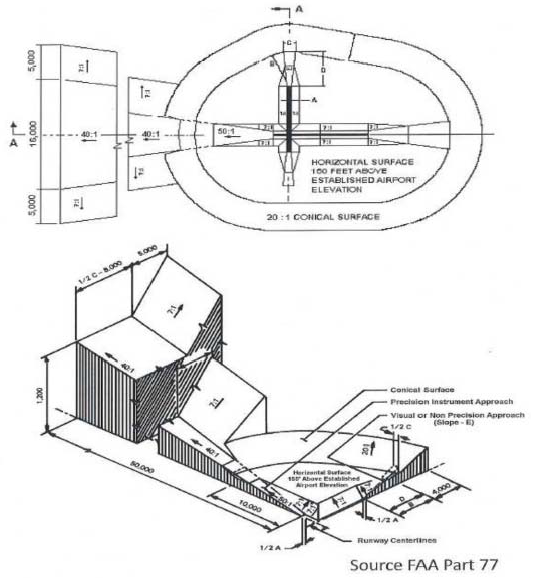
Austin Executive Airport Board of Adjustment means the joint board of adjustment created by subsection (i) of these regulations to administer and enforce these regulations in the areas where the political subdivisions' board of adjustment does not have jurisdiction.
Board of adjustment means a board of adjustment so designated by each political subdivision under Section 241.032 of the Local Government Code, as amended, to administer and enforce these regulations in each respective political subdivision's jurisdiction.
Conical surface means a surface extending outward and upward from the periphery of the horizontal surface at a slope of 20 feet horizontally for each one foot vertically for a horizontal distance of 4,000 feet.
Hazard to air navigation means an obstruction or use of land determined to have a substantial adverse effect on the safe and efficient utilization of navigable airspace.
Height means for the purpose of determining the height limits in all zones set forth in these regulations and shown on the hazard zoning map, the datum shall be height above mean sea level (MSL) elevation as measured in feet.
Horizontal surface means a horizontal plane 150 feet above the established airport elevation which in plan coincides with the perimeter of the horizontal zone.
Nonconforming use, structure, or tree means any structure, tree, or use of land which is inconsistent with the provisions of these regulations and which is existing as of the effective date of these regulations.
Nonprecision instrument runway means a runway having an existing instrument approach procedure utilizing air navigation facilities or other equipment that provides only horizontal guidance or area type navigation equipment. This also includes a runway for which a nonprecision instrument approach procedure has been approved or planned.
Planned Runway 13/34 is considered a nonprecision instrument runway.
Obstruction means any structure, tree, or other object, including a mobile object, which exceeds a limiting height set forth in subsection (e) of these regulations or is an airport hazard.
Other than utility runway means a runway designed for and intended to be used by propeller driven aircraft of more than 12,500 pounds maximum gross weight and jet powered aircraft. Runway 13/31 at Austin Executive Airport is considered an other than utility runway.
Person means an individual, firm, partnership, corporation, company, association, joint stock association, or body politic and includes a trustee, receiver, assignee, administrator, executor, guardian, or other representative.
Precision instrument runway means a runway having an existing instrument approach procedure utilizing air navigation facilities or other equipment which provide both horizontal and vertical guidance. This also includes a runway for which a precision instrument approach procedure has been approved or planned. Runway 13/31 at Austin Executive Airport is considered a precision instrument runway.
Primary surface means a 7,400-foot-wide surface longitudinally centered on the runway extending the full length of the ultimate runway configuration plus 200 feet beyond each ultimate end of the runway. The elevation of any point on the primary surface is the same as the nearest point on the existing or ultimate runway centerline.
Runway means a defined area on the airport prepared for the landing and taking off of aircraft along its length. The current length of Runway 13/31 at Austin Executive Airport is 6,025 feet. The length of the ultimate runway configuration of Runway 13/31 at Austin Executive Airport is 7,500 feet. The length of the ultimate parallel 16/34 is 1,550 feet.
Structure means an object, including a mobile object, constructed or installed by man including, but not limited to, buildings, towers, cranes, smokestacks, poles, earth formations, overhead power lines, and traverse ways. Traverse ways are considered to be the heights set forth in 14 C.F.R. Part 77.23.
Transitional surfaces means surfaces extending perpendicular to the runway centerline and the extended runway centerline outward from the edges of the primary surface and the approach surfaces at a slope of seven feet horizontally for each one foot vertically to where they intersect the horizontal surface. Transitional surfaces for those portions of the precision approach surface which extend through and beyond the limits of the conical surface extend at a slope of seven feet horizontally for each one foot vertically for a distance of 5,000 feet measured horizontally from either edge of the approach surface and perpendicular to the extended runway centerline.
Tree means any type of flora and an object of natural growth.
(c)
Administrative agency. The administrative agency of each political subdivision shall be responsible for the administration and enforcement of the regulations prescribed herein.
(d)
Zones. In order to carry out the provisions of these regulations, there are hereby created and established certain zones which include all of the land lying beneath the approach surfaces, conical surface, horizontal surface, and transitional surfaces as they apply to the airport. Such surfaces are shown on the Austin Executive Airport Hazard Zoning Map prepared by KSA Engineers, dated April 2015, which is incorporated in and made a part of these regulations. An area located in more than one of the following zones is considered to be only in the zone with the more restrictive height limitation. The various zones are hereby established and defined as follows:
(1)
Approach zones. Approach zones are hereby established beneath the approach surfaces at each end of Runway 13/31 at the airport for other than utility runway. The approach surface shall have an inner edge width of 550 feet, which coincides with the width of the primary surface, at a distance of 200 feet beyond each runway end, widening thereafter uniformly to a width of 16,000 feet at a horizontal distance of 50,000 feet beyond the end of the primary surface. The centerline of the approach surface is the continuation of the centerline of the runway.
(2)
Conical zone. A conical zone is hereby established beneath the conical surface at the airport which extends outward from the periphery of the horizontal surface for a horizontal distance of 4,000 feet.
(3)
Horizontal zone. A horizontal zone is hereby established beneath the horizontal surface at the airport which is a plane 150 feet above the established airport elevation, the perimeter of which is constructed by swinging arcs of 10,000 feet radii from the center of each end of the primary surface and connecting the adjacent arcs by lines tangent to those arcs.
(4)
Transitional zones. Transitional zones are hereby established beneath the transitional surfaces at the airport. Transitional surfaces, symmetrically located on either side of the runway, have variable widths as shown on the Austin Executive Airport Height and Hazard Zoning Map (height and hazard map) prepared by KSA Engineers, dated April 2015, which is incorporated in and made a part of these regulations. Transitional surfaces extend outward perpendicular to the runway centerline and the extended runway centerline from the periphery of the primary surface and the approach surfaces to where they intersect the horizontal surface. Where the precision instrument runway approach surface projects through and beyond the conical surface, there are hereby established transitional zones beginning at the sides of and at the same elevation as the approach surface and extending for a horizontal distance of 5,000 feet as measured perpendicular to the extended runway centerline.
(e)
Height limitations. Except as otherwise provided in subsection (h) of this section, no structure shall be erected, altered, or replaced and no tree shall be allowed to grow in any zone created by these regulations to a height in excess of the applicable height limitations herein established for such zone except as provided in paragraph (5) of this subsection. The airport hazard zones described in this section are depicted on an airport height and hazard zoning sheet on file with the Austin Executive Airport. Official notifications will be provided to each political subdivision if changes are made to the official height and hazard map. Such applicable height limitations are hereby established for each of the zones in question as follows:
(1)
Approach zones. Slope one foot in height for each 40 feet in horizontal distance beginning at the end of and at the same elevation as the primary surface and extending to a point 50,000 feet beyond the end of the primary surface.
(2)
Conical zone. Slopes one foot in height for each 20 feet in horizontal distance beginning at the periphery of the horizontal zone and at 150 feet above the airport elevation and extending to a height of 350 feet above the airport elevation, or to a height of 970 feet above mean sea level.
(3)
Horizontal zone. Established at 150 feet above the airport elevation, or at a height of 770 feet above mean sea level.
(4)
Transitional zones. Slope one foot in height for each seven feet in horizontal distance beginning at the sides of and at the same elevations as the primary surface and the approach surfaces.
(5)
Excepted height limitation. None.
(f)
Land use restrictions. Except as provided in subsection (g) of this section, no use may be made of land or water within any zone established by these regulations in such a manner as to create electrical interference with navigational signals or radio communications between the airport and aircraft, make it difficult for pilots to distinguish between airport lights and others, result in glare in the eyes of pilots using the airport, impair visibility in the vicinity of the airport, create potential bird strike hazards such as, but not limited to, waste, construction, and demolition landfills, and new large bodies of water (localized wetland, ponds, and stormwater retention ponds greater than or equal to one acre), or otherwise in any way endanger or interfere with the landing, taking off, or maneuvering of aircraft intending to use the airport. Localized wetlands, ponds, and retention ponds greater than or equal to one acre will be subject to evaluation by Austin Executive Airport to review and if appropriate, issue a letter of no objection.
(g)
Nonconforming uses, structures, and trees.
(1)
Nonconforming uses. Nothing contained in these regulations shall be construed as requiring changes in or interference with the continuance of any nonconforming use of land. Existing nonconforming uses are Lake Pflugerville and 1849 Park water storage and irrigation.
(2)
Nonconforming structures. Nothing contained in these regulations shall be construed as to require the removal, lowering, or other change to any existing nonconforming structure including all phases or elements of a multiphase structure the construction of which was begun prior to the effective date of these regulations and is diligently prosecuted.
(3)
Nonconforming trees. Nothing in these regulations shall be construed as to require the removal, lowering, or other change to any nonconforming tree. However, any nonconforming tree which grows to a greater height than it was as of the effective date of these regulations is subject to the provisions of these regulations as described in subsection (e) in this section.
(h)
Permits and variances.
(1)
Permits. Any person who desires to replace, rebuild, substantially change, or repair a nonconforming structure or replace or replant a nonconforming tree is required to apply for a permit. No permit shall be granted which would allow the establishment of an airport hazard or allow a nonconforming structure or tree to exceed its original height or become a greater hazard to air navigation than it was at the time of the adoption of these regulations. Applications for a permit shall be submitted to the administrative agency which has jurisdiction over the permit application.
(2)
Variances. Any person who desires to erect, substantially change, or increase the height of any structure or establish or allow the growth of any tree which would exceed the height limitations set forth in subsection (e) of this section or change the use of property in such a way as to create a hazardous condition as described in subsection (f) of this section is required to apply for a variance with the Austin Executive Airport Board of Adjustment or Board of Adjustment, as the case may be. The application for variance must be accompanied by a determination from the Federal Aviation Administration under 14 C.F.R. Part 77 as to the effect of the proposal on the operation of air navigation facilities and the safe, efficient use of navigable airspace. Variances shall be allowed where it is duly found that a literal application or enforcement of the regulations will result in practical difficulty or unnecessary hardship and the granting of relief would result in substantial justice, not be contrary to the public interest, and be in accordance with the spirit of these regulations.
(3)
Requirements and reasonable conditions
(A)
Any permit granted may, at the discretion of the administrative agency, impose a requirement to allow the installation and maintenance of any markers or lights to indicate to flyers the presence of an airport hazard.
(B)
Any variance granted may, at the discretion of the Austin Executive Airport Board of Adjustment or Board of Adjustment, impose any reasonable conditions as may be necessary to accomplish the purpose of these regulations.
(i)
Austin Executive Airport Board of Adjustment.
(1)
The Austin Executive Airport Board of Adjustment is hereby created to administer and enforce these regulations in the areas not within the jurisdiction of the political subdivisions' boards of adjustment.
(2)
The Austin Executive Airport Board of Adjustment shall:
(A)
Hear and decide appeals from any order, requirement, decision, or determination made by the administrative agency in the administration or enforcement of these regulations;
(B)
Hear and decide special exceptions to the terms of these regulations when the board is required to do so; and
(C)
Hear and decide specific variances.
(3)
The Austin Executive Airport Board of Adjustment shall be comprised of five members and one alternate member appointed by the political subdivisions. The terms for the members shall be two years. The members shall elect a chairman from one of the members. The Austin Executive Board of Adjustment shall adopt rules for its governance and procedure in harmony with the provisions of these regulations. Meetings of the Austin Executive Board of Adjustment shall be held at the call of the chairman and at such times as the Austin Executive Board of Adjustment may determine. The chairman, or in his/her absence the acting chairman, may administer oaths and compel the attendance of witnesses. All hearings of the Austin Executive Board of Adjustment shall be public. The Austin Executive Board of Adjustment shall keep minutes of its proceedings showing the vote of each member upon each question or if any member is absent or fails to vote, indicating such fact and shall keep records of its examinations and other official actions, all of which shall immediately be filed in the office of the Austin Executive Board of Adjustment or in the office of appropriate administrative agency. All such records shall be public records.
(4)
The Austin Executive Airport Board of Adjustment shall make written findings of fact and conclusions of law stating the facts upon which it relied when making its legal conclusions in determining special exceptions and variances.
(5)
The concurring vote of four members of the Austin Executive Airport Board of Adjustment shall be necessary to decide in favor of the applicant on any matter upon which it is required to pass under these regulations, or to effect any variance to these regulations.
(6)
The political subdivision appointing a member to the Austin Executive Board of Adjustment may remove that member for cause on a written charge after a public hearing. A political subdivision shall fill any vacancy on the board for the unexpired term for a member assigned to that political subdivision.
(7)
Austin Executive Airport is the official recordkeeper of all the Austin Executive Airport Board of Adjustment files and minutes.
(j)
Appeals.
(1)
A person aggrieved or a taxpayer affected by a decision of an administrative agency or a political subdivision or the Austin Executive Joint Airport Zoning Board that believes the decision of an administrative agency is an improper application of these regulations may appeal the decision to a board of adjustment or the Austin Executive Airport Board of Adjustment, as the case may be. For the purpose of subsections (j) and (k) of these regulations, the board of adjustment and the Austin Executive Airport Board of Adjustment are collectively referred to as board of adjustment.
(2)
All appeals hereunder must be taken within a reasonable time as provided by the rules of the board of adjustment by filing a notice of appeal with the board of adjustment and the appropriate administrative agency specifying the grounds for the appeal. The administrative agency shall forthwith transmit to the board of adjustment all papers constituting the record upon which the action appealed was taken.
(3)
An appeal shall stay all proceedings in furtherance of the action appealed unless the administrative agency certifies in writing to the board of adjustment that by reason of the facts stated in the certificate, a stay would, in the opinion of the administrative agency, cause imminent peril to life or property. In such case, proceedings shall not be stayed except by order of the board of adjustment on notice to the administrative agency and on due cause shown.
(4)
The board of adjustment shall fix a reasonable time for hearing appeals, give public notice and due notice to the parties in interest, and decide the same within a reasonable time. Upon the hearing, any party may appear in person, by agent, and/or by attorney.
(5)
The board of adjustment may reverse or affirm, in whole or in part, or modify the administrative agency's order, requirement, decision, or determination from which an appeal is taken and make the correct order, requirement, decision, or determination, and for this purpose the board of adjustment has the same authority as the administrative agency. The concurring vote of four members of the board of adjustment shall be necessary to reverse any order, requirement, decision, or determination of the administrative agency.
(6)
The board of adjustment shall make written finding of fact and conclusions of law stating the facts upon which it relied when making its legal conclusions in reversing, affirming, or modifying any order, requirement, decision, or determination which comes before it under the provisions of these regulations.
(k)
Judicial review. A person aggrieved or a taxpayer affected by a decision of a board of adjustment of a political subdivision or the Austin Executive Airport Zoning Board that believes the decision of a board of adjustment is illegal may present to a court of record a petition stating that the decision of the board of adjustment is illegal and specifying the grounds of the illegality as provided by and in accordance with the provisions of Section 241.041 of the Texas Local Government Code, as amended. This same right of appeal is extended to each administrative agency.
(l)
Enforcement and remedies. Each political subdivision and the Austin Executive Airport Zoning Board may institute in a court of competent jurisdiction an action to prevent, restrain, correct, or abate any violation of Chapter 241 of the Local Government Code, these regulations, or any order or ruling made in connection with their administration or enforcement of these regulations.
(m)
Conflicting regulations. Where there exists a conflict between any of the regulations or limitations prescribed herein and any other regulation applicable to the same area, whether the conflict be with respect to the height of structures or trees, the use of land, or any other matter, the more stringent limitation or requirement shall control.
(n)
Severability. If any of the provisions of these regulations or the application thereof to any person or circumstance is held invalid, such invalidity shall not affect other provisions or application of these regulations which can be given effect without the invalid provision or application and to this end, the provisions of the se regulations are declared to be severable.
(o)
Adherence with state laws. Any actions brought forth by any person or taxpayer as a result of the administration, enforcement, or the contesting these regulations will be in accordance with the provisions of Chapter 241 of the Texas Local Government Code, as amended, and other applicable State laws.
[(p)]
Immunity clause. No elected or non-elected, person, employee, officer, member or agent of political subdivision, Austin Executive Joint Airport Zoning Board and Austin Executive Airport Board of Adjustment shall have: (a) any personal liability with respect to any of the provisions of this chapter, regulation, or (b) any liability for any consequential damages resulting from the exercise by political subdivision or Austin Executive Joint Airport Zoning Board of any its duties herein.
(Ord. No. 565, § 2, 2-19-2020)
Sec. 14.02.046 - Accessory structures.
Accessory structures are allowed in conjunction with principal structures that have already been built and are subject to the following criteria:
(1)
General.
(A)
Accessory structures equal to or less than 120 square feet and not requiring or having installed electrical, plumbing, or mechanical systems do not require a permit.
(B)
Accessory structures may encroach into required yards according to each zoning districts permitted encroachment allowances.
(C)
No accessory structure may be constructed upon a lot until the construction of the principal structure has been commenced, unless the accessory structure is necessary for the material storage and construction of the principal structure, and only when approved by the building official.
(D)
No accessory structure may be used unless the principal structure is also being used.
(E)
No accessory structure shall exceed the height of the principal structure to which it is accessory.
(F)
Accessory structures shall not be located in front of the principal building or use.
(G)
An accessory structure may not be rented, sublet, or sold separately from the sale of the entire property.
(H)
Temporary, pre-assembled, or assembled on-site carports are prohibited in all districts.
(I)
Accessory structures shall be architecturally consistent with the principal structure. Portable classrooms installed for the school district on district owned property are exempt from this requirement.
(2)
Single-family and two-family residential uses
(A)
A lot being used for residential purposes may have no more than one shed, workshop or similar type of accessory structure per dwelling unit. An unattached garage and/or carport shall be exempt from the per lot accessory structure calculation.
(B)
Accessory structures may not exceed 25 percent of the gross floor area of the first floor of the principal structure, except detached garages which may not exceed 100 percent of the gross floor area of the first floor of the principal structure.
(C)
Carports are permitted in A, SF-E, SF-1, SF-2, TF, TH, MH-1, and MH-2 zoning districts. Residential accessory carports shall comply with the following standards. Carports structurally integrated into the residence's initial building plan and architecturally consistent with the principal structure's design are permitted but must also meet the following standards:
(i)
Shall contain a paved surface underneath and leading to the carport structure.
(ii)
Shall meet all building setbacks applicable to the principal structure.
(iii)
Subject property shall not have any covenants, conditions, or restrictions prohibiting carports. If such property has such restriction but allows for exceptions if permitted by the homeowner's association architectural review, the building official may consider such request consistent with the provisions stated herein.
(iv)
Shall consist of similar architectural theme and constructed of materials consistent with the principal structure, including but not limited to support posts and roofing materials.
(v)
The carport shall be generally located to the side or rear of the principal structure. A carport shall not be located between the principal structure and the public right-of-way, unless the carport is architecturally integrated into the overall design of the principal structure, and only when approved by the building official.
(3)
Multi-family uses.
(A)
Accessory carports are permitted when structurally integrated in the principal structure or free-standing structures with similar architectural materials and design of the principal structure.
(B)
Accessory structures shall comply with the architectural standards of the district consistent with the principal structures.
(4)
Commercial and industrial uses.
(A)
Accessory carports and accessory structures are permitted and shall comply with the architectural standards applicable to such zoning districts.
(5)
Agricultural uses.
(A)
Accessory carports and accessory structures associated with agricultural land uses are permitted.
(Ord. No. 565, § 2, 2-19-2020; Ord. No. 615, § 28, 7-7-2021; Ord. No. 703, § 12, 5-3-2023)
Sec. 14.02.047 - Accessory uses.
Accessory uses are allowed with permitted uses that have already been built or are under construction and are subject to the following criteria:
(1)
The use or structure is subordinate to the primary use and serves the primary use or the principal structure;
(2)
The accessory use is subordinate in area, extent and purpose to the primary use served;
(3)
The accessory use contributes to the comfort, convenience or necessity of occupants of the primary use;
(4)
A use that is prohibited in a zoning district shall not be permitted as an accessory use in the district, except for outdoor storage; and
(5)
Accessory uses located in residential districts shall not be used for commercial purposes other than ancillary to the permitted home occupations.
(Ord. No. 565, § 2, 2-19-2020)
Sec. 14.02.048 - Temporary uses and structures.
(a)
The temporary uses below are allowed which require certain controls in order to ensure compatibility with other uses in the district within which they are proposed for location. The temporary uses permitted are:
(1)
Temporary sales of seasonal products. Temporary sales of seasonal products may be allowed subject to the following provisions:
(A)
Issuance of permits for temporary outdoor sales of seasonal products shall be limited to areas with a base zoning of agricultural (A), neighborhood business (NB), downtown business (DB), light commercial (C-1), medium commercial (C-2), heavy commercial (C-3) or any public or religious assembly property.
(B)
Proposed operations shall be subject to approval by a temporary permit issued by the building official with a maximum duration of 45 consecutive days per calendar year except for shaved ice operations which are limited to 120 days per calendar year.
(C)
Shade structures, seating, trash receptacles and similar associated appurtenances shall be provided, but not be located within or cause interference with required parking spaces, driveways, alleys, fire lanes, public roads or sidewalks.
(D)
During hours of operation, the permit holder shall be responsible for providing a trash receptacle for use by customers and shall ensure the area is kept clear of litter and debris at all times.
(E)
A drive thru shall not be permitted.
(F)
Signage must be provided in accordance with city ordinances.
(G)
With exception of white or colored string lights, exterior lighting shall be downcast and shielded so that the light source is not directly visible to passersby.
(H)
The operation shall be generally self-sufficient with regards to water, sewer and electricity. Temporary connections to potable water and sanitary sewer are prohibited. Electricity shall be from a generator or an approved electrical outlet via an approved portable cord that is in conformance with the electrical code as adopted by the city.
(I)
Off street parking must be provided on an improved surface and must not utilize more than five percent of the required spaces for any permanent businesses located on site.
(J)
Health permits and any other applicable county, state or federal permits shall be prominently displayed at all times.
(K)
Unless otherwise said within, approval of a temporary permit for said operation shall not exempt the use or permit holder from all applicable city ordinances including, but not limited to nuisance, noise, signage, lighting, etc.
(L)
The application for a temporary use shall also display a true copy of the sales tax permit required by state law which designates the point of sale. If the city is not the designated point of sale for sales tax purposes, such information shall be noted on the application.
(M)
All tents or similar temporary structures that are greater than ten feet by ten feet, 100 square feet or greater or are enclosed shall be approved by the fire marshal, prior to erection and inspected once constructed.
(N)
Temporary food vendor permits issued in conjunction with a temporary event or use must additionally follow the regulations of article 4.03, Peddlers, Solicitors, Food Vendors, Special Events, and Outdoor Sales.
(O)
Sales of Christmas trees may not begin prior to November 15th and must be cleaned and vacated by January 1st.
(P)
A general site plan is required with an application showing the following:
(i)
Adequate parking.
(ii)
Site location.
(iii)
Improved parking and driveway surfaces and must not interfere with the parking required for the existing retail or commercial use.
(Q)
This provision does not apply to temporary outdoor services such as mobile blood banks, mammography screening, eye screening, or similar medical services.
(2)
Religious revival tents.
(A)
All tents or similar temporary structures that are greater than ten feet by ten feet, 100 square feet or greater or are enclosed shall be approved by the fire marshal, prior to erection and inspected once constructed.
(B)
The location of the tent must be approved by the building official prior to erection.
(3)
Use of temporary buildings or temporary outdoor storage during expansion, remodeling or reconstruction.
(A)
The temporary buildings or the temporary outdoor storage can only be used to accommodate staff, equipment or inventory displaced by the expansion, remodel or reconstruction.
(B)
The location of the temporary building or temporary outdoor storage must be shown on a site plan; and reviewed and approved by the building official. The location requirements are as follows:
(i)
The placement of temporary outdoor storage shall not conflict with any vehicle circulation.
(ii)
The placement of temporary outdoor storage shall not conflict with any public utilities, easements or rights-of-way.
(iii)
If an alternative location exists, the temporary outdoor storage shall not be placed within the street yard.
(iv)
The location of the temporary building or temporary outdoor storage shall meet the accessory building requirements for that zoning district.
(C)
Upon review and approval by the building official, a temporary use permit shall be applied for all temporary buildings and temporary outdoor storage used during the expansion, remodeling or reconstruction of an existing business.
(D)
Separate building permits shall be obtained for the temporary building or temporary outdoor storage; and the expansion, remodel or reconstruction of the existing business.
(E)
The temporary building or temporary outdoor storage shall be removed no later than 45 days after the issuance of the certificate of occupancy for the building permit related to the expansion, remodel or reconstruction of the existing business.
(F)
The business undergoing the expansion, remodel or reconstruction must be an existing business and not a new business, changing businesses or changing uses.
(G)
An existing site plan for the existing business must already be on file with the city.
(H)
Temporary outdoor storage uses shall also comply with the requirements provided in section 14.02.049.
(4)
Temporary portable storage units.
(A)
Temporary portable storage units are prohibited in any right-of-way or easement and must be located on an improved surface such as a paved driveway or parking lot.
(B)
Temporary portable storage units shall not remain on any residential lot for more than seven consecutive days.
(C)
Industrial shipping containers, sometimes known as conexes, are prohibited in any residential or mixed-use zoning district except during construction, expansion, or remodeling as noted in subsection (3) above.
(5)
Temporary facilities for manufacturing concrete or concrete products.
(A)
Temporary facilities for manufacturing concrete or concrete products may be located in any zoning districts where they are directly associated with construction in the area. Retail sales of concrete products shall be prohibited in conjunction with temporary concrete plants. The production site must be returned to its preconstruction state following completion of the associated project.
(6)
Farmers' markets. Temporary outdoor sales of products in an unrefined state, by a state certified farmers' market may be operated for a maximum of two days per week and are permitted with the following provisions:
(A)
Farmers markets shall be permitted on public properties and civic spaces approved by the building official, and private property within the agricultural (A), neighborhood business (NB), downtown business (DB), and light commercial (C-1) districts.
(B)
The market is not required to be located within a paved parking lot but should be accessible to a paved parking lot for use by visitors of the market. When located within a paved parking lot, the market shall not occupy more than ten percent of the required number of parking spaces on private property. The market may not be located within drive aisles, fire lanes or parking setbacks, and in no case shall the market be located within the public right-of-way.
(C)
Any signage must comply with applicable city ordinances.
(D)
The market must be approved by the city prior to location or sales.
(7)
Temporary residential sales offices and model homes. The following regulations shall apply to the conduct of temporary residential sales offices and model homes within residential zoning districts:
(A)
Temporary residential sales offices and model homes may be located within a residential district as part of an ongoing residential development; however, they shall only be located on the periphery of a subdivision or at the entrance to a subdivision.
(B)
Temporary residential sales offices, not otherwise serving as a model home, are not subject to design standards of this chapter.
(C)
Must be either a model home or temporary structure that will operate for a period of time determined by the operator and the building official.
(D)
Any temporary residential sales office or model home shall be removed or converted to a use permitted within the district when certificates of occupancy have been issued to 95 percent of the associated residential units or when use as a sales office or model home has ceased whichever is earlier.
(E)
Model homes for new subdivisions shall only be occupied for residential habitation after all business activities have ceased and upon sale of the home.
(8)
Nonprofit seasonal fundraisers. Seasonal fundraising or noncommercial events for nonprofit religious, educational or community service organizations where the public is invited to participate in the activities and which last longer than 72 hours, but not longer than 45 days. This description shall not preclude the use of existing religious institutions or other not-for-profit facilities for events conducted entirely within a building with the following provisions:
(A)
This article shall apply to only seasonal or periodic fundraisers conducted by nonprofit or charitable institutions. At least 80 percent of the net proceeds from each fundraiser must go directly to the nonprofit group or charitable cause represented. Examples of fundraiser events permitted under this article are pumpkin sales, booster club carwashes, and public school sponsored concessions.
(B)
Solicitation in the public right-of-way, including street medians, is prohibited.
(C)
The sale of used clothing and/or accessories, used furniture, used household and/or sporting goods is prohibited except for place of worship or school sponsored events located and managed at the school or place of worship location that is benefiting from the proceeds.
(D)
Proper county and city permits are required for any nonprofit charitable fundraiser selling/handling onsite prepared food to ensure the health, safety and welfare of the volunteers and of the public. These provisions do not apply to the sale of prepackaged, sealed food(s) (example, Girl Scout cookies). Any sponsor or organization making application for permit approval to conduct a fundraiser shall submit a written application for a permit that shall include:
(i)
The name and address of the applicant.
(ii)
The application shall show satisfactory written proof of the applicant's authority to represent the organization or sponsor the applicant represents.
(iii)
The name and address of the sponsor or organization represented by the applicant.
(iv)
The kinds of goods to be sold or services to be offered at the event.
(v)
The dates and times of the event.
(vi)
The location of the event and the traffic access and circulation planned.
(vii)
Evidence that the required conditions of this article have been met.
(E)
Any fundraiser shall provide evidence to the city, upon request, that the following regulations have been met:
(i)
Written permission from the property owner for the dates, times, and activities approved by the owner to be conducted on the premises.
(ii)
A temporary access barrier is provided when necessary to prohibit pedestrian or vehicular traffic from imposing on any adjacent residential uses and approved by the fire marshal.
(F)
Nonprofit festivals shall provide the following site facilities for the duration of the event:
(i)
Adequate, available off-street parking.
(ii)
A safe access driveway and traffic circulation plan approved by the police department and building official.
(iii)
Electrical permits, plumbing permits, sign permits, and other permits as applicable that are required by code.
(iv)
Health permits (food handlers), any other county, state, or federal permits are prominently displayed.
(v)
Bathroom facilities for employees/volunteers.
(vi)
Handicapped accessibility compliance when applicable.
(b)
Temporary use permits.
(1)
Applicability. Before temporary uses are permitted on private or public property, applicants shall obtain a temporary use permit from the building official that outlines conditions of operations to protect the public, health, safety and welfare. Temporary uses are prohibited in public rights-of-way.
(c)
Temporary uses types.
(1)
Temporary uses shall be deemed to include short-term or seasonal uses that are not otherwise allowed by the zoning district regulations of this code. Commercial events and those not sponsored or held by a nonprofit are considered special events and follow the provisions of Section 1.12.006 of this code.
(d)
Review and action by the building official.
(1)
Application should be made at least 15 days in advance of the requested start date for a temporary use.
(2)
The building official shall determine whether to approve, approve with conditions, or disapprove the permit within ten days after the date of application and shall determine the length of time that the permit is valid. Permits requested for a temporary building or temporary outdoor storage during expansions, remodeling or reconstruction as provided for in this section shall be valid for a period of up to one year and an extension may be requested from the building official for a period not to exceed one additional year prior to the expiration of the original temporary use permit issued. All other permits shall be valid for a period between one and 45 days.
(3)
Where an application has been disapproved by the building official, the applicant shall be notified in writing of the reasons for the disapproval.
(e)
Temporary use approval criteria. Temporary uses shall comply with the following standards:
(1)
Land use compatibility. The temporary use shall be compatible with the purpose and intent of this code and the zoning district in which it will be located. The temporary use shall not impair the normal, safe and effective operation of a permanent use on the same site. The temporary use shall not endanger or be materially detrimental to the public health, safety or welfare, or injurious to property or improvements in the immediate vicinity of the temporary use, given the nature of the activity, its location on the site, and its relationship to parking and access points.
(2)
Compliance with other regulations. A building permit or temporary certificate of occupancy may be required before any structure used in conjunction with the temporary use is constructed or modified. All structures and the site as a whole shall meet all applicable building code, zoning district, and fire code standards and shall be promptly removed upon the cessation of the use or event. Upon cessation of the event or use, the site shall be returned to its previous condition (including the removal of all trash, debris, signage, attention attracting devices or other evidence of the special event or use).
(3)
Hours of operation and duration. The duration and hours of operation of the temporary use shall be consistent with the intent of the event or use and compatible with the surrounding land uses. The duration and hours of operation shall be established by the building official at the time of approval of the temporary use permit.
(4)
Traffic circulation. The temporary use shall not cause undue traffic congestion or accident potential, as determined by the city traffic engineer and/or police department, given anticipated attendance and the existing design of adjacent streets, intersections and traffic controls.
(5)
Off-street parking. Adequate off-street parking shall be provided for the temporary use, and it shall not create a parking shortage for any of the other existing uses on the site.
(6)
Public conveniences and litter control. On-site restroom facilities are required. Adequate on-site solid waste containers may also be required. The applicant shall provide a written guarantee that all litter generated by the event or use shall be removed at no expense to the city.
(7)
Appearance and nuisances. The temporary use shall be compatible in intensity, appearance and operation with surrounding land uses in the area, and it shall not impair the usefulness, enjoyment or value of adjacent property due to the generation of excessive noise, dust, smoke, glare, spillover lighting, or other forms of environmental or visual pollution.
(8)
Signs and attention-attracting devices. The building official shall review all signage in conjunction with the issuance of the permit. The building official may approve signs and the temporary use of attention attracting devices that conform to the signage requirements of this code.
(9)
Other conditions. The building official may establish any additional conditions deemed necessary to ensure land use compatibility and to minimize potential adverse impacts on nearby uses, including but not limited to, time and frequency of operation, temporary arrangements for parking and traffic circulation, requirements for screening/buffering, and guarantees for site restoration and cleanup following the temporary use.
(f)
Expiration and lapse of approval. If the use described in the temporary use permit has not begun within 60 days from the date of issuance, the temporary use permit shall expire and be of no further effect.
(Ord. No. 565, § 2, 2-19-2020)
Sec. 14.02.049 - Outdoor storage and display.
(a)
General. Outdoor storage and display is allowed in certain nonresidential and mixed-use districts in accordance with this section. Any merchandise, material or equipment situated outdoors shall be subject to the requirements of this section.
(b)
Permitted outdoor storage and display table.
Permitted Outdoor Storage and Display Table
(c)
Outdoor display. Outdoor display is the display of items actively for sale and shall adhere to the following standards:
(1)
Outdoor display of merchandise shall not occupy any required parking spaces, landscape area, pedestrian accessibility or fire lane.
(2)
Outdoor display shall not extend into public right-of-way or onto adjacent property and must be kept within 15 feet of the principle structure. This distance requirement does not apply to vehicle rental or garden centers.
(3)
Outdoor display shall be displayed in a neat and orderly manner and maintained in a clean, litter free manner.
(4)
Outdoor display may not be located on the roof of any structure.
(5)
The outdoor display area shall not exceed ten percent of the square footage of the principal structure or 500 square feet, whichever is less, with the following exceptions:
(A)
Outdoor home accessory sales are exempt from this requirement.
(B)
Passenger vehicle sales and rental. Outdoor display of passenger vehicles for sale or rent is exempt from this requirement. This does not include vehicles used for moving.
(C)
Moving vehicle rental. Rental of vehicles utilized for moving of goods, personal or commercial, are limited to a maximum of four parking spaces. All other moving vehicles shall be screened in accordance with the outdoor storage requirements.
(D)
Garden centers are exempt from this requirement.
(E)
Heavy equipment, machinery, and trailers. Large heavy equipment, construction machinery, and trailers associated with a construction and equipment sales, major or truck and trailer sales use are exempt from this requirement.
(F)
Portable building sales. Outdoor display of portable buildings for sale associated with portable building sales use are exempt from this requirement.
(6)
All sales of such merchandise shall be consummated indoors, and no cash register or package-wrapping counter shall be located outdoors.
(7)
The maximum height of merchandise shall not exceed four feet except for vehicle rental and garden centers where retail plants can be displayed above four feet.
(8)
Outdoor display facing a public right-of-way or drive aisle is not required to be screened. Outdoor display visible to adjacent residentially zoned property or parkland shall be screened. This screening may be satisfied by bufferyard landscaping.
(9)
Automotive parts and accessories shall not remain outdoors for more than 12 consecutive hours or will otherwise be required to follow the standards for outdoor storage.
(d)
Limited outdoor storage.
(1)
Limited outdoor storage is temporary storage of goods in individual packaging and not in storage containers. Organic materials in plastic packaging are considered limited outdoor storage.
(2)
Limited outdoor storage shall be screened from view outside the site by a solid wall at least six feet in height. Limited outdoor storage in the IN-1 and IN-2 districts is exempt from the screening requirements provided that district buffering standards have been met.
(3)
Limited outdoor storage shall not be allowed in any off-street parking spaces.
(4)
In the NB, DB, and C-1 districts, limited outdoor storage shall not be allowed in the street yard.
(e)
General and temporary outdoor storage. Outdoor storage is the storage of products or goods on a temporary to permanent basis. Passenger vehicle rental is exempt from these requirements. All other uses providing outdoor storage shall adhere to the following standards:
(1)
Outdoor storage areas are allowed for the purpose of storing goods for a nonresidential enterprise. All outdoor storage areas shall meet each required district building setback lines.
(2)
The location of outdoor storage areas shall be limited to the side or rear of the primary structure to which the facility belongs and a minimum four feet from the principal building. At no point shall materials be located in front of any portion of the principal building.
(3)
A six-foot wall is required to screen outdoor storage when the property is located adjacent to property zoned more restrictive than the subject site, or when the storage is visible from a public right-of-way or parkland. This requirement is in addition to the screening requirements of this code, except where there is conflict this provision controls.
(4)
Outdoor storage shall be prohibited on the roofs of structures.
(5)
The outdoor storage area shall not encroach upon the required off-street parking, pedestrian access, fire lanes and maneuvering areas of the site.
(6)
The outdoor storage area is limited to a maximum one percent of the square footage of the principal structure or tenant space, or 100 square feet, whichever is less, within NB, DB, C-1, and C-2 districts with the following exceptions:
(A)
Mini storage facilities which may provide for outside storage of vehicles (automobiles and recreational vehicles) are limited to a maximum area of 20 percent of the gross site area, if the aforementioned screening is provided.
(B)
Accessory use of vehicle storage is exempt from the limitation on area as long as all other provisions for outdoor storage are met. For example, trucks utilized for moving, fleet vehicles or vehicles receiving auto repair.
(7)
General outdoor storage also includes items stored in shipping containers, conexes, and semi-trailers not attached to a truck. Shipping containers, conexes, and semi-trailers may only be stacked in the IN-2 district, in which case they cannot be stacked more than two units high.
(8)
Outdoor storage of equipment and vehicular storage shall be on a paved surface of asphalt, concrete, or another all-weather solid surface. All-weather solid surface does not include gravel, base material, or similar.
(f)
Storage of motor vehicles, recreational vehicles, and watercraft on residential property.
(1)
Motor vehicles, recreational vehicles and watercraft (collectively "vehicles") not operable due to expired registration or similar, excluding racing vehicles, antique vehicles, and vehicles belonging to members of armed forces who are on active duty, shall be parked or stored only in completely enclosed buildings.
(2)
No vehicle shall be parked or stored on any lot except that it shall be enclosed in a building or parked on an approved surface of concrete or asphalt installed for such purpose.
(3)
Recreation vehicles and watercraft shall not be parked or stored in any right-of-way.
(Ord. No. 565, § 2, 2-19-2020; Ord. No. 599, § 30, 1-6-2021; Ord. No. 615, §§ 29, 30, 7-7-2021)
Sec. 14.02.061 - Single-family detached and two-family.
(a)
Purpose and applicability.
(1)
The purpose of this section is to provide building standards to achieve quality design and development outcomes that reflect positively on the community and its character and values.
(2)
This section applies to all single-family and two-family dwelling units constructed in permitted districts.
(A)
Reconstructions, remodels, or additions to single-family detached and two-family structures constructed prior to the effective date of this chapter shall be exempted from the provisions of this section when then reconstruction, remodel, or addition does not modify the structure's exterior or the reconstruction, remodel, or addition is less than 25 percent of the structures gross floor area.
(b)
Single-family detached and two-family dwellings architectural standards.
(1)
General criteria.
(A)
Masonry as applicable in section 14.02.007(c)(2)(A).
(B)
Covered or uncovered rear patios or decks of a minimum of 100 square feet are required on all floor plans.
(C)
All windows and doors shall have trim.
(D)
The principle dwelling shall have at least a fully enclosed two car garage. The garage may be attached or detached.
(i)
New housing development must avoid front elevations resulting in a streetscape dominated by the sight of garage doors.
(ii)
A front-loading garage, or the area including the garage door and four feet around the garage door, may protrude no more than six feet from the longest front wall.
(iii)
A front-loading garage, or the area including the garage door and four feet around the garage door, whichever is wider, may occupy no more than 65 percent of the house linear frontage. Garage door areas that occupy 50 percent or less shall include one element from the following list. Garage door areas that occupy between 51 percent and 65 percent shall contain at least three elements from the following list:
a.
Integrated trim or banding around the garage door.
b.
Garage door relief detailing, including windows.
c.
Decorative hardware including hinges and handles.
d.
Single garage doors with a minimum ten-inch separation.
e.
Architectural roof above the garage.
f.
Other elements as approved by the building official.
(E)
Facades must be articulated by using color, arrangement, or change in materials to emphasize the facade elements. Exterior wall planes may be varied in height, depth or direction. Design elements and detailing, including the presence of windows and window treatments (for walls that face the public right-of-way), trim detailing, and exterior wall materials, must be continued completely around the structure. Doors and windows must be detailed to add visual interest to the facade.
(F)
Second-story window and door locations are encouraged to be offset from dwelling to dwelling to protect privacy.
(G)
Front doors and windows shall be provided along the primary facade and oriented to face the public street.
(H)
Dwellings are encouraged to be aligned on an east-west axis so that the long side of the building faces north and south while the short ends face east and west. When the long sides of a building face south or west, windows located along those sides are encouraged to be externally shaded using extended roof overhangs, building projections, window recesses or similar structural means to assist in minimizing summer solar admission and improving passive cooling. Buildings are encouraged to be designed to maximize photovoltaic potential.
(c)
Elevation differentiation.
(1)
Development of ten or more single-family detached or two-family dwellings must have five or more elevations, or a number of elevations equal to at least ten percent of the number of lots in the development phase, whichever is more. Different trim levels on units with nearly identical floor plan are not considered different elevations. A proposed dwelling unit within two lots on the same or opposite side of the street shall differ from another dwelling unit in at least three of the six criteria listed below, unless the dwelling units differ with respect to the number of full stories, in which case one criterion from the list below in addition to the number of full stories shall be different.
(A)
Building materials.
(B)
Building material color.
(C)
The proposed dwelling unit is served by a different type or size garage as set forth in subsections (i) through (iv) below:
(i)
Front-load garage;
(ii)
Side entry garage;
(iii)
Detached garage;
(iv)
Angled garage.
(D)
The proposed dwelling unit differs in the number of full stories as set forth in subsection (i) or (ii) below:
(i)
Single story; or
(ii)
Two story.
(E)
The proposed dwelling unit has a different roof type as set forth in subsections (i) through (iv) below:
(i)
Gable;
(ii)
Hip;
(iii)
Combination of both;
(iv)
Roof types (i), (ii) or (iii) with the longest ridge rotated 90 degrees.
(F)
The proposed dwelling unit has variation in the articulation of the front facade as set forth in subsections (i) through (iii) below:
(i)
Garage setback from the front facade of at least four feet;
(ii)
Covered, open walled porch of at least six feet in depth extending at least one-third of the entire width of the front facade; or
(iii)
Other articulation of the front facade at least four feet in depth, extending at least one-third of the width of the front facade.
(d)
Industrialized homes.
(1)
This subsection applies to industrialized or modular homes, as defined in this chapter, that are constructed in agricultural (A), single-family estate (SF-E), single-family suburban (SF-1), single-family standard (SF-2), and two-family (TF) districts.
(2)
The industrialized home must meet the criteria set forth in article 3.09 of the Code.
(Ord. No. 565, § 31, 2-19-2020; Ord. No. 599, § 31, 1-6-2021; Ord. No. 703, § 13, 5-3-2023; Ord. No. 719, § 5, 10-2-2023)
Sec. 14.02.062 - Single-family attached.
(a)
Purpose and applicability.
(1)
The purpose of this section is to provide building standards to achieve quality design and development outcomes that reflect positively on the community and its character and values.
(2)
This section applies to all townhome dwelling units and attached townhome or rowhouse style developments of three or more attached units constructed in the permitted districts.
(3)
The term "primary facade" shall apply to all facades facing a public street, public or private park, or any major drive aisle.
(b)
Single-family attached architectural standards.
(1)
Masonry as applicable in section 14.02.007(c)(2)(A).
(2)
Roof pitch styles.
(A)
Pitch roof: Minimum 6:12.
(B)
Flat roof: Require parapet screening.
(C)
Shed roof, porch roof and arcade roofs: Minimum 2:12.
(3)
Roof articulation (excluding flat roofs). Two of the following:
(A)
Two roof materials.
(B)
Chimneys.
(C)
Dormers along public facades (1/20').
(D)
Eaves that overhang a minimum of 24 inches with a minimum fascia depth of eight feet.
(E)
Three or more roof slope planes per primary facade.
(4)
Building articulation (applicable to each unit per building). Primary facades of each dwelling unit shall be designed to have at least one vertical and horizontal wall projection or recess to provide variation and interest throughout the building. Projections or recesses shall be designed with at least one foot of relief and should be used to create shade and cast shadows on the facade.
(5)
Transparency (windows and doors). The primary facade shall have at least three full size windows. Windows should be designed to be operable and allow for cross ventilation.
(6)
Window and door treatment. Trim shall be provided to accent all windows and doors appropriate to style of structure.
(7)
Window articulation (applicable to overall building, not per unit).
(A)
All primary facades of a building containing a dwelling unit entry shall include at least one of the following window articulation elements per building:
(i)
Veranda, terrace, porch or balcony (accessible for single units) minimum two feet deep.
(ii)
Trellis.
(iii)
Shed roof awning.
(iv)
Twenty-inch projection.
(v)
Bay window.
(vi)
Bow window.
(vii)
Transom windows.
(viii)
Arched windows.
(ix)
Gable windows.
(x)
Shutters.
(8)
Facade repetition. Each dwelling unit within a single structure shall be designed to have distinct architectural characteristics which visually separate it from the other dwelling units in the structure and may include differing materials.
(9)
Top floor articulation. When a flat roof is utilized, a distinctive finish, consisting of a cornice, banding or other architectural termination shall be provided.
(10)
Building and entry orientation. All buildings shall be oriented so that each dwelling unit shall have its main pedestrian entrance fronting onto a public street, a common open space with a landscaped courtyard, or a private street if part of a condominium project. All buildings and units near an arterial or collector level public street shall be oriented and have the primary facade front and face the public street. At no time shall dwelling units front a parking lot. A pedestrian pathway shall connect all building entrances to a public sidewalk.
(11)
Solar orientation and passive cooling. Buildings are encouraged to be aligned on an east-west axis so that the long side of the building faces north and south while the short ends face east to west. When the long sides of a building face south or west, windows located along those sides are encouraged to be externally shaded using extended roof overhangs, building projections, window recesses or similar structural means to assist in minimizing summer solar admission and improving passive cooling. Buildings are encouraged to be designed to maximize photovoltaic potential.
(12)
Entry articulation. Entry shall be covered or inset with distinct architectural detail such as: A covered, open walled porch, portico, arcade, or other similar element. Covered, open walled porches shall have at least six feet in depth extending at least one-third of the entire width of the front facade of the dwelling unit.
(13)
Garage standards.
(A)
One, 12-foot by 20-foot (inside dimensions) garage parking space shall be provided per unit.
(B)
Dwelling units may have a garage face a public right-of-way (front-loaded) provided the garage does not face a collector or arterial road, the garage does not extend past the front facade of the dwelling unit, and the garage door(s) maintains an architectural theme of the unit. A dwelling unit within the same development, located across a local street, and facing an aforementioned front loaded dwelling unit, may also be front loaded.
(i)
A front-loading garage, or the area including the garage door and four feet around the garage door, whichever is wider, may occupy no more than 65 percent of the unit's linear frontage. Garage door areas that occupy 50 percent or less shall include one element from the following list. Garage door areas that occupy between 51 percent and 65 percent shall contain at least three elements from the following list:
a.
Integrated trim or banding around the garage door.
b.
Garage door relief detailing, including windows.
c.
Decorative hardware including hinges and handles.
d.
Single garage doors with a minimum ten-inch separation.
e.
Architectural roof above the garage.
f.
Other elements as approved by the building official.
(C)
Garages shall have same materials and mix as the primary residential structure facade.
(14)
Minimum open space. Common lot single-family attached developments shall provide a minimum one acre per 150 dwelling units or five percent of the total site area, whichever is greater, shall be provided to satisfy recreational open space and amenity requirements. Such recreational and amenity shall be located or arranged so as to function as a recreational or amenity area and be uniformly beneficial to all of the dwelling units in the project or development. Open space required to separate structures and stormwater facilities shall not be considered to be part of the required recreational open space.
(15)
Amenities. All common lot single-family attached developments shall require at least one private amenity, selected from the list below, for every 50 or more dwelling units. The amenities shall be located on a private open space area, landscape lot, or facility accessible to all tenants and all amenities shall be accessible to all residents and shall be owned and maintained by the property owner.
(A)
Amenities for common lot single-family attached structures.
(B)
Amenities.
Playground equipment meeting minimum guidelines by the National Playground Safety Institute with a covered shade structure.
Dog park (not smaller than 2,500 square feet) with minimum depth of 25 feet, fenced, and containing a pet drinking fountain.
Covered picnic area to contain no fewer than two tables with seating and two grills.
Swimming pool.
Splash pad.
Tennis or racquet ball court.
Basketball court.
Volleyball court.
Community garden or orchard with irrigation (minimum 800 square feet).
Gazebo, band stand or outdoor amphitheater.
Amenity center with social room for resident use.
Private fitness facility.
Kitchen available for resident use.
Billiards or similar.
Theater or similar media room.
As approved by the building official.
(Ord. No. 565, § 2, 2-19-2020; Ord. No. 615, § 31, 7-7-2021; Ord. No. 657, § 10, 6-1-2022; Ord. No. 703, § 14, 5-3-2023)
Sec. 14.02.063 - Manufactured home.
(a)
Purpose and applicability.
(1)
The purpose of this section is to provide building standards to achieve quality design and development outcomes that reflect positively on the community and its character and values.
(2)
This section applies to manufactured home dwelling units constructed in a permitted district.
(b)
Manufactured home architectural standards.
(1)
No outside horizontal dimension must be less than 14 feet, except extensions comprising no more than 50 percent of the total enclosed floor area.
(2)
Houses must be skirted in 90 days of installation with material that is compatible with the design and exterior materials of the primary structure.
(3)
Houses must be tied down securely in conformance to applicable regulations before occupancy.
(4)
Houses must be of adequate quality and safe design, as certified by a label stating the unit is constructed in conformance to the federal Manufactured Home Construction and Safety Standards in effect on the date of manufacture, or other applicable standards required by state and federal law. Manufactured houses without certification, but meeting all other standards, may be accepted as safe and quality construction provided:
(A)
Electrical material, devices, appliances and equipment are in safe condition.
(B)
Mechanical systems including space and water heating are in safe condition.
(C)
Plumbing, gas piping, and wastewater systems are in safe condition.
(5)
Houses must be in sound structural condition. Structures that show evidence of fire damage are not acceptable.
(6)
Manufactured houses must be installed by a party licensed by the State of Texas in conformance to state law, or the frame must be supported by and tied to a foundation system capable of safely supporting loads imposed as determined by the character of the soil. Minimum acceptable foundation design must be a series of eight-inch grout-filled concrete block piers spaced no more than eight feet on center and bearing on one foot by one foot solid concrete footings. A tie-down and anchoring system separate and apart from the foundation must be provided as recommended by the manufacturer, if different from the foundation ties.
(7)
Axle and hitch assemblies must be removed on placement on the foundation.
(8)
Electrical power supply must be from a meter installation on the building, or from a permanently installed meter.
(9)
Garage and carport additions must cover a paved parking area, be connected to the street with a paved driveway, meet setback standards, and have roof and siding material compatible with the primary structure.
(10)
Living area additions must meet the minimum building setback standards, have roof and siding material that is compatible with the host structure, and meet setback standards.
(11)
The house must be sited on level ground. All walls and floors must be level.
(Ord. No. 565, § 2, 2-19-2020; Ord. No. 703, § 15, 5-3-2023)
Sec. 14.02.064 - Multi-family and mixed-use.
(a)
Purpose and applicability.
(1)
The purpose of this section is to provide building standards to achieve quality design and development outcomes that reflect positively on the community and its character and values.
(2)
This section applies to multi-family and mixed-use developments constructed in permitted districts.
(3)
The term "primary facade" shall apply to all facades facing a public street, public or private park, or any major drive aisle.
(b)
Multi-family and mixed-use architectural standards.
(1)
Masonry as applicable in section 14.02.007(c)(2)(A) and/or section 14.02.020(c)(1)(A).
(2)
Roof pitch styles.
(A)
Pitch roof: Minimum 6:12.
(B)
Flat roof: Require parapet screening.
(C)
Shed roof, porch roof and arcade roofs: Minimum 2:12.
(3)
Roof articulation (excluding flat roofs). Two of the following:
(A)
Two roof materials.
(B)
Chimneys.
(C)
Dormers along public facades (1/20').
(D)
Eaves that overhang a minimum of 24 inches with a minimum fascia depth of eight feet.
(E)
Three or more roof slope planes per primary facade.
(4)
Vertical articulation. No more than 50 linear (horizontally) feet without a minimum five-foot vertical offset.
(5)
Horizontal articulation. No more than 50 linear (horizontally) feet without a minimum five-foot horizontal offset.
(6)
Transparency (windows and doors).
(A)
Each residential floor on a primary facade shall contain 25 percent doors and windows.
(B)
Each non-residential floor on a primary facade shall contain 50 percent doors and windows.
(7)
Window and door treatment. Trim shall be provided to accent all windows and doors appropriate to style of structure.
(8)
Window articulation.
(A)
Twenty-five percent of primary facades windows shall include one of the following:
(i)
Veranda, terrace, porch or balcony (accessible for single units) minimum four feet deep.
(ii)
Trellis.
(iii)
Shed roof awning.
(iv)
Twenty-inch projection.
(v)
Bay window.
(vi)
Bow window.
(vii)
Transom windows.
(viii)
Arched windows.
(ix)
Gable windows.
(x)
Oval or round windows.
(xi)
Shutters.
(9)
Facade repetition. All buildings shall be designed to have distinct characteristics every 30 feet.
(10)
Top floor articulation. When a flat roof is utilized, a distinctive finish, consisting of a cornice, banding or other architectural termination shall be provided.
(11)
Building orientation.
(A)
All buildings containing ground floor or second story residential dwelling units, located along the perimeter of the development and/or adjacent to public right-of-way, shall have the primary facade front and face the public right-of-way.
(B)
All other buildings shall be designed as liner buildings located adjacent to and fronting the public right-of-way, primary internal drive aisles, or wrapped around a structured parking garage. Buildings shall not be oriented toward a surface parking lot with more than one row of parking along an internal drive aisle without perimeter liner buildings, and only as approved by the building official.
(12)
Primary entrance location. Pedestrian building entrances shall be directly accessible from a public sidewalk or a common open space with a landscaped courtyard.
(13)
Solar orientation and passive cooling. Buildings are encouraged to be aligned on an east-west axis so that the long side of the building faces north and south while the short ends face east to west. When the long sides of a building face south or west, windows located along those sides are encouraged to be externally shaded using extended roof overhangs, building projections, window recesses or similar structural means to assist in minimizing summer solar admission and improving passive cooling. Buildings are encouraged to be designed to maximize photovoltaic potential.
(14)
Entry articulation.
(A)
Mixed use structures shall have a minimum six-foot inset for the width of the entry (minimum eight feet wide).
(B)
All ground floor entries shall be covered with distinct architectural detail such as: Porch, portico, arcade, awning, or other similar shading element.
(15)
Building access. Multi-family units shall be accessed by way of a centralized indoor corridor except that exterior stairwells may be considered if they are oriented toward a central landscaped courtyard and/or screened via evergreen landscaping from any public street or required bufferyard. The stairwell structure shall be architecturally integrated into the building with appropriately sized cutouts to allow for visibility, ventilation, and protection from natural elements.
(16)
Garage standards.
(A)
When visible from street rights-of-way, garages shall be located on the side or behind the rear facades of the multi-family buildings.
(i)
Alternatively, if visible from street rights-of-way, landscaping and walls shall be provided between the garages and the street right-of-way that at minimum meets the bufferyard standards of section 15.03.023.
(B)
When provided, the minimum garage dimensions are 12-foot by 20-foot (inside dimensions) per parking space.
(C)
Garage structures shall have the same materials and mix as facades of the primary residential structure.
(D)
Surface parking lots located within a setback adjacent to a residential use, excluding multi-family 15 (MF-1) and multi-family 25 (MF-2), shall not be permitted.
(i)
Alternatively, single story structures containing garage spaces may be permitted between a multi-family structure and a residential use to buffer the multi-family parking area from the residential use.
(17)
Interior pedestrian access and off-site connectivity.
(A)
Minimum four-foot sidewalks required from all parking and public areas to entryways of all units.
(B)
When provided, perimeter fencing along a public right-of-way shall include one pedestrian gate accessible for every two buildings. The pedestrian gate may be a controlled access gate for the tenants to utilize.
(C)
A pedestrian pathway with a minimum four-foot width shall connect all pedestrian building entrances to the pedestrian gates and to the public sidewalk.
(18)
Minimum open space. Multi-family and mixed-use developments shall provide a minimum one acre per 150 dwelling units or five percent of the total site area, whichever is greater, shall be provided to satisfy recreational open space and amenity requirements. Such recreational and amenity shall be located or arranged so as to function as a recreational or amenity area and be uniformly beneficial to all of the dwelling units in the project or development. Open space required to separate structures and stormwater facilities shall not be considered to be part of the required recreational open space.
(19)
Amenities. All multi-family and mixed use developments shall require at least one private amenity, selected from the list below, for every 50 or more dwelling units. The amenities shall be located on a private open space area, landscape lot, or facility accessible to all tenants and all amenities shall be accessible to all residents and shall be owned and maintained by the property owner.
(A)
Amenities for multi-family and mixed-use structures.
(B)
Amenities.
Playground equipment meeting minimum guidelines by the National Playground Safety Institute with a covered shade structure.
Dog park (not smaller than 2,500 square feet with minimum depth of 25 feet, fenced, and containing a pet drinking fountain.
Covered picnic area to contain no fewer than two tables with seating and two grills.
Swimming pool.
Splash pad.
Tennis or racquet ball court.
Basketball court.
Volleyball court.
Community garden or orchard with irrigation (minimum 800 square feet).
Gazebo, band stand or outdoor amphitheater.
Amenity center with social room for resident use.
Private fitness facility.
Kitchen available for resident use.
Billiards or similar.
Theater or similar media room.
As approved by the building official.
(Ord. No. 565, § 2, 2-19-2020; Ord. No. 657, § 11, 6-1-2022; Ord. No. 703, § 16, 5-3-2023)
Sec. 14.02.065 - Office, commercial, institutional.
(a)
Purpose and applicability.
(1)
The purpose of this section is to provide building standards to achieve quality design and development outcomes that reflect positively on the community and its character and values.
(2)
This section applies to office, commercial, and institutional developments constructed in a permitted district.
(3)
The term "primary facade" shall apply to all facades facing a public street, public or private park, or any major drive aisle.
(b)
Office, commercial, and institutional architectural standards.
(1)
Masonry as applicable in section 14.02.020(c)(2).
(2)
Site arrangement and building orientation.
(A)
Commercial developments adjoining residential developments should be of an appropriate scale, setback and building height. Multi-story commercial buildings should incorporate lower scale, single-story elements and/or greater setbacks adjacent to existing residential developments.
(B)
Pad sites for buildings should be located as close as possible to the intersections of arterial roads whenever possible. Structures located closer to the intersections provide a strong visual and pedestrian relationship to the street while taking into account the queuing requirements for any drive-through services. Parking and store entrances along with associated services may be located behind the structures.
(C)
Gas canopies, drive-through lanes, service functions and accessory structures should be located away from the intersections.
(D)
Design projects to minimize pedestrian and vehicular convergence. Where pedestrian circulation paths cross vehicular routes, provide a change in paving materials, textures or colors to emphasize the areas where they intersect. These areas should be identified by use of decorative bollards to increase visibility and improve aesthetic appeal.
(E)
Design convenient pedestrian and bicycle access to and throughout the development.
(F)
Pedestrian focal points should have enhanced pedestrian paving such as decorative scored concrete, stained concrete, exposed aggregate or other decorative walking surfaces.
(G)
For developments on a single lot or tract ten acres or larger that contains three or more buildings, the following standards additionally apply, as applicable:
(i)
The site's buildings should be organized so that the layout encourages functional pedestrian spaces, plazas and amenities between and in front of the buildings.
(ii)
Provide direct pedestrian and bike access to connect future and existing developments.
(iii)
Design pedestrian amenities that allow for use and enjoyment of outdoor areas as a development focal point or centralized amenity. These may include a mix of pedestrian-scaled lighting, tables, drinking fountains, benches, seating walls, shade trees, raised landscape planters, berms, clock towers, water features, specimen trees, potted plants, information kiosks, botanical exhibits and art exhibits or features.
(iv)
Design sites to accommodate bus stops in the development of shopping centers on arterial streets where future transit service may become available.
(v)
Provide convenient bicycle parking in locations that do not interfere with pedestrian circulation. Place bicycle parking racks or area in several locations within the development.
(vi)
Provide for continuation of pedestrian access when commercial developments are located adjacent to existing planned open space.
(3)
Architectural elements.
(A)
All buildings shall be designed to incorporate no less than four of the architectural elements from the list below. Buildings or multitenant buildings over 50,000 square feet shall include no less than five of the referenced architectural elements. Buildings or multitenant buildings over 100,000 square feet shall include no less than six of the referenced architectural elements:
(i)
Canopies, awnings, or porticos;
(ii)
Arcades;
(iii)
Pitched roof forms;
(iv)
Arches;
(v)
Display windows;
(vi)
Architectural details (such as tile work and moldings) integrated into the building facade;
(vii)
Articulated ground floor levels or base;
(viii)
Articulated cornice line;
(ix)
A minimum of two building materials, differentiated by texture, color, or material; and
(x)
Other architectural features approved by the building official or designee.
(B)
Common development. All buildings within a common development shall have similar architectural styles and materials. This shall include all buildings situated on lots included within an approved preliminary plan.
(C)
Facade finish. All nonresidential buildings shall be architecturally finished on all four sides with same materials, detailing, and features.
(D)
Articulation standards. Any primary façade shall include projections or recesses and vertical variations in the roofline in accordance with the horizontal and vertical articulation requirements set forth below. Buildings less than 1,000 square feet are exempt from articulation standards.
(i)
Horizontal articulation.
a.
A building facade may not extend for a distance greater than three times its average height without a perpendicular offset of at least ten percent of such building height.
b.
The total length of all facade walls in a single plane may not exceed 60 percent of the total facade length.
c.
Regardless of facade length, all primary facades shall have at least one horizontal offset of the required percentage.
(ii)
Vertical articulation.
a.
A horizontal wall may not extend for a distance greater than three times its height without a change in elevation of at least 15 percent of such height.
b.
The total length of all vertical elevation changes in the roofline shall be no less than 20 percent and no more than 40 percent of the total facade length.
c.
Regardless of the facade length, all primary facades shall have at least one vertical elevation change.
d.
Flat roofs with a parapet wall are permitted, provided the roofline meets the vertical articulation requirements.
(E)
Building entrance standards.
(i)
Any front building entrance shall be set back from a drive aisle a minimum distance of 15 feet.
(ii)
Single-use or multitenant buildings over 50,000 square feet in size shall provide clearly defined, highly visible customer or employee entrances with the integration of awnings or similar architectural features.
(iii)
New or renovated commercial buildings shall have outdoor plazas, courtyards, or other pedestrian spaces at their main entrances.
a.
Minimum size of pedestrian space shall be one square foot of space per 100 square feet of building floor area or a minimum of 100 square feet of pedestrian space; whichever is greater.
(iv)
All pedestrian spaces shall incorporate at least four of the following:
a.
Decorative landscape planters or wing walls that incorporate landscape areas.
b.
Pedestrian scale lighting, bollard, or other accent lighting.
c.
Special paving, such as colored/stained and sealed concrete, stamped concrete, brick or other unit paver.
d.
Public art with a valuation of at least 0.05 percent of the total construction cost.
e.
Seating such as benches, tables with attached seats, or low seating walls.
f.
Architectural water structures, features, or fountains.
g.
Other amenity approved by the building official.
(F)
Canopy standards. The following provisions apply to canopies associated with an ATM canopy, gas station canopy, drive-thru canopy, carport, and other similar auto oriented canopies:
(i)
Canopies shall be constructed of roof building material consistent with that of the principal building.
(ii)
Canopies shall have pitched roofs, unless attached to the principal building utilizing a parapet roof type.
(iii)
Canopy columns shall be fully encased with material that is complimentary to that used on the principal building.
(iv)
The canopy band face shall be color consistent with the principal structure's exterior building materials and shall not be backlit or used as signage except that the business name may be displayed on the canopy band.
(v)
Canopies shall be no higher than the principal building. In no case shall the canopy height exceed 20 feet.
(G)
Drive-thru. Drive-thru facilities shall be located to the side or rear of the structure, unless site constraints limit such orientation, as determined by the building official.
(H)
Overhead doors.
(i)
Overhead doors shall not be located closer than 50 feet to a conforming residential lot.
(ii)
Overhead doors shall be oriented to the side or rear of the structure and not front or face a public right-of-way or public street with the following exceptions:
a.
An automotive use with a maximum of four single, service bays may orient toward a public street only when structural awnings of at least three feet ten inches are provided over the extent of the overhead doors, or equivalent structural projections are provided in front of the overhead doors to reduce the visual impact of the service bays from the street.
b.
A roll up, garage type door installed in a restaurant or bar may be permitted to face a public street if it is architecturally integrated into the building and provides a pedestrian connection with a covered outdoor patio area.
c.
When physical site constraints prevent such orientation, the building official may consider alternatives when screened in accordance with this code.
(I)
Loading docks.
(i)
Loading docks shall not be located closer than 50 feet to a conforming residential lot.
(ii)
Loading docks shall be oriented to the side or rear of buildings, and oriented to not front the public right-of-way, not be visible or face a public street, main drive aisle, or patron parking lot.
(iii)
Screening shall be in accordance with this code.
(iv)
When physical site constraints prevent such orientation, the building official may consider alternatives when screened in accordance with this code.
(J)
Service court.
(i)
When multiple offices, commercial and industrial uses are planned, loading docks and delivery receivable areas shall be consolidated into common service courts located to the side or rear of the buildings.
(ii)
The access point into the service court shall be minimized in width in order to substantially screen the service court from a public street, main drive aisle or patron parking area, but allow for necessary vehicle maneuverability.
(iii)
Service courts shall be screened in accordance with this code.
(K)
Roof treatment.
(i)
Pitched roofs shall have a minimum pitch of 4:12. Long unarticulated roofs are not permitted.
(ii)
Parapets shall be used to conceal roof-mounted mechanical equipment on flat roofs on all sides.
(iii)
Where overhanging eaves are used, overhangs shall be no less than two (2) feet beyond the overhanging walls.
a.
Gable and hip roofs shall be symmetrically pitched between 4:12 and 8:12.
b.
Shed roofs, porch roofs, and arcade roofs subordinate and attached to the primary structure, shall be pitched between 2:12 and 6:12.
(Ord. No. 565, § 2, 2-19-2020; Ord. No. 703, §§ 17, 18, 5-3-2023; Ord. No. 719, § 6, 10-2-2023)
Sec. 14.02.066 - Industrial.
(a)
Purpose and applicability.
(1)
The purpose of this section is to provide building standards to achieve quality design and development outcomes that reflect positively on the community and its character and values.
(2)
This section applies to industrial developments constructed in a permitted district.
(3)
The term "primary facade" shall apply to all facades facing a public street, public or private park, or any major drive aisle.
(b)
Industrial architectural standards.
(1)
Masonry as applicable in section 14.02.020(c)(2).
(2)
Architectural elements.
(A)
All buildings shall be designed to incorporate no less than four of the architectural elements from the list below. Buildings or multi-tenant buildings over 50,000 square feet shall include a minimum of five of the referenced architectural elements. Buildings or multitenant buildings over 100,000 square feet shall include a minimum of six of the referenced architectural elements:
(i)
Canopies, awnings, or porticos;
(ii)
Arcades;
(iii)
Pitched roof forms;
(iv)
Arches;
(v)
Minimum of ten percent fenestration on primary facades;
(vi)
Architectural integrated into the building facade;
(vii)
Articulated ground floor levels or base;
(viii)
Articulated cornice line;
(ix)
Integrated planters or wing walls that incorporate landscape and sitting areas;
(x)
A minimum of two building materials, differentiated by texture, color, or material; and
(xi)
Other architectural features approved by the building official or designee.
(3)
Common development.
(A)
All buildings within a common development shall have similar architectural styles and materials. This shall include all buildings situated on lots included within an approved preliminary plan.
(4)
Facade finish.
(A)
All nonresidential buildings shall be architecturally finished on all four sides with same materials, detailing, and features.
(5)
Articulation standards. Any primary facade shall include projections or recesses and vertical variations in the roofline in accordance with the horizontal and vertical articulation requirements set forth below:
(A)
Horizontal articulation.
(i)
The total length of all facade walls in a single plane shall not exceed 60 percent of the total facade length without a horizontal wall offset a minimum of two feet in depth and ten feet in length parallel to the average facade plane. Regardless of facade length, all primary facades shall have at least one horizontal wall offset of a projection or recess.
(ii)
Single-use or multitenant buildings between 15,000 and 49,000 square feet in size shall provide horizontal wall projections and/or recesses, a minimum offset of five feet in depth and 15 feet in length parallel to the average facade plane at all building entrances fronting public right-of-way and along a primary facade.
(iii)
Single-use or multitenant buildings equal to or more than 50,000 square feet in gross floor area shall provide horizontal wall projections and/or recesses, at a minimum offset of ten feet in depth and 30 feet in length parallel to the average facade plane at all customer entrances fronting a public right-of-way and along a primary facade.
(B)
Vertical articulation.
(i)
Regardless of the facade length, all primary facades shall have at least one vertical elevation change without a vertical roof-line offset a minimum of two feet in height and ten feet in length.
(ii)
Flat roofs with a parapet wall are permitted, provided the roofline meets the vertical articulation requirements.
(6)
Building entrance standards.
(A)
Single-use or multitenant buildings over 50,000 square feet in size shall provide clearly defined, highly visible building entrances with the integration of awnings or similar architectural feature, fronting public right-of-way or along a primary facade.
(B)
Single-use or multitenant buildings over 50,000 square feet in size shall have outdoor plazas, courtyards, or other pedestrian spaces at their main entrances.
(i)
Minimum size of pedestrian space shall be one square foot of space per 100 square feet of building floor area.
(ii)
All pedestrian spaces shall incorporate at least four of the following:
a.
Decorative landscape planters or wing walls that incorporate landscape areas.
b.
Pedestrian scale lighting, bollard, or other accent lighting.
c.
Special paving, such as colored/stained and sealed concrete, stamped concrete, brick or other unit paver.
d.
Public art with a valuation of at least 0.05 percent of the total construction cost.
e.
Seating such as benches, tables with attached seats, or low seating walls.
f.
Architectural water structures, features, or fountains.
g.
Other amenity approved by the building official.
(7)
Canopy standards. The following provisions apply to canopies associated with service stations, drive thru facilities and other auto-oriented canopies:
(A)
Canopies shall be constructed of roof building material consistent with that of the principal building.
(B)
Canopy columns shall be fully encased with material that is complimentary to that used on the principal building.
(C)
Canopies shall be no higher than the principal building. In no case shall the canopy height exceed 20 feet.
(D)
The canopy band face must be of a color consistent with the main structure or a complimentary accent color and may not be backlit or used as signage.
(8)
Drive-thru. Drive-thru facilities shall be located to the side or rear of the structure, unless site constraints limit such orientation as determined by the building official.
(9)
Overhead doors.
(A)
Overhead doors shall not be located closer than 50 feet to a conforming residential lot.
(B)
Overhead doors shall be oriented to the side or rear of the structure and not front or face a public right-of-way or public street with the following exceptions:
(i)
An automotive use with a maximum of four single, service bays may orient toward a public street only when structural awnings of at least three feet ten inches are provided over the extent of the overhead doors, or equivalent structural projections are provided in front of the overhead doors to reduce the visual impact of the service bays from the street.
(ii)
When physical site constraints prevent such orientation, the building official may consider alternatives when screened in accordance with this code.
(10)
Loading docks.
(A)
Loading docks shall not be located closer than 50 feet to a conforming residential lot.
(B)
Loading docks shall be oriented to the side or rear of buildings, and oriented to not front the public right-of-way, a public street, major drive aisle, or patron parking lot.
(C)
Screening shall be in accordance with this code.
(D)
When physical site constraints prevent such orientation, the building official may consider alternatives when screened in accordance with this code.
(11)
Roof treatment.
(A)
Parapets shall be used to conceal roof-mounted mechanical equipment on all sides.
(B)
Where overhanging eaves are used, overhangs shall be no less one foot beyond the overhanging walls.
(i)
Gable and hip roofs shall be symmetrically pitched between 4:12 and 8:12.
(ii)
Shed roofs, porch roofs, and arcade roofs subordinate and attached to the primary structure, shall be pitched between 2:12 and 6:12.
(Ord. No. 565, § 2, 2-19-2020; Ord. No. 703, § 19, 5-3-2023)

