
Maple Creek Town City Zoning Code
ARTICLE I
- IN GENERAL
Sec. 54-1.- Statutory authorization.
This chapter is established pursuant to the provisions of Wis. Stats. §§ 59.69 and 59.694, and shall be known as the Outagamie County Zoning Ordinance.
(Code 1992, § 17.01; Ord. of 6-24-1997, § 17.01)
Sec. 54-2. - Purpose.
It is the purpose of this chapter to promote the public health, safety, convenience and general welfare; protect property values and the property tax base; permit the careful planning and efficient maintenance of highway systems; ensure adequate highway, utility, health, educational and recreational facilities; recognize the needs of agriculture, forestry, industry and business in future growth; encourage uses of land and other natural resources which are in accordance with their character and adaptability; provide adequate light and air, including access to sunlight for solar collectors and to wind for wind energy systems; encourage the protection of groundwater resources; preserve wetlands; conserve soil, water and forest resources; protect the beauty and amenities of landscape and manmade developments; provide healthy surroundings for family life; and promote the efficient and economical use of public funds.
(Code 1992, § 17.02)
Sec. 54-3. - Applicability and extent of power.
This chapter is designed to determine, establish, regulate and restrict:
(1)
The areas within which agriculture, forestry, industry, mining, trades, business and recreation may be conducted.
(2)
The areas in which residential uses may be regulated or prohibited.
(3)
The areas in and along or in or along natural watercourses, channels, streams and creeks in which trades or industries, filling or dumping, erection of structures and the location of buildings may be prohibited or restricted.
(4)
Trailer camps, tourist camps and motels or both and mobile home parks.
(5)
Certain designated areas, uses or purposes which may be subjected to special regulation.
(6)
The location of buildings and structures designed for specific uses and designation of uses for which buildings and structures may not be used or altered.
(7)
The location, height, bulk, number of stories and size of buildings and other structures.
(8)
The location of roads and schools.
(9)
Building setback lines.
(10)
The density and distribution of population.
(11)
The percentage of lot which may be occupied, size of yards, courts and other open spaces.
(12)
Places, structures or objects with a special character, historic interest, aesthetic interest or other significant value, historic landmarks and historic districts.
(13)
Burial sites as defined in Wis. Stats. § 157.70(1)(b).
(Code 1992, § 17.03)
Sec. 54-4. - Definitions.
The following words, terms and phrases, when used in this chapter, shall have the meanings ascribed to them in this section, except where the context clearly indicates a different meaning:
Accessory use or structure means a use or structure on the same lot with the principal use or structure and of a nature customarily incidental and subordinate to the principal structure.
Accessory-scale solar energy system means a private or commercial solar energy system less than 100 megawatts that converts sunlight into electricity for the purpose of serving on-site electric demands only. Accessory-scale systems are accessory to permitted/permissible principal uses for the parcel on which it is located.
Agriculture, extension education, zoning and land conservation committee means the agency or committee designated by the County Board, pursuant to Wis. Stats. § 59.69.
Agrivoltaics means a solar energy system co-located on the same parcel of land as agricultural production, including crop production, grazing, apiaries, or other agricultural products or services.
Airport, public, means any airport which complies with the definition contained in Wis. Stats. ch. 114, or any airport which serves or offers to serve common carriers engaged in air transport.
Alley means a public or approved private way which affords only a secondary means of access to abutting property.
Alteration means a change or rearrangement in the structural parts of a structure, an enlargement of a structure, whether by extending on the side or by increasing the height or the movement of a structure from one location to another.
Automobile filling station means buildings and premises where gasoline, oil, grease, batteries, tires and automobile accessories and convenience retail goods may be supplied, dispensed and sold and where minor repair or maintenance work may be performed, such as ignition service, tire repair, repair and replacement of minor parts, such as pumps and filters and the like. A filling station is not a repair or body shop.
Automobile salvage yard means premises used for the storing, dismantling, crushing, shredding or disassembly of more than one used motor vehicles or their parts.
Battery energy storage system (BESS) means electrochemical devices that charge, or collect, energy from the electric grid or a generation facility, store that energy, and then discharge that energy at a later time to provide electricity or other electric grid services.
Billboard means an advertising sign used to advertise goods, services, establishments or organizations off the premises.
Boardinghouse means an establishment where meals and lodging are provided for compensation by prearrangement other than in dwelling units, without limitation on time periods involved, and for a total of at least four or more boarders.
Building means a structure having one or more stories and a roof which is used or intended to be used for shelter or enclosure for persons, property or animals.
Building frontage means the front of a building shall be construed to be the portion facing a street. For purposes of computation of the number and area of signs, the frontage of a building shall be computed as nearly at ground level as computation of horizontal distance permits. In cases where this test is indeterminate or cannot be applied, as for instance where there is a diagonal corner entrance, the administrator or inspector shall select building frontage on the basis of interior layout of the building, traffic on adjacent streets or other indicators.
Building height means a building's vertical measurement from the mean level of the finished grade in front of the building to the highest point on the roof line of a flat roof or a roof having a pitch ratio of less than 1:4 from the horizontal and to a point midway between the peak and the eaves of a roof having a pitch ratio of more than 1:4.
Building line means the rear edge of any required front yard or the rear edge of any required setback line.
Building site means the lot or lots or portion of a lot or lots used for a building, the total area of which lot is ascribed to the building for compliance with these zoning regulations.
Building-integrated solar energy systems means a solar energy system that is an integral part of a principal or accessory building, rather than a separate mechanical device, replacing or substituting for an architectural or structural component of the building. Building-integrated systems include, but are not limited to, photovoltaic or hot water solar energy systems that are contained within roofing materials, windows, skylights, and awnings.
Clinic means an office or group of offices relating to the health care professions, including physicians, dentists and the like engaged in the treatment of persons.
Common open space means a parcel of land or an area of water or combination of land and water designated and intended for either the recreational use and enjoyment of residents of the development for which it was established and for the general public or for the development from which it was established. No yard required in connection with any principal use or structure shall be designated or intended for use as common open space.
Community living arrangement means facilities defined in Wis. Stats. § 46.03(22).
Community-scale solar energy system means a commercial solar energy system less than 100 megawatts that converts sunlight into electricity for the primary purpose of serving electric demands off-site from the facility, either retail or wholesale. Community-scale systems are principal uses and have a project size equal to, or less than, 20 acres.
Convalescent home and nursing home means a place where regular care is provided to three or more infirmed persons, children or aged persons, who are not members of the family which resides on the premises.
Day care.
(1)
Family means a place where regular day care is provided to not more than eight children and is licensed pursuant to Wis. Stats. ch. 48.
(2)
Group means a place where regular day care is provided to nine or more children and is licensed pursuant to Wis. Stats. ch. 48.
Development means any manmade change to improved or unimproved real estate, including, but not limited to, construction, additions or substantial improvements to buildings, other structures or accessory uses, mobile homes, mining, dredging, filling, grading, paving, excavation or drilling operations and deposition of materials.
Dog kennel means a place where more than two adult dogs are boarded for a fee on a recurrent basis or a place that keeps, harbors or has custody of more than three dogs for any purpose.
Drive-in restaurant means any establishment dispensing or serving food in automobiles, including those establishments where customers serve themselves and may eat or drink in the building or in their automobiles on the premises.
Dwelling, mobile home, means a building transportable in one or more sections, built on a permanent chassis, with body width exceeding eight feet or body length exceeding 32 feet, designed to be used as a single dwelling with or without a permanent foundation when connected to the required utilities.
Dwelling, modular home, means a building made up of two or more modular sections transported to the home site, put on a permanent foundation and joined to make a single dwelling. For the purposes of this chapter, modular homes shall be allowed as a single-family detached dwelling.
Dwelling, multiple-family, means a building containing three or more dwelling units. The term "multifamily dwelling" includes cooperative apartments, condominiums, apartments and the like. Regardless of how rental units are equipped, any multifamily dwelling in which units are available for rental periods of less than one week shall be considered a motel.
Dwelling, single-family attached, means a building containing not more than one dwelling unit attached at the side or sides in a series or group of three or more buildings each containing not more than one dwelling unit. Each building shall be separated from the adjoining building or buildings by a party wall or walls extending from footings through roofs. The term "attached dwelling" is intended to imply townhouses, patio or atrium houses or any form which conforms to this definition.
Dwelling, single-family detached, means a building containing not more than one dwelling unit entirely separated from structures on adjacent lots. The term "detached dwelling" does not include mobile homes, travel trailers or other forms of portable or temporary housing.
Dwelling, two-family, means one building containing not more than two dwelling units or two buildings attached at the side, with not more than one dwelling unit per building. The term "two-family dwelling" is intended to imply single-family semidetached buildings and duplexes or any form which conforms to this definition.
Dwelling unit means rooms connected together, constituting a separate, independent housekeeping establishment for one family only, for owner occupancy or for rental, lease or other occupancy on a weekly or longer basis, physically separated from any other rooms or dwelling units and containing independent cooking and sleeping facilities.
Fair market value means assessed value adjusted for equalized value.
Family means one or more persons occupying a single dwelling unit, provided that unless all members are related by blood, marriage or adoption, no such family shall contain over five persons, but further provided that domestic servants employed on the premises may be housed on the premises without being counted as family.
Farm means all land under common ownership that is primarily devoted to agricultural use.
Floor area means the sum of the gross horizontal areas of the several floors of a building measured from the exterior faces of the exterior walls or from the centerline of walls separating two buildings, excluding public corridors, common restrooms, attic areas, unenclosed stairways, elevator structures, heating or other building machinery or equipment or basement space.
Floor area ratio means the ratio of the total floor area of a building to the total lot area.
Fur farm means land, buildings or structures used for the purpose of raising or harboring fur bearing animals, including those defined in Wis. Stats. § 29.01, and also including chinchillas, whether the animals are kept for breeding, slaughtering or petting.
Garage, private, means an accessory building designed or used for inside parking of not more than three private motor vehicles, recreational vehicles or boats by the occupant of the principal building. A private garage attached to or a part of the main building is to be considered part of the main building.
Garage, storage, means an accessory building designed or used for the storage of more than three motor vehicles, recreational vehicles or boats.
Governmental facility means municipal or county-owned building, structure, or land used for public purposes, including town halls, maintenance facilities, public safety facilities, and uses of a similar nature.
Grid-intertie solar energy system means a photovoltaic solar energy system that is connected to an electric circuit served by an electric utility company.
Ground-mount means a solar energy system mounted on a rack or pole that rests or is attached to the ground. Ground-mount systems can be either accessory or principal uses.
Home occupation means an occupation in a residential district conducted entirely in a dwelling unit, provided that:
(1)
The use of the dwelling unit for the home occupation shall be clearly incidental and subordinate to its use for residential purposes by its occupants and shall under no circumstances change the residential character thereof.
(2)
No person other than members of the family residing on the premises shall be engaged in such occupation.
(3)
There shall be no change in the outside appearance of the building or premises or other visible evidence of the conduct of such home occupation other than one sign, not exceeding one square foot in area, nonilluminated, mounted flat against the wall of the principal building.
(4)
No home occupation shall occupy more than 25 percent of the first floor area of the residence. No home occupation shall be conducted in any accessory building or structure.
(5)
No traffic shall be generated by such home occupation in greater volumes than would normally be expected in a residential neighborhood and any need for parking generated by the conduct of such home occupation shall be met off the street and other than in required front yards.
(6)
No equipment or process shall be used in such home occupation which creates noise, vibration, glare, fumes, odors or electrical interference detectable to the normal senses off the lot. In the case of electrical interference, no equipment or process shall be used which creates audible or visual interference in any radio or television receivers off the premises.
Hotel means an establishment where sleeping accommodations are offered to the public and intended primarily for rental to transients with daily charge as distinguished from multifamily dwellings and boardinghouses, where rentals are for periods of a week or longer and occupancy is generally by residents rather than transients. Hotels may serve meals to both occupants and others. The term "hotel" is also intended to imply motel, motor court, motor lodge, tourist court or any form which conforms to this definition.
Junkyard means premises where land, buildings or structures where junk, waste, discarded, salvaged or similar materials, such as old metals, wood, lumber, glass, paper, rags, cloth, cordage, barrels, containers, etc., are brought, bought, sold, exchanged, baled, packed, stored or handled, including used lumber and building materials, equipment, wrecking yards and the like. This definition shall not include automobile salvage or wrecking yards or pawnshops and establishments for the sale, storage or purchase of secondhand vehicles, clothing, furniture, appliances or similar household goods, all of which shall be usable, nor shall it apply to the processing of used, discarded or salvageable materials incident to manufacturing activity on the same site.
Kilowatt (KW) means a unit of power equal to 1,000 watts.
Landscaping means grass, ground covers, shrubs, vines, hedges, trees, berms and complementary structural landscape architectural features, such as rock, fountains, sculpture, decorative walls and tree wells.
Large-scale solar energy system means a commercial solar energy system less than 100 megawatts that converts sunlight into electricity for the primary purpose of wholesale sales of generated electricity. A large-scale solar energy system will have a project size greater than 20 acres and is the principal land use for the parcel(s) on which it is located.
Livestock means bovine animals, equine animals, goats, poultry, sheep, swine, farm-raised deer, farm-raised game birds, camelids, ratites, and farm-raised fish.
Lot means a parcel of land used or set aside and available for use as the site for one or more buildings and buildings accessory thereto or for any other purpose, in one ownership and not divided by a street, nor including any land within the limits of a public or private street right-of-way. The term "record lot" means land designated as a distinct and separate parcel on a legally recorded deed or plat in the register of deeds' office.
Lot area means the total horizontal area within the lot lines of the lot.
Lot coverage means the percentage of the lot area covered by the principal structure.
Lot depth means depth of a lot shall be considered to be the distance between the midpoints of straight lines connecting the foremost points of the side lot lines in front and the rearmost points of the side lot lines in the rear.
Lot frontage means the front of an interior lot shall be construed to be the portion nearest the street. For the purpose of determining yard requirements on corner lots and through lots, all sides of a lot adjacent to a street shall be considered frontage and yards shall be provided as set out in these zoning regulations. For the purpose of computing number and area of signs, frontage of a lot shall be established by orientation of the frontage of buildings thereon or of principal entrance points to the premises if building frontage does not clearly indicate lot frontage. If neither of these methods are determinant, the building inspector shall select on the basis of traffic flow on adjacent streets and the lot shall be considered to front on the street with the greater flow.
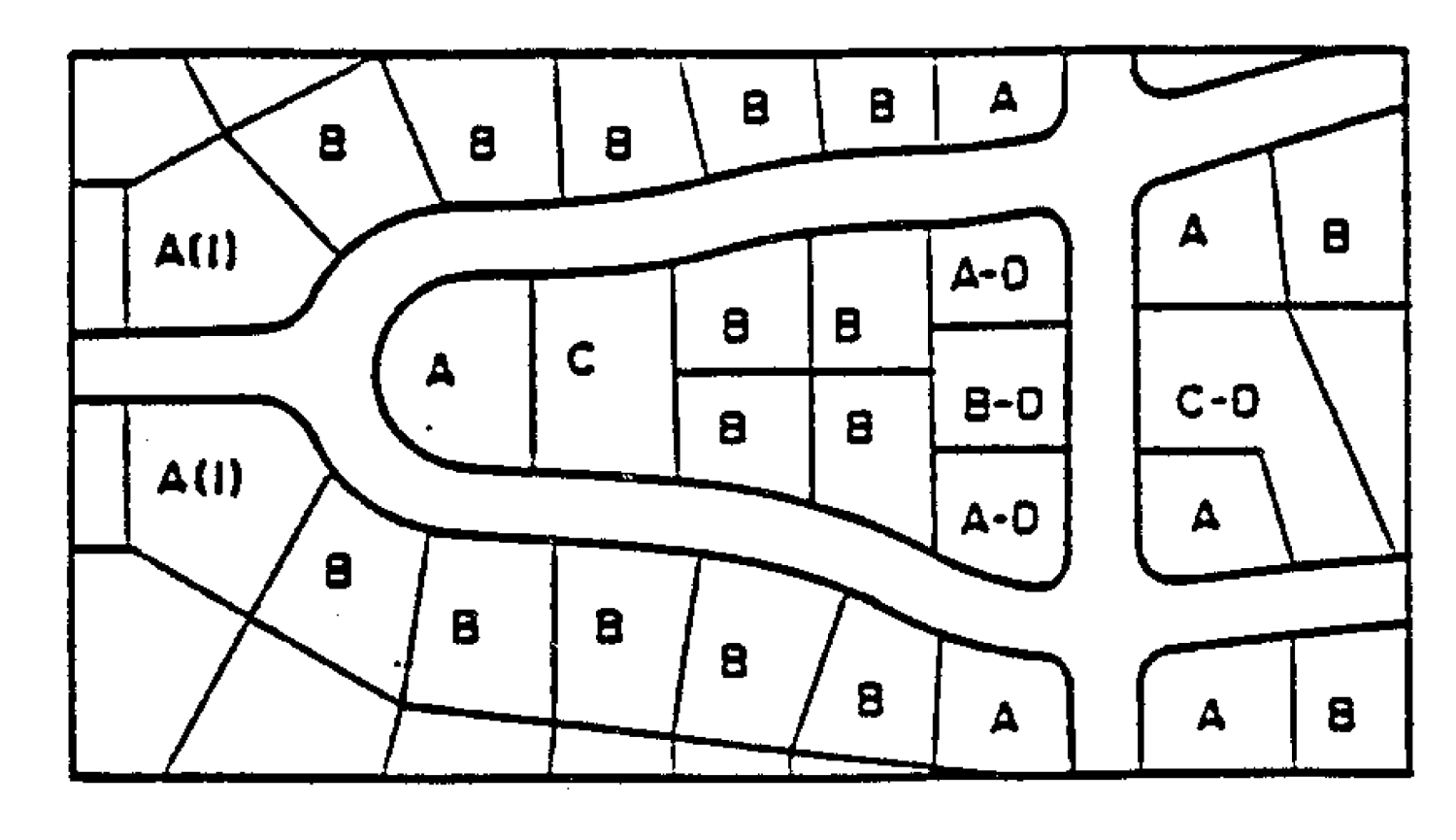
Lot types means the types of lots referenced in the following subsections. The diagram which follows illustrates terminology used in these zoning regulations with reference to corner lots, interior lots, reversed frontage lots and through lots:
(1)
A = Corner lot. A lot located at the intersection of two or more streets. A lot abutting on a curved street or streets shall be considered a corner lot if straight lines drawn from the foremost point of the lot meet at an interior angle of less than 135 degrees. See lots A(1) in the diagram.
(2)
B = Interior lot. A lot other than a corner lot with only one frontage on a street.
(3)
C = Through lot. A lot other than a corner lot with frontage on more than one street. Through lots abutting two streets may be referred to as double frontage lots.
(4)
D = Reversed frontage lot. A lot on which the frontage is at right angles or approximately right angles (interior angle less than 135 degrees) to the general pattern in the area. A reversed frontage lot may also be a corner lot (A-D in the diagram) and interior lot (B-D) or a through lot (C-D).
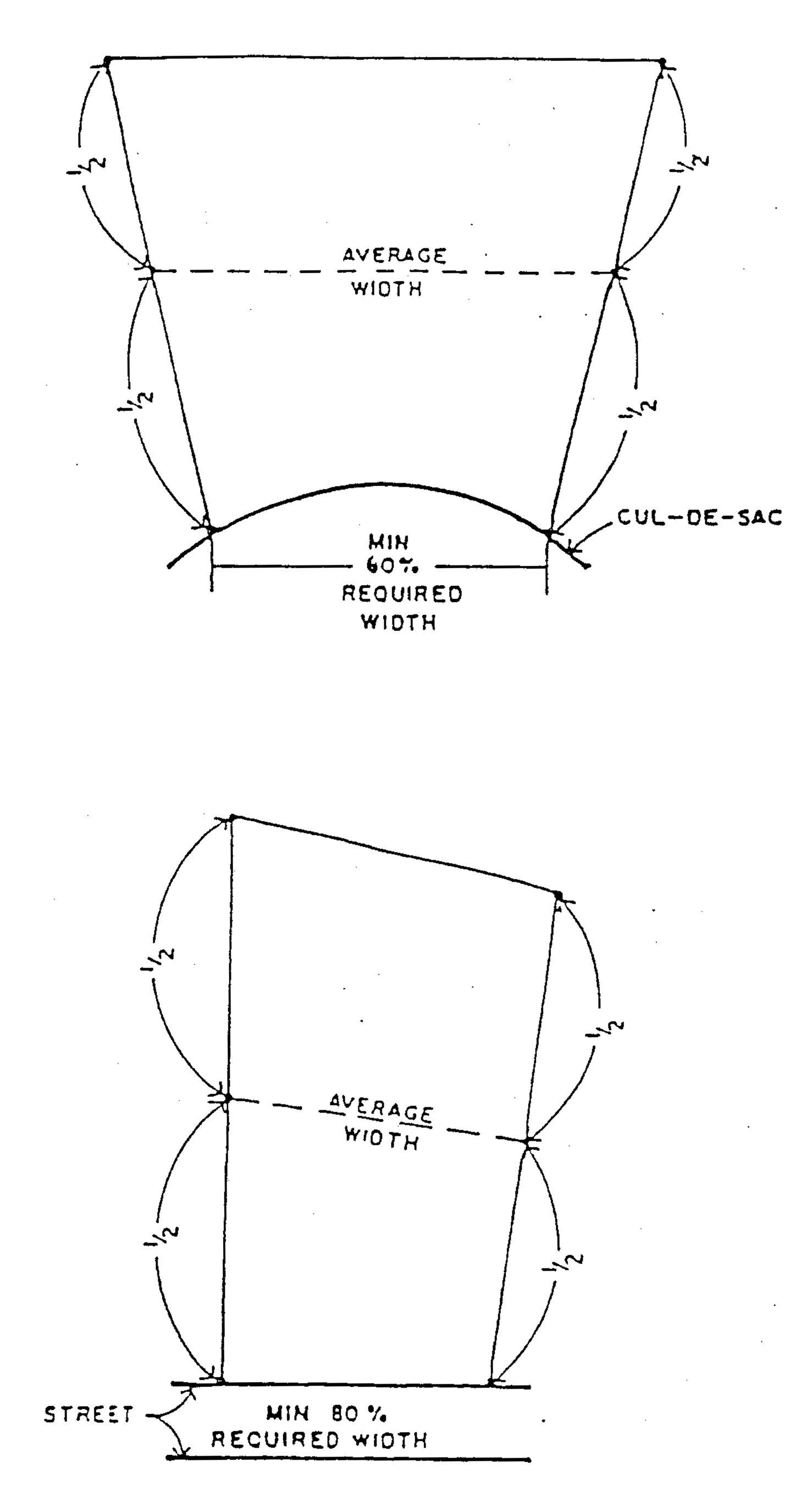
Lot width means the average distance between straight lines connecting front and rear lot lines at each side of the lot, measured as straight lines between the foremost points of the side lot lines in front (where they intersect with the street line) and the rearmost points of the side lot lines in the rear provided, however, that the width between the side lot lines at their foremost points in the front shall not be less than 80 percent of the required lot width, except in the case of lots on the turning circle of a cul-de-sac, where the width shall not be less than 60 percent of the required lot width.
Megawatt (MW) means a unit of power equal to 1,000,000 watts, especially as a measure of the output of a power station.
Mobile home park means premises designed and maintained for the location of two or more mobile homes under a continuing local general management and including special facilities for common use by the occupants such as open space areas and recreational areas and buildings.
Mobile home site means a parcel or lot within a mobile home park, designated for the accommodation of not more than one mobile home.
Mobile home subdivision means premises where more than two mobile homes are located for nontransient living purposes and where lots are set aside and offered for sale for use by mobile homes for living purposes.
Net acre means the total acreage of a lot, tract or parcel of land, excluding land in existing and proposed streets and street rights-of-way.
Net density means the number of residential dwelling units permitted per net acre of land and is determined by dividing the number of units by the total area of land within the boundaries of a lot or parcel not including street rights-of-way. In the determination of the number of dwellings to be permitted on a specific parcel of land, a fractional unit shall not entitle the applicant to an additional unit.
Off-grid solar energy system means a photovoltaic solar energy system in which the circuits energized by the solar energy system are not electrically connected in any way to electric circuits that are served by an electric utility company.
Office, business, means an office for such activities as real estate agencies; advertising agencies, but not sign shops; insurance agencies; travel agencies and ticket sales; chamber of commerce; credit bureau, but not finance company; abstract and title agencies or insurance companies; stockbrokers; and the like. It is characteristic of a business office that retail or wholesale goods are not shown on the premises to a customer. A barbershop or beauty shop is not a business office.
Office, professional, means an office for the use of a person or persons generally classified as professionals, such as architects, engineers, attorneys, accountants, doctors, dentists, chiropractors, psychiatrists, psychologists and the like. It is characteristics that display advertising is not used and that the use is characterized by offering consultive services.
Passive solar energy system means a solar energy system that captures solar light or heat without transforming it to another form of energy or transferring the energy via a heat exchanger.
Photovoltaic system means a solar energy system that converts solar energy directly into electricity.
Planned unit development means a residential or commercial land development comprehensively planned as an entity via a unitary plan which permits flexibility in building siting, mixtures of housing types, usable open spaces and the preservation of significant natural features.
Protected farmland means land that is located in a farmland preservation zoning district, is covered by a farmland preservation agreement, or is otherwise legally protected from nonagricultural development.
Recreational camp means premises and facilities used occasionally or periodically for the accommodation of members of groups or associations for outdoor recreational activities.
Renewable energy easement, solar energy easement means an easement that limits the height or location, or both, of permissible development on the burdened land in terms of a structure or vegetation, or both, for the purpose of providing access for the benefited land to wind or sunlight passing over the burdened land, consistent with Wis. Stats. § 700.35.
Roof-mount means a solar energy system mounted on a rack that is fastened to or ballasted on a structure roof. Roof-mount systems are accessory to the principal use.
Sign means any structure, part thereof or device attached thereto or painted or represented thereon which displays or includes any numeral, letter, word, model, banner, emblem, device, trademark or other representation used as or in the nature of an announcement, advertisement, direction or designation of any person or thing in such a manner as to attract attention from outside of the building. The following signs shall not be included in the application of sign regulations herein:
(1)
Signs not exceeding one square foot in area and bearing only property numbers, post box numbers, names of occupants of the premises or other identification not having commercial connotations.
(2)
Flags and insignia of any government, except when displayed in connection with a commercial promotion.
(3)
Legal notices, identification, informational or directional signs erected or required by governmental agencies.
(4)
Integral or architectural features of buildings, except letters, trademarks, moving parts or moving lights.
(5)
Signs directing or guiding traffic and parking on private property, but bearing no advertisement matter and not exceeding nine square feet in area.
(6)
Temporary paper signs advertising a cultural or civic matter within 30 days of such an event.
Sign, accessory, means a sign relating in its subject matter to the premises on which it is located.
Sign area includes the entire area within the periphery of a regular geometric form or combinations of regular geometric forms, comprising all of the display area of the sign and including all of the elements of the matter displayed, but not including frames or structural elements of the sign bearing no advertising matter. In the case of double face signs where both faces advertise a single facility, product or service, only one face shall count toward area.
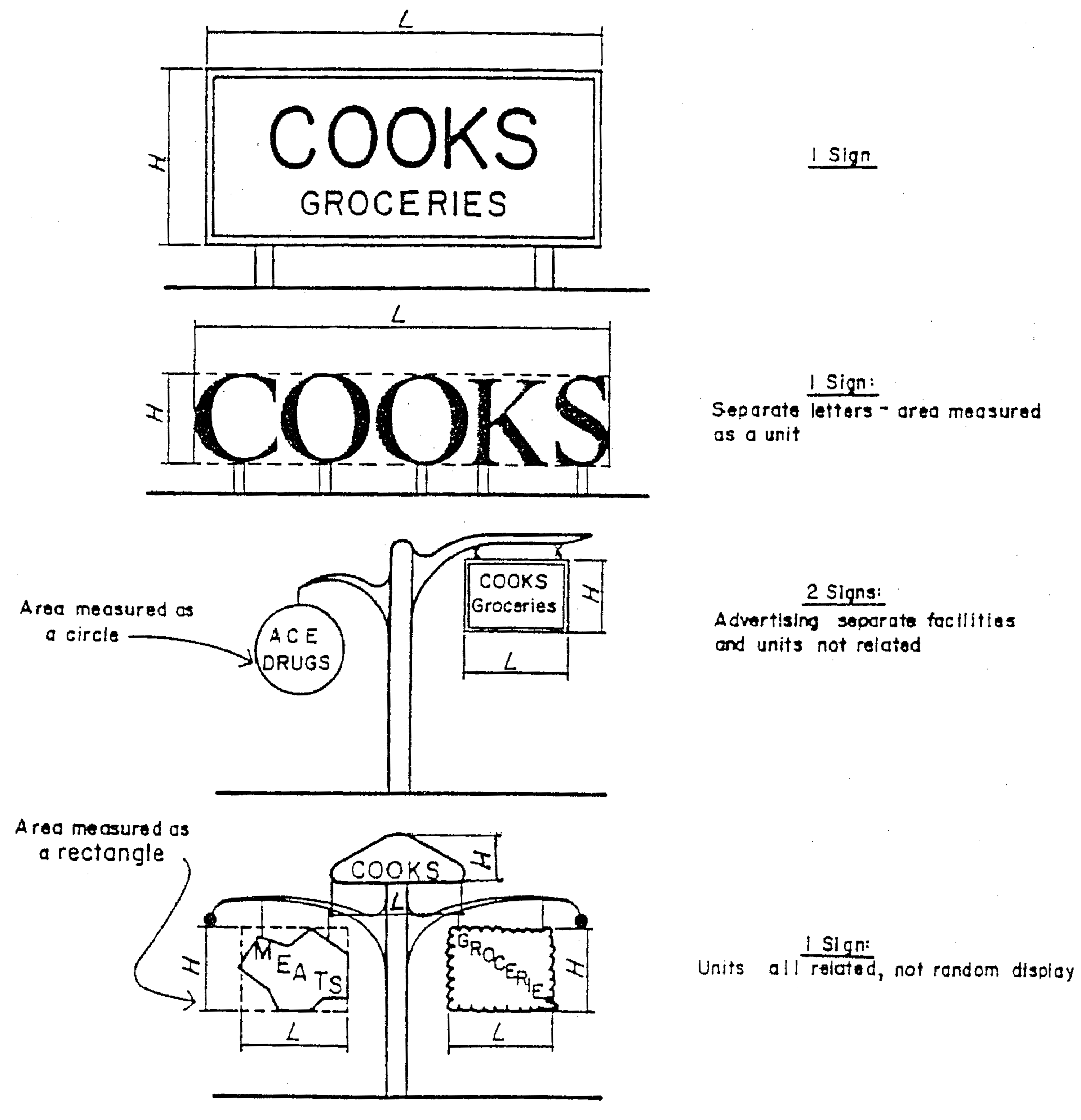
Sign types.
Detached sign means a sign not attached to or painted on a building, but which is affixed to the ground, fence or wall not part of a building.
Flat sign means a sign attached to or parallel to the face of a building or erected or painted on the outside wall of a building and where support of such sign is provided by the wall. No part of such sign shall extend more than 18 inches from the building.
Marquee sign means a sign attached to or hung from a marquee projecting from and supported by a building.
Projecting sign means a sign attached to and projecting 18 inches or more from the face of the wall of a building.
Signs, number of, means for the purpose of determining the number of signs, a sign shall be considered to be a single-display surface or device containing elements organized, related and composed to form a unit. Where subject matter is displayed randomly without any organization of the elements, each element shall be considered to be one sign.
Solar access means an unobstructed access to direct sunlight on a lot or building through the entire year, including access across adjacent parcel air rights, for the purpose of capturing direct sunlight to operate a solar energy system.
Solar carport means a solar energy system that is installed on a carport structure that is accessory to a parking area, and which may include electric vehicle supply equipment or energy storage facilities.
Solar collector means a device, structure, or a part of a device or structure for which the primary purpose is to transform solar radiant energy into thermal, mechanical, chemical, or electrical energy. The collector does not include frames, supports, or mounting hardware.
Solar energy means radiant energy received from the sun that can be collected in the form of heart or light by a solar collector.
Solar energy system means a device, array of devices, or structural design feature, the purpose of which is to provide for generation or storage of electricity from sunlight, or the collection, storage, and distribution of solar energy for space heating or cooling, daylight for interior lighting, or water heating.
Solar hot air system (also referred to as solar air heat or solar furnace) means a solar energy system that includes a solar collector to provide direct supplemental space heating by heating and re-circulating conditioned building air. The most efficient performance includes a solar collector to preheat air or supplement building space heating, typically using a vertically mounted collector on a south-facing wall.
Solar hot water system means a system that includes a solar collector and a heat exchanger that heats or preheats water for building heating systems or other hot water needs, including residential domestic hot water and hot water for commercial processes.
Solar mounting devices means racking, frames, or other devices that allow the mounting of a solar collector onto a roof surface or the ground.
Solar resource means a view of the sun from a specific point on a lot or building that is not obscured by any vegetation, building, or object for a minimum of four hours between the hours of 9:00 a.m. and 3:00 p.m. Standard time on all days of the year, and can be measured in annual watts per square meter.
Special exception means those uses or structures that may not be appropriate generally or without restriction throughout a district, but which if controlled as to number, area, location or relation to the neighborhood, would promote the public health, safety, welfare, comfort, convenience or the general welfare. Such uses or structures may be permitted in a zoning district if they meet the requirements of the district in which they are located and section 54-858.
Stable means premises where more than one horse (livestock) is boarded, raised, kept or trained, regardless of whether the horses (livestock) are owned by the occupants or owners of the premises.
Stable, riding, means premises on which horses (livestock) are kept for the purposes of renting them to the public on an hourly basis. A riding stable shall consist of not less than five acres.
Storage establishment means a structure or structure(s), totaling 40,000 square feet or less, where goods and materials are stored for a fee.
Story means that portion of a building, other than a basement, that is between the surface of any floor and the surface of the next floor above it or, if there is not a floor above, then the space between such floor and the ceiling next above it.
Street line means the dividing line between the street and lot. The street line shall be the same as the legal right-of-way line.
Structure means anything constructed or erected with a fixed location on the ground or attached to something with a fixed location on the ground. Among other things, structures include signs, fences, mobile homes and billboards.
Used oroccupied means intended, designed or arranged to be used or occupied.
Utility-scale energy system means solar (100 MW or larger), wind (100 MW or larger), and other facilities for the production, transmission, delivery or furnishing of heat, light, water, or power, for which a certificate of public convenience and necessity has been obtained from the state Public Service Commission under Wis. Stats. § 196.491.
Variance means a relaxation of the terms of this chapter where such variance will not be contrary to the public interest and where, owing to conditions peculiar to the property and not the result of the actions of the applicant, a literal enforcement of this chapter would result in unnecessary and undue hardship. Variances may be granted only if they meet the requirements of division 7 of article XII of this chapter.
Warehousing means a structure or structure(s), exceeding 40,000 square feet in total, where goods and materials are stored for a fee.
Yard means an open space, other than a court, on a lot, unoccupied and unobstructed from the ground upward provided, however, that fences, walls, poles, posts and other customary yard accessory ornaments and furniture may be permitted in any yard subject to height limitations and requirements limiting obstruction visibility. The term "required yard" means that minimum distances specified by these regulations measured from the property line.
Yard, front, means a yard extending across the front of a lot between the side lot lines and extending from the street line to the nearest line of the principal structure or projection of the principal structure.
Yard, rear, means a yard extending across the rear of a lot between the side lot lines and extending from the rear property line to the nearest line of the principal structure or projection of the principal structure.
Yard, side, means a yard extending between the nearest building or projection thereto and the side lot line and extending from the front yard to the rear yard.
(Code 1992, § 17.04; Ord. of 6-24-1997, § 17.04(2); Ord. No. M-2013-14, 2-25-2014; Ord. No. Z-10-2022-23, 2-14-2023; Ord. No. Z-2-2024-25, 5-28-2024; Ord. No. Z-11-2024-25, 3-11-2025)
Sec. 54-5. - Penalties.
Any person who violates any provision of this chapter or any order, rule or regulation made hereunder shall, upon conviction, be subject to the penalties as set forth in section 1-10.
(Code 1992, § 17.70)
Sec. 54-6. - Establishment of districts.
To achieve the purposes of this chapter, the unincorporated area of the county is hereby divided into the following districts as set forth in sections 54-70 through 54-359.
(1)
AED — Exclusive agricultural district.
(2)
AGD — General agricultural district.
(3)
RSF — Single-family residential district.
(4)
RTF — Two-family residential district.
(5)
RMF — Multifamily residential district.
(6)
CL — Local commercial district.
(7)
CR — Regional commercial district.
(8)
CP — Planned commercial district.
(9)
IND — Industrial district.
(Code 1992, § 17.05)
Sec. 54-7. - Official zoning atlas.
(a)
Establishment. The location and boundaries of the districts shall be as shown in a map atlas entitled "Official Zoning Atlas of Outagamie County, Wisconsin." The district symbol as set out in sections 54-6 and 54-70 through 54-359 shall be used to designate each district. The official zoning atlas, with all notations, dimensions, designations, references and other data shown, is hereby adopted by reference and made a part of this chapter as if fully set forth herein and shall be kept in the office of the Zoning Administrator. Upon adoption by the County Board, each map page shall be signed by the chair of the County Board and attested by the County Clerk bearing the date of adoption.
(b)
Amendments. Amendments to the official zoning atlas shall be approved by the County Board in accordance with the provisions of this chapter and Wis. Stats. § 59.97. Amendments shall be effective as provided in Wis. Stats. § 59.97. Amendments shall promptly be portrayed on the appropriate map page and include the ordinance number and effective date of the amendment.
(c)
Final authority as to zoning status. Regardless of the existence of purported copies of all or part of the official zoning atlas which may from time to time be made or published, the official zoning atlas, which shall be located in the office of the Zoning Administrator, shall be the final authority as to the current zoning status of any lands.
(d)
Replacement of official zoning atlas. If the official zoning atlas or any page or portion thereof becomes damaged, lost, destroyed or difficult to interpret, the County Board may by resolution adopt a new official zoning atlas or any page thereof, which shall supersede the prior official zoning atlas or page thereof. The new official zoning atlas or page thereof may correct drafting or other errors or omissions, but no such correction shall have the effect of amending the original official zoning atlas or page thereof. If, in the process of correcting drafting or other errors or omissions district boundaries are changed or altered, then action shall be taken only in the form of an amendment.
(e)
Retention of earlier maps. All zoning maps which have had the force and effect of official zoning maps for the county prior to the effective date of adoption of the ordinance from which this chapter is derived shall be retained as a public record and as a guide to the zoning status of lands prior to such date.
(Code 1992, § 17.06)
Sec. 54-8. - Interpretation of district boundaries.
(a)
Except as otherwise specifically provided, a district symbol or name shown within district boundaries on the official zoning atlas indicates that the district regulations pertaining to the district extend throughout the whole area surrounded by the boundary line.
(b)
Where uncertainty exists as to the boundaries of districts shown on the official zoning atlas, the following rules shall apply:
(1)
Boundaries indicated as approximately following the centerlines of streets, highways, alleys or rights-of-way shall be construed as following such centerline as they exist on the ground.
(2)
Boundaries indicated as approximately following lot lines shall be construed as following such lines provided, however, that where such boundaries are adjacent to a dedicated street, highway or right-of-way and the zoning status of the street, highway or right-of-way is not indicated, the boundaries shall be construed as running to the middle of the street, highway or right-of-way.
(3)
Boundaries indicated as approximately following the limits of incorporated municipalities shall be construed as following such limits.
(4)
Boundaries indicated as following railroad tracks shall be construed as being midway between the main tracks.
(5)
Where boundaries do not follow property lines and distances are not specified, boundaries shall be determined by the use of the scale in the official zoning atlas.
(6)
Where the property layout existing on the ground is at variance with that shown in the official zoning atlas, the Zoning Administrator shall interpret the official zoning atlas. The determination by the Zoning Administrator may be appealed as provided in section 54-887.
(Code 1992, § 17.07)
Sec. 54-9. - Application of regulations.
The regulations set by this chapter shall be minimum regulations and shall apply uniformly to each class or kind of structure or land and, particularly, except as hereinafter provided:
(1)
No land, building or structure shall hereafter be used or occupied and no building, structure or part thereof shall hereafter be erected, constructed, reconstructed, moved or structurally altered, except in conformity with all the regulations herein specified for the district in which it is located.
(2)
No sign shall hereafter be erected, hung, placed, painted, altered or moved, except in conformity with the regulations of the district in which it is located.
(3)
No part of a yard, open space or off-street parking or loading space required about or in connection with any building for the purpose of complying with this chapter shall be included as part of a yard, open space, off-street parking or loading space similarly required for any other building.
(4)
No lot or yard existing at the effective date of adoption of the ordinance from which this chapter is derived shall be reduced in dimension or area below the minimum requirements set forth herein. Lots or yards created after the effective date of adoption of the ordinance from which this chapter is derived shall meet the minimum requirements established by this chapter.
(5)
No accessory building shall be constructed upon a lot until the construction of the main building has actually commenced. No accessory building shall be used, unless the principal building on the lot is also being used. No cellar or basement shall be used as a dwelling prior to substantial completion of the dwelling of which it is part.
(Code 1992, § 17.08)
Sec. 54-10. - Interpretation.
In their interpretation and application, the provisions of this chapter shall be considered minimum requirements. Where the provisions of this chapter impose greater restrictions than any statute, other regulation, ordinance or covenant, the provisions of this chapter shall prevail. Where the provisions of any statute, other regulation, ordinance or covenant impose greater restrictions than the provisions of this section, the provisions of such statute, other regulation, ordinance or covenant shall prevail.
(Code 1992, § 17.09)
Sec. 54-11. - Other regulations applicable to the development and use of land and structures.
In addition to the applicability of these regulations, certain lands and structures in the county are also subject to, without limitation, regulations pertaining to floodplains, shorelands and wetlands, and airports and airport operations.
(Code 1992, § 17.11)

