
Maplewood City Zoning Code
ARTICLE III
SUPPLEMENTARY REGULATIONS
Sec. 56-497. - Applicability.
For every use hereafter established there shall be provided sufficient space for access and off-street standing, parking and unloading of motor vehicles that may be expected to come to an establishment at any time under normal conditions for any purpose, whether as patrons, customers, employees, guests or otherwise; or when a use is expanded, accessory off-street parking and loading shall be provided in accordance with the following regulations for the area or capacity of such expansion.
(Ord. No. 4062, § 904.01(1), 10-14-1980; Ord. No. 4187, § 1, 6-26-1984; Ord. No. 4545, §§ 1, 2, 7-28-1992; Ord. No. 4668, § 1, 10-25-1994; Ord. No. 4908, § I, 9-28-1999; Ord. No. 5017, §§ I, II, 10-23-2001; Ord. No. 5018, § I, 10-23-2001; Ord. No. 5046, §§ I, IV, 3-26-2002)
Sec. 56-498. - General provisions.
The following general provisions shall apply to all parking, standing and loading space that is provided in accordance with the provisions of this chapter:
(1)
Location of parking or loading space. All required off-street parking or loading spaces shall be provided on the same parcel of land occupied by the use or building to which it is appurtenant; provided, however, that where there are practical difficulties in the way of such location of parking space and/or if the public safety or convenience would be better served by another location, the zoning administrator may authorize a shared parking agreement to allow parking on different parcels of land that are not under common ownership as will adequately serve the public interest, subject to the following conditions:
a.
A surplus of available parking spaces in accordance with the regulations of article III, supplementary regulations, division 2, off-street parking and loading, must be demonstrated before parking spaces can be shared in any agreement.
b.
A pedestrian entrance to such space shall be located within a distance of 300 feet by the shortest route of effective pedestrian access.
c.
Such space shall be useable without causing unreasonable traffic congestion, detriment to any residential neighborhood, or hazard to pedestrians or vehicular traffic.
d.
It shall be unlawful to utilize any required off-street parking or loading facilities for motor vehicle repair work or service of any kind, except as expressly permitted herein.
e.
Businesses must submit evidence of current shared parking agreements to the office of the city clerk in conjunction with their annual business license renewal process. If a business does not provide a required shared parking agreement during their annual business license renewal process, their business license shall be subject to revocation.
(2)
Computation of parking spaces.
a.
For the purpose of computing required off-street standing and parking or loading space in relation to floor area, the gross floor area shall be used.
b.
When computing parking space requirements on the basis of the number of occupants, practitioners or employees, the maximum number of said occupants on the premises at any period of the day shall be used.
c.
When the application of parking or loading requirements would result in a fractional space, any such fraction shall be counted as one space.
d.
In those instances where it is necessary to translate gross parking area into parking spaces, a factor of 350 square feet per gross automobile parking space shall be applied.
e.
In calculating any required parking area, other than for detached single-family dwellings, sufficient access and maneuver space shall be provided to permit the parking and removal of any vehicle without moving other vehicles.
f.
Space allocated for any off-street loading berth shall not, while so allocated, be used to satisfy the space requirements for any off-street parking facilities or portions thereof.
g.
If there is any uncertainty with respect to the amount of parking space required by the provisions of this ordinance as a result of any indefiniteness as to the proposed use of a building or of land, the maximum requirement for the general type of use that is involved shall govern.
(Ord. No. 4062, § 904.01(2), 10-14-1980; Ord. No. 4187, § 1, 6-26-1984; Ord. No. 4545, §§ 1, 2, 7-28-1992; Ord. No. 4668, § 1, 10-25-1994; Ord. No. 4908, § I, 9-28-1999; Ord. No. 5017, §§ I, II, 10-23-2001; Ord. No. 5018, § I, 10-23-2001; Ord. No. 5046, §§ I, IV, 3-26-2002; Ord. No. 5933, § I, 4-28-2020)
Sec. 56-499. - Design and maintenance standards for automobile parking or maintenance areas.
All areas providing off-street parking shall conform with the following standards:
(1)
Area of parking spaces. All required off-street parking spaces shall be at least nine feet in width and at least 19 feet in length, exclusive of any driveways appurtenant and giving access thereto, with a vertical clearance of not less than seven feet.
(2)
Access to parking spaces. Each required off-street parking space shall open directly upon an aisle or driveway of such width and design as to provide safe and efficient means of access to a street or public service drive.
(3)
Surfacing and drainage of parking areas. All open off-street parking areas shall be graded and paved with a durable, dust-free and hard material such as bituminous hot mix or Portland cement concrete, or some comparable material. All parking areas will be properly drained so as to control surface ponding and avoid any nuisance or damage to adjacent property.
(4)
Curbs and delineations. Fixed and permanent wheel bumpers or curbs of concrete or some comparable material at least four inches high shall be installed for each parking area, except for parking areas accessory to single-family dwellings. Parking spaces shall be delineated and markings shall be periodically restored to maintain a clear identification of separate parking stall spaces at all times.
(5)
Screening. All open off-street parking areas containing five or more parking spaces shall be effectively screened by a wall, fence, earth berm or densely planted compact hedge not less than 2½ feet in height on each side that adjoins any street or public right-of-way or adjacent property. A plan demonstrating said screening shall be subject to the review and approval of the zoning administrator. The zoning administrator may require the review of said plan by a certified landscape architect to be chosen by the city. The applicant shall incur all costs of plan review by said landscape architect. If the zoning administrator and applicant cannot come to an agreement on the appropriate method of screening, the plan and zoning commission shall determine the appropriate method of screening and the screening plan shall be subject to the review and approval of the plan and zoning commission.
(6)
Landscaping.
a.
All open off-street parking areas containing 20 or more parking spaces shall be landscaped to effectively reduce heat and glare and to minimize wind blowing of dust and other residue, and reduce oppressive visual effects of large open parking areas. Any application for a building permit to develop or construct a parking area for 20 or more vehicles, either as a separate use of land or accessory to another use, shall be accompanied by a landscape plan. A landscape plan demonstrating said landscaping must be reviewed by the zoning administrator for sufficiency and appropriateness and shall be subject to the review and approval of the plan and zoning commission. The zoning administrator may require the review of said plan by a certified landscape architect to be chosen by the city. The applicant shall incur all costs of plan review by said landscape architect.
b.
Landscape plans submitted shall contain such detailed information as is necessary to evaluate the quality of the proposed treatment and determine compliance with specific landscape standards provided by the plan and zoning commission and/or certified landscape architect for all such parking areas. These standards shall include but not be limited to requirements relating to size, type, spacing and amount of plant material, including trees, shrubbery and ground cover, the size, construction, maintenance protection, watering and drainage of landscaped areas or planting beds, and spatial functional relationships between landscaped areas, parking spaces, automobile circulation and pedestrian movement.
(7)
Lighting. Any light used to illuminate any parking area shall either be so arranged and shielded, as to confine all direct light rays entirely within the boundary lines of such areas, or be a low intensity, highly diffused, luminous light source.
(Ord. No. 4062, § 904.01(3), 10-14-1980; Ord. No. 4187, § 1, 6-26-1984; Ord. No. 4545, §§ 1, 2, 7-28-1992; Ord. No. 4668, § 1, 10-25-1994; Ord. No. 4908, § I, 9-28-1999; Ord. No. 5017, §§ I, II, 10-23-2001; Ord. No. 5018, § I, 10-23-2001; Ord. No. 5046, §§ I, IV, 3-26-2002)
Sec. 56-500. - Minimum number of spaces.
The following shall be the minimum number of off-street parking spaces required for each of the various uses of a given lot or parcel subject to the modifications permitted by the site plan review procedure as provided in article IV, division 8 of this chapter:
(1)
Public and community service activities.
a.
Nursery schools and day care centers, public or private: one space for each staff member or employee.
b.
Elementary and junior high schools, public or private: one space for each 20 students of building design capacity.
c.
High schools: one space for each ten students based upon the maximum number of students attending the school at any one period of the day.
d.
Any auditorium or other facility for public assembly associated with the above school: one space for each ten seats or other accommodation for spectators in addition to required student/faculty parking.
e.
Business, commercial or trade school, including secretarial or beautician school: one space for each three students.
f.
Facilities used for public assembly but having no fixed seating arrangement specified: one space per 50 square feet of floor area.
g.
Noncommercial places of public assembly with fixed seats, (including church or synagogue sanctuaries): one space for each four seats.
h.
Private clubs and lodges: at least one parking space for each three persons, based on the maximum number of persons that can be accommodated at the same time.
i.
Swimming pools and associated clubs: one parking space for each 40 square feet of pool area.
(2)
Residential and housing uses. Parking for residential uses shall be governed by the use regulations for the district in which the use is located, except that in cases where there are no such applicable parking regulations stated, parking shall be provided in accordance with the following minimum standards:
a.
Attached or detached single-family dwellings: Two spaces for each dwelling unit which may include up to one space per unit located with an adjacent street or public right-of-way.
b.
Multifamily apartment dwelling consisting of five or more dwelling units: 1½ spaces for each dwelling unit, except that two spaces shall be provided for each dwelling unit containing three or more bedrooms.
c.
Motel or hotel: One space for each dwelling unit or guest room plus one space for each two employees or permanent residents, plus such additional spaces as required herein for affiliated uses such as restaurants and the like.
d.
Apartment dwelling for the elderly: One space for each four dwelling units specifically provided for occupancy by elderly persons or couples and allowed under site plan review procedures or as a specified conditional use.
(3)
Business and commercial uses.
a.
Office developments not otherwise specified. A parking space shall be provided for each 300 square feet of floor area including basement or other areas useable or adjustable without structural alterations.
b.
Retail business developments not otherwise specified. A parking space shall be provided for each 200 square feet of floor area including basement or other areas useable or adjustable without structural alterations.
c.
Requirements for parking at newly constructed restaurants.
1.
Sit down restaurants: one space for every three seats for patrons and two spaces for every three employees on maximum shift.
2.
Fast food restaurants: one space for every two seats and two spaces for every three employees on maximum shift.
d.
Commercial and business developments. Commercial and business developments with 100 or more required parking spaces may provide for ten percent of those spaces as "compact car only" spaces with a size of 8.5 feet wide by 18 feet long. These spaces must be located in areas as approved by the director of public works.
(4)
Warehousing, wholesale and manufacturing uses. For uses consisting of the manufacture, processing, assembly, storage, warehousing or wholesale and distribution of products: one space for each 1,000 square feet of floor area or one space for each two employees, whichever is greater.
(5)
Other similar uses and uses not limited. The zoning administrator shall determine to which of the above categories of parking regulation any unlisted but similar use, including designated conditional uses, shall belong or determine other applicable standards consistent with the above whenever the above prove inapplicable.
(Ord. No. 4062, § 904.01(4), 10-14-1980; Ord. No. 4187, § 1, 6-26-1984; Ord. No. 4545, §§ 1, 2, 7-28-1992; Ord. No. 4668, § 1, 10-25-1994; Ord. No. 4908, § I, 9-28-1999; Ord. No. 5017, §§ I, II, 10-23-2001; Ord. No. 5018, § I, 10-23-2001; Ord. No. 5046, §§ I, IV, 3-26-2002)
Sec. 56-501. - Standards for the design and maintenance of off-street loading areas.
(a)
Area of loading berths or space. A required off-street loading berth or space shall be at least 12 feet in width and at least 25 feet in length, exclusive of aisle and maneuver space, and shall have a vertical clearance of at least 14 feet.
(b)
Access to loading areas. Each required off-street loading space or berth shall be afforded appropriate means of vehicular access to a street, highway or alley in a manner which will least interfere with traffic movement.
(c)
Surfacing. All open off-street loading shall be improved with a compacted select gravel base, not less than seven inches thick, and surfaced with all-weather dustless material, such as bituminous hot mix or Portland cement concrete, suitably designed for intended use.
(d)
Screening. All loading berths or spaces which abut or are adjacent to a residence district shall be completely screened therefrom by building walls, or a uniformly painted, solid fence, wall or door, or any combination thereof, not less than eight feet in height.
(Ord. No. 4062, § 904.01(5), 10-14-1980; Ord. No. 4187, § 1, 6-26-1984; Ord. No. 4545, §§ 1, 2, 7-28-1992; Ord. No. 4668, § 1, 10-25-1994; Ord. No. 4908, § I, 9-28-1999; Ord. No. 5017, §§ I, II, 10-23-2001; Ord. No. 5018, § I, 10-23-2001; Ord. No. 5046, §§ I, IV, 3-26-2002)
Sec. 56-502. - Loading berth requirements.
(a)
Offices and personal or community service establishments. One loading space shall be provided for each such establishment, including schools, medical or dental clinics, auditoriums or clubs, etc., having greater than 6,000 square feet of gross floor area.
(b)
Residential or housing uses. Any building containing more than 50 apartment dwelling units shall provide one loading berth to facilitate refuse collection and large volume pickup and delivery functions.
(c)
Business, commercial or industrial uses. Every building or use of land consisting of over 3,000 square feet of gross floor area designed or adaptable for retail business purposes, or warehouse, wholesale or manufacturing use shall be provided with loading space as follows:
(d)
Other similar uses. The zoning administrator shall determine to which of the above categories of loading regulation any specific use, including designated conditional uses, shall belong or determine other applicable standards whenever the above regulations prove inapplicable.
(Ord. No. 4062, § 904.01(6), 10-14-1980; Ord. No. 4187, § 1, 6-26-1984; Ord. No. 4545, §§ 1, 2, 7-28-1992; Ord. No. 4668, § 1, 10-25-1994; Ord. No. 4908, § I, 9-28-1999; Ord. No. 5017, §§ I, II, 10-23-2001; Ord. No. 5018, § I, 10-23-2001; Ord. No. 5046, §§ I, IV, 3-26-2002)
Sec. 56-528. - Term defined; authorization.
(a)
Definitions. The term "home occupation" means a business, profession, occupation or trade conducted for gain or support entirely within a residential building or accessory structure thereto.
(b)
Authorization. Any home occupation that is customarily incidental to the principal use of a building as a dwelling shall be permitted in any dwelling unit.
(Ord. No. 4062, § 904.02(1), (2), 10-14-1980)
Sec. 56-529. - Use limitations.
In addition to all use limitations applicable to the district in which it is located, no home occupation shall be permitted unless it complies with the following provisions:
(1)
The business shall not employ persons other than members of the family residing on the premises.
(2)
No more than 25 percent of the total enclosed floor area, including basement, garage or attic spaces, of a dwelling unit may be used for such business.
(3)
No alteration of a principal residential structure shall be made which changes the character thereof as a dwelling.
(4)
No mechanical equipment or process shall be used which creates noise, vibration, glare, fumes, odors or electrical interference detectable to the normal senses outside the place of business.
(5)
There shall be no exterior storage of equipment or material used in connection with the business.
(Ord. No. 4062, § 904.02(3), 10-14-1980)
Sec. 56-530. - Permitted home occupations.
Customary home occupations include, but are not limited to, the following list of occupations; provided, however, that each listed occupation shall be subject to the limitations of section 56-299:
(1)
Dressmakers, seamstresses, tailors.
(2)
Music teachers, provided that instructions shall be limited to one pupil at a time, except for occasional groups.
(3)
Artists, sculptors and authors or composers.
(4)
Office facilities for architects, engineers, lawyers, realtors, insurance agents, brokers and members of similar professions.
(5)
Ministers, rabbis, priests.
(6)
Office facilities for salesmen, sales representatives, manufacturers representatives, when no retail or wholesale sales are made or transacted on the premises or where no warehousing occurs.
(7)
Home crafts, such as model making, rug weaving, lapidary work, cabinetmaking, etc., provided that no machinery or equipment is used or employed, other than that which would customarily be found in the home. Machinery or equipment which would customarily be found in the home shall include machinery or equipment that would customarily be employed in connection with a hobby or a vocation not conducted for gain or profit.
(Ord. No. 4062, § 904.02(4), 10-14-1980)
Sec. 56-531. - Prohibited home occupations.
Permitted home occupations shall not in any event be deemed to include:
(1)
Barbershops and beauty parlors.
(2)
Dancing schools.
(3)
Funeral homes.
(4)
Nursery schools and day-care centers.
(5)
Restaurants.
(6)
Stables, kennels or animal hospitals.
(7)
Medical or dental offices or clinics, including chiropractors, veterinarians, podiatrists, etc.
(8)
Tourist home.
(9)
Motor vehicle repair or service.
(Ord. No. 4062, § 904.02(5), 10-14-1980)
Sec. 56-532. - Allowable signing.
A dwelling unit containing an allowable home occupation shall provide no name plate announcing said occupation exceeding one square foot in area.
(Ord. No. 4062, § 904.02(6), 10-14-1980)
Sec. 56-558. - Term defined; authorization.
(a)
Definitions. The term "accessory use" means a structure or use which meets all of the following criteria:
(1)
It is subordinate to and serves a principal building or a principal use;
(2)
It is subordinate in area, extent or purpose to the principal building or principal use served;
(3)
It contributes to the comfort, convenience or necessity of occupants, business or industry in the principal building or principal use served; and
(4)
It is located on the same lot as the principal building or principal use served.
(b)
Authorization. Accessory uses are permitted in any zoning district in connection with any principal use which is permitted within such district.
(Ord. No. 4062, § 904.03(1), (2), 10-14-1980; Ord. No. 4647, § 5, 5-24-1994; Ord. No. 5003, § I, 8-14-2001; Ord. No. 5018, § II, 10-23-2001; Ord. No. 5046, §§ II, III, 3-26-2002; Ord. No. 5207, § II, 9-28-2004; Ord. No. 5312, § I, 1-24-2006)
Sec. 56-559. - Permitted accessory uses.
A permitted accessory use is any use or structure which complies with the above definition, including, but not limited to, the following typical uses:
(1)
Private garages or carports, provided the structure is not constructed with a lightweight, temporary frame or is covered with canvas, vinyl, corrugated fiberglass, tin or similar material.
(2)
Off-street parking and loading spaces as required by article III, division 2 of this chapter, and any additional off-street parking or loading spaces which are devoted exclusively to the principal use or activity, unless specifically prohibited under section 56-560.
(3)
Private or public parking of motor vehicles in any nonresidential zoning district, subject to the provisions of this division.
(4)
Private parking of private passenger automobiles or motorcycles in the front, side or rear yards in any residential zoning district, subject to the provisions of this chapter; provided that such front yard parking shall not be used to satisfy the off-street parking requirements of this chapter. The parking area shall be located behind the front building line of the residence. The front building line shall not be considered to include any porch or other projection. The minimum area for parking of each vehicle shall be nine feet in width by 19 feet in length. The parking area shall not exceed 30 percent of the required rear yard. The parking area and access drive shall be paved with asphaltic or Portland cement concrete, bricks, paving blocks, and such paving shall extend the full width of the parking area and access drive. The parking area and access drive from the street or public service drive shall be constructed in a manner approved by the director of public works.
(5)
Private parking or storage of major recreational equipment or commercial vehicles, not exceeding 6½ feet in height or 20 feet in length, in any residential zoning district, provided such parking or storage takes place in a garage or carport in a manner that screens the vehicle or equipment from view at normal eye level from any street or private property; or provided such parking or storage takes place in a rear yard in a manner that screens the vehicle or equipment from view at normal eye level from any street or private property; further provided that any such parking or storage does not encroach upon the required off-street parking.
(6)
Parking of commercial vehicles during the actual performance of a service at the premises on which it is parked.
(7)
A structure for storage incidental to a permitted use, provided no such structure that is accessory to a residential building shall exceed 250 square feet in gross floor area and 12 feet in height.
(8)
A child's playhouse.
(9)
A private park or recreation facilities including swimming pools and bath houses, or private tennis courts, provided that such facilities are set back at least 15 feet from any lot line and screened from adjacent residential property with a fence or dense planting at least six and not more than eight feet in height.
(10)
Convenience/service retail uses may be provided as an accessory use to a permitted use in any district except an SR or LR Single-Family District, provided that there are no window displays or extraneous advertisements, other than identification signage or service that shall not be visible from outside the building. Such strictly incidental convenience retail uses may include personal services such as barbershops, beauty parlors, photographic studios, or drycleaning and laundry pick-up or self-service facilities, and restaurants, cafes, or soda fountains, provided the area used for all such uses does not exceed an amount equal to five percent of the gross (residential or other non-retail commercial) floor area of the building or project (exclusive of maintenance and parking areas) in which the same are contained. Because of its incidental and accessory character, no such floor space need be included in the calculation of parking requirements for a given building or project.
(11)
Greenhouses.
(12)
Statuary, arbors, trellises, barbecue stoves, dog houses, flagpoles, fences, walls, hedges.
(13)
Auditoriums and other public assembly halls within MR, HR, P-RO and PA districts.
(14)
Health clubs, including baths and gymnasiums in P-RO districts.
(15)
Required setback for air conditioning units is 15 feet but in those cases where the requirement cannot be met, the setback may be reduced to a minimum of seven feet. In all cases the setback must be the maximum available so that the condensing unit is furthest away from the neighboring property. Under no circumstances can an air conditioning unit be located in a front yard.
(Ord. No. 4062, § 904.03(3), 10-14-1980; Ord. No. 4647, § 5, 5-24-1994; Ord. No. 5003, § I, 8-14-2001; Ord. No. 5018, § II, 10-23-2001; Ord. No. 5046, §§ II, III, 3-26-2002; Ord. No. 5207, § II, 9-28-2004; Ord. No. 5312, § I, 1-24-2006)
Sec. 56-560. - Specifically prohibited uses.
(a)
It shall be unlawful for any person, firm, or corporation to occupy or use any land, building, or part thereof for any accessory use which is specifically prohibited herein.
(b)
The following are specifically prohibited as accessory uses:
(1)
Repair or service of any motor vehicle in any residential zoning district unless the activities are confined within a completely enclosed building or unless the repairs are limited to those defined herein as minor motor vehicle repairs and are fully completed within a period of 24 hours or less; provided that all such repairs shall be limited to the vehicles of the resident or residents living within the principal building.
(2)
Storage of mobile homes or use for dwelling proposes in any residential zoning district.
(3)
The use of major recreational equipment for living, sleeping, or housekeeping purposes.
(4)
Outdoor storage of major recreational equipment in residential zoning districts, unless the equipment is in condition for safe and effective performance of the function for which it is intended or can be made so at cost not exceeding the value of the equipment in its existing state.
(5)
Any outdoor parking or storage, except as specifically permitted by the regulations of this chapter.
(c)
With the exception of accessory dwelling units (ADU's) as set forth in article II, division 2 of this chapter, it shall be unlawful for any person, firm or corporation to occupy an accessory building for purposes of residency or any other use resulting in systematic human occupancy.
(Ord. No. 4062, § 904.03(4), 10-14-1980; Ord. No. 4647, § 5, 5-24-1994; Ord. No. 5003, § I, 8-14-2001; Ord. No. 5018, § II, 10-23-2001; Ord. No. 5046, §§ II, III, 3-26-2002; Ord. No. 5207, § II, 9-28-2004; Ord. No. 5312, § I, 1-24-2006; Ord. No. 6000, § IV, 10-25-2022)
Sec. 56-561. - Bulk regulations.
(a)
Accessory structures and uses shall be set back at least five feet from the rear lot line.
(b)
Accessory structures and uses shall maintain the same side yard as is required for the principal structure located on the zoning lot, except that off-street parking, fences, walls and hedges may be located in required side yards.
(c)
No part of any accessory structure shall be located closer than ten feet to any principal structure or other accessory structure, unless it is attached to or forms a part of such principal structure.
(d)
Accessory structures and uses shall otherwise comply with the bulk regulations applicable to the district in which they are located.
(Ord. No. 4062, § 904.03(5), 10-14-1980; Ord. No. 4647, § 5, 5-24-1994; Ord. No. 5003, § I, 8-14-2001; Ord. No. 5018, § II, 10-23-2001; Ord. No. 5046, §§ II, III, 3-26-2002; Ord. No. 5207, § II, 9-28-2004; Ord. No. 5312, § I, 1-24-2006)
Sec. 56-562. - Use limitations.
All accessory structures and uses shall comply with the use limitations applicable in the zoning district in which they are located and with the following additional use limitations:
(1)
No accessory structure shall be constructed and occupied on any lot prior to the time of the completion of the construction of the principal structure to which it is accessory.
(2)
No accessory structure or use shall be permitted in any required front yard, in any residential district, unless specifically permitted elsewhere in this ordinance or by site plan review with patio and townhouse dwellings as provided in article IV, division 8 of this chapter.
(Ord. No. 4062, § 904.03(6), 10-14-1980; Ord. No. 4647, § 5, 5-24-1994; Ord. No. 5003, § I, 8-14-2001; Ord. No. 5018, § II, 10-23-2001; Ord. No. 5046, §§ II, III, 3-26-2002; Ord. No. 5207, § II, 9-28-2004; Ord. No. 5312, § I, 1-24-2006)
Sec. 56-588. - Multifamily apartment dwellings.
(a)
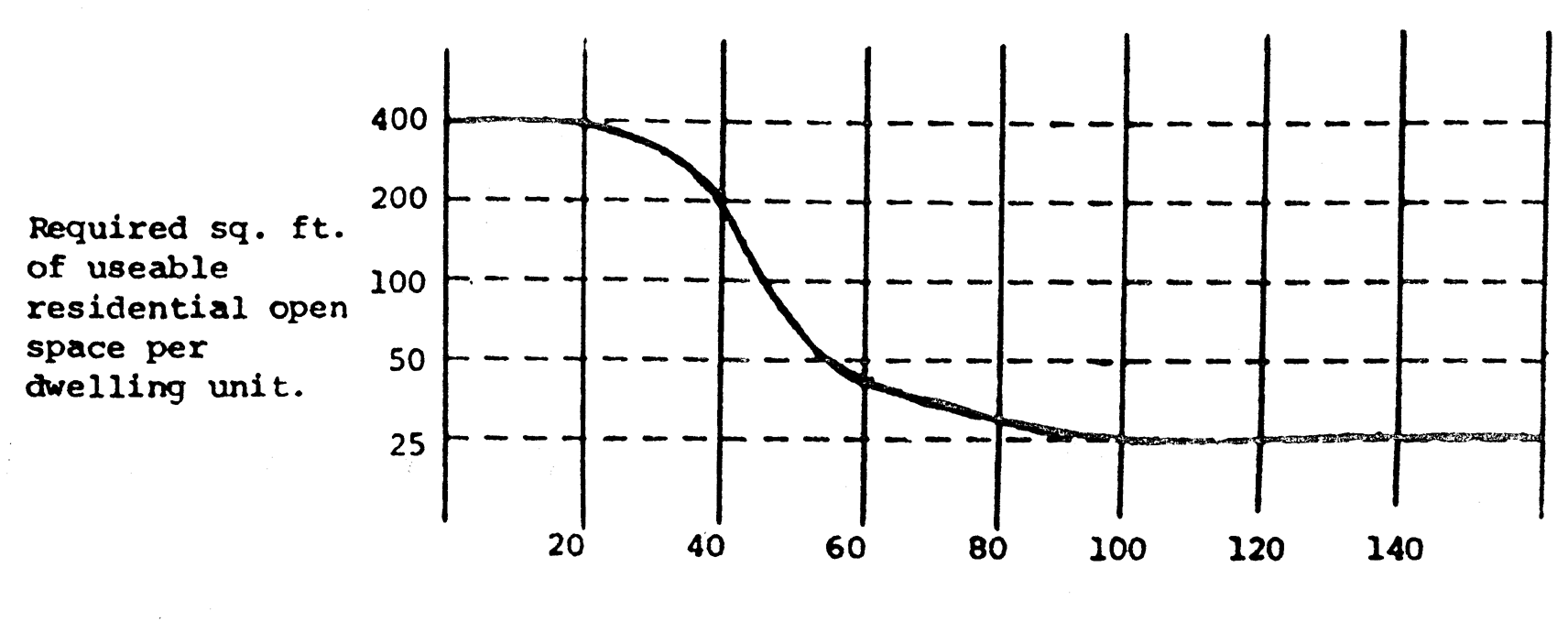
Commonly useable residential open space shall be provided within each lot devoted in whole or in part to multifamily apartment dwellings in accordance with the following graph relating the required square feet of useable space for each dwelling unit to the residential density of any given lot.
RESIDENTIAL DENSITY, DWELLING UNIT/ACRE
(b)
The amount of required commonly useable residential open space may be reduced by an amount equal to twice the total area of private balconies or patios provided they are accessible to individual dwelling units, so long as any such balcony or patio consists of at least 60 square feet of outdoor area and has a least dimension of six or more feet. At no time, however, shall an area equal to less than ten percent of the lot be devoted to commonly useable open space.
(Ord. No. 4062, § 904.04, 10-14-1980)
Sec. 56-612. - Conditional use permit required for certain hours and locations.
(a)
All retail business operations located within any zoning district of the city allowed in this chapter that operates its business between the hours of 2:00 a.m. and 6:00 a.m., within 500 feet of a residential zoning district, shall be required to obtain a conditional use permit as provided in article IV, division 6 of this chapter to conduct said business between those hours.
(b)
This requirement shall not be applicable to existing retail business operations located within the allowed zoning district of this zoning code or those retail business operations that are a nonconforming use in a zoning district where such use is not allowed.
(c)
This requirement is applicable to new retail business operations allowed in various zoning districts.
(Ord. No. 4062, § 904.05, 10-14-1980; Ord. No. 4215, § 1, 6-11-1985)
Sec. 56-643. - Requirements for SR and LR districts.
All satellite dish installations installed in an SR or LR zoning district must conform to the following standards:
(1)
Maximum allowable height of satellite dish to be 16 feet from ground level.
(2)
Location to be in rear yard of property.
(3)
A five-foot setback from side and rear property lines must be maintained.
(4)
Rooftop mountings and front yard installations are strictly prohibited.
(5)
All satellite dishes to be erected to withstand wind velocity of 70 mph.
(6)
All satellite dishes to be landscaped as approved by the design and review board.
(Ord. No. 4062, § 904.06(1), 10-14-1980; Ord. No. 4233, § 1, 9-10-1985)
Sec. 56-644. - Requirements for MR, AB, NB, CB, LM, HM, PA and PB districts.
All satellite dish installations installed in an MR, AB, NB, CB, LM, HM, PA or PB zoning district must conform to the following standards:
(1)
All satellite dish installations on commercial property other than the rear yard must first obtain a conditional use permit as provided in article IV, division 6 of this chapter.
(2)
Maximum allowable height of a satellite dish to be 16 feet from ground level or, if dish is installed on roof, 16 feet from roof mounting site.
(3)
Location to be in rear of property, unless the rear and side yard is not large enough to accommodate a satellite dish.
(4)
A five-foot setback from side and rear property lines must be maintained if mounted at ground level.
(5)
Rooftop mountings will be permitted only if the rear or side yard is not large enough to accommodate a satellite dish.
(6)
Front yard installations are strictly prohibited.
(7)
All satellite dishes to be erected to withstand wind velocity of 70 mph.
(8)
All satellite dishes installed at ground level must be landscaped and all dishes mounted on rooftops must be screened and approved by the design and review board.
(Ord. No. 4062, § 904.06(2), 10-14-1980; Ord. No. 4233, § 1, 9-10-1985)
Sec. 56-662. - Standards.
All communication towers erected, placed in operation or modified after the effective date of the ordinance from which this division is derived must conform to the standards of this division. To the extent of a conflict between the requirements of this division and any requirements contained elsewhere in this chapter, the provision most restrictive against the applicant shall apply.
(Ord. No. 4062, § 904.07, 10-14-1980; Ord. No. 4721, § 1, 3-12-1996)
Sec. 56-663. - Violation.
Communication tower operators possessing conditional use permits for a communication tower shall at all times comply with these regulations and with the terms of the applicable conditional use permit; communication tower operators who violate these regulations or the terms of the applicable conditional use permit shall be subject to prosecution and/or conditional use permit revocation as otherwise specified in this chapter.
(Ord. No. 4062, § 904.07(11), 10-14-1980; Ord. No. 4721, § 1, 3-12-1996)
Sec. 56-664. - Height.
A conditional use permit may authorize a height for a communication tower in excess of any height limitation on buildings or structures contained in the applicable zoning district in which the communication tower will be located, but not to exceed 75 feet.
(Ord. No. 4062, § 904.07(1), 10-14-1980; Ord. No. 4721, § 1, 3-12-1996)
Sec. 56-665. - Setback.
All communication towers shall be set back (measured from the tower base):
(1)
From all yard lines, at least one foot for each foot of tower height; and
(2)
From the boundary of any residential district or any structure or property used for residential purposes, an additional two feet for each foot of tower height (total three feet).
(Ord. No. 4062, § 904.07(2), 10-14-1980; Ord. No. 4721, § 1, 3-12-1996)
Sec. 56-666. - Collocation.
(a)
Applications for new communication towers shall be considered only when an existing or approved communication tower cannot accommodate the communications equipment planned for the proposed communication tower.
(1)
An existing or approved communication tower cannot accommodate planned communications equipment if:
a.
Planned communications equipment would exceed the structural capacity of an existing or approved communication tower, and the communication tower cannot be reinforced to accommodate planned communications equipment at a reasonable cost;
b.
Planned communications equipment will cause radio frequency interference with other existing or planned communications equipment for that communication tower and the interference cannot be prevented at a reasonable cost;
c.
Existing or approved towers do not have space on which planned communications equipment can be placed so it can function effectively and at least in parity with other similar communications equipment in place or approved by the city;
d.
Addition of planned equipment to an existing or approved transmission tower would result in radio frequency emission levels on the tower in excess of those permitted under section 56-671; or
e.
Other reasons that make it impracticable to place the communications equipment planned by the applicant on an existing or approved communication tower.
(2)
No application for a new communication tower shall be considered unless the applicant demonstrates to the city that the applicant is unable to lease or otherwise secure space on:
a.
An existing or approved communication tower; or
b.
On any other structure (building rooftop, water tower, etc.) that would be capable of housing or supporting the planned communications equipment.
(3)
Shared use of an existing or approved tower or such other structure shall be conditioned upon the applicant's agreement to pay reasonable fees and costs associated with adapting existing facilities to the proposed use, including, but not limited to, reasonable costs for reinforcing or modifying a tower or structure, for preventing radio frequency interference, and other changes reasonably required to accommodate shared use. The fees and costs for shared use are unreasonable, among other reasons, if they exceed the cost of the proposed communication tower. The city may consider expert testimony to determine whether the fees and costs are reasonable.
(4)
Once the city finds that communications equipment proposed by the applicant cannot be accommodated on an existing or approved tower or other structure, each tower or other structure so found is presumed unable to accommodate similar equipment that may be proposed in the future, unless evidence is introduced to demonstrate otherwise.
(b)
A communication tower operator, defined as any person or entity that owns or has a legal interest in a communication tower subject to the requirements of this division, and the owner of land upon which a communication tower is located or is proposed to be located pursuant to a pending application, but excluding any person or entity who is permitted to place particular equipment on a communication tower but otherwise has no ownership or general possessory interest in the communication tower, shall be required to:
(1)
Respond in a timely manner to any request from a potential user with information about the available capacity of the communication tower.
(2)
Respond in a timely, comprehensive manner to a request, required under this division, for information from a potential shared-use applicant; the communication tower operator may charge a party requesting information under such section to pay a reasonable fee not in excess of the actual cost of preparing a response.
(3)
Negotiate in good faith for shared use of a communication tower by applicants. Communication tower operators shall negotiate in the order in which requests for information are received, except a communication tower operator generally may negotiate with a third party applicant who has received an FCC license or permit before doing so with other applicants.
(4)
Allow shared use of a communication tower if an applicant agrees in writing to pay charges specified in subsection (b)(5) of this section.
(5)
Make no more than a reasonable charge for shared use, based on generally accepted accounting principals and pricing practices generally reflective of the St. Louis area. The charge may include but is not necessarily limited to a pro rata share of the cost of site selection, planning, project administration, land costs, site design, construction and maintenance, financing, return on investment, and depreciation, and all of the costs of adapting the tower or equipment to accommodate a shared user without causing electromagnetic interference or causing uses on the site to emit radio frequency emissions in excess of levels permitted under section 56-671.
(c)
Communication towers shall structurally accommodate the maximum number of foreseeable users technically practicable and shall be designed to comply with the following standards:
(1)
Television towers shall be designed to accommodate at least two high-power television antennas, four microwave antennas, one FM radio antenna, one radio antenna, and space for one public safety two-way radio antenna.
(2)
FM towers shall be designed to accommodate at least two FM antennas, four microwave antennas and space for one public safety two-way radio antenna.
(3)
Cellular, PCS or similar mobile or wireless telephony towers shall be designed to accommodate at least three potential users.
(4)
Communication towers that are not for television or FM antennas shall be designed to accommodate at least two microwave antennas and space for one public safety two-way radio antenna.
(5)
The city may reduce the required shared capacity of a tower if fewer or different antennas should be accommodated based on the number of FCC licenses that are potentially available for the area, kind of tower site or structure proposed, the number of existing and potential licenses without tower space, and space available on existing and approved towers; or if a tower necessary to provide for such sharing dominates and alters the visual character of the area adversely such that property values are diminished.
(6)
Antennas on a shared tower shall be arranged as follows, except as needed to prevent electromagnetic interference or to accommodate topographic or other physical or functional constraints:
a.
Transmitting and receiving equipment serving similar kinds of uses shall be placed on a shared-use tower so one of the users in a group can operate roughly equal to other users in the group with similar equipment.
b.
A TV tower shall have two side-mounted and one top-mounted TV antenna or one top-mounted, one mounted below it, and one side-mounted. Triangular, T-shaped, or other platforms or candelabra may be used if required communications equipment cannot be mounted as safely or economically without such structures.
c.
Microwave antennas and FM and two-way radio antennas can be placed anywhere on a tower above surrounding obstacles subject to the restrictions contained in these regulations.
(Ord. No. 4062, § 904.07(3), 10-14-1980; Ord. No. 4721, § 1, 3-12-1996)
Sec. 56-667. - Accessory uses.
Equipment shelter structures or buildings, fencing and other similar structures or improvements, all meeting the definition of accessory uses contained in division 4 of this article, shall be deemed permitted accessory uses, subject to the limitations contained in division 4 of this article and to the following additional limitations:
(1)
Such accessory uses may not include offices, sales activities, long-term vehicle storage, outdoor storage, broadcast studios (except for emergency purposes), or other uses that are not needed to send or receive transmissions.
(2)
All accessory uses, and any guy wire anchors, shall be subject to height and setback requirements generally applicable to principal uses in the zoning district in which they are located.
(3)
All guy wire anchor locations, equipment shelter structures or buildings, fencing and similar structures or improvements constituting structures or accessory uses shall be located on the same parcel of land occupied by the communication tower.
(Ord. No. 4062, § 904.07(4), 10-14-1980; Ord. No. 4721, § 1, 3-12-1996)
Sec. 56-668. - Fencing; architectural and design compatibility; landscaping; screening.
(a)
A fence shall be installed around the base of the communication tower, guy anchors and buildings in compliance with the following standards:
(1)
Fences shall be a minimum of six feet in height and shall be constructed of such material as is compatible with surrounding structures.
(2)
Guy anchors shall be fenced to allow a clear zone around the guy anchors such as to provide a 14-foot minimum vertical clearance.
(b)
All buildings or structures shall be constructed of such exterior material as is compatible with surrounding structures or areas from which such buildings or structures are visible.
(c)
A sign shall be installed on the gate to the facility and on the door of any buildings to indicate "High Voltage" on the premises. No other signage shall be allowed.
(d)
Existing on-site vegetation shall be preserved to the maximum extent practicable. Ground disturbed by construction shall be seeded and mulched within 45 days of the completion of construction, except in cases where the applicant has requested and received an extension of this time from the director of public works.
(e)
Landscaping and screening to adequately screen the tower base and accessory uses from view from adjoining properties shall be provided, subject to approval under site plan review pursuant to article IV, division 8 of this chapter.
(f)
In addition to the criteria enumerated in section 56-877, the plan and zoning commission and city council shall consider whether the proposed communication tower and accessory uses, including without limitation tower type, color and design, are compatible with uses and structures located on surrounding properties and on all properties from which the proposed communication tower or accessory uses would be visible, and may impose conditions or requirements to address such compatibility, including without limitation painting, lighting, design (for example, monopole, lattice), camouflage requirements (including towers designed to appear like trees or other stealth towers), and building materials and finishes.
(Ord. No. 4062, § 904.07(5), 10-14-1980; Ord. No. 4721, § 1, 3-12-1996)
Sec. 56-669. - Parking.
At least one off-street parking space shall be provided, subject to approval pursuant to site plan review.
(Ord. No. 4062, § 904.07(6), 10-14-1980; Ord. No. 4721, § 1, 3-12-1996)
Sec. 56-670. - Inspection.
The communication tower operator shall cause the tower to be safety inspected every two years from the date of construction. The inspection shall be performed by a licensed engineer who shall provide a certified copy of the inspection report to the director of public works of the city. Deficiencies noted in inspection reports shall be corrected within 90 days and shall be certified as corrected by the engineer unless for good cause an extension is granted by the director of public works of the city.
(Ord. No. 4062, § 904.07(7), 10-14-1980; Ord. No. 4721, § 1, 3-12-1996)
Sec. 56-671. - Nonionizing electronic radiation (radio frequency emission) standards.
(a)
All communication towers and any equipment or facilities located thereon or installed or used in connection therewith shall conform to:
(1)
The relevant sections of the American National Standard Safety Levels with respect to Human Exposure to Radio Frequency Electromagnetic Fields, 300 kHz to 100 GHz. This standard is identified as ANSI-C95.1-1982 and is published by the American National Standards Institute; and
(2)
Any more rigorous standards governing radio frequency emissions as may be adopted by federal, state or county governmental entities.
(b)
Notwithstanding subsection (a) of this section, to the extent expressly required by law, the city will not regulate the placement, construction or modification of communication towers or communication equipment based on the environmental effects of radio frequency emissions to the extent that such towers or equipment comply with FCC regulations regarding such emissions.
(Ord. No. 4062, § 904.07(8), 10-14-1980; Ord. No. 4721, § 1, 3-12-1996)
Sec. 56-672. - Application procedures.
In addition to the requirements of article IV, division 6 (conditional uses) and article IV, division 8 (site plan review) of this chapter, an application for a conditional use permit for a communication tower shall include:
(1)
A site plan or plans drawn to scale and identifying: the site boundary; tower; guy wire anchors; proposed type, number and location of antennas or other transmission equipment to be located on the tower; existing and proposed structures; vehicular parking and access; existing vegetation to be retained, removed, or replaced; uses, structures, and land-use designations on the site and abutting parcels; and the location of any adjoining residential districts or structures used for residential purposes. Such site plan shall be subject to site plan review pursuant to section article IV, division 8 of this chapter.
(2)
A plan drawn to scale showing proposed landscaping, including species type, size, spacing, and other features.
(3)
A report from a licensed professional engineer. The report shall:
a.
Describe the tower and the technical, economic, and other reasons for the tower design;
b.
Demonstrate that the tower complies with the current building code;
c.
Describe the capacity of the tower, including the number and type of antennas that it can accommodate and the basis for the calculation of capacity; and
d.
Demonstrate that the proposed sources of radio frequency emissions will comply with section 56-671.
(4)
The FAA determination of no hazard and FCC construction permit (if required), or a written statement from those agencies that the tower is exempt from such requirements.
(5)
For a communication tower in any zoning district, evidence that the tower complies with the design requirements of section 56-666.
(6)
Evidence of its legal ownership or possessory interest in the land for which the conditional use permit for a communication tower is being sought.
(7)
Documentary evidence that it complies with section 56-666(a), as follows:
a.
The applicant has contacted the communication tower operators of all existing or approved towers that are reasonably likely to be capable of accommodating the planned communications equipment (except owners of those towers presumed unable to accommodate the proposed antenna under section 56-666(a) and provided each contacted operator with the engineer's report required under subsection (3) of this section.
b.
The applicant shall request each contacted operator to:
1.
Identify the site by address and legal description;
2.
Describe tower height and existing tower users;
3.
Assess whether the existing tower could accommodate the communications equipment/antenna to be attached to the proposed tower without causing structural instability or electromagnetic interference; and
4.
If the communications equipment/antenna to be attached to the proposed tower cannot be accommodated on each existing tower, assess whether the existing tower could be structurally strengthened or whether the antennas, transmitters, and related equipment could be protected from electromagnetic interference and generally describe the means and projected cost of shared use of the existing tower.
c.
Document in writing the response to each contact for each communication tower operator contacted.
d.
The applicant has contacted the owners or managers of all other structures (building rooftops, water towers, etc.) that are reasonably likely to be capable of accommodating the planned communications equipment, offering reasonable market compensation for the right to install and operate such equipment, and the applicant shall document the responses of such owners or managers.
(Ord. No. 4062, § 904.07(9), 10-14-1980; Ord. No. 4721, § 1, 3-12-1996)
Sec. 56-673. - Abandonment.
If use of a communication tower is discontinued or abandoned for a period of six consecutive months (regardless of any reservation of intent not to abandon or to resume such use), the conditional use permit for such communication tower shall be deemed revoked and the communication tower operator shall immediately remove the tower and all accessory structures from the site.
(Ord. No. 4062, § 904.07(10), 10-14-1980; Ord. No. 4721, § 1, 3-12-1996)
Sec. 56-674. - Existing towers.
The installation of additional or the replacement of existing antennas on a communication tower in existence on the effective date of the ordinance from which this division is derived shall not be permitted unless the communication tower operator shall agree to comply with the provisions of sections 56-666, 56-670 and 56-671.
(Ord. No. 4062, § 904.07(12), 10-14-1980; Ord. No. 4721, § 1, 3-12-1996)
Sec. 56-675. - Accessory antenna.
An antenna and supporting structure for the following use is permitted in any district if accessory to a permitted use and if it complies with applicable regulations of the district in which it is situated:
(1)
Amateur radio.
(2)
Citizen band radio.
(3)
A communication device that only receives a RF signal.
(Ord. No. 4062, § 904.07(13), 10-14-1980; Ord. No. 4721, § 1, 3-12-1996)
Sec. 56-694. - Standards.
A communication antenna that is mounted or installed on any building or structure other than a communication tower (including, for example, a billboard, water tower, or office building), together with supporting or mounting equipment, is sometimes in this chapter referred to as a "rooftop communication antenna." All rooftop communication antennas erected, placed in operation or modified after the effective date of the ordinance from which this division is derived must conform to the standards of this division. To the extent of a conflict between the requirements of this division and any requirements contained elsewhere in this chapter, the provision most restrictive against the applicant shall apply.
(Ord. No. 5451, § I, 1-22-2008)
Sec. 56-695. - Violation.
Rooftop communication antenna operators possessing conditional use permits for a rooftop communication antenna shall at all times comply with these regulations and with the terms of the applicable conditional use permit; rooftop communication antenna operators who violate these regulations or the terms of the applicable conditional use permit shall be subject to prosecution and/or conditional use permit revocation as otherwise specified in this chapter.
(Ord. No. 5451, § I(9), 1-22-2008)
Sec. 56-696. - Height.
A rooftop communication antenna shall not protrude more than ten feet above the highest point of the building or structure on which it is located. Notwithstanding section 56-34 (height exception), the building height limitations provided in this chapter shall apply to rooftop communication antennas. A conditional use permit may authorize a height for a rooftop communication antenna in excess of any height limitation on structures contained in the applicable zoning district in which the rooftop communication antenna will be located, but not to exceed 75 feet. The height and location of the rooftop communication antenna shall be such that if the rooftop communication antenna falls, it will not fall on any adjacent parcel of land, public street or right-of-way.
(Ord. No. 5451, § I(1), 1-22-2008)
Sec. 56-697. - Accessory uses.
Equipment shelter buildings, communications support equipment, and other similar structures, equipment or improvements, all meeting the definition of accessory uses contained in section 56-558, shall be deemed permitted accessory uses, subject to the limitations contained in division 4 of this article and section 56-667, and to the following additional limitations:
(1)
All equipment shelter structures or other improvements constituting accessory uses shall be located on the same parcel of land occupied by the building or structure on which the rooftop communication antenna is mounted.
(2)
All accessory equipment shelter buildings or other structures shall be constructed of such exterior material as is compatible with the surrounding structures or area from which such structures are visible.
(3)
Any communications support equipment must be contained within the building, or within an equipment shelter building or cabinet, or screened as approved by the plan and zoning commission.
(Ord. No. 5451, § I(2), 1-22-2008)
Sec. 56-698. - Collocation.
An application for installation of a rooftop communication antenna on a building or structure on which a communication antenna is not then already mounted shall be considered only when the applicant demonstrates to the city that such communication antenna cannot be accommodated on a building or structure already supporting a rooftop communication antenna, or on an existing communication tower.
(Ord. No. 5451, § I(3), 1-22-2008)
Sec. 56-699. - Architectural and design compatibility.
(a)
Rooftop communication antennas attached to a building or other structure, and all accessory uses, shall be of a color identical to or closely compatible with the surface to which they are mounted or shall be concealed by screening or by architectural elements as approved by the plan and zoning commission. No rooftop communication antenna shall extend down from the roof or over the side of the building or structure to which it is attached in such a manner that it is visible against any exterior wall of the building or structure.
(b)
All rooftop communication antennas and accessory uses shall meet or exceed the standards and regulations contained in applicable state and local building and electrical codes, as amended from time to time.
(c)
All rooftop communication antennas and accessory uses shall meet or exceed current standards and regulations of the FAA, FCC and any other federal or state agency with the authority to regulate rooftop communication antennas. Should such standards or regulations be amended, then the owner shall bring such rooftop communication antennas and accessory uses in compliance with the revised standards or regulations within six months of the effective date of the revision unless an earlier date is mandated by the controlling agency.
(d)
All rooftop communication antennas and accessory uses shall be protected from unauthorized access by appropriate security devices. A description of proposed security devices shall be made a part of the application for conditional use permit.
(e)
Rooftop communication antennas shall not be lighted unless required by the FAA or any other federal or state agency with authority to regulate, in which case a description of the required lighting scheme will be made a part of the application for conditional use permit.
(f)
In addition to the criteria enumerated in section 56-877, the plan and zoning commission and city council shall consider whether the proposed rooftop communication antenna and accessory uses, including without limitation antenna type, color and design, and set-back from the edge of the building or structure, are compatible with, harmonize with and are integrated into the design and architecture of the building or structure on which they are located and are compatible with the uses and structures located on surrounding properties and on all properties from which the proposed rooftop communication antenna or accessory uses would be visible, and may impose conditions or requirements to address such integration and compatibility, including without limitation mounting height or location, painting, lighting, design, camouflage requirements, screening and building materials and finishes.
(Ord. No. 5451, § I(4), 1-22-2008)
Sec. 56-700. - Inspection.
The rooftop communication antenna operator (defined as any person or entity that owns or has a legal interest in a rooftop communication antenna subject to the requirements of this article III, division 9, and the owner of the building or structure upon which a rooftop communication antenna is located) shall cause the rooftop communication antenna and accessory uses to be safety inspected every two years from the date of installation. The inspection shall be performed by a licensed engineer who shall provide a certified copy of the inspection report to the director of public works of the city. Deficiencies noted in inspection reports shall be corrected within 90 days and shall be certified as corrected by the engineer unless for good cause an extension is granted by the director of public works of the city.
(Ord. No. 5451, § I(5), 1-22-2008)
Sec. 56-701. - Nonionizing electronic radiation (radio frequency emission) standards.
All rooftop communication antennas and any accessory uses or other equipment or facilities located thereon or installed or used in connection therewith shall comply with the provisions of section 56-671 requiring limitations on nonionizing electronic radiation (radio frequency emission) standards. Notwithstanding the foregoing, to the extent expressly required by law, the city will not regulate the placement, construction or modification of rooftop communication antennas or rooftop communication equipment based on the environmental effects of radio frequency emissions to the extent that such rooftop communication antennas or equipment comply with FCC regulations regarding such emissions.
(Ord. No. 5451, § I(6), 1-22-2008)
Sec. 56-702. - Application procedures.
In addition to the requirements of article IV, division 6 (conditional uses) and article IV, division 8 (site plan review) of this chapter, an application for a conditional use permit for a rooftop communication antenna shall include:
(1)
A plan or plans drawn to scale and identifying the site boundary and any guy wire anchors; an elevation drawing and description of the proposed type, number, dimensions and exact location of antennas, support structures and other accessory uses or equipment; a drawing or photograph showing the color and appearance of the antennas, support structures and accessory uses; a description of the proposed security devices, the uses, structures, and land-use designations on the site and abutting parcels; the location of any adjoining residential districts or structures used for residential purposes; and such other information as the city may request to determine compliance with this division. Such plan shall be subject to site plan review pursuant to article IV, division 8 of this chapter.
(2)
A report from a licensed professional engineer. The report shall:
a.
Describe the rooftop communication antenna and the technical, economic, and other reasons for the antenna design;
b.
Demonstrate that the rooftop communication antenna complies with the current building code;
c.
Demonstrate that the proposed sources of radio frequency emissions will comply with section 56-701.
(3)
In any zoning district, evidence that the rooftop communication antenna complies with the design requirements of section 56-699.
(4)
Evidence of the applicant's legal ownership or possessory interest in the land, building or structure to which the rooftop communication antenna is to be affixed and for which the conditional use permit is being sought.
(5)
Documentary evidence that it complies with section 56-698, as follows:
a.
The applicant has contacted the operators of all existing towers, and of all buildings or structures already supporting a rooftop communication antenna, which towers or buildings are reasonably likely to provide adequate reception to and from the proposed communication antenna and reasonably likely to be capable of accommodating the planned rooftop communications antenna, and the applicant has requested the right to lease or otherwise secure the right to install the proposed rooftop communications antenna or such tower, building or structure upon payable of reasonable fees and costs; and
b.
The applicant has documented in writing the response to each contact for each operator.
(Ord. No. 5451, § I(7), 1-22-2008)
Sec. 56-703. - Abandonment.
If use of a rooftop communication antenna is discontinued or abandoned for a period of six consecutive months (regardless of any reservation of intent not to abandon or to resume such use), the conditional use permit for such rooftop communication antenna shall be deemed revoked and the rooftop communication antenna operator shall immediately remove the antenna and all accessory structures from the site.
(Ord. No. 5451, § I(8), 1-22-2008)
Sec. 56-704. - Existing antennas.
The replacement of existing rooftop communication antennas on a building or structure shall not be permitted unless the rooftop communication antenna operator shall agree to comply with the provisions of sections 56-700 and 56-701.
(Ord. No. 5451, § I(10), 1-22-2008)
Sec. 56-722. - Solar panel installations.
(a)
Solar panels are permitted as an accessory use in all zoning districts subject to the following standards:
(1)
Such panels must be located on the premises.
(2)
Such panels may be mounted on roofs or walls subject to:
a.
Such panels may be installed at any angle, provided they are not visible from the public right-of-way or other public places immediately adjacent to the lot. If they are visible from such locations, they must be installed with an equivalent pitch angle as the roof itself.
b.
Such panels may not project beyond any wall, roof edge or roof ridge.
c.
Prior to the building permit being issued the proposed installation must be approved by the design and review board.
d.
Exterior plumbing and electrical lines should not be installed in any portion of the front of the property.
e.
Panels installed on flat roofs shall not be more than three feet higher than the finished roof to which it is mounted.
(3)
No solar panel may cause a reflection onto other property.
(4)
Free standing panels may only be authorized by conditional use permit if roof or wall mounted panels are shown to be infeasible.
(b)
Solar panels may be mounted on light poles as a source of power for the light fixtures if they are designed as part of the fixtures.
(c)
Exceptions to these standards may be considered for approval through conditional use permit, if the city, at its' sole discretion determines that sufficient evidence exists demonstrating there will be no ill effects detrimental to the public health, safety, welfare, or public interest.
(Ord. No. 5722, § I, 11-12-2013)
Sec. 56-723. - Purpose.
The purpose of this division is to encourage inclusive housing development in the city by pairing economic incentives provided by the city with the development of affordable housing units. The requirements of this division are based on a number of factors including, but not limited to, the city's commitment to economic diversity; the need for affordable housing as reflected in local, state, and federal housing regulations and policies; the demand for affordable housing created by market-rate development; the depletion of potential affordable housing sites by market-rate development; and the impact that the lack of affordable housing production has on the health, safety, and welfare of the city's residents.
(Ord. No. 6020, § I, 8-8-2023)
Sec. 56-724. - Definitions.
The following definitions shall apply to this division:
Affordable housing unit means any dwelling unit that rents for an amount at or below the maximum rent per unit type, as calculated below, based on the HUD Median Family Income (MFI) for the St. Louis Metropolitan Area, and housing cost as 30 percent of household income:
Maximum rent per unit type = MFI × Rent Variable × 30% ÷ 12 months
Economic incentives means incentives granted by the city or any economic development agency or 501c3 nonprofit organization created by the city, in the nature of the capture and redirection, abatement, or exemption of taxes or the issuance of bonds or grants by the city or other city-backed financing.
Market-rate unit means a dwelling unit as to which the rental rate or sales price is not restricted by this division.
Multi-family housing means any property providing multiple dwelling units, whether for rent or sale, including but not limited to apartments, condominiums, townhouses, or the multi-family residential component of a mixed used project, within a single building or lot.
Multi-family housing project means a multi-family housing development or redevelopment for which city permits and approvals are sought.
Naturally occurring affordable housing (or NOAH) means any existing housing meeting the criteria as defined in this section.
(Ord. No. 6020, § I, 8-8-2023)
Sec. 56-725. - Affordable housing obligation for economic incentives.
(a)
The provision of affordable housing units in the manner described in this division shall be a necessary and non-negotiable condition for the award of any economic incentives to developers of all multi-family housing projects seeking such incentives. Additional conditions, whether or not related to the provision of affordable housing units, may be required as part of a development agreement so long as such conditions do not result in reduction of the amount or nature of affordable housing units provided.
(b)
Prior to receiving any economic incentives, the developer of a multi-family housing project shall, on behalf of itself and all successors in interest, covenant with the city the following:
(1)
That at least 20 percent of the total dwelling units in the multi-family housing project are affordable housing units (in cases where 20 percent of units results in a fraction, the fraction must be rounded up for the minimum requirement to be met) and shall remain affordable housing units for the duration of the economic incentives awarded.
(2)
That the developer will use a procedure deemed acceptable by the city to verify that the residents of affordable housing units meet the eligibility requirements set forth in this division. Verification shall occur at the time an initial lease is entered into and at least annually thereafter. The city or its designee shall have the right to audit any such income verification procedure records.
(3)
That the developer will not engage in any discriminatory housing practices as defined in sections 30-20, 30-21, and 30-22 of the city's Code of Ordinances, including discrimination based on lawful sources of income.
(Ord. No. 6020, § I, 8-8-2023)
Sec. 56-726. - Eligibility requirement.
Only households with an income, adjusted for size, qualifying as "very low income" as defined by the annual HUD Adjusted Home Income Limits for the St. Louis Metropolitan Area shall be eligible to occupy or own affordable housing units.
(Ord. No. 6020, § I, 8-8-2023)
Sec. 56-727. - Affordable housing unit requirements.
For purposes of this division, all affordable housing units shall meet the following criteria:
(1)
All affordable housing units shall be on the principal multi-family housing project site.
(2)
All affordable housing units shall be mixed with market-rate units and not clustered together or segregated by structural barriers or separate entrances.
(3)
All affordable housing units shall, at a minimum, be proportional to market-rate units with respect to number of bedrooms per unit.
(4)
If the multi-family housing project contains a phasing plan, the phasing plan shall provide for the development of affordable housing units concurrently with the market-rate units. No phasing plan shall provide that the affordable housing units are the last units to be built in a multi-family housing project.
(5)
The quality and cost of in-unit finishes, systems, appliances, and square footage of all affordable housing units shall be comparable with that of market-rate units on the multi-family housing project site.
(6)
The exterior appearance of affordable housing units shall be made similar to market-rate units by the provision of exterior building materials and finishes substantially the same in type and quality.
(Ord. No. 6020, § I, 8-8-2023)
Sec. 56-728. - Naturally occurring affordable housing requirements.
In order to protect Maplewood residents living in naturally occurring affordable housing (NOAH), any multi-family housing project identified as NOAH, or identified as NOAH within the preceding three years, may be eligible for economic incentives only if the residents of any affordable housing units in the multi-family housing project identified as NOAH receive priority placement (right of return) in a similar affordable housing unit in the new multi-family housing project and receive fair market rent differential compensation for a substantially similar dwelling unit during the duration of the displacement period, if any.
(Ord. No. 6020, § I, 8-8-2023)
Sec. 56-729. - Exemption.
Any multi-family housing project that has been awarded federal or state low income housing tax credits from the state housing development commission is exempt from this division and can seek economic incentives without meeting its requirements.
(Ord. No. 6020, § I, 8-8-2023)

