
Mckinley Town Polk County
City Zoning Code
City Zoning Code
ARTICLE I
- IN GENERAL
Sec. 42-1. - Authority and scope of regulation.
(a)
This chapter is adopted pursuant to the authority expressed in Wis. Stats. §§ 30.12(3)(c), 30.13(2), 59.03, 59.69, 59.692, 59.694, 59.696, 87.30, and 281.31 and Wis. Stats. chs. 91, 236, 287, 289 and 823.
(b)
This chapter shall constitute a comprehensive revision, as described in Wis. Stats. § 59.69(5)(d), of the following land use ordinances:
Polk county comprehensive land use ordinance, initially enacted on April 21, 1971, as amended, which prior ordinance is repealed and replaced by the provisions of this chapter.
(Ord. No. 07-19, § 10.1.2, 3-19-2019; Ord. No. 37-20, § 10.1.2, 9-15-2020)
Sec. 42-2. - Definitions.
The following words, terms and phrases, when used in this chapter, shall have the meanings ascribed to them in this section, except where the context clearly indicates a different meaning:
Accessory building. See Building, accessory.
Accessory structure. See Structure, accessory.
Adult establishment means any business which offers its patrons services, merchandise, or entertainment characterized by an emphasis on matter depicting, exposing, describing, discussing or relating to specified sexual activities or specified anatomical areas, including but without limitation adult bookstores, adult motion picture theaters, adult saunas, adult companionship establishments, adult health/bath clubs, adult cabarets, adult novelty businesses, adult motion picture arcades, adult modeling studios, adult hotel or motel, and adult body painting/massage studios.
Animal unit means a unit of measure used to determine the total number of single animal types or combination of animal types, as specified in Wis. Adm. Code §§ NR 243.11 and 243.05, that are at an animal feeding operation.
Attached structure means a structure connected to another structure by a common wall or roof.
Base farm tract means all land, whether one lot or two or more contiguous lots, that is in a farmland preservation zoning district and that is part of a single farm at the time of adoption of this chapter from which this section is derived, regardless of any subsequent changes in the size of the farm.
Bed and breakfast means any place of lodging that provides eight or fewer rooms for rent to no more than a total of 20 tourists or other transients for more than ten nights in a 12-month period, is the owner's personal residence, is occupied by the owner at the time of rental, and in which the only meal served to guests is breakfast.
Boathouse means a permanent structure used for the storage of watercraft and associated materials and includes all structures which are totally enclosed, have roofs or walls or any combination of these structural parts.
Building means a structure having a roof supported by columns or walls.
Building, accessory, means a subordinate building which is incidental to and customarily found in connection with the primary use of the property limited to 35 feet in height.
Building envelope means the three-dimensional space within which a structure is built.
Building footprint means the perimeter square footage of enclosed building space.
Bunkhouse means a residential accessory structure or part of a residential accessory structure with or without plumbing which is used as temporary sleeping quarters only; no cooking or food preparation facilities; and no greater than 1,000 square feet of enclosed dwelling space.
Campground means any lot or tract of land owned by a person, the state or a local government, which is designed, maintained, intended or used for the purpose of providing sites for nonpermanent overnight use by four or more camping units, or by one to three camping units if the lot or tract of land is represented as a campground.
Camping unit means any portable device, no more than 400 square feet in area, used as a temporary dwelling, including, but not limited to, a camping trailer/travel trailer, motor home, park model, pick-up truck camping topper or tent.
Conditional use. See Use, conditional.
Conservation design development means a style of development that clusters houses onto smaller lot sizes in order to preserve some feature, function, aspect of the property that is being developed.
Contractor's storage yard means the outdoor portion of a lot where construction or service contractor stores and maintains four or more pieces of equipment and other materials in an area greater than 250 square feet customarily used by the construction or service contractor. The term "contractor's storage yard" excludes vehicles which require a Class D driver's license to operate.
Deck (patio) means an unenclosed exterior accessory structure that has no roof or sides.
Development means any manmade change to real estate, including, but not limited to, the construction of buildings, principal or accessory structures; the construction of additions or substantial alterations to buildings, structures or accessory structures; the placement of mobile homes; ditching, lagooning, dredging, filling, grading, paving, excavation or drilling operations; and the deposition or extraction of earthen materials.
Direct drainage means runoff from riparian areas within 300 feet that flow directly into a surface water resource as defined within the ordinance.
District means lots or sections of the county for which the regulations for governing the use of land and buildings are uniform.
Dwelling, multiple-family, means a structure, or that part of a structure, which is used or intended to be used as a home, residence or sleeping place by more than two families intermittently or as a principal residence. Each unit or part of the structure used by a different family or household shall be considered a separate dwelling unit when computing density of the lot.
Dwelling, single-family, means a structure, or that part of a structure, which is used or intended to be used as a home, residence or sleeping place by one person or by two or more persons maintaining a common household, to the exclusion of all others intermittently or as a principal residence. The term "single-family dwelling" includes manufactured homes, but not mobile homes, camping units, travel trailers, and other temporary sleeping units.
Dwelling, two-family, means a structure, or that part of a structure, which is used or intended to be used as a home, residence or sleeping place by two families, to the exclusion of all others intermittently or as a principal residence. These dwellings shall be counted as two dwelling units towards the density requirements of the lot.
Essential services means services provided by public and private utilities, necessary for the exercise of the principal use or service of the principal structure. The term "essential services" includes underground, surface, or overhead gas, electrical, steam, water, sanitary sewerage, stormwater drainage, and communication systems and accessories thereto, such as poles, towers, wires, mains, drains, vaults, culverts, laterals, sewers, pipes, catch basins, water storage tanks, conduits, cables, fire alarm boxes, police call boxes, traffic signals, pumps, lift stations, and hydrants, but not including those uses listed in the county telecommunications towers, antennas, and related facilities ordinance.
Excavating means to remove by scooping or digging out.
Existing development pattern means that principal structures exist within 250 feet of a proposed principal structure in both directions along the shoreline.
Expansion, horizontal (addition), means expansion of a principal structure outside of its existing building footprint.
Expansion, vertical, means expansion of a principal structure either up or down, within its existing building footprint and includes full replacement of roofs and basements/foundations.
Family means the body of persons who live together in one dwelling unit as a single housekeeping unit, regardless of the length of time they have lived together.
Farm animals means dairy cattle, beef cattle, swine, sheep, horses, ducks, chickens, turkeys and animals or fowl of similar character and customarily maintained in a large parcel setting for food, recreational, breeding, zoological or similar purposes.
Farm building means a building or other structure used to house or feed farm animals, store farm animal feed, or to collect or store waste generated from farm animals.
Farm residence means any of the following structures that are located on a farm: A single-family dwelling or two-family dwelling that is the only residential structure on the farm or is occupied by any of the following:
(1)
An owner or operator of the farm.
(2)
A parent or child of an owner or operator of the farm.
(3)
An individual who earns more than 50 percent of his or her gross income from the farm.
(4)
A migrant labor camp that is certified under Wis. Stats. § 103.92.
Feedlot means a lot or building, or combination of contiguous lots and buildings, intended for the confined feeding, breeding, raising or holding of animals and specifically designed as a confinement area in which animal waste may accumulate, or where the concentration of animals is such that a vegetative cover cannot be maintained within the enclosure. For purposes of this chapter, open lots used for feeding and rearing of poultry (poultry ranges) and barns, dairy facilities, swine facilities, beef lots and barns, horse stalls, mink ranches and domesticated animal zoos, shall be considered to be animal feedlots.
Fence, open means a structure where every segment of the fence (e.g. a section between posts) is composed of at least 50 percent open spaces and less than 50 percent solid materials. For the purposes of this chapter, any legal boundary fence listed under Wis. Stats. ch. 90 shall be considered an open fence. Open fences shall not exceed eight feet in height and are exempt from any side yard setback.
Fence, privacy means a structure for enclosure or screening that is greater than four feet in height and greater than 50 percent opaque. Privacy fences shall not be greater than six feet in height.
Floodplain means the land which has been or may be hereafter covered by floodwater during the regional flood. The term "floodplain" includes the floodway and the flood fringe as those terms are defined in Wis. Adm. Code ch. NR 116.
Front yard means a yard extending the full width of the lot between the front lot line and the nearest part of the principal building, excluding uncovered steps.
Frontage means all the property abutting on one side of a road or street between two intersecting roads or streets or all of the property abutting on one side of a street between an intersecting street and the dead end of a street.
Grading means the filling, placing or moving of rock and soil material.
Handicap/ADA access means any temporary deck extension, walkway, ramp, elevator, or any mechanical device used as a means of movement or access by a handicapped person, which is deemed medically necessary.
Height means the elevation from the lowest exposed grade of the structure to the highest peak of the roof, excluding window wells and stairways.
High Density Use means a lot held under fractional or shared ownership, directly or indirectly, where: (A) the lot is owned by more than one family, or more than two people, unless they are immediate family members, and (B) the dwelling unit(s) thereon are used by more than one family. The maximum number of dwelling units allowed for any lot shall be determined based on the lot size and respective zoning district.
Home business means a gainful occupation operated out of a residence or accessory structure, when such occupation is:
(1)
Conducted solely by a member of the resident family.
(2)
Entirely within the residence and incidental to the residential use of the premises.
(3)
No external alterations that would effect a substantial change in the residential character of the building.
(4)
No more than 50 percent of only one floor of the dwelling shall be devoted to such offices.
(5)
Not more than two persons not members of the resident family may be employed or otherwise contracted by such business.
Hotel/motel means a place where sleeping accommodations are offered for pay to transients, in five or more rooms, and all related rooms, buildings and areas.
Human habitation means the act of occupying a structure as a sleeping place whether intermittently or as a principal residence.
Immediate family members means immediate family is limited to the spouse, parents, stepparents, foster parents, father-in-law, mother-in-law, children, stepchildren, foster children, sons-in-law, daughters-in-law, grandparents, grandchildren, brothers, sisters, brothers-in-law, and sisters-in-law.
Impervious surface means an area that releases as runoff all or a majority of the precipitation that falls on it. The term "impervious surface" excludes frozen soil but includes rooftops, sidewalks, driveways, parking lots, and streets unless specifically designed, constructed, and maintained to be pervious. Roadways as defined in Wis. Stats. § 340.01(54), or sidewalks, as defined in Wis. Stats. § 340.01(58), are not considered impervious surfaces.
Industrial use means an industrial district restricted as defined within the county comprehensive land use ordinance.
Inoperable means not able to perform its normal function.
Junkyard/salvage yard/recycling center means an open area where waste or scrap materials are bought, sold, exchanged, stored, baled, disassembled or handled for commercial or noncommercial purposes, including, but not limited to, scrap iron and other metals, paper, rags, rubber tires and bottles. The term "junkyard/salvage yard/recycling center" includes, but is not limited to, an automobile wrecking or dismantling yard or an area where more than one unlicensed or inoperable motor vehicle is kept.
Kennel means the use of land, with related buildings or structures, for the breeding, rearing or boarding of household pets five months of age or older.
Land use runoff rating means a tool used to determine how much mitigation is needed to reduce the effects of development, particularly impervious surfaces, on water quality.
Landscaping means the removal or alteration of topsoil.
Large outdoor commercial event means an event, regardless of whether it is singular, annual, or multiple times per year in which payment is accepted, whether by a fee or by donation, in exchange for a public gathering with entertainment, including, but not limited to, music events, motor vehicle rallies, etc.
Limited short-term non-metallic mining means a non-metallic mining activity where the following criteria are met:
(1)
Does not satisfy the definitions and standards for preexisting non-metallic mining activities under section 42-86(b)(2).
(2)
Will be commenced, completed, and reclaimed within a one-year period from the date of the permit issuance.
(3)
Will be limited to not more than one acre per parcel or owner held under common ownership directly or indirectly, including but not limited to: partnerships, corporations, limited liability companies or other entity.
(4)
Will be limited to private use. Private use under this section means the owner of the parcel is the sole user of the material sourced from the limited, short-term non-metallic mining activity and used on the same parcel or a contiguous parcel of land under the same ownership.
(5)
Will be limited to public use. Public use under this section means the county or a municipality is the sole user of the material sourced from the limited, short term non-metallic mining activity.
(5)
Have obtained a land use permit, or the activity is covered by a different department, DOT, or DNR permit.
Lot means a parcel of land occupied or designed to provide space necessary for one principal building and its accessory buildings or uses, including the open spaces required by this chapter and abutting on a public street or other officially approved means of access. A lot may be a parcel designated in a plat or described in a conveyance recorded in the office of the register of deeds, or any part of a large parcel when such part complies with the requirements of this chapter as to width and area for the district in which it is located. No land included in any street, highway or railroad right-of-way shall be included in computing lot area.
Lot, corner, means a lot located at the intersection of two streets, any two corners of which have an angle of 120 degrees or less, or if bounded by a curved street in which case the chord within the limits of the lot lines form an angle of 120 degrees or less.
Lot lines means the lines bounding a lot as herein defined.
Lot width means for the purpose of this chapter the width of a lot shall be the shortest distance between the sidelines at the setback line.
Manufactured home means any structure, HUD certified and labeled under the National Manufactured Home Construction and Safety Standards Act of 1974 (42 USC ch. 70 (42 USC 5401—5426)), that is, or was as originally constructed, designed to be transported by any motor vehicle upon a public highway and designed, equipped and used primarily for sleeping, eating and living quarters, or is intended to be so used. The term "manufactured home" includes the manufactured home structure, its plumbing, heating, air conditioning and electrical systems, all appliances and all other equipment therein, any additions, attachments, annexes, foundations and appurtenances.
Manufactured home park (previously "mobile home park") means an area or premise on which is provided the required space for the accommodation of manufactured home, together with necessary accessory buildings, driveways, walks, screening and other required adjuncts.
Marina means providing a dock or location to moor watercraft. Marinas may also offer marine supplies, fuel, watercraft repairs, and other facilities to their guests. A property with more than six watercrafts shall be deemed a marina under this chapter.
Mitigation means balancing measures that are designed, implemented and function to restore natural functions and values that are otherwise lost through development and human activities.
Mobile home means any structure, not HUD certified and labeled under the National Manufactured Home Construction and Safety Standards Act of 1974 (42 USC ch. 70 (42 USC 5401—5426)) or manufactured or assembled before June 15, 1976, that is, or was as originally constructed, designed to be transported by any motor vehicle upon a public highway and designed, equipped and used primarily for sleeping, eating and living quarters, or is intended to be so used. The term "mobile home" includes the mobile home structure, its plumbing, heating, air conditioning and electrical systems, all appliances and all other equipment therein, any additions, attachments, annexes, foundations, and appurtenances.
Motel. See Hotel/motel.
Navigable means all lakes, ponds, flowages, rivers and streams in the county shall be presumed to be navigable if they are listed in the state department of natural resources' publication Surface Waters Resources of Polk County, or are shown on the United States Geological Survey quadrangle maps. Lakes, ponds, flowages, rivers and streams not included in these documents may also be determined to be navigable. Also, Lake Superior, Lake Michigan, all natural inland lakes within the state and all streams, ponds, sloughs, flowages and other waters within the territorial limits of the state, including the state portion of boundary waters, which are navigable under the laws of the state. Under Wis. Stats. § 281.31(2)(d), notwithstanding any other provision of law or administrative rule promulgated there under, shoreland ordinances required under Wis. Stats. § 59.692 and Wis. Adm. Code ch. NR 115 do not apply to lands adjacent to:
(1)
Farm drainage ditches where such lands are not adjacent to a natural navigable stream or river and such lands were not navigable streams before ditching; and
(2)
Artificially constructed drainage ditches, ponds or stormwater retention basins that are not hydrologically connected to a natural navigable water body.
Nonconforming structure. See Structure, nonconforming.
Nonconforming use. See Use, nonconforming.
Nonfarm residence means a single-family or multi-family residence other than a farm residence.
Nonmetallic mining activities means the excavation, mining or removal of minerals, clay, ceramic or refractor minerals, quarrying of sand, gravel, crushed or broken stone, including the extraction and removal of topsoil, but not including sod farming. The term shall also include such mineral processing operations as aggregate or ready-mix plants, hot mix asphalt plants, mining services, processing of topsoil, washing, refining or processing of nonmetallic mineral materials, when onsite or on a contiguous property.
Ordinary high-water mark (OHWM) means the point on the bank or shore up to which the presence and action of surface water is so continuous as to leave a distinctive mark such as by erosion, destruction or prevention of terrestrial vegetation, predominance of aquatic vegetation, or other easily recognized characteristics.
Ordinary maintenance and repair means those activities necessary to maintain the structural integrity and current function of the existing structure. The term "ordinary maintenance and repair" may include replacement of windows, doors, siding, insulation, roofing, and roof replacement, provided the pitch does not exceed the pitch necessary to match the existing roof.
Outlot means a lot remnant or parcel of land within a plat remaining after platting, which is intended for open space use, for which no development is intended other than that which is accessory to the open space use. An outlot may not be developed for any use or structure that requires a private, onsite wastewater treatment system.
Parent lot means the lot and associated acreage of that lot that existed at the time of the adoption of the ordinance from which this chapter is derived.
Parking lot means a lot where automobiles are parked or stored temporarily, but not including the wrecking of automobiles or other vehicles or storage for the purpose of repair or wrecking.
Patio. See Deck.
People means human beings in general or considered collectively.
Permit means a written form issued by the zoning department.
Permitted use. See Use, permitted.
Preexisting use means a building, structure, or use, which lawfully existed on the effective date of the ordinance from which this chapter is derived, as revised, and the use of which has been continued uninterrupted and that does not conform to this chapter.
Reconstruction means activities that exceed maintenance and repair, structural repair, structural alteration, horizontal expansion or vertical expansion.
Retaining wall means an accessory structure constructed to hold back earth within 300 feet of the ordinary high-water mark on a riparian parcel. Retaining walls are usually constructed from stacked timbers, concrete (poured), block, planks, steel, or boulders. A single row of these materials or landscaping borders are not retaining walls.
Road means a public or private thoroughfare which affords a primary means of access to abutting property and includes streets and highways.
Roadside stand means a structure having a ground area of not more than 300 square feet, not permanently fixed to the ground, readily removable in its entirety, not fully enclosed and to be used solely for the sale of farm products produced on the premise (or adjoining premise). There shall not be more than one such roadside stand in any single premises.
Setback means the minimum horizontal distance between lot lines, the platted center line of the road, from right-of-way line, or the ordinary high-water mark measured to the closest point of the structure.
Setback lines means lines established adjacent to the highways, lakes or streams for the purpose of defining limits within which no building, structure or any part thereof shall be erected or permanently maintained except as shown herein. The term "within a setback line" means between the setback line and the highway right-of-way, lake or stream.
Shoreland means area landward of the ordinary high-water mark within the following distances: 1,000 feet from a lake, pond or flowage; and 300 feet from a river or stream or to the landward side of the floodplain, whichever distance is greater.
Shoreland protection area means a vegetative strip of land 35 feet measured perpendicular from the ordinary high-water mark.
Shoreland-wetland district means the zoning district, created as a part of this chapter, comprised of shorelands that are designated as wetlands on the state wetland inventory maps.
Sign means any device visible from a public place whose essential purpose and design is to convey either commercial or non-commercial messages by means of graphic presentation of alphabetic or pictorial symbols or representations. Non-commercial flags or any flags displayed from flagpoles or staffs will not be considered to be signs.
Sign, freestanding, means a sign principally supported by one or more columns, poles, or braces placed in or upon the ground.
Sign, off-premises, means a sign advertising a business that is not conducted on the property or located in the immediate vicinity of the business.
Sign, on-premises, means a sign at a business location advertising a business that is conducted on the property and that is located in the immediate vicinity of the business. The term "immediate vicinity" means the sign is within the area bounded by the buildings, driveways and parking areas in which the activity is conducted or within 50 feet of that area. The term "immediate vicinity" does not include any area across a street or road from the area where the business is conducted or any area developed for the purpose of erecting a sign.
Sign, temporary, means a sign intended to display either commercial or non-commercial messages of a transitory or temporary nature. Portable signs or any sign not permanently embedded in the ground, not permanently affixed to a building, or attached to a sign structure that is permanently embedded in the ground are considered temporary signs.
Sign structure means any structure designed for the support of a sign.
Story means the vertical distance between the surface of any floor and the floor next above it, or if there be no floor above it, the space between such floor and the ceiling next above it.
Structural alteration means any change in the exterior supporting members, such as bearing walls, columns, beams or girders, footings and piles.
Structure means a principal structure or any accessory structure including a garage, shed, boathouse, sidewalk, stairway, walkway, patio, deck, retaining wall, porch, or fire pit.
Structure, accessory, means a subordinate structure which is incidental to and customarily found in connection with the primary use of the property, including, but not limited to, garages, sheds, barns, gazebos, fences, retaining walls, and pedestrian walkways and stairways to surface water.
Structure, nonconforming, means a dwelling or other building, structure or accessory building that existed lawfully before the current zoning ordinance was enacted or amended, but that does not conform with one or more of the regulations in the current zoning ordinance.
Structure, principal, or principal building means a building that is utilized for the primary use of a lot.
Substantial evidence means facts and information, other than merely personal preferences or speculation, directly pertaining to the requirements and conditions an applicant must meet to obtain a conditional use permit and that reasonable persons would accept in support of a conclusion.
Tourist or transient means a person who travels to a location away from his permanent address for a short period of time for vacation, pleasure, recreation, culture, business or employment.
Tourist roominghouse means a single-family dwelling in which sleeping accommodations are offered for pay to a maximum of two tourists or transients per bedroom based on the sanitary system serving the dwelling, up to a total of eight from 11:00 p.m. to 7:00 a.m. A maximum of 12 occupants are allowed from 7:00 a.m. to 11:00 p.m. regardless of the number of bedrooms.
Transient lodge means any single-family dwelling rented on a short-term basis with a maximum occupancy of nine to 12 people at any time on the property for up to seven days per month from May thru September, and a total of 174 days per year unless a conditional use permit is obtained for more days per month/year. The maximum occupancy shall be a maximum of two tourists or transients per bedroom based on the sanitary system size or number of legal bedrooms in the dwelling, whichever is more restrictive.
Travel trailer means any vehicle, house car, camp car, or any portable or mobile vehicle either self-propelled or propelled by other means which is used or designed to be used for residential living or sleeping purposes as defined in Wis. Adm. Code ch. ATCP 79.
Undeveloped lot means a lot that does not have a well and an installed sanitary system, not including a privy.
Unnecessary hardship means for area variances, compliance with the strict letter of the restrictions governing area, setbacks, frontage, height, bulk, or density would unreasonably prevent the owner from using the property for a permitted purpose or would render conformity with such restrictions unnecessarily burdensome. An unnecessary hardship must be based on conditions unique to the property rather than considerations personal to the property owner when reviewing a variance application. A financial or self-imposed hardship shall not be considered an unnecessary hardship when considering a variance application under this chapter.
Use, conditional, means a use allowed under a conditional use permit, special exception, or other special zoning permission issued by the county, but does not include a variance. Conditional uses, listed by ordinance, are subject to certain conditions specified in the ordinance and/or designated by the environmental services committee.
Use, nonconforming, means a building, structure or use of land lawfully existing at the time of enactment of this chapter, and which does not conform to the regulations of the district or zone in which it is located.
Use, permitted, means a use permitted in a district whereby a building can be constructed, erected, altered or moved and is consistent with the general intent of the district.
Use variance means an authorization by the board of adjustment under this subsection for the use of land for a purpose that is otherwise not allowed or is prohibited by the applicable zoning ordinance.
Vacant lot means a parcel of land with no building or structure.
Variance (area) means a modification to a dimensional, physical, or locational requirement such as the setback, frontage, height, bulk, or density restriction for a structure that is granted by the board of adjustment. A variance may only be granted in cases of unnecessary hardship and when the spirit of the chapter is not violated.
Viewing and access corridor means an area in which all trees and shrubs may be removed to create a visual view.
Vision clearance triangle means an unoccupied triangular space at the intersection of highways or streets or railroads. Such vision clearance triangle shall be bounded by the intersecting highway, road or railroad right-of-way lines and a setback line connecting points located on such right-of-way lines by measurement from their intersection.
Watercraft means any boat or vessel with or designed to be used with a motor or mechanical propulsion. For the purposes of this chapter, any boats, or vessels less than 16 feet in length without a motor or mechanical propulsion shall not be deemed a watercraft.
Wetlands means those areas where water is at, near or above the land surface long enough to be capable of supporting aquatic or hydrophytic vegetation, and which have soils indicative of wet conditions.
(Ord. No. 07-19, § 10.2, 3-19-2019; Ord. No. 38-19, art. 4, 9-17-2019; Ord. No. 08-20, art. 4, 4-21-2020; Ord. No. 24-21, 5-18-2021; Ord. No. 25-21, 5-18-2021; Res. No. 15-22, § 1, 3-15-2022; Res. No. 07-23, § 1, 3-21-2023; Res. No. 08-23, § 1, 3-21-2023; Res. No. 07-24, § 1, 3-19-2024)
Sec. 42-3. - Contents.
This chapter consists of two distinct but inseparable and integrated parts: written text and zoning maps. The written text and zoning maps taken together constitute this chapter and, therefore, shall at all times be considered as interrelated and inseparable parts of a whole. In addition, other maps and materials referenced in the text are used to support this chapter.
(Ord. No. 37-20, § 10.1.3, 9-15-2020)
Sec. 42-4. - Purpose.
The purpose of this chapter is to promote and protect public health, safety, and other aspects of the general welfare. Further purposes of this chapter are to:
(1)
Aid in the implementation of provisions of the county comprehensive plan.
(2)
Promote planned and orderly land use development.
(3)
Protect property values and the property tax base.
(4)
Fix reasonable dimensional requirements to which buildings, structures, and lots shall conform.
(5)
Prevent overcrowding of the land.
(6)
Advance uses of land in accordance with its character and suitability.
(7)
Provide property with access to adequate sunlight and clean air.
(8)
Aid in protection of groundwater and surface water.
(9)
Preserve water quality, shoreland and wetlands.
(10)
Protect the beauty of landscapes.
(11)
Conserve flora and fauna habitats.
(12)
Preserve and enhance the county's rural characteristics.
(13)
Protect vegetative shore cover.
(14)
Promote safety and efficiency in the county's road transportation system.
(15)
Define the duties and powers of certain county officers and administrative bodies relative to the application, administration and enforcement of this chapter.
(16)
Prescribe penalties in the form of civil forfeitures for violation of this chapter and to facilitate enforcement of the provisions of this chapter by injunctive relief.
(Ord. No. 37-20, § 10.1.4, 9-15-2020)
Sec. 42-5. - Compliance and applicability.
(a)
No land or water shall hereafter be used and no structure or part thereof shall hereafter be used, located, erected, moved, reconstructed, extended, enlarged, converted, or structurally altered without full compliance with the provisions of this chapter or applicable local, county or state regulatory provision.
(b)
State agencies are required to comply when Wis. Stats. § 13.48(13) applies. The state department of transportation is exempt from the requirements of this chapter when Wis. Stats. § 30.12(4) applies.
(c)
Except as otherwise specifically provided, the provisions of this chapter shall be administered and enforced pursuant to the procedural regulations of article II, division 4 of this chapter.
(Ord. No. 37-20, § 10.1.5, 9-15-2020)
Sec. 42-6. - Jurisdiction, force and effective date.
(a)
The jurisdiction of this chapter is the unincorporated areas of the county. This chapter shall affect the unincorporated areas of the county, or applicable portions thereof, as provided in subsection (b)(2) of this section.
(b)
If a town board wishes to withdraw from county zoning prior to a comprehensive zoning ordinance rewrite, they may do so by filing a resolution with the county clerk and governing committee at least one year prior to the effective date of the withdrawal. However, this withdrawal can only happen when a comprehensive plan for the town is developed or revised as required by state law and no more frequently than once every ten years from the original resolution approving the county zoning ordinance and filed with the county clerk.
(Ord. No. 37-20, § 10.1.6, 9-15-2020)
Sec. 42-7. - Abrogation and greater restrictions.
(a)
Except as this chapter may conflict with Wis. Stats. ch. 91, farmland preservation, wherever this chapter imposes greater restrictions than other similar regulations, the provisions of this chapter shall govern.
(b)
Wherever the provisions of this chapter conflict with the provisions of Wis. Stats. ch. 91, farmland preservation, the provisions of Wis. Stats. ch. 91 shall prevail.
(c)
It is not intended by this chapter to repeal, abrogate, annul, impair, or interfere with any existing easement, covenant, deed restriction, or agreement. The provisions of any easement, covenant, deed restriction or like agreement are a matter of private property interest not within the scope of the regulations contained in this chapter. The county shall not enforce any easement, covenant, deed restriction, or agreement to which it is not a party.
(d)
It is not intended by this chapter to repeal, abrogate, annul, impair, or interfere with any permit previously issued pursuant to law.
(Ord. No. 37-20, § 10.1.7, 9-15-2020)
Sec. 42-8. - Interpretation and application.
The provisions of this chapter shall be construed to be minimum requirements and shall be liberally construed in favor of the county and shall not be deemed a limitation or repeal of any other power granted by the state statutes. Further, interpretation and application of the provisions of this chapter shall take into account the purposes of this chapter and any adverse effects that an interpretation may have upon such purposes.
(Ord. No. 37-20, § 10.1.8, 9-15-2020)
Sec. 42-9. - Vesting of rights.
No rights to any particular use vest in any property owner simply because the use is permitted by this chapter. Such use may be prohibited by future amendment to this chapter. However, the approval and issuance of a permit shall vest in the property owner the right to use the property in the manner specifically approved by the permit, unless and until the permit expires. No amendment to this chapter which prohibits a particular use shall be applicable to any property developed under a previously issued permit, except to the extent that such use is rendered nonconforming.
(Ord. No. 37-20, § 10.1.11, 9-15-2020)
Sec. 42-10. - General provisions.
(a)
The use and height of buildings hereafter erected, converted, enlarged or structurally altered and the use of any land shall be in compliance with the regulation established herein for the district in which such land or building is located.
(b)
No lot area shall be so reduced that the yards and open spaces shall be smaller than is required by this chapter, nor shall the density of population be increased in any manner except in conformity with the area regulations hereby established for the district in which a building or premise is located. No part of a yard or other open space provided about any building for the purpose of complying with the provisions of this chapter shall be included as part of a yard or other open space required for another building.
(c)
Every dwelling hereafter erected in the county shall provide not less than 400 square feet of floor area for a one-story building for each family dwelling therein, nor less than 700 square feet for a two-story building for each family dwelling therein.
(d)
Nothing herein contained shall require any change in the plans, construction, size or designated use of any building or structure or part thereof on which construction has started or a particular use has been commenced, or for the construction of a building or structure or part thereof upon which a bona fide contract has been entered into before the effective date of the ordinance from which this chapter is derived.
(e)
There shall be no more than one dwelling per lot, unless otherwise indicated in another part of this chapter.
(f)
Structures including school bus stop shelters, deer stands, dog houses, tree houses and ice-fishing shacks with a footprint of less than 64 square feet shall not be deemed an accessory structure or use, do not require permits, and shall conform to the setbacks and cannot be used for storage.
(g)
Any use not specified herein shall be unpermitted and considered a violation of this chapter.
(h)
The height of a structure is the measurement of the vertical line segment starting at the lowest point of any exposed wall and its intersect with the ground (point "A" in Figure No. 1) to a line horizontal to the highest point of the a structure (point "B" in Figure No. 1), unless specified in another part of this chapter.
(i)
Privacy fences shall have a rear and side yard setback of two (2) feet unless the applicant obtains written permission from their neighbor to construct the fence within the setback area. The fence owner must be able to maintain the fence without trespassing on the neighbor's property, so the type of fence constructed shall be considered and approved by the zoning office.
(j)
Privacy fences shall meet the required road setback unless written approval of a reduced road setback is received from the governmental unit maintaining the road. A Town may also approve a reduced private road setback; however, at no point should a privacy fence encroach upon any easement or road right-of-way.
(k)
Open fences are exempt from road setbacks but cannot encroach upon any easement or road right-of-way.
(l)
Conservation design developments (CDDS) are prohibited within 1,000 feet of a public boat landing/ramp. CDD lots also are prohibited from having an easement or shared ownership, directly or indirectly, with any riparian lot.
(m)
No lot shall be allowed to have more than one dwelling unit within 1,000 feet of a public boat landing/ramp on a navigable water.
(n)
No lot after the effective date of the ordinance from which this chapter is derived shall be developed with a higher residential dwelling unit density than allowed under the lot's respective zoning district. Each unit in a two-family and multifamily dwelling shall each be counted as a separate dwelling unit.
(o)
All dwelling standards shall apply to each dwelling regardless of the ownership structure for the dwelling, whether it be joint tenants, cooperatives, limited liability corporation, condominiums, or otherwise.
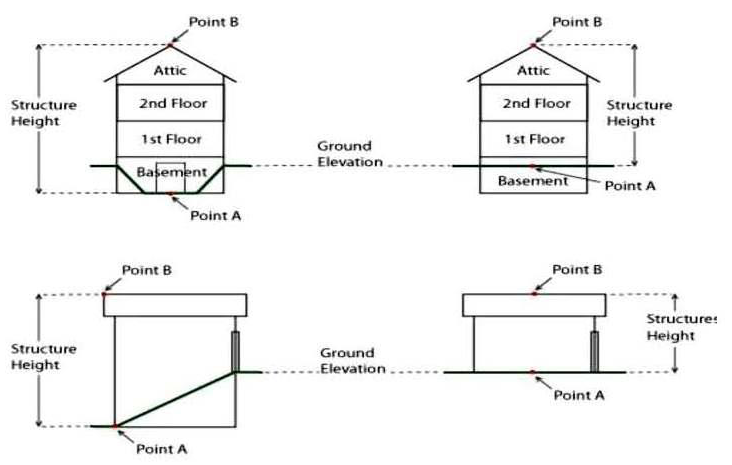
Figure 1. Height of Structure
(Ord. No. 37-20, § 10.3.1, 9-15-2020; Ord. No. 24-21, 5-18-2021; Res. No. 15-22, § 1, 3-15-2022)
Sec. 42-11. - Nonconforming uses and nonconforming structures.
(a)
If a nonconforming use of building, premises or lot of land is discontinued for a period of 12 months, any future use of the building, premises or lot of land shall conform to the regulations for the district in which it is located.
(b)
Legal uses and structures that pre-exist the adoption of the ordinance from which this chapter is derived and do not conform to this chapter shall be considered as a legal nonconforming use.
(c)
Nonconforming uses shall not be expanded or extended beyond the scope of such use existing at the time of the adoption of the ordinance from which this chapter is derived. In the case in which a landowner proposes to expand or extend a nonconforming use, the landowner must apply for and obtain a change to a zoning district such that the use conforms to current provision of this chapter.
(d)
Expansion of the nonconforming principal structure cannot make it more nonconforming (cannot expand towards what is making the structure nonconforming).
(e)
Nonconforming principal structures are allowed to horizontally expand up to 50 percent of the original footprint of the structure over the life of the structure, unless otherwise indicated in this chapter.
(f)
Nonconforming principal structures are allowed maintenance and repair, renovation, rebuilding, remodeling, and vertical expansion, unless otherwise indicated in this chapter.
(g)
Nonconforming accessory structures are allowed maintenance and repair, renovation, rebuilding, remodeling, but no expansion, unless otherwise indicated in this chapter.
(h)
Decks and patios that are attached or immediately adjacent to a nonconforming principal structure may be repaired or replaced, but not expanded vertically or horizontally.
(i)
Nonconforming structures may be restored to the size, location, and use, including enlargement, only if necessary for the structure to comply with applicable state or federal requirements, that it had immediately before the damage or destruction occurred, without limits on the costs of the repair, reconstruction, renovation, or improvement if all of the following apply:
(1)
The nonconforming structure was damaged or destroyed on or after March 2, 2006, Wis. Stats. § 59.69(10m).
(2)
The damage or destruction was caused by violent wind, vandalism, fire, flood, ice, snow, mold, or infestation.
(Ord. No. 37-20, § 10.3.2, 9-15-2020)
Sec. 42-12. - Height and area exceptions.
The regulations contained in this chapter relating to the height of buildings or structures and the size of yards and other open spaces shall be subject to the following exceptions:
(1)
Churches, schools and other public and quasi-public buildings may be erected to a height not exceeding 60 feet or five stories.
(2)
Chimneys, cooling towers, church steeples or spires, tanks, water towers, television antennas, micro-wave radio relay or broadcasting towers, masts or aerials, necessary mechanical appurtenances, farm buildings, and silos for asphalt and concrete mixing plants are hereby exempted from the height regulations of this chapter and may be erected in accordance with other regulations or ordinances of the county.
(Ord. No. 37-20, § 10.3.3, 9-15-2020)
Sec. 42-13. - Substandard lots.
A legally created lot that met minimum area and minimum average width requirements when created, but does not meet current lot size requirements, may be used as a building site if all of the following apply:
(1)
The substandard lot was never reconfigured or combined with another lot by plat, survey, or consolidation by the owner into one property tax parcel.
(2)
The substandard lot has never been developed with one or more of its structures placed partly upon an adjacent lot.
(3)
The substandard lot is developed to comply with all other ordinance requirements.
(4)
In the A-4 district the property must be rezoned or a CUP issued according to Wis. Stats. § 91.46(2) prior to construction commencing.
(Ord. No. 37-20, § 10.3.4, 9-15-2020)
Sec. 42-14. - Setbacks.
(a)
Road setbacks. The setback distances at any point for the respective classes of highways shall be as follows in Table 1, unless otherwise indicated in this chapter:
Table 1. Road Setback Distances
(b)
Setback averaging. There is an exception to the setbacks outlined in subsection (a) of this section (see Figure 2). In order to utilize an established building setback line which sets forth a reduced setback from what is listed in subsection (a) of this section, the following must apply:
(1)
The reduced setback/established building setback line must be in existence prior to the adoption of the ordinance from which this chapter is derived.
(2)
There must be two buildings, one on each side adjoining property.
(3)
There must not be more than 150 feet between the proposed building and a building being used to establish the reduced setback.
(4)
The setback for the proposed or moved building shall not be less than the average of the two buildings on the adjoining properties.
(c)
Setback exemptions.
(1)
A permit shall be issued for a reduced town road setback once written town approval (i.e., minutes, letter, resolution) is received if all other requirements of this chapter are met.
Figure 2. Setback Averaging from Road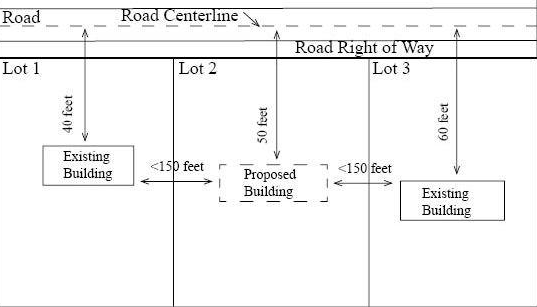
(Ord. No. 37-20, § 10.3.5, 9-15-2020; Res. No. 07-23, § 1, 3-21-2023; Res. No. 08-23, § 1, 3-21-2023; Res. No. 07-24, § 1, 3-19-2024)
Sec. 42-15. - Vision clearance triangle.
Structures, screening vegetation and signs are not allowed in the vision clearance triangle. Figure 3 is a diagram of the vision clearance triangle area as defined in this chapter.
Figure 3. Vision Clearance Triangle Area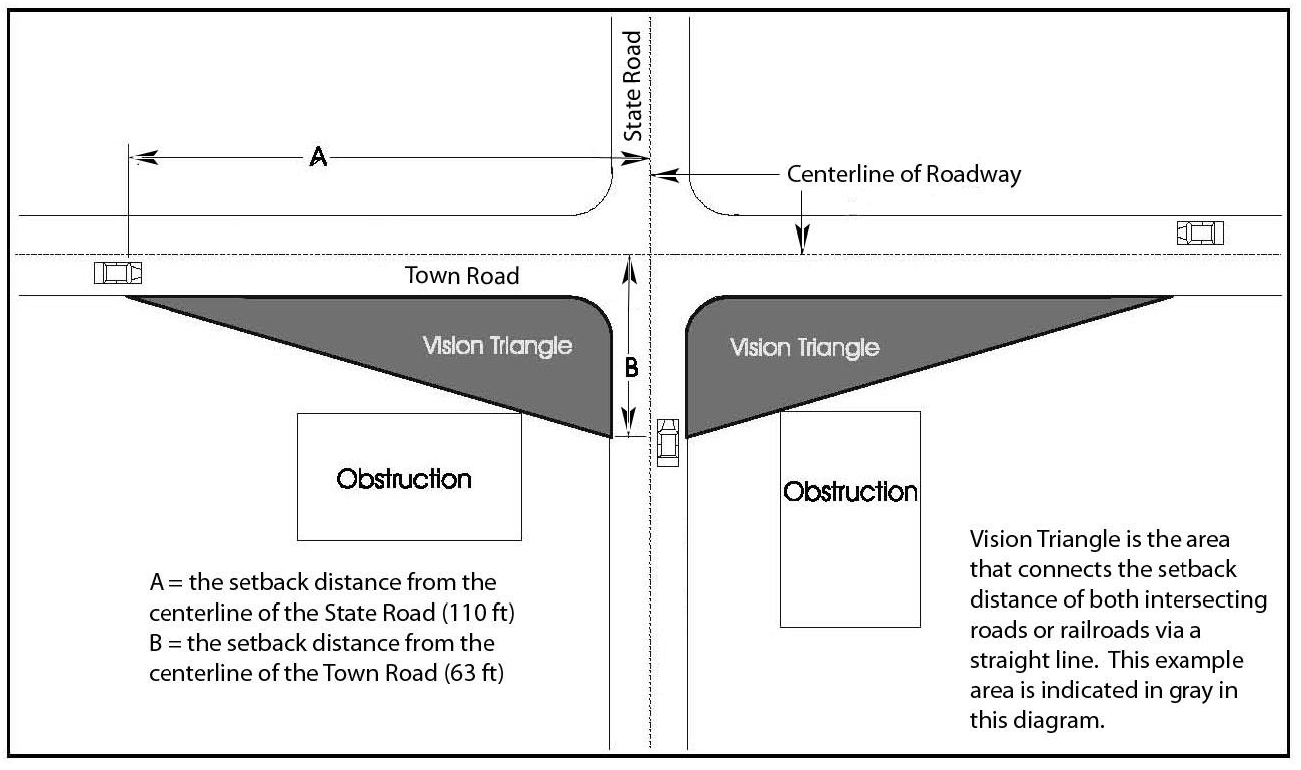
(Ord. No. 37-20, § 10.3.6, 9-15-2020)
Sec. 42-16. - Essential services.
Essential services are allowable uses in all zoning districts except the farmland preservation zoning district, in section 42-80.
(Ord. No. 37-20, § 10.3.7, 9-15-2020)
Sec. 42-17. - Conservation design development.
The standards in this section and in the county land division ordinance shall replace the underlying zoning district's standards. Conservation design development is prohibited in the farmland preservation zoning district.
(1)
Permitted uses. Land within a conservation design development (CDD) may be used for the following purposes:
a.
Permitted uses in the residential portion, not the common open space portion, of the conservation design development:
1.
All permitted uses in the underlying zoning district.
b.
Permitted uses in the common open space portion of the conservation design development shall include:
1.
All uses permitted in the natural resources district, except section 42-81(a)(7).
2.
Drainfields for common sewers with associated easements with the subdivision governing authority and maintenance agreements.
3.
Silent sport activities, including, but not limited to, hiking trails, biking trails, etc.
(2)
Conditional uses. The following uses, upon issuance of a conditional use permit as provided in section 42-149, and provided that the use shall not adversely impact the rural character of the development and shall be consistent with the design objectives listed in the county subdivision ordinance, may be allowed:
a.
Conditional uses in the residential portion, not the common open space portion of the conservation design development: All conditional uses in the underlying zoning district.
b.
Conditional uses in the common open space portion of the conservation design development.
1.
Conditional uses allowed in the natural resources district.
2.
Equestrian boarding and riding facilities available only to development residents. A manure management plan approved by the county land and water resources department is required.
3.
Swimming pools available only to development residents.
4.
Golf courses.
c.
Conditional uses will be approved as part of the conservation design development approval process.
(3)
Density standards. The total number of dwelling units allowed in a conservation design development is referred to as the residential gross density.
a.
Residential base density. The residential base density, or the base number of allowable dwelling units, is determined by the zoning district in which the property resides. Existing dwellings that may or may not be part of a farmstead that will be retained shall be counted toward the base density.
b.
Residential gross density. The residential gross density, or the total number of dwelling units allowed in a conservation design development, is the residential base density plus 25 percent of the number of dwelling units prescribed by the residential base density.
(4)
Companion standards. Companion standards for conservation design development can be found in the county subdivision ordinance.
(Ord. No. 37-20, § 10.3.8, 9-15-2020)

