
Melissa City Zoning Code
ARTICLE 12
300 - ZONING ORDINANCE ADOPTED3
CITY OF MELISSA, TEXAS
ORDINANCE NO. 92-08
AN ORDINANCE REPLACING IN ITS ENTIRETY THE EXISTING ZONING ORDINANCE OF THE CITY OF MELISSA, TEXAS; ESTABLISHING NEW ZONING DISTRICTS; ADOPTING A NEW ZONING MAP; REGULATING THE SIZE AND USE OF BUILDINGS AND LOTS THAT MAY BE OCCUPIED; REQUIRING CERTIFICATES OF OCCUPANCY FOR ALL USES; PROVIDING OFF-STREET PARKING AND LOADING REQUIREMENTS; REGULATING ACCESSORY BUILDINGS; REGULATING SIGNS; PROVIDING FOR SPECIFIC USE PERMITS; PROVIDING FOR AMENDMENTS TO THIS ZONING ORDINANCE AND CLASSIFYING NEW AND UNLISTED USES; PROVIDING FOR NONCONFORMING LOTS AND STRUCTURES; PROVIDING FOR A GENERAL PENALTY FOR VIOLATIONS NOT TO EXCEED TWO THOUSAND DOLLARS ($2,000.00) FOR EACH OFFENSE; PROVIDING FOR A SAVINGS CLAUSE; AND PROVIDING AN EFFECTIVE DATE.
BE IT ORDAINED BY THE CITY COUNCIL OF THE CITY OF MELISSA, TEXAS:
SECTION 1
TITLE
That this ordinance, together with all subsequent amendments thereto, shall hereby referred to as the "Revised Zoning Ordinance of the City of Melissa, Texas."
SECTION 2
PURPOSE
Zoning regulations and districts are herein established in accordance with a comprehensive plan for the purpose of promoting the health, safety, morals and general welfare of the City. They are designed to lessen congestion in the streets; to secure safety from fire, panic and other dangers; to provide adequate light and air; to prevent the overcrowding of land, to avoid undue concentration of population; to facilitate the adequate provision of transportation, water, sewerage, schools, parks and other public requirements. They have been established with reasonable consideration, among other things, for the character of each district, and its peculiar suitability for the particular uses specified; and with a view to conserving the value of buildings and encouraging the most appropriate use of land throughout the City.
SECTION 3
ZONING DISTRICTS ESTABLISHED
The City of Melissa, Texas, is hereby divided into zoning districts as listed in this section.
(Ord. No. 13-21, adopted 4-23-13, Sec. 2; Ord. No. 15-11, adopted 3-24-15, Sec. 2; Ord. No. 18-31, adopted 5-22-18, Sec. 2; Ord. No. 20-26, adopted 6-23-20, Sec. 2)
SECTION 4
ZONING DISTRICT MAP
4.1 The boundaries of the zoning districts as established herein are delineated upon the zoning map of the City of Melissa, Texas, said map being hereby adopted as a part of this ordinance as fully as if the same were set forth herein in detail.
4.2 Two (2) original, official and identical copies of the zoning map are hereby adopted bearing the signature of the Mayor and attestation of the City Secretary and shall be filed and maintained as follows:
(a)
One copy shall be filed with the City Secretary, to be retained as the original record and shall not be changed in any manner.
(b)
One copy shall be displayed for public view in the city hall and shall be maintained up-to-date by posting thereon all changes and subsequent amendments. This zoning map shall be referenced when issuing building permits, certificates of occupancy and for enforcing this zoning ordinance.
(c)
Reproductions for information purposes may from time to time be made of the official zoning maps. The map may be updated as individual zoning requests are approved.
SECTION 5
ZONING DISTRICT BOUNDARIES
5.1 The district boundary lines shown on the zoning map are usually along streets, alleys, property lines or extensions thereof. Where uncertainty exists as to the boundaries of districts as shown on the official zoning map, the following rules shall apply.
5.2 Boundaries indicated as approximately following streets, highways or alleys shall be construed to follow the centerline of such street, highway or alley.
5.3 Boundaries indicated as approximately following platted lot lines shall be construed as following such lines.
5.4 Boundaries indicated as approximately following city limits shall be construed as following city limits.
5.5 Boundaries indicated as following railroad or utility lines shall be construed to be the centerline of the right-of-way or if no centerline is established, the boundary shall be interpreted to be midway between the right-of-way lines.
5.6 Boundaries indicated as approximately following the streams, drainageways, or other bodies of water shall be construed to follow the centerlines of such streets, drainageway, or other body.
5.7 Boundaries indicated as parallel to or extensions of features indicated in subsections 5.1 through 5.6 above shall be so construed. Distances not specifically indicated on the original Zoning Map shall be determined from the graphic scale on the map.
5.8 Whenever the street, alley, or other public way is vacated by official action of the City Council, or whatever street or alley area is franchised for building purposes, the zoning district line adjoining each side of such street, alley or other public way shall be automatically extended to the centerline of such vacated street, alley or way, and all areas so involved shall then and henceforth be subject to all regulations of the extended districts.
5.9 Where physical features of the ground are at variance with information shown on the official zoning district map, or if there arises a question as to how a parcel of property is zoned and such question cannot be resolved by the application of subsections 5-1 through 5-8, or the zoning of property is invalidated by a final judgment of a court of competent jurisdiction, the property shall be considered as classified "A", Agricultural District, temporarily until other zoning is given.
SECTION 6
TEMPORARY ZONING ANNEXED TERRITORY
6.1 All territory hereafter annexed to the City of Melissa shall be temporarily classified as Agricultural District, until permanent zoning is established by the City Council. The procedure for establishing permanent zoning on annexed territory shall conform to the procedures established by law for the adoption of original zoning regulations.
6.2 In an area temporarily classified as Agricultural District:
(a)
No person shall use, erect, construct and/or proceed or continue with the erection or construction of any building or structure or cause the same to be done in any newly annexed territory to the City of Melissa without first applying for and obtaining a building permit or certificate of occupancy from the Building Inspector or the City Council as may be required.
(b)
No permit for the construction of a building or use of land shall be issued by the Building Inspector other than a permit which will allow the construction of a building permitted in the Agricultural District, unless and until such territory has been classified in a zoning district other than the Agricultural District, by the City Council in the manner prescribed by law.
SECTION 7
COMPLIANCE REQUIRED
All land, buildings, structures or appurtenances thereon located within the City of Melissa, Texas, which are hereafter occupied, used, erected, altered, removed, placed, demolished or converted shall be occupied, used, erected, altered, removed, placed, demolished or converted in conformance with the zoning regulations prescribed for the zoning district in which such land or building is located as hereinafter provided.
SECTION 8
"A" AGRICULTURAL DISTRICT
8.1 General Purpose and Description. This district is intended to apply to land situated on the fringe of an urban area and used for agricultural purposes, which may become developed as an urban area in the future. Generally, the land in an Agricultural District may be appropriate for development; therefore, the agricultural activities conducted in the Agricultural District should not be detrimental to urban land uses. The types of uses and the area and intensity of use permitted in this district are intended to encourage and protect agricultural uses until urbanization is warranted and the appropriate change in district classification is made.
8.2 Permitted Uses. Uses permitted in the Agricultural District include those listed in Schedule of Uses found in Section 20 hereof and are subject to the following conditions:
(a)
All general and special agricultural, farming, ranching, stables and related accessory buildings, stock and poultry raising, dairy, and other related uses are permitted so long as they do not cause a hazard to health by reason of unsanitary conditions, are not offensive by reason of odors, dust, fumes, noise or vibrations to persons of ordinary sensibilities, and are not otherwise detrimental to the public safety and welfare.
8.3 Area and Height Regulations and Minimum Dwelling Size. The requirements regulating the minimum lot size, minimum yard sizes, maximum building height, maximum percent of lot coverage by buildings and accessory uses, and the minimum dwelling size shall conform with the schedule found in Section 21.
(Ord. No. 13-21, adopted 4-23-13, Sec. 3)
SECTION 9
"SF-1" SINGLE FAMILY RESIDENTIAL DISTRICT-1
9.1 General Purpose and Description. This district is intended to provide for larger lots with associated large single family residential dwellings and accessory structures. Such districts will usually be located in relatively remote areas, separated from heavy traffic and major thoroughfares. This district is also appropriate in areas of environmental sensitivity and/or uneven topography and as a buffer between areas expected to remain in agricultural use for an extended period of time and areas expected to experience residential development.
9.2 Permitted Uses. Uses permitted in the SF-1 District include those listed in Schedule of Uses found in Section 20 hereof and are subject to the following conditions:
(a)
A private stable used for the housing of a horse or horses owned by the resident shall be set back from adjacent property lines a minimum distance of one hundred feet (100'). An area of one and one-half (1.5) acre shall be required for each animal.
9.2 Area and Height Regulations and Minimum Dwelling Size. The requirements regulating the minimum lot size, minimum yard sizes, maximum building height, maximum percent of lot coverage by buildings and accessory uses, and the minimum dwelling size shall conform with the schedule found in Section 21.
(Ord. No. 13-21, adopted 4-23-13, Sec. 3)
SECTION 10
"SF-2" SINGLE FAMILY RESIDENTIAL DISTRICT-2
10.1 General Purpose and Description. This district is designed to provide for low density, traditional single family residential development. This district is appropriate as a buffer between higher density residential uses and agricultural and/or estate type residential areas.
10.2 Permitted Uses. Uses permitted in the SF-2 District include those listed in Schedule of Uses found in Section 20 hereof.
10.3 Area and Height Regulations and Minimum Dwelling Size. The requirements regulating the minimum lot size, minimum yard sizes, maximum building height, maximum percent of lot coverage by buildings and accessory uses, and the minimum dwelling size shall conform with the schedule found in Section 21.
(Ord. No. 13-21, adopted 4-23-13, Sec. 3)
SECTION 11
"SF-3" SINGLE FAMILY RESIDENTIAL DISTRICT-3
11.1 General Purpose and Description. This district is designed to accommodate single family residential development of somewhat higher density than found in the SF-2 District and SF-1 District. This district is appropriate as a buffer between multi-family residential areas or some commercial areas and lower density single family residential areas.
11.2 Permitted Uses. Uses permitted in the SF-3 District include those listed in Schedule of Uses found in Section 20 hereof.
11.3 Area and Height Regulations and Minimum Dwelling Size. The requirements regulating the minimum lot size, minimum yard sizes, maximum building height, maximum percent of lot coverage by buildings and accessory uses, and the minimum dwelling size shall conform with the schedule found in Section 21.
(Ord. No. 13-21, adopted 4-23-13, Sec. 3)
SECTION 11-A
"TH" TOWNHOME RESIDENTIAL DISTRICT
11-A.1 General Purpose and Description. This district provides for the development of attached residential dwelling units in structures built to accommodate three to eight dwelling units per structure and designed for occupancy by one household per unit. Open space is encouraged in this District through provisions set forth in the standards for the district. This district is appropriate as a buffer between multi-family residential areas or some commercial areas and lower-density single-family residential uses. Except as otherwise provided in this Code, this district shall be considered a single-family residential district for all those regulations and requirements that distinguish between single-family residential districts (SF) and multi-family residential districts (MF). Except as otherwise provided in this Code, townhome structures shall be considered single-family structures for those regulations and requirements that distinguish between single-family residential structures (SF) and multi-family residential structures (MF).
11-A.2 Permitted Uses. Uses permitted in the TH - Townhome Residential District are outlined in the Schedule of Uses found in Section 20 hereof and are subject to the following conditions:
(a)
Community Owned or Multiple Ownership Areas. Common open space, community centers, access gates, entrance guard facilities, recreational buildings and facilities are permitted uses provided they are incidental to the above-described residential uses and are approved on a Final Plat.
11-A.3 Area and Height Regulations and Minimum Dwelling Size. The requirements regulating the minimum lot size, minimum yard sizes, maximum building height, maximum percent of lot coverage by buildings and accessory uses, and the minimum dwelling size shall conform to the schedule found in Section 21.
(Ord. No. 20-26, adopted 6-23-20, Sec. 3)
SECTION 12
"MF" MULTI-FAMILY RESIDENTIAL DISTRICT
12.1 General Purpose and Description. The Multi-Family Residential District is established to meet the needs for medium to high density residential development where such areas are suitable for higher impact development and higher traffic volume. Attached residential dwellings are permitted in this district but not more than fifteen (15) dwelling units per acre shall be allowed.
12.2 Permitted Uses. Uses permitted in the MF District include those listed in Schedule of Uses found in Section 20 hereof.
12.3 Area and Height Regulations and Minimum Dwelling Size. The requirements regulating the minimum lot size, minimum yard sizes, maximum building height, maximum percent of lot coverage by buildings and accessory uses, and the minimum dwelling size shall conform with the schedule found in Section 21 as may be applicable.
12.4 Reserved.
12.5 Refuse Facilities. Every dwelling unit shall be located within two hundred fifty (250) feet of a refuse facility measured along the designated pedestrian and vehicular travel way. There shall be available at all times at least six (6) cubic yards of refuse container per thirty (30) multi-family dwelling units. For complexes with less than thirty (30) dwelling units, no less than four (4) cubic yards of refuse container shall be provided. Each refuse facility shall be screened from view on three sides from persons standing at ground level on the site or immediately adjoining property, by a wall of substantially the same material of the adjacent main structure. The wall shall not be less than six (6) feet nor more than ten (10) feet in height or by an enclosure within a building. Refuse containers shall be provided and maintained in a manner to satisfy public health and sanitary regulations. Each refuse facility shall be located so as to provide safe and convenient pickup by refuse collection agencies.
12.6 Unless otherwise provided in Section 23, border fencing of wood or masonry of not less than six (6) feet in height shall be installed by the builder at the time of construction of any multi-family complex, along the property line on any perimeter not abutting a public street or right-of-way. This fence shall be maintained throughout the existence of the multi-family unit by the owner.
12.7 Each unit in any multi-story design, regardless of density, shall be provided with two (2) points of entry and exit with each providing separate access to places of safety in the event of fire or other emergency.
(Ord. No. 13-21, adopted 4-23-13, Sec. 3; Ord. No. 14-10, adopted 1-28-14, Sec. 2; Ord. No. 15-11, adopted 3-24-15, Sec. 3)
SECTION 13
MANUFACTURED HOME PARK DISTRICT
13.1 General Purpose and Description. This district is designed to accommodate manufactured home development. No manufactured home shall be permitted to be located within the City of Melissa unless located in an authorized manufactured home park. No mobile home constructed prior to June 15, 1976 shall be permitted to be located within the city limits. The minimum size of any manufactured home park shall be twenty (20) acres.
13.2 Permitted Uses. Uses permitted in the MH District include those listed in Schedule of Uses found in Section 20 hereof. Only one (1) manufactured home shall be permitted on each lot or space.
13.3 Area and Height Regulations and Minimum Dwelling Size. The requirements regulating the minimum lot size, minimum yard sizes, maximum building height, maximum percent of lot coverage by buildings and accessory uses, and the minimum dwelling size shall conform with the schedule found in Section 21.
13.4 Reserved.
13.5 Design and Construction Standards.
(a)
Streets. Internal streets, signage, street lights shall be privately owned, built, and maintained unless dedicated to and accepted by the city. Streets rights-of-way widths shall be a minimum of fifty feet (50') and the pavement width shall be not less than thirty-one feet (31') with curb and gutter. Dead end streets shall not be longer than six hundred feet (66') and shall have a permanent paved turnaround of eighty feet (80'). No partial or half streets shall be permitted except with formal approval by the City Council. All streets shall be constructed with six inch (6") reinforced concrete pavement with integral curb and gutter which meets the approval and standards of the City Council.
(b)
Driveways, Parking Areas, and Walkways. All lots shall be provided with a reinforced concrete walkway from the manufactured home to the driveway which is at least four feet (4') in width. Each lot shall also be provided with adequate driveway and parking area to accommodate at least two vehicles and which shall be paved with six inch (6") reinforced concrete. The driveway shall provide access from the street to the back of the front building line. All driveways, parking areas, and walkways shall be constructed in accordance with the latest edition of the Standard Specifications for Public Works Construction published be North Central Texas Council of Governments.
(c)
Electrical and Telephone Service. All electrical wiring and telephone cabling in the manufactured home park shall be underground.
(d)
Water Supply. Each lot shall be supplied water by public water supply system and each lot shall separately metered. All water lines shall conform to the city's plumbing code and water construction standards and the State Board of Insurance and Texas Department of Health minimum standards for water systems.
(e)
Sewer Disposal. Each lot shall be connected to a public sewer system constructed in accordance with the city's plumbing code and sewer construction standards and the Texas Department of Health minimum standards for sewer systems. Each manufactured home space shall be provided with a sewer riser pipe a minimum of four inches (4") in diameter. When the lot is unoccupied or vacant, the sewer riser pipe shall be capped off by the owner or manager of the manufactured home park.
(f)
Drainage. The manufactured home park shall provide for adequate drainage as provided for in the city's subdivision standards. All drainage facilities shall be constructed in accordance with the latest edition of the Standard Specifications for Public Works Construction published be North Central Texas Council of Governments.
(g)
Fire Protection. All service buildings (office, laundry facilities, shops, etc.) shall be provided with at least one fire extinguisher.
(h)
Gas Supply. Gas piping shall be installed underground in accordance with the city's plumbing code and construction standards and the gas supplier's standards. Gas outlets shall be capped when the lot is vacant. Natural gas shall be supplied except that liquefied petroleum gas system may be installed in the nearest available natural gas supply main is located more than one thousand (1,000) feet from the park and is permitted by the City Council.
(i)
Extensions and Add-Ons. No structural extension shall be attached to a manufactured home in violation of the spacing and clearance requirements. A building permit shall be required for any extension or add-on structure. All extensions or add-on structures must be constructed in accordance with the city's building codes and ordinances. All extensions and add-on structures shall be dismantled and removed when the adjoining manufactured home is removed from the lot.
(j)
Solid Waste Disposal. Each lot shall subscribe to a solid waste collection service in accordance with the city's policies and regulations.
(k)
Anchoring and Skirting Requirements. Each manufactured home within the park shall be installed and anchored in accordance with the Texas Department of Labor and Standards rules and regulations. Also, each manufactured home within the park shall be installed with a painted metal or wood skirting around the perimeter of the dwelling which shall be installed within thirty (30) days of placement of the manufactured home. The failure to install this skirting shall be deemed an offense against the city.
(l)
Operational and Maintenance Requirements. All manufactured homes shall comply with the following operational and maintenance requirements:
(1)
The owner or manager of the manufactured home park shall keep an up-to-date register of the park residents, including the manufactured home registration data, the make, model, length, width, year of manufacture, and identification number of each manufactured home.
(2)
The owner or manager of the manufactured home park shall be responsible for the keeping the manufactured home park in a clean, safe and sanitary condition, free of accumulations of debris, trash, and high weeds and grass. The owner or manager shall also keep all streets and sidewalks in good and safe condition. Whenever the owner or manager is notified by the city, or other appropriate authority, that unsafe or unsanitary conditions exist, he or she shall abate the condition or nuisance within the allotted time as provided in the notice to him or her or he or she shall be guilty of a misdemeanor offense.
(3)
The owner or manager of the manufactured home park shall be responsible for insuring that park residents meet the applicable anchoring and skirting requirements as outlined in paragraph (k) above. Such requirements shall be incorporated in all lease or rental agreements and stipulate that failure to do so will result in the eviction of the resident and his property from the park. Failure of the owner or manager to require compliance with such anchoring and skirting requirements after due notice by the city or failure to start eviction proceedings shall be unlawful.
(Ord. No. 13-21, adopted 4-23-13, Sec. 3)
SECTION 14
"C-1" RESTRICTED COMMERCIAL DISTRICT
14.1 General Purpose and Description: The C-1 District is intended for office facilities, neighborhood shopping facilities and retail and commercial facilities of a service character. The C-1 District is established to accommodate such uses compatible with central business district area.
14.2 Permitted Uses: Uses permitted in the C-1 District include those listed in Schedule of Uses found in Section 20 hereof and are subject to the following conditions:
(a)
The business shall be conducted wholly within an enclosed building;
(b)
Required yards shall not be used for display, sale or storage of merchandise or for the storage of vehicles, equipment, containers or waste material;
(c)
All merchandise shall be sold at retail on the premises; and
(d)
Such use shall not be objectionable because of odor, excessive light, smoke, dust, noise, vibration or similar nuisance to a person of ordinary sensibilities.
14.3 Area and Height Regulations and Minimum Dwelling Size: The requirements regulating the minimum lot size, minimum yard sizes, maximum building height, maximum percent of lot coverage by buildings and accessory uses, and the minimum dwelling size shall conform with the schedule found in Section 21.
(Ord. No. 13-21, adopted 4-23-13, Sec. 3)
SECTION 15
"C-2" GENERAL COMMERCIAL DISTRICT
15.1 General Purpose and Description: The C-2 District is intended to provide a zoning category similar to the C-1 District, except that additional uses are permitted which may or may not generally be carried on completely within a building or structure, and an expanded range of service and repair uses is permitted.
15.2 Use Regulations: Uses permitted in the C-2 District include those listed in Schedule of Uses found in Section 20.
15.3 Area and Height Regulations and Minimum Dwelling Size: The requirements regulating the minimum lot size, minimum yard sizes, maximum building height, maximum percent of lot coverage by buildings and accessory uses, and the minimum dwelling size shall conform with the schedule found in Section 21.
(Ord. No. 13-21, adopted 4-23-13, Sec. 3)
SECTION 16
"I-1" LIGHT INDUSTRIAL DISTRICT
16.1 General Purpose and Description: The purpose of this district is to provide for light industrial uses and those commercial uses requiring outside storage and display. The regulations are designed to provide for a mixture of commercial uses and light industrial or manufacturing uses with proper standards to encourage attractive working areas for citizens.
16.2 Use Regulations: Uses permitted in the I-1 District include those listed in Schedule of Uses found in Section 20 hereof and are subject to the following conditions:
(a)
All business, servicing, or processing, except for off-street parking, off-street loading, display of merchandise for sale to the public, and establishments of the "drive-in" type, shall be conducted within completely enclosed areas.
(b)
All storage within one hundred feet (100') of a residence district, except for motor vehicles in operable condition, shall be within completely enclosed buildings or effectively screened with screening not less than six feet (6') nor more than eight feet (8') in height, provided no storage located within fifty feet (50') of such screening shall exceed the maximum height of such screening.
(c)
Permitted uses in the I-1 District shall not disseminate dust, fumes, gas, noxious odor, smoke, glare, or other atmospheric influence.
(d)
Permitted uses in the I-1 District shall produce no noise exceeding in intensity, at the boundary of the property, the average intensity of noise of street traffic.
(e)
Permitted uses in the I-1 District shall not create fire hazards on surrounding property.
16.3 Area and Height Regulations and Minimum Dwelling Size: The requirements regulating the minimum lot size, minimum yard sizes, maximum building height, maximum percent of lot coverage by buildings and accessory uses, and the minimum dwelling size shall conform with the schedule found in Section 21.
(Ord. No. 13-21, adopted 4-23-13, Sec. 3)
SECTION 17
"I-2" HEAVY INDUSTRIAL DISTRICT
17.1 General Purpose and Description: The I-2 District provides for a wide range of industrial activities, some of which may generate objectionable or hazardous conditions and therefore are not compatible with other land uses. Permitted uses include manufacturing, processing, assembling, warehousing, and distribution. This district can also accommodates some commercial uses which have outside storage and displays.
17.2 Use Regulations: Uses permitted in the I-2 District include those listed in Schedule of Uses found in Section 20 hereof and are subject to the following conditions:
(a)
All business, servicing, or processing, except for off-street parking, off-street loading, display or merchandise for sale to the public, and establishments of the "drive-in" type, shall be conducted within completely enclosed buildings unless otherwise indicated.
(b)
All storage within one hundred feet (100') of a residential district, except for motor vehicles in operable condition, shall be within completely enclosed buildings or effectively, screened with screening not less than six feet (6') nor more than eight feet (8') in height, provided no storage located within fifty feet (50') of such screening shall exceed the maximum height of such screening.
(c)
Such facilities for the manufacturing, fabrication, processing or assembly of products, provided that such facilities are not detrimental to the public health, safety or general welfare, and further provided that the following performance standards and city ordinances are met:
(1)
Smoke: No operation shall be conducted unless it conforms to the standards established by any applicable state and federal health rules and regulations pertaining to smoke emission;
(2)
Particulate Matter: No operation shall be conducted unless it conforms to the standards established by applicable state and federal health rules and regulations pertaining to emission of particulate matter;
(3)
Dust, Odor, Gas, Fumes, Glare, or Vibration: No emission of these matters shall result in a concentration at or beyond the property line which is detrimental to the public health, safety or general welfare or which causes injury or damage to property; said emissions shall in all cases conform to the standards established by applicable state and federal health rules and regulations pertaining to said emissions;
(4)
Radiation Hazards and Electrical Disturbances: No operation shall be conducted unless it conforms to the standards established by applicable state and federal health rules and regulations pertaining to radiation control;
(5)
Noise: No operation shall be conducted in a manner so that any noise produced is objectionable due to intermittence, beat frequency or shrillness. Sound levels of noise at the property line shall not exceed 75 DB(A) permitted for a maximum of fifteen (15) minutes in any one (1) hour; said operation shall in all cases conform to the standards established by applicable state and federal health rules and regulations and to other city ordinances pertaining to noise; and
(6)
Water Pollution: No water pollution shall be emitted by the manufacturing or other processing. In a case in which potential hazards exist, it shall be necessary to install safeguards acceptable to the appropriate state and national health and environmental protection agencies prior to issuance of a certificate of occupancy. The applicant shall have the burden of establishing that said safeguards are acceptable to said agency or agencies.
(d)
Other manufacturing and industrial uses which do not meet the general definition for manufacturing processes may be permitted by the City Council after public hearing and review of the particular operational characteristics of each such use and other pertinent data affecting the community's general welfare. Approval of uses under this subsection shall be made in accordance with Section 28.
17.3 Area and Height Regulations and Minimum Dwelling Size: The requirements regulating the minimum lot size, minimum yard sizes, maximum building height, maximum percent of lot coverage by buildings and accessory uses, and the minimum dwelling size shall conform with the schedule found in Section 21.
(Ord. No. 13-21, adopted 4-23-13, Sec. 3)
SECTION 18
SPECIAL ZONING DISTRICTS
[4]
(A)
"PD" Planned Development District
(1)
General Purpose and Description: The "PD" Planned Development District is a district which accommodates coordinated development that provides a more flexible means than the zoning districts outlined in this ordinance. A PD District may be used to permit new or innovative concepts in land utilization or diversification that could not be achieved under conventional zoning approaches. While great flexibility is given to provide special restrictions which will allow development not otherwise permitted, procedures are established herein to ensure against misuse of the increased flexibility.
(a)
The PD District designation shall be used for the following purpose(s):
(i)
Master planning;
(ii)
To carry out specific goals of:
(A)
The Comprehensive Plan;
(B)
The City;
(C)
Public/private partnered special projects; and/or
(D)
City Council strategic focus areas;
(iii)
Development of mixed use, transit-oriented or traditional neighborhoods with a variety of uses and housing types; and/or
(iv)
To preserve natural features, open space and other topographical features of the land.
(2)
Permitted Uses: Any use specified in the ordinance granting a PD District shall be permitted in that district. The size, location, appearance and method of operation may be specified to the extent necessary to ensure compliance with the purpose of this ordinance. Unless specified in the amending ordinance, all buildings and uses shall comply with all City development requirements.
(3)
Development Standards:
(a)
In all applications for a PD District for which there is a known or contemplated development project, development standards for each separate PD District shall be set forth in the ordinance granting the PD District and may include requirements relating to the following: use, density, lot area, lot width, lot depth, yard depths and widths, building height, building elevations, coverage, floor area ratio, parking, access, screening, landscaping, accessory buildings, signs, lighting, management associations and other requirements as the City Council and Planning and Zoning Commission may deem appropriate.
(b)
In all applications for a PD District, the particular district(s) to which uses specified in the proposed PD District are most similar shall be stated. All PD District applications shall list all requested variances, if any, from the standard requirements set forth throughout this ordinance. Applications without this list may be considered incomplete, among any other reasons an application may be deemed incomplete, in accordance with City ordinances, as they exist, may be amended or in the future arising. If no project is identified at the time the application for a PD District is submitted, the proposed use(s) will be subject to the development standards, approval processes and other requirements that are in effect at the time of development.
(c)
The ordinance granting a PD District shall include a statement as to the purpose and intent of the PD District granted therein. A specific list of variances, if any, is required in each granting ordinance.
(d)
The PD District shall conform to all other sections of this ordinance unless specifically exempted in the granting ordinance.
(4)
When a PD District is being considered, a written report may be requested from the applicant discussing the proposed PD District's impact on planning, engineering, water utilities, electric, sanitation, building inspection, tax, police, fire and traffic.
(5)
In establishing a PD District in accordance with this Section (18)(A) ("PD" Planned Development District), the City Council shall approve and file as part of the granting ordinance appropriate plans and standards for the PD District. The granting ordinance for each PD District shall include the following:
(a)
Supplemental data describing standards, schedules or other data pertinent to the development of the PD District. Otherwise, the proposed use(s) will be subject to the development standards, approval processes and other requirements that are in effect at the time of development.
(b)
For detached single family and two family uses:
(i)
A zoning exhibit for detached single family and two family uses shall show general use, thoroughfares and preliminary lot arrangements;
(ii)
A site inventory analysis including a scale drawing showing existing vegetation, natural water courses, creeks or bodies of water and an analysis of planned changes in such natural features as a result of the development. This should include a delineation of any flood-prone areas;
(iii)
A scale drawing showing any proposed public or private streets and alleys; building sites or lots; and areas reserved as parks, parkways, playgrounds, utility easements, school sites, street widening and street changes; the points of ingress and egress from existing streets; general location and description of existing and proposed utility services, including size of water and sewer mains; the location and width for all curb cuts and the land area of all abutting sites and the zoning classification thereof on an accurate survey of the tract with the topographical contour interval of not more than five (5) feet;
(iv)
For nonresidential uses, including but not limited to amenity centers and other common areas, proposed within detached single family and two family PD Districts, a site plan which complies with Section 29-A (Site Plan Requirements);
(v)
A landscape plan showing screening walls, ornamental planting, wooded areas and trees to be planted; and
(vi)
An architectural plan showing elevations and signage style to be used throughout the development. Any or all of the required information may be incorporated on a single drawing if such drawing is clear and can be evaluated by the City's Building Official, or his designated representative.
(c)
For Uses Other than Detached Single Family and Two Family Uses: A site plan which complies with Section 29-A (Site Plan Requirements).
(d)
All zoning exhibits, conceptual plans, site inventory analyses, written reports and other documents required to be submitted under this section or submitted in connection with a planned development application shall in no way vest rights for the property that are outside the regulations of the Zoning Ordinance and other applicable City ordinances, as they currently exist or shall be amended. No such documents shall be considered "plans" or "plats" as those terms are defined under Chapter 212 of the Texas Local Government Code.
(6)
Procedure for Establishing a PD District:
(a)
The procedure for establishing a PD District shall follow the procedure for zoning amendments as set forth in Section 33 (Zoning Changes and Amendments).
(b)
Separate public hearings shall be held by the Planning and Zoning Commission and the City Council for the approval of the ordinance granting the PD District.
(7)
References to and Lists of PD Districts: All PD Districts approved in accordance with the provisions of this ordinance shall be referenced on the Zoning District Map, and a list of such PD Districts, together with the category of uses permitted therein, shall be maintained in the office of the City Secretary.
(8)
Planned Development Ordinances Continued: If the City Council has established various PD Districts prior to the adoption of this ordinance, they are to be continued in full force and effect. The granting ordinances or parts of ordinances approved prior to this ordinance shall be carried forth in full force and effect as are the conditions, restrictions, regulations and requirements which apply to the respective PD Districts shown on the Zoning District Map at the date of adoption of this ordinance.
(B)
"SUP" Specific Use Permit
(1)
General Provisions: The City Council, by an affirmative vote, may, after public hearing and proper notice to all parties affected, and after recommendations from the Planning and Zoning Commission that the uses are in general conformance with the Comprehensive Plan and general objectives of the City and containing such requirements and safe guards as are necessary to protect adjoining property, authorize application and shall be accompanied by a zoning exhibit drawn to scale and showing the general arrangement of the project, together with essential requirements such as off-street parking facilities; size, height, construction materials, and locations of buildings and the uses to be permitted; location and instruction of signs; means of ingress and egress to public streets; the type of visual screening such as walls, plantings and fences; and the relationship of the intended use to all existing properties and land uses in all directions to a minimum distance of two hundred (200) feet. The Planning and Zoning Commission or City Council may require additional information or drawings (such as, among other things, building floor plans), operating data and expert evaluation or testimony concerning the location, function and characteristics of any building or use proposed.
(2)
Specific Use Permit Regulations:
(a)
In recommending that a Specific Use Permit ("SUP") for the premises under consideration be granted, the Planning and Zoning Commission shall determine that such uses are harmonious and adaptable to building structures and uses of abutting property and other property in the vicinity of the premises under consideration, and shall make recommendations as to, among other things, requirements for the paving of streets, alleys and sidewalks, means of ingress and egress to public streets, provisions for drainage, adequate off-street parking, protective screening and open space, area or security lighting, heights of structures, and compatibility of buildings. The Planning and Zoning Commission and City Council shall consider the following criteria in determining the validity of the SUP request:
(1)
The use shall be harmonious and compatible with its surrounding existing uses or proposed uses;
(2)
The activities requested by the applicant shall be normally associated with the requested use;
(3)
The nature of the use shall be reasonable; and
(4)
Any negative impact on the surrounding area shall be mitigated.
(b)
In granting a SUP, the City Council may impose conditions which shall be complied with by the owner or grantee before a Certificate of Occupancy may be issued by the City's Building Official, or his designated representative, for use of the building on such property pursuant to such SUP and such conditions precedent to the granting of the Certificate of Occupancy. Any special conditions shall be set forth in writing by the City Council prior to issuance of the Certificate of Occupancy.
(c)
No SUP shall be granted unless the applicant, owner and grantee of the SUP shall be willing to accept and agree to be bound by and comply with the written requirements of the SUP, as attached to the zoning exhibit (or exhibits) and approved by the Planning and Zoning Commission and City Council.
(d)
A building, premise, or land used under a SUP may be enlarged, modified, structurally altered or otherwise changed provided the changes do not:
(1)
Increase the height of structures, including, without limitation, antenna support structures.
(2)
Increase building square footage from its size at the time the original SUP was granted by greater than ten (10) percent;
(3)
Reduce the distance between a building or noise-generating activity on the property and an adjacent, off-site residential use. This provision shall not apply should the property and the residential use be separated by a Major Thoroughfare, as defined in the City's Subdivision Regulations, as amended; and/or
(4)
Reduce the amount of open space as indicated on the previously approved zoning exhibit.
All other enlargements, modifications, structural alterations, or changes shall require the approval of a new SUP. Antennas may be placed on a tower with an existing SUP without approval of a separate SUP subject to approval of a final plat and site plan for the property.
(e)
The Board of Adjustment shall not have jurisdiction to hear, review, reverse or modify any decision, determination or ruling with respect to the specific land use designated by any SUP.
(f)
When the City Council authorizes the granting of a SUP, except in cases where a SUP is granted for a temporary building in accordance with this Ordinance, the Zoning District Map shall be amended according to its legend to indicate that the affected area has conditional and limited uses and said amendment is to indicate the appropriate zoning district for the approved use and prefixed by an "S" or "SUP" designation. SUPs granted shall be indicated by numerical designation on the Zoning District Map.
(g)
Upon holding a properly notified public hearing, the City Council may amend, change or rescind a SUP if:
(1)
There is a violation and conviction of any of the provisions of this Ordinance or any ordinance of the City that occurs on the property for which the SUP is granted.
(2)
The building, premise, or land used under a SUP is enlarged, modified, structurally altered or otherwise significantly changed without approval of a separate SUP for such enlargement, modification, structural alteration or change.
(3)
Violation of any provision of the terms or conditions of a SUP.
(4)
Ad valorem taxes on the property are delinquent by more than six (6) months.
(5)
The SUP was obtained by fraud or with deception.
(h)
All zoning exhibits, conceptual plans, site inventory analyses, written reports and other documents required to be submitted under this section or submitted in connection with a specific use permit application shall in no way vest rights for the property that are outside the regulations of the Zoning Ordinance and other applicable City ordinances, as they currently exist or shall be amended. No such documents shall be considered "plans" or "plats" as those terms are defined under Chapter 212 of the Texas Local Government Code.
(3)
Specific Use Permit for Temporary Buildings:
(a)
Temporary buildings are permitted by right for houses of worship, public schools (kindergarten through twelfth grade only) and other government agencies and/or political subdivisions of the State of Texas, subject to the conditions below. Temporary buildings are also permitted by SUP for private enterprises subject to the conditions below.
(b)
A permit to erect a temporary building may be issued for an initial period of up to three (3) years provided the applicant submits:
(1)
An application with documented evidence of an immediate need for space to the City's Development Services Department:
(i)
Capacity of the existing permanent building(s), which is located or planned to be located on the same property for which the temporary building permit is being sought, compared to the enrollment, employment and/or number of people attending the existing permanent building(s) at one (1) time;
(ii)
Total enrollment, employment and/or membership size;
(iii)
Documentation of growth records depicting the number of people in the congregation, school and/or office;
(iv)
Whether the facility is a start-up or new facility;
(v)
Indication of alternative options that were explored before a temporary building application was considered;
(vi)
Acts of nature; and/or
(vii)
Any other evidence which is reasonably related to the immediate need for additional space.
(2)
A preliminary site plan to the City's Development Services Department, providing for a permanent solution to the immediate need for a new temporary building(s) showing the permanent building(s), the temporary building(s) and the required parking, which is subject to the review and approval of the Planning and Zoning Commission; and
(3)
A site plan for the temporary building(s) to the City's Development Services Department, which is subject to the review and approval of the Planning and Zoning Commission.
(c)
The temporary building(s) shall be removed within thirty (30) days of the date:
(1)
A Certificate of Occupancy is issued for the permanent building; or
(2)
The permit for the temporary building expires, whichever occurs first.
(d)
A request for a single extension, not to exceed twelve (12) months, ("Single Extension") of the temporary building permit may be granted by the Planning and Zoning Commission provided the applicant:
(1)
Has an approved and valid preliminary site plan for the permanent building(s) and an approved and valid site plan for the temporary building(s);
(2)
Has a specific plan of how an additional year would allow the applicant to construct the permanent building(s) by providing:
(i)
Evidence of numeric growth, beyond that which was specifically anticipated by the applicant;
(ii)
Membership, enrollment and/or employment growth records;
(iii)
Evidence that alternative options were explored before an extension of the temporary building permit was requested; and
(iv)
Any other criteria reasonably deemed appropriate by the Planning and Zoning Commission.
(e)
The applicant may appeal a decision of the Planning and Zoning Commission, in writing, to the City Council within fourteen (14) days of a decision of the Planning and Zoning Commission. The City Council's decision is final.
(f)
Three (3) or more members of the City Council may appeal the decision of the Planning and Zoning Commission by submitting a written notice of appeal to the City's Development Services Department. The City Council shall consider and act on whether it will appeal the Commission's decision no later than fourteen (14) days from the date of such decision or at its first regular meeting (for which there is time to post an agenda as required by law) that occurs after the Commission meeting at which the decision was made, whichever is later. Written notice of the City Council's vote to appeal shall be submitted to the City's Development Services Department within seven (7) days of the City Council's vote. The City Council shall consider the appeal at a public meeting no later than forty-five (45) days after the date on which the notice of appeal is submitted to the City's Development Services Department. The City Council may affirm, modify or reverse the decision of the Planning and Zoning Commission.
(g)
If the applicant desires an extension after being granted the Single Extension, the applicant may request the City Council to grant such an extension provided the applicant submits to the City Council:
(1)
The information required under Subsection 18(B)(3)(d)(2) above:
(2)
A detailed financial summary, including without limitation, the reasons for not complying with the terms of the Single Extension; and
(3)
Any other criteria that the City Council deems necessary to ensure that any further extension granted:
(i)
Is not contrary to the public interest; and
(ii)
Does not impair the City's ability to carry out the administration of all applicable ordinances, rules and regulations of the City, as they exist, may be amended or in the future arising.
(C)
"DOD" DOWNTOWN OVERLAY DISTRICT
(1)
Applicability.
(a)
Purpose and Intent. The purpose of the Downtown Overlay District (DOD), herein referred to as the "Overlay," is to guide development and redevelopment of the historic core of Melissa by building on the community's vision for a new downtown with a mix of uses that creates an enhanced transition between neighborhoods and commercial activity. The Overlay allows a mix of commercial, retail and residential uses while encouraging creative integration of temporary uses, streetscaping, landscaping and urban design amenities, specifically walkability, allowing Downtown to be responsive to market trends and innovative developments. The Overlay and the regulations and requirements relating thereto are intended to substantially advance legitimate governmental interests that include enhancing the quality of life in the City, regulating the character of development and redevelopment in the Downtown area, ensuring the careful and orderly development and redevelopment of the Downtown area and creating and preserving a unique Downtown area for the community.
(b)
Overlay Area. The Overlay district includes all property within the area bounded by State Highway 5 and Waller Street to the north, Miller Street and Sherman Street to the east, Melissa Road to the south and Fannin Road north along the school property to the west, as more particularly depicted in DOD Exhibit 1. Some lots or tracts may be fully or partially located in this Overlay. It is the intent of this Overlay to transition from those lots or tracts located fully in the Overlay district to those lots or tracts not located in the Overlay district by extending building materials and landscape standards to those lots or tracts partially located in the Overlay district. Transitioning concepts will be developed on a project by project basis through the development process.
(1)
Base Zoning. All development standards in this Zoning Ordinance, the Subdivision Ordinance, building codes and other applicable development- related codes and ordinances that apply to the base zoning district in which any property is located shall apply unless otherwise provided specifically herein. In the event of a conflict between the land use standards set forth in Subsection 20.1 (Schedule of Uses and Parking Requirements) applicable to this Overlay and land use standards applicable to the base zoning district, the more stringent land use standards shall apply. Any other standards, regulations or requirements within this Overlay shall override those in the base zoning district in the event of a conflict not addressed above. Standards, regulations or requirements of the base zoning district not augmented or otherwise supplemented by this Overlay will continue to prevail. Notwithstanding any statement to the contrary in this subsection, standards, regulations or requirements of any planned development district within this Overlay shall prevail in the event they conflict with standards, regulations or requirements of this Overlay.
(c)
Character Zones. The Overlay sets the framework for development within the district by using two (2) character zones that represent a variety of development types within the district to support the framework for a walkable, connected and attractive Downtown.
(1)
Commercial Mixed Use (CMU). The Commercial Mixed Use (CMU) character zone establishes the commercial core within the district and focuses on the development of commercial and mixed-use structures within the appropriate context of creating a vibrant downtown.
(i)
For the CMU buildings or uses fronting on State Highway 5, building form will be patterned and developed to perform as a corridor commercial, with the considerations of the development around it and how it transitions toward that context.
(ii)
For a walkable commercial pattern, rules and considerations are assembled to focus on the pedestrian and the human-scale of the development.
(2)
Transition Mixed Use (TMU). The Transition Mixed Use (TMU) character zone extends the commercial core of Downtown to the neighborhoods and development surrounding Downtown. It is intended to be used as a transition between the CMU, State Highway 5 and adjoining neighborhoods.
(2)
Downtown Overlay District Design Guidelines.
(a)
Design Guidelines Adopted. The Downtown Overlay District Design Guidelines as set forth in DOD Exhibit 2 [5] are hereby adopted and incorporated into this Section and shall apply to all property in the Overlay. Building design and construction not in conformity with the Design Guidelines is prohibited.
(b)
Intent of Design Guidelines. The Design Guidelines contain graphics and text standards that are intended to further the purposes of this Section by illustrating, refining and interpreting its requirements. In case of a conflict between the Design Guidelines and the text of this Overlay, the text shall govern.
(3)
Design Guidelines Generally. The following standards apply to the CMU and TMU districts.
(a)
Public Improvement Standards. Public rights-of-way within the Overlay shall be improved in accordance with the following standards and as depicted in DOD Exhibit 3:
(1)
Street Standards. Street standards, by type, shall be as follows:
(i)
Commercial Mixed Use (CMU) Streets.
(a)
Twenty-five (25) mph design speed.
(b)
Minimum eighty (80) feet of right-of-way.
(c)
Two (2) travel lanes at thirteen (13) feet each with on-street twelve-foot-wide angled parking with curbed bulb outs at intersections, where appropriate.
(d)
Angled parking twelve (12) feet wide with curb and gutter.
(e)
Minimum five-foot-wide furnishing zone along outside curb.
(f)
Ten-foot-wide sidewalk outside furnishing zone.
(g)
Street lights are required in furnishing zone.
(h)
Street trees required in furnishing zone.
(ii)
Transition Mixed Use (TMU) Streets.
(a)
Twenty-five (25) mph design speed.
(b)
Minimum seventy-six (76) feet of right-of-way.
(c)
Two (2) travel lanes at thirteen (13) feet each with parallel parking nine (9) feet wide.
(d)
Parallel parking nine (9) feet wide with curb and gutter.
(e)
Minimum five-foot-wide landscape strip along outside curb.
(f)
Minimum ten-foot-wide sidewalk outside landscape strip.
(g)
Streetlights are required in landscape strip.
(h)
Street trees required in landscape strip.
(iii)
Alleys.
(a)
Twenty (20) feet of right-of-way.
(b)
Sixteen-foot-wide paved travel lane.
(c)
Inverted crown asphalt shall be used as an alternative to curb and gutter for drainage purposes.
(d)
Four-foot setback from the edge of pavement.
(e)
Minimum thirty-foot-wide radius from travel lane where a travel lane intersects with an alley.
(f)
Utility easements as required by Melissa Development Services.
(g)
Unless otherwise specified in Section III(a)(i)(3) of this Overlay, alleys will be designed and constructed in accordance with City of Melissa Standard Details.
(iv)
Crosswalks.
(a)
All intersections shall contain crosswalks that connect to sidewalks in all quadrants.
(b)
Crosswalks shall be demarcated with integrated/mixed-in stamped colored concrete.
(v)
Sidewalks, Trails: ten (10) feet wide.
(b)
Awning Standards.
(1)
Generally. Awnings shall be consistent with the building architecture and style of the building and the proposed design thereof shall be submitted to the City with the Building Façade Plan.
(i)
Awnings shall have a minimum depth of five (5) feet from the façade. Awnings shall provide a vertical clearance no less than eight (8) feet above sidewalks, driveways or streets beneath the awnings.
(ii)
Awnings are permitted to encroach into the public right-of-way.
(iii)
Text or signage for the business name, address or logo shall be allowed on the awning in accordance with the City's Sign Ordinance, and any proposed text or signage on an awning shall be submitted with the Building Façade Plan.
(iv)
Canvas or acrylic materials are encouraged. Aluminum, wood or plastic awnings are prohibited.
(v)
Retractable awnings are encouraged, but fixed awnings may be used.
(vi)
Awning hardware shall not be visible.
(c)
Building Facades. Buildings wider than one hundred (100) feet shall be divided into distinct and separate building facades no wider than fifty (50) feet each with the use of various materials, colors, textures, building form, etc.
(d)
Required Pedestrian Passage. Within this Overlay, any block length having three hundred (300) feet or more of continuous building frontage shall be required to have an unobstructed pedestrian passageway.
(e)
Residential Ground Story. New construction with residential ground stories with direct entry to units (i.e., stoops to ground floor units, townhouses, or live/work units) shall be raised a minimum of eighteen (18) inches from the sidewalk level (lobby entries for multifamily buildings are exempt from this requirement).
(f)
Parking.
(1)
Parking Space Requirements. Parking shall be required as provided in Section 22.8 of the Zoning Ordinance, as it exists or may be amended.
(2)
Off-Street Parking Location.
(i)
Off-street parking areas shall be located to the side and/or rear of non-residential buildings, unless there is an additional and larger building on the lot between the proposed parking/building and the street.
(ii)
Off-street parking areas may not be located between buildings and streets, unless there is an additional and larger building on the lot between the proposed parking/building and the street.
(iii)
Parking areas on abutting non-residential lots shall be interconnected by access driveways.
(iv)
Each non-residential lot shall provide easements for its parking areas and access driveways guaranteeing access and use to all other non-residential lots within the tract.
(3)
Shared Parking (Non-Residential Only). Shared parking for non-residential developments or uses may be permitted pursuant to Subsection 22.6(e) of the Zoning Ordinance, as it exists or may be amended.
(4)
On-street Parking.
(i)
Melissa Development Services may approve credit for on-street parking spaces provided on streets as a means to reduce the off-street parking requirements for a parcel.
(ii)
On Commercial Mixed Use (CMU) streets, the number of usable on-street parking spaces credited for a parcel shall not exceed the number of feet of linear frontage of the parcel along local streets (not including frontage devoted to driveways) divided by the constant 13.4.
(iii)
On Transition Mixed Use (TMU) streets, the number of usable on-street parking spaces credited for a parcel shall not exceed the number of feet of linear frontage of the parcel along local streets (not including frontage devoted to driveways) divided by the constant 24.
(iv)
Valet parking shall not be permitted in any on-street parking spots.
(5)
Parking Reduction and Awarding of Public Parking Spaces.
(i)
If it is determined that due to existing site constraints or overall development plan for a project, the requirements of the Zoning Ordinance cannot be met in this Overlay, the Director may award public off-street parking spaces, if available, at City-designated locations if all of the following conditions exist:
(a)
Any property owner/lessee, or his/her authorized agent, requesting any building permit and/or Certificate of Occupancy, which affects a parcel in the Overlay and which results in a more intense use or greater square footage, must provide the additional parking required by the Zoning Ordinance if determined by the Director;
(b)
The proposed use represents an increase in parking intensity;
(c)
The existing or proposed use will be located in an existing structure, and non-building areas of the property cannot be reconfigured to provide all of the required off-street parking;
(d)
The owner and/or lessee of the proposed use has exhausted all other means to provide the necessary parking including, without limitation, utilizing any vacant parcel, owned by the owner and/or lessee, which could be developed as parking;
(e)
There must be a surplus of existing Downtown Overlay District public parking spaces, as determined by the Director;
(1)
A roster of Downtown Overlay District public parking spaces will be kept and maintained by the Director.
(f)
The building occupant agrees to pay, in conjunction with the occupant's water, sewer and garbage bill, a specified Downtown Overlay District parking fee for the use and application of required parking on City-owned property, as solely determined by the City, per spot awarded by the Director for the maintenance of City-provided parking.
(ii)
The Director may approve on-street parking to be credited to a use within the Downtown Overlay District.
(iii)
Retaining Public Parking Spaces.
(a)
Uses in the Downtown Overlay District that have been awarded parking spaces out of any Downtown Overlay District public parking spaces will retain the ability to apply these spaces to their off-street parking requirements for up to six (6) months after the use for which the additional spaces were awarded under this Subsection 18(c)(3)(f)(5), as it exists or may be amended, has vacated the premises.
(b)
If after six (6) months the site does not have a new use for which a Certificate of Occupancy has been issued, the spaces will revert to the City as surplus.
(c)
In the event a property, previously awarded Downtown Overlay District public parking spaces, changes to a less intensive use, the unneeded spaces shall be forfeited.
(iv)
Intent of Awarding Public Parking Spaces.
(a)
Awarding Downtown Overlay District public parking spaces is allowed solely for the purpose of assisting an applicant in satisfying the off-street parking requirements established by the Zoning Ordinance.
(b)
An award of Downtown Overlay District public parking spaces is not a guarantee that the awarded spaces will be open for parking at any and/or all times.
(c)
Availability of any Downtown Overlay District public parking spaces is on a first come, first serve basis, and the Downtown Overlay District public parking spaces are open to the public.
(6)
Parking Lot Landscaping. All parking lots shall contain one (1) parking island for every ten (10) parking spaces. Parking islands shall be landscaped and include at least one (1) tree in each island that is five (5) feet wide or greater or a grouping of shrubs and seasonal flowers for areas less than five (5) feet wide. Edges around parking lots shall be landscaped to include trees and shrubs.
(7)
Parking Screening Standards.
(i)
Street Screen Required. Where a parking lot is adjacent to a street or public right-of-way, the parking lot shall be screened from the right-of-way. Required street screens shall be one (1) of the following:
(a)
A brick, stone or textured concrete masonry unit wall the same building material as the principal structure on the lot no less than three (3) feet high and no more than five (5) feet high; or
(b)
A fence constructed of masonry piers with iron pickets no less than three (3) feet high and no more than five (5) feet high with a vegetative screen composed of shrubs planted to be opaque at maturity.
(c)
The required street screen shall be located at the minimum setback line along the corresponding frontage.
(ii)
Street screens shall not block any required sight triangles along a cross-street or driveway.
(iii)
Street screens may include breaks to provide pedestrian access from any surface parking or surface area to the public sidewalk. Such breaks shall be no more than six (6) feet wide and no closer than sixty-five (65) feet apart.
(8)
Off-Street Loading Areas, Outdoor Storage, and Screening Generally.
(i)
Service Area Location.
(a)
In the CMU, loading and service areas shall be located at the rear of buildings.
(b)
In the TMU, all loading areas and loading docks shall be located to the sides and rears of buildings. Loading docks shall not be visible from public streets.
(ii)
Screening Requirements. Screening, including but not limited to screening of dumpsters, shall comply with Section 3.1400 of the Melissa Code of Ordinances, as it exists or may be amended.
(iii)
Outdoor Storage. Outdoor storage or display of materials shall not be permitted overnight.
(9)
Pedestrian circulation. Parking areas shall be designed to facilitate safe and convenient use by pedestrians. Commercial and multi-family developments shall provide designated pedestrian pathways or sidewalks at least six (6) feet wide connecting the front entrance of the principal building to the sidewalk along the abutting street, including marked crosswalks across interior driveways.
(10)
Mutual Access Utility and Fire Lane Easements. Interparcel access, joint driveways, cross-access drives and access easements shall be provided for properties located within the Commercial Mixed Use (CMU) Character Zone, except where Melissa Development Services determines that they are unfeasible because of topographic or other site-specific constraints.
(i)
Joint driveways and cross access easements shall be established for nonresidential development that abuts other non-residential development, whether existing or planned. The building site shall incorporate the following:
(a)
Continuous cross-access drive located in a cross-access easement, where necessary to connect adjacent parcels along the thoroughfare;
(b)
A design speed of fifteen (15) miles per hour and a two-way travel aisle with a minimum paved width of twenty-four (24) to twenty-six (26) feet (back of curb to back of curb). Paving, base and curb specifications shall meet standards of public streets;
(c)
Driveway aprons, stub-outs and other design features to indicate that abutting properties may be connected to provide cross access via a service drive; and
(d)
A five-foot-wide sidewalk is required on one (1) side of the cross-access drive.
(11)
Lighting in Parking Lots.
(i)
Parking lots containing five (5) or more spaces shall be properly illuminated for the safety and security of pedestrians and vehicles. Parking area lighting shall provide an average illumination of between 0.5 foot-candles and 2.0 foot-candles.
(ii)
Outdoor lighting shall use only LED fixtures mounted in such a manner that its cone of light is directed downward. Spillover shall not exceed 0.3 foot-candles on to residential properties or 1.0 foot-candles on to non-residential properties and public rights-of-way. The method and construction of outdoor lighting shall shield the light source from direct view from any adjacent property or right-of-way.
(4)
Commercial Mixed-Use Design Criteria.
(a)
Purpose. The Commercial Mixed Use (CMU) Character Zone provides for the adaptive reuse, infill and redevelopment of sites to form a central core of mixed uses for Downtown that conforms to consistent and harmonious design standards for public improvements and private property development so as to unify the distinctive visual quality of the Downtown.
(b)
Permitted Uses.
(1)
All uses permitted in the Commercial Mixed Use (CMU) Character Zone of the Downtown Overlay District are identified in the "CMU" Base Zoning District in the Schedule of Uses in the Zoning Ordinance, as it exists or may be amended.
(2)
Mixed-use buildings with commercial uses on ground floor and offices or residences on upper floors.
(c)
Conditional Uses.
(1)
The two (2) uses below are permitted on developed properties located within the Commercial Mixed Use (CMU) Character Zone of the Overlay.
(i)
Outdoor display of merchandise for sale within principal ground floor use.
(ii)
Outdoor food service for eating and drinking establishments.
(2)
Standards for approval.
(i)
Outdoor display and food service may not interfere with the circulation of pedestrians and automobiles along public right-of-way.
(ii)
Outdoor display or food service area may not exceed ten (10) percent of the interior sales area or interior food service area of the principal use to which it is related.
(d)
Architectural Prototypes.
(1)
Buildings within the CMU area of the Overlay shall be designed in substantial conformity with the following architectural prototypes, as set forth in the DOD Building and Sign Design Guidelines:
(i)
Commercial.
(a)
Mercantile Building one (1) story, as described in the DOD Building and Sign Design Guidelines and depicted in Figure 1; or
(b)
Mercantile Building - two (2) or three (3) stories, as described in the DOD Building and Sign Design Guidelines and depicted in Figure 2.
(ii)
Residential.
(a)
Mixed-use buildings with commercial uses on ground floor and offices or multi-family residential uses on upper floors.
(e)
Development Standards.
(1)
Minimum lot width: twenty (20) feet.
(2)
Front yard setback: maximum five (5) feet. No parking except approved on-street parking shall be permitted in front yard.
(3)
Side yard setback: minimum zero (0) feet where buildings meet applicable building and fire codes and a maximum of fifty (50) feet.
(4)
Spacing between detached buildings: minimum fifteen (15) feet.
(5)
Building height: maximum three (3) stories or forty-five (45) feet.
(6)
Building length: maximum one hundred (100) feet if two (2) stories or greater; maximum fifty (50) feet if one (1) story.
(7)
Building facades shall contain facade offsets, appropriate fenestration, and roof treatment consistent with the requirements outlined in Section 23.12(b)(6) of the Zoning Ordinance, as it exists or may be amended, at an interval not to exceed fifty (50) feet.
(8)
Maximum impervious surface: eighty (80) percent.
(f)
Signage. Signage within the CMU area of the Overlay shall be designed in substantial conformity with the design guidelines set forth in the DOD Building and Sign Design Guidelines.
(5)
Transition Mixed-Use Design Criteria.
(a)
Purpose. The Transition Mixed Use (TMU) Character Zone provides development guidelines for parcels developed with newer buildings adjacent to the Downtown core and provides for a transition between the buildings in the Overlay and property outside the Overlay.
(b)
Permitted Uses.
(1)
All uses permitted in the Transition Mixed Use (TMU) area of the Downtown Overlay District are identified in the "TMU" Base Zoning District in the Schedule of Uses in the Zoning Ordinance, as it exists or may be amended.
(2)
Mixed-use buildings with commercial uses on ground floor and offices or multi-family residential uses on upper floors.
(c)
Conditional Uses.
(1)
The two (2) uses below are permitted on developed properties located within the Transition Mixed Use (TMU) Character Zone of the Overlay.
(i)
Outdoor display of merchandise for sale within principal ground floor use.
(ii)
Outdoor food service for eating and drinking establishments.
(2)
Standards for approval.
(i)
Outdoor display and food service may not interfere with the circulation of pedestrians and automobiles along public right-of-way.
(ii)
Outdoor display or food service area may not exceed ten (10) percent of the interior sales area or interior food service area of the principal use to which it is related.
(d)
Architectural Prototypes.
(1)
Buildings within the TMU area of the Overlay shall be designed in substantial conformity with the following architectural prototypes, as set forth in the DOD Building and Sign Design Guidelines:
(i)
Commercial.
(a)
Mercantile Building - one (1) story, as described in the DOD Building and Sign Design Guidelines and depicted in Figure 1; or
(b)
Mercantile Building - two (2) stories, as described in the DOD Building and Sign Design Guidelines and depicted in Figure 2.
(ii)
Residential.
(a)
Mixed-use buildings with commercial uses on ground floor and offices or multi-family residential uses on upper floors.
(b)
Single-family detached dwellings, as described in the DOD Building and Sign Design Guidelines and depicted in Figures 4(a) through 4(f).
(c)
Single-family attached, fee simple dwellings.
(e)
Base Development Standards for Single-Family Residential Development. Single-Family Residential Development shall be in accordance with the City's SF-3 (Single-Family-3 Residential District) base standards, as they exist or may be amended.
(f)
Development Standards for Non-Residential Development.
(1)
Minimum lot width: eighty (80) feet.
(2)
Front yard setback: minimum twenty-five (25) feet, maximum sixty (60) feet. No more than twenty-five (25) percent parking shall be permitted in front yard with parking lot.
(3)
Side yard setback: minimum zero (0) feet where buildings meet applicable building and fire codes and a maximum of fifty (50) feet.
(4)
Spacing between detached buildings: minimum fifteen (15) feet.
(5)
Building height: maximum two (2) stories or thirty (30) feet.
(6)
Building length: maximum one hundred (100) feet if two (2) stories; maximum fifty (50) feet if one (1) story.
(7)
Building facades shall contain facade offsets, appropriate fenestration, and roof treatment consistent with the requirements outlined in Section 23.12(b)(6) of the Zoning Ordinance, as it exists or may be amended, at an interval not to exceed fifty (50) feet.
(8)
Maximum impervious surface: sixty (60) percent.
(g)
Signage. Signage within the TMU area of the Overlay shall be designed in substantial conformity with the DOD Building and Sign Design Guidelines.
(6)
Adaptive Reuse of Residential Structures.
(a)
Purpose. Adaptive reuse maintains the character of the structures, while allowing for modifications to the structure for a different use. Certain structures, due to particular circumstances with regard to locations, type or size of building and/or architectural style may no longer be useful for the purposes for which they were originally designed and designated. Obsolescence of previous use, changing land use patterns or changing of zoning districts may initiate the change from one (1) use to another.
(b)
Applicability. This subsection applies to proposed changes of use in all structures originally constructed as residences within the boundaries of the Overlay. This includes structures in both the Commercial Mixed Use (CMU) and Transition Mixed Use (TMU) Character Zones. A property for which a change in use is proposed requires a zoning change through a Specific Use Permit (SUP) as detailed in the Zoning Ordinance, as it exists or may be amended. The following standards shall apply to specific rehabilitation projects in a practical and reasonable manner, taking into consideration economic and technical feasibility:
(1)
The structure shall not be enlarged or the exterior altered so that it is out of character with the surrounding structures;
(2)
The character of a property shall be retained and preserved. The removal of distinctive materials or alteration of features, spaces and spatial relationships that characterize a property shall be avoided;
(3)
New additions, exterior alterations or related new construction shall not destroy historic materials, features and spatial relationships that characterize the property. The new work shall be differentiated from the old and will be compatible with the historic materials, features, size, scale and proportion and massing to protect the integrity of the property and its environment; and
(4)
Distinctive landscaping elements and existing topographic features shall not be removed or altered so as to change the visual and environmental character of the site except in cases where site modification and improvements for parking, loading or access require the removal of trees or shrubbery. In such cases, replacement landscaping shall be installed where possible adjacent to the modified area.
DOD Exhibit 1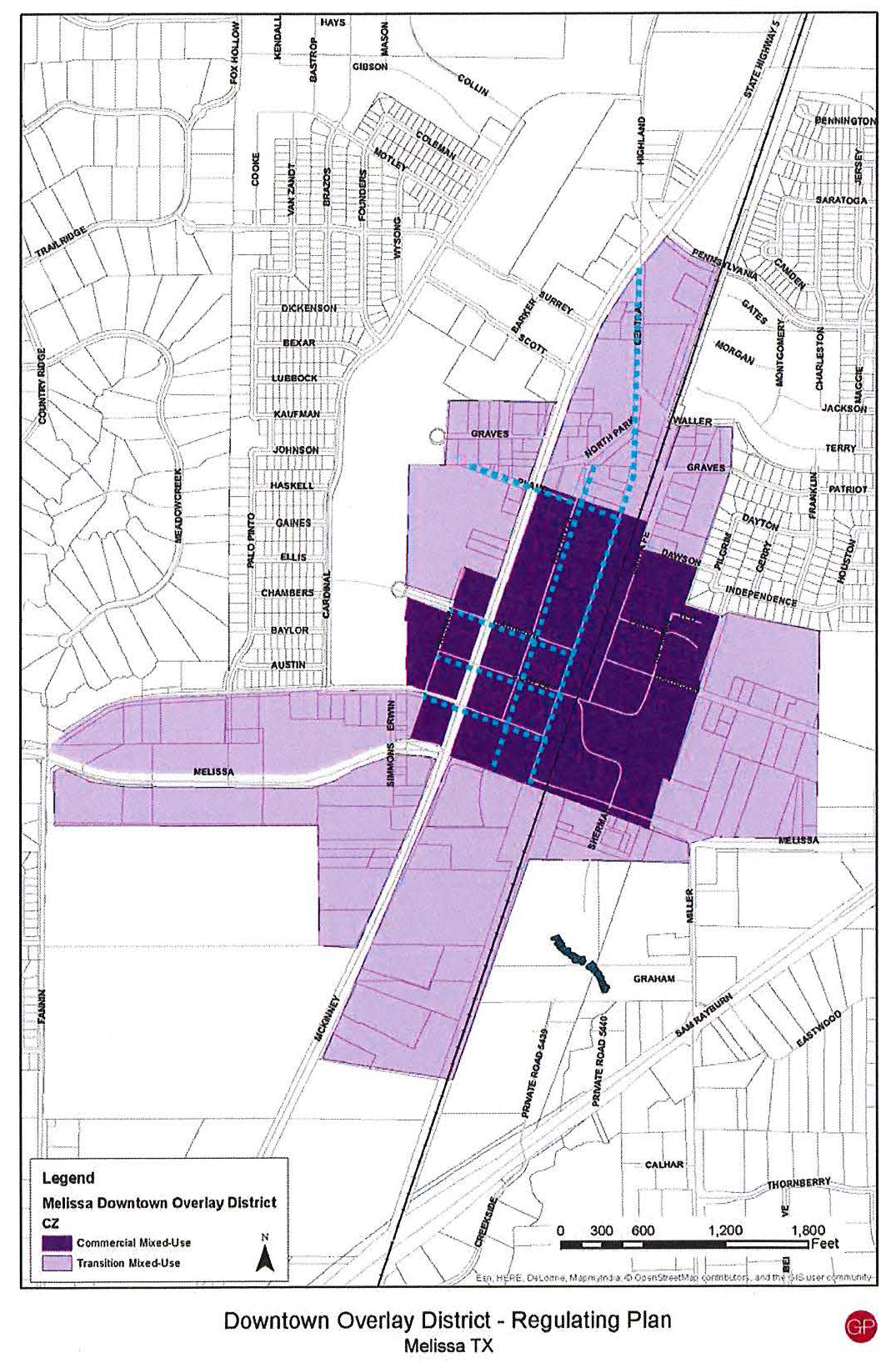
(D)
"CC/O" COMMERCIAL CORRIDOR OVERLAY DISTRICT
(1)
General Provisions:
(a)
Description: The Commercial Corridor Overlay District ("CC/O District") is a zoning district that regulates land uses and development standards within the U.S. Highway 75 ("US 75") and Collin County Outer Loop ("CCOL") corridors, as more specifically illustrated by "Exhibit A", attached hereto and incorporated herein for all purposes. Photos, drawings and other illustrations provided for in this Subsection 18(D) are for illustration, demonstrative and informational purposes only and are intended to provide examples of the types of standards envisioned by these regulations. Such photos, drawings and other illustrations are not all-encompassing. Should there be a conflict between a photo, drawing or other illustration and the provisions of this Subsection 18(D), the provisions of this Subsection 18(D) shall control.
(1)
Base Zoning. All development standards in this Zoning Ordinance, the Subdivision Ordinance, building codes and other applicable development-related codes and ordinances that apply to the base zoning district in which any property is located shall apply unless otherwise provided specifically herein. In the event of a conflict between the land use standards set forth in Subsection 20.1 (Schedule of Uses and Parking Requirements) applicable to this Overlay and land use standards applicable to the base zoning district, the more stringent land use standards shall apply. Any other- standards, regulations or requirements within this Overlay shall override those in the base zoning district in the event of a conflict not addressed above. Standards, regulations or requirements of the base zoning district not augmented or otherwise supplemented by this Overlay will continue to prevail. Notwithstanding any statement to the contrary in this subsection, standards, regulations or requirements of any planned development district within this Overlay shall prevail in the event they conflict with standards, regulations or requirements of this Overlay,
(b)
Purpose: The purpose of the CC/O District is to guide new development and redevelopment along the US 75 and the CCOL corridors by designating a wide array of permitted uses, incorporating development flexibility for varying market conditions and establishing enhanced standards for the design, appearance and placement of buildings and other site improvements, landscaping, signs, utilities, lighting, fences and screening.
(2)
Boundaries: The CC/O District applies to all properties with nonresidential zoning that are within the specified areas as depicted on "Exhibit "A", attached hereto. The properties within the CC/O District shall be given the "CC/O" prefix on the Zoning District Map and shall be subject to the provisions of this Subsection 18(D).
All land and structures within the CC/O District shall be used and developed in compliance with this Subsection 18(D).
(3)
Vision and General Design Principles: The City aspires to be a model for safe and beautiful neighborhoods, a vibrant economy and exceptional recreational, cultural and educational opportunities. The CC/O District creates a unique opportunity to achieve that vision by creating a transportation corridor that is not only a pleasant environment for travelers, but also serves as a source of retail, entertainment, dining and employment opportunities for residents and visitors. Such an environment is characterized by enhanced landscaping, public improvements, building and site design and sustainability.
Design standards are included in this Ordinance to provide property owners and developers with a clear set of design parameters that will guide site planning, architecture, landscaping, streetscapes, signage and other elements to create a consistent character of excellence throughout the CC/O District and other impacted corridors.
The CC/O District encourages the incorporation of unique and community oriented thematic elements into public spaces and public art, landscaping, signage, lighting, fences and walls and other site improvements.
Development should be designed to provide as attractive a streetscape as possible within the CC/O District. Parking lots and other paved areas should be de-emphasized in favor of landscaping and attractive building facades.
Paved areas should not be the predominant feature of a development. While parking is to be sufficient to meet the minimum demand of the use it serves, excess parking is strongly discouraged.
When parking areas are between right-of-way and a building within the CC/O District, such parking areas are to be heavily landscaped with a combination of grass, ground cover, berms, trees, shrubs, or other native and drought-tolerant vegetation.
Parking lots with one hundred (100) or more parking spaces should be divided into segments by ample landscaped walkways that provide safe pedestrian connections between parking areas and buildings. These landscaped walkways serve to create visual relief from paved expanses, minimize storm water run-off, and reduce the heat build-up of paved areas. Parking shall be further regulated by standards hereinafter established.
Site design should promote efficient vehicle circulation patterns with shared driveways, parking areas and access easements.
Development and redevelopment should be sustainable and incorporate such features as energy-efficient buildings, multi-modal transit connections, reduced amounts of paving and other impervious cover, storm water detention/retention, landscaping that includes low-water-demand native and adapted plants that are both drought and heat tolerant and permeable paving.
(4)
Required Standards for New Development:
(a)
Applicability: The standards established by this Subsection 18(D) shall apply to all newly constructed nonresidential structures and all new nonresidential development within the boundaries of the CC/O District.
(b)
Landscaping:
(1)
Landscaped Buffer Requirements.
(i)
A thirty (30) foot wide landscape buffer shall be required along any property line adjacent to the US 75 and CCOL.
(ii)
A twenty (20) foot wide landscape buffer shall be required along any property line adjacent to a Major Thoroughfares, as defined in the City's Subdivision Regulations, as amended, adjacent to or crossing through the CC/O District.
(iii)
A fifteen (15) foot wide landscape buffer shall be required along any property line adjacent to any other roadway (Collector or lesser capacity roadway), as defined in the City's Subdivision Regulations, as amended, adjacent to or crossing the CC Overlay District.
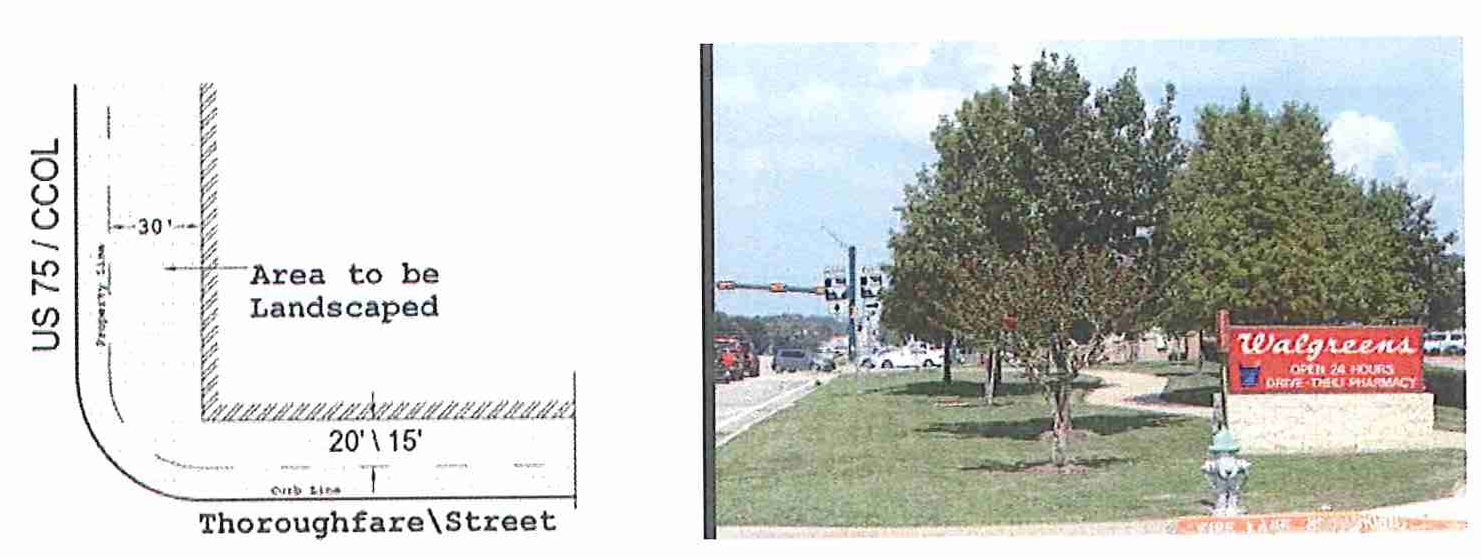
(2)
Landscaping Materials: The landscaping buffers shall include a combination of landscaping elements including, among other things, grass, ground cover, shrubs, flowers, seasonal planting and trees. All landscaping materials shall be from the list of approved trees and shrubs set forth in Section 27-A of the zoning ordinance, as amended, and be a native or adapted, heat and drought-tolerant species with a low water demand. Trees and shrubs shall be of the sizes required by Section 27-A of the zoning ordinance, as amended. Landscape designs with low water demand are encouraged. Landscape designs and hardscape elements including, without limitation, plazas, planters, benches, fountains, art, boulders, tables and similar features may be permitted as part of an overall landscaping plan, subject to approval by the City Manager, if the hardscape elements are consistent with the overall design of the development, do not conflict with visibility requirements or easements and do not create any potential safety hazard.
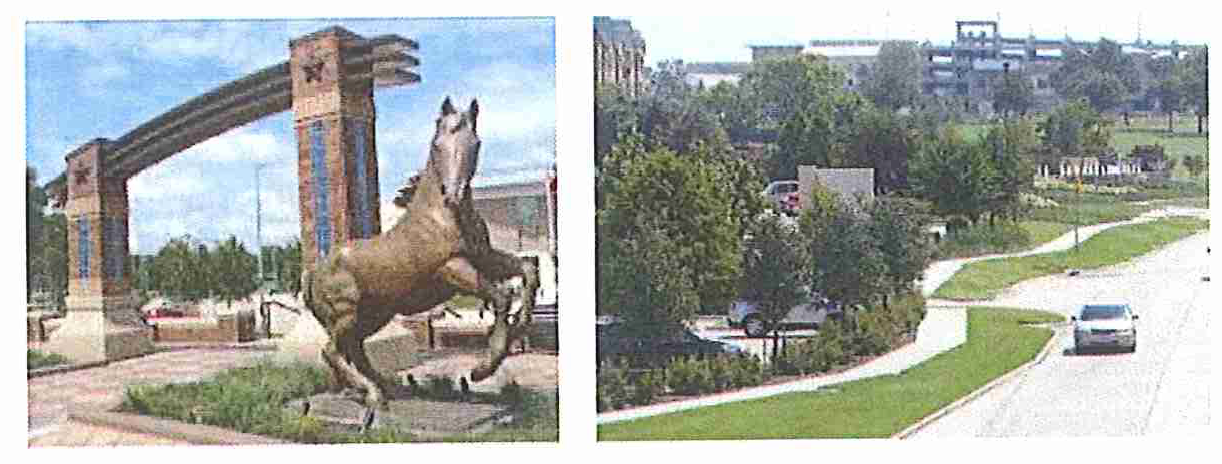
(3)
Trees Required in Landscaped Buffers: Within the landscape buffers established in the above Subsection 18(D)(4)(b)(1), one (1) tree shall be planted for each four hundred fifty (450) square feet of landscape buffer area. Trees may be staggered, clustered and otherwise arranged in landscaped areas in order to appear more natural and to enhance the visibility of the buildings rather than being spaced evenly across the frontage of the property as part of the overall landscape design.
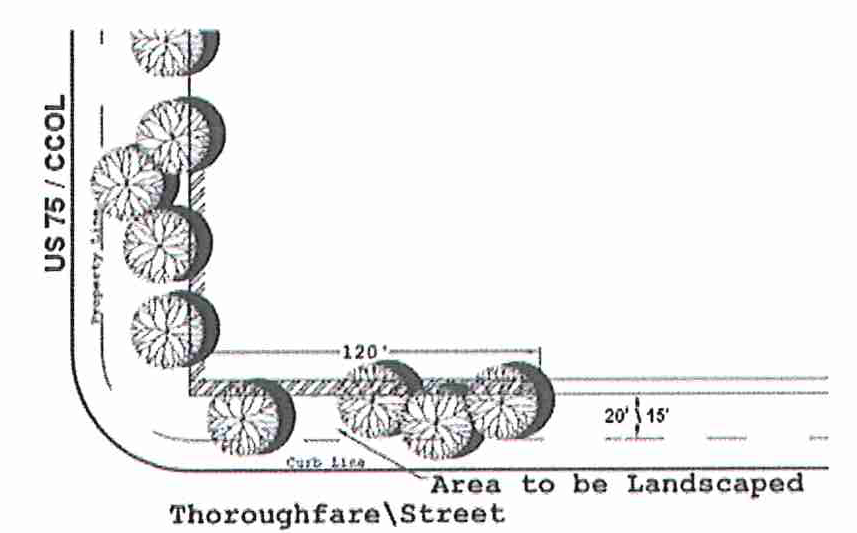
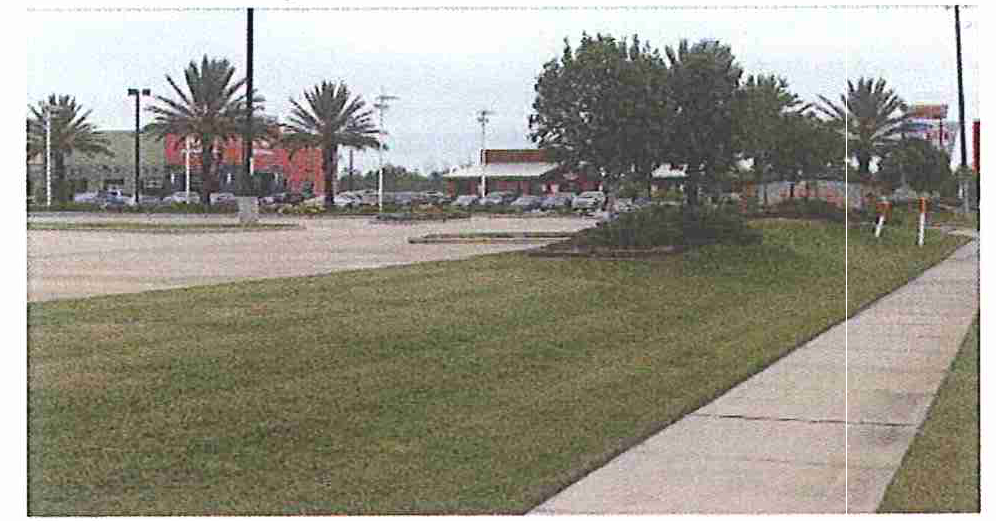
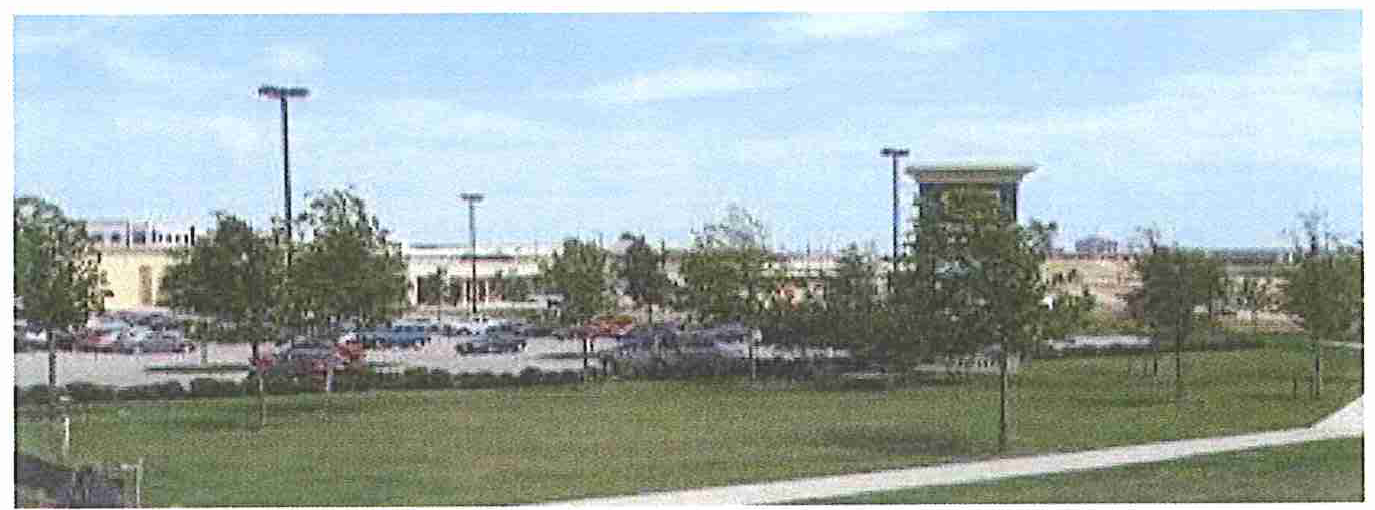
(4)
Screening of Parking: The thirty (30) foot, twenty (20) foot and fifteen (15) foot wide landscape buffers shall also include a row of shrubs, a berm or a masonry wall a minimum of thirty (30) inches tall (measured from top of curb) to screen parking and driveways within the development. The shrubs, berm or wall may be located anywhere within the landscape buffer, but shall not create a visibility obstruction at intersections or driveways. Shrubs shall be planted in a planting bed and be a minimum of eighteen (18) inches tall at the time of planting and planted no more than three (3) feet apart, unless otherwise approved by the City Manager based on a species for which a wider spacing is appropriate. The area within the planting bed separating the shrubs shall be planted with native grasses as described in Subsection 18(D)(15)(b) below. Berms shall be covered with grass or ground cover. Masonry walls shall be of the same brick or stone materials and colors as the main building on the property.
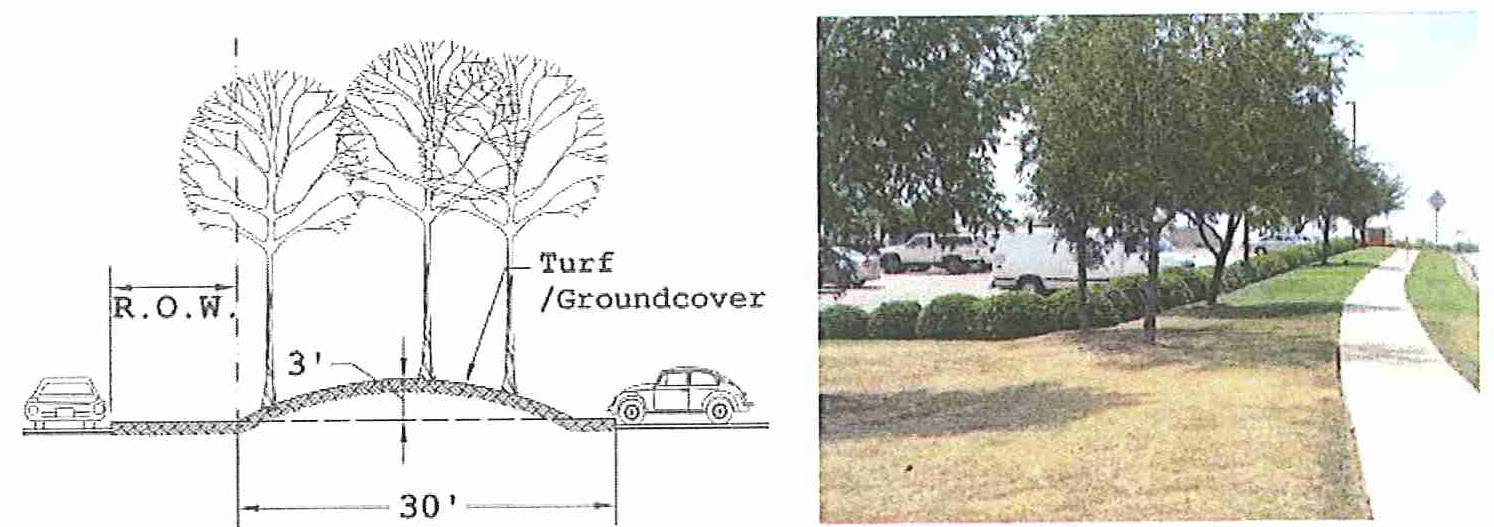
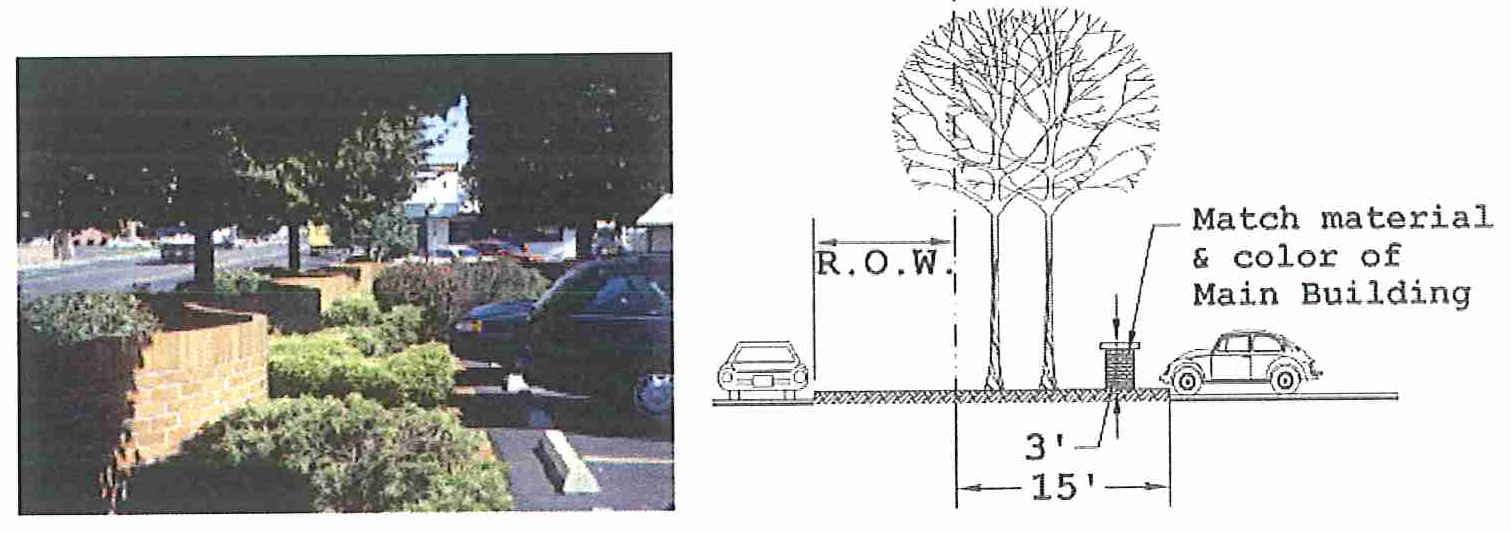
(5)
Driveways and Sidewalks within Landscape Buffers: The landscape buffers may be crossed by perpendicular or angled entry or exit driveways that comply with all applicable ordinances, rules and regulations of the City, as they exist, may be amended or in the future arising, but may not be utilized for on-site circulation or fire lanes. The landscape buffers may include a sidewalk not less than six (6) feet or more than eight (8) feet in width, unless the walk is approved as a bike path in which case the width shall be ten (10) feet. Any portion of a trail or sidewalk that is intended to be part of the "Melissa Trail System", as provided for in the Comprehensive Plan, as amended, shall be a minimum of ten (10) feet wide and a maximum of twelve (12) feet wide at locations identified by the Melissa Trail System or the City Manager as high traffic trail system locations. If a sidewalk is placed within the required landscape buffer, the sidewalk shall be incorporated into the landscaping plan by including such features as, among other things, enhanced pavers, bricks, scored concrete or stamped concrete, a meandering path, benches, shade structures or other elements that enhance the pedestrian experience, but without compromising safety or accessibility requirements.
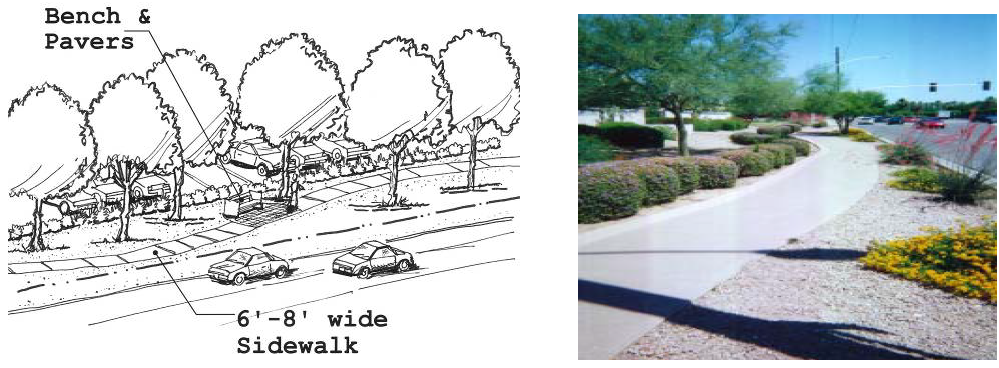
(6)
Parking Lot Trees: All front parking lots (front parking is the parking between the front building line and the adjacent roadway right-of-way) shall be landscaped with a minimum of one (1) tree for every twelve (12) parking spaces; all trees and plant materials shall conform to the allowable species and size standards hereinafter set forth. Additionally, tree/landscape islands shall be placed within parking areas so that there are no more than twelve (12) contiguous parking spaces not separated by a tree/landscape island; tree/landscape islands shall be the same width and depth as a standard parking space. Further, there shall be a minimum of one (1) tree at the end of each parking row. All perimeter and interior parking lots (those parking areas behind the front building line whether to the side of the building or to the rear of the building) shall be landscaped with a minimum of one (1) tree for every twenty (20) parking spaces, except any row of parking adjacent to a public roadway shall also conform to the above provision requiring a tree/landscape island so that there are no more than twelve (12) contiguous parking spaces not separated by a tree/landscape island and there shall be a tree at the end of each parking row. Trees may be evenly spaced throughout parking lots with less than one hundred (100) parking spaces. In parking lots with one hundred (100) or more parking spaces, trees should be clustered in landscape island areas, along major drives, or otherwise distributed within the parking area, rather than being evenly spaced. However, a minimum of fifty (50) percent of the total required trees shall be within the interior of the parking lot and not distributed around the perimeter of the parking lot. Each tree shall be planted in an area no smaller than the width and depth of a standard parking space (9′ × 18′, plus 2′ overhang, or 9′ × 20′ head-to-head parking).
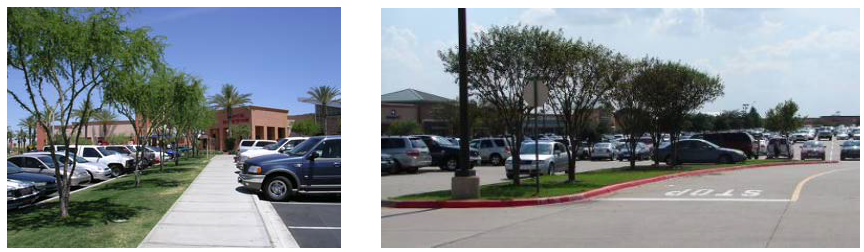
(7)
Parking Garage Landscaping: Parking garages, if provided, shall provide a ten (10) foot deep landscape buffer around the entire base of the parking garage. Trees shall be planted thirty (30) feet on-center within the landscape buffer. Parking garages attached to a building shall provide the landscape buffer only on those exterior sides not adjacent to the attached building.
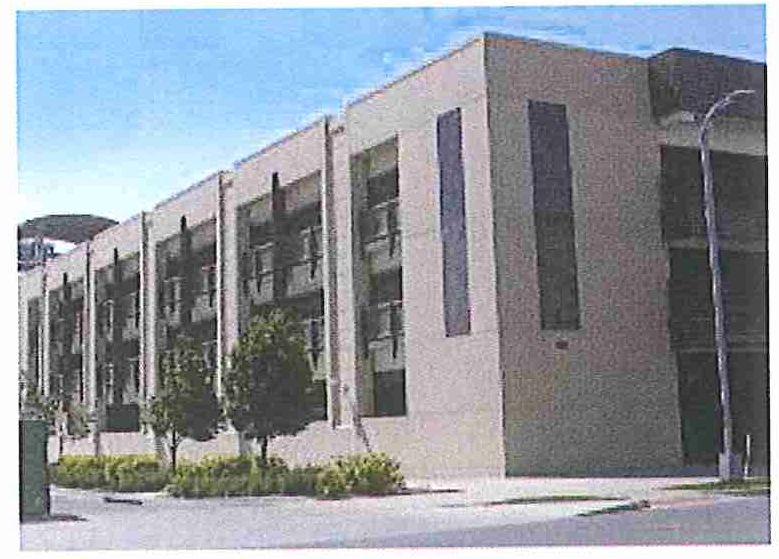
(8)
Maintenance of Adjacent Rights-of-Way: Areas of public rights-of-way between a property line and the back of curb of the frontage road or travel lane of an adjacent street shall be maintained by the adjacent property owner, including, without limitation, mowing and irrigation of grass, removal of trash and litter and maintenance of landscaping, unless prohibited by the Texas Department of Transportation or the City. If the right-of-way area exceeds fifty (50) feet in depth, the adjacent property owner shall be required to maintain only the fifty (50) feet of right-of-way immediately adjacent to the property owner's property line.
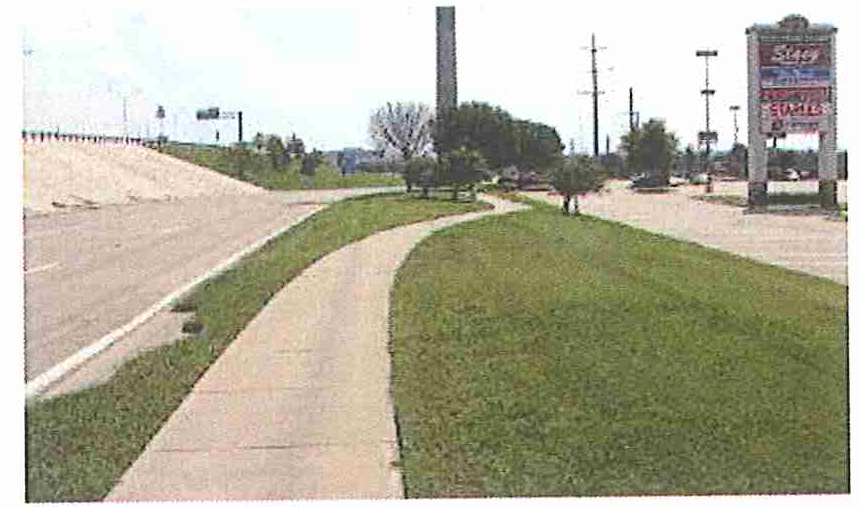
(9)
Irrigation System Required: All landscaping on the premises and within the adjacent right-of-way shall be irrigated by an automatic irrigation system installed in accordance with all applicable Texas Department of Transportation policies and the City's ordinances, rules and regulations, as they exist, may be amended or in the future arising. All main lines, zone control valves, controllers, backflow valves and wiring shall be installed outside of the public right-of-way. Separate bubblers for trees shall be required, unless sufficient justification for not requiring tree bubblers is approved by the City Manager. Any water lines, shut off valves, or sprinkler heads installed in the right-of-way shall comply with the standards of the Texas Department of Transportation.
(10)
Maintenance Required: All landscaping shall be maintained in a healthy condition at all times. Dead or damaged landscaping shall be replaced immediately. The City Manager may approve a delay in replacing dead or damaged landscaping not exceeding one hundred eighty (180) days due to seasonal or other considerations that would justify a postponement. Additional postponement may be granted by the City Manager in drought or other declared water emergency conditions.
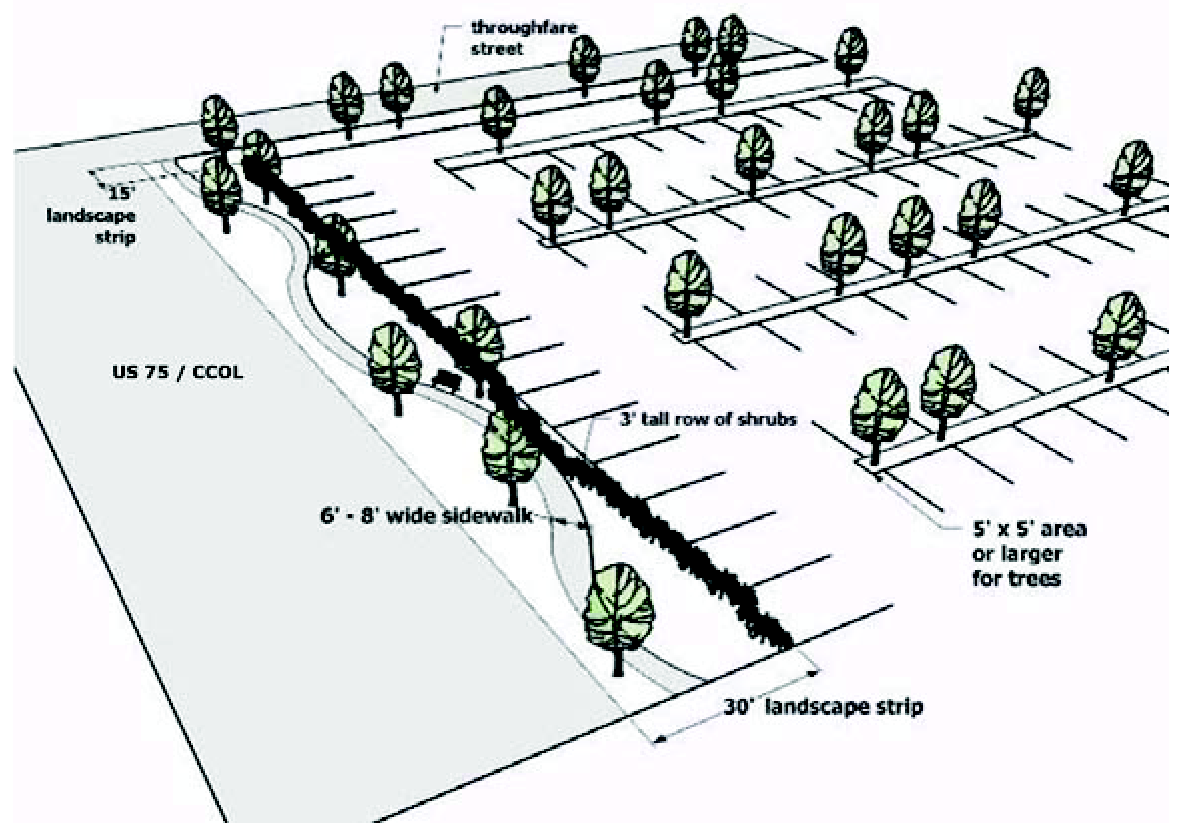
(c)
Building Materials and Design: All nonresidential buildings shall comply with the material and architectural details requirements of the commercial design standards established throughout this Ordinance, except that facades facing US 75 and the CCOL shall provide vertical articulation of eighteen (18) percent of the wall's height.
Articulation Standard Example
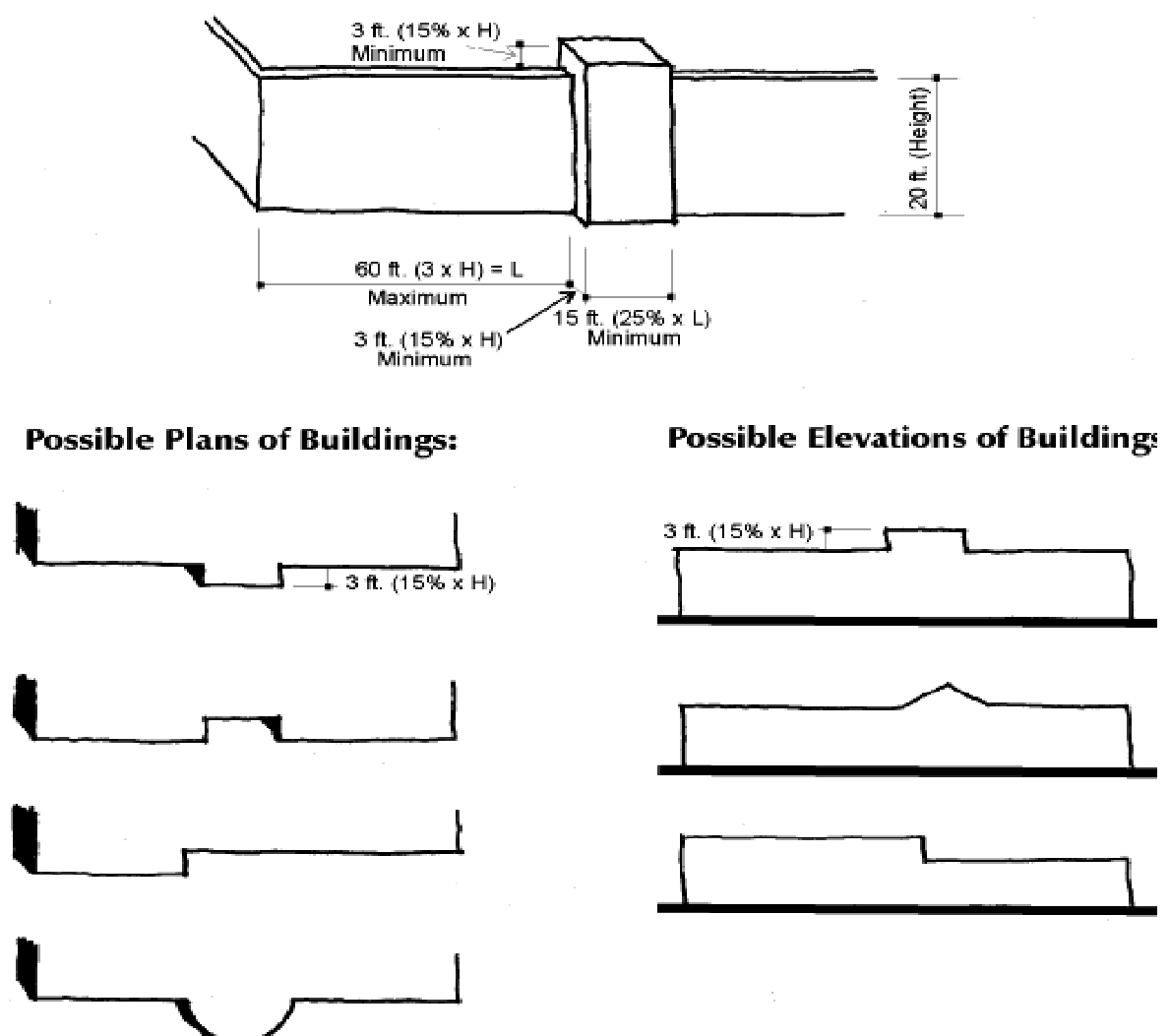
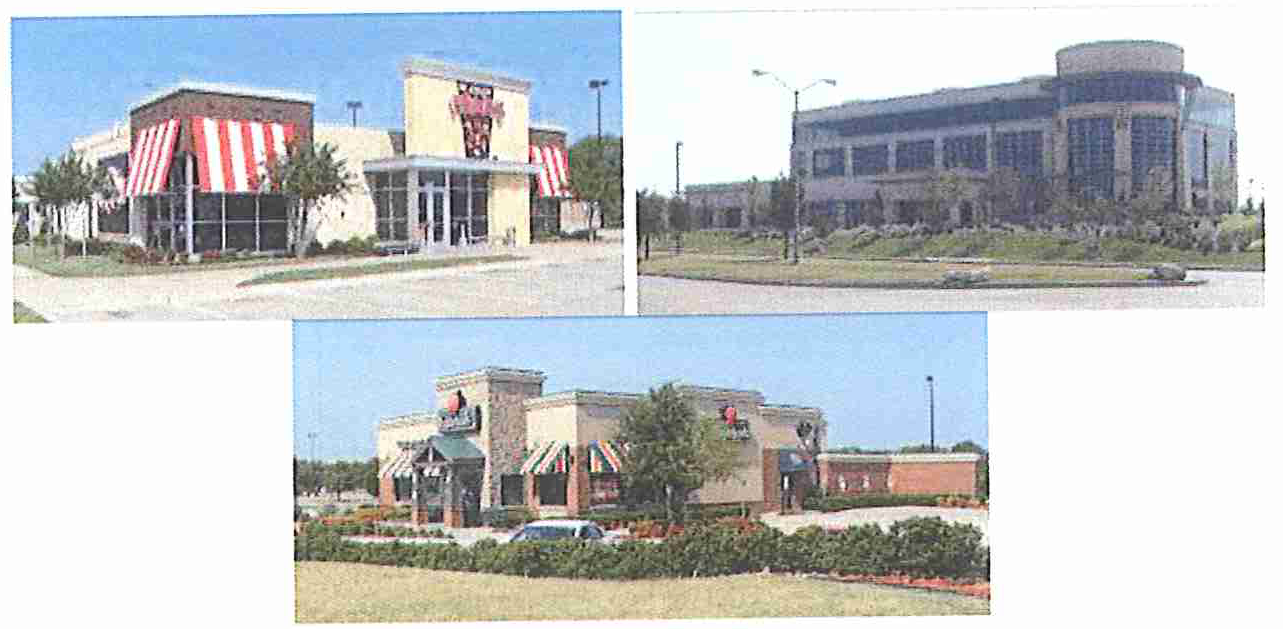
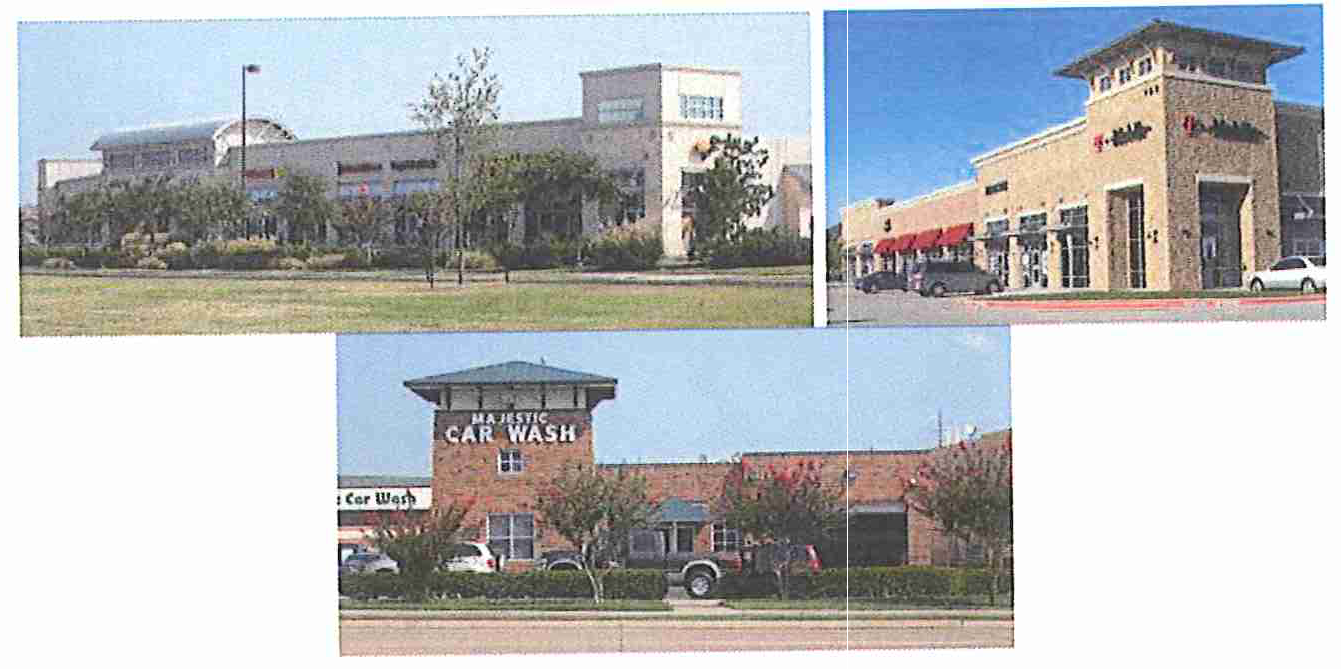
(d)
Site Design:
(1)
Minimize Paving: Development shall be designed to minimize the amount of paving and parking between buildings and US 75 and the CCOL. Other roadway frontages shall be governed by City ordinances, rules and regulations, as they exist, may be amended or in the future arising.
(2)
Parking Location: It is the intent of this provision that parking for large projects not be the dominating feature of such projects, but that the quality of the building architecture, site landscaping and other site amenities are the dominate visual features. Thus, no more than twenty-five (25) percent of the required parking for a use may be located between the facade of a building and US 75 or the CCOL right-of-way. The additional seventy-five (75) percent may be located beside or behind the facade facing US 75 or the CCOL right-of-way.
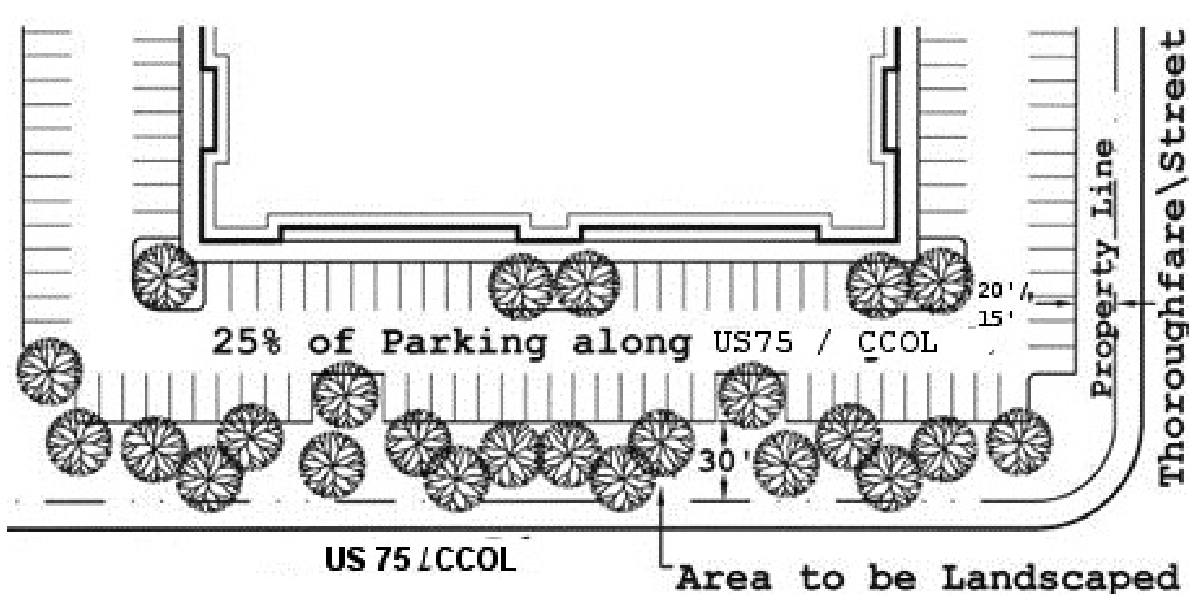
(3)
Internal Walkways: All parking lots that contain more than one hundred (100) parking spaces shall include internal pedestrian walkways a minimum of five (5) feet wide from the public sidewalk to the main entrance of the principal use of the property and shall comply with all applicable requirements of the Texas Accessibility Standards, as amended, for width, slope, texture, level differences and ramps. Pedestrian walkways shall be provided for every three (3) driving aisles or at a distance of not more than one hundred eighty (180) foot intervals, whichever is less. The City-required trail systems may be incorporated into the internal walkway, bicycle path and/or pedestrian path of a private development as a project amenity and enhanced access facility that encourages non-vehicle accessibility.
Pedestrian walkways shall also be provided to connect points of origin, such as, among other things, outlying parking spaces and bus stops with destinations such as building entrances. All such walkways shall be constructed of conventional sidewalk materials, stamped concrete or scored concrete, shall be clearly marked and comply with all applicable requirements of the Texas Accessibility Standards, as amended, for width, slope, texture, level differences and ramps.
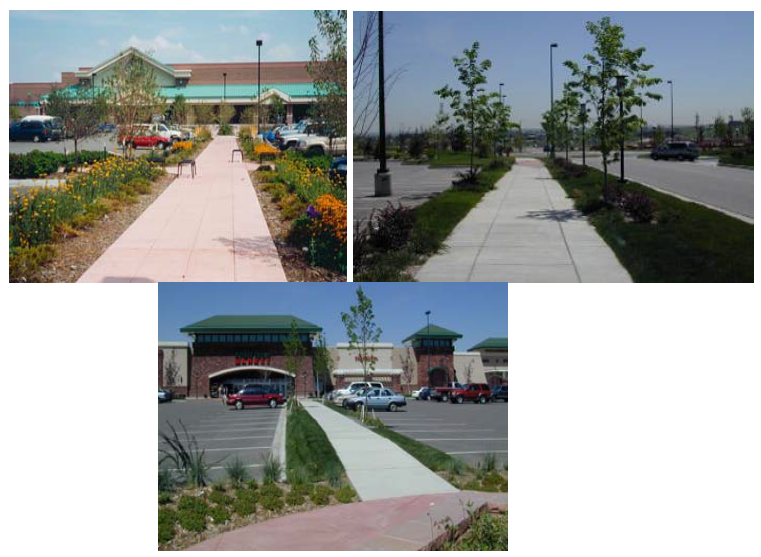
(4)
Walkways Crossing Driveways: Where internal pedestrian walkways cross driveways, such walkways shall be distinguished from driving surfaces through the use of design features such as contrasting colors, enhanced pavers, stamped concrete stained concrete, bricks, scored concrete and alternate colors. Such crossings shall comply with all applicable requirements of the Texas Accessibility Standards, as amended.
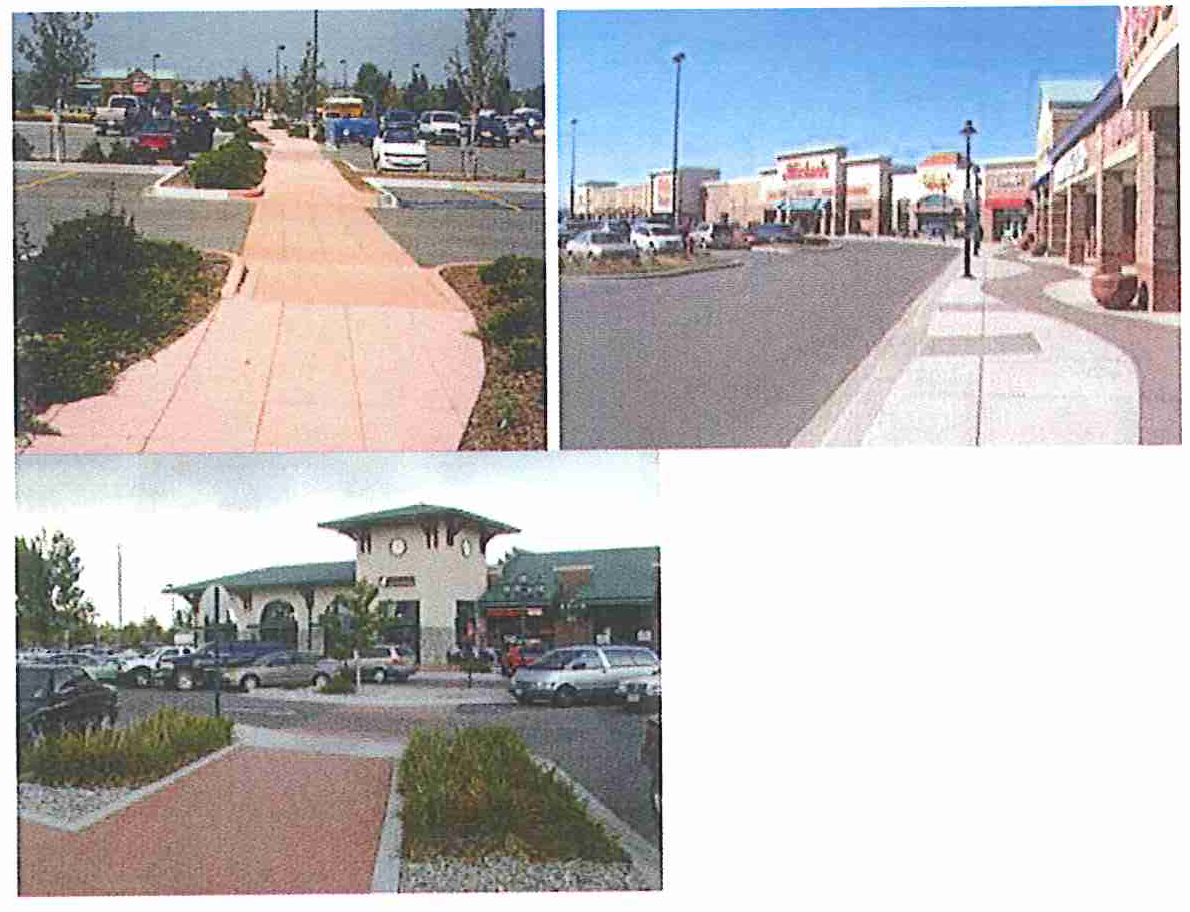
(5)
Accessory Buildings and Uses: Accessory buildings and uses are not permitted within the parking lot area, or between a principal use building and the right-of-way of US 75 or the CCOL.
(6)
Outside Storage: Outside storage of any kind, other than outside display of automobiles or similar vehicles for sale or lease (pursuant to Subsection 18(D)(12)(a) below), temporary storage of shopping carts in cart corrals (pursuant to Subsection 18(D)(4)(d)(7) below), is not allowed between any principal use building and the right-of-way of US 75, the CCOL or any other street right-of-way.
(7)
Shopping Carts: Cart corrals shall be provided by all establishments using shopping carts. Cart corrals shall be uncovered and shall not occupy required parking spaces, but shall be placed in designated locations within the parking lot or adjacent to the building, and surrounded by landscaping with trees. When an establishment is closed, shopping carts are to be stored either within the building or screened with a wall that is integral to the architectural design of the building.
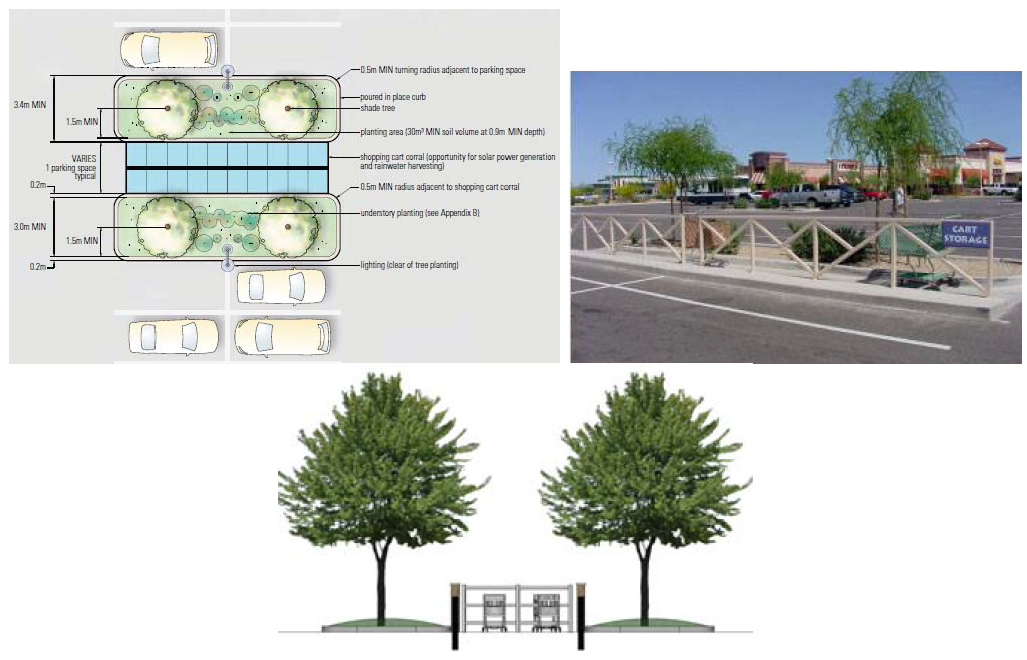
(e)
Building Services:
(1)
The location of aboveground utility facilities should be identified early in the design process. Utility facilities shall be located where they do not conflict with featured views, outdoor dining areas and/or site circulation. Facilities should be accessible for maintenance and service requirements. All new construction to be built in the CC/O District shall have underground utilities from the building to the property line. All new utilities extended from off-site to serve the development must also be underground, or within an easement along the rear of the property, to reduce the amount of overhead utilities along US 75, the CCOL or any other street right-of-way in the CC/O District.
(2)
Loading areas and docks, truck parking, overhead doors, outdoor storage, utility meters, HVAC equipment, trash collection and other building service functions and areas shall be incorporated into the overall design of the building and the landscaping so that the visual and acoustic impacts of these functions are contained and out of view from adjacent properties and public streets. These functions and areas shall not be on any facade facing US 75, the CCOL or any other street right-of-way in the CC/O District.
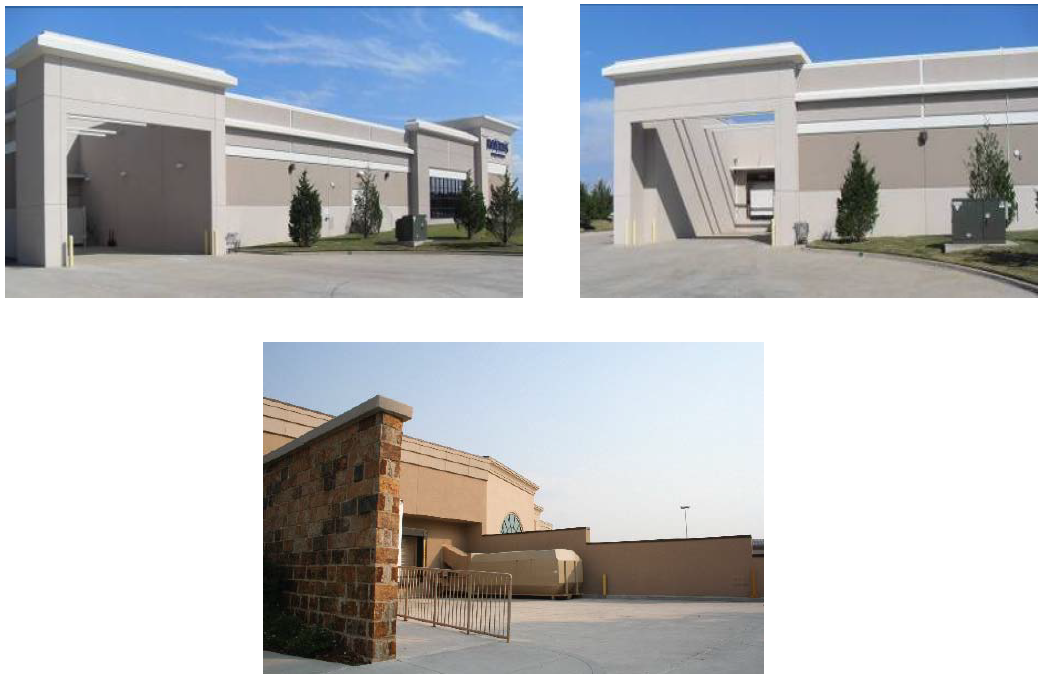
(3)
Solid waste collection areas and ground mounted mechanical equipment shall be screened from view from US 75, the CCOL or any other street right-of-way in the CC/O District.
(4)
Screening materials for solid waste collection and loading areas shall be the same as, or of equal quality to, the materials used for the principal building. Dumpster pads and approach areas shall be constructed and located in accordance with City ordinances, rules and regulations, as they exist, may be amended or in the future arising standards.
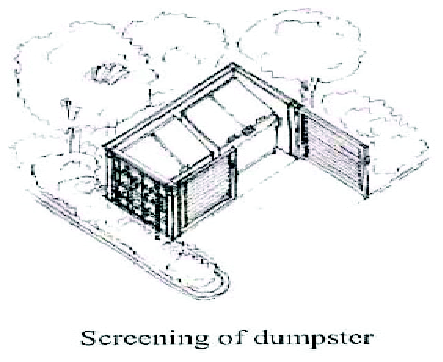
(5)
Roof mounted mechanical equipment, including, without limitation, solar panels, shall be screened from view in accordance with City ordinances, rules and regulations, as they exist, may be amended or in the future arising.
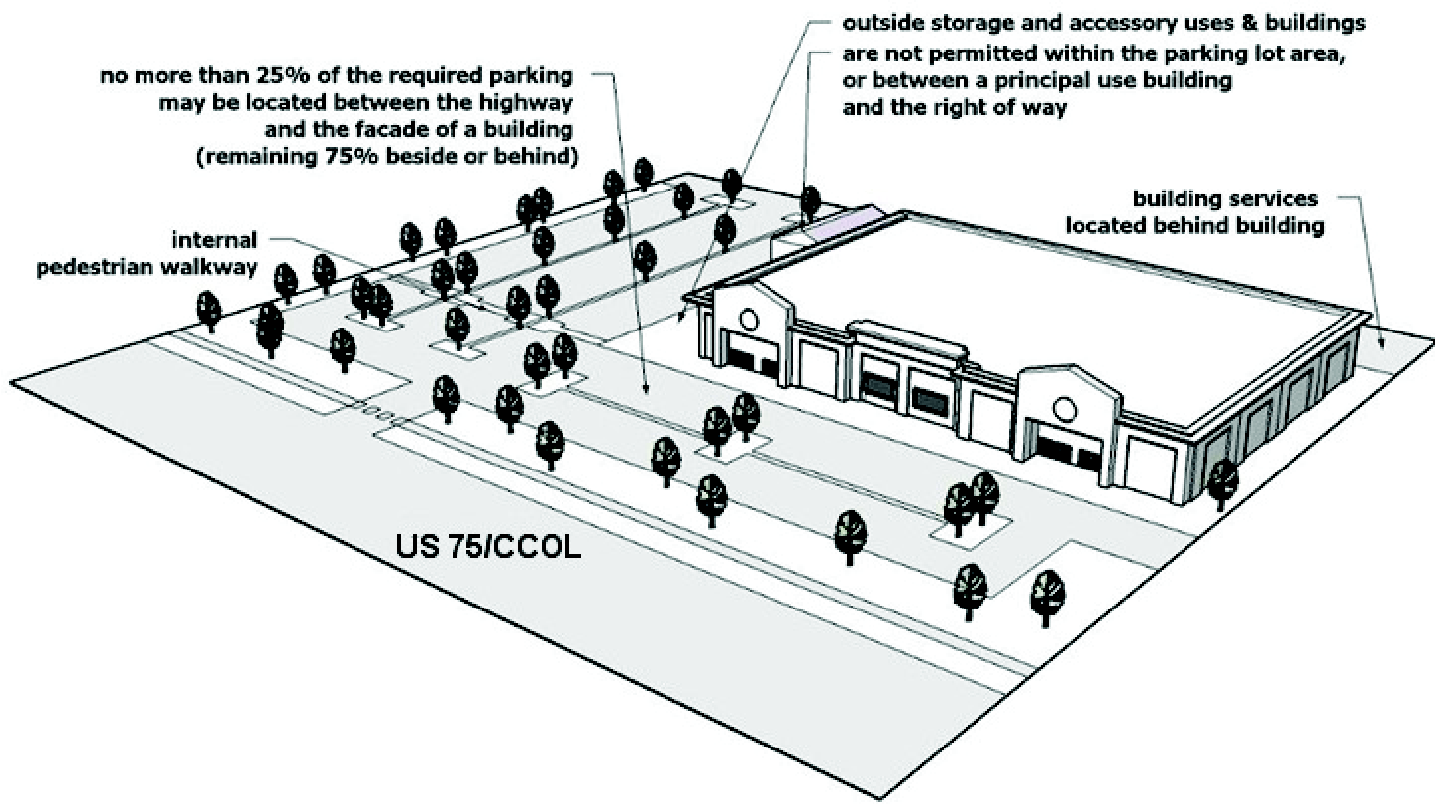
(6)
Solar panels and other solar energy collection/generation equipment may be installed in any zoning district subject to the following criteria:
(i)
Only rooftop installation is permitted;
(ii)
Solar panels and other solar energy collection/generation equipment shall not face a public street;
(iii)
Solar panels and other solar energy collection/generation equipment shall not be free standing;
(iv)
All solar wiring shall be performed by a duly licensed electrician in the State of Texas;
(v)
Solar panels and related equipment shall be designed to take wind and weight loading into consideration; structural support for solar equipment and solar attaching mechanisms shall be designed by a duly licensed engineer in the State of Texas;
(vi)
Solar panels shall be located so as to not cause any nuisance reflection or glare to other properties; and
(vii)
Solar panels, if not in use, shall be disengaged so as to prevent accidental electrical charges to property or persons.
(7)
Wind generation may be considered only in commercial, industrial or office park settings with a minimum of twenty (20) acres of land and shall be subject to the following criteria:
(i)
Wind generation equipment shall only be permitted when installed according to an approved site plan and must take into consideration the avoidance of any nuisance or negative impact to adjacent properties;
(ii)
Wind generation equipment shall only be approved if designed to meet appropriate structural requirements and wind loading requirements with both being certified by a duly licensed structural engineer in the State of Texas; and
(iii)
Wind generation shall be certified to meet noise standards such that no noise carries across the property lines of the property on which the equipment is located.
(5)
Cemeteries: Cemeteries in the CC/O District shall be screened/buffered by an approved fence such as a four (4) foot high ornamental type metal fence with masonry columns thirty (30) feet on-center along a roadway and fifty (50) feet on-center along non-roadway boundaries and a ten (10) foot wide landscape buffer of grass, shrubbery and trees designed to blend with and complement the adjacent project landscape. The combination of fence and landscape materials shall be approved on an individual basis by the City Manager. The purpose of this provision is to insure that cemeteries are marked and afforded reasonable protection from routine access thus preserving the solemn and historic nature of the space; it is not the intent to hide or make access exceptionally difficult. It is believed that appropriately protected cemeteries can contribute to the open space and positive visual aesthetics of the community.
(6)
Parking Requirements:
(a)
Required Parking: Parking for the uses allowed by CC/O District shall be provided in accordance with Section 20 of the zoning ordinance, as amended, with the following exceptions:
(i)
Retail uses: 1/250 g.f.a.;
(ii)
Office and financial institution uses: 1/300 g.f.a.;
(iii)
Restaurants: 1/100 g.f.a.;
(iv)
Parking spaces shall be 9′ × 18′, plus 2′ for overhang (2′ additional space may be added to landscape areas or additional paved space as approved at the time of site plan approval) or 9′ × 20′ if head-to-head. Compact parking spaces (8.5′ × 16′, plus 2′ for overhang) or 8.5′ × 18′ if head-to-head are allowed up to ten (10) percent of the required site parking and shall be blended into the parking area design;
(v)
Surplus parking spaces may be provided, but may not exceed the minimum number required by this Subsection 18(D)(6) by more than twenty (20) percent. For purposes of calculating parking requirements, the following types of parking spaces shall not count against the maximum parking requirements, but shall count toward the minimum requirements:
(A)
Accessible parking;
(B)
Bus, vanpool, and carpool parking;
(C)
Structured parking, underground parking, or parking within, above or beneath the building(s) it serves;
(D)
Dedicated motorcycle or motor scooter parking spaces;
(E)
Bicycle parking shall be incorporated into each project with a bicycle parking area provided for each fifty thousand (50,000) square feet of building area, or portion thereof; and
(F)
For purposes of calculating parking requirements, fleet vehicle parking spaces shall not count toward either the minimum or maximum parking requirements;
(vi)
Exceptions to the maximum parking requirements may be allowed in situations that meet all of the following criteria, as determined by the City Manager:
(A)
The proposed development has unique or unusual characteristics, such as high sales volume per floor area, low parking turnover or overlapping shift work, which creates a parking demand that exceeds the maximum ratio and which typically do not apply to comparable uses;
(B)
The parking demand cannot be accommodated by shared parking with nearby uses or by increasing the supply of spaces that are exempt from the maximum ratio;
(C)
The request is the minimum necessary variation from the standards; and
(D)
If located in a mixed use district, the uses in the proposed development and the site design are highly supportive of the mixed use concept and support high levels of existing or planned pedestrian activity;
(vii)
Retail, restaurant, office and entertainment uses shall provide designated bicycle parking areas within fifty (50) feet of the building entrance with a minimum of one (1) bicycle parking space for each fifty (50) vehicle parking spaces up to a maximum of ten (10) spaces; and
(viii)
Retail, restaurant, office, and entertainment uses are encouraged to provide dedicated parking spaces for motorcycle and motor scooter parking at a ratio of one (1) space per one hundred (100) automobile parking spaces.
(b)
Paving Standards: Parking lots, automobile display lots, internal driveways, vehicle circulation areas and any property used for parking or storage of vehicles, trucks, trailers or motorized equipment of any kind shall be paved with a minimum of five (5) inches of three thousand (3,000) pounds per square inch concrete with #3 rebar on eighteen (18) inch centers both ways. Parking lots, driveways and internal circulation areas shall be maintained free of potholes, with a smooth surface, free of rubble and cracks and sealed. Permeable paving meeting the City's ordinances, rules and regulations, as they exist, may be amended or in the future arising, may be installed in low traffic volume areas or areas that are not used for fire lanes or loading and unloading.
(c)
Striping Required: All required parking shall be clearly striped.
(7)
Screening/Fencing Regulations: Unless specified elsewhere herein, all screening fences required by this CC/O District or any other provision of the zoning ordinance, as amended, shall be a minimum of seven (7) feet in height and constructed of masonry materials in accordance with the City's ordinances, rules and regulations, as they exist, may be amended or in the future arising. The City Manager may approve alternate materials that match or are consistent with either the building on the same property or the noise walls constructed in conjunction with adjacent right-of-way.
(8)
Sign Regulations: All signs shall comply with the City's ordinances, rules and regulations, as they exist, may be amended or in the future arising.
(9)
Lighting Regulations: Exterior lighting is not required, except for purposes of public safety. However, if installed, all exterior lighting shall meet the following standards:
(a)
Concealment and Shielding: Light sources shall be concealed or shielded with luminaries containing shielding, skirts or cut-offs with a cutoff angle not exceeding ninety (90) degrees to minimize the potential for glare and unnecessary diffusion on adjacent property. For purposes of this requirement, the angle shall be measured using a line drawn from the direction of light rays at the light source or reflector, and a line perpendicular to the ground from the light source above from which no light is emitted.

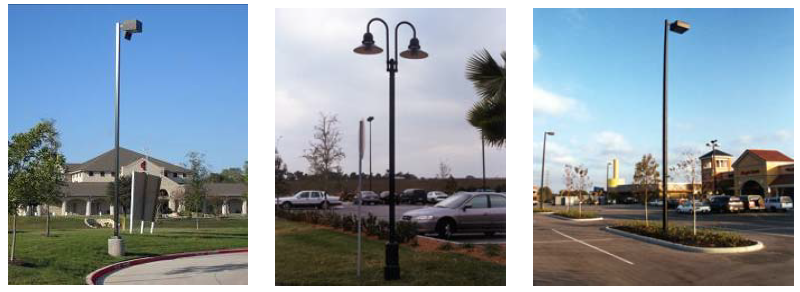
(b)
Lighting to be Minimized: Parking lots and other background spaces shall be illuminated as unobtrusively as possible while meeting the functional needs of safe circulation and protection of people and property. Foreground spaces, such as, among other things, building entrances and outside seating areas, shall utilize local lighting that defines the space without glare. Floodlights shall not be utilized to light any portion of a building facade after normal business hours. For purposes of this Subsection 18(D)(9), if the seating area of a restaurant is closed, but a drive-through remains open, the business shall be considered to be closed, and any floodlights shall be turned off.
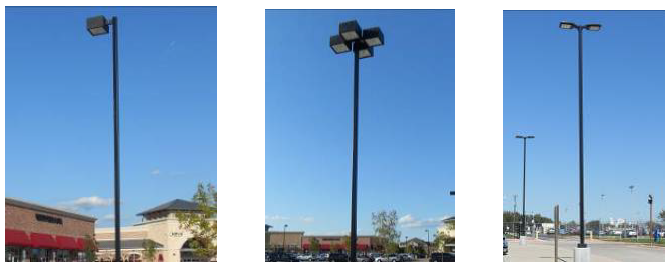
(c)
Style: The style of light standards and fixtures shall be consistent with the overall theme and design of the project. Architectural styles consistent with on-site buildings may be approved by the City Manager. "Cobra head" fixtures, galvanized metal poles and arm lengths greater than four (4) feet are prohibited.
(d)
Glare Prohibited: Lighting shall not cast glare onto adjacent lots or streets in any way that decreases the safety of pedestrians and vehicles.
(e)
Maximum Spillover: In no case shall exterior lighting add more than one (1) foot candle-to-illumination levels at any point off-site.
(f)
Highlighting: Lights may be used to highlight trees and similar features within public and private plazas, courtyards, walkways and other similar outdoor areas at night to create excitement and a festive ambiance.
(g)
Uplighting: Light fixtures used to illuminate flags, statues or any other objects mounted on a pole, pedestal or platform shall use a narrow cone beam of light that will not extend beyond the illuminated object.
(h)
Architectural Lighting: Architectural lighting may be used to articulate the particular building design or to create effects of shadow, relief and outline that add visual interest and highlight aspects of the building. Lighting of cornices, up lighting and other effects may be used. For upward-directed architectural, landscape or decorative lighting, direct light emissions shall not be visible above the roof line.
(i)
LED Lighting: Use of LED lighting is required to achieve direct lighting to the desired or needed location, to minimize spillover for focused uplighting, to achieve optimum architectural impact and for energy efficiency.
(j)
Building-Mounted Fixtures: Building-mounted light fixtures shall be attached to walls, and the top fixture shall not be lower than ten (10) feet or higher than eighteen (18) feet above finished grade, except entry/exit lighting positioned above the entry/exit.
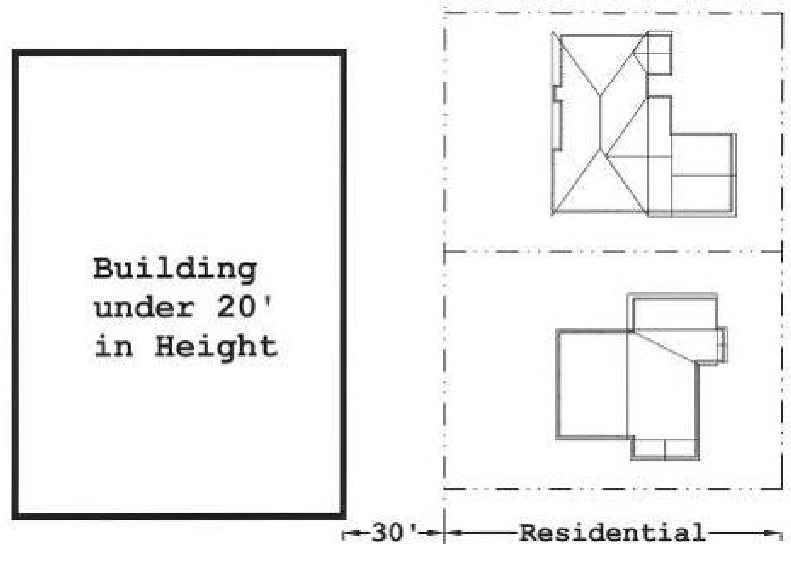
(k)
After-Hours Reduction: All outdoor light not necessary for security purposes shall be reduced, activated by motion sensor detectors, or turned off after normal business hours.
(l)
Flickering and Flashing Lights: No flickering or flashing lights shall be permitted, except for temporary decorative seasonal lighting.
(m)
Color: White light meeting a minimum color standard of 2800 kelvin shall be used at all times. The use of low-sodium vapor or high-pressure sodium vapor lighting is prohibited.
(n)
Security Lighting: Any exterior lighting device (luminaire) designed for security lighting shall be protected by weather and vandal-resistant covering, be a managed light source and directed down to minimize glare and intrusiveness.
(o)
Uniformity of Illumination: Parking lot, driveways and pedestrian circulation route lighting shall provide a uniform level of light throughout the entire parking area. Fixtures shall be arranged in order to provide uniform illumination throughout the parking lot of a 3:1 uniformity ratio of average illumination to minimum illumination.
(p)
Height of Fixtures: Freestanding light fixtures shall not exceed twenty (20) feet in height within fifty (50) feet of any residential zoning district, twenty-five (25) feet in height within fifty (50) to one hundred fifty (150) feet of any residential zoning district and thirty-five (35) feet in all other locations. For the purposes of this requirement, height shall be measured from the top of a light fixture to the adjacent grade at the base of the support for that light fixture.
(q)
Height of Bases: Concrete light fixture bases shall be no taller than eighteen (18) inches.
(r)
Canopy Lighting: Light fixtures mounted under canopies shall be recessed so that the lens cover is recessed or flush with the bottom surface of the canopy and/or shielded to eliminate glare on the adjacent property or right-of-way.
(s)
Access Standards: All development subject to this Subsection 18(D)(9) shall comply with the City's ordinances, rules and regulations, as they exist, may be amended or in the future arising.
(10)
Residential Adjacency/Protection: All new development and redevelopment under this Subsection 18(D) that abuts or is adjacent to any residential use (other than residential use within a mixed use or transit-oriented development, or a residential use accessory to a nonresidential use) shall provide for the protection of the adjacent residential uses by complying with the following regulations:
(a)
Setbacks:
(i)
Setback from Adjacent Residential for Buildings up to Twenty (20) Feet High: Thirty (30) feet if there is no fire lane and thirty-five (35) feet if a twenty-four (24) foot fire lane exists to allow a minimum ten (10) foot landscape space.
(ii)
Setback from Adjacent Residential for Buildings over Twenty (20) Feet High: Thirty (30) feet plus three (3) feet for each additional one (1) foot in height with a maximum of sixty (60) feet. Height is measured to top of parapet wall if a flat roof is used; if a pitched roof is used, height is measured to the mid-point of the pitched roof.
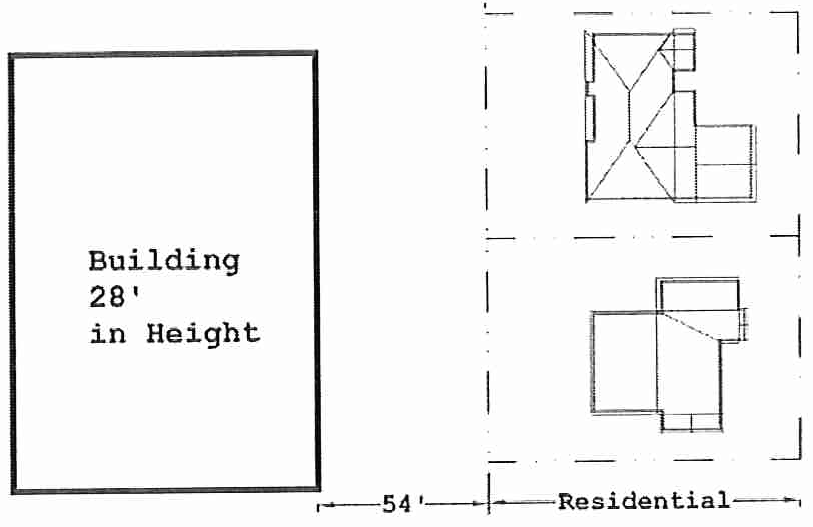
(iii)
Parking Setback from Adjacent Residential: Minimum rear or side setback for parking spaces shall be fifteen (15) feet.
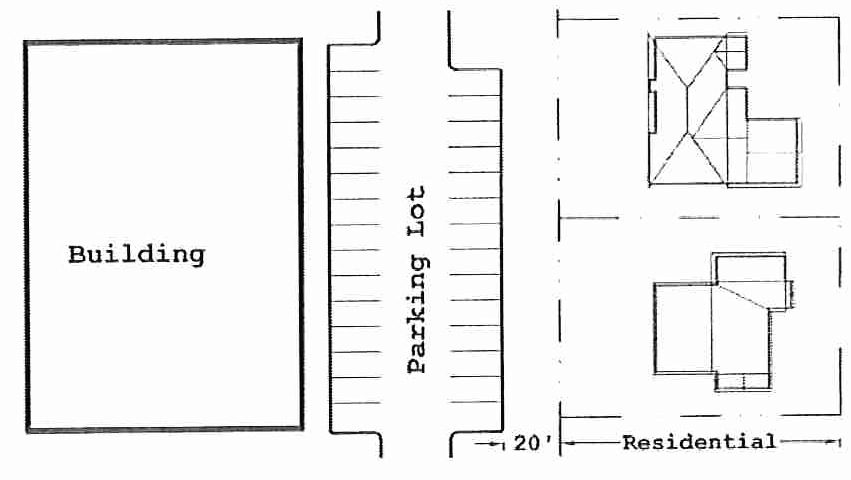
(iv)
Landscape Buffer: A landscaped buffer with a minimum width of fifteen (15) feet shall be provided adjacent to all property lines that abut residentially zoned property. The landscape buffer shall be planted with trees from the approved tree list set forth in Subsection 18(D)(15)(b) below, as amended, at a spacing of a maximum of thirty (30) feet.
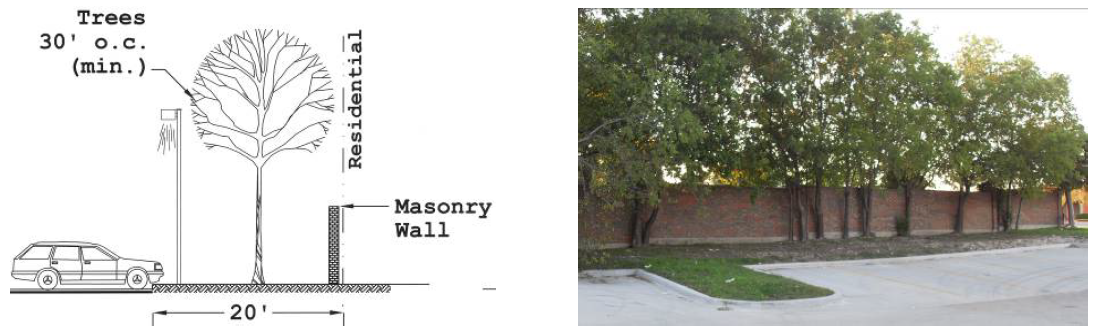
(v)
Screening Fence: A minimum seven (7) foot tall screening fence constructed of masonry materials (brick, stone, or architectural concrete panels), or as approved by the City Manager, shall be provided along the property line(s) or within twenty (20) feet of the property line(s) abutting residentially zoned property, unless the residential property is required to provide a screening fence per the approved zoning of the residential property.
(vi)
Lighting: Lighting shall not encroach into the residential property. Light fixtures shall be designed to include a light cut-off feature that blocks glare and prevents light encroachment into the residential property.
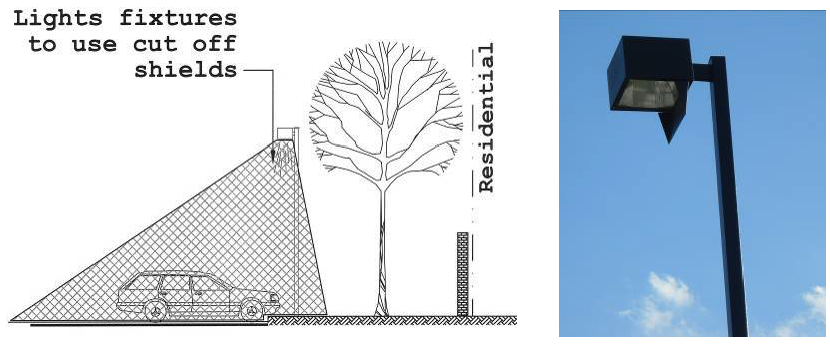
(vii)
Outside Speakers: Outside speakers shall not be located closer than one hundred (100) feet to a residential property line and shall not be utilized between the hours of 10:00 p.m. and 7:00 a.m. on weekdays and 10:00 p.m. and 10:00 a.m. on weekends and holidays. Outside speakers related to restaurant and retail drive-through facilities shall not be located closer than fifty (50) feet to a residential property line and may not be utilized between the hours of 10:00 p.m. and 7:00 a.m. on weekdays and 10:00 p.m. and 10:00 a.m. on weekends and holidays if less than one hundred (100) feet away from a residential property line.
(viii)
Loading Areas: Loading areas within one hundred (100) feet of a residential property line may not be used between the hours of 10:00 p.m. and 7:00 a.m.
(ix)
Trash Containers: Trash containers within one hundred (100) feet of a residential property line may not be serviced between the hours of 10:00 p.m. and 7:00 a.m.
(11)
Vacant Properties:
(a)
Maintenance Required: All vacant properties shall be mowed, kept clear of brush and otherwise maintained by the owner in addition to any adjacent right-of-way area between the property line and the back of curb.
(b)
Exception: Properties that are adjacent to right-of-way with a minimum depth of fifty (50) feet between the back of curb and the property line shall not be required to maintain the portion of right-of-way that is beyond fifty (50) feet of the property line.
(c)
Overgrown Properties: Vacant properties shall not be allowed to become overgrown (vegetative cover exceeding ten (10) inches in height), unless the vegetation is cultivated for agricultural purposes, in which case the vegetation shall be cut and trimmed to the maximum allowed height of ten (10) inches within fifty (50) feet of adjacent developed properties and within twenty-five (25) feet of adjacent road rights-of-way. Nothing within this Subsection 18(D)(11) shall be construed to require the removal of any existing trees unless the trees pose a safety hazard due to their location or condition.
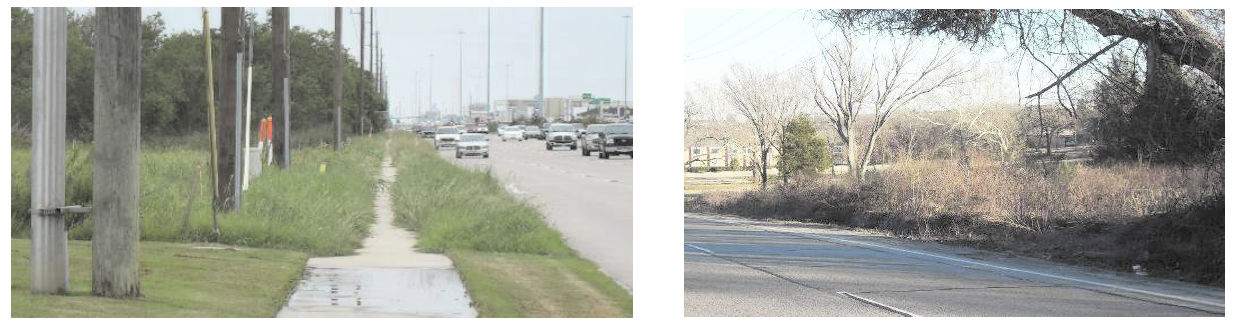
(d)
Trash and Litter Prohibited: Vacant properties and any adjacent right-of-way shall remain free of refuse, garbage, trash, litter, and debris.
(e)
Definition: For purposes of this Subsection 18(D)(11), "vacant properties" shall be defined as any tract or lot that is not part of any public right-of-way and that does not have a habitable building or structure constructed on it.
(12)
Use-Specific Standards:
(a)
Automobile Sales Lots:
(i)
Subject to approval of an SUP, a franchised new automobile dealership may sell new automobiles and previously owned automobiles as part of the franchised new automobile dealership. Standards for such franchised new automobile dealerships shall include:
(A)
A minimum of five (5) acres of land;
(B)
A sales and service building of a minimum of fifteen thousand (15,000) square feet for the base franchised new automobile sales and service facility; four (4) service bays that provide repairs and make-ready services for automobiles being sold; and
(C)
A display area providing for a minimum of one hundred (100) new automobiles is also hereby approved for such use. New and previously-owned sales facilities may be divided into two (2) separate facilities with the minimum aggregate area of facilities totaling seventeen thousand five hundred (17,500) square feet.
(ii)
Automobile wash facilities, if to be provided, must be operated with a minimum of fifty (50) percent water reuse.
(iii)
Automobile sales lots shall have a minimum area of five (5) acres.
(iv)
In addition to the landscaping required by Subsection 18(D)(15)(a) above, automobile sales display frontage on US 75, the CCOL or Major Thoroughfares, as defined in the City's Subdivision Regulations, as amended, shall comply with the parking and landscape provisions set forth herein for the CC/O District.
(v)
All vehicles displayed outdoors must be displayed on the ground and not artificially elevated by ramps, cranes, lifts, hills, slopes or any other artificial means. Parking vehicles for display in the right-of-way, landscape buffer area or required parking setback is prohibited.
(vi)
Canopies, awnings or other structures built to cover vehicles displayed for sale shall comply with the required setbacks from property lines and be consistent with the design and colors of the principal buildings on the property. Such structures shall be designed to include architectural details and enhancements and not resemble flat-roof carports. Such structures need not comply with the building material requirements of Subsection (23.7) and (23.8) of the zoning ordinance, as amended.
(vii)
Newly constructed automobile display lots, internal driveways, vehicle circulation areas and any property used for parking or storage of vehicles, trucks, trailers or motorized equipment of any kind shall be striped and paved with a minimum of five (5) inches of three thousand (3,000) p.s.i. concrete with #3 rebar on eighteen (18) inch centers both ways. Parking lots, driveways and internal circulation areas shall be maintained free of potholes, with a smooth surface, free of rubble and cracks, and sealed. Permeable paving meeting the City's ordinances, rules and regulations, as they exist, may be amended or in the future arising, may be allowed for installation, subject to approval of the City Engineer, in low traffic volume areas or areas that are not used for fire lanes or loading and unloading.
(viii)
Service activities shall be clearly incidental to the vehicle sales operation.
(ix)
Vehicle service activities shall occur within a completely enclosed building.
(x)
Vehicles which have visible body damage shall be stored completely within an enclosed building, or within an area completely enclosed by a masonry fence a minimum of seven (7) feet tall. Any outside storage of such vehicles inside a masonry fence shall not be located less than one hundred (100) feet from US 75, the CCOL and Major Thoroughfares and Collectors, as defined in the City's Subdivision Regulations, as amended.
(xi)
Vehicle loading and unloading activities may take place only within the property (no maneuvering in the right-of-way) and may not occur between the hours of 10:00 p.m. and 7:00 a.m. if the property abuts residential zoning.
(xii)
Banners, streamers, pennants, inflatable signs, characters and materials and other non-permanent signs are prohibited.
(xiii)
Flagpoles shall not exceed forty (40) feet in height.
(b)
Big Box Retail:
(i)
Stand-alone retail buildings with a floor area of fifty thousand (50,000) square feet or more shall be designed such that the front facade has a minimum of three (3) distinct sections to appear as if to accommodate at least three (3) separate occupants.
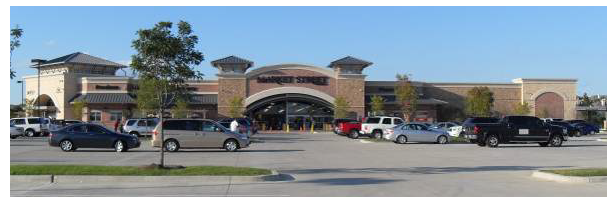
(ii)
The building shall have clearly defined, highly visible customer entrances with a minimum of three (3) of the following features: canopies, porticos, overhangs, recesses/projections, raised corniced parapets over the doors, peaked roof forms, outdoor patios, display windows, arcades, arches, wing walls or integral planters.
(iii)
Covered waiting areas shall be provided adjacent to all public entrances extending a minimum of ten (10) feet on both sides of the doors. Benches or other seating facilities shall be provided in the waiting areas.
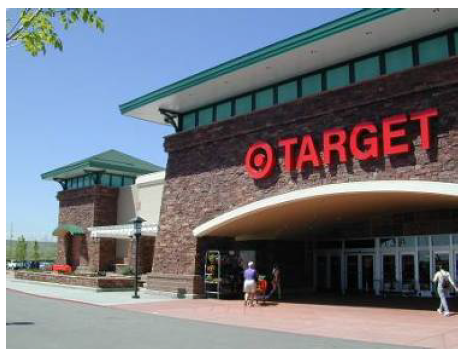
(iv)
All sides of the building shall comply with the articulation standards of Subsection 18(D)(4)(c) above.
(v)
Seven and one-half (7.5) foot deep landscape buffer shall be provided along the base of the wall of the building, except for entrances and loading areas. The landscaped buffer shall include grass or ground cover and a combination of trees, shrubs, seasonal plants, and/or other landscaping elements.
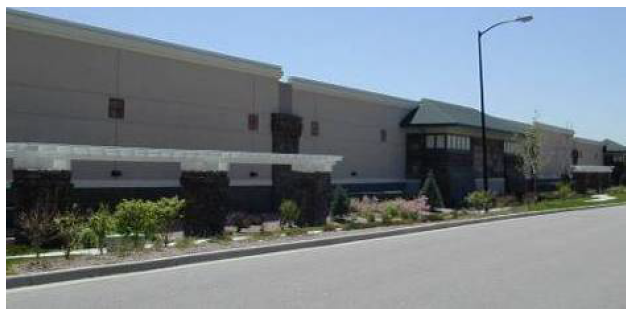
(vi)
A variation in roof lines shall be provided to provide visual interest and reduce the massive scale of large buildings. Roof features shall incorporate a minimum of two (2) of the following features: parapets screening flat roofs and rooftop equipment, overhanging eaves, sloped roofs or three (3) or more roof planes or repeating patterns of changes in color, texture and material modules.
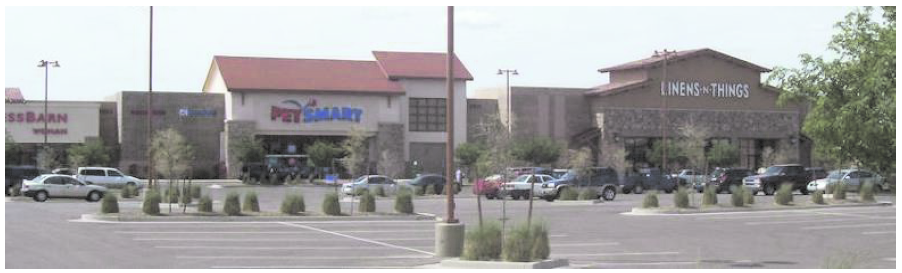
(vii)
Facade colors shall be low reflectance, subtle, neutral or earth tone colors. The use of high intensity, metallic or fluorescent colors is prohibited.
(viii)
Building trim and accent areas may feature brighter colors, including primary colors; however, neon, argon or similar type tubing is not allowed.
(c)
Mixed Use Development:
(i)
The mixed use category is established to encourage and facilitate the development of large-scale, distinctive regional centers containing a concentrated mix of land uses in the same structure or in close proximity. Such centers should include, but not be limited to, major economic generators with a regional market draw, such as, among others, regional retail centers, major employers, restaurants, theaters, hotels and relatively dense office development. Any such center should contain a broad mix of complementary uses including, but not limited to, high-density residential, civic and public facilities, parks and open space. Development should facilitate and encourage pedestrian travel between residential and nonresidential uses. Transit facilities and pedestrian-friendly elements are important components of mixed use centers.
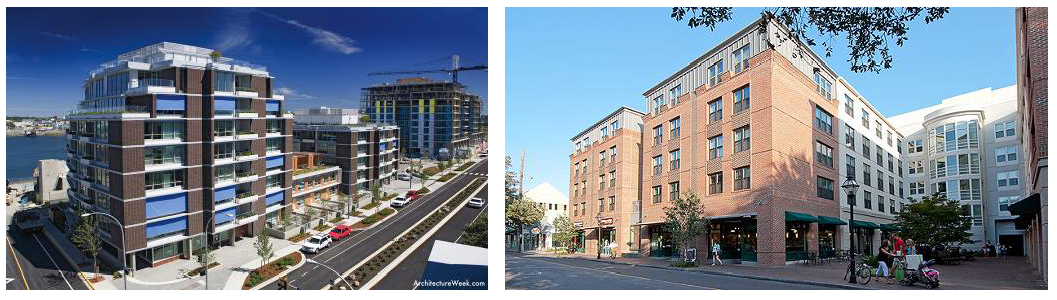
(ii)
Mixed use development should have a minimum area of twelve (12) acres. Residential development should provide a minimum density of eighteen (18) dwelling units per acre.
(iii)
New mixed use development shall establish a regular pattern of blocks that encourages pedestrian circulation without unduly limiting vehicular traffic. Connectivity to adjacent neighborhoods is to be provided with access to surrounding residential neighborhoods limited to the lower density and residential component of the mixed use development. The site should be designed to minimize the amount of commercial traffic coming to and going from the development through residential neighborhoods, while encouraging pedestrian access from adjacent neighborhoods.
(iv)
Streetscape design shall include public sidewalks within rights-of-way or within pedestrian access easements a minimum of sixteen (16) feet wide and a maximum of eighteen (18) feet wide on all sides of all streets (excluding any frontage along US 75 or the CCOL). The sidewalk area shall incorporate both a street tree/furniture area a minimum of six (6) feet in width adjacent to the curb of the street and a clear area between the street tree/furniture area and the face of the buildings. Street trees shall be planted along all internal streets in the mixed use development (excluding any frontage along US 75 or the CCOL) or within the street tree/furniture area(s), at an average spacing of twenty (20) to thirty (30) feet on-center. The street tree/furniture area may also be used for the placement of seating, street lights, planters, waste receptacles, bicycle racks, utility structures and similar elements. Outdoor seating for restaurants is allowed within the clear zone area as long as a minimum six (6) foot wide unobstructed walkway is maintained. For purposes of this Subsection (18)(D)(12)(c), "clear zone" shall be defined as the minimum required space for pedestrian and site amenities adjacent to right-of-way or private street easement space.
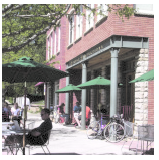
(v)
Within a mixed use development, a building's facade facing an internal public or private street may be positioned at the edge of the clear zone, subject to approval on the overall mixed use development and site plan.
(vi)
Crosswalks across public streets and connecting driveways shall be constructed of stamped concrete with integral color pavers. Crosswalks across private streets and connecting driveways on private property shall be installed over a concrete sub-base or constructed of stamped concrete with integral color and shall comply with the minimum design standards set forth in the City's ordinances, rules and regulations, as they exist, may be amended or in the future arising. The City shall be responsible for maintenance of public streets and crosswalks constructed in accordance with the City's ordinances, rules and regulations, as they exist, may be amended or in the future arising. No pavers shall be allowed in public streets. Adjacent property owners shall be responsible for maintenance of pavers in private streets and driveways.
(vii)
Sidewalks along the streets shall include accent areas of pavers or stamped concrete comprising a minimum of thirty (30) percent of the paved walkway surface. All sidewalk paving shall be installed over a sub-grade approved by the City and shall be maintained by the adjacent property owner.
(viii)
Ground-floor facades that face public streets or other public areas (such as, among other things, outdoor gathering spaces, parks or open space and parking areas) shall incorporate pedestrian-oriented design features into no less than sixty (60) percent of their horizontal length. Pedestrian-oriented design features may include arcades, display windows, entryways, awnings, shaded sidewalks or other similar features approved by the City Manager.
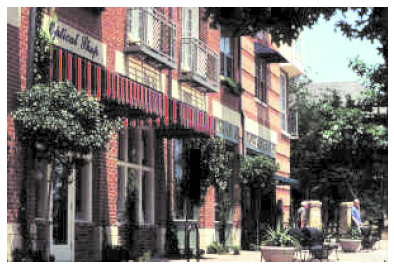
(ix)
Commercial uses, such as, among others, retail, restaurant, personal services and small offices, shall be located at the street level of a mixed use development, which will support residential and larger office uses located on the upper floors within the same building or in other buildings nearby.
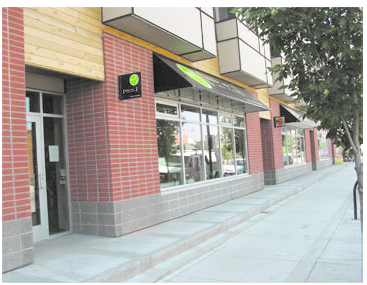
(x)
Parking structures shall be wrapped by retail, office or residential uses along at least sixty (60) percent of the ground-floor frontage on all public and private streets, and residential uses shall be encouraged above the first floor of retail, office or residential uses.
(xi)
Residential uses incorporated within a mixed use district shall be visually and/or physically integrated with nonresidential uses by being vertically located above street-level commercial uses or horizontally located between the highest density uses within the center and the adjacent neighborhood, and by including pedestrian connections which incorporate a clear pedestrian circulation system that minimizes conflict between pedestrian and vehicular movements and encourages pedestrian activity between residential and nonresidential uses.
(xii)
Parking areas shall be limited to the structure or below-grade, with the exception of on-street parking and minimal surface parking areas to support retail uses and stand-alone restaurants. On-street parking shall not be designated per individual businesses or occupancies, but may count toward the minimum parking requirements for the entire structure along the adjacent frontage. Parallel parking, head-in parking along streets and/or minimal surface parking is permitted subject to approval through the site plan approval process.
(xiii)
All mixed use developments shall dedicate a minimum of two (2) percent of the net site area to one (1) of the following types of outdoor gathering spaces or pedestrian amenities that shall be located so as to be readily accessible and usable by residents and visitors to the development:
(A)
Landscaped, private open space for use of residents, employees and visitors to the development; or
(B)
Playground, patio or plaza with outdoor seating area, containing a minimum area of four hundred (400) square feet.
Where significant natural or scenic resources exist on a site, the developer shall give priority to their preservation as an outdoor gathering area. Private yards, public or private streets or rights-of-way and parking areas and driveways shall not be counted toward this requirement.
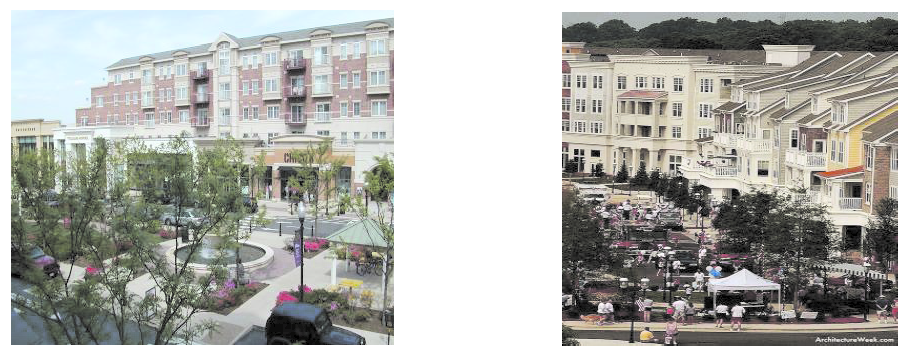
(13)
Area Regulations: The following minimums and maximums shall be required for any development within the CC/O District, except for transit-oriented development or mixed use development:
(a)
Minimum Front Yard Setback: Thirty (30) feet from any street right-of-way.
(b)
Minimum Rear and Side Yard Setback:
(i)
Ten (10) feet abutting non-residential use or zoning.
(ii)
Thirty (30) feet for buildings up to twenty (20) feet high abutting residential use or zoning.
(iii)
Thirty (30) feet, plus three (3) feet for each additional one (1) foot in height above twenty (20) feet, for buildings over twenty (20) feet high abutting residential use or zoning.
(c)
Minimum Parking Setback:
(i)
Thirty (30) feet from US 75 or the CCOL.
(ii)
Fifteen (15) feet from any other street right-of-way.
(iii)
Twenty (20) feet from residential use or zoning.
(d)
Minimum Separation between Buildings: Zero (0) feet.
(e)
Lot Width: Eighty (80) feet.
(f)
Lot Depth: One Hundred (100) feet.
(g)
Maximum Height: One Hundred Fifty (150) feet.
(h)
Maximum Impervious Lot Coverage: Eighty (80) percent.
(14)
Design Guidelines for Public Right-of- Way and Public Property:
(a)
Design Guidelines Objectives for Freeways and other Public Property: The freeway rights-of-way belong to the public and should provide a visually pleasing experience. Public rights-of-way and other publicly owned properties should provide the same level of high quality design, materials, sustainability and maintenance as that required of private property. While it is not the intent of this Ordinance to set definitive criteria for design or landscaping requirements of public property, it is the intent of the City Council of the City to promote the concept of attractive and pleasing public properties and rights-of-way. Further, it is the intent of the City Council to implement the objective of attractive and well landscaped public properties as development matures through specific City projects on City properties and to encourage other public entities to install and maintain well landscaped and attractive public properties and rights-of-way as such entities construct and modify their projects as the community develops.
(b)
Design Guidelines: Public rights-of-way should be landscaped and maintained in an attractive, sustainable manner by the adjacent developer and/or property owner at the time of facility construction on the adjacent development site. Such landscaping shall be installed up to the edge of the adjacent service road or other roadway curb and shall be designed to blend with adjacent site landscaping. Installation of right-of-way landscaping up to the edge of the service road shall occur at the time of adjacent property landscaping. Lighting should be installed and maintained according to the theme and nature of its location. Traffic control cabinets, utility cabinets, switchgear and similar installations should be screened with landscaping, berms and/or walls where possible. Utilities for all projects should be installed underground, except for electric transmission lines, and if overhead lines must be used, they should be placed along rear property lines and other less obtrusive locations. Retaining and noise walls, bridge abutments and roadway slopes should be enhanced with landscaping, graphics and other elements. Landscaping contained within the interior of the freeway right-of-way (from the edge of the service road to the edge of the opposite service road including the landscaped area between service roads and main freeway lanes) shall be the responsibility (installation and maintenance) of the Texas Department of Transportation, or other contractually designated entity.
(15)
Standards and Guidelines: In accordance with the City Council's objectives, the following minimum standards should be incorporated into the design and construction of improvements within the CC/O District.
(a)
Landscaping Standards:
(i)
Selection of Materials: The installation and continuous maintenance of landscaping is extremely important. Landscape materials in areas that are completely surrounded by public right-of-way and not able to be maintained by an owner of an adjacent tract or lot should be chosen for their heat and drought tolerance and overall hardiness. The planning and implementation of all improvements should include, among other things, long-term maintenance costs with respect to plantings, structures, surface treatments and other material along the right-of-way.
(ii)
Visual Appeal: Landscaping and treatment of unpaved portions of right-of-way contribute both aesthetically and functionally to the overall character of the CC/O District; therefore, it is the intent of this Ordinance to establish a higher level of visual appeal than that which has been traditionally observed in the past.
(iii)
Grasses: Native grasses shall be required in all unpaved portions of right-of-way that do not abut private property for ease of maintenance. Allowable species are listed in Subsection 18(D)(15)(b) below.
(iv)
Trees: If the area between the curb of US 75 or the CCOL frontage road and the property line is more than ten (10) feet deep, then native or adapted, heat and drought tolerant trees selected from the list in Subsection 18(D)(15)(b) below shall be planted within the right-of-way a minimum of ten (10) feet from the back of curb. Trees shall be planted at a ratio of one (1) tree per each sixty (60) feet of frontage and should be staggered, clustered or otherwise arranged in landscaped areas rather than spaced evenly across the frontage of the property.
(v)
Other Plant Material: Shrubs, ornamental plants and ornamental grasses may be approved for right-of-way areas, subject to approval of the Texas Department of Transportation, if applicable, and the City. Acceptable species shall include those listed in the City's ordinances, rules and regulations, as they exist, may be amended or in the future arising, or as hereinafter described below.
(b)
Recommended Species and Sizes: Trees, shrubs and grasses within unpaved areas that are completely surrounded by right-of-way shall be selected from the following species:
(i)
Large Trees: Large trees shall be a minimum of four (4) caliper inches at time of planting. Permitted large trees shall be selected from the following species:
• Ash, Texas
• Cypress, Bald
• Elm, Cedar
• Maple, Shantung
• Oak, Chinquapin
• Oak, Live "High Rise"
• Oak, Texas Red
• Pine, Mondell
(ii)
Ornamental Trees: Ornamental trees shall be a minimum of eight (8) feet tall at time of planting. Permitted ornamental trees shall be selected from the following species:
• Holly, Foster
• Yaupon Holly
• Japanese Maple, selected varieties with approval of the City Manager
• Myrtle, Crepe, tree form
• Wax Myrtle
(iii)
Shrubs: Low screening shrubs (generally, dwarf varieties) shall be a minimum of three (3) gallon and a minimum of eighteen (18) inches tall at the time of planting. Larger shrubs shall be a minimum of five (5) gallon and a minimum of thirty-six (36) inches tall at time of planting. Permitted shrubs shall be selected from the following species:
• Crepe Myrtle, Dwarf
• Yaupon Holly, Dwarf
• Hawthorne, Indian (many varieties)
• Holly, Dwarf Burford
• Dwarf Abelia
• Grayleaf Cotoneaster
• Texas Sage
• Nandina, Dwarf varieties only
• Hawthorne, Indian - Dwarf
• Rose, Knockout
• Barberry
• Elaegnus, Dwarf
• Wax Myrtle, Dwarf
(iv)
Ornamental Grasses: Permitted ornamental grasses shall be selected from the following species:
• Miscanthus, many varieties
• Weeping Love Grass
• Indian Feather Grass
• Gulf Muhly
(iv)
Turf Grasses: Permitted turf grasses shall be selected from the following species:
• Bermuda, common or hybrid
• Buffalo grass
(16)
Civic Art or Amenity in Landscape and Other Development Areas:
(a)
Civic art and/or a major amenity should be incorporated into any permanent features that complement the environment in which it is placed (examples shown below). Civic art or amenities shall be placed in designated common areas of projects subject to locations being approved on the project concept and/or site development plan as part of the overall project development or if a project does not have appropriate civic art or amenity locations, the developer is encouraged to place the appropriate civic art funds in a City civic art fund based on the following funding structure:
• Two (2) percent of first five million dollars ($5,000,000.00) of development expense, and
• One (1) percent of project development expense over five million dollars ($5,000,000.00).
(b)
Property Development Guidelines and Standards Impacting Private and Public Projects: The following shall be requirements for private developments (public entities will be encouraged to incorporate these criteria into public projects):
(i)
Retaining Walls: The visual impact of retaining walls shall be softened by the use of graphics, murals, varying patterns of masonry and mortar, stamped concrete, native stone materials, landscaping and other visual enhancements. Retaining walls within projects should endeavor to incorporate unique project identification graphics into the retaining wall structure.

(ii)
Signage: The City's Sign Ordinance, as amended, shall apply to the CC/O District. The location, frequency and graphics of signage of the CC/O District may be limited by state and/or federal regulations and safety standards. The City shall encourage that graphics be arranged to produce a coordinated and coherent system by having consistent visual continuity in the layout of the graphics and sign supports, incorporating concrete columns with architectural enhancements with steel trusses that completely span main lanes, ensuring even alignment of signs on structures and following a uniform design. Street sign posts installed in the City's rights-of-way within the CC/O District shall employ architectural poles and related elements including streetscape furniture and other streetscape elements.
(17)
Administration:
(a)
To encourage creative and unique design, "alternative equivalent compliance" allows development to occur in a manner that meets the intent of this Subsection 18(D), yet through an "alternative design" that does not strictly adhere to the standards of this Subsection 18(D). This is not a general waiver of regulations. Rather, this Subsection 18(D)(17) authorizes a site-specific plan that is equal to or better than the strict application of the standards. The City Manager may approve an alternative design in the following type of site-specific deviations from the provisions provided for in this Ordinance:
(i)
Technical provisions, including material specifications and technical design standards, that can be quantified using engineering or other technical criteria to demonstrate the alternative equivalent compliance intent of this Ordinance; and
(ii)
Building or construction specifications or design provisions that can be illustrated, documented and retained by the City, evidencing the approved alternative design, for the purpose of ensuring adherence to the alternative design in subsequent phases or maintenance of the subject project.
Requests for an alternative design that are Policy (hereinafter defined) decisions in nature, as determined by ___________, shall not be considered by the City Manager for a possible approved alternative design. The word "Policy" as used in this Subsection (18)(D)(17) shall mean issues/subject matters reserved for City Council consideration and possible approval including, but not limited to, density (residential units per acre and residential or commercial lot coverage) and land uses, not provided for in this Ordinance.
(b)
The City Manager may approve an alternative design in specific instances if the applicant demonstrates that the proposed alternative design:
(i)
Achieves the intent of the subject standard(s) to the same or better degree than the subject standard(s);
(ii)
Advances the goals and policies of the CC/O District to the same or better degree than the subject standard(s);
(iii)
Results in benefits to the community that are equivalent to or exceed the benefits associated with the subject standard(s);
(iv)
Imposes no greater impacts on adjacent properties than would occur through compliance with the subject standard(s);
(v)
Is compatible with surrounding development;
(vi)
Complies with all other requirements of the approved zoning of the property;
(vii)
Is an enhancement beyond the minimum design standard(s);
(viii)
Incorporates architectural design and creativity; and
(ix)
Provides other enhancements such as, among other things, landscaping, signs, screening, paving and tree preservation beyond the minimum standard(s).
(c)
Modifications to these standards may also be requested through the variance or SUP process. Requests for zoning in the CC/O District shall be processed the same as any other zoning request.
(d)
Building permit applications for projects that comply with the approved zoning and the design standards established by this Subsection 18(D) may be issued by the City Manager without the need for any other public hearing or site plan approval.
(18)
Definitions: For purposes of this Subsection 18(D), all definitions shall be as set forth throughout Subsection 18(D) with the following exceptions which shall be defined as follows:
(a)
City Manager: The City Manager, or staff person designated by the City Manager, shall be the City Manager of this Ordinance and shall be authorized to review, approve and require revisions to plans submitted hereunder and to make the interpretations provided for hereinabove.
(b)
Entertainment Uses: Establishments that provide food, drink and entertainment to persons on the premise, including such uses as, among other things, public and private park and recreation area, golf course and country club, driving range, miniature golf, dance and assembly hall, amusement park, commercial amusement, concert venue and meeting/conference center.
(c)
General Personal Services: Establishments that provide individual services related to personal needs directly to customers at the site of the business or that receive goods from or return goods to the customer that have been treated or processed at that location or another locations such as, but not limited to, day care centers, dry cleaning and laundry services, pharmacy, shoe repair, beauty or barber shops, massage therapy, tanning salons, mortuary or funeral home, tattoo parlor or piercing studio and nail salon.
(d)
Retail Sales, or Retail Store, General (collectively, Retail Uses): Retail stores and uses completely within an enclosed building. No structure shall be erected, converted or constructed to allow for the interior passage of motor vehicles for the retail sales or delivery of foods or beverages.
(19)
Water Conservation: The City Council of the City is committed to long term water conservation, as well as to quality landscaping that contributes to the aesthetics and beautification of the community. In order to accomplish the above objective, the City Council desires to promote the use of reclaimed water, natural runoff and limited use of well water for irrigation purposes thus preserving the use of potable water for household and business purposes. Steps toward reclamation of water for irrigation purposes include the following:
(a)
Water Retention Facilities: Step one is to provide for water storage ponds, lagoons and other water storage facilities including both detention and retention basins. Enlarging detention basins to include retention, whether in the form of a pond, soil conservation type lake with soil dam and soil banks, or hardscape/armored lake/pond area with brick, concrete or stone embankments, is the first contributor to the potential for reuse of reclaimed and capturing either natural runoff or well supplemented water in addition to the community amenity provided by such water retention facilities.
(b)
Encourage Treatment for Re-Use: Step two is to encourage or require treatment of domestic and business wastewater by compact aerobic systems typically permitted in rural or large lot areas. These treatment facilities can be used to treat a significant portion of large projects' wastewater with the majority of the projects wastewater bypassing the aerobic treatment facilities and thus continuing to flow to regional wastewater treatment facilities. The aerobically treated effluent can be added to the retention facilities described in Subsection 18(D)(19)(a) above. The retention facility shall have aerator equipment and potential chlorination capabilities installed to insure an appropriate level of water quality.
(c)
Pumpage to Landscape Areas: Retainage water and re-use water from Subsection 18(D)(19)(b) above can then be used for large commercial and mixed use project landscape and open space irrigation. Irrigation lines for the re-use project needs shall be clearly marked as re-use and not for potable water purposes. Well water (with appropriate permits) may be used to supplement the retainage and re-use irrigation system.
(d)
Each project described above shall be subject to an engineering evaluation to determine that:
(i)
An appropriate location exists for the required retention facility;
(ii)
The capacity of the retention facility;
(iii)
The volume of aerobically treated water that can be missed or added to the retention facility;
(iv)
The volume of water that can be withdrawn on a monthly basis to provide or supplement irrigation needs; and
(v)
The appropriate location of pumps and irrigation lines.
(e)
Developer Inducement: The City may offer inducements to encourage and promote the concepts described above for initial users to provide documented case evaluations on of the benefits and cost savings. It shall be up to the City Council of the City to determine the form and amount of said inducements. Irrigation systems shall be designed to allow the system to be supplemented with potable water as necessary to maintain the landscaped area.
(f)
City Staff will work with each such project to develop full details and a cost analysis for that project until a base line for typical projects is established.
(g)
Projects shall be encouraged to join together to accomplish the above stated objectives with one (1) of the developers serving as the coordinating property developer. Regionalized or large area drainage and detention facilities may be required to provide for mutual or shared irrigation storage, in which case the City shall develop a mechanism for the initial developer to recover cost in excess of the otherwise proportionate share if said developer had sized and constructed the detention/retainage facility for the exclusive use of said developer's project. Mandatory detention, retention and common use irrigation facilities may be structured to provide for a pro-rata type cost sharing as well as a mechanism for shared operational and maintenance cost.
Exhibit "A"
CC/O District Boundary Map
(Ord. No. 13-09, § 2, 2-21-13; Ord. No. 13-25, § 2, 5-28-13; Ord. No. 15-11, adopted 3-24-15, Sec. 4; Ord. No. 16-28, adopted 6-28-16, Sec. 2; Ord. No. 18-31, adopted 5-22-18, Sec. 2; Ord. No. 19-29, adopted 8-27-19, Sec. 2; Ord. No. 2022-47, adopted 5-24-22, Sec. 2; Ord. No. 2023-29, adopted 4-25-23, Sec. 2)
SECTION 19
"FP" FLOOD PLAIN DISTRICT
Editor's note— Section 3 of Ord. No. 13-09, adopted Feb. 21, 2013, repealed § 19(19.1—19.3), which derived from Ord. No. 92-08, §§ 1—36, adopted Aug. 25, 1992.
SECTION 19A
H/O HISTORIC OVERLAY DISTRICT
Editor's note— Section 3 of Ord. No. 13-09, adopted Feb. 21, 2013, repealed § 19A(19A-1—19A-5), which derived from Ord. No. 92-08, §§ 1—36, adopted Aug. 25, 1992; and Ord. No. 98-07, § 1, adopted July 14, 1998.
SECTION 20
SCHEDULE OF USES AND PARKING REQUIREMENTS
20.1 Land and buildings in each of the following classified districts may be used for any of the following listed uses but no land shall hereinafter be used and no building or structure shall hereinafter be occupied, used, erected, altered, removed, placed, demolished or converted which is arranged or designed to be used for other than those uses specified for the district in which it is located as set forth by the following schedule of uses:
20.2 In instances where a proposed land use is not included in the Schedule of Uses and an interpretation is required regarding the appropriate classification of an unlisted type or form of land use, the City Council shall make such determination, by the affirmative vote of a majority of the City Council present, concerning the classification of such use, which shall be evidenced by an amendment to Section 20 of this Ordinance. The City Council shall consider the nature and described performance of the proposed use, its compatibility with the uses permitted in the various districts and any other factors reasonably deemed appropriate by the City Council and determine whether such use should be permitted and the zoning district(s) within which such use should be permitted. Any use not expressly listed in the Schedule of Uses shall be prohibited.
20.3 Conditional Development Standards: A use is permitted in the zoning district as indicated in the Use Chart, Subsection 20.1, if the following conditional development standards or limitations are met:
(a)
Convenience Store with Gas Pumps:
(1)
Gas Pumps are permitted only within two hundred (200) feet of the right-of-way lines of intersection major thoroughfares;
(2)
Gas Pumps are permitted at a maximum of two (2) corners at an intersection of two (2) major thoroughfares;
(3)
Canopies shall have pitched roofs (3:12 or greater);
(4)
Canopy support columns shall be entirely masonry encased;
(5)
Landscape island(s) totaling a length equal to fifty percent (50%) of the canopy perimeter and a minimum of six (6) feet wide shall be provided for screening and traffic flow purposes;
• These areas shall have a minimum of one (1) ornamental tree per twelve (12) linear feet or portion thereof and one (1) five-gallon shrub per one (1) linear foot arranged as approved by the City Manager, or his designee;
(6)
Use shall be removed if closed for more than six (6) months; and
(7)
The canopy bank face shall be of a color consistent with the main structure or an accent color and may not be backlit.
(b)
Alcoholic Beverage Establishment:
(1)
Alcoholic Beverage Establishments shall be subject to compliance with the TEX. ALC. BEV. CODE, as amended, and any applicable local option elections.
(2)
An Alcoholic Beverage Establishment is permitted only by SUP in C-1, C-2, I-1 and CC/O zoning districts.
(3)
The regulations herein applicable to a public school shall also apply to a day-care center or a child-care center as provided in §109.331, TEX. ALC. BEV. CODE, as amended.
(4)
An Alcoholic Beverage Establishment shall not be located within:
(a)
Eight hundred (800) feet from a church, public hospital, public school, private school and/or residential zoning district. For this purpose, residential zoning districts shall include, but not be limited to, properties that are zoned SF-1, SF-2 SF-3 and residential PD districts;
(b)
One thousand (1,000) feet from a public school if the City Council receives a request for this additional spacing requirement from the school district, and the City Council adopts such additional spacing requirements by resolution; or
(c)
One thousand (1,000) feet from a private school if the City Council receives a request for this additional spacing requirement from the board of the private school, and the City Council adopts the additional spacing requirements by resolution.
(d)
Measurement for the distance between an Alcoholic Beverage Establishment and the uses listed above or the nearest residential zoning district shall be in a direct line from the Property Line of the applicable use listed above or the nearest residential zoning district to the Property Line of the Alcoholic Beverage Establishment, and in a direct line across intersections.
(e)
There shall be no variances considered with regard to the regulations set forth herein.
(c)
Alcoholic Beverage Sales:
(1)
Alcoholic Beverage Sales shall be subject to compliance with the TEX. ALC. BEV. CODE, as amended, and any applicable local option elections.
(2)
Reserved.
(3)
Beer sales are not permitted in districts zoned solely as residential; however, beer sales may be allowed in a mixed- use development and in a PD district.
(4)
Pursuant to the City Charter, the sale of liquor, as defined in the TEX. ALC. BEV. CODE, as amended, shall be prohibited by a person or entity holding a package store permit, as described in the TEX. ALC. BEV. CODE, as amended, in any zoning district which allows, in whole or in part, residential development in the City.
(5)
The regulations herein applicable to a public school shall also apply to a day-care center or a child-care center as provided in §109.331, TEX. ALC. BEV. CODE, as amended.
(6)
Alcoholic Beverage Sales shall not be located within the following:
(a)
Three hundred (300) feet from a church, public school, private school and/or public hospital. However, Alcoholic Beverage Sales may be located within three hundred (300) feet of a private school if minors are prohibited from entering the place of business, as required by §109.53, TEX. ALC. BEV. CODE, as amended; or
(b)
One thousand (1,000) feet from a private school if the City Council receives a request for this additional spacing requirement from the board of the private school, and the City Council adopts the additional spacing requirements by resolution. But, the City Council may not adopt this additional spacing requirement if: (i) minors are prohibited from entering the place of business engaged in Alcoholic Beverage Sales, pursuant to Section 109.53, TEX. ALC. BEV. CODE, as amended; (ii) the holder of a retail off-premises consumption permit or license if less than fifty percent (50%) of the gross receipt for the premises, excluding the sale of items subject to the motor fuels are from the sale or service of alcoholic beverages; or (iii) the holder of a license or permit issued under Chapter 27, 31 or 72, TEX. ALC. BEV. CODE, as amended, who is operating on the premises of a private school.
(7)
Measurement of the distance between the place of business engaged in Alcoholic Beverage Sales and the church or public hospital shall be along the property line of the street fronts, from front door to front door, and in a direct line across intersections. Measurement for the distance between the place of business engaged in Alcoholic Beverage Sales and a public or private school shall be:
(a)
In a direct line from the Property Line of the public or private school to the Property Line of the place of business and in a direct line across intersections; or
(b)
If Alcoholic Beverage Sales are located on or above the fifth (5th) story of a multistory building, in a direct line from the Property Line of the public or private school to the Property Line of the place of business, in a direct line across intersections and vertically up the building at the Property Line to the base floor on which Alcoholic Beverage Sales are located.
(8)
In accordance with §109.33, TEX. ALC. BEV. CODE, as amended, in this Subsection 20.3(c), "private school" means a private school, including a parochial school, that:
(a)
Offers a course of instruction for students in one (1) or more grades from kindergarten through grade twelve (12); or
(b)
Has more than one hundred (100) students enrolled and attending courses at a single location.
(9)
If at any time an original Alcoholic Beverage permit or license is granted by the Texas Alcoholic Beverage Commission to an establishment, place of business or person and the establishment, place of business or person satisfies the requirements regarding the distance requirements in this Subsection 20.3(c), then the same shall be deemed to satisfy the distance requirements for all subject renewals of the license or permit. This shall not be the case if the Texas Alcoholic Beverage Commission revokes the license or permit.
(10)
There shall be no variances considered with regard to the regulations set forth herein.
(d)
Gas Pumps (Accessory Use): Accessory gas pumps are only allowed as an accessory use to a big box tenant and are subject to the following development standards:
(1)
Accessory gas pumps must be located on the same lot as a big box tenant.
(2)
Accessory gas pumps are permitted at a maximum of two (2) corners at an intersection of two (2) major thoroughfares.
(3)
A sales kiosk servicing the accessory gas pumps shall be less than five hundred (500) square-feet in floor area.
(4)
Accessory gas pumps shall be located at least two hundred and fifty (250) feet from a property line of a residential lot.
(a)
For the purposes of this Subsection 20.3(d), a residential lot means a lot on which a residential use is located, a lot zoned residential or a lot designated as residential on the Comprehensive Land Use Plan.
(b)
Accessory gas pumps do not have to meet the spacing requirement if:
(i)
A major thoroughfare separates the accessory gas pumps from the residential lot; or
(ii)
The Future Land Use Plan designates a lot as residential, but the City Council subsequently rezones the property to a nonresidential zoning district and no residential use is located on the lot.
(5)
Canopies shall have pitched roofs.
(6)
Canopy support columns shall be fully encased with masonry materials that are complementary to that used on the main building.
(7)
The canopy band face shall be of a color consistent with the main structure or an accent color and may not be backlit or used as signage.
(e)
Home Occupation: A home occupation, in districts where allowed, shall meet the following standards to maintain the residential character of the neighborhood while providing opportunities for home-based businesses:
(1)
Unless specifically permitted by this Subsection 20.3(e), home occupations shall be conducted entirely within the main building;
(2)
Home occupations shall not produce any alteration or change in the exterior appearance of the residence which is inconsistent with the typical appearance of a residential dwelling:
(a)
No external evidence of the occupation shall be detectable at any lot line, including advertising, signs, smoke, dust, noise, fumes, glare, vibration or electrical disturbance beyond the property line;
(b)
No exterior storage of material, equipment, vehicles and/or supplies used in conjunction with the home occupation;
(c)
No storage of hazardous materials for business purposes shall be allowed on the premises;
(d)
The home occupation shall not have a separate entrance;
(e)
Not more than two (2) patron- or business-related vehicles shall be present at any one time, and the proprietor shall provide adequate off-street parking for such vehicles;
(f)
A maximum of one (1) commercial vehicle, capacity one (1) ton or less, may be used or parked on the property in connection with the home occupation. The commercial vehicle shall not be parked on the street;
(g)
The home occupation shall not require regular or frequent deliveries by large delivery trucks or vehicles in excess of one and one-half (1½) tons. This shall not be construed to prohibit deliveries by commercial package delivery companies;
(h)
The home occupation shall not display advertising signs or other visual or audio devices which call attention to the business use;
(i)
Merchandise shall not be offered or displayed for sale on the premises. Sales incidental to a service shall be allowed; and orders previously made via the telephone, internet, or at a sales party may be filled on the premises; and
(j)
No traffic shall be generated by a home occupation in greater volumes than normally expected in a residential neighborhood, and any need for parking must be accommodated within the off-street parking provided for the residence (i.e. the driveway or garage) and along the street frontage of the lot;
(3)
The home occupation shall be clearly incidental and secondary to the use of the premises for residential purposes;
(4)
The home occupation shall employ no more than two (2) individuals who are not an occupant of the residence. This shall not include the coordination or supervision of employees who do not regularly visit the residence for purposes related to the business;
(5)
The home occupation shall not offer a ready inventory of any commodity for sale, except as specifically listed under Subsection 20.3(e)(8)(c);
(6)
The home occupation shall not accept clients or customers before 7:00 a.m. or after 10:00 p.m. This limitation on hours of operation shall not apply to allowed childcare home occupations. Hours of operation shall be limited to 8:00 a.m. to 8:00 p.m. for outdoor activities; and
(7)
Outdoor activities are not allowed, unless the activities are screened from neighboring property and public rights-of-way.
(8)
Uses allowed as home occupations shall include the following:
(a)
Office of an accountant, architect, attorney, engineer, realtor, minister, rabbi, clergyman, or similar profession;
(b)
Office of a salesman or manufacturer's representative, provided that no retail or wholesale transactions or provision of services may be personally and physically made on premises;
(c)
Author, artist, sculptor;
(d)
Dressmaker, seamstress, tailor, milliner;
(e)
Music/dance teacher, tutoring or similar instruction, provided that no more than three (3) pupils may be present at any one time;
(f)
Swimming lessons or water safety instruction provided that a maximum of six (6) pupils may be present at any one time;
(g)
Home crafts, such as weaving, model making, etc.;
(h)
Repair shop for small electrical appliances, cameras, watches, or other small items, provided that items can be carried by one (1) person with no special equipment, and provided that no internal combustion engine repair is allowed;
(i)
Child-Care: Licensed Child-Care Home, Child-Care: Listed Family Home or Child-Care: Registered Child-Care Home;
(j)
Homes with six (6) or more children shall meet the City's building and/or fire codes, as amended;
(k)
Barbershop, beauty salon or manicure studio, provided that no more than one (1) customer is served at any one time;
(l)
Community home and other residential care facility that qualifies as a community home under the Community Homes for Disabled Persons Location Act, Chapter 123 of the Texas Human Resources Code, as amended, provided such facilities meet the requirements set out within this Ordinance;
(m)
Internet based businesses; and
(n)
Food Production Operations that produce non-potentially hazardous food. Examples of non-potentially hazardous foods include; bread, rolls, biscuits, sweet breads, muffins, cakes, pastries, cookies, fruit pies, jams, jellies, dry herbs and dry herb mixes.
(9)
Uses prohibited as home occupations shall include the following:
(a)
Animal hospital, commercial stable, kennel;
(b)
Boardinghouse or rooming house;
(c)
Schooling or instruction with more than five (5) pupils;
(d)
Restaurant or on-premises food/beverage consumption of any kind;
(e)
Automobile, boat, or trailer repair, small engine or motorcycle repair, large appliance repair, repair of any items with internal combustion engines or other repairs shops;
(f)
Cabinetry, metal work or welding shop;
(g)
Office for doctor, dentist, veterinarian or other medical-related profession;
(h)
On-premises retail or wholesale sale of any kind, except home craft items produced entirely on premises;
(i)
Commercial clothing laundering or cleaning;
(j)
Mortuary or funeral home;
(k)
Trailer, vehicle, tool or equipment rental;
(l)
Antique, gift or specialty shop; and
(m)
Any use defined by the building code as assembly, factory/industrial, hazardous, institutional or mercantile occupancy.
(10)
Determination of a Home Occupation Use not Specifically Listed:
(a)
The Director shall determine whether a proposed use not specifically listed is appropriate as a home occupation. The Director shall evaluate the proposed home occupation in terms of its impact on neighboring property, its similarity to other allowed and prohibited uses and its conformance with the regulations herein.
(11)
Appeal of the Director's Home Occupation Determination:
(a)
If the applicant disagrees with the determination of the Director, the applicant may appeal the Director's decision to the City Manager, in writing and within five (5) calendar days of the Director's decision, unless said appeal procedure is otherwise provided herein. The City Manager's decision shall be final.
(12)
Any home occupation that was legally in existence as of the effective date of this Ordinance and that is not in full conformity with these provisions shall be deemed a legal nonconforming use.
(f)
Household Care Facility: Shall maintain a minimum separation of five hundred (500) feet measured linearly from property line to property line from any other Household Care Facility.
(g)
Private Club:
(1)
Private Clubs shall be subject to compliance with the TEX. ALC. BEV. CODE, as amended, and any applicable local option elections.
(2)
A Private Club is permitted only by SUP in C-1, C-2, I-1, I-2 and CC/O zoning districts. A Private Club is also permitted by SUP as an accessory use in any zoning district only when in conjunction with the operation of a golf course.
(3)
The regulations herein applicable to a public school shall also apply to a day-care center or a child-care center as provided in §109.331, TEX. ALC. BEV. CODE, as amended.
(4)
A Private Club shall not be located within:
(a)
Eight hundred (800) feet from a church, public hospital, public school, private school and/or residential zoning district;
(b)
One thousand (1,000) feet from a public school if the City Council receives a request for this additional spacing requirement from the school district, and the City Council adopts such additional spacing requirements by resolution; or
(c)
One thousand (1,000) feet from a private school if the City Council receives a request for this additional spacing requirement from the board of the private school, and the City Council adopts the additional spacing requirements by resolution.
(5)
Measurement for the distance between a Private Club and the uses listed above or the nearest residential zoning district shall be in a direct line from the Property Line of the applicable use listed above or the nearest residential zoning district to the Property Line of the Private Club and in a direct line across intersections.
(6)
There shall be no variances considered with regard to the regulations set forth herein.
(h)
Rehabilitation In-Home Care: Shall maintain a minimum separation of five hundred (500) feet measured linearly from property line to property line from any other Rehabilitation In-Home Care.
(i)
Restaurant or Cafeteria:
(1)
Restaurants or Cafeterias are permitted by right in the C-1, C-2, I-1, DOD and CC/O zoning districts.
(2)
Restaurants with a drive-through are only permitted in the C-1, C-2, I-1, and CC/O zoning districts and by SUP only in the DOD district.
(3)
Restaurants or Cafeterias that sell Alcoholic Beverages for on-premises consumption shall be subject to compliance with the TEX. ALC. BEV. CODE, as amended, and any applicable local option elections.
(4)
The regulations herein applicable to a public school shall also apply to a day-care center or a child-care center as provided in §109.331, TEX. ALC. BEV. CODE, as amended.
(5)
A Restaurant or Cafeteria that sells Alcoholic Beverages for on-premises consumption shall not be located within the following:
(a)
Three hundred (300) feet from a church, public hospital, public school and/or private school. However, Alcoholic Beverage Sales may be located within three hundred (300) feet of a private school if the holder of a license or permit holds a food and beverage certificate covering a premises that is located within three hundred (300) feet of a private school; or
(b)
One thousand (1,000) feet from a private school if the City Council receives a request for this additional spacing requirement from the board of the private school, and the City Council adopts such additional spacing requirements by resolution. Measurement for the distance between a Restaurant or Cafeteria where Alcoholic Beverages for on-premises consumption are sold and a church or public hospital shall be along the property lines of the street fronts, from front door to front door and in a direct line across intersections.
(6)
Measurement for the distance between a Restaurant or Cafeteria where Alcoholic Beverages for on-premises consumption are sold and a public and/or private school shall be:
(a)
In a direct line from the Property Line of the public and/or private school to the Property Line of the place of business and in a direct line across intersections; or
(b)
If the Restaurant or Cafeteria that sells Alcoholic Beverages for on-premises consumption is located on or above the fifth (5th) story of a multistory building, in a direct line from the Property Line of the public and/or private school to the Property Line of the place of business, in a direct line across intersections and vertically up the building at the Property Line to the base of the floor on which the Restaurant or Cafeteria is located.
(7)
If a Restaurant or Cafeteria receives seventy-five percent (75%) or more of its gross revenue on a quarterly basis from the sale or service of Alcoholic Beverages for on-premises consumption, the use will no longer qualify as a Restaurant or Cafeteria and will be classified and regulated by the City as an Alcoholic Beverage Establishment under the Comprehensive Zoning Ordinance, as amended.
(8)
There shall be no variances considered with regard to the regulations set forth herein.
(j)
Child-Care: Licensed Child-Care Home, Child-Care: Listed Family Home or Child-Care: Registered Child-Care Home: Permitted by right as a home occupation in the designated zoning districts and are subject to the regulations of Home Occupation set forth in Subsection 20.3(e).
(k)
Child-Care: Licensed Child-Care Center:
(1)
Notwithstanding anything to the contrary herein, a public independent school district is not required to obtain a SUP for the operation of a day-care in a public school.
(2)
A day-care not operated by a public school district is permitted by right in the C-1, C-2, I-1 and DOD districts and by SUP only in the CC/O district.
(3)
The approved SUP shall establish the maximum enrollment capacity for a Child-Care: Licensed Child-Care Center.
(4)
Day-care facilities shall provide annual reporting data, upon request, that confirms child-care is provided for less than twenty-four (24) hours a day.
(5)
Outdoor Play Space Requirement:
(a)
All centers shall provide outdoor play space at a rate of sixty-five (65) square feet per child.
(b)
This requirement shall be based on the maximum licensed capacity of the facility.
(c)
The outdoor play space shall have no dimension of less than thirty (30) feet.
(d)
If the facility provides care to all children for less than four (4) hours per day, then the facility shall be exempt from this requirement.
(6)
Outdoor Play Space Defined:
(a)
Outdoor play space is defined as the area used for outside recreational purposes for children.
(b)
The outdoor play area must be enclosed by a fence of at least four (4) feet in height with at least two (2) exits.
(c)
One (1) exit may be an entrance to the building.
(7)
Pre-Existing Exemption: Subsections 20.3(k)(5) and (6) shall not apply to a day-care center with a Certificate of Occupancy, Site Plan or SUP issued or approved prior to May 1, 2013.
(l)
Mobile Food Truck/Mobile Food Truck Park:
(1)
A mobile food truck may remain in one location or on one tract of land for up to four (4) days in a seven (7) consecutive day time period. If a mobile food truck operator wishes to remain in the same location or on the same tract of land for a longer period of time, the operator and/or landowner must obtain a Specific Use Permit to allow for the mobile food truck park land use. A mobile food truck that remains in one location or on one tract of land for more than four (4) days in a seven (7) consecutive day time period must vacate the location or tract of land for at least seven (7) consecutive days unless the location or tract of land has been granted a Specific Use Permit to allow the mobile food truck park land use, provided, however, that a mobile food truck is entitled to remain in one location or on one tract of land notwithstanding the above for the period beginning on the date the mobile food truck's operator and/or landowner on which the mobile food truck is located files a complete application for a Specific Use Permit to allow for the mobile food truck park land use on such location or tract of land and ending on the earlier of: (i) the date such application is denied or withdrawn; (ii) the date the Specific Use Permit expires or is rescinded; (iii) the date the operator ceases to hold a valid mobile food establishment permit or other required permit for the mobile food truck; or (iv) the date the operator ceases to have consent from the landowner to locate the mobile food truck on the landowner's property.
(2)
The applicant for a Specific Use Permit for a mobile food truck park shall submit with the Specific Use Permit application a proposed zoning exhibit depicting the proposed number and location(s) of mobile food trucks on the subject property, proposed seating areas for patrons, proposed equipment and other on-site elements to be used in the operation of the mobile food truck park and other information as required by this Ordinance or Development Services.
(3)
Operators of mobile food trucks and mobile food truck parks shall ensure that such operations are conducted in a clean and nuisance-free manner and shall be responsible for maintaining the mobile food trucks and mobile food truck parks as well as the tract of land on which such operations occur.
(m)
School District Bus Yard: A School District Bus Yard shall be owned and/or operated by a public school district. Unless otherwise approved by the City, School District Bus Yards shall be screened using one (1) of the following methods:
(1)
Option 1:
(a)
A six (6) foot ornamental metal fence;
(b)
Three (3) inch caliper evergreen trees on twenty (20) foot centers; and
(c)
Five (five) gallon evergreen shrubs on three (3) foot centers.
(2)
Option 2:
(a)
A six (6) foot clay-fired brick wall; and
(b)
Three (3) inch caliper evergreen trees on twenty (20) foot centers.
(n)
Temporary Portable Storage Unit (TPSU):
(1)
A permit shall be required to be issued by Development Services for the use of a TPSU for temporary storage. Among other things, the permit application shall indicate the desired location of the TPSU on the subject premises.
(2)
TPSUs may not, under any circumstance, be placed on any public right-of-way and/or easement.
(3)
TPSUs shall be placed solely on surfaces in accordance with Subsection 22.2 (Special Off-Street Parking Provisions) (b) (Paving Requirements).
(4)
In the SF-1, SF-2, SF-3 and MH districts, TPSUs shall be placed at the furthest point from the street.
(5)
In the MF and MH, if applicable, districts, TPSUs shall be placed at the location authorized by the owner of the property.
(6)
Only one (1) permit for one (1) TPSU may be issued per residence at any given time.
(7)
No applicant for a TPSU permit will receive such permit more than twice in any given calendar year.
(8)
A TPSU for which a permit is issued as described herein may remain on the subject premises for no longer than ten (10) consecutive days, commencing on the date the permit is issued and made available to the applicant.
(o)
Concrete/Asphalt Batching Plant, Temporary:
(1)
Installation, construction and operation of a concrete/asphalt batching plant, temporary shall be permitted only upon the issuance of a temporary permit by the City Engineer or his/her designee. The City Engineer or his/her designee has authority to impose conditions on the temporary permit to ensure that the plant complies with any and all ordinances, rules, regulations and/or requirements of the City, as they exist, may be amended or in the future arising, and does not endanger the health, safety or welfare of citizens of the City.
(2)
Except as otherwise specified in the temporary permit, a concrete/asphalt batching plant, temporary and related facilities shall be removed and the temporary permit shall automatically expire on the earlier of (i) the date of the City's final acceptance of the public improvements or the subdivision, if no public improvements exist with respect to the project for which the plant is operated, as applicable, made the subject of the project; or (ii) one hundred eighty (180) days of the date of issuance of the temporary permit.
(3)
A temporary permit authorizing operation of a concrete/asphalt batching plant, temporary is subject to revocation by the City Engineer if he/she determines that the plant operator has violated any ordinances, rules, regulations and/or requirements of the City applicable to the plant or that the plant poses an imminent threat to the health, safety or welfare of citizens of the City. The City Engineer's revocation of a temporary permit may be appealed to the City Manager in writing within five (5) days of the City Engineer's decision. The City Manager's decision shall be final.
(p)
Solar Panel Systems:
(1)
Design Requirements.
(a)
Roof-mounted solar panel systems shall comply with the following:
(i)
Roof-mounted solar panel systems shall be installed parallel to the roofline and shall not exceed the height of the roof ridgeline on a pitched roof.
(ii)
Supporting equipment for solar panel systems, including power conditioning equipment such as batteries for electricity storage and stand-by gasoline electric generators shall be located behind the building and shall be screened by an opaque screening device, except that wall-mounted inverters may be located next to the electric meter. Long lengths of conduit and wiring associated with the system's connection to the primary electrical panel shall be screened by an opaque screening device as well.
(iii)
On a flat roof, a solar panel system shall be screened in accordance with Article 3.1400(9) of the City of Melissa's Code of Ordinances, as it exists or may be amended.
(b)
Ground-mounted solar panel systems shall comply with the following:
(i)
A ground-mounted solar panel system is not permitted as the primary use of a property.
(ii)
Ground-mounted solar panel systems shall be fully screened from public view and shall comply with all setback requirements for the applicable zoning district. Ground-mounted solar panel systems shall not exceed the height of any fence located on the same lot.
(iii)
Ground-mounted solar panel systems will be factored into the Maximum Lot Coverage percentage requirements found in Section 21 of the Zoning Ordinance.
(2)
Nuisance Abatement and Maintenance.
(a)
Glare. A solar panel shall be designed and located to avoid glare or reflection onto adjacent properties and adjacent roadways in a manner that disturbs persons of ordinary sensibilities and shall not interfere with traffic or create a safety hazard.
(b)
Enforcement. A solar panel system, or any component thereof, that creates glare or reflection onto adjacent properties or roadways is determined to constitute a nuisance. If a solar panel system or any component thereof is deemed to constitute a nuisance or a safety hazard, the procedures to abate the nuisance shall be the same as those provided in Sections 6.103—6.104 of the Melissa Code of Ordinances (relating to unlawful conditions on real property), as they exist or may be amended, except that the person to whom a notice of violation is issued shall have thirty (30) days after receipt of the notice of violation in which to comply.
(c)
Maintenance. The owner or occupant of the property with a solar panel system shall maintain the system so that it does not create a safety issue for surrounding property owners.
(3)
Solar Panel Permits.
(a)
It shall be unlawful for any person to construct or install, or have constructed or installed, any type of solar panel or solar panel system, without first having secured a building permit from the City.
(b)
Application. Any person must supply the following information (in addition to all requested information on the City-required building permit application) when applying for a solar panel permit:
(i)
If the solar panel system is to be interconnected with the distribution system of the electric utility provider, written authorization that the utility company has been informed of the owner's intent to install a customer-owned solar panel and that such connection has been approved.
(ii)
A letter from a professional engineer stating the roof will support the structural load of the system.
(4)
Additional installation requirements.
(a)
Any solar panel construction or installation shall comply with the City's adopted National Electrical Code (NEC), as amended, and all applicable International Construction Codes, as amended and as adopted by the City, with an electrical diagram submitted for review to verify code compliance.
(b)
A licensed electrician shall install the solar panel electrical system.
(c)
Solar panel construction or installation shall comply with NEC regulations regarding installation and use. Listed and labeled equipment shall be installed and used in accordance with any instructions included in the listing and labeling.
(q)
Small-box discount store:
(1)
A small-box discount store is prohibited unless the proposed use is located more than five thousand (5,000) feet from another small-box discount store.
(2)
Outdoor display or storage of merchandise for sale is prohibited at all small-box discount stores.
(3)
If located at least five thousand (5,000) feet from another small-box discount store, this use is permitted only upon the issuance of a specific use permit. In addition to the criteria for an SUP set forth in Section 18(B), when reviewing a request for an SUP for a small-box discount store use, the City Council shall consider:
(a)
Whether the proposed small-box discount store will have a detrimental impact on the development of grocery stores and other businesses that sell fresh and healthy food items in the area to be served by the proposed use;
(b)
The availability of healthy food options in the area of the proposed use, including the proximity of full- service grocery stores within one-half (½) mile of the proposed use and the effect of the use on the retail food environment index as defined by the Centers for Disease Control and Prevention; and
(c)
Whether the proposed use is within a food desert, as defined by the United States Department of Agriculture at the time of application.
(4)
An SUP approved for a small-box discount store under this section must stipulate that a minimum of ten (10) percent of the floor area of the small-box discount store must be dedicated to fresh produce, meat and dairy products.
(r)
Multifamily Residence, Enhanced:
(1)
Enhanced Multifamily Residences are permitted only with the issuance of a Specific Use Permit in "MF" Multi-Family Residential Districts. The purpose of this Specific Use Permit requirement is to encourage architectural, design and livability enhancements in multifamily developments beyond the base standards required by this Zoning Ordinance. In granting a Specific Use Permit for Enhanced Multifamily Residences, the City Council may grant requests for increases in density or height or other requests consistent with the guiding development principles proposed by the applicant and provide for other deviations from the base standards set forth in the Zoning Ordinance.
(2)
The applicant for a Specific Use Permit for an Enhanced Multifamily Residence shall submit with the Specific Use Permit application a proposed zoning exhibit depicting the number, layout and site design of the Enhanced Multifamily Residences on the subject property, documentation evidencing the proposed architectural, design and livability enhancements and other information as required by this Ordinance or the Development and Neighborhood Services Director.
(3)
In reviewing a Specific Use Permit application for Enhanced Multifamily Residences, the Planning and Zoning Commission and City Council shall consider whether and the extent to which the following architectural, design and livability enhancements are proposed:
(a)
Enhanced exterior architectural and design elements that materially exceed the standards set forth in the City's Code of Ordinances and Zoning Ordinance and industry standards;
(b)
Enhanced interior architectural and design elements that materially exceed the standards set forth in the City's Code of Ordinances and Zoning Ordinance and industry standards;
(c)
Enhanced energy-efficient construction and design that materially exceed the standards set forth in the City's Code of Ordinances and Zoning Ordinance and industry standards;
(d)
Enhanced paving and landscaping elements that materially exceed the standards set forth in the City's Code of Ordinances and Zoning Ordinance and industry standards;
(e)
Enhanced community amenity and pool elements that materially exceed the standards set forth in the City's Code of Ordinances and Zoning Ordinance and industry standards; and
(f)
Other architectural, design, and livability enhancements that materially exceed the standards set forth in the City's Code of Ordinances and Zoning Ordinance and industry standards.
(s)
Donation Box:
(1)
Donation Boxes are permitted as a secondary use to a commercial primary use on the property.
(2)
No more than one (1) donation box may be permitted for placement on any one (1) lot. In the case of a shopping center or office development that consists of multiple platted lots, the Director shall treat the shopping center or office development as if it is only one (1) contiguous lot. In the case of a shopping center or office development, the Director shall permit a single additional donation box, provided that neither box is within fifty (50) feet of the other, unless both donation boxes are operated by the same person.
(3)
The placement and size of Donation Boxes shall comply with the following:
(a)
Donation Boxes shall not be located in a designated parking or loading space.
(b)
Donation Boxes shall conform to all applicable building setbacks on the property.
(c)
Donation Boxes shall be located so as to facilitate pickup of donated items by the operator or collection agency.
(d)
Donation Boxes shall be located within twenty-five (25) feet of the front facade of a building. For the purposes of this subsection, a front facade of a building shall mean the primary entrance point for the public. Donation Boxes shall not be located in the rear of any building which is not a pad site (defined as a nonresidential building of six thousand (6,000) square feet or less).
(e)
Donation Boxes may be located in the rear of pad sites (defined as a nonresidential building of six thousand (6,000) square feet or less) provided that they meet the other locational criteria.
(f)
Donation Boxes shall be located a minimum distance of twenty-five (25) feet away from the intersection of two (2) or more fire lanes and/or drive aisles, with the distance measured from the intersecting center lines of the fire lanes and/or drive aisles.
(g)
The maximum dimensions of a Donation Box shall be twelve (12) feet in width, twelve (12) feet in depth and seven (7) feet in height.
(h)
Donation Boxes shall not be located within in any required landscape buffers.
(i)
Donation Boxes shall not be located in any designated open space areas.
(4)
Approval process for Donation Boxes:
(a)
The placement of Donation Boxes must be approved as part of a Site Plan.
(b)
The property owner shall sign and notarize the development application for the Site Plan authorizing the placement of the Donation Box on the property.
(c)
A decal to allow a Donation Box to be placed and used at a designated location shall be issued by Development Services at the time of the approval of the Site Plan. The decal shall be placed on the Donation Box in a visible location to identify the Donation Box as an allowed use on the property. In addition to the decal, each Donation Box shall clearly indicate in writing the name and contact information of the operator of the box on the front side of the box. The size of lettering for the notice shall not be less than one-half (½) inch in height.
(d)
The operator of the Donation Box shall serve as the applicant on the development application. A separate application is required for each Donation Box operator for each site. If the Donation Box operator changes, the new operator must submit a new Site Plan prior to the change in operation.
(e)
The Site Plan shall detail a service plan for each Donation Box. The operator of each Donation Box shall be responsible for collecting the contents of the Donation Box to prevent overflow and littering and shall pick up all donated items at least once per week. The service plan shall include information regarding how many times a week donated items will be collected, the time of day the items will be collected, a vehicular circulation plan and a graffiti and litter abatement plan.
(5)
Required maintenance of Donation Boxes and drop-off collection areas:
(a)
The operator of each Donation Box shall keep the real property situated within twenty-five (25) feet of the location of a Donation Box clean and free of trash, debris, broken glass, coat hangers, clothes, clothing accessories or excess donations.
(b)
The Donation Box operator and the real property owner shall be jointly and severally liable and responsible for the maintenance, upkeep and servicing of the Donation Box and the cleanup and removal of any donations left on the property outside of the Donation Box.
(c)
A violation of this Subsection shall constitute a public nuisance, and the City shall have the authority to abate any such violation as such. This provision does not exclude or limit the use of any other remedy available to the City under this Ordinance, the Code of Ordinances or the laws of the State of Texas.
(d)
Each Donation Box shall clearly indicate in writing on the front side of each box that all donations must fit into and be placed within the Donation Box. The size of lettering for the notice shall not be less than one-half (½) inch in height.
(e)
A Donation Box operator or real property owner that fails to maintain the cleanliness of the surrounding real property may receive a notice of violation from the City. If the City elects to send a notice of violation to the email address on file for the operator, the operator shall have forty-eight (48) hours to remedy the complaint. Failure to comply with a notice of violation may result in the issuance of a citation by the City. An operator who is issued more than one (1) citation in a twelve (12) month period for the same offense on the same Donation Box is subject to revocation of the approval for such Donation Box.
(f)
The requirements of this Subsection shall apply to all Donation Boxes regardless of whether the boxes were placed prior to the effective date of these regulations, except that any Donation Boxes existing on the effective date of these regulations shall come into compliance with the requirements of this Subsection not later than ninety (90) days after the effective date of these regulations. Donation Boxes existing on or before the effective date of these regulations shall have no legally existing non-conforming rights and shall immediately comply with the requirements of this Subsection.
(6)
It shall be unlawful for any person who owns, leases, is in control of or is entitled to possession of real property within the City of Melissa to authorize or allow any Donation Box to be placed on or remain on such real property without a valid Site Plan in compliance with the provisions of this Ordinance.
(t)
Itinerant Merchant:
(1)
Itinerant Merchants are permitted as a secondary use to a commercial primary use on the property. Under no circumstances shall an Itinerant Merchant be permitted on a lot or parcel of land on which a certificate of occupancy for another use has not been issued.
(2)
It shall be unlawful for any Itinerant Merchant to sell or offer for sale any commodity:
(a)
Without first obtaining a permit in accordance with Article 4.600 (Peddlers, Solicitors and Handbill Distributors) of the City's Code of Ordinances;
(b)
By means of any outcry, sound, speaker or amplifier, or any instrument or device, that can be heard for a distance greater than three hundred (300) feet;
(c)
In any manner that distracts drivers, such as by displaying fluttering, undulating, rotating, spinning or waving devices, whether or not such devices are for sale;
(d)
In any manner that pedestrian or motor vehicle traffic is obstructed;
(e)
In any manner that obstructs traffic signals or regulatory signs;
(f)
By using signage that is not in compliance with the requirements of Article 3.1000 (Sign Regulations) of the City of Melissa's Code of Ordinances; or
(g)
In such a place or manner as would restrict or interfere with the ingress or egress of the abutting property owner or tenant, create a nuisance, increase traffic congestion or delay, constitute a hazard to traffic, life or property, or obstruct adequate access to City vehicles, including emergency and sanitation vehicles.
(3)
Approval process for Itinerant Merchants:
(a)
Use of property by an Itinerant Merchant must be approved as part of a Site Plan. Standards for Site Plan approval shall include, but are not limited to, a provision for adequate parking, traffic control and restroom facilities.
(b)
The property owner shall sign and notarize the development application for the Site Plan authorizing use of the property by the Itinerant Merchant on the property.
(c)
The Itinerant Merchant shall serve as the applicant on the development application. A separate application is required for each stand at which an Itinerant Merchant sells or offers for sale any commodity.
(4)
Required maintenance ofltinerant Merchant stands:
(a)
Each Itinerant Merchant shall keep the real property situated within twenty-five (25) feet of the location of the Itinerant Merchant's stand clean and free of trash, debris, rubbish, brush and other objectionable, unsightly or unsanitary matter.
(b)
The Itinerant Merchant and the property owner shall be jointly and severally liable and responsible for the maintenance and upkeep of any stand.
(c)
A violation of this Subsection shall constitute a public nuisance, and the City shall have the authority to abate any such violation as such. This provision does not exclude or limit the use of any other remedy available to the City under this Ordinance [from which this subsection derives], the Code of Ordinances or the laws of the State of Texas.
(d)
An Itinerant Merchant or property owner that fails to maintain the cleanliness of a stand and the surrounding property may receive a notice of violation from the City. If the City elects to send a notice of violation to the email address on file for the operator, the operator shall have forty-eight (48) hours to remedy the complaint. Failure to comply with a notice of violation may result in the issuance of a citation by the City. An Itinerant Merchant who is issued more than one (1) citation in a twelve-month period for the same offense is subject to revocation of the approval for any Site Plan.
(5)
It shall be unlawful for any person who owns, leases, is in control of or is entitled to possession of real property within the City of Melissa to authorize or allow any Itinerant Merchant to sell or offer to sale any commodity on such real property without a valid Site Plan in compliance with the provisions of this Ordinance [from which this subsection derives].
(Ord. No. 05-16, adopted 1-25-05, Sec. 2; Ord. No. 06-41, adopted 9-26-06, Sec. 2; Ord. No. 13-06, adopted 2-12-13, Sec. 2; Ord. No. 13-21, adopted 4-23-13, Sec. 4; Ord. No. 14-09, adopted 1-14-14, Sec. 2; Ord. No. 14-18, adopted 5-27-14, Sec. 2; Ord. No. 15-30, adopted 9-22-15, Sec. 2; Ord. No. 16-25, adopted 5-24-16, Sec. 2; Ord. No. 17-16, adopted 11-8-16, Sec. 2; Ord. No. 18-28, adopted 4-24-18, Sec. 2; Ord. No. 18-31, adopted 5-22-18, Sec. 2; Ord. No. 18-32, adopted 5-22-18, Sec. 2; Ord. No. 19-21, adopted 4-23-19, Sec. 2; Ord. No. 19-26, adopted 7-9-19, Sec. 2; Ord. No. 20-25, adopted 6-23-20, Sec. 2; Ord. No. 20-26, adopted 6-23-20, Sec. 4; Ord. No. 21-01, adopted 10-13-20, Sec. 2; Ord. No. 21-13, adopted 2-23-21, Sec. 2; Ord. No. 21-26, adopted 6-24-21, Sec. 3; Ord. No. 2022-38, adopted 3-22-22, Sec. 2; Ord. No. 2022-09, adopted 12-14-21, Sec. 2; Ord. No. 2022-34, adopted 2-22-22, Sec. 2; Ord. No. 2022-63, adopted 11-9-21, Sec. 2; Ord. No. 2023-21, adopted 1-24-23, Sec. 2)
SECTION 21
SCHEDULE OF DISTRICT REGULATIONS
If a conflict exists between this Section 21 and Section 23, the provisions of Section 23 shall prevail and control. In addition to the schedule of regulations below, also see the special and additional regulations in Section 23 of this Zoning Ordinance. Unless specified otherwise in this Zoning Ordinance or in a planned development (PD) ordinance, the maximum number of dwelling units per acre is expressed in terms of net residential density, not gross residential density, for all residential zoning districts.
*The minimum floor area of any dwelling shall be exclusive of garages, breezeways, and porches.
(a)
The minimum side yard on each side of the lot shall have a width of not less than 15% of the width of the lot or 50 feet, whichever is less.
(b)
The minimum lot area for multi-family dwellings shall be at least 2,900 square feet per dwelling unit, with the maximum net residential density being 15.0 units per net acre.
(c)
Refer to Section 23.1(c).
(d)
None required for buildings in existence at the time of passage of this ordinance. However; when new construction of buildings in this district occur, then yard setbacks shall be at least 10 feet from the property line.
(e)
The minimum side yard setback shall be at least 10 feet from the property line except where a permitted use abuts a residential district boundary line, the minimum yard setback shall be a minimum of 20 feet.
(f)
The minimum side or rear yard setback shall be at least 20 feet from the property line except where a permitted use abuts a residential district boundary line, the minimum yard setback shall be a minimum of 50 feet.
(g)
Refer to Section 23.3.
(h)
No more than twenty-five percent (25%) of the Lot Area can be located in a floodplain and/or drainage easement.
(i)
Side Yard Setbacks on corner lots can be reduced by ten feet (10′) if the corner lot is adjacent to a minimum ten foot (10′) wide common area lot owned and maintained by a homeowners association.
(j)
Maximum Lot Coverage percentage shall be exclusive of gazebos and outdoor living areas.
(Ord. No. 04-02, adopted 3-10-04, Sec. 2; Ord. No. 14-10, adopted 1-28-14, Sec. 3; Ord. No. 15-11, adopted 3-24-15, Sec. 5; Ord. No. 20-26, adopted 6-23-20, Sec. 5; Ord. No. 2024-25, adopted 2-27-24, Sec. 2)
SECTION 22
OFF-STREET PARKING AND LOADING REQUIREMENTS
22.1 Purpose: To secure safety from fire, panic, and other dangers; to lessen congestion on public streets; to facilitate the adequate provisions of transportation; to conserve the value of buildings; and to encourage the most appropriate use of land. Minimum off-street parking and loading shall be provided as set forth in the following schedules and provisions.
22.2 Special Off-Street Parking Provisions (Residential Districts, excluding Multi-Family Residential Districts):
(a)
Parking Placement. Required off-street parking shall be provided on the same lot as the use it is to serve, as referenced in Subsection 22.9 (Location of Parking Places).
(b)
Paving Requirements. Required parking must be paved concrete, or it may be pervious concrete or other materials with approval of the City.
(c)
Agricultural Zoning District. In the A district, the required parking shall be on, at a minimum, washed gravel to reduce dust emission or similar all-weather surface.
(d)
Heavy Load Vehicle Storage. No required parking space, garage, carport or other automobile storage space shall be used for the storage of any heavy load vehicle.
(e)
Minimum Parking Provisions.
(1)
In all SF districts, there shall be a minimum of two (2) enclosed garage parking spaces.
(2)
In addition, there shall be two (2) paved parking spaces provided behind the front property line only for the purpose of allowing on-site stacking or maneuvering to the enclosed spaces.
(3)
Front entry design requirements listed in Subsection 23.9 (Residential Front Entry Garage Standards) apply to the districts listed in this Subsection 22.2(e).
(4)
No unshielded parking or storage, of any kind, shall be allowed except on a paved, reinforced concrete or asphalt parking space with access provided by means of a continuous and uninterrupted full width paved, reinforced concrete or asphalt driveway surface. The width of the driveway shall be a minimum of nine (9) feet and constructed outside of the applicable minimum required side yard setback.
(f)
Enclosed Parking and Stacking Spaces.
(1)
In residential zoning districts, required enclosed parking and stacking spaces shall be a minimum of nine (9) feet wide and twenty (20) feet long.
(2)
Required enclosed parking and stacking spaces shall remain clear of any encroachments.
(g)
DOD Detached Garage Setbacks. In the DOD district, the front of a detached garage shall be set back a minimum of twenty (20) feet from the projection of the front porch or building line.
(h)
Circular Driveways.
(1)
Circular driveways shall be designed to accommodate any required parking behind the front building line.
(2)
Such driveways shall comply with driveway standards as outlined in the City's Engineering Standards, as amended, described and defined in the Melissa Code of Ordinances, Article 9.100 (Subdivision Ordinance Adopted), Article IV (Design Standards), which are incorporated herein by reference for all purposes.
22.3 Special Off-Street Parking Provisions (Nonresidential and Multi-Family Residential Districts):
(a)
Parking Space Delineation.
(1)
Parking spaces shall be permanently and clearly identified by stripes, buttons, tiles, curbs, barriers or other approved methods.
(2)
Non-permanent type marking, such as paint, shall be regularly maintained to ensure continuous clear identification of the space.
(b)
Parking Space Dimensions.
(1)
Each standard off-street parking space shall be a minimum of nine (9) feet in width and twenty (20) feet in depth, exclusive of driveways and maneuvering aisles and shall be of usable shape and condition. Compact parking spaces measuring a minimum of eight and one-half (8½) feet in width and sixteen (16) feet in depth, plus two (2) feet for overhang, or eight and one-half (8½) feet in width and eighteen (18) feet in depth if head-to-head, are allowed to comprise up to ten (10) percent of the required site parking.
(2)
Where it is possible for a vehicle to overhang the front of a parking space above a paved, stoned, mulched, or grassed area other than a required landscape area, open space area, sidewalk, street right-of-way or adjacent property, the depth of the paved standard space may be reduced to eighteen (18) feet. The landscaped buffer shall be increased by two (2) feet where the parking is eighteen (18) feet in length.
(3)
No parking space shall allow a vehicle to overhang a required landscape area, open space area, sidewalk, street right-of-way or adjacent property.
(4)
Head-in parking spaces adjacent to buildings shall have a minimum four (4) foot wide clearance between the front of the car and the building.
(a)
The four (4) foot wide clearance shall be maintained by curbs or wheel stops, the face of which shall be located six (6) feet from the building, which allows a vehicle overhang of two (2) feet. Wheel stops shall only be used in parking spaces that are twenty (20) feet long.
(5)
Parallel off-street parking spaces must be a minimum of eight (8) feet in width and twenty-two (22) feet in depth.
(6)
Parking spaces within structured parking garages shall be a minimum of eight and one-half (8½) feet in width and eighteen (18) feet in depth. Compact parking spaces measuring a minimum of eight and one-half (8½) feet in width and sixteen (16) feet in depth, plus two (2) feet for overhang, or eight and one-half (8½) feet in width and eighteen (18) feet in depth if head-to-head, are allowed to comprise up to ten (10) percent of the required site parking.
(c)
Encroachment Upon the Public Right-of-Way or Required Landscaping Areas.
(1)
Off-street parking shall be prohibited from encroaching into the public right-of-way in any case.
(2)
All vehicle maneuvering shall take place on-site.
(a)
No public right-of-way shall be used for backing or maneuvering into a parking space, except in the DOD district as approved by the Director.
(d)
Dead End Parking. Dead end parking is prohibited in nonresidential districts, except in the DOD district as approved by the Director.
(e)
Handicap Parking. Handicap parking space(s) shall be provided according to the State of Texas Program for the Elimination of Architectural Barriers, as amended, and shall conform to the Americans Disability Act (ADA) of 1991, as amended, and accessibility guidelines or the Uniform Federal Accessibility Standards, as amended. Current requirements are as follows and are subject to amendments based on the laws referenced herein:
22.4 Off-Street Loading Space (All Districts): All nonresidential uses having fifty thousand (50,000) square feet or more of gross floor area shall provide and maintain an off-street area for the loading and unloading of merchandise and goods.
(a)
Drives and Approaches.
(1)
All drives and approaches shall provide adequate space and clearances to allow for the maneuvering of trucks off-street.
(2)
Each site shall provide a designated maneuvering area for trucks.
(3)
No maneuvering shall take place in the right-of-way.
22.5 Parking Access from a Public Street (All Districts):
(a)
Vehicular Access. Vehicular access to nonresidential uses shall not be permitted from alleys serving residential uses.
22.6 Rules for Computing Number of Parking Spaces: In computing the number of parking spaces required for each use, the following rules shall govern:
(a)
Floor Area. "Floor Area" shall mean the gross floor area of the specific use.
(b)
Fractional Parking Space Calculation. Where fractional parking spaces result, the parking spaces required shall be rounded up to the nearest whole number.
(c)
Unlisted Use Requirement Calculation. The parking space requirements for a use not specifically mentioned herein shall be the same as required for a use of similar nature or as approved by the City in conjunction with a Site Plan.
(1)
The applicant must provide data to support the request.
(2)
Optional resources for the parking space requirement consideration may include the Urban Land Institute (ULI) and Institute of Transportation Engineers (ITE) technical manuals or other similar planning documents.
(d)
Building/Use Changes or Enlargements. Whenever a building or use constructed or established after the effective date of this Ordinance is changed or enlarged in floor area, number of employees, number of dwelling units, seating capacity or otherwise, to create a need for an increase of ten percent (10%) or more in the number of existing parking spaces, such spaces shall be provided on the basis of the enlargement or change.
(1)
Whenever a building or use existing prior to May 1, 2013 is enlarged to the extent of thirty percent (30%) or more in floor area or in the area used, said building or use shall then and thereafter comply with the parking requirements set forth herein.
(e)
Shared Parking (Non-Residential Only).
(1)
Shared parking for non-residential developments or uses may be permitted by the City Manager or his/her designee if the applicant satisfactorily demonstrates that the actual peak parking requirements of the proposed non-residential development or use can be satisfied with fewer parking spaces through sharing adjacent parking for two (2) or more proximate uses because peak demand periods for proposed land uses do not occur at the same time periods.
(2)
Non-residential developers requesting reductions based on shared parking shall submit the following:
(a)
Site plan indicating the location of uses proposing to share parking requirements and design of shared parking facilities;
(b)
Names and addresses of the owners and uses that would share parking;
(c)
Location and number of shared parking spaces;
(d)
A proposed cross-access easement between owners to assure the continued availability of adequate parking; and
(e)
A shared parking analysis that shall follow the procedures detailed in the subsections below:
(1)
Determine the minimum amount of parking required for each separate use in Subsection 22.8 or other applicable sections of the Zoning Ordinance, as they exist or may be amended;
(2)
Multiply the parking requirement for each use by the corresponding percentage for each of the time periods in the table below;
(3)
Add the total parking requirements for all uses for each of the time periods in the table below;
(4)
The parking requirement for the time period having the largest required total number of parking spaces based on use of the table below shall be the minimum required number of parking spaces for the development.
(5)
Any subsequent change in land uses within the participating developments shall require proof that adequate parking will be available. Prior to any change in ownership or use, the owner must apply to the City Manager or his/her designee for an evaluation and confirmation of the reduction. If the City Manager or his/her designee finds that the parking reduction is no longer justified, the City Manager or his/her designee shall notify the owner to construct the number of parking spaces necessary to meet the required level or take other action as necessary to enforce these regulations.
(3)
Except as otherwise permitted in the CC/O district, uses that conform to Subsection 22.8(a)(42)(c) (Retail (Shopping Center)) of the Zoning Ordinance, as it exists or may be amended, are prohibited from using shared parking, unless otherwise approved by the City Manager or his/her designee.
(4)
Approval of a shared parking agreement by the City may be rescinded by the City, and additional parking shall be obtained by the owners in the event that the City determines that such joint use is resulting in a public nuisance by providing an inadequate number of parking spaces or otherwise adversely affecting the public health, safety or welfare.
22.7 Circulation and Parking Requirements for all Nonresidential Districts:
(a)
Applicability. The regulations provided in this Subsection 22.7 shall apply to all nonresidential districts.
(b)
Parking Aisles. Parking aisles shall be designed perpendicular to the front of the primary building in the development.
(c)
Wheel Stops and/or Bollards. If curbs are not provided, then parking spaces that face and are adjacent to a building shall utilize wheel stops and/or bollards.
(d)
Drive Aisles. Continuous drive aisles in front of buildings cannot be longer than three hundred (300) feet without a thirty (30) foot offset, a roundabout, raised crosswalks, or other acceptable traffic-calming feature approved by the Director and Fire Chief.
22.8 Parking Requirement Based on Use:
(a)
Off-Street Parking Requirements. In all districts, at the time any building or structure is erected or structurally altered, off-street parking spaces shall be provided in accordance with the following requirements:
(1)
Assisted Care or Living Facility. One (1) space per five (5) beds and one (1) parking space for each one thousand (1,000) square feet of lot area for outdoor uses.
(2)
Athletic Fields. Minimum of fifty (50) spaces per field for fields without fixed seating or the greater of fifty (50) spaces per field or one (1) space per four (4) fixed temporary or permanent seats.
(3)
Bank, Savings and Loan or Credit Union. One (1) space per three hundred (300) square feet of gross floor area.
(4)
Bed and Breakfast Inn. One (1) space per guest room in addition to the requirements for a normal residential use.
(5)
Boarding or Rooming House. One (1) parking space for each sleeping room.
(6)
Bowling Alley. Five (5) parking spaces for each alley or lane.
(7)
Car Wash, Full Service. Two (2) parking spaces plus required stacking for each car wash bay.
(8)
Car Wash, Self Service. Two (2) parking spaces plus required stacking for each car wash bay.
(9)
Child-care, Kindergartens, Day Schools and Similar Child Training Establishments. One (1) space per eight (8) pupils plus one (1) space per employee.
(10)
Church, Rectory or Other Place of Worship. One (1) space per one hundred (100) square feet of gross floor area of the main sanctuary.
(11)
College or University. One (1) space per each day student.
(12)
Civic/Convention Center, Community Center, Library, Museum or Art Gallery. Ten (10) parking spaces plus one (1) additional space for each three hundred (300) square feet of floor area in excess of two thousand (2,000) square feet. If an auditorium is included as a part of the building, its floor area shall be deducted from the total and additional parking provided on the basis of one (1) space for each four (4) seats that it contains.
(13)
Commercial Amusement (Indoor). If a stand-alone use, then one (1) space per one hundred (100) square feet of gross floor area. If within a shopping center, then one (1) space per two hundred fifty (250) square feet of gross floor area.
(14)
Commercial Amusement (Outdoor). Two (2) spaces per three (3) seats on amusement rides, or ten (10) spaces per ride, sports court, batting cage facility or attraction with no specific or defined seating.
(15)
Convenience Store with Gas Pumps. One (1) space per two hundred (200) square feet of gross floor area. Parking in front of pump stations shall be counted towards meeting the required parking. A minimum of six (6) parking spaces shall be provided adjacent to the main building.
(16)
Dance Hall, Assembly or Exhibition Hall without Fixed Seats. One (1) parking space for each one hundred (100) square feet of floor area thereof.
(17)
Dwellings, Single Family. See Subsection 22.2 (Special Off-Street Parking Provisions) (Residential Districts, excluding Multi-Family Residential Districts) (e) (Minimum Parking Provisions).
(18)
Dwellings, Multifamily. Two (2) spaces for one (1) and two (2) bedroom units, plus one (1) additional space for each additional bedroom.
(19)
Reserved.
(20)
Fraternity, Sorority or Dormitory. One (1) parking space for each two (2) beds on campus, and one and one-half (1½) spaces for each two beds in off campus projects.
(21)
Gas Pumps (Accessory Use). Four (4) parking spaces.
(22)
Golf Course. Nine (9) parking spaces per hole, plus one (1) parking space for each one hundred fifty (150) square feet of floor area of golf or country club.
(23)
Golf Course (miniature and driving range). One and one-half (1½) parking spaces per hole (or tee), plus one (1) space for each one hundred (100) square feet of game room area.
(24)
Health Studio or Club. One (1) parking space per one hundred (100) square feet.
(25)
Hospital. One (1) space per employee on the largest shift, plus one and one-half (1½) spaces per each bed or examination room, whichever is applicable.
(26)
Hotel. One (1) parking space for each sleeping room or suite plus one (1) space for each two hundred (200) square feet of commercial floor area contained therein.
(27)
Lodge or Fraternal Organization. One (1) space per two hundred (200) square feet.
(28)
Manufacturing or Industrial Establishment, Research or Testing Laboratory, Creamery, Bottling Plant, Warehouse, Printing or Plumbing Shop or Similar Establishment. One (1) parking space for each employee on the maximum working shift plus parking spaces to accommodate all trucks and other vehicles used in connection therewith, but not less than one (1) parking space for each one thousand (1,000) square feet of floor area.
(29)
Mini-Warehouse. Six (6) parking spaces per complex located outside of the security gates and accessible to the public.
(a)
Interior parking spaces for loading and unloading may be included as parallel spaces between the fire lane and storage buildings.
(30)
Manufactured Home Park. Two (2) parking spaces for each manufactured home plus additional parking spaces as required herein for accessory uses.
(31)
Mortuary or Funeral Home. One (1) parking space for each fifty (50) square feet of floor space in slumber rooms, parlors or individual funeral service rooms.
(32)
Reserved.
(33)
Motor Vehicle Repair and Service. Three (3) parking spaces per service bay plus one (1) additional parking space per maximum number of employees on a shift.
(34)
Motor-Vehicle Salesroom and Used Car Lots. One (1) parking space for each five hundred (500) square feet of sales floor for indoor uses, or one (1) parking space for each one thousand (1,000) square feet of lot area for outdoor uses.
(35)
Nursery (Major and Minor). One (1) parking space for each five thousand (5,000) square feet of outdoor storage area. Any associated sales or office area shall be calculated at one (1) parking space per two hundred (200) square feet.
(36)
Office (Professional). One (1) space per three hundred fifty (350) square feet of gross floor area except as otherwise specified herein.
(37)
Office (Medical and/or Dental). One (1) space per two hundred (200) square feet of gross floor area. Facilities over twenty thousand (20,000) square feet shall use the parking standards set forth for hospitals.
(38)
Private Club or Restaurant with a Private Club; Alcoholic Beverage Establishment. One (1) parking space for each seventy-five (75) square feet of gross floor area.
(39)
Recycling Center/Plant. One (1) space per one thousand (1,000) square feet of gross floor area of the processing center.
(40)
Reserved.
(41)
Restaurant or Similar Dining Establishment.
(a)
Stand-alone Restaurants. One (1) parking space for each one hundred (100) square feet of gross floor area.
(b)
Inline Restaurants. Inline restaurants, restaurants located within a common structure, attached to neighboring businesses, and are not stand-alone structures, shall provide one (1) space per two hundred (200) square feet of gross floor area.
(1)
This standard does not apply to restaurants conforming to Subsection 22.8 (Parking Requirement Based on Use) (a) (Off-Street Parking Requirements, (42)(c) (Retail (Shopping Center).
(c)
Outdoor Seating Areas. Outdoor seating areas (may be covered, but not enclosed) under five hundred (500) square feet do not have an additional parking requirement. If greater than five hundred (500) square feet, one (1) parking space for each one hundred (100) square feet of gross floor area.
(42)
Retail.
(a)
General Retail. One (1) space per two hundred (200) square feet of gross floor area.
(b)
Retail (big box, wholesale, furniture store, etc.). One (1) space per two hundred fifty (250) square feet of gross floor area.
(c)
Retail (Shopping Center). One (1) space per two hundred fifty (250) square feet of gross floor area for shopping centers between one hundred thousand (100,000) and five hundred thousand (500,000) square feet. Regardless of use breakdown, parking overflow amongst uses/lots is permitted.
(d)
Retail (over 500,000 square feet). One (1) space per two hundred (200) square feet of gross floor area.
(43)
Sanitarium, Convalescent Home, Home for the Aged or Similar Institution. One (1) parking space for each five (5) beds.
(44)
School, Elementary, Secondary or Middle (Kindergarten through Eighth (8th) Grade) (Public or Private). One (1) parking space per seventeen (17) students.
(a)
The total number of students shall be determined by taking the square footage of standard classrooms divided by twenty (20), plus the square footage of special classrooms, such as art, laboratories, drama, band and vocational rooms, divided by fifty (50).
(45)
School, High School (Ninth (9th) through Twelfth (12th) Grade) (Public or Private). One (1) parking space per three and three-tenths (3.3) students. (The total number of students shall be determined by taking the square footage of standard classrooms divided by twenty (20), plus the square footage of special classrooms, such as art, laboratories, drama, band and vocational rooms, divided by fifty (50)).
(46)
Theater, Sports Arena, Stadium, Gymnasium or Auditorium. One (1) parking space for each four (4) seats or bench seating spaces.
(47)
Truck Stops. One (1) truck parking space measuring seventy-five (75) feet by twelve (12) feet for each ten thousand (10,000) square feet of site area plus one (1) vehicle parking space per two hundred (200) square feet of building area.
(48)
Warehouse, Wholesale, Manufacturing and Other Industrial Type Uses. One (1) space for one thousand (1,000) square feet of gross floor area.
(49)
Best/Current Practices Parking Ratio. For uses shown in the Use Chart that have atypical standards or single uses which have varying parking needs depending on the function of that specific single use, an applicant may submit a parking ratio based on best/current planning and transportation practices.
(a)
Best/Current Practices Parking Ratio Application.
(1)
An applicant shall fully cite the sources used to derive the applicant-submitted parking ratio, possible resources include parking standards materials from the Institute of Transportation Engineers (ITE), as amended, or the American Planning Association (APA), as amended.
(2)
The Director shall review the applicant submitted parking ratio to confirm best/current planning practices for a use.
(3)
The Director shall approve, modify or deny the applicant submitted parking ratio.
(b)
Parking Ratio Determination in Case where no Application is Submitted.
(1)
If the applicant does not submit a parking ratio, then the Director shall determine the parking.
(50)
Conditional Development Standards. (See specific Conditional Development Standards pertaining to use.)
(b)
Stacking Requirements.
(1)
Stacking Space Definition. Stacking spaces provide the ability for vehicles to queue on site prior to receiving a service.
(2)
Stacking Space Size and Location. A stacking space shall be a minimum of nine (9) feet in width and twenty (20) feet in length and shall not be located within or interfere with any other circulation driveway, parking space, fire lane or maneuvering area.
(3)
Additional Stacking Space Location Criteria. Stacking spaces shall be provided behind the vehicle bay door, middle of the service window or middle of the service island, whichever is applicable.
(4)
Number of Required Stacking Spaces (All Districts). In all Districts, at the time any building or structure is erected or altered, stacking spaces shall be provided in the number and manner set forth in the following list of property uses.
(a)
Automated Teller Machine (ATM). Three (3) stacking spaces.
(b)
Automobile Oil Change and Similar Establishments. Three (3) stacking spaces per bay.
(c)
Car Wash, Full Service. Six (6) stacking spaces per bay.
(d)
Car Wash, Self Service (Automated). Three (3) stacking spaces per bay.
(e)
Car Wash, Self Service (Open Bay). Two (2) stacking spaces per bay.
(f)
Car Wash, Self Service (Drying Areas and Vacuum Islands). Two (2) stacking spaces per drying area and/or vacuum island.
(g)
Child-care, Kindergartens, Day Schools and Similar Child Training and Care Establishments. One (1) stacking space per twenty (20) students provided on a through "circular" drive.
(h)
Dry Cleaning, Pharmacy, or Other Retail Establishments with a Drive-Through. Three (3) stacking spaces for first service window.
(i)
Financial Institution. Five (5) stacking spaces per window or service lane.
(j)
Restaurant with Drive-Through. Five (5) stacking spaces for first window, order board or other stopping point.
(k)
School, Elementary, Secondary or Middle (Kindergarten through Eighth (8th) Grade) (Public or Private). One (1) stacking space per twenty (20) students provided on a through "circular" drive.
(l)
School, High School (Ninth (9th) through Twelfth (12th) Grade) (Public or Private). The number of stacking spaces shall be determined during Site Plan review and approved by the Director.
(5)
Single Stacking Space Required after the Final Window, Order Board or Stopping Point. A single stacking space shall be provided after the final window, order board or stopping point to allow vehicles to pull clear of the transaction area prior to entering an intersecting on-site driveway or maneuvering aisle.
(6)
Setback Requirement. Buildings and other structures shall be setback a minimum of ten (10) feet from the back of the curb of the intersecting driveway or maneuvering aisle to provide adequate visibility and to allow vehicles to safely exit drive-through lanes and escape lanes prior to merging into intersecting driveways or maneuvering aisles.
(7)
Escape Lane Requirement for Drive-Through Facilities.
(a)
An escape lane shall be provided for any use containing a drive-through facility.
(b)
An escape lane shall be nine (9) feet in width and shall provide access around the drive-through facility.
(c)
An escape lane may be part of a circulation aisle.
22.9 Location of Parking Spaces: All parking spaces required herein shall be located on the same lot with the building or use served, except as follows.
(a)
Parking Easement Requirement for Off-Site Parking. In any case where the required parking spaces are not located on the same lot with the building or use served, or where such spaces are collectively or jointly provided and used, such spaces shall be located in a parking easement as shown on a Final Plat and Site Plan.
(b)
Reserved.
(c)
Reserved.
(d)
Reserved.
(e)
Parking Prohibited in Front Yards. No parking shall be allowed in the front yards.
22.10 Uses of Required Parking Spaces, All Districts: Required off-street parking and loading spaces shall be used only for these respective purposes and shall not be used for storage or permanent display of boats, trailers, campers, motor vehicles or other goods, personal property, materials or products for sale.
22.11 Storm Water Management Requirements for Parking Lots: For uses with more than one hundred (100) parking spaces, all parking spaces over one hundred (100) which are in excess of the minimum number of required parking spaces shall provide an additional landscape area equal to five percent (5%) of the excess parking surface and provide one (1) additional tree per five hundred (500) square feet of landscape area.
(Ord. No. 22-57, adopted 12-10-02, Sec. 2; Ord. No. 13-21, adopted 4-23-13, Sec. 5; Ord. No. 14-09, adopted 1-14-14, Sec. 3; Ord. No. 16-40, adopted 9-27-16, Sec. 3; Ord. No. 18-31, adopted 5-22-18, Sec. 2)
SECTION 23
SPECIAL AND ADDITIONAL REGULATIONS
23.1 Lot Regulations:
(a)
Lot Area: The minimum residential lot area for the various districts shall be in accordance with the regulations for each district, except that a lot having less area than herein required which was an official "lot of record" prior to the adoption of this ordinance may be used for a single-family dwelling and no lot existing at the time of passage of this ordinance shall be reduced in area below the minimum requirements set forth in the respective district. The minimum multi-family lot area shall be five (5) acres unless otherwise specified within a PD District or other district.
(b)
Location of Dwellings and Buildings: Only one (1) main building for a single-family residence, detached, or duplex use with permitted accessory buildings may be located upon a lot or unplatted tract, save and except if such single-family residence, detached, use consists of cottages. Every means of access shall have a minimum width of twenty-five (25) feet. Where a lot is used for retail and dwelling purposes, more than one (1) main building may be located upon the lot but only when such buildings conform to all the open space, parking and density requirements applicable to the uses and districts. Whenever two or more main buildings, or portions thereof, are placed upon a single lot or tract and such buildings do not face upon a public street, the same may be permitted when the site plan for such development is recommended by the Planning and Zoning Commission and approved by the City Council so as to comply with the normal requirements for platting. No parking area, storage area, or required open space for one building shall be computed as being the open space, yard, or area requirements for any other dwelling or other use.
(c)
Dwelling Size: The minimum dwelling size for multi-family units shall be as follows: (i) a one (1) bedroom unit shall be eight hundred fifty (850) square feet; (ii) a two (2) bedroom unit shall be one thousand (1,000) square feet; and (iii) each additional bedroom over two (2) bedrooms shall require an additional one hundred seventy-five (175) square feet of dwelling size. Efficiency units shall be considered one (1) bedroom units for all calculations under this subsection. A maximum of ten percent (10%) of the total dwelling units in a multi-family development shall be three (3) bedroom units.
(d)
Height Regulations: The maximum height for multi-family units shall be as follows: (1) one-story structures shall not exceed thirty (30) feet in height at any portion of the structure; and (2) two-story structures shall not exceed forty (40) feet in height at any portion of the structure.
(e)
Multi-family structures shall have a minimum of eight (8) but not more than twelve (12) dwelling units per structure.
23.2 Front Yards:
(a)
On corner lots, the front yard setback shall be observed along the frontage of both intersecting streets (unless shown specifically otherwise on a final plat).
(b)
Where the frontage on one side of a street between two intersecting streets is divided by two or more zoning districts, the front yard shall comply with the requirements of the most restrictive district for the entire frontage.
(c)
Where a building line has been established by a plat approved by the City Council or by ordinance and such line requires a greater or lesser front yard setback than is prescribed by this ordinance for the district in which the building line is located, the required front yard shall comply with the building line so established by such ordinance or plat provided no such building line shall be less than twenty (20) feet (except as approved by "PD").
(d)
The front yard shall be measured from the property line to the front face of the building, covered porch, covered terrace or attached accessory buildings. Eaves and roof extensions or a porch without posts or columns may project into the required front yard for a distance not to exceed four (4) feet and subsurface structures, platforms or slabs may not project into the front yard to a height greater than thirty (30) inches above the average grade of the yard.
(e)
Where lots have double frontage, running through from one street to another, a required front yard shall be provided on both streets unless a building line for accessory buildings has been established along one frontage on the plat or by ordinance, in which event only one required front yard need be observed.
(f)
Visual clearance shall be provided in all zoning districts so that no fence, wall, architectural screen, earth mounding or landscaping obstructs the vision of a motor vehicle driver approaching any street, alley or driveway intersection.
On any corner lot for which front and side yards are required herein, no wall, fence, structure, sign, tree, or other planting or slope terrace or embankment may be maintained higher than three (3) feet above the street grade so as to cause danger or hazard to traffic by obstructing the view of the intersection from a point thirty (30) feet back from the right-of-way corner.
(g)
Gasoline service station pump islands may not be located nearer than eighteen (18) feet to the front property line. An unenclosed canopy for a gasoline filling station may extend beyond the front building line but shall never be closer than ten (10) feet to the property line.
(h)
Where a future right-of-way line has been established for future widening or opening of a street or thoroughfare upon which a lot abuts, the front or side yard shall be measured from the future right-of-way line.
(i)
For multi-family structures which are adjacent to a:
(1)
Townhouse, duplex or single-family district or an area shown on the Future Land Use Plan as single-family residential, a minimum front yard shall be thirty (30) feet for a one- or two-story structure; or
(2)
Non-residential or multi-family district or an area shown on the Future Land Use Plan as non-residential or multi-family, a minimum front yard shall be twenty-five (25) feet for a one- or two-story structure.
23.3 Side Yards:
(a)
Every part of a required side yard shall be open and unobstructed except for: (1) accessory buildings as permitted herein; (2) the ordinary projections of window sills, belt courses, cornices, and other architectural features not more than twelve (12) inches into the required side yard; and (3) roof eaves projecting not more than thirty-six (36) inches into the required side yard. Balconies shall not project into the required side yard.
(b)
Reserved.
(c)
When a non-residentially (except multi-family) zoned lot or tract abuts upon a zoning district boundary line dividing that lot or tract from a residentially zoned lot or tract, a minimum side yard of ten (10) feet shall be provided on the non-residential (except multi-family) property. An opaque wood fence or masonry wall having a minimum height of six (6) feet above the average grade of the residential property shall be constructed on non-residential (except multi-family) property adjacent to the common side (or rear) property line.
(d)
For multi-family structures which are adjacent to a:
(1)
Residential district or PD District that allows residential development or an area shown on the Future Land Use Plan as single-family residential, excluding multi-family, a minimum side yard shall be:
(A)
Twenty-five (25) feet for a one-story structure; provided, however, that detached accessory buildings and garages can be reduced to twenty-five (25) feet; and
(B)
Fifty (50) feet for a two-story structure; provided, however, that setbacks for two-story structures can be reduced to twenty-five (25) feet if adjacent to a golf course or a named creek or other similar perpetual open space so long as a minimum setback from a single-family lot line of one hundred fifty (150) feet is maintained.
(2)
Non-residential or multi-family district or PD District that allows non-residential or multi-family development, a minimum side yard shall be twenty-five (25) feet for a one- or two-story structure.
23.4 Rear Yards:
(a)
The required rear yard shall be open and unobstructed from a point thirty (30) inches above the average elevation of the graded rear yard, except for accessory buildings as permitted herein. Eaves, covered porches, and roof extensions without structural support in the rear yard may extend into the rear yard a distance not to exceed four (4) feet. Balconies shall not project into the required rear yard.
(b)
For multi-family structures which are adjacent to a:
(1)
Residential district or PD District that allows residential development or an area shown on the Future Land Use Plan as single-family residential, excluding multi-family, a minimum rear yard shall be:
(A)
Twenty-five (25) feet for a one-story structure; provided, however, that detached accessory buildings and garages can be reduced to twenty-five (25) feet; and
(B)
Seventy-five (75) feet for a two-story structure; provided, however, that setbacks for two-story or more structures can be reduced to fifty (50) feet if adjacent to a golf course or a named creek or other perpetual open space so long as a minimum setback from a single-family lot line of one hundred fifty (150) feet is maintained.
(2)
Non-residential or multi-family district or PD District that allows non-residential or multi-family development, a minimum rear yard shall be twenty-five (25) feet for a one- or two-story structure.
23.5 Swimming Pools: It is the purpose of the following provisions to recognize an outdoor swimming pool as a potential attractive nuisance and to promote the safety and enjoyment of property rights be establishing rules and regulations governing the location and improvement of swimming pools whether privately, publicly or commercially owned or operated.
(a)
Permits and Approvals: No swimming pool shall be constructed or used until a swimming pool building permit and a certificate of occupancy have been issued therefor. No building permit and no final certificate of occupancy shall be issued unless the proposed sanitary facilities and water supply comply with applicable local and State Health Department regulations.
(b)
Requirements: A swimming pool may be constructed and operated when:
(1)
The pool shall not be located in the required front yard or required side yard abutting a street and must comply with the following conditions:
a.
The pool water's edge shall not be closer than five (5) feet from any property line. Requests to reduce this distance to less than five (5) feet from a property line to water's edge will be considered by the director of Development and Neighborhood Services Department or his/her designee provided that the request is accompanied by a letter from a registered professional engineer certifying that the reduced distance will not have a materially adverse effect on any adjacent structure or property; and
b.
Pool depth shall maintain a ratio of at least 1:1 from the nearest foundation to the back pool beam. Requests to encroach onto this ratio will be considered by the director of Development and Neighborhood Services Department or his/her designee provided that the request is accompanied by the pool construction plans and a letter from a registered professional engineer certifying that the encroachment will not have a materially adverse effect on any adjacent structure or property.
(2)
A wall or fence, not less than five (5) feet in height, with self-enclosing and self-latching gates at all entrances, completely encloses either the pool area or the surrounding yard area and which children cannot crawl through;
(3)
All lighting of the pool is shielded or directed to face away from adjoining residence. If lights are not individually shielded they shall be so placed, or the enclosing wall or fence shall be so designed, that direct rays from the lights shall not be visible from adjacent properties;
(4)
No broadcasting system is used for the purpose of advertising the operation of the pool or for the attraction of persons to the premises. This shall not prevent a public address system necessary or useful to the supervision of the pool and the safety of swimmers; and
23.6 Temporary Construction Buildings: Temporary buildings for uses incidental to construction work on the premises shall be permitted in any zoning district but shall be immediately removed upon the completion or abandonment of the construction work. The Building Inspector shall determine the appropriate time period the construction buildings may be used on the site.
23.7 Type of Exterior Construction.
At least eighty percent (80%) of each exterior elevation of the first floor of all structures and at least eighty percent (80%) of each story above the first floor of a straight wall structure shall be of masonry construction exclusive of doors, windows and the area above the top plate line, except as otherwise provided in subsection 23.12.
Except as expressly provided otherwise in this subsection, masonry construction in all districts shall be exterior walls constructed of brick, rock, stone, stucco, tilt wall materials, concrete, concrete block or other approved masonry materials and shall be constructed in accordance with the Melissa Building Code, but in no case shall brick be less than three inches in thickness when applied as a veneer nor shall it be less than the thickness required by the Melissa Building Code when serving as a structural masonry wall; and in no case shall stone, concrete, concrete blocks or tilt wall materials, or other approved masonry materials other than brick be less than 3.58 inches in thickness when applied as a veneer nor shall it be less than the thickness required by the Melissa Building Code when serving as a structural masonry wall. Stucco and exterior cement plaster shall satisfy the masonry requirement in this subsection only when applied using a 3-step process meeting the requirements of the Melissa Building Code. Notwithstanding anything to the contrary herein, synthetic stucco (such as, among others, EIFS) and cement fiber may not be utilized to satisfy the masonry requirements set forth herein. Except as expressly provided otherwise in Section 24 (Accessory Building Regulations), brick, stone, concrete, concrete blocks, tilt wall materials or other approved masonry materials of a thickness less than three (3) inches may be applied as a veneer to an accessory building in single-family residential districts when installed according to generally accepted industry standards as approved by the Melissa Building Official.
Structures Containing a Nonresidential Use: For purposes of the masonry requirements set forth in this subsection, structures may be constructed of stone, brick, stucco, tilt wall materials, concrete and concrete block provided the same is composed of solid, cavity, faced or veneered-wall construction. Stone material includes granite, marble, limestone, slate, river rock and other hard and durable naturally occurring all-weather stone. If stone is utilized to meet the masonry requirements, the overall surface area of the front of the structure shall consist of no less than ten percent (10%) of stone, and cut stone and dimensioned stone techniques are acceptable.
23.8 Types of Roofing Materials: Roofing material in all districts shall consist of architectural asphalt shingles, including laminated shingles, clay and concrete tile, metal shingles, mineral-surfaced row roofing, slate and slate-type shingles, wood shingles, wood shakes or metal roof panels and shall be constructed in accordance with the Melissa Building Code. Should architectural shingles be used as roofing material, said shingles shall be accompanied with a minimum twenty-five (25) year warranty. Notwithstanding anything to the contrary herein, under no circumstance shall three (3) tab shingles be used as roofing material.
For purposes of this subsection, a repair to a roof is defined as maintenance to a roof where the replacement of shingles or other roofing materials does not exceed fifty (50) percent of the existing roof. Repairs to roofs shall be made using the same roofing materials, or roofing materials with comparable composition, color, size, shape and quality, of the roof to which the repair is being made. For purposes of this subsection, a replacement of a roof is defined as replacement of a roof or roofing materials exceeding fifty (50) percent of the existing roof. Replacements of roofs shall comply with the requirements of this subsection.
23.9 Residential Front Entry Garage Standards:
(a)
Applicability. This Subsection 23.9 shall apply to all residential zoning districts, except multi-family and manufactured home park districts.
(b)
Setback. See Section 21. A garage face shall either be set back a minimum of five (5) feet from the front of the house or front porch or be a minimum of twenty-five (25) feet from the front property line, whichever is greater.
(c)
Front Door Enhancement. Homes shall be designed in a manner that enhances the front door rather than the garage door and shall include one (1) of the following:
(1)
Front porch; or
(2)
Columns/Gateways/Articulation at the sidewalk.
(d)
Enhanced Pavement (applicable only to Projects commenced after May 1, 2013). Driveways and entryway sidewalks shall incorporate a decorative paving technique from the following:
(1)
Earth-tone colored concrete (stain mixed in, not applied after).
(2)
Stamped/patterned concrete.
(3)
Brick/pave stone.
(4)
Washed aggregate/exposed pebble finish.
(e)
Garage Door Treatments. Garage doors shall contain three (3) of the following enhancements:
(1)
Garage door recessed a minimum of twelve (12) inches from the garage face.
(2)
Cedar/wood clad doors.
(3)
Double doors.
(4)
Decorative windows.
(5)
Decorative hardware.
(6)
Reveals/texture.
(f)
Visibility: In SF-1 Districts, garage doors cannot face public street.
23.10 Storm Water Detention:
(a)
Multi-Family Districts: Unless otherwise approved by the City, above ground storm water detention is prohibited within required landscape areas and open space areas unless associated with a lake or body of water that has a constant pool elevation. Additionally, dry detention ponds utilized as amenities may be approved by the City to be within required landscape areas and open space areas. These detention areas are subject to approval by the City and shall be designed to be an amenity for the property that allows the required volume of storm water to raise the water surface elevation for the duration of the storm.
23.11 Pedestrian Connections:
(a)
Multi-Family Districts: Gated or un-gated pedestrian connections will be provided to adjacent schools, parks and non-residential developments.
23.12 Building Orientation and Construction Standards:
(a)
Multi-Family Districts:
(1)
Parking:
(A)
Parking is only allowed between the building and a public street when located at or beyond the required landscape buffer and screened with a headlight screen of earthen berms and/or a row of shrubs.
(B)
Parking between the building and a public street is also subject to tree planting requirements specified in this Ordinance.
(C)
Buildings with enclosed garages, when adjacent to a public street, must face garage doors internally to the development. Garage doors may not face a public street.
(2)
Detached Garages: No detached garages may be located between residential buildings and a public street.
(3)
Fiber Cement Siding: Fiber cement siding is allowed and encouraged for architectural detailing and exterior trim work.
(4)
Building Design:
(A)
All main structures within the MF District must have a minimum of eighty percent (80%) masonry on the first and second floors and fifty percent (50%) on all other floors. The required masonry and non-masonry shall be hues of natural stone colors or color shades that blend with brick and other primary façade materials. A minimum of fifteen percent (15%) of the required masonry on any given floor is to be constructed with a natural stone or stone veneer of no less than one inch (1″) thick.
(B)
Exterior Insulation and Finish Systems (EIFS) is not an allowed alternative to the masonry required under subsection (A).
(C)
Flat roofs are prohibited, and a minimum 6:12 roof slope shall be required. HVAC units that are affixed to the window, roof or the roof support are prohibited.
(D)
All residential windows shall be operable, with the exception of decorative windows, transoms and side lights. The windows in living areas and bedrooms, except for dormer windows, shall be a minimum fifteen (15) square feet in size.
(E)
All stairs (except entry stairs and stoops to individual units and shared hallways) and elevated walkways shall be screened with architectural features to avoid a direct view of a stairwell from public streets and open space.
(F)
All multi-family buildings must use four (4) or more of the following architectural features:
(i)
Awnings/Canopies.
(ii)
Balconies (a minimum of forty (40) square feet in size).
(iii)
Dormers.
(iv)
Two (2) foot to four (4) foot offsets within each building (minimum twenty (20) feet to receive credit).
(v)
Patio (a minimum of forty (40) square feet in size).
(vi)
Porches (a minimum of forty (40) square feet in size).
(vii)
Stoops (a minimum of two (2) feet by four (4) feet).
(viii)
Varied roof height in building (minimum ten (10) foot difference).
(ix)
Others as approved by the City.
(G)
Mailrooms or mail kiosks shall be one hundred percent (100%) masonry and constructed of the same materials as the main structure. Any exterior mailbox or mail kiosk shall be covered, and the roof of the mailbox or mail kiosk cover shall match the roof of the main structure.
(H)
An approved facade plan is required prior to issuance of a building permit for all multi-family structures. The provisions of subsection (b)(4) (Facade Plan Review and Approval) shall apply to all multi-family developments and structures; however, if a conflict exists between the provisions of subsection (b)(4) and the provisions of subsection (a), the provisions of subsection (a) shall prevail and control.
(I)
Chimneys, if provided, are to be constructed with, at a minimum, a paintable cement board product.
(J)
Laundry connections are required within each dwelling unit.
(5)
Building Orientation:
(A)
The residential building angle to public streets and single-family districts will be between a minimum of twenty (20) to a maximum of seventy (70) degrees, unless parking is provided between the building and the street.
(B)
As an alternative to angling the buildings along the public street, adjacent buildings may be offset a distance equal to one-half (½) the width of the building closest to the street, not to be less than thirty (30) feet.
(6)
Structure Separation:
(A)
Multi-family structures on the same parcel shall have the following minimum distance between structures:
(i)
From main structure to main structure with walls that have openings for doors or windows on facades facing each other:
(ii)
From main structure to main structure with walls that do not have openings, the minimum distance between structures is twenty (20) feet for one- and two-story buildings and thirty (30) feet for three-story buildings.
(iii)
From main structure to accessory buildings or pools, the minimum distance between structures is twenty (20) feet.
(iv)
From main structure to free-standing garage building, the minimum distance between structures is twenty (20) feet.
(B)
A multi-family structure on a parcel of land shall not be closer than a distance of fifty (50) feet to any existing non-residential building, excluding garages, on an adjacent property.
(7)
Site Facilities:
(A)
Clubhouses: The term "clubhouse" shall mean an indoor space provided as a recreational, meeting, workout/exercise and event center for use by residents of the complex for activities of all or groups of residents or for periodic reservation by individual residents (subject to complex rules and regulations) for friend and family gatherings or events. Clubhouse(s), which shall be available for use by all residents of the development, shall be required for all multi-family developments and shall be a minimum of one thousand two hundred fifty (1,250) square feet plus an additional five (5) square feet for each bedroom in the development. Space used for offices or on-site shared laundry facilities shall not be included in the required clubhouse space calculation, but may be located in the same building and share lobby or entry space. A complex with less than two hundred (200) dwelling units shall provide clubhouse(s) on a proportionate space calculation basis.
(B)
Other Recreation: The Site Plan for each multifamily development shall include open space and/or recreational amenities designed to be compatible with the main buildings of the multi-family development in terms of materials design, style, and color and shall include at least one swimming pool having a minimum of eight hundred (800) square feet of surface water and at least one of the following recreational facilities: an athletic court (tennis, basketball, volleyball, etc.), a picnic or similar open space area or a jogging/walking track (collectively, "Recreational Facilities") or a combination of such Recreational Facilities as illustrated on the attached concept plan. In multi-family developments with more than two hundred twenty-five (225) dwelling units, a proportionately larger pool surface water area shall be provided and a proportionate number of additional Recreational Facilities shall be provided for each dwelling unit above two hundred twenty-five (225) dwelling units; pool areas of zero to two (2) feet depth shall not be counted toward the required pool surface water area if more than ten percent (10%) of the pool surface water area consists of such shallow areas.
(C)
Play areas: One play area consisting of at least one thousand (1,000) square feet and at least one piece of playground equipment, which shall be manufactured, installed and maintained according to the most recent specifications published by the U.S. Consumer Product Safety Commission and the most recent ASTM playground equipment and installation standards. All playground equipment provided under this subsection shall be consistent with the most recent specifications and standards, except that compliance with manufacturing specifications newer than ninety (90) days before the date of equipment purchase shall not be required. Such play area and playground equipment shall be provided for each multi-family development of two hundred twenty-five (225) dwelling units or less. A proportionate number of additional play areas and playground equipment shall be provided for each multi-family development with more than two hundred twenty-five (225) dwelling units.
(8)
Front Door Materials: The front door to each dwelling unit shall be constructed of steel.
(b)
Non-Residential Uses in Non-Industrial Districts:
(1)
Purpose. The purpose of this Subsection 23.12(b) is to establish minimum standards for the appearance of non-residential buildings and corresponding site elements that are recognized as enhancing property values and that are in the interest of the general welfare of the city. The standards contained herein are intended to serve as a baseline for the minimum design expectations of the city. These standards are not intended to prohibit architectural innovation nor are they intended to mandate specific architectural styles and concepts. Rather, they are intended to provide for developments of enduring quality that provide visual character and interest. The development community is encouraged to seek out new and innovative ways to implement the standards contained herein that will result in a significant contribution to the visual character of the area and the city as a whole.
(2)
Applicability. The standards contained in this Subsection 23.12(b) shall apply to all non-residential buildings in all zoning districts other than industrial districts that are constructed after the effective date of the ordinance from which this Subsection 23.12(b) is derived, except the provisions of this Subsection 23.12(b) shall not apply to the following:
(A)
Buildings constructed within the "DOD" Downtown Overlay District whose design conflicts with any applicable design criteria found in Subsection 18(C) of the Zoning Ordinance because of the minimum requirements contained herein; provided, however, that nothing herein shall exempt nonresidential buildings constructed within the "DOD" Downtown Overlay District from complying with the façade plan review and approval process set forth in this Subsection 23.12(b).
(B)
Portable or temporary buildings for non-profit places of worship or private schools which are screened from the view of adjacent properties and public rights-of-way via a building and/or a minimum six (6) foot tall opaque screening device with canopy trees planted every thirty (30) linear feet of visible exposure.
(C)
Portable buildings or temporary buildings for public schools.
(D)
Temporary uses authorized under this article.
(E)
Buildings for which a site plan for the project was approved prior to the effective date of the ordinance from which this Subsection 23.12(b) is derived, provided that:
(i)
The site plan has not expired;
(ii)
A building permit has been issued; and
(iii)
Construction is underway prior to the expiration of two (2) years from the effective date of the ordinance from which this Subsection 23.12(b) is derived.
(F)
Any expansion of an existing building that was constructed and occupied prior to the effective date of the ordinance from which this Subsection 23.12(b) is derived which utilizes exterior finishing materials of equal or higher quality than the existing building.
(G)
Reconstruction of a building due to damage of any kind that necessitates improving, rehabilitating, or reconstructing not more than fifty (50) percent of the original structure or by the cumulative effect of a series of reconstructive activities up to not more than fifty (50) percent of the original structure.
(3)
Conflicts with other ordinances. All applicable provisions of the zoning ordinance, subdivision ordinance, building codes, planned development districts and other ordinances shall apply. Where provisions of the zoning ordinance or other ordinances conflict with this Subsection 23.12(b), the more restrictive provision shall control.
(4)
Façade plan review and approval. An approved façade plan is required prior to issuance of a building permit for all buildings to which the standards contained in this Subsection 23.12(b) apply. Property owners shall file applications for façade plan approval with the Development and Neighborhood Services Department. Applications shall include the information listed on the Development and Neighborhood Services Department's Façade Plan Application Form and Checklist, which shall be created and maintained by the Director.
(A)
Process: a series of two (2) façade plans. The façade plan review process involves a series of two (2) plans, progressing from a generalized evaluation of a development design concept, being a preliminary façade plan, to approval of a detailed development design plan, being a façade plan.
(i)
Preliminary façade plan.
a.
The first plan in the series is the preliminary façade plan.
b.
A preliminary façade plan presents general information on the appearance of buildings and corresponding site elements.
c.
Preliminary façade plan approval assures the applicant that the general design is acceptable prior to proceeding with detailed design work.
(ii)
Façade plan.
a.
A façade plan is a detailed, scaled drawing of all exterior building design elements and corresponding site elements proposed for development.
b.
Façade plan approval is required prior to the release and issuance of building permits.
(B)
Plan approval.
(i)
Preliminary façade plan approval. Approval of a preliminary façade plan shall constitute authorization by the City for the owner(s) to submit an application for façade plan approval provided that the façade plan conforms to the preliminary façade plan and any conditions attached to its approval.
a.
Preliminary façade plans require City Council approval after receiving a recommendation from the Planning and Zoning Commission, unless otherwise specified by ordinance.
(ii)
Façade plan approval. Approval of a façade plan shall constitute authorization by the City for the owner(s) to apply for approval of building permits.
a.
Director approval scenario. Where application for façade plan approval is made for development defined on an approved, valid preliminary façade plan, the Development and Neighborhood Services Director may approve, conditionally approve or deny the application. The Director shall review and approve if all of the following conditions are met:
1.
Valid preliminary façade plan;
2.
The design elements of each building have not materially changed;
3.
The corresponding site elements have not materially changed.
b.
City Council approval scenario. Where the Development and Neighborhood Services Director denies approval of a façade plan or where no preliminary façade plan exists, the City Council after receiving a recommendation from the Planning and Zoning Commission may approve, conditionally approve, table or deny a façade plan.
(iii)
Revocation of façade plan approval. The City Council may revoke approval of a preliminary façade plan or façade plan if it determines that the conditions of the approval have not been met, if the plan contains, or is based upon, incorrect information, or if it is determined that approval was obtained using fraud or deceit.
(C)
Preliminary façade plan and façade plan application, review and appeals.
(i)
Proposed preliminary façade plans shall be submitted at the same time proposed preliminary site plans are submitted for review under Section 29-A (Site Plan Requirements), but only as documents to aid in the review of the proposed preliminary site plans. The submittal of such proposed preliminary façade plans shall not be considered filed and shall not be acted on by the Director, the Planning and Zoning Commission or the City Council; however, failure to submit a proposed preliminary façade plan, where such plans are required under this Ordinance, at the same time as a proposed preliminary site plan application is submitted shall be grounds for denial or rejection of the proposed preliminary site plan application. Except as set forth in this subsection, applications for approval and review of proposed preliminary façade plans shall be governed by the process for applications for approval and review of preliminary site plans, as set forth in Section 29-A (Site Plan Requirements).
(ii)
Proposed façade plans shall be submitted at the same time proposed site plans are submitted for review under Section 29-A (Site Plan Requirements), but only as documents to aid in the review of the proposed site plans. The submittal of such proposed façade plans shall not be considered filed and shall not be acted on by the Director, the Planning and Zoning Commission or the City Council; however, failure to submit a proposed façade plan, where such plans are required under this Ordinance, at the same time as a proposed site plan application is submitted shall be grounds for denial or rejection of the proposed site plan application. Except as set forth in this subsection, applications for approval and review of proposed façade plans shall be governed by the process for applications for approval and review of site plans, as set forth in Section 29-A (Site Plan Requirements).
(iii)
A façade plan meeting all the requirements of Subsection 23.12(b)(4)(A)(ii) may be submitted in lieu of a preliminary façade plan.
(iv)
Any appeal of an action regarding a preliminary façade plan or a façade plan shall be governed by the process for site plan appeals, as set forth in Section 29-A.13 (Site Plan Appeals).
(D)
Review criteria. When considering a proposed preliminary façade plan or a proposed façade plan, the Planning and Zoning Commission and/or the City Council shall consider the following:
(i)
The extent to which the application meets the specific standards of this Subsection 23.12(b);
(ii)
The extent to which the application meets the spirit and intent of this Subsection 23.12(b) through the use of building materials, colors, and façade design to create a building of exceptional quality and appearance;
(iii)
The positive or negative impact of the proposed project on surrounding property use and property values, in comparison to the expected impact of a project, which could be built in conformance with standards of this Subsection 23.12(b); and
(iv)
The extent to which the proposed project accomplishes city goals as stated in the Comprehensive Plan or other approved document.
(v)
Convenience to the applicant and/or reasons related to economic hardship shall not be grounds for approval of an application.
(5)
Façade Plan Lapse.
(A)
The approval of a preliminary façade plan or a façade plan shall be effective for a period of two (2) years from the respective date of approval, at the end of which time the preliminary façade plan or façade plan shall expire unless the applicant demonstrates to the Development and Neighborhood Services Director that progress has been made toward completion of the project for which the preliminary façade plan or façade plan was approved.
(B)
An expired preliminary façade plan or façade plan approval is null and void.
(C)
If the progress towards completion is only for a portion of the project, the preliminary façade plan or façade plan for the remaining portions of the project shall expire.
(D)
Any new preliminary façade plan or façade plan submitted for review and approval shall be subject to the then-existing regulations at the time of submittal.
(6)
Standards for approval. Projects that conform to the minimum standards specified herein shall be approved.
(A)
Exterior construction materials.
(i)
All elevations for buildings that are three (3) stories or smaller in height shall be constructed with at least eighty (80) percent masonry materials. All elevations for buildings that are four (4) or five (5) stories in height shall be constructed with at least sixty percent (60%) masonry materials. All elevations for buildings that are six (6) stories or taller in height shall be constructed with at least fifty percent (50%) masonry materials. The remaining portion of such elevations shall be constructed with the acceptable exterior finishing materials listed below.
(ii)
Acceptable exterior finishing materials include:
a.
Masonry (brick, stone, synthetic stone which includes, but is not limited to, limestone, granite and slate);
b.
Stucco;
c.
Architecturally finished CMU;
d.
Glass curtain wall systems;
e.
Architecturally finished metal panels (does not include corrugated metal);
f.
Lap siding (lap siding may include, but not be limited to, wood or cementitious fiber lap siding but does not include vinyl lap siding or sheet siding fabricated to look like wood lap siding, which is prohibited);
g.
Architectural wood accents which are not to exceed more than twenty (20) percent of any elevation; and
h.
Another material which is visually and physically indistinguishable from one of the aforementioned exterior finishing materials, subject to recommendation by City Staff and review and approval by the Planning and Zoning Commission.
(iii)
Percentages shall be calculated exclusive of doors, windows and trim.
(iv)
For the purposes of this subsection (A), percentage of masonry and masonry finishing materials shall be measured on a per elevation basis opposed to a per wall basis.
(B)
Exterior colors.
(i)
A minimum of eighty (80) percent of all building elevations shall be finished with complimentary neutral, cream or deep, rich, non-reflective or earthtone colors.
(ii)
No more than twenty (20) percent of any building elevation may be finished with bright, pure tone primary or secondary colors. These colors shall be limited to use on accent features including, but not limited to, window and door frames, moldings, cornices, canopies and awnings.
(iii)
These percentages may be modified by up to ten (10) percent in special cases if the building's elevations maintain sufficient visual continuity.
(C)
Building massing.
(i)
All buildings shall utilize façade offsets and appropriate fenestration to add architectural variation and visual interest to an elevation and to break up long, uninterrupted walls or elevations.
(ii)
At a minimum, elevations that are fifty (50) feet or longer in horizontal length shall be interrupted by at least two (2) offsets (projection or recess) from the primary façade plane of at least eighteen (18) inches. This requirement may be suspended in limited cases for buildings which are three (3) stories or taller in height if a proposed building features sufficient architectural interest and composition to make this requirement unnecessary.
(D)
Fenestration.
(i)
Windows shall appear as holes that are punched through walls rather than an appendage to the wall. This shall be accomplished through the use of recessed windows, awnings, sills, drip caps, projecting trim casings or surrounds, projecting muntins or mullions and/or other elements which cause the formation of shadows on the window and the adjacent façade.
(ii)
Windows shall be utilized and scaled appropriately so as to remain proportionate to the wall plane within which they are located.
(E)
Roof treatment.
(i)
Long, uninterrupted roof lines and planes that are visible from the public right-of-way or are oriented to properties zoned or used for residential purposes shall be broken into smaller segments through the use of appropriately scaled gables and/or dormers, changes in height, changes in roof form, type or planes which typically correspond to offsets in the building's façade or other appropriate architectural elements.
(ii)
Parapet roof lines shall feature a well-defined cornice treatment or another similar architectural element to visually cap each building elevation.
(F)
Additional requirements.
(i)
Buildings constructed on a pad site within a larger shopping center or non-residential development shall be designed to be architecturally consistent with the other buildings within the development. Architecturally consistent shall generally mean utilizing the same or similar architectural design elements, colors, roof type and building materials.
(ii)
Additions to existing buildings shall be designed to match the architectural design features and finishing materials of the existing building to the extent possible.
(iii)
The primary entrance for all buildings shall feature a protected entry through the use of a recessed entry, porte-cochere, awning, canopy or similar architectural feature which serves the same purpose. The covering shall be no smaller than three (3) feet in depth when measured from the face of the adjoining façade. Awnings shall be properly maintained by the building owner over time and shall be replaced if they became faded, tattered or otherwise visibly worn.
(iv)
Buildings shall utilize glass with a low reflectivity level.
(v)
Buildings that are less than three (3) stories in height shall be designed with a strong base, distinctive middle section and a well-defined cornice feature (tripartite building composition) in order to create a visual sense of organization. This requirement may be suspended in limited cases if a proposed building features sufficient architectural interest and composition to make this requirement unnecessary.
(vi)
All elevations of each building which are visible from the public right-of-way or are oriented to properties zoned or used for residential purposes shall share the same architectural features and design as the front building elevation.
23.13 Parking and Circulation Standards:
(a)
Multi-Family Districts:
(1)
Garages, When Provided:
(A)
Garages shall be one hundred percent (100%) masonry and be constructed of the same materials as the main structure.
(B)
The garage may be part of the dwelling structure.
(C)
Garage parking can only be counted toward required parking if the garage is attached to, and directly accessed from, the apartment unit that it serves through an internal doorway.
(D)
Additional garage parking can be provided, but will not count towards required parking calculations.
(E)
Garages shall be set back a minimum of eight (8) feet from the circulation aisle.
(F)
The garage shall not be used for storage, thereby prohibiting the parking of an operable vehicle.
(2)
Other Parking and Circulation Requirements:
(A)
Parking located between the building and a public street shall be at or beyond the required landscape buffer and requires a large tree every five (5) parking spaces along the first row of parking and a headlight screen in addition to perimeter landscaping requirements.
(B)
Sub-grade parking under all or a portion of the building will not count against building height if half or more of sub-grade parking is below the average finish grade of the first floor.
(C)
Open or outdoor storage for boats, trailers and recreational vehicle (RV) parking is prohibited. Companion mini-storage units may address the need for such storage.
(D)
Dead-end drive aisles shall have a maximum of ten (10) parking spaces.
(E)
Mail kiosk shall have a minimum of five (5) of the required parking spaces for the development within fifty (50) feet, unless a drive-through facility is provided.
(F)
Enclosed garage parking spaces shall be a minimum of twelve (12) feet by twenty-two (22) feet measured from interior wall face to interior wall face.
(G)
Tandem parking spaces only count toward required parking when located in front of a detached garage. Tandem parking spaces shall be a minimum of nine (9) feet by twenty (20) feet.
(H)
Drive aisles within the apartment complex must be configured to decrease speed and shall have a maximum of five hundred (500) feet in a straight length without an offset of a minimum of thirty (30) feet, unless other traffic calming measures are approved by the City Engineer and Fire Chief.
(I)
Access to a public street in a single-family neighborhood will be limited to emergency vehicles only and will not function as a primary access point for the complex.
(J)
Access to single-family alleys is discouraged.
(K)
Direct access to a median opening is required when the property is located on a divided thoroughfare. This shall be one of the minimum two (2) points of access required.
(L)
A detached multi-car covered parking structure is required to accommodate at least one covered parking space per unit. Detached covered parking shall be integrated into the overall site design so as to blend with the main buildings of the multi-family development and shall be compatible with the main buildings of the multi-family development in terms of materials design, style, roof pitch and color. Detached covered parking structures shall be located within reasonable proximity to the building served. No detached covered parking structure shall accommodate more than twelve (12) parking spaces or be located closer than ten (10) feet to another parking structure.
(Ord. No. 98-08, adopted 7-14-98, Sec. 1; Ord. No. 12-05, adopted 11-15-11, Sec. 2; Ord. No. 13-21, adopted 4-23-13, Sec. 6; Ord. No. 14-10, adopted 1-28-14, Sec. 4; Ord. No. 14-18, adopted 5-27-14, Sec. 3; Ord. No. 15-11, adopted 3-24-15, Sec. 6; Ord. No. 15-30, adopted 9-22-15, Sec. 3; Ord. No. 16-16, adopted 2-9-16, Sec. 2; ; Ord. No. 16-28, adopted 6-28-16, Sec. 2; Ord. No. 16-31, adopted 7-26-16, Sec. 3; Ord. No. 17-23, adopted 2-28-17, Sec. 3; Ord. No. 17-27, adopted 3-28-17, Sec. 2; Ord. No. 17-37, adopted 6-27-17, Sec. 2; Ord. No. 18-28, adopted 4-24-18, Sec. 2; Ord. No. 18-31, adopted 5-22-18, Sec. 2; Ord. No. 18-32, adopted 5-22-18, Sec. 2; Ord. No. 19-29, adopted 8-27-19, Sec. 2)
SECTION 23-A
RESERVED
Editor's note— Section 2 of Ord. No. 21-26, adopted June 24, 2021, repealed former § 23-A, subsections 23-A.1—23-A.6, which pertained to multi-family incentives for architectural, design and livability enhancements, and derived from Ord. No. 15-11, Sec. 7, adopted March 24, 2015; and Ord. No. 16-40, Sec. 3, adopted Sept. 27, 2016.
SECTION 24
ACCESSORY BUILDING REGULATIONS
24.1 In a single-family residential district, an accessory building is a subordinate building exceeding one hundred twenty (120) square feet of floor area, attached to or detached from the main building, without separate bath or kitchen facilities, not used for commercial purposes and not rented.
24.2 In other districts, an accessory building is a subordinate building, the use of which is incidental to and used only in conjunction with the main building.
24.3 No accessory building shall be greater in height than the main structure.
24.4 Regulations for Accessory Buildings in Single-Family Districts: The following regulations shall apply to accessory buildings erected, placed, installed or constructed in single-family districts:
(a)
Area Regulations:
(1)
Front Yard: Attached front accessory buildings shall have a front yard not less than the main building or as specified in the particular district. Detached accessory buildings shall be located in the area defined as the rear yard.
(2)
Side Yard: There shall be a side yard not less than five (5) feet from any side lot line, alley line, or easement line; except that adjacent to a side street, the side yard shall not be less than ten (10) feet.
(3)
Rear Yard: There shall be a rear yard not less than five (5) feet from any lot line, alley line, or easement line. Carports, garages, or other accessory buildings located within the rear portion of a lot as heretofore described shall not be located closer than fifteen (15) feet to the main building nor nearer than five (5) feet to any side lot line.
(4)
No accessory building or structure shall obstruct traffic vision in a triangle formed by legs of forty (40) feet extending horizontally in each direction from the property corner.
(b)
Exterior Facade Regulations:
(1)
Except as provided in subsection (2) below, the exterior facades of accessory buildings, including detached garages, that are greater than one hundred ninety-two (192) square feet: (a) shall be constructed of the same exterior construction material as the main building or structure provided that the main building or structure is constructed with approved masonry materials in accordance with Subsection 23.7 (Type of Exterior Construction); and (b) shall meet or exceed the requirements and conditions set forth in Subsection 23.7 (Type of Exterior Construction).
(2)
Exceptions to exterior facade requirements:
a.
An accessory building that is one hundred ninety-two (192) square feet or less and located in a single-family residential district may be constructed of masonry, metal or wood material.
b.
An accessory building that is one hundred ninety-two (192) square feet or less and located in a single-family residential district must be of a neutral color such as white, tan or brown or the same color as the main building situated on the property on which the accessory building is located. All exterior surfaces must be painted or coated with a protective material so as to prevent decay, rust or deterioration due to weather and environment. The floor of such accessory building may be comprised of concrete slab or other similar foundation or cinder block, wood slat or other similar nonpermanent material or composition. Such accessory building may contain electrical, water and any other utility connection necessary to serve the accessory building with said utilities. Unless such accessory building is constructed with and/or situated on a concrete slab foundation, skirting of the accessory building is required.
(3)
No more than one accessory building of metal or wood construction shall be erected, placed, installed or constructed on any lot.
24.5 Barns: A barn shall not be considered an accessory building and must conform to the following requirements and conditions:
(a)
Barns are permitted only in "A" agricultural districts and "SF-1" single-family residential districts.
(b)
A barn shall be constructed of wood, masonry or steel materials.
(c)
A barn shall not exceed the height of any main building located on the same tract or lot.
(d)
A barn located in a "SF-1" single-family residential district shall be set back from adjacent property lines a minimum distance of one hundred feet (100').
(e)
No barn is permitted in a "SF-1" single-family residential district without there also being a main building located on the same tract or lot. The floor area of a barn located in a "SF-1" single-family residential district shall be no larger than the floor area of the main building located on the same tract or lot. No more than one barn shall be erected, placed, installed or constructed on any lot in a "SF-1" single-family residential district.
(f)
A barn shall not be rented, leased or otherwise made available to any person or group for a public or private event function, whether or not a fee is charged.
(Ord. No. 22-26, adopted 10-9-01, Sec. 2; Ord. No. 16-40, adopted 9-27-16, Sec. 3; Ord. No. 17-27, adopted 3-28-17, Sec. 3)
SECTION 25
USUABLE OPEN SPACE REQUIREMENTS
A.
"MF" MULTI-FAMILY DISTRICT.
(1)
PD Districts: For PD Districts with multi-family zoning, open space shall be provided in accordance with this Ordinance, as it currently exists or may be amended, unless otherwise described in the PD requirements.
(2)
Area Requirements: Each lot or parcel of land developed within a MF District shall provide open space at a rate of twenty-five percent (25%) net area.
(a)
The open space shall have a maximum slope not exceeding ten percent (10%).
(b)
The open space shall have a minimum dimension of not less than thirty (30) feet.
(c)
Of the required open space, fifteen percent (15%) or twenty thousand (20,000) square feet, whichever is greater, shall be grouped in one location.
(1)
Floodplain used for open space may receive full credit for that portion that is maintained in its natural state.
(2)
Floodplain that is reclaimed and used for open space shall receive a fifty percent (50%) credit toward open space.
(d)
Required perimeter landscape buffers will not count toward open space.
(e)
At the time of approval, the Planning and Zoning Commission may give full or partial credit for open areas that exceed the maximum slope, which are otherwise unusable, or which are less than the required twenty thousand (20,000) square feet specified in [subsection] (2)(c) above. These areas must be determined to protect and enhance the City's environmental quality (areas of floodplain or extreme topography, trees and natural landscape, viewsheds and bodies of water) and aesthetic quality (incorporation of desirable designs reflecting the community vision established in the Comprehensive Plan).
(f)
A table showing square footage of each use and/or area is required on the Final Site Plan and Landscape Plan. The required table shall include required and provided open space and indicate credit for each use or area.
(g)
Required landscape buffers, floodplains and erosion hazard setbacks shall not be counted towards the usable open space requirement.
(3)
Landscaping:
(a)
All required landscaping must be located within the required open space, exclusive of required perimeter or parking landscaped areas.
(b)
One (1) shade tree (three (3) inches in caliper minimum) or an approved ornamental tree shall be provided per one thousand (1,000) square feet of required open space.
(1)
A fewer number of trees can be planted where larger trees are provided.
(2)
The approved landscape plan must include the quantity and the size of the trees in the open space.
(Ord. No. 14-10, adopted 1-28-14, Sec. 5)
SECTION 26
RESERVED FOR FUTURE USE
Editor's note— Section 4 of Ord. No. 13-09, adopted Feb. 21, 2013, repealed § 26(26.1—26.3), which pertained to "SUP" Specific Use Permit, and derived from Ord. No. 92-08, §§ 1—36, adopted Aug. 25, 1992; Ord. No. 06-41, § 3, adopted Sept. 26, 2006; and Ord. No. 12-20, § 2, adopted March 27, 2012.
SECTION 27
PLATTING PROPERTY NOT PERMANENTLY ZONED
27.1 The Planning and Zoning Commission shall not approve any plat of any subdivision within the city limits until the area covered by the proposed plat shall have been permanently zoned by the City Council.
27.2 The Planning and Zoning Commission shall not approve any plat or any subdivision within any area where a petition or ordinance for annexation or a recommendation for annexation to the City is pending before the City Council unless and until such annexation shall have been approved by the City Council.
27.3 In the event the Planning and Zoning Commission holds a hearing on proposed annexation, it may, at its discretion, hold a contemporaneous hearing upon the permanent zoning that is to be applied to the area or tract to be annexed. The Commission may make a recommendation on both matters to the City Council and the City Council may, at its discretion, act contemporaneously on the matters of permanent zoning and annexation.
SECTION 27-A
LANDSCAPE REGULATIONS AND TREE PRESERVATION
A.
General Provisions.
1.
Purpose.
(a)
Establish rules and regulations governing the protection and preservation of desired native or established trees within Melissa.
(b)
Encourage the protection of healthy and desirable trees and provide for the replacement and/or replanting of trees that are necessarily removed during construction, development or redevelopment.
(c)
Provide for the preservation and protection of desired larger native or established trees, which provide a valuable amenity to the urban environment and which, once destroyed, can only be replaced after generations, if at all.
(d)
Provide for shade, windbreaks, beauty and the cooling of air.
(e)
Provide for open space and more efficient drainage of land, thereby, reducing the effects of soil erosion and the need for additional drainage facilities.
(f)
Prevent the clear-cutting of land containing trees of six (6) inches caliper or larger. The illegal cutting of each tree six (6) inches caliper or larger shall constitute a separate offense of this Ordinance.
2.
Definitions.
(a)
"Residential Use or District" shall mean SF-1, SF-2, SF-3 Single Family Residential Districts, MF Multi Family Dwelling Districts and MH Manufactured Home Park Districts.
(b)
"Non-Residential Use or Districts" shall mean C-1 and C-2 Commercial Districts, I-1 and I-2 Industrial Districts.
(c)
"PD Planned Development Districts", "Planned Development District" or "PD(s)" shall be Residential or Non-Residential depending on the permitted uses in the Planned Development District.
(d)
"Developed" or "Development" shall mean any manmade change to improved or unimproved real estate, including but not limited to, buildings and/or other structures, paving, drainage, utilities, storage and/or agricultural activities.
(e)
"Redeveloped" or "Redevelopment" shall mean any zoning change and/or manmade change or alteration to a design and/or layout of an existing development(s) including but not limited to, repair, expansion and/or removal and replacement of existing building and/or structure, paving, drainage, utilities, storage and/or agricultural activities. Property rendered non-conforming due to rezoning is exempt until such time as there is a change in ownership or usage.
(f)
"Developer" shall mean any person, firm, corporation or entity responsible for the development or redevelopment of property.
3.
Applicability.
(a)
Requirements of this Ordinance shall apply to all property within the corporate limits of Melissa developed or redeveloped after the passage of this Ordinance, except that such requirements shall not apply to that portion of the property on which trees are required to be removed to facilitate, at Melissa's sole discretion, construction or maintenance of, or to prevent damage to, utility, roadway and/or drainage infrastructure owned by Melissa or to be dedicated to Melissa within twelve (12) months of the date of issuance of a Tree Removal Permit. No site developed prior to the effective date of this Ordinance shall be required to conform to the landscaping requirements of this Ordinance unless the site is being redeveloped. Such property must, however comply with ordinances existing at the time of its development. Once a "Certificate of Occupancy" is issued for single-family, manufactured or duplex home sites, the property becomes exempt from the developmental landscaping provisions of this Ordinance, but must continue to meet the landscaping maintenance and tree preservation provisions set forth herein.
(b)
Trees less than three (3) inches caliper are exempt from the tree preservation requirements of this Ordinance.
B.
Landscape Requirements.
1.
Non-Residential Districts. These standards shall apply to all Non-Residential Use or Districts. Any area within a planned development district containing landscaping standards shall be regulated by the more restrictive standards.
(a)
The minimum landscaping area for nonresidential districts shall be not less than ten (10) percent of the pavement area on the site. Landscaping shall include the following items as detailed in paragraphs (B)(1)(b), (c), (d) and (e) below:
(1)
Landscaping along street rights-of-way;
(2)
Interior parking lot landscaping;
(3)
Landscaping for corner lots; and
(4)
Landscaping/screening for parking lots adjacent to residential areas.
In the event that the total landscape area provided, per the requirements of paragraphs (B)(1)(b), (c), (d) and (e), is less than ten (10) percent of the pavement area of the site, additional landscaping shall be provided to meet the ten (10) percent requirement.
Example:
1.
If (B)(1)(a)(1)—(4) above equal fifteen (15) percent of pavement, then requirement for ten (10) percent of pavement is satisfied.
2.
If (B)(1)(a)(1)—(4) above equal eight (8) percent of pavement, then additional landscaping is required to equal ten (10) percent.
(b)
Landscaping Along Street Rights-of-Way. All commercial, industrial and other non-residential districts shall comply with the following street scope requirements:
(1)
A landscaped edge shall be provided adjacent to all streets. The landscaped edge shall be a minimum width of ten (10) feet, exclusive of street rights-of-way. Within the landscaped edge, a minimum of one (1) shade tree (three (30 inches caliper minimum) or an approved ornamental tree shall be planted per five hundred (500) square feet of landscaped area. The ten-foot landscaped edge may be reduced in the Restricted Commercial (C-1) District to no less than two (2) feet where lots are less than two (2) acres. In such case, a minimum of one (1) shade tree (three (3) inches caliper minimum) or an approved ornamental tree shall be planted for every fifty (50) feet of frontage on any public street.
(2)
Where parking lots and drives abut the landscaped edge, ten (10) shrubs (five-gallon minimum) shall be placed per five hundred (500) square feet of landscaped edge. The number of required shrubs shall be calculated solely on the area of the required landscape edge. A berm may be placed within the landscaped edge in lieu of the required shrubs; however, a headlight screen must be accommodated if required. The berm must be forty-two (42) inches above the average grade of the street and parking lot curbs. The slope of the berm shall not exceed a 3 to 1 grade.
(3)
If the parking lot is located fifty (50) feet or more from the street right-of-way line, no shrubs or berms will be required unless required for a headlight screen.
(4)
The applicant is also encouraged to plant a variety of ornamental trees and flowers in addition to the required plantings. Any permeable surface not occupied by trees, shrubs, planting beds, signs or other permitted fixtures shall be planted with turf or other living ground cover.
(5)
The required width of landscaped edge may be reduced during plan review when public improvements are necessary.
(c)
Interior Parking Lot Landscaping. Any non-residential parking area which contains more than twenty (20) parking spaces shall provide interior landscaping in addition to the required landscaped edge.
(1)
Interior landscaping shall include all areas within the paved boundaries of the parking lot as well as planting islands, curbed areas, corner lots, parking spaces and all interior driveways and aisles, except those with no parking spaces located on either side. Landscaped areas outside of the parking lot may not be used to meet the interior landscaping requirement.
(2)
There shall be eight (8) square feet of interior landscaping for each parking space (one hundred eighty (180) square feet) or fraction thereof.
(3)
There shall be a minimum of one (1) shade tree (three (3) inches caliper minimum) or an approved ornamental tree for every twenty (20) parking spaces unless approved by the City Council until the Director of Community Development is in place.
(4)
All landscaped areas shall be protected by a raised six-inch concrete curb. Pavement shall not be placed in closer than the normal mature drip line of the tree, at time of installation, unless a city-approved root barrier is utilized.
(5)
Where an existing parking area is altered or expanded to increase the number of spaces to more than twenty (20), interior landscaping shall be provided on the new portion of the lot in accordance with the above standards.
(6)
The requirements listed above shall not apply to structured parking garages.
(d)
Landscaping For Corner Lots. Corner lots at the intersection of two (2) major or larger thoroughfares shall comply with the following landscaping requirements in addition to the required plantings for the landscaped edge and interior parking lot landscaping:
(1)
A minimum fifteen-foot wide landscaped edge shall be located along the street right-of-way beginning at the corner and extending one hundred seventy-five (175) feet or to the closest driveway. Beyond this point, the landscaped edge may be gradually reduced (over a distance of twenty-five (25) feet to ten (10) feet in width.
(2)
Where the City Council (until the Community Development Department has been established) determines there is a need for a right-turn lane at a location, the landscaped edge may be reduced to a minimum of seven and one-half (7½) feet (See Thoroughfare Design Standards in the Subdivision Ordinance, as it exits or may be amended).
(3)
A minimum landscaped area of approximately nine hundred (900) square feet shall be located at the intersection corner of the lot. This landscaped area shall be provided within the area measured a minimum distance of forty (40) feet from the projected corner of the intersection on both sides of the lot. No trees may be planted in this area.
(e)
Landscaping/Screening for Parking Lots Adjacent to Residential Areas. Where parking is within fifty (50) feet of residentially zoned property and is not screened from view by a screening wall, a continuous screen of shrubs (five-gallon minimum) must be placed adjacent to the parking. The required landscaping shall comply with the following regulations:
(1)
The required shrubs shall create a minimum forty-two-inch high screen at time of installation.
(2)
Drought and freeze-resistant shrubs shall be used, including but not limited to:
Burford Holly
Chinese Holly
Eleagnus
Juniper (several varieties)
Nellie R. Stevens
Wax Myrtles
Yaupon Holly
Other plants may be used with Melissa staff approval.
(f)
All materials must meet the American Association of Nurseryman, Inc. "American Standard for Nursery Stock" (latest edition).
2.
Multi-Family Districts.
(a)
A landscaped edge shall be provided adjacent to all streets. The landscaped edge shall be a minimum width of ten (10) feet, exclusive of street rights-of-way. Within the landscaped edge, one (1) shade tree, three (3) inches caliper, shall be planted per five hundred (500) square feet of landscaped edge. The number of required trees shall be calculated solely on the areas of the required landscaped edge.
(b)
Where parking lots and drives abut the landscaped edge, ten (10) shrubs (five (5) gallon minimum) shall be planted per five hundred (500) square feet of landscaped edge. The number of required trees shall be calculated solely on the area of the required landscaped edge. A berm may be placed within the landscaped edge in lieu of the required shrubs; however, a headlight screen must be accommodated if necessary. The berm must be forty-two (42) inches above the average grade of the street and parking lot curbs. The slope of the berm shall not exceed a 3 to 1 grade.
(c)
The applicant is also encouraged to plant a variety of ornamental trees and seasonal color in addition to the required plantings. Any permanent surface not occupied by trees, shrubs, planting beds, signs or other permitted textures shall be planted with turf or other living ground cover.
(d)
If the parking lot is located fifty (50) feet or more from the street right-of-way line, no shrubs or berms will be required unless required for a headlight screen.
(e)
The required width of landscaped edge may be reduced during plan review when public improvements are necessary.
(f)
Parking areas shall be landscaped in addition to the required landscaped edge. Eight (8) square feet of landscaping for each parking space shall be provided within the paved boundaries, including one (1) shade tree (three (3) inches caliper minimum) or an approved ornamental tree per ten (10) parking spaces.
(g)
All landscaped areas shall be protected by a raised six-inch concrete curb. Pavement shall not be placed closer than the normal mature drip line of the tree unless a Melissa staff approved root barrier is utilized.
(h)
Reserved.
(i)
All materials must meet the American Association of Nurseryman, Inc. "American Standard for Nursery Stock" (latest edition)
3.
Single Family Residential Districts, MH and Duplexes. Any development that has 11.9 units per acre or less shall fall under this classification. Any area within a planned development district containing landscaping standards shall be regulated by the more restrictive standards. All nonpaved surfaces shall be completely covered with living plant material at the time of final building inspection of a newly constructed residence. Residential lots in all zoning districts shall have a minimum of fifty (50) percent of the required front yard and required side yard adjacent to a side street devoted to landscaping.
(a)
A minimum of two (2) trees (three (3) inches caliper minimum) or approved ornamental trees, either existing or planted, is required in the combined front yard and side yard adjacent to a side street for each dwelling unit.
(b)
All required trees must be planted prior to request for final building inspection of the dwelling unit. Planting of other landscape materials may be deferred, however, up to one hundred eighty (180) days in case of incompatible climatic conditions. In this case, a conditional "Certificate of Occupancy" may, in Melissa's sole discretion, be issued.
(c)
All materials must meet the American Association of Nurseryman, Inc. "American Standard for Nursery Stock" (latest edition).
(d)
Landscaping in harmony with the surrounding area adequate to minimize the visual monotony and barrenness shall be provided in the form of at least three (3) five-gallon or six (6) three-gallon shrubs.
(e)
Turf, Sod or Ground Cover (living, growing material), not to exceed twelve (12) inches in height, which may be combined with aesthetic xeriscape landscaping which prevents soil erosion, shall be provided.
(f)
The installation or construction of artificial turf in or on any yard within the city such that any portion of said turf is visible from the city's streets, sidewalks or easements is prohibited unless otherwise allowed by ordinance in a Planned Development zoning district.
(g)
Any installation or construction of artificial turf must be permitted prior to any work being done in the city and will be reviewed and inspected to ensure drainage remains as approved at time of original yard installation.
(h)
Shrubs used in landscaping shall be in harmony with the surrounding area.
4.
Non-residential, SF, duplex, MH and MF districts within PDs are subject to the respective restrictions described above.
C.
Landscape Maintenance Requirements. The following requirements are intended for all Single-Family, Multi-Family, Commercial and Industrial Districts. These requirements also apply for those areas which have a PD prefix and have an aforementioned zoning.
1.
All plant materials shall be maintained in a healthy and growing condition and must be replaced with plant material of similar variety and size if damaged, destroyed or removed.
2.
Landscaped areas shall be kept free of trash, litter, weeds and other such materials or plants not a part of the landscaping.
3.
An automatic irrigation system must be installed in all required landscaped areas in commercial properties along thoroughfares.
4.
Any person, developer or entity desiring to install and maintain landscaping materials and irrigation facilities within the city right-of-way must first enter into and execute a "Median Right-of-Way Landscape and Irrigation Agreement."
5.
Landscape plans shall be submitted, reviewed and approved by Melissa for entryways to residential subdivisions or commercial properties within city rights-of-way. This requirement also applies to amenity features within city rights-of-way.
6.
Diameters of existing trees are measured at four (4) feet above grade. If the tree is on a slope, measure from the high side of the slope. In addition, measure above unusual swells in the trunk.
(a)
To determine the diameter of a multi-trunk tree, measure all the trunks; add the total diameter of the largest trunk to one-half (½) the diameter of each additional trunk. A multi-trunked tree is differentiated from individual trees growing from a common root stock if there is a visible connection between the trunks above ground.
(b)
Diameter measurements must be accurate to the nearest one-half (½) inch. This data is used in determination of tree significance and replacement value (if necessary).
(c)
Trees may be measured with a caliper, cruise stick, standard tape measure or diameter tape, all of which are available at forestry suppliers. Calipers are accurate, but difficult to handle. Cruise sticks are less accurate, but efficient for quick measurements. Standard tape measures are accurate, but require transposing from circumference to diameter. Diameter tapes are accurate and have the advantage of giving readings in diameter inches. End hooks and automatic recoiling on some models provide maximum efficiency.
D.
Landscape/Irrigation Plans.
1.
Approval of landscape/irrigation plans shall be required for all nonresidential, multi-family and retirement housing development applications. Landscape/irrigation plans shall ensure proper location of vegetation within public rights-of-way, preserve visibility triangles, maintain the overall integrity and intent of living screens and promote ornamental planting within Melissa. Where required, a preliminary landscape/irrigation plan must be submitted, reviewed, and approved by the Development and Neighborhood Services Director before an application for preliminary site plan approval is submitted for review under Section 29-A (Site Plan Requirements). Failure to submit and obtain approval of a preliminary landscape/irrigation plan, where required, shall be grounds for denial or rejection of a preliminary site plan application. Where required, a final landscape/irrigation plan must be submitted, reviewed, and approved by the Development and Neighborhood Services Director before an application for site plan approval is submitted for review under Section 29-A (Site Plan Requirements). Failure to submit and obtain approval of a final landscape/irrigation plan, where required, shall be grounds for denial or rejection of a site plan application.
2.
Submission of landscape/irrigation plans for areas which include public rights-of-way, parks and greenbelts shall be made to the City Council until the following Departments are in place: Department of Community Development for review by Community Development, Public Works and Parks and Recreation. All other submissions shall be made to the City Council until the Community Development, Public Works and Parks and Recreation Departments are in place. The applicant shall be provided a landscape review checklist. Melissa staff shall evaluate the appropriateness of landscape and irrigation plans and may approve them or approve them subject to stipulations.
3.
Landscape and irrigation "As Built" plans shall be submitted to Melissa for areas which include public rights-of-way, parks and greenbelts drawn to a suitable scale before a "Certificate of Occupancy" is issued.
E.
Landscape Buffers. There shall be a twenty-five-foot root irrigated landscape buffer immediately adjacent to U.S. 75, SH 121 and SH 5 in which no building, structure or parking shall be permitted.
F.
Tree Preservation and Protection.
1.
The purpose of the following paragraphs is to establish incentives for the preservation of existing, healthy and protected trees within Melissa and to provide guidelines for the protection of trees.
2.
Applicability. The terms and provisions of the following paragraphs relating to tree preservation and protection apply to real property as follows.
(a)
All vacant and undeveloped properties are the responsibility of the owner(s).
(b)
All property to be developed and redeveloped, including without limitation, any additions or alterations, is the responsibility of the developer or owner.
(c)
Streets in residential developments, including, without limitation, associated landscaping, are the responsibility of the developer until accepted by Melissa or a property and/or home owners association.
3.
Preliminary Development Plans. A general survey of natural vegetation showing tree groupings and anticipated tree losses shall be submitted with all preliminary site plans.
4.
Final Development Plans. The landscape plan that is required with site plans and preliminary plat submissions shall also include the approximate location, size (caliper and height), condition and common name of each tree to be preserved if the applicant is requesting tree credits.
5.
Tree Preservation Credits. For every healthy protected tree (six (6) inches caliper or larger) located outside of the flood plain that is preserved, the developer shall be given credit, according to the following chart. When interior parking lot landscaping is also required, only those trees preserved in the parking area shall be considered for credit for the parking area, according to the following:
(a)
Trees six (6) inches to twelve (12) inches caliper: One (1) inch credit for each one (1) inch preserved.
(b)
Trees twelve and one-tenths (12.1) inches to twenty-four (24) inches caliper: one and one-half (1½") inches credit for each one (1) inch preserved.
(c)
Trees over twenty-four (24) inches caliper: Two (2) inches credit for each one (1) inch preserved.
6.
Only trees having been protected in accordance with the guidelines for tree protection (See paragraph (F)(13) below) shall be considered for credit. No locus, horse apple or similar tree shall be preserved for credit.
7.
Tree credits may be applied at a maximum rate of one-third (⅓) for residential and one-half (½) for non-residential toward landscape and/or tree replacement.
8.
Healthy unprotected trees, over twelve (12) inches in size, located outside the flood plain, may be considered for tree credits only when individually field inspected and approved by a designated representative of Melissa.
9.
Determination of credits shall be made by the Melissa engineering staff until Community Development staff is in place and upon completion of site improvements. Field conditions may, in Melissa's sole discretion, warrant submittal of a revised landscape plan to determine the number of tree credits. Review may include, but not be limited to, a field inspection of the site, and the plan may be referred to other departments or consultants for review and recommendation(s).
10.
Certain native and non-native trees are considered unprotected and will be considered exempt from the requirements of this Ordinance, except that a Tree Removal Permit, required herein, must be issued prior to removal of such unprotected trees. The following are considered unprotected trees:
11.
Other significantly-sized, unprotected trees will be considered for tree credits. These trees must be located outside of the floodplain, be over twelve (12) inches caliper in size and be individually field inspected by a designated representative of Melissa.
12.
New and Unlisted Unprotected Trees. It is recognized that other unprotected native and non-native trees, not commonly found in this area, will be discovered on land to be developed or redeveloped in Melissa. In order to provide for such changes and contingencies, a determination as to the appropriate classification of any new or unlisted unprotected tree shall be made as follows:
(a)
The City Council, until the Director of Community Development is in place, shall refer the question of any new or unlisted unprotected tree to the Planning and Zoning Commission requesting an interpretation as to the classification into which such tree should be placed. The referral of the interpretation question shall be accompanied by a statement of facts listing the overall characteristics of the tree to include whether it is a native tree, ability to resist drought, ability to resist disease, ability to resist destruction by pests common in this area, ability to resist freezing weather, expected life, unprotected features such as thorns or discharge of nuisance by-products and overall aesthetics.
(b)
The Planning and Zoning Commission shall consider the combination of characteristics of the tree as compared with the characteristics of the trees currently listed as "unprotected" and determine whether the tree should be added to the list.
(c)
The Planning and Zoning Commission shall transmit its findings and recommendations to the City Council as to the classification of the tree as "unprotected" or "protected". The City Council shall, by resolution, approve or disapprove of the recommendation(s).
13.
Guidelines for Tree Protection. Developers shall adhere to the following tree protection guidelines on all construction sites as applicable:
(a)
Prior to construction or development, the developer shall clearly mark all trees to be preserved.
(b)
The developer shall erect a temporary fence around each tree or group of trees to prohibit the placement of debris, parking of vehicles or fill within the normal mature drip line of any tree.
(c)
During the construction stage of development, the developer shall prohibit cleaning of equipment or materials under the canopy of any tree or group of trees to remain. In addition, the developer shall not allow the disposal of any waste material such as, among other things, paint, oil, solvents, asphalt, concrete, mortar, etc. under the canopy of any tree or groups of trees to remain.
(d)
No attachments or wires of any kind, other than those of a protective nature, may be attached to any tree.
(e)
Major changes of grade one (1) inch or greater will require additional measures to maintain proper oxygen and water exchange with the roots. With major grade changes, a retaining wall or tree well of rock or brick must be constructed around the tree no closer than one-half (½) the distance between the trunk and the normal mature drip line. The top of the retaining wall must be constructed at the new grade. Grade changes one (1) inch or greater may be made with Melissa staff approval.
(f)
If a patio, sidewalk, drive or parking lot must be placed within the normal mature drip line of an existing tree, material such as porous (turf) pavement that will allow the passage of water and oxygen must be used.
(g)
Fence row trees that exist primarily in nearly a straight line along older or existing property lines that generally, but not always, run parallel to a fence. Fence row trees six (6) inches caliper or greater in residential developments shall be preserved by providing a fifteen-foot protected area centered seven and one-half (7½") feet on each side of the centerline, on and parallel to the fence row trees. No utility, trench (including irrigation trenches), alley paving or permanent structure shall be allowed within the area. Removal of trees six (6) inches caliper or larger is allowed where an alley has back-to-back residential lots and access is needed to one side of the area. These trees shall be identified and removal of such will not require replacement. All trees saved twelve (12) inches caliper and larger shall be considered for tree credit purposes. Fences that are installed within this area, which do not interfere with the existing trees, may be allowed. Fences proposed to be located in the area shall have the design and layout submitted to Melissa for review and approval.
14.
The first floor of parking garages is the only area that should be used to determine landscaping requirements as established herein.
15.
No tree six (6) inches caliper or larger shall be cut down without obtaining a Tree Removal Permit as required herein.
G.
Tree Removal Permits.
1.
Trees three (3) inches caliper or greater shall not be removed without issuance of a Tree Removal Permit. The City Administrator, or his/her designee, must approve the removal thereof. A no-fee permit may, in Melissa's sole discretion, be issued when a tree(s):
(a)
Is/are injured, dying, diseased or infested with harmful insects;
(b)
Is/are in danger of falling, interfere with utility service or create unsafe vision clearance;
(c)
In any manner, create(s) a hazardous or dangerous condition, as solely determined by Melissa, so as to endanger the public health, welfare or safety; or
(d)
Is/are located on real property having an Agriculture-Open Space zoned district classification or has/have an agriculture exemption for taxation purposes.
2.
Under no circumstances shall the clear-cutting of trees on any real property within Melissa be allowed prior to the issuance of a Tree Removal Permit for said property. Any tree removed will be subject to the guidelines and requirements of this Ordinance.
3.
Application for Tree Removal Permit. Tree Removal Permits for the removal of trees shall be obtained by making application to Melissa, on a form provided by Melissa, and shall be subject to the following procedures:
(a)
Review of Application for Tree Removal Permit. Upon receipt of a proper application for a Tree Removal Permit, accompanied by an administrative fee of twenty-five dollars ($25.00) per permit application (unless exempt from the fee), the City Administrator, or his/her designee, shall review the application and may conduct field inspections of the development and/or refer the permit application to other departments for review and recommendation(s), as deemed necessary and appropriate solely by the City Administrator, or his/her designee.
(b)
The application for a Tree Removal Permit, if required, shall be considered an integral part of the application for development plan approval, and no development plan for any development subject to the terms and provisions of this paragraph G shall be approved without said Tree Removal Permit.
4.
Once a Tree Removal Permit has been issued, the trees indicated to be cut down shall be completely removed from the site within ninety (90) days, including all portions of the tree(s) down to and including the trunk to below the finished or proposed finished grade on the site. All replacement trees, transplanted trees or escrow funds sufficient to comply with the requirements of this Ordinance shall be in place prior to the issuance of a "Certificate of Occupancy" or acceptance of any public improvements on the subject property by Melissa.
H.
Penalties for Unauthorized Removal of Trees. If any tree is removed from any real property, including injury to a tree resulting from the owner's failure to follow required tree protection guidelines, that results in or may reasonably be expected to result in the death of the subject tree(s), the property owner shall be determined to be in violation of this Ordinance.
I.
Replacement of Trees. In the event it is necessary to remove a tree six (6) inches caliper or larger, the developer, builder or property owner shall be required to replace the tree to be removed with comparable or better spacious trees somewhere within the planned development or subdivision (see subsections (F)(5)—(11) for tree preservation credits). The City Council may allow such trees to be located to other areas in Melissa if it is deemed necessary by Melissa staff, and space is available. Otherwise, the developer, builder or property owner shall, at Melissa's option, escrow funds sufficient to meet the requirements of this Ordinance or, if approved in a written agreement with Melissa and authorized by the City Council, use such funds to make improvements to one or more private parks, open spaces or recreational facilities, including but not limited to the improvements identified in Section 14.307(a) (Minimum Park Improvements) of the Melissa Code of Ordinances, as it exists or may be amended. Any funds escrowed under this subsection shall be used by Melissa to make improvements to Melissa-owned or -controlled parks, open spaces or recreational facilities, including but not limited to the improvements identified in Section 14.307(a) (Minimum Park Improvements) of the Melissa Code of Ordinances, as it exists or may be amended.
1.
A sufficient number of trees shall be planted to equal, in caliper, the caliper of the tree removed. Said replacement trees shall be a minimum of three (3) inches caliper when planted.
2.
Trees planted to satisfy landscape requirements that are indicated herein, and successfully transplanted trees, shall count toward the tree replacement requirements, inch for inch. Transplanted trees must successfully survive one (1) full year after planting to count as a preserved tree.
3.
Protected trees six (6) inches caliper or larger located m the Restricted Commercial District (C-1) will be replaced at the following rate:
(a)
Trees twenty-four (24) inches caliper or greater—One hundred percent (100%) replacement required.
(b)
Trees less than twenty-four (24) inches caliper—Fifty percent (50%) replacement required.
4.
Credits may be applied as stated in paragraphs (F)(5)—(11) above.
J.
Recommended Trees For New Plantings. The following is a list of recommended high quality, long-living trees which are considered suitable for local soil conditions and climate. Other species may be acceptable with approval from the City Council (until the Community Development Department is established). Required trees shall be a minimum of three (3) inches caliper immediately after planting.
1.
Overstory (Shade) Trees: Height Range 30—60 Feet
2.
The following ornamental trees, with Melissa staff approval, may be substituted for the required shade trees. These ornamental trees shall have a minimum caliper of three (3) inches.
Accent (Ornamental) Trees: Height Range 10—20 Feet
K.
Installation Practices (for areas to be dedicated to Melissa).
1.
Grading. All areas receiving new turf or sod shall be fine graded, eliminating all rocks and debris larger than one (1) inch in diameter. If necessary, use additional fertile soil for top dressing to promote healthy growth and positive drainage.
2.
Bed Preparation. All beds shall be prepped with at least four (4) inches of amended or new soil. The beds must be crowned or sloped to create positive drainage. The beds shall be topped with two (2) inches of weed free mulch.
3.
Turf Requirements. All turf areas must be established prior to Melissa's acceptance. The turf must have ninety (90) percent coverage and be weed free.
4.
All site preparation, landscape and irrigation plans for areas to be turned over and/or dedicated to Melissa must be approved by the City Council, until the Parks and Recreation Department is in place.
5.
All trees must be back filled with the native soil, and a mild fertilizer must be added to the backfill. The soil must be free of rocks and debris. All trees must be staked outside of the rootball.
6.
Warranty. All required trees and plant materials shall be guaranteed for one (1) year. Sod and turf must be maintained by the developer, builder or owner, whichever is applicable, for at least one (1) year prior to Melissa's acceptance.
(Ord. No. 97-12, adopted 12-9-97, Sec. 1; Ord. No. 05-18, adopted 2-22-05, Sec. 2; Ord. No. 14-10, adopted 1-28-14, Sec. 6; Ord. No. 16-16, adopted 2-9-16, Sec. 3; Ord. No. 16-28, adopted 6-28-16, Sec. 2; Ord. No. 16-40, adopted 9-27-16, Sec. 3; Ord. No. 18-05, adopted 11-7-17, Sec. 2; Ord. No. 19-29, adopted 8-27-19, Sec. 2)
SECTION 28
CLASSIFICATION OF NEW AND UNLISTED USES
28.1 It is recognized that new types of land use will develop and forms of land use not anticipated may seek to locate in the city. In order to provide for such changes and contingencies, a determination as to the appropriate classification of any new or unlisted form of land use shall be made as follows:
(a)
The Building Inspector shall refer the question concerning any new or unlisted use to the Planning and Zoning Commission requesting an interpretation as to the zoning classification into which such use should be placed. The referral of the use interpretation question shall be accompanied by a statement of facts listing the nature of the use and whether it involves dwelling activity, sales, processing, type of product, storage and amount, and nature thereof, enclosed or open storage, anticipated employment, transportation requirements, the amount of noise, odor, fumes, dust, toxic material and vibration likely to be generated and the general requirements for public utilities such as water and sanitary sewer.
(b)
The Planning and Zoning Commission shall consider the nature and described performance of the proposed use and its compatibility with the uses permitted in the various districts, and determine the zoning district or districts within which such use should be permitted.
(c)
The Planning and Zoning Commission shall transmit its findings and recommendations to the City Council as to the classification proposed for any new or unlisted use. The City Council shall by resolution approve the recommendation of the Planning and Zoning Commission or make such determination concerning the classification of such use as is determined appropriate based upon its findings.
(d)
Standards for new and unlisted uses may be interpreted as those of a similar use. When determination of the minimum requirements cannot be readily ascertained, the same process outlined in paragraphs (a), (b), and (c) above shall be followed.
SECTION 29
CREATION OF BUILDING SITE
29.1 No permit for the construction of a building or buildings on any plot, tract or lot shall be issued until a building site, building tract or building lot has been created in compliance with the following conditions:
(a)
For uses subject to the site plan approval requirement set forth in Section 29-A (Site Plan Requirements), the plot or tract is all or part of a site plan approved by the City Council and compliance has been made with provisions and improvements approved on such site plan for all utility and drainage easements, dedication of streets, alleys and other public improvements required to meet the standards established for the platting of land. Any and all such plots, tract or lots must be provided access via a public street or drive; and
(1)
The lot or tract if part of a plat of record, properly approved by the City Council and filed in the Plat Records of Collin County, Texas; or
(2)
The plot, tract or lot faces a dedicated street and was separately owned prior to the effective date of the Subdivision Ordinance (Chapter 9 of the Code of Ordinances), in which event a building permit for only one main building conforming to all the requirements of this ordinance may be issued on each such original separately owned parcel without first complying with subsection 29.1(a)(1) above.
(b)
For uses that are not subject to the site plan approval requirement set forth in Section 29-A (Site Plan Requirements), one of the following conditions must be met:
(1)
The lot or tract if part of a plat of record, properly approved by the City Council and filed in the Plat Records of Collin County, Texas; or
(2)
The plot, tract or lot faces a dedicated street and was separately owned prior to the effective date of the Subdivision Ordinance (Chapter 9 of the Code of Ordinances), in which event a building permit for only one main building conforming to all the requirements of this ordinance may be issued on each such original separately owned parcel without first complying with subsection 29.1(a)(1) above.
(Ord. No. 15-11, adopted 3-24-15, Sec. 8)
SECTION 29-A
SITE PLAN REQUIREMENTS
29-A.1 Purpose:
(a)
Intent and Exclusion of Detached Single Family and Two Family Uses. The purpose of the site plan process is to establish a procedure for coordinating improvements to properties zoned other than detached single family or two family uses.
(b)
For Uses Other Than Detached Single Family and Two Family Uses. Through site plan review, zoning standards and other applicable municipal standards or ordinances that may apply to specific site development can be uniformly implemented by the City Council for multifamily, townhome and nonresidential uses.
(c)
Results. This procedure is intended to promote, among other items, the efficient and harmonious use of land, safe and efficient vehicular and pedestrian circulation, parking and loading, lighting, screening, open space, landscaping and natural features.
29-A.2 General Provisions:
(a)
Process: A Series of Two Site Plans. Section 29-A (Site Plan Requirements) establishes a site plan review process for land development. The process involves a series of two plans, progressing from a generalized evaluation of a site and development concept, being a preliminary site plan, to approval of a detailed development plan, being a site plan.
(1)
Preliminary Site Plan.
(A)
The first plan in the series is the preliminary site plan.
(B)
A preliminary site plan presents general information on building layout, parking, drives, landscaping, screening and other site improvements.
(C)
Preliminary site plan approval assures the applicant that the general layout is acceptable prior to proceeding with detailed engineering and design work.
(2)
Site Plan.
(A)
A site plan is a detailed, scaled drawing of all surface improvements, structures and utilities proposed for development.
(B)
Site plan approval is required prior to the release and issuance of building permits.
(3)
Preliminary Site Plan and Site Plan Approval.
(A)
Preliminary site plans require City Council approval after receiving a recommendation from the Planning and Zoning Commission, unless otherwise specified by ordinance.
(B)
Site Plans require review and approval by the Development and Neighborhood Services Director. The Director shall review and approve if all of the following conditions are met:
(i)
Valid preliminary site plan;
(ii)
A building does not move closer to abutting residential property;
(iii)
A building's height does not increase;
(iv)
A building's size does not increase more than ten (10) percent; and
(v)
Screening remains the same.
(b)
Process Purpose. The purpose of this process is to:
(1)
Ensure compliance with adopted City development regulations and other applicable regulations that apply to the property for which the City has enforcement responsibility;
(2)
Promote safe, efficient and harmonious use of land through application of City-adopted design standards and guidelines;
(3)
Promote the vision established by the Comprehensive Plan;
(4)
Ensure adequate public facilities to serve development;
(5)
Prevent or mitigate adverse development impacts, including overcrowding and congestion;
(6)
Aid evaluation and coordination of land subdivision;
(7)
Incorporate the assets of open space and natural features into the design of a site; and
(8)
Promote the public health, safety and welfare.
29-A.3 Applicability: The Site Plan Requirements shall apply to the following:
(a)
Nonresidential Development.
(1)
Nonresidential development, except as provided in Section 29-A.4 Exemptions.
(b)
Residential Development.
(1)
Residential development having more than two dwelling units, including attached single family housing, townhomes, and condominiums.
(2)
Manufactured home parks.
29-A.4 Exemptions: Temporary field construction offices/staging areas as allowed by the City's Code of Ordinances are exempted from the requirements of this Section 29-A (Site Plan Requirements).
29-A.5 Submission of Applications:
(a)
Coordinating Official. Applications for approval of site plans required by this Section 29-A (Site Plan Requirements) must be submitted to the Development and Neighborhood Services Department.
(b)
Official Development Review Schedule Dates. The filing of all applications required under this Zoning Ordinance, including applications for preliminary site plan and site plan approval, and all written responses submitted under Section 212.0093 of the Texas Local Government Code shall occur only on an official Development Review Schedule Date for each such filing, which shall be set by the Development and Neighborhood Services Director and published on the City website. A complete application or written response attempted to be filed on a date other than an official Development Review Schedule Date set pursuant to this subsection shall be considered filed on the first Development Review Schedule Date following the attempted date of filing.
(c)
Other Regulations for Applications. If an application or filing is rejected by the Development and Neighborhood Services Director or his/her designee, then it is not considered filed under this Zoning Ordinance and the law or regulation governing the application or filing, including Chapter 212 of the Texas Local Government Code, if applicable. Applications are also governed by Section 34 (Vesting and Complete Application Requirements).
29-A.6 Fees, Forms and Procedures:
(a)
Schedule of Fees. The City Council shall establish a schedule of fees relating to the site plan approval process.
(b)
Delinquent Taxes. No site plan shall be approved for properties with delinquent City taxes.
(c)
Procedures, Forms and Standards. The Development and Neighborhood Services Director shall establish procedures, forms and standards with regard to the content, format and number of copies of information constituting an application for preliminary site plans and site plans.
29-A.7 Preliminary Site Plan:
(a)
Preliminary Site Plan Elements. A preliminary site plan is the first plan in the site plan approval process. A preliminary site plan is less detailed and specific than a final site plan in terms of exact arrangement of buildings, parking areas, open spaces, access points and other site design features. A checklist of all required information to be depicted on a preliminary site plan shall be maintained by the Development and Neighborhood Services Director. The purpose of the preliminary site plan is to:
(1)
Ensure compliance with applicable development regulations and previously approved, valid plans affecting development of the property;
(2)
Identify any conflicts between proposed project plans and applicable development regulations;
(3)
Establish a specific list of exceptions to applicable development regulations that may be requested by the applicant;
(4)
Provide satisfactory vehicular and pedestrian connectivity to adjoining developments and within the site;
(5)
Promote the long term viability of multi-parcel developments by providing visibility of internal tracts;
(6)
Determine the preliminary design of drainage facilities and utilities; and
(7)
Promote the health, safety and welfare of the public.
(b)
Preliminary Site Plan Applicability.
(1)
Prerequisite for a Site Plan. Except as provided in Section 29-A.8(b)(2) (Exempted Development), an approved, valid preliminary site plan shall be required prior to the consideration of a site plan for development of property set forth in Section 29-A.8 Site Plan (Site Plan).
(2)
Area Scope:
(A)
A preliminary site plan must include all contiguous property of common ownership, except that approved platted lots that are not part of the intended development may be shown for informational purposes only.
(B)
Property which has been subdivided by metes and bounds, regardless of ownership, shall be included in the preliminary site plan since the subdivision of land was not conducted in accordance with the Subdivision Ordinance.
(3)
A site plan meeting all the requirements of Section 29-A.8 (Site Plan) may be submitted in lieu of a preliminary site plan.
(c)
Preliminary Site Plan Application Procedure and Requirements.
(1)
Preliminary Site Plan Pre-Application.
(A)
Before preparing a preliminary site plan, it is recommended that the applicant meet with an authorized representative of the Development and Neighborhood Services Department to allow the applicant to learn the general procedures for approval, and to review the general plan of the proposed development, but the development/project shall not be discussed in sufficient detail to provide the City with fair notice of the project.
(B)
No applications for a permit may be submitted to or accepted for filing with representatives of the Development and Neighborhood Services Department during the meeting.
(C)
No rights derived from Chapter 245 of the Texas Local Government Code, as amended, shall accrue from any pre-filing meeting, pre-filing process or documents offered for review in connection therewith. There shall be no vested rights based on a pre-submittal meeting or pre-filing process.
(2)
Order of Application Filing and Acceptance.
(A)
Where preliminary site plan approval is required by this Zoning Ordinance prior to the filing or approval of a site plan application, no application for final plat, minor plat, conveyance plat or replat approval shall be accepted for filing or action until a site plan is approved for the property subject to the proposed plat.
(B)
Where site plan approval is required by this Zoning Ordinance prior to development, no application for final plat, minor plat or replat approval shall be accepted for filing or action until a site plan has been approved for the property subject to the proposed plat.
(C)
Where the filing and approval of a flood study, traffic impact analysis, traffic circulation study, façade plan and/or landscape plan/tree survey is required by the Subdivision Regulations, this Zoning Ordinance or other applicable law or regulation, no application for approval of a preliminary plat, final plat, minor plat, conveyance plat, replat, preliminary site plan or site plan shall be accepted for filing or action in connection with the property subject to such proposed plats or plans until the following have been filed, accepted and approved in this sequential order:
(i)
Flood study, if required;
(ii)
Traffic impact analysis, if required;
(iii)
Traffic circulation study, if required;
(iv)
Façade plan; and
(v)
Landscape plan/tree survey.
(D)
No application for approval of a traffic impact analysis shall be accepted for filing or action until a flood study, where a flood study is required under the Subdivision Regulations, this Zoning Ordinance or other applicable law or regulation is required, has been approved. Failure to file and obtain approval of a flood study, where required, shall be grounds for denial of the traffic impact analysis application.
(E)
No application for approval of a traffic circulation study shall be accepted for filing or action until a flood study and/or a traffic impact analysis, where such plan or plans are required under the Subdivision Regulations, this Zoning Ordinance or other applicable law or regulation is required, has or have been approved. Failure to file and obtain approval of a flood study and/or a traffic impact analysis, where required, shall be grounds for denial of the traffic circulation study application.
(F)
No application for approval of a façade plan shall be accepted for filing or action until a flood study, a traffic impact analysis and/or traffic circulation study, where such plan or plans are required under the Subdivision Regulations, this Zoning Ordinance or other applicable law or regulation is required, has or have been approved. Failure to file and obtain approval of a flood study, a traffic impact analysis and/or traffic circulation study, where required, shall be grounds for denial of the façade plan application.
(G)
No application for approval of a landscape plan/tree survey shall be accepted for filing or action until a flood study, a traffic impact analysis, traffic circulation study and/or façade plan, where such plan or plans are required under the Subdivision Regulations, this Zoning Ordinance or other applicable law or regulation is required, has or have been approved. Failure to file and obtain approval of a flood study, a traffic impact analysis, traffic circulation study and/or façade plan, where required, shall be grounds for denial of the landscape plan/tree survey application.
(3)
Preliminary Site Plan Details for Tracts Greater than Five (5) Acres. At a minimum, a preliminary site plan that includes tracts greater than five (5) acres shall depict the following information:
(A)
Estimated use and size of all buildings and amount of required parking. The exact location of the buildings is not required.
(B)
The general design of adjacent public street improvements and right-of-way, including existing or proposed deceleration lanes, median openings and left turn bays, location of driveways, drive aisles, cross access between internal developments, and access to properties adjacent to the subject site.
(C)
Required landscape edges and buffers adjacent to thoroughfares and bordering properties.
(D)
Existing natural and hydrological features, including wetlands.
(E)
Existing or proposed easements.
(F)
Location and general size of drainage, detention and retention areas.
(G)
Location of centralized or concentrated open spaces, screening and other site improvements.
(4)
Preliminary Site Plan Details for Tracts Containing Five (5) Acres or Less. Existing or proposed tracts which contain five (5) or fewer net acres shall depict a greater level of detail than tracts in excess of five (5) net acres. A checklist of the required information shall be maintained by the Development and Neighborhood Services Director.
(5)
Preliminary Site Plan Additional Requirements. In addition to meeting the requirements for preliminary site plan approval, the following approvals may be necessary (such applications and plans shall be accepted for filing, however, prior to approval of the preliminary site plan, and failure to submit such applications prior to approval of the preliminary site plan shall be grounds for denial or rejection of the preliminary site plan):
(A)
Address City staff comments;
(B)
Preliminary plat, if required; and
(C)
Preliminary engineering plans, including but not limited to, utility, paving, drainage and site layout plans.
(6)
Preliminary Site Plan Standards of Approval. The City Council, after receiving a recommendation from the Planning and Zoning Commission, may approve, conditionally approve, table or deny a preliminary site plan based on:
(A)
The recommendation of the Planning and Zoning Commission;
(B)
Conformance with the Comprehensive Plan and adopted design guidelines;
(C)
Compliance with the Zoning Ordinance and other applicable regulations and previously approved, valid plans for the property;
(D)
Impact on the site's natural resources (i.e., floodplain, drainage, trees, topography, etc.) but excluding fence rows;
(E)
Effect on adjacent and area property and land use;
(F)
Safety and efficiency of vehicular and pedestrian circulation, traffic control and congestion mitigation;
(G)
Safety and convenience of off-street parking and loading facilities;
(H)
Access for firefighting and emergency equipment to buildings;
(I)
Use of landscaping and screening to shield lights, noise, movement or activities from adjacent properties, and to complement the design and location of buildings and parking; and
(J)
The location, size and configuration of usable open space areas to ensure that such areas are suitable for intended recreation and conservation uses.
(7)
Preliminary Site Plan Effect:
(A)
City approval of a preliminary site plan shall constitute authorization by the City for the owner(s) to submit an application for site plan approval for development of the entire site or a portion thereof provided that the site plan conforms to the preliminary site plan and any conditions attached to its approval.
(B)
During the time the preliminary site plan remains valid, the location of buildings, landscaped areas, open space, streets, drives, fire lanes, median breaks, curb cuts and parking shall remain fixed except as to permit minor adjustments resulting from subsequent engineering of improvements or to prevent a condition affecting public health or safety which was not known at the time of approval.
(C)
Except where authorized by ordinance, a preliminary site plan may not be used to approve an exception to development regulations.
(D)
Where an approved preliminary site plan conflicts with an adopted regulation and no variance or exception is expressly approved, the regulation shall apply.
(8)
Preliminary Site Plan Lapse.
(A)
The approval of a preliminary site plan shall be effective for a period of two (2) years from the date of approval, at the end of which time the preliminary site plan shall expire unless the applicant demonstrates to the Development and Neighborhood Services Director that progress has been made toward completion of the project for which the preliminary site plan was approved or that a site plan has been approved.
(B)
An expired preliminary site plan approval is null and void.
(C)
If the progress towards completion is only for a portion of the property, the preliminary site plan for the remaining property shall expire.
(D)
Any new preliminary site plan submitted for review and approval shall be subject to the then-existing regulations at the time of submittal.
(9)
For appeals, see Subsection 29-A.13 (Site Plan Appeals).
29-A.8 Site Plan:
(a)
Site Plan General Information. A site plan is the final plan required in the site plan approval process. The site plan is a detailed plan of the public and private improvements to be constructed. The purpose of the plan is to:
(1)
Ensure compliance with applicable development regulations and previously approved, valid plans affecting development of the property;
(2)
Coordinate and document the design of public and private improvements to be constructed;
(3)
Coordinate the subdivision of land, including the granting of easements, rights-of-way, development agreements and provision of surety;
(4)
Promote the health, safety and welfare of the public; and
(5)
Identify and address environmental concerns (i.e., floodplain, drainage, trees, topography, etc.).
(b)
Site Plan Applicability.
(1)
Prerequisite for the Approval of Any Building Permit. An approved, valid site plan shall be required prior to the approval of any building permit for, and development of, the following:
(A)
Nonresidential development, except as provided in Section 29-A.8(b)(2) below;
(B)
Residential development having more than two dwelling units, including attached single family housing, townhomes and condominiums;
(C)
Manufactured home parks; or
(D)
Parking lot development, and reconstruction or reconfiguration of more than twenty (20) spaces.
(2)
Exempted Development. The following type of development is exempted from the requirements of this Section 29-A.8 (Site Plan):
(A)
Temporary field construction offices/staging areas as permitted by the Code of Ordinances.
(c)
Site Plan Application Procedure and Requirements.
(1)
Site Plan Pre-Application.
(A)
Before preparing a site plan, the applicant may meet with Development and Neighborhood Services Department staff to allow the applicant to learn the general procedures for approval and to review the concept of the proposed development, if desired by applicant.
(B)
No application for a permit may be submitted to or accepted for filing with the Development and Neighborhood Services Department staff during the meeting.
(C)
No rights derived from Chapter 245 of the Texas Local Government Code, as amended, shall accrue from any pre-filing meeting, pre-filing process or documents offered for review in connection therewith. There shall be no vested rights based on a pre-submittal meeting or pre-filing process.
(2)
Order of Application Filing and Acceptance. See Subsection 29-A.7(c)(2).
(3)
Site Plan Additional Requirements. Engineering plans, including but not limited to, utility, paving, drainage and site layout plans, shall be submitted with a site plan application and approval of all such plans is necessary prior to final authorization for development.
(4)
Site Plan Standards of Approval.
(A)
Director Approval Scenario. Where application for site plan approval is made for development defined on an approved, valid preliminary site plan, the Development and Neighborhood Services Director may approve, conditionally approve or deny the application based on the standards listed below.
(B)
City Council Approval Scenario. Where the Development and Neighborhood Services Director denies approval of a site plan or where no preliminary site plan exists, the City Council after receiving a recommendation from the Planning and Zoning Commission may approve, conditionally approve, table or deny a site plan based on the standards listed below.
(C)
Approval Standards:
(i)
Recommendation from the Planning and Zoning Commission;
(ii)
Conformance with approved preliminary site plan, if applicable, and any conditions attached to its approval;
(iii)
Conformance with the Comprehensive Plan and adopted design guidelines;
(iv)
Compliance with the Zoning Ordinance and other applicable regulations and previously approved, valid plans for the property;
(v)
The design and location of off-street parking and loading facilities to ensure that all such spaces are usable and are safely and conveniently arranged;
(vi)
The width, grade and location of streets designed to accommodate prospective traffic and to provide access for firefighting and emergency equipment to buildings;
(vii)
The use of landscaping and screening to provide adequate buffers to shield lights, noise, movement or activities from adjacent properties when necessary, and to complement the design and location of buildings and be integrated into the overall site design;
(viii)
The location, size and configuration of parks and open space areas to ensure that such areas are suitable for intended recreation and conservation uses;
(ix)
Protection and conservation of soils from erosion by wind or water or from excavation or grading;
(x)
Protection and conservation of water courses and areas subject to flooding;
(xi)
The adequacy of streets, water, drainage, sewerage facilities, garbage disposal and other utilities necessary for essential services to residents and occupants; and
(xii)
The City shall not take action on a site plan for property where City taxes are delinquent.
(5)
Site Plan Effect.
(A)
Approval of a site plan is the City's authorization to apply for approval of building permits and to receive approval of engineering plans.
(B)
During the time the site plan remains valid the City shall not apply any additional requirements concerning building placement, streets, drives, parking, landscaping or screening.
(C)
Site plan approval is separate and distinct from other permits and approvals as may be required by the City and other regulatory agencies.
(D)
Approval of a site plan shall not affect other applicable regulations concerning development and land use.
(E)
Except where authorized by ordinance, a site plan may not be used to approve a variance to development regulations.
(F)
Where an approved plan conflicts with an adopted regulation and no variance is expressly approved, the regulation shall apply.
(6)
Site Plan Lapse.
(A)
Applications filed on or after March 24, 2015.
(i)
For applications filed on or after March 24, 2015, the approval of a site plan shall be effective for a period of two years from the date of filing of the application with the Development and Neighborhood Services Director or designee at the end of which time the site plan shall expire unless the applicant demonstrates to the Director that material progress has been made toward completion of the project for which the site plan was approved.
(ii)
Submission and receipt of approval of engineering plans and building permits prior to expiration of the site plan shall be evidence of progress toward completion.
(iii)
Notwithstanding Sections 29-A.8(c)(6)(A)(i)-(ii), if engineering plans and permits have been approved only for a portion of the property or if the progress toward completion is only for a portion of the property and/or improvements, the site plan for the remaining property and/or improvements, together with any preliminary site plan for the property, shall expire.
(B)
Expired Site Plans.
(i)
For all expired site plans, the applicant shall be required to submit a new site plan and, if required, a new preliminary site plan for review and approval by the City Council after receiving a recommendation from the Planning and Zoning Commission subject to the then-existing regulations (see Section 29-A.8(c) (Site Plan Application Procedure and Requirements)).
(ii)
Site plan approval shall expire upon completion of the improvements shown on the plan. Permits must remain valid during the construction process.
(iii)
Subsequent additional development, site modifications and redevelopment shall be permitted in accordance with Section 29-A.11 (Additional Development and Redevelopment) and shall be considered a new project subject to the then-existing ordinances, laws and regulations of the City.
(7)
For appeals, see Subsection 29-A.13 (Site Plan Appeals).
29-A.9 Site Plan Amendments: As changes are proposed to an approved preliminary site plan or to an approved site plan, an applicant shall comply with the following review and approval processes.
(a)
Updates During Construction Plan Reviews.
(1)
Updates made to a site plan based on modifications made during construction plan review shall require a new site plan application subject to the requirements and regulations in effect at the time the application is filed. Failure to submit a new site plan application in such an event shall be grounds for denial of the construction plan application.
(2)
The applicant shall submit as-built drawings prior to final acceptance for approval by the Development and Neighborhood Services Director.
(b)
Substantially Conforming Site Plans.
(1)
This plan shall include, but is not limited to, corrections of distances and dimensions, adjustments of building configuration and placement, increase in building area not to exceed the lesser of ten (10) percent overall square footage or one thousand (1,000) square feet of any proposed structure, changes to utility locations, modifications to the number or size of meters, the addition or removal of twenty (20) or fewer parking spaces, and the addition of cellular antenna ground-mounted equipment where the use has been approved.
(2)
The substantially conforming plan shall be reviewed and approved or denied by the Development and Neighborhood Services Director. If the substantially conforming site plan results in changes to the approved construction plan, a new construction plan application must be submitted subject to the requirements and regulations in effect at the time the application is filed. Failure to submit a new construction plan application in such an event shall be grounds for denial of the substantially conforming site plan.
(3)
The expiration shall be the same date of the originally approved site plan. In cases where a site plan has already expired, the substantially conforming site plan shall expire six (6) months from the date of approval during which time all permits shall be issued for construction.
(A)
For appeals, see Subsection 29-A.13 (Site Plan Appeals).
(4)
Any construction plans and building plans associated with the project that have been submitted or approved shall be updated accordingly with the approval.
(5)
Depending on the changes proposed, other approvals may be required, such as Landscape Plans, Façade Plans, platting, etc. If required, a façade plan application shall be filed at the same time as the substantially conforming site plan application. Failure to obtain approval of a façade plan, where a façade plan is required under this ordinance, shall be grounds for denial or rejection of the substantially conforming site plan.
(6)
Failure to submit the plans described in this subsection with the substantially conforming site plan application shall be grounds for rejection or denial of the substantially conforming site plan application.
(c)
Revised Preliminary Site Plan or Revised Site Plan.
(1)
This plan shall include, but is not limited to, realignments of drive aisles and fire lanes, increase in building area exceeding ten (10) percent of the overall square footage of any existing or proposed structure, any new structure of one thousand (1,000) square feet or more, increase of building height, decrease in the proximity to an adjacent (off-site) residential use, and the addition or removal of more than twenty (20) parking spaces.
(2)
An application for approval of a revised preliminary site plan or revised site plan shall be considered a new project and shall be evaluated under the regulations in effect at the time the application is submitted.
(3)
The revised plan requires approval by the City Council after receiving a recommendation from the Planning and Zoning Commission.
(4)
The revised preliminary site plan or revised site plan shall expire two years from the date of City Council approval.
(5)
If the revised preliminary site plan or revised site plan results in changes to the approved construction plan, a new construction plan application must be submitted subject to the requirements and regulations in effect at the time the application is filed. Failure to submit a new construction plan application in such an event shall be grounds for denial of the revised preliminary site plan or revised site plan. Building plans associated with the project that have been submitted or approved shall be updated accordingly with the approval. The construction of the modified improvements shall not occur until after the approval of a revised site plan.
(6)
Depending on the changes proposed, other approvals may be required, such as but not limited to, landscape plans, façade plans and plats. If required, a façade plan application shall be filed at the same time as the revised preliminary site plan or revised site plan application. Failure to obtain approval of a façade plan, where a façade plan is required under this ordinance, shall be grounds for denial or rejection of the revised preliminary site plan or revised site plan.
(7)
Failure to submit the plans described in this subsection with the revised preliminary site plan or revised site plan application shall be grounds for rejection or denial of the revised preliminary site plan or revised site plan application.
29-A.10 Revocation of Site Plan Approval: The City Council may revoke approval of a preliminary site plan or site plan if it determines that the conditions of the approval have not been met, if the plan contains, or is based upon, incorrect information, or if it is determined that it was obtained using fraud or deceit.
29-A.11 Additional Development and Redevelopment:
(a)
Additional Development, Site Modifications, or Redevelopment. Following the completion of improvements shown on an approved site plan, additional development, site modifications or redevelopment of the site shall be permitted subject to the approval of a revised site plan, which shall be considered a new project and shall require submittal of a revised site plan and the approval of the City Council after receiving a recommendation from the Planning and Zoning Commission under the regulations, requirements and procedures then in effect.
(b)
Minor Expansions and Redevelopment. Minor expansions and redevelopment may be approved by the Development and Neighborhood Services Director under the terms of Section 29-A.9 (Site Plan Amendments).
29-A.12 Design Standards and Specifications:
(a)
Incorporation of Design Standards and Specifications. The following design standards and specifications, as they exist or may be amended, are required in addition to the design standards and specification set forth in this ordinance:
(1)
Subdivision Ordinance;
(2)
Development Standards;
(3)
Fire Code;
(4)
Engineering Design Standards and Construction Details;
(5)
Any design standards and specifications approved by the City Council following the enactment of this provision; and
(6)
Building Code.
29-A.13 Site Plan Appeal:
(a)
The applicant or the Development and Neighborhood Services Director may appeal the decision regarding a site plan by submitting a written notice of appeal to the Director no later than fourteen (14) calendar days from the date of such decision.
(b)
The City Council shall consider the appeal at a public meeting no later than forty-five (45) calendar days after the date on which the notice of appeal is submitted to the Director.
(c)
The City Council may affirm, modify or reverse the site plan decision.
(Ord. No. 15-11, adopted 3-24-15, Sec. 9; Ord. No. 19-29, adopted 8-27-19, Sec. 2)
SECTION 30
NONCONFORMING USES AND STRUCTURES
30.1 Intent of Provisions:
(a)
Existence of Nonconformities.
(1)
The purpose of this Section 30 is to establish provisions for the allowance and potential alteration of uses, lots and/or structures which do not conform to currently applicable standards or regulations, but which were in conformance with standards in place at the time of their inception, and have been rendered nonconforming due to a change in the applicable standards and regulations.
(A)
Nonconformities occur in three (3) general categories, or combinations thereof:
(i)
Nonconforming lots as described in Subsection 30.2(a)(1) (Legal Nonconforming). For example, a nonconforming lot can be nonconforming as to lot area or dimension requirement.
(ii)
Nonconforming structures as described in Subsection 30.2(a)(1) (Legal Nonconforming). For example, a nonconforming structure can be nonconforming as to setback, yard or height lot area or dimension requirement.
(iii)
Nonconforming uses are uses as described in Subsection 30.2(a)(1) (Legal Nonconforming).
(B)
It is the declared intent of this Section 30 that nonconforming uses and structures eventually be eliminated and be required to comply with the regulations of this Ordinance, having due regard for the property rights of the person affected, the public welfare and the character of the surrounding area.
(b)
Limit Incompatibility. It is further the intent of this Section 30 that nonconforming uses shall not be:
(1)
Enlarged upon,
(2)
Expanded or extended, or
(3)
Used as a basis for adding other structures or uses prohibited elsewhere in the same district.
(c)
Incompatible Uses. Notwithstanding anything to the contrary herein, nonconforming uses are hereby declared incompatible with the permitted uses in the districts involved.
30.2 Establishment of Legal Nonconforming Status.
(a)
Existence. For purposes of interpretation of this Section 30, any uses, structures and/or lots which, in whole or part, are not in conformance with current zoning standards shall be considered as follows:
(1)
Legal Nonconforming. Those uses, structures or lots which in whole or part are not in conformance with current zoning standards, but were legally established at a prior date at which time they were in conformance with applicable standards. Such uses, structures or lots may be maintained or potentially altered subject to the provisions of this Section 30.
(2)
Illegal Status. Those uses, structures or lots which, in whole or part, are not in conformance with current zoning standards and were not in conformance with applicable standards at the time of their inception shall not be considered nonconforming, but shall be considered illegal uses, structures or lots and shall not be approved for any alteration or expansion, and shall undertake necessary remedial measures to reach conformance with current standards, or be discontinued.
(b)
Time of Adoption. Any use, platted lot and/or structure is a lawful use at the time of the adoption of any amendment to this Ordinance, but by such amendment is placed in a district wherein such use, platted lot and/or structure is not otherwise permitted shall be deemed legal nonconforming.
(c)
Annexation. If a use, platted lot and/or structure was in existence at the time of annexation to the City and has since been in regular and continuous use shall be deemed legal nonconforming.
30.3 Burden of Demonstration. The burden of establishing that any nonconformity is a legal nonconformity as defined in this Section 30 shall be borne by the owner or proponent of such nonconformity.
30.4 Continuing Lawful Use of Property and Existence of Structures.
(a)
Abandonment of Nonconforming Use. If a nonconforming use on a particular parcel of land shall cease operations for a period of more than six (6) months, then such nonconforming use shall be deemed to be permanently abandoned. For the purpose of this paragraph, to "cease operations" shall mean to intentionally terminate operations of the nonconforming use. Any nonconforming use which does not involve a permanent type of structure or operation and which is moved from the premises shall be considered to have been abandoned.
(b)
Prohibited Expansion or Reoccupation. A nonconforming use or structure shall not be expanded, reoccupied with another nonconforming use or increased as of the effective date of this Ordinance, except as provided in Subsection 30.6 (Expansion of Nonconforming Uses and Structures).
(c)
Single Family Residential Uses.
(1)
Conforming single family residential uses on platted lots approved prior to February 28, 2013, which may now be nonconforming due to stricter standards, shall be deemed in conformance with this Ordinance as long as the use of the lot is allowed in the respective district.
(2)
Only the lot size, depth, setbacks and width shall be allowed to be less than the regulations prescribed in the zoning district in which it is located. All other regulations of this Ordinance shall be met, or the lot shall be considered nonconforming.
(d)
Existing Platted Lots are Conforming Lots. Any existing vacant lot platted prior to February 28, 2013, which was legally conforming, shall be deemed a conforming lot.
30.5 Changing Uses and Nonconforming Rights.
(a)
Nonconforming Use to Conforming Use. Any nonconforming use may be changed to a conforming use, and once such change is made, the use shall not be changed back to a nonconforming use.
(b)
Nonconforming Use to another Nonconforming Use. A nonconforming use may not be changed to another nonconforming use.
(c)
Conforming Use in a Nonconforming Structure. Where a conforming use is located in a nonconforming structure, the use may be changed to another conforming use provided the following criteria are met:
(1)
Regardless of whether the land upon which the nonconforming structure is located has been previously platted, in any way, no conforming use may be operated within said nonconforming structure unless and until any and all dedications and conveyances (whether in fee simple, by easement or otherwise) are dedicated, conveyed and granted to the City in accordance with Article 9.100 (Subdivision Ordinance Adopted), as amended, of the City's Code of Ordinances, and in the form reasonably required by the City;
(2)
Compliance with Article 3.100 (Construction Codes), as amended, of the City's Code of Ordinances; and
(3)
Compliance with the process outlined in Subsection 30.6 (Expansion of Nonconforming Use and Structures).
NOTWITHSTANDING THE FOREGOING SUBSECTION 30.5(C) (CONFORMING USE IN A NONCONFORMING STRUCTURE), CHAPTER 245, TEX. LOC. GOV'T CODE, AS AMENDED, ("CHAPTER 245") SHALL NOT APPLY TO THE REQUIREMENTS SET FORTH IN THIS SUBSECTION 30.5(C). IF A CLAIM IS MADE AGAINST THE CITY UNDER CHAPTER 245 WITH REGARD TO THIS SUBSECTION 30.5(C), THE OPTION SET FORTH IN THIS SUBSECTION 30.5(C) SHALL NOT APPLY AND/OR BE MADE AVAILABLE TO AN APPLICANT SEEKING RELIEF UNDER SUBSECTION 30.5(C).
30.6 Expansion of Nonconforming Uses and Structures. An expansion of a nonconforming use or structure is allowed in accordance with the following.
(a)
Nonconforming Use Expansion in Existing Building. A nonconforming use located within a building may be extended throughout the existing building, provided:
(1)
No structural alteration may be made on or in the building except those required by law to preserve such building in a structurally sound condition.
(2)
The number of dwelling units or rooms in a nonconforming residential use shall not be increased so as to exceed the number of dwelling units or rooms existing at the time said use became a nonconforming use.
(b)
Nonconforming Use Prohibited from Expansion beyond Existing Building. A nonconforming use within a building shall not be extended to occupy any land outside the building.
(c)
Off-Street Loading and Parking. A nonconforming use of land or building shall not be enlarged, increased or extended to occupy a greater area of land than was occupied at the time the land or building became a nonconforming use, except to provide off-street loading or off-street parking space.
(d)
Residential Lot Exemption. The minimum residential lot areas for the various zoning districts shall be in accordance with their respective districts except that a lot having less area than herein required which was an official "lot of record" prior to February 28, 2013, may be used for a single family dwelling.
(e)
Reuse of Abandoned or Vacant Buildings by Conforming Uses Allowed. Buildings or structures which have been vacant or abandoned for more than six (6) months and do not meet the current area regulations or development standards shall be allowed to be re-occupied by a conforming use, provided the applicant complies with the requirements of Subsections 30.5(c) (Conforming Use in a Nonconforming Structure) and 30.6 (Expansion of Nonconforming Use and Structures).
30.7 Restoration of Nonconforming Structures.
(a)
Total Destruction. If a nonconforming structure is destroyed by fire, the elements or other cause, it may not be rebuilt except to conform to the provisions of this Ordinance.
(b)
Partial Destruction. In the case of partial destruction of a nonconforming structure not exceeding fifty-one percent (51%) of its total appraised value as determined by the Collin County Appraisal District, reconstruction will be permitted, but the existing square footage or function of the nonconforming structure cannot be expanded.
30.8 Movement of Nonconforming Structures.
(a)
Relocation of a Nonconforming Structure within a Platted Lot. Nonconforming structures may be relocated within the same platted lot.
(b)
Compliance. Nonconforming structures shall comply with all setback and screening requirements.
30.9 Completion of Structures. Nothing herein contained shall require any change in the plans, construction or designated use of the following.
(a)
Approved Building. A building or structure for which a building permit has been issued or a Site Plan approved prior to February 28, 2013.
(b)
Building in the Approval Process. A building or structure for which a complete application for a building permit was accepted by the Chief Building Official on or before the effective date of these regulations; provided, however, that such building permit shall comply with all applicable ordinances in effect on the date such application was filed.
30.10 Amortization of Nonconforming Uses.
(a)
Initiation of Compliance Case. Any person who resides or owns real property in the City may request that the City Council establish a compliance date for a nonconforming use.
(b)
Public Hearing Process. Upon receiving a request under Subsection 30.10(a) (Initiation of Compliance Case), City staff shall schedule the First Public Hearing before the City Council.
(1)
First Public Hearing. The City Council shall hold a public hearing to determine whether the continued operation of the nonconforming use will have an adverse effect on nearby properties, it shall schedule a second public hearing to establish a compliance date for the nonconforming use; otherwise, it shall not. In determining whether the continued will have an adverse effect on nearby properties, the City Council shall consider the following factors:
(A)
The character of the surrounding neighborhood.
(B)
The degree of incompatibility of the use to the zoning district in which it is located.
(C)
The manner in which the use is being conducted.
(D)
The hours of operation of the use.
(E)
The extent to which continued operation of the use may threaten public health or safety.
(F)
The environmental impact of the use's operations, including but not limited to the impacts of noise, glare, dust and odor.
(G)
The extent to which public disturbances and nuisances may be created or perpetuated by continued operation of the use.
(H)
The extent to which traffic or parking problems may be created or perpetuated by continued operation of the use.
(I)
Any other factors relevant to the issue or whether continued operation of the use will adversely affect nearby properties.
(J)
Notwithstanding anything to the contrary herein, the City Council cannot amortize a use described in Subsection 6.2(a) (Temporary Zoning Annexed Territory).
(2)
Second Public Hearing.
(A)
If the City Council has determined at the first public hearing that the nonconforming use will have an adverse effect on nearby properties, it shall hold a second public hearing to establish a compliance date for the nonconforming use under a plan whereby the owner's actual investment in the use before the time that the use became nonconforming can be amortized within a definite time period. The following factors must be considered by the City Council in determining a reasonable amortization period:
(i)
The owner's capital investment in structures, fixed equipment and other assets (excluding inventory and other assets that may be feasibly transferred to another site) on the property before the time the use became nonconforming.
(ii)
Any costs that are directly attributable to the establishment of a compliance date, including demolition expenses, relocation expenses, termination of leases and discharge of mortgages.
(iii)
Any return on investment since inception of the use, including net income and depreciation.
(iv)
The anticipated annual recovery of investment, including net income and depreciation.
(v)
A reasonably wind-up period for the nonconforming use.
(B)
If the City Council, at the first public hearing, requests financial documentation and/or records from the owner relating to the factors listed directly above, the owner shall provide said documents and/or records at least thirty (30) days before the second public hearing. If the owner does not provide said documentation and/or records, the City Council is authorized to make its determination of a compliance date based upon any reasonably available public records, as well as public testimony at the hearing. Failure by owner to provide the requested financial documents and/or records shall not prevent the City Council from setting a compliance date.
30.11 Ceasing Operations. If the City Council establishes a compliance date for a nonconforming use, the use must cease operations on that date and it may not operate thereafter unless it becomes a conforming use.
30. 12 Definitions. For purposes of this Section 30, "owner" means the owner of the nonconforming use at the time of the City Council's determination of a compliance date for the nonconforming use.
30.13 Finality of Decisions.
(a)
Decisions that Cannot be Immediately Appealed. A decision by the City Council that the continued operation of a nonconforming use will have an adverse effect on neighboring property, and the City Council's decision to schedule a second public hearing to establish a compliance date is final.
(b)
Decision to Deny a Request to Establish a Compliance Date. A decision by the City Council to deny a request to establish a compliance date is final unless appealed to a Collin County State Court within ten (10) calendar days in accordance with Chapter 211, Texas Local Government Code, as amended.
(c)
Decision Setting a Compliance Date. A decision by the City Council setting a compliance date is final unless appealed to a Collin County State Court within ten (10) calendar days in accordance with Chapter 211, Texas Local Government Code, as amended.
(Ord. No. 03-20, adopted 9-9-03, Sec. 2; Ord. No. 05-16, adopted 1-25-05, Sec. 3; Ord. No. 13-06, adopted 2-12-13, Sec. 3)
SECTION 31
RULES OF CONSTRUCTION AND GENERAL DEFINITIONS
31.1 General Rules of Construction: The following rules of construction shall apply to the interpretation of words used in this ordinance:
(1)
Words used in the present tense include the future tense.
(2)
Words used in the singular number include the plural number.
(3)
Words in the plural number include the singular number.
(4)
The words "building" and "structure" are synonymous.
(5)
The words "lot", "plot" and "tract" are synonymous.
(6)
The word "shall" is mandatory and not discretionary.
31.2 General Definitions: For the purpose of this Comprehensive Zoning Ordinance, certain terms and words are to be used and interpreted as defined hereinafter. Words used in the present tense shall include the future tense; words in the singular number include the plural and words in the plural number include the singular, except where the natural construction of the writing indicates otherwise. The word shall is mandatory and not discretionary. The following are the Comprehensive Zoning Ordinance definitions:
Accessory Structure. Any structure either attached or detached from the main dwelling, the use of which is incidental to that of the main structure and located on the same lot. Accessory structures include, but are not limited to, patio covers, arbors, gazebos, cabanas, outdoor kitchens and/or recreational fire enclosures, trellis and structures/sheds or the like. A permit is required for all accessory structures. Also referred to as an "accessory building".
Accessory or Incidental Use. Any use different from the primary use, but which complements and/or supplements the primary. "Accessory or Incidental" shall mean an area that constitutes not more than fifteen percent (15%) of the total square footage of the building dedicated to the primary use.
Acts of Nature. An extraordinary interruption by a natural cause (such as a flood or earthquake) of the usual course of events that experience, prescience or care cannot reasonably foresee or prevent.
Advertising Sign or Structure. Any cloth, card, paper, metal, glass, wooden, plastic, plaster or stone sign or other sign, device or structure of any character whatsoever, including a statuary or place for outdoor advertising purposes on the ground or any tree, wall, bush, rock, post, fence, building or structure. The term placed shall include erecting, constructing, posting, painting, printing, tacking, mailing, gluing, sticking, carving or otherwise fastening, affixing or making visible in any manner whatsoever. Neither directional, warning nor other signs posted by public officials in the course of their public shall be construed as advertising signs for the purpose of this Ordinance. (See Article 3.1000 (Sign Regulations) of the Melissa Code of Ordinances for further details.)
Agricultural Use. A use that consist of the growing of crops mainly for food and fiber, or the keeping, grazing, breeding or feeding of animals for the products they produce or for eventual sale.
Airport/Heliport. A place where aircraft and/or helicopters can land and take off, usually equipped with hangars, facilities for refueling and repair and various accommodations for passengers.
Alcoholic Beverage. Means alcohol, or any beverage containing more than one-half (½) of one percent (1%) of alcohol by volume, which is capable of use for beverage purposes, either alone or diluted, as defined by the TEX. ALC. BEV. CODE, as amended.
Alcoholic Beverage Establishment. Any establishment that derives seventy-five percent (75%) or more of its gross revenues on a quarterly basis from the sale or service of alcoholic beverages, as defined by the TEX. ALC. BEV. CODE, as amended, for on-premises consumption.
Alcoholic Beverage Sales. Any establishment, place of business or person engaged in the selling of alcoholic beverages, as defined by the TEX. ALC. BEV. CODE, as amended, to the general public for off-premises personal or household consumption.
Alley. A minor right-of-way, dedicated to public use, which affords a secondary means of vehicular access to the back or side of properties otherwise abutting a street, and which may be used for public utility purposes.
Alternative Financial Services. The transmission of money or monetary value through money transmission. This definition specifically excludes a check-cashing business and/or check-cashing services, the making of payday loans or deferred presentment transactions and motor vehicle/auto title/car title/title loan businesses, purchases from patrons selling goods or services such as, among other things, the buying and selling of precious metals and/or or any other consumable or non-consumable products, goods or services.
Amenity Center. A recreational facility, including, but not limited to, clubhouse, swimming pool, play area, operated for the exclusive use of private residents or neighborhood groups and their guests, and not the general public.
Antenna. An instrument or device consisting of wires, poles, rods, or reflecting discs, designed for transmitting or receiving any portion of the radio, microwave, or electromagnetic spectrum.
Antenna, Stealth. A Stealth Antenna is a commercial antenna that is designed to be non-obtrusive, or virtually transparent or invisible to the surrounding neighborhood. Stealth Antennas include, but are not limited to:
(A)
Antennas within a building's attic space.
(B)
Antennas on the roof of a minimum three-story building and not visible from the property line of the lot on which the antenna is located.
(C)
Antennas on a public utility structure, such as a water tower or high transmission line support tower, and painted to match the structure.
(D)
Antennas located within a structure such as a flagpole, church steeple, subdivision monument, clock tower, or similar architectural feature, and antennas located on an athletic field light pole.
Antenna and/or Antenna Support Structure, Commercial. An antenna and its support structure used for commercial broadcasting or telecommunication purposes. This definition shall also include a satellite dish exceeding twelve (12) feet in diameter and a microwave-transmitting tower. All radiating equipment must comply with Federal Communications Commission (FCC), Environmental Protection Agency (EPA), Occupational Health and Safety Administration (OSHA), and all other applicable State and Federal regulatory agency requirements and guidelines for human safety, as amended. This definition includes ancillary ground equipment.
Antenna and/or Antenna Support Structure, Non-Commercial. An instrument or device consisting of wires, poles, rods, or reflecting discs and its support structure not exceeding forty (40) feet in height above the ground elevation at the base of the support structure, designed for transmitting or receiving any portion of the radio, microwave or electromagnetic spectrum. This definition shall also include a satellite dish antenna not to exceed twelve (12) feet in diameter.
Antenna Support Structure. Any tower, mast, pole, tripod, box frame, or other structure utilized for the purpose of transmission, retransmission and/or reception of electromagnetic, radio, television or microwave signals.
Antique Shop. A retail establishment engaged in the selling of works of art, furniture, or other artifacts of an earlier period, with all sales and storage occurring inside a building.
Apartment. A room or suite of rooms in a multifamily residence arranged, designed, or occupied as a place of residence by a single family, individual or group of individuals.
Applicant. Any person or entity that submits to the City an application for a permit required by the City for a Project. To be qualified as an applicant under this Ordinance, the person or entity must have sufficient legal authority or proprietary interests in the land to commence and maintain proceedings under this Ordinance. The term shall be restricted to include only the property owner(s), or a duly authorized agent and representative of the property owner.
Application for a Permit. Any document filed with the City that clearly indicates that the applicant is seeking consideration for a permit, the type of permit sought and provides the City with fair notice of the project, and when used in this Comprehensive Zoning Ordinance, shall include a plan for development of real property or a plan for development, but excluding applications to establish or amend a zoning district, including but not limited to, a request to establish or amend a PD or to receive or amend a SUP.
Assisted Living Facility. A facility providing residence, supervision and daily assistance for individuals, generally persons fifty-five (55) years of age or older, with common dining and recreational areas designed for the needs of the elderly. Services in these establishments include assistance with routine living functions that are non-medical in nature, such as dressing, grooming, bathing, and social and recreational services, such as meal services, transportation, housekeeping, linen and organized social activities. An assisted living facility may include an adult day-care as an accessory use.
Athletic Stadium or Field, Private. A private field(s) and structure used for sporting events with associated spectator seating, either permanent or temporary.
Athletic Stadium or Field, Public. A field(s) and structure owned and operated by the City and/or a local independent school district used for sporting events with associated spectator seating, either permanent or temporary.
Automobile. A self-propelled mechanical vehicle designed for use on streets and highways for the conveyance of goods and people, including, but not limited to, passenger cars, trucks, buses, motor scooters and motorcycles.
Automobile Paid Parking Lot/Garage. An area or structure where a fee is charged for parking automobiles, excluding heavy load vehicles, and which serves as the primary use on the lot. This use does not include the storage of gasoline.
Automobile Parking Lot/Garage. An area or structure where the parking of automobiles, excluding heavy load vehicles, serves as the primary use on the lot. This use does not include the storage of gasoline.
Automobile Repair, Major. General repair or reconditioning of engines, air- conditioning systems, and transmissions for automobiles; wrecker or towing service with on-site storage of vehicles; collision services including body, frame, or fender straightening or repair; customizing; painting; vehicle steam cleaning; tire retreading; insurance estimations with on-site storage; undercoating and rust proofing and other similar uses.
Automobile Repair, Minor. An establishment used for the dispensing or sales of automobile fuels, lubricants, and automobile accessories; the minor repair or replacement of parts and performing state inspections and making minor repairs necessary to pass said inspection; automobile detailing; window tinting and the sales and installation of automobile radios. Uses listed under "Automobile Repair, Major" or any other similar uses are not included. Vehicles, which are inoperative or are being repaired, may not remain parked outside for a period greater than seven (7) calendar days.
Automobile Sales, Used. Sales of used automobiles or light load vehicles.
Automobile Sales/Leasing, New. Sales, rental and/or leasing of new automobiles or light load vehicles, including, as accessory uses: Automobile Sales, Used; Automobile Repair, Major; and Automobile Storage.
Automobile Storage. The storage on a lot or tract of operable automobiles for the purpose of holding such vehicles for sale, lease, distribution or storage.
Bank, Savings and Loan or Credit Union. An establishment for the custody, loan, exchange or issue of money, the extension of credit and/or facilitating the transmission of funds, including automated teller machines.
Barn. A structure intended or used for agricultural purposes, including the storage of animals, products, equipment or supplies related to the raising of livestock and farming. A barn is not considered an accessory building.
Basement (or Cellar). A story partly or wholly underground. For purposes of height measurement, a basement shall be counted as a story when more than one-half (½) of its height is above the average level of the adjoining ground or when subdivided and used for commercial or dwelling purposes by other than a janitor employed on the premises.
Beauty Salon/Barber Shop. Establishments primarily engaged in providing services generally involved in the care of the person or his apparel including, but not limited to, barber and beauty shops, tanning salons, ear piercing shops, cosmetic tattooing shops and reducing salons.
Bed and Breakfast Inn. An owner (or operator) occupied residence with up to five (5) bedrooms available for overnight guests. A Bed and Breakfast Inn may provide for guest stays up to fourteen (14) consecutive calendar days; however, it shall not offer weekly rental rates. Kitchen and dining facilities may be included to provide meals for guests only; however, no food preparation shall be permitted in guest bedrooms. A Bed and Breakfast Inn shall not include restaurants, banquet facilities or similar services.
Big Box Retail Development. Unless specifically provided otherwise in a special district, Big Box uses are defined as single tenant retail buildings over seventy thousand (70,000) square feet.
Block. A grouping of residential lots (and their alleys) that are partially or fully surrounded by one or more streets. A block consists of one (1) or two (2) tiers of lots. Lots that are separated by an alley are in the same block, but lots that are separated by a street are in different blocks.
Block Face. The portion of a block that abuts a street.
Block Length. The length of the block face between two (2) intersections.
Board of Adjustment. The Board of Adjustment of the City of Melissa.
Buildable Area. The allowable area available to construct a building or structure after complying with the City's applicable set back and maximum lot coverage requirements.
Building. Any structure used or intended for supporting or sheltering any use or occupancy.
Building, Main. In a nonresidential district, a building in which the principal use of the lot on which it is situated is conducted. In a residential district, any Dwelling Unit Area shall be deemed to be a main building on the lot on which it is situated.
Building Height. The vertical distance between the average of the highest and lowest points of grade of that portion of the lot covered by the building to the highest point of a structure.
Building Line. A line parallel, or approximately parallel, to any front lot line at a specific distance therefrom, marking the minimum distance from the front lot line that a building may be erected.
Building Material and Hardware Sales, Major. An establishment for the sale of materials customarily used in the construction of buildings and other structures, including outside storage or display of materials or merchandise.
Building Material and Hardware Sales, Minor. An establishment for the sale of materials customarily used in the construction of buildings and other structures, without any outside storage or display of materials or merchandise.
Building Official, Chief. The inspector or administrative official charged with responsibility for issuing permits and enforcing the Comprehensive Zoning Ordinance and applicable construction codes, as adopted by the City and set forth in Article 3.100 (Construction Codes) of the Melissa Code of Ordinances.
Build-to-Line. A line parallel, or approximately parallel, to any lot line at a specific distance therefrom, marking the minimum distance from the lot line that a building may be erected, and marking the building envelope, which is the area in which a building may be erected.
Building Size. See Building, Main.
Business Service. An establishment primarily engaged in providing services not elsewhere classified, to business enterprises on a fee contract basis, including, but not limited to, advertising agencies, computer programming and software services, and office equipment sales, rental, leasing or repair.
Cabinet/Upholstery Shop. An establishment for the production, display, and sale of cabinets, furniture and soft coverings for furniture.
Carport. A structure open on a minimum of two sides designed or used to shelter not more than three (3) vehicles and not to exceed twenty-four (24) feet on its longest dimension. Also called "covered parking area".
Car Wash, Full Service. A facility where a customer can have a motorcycle, automobile and light load vehicle washed in exchange for financial consideration.
Car Wash, Self Service. A facility, typically coin operated, used by the customer to wash motorcycles, automobiles and light load vehicles.
Cemetery or Mausoleum. Property used for the interring of the dead.
Certificate of Occupancy. An official certificate issued by the City through the Chief Building Official that indicates conformance with or approved conditional variations from the zoning regulations and authorizes legal use of the premises for which it is issued.
Check(s). A check, draft, share draft or other instrument for the payment of money, or as otherwise amended by the TEX. ADMIN. CODE, Chapter 83.
Check-Cashing Business or Check-Cashing Services. A person or entity that for compensation engages, in whole or in part, in the business, or offers the service, of cashing checks, drafts or other instruments for the payment of money. This definition does not include: (i) a state or federally chartered bank, savings association or credit union; or (ii) any person who, or entity which, cashes checks without receiving, directly or indirectly, any consideration or fee therefor.
Child-Care: Foster Family Home (Independent). Pursuant to the definition of the Department of Family and Protective Services (DFPS), as amended, a single independent home that is the primary residence of the foster parents and licensed to provide care for six (6) or fewer children up to the age of eighteen (18) years.
Child-Care: Foster Group Home (Independent). Pursuant to the definition of the Department of Family and Protective Services (DFPS), as amended, a single independent home that is the primary residence of the foster parents and licensed to provide care for seven (7) to twelve (12) children up to the age of eighteen (18) years.
Child-Care: Licensed Child-Care Center. Pursuant to the definition of the Department of Family and Protective Services (DFPS), as amended, an operation providing care for seven (7) or more children younger than fourteen (14) years old for less than twenty-four (24) hours per day at a location other than the permit holder's home.
Child-Care: Licensed Child-Care Home. Pursuant to the definition of the Department of Family and Protective Services (DFPS), as amended, the primary caregiver provides care in the caregiver's own residence for children from birth through thirteen (13) years. The total number of children in care varies with the ages of the children, but the total number of children in care at any given time, including the children related to the caregiver, must not exceed twelve (12).
Child-Care: Listed Family Home. Pursuant to the definition of the Department of Family and Protective Services (DFPS), as amended, a caregiver at least eighteen (18) years old who provides care in her own home for compensation, for three (3) or fewer children unrelated to the caregiver, ages birth through thirteen (13) years. Regular care is provided, which is care provided for at least four (4) hours a day, three (3) or more days a week, and more than nine (9) consecutive weeks. The total number of children in care, including children related to the caregiver, may not exceed twelve (12).
Child-Care: Registered Child-Care Home. Pursuant to the definition of the Department of Family and Protective Services (DFPS), as amended, a caregiver who provides regular care in her own home for not more than six (6) children from birth through thirteen (13) years. Child day-care can be provided for six (6) additional school-aged children before and after the customary school day. The total number of children in care at any given time, including the children related to the caregiver, must not exceed twelve (12).
Church, Temple, Synagogue, Mosque or Other Place of Worship. A building used primarily for religious assembly and worship and those accessory activities which are customarily associated therewith, and the place of residence for ministers, priests, nuns, rabbis, or other religious personnel on the premises (tax exempt as defined by State law). For the purposes of this Ordinance, Bible study and other similar activities that occur in a person's primary residence shall not apply to this definition.
City. Means the City of Melissa, Texas.
City Council. The governing body of the City of Melissa, Texas.
Civic/Convention Center. A building or complex of buildings used for cultural, recreational, athletic, convention or entertainment purposes.
Clear-Cutting. Any indiscriminate cutting, plowing, or grubbing of tree(s) without regard to their type or size for the purpose of clearing an area of land of trees.
College, University, Trade or Private Boarding School. An institution established for educational purposes offering courses for study beyond the secondary education level, including trade schools and commercial schools offering training or instruction in a trade, art, or occupation. A boarding school is an educational institution offering primary and secondary level courses. Dormitories for students and employees only are permitted in conjunction with these uses.
Commercial Amusement, Indoor. An enterprise providing for indoor recreational activities, services, amusements, and instruction for an admission fee. Uses may include, but are not limited to, bowling alleys, ice or roller skating rinks, bingo parlors, amusement arcades, and/or practice areas.
Commercial Amusement, Outdoor. An enterprise providing for outdoor recreational activities, services, amusements, and instruction for an admission fee, including, but not limited to, batting cages, miniature golf, go-kart tracks and carnivals.
Commercial Mixed Use (CMU) Street. A street located in the Commercial Mixed Use (CMU) Character Zone within the Downtown Overlay District.
Commodity. Goods, wares or merchandise, including but not limited to, fruits, vegetables, farm products or provisions, dairy products, pets, animals, fish, game, poultry, meat, plants, flowers, appliances, wearing apparel, jewelry, ornaments, art work, cosmetics and beauty aids, health products, medicines, household or garden items or furnishings, food of any kind, whether or not for immediate consumption, confections or drinks.
Community Center. A building or portion of a building owned and/or operated by a government entity or not-for-profit agency in which facilities are provided for civic, educational, political or social purposes.
Comprehensive Plan. Graphic and textual form policies which govern the future development of the City and which consists of various components governing specific geographic areas and functions and services of the City. Comprehensive Plan shall mean as it exists or may be amended.
Concrete/Asphalt Batching Plant, Permanent. A permanent manufacturing facility for the production of concrete or asphalt.
Concrete/Asphalt Batching Plant, Temporary. A temporary manufacturing facility for the production of concrete or asphalt during construction of a project and to be removed when the project is completed.
Construction Yard and Field Office, Temporary. A building, structure, or storage/assembly yard used in conjunction with a development project for housing temporary supervisory or administrative functions related to development, construction, or the sale of real estate properties within the development and subject to removal at completion of construction.
Contractor's Shop and/or Storage Yard. A building, part of a building, or land area for the construction or storage (inside or out) of materials, tools, products and vehicle fleets.
Convenience Store with Gas Pumps. A retail establishment that sells food and other consumable and non-consumable products for off-premises use or consumption, as well as the dispensing or sales of motor vehicle fuels, lubricants and accessories but does not include automobile repair or the sale of replacement parts. This use is for the service of automobiles and light load vehicles and excludes the dispensing or sales of motor vehicle fuels, lubricants and accessories for heavy load vehicles. This use may allow the retail establishment to offer limited Alternative Financial Services so long as the Alternative Financial Services constitute less than five percent (5%) of the total square footage of the building dedicated to the retail establishment. Said Alternative Financial Services shall not be the primary use of the property upon which the retail establishment is located.
Convenience Store without Gas Pumps. A retail establishment that sells food and other consumable and non-consumable products for off-premises use or consumption. This use may allow the retail establishment to offer limited Alternative Financial Services, so long as, the Alternative Financial Services constitute less than five percent (5%) of the total square footage of the building dedicated to the retail establishment. Said Alternative Financial Services shall not be the primary use of the property upon which the retail establishment is located.
Cottages. Single-family residences, detached, clustered around a commonly owned courtyard or common area.
Court. An open, unobstructed space, bounded on more than two sides by the walls of a building. An inner court is entirely surrounded by the exterior walls of a building. An outer court has one (1) side open to a street, alley, yard or other permanent open space.
Coverage. The lot area covered by all structures located thereon. Structures shall include main structures and accessory structures with or without a permeable roof.
Currency. The coin and paper money of the United States or another country that is designated as legal tender and circulates and is customarily used and accepted as medium of exchange in the country of issuance, or as otherwise amended by the TEX. FIN. CODE, Chapter 151.
Day Services, Adult. A facility that provides services under an Adult Day-Care Program on a daily or regular basis, but not overnight, to four (4) or more elderly or handicapped persons who are not related by blood, marriage, or adoption to the owner of the facility. Adult Day Services Centers (also referred to as Adult Day- Care Centers) must be licensed by the Texas Department of Human Services.
Development. Any manmade change to improved or unimproved real estate, including but not limited to, buildings and/or other structures, paving, drainage, utilities, storage, and agricultural activities.
Director. The Director of Development Services, or his/her designee or representative.
Disability or Handicap. With respect to an individual:
(A)
A physical or mental impairment which substantially limits one (1) or more of such person's major life activities;
(B)
A record of having such an impairment; or
(C)
Being regarded as having such an impairment, but such term does not include current, illegal use of or addiction to a controlled substance (as defined in §102 of the Controlled Substances Act, 21 U.S.C. 802, as amended)).
District. Any section or sections of the City for which the regulations governing the use of land and the use, density, bulk, height and coverage of buildings and other structures are uniform for each class or kind of building therein.
Donation Box. Any drop-off box, container, receptacle, trailer or similar facility that accepts donated textiles, clothing, shoes, books, toys, household items and/or other salvageable personal property items to be used by the operator for distribution, resale or recycling.
Dry Cleaning, Major. An industrial facility where fabrics are cleaned with substantially non-aqueous organic solvents on a commercial or wholesale basis.
Dry Cleaning, Minor. A custom cleaning shop or pick-up station not exceeding six thousand (6,000) square feet of floor area, including, but not limited to, dry cleaning plants having no more than one thousand five hundred (1,500) square feet of floor area for dry cleaning equipment.
Dwelling Size. See Dwelling Unit Area.
Dwelling Unit Area. Dwelling unit area is defined as that area devoted to the living area in a residence or dwelling unit and is exclusive of porches, enclosed or open breezeways, storage area or closets or other non-living space.
Easement. A grant of one (1) or more of the property rights by the property owner to and/or for the use by the public, a corporation or another person or entity.
E-Cigarette. An electronic cigarette or any other device that simulates smoking by using a mechanical heating element, battery or electronic circuit to deliver nicotine or other substances to the individual inhaling from the device; or a consumable liquid solution or other material aerosolized or vaporized during the use of an electronic cigarette or other device. This term includes any device described by this definition regardless of whether the device is manufactured, distributed or sold as an e-cigarette, e-cigar or e-pipe or under another product name or description. This term does not include prescription medical devices unrelated to the cessation of smoking.
E-Cigarette Retail Establishment. A commercial establishment:
(A)
That is required to apply for and obtain an e-cigarette retailer permit from the state comptroller under Chapter 147 of the Texas Health and Safety Code, as amended; and
(B)
In which, as one of its principal business activities, offers for sale for any form of consideration any one or more of the following: e-cigarettes; or a component, part or accessory of any e-cigarette, regardless of whether the component, part or accessory is sold separately from the electronic cigarette or other device.. As used in this definition, a "principal business activity" exists where the commercial establishment meets any one or more of the following criteria:
(1)
At least thirty-five percent (35%) of the establishment's displayed merchandise consists of said items;
(2)
At least thirty-five percent (35%) of the retail value (defined as the price charged to customers) of the establishment's displayed merchandise consists of said items;
(3)
At least thirty-five percent (35%) of the establishment's revenues derive from the sale, for any form of consideration, of said items;
(4)
The establishment maintains at least thirty-five percent (35%) of its floor space for the display and/or sale of said items (aisles and walkways used to access said items shall be included in floor space maintained for the display or sale of said items); or
(5)
The establishment maintains at least five hundred (500) square feet of its floor space for the display and/or sale of said items (aisles and walkways used to access said items shall be included in floor space maintained for the display or sale of said items).
Educational Use. A use that provides instruction and training in a wide variety of subjects provided by specialized establishments, such as schools, colleges, universities and training centers.
Electrical Power Generating Plant. All equipment, fixtures, and property operated or maintained in connection with the production of electricity and transmission of electricity produced.
Equipment and Machinery Sales and Rental, Major. A building or open area used for the display, sale, rental, or outdoor storage of heavy equipment and machinery.
Equipment and Machinery Sales and Rental, Minor. A building or structure used for the inside display, sale, rental, or storage of light machinery, including, but not limited to, bicycles, lawn mowers, tools and other small machinery.
Fair Notice. An application for a permit containing information sufficient for the City to determine:
(A)
The size, number, location and shape of all lots involved in the project;
(B)
The desired zoning district and the specific uses allowed within the zoning district that will be developed on the property as part of the project;
(C)
The size, number, location and type of improvements to be made on the property as part of the project; and
(D)
The streets, alleys, water mains and taps, sanitary sewer mains and taps and storm sewers that will be necessary to adequately serve the property when the project is complete.
Fairgrounds/Exhibition Area. An area where outdoor fairs, circuses or exhibitions are held.
Family. One (1) or more persons related by blood, marriage, or adoption, or a group not to exceed four (4) persons not all related by blood or marriage, adoption or guardianship, occupying a dwelling unit and living as a single housekeeping unit.
Farm, Ranch, Stable, Garden or Orchard. An area which is used for the cultivation of vegetables, fruits, and grain or for the raising thereon of the usual farm poultry and farm animals such as horses, cattle, and sheep and including the necessary accessory uses for raising, treating, and storing products raised on the premises, but not including the commercial feeding of offal or garbage to swine or other animals and not including any type of agriculture or husbandry specifically prohibited by ordinance or law.
Farmer's Market. An area containing individual vendors who offer fruits, vegetables, herbs, spices, edible seeds, nuts, live plants, flowers, and honey for sale. This definition does not include the sale of any type of meat, fish, poultry, eggs, refrigerated dairy products, or home canned or packaged items.
Fire Lane. A Fire Apparatus Access Road according to the fire code, as adopted by the City and set forth in Article 3.100 (Construction Codes) of the Melissa Code of Ordinances.
Floodplain. Any property within the limits as delineated by FEMA (Federal Emergency Management Agency) of the 100-year floodplain or as amended by an engineering flood study of the ultimate developed conditions prior to any reclamation.
Floor Area. The total gross square feet of floor space within the outside dimensions of a building including each floor level, but excluding carports, residential garages, and breezeways.
Floor Area Ratio (FAR). The floor area of a main building or buildings on a lot, excluding structured parking garages, divided by the lot area.
Fraternal Organization, Lodge, Civic Club, Fraternity or Sorority. An organized group having a restricted membership and specific purpose related to the welfare of the members including, but not limited to, Elks, Masons, Knights of Columbus, Rotary International, Shriners or a labor union.
Furnishing Zone. The portion of the public right-of-way used for street trees, landscaping, street lights and site furnishings.
Furniture Restoration. A workshop that specializes in furniture refinishing, including the use of all materials, tools, and chemicals associated with the use.
Garage, Private. An enclosed (on at least three (3) sides) accessory building, or a part of a main building, used for storage of automobiles and used solely by the occupants and their guests. Also called "enclosed parking space".
Garage Apartment. A dwelling unit erected in conjunction with a garage when the main structure is an owner occupied detached dwelling unit.
Gas Pumps (Accessory Use). Any facility, equipment or fixture, including a canopy, used for dispensing motor vehicle fuels for the service of automobiles and light load vehicles as an accessory use of a Big Box Retail Development and excludes the dispensing of motor vehicle fuels for heavy load vehicles.
General Manufacturing/Industrial Use Complying with Performance Standards. Manufacturing of finished products and component products or parts through the processing of materials or substances, including basic industrial processing. Such operations shall be determined by Health, Fire, and Chief Building Official not to be a hazard or nuisance to adjacent property or the community at large, due to the possible emission of excessive smoke, noise, gas, fumes, dust, odor or vibration, or the danger of fire, explosion or radiation.
Glare. Direct light emitted from a light source, which is sufficient to cause annoyance, discomfort or temporary loss of visual performance and visibility.
Golf Course and/or Country Club. A land area and buildings used for golf, including fairways, greens, tee boxes, driving range, putting green, and associated maintenance and retail facilities. This definition shall also include clubhouses, dining rooms, swimming pools, tennis courts, and similar recreational or service uses available only to members and their guests.
Governmental Office. A building used for the provision of governmental executive, management, administrative, and/or postal services. Governmental offices include those facilities owned and/or operated by city, special district, county, state, and federal agencies.
Guest House. An accessory building used to house guests of the owner(s) of the main residential structure, and which is never rented or offered for rent.
Gunsmith or Gun Dealer Shop. Any person or establishment licensed and engaged in (whether part-time or full-time), as a regular course of trade or business, purchasing and/or selling (whether wholesale or retail), manufacturing, transferring and/or repairing firearms and/or making or fitting special barrels, stocks or trigger mechanisms to firearms.
Gymnastics/Dance Studio. A building or portion of a building used as a place of work for a gymnast, dancer, or martial artist or for instructional classes in gymnastics, dance or martial arts.
Hall, Dance. An establishment open to the general public for entertainment, in particular, dancing.
Hall, Reception/Banquet/Meeting. A building, facility, room, or portion thereof, which is rented, leased or otherwise made available to any person or group for a private event function, that is not open to the general public, whether or not a fee is charged.
Health/Fitness Center. A public or private facility operated to promote physical health and fitness. Activities may include exercise, physical therapy, training, and education pertaining to health and fitness. Uses or combinations of uses or facilities would typically include, but are not limited to, game courts, weight lifting and exercise equipment, aerobics, swimming pools and spas and running or jogging tracks.
Heavy Load Vehicle. A self-propelled vehicle having a Manufacturer's Recommended Gross Vehicle Weight (GVW) of greater than eleven thousand (11,000) pounds, such as large recreational vehicles (originally manufactured as RVs, not converted), tractor-trailers, buses, vans, and other similar vehicles. The term "truck" shall be construed to mean "Heavy Load Vehicle" unless specifically stated otherwise.
Helistop. An accessory use where helicopters can land and take off but excluding refueling, maintenance, repairs, and storage of helicopters.
Home Occupation. An occupation, which is secondary to the primary use of a dwelling as a residence, conducted on residential premises by the occupant of the residence.
Homebuilder Design Center. A building or structure used for the marketing and sale of lots or homes.
Hospital. An institution providing primary health services and medical or surgical care to persons, primarily inpatients, suffering from illness, disease, injury, deformity, and other abnormal physical or mental conditions and including, as an integral part of the institution, related facilities such as laboratories, helistops, outpatient facilities, or training facilities as licensed by the State of Texas.
Hotel. A building or group of buildings used as a temporary dwelling place for individuals in exchange for financial consideration where customary hotel services such as linen, housekeeping service, and telephone are provided. Hotel room units are accessed through doorways into an internal hallway, courtyard, or lobby. Financial consideration for Hotel room units is generally calculated on a nightly basis.
Household Care Facility. A dwelling unit which provides residence and care to not more than nine (9) persons, regardless of legal relationship, who are elderly; disabled; orphaned, abandoned, abused or neglected children; victims of domestic violence; convalescing from illness; terminally ill; or rendered temporarily homeless due to fire, natural disaster or financial setbacks, living together with not more than two (2) supervisory personnel as a single housekeeping unit. Where applicable, a household care facility shall have appropriate licensing and/or registration by the State of Texas.
Indoor Gun or Archery Range (Commercial amusement-indoor). Any indoor facility open to the public and occupying all or a portion of a building where firearms and/or archery are discharged for testing or recreation purposes.
Industrial Park. A large tract of land that has been planned, developed and operated as an integrated facility for a number of individual industrial uses, with special attention to circulation, parking, utility needs, aesthetics and compatibility.
Infill Development. The development of structures within previously developed areas which utilize the existing infrastructure.
Institutional Use. A use that provides health, social, or community services, including uses such as hospitals, churches, public recreational centers or rehabilitation care facilities.
Irrigator. A person who holds a license to practice irrigation in the State of Texas.
iSWM. The integrated Storm Water Management (iSWM) program, a site development design manual developed by the North Central Texas Council of Governments (NCTCOG).
Itinerant Merchant. Any person who exhibits, displays, sells or offers for sale any commodity from a stand located on public or private property or on a street in the City. The term does not include a mobile food truck or farmer's market.
Kennel. A use primarily engaged in providing pet care services (except veterinary) for four (4) or more animals, such as boarding, grooming, sitting and training pets.
Landfill. A tract of land used for the burial of farm, residential, institutional, industrial, or commercial waste that is not hazardous, medical or radioactive.
Landscape Architect. A person who holds a license to practice landscape architecture in the State of Texas.
Landscaping. Material such as, but not limited to, grass, groundcovers, shrubs, vines, hedges, trees and non-living durable material commonly used in landscaping, such as, but not limited to, rocks, pebbles, sand, walls or fences, but excluding paving.
Laundromat. A facility where patrons wash, dry or dry-clean clothing and other fabrics in machines operated by the patron.
Light Load Vehicles. A self-propelled vehicle having a Manufacturer's Recommended Gross Vehicle Weight (GVW) not greater than eleven thousand (11,000) pounds, and having no more than two (2) axles, such as pick-up trucks, vans, recreational vehicles (less than thirty-two (32) feet in length), campers and other similar vehicles, but not including automobiles and motorcycles.
Limited Assembly and Manufacturing Use Complying with Performance Standards. The fabrication, assembly, manufacturing, and packaging of finished products or parts, predominantly from previously prepared materials, but excluding basic industrial processing. Such operations shall be determined by health, fire and building officials not to be a hazard or nuisance to adjacent property or the community at large, due to the possible emission of excessive smoke, noise, gas, fumes, dust, odor or vibration or the danger of fire, explosion or radiation.
Loading Space. An off-street space or berth used for the delivery and loading or unloading of vehicles.
Locksmith/Security System Company. Establishments primarily engaged in providing, installing, repairing, and/or monitoring locks and electronic security systems.
Lot. Any plot of land occupied or intended to be occupied by one (1) main building and the required parking, or a group of main buildings, and accessory building and/or accessory or incidental uses, including such open spaces as are required by this Ordinance, and other laws or ordinances, and having its principal frontage on a public street or officially approved place.
Lot, Area. The total area, measured on a horizontal plane, included within lot lines. "Lot, Area" shall also mean Lot Size.
Lot, Corner. A lot which has at least two (2) adjacent sides abutting for their full lengths on a street, provided that the interior angle at the intersection of such two (2) sides is less than one hundred thirty-five degrees (135°).
Lot, Depth. The mean horizontal distance between the front and rear lot lines. Thoroughfare easements shall not be included in lot depth calculations.
Lot, Double Frontage. A lot having a frontage on two (2) non-intersecting streets, as distinguished from a corner lot.
Lot, Flag or Panhandle. A lot having access to a street by means of a parcel of land having a depth greater than its frontage, and having a width less than the minimum required lot width, but not less than twenty-five (25) feet. The maximum distance of the area less than the required width from the front property line shall be one hundred ten (110) feet.
Lot, Interior. A lot other than a corner lot.
Lot, Key. A corner lot that is so designed that the lots located directly behind it face the side street of the corner lot and are not separated by an alley shall be considered a key lot.
Lot Coverage. The ratio between the ground floor area of the building or buildings and the lot area, excluding any covered patio structure that is used solely for general open use and swimming pool.
Lot Dimension. The area in square footage when the lot width is multiplied by lot depth.
Lot Frontage. That dimension of a lot or portion of a lot abutting on a street, excluding the side dimension of a corner lot.
Lot Line, Front. The narrower side of the lot abutting a street. Where two (2) lot lines abutting streets are of equal length, the owner shall have a choice in designating which shall be the lot frontage. For a lot which has a boundary line which does not abut the front street line, is not a rear lot line and lies along the same general directional orientation as the front and rear lot lines, said line shall be considered a front lot line in establishing minimum setback lines.
Lot Line, Rear. The lot line farthest from and most parallel to the front lot line. For triangular lots, the point opposite the front lot line shall be considered the rear lot line and have a value of zero.
Lot Line, Side. Any lot line not the front or rear lot line.
Lot Lines or Property Lines. The lines bounding a lot as defined herein; provided, however, "Property Line" when used for the purpose of establishing measurement requirements for the sale of any type of alcoholic beverage shall mean the nearest property line of the lot where the sale of any type of alcoholic beverage may occur, without regard to intervening structures or objects, to the nearest property line of the lot where the church, public hospital, public school, private school and/or residential zoning district, as applicable, is located.
Lot of Record. A lot which is part of a subdivision, the plat of which has been recorded in the office of the County Clerk of Collin or a lot subdivided by metes and bounds description prior to September 10, 1985.
Lot Size. See Lot, Area.
Lot Width. The horizontal distance measured between side lot lines parallel to the front lot line, and measured from the point on the building line that is closest to the front lot line.
Machine Shop. A workshop where metal fabrication tools, including, but not limited to, lathes, presses, and mills, are used for making, finishing, or repairing machines or machine parts.
Major Thoroughfare. A six (6) lane divided roadway as identified on the Thoroughfare Plan of the Comprehensive Plan.
Manufactured Home (HUD Code). A factory-built, single-family structure, which is manufactured or constructed under authority of 42 U.S.C. §5403, Federal Manufactured Home Construction and Safety Standards, and is to be used as a place for human habitation and is constructed with a permanent chassis and displays a red HUD certification label.
Masonry Construction. (See Subsection 23.7 (Type of Exterior Construction)).
Massage Therapy, Licensed. Any place of business in which massage therapy is practiced by a massage therapist, as defined and licensed by State law. "Massage therapy", as a health care service, means the manipulation of soft tissue for therapeutic purposes. The term includes, but is not limited to, effleurage (stroking), petrissage (kneading), tapotement (percussion), compression, vibration, friction, nerve strokes, and Swedish gymnastics, either by hand or with mechanical or electrical apparatus for the purpose of body message. Massage therapy may include the use of oil, salt glows, heat lamps, hot and cold packs, tub, shower or cabinet baths. Equivalent terms for "massage therapy" are massage, therapeutic massage. Massage and "therapeutic" do not include diagnosis, the treatment of illness or disease, or any service or procedure for which a license to practice medicine, chiropractic, physical therapy, or podiatry is required by law.
Massage Therapy, Unlicensed. Any place of business in which massage therapy is practiced by an unlicensed massage therapist. "Massage therapy", as a health care service, means the manipulation of soft tissue for therapeutic purposes. The term includes, but is not limited to, effleurage (stroking), petrissage (kneading), tapotement (percussion), compression, vibration, friction, nerve strokes, and Swedish gymnastics, either by hand or with mechanical or electrical apparatus for the purpose of body message. Massage therapy may include the use of oil, salt glows, heat lamps, hot and cold packs, tub, shower or cabinet baths. Equivalent terms for "massage therapy" are massage, therapeutic massage. Massage and "therapeutic" do not include diagnosis, the treatment of illness or disease, or any service or procedure for which a license to practice medicine, chiropractic, physical therapy, or podiatry is required by law.
Melissa Code of Ordinances. Means the City of Melissa's Code of Ordinances No. 92-04, as amended.
Mini-Warehouse/Self-Storage. A building(s) containing separate, individual self-storage units for rent or lease. The conduct of sales, business or any activity other than storage shall be prohibited within any individual storage unit.
Miscellaneous Hazardous Industrial Use. Any industrial use not specifically defined in this Ordinance that is a hazard or nuisance to adjacent property or the community at large, due to the possible emission of excessive smoke, noise, gas, fumes, dust, odor, or vibration or the danger of fire, explosion or radiation.
Mobile Food Truck. A mobile kitchen that prepares and serves food or beverages from an enclosed, self-contained, non-motorized or motorized vehicle or a vehicle that serves non-prepackaged food prepared off-site and sold from an enclosed, self- contained. non-motorized or motorized vehicle.
Mobile Food Truck Park. A tract of land that contains at least one (1) permanently stationed mobile food truck.
Model Home. A single family dwelling in a developing subdivision located on a legal lot of record that is limited to temporary use as a sales office for the subdivision and to provide an example of the dwellings which are proposed to be built in the same subdivision.
Modular Home (or Industrialized Housing). Pursuant to §1202 of the TEX. OCC. CODE, as amended:
(A)
Modular or Industrialized housing is a residential structure that is:
(1)
Designed for the occupancy of one (1) or more families;
(2)
Constructed in one (1) or more modules or constructed using one (1) or more modular components built at a location other than the permanent site; and
(3)
Designed to be used as a permanent residential structure when the module or the modular component is transported to the permanent site and erected or installed on a permanent foundation system.
(B)
Modular or Industrialized housing includes the structure's plumbing, heating, air conditioning, and electrical systems.
(C)
Modular or Industrialized housing does not include:
(1)
A residential structure that exceeds three (3) stories or forty-nine (49) feet in height as measured from the finished grade elevation at the building entrance to the peak of the roof;
(2)
Housing constructed of a sectional or panelized system that does not use a modular component; or
(3)
A ready-built home constructed in a manner in which the entire living area is contained in a single unit or section at a temporary location for the purpose of selling and moving the home to another location.
Money or Monetary Value. Currency or a claim that can be converted into currency through a financial institution, electronic payments network or other formal or informal payment system, or as otherwise amended by the TEX. FIN. CODE, Chapter 151.
Money Transmission. Shall mean the following, unless otherwise amended by the TEX. FIN. CODE, Chapter 151, the receipt of money or monetary value by any means in exchange for a promise to make the money or monetary value available at a later time or different location. The term:
(A)
Includes:
(1)
Selling or issuing stored value or payment instruments, including checks, money orders and traveler's checks;
(2)
Receiving money or monetary value for transmission, including by payment instrument, wire, facsimile, electronic transfer or ACH debit;
(3)
Providing third-party bill paying services; or
(4)
Receiving currency or an instrument payable in currency to physically transport the currency or its equivalent from one location to another by motor vehicle or other means of transportation or through the use of the mail or a shipping, courier or other deliver service; and
(B)
Does not include the provision solely of online or telecommunication services or connection services to the Internet.
Mortuary/Funeral Parlor. A place for the storage of human bodies prior to their burial or cremation, or a building used for the preparation of the deceased for burial and the display of the deceased and ceremonies connected therewith before burial or cremation.
Motorcycle. A usually two-wheeled self-propelled vehicle having one (1) or two (2) saddles or seats, and which may have a sidecar attached. For purposes of this Ordinance, motorbikes, motor scooters, mopeds and similar vehicles are classified as motorcycles.
Motorcycle Sales/Service. The display, sale, repair and servicing of new or used motorcycles.
Motor Vehicle. Any vehicle designed to carry one (1) or more persons, which is propelled or drawn by mechanical power, such as automobiles, trucks, motorcycles and buses.
Motor Vehicle Title Loans/Auto Title Loans/Car Title Loans/Title Loans. A loan in which an unencumbered motor vehicle is given as security for the loan, or as otherwise amended by Chapter 393, TEX. FIN. CODE. The term does not include a retail installment transaction under Chapter 348, TEX. FIN. CODE, as amended, or another loan made to finance the purchase of a motor vehicle.
Multi-Family Residence. Attached dwelling units designed to be occupied by three (3) or more households living independently of one another, exclusive of hotels, motels or residence hotels.
Multifamily Residence, Enhanced. A multi-family residence that is part of a development that (A) exceeds the maximum number of multi-family residences allowed within the base "MF" Multi-Family Residential District, (B) exceeds the maximum height allowed within the base "MF" Multi-Family Residential District; or (C) has other deviations from what is allowed within the base "MF" MultiFamily Residential District.
Municipal Uses Operated by the City. Any area, land, building, structure, and/or facility owned, used, leased, or operated by the City, including, but not limited to, administrative office, maintenance facility, fire station, library, sewage treatment plant, police station, water tower, service center, park, heliport, helistop and golf course.
Museum/Art Gallery. A building serving as a repository for a collection of natural, scientific, artistic, or literary objects of interest, and designed to be used for viewing, with or without an admission charge, and which may include as an accessory use the sale of goods.
Net Acreage, Lot. The acreage within the platted lot.
Net Acreage, Subdivision. The total remaining acres of a subdivision after subtracting land dedicated for rights-of-way greater than sixty (60) feet, floodplains, and erosion hazard setbacks, easements greater than twenty (20) feet, areas for thoroughfare screening and land provided for City and school district purposes.
New Urbanism. The process of reintegrating the components of modern life—housing, workplace, shopping, and recreation—into compact, pedestrian friendly, mixed-use neighborhoods linked by transit and set in a larger regional open space framework. New Urbanism is commonly referred to as "neotraditional planning" or "traditional neighborhood development".
Nonconforming Use. A building, structure, or use of land lawfully occupied at the time of the effective date of this Ordinance or amendments thereto, but which does not conform to the use regulations of the district in which it is situated.
Nonresidential. Property zoned or used for other than residential purposes.
Nursery, Major. An establishment for the cultivation and propagation, display, storage, and sale (retail and wholesale) of large plants, shrubs, trees, and other materials used in indoor or outdoor plantings; and the contracting for installation and/or maintenance of landscape material as an accessory use. Outdoor display and storage is permitted.
Nursery, Minor. A retail business for the display and/or sale of trees, shrubs, flowers, ornamental plants, seeds, garden and lawn supplies, and other materials used in indoor and outdoor planting, without outside storage or display.
Nursing/Convalescent Home. An institutional facility licensed by the State of Texas providing in-patient health care, personal care or rehabilitative services over a long period of time generally exceeding thirty (30) days to persons chronically ill, aged or disabled who need on-going health supervision but not including hospitals. This use excludes the provision of surgical or emergency medical services and the provision of care for alcoholism, drug addiction, mental disease or communicable disease.
Occupancy Classification. The use or intended use of the land or buildings by proprietors or tenants.
Office/Office Center. A building or complex of buildings used for conducting the affairs of the government, a business, such as, among other things, executive, management, administrative and professional, and other services, such as, among other things, real estate, property management, investment, medical, architect, engineer, travel, secretarial services, accounting organizations and associations and vehicle rental office without on-site storage of fleet vehicles, or like activity that may include ancillary services for office workers such as, among other things, a coffee shop, newspaper or candy stand.
Office and Storage Area for Public/Private Utility. The pole yard, maintenance yard or administrative office of public or private utilities.
Office/Showroom. A building that primarily consists of sales offices and sample display areas for products and/or services delivered or performed off-premises. Catalog and telephone sales facilities are appropriate. Incidental retail sales of products associated with the primary products and/or services are permitted. Warehousing facilities shall not exceed fifty percent (50%) of the total floor area. This designation does not include contractor's shop and storage yard.
Office/Warehouse/Distribution Center. A building primarily devoted to storage, warehousing, and distribution of goods, merchandise, supplies, and equipment. Accessory uses may include retail and wholesale sales areas, sales offices and display areas for products sold and distributed from the storage and warehousing areas.
Officially Approved Place of Access. Access, other than a dedicated street, to a property, which is approved by the City.
Oil Well/Gas Well and Mineral Extraction. Area used for development and production and all operational activities associated with oil and gas for any well drilled, to be drilled, or used for the intended or actual production of oil or natural gas, or a well classified as an oil or gas well under the laws of the State of Texas. Mineral extraction is the process of extracting sand, gravel, stone or other minerals/natural resources from the earth.
Open Ornamental Fence. Fencing constructed with wrought iron, tubular steel or similar materials and designed to allow for partial visibility from one side of the fence to the other. Open ornamental fences may have solid masonry foundations, columns or similar features. Chain link fences are not included in this definition.
Outside Merchandise Display, Incidental Use. A temporary display of merchandise for sale outside of a building for no more than seventy-two (72) hours.
Outside Storage and Display, Primary Use. A primary use providing outdoor storage or display of commodities, materials, goods, equipment, vehicles, or merchandise in its normal day-to-day business activities. This definition excludes new and used sale or lease of automobiles, motorcycles, recreational vehicles, boats or personal watercrafts. This definition does not include temporary outside merchandise display, such as a sidewalk sale.
This definition does not include temporary outside merchandise display, such as a sidewalk sale.
Park or Playground. An area developed for active play and recreation that includes, but is not limited to, open space, sports courts, play equipment and trails.
Parking Lot. An off-street, ground level area, usually surfaced and improved, for the temporary storage of motor vehicles.
Parking Space. An area reserved exclusively for the parking of a motor vehicle.
Pawn Shop. An establishment where money is loaned on the security of personal property pledged in the keeping of the owners (pawnbroker).
Payday Loan or Deferred Presentment Transaction. Shall mean the following unless otherwise amended by the TEX. ADMIN. CODE, Chapter 83:
(A)
A transaction in which:
(1)
A cash advance in whole or part is made in exchange for a personal check or authorization to debit a deposit account;
(2)
The amount of the check or authorized debit equals the amount of the advance plus a fee; and
(3)
The person making the advance agrees that he check will not be cashed or deposited or the authorized debit will not be made until a designated future date.
(B)
This type of transaction is often referred to as a "payday loan", "payday advance" or "deferred deposit loan".
Payment Instrument. Shall mean the following unless otherwise amended by the TEX. FIN. CODE, Chapter 151, a written or electronic equivalent of a check, draft, money order, traveler's check or other written or electronic instruments, service or device for the transmission or payment of money or monetary value, sole or issued to one (1) or more persons, regardless of whether negotiable. The term does not include an instrument, service or device that:
(A)
Transfers money directly from a purchaser to a creditor of the purchaser or to an agent of the creditor;
(B)
Is redeemed by the issuer in goods or services or a cash or credit refund under circumstances not designed to evade the obligations and responsibilities imposed under Chapter 151, TEX. FIN. CODE, as amended, or
(C)
Is a credit card voucher or letter of credit.
Permit. A license, certificate, approval, registration, consent, permit, contract or other agreement for the construction or provision of service from a utility owned, operated, or controlled by the City, or other form of authorization required by law, rule, regulation, order or ordinance, which has been approved by the City, that a person or entity must obtain to perform an action or initiate, continue, or complete a project for which the permit is sought, and for which the application for the permit or information required to be submitted for consideration provides fair notice of the project to the City. Notwithstanding, an ordinance establishing or changing a zoning district, including but not limited to an ordinance establishing or amending a PD or SP, is not considered a permit.
Plan for Development of Real Property or a Plan for Development. An administratively complete application for a Preliminary Site Plan or Site Plan. An application for a Preliminary Site Plan or Site Plan shall be considered administratively complete when all information required to be submitted for consideration has been received by the City, in addition to any required fees.
Planned Development District. Planned associations of uses developed as integral land use units such as industrial parks or industrial districts, offices, commercial or service centers, shopping centers, residential developments of multiple or mixed housing, including attached single family dwellings or any appropriate combination of uses which may be planned, developed or operated or integral land use units either by a single owner or a combination of owners.
Planning & Zoning Commission. A board, appointed by the City Council as an advisory body, authorized to recommend changes in the zoning and other planning functions as delegated by the City Council. Also referred to as the "Commission".
Plat. A plan of a subdivision of land creating building lots and showing all essential dimensions and other information essential to comply with the subdivision standards of the City and subject to approval- by the Planning & Zoning Commission and filed in the plat records of Collin County.
Plot. A single unit or parcel of land that can be identified and referenced to a recorded plat or map.
Portable Building Sales. An establishment that displays and sells structures which are capable of being carried and transported to another location, sometimes referred to as Portable on Demand (POD) Storage Units, but specifically excluding manufactured homes.
Premises. Land together with any buildings or structures situated thereon.
Primary Use. The use applicable to and authorized on the property for the designated zoning district described in this Ordinance, as amended.
Print Shop, Major. An establishment specializing in long-run printing operations including, but not limited to, book, magazine, and newspaper publishing using engraving, die cutting, lithography and thermography processes.
Print Shop, Minor. An establishment specializing in short-run operations to produce newsletters, flyers, resumes, maps, construction documents and plans, and similar materials using photocopying, duplicating and blue printing processes. This definition shall include mailing and shipping services, but excludes the on- site storage of heavy load fleet vehicles.
Private Club. An establishment holding a Private Club permit under Chapter 32 or 33 of the TEX. ALC. BEV. CODE, as amended, that derives thirty-five percent (35%) or more of its gross revenue from the sale or service of Alcoholic Beverages for on-premises consumption and that is located within a dry area as defined in Title 6 (Local Option Elections) of the TEX. ALC. BEV. CODE, as amended. Private Club does not include a fraternal or veteran's organization, as defined in the TEX. ALC. BEV. CODE, as amended, holding a Private Club permit under Chapter 32 or 33 of the TEX. ALC. BEV. CODE. A Private Club does not include the holder of a food and beverage certificate, as defined in the TEX. ALC. BEV. CODE, as amended. Unless the person owning or operating the use supplies the building official with records to prove otherwise, an establishment holding a Private Club permit under Chapter 32 or 33 of the TEX. ALC. BEV. CODE, as amended, is presumed to derive thirty-five percent (35%) or more of its gross revenue from the sale or service of Alcoholic Beverages for on-premises consumption.
Private Utility (other than listed). A non-public utility requiring special facilities in residential areas or on public property such as electricity, natural gas, or telecommunications not customarily provided by the municipality or public utilities. All radiating equipment must comply with current Federal Communications Commission (FCC), Environmental Protection Agency (EPA), Occupational Health and Safety Administration (OSHA) and all other applicable State and Federal regulatory agency requirements and guidelines for human safety, as they each exist, may be amended or in the future arising.
Progress Towards Completion. (See §245.005(c) of the TEX. LOC. GOV'T CODE, as amended, unless another meaning is specified.)
Project. An endeavor over which the City exerts its jurisdiction and for which one (1) or more permits are required to initiate, continue or complete the endeavor.
Property Line. (See Lot Lines or Property Lines.)
Public Parking Space(s). An area reserved exclusively for the temporary parking of a motor vehicle.
Public/Semi-Public Uses. Any uses that are educational, governmental or institutional in nature.
Receive. To obtain possession of money or monetary value in a manner that be reversed through the exercise of routine contractual or statutory rights, unless otherwise amended by the TEX. FIN. CODE, Chapter 151.
Recreational Vehicle (RV). A portable or mobile living unit used for temporary human occupancy away from the place of permanent residence of the occupants and self-propelled (motorized). (Also see "Heavy Load Vehicle".)
Recreational Vehicle Sales and Service, New/Used. Sales and/or leasing of new and/or used recreational vehicles or boats, including, as an accessory use, repair work of recreational vehicles and boats.
Recreational Vehicle/Truck Parking Lot or Garage. An area or structure designed for the short or long-term parking or storage of recreational vehicles, boats or heavy load vehicles.
Recycling Center. A facility in which recoverable resources, such as newspapers, glassware, and metal cans are collected, stored, flattened, crushed or bundled, essentially by hand within a completely enclosed building.
Recycling Collection Point. An incidental use that serves as a neighborhood drop-off point for temporary storage of recoverable resources. No processing of such items is allowed. This facility would generally be located in a shopping center parking lot or in other public/quasi-public areas such as in churches and schools.
Recycling Plant. A facility that is not a junkyard and in which recoverable resources, such as newspapers, magazines, books, and other paper products; glass; metal cans; and other products, are recycled, reprocessed, and treated to return such products to a condition in which they may again be used for production.
Redevelopment. Any manmade change or alteration to a design and/or layout of an existing Development(s) including repair, expansion and/or removal and replacement of existing building and/or structure, paving drainage, utilities, storage and/or agricultural uses.
Rehabilitation Care Institution. Subject to being licensed to operate by the Texas Department of Aging and Disability Services (DADS), a facility which provides residence and care to ten (10) or more persons, regardless of legal relationship, who have demonstrated a tendency toward alcoholism, drug abuse, mental illness, or antisocial or criminal conduct together with supervisory personnel.
Rehabilitation In-Home Care. Subject to being licensed to operate by the Texas Department of Aging and Disability Services (DADS), a dwelling unit which provides residence and care to not more than nine (9) persons regardless of legal relationship who have demonstrated a tendency towards alcoholism, drug abuse, mental illness, or antisocial or criminal conduct living together with not more than two (2) supervisory personnel as a single housekeeping unit.
Research and Development Center. A facility that includes laboratories and experimental equipment for medical testing, prototype design and development, and product testing. Any facility that is determined by health, fire or building officials to be a hazard or nuisance to adjacent property or the community at large, due to the possible emission of excessive smoke, noise, gas, fumes, dust, odor or vibration or the danger of fire, explosion or radiation is not to be included in this category.
Residence. Any building or portion thereof, which is designed or used as living quarters for one (1) or more households.
Residence Hotel (Extended Stay Hotel). A building or group of buildings used as a temporary dwelling place for individuals in exchange for financial consideration where customary hotel services such as linen, housekeeping service and telephone are provided. Residence Hotel room units are designed to be suitable for long term occupancy with financial consideration being calculated on a nightly, weekly, and/or monthly basis. Typical Residence Hotel attributes include, but are not limited to, kitchen facilities, two-story design and external doorways into room units.
Residential Density, Gross. The number of dwelling units per gross acre of the site or lot on which they are proposed to be located. Gross residential density is calculated by dividing the number of dwelling units by the gross acreage of the site or lot proposed for development, including such areas as public and private street rights-of-way, floodplain areas, fire lane easements, utility easements, detention easements, public access easements, street easements and parks and open spaces.
Residential Density, Net. The number of dwelling units per net acre of the site or lot on which they are proposed to be located. Net residential density is calculated by dividing the number of dwelling units by the net buildable acreage of the site or lot proposed for development, excluding such areas as public and private street rights-of-way, floodplain areas, fire lane easements, utility easements, detention easements, public access easements, street easements and parks and open spaces.
Residential District. District where the primary purpose is residential use.
Restaurant or Cafeteria. An establishment where food and drink are prepared and consumed primarily on the premises. Drive-through windows are permitted.
Restaurant, Drive-In. An eating establishment where primarily food or drink is served to customers in motor vehicles or where facilities are provided on the premises which encourage the serving and consumption of food in automobiles on or near the restaurant premises.
Retail Stores and Shops. An establishment engaged in the selling of goods and merchandise to the general public for personal or household consumption and rendering services incidental to the sale of such goods.
Retail/Service, Incidental. Any use different from the primary use, but which complements and/or supplements the primary use. Said use shall be operated for the benefit or convenience of the employees, visitors or customers of the primary use.
Room. A building or portion of a building that is arranged, occupied, or intended to be occupied as living or sleeping quarters but not including toilet or cooking facilities.
Satellite Dish Antenna. An oval or round, parabolic apparatus capable of receiving television communications.
School, Private. A school operated by a private or religious agency or corporation other than an independent school district, having a curriculum generally equivalent to a public elementary or secondary school.
School, Public. A school operated by an independent school district and providing elementary or secondary curriculum.
School District Bus Yard. Any premises owned and/or operated by an independent school district used for the parking and storage of motor-driven buses.
Sewage Treatment Plant/Pumping Station. A facility owned and/or operated by a private entity that is designed for the collection, removal, treatment, and/or disposal of water borne sewage but not including off-site sewer facilities/septic.
Sexually Oriented Uses. Sexually oriented establishments and businesses as defined in Article 4.700 (Sexually Oriented Businesses) of the Melissa Code of Ordinances. Sexually oriented uses include, but are not limited to, adult bookstore, adult video store, adult theater, adult cabaret, sexual encounter center and nude modeling center.
Shopping Center. A group of primarily retail and service commercial establishments planned, constructed and managed as a total entity with customer and employee parking provided on-site, provision for goods delivery separated from customer access, provision of aesthetically appropriate design and protection from the elements.
Single Family Residence, Attached. A building having separate accommodations for, and occupied by not more than, two (2) households, whereby each individual dwelling unit is located on a separate lot of record as a result of the property line being coincident with the common wall separating each dwelling unit, such that dwelling units may be individually owned.
Single Family Residence, Detached. A dwelling designed and constructed for occupancy by one (1) household and having no physical connection to a building located on any other separate lot or tract.
Small-Box Discount Store. A retail store with a floor area of fewer than ten thousand (10,000) square feet that sells a variety of relatively inexpensive items priced usually at a dollar or a few dollars.
Small Engine Repair Shop. A shop for the repair of lawnmowers, chainsaws, lawn equipment, and other small engine equipment and machinery.
Solar Panel Systems. A combination of equipment and/or controls, accessories, interconnecting means and terminal elements for the collection, storage and distribution of solar energy. Solar panel systems do not include individually powered outdoor solar lights, such as garden lights, accent lights, security lights or flood lights.
Stable, Commercial. A stable used for the rental of stall space or for the sale or rental of horses or mules.
Stand. The ground, or any place, showcase, table, bench, rack, handcart, pushcart, stall, booth, vehicle or any other fixture or device or thing that is used for the purpose of displaying, exhibiting, carrying, transporting, storing, selling or offering for sale any commodity.
Storage or Wholesale Warehouse. A building used primarily for the storage of goods and materials.
Stored Value. Shall mean the following, unless otherwise amended by the TEX. FIN. CODE, Chapter 151, monetary value evidenced by an electronic record that is prefunded and for which value is reduced on each use. The term does not include an electronic record that is:
(A)
Loaded with points, miles or other nonmonetary value; or
(B)
Not sold to the public but distributed as a reward or charitable donation.
Story. That portion of a building included between the upper surface of a floor and the upper surface of the floor or roof next above (also see "Mezzanine" as defined in the building code, as adopted by the City and set forth in Article 3.100 (Construction Codes) of the Melissa Code of Ordinances). It is measured as the vertical distance from top to top of two (2) successive tiers of beams or finished floor surfaces and, for the topmost story, from the top of the floor finish to the top of the ceiling joists or where there is not a ceiling, to the top of the roof rafters.
Story, Half. A single room within a dwelling unit above the second floor. A half-story will occupy no less than two-thirds (⅔) of the area under the roof, and shall have non-operating opaque windows for façades that face adjacent properties. Transparent windows may face the front yard. A half-story containing independent apartment, living quarters, or bedroom shall be counted as a full story.
Street. Any dedicated public thoroughfare that affords the principal means of access to abutting property.
Street, Intersection. Any street that joins another street at an angle, whether or not it crosses the other.
Structural Alterations. Any change in the supporting members of a building, such as bearing walls or partitions, columns, beams, or girders or any substantial change in the roof or in the exterior walls.
Structure. Same as "Building". Anything constructed or erected, the use of which requires location on the ground or which is attached to something having a location on the ground (also see definition of Building).
Studio Residence. A residence that includes up to fifty percent (50%) of its total floor area as a work area for a photographer, artist, musician, architect, or similar occupation. The primary occupant of the work area must also be a permanent resident of the dwelling unit. All activities associated with the studio shall take place in the primary structure, as opposed to an accessory building or yard.
Taxidermist. An establishment whose principal business is the practice of preparing, stuffing, and mounting the skins of dead animals for exhibition in a lifelike state.
Telephone Exchange. A central switching hub servicing the public at large in which telephone lines are connected to permit communication.
Temporary Building. An industrialized or modular building or structure without a permanent foundation shall be considered a temporary building. Membrane structures shall not be considered a temporary building.
Temporary Portable Storage Unit (TPSU). A transportable, standardized, reusable vessel, container or receptacle that was originally and specifically designed and/or used for, among other things, stowing, packing, shipping, moving, transporting items such as, among other things, freight, articles, goods or commodities; that is designed for or is capable of being mounted or moved on a truck; and that is located at a site or premises for temporary storage of personal property. A TPSU is sometimes referred to as Portable on Demand (POD) Storage Unit.
Theater, Neighborhood. A building or part of a building devoted to the showing of motion pictures or for dramatic, musical, or live performances, with a maximum of ten screens, stages, or combination thereof or a combined seating capacity of two thousand five hundred (2,500) or less.
Theater, Regional. A building or portion of a building used primarily for showing motion pictures or for dramatic, musical, or live performance having more than ten (10) screens, stages, or combination thereof or a combined seating capacity greater than two thousand five hundred (2,500).
Townhome. A structure containing three (3) to eight (8) dwelling units with each unit designed for occupancy by one household and each unit attached to another by a common wall.
Tract. An un-platted area, parcel, site, piece of land, or property that is the subject of a zoning or development application.
Trailer, Hauling. A vehicle to be pulled behind an automobile or truck which is designed for hauling animals, produce, goods or commodities, including boats.
Trailer, Travel or Camping. A portable or mobile living unit used for temporary human occupancy away from the place of residence of the occupants, and not constituting the principal place of residence of the occupants designed to be towed behind another vehicle.
Trailer Rental. The display and offering for rent of trailers designed to be towed by light load vehicles.
Trailer/Manufactured Home Display and Sales. The offering for sale, storage, or display of trailers or manufactured homes on a parcel of land but excluding the use of such facilities as dwellings either on a temporary or permanent basis.
Transit Center. Any premises, including train or bus stations, for the loading and unloading of passengers and the temporary parking of transit vehicles between routes or during stopovers and excluding overnight parking and storage of transit vehicles.
Transition Mixed Use (TMU) Street. A street located in the Transition Mixed Use (TMU) Character Zone within the Downtown Overlay District.
Truck. A light or heavy load vehicle. (See Light and Heavy Load Vehicle.)
Truck Sales, Heavy Trucks. The display, storage, sale, leasing, or rental of new or used panel trucks, vans, trailers, recreational vehicles, or buses in operable condition.
Truck Terminal. An area and building where cargo is stored and where trucks, including tractors and trailer units, load and unload cargo on a regular basis, including facilities for the temporary storage of loads prior to shipment.
Truck/Bus Repair. An establishment providing major and minor repair services to panel trucks, vans, trailers, recreational vehicles or buses.
Two Family Residence (Duplex). A detached dwelling designed with a common vertical wall between units and to be occupied by two (2) households living independently of each other.
Urban Mixed Use. A development or portion of a development that includes a mixture of residential and nonresidential uses in a configuration where a majority of the buildings are two or more stories tall and pedestrian oriented.
Usable Open Space.
(A)
Usable Open Space.
(1)
An area or recreational facility that is designed and intended to be used for outdoor living and/or recreation.
(B)
Space Defined.
(1)
An area of common usable open space:
(a)
Shall have a slope not exceeding ten percent (10%);
(b)
Shall have no dimension of less than fifteen (15) feet; and
(c)
May include recreational facilities, water features, required perimeter landscape areas, floodplain areas and decorative objects such as art work or fountains.
(C)
Usable open space shall not include:
(1)
Walks;
(2)
Rooftops;
(3)
Accessory buildings, except those portions or any building designed specifically for recreational purposes;
(4)
Parking areas;
(5)
Landscaped parking requirements;
(6)
Driveways;
(7)
Turn-arounds; or
(8)
Right-of-way or easement for streets or alleys.
Utility Distribution/Transmission Line. Facilities, including subsidiary stations, that serve to distribute, transmit, transform, or reduce the pressure of gas, water, or electric current, including, but not limited to, electrical transmission lines, gas transmission lines and metering stations.
Variance. An adjustment in the application of the specific regulations of the Comprehensive Zoning Ordinance to a particular parcel of property which, because of special conditions or circumstances of hardship peculiar to the particular parcel, is necessary to prevent the property from being deprived of rights and privileges enjoyed by other parcels in the same vicinity and zoning district. Only the Board of Adjustment of the City can grant a variance.
Veterinarian Clinic and/or Kennel, Indoor. An establishment, not including outside pens/kennels, where animals and pets are admitted for examination and medical treatment, or where domesticated animals are housed, groomed, bred, boarded, trained or sold for commercial purposes.
Veterinarian Clinic and/or Kennel, Outdoor. An establishment with outdoor pens/kennels, where animals and pets are admitted for examination and medical treatment, or where domesticated animals are housed, groomed, bred, boarded, trained or sold for commercial purposes.
Village Green. A communal usable open space area or park central to a neighborhood.
Water Resource Zone. A landscape zone that is designed for the purpose of capturing, filtering, reusing or infiltrating rainwater with the intended purpose of protecting and conserving water resources.
Water Treatment Plant. A facility owned and/or operated by a private entity that is used to alter the physical, chemical or biological quality of water.
Yard. An open space at grade between a building and the adjoining lot lines, unoccupied and unobstructed by any portion of a structure from the ground upward, except where otherwise specifically provided in this Ordinance that the building or structure may be located in a portion of a yard required for a main building. In measuring a yard for the purpose of determining the width of the side yard, the depth of a front yard or the depth of a rear yard, the shortest horizontal distance between the lot line and the main building shall be used.
Yard, Front. A yard located in front of the front elevation of a building and extending across a lot between the side yard lines and being the minimum horizontal distance between the front property line and the outside wall of the main building.
Yard, Rear. The area extending across the rear of a lot measured between the lot lines and being the minimum horizontal distance between the rear lot line and the rear of the outside wall of the main building. On both corner lots and interior lots, the rear yard shall in all cases be at the opposite end of the lot from the front yard.
Yard, Side. The area between the building and side line of the lot and extending from the front lot line to the rear lot line and being the minimum horizontal distance between a side lot line and the outside wall of the side of the main building.
Zoning Application. A request to consider an ordinance establishing or changing a zoning district, including but not limited to an ordinance establishing or amending a PD or Permit.
Zoning District Map. The official map upon which the boundaries of the various zoning districts are drawn and which is an integral part of the Comprehensive Zoning Ordinance.
(Ord. No. 22-26, adopted 10-9-01, Sec. 3; Ord. No. 05-16, adopted 1-25-05, Sec. 4; Ord. No. 06-41, adopted 9-26-06, Sec. 4; Ord. No. 13-06, adopted 2-12-13, Sec. 4; Ord. No. 13-21, adopted 4-23-13, Sec. 7; Ord. No. 14-09, adopted 1-14-14, Sec. 4; Ord. No. 14-18, adopted 5-27-14, Sec. 4; Ord. No. 15-11, adopted 3-24-15, Sec. 10; Ord. No. 16-40, adopted 9-27-16, Sec. 3; Ord. No. 17-16, adopted 11-8-16, Sec. 2; Ord. No. 17-18, adopted 12-13-16, Sec. 2; Ord. No. 17-37, adopted 6-27-17, Sec. 2; Ord. No. 18-28, adopted 4-24-18, Sec. 2; Ord. No. 18-31, adopted 5-22-18, Sec. 2; Ord. No. 20-25, adopted 6-23-20, Sec. 3; Ord. No. 21-01, adopted 10-13-20, Sec. 3; Ord. No. 21-26, adopted 6-24-21, Sec. 4; Ord. No. 2022-38, adopted 3-22-22, Sec. 3; Ord. No. 2022-09, adopted 12-14-21, Sec. 3; Ord. No. 2023-21, adopted 1-24-2023, Sec. 2; Ord. No. 2024-25, adopted 2-27-24, Sec. 2)
SECTION 32
CERTIFICATES OF OCCUPANCY
32.1 Certificate of Occupancy Required: No permanent structure constructed, remodeled, enlarged, or otherwise located within the city limits may be occupied prior to issuance of a certificate of occupancy by the Building Inspector. No change in the existing conforming use of a permanent structure or of land to a use of a different classification under this ordinance, and no change in the legally conforming use of a permanent structure or of land may take place prior to issuance of a certificate of occupancy by the Building Inspector.
32.2 Procedure for Vacant Land or a Change in Use: Written application for a certificate of occupancy for the use of vacant land, or for a change in the use of land or a building, or for a change in a nonconforming use, as herein provided, shall be made to said Building Inspector. If the proposed use is in conformity with the provisions of this ordinance, the certificate of occupancy therefor shall be issued within ten (10) days after the application for same has been made.
32.3 Contents of Certificate of Occupancy: Every certificate of occupancy shall state that the building or the proposed use of a building or land complies with all provisions of the building and zoning laws and ordinances of the city. A record of all certificates of occupancy shall be kept on file in the office of the Building Inspector or his or her agent and copies shall be furnished on request to any person having proprietary or tenancy interest in the building or land affected.
32.4 Temporary Certificate: Pending the issuance of a regular certificate, a temporary certificate of occupancy may be issued by the Building Inspector for a period not exceeding six (6) months during the completion of alterations or during partial occupancy of a building pending its completion. Issuance of a temporary certificate shall not be construed to alter the respective rights, duties, or obligations of the owner or of the City relating to the use occupancy of the premises or any other matter covered by this zoning ordinance.
32.5 Application and Issuance of Certificates for Nonconforming Uses: A certificate of occupancy shall also be required for all lawful nonconforming uses of land or buildings created by adoption of this zoning ordinance. It shall be the responsibility of the owner or lessee of building or land occupied by such nonconforming use to file an application with the Building Inspector for such certificate of occupancy. Upon receipt of the application by the Building Inspector, each owner or lessee shall be required to file an affidavit stating that such land or building was occupied by the nonconforming use and was in lawful use or lawfully existed as of the date of the adoption of this zoning ordinance. If the Building Inspector finds that such use did in fact lawfully exist at the time of adoption of this zoning ordinance, the Building Inspector shall then issue a certificate of occupancy for such lawful nonconforming use. Failure to apply for such certificate of occupancy for a nonconforming use within one (1) year from the date of adoption of this ordinance shall be evidence that said nonconforming use was either illegal or did not lawfully exist at the adoption date of this ordinance, unless the owner or lessee can otherwise prove the nonconforming use did exist at the time of adoption of this ordinance. Proof of verification can include utility records, tax records, affidavits from neighbors, etc.
SECTION 33
ZONING CHANGES AND AMENDMENTS
33.1 Declaration of Policy: The City declares the enactment of these regulations governing the use and development of land, buildings, and structures to be a measure necessary to the orderly development of the community. Therefore, no change shall be made in these regulations or in the boundaries of the zoning districts except:
(a)
To correct any error in the regulations or map.
(b)
To recognize changed or changing conditions or circumstances in a particular locality.
(c)
To recognize changes in technology, style of living, or manner of doing business.
(d)
As an official amendment of the zoning ordinance.
33.2 Authority to Amend Ordinance: The City Council may from time to time, after receiving a final report thereon by the Planning and Zoning Commission and after public hearings required by law, amend, supplement, or change the regulations herein provided or the classification or boundaries of the zoning districts. Any amendment, supplement, or change to the text of the zoning ordinance and any change in the classification or boundaries of the zoning districts may be ordered for consideration by the City Council, may be initiated by the Planning and Zoning Commission, or may be requested by the owner of affected real property or the authorized representative of an owner of affected real property.
33.3 Public Hearing and Notice: Prior to making a report to the City Council, the Planning and Zoning Commission shall hold at least one (1) public hearing on each application. If the application proposes a change in a zoning classification or boundary, written notice of each public hearing before the Planning and Zoning Commission shall be sent to each owner, as indicated by the most recently approved City tax roll, of real property within two hundred (200) feet of the property on which the change is proposed before the tenth (10th) day before the hearing date. The notice may be served by its deposit in the City, properly addressed with postage paid, in the United States mail. If the property within two hundred (200) feet of the property on which the change is proposed is located in territory annexed to the City and is not included on the most recently approved City tax roll, the notice shall be given by publication in the official newspaper of the City or a newspaper of general circulation in the City. Notice of each public hearing on a proposed change in the text of the Zoning Ordinance and/or on a proposed change in a zoning classification or boundary shall be published at least once in the official newspaper of the City or a newspaper of general circulation in the City before the fifteenth (15th) day before the date of the hearing.
33.4 Commission Consideration and Report: The Planning and Zoning Commission, after the public hearing is closed, shall prepare its report and recommendations on the proposed change stating its findings, its evaluation of the request and of the relationship of the request to the Comprehensive Plan. The Planning and Zoning Commission may defer its report for not more than ninety (90) days until it has had opportunity to consider other proposed changes which may have a direct bearing thereon. In making its determination, the Planning and Zoning Commission shall consider the following factors:
(a)
Whether the uses permitted by the proposed change will be appropriate in the immediate area concerned and their relationship to the general area and the City as a whole.
(b)
Whether the proposed change is in accord with any existing or proposed plans for providing public schools, streets, water supply, sanitary sewers and other utilities to the area and shall note the findings.
(c)
The amount of vacant land currently classified for similar development in the vicinity and elsewhere in the City, and any special circumstances which may make a substantial part of such vacant land unsuitable for development.
(d)
The recent rate at which land is being developed in the same zoning classification as the request, particularly in the vicinity of the proposed change.
(e)
The manner in which other areas designated for similar development will be, or are likely to be, affected if the proposed amendment is approved, and whether such designation for other areas should also be modified.
(f)
Any other factors which will substantially affect the public health, safety, morals or general welfare.
33.5 Council Consideration:
(a)
Proposal Recommended for Approval: Every proposal which is recommended favorably by the Planning and Zoning Commission shall be forwarded to the Council for a public hearing thereon. No ordinance change shall become effective until after the adoption of the ordinance and its publication as required by law.
(b)
Proposal Recommended for Denial: When the Planning and Zoning Commission determines that a proposal should be denied, it shall so report and recommend to the City Council and notify the applicant. When a proposed zoning request is heard by the City Council that has been denied by the Planning and Zoning Commission, a three-fourths (¾) majority vote by the City Council shall be required for approval. A request which has been denied by the Planning and Zoning Commission and/or City Council may be resubmitted at any time for reconsideration by the City along with a new filing fee which must accompany the request. The Planning and Zoning Commission and/or City Council may specifically deny any request with or without prejudice. If a request has been specifically denied with prejudice, the request may not be resubmitted to the City for six (6) months from the original date of denial.
(c)
Council Hearing and Notice: Required notice of City Council hearing shall be given by publication in the official newspaper of the city, stating the time and place of such hearing, which shall be at least fifteen (15) days after the date of publication.
(d)
Three-Fourths Vote: A favorable vote of three-fourths (¾) of all members of the City Council shall be required to approve any change in zoning when written objections are received by owners of twenty (20) percent or more of the area of the lots or land covered by the proposed change or such area within two hundred (200) feet of the property which a zoning change is being contemplated. If a protest against such proposed amendment, supplement or change has been filed with the City Secretary, duly signed and acknowledged by the owners of twenty (20) percent or more of the area of the lots or land included in such a proposed change or the lots or land immediately adjoining the same and extending two hundred (200) feet therefrom (measured without regard to city streets or other public right of way), such zoning change or amendments shall not become effective except by a three-fourths (¾) vote of the City Council.
33.6 Final Approval and Ordinance Adoption: Following the hearing on the zoning request by the City Council, the applicant shall submit a metes and bounds description to the City within thirty (30) days for the preparation of the amending ordinance. The amending ordinance shall be approved within six (6) months of the zoning request.
(Ord. No. 16-16, adopted 2-9-16, Sec. 4)
SECTION 34
VESTING AND COMPLETE APPLICATION REQUIREMENTS
34.1 Incomplete Application Procedures.
(a)
Application Filing. A determination of completeness shall not constitute a determination of compliance with the substantive requirements of this Ordinance. A typographical error shall not, by itself, constitute an incomplete application.
(b)
Determination of Incomplete Applications. If the application does not contain all information and/or does not conform to all standards required by any ordinance, checklist, law or regulation, as each exists, may be amended or in the future arising, governing the application, then it shall be considered incomplete and rejected. If an application is rejected by the Development and Neighborhood Services Director or his/her designee, then it is not considered filed under this Zoning Ordinance and the law or regulation governing the application or filing, including Chapter 212 of the Texas Local Government Code, if applicable.
(c)
City Shall Provide Notice of Incomplete Applications.
(1)
Written Notice Delivery Methods. The City shall provide written notice of the failure to the applicant by one (1) of the following methods:
(A)
Mail;
(B)
Email;
(C)
Facsimile;
(D)
Delivery service; or
(E)
Hand delivery or other delivery method of written notice approved by the City Manager, or his designee.
(2)
The written notice of incompleteness need not identify all reasons why the application was deemed incomplete. If the notice contains one or more reasons why the application was deemed incomplete, addressing the reason(s) identified in the notice does not guarantee acceptance of a subsequent application.
(3)
For all incomplete applications, any filing fee paid may be retained by the City for reviewing the application for completeness. Thereafter, the applicant must file a new application, including, but not limited to, the filing fee, if the applicant wishes the application to be considered.
(d)
Resubmittal after Notification of Incompleteness. If the application is resubmitted after a notification of incompleteness, the application shall be processed upon receipt of the resubmittal. An additional determination of completeness shall be made thereafter as described in this section. The statutory 30-day time frame for action on "plats" and "plans" as defined by State law shall begin when the City deems the application is complete.
34.2 Filed Applications.
(a)
Applications Received from the United States Postal Service. If sent to the City by the United States Postal Service, an application must be properly addressed and shall be considered filed, if deemed complete as required by this Zoning Ordinance, on the first official Development Review Schedule Date established pursuant to this Zoning Ordinance after the date on which the application was deemed complete following receipt thereof by the City's Development Services Department.
(b)
Applications Received by Means other than the United States Postal Service or are Hand-Delivered:
(1)
If sent to the City by means other than United States Postal Service or hand-delivered, an application shall be considered filed, if deemed complete as required by this Zoning Ordinance, on the first official Development Review Schedule Date established pursuant to this Zoning Ordinance after the date on which the application was deemed complete following receipt thereof by the City's Development Services Department.
(2)
If not properly addressed to the attention of the City's Development Services Department, an application for a permit shall be considered filed on the first official Development Review Schedule Date established pursuant to this Zoning Ordinance after the date on which the application was deemed complete following receipt thereof by the City's Development Services Department.
(3)
If hand-delivered, applications for permits must be filed with the City's Development Services Department. Documents given to City staff, other than staff in the City's Development Services Department, shall not be considered an application, including, but not limited to, documents given to City staff during a meeting.
(4)
For purposes of this section, the term "properly addressed" means the envelope or container for delivery is labeled "Application Enclosed" conspicuously on the outside thereof in at least twelve (12) point font and is addressed to:
Department of Development Services
3411 Barker Avenue
Melissa, Texas 75454
(c)
Official Development Review Schedule Dates. The filing of all applications required under this Zoning Ordinance and all written responses submitted under Section 212.0093 of the Texas Local Government Code shall occur only on an official Development Review Schedule Date for each such filing, which shall be set by the Development and Neighborhood Services Director and published on the City website. A complete application or written response attempted to be filed on a date other than an official Development Review Schedule Date set pursuant to this subsection shall be considered filed on the first Development Review Schedule Date following the attempted date of filing.
34.3 Mandated Action for Permits. A determination of an application's completeness shall not constitute a determination of the application's compliance with the substantive requirements of this ordinance, another ordinance or other law or regulation.
34.4 Zoning Applications.
(a)
Complete Applications Required. No zoning application shall be accepted for filing or processing unless such request is accompanied by a completed application and all documents required by and prepared in accordance with the requirements of this Ordinance and any other applicable ordinance, as it exists, may be amended or in the future arising, and it is filed with the City's Department of Development Services. A determination of an application's completeness shall not constitute a determination of the application's compliance with the substantive requirements of this ordinance, another ordinance or other law or regulation.
(b)
Texas Local Government Code Chapter 245 does not apply to Zoning Applications. Chapter 245 of the Texas Local Government Code, as amended, shall not apply to a zoning application or an ordinance establishing zoning since neither is a permit under this Ordinance or Chapter 245.
(c)
Denial of Zoning Applications.
(1)
The acceptance or processing by any City official of a zoning application prior to the time a complete application is submitted hereby is deemed to be null and void and, upon discovery, shall be grounds for denial or revocation of such application.
(2)
A typographical error shall not constitute an incomplete application.
(3)
The applicant may be notified of such denial or revocation for an incomplete zoning application in writing.
34.5 No Accrual of Vested Rights from Specific Applications. No rights derived from Chapter 245 of the Texas Local Government Code, as amended, shall accrue from an application for a permit that expires, from an application for a permit that is denied or from an application that does not provide fair notice.
(Ord. No. 13-06, adopted 2-12-13, Sec. 5; Ord. No. 16-16, adopted 2-9-16, Sec. 5; Ord. No. 16-40, adopted 9-27-16, Sec. 3; Ord. No. 19-29, adopted 8-27-19, Sec. 2)
Editor's note— Section 5 of Ord. No. 13-06, adopted Feb. 12, 2013, repealed the former § 34, and enacted a new § 34 as set out herein. The former § 34 pertained to preserving rights in pending litigation, and derived from Ord. No. 92-08, adopted Aug. 25, 1992, Sec. 34.
SECTION 35
DORMANT DEVELOPMENT PROJECTS/EXPIRED PROJECTS
35.1 Progress Towards Completion Defined. For purposes of this Subsection 35.1 (Progress Towards Completion Defined), progress towards completion of the development of land shall be considered to have occurred if as of May 11, 2000:
(a)
No Expiration Date. The approved application did not have an expiration date; and
(b)
Progress Benchmarks. Any one (1) or more of the following had occurred.
(1)
An application for a Final Plat or plan was properly filed in accordance with City ordinances, and said Final Plat or plan has not expired.
(2)
A good-faith attempt was made to file an application for a permit required to begin or continue towards completion of the development.
(3)
Costs were incurred for developing the project, including, without limitation, costs associated with roadway, utility, and other infrastructure facilities designed to serve, in whole or in part, the development (but not including the cost of land acquisition) in the aggregate amount of five percent (5%) of the most recent appraised value of the real property on which the project is located.
(4)
Fiscal security was posted with the City, or other regulatory agency, to ensure performance of obligations required by City ordinances and/or regulatory agencies.
(5)
Utility connection fees or impact fees for the project were paid to the appropriate authority or regulatory agency.
35.2. Expiration Date for Project and Permits Filed on or after September 1, 2005.
(a)
Projects. For projects commenced on or after September 1, 2005, by the filing of an application for a permit, the project shall expire on the fifth (5th) anniversary of the date the first application for a permit that was approved by the City was filed if there is no progress towards completion. Following expiration of a project, any new applications for permits submitted for a project shall be subject to the then existing regulations.
(b)
Permits. Applications for a permit filed on or after September 1, 2005, for which the application does not expire pursuant to Subsection 34.1 (Incomplete Application Procedures) or for which the permit is subsequently approved, the application for a permit and/or the permit shall expire two (2) years from the date the application for a permit was filed if there is no progress towards completion.
35.3 Expiration Date for Permits Filed before September 1, 2005, and Approved on or after May 11, 1999.
(1)
Expiration Date Specified. Applications for permits and projects filed with the City before September 1, 2005, and approved on or after May 11, 1999, shall be valid for the period of time specified in the ordinances that existed on the date the application for permit was filed.
(2)
No Expiration Date Specified. If the approved application did not have an expiration date, then the permit shall be valid for eighteen (18) months beginning on the date the application for permit was filed.
(Ord. No. 13-06, adopted 2-12-13, Sec. 6)
Editor's note— Section 6 of Ord. No. 13-06, adopted Feb. 12, 2013, repealed the former § 35, and enacted a new § 35 as set out herein. The former § 35 pertained to penalty for violations, and derived from Ord. No. 92-08, adopted Aug. 25, 1992, Sec. 35.
SECTION 36
PRESERVING RIGHTS IN PENDING LITIGATION
By the passage of this Ordinance, no presently illegal use shall be deemed to have been legalized unless such use specifically falls within a use district where the actual use is a conforming use. Otherwise, such uses shall remain nonconforming uses where recognized, or an illegal use, as the case may be. It is further the intent and declared purpose of this Ordinance that no offense committed and no liability, penalty or forfeiture, either civil or criminal, incurred prior to the time the existing Zoning Ordinance was amended in its entirety by this Ordinance, shall be discharged or affected by such repeal; but prosecution and suits for such offenses, liabilities, penalties, or forfeitures may be instituted or causes presently pending may be proceeded with in all respects as if such prior ordinance had not been amended.
(Ord. No. 13-06, adopted 2-12-13, Sec. 7)
Editor's note— Section 7 of Ord. No. 13-06, adopted Feb. 12, 2013, repealed the former § 36, and enacted a new § 36 as set out herein. The former § 36 pertained to validity, severance and conflicts, and derived from Ord. No. 92-08, adopted Aug. 25, 1992, Sec. 36.
SECTION 37
PENALTY FOR VIOLATIONS
Any person or corporation violating any of the provisions of this ordinance shall upon conviction be fined the sum of two thousand dollars ($2,000.00) per day; and each and every day that the provisions of this ordinance are violated shall constitute a separate and distinct offense. In addition to the said penalty provided for, the right is hereby conferred and extended upon any property owner owning property in any district where such property owner may be affected or invaded by a violation of the terms of the ordinance to bring suit in such court or courts having jurisdiction thereof and obtain such remedies as may be available at law and equity in the protection of the rights of such property owners.
(Ord. No. 13-06, adopted 2-12-13, Sec. 8)
SECTION 38
VALIDITY, SEVERANCE AND CONFLICTS
If any section, paragraph, subdivision, clause, phrase or provision of this ordinance shall be adjudged invalid or held unconstitutional, the same shall be served from and shall not affect the validity of this ordinance as a whole or any part or provision thereof other than the part so dedicated to be invalid or unconstitutional. It is intended that this ordinance entirely replace and supersede all provisions of the existing zoning ordinance, of the City of Melissa, Texas, as amended. To the extent any provision of this ordinance conflicts with other ordinances of the City of Melissa the terms of this ordinance shall control.
(Ord. No. 13-06, adopted 2-12-13, Sec. 9)
PASSED and APPROVED by the City Council of the City of Melissa, Texas on this the 25th day of August, 1992.
APPROVED:
___________
Mayor
ATTEST:
___________
City Secretary
Editor's note— Ord. No. 92-08, §§ 1—36, adopted Aug. 25, 1992, was not specifically amendatory of the Code, and inclusion as Article 12.300 was at the city's discretion. Formerly, the Zoning Ordinance was maintained in the office of the City Secretary, as amended from time to time.
State Law reference— Zoning authority, V.T.C.A., Local Government Code, ch. 211
--- (4) ---
Editor's note— Section 2 of Ord. No. 13-09, adopted Feb. 21, 2013, repealed the former Section 18, and enacted a new Section 18 as set out herein. The former Section 18 pertained to "PD" Planned Development District, and derived from Ord. No. 92-08, §§ 1—36, adopted Aug. 25, 1992.
--- (5) ---
Editor's note— DOD Exhibit 2 has not been set out, but may be reviewed in the city office.

