
Meridian City Zoning Code
ARTICLE IV
- DEFINITION OF TERMS
Sec. 2000. - Overview.
For the purpose of these regulations, certain terms and words are to be used and interpreted as defined hereinafter. Words used in the present tense shall include the future tense; words in the singular number include the plural, and words in the plural number include the singular. The word person includes a firm or corporation, as well as an individual. The word may is permissive, but the words shall and must are mandatory. Any term not defined within this Code shall be construed to be used in this Code as defined by the latest edition of Webster's Unabridged Dictionary or The Planner's Dictionary or relevant court opinions.
Accessory structure: A structure detached from a principal building on the same site and incidental and subordinate to the principal building or use.
Accessory use: A use of land or of a building or portion thereof incidental and subordinate to the principal use of the land or building and located on the same site with such principal use. An accessory use contributes to the comfort, convenience, enjoyment or necessity of the principal use of structure.
Adult entertainment use (or activity or establishment): An establishment which features or depicts behavior which is characterized by the exposure of "specified anatomical areas", such as in an adult nightclub or an establishment which features or depicts behavior which is characterized by exposure of "specified anatomical areas", or "specified sexual activities" such as an adult bookstore, adult motion picture theater or similar establishments.
(1)
Specified anatomical areas are: Less than completely and opaquely covered human genitals, pubic region, buttocks, anus or less than fifty (50) percent of the female breast below a point immediately above the areola; or human male genitals in a discernibly turgid state even if completely and opaquely covered.
(2)
Specified sexual activities are: Depiction or description of human sexual intercourse/acts or the exhibition of human sexual organs in a stimulated state.
Agriculture: The science, art, or practice of cultivating the soil, producing crops, and raising livestock and in varying degrees the preparation and marketing of the resulting products.
Alley: a narrow street not intended for general traffic circulation; a service way providing a secondary means of public access to the rear of lots or buildings.
Amusement facility: Establishments engaged in providing amusement or entertainment for a fee or admission charge or coin-operated device including such places and activities as dance hall; studio; theatrical production; bands, orchestras, and other musical entertainment; driving range; mini-golf course; bowling alley; billiards, pool hall, and similar gaming establishments; commercial sports facilities such as ranges, arenas, rings, racetracks, rinks, courts; amusement parks; amusement and bathing beaches; swimming pools; riding academies; carnival operations; expositions; and horse shows.
Automobile wrecking yard: See "Junkyard".
Bar, tavern, and/or cocktail lounge: Any premises wherein alcoholic beverages are sold at retail for consumption on the premises and minors are excluded therefrom by law. It shall not mean a premises wherein such beverages are sold in conjunction with the sale of food for consumption on the premises and the sale of said beverages comprises less than twenty-five (25) percent of the gross receipts, See "Restaurant, Class C & D".
Basement (cellar): A story wholly or partially underground. For purposes of height measurement, a basement shall be included when more than one-half (½) of its height is above the finished floor level or when it is used for commercial purposes, See Figure 1.
Boardinghouse: See hotel/motel [includes such activities as tourist court, motor court, boarding house, rooming house, lodging house, fraternal house, dormitory and similar shared, short term lodging types].
Buffer yard: An area of land, identified on a site plan or by this ordinance, which serves to separate two (2) or more uses and/or districts. Normally, the area is landscaped and reserved for open space use, See "Screening", See Figure 2.
Building: Any structure having a roof supported by columns or walls and intended for the shelter, housing or enclosure of any individual, animal, process, equipment, goods or materials of any kind or nature. Not all structures are buildings, but all buildings are structures.
Building code: The current building code as adopted by the governing authority.
Building, front line of: A line which passes through the foremost portion of a building and parallel and/or concentric to the street right-of-way line.
Building height: The vertical distance measured from the first floor elevation along the front of the building or the portion of the building facing the public street to the highest point of the roof surface, See Section 704.
Building official: The person charged with the responsibility of enforcing the city building codes, enforcing the zoning ordinance, issuing of building permits and other duties.
Building permit: A permit which a person shall obtain from the building official granting permission to said person to construct, build, remodel, or alter any structure.
Building setback: The minimum horizontal distance required by this ordinance to be maintained between a given lot line, easement or right-of-way line and any building/structure foundation or support [front, rear, or side] as specified and restricted herein, See Section 704.
Car wash: A building or area that provides facilities for washing, cleaning, waxing, and/or polishing of motor vehicles. It may use production line methods with a conveyor, blower, or other mechanical devices, or hand labor.
Cemetery: Land used or intended to be used for the burial of the dead and similar internment purposes including columbarium, crematorium, or mausoleum, when operated in conjunction with and within the boundary of such cemetery. An internment facility.
Certificate of occupancy/zoning compliance: A document issued by the building official for new, altered, or nonconforming uses allowing the occupancy or use of a building and certifying that the structure has been constructed or will be used in compliance with all applicable municipal codes and ordinances.
Check-cashing facility: A non-chartered establishment that, for compensation, engages in the business of cashing checks, warrants, drafts, money orders, or other commercial paper serving the same purpose.
Church: A building or structure, or groups of buildings or structures, which by design and construction are primarily intended for the conducting of religious services and accessory uses associated therewith.
Club, country: A private, non-profit membership club catering primarily to its membership, providing one or more of the following primary use recreation activities: golf, swimming, riding, tennis; and secondary activities such as clubhouse, locker room, pro shop and similar uses.
Club, social: A building, facilities, or land owned or operated by a corporation, association, or person used for a social, educational, cultural or recreational purpose but not primarily for profit or to render a service that is customarily carried on as a business [i.e.-community center, assembly hall, lodge, fraternity and similar use].
Cocktail lounge: See "Bar" and "Restaurant, Class C and D".
Commercial or business use: An occupation, employment, or enterprise that is non-residential and carried out by the owner, lessee, or licensee.
Comprehensive rezoning: A zoning ordinance and map, based on sound comprehensive studies and investigations and, preferably, a development or master plan for the municipality. This term is used to distinguish rezoning that is comprehensive in nature, dealing with all aspects of the community development, from rezoning that is piecemeal or haphazard. Comprehensive zoning will be founded on thorough studies dealing with land use, population, traffic circulation, economy, and municipal services and facilities, as well as a projected future land utilization plan. It occurs after a comprehensive plan is rewritten, updated, or revised in such a manner that many zoning districts are affected.
Day care facility:
(1)
Class A day care—A private residence where care, protection, and supervision are provided, for a fee, at least twice a week for a part of a day, to no more than five (5) children at one time (including children of the provider) and which is licensed or approved by the State Board of Health.
(2)
Class B day care—A building or structure where care, protection, and supervision are provided, for a fee, at least twice a week for part of a day to six (6) or more children at one time (including children of the provider) and which is licensed or approved by the State Board of Health.
(3)
Class C day care—A building or structure where care, protection, and supervision are provided, for a fee, at least twice a week for part of a day to adults, and which is licensed or approved by the State Board of Health.
Driving range: An amusement facility or accessory use on which golf players drive golf balls from a central driving tee, such area to include the driving tee and other incidental activities pertaining to this activity.
Dwelling: Any building or portion thereof, which is used primarily for residential purposes, including one-family, two-family, and multiple-family dwellings, but not including hotels and boarding and lodging houses. A manufactured home as defined herein shall be considered a dwelling but shall not be considered a single-family use. The word is used here to serve as basis for the following:
(1)
Dwelling, multi-family: A dwelling designed for occupancy for three (3) or more households living independently of each other.
(2)
Dwelling, single-family detached: A residential building designed to be occupied by not more than one (1) household entirely surrounded by open space on the same lot.
(3)
Dwelling, two-family (duplex): A residential building designed to be occupied by two (2) households living independently of each other, entirely surrounded by open space on the same lot.
(4)
Dwelling unit: One (1) or more rooms physically arranged so as to create a separate independent housekeeping establishment for occupancy by one (1) household with separate toilets and facilities for cooking and sleeping.
Fairground: An outdoor facility, including accessory buildings and structures, used primarily for the accommodation of periodic or seasonal cultural or entertainment programs or events.
Family: One (1) or more persons who are related by blood, adoption or marriage, occupying a dwelling unit and living as a single housekeeping unit, or a group of not more than four (4) unrelated persons occupying a single dwelling unit and living together as a single housekeeping unit. This definition excludes groups living in boarding houses and hotels, fraternities, sororities and clubs.
Floor area, gross: The sum of the gross horizontal areas of the several floors of all buildings on a lot, measured from the interior faces of exterior walls. The term gross floor area shall include basements; elevator shafts; stairwells at each story; floor space used for mechanical equipment with structural headroom of six (6) feet-six (6) inches or more; penthouses; attic space, if used for human occupancy; interior balconies; and mezzanines. It does not include unenclosed porches, or attics not used for human occupancy, or any floor space in accessory buildings or in the main building intended and designed for motor vehicle parking.
Frontage: That side or sides of a lot/site abutting on a street or way and ordinarily regarded as the front of the lot/site. For the purposes of determining yard requirements on multiple-frontage lot/sites, all sides of a lot/site adjacent to a street shall be considered frontage, and yards shall be provided as indicated by the district regulations.
Funeral home: A building or part thereof used for human funeral services and considered an internment facility. Such building may contain space and facilities for: (a) embalming and the performance of other services used in preparation of the dead for burial; (b) the performance of autopsies and other surgical procedures; (c) the storage of caskets, funeral urns, and other related funeral supplies; and (d) the storage of funeral vehicles. Where a funeral home is permitted, a funeral chapel may also be permitted as an accessory use.
Group care facility: A facility or dwelling unit housing persons generally unrelated by blood or marriage and operating as a group household. A facility housing four (4) or more persons must be state-authorized. A group care facility may include recovery homes and homes for terminally ill, handicapped persons, orphans, foster children, the elderly and battered persons. It may include a specific treatment providing less than primary health care as further defined below:
(1)
Class A [family based] group care facility: A licensed and approved residential facility for physically, mentally, or emotionally handicapped persons as defined below including associated supervisory personnel housing no more than four (4) individuals per dwelling unit in a structure originally designed as a single-family or a two-family residence and provided that each such individual has a separate bedroom.
(2)
Class B [community based] group care facility: Similar to a family based facility, but allows more than four (4) handicapped individuals and supervisory personnel to reside in the structure and provided that each such individual has a separate bedroom.
(3)
Class C [nursing home, orphanage] group care facility: An extended or intermediate care facility licensed and approved to provide long-term, full-time residential and convalescent or chronic care to individuals who, by reason of age, chronic illness or infirmity, are unable to care for themselves.
(4)
Class D [hospice] group care facility: A licensed and approved residential facility which provides palliative and supportive medical and other health services to meet the normal and special needs of terminally ill patients and their families.
(5)
Class E [halfway house] group care facility: A licensed and approved residential facility whose primary purpose is the rehabilitation and reintegration of persons not handicapped as defined by the Fair Housing Act, especially, those convicted of crimes or suffering the effects of substance abuse.
Handicapped person: Also referred to as developmentally disabled by the Fair Housing Act, is a person having a physical or mental impairment that substantially limits one or more of such person's major life activities so that such person is incapable of living independently.
Health/recreational/athletic/exercise facility, spa, salon or similar establishment: A structure or use including gymnasium, sport courts, exercise equipment, locker rooms, showers/sauna, and pro-shop, educational and training activities for the personal care and improvement in general health of its members.
Height: The vertical distance of a structure measured from the first floor elevation to the highest point of the structure, except as otherwise limited by Section 704.
Home occupation: An occupation, profession, or activity for gain carried out by a resident in a residence which is an accessory use clearly customary, incidental, and subordinate to the use of the dwelling unit as a residence and is allowed by permit pursuant to Section 709.
Home occupation permit: A specialized Special Use Permit serving as the approval form and process required by Section 709.05.02.
Hospice: See "Group care facility—Class D".
Hospital: An institution providing twenty-four-hour health care services primarily for human in-patient medical or surgical care for the sick or injured and including related facilities such as laboratories, out-patient departments, training facilities, central services facilities, and staff offices that are an integral part of the facilities.
Hotel/motel: A commercial building or buildings offering temporary lodging accommodations on a short term rate to the general public and sometimes providing additional services such as meals, laundering, restaurants, meeting rooms, and recreational facilities [includes such activities as tourist court, motor court, boarding house, rooming house, lodging house, fraternal house, dormitory and similar shared lodging types].
Impervious surface: Any material which reduces and/or prevents absorption of storm water into previously undeveloped land.
Internment facility shall mean such activities as funeral home, cemetery, mortuary, mausoleum, crematorium, etc.
Junkyard: Any area, lot, land, parcel, building or structure or part thereof used for the storage, collection, processing, purchase, sale or abandonment of wastepaper, rags, building materials, bottles, glass, appliances, furniture, beds and bedding, scrap metal or other scrap or discarded goods, materials, machinery or wrecked, dismantled, partially dismantled or inoperative motor vehicles, or other type of junk. This definition also includes automobile wrecking yard, auto-graveyard, scrap yard and similar uses.
Kennel: An establishment in which more than three (3) domesticated animals more than six (6) months old are housed, groomed, bred, boarded or trained for compensation or offered for sale.
Laundering facility: An establishment or activity that engages in the collection, cleaning, repair, and otherwise making ready for use of clothing, fabrics or similar materials and which are further classified as follows:
(1)
Laundry: A laundering facility which does not use chemical solvents on the premises.
(2)
Dry cleaner: A laundering facility which does use chemical solvents on the premises.
Lot: A uniquely described site, tract, parcel, plot, or similar area of land or a combination or division thereof, occupied or developed, or in the process of being occupied/ developed, or proposed to be occupied/developed with principle and accessory structures and uses together with such open spaces as are required, and having at least the minimum area required for the zoning district in which such land is located, and having adequate frontage for access to either an improved public street, or an approved private street, See "Site".
Lot of record: A lot/site which is part of a subdivision recorded in the office of the Chancery Clerk of Lauderdale County, or a lot/site described by metes and bounds, the description of which has been legally recorded.
Lot types: See Figure 3. May also be called site types.
(1)
Corner lot: A lot located at the intersection of two (2) or more streets. A lot abutting on a curved street or streets shall be considered a corner lot if straight lines drawn from the foremost points of the side lot lines to the foremost point of the lot meet at an interior angle of less than one hundred thirty-five (135) degrees.
(2)
Flag lot: A lot with access provided to the bulk of a lot by means of a narrow corridor.
(3)
Interior lot: A lot with only one (1) frontage on a street.
(4)
Through lot: A lot having frontage abutting two (2) non-intersecting streets (also referred to as double frontage lots).
Major street plan: That portion of the Comprehensive Plan and Code of Ordinances which shows and/or describes arterial and collector streets, their locations and right-of-way widths and is used as a planning guide.
Manufactured housing: A structure defined by and constructed in accordance with the National Manufactured Housing and Construction and Safety Standards Act of 1974, as amended, 42 4.S.C. 5401, et seq., and manufactured after June 15, 1976, and designed to be used as a single-family residential dwelling or other shelter with or without a permanent foundation when connected to the required utilities, and includes the plumbing, heating, air conditioning, and electrical systems contained therein; except that such term shall include any structure which meets all the requirements of this code and with respect to which the manufacturer voluntarily files a certification required by the secretary and complies with the standards established under the National Manufactured Housing Construction and Safety Standards Act of 1974 and the Uniform Standards Code for Factory Built Homes Law, State of Mississippi. Notwithstanding the definition of manufactured housing hereinabove, for the purposes of this ordinance, all manufactured housing shall be placed on an approved foundation as defined in this ordinance. A mobile home/ trailer home is not manufactured housing. See Section 719.
Mobile home/ trailer home: A transportable, factory-built home/structure, designed to be used as a year-round residential dwelling/shelter and built prior to enactment of the Federal Manufactured Housing Construction and Safety Standards Act of 1974, which became effective June 15, 1976.
Modular home/building/housing: Factory-built housing/shelter certified as meeting the local building code. A modular home/building is not considered a manufactured home/building/housing.
Nightclub: A Class D restaurant and commercial establishment dispensing alcoholic beverages for consumption on the premises and in which dancing is permitted and includes the term "cabaret", "After hours club" and "B.Y.O.B." establishments.
Nursing home: An extended or intermediate care facility licensed or approved to provide full-time residence, convalescent or chronic care to individuals who, by reason of advanced age, chronic illness or infirmity, are unable to care for themselves. See "Group care facility—Class C".
Overlay district: A special zoning district that is described in the ordinance text, is mapped, and is imposed in addition to those of the underlying district. Developments within the overlay district must conform to the requirements of both districts or the more restrictive of the two (2).
Package liquor facility: Any business selling distilled spirits, hard liquor and other general alcoholic beverages for off-premises consumption. Package liquor facility does not include a business selling only beer and/ or wine for off-premises consumption.
Park: Any public land or area open to the general public and reserved for recreational purposes, or property declared by city resolution or ordinance as open space or GLP Greenway/Linear Park District.
Pawn shop: An establishment primarily engaged in the loaning of money on the security of property pledged in the keeping of the pawnbroker, and the sale of such property.
Permitted use: Any principal, accessory, or special use allowed in a zoning district and subject to the restrictions applicable to that zoning district.
Planned unit development (PUD): A development of land that is under unified control and is planned and developed as a whole in a single development operation or programmed series of development stages pursuant to Section 600 of this ordinance.
Principal structure or use: A structure in which the primary activity or use of the lot/site on which the building is located is conducted.
Professional office: A recognized calling requiring specialized knowledge and after long and intensive academic preparation. For purposes of this ordinance, the term profession is limited in its application to physicians and surgeons, lawyers, dentists, members of the clergy, architects, engineers, planners or other persons holding advanced degrees from accredited institutions of higher learning in the field in which they practice.
Projections (into yards): Parts of buildings such as architectural features which are exempted, to a specified amount, from the yard requirements of this ordinance including bay windows, eaves, uncovered porches, and the like.
Public use: A use owned and/or operated by a government authority (city, county, state, or federal) for the purported benefit and well-being of the general public.
Recreational vehicle [RV]: A vehicle, which can be towed, hauled or driven and primarily designed as temporary living accommodation for recreational, camping, and travel use and including but not limited to travel trailers, truck campers, camping trailers, and self-propelled motor homes.
Recycling facility: A building and related property that is not a junkyard in which recoverable material is collected and/or separated and/or processed to return such products to a condition in which they may again be used for production.
Restaurant: Any land, building, structure or portion thereof, where food/drink is provided for sale, for consumption on the premises, or for consumption off the premises, including a cafe, coffeehouse, lunchroom, tearoom, dining room, drive-in, carryout, or other similar establishments, shall be considered as a restaurant; however, any establishment where the preparation of food is merely incidental to the sale of food products, such as grocery stores and food markets, shall not be included.
(1)
Class A restaurant—A conventional dining room restaurant, or any place or establishment merchandising or dispensing food and drink for consumption on the premises by at least ninety (90) percent of its customers primarily within the principal building, where alcoholic beverage sales are incidental to food service, and the sale of said beverages comprises less than twenty-five (25) percent of the gross receipts. Food is served to the public on demand from a menu during stated business hours, served in and on reusable containers and dinnerware, intended to be eaten on the premises primarily inside the building at tables, booths or counters, with chairs and stools. Food service can be ordered in a cafeteria line, perhaps brought to the table by food attendants (waiters/waitresses), or ordered at tables from food attendants.
(2)
Class B restaurant—Any limited-service place or establishment merchandising or dispensing food and drink at which its customers are served including:
(A)
Fast food restaurant: An establishment where generally, food is prepared in advance for immediate sale, served in disposable containers and wrappers, purchased from a limited menu before being consumed without waiter service. May include inside seating, drive-through and take out/carry out services, perhaps all at the same restaurant.
(B)
Carryout restaurant: An establishment where meals are ordered prepared and ready for pickup by the customer or delivered to the customer. It includes lunch-hour sandwich shops in high-employment areas and may include specialty dining-room restaurants such as Chinese restaurants, barbecue restaurants, and pizzerias. Not necessarily a fast food restaurant.
(C)
Drive-in restaurant: A variant of fast food restaurants where customers are served in parked vehicles by food attendants who take food orders and deliver the order to customers in their vehicles, perhaps on trays that attach to vehicle window sills, to be consumed on or off the premises. Not a drive-through restaurant.
(D)
Drive-through restaurant: An establishment where food is purchased by motorists from inside their vehicles, to be consumed off the premises or on the premises in a parking area.
(E)
Snack shop: A limited-service restaurant as a dining room or fast-food restaurant. It does not have drive-in or drive-through service, but might include takeout service. The term snack shop includes coffee shops and canteens. A snack shop meets all the criteria of other types of restaurants but is intended only to be a small eating place with limited patronage, Thereby, it does not need to provide off-street parking and may have exterior entrances, signs or show window.
(F)
Refreshment stand or vending stand: A principal or accessory use often specializing in selling one product with no cooking other than heat-up of prepackaged vended, chilled or frozen food or beverage items with a caretaker who assists patrons and may either be mobile itinerants [ice cream trucks, produce carts, trailers or other wheeled vehicles], or at fixed locations [snow cone stands, fruit or vegetable kiosk].
(3)
Class C restaurant—Any establishment or eating place with drinking places [bar, cocktail lounge, tavern and the like] or liquor licenses, excluding Class A restaurants, where food sales are incidental to alcoholic drink sales, See Section 720.
(4)
Class D restaurant—Any Class C restaurant merchandising food or drink and providing entertainment, See "Nightclub" and Section 720.
(5)
Class E restaurant—Any eating place which is an accessory use to such primary uses as hotels, motels, grocery stores, department stores, country clubs, convenience stores, hospitals, schools, office buildings, bowling alleys, skating rinks and including employee restaurants [Accessory uses which are generally limited-service such as dining room restaurants, cafeterias or snack shops] and employee eating places [Accessory non-restaurant floor areas perhaps having vending machines, refrigerator and/or microwave for employees only].
Rezoning: An amendment to or a change in this ordinance pursuant to Section 1500 of same.
Right-of-way: (1) A strip of land acquired by reservation, dedication, forced dedication, prescription or condemnation and intended to be occupied or occupied by a road, crosswalk, railroad, electric transmission lines, oil or gas pipeline, water line, sanitary sewer, storm sewer and other similar uses; (2) Generally, the right of one to use the property of another, See Figure 5.
Satellite dish: A device incorporating a reflective surface that is solid, open mesh, or bar configured and is in the shape of a shallow dish, cone, horn, or cornucopia. Such device shall be used to transmit and/or receive radio or electromagnetic waves. This definition is meant to include but not be limited to what are commonly referred to as satellite earth stations, TVRO's (television reception only satellite dish antennas), and satellite microwave antennas.
School: A public or private institution at which persons are instructed in the specifics of learning; for purposes of this ordinance including Headstart Centers, kindergartens, elementary schools, junior high schools, and high schools, but not including business schools, colleges, or universities.
Screening: The method by which a view of one site from another adjacent site is shielded, concealed, or hidden. Screening techniques include fences, walls, plant materials, berms, or other features, See "Buffer yard".
Setback: The required minimum horizontal distance between the building line and the related front, side, or rear property line, but excluding bay windows, steps, eaves, uncovered porches, marquees, awnings, and canopies over gasoline pumps, See Figure 2 and Figure 5.
Site: A uniquely described lot, tract, parcel, plot, or similar area of land or a combination or division thereof, occupied or developed, or in the process of being occupied/ developed, or proposed to be occupied/developed with principle and accessory structures and uses together with such open spaces as are required, and having at least the minimum area required for the zoning district in which such land is located, and having adequate frontage for access to either an improved public street, or an approved private street, See "Lot".
Site plan: A development proposal for a site, prepared to scale, showing accurately and with complete dimensioning, the nature of such proposal including the location of existing and proposed property lines, buildings, structures, uses, and related features sufficient to demonstrate compliance with this ordinance, See Figure 4.
Sight triangle: A triangular shaped portion of land established at street intersections pursuant to Section 701 in which nothing is legally erected, placed, planted or allowed to grow in such a manner as to limit or obstruct the sight distance of motorists entering or leaving the intersection.
Special use: A use allowed in a particular zoning district only upon showing that such use in a specified location will comply with all the conditions and standards for the compatible location or operation of such use as specified in this ordinance.
Special use permit: A permit issued by the Zoning Administrator which must be acquired before a special use development can be constructed. The permit states that the development project as proposed meets all conditions set forth in this ordinance and lists any conditions.
Spot zoning: Rezoning of a relatively small area of land to benefit an owner usually for a use incompatible with surrounding uses and not for the purpose or effect of furthering the Comprehensive Plan.
Street: A public or private thoroughfare used, or intended to be used, for passage or travel by vehicles and pedestrians and indicated on the Major Street Plan and further classified by the functions they perform, as follows:
(1)
Expressway: A limited access, interregional route (superhighway, interstate highway). It is designed exclusively for unrestricted movement, has no private access, and intersects only with selected highways or major streets by means of interchanges engineered for free-flowing movement.
(2)
Major arterial: A street which has the primary purpose of carrying through traffic and the secondary purpose of providing access to abutting property and with access control, channelized intersections, restricted parking, and which collects and distributes large volumes of traffic from one part of the city to another.
(3)
Minor arterial: A street with signals at important intersections and stop signs on the side streets, and which collects and distributes traffic to and from major arterials and collector streets.
(4)
Collector: A street designed to facilitate traffic movement between minor arterials and local streets and to provide indirect access to abutting properties. Shall have a minimum right-of-way of sixty (60) feet.
(5)
Street, local: A street designed primarily to provide access to abutting residential, commercial or industrial properties. Shall have a minimum right-of-way of fifty (50) feet.
(6)
Private street: Any private way or place which is not dedicated to the public and for which maintenance shall be the responsibility of a designated non-public entity and which provides the principal means of access for abutting properties.
(7)
Public street: Any public way or place, which is dedicated to and accepted for public use, and maintenance, and which provides the principal means of access for abutting properties.
Structure: Anything constructed or erected, the use of which requires a fixed location on the ground, or attached to something having a fixed location on the ground. Structures include billboards, manufactured homes, walls, swimming pools, and fences, but do not include marquees, canopies, service or dispensing facilities, whether free-standing or attached. All buildings are structures; however, not all structures are buildings.
Tattoo parlor: An establishment whose principal business activity, either in terms of operation or as held out to the public is the practice of the creation of an indelible mark, figure, word, or graphic illustration upon a human body by the insertion of pigment under the skin or by the production of scars. This term shall also apply to body illustrations and permanent cosmetics.
Tavern: A Class C or D restaurant, See "Bar".
Transition district: A zoning district permitting uses of an intermediate intensity between more intensive and less intensive uses usually ascribed to an area in the process of changing from one major land use category to another.
Variance: A relaxation of the dimensional regulations of this ordinance pursuant to Section 1700 thereof where such action will not be contrary to the public interest and where, owing to conditions peculiar to the property and not the result of actions or the situation of the applicant, a strict enforcement of this code would result in unnecessary and undue hardship.
Vehicle repair facility: A structure or use engaged in major maintenance, repair or painting of motor vehicles as typically evidenced by the removal and replacement of larger parts thereof.
Vehicle service station: Any premises where fuels for vehicles are sold and/or light maintenance activities such as engine tune-ups, car washing and detailing, lubrication, minor repairs, and carburetor cleaning are conducted. This use shall not include premises where major vehicle maintenance activities such as engine/transmission overhauls, painting, and body fender work are conducted, See "Vehicle repair facility".
Yard: An open space between a building and the adjoining front, rear and/or side lot/site lines, See Figure 2 and Figure 5 and See "Building setback".
Zoning administrator: The authority and/or designated person whose duties and responsibilities include enforcing and administering this ordinance pursuant to Section 1000 thereof.
Zoning map: The official zoning map or maps which are a part of this ordinance and delineate
the boundaries of the zoning districts pursuant to Section 11 of this ordinance.
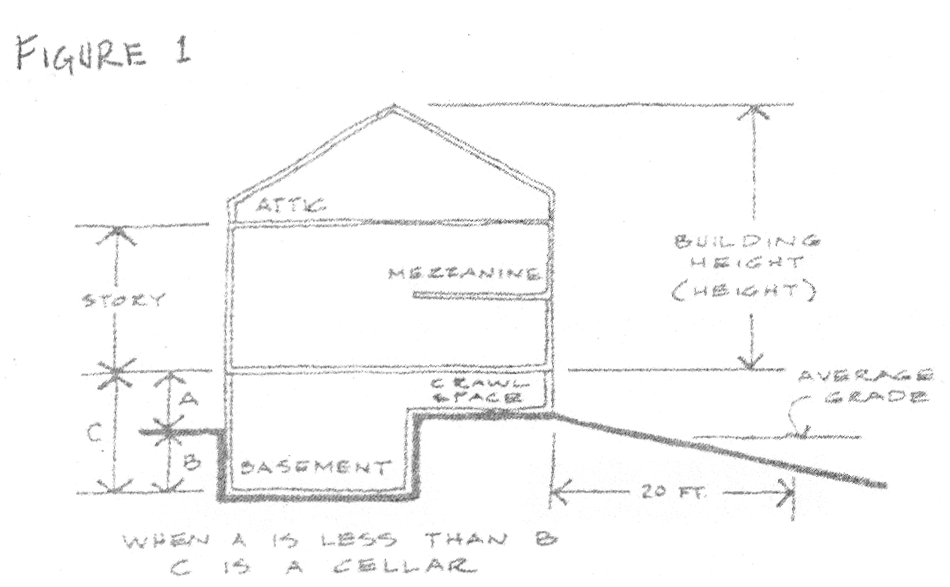
Figure 1
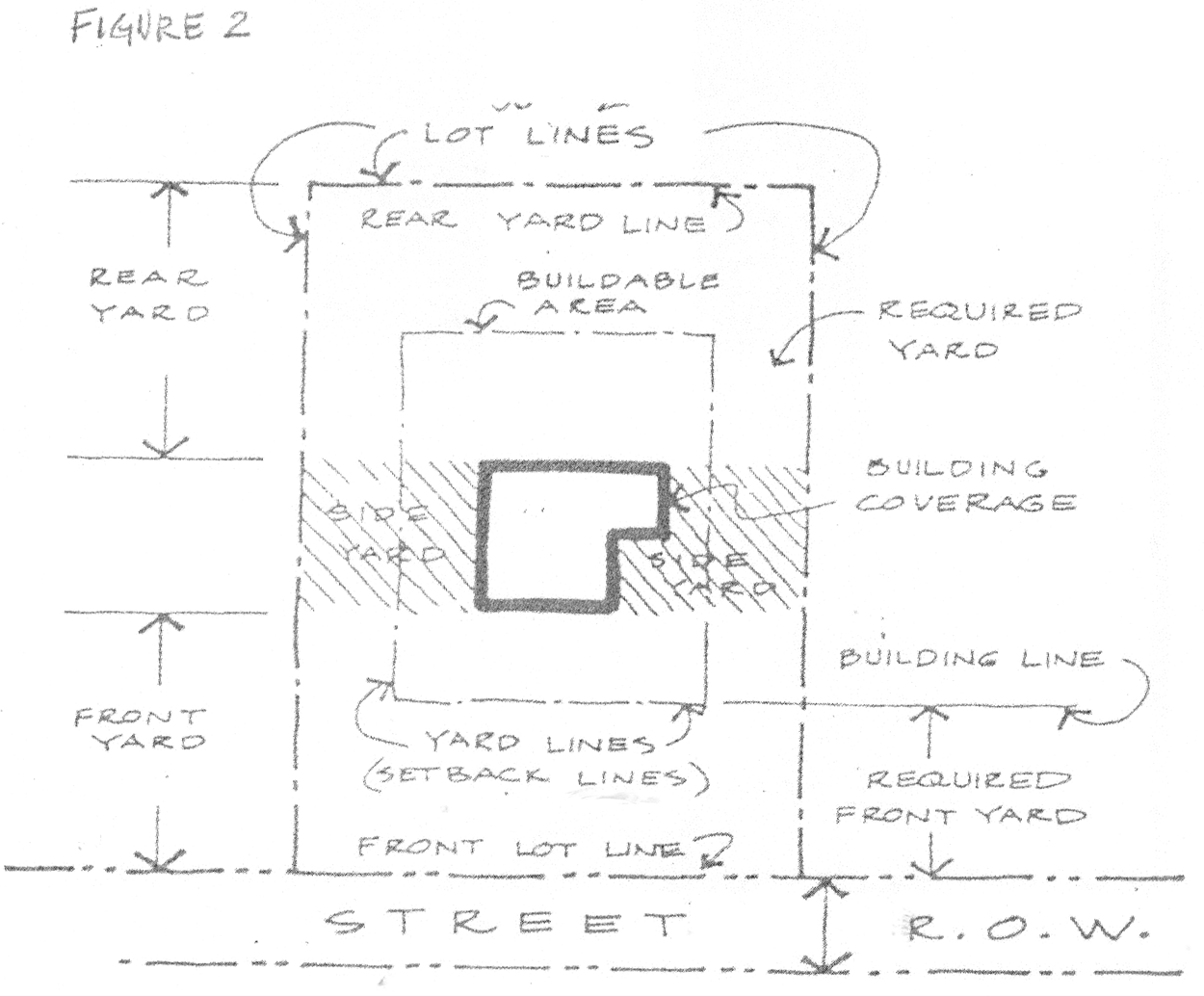
Figure 2
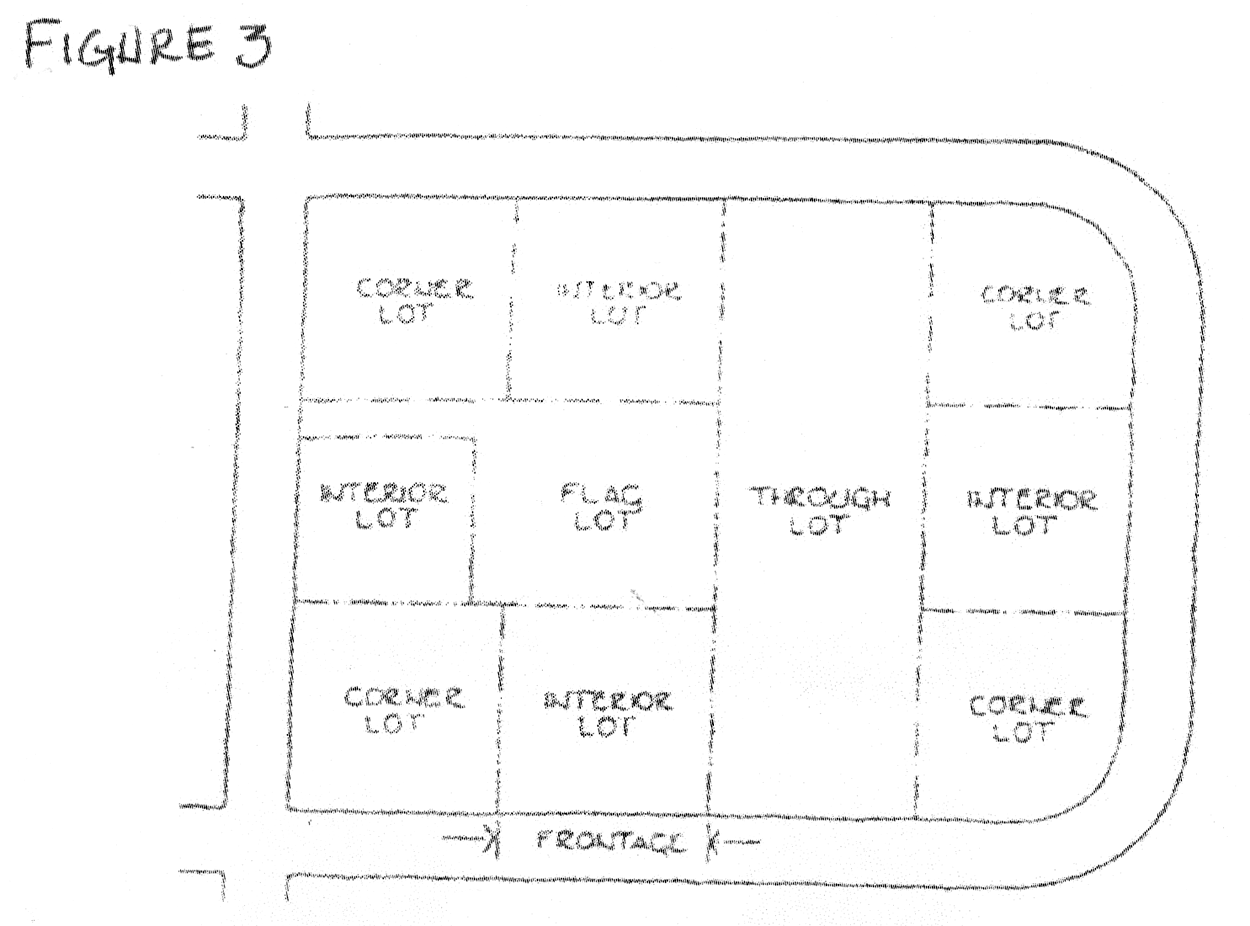
Figure 3
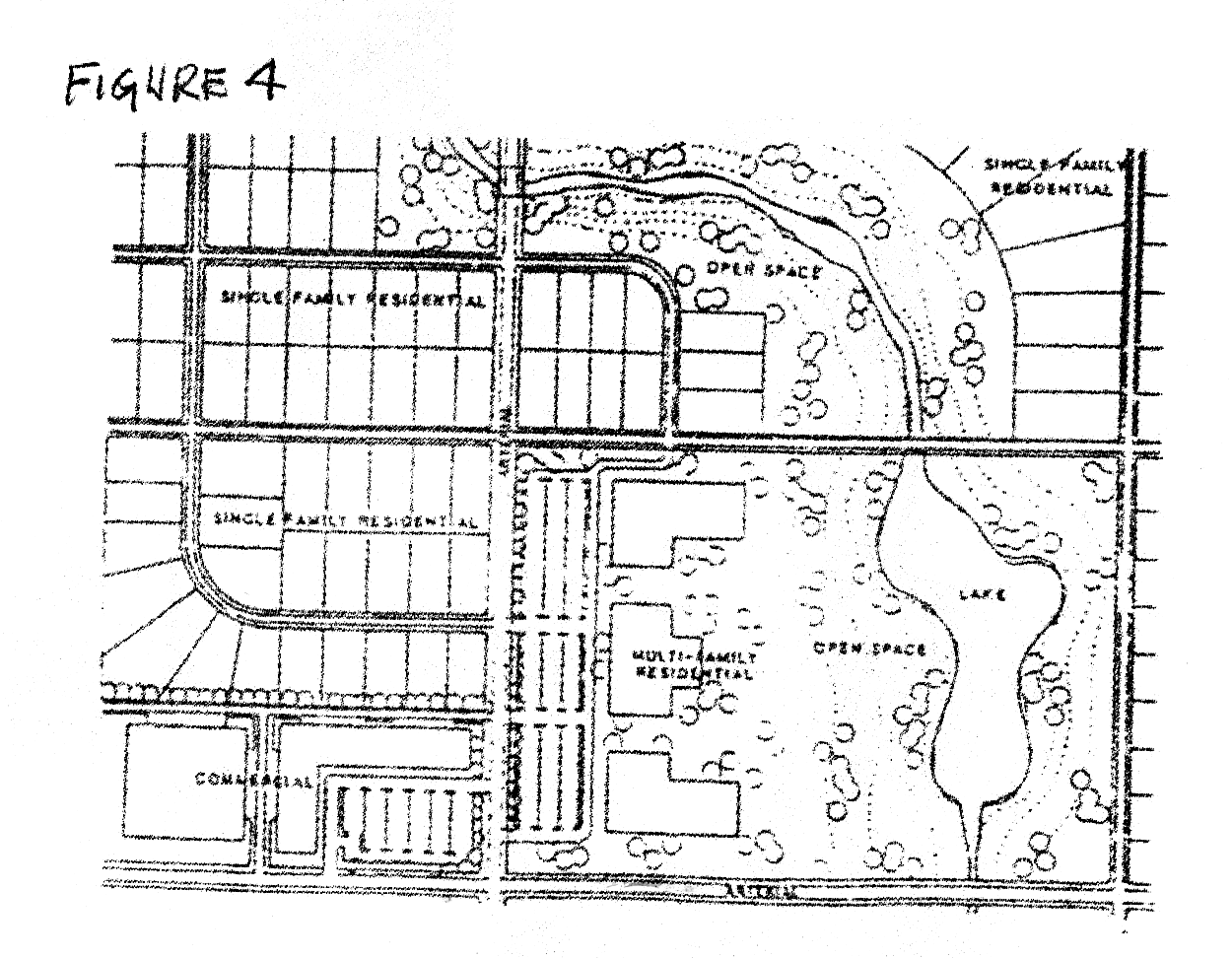
Figure 4
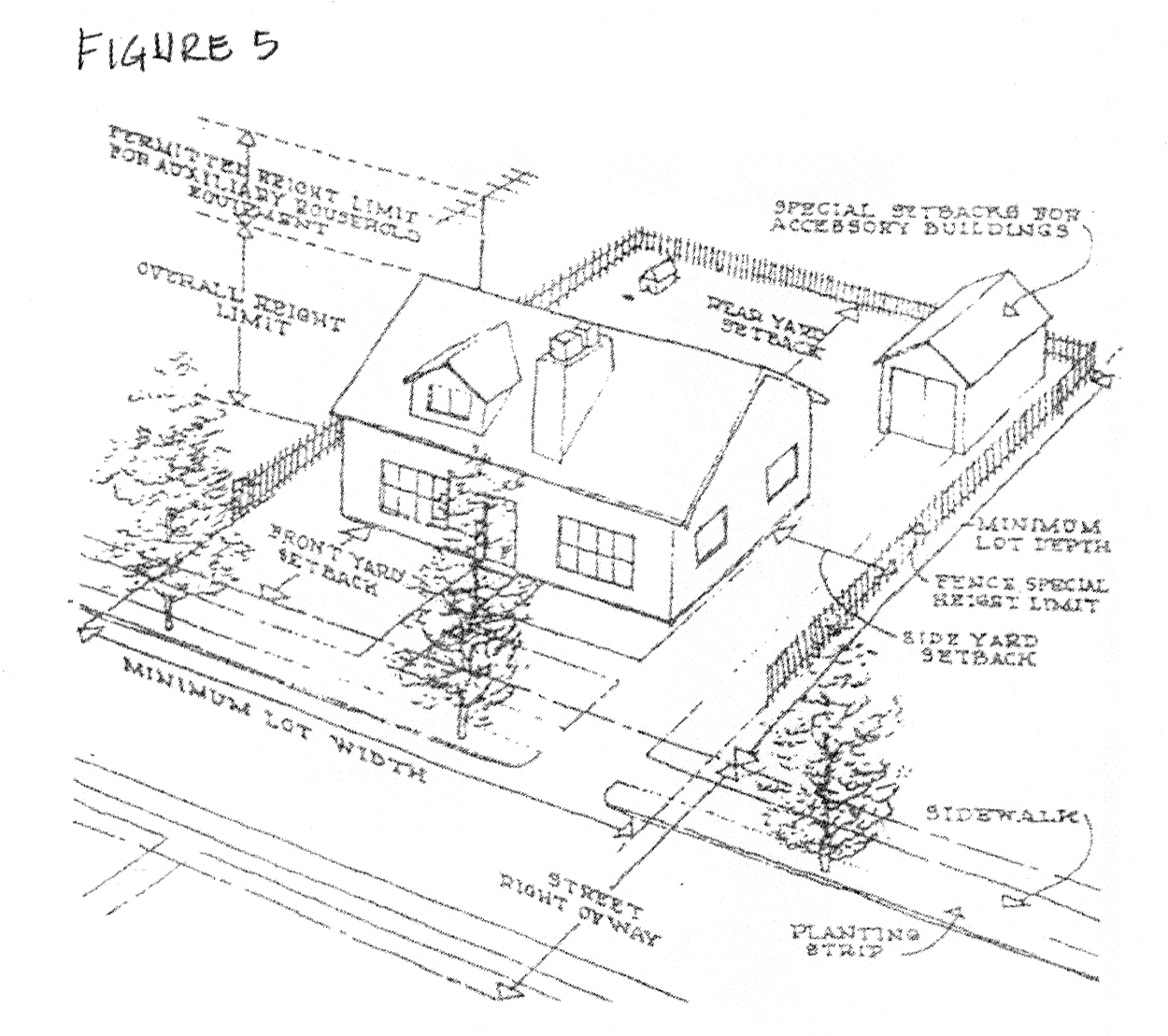
Figure 5
(Adm. Corr. of 5-7-2007; Adm. Corr. of 3-11-2008; Ord. No. 4359, § 1, 10-20-2009)

