
Miami Lakes City Zoning Code
ARTICLE IV
- ZONING DISTRICT REGULATIONS
DIVISION 24. - GF-GOVERNMENTAL FACILITIES[2]
Editor's note— Ord. No. 18-220, § 2, adopted February 6, 2018, amended the title of div. 24 to read as set out herein. Previously div. 24 was titled "GP Governmental Property District."
Sec. 13-401.- Purpose.
This article describes the purpose and intent of each zoning district; identifies permitted, conditional, and prohibited uses by zoning district; and presents densities and development regulations for each zoning district.
(LDC 2008, Div. 4.1; Ord. No. 08-102, § 2(Div. 4.1), 6-17-2008)
Sec. 13-421.- Applicability.
Except as stated otherwise, the provisions of this division apply to the Single-Family and Two-Family Residential Districts RU-1, RU-1A, RI-1B, RU-1Z and RU-2.
Sec. 13-422. - Main permitted uses.
(a)
RU-1, RU-1A, RU-1B, RU-1Z. Main permitted uses are as follows:
(1)
Single-family residences. Said uses may be permitted according to the development regulations of a district with equal or larger lot size requirements, subject, however, to the development regulations applicable to that larger lot size district, including but not limited to, lot width, area, setbacks, accessory uses, yard areas, height, density and lot coverage. Thereafter, the development regulations of the larger lot size district under which the area was developed shall be enforced.
(2)
Municipal recreation building, playgrounds, parks or reservations owned and operated by a municipality, County, State or the United States government.
(3)
Private recreation area, private recreation building or playground owned and maintained by a homeowner's or tenant association, provided same is approved in conjunction with approval of the subdivision at time of site plan approval or plat.
(b)
RU-2. Main permitted uses are as follows:
(1)
Any use permitted in an RU-1 Zoning District.
(2)
Two-family residential structures.
(LDC 2008, Div. 4.2(a); Ord. No. 08-102, § 2(Div. 4.2(A)), 6-17-2008; Ord. No. 08-107, § 2(Div. 4.2(a)), 10-21-2008; Ord. No. 18-233, § 3(Exh. A), 10-16-2018)
Sec. 13-423. - Conditional uses.
Conditional uses are as follows:
Community homes subject to Section 13-764.1.
(LDC 2008, Div. 4.2(b); Ord. No. 08-102, § 2(Div. 4.2(B)), 6-17-2008; Ord. No. 18-233, § 3(Exh. A), 10-16-2018)
Sec. 13-424. - Prohibited uses.
The following uses shall be prohibited in any RU-1, RU-1A, RU-1B, RU-1Z, and RU-2 Residential Districts:
(1)
All uses not specifically or provisionally provided for herein.
(2)
Beehives or the breeding or raising of any insects, reptiles or animals other than customary pets.
(3)
The keeping, breeding, or maintaining of farm animals such as horses, cattle, goats, etc.
(4)
The raising of poultry, fowl, or livestock. No animals, livestock, fowl or poultry of any kind shall be raised, bred, or kept on any lot, except for dogs, cats, or other household pets. No animals of any kind may be kept, bred, or maintained for any commercial purpose. All pets shall be maintained in a quiet and orderly fashion so as to not disturb other property owners. Pet owners shall comply with all governmental regulations concerning the proper care, maintenance, licensing, and control of their individual pets.
(LDC 2008, Div. 4.2(c); Ord. No. 08-102, § 2(Div. 4.2(C)), 6-17-2008; Ord. No. 08-107, § 2(Div. 4.2(c)), 10-21-2008)
Sec. 13-425. - Accessory uses.
The accessory uses in the RU-1, RU-1A, RU-1B, RU-1Z and RU-2 Residential Districts are those uses customarily associated with single-family residences such as, but not limited to, decks, swimming pools, spas, tennis courts, ornamental features, storage structures, noncommercial boat piers or docks. In addition, the following accessory uses are permitted:
(1)
Family day care and after-school care for children is permitted upon compliance with the following conditions:
a.
That the total number of children on the premises does not exceed five in number, including in the count only preschool children of the resident family. Preschool children shall consist of children five years of age or younger.
b.
That the age of the children, excluding those of the resident family, shall not exceed 11 years of age.
c.
That the applicant secure a license from the State agency having jurisdiction to operate a family day care home at the subject property.
d.
Where applicable, compliance with the requirements of this Code pertaining to educational and child care facilities.
e.
Upon compliance with all conditions enumerated, a certificate of use and occupancy is secured from the Town.
f.
The facility shall comply with the safety barrier requirements and restrictions enumerated Section 13-1512.
(2)
Home-based office as defined in Section 13-1602.
(3)
Garage sales, estate sales, moving sales and yard sales shall not be deemed commercial activities and will be permitted, so long as they are conducted on the residential property no more than four days per calendar year, per home, regardless of any change in ownership throughout the one year period and involve the sale of normal household items only. A garage sale permit from the Town is required.
(4)
Accessory use solar energy systems as defined and subject to Section 13-1702.
(LDC 2008, Div. 4.2(d); Ord. No. 08-102, § 2(Div. 4.2(D)), 6-17-2008; Ord. No. 19-252, § 3(Exh. A), 10-8-2019)
Sec. 13-426. - Development regulations for single-family and two-family districts.
The following table shows the development regulations for single-family and two-family districts.
(1)
Maximum lot coverage. Lot coverage is defined as the percentage of the total area of a lot that, when viewed directly from above, would be covered by the principal residence. The lot coverage shall not include accessory structures in the required rear yard, roof overhangs, projecting unenclosed balconies, awnings, at grade walkways and decks, swimming pools, and canopies or porches open on at least two sides and not covered by an enclosed floor above.
(2)
Lot coverage requirements shall in no way affect existing setback or spacing requirements, or the requirements that residential uses must conform to residential setbacks when established in business or industrial districts.
(3)
For waterfront lots the lot area used for lot coverage calculations shall include all of the land up to the water's edge.
(4)
Lot width is measured at the required front yard setback and parallel to the front property line abutting the street. However, in the residential districts the lot width shall be the average of the front and rear lot widths if a lot meets the following criteria:
a.
The side lot lines are not parallel.
b.
The lots front a curvilinear street.
c.
The width of the front lot line facing the street is at least:
50 feet for RU-1 and RU-2
40 feet for RU-1B
33 feet for RU-1A
31 feet for RU-1Z
(5)
For corner lots, the front of a lot shall be the narrowest portion facing the street or as otherwise designated by the owner/developer and approved by the Administrative Official or Town Council. Once the lot front is designated, said designation shall apply for purposes of all development regulations including the front yard setback. The main entrance to the residence shall face the front of the lot and no other doorway, other than the main entrance shall be provided a walkway directly to the sidewalk edge.
(6)
The height of a building shall be measured from the crown of the road in front of the property to the highest ridge of a pitched roof or the highest point of a flat roof, not including the parapet. Exceptions to the height regulations are listed in Section 13-1514.
(7)
For waterfront lots, the rear setback shall be measured from the water's edge. However, no structures are permitted past the top of the slope or tie line other than those permitted by Section 13-1605 entitled "Waterfront Properties."
(LDC 2008, Div. 4.2(e); Ord. No. 08-102, § 2(Div. 4.2(E)), 6-17-2008; Ord. No. 08-107, § 2(Div. 4.2(e)), 10-21-2008)
Sec. 13-427. - Density.
The single-family and two-family districts shall permit the following maximum densities:
(LDC 2008, Div. 4.2(f); Ord. No. 08-102, § 2(Div. 4.2(F)), 6-17-2008)
Sec. 13-428. - Additional development regulations for the RU-1Z Zero Lot Line Districts.
(a)
Openings prohibited on the zero lot line side. The wall of the dwelling unit located on the lot line shall have no windows, doors, air-conditioning units, or any other type of openings except for the following:
(1)
Atriums or courts shall be permitted on the zero lot line side when the court or atrium is enclosed by three walls of the dwelling unit, and a solid wall of at least eight feet in height is provided on the zero lot line. Said wall shall be constructed of the same material as exterior walls of the unit.
(2)
Windows shall be permitted on the zero lot line side provided said windows are placed at a minimum height of six feet above the finished floor level of any floor adjacent to the wall below the window.
(3)
Windows shall be permitted on a building wall which is located perpendicular to the zero lot line property line or where said windows are located at least ten feet from the property line.
(b)
Maintenance and drainage easements. A perpetual four-foot wall-maintenance easement shall be provided on the lot adjacent to the zero lot line property line, which, with the exception of walls and/or fences, shall be kept clear of structures, decks and paving. This easement shall be shown on the plat and incorporated into each deed transferring title to the property. The wall shall be maintained in its original color and treatment unless otherwise agreed to in writing by the two affected lot owners. Roof overhangs may penetrate the easement on the adjacent lot a maximum of 24 inches but the roof shall be so designed that water runoff from the dwelling placed on the lot line is limited to the easement area. Building footings may penetrate the easement on the adjacent lot a maximum of eight inches.
(LDC 2008, Div. 4.2(g); Ord. No. 08-102, § 2(Div. 4.2(G)), 6-17-2008)
Sec. 13-429. - Subdivision of RU-2 lots.
Two-family uses which comply with the minimum standards for such uses in the RU-2 District and other districts where two-family uses are permitted may be subdivided so as to create one lot for each dwelling unit, provided that the following conditions are met:
(1)
Each individual lot must be subdivided in accordance with the platting regulations of this Code.
(2)
Lot frontage. Each individual lot shall have a minimum frontage of 37.5 feet at the front property line and at the required 25-foot front setback line.
(3)
Lot area. Each individual lot shall have a minimum area of 3,750 square feet.
(4)
Lot coverage. For each individual lot, the percentage of lot covered by structures shall not exceed 35 percent.
(5)
Parking. For each individual lot, a minimum of two parking spaces per lot shall be provided.
(6)
Height. The maximum height shall be 35 feet and two stories.
(7)
Setbacks. Zero feet between units, all other setbacks shall comply with the minimum setbacks in this division.
(8)
Utilities and services. Each individual unit shall be independently served by separate heating, air conditioning, sewer, water, electric power, gas, and other facility and utility services, wherever such utilities and services are provided, and no individual unit shall be in any way dependent upon such services or utility lines located within another unit. All buildings on all lots must be served by underground utilities to the extent that such services are provided.
(9)
Walls. The individual units in a fee-simple two-family arrangement shall be separated by a party wall meeting all requirements of the Florida Building Code. Where units are offset from one another and a common party wall is used, the wall may be placed equidistant on each side of the lot line not exceeding the length of the offset.
(LDC 2008, Div. 4.2(h); Ord. No. 08-102, § 2(Div. 4.2(H)), 6-17-2008; Ord. No. 08-107, § 2(Div. 4.2(h)), 10-21-2008)
Sec. 13-441.- Purpose and intent.
It is the purpose and intent of this division to provide a townhouse zoning district in order to permit separate ownership of one-family dwelling units upon compliance with certain rules, regulations and standards, and to authorize the grouping of separately owned one-family dwelling units into a group of townhouses in such a manner as to make efficient, economical and aesthetically pleasing use of land, so restricted that the same will be continually well-maintained in order to preserve the health, welfare, safety, morals and convenience of the neighborhood and surrounding area. The provisions of this division apply to the RU-TH Townhouse District.
(LDC 2008, Div. 4.3(a); Ord. No. 08-102, § 2(Div. 4.3(A)), 6-17-2008)
Sec. 13-442. - Definitions.
The following words, terms and phrases, when used in this division, shall have the meanings ascribed to them in this section, except where the context clearly indicates a different meaning:
Awning means a temporary, movable, detachable canvas or other cloth protection against sun or weather, supported by a metal frame, or wood, metal or other rigid material used similarly as protection against sun or weather. Awnings may be so installed so as to remain in a fixed position or be installed in a manner permitting raising and lowering or shifting to function as a shutter to close entirely the protected opening. An awning must be supported entirely from the walls of the building to which attached.
Canopy means a temporary detachable canvas or other cloth protection against the sun or weather on a rigid frame, which may be made of metal, wood, or other rigid material which is supported in part by posts attached to the ground or to deck or floor of a building and, in part, on the wall of the building. A canopy-shutter is a canopy installed, over an opening (door or window) in a manner permitting raising and lowering to close entirely the protected opening.
Official Authorized Body means the body designated by the declaration of restrictions in the townhouse developments to approve architectural changes. If such a body does not exist, the Administrative Official, Building Official and the Town Manager shall serve as de-facto board only for the purposes of consideration and approval of architectural changes as required by the declaration of restrictions. Decisions of the de-facto board are binding unless appealed to the planning and zoning board within 30 days. The de-facto board shall make decisions on a majority basis and at least two members must be present to make decisions.
Townhouse or townhome means an attached one-family dwelling unit with ground floor access and situated so that no townhouse unit or a portion of a townhouse unit is located above another unit in a group of three or more such units separated by a common party fire wall; provided, however, that up to ten percent of the total number of units on any individual site plan may be developed in two-unit groupings. Said common party fire wall shall extend to the roof line or above the roof of units which it serves and shall have no openings therein. Where units are offset from one another and a common party wall is used, the wall may be placed equidistant on each side of the lot line not exceeding the length of the offset. Each townhouse unit shall be constructed upon a separate platted lot; provided, however, that the roof lines may overhang onto adjacent lots or common areas a maximum of 24 inches, subject to the approval of and determination by the Administrative Official or his designee that the roof or drainage system is designed so that runoff of water from the roof does not adversely affect adjacent units or lots. Each townhouse unit shall be serviced with separate utilities and other facilities and shall otherwise be independent of one another; provided, however, that the electrical lines or telephone lines or cables which service a particular unit may be placed through other lots where approved by the Administrative Official or his designee. The Administrative Official or his designee's approval shall be based upon his finding that the placement of said lines or cables will not adversely affect the lots through which they are placed.
Water's edge means the average high ground water elevation. For properties originally developed with a bulkhead or seawall, the water's edge shall be the waterside of the existing bulkhead or seawall.
(LDC 2008, Div. 4.3(b); Ord. No. 08-102, § 2(Div. 4.3(B)), 6-17-2008; Ord. No. 20-264, § 2(Exh. A), 6-16-2020; Ord. No. 20-271, § 2, 11-17-2020)
Sec. 13-443. - Uses permitted.
No land, body of water or structure shall be used or permitted to be used, and no structure shall be hereafter erected, constructed, moved, or reconstructed, structurally altered or maintained for any purpose in a Townhouse District (RU-TH) which is designed, arranged or intended to be used or occupied for any reason or purpose, except for one of the following uses:
(1)
Townhouses as defined in this division.
(2)
Those uses permitted in the RU-1, RU-1A, RU-1B and RU-2 Districts, subject only to the requirements, limitations and restrictions applicable therefor in said districts, including, but not limited to, lot width, areas, yard areas, heights, density and coverage.
(3)
Accessory use solar energy systems as defined and subject to Section 13-1702.
(LDC 2008, Div. 4.3(c); Ord. No. 08-102, § 2(Div. 4.3(C)), 6-17-2008; Ord. No. 19-252, § 3(Exh. A), 10-8-2019)
Sec. 13-444. - Development regulations.
Townhouse developments are subject to the following restrictions:
(1)
Densities. The maximum number of units per net acre shall not exceed 8.5.
(2)
Common open space. A minimum of 30 percent of the site to be developed for townhouses shall be provided as a common open space; 50 percent of said space shall be unencumbered with any structure or off-street parking and shall be landscaped and well-maintained with grass, trees and shrubbery. The remaining 50 percent may be used only as swimming pools, tennis courts, shuffleboards, pedestrian walks, entrance features, recreation buildings, maintenance buildings for the common areas, lakes, canals and lagoons, and other recreational uses.
(3)
Grouping length. A grouping of townhouses shall not exceed 240 feet in length.
(4)
Unit size. No townhouse shall be smaller than 800 square feet, and the average size of the townhouses in any grouping shall be a minimum of 1,000 square feet.
(5)
Height. The maximum height for any townhouse shall be 40 feet.
(6)
Size of development site. The minimum size of the site to be developed for townhouses shall be one net acre.
(7)
Lot area for each unit. No townhouse site shall contain an area of less than 1,250 square feet and the average size for a group shall not be less than 1,500 square feet, and each unit shall have its foundation on its individual site, except where the units are separated by a common party wall in which event the foundation may be installed equidistant on each side of the lot line for the length of the party wall and its extension along the offset of the townhouses on abutting lots.
(8)
Front yard requirements and parking.
a.
There shall be a 15-foot minimum distance from the nearest edge of roadway pavement to the front building line. Where parking spaces are provided in front of townhouse buildings, the required front setback of the building shall be a minimum of 25 feet from the nearest edge of roadway pavement or common access drive for said parking area. The parking spaces shall be no deeper than 20 feet and a minimum five feet of landscape buffer area shall be maintained between the townhouse building and the end of the parking spaces.
b.
If garages are provided the garage portion of the structure shall be set back 20 feet from the nearest edge of roadway pavement or common access drive. Any portion of the townhouse building that is not located directly in front of parking spaces shall be set back a minimum of 15 feet from the nearest edge of roadway pavement.
(9)
Rear yard requirements. The minimum rear building setback shall be 15 feet. The setback shall be measured from the plated property line or if the lot extends into the water the setbacks shall be taken from the water side of the bulkhead line or the water's edge. Awnings and canopies shall be permitted to encroach a maximum of ten feet into the required rear yard setback.
(10)
Side yard requirements. A minimum side yard of 15 feet shall be provided between the end of a group of townhouses and a public or private street. A spacing of 20 feet shall be provided between each such group of townhouses. The side yard setback areas shall remain open and landscaped with the exception of a walkway with a maximum width of three feet.
(11)
Street frontage. Each townhouse site must have a clear, direct frontage on public streets or to private access ways complying with public street requirements.
(12)
Utilities and services. Each townhouse shall be independently served by separate heating, air conditioning, seer, water, electric power, gas, and other facility and utility services, wherever such utilities and services are provided, and no townhouse shall be in any way dependent upon such services or utility lines located within another unit or on or in another townhouse or townhouse site, except as may be installed in public easements. All townhouses must be connected to water and sewer lines and all electrical and telephone lines in a townhouse development site shall be placed underground. Proper and adequate access for firefighting purposes, and access to service areas to provide garbage and waste collection, and for other necessary services shall be provided.
(13)
Parking. Driveways and parking spaces shall be graveled or hard-surfaced. Parking shall not be permitted on sand, lawns, common access areas, private access ways, across sidewalks, center islands of culs-de-sac and other nonpaved areas not designated for parking on the approved site plan. Overnight parking, any time between the hours of 12:00 midnight and 6:00 a.m., shall not be permitted on landscaped swale areas, however, overnight parking shall be permitted on driveway approach areas if the vehicle does not block the sidewalk. Unlicensed vehicles and inoperable vehicles may only be placed and kept on a lot in a closed garage. All parking requirements and specifications shall be met as provided in this Code.
(14)
Street right-of-way width and improvements. The right-of-way width of public streets and private streets serving a group of townhouses and the improvements therein shall conform to all applicable minimum Town standards and maintenance requirements for such streets.
(15)
Fences and walls. Fences and walls shall comply with Section 13-1509(a). Unless approved in the original site plan approval for the townhouse development, fences and or walls shall not be permitted in the front of the townhouse units. Where permitted, fences and walls shall not exceed six feet in height. Fences along lakefronts shall be constructed of the open picket type or vinyl coated chain link.
(16)
Patio walls. All patio outdoor living areas on each townhouse site shall be enclosed by a wall affording complete screening except in cases where a natural feature of the site such as a lake or golf course would suggest that complete screening would not be required. Such determination shall be made as a result of the site plan review process as provided herein. Such wall shall be of masonry or other similar material and the minimum height of such wall shall be six feet and the maximum height shall not exceed the roof line; such walled-in patio areas may include an awning, canopy or screen roof. All rear yard areas used for service, such as drying areas, shall be completely screened from view.
(17)
Awnings and patio coverings.
a.
All awnings and canopies covering patios of townhouses shall only consist of a metal frame covered with canvas, vinyl or cloth and be of a uniform size, color, pitch, pattern and design throughout the development or sections of the development.
b.
All new and replacement awnings and canopies must be approved through the minor site plan amendment procedure contained in Section 13-445(2).
c.
Supports for attached, open or screened canopies shall not extend past the height or length of the privacy walls.
d.
All awnings and canopies including nonconforming awnings and canopies must comply with the maintenance standards of Section 13-1601 at all times which requires them to be regularly maintained and promptly cleaned, painted or replaced when they become encrusted with mold, fungus, soil or any other matter which detrimentally affect their appearance, or when they become discolored by their exposure to sun.
(18)
Patios and service areas.
a.
There shall be provided on each townhouse site at least 400 square feet of patio living area exclusive of parking and service areas for each townhouse; such footage may consist of one or more patio areas. Open and non-air-conditioned roof areas and balconies designed and planned for patio purposes may be credited toward patio area. The following features may also be included in the required patio area calculation: screen enclosures, canvas roofed areas, patio slabs, Jacuzzis, swimming pools, decks, garden features and hot tubs. Said features must be either shown on the approved site plan or approved pursuant to the provisions of Section 13-445(2).
b.
The required patio and service areas for existing individual townhouse units that have been enclosed without a building permit as of May 17, 2005, may be approved by the Administrative Official provided that:
1.
Site plan approval is obtained through the site plan review criteria and procedures outlined in Section 13-304. If approved, conditions may be imposed to mitigate the impact of the patio enclosure on the townhouse community.
2.
The applicant submits as part of the site plan application a recommendation from the Official Authorized Body. The recommendation may be either for approval, denial or approval with conditions. The recommendation is advisory only and a positive recommendation is not required in order to receive site plan approval.
3.
The patio area to be enclosed is surrounded on three sides by the existing enclosed portions of the townhouse.
4.
The enclosed area does not extend beyond the outermost footprint of the townhouse unit and will not reduce the existing setbacks.
5.
The enclosures shall be of a uniform design throughout the townhouse community.
6.
All required building permits must be obtained and the proposed enclosure must comply with the applicable building codes in effect at the time of the building permit.
(19)
Accessory buildings and structures. Accessory buildings and structures are not permitted within the front or side setback areas. Detached fully enclosed accessory buildings shall not be permitted. Accessory storage sheds less than six feet high and no more than 50 square feet shall be permitted if they are located behind walls or fences and not visible from other properties or rights-of-way. Accessory structures such as gazebos, trellises, Jacuzzis, hot tubs, decks, pools, etc., are only permitted within the patio walled areas and shall not extend above the height of the patio walls and must be approved through the site plan review process in Section 13-304 as minor site plan amendments.
(20)
Building and roof colors.
a.
All townhouse buildings within a development or within separate groupings in a development shall be painted in the same color or color scheme as approved by the Official Authorized Body.
b.
All roofs within a development shall be comprised or appear to be comprised of the same material and color as approved by the Official Authorized Body. All roofs, with the exception of cloth/canvas awnings or canopies, with a pitch greater than two and one-half shall be constructed of either cement, ceramic, synthetic or metal to match or replicate the material and color approved by the Official Authorized Body. All re-roofs shall match the color and material of the existing attached roofs in the development.
(21)
Air conditioning units. All roof-mounted air conditioning units visible from the public right-of-way shall be of a neutral color (i.e. white, black, gray, beige, or green).
(22)
Ground-mounted air-conditioning units. Ground-located air conditioning units shall be screened from view from the front of the property with landscaping.
(LDC 2008, Div. 4.3(d); Ord. No. 08-102, § 2(Div. 4.3(D)), 6-17-2008; Ord. No. 15-187, § 2, 11-3-2015; Ord. No. 20-264, § 2(Exh. A), 6-16-2020)
Sec. 13-445. - Site plan review.
All new construction of townhouses, exterior changes to existing townhouses or the addition of enclosed floor area shall require approval through the site plan review procedures outlined in Section 13-304 before a building permit can be issued. Second floor additions to existing one-story townhouses are not permitted.
(1)
Site plan review criteria for new townhouse developments. In addition to the site plan review criteria specified in Section 13-304 the following design criteria shall be utilized in the site plan review process for new developments:
a.
Purpose and intent. The proposed development fulfills the objectives of this article.
b.
The proposed new developments must comply with the townhouse development regulations in this division.
c.
Landscape. Landscape shall be reserved in its natural state insofar as is practicable by minimizing tree removal. Landscape shall be used to shade and cool, direct wind movements, enhance architectural features, relate structure design to site, visually screen noncompatible uses and block noise generated by the major roadways and intense use areas.
d.
Buffers. Buffering elements in the form of architectural design and landscape design that provide a logical transition to adjoining existing or permitted uses shall be provided.
e.
Scale. Scale of proposed structures shall be compatible with surrounding proposed or existing uses or shall be made compatible by the use of buffering elements.
f.
Street system. A well-defined system shall be designed to allow free movement throughout the development while discouraging excessive speeds, and shall structure the development in clearly defined clusters and/or groups of townhouses. All dwelling units should be located on residential service streets or courts designed to discourage all traffic except that of owner/occupants, their guests, and their services. Pedestrian and auto circulation shall be separated insofar as is practicable.
g.
Visibility. No obstruction to visibility at street intersections shall be permitted, and such visibility clearances shall be as required by the Department of Public Works.
h.
Energy consideration. Site design methods to reduce energy consumption shall be encouraged. Energy site conservation methods may include siting of structures in relation to prevailing breezes and sun angles and use of landscape materials for shade and transpiration.
i.
Parking. Private parking shall not be in adjacent groups of more than four spaces, said groups to be separated by the use of landscape elements. Where parking is provided in a group arrangement, planting, berms or other innovative methods shall be used as a means of minimizing the adverse effect of the visual impact of parked cars. This requirement is in addition to the requirements of the landscape regulations of Article 18A, Landscape Ordinance (see Section 13-1).
j.
Open spaces. Open spaces shall relate to any natural characteristics in such a way as to preserve and enhance their scenic and functional qualities to the fullest extent possible. To the extent possible the open spaces shall be designated as parks on the site plan and plat.
k.
Privacy. Due consideration of aural and visual privacy shall be evidenced in the design of the overall development and in the design of the individual units.
l.
Graphics. Graphics, as required, shall be designated as an integral part of the overall design of the project.
m.
Art display. Permanent interior and exterior art displays and water features should be encouraged in the overall design of the project.
n.
Emergency access. Access to emergency equipment shall be provided.
o.
Visual screening for decorative walls surrounding townhouse developments. In an effort to prevent graffiti vandalism, the following options shall be utilized for walls abutting zoned or dedicated rights-of-way:
1.
Wall with landscaping. The wall shall be set back two and one-half feet from the right-of-way line and the resulting setback area shall contain a continuous extensively landscaped buffer which must be maintained in a good, healthy condition by the property owner, or where applicable, by the Official Authorized Body. Perimeter walls surrounding subdivisions shall be painted one consistent color scheme to be determined by the homeowners association and the Town. The landscape buffer shall contain one or more of the following planting materials:
(i)
Shrubs. Shrubs shall be a minimum of three feet in height when measured immediately after planting and shall be planted and maintained to form a continuous, unbroken, solid, visual screen within one year after time of planting.
(ii)
Hedges. Hedges shall be a minimum of three feet in height when measured immediately after planting and shall be planted and maintained to form a continuous, unbroken, solid, visual screen within one year after time of planting. The maximum height of the hedges shall be determined by Chapter 18A, Landscape Ordinance (see Section 13-1).
(iii)
Vines. Climbing vines shall be a minimum of 36 inches in height immediately after planting.
2.
Walls with anti-graffiti paint. All concrete block stucco walls abutting rights-of-way shall be treated with anti-graffiti paint.
3.
Metal picket fence. Where a metal picket fence abutting a zoned or dedicated right-of-way is constructed in lieu of a decorative wall, landscaping shall not be required.
p.
Utilities. No garbage, trash, refuse, rubbish, or recyclables shall be deposited or kept on any lot except in a suitable sturdy container. Such container shall not be visible from any point on the front lot line, or from the lake or golf course, as applicable. Corner lots shall also not have garbage, trash, refuse, rubbish or other debris and discards, including recyclables, visible from the side yard which faces the street.
(2)
Minor site plan changes for existing townhouses. The Administrative Official or his designee may administratively authorize through the site plan review process in Section 13-302 minor exterior changes in a site plan or to building elevations for existing individual townhouse units for the following items: screen enclosures, changes to approved landscape areas, patio slabs/pavers, new facial or trim work, trellis or garden amenities, canvas or cloth awnings and canopies, walls or fences, Jacuzzis, swimming pools, decks, hot tubs, shared parking areas or similar improvements provided that:
a.
The applicant submits as part of the site plan application a recommendation from the Official Authorized Body. The recommendation may be either for approval, denial or approval with conditions. The recommendation is advisory only and a positive recommendation is not required in order to receive site plan approval.
b.
That the proposed changes comply with the development regulations for townhouses contained in this chapter and variances are not necessary to accomplish the proposed changes.
c.
In approving the amendments or changes to the site plan or building elevations, the Administrative Official or his designee shall find that the change in plan will be in harmony with and compatible with existing development in the area, and will not destroy the theme or character of the development in the area.
d.
Additions of enclosed air conditioned space is not permitted through the minor amendment process and requires site plan approval through a public hearing.
e.
Exceptions.
1.
The installation of temporary storm panels approved under the Florida Building Code shall be permitted as a matter of right. However, the Official Authorized Body review shall be required for the installation of permanent storm shutters. For the purposes of this subsection, temporary storm panels shall be defined as detachable protection devices that are installed temporarily over building openings in the event of an approaching hurricane or tropical storm.
2.
The replacement or modification of driveways at individual townhouse units shall not require approval through the administrative site plan review process, provided the improvements comply with the following requirements:
(i)
That the applicant submits, as part of the building permit application, a recommendation from the Official Authorized Body, if applicable. The recommendation may be either for approval, denial or approval with conditions. The recommendation is advisory only and a positive recommendation is not required in order to receive building permit approval.
(ii)
In conducting the zoning review for the building permit application for the driveway, the Administrative Official or his designee shall find that the proposed improvement will be in harmony with and compatible with existing development in the area, and will not destroy the theme or character of the development in the area and complies with all requirements for such improvements found elsewhere in this Code or other applicable codes or regulations.
(LDC 2008, Div. 4.3(e); Ord. No. 08-102, § 2(Div. 4.3(E)), 6-17-2008; Ord. No. 11-135, § 2, 9-13-2011)
Sec. 13-446. - Maintenance of common area.
Provisions satisfactory to the Town shall be made to ensure that nonpublic areas and facilities for the common use of occupants of a townhouse development, but not in individual ownership of such occupants, shall be maintained in a satisfactory manner, without expense to the general taxpayer of the Town. Such may be provided by the incorporation of an automatic membership home association for the purpose of continuously holding title to such nonpublic areas and facilities, and levying assessment against each townhouse lot, whether improved or not, for the purpose of paying the taxes and maintaining such nonpublic areas and facilities which may include, but not be limited to, recreational areas, off-street parking bays, private streets, sidewalks, streetlights, and common open and landscaped areas. Such assessments shall be a lien superior to all other liens save and except tax liens and mortgage liens, provided said mortgage liens are first liens against the property encumbered thereby, subject only to tax liens, and secure indebtedness which are amortized in monthly or quarter-annual payments over a period of not less than ten years. Other methods may be acceptable if the same positively provide for the proper and continuous payment of taxes and maintenance without expense to the general taxpayers. The instrument incorporating such provisions shall be approved by the Town Attorney as to form and legal sufficiency and shall be recorded in the public records of Miami-Dade County at the time of the recording of the subdivision plat.
(LDC 2008, Div. 4.3(f); Ord. No. 08-102, § 2(Div. 4.3(F)), 6-17-2008)
Sec. 13-447. - Platting requirements.
Each townhouse unit shall be located on its own individual platted lot. If areas for common use of occupants of a townhouse development are shown on the plat, such areas shall not be approved until satisfactory arrangements are made for maintenance as provided by this article.
(LDC 2008, Div. 4.3(g); Ord. No. 08-102, § 2(Div. 4.3(G)), 6-17-2008)
Sec. 13-448. - Trees.
Landscaping and trees shall be provided in accordance with Chapter 18A, Landscape Ordinance (see Section 13-1). Removal or reduction of existing privately owned landscape or pervious areas approved as part of the original site plan within an existing townhouse development is discouraged. However, removal of portions of a landscape or pervious area may be permitted on an individual basis.
(LDC 2008, Div. 4.3(h); Ord. No. 08-102, § 2(Div. 4.3(H)), 6-17-2008)
Sec. 13-449. - Swale areas.
When applicable, the swale area in the front of an individual townhouse that is located within the public right-of-way shall be maintained by the abutting property owner. Unless approved by the Town through a public works permit, no structures or improvements of any kind, with the exception of sod, annuals or perennials, driveway approaches and shade trees approved by the Town, shall be permitted within the swale areas. Trees planted in the swale area are the property of the Town and may not be removed or trimmed by the abutting property owner without approval of the Town. Additionally:
(1)
Overnight parking, between the hours of 11:00 p.m. to 6:00 a.m. on swale areas shall be strictly forbidden. Vehicles parked overnight in swale areas will be subject to the imposition of a civil fine or code compliance citation.
(2)
The use of any such swale area by any party in contravention of the provisions of this section shall be subject to the code enforcement provisions and procedures set forth in the Town Code of Ordinances and the provisions of the Miami-Dade County Code of Ordinances and State law applicable to such unauthorized use.
(LDC 2008, Div. 4.3(i); Ord. No. 08-102, § 2(Div. 4.3(I)), 6-17-2008; Ord. No. 22-290, § 2, 3-8-2022)
Sec. 13-461.- Applicability.
The provisions of this division apply to the RM-13 Low Density Residential District (RU-3M).
Sec. 13-462. - Permitted uses.
No land, body of water or structure shall be used or permitted to be used, and no structure shall be hereafter erected, constructed, moved or reconstructed, structurally altered or maintained for any purpose in an RM-13 District which is designed, arranged or intended to be used or occupied for any purpose, except for one of the following uses:
(1)
Those uses permitted in the RU-1, RU-1A, RU-1B, RU-2, and RU-TH Districts subject only to the requirements, limitations and restrictions applicable therefor in said districts, including but not limited to, lot width, area, accessory uses, yard areas, height, density and lot coverage.
(2)
Multiple-family apartment buildings.
(3)
Community homes subject to Section 13-764.1.
(LDC 2008, Div. 4.4(a); Ord. No. 08-102, § 2(Div. 4.4(A)), 6-17-2008; Ord. No. 18-233, § 3(Exh. A), 10-16-2018)
Sec. 13-463. - Conditional uses.
Conditional uses are as follows:
Educational and child care facilities, nonpublic, as provided in this Code.
(LDC 2008, Div. 4.4(b); Ord. No. 08-102, § 2(Div. 4.4(B)), 6-17-2008; Ord. No. 18-233, § 3(Exh. A), 10-16-2018)
Sec. 13-464. - Accessory uses.
The accessory uses in the RM-13 District are those uses customarily associated with multifamily residential buildings and are for use of the residents only such as, but not limited to, decks, swimming pools, spas, tennis courts, recreational amenities, ornamental features, storage structures, noncommercial boat piers or docks, accessory use solar energy systems, etc. Accessory uses shall be located on the same lot as the main use. Accessory use solar energy systems shall comply with Section 13-1702.
(LDC 2008, Div. 4.4(c); Ord. No. 08-102, § 2(Div. 4.4(C)), 6-17-2008; Ord. No. 19-252, § 3(Exh. A), 10-8-2019)
Sec. 13-465. - Development regulations.
(a)
Lot width and lot area. The minimum lot width shall be 100 feet and the minimum lot area shall be 10,000 square feet.
(b)
Lot coverage. The maximum area covered by all buildings shall not exceed 30 percent of the lot.
(c)
Setbacks. The setbacks shall be as follows:
(1)
Minimum setback from front property line shall be 25 feet.
(2)
Minimum setback from interior side property line shall be 20 feet.
(3)
Minimum setback from side street property line shall be 25 feet.
(4)
Minimum setback from a rear property line shall be 25 feet.
(5)
Minimum setback between buildings shall be 20 feet, except where doors, windows or other openings in the building wall of a living unit face a wall of the same building and/or a wall of another building with living units on the same site, then there shall be provided a minimum clear distance of not less than 30 feet. Said distance to be measured on a line projected at right angles at the opening to the opposite wall.
(6)
Parking setbacks.
Front: 25 feet from front property line.
Street side: 15 feet from corner side street property lines.
Interior side: five feet from interior side property lines.
Rear: five feet from rear property lines.
(7)
Accessory buildings.
a.
Single-family, two-family, and townhouses. Accessory buildings shall conform to requirements in the respective districts.
b.
All other uses. Accessory buildings shall not be permitted within the front yard or side street setback areas. Otherwise the location, setbacks, lot coverage, height, size, etc., shall be determined through the site plan review process.
(d)
Height. No building or structure or part thereof shall be erected or altered to a height exceeding two stories and shall not exceed 35 feet.
(e)
Floor area ratio. The floor area ratio shall not exceed 0.5.
(f)
Density. The maximum number of dwelling units shall be determined on the basis of a total of 13 dwelling units per net acre.
(g)
Minimum apartment unit size/average apartment unit size. The minimum apartment unit size shall be 600 square feet and the minimum average apartment unit size for an entire development shall be 800 square feet. The minimum size shall be measured from the outside of exterior walls to the centerline of interior partitions. Non-air-conditioned spaces such as balconies shall not be counted towards the required minimum unit size.
(h)
Open space. On each lot there shall be provided landscaped open space equal to a minimum of 30 percent of the total lot area. Said open space shall be unencumbered with any structure or off-street parking or drive aisles, and shall be landscaped and well-maintained with grass, trees and shrubbery, excepting only areas used as pedestrian walks and water bodies provided said water bodies do not count for more than 20 percent of the open space requirement.
(i)
Landscaping. Landscaping and trees shall be provided in accordance with Chapter 18A, Landscape Ordinance (see Section 13-1).
(LDC 2008, Div. 4.4(d); Ord. No. 08-102, § 2(Div. 4.4(D)), 6-17-2008)
Sec. 13-466. - Site plan review.
All new construction or substantial remodeling shall comply with the site plan review criteria and procedures outlined in Section 13-304 before a building permit can be issued. In addition to the site plan review criteria specified in Section 13-304 the following design criteria shall be utilized in the site plan review process:
(1)
Purpose and intent. The proposed development fulfills the objectives of this article.
(2)
Landscape. Landscape shall be preserved in its natural state insofar as is practicable by minimizing tree removal. Landscape shall be used to shade and cool, direct wind movements, enhance architectural features, relate structure design to site, visually screen noncompatible uses and block noise generated by the major roadways and intense use areas.
(3)
Buffers. Buffering elements in the form of architectural design and landscape design that provide a logical transition to adjoining existing or permitted uses shall be provided.
(4)
Scale. Scale of proposed structures shall be compatible with surrounding proposed or existing uses or shall be made compatible by the use of buffering elements.
(5)
Circulation. Pedestrian and auto circulation shall be separated insofar as is practicable, and all circulation systems shall adequately serve the needs of the development and be compatible and functional with circulation systems outside the development.
(6)
Energy consideration. Site design methods to reduce energy consumption shall be encouraged. Every site conservation method may include siting of structures in relation to prevailing breezes and sun angles and use of landscape materials for shade and transpiration.
(7)
Parking areas. Building wall extensions, planting, berms or other innovative methods shall be used as a means of minimizing the adverse effect of the visual impact of parking areas. This requirement is in addition to the requirements of the landscape regulations of the Town Code.
(8)
Open spaces. Open spaces shall relate to any natural characteristics in such a way as to preserve and enhance their scenic and functional qualities to the fullest extent possible.
(9)
Graphics. Graphics, as required, shall be designated as an integral part of the overall design of the project.
(10)
Art display. Permanent interior and exterior art displays and water features should be encouraged in the overall design of the project.
(11)
Visual screening for decorative walls. In an effort to prevent graffiti and vandalism, the following options shall be utilized for walls abutting zoned or dedicated rights-of-way:
a.
Wall with landscaping. All concrete block stucco walls abutting rights-of-way shall be treated with anti-graffiti paint. The wall shall be set back two and one-half feet from the right-of-way line and the resulting setback area shall contain a continuous extensively landscaped buffer which must be maintained in a good healthy condition by the property owner, or where applicable, by the condominium, homeowners or similar association. Perimeter walls surrounding subdivisions shall be painted one consistent color scheme to be determined by the homeowners association and the Town. The landscape buffer shall contain one or more of the following planting materials:
1.
Shrubs. Shrubs shall be a minimum of three feet in height when measured immediately after planting and shall be planted and maintained to form a continuous, unbroken, solid, visual screen within one year after time of planting.
2.
Hedges. Hedges shall be a minimum of three feet in height when measured immediately after planting and shall be planted and maintained to form a continuous, unbroken, solid, visual screen within one year after time of planting.
3.
Vines. Climbing vines shall be a minimum of 36 inches in height immediately after planting.
b.
Metal picket fence. Where a metal picket fence abutting a zoned or dedicated right-of-way is constructed in lieu of a decorative wall, landscaping shall not be required.
(12)
Bikeways and bicycle parking facilities. Where feasible all new and substantially redeveloped multifamily developments shall provide bikeways and on-site bicycle parking facilities.
(LDC 2008, Div. 4.4(e); Ord. No. 08-102, § 2(Div. 4.4(E)), 6-17-2008)
Sec. 13-481.- Applicability.
The provisions of this division apply to the RM-33 Medium Density Residential District (RU-4L).
Sec. 13-482. - Permitted uses.
No land, body of water or structure shall be used, or permitted to be used, and no structure shall be hereafter erected, constructed, moved or reconstructed, structurally altered or maintained for any purpose in a RM-23 District which is designed, arranged or intended to be used or occupied for any purpose, except for one of the following uses:
(1)
Those uses permitted in the RU-1, RU-1A, RU-1B, RU-2 and RU-TH Districts subject only to the requirements, limitations and restrictions applicable therefor in said districts, including but not limited to, lot width, accessory uses, area, yard areas, height, density and lot coverage.
(2)
Multiple-family apartment.
(3)
Community homes subject to Section 13-764.1.
(LDC 2008, Div. 4.5(a); Ord. No. 08-102, § 2(Div. 4.5(A)), 6-17-2008; Ord. No. 18-233, § 3(Exh. A), 10-16-2018)
Sec. 13-483. - Conditional uses.
Conditional uses are as follows:
Educational and child care facilities, nonpublic, as provided in this Code.
(LDC 2008, Div. 4.5(b); Ord. No. 08-102, § 2(Div. 4.5(B)), 6-17-2008; Ord. No. 18-233, § 3(Exh. A), 10-16-2018)
Sec. 13-484. - Accessory uses.
The accessory uses in the RM-23 District are those uses customarily associated with multifamily residential buildings and are for use of the residents only such as, but not limited to, decks, swimming pools, spas, tennis courts, recreational amenities, ornamental features, storage structures, noncommercial boat piers or docks, accessory use solar energy systems, etc. Accessory uses shall be located on the same lot as the main use. Accessory use solar energy systems shall comply with Section 13-1702. In addition, the following accessory uses are permitted:
(1)
Convenience retail facilities. Not more than one food and drug convenience retail service facility shall be permitted as an accessory use to an apartment use or apartment development, said facility not to exceed 1,000 square feet in a development having a minimum of 300 apartment units, provided that:
a.
Such services relate to the needs of the inhabitants of the proposed complex;
b.
Such services are not provided direct access from public roads;
c.
Such services are not visible from public roads;
d.
Detached signs and signs visible from public roads are not used;
e.
Such services are designed as an integral part of the total design as determined by site plan review;
f.
Such services are located in the principal structure or in a community service center structure.
An additional one square foot of retail area shall be permitted for each apartment unit above 300 units; provided, however, that the maximum square footage for such facilities shall not exceed 3,000 square feet.
(LDC 2008, Div. 4.5(c); Ord. No. 08-102, § 2(Div. 4.5(C)), 6-17-2008; Ord. No. 19-252, § 3(Exh. A), 10-8-2019)
Sec. 13-485. - Development regulations.
(a)
Lot width and lot area. The minimum lot width shall be 100 feet and the minimum lot area shall be 10,000 square feet.
(b)
Lot coverage. The maximum area covered by all buildings shall not exceed 30 percent of the lot.
(c)
Setbacks. The setbacks shall be as follows:
(1)
Minimum setback from front property line shall be 25 feet.
(2)
Minimum setback from interior side property line shall be 20 feet.
(3)
Minimum setback from side street property line shall be 25 feet.
(4)
Minimum setback from a rear property line shall be 25 feet.
(5)
Minimum setback between buildings shall be 20 feet, except where doors, windows or other openings in the building wall of a living unit face a wall of the same building and/or a wall of another building with living units on the same site, then there shall be provided a minimum clear distance of not less than 30 feet. Said distance to be measured on a line projected at right angles at the opening to the opposite wall.
(6)
Parking setbacks.
Front: 25 feet from front property line.
Street side: 15 feet from corner side street property lines.
Interior side: five feet from interior side property lines.
Rear: five feet from rear property lines.
(7)
Accessory buildings.
a.
Single-family, two-family, and townhouses. Accessory buildings shall conform to requirements in the respective districts.
b.
All other uses. Accessory buildings shall not be permitted within the front yard or side street setback areas. Otherwise the location, setbacks, lot coverage, height, size, etc., shall be determined through the site plan review process.
(d)
Height. No building or structure, or part thereof shall be erected or altered to a height exceeding four stories, and shall not exceed 50 feet.
(e)
Floor area ratio. The floor area ratio shall not exceed 0.8.
(f)
Density. The maximum number of dwelling units shall be determined on the basis of a total of 23 dwelling units per net acre.
(g)
Minimum apartment unit size/average apartment unit size. The minimum apartment unit size shall be 600 square feet and the minimum average apartment unit size for an entire development shall be 800 square feet. The minimum size shall be measured from the outside of exterior walls to the centerline of interior partitions. Non-air-conditioned spaces such as balconies shall not be counted towards the required minimum unit size.
(h)
Open space. On each lot there shall be provided landscaped open space equal to a minimum of 30 percent of the total lot area. Said open space shall be unencumbered with any structure or off-street parking or drive aisles, and shall be landscaped and well-maintained with grass, trees and shrubbery, excepting only areas used as pedestrian walks and water bodies provided said water bodies do not count for more than 20 percent of the open space requirement.
(i)
Landscaping. Landscaping and trees shall be provided in accordance with Chapter 18A, Landscape Ordinance (see Section 13-1).
(LDC 2008, Div. 4.5(d); Ord. No. 08-102, § 2(Div. 4.5(D)), 6-17-2008)
Sec. 13-486. - Site plan review.
All new construction or substantial remodeling shall comply with the site plan review criteria and procedures outlined in Section 13-304 before a building permit can be issued. In addition to the site plan review criteria specified in Section 13-304 the following design criteria shall be utilized in the site plan review process:
(1)
Purpose and intent. The proposed development fulfills the objectives of this article.
(2)
Landscape. Landscape shall be preserved in its natural state insofar as is practicable by minimizing tree removal. Landscape shall be used to shade and cool, direct wind movements, enhance architectural features, relate structure design to site, visually screen noncompatible uses and block noise generated by the major roadways and intense use areas.
(3)
Buffers. Buffering elements in the form of architectural design and landscape design that provide a logical transition to adjoining existing or permitted uses shall be provided.
(4)
Scale. Scale of proposed structures shall be compatible with surrounding proposed or existing uses or shall be made compatible by the use of buffering elements.
(5)
Circulation. Pedestrian and auto circulation shall be separated insofar as is practicable, and all circulation systems shall adequately serve the needs of the development and be compatible and functional with circulation systems outside the development.
(6)
Energy consideration. Site design methods to reduce energy consumption shall be encouraged. Every site conservation method may include siting of structures in relation to prevailing breezes and sun angles and use of landscape materials for shade and transpiration.
(7)
Parking areas. Building wall extensions, planting, berms or other innovative methods shall be used as a means of minimizing the adverse effect of the visual impact of parking areas. This requirement is in addition to the requirements of the landscape regulations of the Town Code.
(8)
Open spaces. Open spaces shall relate to any natural characteristics in such a way as to preserve and enhance their scenic and functional qualities to the fullest extent possible.
(9)
Graphics. Graphics, as required, shall be designated as an integral part of the overall design of the project.
(10)
Art display. Permanent interior and exterior art displays and water features should be encouraged in the overall design of the project.
(11)
Visual screening for decorative walls. In an effort to prevent graffiti and vandalism, the following options shall be utilized for walls abutting zoned or dedicated rights-of-way:
a.
Wall with landscaping. All concrete block stucco walls abutting rights-of-way shall be treated with anti-graffiti paint. The wall shall be set back two and one-half feet from the right-of-way line and the resulting setback area shall contain a continuous extensively landscaped buffer which must be maintained in a good healthy condition by the property owner, or where applicable, by the condominium, homeowners or similar association. Perimeter walls surrounding subdivisions shall be painted one consistent color scheme to be determined by the homeowners association and the Town. The landscape buffer shall contain one or more of the following planting materials:
1.
Shrubs. Shrubs shall be a minimum of three feet in height when measured immediately after planting and shall be planted and maintained to form a continuous, unbroken, solid, visual screen within one year after time of planting.
2.
Hedges. Hedges shall be a minimum of three feet in height when measured immediately after planting and shall be planted and maintained to form a continuous, unbroken, solid, visual screen within one year after time of planting.
3.
Vines. Climbing vines shall be a minimum of 36 inches in height immediately after planting.
b.
Metal picket fence. Where a metal picket fence abutting a zoned or dedicated right-of-way is constructed in lieu of a decorative wall, landscaping shall not be required.
(12)
Bikeways and bicycle parking facilities. Where feasible all new and substantially redeveloped multifamily developments shall provide bikeways and on-site bicycle parking facilities.
(LDC 2008, Div. 4.5(e); Ord. No. 08-102, § 2(Div. 4.5(E)), 6-17-2008)
Sec. 13-501.- Applicability.
The provisions of this division apply to the RM-30 Low Medium Density Residential District.
(Ord. No. 25-338, § 3(Exh. A), 6-17-2025)
Sec. 13-502. - Permitted uses.
No land, body of water or structure shall be used, or permitted to be used and no structures shall be hereafter erected, constructed, moved or reconstructed, structurally altered or maintained for any purpose in a RM-30 District which is designed, arranged or intended to be used or occupied for any purpose, except for one of the following uses:
(1)
Those uses permitted in the RU-1, RU-IA, RU-1B, RU-2 and RU-TH Districts subject only to the requirements, limitations and restrictions applicable therefore in said districts, including but not limited to, lot width, accessory uses, area, yard areas, height, density and lot coverage.
(2)
Multiple-family apartment buildings.
(3)
Community homes subject to Section 13-764.1.
(LDC 2008, Div. 4.6(a); Ord. No. 08-102, § 2(Div. 4.6(A)), 6-17-2008; Ord. No. 18-233, § 3(Exh. A), 10-16-2018; Ord. No. 25-338, § 3(Exh. A), 6-17-2025)
Sec. 13-503. - Conditional uses.
Conditional uses are as follows:
Educational and child care facilities, nonpublic, as provided in this Code.
(LDC 2008, Div. 4.6(b); Ord. No. 08-102, § 2(Div. 4.6(B)), 6-17-2008; Ord. No. 18-233, § 3(Exh. A), 10-16-2018; Ord. No. 25-338, § 3(Exh. A), 6-17-2025)
Sec. 13-504. - Accessory uses.
The accessory uses in the RM-30 District are those uses customarily associated with multifamily residential buildings and are for use of the residents only such as, but not limited to, decks, swimming pools, spas, tennis courts, recreational amenities, ornamental features, storage structures, noncommercial boat piers or docks, accessory use solar energy systems, etc. Accessory uses shall be located on the same lot as the main use. Accessory use solar energy systems shall comply with Section 13-1702. In addition, the following accessory uses are permitted:
(1)
Convenience retail facilities. Not more than one food and drug convenience retail service facility shall be permitted as an accessory use to an apartment use or apartment development said facility not to exceed 1,000 square feet in a development having a minimum of 300 apartment units, provided that:
a.
Such services relate to the needs of the inhabitants of the proposed complex;
b.
Such services are not provided direct access from public roads;
c.
Such services are not visible from public roads;
d.
Detached signs and signs visible from public roads are not used;
e.
Such services are designed as an integral part of the total design as determined by site plan review;
f.
Such services are located in the principal structure or in a community service center structure.
An additional one-square-foot of retail area shall be permitted for each apartment unit above 300 units; provided, however, that the maximum square footage for such facilities shall not exceed 3,000 square feet.
(LDC 2008, Div. 4.6(c); Ord. No. 08-102, § 2(Div. 4.6(C)), 6-17-2008; Ord. No. 19-252, § 3(Exh. A), 10-8-2019; Ord. No. 25-338, § 3(Exh. A), 6-17-2025)
Sec. 13-505. - Development regulations.
(a)
Lot width and lot area. The minimum lot width shall be 100 feet and the minimum lot area shall be 10,000 square feet.
(b)
Lot coverage. The maximum area covered by all buildings shall not exceed 30 percent of the lot.
(c)
Setbacks. The setbacks shall be as follows:
(1)
Minimum setback from front property line shall be 25 feet.
(2)
Minimum setback from interior side property line shall be 20 feet.
(3)
Minimum setback from side street property line shall be 25 feet.
(4)
Minimum setback from a rear property line shall be 25 feet.
(5)
Minimum setback between buildings shall be 20 feet, except where doors, windows or other openings in the building wall of a living unit face a wall of the same building and/or a wall of another building with living units on the same site, then there shall be provided a minimum clear distance of not less than 30 feet. Said distance to be measured on a line projected at right angles at the opening to the opposite wall.
(6)
Parking setbacks.
Front: 25 feet from front property line.
Street side: 15 feet from comer side street property lines.
Interior side: Five feet from interior side property lines.
Rear: Five feet from rear property lines.
(7)
Accessory buildings.
a.
Single-family, two-family, and townhouses. Accessory buildings shall conform to requirements in the respective districts.
b.
All other uses. Accessory buildings shall not be permitted within the front yard or side street setback areas. Otherwise the location, setbacks, lot coverage, height, size, etc., shall be determined through the site plan review process.
(d)
Height. No building or structure, or part thereof shall be erected or altered to a height exceeding five stories, and shall not exceed 65 feet.
(e)
Floor area ratio. The floor area ratio shall not exceed 0.85.
(f)
Density. The maximum number of dwelling units shall be determined on the basis of a total of 30 dwelling units per net acre.
(g)
Minimum apartment unit size/average apartment unit size. The minimum apartment unit size shall be 600 square feet and the minimum average apartment unit size for an entire development shall be 800 square feet. The minimum size shall be measured from the outside of exterior walls to the centerline of interior partitions. Non-air-conditioned spaces such as balconies shall not be counted towards the required minimum unit size.
(h)
Open space. On each lot there shall be provided landscaped open space equal to a minimum of 30 percent of the total lot area. Said open space shall be unencumbered with any structure or off-street parking or drive aisles, and shall be landscaped and well-maintained with grass, trees and shrubbery, excepting only areas used as pedestrian walks and water bodies provided said water bodies do not count for more than 20 percent of the open space requirement.
(i)
Landscaping. Landscaping and trees shall be provided in accordance with Chapter 18A, Landscape Ordinance (see Section 13-1).
(LDC 2008, Div. 4.6(d); Ord. No. 08-102, § 2(Div. 4.6(D)), 6-17-2008; Ord. No. 25-338, § 3(Exh. A), 6-17-2025)
Sec. 13-506. - Site plan review.
All new construction or substantial remodeling shall comply with the site plan review criteria and procedures outlined in Section 13-304 before a building permit can be issued. In addition to the site plan review criteria specified in Section 13-304 the following design criteria shall be utilized in the site plan review process:
(1)
Purpose and intent. The proposed development fulfills the objectives of this article.
(2)
Landscape. Landscape shall be preserved in its natural state insofar as is practicable by minimizing tree removal. Landscape shall be used to shade and cool, direct wind movements, enhance architectural features, relate structure design to site, visually screen noncompatible uses and block noise generated by the major roadways and intense use areas.
(3)
Buffers. Buffering elements in the form of architectural design and landscape design that provide a logical transition to adjoining existing or permitted uses shall be provided.
(4)
Scale. Scale of proposed structures shall be compatible with surrounding proposed or existing uses or shall be made compatible by the use of buffering elements.
(5)
Circulation. Pedestrian and auto circulation shall be separated insofar as is practicable, and all circulation systems shall adequately serve the needs of the development and be compatible and functional with circulation systems outside the development.
(6)
Energy consideration. Site design methods to reduce energy consumption shall be encouraged. Every site conservation method may include siting of structures in relation to prevailing breezes and sun angles and use of landscape materials for shade and transpiration.
(7)
Parking areas. Building wall extensions, planting, berms or other innovative methods shall be used as a means of minimizing the adverse effect of the visual impact of parking areas. This requirement is in addition to the requirements of the landscape regulations of the Town Code.
(8)
Open spaces. Open spaces shall relate to any natural characteristics in such a way as to preserve and enhance their scenic and functional qualities to the fullest extent possible.
(9)
Graphics. Graphics, as required, shall be designated as an integral part of the overall design of the project.
(10)
Art display. Permanent interior and exterior art displays and water features should be encouraged in the overall design of the project.
(11)
Visual screening for decorative walls. In an effort to prevent graffiti and vandalism, the following options shall be utilized for walls abutting zoned or dedicated rights-of-way:
a.
Wall with landscaping. All concrete block stucco walls abutting rights-of-way shall be treated with anti-graffiti paint. The wall shall be set back two and one-half feet from the right-of-way line and the resulting setback area shall contain a continuous extensively landscaped buffer which must be maintained in a good healthy condition by the property owner, or where applicable, by the condominium, homeowners or similar association. Perimeter walls surrounding subdivisions shall be painted one consistent color scheme to be determined by the homeowners association and the Town. The landscape buffer shall contain one or more of the following planting materials:
1.
Shrubs. Shrubs shall be a minimum of three feet in height when measured immediately after planting and shall be planted and maintained to form a continuous, unbroken, solid, visual screen within one-year after time of planting.
2.
Hedges. Hedges shall be a minimum of three feet in height when measured immediately after planting and shall be planted and maintained to form a continuous, unbroken, solid, visual screen within one-year after time of planting.
3.
Vines. Climbing vines shall be a minimum of 36 inches in height immediately after planting.
b.
Metal picket fence. Where a metal picket fence abutting a zoned or dedicated right-of-way is constructed in lieu of a decorative wall, landscaping shall not be required.
(12)
Bikeways and bicycle parking facilities. Where feasible all new and substantially redeveloped multifamily developments shall provide bikeways and on-site bicycle parking facilities.
(LDC 2008, Div. 4.6(e); Ord. No. 08-102, § 2(Div. 4.6(E)), 6-17-2008; Ord. No. 25-338, § 3(Exh. A), 6-17-2025)
Sec. 13-521.- Applicability.
The provisions of this division apply to the RM-50 High Density Residential District (RU-4).
Sec. 13-522. - Permitted uses.
No land, body of water or structure shall be used, or permitted to be used, and no structure shall be hereafter erected, constructed, moved or reconstructed, structurally altered or maintained for any purpose in an RM-50 High Density Residential District, which is designed, arranged or intended to be used or occupied for any purpose, except for one of the following uses:
(1)
Those uses permitted in the RU-1, RU-1A, RU-1B, RU-2 and RU-TH Districts subject only to the requirements, limitations and restrictions applicable therefor in said districts, including but not limited to, lot width, accessory uses, area, yard areas, height, density and lot coverage.
(2)
Multiple-family apartment building.
(3)
Community homes subject to Section 13-764.1.
(LDC 2008, Div. 4.7(a); Ord. No. 08-102, § 2(Div. 4.7(A)), 6-17-2008; Ord. No. 18-233, § 3(Exh. A), 10-16-2018)
Sec. 13-523. - Conditional uses.
Conditional uses are as follows:
Educational and child care facilities, nonpublic, as per the provisions of this Code.
(LDC 2008, Div. 4.7(b); Ord. No. 08-102, § 2(Div. 4.7(B)), 6-17-2008; Ord. No. 18-233, § 3(Exh. A), 10-16-2018)
Sec. 13-524. - Accessory uses.
The accessory uses in the RM-50 District are those uses customarily associated with multifamily residential buildings and are for use of the residents only such as, but not limited to, decks, swimming pools, spas, tennis courts, recreational amenities, ornamental features, storage structures, noncommercial boat piers or docks, accessory use solar energy systems, etc. Accessory uses shall be located on the same lot as the main use. Accessory use solar energy systems shall comply with Section 13-1702. In addition, the following accessory uses are permitted:
(1)
Convenience retail facilities. Not more than one food and drug convenience retail service facility shall be permitted as an accessory use to an apartment use or apartment development, said facility not to exceed 1,000 square feet in a development having a minimum of 300 apartment units, provided that:
a.
Such services relate to the needs of the inhabitants of the proposed complex;
b.
Such services are not provided direct access from public roads;
c.
Such services are not visible from public roads;
d.
Detached signs and signs visible from public roads are not used;
e.
Such services are designed as an integral part of the total design as determined by site plan review;
f.
Such services are located in the principal structure or in a community service center structure.
An additional one square foot of retail area shall be permitted for each apartment unit above 300 units; provided, however, that the maximum square footage for such facilities shall not exceed 3,000 square feet.
(LDC 2008, Div. 4.7(c); Ord. No. 08-102, § 2(Div. 4.7(C)), 6-17-2008; Ord. No. 19-252, § 3(Exh. A), 10-8-2019)
Sec. 13-525. - Development regulations.
(a)
Lot width and lot area. The minimum lot width shall be 100 feet and the minimum lot area shall be 10,000 square feet.
(b)
Lot coverage. The lot coverage for all buildings on the site shall not exceed 40 percent of the total lot area.
(c)
Setbacks. The setbacks shall be as follows:
(1)
Front setback. For structures not exceeding 35 feet in height, the minimum setback shall be 25 feet; for structures over 35 feet in height the setbacks shall be increased by 40 percent of the additional height provided above 35 feet.
(2)
Rear setback. For structures not exceeding 35 feet in height, the minimum setback shall be 25 feet; for structures over 35 feet in height the setbacks shall be increased by 40 percent of the additional height.
(3)
Interior side setbacks and side street setbacks. Minimum setbacks for all structures shall be 25 feet to the interior side property line or side street property line.
(4)
Minimum setback between buildings shall be 20 feet except where doors, windows or other openings in the building wall of a living unit face a wall of the same building and/or a wall of another building with living units on the same site. In that case there shall be provided a minimum clear distance of not less than 30 feet, said distance to be measured on a line projected at right angles from the opening to the opposite wall.
(5)
Parking setbacks.
Front: 25 feet from front property line.
Street side: 15 feet from corner side street property lines.
Interior side: five feet from interior side property lines.
Rear: five feet from rear property lines.
(6)
Accessory buildings.
a.
Single-family, two-family, and townhouses. Accessory buildings shall conform to requirements in the respective districts.
b.
All other uses. Accessory buildings shall not be permitted within the front yard or side street setback areas. Otherwise the location, setbacks, lot coverage, height, size, etc., shall be determined through the site plan review process.
(d)
Height. The maximum height shall be six stories and 75 feet.
(e)
Floor area ratio. The floor area ratio shall not exceed 1.40. Required parking spaces and associated drives in a parking structure shall not count as a part of the floor area, but shall be counted in computing building height. In an accessory parking garage which provides additional parking spaces than what is required for a proposed development, the floor area of the garage which contains the parking spaces and driveways above 120 percent of the parking requirement shall be included in the floor area calculations.
(f)
Density. The maximum number of dwelling units shall not exceed a density of 50 dwelling units per net acre.
(g)
Minimum apartment unit size/average apartment unit size. The minimum apartment unit size shall be 600 square feet and the minimum average apartment unit size for an entire development shall be 800 square feet. The minimum size shall be measured from the outside of exterior walls to the centerline of interior partitions. Non-air-conditioned spaces such as balconies shall not be counted towards the required minimum unit size.
(h)
Open space. On each lot there shall be provided landscaped open space equal to a minimum of 30 percent of the total lot area. Said open space shall be unencumbered with any structure or off-street parking or drive aisles, and shall be landscaped and well-maintained with grass, trees and shrubbery, excepting only areas used as pedestrian walks and water bodies provided said water bodies do not count for more than 20 percent of the open space requirement.
(i)
Landscaping. Landscaping and trees shall be provided in accordance with Chapter 18A, Landscape Ordinance (see Section 13-1).
(LDC 2008, Div. 4.7(d); Ord. No. 08-102, § 2(Div. 4.7(D)), 6-17-2008)
Sec. 13-526. - Site plan review.
All new construction or substantial remodeling shall comply with the site plan review criteria and procedures outlined in Section 13-304 before a building permit can be issued. In addition to the site plan review criteria specified in Section 13-304 the following design criteria shall be utilized in the site plan review process:
(1)
Purpose and intent. The proposed development fulfills the objectives of this article.
(2)
Landscape. Landscape shall be preserved in its natural state insofar as is practicable by minimizing tree removal. Landscape shall be used to shade and cool, direct wind movements, enhance architectural features, relate structure design to site, visually screen noncompatible uses and block noise generated by the major roadways and intense use areas.
(3)
Buffers. Buffering elements in the form of architectural design and landscape design that provide a logical transition to adjoining existing or permitted uses shall be provided.
(4)
Scale. Scale of proposed structures shall be compatible with surrounding proposed or existing uses or shall be made compatible by the use of buffering elements.
(5)
Circulation. Pedestrian and auto circulation shall be separated insofar as is practicable, and all circulation systems shall adequately serve the needs of the development and be compatible and functional with circulation systems outside the development.
(6)
Energy consideration. Site design methods to reduce energy consumption shall be encouraged. Every site conservation method may include siting of structures in relation to prevailing breezes and sun angles and use of landscape materials for shade and transpiration.
(7)
Parking areas. Building wall extensions, planting, berms or other innovative methods shall be used as a means of minimizing the adverse effect of the visual impact of parking areas. This requirement is in addition to the requirements of the landscape regulations of the Town Code.
(8)
Open spaces. Open spaces shall relate to any natural characteristics in such a way as to preserve and enhance their scenic and functional qualities to the fullest extent possible.
(9)
Graphics. Graphics, as required, shall be designated as an integral part of the overall design of the project.
(10)
Art display. Permanent interior and exterior art displays and water features should be encouraged in the overall design of the project.
(11)
Visual screening for decorative walls. In an effort to prevent graffiti and vandalism, the following options shall be utilized for walls abutting zoned or dedicated rights-of-way:
a.
Wall with landscaping. All concrete block stucco walls abutting rights-of-way shall be treated with anti-graffiti paint. The wall shall be set back two and one-half feet from the right-of-way line and the resulting setback area shall contain a continuous extensively landscaped buffer which must be maintained in a good healthy condition by the property owner, or where applicable, by the condominium, homeowners or similar association. Perimeter walls surrounding subdivisions shall be painted one consistent color scheme to be determined by the homeowners association and the Town. The landscape buffer shall contain one or more of the following planting materials:
1.
Shrubs. Shrubs shall be a minimum of three feet in height when measured immediately after planting and shall be planted and maintained to form a continuous, unbroken, solid, visual screen within one year after time of planting.
2.
Hedges. Hedges shall be a minimum of three feet in height when measured immediately after planting and shall be planted and maintained to form a continuous, unbroken, solid, visual screen within one year after time of planting.
3.
Vines. Climbing vines shall be a minimum of 36 inches in height immediately after planting.
b.
Metal picket fence. Where a metal picket fence abutting a zoned or dedicated right-of-way is constructed in lieu of a decorative wall, landscaping shall not be required.
(12)
Bikeways and bicycle parking facilities. Where feasible all new and substantially redeveloped multifamily developments shall provide bikeways and on-site bicycle parking facilities.
(LDC 2008, Div. 4.7(e); Ord. No. 08-102, § 2(Div. 4.7(E)), 6-17-2008)
Sec. 13-541.- Applicability.
The provisions of this division apply to the RO-13 Low Density Residential/Office District (RU-5A).
Sec. 13-542. - Permitted uses.
No land, body of water or structure shall be used, or permitted to be used, and no structure shall be hereafter erected, constructed, reconstructed, moved or structurally altered or maintained for any purpose in an RO-13 District which is designed, arranged, or intended to be used or occupied for any purpose, except for one or more of the uses permitted by the Master List of Business, Commercial and Industrial Uses as set forth in Article IV, Division 20 of this chapter. All other uses, including retail uses are hereby prohibited.
(LDC 2008, Div. 4.8(a); Ord. No. 08-102, § 2(Div. 4.8(A)), 6-17-2008; Ord. No. 13-155, § 2(Exh. A), 3-12-2013)
Sec. 13-543. - Reserved.
Editor's note— Section 2, Exhibit A, adopted March 12, 2013, replaced § 13-543, conditional uses, with a reserved section. Former § 13-543 derived from LDC 2008, Div. 4.8(b); and Ord. No. 08-102, adopted June 17, 2008.
Sec. 13-544. - Reserved.
Editor's note— Section 2, Exhibit A, adopted March 12, 2013, replaced § 13-544, accessory uses, with a reserved section. Former § 13-544 derived from LDC 2008, Div. 4.8(c); and Ord. No. 08-102, adopted June 17, 2008.
Sec. 13-545. - Development regulations.
(a)
Minimum lot width and area.
(1)
Minimum lot width shall be 75 feet.
(2)
Minimum lot area shall be 10,000 square feet.
(b)
Lot coverage. The maximum lot coverage for all structures on the site shall be 30 percent.
(c)
Setbacks.
(1)
Minimum setback from front property line shall be 25 feet.
(2)
Minimum setback from side property line abutting a highway right-of-way shall be 15 feet.
(3)
Minimum setback from interior side property line shall be 15 feet.
(4)
Minimum setback from rear property line shall be 25 feet.
(5)
Parking setbacks.
Front: 25 feet from front property line.
Street side: ten feet from corner side street property lines.
Interior side: five feet from interior side property lines.
Rear: five feet from rear property lines.
(6)
Minimum spacing between principal buildings and accessory buildings. Minimum spacing between principal buildings shall be 20 feet to nearest portion of building(s) and for accessory buildings, ten feet.
(7)
Other spacing. No building containing a private school, convalescent home, eleemosynary or philanthropic institution shall be located within 100 feet of any RU-1 or RU-2 Zone or within 50 feet of any property under different ownership.
(8)
Accessory buildings.
a.
Single-family, two-family, and townhouses. Accessory buildings shall conform to requirements in the respective districts.
b.
All other uses. Accessory buildings shall not be permitted within the front yard or side street setback areas. Otherwise the location, setbacks, lot coverage, height, size, etc., shall be determined through the site plan review process.
(d)
Height. The maximum height of any structure shall be two stories but not to exceed 35 feet above grade.
(e)
Floor area ratio. The floor area ratio shall not exceed 0.60, providing, however, that structure parking shall not count as part of the floor area, but shall be counted in computing building height. In an accessory parking garage which provides additional parking spaces than what is required for a proposed development, the floor area of the garage which contains the parking spaces and driveways above 120 percent of the parking requirement shall be included in the floor area calculations.
(f)
Density; maximum number of apartment and hotel units. The maximum number of dwelling units in a multiple-family housing development or apartment building shall not exceed a density of 13 dwelling units per acre. Hotels and motels developed for transient residential usage shall not exceed a density of 20 dwelling units per net acre. The maximum number of units in an apartment hotel (defined as a building containing a combination of apartment units and hotel units) shall be calculated on a proportional basis. For example, if a proposed building contains 20 percent apartment units and 80 percent hotel units, then 20 percent of the lot area will be calculated at the apartment density of 13 dwelling units per acre and 80 percent of the lot area will be calculated at the hotel density of 20 units per acre.
(g)
Minimum apartment unit size/average apartment unit size. The minimum apartment unit size shall be 600 square feet and the minimum average apartment unit size for an entire development shall be 800 square feet. The minimum size shall be measured from the outside of exterior walls to the centerline of interior partitions. Non-air-conditioned spaces such as balconies shall not be counted towards the required minimum unit size.
(h)
Landscaped open space. On each lot there shall be provided landscaped open space equal to a minimum of 30 percent of the total lot area. Said open space shall be unencumbered with [by] any structure or off-street parking or drive aisles, and shall be landscaped and well-maintained with grass, trees and shrubbery, excepting only areas used as pedestrian walks and water bodies provided said water bodies do not count for more than 20 percent of the open space requirement.
(i)
Landscape. Landscaping and trees shall be provided in accordance with Chapter 18A, Landscape Ordinance [of the Miami-Dade County Code] (see Section 13-1). All landscaped areas shall be continuously maintained in a good, healthy condition, and sprinkler systems of sufficient size and spacing shall be installed to serve all required landscaped areas, except within tree preservation zones of natural forest communities as defined in Section 26B-1 of the Code of Metropolitan Miami-Dade County. Tree preservation zones shall also be maintained in a healthy natural condition free from trash, debris and disturbance of understory vegetation.
(j)
Wall. A decorative wall of masonry, reinforced concrete, precast concrete, or wood fence or other like material that will be compatible with the main structure, five feet in height, shall be erected along all interior property lines including the rear property line; provided, however, in the event that the rear property line abuts a secondary road, said wall shall be set in ten feet from the official right-of-way of the secondary road and said ten-foot strip shall be landscaped; provided further, in the event that the interior side property line abuts RO Residential/Office zoned property or a more liberal zoning district, the requirement for the wall along said common interior property line shall not apply. The aforementioned landscaped ten-foot strip, where applicable, shall contain one or more of the following planting materials:
(1)
Shrubs. Shrubs shall be a minimum of three feet in height when measured immediately after planting and shall be planted and maintained to form a continuous, unbroken, solid, visual screen within one-year after time of planting.
(2)
Hedges. Hedges shall be a minimum of three feet in height when measured immediately after planting and shall be planted and maintained to form a continuous, unbroken, solid, visual screen within one-year after time of planting.
(3)
Vines. Climbing vines shall be a minimum of 36 inches in height immediately after planting.
(k)
Through lots. Where the building site is on a through lot, the structure shall front on the principal road, and if there is any question as to which of the two roads is the principal road, the decision of the Administrative Official shall be adhered to.
(l)
Type of buildings permitted. The principal buildings to be erected shall be without storefronts or display windows and all uses must be entered through a main entrance or lobby to the building.
(LDC 2008, Div. 4.8(d); Ord. No. 08-102, § 2(Div. 4.8(D)), 6-17-2008; Ord. No. 13-155, § 2(Exh. A), 3-12-2013; Ord. No. 13-159, § 2, 9-10-2013)
Secs. 13-546—13-560. - Reserved.
Editor's note— Ord. No. 13-159, § 2, adopted September 10, 2013, repealed § 13-546, in its entirety. Former § 13-546 pertained to site plan review and was derived from LDC 2008, Div. 4.8(e); Ord. No. 08-102, § 2(Div. 4.8(E)), adopted June 17, 2008 and Ord. No. 13-155, § 2(Exh. A), adopted March 12, 2013.
Sec. 13-561.- Applicability.
The provisions of this division apply to the RO-50 High Density Residential/Office District (RU-4A).
Sec. 13-562. - Permitted uses.
No land, body of water or structure shall be used, or permitted to be used and no structure shall be hereafter erected, constructed, moved or reconstructed, structurally altered or maintained for any purpose in an RO-50 District which is designed, arranged, or intended to be used or occupied for any purpose, except for one or more of the uses permitted by the Master List of Business, Commercial and Industrial Uses as set forth in Article IV, Division 20 of this Chapter. All other uses, including retail uses are hereby prohibited.
(LDC 2008, Div. 4.9(a); Ord. No. 08-102, § 2(Div. 4.9(A)), 6-17-2008; Ord. No. 13-155, § 2(Exh. A), 3-12-2013)
Secs. 13-563, 13-564. - Reserved.
Editor's note— Ord. No. 13-155, § 2(Exh. A), adopted March 12, 2013, repealed §§ 13-563, 13-564, in their entirety. Former §§ 13-563, 13-564 pertained to conditional uses and accessory uses, respectively, and were derived from LDC 2008, Div. 4.9(b), (c) and Ord. No. 08-102, adopted June 17, 2008.
Sec. 13-565. - Development regulations.
(a)
Minimum lot width and area.
(1)
The minimum lot width shall be 100 feet.
(2)
The minimum lot area shall be 10,000 square feet.
(b)
Lot coverage. The total lot coverage permitted for all buildings on the site shall not exceed 40 percent of the total lot area.
(c)
Setback requirements.
(1)
Front setback. For structures not exceeding 35 feet in height, the minimum setback shall be 25 feet; for structures over 35 feet in height the setbacks shall be increased by 40 percent of the additional height above 35 feet.
(2)
Rear setback. For structures not exceeding 35 feet in height, the minimum setback shall be 25 feet; for structures over 35 feet in height the setbacks shall be increased by 40 percent of the additional height above 35 feet.
(3)
Interior side setbacks and side street setbacks. Minimum setbacks for all structures shall be 25 feet to the interior side property line(s) or side street property line(s).
(4)
Minimum setback between buildings shall be 20 feet, except where doors, windows or other openings in the building wall of a living unit face a wall of the same building and/or a wall of another building with living units on the same site. In that case there shall be provided a minimum clear distance of not less than 30 feet, said distance to be measured on a line projected at right angles from the opening to the opposite wall.
(5)
Parking setbacks.
Front: 25 feet from front property line.
Street side: 15 feet from corner side street property lines.
Interior side: five feet from interior side property lines.
(6)
Other spacing. No building containing a hospital, private school, convalescent home, eleemosynary or philanthropic institution shall be located within 100 feet of any RU-1 or RU-2 Zone or within 50 feet of any property under different ownership.
(7)
Accessory buildings.
a.
Single-family, two-family, and townhouses. Accessory buildings shall conform to requirements in the respective districts.
b.
All other uses. Accessory buildings shall not be permitted within the front yard or side street setback areas. Otherwise the location, setbacks, lot coverage, height, size, etc., shall be determined through the site plan review process.
(d)
Height. The maximum height shall be six stories and [or] 75 feet. All structures higher than two stories or 35 feet shall require site plan approval at a public hearing.
(e)
Floor area ratio. The floor area ratio shall not exceed 1:4; provided, however, that covered structure parking shall not count as a part of the floor area, but shall be counted in computing building height. In an accessory parking garage which provides additional parking spaces than what is required for a proposed development, the area of the garage which contains the parking spaces and driveways above 120 percent of the parking requirement shall be included in the floor area calculations.
(f)
Density; maximum number of apartment and hotel units.
(1)
The maximum number of dwelling units in a multiple-family housing development, or apartment, shall not exceed a density of 50 dwelling units per acre.
(2)
Hotels and motels developed for transient residential usage shall not exceed a density of 75 dwelling units per net acre.
(3)
The maximum number of units in an apartment hotel (defined as a building containing a combination of apartment units and hotel units) shall be calculated on a proportional basis. For example, if a proposed building contains 20 percent apartment units and 80 percent hotel units, then 20 percent of the lot area will be calculated at the apartment density of 50 dwelling units per acre and 80 percent of the lot area will be calculated at the hotel density of 75 units per acre.
(g)
Minimum apartment unit size/average apartment unit size. The minimum apartment unit size shall be 600 square feet and the minimum average apartment unit size for an entire development shall be 800 square feet. The minimum size shall be measured from the outside of exterior walls to the centerline of interior partitions. Non-air-conditioned spaces such as balconies shall not be counted towards the required minimum unit size.
(h)
Landscaped open space. On each lot there shall be provided landscaped open space equal to a minimum of 30 percent of the total lot area. Said open space shall be unencumbered with [by] any structure or off-street parking or drive aisles, and shall be landscaped and well-maintained with grass, trees and shrubbery, excepting only areas used as pedestrian walks and water bodies provided said water bodies do not count for more than 20 percent of the open space requirement.
(i)
Landscape. Landscaping and trees shall be provided in accordance with Chapter 18A, Landscape Ordinance [of the Miami-Dade County Code] (see Section 13-1).
(j)
Wall. A decorative wall of masonry, reinforced concrete, precast concrete, or wood fence or other like material that will be compatible with the main structure, five feet in height, shall be erected along all interior property lines including the rear property line; provided, however, in the event that the rear property line abuts a secondary road, said wall shall be set in ten feet from the official right-of-way of the secondary road and said ten-foot strip shall be landscaped; provided further, in the event that the interior side property line abuts RO Residential/Office zoned property or a more liberal zoning district, the requirement for the wall along said common interior property line shall not apply. The aforementioned landscaped ten-foot strip, where applicable, shall contain one or more of the following planting materials:
(1)
Shrubs. Shrubs shall be a minimum of three feet in height when measured immediately after planting and shall be planted and maintained to form a continuous, unbroken, solid, visual screen within one-year after time of planting.
(2)
Hedges. Hedges shall be a minimum of three feet in height when measured immediately after planting and shall be planted and maintained to form a continuous, unbroken, solid, visual screen within one-year after time of planting.
(3)
Vines. Climbing vines shall be a minimum of 36 inches in height immediately after planting.
(k)
Through lots. Where the building site is on a through lot, the structure shall front on the principal road, and if there is any question as to which of the two roads is the principal road, the decision of the Administrative Official shall be adhered to.
(l)
Type of buildings permitted. The principal buildings to be erected shall be without storefronts or display windows and all uses must be entered through a main entrance or lobby to the building.
(LDC 2008, Div. 4.9(d); Ord. No. 08-102, § 2(Div. 4.9(D)), 6-17-2008; Ord. No. 13-155, § 2(Exh. A), 3-12-2013; Ord. No. 13-159, § 2, 9-10-2013)
Secs. 13-566—13-580. - Reserved.
Editor's note— Ord. No. 13-159, § 2, adopted September 10, 2013, repealed § 13-566, in its entirety. Former § 13-566 pertained to site plan review and was derived from LDC 2008, Div. 4.9(e); Ord. No. 08-102, § 2(Div. 4.9(E)), adopted June 17, 2008 and Ord. No. 13-155, § 2(Exh. A), adopted March 12, 2013.
Sec. 13-581.- Applicability.
The provisions of this division apply to the AU Agricultural District.
Sec. 13-582. - Purpose and intent.
This division shall not be construed to:
(1)
Prohibit, restrict, regulate, or otherwise limit any activity of a bona fide farm operation on land classified as agricultural land pursuant to F.S. § 193.461, where such activity is regulated through implemented best-management practices or interim measures developed by the Florida Department of Environmental Protection, the Florida Department of Agriculture and Consumer Services, or water management districts and adopted under F.S. ch. 120, as part of a statewide or regional program.
(2)
Prohibit, restrict, regulate, or otherwise limit any activity of a farm operation, as so long as such activity has not been determined to be a nuisance pursuant to Section 13-591.
(LDC 2008, Div. 4.10, § 1; Ord. No. 08-102, § 2(Div. 4.10, § 1), 6-17-2008)
Sec. 13-583. - Definitions.
The following words, terms and phrases, when used in this division, shall have the meanings ascribed to them in this section, except where the context clearly indicates a different meaning:
Accessory use or structure means a use or structure customarily incidental and subordinate to the principal use or structure and, unless otherwise specifically provided, located on the same premises. The term "on the same premises" shall be construed as meaning on the same lot or on a contiguous lot in the same ownership. Where a building is attached to the principal building, it shall be considered part thereof, and not an accessory structure.
Affected land, for the purpose of this division, means any parcel of land designated Agriculture, or zoned AU, or abutting any AU-zoned parcel.
Ancillary means subordinate to the primary use.
Feed means food for domestic livestock.
Feeding station means any structure, equipment, container or any other area located upon the affected land used to provide, hold or store feed.
Front of property means property line facing a highway right-of-way.
Interest in real property means a nonleasehold, legal or equitable estate in and/or any severable part thereof created by deed, contract, mortgage, easement, covenant or other instrument.
Operable condition means vehicle is devoid of mechanical damage that prohibits vehicle from operating properly.
Purchaser means a buyer, transferee, grantee, donee or other party acquiring an interest in real property.
Real property transaction means the sale, grant, conveyance, mortgage or transfer of an interest in real property.
Seller means a transferor, grantor, donor or other party conveying an interest in real property.
(LDC 2008, Div. 4.10, § 2; Ord. No. 08-102, § 2(Div. 4.10, § 2), 6-17-2008)
Sec. 13-584. - Permitted uses.
No land, body of water and/or structure shall be maintained, used or permitted to be used, and no structure shall be hereafter maintained, erected, constructed, moved, reconstructed or structurally altered or be permitted to be erected, constructed, moved, reconstructed or structurally altered for any purpose in an AU District which is designed, arranged, or intended to be used or occupied for any purpose other than the following:
(1)
All uses, except golf courses, permitted in the RU District and subject to the restrictions thereof not inconsistent with this article.
(2)
Cattle or stock grazing (not including hog raising).
(3)
Dairy barns shall be subject to approval of the site plan at a public hearing, if to be located within 50 feet of a residence under separate and different ownership or if to be located within 500 feet of an RU District boundary.
(4)
Farms.
(5)
Groves.
(6)
Greenhouses, nurseries—commercial.
(7)
Horticultural farming—commercial.
(8)
Nurseries—horticultural.
(9)
The raising of 100 poultry, or more, shall be considered as commercial poultry raising. Buildings housing poultry must be at least 500 feet from any RM or RU District boundary, and at least 50 feet from any residence under separate ownership on any adjacent property.
(10)
Truck gardens.
(11)
Fish pools shall conform to setbacks for accessory buildings, as provided in Section 13-587(c).
(12)
Community homes subject to Section 13-764.1.
(LDC 2008, Div. 4.10, § 3; Ord. No. 08-102, § 2(Div. 4.10, § 3), 6-17-2008; Ord. No. 18-233, § 3(Exh. A), 10-16-2018)
Sec. 13-585. - Conditional uses.
Conditional uses are as follows:
(1)
Schools, including institutions of higher learning and primary and secondary schools only shall be permitted; provided, the school structures, buildings or improvements, as well as all incidental school uses, are at least 250 feet from the boundary, property or lot line.
(2)
Seed drying facility on a parcel of land not less than ten acres gross.
(3)
Hydroponics or other chemical farming shall be permitted only upon approval of the site plan at a public hearing.
(LDC 2008, Div. 4.10, § 4; Ord. No. 08-102, § 2(Div. 4.10, § 4), 6-17-2008)
Sec. 13-586. - Accessory uses.
Accessory uses are as follows:
(1)
Accessory barns and sheds. Barns and sheds used for cattle or stock and feeding station storage; provided such barns and sheds shall not be used for hogs and shall not be permitted unless approved after public hearing if located within 250 feet of a residence under different ownership or if located within 250 feet of an RU, or EU RM District.
(2)
Accessory barns and sheds. Barns, sheds or other buildings used for the storage of equipment, feed, fertilizer, produce or other items ancillary with the use permitted in this division. Such use shall be accessory to the agricultural use conducted on the property upon which the barns, sheds, or other buildings are located unless approved after public hearing and shall be 50 feet from any residence under different ownership and any RU or EU RM zoned property unless approved after public hearing.
(3)
Packing facilities. The term "packing facility" shall include any building, lean-to, pole barn or open area utilized by the farmer or grove owner in the course of packing fruits or vegetables as well as any areas whether or not within a building used for the cleaning of produce, storing of trucks, equipment, coolers, refrigerated containers, packing crates or other items used in the packing operation and parking of any vehicles including employee cars and trucks used by the farmer or grove owner to transport the produce to or from the site as well as any trucks on the property being loaded for the purpose of transporting the produce onto or off the property.
a.
Small packing facilities used for the packing of fruits and vegetables upon compliance with the following conditions:
1.
Such use shall be accessory to an agricultural use conducted on the property upon which the packing facility is located and said agricultural use must encompass 51 percent or more of the property.
2.
The packing facility shall be located at least 100 feet from any property line.
3.
The small packing facility shall not exceed 3,500 square feet.
b.
Large packing facilities used for the packing of fruits and vegetables upon compliance with all of the following conditions:
1.
Such use shall be accessory to an agricultural use conducted on the entire property upon which the packing facility is located, and said agricultural use must encompass 51 percent or more of the property.
2.
The lot upon which the packing facility is located shall not be less than ten acres.
3.
Packing operations shall be discontinued if the farm or grove use is abandoned.
4.
Incidental cleaning, storage and shipping of the fruits and vegetables is permitted.
5.
Outside storage of refrigerated containers is prohibited unless the refrigeration system is powered by electricity. The parking of trucks with refrigeration powered by means other than electricity is permitted on a temporary basis only until the truck is loaded for delivery.
6.
The packing facility shall be 100 feet from any property line.
7.
Site plan approval is secured from the Department.
8.
Upon compliance with all conditions enumerated, a certificate of use and occupancy is secured from the Building Department.
(4)
Outdoor storage of vehicles and equipment associated with agricultural, aquacultural or horticultural production occurring on property other than the property on which the storage is located, provided the storage is not a principal use but is ancillary to a use permitted in this division other than residential, subject to all of the following conditions:
a.
The storage of refrigerated containers is prohibited, unless such refrigeration is electrically powered. Storage within the containers or within other types of equipment is permitted only on a recurrent basis with each occurrence limited to a maximum of 30 days, with approval of the Town Administrative Official.
b.
Such equipment, vehicles and the area of storage shall be maintained in compliance with Section 13-1604. The vehicles and equipment shall be maintained in operable condition at all times, except as otherwise provided herein.
c.
Major repairs or overhaul shall be permitted on equipment or vehicles associated with agricultural, aquacultural or horticultural production.
d.
The equipment and vehicles shall be located on the property with the following setbacks:
1.
From front property line, 50 feet;
2.
From rear property line, 25 feet;
3.
From interior side property line, 25 feet; unless the side property line faces an RU or RM zoning district then the setback shall be 50 feet; and
4.
From side street property line, 25 feet.
If the equipment or vehicles are used for ancillary cattle or livestock feed storage, feed, fertilizer, produce or other items ancillary with the use permitted in this division the setbacks shall comply with Subsection (2) of this section for barns, sheds or other buildings used for the storage.
(5)
Outdoor storage of vehicles and equipment associated with agricultural, aquacultural or horticultural production occurring on property other than the property on which the storage is located, provided the storage is not a principal use but is ancillary to a residential use permitted in this division subject to all of the following conditions:
a.
Such storage shall be limited to equipment and/or vehicles owned or leased by the occupant-owner or occupant-lessee of the site where the storage is located.
b.
The location for such parked equipment and vehicles shall be in the rear yard or in the side yard to the rear of a line established by the front building line farthest from the street and set back to at least the rear building line. Such equipment and vehicles shall be set back from side property lines a distance at least equivalent to the required side setback for the principal building and shall be set back from the rear property line at least ten feet.
c.
Such equipment, vehicles and the area of storage shall be maintained in compliance with Section 13-591. The vehicles and equipment shall be maintained in operable condition at all times, except as otherwise provided herein.
d.
Major repairs or overhaul shall be permitted on equipment or vehicles associated with agricultural, aquacultural or horticultural production.
e.
The number of vehicles and amount of equipment stored on a residential site is limited by Section 13-591. The storage of refrigerated containers is prohibited, unless such refrigeration is electrically powered. Storage within commercial vehicles or within other types of equipment is permitted only on a recurrent basis with each occurrence limited to a maximum of 30 days, with approval of the Town Administrative Official.
(6)
Farm labor housing. One single-family permanent or temporary structure to house farm labor personnel will be permitted on a farm site for the first ten acres (or less, if smaller, but not less than five acres) and an additional one-family structure for each five acres of additional land in said farm site will be permitted under the following conditions:
a.
Providing the structures are located a minimum of 100 feet from any property under separate and different ownership.
b.
Except as permitted above, temporary or permanent barracks or structures to house farm labor may be erected only upon approval after a public hearing.
(LDC 2008, Div. 4.10, § 5; Ord. No. 08-102, § 2(Div. 4.10, § 5), 6-17-2008)
Sec. 13-587. - Development regulations for buildings and enclosures.
(a)
Lot area and width. Lots for any use in AU District shall contain a minimum of five acres, and have a minimum street frontage of 200 feet. Credit shall be given towards lot area requirements for right-of-way dedication from the site.
(b)
Lot coverage. The maximum lot coverage shall be 15 percent of the total lot area. There shall be no minimum or maximum lot coverage requirements on buildings housing poultry; nor on nursery buildings housing plants where the same area of glass, slats, saran, or of a similar type construction.
(c)
Setbacks and spacing.
(1)
Minimum building setback requirements shall be as follows:
a.
From front property line, 50 feet.
b.
From rear property line, 50 feet.
c.
From interior side property line, 15 feet.
d.
From side street property line, 25 feet.
(2)
Minimum setbacks from accessory buildings when not specifically mentioned in this division are:
a.
From front property line, 75 feet.
b.
From rear property line, 7½ feet unless the rear property line faces an RU or RM zoning district then the setback shall be 50 feet.
c.
Between buildings on same lot, parcel or tract of land, 20 feet.
d.
From interior side property line, 20 feet, unless the side property line faces an RU or RM zoning district then the setback shall be 50 feet.
e.
From side street property line, 30 feet.
f.
Horticultural nursery buildings shall comply with accessory building setbacks, except that no minimum spacing need be provided between such structures on the same property and except that agricultural shade houses may be constructed to within 30 feet of the front property line. Buildings housing poultry shall comply with accessory building setbacks (except as otherwise provided in Section 13-584(9) except that no minimum spacing need be provided between such buildings on the same property). Fence enclosures for poultry shall be the same as other fence requirements in this district.
(3)
Buildings for hogs, cattle and other stock shall not be placed closer than 250 feet to a residential district and no enclosure for hogs shall be closer than 500 feet to a residence under separate and different ownership. No hogs, cattle or other stock shall be permitted closer than ten feet to any highway right-of-way.
(d)
Height; construction.
(1)
The maximum height of any building in this district shall be 35 feet, two stories.
(2)
All structures in the AU (Agricultural) District shall comply with all technical code requirements for the Town, as the same may be provided for in this chapter or other ordinances.
(LDC 2008, Div. 4.10, § 6; Ord. No. 08-102, § 2(Div. 4.10, § 6), 6-17-2008)
Sec. 13-588. - Site plan review and setback reduction procedure.
(a)
All new uses, construction, substantial remodeling or alterations to existing buildings and or uses shall comply with the site plan review criteria and procedures outlined in Section 13-304 before a building permit or a certificate of use can be issued.
(b)
The required setback may be decreased through the variance procedure specified in Section 13-305; provided that the applicant for a variance shall demonstrate that the existing setback requirement prohibits, restricts or otherwise limits a generally accepted farming practice. Any setback approved under this section shall be conditioned upon the applicant providing a buffer consisting of an opaque fence or wall, hedge or berm to a minimum height of six feet.
(LDC 2008, Div. 4.10, § 7; Ord. No. 08-102, § 2(Div. 4.10, § 7), 6-17-2008)
Sec. 13-589. - Vested rights; property rezoned to AU.
(a)
Any landowner whose property was rezoned to AU subsequent to December 28, 1984, as the result of an application by the Director and who claims a vested right to develop or use his property contrary to Section 13-584, may submit an application for a determination of vested rights to the Town Council within 90 days after the later of: (1) the effective date of the ordinance or resolution by the Town Council; or (2) the date of final judicial action.
(b)
Any person filing an application for a determination of vested rights with the Town Council shall attach an affidavit setting forth the facts upon which the applicant bases his claim for vested rights. The applicant shall include copies of any contracts, letters and other documents upon which a claim of vested rights is based. The mere existence of zoning prior to the effective date of said ordinance or resolution or final judicial action shall not vest rights.
(c)
The Town Council shall review the application and determine whether the applicant has demonstrated:
(1)
An act of development approval by an agency of Miami-Dade County or the Town of Miami Lakes;
(2)
Upon which the developer has in good faith relied to his detriment;
(3)
Such that it would be highly inequitable to deny the landowner the right to complete the previously approved development.
(d)
A determination that a landowner is entitled to a vested right to develop or use property contrary to Section 13-584, shall entitle development or use in accord with said determination. However, the development or use shall not be excepted from compliance with other standards set forth in this Code.
(LDC 2008, Div. 4.10, § 8; Ord. No. 08-102, § 2(Div. 4.10, § 8), 6-17-2008)
Sec. 13-590. - Fees and permits.
(a)
Permits shall be required and must be obtained for all structures erected, constructed, moved, reconstructed or structurally altered in this district.
(b)
Fees shall be paid for all permits on all residential structures. For all nonresidential structures, fees shall be paid on all structures in excess of 200 square feet in area. All fees shall be paid in accordance with the fee schedule as otherwise provided for.
(LDC 2008, Div. 4.10, § 9; Ord. No. 08-102, § 2(Div. 4.10, § 9), 6-17-2008)
Sec. 13-591. - Public nuisance.
(a)
Farm operations located on that portion of a plot or plots of land located in agricultural districts, shall constitute a public or private nuisance if the farm operation does not conform to generally accepted agricultural and management practices or if it is determined by the Code Enforcement Board or Authorized Hearing Officer that any of the following conditions exist:
(1)
The presence of untreated or improperly treated human waste, garbage, offal, dead animals, dangerous waste materials, or gases which are harmful to human or animal life.
(2)
The presence of improperly built or improperly maintained septic tanks, water closets, or privies.
(3)
The keeping of diseased animals which are dangerous to human health, unless such animals are kept in accordance with a current state or federal disease control program.
(4)
The presence of unsanitary places where animals are slaughtered, which may give rise to diseases which are harmful to human or animal life.
(b)
No farm operation shall become a public or private nuisance as a result of a change of ownership, a change in the type of farm product being produced, a change in conditions in or around the locality of the farm, or a change brought about to comply with best management practices adopted by local, State, or federal agencies if such farm has been in operation for one year or more since its established date of operation and if it was not a nuisance at the time of its established date of operation.
(LDC 2008, Div. 4.10, § 10; Ord. No. 08-102, § 2(Div. 4.10, § 10), 6-17-2008)
Sec. 13-592. - Agricultural disclosure.
(a)
Disclosure statement for real property transactions involving affected land. The seller shall provide the purchaser with the following statement, which shall be set forth on a separate sheet of paper and shall be signed by the prospective purchaser prior to the execution of any other instrument committing the purchaser to acquire title to such real property or any other interest in any affected land, as follows:
(1)
For all affected land, the statement shall include the following language:
"Land involved in this transaction is zoned Agricultural (AU) or lies adjacent to land that is zoned AU, or is designated for agricultural use by the Town of Miami Lakes Comprehensive Development Plan, or is subject to AU regulations.
"Agricultural activities which may be lawfully conducted within this area include but may not be limited to cultivation and harvesting of crops; processing and packing of fruit and vegetables; breeding of livestock and poultry; operation of irrigation pumps and other machinery; ground or aerial seeding or spraying; application of chemical fertilizers, conditioners, pesticides and herbicides; generation of tractor and truck traffic and of noise, odors, dust and fumes associated with the conduct of the foregoing activities; and the employment and use of agricultural labor. Such agricultural activities may be protected from nuisance suits by the "Florida Right to Farm Act," F.S. § 823.14."
(2)
In addition to the language set forth above, the statement for all AU land not in the East Everglades Area of Critical Environmental Concern shall include the following language:
"Town of Miami Lakes zoning regulations require a minimum of 200 feet of street frontage and a minimum of five acres of land area (including right-of-way dedications) as prerequisites to any use of AU land, including development of any single-family residence thereon."
(3)
In addition to the language set forth above the statement for all nonresidential AU land served or to be served by a septic tank shall include the following language:
"All nonresidential AU land served or to be served by a septic tank shall be subject to the following provisions:
"The only liquid waste (excluding liquid wastes associated with the processing of agricultural produce in agricultural packing houses and liquid wastes associated with agricultural vehicle or agricultural equipment maintenance facilities which repair or maintain vehicles or equipment ancillary to and directly supportive of a bona fide agricultural purpose and which vehicle or equipment are owned or operated by the owner or lessee of the agricultural vehicle or agricultural equipment maintenance facility) which shall be generated, disposed of, discharged, or stored on the property shall be domestic sewage discharged into a septic tank.
"Nondomestic waste, including waste resulting from an agricultural vehicle or agricultural equipment maintenance facility, shall not be discharged to a septic tank and must be disposed of in accordance with applicable regulations."
(4)
For all AU land, the statement shall conclude with the following language:
The Zoning Code of the Town of Miami Lakes enumerates certain exceptions where smaller county lot sizes are permitted. If the land which is the subject of this transaction does not qualify for an exception, and does not meet both the lot frontage and area requirements noted above, no single-family residential use or any other use of the property may be permitted unless first approved after public hearing.
I hereby certify that I have read and understand the foregoing statement.
___________
Signature of Purchaser
Date: ________
(b)
Acknowledgment of agricultural disclosure statement on instrument of conveyance. It shall be the seller's responsibility that the following statement shall appear in a prominent location on the face of any instrument conveying title to or any other interest in affected land. The seller shall record the notarized statement with the Clerk of the Court:
I hereby certify that I have read, understand and have signed the agricultural disclosure statement for the sale of or other transaction involving this parcel of affected land as required by Section 13-592, Code of the Town of Miami Lakes.
___________
Signature of Purchaser
Date: ________
(c)
Penalties. Any seller who violates any provision of this section, or fails to comply therewith, or with any lawful rule, regulation or written order promulgated under this section, shall be subject to the penalties, civil liability, attorney's fees and enforcement proceedings set forth in this Code and to such other penalties, sanctions and proceedings as may be provided by law. The Town shall not be held liable for any damages or claims resulting from the seller's failure to comply with provisions of this section.
(d)
Exceptions. Notwithstanding any other provision of this Code, real property that is zoned AU (Agriculture) or that is zoned GU (Interim) and determined by the Director to be subject to an agricultural trend of development, and which property or property interest is being transferred to the South Florida Water Management District, shall be exempt from all disclosure requirements pertaining to AU land.
(LDC 2008, Div. 4.10, § 11; Ord. No. 08-102, § 2(Div. 4.10, § 11), 6-17-2008)
Sec. 13-601.- Definitions.
The following words, terms and phrases, when used in this division, shall have the meanings ascribed to them in this section, except where the context clearly indicates a different meaning:
Hurricane means Hurricane Wilma or any storm that had an impact on the Town for which the Town Council has authorized by resolution that the provisions of this division shall apply.
Hurricane damage means damage caused by Hurricane Wilma or any other storm designated as a hurricane by the Town Council.
Illegal nonconforming fence or awning means a fence, and as defined in Section 13-444(17) an awning, or patio covering, which prior to December 5, 2000, was:
(1)
Built without a building permit or zoning permit and is a legally permissible fence or awning as defined herein; or
(2)
Issued a building or zoning permit but the permit expired without an approved final inspection, and which was otherwise in compliance with all other provisions of the Miami-Dade County Zoning Code in effect on December 5, 2000, but no longer conforms to the Town Code.
Legal nonconforming fence or awning means a fence, and as defined in Section 13-444(17) an awning or patio covering that obtained and closed all proper permits for building and zoning.
Legally permissible awning means an awning or patio covering as defined in Section 13-444(17) belonging to a townhouse that was permissible under the Town land development regulations in effect on December 5, 2000.
Legally permissible fence means a fence either belonging to a single family in the RU District or belonging to a townhouse in the RU-TH District that was permissible under the Town land development regulations in effect on December 5, 2000.
RU District means all single- and two-family residential districts, including RU-1, RU-1A, RU-1B, RU-1Z and RU-2.
(LDC 2008, Div. 4.11(a); Ord. No. 08-102, § 2(Div. 4.11(A)), 6-17-2008)
Sec. 13-602. - Repair and replacement of legal and illegal nonconforming fences after hurricane damage.
This section provides for exemption from Section 33-35(c) (see Section 13-1) and provides procedures for legal and illegal nonconforming fences in the RU Districts and fences and awnings in the RU-TH District to obtain permits or final inspection after hurricane damage.
(1)
Applicability. This division shall apply to repairs or replacement of:
a.
Legal nonconforming fences and awnings in the RU and RU-TH Districts; and
b.
Illegal nonconforming fences in the RU Districts built before December 5, 2000, and illegal nonconforming fences and awnings in the RU-TH District built before December 5, 2000.
(2)
Time for application for building permit. Applications for building permits hereunder shall be made no later than one year after the effective date of the Town Council resolution authorizing application of this division to the hurricane damage. However, persons affected by hurricane damage from Hurricane Wilma shall have one year from the effective date of passage of the ordinance from which this division is derived to apply for a building permit.
(3)
The permit application shall comply with all requirements of the Florida Building Code (FBC) and the owner shall furnish to the Zoning Official and Building Official the following:
a.
Evidence satisfactory to the Zoning Official that the structure in question existed prior to December 5, 2000, and sustained damage due to a hurricane by providing proof such as but not limited to aerial photographs, signed and sealed surveys, photographs, insurance claim applications, and affidavits from previous owners or neighboring property owners.
b.
Evidence satisfactory to the Zoning Official that the structure in question was a legal nonconforming fence or awning as defined herein.
c.
Evidence satisfactory to the Building Official that the structure or repair to or replacement of the structure satisfies the requirements of the Building Code and the Florida Fire Prevention Code in effect at the time of the current building permit application. In no instance will a nonconforming structure be allowed to be rebuilt, repaired or replaced without complying with the requirements of the Building Code and the Florida Fire Prevention Code in effect at the time of the current building permit application.
(4)
All permit applications. All repairs and/or replacement applications must secure a proper building permit and final approved inspection. The permit must be issued within six months of the application.
(5)
Fees. The Building Official shall calculate a fee for processing applications and to conduct any inspections done pursuant to this division in accordance with the approved Building Department Fee Schedule.
(6)
Notice. The Town Manager or designee shall notify residents that previously applied for a variance for which this division provides relief. The notice shall state the structures which may take advantage of the provisions of this division, set forth the requirements of this division, the time limits allowed, and the possible effects of the failure to comply with the division provisions and the Florida Building Code. A public notice will be printed in a newspaper of general circulation, or by any other method provided by Florida Law, as may be amended from time to time, advising residents of the relief provided by this division due to future hurricane damage.
(7)
The provisions of this division shall not be interpreted to supersede the following requirements, which must be complied with by all structures in question at all times:
a.
Zoning requirements on December 5, 2000.
b.
Requirements of the Florida Building Code or federal or State laws or other preemptive laws, codes or standards.
(LDC 2008, Div. 4.11(b); Ord. No. 08-102, § 2(Div. 4.11(B)), 6-17-2008; Ord. No. 24-320, § 2(Exh. A), 3-12-2024)
Sec. 13-603.- Purpose and intent.
The purpose of the BU-1 Neighborhood District is to provide for retail and service convenience facilities which satisfy the essential and frequent needs of the adjacent residential neighborhood.
(Ord. No. 13-155, § 2(Exh. A), 3-12-2013)
Sec. 13-604. - Uses permitted.
No land, body of water and/or structure shall be used or permitted to be used, and no structure shall be hereafter erected, constructed, reconstructed, moved, occupied or maintained for any purpose in any BU-1 District except for one or more of the uses permitted by the Master List of Business, Commercial and Industrial uses as set forth in Division 20 of this Article.
(Ord. No. 13-155, § 2(Exh. A), 3-12-2013)
Sec. 13-605. - Minimum width and area of lots.
The minimum width and area of lots, the maximum lot coverage, and minimum building sizes shall be in effect for the BU-1 District shall be as follows:
* Where it is desired to combine a residential use with of any type with a commercial use, necessary lot area shall first be provided for the residential use and, if there is any surplus area, the commercial use will be permitted, providing all setback, parking and other requirements are met.
(Ord. No. 13-155, § 2(Exh. A), 3-12-2013)
Sec. 13-606. - Setbacks.
(a)
Except as provided in Subsection (b) below, minimum building setbacks in the BU-1 District (including both principal structures and accessory buildings) shall be as follows:
* Front building lines for all structures shall be set back from the nearest highway right-of-way according to sections on official right-of-way plan and minimum widths in this article and in the Town of Miami Lakes Comprehensive Plan, regardless of whether such right-of-way has been officially dedicated.
(b)
Front street setbacks for light poles shall the same as those provided for standing signs as established in Article IX.
(Ord. No. 13-155, § 2(Exh. A), 3-12-2013)
Sec. 13-607. - Use of more restrictive dimensions; compliance with special setback lines.
(a)
In the case of two or more districts abutting in one block, the yard dimensions which are the greater for the districts in that block shall prevail.
(b)
Where special setback lines, other than those provided in this article, are established by the Director for any purpose, such as for odd-shaped lots, for waterfront sites (including canals, bays, etc.) or other reasons specified herein, all buildings erected, moved or added to thereafter shall conform to said special setback lines established by any amendment hereto, regardless of the standards provided in this article, or chapter.
(Ord. No. 13-155, § 2(Exh. A), 3-12-2013)
Secs. 13-608, 13-609. - Reserved.
Editor's note— Ord. No. 13-159, § 2, adopted September 10, 2013, repealed § 13-609, in its entirety. Former § 13-609 pertained to survey required when property line in doubt and was derived from Ord. No. 13-155, § 2(Exh. A), adopted March 12, 2013.
Sec. 13-610. - Height.
The maximum height of a building shall be two stories and shall not exceed 35 feet in height.
(Ord. No. 13-155, § 2(Exh. A), 3-12-2013)
Sec. 13-611. - Floor area ratio and lot coverage.
The floor area ratio shall be 0.40 at one story and shall be increased by 0.11 for each additional story. Structure parking shall not count as part of the floor area, but shall be counted in computing building height and number of stories. The total lot coverage permitted for all buildings on the site shall not exceed 40 percent of the total lot area. Enclosed or nonenclosed mall areas shall not count as part of the floor area, for floor area ratio computation purposes, nor as part of the lot coverage.
(Ord. No. 13-155, § 2(Exh. A), 3-12-2013)
Sec. 13-612. - Landscaped open space.
(a)
The minimum landscaped open space at one story shall be in accordance with the following table:
(b)
The minimum landscaped open space shall be increased by one and one-half percent for each additional story or part thereof. For the purpose of computing the amount of required landscaped open space where the building height varies, the number of stories shall be equal to the sum of the products of the number of stories of each part of the building(s) of a different height times its floor area divided by the sum of the floor area of all parts of the building(s). Said open space shall be extensively landscaped with grass, trees and shrubbery. Water areas may be used as part of the required landscaped open space provided such water areas do not exceed 20 percent of the required landscaped open space. The specific areas within enclosed or nonenclosed malls which are landscaped with grass, trees and/or shrubbery, water areas therein, and areas therein with permanent art display may be used as part of the required landscaped open space provided such areas do not exceed ten percent of the required landscaped open space. Landscaping and trees shall be provided in accordance with Chapter 18A of the Code [of Miami-Dade County].
(c)
In addition to the above minimum open space requirement, all parking lots shall include ten square feet of open landscaped space area per parking space dispersed throughout the parking lot and exclusive of required parking lot buffers.
(d)
Lot coverage requirements shall in no way affect existing setback or spacing requirements, or the requirements that residential uses must conform to residential setbacks when established in business or industrial districts.
(Ord. No. 13-155, § 2(Exh. A), 3-12-2013)
Sec. 13-613. - Prohibited uses.
Sale of fruit or merchandise from trucks, wagons or other vehicles parked on or along public or private streets or from open stands or vacant lots shall be prohibited. Such business on private or public property shall be conducted only from within approved permanent substantial buildings.
(Ord. No. 13-155, § 2(Exh. A), 3-12-2013)
Sec. 13-614. - Enclosed uses.
All uses shall be conducted within completely enclosed buildings, unless otherwise specifically provided in this chapter. All materials and products shall be stored within the building or within an area completely enclosed with walls which have a life expectancy of 20 years or more from the date of installation of said walls. Storage shall not be made above the height of the walls.
(Ord. No. 13-155, § 2(Exh. A), 3-12-2013; Ord. No. 13-159, § 2, 9-10-2013)
Sec. 13-615. - Requirement for decorative masonry wall.
(a)
Where a business lot abuts an AU, GU or RU zoned property, a decorative masonry wall at least five feet in height shall be erected on the business lots along the common property line separating the two districts. Where a dedicated alley separates the two districts, the five-foot decorative masonry wall shall be erected along the business lots adjacent to the alley, permitting only openings for egress and ingress purposes with the smallest width possible for this purpose. Where the business property is a through lot, and the rear of the business lot lies across the street right-of-way from AU, GU or RU zoned property, said wall shall be located on the business lot ten feet in from the official right-of-way line at the rear of the lot, and the ten-foot strip shall be substantially landscaped. The Director shall determine which part of the lot is the rear property line. No wall will be required along the front property line of the business lot where the same is separated from a residential zone by a street. Where the common property line between the two districts is an interior side property line, the required wall shall extend only to a point 15 feet from the official front property line.
(b)
If a wall required under this section abuts a zoned or dedicated right-of-way, the wall shall be set back two and one-half feet from the right-of-way line and resulting setback area shall contain a continuous extensively landscaped buffer, which shall include one or more of the following planting materials: shrubs or hedges at three feet in height, planted and maintained to form a continuous solid, visual screen within one-year after planting; climbing vines at least 36 inches in height immediately after planting.
(Ord. No. 13-159, § 2, 9-10-2013)
Editor's note— Ord. No. 13-159, § 2, adopted September 10, 2013, amended § 13-615 to read as set out herein. Previously § 13-615 pertained to business property adjacent to residential districts and was derived from Ord. No. 13-155, § 2(Exh. A), adopted March 12, 2013.
Sec. 13-616. - Off-street parking.
(a)
All development within the BU-1 District shall comply with the off-street parking requirements found in Section 13-1801 and elsewhere in this land development code.
(b)
All parking lots adjacent to a right-of-way or private street shall be provided with a landscaped buffer strip of seven feet in width and landscaped in accordance with Chapter 18A of the Code [of Miami-Dade County].
(c)
In no event may parking areas located in the setback areas be sheltered or enclosed in any manner.
(Ord. No. 13-155, § 2(Exh. A), 3-12-2013; Ord. No. 13-159, § 2, 9-10-2013)
Secs. 13-617, 13-618. - Reserved.
Editor's note— Ord. No. 13-159, § 2, adopted September 10, 2013, repealed § 13-617, in its entirety. Former § 13-617 pertained to plan review standards and was derived from Ord. No. 13-155, § 2(Exh. A), adopted March 12, 2013.
Sec. 13-619.- Purpose and intent.
The purpose of the BU-1A General Business District is to provide for retail and service convenience facilities which satisfy the essential and frequent needs of the adjacent residential neighborhood as well as the more specialized commercial facilities which may serve several neighborhoods.
(Ord. No. 13-155, § 2(Exh. A), 3-12-2013)
Sec. 13-620. - Uses permitted.
No land, body of water and/or structure shall be used or permitted to be used, and no structure shall be hereafter erected, constructed, reconstructed, moved, occupied or maintained for any purpose in any BU-1A District except for one or more of the uses permitted by the Master List of Business, Commercial and Industrial Uses as set forth in Division 20 of this Article.
(Ord. No. 13-155, § 2(Exh. A), 3-12-2013)
Sec. 13-621. - Table of minimum width and area of lots.
The minimum width and area of lots, the maximum lot coverage, and minimum building sizes shall be in effect for the BU-1A District shall be as follows:
* Where it is desired to combine a residential use with of any type with a commercial use, necessary lot area shall first be provided for the residential use and, if there is any surplus area, the commercial use will be permitted, providing all setback, parking and other requirements are met.
(Ord. No. 13-155, § 2(Exh. A), 3-12-2013)
Sec. 13-622. - Setbacks.
(a)
Except as provided in Subsections (b) and (c) below, minimum building setbacks in the BU-1A District (including both principal structures and accessory buildings) shall be as follows:
* Front building lines for all structures shall be set back from the nearest highway right-of-way according to sections on official right-of-way plan and minimum widths in this article and in the Town of Miami Lakes Comprehensive Plan, regardless of whether such right-of-way has been officially dedicated.
(b)
Front street setbacks for light poles shall the same as those provided for standing signs as established in Article IX.
(c)
Detached, freestanding canopies to cover pump islands at gasoline service stations shall set back, at a minimum, as follows:
(1)
Seventeen feet from the nearest edge of the detached canopy to the front property line (measured to the official right-of-way line).
(2)
Twelve feet from the nearest edge of the detached canopy to the side street property line (measured to the official right-of-way line).
(3)
No minimum setback or spacing need be provided between the inner edge of the canopy and the gasoline service station building.
(Ord. No. 13-155, § 2(Exh. A), 3-12-2013)
Sec. 13-623. - Use of more restrictive dimensions; compliance with special setback lines.
(a)
In the case of two or more districts abutting in one block, the yard dimensions which are the greater for the districts in that block shall prevail.
(b)
Where special setback lines, other than those provided in this article, are established by the Director for any purpose, such as for odd-shaped lots, for waterfront sites (including canals, bays, etc.) or other reasons specified herein, all buildings erected, moved or added to thereafter shall conform to said special setback lines established by any amendment hereto, regardless of the standards provided in this article, or chapter.
(Ord. No. 13-155, § 2(Exh. A), 3-12-2013)
Secs. 13-624, 13-625. - Reserved.
Editor's note— Ord. No. 13-159, § 2, adopted September 10, 2013, repealed § 13-625, in its entirety. Former § 13-625 pertained to survey required when property line in doubt and was derived from Ord. No. 13-155, § 2(Exh. A), adopted March 12, 2013.
Sec. 13-626. - Height.
The maximum height of a building in a BU-1A District shall be four stories and shall not exceed 45 feet in height.
(Ord. No. 13-155, § 2(Exh. A), 3-12-2013)
Sec. 13-627. - Reserved.
Editor's note— Ord. No. 13-159, § 2, adopted September 10, 2013, repealed § 13-627, in its entirety. Former § 13-627 pertained to fire resistive construction of building over fifty-five feet and was derived from Ord. No. 13-155, § 2(Exh. A), adopted March 12, 2013.
Sec. 13-628. - Floor area ratio and lot coverage.
The floor area ratio shall be 0.40 at one story and shall be increased by 0.11 for each additional story up to seven stories, thereafter the floor area ratio shall be increased by 0.06 for each additional story. Structure parking shall not count as part of the floor area, but shall be counted in computing building height and number of stories. The total lot coverage permitted for all buildings on the site shall not exceed 40 percent of the total lot area. Enclosed or nonenclosed mall areas shall not count as part of the floor area, for floor area ratio computation purposes, nor as part of the lot coverage.
(Ord. No. 13-155, § 2(Exh. A), 3-12-2013)
Sec. 13-629. - Landscaped open space.
(a)
The minimum landscaped open space at one story shall be in accordance with the following table:
(b)
The minimum landscaped open space shall be increased by one and one-half percent for each additional story or part thereof. For the purpose of computing the amount of required landscaped open space where the building height varies, the number of stories shall be equal to the sum of the products of the number of stories of each part of the building(s) of a different height times its floor area divided by the sum of the floor area of all parts of the building(s). Said open space shall be extensively landscaped with grass, trees and shrubbery.
(c)
Water areas may be used as part of the required landscaped open space provided such water areas do not exceed 20 percent of the required landscaped open space. The specific areas within enclosed or nonenclosed malls which are landscaped with grass, trees and/or shrubbery, water areas therein, and area therein with permanent art display may be used as part of the required landscaped open space provided such areas do not exceed ten percent of the required landscaped open space. Landscaping and trees shall be provided in accordance with Chapter 18A of the Code [of Miami-Dade County].
(d)
In addition to the above minimum open space requirement, all parking lots shall include ten square feet of open landscaped space area per parking space dispersed throughout the parking lot and exclusive of required parking lot buffers.
(e)
Lot coverage requirements shall in no way affect existing setback or spacing requirements, or the requirements that residential uses must conform to residential setbacks when established in business or industrial districts.
(Ord. No. 13-155, § 2(Exh. A), 3-12-2013)
Sec. 13-630. - Prohibited uses.
Sale of fruit or merchandise from trucks, wagons or other vehicles parked on or along public or private streets or from open stands or vacant lots shall be prohibited. Such business on private or public property shall be conducted only from within approved permanent substantial buildings.
(Ord. No. 13-155, § 2(Exh. A), 3-12-2013)
Sec. 13-631. - Enclosed uses.
All uses shall be conducted within completely enclosed buildings, unless otherwise specifically provided in this chapter. All materials and products shall be stored within the building or within an area completely enclosed with walls which have a life expectancy of 20 years or more from the date of installation of said walls. Storage shall not be made above the height of the walls.
(Ord. No. 13-155, § 2(Exh. A), 3-12-2013; Ord. No. 13-159, § 2, 9-10-2013)
Sec. 13-632. - Requirement for decorative masonry wall.
(a)
Where a business lot abuts an AU, GU, or RU zoned property, a decorative masonry wall at least five feet in height shall be erected on the business lots along the common property line separating the two districts. Where a dedicated alley separates the two districts, the five-foot decorative masonry wall shall be erected along the business lots adjacent to the alley, permitting only openings for egress and ingress purposes with the smallest width possible for this purpose. Where the business property is a through lot, and the rear of the business lot lies across the street right-of-way from AU, GU, or RU zoned property, said wall shall be located on the business lot ten feet in from the official right-of-way line at the rear of the lot, and the ten-foot strip shall be substantially landscaped. The Director shall determine which part of the lot is the rear property line. No wall will be required along the front property line of the business lot where the same is separated from a residential zone by a street. Where the common property line between the two districts is an interior side property line, the required wall shall extend only to a point 15 feet from the official front property line.
(b)
If a wall required under this section abuts a zoned or dedicated right-of-way, the wall shall be set back two and one-half feet from the right-of-way line and resulting setback area shall contain a continuous extensively landscaped buffer, which shall include one or more of the following planting materials: shrubs or hedges at three feet in height, planted and maintained to form a continuous solid, visual screen within one-year after planting; climbing vines at least 36 inches in height immediately after planting.
(Ord. No. 13-159, § 2, 9-10-2013)
Editor's note— Ord. No. 13-159, § 2, adopted September 10, 2013, amended § 13-632 to read as set out herein. Previously § 13-632 pertained to business property adjacent to residential districts and was derived from Ord. No. 13-155, § 2(Exh. A), adopted March 12, 2013.
Sec. 13-633. - Off-street parking.
(a)
All development within the BU-1A District shall comply with the off-street parking requirements found in Section 13-1801 and elsewhere in this land development code.
(b)
All parking lots adjacent to a right-of-way or private street shall be provided with a landscaped buffer strip of seven feet in width and landscaped in accordance with Chapter 18A of the Code [of Miami-Dade County].
(c)
In no event may parking areas located in the setback areas be sheltered or enclosed in any manner.
(Ord. No. 13-155, § 2(Exh. A), 3-12-2013; Ord. No. 13-159, § 2, 9-10-2013)
Sec. 13-634. - Reserved.
Editor's note— Ord. No. 13-159, § 2, adopted September 10, 2013, repealed § 13-634, in its entirety. Former § 13-634 pertained to plan review standards and was derived from Ord. No. 13-155, § 2(Exh. A), adopted March 12, 2013.
Sec. 13-635.- Purpose and intent.
The purpose of the BU-2 Special Business District is to provide for large-scale commercial and/or office facilities which service the needs of large urban areas.
(Ord. No. 13-155, § 2(Exh. A), 3-12-2013)
Sec. 13-636. - Uses permitted.
No land, body of water and/or structure shall be used or permitted to be used, and no structure shall be hereafter erected, constructed, reconstructed, moved, occupied or maintained for any purpose in any BU-2 District except for one or more of the uses permitted by the Master List of Business, Commercial and Industrial Uses as set forth in Division 20 of this article.
(Ord. No. 13-155, § 2(Exh. A), 3-12-2013)
Sec. 13-637. - Table of minimum widths, area of lots.
The minimum width and area of lots, the maximum lot coverage, and minimum building sizes shall be in effect for the BU-2 District shall be as follows:
* Where it is desired to combine a residential use with of any type with a commercial use, necessary lot area shall first be provided for the residential use and, if there is any surplus area, the commercial use will be permitted, providing all setback, parking and other requirements are met.
(Ord. No. 13-155, § 2(Exh. A), 3-12-2013)
Sec. 13-638. - Setbacks.
(a)
Except as provided in Subsections (b) and (c) below, minimum building setbacks in the BU-2 District (including both principal structures and accessory buildings) shall be as follows:
* Front building lines for all structures shall be set back from the nearest highway right-of-way according to sections on official right-of-way plan and minimum widths in this article and in the Town of Miami Lakes Comprehensive Plan, regardless of whether such right-of-way has been officially dedicated.
(b)
Front street setbacks for light poles shall [be] the same as those provided for standing signs as established in Article IX.
(c)
Detached, freestanding canopies to cover pump islands at gasoline service stations shall [be] set back, at a minimum, as follows:
(1)
Seventeen feet from the nearest edge of the detached canopy to the front property line (measured to the official right-of-way line).
(2)
Twelve feet from the nearest edge of the detached canopy to the side street property line (measured to the official right-of-way line).
(3)
No minimum setback or spacing need be provided between the inner edge of the canopy and the gasoline service station building.
(Ord. No. 13-155, § 2(Exh. A), 3-12-2013)
Sec. 13-639. - Use of more restrictive dimensions; compliance with special setback lines.
(a)
In the case of two or more districts abutting in one block, the yard dimensions which are the greater for the districts in that block shall prevail.
(b)
Where special setback lines, other than those provided in this article, are established by the Director for any purpose, such as for odd-shaped lots, for waterfront sites (including canals, bays, etc.) or other reasons specified herein, all buildings erected, moved or added to thereafter shall conform to said special setback lines established by any amendment hereto, regardless of the standards provided in this article, or chapter.
(Ord. No. 13-155, § 2(Exh. A), 3-12-2013)
Secs. 13-640, 13-641. - Reserved.
Editor's note— Ord. No. 13-159, § 2, adopted September 10, 2013, repealed § 13-641, in its entirety. Former § 13-641 pertained to survey required when property line in doubt and was derived from Ord. No. 13-155, § 2(Exh. A), adopted March 12, 2013.
Sec. 13-642. - Height.
The maximum height of a building is limited to two stories, or 35 feet, for properties designated Office/Residential (OR) by the Town's adopted Comprehensive Plan; and to seven stories for properties designated Business and Office (BO) in the Town's adopted Comprehensive Plan. These maximum heights may be exceeded through the public hearing variance process, as provided in Article III.
(Ord. No. 13-155, § 2(Exh. A), 3-12-2013; Ord. No. 13-159, § 2, 9-10-2013)
Sec. 13-643. - Reserved.
Editor's note— Ord. No. 13-159, § 2, adopted September 10, 2013, repealed § 13-643, in its entirety. Former § 13-643 pertained to fire resistive construction of building over fifty-five feet and was derived from Ord. No. 13-155, § 2(Exh. A), adopted March 12, 2013.
Sec. 13-644. - Floor area ratio and lot coverage.
The floor area ratio shall be 0.40 at one story and shall be increased by 0.11 for each additional story up to seven stories, thereafter the floor area ratio shall be increased by 0.06 for each additional story. Structure parking shall not count as part of the floor area, but shall be counted in computing building height and number of stories. The total lot coverage permitted for all buildings on the site shall not exceed 40 percent of the total lot area. Enclosed or unenclosed mall areas shall not count as part of the floor area, for floor area ratio computation purposes, nor as part of the lot coverage.
Lot coverage requirements shall in no way affect existing setback or spacing requirements, or the requirements that residential uses must conform to residential setbacks when established in business or industrial districts.
(Ord. No. 13-155, § 2(Exh. A), 3-12-2013)
Sec. 13-645. - Landscaped open space.
(a)
The minimum landscaped open space at one story shall be in accordance with the following table:
(b)
The minimum landscaped open space shall be increased by one and one-half percent for each additional story or part thereof, up to eight stories, thereafter the landscaped open space shall increase by two and one-half percent for each additional story or part thereof. For the purpose of computing the amount of required landscaped open space where the building height varies, the number of stories shall be equal to the sum of the products of the number of stories of each part of the building(s) of a different height times its floor area divided by the sum of the floor area of all parts of the building(s). Said open space shall be extensively landscaped with grass, trees and shrubbery.
(c)
Water areas may be used as part of the required landscaped open space, provided, such water areas do not exceed 20 percent of the required landscaped open space. The specific areas within enclosed or unenclosed malls which are landscaped with grass, trees and/or shrubbery, water areas therein, and areas therein with permanent art display may be used as part of the required landscaped open space provided such areas do not exceed ten percent of the required landscaped open space. Landscaping and trees shall be provided in accordance with Chapter 18A of the Code [of Miami-Dade County].
(d)
In addition to the above minimum open space requirement, all parking lots shall include ten square feet of open landscaped area per parking space dispersed throughout the parking lot and exclusive of required parking lot buffers.
(e)
Lot coverage requirements shall in no way affect existing setback or spacing requirements, or the requirements that residential uses must conform to residential setbacks when established in business or industrial districts.
(Ord. No. 13-155, § 2(Exh. A), 3-12-2013)
Sec. 13-646. - Prohibited uses.
Sale of fruit or merchandise from trucks, wagons or other vehicles parked on or along public or private streets or from open stands or vacant lots shall be prohibited. Such business on private or public property shall be conducted only from within approved permanent substantial buildings.
(Ord. No. 13-155, § 2(Exh. A), 3-12-2013)
Sec. 13-647. - Enclosed uses.
All uses shall be conducted within completely enclosed buildings, unless otherwise specifically provided in this chapter. All materials and products shall be stored within the building or within an area completely enclosed with walls which have a life expectancy of 20 years or more from the date of installation of said walls. Storage shall not be made above the height of the walls.
(Ord. No. 13-155, § 2(Exh. A), 3-12-2013; Ord. No. 13-159, § 2, 9-10-2013)
Sec. 13-648. - Business property adjacent to residential districts.
(a)
Where a business lot abuts an AU, GU or RU zoned property, a decorative masonry wall at least five feet in height shall be erected on the business lots along the common property line separating the two districts. Where a dedicated alley separates the two districts, the five-foot decorative masonry wall shall be erected along the business lots adjacent to the alley, permitting only openings for egress and ingress purposes with the smallest width possible for this purpose. Where the business property is a through lot, and the rear of the business lot lies across the street right-of-way from AU, GU or RU zoned property, said wall shall be located on the business lot ten feet in from the official right-of-way line at the rear of the lot, and the ten-foot strip shall be substantially landscaped. The Director shall determine which part of the lot is the rear property line. No wall will be required along the front property line of the business lot where the same is separated from a residential zone by a street. Where the common property line between the two districts is an interior side property line, the required wall shall extend only to a point 15 feet from the official front property line.
(b)
If a wall required under this section abuts a zoned or dedicated right-of-way, the wall shall be set back two and one-half feet from the right-of-way line and resulting setback area shall contain a continuous extensively landscaped buffer, which shall include one or more of the following planting materials: shrubs or hedges at three feet in height, planted and maintained to form a continuous solid, visual screen within one-year after planting; climbing vines at least 36 inches in height immediately after planting.
(Ord. No. 13-155, § 2(Exh. A), 3-12-2013; Ord. No. 13-159, § 2, 9-10-2013)
Sec. 13-649. - Off-street parking.
(a)
All development within the BU-2 District shall comply with the off-street parking requirements found in Section 13-1801 and elsewhere in this land development code.
(b)
Parking lot buffers, all parking lots adjacent to a right-of-way or private street shall be provided with a landscaped buffer strip of seven feet in width and landscaped in accordance with Chapter 18A of the Code [of Miami-Dade County].
(c)
In no event may parking areas located in the setback areas be sheltered or enclosed in any manner.
(Ord. No. 13-155, § 2(Exh. A), 3-12-2013; Ord. No. 13-159, § 2, 9-10-2013)
Sec. 13-650. - Reserved.
Editor's note— Ord. No. 13-159, § 2, adopted September 10, 2013, repealed § 13-650, in its entirety. Former § 13-650 pertained to plan review standards and was derived from Ord. No. 13-155, § 2(Exh. A), adopted March 12, 2013.
Sec. 13-651.- Purpose and intent.
The purpose of the BU-3 Liberal Business District is to provide for large scale commercial activities.
(Ord. No. 13-155, § 2(Exh. A), 3-12-2013)
Sec. 13-652. - Uses permitted.
No land, body of water and/or structure shall be used or permitted to be used, and no structure shall be hereafter erected, constructed, reconstructed, moved, occupied or maintained for any purpose in any BU-3 District except for one or more of the uses permitted by the Master List of Business, Commercial and Industrial Uses as set forth in Division 20 of this Article, except as specifically allowed by Section 13-653, below.
(Ord. No. 13-155, § 2(Exh. A), 3-12-2013)
Sec. 13-653. - Additional uses permitted.
(a)
In the development and enforcement of this ordinance [Ord. No. 13-155] it is recognized that there are uses which because of their very nature are recognized as having serious objectionable characteristics, particularly when several of them are concentrated in any given location, thereby having a deleterious effect upon the adjacent business and residential areas. It is desirable, therefore, to locate these adult oriented activities away from residential areas and public facilities used frequently by minors such as schools, churches, parks, libraries, and day care centers.
(b)
For the purpose of this section the following definitions for terms used herein shall apply:
(1)
Adult bookstore. Any business engaged in displaying, distributing, bartering, renting or selling printed matter, pictures, films, graphic or other materials which activity requires the exclusion of minors pursuant to F.S. ch. 847, unless such activity comprises no more than 15 percent of the total floor area and is kept from clear view of minors.
(2)
Adult theater. Any business engaged in presenting films, theatrical productions, performances, recitals, displays, printed matter or other entertainment which activity requires the exclusion of minors pursuant to F.S. ch. 847.
(3)
Adult entertainment club. Any business which features live entertainment requiring the exclusion of minors pursuant to F.S. ch. 847.
(4)
Adult video store. Any business engaged in displaying, renting or selling videotapes which activity requires the exclusion of minors pursuant to F.S. ch. 847, unless such activity comprises no more than 15 percent of the total floor area and is kept from clear view of minors.
(5)
Massage establishment.
a.
Any shop, parlor, establishment or place of business wherein all or any one or more of the following named subjects and methods of treatments are administered or practiced: Body massage either by hand or by any mechanical or electrical apparatus or device (excluding fever therapy), applying such movements as stroking, friction, rolling, vibration, kneading, cupping, petrissage, rubbing, effleurage or tapotement.
b.
Nothing in this ordinance [Ord. No. 13-155] shall be construed as applying to State of Florida licensed massage therapists, barbers, cosmetologists, manicurists, pedicurists, physical therapists' assistants, midwives, practical nurses, agents, servants or employees in licensed hospitals or nursing home or other licensed medical institutions, licensed physicians, osteopaths, chiropractors, podiatrists, naturopathic physicians or other licensed medical practitioners, or their agents, servants, or employees acting in the course of such agency, service or employment under the supervision of the licensee.
c.
Provided, however, that, for the purpose of this ordinance [Ord. No. 13-155], the term "massage establishment" shall not include any massage establishment wherein at least one State of Florida licensed massage therapist is employed and on duty full-time during the hours open for business.
(6)
Adult modeling establishments. Any establishment offering nude or partially nude modeling sessions or lingerie, swimwear or photography modeling sessions between two or more persons requiring the exclusion of minor pursuant to F.S. ch. 847.
(7)
Encounter studio. All establishments offering nude or partially nude encounter sessions between two or more persons, nude or partially nude dance encounter sessions between two or more persons, and sexual consultation requiring the exclusion of minors pursuant to F.S. ch. 847.
(c)
The following uses shall only be permitted in the BU-3 Zone:
(1)
Adult bookstore;
(2)
Adult theater;
(3)
Adult entertainment club;
(4)
Adult video store;
(5)
Massage establishment;
(6)
Adult modeling establishment;
(7)
Encounter studio.
(d)
Unless approved as a special exception, none of the uses set forth in Subsection 13-653(c) shall be permitted:
(1)
Within 1,000 feet of a private school as defined in Section 13-775, public school, church, public park, public library, day care center or nursery for children;
(2)
Within 1,000 feet of any of the uses described in Subsection 13-653(c); and
(3)
Within 660 feet of any RU zoning district;
provided, however, that the spacing requirements above shall not apply where the adult entertainment use is separated from the uses set forth at Subsections 13-653(d)(1) and Subsection 13-653(d)(3), above, by a county or state road of not less than five lanes, an expressway, a river or lake. All other distance and spacing requirements pursuant to the Code shall apply.
(e)
The distance and spacing requirements set forth in Subsection (d) shall be measured as follows:
(1)
From a church the distance shall be measured by following a straight line from the nearest point of the proposed place of business, whether it is the structure itself or the parking lot used by the patrons of the proposed place of business, to the nearest point on the church property.
(2)
From a private or public school the distance shall be measured by following a straight line from the nearest point of the proposed place of business, whether it is the structure itself or the parking lot used by the patrons of the proposed place of business, to the nearest point on the school grounds.
(3)
From another Subsection 13-653(b) use the distance shall be measured by following a straight line from the front door of the proposed place of business to the nearest point of the existing Subsection 13-653(b) use.
(4)
From a RU District the distance shall be measured by following a straight line from the nearest point of the proposed place of business, whether it is the structure itself or the parking lot used by the patrons of the proposed place of business, to the nearest boundary of the RU zoning district.
(5)
From a public park the distance shall be measured by following a straight line from the nearest point of the proposed place of business, whether it is the structure itself or the parking lot used by the patrons of the proposed place of business, to the nearest point on park grounds.
(6)
From a public library the distance shall be measured by following a straight line from the nearest point of the proposed place of business, whether it is the structure itself or the parking lot used by the patrons of the proposed place of business, to the nearest point of the library property.
(7)
From day care centers or nurseries for children the distance shall be measured by following a straight line from the nearest point of the proposed place of business, whether it is the structure itself or the parking lot used by the patrons of the proposed place of business, to the nearest point on the property of the day care center or the nursery.
(f)
For the purposes of establishing the distance between the uses set forth in Subsection 13-653(b) and between such uses and private schools as defined in Section 13-775, public schools, churches, public parks, public libraries, day care centers or nurseries for children, or RU zoning district, the applicant for such use shall furnish a certified survey from a registered surveyor. Such sketch shall indicate the distance between the proposed place of business, and any existing Subsection 13-653(b) use, any church, public school, private school, public park, public library, day care center or nursery for children or RU zoning district. Each sketch shall indicate all such distances and routes. In case of dispute, the measurement, scaled by the Director of the Department of Planning and Zoning shall govern.
(g)
Exemptions. This section shall not apply to accredited universities, accredited colleges or other accredited educational institutions, museums, art exhibits, arts and cultural performance theaters and playhouses or commercial professional photography and portrait studios which may use nude subjects for their photographs or portraits.
(Ord. No. 13-155, § 2(Exh. A), 3-12-2013; Ord. No. 13-159, § 2, 9-10-2013)
Sec. 13-654. - Minimum widths and area of lots.
The minimum width and area of lots, the maximum lot coverage, and minimum building sizes shall be in effect for the BU-3 District shall be as follows:
* Where it is desired to combine a residential use with of any type with a commercial use, necessary lot area shall first be provided for the residential use and, if there is any surplus area, the commercial use will be permitted, providing all setback, parking and other requirements are met.
(Ord. No. 13-155, § 2(Exh. A), 3-12-2013)
Sec. 13-655. - Setbacks.
(a)
Except as provided in Subsections (b) and (c) below, minimum building setbacks in the BU-3 District (including both principal structures and accessory buildings) shall be as follows:
* Front building lines for all structures shall be set back from the nearest highway right-of-way according to sections on official right-of-way plan and minimum widths in this article and in the Town of Miami Lakes Comprehensive Plan, regardless of whether such right-of-way has been officially dedicated.
(b)
Front street setbacks for light poles shall [be] the same as those provided for standing signs as established in Article IX.
(c)
Detached, freestanding canopies to cover pump islands at gasoline service stations shall [be] set back, at a minimum, as follows:
(1)
Seventeen feet from the nearest edge of the detached canopy to the front property line (measured to the official right-of-way line).
(2)
Twelve feet from the nearest edge of the detached canopy to the side street property line (measured to the official right-of-way line).
(3)
No minimum setback or spacing need be provided between the inner edge of the canopy and the gasoline service station building.
(Ord. No. 13-155, § 2(Exh. A), 3-12-2013)
Sec. 13-656. - Use of more restrictive dimensions; compliance with special setback lines.
(a)
In the case of two or more districts abutting in one block, the yard dimensions which are the greater for the districts in that block shall prevail.
(b)
Where special setback lines, other than those provided in this article, are established by the Director for any purpose, such as for odd-shaped lots, for waterfront sites (including canals, bays, etc.) or other reasons specified herein, all buildings erected, moved or added to thereafter shall conform to said special setback lines established by any amendment hereto, regardless of the standards provided in this article, or chapter.
(Ord. No. 13-155, § 2(Exh. A), 3-12-2013)
Secs. 13-657, 13-658. - Reserved.
Editor's note— Ord. No. 13-159, § 2, adopted September 10, 2013, repealed § 13-658, in its entirety. Former § 13-658 pertained to survey required when property line in doubt and was derived from Ord. No. 13-155, § 2(Exh. A), adopted March 12, 2013.
Sec. 13-659. - Height.
The maximum height of a building is not limited except as all other provisions of this article must be compiled with, especially the floor area ratio and lot coverage and the landscaped open space requirements.
(Ord. No. 13-155, § 2(Exh. A), 3-12-2013)
Sec. 13-660. - Reserved.
Editor's note— Ord. No. 13-159, § 2, adopted September 10, 2013, repealed § 13-660, in its entirety. Former § 13-660 pertained to fire resistive construction of building over fifty-five feet and was derived from Ord. No. 13-155, § 2(Exh. A), adopted March 12, 2013.
Sec. 13-661. - Floor area ratio and lot coverage.
The floor area ratio shall be 0.40 at one story and shall be increased by 0.11 for each additional story up to eight stories, thereafter the floor area ratio shall be increased by 0.06 for each additional story. Structure parking shall not count as part of the floor area, but shall be counted in computing building height and number of stories. The total lot coverage permitted for all buildings on the site shall not exceed 40 percent of the total lot area. Enclosed or unenclosed mall areas shall not count as part of the floor area, for floor area ratio computation purposes, nor as part of the lot coverage.
Lot coverage requirements shall in no way affect existing setback or spacing requirements, or the requirements that residential uses must conform to residential setbacks when established in business or industrial districts.
(Ord. No. 13-155, § 2(Exh. A), 3-12-2013)
Sec. 13-662. - Landscaped open space.
(a)
The minimum landscaped open space at one story shall be in accordance with the following table:
(b)
The minimum landscaped open space shall be increased by one and one-half percent for each additional story or part thereof, up to eight stories, thereafter the landscaped open space shall increase by two and one-half percent for each additional story or part thereof. For the purpose of computing the amount of required landscaped open space where the building height varies, the number of stories shall be equal to the sum of the products of the number of stories of each part of the building(s) of a different height times its floor area divided by the sum of the floor area of all parts of the building(s). Said open space shall be extensively landscaped with grass, trees and shrubbery.
(c)
Water areas may be used as part of the required landscaped open space provided such water areas do not exceed 20 percent of the required landscaped open space. The specific areas within enclosed or unenclosed malls which are landscaped with grass, trees and/or shrubbery, water areas therein, and areas therein with permanent art display may be used as part of the required landscaped open space provided such areas do not exceed ten percent of the required landscaped open space. Landscaping and trees shall be provided in accordance with Chapter 18A of the Code [of Miami-Dade County].
(d)
In addition to the above minimum open space requirement, all parking lots shall include ten square feet of open landscaped area per parking space dispersed throughout the parking lot and exclusive of required parking lot buffers.
(e)
Lot coverage requirements shall in no way affect existing setback or spacing requirements, or the requirements that residential uses must conform to residential setbacks when established in business or industrial districts.
(Ord. No. 13-155, § 2(Exh. A), 3-12-2013)
Sec. 13-663. - Prohibited uses.
Sale of fruit or merchandise from trucks, wagons or other vehicles parked on or along public or private streets or from open stands or vacant lots shall be prohibited. Such business on private or public property shall be conducted only from within approved permanent substantial buildings.
(Ord. No. 13-155, § 2(Exh. A), 3-12-2013)
Sec. 13-664. - Enclosed uses.
All uses shall be conducted within completely enclosed buildings, unless otherwise specifically provided in this chapter. All materials and products shall be stored within the building or within an area completely enclosed with walls which have a life expectancy of 20 years or more from the date of installation of said walls. Storage shall not be made above the height of the walls.
(Ord. No. 13-155, § 2(Exh. A), 3-12-2013; Ord. No. 13-159, § 2, 9-10-2013)
Sec. 13-665. - Business property adjacent to residential districts.
(a)
Where a business lot abuts an AU, GU or RU zoned property, a decorative masonry wall at least five feet in height shall be erected on the business lots along the common property line separating the two districts. Where a dedicated alley separates the two districts, the five-foot decorative masonry wall shall be erected along the business lots adjacent to the alley, permitting only openings for egress and ingress purposes with the smallest width possible for this purpose. Where the business property is a through lot, and the rear of the business lot lies across the street right-of-way from AU, GU or RU zoned property, said wall shall be located on the business lot ten feet in from the official right-of-way line at the rear of the lot, and the ten-foot strip shall be substantially landscaped. The Director shall determine which part of the lot is the rear property line. No wall will be required along the front property line of the business lot where the same is separated from a residential zone by a street. Where the common property line between the two districts is an interior side property line, the required wall shall extend only to a point 15 feet from the official front property line.
(b)
If a wall required under this section abuts a zoned or dedicated right-of-way, the wall shall be set back two and one-half feet from the right-of-way line and resulting setback area shall contain a continuous extensively landscaped buffer, which shall include one or more of the following planting materials: shrubs or hedges at three feet in height, planted and maintained to form a continuous solid, visual screen within one-year after planting; climbing vines at least 36 inches in height immediately after planting.
(Ord. No. 13-155, § 2(Exh. A), 3-12-2013; Ord. No. 13-159, § 2, 9-10-2013)
Sec. 13-666. - Off-street parking.
(a)
All development within the BU-3 District shall comply with the off-street parking requirements found in Section 13-1801 and elsewhere in this land development code.
(b)
All parking lots adjacent to a right-of-way or private street shall be provided with a landscaped buffer strip of seven feet in width and landscaped in accordance with Chapter 18A of the Code [of Miami-Dade County].
(c)
In no event may parking areas located in the setback areas be sheltered or enclosed in any manner.
(Ord. No. 13-155, § 2(Exh. A), 3-12-2013; Ord. No. 13-159, § 2, 9-10-2013)
Sec. 13-667. - Reserved.
Editor's note— Ord. No. 13-159, § 2, adopted September 10, 2013, repealed § 13-667, in its entirety. Former § 13-667 pertained to plan review standards and was derived from Ord. No. 13-155, § 2(Exh. A), adopted March 12, 2013.
Sec. 13-668.- Uses permitted.
No land, body of water and/or structure shall be used or permitted to be used, and no structure shall be hereafter erected, constructed, reconstructed, moved, occupied or maintained for any purpose in any IU-1 District except for one or more of the uses permitted by the Master List of Business, Commercial and Industrial uses as set forth in Division 20 of this Article.
(Ord. No. 13-155, § 2(Exh. A), 3-12-2013)
Sec. 13-669. - Minimum width and area of lots.
(a)
The minimum width of lots in the IU-1 District shall be 50 feet for old subdivisions and 75 feet for new subdivisions.
(b)
The minimum area of lots in the IU-1 District shall be 5,000 square feet for old subdivisions and 7,500 square feet for new subdivisions.
(Ord. No. 13-155, § 2(Exh. A), 3-12-2013)
Sec. 13-670. - Setbacks.
(a)
Except as provided in Subsection (b) below, minimum building setbacks in the IU-1 District (including both principal structures and accessory buildings) shall be as follows:
* Front building lines for all structures shall be set back from the nearest highway right-of-way according to sections on official right-of-way plan and minimum widths in this article and in the Town of Miami Lakes Comprehensive Plan, regardless of whether such right-of-way has been officially dedicated.
(b)
Front street setbacks for light poles shall the same as those provided for standing signs as established in Article IX.
(Ord. No. 13-155, § 2(Exh. A), 3-12-2013)
Sec. 13-671. - Use of more restrictive dimensions; compliance with special setback lines.
(a)
In the case of two or more districts abutting in one block, the yard dimensions which are the greater for the districts in that block shall prevail.
(b)
Where special setback lines, other than those provided in this article, are established by the Director for any purpose, such as for odd-shaped lots, for waterfront sites (including canals, bays, etc.) or other reasons specified herein, all buildings erected, moved or added to thereafter shall conform to said special setback lines established by any amendment hereto, regardless of the standards provided in this article, or chapter.
(Ord. No. 13-155, § 2(Exh. A), 3-12-2013)
Secs. 13-672, 13-673. - Reserved.
Editor's note— Ord. No. 13-159, § 2, adopted September 10, 2013, repealed § 13-673, in its entirety. Former § 13-673 pertained to survey required when property line in doubt and was derived from Ord. No. 13-155, § 2(Exh. A), adopted March 12, 2013.
Sec. 13-674. - Maximum height in IU-1 District.
(a)
No building in the IU-1 District shall be of a height greater than the width of the widest street upon which such building abuts.
(b)
However, provisions of this section regarding building height shall not apply to: airplane beacons, belfries, chimneys, church spires/steeples, conveyors, cooling towers, cupolas, domes, elevator bulkheads and shafts and enclosures for mechanical equipment shall not be considered a part of a building for height calculations, fire towers, flag poles, monuments, parapet wall extending not more than five feet above the limited height of the building on which it rests, radio and television towers, roof structures used only for ornamental purposes providing they do not exceed ten percent of the roof area on which they stand, smokestacks, stage towers or scenery lofts, tanks, bins and silos used for purpose of storing grain or feed products such as silage in connection with agricultural production, water towers, and structures used in connection with screening of antennas.
(c)
The provisions of this section regarding building height shall not apply to active and passive recreational facilities which may be provided on the roof of a building, provided that the enclosed portion of such facilities shall not exceed 60 percent of the total area of such roof, and provided that the same does not exceed one-story or 20 feet in height.
(Ord. No. 13-155, § 2(Exh. A), 3-12-2013; Ord. No. 13-159, § 2, 9-10-2013)
Secs. 13-675—13-678. - Reserved.
Editor's note— Ord. No. 13-159, § 2, adopted September 10, 2013, repealed § 13-678, in its entirety. Former § 13-678 pertained to fire resistive construction of building over fifty-five feet and was derived from Ord. No. 13-155, § 2(Exh. A), adopted March 12, 2013.
Sec. 13-679. - Prohibited uses.
Sale of fruit or merchandise from trucks, wagons or other vehicles parked on or along public or private streets or from open stands or vacant lots shall be prohibited. Such business on private or public property shall be conducted only from within approved permanent substantial buildings.
(Ord. No. 13-155, § 2(Exh. A), 3-12-2013)
Sec. 13-680. - Minimum landscaped open space, greenbelts, trees, maintenance.
(a)
Landscaped open space. A minimum of ten percent of the net lot area of the site shall be developed as landscaped open space; provided, however, that a site in an IU-1 zone that abuts a site in a RU zone or developed with residential uses shall provide 15 percent of the net lot area as landscaped open space. In addition to the minimum open space requirement, all parking lots shall include ten square feet of parking area landscaped open space per parking space dispersed throughout the parking lot and exclusive of required parking lot buffers. Said landscaped open space may include entrance features, greenbelts, unpaved passive and active recreation areas, and other similar landscaped open space at ground level. Open space areas may also include tree preservation zones of "natural forest communities" as defined in Chapter 42 [Section 26B-1 of the Code of Miami-Dade County]. Tree preservation zones shall be delineated on all plans submitted to the Town for site plan review under Sections 13-302 and 13-304, for the purposes of determining overall preservation area and percent of overall landscaped area. The requirements contained herein do not replace or substitute for any requirements contained within Chapter 18A [of the Code of Miami-Dade County].
(b)
[Required landscape space.] Water bodies may be used as part of the required landscaped open space but such water areas shall not be credited for more than 20 percent of the required open space. The specific areas within enclosed or unenclosed malls which are landscaped with grass, trees and/or shrubbery, water areas therein and areas therein with permanent art display may be used as part of the required landscaped open space, but such areas shall not be credited for more than ten percent of the required landscaped open space. For approved structures exceeding four stories in height, additional landscaped open space shall be provided equivalent to 25 percent of the gross floor area of each floor above four stories.
(c)
Greenbelts. Continuous, extensively planted greenbelts, penetrated only at approved points for ingress or egress to the property, shall be provided along all property lines abutting public rights-of-way or properties zoned residential, in accordance with the following minimum standards:
(d)
[Landscaping and trees.] Landscaping and trees shall be provided in accordance with Chapter 18A of the Code [of Miami-Dade County].
(e)
Maintenance. All landscaped areas shall be continuously maintained in a good, healthy condition, and sprinkler systems of sufficient size and spacing shall be installed to serve all required landscaped areas except within tree preservation zones of "natural forest communities," as defined in Chapter 42 [Section 26B-1 of the Code of Miami-Dade County]. Tree preservation zones shall also be maintained in a healthy natural condition free from trash, debris and disturbance of understory vegetation.
(Ord. No. 13-155, § 2(Exh. A), 3-12-2013)
Sec. 13-681. - Uses confined to building.
At all manufacturing establishments or rebuilding, storage or repair places permitted in an IU-1 District, all materials and products shall be stored and all manufacturing, rebuilding, storing or renovating operations shall be carried on entirely within an enclosed building or confined and completely enclosed within masonry walls not less than six feet in height; provided the water frontage of shipyards, dry docks, boat slips, and like uses may be open.
(Ord. No. 13-155, § 2(Exh. A), 3-12-2013)
Sec. 13-685. - Off-street parking.
(a)
All development within the IU-1 District shall comply with the off-street parking requirements found in Section 13-1801 and elsewhere in this land development code.
(b)
All parking lots adjacent to a right-of-way or private street or residentially zoned properties shall comply with the greenbelt requirements above in and landscaped in accordance with Chapter 18A of the Code [of Miami-Dade County].
(c)
In no event may parking areas located in the setback areas be sheltered or enclosed in any manner.
(Ord. No. 13-155, § 2(Exh. A), 3-12-2013; Ord. No. 13-159, § 2, 9-10-2013)
Secs. 13-686, 13-687. - Reserved.
Editor's note— Ord. No. 13-159, § 2, adopted September 10, 2013, repealed §§ 13-686, 13-687 in their entirety. Former §§ 13-686, 13-687 pertained to plan review standards and validity of site plans, respectively, and were derived from Ord. No. 13-155, § 2(Exh. A), adopted March 12, 2013.
Sec. 13-688.- Permitted uses.
No land, body of water and/or structure shall be used or permitted to be used, and no structure shall be hereafter erected, constructed, reconstructed, moved, occupied or maintained for any purpose in any IU-2 District except for one or more of the uses permitted by the Master List of Business, Commercial and Industrial Uses as set forth in Division 20 of this Article.
(Ord. No. 13-155, § 2(Exh. A), 3-12-2013)
Sec. 13-689. - Minimum width and area of lots.
(a)
The minimum width of lots in the IU-2 District shall be 50 feet for old subdivisions and 75 feet for new subdivisions.
(b)
The minimum area of lots in the IU-2 District shall be 5,000 square feet for old subdivisions and 7,500 square feet for new subdivisions.
(Ord. No. 13-155, § 2(Exh. A), 3-12-2013)
Sec. 13-690. - Setbacks
(a)
Except as provided in Subsection (b) below, minimum building setbacks in the IU-2 District (including both principal structures and accessory buildings) shall be as follows:
* Front building lines for all structures shall be set back from the nearest highway right-of-way according to sections on official right-of-way plan and minimum widths in this article and in the Town of Miami Lakes Comprehensive Plan, regardless of whether such right-of-way has been officially dedicated.
(b)
Front street setbacks for light poles shall the same as those provided for standing signs as established in Article IX.
(Ord. No. 13-155, § 2(Exh. A), 3-12-2013)
Sec. 13-691. - Use of more restrictive dimensions; compliance with special setback lines.
(a)
In the case of two or more districts abutting in one block, the yard dimensions which are the greater for the districts in that block shall prevail.
(b)
Where special setback lines, other than those provided in this article, are established by the Director for any purpose, such as for odd-shaped lots, for waterfront sites (including canals, bays, etc.) or other reasons specified herein, all buildings erected, moved or added to thereafter shall conform to said special setback lines established by any amendment hereto, regardless of the standards provided in this article, or chapter.
(Ord. No. 13-155, § 2(Exh. A), 3-12-2013)
Secs. 13-692, 13-693. - Reserved.
Editor's note— Ord. No. 13-159, § 2, adopted September 10, 2013, repealed § 13-693, in its entirety. Former § 13-693 pertained to survey required when property line in doubt and was derived from Ord. No. 13-155, § 2(Exh. A), adopted March 12, 2013.
Sec. 13-694. - Maximum height in IU-2 District.
(a)
No building in the IU-2 District shall be of a height greater than the width of the widest street upon which such building abuts.
(b)
However, the provisions of this section regarding building height shall not apply to: airplane beacons, belfries, chimneys, church spires/steeples, conveyors, cooling towers, cupolas, domes, elevator bulkheads and shafts and enclosures for mechanical equipment shall not be considered a part of a building for height calculations, fire towers, flag poles, monuments, parapet wall extending not more than five feet above the limited height of the building on which it rests, radio and television towers, roof structures used only for ornamental purposes providing they do not exceed ten percent of the roof area on which they stand, smokestacks, stage towers or scenery lofts, tanks, bins and silos used for purpose of storing grain or feed products such as silage in connection with agricultural production, water towers, and structures used in connection with screening of antennas.
(c)
The provisions of this section regarding building height shall not apply to active and passive recreational facilities which may be provided on the roof of a building, provided that the enclosed portion of such facilities shall not exceed 60 percent of the total area of such roof, and provided that the same does not exceed one-story or 20 feet in height.
(Ord. No. 13-155, § 2(Exh. A), 3-12-2013; Ord. No. 13-159, § 2, 9-10-2013)
Sec. 13-698. - Location of industrial use; use confined to building; location of petroleum tanks; residential uses limited.
(a)
No establishment or industrial use permitted in this district, however, shall be located within 500 feet of any RU or BU-1 District, except after a public hearing. Provided that the spacing limitation shall be 250 feet if the use is confined within a building and an exterior wall or walls of the building located on the establishment is not penetrated with any openings directly facing the RU or BU-1 District. It is further provided that, except for exterior uses, such distances shall be measured from the closest point of the subject use in the building to the RU or BU-1 District. In connection with exterior uses, the distance of 500 feet shall be measured from the closest point of the IU District to the RU or BU-1 District. For purposes of establishing such distances, the applicant for such use shall furnish a certified survey from a registered surveyor, which shall indicate such distances. In case of dispute, the measurement scaled by the Director of the Department of Planning and Zoning shall govern.
(b)
At all manufacturing establishments or rebuilding, processing, packaging, storage or repair places permitted in an IU-2 District, all materials and products shall be stored and all manufacturing, rebuilding, processing, packaging, storing or renovating operations shall be carried on entirely within an enclosed building or confined and completely enclosed within masonry walls not less than six feet in height, excepting only shipyards, dry docks, boat slips, and the like, where necessary frontage on the water may be open.
(c)
In no case shall petroleum storage tanks be located closer than 300 feet to a residential building.
(d)
No residential uses will be permitted, except a watchman's or caretaker's quarters used in connection with industrial use on the premises concerned.
(Ord. No. 13-155, § 2(Exh. A), 3-12-2013)
Sec. 13-699. - Minimum landscaped open space, greenbelts, trees, maintenance.
(a)
Landscaped open space. A minimum of ten percent of the net lot area of the site shall be developed as landscaped open space; provided, however, that an industrial zoned site that abuts residentially zoned or developed property shall provide 15 percent of the net lot area as landscaped open space. In addition to the minimum open space requirement, all parking lots shall include ten square feet of parking area landscaped open space per parking space dispersed throughout the parking lot and exclusive of required parking to buffers. Said landscaped open space may include entrance features, greenbelts, unpaved passive and active recreation areas, and other similar landscaped open space at ground level. Open space areas may also include tree preservation zones of "natural forest communities" as defined in Chapter 42 [Section 26B-1 of the Code of Miami-Dade County]. Tree preservation zones shall be delineated on all plans submitted to the Town for site plan review under Sections 13-302 and 13-304 of this chapter, for the purposes of determining overall preservation area and percent of overall landscaped area. The requirements contained herein do not replace or substitute for any requirements contained within Chapter 18A [of the Code of Miami-Dade County].
(b)
[Required landscaped open space.] Water bodies may be used as part of the required landscaped open space but such water areas shall not be credited for more than 20 percent of the required open space. The specific areas within enclosed or unenclosed malls which are landscaped with grass, trees and/or shrubbery, water areas therein and areas therein with permanent art display may be used as part of the required landscaped open space, but such areas shall not be credited for more than ten percent of the required landscaped open space. For approved structures exceeding four stories in height, additional landscaped open space shall be provided equivalent to 25 percent of the gross floor area of each floor above four stories.
(c)
Greenbelts. Continuous, extensively planted greenbelts, penetrated only at approved points for ingress or egress to the property, shall be provided along all property lines abutting public rights-of-way or properties zoned residential, in accordance with the following minimum standards:
(d)
[Landscaping and trees.] Landscaping and trees shall be provided in accordance with Chapter 18A of the Code [of Miami-Dade County].
(e)
Maintenance. All landscaped areas shall be continuously maintained in a good, healthy condition, and sprinkler systems of sufficient size and spacing shall be installed to serve all required landscaped areas except within tree preservation zones of "natural forest communities," as defined in Chapter 42 [Section 26B-1 of the Code of Miami-Dade County]. Tree preservation zones shall also be maintained in a healthy natural condition free from trash, debris and disturbance of understory vegetation.
(Ord. No. 13-155, § 2(Exh. A), 3-12-2013)
Secs. 13-700—13-702. - Reserved.
Editor's note— Ord. No. 13-159, § 2, adopted September 10, 2013, repealed §§ 13-700, 13-701 in their entirety. Former §§ 13-700, 13-701 pertained to site plan review, plan review standards and validity of site plans, respectively, and were derived from Ord. No. 13-155, § 2(Exh. A), adopted March 12, 2013.
Sec. 13-703.- Permitted uses.
No land, body of water and/or structure shall be used or permitted to be used, and no structure shall be hereafter erected, constructed, reconstructed, moved, occupied or maintained for any purpose in any IU-3 District except for one or more of the uses permitted by the Master List of Business, Commercial and Industrial Uses as set forth in Division 20 of this Article.
(Ord. No. 13-155, § 2(Exh. A), 3-12-2013)
Sec. 13-704. - Minimum width and area of lots.
(a)
The minimum width of lots in the IU-3 District shall be 50 feet for old subdivisions and 75 feet for new subdivisions.
(b)
The minimum area of lots in the IU-3 District shall be 5,000 square feet for old subdivisions and 7,500 square feet for new subdivisions.
(Ord. No. 13-155, § 2(Exh. A), 3-12-2013)
Sec. 13-705. - Setbacks.
(a)
Except as provided in Subsection (b) below, minimum building setbacks in the IU-3 District (including both principal structures and accessory buildings) shall be as follows:
* Front building lines for all structures shall be set back from the nearest highway right-of-way according to sections on official right-of-way plan and minimum widths in this article and in the Town of Miami Lakes Comprehensive Plan, regardless of whether such right-of-way has been officially dedicated.
(b)
Front street setbacks for light poles shall the same as those provided for standing signs as established in Article IX.
(Ord. No. 13-155, § 2(Exh. A), 3-12-2013)
Sec. 13-706. - Use of more restrictive dimensions; compliance with special setback lines.
(a)
In the case of two or more districts abutting in one block, the yard dimensions which are the greater for the districts in that block shall prevail.
(b)
Where special setback lines, other than those provided in this article, are established by the Director for any purpose, such as for odd-shaped lots, for waterfront sites (including canals, bays, etc.) or other reasons specified herein, all buildings erected, moved or added to thereafter shall conform to said special setback lines established by any amendment hereto, regardless of the standards provided in this article, or chapter.
(Ord. No. 13-155, § 2(Exh. A), 3-12-2013)
Secs. 13-707, 13-708. - Reserved.
Editor's note— Ord. No. 13-159, § 2, adopted September 10, 2013, repealed § 13-708, in its entirety. Former § 13-708 pertained to survey required when property line in doubt and was derived from Ord. No. 13-155, § 2(Exh. A), adopted March 12, 2013.
Sec. 13-709. - Maximum height in IU-3 District.
(a)
No building in the IU-3 Districts shall be of a height greater than the width of the widest street upon which such building abuts.
(b)
However, the provisions of this section regarding building height shall not apply to: airplane beacons, belfries, chimneys, church spires/steeples, conveyors, cooling towers, cupolas, domes, elevator bulkheads and shafts and enclosures for mechanical equipment shall not be considered a part of a building for height calculations, fire towers, flag poles, monuments, parapet wall extending not more than five feet above the limited height of the building on which it rests, radio and television towers, roof structures used only for ornamental purposes providing they do not exceed ten percent of the roof area on which they stand, smokestacks, stage towers or scenery lofts, tanks, bins and silos used for purpose of storing grain or feed products such as silage in connection with agricultural production, water towers, and structures used in connection with screening of antennas.
(c)
The provisions of this article regarding building height shall not apply to active and passive recreational facilities which may be provided on the roof of a building, provided that the enclosed portion of such facilities shall not exceed 60 percent of the total area of such roof, and provided that the same does not exceed one-story or 20 feet in height.
(Ord. No. 13-155, § 2(Exh. A), 3-12-2013; Ord. No. 13-159, § 2, 9-10-2013)
Secs. 13-710—13-713. - Reserved.
Editor's note— Ord. No. 13-159, § 2, adopted September 10, 2013, repealed § 13-713, in its entirety. Former § 13-713 pertained to fire resistive construction of building over fifty-five feet and was derived from Ord. No. 13-155, § 2(Exh. A), adopted March 12, 2013.
Sec. 13-714. - Prohibited uses.
Sale of fruit or merchandise from trucks, wagons or other vehicles parked on or along public or private streets or from open stands or vacant lots shall be prohibited. Such business on private or public property shall be conducted only from within approved permanent substantial buildings.
(Ord. No. 13-155, § 2(Exh. A), 3-12-2013)
Sec. 13-716. - Wall or dike for storage of petroleum products.
The premises used by gasoline, oil and petroleum storage tanks shall be surrounded by an unpierced fire wall or dike of such height and dimensions as to contain the maximum capacity required by current applicable codes. Where an abandoned rock pit is located in an IU-3 District, a permit may be issued to use such pits for oil storage tanks in which dikes may be omitted if the pit has the required capacity. All storage tanks and adjacent structures shall meet the requirements of the current applicable codes.
The foregoing paragraph requiring an unpierced fire wall or dike shall not apply to storage tanks containing liquefied petroleum, commonly known as bottled gas; such tanks may be erected without said wall or dike.
(Ord. No. 13-155, § 2(Exh. A), 3-12-2013)
Sec. 13-717. - Uses confined to buildings or within wall enclosures.
At all manufacturing establishments or rebuilding, storage or repair places permitted in an IU-3 District, all materials and products shall be stored and all manufacturing, rebuilding, storing or renovating operations shall be carried on entirely within an enclosed building or confined and completely enclosed within masonry walls, at least six feet in height but no higher than eight feet, excepting only shipyards, dry docks, boat slips, and the like, where necessary frontage on the water may be open.
(Ord. No. 13-155, § 2(Exh. A), 3-12-2013)
Sec. 13-718. - Minimum landscaped open space, greenbelts, trees, maintenance.
(a)
Landscaped open space. A minimum of ten percent of the net lot area of the site shall be developed as landscaped open space; provided, however, that an industrial zoned site that abuts residentially zoned or developed property shall provide 15 percent of the net lot area as landscaped open space. Said landscaped open space may include entrance features, greenbelts, unpaved passive and active recreation areas, and other similar landscaped open space at ground level. Open space areas may also include tree preservation zones of "natural forest communities" as defined in Chapter 42 [Section 26B-1 of the Code of Miami-Dade County]. Tree preservation zones shall be delineated on all plans submitted to the Town for site plan review under Sections 13-302 and 13-304, for the purpose of determining overall preservation area and percent of overall landscaped area. The requirements contained herein do not replace or substitute for any requirements contained within Chapter 18A [of the Code of Miami-Dade County].
(b)
[Required landscaped open space.] Water bodies may be used as part of the required landscaped open space, but such water areas shall not be credited for more than 20 percent of the required open space. The specific areas within enclosed or unenclosed malls which are landscaped with grass, trees and/or shrubbery, water areas therein and areas therein with permanent landscaped open space, but such areas shall not be credited for more than ten percent of the required landscaped open space. For approved structures exceeding four stories in height, additional landscaped open space shall be provided equivalent to 25 percent of the gross floor area of each floor above four stories.
(c)
Greenbelts. Continuous, extensively planted greenbelts, penetrated only at approved points for ingress or egress to the property, shall be provided along all property lines abutting public rights-of-way or properties zoned residential, in accordance with the following minimum standards:
(d)
Trees. Landscaping and trees shall be provided in accordance with Chapter 18A of the Code [of Miami-Dade County].
(e)
Maintenance. All landscaped areas shall be continuously maintained in a good, healthy condition, and sprinkler systems of sufficient size and spacing shall be installed to serve all required landscaped areas except within tree preservation zones of "natural forest communities," as defined in Chapter 42 [Section 26B-1 of the Code of Miami-Dade County]. Tree preservation zones shall also be maintained in a healthy natural condition free from trash, debris and disturbance of understory vegetation.
(Ord. No. 13-155, § 2(Exh. A), 3-12-2013)
Secs. 13-718.1, 13-718.2. - Reserved.
Editor's note— Ord. No. 13-159, § 2, adopted September 10, 2013, repealed §§ 13-718.1, 13-718.2, in their entirety. Former §§ 13-718.1, 13-718.2 pertained to plan review standards and validity of site plans, respectively, and were derived from Ord. No. 13-155, § 2(Exh. A), adopted March 12, 2013.
Sec. 13-719.- Purpose and intent.
The IU-C District shall be applied only to those lands that appropriately may be used and utilized for the development, construction and operation of large industrial projects and industrial park development of the nature, type and character commensurate with the public health, safety, comfort, convenience, and the general welfare of the Town. It is intended that this district shall be utilized to provide an adequate reservoir of lands suited for the needs and requirements of large industries, and industrial park developments, to the end that desirable industrial concerns may be attracted to this area. It is intended, however, that this district shall not be used indiscriminately, so as to permit any industrial use which might be offensive or obnoxious by reason of the emanation of odors, gases, dust, noise or vibration, pollution of air or water, or otherwise detrimental to the general welfare of this community; but that it shall be restricted and confined to only those large industrial uses and industrial park type developments which produce a net gain to the community. It is recognized that the rapid development of new and different industrial uses and operations makes it impossible and impractical to accurately enumerate those which would be beneficial or detrimental to the welfare of this community. Therefore, the intent and purpose for the establishment of this district is expressly set forth, and standards set forth for the use of lands embraced within this district.
(Ord. No. 13-155, § 2(Exh. A), 3-12-2013)
Sec. 13-720. - Permitted uses.
No land, body of water and/or structure shall be used or permitted to be used, and no structure shall be hereafter erected, constructed, reconstructed, moved, occupied or maintained for any purpose in any IU-C District except for one or more of the uses permitted by the Master List of Business, Commercial and Industrial uses as set forth in Division 20 of this Article.
(Ord. No. 13-155, § 2(Exh. A), 3-12-2013)
Sec. 13-721. - Permit for use; issuance; denial; appeals.
No use whatsoever shall be permitted in a IU-C District until the applicant for the use shall have filed a written application specifying the use and containing such detailed information and certified reports as may be reasonably required to determine whether or not the proposed use would be commensurate with the public health, safety, comfort, convenience and general welfare of the community and in compliance with other Code provisions. Such written report shall be filed in triplicate with the Administrative Official, and shall be reviewed, studied and considered by the Department and such other appropriate department or governmental unit that may be interested or may regulate the use. Said agency shall promptly make a written report of its findings and recommendations to the Administrative Official, and simultaneously furnish a copy thereof to the applicant. The proposed use shall be permitted unless the aforesaid report shows that the proposed use would be detrimental to the public health, safety, comfort, convenience or general welfare of the Town, or that the proposed use would be offensive or obnoxious by reason of the emission of odors, gases, dust, noise or vibration, or would cause any pollution of the air or water, or otherwise would be contrary to the intent and purpose of this chapter. If the aforesaid report and findings are favorable to the applicant, and it is recommended that the proposed use be permitted, then the Administrative Official shall issue appropriate permits and permit the use requested and set forth in the application. If such report is unfavorable to the applicant, no permits shall be issued and the requested use shall not be permitted; provided the applicant has a right of appeal pursuant to Section 13-310. Nothing herein, however, shall prohibit the issuance of a building permit for an industrial building that complies with all applicable requirements prior to a determination of what use shall occupy such building, the ultimate occupancy being subject to the requirements of this section. No new application for the same proposed use shall be permitted within the period of six months from the date of final determination of a prior application.
(Ord. No. 13-155, § 2(Exh. A), 3-12-2013; Ord. No. 13-159, § 2, 9-10-2013)
Sec. 13-723. - Wall or dike for storage of petroleum products.
The premises used by gasoline, oil and petroleum storage tanks shall be surrounded by an unpierced fire wall or dike of such height and dimensions as to contain the maximum capacity required by current applicable codes. Where an abandoned rock pit is located in an IU-C District, a permit may be issued to use such pits for oil storage tanks in which dikes may be omitted if the pit has the required capacity. All storage tanks and adjacent structures shall meet the requirements of the current applicable codes.
The foregoing paragraph requiring an unpierced fire wall or dike shall not apply to storage tanks containing liquefied petroleum, commonly known as bottled gas; such tanks may be erected without said wall or dike.
(Ord. No. 13-155, § 2(Exh. A), 3-12-2013)
Sec. 13-724. - Uses confined to buildings or within wall enclosures.
At all manufacturing establishments or rebuilding, storage or repair places permitted in an IU-C District, all materials and products shall be stored and all manufacturing, rebuilding, storing or renovating operations shall be carried on entirely within an enclosed building or confined and completely enclosed within masonry walls, at least six feet in height but no higher than eight feet, excepting only shipyards, dry docks, boat slips, and the like, where necessary frontage on the water may be open.
(Ord. No. 13-155, § 2(Exh. A), 3-12-2013)
Sec. 13-725. - Platting of land before use.
No uses shall be established, and no building permits issued for structures, until a plat of the land to be used has been recorded with the platting and required improvements resulting from such platting taking into consideration the establishment of a continuity of road pattern and drainage in the general area, including proper and adequate access to existing adequate drainage facilities. In addition, the area proposed for use shall be platted and improved in such a manner as to promote the orderly and logical development and platting of adjacent lands and the area in general, all in accordance with the provisions of this chapter.
(Ord. No. 13-155, § 2(Exh. A), 3-12-2013)
Sec. 13-726. - Frontage; depth and area.
No application for zoning of a tract of land for IU-C or for the platting thereof shall be permitted unless such tract consist of at least ten acres of land, credit being given for right-of-way dedications; and such tract shall have not less than 330 feet of frontage and 330 feet in depth, credit being given for right-of-way dedication in computing such frontage and depth.
(Ord. No. 13-155, § 2(Exh. A), 3-12-2013)
Sec. 13-727. - Setbacks.
(a)
Except as provided in Subsection (b) below, minimum building setbacks in the IU-C District (including both principal structures and accessory buildings) shall be as follows:
* Front building lines for all structures shall be set back from the nearest highway right-of-way according to sections on official right-of-way plan and minimum widths in this article and in the Town of Miami Lakes Comprehensive Plan, regardless of whether such right-of-way has been officially dedicated.
(b)
Front street setbacks for light poles shall the same as those provided for standing signs as established in Article IX.
(Ord. No. 13-155, § 2(Exh. A), 3-12-2013)
Sec. 13-728. - Use of more restrictive dimensions; compliance with special setback lines.
(a)
In the case of two or more districts abutting in one block, the yard dimensions which are the greater for the districts in that block shall prevail.
(b)
Where special setback lines, other than those provided in this article, are established by the Director for any purpose, such as for odd-shaped lots, for waterfront sites (including canals, bays, etc.) or other reasons specified herein, all buildings erected, moved or added to thereafter shall conform to said special setback lines established by any amendment hereto, regardless of the standards provided in this article, or chapter.
(Ord. No. 13-155, § 2(Exh. A), 3-12-2013)
Secs. 13-729, 13-730. - Reserved.
Editor's note— Ord. No. 13-159, § 2, adopted September 10, 2013, repealed § 13-730, in its entirety. Former § 13-730 pertained to survey required when property line in doubt and was derived from Ord. No. 13-155, § 2(Exh. A), adopted March 12, 2013.
Sec. 13-731. - Maximum height in IU-C District.
(a)
No building in IU-C District shall be of a height greater than the width of the widest street upon which such building abuts.
(b)
However, the provisions of this section regarding building height shall not apply to: airplane beacons, belfries, chimneys, church spires/steeples, conveyors, cooling towers, cupolas, domes, elevator bulkheads and shafts and enclosures for mechanical equipment shall not be considered a part of a building for height calculations, fire towers, flag poles, monuments, parapet wall extending not more than five feet above the limited height of the building on which it rests, radio and television towers, roof structures used only for ornamental purposes providing they do not exceed ten percent of the roof area on which they stand, smokestacks, stage towers or scenery lofts, tanks, bins and silos used for purpose of storing grain or feed products such as silage in connection with agricultural production, water towers, and structures used in connection with screening of antennas.
(c)
The provisions of this section regarding building height shall not apply to active and passive recreational facilities which may be provided on the roof of a building, provided that the enclosed portion of such facilities shall not exceed 60 percent of the total area of such roof, and provided that the same does not exceed one-story or 20 feet in height.
(Ord. No. 13-155, § 2(Exh. A), 3-12-2013; Ord. No. 13-159, § 2, 9-10-2013)
Secs. 13-732—13-734. - Reserved.
Editor's note— Ord. No. 13-159, § 2, adopted September 10, 2013, repealed § 13-734, in its entirety. Former § 13-734 pertained to fire resistive construction of building over fifty-five feet and was derived from Ord. No. 13-155, § 2(Exh. A), adopted March 12, 2013.
Sec. 13-735. - Off-street parking.
All off-street parking areas shall be provided in accordance with applicable zoning regulations, and such off-street parking shall be located outside of areas which are allocated for any other use. Off-street parking shall be permitted within the setback areas, as established in Section 13-727, on the following basis:
(a)
Not closer than ten feet to a side property line adjoining a side street.
(b)
Not closer than five feet to an interior side or rear property line.
(c)
Off-street parking shall not be permitted within a 25-foot setback distance from the front property line for the particular lot concerned.
(Ord. No. 13-155, § 2(Exh. A), 3-12-2013)
Sec. 13-736. - Water supply, sewage and waste disposal.
Adequate water supply, sewage and waste disposal facilities shall be provided to serve the proposed use, subject to the approval of the Department of Public Health and the Department of Environmental Regulation; and no use permit or certificate of occupancy shall be issued until satisfactory facilities have been completed and actually in operation.
(Ord. No. 13-155, § 2(Exh. A), 3-12-2013)
Sec. 13-737. - Reserved.
Editor's note— Ord. No. 13-159, § 2, adopted September 10, 2013, repealed § 13-737, in its entirety. Former § 13-737 pertained to fire protection and was derived from Ord. No. 13-155, § 2(Exh. A), adopted March 12, 2013.
Sec. 13-738. - Multiple industrial uses.
Multiple industrial uses, and platting into lots in the form of industrial park development, or waiver of plat to subdivide into lots where such tract has been platted, shall be permitted on the minimum tract described herein, subject to compliance with all applicable requirements of this chapter, and except that such lots shall have a minimum frontage of 125 feet, and a minimum depth of 150 feet. The adequacy of the plan for development of the proposed park, and the plan for the proper control of those facilities and uses which must be installed and maintained for the joint use of the users of the property, if any, shall be subject to the approval of the Director.
(Ord. No. 13-155, § 2(Exh. A), 3-12-2013)
Sec. 13-739. - Reserved.
Editor's note— Ord. No. 13-159, § 2, adopted September 10, 2013, repealed § 13-739 in its entirety. Former § 13-739 pertained to application of other provisions, and was derived from Ord. No. 13-155, § 2(Exh. A), adopted March 12, 2013.
Sec. 13-740. - Prohibited uses.
Sale of fruit or merchandise from trucks, wagons or other vehicles parked on or along public or private streets or from open stands or vacant lots shall be prohibited. Such business on private or public property shall be conducted only from within approved permanent substantial buildings.
(Ord. No. 13-155, § 2(Exh. A), 3-12-2013)
Sec. 13-741. - Minimum landscaped open space, greenbelts, trees, maintenance.
(a)
Landscaped open space. A minimum of 20 percent of the net lot area of the site shall be developed as landscaped open space. Said landscaped open space may include entrance features, greenbelts, unpaved passive and active recreation areas, tree preservation zones of "natural forest communities," as defined in Chapter 42 [Section 26B-1 of the Code of Miami-Dade County], and other similar landscaped open space at ground level.
(b)
[Required landscaped open space.] Water bodies may be used as part of the required landscaped open space, but such water areas shall not be credited for more than 20 percent of the required open space. The specific areas within enclosed or unenclosed malls which are landscaped with grass, trees and/or shrubbery, water areas therein and areas therein with permanent art display may be used as part of the required landscaped open space, but such areas shall not be credited for more than ten percent of the required landscaped open space. For approved structures exceeding four stories in height, additional landscaped open space shall be provided equivalent to 25 percent of the gross floor area of each floor above four stories.
(c)
Greenbelts. Continuous, extensively planted greenbelts, penetrated only at approved points for ingress or egress to the property, shall be provided along all property lines abutting public rights-of-way or properties zoned residential, in accordance with the following minimum standards:
(d)
[Landscaping and] trees. Landscaping and trees shall be provided in accordance with Chapter 18A of the Code [of Miami-Dade County].
(e)
Maintenance. All landscaped areas shall be continuously maintained in good, healthy condition, and sprinkler systems of sufficient size and spacing shall be installed to serve all required landscaped areas except within tree preservation zones of "natural forest communities," as defined in Chapter 42 [Section 26B-1 of the Code of Miami-Dade County]. Tree preservation zones shall be delineated on all plans submitted to the Town for site plan review under Sections 13-302 and 13-304, for the purposes of determining overall preservation area and percent of overall landscaped area. The requirements contained herein do not replace or substitute for any requirements contained within Chapter 18A [of the Code of Miami-Dade County].
(Ord. No. 13-155, § 2(Exh. A), 3-12-2013)
Secs. 13-742—13-744. - Reserved.
Editor's note— Ord. No. 13-159, § 2, adopted September 10, 2013, repealed §§ 13-742, 13-743, in their entirety. Former §§ 13-742, 13-743 pertained to site plan review—plan review standards, and validity of site plans, respectively, and were derived from Ord. No. 13-155, § 2(Exh. A), adopted March 12, 2013.
Sec. 13-745.- Intent and application.
It is the intent of this division to provide in tabular form a listing (herein called the master list) of the uses that shall be permitted in the various business, commercial and industrial districts, and the TC Town Center District, as they exist from time to time as shown on the Official Zoning Map. Any use similar to the listed uses shall be permitted. Any business use not specifically enumerated or similar to any one of the categories listed in Section 13-748 may be granted as a, conditional use or unusual use in any business district, when approved by the Town Council after having been duly considered as set forth in Section 13-303.
(1)
Where a "P" appears on the same line as a listed use, the use shall be permitted in the district as indicated by the column heading in which the "P" appears.
(2)
When an asterisk "*" appears in any box, refer to the last column which contains additional regulations for any uses wherein an asterisk "*" has been included. Such additional regulations, as indicated in the last column, are located in Division 21, entitled Additional Business, Commercial, Industrial and Other Use Regulations, or Division 26, entitled TC Town Center District. All other portions of the Town's Land Development Code remains applicable to any and all uses.
(3)
Where a "blank space" appears on the same line as a listed use, the use shall be prohibited in the district as indicated by the column heading in the same manner.
(4)
Where an "C" appears, the listed use shall be subject to, or modified by, the regulation set forth in the use column, and further regulations set forth by the provisions of Section 13-303
(5)
Where an "A" appears on the same line as a listed use, the use shall be permitted only as an accessory to a principle permitted use in the district indicated by the column heading in which the "A" appears.
(Ord. No. 13-155, § 2(Exh. A), 3-12-2013; Ord. No. 13-159, § 2, 9-10-2013; Ord. No. 15-184, § 3, 9-1-2015)
Sec. 13-746. - Validity.
Where a use is permitted or prohibited by the master list as set forth in Section 13-748 such indication shall have the same validity as if the use were listed as permitted or prohibited in the district regulations of this chapter.
(Ord. No. 13-155, § 2(Exh. A), 3-12-2013; Ord. No. 13-159, § 2, 9-10-2013)
Sec. 13-747. - Amendments.
The master list set out in this division may be amended in the same manner as any other section of this chapter.
(Ord. No. 13-155, § 2(Exh. A), 3-12-2013; Ord. No. 13-159, § 2, 9-10-2013)
Sec. 13-748. - Business, Commercial and Industrial Use Master List.
(Ord. No. 13-155, § 2(Exh. A), 3-12-2013; Ord. No. 13-159, § 2, 9-10-2013; Ord. No. 15-184, § 3, 9-1-2015; Ord. No. 18-233, § 3(Exh. A), 10-16-2018; Ord. No. 19-252, § 3(Exh. A), 10-8-2019; Ord. No. 20-255, § 3(Exh. A), 2-18-2020; Ord. No. 25-336, § 2(Exh. A), 5-20-2025)
Sec. 13-749.- Purpose and intent.
The regulations contained in this division shall govern all uses in the RO, BU, TC and IU Districts, as made applicable by the Master Business List in Article IV, Division 20 and the provisions of the individual zoning districts wherein any such use shall be established or maintained.
(Ord. No. 13-155, § 2(Exh. A), 3-12-2013; Ord. No. 15-184, § 3, 9-1-2015)
Sec. 13-750. - Antennas for amateur radio stations.
Poles, masts and towers for supporting antenna used in the operation of amateur radio stations licensed by the Federal Communications Commission shall be governed by the following requirements:
(1)
Location on property. All such poles, masts and towers shall be placed no closer than five feet to an official right-of-way line or to property under different ownership, or closer than one-foot to an easement. If beam (array) type of antenna installed, no element or part of such beam type array antenna shall extend closer than five feet to an official right-of-way line and/or the property under different ownership or closer than one-foot to an easement.
(2)
Compliance with electrical codes and federal regulations. All such installations shall conform to the requirements of the National Electrical Code and the F.C.C. regulations, Part 12, Sec. 12.60 governing amateur radio services. National Electrical Code installation must maintain a minimum of eight feet clearance from power lines over 250 volts and all high voltage primary lines, and this includes the beam elements or any part thereof.
(3)
Permits. Permits shall be required for installation of any poles, masts or towers over 20 feet above the roof of any structure to which they may be attached, and for any installation over 35 feet in height when erected on natural ground. Where permits are required, they shall be obtained from the Department; and applications for permits shall be accompanied by plans and specifications, three copies, showing all dimensions, size and kind of members, footings and guy wires, if any; locations, depth and type of guy anchors and footings, if any, and showing the type and weight of antenna, apparatus or structure to be attached to or supported by the structure.
(4)
Poles, type. Poles shall be of the approved creosoted type or treated or painted with a chemical preservative and an outer coat of oil base paint before installation (Color to match surrounding development).
(5)
Holes. Recommended sizes and depths of holes for various type poles subject to good engineering standards: [table follows]. If the earth is damp or soggy, the depth of hole is to be increased by one-foot.
If the pole is guyed in accordance with American Standards Association standards, the depth of hole as listed in Code can be decreased by one-foot. If carrying a beam, poles must be properly guyed, as is the case where pulling effect of wire antenna or weight of other installations will require guying.
(6)
Masts. Masts constructed of wood (two inches by two inches or four inches by four inches for either the "A" frame type construction or straight masts) shall be properly chemically treated, painted with an outside coat of oil base paint and be properly guyed both at the top and middle in at least three different directions, approximately 120 degrees apart, or otherwise suitably guyed. Masts to support a beam, whether of wood or metal pipe, must comply with all the regulations applicable in regard to location, guying, etc., and the maximum allowable weight of antenna, rotator and components shall not exceed 150 pounds.
(7)
Towers. Towers of steel, iron or aluminum, whether of the rigid nondemountable type or the rigid, demountable type with the crank-up, crank-down and either the hinged base or swivel crank-over features shall carry no more weight on the top than specified by the manufacturers' specifications.
(Ord. No. 13-155, § 2(Exh. A), 3-12-2013; Ord. No. 13-159, § 2, 9-10-2013)
Sec. 13-751. - Apparel stores.
Apparel stores selling new and/or used merchandise, provided such establishments offering used merchandise contain not more than 4,000 square feet of gross floor area. The incidental sales of used jewelry, used toys, and used furniture shall be permitted in conjunction with the sales of used apparel, provided that the floor area devoted to the display of those incidental sales items does not exceed 30 percent of the total gross floor area of the apparel store.
(Ord. No. 13-155, § 2(Exh. A), 3-12-2013)
Sec. 13-752. - Attended, non-motorized donation collection vehicles.
(a)
Attended, non-motorized donation collection vehicles shall include those vehicles which comply with the following criteria:
(1)
The non-motorized vehicles must be operated by an organization which has been incorporated as a not-for-profit organization under the laws of the State of Florida for a charitable purpose and which has been declared exempt from the payment of federal income taxes by the United States Internal Revenue Service;
(2)
Personnel directly employed by or volunteers for the not-for-profit organization must be present at the non-motorized vehicles at least five days a week (except holidays) to accept donations;
(3)
The monetary proceeds resulting from the sale of donations collected at a non-motorized vehicle must be used in accordance with the organization's charitable purpose to benefit persons within the boundaries of Miami-Dade County or outside of Miami-Dade County to provide emergency relief for victims of natural, man-made or economic disasters;
(4)
The operation of the non-motorized vehicles, the collection and distribution of donations and proceeds thereof must be conducted by said not-for-profit organization and not by a licensee, subcontractor or agent of the not-for-profit organization; and
(5)
The non-motorized vehicles shall be located on sites in accordance with the requirements of Subsection (b); provided further that said non-motorized vehicles shall operate in a safe manner, be neat in appearance, well maintained, free of graffiti, fully painted and shall be buffered from adjacent properties by on-site landscaping, walls or similar screening; and
(6)
For each non-motorized vehicle said not-for-profit organization shall submit a declaration of use in a form meeting with the approval of the Administrative Official in connection with the issuance of an annually renewable certificate of use and occupancy. Said declaration of use shall specify compliance with the foregoing conditions.
(b)
Non-motorized vehicles which comply with the foregoing criteria are not required to be shown on site plans required by Section 13-302 or Section 13-304; provided, however, that such attended non-motorized donation collection vehicles are placed only on improved property on sites of not less than one-half-acre in size, in compliance with required setbacks, and not in required landscape areas or required parking areas and not in an area which would impede traffic circulation. It is further provided, that no attended non-motorized donation collection vehicle shall be placed within 2,600 feet of another non-motorized donation collection vehicle; the distance shall be measured by following a straight line from the nearest property line where the proposed attended, non-motorized donation collection vehicle is to be located to the nearest property line of an existing attended, non-motorized donation collection vehicle.
(Ord. No. 13-155, § 2(Exh. A), 3-12-2013; Ord. No. 13-159, § 2, 9-10-2013)
Editor's note— Ord. No. 13-159, § 2, adopted September 10, 2013, amended the title of § 13-752 to read as set out herein. Previously § 13-752 was titled attended, nonmotorized donation collection vehicles.
Sec. 13-753. - Automobile and light truck sales, automobile auction and wholesale distribution.
Automobile and light truck sales and automobile auctions and wholesale distribution shall be subject to the following conditions:
(1)
That a continuous, densely planted greenbelt of not less than 15 feet in width, penetrated only at points approved by the Administrative Official and the Director of Public Works for ingress or egress to the property, shall be provided along all property lines abutting public rights-of-way or properties zoned residential. Said greenbelt shall have shade trees planted at a maximum spacing of 30 feet on center. The shade trees shall have a minimum caliper of two and one-half inches at time of planting.
(2)
That a decorative masonry wall at least five feet in height shall enclose the vehicle storage area and repair area approved through public hearing. The placement of said wall and openings through same shall comply with the requirements contained elsewhere in this article.
(3)
That all outdoor paging or speaker systems are expressly prohibited.
(4)
Reserved.
(5)
Reserved.
(6)
That the applicant obtain a certificate of use and occupancy which shall be automatically renewable yearly upon compliance with all terms and conditions applicable.
(Ord. No. 13-155, § 2(Exh. A), 3-12-2013; Ord. No. 13-159, § 2, 9-10-2013)
Editor's note— Ord. No. 13-159, § 2, adopted September 10, 2013, amended the title of § 13-753 to read as set out herein. Previously § 13-753 was titled automobile and light truck, new sales agency or rental.
Sec. 13-754 - Automobile and truck rentals including new and/or used vehicles.
Automobile and truck rentals including new and/or used vehicles and wholesale distribution shall be permitted in the IU Districts subject to the following conditions:
(1)
That a continuous, densely planted greenbelt of not less than 15 feet in width, penetrated only at points approved by the Administrative Official and the Director of Public Works for ingress and egress to the property, shall be provided along all property lines abutting public rights-of-way or properties zoned residential. Said greenbelt shall have shade trees planted at a maximum spacing of 30 feet on center and a hedge of a minimum of six feet in height abutting residentially zoned property and a minimum of three feet in height abutting public rights-of-way. The shade trees shall have a minimum caliper of two and one-half inches at time of planting.
(2)
A minimum of 20 percent of the net lot area of the site shall be developed as landscaped open space.
(3)
That such uses be located only on major access roads, including major roadways (three or more lanes) and frontage roadways serving limited access highways and expressways.
(4)
That such uses on sites of ten acres or more shall require approval by conditional use.
(5)
That such uses be conducted on sites consisting of at least two acres.
(6)
Reserved.
(7)
That outdoor loudspeakers are prohibited.
(8)
That outdoor lighting shall be designed to avoid spilling beyond the site boundaries.
(9)
That no vehicular test drives shall be conducted on residential local traffic streets (50-foot right-of-way or less).
(Ord. No. 13-155, § 2(Exh. A), 3-12-2013; Ord. No. 13-159, § 2, 9-10-2013)
Editor's note— Ord. No. 13-159, § 2, adopted September 10, 2013, amended the title of § 13-754 to read as set out herein. Previously § 13-754 was titled automobile and truck sales and automobile and truck rentals including new and/or used vehicles and wholesale distribution.
Sec. 13-755. - Automobile parking garages.
(a)
Automobile parking garages may be allowed in the RO, BU and IU Districts in accordance with the conditional use process in Section 13-303, and subject to the following provisions:
(1)
No automobile parking garage shall be over six stories in height.
(2)
No automobile parking garage shall be located closer than 200 feet to an RU District or to a hospital, religious facility/institution or building used for public assemblage, except that a parking garage may be located closer than 200 feet to a hospital, religious facility/institution or building used for public assemblage when the parking garage and such facility are shown on the same approved site plan.
(3)
Any automobile parking garage in the RO or BU Districts shall be lined with active, ground-floor uses facing all street frontages.
(4)
In addition to the criteria for review of conditional uses contained in Section 13-303(b)(3), requests for automobile parking garages shall be subject to urban design review to ensure that any such garage is designed appropriately for its surrounding context and to be architecturally consistent with existing buildings in the immediate vicinity.
(b)
Parking garages may be allowed in the TC District where such parking garage is found to meet the site plan review standards of Section 13-881, and all other applicable regulations.
(Ord. No. 13-155, § 2(Exh. A), 3-12-2013; Ord. No. 13-159, § 2, 9-10-2013; Ord. No. 15-184, § 3, 9-1-2015)
Sec. 13-756. - Automobile self-service gas stations.
Automobile self-service gas stations, as defined in Section 14-9 of the [Fire Prevention] Code shall be subject to the following restrictions:
(a)
Compliance with Chapter 14, Sec. 9 (fire prevention code).
(b)
Attendant-control area to have clear visibility to all pumps, and this shall prohibit the use of attraction signs on the windows of said attendant-control area.
(c)
Parking will be provided on the basis of one space for each 300 square feet of retail product sales area, with a minimum of three spaces which will be designed so as not to interfere with the gasoline dispensing operation.
(d)
Where the gasoline/retail product sales uses are designed as one structure, the building will receive full credit and the canopy one-half credit toward the minimum square foot building requirement.
(Ord. No. 13-155, § 2(Exh. A), 3-12-2013)
Sec. 13-757. - Automobile service stations.
Automobile service stations (which may include facilities available for sale of other retail products and services related to the servicing of automobiles) including rental of single axle hauling trailers. Plans for paved areas, driveways or curb cuts of service stations shall be submitted to and approved by the Director of Public Works and, where required, the Florida State Department of Transportation before a permit can be issued. As an accessory use, the service stations may perform minor automobile repairs as herein listed:
(1)
Sale and servicing of spark plugs and batteries.
(2)
Tire repair and servicing, but no recapping.
(3)
Replacement of mufflers and tailpipes, water hose, fan belts, brake fluids, light bulbs, floor mats, seat covers, wiper blades, arms for windshields and replacement of grease retainers and wheel bearings.
(4)
Radiator cleaning and flushing.
(5)
Washing and polishing.
(6)
Greasing and lubrication.
(7)
Exchanging fuel pumps and installing fuel lines.
(8)
Minor servicing or replacement of carburetors.
(9)
Emergency wiring repairs.
(10)
Adjusting brakes and installing or exchanging brake shoes.
(11)
Tuning engines, with the exception of grinding valves, cleaning carbon or removing the head of engines and/or crankcases.
(12)
Wheel balancing and aligning.
(13)
Shock absorbers.
(Ord. No. 13-155, § 2(Exh. A), 3-12-2013; Ord. No. 13-159, § 2, 9-10-2013)
Sec. 13-758. - Business and commercial establishments, bars, pubs and cabarets in the RO Districts.
Business and commercial establishments, restaurants, bars, pubs and cabarets open to the public shall be permitted in hotels, motels and apartment hotels in the RO Districts provided they are located within the principal building, which contains at least 100 units, and provided the exterior of any such principal building shall not have store fronts or give the appearance of commercial or mercantile as viewed from the highway: In the event the use contains windows which may be seen from the street or highway, said windows shall be of fixed, obscure glass. Such business or commercial establishments and bars in this district shall be entered only through the lobby and no additional entrances shall be permitted, except when the same opens into the courtyard or patio (away from the street side) which is enclosed and which is not visible from the street and, except that a fire door or emergency exit shall be permitted.
(Ord. No. 13-155, § 2(Exh. A), 3-12-2013)
Sec. 13-759. - Separation of certain uses from RU Districts.
Any use subject to this provision shall not be located closer than 500 feet to an RU District, unless such building is so constructed as to prevent the emission of sound and vibration; provided, however, that in the case of textile, hosiery and weaving mills, the required separation to an RU District shall be 200 feet, regardless of the construction of the building.
(Ord. No. 13-155, § 2(Exh. A), 3-12-2013)
Sec. 13-761. - Cabana as accessory use in the RO Districts.
Cabanas, provided they are strictly incidental to a hotel, motel or apartment hotel. Cabanas shall not be used for overnight sleeping quarters nor rented or leased to any person other than a guest of the apartment house, apartment hotel, motel or hotel.
(Ord. No. 13-155, § 2(Exh. A), 3-12-2013)
Sec. 13-762. - Certain cocktail lounge-bars in restaurants.
Restaurants in the BU-1A, BU-2, TC and IU Districts may include an accessory cocktail lounge-bar use, subject to compliance with the provisions governing alcoholic beverages and outdoor dining of this Code, as applicable, and with the following:
(1)
The restaurant occupies no less than 4,000 square feet of gross floor space, and has accommodations for service of at least 200 or more patrons at tables;
(2)
The restaurant prepares and serves fully cooked meals daily and contains full kitchen facilities, meaning commercial grade burners, ovens, range hood(s) and refrigeration units of such size and quantity to accommodate the occupancy content of the restaurant, and provided that the restaurant shall be prohibited from advertising itself as a bar, cocktail lounge-bar, saloon, nightclub or similar type of establishment;
(3)
That once the restaurant use is terminated, the cocktail lounge use will automatically terminate;
(4)
That the cocktail lounge-bar in the restaurant structure shall not have separate outside patron entrances, provided, however, a fire door exit shall be permitted, when the same is equipped with panic-type hardware and locks and is maintained in a locked position except in emergencies; and provided the cocktail lounge-bar shall be so located that there is no indication from the outside of the structure that the cocktail lounge-bar is within the structure;
(5)
That the accessory cocktail lounge-bar is no larger than 15 percent of the gross square footage of the restaurant;
(6)
That the alcoholic beverages are served for on-premises consumption only; and,
(7)
That the operating hours for the cocktail lounge-bar shall not extend beyond the permitted hours of operation for the restaurant.
(Ord. No. 13-155, § 2(Exh. A), 3-12-2013; Ord. No. 13-159, § 2, 9-10-2013; Ord. No. 15-184, § 3, 9-1-2015)
Sec. 13-763. - Donated goods centers.
Donated goods centers for the acceptance only of new or used merchandise, upon compliance with the following conditions:
(1)
The portion of the donated goods center which is open to the public shall not exceed 2,000 square feet;
(2)
A solid wall shall separate the public area of the donated goods center from the balance of the said center and shall prevent public access to the balance of said center;
(3)
The donated goods center must be operated by an organization which has been incorporated as a not-for-profit organization under the laws of the State of Florida for a charitable purpose and which has been declared exempt from the payment of federal income taxes by the United States Internal Revenue Service;
(4)
The donated goods must be accepted by personnel directly employed by or volunteers for the not-for-profit organization;
(5)
The monetary proceeds resulting from the sale of donations collected at a donated goods center must be used in accordance with the organization's charitable purpose pursuant to Subjection (3) to benefit persons within the boundaries of Miami-Dade County or outside of Miami-Dade County to provide emergency relief for victims of natural, man-made or economic disasters;
(6)
The operation of the donated goods center, the collection and use of donations and proceeds thereof must be conducted by said not-for-profit organization and not by a licensee, subcontractor or agent of the not-for-profit organization;
(7)
A declaration of use in a form meeting with the approval of the Administrative Official shall be submitted to the Department prior to the issuance of a certificate of use and occupancy specifying compliance with the foregoing conditions. Said declaration of use shall include a floor plan for the intended use as required by the Department.
(Ord. No. 13-155, § 2(Exh. A), 3-12-2013; Ord. No. 13-159, § 2, 9-10-2013)
Sec. 13-764. - Community residential homes (ALFS), recovery residences, and reasonable accommodations.
Editor's note— Ord. No. 18-233, § 3(Exh. A), adopted Oct. 16, 2018, repealed the former § 13-764, and enacted new §§ 13-764—13-764.3 as set out herein. The former § 13-764 pertained to group homes and derived from Ord. No. 13-155, § 2(Exh. A), adopted March 12, 2013 and Ord. No. 13-159, § 2, adopted Sept. 10, 2013.
Sec. 13-764.1. - Community residences.
(a)
Applicability. All community residences of three or more unrelated persons, with or without disabilities, whether family community residences or transitional community residences, as defined in subsection (d) below, prior to occupancy or construction, must register with the Town, using a form provided by the Town, in order to determine whether the proposed community residence is a permitted use or requires a conditional use permit, to determine the maximum number of occupants allowed under minimum housing standards, and to identify whether any further reasonable accommodation is needed in accordance with Section 13-764, "Reasonable Accommodation Procedures" of the LDC. Legal nonconforming community residences existing at the date of the adoption of this subsection shall be allowed to continue without regard to distance limitations and without the necessity to obtain a conditional use permit but shall have 60 days to register and obtain certification. Legal nonconforming community residence uses and structures shall be subject thereafter to the nonconformity provisions of these LDCs.
(b)
Generally. Community residences may locate in residential zoning districts as a permitted use, or with a conditional use permit, or with a reasonable accommodation approval, in accordance with the following and in compliance with these LDCs. All community residences of three or more unrelated persons shall be required to be licensed as a community residence by a state of Florida licensing agency or certified by a state of Florida credentialing agency authorized under F.S. § 397.487, unless they are recognized or sanctioned by Congress. If the State of Florida does not offer a license or certification for the proposed kind of community residence and the population it would serve, the applicant must obtain a conditional use approval pursuant to the standards of Section 13-764.
(c)
Approvals.
(1)
Community residences of fewer than three residents are considered a family as defined in the subsection (d) below and are allowed as of right wherever a family can be housed.
(2)
Community residences with ten or more than ten residents require a conditional use approval pursuant to the standards of Section 13-764.2.
(3)
Family community residences and transitional community residences are permitted based on distance separation as follows:
a.
Family community residence.
1.
Family community residences with between three and ten residents and located at least 1,000 feet from a community residence, or from a community residential home as defined by F.S. § 419.001(1)(a), when measured from the closest point of the property line of the proposed community residence to the closest point of the property line of the nearest existing community residence or community residential home, are permitted in any residential zoning district. Family community residences with between three and nine residents that are located less than 1,000 feet from another community residence may be permitted within all residential zoning districts subject to conditional use requirements.
2.
Family community residences with between three and nine residents, are permitted in all multifamily zoned property subject to conditional use requirements.
b.
Transitional community residence:
1.
Transitional community residences with between three and nine residents may be permitted within single family residential zoning districts subject to conditional use requirements.
2.
Transitional community residences with between three and ten residents, are permitted in all multifamily zoned property subject to conditional use requirements.
(d)
Definitions. For the purpose of this division, the following terms and phrases shall be defined as provided below.
Community residence. Except as required by state law, a community residence is a residential living arrangement for unrelated individuals with or without disabilities living as a single functional family in a single dwelling unit who are in need of the mutual support furnished by other residents of the community residence as well as the support services, if any, provided by the staff of the community residence. Residents may be self-governing or supervised by a sponsoring entity or its staff, which provides habilitative or rehabilitative services, related to the residents' disabilities. A community residence seeks to emulate a biological family to normalize its residents and integrate them into the surrounding community. Its primary purpose is to provide shelter in a family-like environment; treatment is incidental as in any home. Supportive inter-relationships between residents are an essential component. A community residence may be either a family community residence or a transitional community residence.
A community residence shall be considered a residential use of property for purposes of all zoning, building, and property maintenance codes. The term does not include any other group living arrangement for prison pre-parolees or sex offenders. Community residences include community residential homes that are defined in F.S. § 419.001(1)(a), and licensed by the Florida Agency for Persons with Disabilities, the Florida Department of Elderly Affairs, the Florida Agency for Health Care Administration, and the Florida Department of Children and Families. They also include functional family sober living arrangements also known as recovery residences certified by the state of Florida's designated credentialing entity established under F.S. § 397.487.
Disability. A physical or mental impairment that substantially limits one or more of an individual's major life activities, impairs an individual's ability to live independently, having a record of such an impairment, or being regarded as having such an impairment. People with disabilities do not include individuals who are currently using alcohol, illegal drugs, or using legal drugs to which they are addicted, or individuals who constitute a direct threat to the health and safety of others.
Family. One or more persons living together and interrelated by bonds of consanguinity, marriage or legal adoption, or a group of persons up to two in number who are not so interrelated, occupying the whole or part of a dwelling as a single housekeeping unit, supplied with a kitchen or facilities for doing their own cooking on the premises, and who share common living facilities. Any person under the age of 18 years whose legal custody has been awarded to the State Department of Health and Rehabilitative Services or to a child-placing agency licensed by the department, or who is otherwise considered to be a foster child under the laws of the state, and who is placed in foster care with a family, shall be deemed to be related to and a member of the family for the purposes of this definition. A family does not include residents of any nursing home; club; boarding or lodging house; dormitory; fraternity; sorority; or group of individuals whose association is seasonal or similar in nature to a resort, motel, hotel, boarding or lodging house.
Family community residence. A family community residence is a type of community residence that is a relatively permanent living arrangement for three or more unrelated people with or without disabilities with no limit on how long a resident may live in the home. The length of tenancy is measured in years. A family community residence may be certified as a recovery residence by the state of Florida's designated credentialing entity established under F.S. § 397.487, but does not include a community residential home as defined under F.S. § 419.001(1)(a), and licensed by the State of Florida.
Reasonable accommodation request. A request pursuant to the LDC for a case specific modification of the LDC so that a person with a disability will have an equal opportunity to use and enjoy a dwelling unit.
Transitional community residence. A transitional community residence is a type of community residence that is a temporary living arrangement for three or more unrelated people with or without disabilities with a limit on length of tenancy that is measured in weeks or months, not years. The residents in a transitional community residence do not typically, but may as conditioned under a reasonable accommodation approval, operate as a single functional family. A transitional community residence may be certified as a recovery residence by the state of Florida's designated credentialing entity established under F.S. § 397.487, but does not include a community residential home as defined under F.S. § 419.001(1)(a), and licensed by the State of Florida.
(Ord. No. 18-233, §3(Exh. A), 10-16-2018)
Sec. 13-764.2. - Conditional use permit requirements.
(a)
Conditional use permit for community residences. In conjunction with Section 13-303 of the LDC, the purpose of this section is to provide narrowly-tailored standards for determining whether to grant a conditional use permit as a form of reasonable accommodation to ensure that the community residences required to obtain a conditional use permit will:
(1)
Comply with minimum housing standards as provided in Section 13-1600 of this LDC;
(2)
Be located a sufficient distance from any existing community residences so that the proposed community residence does not lessen nor interfere with the normalization and community integration of the residents of existing community residences or combine with any existing community residences to contribute to the creation or intensification of a de facto social service district;
(3)
Operate as a functional family (also known as emulating a biological family) that fosters normalization and community integration of its residents; and
(4)
Operate in a manner consistent with the protections afforded by the State of Florida's licensing or certification standards for community residences serving individuals with disabilities similar to those of the proposed community residence in order to protect the residents of the proposed community residence from abuse, exploitation, fraud, theft, insufficient support, use of illegal drugs or alcohol, and misuse of prescription medications.
(b)
Standards for awarding a conditional use permit for family community residence and transitional community residence of three to ten residents. A conditional use permit may be issued only if the proposed family community residence or proposed transitional community residence meets the following standards, in addition to the conditional use standards of Section 13-303:
(1)
When the proposed family community residence or a transitional community residence is required to obtain a conditional use permit because it would be located within 1,000 linear feet of an existing community residence,
a.
The applicant demonstrates that the proposed community residence will not interfere with the normalization and community integration of the residents of any existing community residence and that the presence of other community residences will not interfere with the normalization and community integration of the residents of the proposed community residence, and
b.
The applicant demonstrates that the proposed community residence in combination with any existing community residences will not alter the residential character of the surrounding neighborhood by creating an institutional atmosphere or by creating or intensifying a de facto social service district by concentrating community residences on a block or in a neighborhood.
(2)
When the proposed transitional community residence is a conditional use in a single-family zoning district,
a.
The applicant demonstrates that the proposed transitional community residence will not interfere with the normalization and community integration of the residents of any existing community residence and that the presence of other community residences will not interfere with the normalization and community integration of the residents of the proposed community residence, and
b.
The applicant demonstrates that the proposed transitional community residence in combination with any existing community residences will not alter the residential character of the surrounding neighborhood by creating an institutional atmosphere or by creating or intensifying a de facto social service district by concentrating community residences on a block or in a neighborhood, and
c.
The applicant demonstrates that the proposed transitional community residence will be compatible with the residential uses allowed as of right in the zoning district, and
d.
The applicant demonstrates that the proposed transitional community residence will not alter the residential stability of the single-family zoning district.
(c)
Standards for awarding a conditional use for community residence with more than ten residents. To establish a community residence for more than ten individuals with disabilities, the applicant shall submit a request for conditional use in accordance with the procedures of this section. In all cases the Administrative Official shall make findings of fact in support of all determinations and shall render the decision in writing. To grant a conditional use to allow more than ten occupants in a community residence, the Special Magistrate shall affirmatively find compliance with the conditional use standards of Section 13-303 of the LDC, the reasonable accommodation standards promulgated in Section 13-764 of the LDC, and the following:
(1)
The applicant specifies by how many individuals it wishes to exceed the maximum of ten residents and adequately demonstrates the financial or therapeutic need to house the proposed number of residents; and
(2)
The applicant demonstrates that the primary function of the proposed community residence is residential where any treatment is merely incidental to the residential use of the property; and
(3)
The applicant demonstrates that it will ensure that the proposed community residence emulates a biological family and operates as a functional family rather than as an institution, boarding house, nursing home, short term vacation rental, continuing care facility, motel, hotel, treatment center, rehabilitation center, or a nonresidential use, and
(4)
The applicant demonstrates that the requested number of residents in the proposed community residence will not interfere with the normalization and community integration of the occupants of any existing community residence.
(d)
Community residence for which the State of Florida does not offer a license or certification. To establish a community residence of three or more persons for which the State of Florida does not offer a license or certification, the applicant must meet the standards for the similar proposed size and type of community residence in Section 13-764.1 (b) or (c), as applicable, in addition to the reasonable accommodation standards promulgated in Section 13-764.2 of the LDC. The Administrative Official shall make findings of fact in support of all determinations and shall render the decision in writing.
(e)
Fees. The fee for consideration of a conditional use permit under this section shall be pursuant to Article XI of the LDC.
(f)
Termination of conditional use permit. A community residence or its operator that loses its license or certification must cease operations and vacate the property within 60 days of the date on which its licensing or certification was discontinued or the date required by state law, whichever is less.
(Ord. No. 18-233, §3(Exh. A), 10-16-2018)
Sec. 13-764.3. - Reasonable accommodation procedure.
(a)
Purpose. The purpose of this subsection is to implement a procedure for processing requests for reasonable accommodation for housing to the Town's LDC, for persons with disabilities as provided by the federal Fair Housing Amendments Act (42 U.S.C. 3601, et. seq.) ("FHA") and Title II of the Americans with Disabilities Amendments Act (42 U.S.C. Section 12131, et. seq.) ("ADA"). For purposes of this section, a "disabled" person is an individual that qualifies as disabled or handicapped under the FHA or ADA. Any person who is disabled (or qualifying entities) may request a reasonable accommodation for housing with respect to the Town's LDC, as provided by the FHA and the ADA, pursuant to the procedures set out in this section.
(b)
Notice to the public of availability of accommodation. The Town shall display a notice on the Town's public notice bulletin board (and shall maintain copies available for review in the Department of Sustainable Development and the Town Clerk's Office), advising the public that disabled individuals (and qualifying entities) may request a reasonable accommodation as provided herein.
(c)
Application. A request for reasonable accommodation shall be submitted on a zoning application form maintained by and submitted to the Town and shall include a supplemental application form particular to such requests.
(1)
Confidential information. Should the information provided by the disabled individual to the Town include medical information or records, including records indicating the medical condition, diagnosis or medical history of the disabled individual, such individual may, at the time of submitting such medical information, request that the Town, to the extent allowed by law, treat such medical information as confidential information of the disabled individual. The Town shall thereafter endeavor to provide written notice to the disabled individual, or their representative, of any request received by the town for disclosure of the medical information or documentation which the disabled individual has previously requested be treated as confidential by the Town. The Town will cooperate with the disabled individual, to the extent allowed by law, in actions initiated by such individual to oppose the disclosure of such medical information or documentation, but the Town shall have no obligation to initiate, prosecute or pursue any such action, or to incur any legal or other expenses (whether by retention of outside counsel or allocation of internal resources) in connection therewith, and may comply with any judicial order without prior notice to the disabled individual.
(2)
Fee. There shall be no fee imposed by the Town in connection with an administrative conditional use request for reasonable accommodation under this section. Request requiring public hearing shall pay the required fees and deposits as provided at Chapter 13, Article XI, of the Land Development Code. The Town shall have no obligation to pay a requesting party's attorney's fees or costs in connection with the request.
(3)
Town assistance. The Town shall provide such assistance and accommodation as is required pursuant to FHA and ADA in connection with a disabled person's request for reasonable accommodation, including, without limitation, assistance with reading application questions, responding to questions, completing the form, and appearing at a hearing, etc., to ensure the process is accessible.
(4)
Supplemental application form. The following information shall be included on the supplemental application form.
a.
Name and contact information of the applicant;
b.
Information regarding property at which reasonable accommodation is requested, including the address and legal description of such location as well as ownership of the subject property;
c.
Describe the accommodation and the specific regulation(s) or procedure(s) from which accommodation is sought;
d.
Reasons the accommodation may be necessary for the requesting party or the individuals with disabilities seeking the specific accommodation, and if relating to housing, why the requested reasonable accommodation is necessary to use and enjoy the housing;
e.
Describe qualifying disability or handicap;
f.
Other relevant information pertaining to the disability or property that may be needed by the City in order for it to be able to evaluate the request for reasonable accommodation;
g.
All certified recovery residences must provide proof of satisfactory, fire, safety, and health inspections as required by F.S. § 397.487, as amended from time to time;
h.
Signature of requesting party;
i.
If there will be an on-site supervisor or manager, provide the name and contact information (phone and email) for each;
j.
Date of request;
k.
Owner's consent for application.
l.
A requesting party who seeks a reasonable accommodation to house more than ten unrelated individuals in a community residence as provided in Section 13-901(c) shall also complete and submit the form the Town requires of all applications to establish a community residence.
(d)
Findings for reasonable accommodation. In lieu of the criteria for conditional uses at Section 13-303(b)(3) a reasonable accommodation request shall be granted or denied upon a determination that the requesting party establishes that he/she or the residents of the housing for which this request is made are protected under the FHA or ADA by demonstrating that he/she or the residents of the proposed housing are people with disabilities, at Section 13-900(d).
(1)
The requesting party shall demonstrate that the proposed reasonable accommodations sought are reasonable and necessary to afford the subject individual(s) with disabilities an equal opportunity to use and enjoy the housing that is the subject of the request. The following factors shall be considered, among other relevant factors including judicial interpretation of disability law:
a.
The disabled individuals shall establish that they are handicapped or disabled, as defined in the FHA or ADA, and therefore entitled to protection under the FHA or ADA, such that they have a physical or mental impairment which substantially limits one or more major life activities; or that they have a record of having such impairment, or that they are regarded as having such impairment.
b.
If a request for reasonable accommodation is submitted by an operator of a residence that provides housing to disabled individuals, the operator shall be required to establish that the operator is qualified to provide such housing to disabled individuals.
c.
The requesting party shall demonstrate that the requested accommodation is both reasonable and necessary (as interpreted by the courts) to afford the disabled individuals served by the housing an equal opportunity to use and enjoy the housing, including that the proposed accommodation is therapeutically necessary and actually alleviates the effects of a handicap or disability, with a site-specific assessment in regard to the particular property in that regard.
d.
The requesting party shall demonstrate that the proposed accommodation does not constitute a fundamental alteration of the Town's zoning scheme or other Town program or policies, and that it does not impose an undue financial or administrative burden on the Town.
(2)
A request for reasonable accommodation to permit more than ten unrelated individuals to occupy a community residence shall be granted only when the requesting party also meets the applicable standards for community residences in Section 13-901(c) of the LDC. In this case, the process will involve a hearing by the Planning and Zoning Board.
(3)
A request for reasonable accommodation to permit a community residence for three or more disabled individuals for which there is no license or certification available shall also meet the standards for the similar proposed size and type of community resident in Section 13-901(b) or (c), as applicable. In this case, the process will involve a hearing by the Planning and Zoning Board. In addition, the applicant must demonstrate that the proposed community residence will be operated in a manner effectively similar to that of a licensed or certified community residence, that the staff will be adequately trained, that the home will emulate a biological family and be operated to achieve normalization and community integration, and that the rules and practices governing how the home is operated will actually protect residents from abuse, exploitation, fraud, theft, insufficient support, use of illegal drugs or alcohol, and misuse of prescription medications.
(4)
The foregoing shall be the basis for a written decision with findings of fact upon a reasonable accommodation request made to the Planning and Zoning Board.
(e)
Planning and Zoning Board review and decision. When a reasonable accommodation request form has been completed and submitted to the Town, it will be referred to the Planning and Zoning Board for review and consideration. The Planning and Zoning Board shall conduct a noticed public hearing to receive input and information from the public. The Planning and Zoning Board shall thereafter issue a written determination within 30 calendar days of the date of receipt of a completed application and may, in accordance with federal law, (1) grant the accommodation request, (2) grant a portion of the request and deny a portion of the request, or impose conditions upon the grant of the request, or (3) deny the request, in accordance with federal law. Any such denials shall be in writing and shall state the grounds therefore. All written determinations shall give notice of the right to appeal. The notice of determination shall be sent to the requesting party (i.e. the disabled individual or his/her representative) by certified mail, return receipt requested or hand delivery, receipt signed by the recipient. If reasonably necessary to reach a determination on the request for reasonable accommodation, the Planning and Zoning Board may, prior to the end of said 30 calendar day period, request additional information from the requesting party, specifying in sufficient detail what information is required. The requesting party shall have 15 calendar days after the date of the request for additional information to provide the requested information. In the event a request for additional information is made, the 45 calendar day period to issue a written determination shall no longer be applicable, and the Planning and Zoning Board shall issue a written determination within 30 calendar days after receipt of the additional information. If the requesting party fails to provide the requested additional information within said 15 calendar day period, the Administrative Official shall issue a written notice advising that the requesting party had failed to timely submit the additional information and therefore the request for reasonable accommodation shall be deemed abandoned or withdrawn and no further action by the Town with regard to said reasonable accommodation request shall be required.
(f)
Appeal. An appeal from a decision of the Planning and Zoning Board or Administrative Official shall be handled exclusively by petition for writ of certiorari within 30 days from the date of filing the written order of the Special Magistrate with the Town Clerk.
(g)
Stay of enforcement. While a request for reasonable accommodation for a community residence, or appeal of a determination of same, is pending before the Town, the Town will not enforce the subject zoning ordinance, rules, policies, and procedures against the requesting or appealing party.
(h)
Expiration of approvals. Approvals of requests for reasonable accommodation shall expire within 180 days if not implemented.
(i)
Recertification. All reasonable accommodation requests approved by the Planning and Zoning Board and implemented by the requesting party pursuant to Section 13-902, are valid for no more than one year and shall require annual recertification each year on or before October 1st. Failure to recertify annually shall result in the revocation of the approved reasonable accommodation. Recertification requests shall follow the same requirements and procedures provided in Section 13-764, except the recertification notice will be sent annually by regular mail or hand delivered.
(Ord. No. 18-233, §3(Exh. A), 10-16-2018)
Sec. 13-765 - Hospitals.
Hospitals (other than animal hospitals) including accessory office buildings and accessory commercial service facilities shall comply with the following additional criteria:
(1)
Office buildings:
a.
Office buildings shall be located on a hospital site containing a minimum of ten acres.
b.
Hospital and office buildings shall be under one ownership and the property owner shall file a unity of title agreement or other similar agreement or covenant in lieu thereof in conformance with the provisions of Section 13-308.
c.
Tenants of the office buildings shall be limited to medical personnel affiliated with, and having staff privileges at, the hospital.
d.
The hospital must contain a minimum of 100 beds.
e.
The office complex shall not exceed 40 percent of the hospital's total square footage.
(2)
Commercial service facilities:
a.
Service facilities shall be restricted to cafeterias or restaurant, florist shop, gift shop, financial institution, pharmacy, newspaper and magazine stand, and other similar uses determined by the Administrative Official to be ancillary to a hospital/office complex.
b.
Services shall be permitted and available exclusively for use by medical staff, hospital personnel, patients and visitors of the hospital.
c.
Outside advertising or signs (including wall signs) shall be prohibited.
d.
Service facilities shall not exceed three percent of the hospital floor area, nor shall they exceed seven percent of the office floor area.
e.
Service facilities meeting the above criteria shall not require further public hearing(s) if located within hospitals or related office buildings approved at public hearing(s) held after the effective date of Miami-Dade County Ordinance 88-93.
(Ord. No. 13-159, § 2, 9-10-2013)
Editor's note— Ord. No. 13-159, § 2, adopted September 10, 2013, amended § 13-765 to read as set out herein. Previously § 13-765 pertained to hospitals in the RO-50 district and was derived from Ord. No. 13-155, § 2(Exh. A), adopted March 12, 2013.
Sec. 13-766. - Hotels, motels and apartment hotels in the IU Districts.
Freestanding hotels, motels and apartment hotels in the IU Districts shall comply with all use requirements of the RO-50 District.
Hotels, motels and apartment hotels in the IU Districts within mixed-use buildings (i.e. connected with, and attached to, a structure containing another use permitted in that IU district) shall comply with the following provisions:
(1)
Minimum lot width and area. The minimum lot width shall be 330 feet and the minimum lot area five acres including right-of-way dedications made from the property.
(2)
Lot coverage. There shall be no restriction on lot coverage except as it might be controlled by other specific requirements.
(3)
Setbacks. The setbacks shall be as follows:
a.
Thirty-five feet from all property lines to that portion of the structure not exceeding three stories in height and not exceeding 35 feet in height.
b.
A distance from all property lines to any portion of the tower structure above three stories in height equal to 70 percent of the overall height of the tower, the height being measured from the third-floor level (but not exceeding 35 feet) to the top of the tower structure.
(4)
Height. There shall be no limitation as to height except those applicable under the airport zoning regulations.
(5)
Floor area ratio. No limitation.
(6)
Maximum number of units. The number of dwelling units shall not exceed a density of 75 dwelling units per net acre, based on 33⅓ percent of the entire building site.
(7)
Parking. Parking shall be provided for the combined uses in a total number as may be required elsewhere in the Code for each of the uses on the property.
(8)
Open space. There shall be provided open landscaped space equal to a minimum of 15 percent of the lot area (entire site) in all the industrial districts except that in the IU-C District a minimum of 20 percent shall be provided.
(9)
Accessory uses.
a.
Business or commercial establishments of the BU-1 type, bars and cabarets shall be permitted in motels and hotels provided they are located within the principal building, which contains at least 100 units, and provided the exterior of any such principal building shall not have storefronts or give the appearance of commercial or mercantile activity as viewed from the highway: in the event the use contains windows which may be seen from the street or highway, said windows shall be of fixed, obscure glass. Such business or commercial establishments and bars in this district shall be entered only through the lobby, and no additional entrances shall be permitted except when the same opens into a courtyard or patio (away from the street side) which is enclosed and which is not visible from the street, and except that a fire door or emergency exit shall be permitted.
b.
Hotels and motels with 150 or more guest rooms may contain liquor package use on the premises for the accommodation and use of their guests only, provided the establishment housing such use is entered only through the lobby within the building and does not have the appearance of commercial or mercantile activity as viewed from the highway. No advertisement of the use will be permitted which can be seen from the outside of the building.
c.
Hotels and motels with 200 or more guest rooms under one roof may contain a night club on the premises, provided the exterior of any such building shall not have storefronts or give the appearance of commercial or mercantile activity as viewed from the highway. In the event the use contains windows which may be seen from the highway, said windows shall be of fixed obscure glass. Such night club shall be entered only through the lobby, and no additional entrance shall be permitted except when the same opens into a courtyard or patio (away from street side) which is enclosed and which is not visible from the street, and except that a fire door or exit shall be permitted.
(Ord. No. 13-155, § 2(Exh. A), 3-12-2013; Ord. No. 13-159, § 2, 9-10-2013)
Sec. 13-767. - Information booth, gate house, security station.
A structure housing an information booth, gate house or security station shall comply with the principal building setback requirements, but need not comply with any minimum square footage requirements for the districts.
(Ord. No. 13-155, § 2(Exh. A), 3-12-2013)
Sec. 13-768. - Liquor package store as accessory use in RO Districts.
Hotels and motels with 150 or more guest rooms may contain a liquor package store on the premises for the accommodation and use of their guests only, provided the establishment housing such use is entered only through the lobby within the building and does not have the appearance of commercial or mercantile activity as viewed from the highway. No advertisement of the use will be permitted which can be seen from the outside of the building. These restrictions shall not apply when the hotel or motel site is in a commercial district and the package store is a permitted use and conforms to all of the requirements of said district.
(Ord. No. 13-155, § 2(Exh. A), 3-12-2013)
Sec. 13-769. - Towers, poles and masts.
Towers, poles and masts shall comply with the following provisions:
(1)
Before erection of a water tower, standpipe, windmill, tower or mast for any purpose, over ten feet in height above the roof of a structure or over 20 feet in height if erected on natural ground, the requirements of this article and the construction requirements of the Florida Building Code shall be observed. All towers, poles, and masts requiring notice to the Federal Aviation Administration (FAA) as prescribed in Federal Aviation Regulations (FAR) Part 77, shall be lighted as specifically recommended by the FAA in the determination rendered to the proponent's notice of proposed construction. In addition, for all towers, poles, and masts not requiring notice to the FAA which are 150 feet or higher above grade in height, one flashing red beacon safety light will be required for each 150 feet in height. The peak effective intensity of said lights should not be less than 1,500 candles (in red) when measured at any horizontal angle. The flashing mechanism should not permit more than 40 nor less than 20 flashes per minute. The beacons shall conform to Federal Aviation Administration type L-866 (red) or Military Specification L-6273. All existing towers, poles, and masts, which are 150 feet or higher above grade shall be made to conform with those requirements by May 1, 1989.
(2)
Plans and specifications for the structures provided in this section shall be submitted to the Administrative Official showing all dimensions, size and kind of members, footings, guy wires; location, depth and type of guy anchors and footings, type and weight of antenna, apparatus or structures to be attached to or supported by the structure, and application made for permit.
(3)
The top of the structure shall not be higher above its foundation than 90 percent of the horizontal distance from its base to the nearest point on adjacent property under another ownership or to the nearest edge of a highway right-of-way, except that masts or other structures located on roofs of buildings in a BU or IU District shall be designed and erected as required by the Florida Building Code and signs shall meet the requirements of article VII of this chapter; anything to the contrary notwithstanding, radio towers where incidental to a business or industrial use on the premises in a BU-3 or any IU Zone, need not conform to the requirements of this section, provided the same does not exceed a height of 150 feet measured from ground elevation and the same conforms to the provisions of the Florida Building Code; provided, however, that such installation shall conform to the provisions of all airport zoning regulations contained herein.
(Ord. No. 13-155, § 2(Exh. A), 3-12-2013; Ord. No. 13-159, § 2, 9-10-2013)
Sec. 13-770. - Night clubs.
(a)
Hotels, motels and apartment hotels in the RO Districts with 200 or more guest rooms or apartment units under one roof may contain a night club on the premises, provided the exterior of any such building shall not have store fronts or give the appearance of commercial or mercantile activity as viewed from the highway. In the event the use contains windows which may be seen from the highway, said windows shall be of fixed obscure glass. Such night club shall be entered when the same opens into a courtyard or patio (away from street side) which is enclosed and which is not visible from the street and, except that a fire door or exit shall be permitted.
(b)
Night clubs in the BU-2 or TC Districts shall be located no closer than 500 feet to any RU District boundary.
(c)
All night clubs shall comply with the provisions pertaining to alcoholic beverages per Sections 13-782 and 13-783.
(d)
In reviewing an application for a night club, the Department and/or Town Council (as applicable) shall apply the following supplemental review criteria which, in the case of a night club in the BU-2 or TC districts, shall be in addition to the standard conditional use review criteria:
(1)
An operational/business plan which addresses hours of operation, number of employees, menu items (if applicable), goals of business and other operational characteristics pertinent to the application.
(2)
A parking plan which fully describes where and how the parking is to be provided and utilized, e.g. valet, selfpark, shared parking, after-hour metered spaces and the manner in which it is to be managed.
(3)
An indoor/outdoor crowd control plan which addresses how large groups of people waiting to gain entry into the establishment, or already on the premises will be controlled.
(4)
A security plan for the establishment and any parking facility, including enforcement of patron age restrictions.
(5)
A traffic circulation analysis and plan which details the impact of projected traffic on the immediate neighborhood and how this impact is to be mitigated.
(6)
A sanitation plan which addresses on-site facilities as well as off-premises issues resulting from the operation of the establishment.
(7)
A noise attenuation plan which addresses how noise will be controlled to meet the requirements of the noise ordinance.
(8)
Proximity of proposed establishment and adjacent pre-existing uses.
(e)
Night clubs may not admit patrons under the age of 21, and shall observe the limitations on the hours and days of sale of alcoholic beverages contained in Section 13-783.
(Ord. No. 13-155, § 2(Exh. A), 3-12-2013; Ord. No. 13-159, § 2, 9-10-2013; Ord. No. 15-184, § 3, 9-1-2015)
Sec. 13-771. - Outdoor dining.
(a)
Permitted accessory use. Outdoor dining shall be permitted as an accessory use in conjunction with a restaurant as defined by Section 13-1(a) subject to the following restrictions:
(1)
The restaurant shall be a permitted use in the subject zoning district.
(2)
The outdoor dining area shall be managed, operated and maintained as an integral part of the immediately adjacent restaurant where applicable.
(3)
The outdoor dining area shall not reduce required parking or landscaping for the site.
(4)
The outdoor dining area shall be specifically delineated on the site plan and building permit plan and included in calculations for required parking as set forth in Section 13-1801.
(5)
The applicant shall provide a landscaping plan for the outdoor dining area where required by Chapter 18A of the Code [of Miami-Dade County].
(6)
The amount of area designated for outdoor dining shall not exceed 40 percent of the dining area within the restaurant. The amount of seating in the outdoor dining area shall not exceed 40 percent of the seating provided in the restaurant. However, these limitations shall not apply in the TC District, where up to 100 percent of seating may be outdoors.
(7)
Outdoor dining that is located on a sidewalk along a public or private street shall be restricted to the sidewalk frontage of the licensed restaurant to which the permit is issued or within the sidewalk frontage of the building where the validity licensed restaurant is located. The area of the permit may also extend by a maximum total of 50 feet on either side of the permittee's business subject to the conditions provided in this section.
(8)
No outdoor dining shall be placed closer than ten feet to a side or rear property line.
(9)
Permits shall not be issued where the tables and chairs would be placed within five feet of bus stops, taxi stands, fire hydrants, alleys, bike racks, or any type of public street furniture or fixtures.
(10)
No tables, or chairs, umbrellas, fixtures, or other permissible objects shall be permitted within five feet of a pedestrian crosswalk or corner curb cut.
(11)
Outdoor dining shall be located in such a manner that a distance of not less than six feet is maintained at all times as a clear and unobstructed pedestrian path. For the purpose of the minimum clear path, parking meters, traffic signs, trees and all similar obstacles shall constitute obstructions.
(12)
Tables, chairs, umbrellas, fixtures, and other permissible objects, including planters, shall be stored indoors when the restaurant is closed.
(13)
Umbrellas and other decorative material shall be fire-retardant, pressure-treated or manufactured of fire-resistant material.
(14)
The Town Manager or his or her designee may require the temporary removal of outdoor dining areas when street, sidewalk, right-of-way, or utility repairs necessitate such action.
(15)
The Town Manager or his or her designee may cause the immediate removal or relocation of all or parts of the outdoor dining areas in emergency situations or for safety considerations.
(16)
Tables, chairs, umbrellas and other permissible objects provided within an outdoor area shall be maintained with a clean and attractive appearance and shall be in good repair at all times.
(17)
All tables, chairs, umbrellas, plants, planters, or any other items or parts of items shall be readily removable, and shall not be physically attached, chained or in any other manner affixed to any structure, tree, post, sign or other fixture, curb or sidewalk within or near the permitted area.
(18)
No food preparation, plastic food displays, food storage, or refrigeration apparatus or equipment, or fire or fire apparatus or equipment, shall be allowed in the outdoor dining area. However, space heaters are permitted provided that they are an outdoor approved type, are located in accordance with any manufacturer's recommendations, and are located at least two feet from the edge of any umbrella canvas, any foliage, or any other flammable object or material.
(19)
No outside public address system shall be permitted. Unamplified music shall be permitted in the outdoor dining area subject to compliance with Sections 21-28 and 21-28.1 of the Town Coode. In the TC District, amplified music may be allowed through approval of a minor conditional use, upon a finding that the amplified music cannot be heard, nor any vibration or other disturbance caused, inside any existing residential units with all windows and doors of the residential units closed, in addition to other applicable criteria for the approval of the minor conditional use. The Applicant for such minor conditional use shall have the burden of submitting any evidence and documentation to support such a finding.
(20)
The seating of patrons in the outdoor dining area shall only be permitted between the hours of 7:00 a.m. to 12:00 a.m. In the TC District, these hours of operation may be extended through the approval of a minor conditional use.
(21)
No signage shall be permitted on any outdoor furniture, umbrellas or fixtures.
(22)
Blinking and flashing type lighting shall be prohibited in the outdoor dining area.
(b)
Certificate of use and occupancy. The certificate of use and occupancy for such establishment shall reflect whether or not outdoor dining is permitted. The certificate of use and occupancy shall be automatically renewable annually by the Building Department upon compliance with all terms and conditions, including, but not limited to, the maintenance of the facility in accordance with the approved plans.
(c)
Plan approval. Any request for outdoor dining shall be reviewed and approved administratively by the Building Department.
(1)
Application forms. The Building Department shall make available application forms for the review of outdoor dining.
(2)
Content. An outdoor dining application shall be accompanied by a site plan and building permit plans delineating those areas and structures on the property to be utilized for outdoor dining. The Building Department may require additional information from the application where it is deemed necessary.
(3)
Plan review. The Building Department and appropriate staff shall review the site plan and building permit plans to determine whether the outdoor dining area complies with all applicable life safety codes and with the conditions set forth in this part.
(4)
Modification to previously approved plans. Despite the express terms of any prior County or Town zoning approval, a previously approved site plan may be modified administratively by the Building Department solely for the purpose of delineating areas for outdoor dining. An application for a modification shall be filed in the same manner as set forth in section (c). However, revisions to the approved site plan shall not in any way deviate from the previously approved site plan with the sole exception of delineating the outdoor dining area and providing for revised parking and landscaping calculations.
(Ord. No. 13-155, § 2(Exh. A), 3-12-2013; Ord. No. 15-184, § 3, 9-1-2015)
Sec. 13-772. - Outside walk-up window service.
Outside walk-up window service may be allowed as an accessory use in the BU and TC Districts where the principal use is selling food and drink products, provided that a sidewalk of at least seven feet in width abuts the store unit. No outside stools, chairs or tables may be allowed as part of outside walk-up window service.
(Ord. No. 13-155, § 2(Exh. A), 3-12-2013; Ord. No. 15-184, § 3, 9-1-2015)
Sec. 13-773. - Private recreation area, private recreation building or private playground in the RO Districts.
A private recreation area, private recreation building or playground may be allowed in the RO-13 and RO-50 Districts provided it is owned and maintained by a homeowner's association or tenant association, provided the same is approved in conjunction with approval of the subdivision at time of site plan approval or plat.
(Ord. No. 13-155, § 2(Exh. A), 3-12-2013)
Sec. 13-774. - Rentals of trucks other than light trucks ancillary to self-storage facilities.
Rentals of trucks other than light trucks are allowed in conjunction with and ancillary to self-storage facilities, providing the following conditions are met in addition to those specified in Section 13-754:
(1)
That a decorative masonry wall at least eight feet in height shall enclose the vehicle storage area and repair area. The placement of said wall and openings through same shall comply with the requirements contained elsewhere in this article. Prior to the granting of any building permit for such wall, the permit applicant shall post with the Administrative Official a bond in the amount of $2,500.00 to provide for the costs of removal of graffiti from the wall by the department as provided in Section 21-30.1(d)(6), Code of Miami-Dade County, as amended, should the applicant fail after notice to remove such graffiti.
(2)
There shall be a landscaped buffer between the masonry wall and any abutting roads which may be a hedge, and/or trees at least 48 inches high at the time of planting, or other reasonable landscape plans acceptable to the department.
(3)
That there be no rental of any truck having a net vehicle weight exceeding 12,600 pounds.
(4)
That for each 100 self-storage units there shall be no more than one rental truck stored, e.g., 1—100 units: 1 rental truck; 101—200 units; 2 rental trucks, etc.; provided however, no more than eight rental trucks may be stored on the premises.
(5)
That no building in the area enclosed by the wall shall exceed two stories in height.
(6)
That no loading or unloading of trucks is permitted outside the enclosed area and all trucks must be stored inside the enclosed area at all times.
(7)
That there shall be no repairs or maintenance work on vehicles on the premises of the self-storage facility.
(8)
That the area of self-storage facilities be not less than two and one-half acres.
(Ord. No. 13-155, § 2(Exh. A), 3-12-2013; Ord. No. 13-159, § 2, 9-10-2013)
Sec. 13-775. - Residential uses in the RO, BU, TC and IU Districts.
Residential uses are allowed in the RO, BU, TC and IU Districts only insofar as they comply with the following provisions:
(1)
Single family, two-family, townhouses and multiple family apartment buildings are permitted uses in the RO Districts. Single-family, two-family and townhouse uses shall be subject, however, to the requirements, restrictions and limitations of the RU-1, RU-1A, RU-1B, RU-2 or RU-TH district, as appropriate.
(2)
In the BU Districts, residential uses may be permitted only in conjunction with business or commercial uses, with at least 70 percent of the residential units vertically integrated with business or commercial uses in the same building.
(3)
In the IU Districts, except as hereinafter provided, residential uses shall be limited to watchman's or caretaker's quarters in connection with an existing industrial use and located on the premises concerned.
(4)
In the TC District, townhomes and multiple family apartment buildings (including condominium buildings) are permitted uses. Single-family and two-family uses shall be prohibited in the TC District. In order to ensure flexibility in future use and occupancy, any new townhouse in the TC District with frontage on a Type 1 Street shall be designed with a minimum slab-to-ceiling height of ten feet.
(5)
In the TC District, live-work units shall be permitted, subject to the following restrictions:
a.
The entire ground floor of the unit shall be occupied by an office or commercial use otherwise allowed in the TC District, but which does not include use of hazardous materials, and shall not be subject to the restrictions of home offices of Section 13-1602;
b.
All improvements and occupations shall be in conformance with the Florida Building Code and other applicable regulations;
c.
The live-work unit shall be designed and maintained as one integrated unit, with access between the residential and non-residential portions of the unit without the need to go outdoors;
d.
Establishment of the live-work use, and any change in use/occupancy of the nonresidential portion of the live-work use, shall be subject to administrative site plan review, including review of the floor plan, to ensure safety and consistency with the purpose and intent of the TC District. The Administrative Official may impose reasonable conditions, including limitations upon the non-residential use, to ensure consistency with the purpose and intent of the TC District and other provisions of the Land Development Code and Comprehensive Plan.
(Ord. No. 13-155, § 2(Exh. A), 3-12-2013; Ord. No. 13-159, § 2, 9-10-2013; Ord. No. 15-184, § 3, 9-1-2015)
Editor's note— Ord. No. 15-184, § 3, adopted September 1, 2015, amended § 13-775 to read as set out herein. Previously § 13-775 was titled "Residential uses in the RO, BU and IU Districts."
Sec. 13-776. - Restaurants in the BU Districts.
Restaurants in the BU Districts are subject to the following provisions:
(a)
Restaurants and coffee houses or dining rooms are allowed in the BU Districts where kitchen is screened or located altogether within an enclosed building or room and with ample provisions for carrying away or dissipating fumes, odors, smoke or noise and where premises are so arranged and the business is so conducted as not to be offensive or obnoxious to occupants of adjoining premises or to passersby. Restaurants and outdoor (where approved by public hearing) cafes may serve alcoholic beverages where such service is strictly incidental to the service of food and from a service bar only provided no entertainment of any kind is furnished. No sign of any type or character shall be exhibited or displayed to the outside denoting that alcoholic beverages are obtainable within.
(b)
Restaurants in the BU-1A and BU-2 Districts may provide an accessory children's outdoor playground facility, subject to the following: The restaurant providing such an accessory use shall contain not less than 2,500 square feet of improved building area;
(1)
The total outdoor playground area shall not exceed 35 percent of the square footage of the subject restaurant structure;
(2)
The playground equipment shall be the nonmechanical type and shall be designed and intended for children two through 12 years of age;
(3)
The playground shall be immediately adjacent to, visible from, and accessible from the indoor patron area;
(4)
The playground area shall be enclosed with a masonry wall or fence not less than four feet in height and any gates shall be of the spring lock type, so that they shall automatically be in a closed and fastened position at all times;
(5)
The playground area shall not reduce required parking or landscaping for the site and shall be set back no less than ten feet from any property line and in compliance with all Code requirements; and
(6)
Site plan review and approval shall be required.
(Ord. No. 13-155, § 2(Exh. A), 3-12-2013)
Sec. 13-777. - Salesroom and showrooms in the IU Districts.
(a)
Salesrooms and showrooms in the IU Districts shall be subject to the following provisions:
(1)
Any industrial use and its related retail sales/showroom uses in different units or bays within the same building must be under one certificate of use and occupancy, and all areas under one such certificate must be connected by communicating doors between units or bays.
(2)
Only merchandise which is warehoused, stored, manufactured or assembled on the premises can be sold on a retail basis.
(3)
The size of retail sales/showroom floor area must be less than 50 percent of the total floor area of the subject premises under a single certificate of use and occupancy. Outside storage areas are to be excluded from consideration in determining the percentage of uses.
(4)
A solid wall shall separate retail sales/showroom area from the balance of the industrial area which shall prevent public access to the industrial portion of the building. The industrial use area shall not be accessible to the general public.
(5)
Required parking is to be calculated based upon the floor area assigned to the use classifications within the building in accordance with the provisions of Article VIII.
(6)
A declaration of use in a form meeting with the approval of the Administrative Official shall be submitted to the Department prior to the issuance of a certificate of use and occupancy specifying compliance with the foregoing conditions. Said declaration of use shall include a floor plan for the intended use as required by the Department.
(b)
Subsection (a) is intended to permit retail salesrooms and showrooms in recognition of the compatibility and reasonableness of incorporating certain retail uses into the other uses permitted in this district. To assure compatibility, the retail uses hereinafter enumerated, and uses similar thereto, shall be subject to the following additional conditions: (1) the primary and permitted industrial use shall be the manufacture or assembly of the products being offered for sale; and (2) the retail sales area shall not exceed 15 percent of the total floor area of the subject premises under a single certificate of use and occupancy.
(1)
Antique and secondhand goods shops.
(2)
Apparel stores.
(3)
Art and crafts supplies and finished products.
(4)
Art galleries.
(5)
Bait and tackle shop.
(6)
Bakeries.
(7)
Bicycle sales, rentals and repairs (non-motorized).
(8)
Card shops.
(9)
Confectionery, ice cream stores and dairy stores.
(10)
Drugstores.
(11)
Florist shops.
(12)
Furniture stores less than 10,000 square feet.
(13)
Gift stores.
(14)
Grocery stores, supermarkets, fruit stores, health food stores, meat and fish markets and other similar food stores.
(15)
Hardware stores less than 10,000 square feet.
(16)
Jewelry stores.
(17)
Leather goods and luggage shops.
(18)
Liquor package stores.
(19)
Optical stores.
(20)
Paint and wallpaper stores less than 10,000 square feet.
(21)
Photograph studio and photo supply.
(22)
Pottery shops.
(23)
Shoe stores and shoe repair shops.
(24)
Sporting good[s] stores.
(25)
Tobacco shops.
(26)
Variety stores and junior and major department stores.
(27)
Retail uses determined by the Administrative Official to be similar to those enumerated above. In determining similarity between a proposed use and the uses enumerated above the Administrative Official shall be guided by the intent of this Subsection and shall consider common characteristics including the nature of products offered for sale, the generation of pedestrian and vehicular traffic, and incompatibility with the primary uses permitted in this district.
(c)
Failure to comply with any of the provisions of this subsection shall be deemed a change in use from an industrial to retail business use for which a use variance shall be required.
(d)
Any ancillary retail sales use pursuant to a lawful, valid, permanent certificate of use and occupancy issued by the Department prior to July 29, 1983, which use is in compliance with the Department's percentage of use and parking requirements on said effective date will be considered a legal, nonconforming use. Legal, nonconforming use status will also be granted to any ancillary retail sales use for which a certificate of use and occupancy has not been issued as of July 29, 1983, where the property owner or tenant:
(1)
Has obtained a building permit based on the submission of plans on which the intended retail sales area has been clearly represented by physical separation from the industrial use through placement of a solid wall, and adequate parking for the retail sales use and landscaping has been provided, and said permit remains valid in accordance with the provisions of the Florida Building Code; or
(2)
Has submitted a declaration of use, parking plan and floor plan for an existing building which have been approved by the Department provided that a physical separation of the retail and industrial uses has been effected through placement of a solid wall and a temporary certificate of use and occupancy as provided in the Florida Building Code has been obtained from the Department before July 29, 1983. Legal nonconforming use status will not be perfected if the temporary certificate of use and occupancy is not converted to a permanent certificate of use and occupancy before it expires.
(3)
Has a covenant, accepted and approved by Miami-Dade County on or before July 5, 1983, and recorded in the public records, providing assurances to Miami-Dade County to comply with the provisions of Subsection (a) and has materially changed his position in reliance thereon. The property owner or tenant shall be permitted 60 days to obtain a building permit and an additional 60 days to complete construction in compliance therewith.
(Ord. No. 13-155, § 2(Exh. A), 3-12-2013; Ord. No. 13-159, § 2, 9-10-2013)
Sec. 13-777.1. - Online sales showroom/modified retail.
(a)
Any request for an online sales showroom use in the RO Districts shall be processed as a minor conditional use, regardless of the size of the proposed establishment. The applicant shall be required to request renewal of the minor conditional use on an annual basis.
(b)
An online sales showroom in the RO Districts shall be permitted only where its entrance is interior to an office building and shall not be permitted to have signage or other advertising on the exterior of the building.
(c)
Online sales showrooms in the RO Districts shall occupy in the aggregate no more than 15 percent of the total square footage of the office building in which it is located.
(d)
As part of the minor conditional use process, the administrative official may impose conditions upon the operation of the use, including but not limited to hours of operation, the extent to which retail sales and storage of products will be allowed on-site, and whether the showroom may accept walk-in customers (without appointment).
(Ord. No. 25-336, § 2(Exh. A), 5-20-2025)
Sec. 13-778 - Warehouse, membership.
Warehouses, membership shall be subject to the following:
(1)
The area of such occupancy shall contain no less than 100,000 square feet of gross floor area; and
(2)
The subject use shall be located on an arterial roadway per the Miami-Dade County Federal Functional Classification system and shall be within one-quarter-mile of that roadway's intersection with another arterial roadway.
(Ord. No. 13-159, § 2, 9-10-2013)
Editor's note— Ord. No. 13-159, § 2, adopted September 10, 2013, amended § 13-778 to read as set out herein. Previously § 13-778 pertained to warehouse, membership in IU district and was derived from Ord. No. 13-155, § 2(Exh. A), adopted March 12, 2013.
Sec. 13-779. - Wireless supported service facilities.
Wireless supported service facilities shall be subject to the following provisions:
(1)
Wireless supported service facilities are allowed in the RO, BU and IU Districts as an accessory use to hotels, motels and apartment hotels, subject to the criteria outlined below:
a.
Antennas may be located on existing structures with a height of 30 feet or greater, so long as the antennas do not extend more than 13 feet above the highest point of the roof of a building as measured in accordance with the provisions of Section 13-1(a) or the highest point on the structure.
b.
Except for cylinder type antennas, antennas shall be screened from view or wall mounted and shall not exceed nine sectors.
1.
Where wall mounted antennas shall not extend above the wall where located and shall be painted to match the supporting structure. Wall mounted antennas shall be limited to one-sector per building elevation.
2.
Wall mounted antennas not exceeding the height of the wall where located and painted to match the supporting structure will be allowed on rooftop elevator bulkheads, rooftop enclosures for mechanical equipment, and rooftop accessory wireless equipment buildings in addition to (1)b.1., but shall be limited to one-sector per elevations on the particular rooftop structure where they are placed.
3.
Where roof mounted:
i.
Requests to install roof mounted antennas shall be accompanied by a line of sight analysis for each building elevation. The line of sight analysis shall be as provided for in the sketch below. The width of the right-of-way shall be equal to the width of the right-of-way fronting the particular elevation. Any antennas or portion thereof above the line of sight will require screening.
ii.
Where screening is required and where the screening is located within 13 feet of the corner of a structure, screening material shall be installed on the two side of the corners, nearest the exterior walls of the structure. The screening material at the corners shall be the same length and height on both corners. After the initial antenna installation, any additional antennas installed within 20 feet of the corner where the initial installation took place and which require screening shall be continuously screened in the same fashion as the initial installation.
iii.
Where screening is required and where screening is not located within 13 feet of the corner of the roof, or continuously as provided for in Subsection (1)b.3.ii., screening material shall be installed between the antenna(s) and the nearest exterior wall of the structure.
iv.
Screening for installations not covered by Subsection (1)b.3.i., ii. or iii. shall be as required by the Administrative Official.
c.
Cylinder type antennas shall be limited to three per structure and shall be painted to match the structure.
d.
No sign shall be allowed on an antenna.
e.
No signals, lights, or illumination shall be permitted on an antenna, unless required by any applicable federal, state or local rule, regulation or law.
f.
Accessory wireless equipment buildings used in conjunction with antennas, if located on the ground, shall comply with the minimum principal building setback requirements of the zoning district in which they are located. Self-standing, nonsheltered equipment cabinet(s) used in conjunction with antennas, if located on the ground shall be deemed mechanical equipment similar to air conditioning units and shall be limited to a height not to exceed eight feet and an area not to exceed 80 square feet. There shall be no minimum spacing between accessory wireless equipment buildings and the building located on the property.
g.
Antennas meeting the criteria outlined in this section shall not require an unusual use.
(2)
Antenna support structures. Wireless supported service facilities including antenna support structures of 100 feet or less in height used in connection with a wireless supported service facility shall be permitted in the BU-3 and in all Industrial Districts. When the antenna support structure is greater than 100 feet in height, a public hearing is required pursuant to Section 13-303. Antenna support structures which exceed 150 feet in height must comply with the requirements of Subsection 13-769(3).
a.
No sign shall be allowed on the antenna support structure or the antennas.
b.
No signals, lights, or illumination shall be permitted on the antenna support structure or the antennas, unless required by any applicable federal, state or local rule, regulation or law.
c.
Accessory wireless equipment buildings used in conjunction with antenna support structures and antennas, if located on the ground, shall comply with the minimum principal building setback requirements of the zoning district in which they are located. Self-standing, nonsheltered equipment cabinet(s) used in conjunction with antenna support structures or antennas, if located on the ground shall be deemed mechanical equipment similar to air conditioning units and shall be limited to a height not to exceed eight feet and an area not to exceed 80 square feet. There shall be no minimum spacing between accessory wireless equipment buildings and the building located on the property.
(3)
To encourage co-location and the use of sites, which already have wireless supported service facilities, additions to such facilities may occur as follows:
a.
The addition of antennas, cables, and/or accessory wireless equipment building to an existing wireless supported service facility shall be permitted in any district regardless of whether the wireless supported service facility is legally conforming or non-conforming and regardless of any limitations placed by any resolution approving the wireless supported service facility.
(4)
If a wireless supported service facility requires a conditional use approval, authority to grant such approval shall rest with the Town Council, notwithstanding any provision of this Code to the contrary.
(Ord. No. 13-155, § 2(Exh. A), 3-12-2013; Ord. No. 13-159, § 2, 9-10-2013)
Sec. 13-780. - Public and private utility facilities.
Public and private utility facilities such as electricity, gas, water, telephone, telegraph, cable TV, and including work centers (repair and storage areas for trucks, heavy equipment, pipe, meters, valves, cable, poles) as accessory uses, and including sewage treatment plants and lift stations and water treatment plants and pumping stations, excluding temporary package water and sewage treatment plants approved by the Environmental Control Board and until December 31, 2008, excluding any telecommunications antenna owned and operated by a telecommunications company providing services to the public for hire attached to any pole or H-frame or lattice structure owned by a utility which is used in and is part of the utility's network for the provision of electric services provided that:
(a)
Equipment approved appurtenant to the antenna is maintained on the utility pole or structure;
(b)
The utility pole or structure does not exceed 125 feet in height above ground unless the utility pole or structure is located in an easement or right-of-way which is greater than 50 feet in width or, if less than 50 feet in width, such easement or right-of-way is adjacent to and parallel with road right-of-way which is 100 feet or greater in width; and
(c)
The antenna was attached to the utility pole or structure prior to January 1, 1997.
(Ord. No. 13-155, § 2(Exh. A), 3-12-2013)
Sec. 13-781. - Spacing requirements for certain uses.
No use made subject to this section by the provisions of Section 13-748 (Business, Commercial and Industrial Use Master List) shall be located within 500 feet of any RU District except after approval by the Town Council as a conditional use per the requirements of Section 13-303. Provided, however, that this spacing limitation shall be 250 feet if the use is confined within a building and an exterior wall or walls of the building located on the establishment is not penetrated with any openings directly facing the RU District. It is further provided that, except for exterior uses, such distances shall be measured form the closest point of the subject use in the building to the RU District. In connection with exterior uses, the distance of 500 shall be measured from the closest point of the IU or BU District in which the use is located to the RU District. For purposes of establishing such distances, the applicant for such use shall furnish a certified survey from a registered surveyor, which shall indicate such distances. In case of dispute, the measurement scaled by the Administrative Official shall govern. However, for uses in the IU-C District, the spacing requirements to residential zone boundaries shall not apply.
(Ord. No. 13-155, § 2(Exh. A), 3-12-2013; Ord. No. 13-159, § 2, 9-10-2013)
Sec. 13-782. - Sale of alcoholic beverages.
(a)
Distance from religious facility or school. Unless approved as a conditional use, no premises shall be used for the sale of alcoholic beverages to be consumed on or off the premises where the structure or place of business intended for such use is located less than 1,000 feet from a freestanding religious facility/institution or public school. The 1,000-foot distance requirement shall be measured and computed as follows:
(1)
From a religious facility/institution, the distance shall be measured by following a straight line from the front door of the proposed place of business to the nearest point of the religious facility/institution structure, and
(2)
From a public school, the distance shall be measured by following a straight line from the front door of the proposed place of business to the nearest point of the school grounds.
(b)
Compliance prerequisite to issuance of licenses, permits and certificates. No certificate of use or occupancy, license, building or other permit shall be issued to any person, firm, or corporation for the sale of alcoholic beverages to be consumed on or off the premises where the proposed place of business does not conform to the requirements of subsection (a).
(c)
Nonconforming uses; definition of abandonment. The uses referred to in subsection (a) that are in violation of the provisions thereof, and that were in existence on or before June 14, 1956, shall be deemed to be nonconforming and as such may continue until there is an abandonment thereof, provided that such nonconforming uses have been established and proven to the satisfaction of the Administrative Official on or before October 1, 1956, and not thereafter. After October 1, 1956, the right to establish a use not conforming with the requirements of Subsection (a) shall have expired and shall not thereafter be recognized. Any uses, created and established in a legal manner, which may thereafter become nonconforming, may continue until there is an abandonment. Once a nonconforming use is abandoned it cannot be re-established unless it can conform to the requirements of this chapter. Abandonment shall consist of a change of use or of a suspension of active business with the public for a period of not less than three months, or prior to the end of the period, on a written declaration of abandonment by the tenant and owner of the premises if under lease, and if not, by the owner.
(d)
Exceptions to spacing and distance requirements. The restrictions and spacing requirements set forth in subsections (a) shall not apply:
(1)
To private clubs, provided such clubs conform to all the requirements of a private club as stated in F.S. ch. 561 and other applicable State laws, and providing that there are no signs of any type exhibited or displayed or other indications that can be seen from the exterior of the clubhouse, building or structure that alcoholic beverages are served. Before a certificate of use and occupancy to serve alcoholic beverages will be issued, the applicant must submit necessary data to prove that it is eligible for the use and complies with F.S. ch. 561 or other applicable State laws; provided, anything to the contrary notwithstanding, these requirements must be complied with, including in cases where the club intends to serve only beer and/or wine.
(2)
Reserved.
(3)
Restaurants in BU Districts. To dining rooms or restaurants located in the BU or TC Districts which comply with the requirements of such districts and serve cooked, full course meals, daily prepared on the premises, or such other dining rooms or restaurants in other more liberal districts and which serve cooked, full course meals, daily prepared on the premises, providing that only a service bar is used and the sale of alcoholic beverages are sold only to persons seated at tables.
(4)
Certain cocktail lounge-bars in restaurants. Cocktail lounge-bars as an accessory use in restaurants located in any IU, BU Districts shall be permitted subject to the following conditions:
a.
Reserved.
b.
The restaurant prepares and serves fully cooked meals daily and contains full kitchen facilities, meaning commercial grade burners, ovens, range hood(s) and refrigeration units of such size and quantity to accommodate the occupancy content of the restaurant, and provided that the restaurant shall be prohibited from advertising itself as a bar, cocktail lounge-bar, saloon, nightclub or similar type of establishment;
c.
That once the restaurant use is terminated, the cocktail lounge use will automatically terminate;
d.
That the cocktail lounge-bar in the restaurant structure shall not have separate outside patron entrances, provided, however, a fire door exit shall be permitted, when the same is equipped with panic-type hardware and locks and is maintained in a locked position except in emergencies; and provided the cocktail lounge-bar shall be so located that there is no indication from the outside of the structure that the cocktail lounge-bar is within the structure;
e.
That the accessory cocktail lounge-bar is no larger than percent of the gross square footage of the restaurant;
f.
That the alcoholic beverages are served for on-premises consumption only; and
g.
That the operating hours for the cocktail lounge-bar shall not extend beyond the hours of operation for the restaurant, and the restaurant must continue to offer a full menu for as long as alcohol is served in the cocktail-lounge bar.
(5)
Beer and wine for off-premises consumption. To the sale of beer and wine as a grocery item for consumption off the premises, from grocery stores.
(6)
Convention halls in BU Districts. To convention halls located in BU or IU districts, which meet the following requirements:
a.
Where the hall is part of the operation of a hotel or motel and directly under its management.
b.
Where the square footage area of the convention hall is at least 10,000 square feet.
c.
Where the seating capacity of the hall is in excess of 500 persons.
d.
Where the sign advertising the cocktail lounge or bar use is incorporated into the sign proper for the convention hall.
(7)
Beer and wine in bowling alleys. To beer and wine bars in bowling alleys:
a.
Where there are no signs of any type exhibited or displayed, or other indications, that can be seen from the outside of the structure concerned, that beer or wine or other malt and vinous beverages are being served, and
b.
When such bowling alleys are in a fully air conditioned building having at least 10,000 square feet of floor space under one roof and under one ownership of title, and
c.
Where the building contains at least six alleys usable for bowling, and where the bowling alley has facilities for the service of food and beverages in an area separate from the alleys themselves and contains at least 2,000 square feet of usable floor space, including the bar and other facilities for the service of food and beverages and has accommodations for at least 60 patrons at tables, and
d.
Provided that such building be not less than 500 feet from a school or religious facility/institution measured as provided hereinabove.
(8)
Reserved.
(9)
Cocktail lounges in golf course clubhouses and beer in ancillary refreshment stands located on said golf course. To cocktail lounges in golf course clubhouses and beer in ancillary refreshment stands located on said course, whether governmentally or privately owned provided a bona fide regular, standard golf course is maintained and consists of at least nine holes, with clubhouse, locker rooms and attendant golf facilities and comprising in all at least 100 acres of land. Failure of such club to maintain the golf course, clubhouse and golf facilities shall ipso facto terminate the privilege of the cocktail lounge and sale of beer from the refreshment stands.
(10)
Tennis clubs and indoor racquetball clubs. To any chartered or incorporated club owning or leasing and maintaining any bona fide tennis club or four-wall indoor racquetball club consisting of not less than ten regulation-size tennis courts or ten regulation-size four-wall indoor racquetball courts, or a combination of tennis courts and four-wall indoor racquetball courts numbering 15, with clubhouse facilities, pro shop, locker rooms, and attendant tennis or racquetball facilities, all located on a contiguous tract of land owned or leased by such club and providing that there are no signs of any type exhibited or displayed or other indications that can be seen from the exterior of the clubhouse, building or structure that alcoholic beverages are served.
(11)
Not-for-profit theaters with live performances. To any State-chartered not-for-profit legal entity organized principally for the purpose of operating a theater with live stage performances and with not fewer than 100 seats. Sales of alcoholic beverages shall be permitted only for consumption on the premises and only to patrons during any regularly scheduled live theater performance. No sit-down bar shall be permitted.
(12)
The distance separation requirements of this section shall be of no effect for the establishment of uses in the TC District.
(e)
Prerequisites to use of premises as exception. For the purpose of this chapter, the right to use premises for the sale of beer, wine or liquor for consumption on, or off, such premises shall be established at such time as a building permit or certificate of use is issued, the application for which states that such use is to be established, and provided that the structure for which the building permit was issued is completed, and an occupancy permit issued for such use within the time prescribed for the completion of said structure under these regulations. In cases where the use is to be established in an existing structure, such use will be considered as existing at such time as the certificate of use for such use has been issued, provided the use has been established within the time prescribed in the permit.
(f)
Sketch indicating location. For the purpose of establishing the distance between such uses and religious facilities/institutions or public schools, the applicant for such use shall furnish a certified sketch of survey from a registered engineer or surveyor. Such sketch shall indicate the distance between the proposed place of business and any religious facility/institution or school within 2,000 feet. Each sketch shall indicate all such distances and routes. In case of dispute, the measurement scaled by the Administrative Official shall govern.
(g)
Expansion of nonconforming use. A legally existing alcoholic beverage use made nonconforming by reason of the regulations establishing distance restrictions between any such uses and religious facilities/institutions or schools, shall not be expanded unless and until such expansion shall have been approved as a conditional use "Expansion" as used herein, shall include the enlargement of space for such use and uses incidental thereto, the extension of a beer and wine bar to include intoxicating liquor, and the extension of a bar use to a night club use.
(h)
Certificate void after 30 days if premises not established. All alcoholic beverage uses must be established on the premises within 30 days of the date of the issuance of a certificate of use and occupancy, otherwise said certificate of use and occupancy shall be null and void.
(i)
Compliance prerequisite to issuance of license. Anything to the contrary notwithstanding, no liquor license of any type may be used in a manner contrary to this chapter. No liquor license shall be issued unless a current certificate of use or occupancy in the applicant's name accompanies the application. The license as issued shall note thereon any special limitations or restrictions applicable due to the zoning on the property.
(Ord. No. 13-155, § 2(Exh. A), 3-12-2013; Ord. No. 13-159, § 2, 9-10-2013; Ord. No. 15-184, § 3, 9-1-2015)
Sec. 13-783. - Hours and days of sale.
No alcoholic beverages shall be sold or served within the Town of Miami Lakes except at such hours and on such days and by such vendors as set forth below:
(1)
Consumption on the premises. Vendors holding a license from the State for the sale of alcoholic beverages for consumption on the premises may sell or serve such beverages as follows:
a.
Night clubs. Night clubs, as defined in this Code, shall not sell or serve alcoholic beverages except between the hours of 8:00 a.m. and 2:00 a.m. on the following day, except that these hours may be further limited by the conditional use approval process, where applicable.
b.
Private clubs. Private clubs, as defined in this Code, shall not be limited as to the hours and days for serve or sale of alcoholic beverages, except that such hours may be limited by the conditional use process, where applicable.
c.
Other establishments. All other establishments shall not sell or serve alcoholic beverages except between the hours of 8:00 a.m. and midnight where the service day begins on Sunday through Thursday, and between the hours of 8:00 a.m. and 1:00 a.m. on the following day where the service day begins on a Friday or Saturday.
(2)
Consumption off the premises. Vendors holding a license from the State for the sale of alcoholic beverages for consumption off the premises may sell or serve such beverages as follows:
a.
Sale of intoxicating liquors. Establishments shall not sell or otherwise provide intoxicating liquors except between the hours of 8:00 a.m. and midnight where the service day begins on Sunday through Thursday, and between the hours of 8:00 a.m. and 1:00 a.m. on the following day where the service day begins on a Friday or Saturday.
b.
Sale of beer and wine. Establishments may make sales of beer or wine in sealed containers during such times as the place of business legally remains open for the sale of other items.
(Ord. No. 13-155, § 2(Exh. A), 3-12-2013; Ord. No. 13-159, § 2, 9-10-2013)
Sec. 13-784. - Places of public assembly.
All places of public assembly shall comply with the following:
(1)
Buildings used for places of public assembly in the RO, BU or IU Districts may be located with the same yard requirements and setbacks as required of the business or industrial buildings legally allowed in the applicable district, provided no structure shall be located closer than 25 feet to any property line which abuts on a public highway or alley, or closer than 50 feet to another building in the district or closer than 75 feet to an existing residential building.
(2)
A separate lot used to provide setback requirements shall not be occupied by another building, if it would reduce the clear space required.
(3)
Ample parking facilities for places of public assembly shall be provided off the public right-of-way. Parking facilities for places of public assembly for noncommercial purposes in a residential district may be permitted in the same district with said places used for noncommercial purposes, provided no parking lot or special parking area is closer than 25 feet to any property under different ownership which is zoned RU unless the parking area is separated from such lot by a wall or hedge approved by the Administrative Official.
(4)
Philanthropic and eleemosynary institutions shall be classed as for places of public assembly, but if any building or its use is operated for profit, it shall be permitted only in districts where such business or industry is permitted.
(5)
Reserved.
(6)
With the exception of religious facilities, no places of public assembly shall be permitted in IU-2 and IU-3 Districts unless directly connected with legally established industrial use.
(7)
Schools in IU-1, IU-2, IU-3 and IU-C will be permitted only upon approval after public hearing as a conditional use, and shall be subject to compliance with the requirements of Section 13-785.
(8)
Off-street parking facilities shall be provided and maintained within the land area of every place of public assembly in conformity with the requirements of Section 13-1801, except that off-site, off-street parking located within 300 feet of a place of public assembly may be utilized upon approval of a cross-parking agreement in a form approved by the Administrative Official and the Town Attorney.
(Ord. No. 13-159, § 2, 9-10-2013)
Editor's note— Ord. No. 13-159, § 2, adopted September 10, 2013, amended § 13-784 to read as set out herein. Previously § 13-784 pertained to buildings for public assemblage in districts other than business or industrial and was derived from Ord. No. 13-155, § 2(Exh. A), adopted March 12, 2013.
Sec. 13-785. - Nonpublic educational and child care facilities.
(a)
As used in this section, the term "private school" or "nonpublic educational facility" shall mean an institution which provides child care and/or instruction from the infant level through the college level and which does not come under the direct operation and administration of the Miami-Dade County School Board or the State of Florida; only such uses are intended to be controlled by this section and include, but are not limited to, the following:
(1)
Day nurseries. Child care for infants and children up to and including age six.
(2)
Kindergartens. Child care and preschool programs for children ages four through six.
(3)
After-school care. Child care and recreation for children above the age of five when no formal schooling program is conducted and where the care provided is generally after school, on weekends, school holidays and vacations.
(4)
Babysitting service for shoppers. Child care for limited time periods (maximum three hours) provided within a shopping center solely for the convenience of the patrons, and limited to not more than 40 children at any one time.
(5)
Private college/university. An institution of higher learning beyond the high school level.
(6)
Family day care homes. Child care and recreation with a maximum of five children including the day care operator's own children.
(7)
Private school. This term as used herein refers to any private institution providing child care and/or instruction at any level from infants through the college level.
(8)
Child, student, pupil. The terms "child," "student," "pupil," and their plurals are used interchangeably in this section.
(9)
Elementary, junior and senior high schools. References to these schools are to be loosely interpreted to encompass any schools, graded or ungraded, whose students are within the age ranges typically found at these school levels. This article shall not be applicable to facilities used principally for weekend or intermittent nonacademic religious instruction or for the care of children whose parents or guardians are attending religious services or meetings on the premises.
(10)
All day nurseries, after-school centers, kindergartens and private schools shall meet the requirements included herein and the requirements of the particular zoning district in which they are located if that district is one in which the facility is a permitted use; facilities in other districts shall meet the following minimum requirements:
a.
Front setback: 25 feet
b.
Side street setback: 25 feet
c.
Interior side setback: 15 feet
d.
Rear setback: 25 feet
e.
Lot width: 75 feet
f.
Lot area: 7,500 square feet
g.
Lot coverage (principal structure): 40 percent
h.
Building size: 7,500 square feet
(b)
Notwithstanding any other provisions of this chapter, office developments in the RO-13 Districts:
(1)
That contain a platted lot of not less than five acres net approved under one site plan, and under one ownership with a recorded unity of title agreement, and
(2)
That include day nursery, kindergarten or after school care space, shall be eligible for a floor area bonus of three square feet for each square foot of floor area dedicated to child care use, subject to the following requirements and entitlements:
a.
Physical standards for the licensed child care facility shall be as provided in Subsection (g) and elsewhere in this chapter.
b.
The outdoor area provided in connection with any licensed child care facility qualifying under this Subsection (b) shall be included in the calculation of open space required to be provided in the zoning district in which the facility is located. As a condition of qualifying for inclusion in the calculation of total required open space, the outdoor area shall be shown in the plot use or site plan required by Subsection (d). The required plot use or site plan shall establish:
1.
Direct proximity or protected access between the child care facility and the open area;
2.
Adequate provisions for safety in the outdoor area; and
3.
Reasonable provisions for integrating use and enjoyment of the outdoor area both for child care and for other uses at the site.
c.
For each square foot of floor area dedicated to child care use under this Subsection (b), an additional three square feet of floor area for uses other than the child care use at the site shall be allowed in calculating the maximum floor area ratio permitted in the zoning district in which the child care facility is provided. As a condition of approving the plot use or site plan required by Subsection (d), the Administrative Official shall require a recorded covenant establishing:
1.
The calculations and conditions upon which the additional square footage has been permitted; and
2.
Restricting the area designated for child care to child care use only.
(c)
Private colleges and universities. Private colleges and universities shall be subject to the following provisions:
(1)
Main campus requirements. Private colleges and universities with sites of 30 acres or less shall meet the minimum standards established herein for high school facilities. Above 30 acres, in addition to said minimum standards, said facilities shall be subject to intensive review by the Department and the County Commission utilizing the study entitled "Physical Standards for Proposed Private Educational Facilities in Unincorporated Miami-Dade County," adopted pursuant to Miami-Dade County Resolution No. R-633-77.
(2)
Exception for satellite classroom facilities. The requirements set forth in Subsection (a) or any other section of this article shall not apply to satellite facilities either owned or leased by private colleges or universities located in a shopping center in a BU-2 or more liberal BU district, where the shopping center is not less than 25 acres under one ownership of title, unity of title, or a declaration in lieu of unity of title, with an approved plan showing at least 200,000 square feet of building area with facilities for parking for not less than 300 vehicles. A satellite classroom facility is a permitted use within such a shopping center, provided that it satisfies the following requirements:
a.
The total cumulative square footage of all satellite classroom facilities located in a shopping center shall be less than 50 percent of the square footage of the shopping center;
b.
The satellite classroom facility shall be located at least five miles away from the main campus of the private college or university; and
c.
The total cumulative square footage of the satellite classroom facilities located in a shopping center shall not exceed ten percent of the total cumulative classroom square footage located at the main campus of the private college or university.
For the purposes of this subsection, distance shall be measured by following a straight line from the front door of the proposed satellite classroom facility to the nearest point of the main campus grounds. All satellite classroom facilities must comply with the parking requirements set forth in Section 13-1801. Applicants for satellite classroom facilities shall submit to the Department an affidavit setting forth the total cumulative classroom square footage located at the main campus of the private college or university. A school bookstore selling both new and used books shall be permitted to operate as an ancillary use in connection with satellite classroom facilities provided that the square footage of such bookstore does not exceed ten percent of the total cumulative classroom square footage located at the shopping center. The square footage of such a bookstore shall be included in the total cumulative classroom square footage at the shopping center for the purposes of this subsection.
(3)
Exception for commuter colleges/universities. The requirements set forth in this subsection (c) do not apply to commuter colleges/universities.
(d)
Required information. Applications for a nonpublic educational facility shall include the following information:
(1)
Total size of the site;
(2)
Maximum number of students to be served;
(3)
Number of teachers and administrative and clerical personnel;
(4)
Number of classrooms and total square footage of classroom space;
(5)
Total square footage of nonclassroom space;
(6)
Amount of exterior recreational/play area in square footage;
(7)
Number and type of vehicles that will be used in conjunction with the operation of the facility;
(8)
Number of parking spaces provided for staff, visitors, and transportation vehicles, and justification that those spaces are sufficient for this facility;
(9)
Grades or age groups that will be served;
(10)
Days and hours of operations;
(11)
Means of compliance with requirements by the Miami-Dade County Fire Department, Miami-Dade County Department of Public Health, the Department of Health and Rehabilitative Services, and any federal guidelines applicable to the specific application.
(12)
Graphic information, less than 50 students.
a.
A detailed site plan shall be submitted to the Department of Planning and Zoning, and the same shall be drawn to scale and include dimensions to indicate lot size, street rights-of-way and pavement measured from center line, size of building or buildings, interior floor layout and interior uses, location and size of recreation and/or play areas, location of fences and/or walls that shall enclose recreation and/or play areas; said plans shall include, but not be limited to, off-street parking areas and driveways, walls, fences, signs and landscaping. Landscaping and trees shall be provided in accordance with Chapter 18A of the Code [of Miami-Dade County]. The plot use plan shall include a title block giving the name of the project, the title of the person preparing the plan, the date of preparation of the plan and scale of drawings.
b.
Other data shall be furnished as requested by the Administrative Official where such data may be needed in order to determine that standards as specified in this article have been met.
(13)
Graphic information, 50 or more students. The following graphic information shall be prepared by design professionals, such as registered Florida architects and landscape architects, for proposed facilities with 50 or more students.
a.
A plan indicating existing zoning on the site and adjacent areas.
b.
A site plan indicating the following:
1.
Location of all structures;
2.
Parking layout and drives;
3.
Walkways;
4.
Location of recreation areas and play equipment which shall include surrounding fences and/or walls;
5.
Any other features which can appropriately be shown in plan form.
c.
Floor plans and elevations of all proposed structures.
d.
Landscape development plan listing quantities, size, and names of all plants in accordance with Chapter 18A of the Code [of Miami-Dade County].
(e)
Where a private educational facility is to be operated in a structure simultaneously used as a residence, religious facility or other facility, the area which will be specifically used for a private school or child care facility during the hours of operation shall be clearly defined. The area so delineated shall be used as the basis for determining physical space requirements as provided in this section. No physical space credit will be given for interior or exterior areas that are not restricted to the school or child care use during the hours of operation of said facility.
(f)
No combination of residential use and nonpublic educational facility will be permitted on the same property except as follows:
(1)
A single-family residential use will be permitted in the same building with a nursery or kindergarten use, where the same is used only by the nursery-kindergarten operator.
(2)
In connection with day nursery and kindergarten facilities, a residential unit for a caretaker may be permitted only when the facility operator does not reside on said premises.
(3)
A residential unit will be permitted for a caretaker on the site of an elementary, junior and/or senior high school.
(4)
An existing multifamily apartment building or complex may incorporate a day nursery and/or kindergarten for the accommodation of residents only; provided, that such facility will not be contrary to any site plans previously approved at a public hearing.
(5)
Nonpublic educational facilities may be incorporated into a proposed apartment building or complex, but in such cases the nonpublic educational facility conditional use approval will require a public hearing, regardless of the size of the nonpublic educational facility
(g)
Minimum outdoor areas. Outdoor recreation/play areas shall be in accordance with the following minimum standards, calculated in terms of the proposed maximum number of children for attendance at the school at any one time unless otherwise indicated.
(1)
Standards as follows:
a.
For day nursery/kindergarten and after-school care: 45 square feet per child calculated in terms of half of the proposed maximum number of children for attendance at the school at one time;
b.
For elementary school (grades 1-6): 500 square feet per student for the first 30 students, thereafter, 300 square feet per student;
c.
For junior and senior high school (grades 7-12): 800 square feet per student for the first 30 students, 300 square feet per student for the next 300 students, thereafter, 150 square feet per student.
d.
Where there are category combinations, each classification shall be calculated individually.
(h)
Signs. Signs shall comply with Article IX of this chapter for this district where the proposed facility is located
(i)
Auto stacking. Stacking space, defined as that space in which pickup and delivery of children can take place, shall be provided for a minimum of two automobiles for schools with 20 to 40 children; schools with 40 to 60 children shall provide four spaces; thereafter there shall be provided a space sufficient to stack five automobiles.
(j)
Parking requirements. Parking requirements shall be as provided in Article VIII.
(k)
Classroom size. All spaces shall be calculated on the effective net area usable for instruction or general care of the group to be housed. This space shall not include kitchen areas, bathrooms, hallways, teachers' conference rooms, storage areas, or any other interior space that is not used for instruction, play or other similar activities. The minimum classroom space shall be determined by multiplying the maximum proposed number of pupils for attendance at any one time by the minimum square footages, (1)—(4). Where a private educational facility is nongraded, calculations shall be based on the age level that corresponds to the grade level in the public school system. Where a school includes more than one of the following categories, each category shall be individually computed:
(1)
Day nursery and kindergarten, preschool and afterschool care, 35 square feet per pupil.
(2)
Elementary (grades 1—6), 30 square feet per pupil.
(3)
Junior high and senior high (grades 7—12), 25 square feet per pupil.
(4)
Baby-sitting service, 22 square feet of room area per child.
(l)
The certificate of use and occupancy shall be automatically renewable annually by the Administrative Official upon compliance with all terms and conditions including maintenance of the facility in accordance with the approved plan.
(m)
It is not the intention of this section to require any changes in any nonpublic educational facilities already in existence at the time of the adoption of this section, so long as said uses have been legally established in accordance with existing regulations. Any proposed minor changes to existing nonpublic educational facilities may be approved by the Administrative Official, provided that such modifications do not violate the resolution or development order that approved the nonpublic educational facilities. Such minor changes shall include, but not be limited to, enlargement of the play area, additions, such as storage areas, additional restrooms, and expansion of kitchen facilities.
(Ord. No. 13-155, § 2(Exh. A), 3-12-2013; Ord. No. 13-159, § 2, 9-10-2013)
Sec. 13-786. - Self-service storage facility.
(a)
All self-service storage facilities shall require site plan approval.
(b)
No wholesale or retail sales shall be permitted; however, auction sales may be permitted if a special event permit is obtained pursuant to Section 13-1617.
(c)
Notwithstanding any provision in this Code to the contrary, self-service storage facilities shall not exceed two stories in height.
(Ord. No. 13-159, § 2, 9-10-2013)
Editor's note— Ord. No. 13-159, § 2, adopted September 10, 2013, repealed and replaced § 13-786 in its entirety. Similar provisions are now included in § 13-785. Former § 13-786 pertained to private colleges and universities, and was derived from was derived from Ord. No. 13-155, § 2(Exh. A), adopted March 12, 2013.
Sec. 13-787. - Call centers.
(a)
Prior to the issuance of a certificate of use for a call center, the applicant for such use shall provide to the Town an operational plan containing information needed to assess the potential impact on parking and traffic, including the number of employees, a shift schedule including the maximum number of employees arriving from and leaving the call center during the shift change and any steps that may be proposed for mitigating parking and/or traffic impacts. Examples of mitigation measures include shifts schedules to avoid arriving and leaving at peak traffic hours, and providing incentives for employees using public transportation or ridesharing arrangements.
(b)
If determined by the Administrative Official to be necessary, submittal of a traffic impact statement and/or study may be required to ensure that adequate parking will be available and that the call center will not cause surrounding roadways to perform at an unacceptable level of service. If such traffic statement or study is required, the applicant shall be responsible for any costs incurred by the Town in reviewing such statement or study.
(c)
The Administrative Official may impose necessary conditions upon a certificate of use for a call center if it is deemed necessary to mitigate parking and/or traffic impacts of the call center.
(Ord. No. 13-159, § 2, 9-10-2013)
Sec. 13-788. - Caterers in the BU-2, BU-3 and TC Districts.
Caterers may be allowed in the BU-2, BU-3 and TC Districts as an accessory use to a restaurant.
(Ord. No. 13-159, § 2, 9-10-2013; Ord. No. 15-184, § 3, 9-1-2015)
Editor's note— Ord. No. 15-184, § 3, adopted September 1, 2015, amended § 13-775 to read as set out herein. Previously § 13-775 was titled "Caterers in the BU-2 and BU-3 Districts."
Sec. 13-789. - Veterinarians, animal hospitals, pet emergency and dog kennels.
Veterinarians, animal hospitals, pet emergency, dog kennels and dog day care shall be subject to the following provisions:
(1)
Any veterinarian, animal hospital, pet emergency, dog kennel or dog day care shall be within a soundproof, air-conditioned building.
(2)
In the BU Districts, all operations for a veterinarian, animal hospital, pet emergency, dog kennel or dog day care shall be contained within the building.
(3)
In IU Districts, animal exercise areas may be located outside provided that an operational plan is submitted and approved that ensures that outdoor operations will not negatively impact any nearby residential areas.
(Ord. No. 13-159, § 2, 9-10-2013)
Sec. 13-790. - Spas, beauty parlors/manicurists and barber shops in the RO Districts and in the IU-C District.
(a)
Any request for a spa, beauty parlor/manicurist or barber shop use in the RO Districts or in the IU-C District shall be processed as a minor conditional use, regardless of the size of the proposed establishment. The applicant shall be required to request renewal of the minor conditional use on an annual basis.
(b)
A spa, beauty parlor/manicurist or barber shop in the RO Districts or in the IU-C District shall be permitted only where its entrance is interior to an office building, and shall not be permitted to have signage or other advertising on the exterior of the building.
(c)
Spas, beauty parlors/manicurists and barber shops in the RO Districts or in the IU-C District shall occupy in the aggregate no more than 15 percent of the total square footage of the office building in which it is located.
(d)
As part of the minor conditional use process, the Administrative Official may impose conditions upon the operation of the use, including but not limited to hours of operations, the extent to which retail sales and storage of products will be allowed on-site and whether the spa may accept walk-in customers (without appointment).
(Ord. No. 13-159, § 2, 9-10-2013)
Sec. 13-791. - Drugstores, grocery stores and variety stores that include a pharmacy.
Where a drugstore, grocery store or variety store includes a pharmacy (inclusive of the areas that are dedicated to prescription drug storage, dispensing or prescription drug related customer service area) that occupies 30 percent or more of the establishment's gross floor area, the establishment shall be subject to Section 13-1610 of the Town Land Development Code and a conditional use approval must be obtained for the pharmacy.
(Ord. No. 13-155, § 2(Exh. A), 3-12-2013)
Sec. 13-792. - Office buildings, office parks, or regional shopping centers that include a medical office or clinic, medical or dental laboratory, pharmacy or pain management clinic.
Where a medical office or clinic, medical or dental laboratory, or pain management clinic is located within an office building, office park or regional shopping center, such uses shall be subject to Section 13-1610, and a conditional use approval must be obtained for a pharmacy or pain management clinic.
(Ord. No. 13-155, § 2(Exh. A), 3-12-2013)
Sec. 13-793. - Office buildings in the RO Districts.
Offices located in the RO Districts must be accessed from a common entrance to the building and from interior hallways. Office buildings in the RO Districts shall not have individual storefronts facing the exterior of the building. Additionally, mixed use buildings including offices shall not have residential units located on the same floor as office uses.
(Ord. No. 13-155, § 2(Exh. A), 3-12-2013)
Sec. 13-794. - Control of uses.
Any person, firm, corporation or other legal entity desiring to use any property or premises situated in an IU-3 or IU-C District for the manufacture, assembly, processing or packaging of any article or matter made subject to this section according to Section 13-748, or for the storage of relatively large quantities of such article or matter (not to include storage where storage is relatively small and incidental to the use of small quantities of such article or matter in connection with manufacture, processing or use permitted in more restrictive districts), or manufacture, assembly, processing, packaging or storage of similar articles or matter, or for any use or operation made subject to this section according to Section 13-748 or for similar use or operation, shall file with the Administrative Official a written application setting forth a full description of the proposed use or occupancy, and accurate legal description of the property or premises, a description of the structure or structures to be constructed or occupied, satisfactory proof that the proposed use will conform to the requirements of the Miami-Dade County Pollution Control Ordinance, and such other information as may be reasonably required by the Administrative Official, who shall determine from such information, whether or not the proposed use will, in fact, create objectionable influences ordinarily associated with the general type of such uses. If it is found that such use because of the method of operation, or type of materials used, the usual degree of hazardous conditions will not be created, the Administrative Official may assign the use to an appropriate IU District or Districts. However, if it is determined that the high hazards usually anticipated in connection with the uses listed involving fire, explosions, noise, vibration, dust or emissions of smoke, odors, or toxic gases, or other hazards to public health, safety or welfare will be created, the Administrative Official shall require approval as a conditional use per Section 13-303 before such use is permitted.
(Ord. No. 13-155, § 2(Exh. A), 3-12-2013; Ord. No. 13-159, § 2, 9-10-2013)
Sec. 13-795. - Hospitals, private or special.
Private or public institutions or homes, including hospitals, for the care and treatment of persons who are mentally ill, must be placed at least 300 feet from any adjoining property line and not closer than 100 feet from any official right-of-way line, and are prohibited in all districts unless approved as the result of a public hearing; provided, however, that in districts in which group homes and community residential homes are a permitted use, these setback requirements shall not apply to such homes.
(Ord. No. 13-155, § 2(Exh. A), 3-12-2013)
Sec. 13-796. - Brewery as an accessory use to a restaurant in the BU and TC Districts.
A brewery may be allowed as an accessory use to a restaurant in the BU and TC Districts where the brewery is no more than 25 percent of the total square footage of the restaurant, inclusive of any outdoor dining areas.
(Ord. No. 13-159, § 2, 9-10-2013; Ord. No. 15-184, § 3, 9-1-2015)
Editor's note— Ord. No. 15-184, § 3, adopted September 1, 2015, amended § 13-775 to read as set out herein. Previously § 13-775 was titled "Veterinarians, animal hospitals, pet emergency and dog kennels."
Sec. 13-797. - Plant nursery.
Fertilizer, manure, compost, soil and similar materials shall be kept at least 200 feet from any RU District boundary. If such materials are made available for retail sale, it shall be packaged in quantities for immediate use.
(Ord. No. 13-159, § 2, 9-10-2013)
Sec. 13-798. - Petroleum products storage tank.
A petroleum products storage tank or group of tanks with an aggregate capacity greater than 30,000 gallons shall either:
(1)
Be placed below the surface of the ground or in a rockpit; or
(2)
Be approved as a conditional use at a public hearing.
(Ord. No. 13-159, § 2, 9-10-2013)
Sec. 13-799. - Dry cleaning establishments.
Dry cleaning establishments in the BU Districts shall be limited to the use of noninflammable solvents in self-contained dry cleaning units of the Prosperity type or Dedrick type or an equal approved by the Administrative Official.
(Ord. No. 13-159, § 2, 9-10-2013)
Sec. 13-799.1. - Automobile washing.
(a)
Automobile washing (stationary) uses need not be within a fully enclosed building if one of the following circumstances apply:
(1)
If the automobile washing occurs within a permanent structure, the structure may remain open to allow the entrance and exit of vehicles. Such a use shall require approval by administrative site plan review, and the Administrative Official may impose requirements for landscaping, building orientation, height and operations to mitigate any negative visual impacts to the public right-of-way or adjacent properties.
(2)
If accessory to a gas station, automobile washing may occur under a tent or canopy. Such a use shall require approval by administrative site plan review. Such a use must be so located as not to obscure the main structure and shall be substantially screened from view of the public right-of-way by landscaping, fencing or similar methods. Further, such accessory use may only be established if the site will continue to meet all requirements with regard to landscaping, open space, lot coverage, parking requirements and other provisions of this chapter.
(b)
Automobile washing (mobile) may be allowed by the Administrative Official in the RO, BU, TC and IU Districts upon legally established, paved parking areas. The business shall be required to obtain a certificate of use (CU). The application for the CU shall include documentation indicating all sites within the Town at which such automobile washing will occur and authorization from the property owner of each such site.
(1)
The Administrative Official shall have the authority to reject any or all of the proposed sites, to revoke approval for any or all of such sites, or require modifications/conditions regarding the allowed days and times at which the use can occur upon a finding that such denial, modification(s) or condition(s) are necessary to ensure that adequate parking exists on each site.
(2)
Before issuance of a CU for automobile washing (mobile), the Administrative Official shall have completed, at the applicant's expense, a background check of the proposed owner and/operator of the business, consistent with the same requirements for peddlers and solicitors in Section 35-1(d)(5). A "pass" response to the background check is required to issue the CU.
(Ord. No. 13-159, § 2, 9-10-2013; Ord. No. 15-184, § 3, 9-1-2015)
Sec. 13-799.2. - Executive office center.
An executive office center shall be required to obtain a certificate of use (CU); individual tenants of the executive office center shall not be required to obtain a CU, so long as the activities of those tenants are entirely consistent with the operations of an administrative office and do not otherwise require approval by the Town under the provisions of this chapter. However, each individual tenant of an executive office suite shall be required to obtain a Business Tax Receipt (BTR) and to renew the same annually.
(Ord. No. 13-159, § 2, 9-10-2013)
Sec. 13-799.3. - Private clubs.
Private clubs in the BU, TC and IU Districts wherein alcohol will be served shall be subject to conditional use per section 13-303.
(Ord. No. 13-159, § 2, 9-10-2013; Ord. No. 15-184, § 3, 9-1-2015)
Sec. 13-799.4. - Outdoor storage of non-hazardous materials.
Outdoor storage of non-hazardous materials, including storage of personal automobiles and boats but specifically excluding storage of semi trucks and trailers, shall be allowed as a principal use in the IU Districts. Provided, however, that such use shall be subject to site plan review and approval, and any such use shall include fences/walls and landscaping sufficient to shield the stored items and materials from view of any public right-of-way and adjacent properties. If one or more variances are necessary to establish fences/walls and landscaping sufficient to accomplish such screening, establishment of such use is contingent on the approval of said variances.
(Ord. No. 13-159, § 2, 9-10-2013)
Sec. 13-799.5. - Rooftop commercial activity in the TC District.
Commercial activity on a rooftop in the TC District, where such would otherwise be allowed in the district as a permitted, conditional or accessory use, shall require approval as a minor conditional use, regardless of the size of such use.
(Ord. No. 15-184, § 3, 9-1-2015)
Sec. 13-799.6. - Reserved.
Editor's note— Ord. No. 18-233, § 3(Exh. A), adopted Oct. 16, 2018, repealed § 13-799.6, which pertained to group homes and derived from Ord. No. 15-184, § 3, adopted Sept. 1, 2015.
Sec. 13-799.7. - Low THC facilities, cannabis dispensaries, medical marijuana treatment facilities, and independent testing laboratories.
With the exception of low THC cannabis, as defined in this section, cannabis dispensaries, medical marijuana treatment facilities, and independent testing laboratories are prohibited within the territorial jurisdiction of the Town of Miami Lakes as provided at F.S. § 381.986. This section is not intended to regulate the sale of hemp products as defined by this section and regulated by Florida Law.
(1)
Definitions. For purposes of this section, the following words terms and phrases, including their respective derivatives have the following meanings:
a.
Cannabis means all parts of any plant of the genus Cannabis, whether growing or not; the seeds thereof; the resin extracted from any part of the plant and every compound, manufacture, salt derivative, mixture or preparation of the plant or its seeds or resin. Also known as marijuana.
b.
Cannabis dispensary means an establishment where the cultivation of the cannabis plant, sale of the cannabis plant, sale of any part of the cannabis plant, including its flowers and any derivative product of the cannabis plant, not including low-THC cannabis, is dispensed at retail.
c.
Derivative product means any form of cannabis suitable for routes of administration.
d.
Independent testing laboratory means a laboratory, including the managers, employees, or contractors of the laboratory, which has no direct or indirect interest in a dispensing organization.
e.
Hemp as defined in Florida Statutes § 581.217, means the plant Cannabis Sativa L., and any part of that plant, including the seeds thereof, and all derivatives, extracts, cannabinoids, isomers, acids, salts, and salts of isomers thereof, whether growing or not, that has a total delta-9-tetrahydrocannabinol concentration that does not exceed .3 percent on a dry-weight basis, and is considered an agricultural commodity.
f.
Hemp-derived cannabinoids, as defined in Florida Statutes § 581.217, including but not limited to, cannabidiol are not controlled substances or adulterants.
g.
Hemp extract, as defined in Florida Statutes § 581.217, means a substance or compound intended for ingestion, containing more than trace amounts of cannabinoid, or for inhalation which is derived from or contains hemp and which does not contain other controlled substances.
h.
Low-THC cannabis means a plant of the genus Cannabis, the dried flowers of which contain 0.8 percent or less of tetrahydrocannabinol and more than ten percent of cannabidiol weight for weight; the seeds thereof; the resin extracted from any part of such plant; or any compound, manufacture, salt, derivative, mixture, or preparation of such plant or its seed or resin that is dispensed only from a dispensing organization approved by the Florida Department of Health pursuant to F.S. § 381.986.
i.
Low-THC cannabis dispensary means an establishment where low-THC cannabis is dispensed at retail.
j.
Medical cannabis means all parts of any plant of the genus Cannabis, whether growing or not; the seeds thereof; the resin extracted from any part of the plant; and every compound, manufacture, sale, derivative, mixture, or preparation of the plant or its seeds or resin that is dispensed only from a dispensing organization for medical use by an eligible patient as defined in F.S. § 499.0295.
k.
Medical marijuana treatment facility means business entities that cultivate, process, and dispense cannabis for medicinal purposes to qualified patients.
(Ord. No. 17-210, § 3, 9-5-2017; Ord. No. 18-234, § 3(Exh. A), 10-16-2018; Ord. No. 21-276, § 3(Exh. A), 4-13-2021)
Editor's note— Ord. No. 18-234, § 3(Exh. A), adopted Oct. 16, 2018, amended the title of § 13-799.7 to read as herein set out. The former § 13-799.7 title pertained to cannabis dispensaries, medical marijuana treatment facilities, and independent testing laboratories.
Sec. 13-799.8. - Human trafficking public awareness signs.
(1)
Employers at each of the following establishments shall display a human trafficking public awareness sign in a conspicuous location where other labor and employment signs are displayed, which is clearly visible to the employees of these businesses or establishments:
a.
Restaurants, alcoholic beverage establishments, night clubs and any other entertainment or food service establishments; and
b.
Public lodging establishments, classified as a hotel, motel, non-transient apartment, transient apartment, bed and breakfast inn, timeshare project, or vacation rentals; and
c.
Any business or establishment operating as a specialty salon performing nail, beauty services; and
d.
A business or establishment that offers massage or bodywork services for compensation that is not owned by a health care practitioner regulated pursuant to F.S. Ch. 456 and defined in F.S. § 456.001;
e.
Urgent care centers, facilities or clinics that provide urgent care medicine or services, and may be commonly referenced as urgent care, convenient care, walk-in care or immediate care centers, whether operated by brand name corporations or non-brand name corporations, or other business entities.
(2)
The required human trafficking public awareness sign must be printed in a size consistent with, and must substantially state in English and Spanish the following as set forth in F.S. § 787.29(4):
"If you or someone you know is being forced to engage in an activity and cannot leave - whether it is prostitution, housework, farm work, factory work, retain work, restaurant work or any other activity - call the National Human Trafficking Resource Center at 1-888-373-7888 or text INFO or HELP to 233-733 to access help and services. Victims of slavery and human trafficking are protected under United States and Florida Law."
(3)
Design specifics regarding color, graphics, and additional verbiage may be adopted via Resolution.
(4)
The code compliance department, in conjunction with the police department, shall enforce the provisions of this section and upon conviction of such offense, be punished by a fine not to exceed $500.00 provided in F.S. § 775.083. A continued violation shall be considered a separate offense for each day.
(5)
The violation issued for this offense, will be consistent with those violation notices issued by the city pursuant to Section 21-31.5 of the Code of Miami-Dade County.
(6)
Citations may be appealed to the Town's Special Master.
(Ord. No. 19-239, § 3(Exh. A), 4-9-2019)
Sec. 13-800.- Purpose and intent.
The purpose and intent of the Planned Area Development District, is to create living environments that are responsive to the needs of their inhabitants; to provide flexibility in planning, design and development; to encourage innovative approaches to the design of community environments; to encourage the fulfillment of housing needs appropriate to various life styles and income levels; to encourage the integration of different housing types within a development; to provide for necessary commercial, recreational and educational facilities conveniently located in relation to housing; to provide for an efficient use of land; to provide an environment compatible with surrounding land use; to adapt the zoning process to changes in construction and development technology; to encourage the preservation of the natural site features; to provide community environments that are so designed and located as to be an integral part of the total ecosystem; to encourage the design of communities and structures adapted to the local subtropical climate; thereby promoting the public health, safety, and general welfare of the Town of Miami Lakes.
(Ord. No. 13-155, § 2(Exh. A), 3-12-2013)
Sec. 13-801. - Ownership requirements.
An applicant(s) for approval of a planned area development shall be owner(s) of record, or a lessee with the sworn-to consent of the owner(s).
(Ord. No. 13-155, § 2(Exh. A), 3-12-2013)
Sec. 13-802. - Review procedures.
The planned area development review procedures are divided into four steps: (A) preapplication conference; (B) total development plan review; (C) development tract review; and (D) review criteria.
(a)
Preapplication conference. To obtain information each applicant shall confer with the Department, other affected interested department heads, and where applicable, representatives of adjacent municipalities, in connection with the preparation of the planned area development application. It shall be the responsibility of the Department to coordinate and invite department heads, municipalities or their representatives to a joint meeting. The general outlines of the proposal evidenced schematically by sketch plans and including narrative information sufficient for the understanding of the proposed development shall be provided by the applicant for consideration at said joint meeting, before submission of the zoning application for Planned Area District boundary change. Thereafter and within ten working days after the preapplication conference, the Director shall furnish the applicant with all written comments resulting from such conference including appropriate recommendations to inform and assist the applicant in his preparation of the components of the planned area development application.
(b)
Total development plan review. Following the preapplication conference the total development plan reviews shall be initiated by the applicant. Required exhibits listed below and a completed development impact statement if required by this chapter, together with an application for public hearing as required by this chapter, shall be submitted to the Department.
(1)
Required exhibits—Written documents. The following written documents shall be submitted as part of the planned area development zoning application:
a.
Recordable agreement guaranteeing the development in accordance with promises made in the written and graphic documents listed below as approved by the Town Council.
b.
A completed development impact statement, if required in this chapter.
c.
A development schedule indicating the approximate date(s) when construction of the planned area development and stages thereof can be expected to be initiated.
d.
Quantitative data for the following: Total number of dwelling units; total number of bedrooms; size of total development proposed land coverage of buildings and structures; acres of common open space; gross and net residential densities; total amount of open space; total amount of nonresidential construction, amount of public and private roads, and population projections.
e.
Tentative agreements with appropriate governmental agencies for the proposed dedication of land for public uses prior to public hearing.
(2)
Required exhibits—Graphic documents. Maps, site plans and drawings of the proposed planned area development shall be submitted as part of the total development plan and shall contain the following minimum information:
a.
The existing site characteristics including any major variations of elevations, water course(s), unique natural features, and natural vegetation.
b.
Legal description and size of developmental tracts (see Section 13-803(b) for details of developmental tracts).
c.
The location of all major land uses with densities and/or floor area of such uses including structure heights, with drawings indicating basic development concepts of the proposed development.
d.
The location and size in acres or square feet of all areas to be conveyed, dedicated, or reserved as common open spaces, public facility space, common recreational areas, school sites, and similar public and semipublic uses.
e.
The existing and proposed circulation system of arterial and collector streets, and major points of access to public rights-of-way including major points of ingress and egress to the development. Notations of proposed ownership of roadways, public or private, should be included where appropriate.
f.
The existing and proposed pedestrian, equestrian and bicycle circulation systems including interrelationships with the vehicular circulation system, indicating proposed treatment of points of conflicts.
g.
A schematic landscape plan in accordance with Chapter 18A of the Code [of Miami-Dade County], indicating the proposed design of major landscape elements. Plant names and sizes of tree masses shall be provided.
h.
Adequate information on land areas adjacent to the proposed planned area development to indicate the relationships between the proposed development and adjacent areas, including existing land uses, zoning classifications, densities, vehicular, pedestrian and equestrian circulation systems and public facilities, as well as unique natural features of the landscape.
i.
The proposed treatment of the perimeter of the planned area development including materials and techniques to be used such as screens, landscape buffer, fences, walls and berms when appropriate.
j.
Any additional information required by the review authority necessary to evaluate the character and impact of the proposed planned area development.
(3)
Review process. The review of the total development plan of a planned area development shall be by the Department, and review and action by the Town Council shall be in accord with Section 13-306 of this chapter.
(c)
Development tract review. Following approval of the total development plan by the Town Council, review at the development tract level may be initiated:
(1)
Required exhibits. The following exhibits shall be prepared by Florida registered landscape architects, architects and engineers and shall accompany the development tract review application to be filed with the Department:
a.
A plan indicating existing zoning on site and adjacent areas.
b.
Aerial photograph or map indicating site and development in the immediate area.
c.
Site plan at no less than one inch to 50 feet which shall include the following information:
1.
Location, shape, size and height of existing and proposed buildings, fences and walls.
2.
Pedestrian, equestrian and vehicular circulation systems.
3.
Parking layouts and drives.
4.
Landscaping in accordance with Chapter 18A of the Code [of Miami-Dade County].
5.
Major changes in grades.
6.
Building setbacks and spacing.
7.
A legend including the following applicable information shall be provided as part of the site plan in accordance with the following format:
8.
The following information shall be provided on the site plan or in a separate document:
Amount of pervious and impervious surfaces.
Maximum density of development tract approved at public hearing.
Density as proposed.
Total dwelling units.
Table of dwelling unit mix.
Total number of bedrooms.
Total number of building types including accessory buildings.
Table of buildings by heights, stories, unit types, and square footage.
Name of water utility.
Name of sewer utility.
Required private open space.
Provided minimum and average private open space.
Table of parking spaces required and provided.
Acreage dedicated for public and semipublic facilities.
Survey of existing trees.
Total trees required and provided in accordance with Chapter 18A of the Code [of Miami-Dade County].
Any supplementary data needed to adequately review the proposed development.
d.
Floor plans, elevations, sections, when appropriate, and either isometrics or perspectives for the different proposed buildings at no less than one inch equals 16 feet which shall include the following information:
1.
Location, shape, size and heights of enclosed and unenclosed spaces within the proposed buildings.
2.
Horizontal and vertical circulation systems of the proposed buildings.
3.
Design of the outdoor surfaces of the proposed buildings.
(2)
Review process. Prior to the development of a development tract (see Section 13-803(b)) or prior to the sale, transfer or lease of any portion of a development tract, a development tract plan shall be prepared, submitted to, and approved by the Department for review and approval in accordance with review criteria, Section 13-802(d), and development plan(s) approved by the Town Council. Said development tract plan is a detailed refinement of information provided in the approved total development plan. If the planned area development involves only one development tract the same procedure shall be followed.
Upon approval of a development tract plan, a copy of said approved plan and statement of approval shall be forwarded to the applicant and to the Department for filing in the planned area development file for the particular project.
If requested approval is denied, the proposed project may be appealed to the Town Council, in accordance with regulations as provided in Section 13-310.
(d)
Review criteria. The following criteria shall be utilized as a basis for the review of the total development plan and the development tract plans:
(1)
Purpose and intent. The proposed development shall fulfill the purpose and intent of this article.
(2)
Planning studies. Design, planning or development studies accepted or approved by the Town Council that include development patterns or environmental design criteria which would apply to the development proposal under review shall be utilized in the site plan review process.
(3)
Exterior spatial relationships. The three-dimensional airspace volume created by the arrangement of structures and landscape shall produce spatial relationships that function with the intended use and occupancy of the project and are compatible with the development or zoning in the adjoining area. Building height shall reflect a scale compatible with the development or zoning in the adjoining area. Elements that provide a logical transition to adjoining existing or permitted uses shall be provided. Spacing between buildings shall provide ample access for emergency equipment.
(4)
Subtropical characteristics. Architecture and site development should incorporate consideration of the subtropical characteristics of the area. The provision of sun-control devices, shaded areas, vegetation, roof terraces and similar features characteristic of subtropical design shall be encouraged.
(5)
Energy conservation. Design methods to reduce energy consumption shall be encouraged. Energy conservation methods may include, but not be limited to, natural ventilation of structures, siting of structures in relation to prevailing breezes and sun angles, insulation of structures, use of landscape material for shade, direction of breezes and transpiration.
(6)
Privacy. Due consideration of aural and visual privacy shall be evidenced in the design of the overall development and in the design of individual units.
(7)
Open space. A variety of open spaces shall be provided, appropriate to the needs of the particular type of development. Open space shall relate to any natural characteristics in such a way as to preserve and enhance their scenic and functional qualities to the fullest extent possible and shall be so located and developed as to be easily accessible to all residents of the development.
(8)
Landscape. The landscape shall be preserved in its natural state insofar as is practicable by minimizing tree removal. Landscaping shall be used to shade and cool, direct wind movements, provide scale, enhance architectural features, relate structure design to the site, visually screen noncompatible uses and block noise generated by the major roadways and intense use areas.
(9)
Location of public and semipublic uses. All public uses and semipublic uses such as churches, schools, day care centers, post offices, and other similar facilities shall be so located as to provide easy access by residents of the proposed development.
(10)
Circulation. Pedestrian, bicycle trails and equestrian trails shall be separated from auto circulation insofar as is practicable and all circulation systems shall adequately serve the needs of the development and be compatible and functional in its relationship to circulation systems outside the development.
(11)
Parking areas. Parking areas shall be provided that are screened and so located as not to interfere with the livability of the development, its environs, and adjacent properties. Parking areas shall be conveniently located for occupants of the residential structures.
(12)
Service areas. Service areas shall be provided that are screened and so located as not to interfere with the livability of the development or adjacent properties.
(13)
Visual screening for decorative walls. In an effort to prevent graffiti vandalism, the following options shall be utilized for walls abutting zoned or dedicated rights-of-way:
a.
Wall with landscaping. The wall shall be setback two and one-half feet from the right-of-way line and the resulting setback area shall contain a continuous extensively landscaped buffer which must be maintained in a good healthy condition by the property owner, or where applicable, by the condominium, homeowners or similar association. The landscape buffer shall contain one or more of the following planting materials:
1.
Shrubs. Shrubs shall be a minimum of three feet in height when measured immediately after planting and shall be planted and maintained to form a continuous, unbroken, solid, visual screen within one year after time of planting.
2.
Hedges. Hedges shall be a minimum of three feet in height when measured immediately after planting and shall be planted and maintained to form a continuous, unbroken, solid, visual screen within one year after time of planting.
3.
Vines. Climbing vines shall be a minimum of 36 inches in height immediately after planting.
b.
Metal picket fence. Where a metal picket fence abutting a zoned or dedicated right-of-way is constructed in lieu of a decorative wall, landscaping shall not be required.
(Ord. No. 13-155, § 2(Exh. A), 3-12-2013)
Sec. 13-803. - Development parameters.
All applications for the Planned Area District shall comply with the following applicable development parameters:
(a)
Size of development site. The minimum size of the site to be developed as a Planned Area Development shall be five acres.
(b)
Development tracts. Proposed development shall be structured into separate geographical units termed development tracts. The tract shall be subject to unity of title and be so designed as to constitute a self-sufficient unit. The unity of title shall continue on record unless the plat includes individual lot development which was approved as such in the total development plan, in which case that part may be released from the unity of title upon final plat approval by the Town Council. The tract shall be buildable in one phase, having common open space, a road system and a sufficient identity of its own in the event the overall project is not completed.
The scheduling capabilities of the developer should relate to the size and delineation of the proposed development tract. In the design of the development tract, consideration shall be given to factors such as natural characteristics of the site, the major road patterns, the location of retail commercial facilities, water bodies, public facilities, common open space, the phasing of the development and other factors which provide definition for development tracts.
At any time after a Planned Area Development District boundary change is approved at final hearing, any tract so approved may be subdivided in accordance with the subdivision ordinances of the Town of Miami Lakes without any prior public hearing before the Town Council, providing that the new tract or tracts so created shall meet all of the provisions of this article, all existing agreements of record, and the written approval of the Department.
The foregoing is not intended to preclude phased condominium development as contemplated by F.S. § 718.403 (1979).
(c)
Permitted residential uses. All residential types, including single-family, and multifamily, whether detached, attached or any combination thereof, shall be permissible in the Planned Area Development zoning classification upon approval by the Town Council.
(d)
Maximum permitted density. Maximum permitted densities, in terms of number of units per gross residential acre and total number of dwelling units and bedrooms, shall be established for each development tract at the time of approval of the development plan by the Town Council. All uses and land areas devoted thereto approved under the other use provision, Section 13-803(h), shall be excluded in the computation of the overall residential density. Said number of dwelling units and densities shall be in conformance with the Comprehensive Plan, neighborhood planning studies and existing zoning and development in adjacent and in immediate areas shall be considered in the establishment of the maximum density for the Planned Area Development District. The information provided in the development impact statement shall be considered in the establishment of densities.
Maximum permitted densities within a development tract shall be increased up to a maximum of 15 percent for each development tract that incorporates an equivalent percentage of government subsidized low- and/or moderate-income housing, as defined in the Housing and Community Development Act of 1974.
(e)
Accessory uses. Accessory uses which are designed in a manner compatible with the planned area development and relate to the common needs of its inhabitants shall be permitted. Accessory uses shall include, but not be limited to, parking garages, recreation buildings, swimming pools, play fields, utility or maintenance buildings and other similar uses.
(f)
Convenience retail service facilities. Convenience retail service facilities as permitted in the BU-1 Neighborhood Business District shall be permitted on the basis of the following standards:
(1)
Three square feet of interior convenience retail floor area per dwelling unit shall be permitted.
(2)
Such services shall be designed as an integral part of the total development and conveniently located for the use of the residents of the proposed development.
(3)
Such facilities shall not be constructed prior to initiation of construction of the residential units which justify the need for such retail facilities.
(4)
Such services are not visible from public roads, detached signs and signs visible from public roads are not permitted.
(g)
Public facilities. If dedicated by the developer, land for public facilities shall be appropriately located in terms of projected user needs. Said public facility space shall not be considered in meeting common open space requirements.
(h)
Other uses with PAD application. Other zoning districts not previously listed as permitted uses in this article but related to the needs of the inhabitants of a proposed development or to Townwide needs shall be permitted if approved under the provisions of this article. Such other uses shall be included as separate development tracts on the basis of the zoning districts in which they are permitted and shall comply with all requirements of the applicable zoning districts, as well as all applicable requirements for development tracts. Deviations from required setback regulations need not be in conformity with the provisions of this chapter. Separate requests for zoning districts shall be made at the time of the PAD application and shall be deemed an integral part of said application.
Other uses that are permitted only by the special exception, new use or unusual use procedure under the zoning regulations are permitted in a development tract, subject to the required Town Council approval. In all instances the development tracts in which such other uses are located shall comply with all applicable requirements for development tracts and shall be filed with the application for the Planned Area Development District. No separate request or application for special exceptions or unusual uses shall be required so long as they are clearly noted on the development plan.
(i)
Common open space. Open space for the common benefit of the residents of the proposed development shall be provided in accordance with the requirements hereby established. Areas to be credited toward the common open space requirements are categorized as follows:
(1)
Landscaped ground areas maintained with grass, trees and shrubbery, and unencumbered with any structure or off-street parking or private drives.
(2)
Lakes, entrance features, pedestrian walks and sitting areas, shuffle boards, swimming pools, tennis courts, accessory buildings related to active or passive recreational uses and other passive or active uses including golf courses, which shall be restricted for said use for a minimum of 40 years.
(3)
Category (1) type areas on roof decks and other above-grade surfaces.
(4)
Category (2) type areas on roof decks and other above-grade surfaces.
Following are the minimum and maximum amounts for each category of common open space:
Common open space at grade or above-grade in categories (1) through (4) above shall be provided in each development tract in accordance with the following table. Development tract(s) which comply with Section 13-803(h) shall meet the open space requirements of the applicable zoning district and not those listed below:
Over 29: One percent increase in open space for each additional dwelling unit per acre up to a maximum of 75 percent open space
The following criteria shall apply to the provisions of common open space:
a.
Recreational use or uses appropriate for the use of the projected future residents of the proposed development shall be provided.
b.
Common open space shall be so located and developed as to be accessible to residents of the development.
c.
Common open space shall relate to any natural site characteristics in such a way as to preserve and enhance both their functional and scenic qualities to the fullest extent.
d.
Improvements to common open space areas in accordance with the development tract plan shall be coordinated with and shall keep pace with the construction of dwelling units.
(j)
Conveyance and maintenance of common open space. All land designated on approved plans as common open space will be conveyed under one of the following procedures:
(1)
For those projects developed under a condominium arrangement, common open space shall be maintained under the applicable Florida State law.
(2)
The common open space may be conveyed to a homeowners' association in which case conveyance shall be subject to covenants to be approved by the Town restricting the open space to uses specified in the final plan and providing for the maintenance of the common open space in a manner that assures its continuing use for its intended purpose provided that:
a.
Approval by the Town Attorney's Office shall be required.
b.
A homeowners' association shall be established before the units or individual building lots are sold.
c.
Membership shall be mandatory for each resident and said association shall have the authority to adjust the assessment to meet the needs of maintaining the open space.
d.
Any sums levied by the homeowners' association that remain unpaid shall become a lien on the individual property and said lien shall be superior to all other liens save and except tax liens and mortgage liens, provided said mortgage liens are first liens against the property encumbered thereby, subject only to tax liens and secure indebtedness which are amortized in monthly or quarter annual payments over a period of not less than ten years.
e.
The homeowners' association shall be responsible for maintenance and local taxes.
(k)
Private open space. Private open space is required for each single-family attached or detached unit that has direct ground floor access. Said space shall be for the exclusive recreational or leisure use of the inhabitants of the dwelling unit, and shall be located immediately adjacent to the unit, and designed in such a way as to provide privacy from adjacent dwelling units. Said private open space shall be in addition to the common open space required and the amount of such space shall be equivalent to 60 percent of the interior gross floor area of each attached unit and equivalent to 125 percent of the interior gross floor area of each detached unit. Provisions shall be made in the sale or rental of such units that such private open space is for the exclusive use of the unit concerned.
(l)
Trees. Landscaping and trees shall be provided in accordance with Chapter 18A of the Code [of Miami-Dade County].
(m)
Parking. All required parking shall comply with Section 13-1801.
(n)
Minimum square footage. The minimum square footage for a single-family attached or detached unit that has direct ground floor access shall be 850 square feet. Multifamily residential units shall have a minimum square footage of 400 square feet for efficiencies, 550 square feet for one bedroom units with an additional 100 square feet for each additional bedroom.
(Ord. No. 13-155, § 2(Exh. A), 3-12-2013)
Sec. 13-804. - Fees.
An application fee and/or cost recovery deposit for development tract review shall be paid as provided for in Section 13-2101 and 13-2102.
(Ord. No. 13-155, § 2(Exh. A), 3-12-2013; Ord. No. 14-177, § 2, 10-28-2014)
Sec. 13-821.- Purpose and intent.
The TND District is designed to ensure the development of land along the lines of traditional neighborhoods. Its provisions adapt the urban conventions which were normal in the United States from colonial times until the 1940s. The TND ordinance prescribes the following physical conventions:
(a)
The neighborhood is spatially understood and limited in size.
(b)
Residences, shops, workplaces, and civic buildings are interwoven within the neighborhood, all in close proximity.
(c)
A hierarchy of streets serves equitably the needs of the pedestrian, the bicycle and the automobile.
(d)
Carefully placed civic buildings and squares reinforce the identity of the neighborhood.
(e)
Spatially defined squares and parks provide places for social activity and recreation.
(f)
Civic buildings provide places of assembly for social, cultural and religious activities, becoming symbols of community identity through their architectural clarity.
(g)
Private buildings form a disciplined edge, spatially delineating the public street space and the private block interior.
(h)
Architecture and landscape respond to the unique character of the region.
Where the terms, design criteria, development parameters, and review procedure contained herein conflict with those provisions provided elsewhere in this chapter, the provisions of the TND shall apply.
(Ord. No. 13-155, § 2(Exh. A), 3-12-2013)
Sec. 13-822. - Design criteria.
(a)
The following design criteria and requirements shall be applicable in the TND District. Terms used throughout this ordinance [Ord. No. 13-155] shall take their commonly accepted meaning unless otherwise defined in this chapter. Terms requiring interpretation specific to this ordinance [Ord. No. 13-155] are as follows:
(1)
Alley: A vehicular passageway providing secondary and/or service access to the sides or rear of building lots. Posted speed shall not exceed 15 miles per hour.
(2)
Artisanal use: The manufacture and sale of artifacts utilizing only handheld and/or table mounted electrical tools contained within an enclosed structure.
(3)
Block: A combination of building lots serviced by an alley, the perimeter of which abuts public use lands (in most cases public right-of-way).
(4)
Building lot: A separately platted portion of private land, not including the specified sidewalk area.
(5)
Civic building: Any permitted or required civic use building when located in a civic use lot.
(6)
Clear zone: An area beyond the curb radius, so specified, which shall be kept clear of all objects to provide emergency vehicle clearance.
(7)
Colonnade: A roof or building structure, extending over the sidewalk, open to the street and sidewalk except for supporting columns or piers. Colonnades shall have, at the sidewalk, a minimum clear height of ten feet (excluding signage or lighting) and a minimum clear width of eight feet (from frontage line to inside column face). Colonnades shall be constructed 18 inches to 24 inches from the face of the curb. Awnings are permitted within the TND but are not considered colonnades. Colonnades shall not cause roof drainage into the public right-of-way.
(8)
Congregate living facilities: A group home for a maximum of six resident clients who are cared for by the owner who permanently resides in the residential unit. The facility must be licensed by the State of Florida Department of Health and Rehabilitative Services and meet Code criteria for such use. In the shopfront use location the total residents may be in excess of six if the use meets the other requirements of the shopfront use category. Congregate living facilities shall include homes for the aged.
(9)
Cornice line: A molded and projecting horizontal member that crowns an architectural composition. A cornice line shall project a minimum of two inches from the front elevation of the structure.
(10)
Curb radius: The curved edge of the street at intersections, measured at the edge of the travel lanes. Curbs at intersections shall not intrude into the intersection beyond the specified maximum curb radius. Where streets of different use categories intersect, the requirements of the higher intensity use shall govern. The curb radius shall be handicapped accessible.
(11)
Front porch: A front porch is an unair-conditioned roofed structure attached to the front of the unit. A front porch shall have a minimum depth of six feet and a minimum width of 12 feet and, except for insect screening, shall only have supporting columns visible above 42 inches from the finished porch floor level. Side and rear porches are not subject to these requirements. All or a portion of the front porch may encompass a ramp providing handicap access.
(12)
Frontage line: The shorter building lot line which coincides to the right-of-way of the street or square. In the case of a building lot abutting upon only one street, the frontage line is the line parallel to and common with the edge of sidewalk. In the case of a corner lot, that part of the building lot having the narrowest frontage on any street shall be considered the frontage line.
(13)
Greenbelt: An optional open space area adjoining the neighborhood proper and no less than 150 feet wide at any place. The area shall be preserved in perpetuity in its natural condition, or enhanced by the owner, as determined by the Town. The greenbelt area may be used for non-row crop farming, wetlands, water retention, animal husbandry, bulky waste site (for the exclusive use of the TND), golf courses, or subdivided into house lots no smaller than five acres. Roadways, exclusive of through streets, may penetrate greenbelts in order to provide access to areas outside the TND.
(14)
Height: Building height shall be measured from the average elevation of the finished exterior building site to the eave line or to the top of the parapet. Flat roofs shall have parapet walls on all sides.
(15)
Home occupation use: Premises used for the transaction of business or the supply of professional services excluding medical and dental. Home occupation shall be limited to the following: Architect, artist, broker, consultant, dressmaker, draftsman, engineer, interior decorator, lawyer, manufacturer's agent, notary public, teacher (excluding group instruction), and other similar occupations. Such use shall not simultaneously employ more than two persons, one of whom must reside on the property. The total gross area of the home occupational use shall not exceed 25.0 percent of the gross square footage of the residential unit. Certificates of use and occupancy shall be reviewed annually.
(16)
Limited lodging use: The provision of no more than four bedrooms for letting. Food service may be included between the hours of 6:00 a.m. to 11:00 a.m. The maximum length of stay shall not exceed 14 days.
(17)
Limited office use: The transaction of business or the supply of professional services, employing no more than eight persons.
(18)
Lodging use: Buildings providing food service and bedrooms for letting.
(19)
Maintenance easement: A perpetual four-foot wide wall maintenance easement shall be provided on a lot adjacent to a zero lot line property line, which, with the exception of walls and/or fences, shall be kept clear of structures. This easement shall be shown on the plat and incorporated into each deed transferring title to the property. The wall shall be maintained in its original color and treatment unless otherwise agreed to in writing by the affected lot owners. Roof overhangs may penetrate the easement on the adjacent lot a maximum of 24 inches but the roof shall be so designed that water runoff from the dwelling placed on the lot line is limited to the easement area. The easement shall be maintained unless otherwise agreed to, in writing, by the two affected lot owners.
(20)
Meeting hall: A building designed for public assembly, containing at least one room having an area equivalent to four square feet per dwelling unit or 2,400 gross square feet, whichever is greater. The total number of dwelling units shall be established at the time of the TND approval.
(21)
Neighborhood proper: The built-up area planned for development within a TND, including blocks, streets, squares and parks, but excluding greenbelts or other open green periphery areas.
(22)
Outbuilding: An accessory use building, for residential, parking, or storage use only, contiguous with the rear lot line, of a maximum of 24 feet in height and having a maximum building footprint of 500 gross square feet.
(23)
Park: A public open space whose area is delineated by the surrounding building frontage lines within the neighborhood proper. Parks shall be paved for no more than ten percent of their area exclusive of dedicated rights-of-way, landscaped, and surrounded by building frontage lines whose collective linear footage is equivalent to at least 50 percent of the park perimeter's linear footage. Parks shall have a length to width ratio no greater than 3:1.
(24)
Pedestrian pathways: Pedestrian pathways are interconnecting paved walkways that provide pedestrian passage through blocks running from street to street. Said pathways shall not be less than ten feet, nor more than 20 feet in width, with a minimum pavement width of ten feet. Pedestrian pathways shall provide an unobstructed view, from street to street, no less than ten feet wide.
(25)
Plaza: An open space area within a town center on which all shopfront lots front. Plazas shall be limited to parking, landscaping, and permanent architectural and/or water oriented features.
(26)
Private open space: That space on each building lot that is for the private use of the inhabitants of such lot. Said space shall be unenclosed, and open to the sky except for roofed porches. Atriums, gardens, garden courts, walks, patios, and other similar spaces shall count as private open space. Up to one-third of the private open space area may be a roof terrace.
(27)
Prohibited uses: The following uses are not permitted anywhere within a TND: Vending machines, including newspaper, except as an accessory use within a commercial building; detached signs; chemical manufacturing, storage or distribution as a primary use; gun shops, pawn shops, chicken hatcheries, packing houses, tire vulcanizing and retreading, automobile sales and rental, any commercial use in which patrons remain in their automobiles while receiving goods or services, except service stations; on-site enameling, painting or plating, of materials for off-site use, except artist's studios and as provided in the workshop land use category; outdoor advertising or billboard; terminal or yard used for the business of carting, moving, or hauling goods, except delivery of goods to businesses within a TND; prisons, or detention centers, except as accessory to police station; manufacture, storage or disposal of hazardous waste materials; scrap yards; mobile homes; sand, gravel, or other mineral extraction; kennels.
(28)
Residential use: The term residential is applied herein to any lot, plot, parcel, or piece of land or any building used for dwelling purposes.
(29)
Setback: An absolute distance from the building lot line on which the enclosed portion of the building shall be built. Front porches and handicap ramps are exempt from setback requirements.
(30)
Shared parking: Any parking spaces intended to be utilized for more than one use occurring on a single lot or within a single building, where persons utilizing the spaces are unlikely to need the spaces at the same time of day.
(31)
Square: An outdoor public tract whose area is defined by adjacent buildings' frontage lines. Squares shall include streets on at least three sides. Squares shall be at least 75 percent paved and surrounded by shopfront use lots or rowhouse use lots on at least 60 percent of its perimeter (perimeter being defined as the aggregate of the frontage lines of the surrounding lots). For at least one square, shopfront uses shall be permitted on all the surrounding lots. Squares shall have a length to width ratio no greater than 3:1.
(32)
Streetedge: A masonry wall, wood fence, or electrostatic plated black aluminum or wrought iron, or hedge, no less than 50 percent opaque, or a hedge on 30-inch centers, between two and one-half and five feet in height, built along the frontage line. Any wall, fence or hedge built between the frontage line and a point even with the nearest enclosed edge of the house shall not be of greater height than the streetedge.
(33)
Streetwall: A masonry or wood wall, or electrostatic plated black aluminum or wrought iron fence between six feet and 12 feet in height, no less than 25 percent and no more than 50 percent opaque, except for service yards which require no less than 50 percent opacity, built along the frontage line. Any openings shall be gated. The percent opacity shall be calculated including all openings.
(34)
Streetlamp: A light standard not to exceed 15 feet in height. Streetlamps shall be installed on both sides of streets at no more than 75-foot intervals measured parallel to the street. Any streetlights in alleys shall be designed in accordance with the standards developed by the Illumination Engineering Society. The installation and maintenance of the street light system will be through a special taxing district. Street lighting design shall meet the minimum standards developed by the Illumination Engineering Society.
(35)
Street vista: A view through or along a street centerline which is not less than 600 feet in length.
(36)
Through street: A street constructed in accordance with major and minor roadways as depicted on the adopted comprehensive development land use plan map. A TND may be located adjacent to, but shall not be bisected by a through street.
(37)
Town center: A town center is an optional and accessory use to the TND providing for larger scale commercial shopfront uses in buildings that front a plaza. A portion of the town center plaza may be used for parking. The town center buildings shall surround the plaza on at least 35 percent of its perimeter. The town center shall meet all requirements of said shopfront use category, except as modified below, and all other requirements of the TND, including requirements for parking lots, if any part of the plaza is used for parking.
A maximum of seventy-five (75) percent of the TND's allocation for shopfront use lots may be transferred to the town center. Any additional commercial area shall only be permitted where designated on CDMP, land use plan map.
A town center shall only be located where through streets or any street adjacent to the neighborhood proper intersect. There shall be no more than one town center in a TND. Town center plazas shall extend no further than 600 feet along the through street from the centerline of the intersection and shall have a maximum area of 1,400 square feet per TND acre in area to a maximum of 200,000 square feet. The town center shopfront uses shall be located no further than a six-hundred-foot radius from other shopfront uses located on the mandatory square. There shall be a direct street connection between the mandatory square and the town center plaza. A minimum of 35 percent of the gross leasable building area (taken in sum) of the lots fronting the plaza shall be for residential use. A maximum of four lots fronting the town center plaza may be consolidated. Colonnades are required on all shopfront use buildings fronting the town center plaza. At least ten percent of the plaza shall be devoid of parking and developed with permanent architectural and/or water features as a focal point for the town center. Said focal point shall be in addition to other landscape requirements as provided in the TND. Town centers may include, in addition to BU-1 uses, one grocery and/or department store use, each not exceeding 40,000 square feet of building area.
(38)
Warranted traffic control device: A device (typically a yield or stop sign, or a traffic signal) that has met the minimum criteria for installation based on the Manual on Uniform Traffic Control Devices; National Manual, 1988 Edition.
(Ord. No. 13-155, § 2(Exh. A), 3-12-2013)
Sec. 13-823. - Development parameters.
All applications for a TND shall comply with the following development parameters:
(a)
Size and location of site. The minimum size of the neighborhood proper shall be 40 acres and the maximum size shall not exceed 200 acres. Larger parcels shall be developed as multiple TNDs, each individually subject to all the provisions. A TND may be located adjacent to, but shall not be bisected by a through street.
(b)
Density. The requested densities, in terms of number of units per gross residential acre and total number of dwelling units shall be made at the time of application. Said number of dwelling units and densities shall be in conformance with the Comprehensive Plan, as amended from time to time, including any density bonus as provided therein.
(c)
General development criteria.
(1)
Land use. The entire land area of a TND shall be divided into a neighborhood proper and optional natural or greenbelt areas.
(2)
Land allocation.
a.
Except for the public use category, land uses in the TND are regulated by net lot area (street and alley rights-of-way excluded) as a percentage of the gross area of the neighborhood proper.
b.
Similar land use categories shall face across streets. Dissimilar uses may abut at rear lot lines. Public uses and civic uses are considered similar land uses with all TND use categories.
c.
Land use categories described in Section 13-826 of one category greater or lesser intensity may abut at side lot lines (the street requirements of the greater intensity use shall govern) or face across a square or park. For example, across a square or park, house use may front rowhouse use; rowhouse use may front house use or shopfront use; shopfront use may front rowhouse use or workshop use; workshop use may front shopfront use.
d.
Land use for corner lots which front on streets of dissimilar use shall be designated the more intensive use category.
(3)
Lots and buildings.
a.
All lots shall share a frontage line with a street or square.
b.
All buildings shall have their main entrance opening to a street or square (except outbuildings).
c.
All uses shall be conducted within completely enclosed buildings, unless otherwise specified herein.
d.
Stoops, and front porches may encroach up to ten feet into the front setbacks.
e.
No building or portion thereof shall be less than 50 feet from the centerline right-of-way of a through street.
(4)
Streets, alleys and pedestrian pathways.
a.
Traffic control signing shall be established for each community to satisfy intersecting street geometrics and installed at entrances and other appropriate locations.
b.
Streets shall provide access to all tracts and building lots.
c.
All streets, alleys and pedestrian pathways shall connect to other streets within the TND and connect to existing and projected streets outside the TND, if applicable. Cul-de-sacs, T-turnarounds and gated or dead-end streets are not permitted within the TND.
d.
There shall be a continuous network of alleys to the rear of building lots within the TND except as may be provided herein.
e.
The average perimeter of all blocks within the TND shall not exceed 1,300 feet. No block face shall have a length greater than 400 feet without an alley or pedestrian pathway providing through access to another street or alley.
f.
All streets shall have a six-inch high curb except for streets in house use areas.
g.
A curb, six inches in height, is required at all street intersections. There shall be curb cuts providing handicap access at all intersections and points of pedestrian crossing.
h.
Curb interruptions are permitted only for alleys, handicap access and other parking access points specified herein.
i.
A warranted traffic control device shall be placed at intervals no further than 600 feet on all streets internal to the TND.
j.
All sidewalks shall have a continuous unobstructed clear area of a width no less than 36 inches. This area shall be unobstructed by utility poles, fire hydrants, benches or any other temporary or permanent structures.
k.
Utilities shall run underground.
l.
Rights-of-way in a TND shall extend 18 inches beyond the curbface/edge of the sidewalk, measured away from the right-of-way centerline.
m.
Free and clear public use of the sidewalk area beyond the right-of-way shall be protected by a public access easement, except as provided herein for the shopfront use category.
n.
Where TND streets intersect through streets, the provisions of this ordinance [Ord. No. 13-155] shall not apply with regard to roadway design.
o.
Street furniture such as trash containers and bus benches shall be permanently secured to the sidewalk.
p.
No sign, awning, lighting, wiring or other object higher than 27 inches from the ground shall extend more than four inches horizontally over any sidewalk from the column, post or wall on which it is mounted or shall hang down above the sidewalk unless its bottom edge is more than 80 inches above the sidewalk.
(5)
Parking.
a.
Parking lots shall be located at the rear or at the side of buildings. Streetwalls shall be built on the frontage line.
b.
Parking lots and parking garages shall not:
1.
Abut street intersections or civic use lots;
2.
Be adjacent to squares or parks; or
3.
Occupy lots which terminate a street vista.
c.
Adjacent parking lots shall have vehicular connections, via an alley.
d.
Except as otherwise provided by the ordinance, parking requirements for all uses shall be in accordance with this chapter. On-street parking directly fronting a lot shall count toward fulfilling the parking requirement of that lot. One parking space credit shall be given for every space in front of a lot that is over 50 percent of the length of the parking space. Civic use lots within or adjacent to public use tracts may count on-street parking fronting the public use tract towards its parking requirements. A group or common parking lot is permitted in shopfront, rowhouse and workshop uses and shall be credited to the required parking for individual uses. Attached and detached single family units shall have a minimum of two parking spaces.
e.
There shall be provided a minimum of one handicap parking space within 100 feet of each intersection. Such parking shall have a clear unobstructed space five feet from the curb side, measured toward the lot line and shall be the full length of the parking space.
f.
Parking requirements for on-site parking may, at the applicants discretion, be reduced by 25 percent, except in those instances where the use is exclusively residential or town center.
g.
Shared parking shall be permitted if approved at public hearing, in accordance with Subsection 13-822(a)(30) of the Code.
h.
Parking for community related retail and service uses shall not require on-site parking provided that: (1) the required parking, in accordance with this chapter, is reserved and accessible within a six-hundred-foot radius of the activity; (2) the total floor space for the individual uses does not exceed 500 square feet of gross floor area; (3) such uses be restricted to shopfront and rowhouse areas and (4) that such uses shall be restricted to the following:
1.
Art galleries.
2.
Bakery.
3.
Barber/beauty parlor.
4.
Bookstore.
5.
Coffee house.
6.
Confectionary, sale of cookies/ice cream.
7.
Convenience grocery.
8.
Dry cleaning (no cleaning on premises).
9.
Sale of newspapers, magazines.
10.
Shoe repair (no sale of shoes).
(6)
Landscape. Landscaping and trees shall be provided in accordance with Chapter 18A of the Code [of Miami-Dade County].
(Ord. No. 13-155, § 2(Exh. A), 3-12-2013)
Sec. 13-824. - Ownership requirements.
An application for approval of a TND District shall meet the requirements of Section 13-306 of this chapter.
(Ord. No. 13-155, § 2(Exh. A), 3-12-2013)
Sec. 13-825. - Review procedure.
The TND review procedures are divided into four steps: (A) preapplication conference; (B) initial TND review; (C) intermediate site plan review; and (D) final review.
(a)
Preapplication conference. It shall be the responsibility of the Department to coordinate with other affected departments, and where applicable, representatives of adjacent municipalities to a joint meeting for the purposes of participating in the review of the TND. Prior to said joint meeting, the applicant may confer with the Department, other affected Departments and, where applicable, representatives of adjacent municipalities, in connection with the preparation of the TND District application. The applicant shall provide a general outline of the proposal through schematics and sketch plans including narrative information sufficient for the understanding of the proposed development. Thereafter and within ten working days after the preapplication conference, the Department shall furnish the applicant with all written comments resulting from such conference including appropriate recommendations to inform and assist the applicant in the preparation of the components of the TND District application. The applicant shall have the right to apply for an additional preapplication conference prior to filing a formal application with the Department. The same procedure as above shall be followed.
(b)
Initial TND review.
(1)
Following the preapplication conference(s), the total development plan reviews shall be initiated by the applicant. Required exhibits listed below together with an application for public hearing shall be submitted to the Department in accordance with the requirements of Section 13-306 of this chapter.
a.
Required exhibits—Written documents. The following written documents shall be submitted to the Department for review prior to the public hearing.
1.
Recordable agreement guaranteeing the development in accordance with promises made in the written and graphic documents listed below as approved by the Town Council. A draft of said agreement shall be submitted to the Department 12 days prior to Department review with final executed agreement received 15 days prior to Town Council review and action.
2.
A development schedule indicating the approximate date(s) when construction of the TND and phases thereof including the mix of residential and commercial, will be initiated and completed.
3.
Quantitative data in a table format indicating the intensity of the land uses proposed in the TND and the total maximum number of units.
b.
Required exhibits—Graphic documents. Map, site plans and drawings, depicting the proposed TND shall be submitted as part of the development plan and shall contain the following minimum information:
1.
A certificated survey indicating the existing site characteristics including any major variations of elevations, watercourse(s), unique natural historical and archeological features, existing buildings and vegetation.
2.
A plan at a scale of one inch equals 300 feet indicating all land uses on perimeter lots greenbelts, existing and proposed circulation systems for arterial, (i.e., through streets), and major points of ingress and egress to the development.
3.
Adequate information on land areas adjacent to the proposed TND at a scale of one inch equals 300 feet to indicate the relationships between the proposed development and adjacent areas, including existing land uses, zoning districts, densities, vehicular, pedestrian and equestrian circulations systems and public facilities, as well as unique natural features of the landscape.
4.
The proposed treatment of the perimeter of the TND including materials and techniques to be used to provide transition to other developments.
5.
Any additional information required by the Department to evaluate the character and impact of the proposed TND.
It is provided, however, that the requirements of Subsections 13-825(b)(1)a.1. and 2., and 13-825(b)(1)b.4. shall not apply to applications of the Director.
(2)
Upon the filing of a complete application, the Department shall submit the required exhibits for the TND. At a public hearing held by the Town Council, the applicant shall present the proposal. The Town Council shall have the recommendations of the Department. The Town Council shall consider the information presented by the applicant, the recommendations of the Department and viewpoints of the public expressed at the hearing. The Town Council shall take formal action either approving the plan as presented, approving it subject to certain specified modifications, and/or conditions disapproving it, or a combination of the foregoing. Upon approval, plans, documents and recordable development agreements shall be filed with the Department and recorded in the official records and shall thereby constitute the TND District. If the TND is approved with specific modifications, as incorporated in the Town Council's resolution, those modifications shall be made by the applicant on all applicable documents and plans prior to filing the same with the Department. Such filing shall be completed within 60 calendar days from date the decision becomes final including all appeals. Failure to do so shall nullify the Town Council's action unless waived by the Town Council. The Director shall review all modifications in accordance with the Town Council's decision. The approved TND shall be indicated on the zoning maps as would any other district boundary change. Intermediate site plan review shall not be initiated until the above requirements have been met.
(c)
Intermediate site plan review.
(1)
Following approval of the TND by the Town Council, the following plans and documents shall be submitted for Department review and approval together with any other relevant information required by said Committee. The site plan(s) to be reviewed and approved administratively by the Department shall include:
a.
A master plan at a scale of no less than one inch equals 100 feet which shall include the following information:
1.
All land use categories, blocks, squares and parks, greenbelts, civic and/or public/semi-public building footprints, parking, landscaped open space. In addition, the plan shall indicate existing and proposed circulation systems, including streets, alleys and major points of access.
2.
Drawings of typical street sections.
3.
A table shall be provided as part of the site plan in accordance with the following:
(2)
Following administrative site plan approval by the Department, subsequent substantial modifications to the site plan with regard to land use including, but not limited to, the location of streets, parks and squares, civic use lots, greenbelts, and parking shall be required to be approved after a public hearing in accordance with the procedures contained in Subsection (b) herein.
(d)
Final review.
(1)
Final review for all or a portion of the TND shall be by the Department in accordance with all plans and documents as approved by the Town Council, the Department, and as filed with the Department. Said final review shall be completed prior to tentative plat approval. Upon approval by said Department, the applicant may proceed to develop any portion of the TND as approved under final review. The Department shall issue building permits in accordance with all previously approved plans and documents and in accordance with applicable requirements of the South Florida Building Code and other applicable State and Town requirements. The following information shall be submitted to the Department.
a.
Master plan at a scale of not less than one inch equals 100 feet which shall include the following information:
1.
All land use categories, blocks, squares and parks, greenbelts, civic and/or public/semi-public building footprints, parking, landscaped open space. In addition, the plan shall indicate existing and proposed circulation systems, including streets, alleys and major points of access.
2.
Footprint and height of existing and proposed civic use buildings, fences and walls.
3.
Building lots.
4.
Pedestrian, equestrian and vehicular circulation systems.
5.
Drawings of typical street sections at one inch equals 20 feet.
6.
Drawings indicating the type of street furniture, signage, and street lights proposed for the TND.
7.
Parking layouts and drives.
8.
Landscaping and trees shall be provided in accordance with Chapter 18A of the Code [of Miami-Dade County].
9.
Building design control which will establish the design criteria for the TND referring to materials and methods of construction, proportions and conformance to regional environmental and design issues including the general use of roof overhangs, colonnades, porches, pergolas, trellises and the maximization of cross ventilation.
10.
A calculation of maximum potential lot coverage for stormwater drainage engineering purposes.
(Ord. No. 13-155, § 2(Exh. A), 3-12-2013)
Sec. 13-826. - Land use categories.
(a)
Public and/or semi-public use.
(1)
Land use.
a.
Land designated for public and/or semi-public use shall be tracts consisting of parks, squares, greenbelts, and civic use lots and buildings.
b.
The only buildings permitted in public and/or semi-public use tracts shall be civic use buildings.
c.
A maximum of 15 percent of a park or square may be used as a civic use lot.
d.
Large area recreational uses such as golf courses and multiple game fields shall be located outside the neighborhood proper.
(2)
Land allocation.
a.
A minimum of five percent of the gross area of the neighborhood proper, or five acres, (whichever is greater) shall be permanently allocated to tracts totally comprised of parks or squares. Each neighborhood proper shall contain at least one square, no less than 60,000 square feet and no greater than 120,000 square feet. No single square or park can be more than 45 percent of the public use area. This mandatory square shall be within a 300-foot radius of the geometric center of the neighborhood proper.
b.
The remaining required public use tracts shall be divided into lesser tracts and distributed such that no part of the neighborhood proper is further than a six-hundred-foot radius from a park or square.
c.
Squares, parks and waterfronts shall have at least 50 percent of their perimeter abutting public or semi-public tracts or streets.
(3)
Lots and buildings. Setbacks for civic use buildings shall be indicated on the master plan at the time of intermediate and final review.
(4)
Parking. Parking on public use tracts shall be restricted to required parking for civic use facilities located thereon. Such parking shall be graded, compacted and paved in accordance with the requirements of Section 13-1801. Public/semi-public use tracts shall permit a maximum of 15 percent of the land area of each tract to be used for civic use lots including required parking.
(b)
Civic use.
(1)
Land use.
a.
Land designated for civic use shall be lots containing community buildings which shall be open to the public, including meeting halls, libraries, schools, child care centers, police stations, fire stations, post offices, clubhouses, religious buildings, playgrounds, museums, cultural societies, visual and performance arts buildings, and governmental buildings.
b.
The construction of commonly owned buildings on civic use lots shall be supported by a permanent assessment dedicated to this purpose and administered according to the common maintenance provisions provided in Section 13-828.
(2)
Land allocation.
a.
Civic use building lots shall constitute a minimum of two percent of the gross area of the neighborhood proper.
b.
Civic use lots shall be located within or adjacent to a square or park tract or on a lot terminating a street vista.
c.
The developer shall covenant to construct a meeting hall on a civic use lot, on or adjacent to the mandatory square upon the sale of 50 percent of the lots and/or units of the neighborhood proper.
d.
The developer shall dedicate a minimum of one civic use lot reserved for child care use. The developer shall covenant to construct a building for said use shall be constructed when 50 percent of the residential units are sold. Day care centers and private schools shall be in accordance with this chapter.
(3)
Lots and buildings. Buildings located on civic use lots shall not exceed 40 feet in height excluding spires, cupolas, monuments, flag poles, and chimneys.
(4)
Parking.
a.
The number of required parking spaces for civic uses shall be in accordance with this chapter; however, required parking may be provided within a 600-foot radius of the civic use facility provided that the required parking is under common lease or ownership with the civic use building it serves and that the same is approved at public hearing.
b.
Civic uses within or adjacent to a public use tract may utilize the on-street parking fronting the public use tract toward its parking requirement.
c.
When onsite parking is provided, no less than 75 percent of the off-street parking places shall be to the rear of the building. Access may be through the frontage.
(5)
Signage. Two wall signs shall be permitted for each structure not to exceed a combined total of eight square feet.
(c)
Shopfront use.
(1)
Land use.
a.
Land designated for shopfront use shall be in building lots containing buildings for residential, including lodging, and commercial uses as provided in the BU-1 District, and other similar uses as approved by the Town Council at the time of the TND approval, except those listed as prohibited uses in the design criteria. At least 50 percent of the gross square footage shall be restricted to residential and/or limited lodging use.
b.
Residential uses, except for entries and lobbies to residential uses, are not permitted on the ground floors of shopfront use buildings.
c.
An outbuilding is permitted on each lot.
(2)
Land allocation.
a.
Shopfront use building lots shall comprise a minimum of two percent and a maximum of 20 percent of the gross area of the neighborhood proper.
b.
A maximum of three shopfront use lots may be consolidated for the purpose of constructing a single building.
c.
A maximum of 50 percent of all shopfront use lots may be consolidated.
d.
A minimum of two shopfront use lots shall front on the mandatory square.
(3)
Lots and buildings.
a.
Shopfront use lots shall have a maximum width of 50 feet and a minimum width of 16 feet.
b.
Street-front entries shall be at grade to allow handicap access.
c.
Buildings on shopfront use lots shall have the facade built directly on the frontage line along at least 70 percent of its linear frontage. For lots at street intersections, the building shall be built directly on the side street frontage for at least 50 percent of its linear frontage.
d.
The unbuilt portion of the frontage line shall have a streetwall built directly upon it.
e.
Buildings on shopfront use lots shall have a setback of zero feet along at least one side property line. For buildings without a side setback, a maintenance easement is required in the form of a perpetual four-foot wall maintenance easement as provided herein. There shall be no required rear setback.
f.
Buildings on shopfront use lots shall cover no more than 50 percent of the building lot area.
g.
Buildings on shopfront use lots shall not be less than 24 feet in height and shall not exceed 40 feet in height (excluding chimneys and elevator towers). When fronting a square, buildings shall be no less than 30 feet in height. A cornice line shall define the first floor.
h.
At least 25 percent of the building lot shall be reserved for private open space.
i.
Unenclosed balconies with a minimum of nine feet of clearance above grade shall be permitted to extend up to six feet over the sidewalk.
j.
Colonnades, are required when shopfront use lots front on the mandatory square. Enclosed space shall be permitted directly above the sidewalk.
(4)
Streets and alleys.
a.
Shopfront use lots shall front on streets of 60 feet maximum width consisting of two 12-foot wide travel lanes, and an eight-foot wide parallel parking lane on at least one side. Parallel parking shall be located adjacent to all shop front lots when such lots front a square, park and/or plaza. If the parking lane is provided on only one side, there shall be a planting strip, at least four feet wide, between the opposite travel lane and sidewalk. Two sidewalks are required and shall be no less than ten feet wide. A public access easement shall provide for public passage—excepting an area within four feet of the shopfronts which may be occupied by furniture for restaurants. (As an example, refer to Figures 1 and 2). Shopfront use lots may also front on a square or park tract.
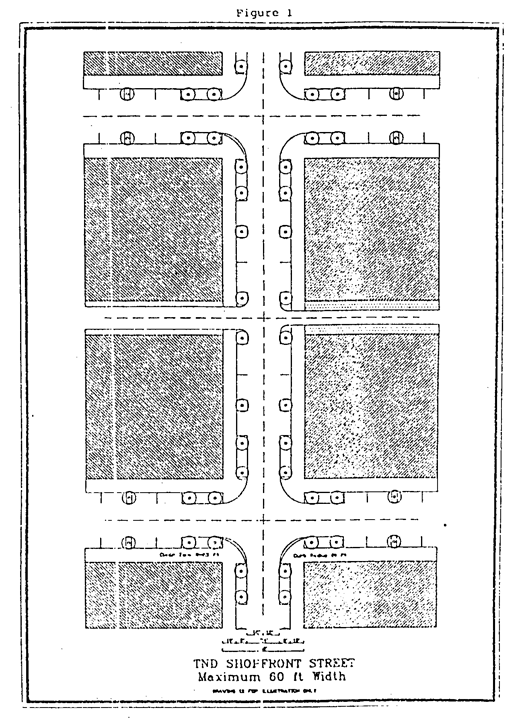
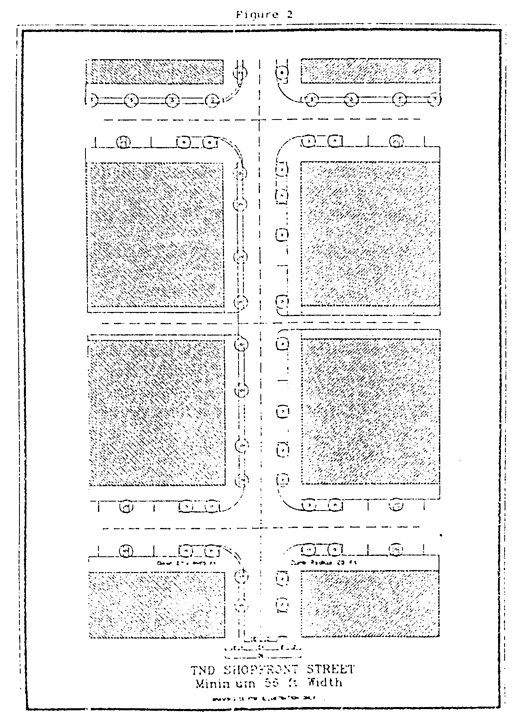
b.
Posted vehicle speed for shopfront use streets shall not exceed 25 miles per hour.
c.
At intersections the curb radius shall be 20 feet, with a clear zone radius of 25 feet. Parking lanes shall not be closer than 30 feet to the nearest intersecting building lot line.
d.
Shopfront use lots may front on through streets or on a town center, if approved by the Town Council.
e.
Signs in colonnades shall have a minimum clearance of nine feet above the sidewalk.
f.
Shopfront use lots shall have their rear lot lines coinciding with an alley 24 feet wide, containing a vehicular pavement width of at least nine feet one-way, and a maximum of 18 feet two-way.
(5)
Parking.
a.
No less than 75 percent of the parking spaces shall be to the rear of the building. Access may be through the frontage only if an alley or side street providing access to the alley is not within 200 linear feet of the lot.
(6)
Signage.
a.
All signs shall be wall signs or cantilever signs and shall not exceed a total of 24 square feet per building with no more than three signs. Individual cantilever signs shall be mounted perpendicular to the building face and shall not exceed eight square feet. No sign shall be mounted above the first floor of the structure.
(d)
Rowhouse use.
(1)
Land use.
a.
Land designated for rowhouse use shall be on lots containing buildings for residential uses including townhouse, apartment, limited office as permitted in the RU-5A Zoning District, limited lodging, congregate living facilities, family day care pursuant to this chapter, and artisanal. Where nonresidential uses are proposed, at least 50 percent of the gross square footage shall be restricted to residential use as demonstrated by the submittal of floor plans identifying the use of each room.
b.
One hundred percent of the building area above the ground floor shall be designated for residential use.
c.
An outbuilding is permitted on each lot.
(2)
Land allocation.
a.
Rowhouse use building lots shall constitute a minimum of 20 percent and a maximum of 50 percent of the gross area of the neighborhood proper.
b.
A maximum of five rowhouse use lots may be consolidated for the purpose of constructing a single building containing multifamily dwellings.
c.
A maximum of 50 percent of all rowhouse use lots may be consolidated.
(3)
Lots and buildings.
a.
Rowhouse use lots shall have a maximum width of 32 feet.
b.
Rowhouse use buildings with the minimum setback shall have their front entry set to one side of the facade. This is to preserve the possibility of retro-fitting a ramp for wheelchair access.
c.
Rowhouse use buildings shall be attached (built with no side setback or as a single building) at not less than five-unit segments. Lots comprising the end of the block adjacent to the street or alley or along street curves may be attached in segments of two to five units.
d.
All units must comply with Americans with Disabilities Act 42 U.S.C. § 12101 et seq., requirements regarding handicapped access.
e.
Buildings on rowhouse use lots shall be setback six or 15 feet from the frontage line. Buildings at street intersections shall be set back six feet from frontage line and side street line. Setback requirements shall apply to the enclosed portion of the buildings only.
f.
Buildings on rowhouse use lots shall have a setback of zero feet from at least one side property line. There shall be no required rear setback.
g.
Outbuildings shall have no required setbacks.
h.
Setbacks on consolidated rowhouse use lots shall apply as in a single lot.
i.
Buildings on rowhouse use lots shall cover no more than 50 percent of the building lot area. Outbuildings shall not count against lot coverage.
j.
Buildings on rowhouse use lots shall not exceed 35 feet in height (excluding chimneys and elevator towers) and a cornice line shall be used to define the first floor.
k.
Buildings on rowhouse use lots shall have a first floor front elevation 18 inches above finished sidewalk grade.
l.
A minimum of 30 percent of the building lot area shall be developed as private open space.
m.
Rowhouse use lots shall have a streetedge built along the unbuilt parts of the frontage line.
n.
A minimum of 25 percent of the buildings on rowhouse use lots shall have front porches. Said front porches may encroach into the front setback and shall not count against lot coverage requirements but shall count towards private open space requirements.
(4)
Streets and alleys.
a.
Rowhouse use lots shall front on streets consisting of a 50-foot maximum width, including two ten-foot wide travel lanes and an eight-foot wide parallel parking lane on at least one side. If the parking lane is provided on only one side there shall be a planting strip, at least five feet wide, provided between the opposite sidewalk and travel lane. two sidewalks are required and shall be no less than six feet wide. (As an example, refer to Figures 3 and 4). Rowhouse use lots may also front on squares or park tracts.
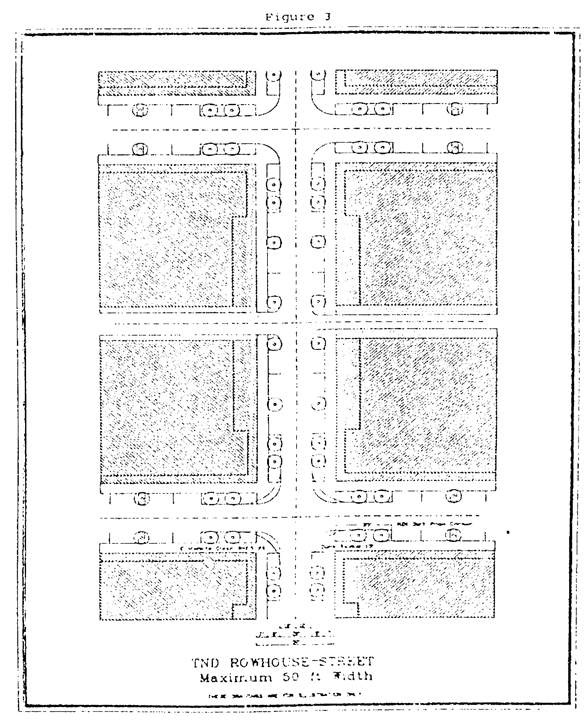
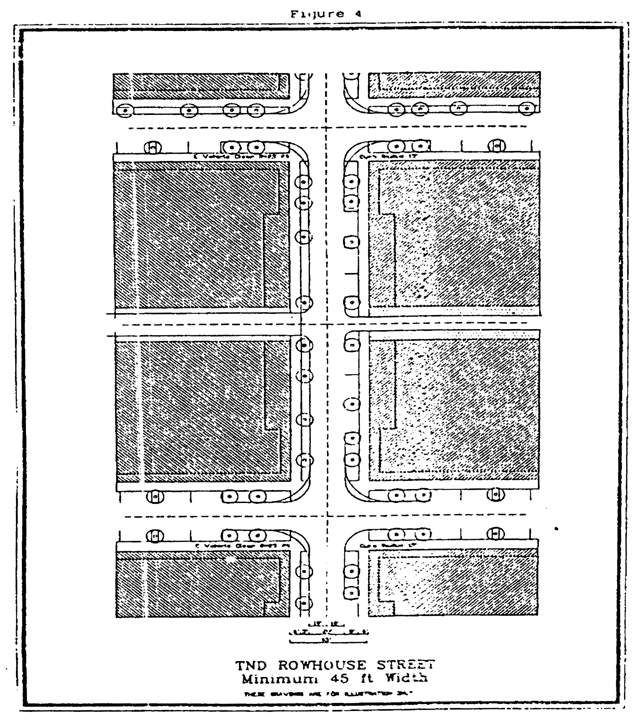
b.
Posted vehicle speed for rowhouse use streets shall not exceed 20 miles per hour.
c.
At intersections, the curb radius shall be 15 feet with a clear zone radius of 25 feet. Parking lanes shall not be closer than 25 feet from the lot line adjoining intersecting streets.
d.
Rowhouse use lots shall have their rear lot lines coinciding with an alley 24 feet wide containing a vehicular pavement width of at least ten feet one-way and 16 feet two-way.
(5)
Parking. All off-street parking places shall be to the rear of the building. Access shall be through a vehicular alley only.
(6)
Signage. All signs shall be wall signs and limited to two signs and shall not exceed a cumulative total of four square feet. No signs shall be mounted above the first floor of a structure.
(e)
House use.
(1)
Land use.
a.
Land designated for house use shall be on lots containing buildings for residential uses including single-family houses, guest houses as outbuildings, home occupation, family day care pursuant to this chapter.
b.
One hundred percent of the building area above the ground floor shall be designated for residential use.
c.
An outbuilding is permitted on each lot.
(2)
Land allocation.
a.
House use building lots shall constitute a maximum of 30 percent of the gross area of the neighborhood proper.
b.
A maximum of two house use lots may be consolidated for the purpose of constructing a single residence.
c.
A maximum of 50 percent of all house use lots may be consolidated.
(3)
Lots and buildings.
a.
Houses on house use lots shall be raised a minimum of 18 inches from finished exterior sidewalk grade.
b.
All units must comply with Americans with Disabilities Act, 42 U.S.C. § 12101 et seq., requirements regarding handicapped access.
c.
Buildings on house use lots shall be set back ten or 20 feet from the frontage line. Buildings at street intersections shall be set back ten feet from the frontage line and the side street frontage.
d.
House use building lots shall have a minimum width of 36 feet and a maximum width of 75 feet with a minimum average lot size of 5,000 square feet.
e.
Setbacks on consolidated house use lots shall apply as on a single lot.
f.
Buildings on house use lots shall be set back from the side building lot lines equivalent (in total) to no less than 20 percent of the width of the building lot. The entire setback may be allocated to one side. If buildings have a zero-foot setback on one side a four-foot maintenance easement shall be provided on the adjacent lot.
g.
Buildings on house use lots shall be set back no less than 20 feet from the rear lot line. Outbuildings on house use lots shall have a setback no less than five feet from the rear lot line except on an alley where it shall have a zero-foot setback. Side setbacks for outbuildings shall be the same as for the primary building on the lot.
h.
Buildings on house use lots shall cover no more than 40 percent of the building lot area. Outbuildings and front porches do not count in lot coverage.
i.
Buildings on house use lots shall not exceed 24 feet in height (excluding chimneys).
j.
Buildings on house use lots shall have a streetedge built along the frontage line.
k.
A minimum of 25 percent of the buildings on house use lots shall have front porches which may encroach into the front setback and shall not count in lot coverage but shall count towards private open space requirements.
(4)
Streets and alleys.
a.
House use lots shall front on streets of a 46-foot maximum width consisting of two ten-foot travel lanes, two planting strips of at least six feet wide each, and two sidewalks which shall be no less than five feet wide. A parallel parking lane eight feet wide may be used in place of either planting strip. (As an example, refer to Figures 5 and 6.)
b.
Posted vehicle speed for house use streets shall not exceed 20 miles per hour.
c.
At intersections, the curb radius shall be 15 feet with a clear zone radius of 25 feet. Parking lanes shall not be closer than 25 feet from the lot line adjoining intersecting streets.
d.
House use lots shall have their rear lot lines coinciding with an alley 24 feet wide containing a pavement width of at least ten feet one-way and 16 feet two-way, except where the rear lot adjoins a greenbelt.
(5)
Parking.
a.
All off-street parking places shall be to the side or the rear of the building. Where no alley access exists and vehicular access is through the frontage, garage or carports shall be located a minimum of 20 feet behind the front building setback.
(6)
Signage.
a.
One wall, or streetedge mounted, sign not to exceed one square foot shall be permitted.
(f)
Workshop use.
(1)
Land use.
a.
Land designated for workshop use shall be in land containing buildings for the following uses:
1.
Artists studios and accessory gallery use.
2.
Artisanal use.
3.
Automobile body shops.
4.
Automobile parking garages.
5.
Automobile service and repairs.
6.
Bait and tackle shops.
7.
Bakeries (wholesale).
8.
Banks excluding drive-in teller services.
9.
Bottling of beverages.
10.
Cabinet shops.
11.
Cold storage warehouse.
12.
Dance studios.
13.
Dog and pet hospitals in air conditioned buildings.
14.
Dry cleaning and dyeing establishments.
15.
Engines, sales and services.
16.
Gasoline service stations.
17.
Glass installation.
18.
Health and exercise clubs.
19.
Interior design shops.
20.
Leather goods manufacturing, excluding tanning.
21.
Locksmith shops, sharpening and grinding shops.
22.
Lumber yards.
23.
Mail order offices and storage.
24.
Office buildings.
25.
Photography labs.
26.
Pottery shops.
27.
Printing shops.
28.
Restaurants excluding drive-in service.
29.
Secondhand stores.
30.
Upholstery and furniture shops.
31.
Wholesale salesroom and storage rooms.
(2)
Land allocation.
a.
Workshop use building lots shall constitute a minimum of three percent and a maximum of seven percent of the gross area of the neighborhood proper.
b.
Workshop use lots shall not be within 300 feet of the geometric center of the neighborhood proper or the mandatory square. When a TND borders land designated in the CDMP as agriculture or open land, then workshop use lots shall not be permitted within 330 feet of said TND boundary except if necessary to maintain consistency with the goals, objectives and policies of the Comprehensive Plan.
c.
All workshop use lots shall be located within one geographic area with no intervening uses.
(3)
Lots and buildings.
a.
Buildings on workshop use lots shall have a setback of zero or five feet from the frontage line. The setback at street intersections shall not exceed five feet from the frontage line and the side street line.
b.
Street-front entries shall be at grade to allow handicap access.
c.
Buildings on workshop use lots shall cover no more than 50 percent of the building lot area.
d.
A minimum of 15 percent of the building lot area shall be developed as landscaped open space.
e.
Buildings on workshop use lots shall not exceed 35 feet in height.
f.
Workshop use lots shall be separated from other use types at the side and rear lot lines (excepting an entry on the alley) by a continuous masonry wall no less than six feet and no more than eight feet in height.
g.
Workshop use building lots shall have a maximum width of 300 feet.
(4)
Streets and alleys.
a.
Workshop use lots shall front on streets of a 60 feet maximum width consisting of two 12-foot wide travel lanes, and eight-foot wide parallel parking on at least one side of the road. If the parking lane is provided on only one side there shall be a planting strip of at least eight feet wide between the opposite lane and the sidewalk. Sidewalks shall be no less than eight feet wide and are required on both sides of the street.
b.
Posted vehicle speed for workshop use streets shall not exceed 25 miles per hour.
c.
At intersections the curb radius shall be 20 feet, with a clear zone radius of 25 feet. Parking lanes shall not be closer than 25 feet to the nearest intersecting building lot line.
d.
Workshop use lots may front on through streets if approved by the Town Council at the time of submission.
e.
Workshop use lots shall have their rear lot lines adjacent to an alley 24 feet wide containing a vehicular pavement width of at least ten feet one-way and 18 feet two-way, except where the rear lot line adjoins a greenbelt.
(5)
Parking. Off-street parking places may be to the side or the rear of the building.
(6)
Signage. All signs shall be wall-mounted perpendicular to the building face with an eight-foot clearance to the sidewalk and shall not exceed a total of 24 square feet and shall be limited to three signs.
(Ord. No. 13-155, § 2(Exh. A), 3-12-2013)
Sec. 13-827. - Limitation on variances.
The following provisions of the TND ordinance shall not be varied:
(a)
The requirement for the use of alleys.
(b)
Curb requirements.
(c)
Front porch requirements.
(d)
Location of on-site parking.
(e)
Colonnades.
(f)
Rowhouse and house use with first floor of 18 inches above finished grade.
(g)
Average block perimeter.
(h)
Public/semi-public use and civic use land allocation requirements.
(i)
Minimum land allocation requirements.
(j)
Street width requirements.
(k)
Maximum and minimum setback requirements.
(Ord. No. 13-155, § 2(Exh. A), 3-12-2013)
Sec. 13-828. - Ownership and maintenance of common open space(s) and civic use buildings.
All land designated on approved plans as common open space, including squares and parks, and all structures devoted to the common use of the inhabitants of a TND will be owned and/or maintained as follows:
(a)
Those projects developed under a condominium ownership shall be in accordance with applicable Florida law, or
(b)
The common open space and civic uses shall be maintained under a special taxing improvement district as approved by the Town Council, or
(c)
The common open space and civic uses shall be owned by a property homeowners' association in which case the ownership shall be subject to covenants providing for the maintenance of common facilities in a manner that assures its continuing use for its intended purpose and provided that a homeowners' association shall comply with the following requirements:
(1)
Approval for form and legal sufficiency as to compliance with the ordinance by the Town Attorney's Office.
(2)
A homeowners' association shall be established before the units or individual building lots are sold.
(3)
Membership shall be mandatory for each property owner and said association shall have the authority to adjust the assessment to meet the needs of maintaining the open space and common facilities.
(4)
Any sums levied by the homeowners' association that remain unpaid, shall become a lien on the individual property and said lien shall be superior to all other liens save and except tax liens and mortgage liens, provided said mortgage liens are first liens against the property encumbered thereby, subject only to tax liens and secure indebtedness which are amortized in monthly or quarter annual payments over a period of not less than ten years.
(Ord. No. 13-155, § 2(Exh. A), 3-12-2013)
Sec. 13-842.- Uses permitted.
The Town Council may establish the uses listed in this division without regard to the zoning or use classification of any particular site or location of any governmental facility on any lands leased or owned by a governmental entity within the Town's jurisdiction. The procedure to establish such facilities as provided in this division shall be exclusive to the Town.
(1)
Public parks, playgrounds and buildings, and structures supplementary and incidental to such uses;
(2)
Fire stations;
(3)
Police stations;
(4)
Public auto inspection stations;
(5)
Public water and sewer treatment and distribution facilities;
(6)
Public libraries;
(7)
Public buildings and centers;
(8)
Public hospitals, nursing homes and health facilities;
(9)
Public auditoriums, arenas, museums, art galleries;
(10)
Maximum and minimum detention facilities;
(11)
Solid waste collection and disposal facilities;
(12)
Public maintenance and equipment yards;
(13)
Public bus stations and rapid transit stations and facilities;
(14)
Public airports and heliports;
(15)
Utilities, including telecommunication facilities;
(16)
Equipment yards, plant nurseries;
(17)
And other similar governmental uses or other facilities which serve the general health and welfare of the public.
(Ord. No. 13-155, § 2(Exh. A), 3-12-2013; Ord. No. 18-220, § 2, 2-26-2018)
Sec. 13-843. - Exclusive site plan review procedure.
The site plan procedures in this division shall be exclusive to the Town as further provided below:
(1)
Public hearing and notice required. The Town Council may only authorize the erection, construction and operation of the governmental facilities enumerated in this division by resolution following public hearing. The said public hearing shall be held upon at least 15 days' notice of the time and place of such hearing published in a newspaper of general circulation in the Town, or by any other method provided by Florida Law, as may be amended from time to time, which publication shall include the time and place of hearing before the Town Council. A courtesy notice containing general information as to the date, time, and place of the hearing, the property location and general nature of the application may be mailed to the property owners of record, within a radius of 300 feet of the property described in the application, or such greater distance as the Director may prescribe; provided, however, that failure to mail or receive such courtesy notice shall not affect any action or proceeding taken hereunder. To provide additional notice to the public, the property shall be posted by a sign or signs indicating the action desired and the time and place of the public hearing thereon. Failure to post such property shall not affect any action taken hereunder. At the public hearing the Town Council shall consider, among other factors, the type of function involved, the public need therefor, the existing land use pattern in the area, alternative locations for the facility and the nature of the impact of the facility on the surrounding property. After considering these said factors, the Town Council shall take such action as is necessary to provide for and protect the public health, safety and welfare of the citizens and residents of the Town of Miami Lakes.
(2)
[Signs.] In the event the Town Council authorizes the construction, erection, use or operation of a governmental facility in accordance with the procedures delineated above, or in the event the Council otherwise determines that property should be utilized by the Town for a particular public purpose, the property shall be posted by a sign or signs conspicuously located thereon indicating the governmental facility or use authorized for the property. Such sign or signs may be removed upon the commencement of construction. The Town Manager or designee shall periodically check the property to ensure that the signs provided for in this subsection remain in existence and accurately depict the proposed use of the subject property. This subsection shall be construed as directory only and failure to comply with the provisions hereof shall not affect the validity of the Town Council's action authorizing the use of the property for the designated purposes.
(3)
Notice exemption. Any facility which is designated as or intended to be operated as a domestic violence center at the time of consideration, planning, erection, construction or acquisition, shall be exempt from the notice and public hearing provisions set forth in subsection (2).
(4)
Minor site plan amendments. The Administrative Official, upon a determination that a requested site plan change of a previously approved governmental facility is minor, shall have the authority to review and approve, approve with modifications and/or conditions or deny the minor change or amendment, providing the amended site plan complies with the following:
a.
Is compliant with the minimum requirements of this Code;
b.
Does not increase the intensity of the project;
c.
Does not violate any conditions of the original approval;
d.
Does not increase the floor area of the project;
e.
Is compliant with concurrency requirements; and
f.
Satisfactorily addresses land use compatibility, buffering, screening, and landscaping.
(5)
Deferral. A council member may request a deferral of consideration of any item relating to the construction, erection, use or operation of a governmental facility for up to 30 days the first time the item appears on a council agenda or the first time the item is raised at a Town Council meeting if the proposed construction, erection, use or operation of the governmental facility affects that council member's district exclusively or primarily. Upon the council member's invoking this right, discussion upon that item shall cease and the council shall move to another item of business.
(6)
Issuance of permits upon appeal. Notwithstanding any contrary provisions of this division, during an appeal of a development order for a government facility approved pursuant to this section, zoning approvals relating to that development order being appealed shall be issued upon the request of the applying government, providing that:
a.
The applying government indicates in writing that it will conform as necessary to any subsequent changes mandated as a result of the appellate process by the court or by the Town Council; and
b.
That other applicable requirements of law are met.
(Ord. No. 18-220, § 2, 2-26-2018; Ord. No. 24-320, § 2(Exh. A), 3-12-2024)
Editor's note— Ord. No. 18-220, § 2, adopted February 26, 2018, repealed § 13-843 in its entirety, and enacted a new § 13-843, to read as set out herein. Former § 13-843 pertained to "Designation of property," and was derived from Ord. No. 13-155, § 2(Exh. A), adopted March 12, 2013.
Sec. 13-844. - Reserved.
Editor's note— Ord. No. 18-220, § 2, adopted February 26, 2018, repealed § 13-844 in its entirety. Former § 13-844 pertained to "Exclusive procedure," and was derived from Ord. No. 13-155, § 2(Exh. A), March 12, 2013.
Sec. 13-856.- Boundary.
The boundary of the GU Interim District shall be the entire area of the Town, excepting the area specifically covered by another district.
(Ord. No. 13-155, § 2(Exh. A), 3-12-2013)
Sec. 13-857. - Standard for determining regulations to be applied.
(a)
If a neighborhood in GU District is predominantly one classification of usage, the Director shall be governed by regulations for that class of usage in determining the standard zoning regulations to be applied, including setbacks, yard areas, type of structures, height, limitations, use, etc. For the purposes of this section, "trend of development" shall mean the use or uses which predominate in adjoining properties which because of their geographic proximity to the subject parcel make for a compatible use. The Director shall be guided in determining what constitutes a neighborhood by limiting his evaluation to separate geographic areas which may be designated by natural boundaries (rivers, canals, etc.) and/or man-made boundaries (roads, full- and half-section lines, etc.). The Director's decision shall be subject to appeal pursuant to the provisions of Section 13-310 of the Code.
(b)
If no trend of development has been established in the neighborhood, the following minimum standards shall apply:
(1)
Front setback: 50 feet for single-family residence; 85 feet for all others.
(2)
Rear setback: 25 feet.
(3)
Side street setback: 25 feet.
(4)
Interior side setback: 15 feet.
(5)
Minimum lot width: 200 feet.
(6)
Minimum lot area: 5 acres, including dedicated rights-of-way.
(7)
Maximum lot coverage (principal structure): 15 percent.
(8)
Minimum building size: 17,500 cubic feet.
(Ord. No. 13-155, § 2(Exh. A), 3-12-2013)
Sec. 13-858. - Reserved.
Editor's note— Ord. No. 18-233, § 3(Exh. A), adopted Oct. 16, 2018, repealed § 13-858, which pertained to group homes and derived from Ord. No. 15-155, § 2(Exh. A), adopted March 12, 2013.
Sec. 13-859. - New district classifications.
Subdivisions in GU Districts shall be governed by the provisions of Section 13-308. Where applications for building permits indicate the need for reclassification of an area in GU District, the Director may initiate an application for a change of zoning.
(Ord. No. 13-155, § 2(Exh. A), 3-12-2013)
Sec. 13-860. - Public hearing on refusal to issue permit.
Whenever a permit to construct, alter, move or use a building or premises in a GU District is refused because the proposed use would conflict with regulations contained herein, the person desiring a permit may apply for a public hearing.
(Ord. No. 13-155, § 2(Exh. A), 3-12-2013)
Sec. 13-861. - Cemeteries, mausoleums and crematories.
No premises shall be used or occupied for the purpose of a cemetery, mausoleum or crematory, in any district established by this chapter, excepting in GU District, and then only upon approval after public hearing.
No land for which a plat has not been recorded shall be used for any burials. The dead shall not be buried or placed closer than 50 feet to any highway right-of-way which is 70 feet or more in width nor closer than 25 feet to any highway, the right-of-way width of which is less than 70 feet nor closer than 25 feet to any other property line.
(Ord. No. 13-155, § 2(Exh. A), 3-12-2013)
Sec. 13-862.- Purpose and intent.
It is the purpose and intent of this division to implement the provisions of the Town Center Mixed-Use (TCMU) future land use category of the Town of Miami Lakes Comprehensive Plan, and to facilitate the creation of a vibrant, mixed-use town center that provides a high quality environment for its residents, workers and visitors, and serves as the center of economic and civic life in Miami Lakes. It is explicitly the intent of this division that the TC District shall function as a whole, where activities interact within the District and contribute to the vitality of the Town Center, and are not isolated as to their individual parcels. The provisions of this division apply to the TC Town Center District.
(Ord. No. 15-184, § 3, 9-1-2015)
Sec. 13-863. - Uses permitted.
No land, body of water and/or structure shall be used or permitted to be used, and no structure shall be hereafter erected, constructed, reconstructed, moved, occupied or maintained for any purpose in any TC District except for one or more of the uses permitted by the Master List of Business, Commercial and Industrial Uses as set forth in Division 20.
(Ord. No. 15-184, § 3, 9-1-2015)
Sec. 13-864. - Conflicts with other regulations.
Where the provisions of this division conflict with other provisions of the Town Code or other regulations or standards, including but not limited to zoning, subdivision, landscaping and public works rules, regulations or standards, the provisions of this division shall control to the extent of such conflict. However, this shall not be construed to mean that a provision of this Division authorizing a land use or improvement would necessarily supersede a law or regulation of another agency which lawfully prohibits the same land use or improvement.
(Ord. No. 15-184, § 3, 9-1-2015)
Sec. 13-865. - Street types—Establishment and hierarchy.
There is hereby established a hierarchy of street types in the TC District, numbered "1" through "3". The table below establishes the street type of each existing street segment in the Town Center area. A "1" street type shall be considered the highest street type in the hierarchy, a "2" street type shall be considered next highest, and so on. Assignment of a street type to any new street segments, including both public and private streets, shall be reserved to the Town Council after a public hearing. These street types shall be shown on all site plan or other development plans submitted to the Town for approval.
(Ord. No. 15-184, § 3, 9-1-2015)
Sec. 13-866. - Building orientation and frontage determination.
(a)
Buildings shall be oriented to the lot. The primary building entrance shall face the front lot line, except in the following scenarios:
(1)
In cases of a corner lot, the primary entrance may be directly on the corner, where such a placement is found to meet the site plan review standards in Section 13-881.
(2)
Where the front lot line abuts a Type 3 street and accessory parking is placed to the side of the building, the primary entrance may face said accessory parking. However, in such case, the building façade facing the front lot line shall be designed to be architecturally equal in importance to the façade where the primary entrance is located, and shall include a secondary entrance facing the front of the lot, if feasible.
(b)
On a corner lot, the front lot line shall be that which runs along the higher street type in the street hierarchy. Where the street types along a corner lot are the same, the Administrative Official, in consultation with the applicant for development approval, shall determine the front of the lot based upon principles of good urban design and ensuring pedestrian safety, comfort and convenience. Rear and side lot lines shall then be determined based on other provisions of this chapter.
(Ord. No. 15-184, § 3, 9-1-2015)
Sec. 13-867. - Required building setbacks.
The following table shows the minimum and maximum setbacks for buildings according to the street type on which the lot fronts.
(1)
Maximum front and side street setbacks shall be determined by averaging the setback of the building from the adjacent right-of-way line at points every three feet along the building face. Measurements shall be taken from the base of the building, except that projecting balconies on the second and third floors may be included, but shall constitute no more than one-half of the setback measurement points along the building.
(2)
The required maximum front setbacks for all street types shall not apply if a property owner chooses to include a plaza and/or courtyard between the front lot line and building. In such case, the maximum front setback shall be increased to 50 feet, and the requirements of Section 13-878(e) shall be met. However, where this option is chosen, in no case shall vehicular parking be placed between the front lot line and the building, nor shall off-street vehicular parking be placed in any location adjacent to the plaza/courtyard.
(3)
The required maximum front setbacks shown here for Type 2 streets shall not apply if a property owner chooses to place vehicular parking between the front lot line and the building. However, in that case, the property owner shall be subject to the requirements of Section 13-875(g). When this option is chosen, there may be placed a maximum of two rows of parking, a drive aisle, a walkway parallel with and directly in front of the building up to five feet wide and those items required to comply with Section 13-875(g). The distance required for these items added together shall then constitute the required front setback.
(4)
At streets where an existing easement prevents construction of buildings within the easement, the maximum average front and side street setbacks along the relevant street may be increased as necessary up to a maximum setback of 20 feet.
(Ord. No. 15-184, § 3, 9-1-2015)
Sec. 13-868. - Projections into required setbacks and adjacent rights-of-way.
(a)
Entrance steps, stoops (including covered stoops), window and door awnings and decorative architectural features may project an unlimited distance into required setbacks, and may project up to two feet into the public right-of-way, subject to the restrictions in subsection (c). Additionally, on upper floors, balconies may project an unlimited distance into required setbacks, and may project up to five feet into the public right-of-way. Provided, however, that any elements projecting into required setbacks or the public right-of-way must be approved through the site plan review process, and found to be consistent with the criteria in Section 13-881. Additionally, any elements projecting into the public right-of-way shall be subject to subsection (c).
(b)
Ground floor colonnades or arcades may project an unlimited distance into required front setbacks, and a sufficient distance into the public right-of-way to cover the portion of a sidewalk to within two feet of the edge of the sidewalk nearest to the roadway; provided, however, that any colonnade or arcade projecting into required setbacks or the public right-of-way must be approved through the site plan review process, and found to be consistent with the criteria in Section 13-881. Additionally, any elements projecting into the public right-of-way shall be subject to subsection (c).
(c)
Any projections into the public right-of-way are subject to approval by the Public Works Department or other department with appropriate responsibility for public rights-of-way, whose decisions shall be based upon public safety, compliance with the Americans with Disabilities Act and other provisions to ensure handicapped accessibility, sufficient vertical clear distance for proper functioning of the right-of-way and needs for the current or future provision of public infrastructure and services utilizing the public right-of-way. Where another governmental entity also has jurisdiction over the public right-of-way in question, the approval of that governmental entity must also be obtained. Any permit issued for projections into the public right-of-way shall be revocable, and removal of said projecting elements shall be required if and when said permit is revoked.
(Ord. No. 15-184, § 3, 9-1-2015)
Sec. 13-869. - Accessory buildings and accessory structures.
Accessory buildings and accessory structures shall not be permitted in the front or street side setbacks, and shall be at least five feet from rear and interior side property lines. However, the Administrative Official may adjust this five feet setback requirement from rear and side property lines through the site plan review process, where it is found that a smaller setback is required to shield or house an existing utility structure or facility. The maximum height of accessory buildings and accessory structures shall be one story, but in no case shall exceed 20 feet.
(Ord. No. 15-184, § 3, 9-1-2015)
Sec. 13-870. - Building height.
The maximum height of buildings shall not exceed five stories, except where a building includes vertically integrated mixed uses, in which case, subject to Town Council review and approval, the maximum height shall not exceed seven stories. However, where a building includes frontage on a Type 1 Street, the ground floor must be occupied with active uses, as defined in this Code, in order to qualify for height above five stories. Height may be limited by the Opa-Locka Airport Zoning Ordinance of Miami-Dade County.
(Ord. No. 15-184, § 3, 9-1-2015; Ord. No. 17-215, § 3, 11-7-2017)
Sec. 13-871. - Lot coverage and maximum impervious area.
The maximum lot coverage of all buildings shall be 70 percent. The maximum impervious area on a site shall be 85 percent.
(Ord. No. 15-184, § 3, 9-1-2015)
Sec. 13-872. - Densities and intensities of use.
(a)
Residential density shall be limited to a maximum of 42.5 dwellings units per acre, except as provided for in Section 13-873.
(b)
Non-residential building square footage shall be limited to a maximum of 1.06 times the square footage of the lot, except as provided for in Section 13-873. However, parking structures, or the portions of buildings dedicated as a parking structure, shall not be included in this maximum building square footage.
(c)
The density and intensity limitations of subsections (a) and (b), are intended to be cumulative, and a lot may include both residential and non-residential uses up to the maximums set forth above.
(Ord. No. 15-184, § 3, 9-1-2015)
Sec. 13-873. - Development rights transferrable.
Development rights as determined by Section 13-872, shall be transferable between properties in the TC District, including unused development potential on developed properties. In order to utilize this provision, a covenant running with the land, in a form acceptable to the Administrative Official and the Town Attorney, encumbering both the property to which development potential is being transferred, and the property from which development potential is being transferred, shall be recorded among the public records. If allowable development potential is changed at a future date by regulatory action, the development potential of properties that have been subject to a transfer shall nevertheless continue to be diminished, or enhanced, as applicable, by the number of dwelling units and non-residential square feet transferred to or from said properties. The Town shall keep a record of such transfers. Transfers of development potential shall not relieve the obligation for all development actually constructed to meet any and all permitting, concurrency, infrastructure, public facilities and similar requirements, nor shall it relieve any property of maximum heights or other development requirements.
(Ord. No. 15-184, § 3, 9-1-2015)
Sec. 13-874. - Architectural standards.
(a)
The buildings on each lot shall form a minimum percentage of frontage on each adjacent street, within the maximum setback from said street, according to the street types as set forth below:
(1)
Street type 1: 60 percent.
(2)
Street type 2: 50 percent.
(3)
Street type 3: 40 percent.
However, no continuous portion of a lot's street frontage on a Type 1 street greater than 25 percent of such total frontage on that street shall be without a building within the maximum setback from said street.
(b)
Minimum glazing requirements shall be as follows:
(1)
Non-residential building surfaces facing a Type 1 or Type 2 street, and non-residential uses facing a Type 3 street, shall be a minimum of 30 percent glazed on the ground floor. All glazing required by this subsection shall be of a type that permits view of activities and spaces within. The bottom edge of glazed areas required by this subsection shall be no greater than 36 inches above the finished grade.
(2)
Residential building surfaces facing any street, including each residential floor or portion thereof of a mixed-use building, shall be a minimum of 25 percent glazed.
(c)
In order to ensure flexibility in future use and occupancy, the ground floor of any new multifamily residential building fronting on a Type 1 Street, regardless of its intended or initial use and/or occupancy, shall be designed and constructed with a minimum slab-to- ceiling height of ten feet, six inches, and the slab shall be non-structural, such that it can be modified in the future to accommodate commercial uses/occupancies.
(Ord. No. 15-184, § 3, 9-1-2015)
Sec. 13-875. - Parking and loading.
(a)
All development within the TC District shall comply with the parking provisions found in Sections 13-1801 and 13-1802 and elsewhere in this land development code, except as specifically modified in this section.
(b)
No off-street vehicular parking spaces shall be placed between a front lot line and the building, except as specifically allowed with regard to Type 2 streets pursuant to Section 13-867.
(c)
Off-street vehicular surface parking lots (not including parking structures) are expressly forbidden in the TC District, except where they are accessory to a legally established use or uses on the same parcel, or in connection with a use or uses on another parcel, as allowed by subsection (h).
(d)
All off-street loading areas shall be completely screened from view of streets and any RU zoned areas, by a wall of the same color and material as the principal building.
(e)
On-street loading shall only be allowed upon approval of a minor conditional use, which shall require submittal and approval of an operational plan demonstrating how the on-street loading will avoid unreasonable disruption of vehicular, pedestrian and bicycle traffic, and other common uses of public or private streets.
(f)
Off-street vehicular parking may be placed within the required setback from a Type 3 street, provided that the building frontage requirements of Section 13-874(a) have been satisfied, and the following requirements are complied with:
(1)
The off-street vehicular parking shall be placed at least seven feet from the property line abutting the Type 3 street.
(2)
A masonry wall with a minimum height of two feet, six inches and a maximum height of five feet, or a decorative open picket fence with a minimum height of three feet, six inches and a maximum height of five feet, six inches, shall be placed between the Type 3 street and the off-street vehicular parking. The fence or wall shall be set back a minimum of two feet and a maximum of six feet from the property line, or from the back of a street utility easement where applicable, along the Type 3 street.
(3)
A hedge shall be placed immediately adjacent to the wall or fence required by subsection (f)(2), on the street side of the wall or fence.
(4)
Shade trees shall be placed between the wall or fence required by subsection (f)(2) and the property line abutting the Type 3 street or between the wall or fence and the parking spaces, at a maximum spacing of 20 feet on-center along the Type 3 street, for the entire length that off-street vehicular parking is in the required front setback from the Type 3 street.
(5)
Where a fence and/or hedge is utilized along a Type 3 street pursuant to this subsection, pedestrian access points shall be provided at intervals no greater than 200 linear feet along the street edge. More frequent pedestrian access points may be permitted through the site plan review process at the discretion of the Administrative Official.
(g)
If off-street vehicular parking is placed in the front or side street setback between a Type 2 street and a building, as provided for in Section 13-867, then all of the following shall also apply:
(1)
The sidewalk along the street must be at least eight feet wide. If necessary, the property owner shall dedicate sufficient right-of-way and extend the sidewalk such that it is at least eight feet wide, in accordance with Section 13-877(b).
(2)
No more than five feet from the back of the sidewalk along the Type 2 street, the property owner shall construct a masonry wall of a minimum of three feet and a maximum of four and one-half feet in height and a minimum of 8 inches in width for. Gaps in this wall shall only be allowed for vehicular or pedestrian access to the site, as permitted, and for the placement of bicycle parking or amenities. Where the property use is non-residential or mixed-use, pedestrian access points shall be provided at intervals no greater than 200 linear feet along the street edge. More frequent pedestrian access points may be permitted through the site plan review process at the discretion of the Administrative Official.
(3)
Between the off-street vehicular parking and the wall described in subsection (d)(2), a hedge shall be provided and maintained at a height of no less than four feet, and no greater than as otherwise provided in the Town Code. Gaps in this hedge shall only be allowed for vehicular or pedestrian access to the site, as permitted, and for the placement of bicycle parking or amenities. Where the property use is non-residential or mixed-use, pedestrian access points shall be provided at intervals no greater than 200 linear feet along the street edge. More frequent pedestrian access points may be permitted through the site plan review process at the discretion of the Administrative Official.
(h)
Where a site in the TC District is adjacent to a greenway per the adopted Greenways and Trails Master Plan, required vehicular parking may be replaced by bicycle parking at the rate of five bicycle parking places to each required vehicular space. Required vehicular parking may be reduced by up to 20 percent by this method. Such bicycle parking spaces shall be in addition to those otherwise required by Article VIII, and shall be placed so as to be accessible to the designated greenway.
(i)
Surplus vehicular parking on any property in the TC District (parking in excess of that required by this chapter) may be utilized to meet all or a portion of the required vehicular parking on another property or properties in the TC District. When this option is utilized, a covenant running with the land encumbering all properties involved, and in a form acceptable to the Administrative Official and the Town Attorney, shall be recorded among the public records. The burden shall be on the property owner and/or applicant to demonstrate compliance with minimum parking requirements, and to produce any documentation as necessary.
(j)
The use of shared parking — the reduction in the number of required parking spaces based on time of day variation by different types of land uses — may be approved, either for one site or between two or more sites, through the site plan approval process. In order for a shared parking arrangement to be approved, the Applicant must submit appropriate data and analysis, utilizing professionally acceptable methodologies, establishing reasonably expected levels of parking utilization by types of land uses at different times of the day. When this option is utilized involving two or more properties, a covenant running with the land encumbering all properties involved, and in a form acceptable to the Administrative Official and the Town Attorney, shall be recorded among the public records.
(k)
Where a building on a Type 1 Street includes active uses on the ground floor directly fronting the Type 1 Street, the required vehicular parking for said active uses shall be reduced by ten percent, in addition to any other reductions in required parking available in this Code.
(Ord. No. 15-184, § 3, 9-1-2015)
Sec. 13-876. - Access management.
(a)
The number of vehicular ingress and egress points shall be minimized. Whenever possible, access shall be provided through an adjacent property which has legal access to a public or private street, either directly or through another property or properties. If access through an adjacent property is not possible, an access point onto a lower hierarchy street type shall be preferred to access onto a higher hierarchy street type.
(b)
The Town may, through the site plan approval process or through other applicable development approval processes, require provisions for vehicular and/or pedestrian cross-access to adjacent properties, including but not limited to stub-outs, depiction and notation on the site plan and recording of a cross access easement. Where an adjacent property has such stub-out, easement, etc. to access the subject property, the Town may require use of that connection point or points. If adjacent properties are undeveloped or are developed but have not provided for cross-access to the subject site, the Town may require establishment of a potential connection point or points that, in the judgment of the Administrative Official, Town Council or designated Town Board, as appropriate, is the most advantageous to the purpose and intent of this division.
(c)
If a plan, study or similar planning document that has been adopted by the Town Council calls for an alley or similar way connecting properties, the Town may require dedication of such alley or way as right-of-way or as an easement, as a condition of any development approval.
(Ord. No. 15-184, § 3, 9-1-2015)
Sec. 13-877. - Dedications and public improvements.
(a)
Any development approval may be conditioned upon the dedication of right-of-way or easements as needed to provide or improve any public infrastructure specifically called for in the Capital Improvements Element of the Miami Lakes Comprehensive Plan or the provisions of this division, and subject to the approval of the Public Works Department or other department with appropriate responsibility for public rights-of-way, including but not limited to bus stop infrastructure or shelters or greenways, including sufficient space for designated greenways to deviate behind existing bus shelters where there is not adequate room for the greenways in front of the existing shelter.
(b)
The minimum public sidewalk width within the TC District shall be eight feet. New construction or substantial renovations on a property in which the public sidewalk adjacent to the property is missing or damaged, shall require the construction, reconstruction or repair, as appropriate, of said public sidewalk by the property owner concurrent with the construction project. Widening of an existing sidewalk to meet the eight feet standard shall only be required upon development of a vacant site or redevelopment of a property to an extent that any nonconforming site improvements would be required to be brought into full compliance with this division according to the provisions of Section 13-882(e)3. In such cases, the sidewalk shall be widened along the entire street frontage of the property. Said construction, reconstruction or repair shall meet the Town's standards, and meet with the approval of the Public Works Department or other department with appropriate responsibility for public rights-of-way, prior to acceptance by the Town, and the work may require posting of a performance bond, at the discretion of the Town.
(Ord. No. 15-184, § 3, 9-1-2015)
Sec. 13-878. - Open space and landscaping requirements.
(a)
Notwithstanding any provision of this Code to the contrary, each site shall provide a minimum of 12 percent of its net lot area as landscaped open space, except where this requirement is modified per subsection (b) and/or subsection (c).
(b)
In-lieu of providing all or a portion of the landscaped open space required by subsection (a), a property owner may choose to aggregate all or a portion of required landscaped open space together on one site within the TC District. In order to utilize this option, said aggregated space must be readily accessible to the public, must be a minimum of one-quarter acre, and must be approved through the site plan review process. Additionally, where this option is utilized, in whole or in part, to meet the required landscaped open space for residential uses in the TC District, said space may be counted toward any land dedication otherwise needed to meet the requirements of parks concurrency. When this option is utilized, a covenant running with the land encumbering all properties involved, and in a form acceptable to the Administrative Official and the Town Attorney, shall be recorded among the public records. The burden shall be on the property owner and/or applicant to demonstrate compliance with landscaped open space requirements, and to produce any documentation as necessary. However, notwithstanding the provisions of this subsection, sufficient landscaping shall be provided on-site to appropriately complement building architecture and other functions on each site, as determined through the site plan review process, and to meet other explicit requirements of this Code.
(c)
Where a building includes a habitable rooftop, including but not limited to a recreation area or outdoor dining space, said habitable rooftop area shall be counted toward the amount of land required for landscaped open space per subsection (a).
(d)
Except as provided in subsection (e), each site shall provide the number of trees, shrubs and other landscape materials as provided in Chapter 18A, in an amount equal to those required for the BU-2 district. However, placement of trees, shrubs and other landscape materials shall be determined through the site plan review process, consistent with the site plan review standards in Section 13-881.
(e)
Where all required trees and shrubs cannot be provided on-site, the property owner may choose a cash in-lieu payment to the Town instead of providing that portion of trees or shrubs that cannot be provided on-site, subject to approval by the Town. In order to utilize this provision, the property owner shall provide to the Town a good faith estimate, at the prevailing market rate as approved by the Administrative Official, of the cost to purchase and install that portion of trees and shrubs that cannot be provided on-site, which shall constitute the amount of the required payment. The Town may only use these funds in furtherance of projects identified in the adopted Beautification Master Plan that are within the TC District. If there are no projects in the TC District for which these funds may be utilized, the Town shall not accept the cash in-lieu, and the property owner/developer shall either modify the proposed project to accommodate the required trees and shrubs, or apply for a variance. However, notwithstanding the provisions of this subsection, sufficient landscaping shall be provided on-site to appropriately complement building architecture and other functions on each site, as determined through the site plan review process, and to meet other explicit requirements of this Code.
(f)
If a plaza or courtyard is placed in the front or side street setback between any street type and a building, as provided for in Section 13-867, said plaza/courtyard shall remain open to the public except in the case of emergencies or in the case of special events, as approved by the Town in accordance with Section 13-1616.5. Said plaza/courtyard may be counted as open space, including as aggregated open space per subsection (b).
(Ord. No. 15-184, § 3, 9-1-2015)
Sec. 13-879. - Drive-thru facilities.
(a)
Except as provided for in subsection (b), no drive-thru facility of any kind, including but not limited to those in connection with eating establishments, pharmacies and automatic teller machines, shall be located within any required front or side street setback. Further, any drive-thru facility, including any designated or reasonably foreseeable vehicle stacking area, shall be completely screened from view from any Type 1 or Type 2 street.
(b)
Establishment of any type of drive-thru facility located within any required side street setback shall require approval as a minor conditional use. Drive-thru facilities within a required front setback may not be approved as a minor conditional use, and shall be prohibited. In addition to all other applicable criteria for approval of a minor conditional use, said drive-thru facility shall comply with the following:
(1)
The drive-thru facility shall contain no more than two vehicle lanes;
(2)
The drive-thru facility must be physically and architecturally integrated as part of the structure of the primary building, and shall not be detached;
(3)
The design of the drive-thru facility, and the entire site, shall minimize the impact of the facility on surrounding properties and streets, and shall maintain the integrity of the Town Center area as a pedestrian-oriented district.
(c)
Property owners shall be responsible for ensuring that vehicle stacking does not back up into a public or private street. Properties where this this requirement is repeatedly violated shall be subject to citation and/or revocation of zoning approvals. Additionally, the applicant for a development approval may be required to provide a queuing analysis to demonstrate that sufficient space will be available for queuing of vehicles for any drive-thru facility when, in the judgment of the Administrative Official, such queuing analysis is necessary.
(Ord. No. 15-184, § 3, 9-1-2015)
Sec. 13-880. - Comprehensive signage plan.
(a)
Signs in the TC District shall comply with Article IX, Sign Code, except as provided in subsection (b).
(b)
The property owners within the TC District may collectively apply for approval of a comprehensive signage plan in the TC District. Said comprehensive signage plan shall address such things as types, location, sizes, heights, illumination, materials and similar characteristics of signs throughout the TC District. The Town Council shall have the authority to approve or deny a comprehensive signage plan proposed for the TC District, and shall take such action by resolution following a quasi-judicial public hearing and after hearing the recommendations of the Administrative Official and the Planning and Zoning Board. Upon approval of a comprehensive signage plan by the Town Council, the comprehensive signage plan shall constitute the signage regulations for the TC District, and shall supersede the provisions of Article IX. However, where the comprehensive signage plan is silent on any particular standard, any provisions of Article IX addressing such standard shall control.
(Ord. No. 15-184, § 3, 9-1-2015)
Sec. 13-881. - Site plan review standards.
All site plan reviews and approval decisions in the TC District shall be by the Administrative Official except for plans that include height requests that exceed five stories, which shall require final site plan review and approval by the Town Council. Any Administrative Official decision to approve, approve with modifications and/or conditions, or deny a site plan, may be appealed to the Town Council in accordance with Section 13-310. In addition to other applicable standards in this Code, including those in Section 13-304(h), in order to be approved, a site plan must meet the following criteria:
(1)
Demonstrate consistency with the purpose and intent of the TC Zoning District;
(2)
Demonstrate consistency in all respects with the Town of Miami Lakes Comprehensive Plan.
(3)
Landscaping must be so designed as to, primarily, improve the safety, convenience and comfort of pedestrians in the public right-of-way and, secondarily, to complement the building architecture and define and delineate pedestrians paths.
(4)
Lighting must be so designed as to provide for the safety, comfort and convenience of pedestrians on the public right-of-way and on the particular site, shall include fixtures at a human scale and shall be utilized to highlight architectural features.
(5)
Signs must complement, and not detract from, the building architecture.
(6)
All signs, when taken as a whole, must be primarily oriented toward pedestrians in terms of location, size and height.
(7)
Demonstrate that building design utilizes the street as its primary organizing feature.
(8)
Facilities for disposal and handling of refuse shall be screened from view from the public right-of-way and areas of high pedestrian activity, and shall include measures as needed to prevent unpleasant odors from impacting habitable areas, including on upper floors of buildings.
(9)
In the case of non-residential uses, open spaces must be so located and oriented that they invite and allow for access and use by the general public, primarily pedestrians. Where residential uses and non-residential uses are mixed on a site, the portion of open spaces that must be oriented to the general public shall be proportional to the portion of building square footage dedicated to non-residential use.
(10)
Building design shall take account of existing architecture in the immediate vicinity, including immediately adjacent properties, and shall neither clash with such architecture, nor shall it serve to create an unduly monotonous streetwall that would fail to maintain the visual interest of pedestrians.
(Ord. No. 15-184, § 3, 9-1-2015; Ord. No. 17-215, § 3, 11-7-2017)
Sec. 13-882. - Nonconformities.
(a)
For purposes of this section, the terms "nonconforming use", "nonconforming structure" and "nonconforming site improvement" shall have the meanings set forth as follows:
(1)
"Nonconforming use" shall mean a land use, whether such use occurs within or outside a structure or in some combination thereof, that was in compliance with the zoning regulations that were applicable to it when it was established, and for which all required permits were issued, but which would not be allowed under the current regulations of this division.
(2)
"Nonconforming structure" shall mean any structure meeting the definition of a "building" according to the definition in Section 13-1(24) which was legally established in its current form, but which would not be allowed under the current regulations of this division.
(3)
"Nonconforming site improvement" shall mean a deliberate man-made improvement to a site, other than the principal structure, including but not limited to parking and loading areas; walkways; fences and walls; lighting; landscaping; fill, digging and other changes in grade, decks and similar improvements which were legally established with all required permits, but which would not be allowed under the current regulations of this division.
(b)
Intent.
(1)
It is the intent of this section to regulate nonconforming uses, structures and site improvements in the TC District so as to manage their impacts and allow necessary maintenance and limited expansions where appropriate, while encouraging their conversion to conforming status over time.
(2)
A change in tenancy, ownership or management of a nonconforming use, structure or site improvement shall not be construed to terminate a nonconforming status, provided the change is otherwise lawful and in compliance with this division.
(3)
The existence of a nonconformity shall not be used as a reason to add new uses, structures or site improvements that are not allowed by the regulations of this division, and shall not be used as a justification for a variance.
(c)
Nonconforming uses, as defined in this section, may continue, subject to the following provisions:
(1)
In the event that a nonconforming use is discontinued and replaced by a permitted use, regardless of how brief such period of time is and regardless of whether the permitted use obtains a certificate of use during such period, the nonconforming use shall not be resumed.
(2)
When a nonconforming use ceases for three consecutive months, or for 12 months during any three-year period, whether or not replaced by another use or uses, the nonconforming use shall not be resumed. The issuance or existence of or a required license, permit or other governmental authorization to conduct such nonconforming use shall not mean that the use has not ceased, but the lack of any such required license, permit or authority shall create a rebuttable presumption that the use has ceased. Actions or activities of the property owner or agent of the property owner attempting to lease or rent the premises shall not be considered a use of the property in determining whether a nonconforming use has ceased.
(3)
Where a structure contains, or partially contains, a nonconforming use, the removal or destruction of the structure, whether voluntary or involuntary, to an extent of more than 50 percent of the current replacement value of the structure or to an extent of more than 50 percent of the gross square footage of the structure, shall mean that the nonconforming use shall not be resumed. This shall be true whether the structure in question was conforming or nonconforming at the time of its removal or destruction.
(4)
Where a structure contains, or partially contains, a nonconforming use, and the structure becomes subject to an order to demolish by the Miami-Dade County Unsafe Structures Board, or there is a failure to comply with an order of the Miami-Dade County Unsafe Structures Board to correct one or more violations regarding the structure within the specified time period, the nonconforming use shall cease and may not be resumed.
(d)
Nonconforming structures, as defined in this section, may continue, subject to the following provisions:
(1)
Internal and external repairs (including but not limited to re-roofing, painting, window and door replacement, mechanical equipment repair and replacement and plumbing and electrical maintenance), alterations and improvements to a nonconforming structure that do not increase the size of the nonconforming structure (including but not limited to square footage and height), are permitted, so long as they do not increase the degree of nonconformity in any respect.
(2)
The following shall govern the expansion of a nonconforming structure:
a.
The expansion of a nonconforming structure shall be permitted if the total square footage of the improvement, and the total cumulative square footage of all expansions since the date that the structure became nonconforming, is less than or equal to 50 percent of the square footage of the structure at the time it became nonconforming. However, the Administrative Official may allow an expansion of greater than 50 percent of the structure at the time it became nonconforming, upon finding both that the proposed improvement would decrease an existing nonconformity with respect to the street frontage requirements of Section 13-874(a) and that the proposed improvement would further the purpose and intent of the TC District as expressed in Section 13-862.
b.
The expansion shall be in compliance with all provisions of this division, and shall not increase the degree of nonconformity of the structure in any respect.
c.
Except as specifically provided for in this subsection (d)(2), if the total square footage of the proposed improvement, and the total cumulative square footage of all expansions since the date that the structure became nonconforming, is greater than 50 percent of the square footage of the structure at the time it became nonconforming, the entire structure and site improvements shall be brought into compliance with current regulations.
(3)
If a nonconforming structure is subject to an order by the Miami-Dade County Unsafe Structures Board to be demolished, or there is a failure to comply, within the specified time period, with an order of the Miami-Dade County Unsafe Structures Board to correct one or more violations regarding said structure, then any future construction on the site shall be in compliance with current regulations.
(4)
If a nonconforming structure is destroyed, or partially destroyed, through deliberate action of the owner, by natural disaster, explosion, fire, war, act of God or similar, the following shall govern the replacement or reconstruction of the nonconforming structure:
a.
Should the nonconforming structure be destroyed to an extent of 50 percent or more the replacement value of the structure on the date of destruction, or to an extent of 50 percent or more of the gross floor area of the structure on the date of destruction, said nonconforming structure shall not be reconstructed except in full compliance with the requirements of this division.
b.
Should the nonconforming structure be destroyed to an extent that is both less than 50 percent of the replacement value of the structure on the date of destruction, and less than 50 percent of the gross floor area of the structure on the date of destruction, the portion of the nonconforming structure that remains undamaged may remain; however, the portion of the structure that has been destroyed shall only be replaced such that the replacement portion complies with the provisions of this division.
(5)
If a nonconforming structure is moved for any reason for any distance whatever, other than as a result of governmental action requiring such movement, it shall thereafter conform to the provisions of this division.
(e)
Nonconforming site improvements may continue, subject to the following provisions:
(1)
No change shall be made in any nonconforming site improvement which increases the nonconformity. However, changes, such as repairs and replacements, may be made in site improvements which maintain or decrease the degree of nonconformity, so long as these changes are not integrally connected with changes in one or more structures that would trigger compliance with current regulations, as otherwise provided.
(2)
Full compliance with current landscaping requirements on a site, including with parking lot landscaping requirements, shall be required when a principal structure on a site is expanded by an amount equal or greater than either 20 percent of its replacement value or by 20 percent or more of its square footage on the date that this section became effective. For purposes of this provision, all expansions of square footage of any such structure shall be considered cumulatively from the date that this section became effective. Compliance with this provision may be satisfied through any of the methods as otherwise allowed in Section 13-878.
(3)
All site improvements on a site shall be brought into full compliance with this division upon the occurrence of any one of the following:
a.
The total cumulative square footage of all expansions of a principal structure after the effective date of this section equal or exceed 50 percent of the square footage of the structure on said effective date;
b.
A nonconforming principal structure on the site is required to be brought into full compliance with this division according to the provisions of this section; or,
c.
A new principal structure is constructed on the site.
(Ord. No. 15-184, § 3, 9-1-2015)

