
Midland City Zoning Code
ARTICLE II
ZONING DEFINITIONS
Sec. 11-1-2.01. - Standard zoning definitions.
(A)
Words and terms not expressly defined in this article are to be construed according to the normally accepted meaning of such words or terms or, where no definition appears, according to their customary usage in the practice of municipal planning and engineering.
Abandonment: To cease or discontinue a use or activity, but excluding temporary or short-term interruptions to a use or activity during periods of remodeling, maintaining, or otherwise improving or rearranging a facility, or during normal periods of vacation or seasonal closure.
Abutting: Adjacent, adjoining and contiguous to. It may also mean having a lot line in common with a right-of-way or easement, or with a physical improvement such as a street, waterline, park, or open space.
Access: A means of approaching or entering a property, or the ability to traverse a property (such as in the use of the phrase "pedestrian access easement").
Accessory Building: A subordinate building incidental to the main structure.
Accessory Dwelling Unit: Living quarters either attached or detached from the principal residence and used as an accessory use without renting or leasing as a residence by either guests or persons employed to provide domestic services to the occupants of the principal residence.
Accessory Use: A use that is clearly and customarily incidental and secondary to the principal use of land or building(s), and that is located upon the same lot, and that does not change the character thereof.
Adult Day-Care Services: A facility that provides services under an adult day care program on a daily or regular basis, but not overnight, to four or more elderly or handicapped persons who are not related by blood, marriage, or adoption to the owner of the facility. Adult day services centers (also referred to as adult day care centers) must be licensed by the Texas Department of Human Services or its successor.
Agricultural Use: Land where the production, keeping, or maintenance for sale, lease, or personal use of plants and animals useful to man, including, forages and sod crops, grains and seed crops, dairy animals, poultry and livestock, including, but not limited to, ostriches, emus, buffalos, beef cattle, sheep, goats, mules, horses, and ponies.
Air Conditioning and Warm Air Heating Equipment and Commercial and Industrial Refrigeration Equipment Manufacturing: This industry comprises establishments primarily engaged in (1) manufacturing air-conditioning (except motor vehicle) and warm air furnace equipment or (2) manufacturing commercial and industrial refrigeration and freezer equipment. Uses include air-conditioning and warm air heating combination units manufacturing, humidifying equipment (except portable) manufacturing, air-conditioning compressors (except motor vehicle) manufacturing, refrigerated counter and display cases manufacturing, air-conditioning condensers and condensing units manufacturing, refrigerated drinking fountains manufacturing, dehumidifiers (except portable electric) manufacturing, snow making machinery manufacturing, heat pumps manufacturing, soda fountain cooling and dispensing equipment manufacturing.
Aircraft Engine and Engine Parts Manufacturing: This industry comprises establishments primarily engaged in one or more of the following:
(a)
Manufacturing aircraft engines and engine parts;
(b)
Developing and making prototypes of aircraft engines and engine parts;
(c)
Aircraft propulsion system conversion (i.e., major modifications to systems); and
(d)
Aircraft propulsion systems overhaul and rebuilding (i.e., periodic restoration of aircraft propulsion system to original design specifications).
Aircraft Parts and Auxiliary Equipment Manufacturing: This industry comprises establishments primarily engaged in (1) manufacturing aircraft parts or auxiliary equipment (except engines and aircraft fluid power subassemblies) or (2) developing and making prototypes of aircraft parts and auxiliary equipment. Auxiliary equipment includes such items as crop dusting apparatus, armament racks, in-flight refueling equipment, and external fuel tanks.
Alley: A public Right-of-Way, not intended to provide the primary means of access to abutting lots, that is used primarily for vehicular service access to the back or sides of properties otherwise abutting on a street.
All-Weather Surfaced Driveway: A gravel, asphalt, or concrete driveway.
Ambulance Service: A privately-owned facility for the dispatch, storage, and maintenance of emergency medical care vehicles.
Amusement, Commercial (indoors): An amusement enterprise wholly enclosed in a building that is treated acoustically so that noise generated by the enterprise is not perceptible at the bounding property line and including, but not limited to, a climbing wall center or billiard parlor.
Amusement, Commercial (outdoors): An amusement enterprise offering entertainment or games of skill to the general public for a fee or charge wherein any portion of the activity takes place in the open including, but not limited to, a golf driving range, archery range and miniature golf course.
Antenna Support Structures: The following are antenna support structures.
(a)
Monopole antenna structure: A self-supporting pole type structure with no guy wire support, tapering from base to top and so designed to support fixtures which hold one or more antennas and related equipment for wireless telecommunication transmission.
(b)
Lattice antenna structure: A steel lattice, self-supporting structure with no guy wire support, so designed to support fixtures which hold one or more antennas and related equipment for wireless communication transmission.
(c)
Guyed lattice antenna structure: A steel lattice, guy wire supported structure, so designed to support fixtures which hold one or more antennas and related equipment for wireless communication transmission.
Antique Shop: An establishment offering for sale, within a building, articles such as glass, china, furniture or similar furnishing and decorations that have value and significance as a result of age, design and sentiment.
Apartment: A room or suite of rooms in a multi-family residence arranged, designed, or occupied as a place of residence by a single-family, individual, or group of individuals.
Appliance Rental: Generally a store where household appliances are sold, rented, or leased.
Applicant: The person or entity responsible for the submission of an application. The applicant must be the actual owner of the property for which an application is submitted, or shall be a duly authorized representative of the property owner. Also see developer.
Application: The package of materials, including, but not limited to, an application form, plat, completed checklist, tax certificate, construction plans, special drawings or studies, and other informational materials, that is required by the City to initiate City review and approval of a development project.
Application Form: The written form (as provided by and as may be amended by the Planning Division Manager) that is filled out and executed by the applicant and submitted to the City along with other required materials as a part of an application.
Approval:
(a)
Approval constitutes a determination by the official, board, commission or City Council responsible for such determination that the application is in compliance with the minimum provisions of this Zoning Ordinance.
(b)
Such approval does not constitute approval of the engineering or surveying contained in the plans, as the design engineer or surveyor that sealed the plans is responsible for the adequacy of such plans.
Armed Services Recruiting Center: An office space occupied by a U.S. Army, Navy, Air Force, Marine, Coast Guard, or Merchant Marine recruiting center where phone calls are made, letters are written and mailed, and possible recruits are interviewed and enlisted in one of the service branches.
Art Gallery or Museum: An institution for the collection, display, or distribution of objects of art, and that is sponsored by a public or quasi-public agency, and is open to the general public.
Art Supply Store: An establishment within a building offering for sale articles such as painting supplies, picture framing, brushes, artist easels, canvas, or similar supplies for various art forms.
Arterial Street:
(a)
A street (also referred to as a thoroughfare) designated within the Comprehensive Plan.
(b)
A principal traffic way more or less continuous across the City or areas adjacent thereto, intended primarily to provide for the movement of through traffic, and that shall act as a principal connecting street with highways as indicated in the Comprehensive Plan.
Articulation: The visual variation to both the height and depth dimensions of a building through the use of materials, colors, fenestration and details.
Artisan's Workshop: An establishment used for the preparation, display, and sale of individually crafted artwork, jewelry, furniture, sculpture, pottery, leather-craft, hand-woven articles, and related items.
Assisted Living/Nursing Home: A facility operated by a business or non-profit organization where ill or elderly people are provided with lodging and meals, with or without nursing care.
Automobile Body Shop: A facility that provides collision repair services, including body frame straightening, replacement of damaged parts, and painting. See Outside Storage.
Automobile or Other Motorized Vehicle Sales and Service: A business providing sales, display and service of new and used motorized vehicles, including motorcycles, RVs, and boats—not including semi-truck or heavy truck sales.
Automobile Parts Store: Stores selling new automobile parts, tires, and accessories. See Outside Storage.
Automobile Rental: Storing or renting of automobiles and light trucks.
Automobile Service Garage (Major): A facility for the general repair, rebuilding, or reconditioning of engines, motor vehicles, or trailers, or providing collision services, including body, frame, or fender repair, and overall painting, where all work is conducted inside the building. See Outside Storage.
Automobile Service Garage (Minor): A facility for routine automobile services or minor repairs, such as tire services, quick-lubes, batteries, with all work being conducted inside the building and within the same day. See Outside Storage.
Bail Bond Services: A bail bond service or bondsman is any person or corporation that will act as a surety and pledge money or property as bail for the appearance of a criminal defendant in court.
Bakery Shop: A shop that sells baked goods, such as pastry items and donuts.
Bank or Financial Institution: A freestanding building, with or without a drive-up window, for the custody, loan, or exchange of money; for the extension of credit; and for facilitating the transmission of funds.
Bar: An establishment, not a restaurant, the principal activity of which is the sale and consumption on the premises of liquor, wine, beer, or any other alcoholic beverages, whether served with or without food and other refreshment.
Barber or Beauty Shop: A fixed establishment or place where one or more persons engage in the practice of barbering or cosmetology.
Bed and Breakfast Inn: An owner or operator occupied residence with bedrooms providing overnight or otherwise temporary lodging for the general public for 96 hours or fewer. Typically, breakfast is the only meal served to guests.
Bike (Bicycle) Sales and Service: A facility where bicycles are assembled and sold, or repaired and serviced.
Block: A tract or parcel of land bounded by streets, or by a combination of streets and public parks, cemeteries, railroad right-of-way, highway, stream, or corporate boundary lines.
Board of Adjustment: The City's Board of Adjustment, which is established in Article VII Board of Adjustment.
Boarding or Rooming House: A building other than a motel or hotel where, for compensation and by prearrangement for definite periods, meals or lodging are provided for three or more persons, but not to exceed eight persons.
Book Store: A retail establishment that, as its primary business, engages in the sale, rental, or other charge-for-use of books, magazines, newspapers, greeting cards, postcards, videotapes, computer software, or any other printed or electronically conveyed information or media.
Bottling Works: An establishment that engages in the business of placing liquids (soft drinks, milk, juices, etc.) in bottles made of glass or plastic.
Bowling Alley: An establishment that devotes more than 50 percent of its gross Floor Area to bowling lanes, equipment, and playing area. A bowling alley is wholly enclosed in a building that is treated acoustically so that noise generated by the enterprise is not perceptible at the bounding property line.
Brewery, Large: An industrial use that brews ales, beers, meads, and/or similar beverages on site. Large breweries are classified as a use that manufactures more than 6 million gallons of beverage annually (all beverages combined).
Brewery, Local: An industrial use that brews ales, beers, meads, and/or similar beverages on site. Regular breweries area classified as a use that manufactures less than 15,000 gallons of beverages annually (all beverages combined).
Brewery, Regular: An industrial use that brews ales, beers, meads, and/or similar beverages on site. Local breweries area classified as a use that manufactures between 15,000 and 6 million gallons of beverages annually (all beverages combined).
Building: Any structure built for support, shelter or enclosure of persons, animals, personal property, records or other movable property and when separated in a manner sufficient to prevent fire, each portion of such building shall be deemed a separate building.
Building Height: The vertical distance from Grade Plan to the average height of the highest roof surface.
Building Official: The Building Official of the City or his or her designee.
Building or Other Independent Support Structure: Buildings or other structures such as water towers, church steeples, utility poles and other creative locations.
Building Permit: A permit issued by the City before a building or structure is started, improved, enlarged or altered as proof that such action is in compliance with the City Code.
Building Setback Line: The line within a property defining the minimum horizontal distance between a building or other structure and the adjacent street right-of-way/property line.
Cabinet Shop: A wood shop that does layouts, cutting, fitting and assembly of residential and commercial cabinets.
Car Wash, Full Service: A facility where a customer can have a motorcycle, automobile and light load vehicle washed in exchange for financial consideration.
Car Wash, Self Service: A facility, typically coin operated, used by the customer to wash motorcycles, automobiles and light load vehicles.
Carnival, Circus or Tent Service (Temporary): Outdoor or indoor commercial amusement provided on a temporary basis.
Carpentry Shop: A shop involving woodworking and the assembly of wood products.
Caterer or Wedding Service: A service providing meals or refreshment preparation for public or private entertainment for a fee.
Cement or Hydrated Lime Plant: A plant that manufactures cement or hydrated lime for use in the construction industry, for the making of concrete, mortar or plaster.
Cemetery or Mausoleum: Property used for the interring of the dead.
Ceramic and Pottery Manufacturer: Manufacturing site for ceramic and pottery goods, including dust, odor, and fume control.
Certificate of Occupancy and Compliance: An official certificate issued by the City through the Building Official (in conjunction with a Building Permit) that indicates conformance with the City's rules and regulations and that authorizes legal use of the premises.
Child-Care: Agency Foster Home: Per Section 42.002 of the State of Texas Human Resource Code, as may be amended, "agency foster home" means a facility that provides care for not more than six children for 24 hours a day, is used only by a licensed child-placing agency or continuum-of-care residential operation, and meets department standards.
Child-Care: Day-Care Center: Per Section 42.002 of the State of Texas Human Resource Code, as may be amended, "day-care center" means a child-care facility that provides care at a location other than the residence of the director, owner, or operator of the child-care facility for seven or more children under 14 years of age for less than 24 hours a day, but at least two hours a day, three or more days a week.
Child-Care Facility: Per Section 42.002 of the State of Texas Human Resource Code, as may be amended, "child-care facility" means a facility licensed, certified, or registered by the Department of Family and Protective Services (or its successor) to provide assessment, care, training, education, custody, treatment, or supervision for a child who is not related by blood, marriage, or adoption to the owner or operator of the facility, for all or part of the 24-hour day, whether or not the facility is operated for profit or charges for the services it offers.
Child-Care: Family Home: Per Section 42.002 of the State of Texas Human Resource Code, as may be amended, "family home" means a home that provides regular care in the caretaker's own residence for not more than six children under 14 years of age, excluding children who are related to the caretaker, and that provides care after school hours for not more than six additional elementary school children, but the total number of children, including children who are related to the caretaker, does not exceed 12 at any given time. The term does not include a home that provides care exclusively for any number of children who are related to the caretaker.
Child-Care: Group Day-Care Home: Per Section 42.002 of the State of Texas Human Resource Code, as may be amended, "group day-care home" means a child-care facility that provides care at the residence of the director, owner, or operator of the child-care facility for seven or more children under 14 years of age for less than 24 hours a day, but at least two hours a day, three or more days a week.
Cigar Lounge: A business that sells a variety of cigars. It may also sell other tobacco accessories such as lighters, cigar boxes and containers, as well as cigar cutters and punches. In addition, this business may contain a lounge where persons can go to smoke cigars.
City: The City of Midland, Texas, together with all its governing and operating bodies.
City Attorney: See the Municipal Code, Title 1.
City Council: See the Municipal Code, Title 1.
City Manager: See the Municipal Code, Title 1.
City Secretary: The person(s) so designated by the City to provide clerical and official services for the City Council. This term shall also include any designee of the City Secretary.
Civic/Convention Center: A building or complex of buildings used for cultural, recreational, athletic, convention, or entertainment purposes.
Clothing or Similar Light Manufacturing: A business that buys bolts of cloth or fabric, cuts from patterns and sews into finished shirts, pants, dresses, and other pieces of clothing.
Collector Street: A street that is continuous through several residential districts and is intended as a connecting street between residential districts and Arterial Streets, highways or business districts, and that may serve both through-traffic and local access functions.
College or University: An academic institution of higher learning, accredited or recognized by the State, and offering a program or series of programs of academic study.
Commission: The Planning and Zoning Commission of the City.
Community Center: A building dedicated to social or recreational activities, serving the City or neighborhood and owned and operated by the City, or by a non-profit organization dedicated to promoting the health, safety, and general welfare of the City.
Community Group Home: A community-based residential home with not more than six persons with disabilities and two supervisors residing in the home, and that otherwise meets the requirements of the Community Homes for Disabled Persons Location Act (Chapter 123 of the Human Resources Code), as may be amended.
Comprehensive Plan:
(a)
The plan, including all revisions thereto, adopted by the City Council as the official policy regarding the guidance and coordination of the development of land in the City.
(b)
The plan indicates the general location recommended for various land uses, transportation routes, public and private buildings, streets, utilities, parks other public and private developments and improvements and population projections.
(c)
The plan may consist of, but is not limited to, the following plan elements: Future Land Use Plan, Mobility, Housing, Livability, and Infrastructure.
Computer and Peripheral Equipment Manufacturing: This industry comprises establishments primarily engaged in manufacturing or assembling electronic computers, such as mainframes, personal computers, workstations, laptops, and computer servers, and computer peripheral equipment, such as storage devices, printers, monitors, input/output devices and terminals.
Concrete Block and Brick Manufacturing: This industry comprises establishments primarily engaged in manufacturing concrete block and brick.
Concrete or Asphalt Batching Plant, Permanent: A permanent manufacturing facility for the production of concrete or asphalt.
Concrete or Asphalt Batching Plant, Temporary: A temporary manufacturing facility for the on-site production of concrete or asphalt during construction of a project, and to be removed when the project is completed.
Concrete Pipe Manufacturing: This industry comprises establishments primarily engaged in manufacturing concrete pipe and other concrete products, excluding concrete block and brick.
Consignment Store: A store that receives merchandise on consignment from individuals and places for resale.
Construction Machinery Manufacturing: This industry comprises establishments primarily engaged in manufacturing construction machinery, surface mining machinery, and logging equipment such as backhoes manufacturing, pile-driving equipment manufacturing, bulldozers manufacturing, portable crushing, pulverizing, and screening machinery manufacturing, construction and surface mining-type rock drill bits manufacturing, powered post hole diggers manufacturing, construction-type tractors and attachments manufacturing, road graders manufacturing, off-highway trucks manufacturing, surface mining machinery manufacturing.
Construction Plans: A set of drawings, including paving, water, wastewater, drainage, or other required plans, submitted to the City for review in conjunction with a subdivision or a development.
Contractor's Shop or Storage Yard: A building, part of a building, or land area for the construction or outdoor or indoor storage of materials, tools, products, and vehicle fleets.
Copy Shop or Printing Shop: An establishment that reproduces, in printed form, individual orders from a business, profession, service, industry or government organization.
Council: See City Council.
Country Club: An area containing a golf course and club house that may include as adjunct facilities a dining room, private club, swimming pool, cabanas, tennis courts and similar service and recreational facilities for the members.
County: Midland County or Martin County.
Courtyard: An open unoccupied space other than a yard, on the same lot with a building that is bounded on three or more sides by the building.
Credit Access Business: A Credit Access Business has the meaning given that term in Section 5-11-2 of the Midland Municipal Code, as may be amended.
Crosswalk Way: A public right-of-way, four feet or more in width between property lines that provides pedestrian circulation.
Cul-de-sac: A short, residential street having only one vehicular access point to another street, and terminating by a vehicular turnaround.
Dance Hall: An establishment offering to the general public facilities for dancing and entertainment for a fee.
Dance, Music, or Drama Studio: Studio for performing arts education or similar activities.
Design Transfer Manufacturing and Wholesale Shops: An establishment whose business involves the placing and/or transferring of photographs, logos, or other designs onto articles of clothing, backpacks or other articles. This use applies to the manufacture of articles for wholesale purposes, only, and may include embroidery of names, logos or other text. This use generally includes catalog sales. Retail sales with display areas are permitted as a secondary use. This use typically involves the preparation of custom artwork, and is for the mass production of articles. Although silk screening is typically employed for this use, heat transfer, Direct-To-Garment (DTG) and/or similar equipment are also acceptable.
Developer:
(a)
A person or entity, limited to the property owner or duly authorized representative thereof, who proposes to undertake or undertakes the division, development, or improvement of land and other activities covered by this Zoning Ordinance.
(b)
The word Developer is intended to include the terms subdivider, property owner, and, when submitting platting documents, applicant.
Development: Any manmade change to improved or unimproved real estate, including, but not limited to, buildings or other structures, paving, drainage, utilities, storage, and agricultural activities.
Discount or Department Store: Retail store generally advertising reduced prices and dealing in a large variety of products including, but not limited to, clothing. May include appliances, electronics, and limited packaged food products.
Distillery: An industrial use that manufactures liquor and sells distilled spirits for consumption off the premises.
Distribution Center: Building or facility used for the storage and distribution of wholesale items/products.
Donation or Recycling Collection Point: An incidental use that serves as a neighborhood drop-off point for and temporary storage of donations and recoverable resources. No processing of such items occurs on-site and the site functions solely as an area of collecting materials. This facility is generally located in a shopping center parking lot or in a public/quasi-public area such as in a church and school.
Drapery or Furniture Coverings Shop: An establishment for the production, display and sale of draperies and soft coverings for furniture.
Drive-Through: A building or facility where customers can be served without leaving a vehicle.
Dwelling Unit: A single unit providing complete, independent living facilities for one or more persons, including permanent provisions for living, sleeping, eating, cooking and sanitation.
Dwelling, Multi-Family: Any building, or portion thereof, that is designed, built, rented, leased or let to be occupied as three or more dwelling units or apartments, or that is occupied as a home or place of residence by three or more families living in independent and separate housekeeping units.
Dwelling, Single-Family (attached—duplex): A building designed for occupancy for two families living independently of each other. A two family attached unit (also known as a duplex) has a lot line dividing the building and separating the building's two dwellings units onto two separate lots.
Dwelling, Single-Family (attached—townhouse): A dwelling that is joined to another dwelling at one or more sides by a party wall or abutting separate wall, and that is designed for occupancy by one family and is located on a separate lot delineated by front, side and rear lot lines.
Dwelling, Single-Family (detached): A dwelling designed and constructed for occupancy by one family and located on a lot or separate building tract and having no physical connection to a building located on any other lot or tract and occupied by one family.
Easement A grant by a property owner of the use of land by the public, a corporation, entity, or persons for specific purposes.
Easement, Common Access: An easement created for the purpose of providing vehicular or pedestrian access to a property.
Educational Services Office: A business involved in providing educational training or tutoring in an office environment.
Effective Date: The date this Zoning Ordinance, or a subsequent amendment thereto, shall become effective.
Electrical Energy Generating Plant: A facility or structure where electrical (high voltage) energy is generated.
Electrical Equipment Manufacturing: This industry comprises establishments primarily engaged in manufacturing power, distribution, and specialty transformers, electric motors, generators, and motor generator sets, switchgear and switchboard apparatus, relays, and industrial controls.
Electrical Power Substations: A part of the electrical distribution system with the primary function to transform electrical voltage, and includes transformer stations and switching stations.
Engine, Turbine, and Power Transmission Equipment Manufacturing: This industry comprises establishments primarily engaged in manufacturing turbines, power transmission equipment, and internal combustion engines (except automotive gasoline and aircraft).
Engineer: Per Section 1001.002 of the State of Texas Occupations Code, as may be amended, "Engineer" means a person licensed to engage in the practice of engineering in the State of Texas.
Engineering Plans: See Construction Plans.
Engineering Services Director: The person so designated by the City to provide oversight for and have responsibility of the City's Engineering Department. This term shall also include any designee of the Engineering Services Director.
Equestrian Center: An improved area, lighted and generally fenced, of at least 30 feet in width or length within which equestrian activities involving horse riding or driving occurs. Also includes boarding stables.
Equipment Rental (Heavy): An establishment that rents large equipment and machinery such as compressors, backhoes, front-end loaders, roller compactors, generators, tree coppers, trailers, bulldozers, trenching machines, sky lifts, tractors, and dump trucks. This equipment can be self-propelled or because of its size must be hauled or towed. The equipment is generally stored outside. This use may involve the starting and running of machinery.
Equipment Repair Shop: Business providing basic repair services for mechanical equipment.
ETJ: See Extraterritorial Jurisdiction (ETJ).
Exterminating Company: A business providing services for the extermination of rodents and insects.
Extraterritorial Jurisdiction (ETJ): The unincorporated area, not a part of any other municipality, that is contiguous to the corporate limits of the City, the outer limits of which are measured from the extremities of the corporate limits of the City outward up to the distance stipulated in Chapter 42 of the Texas Local Government Code, as may be amended, according to the population of the City, and in which area the City may apply its Subdivision Regulations and other ordinances and regulations specifically provided by State law to be applied within the Extraterritorial Jurisdiction (ETJ).
Family: A person living alone, or one of the following groups of people living as a single nonprofit housekeeping unit and sharing common living, sleeping, cooking, and eating facilities:
(a)
Any number of people related by blood, marriage, adoption, guardianship, or other duly authorized custodial relationship;
(b)
Four unrelated people; or
(c)
Two unrelated people and any children (including adopted children) related to either of them.
Farmer's Market: An occasional or periodic market held in an open area or in a structure where groups of individual sellers offer for sale to the public such items as fresh produce, seasonal fruits, fresh flowers, arts and crafts items, and food and beverages (but not to include second-hand goods) dispensed from booths located on-site.
Fee Schedule: A separate document listing fees for various City Applications, prepared by the City Manager or designee and approved by City Council and which may be amended periodically.
Feed Store: An establishment engaged in retail sale of supplies directly related to the day-to-day activities of agricultural production.
Firearms Sales Establishment: An establishment having at least 25 percent of its gross floor area used for the sale of firearms, ammunition and ammunition components, and hunting or shooting equipment.
Floodplain: An area of land subject to inundation by a 100-year frequency flood as determined using standard engineering practices and generally as shown on the Flood Insurance Rate Map (FIRM) of the City.
Floor Area: The floor area within the inside perimeter of the exterior walls of the building under consideration, exclusive of vent shafts and courts, without deduction for corridors, stairways, closets, the thickness of interior walls, columns or other features. The floor area of a building, or portion thereof, not provided with surrounding exterior walls shall be the usable area under the horizontal projection of the roof or floor above. The gross floor area shall not include shafts with no openings or interior courts.
Florist: Retail business whose principal activity is the selling of plants that are not grown on the site and whose business is conducted within an enclosed building.
Food Processing Plant: A building or plant that uses special processes, treatments or blending of foods to achieve a specified result. Not a distribution center.
For-Profit Plasma Donation Centers: A for-profit business that withdraws blood plasma from individuals.
Front Façade: A façade directly visible from any public street or main circulation drive and the façade used as the primary entrance to the building.
Frontage: All the property abutting on one side of the street, or between two intersecting streets, measured along the street line.
Funeral Home or Mortuary: A place for the storage of human bodies prior to their burial or cremation, or a building used for the preparation of the deceased for burial and the display of the deceased and ceremonies connected therewith before burial or cremation.
Furniture Repair and Upholstering Shop: A business that repairs and replaces upholstery to household and office furnishings; does not include motor vehicle upholstering or repair.
Garage, Private (attached): A garage that has one or more walls common with the principal building on a lot or that is attached to the principal building by an enclosed porch, or passage way, the roof of which is part of an extension of the roof of the principal building and for the purpose of the height and area regulations of this Zoning Ordinance such a garage is to be considered a part of the principal building.
Garage, Private (detached): A garage existing separate and apart from the main building, but situated on the same lot, tract or parcel of land with the main building.
Garage, Storage: A building or portion thereof, other than a private garage, used exclusively for parking or storage of self-propelled vehicles, but with no other services provided, except facilities for washing.
Gas or Oil Well Operation: Places primarily devoted to subsurface mining of gas or oil. Typical uses are gas and oil drilling operations. Regulations for Gas or Oil Well Operation can be found in Chapter 6-1 of the Midland Municipal Code.
Gasoline Filling or Service Station: Any lot or parcel of land or portion thereof used partly or entirely for storing or dispensing flammable liquids, combustible liquids, liquefied flammable gas, or flammable gas into the fuel tanks of motor vehicles, including any associated convenience store or service station.
Gasoline Self-Service Pumps Only: Any lot or parcel of land or portion thereof used partly or entirely for storing or dispensing flammable liquids, combustible liquids, liquefied flammable gas, or flammable gas into the fuel tanks of motor vehicles. This use addresses the presence of self-service pumps only and does not include any related buildings, such as an associated convenience store or service station.
Golf Course: A private or public tract of land laid out with at least nine holes for playing a game of golf and improved with tees, greens, fairways, and hazards. A golf course includes a clubhouse and shelters as accessory uses.
Grade Plan: A reference plane representing the average of finished ground level adjoining the building at exterior walls. Where the finished ground level slopes away from the exterior walls, the reference plane shall be established by the lowest points within the area between the building and the lot line or, where the lot line is more than six feet (1,829 mm) from the building, between the building and a point six feet (1,829 mm) from the building.
Grocery Store: A retail establishment primarily selling prepackaged and perishable food as well as other convenience and household goods.
Gun Club, Skeet or Target Range (Indoor): The use of a structure for archery or the discharging of firearms indoors for the purpose of target practice or competition.
Gun Club, Skeet or Target Range (Outdoor): The use of land for archery or the discharging of firearms outdoors for the purpose of target practice or competition.
Gym or Health/Fitness Center: A facility where members or nonmembers use equipment or space for the purpose of physical exercise.
Gymnastic Studio: A building or portion of a building used as a place of work for a gymnast or for instructional classes in gymnastics.
Handcraft Shop: A shop where handcrafted art objects are made and displayed for sale.
Height (Building): See Building Height.
Heliport or Helistop: An area designed to be used for the landing or takeoff of helicopters including operations facilities, such as maintenance, loading and unloading, storage, fueling, or terminal facilities.
Hobby Shop: A retail shop that sells materials and supplies to persons for the making of arts and crafts, including models.
Home-Based Business: An occupation carried on in the home by a member of the occupying family without structural alterations in the building or any of its rooms, without the installation or use of machinery or additional equipment, other than that customarily incident to normal household operations, without the employment of additional persons not members of the household, without the use of a sign to advertise the occupation, without involving the conduct of a business or offering any commodity for sale on the premises, which does not cause a generation of excessive traffic in the street and which does not involve visits to the premises from the public or any members thereof in the capacity of "clients," "patients," or "customers," or similar capacities as a daily routine matter, and which does not create obnoxious noise or other conditions obnoxious to abutting residential property. A home occupation must be an incidental use to one of the principal uses permitted in the district and shall never be permitted as a principal use but only as a secondary use when otherwise in compliance with the above standards. A home occupation shall not include a barbershop, beauty shop, carpenter's shop, electrician's shop, plumber's shop, radio or TV shop, auto repairing, auto painting, furniture repairing, or sign painting, or other similar uses.
Homeowners' or Property Owners' Association: A formal nonprofit organization operating under recorded land agreements through which:
(a)
Each owner of property in a specific area is automatically a member; and
(b)
Each lot or property interest is automatically subject to a charge for a proportionate share of the expense for the organization's activities, such as the maintenance of common property; and
(c)
The charge if unpaid, becomes a lien against the nonpaying member's property.
Hospital, Acute Care: An institution where sick or injured patients are given medical or surgical treatment intended to restore them to health and an active life, and that is licensed by the State of Texas.
Hospital, Chronic Care: An institution where those persons suffering from illness, injury, deformity, deficiency or age are given care and treatment on a prolonged or permanent basis, and that is licensed by the State of Texas.
Hotel: An establishment offering lodging to the transient public for compensation. A Hotel is distinguished from Motel, Motor Hotel, or Tourist Court in that access to the majority of the guest rooms is through a common entrance and lobby. A Hotel is a nonresidential use. See Tourist Court.
HUD-Code Manufactured Home: See Manufactured Home—HUD Code under the definition of Manufactured Housing.
Improvement: Any man-made fixed item that becomes part of or placed upon real property. See also Public Improvement.
Industrial Truck, Tractor, Trailer, and Stacker Machinery Manufacturing: This industry comprises establishments primarily engaged in manufacturing industrial trucks, tractors, trailers, and stackers (i.e., truck-type) such as forklifts, pallet loaders and unloaders.
Industrialized (Commercial) Building: Per Section 1202.003 of the State of Texas Occupations Code, as may be amended.
(a)
An industrialized building is a commercial structure that is:
i.
Constructed in one or more modules or constructed using one or more modular components built at a location other than the commercial site; and
ii.
Designed to be used as a commercial building when the module or the modular component is transported to the commercial site and erected or installed.
(b)
An industrialized building includes the structure's plumbing, heating, air conditioning, and electrical systems.
(c)
An industrialized building includes a permanent commercial structure and a commercial structure designed to be transported from one commercial site to another commercial site but does not include:
i.
A commercial structure that exceeds three stories or 49 feet in height; or
ii.
A commercial building or structure that is:
1.
Installed in a manner other than on a permanent foundation; and
2.
Either:
3.
Not open to the public; or
4.
Less than 1,500 square feet in total area and used other than as a school or a place of religious worship.
Industrialized Housing: Per Section 1202.002 of the State of Texas Occupations Code, as may be amended:
(a)
Industrialized housing is a residential structure that is:
i.
Designed for the occupancy of one or more families;
ii.
Constructed in one or more modules or constructed using one or more modular components built at a location other than the permanent site; and
iii.
Designed to be used as a permanent residential structure when the module or the modular component is transported to the permanent site and erected or installed on a permanent foundation system.
(b)
Industrialized housing includes the structure's plumbing, heating, air conditioning, and electrical systems.
(c)
Industrialized housing does not include:
i.
A residential structure that exceeds three stories or 49 feet in height;
ii.
Housing constructed of a sectional or panelized system that does not use a modular component; or
iii.
A ready-built home constructed in a manner in which the entire living area is contained in a single unit or section at a temporary location for the purpose of selling and moving the home to another location.
See Additional Development Standards subsection 11-1-4.04.A.3 for Industrialized Housing regulations.
Infrastructure: All streets, alleys, sidewalks, storm drainage, water, and wastewater facilities, utilities, lighting, transportation, and other facilities as required by the City.
Institution for the Care of Alcoholic, Psychiatric, or Narcotic Patients: An institution offering resident treatment to alcoholic, psychiatric or narcotic patients.
Jewelry Manufacturing or Assembly: A facility for manufacturing or assembling jewelry.
Kennel: Kennels as described by Section 6-2-7(E) of the City Code.
Kindergarten: A school or class of young children four to six years old that develops basic skills and social behavior by games, handicraft and other means.
Laboratory, Scientific or Research: An establishment that engages in research, testing or evaluation of materials or products, but not necessarily medical related.
Laminated Plastics Plate, Sheet (except Packaging), and Shape Manufacturing: This industry comprises establishments primarily engaged in laminating plastics profile shapes such as plate, sheet and rod. The lamination process generally involves bonding or impregnating profiles with plastics resins and compressing them under heat.
Landfill: A tract of land used for the burial of farm, residential, institutional, industrial, or commercial waste that is not hazardous, medical, or radioactive.
Laundry, Commercial: An industrial facility where fabrics are cleaned with substantially non-aqueous organic solvents on a commercial or wholesale basis.
Laundry, Dry Cleaning Drop-Off/Pick-Up: Fabrics, clothes, and linens cleaning shop or drop-off/pick-up station not exceeding 6,000 square feet of Floor Area.
Laundry, Self-Service: A laundromat facility not exceeding 2,500 square feet in Floor Area where patrons wash, dry, or dry clean clothing or other fabrics in machines operated by the patron.
Leather Product and Saddle Manufacturing: A facility that uses animal hides to produce products for sale, including saddles.
Library: A room or building for exhibiting, or an institution in charge of, a collection of books, or artistic, historical, or scientific objects.
Light Assembly and Manufacturing Processes:
(a)
The fabrication, assembly, manufacturing, and packaging of finished products or parts, predominantly from previously prepared materials, but excluding basic industrial processing.
(b)
Light fabrication, assembly, manufacturing, and packaging processes do not emit detectable dust, odor, smoke, gas or fumes beyond the bounding property lines of the lot or tract upon which the use is located and do not generate noise or vibration at the property boundary that is generally perceptible in frequency or pressure above the ambient level of noise in the adjacent areas.
Local Street: A Local Street is a street used primarily for access to the abutting properties.
Locksmith/Security System Company: Establishments primarily engaged in providing, installing, repairing, or monitoring locks and electronic security systems.
Lounge or Nightclub: An establishment, other than a restaurant, where liquor, wine, beer and/or other alcoholic beverage is served, dispensed or sold, whether served with or without food or other refreshment, and where facilities are offered for dancing, or dancing is permitted or invited, by the general public, or where live entertainment is provided.
Manufactured Home (HUD Code): See Manufactured Home—HUD Code under the definition of Manufactured Housing.
Manufactured Home Mini-Park: A single contiguous tract of land under one ownership, uninterrupted by streets, alleys or any other public space, and providing spaces for rent or lease as manufactured or mobile home sites on a short-term or long-term basis, said spaces being situated and configured similar to individual lots.
Manufactured Home Park: Any single contiguous tract of land under one ownership, uninterrupted by streets, alleys or any other public space, other than a Manufactured Home Mini-Park, where accommodations are provided for non-transient manufactured or mobile home use.
Manufactured Home Sales: The offering for sale, storage, or display of Manufactured Housing units on a parcel of land, but excluding the use of such facilities as dwellings either on a temporary or permanent basis.
Manufactured Housing: Per Section 1201.003 of the State of Texas Occupations Code, as may be amended:
(a)
Manufactured Home—HUD Code.
i.
Means a structure:
1.
Constructed on or after June 15, 1976, according to the rules of the United States Department of Housing and Urban Development;
2.
Built on a permanent chassis;
3.
Designed for use as a dwelling with or without a permanent foundation when the structure is connected to the required utilities;
4.
Transportable in one or more sections; and
5.
In the traveling mode, at least eight body feet in width or at least 40 body feet in length or, when erected on site, at least 320 square feet;
ii.
Includes the plumbing, heating, air conditioning, and electrical systems of the home; and
iii.
Does not include a recreational vehicle as defined by 24 C.F.R. Section 3282.8(g).
(b)
Mobile Home.
i.
Means a structure:
1.
Constructed before June 15, 1976;
2.
Built on a permanent chassis;
3.
Designed for use as a dwelling with or without a permanent foundation when the structure is connected to the required utilities;
4.
Transportable in one or more sections; and
5.
In the traveling mode, at least eight body feet in width or at least 40 body feet in length or, when erected on site, at least 320 square feet; and
ii.
Includes the plumbing, heating, air conditioning, and electrical systems of the home.
Manufacturing or Industrial Operations: An establishment engaged in manufacturing, assembly, fabrication, packaging or other industrial processing of products primarily from extracted/raw materials or the bulk storage and handling of such products and materials, or an industrial establishment having potential to produce noise, dust, glare, odors or vibration beyond its property line.
Medical Clinic: A group of offices for one or more physicians, surgeons, chiropractors or dentists, engaged in treating the sick or injured, but not including rooms for the abiding of patients.
Mixed Use Development: The development of a tract of land or building or structure with two or more different uses, such as, but not limited to, residential, office, retail, public, entertainment, and recreational.
Mobile Food Vendor Park: An area designed to accommodate two or more mobile food vendors offering food and/or beverages for sale to the public, functioning as a single business and as the primary use of the property.
Model Home: A single-family dwelling in a developing subdivision located on a legal lot of record that is limited to temporary use as a sales office for the subdivision and to provide an example of the dwellings which have been built or which are proposed to be built in the same subdivision.
Motel, Motor Hotel, or Tourist Court:
(a)
An establishment offering to the transient public the use of guest rooms or sleeping accommodations for compensation.
(b)
Such an establishment consists of a group of attached or detached guest rooms or sleeping accommodations the majority of which have private and direct access from parking areas not through common entrance and lobby.
(c)
The establishment furnishes customary Hotel services and many contain a restaurant, club, lounge, banquet hall or meeting rooms. See Hotel
(d)
A motel is a nonresidential use.
Motor Freight Company: A company using trucks or other heavy load vehicles to transport goods, equipment and similar products. Includes companies that move residential or commercial belongings.
Motor Vehicle Electrical and Electronic Equipment Manufacturing: This industry comprises establishments primarily engaged in manufacturing and rebuilding electrical and electronic equipment for motor vehicles and internal combustion engines. This would include alternators and generators, ignition wiring harness, coils and ignition, instrument control panels, distributors' spark plugs, electrical ignition cable sets, windshield washer pumps, and generators.
Motor Vehicle Parts Manufacturing: An industry engaged in manufacturing motor vehicle engines and gasoline motor vehicle engine parts such as carburetors, pistons, piston rings and valves. Also includes the manufacture of motor vehicle steering mechanisms and suspension, brake systems, transmissions and power train parts, air conditioning systems and compressors, as well as vehicle stampings such as fenders, tops, trim and molding.
Movie Theatre: A specialized theater for showing movies or motion pictures.
Newspaper Printing: A commercial printing operation involving a process that is considered printing, imprinting, reproducing, or duplicating images and using printing methods including, but not limited to, offset printing, lithography, web offset, flexographic, and screen process printing.
Nonconforming Lot: A lot that does not meet the current requirements of this Zoning Ordinance, but that was in conformance with the standards in place at the time of its inception.
Nonconforming Structure: A structure that does not meet the current requirements of this Zoning Ordinance, but that was in conformance with the standards in place at the time of its inception.
Nonconforming Use: A use of land that does not meet the current requirements of this Zoning Ordinance, but that was in conformance with the standards in place at the time of its inception.
Nonconformities: The term Nonconformities is a general term used to refer to Nonconforming Uses, Nonconforming Structures and Nonconforming Lots.
Nonresidential Use: Any use other than a residential use.
Nonresidential Zoning Districts: The term "Nonresidential Zoning Districts" means a zoning district as listed a nonresidential zoning district within Table 1: Zoning Districts.
Nursery, Major: An establishment for the cultivation and propagation, display, storage, and sale (retail and wholesale) of large plants, shrubs, trees, and other materials used in indoor or outdoor plantings, and the contracting for installation or maintenance of landscape material as an accessory use. Outdoor display and storage is included.
Nursery, Minor: A retail business for the display and sale of trees, shrubs, flowers, ornamental plants, seeds, garden and lawn supplies, and other materials used in indoor and outdoor planting, without outside storage or display.
Office, Professional, Medical, or Business: A room or group of rooms used for conducting the affairs of a business, profession, service industry, or government.
Open Space: An area or portion of land, either landscaped or essentially unimproved and which is used to meet recreational or spatial needs, or to protect water, air, or plant areas.
Palm Reader/Card Reader: An individual who works out of a small shop and customers are invited to sit with the reader and supposedly reveal future events by "reading" the customer's palm or through the reading and interpretation of Tarot Cards.
Park, Playground, or Community Center, Public: An open recreational facility or park owned and operated by a public agency such as the City, the school district, or private association, and available to the general public.
Parking Area: An open area or place, other than a street or alley, used for temporary parking of more than four self-propelled vehicles and available for public use, whether free, for compensation or as an accommodation for clients or customers.
Parking Space: Space or garage space reserved exclusively for the parking of a vehicle.
Parking Structure:
(a)
A structure devoted to the parking or storage of automobiles.
(b)
May include, in the case of a Parking Structure only, a facility for servicing of automobiles, provided such facility is primarily an internal function for use only by automobiles occupying the structure and creates no special problems of ingress or egress.
Parkway: Within the Right-of-Way, the area between the property line and the nearest curb or edge of the roadway (if no curb exists.) See Figure 1: Example of a Parkway for visual depiction of a parkway.
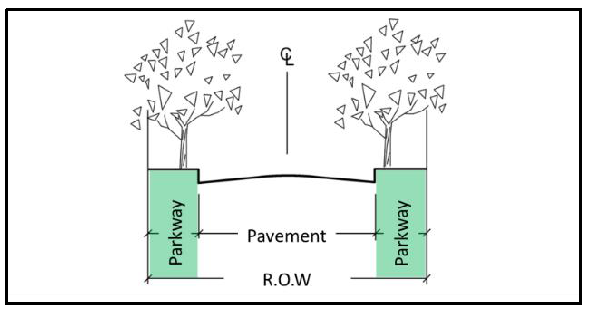
Figure 1: Example of a Parkway
Pawn Shop: An establishment that lends or advances money or other things for profit on the pledge and possession of personal property, or other valuable things, other than securities or written or printed evidences of indebtedness, or, that deals in the purchasing of personal property or other valuable things on condition of selling the same back to the seller at a stipulated price.
Penal and Correctional Institutions: Publicly or privately operated facility for the detention, confinement, treatment or rehabilitation of persons arrested or convicted for the violation of civil or criminal law. Such facilities include an adult detention center, juvenile delinquency center, jail, prison, and halfway house.
Permanent Cosmetics or Makeup: A permanent, non-dwelling building or portion of a building where colored pigment is inserted into the skin for cosmetic purposes in accordance with all applicable laws, ordinances, rules, and regulations.
Personal Service Shop: Establishments primarily engaged in providing services generally involving the care of the person or apparel including, but not limited to, barber and beauty shops, dressmaking, shoe shining, dry-cleaning and laundry pick-up stations, tailor or seamstress, and health clubs.
Pet Store (Retail Sales Only): A retail sales establishment primarily involved in the sale of pet supplies or the sale or adoption of domestic animals, such as dogs, cats, fish, birds, and reptiles, excluding exotic animals and farm animals such as horses, goats, sheep, and poultry.
Petroleum Storage and Collection Facilities: An outdoor area where storage of petroleum is allowed (tank farm).
Pharmaceutical and Medicine Manufacturing: This industry comprises establishments primarily engaged in one or more of the following: (1) manufacturing biological and medicinal products; (2) processing (i.e., grading, grinding, and milling) botanical drugs and herbs; (3) isolating active medicinal principals from botanical drugs and herbs; and (4) manufacturing pharmaceutical products intended for internal and external consumption in such forms as ampoules, tablets, capsules, vials, ointments, powders, solutions, and suspensions.
Pharmacy: A shop or a store wherein prescription medicines may be obtained during all operating hours wherein primarily medicine and medical supplies are offered for sale.
Photographer's or Artist's Studio/Film Processing: Work space for one or more photographers, artists or artisans, including the accessory sale of art produced on the premises.
Planning and Zoning Commission: The Planning and Zoning Commission of the City.
Planning Division Manager: The person(s) so designated by the City to provide oversight for and have responsibility of the City's planning and development related duties. This term shall also include any designee of the Planning Division Manager. Also, this term shall be inclusive of any future variations of the term, such as "Planning Director" or "Zoning Administrator."
Plastic Products Manufacturing: The making of goods by processing plastics materials or raw rubber, with dust and fume control.
Plat: A map or chart of the subdivision, lot or tract of land that is filed in the County plat records.
Play Field or Stadium, Public: An athletic field or stadium owned and operated by a public agency for the general public including a baseball field, football field or stadium.
Plumbing/Electrical/Air Conditioning Store (Retail Sales Only): Establishments primarily engaged in retail sales of plumbing, heating, and air-conditioning equipment, without warehouse facilities, includes storage for ordinary repair but no materials for contracting work.
Police or Fire Station: Protection centers operated by a governmental agency, including administrative offices, storage of equipment, temporary detention facilities, and the open or enclosed parking of safety vehicles; excluding, however, correctional institutions.
Polystyrene Foam Product Manufacturing: This industry comprises establishments primarily engaged in manufacturing polystyrene foam products.
Principal Use: The primary or predominant use of any lot or building.
Printing/Duplication or Mailing Center:
(a)
An establishment in which the principal business consists of duplicating and printing services using photocopy, blueprint, or offset printing equipment, including publishing, binding, and engraving; or
(b)
A commercial business that conducts the retail sale of stationery products, provides packaging and mail services (both U.S. Postal and private service), and provides mailboxes for lease.
Private Utility: A non-public utility requiring special facilities in residential areas or on public property such as electricity, natural gas, or telecommunications not customarily provided by the municipality or public utilities. All radiating equipment must comply with current Federal Communications Commission (FCC) or its successor, Environmental Protection Agency (EPA) or its successor, Occupational Health and Safety Administration (OSHA) or its successor, and all other applicable State and Federal regulatory agency requirements and guidelines for human safety.
Progress Towards Completion: Progress towards completion of the project shall include any one of the following:
(a)
An Application for a final plat or plan for development is submitted;
(b)
A good-faith attempt is made to file with the City an Application for a permit necessary to begin or continue towards completion of the project;
(c)
Costs have been incurred for developing the project including, without limitation, costs associated with roadway, utility, and other infrastructure facilities designed to serve, in whole or in part, the project (but exclusive of land acquisition) in the aggregate amount of five percent of the most recent appraised market value of the real property on which the project is located;
(d)
Fiscal security is posted with a regulatory agency to ensure performance of an obligation required by the regulatory agency; or
(e)
Utility connection fees for the project have been paid to a regulatory agency.
Public Improvement: Any Improvement, facility or service together with its associated public site, Right-of-Way or easement necessary to provide transportation, storm drainage, public or private utilities, parks or recreational, energy or similar essential public services and facilities, for which the City or other government authority ultimately assumes the responsibility for maintenance, operation or ownership.
Public Use or Building:
(a)
Any use or building held, used, or controlled exclusively for public purposes by any department or branch of government, federal, state, county, or municipal, without reference to the ownership of the building or of the realty upon which it is situated.
(b)
A building belonging to or used by the public for the transaction of public or quasi-public business.
Radio or TV Station: Establishments primarily engaged in the provision of broadcasting and other information relay services accomplished through the use of electronic and telephonic mechanisms. Excluded are facilities classified as major utility services or broadcasting or communication towers.
Record Drawings: A group of drawings or plans that depicts the final configuration of the installed or constructed improvements of a development, improvements that have been verified by the contractor as their installation or construction occurs during development. The Record Drawings shall reflect the Construction Plans (or working drawings) used, corrected, or clarified in the field.
Refreshment Kiosk: A structure that meets building code standards to be freestanding and is used to sell to and serve to drive through and walk-up customers prepackaged, foods and beverages from a drive through window for off-premises consumption and that provides no indoor or outdoor seating.
Religious Use: A place of worship and religious training of recognized religions, including the on-site housing of ministers, rabbis, priests, nuns, Islamic religious leaders, and similar staff personnel.
Residential Street: A street that is intended primarily to serve traffic within a neighborhood or limited residential district and that is used primarily for access to abutting properties.
Residential Use: Residential use means use of a structure as a residence.
Residential Zoning Districts: Residential district means a single-family, duplex, townhouse, multiple-family or mobile home zoning district as defined in the zoning ordinance, see Table 1: Zoning Districts for a list of districts.
Restaurant or Cafeteria, with Drive-Through Window or Curb Service: An establishment, with drive-through window or curb service, where food and/or drink are prepared and consumed primarily on the premises.
Restaurant or Cafeteria, Without Drive-Through Window or Curb Service: An establishment, without drive-through window or curb service, where food and/or drink are prepared and consumed primarily on the premises.
Retail Stores and Shops: An establishment engaged in the selling of goods and merchandise to the general public for personal or household consumption and rendering services incidental to the sale of such goods.
Retail Tobacco Store: A retail store that sells mainly tobacco products. This business may also sell tobacco accessories such as lighters, matches, cigarette holders and devices used to preserve tobacco, cigars or cigarettes, which are incidental to the sale of tobacco products.
Retaining Wall: A non-building, structural wall supporting soil loads and live and dead surcharge loads to the soil, such as additional soil, structures and vehicles.
Retirement Housing: Any age restricted housing development that may be in any housing form, including detached and attached dwelling units, apartments, and residences, offering private and semiprivate rooms and designed to provide meals and nursing care.
Right-of-Way:
(a)
A parcel of land occupied or intended to be occupied by a street or alley or other transportation infrastructure.
(b)
A Right-of-Way may be used for other facilities and utilities, such as sidewalks, railroad crossings, electrical communication, oil or gas, water or sanitary or storm sewer facilities, or for any other use.
(c)
The use of Right-of-Way shall also include parkways and medians outside of pavement.
Rodeo Grounds: A public gathering place for rodeo activities in which there are performances of riders with horses and generally involving cattle. The area may involve various cattle pens, barns or shelters. Parking generally would involve double drive-through spaces for participants with trucks pulling horse trailers and standard parking for spectators.
School, Career: Career schools including programs such as dental assisting, pharmacy technician, nurse aide, veterinary assistant, etc.
School, Private: Includes private school facilities providing pre-K through 12 education (Pre-Kindergarten, Kindergarten, elementary, middle school, high schools).
School, Public: Includes public school facilities providing pre-K through 12 education (Pre-kindergarten, Kindergarten, elementary, middle school, high schools).
Scientific Research and Development Center or Laboratory: A facility that includes laboratories and experimental equipment for medical testing, scientific testing, prototype design and development, and product testing. Any facility that is determined by Health, Fire, or Building officials to be a hazard or nuisance to adjacent property or the community at large due to the possible emission of excessive smoke, noise, gas, fumes, dust, odor, or vibration, or the danger of fire, explosion, or radiation is not included in this category.
Seamstress or Tailor Shop: Establishments primarily engaged in manufacturing or modifying clothing.
Setback Line: A line within a lot, parallel to and measured from a corresponding lot line, establishing the minimum required yard and governing the placement of structures and uses on the lot.
Shoe Repair Shop: An establishment with the principal business of repairing shoes.
Site Plan: A Site Plan is a detailed, scaled drawing of all surface improvements, structures, and utilities proposed for development and is associated with the zoning ordinance.
Small Engine Repair Shop: A shop for the repair of lawnmowers, chainsaws, lawn equipment, and other small engine equipment and machinery.
Small Wind Energy Systems: A wind energy conversion system consisting of a wind turbine, a tower and associated control or conversion electronics that will be used to reduce on-site consumption of utility power.
Smelter, Refinery, or Chemical Plant: A building or facility for refining or processing oil or a chemical plant for producing chemical products or processing of those products.
Soap and Cleaning Compound Manufacturing: This industry comprises establishments primarily engaged in manufacturing and packaging soap and other cleaning compounds, surface active agents, and textile and leather finishing agents used to reduce tension or speed the drying process.
Spa, Day Spa or Health Spa: A business that provides therapeutic and personal grooming services, including haircuts and styling, waxing, facial treatments, body therapies (massage and massage therapy), and nail treatments by providers licensed by the State of Texas.
Special Zoning Districts: The term "Special Zoning Districts" means a zoning district as listed a special zoning district within Table 1: Zoning Districts.
Specific Use Designation:
(a)
A zoning procedure to allow a specific use on a property.
(b)
See 11-1-9.07 Specific Use Designation (SUDs).
(c)
See 11-1-4.03 Use Chart for which zoning districts allow a Specific Use Designation.
Stable: A stable and related facilities, including an open pasture, where horses are quartered for owners.
Storage:
(a)
Outside Display. The temporary outside display of finished goods. Finished goods are specifically intended for immediate retail sales and are not intended nor used as an area for the continuous keeping or storage (i.e., Outside Storage) of such finished goods. Examples of outside display include the display of grills, deer feeders, patio furniture, lawn mowers, flowers, pumpkins, Christmas trees, and clothing. For information regarding Outside Display regulations, see the Use Chart* and Section 11-1-4.04.A.15.
(b)
Outside Storage. The continuous keeping or storage of any finished or unfinished goods, materials, merchandise, or equipment outside of a building for more than 24 hours. For information regarding Outside Storage regulations, see the Use Chart and Section 11-1-4.04.A.16.
Storage Units, Mini:
(a)
A building(s) containing separate, individual self-storage units for rent or lease.
(b)
The conduct of sales, business, or any activity other than storage does not occur within any individual storage unit.
Storefront: Storefronts are defined as the part of the building that fills the structural bay on the front façade at ground level.
Story: That portion of a building included between the upper surface of a floor and the upper surface of the floor or roof next above. It is measured as the vertical distance from top to top of two successive tiers of beams or finished floor surfaces and, for the topmost story, from the top of the floor finish to the top of the ceiling joists or, where there is not a ceiling, to the top of the roof rafters.
Street: A public Right-of-Way that provides vehicular traffic access to adjacent lands or for the movement of through traffic.
Structural Alterations: Any change in any supporting member of a building, such as a bearing wall, column, partition, beam, or girder, or a change in the pitch or height of the roof.
Structure: Anything constructed or erected that requires location on the ground, or attached to something having a location on the ground, including, but not limited to, advertising signs, billboards and poster panels, but exclusive of customary fences or boundary of retaining walls, sidewalks and curbs.
Studio Residence: A dwelling unit or sleeping unit in which a significant portion of the space includes a nonresidential use that is operated by the tenant.
Subdivider:
(a)
Any person or any agent thereof, dividing or proposing to divide land so as to constitute a subdivision.
(b)
In any event, the term "subdivider" shall be restricted to include only the owner, equitable owner or authorized agent of such owner or equitable owner, of land to be subdivided.
Subdivision:
(a)
The division of a tract or parcel of land into two or more parts or lots for the purpose, whether immediate or future, of sale or building development or transfer of ownership with the exception of transfer to heirs of an estate, and shall include re-subdivision.
(b)
Any other subdivision or re-subdivision of land contemplated by the provisions of Chapter 212, Local Government Code.
Subdivision Regulations: The adopted subdivision regulations of the City. (See Chapter 11-2 of the Midland Municipal Code, as may be amended.)
SUD: See Specific Use Designation definition and Section 11-1-9.07 Specific Use Designation (SUDs).
Surveyor: A licensed State Land Surveyor or a Registered Public Surveyor, as authorized by the State to practice the profession of surveying.
Tattoo Studio: A permanent, non-dwelling building or portion of a building where scarring or inserting a pigment of a design or artistic image under the skin using needles, scalpels, or other related equipment is performed in accordance with all applicable laws, ordinances, rules, and regulations.
Taxidermist: An establishment whose principal business is the practice of preparing, stuffing, and mounting the skins of dead animals for exhibition in a lifelike state.
Telephone Exchange (No Offices or Storage Facilities): A building used exclusively for the transmission and exchange of telephone messages, but the term shall not include wireless service towers.
Temporary Building for New Construction:
(a)
A structure or shelter used in connection with the construction of a development or building project for housing on the site of temporary administration and supervisory functions and for sheltering employees and equipment.
(b)
Buildings are permitted for a specific period of time in accordance with a permit issued by the City.
(c)
See the 11-1-4.03 Use Chart* and Section 11-1-4.04.A.19 within the Additional Development Standards for details.
(d)
The term "Temporary Field or Construction Office" may also be used.
Textile Manufacturing, with dust and odor control: Establishments primarily engaged in finishing of textiles, fabrics, and apparel, with dust and odor controls.
Thoroughfare: See Arterial Street.
Tinsmith/Sheet Metal Shop: A shop where flat sheets of metal are shaped into three-dimensional objects and soldered, brazed or welded.
Trailer: A portable dwelling unit designed to move on wheels from location to location by automobile or truck.
Transit Center: Any premises, including train or bus stations, for the loading and unloading of passengers and the temporary parking of transit vehicles between routes or during stopovers and excluding overnight parking and storage of transit vehicles.
Transportation Plan: The plan that guides the development of adequate circulation within the City, and connects the City street system to regional traffic carriers. Also referred to as the Thoroughfare Plan.
Truck Sales, Heavy Trucks: The display, storage, sale, leasing, or rental of new or used panel trucks, vans, trailers, recreational vehicles, or buses in operable condition.
Unmanned Equipment Building: An accessory building housing electronic and communication equipment as an associated and permitted part of a wireless communication system.
Urethane and Other Foam Product (except Polystyrene) Manufacturing: This industry comprises establishments primarily engaged in manufacturing plastics foam products
Utility Distribution/Transmission Line: Facilities, including subsidiary stations that serve to distribute, transmit, transform, or reduce the pressure of gas, water, or electric current, including, but not limited to, electrical transmission lines, gas transmission lines, and metering stations.
Utility Easement: See Easement.
Vacation Travel Trailer: A vacation travel trailer is a vehicular portable structure designed for a temporary or short-term occupancy for travel, recreational or vacation uses. Such vehicles shall include travel trailers, converted buses, tent trailers, recreational vehicles, motor homes or similar devices used for temporary portable housing.
Vacation Travel Trailer Park: A Vacation Travel Trailer Park is any tract of land under single ownership and where accommodation is provided for transient trailer use for a maximum of seven days. See Section 11-1-4.04.A.2 Manufactured Home Mini-Park, Manufactured Home Park, and Vacation Travel Trailer Park Standards for more information.
Veterinarian Clinic: An establishment where animals and pets are admitted for examination and medical treatment.
Warehouse: Facilities characterized by extensive warehousing, frequent heavy trucking activity, Outside Storage of material, or nuisances such as dust, noise, and odors, but not involved in manufacturing or production.
Wedding Chapel, Reception Facility, Special Events Center: A building, facility, room, or portion thereof, which is rented, leased or otherwise made available to any person or group for a private event function, that is not open to the general public, whether or not a fee is charged.
Weight Loss Center: An establishment that holds meetings for its membership, counsels, or sells products to encourage the personal weight loss of individuals.
Wholesale Center: An establishment or place of business primarily engaged in selling or distributing merchandise to the general public, to retailers, to industrial, commercial, institutional, or professional business users, and to other wholesalers.
Wildlife Rehabilitation Center: A property or building where wildlife animals are kept for the purpose of undergoing rehabilitation.
Winery: An establishment where wine is made.
Wireless Communication Systems: Antenna support structures for mobile and land based telecommunication facilities, whip antennas, panel antennas, microwave dishes and receive-only satellite dishes, cell enhancers and related equipment for wireless transmission from a sender to one or more receivers, such as for mobile cellular telephones, mobile radio systems facilities, commercial mobile radio service and radio or television (commercial only) broadcasting towers and transmitting stations. This definition is inclusive of the placement of the above-referenced equipment on a monopole tower, a steel lattice tower, guyed steel lattice tower and any communication tower which does or does not utilize guy wire support in addition to existing buildings or other independent support structures. This system shall also allow as one of its components an unmanned equipment shelter.
Wood Window and Door Manufacturing: This industry comprises establishments primarily engaged in manufacturing window and door units, sash, window and door frames, and doors from wood or wood clad with metal or plastics.
Woodworking and Planing Mill:
(a)
Establishments with dust and noise control and primarily engaged in one or more of the following:
i.
Manufacturing dimension lumber from purchased lumber;
ii.
Manufacturing dimension stock (i.e., shapes) or cut stock;
iii.
Re-sawing the output of sawmills; and
iv.
Planning purchased lumber.
(b)
These establishments generally use woodworking machinery, such as jointers, planers, lathes, and routers to shape wood.
Wrecking or Auto Salvage Yard: A yard or building where automobiles or machinery are stored, dismantled and offered for sale as whole units, as salvaged parts or as processed metal.
Yard:
(a)
An open space other than a court, on the same lot with a building, unoccupied and unobstructed from the ground upward, except as otherwise provided herein.
(b)
In measuring to determine the width of a side yard, the depth of a front yard or the depth of a rear yard, the least horizontal distance between the lot line and the main building shall be used.
Yard, Front: A yard across the full width of a lot extending from the front line of the main building to the front property line of the lot.
Yard, Rear: A yard extending across the full width of the lot and measured between the rear property line of the lot and rear line of the main building, except that area included in the side yard as defined below.
Yard, Side: A yard between the building and the side property line of the lot and extending from the front yard to the required minimum rear yard.
Zoning District Map:
(a)
The official map upon which the boundaries of the various zoning districts are drawn, and which is an integral part of the Zoning Ordinance, which may also be cited as the Zoning Map.
(b)
See Section 11-1-1.04 Official Zoning District Map.
Zoning Ordinance: The adopted Zoning Ordinance of the City, as may be amended in the future, and may be referred as "the Zoning Ordinance."
(Ordinance 9920, sec. 1,(Exh. A) adopted 5/28/2019)
Editor's note— *Said Use Chart is included as an attachment to this chapter.

