
Miles City City Zoning Code
ARTICLE III
- APPLICATION OF ZONING REGULATIONS TO ALL DISTRICTS
Sec. 24-40. - Standards applicable to all districts when required.
The following sections of these regulations outline standards applicable to the various zoning districts when required. Article V defines the terms related to several of these standards. This article outlines how certain terms and definitions are applied with these zoning regulations.
(Ord. No. 1306, § 1(Exh. A) 11-9-16)
Sec. 24-41. - Building setbacks.
The zoning district a lot is located within includes the minimum required setbacks for buildings. The minimum setback is measured horizontally from the applicable property line to the outer wall of any building, at grade, any extensions above grade that is over two feet will be measured as the start point. See Figure III.A.
(Ord. No. 1306, § 1(Exh. A) 11-9-16; Ord. No. 1380, § 1, 6-11-24)
Sec. 24-42. - Yards.
A yard is an area of a lot between a property line and an actual building setback line. A required yard is a yard unoccupied by buildings except as may be expressly allowed by these regulations. A minimum setback distance establishes the respective required minimum yard size on a lot. See Figure III.A. These regulations establish three types of yards, each of which may a have required minimum yard size as a result of the minimum setback:
(a)
Front yard: The yard between the front lot line and the front side of any building closest to the front lot line.
(b)
Rear yard: The yard between the rear lot line and the rear side of the main building on a lot.
(c)
Side yard: A yard between the side of any building and the side lot line extending from the front yard to the rear lot line. For purposes of determining side yards, any lot line not a rear lot line or a front lot line shall be deemed a side lot line.
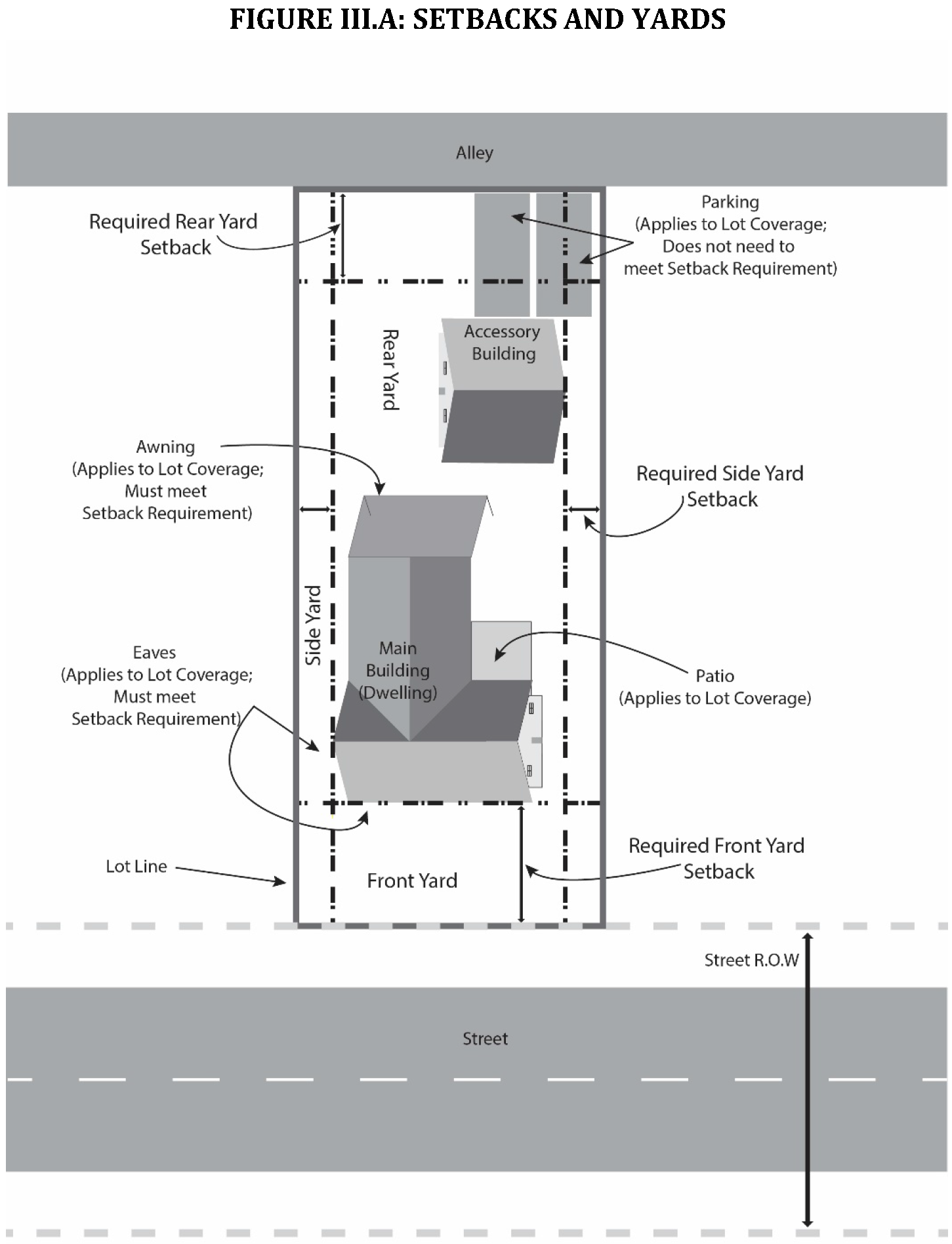
As illustrated by Figure III.A, the eaves, awning and other above grade projections must meet the setback requirements and constitute lot coverage. The patio, if at grade, is deemed lot coverage, but would not need to meet the setback requirements because it is not above grade. The minimum front and side yard setbacks form the respective minimum yards. The rear yard as a whole is formed by the area between the rear lot line and the back of the main building, and the accessory building (garage) is allowed in the rear yard, but not the required rear yard setback. See section 24-62 for a description of where accessory buildings are allowed in yards.
(Ord. No. 1306, § 1(Exh. A) 11-9-16)
Sec. 24-43. - Vacant lots in residential districts.
Vacant lots in residential districts may be used for gardening, tennis courts, playgrounds and other recreational facilities only, and shall be kept free of all rubbish, and/or garbage at all times. Noxious weed and grass shall be managed in compliance with chapter 15, nuisances. All other uses of vacant lots in residential districts shall not be approved without a variance granted by the board of adjustment. In the event a variance is granted for the storage of vehicles and/or equipment, the applicant shall install screening to soften the visual impact on neighboring properties. Appropriate screening shall be determined by the board of adjustment and may include fencing and/or landscaping.
(Ord. No. 1306, § 1(Exh. A) 11-9-16)
Sec. 24-44. - Outdoor lighting.
Outdoor lighting shall be downward pointed and side-shielded to not illuminate any other property or cause excessive glare on public streets.
(Ord. No. 1306, § 1(Exh. A) 11-9-16)
Sec. 24-45. - Floodplain compliance.
All development may be required to demonstrate compliance with applicable floodplain requirements.
(Ord. No. 1306, § 1(Exh. A) 11-9-16)
Sec. 24-46. - Storm water management plan.
(a)
A storm water management plan shall be implemented by all commercial developments and multifamily residential developments in excess of four units. Such plans shall be prepared by a qualified professional and are reviewed by the administrator. Storm water management plans shall comply with applicable requirements of the Montana Department of Environmental Quality (DEQ).
(b)
Storm water management plans shall demonstrate the following:
(1)
How runoff and erosion control on the site will be addressed;
(2)
How and to what extent existing vegetation will be maintained;
(3)
How the area disturbed by construction at any one time will be minimized and how disturbed areas will be stabilized during the construction period;
(4)
How disturbed areas will be promptly, permanently stabilized by revegetation or structural techniques;
(5)
How runoff velocities will be minimized and drainage ways will be prepared to handle any acceleration or increase in runoff;
(6)
How the additional volume of runoff generated will be retained on-site and absorbed, evaporated, or released at the pre-development rate of release;
(7)
How sediment resulting from accelerated soil erosion will be retained on site;
(8)
How water quality in adjoining or nearby streams or wetlands will be protected by retention of existing vegetation, installation of vegetative filter strips, and similar means;
(9)
How groundwater quality will be protected; and
(10)
How the future maintenance of runoff management measures (including earthwork, plantings and structures) will be provided.
(c)
Any storm water management plan that proposes to utilize Miles City storm sewer infrastructure shall require approval by the Miles City Public Works Department prior to issuance of a permit for development.
(Ord. No. 1306, § 1(Exh. A) 11-9-16)
Sec. 24-47. - Clear vision triangles.
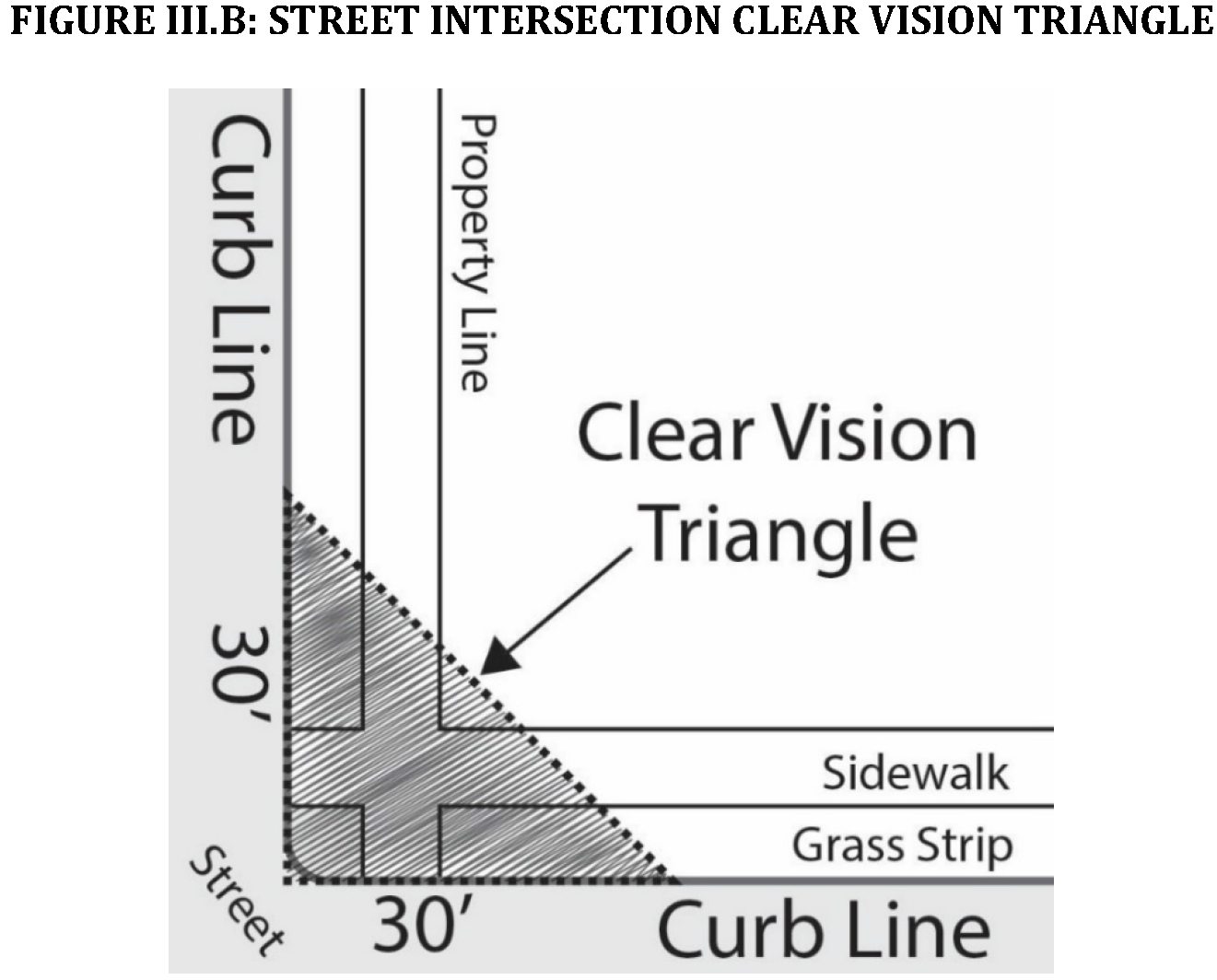
Clear vision triangles are triangular areas at intersections of streets and intersections of streets and driveways in which certain visual obstructions are prohibited. These regulations establish two kinds of clear vision triangles:
(a)
Street intersection clear vision triangle. Clear vision triangles at street intersections are triangular areas formed on corner lots where visual obstructions are prohibited. The two legs of the triangle along the streets are 30 feet long, as measured from the point of intersection of the curb lines of the two intersecting streets (See figure III.B). If curb does not exist, the predominant edge of the street shall be used. The clear vision triangle is an area in which no parking, and no fence, hedge or other visual obstruction exceeding 36 inches in height, or transparent chain link fence (no slats) exceeding 48 inches in height above an established top of curb grade are prohibited except as provided by these regulations. Trees may be permitted in street intersection clear vision triangles, but only where all branches are pruned to a height of at least eight feet above grade and do not create a visual obstruction.
(b)
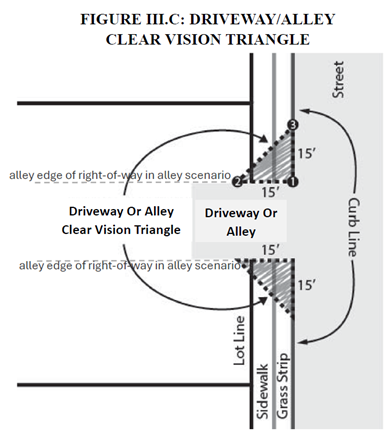
Driveway and alley clear vision triangles. Driveway and alley clear vision triangles shall be provided on both sides of driveways and alleys (rights-of-way). A driveway and alley clear vision triangle is formed by the connection of three points: point 1 shall be at the intersection of the curb line and the edge of the driveway or alley; point 2 shall be 15 feet from point 1 extending along the edge of the driveway or alley; and point 3 shall be 15 feet from point 1 extending along the edge of the curb line (or street edge where no curb exists—See Figure III.C). For driveways and alleys accessing arterials, the distances shall be increased to 30 feet. The driveway and alley clear vision triangle is an area in which no parking, and no fence, hedge or other visual obstruction exceeding 36 inches in height, or transparent chain link fence (no slats) exceeding 48 inches in height above the curb grade are prohibited except as provided by these regulations. Trees may be permitted, but only where all branches are pruned to a height of at least eight feet above grade and do not create a visual obstruction. See Figure III.C.
(Ord. No. 1306, § 1(Exh. A) 11-9-16; Ord. No. 1387, § 1, 1-14-25)
Sec. 24-48. - Location, standards, and maximum height of fences and hedges; projecting tree branches or shrubbery.
(a)
No fence, hedge or other visual obstruction exceeding three feet in height, or transparent chain link fence (no slats) exceeding four feet in height, as measured from the adjacent grade, shall be constructed within 20 feet of the front lot line. Fencing over the above three- or four-foot height restriction, up to six feet in height, may be constructed up to other lot lines as long as it is located over 20 feet from the front lot line, is not located within the front yard, and all other requirements within this section and section 24-47 are met.
(b)
In all other areas, the fence, hedge or other visual obstruction may not exceed six feet in height, as measured from the street grade.
(c)
Any fence higher than six feet will require an approved variance.
(d)
All fencing shall be placed inside the exterior boundaries of the subject property and shall not be placed within a public right-of-way or extend beyond the owner's property boundaries.
(e)
It shall be unlawful for the owner or occupant of any premises within the city to permit any branches of any trees, bushes, shrubs or shrubbery to project over any sidewalk or street at a height less than eight feet or otherwise create a visual obstruction.
(f)
These restrictions are intended to work in conjunction with the standards for clear vision triangles in the preceding section 42-47.
(Ord. No. 1306, § 1(Exh. A) 11-9-16; Ord. No. 1387, § 1, 1-14-25)
Sec. 24-49. - Landscaping requirements.
(a)
Purposes. Incorporating landscaping, greenspace, and vegetation into commercial and industrial land use projects and other intensive development projects is an effective technique for improving land use compatibility, enhancing visual appeal of projects and their setting within the greater community, and accommodating runoff. To promote those purposes, landscaping shall be planned and implemented as required by this section.
(b)
Scope.
(1)
Applicability. All new land uses, redevelopment projects, and expanded land uses listed below require installation and maintenance of landscaped areas on the lot in compliance with this section, except as provided in subsection (2) below.
a.
All commercial and industrial uses, including offices.
b.
Day care centers in excess of 12 children.
c.
Multifamily dwellings in excess of eight units.
d.
Hospitals, nursing homes, assisted care and ambulatory care facilities, medical clinics for human services, and offices, including those for physicians, surgeons, psychologists, dentists, optometrists, etc.
e.
Commercial and industrial parking lots, storage areas, junkyards and similar uses.
(2)
Exceptions.
a.
This section does not apply within the Central Business District.
b.
This section does not apply to home occupations.
c.
This section shall not apply to lots or sites within a subdivision or planned unit development which have been previously approved with its own landscape plan. However, these provisions shall be used as the basis for determining the landscaping plans for future subdivisions, in addition to the requirements of the subdivision regulations, and such developments' landscaping plans shall meet or exceed these landscape standards and those of the subdivision regulations.
(c)
Landscaping plans required. Any permit or subdivision application that prompts the landscaping requirements of this section shall include a landscaping plan that demonstrates compliance with this section. The plan shall include a site plan and description of the various elements of the plan and the timing of installation of the landscaping features. The plan is encouraged to be prepared by a qualified person with local knowledge of effective vegetation plantings for long-term success given on-site and area conditions.
(d)
Minimum area to be landscaped. The area of the lot proposed for development or uses that will be considered "lot coverage" (e.g., buildings, decks, patios, paved or gravel parking lots and driving surfaces, etc.) and/or is to be used for outdoor storage, junkyards, or similar uses shall determine the amount of area that is to be landscaped in accordance with this section. At least 15 percent of that calculated area amount shall be landscaped on the lot. For example, if the lot will contain a 10,000 square foot building, 10,000 square feet of gravel or paved parking lot and driving surfaces, and 10,000 square of outdoor storage, 15 percent of the total of 30,000 square feet equals 4,500 square feet, which is the minimum amount of the lot required to be landscaped.
(e)
Locations of landscaped areas.
(1)
Landscaping shall be strategically placed in locations that will provide a visual buffer as viewed from more sensitive surrounding land uses and public streets and pedestrian facilities. To accomplish this, a majority of the landscaping shall be located between the developed areas (buildings, parking and loading areas, driving surfaces, and outdoor storage areas) and the more sensitive land uses, public streets, and pedestrian facilities to be buffered.
(2)
Landscaped areas that blend with and complement adjacent or surrounding landscaped areas are encouraged.
(3)
To minimize future disturbance of landscaped areas, trees, shrubs, and other plantings proposed to meet these requirements shall not be located within utility easements or other easements that provide for ground disturbance and vegetation removal, unless the party benefited by said easement is required to restore the disturbance to the conditions outlined by the applicant's landscaping plan.
(f)
Landscaped areas defined.
(1)
To count as a "landscaped area", the area must be comprised of mixture of groundcover of well-maintained grass, mulch, or decorative landscape rock broken with other vegetation including shrubs, flowers, creeping vegetation, and/or trees.
(2)
To count as a "landscaped area", the area shall include a minimum of one tree and three shrubs per 500 square feet. Trees and shrubs used for landscaping materials shall comply with the following minimum size standards at the time of planting:
a.
Minimum height for deciduous trees shall be eight feet. Expected height at maturity shall be at least 25 feet.
b.
Minimum height for evergreen trees shall be five feet. Expected height at maturity shall be at least 25 feet.
c.
Minimum caliper size for trees six inches above grade shall be a one and one- half inch.
d.
Minimum size for shrubs shall be five-gallon containers and two feet height above grade.
It is recommended that a professional horticulturist, nurseryman or design professional be consulted to determine the proper time to move and install all plant materials, so that stress to the plants will be minimized.
(3)
Large areas of groundcover only without other vegetation may be excluded from counting toward meeting the minimum area required to be landscaped if the Administrator finds these areas will not effectively promote the purposes of this section.
(g)
Installation timing. All landscaping shall be installed prior to expiration of the building permit and issuance of a certificate of occupancy. The property will be inspected by the administrator or designee to ensure that the required landscaping has been installed before the certificate of occupancy is issued. In circumstances where this is impossible due to the seasonal timing of the permit expiration or pending certificate of occupancy, the installation of the landscaping may be delayed until the next suitable planting season through written agreement between the applicant and administrator.
(h)
Miscellaneous.
(1)
The preservation and use of existing healthy vegetation to meet the requirements of this section is allowed and encouraged.
(2)
The use of evergreen varieties of trees and shrubs is encouraged to provide year-round visual buffers.
(3)
Drought-tolerant and native species of vegetation are encouraged.
(4)
Landscaping shall be located on the outside of any screening fencing or wall.
(5)
Landscaping shall comply with section 24-47 (clear vision triangles) and section 24-48 (location, standards, and maximum height of fences and hedges; projecting tree branches or shrubbery) of the zoning code.
(6)
Landscaping plans will be considered during the review of applications for conditional use permits and variances. Conditions may be recommended by the administrator and/or imposed by the appropriate body when granting approval of such applications in accordance with the applicable review criteria, which may result in landscaping requirements that exceed the requirements of this section.
(i)
Long-term maintenance and irrigation.
(1)
All required landscaped areas shall be maintained to meet the intended purposes of the landscaping, and kept free of weeds, debris and litter.
(2)
Vegetation that dies and landscaped areas that deteriorate or are disturbed shall be promptly replaced or reestablished.
(3)
Failure to maintain landscaping in accordance with this section or an approved landscaping plan, or adding to lot coverage or outdoor storage area without obtaining approval of a new or modified landscaping plan and implementing it, shall be a violation, subject to section 24-98 (violations/enforcement) of the zoning code.
(4)
Irrigation systems are encouraged if appropriate based on the types of vegetation used.
(j)
Administrative relief.
(1)
Administrative relief provisions are intended to add flexibility in the application of the landscaping requirements, when a requirement is inapplicable, inappropriate, or infeasible to a specific site, use, or development proposal. It is recognized that the landscaping requirements cannot anticipate all possible scenarios and that there may be landscaping plans which conform to the purposes, intents and objectives of this section. Therefore, the administrator may grant administrative relief in the event of these situations and proposals.
(2)
The administrator shall attempt to balance the reasonable use of a lot with the provision of required landscaping. This balance will be affected by the site's characteristics as well as the proposed landscaping plan.
(3)
The reasonable development of a site may require the granting of administrative relief to some, but not all of the landscaping requirements. Although the landscaping requirements are considered important, when reviewing administrative relief requests, the administrator will consider the following in addition to the request and plans:
a.
Buildings, parking and loading areas, driving surfaces, and outdoor storage areas visual from public streets, public ways, and otherwise within public view, and from adjacent residential uses and other sensitive land uses, should be visually buffered and enhanced by vegetation; and
b.
The landscaping plan follows the recommendations and provisions encouraged by this section in specific manners.
(4)
Procedure.
a.
A written request for administrative relief shall be submitted to the administrator, which shall include a description of the requirements proposed for relief and project-specific justifications for the request.
b.
The administrator must make the following findings in order to grant administrative relief:
i.
The strict application of the regulation in question is unreasonable given the development proposal or that the property has physical conditions that will not allow a reasonable use of the property without relief; and
ii.
The granting of administrative relief will not result in an adverse impact upon surrounding properties.
c.
An appeal of the administrator's decision or a variance request may be made to the Board of Adjustment.
(Ord. No. 1394, § 1, 5-27-25)
Sec. 24-50. - Off-street parking and loading.
Unless otherwise indicated in these regulations, all new developments shall provide off-street parking and loading areas in compliance with the following standards for off-street parking and loading areas. Driveways must adhere to Americans with Disabilities Act standards as applicable. The required number of disabled parking spaces with the required dimensions shall be provided pursuant to federal law.
(a)
Purpose. These standards are intended to prevent traffic congestion by requiring provision of adequate off-street parking and loading areas.
(b)
Off-street parking required. Except as indicated in (f), (g), (h), and (i) below, all uses and buildings shall provide at least the minimum number of off-street parking spaces required by Table III.2. Off street parking for different uses in the same building shall be calculated separately. Parking areas shall have properly graded and drained surfaces. Each standard off-street parking space shall be located outside any public right-of-way, be designed at least nine feet by 20 feet in size with vertical clearance of seven feet, for parking of typical passenger vehicles with room to get out on either side of the vehicle, with adequate maneuvering space and accessible to public streets or alleys.
(c)
Off-street parking requirements for uses not listed. The classification of uses and the off-street parking requirements for uses not listed in Table III.2 shall be determined by the administrator based on:
(1)
The most similar land use listed in Table III.2; and
(2)
Published sources of parking information such as those produced by the Institute of Transportation Engineers, the American Planning Association or the International Building Code.
(d)
Location of off-street parking. Required off-street parking spaces shall be within 600 feet of a main entrance of the use or building served, except for spaces serving a dwelling, which shall be within 200 feet of the main entrance of the dwelling unit served.
(e)
Control of parking. Off-street parking shall generally be provided on the same lot or parcel, and under the same ownership as the use it serves, but two or more uses may share parking where:
(1)
The total number of spaces provided meets the minimum standards for the number of spaces required for all buildings or uses served, and
(2)
A contract providing for shared parking for a period of at least 20 years is executed before approval of a permit and recorded before issuance of a certificate of occupancy.
In such cases, the required off-street parking may be located on the lot or parcel serving one of the uses.
(f)
Exception: Commercial parking requirements in the central business district. In the CBD commercial enterprises are granted a 100 percent reduction in off-street parking spaces required in Table III.2. This exceptions does not apply to residential uses in the CBD, which shall meet the full parking space requirements in Table III.2.
(g)
Exception: Commercial parking requirements in the general commercial district. In the GC district commercial enterprises are granted a 40 percent reduction in off-street parking spaces required in Table III.2. Additionally, the administrator may grant commercial enterprises up to a 60 percent reduction in off-street parking spaces required in Table III.2, provided the applicant demonstrates sufficient on-street and/or shared parking is available to meet the demand of the particular use. These exceptions do not apply to residential uses in the GC district, which shall meet the full parking space requirements in Table III.2.
(h)
Exception: Commercial parking requirements in residential districts. In all residential districts, commercial enterprises, permitted through the issuance of a conditional use permit, are granted a 20 percent reduction in off-street parking spaces required in Table III.2. Additionally, the administrator may grant commercial enterprises up to a 40 percent reduction in off-street parking spaces required in Table III.2, provided the applicant demonstrates sufficient on-street and/or shared parking is available to meet the demand of the particular use. These exceptions do not apply to residential uses, day care centers, or bed and breakfasts in residential districts, which shall meet the full parking space requirements in Table III.2.
(i)
Exception: Reduction in shared off-street parking spaces. The administrator may authorize the joint use of parking facilities under the following circumstances:
(1)
When at least 50 percent of the parking spaces required by this section are for primarily "night-time" uses such as theatres, bowling alleys, bars and related uses, and the parking spaces to serve those uses are provided by "day-time" uses such as banks, offices, furniture stores, manufacturing, large-scale retail, wholesale and related uses;
(2)
When at least 50 percent of the parking spaces required by this section for primarily "day-time" uses may be supplied primarily by "night-time" uses;
(3)
When at least 60 percent of the parking spaces required by this section for a religious institution, an auditorium incidental to a school, or a similar use, may be supplied by the off-street parking facilities provided by uses primarily of a "day-time" or complimentary nature;
(4)
The joint parking facility shall be located within 600 of a main entrance of the use or building served, except for spaces serving a dwelling, which shall be within 200 feet of the main entrance of the dwelling unit served;
(5)
The applicant for the joint use parking facility shall show there is no substantial conflict in the principal operating hours of the buildings or uses for which joint use of the off-street parking facilities is proposed;
(6)
A contract providing for shared parking for a period of at least 20 years is executed before approval of a permit and recorded before issuance of a certificate of occupancy.
(j)
Passenger loading areas. Schools, community residential facilities, places for public assembly and similar uses located on arterial roads shall provide at least one safe, properly signed off-street passenger loading area.
(k)
Freight loading areas. Commercial and industrial buildings and uses shall provide one safe, properly signed off-street freight loading area for each 10,000 square feet of gross floor and/or outdoor storage area, except in the CBD, where reliance on on-street or alley loading areas may be permitted. Off-street freight loading areas shall be on the same lot or parcel and under the same ownership as the building or use they serve, be designed to accommodate the largest vehicle that may reasonably be anticipated, and have the following minimum dimensions:
(1)
Vertical clearance: 14 feet;
(2)
Width: 12 feet; and
(3)
Depth or length: 35 feet. No vehicle parked in an off-street freight loading area shall extend into a public right-of-way.
(l)
Driveways. Properly graded and drained driveways shall be provided for safe access to off-street parking and loading areas, including the off-street parking for single family dwellings.
(1)
No parking or loading area shall create a situation in which vehicles are required to back onto a public street. Parking areas for single family dwellings with access to minor and collector streets are exempt from this requirement.
(2)
Continuous curb cuts shall be prohibited. All access to public streets shall be via driveways that comply with these standards.
(3)
Driveways accessing an arterial shall be at least 200 feet from any other point of access (other driveways or intersections).
(4)
Driveways to roads intersecting an arterial shall be located at least 150 feet from the arterial or, where that distance cannot be attained, at the property line most distant from the arterial.
(5)
Driveway clear vision triangles shall be provided on both sides of driveways pursuant to section 24-48. See section 24-48 and figure III.C.
(m)
Circulation in off-street parking areas. The pattern of circulation within parking areas shall be designed to provide safe and efficient access to individual parking spaces, protect pedestrians moving through the parking area, and facilitate safe access to public streets.
(1)
Minimum aisle widths shall be:
a.
90° parking: 24 feet for two-way circulation;
b.
60° angle parking: 18 feet for one-way circulation; 22 feet for two-way circulation; and
c.
45° angle parking: 15 feet for one-way circulation; 20 feet for two-way circulation.
TABLE III.2: OFF-STREET PARKING REQUIREMENTS BASED ON USES
*DU = Dwelling unit
**sq = square feet
(Ord. No. 1306, § 1(Exh. A) 11-9-16)
Sec. 24-60. - Standards for specific land uses.
The following sections of these regulations outline standards applicable to specific land uses as allowed in the various zoning districts.
(Ord. No. 1306, § 1(Exh. A) 11-9-16)
Sec. 24-61. - Mobile homes.
The following standards apply to all mobile home installations:
(a)
Footings shall meet the following requirements:
(1)
All grass and organic material shall be removed from beneath the footings.
(2)
All footings shall be of a material impervious to rot which has a minimum weight bearing ability equal to or greater than a solid piece of wood having minimum nominal dimensions of two inches by 12 inches by 20 inches.
(3)
Each footing may be constructed from more than one piece of material provided that each piece of material has minimum nominal dimensions of not less than two inches by 12 inches by 20 inches, unless smaller dimensions are approved by the Building Inspector prior to use.
(4)
A footing shall be at least four inches longer and four inches wider than the pier resting upon it, unless smaller dimensions are approved by the Building Inspector prior to use.
(5)
Tiedowns are to be either one-half-inch (I)-bolt or one-half-inch (J)-bolt poured within the footing. A one-quarter-inch cable is to be used from the bolt to the frame of the mobile home, and a 3/16 -inch turnbuckle to be used for adjustments.
(b)
Piers shall meet the following requirements:
(1)
Wooden or concrete piers.
a.
A pier shall be constructed of a material or materials which have a minimum weight bearing ability equal to or greater than a standard eight-inch by eight-inch by 16-inch minimum celled concrete block. If a celled concrete block or an expanded shell is used to construct piers, the material shall be installed so the open end of each cell is perpendicular to the frame rail and to the ground.
b.
A pier shall be not less than eight nominal inches wide, and in any event shall be the same width as the cap resting upon it.
c.
A pier eight inches in height or less may be constructed of more than one piece of material, provided each piece has minimum nominal dimensions of two inches by four inches by 16 inches.
d.
A pier more than eight inches in height or less may be constructed of more than one piece of material having minimum nominal dimensions of eight inches wide, eight inches high and 16 inches long, provided that the pieces fit flush one to another.
(2)
Metal piers. Fabricated metal piers of equal load capacity and stability may be used.
(c)
Caps shall meet the following requirements:
(1)
All piers, except metal piers with their own caps, shall be topped with a cap not more than six inches in height and not less than eight nominal inches wide and 16 inches long.
(2)
Each cap shall be constructed of the same material throughout, and may be constructed of more than one piece of material, each having minimum nominal dimensions of one inch by eight inches by 16 inches.
(d)
Shims shall meet the following requirements:
(1)
All shims shall be two inches or less in thickness and wide enough to provide bearing over the width of the cap; the maximum included angle shall be one degree.
(2)
The shims shall be driven tight between the cap and the frame rail to provide uniform bearing.
(e)
Footings, piers, caps and shims shall be installed directly under the main frame or chassis of the mobile home according to the manufacturer's recommendations, so long as those recommendations meet the minimum standards in this section.
(f)
All footings, piers, caps and shims shall be located under the unit's support structure and shall be installed so the longest dimension of each piece of material used for the construction of a pier and of each footing, cap and shim is parallel with the ground and perpendicular to the frame rail. Those nearest each end of the mobile home shall be within five feet from the end of the home, and the maximum spacing shall be ten feet on centers, or according to the manufacturer's instructions.
(Ord. No. 1306, § 1(Exh. A) 11-9-16)
Sec. 24-62. - Recreational vehicles.
The following apply to recreational vehicles (RVs) outside RV Parks:
(a)
One RV per dwelling unit (excluding accessory dwelling units) may be kept or stored on each residential lot, but RVs may not be occupied as residences on a basis exceeding 15 days consecutively or for more than 30 days per calendar year.
(b)
On non-residential lots, RVs may be kept or stored, but RVs may not be occupied for sleeping purposes.
(c)
In the MH-A District, RVs and attachments such as bump-outs and awnings shall meet the minimum setbacks of the district and shall only be placed and used on the site for fewer than 180 consecutive days. RVs shall be fully licensed and ready for highway use. A recreational vehicle is ready for highway use if it is on its wheels or jacking system with wheels intact, is attached to the site only by quick disconnect type utilities and security devices, and has no permanently attached additions except built-on retractable awnings and factory bump-outs.
(Ord. No. 1306, § 1(Exh. A) 11-9-16; Ord. No. 1387, § 1, 1-14-25)
Sec. 24-63. - Accessory buildings.
(Also see accessory dwelling units, section 24-65)
Accessory buildings are allowed in all zoning districts subject to permitting requirements except as exempted under section 24-81 and the following standards:
(a)
No accessory building shall be located within five feet of any principal residential building, or have a height over 24 feet as measured from the highest peak of the building.
(b)
On residential lots, accessory buildings may be located in rear yards, but not in the required rear yard setback. See Figure III.A, setbacks and yards.
(c)
No accessory building shall be located in any required side or front yard in residential districts, with the following exceptions: Storm shelters, fallout shelters and similar shelters to protect human life during periods of danger may be constructed in the required front or side yard, but no part of the building may protrude above the average grade of the lot. In addition, such buildings with impervious surfaces shall be calculated against the permitted lot coverage.
(d)
In non-residential districts, with the exception of the CBD, accessory structures may be located in any yard, but not required yards.
(e)
For those uses listed as a conditional use, the addition of accessory buildings that expand a conditional use beyond what may have been reviewed under a conditional use permit process require review as a conditional use.
(f)
For nonconforming uses, the addition of accessory buildings that expand the nonconformity shall not be permitted without approval of a variance. For purposes of this requirement, nonconformity is increased if any portion of a required yard would be diminished by the proposed activity.
(Ord. No. 1306, § 1(Exh. A) 11-9-16; Ord. No. 1380, § 1, 6-11-24; Ord. No. 1387, § 1, 1-14-25)
Sec. 24-64. - Home occupations.
Home occupations are non-intrusive commercial or light industrial activities conducted in a dwelling or a building accessory to a dwelling, which may be allowed as a permitted or conditional use in the residential districts depending upon the number of employees (see permitted and conditional use tables in district regulations, article II) subject to the following standards:
(a)
The use of the dwelling unit and/or accessory building for the home occupation shall be clearly incidental and subordinate to the property's residential use by its occupants.
(b)
There shall be no change in the outside appearance of the building or premises and other visible evidence of the conduct of such home occupation other than signage as allowed under separate ordinance.
(c)
No traffic shall be generated by such home occupation in greater volumes than would normally be expected in a residential neighborhood. For the purpose of comparing traffic volumes, traffic generated by existing land uses and also potential permitted land uses on the subject property may be used.
(d)
No equipment or process shall be used in such home occupation which will cause any vibration, glare, fumes, odors or electrical interference detectable through the normal senses off the lot, if the occupation is conducted in a dwelling, or outside the dwelling unit if conducted in an accessory building. In the case of electrical interference, no equipment or process shall be used which creates visual or audible interferences in any radio or television receivers off the premises or causes fluctuations in line voltage off the premises.
(e)
Businesses established for the purpose of providing, purveying, selling, growing, manufacturing, or otherwise dealing in the procurement, production and sale of medical marijuana shall not be permitted as home occupations.
(Ord. No. 1306, § 1(Exh. A) 11-9-16)
Sec. 24-65. - Accessory dwelling units.
(a)
Purpose. The purpose of these performance standards is to allow efficient use of the existing housing stock and infrastructure, provide housing options that respond to changing household sizes and needs, provide a means for residents—particularly seniors, single parents and empty-nesters—to remain in their homes and neighborhoods, obtain extra income, security, companionship and assistance, and to provide a broader range of affordable housing options.
(b)
Applicability. The following are considered accessory dwelling units or uses:
(1)
A single dwelling unit occupied by the owner, a manager, or a guard is a customary accessory use on commercial and industrial properties in the HCLI and HI districts.
(2)
An accessory apartment (an attached, single, functionally separate dwelling unit) is a customary accessory use in all single family dwellings.
(3)
A detached accessory dwelling unit (a single, fully functional dwelling unit physically separated from the primary dwelling on a lot), including an apartment above a garage, is a customary accessory residential use in the RA, RB, RC, and SR districts.
(c)
Specification standards.
(1)
Only one accessory dwelling is permitted per lot;
(2)
Except for an accessory dwelling provided for a manager or guard on a commercial or industrial property in the HCLI or HI districts, accessory dwelling units are only allowed on lots developed with single family residences.
(3)
An accessory dwelling shall not contain more than two bedrooms (rooms used primarily for sleeping purposes);
(4)
In the residential districts, the lot must meet the minimum size requirement of the district;
(5)
The ground floor area of the accessory unit shall not exceed 50 percent of the ground floor area of the principal dwelling or structure;
(6)
An accessory dwelling shall not exceed the district's maximum height limitation for accessory buildings;
(7)
The accessory dwelling shall have a roof pitch, siding, trim and window proportions similar to that of the principal dwelling or structure to the extent feasible, as determined by the administrator;
(8)
The accessory dwelling shall comply with all other standards for principal dwellings or structures such as setbacks, lot coverage and height;
(9)
The accessory dwelling unit shall not require a separate access approach to the adjacent public street, with the exceptions that the alley may serve the accessory dwelling and existing driveway approaches may serve the accessory dwelling unit;
(10)
At least one off-street parking space must be provided for an accessory dwelling unit; and
(11)
Approval from the Montana Department of Environmental Quality may be required prior to issuance of a permit.
(d)
Renting an accessory dwelling unit. Renting of either a primary or accessory dwelling is allowed.
(e)
Tiny homes. All tiny homes must comply with regulations set forth in state and local building regulations. See International Residential Code Appendix Q. No more than two tiny homes per RA zoned lot shall be allowed, with one being accessory dwelling unit. To qualify as a tiny home square footage must be between 320 and 600 square feet. State of Montana RVIA-certified built structures shall be deemed compliant.
(Ord. No. 1306, § 1(Exh. A) 11-9-16; Ord. No. 1380, § 1, 6-11-24)
Sec. 24-66. - Bed and breakfasts.
The purpose of this section is to provide options for overnight accommodations and meal services to tourists and visitors while minimizing impacts to the neighborhood in which the accommodations are located. For purposes of this chapter, a bed and breakfast is defined as a single household which remains owner-occupied at all times, providing from one to no more than six guest rooms for compensation, and where food service may be served to overnight guests only. Bed and breakfasts are conditional uses in the RA, RB, RC, MH-A, and SR districts, subject to conditional use review and approval by the City Council and the following standards:
(a)
The establishment must be operated by the owner of the home, who must live in the structure.
(b)
The bed and breakfast may not provide accommodations for more than 18 guests.
(c)
Food service may be provided for resident guests only.
(d)
Bed and breakfasts may not be leased or offered for use as reception space, party space, meeting space or similar events open to non-resident guests.
(e)
Bed and breakfasts may display signs as permitted by the International Building Code's sign regulations (Appendix H).
(f)
Off-street parking shall be provided in compliance with section 24-50.
(g)
The exterior appearance of the building shall not be altered from its single-family residential appearance.
(Ord. No. 1306, § 1(Exh. A) 11-9-16; Ord. No. 1311, § 1, 3-14-17; Ord. No. 1387, § 1, 1-14-25)
Sec. 24-67. - Multiple-family dwellings, two-family dwellings, townhouses and townhomes.
Multiple-family dwellings, two-family dwellings (duplexes,) townhouses and townhomes are subject to all applicable regulations of the Miles City Codes except as modified or supplemented by these standards. These standards apply to multiple-family and two-family dwelling structures, including apartments, condominiums and retirement homes that contain more than two living units. They also apply to townhouse structures, and when a single parcel contains either multiple two-family dwellings or a combination of multifamily dwellings and two-family dwellings.
(a)
Pedestrian access. Such developments must provide a system of walkways connecting each dwelling to the following when applicable: adjacent public sidewalks, on-site parking lots or parking structures, other on-site multiple-family dwelling buildings, garages, disposal and recycling containers, mail boxes, recreation areas and storage areas.
(b)
Parking and vehicle access.
(1)
Off-street parking shall be provided in compliance with section 24-50.
(2)
No more than 30 percent of the parking area may be located between the principal building and the front street.
(3)
Parking may not be located within any required side setback area.
(4)
Access and access routes meeting the requirements of the Miles City Fire Department may be required to ensure residents have adequate means of escape in the event of an emergency and that the fire department has sufficient access.
(c)
Design features. The developer shall provide at least three of the following (at the developer's discretion):
(1)
Modulated building wall planes on the front façade through the use of projections, recesses and offset planes with a minimum depth of two feet;
(2)
Balconies or bay windows on the front building facade;
(3)
Varied rooflines;
(4)
Visual diversity on all building façades by varying materials, texture, or color; and
(5)
Windows or glazed area equal to at least 15 percent of the combined total of all the building façades.
(d)
Utilities. Each unit shall be provided with separate utility connections and meters.
(e)
Townhouses and townhomes unit access. Each unit of townhouse/townhome developments shall be provided with at least two separate and private outdoor access doors.
(f)
Landscaping. Landscaping shall be installed in accordance with section 24-49.
(Ord. No. 1306, § 1(Exh. A) 11-9-16)
Sec. 24-68. - Requirements for chickens.
The keeping of up to six chickens, but no roosters, shall be allowed in all residential districts if the following requirements are met:
(a)
No coops or runs shall be located in front yards. In addition, for corner lots, required side yards shall not be used.
(b)
Chicken coops and runs shall be located at least 20 feet away from any residential structure, religious institution, school, or other building inhabited by people except the residence of the chicken owner, custodian, or keeper as measured from the nearest exterior wall of both structures.
(c)
Coops and runs must be set back a minimum of ten feet from all property lines as measured from the nearest wall of the coop or run.
(d)
No coop shall exceed 48 square feet in size; however eaves, feed boxes, and other minor appurtenances may extend further without being calculated as the basic square footage.
(e)
All coops shall be designed to be predator proof.
(f)
No coop shall exceed the height of eight feet.
(g)
No coops or runs shall be constructed in the floodway in compliance with the floodplain regulations and shall also comply with any floodplain regulation requirements if located in the floodway fringe.
(h)
Runs shall be constructed of wood or woven wire materials, allow chickens to contact the ground, shall not exceed six feet in height, and shall not exceed 20 square feet per chicken.
(i)
Run fencing shall be attached to the coop except in the case of a mobile coop.
(j)
Electrified fences on runs are prohibited.
(k)
No flags or banners shall be strung around the perimeter of runs.
(l)
If electrical lines/cords to coops are strung aerially, they shall not be visible from neighboring properties or public spaces.
(m)
Mobile coops are allowed but are required to meet the location and design requirements in subsections (a) through (l) of this section and shall be confined within a run.
(Ord. No. 1306, § 1(Exh. A) 11-9-16)
Sec. 24-69. - Animal rescue shelters.
(a)
The keeping of a total of up to eight dogs, cats, or a combination of both, not exceeding eight animals, for the purpose of operating an animal rescue shelter are allowed in certain districts subject to the requirements below.
(b)
Animal rescue shelters of any size are permitted uses in the GC and HWC districts.
(c)
In the SR district, any personal dogs or cats kept as pets by the operator of the facility shall reduce the allowed number of sheltered animals by a count of one animal for each dog or cat that is being housed on the same premises and kept as a pet.
(d)
An animal shelter in the SR district shall not be located any closer than 3,000 feet from another existing animal rescue shelter.
(e)
For purposes of determining the total number of allowed animals, litters under four months of age shall count the same as one adult animal. For rescued animals that give birth after being rescued, animals under the age of four months shall not be counted in the total. For shelters being operated out of a single-family home, only one litter at a time shall be allowed.
(f)
A permit is required and the permit holder shall comply with all other applicable control regulations.
(Ord. No. 1306, § 1(Exh. A) 11-9-16)
Sec. 24-70. - Antennae, antenna support structures and wireless communications facilities.
(a)
Intent. The intent of this section is to:
(1)
Encourage the location of antenna support structures in non-residential areas and minimize the total number of antenna support structures throughout the city;
(2)
Require the joint use of new and existing antenna support structures when possible;
(3)
Require wireless communication facilities to be located, to the extent possible, in areas where the adverse impact on city residents is minimal;
(4)
Require wireless communication facilities to be configured in a way that minimizes the adverse visual impact of the towers and antennas; and
(5)
Enhance the ability of the providers of wireless communication services to provide such services as quickly, effectively, and efficiently as possible.
(b)
Permit requirements. All uses within the city for the location, construction, or modification of a new wireless communication facility, antenna support structure or amateur radio antenna support structure shall require compliance with the applicable Administration and Enforcement requirements of article IV.
(1)
In districts where amateur radio antenna support structures, antenna support structures, alternative antenna support structures, antennae, and amateur radio antennae in compliance with section 24-70(c) (below) are listed as a permitted use, the project shall require review of a zoning conformance permit pursuant to section 24-85.
(2)
In districts where wireless communications facilities are listed as a conditional use, the project shall require review of a Conditional Use pursuant to section 24-91.
(c)
Permitted uses. The following are permitted uses:
(1)
Amateur radio antenna support structures and alternative antenna support structures, within any district, that meet all of the following criteria:
a.
Are located within the rear yard of a lot;
b.
Are not located within any setback required in the zoning district in which it is located or across or upon any existing legal right-of-way or easement;
c.
Obtain a building permit under article IV;
d.
Have no lighting upon the structure except such hazard lighting as mandated by the FAA, provided, however, seasonal decorations which do not conflict with government regulations, may be permitted;
e.
Have no signage or displays of any type upon the structure except warning signs required by law or applicable regulation, provided, however, seasonal decorations which do not conflict with government regulations, may be permitted; and
f.
The maximum total antenna and support structure height is less than or equal to 100 feet;
(2)
Amateur radio antenna support structures and antenna support structures, that were in existence and in place or under actual construction in place prior to July 25, 2006, unless:
a.
Such amateur radio antenna support structure or antenna support structure is subsequently damaged or destroyed and the cost of repair or reconstruction of such support structure exceeds 50 percent of the replacement cost of such support structure; or
b.
Such antenna support structure has been abandoned. Abandonment is presumed if the support structure has not been utilized by any licensed user of the support structure for a period in excess of 180 consecutive days and use of the support structure has not been reinstated by any licensed user within 90 days of the city giving written notice of its declaration of abandonment to all licensed users of the support structure. If the city declares a support structure abandoned pursuant to this subsection, the burden shall be upon the licensed users of the support structure to document actual use of the support structure within such 180 consecutive day period; or
c.
Such antenna support structure is modified subsequent to July 25, 2006 and unless such modification is limited to:
i.
Addition of antenna arrays which do not result in an increase in the height of the tallest portion of the structure by more than 20 feet of the height of the structure as it existed on July 25, 2006 and do not result in the antenna support structure height exceeding 75 feet for an antenna support structure that was less than 75 feet in height on July 25, 2006;
ii.
Addition of antenna, otherwise complying with subsection (1), above, not exceeding the number of antennas for which the antenna support structure was originally designed to accommodate.
d.
Such amateur radio antenna support structure is modified subsequent to July 25, 2006 and such modification results in the antenna support structure height exceeding 75 feet.
(d)
Building permits required for all antenna support structures and certain amateur radio antenna support structures.
(1)
Any amateur radio antenna support structure shall require a building permit if the amateur radio antenna support structure together with any attached antenna have an antenna support structure height in excess of six feet, if ground mounted, or in excess of six feet above the highest point of the roof, if roof mounted. The application must include documentation that the amateur radio antenna support structure is adequately anchored and engineered to prevent collapse and damage to adjacent structures or property in the event of failure.
(2)
All antenna support structures shall require a building permit. The application must include documentation that the antenna support structure is adequately anchored and engineered to prevent collapse and damage to adjacent structures or property in the event of failure.
(e)
General requirements for location and construction of all wireless communication facilities.
(1)
All construction shall comply with all applicable local and State of Montana building codes;
(2)
All facilities shall comply with all other applicable government laws and regulations;
(3)
Minimum setback requirements from any residential structure or any lot line adjacent to any residential district:
a.
For antenna support structures one-half the height of the antenna support structure; and
b.
For accessory structures: The greater of 15 feet or the minimum yard setback requirements for the zone in which the structure is located.
(4)
Antenna support structures and accessory structures located in commercial or industrial zones shall meet the minimum yard setbacks for the zone in which they are located.
(5)
Antenna support structures and accessory structures shall not exceed the maximum lot coverage limits for the zone in which they are located.
(6)
Accessory structures shall not exceed the height limits for the district in which they are located.
(7)
A secure chain link fence with plastic lath inserts, painted solid wood fence, or masonry wall, with a minimum height of six feet, shall be constructed and maintained around the perimeter of the antenna support structure with any setbacks required for fences within the district in which the structure is located.
(8)
The only lighting permitted upon an antenna support structure shall be:
a.
Lighting mandated by FAA or other government regulation. Unless otherwise mandated by such regulations, all such mandated lighting shall be only red beacons; and
b.
Security lighting mounted no higher than 20 feet above ground level. All such security lighting shall be directed towards the ground to minimize light pollution, prevent off-site light spillage, and avoid illumination of the tower. Cut-off security lighting must be utilized adjacent to existing residences or lots zoned in a residential district. When incorporated into the approved design of the facility, light fixtures used to illuminate adjacent sport fields, parking lots or similar areas may be included in the facility upon approval of the administrator.
(9)
Signage shall be limited to non-illuminated warning and equipment identification signs, unless otherwise mandated by applicable government regulation.
(10)
To facilitate co-location, antenna support structures shall be designed and constructed to accommodate the applicant's antennas and the following additional comparable antennas:
a.
For structures with an antenna support structure height greater than 100 feet, two additional antennas;
b.
For structures with an antenna support structure height less than 100 feet but greater than 75 feet, one additional antenna.
(11)
All new antennas must be co-located on existing antenna support structures or alternative antenna support structures unless the application for special review demonstrates that it is not feasible to co-locate such antennas.
(12)
Equipment at a wireless communication facility shall be automated whenever feasible in order to minimize traffic and congestion upon the facility site.
(13)
All wireless communication facilities and the site upon which they are located shall be maintained at all times in compliance with all applicable government laws and regulations.
(14)
Wireless communications facilities shall comply with the following visual impact/aesthetics standards unless otherwise mandated by government law or regulation:
a.
Exterior finish shall be galvanized steel or a neutral color which blends with the color of structures adjacent to the site;
b.
Antennas installed on a structure other than a tower, together with associated electrical and mechanical equipment, shall be of a neutral color identical to or blending with the color of the support structure so as to render the antennas, electrical and mechanical equipment as visually unobtrusive as possible;
c.
Antennas and antenna support structures may be mounted on the roofs of buildings (other than buildings which are utilized primarily as equipment enclosures for a wireless communication facility) that are greater than 30 feet in height above street grade so long as the antennas and antenna support structure do not add more than 30 feet to the total height of the building upon which they are mounted. Only monopole antenna support structures with omni-directional (whip) or low profile single-directional (panel) antennas shall be mounted upon building roofs. Crows nest antenna arrays are prohibited upon building roofs.
d.
Wireless communication facilities attached to new or existing structures shall be designed to blend with the structure's architecture and placed so as to be incorporated with the vertical design elements of the structure.
e.
Wireless communication facilities shall not be located within any officially designated historic district unless:
i.
The location is required to be permitted by preemptive government law or regulation; or
ii.
The proposed facility, upon conditional use review and approval, is determined by the board of adjustment to be designed to be hidden, screened or otherwise blend with the historical district structures and surroundings so as to be virtually unnoticeable.
(15)
Antenna support structures with a height in excess of 75 feet shall be located at least one linear mile from any other antenna support structure with a height in excess of 75 feet, unless the proposed antenna support structure is to be located in a tower farm.
(16)
A tower farm shall be located at least one linear mile from any other tower farm.
(17)
Exceptions to requirements of subsections (15) and (16) above, may be granted by the board of adjustment during the conditional use review process, if the applicant satisfactorily documents:
a.
No existing antenna support structure within the required separation distance of the proposed location can accommodate the applicant's proposed antenna; or
b.
A critical need exists for the proposed location and it is not technically feasible to locate or co-locate structures at or beyond the required separation distance.
(f)
Conditional use permit applications.
(1)
Prior to commencing construction or modification of any wireless communication facility in the districts in which the use is listed as a conditional use, the person or entity proposing construction of such structure or facility, shall submit a conditional use permit application pursuant to section 24-91, which shall, in addition to the standard requirements for a conditional use permit application, contain all of the following information:
a.
The full name, current address and telephone number of the applicant and the address of the applicant's principal place of business;
b.
If the applicant is an entity, the form of entity, state of organization and, if a corporation or limited liability company, a certificate of good standing or certificate of existence issued by the Montana Secretary of State;
c.
A description of the proposed location of the facility or structure, including physical address, legal description of all land upon which the facility or structure will be sited, the height, latitude and longitude (or GPS coordinates) of the proposed location of the facility or structure, a map to scale showing the service area of the proposed facility or structure, and an explanation of the need for the facility or structure;
d.
A site plan showing the following:
i.
North arrow.
ii.
The location and dimensions of all vehicular points of ingress and egress, drives, alleys, streets, and easements.
iii.
Center line and names of streets relevant to the application.
iv.
The locations and dimensions of all existing and proposed buildings, structures, and improvements including those that will be removed. All information must be labeled.
v.
Setbacks from all property boundaries for existing and proposed structures and buildings.
vi.
Property boundaries and lot line dimensions.
vii.
Elevation drawing of proposed wireless communication facility including the antenna support structure, antenna platforms and associated equipment enclosures. Also indicate the maximum number of antenna platforms that can be supported.
viii.
Location of artificial light sources and the areas of illumination.
e.
Area map showing the property boundaries of all lots or tracts adjacent to the proposed site and the location of any existing buildings on the adjacent properties;
f.
Documentation of any mandated lighting requirements of the FAA or any other government;
g.
If applicable, documentation of any FAA airspace review and a copy of any FAA comments;
i.
If the application is for an amateur radio antenna support structure, a copy of the applicant's amateur radio FCC license. Otherwise, a copy of the applicant's FCC license authorizing it to provide the wireless communications services for which the facility or structure is proposed;
j.
Other than an application for an amateur radio antenna support structure, documentation of the applicant's inability to utilize an existing antenna support structure or wireless communication facility to accommodate the applicant's proposed antenna or antenna array. Such documentation shall include:
i.
A description of any existing antenna support structure or wireless communication facility which would meet the applicant's engineering requirements and documentation of the applicant's attempt to obtain permission to utilize such existing structure or facility and the owner's refusal to accommodate such request. If the inability to obtain permission is based upon applicant's position that the cost of use of such existing structure or facility is unreasonable, a comparison of the cost of such use with the cost of constructing and maintaining the proposed new structure or facility.
ii.
Documentation that no existing antenna support structure or wireless communication facility meets the applicant's engineering requirements. This documentation shall consist, at the minimum, of documentation that:
A.
No existing or approved antenna support structures are located within the geographic area required to meet the applicant's engineering requirements.
B.
Existing or approved antenna support structures are not of sufficient height to meet the applicant's engineering requirements.
C.
Existing or approved antenna support structures do not have sufficient structural strength to support the applicant's proposed antenna and related equipment and cannot be reinforced to provide sufficient structural strength.
D.
The applicant's proposed antenna would cause electromagnetic interference with the antenna on the existing or approved antenna support structures, or the antenna on the existing or approved antenna support structures would cause interference with the applicant's proposed antenna.
E.
The applicant demonstrates that there are other limiting factors that render existing or approved antenna support structures unsuitable.
k.
Other than an application for an amateur radio antenna support structure, a statement from the applicant that the applicant, upon commercially reasonable terms, will permit co-location by any FCC licensed wireless communication provider utilizing compatible technology up to the antenna support structures capacity to accommodate additional antennas. The statement shall include details of how requests for co-location will be processed;
l.
Documentation of the applicant's efforts to minimize adverse impact of the proposed structure or facility upon property values within a 400 feet radius of the proposed structure or facility.
m.
A map of all properties within a 400 feet radius of the proposed site, measured from the exterior boundaries of the lot containing the proposed site, together with a list of the names and mailing addresses of all record owners of tracts of land within such 400 feet radius, and envelopes, with proper prepaid postage attached, preaddressed to each such property owner.
n.
Such additional or supplemental information as the administrator shall designate in writing to the applicant as necessary for the consideration of the application.
(2)
At least 15 calendar days before the hearing, the administrator shall, in addition to the noticing requirements of section 24-91 and section 24-97, post in a conspicuous place upon the tract of land upon which the tower structure is proposed to be located a notice to the public stating the name of the applicant, the date of posting, applicant's intent to apply for a conditional use permit to construct a tower, the proposed height of the tower to be constructed, and, that the application for the permit may be examined at city hall. The notice shall be on fluorescent orange colored card stock of one and one-half feet by two feet nominal dimension with black lettering in at least 30-point bold type. The posting shall remain in place for at least 15 consecutive days.
(3)
The notification area for Conditional Use reviews of wireless communication facilities is extended from 150 feet (per section 24-97(b)(1)) to 300 feet of the exterior boundaries of the lot containing the proposed site.
(4)
Section 24-91 of these regulations outlines the other processes and criteria for conditional use review.
(5)
No application shall be denied or subject to conditions upon the basis of environmental effects of radio frequency emissions to the extent that such facility or structure complies with FCC regulations concerning such emissions.
(Ord. No. 1306, § 1(Exh. A) 11-9-16)
Sec. 24-71. - Medical marijuana.
The following requirements apply to medical marijuana providers.
(a)
Medical marijuana providers shall not display, in an open or visible manner to the general public, any medical marijuana plant, marijuana infused product, or any depictions, caricatures, or other artistic renditions of a marijuana plant, leaf, bud or parts in a manner visible from the exterior of the establishment, structure or building in which the provider does business.
(b)
Medical marijuana providers shall not be located within 1,000 feet of a public or private school, park, playground or a religious institution.
(Ord. No. 1306, § 1(Exh. A) 11-9-16)
Sec. 24-72. - Administration of zoning in cases of multiple lots.
(a)
When a property proposed for use or development is or may be comprised of more than one lot or tract of record, the owner(s) may be required to aggregate lots or otherwise modify the tracts of record and/or boundaries to achieve zoning compliance.
(b)
The city may administer the zoning code in a manner that provides for multiple lots or tracts of record to be considered one tract of record for zoning purposes if (1) the lots are taxed as a single property, (2) the proposed development would preclude the transfer of the individual lots/tracts separately, or (3) through agreement with the Zoning Administrator that the lots/tracts will not be transferred separately to result in non-conformance with the zoning code.
(Ord. No. 1387, § 1, 1-14-25)

