
Milford City Zoning Code
ARTICLE VI
Signs
§ 230-24.- Purpose.
These regulations balance the need to protect the public safety and welfare, the need for a well maintained and attractive community, and the need for adequate identification, communication, and advertising. The regulations for signs have the following specific objectives:
A.
To ensure that signs are designed, constructed, installed and maintained according to minimum standards to safeguard life, health, property and public welfare.
B.
To allow and promote positive conditions for sign communication.
C.
To reflect and support the desired ambience and development patterns of the various zones and districts and promote an attractive environment.
D.
To ensure that the constitutionally guaranteed right of free expression is protected.
[Ord. No. 2022-06, 1-24-2022]
§ 230-24.1. - Hierarchy of regulations.
A.
Where there is a conflict between specific sign regulations and the base for general sign regulations of this Code, the specific sign regulations supersede the base sign regulations.
B.
Other conflicts. Where there is a conflict between a land use regulation and a structural regulation, or other conflicts not otherwise addressed by this section, the most restrictive regulation applies.
[Ord. No. 2022-06, 1-24-2022]
§ 230-24.2. - Definitions.
For purpose of this article, certain words and phrases shall be interpreted and defined as follows:
ABANDONED OFF-PREMISE SIGN — A sign that, for 180 days or more, no longer:
(1)
Directs attention to a business commodity, service or entertainment conducted, sold, or offered elsewhere than upon the premises where the sign is maintained; and
(2)
No longer markets, advertises, or promotes the sign for sale or rent.
ABANDONED ON-PREMISE SIGN — A sign or sign structure that, for 180 days or more, no longer identifies an ongoing business, product, location, service, idea, or activity conducted on the premises on which the sign is located or on a property adjacent to the property on which the sign is located when the adjacent property has a recorded easement for access on or along the property on which the sign is located.
ALTERATION — A change in the size or shape of an existing sign. Copy or color change of an existing sign is not an alteration. Changing or replacing a sign face or panel is not an alteration.
ANIMATED SIGN — A sign employing actual motion, the illusion of motion, or light and color changes achieved through mechanical, electrical, or electronic means. Animated signs, which are differentiated from changeable signs as defined and regulated by this Code, include the following types:
(1)
ENVIRONMENTALLY ACTIVATED — Animated signs or devices motivated by wind, thermal changes, or other natural environmental input. Includes spinners, pinwheels, pennant strings, and other devices or displays that respond to naturally occurring external motivation.
(2)
MECHANICALLY ACTIVATED — Animated signs characterized by repetitive motion or rotation activated by a mechanical system powered by electric motors or other mechanically induced means.
(3)
ELECTRICALLY ACTIVATED — Animated signs producing the illusion of movement by means of electronic, electrical, or electromechanical input or illumination capable of simulating movement through employment of the characteristics of one or both of the classification notes below:
(a)
FLASHING — Animated signs or animated portions of signs whose illumination is characterized by a repetitive cycle in which the period of illumination is either the same as or less than the period of non-illumination. For the purposes of this article, flashing will not be defined as occurring if the cyclical period between on-off phases of illumination exceeds eight seconds.
(b)
PATTERNED ILLUSIONARY MOVEMENT — Animated signs or animated portions of signs whose illumination is characterized by simulated movement through alternate or sequential activation of various illuminated elements for the purpose of producing repetitive light patterns designed to appear in some form of constant motion.
ARCHITECTURAL PROJECTION — Any projection from a building that is decorative or functional and not intended for occupancy, and that extends beyond the face of an exterior wall of a building but that does not include signs as defined herein. See also Awning; Back-lit Awning; and Canopy, Attached and Freestanding.
AWNING — An architectural projection or shelter projecting from and supported by the exterior wall of a building and composed of a covering of rigid or non-rigid materials or fabric on a supporting framework that may be either permanent or retractable.
AWNING SIGN — A sign displayed on or attached flat against the surface or surfaces of an awning. See also Wall or Fascia Sign. An awning that contains a "sign" section or copy area shall comply with the applicable sign area requirements for parallel signs contained in this Code. Only the sign or copy area displayed on an awning shall be used to determine the permitted sign area; the entire awning shall not be included in a Sign Area calculation.
BACK-LIT AWNING — An awning comprised of covering material exhibiting the characteristic of luminosity obtained by means of a source of illumination contained within its framework.
BANNER — A flexible substrate on which copy or graphics may be displayed.
BANNER SIGN — A sign utilizing a banner as its display surface.
BENCH SIGN — A sign applied or affixed to the seat or back of a bench.
BILLBOARD — See Off-Premise Sign and Commercial Outdoor Advertising Sign.
BUILDING FAÇADE — That portion of any exterior elevation of a building extending vertically from grade to the top of a parapet wall or eaves and horizontally across the entire width of the building elevation.
BUILDING SIGN — A sign that is applied or affixed to a building.
CANDELA — The basic unit of measurement of light in SI (metric) units.
CANDELA PER SQUARE METER (cd/m2) — The SI (metric) unit used to describe the luminance of a light source or of an illuminated surface that reflects light. Also referred to as Nits.
CANDLE or CANDLEPOWER — Synonymous with Candela, but in English, not SI, terms.
CANOPY (ATTACHED) — A multi-sided overhead structure or architectural projection supported by attachment to a building on one or more sides and either cantilevered from such building or also supported by columns at additional points. The surface(s) or soffit of an attached canopy may be illuminated by means of internal or external sources of light. Similar to a Marquee.
CANOPY (FREESTANDING) — A multi-sided overhead structure supported by columns, but not enclosed by walls. The surface(s) and or soffit of a freestanding canopy may be illuminated by means of internal or external sources of light.
CANOPY SIGN -A sign affixed to the visible surface(s) of an attached or freestanding canopy. May be internally or externally illuminated. Similar to a Marquee Sign.
CHANGEABLE SIGN — A sign with the capability of content by means of manual or remote input, includes the following types:
(1)
MANUALLY ACTIVATED — Changeable sign whose message copy or content can be changed manually on a display surface.
(2)
ELECTRONICALLY ACTIVATED — Changeable sign whose message copy or content can be changed by means of remote electrically energized on-off switching combinations of alphabetic or pictographic components arranged on a display surface. Illumination may be integral to the components, such as characterized by lamps or other light-emitting devices; or it may be from an external light source designed to reflect off the changeable component display. See also Electronic Message Center.
CHANNEL LETTER (OPEN FACED) — A dimensional letter with a back and sides but no face at the front of the letter. Open Faced Channel Letters may be non-lit, externally illuminated, or illuminated by a light source contained inside the open channel of the letter itself, such as a neon tube.
CHANNEL LETTER (INTERNALLY ILLUMINATED) — A dimensional letter with a back, sides, and a translucent front face capable of transmitting light from an internal light source within the letter.
CHANNEL LETTER (REVERSE) — A dimensional letter with a face and sides but no back, opposite to an Open-Faced Channel Letter. A Reverse Channel Letter has an open channel facing the wall or building to which it is affixed. A Reverse Channel Letter may contain a source of illumination designed to project lighting against the surface behind the letter, commonly referred to as a Backlit Channel Letter; also referenced as a halo or silhouette lighted channel letter. The face of a Reverse Channel Letter does not illuminate.
CLADDING — A non-structural covering designed to conceal the actual structural supports of a sign. See also Pole or Pylon Cover.
COMMERCIAL OUTDOOR ADVERTISING SIGN — A permanent off-premise sign erected, maintained or used in the outdoor environment for the purposes of providing copy area for commercial or noncommercial messages.
CONFORMING SIGN — A sign that is legally installed in conformance with all prevailing jurisdictional laws and ordinances.
COPY — The graphic content or message of a sign.
COPY AREA OF SIGN — The actual area of the sign copy as applied to any background. Copy area on any individual background may be expressed as the sum of the geometrically computed shape or shapes encompassing separate individual letters, words, or graphic elements on the background.
DIMENSIONAL LETTER, SYMBOL, OR GRAPHIC — A letter, symbol, or graphic that is three dimensional in character, containing height, width, and depth.
DIRECTIONAL SIGN — Any sign that is designed and erected for the purpose of providing direction or orientation for pedestrian or vehicular traffic.
DISPLAY TIME — The amount of time a message or graphic is displayed on an Electronic Message Sign.
DISSOLVE — A mode of message transition on an Electronic Message Sign accomplished by varying the light intensity or pattern, in which the first message gradually appears to dissipate and lose legibility with the gradual appearance and legibility of the second message.
DOUBLE-FACED SIGN — A sign with two faces, back to back.
DYNAMIC FRAME EFFECT — An Electronic Message Sign frame effect in which the illusion of motion or animation is used.
ELECTRIC SIGN — Any sign activated or illuminated by means of electrical energy.
ELECTRONIC MESSAGE CENTER OR SIGN (EMC) -An electrically activated changeable sign whose variable message or graphic presentation capability can be electronically programmed by computer from a remote location. Also known as an EMC. EMCs typically use light emitting diodes (LEDs) as a lighting source. (See also following terms principally associated with Electronic Message Centers: Display Time, Dissolve, Dynamic Frame Effect, Fade, Frame, Frame Effect, Scroll, Transition, Travel)
EXTERNALLY ILLUMINATED SIGN — See Illuminated Sign.
EXTERIOR SIGN — Any sign placed outside a building.
FAÇADE — See Building Façade.
FADE — A mode of message transition on an Electronic Message Sign accomplished by varying the light intensity, where the first message gradually reduces intensity to the point of not being legible and the subsequent message gradually increases intensity to the point of legibility.
FASCIA SIGN — See Wall Sign.
FLASHING SIGN — See Animated Sign, Electrically Activated.
FONT — A set of letters, numerals, symbols, or shapes conforming to a specific set of design criteria.
FOOT CANDLE — An English unit of measurement of the amount of light falling upon a surface (Illuminance). One foot candle is equal to one lumen per square foot. Can be measured by means of an illuminance meter.
FOOT LAMBERT — An English unit of measurement of the amount of light emitted by or reflecting off a surface (luminance) equivalent to 3.4262591 candelas per square meter.
FRAME — A complete, static display screen on an Electric Message Sign.
FRAME EFFECT — A visual effect on an Electronic Message Sign applied to a single frame. See also Dynamic Frame Effect.
FREESTANDING SIGN — A sign principally supported by one or more columns, poles, or braces placed in or upon the ground. May also be referenced as a Ground or Monument Sign. Refer also to Section 230-24.3 for visual reference examples.
FRONTAGE (PROPERTY) — The length of the property line(s) of any single premise along either a public way or other properties on which it borders.
FRONTAGE (Building) — The length of an exterior building wall or structure of a single premise along either a public way or other properties that it faces.
GROUND SIGN — See Freestanding Sign.
ILLUMINANCE — The amount of light falling upon a real or imaginary surface, commonly called "light level" or "illumination." Measured in foot candles (lumens/square foot) in the English system, and lux (lumens/square meter) in the SI (metric) system.
ILLUMINATED SIGN — A sign characterized by the use of artificial light, either projecting through its surface(s) [Internally or trans-illuminated]; or reflecting off its surface(s) [Externally illuminated].
INTERNALLY ILLUMINATED SIGN — See Illuminated Sign.
INTERIOR SIGN — Any sign placed within a building, but not including window signs as defined by this article. Interior signs, with the exception of window signs as defined, are not regulated by this article.
LISTED SIGN — A sign manufactured and labeled in accordance with specifications promulgated by a recognized testing laboratory designed to assure compliance with applicable American National Standards (ANSI) and the National Electric Code (NEC).
LUMINANCE — The light that is emitted by or reflected from a surface. Measured in units of luminous intensity (candelas) per unit area (square meters in SI measurement units or square feet in English measurement units). Expressed in Si units as cd/m2, and in English units as foot lamberts. Sometimes also expressed as "nits", a colloquial reference to SI units. Can be measured by means of a luminance meter.
LUX — the SI (metric) unit for illuminance. One lux equals 0.093 foot candles.
MANSARD — A roof-like façade comparable to an exterior building wall.
MARQUEE — See Canopy (Attached).
MARQUEE SIGN — See Canopy Sign.
MULTIPLE-FACED SIGN — A sign containing 3 or more faces.
NIT — A photometric unit of measurement referring to luminance. One nit is equal to one cd/m2.
NON-CONFORMING SIGN — A sign that was legally installed by permit in conformance with municipal sign regulations and ordinances in effect at the time of its installation, but which may no longer comply with subsequently enacted laws and ordinances having jurisdiction relative to the sign.
NON-CONFORMING USE — A continued and lawful use of property, including a sign or signs lawfully installed in accordance with laws or ordinances prevailing at the time of installation.
OFF-PREMISE SIGN — See Outdoor Advertising Sign. See Also, Wayfinding Sign.
ON-PREMISE SIGN — A sign erected, maintained or used in the outdoor environment for the purpose of the display of messages appurtenant to the use of, products sold on, or the sale or lease of, the property on which it is displayed or on a property adjacent to the property on which the sign is located when the adjacent property has a recorded easement for access on or along the property on which the sign is located.
ORIGINAL ART MURAL — A hand produced work of visual art which is tiled or painted by hand directly upon, or affixed directly to, an exterior wall of a building or structure. Original Art Mural does not include: mechanically produced or computer-generated prints or images, including but not limited, to digitally printed vinyl, murals containing electrical or mechanical components, or changing image murals.
OUTDOOR ADVERTISING SIGN — A permanent sign erected, maintained or used in the outdoor environment for the purpose of the display of commercial or non-commercial messages not appurtenant to the use of, products sold on, or the sale or lease of, the property on which it is displayed. May also be referenced as an Off-Premise Sign, Billboard, or Commercial Outdoor Advertising Sign.
PARALLEL SIGN — See Wall Sign.
PARAPET — The extension of a building façade above the line of the structural roof.
PERMITTED ORIGINAL ART MURAL — An Original Art Mural for which a permit has been issued by the City of Milford pursuant to this article.
PERPENDICULAR SIGN — See also Freestanding Sign; See also Projecting Sign.
POLE COVER OR PYLON COVER — An enclosure designed to conceal poles or other structural supports of a sign. See also Cladding.
POLE SIGN — See Freestanding Sign.
POLITICAL SIGN — A temporary sign intended to advance a political statement, cause, ballot, issue, or candidate for office.
PORTABLE SIGN — Any sign not permanently attached to the ground and can be removed without the use of tools.
PROJECTING SIGN — A sign other than a Wall Sign that is attached to or projects more than 18 inches from a building face or wall or from a structure whose primary purpose is other than the support of a sign.
PYLON SIGN — See Freestanding Sign.
REAL ESTATE SIGN — A temporary sign advertising the sale, lease, or rental of the property or premises upon which it is located.
REVOLVING SIGN — A sign that has the capability to revolve 360 about an axis. See also: Animated Sign, Mechanically Activated.
ROOF LINE — The uppermost line of the roof of a building or, in the case of an extended façade or parapet, the uppermost point of said façade or parapet.
ROOF SIGN — A sign mounted on the main roof portion of a building or on the uppermost edge of a parapet wall of a building and which is wholly or partially supported by such building. Signs mounted on mansard facades, pent eaves, and architectural projections such as canopies or marquees shall not be considered to be roof signs.
SCROLL — A mode of message transition on an Electronic Message Sign in which the message appears to move vertically across the display surface.
SI (INTERNATIONAL SYSTEM OF UNITS) — The modern metric system of measurement abbreviated Sis for the French term "Le Systeme International d'Unites."
SIGN — Any device visible from a public place whose essential purpose and design is to convey either commercial or noncommercial messages by means of graphic presentation of alphabetic or pictorial symbols or representations. Noncommercial flags or any other flags displayed from flagpoles or staffs will not be considered to be signs.
SIGN AREA — The area of the smallest geometric figure, or the sum of the combination of regular geometric figures, which comprise the sign face. The area of any double-sided or "V" shaped sign shall be the area of the largest single face only. The area of a sphere shall be computed as the area of a circle. The area of all other multiple-sided signs shall be computed as 50% of the sum of the area of all faces of the sign.
SIGN COPY — The letters, numerals, figures, symbols, logos and graphic elements comprising the content or message of a sign, exclusive of numerals identifying a street address only.
SIGN FACE — The surface upon, against or through which the sign copy is displayed or illustrated, not including structural supports, architectural features of a building or sign structure, nonstructural thematic or decorative trim, or any areas that are separated from the background surface upon which the sign copy is displayed by a distinct delineation, such as a reveal or border.
(1)
In the case of panel or cabinet signs, the sign face shall include the entire area of the sign panel, cabinet or face substrate upon which the sign copy is displayed or illustrated, but not open space between separate panels or cabinets.
(2)
In the case of signs painted on a building, or individual letters or graphic elements affixed to a building or structure, the sign face shall comprise the sum of the geometric figures or combination of regular geometric figures drawn closest to the edge of the letters or separate graphic elements comprising the sign copy, but not the open space between separate groupings of sign copy on the same building or structure.
(3)
In the case of sign copy enclosed within a painted or illuminated border, or displayed on a background contrasting in color with the color of the building or structure, the sign face shall comprise the area within the contrasting background, or within the painted or illuminated border.
SIGN STRUCTURE — Any structure designed for the support of a sign.
SITE — The ground area legally designated as a zoning lot, which may be categorized as a permanent parcel (a lot of record), multiple lots of record, or a portion of a lot of record.
SPECIAL EVENT SIGN — A temporary sign pertaining to any civic, patriotic, or special event of general public interest.
TEMPORARY SIGN — A sign intended to display either commercial or noncommercial messages of a transitory or temporary nature. Portable signs or any sign not permanently embedded in the ground, or not permanently affixed to a building or sign structure that is not permanently embedded in the ground, are considered temporary signs.
TRANS-ILLUMINATED SIGN — See Internally Illuminated Sign.
TRANSITION — A visual effect used on an Electronic Message Sign to change from one message to another.
TRAVEL — A mode of message transition on an Electronic Message Sign in which the message appears to move horizontally across the display surface.
UNDER CANOPY OR UNDER MARQUEE SIGN — A sign attached to the underside of a canopy or marquee.
V SIGN — A sign containing two faces of equal size, positioned at an interior angle subtending less than 179 degrees at the point of juncture of the individual faces.
WALL OR FASCIA SIGN — A sign that is in any manner affixed to any exterior wall of a building or structure and that projects not more than 18 inches from the building or structure wall. Also includes signs affixed to architectural projections that project from a building provided the copy area of such signs remains on a parallel plane to the face of the building façade or to the face or faces of the architectural projection to which it is affixed.
WAYFINDING SIGN — A sign, frequently off-premise, specifically designed to provide directional or destination information and installed or maintained by the City or another government agency.
WINDOW SIGN — A sign affixed to the surface of a window with its message intended to be visible to the exterior environment.
[Ord. No. 2022-06, 1-24-2022]
§ 230-24.3. - Typical on-premise sign types.
The purpose of this section is to provide visual examples of certain types of signs.
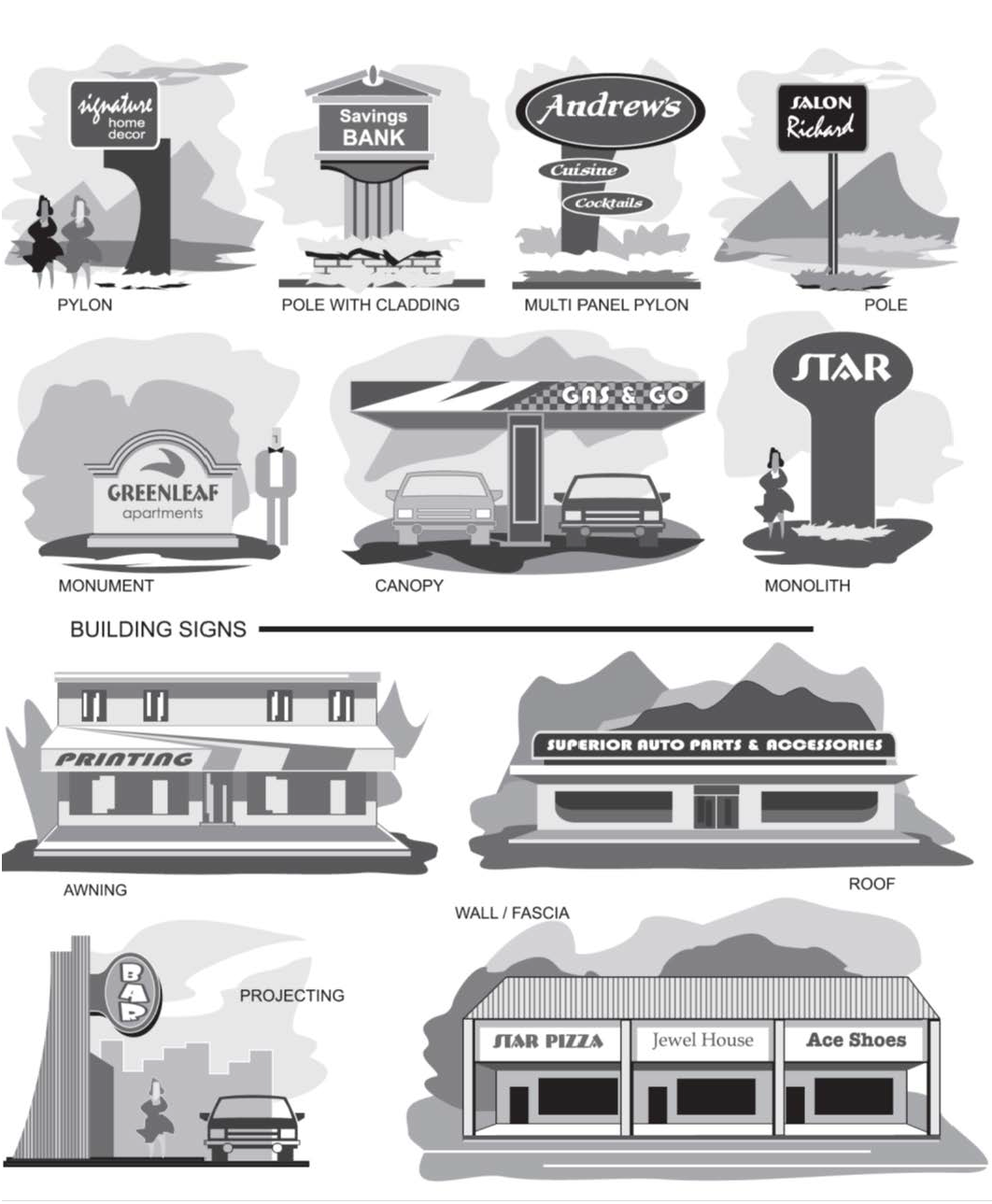
[Ord. No. 2022-06, 1-24-2022]
§ 230-24.4. - Sign area computational methodology.
Sign areas shall be calculated using the methodology set forth in this section, except that embellishment or support cladding is not included in the sign area unless it contains copy.
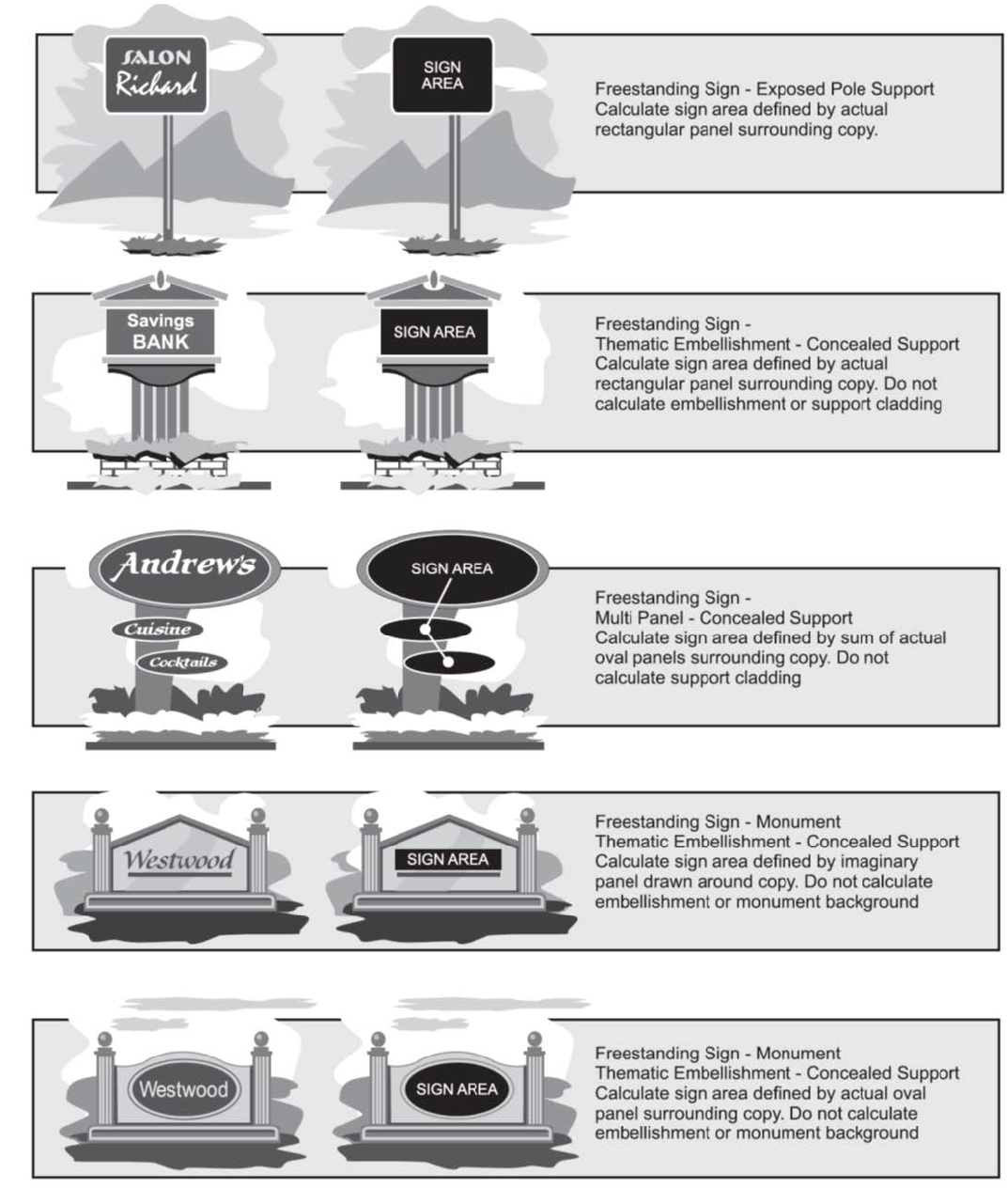
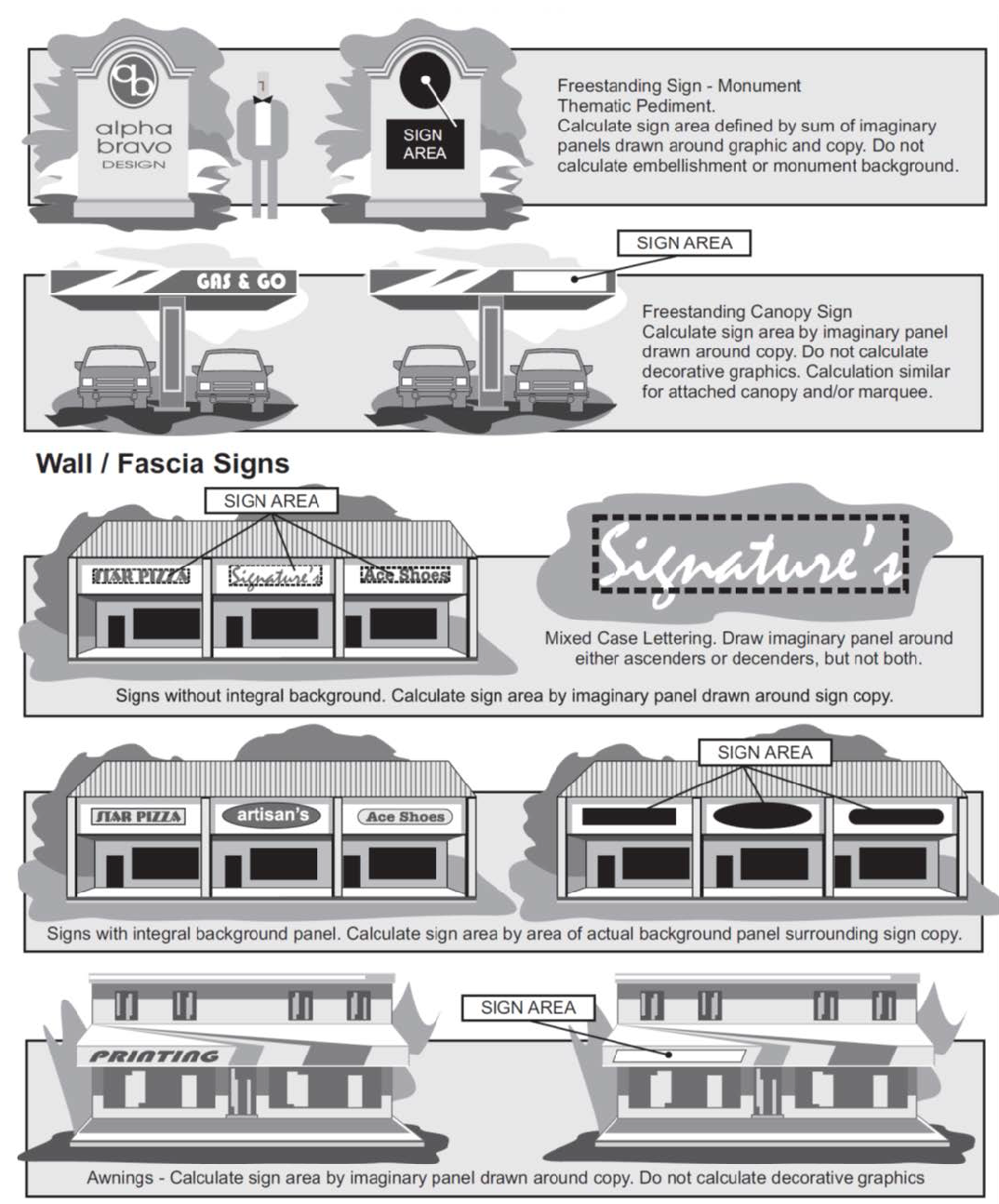
[Ord. No. 2022-06, 1-24-2022]
§ 230-24.5. - Comparison: roof and wall sign distinctions.
The following diagrams demonstrate visual examples of distinctions between roof signs and wall signs.
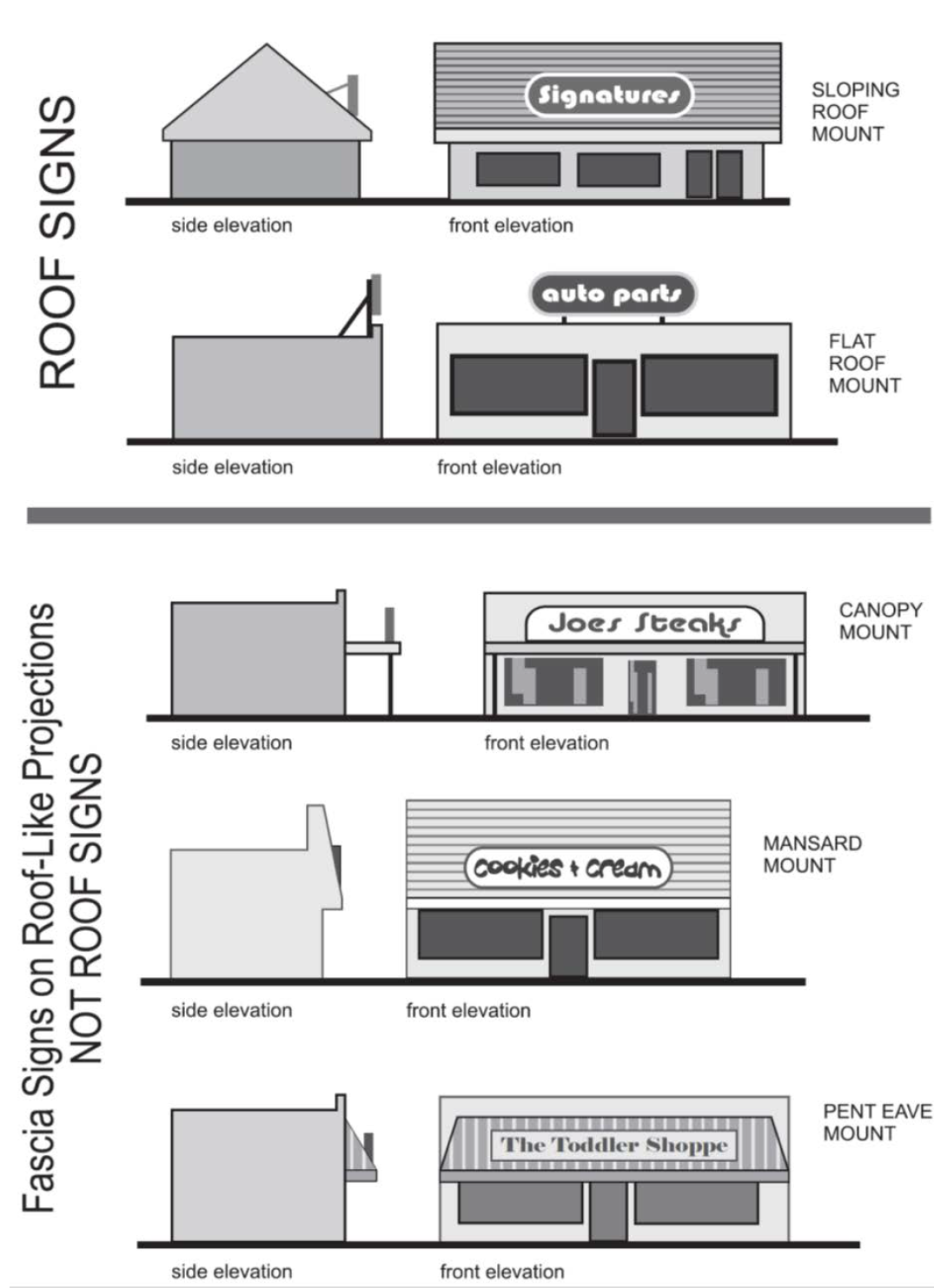
[Ord. No. 2022-06, 1-24-2022]
§ 230-24.6. - Sign face area.
A.
Sign Cabinets. The area of sign faces enclosed in frames or cabinets shall be determined based on the outer dimensions of the frame or cabinet.
B.
Double-sided signs. Only one side of a double-sided sign is counted in determining the area of sign faces. Where the two sides are not of equal size, the larger of the two sides is used for the determination of sign area. The area of multiple-faced signs in which the interior angle formed by the faces is greater than 91 degrees shall be expressed as the sum of the areas of all the faces, except for multiple-faced signs containing faces that are configured back to back, in which case the area of the faces configured back to back will be calculated according to the rule for double-faced signs.
C.
Round, Oval, and Irregularly shaped signs shall be measured based on the appropriate mathematical formula to obtain the sign area for the shape of the sign.
D.
Calculating Sign Area.
(1)
Signs containing integral background areas: The area of a sign containing a clearly defined background area shall be calculated based on the area of the smallest standard geometric shape or combination of geometric shapes capable of encompassing the perimeter of the background area of the sign. In the case of signs in which multiple background areas are separated by open space, sign area shall be calculated based on the sum of the areas of all separate background areas, calculated as referenced above, but without regard for any open space between the separate background areas.
(2)
Signs without integral background areas: In instances in which a sign consists of individual elements such as letters, symbols, or other graphic objects or representations that are painted, attached to, or otherwise affixed to a surface such as a wall, window, canopy, awning, architectural projection, or to any surface not specifically designed to serve as a sign background, the sign area shall be based on the sum of the individual areas of the smallest geometric shape or combination of geometric shapes capable of encompassing the perimeters of the individual elements comprising the sign.
E.
Awnings and marquees. When graphics or sign copy is incorporated into an awning, the sign area is determined by computing the area of a standard imaginary geometric shape or combination of shapes drawn around the sign copy area or graphics. When the ends of awnings or marquees are parallel and contain graphics or sign copy, only one side is counted in addition to the sign face area on the front.
[Ord. No. 2022-06, 1-24-2022]
§ 230-24.7. - Height of signs.
A.
Except as otherwise provided in this section, the overall height of a freestanding sign or sign structure is measured from the lowest point of the ground directly below the sign to the highest point of the freestanding sign or sign structure.
B.
Where a freestanding sign or sign structure is mounted along a roadway that has a higher-grade level as compared to the grade level directly below the freestanding sign or sign structure, then the freestanding sign or structure's height will be measured from the roadway grade level to the highest point of the freestanding sign or sign structure. See Figure A.
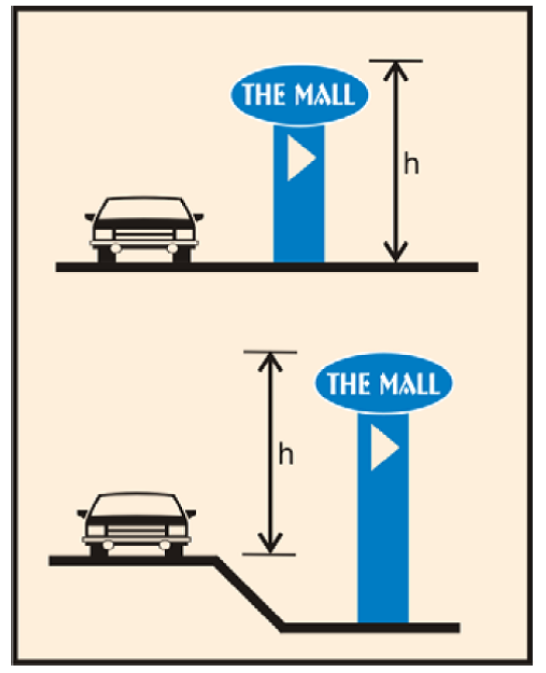
Figure A
[Ord. No. 2022-06, 1-24-2022]
§ 230-24.8. - Signs permitted in all zones—Exempt from permit.
The following are exempt from the regulations of this article, but may be subject to other portions of this Chapter where applicable:
A.
Signs inside a building and not visible from outside the building.
B.
Signs carved into a building or raised in integral relief on a building. Signs or letters that are raised must be a physical part of the building façade and a part of the physical construction of the building materials comprising the façade in order to qualify for relief under this provision. Letters or signs that are merely attached to the exterior façade of the building, even if the same finish and color, shall not qualify for this exemption.
C.
Signs required by federal, state, county, or City of Milford law or regulation.
D.
Painted or applied wall accents and decorations, provided that the accents and decorations are typically not associated with the brand or company that owns or occupies the building, site, or tenant space.
E.
Illuminated building accents and decorations, provided the accents and decorations are typically associated with the brand or company that owns or occupies the building, site, or tenant space.
F.
Public Art, including Permitted Original Art Murals.
G.
Name and Address — Up to two signs indicating address, number or name of occupants of the premises, that do not exceed two square feet in area per side, and do not include any commercial advertising or other identification.
H.
Decals — Decals or logos affixed to windows or door glass panels, such as those indicating membership in a business group or identifying credit cards accepted at the establishment.
I.
Americans with Disabilities Act Parking Space — Signs not exceeding two square feet in area reserving parking for handicapped individuals.
J.
Private Drive Signs — On-premise private drive signs are limited to one per driveway entrance, not exceeding two square feet in area.
K.
Public Signs — Signs erected by government agencies or utilities, including traffic, utility, safety, railroad crossing and identification signs for public facilities and any signs erected by the City of Milford.
L.
Security and Warning Signs — On-premise regulating the use of the premises, such as "no trespassing", "no hunting" and "no soliciting" signs that do not exceed one sign consisting of two square feet in area per side in residential areas and one sign consisting of five square feet in area per side in commercial and industrial zones. These limitations shall not apply to the posting of conventional "no trespassing" signs in accordance with state law.
M.
Vehicles — The use of business logos, identification, or advertising on vehicles primarily and actively used for business or personal transportation shall be permitted.
[Ord. No. 2022-06, 1-24-2022]
§ 230-24.9. - Permit.
A.
Except as otherwise provided in this article, no on-premise or off-premise sign or structure shall be erected, moved, enlarged, replaced, refaced, or reconstructed except by permit from the City and in accordance with this chapter. See Chapter 88, Building Construction.
B.
Except for Special Event Signs, temporary signs shall not require a permit.
[Ord. No. 2022-06, 1-24-2022]
§ 230-24.10. - Prohibitions.
The following signs are prohibited:
A.
Signs containing strobe lights.
B.
Abandoned sign structures.
C.
Signs placed on or painted on a motor vehicle or trailer parked with the primary purpose of providing signage not otherwise allowed under this article. Except as otherwise provided in this article, any sign displayed on a parked trailer or truck or other vehicle where the primary purpose of the vehicle is to advertise a product, service, business, or other activity, whether on-premise or off-premise shall be prohibited. This regulation shall not prohibit the use of business logos, identification, or advertising on vehicles primarily and actively used for business or personal transportation.
D.
Mechanically Moving Signs — An environmentally activated sign or other display with actual mechanical motion powered by natural, manual, mechanical, electrical or other means, including but not limited to pennant strings, streamers, spinners, propellers, and search lights.
E.
Flashing Signs.
F.
Inflatable Signs and Other Permanent Objects — Signs and other objects which are inflated, including but not limited to, balloons except that balloons may be permitted in temporary non-commercial situations such as for special occasions at a residence, which are permitted.
G.
Posters and Handbills — Signs affixed to any structure, utility or sign pole, trees, or other natural vegetation, rocks or poles.
H.
Roof Signs.
I.
Simulated Traffic Signs and Obstructions — Any sign which may be confused with, or obstruct the view of, any authorized traffic sign or signal, obstruct the sight-distance triangle at any road intersection or extend into the public right-of-way.
J.
A-frame/Wheeled Signs — Any portable "A" frame or similar portable sign is prohibited except as described under Temporary Signs.
K.
Signs Adversely Affecting Safety — Signs which prevent free ingress or egress from any door, window, fire escape, or that prevent free access from one part of a roof to any other part. No sign other than a safety sign shall be attached to a stand-pipe or fire escape.
L.
Sign Emissions — No sign which emits smoke, visible vapors, particles, sound or odor shall be permitted. Open flames used to attract public attention to a place of business or to an advertising sign shall not be permitted.
M.
Mirrors — No mirror device shall be used as part of a sign.
N.
Animated Signs.
O.
Any sign located or projecting into the public right-of-way except as otherwise expressly permitted in this article.
P.
Permanent Banners — Banners used as permanent signs.
Q.
Temporary Signs placed within any right-of-way.
[Ord. No. 2022-06, 1-24-2022]
§ 230-24.11. - Standards in residential zones.
A.
General standards and sign features: Permanent on-premise signs in Residential Zones, as identified herein, shall be subject to the standards set forth in this section.
(1)
R-1 Single-Family Residential District;
(2)
R-2 Residential District;
(3)
R-3 Garden Apartment and Townhouse District;
(4)
R-8 Garden Apartment and Townhouse District.
B.
Subdivisions, apartments, multi-family dwellings, and condominium complexes are permitted the following:
(1)
One freestanding sign not to exceed 64 square feet of sign area per side and seven feet in height and further provided that one such sign shall be permitted for each separate entrance.
(2)
Other directional, incidental, or accessory signs located within the subdivision, complex, or multi-family residential development provided that such signs shall not exceed six square feet of sign area per side and four feet in height, if freestanding.
C.
For properties located in a Residential Zone as described in subsection B above, other directional, incidental or accessory signs are also permitted, to be located within the subdivision, complex or multi-family residential development. Such directional, incidental and/or accessory signs shall not exceed six square feet in sign area per side and four feet in height, if freestanding.
D.
Home Occupation — One non-illuminated on-premise sign not to exceed six square feet of sign area per side, identifying a permitted home occupation on the premises. A sign shall contain no more than two sides or facings, back-to-back, and shall have a minimum setback five feet from the front lot line, and a minimum setback of 15 feet from all adjacent property lines, and shall not exceed four feet in height.
E.
Properties in a Residential Zone which are used for permitted non-residential uses are permitted a freestanding sign not to exceed 48 square feet of sign area and 10 feet in height, and further provided that one such sign shall be permitted for each separate street frontage occupied by the permitted use. A sign shall contain no more than two sides or facings, back-to-back, and shall have a minimum setback of 10 feet from the front lot line, and a minimum setback of 15 feet from all adjacent property lines.
F.
Electronic Message Centers are prohibited except as may be permitted by conditional use approval from City Council on properties used for any of the following uses:
(1)
Public and private schools
(2)
Churches and other places of worship
(3)
Social clubs or fraternal, social service, union, or civic organizations
[Ord. No. 2022-06, 1-24-2022; Ord. No. 2023-28, § 4, 8-14-2023]
§ 230-24.12. - Standards in downtown commercial zones.
A.
General standards and sign features: Permanent on-premise signs in the Downtown Commercial Zones, as identified herein, shall be subject to the standards set forth in this section.
(1)
C-2 Central Business District;
(2)
C-2A Riverfront Development District.
B.
Subject to the regulations in this section, Downtown Commercial Zone properties are limited to a combination of two signs per street or road frontage. No more than one sign per street or road frontage shall be either a freestanding sign or a projecting sign. No more than one sign per street or road frontage shall be either a building sign, a canopy sign, or an awning sign.
(1)
Freestanding Signs.
(a)
Freestanding signs shall be limited to one per street frontage.
(b)
Freestanding signs shall not exceed six feet in height and shall not exceed 24 square feet of sign area per side.
(c)
Freestanding signs shall have a minimum setback of 10 feet from the front lot line and a minimum setback of 15 feet from adjacent property lines.
(2)
Projecting Signs.
(a)
Except as otherwise stated herein, projecting signs shall not be permitted in addition to any permitted freestanding sign. Projecting signs shall be limited to one per building façade on which any such sign is mounted except for a use that fronts on more than one street, in which case, one such sign shall be permitted per façade for each separate street frontage.
(b)
A projecting sign shall have a sign area of no greater than 20 square feet per side.
(c)
No projecting sign shall extend in a vertical dimension above the highest architectural point of the façade to which it is mounted in excess of 25% of the vertical dimension of the façade itself.
(d)
Projecting signs extending over a public sidewalk shall be limited to a projection distance not to exceed two-thirds of the width of the sidewalk. There shall be at least eight feet of clearance between the projecting sign and the sidewalk.
(e)
A property may have a projecting sign and a freestanding sign provided that the property has more than one street or road frontage provided that all other requirements governing projecting signs are met.
(f)
Projecting signs should be located above the storefront windows and below the sills under the second-floor windows.
(3)
Building Signs.
(a)
Building signs include wall or fascia signs, and signs otherwise permanently applied to walls or other building surfaces. Building signs should be placed directly over the storefront.
(b)
The total sign area of all parallel wall signs applied to any given façade shall not exceed 10% of the building façade in elevation view, including window and door areas and cornices to which they are affixed or applied.
(c)
Window Coverings — A maximum of 20% of storefront windows may be covered with signage or decals.
(4)
Canopy Signs (Also Marquee Signs and Signs on Architectural Projections).
(a)
Canopy Signs, Marquee Signs, and Signs on Architectural Projections are signs that are mounted to structures that project off the face of the building more than 18 inches.
(b)
Signs affixed or applied in an essentially flat plane to the face of a building or freestanding canopy, marquee, or architectural projection provided that the copy area of any such sign, as defined herein, does not exceed an area equal to 40% of the product of the height and length of the face area of the canopy, marquee, or architectural projection to which such sign is affixed or applied, or 10% of the building façade to which it is attached, whichever is greater.
(c)
Graphic treatment in the form of striping or patterns shall be permitted on the face of any building or freestanding canopy, marquee, or architectural projection provided that the striping or patterns are not typically associated with the brand or company occupying the building, site or suite, and the area of any such graphic allowed treatment shall not be calculated as a component of permitted copy area.
(5)
Awning Signs.
(a)
Graphics affixed or applied to the face or side surfaces of an awning or backlit awning are permitted provided that the copy area does not exceed an area equal to 40% of the product of the height and length of the face area of the awning to which the sign is affixed or applied, or 10% of the building façade to which it is attached, whichever is greater.
(b)
Graphic treatment and embellishment in the form of striping, patterns, or valances shall be permitted on the face or side surfaces of any awning or backlit awning provided that the striping or patterns are not typically associated with the brand or company occupying the building, site or suite, and the area of any allowed such graphic treatment and embellishment shall not be calculated as a component of permitted copy area.
(c)
Awning signs should add variety and color to the streetscape.
(6)
Electronic Message Centers: Prohibited.
(7)
Signs within the Downtown Commercial Zone are subject to the following standards and guidelines.
(a)
Overall Design.
[1]
Historically significant signs shall be retained, repaired, and reused.
[2]
Signs shall reflect simplicity, using graphics and minimum information.
[3]
Signs should employ a style consistent with the age of the building and should fit into the size and proportions of the building.
[4]
When multiple signs are used on one property, the signs should be compatible with one another and part of an overall sign plan for the building.
(b)
Size and Shape.
[1]
Signs should be scaled and oriented to relate to pedestrians and passing motorists.
[2]
Buildings signs should be typically horizontal.
[3]
Projecting signs should be typically vertical.
[4]
Nonrectangular shapes add variety and interest and can be appropriate, but the use of strange or highly irregular shapes, where not rationalized by the nature of the business, should be avoided.
(c)
Colors.
[1]
Sign colors should be chosen to complement the color of the building.
[2]
It is preferred to use no more than three colors on a sign. A fourth color might be used for illustrations if applicable.
[3]
It is preferred that dark or medium colors be used for the main background of the sign and that light colors be used for the lettering. The use of the following color types is encouraged for signage; nature blending, earth tone colors, neutral colors, pastel colors. Bright colors, primary colors, and metallic colors are generally best limited to accent areas. Background colors should be burgundy red, forest green, chocolate brown, black, charcoal, or navy blue. Suggested letter colors should be ivory, white, or gold.
(d)
Sign Illumination.
[1]
Illuminated signs shall use an indirect lighting method, such as overhead or gooseneck lights.
[2]
Signs may be externally illuminated by one or more shielded, stationery bulbs projecting onto the sign.
[3]
Neon signs, exposed tubes filled with a gas that glows when electrified, are permitted if located behind the storefront glass.
[4]
Internally lit signs, fluorescent lighting, or spotlights are prohibited for signs on the exterior of buildings.
(e)
Materials.
[1]
Metal and wood are traditional materials that are preferred and appropriate for historic buildings.
(f)
Typefaces.
[1]
Typefaces should be harmonious with the building and the nature of the building and should be easily legible.
[Ord. No. 2022-06, 1-24-2022]
§ 230-24.13. - Standards in neighborhood commercial zones.
A.
General standards and sign features: Permanent on-premise signs in the Neighborhood Commercial Zones, as identified herein, shall be subject to the standards set forth in this section.
(1)
OB-1 Office Building District.
(2)
C-1 Community (Neighborhood) Commercial District.
B.
Subject to the regulations in this section, Neighborhood Commercial Zone properties are limited to a combination of two signs per street or road frontage. No more than one sign per street or road frontage shall be either a freestanding sign or a projecting sign. No more than one sign per street or road frontage shall be either a building sign, a canopy sign, or an awning sign.
(1)
Freestanding Signs.
(a)
Freestanding signs shall be limited to one per street frontage.
(b)
Freestanding signs shall not exceed six feet in height and shall not exceed 24 square feet of sign area per side.
(c)
Freestanding signs shall have a minimum setback of 10 feet from the front lot line and a minimum setback of 15 feet from adjacent property lines.
(2)
Projecting Signs.
(a)
Projecting signs shall be limited to one per building façade on which any such sign is mounted except for a use that fronts on more than one street, in which case, one such sign shall be permitted per façade for each separate street frontage.
(b)
The sign area of any projecting sign shall be no greater than 20 square feet per side.
(c)
No projecting sign shall extend in a vertical dimension above the highest architectural point of the façade to which it is mounted in excess of 25% of the vertical dimension of the façade itself.
(d)
Projecting signs extending over a public sidewalk shall be limited to a projection distance not to exceed two-thirds of the width of the sidewalk. There shall be at least eight feet of clearance between the projecting sign and the sidewalk.
(e)
A property may have a projecting sign and a freestanding sign provided that the property has more than one street or road frontage provided that all other requirements governing projecting signs are met.
(3)
Building Signs.
(a)
Building signs include wall or fascia signs, roof signs, and signs otherwise permanently applied to walls or other building surfaces.
(b)
The total sign area of all parallel wall signs applied to any given façade shall not exceed 10% of the building façade in elevation view, including window and door areas and cornices to which they are affixed or applied.
(4)
Canopy Signs (Also Marquee Signs and Signs on Architectural Projections).
(a)
Canopy Signs, Marquee Signs, and Signs on Architectural Projections are signs that are mounted to structures that project off the face of the building more than 18 inches.
(b)
Signs affixed or applied in an essentially flat plane to the face of a building or freestanding canopy, marquee, or architectural projection provided that the copy area of any such sign, as defined herein, does not exceed an area equal to 40% of the product of the height and length of the face area of the canopy, marquee, or architectural projection to which such sign is affixed or applied, or 10% of the building façade to which it is attached, whichever is greater.
(c)
Graphic treatment in the form of striping or patterns shall be permitted on the face of any building or freestanding canopy, marquee, or architectural projection provided that the striping or patterns are not typically associated with the brand or company occupying the building, site or suite, and the area of any such graphic allowed treatment shall not be calculated as a component of permitted copy area.
(5)
Awning Signs.
(a)
Graphics affixed or applied to the face or side surfaces of an awning or backlit awning are permitted provided that the copy area does not exceed an area equal to 40% of the product of the height and length of the face area of the awning to which the sign is affixed or applied, or 10% of the building façade to which it is attached, whichever is greater.
(b)
Graphic treatment or embellishment in the form of striping, patterns, or valances shall be permitted on the face or side surfaces of any awning or backlit awning provided that the striping or patterns are not typically associated with the brand or company occupying the building, site or suite, and the area of any allowed such graphic treatment or embellishment shall not be calculated as a component of permitted copy area.
(6)
Electronic Message Centers are prohibited except as may be permitted by conditional use approval from City Council on properties used for any of the following uses
(a)
Public and private schools.
(b)
Churches and other places of worship.
(c)
Social clubs or fraternal, social service, union, or civic organizations
[Ord. No. 2022-06, 1-24-2022]
§ 230-24.14. - Standards in business park and office zones.
A.
General standards and sign features: Permanent on-premise signs in the Business Park and Office Zones, as identified herein, shall be subject to the standards set forth in this section.
(1)
BP Business Park District.
(2)
OC-1 Office Complex District.
B.
Subject to the regulations in this section, Business Park and Office Zone properties are limited to a combination of two signs per street frontage.
(1)
Freestanding Signs
(a)
Freestanding signs shall be limited to one per street frontage.
(b)
Freestanding signs shall not exceed 10 feet in height and shall not exceed 48 square feet of sign area per side.
(c)
Freestanding signs shall have a minimum setback of 10 feet from the front lot line and a minimum setback of 15 feet from adjacent property lines.
(2)
Projecting Signs: Prohibited.
(3)
Building Signs.
(a)
Building signs include wall or fascia signs, and signs otherwise permanently applied to walls or other building surfaces.
(b)
The total sign area of all parallel wall signs applied to any given façade shall not exceed 10% of the building façade in elevation view, including window and door areas and cornices to which they are affixed or applied.
(4)
Canopy Signs: Prohibited.
(5)
Awning Signs: Prohibited.
(6)
Electronic Message Centers are prohibited except that electronic message centers may be permitted by conditional use approval from City Council on properties used for any of the following uses
(a)
Public and private schools.
(b)
Churches and other places of worship.
(c)
Social clubs or fraternal, social service, union, or civic organizations.
[Ord. No. 2022-06, 1-24-2022]
§ 230-24.15. - Standards in institutional zones.
A.
General standards and sign features: Permanent on-premise signs in the Institutional Zones, as identified herein, shall be subject to the standards set forth in this section.
(1)
H-1 Institutional Development District.
(2)
IM Institutional Medical District.
(3)
IS Institutional Service District.
B.
Subject to the regulations in this section, Institutional Zone properties as regulated by reference to types noted below are limited to a combination of two signs per street frontage.
(1)
Freestanding Signs.
(a)
Freestanding signs shall be limited to one per street frontage.
(b)
Freestanding signs shall not exceed 10 feet in height and shall not exceed 120 square feet of sign area per side.
(c)
Freestanding signs shall have a minimum setback of 10 feet from the front lot line and a minimum setback of 25 feet from adjacent property lines.
(2)
Projecting Signs: Prohibited.
(3)
Building Signs.
(a)
Building signs include wall or fascia signs, roof signs, and signs otherwise permanently applied to walls or other building surfaces.
(b)
The total sign area of all parallel wall signs applied to any given façade shall not exceed 5% of the building façade in elevation view, including window and door areas and cornices to which they are affixed or applied.
(4)
Canopy Signs: Prohibited.
(5)
Awning Signs: Prohibited.
(6)
Electronic Message Centers are prohibited except as may be permitted by conditional use approval from City Council on properties used for any of the following uses.
(a)
Public and private schools.
(b)
Churches and other places of worship.
(c)
Social clubs or fraternal, social service, union, or civic organizations.
[Ord. No. 2022-06, 1-24-2022]
§ 230-24.16. - Standards in commercial and industrial zones.
A.
General standards and sign features: Permanent on-premise signs in the Commercial and Industrial Zones, as identified herein, shall be subject to the standards set forth in this section.
(1)
C-3 Highway Commercial District.
(2)
I-1 Limited Industrial District.
(3)
I-2 General Industrial District.
B.
Subject to the regulations in this section, Commercial and Industrial Zone properties are limited to a combination of two signs per street or road frontage. No more than one sign per street or road frontage shall be either a freestanding or a projecting sign. No more than one sign per street or road frontage shall be either a building sign, a canopy sign, or an awning sign.
(1)
Freestanding Signs.
(a)
Freestanding signs shall be limited to one per street frontage. In the case of shopping centers with separate buildings or pad sites, one additional freestanding sign will be permitted for each separate building or pad site.
(b)
Freestanding signs shall not exceed 28 feet in height and shall not exceed 225 square feet of sign area per side.
(c)
Freestanding signs shall have a minimum setback of 10 feet from the front lot line and a minimum setback of 25 feet from adjacent property lines.
(d)
Shared Freestanding Signs.
[1]
For adjoining nonresidential properties, a freestanding sign structure may be shared among adjoining property owners or tenants solely for the purpose of identification of the adjoining property or business located thereon.
[2]
The permit application for a shared freestanding sign shall be accompanied by an agreement regarding ownership and maintenance obligations for the shared sign executed by the adjacent property owners or tenants, as the case may be.
(2)
Projecting Signs.
(a)
Projecting signs shall be limited to one per building façade on which any such sign is mounted per each separate street frontage.
(b)
The area of any projecting sign shall be no larger in area than 20 square feet per side.
(c)
No projecting sign shall extend in a vertical dimension above the highest architectural point of the façade to which it is mounted in excess of 25% of the vertical dimension of the façade itself.
(d)
Projecting signs extending over a public sidewalk shall be limited to a projection distance not to exceed two-thirds of the width of the sidewalk. There shall be at least eight feet of clearance between the projecting sign and the sidewalk.
(e)
A property may have a projecting sign and a freestanding sign provided that the property has more than one street or road frontage provided that all other requirements governing projecting signs are met.
(3)
Building Signs.
(a)
Building signs include wall or fascia signs, roof signs, and signs otherwise permanently applied to walls or other building surfaces.
(b)
The total sign area of all parallel wall signs applied to any given façade shall not exceed 15% of the building façade in elevation view, including window and door areas and cornices to which they are affixed or applied.
(c)
In the case of a shopping center or a group of stores or other business uses on a lot held in single and separate ownership, the provisions of this section relating to the total area of signs permitted on a premise shall apply with respect to each building, separate store, separate storefront, or separate use.
(4)
Canopy Signs (Also Marquee Signs and Signs on Architectural Projections).
(a)
Canopy Signs, Marquee Signs, and Signs on Architectural Projections are signs that are mounted to structures that project off the face of the building more than 18 inches.
(b)
Signs affixed or applied in an essentially flat plan to the face of a building or freestanding canopy, marquee, or architectural projection provided that the copy area of any such sign, as defined herein, does not exceed an area equal to 40% of the product of the height and length of the face area of the canopy, marquee, or architectural projection to which such sign is affixed or applied, or 10% of the building façade to which it is attached, whichever is greater.
(c)
In the case of a shopping center or a group of stores or other business uses on a lot held in single and separate ownership, the provisions of this section relating to the total area of signs permitted on a premise shall apply with respect to each building, separate store, separate storefront, or separate use.
(d)
Graphic treatment in the form of striping or patterns shall be permitted on the face of any building or freestanding canopy, marquee, or architectural projection provided that the striping or patterns are not typically associated with the brand or company occupying the building, site or suite, and the area of any such graphic allowed treatment shall not be calculated as a component of permitted copy area.
(5)
Awning Signs.
(a)
Graphics affixed or applied to the face or side surfaces of an awning or backlit awning are permitted provided that the copy area does not exceed an area equal to 40% of the product of the height and length of the face area of the awning to which the sign is affixed or applied, or 10% of the building façade to which it is attached, whichever is greater.
(b)
In the case of a shopping center or a group of stores or other business uses on a lot held in single and separate ownership, the provisions of this section relating to the total area of signs permitted on a premise shall apply with respect to each building, separate store, separate storefront, or separate use.
(c)
Graphic treatment or embellishment in the form of striping, patterns, or valances shall be permitted on the face or side surfaces of any awning or backlit awning provided that the striping or patterns are not typically associated with the brand or company occupying the building, site or suite, and the area of any allowed such graphic treatment or embellishment shall not be calculated as a component of permitted copy area.
(6)
Electronic message centers are permitted on properties used for non-residential purposes as part of a freestanding sign or building sign subject to the regulations of this article.
[Ord. No. 2022-06, 1-24-2022]
§ 230-24.17. - Additional standards.
A.
Applicability. These regulations apply to all signs regulated by this Code.
B.
Sign placement. All signs and sign structures must be erected and attached totally on or within the site or property to which they refer, behind any applicable legal right of way.
C.
Signs extending into the right-of-way. Except as otherwise provided herein, no sign may be erected, placed, project, or extend over or into a right-of-way.
(1)
Projecting, awning, and marquee signs in the Downtown Commercial Zone, projecting over a public sidewalk are permitted provided that no sign shall project farther than two-thirds of the width of the sidewalk.
(2)
A-frame signs. A-frame signs may be used in the Downtown Commercial Zones and in the Commercial and Industrial Zones if said signs meet the following standards:
(a)
The sign is entirely outside the street or roadway.
(b)
The sign is no larger than 10 square feet of sign area per side.
(c)
The sign does not obstruct a continuous path through pedestrian zone of at least four feet in width.
(d)
The sign is placed no further than 10 feet from the primary entrance to the associated business.
(e)
The sign does not constitute an off-premise sign.
(f)
The sign does not obstruct pedestrian and wheelchair access from the sidewalk to any of the following:
[1]
Transit stop areas;
[2]
Designated parking spaces to comply with the Americans with Disabilities Act;
[3]
Access ramps to comply with the Americans with Disabilities Act; or
[4]
Building exits including fire escapes.
D.
Removal of signs. The City may require signs extending into the right-of-way to be modified or moved if streets are widened, or other improvements made in the right-of-way, which result in the creation of unsafe conditions. The modifications or moving will be at the owner's expense. If a nonconforming sign is moved under this requirement, it may be re-erected on the site without being brought into conformance.
E.
Freestanding Signs may not extend into the right-of-way.
F.
Fascia or Wall Signs.
(1)
Vertical extensions: Fascia or wall signs may not extend above the top of the building wall upon which they are mounted.
(2)
Horizontal extensions: Fascia or wall signs may not extend more than 18 inches out from the wall or structure to which they are attached.
G.
Projecting Signs
(1)
Placement: Projecting signs are not allowed on rooftops or on pitched roofs.
(2)
Projecting signs may not extend over a right-of-way unless they are located in the Downtown Commercial Zone. There shall be at least eight feet of clearance between the projecting sign and the sidewalk.
H.
Directional Signs.
(1)
General standards: Directional signs that meet the standards of this subsection are allowed in all zones and are not counted in the total square footage of permanent sign allowed on any property or site.
(2)
Size: Freestanding directional signs may consist of up to six square feet in area per side and eight feet in height. Fascia directional signs may consist of up to 16 square feet in area per side.
(3)
Directional signs in any zone may have internal or external illumination.
I.
Temporary Signs are prohibited in the right-of-way unless approved as part of a Special Event Permit.
[Ord. No. 2022-06, 1-24-2022]
§ 230-24.18. - Temporary signage.
A.
Signs that meet the standards of this section are exempt from the standards for permanent signs and are not counted in the total square footage of signage allowed on any particular property or site. Signs that do not meet the standards of this section are subject to the standards for permanent signs.
B.
Temporary signs may have external or internal illumination.
C.
Temporary signs and banners shall be anchored or have adequate base weight to prevent blowing away or blowing over.
D.
Temporary banners: Temporary banners are subject to the following regulations:
(1)
In all Residential Zones, temporary banners are prohibited on properties used for residential purposes except that the following temporary banners are permitted for the following:
(a)
Holidays.
(b)
Religious commemoration.
(c)
Special family events.
(d)
New development home sales and model homes.
(2)
In all other zones and for non-residential uses in Residential Zones, temporary banners may be permitted by the Planning Director or designee after obtaining a Special Event Sign Permit and meeting the following standards:
(a)
Permits may be issued for Special Events, including but not limited to Festivals, Grand Openings, Closing Sales, and Holiday Sales.
(b)
Three Special Event Sign Permits may be issued in a calendar year for each property or, on a multi-use property, each storefront. Each Special Event Sign Permit is limited to 30 days for each permit period.
(c)
Only two temporary banners shall be permitted for each property and shall be limited to a maximum of 32 square feet each.
(d)
Temporary banners shall have a minimum setback of 10 feet from the front lot line, a minimum setback of 25 feet from the right of way line of an intersection with another street or road, and a minimum setback of 15 feet from all adjacent property lines.
(e)
Exceptions:
[1]
Temporary banners are permitted on motor vehicle sales lots with a permit. Such temporary banners may be permitted at a rate not to exceed one temporary banner for each 10 motor vehicle parking/storage spaces on the premises, and any such temporary banner shall not be situated closer than 50 feet of any other temporary banner on the premises. Parking spaces required for employees, customers and service department uses shall not be counted to calculate the number of temporary banners. For purposes of this exception, the term "banner" does not include pennants, streamers, balloons or other temporary or permanent signs.
(3)
Any temporary banner that is faded, frayed, ripped, or otherwise damaged by weather, neglect, or other circumstances, must be removed immediately.
E.
Temporary Wall or Fascia Signs.
(1)
Business Park and Office, Institutional, Commercial and Industrial Zones.
(a)
One temporary wall sign is allowed per property or, on a multi-use property, per storefront in these Zones and is not counted in the total square footage of permanent signage allowed on the site.
(b)
Temporary wall signs may be up to 20 square feet in area.
(c)
Temporary wall signs may not extend above roof lines.
(d)
Extensions into the right-of-way are prohibited.
(e)
A temporary wall sign may be displayed no longer than 90 days per calendar year.
(2)
Residential, Downtown Commercial and Neighborhood Commercial Zones.
(a)
Properties are permitted temporary signs not to exceed 12 square feet in total sign area per road frontage.
(c)
Temporary wall signs may not extend above roof lines.
(d)
Extensions into the right-of-way are prohibited.
(e)
A temporary wall sign may be displayed no longer than 90 days per calendar year.
F.
Temporary Freestanding or Portable Signs.
(1)
Business Park and Office, Institutional, Commercial, and Industrial Zones.
(a)
One temporary freestanding sign is allowed per property or, on a multi-use property, per storefront in these Zones and is not counted in the total square footage of permanent signage allowed on the site.
(b)
Temporary freestanding signs may be up to 20 square feet in area.
(c)
A sign shall not contain more than two sides or facings, back to back, and shall have a minimum setback of 10 feet from the front lot line, a minimum setback of 25 feet from the right of way line of an intersection with another street or road, and a minimum setback of 15 feet from all adjacent property lines. Extensions into the right-of-way are prohibited.
(d)
A temporary freestanding sign may be displayed no longer than 90 days per calendar year.
(2)
Residential, Downtown Commercial, Neighborhood Commercial Zones.
(a)
Properties are permitted temporary signs not to exceed 12 square feet in total sign area per road frontage.
(b)
A sign shall contain no more than two sides or facings, back to back, and shall have a minimum setback of five feet from the front lot line, a minimum setback of 25 feet from the right-of-way line of an intersection with another street or road, and a minimum setback of 15 feet from all adjacent property lines.
(c)
A temporary freestanding sign may be displayed no longer than 90 days per calendar year.
[Ord. No. 2022-06, 1-24-2022]
§ 230-24.19. - Off-premise signs.
Off premises signs are prohibited.
[Ord. No. 2022-06, 1-24-2022]
§ 230-24.20. - Electronic message centers.
A.
General Electronic Message Center regulations
(1)
An Electronic Message Center may consist of a portion of a building sign or freestanding sign, subject to the following limitations;
(a)
For a sign with a sign area of 32 square feet or less, all of the sign can be comprised of an Electronic Message Center.
(b)
For a sign with a sign area of greater than 32 square feet, the electronic message center portion of the sign cannot exceed 70% of the sign area or 100 square feet per sign, whichever is less.
(2)
All Electronic Message Centers shall have automatic dimming controls, either by photocell (hardwired) or via software settings, in order to bring the Electronic Message Center lighting level at night into compliance with Section 230-24.21, Sign Illumination Standards. The owner of the Electronic Message Center shall provide a certification by an independent contractor of the lumens showing compliance with the Illumination Standards at the time of building permit issuance.
(3)
The owner of the Electronic Message Center shall provide the City with contact information for a person who is available at any time to turn off the Electronic Message Center promptly if a malfunction occurs.
(4)
All Electronic Message Center display features and functions are permitted, except that the following features and functions are prohibited:
(a)
Flashing.
(b)
Full motion video or film display via an electronic file imported into the Electronic Message Center software or streamed in real time into the Electronic Message Center.
[Ord. No. 2022-06, 1-24-2022]
§ 230-24.21. - Sign illumination standards.
Signs may be illuminated consistent with the following standards:
A.
A sign in any Zone may be illuminated at night. Signs that are illuminated at night may not exceed a maximum luminance level of 750 cd/m2 or Nits, regardless of the method of illumination.
B.
The following signs are prohibited:
(1)
Signs which are not effectively shielded as to prevent beams or rays of light from being directed at any portion of any roadway or residential area.
(2)
Signs which are of such intensity or brilliance as to cause glare or to impair the vision of any resident or the driver of any motor vehicle or which otherwise interfere with any driver's operation of a motor vehicle.
(3)
Signs which are so illuminated that they interfere with the effectiveness of or obscures an official traffic sign, device or signal.
C.
Signs that have external illumination, whether the lighting is mounted above or below the sign face or panel, shall have lighting fixtures or luminaries that are fully shielded to focus light only on the sign.
D.
All illuminated signs must comply with the maximum luminance level of 750 cd/m2 or Nits at least one-half hour before Apparent Sunset, as determined by the National Oceanic and Atmospheric Administration (NOAA), US Department of Commerce, for the specific geographic location and date. All illuminated signs must comply with this maximum luminance level throughout the night, if the sign is energized, until Apparent Sunrise, as determined by the NOAA, at which time the sign may resume luminance levels appropriate for daylight conditions, when required or appropriate.
E.
No illuminated sign, including Electronic Message Centers, shall have a maximum illuminance level greater than 0.30 foot candle above ambient light, as measured using a foot candle meter, or similar technology, at a preset distance. Preset distances to measure the foot candle impact vary with expected viewing distances of each sign size. Measurement shall be based upon the sign area using the following formula:
Notes: For signs with a sign area in square feet other than those measurements specifically listed in the table above, the measurement distance shall be calculated with the following formula:
Measurement Distance = Sign Area in Square Feet x 100
F.
On-premise signs shall not be used as a form of outdoor lighting at night for security purposes or egress illumination.
[Ord. No. 2022-06, 1-24-2022]
§ 230-24.22. - Nonconforming signs.
A.
Except as otherwise provided in this article, nonconforming signs may remain on the property where located.
B.
Permanent signs and sign structures that are moved, removed, replaced, or structurally altered must be brought into conformance with the sign regulations except that nonconforming signs required to be moved because of public right-of-way improvements may be re-established. Removable faces or sign panel inserts in a cabinet style may also be changed by right and such change does not constitute a structural alteration nor trigger a loss of nonconforming status.
C.
Ownership. The status of a nonconforming sign is not affected by changes in ownership of the sign or of the property where the sign is located.
D.
Except as otherwise provided in this article, once a sign is altered to conform or is replaced with a conforming sign, the nonconforming rights for that sign are lost and a nonconforming sign may not be re-established.
E.
If an on-premises sign or an off-premises sign is abandoned, as defined by this article, the sign shall no longer be considered a nonconforming sign and shall be removed from the property or otherwise brought into compliance with this article.
F.
Nothing in this subsection shall require any change in the plans, construction, or designated use of any sign or part thereof, the construction of which shall be lawfully in progress at the time of passage of this article or for which a permit shall have been issued pursuant to law, provided that construction shall be promptly and diligently pursued.
G.
In any case where a district boundary line crosses a sign which existed at the time such boundary was established, a sign permitted in the less restricted of the two districts may be extended as a nonconforming sign during the life of said sign into that part of the sign situated within the more restricted district.
H.
Destruction. When a sign or sign structure is removed or intentionally destroyed, replacement signs and sign structures must comply with the current standards.
(1)
Repair and maintenance. A nonconforming sign or sign structure may be removed temporarily to perform sign maintenance or sign repair.
(2)
Unintentional destruction. When a sign or sign structure that has nonconforming elements is partially or totally damaged by fire or other causes beyond the control of the owner, the sign and sign structure may be rebuilt to the same size and height using the same materials as long as the work is completed within 12 months of the destruction.
[Ord. No. 2022-06, 1-24-2022]
§ 230-24.23. - Construction and structural requirements.
A.
Structural Standards.
(1)
Signs, sign structures, sign foundations, and methods to attach and anchor signs must be designed and constructed in accordance with applicable provisions of Chapter 88, Building Construction. All signs and their foundations and attachments must be designed for the appropriate dead, wind, and snow loads for the geographic area in question.
(2)
The supports and foundations used for construction for all signs and sign structures must be located outside of any right-of-way.
(3)
Welds of sign structures and sections of sign structures must be welded in accordance with Chapter 88, Building Construction.
B.
Engineering Standards.
(1)
Signs, sign structures, sign foundations, and anchorages to a building must be individually designed in accordance with Chapter 88, Building Construction, and the provisions of this article.
(2)
The Building Code Official may waive the requirement for a signed, sealed design construction plan as set forth in Chapter 88 for an on-premises sign if the permit application contains sufficient information to satisfy the Building Code Official that the sign will be constructed to meet the structural standards of this article.
C.
Clearances.
(1)
Vision clearance areas. Vision clearance areas are triangular-shaped areas located at the intersection of any combination of rights-of-way, alleys, or driveways. The sides of the triangle extend 25 feet from the intersection of the right-of-way, alley or driveway in either/each direction. No sign may be installed within this clear site triangle.
(2)
Vehicle area clearances. In areas outside of rights-of-way, when a sign or awning extends over an area in which vehicles travel or are parked, the bottom of the structure must be at least 14 feet above the ground. Vehicle areas include driveways, alleys, parking areas, and loading and maneuvering areas.
(3)
Pedestrian area clearances. When a sign or awning extends more than one foot over a sidewalk, walkway or other space used by pedestrians, the bottom of the structure must be at least eight feet above the ground.
(4)
Clearances from fire escapes, means of egress, or standpipes. Signs, sign structures and awnings are prohibited from being erected in any manner that interferes in any way with the free use of any fire escape, means of egress, or standpipe. Attaching signs, sign structures, or awnings to a fire escape are prohibited.
(5)
Obstruction of windows and ventilation. Signs, sign structures, and awnings are prohibited from being installed in any way that obstructs any building openings to such an extent that light, ventilation, or exhaust are reduced to a level below that required by either Chapter 88, Building Construction, or Chapter 174, Property Maintenance.
D.
Signs, sign structures, supports, foundations, panels, and methods to attach the sign to the structure shall be removed when the principal structure on the lot is demolished.
[Ord. No. 2022-06, 1-24-2022]
§ 230-24.24. - Maintenance requirements.
A.
Signs, sign structures, and awnings, together with their supports, braces, guys, anchors, and electrical components must be maintained in a proper state of repair. The City Manager may order the removal of any sign, sign structure, or awning that is not maintained in accordance with this Code.
B.
Dangerous Structures and Equipment.
(1)
Signs, sign structures, or awnings that are dangerous must be taken down and removed or made safe as the City Manager deems necessary. Signs may be deemed dangerous for one or more of the following reasons:
(a)
Whenever a sign structure or its foundation, a sign's attachments to a building, or a building to which a sign is attached is damaged by fire, earthquake, wind, flood, or by any other cause, to such an extent that the structure's strength or stability is materially less than it was before the catastrophe and is less than the minimum requirements of the Building Code;
(b)
Whenever any portion or member of a sign, sign structure, or awning is likely to fail, or become detached or dislodged, or to collapse;
(c)
Whenever any portion or member of a sign, sign structure, or awning is likely to partially or completely collapse as a result of any cause, including, dilapidation, deterioration, or decay, faulty construction or wiring, or removal, movement or instability of any portion of the ground or building necessary for supporting such structure;
(d)
Whenever a sign, sign structure, or awning is structurally or electrically unsafe or otherwise hazardous to human life or safety by reason of inadequate maintenance, dilapidation, obsolescence, fire hazard, disaster, damage, or abandonment;
(2)
All signs, sign structures and awnings determined after inspection by the City Manager to be dangerous must be abated by repair, rehabilitation, demolition, or removal.
[Ord. No. 2022-06, 1-24-2022]
§ 230-24.25. - Comprehensive signage for major subdivisions and complexes.
A.
Purpose. In recognition that large developments and complexes have signage needs that may not be adequately addressed by the standard sign regulations of Chapter 230, this section is specifically intended to establish an optional procedure for approval of comprehensive signage plans for such projects.
B.
Qualifications. Comprehensive signage plans may only be submitted in conjunction with the following types of development projects:
(1)
Major subdivisions and residential developments involving more than one entrance or involving 200 or more dwelling units;
(2)
Planned unit developments;
(3)
Shopping centers;
(4)
Groups of three or more nonresidential principal structures under common management and located on one or more contiguous properties; or
(5)
Any institutional complex, professional office, medical or educational campus, or business park.
C.
Standards. Comprehensive signage plans shall comply with the following standards:
(1)
If approved, comprehensive signage plans may not be held to the size, height, numbers, and area regulations for signs found in other sections of this article provided that the number, type, and size of signs proposed shall not be excessive and must be in proportion to the scale of the buildings and the uses planned for the site.
(2)
All proposed signage shall be designed and coordinated with the overall architectural concept for the buildings on the site. Sign type, color scheme, size, and illumination shall be coordinated and compatible with the architecture of the development so as to formulate a thematic sign plan for the site.
(3)
Wall-mounted signs shall be coordinated with the overall design theme of the site and designed as an integral component of the facades of buildings.
(4)
Site landscaping shall be designed to complement and not conflict with sign placements.
(5)
No off-premises signage will be permitted as part of an application for a comprehensive signage plan.
D.
Approval process.
(1)
Comprehensive signage plans shall be submitted for review by the Planning Commission for the purpose of providing commentary and recommendation to the City Council, if applicable. The City Council shall have authority to approve or deny the comprehensive signage plans, except for applications that are not required to be reviewed by City Council, in which case the Planning Commission shall have the authority to approve or deny the comprehensive signage plans.
(2)
Applicants may submit a comprehensive signage plan in conjunction with, and as a component of, any Preliminary Site Plan or Preliminary Major Subdivision application, for review and consideration by the Planning Commission and City Council, if applicable.
(3)
Owners of existing developments or previously approved but not completed developments, or successors in interest thereto, including but not limited to legally created homeowners associations, that own and control subdivision identification signage in subdivision that meet the qualifications of Chapter 230-24.25(B) may submit a comprehensive signage plan for consideration as a conditional use site plan in accordance with the procedures set forth in Chapter 230 of this Code.
(4)
Sign permits shall be obtained for each sign approved for installation as part of a comprehensive signage plan prior to the installation or placement of the sign.
E.
Submission requirements. The following minimum submission materials shall accompany any request for consideration of a comprehensive signage plan.
(1)
A site plan which details the signage proposed to include the physical location of all existing and proposed signs on the property and their relationship to all existing and proposed buildings, structures, streets, parking areas, stormwater management ponds, and all other physical features of the site.
(2)
Fully dimensioned elevation drawings of each proposed sign. Proposed wall-mounted signs shall be illustrated as a component of the architectural elevation drawing of the building façade.
(3)
Colored renderings of each proposed sign.
(4)
Miscellaneous specifications to include proposed illumination type, mounting details, and materials proposed.
F.
Planning Commission and City Council considerations. In considering approval of comprehensive signage plans, the Planning Commission and City Council shall take into consideration the public health, safety, and welfare, the comfort and convenience of the public in general, and the residents, businesses, and property owners in the immediate vicinity in particular, and shall ensure that qualifying developments are afforded adequate, but not excessive, signage.
[Ord. No. 2022-06, 1-24-2022]
§ 230-24.26. - Severability.
If any portion of this ordinance, Article, Section, or subdivision thereof shall be declared unconstitutional or in violation of the general laws of this state, such declaration shall not affect the remainder of this ordinance and Article which shall remain in full force and effect.
[Ord. No. 2022-06, 1-24-2022]
§ 230-24.27. - Substitution.
The owner of any sign that is otherwise allowed under this article may substitute non-commercial copy in lieu of any other commercial or non-commercial copy. This substitution of copy may be made without any additional approval or permitting. The purpose of this section is to prevent inadvertent favoring of commercial message over any other non-commercial messages. This provision prevails over any more specific provision to the contrary. This provision does not create a right to increase the total amount of signage on a parcel or to allow the substitution of an off-premises commercial message in place of an on-premises commercial message.
[Ord. No. 2022-06, 1-24-2022]

