
Minerva Park City Zoning Code
TITLE SIX
ZONING
APPENDIX A: DRIVEWAY AND INTERSECTION SIGHT TRIANGLES
DRIVEWAY SIGHT TRIANGLE
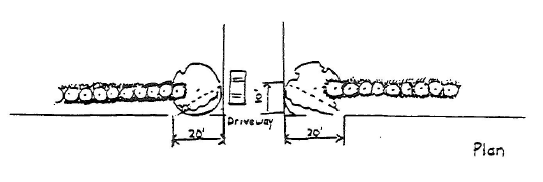
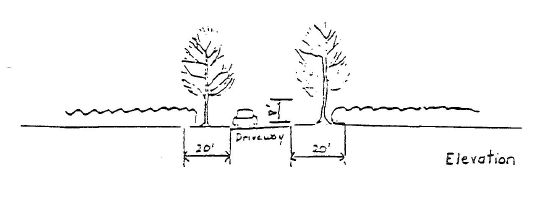
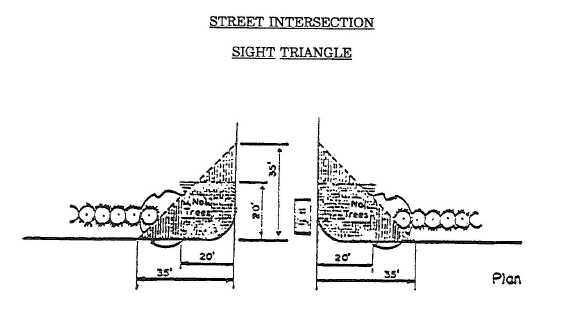
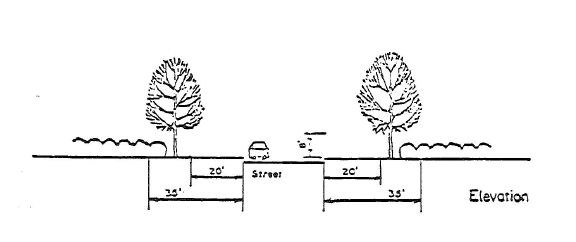
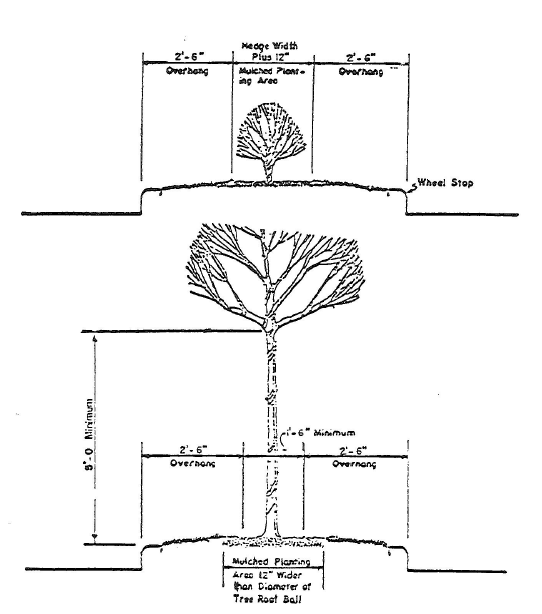
APPENDIX B: VEHICLE OVERHANG
APPENDIX C: RECOMMENDED TREES FOR THE VILLAGE OF MINERVA PARK
This Appendix C is designed to encourage an imaginative selection of landscape trees. Careful selection will prevent an over-dependence on a few species. This Appendix C will be useful to residents, nurserymen, horticulturists, landscapers, developers and landscape architects.
Along an individual street, uniform street tree plantings are desirable. However, overuse of a few species is inevitable without a conscious effort to vary plant species and families. Deviations from the recommended list are permitted with the approval of the Planning and Zoning Commission.
The list is divided into three size categories: large trees which mature at a height of 50 feet or more (Group A); medium trees which reach a mature height of between 30 and 50 feet (Group B); and small trees which range from ten to 30 feet at maturity (Group C). Tree lawn sizes must accommodate the tree size planted: Group A (greater than seven feet); Group B (four to seven feet); Group C (three to four feet). Use under utility lines is limited to small trees, although medium trees may be planted as close as ten lateral feet to utility lines.
The approximate mature height and diameter of the crown of each tree are given.
Trees are alphabetized by their scientific name with the common name given. Cultivars best suited to central Ohio are also provided. An asterisked entry indicates a tree which is unsuitable for planting within 15 lateral feet of a sidewalk or bike way.
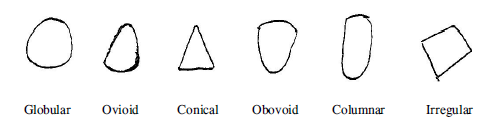
Habit refers to the three dimensional form of the tree. Six general terms describe the characteristic shape of the trees:
The tolerance category presents information from various sources listed in the bibliography. The tree’s relative tolerance to insects, diseases, pollution and soil conditions is signified by either a “Y” meaning yes, it is tolerant; “N” meaning no, it is not tolerant; or “-” meaning no information is available from these sources.
Comments pertain to any other notable characteristic of the tree.
Common Name (scientific name) ‘Cultivar” | Height (ft.) | Speed (ft.) | Habit | Insect/ Diseases | Pollution | Dry Soil | Damp Soil | Comments |
Common Name (scientific name) ‘Cultivar” | Height (ft.) | Speed (ft.) | Habit | Insect/ Diseases | Pollution | Dry Soil | Damp Soil | Comments |
Large Deciduous Trees (50 ft. or greater) - Group A | ||||||||
American Yellowwood (Cladrastis lutea) | 30-50 | 40-55 | obovoid | N | N | Y | - | white flowers; select those with wide branch angles |
Autumn Gold Ginkgo (Ginko biloba) ‘Autumn Gold’ | 50-80 | 30-60 | conical to globular | Y | Y | Y | Y | a male variety which does not fruit |
Bald Cypress (Taxodium distichum) | 50-70 | 20-30 | conical | Y | Y | Y | Y | characteristic knees develop in wet soils |
Black Alder (Alnus Glutinosa) | 40-60 | 20-40 | obovoid to globular | Y | Y | Y | Y | naturally a multi- stemmed tree; may prune to a single trunk |
Black Gum (Nyssa sylvatica) | 30-50 | 20-30 | conical to ovoid | Y | - | Y | Y | brilliant fall color |
Green Ash (Fraxinus pennsylvanica) ‘Marshall’s Seedless’ ‘Summit’ | 50-60 | 30-40 | irregular to globular | N | - | Y | Y | overplanted in Dublin |
Hardy Rubber Tree (Eucommia ulmoides) | 40-60 | 40-70 | conical to globular | Y | Y | Y | Y | dark green canopy |
Katsura Tree (Cercidiphyllum japonicum) | 40-60 | 30-50 | obovoid | Y | Y | N | Y | single or multi- stemmed; fall color an interesting apricot |
Kentucky Coffee Tree (Gymnocladus dioicus) | 60-75 | 40-50 | irregular to ovoid | Y | Y | Y | N | fruit may be objectionable; course texture |
Lacebark Elm (Ulmus parvifolia) | 40-50 | 30-40 | obovoid | Y | Y | Y | Y | exquisite mottled bark; resistant to Dutch elm disease |
Larch (Larix decidua) | 70-75 | 20-30 | conical | N | N | N | Y | deciduous conifer |
Norway Maple (Acer plantanoldes) ‘Cleveland’ ‘Emerald Queen’ ‘Summer Shade’ | 40-50 | 40-50 | globular | N | Y | Y | Y | dense shade and shallow roots inhibit turf |
Red Maple (Acer rubrum) ‘Autura Flame’ ‘October Glory’ ‘Red Sunset’ | 40-60 | 40-50 | ovoid to globular | Y | N | N | Y | suffers in urban environment; outstanding fall color |
Red Oak (Quercos rubra) | 60-75 | 40-50 | ovoid to globular | Y | Y | Y | Y | russet-red fall color |
Redmond Linden (Tilia americana) ‘Redmond’ | 40-50 | 25-30 | ovoid | N | Y | Y | Y | Japanese beatles may attack foliage |
Sassafrass (Sassafras albidum) | 30-60 | 25-40 | conical to irregular | Y | Y | Y | Y | outstanding fall color |
Scarlet Oak (Quercus coccinea) | 70-75 | 40-50 | globular | N | N | Y | N | red fall color |
Shingle Oak (Quercus imbricaria) | 50-60 | 50-70 | conical | Y | Y | Y | Y | leaves retained into winter |
Shumard Oak (Quercus shumardii) | 70-75 | 40-50 | ovoid to globular | Y | Y | Y | Y | a replacement for pin oak |
Silver Linden (Tilia tomentosa) | 50-70 | 30-40 | ovoid | N | Y | Y | Y | Japanese beatles may attack foliage |
Sugar Hackberry (Celtis laevigata) | 60-80 | 50-60 | globular | Y | Y | Y | Y | smooth bark |
Sugar Maple (Acer sacchanim) ‘Green Mountain’ ‘Legacy’ | 60-75 | 50-60 | ovoid to globular | Y | N | N | N | attractive fall color |
Swamp White Oak (Quercus bicolor) | 50-60 | 50-70 | ovoid | Y | Y | Y | Y | attractive scaly bark |
Sweetgum (liquidambar styraciflua) ‘Moraine’ | 60-75 | 40-50 | conical to globular | Y | N | N | Y | messy star-shaped fruit |
Turkish Filbert (Corylus colurna) | 40-50 | 30-40 | ovoid to conical | Y | Y | Y | Y | produces nuts in a stickyhusk that are a delicacy to squirrels |
Urban Elm (Ulmus) ‘Urban Elm’ | 50-70 | 25-40 | obovoid | Y | Y | Y | Y | resistant to Dutch elm disease |
White Ash (Fraxinus americana) ‘Autumn Applause’ ‘Autumn Purple’ | 50-80 | 40-70 | irregular to globular | N | - | N | Y | beautiful fall color |
Medium Deciduous Trees (30 - 50 ft.) Group B | ||||||||
American Hophornbeam (Ostrya virginiana) | 25-40 | 20-35 | conical | Y | - | Y | Y | transplant in spring |
Amur Cork Tree (Phellodendron amurense) | 30-45 | 30-50 | obovoid | Y | Y | Y | Y | broad-spreading |
Callary Pear (Pyrus calleryana) ‘Aristocrat’ ‘Chanticleer’ ‘Red Spire’ | 30-50 | 20-35 | conical to ovoid | Y | Y | Y | Y | commonly planted ‘Bradford’ exhibits poor branch structure leading to splitting |
Goldenraintree (Koelreuteria paniculata) | 30-40 | 30-50 | globular | Y | Y | Y | Y | course texture |
Hedge Maple (Acer campestre) | 25-35 | 20-35 | globular | Y | Y | Y | Y | dense canopy |
Sargent Cherry (Prunus sargentii) ‘Columnaris’ | 40-50 | 30-45 | globular | Y | - | - | - | stately bark; lovely early pink blossoms |
Sawtooth Oak (Quercus acutissima) | 35-45 | 35-45 | ovoid to globular | N | - | Y | N | chestnut-like leaf shape |
Thornless Honeylocust (Gleditsia triacanthos) var. inermis ‘Imperial’ ‘Moraine’ ‘Shade Master’ ‘Skyline’ | 35-50 | 20-35 | irregulat to globular | N | Y | Y | Y | overplanted; use moderately; delicate form |
Small Deciduous Trees (10 - 30 ft.) - Group C | ||||||||
‘Baskatong’ | 30 | - | - | Y | Y | - | - | purple-red flowers; dark purple- red fruit |
‘Centurion’ | 20-25 | - | columnar | Y | Y | - | - | rose-red flowers; cherry-red fruit |
‘Donald Wyman’ | 20-25 | - | columnar | Y | Y | - | - | white flowers; red fruit |
‘Harvest Gold’ | 20 | 15 | obovoid | Y | Y | - | - | white flowers; gold fruit |
‘Henningi’ | 25 | - | obovoid | Y | Y | - | - | white flowers; orange-red fruit |
‘Prairiefire’ | - | - | - | Y | Y | - | - | redflowers; maroon fruit |
‘Ralph Shay’ | - | - | - | Y | Y | - | - | retains red fruit |
‘Sentinel’ | - | - | columnar | Y | Y | - | - | pale pink flowers; red fruit |
‘Snow Drift’ | 15-25 | - | globular | Y | Y | - | - | profuse white flowers; orange-red fruit; fire-blight in nearby states |
‘Spring Snow’ | 20-25 | - | obovoid | Y | - | - | - | white flowers; fruitless |
‘Sugar Tyme’ | 18 | 15 | obovoid | Y | - | - | - | white flowers; red fruit |
‘White Angel’ | 20-25 | - | obovoid | Y | - | - | - | white flowers; red fruit |
‘Winter Gold’ | 30 | - | - | Y | - | - | - | white flowers; yellow fruit |
Amur Maple (Acer ginnala) | 15-20 | 43027 | obovoid to globular | Y | Y | Y | Y | grown multi- stemmed or as a single truck |
Blackhaw Viburnum (Viburnum prunifolium) | 43083 | 42958 | globular | Y | Y | Y | Y | blue-black fruit; prune to a tree form |
Crabapple (Malus) ‘Adams’ | 20-25 | - | globular | Y | Y | - | - | reddish pink flowers; red fruit |
Crabapple (malus) ‘Robinson’ | 25 | - | obovoid | Y | Y | - | - | deep pink flowers; dark red fruit |
Dotted Hawthorn (Crataequs punctata) ‘Ohio Pioneer’ | 25-30 | 25-35 | globular | N | Y | Y | Y | few thorns; attractive bark; large 1-inch fruit |
Fringe Tree (Chionanthus virginicus) | 43027 | 43027 | obovoid | Y | Y | Y | Y | fragrant, white flowers; lovely tree when single-stemmed |
Japanese Tree Lilac (Syringa reticulata) ‘Ivory Silk’ | 20-30 | 15-25 | obovoid | Y | Y | Y | Y | flowers in June |
Lavalle Hawthorn (Crataeque x lavallei) | 15-30 | 43032 | globular | N | Y | Y | Y | nearly thornless, showy red fruit |
Paperbark Maple (Acer griseum) | 20-30 | 43037 | globular to ovoid | Y | - | N | Y | unequaled bronze, exfoliating bark |
Serviceberry (Amelachier arborea) | 15-25 | 42925 | obovoid | Y | N | Y | Y | early white flowers; delicate form; single or multi-stemmed |
Thornless Cockspur Hawthorn (Crataequs crusgalli) var. inermis ‘Crusader’ | 20-30 | 20-35 | globular | N | Y | Y | Y | most cockspurs are dangerous; however, this one lacks thorns |
Trident Maple (Acer buergerianum) | 20-30 | 20-25 | globular | Y | Y | Y | N | dark green leaf |
Washington Hawthorn (Crataeque phaenopyrum) | 25-30 | 20-25 | globular | N | Y | Y | Y | thorns; red fruit persists into winter |
Winter King Hawthorn (Crataequs viridis) ‘Winter King’ | 20-35 | 15-30 | globular | N | Y | Y | Y | few thorns; fruit persists into winter; attractive bark |
Unacceptable Trees for Street Tree Use
Common Name | Scientific Name |
Common Name | Scientific Name |
Apple | Malus pumila |
Black Locust | Robinia pseudoacacia |
Box Elder | Acer negundo |
Bradford Pear | Pvrus callervana ‘Bradford’ |
Buckeye, Horsechestnut | Aesculus species |
European Mountain Ash | Sorbus aucuparia |
European White Birch | Betula pendula |
Ginko (female) | Ginko biloba |
Moline American Elm | Ulmus americana ‘Moline’ |
Mulberry | Morus species |
Northern Catalpa | Catalpa speciosa |
Osage-Orange | Maclura pomifera |
Paper Birch | Betula papvrifera |
Poplar | Populus species |
Siberian Elm | Ulmus pumila |
Silver Maple | Acer saccharinum |
Tree of Heaven | Ailanthus altissima |
Upright English Oak | Quercus robur ‘fastigiata’ |
Willow | Salix species |
(Ord. 5-89, passed 5-8-1989)
§ 1230.01 DESIGNATION AND PURPOSE.
(a) This Title Six of Part Twelve of these codified ordinances shall be known as the Zoning Code of the Village of Minerva Park, Ohio, and may be cited as such or as the Zoning Code.
(b) The purpose of this Zoning Code is as prescribed by R.C. Ch. 713.
(Ord. 5-89, passed 5-8-1989)
§ 1230.02 SCOPE.
The provisions of this Zoning Code shall apply to all land now within or hereafter annexed to the village.
(Ord. 5-89, passed 5-8-1989)
§ 1230.03 APPLICATION.
(a) New Development. New development, including the subdivision of land, construction and the use of land or structures, shall conform to the regulations for the zoning district in which such development is located.
(1) New Subdivisions. The subdivision or resubdivision of land shall not create lots less than the minimum size required for the zoning district in which such land is located, nor shall lots be provided or intended for uses not allowed in the zoning district.
(2) New Structures. New structures and/or developments shall be permitted only on lots subdivided to meet the requirements of this Zoning Code, in accordance with the subdivision regulations of the village, and shall conform to the development standards of the zoning districts in which such construction is permitted, except as is otherwise provided for in division (d) hereof.
(3) New Uses. Any new use of land or a structure shall be a permitted use or a conditional use for the zoning district in which such use is to be located.
(b) Existing Conforming Lots, Structures or Uses. Lots, structures or the use of lots and/or structures which conform to the regulations of the zoning district in which they are located may be continued to and may be altered, extended or changed in accordance with the following.
(1) Conforming Lots. A conforming lot may be changed, altered, enlarged or reduced in dimensions; provided, however, that the remaining lot and/or resulting lots shall conform to the development standards for the zoning district in which the lot is located.
(2) Conforming Structures. A conforming structure may be altered, reconstructed or extended only in such a manner as will comply with the development standards of the zoning district in which the structure is located.
(3) Conforming Uses. A conforming use may be expanded, modified or changed only in such a manner as will comply with the permitted use or conditional use regulations and with the development standards of the zoning district in which the conforming use is located.
(c) Nonconforming Lots, Structures or Uses. Existing lots, structures and accessory development, or the use of lots and/or structures, which would be prohibited under the regulations for the zoning district in which they are located shall be considered as nonconforming. A nonconforming use in violation of a provision of this Zoning Code shall not be validated by the adoption of this Zoning Code. It is the intent of this Zoning Code to permit these nonconforming situations to continue until they are removed, but not to encourage their continued use or expansion. A variance from any development standard must be obtained by approval of the Planning and Zoning Commission and Council.
(d) Nonconforming Structures and Developments. Structures and/or accessory developments, which, by reason of their size, type, location on a lot, or otherwise, are in conflict with the regulations of the zoning district in which they are located, may be altered, reconstructed or extended only in such a manner that the alteration, reconstruction or extension will comply with the development standards of the zoning district in which the structure and/or accessory development is located. Such alteration, reconstruction or extension shall include such additional development and compliance with the development standards of the zoning district as would be required of a new structure and/or accessory development to the extent practicable and so that the spirit and intent of the development standards are accomplished.
(e) Nonconforming Uses Superseded. Any nonconforming building, structure or use of land superseded by a use permitted within the zoning district where it is located shall thereafter be in conformity with this Code, and the previous nonconforming use shall not be resumed.
(f) Nonconforming Uses Discontinued. Any nonconforming use of land that is discontinued, and any building or structure left vacant for a period of one year or more, shall not be resumed. Any subsequent use of the land shall be in conformity with this Code, or be permitted by variance granted by the Planning and Zoning Commission.
(g) Nonconforming Uses Destroyed. Any nonconforming building or use of land destroyed by any cause to the extent of more than 50% of its replacement value shall not be resumed or reconstructed. The remains of any building or structure shall be razed. Any subsequent use of the land shall be in conformity with this Code, based upon the reproduction cost of the building, structure or use prior to the calamity and determined by the Zoning Inspector. In case of any uncertainty about the replacement value of a particular building, structure or use, the determination of the Mayor or his or her designee shall be final.
(h) Extension of Nonconforming Uses. The Planning and Zoning Commission may authorize the extension of a nonconforming use throughout those parts of an existing building that was manifestly designed or arranged for such use prior to the effective date of this Code if no structural alterations except those required by law are made therein.
(i) Prohibited Uses. The following uses are determined to be detrimental to the character of the village and are specifically prohibited, unless they are nonconforming uses. No permit shall be issued on the lot where a nonconforming prohibited use is located without the prohibited use being terminated and without evidence of its removal to grade. Uses not specifically listed as prohibited, but not listed as permitted, are permitted only upon approval by the Planning and Zoning Commission:
(1) Outhouses;
(2) Mobile homes;
(3) Garbage and refuse handling; and
(4) Junk yards.
(Ord. 5-89, passed 5-8-1989; Ord. 3-2002, passed 10-14-2002)
§ 1230.04 INTERPRETATION.
Except where specifically defined in this Zoning Code, all words used in this Zoning Code shall carry their customary meanings. Words used in the present tense include the future tense; the singular number includes the plural; the word “structure” includes the word “building”; the word “lot” includes the word “plot” or “parcel”; the term “shall” is always mandatory; the words “used” or “occupied”, as applied to any land or structure, shall be construed to include the words “intended, arranged or designed to be used or occupied”.
(Ord. 5-89, passed 5-8-1989)
§ 1230.05 DEFINITIONS.
As used in this Zoning Code:
(a) “Accessory building.” A subordinate building, the use of which is incidental to and customary in connection with the principal building or use and which is located on the same lot with such principal building or use.
(b) “Accessory use.” A subordinate use which is incidental to and customary in connection with the principal building or use and which is located on the same lot with such principal building or use.
(c) “Building.” A structure intended for shelter, housing or enclosure of persons, animals or chattels. When separated by dividing walls without openings, each portion of such structure so separated shall be deemed a separate building.
(d) “Building, height of.” The vertical distance measured from the grade to the highest point of the coping of a flat roof, to the deck line of a mansard roof or to the mean height level between the eaves and ridge of a gable, hip or gambrel roof.
(e) “Building setback line.” A line establishing the minimum allowable distance between the nearest portion of any building and the centerline of any street when measured perpendicularly thereto.
(f) “Child care.” Any place, home or institution which cares for young children apart from their parents, when received for regular periods of time for compensation, such as a kindergarten, a nursery school or a class for young children that develops basic skills and social behavior by games, exercises, toys and simple handicraft.
(g) “Clinic.” An establishment where patients are not lodged overnight, but are admitted for examination and treatment by a group of physicians or dentists practicing medicine together.
(h) “Commission.” The Planning and Zoning Commission of the village.
(i) “Council.” The Council of the village.
(j) “Dish antenna.” An outside accessory antenna that is linked to a receiver located on the same lot and used for the reception of signals transmitted by stations licensed by the Federal Communications Commission and the Radio Broadcast Services, including AM, FM and television signals.
(k) “Drive-in commercial uses.” Retail or service establishments which provide a designated place where people can drive up in motor vehicles and conduct the major portion of their business without having to get out of their motor vehicles, or where the serving of motor vehicles is the major business. “Drive-in commercial uses” include, but need not be limited to, drive-in restaurants which prepare and/or dispense ready-to-eat food or beverages and do not provide a place for all their customers to eat inside the building, or which serve ready-to-eat food or beverages for carry out; drive-in theaters; drive-in eating and drinking places; establishments where customers may serve themselves and may eat or drink food, refreshments or beverages on the premises; car washes; and drive-in banks.
(l) “Dwelling, apartment.” A building arranged or intended for four or more families living independently of each other in separate dwelling units, any two or more of which are provided with a common entrance or hall and all dwelling units of which are intended to be maintained under single ownership or owned under condominium arrangement.
(m) “Dwelling, single-family.” A building arranged or designed to be occupied by one family, the structure having only one dwelling unit.
(n) “Dwelling, two-family.” A building arranged or designed to be occupied by two families, the structure having only two dwelling units with separate entrances.
(o) “Landscaped area.” An area that is permanently devoted and maintained for the growing of shrubbery, grass and other plant material.
(p) “Lot, depth of.” The average horizontal distance between front and rear lot lines.
(q) “Lot, minimum.” A parcel of land occupied or to be occupied by a principal structure or group of structures and accessory structures, together with such yards, open spaces, lot width and lot area as are required by this Zoning Code, and having not less than the minimum required frontage upon a street, either shown and identified by lot number on a plat of record or considered as a unit of property and described by metes and bounds.
(r) “Lot line.” A line bounding or demarcating a plot of land or ground as established by a plat of record.
(s) “Lot, width.” The average horizontal distance between side lot lines.
(t) “Nonconforming use.” A legal use of a building and/or of land that antedates the adoption of this Zoning Code and does not conform to the regulations for the zoning district in which it is located.
(u) “Opaqueness.” The degree to which a wall, fence, structure or landscaping is solid or impenetrable to light or vision in a generally uniform pattern over its surface.
(v) “Street right-of-way line.” The dividing line between a street right-of-way and the contiguous property.
(w) “Structure.” Anything constructed or erected, the use of which requires permanent location on the ground or attachment to something having permanent location on the ground, including advertising signs, billboards, mobile homes (located for occupancy on a permanent foundation) and other construction or erection with special function or form, except fences or walks.
(x) “Structure, principal.” A structure in which is conducted the principal use of the lot on which it is situated.
(y) “Townhouse.” A building consisting of a series of three or more attached or semi-detached dwelling units, each with a ground floor and a separate ownership or condominium.
(z) “Yard, rear.” An open space between the rear lines of the principal structure, exclusive of steps, and the rear line of the lot and extending the full width of the lot. The “rear yard” may be used for accessory structures.
(aa) “Yard, side.” An open, unoccupied space on the same lot with a structure between the side line of the structure, exclusive of steps, and the side line of the lot, and extending from the front line to the rear line of the building.
(bb) “Zoning district.” Any section of the village in which zoning regulations are uniform.
(Ord. 5-89, passed 5-8-1989)
§ 1232.01 VARIANCES.
(a) Nature of Variance.
(1) On a particular property, extraordinary circumstances may exist making strict enforcement of the applicable development standards of this Zoning Code unreasonable. Therefore, the procedure for a variance from development standards is provided to allow the flexibility necessary to adapt to changed or unusual conditions, both foreseen and unforeseen, under circumstances which do not ordinarily involve a change of the primary use of the land or structure permitted.
(2) Description of property and nature of variance. The application for a variance shall include the following information:
A. The nature of the variance, including the specific provisions of this Zoning Code upon which the variance is requested;
B. A legal description of the property;
C. A statement of the special circumstances or conditions applying to the land or structure and not applying generally throughout the zoning district;
D. A statement showing that the special conditions and circumstances do not result from the actions of the applicant;
E. A statement showing that the granting of the application is necessary to the preservation and enjoyment of substantial property rights; and
F. 1. Such other information regarding the application as may be pertinent or required for appropriate action by the Council.
2. Plot plan. The application shall be accompanied by three copies of a plot plan drawn to an appropriate scale showing the following:
(a) The boundaries and dimensions of the lot;
(b) The nature of the special conditions or circumstances giving rise to the application for approval;
(c) The size and location of existing and proposed structures;
(d) The proposed use of all parts of the lot and structures, including accessways, walks, off-street parking and loading spaces, and landscaping;
(e) The relationship of the requested variance to the development standards; and
(f) The use of land and the location of structures on adjacent property.
(b) Review by Planning and Zoning Commission. One copy of the application and plot plan shall be forwarded to the Planning and Zoning Commission not less than 15 days prior to the date of the public hearing on the application. The Commission, shall review the application and submit a written report to Council on or before the date of the public hearing. Such report shall recommend approval, modification or disapproval of the variance and the reasons therefor.
(c) Actions of Council. Council shall hold a public hearing and act on an application in one of the following ways.
(1) Approval. Council shall only approve a variance or modification thereof if the following findings are made:
A. Special conditions and circumstances exist which are peculiar to the land or structure involved and which are not applicable to other lands or structures in the same zoning district;
B. A literal interpretation of the provisions of this Zoning Code would deprive the applicant of rights commonly enjoyed by other properties in the same zoning district under the terms of this Zoning Code;
C. The special conditions and circumstances do not result from the action of the applicant;
D. Granting the variance requested will not confer on the applicant any special privilege that is denied by this Zoning Code to other lands or structures in the same zoning district; and
E. Granting the variance will not adversely affect the health or safety of persons residing or working in the vicinity of the proposed development, be materially detrimental to the public welfare, or be injurious to private property or public improvements in the vicinity.
(2) Change of Zoning Use. In the event a variance or modification thereof would change the character of the land use, the result of which would be to permit a different zoning use on the property, all in accordance with the foregoing sections, then the variance or modification shall become effective only after it has been approved as a variance or modification by Council.
(3) Certificate of Zoning Compliance. A certificate of zoning compliance may be issued for an approved variance within a period of one year from the date of final approval by Council.
(4) Building Permit. A building permit may be obtained for the development only in accordance with the approved plot plan.
(Ord. 5-89, passed 5-8-1989)
§ 1232.02 CONDITIONAL USES.
(a) Nature of Conditional Uses; Intent. Specifically listed conditional uses are provided within the zoning district regulations in recognition of the fact that such uses, although often desirable, will more intensely affect the surrounding area in which they are located than the permitted uses of such zoning districts. The intent of this section is to set forth the development standards and criteria for locating and developing a conditional use in accordance with the nature of the surrounding area and the conditions of development and with regard to appropriate plans.
(b) Written Applications. Two copies of a written application shall be filed with the Planning and Zoning Commission.
(1) Description of Property and Intended Use. The application shall include the following statements:
A. A legal description of the property;
B. The proposed use of the property;
C. A statement of the necessity or desirability of the proposed use to the neighborhood or community;
D. A statement of the relationship of the proposed use to adjacent property and land use; and
E. Such other information regarding the property, proposed use or surrounding area as may be pertinent to the application or required for appropriate action by the Planning and Zoning Commission.
(2) Plot Plan. The application shall be accompanied by three copies of a plot plan, drawn to an appropriate scale, clearly showing the following:
A. The boundaries and dimensions of the lot;
B. The size and location of existing and proposed structures;
C. The proposed use of all parts of the lot and structures, including accessways, walks, off-street parking and loading spaces and landscaping;
D. The relationship of the proposed development to the development standards; and
E. The use of the land and the location of structures on adjacent property.
(c) Review by the Planning and Zoning Commission. The application and plot plans shall be forwarded to the Planning and Zoning Commission. The Planning and Zoning Commission shall review the application and submit a written report to the Council and shall recommend approval, modification or disapproval of the conditional use and the reasons therefor.
(d) Actions of Council. Council shall hold a public hearing and act on a conditional use in one of the following ways:
(1) Approval. Council shall approve an application for a conditional use if the following three conditions are met:
A. The proposed use is a conditional use of the zoning district and the applicable development standards established in this Zoning Code are met;
B. The proposed development is in accord with appropriate plans for the area; and
C. The proposed development will be in keeping with the existing land use character and physical development potential of the area.
(2) Approval with Modification.
A. Council may approve with modification an application for a conditional use. If the proposed use is a conditional use of the zoning district and the applicable development standards are met, plot plan modification is required:
1. To be in accord with appropriate plans for the area; and
2. To prevent undesirable effects on adjacent property and the surrounding area.
B. Such modification may be a limitation on the extent or intensity of development, a requirement for additional screening by fence or landscaping, a change in the method or plan for lighting, or a control of access or other conditions of development as may be required. Recommendations regarding the modification of plans or other appropriate actions shall be stated with the reasons for such recommendations.
(3) Disapproval. Council shall only disapprove of an application for a conditional use for any one of the following reasons:
A. The proposed use is not a conditional use of the zoning district, or the applicable development standards are not and cannot be met;
B. The proposed development is not in accord with appropriate plans of the area; or
C. The proposed development will have undesirable effects on the surrounding area and is not in keeping with the existing land use character and physical development potential of the area.
(4) Conditional Use Approval. Upon a favorable finding, Council shall approve a conditional use application within 30 days following the public hearing.
(5) Certificate of Zoning Compliance. A certificate of zoning compliance may be issued for an approved conditional use within a period of one year from the date of final approval by Council.
(6) Building Permit. A building permit may be obtained for the development only in accordance with the approved plot plan.
(Ord. 5-89, passed 5-8-1989)
§ 1232.03 FEES FOR VARIANCES AND CONDITIONAL USES.
A fee of $50 shall be paid to the village for each application for a variance or conditional use to cover the necessary administrative and advertising costs.
(Ord. 5-89, passed 5-8-1989)
§ 1232.99 PENALTY.
(a) Whoever violates or fails to comply with any of the provisions of this Zoning Code, or a valid order issued for violation thereof, for which no penalty is otherwise provided, is guilty of a misdemeanor of the third degree for each offense. A separate offense shall be deemed committed each day during or on which a violation occurs or continues.
(b) The application of the penalty set forth in division (a) above shall not be deemed to prohibit the removal of prohibited conditions or the application of any other equitable remedy.
(Ord. 4-2002, passed 10-14-2002)
§ 1234.01 APPEALS TO COUNCIL FROM DECISIONS OF THE PLANNING AND ZONING COMMISSION.
(a) Appeals to Council may be taken by any person aggrieved by, or by any officer of the village affected by, any decision of the Planning and Zoning Commission.
(b) Appeals shall be made within 20 days after the decision by filing with the Fiscal Officer, a notice of appeal, specifying the grounds therefor.
(Ord. 5-89, passed 5-8-1989)
§ 1236.01 INITIATION OF AMENDMENTS; RESUBMISSION AFTER DISAPPROVAL.
Council may amend the text of this Zoning Code, or the Zoning District Map in any of the following ways.
(a) Initiation by Resolution or Motion. Proposed amendments may be initiated by Council by resolution or by motion of the Planning and Zoning Commission.
(b) Initiation by Application. Proposed amendments may be initiated by application one or more owners or lessees of land within the area that is proposed to be changed by amendment of the Zoning District Map, or by one or more owners or lessees of land to be affected by an amendment of other provisions of this Zoning Code.
(c) Resubmission of Application. If a proposed amendment or supplement initiated by application is disapproved of by Council, another application for amendment or supplement affecting the land included in the disapproved application shall not be submitted within one year from the date of disapproval, except with a statement from the Planning and Zoning Commission of changed or changing conditions affecting the land sufficient to warrant reconsideration.
(Ord. 5-89, passed 5-8-1989)
§ 1236.02 AMENDMENT APPLICATION; FEE.
(a) Filing. Two copies of a provided application form shall be filed with the Mayor not less than 20 days prior to the public hearing of the Planning and Zoning Commission at which the proposal is to be considered.
(b) Contents. The application for any proposed change or amendment shall contain:
(1) A description or statement of the present and proposed provisions of this Zoning Code or the proposed amendment of the district boundaries of the Zoning District Map;
(2) A description by map or text of the property to be affected by the proposed amendment;
(3) A statement of the relation of the proposed amendment to the general health, safety and welfare of the public in terms of need or appropriateness within the area by reason of changed or changing conditions and the relation to appropriate plans for the area; and
(4) A list of owners of property within, contiguous to and directly across the street from the area proposed to be rezoned. Such list shall be in accordance with the Franklin County Auditor’s current tax list.
(c) Fees. A fee of $50 shall be paid to the village for each application for any proposed amendment to cover the necessary administrative and advertising costs.
(Ord. 5-89, passed 5-8-1989)
§ 1236.03 AUTHORITY OF PLANNING AND ZONING COMMISSION AND COUNCIL; HEARINGS.
(a) Review of Ordinance by Commission; Report; Date of Public Hearing. Upon its own action, or upon receipt of an application from an owner or lessee of land, or upon receipt of a resolution from the Planning and Zoning Commission, Council shall transmit the ordinance regarding a proposed amendment of this Zoning Code or the Zoning District Map to the Planning and Zoning Commission for study and report. The Planning and Zoning Commission shall have not less than 30 days in which to consider and report upon such proposed ordinance. The report of the Planning and Zoning Commission shall be transmitted to Council, at which time Council shall set a date for a public hearing upon the proposed amendment.
(b) Notice of Public Hearing. A notice setting forth the time and place of a public hearing and the nature of the proposed amendment shall be given by Council, at least 30 days in advance of the date of such hearing, in a newspaper of general circulation in the village.
(1) If the ordinance, measure or regulation intends to rezone or redistrict ten or fewer parcels of land, as listed on the tax duplicate, a written notice of the hearing shall be mailed by the Fiscal Officer by first class mail, at least 20 days before the date of the public hearing, to the owners of property within, contiguous to and directly across the street from such parcel or parcels, to the addresses of such owners appearing on the County Auditor’s current tax list or the Fiscal Officer’s mailing list, or to the names and addresses supplied by the applicant to the Fiscal Officer at the time of filing the application.
(2) During the 30 days preceding the public hearing, the text or a copy of the text of the ordinance, measure or regulation, together with the maps or plans, or copies thereof, forming a part of or referred to in the ordinance, measure or regulation, and the maps, plans and reports submitted by the Planning and Zoning Commission or by any board or officer, shall be on file, for public examination, in the office of the Fiscal Officer or in such other office as is designated by Council.
(Ord. 5-89, passed 5-8-1989)
§ 1238.01 ESTABLISHMENT AND ADOPTION OF DISTRICT USE AND DEVELOPMENT REGULATIONS.
Regulations pertaining to the use of land and/or structures, and the physical development thereof, within each of the zoning districts, as adopted as a standard zoning district and as shown on the Zoning District Map, are hereby established and adopted.
(Ord. 5-89, passed 5-8-1989)
§ 1238.02 INTERPRETATION AND ENFORCEMENT OF REGULATIONS.
The standard district regulations, set forth in Chapters 1238 through 1270, shall be interpreted and enforced according to the following rules:
(a) Permitted Uses. Only a use designated as a permitted use shall be allowed as a matter of right in a zoning district, and any use not so designated shall be prohibited, except that when an additional use is in character with the zoning district, such additional use may be added to the permitted uses of the zoning district by an amendment of this Zoning Code.
(b) Conditional Uses. A use designated as a conditional use shall be allowed in a zoning district when such conditional use, its location, extent and method of development, will not substantially alter the character of the vicinity or unduly interfere with the use of adjacent lots in the manner prescribed for the zoning district. To this end, the Planning and Zoning Commission shall, in addition to the development standards for the zoning district, set forth such additional requirements as will, in its judgment render the conditional use compatible with the existing and future use of adjacent lots and the vicinity.
(c) Development Standards. The development standards set forth in this Zoning Code shall be the minimum allowed for development in a zoning district. If the development standards are in conflict with the requirements of any other lawfully adopted rules, regulations or laws, the more restrictive or higher standard shall govern.
(Ord. 5-89, passed 5-8-1989)
§ 1238.03 ADOPTION OF ZONING DISTRICT MAP; IDENTIFICATION.
(a) Division of Land. All land in the village is placed into zoning districts as shown on the Zoning District Map, which is hereby adopted and declared to be a part of this Zoning Code.
(1) Final Authority. The Zoning District Map, as amended from time to time, shall be the final authority for the current zoning district status of land under the jurisdiction of this Zoning Code.
(2) Undesignated Land. All land under this Zoning Code that is not designated or otherwise included within another zoning district on the Zoning District Map shall be included in the Rural District.
(b) Identification of the Zoning District Map. The Zoning District Map, with any amendments made thereon, shall be dated and identified by the signatures of the Mayor and the Chairperson of the Planning and Zoning Commission and shall be on file in the Village Offices for inspection by the public.
(Ord. 5-89, passed 5-8-1989)
§ 1238.04 DESIGNATION OF DISTRICTS ON ZONING DISTRICT MAP; LEGEND.
(a) District Names and Symbols. The names and symbols for the standard zoning districts as shown on the Zoning District Map are as follows:
Name | Symbol |
Name | Symbol |
Residential Districts | |
Rural | R |
Restricted Suburban Residential | R-1 |
Limited Suburban Residential | R-2 |
Suburban Residential | R-3 |
Suburban Residential | R-4 |
Two-Family Residential | R-10 |
Urban Residential | R-12 |
Commercial Districts | |
Suburban Office and Institutional | SO |
Neighborhood Commercial | NC |
Community Commercial | CC |
Central Community Commercial | CCC |
Central Business | CB |
Industrial Districts | |
Restricted Industrial | RI |
Limited Industrial | LI |
General Industrial | GI |
Office, Laboratory and Research | OLR |
Planned Districts | |
Planned Residential District | PRD |
Planned Shopping Center | PSC |
Planned Highway Service | PHS |
Planned Industrial Park | PIP |
Planned Unit Development | PUD |
Planned Office, Laboratory and Research | POLR |
Special Districts | |
Floodplain | FP |
(b) Legend. There shall be provided, on the Zoning District Map, a legend which shall list the name and symbol for each zoning district. In lieu of a symbol, a color or black and white pattern may be used to identify each zoning district, as indicated in the legend.
(Ord. 5-89, passed 5-8-1989; Ord. 08-2013, passed 9-9-2013)
§ 1238.05 DISTRICT BOUNDARIES.
(a) In General. The boundaries of the zoning districts are shown on the Zoning District Map. The Zoning District Map, and all notations, references and other information shown thereon are a part of this Zoning Code and have the same force and effect as if the Zoning District Map, and all the notations, references and other information shown thereon, were all fully set forth or described herein. A certified copy of the Zoning District Map is properly attested and is on file with the Fiscal Officer.
(b) Rules for Determination of Boundaries. When uncertainty exists with respect to the boundaries of zoning districts, as shown on the Zoning District Map, the following rules shall apply.
(1) Boundaries Along Rights-of-Way or Watercourses. Where zoning district boundary lines are indicated as approximately following the centerline of a street, highway, alley, railroad easement or other right-of-way, or a river, creek or other watercourse, such centerline shall be the zoning district boundary.
(2) Boundaries Along Lot Lines. Where zoning district boundary lines are indicated as approximately following a lot line, such lot line shall be the zoning district boundary.
(3) Boundaries Parallel to Right-of-Way Centerlines or Property Lines. Where zoning district boundary lines are indicated as being approximately parallel to a right-of-way centerline or a property line, such zoning district boundary lines shall be parallel thereto and, in the absence of a specified dimension on the Map, at such scaled distance therefrom as indicated on the Zoning District Map.
(4) Boundaries in Conflict with Zoning District Map. When the actual street or lot layout existing on the ground is in conflict with that shown on the Zoning District Map, the party alleging that such a conflict exists shall furnish an actual survey for interpretation by Council.
(5) Extending District Boundaries for Vacated Rights-of-Way. Whenever any street, alley or other public way is vacated by official action of Council, the zoning district adjoining each side of such vacation, and all area included in the vacation, shall then and thenceforth be subject to all appropriate regulations of the extended district or districts.
(Ord. 5-89, passed 5-8-1989)
§ 1240.01 PERMITTED USES.
The following uses shall be permitted in the Rural District.
(a) Agriculture.
(1) Agriculture uses, including farming, dairying, pasturage, horticulture, floriculture, viticulture and animal and poultry husbandry;
(2) Farm dwelling structures;
(3) Farm labor quarters for laborers working on the premises; and
(4) Roadside stands offering for sale only farm products produced on the premises.
(b) Dwelling Structures. One-family dwelling structures. A lot of record on the date of adoption of this Zoning Code may be subdivided in accordance with the subdivision regulations to provide up to four residential lots, provided that the remaining portion of the lot is five acres or more.
(c) Home Occupations. Home occupations in association with a permitted dwelling and in accordance with the provisions of Chapter 1272.
(d) Accessory Buildings and Uses. Accessory buildings and uses in association with agriculture or permitted dwellings as specified in § 1272.05
, including noncommercial guest housing, provided the lot is five acres or more.
(e) Schools and Parks.
(1) Public or private schools offering general educational courses and having no rooms regularly used for the housing or sleeping of students; and
(2) Parks, playgrounds and playfields.
(f) Religious Uses. A church or other place of worship, provided it occupies a lot of not less than five acres.
(g) Storage and Processing of Agricultural Products. Grain elevators, mills or other facilities for the storage, sorting or other preliminary processing of agricultural products, except that commercial grain elevator operations shall not be permitted. Storage facilities shall not be within 50 feet of a side or rear lot line, except when along a railroad right-of-way. Processing facilities shall not be within 100 feet of a side of rear lot line, except when along a railroad right-of-way.
(Ord. 5-89, passed 5-8-1989)
§ 1240.02 CONDITIONAL USES.
The following uses shall be permitted in the Rural District subject to approval by Council.
(a) Mobile Homes. A mobile home or house trailer is permitted for a period not to exceed 18 months.
(b) Private Schools or Colleges. A private school or college, with students in residence is permitted; provided it occupies a lot of not less than ten acres or more and provided there is one acre or more per 25 day students, and one acre or more per 15 resident students.
(c) Kindergarten or Child Care. Kindergarten or child care is permitted as an accessory use of a dwelling or as a principal use of the lot; provided it occupies a lot of not less than one acre and provided there is an outdoor play area of 200 square feet or more per child. Such play area shall be arranged in accordance with the provisions of this district for accessory uses and shall be enclosed with a chain-link fence or its equivalent in strength and protective character, to a height of four feet, but not more than six feet.
(d) Cemeteries. Cemeteries hereafter established, following the adoption of this Zoning Code, shall occupy a parcel of not less than 40 acres, excepting those parcels added to an existing cemetery, which may be less than 40 acres. Interment shall not be within 100 feet of any property line. A mausoleum, crematory or other structure shall not be within 300 feet of any property line.
(e) Associated Sales. Associated sales are permitted as an accessory to and in association with an agricultural permitted use, with such associated sales to cease upon cessation of the agricultural activity. Associated sales shall include, but are not limited to, garden supplies with a nursery or greenhouse, milk products with a dairy, or imported produce with a permitted produce stand.
(f) Care and Boarding of Animals. Veterinarian offices, animal hospitals, kennels or other facilities for the care or boarding of animals, are permitted, provided that they occupy a lot of not less than five acres and provided that a building pen or other enclosure so used shall not be within 200 feet of any property line.
(g) Commercial Grain Elevator Operations. Commercial grain elevator operations are permitted, provided that the Planning and Zoning Commission determines that adequate lot area is available for such an operation.
(Ord. 5-89, passed 5-8-1989)
§ 1240.03 DEVELOPMENT STANDARDS.
In addition to the provisions of Chapter 1272, the following standards for the arrangement and development of land and buildings are required in the Rural District.
(a) Lot Area and Coverage.
(1) For agricultural purposes, in the determination of accessory and associated uses, the lot area shall be five acres or more, but this shall not exclude the agricultural use of any smaller lot.
(2) For each dwelling unit there shall be a lot area of not less than 40,000 square feet.
(3) For each permitted use and conditional use the lot area shall be adequate to meet the sanitation requirements of the County Board of Health, but shall not be less than that prescribed for such use.
(4) Only one principal use shall be permitted on a lot, and such lot shall not be covered more than 20% by structure.
(b) Lot Width. For a one-family dwelling, there shall be a lot width of 150 feet or more at the front line of the dwelling, and such lot shall have access to and abut on a public right-of-way for a distance of 60 feet or more.
(c) Side Yards. For dwellings or associated accessory buildings there shall be a total of side yards of 25 feet or more, with a minimum of eight feet on one side. For conditional uses there shall be a side yard of not less than 25 feet, except when a larger side yard is required for such use by this Zoning Code.
(d) Rear Yards. For main buildings, there shall be a rear yard of 20% or more of the lot depth, except that a rear yard of more than 50 feet shall not be required.
(e) Maximum Height. No dwelling structure shall exceed 35 feet in height. The maximum height for other structures shall not exceed a safe height as determined by the Planning and Zoning Commission.
(Ord. 5-89, passed 5-8-1989)
§ 1242.01 PERMITTED USES.
Land and buildings in the Restricted Suburban Residential District shall be used only for the following purposes.
(a) Dwelling Structures. One-family structures.
(b) Home Occupations. Home occupations in association with a permitted dwelling and in accordance with the provisions of § 1242.02 and Chapter 1272.
(c) Accessory Buildings and Uses.
(1) Accessory buildings and uses in association with permitted dwellings, as specified in § 1242.02 and Chapter 1272; and
(2) Domestic servants quarters (employed on the premises).
(d) Public Schools and Parks.
(1) Public schools offering general educational courses and having no rooms regularly used for housing or sleeping of students; and
(2) Parks, playgrounds and playfields.
(e) Private Schools. Private schools offering general educational courses similar to those ordinarily given in public schools and having no rooms regularly used for housing or sleeping of students, provided that such school it occupies a lot of not less than five acres.
(f) Religious Uses. A church or other place of worship, provided it occupies a lot of not less than five acres.
(Ord. 5-89, passed 5-8-1989)
§ 1242.02 DEVELOPMENT STANDARDS.
In addition to the provisions of Chapter 1272, the following standards for the arrangement and development of land and buildings are required in the Restricted Suburban Residential District.
(a) Lot Area and Coverage.
(1) For each dwelling unit there shall be a lot area of not less than 40,000 square feet.
(2) For each permitted use and conditional use the lot area shall be adequate to meet the sanitation requirements of the County Board of Health, but shall not be less than that prescribed for such use.
(3) One principal use shall be permitted on a lot and such lot shall not be covered more than 20% by structure.
(b) Lot Width. For a one-family dwelling there shall be a lot width of 150 feet or more at the front line of the dwelling, and such lot shall have access to and abut on a public right-of-way for a distance of 60 feet or more. For a conditional use, the lot width shall be adequate to meet the development standards of the Restricted Suburban Residential District.
(c) Side Yards. For dwellings or associated accessory buildings there shall be a total of side yards of 25 feet or more, with a minimum of eight feet on one side. For a conditional use, except dwellings and accessory structures thereto, there shall be a side yard of 25 feet or more on each side of a building.
(d) Rear Yards. For main buildings, there shall be a rear yard of 20% or more of the lot depth, except that a rear yard of more than 50 feet shall not be required.
(e) Maximum Height. No dwelling structure shall exceed 35 feet in height. The maximum height for other structures shall not exceed a safe height as determined by the Planning and Zoning Commission.
(Ord. 5-89, passed 5-8-1989)
§ 1244.01 PERMITTED USES.
Land and buildings in the Limited Suburban Residential District shall be used only for the following purposes.
(a) Dwelling Structures. One-family dwelling structures.
(b) Home Occupations. Home occupations in association with a permitted dwelling, and in accordance with the provisions of § 1244.03 and Chapter 1272.
(c) Accessory Buildings and Uses. Accessory buildings and uses in association with permitted dwellings as specified in § 1244.03 and Chapter 1272.
(d) Public Schools and Parks.
(1) Public schools offering general educational courses and having no rooms regularly used for housing or sleeping of students; and
(2) Parks, playgrounds and playfields.
(e) Private Schools. Private schools offering general educational courses similar to those ordinarily given in public schools and having no rooms regularly used for housing or sleeping of students, provided that such school occupies a lot of not less than five acres.
(f) Religious Uses. A church or other place of worship, provided it occupies a lot of not less than five acres.
(Ord. 5-89, passed 5-8-1989)
§ 1244.02 CONDITIONAL USE.
The following uses shall be allowed in the Limited Suburban Residential District subject to approval in accordance with § 1244.03 and Chapter 1272: Kindergarten or child care, as an accessory use of a dwelling.
(a) There shall be an outdoor play area of 200 square feet or more per child.
(b) Such play area shall be arranged in accordance with the provisions of this district for accessory uses and shall be enclosed with a chain-link fence, or its equivalent in strength and protective character, to a height of four feet, but not more than six feet.
(Ord. 5-89, passed 5-8-1989)
§ 1244.03 DEVELOPMENT STANDARDS.
In addition to the provisions of Chapter 1272, the following standards for the arrangement and development of land and buildings are required in the Limited Suburban Residential District.
(a) Lot Area and Coverage.
(1) For each dwelling unit there shall be a lot area of not less than 20,000 square feet.
(2) For all other permitted uses and conditional uses, the lot area shall be adequate to meet the sanitation requirements of the County Board of Health, but shall not be less than that prescribed for such use.
(3) Only one principal use shall be permitted on a lot, and such lot shall not be covered more than 20% by structure.
(b) Lot Width. For a one-family dwelling there shall be a lot width of 100 feet or more at the front line of the dwelling, and such lot shall have access to and abut on a public right-of-way for a distance of 60 feet or more. For a conditional use, the lot width shall be adequate to meet the development standards of the Limited Suburban Residential District.
(c) Side Yards. For dwellings or associated accessory buildings there shall be a total of side yards of 20 feet or more, with a minimum of eight feet on one side. For a conditional use, except dwellings and accessory structures thereto, there shall be a side yard of 25 feet or more on each side of a building.
(d) Rear Yards. For main buildings there shall be a rear yard of 20% or more of the lot depth, except that a rear yard of more than 50 feet shall not be required.
(e) Maximum Height. No dwelling structure shall exceed 35 feet in height. The maximum height for other structures shall not exceed a safe height as determined by the Planning and Zoning Commission.
(Ord. 5-89, passed 5-8-1989)
§ 1246.01 PERMITTED USES.
Land and buildings in the R-3 Suburban Residential District shall be used only for the following purposes.
(a) Dwelling Structures. One-family dwelling structures.
(b) Home Occupations. Home occupations in association with a permitted dwelling, and in accordance with the provisions of § 1246.03 and Chapter 1272.
(c) Accessory Buildings and Uses. Accessory buildings and uses in association with permitted dwellings as specified in § 1246.03 and Chapter 1272.
(d) Public Schools. Public schools offering general educational courses and having no rooms regularly used for housing or sleeping of students.
(e) Private Schools. Private schools offering general educational courses similar to those ordinarily given in public schools and having no room regularly used for housing or sleeping of students; provided that such school occupies a lot of not less than five acres.
(f) Religious Uses. A church or other place of worship; provided it occupies a lot of not less than five acres and there is one acre or more per 100 seats or similar accommodations in the main assembly area.
(Ord. 5-89, passed 5-8-1989)
§ 1246.02 CONDITIONAL USE.
The following uses shall be allowed in the R-3 Suburban Residential District subject to approval in accordance with § 1246.03 and Chapter 1272: Kindergarten or child care, as an accessory use of a dwelling.
(a) There shall be an outdoor play area of 200 square feet or more per child.
(b) Such play area shall be arranged in accordance with the provisions of this district for accessory uses and shall be enclosed with a chain-link fence or its equivalent in strength and protective character, to a height of four feet, but not more than six feet.
(Ord. 5-89, passed 5-8-1989)
§ 1246.03 DEVELOPMENT STANDARDS.
In addition to the provisions of Chapter 1272, the following standards for the arrangement and development of land and buildings are required in the R-3 Suburban Residential District.
(a) Lot Area and Coverage.
(1) For each dwelling unit there shall be a lot area of not less than 10,000 square feet. The average net density, exclusive of public rights-of-way, for an area to be platted into single-family lots, shall not exceed three dwelling units per acre.
(2) For all other permitted uses and conditional uses, the lot area shall be adequate to meet the sanitation requirements of the County Board of Health, but shall not be less than that prescribed for such use.
(3) Only one principal use shall be permitted on a lot, and such lot shall not be covered more than 30% by structure.
(b) Lot Width. For a dwelling there shall be a lot width of 80 feet or more at the front line of the dwelling, and such lot shall have access to and abut on a public right-of-way for a distance of 50 feet or more. For a conditional use the lot width shall be adequate to meet the development standards of the R-3 District.
(c) Side Yards. For dwellings or associated accessory buildings there shall be a total of side yards of 18 feet or more, with a minimum of eight feet on one side.
(d) Rear Yards. For main buildings there shall be a rear yard of 25% or more of the lot depth, except that a rear yard of more than 50 feet shall not be required.
(e) Maximum Height. No dwelling structure shall exceed 35 feet in height. The maximum height for other structures shall not exceed a safe height as determined by the Planning and Zoning Commission.
(Ord. 5-89, passed 5-8-1989)
§ 1248.01 PERMITTED USES.
Land and buildings in the R-4 Suburban Residential District shall be used only for the following purposes.
(a) Dwelling Structures. One-family dwelling structures. Two-family dwelling structures and up to and including eight-family dwelling structures may be permitted, provided that:
(1) An acceptable site development plan and subdivision plat are submitted and are reviewed and approved by the Planning and Zoning Commission;
(2) Such plan conforms to the development standards set forth in § 1248.03 and Chapter 1272; and
(3) The average net density, exclusive of public rights-of-way, for an area to be developed and/or platted under the R-4 Suburban Residential District, shall not exceed four dwelling units per acre.
(b) Home Occupations. Home occupations in association with a permitted dwelling and in accordance with the provisions of § 1272.04.
(c) Accessory Buildings and Uses. Accessory buildings and uses in association with permitted dwellings, as specified in § 1248.03 and Chapter 1272.
(d) Public Schools. Public schools offering general educational courses and having no rooms regularly used for housing or sleeping of students.
(e) Private Schools. Private schools offering general educational courses similar to those ordinarily given in public schools and having no rooms regularly used for housing or sleeping of students, provided that such school occupies a lot of not less than five acres.
(f) Religious Uses. A church or other place of worship, provided it occupies a lot of not less than five acres and there is one acre or more per 100 seats or similar accommodations in the main assembly area.
(Ord. 5-89, passed 5-8-1989)
§ 1248.02 CONDITIONAL USE.
The following uses shall be allowed in the R-4 Suburban Residential District subject to approval in accordance with § 1232.02. Kindergarten or child care as an accessory use of a dwelling.
(a) There shall be an outdoor play area of 200 square feet or more per child.
(b) Such play area shall be arranged in accordance with the provisions of this district for accessory uses and shall be enclosed with a chain-link fence, or its equivalent in strength and protective character, to a height of four feet, but not more than six feet.
(Ord. 5-89, passed 5-8-1989)
§ 1248.03 DEVELOPMENT STANDARDS GENERALLY.
In addition to the provisions of Chapter 1272, the following standards for the arrangement and development of land and buildings are required in the R-4 Suburban Residential District.
(a) Lot Area and Coverage.
(1) For each dwelling unit there shall be a lot area of not less than 10,000 square feet.
(2) For all other permitted uses and conditional uses the lot area shall be adequate to meet the sanitation requirements of the County Board of Health, but shall not be less than that prescribed for such use.
(3) Only one principal use shall be permitted on a lot, and such lot shall not be covered more than 25% by structure.
(b) Lot Width. For a single-family dwelling there shall be a lot width of 75 feet or more at the front line of the dwelling and such lot shall have access to and abut on a public right-of-way for a distance of 50 feet or more. For a conditional use the lot width shall be adequate to meet the development standards of the R-4 District.
(c) Side Yards. For single-family dwellings or associated accessory buildings there shall be a total of side yards of 15 feet or more, with a minimum of five feet on one side. For conditional uses, except dwellings and accessory structures thereto, there shall be a side yard of 25 feet or more on each side of a building.
(d) Rear Yards. For main buildings there shall be a rear yard of 20% or more of the lot depth, except that a rear yard of more than 50 feet shall be required.
(e) Maximum Height. No dwelling structure shall exceed 35 feet in height. The maximum height for other structures shall not exceed a safe height as determined by the Planning and Zoning Commission.
(Ord. 5-89, passed 5-8-1989)
§ 1248.04 DEVELOPMENT STANDARDS FOR TWO-FAMILY DWELLING STRUCTURES.
For two-family dwelling structures, the following standards shall apply.
(a) Lot Area and Coverage. For each dwelling unit there shall be a lot area of not less than 8,500 square feet. Such lot shall not be covered more than 20% by structure.
(b) Lot Width. The minimum width for a two-family lot shall be 100 feet and the lot shall have access to and abut on a public right-of-way for a distance of 60 feet or more.
(c) Side Yards. For a two-family structure there shall be a total of side yards of 20 feet and a minimum side yard of eight feet on one side.
(d) Rear Yards. A minimum rear yard of 30 feet shall be required.
(e) Maximum Height. No dwelling structure shall exceed 35 feet in height. The maximum height for other structures shall not exceed a safe height as determined by the Planning and Zoning Commission.
(Ord. 5-89, passed 5-8-1989)
§ 1248.05 DEVELOPMENT STANDARDS FOR THREE- THROUGH EIGHT-FAMILY DWELLING STRUCTURES.
For three- through eight-family dwelling structures, the following standards shall apply.
(a) Lot Area. For each dwelling unit there shall be a lot area of 8,500 square feet.
(b) Lot Width. The minimum lot width shall be 150 feet.
(c) Side and Rear Yards. Structures shall be set back from all side and rear property lines a minimum of 25 feet.
(d) Maximum Height. No dwelling structure shall exceed 35 feet in height. The maximum height for other structures shall not exceed a safe height as determined by the Planning and Zoning Commission.
(e) Traffic and Parking Concept. A proposed traffic circulation and parking concept shall be shown on the development plan, indicating ingress and egress points, resident and guest parking and provision for service vehicles.
(f) Open Space Concept. A proposed open space concept shall be shown on the development plan, indicating proposed recreational or other amenities, such as operation and maintenance of such areas.
(Ord. 5-89, passed 5-8-1989)
§ 1250.01 PERMITTED USES.
Land and buildings in the Two-Family Residential District shall be used for the following purposes:
(a) Dwelling Structures. Two-family dwelling structures.
(b) Home Occupations. Home occupations in association with a permitted dwelling and in accordance with the provisions of § 1250.03 and Chapter 1272.
(c) Accessory Buildings and Uses. Accessory buildings and uses in association with permitted dwellings, as specified in § 1250.03 and Chapter 1272.
(d) Public Schools. Public schools offering general educational courses and having no rooms regularly used for housing or sleeping of students.
(e) Private Schools. Private schools offering general educational courses similar to those ordinarily given in public schools and having no rooms regularly used for housing or sleeping of students, provided that such school occupies a lot of not less than five acres.
(f) Religious Uses. A church or other place of worship, provided it occupies a lot of not less than five acres and there is one acre or more per 100 seats or similar accommodations in the main assembly area.
(Ord. 5-89, passed 5-8-1989)
§ 1250.02 CONDITIONAL USE.
The following use shall be allowed in the Two-Family Residential District subject to approval in accordance with § 1232.02: Kindergarten or child care as an accessory use of a dwelling.
(a) There shall be an outdoor play area of 200 square feet or more per child.
(b) Such play area shall be arranged in accordance with the provisions of this District for accessory uses and shall be enclosed with a chain-link fence, or its equivalent in strength and protective character, to a height of four feet, but not more than six feet.
(Ord. 5-89, passed 5-8-1989)
§ 1250.03 DEVELOPMENT STANDARDS.
In addition to the provisions of Chapter 1272, the following standards for the arrangement and development of land and buildings are required in the Two-Family Residential District.
(a) Lot Area and Coverage. For each dwelling unit there shall be a lot area not less than 4,500 square feet. Only one principal use shall be permitted on a lot, and such lot shall not be covered more than 30% by structure.
(b) Lot Width. For a two-family lot there shall be a lot width of 80 feet or more at the front line of the dwelling, and such lot shall have access to and abut on a public right-of-way for a distance of 50 feet or more. For a conditional use, the lot width shall be adequate to meet the development standards for the Two-Family Residential District.
(c) Side Yards. For dwellings or associated accessory buildings there shall be a total of side yards of 15 feet or more, with a minimum of five feet on one side.
(d) Rear Yards. For main buildings there shall be a rear yard of 25% or more of the lot depth, except that a rear yard of more than 50 feet shall not be required.
(e) Maximum Height. No dwelling structure shall exceed 35 feet in height. The maximum height for other structures shall not exceed a safe height as determined by the Planning and Zoning Commission.
(f) Reduction of Development Standards. It is encouraged that two-family developments be done in a planned, coordinated fashion with provision for open space and play areas to be included within the site development concept. At the applicant’s option, the lot area per dwelling unit may be reduced to 4,000 square feet; provided that a useable centralized open space or play area is provided at the ratio of 250 square feet per dwelling unit. This reduction in lot area and lot frontage and the provision for an open space concept shall be subject to review and approval by the Planning and Zoning Commission.
(Ord. 5-89, passed 5-8-1989)
§ 1252.01 PERMITTED USES.
Land and buildings in the Urban Residential District shall be used only for the following purposes.
(a) Dwelling Structures. Multiple-family structures having three or more dwelling units per structure.
(b) Home Occupations. Home occupations in association with a permitted dwelling and in accordance with the provisions of § 1252.03 and Chapter 1272.
(c) Accessory Buildings and Uses. Accessory buildings and uses in association with permitted dwellings as specified in § 1252.03 and Chapter 1272.
(d) Public Schools and Parks.
(1) Public schools offering general educational courses and having no rooms regularly used for housing or sleeping of students; and
(2) Parks, playgrounds and playfields.
(e) Private Schools. Private schools offering general educational courses similar to those ordinarily given in public schools and having no rooms regularly used for housing or sleeping of students, provided that such school occupies a lot of not less than five acres.
(f) Religious Uses. A church or other place of worship, provided it occupies a lot of not less than five acres.
(Ord. 5-89, passed 5-8-1989)
§ 1252.02 CONDITIONAL USES.
The following uses shall be allowed in the Urban Residential District, subject to approval in accordance with § 1232.02:
(a) Two-family structures;
(b) Kindergarten or child care as an accessory use of a dwelling. There shall be an outdoor play area of 200 square feet or more per child. Such play area shall be arranged in accordance with the provisions of this district for accessory uses and shall be enclosed with a chain-link fence, or its equivalent in strength and protective character, to a height of four feet, but not more than six feet; and
(c) Those uses incidental and accessory to multiple-family dwellings, including recreational facilities, swimming pools and rental offices, to be part of a multiple-family development.
(Ord. 5-89, passed 5-8-1989)
§ 1252.03 DEVELOPMENT STANDARDS.
In addition to the provisions of Chapter 1272, the following standards for the arrangement and development of land and buildings are required in the Urban Residential District.
(a) Lot Area and Coverage.
(1) For each multiple-family dwelling unit there shall be a minimum net lot area of 3,600 square feet. Net lot area does not include publicly dedicated street rights-of-way.
(2) The minimum lot area for development of multiple-family uses shall be 10,000 square feet.
(3) For each two-family lot there shall be a lot area of not less than 4,500 square feet per dwelling unit.
(b) Lot Width.
(1) The lot width shall be 125 feet on a publicly dedicated right-of-way at the front building line.
(2) Two-family lots shall have a minimum lot width of 80 feet.
(3) For a conditional use the lot width shall be adequate to meet the development standards of the Urban Residential District.
(c) Side and Rear Yards.
(1) Multiple-family structures shall be set back from all side and rear property lines a minimum of 25 feet.
(2) For two-family lots a minimum side yard of five feet shall be maintained.
(3) The minimum sum of side yards shall equal 15 feet and the minimum rear yard for two- family lots shall be 25% of the lot depth, except that a rear yard of more than 50 feet shall not be required.
(d) Maximum Height. No dwelling structure shall exceed 35 feet in height. The maximum height for other structures shall not exceed a safe height as determined by the Planning and Zoning Commission.
(Ord. 5-89, passed 5-8-1989)
§ 1253.01 PURPOSE AND INTENT.
(a) Based on the premise that the ultimate quality of a particular environment is determined not only by the type and arrangement of land uses but also the way in which such uses are developed, the procedures outlined in this chapter are designed to:
(1) Encourage imaginative site and architectural design;
(2) Permit creation of flexible development standards that respect the unique characteristics of the site and surrounding uses;
(3) Result in more efficient and beneficial use of land; and
(4) Regulate development and redevelopment of individual parcels within already improved areas.
(b) The process for achieving the above purpose and intent is to require the submission and approval of a Preliminary Plan for the total proposed development and the submission and approval of a Development Plan for all or any part of the area defined in the Preliminary Plan prior to obtaining a Zoning Certificate as part of the approval of the construction of any portion of the area. As part of the Preliminary Plan, the applicant must prepare and submit a Development Standards Text establishing the standards to be applied to the proposed development. As part of the final Development Plan, the applicant must substantially comply with the previously approved Development Standards Text or submit as part of the Development Plan a modified Development Standards Text for approval by Village Council.
(Ord. 08-2013, passed 9-9-2013)
§ 1253.02 PERMITTED USES.
Land and buildings in the Planned Residential District (PRD) shall be used only for the following purposes:
(a) Residential dwellings: single-family dwellings and accessory uses and buildings in association with a permitted dwelling;
(b) Open space;
(c) Public uses: parks, playgrounds, recreation and community center buildings and grounds, golf courses, public swimming pools, tennis courts and similar recreational uses;
(d) Accessory buildings and uses in association with a permitted single-family residential structure;
(e) Home occupations associated with a principal use and in accordance with Chapter 1272; and
(f) The Village Council may permit additional uses that are compatible with the character of the proposed development and the intent and purpose of the Planned Residential District.
(Ord. 08-2013, passed 9-9-2013)
§ 1253.03 PLAN CONTENTS AND REQUIREMENTS.
(a) As part of the request for rezoning to a Planned Residential District, a Preliminary Plan must
be submitted to the Planning and Zoning Commission along with a Development Standards Text of all applicable standards for the proposed development. A Zoning Certificate will not be issued for any site or sites until a Development Plan is approved by the Planning and Zoning Commission and found in conformance with the adopted Preliminary Plan and Development Standards Text.
(1) Preliminary Plan. The Preliminary Plan is a conceptual plan submitted at the time of a request for rezoning generally describing the proposed uses for the site to be rezoned and their relationship with surrounding properties and uses. The Preliminary Plan shall contain the following elements:
A. A topographic map of the site and adjacent property showing existing natural features including wooded areas and major trees. A description of how the proposed development has planned to utilize the existing site, identifying the changes to the existing site grading and noting major trees that will be removed as part of the proposed development;
B. A schematic plan showing the general development of the tract, location of existing and proposed structures, parking lot layout and other development features including the location of all out parcels;
C. An engineering feasibility statement in sufficient detail to indicate how the proposed development will be serviced with water, sanitary sewer and storm drainage facilities;
D. The proposed traffic circulation pattern showing public and private streets and other transportation facilities, including major pedestrian routes, with evidence through a traffic study that the proposed development will not adversely impact existing transportation facilities;
E. A conceptual landscaping plan that shows the ability of the proposed development to meet all the aspects of Chapter 1278;
F. A proposed schedule or phasing of development of the site;
G. Evidence that the applicant has sufficient control over the land to accomplish proposed and required land improvements; and
H. Any additional information required by the Planning and Zoning Commission necessary to determine that the proposed development meets the intent and purposes of the planned district.
(2) Development Standards Text. A Development Standards Text shall be submitted as part of the Preliminary Plan and shall be narrative and graphics, as necessary, in order to detail the development standards to be applied to the development concept described in the Preliminary Plan. Unless specifically modified by the Development Standards Text, the standards established by the Zoning Code and the subdivision regulations shall apply to the proposed development.
(3) Development Plan. Following approval of the Preliminary Plan and prior to issuance of a Zoning Certificate, a Development Plan shall be submitted to the Planning and Zoning Commission for the part of the area defined in the Preliminary Plan. The Development Plan is a detailed Site Plan that shall contain the following information and adhere to the Development Standards Text approved as part of the Preliminary Plan:
A. Site Survey. On a survey, show boundary information, existing and proposed development, existing and proposed topography, existing and proposed easements, rights-of-way and utilities;
B. Setbacks. The Site Plan shall indicate building, service areas, parking lot and signage setbacks including front yard, rear yard and side yard areas and shall be in accordance with the approved Development Standards Text;
C. Modifications of Preliminary Plan or Development Standards Text. Any desired modifications of the Development Standards Text or Plan approved as part of the Preliminary Plan shall be so indicated in a modified Development Standards Text document or Preliminary Plan;
D. Height Requirements. Maximum height requirements, including mechanical areas, parapets, and the like, shall be made per the Development Standards Text requirements and shown on building front, rear and side elevation drawings;
E. Parking and Loading. All parking and loading spaces shall be shown including typical dimensions of parking stalls, aisles and loading spaces, size, number of spaces and general location shall also be governed by the Development Standards Text;
F. Waste and Refuse. Handling of waste and refuse materials shall be indicated and described by the Development Standards Text and shall include appropriate screening and type of containerization;
G. Circulation. All major circulation routes, including arterial, adjacent curb cuts, collector and local streets shall be indicated including rights-of-way, dimensions, pavement widths and intersection improvements. All driveways/curb cuts shall be indicated, including major aisle ways and service routes. Major pedestrian circulation routes shall also be indicated including dimensions of path and pedestrian crossings, and the like, plus any attempts at separating vehicular and pedestrian/recreation movement;
H. Landscaping. As part of the Development Plan, proposed landscaping shall be shown including the general landscaping pattern and type of materials, mounding and fencing. Landscaping may vary in density, spacing and other treatment to reflect variations in topography, existing landscaping or adjacent land uses and conform to Chapter 1278. Landscape features shall be shown as well as planning dimensions, height, d.b.h. and type of plant materials per the Development Standards Text;
I. Signage and Graphics. All signage and graphics shall comply with the Development Standards Text. Letter and other graphic size, sign material, shape, color and illumination (internal only) shall be indicated. This includes dimensions of all ground and wall signage as well as distances from rights-of-way and intensity of illumination. Directional signage shall also be indicated;
J. Lighting. All exterior lighting fixtures shall be shown including parking lot lighting, street walkway or pedestrian lighting, walkway accent lighting and building accent lighting. Lighting intensity and installation height shall be indicated;
K. Accessory Structures, Decks, Patios and Fencing. All accessory structures, decks, patios and fences shall conform to the Development Standards Text and appropriate materials, heights, location and style indicated; and
L. Architectural Treatment. As part of the Development Plan front, rear and side building elevations shall be shown in accordance with the Development Standards Text indicated building material, color and height. Color material samples shall also be made for inspection.
(Ord. 08-2013, passed 9-9-2013)
§ 1253.04 REVIEW BASIS.
(a) Preliminary Plan. The basis for approval of the Preliminary Plan shall be:
(1) The proposed development is consistent with the purpose, intent and applicable standards of the Zoning Code;
(2) The acceptability of setbacks, distances between buildings, yard space, suitability of open space systems, traffic accessibility and other elements having a bearing on the overall acceptability of the Preliminary Plan shall contribute to the orderly development of land within the village;
(3) The proposed development is in conformity with any design or site planning guidelines adopted by the Planning and Zoning Commission; and
(4) The plan provides for the coordination and integration of buildings and open space into one planned district.
(b) Development Plan. Basis for approval of a Development Plan shall be:
(1) The plan is complete in all respects relative to the requirements set forth in § 1253.05(a);
(2) The Development Plan complies with the Preliminary Plan and Development Standards Text and any modifications thereof by Village Council; and
(3) All engineering issues have been resolved to the satisfaction of the appropriate municipal staff and that final approval of the Development Plan is subject to the acceptance of final engineering of all phases of the development.
(Ord. 08-2013, passed 9-9-2013)
§ 1253.05 PROCEDURES FOR APPROVAL.
(a) Submission of Application for Preliminary Plan.
(1) The applicant shall submit the rezoning application along with 20 copies of the proposed Preliminary Plan and Development Standards Text in accordance with the submission schedule established by the Planning and Zoning Commission. In order to defray the cost of examination of the rezoning application and the Preliminary Plan and Development Standards Text and review by the Planning Commission, the applicant shall pay a fee in accordance with the fee as stipulated by ordinance. Staff shall circulate the Preliminary Plan and other comments to appropriate departments in the municipality for review and comment.
(2) Once the applicant has submitted a completed application in accordance with the submission schedule, staff shall submit the application to the Planning and Zoning Commission for its review and action at the earlier of the next regular meeting or special meeting as necessary or requested, of Planning and Zoning Commission to review the plan and determine whether it complies with the regulations of this chapter. Planning and Zoning Commission will forward a recommendation to Council.
(3) A Preliminary Plan shall be valid for five years after Council approval. Construction of any phase of the development must begin within this period or a new Preliminary Plan is required. Once a final plat is recorded for any section of the development, the Preliminary Plan shall not expire.
(b) Submission of Development Plan.
(1) The applicant shall submit an application to the municipality including the required number of copies of the proposed Development Plan, Development Standards Text modification if appropriate and any other required information in accordance with the submission schedule of the Planning and Zoning Commission. In order to defray the cost of examination of the materials and review by the Planning and Zoning Commission, the applicant shall pay a fee in accordance with the fee schedule as stipulated by ordinance.
(2) It shall be the duty of the Planning and Zoning Commission to review the Development Plan and determine whether it complies with the Preliminary Plan, Development Standards Text and any applicable regulations of this chapter. Such determination shall be made at the earlier of the first regular meeting or special meeting of the Planning and Zoning Commission in accordance with the submission and hearing schedule established by the Commission. If the Planning and Zoning Commission finds that the Development Plan complies in all respects with the applicable regulations of this chapter and the previously approved Preliminary Plan and Development Standards Text, the Commission shall approve the plan. Planning and Zoning Commission may approve Development Plans that have minor modifications from the approved Preliminary Plan and Development Standards Text. Such modifications shall not increase the overall density of the site or change the essential character of the approved plan. If the Planning and Zoning Commission determines that such proposed modifications significantly alter the approved Preliminary Plan and Development Standards Text must be resubmitted to Council for approval.
(3) In the event the Planning and Zoning Commission does not approve the plan, each applicant shall be notified in writing of the reason for disapproval or modification along with the decision of the Planning and Zoning Commission. Decisions of the Planning and Zoning Commission disapproving the plan are appealable to Council in accordance with the provisions of Chapters 1202 and 1234.
(Ord. 08-2013, passed 9-9-2013)
§ 1253.06 EFFECT OF APPROVALS; PROCEDURES FOR MODIFICATION.
(a) The Preliminary Plan and Development Standards. Text as approved and modified by Council shall constitute a Planned Residential Development District as it applies to the land included in the approved PRD zoning district approved by Council.
(b) Approval. Approval of the PRD Preliminary Plan constitutes approval of a preliminary subdivision plat as required by Chapter 1214 of the subdivision regulations.
(c) Conformance with the Development Plan. Development shall be in conformance with the Development Plan and construction site improvements must be commenced within two years of Planning and Zoning Commission or Council approval; otherwise, no development of the land shall take place until a new Development Plan is approved pursuant to this section. Any development undertaken without such final approval is in violation of this Zoning Code and an abatable nuisance.
(d) Extension of Time. Extensions of the time limits of Preliminary Plan and Development Standards Text compliance may be approved by resolution of Council. Extensions of the time limits for the Development Plan and construction of site improvements may be approved by resolution of Council. Such approvals shall be given upon a finding of the purpose or necessity for such extension and evidence of reasonable effort toward the accomplishment of the Preliminary Plan and Development Standards Text as approved by Council or the Development Plan as approved by the Planning and Zoning Commission.
(Ord. 08-2013, passed 9-9-2013)
§ 1254.01 PERMITTED USES.
The following uses shall be permitted in the Suburban Office and Institutional District.
(a) Residential. Dwellings ancillary to permitted institutional uses.
(b) Administrative and Business. Administrative offices primarily engaged in general administration, supervision, purchasing, accounting and other management functions, and business offices carrying on no retail trade with the general public and having no stock of goods maintained for sale to customers, including:
(1) Commercial and stock savings banks;
(2) Mutual savings banks;
(3) Trust companies not engaged in deposit banking;
(4) Establishments performing functions closely related to banking;
(5) Rediscount and financing institutions for credit agencies other than banks;
(6) Savings and loan associations;
(7) Agricultural credit institutions;
(8) Personal credit institutions;
(9) Business credit institutions;
(10) Loan correspondents and brokers;
(11) Security brokers, dealers and flotation companies;
(12) Commodity contracts brokers and dealers;
(13) Security and commodity exchanges;
(14) Services allied with the exchange of securities or commodities;
(15) Life insurance;
(16) Accident and health insurance;
(17) Fire, marine and casualty insurance;
(18) Surety insurance;
(19) Title insurance;
(20) Insurance carriers, not elsewhere classified;
(21) Insurance agents, brokers and service;
(22) Real estate operators (except developers) and lessors;
(23) Agents, brokers and managers;
(24) Title abstract companies;
(25) Subdividers and developers;
(26) Operative builders;
(27) Combinations of real estate, insurance, loans, law offices;
(28) Holding companies;
(29) Investment companies;
(30) Trusts; and
(31) Miscellaneous investing institutions.
(c) Professional. Professional offices engaged in providing tangible and intangible services to the general public, involving both persons and their possessions, including:
(1) Offices of physicians and surgeons;
(2) Offices of dentists and dental surgeons;
(3) Offices of osteopathic physicians;
(4) Offices of chiropractors;
(5) Medical and dental laboratories;
(6) Health and allied services;
(7) Legal services;
(8) Engineering and architectural services;
(9) Accounting, auditing and bookkeeping services; and
(10) Services (professional) not elsewhere classified.
(d) Institutions. Institutions providing social, cultural, educational and health services to member agencies, organizations and individuals or to the general public, including:
(1) Hospitals;
(2) Elementary and secondary schools;
(3) Colleges, universities, professional schools, junior colleges and normal schools;
(4) Libraries;
(5) Museums and art galleries; and
(6) Religious organizations.
(e) Organizations and Associations. Organizations and associations, organized on a profit-making or nonprofit-making basis, for the promotion of membership interests, including:
(1) Business associations;
(2) Professional membership organizations;
(3) Labor unions and similar labor organizations;
(4) Civic, social and fraternal associations;
(5) Political organizations;
(6) Charitable organizations; and
(7) Nonprofit membership organizations not elsewhere classified.
(Ord. 5-89, passed 5-8-1989)
§ 1254.02 CONDITIONAL USES.
The following uses shall be allowed in the Suburban Office and Institutional District, subject to approval in accordance with § 1232.02.
(a) Drive-in or Outdoor Service Facilities. Drive-in or outdoor service facilities developed in association with a permitted use.
(b) Personal Services. Personal services generally involving the care of a person or his or her apparel, including:
(1) Photographic studios, including commercial photography;
(2) Beauty shops;
(3) Barber shops; and
(4) Funeral service establishments and crematories.
(c) Educational and Research Establishments. Educational and research establishments engaged in providing tangible and intangible services to members of the general public, including:
(1) Research, development and testing laboratories;
(2) Vocational schools;
(3) School and educational services not elsewhere classified; and
(4) Nonprofit educational and scientific research agencies.
(d) Food and Lodging. Commercial establishments and institutions engaged in furnishing lodging and meals on a fee basis, including:
(1) Eating and drinking places;
(2) Rooming and boarding houses; and
(3) Organization hotels and lodging houses on a membership basis.
(e) Exceptional Uses. Offices of veterinarians and animal hospitals.
(Ord. 5-89, passed 5-8-1989)
§ 1254.03 DEVELOPMENT STANDARDS.
In addition to the provisions of Chapter 1272, the following standards for the arrangement and development of land and buildings are required in the Suburban Office and Institutional District.
(a) Lot Size and Coverage. No minimum lot size is required. However, lot size shall be adequate to provide the yard space required by this section. One or more main buildings or permitted uses may be placed on a lot. However, no main or accessory structure shall occupy more than 50% of a lot, nor shall the total gross floor area exceed 80% of the lot area.
(b) Lot Width. No minimum lot width is required. However, all lots shall abut a street and have adequate width to provide the yard space required by this section.
(c) Side Yards. A side yard shall be required adjacent to a Residential Zoning District or a Planned Development Zoning District, as listed in § 1238.04
. Such side yard shall not be less than one-fourth the sum of the height of the structure and the length of the wall most nearly parallel to the side lot line, but in no case shall the side yard be less than 15 feet.
(d) Rear Yard. A rear yard shall be required adjacent to a Residential Zoning District or a Planned Development Zoning District, as listed in § 1238.04
. Such rear yard shall not be less than one-fourth the sum of the height of the structure and the length of the wall most nearly parallel to the rear lot line, but in no case shall the rear yard be less than 15 feet.
(Ord. 5-89, passed 5-8-1989)
§ 1256.01 PERMITTED USES.
The following uses shall be permitted in the Neighborhood Commercial District.
(a) Retail Stores. Retail stores primarily engaged in selling merchandise for personal or household consumption and rendering services incidental to the sale of the goods, including the buying or processing of goods for resale, including:
(1) Hardware stores;
(2) Grocery stores;
(3) Meat and fish (seafood) markets;
(4) Fruit stores and vegetable markets;
(5) Candy, nut and confectionery stores;
(6) Dairy products stores;
(7) Retail bakeries;
(8) Drug stores and proprietary stores;
(9) Liquor stores; and
(10) Florists.
(b) Personal Services. Personal services generally involving the care of the person or his or her personal effects, including:
(1) Eating and drinking places;
(2) Self-service laundries;
(3) Beauty shops;
(4) Barber shops;
(5) Shoe repair shops, shoe shine parlors and hat cleaning shops; and
(6) Pressing, alteration and garment repair shops.
(c) Business and Professional Offices. Business offices carrying on no retail trade with the general public and having no stock of goods maintained for sale to customers, and professional offices engaged in providing tangible and intangible services to the general public, involving both persons and their possessions, including:
(1) Commercial and stock savings banks;
(2) Credit agencies other than banks;
(3) Personal credit institutions;
(4) Insurance agents, brokers and service;
(5) Real estate agents, brokers and managers;
(6) Combinations of real estate, insurance, loans and law offices;
(7) Offices of physicians and surgeons;
(8) Offices of dentists and dental surgeons;
(9) Offices of osteopathic physicians;
(10) Offices of chiropractors; and
(11) Legal services.
(Ord. 5-89, passed 5-8-1989)
§ 1256.02 CONDITIONAL USES.
The following uses shall be allowed in the Neighborhood Commercial District subject to approval in accordance with § 1232.02.
(a) Automotive Services. Gasoline service stations, provided that no portion of a structure or its appurtenances, including ancillary, associated or auxiliary equipment, shall be located in front of the established building line.
(b) Drive-in or Outdoor Service Facilities. Drive-in or outdoor service facilities developed in association with a permitted use.
(Ord. 5-89, passed 5-8-1989)
§ 1256.03 DEVELOPMENT STANDARDS.
In addition to the provisions of Chapter 1272, the following standards for the arrangement and development of land and buildings are required in the Neighborhood Commercial District.
(a) Lot Size. No minimum lot size is required. However, lot size shall be adequate to provide the yard space required by this section.
(b) Lot Width. No minimum lot width is required. However, all lots shall abut a street and have adequate width to provide the yard space required by this section.
(c) Side Yards. A side yard shall be required adjacent to a Residential Zoning District or a Planned Residential Zoning District, as listed in § 1238.04
. Such side yards shall not be less than one-fourth the sum of the height and depth of the building, but in no case shall they be less than 15 feet.
(d) Rear Yards. A rear yard shall be required adjacent to a Residential Zoning District or a Planned Development Zoning District, as listed in § 1238.04
. Such required rear yards shall not be less than one- fourth the sum of the height and width of the building, but in no case shall they be less than 20 feet. A use to be serviced from the rear shall have a service court, alleyway or combination thereof not less than 40 feet wide.
(Ord. 5-89, passed 5-8-1989)
§ 1258.01 PERMITTED USES.
The following uses shall be permitted in the Community Commercial District.
(a) Retail Stores. Retail stores primarily engaged in selling merchandise for personal or household consumption and rendering services incidental to the sale of the goods, including the buying or processing of goods for resale, including:
(1) General Merchandise.
A. Hardware stores;
B. Department stores;
C. Mail order houses;
D. Limited price variety stores; and
E. Miscellaneous general merchandise stores.
(2) Food.
A. Grocery stores;
B. Meat and fish (seafood) markets;
C. Fruit stores and vegetable markets;
D. Candy, nut and confectionery stores;
E. Dairy products stores;
F. Retail bakeries; and
G. Miscellaneous food stores.
(3) Automobile Sales.
A. Motor vehicle dealers (new and used cars);
B. Motor vehicle dealers (used cars only);
C. Tire, battery and accessory dealers; and
D. Miscellaneous aircraft, marine and automotive dealers.
(4) Building Materials.
A. Lumber and other building materials dealers;
B. Heating and plumbing equipment dealers;
C. Electrical supply stores; and
D. Hardware and farm equipment.
(5) Apparel.
A. Men’s and boys’ clothing and furnishings stores;
B. Women’s accessory and specialty stores;
C. Women’s ready-to-wear stores;
D. Children’s and infants’ wear stores;
E. Family clothing stores;
F. Shoe stores;
G. Custom tailors;
H. Furriers and fur shops; and
I. Miscellaneous apparel and accessory stores.
(6) Home Furnishings.
A. Furniture, home furnishings and equipment stores;
B. Household appliance stores; and
C. Radio, television and music stores.
(7) Food and Lodging. Commercial establishments, and institutions engaged in furnishing lodging and meals on a fee basis, including:
A. Eating and drinking places;
B. Motels; and
C. Rooming and boarding houses.
(8) Miscellaneous Retail.
A. Drug stores and proprietary stores;
B. Liquor stores;
C. Antique stores and secondhand stores;
D. Book and stationery stores;
E. Sporting goods stores and bicycle shops;
F. Jewelry stores;
G. Florists;
H. Cigar stores and stands;
I. News dealers and newsstands;
J. Camera and photographic supply stores;
K. Gift, novelty and souvenir shops;
L. Optical goods stores; and
M. Miscellaneous retail stores not elsewhere classified.
(b) Administrative, Business and Professional Offices. Administrative offices primarily engaged in general administration, supervision, purchasing, accounting and other management functions; business offices carrying on no retail trade with the general public and having no stock of goods maintained for sale to customers; and professional offices engaged in providing tangible and intangible services to the general public, involving both persons and possessions, including:
(1) Finance.
A. Commercial and stock savings banks;
B. Mutual savings banks;
C. Trust companies not engaged in deposit banking;
D. Establishments performing functions closely related to banking;
E. Savings and loan associations;
F. Agricultural credit institutions;
G. Personal credit institutions;
H. Business credit institutions;
I. Loan correspondents and brokers;
J. Holding companies;
K. Investment companies;
L. Trusts; and
M. Miscellaneous investing institutions.
(2) Insurance Carriers.
A. Life insurance;
B. Accident and health insurance;
C. Fire, marine and casualty insurance;
D. Surety insurance;
E. Title insurance; and
F. Insurance carriers not elsewhere classified.
(3) Insurance Agents. Insurance agents, brokers and service.
(4) Business Services.
A. Advertising;
B. Duplicating, addressing, blueprinting, photocopying, mailing, mailing list and stenographic services;
C. Services to dwellings and other buildings; and
D. Business services not elsewhere classified.
(5) Repair Services.
A. Electrical repair shops;
B. Watch, clock and jewelry repair;
C. Re-upholstery and furniture repair; and
D. Miscellaneous repair shops and related services.
(6) Professional.
A. Offices of physicians and surgeons;
B. Offices of dentists and dental surgeons;
C. Offices of osteopathic physicians;
D. Offices of chiropractors;
E. Medical and dental laboratories;
F. Health and allied services not elsewhere classified;
G. Legal services;
H. Engineering and architectural services; and
I. Accounting, auditing and bookkeeping services.
(c) Personal and Consumer Services. Personal services generally involving the care of the person or his or her personal effects, and consumer services generally involving the care and maintenance of tangible property or the provision of intangible services for personal consumption, including:
(1) Personal.
A. Photographic studios, including commercial photography;
B. Beauty shops;
C. Barber shops;
D. Shoe repair shops, shoe shine parlors and hat cleaning shops;
E. Funeral service establishments;
F. Pressing, alteration and garment repair; and
G. Miscellaneous personal services.
(2) Business.
A. Advertising;
B. Consumer credit reporting agencies, mercantile reporting agencies, and adjustment and collecting agencies;
C. Duplicating, addressing, blueprinting, photocopying, mailing, mailing list and stenographic services;
D. News syndicates;
E. Private employment; and
F. Business services not elsewhere classified, except research, development and testing laboratories (see § 1254.02(c)(1)).
(3) Automotive. Gasoline service stations.
(Ord. 5-89, passed 5-8-1989)
§ 1258.02 CONDITIONAL USES.
The following uses shall be allowed in the Community Commercial District, subject to approval in accordance with § 1232.02.
(a) Drive-in, Outdoor Service or Open-Display Facilities. Drive-in, outdoor service or open-display facilities, developed in association with a permitted use, except for a gasoline service station when all of its lot lines are 25 feet or more from a Residential Zoning District to a Planned Residential Zoning District as listed in § 1238.04
.
(b) Residential. Living quarters as an integral part of a permitted use structure.
(c) Consumer Services. Consumer services generally involving the care and maintenance of tangible property or the provision of intangible services for personal consumption, including:
(1) Recreation.
A. Motion picture theaters;
B. Dance halls, studios and schools;
C. Theatrical producers, except motion pictures, bands, orchestras and entertainers (theater);
D. Bowling alleys, billiard and pool halls;
E. Swimming pools; and
F. Skating rinks.
(2) Automotive.
A. Automotive rentals, without drivers;
B. Automotive parking; and
C. Automobile services, except repair.
(d) Offices of Veterinarians and Animal Hospitals. Offices of veterinarians and animal hospitals.
(Ord. 5-89, passed 5-8-1989)
§ 1258.03 DEVELOPMENT STANDARDS.
In addition to the provisions of Chapter 1272, the following standards for the arrangement and development of land and buildings are required in the Community Commercial District.
(a) Lot Size. No minimum lot size is required. However, lot size shall be adequate to provide the yard space required by this section.
(b) Lot Width. No minimum lot width is required. However, all lots shall abut a street and have adequate width to provide the yard space required by this section.
(c) Side Yards. A side yard shall be required adjacent to a Residential Zoning District or Planned Residential Zoning District, as listed in § 1238.04
. Such side yards shall not be less than one fourth the sum of the height and depth of the building, but in no case shall they be less than 15 feet.
(d) Rear Yards. A rear yard shall be required adjacent to a Residential Zoning District or a Planned Residential Zoning District, as listed in § 1238.04
. Such rear yards shall not be less than one-fourth the sum of the height and width of the building, except when adjacent to a dedicated alley of not less than 20 feet. A use to be serviced from the rear shall have a service court, alleyway or combination thereof not less than 40 feet wide.
(Ord. 5-89, passed 5-8-1989)
§ 1259.01 PURPOSE AND INTENT.
(a) Based on the premise that the ultimate quality of a particular environment is determined not only by the type and arrangement of land uses but also the method in which such uses are developed, the procedures outlined in this chapter are designed to:
(1) Encourage imaginative site and architectural design;
(2) Permit creation of flexible development standards that respect the unique characteristics of the site and surrounding uses;
(3) Result in more efficient and beneficial use of land; and
(4) Regulate development and redevelopment of individual parcels within already improved areas.
(b) To accomplish the above purpose, the intent of this chapter is to allow the applicant to lessen the development standards in some areas in exchange for an increase in development standards in another. The process for achieving the above purposes and intent is to require the submission and approval of a Preliminary Plan for the total proposed development and the submission and approval of a Development Plan for all or any part of the area defined in the Preliminary Plan before obtaining a Zoning Certificate as part of the approval of the construction of any portion of the area. As part of the Preliminary Plan, the applicant must prepare and submit a Development Standards Text that identifies any development standard that is less restrictive than the standards set forth in this chapter or other referenced chapters or applicable village ordinances including the Northland Standards. When conflicts exist between Northland Standards and village ordinances, the more restrictive shall apply. As part of the Development Standards Text, the applicant must justify the modifications of these standards based on the fact that the proposed development goes beyond minimum requirements in other areas that will result in a superior development than if the standards set forth in this chapter had been followed. As part of the final Development Plan, the applicant must reaffirm use of the previously approved Development Standards Text or submit as part of the Development Plan a modified Development Standards Text for approval by Village Council.
(Ord. 1-2007, passed 6-11-2007)
§ 1259.02 PERMITTED USES.
Those uses permitted within the Planned Commercial District include those uses that are permitted in the Suburban Office District, Chapter 1254, and additional commercial uses the Village Council feels to be in character with the intent and purpose of the Planned Commercial District.
(Ord. 1-2007, passed 6-11-2007)
§ 1259.03 CONDITIONAL USES.
Those uses conditionally permitted within the Planned Commercial District include those uses that are conditionally permitted in the Suburban Office District, Chapter 1254. The Village Council may consider additional uses it feels under certain conditions could be in character with the intent and purpose of the Planned Commercial District except that these additional uses may not include high traffic generation uses such as automotive service or sales, fast foods and any use with a drive-through facility.
(Ord. 1-2007, passed 6-11-2007)
§ 1259.04 DEVELOPMENT STANDARDS.
(a) The following development standards shall be considered as minimal standards within the Planned Commercial District.
(b) These standards shall serve as base standards to be included and modified if desired as part of the Development Standards Text and Preliminary Plan and further refined as part of the Development Plan. Other development standards, including signage, specified in village ordinances that relate to commercial development must be also be addressed when any deviation from them is proposed.
(1) Lot Requirements. Before determining setbacks, refer to § 1278.04
(b), Minimum Landscape Requirements. If a buffer zone is required and the minimum setback is less than the appropriate buffer zone width, then the setback shall be equal to the buffer zone width. If a buffer zone is required and the minimum setback is greater than the appropriate buffer zone width, then the setback shall be equal to the required setback.
A. Minimum Site Area. None, except area shall be sufficient area to accommodate building and pavement setbacks, landscaping, parking, circulation and landscaping requirements. Individual lots may be combined to attain this minimum area for purposes of the Development Plan.
B. Minimum Lot Width. None, except that all lots must abut a public street and have adequate width to meet all building and pavement setbacks, parking, circulation, open space and landscaping requirements.
C. Minimum Front Yard Setback. Structure setback 50 feet; pavement setback, 15 feet.
D. Minimum Side Yard. Structure setback 30 feet; pavement setback 15 feet. In addition to the required side yard, buffer zones shall be provided per § 1278.04
(b).
E. Minimum Rear Yard. Structure setback 30 feet: pavement setback 20 feet. In addition to the required rear yard, buffer zones shall be provided per § 1278.04
(b).
F. Maximum Lot Coverage. Maximum lot coverage or impervious surface area shall be 80% with a total building coverage of 30%, unless otherwise modified by the Village Council. At least 20% of the site area shall be landscaped with natural vegetation.
G. Parking. Parking areas shall be no closer to main structure than ten feet.
(2) Building Requirements. Maximum building height of 40 feet.
(3) Site Development Requirements.
A. Outdoor storage is prohibited. Merchandise may not be displayed on the sidewalk.
B. All vending machines and display racks, except for telephone booths and newspaper racks, shall be located inside the building.
C. Trash and litter shall be controlled, and stored in container systems which are located and enclosed in a manner to screen them from view on all sides and shall be located behind the front building line.
D. Provision for storm drainage shall be adequate to protect the public and owners of surrounding land and meet the village’s requirements for stormwater management.
E. All service and delivery shall be at the rear of the building; provided, however, where site layout and design would be enhanced, provisions may be made for service and delivery at the side of the building.
(Ord. 1-2007, passed 6-11-2007)
§ 1259.05 PLAN CONTENTS AND REQUIREMENTS.
(a) As part of the request for rezoning to a Planned Commercial District, a Preliminary Plan must be initially submitted to the Planning and Zoning Committee for their review and recommendation and then to the Village Council along with the text of all applicable development standards.
(b) Village Council must approve the zoning change. Preliminary Plan and Development Standards Text A Zoning Certificate will not be issued for any site or portion thereof until a Development Plan is approved by the Village Council and found in conformance with the adopted Preliminary Plan and Development Standards.
(1) Preliminary Plan. The Preliminary Plan is a conceptual plan submitted at the time of a request for rezoning generally describing the proposed uses for the site to be rezoned and their relationship with surrounding properties and uses. The Preliminary Plan should contain the following elements:
A. A topographic map of the site and adjacent property showing existing natural features including wooded areas and major trees. A description of how the proposed development has planned to utilize the existing site, identifying changes to the existing site grading and noting major trees that will be removed as part of the proposed development;
B. A schematic plan showing the general development of the tract, location of existing and proposed structures, parking lot layout and other development features including the location of all out parcels;
C. An engineering feasibility statement in sufficient detail to indicate how the proposed development will be serviced with water, sanitary sewer and storm drainage facilities;
D. The proposed traffic circulation pattern showing public and private streets and other transportation facilities, including major pedestrian routes, with evidence through a traffic study that the proposed development will not adversely impact existing transportation facilities;
E. The proposed parking plan showing the parking and loading spaces shall be shown including typical dimensions of parking stalls, aisles and loading spaces, size, number of spaces and general location. Also the type of usage proposed for each component of the commercial development and the allocated square footage for each usage category;
F. A conceptual landscaping plan that shows the ability of the proposed development to meet all aspects of Chapter 1278;
G. A proposed schedule or phasing of development of the site;
H. Evidence that the applicant has sufficient control over the land to accomplish proposed and required land improvements; and
I. Any additional information required by the Village Council necessary to determine that the proposed development meets the intent and purposes of the Planned Commercial District.
(2) Development Standards Text. A Development Standards Text shall be submitted as part of the Preliminary Plan and shall, through a narrative and graphics, as necessary, in order to detail the development standards to be applied to the development concept described in the Preliminary Plan. The Development Standards Text should clearly identify any standard that is less than the standards established by this chapter. These modifications shall be justified by fully stating what adjustments, amenities or other compensations are provided as part of the Preliminary Plan to offset the use of reduced standards and by demonstrating how the modified standards will result in the best possible development for the site. Unless specifically modified by the Development Standards Text, the standards established by this chapter shall apply to the proposed development.
(3) Development Plan. Following approval of the Preliminary Plan and before issuance of a Zoning Certificate, a Development Plan shall be initially submitted to the Planning and Zoning Committee for their review and recommendation and then to the Village Council for all or part of the area defined in the Preliminary Plan. The Development Plan is a detailed Site Plan which shall contain the following information and adhere to the Development Standards Text approved as part of the Preliminary Plan.
A. Site Survey. On a survey show boundary information, existing and proposed development, existing and proposed topography, existing and proposed easements, rights-of-way and utilities.
B. Setbacks. The Site Plan shall indicate building, service areas, parking lot and signage setbacks including front yard, rear yard and side yard areas and shall be in accordance with the approved Development Standards Text.
C. Modifications of Development Standards Text. Any desired modifications of the Development Standards Text approved as part of the Preliminary Plan shall be so indicated in a modified Development Standards Text document.
D. Height Requirements. Maximum height requirements, including mechanical areas, parapets and the like, shall be made per the Development Standards Text requirements and shown on building front, rear and side elevation drawings.
E. Parking and Loading. All parking and loading spaces shall be shown including typical dimensions of parking stalls, aisles and loading spaces, size, number of spaces and general location shall also be governed by the Development Standards Text.
F. Waste and Refuse. Handling of all waste and refuse materials shall be indicated and described by the Development Standards Text to include appropriate screening and type of containerization.
G. Circulation. All major circulation routes, including arterials, adjacent curb cuts, collector and local streets shall be indicated including rights-of-way, dimensions, pavement widths and intersection improvements. All driveways/curb cuts shall be indicated, including major aisle ways and service routes. Major pedestrian circulation routes shall also be indicated including dimensions of path and pedestrian crossings and the like, plus any attempts at separating vehicular and pedestrian/recreation movement.
H. Landscaping. As part of the Development Plan, proposed landscaping shall be shown including the general landscaping pattern and type of materials, mounding and fencing. Landscaping may vary in density, spacing and other treatment to reflect variations of topography, existing landscaping or adjacent land uses and conform to Chapter 1278, Landscaping. Landscape features shall be shown as well as planting dimensions, height, caliper and type of plant materials per the Development Standards Text.
I. Signage and Graphics. All signage and graphics shall comply with the Development Standards Text. Letter and other graphic size, sign material, shape, color and illumination (internal only) shall be indicated. This includes dimensions of all ground and wall signage as well as distances from rights-of-way and intensity of illumination. Directional signage shall also be indicated.
J. Lighting. All exterior lighting fixtures shall be shown including parking lot lighting, street walkway or pedestrian lighting, walkway accent, lighting and building accent lighting. Lighting intensity and installation height shall be indicated.
K. Fencing. All fences shall conform to the Development Standards Text and appropriate materials, heights, location and style indicated.
L. Architectural Treatment. As part of the Development Plan, front, rear and side building elevations shall be shown in accordance with the Development Standards Text indicating building material, color and height. Color material samples shall also be made available for inspection.
(Ord. 1-2007, passed 6-11-2007)
§ 1259.06 REVIEW BASIS.
(a) Preliminary Plan. The basis for the approval of the Preliminary Plan shall be:
(1) The proposed development is consistent in all respects with the purpose, intent and applicable standards of the Zoning Ordinance;
(2) The proposed development is in conformity with appropriate comprehensive planning or portion thereof as it may apply;
(3) The acceptability of setbacks, distances between buildings, yard space, suitability of open space systems, traffic accessibility and other elements having a bearing on the overall acceptability of the Development Plan shall contribute to the orderly development of land within the village;
(4) Any modifications or minimum development standards established by the Planning and Zoning Code are properly identified and adequately justified in the Development Standards Text as necessary to insure a higher quality development;
(5) The proposed development is in conformity with any design or site planning guidelines adopted by the Village Council; and
(6) The plan provides for the coordination and integration of individually designed buildings into one planned district.
(b) Development Plan. Basis for approval of a Development Plan shall be:
(1) The plan is complete in all respects relative to the requirements set forth in this chapter;
(2) Any modifications of the Development Standards Text approved as part of the Preliminary Plan support and enhance the purposes and intent of the Planning and Zoning Code, any applicable comprehensive planning programs and any design or site planning guidelines adopted by Village Council; and
(3) All engineering issues have been resolved to the satisfaction of the appropriate village staff and that final approval of the Development Plan is subject to the acceptance of final engineering of all phases of the development.
(Ord. 1-2007, passed 6-11-2007)
§ 1259.07 PROCEDURES FOR APPROVAL.
(a) Submission of Application for Preliminary Plan.
(1) Before filing an application for rezoning to a Planned Commercial District, the applicant shall meet with village staff in a pre-application review meeting to discuss the requirements for a Preliminary Plan and Development Standards Text which are required as part of the rezoning request.
(2) The applicant shall submit the rezoning application along with the required number of copies of the proposed Preliminary Plan and Development Standards Text in accordance with the submission schedule established by the Village Council. In order to defray the cost of examination of the rezoning application and the Plan and Text and review by the Village Council, the applicant shall pay a fee in accordance with the fee schedule adopted and approved by Village Council. Staff shall circulate the Preliminary Plan and other comments to appropriate departments in the village for review and comment.
(3) Once the applicant has submitted a completed application in accordance with the submission schedule. Staff shall submit the application to the Village Council for its review and action, which shall be accomplished within a reasonable time. It shall be the duty of Village Council to review the Plan and determine whether it complies with the regulations of this chapter.
(4) A Preliminary Plan shall be valid for three years after Village Council approval. Construction of any phase of the development must begin within this period or a new Preliminary Plan is required.
(b) Submission of Development Plan.
(1) Before filing for Development Plan Approval, the applicant shall meet with the village administration to review the Development Plan relative to the previously approved Preliminary Plan and Development Standards Text as well as procedures for approval.
(2) The applicant shall submit an application to the village including the required number of copies of the proposed Development Plan. Development Standards Text modification if appropriate, and any other required information in accordance with the submission schedule of the Village Council. In order to defray the cost of examination of the materials and review by the Village Council, the applicant shall pay a fee in accordance with the fee schedule adopted and approved by Village Council.
(3) It shall be the duty of the Village Council to review the plan and determine whether it complies with the regulations of this chapter. Such determination shall be made within a reasonable time. If the Village Council finds that the Development Plan complies in all respects with the regulations of this chapter and the previously approved Preliminary Plan and Development Standards Text, the Village Council shall approve the plan. With the approval of the Village Council, minor modifications of the approved Preliminary Plan may be made. Such modification shall not increase the overall density of the site or change the essential character of the approved plan. If the Village Council determines that such proposed changes significantly alter the approval plan, it is considered to be a major change and the plan must be resubmitted to Village Council for approval.
(4) In the event that the Village Council does not approve the plan, each applicant shall be notified in writing of the reason for disapproval or modification along with the decision of the Village Council.
(c) Conformance with the Development Plan. Development shall be in conformance with the Development Plan and construction of site improvements must be commenced within two years of Village Council approval: otherwise no development of the land shall take place until a new Development Plan is approved pursuant to this section.
(d) Modification of the Development Plan. With the approval of the Village Council, minor modifications of the approved Development Plan may be made. Such modification shall not increase the overall density of the site or change the essential character of the approved plan. If the Village Council determines that such proposed changes significantly alter the approved plan, it is considered to be a major change and the plan must be resubmitted to Village Council for approval. Development of land shall not proceed before final approval of the Development Plan. Any development undertaken without such final approval is in violation of this zoning ordinance and an abatable nuisance.
(e) Variances from Development Standards. The Village Council may approve variances from the Development Standards of this chapter as part of the Development Standards Text and Development Plan. These variances shall be consistent with the intent of this zoning district.
(Ord. 1-2007, passed 6-11-2007)
§ 1260.01 PERMITTED USES.
The following uses shall be permitted in the Central Community District:
(a) Retail Stores. Retail stores primarily engaged in selling merchandise for personal or household consumption and rendering services incidental to the sale of the goods, including the buying or processing of goods for resale, including:
(1) General Merchandise.
A. Hardware stores;
B. Department stores;
C. Mail order houses;
D. Limited price variety stores; and
E. Miscellaneous general merchandise stores.
(2) Food.
A. Grocery stores;
B. Meat and fish (seafood) markets;
C. Fruit stores and vegetable markets;
D. Candy, nut and confectionery stores;
E. Dairy products stores;
F. Retail bakeries; and
G. Miscellaneous food stores.
(3) Building Materials.
A. Lumber and other building materials dealers;
B. Heating and plumbing equipment dealers;
C. Electrical supply stores; and
D. Hardware and farm equipment.
(4) Apparel.
A. Men’s and boys’ clothing and furnishings stores;
B. Women’s accessory and specialty stores;
C. Women’s ready-to-wear stores;
D. Children’s and infants’ wear stores;
E. Family clothing stores;
F. Shoe stores;
G. Custom tailors;
H. Furriers and fur shops; and
I. Miscellaneous apparel and accessories stores.
(5) Home Furnishings.
A. Furniture, home furnishings and equipment stores;
B. Household appliance stores; and
C. Radio, television and music stores.
(6) Eating and Drinking. Eating and drinking places, i.e., commercial establishments and institutions engaged in furnishing meals on a fee basis.
(7) Miscellaneous Retail.
A. Drug stores and proprietary stores;
B. Liquor stores;
C. Antique stores and secondhand stores;
D. Book and stationery stores;
E. Sporting goods stores and bicycle shops;
F. Jewelry stores;
G. Florists;
H. Cigar stores and stands;
I. News dealers and newsstands;
J. Camera and photographic supply stores;
K. Gift, novelty and souvenir shops;
L. Optical goods stores; and
M. Miscellaneous retail stores not elsewhere classified.
(b) Administrative, Business and Professional Offices. Administrative offices primarily engaged in general administration, supervision, purchasing, accounting and other management functions; business offices carrying on no retail trade with the general public and having no stock of goods maintained for sale to customers; and professional offices engaged in providing tangible and intangible services to the general public, involving both persons and professions, including:
(1) Finance.
A. Commercial and stock savings banks;
B. Mutual savings banks;
C. Trust companies not engaged in deposit banking;
D. Establishments performing functions closely related to banking;
E. Savings and loan associations;
F. Agricultural credit institutions;
G. Personal credit institutions;
H. Business credit institutions;
I. Loan correspondence and brokers;
J. Holding companies;
K. Investment companies;
L. Trusts; and
M. Miscellaneous investing institutions.
(2) Insurance Carriers.
A. Life insurance;
B. Accident and health insurance;
C. Fire, marine and casualty insurance;
D. Surety insurance;
E. Title insurance; and
F. Insurance carriers not elsewhere classified.
(3) Insurance Agents. Insurance agents, brokers and service.
(4) Real Estate.
A. Real estate operators (except developers) and lessors;
B. Agents, brokers and managers;
C. Title abstract companies;
D. Subdividers and developers;
E. Operative builders; and
F. Combinations of real estate, insurance, loans and law offices.
(5) Business Services.
A. Advertising;
B. Duplicating, addressing, blueprinting, photocopying, mailing, mailing list and steno graphic services;
C. Business services not elsewhere classified; and
D. Services to dwellings and other buildings.
(6) Repair Services.
A. Electrical repair shops;
B. Watch, clock and jewelry repair;
C. Re-upholstery and furniture repair; and
D. Miscellaneous repair shops and related services.
(7) Professional.
A. Offices of physicians and surgeons;
B. Offices of dentists and dental surgeons;
C. Offices of osteopathic physicians;
D. Offices of chiropractors;
E. Medical and dental laboratories;
F. Health and allied services not elsewhere classified;
G. Legal services;
H. Engineering and architectural services;
I. Accounting, auditing and bookkeeping services; and
J Offices of veterinarians and animal hospitals.
(c) Personal and Consumer Services. Personal services generally involving the care of the person or his or her personal effects, and consumer services generally involving the care and maintenance of tangible property or the provision of intangible services for personal consumption, including:
(1) Personal.
A. Motel;
B. Photographic studios, including commercial photography;
C. Beauty shops;
D. Barber shops;
E. Shoe repair shops, shoe shine parlors and hat cleaning shops;
F. Pressing, alteration and garment repair; and
G. Miscellaneous personal services.
(2) Business.
A. Consumer credit reporting agencies, mercantile reporting agencies and adjustment and collecting agencies;
B. News syndicates; and
C. Private employment agencies.
(3) Automotive.
A. Tire, battery and accessory dealers; and
B. Gasoline service station.
(Ord. 5-89, passed 5-8-1989)
§ 1260.02 CONDITIONAL USE.
The following use shall be allowed in the Central Community Commercial District, subject to approval in accordance with § 1232.02: living quarters as an integral part of a permitted use structure.
(Ord. 5-89, passed 5-8-1989)
§ 1260.03 DEVELOPMENT STANDARDS.
In addition to the provisions of Chapter 1272, the following standards for the arrangement and development of land and buildings are required in the Central Community Commercial District.
(a) Lot Size. No minimum lot size is required.
(b) Lot Width. No minimum lot width is required. However, all lots shall abut a street and have adequate width to provide the yard space required by this section.
(c) Side Yards. A side yard shall be required adjacent to a Residential Zoning District or Planned Residential Zoning District, as listed in § 1238.04
. Such side yards shall not be less than one-fourth the sum of the height and depth of the building, but in no case shall they be less than 15 feet.
(d) Rear Yards. A rear yard shall be required adjacent to a Residential Zoning District or a Planned Residential Zoning District, as listed in § 1238.04
. Such rear yards shall not be less than one-fourth the sum of the height and width of the building, except when adjacent to a dedicated alley of not less than 20 feet. A use to be serviced from the rear shall have a service court, alleyway or combination thereof not less than 40 feet wide.
(e) Location and Appearance. The location on the site and the appearance (architectural character) of structures proposed for construction in the Central Community Commercial District shall be determined by the Planning and Zoning Commission following the procedures and guidelines established in this Zoning Code.
(Ord. 5-89, passed 5-8-1989)
§ 1262.01 PERMITTED USES.
The following uses shall be permitted in the Central Business District.
(a) Residential. Residential structures containing not more than four dwelling units.
(b) Retail Stores. Retail stores primarily engaged in selling merchandise for personal or household consumption and rendering services incidental to the sale of the goods, including the buying or processing of goods for resale, including:
(1) Building Materials.
A. Heating and plumbing equipment dealers;
B. Paint, glass and wallpaper stores;
C. Electrical supply stores; and
D. Hardware stores.
(2) General Merchandise.
A. Department stores;
B. Mail order houses;
C. Limited price variety stores; and
D. Dry goods and general merchandise stores.
(3) Food.
A. Grocery stores;
B. Fruit stores and vegetable markets;
C. Candy, nut and confectionery stores;
D. Dairy products stores;
E. Retail bakeries - nonmanufacturing; and
F. Food stores not elsewhere classified.
(4) Apparel and Accessories.
A. Men’s and boys’ clothing and furnishings stores;
B. Women’s ready-to-wear stores;
C. Women’s accessory and specialty shops;
D. Children’s and infants’ wear stores;
E. Family clothing stores;
F. Shoe stores;
G. Custom tailors;
H. Furriers and fur shops; and
I. Miscellaneous apparel and accessory stores.
(5) Home Furnishings.
A. Furniture, home furnishings and equipment stores;
B. Household appliance stores; and
C. Radio, television and music stores.
(6) Eating and Drinking. Eating and drinking places.
(7) Miscellaneous Retail.
A. Drug stores and proprietary stores;
B. Liquor stores;
C. Antique stores and secondhand stores;
D. Book and stationery stores;
E. Sporting goods stores and bicycle shops;
F. Jewelry stores; and
G. Retail stores not elsewhere classified.
(c) Administrative, Business and Professional Offices. Administrative offices primarily engaged in general administration, supervision, purchasing, accounting and other management functions; business offices carrying on no retail trade with the general public and having no stock of goods maintained for sale to customers; and professional offices engaged in providing tangible and intangible services to the general public, involving both persons and possessions, including:
(1) Finance.
A. Federal Reserve banks;
B. Commercial and stock savings banks;
C. Mutual savings banks;
D. Trust companies not engaged in deposit banking;
E. Establishments performing functions closely related to banking;
F. Rediscount and financing institutions for credit agencies other than banks;
G. Savings and loan associations;
H. Agricultural credit institutions;
I. Personal credit institutions;
J. Business credit institutions;
K. Loan correspondents and brokers;
L. Security brokers, dealers and flotation companies;
M. Commodity contracts brokers and dealers;
N. Security and commodity exchanges; and
O. Services allied with the exchange of securities or commodities.
(2) Insurance Carriers.
A. Life insurance;
B. Accident and health insurance;
C. Fire, marine and casualty insurance;
D. Surety insurance;
E. Title insurance; and
F. Insurance carriers not elsewhere classified.
(3) Insurance Agents. Insurance agents, brokers and service.
(4) Real Estate.
A. Real estate operators (except developers) and lessors;
B. Agents, brokers and managers;
C. Title abstract companies;
D. Subdividers and developers;
E. Operative builders; and
F. Combination of real estate, insurance, loans and law offices.
(5) Holding and Other Investment Companies.
A. Holding companies;
B. Investment companies;
C. Trusts; and
D. Miscellaneous investing institutions.
(6) Professional.
A. Offices of physicians and surgeons;
B. Offices of dentists and dental surgeons;
C. Offices of osteopathic physicians;
D. Offices of chiropractors;
E. Medical and dental laboratories;
F. Health and allied services not elsewhere classified;
G. Legal services;
H. Engineering and architectural services; and
I. Accounting, auditing and bookkeeping services.
(d) Personal and Consumer Services. Personal services generally involving the care of the person or his or her personal effects, and consumer services generally involving the care and maintenance of tangible property or the provision of intangible services for personal consumption, including:
(1) Personal.
A. Photographic studios, including commercial photography;
B. Beauty shops;
C. Barber shops;
D. Shoe repair shops, shoe shine parlors and hat cleaning shops;
E. Funeral service establishments;
F. Pressing, alteration and garment repair; and
G. Miscellaneous personal services.
(2) Business.
A. Advertising;
B. Consumer credit reporting agencies, mercantile reporting agencies, and adjustment and collection agencies;
C. Duplicating, addressing, blueprinting, photocopying, mailing, mailing list and stenographic services;
D. News syndicates; and
E. Business services not elsewhere classified (except research, development and testing laboratories, as approved by the Planning and Zoning Commission).
(3) Miscellaneous Repair.
A. Electrical repair shops;
B. Watch, clock and jewelry;
C. Re-upholstery and furniture repair; and
D. Miscellaneous repair shops and related services.
(Ord. 5-89, passed 5-8-1989)
§ 1262.02 CONDITIONAL USES.
The following uses shall be allowed in the Central Business District, subject to approval in accordance with § 1232.02.
(a) Residential. Living quarters developed as an integral part of a permitted use structure.
(b) Industrial Controls. Industrial controls, but limited to those of an electronic character.
(Ord. 5-89, passed 5-8-1989)
§ 1262.03 DEVELOPMENT STANDARDS.
In addition to the provisions of Chapter 1272, the following standards for the arrangement and development of land and buildings are required in the Central Business District.
(a) Lot Size. No minimum lot size is required.
(b) Lot Width. No minimum lot width is required. However, all lots shall abut a street.
(c) Side Yards. A side yard shall be required adjacent to a Residential Zoning District or Planned Residential Zoning District, as listed in § 1238.04
. Such side yards shall not be less than one-fourth the sum of the height and depth of the building, but in no case shall they be less than 15 feet.
(d) Rear Yards. A rear yard shall be required adjacent to a Residential Zoning District or a Planned Residential Zoning District, as listed in § 1238.04
. Such rear yards shall not be less than one-fourth the sum of the height and width of the building, except when adjacent to a dedicated alley of not less than 20 feet. A use designed to be serviced from the rear shall provide a service court, alleyway or combination thereof having a width of not less than 40 feet.
(e) Location and Appearance. The location on the site and the appearance (architectural character) of structures proposed for construction in the Central Business District shall be determined by the Planning and Zoning Commission following the procedures and guidelines established in this Zoning Code.
(Ord. 5-89, passed 5-8-1989)
§ 1264.01 PERMITTED USES.
The following uses shall be permitted in the Restricted Industrial District.
(a) Manufacturing.
(1) Canning and preserving fruits, vegetables and seafoods (except canned and cured sea foods and fresh or frozen packaged fish);
(2) Bakery products;
(3) Candy and other confectionery products;
(4) Men’s, youths’ and boys’ suits, coats and overcoats;
(5) Men’s, youths’ and boys’ furnishings, work clothing and allied garments;
(6) Women’s, misses’ and juniors’ outerwear;
(7) Women’s, misses’, children’s and infants’ undergarments;
(8) Hats, caps and millinery;
(9) Girls’, children’s and infants’ outerwear;
(10) Fur goods;
(11) Miscellaneous apparel and accessories;
(12) Miscellaneous fabricated textile products;
(13) Newspapers: publishing, and publishing and printing;
(14) Periodicals: publishing, and publishing and printing;
(15) Books;
(16) Miscellaneous publishing;
(17) Commercial printing;
(18) Manifold business forms manufacturing;
(19) Greeting card manufacturing;
(20) Bookbinding and related industries;
(21) Service industries for the printing trade;
(22) Drugs;
(23) Footwear, except rubber;
(24) Leather gloves and mittens;
(25) Luggage;
(26) Handbags and other personal leather goods;
(27) Glass products made of purchased glass;
(28) Communication equipment;
(29) Electronic components and accessories;
(30) Engineering, laboratory and scientific and research instruments and associated equipment;
(31) Instruments for measuring, controlling and indicating physical characteristics;
(32) Optical instruments and lenses;
(33) Surgical, medical and dental instruments and supplies;
(34) Ophthalmic goods;
(35) Photographic equipment and supplies;
(36) Watches, clocks, clockwork operated devices and parts; and
(37) Jewelry, silverware and plated ware.
(b) Wholesaling.
(1) Drugs, chemicals and allied products;
(2) Dry goods and apparel;
(3) Groceries and related products;
(4) Electrical goods;
(5) Hardware and plumbing and heating equipment and supplies;
(6) Machinery, equipment and supplies;
(7) Tobacco and tobacco products;
(8) Beer, wine and distilled alcoholic beverages;
(9) Paper and paper products; and
(10) Furniture and home furnishings.
(Ord. 5-89, passed 5-8-1989)
§ 1264.02 CONDITIONAL USES.
The following uses shall be allowed in the Restricted Industrial District, subject to approval in accordance with § 1232.02.
(a) Laboratories. Research, development and testing laboratories.
(b) Other Industries. Permitted uses of the Limited Industrial District developed in accordance with the provisions of this district.
(Ord. 5-89, passed 5-8-1989)
§ 1264.03 DEVELOPMENT STANDARDS.
In addition to the provisions of Chapter 1272, the following standards for the arrangement and development of land and buildings are required in the Restricted Industrial District.
(a) Lot Size; Use Regulations. Lot size shall be adequate to provide the yard space required by this section and the following provisions.
(1) A use allowed in this district shall operate entirely within an enclosed structure, emitting no dust, smoke, noxious odor or fumes outside such structure and producing a noise level audible at the property line no greater than the average noise level occurring on any adjacent street.
(2) Open service areas and loading docks shall be screened by walls or fences at least six feet, but not more than eight feet, in height. Such walls or fences shall have an opaqueness of 75% or more, so as to effectively conceal service and loading operations from adjoining streets and from any Residential Zoning District or Planned Development District, as listed in § 1238.04.
(b) Lot Width. All lots shall abut a public street and have adequate width to provide the yard space required by this section.
(c) Side Yards. For main and accessory structures, including open service and loading areas, the required side yards shall not be less than one-third the sum of the height and depth of the structure, but in no case shall they be less than 15 feet from the interior lot line and 25 feet from any Residential Zoning District or Planned Development District, as listed in § 1238.04
.
(d) Rear Yards. For main and accessory structures, the required rear yards shall not be less than one-third the sum of the height and width of the structure, but in no case shall they be less than 15 feet from any interior lot line and 25 feet from any Residential Zoning District or Planned Development District, as listed in § 1238.04
.
(Ord. 5-89, passed 5-8-1989)
§ 1266.01 PERMITTED USES.
The following uses shall be permitted in the Limited Industrial District.
(a) Restricted Industrial District Uses. Any permitted use of the Restricted Industrial District.
(b) Manufacturing.
(1) Sausages and other prepared meat products;
(2) Dairy products;
(3) Grain mill products;
(4) Beverage industries;
(5) Broad woven fabric mills; cotton;
(6) Broad woven fabric mills; human-made fiber and silk;
(7) Broad woven fabric mills; wool, including dyeing and finishing;
(8) Narrow fabrics and other small wares mills; cotton, wool, silk and human-made fiber;
(9) Knitting mills;
(10) Dyeing and finishing textiles, except wool fabrics and knit goods;
(11) Floor covering mills;
(12) Yarn and thread mills;
(13) Miscellaneous textile goods;
(14) Household furniture;
(15) Office furniture;
(16) Public buildings and related furniture;
(17) Partitions, shelving, lockers and office and store fixtures;
(18) Miscellaneous furniture and fixtures;
(19) Converted paper and paperboard products, except containers and boxes;
(20) Paperboard containers and boxes;
(21) Boot and shoe-cut stock and findings;
(22) Leather goods not elsewhere classified;
(23) Nonferrous foundries;
(24) Sheet metal work;
(25) Machine shops, jobbing and repair;
(26) Household appliances;
(27) Electric lighting and wiring equipment;
(28) Miscellaneous electrical machinery, equipment and supplies;
(29) Musical instruments and parts;
(30) Toys, amusements, sporting and athletic goods;
(31) Pens, pencils and other office and artists’ materials;
(32) Costume jewelry, costume novelties, buttons and miscellaneous notions, except precious metal;
(33) Miscellaneous manufacturing industries; and
(34) Manufacturing industries not elsewhere classified.
(c) Warehousing, Wholesaling and Transportation Services.
(1) Railroads;
(2) Steering car and other passenger car service;
(3) Railway express service;
(4) Trucking, local and long distance;
(5) Public warehousing;
(6) Terminal and joint terminal maintenance facilities for motor freight transportation;
(7) Freight forwarding;
(8) Arrangement of transportation;
(9) Rental of railroad cars;
(10) Miscellaneous services incidental to transportation;
(11) Motor vehicles and automotive equipment;
(12) Drugs, chemicals and allied products;
(13) Dry goods and apparel;
(14) Groceries and related products;
(15) Farm products - raw materials;
(16) Electrical goods;
(17) Hardware; plumbing and heating equipment and supplies;
(18) Machinery, equipment and supplies; and
(19) Miscellaneous wholesalers (except scrap and waste materials).
(d) Service Industries.
(1) General building contractors;
(2) Highway and street construction, except elevated highways;
(3) Heavy construction, except highway and street construction;
(4) Plumbing, heating and air conditioning;
(5) Painting, paper hanging, and decorating;
(6) Electrical work;
(7) Masonry, stonework, tile setting and plastering;
(8) Carpentering and wood flooring;
(9) Roofing and sheet metal work;
(10) Concrete work;
(11) Water well drilling; and
(12) Miscellaneous special trade contractors.
(Ord. 5-89, passed 5-8-1989)
§ 1266.02 CONDITIONAL USES.
The following uses shall be allowed in the Limited Industrial District, subject to approval in accordance with § 1232.02.
(a) General Industrial District Uses. Any permitted use of the General Industrial District developed in accordance with the development standards of this district.
(b) Commercial Establishments. Commercial establishments normally associated with and intended to serve the industrial establishments or their employees, including:
(1) Eating and drinking places;
(2) Commercial and stock saving banks;
(3) Savings and loan associations;
(4) Personal credit institutions;
(5) Business credit institutions;
(6) Offices of physicians and surgeons;
(7) Offices of dentists and dental surgeons;
(8) Offices of osteopathic physicians;
(9) Medical and allied services;
(10) Engineering and architectural services; and
(11) Accounting, auditing and bookkeeping services.
(c) Administrative Offices. Administrative offices primarily engaged in general administrative supervision, purchasing, accounting and other management functions.
(d) Personal and Consumer Services. Personal services generally involving the care and maintenance of tangible property or the provision of intangible services for personal consumption, intended to serve the industrial establishments or their employees, including:
(1) Personal.
A. Beauty shops;
B. Barber shops;
C. Shoe repair shops, shoe shine parlors and hat cleaning shops;
D. Pressing, alterations and garment repair; and
E. Miscellaneous personal services.
(2) Business.
A. Advertising;
B. Consumer credit reporting agencies, mercantile reporting agencies and adjustment and collecting agencies;
C. Duplicating, addressing, blueprinting, photocopying, mailing, mailing list and stenographic services;
D. Private employment agencies; and
E. Business services not elsewhere classified (except research, development any testing laboratories).
(Ord. 5-89, passed 5-8-1989)
§ 1266.03 DEVELOPMENT STANDARDS.
In addition to the provisions of Chapter 1272, the following standards for the arrangement and development of land and buildings are required in the Limited Industrial District.
(a) Lot Size; Use Regulations. Lot size shall be adequate to provide the yard space required by this section and the following provisions.
(1) A use allowed in this district shall entirely enclose its primary operation within a structure. Open storage and service areas and loading docks shall be screened by walls or fences at least six feet, but not more than 12 feet, in height. Such walls or fences shall have an opaqueness of 75% or more, so as to effectively conceal production, storage, service and loading operations from adjoining streets and from a Residential Zoning District or a Planned Development District, as listed in § 1238.04.
(2) Permitted uses of this District may be developed in accordance with the development standards of Chapter 1264.
(b) Lot Width. All lots shall abut a public street for a distance of 100 feet or more and have adequate width to provide the yard space required by this section.
(c) Side Yards. For main and accessory structures, including open storage, service and loading areas, the required side yards shall not be less than one-third the sum of the height and depth of the structure, nor less than 50 feet from any Residential Zoning District, as listed in § 1238.04
, except in accordance with the development standards of Chapter 1264
.
(d) Rear Yards. For main and accessory structures, including open storage, service and loading areas, the required rear yards shall not be less than one-third the sum of the height and width of the structure, nor shall the rear yards be less than 50 feet from any Residential Zoning District or Planned Development District, as listed in § 1238.04
, except in accordance with the development standards of Chapter 1264
.
(Ord. 5-89, passed 5-8-1989)
§ 1267.01 PERMITTED USES.
The following uses shall be permitted in the Planning Industrial Park District.
(a) Industrial Development. Manufacturing, processing, warehousing and industrial service activities located and maintained within the limits of the development standards of these Planned Industrial District regulations and in accordance with the approved development plan.
(b) Commercial Establishments. Commercial establishments normally associated with and intended to serve the industrial establishments or their employees and approved as a part of the development plan. These commercial establishments are financial institutions, restaurants, gasoline service stations, automobile repair establishments, recreation or other personal enrichment facilities established primarily for employees of industrial establishments or in conjunction with commercially operated recreation establishments, developed as part of the approved development plan.
(Ord. 4-96, passed 5-13-1996)
§ 1267.02 PROCEDURE FOR PLACING LAND IN DISTRICT.
The following procedure shall be followed in placing land in the Planned Industrial Park District.
(b) Development Plan. Three copies of a development plan shall be submitted with the application to amend the Zoning District Map. Such development plan shall include, in text or map form:
(1) The proposed location and size of industrial areas, indicating by sketch, map or text, the general development character of the tract, limitations or controls to be placed on industrial uses, processes, operations, locations or the types of tenants, probable lot size and other development features, including the landscaping plan;
(2) The proposed location and size of non-industrial uses within the tract, indicating types of proposed uses, such as commercial, community service or facility, or other associated nonindustrial activity;
(3) The proposed provisions of water, sanitary sewer, industrial waste disposal and surface drainage facilities, including engineering feasibility studies or other evidence of reasonableness;
(4) The proposed traffic circulation pattern showing public and private streets and other transportation facilities, including their relationship to topography and existing transportation facilities, with evidence of reasonableness;
(5) The proposed schedule of site development and associated facilities, including streets, other transportation facilities, utilities, services and other facilities;
(6) The relationship of the proposed development to existing and future land use in the surrounding area, the street system, community facilities, services and other public improvements; and
(7) Evidence that the applicant has sufficient control over the land to prepare required land improvements, including street, water, sanitary sewer, waste disposal, surface drainage and other facilities for subdivision development required by the subdivision regulations. Evidence of control includes property rights and any engineering feasibility data which may be necessary.
(c) Basis of Approval. The basis for approving a Planned Industrial Park District application shall be:
(1) The proposed development is consistent in all respects with the purpose, intent and applicable standards of this Zoning Code;
(2) The proposed development is in conformity with a comprehensive plan or portion thereof as it may apply;
(3) The proposed development advances the general welfare of the municipality and the immediate vicinity; and
(4) The benefits of improved arrangement and design of the development justifies deviation from the standard requirements for industrial development included in this Zoning Code.
(d) Plat Required. In the Planned Industrial Park District, no use shall be established or changed and no structure shall be constructed or altered until the required plat has been approved by the Planning and Zoning Commission. The plat shall be in accordance with the approved development plan and shall show or include:
(1) Public and private streets; building setback lines; water, sewer, fire hydrant and other public utility installations, including sanitary sewer and waste disposal facilities; easements, rights-of- way, pavements and walks; and land reserved for nonindustrial use, with an indication of the nature of the use; and
(2) The nature and extent of earthwork required for site preparation and the installation of public improvements such as streets and utilities.
(e) Extension of Time or Modification. An extension of the time limit or the modification of the approved development plan may be approved by Council. Such approval shall be given upon a finding of the purpose and necessity for such extension or modification and evidence of reasonable effort toward the accomplishment of the original development plan, and that such extension or modification is not in conflict with the general health, safety and welfare of the public or the development standards of the Planned Industrial Park District.
(Ord. 4-96, passed 5-13-1996)
§ 1267.03 DEVELOPMENT STANDARDS.
In addition to the provisions of § 1266.03, the following standards for arrangement and development of land and buildings are required in the Planned Industrial Park District.
(a) Intensity of Use.
(1) A use allowed in this district shall entirely enclose its primary operation within a structure. Open storage and service areas and loading docks shall be screened by walls or fences at least six feet, but not more than 12 feet, in height. These walls or fences shall have an opaqueness of 75% or more, so as to effectively conceal production, storage, service and loading operations from adjoining streets and from a Residential Zoning District or another planned development district as listed in § 1238.04.
(2) Permitted uses in this district may be developed in accordance with the development standards of Chapter 1266.
(b) Lot Width. All lots shall abut a public street or otherwise provide access to such public street for a distance of 100 feet or more and have adequate width to provide the yard space required by § 1266.03
.
(c) Side Yards. For main and accessory structures, including open storage, service and loading areas, the required side yards shall equal one-third the sum of the height and depth of the structure, but in no case shall such yards be less than 50 feet from any Residential Zoning District or Planned Residential District as listed in § 1266.03
.
(d) Rear Yards. For main and accessory structures, including open storage, service and loading areas, the required rear yards shall equal one-third the sum of the height and width of the structure, but in no case shall such yards be less than 50 feet from any Residential Zoning District or Planned Residential District as listed in § 1266.03
.
(e) Improvements Required. The following improvements shall be required:
(1) Street improvements within or adjacent to the tract;
(2) Water and sewer facility improvements in accordance with the requirements of the Franklin County Board of Health rules and regulations; and
(3) An easement 25 feet or more in width shall be provided around the entire tract and shall be landscaped in accordance with an approved landscape plan. Such plan shall provide plantings which will achieve a height of ten feet or more and an opaqueness of at least 75% with five years of normal growth. This easement, when adjacent to a street right-of-way 80 feet or more in width, or other Industrial Zoning District, may be reduced to 15 feet, a 25% opaqueness and two feet in height. The landscape plan shall be submitted with the subdivision plat and shall be subject to approval in the same manner as required for the subdivision plat.
(f) Plat and Landscape Required. The plat shall be developed and recorded in accordance with § 1272.02
. Landscaping shall be accomplished in accordance with the approved landscape plan as required in Chapter 1278
.
(Ord. 4-96, passed 5-13-1996)
§ 1268.01 PERMITTED USES.
The following uses shall be permitted in the General Industrial District.
(a) Restricted Industrial District Uses. Any permitted use of a Restricted Industrial District.
(b) Limited Industrial District Uses. Any permitted use of a Limited Industrial District.
(c) Manufacturing.
(1) Chocolate and cocoa products;
(2) Chewing gum;
(3) Sawmills and planing mills;
(4) Millwork, veneer, plywood and prefabricated structural wood products;
(5) Wooden containers;
(6) Miscellaneous wood products;
(7) Industrial leather belting and packing;
(8) Flat glass;
(9) Glass and glassware, pressed or blown;
(10) Structural clay products;
(11) Pottery and related products;
(12) Ready-mixed concrete;
(13) Cut stone and stone products;
(14) Iron and steel foundries;
(15) Miscellaneous primary metal industries;
(16) Metal cans;
(17) Cutlery, hand tools and general hardware;
(18) Heating apparatus (except electric) and plumbing fixtures;
(19) Fabricated structural metal products;
(20) Screw machine products, and bolts, nuts, screws, rivets and washers;
(21) Metal stampings;
(22) Coating, engraving and allied services;
(23) Miscellaneous fabricated wire products;
(24) Miscellaneous fabricated metal products;
(25) Engines and turbines;
(26) Farm machinery and equipment;
(27) Construction, mining and materials handling machinery and equipment;
(28) Metalworking machinery and equipment;
(29) Special industry machinery, except metalworking machinery;
(30) General industrial machinery and equipment;
(31) Office, computing and accounting machines;
(32) Service industry machines;
(33) Miscellaneous machinery, except electrical;
(34) Electric transmission and distribution;
(35) Electrical industrial apparatus;
(36) Household appliances;
(37) Electric lighting and wiring equipment;
(38) Radio and television receiving sets, except communication types;
(39) Communication equipment;
(40) Electronic components and accessories;
(41) Miscellaneous electrical machinery, equipment and supplies;
(42) Motor vehicles and motor vehicle equipment;
(43) Aircraft and parts;
(44) Ship and boat building and repairing;
(45) Railroad equipment;
(46) Motorcycles, bicycles and parts; and
(47) Miscellaneous transportation equipment.
(Ord. 5-89, passed 5-8-1989)
§ 1268.02 CONDITIONAL USES.
The following uses shall be allowed in the General Industrial District, subject to approval in accordance with § 1232.02.
(a) Manufacturing.
(1) Guns, howitzers, mortars and related equipment;
(2) Ammunition, except for small arms;
(3) Tanks and tank components;
(4) Sighting and fire control equipment;
(5) Small arms;
(6) Small arms ammunition;
(7) Ordnance and accessories not elsewhere classified;
(8) Poultry and small game dressing and packing, wholesale;
(9) Industrial inorganic and organic chemicals;
(10) Plastic materials and synthetic resins, synthetic rubber, synthetic and other human-made fibers, except glass;
(11) Drugs;
(12) Soaps, detergents and cleaning preparations, perfumes, cosmetics and other toilet preparations;
(13) Paints, varnishes, lacquers, enamels and allied products;
(14) Gum and wood chemicals;
(15) Agricultural chemicals;
(16) Miscellaneous chemical products;
(17) Petroleum refining;
(18) Paving and roofing materials (petroleum, asphalt and tar);
(19) Miscellaneous products of petroleum and coal;
(20) Tires and inner tubes;
(21) Rubber footwear;
(22) Reclaimed rubber;
(23) Fabricated rubber products not elsewhere classified;
(24) Miscellaneous plastics products;
(25) Concrete, gypsum and plaster products;
(26) Abrasive, asbestos and miscellaneous nonmetallic mineral products;
(27) Blast furnaces, steel works and rolling and finishing mills;
(28) Iron and steel foundries;
(29) Primary smelting and refining of nonferrous metals;
(30) Secondary smelting and refining of nonferrous metals and alloys;
(31) Rolling, drawing and extruding of nonferrous metals;
(32) Miscellaneous primary metal industries;
(33) Stockyards;
(34) Scrap and waste materials; and
(35) Secondhand automotive tire, battery and accessory dealers.
(b) Other Industrial Uses. Any other industrial use.
(Ord. 5-89, passed 5-8-1989)
§ 1268.03 DEVELOPMENT STANDARDS.
In addition to the provisions of Chapter 1272, the following standards for the arrangement and development of land and buildings are required in the General Industrial District.
(a) Lot Size; Use Regulations. Lot size shall be adequate to provide the yard space required by this section and the following provisions.
(1) A use allowed in this district shall have its primary operation, open storage and service areas and loading docks entirely enclosed or screened by walls or fences at least six feet, but not more than 12 feet, in height. Such walls or fences shall have an opaqueness of 75% or more, so as to effectively conceal production, storage, service and loading operations from adjoining streets and from a Residential Zoning District or a Planned Development District as listed in § 1238.04.
(2) Permitted uses of this District may be developed in accordance with the development standards of Chapter 1266.
(b) Lot Width. All lots shall abut a public street for a distance of 100 feet or more and have adequate width to provide the yard space required by these development standards.
(c) Side Yards. For main and accessory structures, including open production, storage, service and loading areas, the required side yards shall not be less than one-third the sum of the height and width of the structure and in no case shall they be less than 100 feet from any Residential Zoning District or Planned Development District, as listed in § 1238.04
, except when in accordance with the development standards of Chapter 1266
.
(d) Rear Yards. For main and accessory structures, including open production, storage, service and loading areas, the required rear yards shall not be less than one-third the sum of the height and depth of the structure and in no case shall they be less than 100 feet from any Residential Zoning District or Planned Development District, as listed in § 1238.04
, except in accordance with the development standards of Chapter 1266
.
(Ord. 5-89, passed 5-8-1989)
§ 1270.01 PERMITTED USES.
The following uses shall be permitted in the Office, Laboratory and Research District:
(a) Administrative and executive offices for personnel engaged in general administrative, supervisory, purchasing, accounting and other functions related to office operations; research, synthesis, analysis, development and testing laboratories, including the fabrication, assembly, mixing and preparation of equipment and components incident, convenient or necessary to the conduct of such activities; and facilities for training personnel engaged in servicing of electronic equipment and furnishing of telephone company supplies; and
(b) Uses normally attendant to and in support of the servicing of office, administrative, executive, training, servicing, research and laboratory facilities and related functions, including supply storage and private meal and lodging facilities for personnel engaged in the training facility.
(Ord. 5-89, passed 5-8-1989)
§ 1270.02 DEVELOPMENT STANDARDS.
In addition to the provisions of Chapter 1272, the following standards for the arrangement and development of land and buildings shall be required in the Office, Laboratory and Research District.
(a) Lot Size; Use Regulations. Lot size shall be adequate to provide the yard space required by this section and the following provisions.
(1) A use allowed in this district shall operate entirely within an enclosed structure, emitting no dust, smoke, noxious odor or fumes outside such structure and producing a noise level audible at the property line no greater than the average noise level occurring on the street fronting the property.
(2) A use allowed in this district shall have its primary operation and service areas and loading docks entirely enclosed or screened by walls or fences at least six feet, but not more than 12 feet, in height. Such walls or fences shall have an opaqueness of 75% or more, so as to effectively conceal production, storage, service and loading operations from adjoining streets and from a Residential Zoning District or a Planned Development District, as listed in § 1238.04.
(b) Lot Width. All lots shall abut a public or private street for a distance of 100 feet or more and have adequate width to provide the yard space required by this section.
(c) Side Yards. For main and accessory structures, including open production, storage, service and loading areas, the required side yards shall not be less than one-half the sum of the height and width of the structure and in no case shall they be less than 100 feet from any Residential Zoning District or Planned Development District, as listed in § 1238.04
.
(d) Rear Yards. For main and accessory structures, including production, storage, service and loading areas, required rear yards shall not be less than one-half the sum of the height and depth of the structure and in no case shall they be less than 100 feet from any Residential Zoning District or Planned Development District, as listed in § 1238.04
.
(Ord. 5-89, passed 5-8-1989)
§ 1272.01 APPLICATION OF CHAPTER.
Standards pertaining generally and uniformly to the arrangement and development of land and structures within the zoning districts established in § 1238.04 are hereby established and adopted as supplementary to the district regulations set forth in Chapters 1238 through 1270.
(Ord. 5-89, passed 5-8-1989)
§ 1272.02 LOT AREA AND YARD SPACE REQUIREMENTS.
(a) Platting Required. No use shall be established or altered, and no structure shall be constructed or altered, except upon a lot that has been platted in accordance with or which otherwise meets the requirements of the subdivision regulations.
(b) Minimum Requirements. The development standards are the minimum requirements for the arrangement of lots and spaces to be achieved in all developments.
(c) Lot Area and Yard Space. The lot area and yard space required for a use or structure shall be maintained during its life and shall not be reduced below the minimum requirement, be occupied by another use or structure or be counted as yard space for any other use or structure.
(1) Open Yards Required. The yard space required for a use or structure shall, during its life, remain free of all uses or occupancy, except as follows.
A. Fences, walls and landscaping shall be permitted in any required yard, or along the edge of any yard, provided that no fence or wall between a street and a front building line is more than three feet in height, except as required by Chapter 1278, or in accordance with an approved development plan of a Planned Development District.
B. Eaves, cornices, window sills and belt courses may project into any required yard a distance not to exceed two feet.
C. Open and uncovered porches may project beyond the front building line, or into a required rear yard, a distance not to exceed five feet.
D. Driveways shall be permitted in required yards, but shall be three feet or more from any property line, except where such driveways are developed jointly as a common drive to adjoining lots.
E. Parking areas shall be permitted in required yards developed in Industrial Zoning Districts to within 15 feet of a Residential Zoning District or a Planned Residential Zoning District, as listed in § 1238.04.
(2) Yards Not Otherwise Required. Yard space not otherwise required, but provided, shall be five feet or more in width.
(3) Maintenance of Yards. All yard space shall be maintained in accordance with one or more of the following provisions:
A. Fenced, as permitted or required;
B. Landscaped by lawns, shrubberies, trees and other plantings, maintained in a neat and orderly natural state, or used for permitted accessory or ancillary use; or
C. Paved for parking, as permitted.
(Ord. 5-89, passed 5-8-1989)
§ 1272.03 BUILDING LINES ALONG PUBLIC RIGHTS-OF-WAY; SETBACKS; VISIBILITY.
(a) Establishment of Building Lines. Along every street right-of-way a building line shall be established from the centerline of the right-of-way a distance equal to the width of the existing right-of- way or the width of the right-of-way as approved by the Planning and Zoning Commission.
(1) Required Setback Defined. As used in this section, “required setback” means that distance between the established building line and the actual or proposed street right-of-way. No structure or other use of land, except parking, shall be located in the required setback. In no case shall the required setback be less than 30 feet.
(2) Parking Within the Required Setback. Open parking or loading spaces shall be permitted to extend toward the street right-of-way from the established building line a distance equal to 40% of the required setback distance as measured from the right-of-way or the proposed right-of-way. In no case shall any part of a parking area be closer than 15 feet to any established or proposed right-of-way.
(3) Platted Setback. No structure or other use, including parking, shall be located between the street right-of-way and the platted building line.
(b) Setbacks Along Freeways or Expressways. The setback for all buildings and accessory buildings and parking along freeway and expressway rights-of-way shall be 50 feet.
(c) Establishment of Sight Triangle. At every intersection of street rights-of-way, a sight triangle shall be established. As used in this section, “sight triangle” means the right-of-way lines of intersecting streets with the third side being a line passing through a point on each right-of-way line that is a distance, from their point of intersection, equal to the sum of the width of both rights-of-way divided by four.
(d) Maintenance of Visibility. Within the sight triangle, clear visibility shall be maintained between two and one-half feet and ten feet above the average centerline grade of intersecting streets, except trunks of all existing trees or light or sign supports. Such a support shall have a maximum dimension of six inches or less of its horizontal section. If there are two or more supports on a framework, they shall not have an opaqueness of more than 10% when viewed parallel to the third side of the sight triangle. The maintenance of clear visibility first requires that there shall be no vehicle parking or standing space provided within the sight triangle.
(Ord. 5-89, passed 5-8-1989)
§ 1272.04 COMPREHENSIVE RESIDENTIAL AND NEIGHBORHOOD IMPROVEMENTS.
(a) Purpose.
(1) The purpose of this section shall be the enhancement of the public health, safety and welfare by eliminating conditions favorable to pestilence, disease and generally unsafe conditions, while at the same time improving the quality, appearance and, most likely, the value of residential property for all residents of the village.
(2) In conjunction therewith, it is important to maintain residential areas as residential areas and to confine occupational uses to areas properly zoned for commercial and related nonresidential uses of property.
(b) Home Occupations. Home occupations shall be those limited occupations which are hereafter defined and which may be carried on in residential neighborhoods.
(1) Standards for Home Occupations. No home occupation shall hereafter be established, altered or enlarged in any Residential District, unless such home occupation is permitted by this Zoning Code and complies with the following restrictions or standards.
A. No person, other than members of the family residing on the premises, shall be engaged in a home occupation in any residential district.
B. No sign shall be used in connection with a home occupation, nor shall any display be used that will indicate from the exterior that the building is being utilized in part for any purpose other than that of a dwelling.
C. No change in the outside appearance of the building or premises shall be made, nor shall there be any other visible evidence of the conduct of such home occupation, which would change the essential character thereof as a dwelling.
D. The space devoted for use of the home occupation must be within the main dwelling or basement and shall occupy not more than 300 square feet. Accessory buildings, such as garages or sheds, whether attached or unattached, shall not be used for home occupations.
E. No mechanical or electrical equipment shall be used, except normal domestic or household equipment, adding machines, typewriters, copy machines and similar equipment, or any equipment necessary and essential to any of the permitted home occupations.
F. No home occupation shall be used in such a manner as to create offensive noise, vibration, smoke or other particular matter, heat, humidity, glare, electronic interference or otherwise constitute a nuisance or safety hazard to any occupant of adjacent or nearby properties.
G. There shall be no outdoor storage of equipment or materials used in the home occupation.
H. Not more than four motor vehicles, used by customers of the home occupation, shall be parked at the location of the home occupation at one time.
I. The home occupation shall not generate traffic greater in volume than normal for a residential neighborhood.
J. No trucks, vans, automobile or other mobile equipment used in the home occupation shall be parked in side or open yards, and all automobiles used by customers shall be parked in the driveway or along the street curb abutting the premises, unless other more satisfactory arrangements are required or approved by Council after a public notice and hearing. Home occupation parking on noncurbed streets is prohibited. No truck other than one van-type truck shall be used in connection with a home occupation, unless approved by Council after a public notice and public hearing.
(2) Permits. All persons conducting home occupations which are presently existing, or which are established, changed or enlarged after the effective date of this chapter, shall be required to obtain a permit from the Village Engineer or his or her agent. The initial permit shall be valid for a period of two years after the date of issuance. A renewal permit shall be secured for each subsequent two-year period thereafter. The fee for the initial permit shall be $20. The fee for each renewal shall be $10.
(3) Permitted Home Occupations. The following shall be illustrative of permitted home occupations: handicrafts; art or music lessons; dressmaking; millinery; laundry; preserving and home cooking. Other uses shall be permitted by the Mayor if he or she determines that such uses are in keeping with the intent and purpose of this section. It shall not be the intent of this section to prohibit the maintenance by a homeowner of a private professional office (e.g., a lawyer’s, doctor’s or architect’s) on his or her premises, provided that the provisions of this section regarding signage, traffic and other provisions regulating home occupations are adhered to.
(c) Condition of Premises; Waste Accumulation. No person shall:
(1) Cause or permit waste, garbage, trash or any debris, building materials, unused tires or other material, to accumulate or remain on his or her property, except as noted below. Trash, yard waste and recycling shall meet the following requirements:
A. Trash, yard waste, and recycling in containers or bundles that meet the trash hauler’s requirements are permitted to be placed on the driveway or yard (not in the street) from noon the day before the scheduled day of trash pick-up to 8:00 a.m. the day following trash pickup.
B. Trash cans and bundled trash must be stored out of sight from street right-of-ways when not set out for collection. Fences or landscaping materials may be used to conceal the cans and/or bundles. Fences and landscaping must be 100% opaque year-round. Fences used to conceal trash cans may be placed no further forward than a line two feet behind the adjacent front facade of the house. The fence may not be higher than 72" above the natural ground and each panel may be no wider than 48".
(2) Permit commercial vehicles or nonprivate passenger vehicles, exceeding four, to be parked or to remain in open view upon the premises of a residential neighborhood, except in connection with repair or construction work being undertaken at the premises and then only during such periods of repair or construction.
A. All motor vehicles at the premises, whether private, passenger, commercial or other, shall be parked on driveways or paved areas or concealed from public view in private garages, carports and the like. No motor vehicle shall be parked in required yard areas of residential neighborhoods.
B. All motor vehicles in public view on the premises shall be in operating condition and in compliance with all motor vehicle safety, equipment, registration and licensing laws by displaying proper tags and validation stickers.
C. Motor homes, trailers, boats and other nonprivate passenger vehicles shall, as nearly as practicable, be concealed from public view.
(3) Fail to keep the exterior of all residential and commercial premises in good condition and well-maintained, including painting, if necessary, and such persons shall, within a reasonable time, after notice, remove or remedy all unsightly, dirty and unsafe conditions; and
(4) Keep all vacant lots mowed, as often as necessary, in keeping with the character of the neighborhood, to prevent pestilence and insect infestation and to discourage the use of the property for dumping or landfill purposes.
A. All such vacant property shall be kept free of hazardous and unhealthful accumulations of water and other conditions affecting the health and welfare of residents of the village.
B. In those instances where such vacant property is being used contrary to village zoning laws and other ordinances, the property owner, upon notice, shall make use of appropriate remedies to prevent such unlawful use in cooperation with village officials.
C. All vacant lots shall be kept seeded or maintained in such manner as to prevent erosion of the property and excess drainage onto adjoining lands, and shall be kept free of trash and debris.
(d) Corrective Action by Village Officials.
(1) All violations of this section, which remain uncorrected after not less than ten days’ notice to the owner or resident, may be corrected by the village, or by any person selected by the village, and the costs thereof shall be paid by the owner of such property within 30 days.
(2) Any such charges which remain unpaid after 30 days may be collected in any manner provided by law and shall be certified by the Mayor to the Auditor of each county wherein such property may be located to be charged as a lien against the property.
(e) Appeals. Any person affected or aggrieved by any decision made by the Mayor in accordance with this section may appeal such decision directly to Council, and the decision of Council shall be final.
(f) Motor Vehicle Repair.
(1) Definitions. For the purposes of this section the following definitions shall have the following specified meanings:
A. “Major vehicle repair.” Any maintenance, repair or replacement not listed in the definition of “minor vehicle repair” in this division, including, but not limited to, the removal of engines, rebuilding of engines, repair of the internal components, repair or removal of differentials or axles, dismantling of vehicles, and body work.
B. “Minor vehicle repair.” Maintenance, repair or replacement of the alternator, generator, starter, water pump, battery, brakes or part thereof; minor tune-up (which consists of distributor cap, rotor and spark plug replacement); change of oil and filter, fan belt, or hoses; lamp replacement; repair of flat tires; lubrication; vehicle cleaning such as washing; waxing; detailing.
(2) Motor Vehicle Service and Repair. No person shall perform or conduct any motor vehicle service, work, grade, occupation or business, including, but not limited to, the servicing, repairing, assembling, wrecking, modifying, restoring, painting or otherwise working on a motor vehicle as defined by R.C. § 4511.01, or related thereto, on a residential lot or in any private garage.
A. The performance of major vehicle repair and/or minor motor vehicle repair of the motor vehicle registered to the resident of such lot thereon and shall not constitute a violation of this section providing:
1. Such major motor vehicle repair must be performed in a fully enclosed structure;
2. Such minor motor vehicle repair may be performed outside a fully enclosed structure provided that the total continuous elapsed time between the beginning and the end of the repair does not exceed 24 hours;
3. Such work shall be conducted on no more than one vehicle at any one time and no more than two vehicles within a 14-day period;
4. Such work shall be done only between the hours of 8:00 a.m. and 8:00 p.m;
5. Such work shall not be done in a public right-of-way;
6. Storage of parts, equipment, or other supplies needed for the repair of the vehicle on the premises must be kept within an enclosed structure or in an area which is screened from public view;
7. Upon completion of any work allowed by this section, the property shall be cleaned of all debris, grease, gasoline, cloths, rags, equipment or material used in the work, and shall be left in such a condition that no hazard to persons or property shall remain; and
8. No such work which creates a nuisance as defined in § 1272.07 shall be permitted.
(3) Penalty. Violation or failure to comply with any of the provisions of this section shall be considered a minor misdemeanor punishable per day per occurrence. Nothing herein shall prevent the village from taking corrective action or such other lawful action, including civil actions at law or equity, including temporary restraining orders, preliminary injunctions and permanent injunctions, as is necessary to prevent or remedy any violations.
(Ord. 5-89, passed 5-8-1989; Ord. 06-2017, passed 3-13-2017)
§ 1272.05 ACCESSORY USES AND STRUCTURES.
Accessory uses and structures shall be permitted in association with a principal use or structure.
(a) Accessory Use and Structure Defined.
(1) As used in this section, “accessory use and structure” means a subordinate use or structure which is incidental to and in association with a principal use or structure.
(2) Accessory structures used as storage sheds must be over six square feet and allow a person to walk inside, however, they may not be used to store automobiles or contain living quarters.
(b) Location in Residential Zoning Districts. In a Residential Zoning District, as listed in § 1238.04
, unattached accessory structures shall be located to the rear of the dwelling, four feet or more from the side and rear property lines and no closer than four feet to any other structure.
(c) Location in Other Zoning Districts. In any zoning district other than a Residential Zoning District, accessory uses or structures shall be on the same lot as the principal use or structure and located subject to the development standards of the zoning district in which it is located.
(d) Size, Height and Configuration. The sum total of all accessory structures shall not be greater than 25% of the gross floor area of the principal use structure as listed on the County Auditor’s website or cover more than 10% of the rear yard area of the residence. Maximum size shall be 200 square feet as measured on the outside of the accessory structure walls. Maximum height shall be 12 feet as measured from the natural ground to the highest point. Where an accessory structure is constructed on a mound, or where the ground under the same has been raised to a higher level than the surrounding surface, the permissible height of the structure shall be reduced by the height of such mound or raised surface. No door openings shall be closer than 15 feet to a lot line. Accessory structures used for storage constructed of fabric or plastic tarp-like materials such as temporary garages or canopies are not allowed in any zoned property within the village. All enclosed accessory structures must have an architectural floor built of wood, metal or concrete.
(e) Permitting, Inspection and Acceptance.
(1) No accessory structures may be installed or constructed without first obtaining a permit from the Code Enforcement Officer and the Mayor or his or her designee. All permits expire six months after issuance and are not transferable between owners. A permit filing and a fee shall be collected in accordance with the fee schedule established by the Council and is in force on the date the permit filing and review fee is due and payable.
(2) If accessory structure construction is not declared complete by the Code Enforcement Officer within six months from permit approval, the property owner must re-apply for a permit. The Code Enforcement Officer or other designee of the Mayor shall inspect the installation of an accessory structure twice: first, upon approving the proposed location indicated by staked-out corners of the accessory structure and second, at the final completion of the accessory structure.
(f) Repair to Accessory Structures. Repairs must be equal to or better than the original construction in materials and workmanship as determined by the Code Enforcement Officer or other designee of the Mayor.
(g) Variances. Variances to the accessory structure ordinance may be granted by Village Council after recommendation by the Planning and Zoning Commission for conditions of hardship. Application for a variance from the requirements of village ordinances is defined in § 1232.01
.
(h) Penalty. Violation or failure to comply with any of the provisions of this section shall be considered a minor misdemeanor punishable per day per occurrence. Nothing herein shall prevent the village from taking corrective action or such other lawful action, including civil actions at law or equity, including temporary restraining orders, preliminary injunctions and permanent injunctions, as is necessary to prevent or remedy any violations.
(Ord. 5-89, passed 5-8-1989; Ord. 3-97, passed 7-14-1997; Ord. 5-2002, passed 10-14-2002; Ord. 03-2017, passed 6-19-2017)
§ 1272.06 INDIVIDUAL SEWAGE TREATMENT AND WATER SUPPLY; LOT SIZE; APPROVAL OF BOARD OF HEALTH.
(a) Sewers and Water. A tract of land that was of record on the date of adoption of this Zoning Code (May 8, 1989) shall not be developed with individual sewage treatment or individual water supply without the approval of the Franklin County District Board of Health. Approval shall be with a finding of adequate control of water pollution and sewage disposal, in accordance with Board of Health rules and regulations.
(b) Required Lot Size. The size of the lot or area provided for each dwelling unit shall be a size or larger than as approved by the Board of Health, but shall be not less than the minimum lot size for the zoning district in which it is located.
(Ord. 5-89, passed 5-8-1989)
§ 1272.07 PUBLIC NUISANCE REGULATIONS.
(a) Prevention. Every structure or use subject to the provisions of this Zoning Code shall be located, arranged and operated in accordance with the following provisions so that it will not interfere with the development and enjoyment of adjacent property.
(b) Limits of Development and Operation. The following limits of development and operation are provided to control hazardous, obnoxious or other nuisance activity relating to uses subject to the provisions of this Zoning Code.
(1) Noise. Noise or vibration shall be so controlled that, at the property line on which such noise or vibration is produced, it will not be at a level above that normally perceptible from other developments in the area or from the usual street traffic observed at the street right-of-way line of the lot, except an occasional blast or shock required in normal operation and produced in such a manner as not to create a hazard.
(2) Smoke. Smoke shall be controlled in its emission so as to be less dark in shade than that designated as No. 2 on the Ringelmann Chart, published and used by the U.S. Bureau of Mines, except that an emission above a such level shall be permitted for a period of three minutes or less during the operation of starting or cleaning a fire.
(3) Dust. Dust or particulate matter shall be controlled so as not to produce a hazardous or obnoxious situation beyond the property lines of the lot on which such dust or particulate matter is produced.
(4) Odor or Fumes. Odor or noxious fumes shall be controlled so as not to be offensive or to create a hazard.
(5) Glare. Glare or heat from processing or other activity, or lighting, shall be screened so as not to be perceptible beyond the property lines of the lot on which such glare or heat is produced.
(6) Animals. No person shall keep or harbor any animal, fowl or winged insect in the municipality so as to create noxious or offensive odors or unsanitary or nuisance conditions which are a menace to the health, comfort or safety of the public.
(c) Penalty. Whoever violates or fails to comply with any of the provisions of this section shall be guilty of a misdemeanor of the fourth degree.
(Ord. 5-89, passed 5-8-1989)
§ 1274.01 PURPOSES.
The purpose of this chapter is to identify land uses which require a special permit due to unique characteristics relative to the location, design, size, operation, circulation or need of public services, and to provide supplemental criteria which shall be applied by the Planning and Zoning Commission when reviewing a proposed use.
(Ord. 5-89, passed 5-8-1989)
§ 1274.02 SPECIAL PERMIT REQUIRED.
Within the village, no building, structure or premises shall be used, and no building or structure shall be erected which is arranged, intended or designed to be used, for any use specified in this chapter, unless a special permit has been issued by the Planning and Zoning Commission.
(Ord. 5-89, passed 5-8-1989)
§ 1274.03 POWERS AND DUTIES OF PLANNING AND ZONING COMMISSION.
The Planning and Zoning Commission shall have the following powers and duties:
(a) To grant special permits for uses listed in this chapter where it is shown that a special use can be granted without substantial impairment of the general purpose and intent of the zoning district in which the use is proposed to be located, and without significant incompatibility with the general character of the neighborhood;
(b) To impose such requirements and conditions regarding the location, character and other features of the proposed use or structure as the Commission feels necessary to carry out the intent and purpose of this Zoning Code and to otherwise safeguard the public safety and welfare; and
(c) Upon application by the Law Director, to revoke any special permit whose condition has been violated after a notice and an opportunity to conform have been given.
(Ord. 5-89, passed 5-8-1989)
§ 1274.04 APPEALS.
Any applicant who is denied a special permit by the Planning and Zoning Commission may appeal such denial directly to Council.
(Ord. 5-89, passed 5-8-1989)
§ 1274.05 HELIPORTS.
(a) Intent. Due to the rapid development of and the need for helicopter services, it has been deemed appropriate that such uses require a special permit, as required by this chapter, in order to promote the continued growth of such services in a safe, orderly manner.
(b) Application for Permit. Permits for establishing and maintaining heliports shall be issued to the owner or lessee of the heliport after approval of a special permit by the Planning and Zoning Commission and after the applicant has submitted an application providing written proof that:
(1) The heliport, when located in zoning districts other than Residential Zoning Districts:
A. Has been inspected and, if applicable, approved and registered or licensed by either the Division of Aviation of the Ohio Department of Transportation (ODOT) or the Federal Aviation Administration (FAA) for compliance with the criteria set forth in the Transportation Laws of Ohio Annotated With Rules and Regulations, Chapters TRa-1, TRa-2 and TRa-5, as amended, and applicable federal regulations; and
B. Has received such approval and clearance from the FAA as may be required by the Federal Aviation Regulations (FARs).
(2) The heliport, when located in a residential zoning district:
A. Complies with the requirements set forth in division (b)(1) above for heliports located in zoning districts other than residential zoning districts;
B. Shall be limited to servicing helicopters of 12,000 pounds gross weight or less (executive-type helicopters) for the purpose of internal cargo or personnel transportation only;
C. Shall be a minimum of one acre and, when in use, shall be marked in such a way as to be clearly visible; and
D. Shall be a minimum of 500 feet from the nearest occupied structure, expressway or principal arterial, minor arterial or collector street within the village.
(c) Fee. A fee of $5 shall be paid to the village for each application for a special permit to establish a heliport.
(d) Take-off or Landing of Helicopters. No person shall takeoff or land a helicopter anywhere within the village, except at a heliport for which a permit issued by the municipality, as hereinafter provided, is in force, unless such take-off or landing is:
(1) Necessary for law enforcement or other public safety purposes;
(2) Necessary for aircraft or medical emergencies; or
(3) For a single or one-time landing, at a site not regularly used for landings, when prior approval is obtained from the Mayor. Such approval shall not be unreasonably withheld when the Ohio Department of Transportation has issued a temporary heliport certificate for such an activity.
(e) Validity of Permit. All permits issued shall be valid only to the original property owner or original lessee. If the ownership or tenancy has changed, a new application shall be required.
(f) Violations. Whoever operates a helicopter, or allows the operation of a helicopter, in violation of the provisions of this section shall be subject to the penalty provided in § 1274.99
.
(Ord. 5-89, passed 5-8-1989)
§ 1274.06 DISH ANTENNAS.
(a) Intent. This section seeks to reduce the visual impact of dish antennas and prevent dish antennas from blocking fire lanes and utility easements.
(b) Residential Districts. Within Residential Districts, the following provisions shall apply to satellite ground stations or other antennas designed to transmit or receive radio or television signals to or from earth satellites:
(1) Ground mounted satellite antennas must meet the following provisions:
A. Not exceed one in number at any one address;
B. Be located behind the front building line or front facade whichever is further from the street right-of-way and not exceed six feet in height;
C. Be no closer than four feet to the rear or side property line;
D. Be no closer than one foot to any easement;
E. Have all associated wiring buried below grade;
F. Utilize a support structure consisting of one galvanized or aluminum pipe mounted in 8" in diameter and 24" deep or larger concrete footing;
G. Be capable of withstanding a wind force of up to 70 miles per hour without the use of supporting guy wires; and
H. Must be removed when no longer being used.
(2) Roof or wall mounted satellite antennas must meet the following provisions:
A. Not exceed one in number at any one address;
B. Such stations or antennas shall be mounted directly on the roof or wall of the house and shall not be mounted on appurtenances such as chimneys, towers, spires, utility poles, or trees;
C. Shall not extend over seven feet above the ridge line of the house;
D. All associated wiring must not be visible from the ground; and
E. Be capable of withstand a wind force of up to 70 miles per hour without the use of supporting guy wires.
(c) Commercial or Industrial Zoning Districts. A dish antenna, when installed in any Commercial or Industrial Zoning Districts must receive a permit originated by and approved by the Planning and Zoning Commission shall meet the requirements of the residential zoned installation with the following exceptions:
(1) Dish antenna size shall not exceed five feet in diameter;
(2) The top of the antenna shall not extend ten feet above grade or surrounding roof surface; and
(3) Shall meet the residential requirements of an antenna installation if it is installed within 25 feet of residentially zoned property.
(d) Zoning variance. A zoning variance for the installation of dish antennas shall be required if the installation does not meet all of the requirements of the zoned property.
(e) Penalty. Violation or failure to comply with any of the provisions of this section shall be considered a minor misdemeanor punishable per day per occurrence. Nothing herein shall prevent the village from taking corrective action or such other lawful action, including civil actions at law or equity, including temporary restraining orders, preliminary injunctions and permanent injunctions, as is necessary to prevent or remedy any violations.
(Ord. 09-2017, passed 5-22-2017)
§ 1274.07 GROUND ANTENNAS.
(a) Cellular phone antennas, television antennas, radio antennas, citizens band (CB) antennas and other antennas that receive ground oriented electromagnetic waves, shall be required to receive a permit. They shall meet the following requirements.
(1) They shall follow the Federal Aviation Administration height restrictions.
(2) They shall be set back at least ten feet from all property lines.
(3) They shall be constructed to withstand a wind force of up to 70 mph.
(4) They shall be placed behind the building setback line.
(5) They shall meet all applicable Building Code requirements.
(b) Cellular phone antennas, television antennas, radio antennas, citizen band (CB) antennas and other antennas in residential districts, shall be exempt from receiving a permit if they meet the following requirements.
(1) They do not exceed 17 feet above the peak of the roof of the principal residential structure, including roof-mounted antennas.
(2) They are built to withstand a wind force of up to 70 mph.
(3) Ground-mounted antennas are set back at least ten feet from all property lines.
(4) Roof-mounted antennas are set back at least seven feet from all property lines.
(5) They are placed behind the building setback line.
(6) They meet all applicable Building Code requirements.
§ 1274.99 PENALTY.
Whoever violates § 1274.05 shall be guilty of a misdemeanor of the fourth degree for each offense.
(Ord. 5-89, passed 5-8-1989)
§ 1276.01 ESTABLISHMENT; DISTRICT REGULATIONS.
(a) Establishment. Districts providing for the use or development of land for certain purposes or under certain conditions, as hereinafter specified, are hereby established.
(b) District Regulations. Regulations pertaining to the use or development of land in Special Districts shall be as provided for in this chapter.
(Ord. 5-89, passed 5-8-1989)
§ 1276.02 DEVELOPMENT STANDARDS; PROCEDURE FOR PLACING LAND; SPECIAL USES.
(a) Development Standards. The provisions of Chapter 1272
shall pertain to Special Districts. Because of the unique nature and requirements of the uses in Special Districts, and because their locations cannot be readily predetermined, appropriate development standards cannot be set forth, but development standards, requirements and other provisions of this Zoning Code, as they may be appropriate, shall be used.
(b) Procedure. The following procedure shall be followed when placing land in a Special District.
(1) Development Plan. Three copies of a development plan shall be submitted to the Clerk of the Planning and Zoning Commission with the application for amendment of the Zoning District Map. Such plan shall include, in text or map form:
A. The proposed location and size of areas of use, indicating the size, location and type of structure;
B. The proposed location, size and use of all open areas landscaped and other open spaces, with suggested ownership of such areas;
C. The proposed provision of water, sanitary sewer and surface drainage facilities, including engineering feasibility or other evidence of reasonableness;
D. The proposed circulation pattern, including streets, both public and private, parking areas, walks and other accessways, including their relation to topography and existing streets, and other evidence of reasonableness;
E. The proposed schedule of site development and construction of buildings and associated facilities, including sketches or other documentation indicating design principles or concepts for site development, buildings, landscapes or other features. Such schedule shall include the use or redevelopment of existing features, such as structures, streets, easements, utility lines and land uses;
F. The relationship of the proposed development to the existing and future land use in the surrounding area, the street system, community facilities and services and other public improvements; and
G. Evidence that the applicant has sufficient control over the land to effectuate the proposed development plan within three years. Such control includes property rights, economic resources and engineering feasibility, as may be necessary.
(2) Basis of Approval. The basis of approval for a Special District shall be:
A. The proposed development is consistent in all respects with the purpose, intent and applicable standards of this Zoning Code;
B. The proposed development is in conformity with a comprehensive plan or a portion thereof, as it may apply; and
C. The proposed development advances the general welfare of the village and that the benefits to be derived from the proposed use justify the change in the land use character of the area.
(3) Effect of Approval. The development plan, as approved by Council, shall constitute an amendment of the Zoning District Map and a supplement to the Special District regulations, as they apply to the land included in the approved amendment. Such approval shall be for a period of three years to allow for the preparation of a subdivision plat, submitted in accordance with the subdivision regulations, if required, or, if no plat is required for the completion of the development plan, for an application for a certificate of zoning compliance to be made. If a plat is not submitted and filed, and if a certificate of zoning compliance is not applied for and used, within the three-year period, the approval shall be voided and the land shall revert to its previous zoning district, unless an application for a time extension is submitted and approved in accordance with division (b)(4) below.
(4) Time Extension; Modification of Plan. An extension of the time limit or a modification of the approved development plan may be approved by Council. Such approval shall be given upon a finding of the purpose and necessity for such extension or modification and evidence of reasonable effort toward the accomplishment of the original development plan, provided that such extension or modification is not in conflict with the general health, safety and welfare of the public or the development standards of a Special District.
(c) Special Uses. The following listed uses shall be subject to Special District regulations, as set forth in this section, except as they may be permitted by other provisions of this Zoning Code:
(1) Transportation. Airports or flying fields, transportation terminals, depots or other transportation facilities not exempt from regulation;
(2) Recreation and Amusement.
A. Amusement centers, amusement parks, skating rinks, miniature golf courses, swimming pools, drive-in theaters or similar facilities;
B. Athletic fields, stadiums, race tracks or similar sports facilities not otherwise allowed by the provisions of this Zoning Code;
C. Golf clubs, country clubs, fishing clubs or lakes, gun clubs, riding stables, including the boarding of animals, or similar recreational facilities operated on an admission fee or membership basis; and
D. Resort establishments, parks, camping or boating facilities, picnic grounds or similar recreational facilities operated on an admission fee or membership basis.
(3) Social and Cultural Institutions.
A. Cemeteries or crematories not otherwise allowed by the provisions of this Zoning Code;
B. Hospitals, sanitoriums, convalescent homes, rest homes or homes for children or the aged not otherwise allowed by the provisions of this Zoning Code; and
C. Private schools or colleges, including those with students or faculty in residence, not otherwise allowed by the provisions of this Zoning Code.
(4) Unique or Exceptional Uses. Other legal uses of unique or exceptional requirements or circumstances that are otherwise not permitted by this Zoning Code.
(Ord. 5-89, passed 5-8-1989)
§ 1276.03 FLOODPLAIN REGULATIONS.
(a) Intent. The following provisions pertaining to the use and development of lands subject to periodic flooding are provided to encourage the use and development of such lands in a manner so as to reduce the perils of flooding and to promote the public health, safety and general welfare.
(b) Zones. The floodplain shall be divided into two zones as follows:
(1) Restricted Zone. The floodway necessary to preserve the natural capacity of a channel for flood water; and
(2) Limited Zone. The low-lying area on each side of the restricted zone where flooding is of sufficient frequency to require proofing of structures against flood loss.
(c) Zone Boundaries. Zone boundaries shall be determined by the Village Engineer and based upon publications of the Ohio Department of Natural Resources pertaining to floods and other appropriate information.
(d) Change of Zone Boundaries. Zone boundaries shall only be decreased subject to the provision of flood control or protection works and a finding by the Village Engineer that such control or protection is adequate to prevent flooding of the land being removed from regulation under this section.
(e) Development Standards. In addition to the provisions of the established zoning district, the following standards for the arrangement and development of land and buildings are required under this section.
(1) Restricted Zone. Within the restricted zone, the use and development of land shall be conducted in such a manner as not to fill the specified channel or otherwise restrict the flow of flood waters and shall be subject to the approval of the Village Engineer.
(2) Limited Zone. Within the limited zone, the use shall be so developed as to proof the use or structure against flood damage, by elevating it above the prescribed level or by other appropriate means, and shall be subject to the approval of the Village Engineer.
(Ord. 5-89, passed 5-8-1989)
§ 1278.01 INTENT.
The intent of this chapter is to improve the appearance of vehicular use areas and property abutting public rights-of-way; to require buffering between noncompatible land uses; to protect, preserve and promote the aesthetic appeal, character and value of surrounding neighborhoods; and to promote public health and safety through the reduction of noise pollution, air pollution, visual pollution, air temperature and artificial light glare.
(Ord. 5-89, passed 5-8-1989)
§ 1278.02 PURPOSE.
The purpose of this chapter is to specifically promote the preservation and replacement of trees and significant vegetation removed in the course of land development, and to promote the proper utilization of landscaping, as an ease between certain land uses, to minimize nuisances.
(Ord. 5-89, passed 5-8-1989)
§ 1278.03 SITES AFFECTED.
(a) New Sites. No certificate of zoning compliance or building permit shall be issued for any site development or for the construction or improvement of any building, structure or vehicular use, except where the landscaping for such development, construction or improvement has been approved, as required by the provisions of this chapter. Single-family uses shall be exempt from the requirements of § 1278.04
(d)(2), but all other requirements of this chapter shall apply, unless single-family uses are clearly exempt. However, any person with such a single-family use may request a variance from the provisions of this chapter, for any demonstrated hardship, from the Mayor or his or her designee.
(b) Existing Sites. No building, structure or vehicular use area shall be constructed or expanded, unless the minimum landscaping required by the provisions of this chapter is provided to the property to the extent of the alteration or expansion and not for the entire property of which the alteration or expansion is a part, unless the alteration or expansion is substantial. An alteration or expansion to an existing property is substantial when:
(1) In the case of a building or structure the expansion of which does not involve additional land, the square footage of the alteration or expansion exceeds 25% of the square footage of the existing building, exclusive of the alteration or expansion; and
(2) In the case of an alteration or expansion involving both an existing building or structure and additional land and, if applicable, additional structures or buildings, the area or square footage of the expanded or altered land, structure or building, respectively, exceeds 25% of the area or square footage of the existing land, structure or building, respectively, exclusive of the alteration or expansion. As used in this division, “land” includes land used for space, parking or building purposes.
(Ord. 5-89, passed 5-8-1989)
§ 1278.04 MINIMUM LANDSCAPE REQUIREMENTS; NONCOMPLIANCE.
(a) Establishment. This section establishes the minimum requirements that shall be met in regard to perimeter landscaping for noncompatible land use areas, landscaping for service areas and interior landscaping for businesses, buildings, structures or other new developments of the land, are hereby established.
(b) Perimeter Landscaping Requirements. Unless otherwise provided, landscape materials shall be installed to provide a minimum of 50% winter opacity and 70% summer opacity, between one foot above the finished grade level to the top of the required planting, hedge, fence, wall or earth mound, within four years after installation. The required landscaping shall be provided either in easements in certain zones or adjacent to vehicular use area.
(1) Landscape Buffer Zone. The landscape buffer zone and materials required adjacent to any street, under this chapter, shall be provided by the property owner adjoining the street, unless the authority building the street has fully met all requirements on the street right-of-way. When adjacent to other common boundaries, the landscape buffer zone and materials:
A. May be placed on either adjoining parcel, or astride the boundary, if both are owned and are being processed by the same owner;
B. May be placed astride the boundary of adjoining parcels having different owners if a written agreement, signed by both owners, is filed with the Planning and Zoning Commission and kept as a public record; or
C. Shall not be required along the common boundary if the requirements of this chapter have been fully complied with on the adjoining property.
(2) Buffer Zone Conflicts. The required landscape buffer zone may be combined with a utility or other easement as long as all of the landscape requirements can be provided in addition to, and separate from, any other easement. Cars or other objects shall not overhang or otherwise intrude upon the required landscape buffer zone more than two and one-half feet and wheel stops or curbs shall be required.
(3) Existing Landscape Materials. Existing landscape materials shall be shown on the required plan, and any material in satisfactory condition may be used to satisfy these requirements, in whole or in part, when, in the opinion of Council, such materials meet the requirements and achieve the objectives of this chapter.
(4) Landscaping at Driveway and Street Intersections. To ensure that landscape materials do not constitute a driving hazard, a sight triangle shall be observed at all street intersections or intersections of driveways with streets. Within this sight triangle, no landscape material, except for required grass or ground cover, nor parked vehicles, shall be permitted. Within the sight triangle, trees shall be permitted as long as only the tree trunk is visible between the ground and eight feet above the ground, except during early growth stages, or otherwise does not present a traffic visibility hazard. The sight triangle is defined in divisions (a)(4)A. and (a)(4)B. below and is illustrated in Appendix A, following the text of this Zoning Code.
A. Driveway Intersection Sight Triangle. At intersections of driveways with streets, the sight triangle shall be established by locating the intersection of the street curb with the driveway edge and by measuring, from this point, a distance of ten feet along the driveway to a point and a distance of 20 feet along the street curb to a point and connecting these points.
B. Street Intersection Sight Triangle. At street intersections, the sight triangle shall be formed by measuring at least 35 feet along curb lines and connecting these points.
(c) Interior Landscaping for Vehicular Use Areas. Any open vehicular use area, excluding loading, unloading and storage areas in an industrial zone or business zone, containing more than 6,000 square feet of area or 20 or more vehicular parking spaces, shall provide interior landscaping in addition to the previously required perimeter landscaping. Interior landscaping may be of the peninsular or island type.
(1) Landscape Area. For each 100 square feet, or fraction thereof, of vehicular use area, a minimum total of five square feet of landscaped area shall be provided.
A. Minimum Area. The minimum landscape area permitted shall be 64 square feet with a four-foot minimum dimension to all trees from the edge of the pavement where vehicles overhang.
B. Maximum Contiguous Area. In order to encourage the required landscape area to be properly dispersed, no individual landscape area shall be larger than 350 square feet in size, and no individual area shall be larger than 1,500 square feet in vehicular use areas over 30,000 square feet. In both cases, the least dimension of any required area shall be four feet to all trees from the edge of the pavement where vehicles overhang. Individual landscape areas larger than those prescribed are permitted as long as the additional area is in excess of the required minimum total.
(2) Trees.
A. The following minimums for the planting of trees are required, based upon total ground coverage of structures and vehicular use areas:
1. Up to 20,000 Square Feet. A minimum of one tree per 5,000 square feet of ground coverage and a total tree planting equal to one inch in tree trunk size for every 2,000 square feet of ground coverage;
2. Over 20,000 to 50,000 Square Feet. A minimum of one tree for every 5,000 square feet of ground coverage and a total tree planting equal to ten inches plus one-half inch in tree trunk size for every 2,000 square feet over 20,000 square feet in ground coverage; and
3. Over 50,000 Square Feet. A minimum of one tree for every 5,000 square feet of ground coverage and a total tree planting equal to 25 inches, plus one-half inch in tree trunk size for every 4,000 square feet over 50,000 square feet in ground coverage.
B. Trees shall have a clear trunk of at least five feet above the ground, and the remaining area shall be landscaped with shrubs or ground cover not to exceed two feet in height.
(3) Vehicle Overhang. Parked vehicles may hang over the interior landscaped area no more than two and one-half feet as long as concrete or other wheel stops are provided to ensure no greater overhang or penetration of the landscaped area. See Appendix B.
(d) Dumpsters (Service Structures) Screening. All dumpsters shall be screened on all sides including the gate wherever it is located. Dumpsters may be grouped together. However, screening height requirements shall be based upon the tallest of the dumpsters.
(1) Location of Screening. A continuous (having 100% opacity) planting, hedge or fence, which would enclose any dumpster that must be frequently moved, shall be one foot higher than the height of the enclosed dumpster, but shall not be required to exceed ten feet in height. Whenever a dumpster is located next to a building wall, a perimeter landscaping material or a vehicular use area landscaping material, such wall or screening material may fulfill the screening requirements for that side of the dumpster if such wall or screening material is of an average height sufficient to meet the height requirement set forth in this section. Whenever dumpsters are screened by plant material, such material may count towards the fulfillment of required interior or perimeter landscaping.
(2) Curbs to Protect Screening Material. Whenever screening material is placed around a dumpster which is emptied or removed mechanically on a regularly occurring basis, a curb to contain the placement of the container shall be provided within the screening material on those sides where there is such material. The curbing shall be at least one foot from the material and shall be designed to prevent possible damage to the screening when the dumpster is moved or emptied.
(3) Permitting, Inspection and Acceptance.
A. No dumpster screening may be installed or constructed without first obtaining a permit from the Code Enforcement Officer and the Mayor or his or her designee.
B. A permit filing and a fee shall be collected in accordance with the fee schedule established by the Council and in force on the date the permit filing and review fee is due and payable.
C. All permits expire six months after issuance and are not transferable between owners.
D. Use of service structures and dumpsters shall require the following:
1. The gate must remain closed when not being loaded or unloaded;
2. No trash may be placed beside or on top of the dumpster; and
3. Dumpster enclosures may be locked or unlocked; however, all measures shall be taken to prevent unauthorized dumping or placing of trash near or against dumpster screening.
E. Dumpster screening installation shall be inspected by the Code Enforcement Officer or other designee of the Mayor twice: first, when the post holes have been dug or other screening material location has been laid out and second, at the completion of the screening construction. Only after the Code Enforcement officer or other designee of the Mayor has approved the completed dumpster screening will the Planning and Zoning Commission accept the screening as a permanent improvement on any lot, part of a lot or combination of lots.
(4) Repair. Repair to dumpster screening that requires the replacement of posts or greater than 50% of the screening material requires an accessory structure permit at one half the cost of a new dumpster screening permit.
(e) Variances. Variances to the fence ordinance may be granted by Village Council after recommendation by the Planning and Zoning Commission for conditions of hardship. Application for a variance from the requirements of village ordinances is defined in § 1232.01
.
(f) Penalty. Violation or failure to comply with any of the provisions of this section shall be considered a minor misdemeanor punishable per day per occurrence. Nothing herein shall prevent the village from taking corrective action or such other lawful action, including civil actions at law or equity, including temporary restraining orders, preliminary injunctions and permanent injunctions, as is necessary to prevent or remedy any violations.
(Ord. 5-89, passed 5-8-1989; Ord. 04-2017, passed 6-19-2017)
§ 1278.05 LANDSCAPE MATERIALS; MAINTENANCE AND INSTALLATION; VIOLATIONS.
The proposed landscape materials should complement the form of existing trees and plantings, as well as the development’s general design and architecture. The type of shade or sun should be considered when selecting plant materials.
(a) Walls and Fences. To comply with Chapter 1464 of the Building and Housing Code, for any proposed new building, residential or otherwise, where stone fencing exists, such stone fencing shall be retained and improved as part of the approved landscaping.
(b) Earth Mounds. As used in this division (b), “earth mounds” means physical barriers which block or screen the view, similar to a hedge, fence or wall. Earth mounds shall be constructed with proper and adequate plant material to prevent erosion. A difference in elevation between areas requiring screening does not constitute an existing earth mound and shall not be considered as fulfilling any screening requirements.
(c) Plants. Artificial plants are prohibited. All plant materials shall be living plants and shall meet the following requirements.
(1) Quality. Plant materials used in conformance with the provisions of this chapter shall conform to the standards of the American Association of Nurserymen and shall have passed any inspections required under state regulations.
(2) Deciduous Trees. Trees which normally shed their leaves in the fall shall be species having an average mature crown spread of greater than 15 feet in central Ohio and having trunks which can be maintained with over five feet of clear wood in areas which have visibility requirements, except at vehicular use area intersections where the eight-foot clear wood requirement shall control. Trees having an average mature crown spread of less than 15 feet may be substituted by a grouping of the same so as to create the equivalent of a 15 foot crown spread. A minimum of ten feet of overall height or a minimum caliper, trunk diameter, measured six inches above ground for trees up to four inches caliper, of at least one and three-fourths inches, immediately after planting, shall be required. Trees of a species whose roots are known to cause damage to public roadways or other public works shall not be planted closer than 15 feet to such public works, unless the tree root system is completely contained within a barrier whose minimum interior containing depth is five feet and which is constructed of four-inch thick reinforced concrete.
(3) Evergreen Trees. Evergreen trees shall be a minimum of five feet high with a minimum caliper of one and one-half inches immediately after planting.
(4) Shrubs and Hedges. Shrubs and hedges shall conform to the opacity and other requirements set forth in this chapter within four years after planting.
(5) Vines. Vines shall be at least 12 or 15 inches high at planting and shall generally be used in conjunction with walls or fences.
(6) Grass or Ground Cover. Grass of the fescue (Gramineae) or bluegrass (Poaceae) family shall be planted in species normally grown as permanent lawns in central Ohio and may be sodded or seeded, except in swales or other areas subject to erosion, where solid sod, erosion-reducing net or suitable mulch shall be used. Nurse-grass seed shall be sown for immediate protection until complete coverage is otherwise achieved. Grass sod shall be clean and free of weeds and noxious pests or diseases. Ground cover shall be planted in such a manner as to present a finished appearance and as to result in 75% of complete coverage after a complete growing season, with a maximum of eight inches on center. In certain cases, ground cover may also consist of rocks, pebbles, sand and similarly approved materials.
(d) Maintenance and Installation. All landscaping materials shall be installed in a sound, workmanlike manner and according to accepted, good construction and planting procedures. The owner of the property shall be responsible for the continued proper maintenance of all landscaping materials and shall keep them in a proper, neat and orderly appearance, free from refuse and debris at all times. All unhealthy or dead plant material shall be replaced within one year or by the next planting period, whichever comes first, while other defective landscape material shall be replaced or repaired within three months.
(e) Violations. A violation of any of the provisions of this section shall be grounds for the Building Inspector to refuse a building occupancy permit or to institute legal proceedings.
(Ord. 5-89, passed 5-8-1989)
§ 1278.06 SUBMISSION AND CONTENTS OF LANDSCAPE PLAN; POSTING OF BOND OR IRREVOCABLE LETTER OF CREDIT; PLANTING PERIOD; NONCOMPLIANCE.
(a) Submission of Landscape Plan. Whenever any property is affected by the landscape requirements set forth in this chapter, the property owner or developer shall prepare a landscape plan for submittal to the Planning and Zoning Commission for review. Where such a plan is a part of an application for rezoning, a variance, a conditional use or another matter which must be approved by the Planning and Zoning Commission and Council, such plan shall be submitted to the Village Engineer for review 15 days before the first meeting of the approving body, or along with the application if there are other required plans. All other landscape plans shall be approved by the Planning and Zoning Commission prior to the issuance of a building permit.
(b) Contents of Landscape Plan. The contents of the landscape plan shall include the following:
(1) A plot plan, drawn to an easily readable scale of not less than one inch equals 20 feet, showing and labeling, by name and dimensions all existing and proposed property lines, easements, buildings and other structures, vehicular use areas, including parking stalls, driveways, service areas, square footage and the like, locations of structures on adjoining parcels, water outlets and landscape materials, including their botanical name and their common name, installation size, on-center planting dimensions, where applicable, quantities for all plants used and all existing trees;
(2) Typical elevations and/or cross-sections, as may be required; and
(3) The title block with all pertinent names and addresses, including the property owner and the person drawing the plan, the scale, the date, the north arrow, generally oriented so that north is to the top of the plan, and the zoning district.
(c) Posting of Bond or Irrevocable Letter of Credit. Where landscaping is required, no building permit shall be issued until the required landscaping plan has been submitted and approved, and no certificate of occupancy shall be issued until the landscaping is completed and certified by an on-site inspection by the Building Inspector, unless a performance bond or an irrevocable letter of credit from a banking institution has been posted. If the required landscaping has not been completed and a temporary certificate of occupancy is issued, a performance bond or an irrevocable letter of credit from a banking institution shall be posted at that time.
(d) Planting Period. After a bond or an irrevocable letter of credit has been posted, the landscaping material required in the approved landscaping plan shall be installed within six months after the date of such posting. A one-month extension of the planting period may be granted by the Building Inspector upon demonstration by the property owner or developer that such an extension is warranted because of adverse weather conditions or the unavailability of required plant materials. No more than three such one-month extensions may be granted.
(e) Noncompliance. Foreclosure proceedings shall be brought against the performance bond or the irrevocable letter of credit if the required landscaping plans have not been complied with by the end of the approved planting period.
(Ord. 5-89, passed 5-8-1989)
§ 1278.07 APPEALS; VARIANCES.
(a) Appeals. The disapproval of a landscape plan by the Planning and Zoning Commission may be appealed according to the procedure provided for in Chapter 1234. Council may, upon request of any aggrieved party, review the decision of the Commission and modify such decision if it finds hardship or inconsistency.
(b) Variances. Council, in its review of the recommendations on variance requests, shall base its recommendations on all of the following criteria:
(1) The specific conditions, in detail, which are unique to the applicant’s land and do not exist on other land within the same zone;
(2) The manner in which the strict application of the provisions of this chapter would deprive the applicant of a reasonable use of the land in a manner equivalent to the use which other landowners in the same zone are permitted;
(3) A finding that the unique conditions and circumstances are not the result of actions of the applicant subsequent to the adoption of this chapter; and
(4) Reasons that the variance shall preserve, not harm, the public safety and welfare and shall not alter the essential character of the neighborhood.
(Ord. 5-89, passed 5-8-1989)
§ 1278.08 STREET TREE PLANTING REQUIREMENTS; VIOLATIONS.
(a) Definitions. As used in this section:
(1) “Large tree.” Any tree species which normally attains a full-grown height in excess of 50 feet.
(2) “Medium tree.” Any tree species which normally attains a full-grown height of between 25 and 50 feet.
(3) “Person.” Any individual, corporation, partnership, company, contracting firm or other entity.
(4) “Small tree.” Any tree species which normally attains a full-grown height of under 25 feet.
(b) Requirements for All Zoning Districts. The following are street tree planting requirements for all zoning districts.
(1) General Requirements. All subdividers in all zoning districts shall plant trees along the public streets of their developments in such a manner, type, quantity and location as approved by the Planning and Zoning Commission and as defined by the following conditions. Any undeveloped street or existing street with undeveloped frontage shall conform to these requirements at the time of development.
A. The tree to be planted shall not be an undesirable tree species, as listed in Appendix C - Recommended Trees for the Village of Minerva Park, following the text of this Zoning Code.
B. The minimum spacing between the tree to be planted and other trees shall be 45 feet for large trees, 35 feet for medium trees and 25 feet for small trees.
C. The minimum distance between the tree to be planted and the edge of the street shall be two and one-half feet for a large tree, two feet for a medium tree and one and one-half feet for a small tree. In areas where a sidewalk exists or is proposed, the minimum distance between the tree and both the edge of the street and the sidewalk shall be two feet for large and medium trees and one and one-half feet for a small tree.
D. The tree shall be located at least 20 feet from street intersections and ten feet from fire hydrants or utility poles.
E. A small tree shall be used when planting under or within ten lateral feet of overhead utility wires. A small or medium tree shall be used when planting within ten or 20 lateral feet of overhead utility wires.
F. The developer shall be required to maintain the trees for one year after the trees are planted and to replace any tree which dies within the one-year guarantee period. Upon completion of a street tree planting, the landscape contractor shall contact the Planning and Zoning Commission for a preliminary inspection. The guarantee period shall begin after the approval of the Commission. A final inspection shall be made at the end of the guarantee period. All trees not exhibiting a healthy, vigorous growing condition, as determined by the inspection, shall be promptly replaced at the expense of the developer.
G. The trees should be of one and the same genus and species planted continuously down each street, as determined by the Planning and Zoning Commission.
H. The minimum trunk caliper, measured at six inches above the ground for all street trees, shall be one and one-half inches.
I. The maximum spacing between large trees shall be 50 feet, between medium trees, 40 feet, and between small trees, 30 feet.
(2) Topping. No person shall, as a normal practice, top any tree within the public right-of- way. As used in this division (b)(2), “topping” means the severe cutting back of limbs to stubs larger than three inches in diameter within the tree’s crown to such a degree as to remove the normal canopy and disfigure the tree. Trees severely damaged by storms or other causes, or trees under utility wires or other obstructions where other pruning practices are impractical, are hereby exempted from the provisions of this division (b)(2).
(3) Height of Limbs over Sidewalks and Streets.
A. Tree limbs extending over a sidewalk shall be trimmed to such an extent that no portion of the same shall be less than seven feet above the sidewalk. Tree limbs extending over streets shall be trimmed to such an extent that no portion of the same shall interfere with the normal flow of traffic.
B. The village shall have the right to plant, prune, maintain and remove trees, plants and shrubs within the lines of all streets, alleys, avenues, lanes and other public grounds, as may be necessary, to ensure the public safety or to preserve or enhance the symmetry and beauty of such public grounds.
(4) Size of Tree Lawn. No person shall, by any type of construction, reduce the size of a tree lawn without first obtaining permission therefor from the Planning and Zoning Commission.
(5) Violations. Whoever removes, damages or causes to be removed or damaged a public tree from a tree lawn or other public place shall be required to replace the tree at his or her own expense. The replacement tree shall have a minimum diameter of two and one-half inches. The requirement provided for herein shall be in addition to the penalty provided in § 1232.99
.
(Ord. 5-89, passed 5-8-1989)
§ 1280.01 PURPOSE; INTENT.
The purpose of this chapter is to protect the general health, safety and welfare of the community by providing an instrument for protecting the physical appearance of the community and for encouraging high quality, effective outdoor graphics for purposes of navigation, information and identification. Specifically, it is the intent of this chapter to provide businesses in the village with equitable sign standards in accordance with fair competition and aesthetic standards acceptable to the community, and to provide the public with a safe and effective means of locating businesses, services, areas and points of interest in the village. This chapter is based on the premise that signs are as much subject to control as noise, odors, debris and similar characteristics of land use and that if they are not controlled and regulated they can become a nuisance to adjacent properties or to the community in general or depreciate the value of other properties in the community.
(Ord. 5-89, passed 5-8-1989)
§ 1280.02 SIGN DEFINED; COMPLIANCE.
As used in this chapter, “sign” means any name, number, symbol, identification, description, display or illustration which is affixed to, painted on, or represented directly or indirectly upon, a building, structure or other device and which directs attention to any object, product, place, activity, person, institution, organization or business. “Sign” includes back-lighted plastic panels or strip lighting affixed to any wall or roof where any such panels or lighting serves to identify a business and attract attention rather than to illuminate space for human activity. All signs located on land within or hereafter annexed to the village and visible from any public right-of-way or adjacent property shall comply with this chapter, unless specifically exempted in § 1280.03. Every building must display its assigned postal street number clearly.
(Ord. 5-89, passed 5-8-1989)
§ 1280.03 EXEMPTED SIGNS.
The following signs are exempt from the provisions of this chapter and are not subject to permit requirements:
(a) The flag, pennant or insignia of any nation, state, city or other political unit;
(b) Signs of a duly constituted governmental body, including traffic or similar regulatory devices, legal notices or warnings at railroad crossings;
(c) Signs in the nature of cornerstones, commemorative tables and historical signs, provided that such signs are limited to six square feet or less and are not illuminated;
(d) Signs clearly in the nature of decorations customarily associated with any national, state, local or religious holiday, to be limited to 30 days in any one year and to be displayed for not more than 30 consecutive days. Such signs may be illuminated, provided that no safety or visibility hazards are created;
(e) Political signs or posters concerning candidates for elective office, public issues and similar matters to be decided by public election, provided that they are displayed no more than 30 days prior to an election and removed no later than seven days after such election. Such signs shall not exceed six square feet in size, shall not be illuminated in any manner, shall not create a safety or visibility hazard, shall not be affixed to any public utility pole, tree or natural object, and shall not be located within a public right-of-way;
(f) Signs not exceeding one square foot in area, bearing only property numbers, postal box numbers or names of occupants of premises;
(g) Signs indicating the sale, rental or lease of real estate, provided that such signs are limited in size to seven square feet with one sign per street front. Such signs shall be placed on the property to be sold, rented or leased and shall not be placed in a public right-of-way. Such signs shall be removed within 14 days after the sale, rental or lease has occurred;
(h) Signs for the promotion of school, community service or church activities for a maximum period of 15 days per activity. No one sponsor shall display a promotional sign for more than 30 days in any one year;
(i) Signs incorporated into a window display of a business, provided that such window display signs are:
(1) Limited to 10% of the total first floor window area, up to a maximum of four square feet, with no more than one such sign per window;
(2) Placed only in ground level windows;
(3) Illuminated only from a concealed source; and
(4) Erected for a period not to exceed 30 days each.
(j) Traffic and directional signs indicating points of entry or exit for a facility or off-street parking area, provided that such signs are limited to four square feet in area and three feet in height, do not interfere with safe traffic circulation, do not interfere with or obstruct the view of drivers exiting onto highways or thoroughfares and contain no information other than the word “in”, “enter”, “entrance”, “out” or “exit” and/or arrows indicating the desired traffic movement; and
(k) Window signage with a total area of less than two square feet and bearing only information about entry and exit, business hours and/or discount and credit systems accepted in that establishment (e.g., American Express, Master Card, Visa, Golden Buckeye Card).
(Ord. 5-89, passed 5-8-1989)
§ 1280.04 GENERAL REQUIREMENTS.
(a) Location. No sign shall be placed in a public right-of-way, except for those properties within the Central Business District, or in public parks or any other public property, or on utility poles, trees or natural objects. No sign shall be located in such a way that it obscures traffic-control signs, obstructs the view of approaching or intersecting traffic or interferes with the visibility or safety of vehicles or pedestrians entering, leaving or crossing a public right-of-way. No sign shall be located in any district zoned R-1, R-2, R-3 or R-4, except as specified in §§ 1280.06
, 1280.07
and 1280.08
(b).
(b) Size. Sign area shall include the face of all the display area of the sign, except the bracing, framing and structural supports of the sign, unless such support members are made part of the message or face of the sign. Where a sign has two or more display faces, the area of all faces of the sign shall be included in determining the area of the sign, unless two display faces are joined back to back, are parallel to each other and are not more than 24 inches apart, or form a V-angle of less than 45 degrees. For spherical signs, the size shall be defined as the area of the bisecting plane. The area of a sign consisting of individual letters or symbols, either free-standing or attached to or painted on a surface, building, wall or window, shall be considered to be that of the smallest rectangle or regular geometrical shape which encompasses all the letters and symbols.
(c) Design.
(1) Signs shall not resemble, by design, color, shape or other characteristic, any common traffic-control device, or directional or warning sign, directed or maintained by the state, by the village or by any railroad, public utility or similar agency concerned with the protection of the public health or safety.
(2) No sign shall display a representation of a logo or commercial product (e.g., a soft drink bottle, hamburger, hat) in excess of 20% of the permitted sign area.
(3) No sign shall have more than three colors.
(4) Any multifaced sign shall consistently display the name and message on all used faces.
(5) Reverse sides of signs shall be unobtrusive and shall blend with the surroundings.
(d) Lighting.
(1) If illuminated, signs shall be illuminated only by the following means:
A. By a white steady, stationary light of reasonable intensity, directed solely at the sign and shielded from, or otherwise prevented from beaming directly onto, adjacent properties or streets; and
B. By a white interior light of reasonable intensity with logos and/or letters lit or silhouetted on an opaque background. No additional background lighting shall be permitted.
(2) The level of illumination emitted or reflected from a sign shall not be of an intensity sufficient to constitute a demonstrable safety hazard to air traffic or to vehicular traffic on any street from which the sign may be viewed.
(e) Construction, Maintenance and Operation. All signs shall be properly constructed and maintained to ensure that no hazard is created and shall be able to withstand a wind pressure of 30 pounds per square foot. All electrical wiring, fittings and materials used in the construction and operation of electrically illuminated signs shall conform to the construction specifications of the village. All signs and related surroundings shall be properly maintained and shall not be allowed to fall into a state of obvious disrepair or neglect.
(f) Prohibited Signs and Devices. Banners, pennants, streamers, spinners, bench signs, portable signs, mobile placards, marquee-type signs with changeable messages, flashing or blinking signs, animated signs, signs with moving or moveable parts, or similar signs or devices, shall be prohibited. Signs on vending machines, trash bins or other devices serving any premises shall be screened from view from any public right-of-way. All free-standing and off-premises signs are prohibited.
(Ord. 5-89, passed 5-8-1989)
§ 1280.05 PERMANENT SIGNS.
All permanent signs shall comply with the following requirements and with the height, area and setback regulations of § 1280.06:
(a) Wall Signs. Wall signs are permitted for any business or use not identified by a ground sign.
(1) Placement.
A. Wall signs shall not protrude more than ten inches from a building wall or face.
B. A wall sign may not extend above the window sill of the second story. If wall signs, either box or separated letters, are placed in a space between windows, the height of such signs may not exceed two-thirds of the distance between the top of the window and the sill of the window above or the major architectural details related thereto. If individual letters or box graphics are placed between window spandrels, the height of the letters or box graphics may not exceed two-thirds of the height of the spandrel.
C. Signs may be attached to a building wall or extension which faces a street, parking lot or service drive, or may be attached to a canopy, marquee or roof which projects beyond the building, provided that no part of the sign may extend above the roof, canopy or marquee.
(2) Vacancies. Should a tenant space become vacant, the owner/landlord will replace the sign face where applicable with a blank sign face that is complementary to the surrounding facade color.
(3) Size. The maximum allowable size for any wall sign shall be one square foot of sign area for each linear foot of width of the building face to which the sign is attached, but no wall sign shall exceed the maximum size allowed for the use by § 1280.06.
(4) Number. Wall signs shall be limited in number to one per building or use. For buildings or uses on corner lots having at least 100 feet of frontage on two public rights-of-way, a second sign is permitted facing the right-of-way.
(b) Ground Signs. Ground signs shall include pole signs and other types of free-standing signs supported by uprights or braces on the ground, except in the CCC and CB Districts, where a ground sign is permitted only when all of the following conditions are fulfilled:
(1) The sign is located on the property to which it refers;
(2) The use is free-standing on its individual lot, is accessible by automobile and has off-street parking; and
(3) The use has no wall sign visible from a public right-of-way.
A. Location. All ground signs shall be set back a minimum of eight feet from any public right-of-way or property boundary line.
B. Size. The maximum area and height for any ground sign shall be determined by the table in § 1280.06
. The maximum height shall be measured from the established grade line to the highest point of the sign or its frame or support. As used in this division (b)(3)B., “established grade line” means the average finished grade for that area of the site where a sign is to be located; provided, however, that the height of a sign shall not be artificially increased by the use of mounding.
C. Number. No more than one ground sign shall be permitted on any one lot or on multiple lots if such lots are devoted to one specific use or user, except that two ground signs are permitted for buildings or uses having at least 100 feet of frontage on each of two public rights-of-way, as long as the combined area and height of both ground signs does not exceed one and one-third times the area and height of the ground sign with the maximum allowable area and height dimensions. Neither ground sign shall, by itself, exceed the maximum allowable area and height dimensions.
D. Shape. No ground sign shall be in the shape of a logo or commercial product.
(c) Window Signs. Window signs shall include signs, posters, symbols and any other identification of or information about the occupant, the activity and/or the use of the premises. Window signs are permitted for uses specified in § 1280.06
, in addition to any permitted wall or ground signs, provided that the sum of the area of the window sign and the area of the wall or ground sign for that building face does not exceed the maximum allowable area as determined by the use and the type (i.e., wall or ground) of the primary sign.
(1) Placement. Window signs shall be limited to ground floor or first floor windows only, unless a use is located on the second floor or on a higher story of a building and has no first floor occupancy.
(2) Number and Size. Window signs shall be limited to one sign per window and shall have a total area not to exceed 10% of the total first floor window area of the establishment or ten square feet, whichever is less.
(d) Roof Signs. As used in this division (d), a “roof sign” means any sign erected upon the roof of a building or having some part of such sign extending above the roof line of the building. “Roof line” means the uppermost line of the roof of the building or, in the case of any extended building facade, the uppermost height of the facade. Roof signs are hereby prohibited in all districts.
(e) Projecting Signs. As used in this division (e), a “projecting sign” means any sign attached to a building in such a way that the sign face is not parallel to the building face. Projecting signs are prohibited, except in CCC and CB Districts as follows.
(1) Projecting signs shall be limited in number to one per business or use for each public right- of-way that the business or use faces.
(2) Projecting signs shall not exceed six square feet in area, project more than three feet from the building face or hang lower than eight feet above the level of the pedestrian walkway.
(f) Compliance with Area, Height and Setback Requirements; Mounting. All signs, including all wall signs, ground signs, window signs and roof-mounted signs, shall comply with the provisions of § 1280.06 and shall be mounted only on the property to which they refer.
(Ord. 5-89, passed 5-8-1989; Ord. 21-2019, passed 11-11-2019)
§ 1280.06 TABLE OF AREA, HEIGHT AND SETBACK REQUIREMENTS.
Wall Signs | Ground Signs | Window Signs | ||||
Max. Area (sq. ft.) | Max. Height (ft.) | Max. Area (sq. ft.) | Max. Height (ft.) | Min. Setback (ft.) | Max. Area (sq. ft.) | |
Wall Signs | Ground Signs | Window Signs | ||||
Max. Area (sq. ft.) | Max. Height (ft.) | Max. Area (sq. ft.) | Max. Height (ft.) | Min. Setback (ft.) | Max. Area (sq. ft.) | |
Child care, rest home | 8 | 8 | Not permitted | N/A | Not permitted | |
General commerce (retail, restaurant, lodging, consumer service, entertainment, wholesaling, transportation, manufacturing, research) | 80 | 15 | 50 | 15 | 8 | 10 |
Hospital | 35 | 15 | 30 | 15 | 8 | Not permitted |
Multi-family project ID | 20 | 8 | 20 | 6 | 8 | Not permitted |
Office (administrative, professional, other) | 25 | 15 | 20 | 15 | 8 | 10 |
Personal service | 35 | 15 | 25 | 15 | 8 | 10 |
Rental/sales office within Residential District | 8 | 8 | 8 | 6 | 8 | Not permitted |
School, church library | 20 | 8 | 15 | 6 | 8 | Not permitted |
(Ord. 5-89, passed 5-8-1989)
§ 1280.07 TEMPORARY SIGNS.
Temporary signs shall include signs indicating or promoting the development of land, facilities or structures. Temporary signs must comply with the provisions of § 1280.04, except that such signs shall not be illuminated. Temporary signs shall be limited to 32 square feet in area and eight feet in height and be a minimum of eight feet from a public right-of-way. Application for the erection of a temporary sign shall be made to the Planning and Zoning Commission. Approval shall be for a period not to exceed one year and may be renewed upon application.
(Ord. 5-89, passed 5-8-1989)
§ 1280.08 SPECIAL CONDITIONS.
In addition to the requirements and regulations previously set forth in this chapter, the following special conditions shall apply.
(a) Joint Identification Signs. Joint identification signs identifying the project name of a shopping center or other building complex shall be permitted for three or more combined permitted uses of the same lot. A joint identification sign shall be limited to one ground sign, shall not exceed the maximum allowable height for the uses involved (see § 1280.06
) and shall be allowed in addition to the permitted signs of individual occupants. The area of the sign shall not exceed 25% of the total allowable ground sign area for the combined uses and in no case shall the total area of a joint identification sign exceed eight square feet. A second joint identification sign of the same size is permitted if the site fronts on two streets, provided that the frontage on each street is more than 600 feet. For all buildings or complexes designed and/or intended for multi-tenant usage, a total sign plan which must conform to all requirements of this section must be submitted to the Planning and Zoning Commission before any sign permit for the complex or an individual tenant will be issued.
(b) Residential Subdivision Entrance Signs. As used in this division (b), “residential subdivision entrance sign” means a sign or feature marking a major entrance or entrances to a residential subdivision. Such identification shall be limited to wall-mounted signs only, with placement on a brick wall, railroad ties, entrance columns or similar architectural or landscaping features. Pole-type ground signs shall be prohibited. Such identification features may be located on the public right-of-way, provided that the location is within that portion of the right-of-way between the outermost edge of an existing or proposed right-of-way on the same side of the right-of-way centerline and is approved by the Planning and Zoning Commission. Under no circumstances shall such features be located in the tree lawn or create a visibility hazard for the safe movement of traffic.
(c) Nonconforming Signs. All existing signs that do not conform to the standards of this section must be brought into conformity:
(1) Upon any change of use of the property for which such property was intended at the time this chapter became effective; or
(2) Upon alterations to the existing sign, in which case the following regulations shall apply:
A. Structural. No display sign shall hereafter be altered, enlarged, extended or relocated, except in conformity with the provisions of this section. The repainting or repairing of signs shall not be deemed to be an alteration within the meaning of this section.
B. Existing Signs; Continuance. Except as otherwise specifically provided, nothing in this section shall require the removal or discontinuance of a legally existing permanent display sign which is attached to the realty, as distinguished from a temporary or portable sign, that is not altered, rebuilt, enlarged, extended or relocated, and the same shall be deemed a nonconforming use under the terms of this section.
(d) Conditional Uses. A conditional use shall be subject to the same signage requirements as if such use were a permitted use.
(Ord. 5-89, passed 5-8-1989)
§ 1280.09 PERMITS; FEES; REINSPECTION AND MAINTENANCE.
(a) Permits. Prior to the erection of any sign, except as otherwise noted, a permit shall be obtained from the village. In applying for such permit, a scale drawing or drawings of the proposed sign and a plot plan showing its proposed location and the location of adjacent buildings shall be submitted to the village.
(b) Fees. The following fee schedule shall apply:
Type of Sign | Original Permit Fee | Reinspection Fee |
Type of Sign | Original Permit Fee | Reinspection Fee |
Ground | ||
- Nonilluminated | $10.00 | $5.00 |
- Illuminated: single face | 15.00 | 7.50 |
- Illuminated: multiple face | 25.00 | 12.50 |
Projecting | 10.00 | 5.00 |
Wall | 15.00 | 5.00 |
No fee is required for temporary signs or signs exempted in § 1280.03 | ||
(c) Reinspection and Maintenance; Noncompliance.
(1) All signs for which a permit shall be issued, in accordance with this section, shall be subject to the following provisions.
A. The Village Engineer or his or her designee shall reinspect each sign, once every 24 months following the erection of such sign, to determine its compliance with applicable building regulations of the village and to ensure proper operating conditions and maintenance.
B. Whenever the inspecting official, when making a reinspection, finds a sign in need of repair, support, replacement, cleaning, repainting or any maintenance service necessary to maintain a reasonable and proper appearance and the public safety, he or she shall issue an order to the owner of such sign allowing 30 days to affect needed repairs or maintenance.
(2) Failure of an owner to comply with the provisions of this section shall be cause for the inspecting official to void the permit issued for the sign and issue an order for the sign to be removed within 15 days.
(Ord. 5-89, passed 5-8-1989)
§ 1280.10 ABANDONED SIGNS.
(a) A sign shall be considered abandoned:
(1) When it is associated with an abandoned use;
(2) When it remains after the termination of a business. A business is considered to have ceased operations if it is closed to the public for at least 90 consecutive days. Seasonal businesses are exempt from this determination;
(3) When, on its immediate premises, it is not adequately maintained and the repairs or maintenance ordered under § 1280.09(c) are not effected within the specified time; and
(4) When it does not conform to the provisions of this section or is not brought into conformity with § 1280.08(d).
(b) Abandonment shall be determined by the Mayor after a public hearing. Upon determination that the sign is abandoned, the right to maintain and use such sign shall terminate immediately and the Mayor or his or her designee shall issue an order for the sign to be removed within 30 days. Any abandoned sign still standing after 30 days following an order for removal may be removed by the village and the cost of the removal billed to the owner of the property.
(Ord. 5-89, passed 5-8-1989)
§ 1282.01 DEFINITIONS.
As used in this chapter:
(a) “Aisle.” That portion of the off-street parking and loading area that provides access to parking, stacking or loading spaces, exclusive of driveways and parking and loading spaces. The minimum aisle width to serve a loading space shall be 15 feet. The minimum aisle width to serve a parking space shall be as follows:
Angle of Parking (Degrees) | Minimum Aisle Width (Feet) | |
One-Way Travel | Two-Way Travel | |
Parallel | 13 | 20 |
Up to 50 | 13 | |
50 up to 80 | 17 | |
80 or more | 22 | |
(b) “Employees.” For determining parking requirements, the maximum number of employees on duty on the premises at one time or on any two successive shifts, whichever is greater.
(c) “Gross floor area.” Includes:
(1) For determining parking requirements, the total floor area of all main accessory buildings, whether closed or unenclosed, measured from the exterior building face, including storage areas, but excluding interior areas used for parking and loading and access thereto; and
(2) For determining loading requirements, the total floor area of all main and accessory buildings, whether closed or unenclosed, measured from the exterior building face, including storage areas, but excluding interior areas used for parking and loading and access thereto.
(d) “Hospital bassinets.” For determining parking requirements, shall not be counted as beds.
(e) “Off-street loading space.” A cubical area for the parking of one commercial vehicle for pick-ups and deliveries, which space has minimum dimensions of 12 feet in width, 50 feet in length and 15 feet in vertical height, which is located in a building or in the open on the same lot as the use such space is intended to serve, which has access to a public street and which is exclusive of the right-of-way of any public or private street or any driveway, aisle, circulation drive or off-street parking space.
(f) Off-street parking space.” A rectangular area for the parking of one motor vehicle, which area is located in a building or in the open, has access to a public street and is exclusive of the right-of-way of any public or private street or any driveway, aisle, circulation drive or off-street loading space. Off-street parking spaces shall have minimum rectangular dimensions as follows:
Parking Angle (Dimensions in Feet) | ||||
Parking Space | Parallel | 45 Degrees | 60 Degrees | 90 Degrees |
Length | 23 | 20 | 19 | 19 |
Width | 10 | 10 | 9 | 9 |
(g) “Parking setback line.” A line specifically established by ordinance of Council or by a zoning district, overlay or subdivision plat, which determines the minimum distance that parking, loading or maneuvering may be located from a street right-of-way line.
(h) “Seats.” The number of seating units installed or indicated on plans or each 30 linear inches of stands, benches or pews. It is assumed that a seating unit occupies seven square feet of floor area for fixed seating and 15 square feet of floor area for uses without fixed seating, exclusive of aisles and assembly areas.
(Ord. 5-89, passed 5-8-1989)
§ 1282.02 INTERPRETATION; CALCULATION OF PARKING SPACES.
(a) Parking and loading spaces for uses not specifically provided for in this chapter shall be determined by the Planning and Zoning Commission.
(b) Each separate use shall meet its own specific requirements, as set forth in this chapter or as determined by the Commission if not set forth in this chapter. For mixed uses, the total sum of parking and loading spaces shall be the sum of all the requirements for each separate permitted, accessory or conditional use.
(c) Fractional numbers shall be increased to the next whole number.
(d) Parking spaces shall be designated for the physically handicapped and may be used to compute the total number of spaces required. The number and location of designated spaces shall be in compliance with the requirements of the Ohio Basic Building Code, as follows:
Total Number of Spaces in the Lot or Structure | Required Number of Handicapped Accessible Spaces |
Up to 100 | 1 per 25 parking spaces |
101 to 200 | 4, plus 1 space per 5 parking spaces over 100 |
201 to 500 | 6, plus 1 space per 75 parking spaces over 200 |
Over 500 | 10, plus 1 space per 10 parking spaces over 500 |
(Ord. 5-89, passed 5-8-1989)
§ 1282.03 COMPLIANCE; APPLICATION; CHANGE OF USE; REVISION OF EXISTING SITE PLAN.
(a) No building, structure or land shall be used or occupied, and no building, structure or part thereof shall be erected or constructed, unless permanently maintained off-street parking and loading spaces are provided as required by and in accordance with the provisions of this chapter.
(b) No building, structure or part thereof shall be substantially reconstructed, altered or repaired unless permanently maintained off-street parking and loading spaces are provided as required by and in accordance with the provisions of this chapter.
(c) The required space provisions of this chapter, except when there is a change of use, shall not apply to any existing building or structure. When the new use, as changed, involves no additions or enlargements, there shall be provided as many of such spaces as may be required for the new use.
(d) Whenever the use of a building or structure is changed or is increased in floor area, number of employees, seating capacity or otherwise so as to create a need for an increase in the number of existing parking spaces, additional parking spaces shall be provided on the basis of such change or increase.
(e) Any revision of an approved parking lot, including, but not limited to, the reduction, enlargement, restriping or remarking of any parking lot in a manner that differs from the existing site plan, shall require a new site plan and a permit approving such change.
(Ord. 5-89, passed 5-8-1989)
§ 1282.04 JOINT PARKING AREAS.
(a) All off-street parking and loading spaces shall be located on the same lot as the use to be served, except that the owners of two or more separate uses may establish a joint parking area to provide the total number of required off-street parking and loading spaces for all such combined uses, subject to the approval of Council and to such conditions as may be imposed by Council.
(b) Churches may establish joint parking areas for 50% or less of their required spaces if such areas are located within 300 feet of the main church entrance.
(Ord. 5-89, passed 5-8-1989)
§ 1282.05 WHEEL STOPS.
(a) Whenever a parking area extends to a lot line, sidewalk, planter strip or building, a wheel stop device consisting of blocks, a permanent curb, an expanded sidewalk or another suitable restraint shall be installed to prevent any part of a parked motor vehicle from extending beyond the property line, overhanging a pedestrian walkway or sidewalk or damaging any building, structure or landscaping.
(b) The minimum height of a wheel stop device shall be five inches and the minimum distance from a wheel stop device to a property line or protected area shall be two and one-half feet.
(Ord. 5-89, passed 5-8-1989)
§ 1282.06 SURFACING AND MAINTENANCE.
(a) All off-street parking and loading areas, including spaces, driveways, aisles and circulation drives, shall be hard-surfaced with asphalt, concrete or a combination thereof, meeting the requirements of the State of Ohio Department of Transportation Construction and Material Specifications, the latest edition.
(b) All off-street parking and loading areas, including spaces, driveways, aisles and circulation drives, shall be graded and maintained so that water does not unreasonably accumulate on such areas, nor flow or drain onto adjacent public or private property. All such surfaced areas shall be maintained free of chuck holes, litter, glass, nails or other dangerous materials.
(c) Stormwater retention requirements shall be as set forth in § 1218.11.
(Ord. 5-89, passed 5-8-1989)
§ 1282.07 LIGHTING, STRIPING AND TRAFFIC CONTROL.
(a) Any nonresidential parking area with ten or more off-street parking spaces, and any residential parking area with 20 or more off-street parking spaces, shall be illuminated during times of poor visibility to provide an average intensity of one-half footcandles of light as measured at the parking surface area. All outdoor lighting shall be of constant intensity and shall be directed, reflected or shielded so as not to be of excessive brightness or cause glare hazardous to pedestrians or drivers, or create a nuisance or unreasonably interfere with a neighboring property owner’s right to enjoy his or her property.
(b) Any parking area with ten or more off-street parking spaces shall be striped and maintained in good condition so as to be clearly visible with lines four inches wide to indicate parking space limits.
(c) Any off-street parking area shall be marked or posted with traffic-control devices, as may be determined necessary by the Police Chief, for the protection of operators and pedestrians, including directional arrows, one-way signs, no parking signs and fire lane signs.
(Ord. 5-89, passed 5-8-1989)
§ 1282.08 PARKING IN RESIDENTIAL DISTRICTS.
The provision of parking space, either open or enclosed, for the parking or storage of motor vehicles in a residential zoning district or planned residential zoning district shall be subject to the following.
(a) Commercial vehicles. No commercial vehicle or other vehicle which infringes on the residential character of a residential district shall be stored or parked on a residentially zoned lot. However, infrequent short-term parking of a commercial or commercial-type vehicle, for conveying tools and materials to premises where labor using such tools and materials is being performed, for delivering goods to a residence or for moving furniture to or from a residence, during the time such parking is actually necessary, is hereby permitted. For purposes of this division (a), "commercial vehicle" means any vehicle used or designed to be used for business or commercial purposes, which vehicle infringes on the residential character of a residential district, including, but not limited to, a bus, cement truck, commercial tree trimming truck, semitractor, semitrailer, stage bed truck, step van, tank truck, tar truck or other commercial-type vehicle licensed by the Ohio Bureau of Motor Vehicles as a commercial vehicle or truck.
(b) Recreational and other large vehicles. The off-street parking of a recreational vehicle, boat, boat trailer, camper, coach, motor home, tent trailer, travel trailer, or utility trailer is permitted subject to the following conditions.
(1) None of the above-mentioned vehicles shall be parked in the required front or side yard, except they may be parked in a driveway for not longer than 72 hours and three days between for loading or unloading.
(2) If the camping and recreational equipment is parked or stored outside of a garage, it shall be parked or stored ten feet to the rear of the front line of the dwelling. The setback requirement in the side or rear yard shall be a minimum of three feet.
(3) All such parking shall be as close to the structure as practical, but not closer than two feet nor farther than 20 feet.
(4) No such camping or recreational vehicle shall have fixed connection to electricity, gas, water or sewer facilities, nor shall such be used as a dwelling in any case.
(c) Inoperable vehicles.
(1) All recreational equipment must be kept in good repair and carry the current year's license and/or registration.
(2) Such motor vehicles may be parked or stored for an indefinite period if stored entirely within an enclosed building.
(Ord. 5-89, passed 5-8-1989; Ord. 6-2002, passed 10-14-2002; Ord. 20-2019, passed 11-11-2019)
§ 1282.09 ACCESS AND MANEUVERING AREAS; DRIVE-IN STACKING AREAS.
(a) Access and Maneuvering Areas. Every parking and loading space shall have sufficient access and maneuvering area. All maneuvering areas shall be on the same lot as the use that such area is intended to serve. In single-family or two-family residential districts, the maneuvering area may include a driveway, street or parking space.
(b) Drive-in Stacking Areas. Drive-in facilities, in order to obtain approval as a conditional use, shall be provided with stacking areas, as may be required by the Planning and Zoning Commission.
(Ord. 5-89, passed 5-8-1989)
§ 1282.10 LANDSCAPING REQUIREMENTS.
Landscaping shall be provided as set forth in § 1278.04(c).
(Ord. 5-89, passed 5-8-1989)
§ 1282.11 DRIVEWAYS AND ACCESS DRIVES.
(a) As used in this section, “driveway” means any access corridor leading from a public right-of- way to a parking lot, aisle, parking circulation area, garage, off-street parking space or loading space. Each driveway shall be located and designed in a manner that provides for the safety of motorists and pedestrians.
(b) A driveway serving a parking lot shall be located and designed so that vehicles entering or leaving the parking lot will be traveling in a forward motion.
(c) An access drive, exclusive of curb returns, shall be ten feet or more from the side lot line and 20 feet or more from another access drive, except that an access drive for residential use may be within three feet of a side lot line, or adjacent to the side lot line if a common drive is provided for two adjoining lots.
(d) A driveway serving a residential parking area containing one to eight parking spaces shall have a minimum width of ten feet.
(e) All other driveways shall have a minimum width of 20 feet and a maximum width of 25 feet, except curb returns.
(Ord. 5-89, passed 5-8-1989)
§ 1282.12 MINIMUM LOADING SPACE REQUIREMENTS.
The minimum number of off-street loading spaces shall be as set forth in the following table.
(a) Each use of a business, institutional, personal or professional service nature, including, but not limited to, a business office, hotel, motel, recreational or entertainment-type use, shall provide loading spaces based on gross floor area as follows:
Gross Floor Area (sq. ft.) | Minimum Number of Loading Spaces Required |
Under 10,000 | 0 |
10,000 to 100,000 | 1 |
100,001 to 350,000 | 2 |
350,001 or more | 2, plus 1 for each additional 100,000 sq. ft. or fraction thereof exceeding 350,000 sq. ft. |
(b) Each commercial or industrial-type use involving the retail or wholesale exchange, sale, storage, processing or manufacturing of merchandise or personal property of any type, which is permitted in any commercial or manufacturing district, shall provide loading spaces based on gross floor area as follows:
Gross Floor Area (sq. ft.) | Minimum Number of Loading Spaces Required |
Gross Floor Area (sq. ft.) | Minimum Number of Loading Spaces Required |
Under 5,000 | 0 |
5,001 to 10,000 | 1 |
10,001 to 30,000 | 2 |
30,001 to 90,000 | 3 |
90,001 to 150,000 | 4 |
150,001 to 250,000 | 5 |
250,001 or more | 5, plus 1 for each 80,000 sq. ft. or fraction thereof exceeding 250,000 sq. ft. |
(Ord. 5-89, passed 5-8-1989)
§ 1282.13 MINIMUM PARKING SPACE REQUIREMENTS.
The minimum number of off-street parking spaces required shall be as set forth in the following table:
Type of Use | Minimum Number of Parking Spaces Required |
Type of Use | Minimum Number of Parking Spaces Required |
Residential | |
All other dwelling units | 2.5 per dwelling unit |
Housing for elderly | 1 per dwelling unit |
One- or two-family dwelling | 2 per dwelling unit |
Office | |
Administrative or business | 1 per 250 sq. ft. of gross floor area |
Medical or dental | 1 per 200 sq. ft. of gross floor area |
Institutional | |
Auditorium, stadium, center or other place of assembly | 1 per 25 sq. ft. of gross floor area |
Church | 1 for each 30 sq. ft. of gross floor area, of the sanctuary, auditorium or main place of worship |
Day or nursery schools | 1 per teacher/employee, plus 1 per six students |
Elementary schools | 2 per classroom, plus 1 per 60 sq. ft. of the auditorium or assembly hall area |
High school, business, technical or trade school, college or university | 2 per classroom, plus 1 for every 20 students for which the facility is designed, or 1 per 60 sq. ft. of the auditorium or assembly hall area, whichever is greater |
Hospital | 2.5 per bed, plus 1 per employee on the largest shift |
Library, museum or art gallery | 1 per 250 sq. ft. of gross floor area, plus 1 per each employee on the largest shift |
Nursing home | 1 per 6 beds, plus 1 per employee on the largest shift |
Swimming facility | 1 per 75 sq. ft., plus 1 per 30 sq. ft. of spectator area, plus 1 per employee on the largest shift |
Commercial | |
Automobile service station | 2 per automobile service station, plus requirements for vehicular repair |
Bank | 1 per 250 sq. ft. of gross floor area, plus 1 per employee on the largest shift |
Beauty or barber shop | 1 per 200 sq. ft. |
Commercial or business service uses, including retail centers less than 100,000 sq. ft., except as otherwise specifically provided for herein | 1 per 150 sq. ft. of gross floor area, plus 1 per 200 sq. ft. of storage area |
Funeral home | 1 per 150 sq. ft. of gross floor area, plus 1 per business vehicle |
Lumber yard, furniture or large appliance store | 1 per 200 sq. ft. of gross floor area |
Motel or hotel | 1 per rental unit, plus 1 per employee on the largest shift, plus 1 per 150 sq. ft. of conference or meeting area, plus required spaces for the restaurant and lounge |
Restaurant, tavern, night club lounge or dance hall | 1 per 50 sq. ft. of gross floor area |
Shopping center with a gross floor area of: | |
- 100,000 to 500,000 sq. ft. | 5.5 per 1,000 sq. ft. of gross floor area |
- Over 500,000 sq. ft. | 5 per 1,000 sq. ft. of gross floor area |
Vehicle repair | 1 per 100 sq. ft. of gross floor area, or 3 per each service bay, whichever is greater |
Vehicle sales | 1 per 300 sq. ft. of gross floor area, plus 1 per 1,000 sq. ft. of outdoor display area |
Entertainment | |
Bowling alley | 5 per lane, plus spaces for restaurants |
Golf driving range | 1 per tee, plus 1 per employee on the largest shift |
Miniature golf | 1.5 per hole, plus 1 per employee on the largest shift |
Skating rink (ice or roller) | 1 per 300 sq. ft. of gross floor area |
Theater, auditorium or assembly hall | 1 per 3 patrons, based on the maximum capacity |
Industrial | |
All laboratories and all manufacturing, production, fabrication and printing operations | 1 per employee on the largest shift, plus 1 per business vehicle normally on the premises |
Warehousing | 1 per business vehicle, plus: |
Gross floor area (sq. ft.) | |
- Up to 20,000 | 1 per 1,000 sq. ft. of gross floor area |
- 20,001 to 120,000 | 1 per 5,000 sq. ft. of gross floor area |
- Over 120,000 | 1 per 10,000 sq. ft. of gross floor area |
(Ord. 5-89, passed 5-8-1989)
§ 1284.01 PURPOSES.
The establishment of adult entertainment businesses, as defined in § 1284.02(b), tends to result in the blighting and deterioration of the areas in which such businesses are established. Accordingly, it is necessary that such businesses be regulated in such a manner as to prevent the erosion of the character of the affected neighborhood and to prohibit the establishment of such a business within close proximity to other adult entertainment businesses, residentially zoned areas, schools, churches, parks and playgrounds. The regulations for adult entertainment businesses are established in § 1284.03.
(Ord. 7-85, passed 2-11-1985)
§ 1284.02 DEFINITIONS.
As used in this chapter:
(a) “Adult book store.” An establishment having as a significant portion of its stock in trade, for the purpose of retail sale or for the purpose of display by coin or slug-operated or electronically, electrically or mechanically controlled still or motion picture machines, projectors or other image- producing devices, or both, books, magazines, other periodicals, films, tapes and cassettes, which materials have as their major or dominant theme matter depicting, describing or relating to sexual conduct or specified anatomical areas, as defined herein.
(b) “Adult entertainment business.” An adult bookstore, an adult mini-motion picture theater, an adult motion picture arcade and an adult motion picture theater, as defined herein.
(c) “Adult mini-motion picture theater.” Any enclosed building with a capacity of fewer than 50 persons, regularly used for presenting material distinguished or characterized by an emphasis on depicting or describing sexual conduct or specified anatomical areas.
(d) “Adult motion picture arcade.” Any place to which the public is permitted or invited wherein coin or slug-operated or electronically, electrically or mechanically controlled still or motion picture machines, projectors or other image-producing devices are maintained to show images to five or fewer persons per machine at any one time, and where images so displayed are distinguished or characterized by an emphasis on depicting or describing sexual conduct or specific anatomical areas.
(e) “Adult motion picture theater.” An enclosed building with a capacity of 50 or more persons, regularly used for presenting material distinguished or characterized by an emphasis on depicting or describing sexual contact or specified anatomical areas.
(f) “Sexual conduct.” The fondling or other touching of human genitals, the pubic region, buttocks or female breasts, masturbation and the physical acts defined as sexual conduct or sexual contact in Chapter 666 of the General Offenses Code.
(g) “Specified anatomical areas.”Human genitals less than completely and opaquely covered, the public region, buttocks, female breasts below a point immediately above the top of the areola and male genitals in a discernibly turgid state, even if completely and opaquely covered.
(Ord. 7-85, passed 2-11-1985)
§ 1284.03 LOCATION; DEVELOPMENT STANDARDS.
(a) Location. Notwithstanding any other provision of these codified ordinances, no person shall cause or permit the establishment of any adult entertainment business within any zoning district other than a business district.
(b) Development Standards. In addition to the development standards prescribed in this Zoning Code for business districts, no person shall cause the establishment of an adult entertainment business within 1,000 feet of another such business or within 1,000 feet of any church, public or private pre- school, elementary, middle or secondary school, park, playground or area zoned for residential use. For the purpose of this division (b), distances shall be measured in a straight line, without regard to intervening structures or objects, from the nearest portion of the real estate upon which an adult entertainment business is located to the nearest property line of the premises of a church, public or private pre-school, elementary, middle or secondary school, park or playground, or to the nearest boundary line of a district restricted to residential use by ordinances of the village.
(c) Establishment. The establishment of an adult entertainment business shall include the opening of such business as a new business, the relocation of such business or the conversion of an existing business location to any of the uses defined as an adult entertainment business.
(Ord. 7-85, passed 2-11-1985)
§ 1290.01 CHICKENS, DUCKS, AND RABBITS.
(a) No person shall own, keep or harbor any chickens, ducks, or rabbits without meeting the requirements set forth in the following divisions:
(1) A one time permit is required and issued by the Village of Minerva Park prior to acquiring chickens, ducks, or rabbits, and an inspection occur by the village within 60 days of acquiring chickens, ducks, or rabbits. The "Minerva Park Chicken/Duck/Rabbit Checklist" as adopted by Council shall be utilized by reference to this section.
(2) The chickens, ducks, and/or rabbits shall be kept in a secure enclosure shielded from the street to which it fronts and shielded from the neighbors/adjacent property owners.
(3) An appropriate enclosure (such as a chicken coop for chickens) shall be provided, and be kept clean and in good repair. This enclosure will be able to provide proper protection for the residing animals in both summer and winter months.
(b) No person in division (a) of this section shall sell eggs produced by said chickens and/or ducks.
(c) No person in division (a) of this section shall own, keep or harbor a rooster.
(d) No person in division (a) of this section shall fail to comply with all other sections of Chapter 618, Animals, of this Code of Ordinances, involving the care and responsibility of animals.
(e) Whoever violates this section is guilty of a minor misdemeanor for a first offense; whoever violates this section for a second or subsequent offense is guilty of a misdemeanor in the fourth degree. In addition, for second or subsequent violations, the court may order the offender to forfeit the animals.
(Ord. 08-2019, passed 10-14-2019)

