
Montgomery County Unincorporated
City Zoning Code
City Zoning Code
ARTICLE X
- WIRELESS TELECOMMUNICATION FACILITIES REGULATION
Section 1. - Generally.
Wireless facilities and wireless support structures are of such substantially different character from other permitted uses that specific and additional standards must be established to assist the Board of Commissioners in their decision-making process.
(Ord. of 4-16-2013, § 1)
Section 2. - Purpose.
Wireless facilities and wireless support structures regulations are needed in order to promote the health, safety, and general welfare of the public by minimizing the impacts of wireless facilities and wireless support structures on surrounding areas by establishing standards for location, structural integrity, and compatibility. Montgomery County wishes to accommodate the growing need and demand for wireless communication services. This section establishes predictable and balanced codes governing the construction and location of wireless facilities and wireless support structures, within the confines of permissible local regulations. This section establishes review procedures to ensure that applications for wireless facilities and wireless support structures are reviewed, and acted upon within a reasonable period. The regulations herein help protect the character of the County while meeting the needs of its citizens to enjoy the benefits of wireless communications services. This section shall be subject to updates pertaining to the consideration of land compatibility with the goals and objectives of the Montgomery County Land Use Plan.
(Ord. of 4-16-2013, § 2)
Section 3. - Definitions.
3.1.
Antenna. Communications equipment that transmits and receives electromagnetic radio signals used in the provision of all types of wireless communications services. Types of antennas include, but are not limited to the following: omni-directional (whip) antennas, sectionalized (panel) antennas, multi or single bay (FM & TV), yagi, or parabolic (dish) antennas.
3.2.
Application. A formal request submitted to the county to construct or modify a wireless support structure or a wireless facility.
3.3.
Building permit. An official administrative authorization issued by the county prior to beginning construction consistent with the provisions of G.S. 153A-357.
3.4.
Co-location. The mounting or installation of an antenna on an existing tower, building, or structure for the purposes of transmitting and/or receiving radio frequency signals for communication purposes.
3.5.
Equipment enclosure. An enclosed structure, cabinet, or shelter used to contain radio or other equipment necessary for the transmission or reception of wireless communication signals.
3.6.
Search ring. The area within which a wireless facility must be located in order to meet service objectives of the wireless service provider using the wireless facility or wireless support structure.
3.7.
Utility pole. A structure designed for and used to carry lines, cables, or wires for telephone, cable television, or electricity, or to provide lighting.
3.8.
Wireless Communication Facility. The set of equipment and network components, exclusive of the underlying support structure or tower, including antennas, transmitters, receiver base stations, power supplies, cabling, and associated equipment necessary to provide wireless data and telecommunications services to a discrete geographic area.
3.9.
Wireless support structure. A new or existing structure, such as a monopole, lattice tower, or guyed tower that is designed to support or capable of supporting wireless facilities. A utility pole is not a wireless support structure.
(Ord. of 4-16-2013, § 3)
Section 4. - General Recommendations.
4.1.
Montgomery County encourages the location and co-location of wireless facilities and wireless support structures on existing structures thereby minimizing new visual, aesthetic, public safety impacts, effects upon the natural environment, wildlife, and to reduce the need for additional antenna support structures.
4.2.
Montgomery County encourages, but does not require (per NCGS 153A-349.52 H) the use of public (county owned) lands, buildings, and structures as locations for wireless telecommunications infrastructure demonstrating concealed technologies and revenue generating methodologies. By doing so, the approval process shall be expedited significantly if feasible, which will be determined by current staff workload.
4.3.
Placement of wireless facilities and wireless support structures on existing public utility structures such as a water storage tank or co-location on existing wireless support structures is encouraged.
4.4.
The property upon which a wireless facility and wireless support structure is located should be primarily developed with governmental, institutional, and recreational uses or right-of-way for a cross-county utility transmission distribution structure. Examples: fire stations, schools, churches, parks, libraries, water tanks, 911 facilities, athletic fields, golf courses, clubs or lodges, swim and tennis clubs, and cemeteries/mausoleums.
4.5.
Montgomery County hopes that wireless facilities and wireless support structures applicants agree with allowing our County the option of locating our public safety communications equipment on their wireless support structures and sites.
(Ord. of 4-16-2013, § 4)
Section 5. - General Regulations.
5.1.
Where Permitted. Wireless facilities and wireless support structures are a permitted use in the Commercial (C), Industrial (I), and Residential 3 (R-3) districts. Wireless facilities and support structures may be placed in Residential 2 (R-2) Zoning districts with proper application and approval of a conditional use permit. Under no circumstance may any wireless facility or wireless support structure be placed within a Residential 1 (R-1) Zoning District. The Board of Commissioners must approve any request for additional height past 150 feet. The Board of Commissioners must approve requests for a guyed or lattice tower over 250 feet in height. Such a request shall be considered a conditional use, and subject to all standards found in Article V of the Montgomery County Zoning Ordinance.
5.2.
Minimum Area. Sites shall be at least 10,000 square foot in size or meet the minimum lot size for that district in which it is located.
5.3.
Setbacks. Wireless facilities and wireless support structures shall be a minimum of one hundred (100) feet from any abutting residentially zoned property, or any property utilized as residential, and shall be located such that all supporting cables and anchors are contained within the property.
5.4.
Height. No wireless support structure is permitted, by right, over 150 feet in height. Any request for additional height, up to a maximum of 250 feet in height, must be approved by the Board of Commissioners as a conditional use. Any request for a guyed or lattice tower over 250 feet in height must be approved by the Board of Commissioners as a conditional use.
5.5.
Height and Setbacks of Attached Concealed Tower. Any wireless support structure that is to be attached to a building devoted to another use in such a manner that the staff finds that the tower will be effectively concealed or disguised shall observe the minimum setback and maximum height of the underlying zoning district.
5.6.
Aesthetics. Wireless support structures shall be constructed of the monopole style; unless provider can document that reasonable service could not be provided by a monopole tower. In residential, office, and commercial districts, new wireless support structures shall be unobtrusive. To the maximum extent possible, antennas and wireless support structures shall be camouflaged in an effort to conceal them from public view. Concealment may be in the form of building antennas into lighting fixtures, blending antennas inside wall-mounted signage, mounting antennas inside self-containing monopoles. Examples include flagpoles; church steeples; monopoles and/or lattice towers disguised as clock and/or bell towers, trees, signs, public art and/or other camouflaged structures available to the industry. Roof-mounted antennas extending less than five (5) feet above the principal building shall be painted to match the color of the facade of the principal building. Roof-mounted antennas extending over five (5) feet above the principal building shall be located behind a facade that blends with the principal building. Wireless facilities and wireless support structures may be denied based on negative influence on property value or on aesthetic concerns. As a condition for approval, Montgomery County can require a concealed wireless support structure design that harmonizes with the surrounding area.
A.
Examples of camouflaged towers:
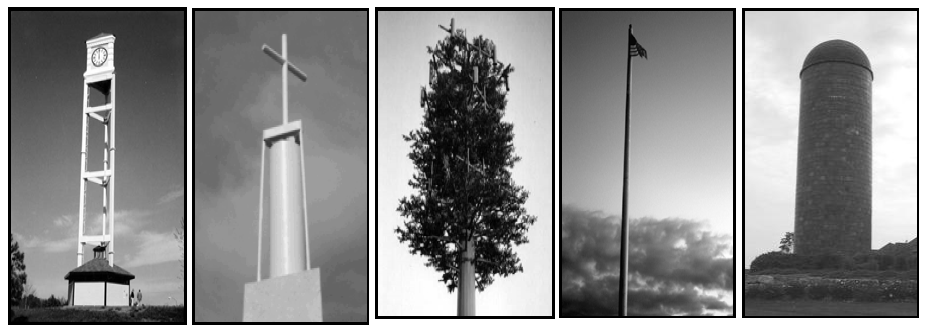
5.7.
Accessory Structures. If structures are adjacent to residentially zoned or residentially occupied property, all accessory structures that extend more than one (1) foot above the height of fencing must be designed and/or camouflaged to resemble neighborhood architecture.
5.8.
Fencing. The wireless support structure shall have an 8-foot high opaque fence constructed around the perimeter of the site. This fence may be in the form of slats inserted in a chain link fence. Fencing around compounds within or adjacent to residentially zoned or residentially occupied property shall match the facade of the principal building. If there is no principal building, shadowbox fencing shall be used.
5.9.
Co-location. Prudent and reasonable efforts shall be made to co-locate a new cellular antenna on existing wireless support structures, or other structures. A co-location analysis is required whenever a tower is within 3 miles of the proposed tower site. The report shall also illustrate a search ring. County staff or representatives will evaluate the report with consideration given both to the communication provider's needs and to the community's desires to limit new tower construction. If staff or representatives determine that co-location is not prudent and not feasible, a new wireless support structure site shall be authorized, and the project can proceed with site plan and permit approvals. If staff determines that co-location is prudent and feasible, the new wireless support structure site shall be denied, requiring co-location on an existing tower or structure. The co-location analysis report shall be submitted and consist of the following items:
A.
Detailed description of the purpose of proposed site, i.e., capacity or coverage, and area designed to cover (search ring);
B.
Site Plan showing wireless support structure location, wireless support structure height, ground elevation, and type of wireless support structure;
C.
Detailed description of all existing wireless support structures or other structures of significant height within a 3-mile radius of the proposed tower, including height of structure, ground elevation, number of existing users, height available for co-location, if any, and structural deficiencies, if any;
D.
Detailed analysis of co-location possibilities including coverage overlap percentages, signal interference problems, etc.
Additional information may be requested after initial review for further analysis. If the department or representative determines that co-location is prudent and feasible after its review, it may submit the information to a radio frequency engineer for an independent analysis. Wireless support structures shall be constructed to allow future location of additional antennas.
A co-location application that is entitled to streamlined processing under G.S. 153A-349.53 (below) shall be deemed complete unless the county provides notice in writing to the applicant within 45 days of submission or within some other mutually agreed upon timeframe. The notice shall identify the deficiencies in the application which, if cured, would make the application complete. The application shall be deemed complete on resubmission if the additional materials cure the deficiencies identified.
Staff or a county representative shall issue a written decision approving or denying an application within 45 days in the case of co-location applications entitled to streamlined processing, under G.S. 153A-349.53. A decision shall be made within a reasonable period consistent with the issuance of other land-use permits in the case of other applications, each as measured from the time the application is deemed complete.
§ 153A-349.53. Co-location of wireless facilities.
(a)
Applications for co-location entitled to streamlined processing under this section shall be reviewed for conformance with applicable site plan and building permit requirements but shall not otherwise be subject to zoning requirements, including design or placement requirements, or public hearing review.
(b)
Applications for co-location of wireless facilities are entitled to streamlined processing if the addition of the additional wireless facility does not exceed the number of wireless facilities previously approved for the wireless support structure on which the co-location is proposed and meets all the requirements and conditions of the original approval. This provision applies to wireless support structures which are approved on or after December 1, 2007.
(c)
The streamlined process set forth in subsection (a) of this section shall apply to all co-locations, in addition to co-locations qualified for streamlined processing under subsection (b) of this section that meet the following requirements:
(1)
The co-location does not increase the overall height and width of the tower or wireless support structure to which the wireless facilities are to be attached.
(2)
The co-location does not increase the ground space area approved in the site plan for equipment enclosures and ancillary facilities.
(3)
The wireless facilities in the proposed co-location comply with applicable regulations, restrictions, or conditions, if any, applied to the initial wireless facilities placed on the tower or other wireless support structure.
(4)
The additional wireless facilities comply with all federal, State, and local safety requirements.
(5)
The co-location does not exceed the applicable weight limits for the wireless support structure.
5.10.
Access and Orientation. Any road accessing a wireless facility and/or wireless support structure shall be paved or graveled, at least 12 feet wide, and well maintained. Access to the compound shall be from the interior of the site and from a separate driveway connection to a public or private street. For all facilities within or adjacent to residentially zoned or residentially occupied property, the gated drive to the compound shall be located to minimize the effect on adjoining property and the gate shall not face any lot line that is within one hundred (100) feet of the gate.
5.11.
Signage. Commercial advertising is not allowed on the wireless support structure or any of its related buildings. However, a wall sign may be placed on any equipment enclosure provided it not exceed 10% of the wall area. Freestanding signs are prohibited.
5.12.
Lighting.
5.12.1.
Lighting on all wireless facilities and/or wireless support structures, if required by the Federal Aviation Administration (FAA), shall not exceed the FAA minimum standards. Any strobe lighting required by the FAA must be of the minimum intensity and number of flashes per minute allowable by the FAA. Shielding shall be utilized to minimize visual impact to pedestrians and reduce potential attraction to migratory birds. Dual lighting standards shall be used in the following manner: Strobe lights during daylight hours and red lights during nighttime hours unless specifically prohibited by the FAA.
5.12.2.
All wireless facilities and/or support structures may utilize a security light controlled by a motion detection sensor at or near the entrance to the facility. This security light shall be placed in such a manner to not disturb any neighboring residentially zoned or residentially occupied property.
5.13.
Landscaping. Shall be provided around the perimeter of the compound except for gate drive area. Landscaping shall consist of evergreen shrub and trees that must be a least 3 feet in height at time of placement and must reach 6 feet in height within 2 years. Said landscaping shall be planted five (5) feet from the fence.
5.14.
Address. Applicant shall prominently display and maintain the assigned address number on a post at the driveway intersection. The numbers on the driveway display shall be no less than 3 inches in height and have a night reflective surface. Further, this address post shall be installed within five (5) business days from issuance of zoning permit. The site must be posted with the owner's name and contact information and all carrier's names and contacts. These shall be updated when ownership change occurs.
5.15.
Termination of Use. Whenever a wireless facility, wireless support structure, antenna, or related equipment ceases to be in active operation for communication purposes, for more than 180 days, all structures shall be removed. A one-time extension can be granted for removal.
(Ord. of 4-16-2013, § 5)
Section 6. - Required Information.
6.1.
All requests for a wireless facility and wireless support structure must be accompanied by a detailed site plan. The applicant shall submit photographs of a similar wireless facility and wireless support structure and use photo imagery to superimpose the wireless facility and wireless support structure and other related structures onto the existing site for review and approval by staff. Design review shall ensure that the wireless facility and wireless support structure and other structures bear a reasonable relationship to the proportions and scale of the existing building, towers, and other structures. Once the site plan and photograph(s) or photo rendering(s) of the wireless facility and wireless support structure and other structures are approved, the wireless facility and wireless support structure and other structures must be constructed in compliance to this approval. If not so constructed, the Enforcement Officer shall order the wireless facility and wireless support structure and other structures be altered to achieve compliance with the approved application. If the applicant fails to achieve compliance within sixty (60) days, the Enforcement Officer shall issue a Violation Letter directing the facility be removed within sixty (60) days of the date of said notice.
6.2.
The proposed maximum height of the proposed telecommunication tower, including individual measurement of the base and the antenna support structure (less the lightning rod).
6.3.
If the United States Fish and Wildlife Service requires the applicant to submit any information to them concerning the proposed wireless facility and wireless support structure, the applicant shall also furnish a copy of any material submitted to the United States Fish and Wildlife Service to the County as part of the application package.
6.4.
Compliance letter from the State Historic Preservation Office (SHPO), if applicable.
6.5.
Completed checklist demonstrating compliance with the National Environmental Policy Act (NEPA), if applicable.
6.6.
The North Carolina Wildlife Resources Commission may assist staff in determining areas for which wireless facility and wireless support structures shall not be located, as based on conservation areas designated by the Montgomery County Conservation Target Map.
6.7.
If applicable, the applicant shall provide a statement as to the potential visual and aesthetic impacts of the proposed wireless facility and wireless support structure on all adjacent residential zoning districts.
6.8.
If applicable, a septic check by the Montgomery County Environmental Health Department is required for any site that has a structure on the tract that uses on-site waste disposal systems (septic fields). This requirement is to ensure that the septic system is functioning properly and to ensure that the proposed development does not interfere with the safe operation of the septic system. An additional application and fee required shall be determined by the Environmental Health Department.
6.9.
A copy of the FAA's "Determination of No Hazard Report."
6.10.
Prior to the issuance of any telecommunications tower permit, the applicant shall be required to provide a certificate of insurance demonstrating it has a minimum of $1,000,000 in general liability insurance covering any liability arising out of its construction or operation of the wireless telecommunication facility.
6.11.
Whenever the County encounters radio frequency interference with its public safety communications equipment and believes that such interference has been or is being caused by one or more wireless facility and wireless support structures, the following steps shall be taken:
A.
The County shall provide notification to all wireless facility and wireless support structure service providers operating in the jurisdiction of possible interference with the public safety communications equipment. Upon such notification, the owners shall use their best efforts to cooperate and coordinate with the County and, among themselves investigate and mitigate the interference. If any, utilizing the procedures set forth in the joint wireless industry-public safety "Best Practices Guide," released by the FCC in February 2001, including the "Good Engineering Practices," which may be amended or revised by the FCC.
B.
If any wireless facility and wireless support structure owner fails to cooperate with the County in complying with the owner's obligations under this section or if the FCC makes a determination of radio frequency interference with the County public safety communications equipment, the owner who fails to cooperate and/or the owner of the wireless facility and wireless support structure which caused the interference shall be responsible, upon FCC determination of radio frequency interference, for reimbursing the County for all costs associated with ascertaining and resolving the interference, including but not limited to any engineering studies obtained by the jurisdiction to determine the source of the interference. For the purposes of this subsection, failure to cooperate shall include failure to initiate any response or action as described in the "Best Practices Guide" within twenty-four (24) hours of the County's notification.
(Ord. of 4-16-2013, § 6)
Section 7. - Review Process.
7.1.
Any application submitted pursuant to this section shall be reviewed by County staff as determined by the County Manager for completeness. The Board of Commissioners may create a Technical Review Committee to assist staff in review of plans. If any required item fails to be submitted, the application shall be deemed incomplete. Staff shall advise an applicant in writing within forty-five (45) business days after submittal of an application regarding the completeness of the application. If the application is incomplete, such notice shall set forth the missing items or deficiencies in the application, which the applicant must correct and/or submit in order for the application to be deemed complete.
7.2.
Where due to the complexity of the methodology or analysis required to review an application for a wireless communication facility, the Board of Commissioners may require the applicant to pay for a technical review by a third party expert. A $5,000 consultation fee shall be required for any outside consultation, and any application shall not be considered complete until this fee is paid in full.
7.3.
Based on the results of the expert review, staff may require changes to the applicant's application or submittals.
7.4.
The applicant shall submit as published in the County's current fee schedule. Montgomery County may fix and charge an application fee, consulting fee, or other fee associated with the submission, review, processing, and approval of an application to site or modify wireless support structures or wireless facilities that is based on the costs of the services provided and does not exceed what is usual and customary for such services. Any charges or fees assessed by a county on account of an outside consultant shall be fixed in advance and incorporated into a permit or application fee and shall be based on the reasonable costs to be incurred by the county in connection with the regulatory review authorized under this section. The foregoing does not prohibit Montgomery County from imposing additional reasonable and cost based fees for costs incurred should an applicant amend its application. On request, the amount of the consultant charges incorporated into the permit or application fee shall be separately identified, and disclosed to the applicant.
7.5.
After approval of the entire application by the Board of Commissioners, the applicant will submit construction/engineering drawings to the Montgomery County Inspections Department, providing structural analysis report for 90 mph wind load and include seismic analysis based on the short and long spectral response acceleration as per the 2000 International Building Code/North Carolina 2002 Code.
(Ord. of 4-16-2013, § 7)
Section 8. - Conditional Use Criteria.
8.1.
Montgomery County staff must send a letter to residents within a ½-mile radius and include:
i.
Tower height.
ii.
Existing and planned tower uses.
8.2.
All conditional use permit requests are subject to the regulations described in Article V of the Montgomery County Zoning Ordinance.
8.3.
Upon the approval of a conditional use permit by the Montgomery County Board of Commissioners, the wireless facility and wireless support structure and other structures must be completely constructed within 25 months from the date of issuance or the permit will be null and voided.
(Ord. of 4-16-2013, § 8)

