
Nacogdoches City Zoning Code
ARTICLE VI
DEVELOPMENT STANDARDS7
Editor's note— Ord. No. 1708-6-16, § 2, adopted June 21, 2016, amended Art. VI in its entirety to read as set out herein. Former Art. II, §§ 118-421—118-433, pertained to similar subject matter and derived from Ord. No. 1130, art. IV, §§ 1.1—1.6, 3—9; art. V, § 1; Ord. No. 1362-5-04, adopted May 4, 2004; Ord. No. 1673-6-14, § 2, adopted June 17, 2014.
DIVISION 2. - OFF-STREET PARKING STANDARDS[8]
Cross reference— Stopping, standing and parking, § 102-151 et seq.
Sec. 118-421. - Purpose.
(a)
Enhance the view and image of the community.
(b)
Contribute to the overall quality and visual appearance of individual developments.
(c)
Reduce glare from paved surfaces and break up large expanses of paving.
(d)
Replenish oxygen supply and provide natural air purification.
(e)
Provide visual relief and open space within urbanized developments.
(f)
Ensure that the local stock of native trees and vegetation is replenished.
(g)
Safeguard and enhance property values and to protect public and private investment.
(h)
Preserve and protect the unique identity and environment of the City of Nacogdoches and preserve the economic base attracted to the City of Nacogdoches by such factors.
(Ord. No. 1708-6-16, § 2, 6-21-2016)
Sec. 118-422. - Applicability.
Except as provided in section 118-430(b), no building or structure or part thereof shall be erected, altered or converted for any use unless it is in conformity with the minimum requirements specified in this division.
(Ord. No. 1708-6-16, § 2, 6-21-2016)
Sec. 118-423. - General requirements.
(a)
Requirements for a building permit. No permit for the construction of a building upon any tract or plot shall be issued until a building site, building tract or building lot has been created by compliance with one of the following conditions:
(1)
Subdivided. The lot or tract is part of a plat of record, properly approved by the city, and filed in the plat records of the county.
(2)
Planned development (PD) district. The site, plot or tract is all or part of a site plan officially approved by the city planning and zoning commission, in accordance with subdivision II of division 4 or article II and article V of this chapter pertaining to zoning-related applications, which site plan shows all utility and drainage easements, alleys, streets and other public improvements necessary to meet the normal requirements for platting including the designation of building areas and such easements, alleys, and streets as are required and have been properly dedicated, and the necessary public improvements which have been provided.
(3)
Unplatted prior to ordinance or annexation. The plot, tract, or lot faces upon a dedicated street and was separately owned prior to the effective date of the ordinance from which this chapter derives or prior to annexation to the city, whichever is applicable.
(b)
Single-family. Only one main building for one-family (attached or detached) or two-family dwelling purposes may be located upon a platted lot or tract zoned R-1, single-family residential, R-2, single-family residential, or R-3, two-family residential, except where building arrangements have been approved in accordance with subdivision II of division IV of this chapter pertaining to zoning-related applications.
(c)
Multiple-family and nonresidential. More than one main building for multiple-family, office, retail, commercial, industrial, or institutional use may be erected upon an officially platted lot or tract zoned R-4, multi-family residential, B-1, local business, B-2 general business, B-3, central business, M, medical, I-1 light industrial, or I-2, heavy industrial, provided such building arrangements comply with the applicable requirements for land use.
(d)
Multiple buildings with common roof. Two or more buildings or structures covered by a common roof shall be considered as a single building.
(Ord. No. 1708-6-16, § 2, 6-21-2016)
Sec. 118-424. - Projections into setbacks.
Eave and roof extensions may project into the required front, side or rear yard setback for a distance not exceed two feet. Ordinary projections of windowsills, belt courses, cornices, and other architectural features may project into the required setback for a distance not to exceed one foot.
(Ord. No. 1708-6-16, § 2, 6-21-2016)
Sec. 118-425. - Yard requirements for planned development districts.
Minimum yard requirements in a planned development district shall be established on the site plan in accordance with the provisions for planned development districts in this chapter or by reference in the planned development ordinance to a particular zoning district.
(Ord. No. 1708-6-16, § 2, 6-21-2016)
Sec. 118-426. - Visibility triangles.
(a)
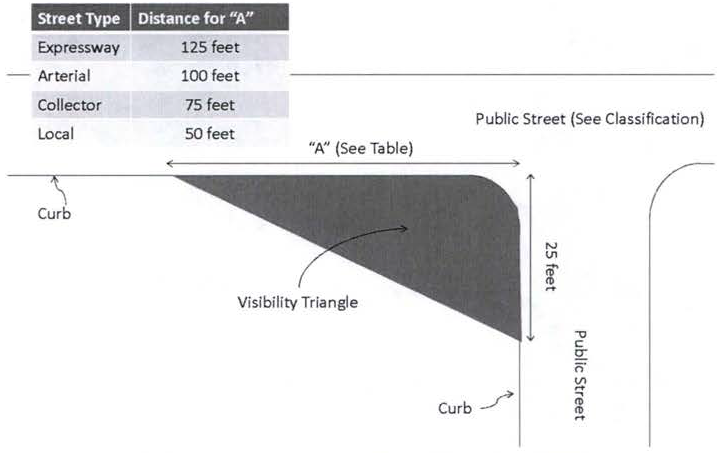
Street visibility triangles. The street visibility triangle is a triangular area formed by extending the two curb lines, or edges of pavement, a designated distance based upon the street types involved from their point of intersection, and connecting these points with an imaginary line, thereby creating a triangle. Figure 1 illustrates the required street visibility triangle.
Figure 1 Visibility Triangle
(b)
Distance requirements. The distance along the through-street is determined by street type, as shown in the Thoroughfare Plan in the City of Nacogdoches Comprehensive Plan. For arterial through-streets, the distance shall be 100 feet; for collector through-streets, the distance shall be 75 feet; and for local through-streets, the distance shall be 50 feet.
(c)
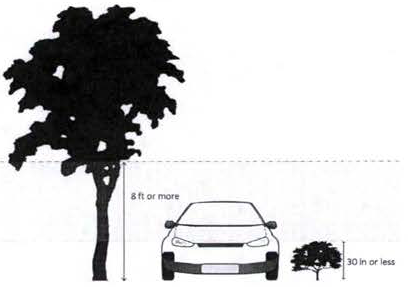
Prohibitions. Fences, walls, screens, signs, structures, and parked vehicles are prohibited within the visibility triangle. Foliage of hedges or trees shall be maintained in such a manner as to not obstruct or interfere with a clear line of sight for the drivers of approaching motor vehicles within the visibility triangle between 30 inches and eight feet above the average grade of the street. This shall not be interpreted to prohibit traffic signposts and control boxes, utility poles, street signs or tree trunks within the visibility triangle area.
Figure 2 Prohibitions within Visibility Triangle
(Ord. No. 1708-6-16, § 2, 6-21-2016)
Sec. 118-427. - District development standards.
(a)
District development chart.
Figure 3 District Development Standards Chart
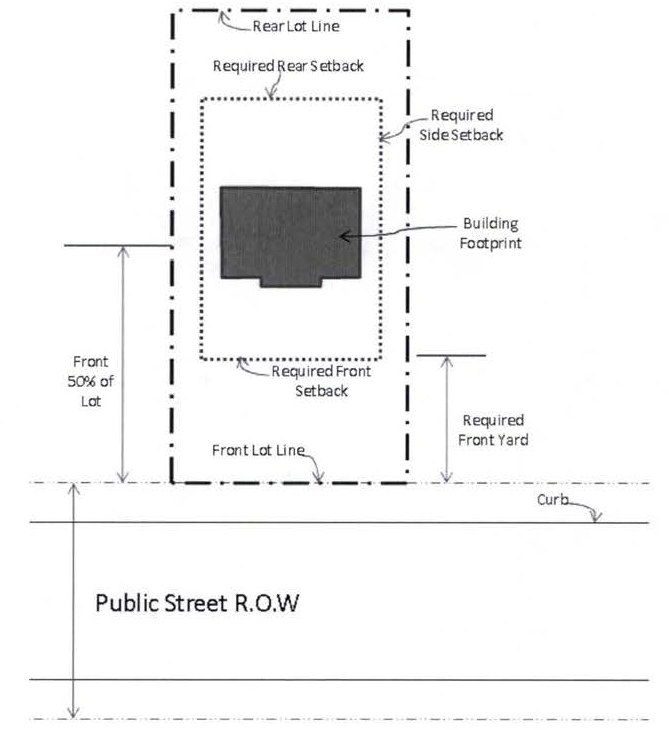
Figure 4 Lot Lines and Setbacks
(b)
Front yard setbacks.
(1)
Building lines established by ordinance. Where a building line has been established by ordinance and such line requires a greater or lesser front yard setback than is prescribed by this chapter for the district in which the building is located, the minimum required front yard shall comply with the building line so established by such ordinance.
(2)
Platted building line. Where a building line is shown on a subdivision plat recorded with the county clerk prior to the effective date of the ordinance from which this chapter derives and such building line requires a greater or lesser front yard setback than is prescribed by this chapter for the district in which the subdivision is located, the building lines as so shown on the plat shall be interpreted as establishing the minimum front yard requirement for lots in the subdivision.
(3)
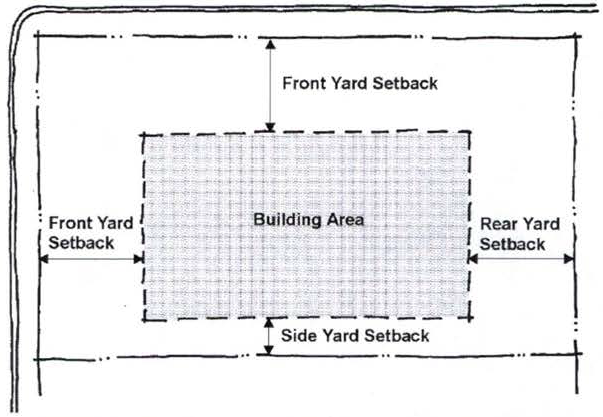
Double frontage lots. Where lots have double frontage, running through from one street to another, a required front yard shall be provided on both streets.
Figure 5 Corner Lots
(4)
Service station canopy. An unenclosed canopy for a gasoline service station may extend into the required front yard, provided such extension shall not be closer than ten feet to the front lot line.
(5)
Fences. No fence shall be constructed closer than 12 feet from the back of a curb where a curb exists, or 12 feet from the central flow line of a ditch paralleling such uncurbed streets, or behind the property line, whichever is greater.
(c)
Side yard setbacks.
(1)
Side yard abutting a street. Single-family attached dwellings need not provide a side yard, except that where such side yard abuts a street, a minimum side yard of 20 feet shall be provided.
(2)
Duplex and multi-family dwelling units. For the purpose of applying side yard requirements, two-family and multi-family dwelling units covered by a continuous roof shall be considered as one building occupying a lot.
(d)
Maximum density; parking structures excluded. The floor area of structures used for the off-street parking of vehicles shall be excluded in computing the floor area ratio of a structure.
(e)
Accessory uses and structures in residential districts.
(1)
Accessory uses in main building. Accessory uses located in the main building or in structures attached to the main building shall observe the same front, side, and rear yard requirements as the main building.
(2)
Accessory buildings in front half of lot. Detached accessory buildings within the front 50 percent of the lot shall observe the same front and side yard requirements as the main building.
(3)
Accessory buildings near residential. Detached accessory buildings shall not be located nearer than ten feet to a residential structure.
(4)
Accessory buildings near rear lot line. Detached accessory buildings shall not be located nearer than ten feet to any rear lot line.
(5)
Accessory buildings on corner lot. Detached accessory buildings on a corner lot shall not be located nearer the side lot line along the side street than the main building.
(6)
Accessory buildings near interior side lot line. Detached accessory buildings shall not be located nearer than five feet to any interior side lot line.
(7)
Emergency access. No off-street parking areas shall be so located or arranged so as to obstruct direct fire protection and emergency access to any multiple-family dwelling.
(Ord. No. 1708-6-16, § 2, 6-21-2016)
Sec. 118-428. - Commercial and industrial district screening from view.
(a)
Required screening. Where required elsewhere in this chapter, service areas and outside storage shall be screened using the standards established in this section.
(b)
Screening. Standards and maintenance of screening shall be as follows:
(1)
Screening wall standards. The screening wall shall be constructed of solid masonry material on a concrete foundation, or solid wood fence with metal structural supports to a minimum height of six feet tall. All screening walls shall be constructed according to minimum specifications approved by the building official.
(2)
Maintenance of screening. It shall be the responsibility of the commercial or industrial property owner to maintain the screening wall in good repair.
(Ord. No. 1708-6-16, § 2, 6-21-2016)
Sec. 118-429. - Commercial sites with residential adjacency.
(a)
Applicability. Where nonresidential sites are immediately adjacent to residentially zoned properties, including adjacencies where there is an intervening alley, the standards of this section shall apply.
(b)
Exceptions to required fences. An exception to the screening fence requirement may be granted by the Zoning Board of Adjustment based on a recommendation from the city planner. One or more of the following conditions must be present or apply for consideration of an exception:
(1)
The required fence or wall and buffer yard is adjacent to a natural feature, such as a creek or FEMA designated floodway. Under this provision the requirement for a fence may be waived if a 30-foot landscape buffer is provided and preserved in its natural state between the developed area and the natural feature. In addition, one tree shall be provided for each 25 feet of common adjacency. The tree shall be a preserved tree or, if a newly planted tree, shall be a minimum container size of five gallons at the time of planting.
(2)
Vegetation exists which is at least six feet high and non-transparent year-round, and visibly separates one use from another and shields or blocks noise, glares, or other nuisances. The existing vegetation shall consist of canopy and non-canopy trees which are shown through a tree survey, and is protected in accordance with section 118-431(c) of this zoning ordinance. Landscape buffer yards under this provision shall be a minimum of 15 feet wide.
(c)
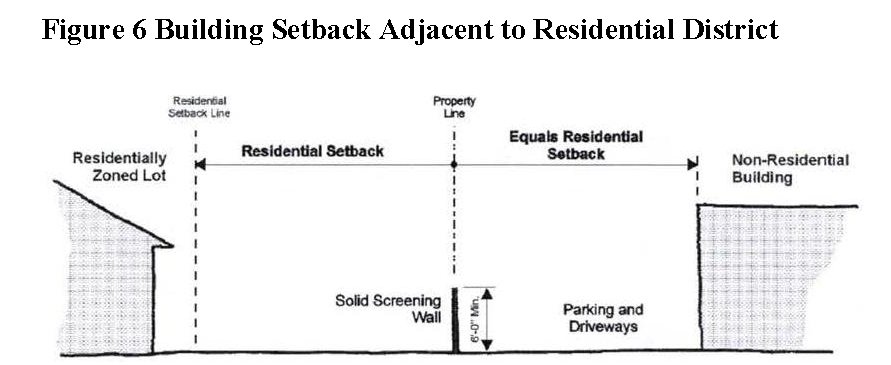
Building setback. Minimum building setbacks on side and rear yards of nonresidential properties, which are immediately adjacent to residential properties, shall be the more restrictive of either the nonresidential zoning district, or the adjacent residential zoning district.
(d)
Screening. Screening shall be in accordance with the following:
(1)
Generally. A solid screening wall shall be constructed on the nonresidential property in close proximity to the residential property line in order to screen views and windblown trash and debris. In addition, a ten-foot wide landscaped buffer with one tree for each 25 feet of common adjacency shall be provided. The tree shall be a preserved tree or, if a newly planted tree, shall be a minimum container size of five gallons at the time of planting.
(2)
Screening wall standards. The screening wall shall be constructed of solid masonry material on a concrete foundation, or solid wood fence with metal structural supports to a minimum height of six feet tall. The finished side of the wall shall be constructed to face the residential property. All screening walls shall be constructed according to minimum specifications approved by the building official. Buffer plantings may be reduced by half if providing a masonry wall instead of a wooden fence.
(3)
Screening tree standards. Required trees shall be non-deciduous in order to provide year-round screening and shall be of a type and species listed in subsection 118-430(f)(2) below.
(4)
Maintenance of screening. It shall be the responsibility of the nonresidential property owner to maintain the screening wall in good condition and to maintain the screening trees in a healthy condition at all times. This may include the installation of an irrigation system if conditions warrant. Screening trees shall be replaced with new trees as the trees die or are removed.
(5)
Easement reduction. Where utility or drainage easements or other similar situations exists in the required buffer yard, the buffer yard may be reduced by the width of the easement; however, an additional five to ten feet may be required beyond the width of the easement in these situations to allow for the required plantings and fence or wall. All new plantings and irrigation shall be located outside of the easement. The required fence or wall may be located within the easement with the approval of the city planner and city engineer.
(6)
Substitutions.
a.
Living screens may be substituted for the required fence or wall and landscape buffer, subject to the following provisions:
1.
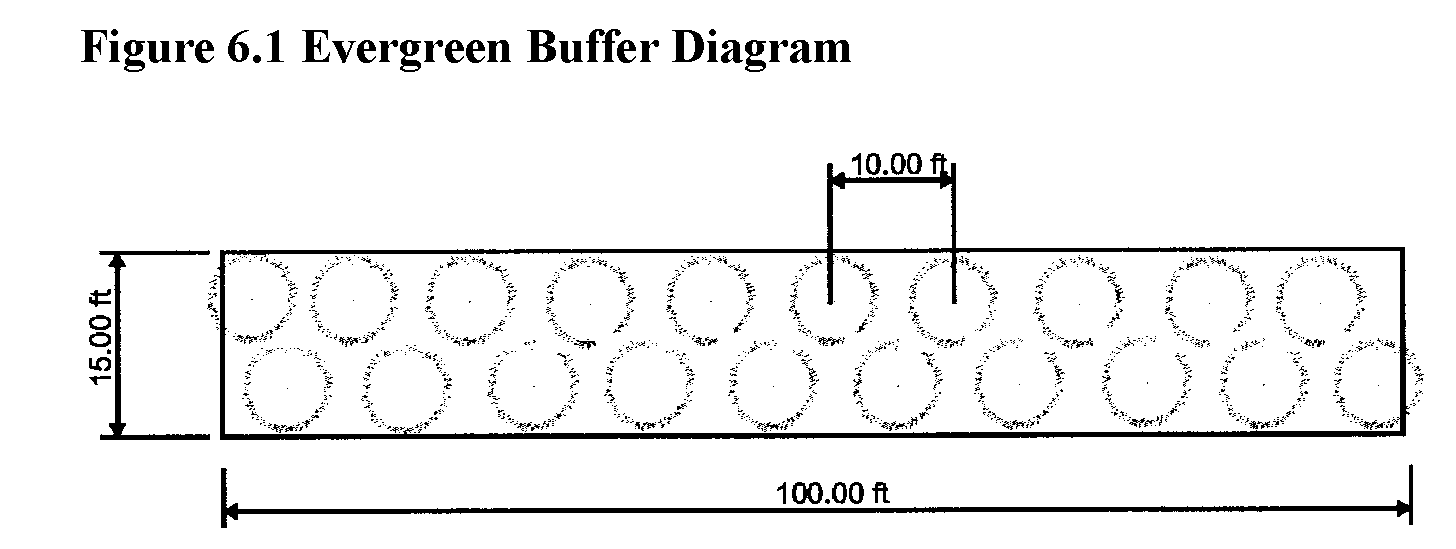
Evergreen buffer. Shall consist of a 15-foot landscape buffer with two rows of triangular spaced evergreen trees (minimum six feet in height at time of planting) to create a solid screen along the common property line. Double rows of evergreen trees shall be staggered and planted no more than ten feet apart in each row.
2.
Hedge wall. Fences and walls may be substituted with a solid plant or hedge wall that is greater than six feet in height with approximately 100 percent opacity. All plantings for a hedge wall must be a minimum of 15 gallons each. The solid plant or hedge wall must be evergreen. Landscape buffer yards under this provision shall be 15 feet wide.
b.
Evergreen trees planted in accordance with this subsection shall be comprised of the following as listed in subsection 118-430(f): cherry laurel, yaupon, wax myrtle, American holly, eastern red cedar, and Arizona cypress.
(Ord. No. 1708-6-16, § 2, 6-21-2016; Ord. No. 1827-05-20, § II, 5-19-2020; Ord. No. 2034-03-25, § II, 3-18-2025)
Sec. 118-430. - Commercial district landscaping.
(a)
Applicability. This section shall apply to all commercial development where any of the following conditions are present:
(1)
New construction.
a.
Any new building construction requiring a permit and is greater than 500 square feet or valued at more than $2,500.00, or
b.
Any construction of a new parking lot for which a permit is required,
(2)
Additions/renovations.
a.
Any building addition or renovation exceeding 50 percent of the existing building area as defined by the footprint of the existing building for which the building permit is required.
b.
Any parking lot addition within the front 50 percent by more than 5,000 square feet or ten percent in area of the existing parking lot whichever is greater for which a building permit is required.
(b)
Exceptions. Exceptions to this section shall be as follows:
(1)
Residential uses other than multi-family apartments.
(2)
Exterior or interior finishing and remodeling that does not increase the existing building area or parking area of the existing development.
(3)
Subsection 118-430(e) is excepted for the existing portions of parking area expansion projects as described in subsection 118-430(a)(2)b.
(c)
Landscaping plan.
(1)
When the requirements of this section must be met, a landscaping plan shall be submitted and must be approved by the city planner or their designee before the issuance of a certificate of occupancy for the project. This plan may be provided as a combined exhibit for parking and landscaping. The plan shall contain the following information:
a.
Date, scale, north arrow.
b.
Location of existing boundary lines and dimensions of the lot and any artificial lot lines, street address, approximate centerline of existing watercourses and the location of the 100-year floodplain, if applicable; the approximate location of significant drainage features; and the location and size of existing and proposed streets and alleys, utility easements, driveways, and sidewalks on or adjacent to the lot.
c.
Location, height and material of proposed screening and fencing between residential and non-residential property, if such screening and fencing is required.
d.
Location and description, by type and size, of existing trees proposed to be retained. Such trees shall be marked and dripline of said trees shall be protected prior to and during all construction, including dirt work.
e.
Location of plant materials to be installed, container sizes at installation, spread, and spacing.
f.
Identification of visibility triangles on the lot for all driveway intersections with public streets.
g.
Complete description of plant materials to be installed, including names, locations, quantities, heights, spread, and spacing.
h.
For plans which include trees to be preserved and be eligible for tree preservation credit under section 118-430.
(2)
Phasing of landscaping plan. The landscaping plan may be submitted in two phases.
a.
Phase 1 shall be submitted at the time the building permit application and plans are submitted and shall contain items a. through f. as shown in subsection 118-430(c)(1) above.
b.
Phase 2 shall be submitted prior to the request for a final certificate of occupancy inspection and shall contain all items as shown in subsection 118-431(c) above.
(d)
Street landscaping.
(1)
For each 100 feet of frontage, three small mature-height or two tall mature-height trees as listed in subsection 118-430(f) shall be planted between the front property line and a line measured 35 feet from the front property line.
(2)
The maximum separation between trees shall be no more than 50 percent of the lot width.
(e)
Interior parking lot landscaping for large parking areas.
(1)
Subsection 118-430(e) shall apply to parking areas of 120 spaces or more.
(2)
A minimum of five percent of gross parking areas shall be devoted to pervious planting areas which includes mulch, grass, ground cover, plants, shrubs, or trees. Gross parking area is measured from the edge of the parking and/or driveway paving and the back of the adjacent curb or sidewalk.
(3)
There shall be a minimum of one tree planted for each 150 square feet of required pervious area.
(4)
Credit for trees required in this subsection 118-430(e) may be given for trees planted as required in subsection 118-430(d) above.
(5)
No parking space shall be more than 100 feet from the center point of any tree.
(f)
Tree standards.
(1)
Trees required by this chapter shall be a minimum container size of five gallons.
(2)
Tree species.
a.
Small deciduous.
1.
Chalk maple.
2.
Japanese maple.
3.
Redbud — Cercis canadensis, Cercis Mexicana.
4.
Desert willow.*
5.
American or Chinese fringe tree.*
6.
Dogwood.
7.
Parsley hawthorn.*
8.
Mayhaw.
9.
Eve's necklace.*
10.
American or Japanese snowbell.
11.
Two-winged silverbell.
12.
Chastetree.*
13.
Deciduous magnolia.
14.
Crape myrtle.*
15.
Possumhaw holly.
16.
Purple Pride plum.
17.
Mexican plum.*
18.
Flowering apricot.
19.
Persian witch hazel.
20.
Black cherry.
21.
Carolina buckthorn.*
22.
Mexican buckeye.*
23.
Rusty blackhaw viburnum.*
b.
Large deciduous.
1.
Southern sugar maple.
2.
Red maple.
3.
River birch.
4.
Pecan.
5.
Shagbark hickory.
6.
American beech.
7.
Ginko.
8.
Black gum.
9.
Bald cypress.
10.
Basswood.
11.
Lacebark elm.
12.
Japanese zelkova.
13.
Cherrybark oak.
14.
Mexican white oak.
15.
Overcup oak.
16.
Swamp chestnut oak.
17.
Shumard oak.
18.
White oak.
19.
Sawtooth oak.
20.
Nutall oak.
c.
Small evergreen.
1.
Texas mountain laurel.
2.
Cherry laurel.
3.
Yaupon.
4.
Wax myrtle.*
d.
Large evergreen.
1.
Southern magnolia.
2.
Sweetbay.
3.
American holly.
4.
Eastern red cedar.
5.
Southern live oak.
6.
Longleaf pine.
7.
Loblolly pine.
8.
Shortleaf pine.
9.
Arizona cypress.
Species marked with an "*" are overhead utility line compatible trees.
(Ord. No. 1708-6-16, § 2, 6-21-2016; Ord. No. 1783-11-18, § 2, 11-6-2018)
Sec. 118-431. - Administration and enforcement of commercial district landscaping.
(a)
Exceptions.
(1)
Administrative exception.
a.
The city planner may, upon review and unanimous recommendation from the building official and the city engineer, approve minor variations in the location of required landscape materials due to unusual topographic constraints, siting requirements, preservation of existing stands of native trees or similar conditions. These minor changes may vary the location of required landscape materials, but may not reduce the amount of required landscape area or the required amount of landscape materials. The landscape plan shall be submitted to the city planner and shall specify the modifications requested and present a justification for such modifications.
b.
In determining the practicality and acceptability of the alternate proposal, the city planner shall consider the following factors:
1.
The configuration of the lot or tract in question.
2.
The square footage of the property in question.
3.
The square footage of the property to be developed.
4.
The zoning districts and landscaping on adjacent property.
5.
The topography and soil on the property in question.
6.
The existing plant materials and plant materials to be preserved.
7.
Alternate proposals of similarly situated properties, and/or
8.
Other factors relevant or material to the circumstances of the site in question.
(2)
If a unanimous approval of the city planner, city engineer, and building official cannot be reached regarding a request for an administrative exception, the request for an exception shall be denied.
(3)
An appeal of the decision regarding an administrative exception may be made to the zoning board of adjustments in accordance with the requirements and procedures in article II, division 3 of this chapter.
(4)
Within five days following the approval of an administrative exception, written notice of the approval shall be sent to each owner indicated by the most recently approved municipal tax role, of real property within 200 feet of the property on which the exception is granted.
(5)
Within five days following the approval of an administrative exception, notice of the exception shall be posted in the agenda notification area at City Hall, and shall remain posted for ten days.
(6)
Variances other than those as described in subsection 118-431(a)(1) above shall be requested through the zoning board of adjustments as described in article II, division 3 of this chapter. The zoning board of adjustments may grant variances to section 118-430 upon finding that:
a.
Such variance is in harmony with the intent and purpose of the comprehensive plan and this chapter;
b.
Such variance will not adversely affect the health, safety, or general welfare of the public;
c.
The variance sought is due to unique circumstances affecting the property or the owner's use of the property. Financial consideration shall not be grounds for a variance; and
d.
The owner has made provisions for alternative landscaping reasonably equivalent in value and utility to the requirement sought to be varied.
(b)
Deferral of planting.
(1)
If a certificate of occupancy is sought during a season in which the city planner determines it would be impractical to install landscaping and trees, a temporary certificate of occupancy may be issued by the building official.
(2)
The temporary certificate of occupancy shall have a term of up to six months.
(3)
Failure to comply within the temporary term of six months shall constitute a violation of this article and subject the owner to enforcement penalties and procedures.
(c)
Tree planting equivalency credits.
(1)
Credit toward the total tree requirement shall be given for planting trees that exceed the minimum size required by this article at the rate of two trees for each tree planted with a caliper of four inches and greater, as measured three feet above the ground.
(2)
Credit for the preservation of existing on-site trees.
a.
Credit for the preservation of existing on-site trees may be granted when requested and depicted on the landscape plan.
b.
Credit for preserving existing trees shall be granted based upon figure 7 below.
Figure 7 Tree Preservation Credit Chart
c.
To receive credit for trees preserved under this section, the following conditions must be met:
1.
An appropriate aeration system or alternative method of protecting the tree to be preserved must be documented in the landscaping plan and provided as designed in the landscaping plan.
2.
At least 50 percent of the dripline area of the tree to be preserved must be a permeable surface.
(d)
Artificial lots.
(1)
If a building site is over two acres in size, the city planner may, upon request, designate an artificial lot to satisfy the requirements of this article.
(2)
If designated, the artificial lot shall be consistent with the purposes and policies of this chapter as determined from the criteria below. No artificial lot may be delineated by the city planner unless it:
a.
Wholly includes the area on which the construction work is to be done, and
b.
Has an area that does not exceed 50 percent of the area of the building site.
(e)
Utility lines.
(1)
Trees shall be planted no closer than 20 feet from the nearest underground utility line.
(2)
Where the location of existing overhead utility lines conflict with the required street trees, planting of small mature height trees from subsection 118-430(f)(2)a. and c. shall be required.
(3)
Where easements containing underground utilities conflict with the area where street trees are required to be planted, the city planner may authorize the planting of street trees outside the easement area.
(Ord. No. 1708-6-16, § 2, 6-21-2016)
Sec. 118-432. - Historic overlay district.
All properties within a historic overlay district shall comply with the standards and requirements established in article II of chapter 50 pertaining to historic preservation.
(Ord. No. 1708-6-16, § 2, 6-21-2016)
Sec. 118-461. - Purpose.
The purpose of required parking spaces is to provide enough on-site parking to accommodate the majority of traffic generated by the range of uses which might locate at the site over time. Parking requirements should be balanced with an active pedestrian network to minimize pedestrian, bicycle and vehicle conflicts as much as possible. Construction of bicycle parking may be substituted for some required parking on a site to encourage alternative forms of transportation.
(Ord. No. 1130, art. V, § 1, 11-3-1998; Ord. No. 1720-9-16, § 2, 9-20-2016)
Sec. 118-462. - Applicability.
(a)
Construction or creation of use. Any building, improvement, or use of land approved or erected shall include the necessary off-street parking spaces, and require off-street/on-site loading facilities subject to the standards established in this division.
(b)
Change of use. Whenever any building, improvement, or use of land is proposed to be changed to a new use, the provision of off-street parking and loading shall be required for the new use in accordance with this division.
(c)
Expansion of existing use. If any building, improvement, or use of land is expanded, the provisions for parking and loading shall be provided for the portion of land use and/or building that has been added.
(d)
Renovation or redevelopment. Notwithstanding subsection (b) of this section, if any building, improvement, or use of land is repaired, renovated, altered, expanded or redeveloped, and the cost of such changes exceed 50 percent of the fair market value of the building improvement prior to the subject improvements, the parking and loading facilities set forth in this division shall be made conforming.
(Ord. No. 1130, art. V, § 2, 11-3-1998)
Sec. 118-463. - Calculation of parking spaces.
(a)
Fractional number of spaces. In determining the required number of parking spaces, fractional spaces shall be counted to the nearest whole space. Parking spaces located in buildings used for repair garages or auto laundries shall not be counted as meeting the required minimum parking.
(b)
Parking structures excluded. Floor area of structures devoted to off-street parking of vehicles shall be excluded in computing the floor area for off-street parking requirements.
(c)
Requirements for uses not listed. The off-street parking requirements for a use not specifically listed in the parking requirement schedule shall be the same as required for a use of a similar nature as determined by the city planner.
(Ord. No. 1130, art. V, § 3.1, 11-3-1998)
Sec. 118-464. - Location of parking and loading spaces.
The required off-street parking and loading spaces shall be located on the same lot as the building or use served, except off-street parking may also be located as follows:
(1)
Off-site location. When an increase in the number of off-street parking spaces is required by a change or enlargement of use, or where off-street parking spaces are provided collectively or used jointly by two or more buildings or establishments, the required off-street parking spaces may be located at a distance not to exceed 300 feet from an institutional building served or 500 feet from any other nonresidential building served; provided, however, that a written agreement thereto is properly executed and filed as provided in this section. The distance from the land use requiring parking to the off-site parking site shall be measured along the shortest legal pedestrian path between one site and the other.
_____
(2)
Joint use of parking. Parking adjustments may be allowed according to the following percentages by time of day:
FIGURE 1 PARKING ADJUSTMENT PERCENTAGES BY TIME OF DAY
FIGURE 2 JOINT USE PARKING EXAMPLE:
_____
(3)
Off-site parking agreement. When the required off-street parking spaces are not located on the same lot with the building or use served or when the required off-street parking spaces are provided collectively or used jointly by two or more establishments, a written agreement which ensures the retention of such spaces for this purpose, and for a period of not less than two years, shall be drawn and executed by the parties concerned, approved as to form by the city attorney, and filed with the application for a building permit or certificate of occupancy if a change in use is involved. If the off-site parking is terminated for any reason, alternative parking meeting the standards of this division shall be acquired, or the property shall lose its certificate of occupancy.
(4)
Parking in front yards of residential and agriculture districts. No required off-street parking space shall be located in the required front yard in any residential or agricultural district.
(5)
Parking in front yards of nonresidential districts. In any nonresidential district, the required off-street parking space may be located in the required front yard. However, off-street parking spaces shall be located one foot behind the property line or 12 feet behind the back of curb of the adjacent street, whichever is greater.
(Ord. No. 1130, art. V, § 3.2, 11-3-1998)
Sec. 118-465. - Lighting of parking and loading areas.
(a)
Spillover lighting. All lighting facilities for off-street parking shall be so arranged as to reflect the illumination away from any adjacent property. Such lighting facilities shall provide illumination within parking areas not to exceed a maintained average of one footcandle at ground level, and shall distribute not more than two-tenths of one footcandle of light upon any adjacent residential property.
(b)
Nuisance or safety hazard. All lighting facilities shall be placed, masked or otherwise arranged such that illumination or glare shall not intrude on residential property or create a hazard to motorists on any street, alley or other public way.
(Ord. No. 1130, art. V, § 3.3, 11-3-1998)
Sec. 118-466. - Off-street parking requirements.
(a)
Schedule of off-street parking. The schedule of off-street parking requirements in this section establishes parking requirements for all zoning districts except the B-3 central business district.
(b)
CBD parking requirements. In the B-3 central business district, off-street parking space for all buildings shall be provided at the ratio of one space for each 2,000 square feet of floor area; provided, however, if the computed number of required off-street parking spaces is less than ten spaces, no off-street parking spaces need be provided.
(c)
Urban core parking requirements. In the urban core overlay, off street parking requirements as described in section 118-467 shall be decreased by ten percent in total.
FIGURE 3 SCHEDULE OF OFF-STREET PARKING REQUIREMENTS
(Ord. No. 1130, art. V, § 4.1, 11-3-1998; Ord. No. 1185-12-99, 12-7-1999; Ord. No. 1588-2-12, 2-7-2012; Ord. No. 1626-5-13, 5-7-2013; Ord. No. 1720-9-16, § 2, 9-20-2016)
Sec. 118-467. - Off-street parking standards.
(a)
Head-in parking. An off-street parking space shall not be located on a public street or alley. Head-in parking adjacent to a public street wherein the maneuvering of the vehicle in parking or leaving a parking space is done directly onto a public street shall not be allowed in nonresidential zoning districts nor shall it be allowed in conjunction with multifamily residential land uses.
(b)
Parking spaces and aisle surfaces. All parking spaces, aisles and maneuvering areas shall have an all-weather surface, whether enclosed or unenclosed, and shall be connected by an all-weather surfaced driveway to a street or alley.
(c)
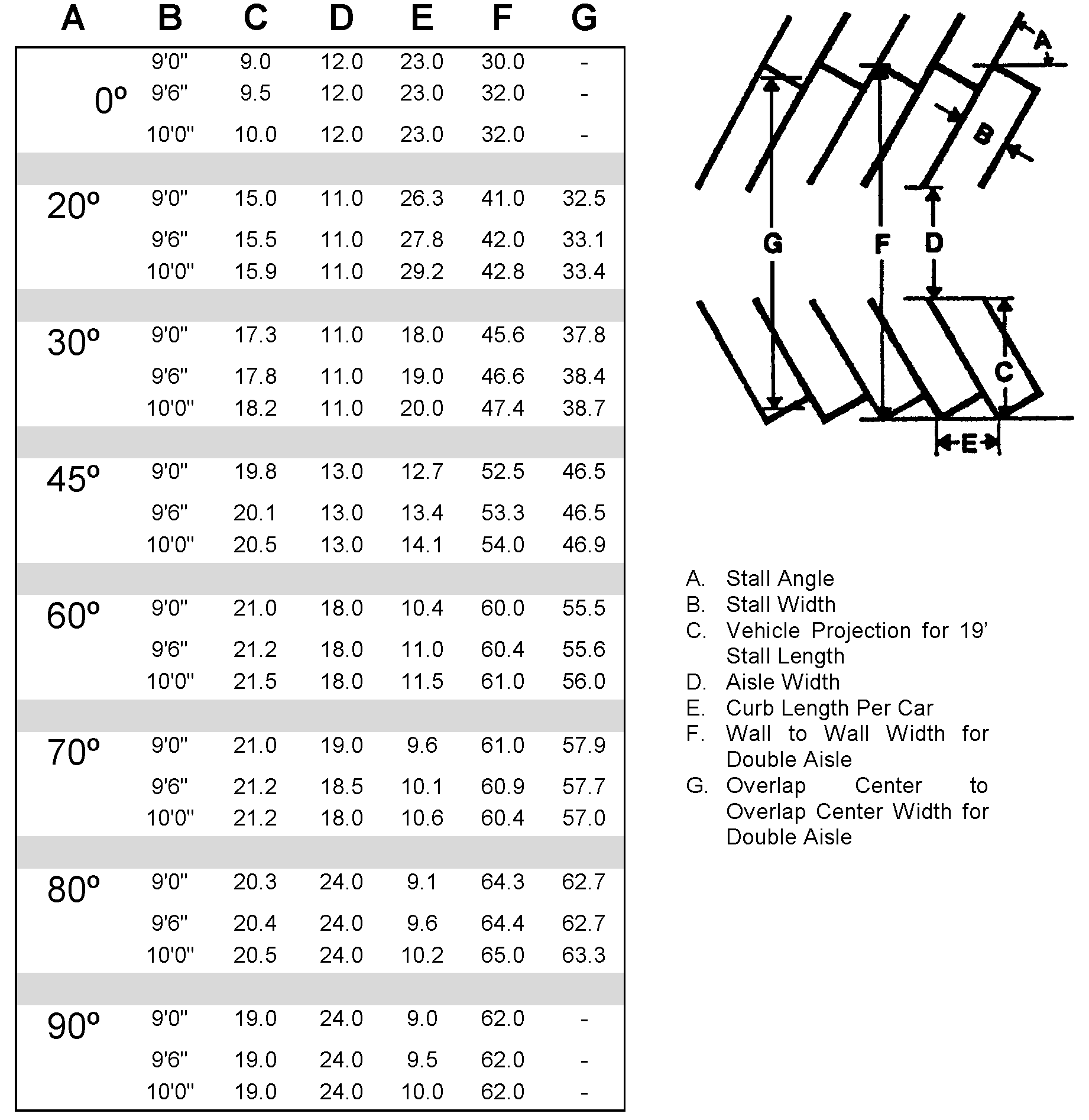
Parking space and aisle dimensions. All parking spaces and aisle dimensions shall conform to Figure 5, Off-Street Parking Standard Diagram, unless specifically approved by the building official.
(d)
Site access for vehicles. Access to a lot or tract shall conform to the access control guidelines in the city's comprehensive plan. A driveway conforming to city driveway standards shall be constructed for each approved access point. A permit must be obtained from the city to construct a driveway within the city.
FIGURE 5 OFF-STREET PARKING
STANDARDS DIAGRAM
(Ord. No. 1130, art. V, § 4.2, 11-3-1998)
Sec 118-468. - Parking lot accessibility.
All parking lots shall conform to Texas accessibility standards.
(Ord. No. 1720-9-16, § 2, 9-20-2016)
Editor's note— Ord. No. 1720-9-16, § 2, adopted Sept. 20, 2016, amended § 118-468 in its entirety to read as set out herein. Former § 118-468 pertained to handicapped parking and derived from Ord. No. 1130, art. V, § 4.3, adopted Nov. 3, 1998.
Sec. 118-469. - Reductions in required parking.
(a)
Landscaping credit for off-street parking.
(1)
The minimum off-street parking requirement may be reduced a maximum of ten percent for those parking facilities where a percentage of the total required parking spaces has been retained and/or developed as landscaped open space. The area to be retained and/or developed shall be equal or larger than the area of the number of parking spaces reduced.
(2)
A minimum of one tree shall be retained or planted on the site for each 300 square feet or portion thereof of landscaped open space. Acceptable tree species are indicated in section 118-431. The property owner or agent shall maintain trees in a healthy condition. Removed trees shall be replaced as necessary to maintain the credit.
(3)
If the property owner or the owner's agent does not replace dead or removed trees within 30 days of notification by the city planner or his or her designee, the parking credit shall be lost and the otherwise required parking shall be provided within 90 days.
(b)
Bicycle parking.
(1)
For every five bicycle parking spaces provided, the vehicle parking space requirement is reduced by one space, up to ten percent of the original required parking.
(2)
Existing vehicle parking may be converted to take advantage of this provision.
(3)
To utilize this exemption, the property must provide bicycle racks and must meet the following requirements:
a.
The bicycle frame and one wheel can be locked to the rack with a high security, U-shaped shackle lock if both wheels are left on the bicycle.
b.
A space two feet by six feet must be provided for each bicycle parking space, so a bicycle six feet long can be securely held with its frame supported so the bicycle cannot be pushed or fall in a manner that will damage the wheels or components.
(c)
Motorcycle parking.
(1)
Motorcycle parking may substitute for up to five percent of required parking.
(2)
For every five motorcycle parking spaces provided, the vehicle parking space requirement is reduced by one space.
(3)
To utilize this exemption, the property must provide motorcycle parking spaces meeting the following standards:
a.
A space two feet by six feet must be provided for each motorcycle space.
b.
All motorcycle spaces shall be located on a paved surface.
(Ord. No. 1720-9-16, § 2, 9-20-2016)
Editor's note— Ord. No. 1720-9-16, § 2, adopted Sept. 20, 2016, amended § 118-469 to read as set out herein. Former § 118-469 pertained to landscaping crecdit for off-street parking and derived from Ord. No. 1130, art. V, § 4.4, adopted Nov. 3, 1998.
Sec. 118-470. - Off-street loading requirements.
Any use that receives or distributes material, supplies or merchandise by motor vehicle shall provide off-street loading space in accordance with the following requirements:
(1)
Retail, commercial and industrial uses.
FIGURE 6 COMMERCIAL OFF-STREET LOADING REQUIREMENTS
(2)
Auditoriums, exhibitions halls, hotels, restaurants and sports arenas.
FIGURE 7 RESTAURANTS AND PUBLIC FACILITIES LOADING REQUIREMENTS
(Ord. No. 1130, art. V, § 5.1, 11-3-1998)
Sec. 118-471. - Off-street loading standards.
Loading spaces shall be a minimum of 12 feet in width, 65 feet in length, and 14 feet in height except as required for kindergartens, day care centers or similar child training and care establishments.
(Ord. No. 1130, art. V, § 5.2, 11-3-1998)
Sec. 118-472. - Dumpster screening requirements.
(a)
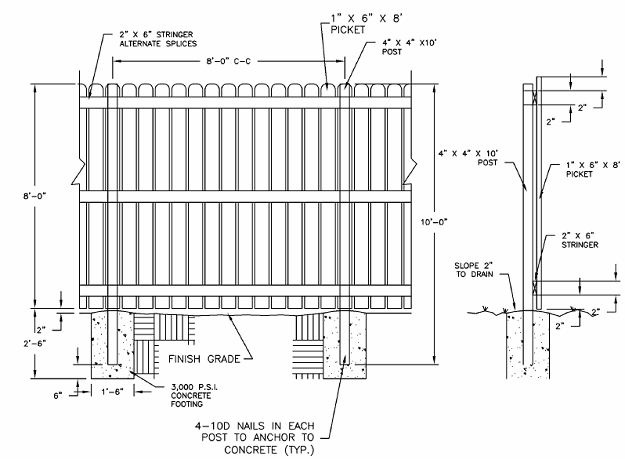
Screening required. Dumpster enclosures shall be screened from view from a public right-of-way. The dumpster area shall be in a location accessible to city sanitation vehicles and constructed according to the standards shown in figures 8 and 9.
FIGURE 8 DUMPSTER PAD DIAGRAM
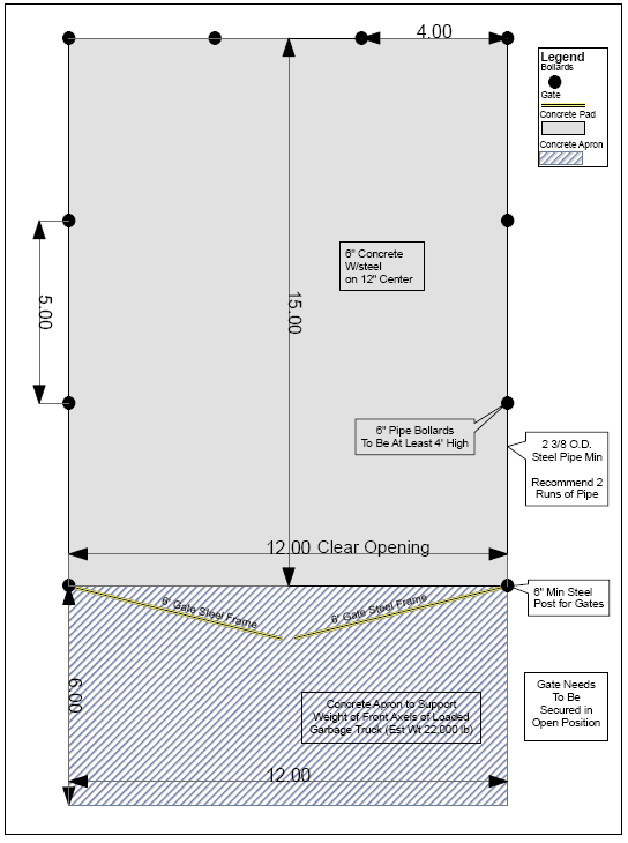
FIGURE 9 DUMPSTER SCREENING DIAGRAM
(b)
Maintenance of screening. It shall be the responsibility of the property owner to maintain the screening wall in a good condition at all times.
(c)
Alternative methods and construction of screening. The city manager or his designee may grant approval of screening materials and construction methods provided in this section.
(d)
Variances to screening requirements. The board of adjustment may grant variances to this section upon finding that:
(1)
Such variance is in harmony with the intent and purpose of the comprehensive plan and this chapter;
(2)
Such variance will not adversely affect the health, safety or general welfare of the public;
(3)
The variance sought is due to unique circumstances affecting the property or the owner's use of the property. Financial consideration alone shall not be grounds for a variance; and
(4)
The owner has made provisions for alternative screening reasonably equivalent in value and utility to the requirement sought to be varied.
(Ord. No. 1478-2-08, 2-5-2008)

