
Nashotah Village City Zoning Code
INTERPRETATION AND
PURPOSE
17.01 - AUTHORITY.
These regulations are adopted under the authority granted by §§61.35 and 62.23, Wis. Stats.
17.02 - PURPOSE.
The purpose of this chapter is to promote the health, safety, morals, prosperity, aesthetics, orderly development and general welfare of the Village.
17.03 - INTENT.
It is the general intent of this chapter to regulate and restrict the use of all structures, lands and waters; regulate and restrict lot coverage, population distribution and density and the size and location of all structures so as to lessen congestion in and promote the safety and efficiency of the streets and highways; secure safety from fire, flooding, panic and other dangers; provide adequate light, air, sanitation and drainage; prevent over-crowding; avoid undue population concentration; facilitate the adequate provision of public facilities and utilities; stabilize and protect property values; protect alternate energy sources; further the appropriate use of land and conservation of natural resources; preserve and promote the beauty of the community; and implement the community's comprehensive plan or plan components. It is further intended to provide for the administration and enforcement of this chapter and to provide penalties for its violation.
17.04 - ABROGATION AND GREATER RESTRICTIONS.
It is not intended by this chapter to repeal, abrogate, annul, impair or interfere with any existing easements, covenants, agreements, rules, regulations or permits previously adopted or issued pursuant to laws. However, wherever this chapter imposes greater restrictions, the provisions of this chapter shall apply.
17.05 - INTERPRETATION.
In their interpretation and application the provisions of this chapter shall be held to be minimum requirements and shall be liberally construed in favor of the Village.
17.06 - SEVERABILITY.
If any section, clause, provision or portion of this chapter is adjudged unconstitutional or invalid by a court of competent jurisdiction, the remainder of the chapter shall not be affected thereby.
17.07 - REPEAL.
All other ordinances or parts of ordinances of the Village inconsistent or conflicting with this chapter to the extent of such inconsistency or conflict only are hereby repealed.
17.08 - TITLE.
This chapter shall be known as, referred to or cited as the "Zoning Ordinance, Village of Nashotah, Wisconsin."
17.09 - DEFINITIONS.
For the purpose of this chapter, the following definitions shall be used. Words used in the present tense include the future; the singular number includes the plural number; and the plural number includes the singular number. The word "shall" is mandatory and not directory. Any words not defined herein shall be construed as defined in the "Wisconsin Uniform Building Code" or as defined by common dictionary usage.
ACCESSORY BUILDING. A building or portion of a building subordinate to the main building and used for a purpose customarily incidental to the permitted use of the main building or the use of the premises. When an accessory building is part of the main building or is substantially attached thereto, the side yard and rear yard requirements of the main building shall be applied to the accessory building.
ACCESSORY USE OR STRUCTURE. A use or detached structure subordinate to the principal use of a structure, land or water and located on the same lot or parcel serving a purpose customarily incidental to the principal use or the principal structure.
ADDITION. Any new construction whereby an existing building or structure or building or structure in the course of construction is increased in area or cubical content.
ADJOINING LOT LINE. The line between adjoining lots, plots of land or parcels of land of different or same ownership.
ALL-TERRAIN VEHICLE. (Cr. #225) A commercially designed and manufactured motor-driven device that has a weight, without fluids, of 900 pounds or less, has a width of not more than 50 inches as measured laterally between the outermost wheel rim on each side of the vehicle, exclusive of tires, mirrors, and accessories that are not essential to the vehicle's basic operation, is equipped with a seat designed to be straddled by the operator, and travels on 3 or more tires.
ALLEY. A public right-of-way or public easement which affords a secondary means of vehicular access to abutting properties. A street shall not be considered an alley.
ALTERATION. Any change or modification in construction or occupancy.
ANIMAL HOSPITALS. A totally enclosed sanitary structure, adequately soundproofed, for the express purpose of medically or surgically treating animals, but not serving as a commercial kennel.
APARTMENT. A room or suite of rooms which is occupied or which is intended or designed to be occupied by one family for living or sleeping purposes.
AREA. As applied to dimensions, means the maximum horizontal projected area of a building, structure, room, apartment or open space, not including overhangs.
ARTERIAL STREET. A public street or highway used or intended to be used primarily for fast or heavy through traffic. Arterial streets and highways shall include freeways, expressways and parkways.
ATTIC. A space not suitable for human occupancy under the roof and above the ceiling of the topmost story of any building or part thereof.
BASEMENT. That portion of a building, the floor line of which is below lot grade and the ceiling of which is not more than 4' above lot grade.
BOARDINGHOUSE. An accessory use in any residential district, other than a hotel or restaurant, where meals or lodging and meals are regularly furnished by prearrangement for compensation for not more than 2 persons not members of the family and not open to transient customers.
BOATHOUSE. An accessory building designed and used primarily for the purpose of protecting or storing a boat, boats or boating equipment used in conjunction with a residence for noncommercial purposes, no part of which is used for human habitation, and located on the same lot as the residence building.
BUILDING. Any structure having a roof supported by columns or walls used or intended to be used for the shelter or enclosure of persons, animals, equipment, machinery or materials or other property.
BUILDING AREA. The total living area bounded by the exterior walls of a building at the floor levels, but not including basement, garages, porches, breezeways and unfinished attics.
BUILDING, HEIGHT OF. The vertical distance measured from the average elevation of the finished lot grade along all sides of the building to the highest point of a flat roof, to the deck line of a mansard roof and to the mean height level between the eaves and ridges of gable, gambrel, hip and pitch roofs.
BUILDING, PRINCIPAL. That building on a lot intended or used for the primary use permitted by the regulations of the district in which it is located.
BUILDING UNIT. A building designed for the shelter and storage of gardening equipment, normal household goods and tools and materials customarily associated with a single family residence. No utility building shall exceed 150′ in area. Truck bodies, trailers or vans shall not be permitted as utility buildings.
BUSINESS ESTABLISHMENT. A place of business carrying on business operation, the ownership and management of which are separate and distinct from those of any other place of business located on the same lot.
BUSINESS OFFICE. (Am. #213) A building, room or set of rooms from which a company or non-profit entity conducts some or all of its activities which may include, administration, management, bookkeeping, human resources, information technology, sales, meetings, and similar bureaucratic activities necessary of the function of the company and has limited customer (less than 5 persons/day/business) visits but does not include financial institutions, government and professional offices.
CHANNEL. Those floodlands normally occupied by a stream, lake bed or other body of water under average annual high water flow conditions while confined within generally well established banks.
CONDITIONAL USES. Uses of a special nature as to make impractical their predetermination as a principal use in a district. The use of property, including the use and location of buildings, the size of lots and the dimensions of yards, otherwise not allowable under the terms of this chapter, which is permissible by reason of special provisions of this chapter, or for which a conditional use permit may be issued by the Village Board, under conditions specified in this chapter.
DECK. (Cr. #139) A structure characterized by a flat open horizontal surface or platform that is suspended above the grade of the land it covers and which is supported by posts, beams, cantilevers or by other methods, including a flat roof of a structure intended to be occupied for recreational purposes.
DRIVE-IN ESTABLISHMENT. An establishment which is designed to provide, either wholly or in part, service to customers while in their automobiles parked upon the premises.
DWELLING, EFFICIENCY APARTMENT. A dwelling unit consisting of one principal room, an individual bathroom and cooking facilities, with no separate sleeping rooms.
DWELLING, MULTI-FAMILY. A residential building designed for or occupied by 3 or more families, with the number of families in residence not to exceed the number of dwelling units provided, not including rooming and boarding houses, group homes and transient hotels and motels.
DWELLING, SINGLE-FAMILY. A detached building designed or used exclusively as a residence or living quarters for occupancy by a single family.
DWELLING UNIT. One or more rooms which are arranged, designed or used exclusively as a residence or living quarters for one family, but not including boarding or lodging houses, motels, hotels, tents, cabins or mobile homes.
ESSENTIAL SERVICES. Services provided by public and private utilities, necessary for the exercise of the principal use or service of the principal structure. These services include underground, surface or overhead gas, electrical, steam, water, sanitary sewerage, storm water drainage and communication systems and accessories, such as poles, towers, wires, mains, drains, vaults, culverts, laterals, sewers, pipes, catch basins, conduits, cables, fire alarm boxes, police call boxes, traffic signals, pumps, lift stations and hydrants, but not including buildings.
EXISTING. A building, structure, equipment or premises completed or in the course of construction or used or occupied and for which a legal permit has been issued prior to the effective date of this chapter.
FAMILY. Any number of persons related by blood, adoption or marriage or not to exceed 4 persons not so related, including boarders, living together in one dwelling as a single housekeeping entity.
FARM. A tract of land devoted in whole or part to the raising of animals, livestock or crops for commercial purposes.
FARM DWELLING. (Cr. #183) A room or group of rooms, providing or intended to provide living quarters for farm workers.
FENCE. An enclosing barrier consisting of vegetation, wood, stone or metal or other materials. The term "fence" shall be construed to include plantings such as hedges.
FENCE, ORNAMENTAL. (Cr. #139) A fence whose only purpose is to decorate, accent, or frame a feature of the landscape. Ornamental fences are often used to identify a lot corner or lot line; or frame a driveway, walkway, or planting bed. Ornamental fences are those with more than 75 percent of their surface area open for free passage of light and air. Ornamental fences are often of the rail, or wrought iron type.
FENCE, RESIDENTIAL. (Cr. #139) A fence that is not a screening fence, security fence, barbed wire fence, or electric fence, and that is designed to be attractive and consistent with residential uses, and which has at least 33 percent of its surface area open for free passage of light and air, including but not necessarily limited to a wooden picket fence or a properly designed and installed woven wire or chain link fence.
FENCEROW. A boundary consisting of vegetation along with metal, wood, stone or other constructed or deposited materials. Commonly associated with traditional farming practices and property line delineations.
FENCE, SCREENING. (Cr. #139) A structure of bricks, planks, woven wire with screening inserts, or similar material erected as an enclosure, barrier, or boundary. A screening fence is erected for the purpose of preventing a view of equipment, materials, or products; may shield undesirable views; or may serve as a barrier to prohibit entry to a property at a given location. A screening fence may or may not form a complete enclosure.
FENCE, SECURITY. (Cr. #139) A structure of rails, planks, stakes, strung wire, or similar material erected as an enclosure, barrier, or boundary. A security fence is erected for the purpose of preventing entry to a property by unauthorized persons and protecting equipment, materials, or products contained within the enclosure. A security fence may also be erected to screen equipment, materials, or products from unauthorized view.
FLOODLANDS. For the purpose of this chapter, the floodlands are all lands contained in the regional flood or 100 year recurrence interval flood.
FLOODPROOFING. Measures designed to prevent and reduce flood damage for those uses which cannot be removed from or which, of necessity, must be erected in the floodplain, ranging from structural modifications through installation of special equipment or materials to operation and management safeguards, such as reinforcing of basement walls; underpinning of floors; permanent sealing of all exterior openings; use of masonry construction; erection of permanent watertight bulkheads, shutters and doors; treatment of exposed timbers; elevation of flood vulnerable utilities; use of waterproof cement; adequate fuse protections; anchoring of buoyant tanks; sealing of basement walls; installation of sump pumps; placement of automatic swing check valves; installation of sealtight windows and doors; installation of wire reinforced glass; location and elevation of valuable items; waterproofing, disconnecting, elevation or removal of all electric equipment; avoidance of the use of flood vulnerable areas; temporary removal or waterproofing of merchandise; postponement of order or rescheduling of freight shipments; operation of emergency pump equipment; closing of backwater sewer valve; placement of plugs and flood drain pipes; placement of movable watertight bulkheads; counter flooding; erection of sand bag levees; and the shoring of weak walls or structures.
FLOOR AREA.. See BUILDING AREA.
FLOOR AREA RATIO. The term Floor Area Ratio or F.A.R. shall be used to indicate the total floor area of buildings allowed on a given lot, expressed as a percentage ratio to the total area of the lot; i.e. and F.A.R. of 100% allows a floor area equal to the lot; a F.A.R. of 50% allows a floor area of ½ the total area of the lot; etc. A floor area ratio of 50% could be applied to a one story building occupying 50% of the lot or a 2 story building occupying 25% of the lot.
FRONTAGE. The smallest dimension of a lot abutting a public street measured along the street right-of-way line. For lots abutting a lake or stream, the smallest dimension measured along the shoreline.
GARAGE, PRIVATE. A structure primarily intended for and used for the enclosed storage or shelter of the private motor vehicles of the families resident upon the premises. Carports are considered garages.
GARAGE, PUBLIC. Any building or premises, other than an automobile service or filling station, or a private or storage garage, where motor driven vehicles are equipped, repaired, serviced, hired sold or stored as a business.
GARAGE, STORAGE. Any building or premises used for the storage only of motor driven vehicles, pursuant to previous arrangements and not to transients, and where no equipment, parts, fuel, grease or oil is sold and vehicles are not equipped, serviced, repaired, hired or sold as a business.
GARDEN. (Cr. #139) For purposes of regulating where a garden may be located on a lot, the term "garden" is defined broadly as any vegetation grown on a lot, except for:
(a)
Grass that is maintained as a lawn;
(b)
Trees, shrubs and similar materials that are maintained as landscaping in a yard; and
(c)
Plantings of flowers that are designed as part of a landscaped yard and that are maintained reasonably free of visible weeds and dead material. See §17.34(1)(i) of this code.
GUEST HOUSE. An accessory building providing quarters for the temporary housing of nonpaying quests of the occupants of the principal building on the lot.
GRADE, BUILDING. Elevation of ground adjacent to the structure.
GRADE, ESTABLISHED. The elevation of the finished street at the centerline as fixed by the City Engineer or by such authority as shall be designated by law to determine such an elevation.
HANDICAPPED HOUSEHOLDS. One or 2 person households headed by a person who is under a disability or is handicapped, as defined in §3 of the U.S. Housing Act of 1937, as amended.
HIGHWAY. A right-of-way, designated on a comprehensive system for the principal purpose of providing vehicular thoroughfare and not necessarily affording direct access to abutting property (traffic artery).
HISTORICAL STRUCTURE. (Cr. #183) An existing structure permanently located on property which is set apart from other structures as being distinct due to its construction technique, materials, age and local historical significance, as determined by the Plan Commission.
HOME OCCUPATION. An occupation for gain or support which is conducted entirely within a building and is customarily incidental to the principal use of the premises and does not exceed 25% of the total floor area of a dwelling. A home occupation shall not include the use of any machinery, tools or other appliances which create a nuisance to the surrounding residential area by reason of noise, vibration, dust, smoke or odor. A home occupation shall not generate traffic from suppliers or customers or cause any other unreasonable nuisance to the surrounding residential area.
HORTICULTURE. The culture of growing and cultivating fruits, flowers and related plant material.
HOTEL. A building in which lodging, with or without meals, is offered primarily for transients for compensation and having more than 4 sleeping rooms for this purpose.
HOUSING FOR OLDER PERSONS. (Cr. #124)
(1)
As used in this section, "housing for older persons" means housing:
(a)
Provided under any State or Federal program that the federal government determines is specifically designed and operated to assist elderly persons (as defined in the State or Federal program); or
(b)
Intended for, and solely occupied by, persons 62 years of age or older; or
(c)
Intended and operated for occupancy by persons 55 years of age or older, and
1.
At least 80 percent of the occupied units are occupied by at least one person who is 55 years of age or older; and
2.
The housing facility or community publishes and adheres to policies and procedures that demonstrate the intent required under this subparagraph; and
3.
The housing facility or community complies with federal rules for verification of occupancy, which shall:
a.
Provide for verification by reliable surveys and affidavits; and
b.
Include examples of the types of policies and procedures relevant to a determination of compliance with the requirement of (a)2. above. Such surveys and affidavits shall be admissible in administrative and judicial proceedings for the purposes of such verification.
(2)
Housing shall not fail to meet the requirements for housing for older persons by reason of:
(a)
Persons residing in such housing as of December 28, 1995, who do not meet the age requirements of subsection (1)(b) or (c); provided, that new occupants of such housing meet the age requirements of subsection (1)(b) or (c);
(b)
Unoccupied units: Provided, that such units are reserved for occupancy by persons who meet the age requirements of subsections (1)(b) or (c).
KENNEL. An establishment where more than 3 dogs or other household pets more than 6 months of age are raised, bred, boarded or cared for.
LANE. A public or private way in the nature of easement, not more than 20 feet in average width, affording access to or from a lot or lots.
LIVING AREA. All rooms within a dwelling, except closets, foyers, storage areas, utility rooms and bathrooms.
LOADING SPACE. An off-street space or berth on the same lot with a building or contiguous to a group of buildings and abutting on or affording direct access to a public street or alley for the temporary parking of a commercial vehicle while loading or unloading cargo.
LOT AREA. The area of contiguous land bounded by lot lines, exclusive of land provided for public thoroughfare.
LOT, CORNER. A lot abutting upon 2 or more streets at their intersection or upon 2 parts of the same street, such streets or parts of the same street forming an interior angle of less than 135° on the side on which such lot abuts. The point of intersection of the street lines is the corner.
LOT DEPTH. The mean horizontal distance measured between the front and rear lot lines or measured between the street line and the opposing rear or shore lot line.
LOT, DOUBLE FRONTAGE. A parcel of land, other than a corner lot, with frontage on more than one street or with frontage on a street and a navigable body of water. Double frontage lots for the purpose of this chapter shall be deemed to have 2 front yards and no rear yard.
LOT LINES. The line bounding a lot as defined herein.
LOT OF RECORD. A parcel of land, the dimensions of which are shown on a document or map on file with the County Register of Deeds, or in common use by village, town or county officials, and which actually exists as so shown, or any part of such parcel held in record ownership separate from that of the remainder.
LOT WIDTH. The width of a parcel of land measured at the required building setback line.
MACHINE SHOPS. Shops where lathes, presses, grinders, shapers and other wood and metal working machines are used as blacksmith, tinsmith, welding and sheet metal shops; plumbing, heating and electrical repair and overhaul shops.
MOBILE HOME. A single-family dwelling unit designed for long term occupancy which is or was as originally constructed designed to be transported by any motor vehicle upon a public highway arriving at the site where it is to be occupied complete (with or without major appliances and furniture) and ready for occupancy, except for minor and incidental unpacking and hookup operations, and designed, equipped and used primarily for sleeping, eating and living quarters, or is intended to be so used; and includes any additions, attachments, annexes, foundations and appurtenances.
MODEL HOME. A residential structure used for display and advertising purposes only. A sales office shall not be permitted in conjunction with a model home.
MOPED. A bicycle type motor vehicle with fully operative pedals for propulsion by human power which has an engine certified by the manufacturer at not more than 50 cc., and an automatic transmission. The maximum design speed of a moped shall not exceed 30 mph on level ground.
MOTEL. A building or series of related buildings on a lot in which lodging is offered primarily for transients for compensation, which may have more than 4 sleeping rooms or units for this purpose and which is distinguished from a hotel primarily by reason of providing direct independent access to and adjoining parking for each rental unit.
NONCONFORMING LOT OF RECORD. A lot of record existing at the time of adoption or amendment of this chapter which does not conform with the lot area or lot width provisions of this chapter.
NONCONFORMING STRUCTURE OR BUILDING. A principal or minor structure or building existing at the time of adoption or amendment of this chapter which does not conform with the lot width, lot area, yard, height, parking, loading and access provisions of this chapter.
NONCONFORMING USE OF STRUCTURES, LAND OR WATER. Any use of land, buildings, structures or water, lawfully in existence, occupied or erected at the time of the effective date of this chapter or amendments, which does not comply with the regulations of this chapter or amendments. Any structure conforming in respect to use, but not in respect to frontage, width, height, area, yard, parking, loading or access requirements, shall be considered a nonconforming structure and not a nonconforming use.
NORMAL HIGH WATER MARK. A line of reference commonly identified as being where the land is coterminous to the normal high water elevation. For the purposes of this chapter, the normal high water mark is defined as the line where the natural vegetation changes from predominately aquatic to predominately terrestrial.
OFFSET. The distance between any lot line, other than a street line, and the nearest portion or projection of a building. The offset distance shall be measured between a building or structure and the lot line, exclusive of such features which are permitted to project into a yard.
OPEN SPACE. (Rep. & recr. #139) That portion of the front, side or rear yard or court on a lot which is unoccupied by buildings, structures, decks, patios, driveways, walkways, or impervious surfaces, and is open and unobstructed to the sky.
PARCEL. See LOT.
PARKING LOT. A structure or premises containing parking space open to the public.
PARKING SPACE. A graded and surfaced area of not less than 160 sq. ft. in area, either enclosed or open for the parking of a motor vehicle, having adequate ingress and egress to a public street or alley.
PARTIES IN INTEREST. (Am. #212) Includes the clerk of any contiguous municipality which abuts the property for which a public hearing is being held, and those persons who have placed a request to receive notice on file as described in §62.23(7)(d)4 Wis. Stats.
PATIO. (Cr. #139) A structure, ordinarily but not necessarily made out of bricks, blocks, concrete, or stones, which is characterized by a flat open horizontal surface, and which is not suspended above the grade of the land it covers.
PLAN OF OPERATION. A written expression of proposed activity, to include at least the following items:
(a)
Description of operation.
(b)
Hours of operation.
(c)
Number of employees.
(d)
Operational characteristics, such as noise, smoke, odor, lighting, etc.
(e)
Plot plan indicating building location, parking and other uses on the site.
PREMISES. A lot as otherwise used in this chapter.
PRIVATE CLUB. A building or grounds used for regular or periodic meetings or gatherings of a group of persons privately organized for a nonprofit purpose, but not groups organized to supply goods or render services customarily carried on as a business.
PROFESSIONAL OFFICE. The offices of a doctor, practitioner, dentist, minister, architect, landscape architect, professional engineer, lawyer, author, musician or other similar recognized profession whose advertising is limited to professional signs permitted under this chapter.
PUBLIC AND SEMI-PUBLIC BUILDINGS. Structures principally of an institutional nature and rendering as their principal activity, a recognized public service, such as churches, hospitals, rest homes, schools, including private academic schools and nursery schools, libraries, museums, post offices, police and fire stations, public and private utilities and other public services, but not including such private commercial enterprises as clinics, business or trade schools or any enterprise, other than a franchised utility, primarily devoted to sale of commodities or services.
PYRAMIDING. The act of obtaining or providing access to public bodies of water across private lots or lands in a manner which increases the number of families which have access to that water to a degree greater than would occur with individual riparian owners having individual lots fronting on the water.
QUARRYING. The removal of rock, slate, gravel, sand, topsoil or other natural material from the earth by excavating, stripping, leveling or any other such process for the purpose of putting the removed material to use off the premises.
REAR YARD. A yard extending across the full width of the lot, the depth of which shall be the minimum horizontal distance between the rear lot line and a line parallel through the nearest point of the principal structure. This yard shall be opposite the street yard or one of the street yards on a corner lot.
RECREATIONAL VEHICLES. (Am. #225) A vehicle or piece of equipment which can be towed, hauled, carried or driven and designed as a temporary living accommodation for recreational camping and travel use and including, but not limited to, trailers, truck campers, tent trailers, camping trailers and self-propelled motor homes.
REGIONAL FLOOD. The regional flood is a flood determined to be representative of large floods known to have generally occurred in Wisconsin and which may be expected to occur on a particular stream because of like physical characteristics. The flood frequency of the regional flood is once in every 100 years. This means that in any given year there is a one percent chance that the regional flood may occur or be exceeded. During a typical 30-year mortgage period, the regional flood has a 26% chance of occurrence.
RELAXATION POOL. (Cr. #139) A water pool that is designed to be used for a person or persons to rest in a stationary position, and which holds water that is no more than ten feet across in any direction, such as a hot tub, spa, Jacuzzi or whirlpool.
RESTAURANT. An establishment where meals are regularly offered for compensation.
ROAD. A public or private right-of-way usually affording primary access to abutting property.
ROADSIDE STAND. A structure used or intended to be used solely by the owner or tenant of the property on which such structure is located for the sale of products raised on the property.
SAND OR GRAVEL PITS. See QUARRYING.
SERVICE STATION. A place where gasoline, kerosene or any other motor fuel, lubricating oil or grease for operating motor vehicles is offered for sale to the public and deliveries are made directly into motor vehicles, including greasing and oiling on the premises and minor repairs, but which furnishes none of the other facilities of a public or storage garage.
SETBACK. A distance specified in this chapter, measured horizontally on a lot from and at right angles to the front lot line or the right-of-way line of an existing or proposed street as specified in the building permit or from a base setback line, whichever results in the greater front yard depth.
SHALL. As used herein, is mandatory. Same for "must.
SHORELAND. Those lands lying within 1,000′ from the high water elevation of navigable lakes, ponds, flowages; 300′ from the high water elevation of navigable streams, or to the landward side of the floodplain, whichever is greater, pursuant to §59.971(1), Wis. Stats.
SIGNS. Any words, letters, figures, numerals, phrases, sentences, emblems, devices, designs, trade names or trademarks by which anything is made known and which are or private street purposes or subject to public easements used to advertise or promote an individual, firm, association, corporation, profession, business, commodity or product and which is visible from any public street or highway.
SIGN AREA. The entire area within a circle, triangle or parallelogram enclosing the extreme limits of writing, representation, emblem or any figure of similar character, together with any frame or other material or color forming an integral part of the display or used to differentiate the sign from the background against which it is placed, excluding the necessary supports or uprights on which such sign is placed. Where a sign has 2 or more faces, the area of all faces shall be included in determining the area of the sign, except that where 2 such faces are placed back to back and are at no point more than 2 feet from one another, the area of the sign shall be taken as the area of one face if the 2 faces are of equal area or as the area of the larger face if the 2 faces are of unequal area.
SINGLE-FAMILY [DWELLING]. A detached building designed or used exclusively as a residence or living quarters for occupancy by a single family.
SNOWMOBILE. (Cr. #225) An engine-driven vehicle that is manufactured solely for snowmobiling that has an endless belt tread and sled-type runners, or skis, to be used in contact with snow but does not include such a vehicle that is any of the following:
(a)
A vehicle that has inflatable tires.
(b)
A vehicle that is driven by a motor of 4 horsepower or less and that is operated in sanctioned races, derbies, competitions or exhibitions or only on private property.
STABLE. A building for the shelter and feeding of horses. Since a site plan will be required for new stables in all residential districts, the size and location of new stables will be subject to Plan Commission review and site plan approval.
STORY. That portion of a building included between the surface of a floor and the surface of the floor next above it or, if there is no floor above it, then the space between the floor and the ceiling next above it. A basement or cellar having ½ or more of its height above grade shall be deemed a story for purposes of height regulation. The space under any roof, except a flat roof, if designed to be occupied for residential or commercial purposes shall be counted as a full story.
STORY, HALF. The space under any roof, except a flat roof, which, if occupied for dwelling purposes, shall be construed to be a full story for the purposes of this chapter.
STREET. All property dedicated or intended for public or private street purposes or subject to public easements.
STRUCTURAL ALTERATIONS. Any change in the supporting members of a structure, such as foundations, bearing walls, columns, beams or girders.
STRUCTURE. Any erection or construction, such as buildings, towers, masts, poles, booms, signs, decorations, carports, machinery, piers, walkways and equipment, having a permanent location on the ground.
STRUCTURE, MINOR. Any small movable accessory erection or construction, such as birdhouses; tool houses; pethouses; play equipment; arbors; and walls and fences under 4 feet in height.
STRUCTURE, PRINCIPAL. The building containing the primary use of a property.
STRUCTURE, TEMPORARY. (Am. #183) A moveable structure not designed for human habitation or occupancy but for the temporary protection of goods or property or for the display of signs and advertising, but such temporary period of use shall in no case exceed 90 days, unless a specific time extension is granted by the Village Board.
SUSTAINED YIELD FORESTRY. The management of forested lands to provide annual or periodic crops of forest products.
SWIMMING POOL. (Rep. & recr. #139) Any structure above or below grade level, designed to hold water more than 30 inches deep to be used for recreational or relaxation purposes, but which is not a relaxation pool as defined herein.
TOWNHOUSES. A group of single-family dwellings, also called row houses, having an unpierced common wall between each adjacent section and the end units having side yards.
USE, ACCESSORY. A use subordinate to and customarily incident to the permitted principal use of the property or buildings and located upon the same lot as the principal use.
USE, PRINCIPAL. The main or primary use of property, buildings or other structures as specified and permitted by the regulations of the district in which it is located.
USE, TEMPORARY. (Cr. #183) A nonpermanent use of a building or property that is not specifically regulated or prohibited under the Village's zoning or other ordinances. Temporary uses are conducted for short periods of time, (e.g., one to 90 days). Temporary uses can include, but not be limited to, public entertainment and/or fund-raising events of a civil, religious, or nonprofit nature; seasonal sales of produce or nursery products from property located in a commercial or business zoning district; use of nonpermanent buildings or structures during periods of construction; live and/or outside entertainment on commercial or business property; model homes and real estate offices in a new residential subdivision.
USE, UNCLASSIFIED OR UNSPECIFIED. (Cr. #183) Any use not specifically listed as a permitted use or that is not in any manner addressed within the code.
UTILITIES. Public and private facilities, such as water wells, water and sewage pumping stations, water storage tanks, power and communication transmission lines, electrical power substations, static transformer stations, telephone and telegraph exchanges, microwave radio relays and gas regulation stations, but not including sewage disposal plants, municipal incinerators, warehouses and storage yards.
VARIANCE. A departure from the terms of this chapter as applied to a specific building or parcel of land, which the Board of Appeals may lawfully permit, and not in strict conformity with the regulations of this chapter for the district in which such building structure or parcel of land is located, provided the public safety, health and welfare is secured.
VISION CLEARANCE. An unoccupied triangular space at the street corner of a corner lot which is bounded by the street lines and a setback line connecting points specified by measurement from the corner on each street line.
WETLANDS. Those geographical areas covered with shallow and sometimes temporary or intermittent waters and commonly referred to as marshes, swamps and bogs.
YARD. An open space on the same lot with a structure, unoccupied and unobstructed from the ground upward, except for vegetation. The street yard and rear yard extend the full width of a lot.
YARD, FRONT. A yard extending the full width of a lot, the depth of which, at any point, shall be the setback required by this chapter for the district in which such lot is located. See SETBACK.
YARD, SIDE. A yard extending from the front yard to the rear yard, being the minimum horizontal distance between a building and the side lot line.
YARD, STREET. (Cr. #139) A yard extending across the full width of the lot, the depth of which shall be the minimum horizontal distance between the existing or proposed street or highway line and a line parallel thereto through the nearest point of the principal structure. Corner lots and double frontage lots have 2 such yards. The street yard is the same as the "front yard", unless the context in which the term is used indicates otherwise. (See Illustration No. 1.)
ILLUSTRATION NO. 1
LOCATION OF YARDS ON TYPICAL
INTERIOR, CORNER, AND DOUBLE FRONTAGE LOTS
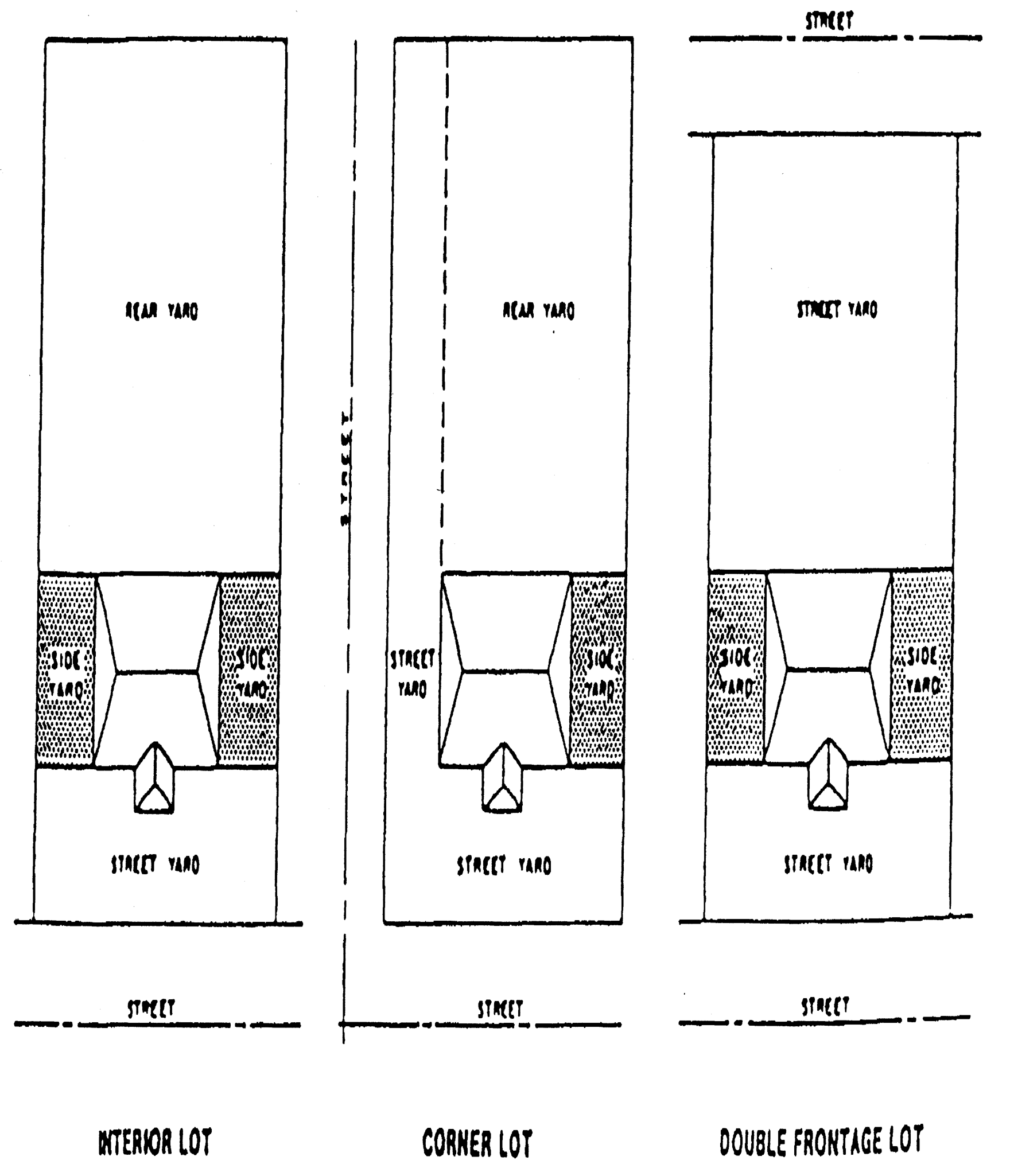
Illustration No. 1

