
Nederland City Zoning Code
SUBCHAPTER D
ADDITIONAL LAND DEVELOPMENT REQUIREMENTS
SECTION 20. - SIDEWALKS
Where required, sidewalks shall be constructed of reinforced concrete, nonskid brushed surface, five feet minimum with four inches minimum thickness, with expansion joints on not more than 60 feet centers and contraction surface joints on not more than five feet centers along the entire front property line of all commercial buildings. Sidewalks in front of a business shall be maintained by the property owner whether on the property or in the street right-of-way.
Section 18.1. - Residential districts.
1.
Shall not exceed a standard height of eight feet in the rear or side yard and be of sound construction.
2.
In the front yard, shall not exceed a height of three feet on or within the property line, and shall be nonopaque.
3.
Within 20 feet of the front property line the fence shall not exceed a height of three feet, and any fence, hedge or enclosure wall on a corner lot extending closer to the side property line than the required building setback line shall not exceed a height of three feet.
4.
A fence, hedge or enclosure wall within 20 feet of the rear property line that abuts a street right-of-way shall not exceed a height of three feet, without a variance from the zoning board of appeals.
5.
No fence, hedge or enclosure wall shall be placed within a street right-of-way, alleyway or on any other city property.
6.
Anyone wishing to construct a fence shall first submit a drawing to the inspection department showing the property lines, where the fence is to be located and the height of the fence.
7.
A permit is required to be taken out prior to construction and the fee for the permit is based on the cost of the project.
Section 18.2. - Commercial districts—General requirements.
1.
In all other than residential districts, when a lot abuts a residential district, there shall be provided, at the time any building or structure is erected, renovated, or when there is a change in ownership or classification, or the commercial land is developed or the property is utilized for any purpose (for more than 45 consecutive days), a six-foot permanent screening wall or fence. Screening walls or fences shall be constructed of redwood, cedar, pressure treated pine, masonry or other permanent wall or fence material.
2.
The surface of such wall or fence shall not contain any openings consisting of more than 40 square inches in each one square foot of wall or fence surface. All passageways in such wall or fence shall be equipped with gates equal in height and screening characteristic of the wall or fence.
3.
All required screening walls or fences shall not be less than six feet nor more than eight feet in height. The lower edge of such wall or fence shall not be over three inches above the finished ground elevation.
4.
All required screening walls or fences shall be permanently maintained by the owner in a safe and sound vertical condition. The area in front of such wall or fence shall be maintained in a clean and orderly condition, free of weeds, debris and trash.
5.
A fence, hedge or enclosure extending closer than ten feet from the front property line shall not exceed a height of three feet and, on a corner lot, a fence, hedge or enclosure extending closer than ten feet from the side property line shall not exceed a height of three feet.
6.
No fence shall be allowed in the front yard of a commercial use that would obstruct visibility or create a traffic hazard in accordance with (section 18.3) below.
Section 18.3. - Commercial uses adjacent to residential district.
1.
The fence shall be opaque and not less than six feet in height and not higher than eight feet.
2.
An addition to a commercial use in excess of 50 percent or more of the existing floor area, where the commercial use is adjacent to a residential zone, shall require construction of an opaque fence not less than six feet in height and not higher than eight feet.
3.
All fences adjacent to residential zones shall be maintained by the owner of the commercial property to prevent unsightliness and shall be maintained to prevent openings in the fence.
Section 18.4. - Visibility triangles.
Neither residential, commercial or industrial fencing, nor any sight obstruction including vegetation, which constitutes a hazard to the traveling public shall be permitted on any corner lot in any zone within the area designated as the "visibility triangle" as set forth below:
1.
A visibility triangle is a measurement applied at the intersection of two streets or the intersection of an alley or commercial driveway and a street to ensure unobstructed vision of motorists and pedestrians. Within the visibility triangle, the space between three and one-half feet and seven feet above the street, or three feet above the sidewalk, must be unobstructed and calculated as follows:
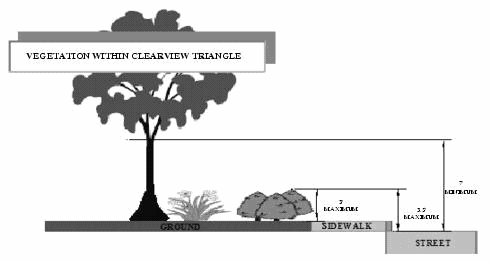
Figure 18-1 Visibility
2.
Requirements.
a.
Uncontrolled intersection. The right isosceles triangle having sides of 50 feet measure along the curb line of each intersecting local access street (or five feet from edge of pavement for a street with no curbs), alley or commercial driveway (see Figure 18-2); or
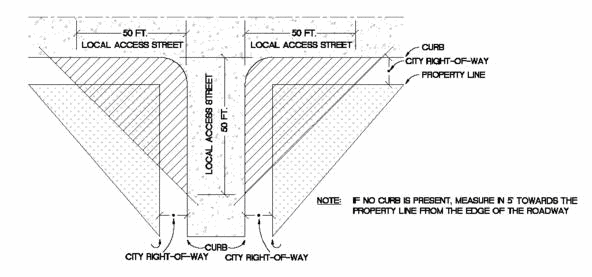
Figure 18-2 Uncontrolled Intersection
b.
Two-way stop controlled intersection. The right triangle having a 16-foot side measured along the curb line of a local access street (or five feet from edge of pavement for a street with no curbs), alley or commercial driveway, and the distance shown on Table 18-1 based on posted speed along the side along the curb line of the intersecting street (or five feet from edge of pavement for a street with no curbs) (see Figure 18-3); or
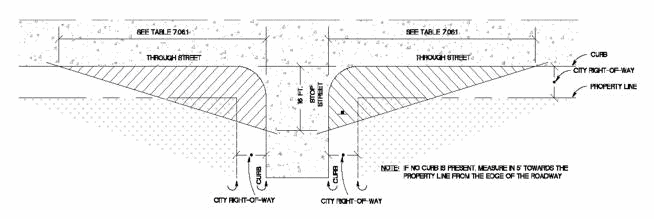
Figure 18-3 Two-Way Stop controlled Intersection
Table 18-1 - Yield-Controlled
c.
In cases including, but not limited to, arterials with posted speeds in excess of 35 miles per hour, one-way streets, steep grades and sharp curves, the city traffic engineer will determine the appropriate measurement; or
d.
Yield-controlled intersection. For intersections of local streets with 25-mile per hour speed limits, the right triangle having a 35-foot side measured along the curb line or edge of pavement of the yield-controlled street, and an 80-foot side measured along the curb line or edge of pavement of the intersecting street. Triangles for yield-controlled intersections on collectors or arterials, or streets with speeds higher than 25 miles per hour, will be determined by the city traffic engineer (see Figure 18-4); or
e.
All-way stop controlled. The triangle determined by the city traffic engineer using AASHTO sight distance requirements for all-way stop controlled intersections; or
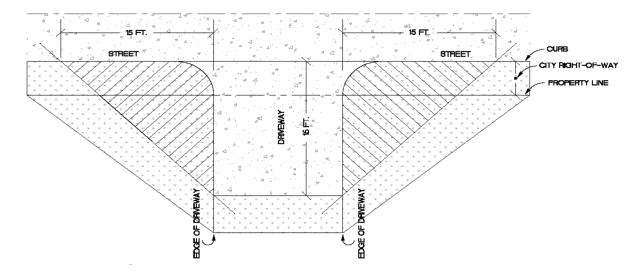
Figure 18-4 Yield-Controlled Intersection
f.
Signal-controlled intersection. The triangle determined by the director of public works using AASHTO sight distance requirements for signalized intersections; or
g.
Noncommercial driveway serving three or more residences. The right isosceles triangle having sides of 15 feet measured along the curb line of the street and the edge of the driveway (see Figure 18-5).
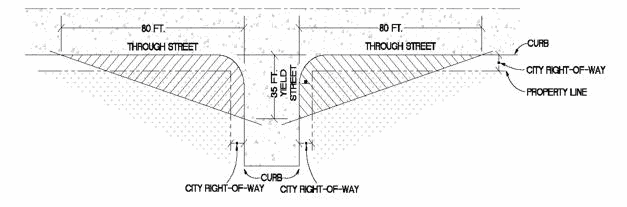
Figure 18-5 Noncommercial Driveway
3.
Exemptions. Visibility triangle regulations of this chapter shall not apply to:
a.
Public utility poles;
b.
Trees, so long as they are not planted in the form of a hedge and are trimmed to a height of at least seven feet above the street surface;
c.
Properties where the natural ground contour penetrates the visibility triangle; and traffic control devices installed by the city.
4.
Enforcement. The director of public works or his designee has authority to enforce this section.
Section 19.1. - Purpose.
The purpose of these standards is to provide safe on-site circulation for motorists, bicyclists and pedestrians and to provide adequate parking, pedestrian facilities and access. All parking areas within the city limits of Nederland shall be surfaced with concrete or asphalt and shall be kept in a state of repair so as not to create dust.
Section 19.2. - Vehicle parking.
1.
The number of required off-street parking spaces shall be based on the following:
a.
"Floor area" shall mean the gross square feet of the specific use.
b.
Where fractional spaces result, the parking spaces required shall be constructed to the nearest whole number.
c.
Uses not specified in Table 19-1 shall provide parking based on a use of similar nature;
d.
Whenever a building is changed in occupancy type, or enlarged in floor area, which creates a need for an increase in the number of existing parking spaces such spaces shall be provided on the basis of the enlargement or change. Whenever a building or use existing prior to the effective date of these regulations is enlarged to the extent of 50 percent or more in floor area or in area used, the entire building shall then and thereafter comply with the parking requirements set forth herein for new construction. Prior to occupancy of a new structure within any zoning district, off-street vehicle parking shall be provided in accordance with Table 19-1.
e.
In the case of mixed or joint uses, the parking spaces required shall equal the sum of the requirements of the various uses computed separately.
Section 19.3. - Location of parking spaces.
1.
All parking spaces required herein shall be located on the same lot with the building or use served, except that where an increase in the number of spaces is required by a change or enlargement of use, or where such spaces are provided collectively or used jointly by two or more buildings or establishments, the required spaces may be located and maintained not to exceed 300 feet from an institutional building served and not to exceed 500 feet from any other commercial building served.
2.
Up to 50 percent of the parking spaces required for (a) theaters, public auditoriums, bowling alleys, night clubs, cafes, restaurants and similar business that are open primarily at night and up to 100 percent of the parking spaces required for a church or school auditorium may be provided and used jointly by (b) banks, offices, retail stores, repair shops, service establishments and similar uses not normally open, used or operated during the same hours; provided, however, that written agreement thereto shall be properly executed by the parties concerned, approved as to form by the city attorney; and filed with the application for a building permit.
3.
Off-street parking spaces may be located within the required front yard of any business or industrial district, provided that entrances to these spaces are approved by the director of public works.
4.
No off-street parking shall be permitted in the required front yard of any residential district, except upon a driveway providing access to a garage, carport or parking space for a dwelling. For existing property and new construction the parking space shall be constructed of concrete or asphalt. Driveways for new construction shall be surfaced with concrete or asphalt. For existing property the driveways shall be surfaced with an all weather material to not create dust or mud.
Section 19.4. - Off-street parking design standards and minimum dimensions.
All parking spaces shall be designed and constructed in accordance with the standards contained in Table 19-3, and Figure 19-1 below. All traffic circulation lanes and fire lanes must be maintained free and clear of merchandise, carts and any other materials to allow for emergency access.
Table 19-3 - Parking Minimum Design Requirements
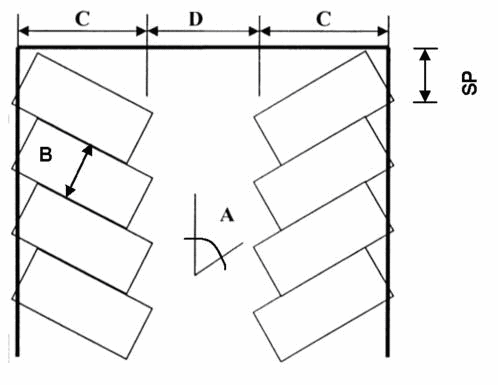
Figure 19-1 Calculation of Parking Spaces
Section 19.5. - Accessible parking.
All developments shall comply with the parking standards of the Americans with Disabilities Act and applicable state law. Accessible parking shall be developed in accordance with the standards and requirements of Figure 19-2 and Table 19-4, below. If federal or state law requirements are more stringent, those shall control.
1.
Location. Accessible parking spaces shall be located on the shortest accessible route of travel from adjacent parking to an accessible building entrance. Where buildings have multiple accessible entrances with adjacent parking, accessible parking spaces shall be dispersed and located near the accessible entrances.
a.
Hospital outpatient facilities. Ten percent of patient and visitor parking spaces provided shall be accessible.
b.
Rehabilitation facilities and outpatient physical therapy facilities. Twenty percent but not less than one of the portion of patient and visitor parking spaces shall be accessible.
c.
Van spaces. For every six or fraction of six accessible parking spaces, at least one shall be a van-accessible parking space.
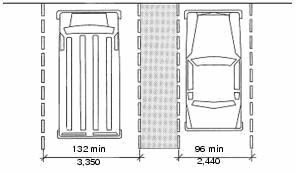
Figure 19-2 Parking Space Size
d.
Accessible car and van parking space size shall be as follows:
i.
Car parking spaces shall be eight feet (96 inches) minimum in width.
ii.
Van parking spaces shall be 11 feet (132 inches) minimum in width.
Exception: Van parking spaces shall be permitted to be eight feet (96 inches) minimum in width where the adjacent access aisle is eight feet (96 inches) minimum in width.
Table 19-4 - Accessible Parking Spaces Required
Section 19.6. - Stacking and queuing requirements.
1.
Driveway stacking length for individual uses is the distance between the street right-of-way line and the proposed use. The minimum length of driveway stacking for drive-thru windows shall be as required in Table 19-5:
Table 19-5 - Minimum Stacking Lane Length (in Feet)
2.
Driveway stacking length for multi-use properties is the distance between the street right-of-way line and the near side of the first intersection interior aisle or parking stall. In order to prevent stacking within the public street, the total number of driveways accessing a public street is divided by the total number of parking spaces, establishing the minimum length of driveway stacking as described in Table 19-6:
Table 19-6 - Parking Lot Stacking
3.
The City of Nederland may require a traffic study to determine the stacking and queuing requirements for such uses that include, but are not limited to, service stations, drive-thru restaurants, drive-in banking, etc.
Section 19.7. - Off-street loading.
1.
Every building or part thereof erected or occupied for retail business, service, manufacturing, storage, warehousing, hotel/motel, industrial or any other use similarly involving the receipt or distribution by vehicles of materials or merchandise shall provide and maintain on the same premises loading space in accordance with the following requirements:
a.
Off-street loading spaces shall measure as follows:
i.
When one space is required, it shall measure 12 feet wide, 30 feet long and 15 feet high (if a dock).
ii.
When two or more spaces are required, they shall measure 12 feet wide, 60 feet long and 15 feet high (if a dock).
b.
Loading facilities located on the side of a building but not facing a street shall be set back from the front property line a minimum distance of 60 feet.
c.
Driveways, aisles and maneuvering areas shall be designed to accommodate the largest vehicles that would normally be expected to use those particular driveways, aisles and maneuvering areas. The turning radius shall be a minimum of 30 feet and the driveway aisles shall be a minimum of 24 feet.
d.
Whenever possible, the site should be designed for counterclockwise circulation of large trucks as left turns and left-hand backing maneuvers are easier and safer since the driver's position is on the left hand of the vehicle.
e.
All parking, loading and maneuvering of trucks shall be conducted on private property.
f.
Required passenger vehicle parking shall not be allowed within the truck dock apron space.
The minimum number of off-street loading spaces shall be as shown on Table 19-7:
Table 19-7 - Loading Spaces Required
2.
Screening of off-street loading areas.
a.
Off-street loading spaces and apron space shall not be located on the street side of any building in commercial or residential zones. In those instances where three or more sides of the building face dedicated streets, loading spaces and apron space shall be located at the rear or side of the building and screened from view of the abutting streets for a minimum of 35 feet. In the industrial zones, off-street loading spaces and apron space may be located on the street side of buildings providing that they are screened from view of the abutting streets for a minimum of 35 feet.
b.
No loading dock or service bay doors shall be constructed on any portion of a front wall or on a side or rear wall within 60 feet of any front property line or adjacent to the street.
Section 19.8. - Bicycle parking.
Bicycle spaces are individual units within ribbon racks, inverted "U" racks, locking wheel racks, lockers, or other similar permanent structures accommodating five or more bicycles, and shall meet the following standards.
1.
Bicycle racks and/or storage shall be provided when 25 or more parking spaces are required, at a ratio of one rack for every 25 parking spaces.
2.
Required bicycle parking must be located within 50 feet of an entrance to the building or use.
3.
If bicycle parking is not visible from the street, a sign must be posted indicating the location of the bicycle parking spaces.
4.
All bicycle parking must be separated from motor vehicle traffic by a barrier, curb, post, bollard or other similar device.
5.
The property owner of a site shall have a continuing obligation to properly maintain any bicycle parking facilities on their property.
Section 19.9. - Parking of commercial vehicles in residential districts or areas.
1.
Definitions.
Large commercial vehicles are defined as those weighting more than 13,000 pounds, or weighing less than 13,000 pounds but which are more than 9.5 feet in height, or with a cargo area or work platform of 14 feet or more in length.
Light commercial vehicles are those weighing less than 13,000 pounds with a cargo area or work platform of less than the height of the vehicle cab and no more than 9 feet in length.
Medium commercial vehicles are those weighing less than 13,000 pounds with a cargo area or work platform of less than nine and one-half feet in height and less than 14 feet in length.
2.
Large commercial vehicles. Large commercial vehicles are hereby prohibited from parking on public streets, in driveways, or on private property in any residential districts or areas not zoned for residential use, but where the predominant land use is residential.
3.
Medium and light commercial vehicles. Medium or light commercial vehicles are hereby prohibited from parking on public streets, in driveways, or on private property in any residential districts or areas not zoned for residential use, but where the predominant land use is residential.

