
Neoga City Zoning Code
ARTICLE II
- BASIC DEFINITIONS AND INTERPRETATIONS
DIVISION 2G.- I/INDUSTRIAL DISTRICT[2]
Note— The I-Industrial District is intended to provide for areas where light industry, research facilities, warehouses, and wholesale businesses may locate without detriment to the remainder of the community.
DIVISION 2H.- OPEN/RECREATIONAL FACILITIES AND OPEN SPACE[3]
Note— The Open Recreational Facilities and Open Space District is intended to provide for areas for public use or enjoyment.
Sec. 2.0.- Definitions of basic terms.
Unless otherwise specifically provided, or unless clearly required by the context, the words and phrases defined in this section shall have the meaning indicated when used in this chapter.
(1)
Accessory structure. A subordinate structure located on the same parcel as the main building, the use of which is naturally and normally incidental to that of the dominate use of the principal building and not used or designed for human occupancy. An accessory structure shall not be used for living, sleeping, housekeeping, or residential purposes. Furthermore, an accessory structure shall not be used for the conduct of business for a home occupation, or storage for a home occupation or other commercial use, provided, however, that this prohibition shall not apply to a lot legally developed with a farm or livestock farm.
(2)
Accessory use. A use of land or of a building or portion thereof customarily incidental and subordinate to the principal use of the land or building and located on the same lot with the principal use.
(3)
Reserved.
(4)
Alley. A public thoroughfare which affords only a secondary means of access to the property abutting thereon.
(5)
Alterations. Any enlargement to or diminution of a building or structure, whether horizontally or vertically, or the moving of a building or structure from one location to another.
(6)
Americans With Disabilities Act. A 1990 federal law designed to bring disabled Americans into the economic mainstream by providing them equal access to jobs, transportation, public facilities, and services.
(7)
Antenna. Equipment designed to transmit or receive electronic signals.
(8)
Applicant. A person submitting an application for development.
(9)
Barrier. A fence, a wall, a building wall or a combination thereof which completely surrounds an area and obstructs access to that area.
(10)
Base flood. The flood having a one percent chance of being equaled or exceeded in any given year. Also known as the 100-year flood.
(11)
Basement. A portion of a building having more than one-half of the distance between floor and ceiling below mean grade.
(12)
Block. A unit of land bounded by streets or by a combination of streets and public land, railroad rights-of-way, waterways, or another barrier to the continuity of development. See Figure 3.
(13)
Boarding house. A residential use consisting of at least one dwelling unit together with more than two rooms that are rented or are designed or intended to be rented but which rooms, individually or collectively, do not constitute separate dwelling units. A rooming house or boarding house is distinguished from a tourist home in that the former is designed to be occupied by longer term residents (at least month-to-month tenants) as opposed to overnight or weekly guests.
(14)
Building. A structure designed to be used as a place of occupancy, storage or shelter.
(15)
Building inspector. The designated city official charged with administering land development regulations.
(16)
Buffer zone. A zoning district that permits uses compatible with uses permitted in two adjacent zones that, without the transition zone, could be considered incompatible to each other.
(17)
Business. A purchase, sale or exchange of goods or services for profit or the maintenance for profit of offices or recreational or amusement enterprises.
(18)
Car port. A covered parking area with no more than three sides enclosed.
(19)
Cemetery. Property used for the interring of the dead.
(20)
Certify. Whenever this chapter requires that some agency certify the existence of some fact or circumstance to the city, the city may require that such certification be made in any manner that provides reasonable assurance of the accuracy of the certification. By way of illustration, and without limiting the foregoing, the city may accept certification by telephone from some agency when the circumstances may warrant it, or the city may require that the certification be in the form of a letter or other document.
(21)
Circulation area. Physical improvements for the movement of people and/or goods.
(22)
City. The City of Neoga.
(23)
Clinic. An establishment in which patients are admitted for medical or dental study or treatment and in which the services of a physician(s), a dentist(s) or a chiropractor(s) are provided.
(24)
Closed construction. Any building, component, assembly or system manufactured in such a manner that all portions cannot readily be inspected at the installation site without disassembly, damage to, or destruction thereof.
(25)
Club. A building or portion thereof or premises owned or operated by a corporation, association, person or persons for social, educational or recreational purposes, but not primarily for profit, or to render a service which is customarily carried on as a business.
(26)
Combination use. A use consisting of a combination on one lot of two or more principal uses.
(27)
Commercial establishment. Activity involving the sale of goods or services carried out for profit.
(28)
Conditional use. A use permitted in a particular zoning district upon showing that such use in a specified location will comply with all the conditions and standards for the location or operation of the use as specified in the zoning ordinance and authorized by the council.
(29)
Conditional use permit. A permit issued by the city council that authorizes the recipient to make use of property in accordance with the requirements of this chapter as well as any additional requirements imposed by the council.
(30)
Contiguous. Next to, abutting, or touching and having a boundary, or portion thereof, that is coterminous.
(31)
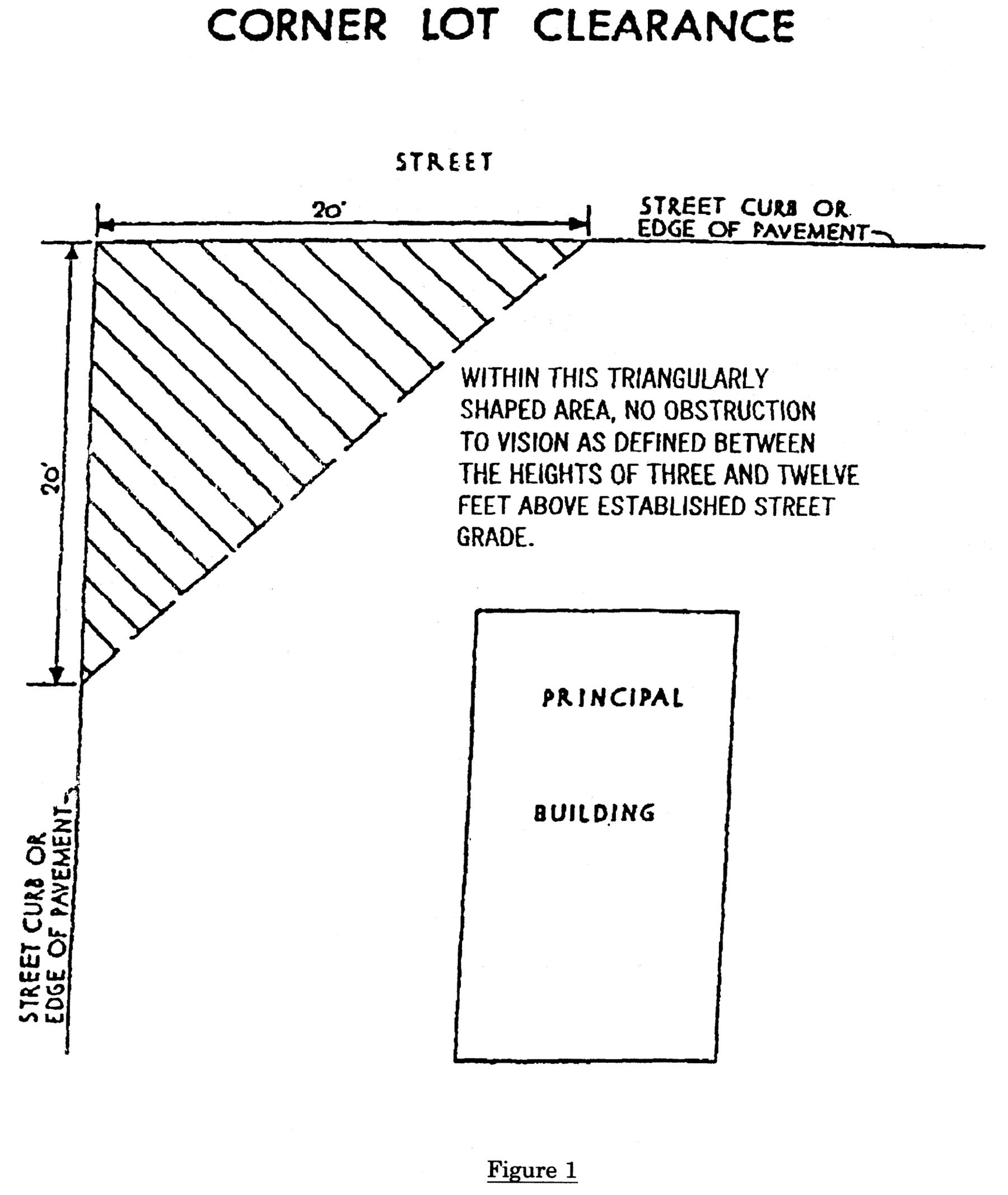
Corner lot clearance. A triangular space at the street corner of a corner lot free from any kind of obstruction between the heights of three and twelve feet above established grade determined by a diagonal line connecting two points measured equal distance from the street corner along each property line. See Figure 1.
(32)
Court. An unoccupied space, other than a yard, on the same lot with a building which is bounded on three or more sides by walls of such building.
(33)
Council. The city council of the City of Neoga.
(34)
Deck. A floored roofless area adjoining a building.
(35)
Developer. A person who is responsible for any undertaking that requires a zoning permit, subdivision approval, conditional use permit, or sign permit.
(36)
Development. That which is to be done pursuant to a zoning permit, subdivision approval, conditional use permit, or sign permit.
(37)
Driveway. A private roadway providing access to a street or highway.
(38)
Dwelling. Any building or portion thereof which is designed for or used for residential purposes.
(39)
Dwelling unit. An enclosure containing sleeping, kitchen, and bathroom facilities designed for and used for use as a permanent residence by one family.
(40)
Dwelling, two-family (duplex). A building designed for two dwelling units.
(41)
Dwelling, single-family. A building designed for or occupied exclusively by one family, and which shall have a minimum area of 900 square feet. The shortest side cannot have a length of less than 20 feet including the garage.
(42)
Dwelling, multi-family. A building designed for or occupied exclusively by three or more dwelling units.
(43)
Dwelling, with accessory apartment. A residential use having the external appearance of a single-family dwelling but in which there is located a second dwelling unit.
(44)
Extraterritorial planning jurisdiction. That portion of the city's planning jurisdiction that lies outside the corporate limits of the city.
(45)
Extraterritorial zoning jurisdiction. That portion of the city's zoning jurisdiction that lies outside the corporate limits of the city.
(46)
Family. One or more persons living together as a single housekeeping unit.
(47)
Flood. The temporary overflowing of water onto land that is usually devoid of surface water.
(48)
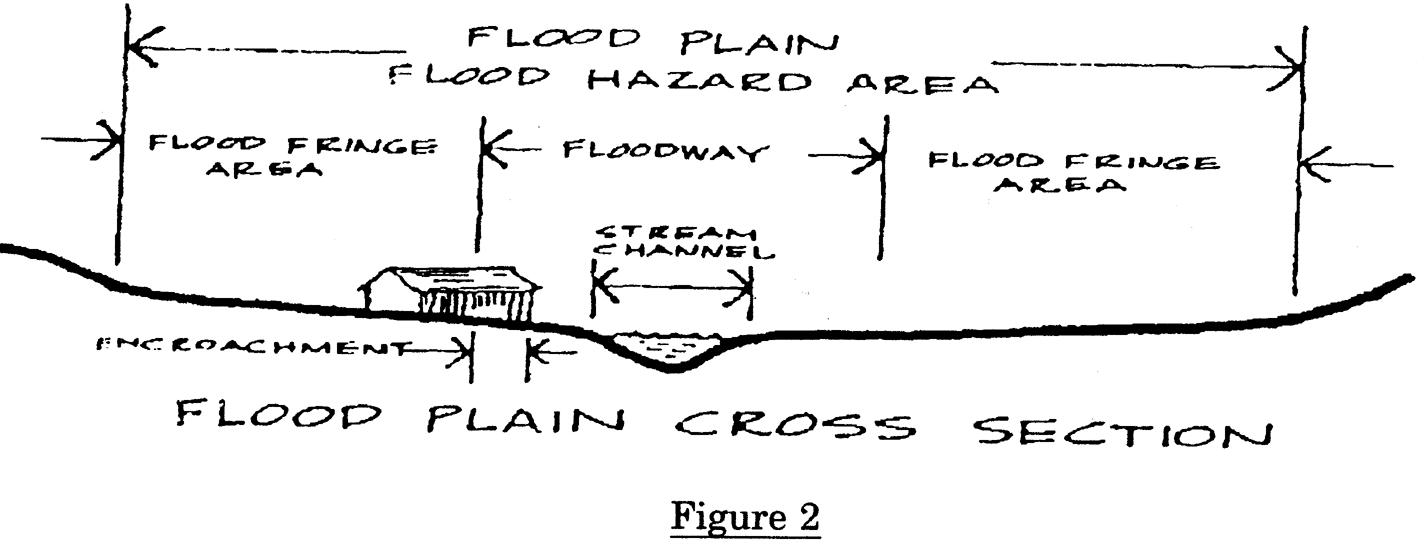
Floodplain. Any land area susceptible to be inundated by water from the base flood. As used in this chapter, the term refers to that area designated as subject to flooding from the 100-year flood (Zone A) and 500-year flood (Zone B) on the "Flood Insurance Rate Map" prepared by the Federal Emergency Management Agency, a copy of which is on file in the city clerk's office. See Figure 2.
(49)
Floodplain, encroachment. Any obstruction or illegal or unauthorized intrusion in a delineated floodway, right-of-way, or an adjacent land. See Figure 2.
(50)
Floodway. The channel of a natural stream or river and portions of the flood plain adjoining the channel, which are reasonably required to carry and discharge the floodwater or flood flow of any natural stream or river. See Figure 2.
(51)
Flood fringe area. The portion of the flood hazard area outside of the floodway based on the total area inundated from the 100-year flood and 500-year flood. See Figure 2.
(52)
Footing. A building component which secures the placing of the structure.
(53)
Funeral home. A building used for the preparation of the deceased for burial and the display of the deceased and rituals connected therewith before burial or cremation.
(54)
Garage. An accessory building designed or used for the storage of not more than three motor-driven vehicles owned and used by the occupants of the dwelling or duplex to which it is accessory, and which is attached or unattached from the dwelling.
(55)
Gross floor area. The total area of a building measured by taking the outside dimensions of the building at each floor level intended for occupancy or storage.
(56)
Habitable floor. Any floor usable for living purposes, which includes working, sleeping, eating, cooking, or recreation, or any combination thereof. A floor used only for storage is not a habitable floor.
(57)
Height of building. The vertical distance of a structure measured from the average of the finished grade surrounding the structure to the highest point of the structure.
(58)
Home occupation. A business, occupation or profession conducted within a dwelling unit by a person residing within that dwelling unit which is clearly incidental to the primary residential use of the structure, and provided that:
a.
The home occupation shall be conducted wholly within the principal building;
b.
No home occupation use shall be made of garage facilities or other accessory structure, whether attached or detached;
c.
Other than a member of the family residing in the dwelling unit, no more than one person may be employed or working in the home occupation;
d.
A separate entrance shall not be provided in conjunction with the conduct of the home occupation;
e.
No alteration of any kind shall be made to the principal building which changes its residential character as a dwelling unit;
f.
No outdoor display or storage in connection with the home occupation shall be allowed;
g.
The home occupation shall not involve more than a total of 300 square feet of the area of a dwelling unit;
h.
No sign shall be permitted on the premises except a nameplate of one square foot in area mounted flush against the side of the residential structure;
i.
There shall be no commodity sold or services rendered that require delivery or shipment of merchandise, goods or equipment by other than passenger-sized motor vehicles, three-quarter to step-up van or similar sized trucks;
j.
The home occupation shall not create noise, dust, vibration, smell, smoke, glare, electrical magnetic interference (EMI) and radio frequency interference (RFI), fire hazard, or any other hazard or nuisance greater than that usually experienced in a residential district;
k.
The home occupation shall be conducted in such a manner that it does not create parking or traffic congestion for the abutting or adjoining neighbors or for the immediate neighborhood; and,
l.
All home occupations shall be registered in the office of the building inspector on the forms provided by the building inspector.
(59)
Hotel or motel. A building in which lodging is provided or offered to the public for compensation, with or without meals.
(60)
Improvement. Any permanent structure that becomes part of, placed upon, or is affixed to real estate.
(61)
Junk. Any scrap, waste, reclaimable material, or debris, whether or not stored, for sale or in the process of being dismantled, destroyed, processed, salvaged, stored, baled, disposed, or other use or disposition.
(62)
Junk yard. Any area, lot, land, parcel, building, or structure, or part thereof, used for the storage, collection, processing, purchase, sale, salvage, or disposal of junk.
(63)
Landing. An open, above grade, uncovered area used for access to the house.
(64)
Loading space. An off-street space or berth used for the loading or unloading of cargo, products, or materials from vehicles. Every required off-street loading space shall be at least 12 feet wide and 45 feet long exclusive of aisle and maneuver space, and shall have vertical clearance of at least 14 feet. In no case shall a vehicle being loaded or unloaded overhang into the public right-of-way.
(65)
Lodge. The place where members of a local chapter of an association or a fraternal, cultural, or religious organization hold their meetings.
(66)
Lot. A designated parcel, tract, or area of land established by plat, subdivision, or as otherwise permitted by law, to be separately owned, used, developed, or built upon. See Figure 3.
(67)
Lot area. The total area within the lot lines of a lot, excluding any street rights-of-way.
(68)
Lot coverage. That portion of the lot that is covered by above grade improvements and including swimming pools.
(69)
Lot depth. The average distance measured from the front lot line to the rear lot line. See Figure 3.
(70)
Lot frontage. The length of the front lot line measured at the street right-of-way. See Figure 3.
(71)
Lot width. The horizontal distance between the side lines of a lot measured at right angles to its depth along a straight line parallel to the front lot line at the minimum required building setback line. See Figure 3.
(72)
Lot, corner. A lot or parcel of land abutting upon two or more streets at their intersection or upon two parts of the same streets forming an interior angle of less than 135 degrees. See Figure 3 and Figure 6.
[(73)
Reserved.]
(74)
Lot, improved. (1) A lot upon which a building can be constructed and occupied; (2) a lot with buildings or structures.
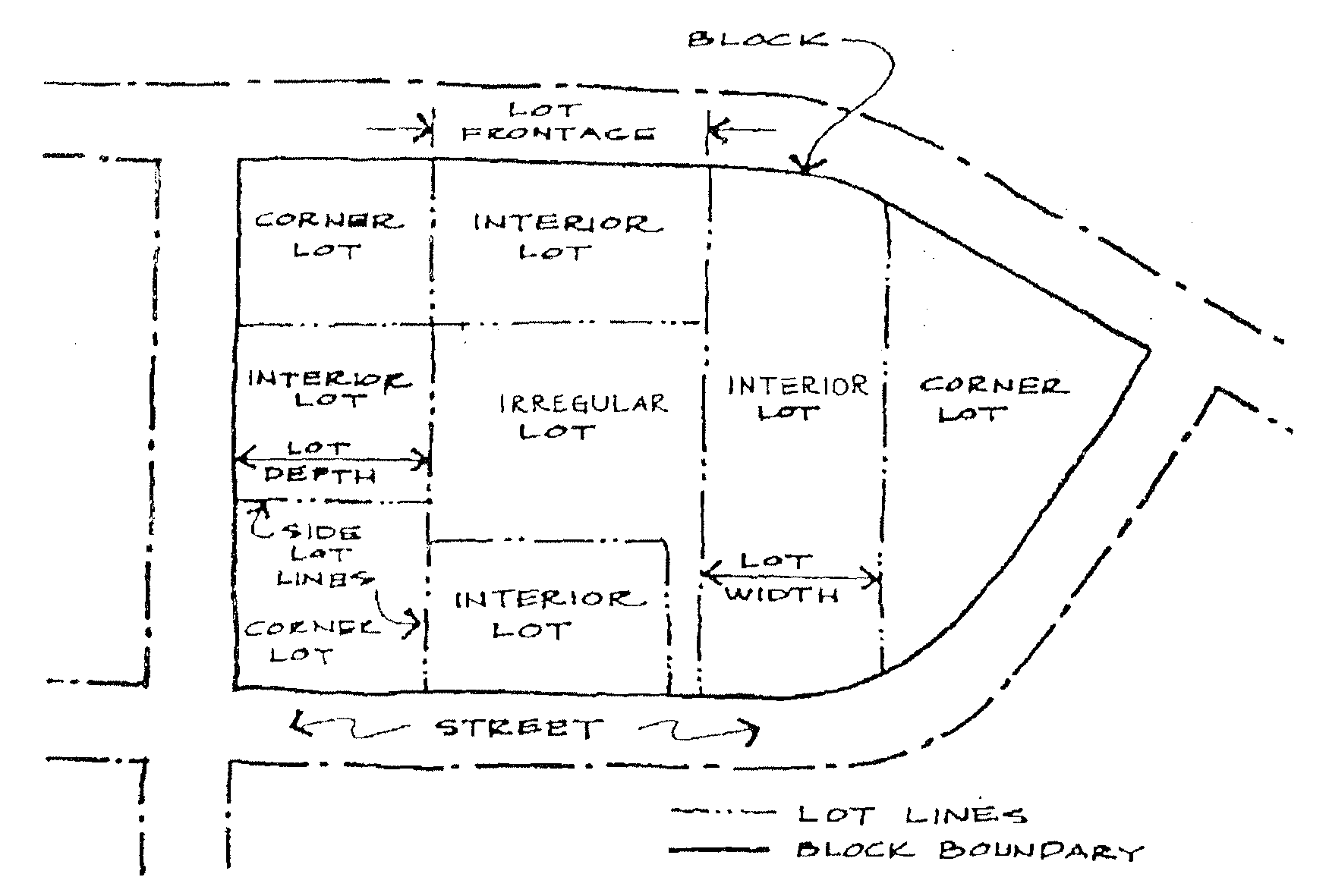
Figure 3
(75)
Lot, interior. A lot other than a corner lot. See Figure 3 and Figure 6.
(76)
Lot, irregular. Also known as odd shaped lots. See Figure 3 and Figure 6.
(77)
Lot line. The lines bounding a lot. See Figure 3.
(78)
Lot line, front. The lot line separating a lot from a street right-of-way. See Figure 3.
(79)
Lot line, rear. The lot line opposite and most distant from the front lot line. In the case of triangular or otherwise irregularly shaped lots, a line ten feet in length entirely within the lot, parallel to and at a maximum distance from the front lot line. See Figure 3.
(80)
Lot line, side. Any lot line other than a front or rear lot line. See Figure 3.
(81)
Manufactured home (mobile home, house trailer or double-wide trailer). A transportable structure or portable dwelling larger than 320 square feet in floor area, constructed to be towed on its own chassis, connected to utilities and designed without a permanent foundation for year-round residential dwelling, which can consist of one or more components that can be retracted for towing purposes and subsequently expanded for additional capacity, or of two or more units separately towable but designed to be joined into one integral unit. If constructed on or after June 15, 1976, shall bear a seal demonstrating compliance with federal manufactured home construction and safety standards established pursuant to 42 U.S.C § 5403.
(82)
Mayor. Mayor shall mean the Mayor of the City of Neoga, Illinois.
(83)
Mineral extraction. Mining or quarrying and removal of earth materials.
(84)
Mobile home. See "Manufactured home."
(85)
Manufactured home park (trailer park or mobile home park). A parcel not less than ten acres in area in single ownership/control, developed with facilities for accommodating two or more occupied manufactured homes for living purposes.
(86)
Modular dwelling. A building assembly, system of building sub-assemblies or manufactured residential structure, designed for habitation as a dwelling for one or more persons, including the necessary electrical, plumbing, heating, ventilating and other service systems, which is of closed or open construction and which is made or assembled by a manufacturer, built to a nationally recognized and accepted construction standard published by the International Code Council (ICC), on or off the building site with inspection and certification that the construction meets the applicable standards. It shall be installed and set up according to the manufacturer's instructions on an approved concrete basement or foundation and support system with permanent connections to utilities. A modular dwelling shall have a floor area of at least 1,000 square feet with exterior structure materials and appearance similar to customary single-family structures, including, but not limited to, pitched roof, eave projection, varying depths, ornamental windows, walkway and stairs, formal landscaping and use of exterior masonry.
(87)
Motor home. A self contained, motor driven structure that (i) is standing on wheels and used for short-term human occupancy, carrying of materials, goods, or objects, or as a temporary office or (ii) is designed for temporary use as living quarters but that does not satisfy one or more of the definitional criteria of a mobile home.
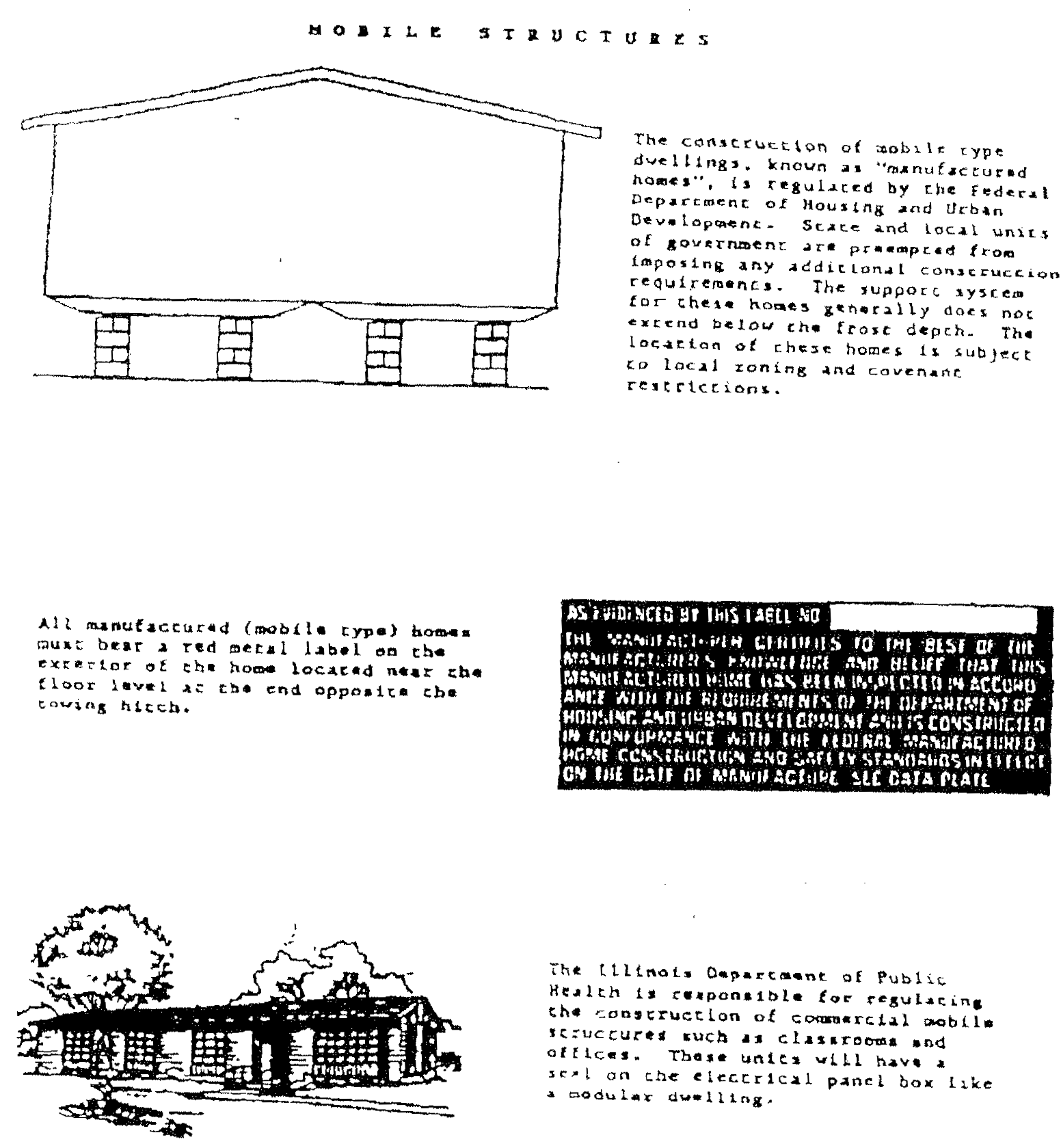
Figure 4
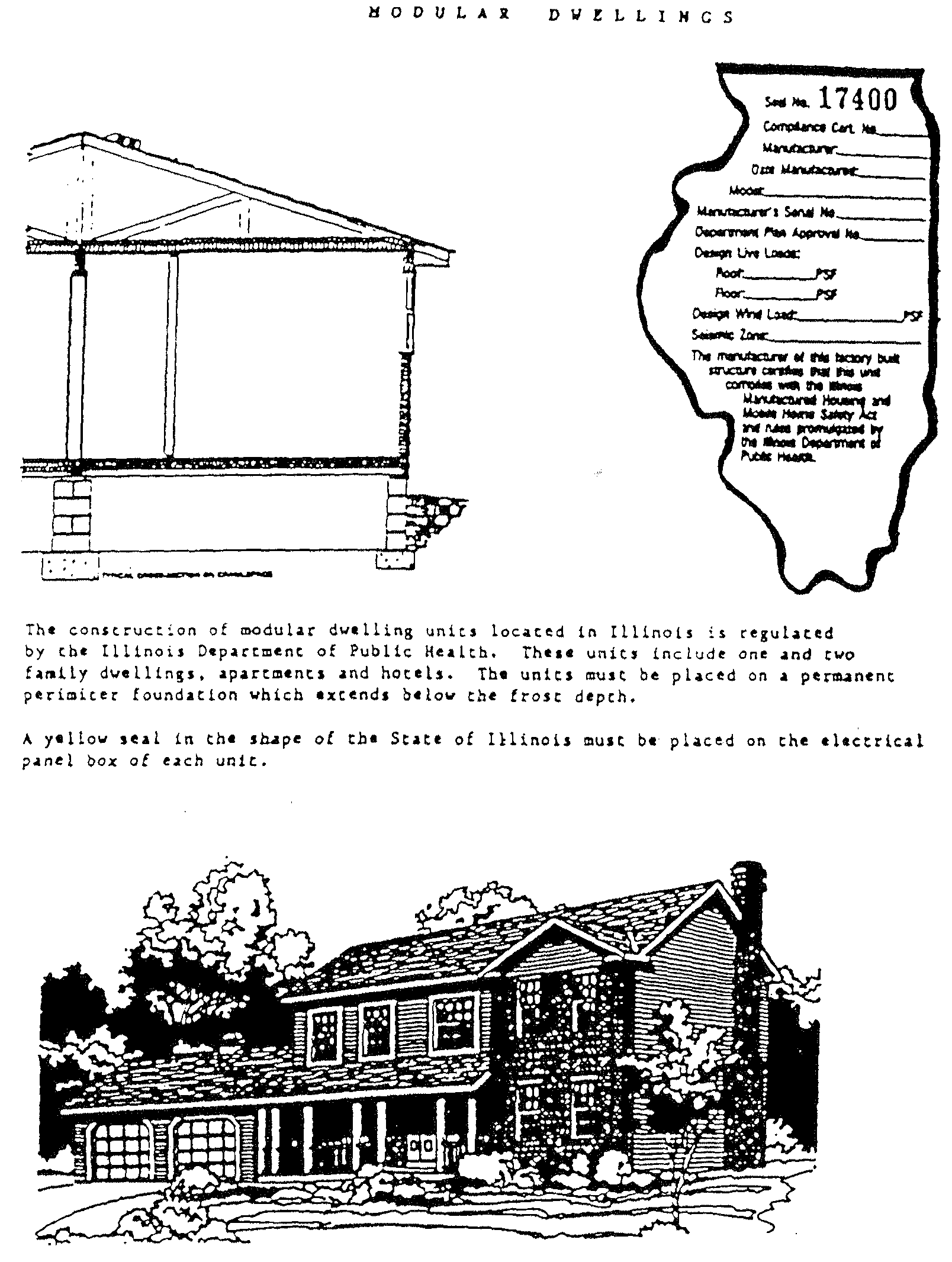
Figure 5
(88)
Nonconforming use. A use or activity that was lawful prior to the adoption, revision or amendment of the zoning ordinance but that fails by reason of such adoption, revision, or amendment to conform to the present requirements of the zoning district.
(89)
Nonconforming lot. A lot, the area, dimensions, or location of which was lawful prior to the adoption, revision, or amendment of the zoning ordinance but that fails by reason of such adoption, revision, or amendment to conform to the present requirements of the zoning district.
(90)
Nonconforming building, structure, or undertaking. A structure, building, or undertaking, the size, dimensions, or location of which was lawful prior to the adoption, revision, or amendment to the zoning ordinance but that fails by reason of such adoption, revision, or amendments to conform to the present requirements of the zoning district.
(91)
Nursing care home. A state licensed facility maintained for the purpose of providing nursing care and medical supervision at a lower level than that available in a hospital.
(92)
Office. A room or group of rooms used for conducting the affairs of a business, profession, service, industry, or government and generally furnished with desks, tables, files, and communication equipment.
(93)
Open space. Any parcel or area of land or water essentially unimproved and set aside, dedicated, designated, or reserved for public or private use or enjoyment or for the use and enjoyment or owners, occupants, and their guests of land adjoining or neighboring such open space.
(94)
Parcel. A contiguous lot or tract of land owned and recorded as the property of the same persons or controlled by a single entity.
(95)
Park. A tract of land, designated and used by the public for active and passive recreation.
(96)
Parking access. The area of a parking lot that allows motor vehicles ingress and egress from the street.
(97)
Parking area. Any public or private area, under or outside of a building or structure, designed and used for parking motor vehicles including parking lots, garages, private driveways, and legally designated areas of public streets.
(98)
Parking area, private. A parking area for the exclusive use of owners, tenants, lessees, or occupants of the lot on which the parking area is located or their customers, employees, or whomever else they permit to use the parking area.
(99)
Parking area, public. A parking area available to the public, with or without payment of a fee.
(100)
Parking bay. The parking module consisting of one or two rows of parking spaces and the aisle from which motor vehicles enter and leave the spaces.
(101)
Parking lot. An off-street, ground level open area, usually improved, for the temporary storage of motor vehicles.
(102)
Parking space. A space for the parking of a motor vehicle within a public or private parking area, and having an area not less than 200 square feet. Each required parking space shall be at least ten feet wide and 20 feet long, and shall have at least seven feet of vertical clearance. Every space shall be situated so that no part of any parked vehicle overhangs the public right-of-way.
(103)
Permanent foundation. A closed perimeter formation consisting of materials such as concrete, mortared concrete block, or mortared brick extending into the ground below the frost line which shall include, but not necessarily be limited to, cellars, basements, or crawl spaces, but does exclude the use of piers.
(104)
Person. Any individual, firm, partnership, organization, corporation, limited liability company, association, proprietorship or other legal entity. It shall also include an executor, administrator, trustee, receiver or other representative appointed according to law. Whenever the word "person" appears in any section of this appendix B prescribing a penalty or fine, as to partnerships or associations, the word shall include the partners or members thereof, and as to corporations or limited liability companies, shall include the officers, agents or members thereof who are responsible for any violation of any provision of this appendix B.
(105)
Plan. A detailed summary intended to guide the growth and development of a community that typically includes information leading to recommendations for the community's future growth and development.
(106)
Planning jurisdiction. The area within the city limits as well as the area beyond the city limits within which the city is authorized to plan for development.
(107)
Plot. A parcel of land that can be identified and referenced to a recorded plat or map.
(108)
Porch. A roofed open area, which may be screened, attached to or part of and with direct access to or from a building.
(109)
Portable structure. A structure without any foundation or footings and that can be removed at any time.
(110)
Potable water. Any water suitable and safe for drinking.
(111)
Principal building. The primary building on a parcel or a building that houses a principal use.
(112)
Principal use. The primary or predominant use of any lot or parcel.
(113)
Recreational vehicle. A vehicular-type portable structure without permanent foundation that can be towed, hauled, or driven and primarily designed as a temporary living accommodation for recreational, camping, and travel use and including, but not limited to, travel trailers, truck trailers, truck campers, camping trailers, and self-propelled motor homes.
(114)
Recreational vehicle park. Any lot or parcel of land upon which two or more recreational vehicle sites are located, established, or maintained for occupancy by recreational vehicles, travel trailers, or motor homes of the general public as temporary living quarters for recreation or vacation purposes.
(115)
Road. (See "Street.")
(116)
Rooming house. (See "Boarding House.")
(117)
Satellite dish. A parabolic or dish-shaped antenna or any other apparatus or device that is designed for the purpose of receiving radio waves.
(118)
Setback. The distance between the building and any lot line.
(119)
Setback line. That line that is the required minimum distance from any lot line and that establishes the area within which the principal structure must be erected or placed.
(120)
Special events. Circuses, fairs, carnivals, festivals, or other types of special events that (i) run for one day but not longer than two weeks, (ii) are intended to or likely to attract substantial crowds, and (iii) are unlike the customary or usual activities generally associated with the property where the special event is to be located.
(121)
Story. That portion of a building included between the surface of any floor and the surface of the floor next above it, or if there is no floor above it, then the space between the floor and the ceiling next above it and including those basements used for the principal use.
(122)
Street. Any vehicular way that: (1) is an existing state, county, or municipal roadway; (2) is shown upon a plat approved pursuant to law; or (3) is approved by other official action.
(123)
Street, arterial. A major street in the city's street system that serves as an avenue for the circulation of traffic onto, out, or around the city and carries high volumes of traffic.
(124)
Street, collector. A street that collects traffic from local streets and connects with arterials.
(125)
Street, cul-de-sac. A street that terminates in a vehicular turnaround.
(126)
Street, local. A street designed to provide vehicular access to abutting property.
(127)
Structural alterations. Any change in the supporting members of a structure, such as bearing walls, columns, beams or girders, other than a change in doors or windows.
(128)
Structure. Anything constructed or erected.
(129)
Subdivision. The division of a lot, tract, or parcel of land into two or more lots, tracts, parcels, or other divisions of land for sale, development, or lease (See Neoga Subdivision Ordinance).
(130)
Temporary emergency, construction, or repair residence. A residence (which may be a mobile home) that is: (i) located on the same lot as a residence made uninhabitable by fire, flood, or other natural disaster and occupied by the persons displaced by such disaster, or (ii) located on the same lot as a residence that is under construction or undergoing substantial repairs or reconstruction and occupied by the persons intending to live in such permanent residence when the work is completed, or (iii) located on a nonresidential construction site and occupied by persons having construction or security responsibilities over such construction site. The time frame for the temporary emergency, construction, or repair residence should not exceed 6 months from inspection of the emergency, with time extensions possible for completion of the construction or repair.
(131)
Temporary use permit. A permit issued in accordance with the provisions of this ordinance and valid for not more than one year, which allows the occupation of a temporary structure or the operation of a temporary enterprise.
(132)
Tourist home. An establishment in a private dwelling that supplies temporary accommodations to overnight guests for a fee (also known as "Bed and Breakfast").
(133)
Tower. Any structure whose principal function is to support an antenna.
(134)
Tract. An area, parcel, site, piece of land, or property that is the subject of a development application.
(135)
Travel trailer. A structure that (i) is standing on wheels, towed or hauled by another vehicle, and used for short-term human occupancy, carrying of materials, goods, or objects, or as a temporary office or (ii) is designed for temporary use as living quarters but that does not satisfy one or more of the definitional criteria of a mobile home.
(136)
Trip generation. The total number of vehicle trip ends produced by a specific land use or activity.
(137)
Use. The activity or function that actually takes place or is intended to take place on a lot.
(138)
Utility facilities. Any above-ground structures or facilities (other than buildings, unless such buildings are used as storage incidental to the operation of such structures or facilities) owned by a governmental entity, a nonprofit organization, a corporation, or any entity defined as a public utility for any purpose [as defined by the Illinois Compiled State Statutes] and used in connection with the production, generation, transmission, delivery, collection, or storage of water, sewage, electricity, gas, oil, or electronic signals. Excepted from this definition are utility lines and supporting structures.
(139)
Variance. Permission to depart from the literal requirements of this land use ordinance.
(140)
Veterinary clinic. An enclosed structure where animals are given medical care and the boarding of animals is limited to short-term care incidental to the clinic use.
(141)
Wholesale sales. On-premises sales of goods primarily to customers engaged in the business of reselling the goods.
(142)
Yard. An open space that lies between the principal building or buildings and the nearest lot line. The minimum required yard as set forth in the ordinance is unoccupied and unobstructed from the ground upward except as may be specifically provided in the zoning ordinance. See Figure 6 following "yard line" definition.
(143)
Yard, side. A space extending from the front yard to the rear yard between the principal building and the side lot line and measured perpendicular from the side lot line to the closest point of the perpendicular building. See Figure 6.
(144)
Yard, front. A space extending the full width of the lot between any building and the front lot line and measured perpendicular to the building at the closest point to the front lot line. See Figure 6.
(145)
Yard, rear. A space extending across the full width of the lot between the principal building and the rear lot line and measured perpendicular to the building to the closest point of the rear lot line. See Figure 6.
(146)
Yard, line. A line drawn parallel to a lot line at a distance therefrom equal to the depth of the required yard. See Figure 6.
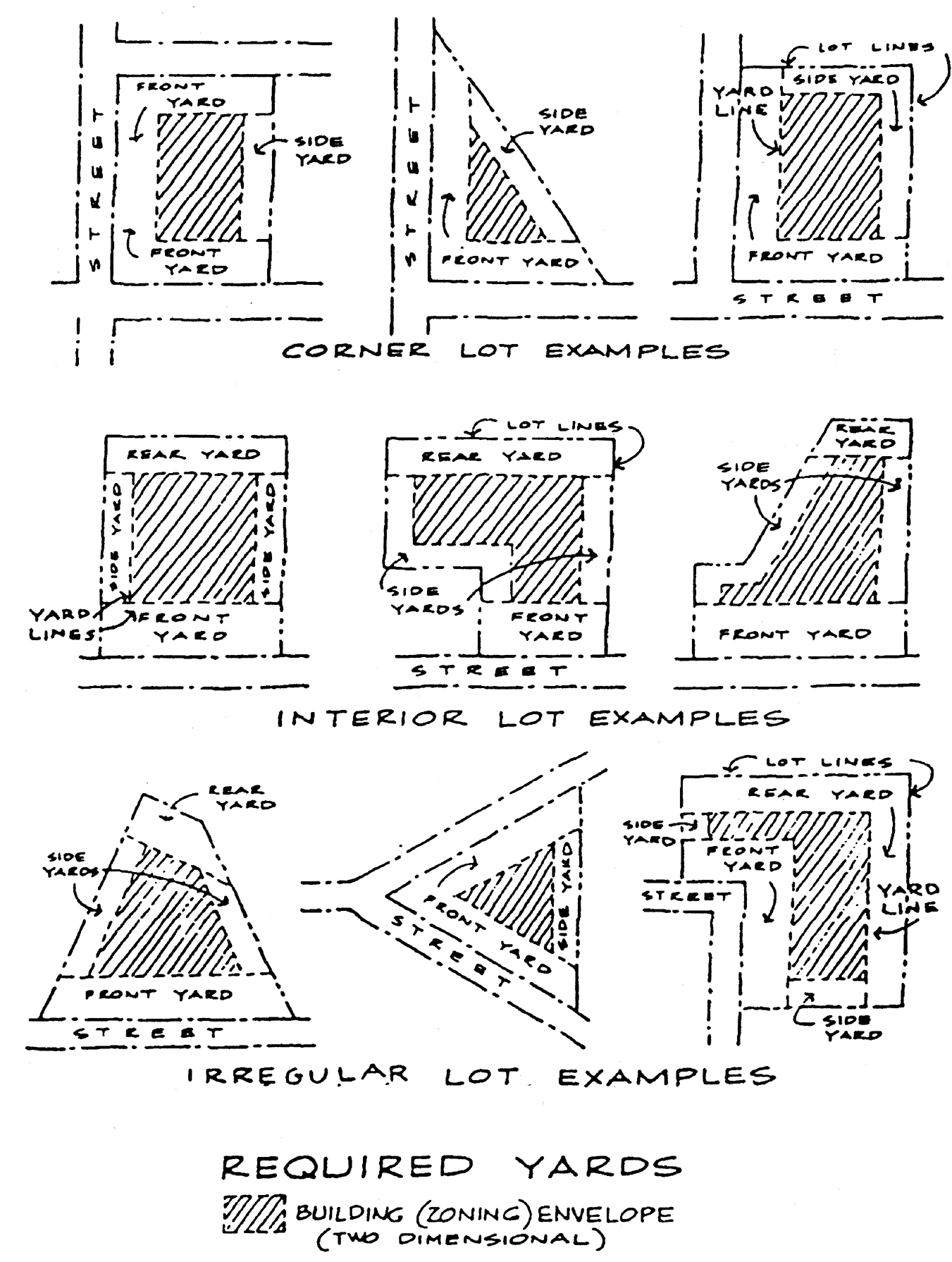
Figure 6
(147)
Zoning jurisdiction. The area within the city limits as well as the area beyond the city limits within which the city is authorized to regulate development.
(148)
Zoning district. A specifically delineated area or district in a municipality's zoning jurisdiction within which uniform regulations and requirements govern the use, placement, spacing, and size of land and buildings.
(149)
Farm shall mean a tract of land used for agricultural purposes, which includes the growing and storage of the usual agricultural products, such as grain, vegetables, and fruit, as operations for treating or storing the produce provided, however, that the operation of any accessory uses shall be secondary to that of the normal farming activities. Notwithstanding the foregoing:
(1)
A commercial feed lot shall not be considered a farm.
(2)
Single-family dwellings occupied by persons primarily engaged in farming at the location of the farm shall be included in the term "farm," provided, however, that there shall not be more than two single-family dwelling units on any one farm.
(150)
Livestock farm shall mean tract of land used for the growing and storage of the usual agricultural products such as grain, vegetables, and fruit, as well as for the raising thereon of the usual farm poultry and farm animals, including but not limited to horses, cattle, sheep and swine.
(151)
Commercial feed lot shall mean any tract on which the principal use is the concentrated or forced feeding of livestock, fish, fowl, or other animals for the sale of such animals or the sale of products derived from such animals.
(152)
Home occupation - day care home. Any in-home childcare facility receiving a maximum number of 12 children, including the caregiver's own children, for care during all or part of the day, which is conducted within a dwelling unit by a person residing within that dwelling unit which is clearly incidental to the primary residential use of the structure, and provided that:
a.
The day care home shall be conducted wholly within the principal building;
b.
No day care home shall used or be made within garage facilities or other accessory structure, whether attached or detached;
c.
An assistant who may or may not be a member of the family residing in the dwelling unit may be employed by the day care home;
d.
A separate entrance shall not be provided in conjunction with the conduct of the day care home;
e.
No alteration of any kind shall be made to the principal building which changes its residential character as a dwelling unit;
f.
No outdoor display or storage in connection with the day care home shall be allowed;
g.
No sign shall be permitted on the premises except a nameplate of one square foot in area mounted flush against the side of the residential structure;
h.
The day care home shall be conducted in such a manner that it does not create parking or traffic congestion for the abutting or adjoining neighbors or for the immediate neighborhood; and,
i.
All day care homes shall be registered in the office of the building inspector on the forms provided by the building inspector.
(153)
Solar energy system. A system that converts solar energy into electricity or heat through the use of photovoltaic panels or film, solar thermal panels, and associated control or conversion electronics.
(154)
Flush mounted solar energy system. System in which the solar collector does not extend beyond six inches from the roof surface.
(155)
Non-flush mounted solar energy system. System in which the solar collector extends beyond six inches from the roof surface.
(156)
Temporary accessory structure or facility. An independent structure or enclosed facility that is purposely constructed for transport on highways or by rail from one location to another location such as a travel trailer, mobile home, cargo trailer, bus or railroad car - with or without wheels, tongue or supporting frame removed or other modification.
(157)
Wind Energy Conversion System (WECS). A machine that converts the kinetic energy in the wind into a usable form (commonly known as a wind turbine or windmill).
(Ord. No. 690-10-99, 10-4-99; Ord. No. 716-05-02, § 1, 5-20-02; Ord. No. 869-08-15, § II, 8-10-15; Ord. No. 871-08-15, § XXII, 8-10-15; Ord. No. 1011-07-21, §§ III, IV, 7-12-21; Ord. No. 1057-04-23, § II, 4-24-23)
Sec. 2.1.- Zoning districts.
For the purposes of this ordinance, the city and the area within one and one-half miles of the city limits, excluding that area within one and one-half miles of the city limits that has been zoned by some other municipality, is hereby divided into the following districts:
(Ord. No. 690-10-99, 10-4-99)
Sec. 2.2. - Zoning district map.
The boundaries of these districts are hereby established as shown on the map accompanying and made a part of this ordinance which map is designated as the "Zoning District Map of the City of Neoga." The zoning district map and all the notations, references and other information shown thereon are a part of this ordinance and shall have the same force and effect as if such map and all the notations, references and other information shown thereon were all fully set forth herein verbatim, which zoning district map is properly attested and on file with the City Clerk of the City of Neoga.
(Ord. No. 690-10-99, 10-4-99)
Sec. 2.3. - Extraterritorial zoning map.
Contiguous territory within one and one-half miles of the corporate limits of the City of Neoga, is classified for zoning purposes as shown on the "Extraterritorial Zoning Map of the City of Neoga" which accompanies and is hereby declared to be a part of this ordinance; and all the notations, references and other information shown thereon are a part of this ordinance, and shall have the same force and effect as if such "extraterritorial zoning map" and all the notations, references and other information shown thereon were fully set forth herein verbatim, which extraterritorial zoning map is properly attested and on file with the City Clerk of the City of Neoga.
(Ord. No. 690-10-99, 10-4-99)
Sec. 2.4. - District boundaries.
(a)
The district boundary lines on said map are intended to follow either streets or alleys or lot lines, and where the districts designated on the maps are bounded approximately by such street, alley or lot lines, the street or alley or lot lines shall be construed to be the boundary of the district unless such boundary is otherwise indicated on the map. In the case of unsubdivided property, the district boundary lines shall be determined by the use of the scale appearing on the extraterritorial zoning map or by dimensions.
(b)
Where the boundary of the district follows a railroad line, such boundary shall be deemed to be located midway between the main tracks of said railroad line.
(Ord. No. 690-10-99, 10-4-99)
Sec. 2.5. - Annexed territory.
All territory which may hereafter be annexed to the City of Neoga shall determine its district classification at the time of annexation. For any unzoned land lying outside of and contiguous to the zoning boundary one and one-half miles distant from the corporate limits of the City of Neoga, Illinois, the City of Neoga shall determine its district classification at the time of entering the extraterritorial zoning jurisdiction when said corporate limits are changed or altered in such a way that the previous contiguous land then lies within the one and one-half mile area.
(Ord. No. 690-10-99, 10-4-99)
Sec. 2.6. - Vacated streets and alleys.
Whenever any street, alley or other public way is vacated by official action of the city council, the zoning district adjoining each side of such street, alley or public way shall be automatically extended to the center of such vacation, and all area included in the vacation shall then and henceforth be subject to all appropriate regulations of the extended districts.
(Ord. No. 690-10-99, 10-4-99)
Sec. 2.7. - Land under water.
Any area within the corporate limits of the City of Neoga or within one and one-half miles of the corporate limits of said city which is under water and not shown as included within any district shall be subject to all of the regulations of the district which automatically adjoins the water area. Where said water area adjoins two or more districts, the boundaries of each district shall be construed to extend to the center of the water area.
(Ord. No. 690-10-99, 10-4-99)
Sec. 2.8. - Prohibitions.
(a)
No building shall be erected or altered nor shall any building or premises be used for any purpose other than is permitted in the district in which such building or premises is located and no building or use shall exceed the height, yard, density, area and parking requirements of this ordinance unless in conformity with the regulations herein established.
(b)
If a use is not specifically listed as a permitted or conditional use within the district in which the Lot is located, it shall be assumed that it is prohibited.
(c)
Use of temporary accessory structure or facility. No temporary accessory structure or facility shall be used or occupied for any residential, commercial, industrial or institution use, including storage, except as permitted or required by this subparagraph (c). No temporary accessory structure or facility may be used, stored, occupied, or parked on any public right-of-way.
(1)
The building inspector may permit the use of such a temporary accessory structure or facility for a period not to exceed 60 days in compliance with reasonable consideration of the general health, safety or general welfare relating to fire, explosion, flood or other health or safety threatening situations.
(2)
The building inspector may issue a permit for a temporary accessory structure or facility for office or storage use in conjunction with construction, demolition or similar activity for a period not to exceed one year. Such permit may be extended by six-month increments to the end of the project, but not beyond.
(Ord. No. 1011-07-21, § V, 7-12-21)
Sec. 2.9. - Lots divided by district lines.
(a)
Whenever a single lot two acres or less in size is located within two or more different zoning districts, the district regulations applicable to the district within which the larger portion of the lot lies shall apply to the entire lot.
(b)
Whenever a single lot greater than two acres in size is located within two or more different zoning districts, each portion of that lot shall be subject to all the regulations applicable to the district in which it is located.
(Ord. No. 690-10-99, 10-4-99)
Sec. 2.13.- Permitted uses.
Provided all the use restrictions of this district are observed, the following uses are permitted:
(a)
Single-family dwellings, with or without attached garages, housing not more than three motor vehicles for residences.
(b)
Two-family dwellings (duplex).
(c)
Modular dwellings.
(d)
Existing railway rights-of-way, all equipment and uses necessary for the operating of railroads.
(e)
Public parks and playgrounds.
(f)
Public utility structures or buildings primarily required to service the district.
(g)
Accessory structure or detached garage and accessory use.
(Ord. No. 690-10-99, 10-4-99; Ord. No. 1011-07-21, § VI, 7-12-21)
Sec. 2.14. - Conditional uses.
Provided all the use restrictions of this district are observed, the following uses may be allowed by conditional use permit:
(a)
Churches, temples, or similar places of public worship with buildings accessory thereto.
(b)
Public or parochial schools and libraries.
(c)
Home occupations or day care homes.
(d)
Hospitals, sanitariums, rest homes, buildings for philanthropic and similar uses.
(Ord. No. 690-10-99, 10-4-99; Ord. No. 1011-07-21, § VII, 7-12-21)
Sec. 2.15. - Height requirements and antennas.
(a)
No principal building, dwelling, or structure shall hereafter be erected or altered to exceed 35 feet in height.
(b)
No accessory structure, detached garage, or accessory use shall hereafter be erected or altered to exceed 17 feet in height.
(c)
No television, FM radio or CB radio tower shall exceed 40 feet in height and shall be securely anchored to the dwelling, accessory structure, or ground.
(d)
The construction of antennas shall meet Federal Communication Commission Regulations, as may be amended from time to time, and shall further comply with lot setback regulations applicable to portable structures in an R-1 single family dwelling district.
(Ord. No. 690-10-99, 10-4-99; Ord. No. 1011-07-21, § VIII, 7-12-21)
Sec. 2.16. - Front yard.
(a)
All dwellings and duplexes shall have a front yard of not less than 25 feet. This distance shall be measured from the front yard line to the front lot line. (See Article 11, Figure 5).
(b)
Where a uniform front yard has already been established or observed on one side of a street or on any one block of less than 25 feet within one adjacent block in either direction, new dwellings may establish a front yard of not less than the average of those already established.
(Ord. No. 690-10-99, 10-4-99; Ord. No. 716-05-02, § 2(1), 5-20-02)
Sec. 2.17. - Corner lots.
All dwellings or duplexes on corner lots shall meet, at a minimum, the requirements of the definition of "Corner Lot Clearance" as defined in Article II, Division 1, Section 2.0 "Definitions of Basic Terms"; and all dwellings or duplexes on corner lots shall have a front yard on each side of not less than 25 feet, measured from the front yard line to the side lot line on each street.
(Ord. No. 690-10-99, 10-4-99)
Sec. 2.18. - Side yard.
All dwellings and duplexes shall have a side yard of not less than six feet measured from the side yard line to the side lot line. No portion of the house can extend four feet beyond the side yard line.
(Ord. No. 690-10-99, 10-4-99)
Sec. 2.19. - Rear yard.
All dwellings and duplexes shall have a rear yard of not less than 25 feet measured from the rear yard line to the rear lot line.
(Ord. No. 690-10-99, 10-4-99)
Sec. 2.20. - Porches and landings.
Porches and landings may not extend beyond the front yard line or side yard line and must be an integral part of the house or duplex design. The front yard line of the porch will be considered the front yard line of the dwelling or duplex for purposes of determining the front yard set back.
(Ord. No. 690-10-99, 10-4-99)
Sec. 2.21. - Footings.
Footing requirements must meet or exceed all Building Officials and Code Administrators International (BOCA) requirements adopted by the city. Minimum footing depth below finished grade will be at least 36 inches.
(Ord. No. 690-10-99, 10-4-99; Ord. No. 716-05-02, § 2(2), 5-20-02)
Sec. 2.22. - Plumbing.
Plumbing for all dwellings, duplexes and other buildings must meet or exceed all State of Illinois code requirements.
(Ord. No. 690-10-99, 10-4-99)
Sec. 2.23. - House numbers.
All new dwellings and duplexes must display the correct street number prominently on the face of the building and must be a minimum of four inches tall.
(Ord. No. 690-10-99, 10-4-99)
Sec. 2.24. - Fences.
Fences for all dwellings, duplexes and other buildings shall comply with the requirements of Ordinance No. 537-6-89, entitled "An Ordinance Regulating the Construction of Fences of the City of Neoga, Illinois," passed on June 5, 1989, and all amendments thereto.
(Ord. No. 690-10-99, 10-4-99)
Sec. 2.25. - Minimum square footage.
All new dwellings must have a minimum square footage, excluding the garage, of 900 square feet. The shortest side cannot have a length of less than 20 feet including the garage. All new duplexes must a minimum square footage, excluding the garage or garages, of 1,400 square feet. The shortest side cannot have a length of less than 20 feet including the garage.
(Ord. No. 690-10-99, 10-4-99; Ord. No. 716-05-02, § 2(3), 5-20-02)
Sec. 2.26. - Lot coverage requirements.
Maximum coverage of all structures, including accessory structures or detached garages, portable buildings, and private swimming pools shall be no more than 33 percent of the total area of either an interior lot or corner lot.
(Ord. No. 690-10-99, 10-4-99; Ord. No. 1011-07-21, § IX, 7-12-21)
Sec. 2.27. - Accessory structure or detached garage.
(a)
An accessory structure or detached garage shall not be constructed on a Lot unless in conjunction with the construction of a single-family dwelling or two-family dwelling (duplex).
(b)
An accessory structure or detached garage shall not exceed 36 feet in length, 30 feet in width.
(c)
The walls of an accessory structure or detached garage shall not exceed ten feet in height from the top of the finished floor to the point where the exterior walls meet the roof rafters, and shall further not exceed a maximum height of 17 feet in height.
(d)
An accessory structure or detached garage shall have a finished concrete floor a minimum of three and one-half inches thick and shall have a footing around the entire perimeter of no less than 12 inches thick and no less than 16 inches wide extending in from the outer edges of the floor.
(e)
An accessory structure or detached garage must be located in the side yard or rear yard only, and no closer than six feet to the side lot line or rear lot line.
(f)
A detached garage shall have at least one overhead entrance door for vehicles of no more than nine feet in height, and have at least one service entrance door of no more than four feet in width and six feet eight inches in height.
(g)
Any entrance to an accessory structure or detached garage which is entered from an alley shall be a minimum of 20 feet from the rear lot line.
(h)
There shall be only one accessory structure or one detached garage per lot.
(Ord. No. 690-10-99, 10-4-99; Ord. No. 1011-07-21, § X, 7-12-21)
Sec. 2.28. - Portable structure.
(a)
A portable structure shall not be constructed on a lot unless in conjunction with the construction of a single-family dwelling or two-family dwelling (duplex).
(b)
A portable structure shall not exceed 20 feet in length, 12 feet in width, and 12 feet in height to the highest point of the roof.
(c)
A portable structure must be located in the rear yard only, and not closer than six feet to any lot line.
(d)
There shall be only one portable structure per lot.
(Ord. No. 690-10-99, 10-4-99; Ord. No. 1011-07-21, § XI, 7-12-21)
Sec. 2.29. - Garages (attached) and car ports.
(a)
An attached garage shall not exceed 36 feet in length, 30 feet in width.
(b)
An attached garage shall have a finished concrete floor a minimum of three and one-half inches thick and shall have a footing around the entire perimeter of no less than 12 inches thick and no less than 16 inches wide extending in from the outer edges of the floor.
(c)
An attached garage shall have at least one overhead entrance door for vehicles of no more than nine feet in height, and have at least one service entrance door of no more than four feet in width and six feet eight inches in height.
(d)
The entrance to an attached garage which is entered from an alley shall be a minimum of 20 feet from the rear lot line.
(e)
Car ports shall be located no closer to the front lot line than the dwelling's front yard line.
(f)
Car ports shall not exceed 17 feet in height.
(Ord. No. 690-10-99, 10-4-99; Ord. No. 1011-07-21, § XII, 7-12-21)
Sec. 2.30. - Reserved.
Editor's note— Ord. No. 1011-07-21, § XIII, adopted July 12, 2021, amended the Code by repealing former § 2.30 in its entirety. Former § 2.30 pertained to antennas, and derived from Ord. No. 690-10-99, adopted October 4, 1999.
Sec. 2.31. - Parking.
(a)
A minimum of two off-street parking spaces shall be required for a lot developed with a single-family dwelling or single modular dwelling and a minimum of four off-street parking spaces shall be required for a lot developed with a duplex.
(b)
Trucks and trailers in excess of 12,000 pounds designed and manufactured for or used for specific commercial purposes, including, but not limited to, wreckers, dump trucks, tracked vehicles, buses, construction vehicles, equipment carriers, bottling works delivery trucks, grain trucks and refrigerated trucks, are prohibited from parking in an R-1/single-family dwelling district. No vehicle in excess of 12,000 pounds gross vehicle weight, excluding recreational trailers and recreational vehicles, shall be parked in an R-1/single-family dwelling district. Notwithstanding anything contained in this section 2.31 to the contrary, any type of commercial vehicle, regardless of gross vehicle weight, delivering or picking up merchandise for delivery or employed in performing a repair or construction service may park for the purpose of making such pickup or delivery or for the duration of the period during which a repair or construction service is being performed on or to property in the area where parked.
(c)
Not more than five vehicles, including allowed recreational vehicles and trailers, shall be permanently parked outside of an enclosed structure on a lot or parcel.
(Ord. No. 690-10-99, 10-4-99; Ord. No. 1011-07-21, § XIV, 7-12-21)
Sec. 2.32. - Minimum lot area.
(a)
No dwelling lot shall be platted with less than 7,500 square feet of area with a minimum front yard width of 75 feet for interior lots and 100 feet for corner lots. No existing lot shall be reduced in size less than these minimum requirements.
(b)
Duplexes shall occupy a lot of not less than 7,500 square feet of area with a minimum front yard width of 75 feet for interior lots and 100 feet for corner lots.
(Ord. No. 690-10-99, 10-4-99)
Sec. 2.33. - Decks.
(a)
All decks shall be constructed in the side yard or rear yard of dwellings only. Decks shall be constructed of material that has been commercially treated to resist rot and decay and shall be constructed upon supports that extend a minimum of 32 inches below the grade level of the dwelling and which are anchored in concrete.
(b)
No point of a deck constructed at the side of a dwelling shall be closer than six feet to the side lot line.
(c)
No point of a deck constructed in the rear yard of a dwelling shall be closer to the rear lot line than six feet.
(Ord. No. 690-10-99, 10-4-99)
Sec. 2.34. - Swimming pools.
(a)
No swimming pool, whether public or private, shall be located in any front yard or closer than six feet to any side or rear lot line.
(b)
Every swimming pool that is more than two feet deep shall be enclosed by a wall or fence at least four feet in height. The passage through such wall or fence shall be equipped with a locking gate.
(Ord. No. 690-10-99, 10-4-99)
Sec. 2.38.- Permitted uses.
Provided all the use restrictions of this district are observed, the following uses are permitted:
(a)
Any permitted use in the R-1 single-family dwelling district.
(b)
Multi-family dwellings in new or converted buildings.
(Ord. No. 690-10-99, 10-4-99)
Sec. 2.39. - Conditional uses.
Provided all the use restrictions of this district are observed, the following uses may be allowed by conditional use permit:
(a)
Any conditional use in the R-1 single-family dwelling district
(b)
Clubs and lodges.
(c)
Boarding houses.
(d)
Funeral homes.
(e)
Doctors and other professional offices and clinics, excepting however, veterinary hospitals.
(f)
Nursing care homes.
(Ord. No. 690-10-99, 10-4-99)
Sec. 2.40. - Single-family dwellings and duplexes.
Notwithstanding the regulations as contained in sections 2.41 through 2.45 of this division 2B, all single-family dwellings and duplexes in an R-2/multi-family dwelling district shall conform to requirements outlined in sections 2.16 through 2.26 of division 2, as applicable to single-family dwellings and duplexes in an R-1/single-family dwelling district.
(Ord. No. 690-10-99, 10-4-99; Ord. No. 716-05-02, § 3(1), 5-20-02; Ord. No. 1011-07-21, § XV, 7-12-21)
Sec. 2.41. - Front yard.
(a)
All multi-family dwellings shall have a front yard of not less than 25 feet. This distance shall be measured from the front yard line to the front lot line (see Article 11, Figure 5).
(b)
Where a uniform front yard has already been established or observed on one side of a street or on any one block of less than 25 feet within one adjacent block in either direction, new dwellings may establish a front yard of not less than the average of those already established.
(Ord. No. 690-10-99, 10-4-99; Ord. No. 716-05-02, § 3(2), 5-20-02)
Sec. 2.42. - Corner lots.
All multi-family dwellings on corner lots shall meet, at a minimum, the requirements of the definition of "Corner Lot Clearance" as defined in Article II, Division 1, Section 2.0 "Definitions of Basic Terms"; and all multi-family dwellings on corner lots shall have a front yard on each side of not less than 25 feet, measured from the front yard line to the side lot line on each street.
(Ord. No. 690-10-99, 10-4-99)
Sec. 2.43. - Side yard.
All multi-family dwellings shall have a side yard of not less than six feet measured from the side yard line to the side lot line. No portion of the house can extend four feet beyond the side yard line.
(Ord. No. 690-10-99, 10-4-99)
Sec. 2.44. - Rear yard.
All multi-family dwellings shall have a rear yard of not less than 25 feet measured from the rear yard line to the rear lot line.
(Ord. No. 690-10-99, 10-4-99)
Sec. 2.45. - Lot coverage requirements.
All multi-family dwellings shall provide a minimum lot area of 3,500 square feet per unit.
(Ord. No. 690-10-99, 10-4-99)
Sec. 2.46. - Accessory structure or detached garage.
(a)
An accessory structure or detached garage shall not be constructed on a lot unless in conjunction with the construction of a single-family dwelling, two-family dwelling (duplex), or multi-family dwelling.
(b)
An accessory structure or detached garage shall not exceed 36 feet in length, 30 feet in width.
(c)
The walls of an accessory structure or detached garage shall not exceed ten feet in height from the top of the finished floor to the point where the exterior walls meet the roof rafters, and shall further not exceed a maximum height of 17 feet in height.
(d)
An accessory structure or detached garage shall have a finished concrete floor a minimum of three and one-half inches thick and shall have a footing around the entire perimeter of no less than 12 inches thick and no less than 16 inches wide extending in from the outer edges of the floor.
(e)
An accessory structure or detached garage must be located in the side yard or rear yard only, and no closer than six feet to the side lot line or rear lot line.
(f)
A detached garage shall have at least one overhead entrance door for vehicles of no more than nine feet in height, and have at least one service entrance door of no more than four feet in width and six feet eight inches in height.
(g)
Any entrance to an accessory structure or detached garage which is entered from an alley shall be a minimum of 20 feet from the rear lot line.
(h)
There shall be only one accessory structure or one detached garage per lot.
(Ord. No. 1011-07-21, § XVI, 7-12-21)
Sec. 2.47. - Portable structure.
(a)
A portable structure shall not be constructed on a lot unless in conjunction with the construction of a single-family dwelling, two-family dwelling (duplex), or multi-family dwelling.
(b)
A portable structure shall not exceed 20 feet in length, 12 feet in width, and 12 feet in height to the highest point of the roof.
(c)
A portable structure must be located in the rear yard only, and not closer than six feet to any lot line.
(d)
There shall be only one portable structure per lot.
(Ord. No. 690-10-99, 10-4-99; Ord. No. 1011-07-21, § XVII, 7-12-21)
Sec. 2.48. - Garages (attached) and car ports.
(a)
An attached garage shall not exceed 36 feet in length, 30 feet in width.
(b)
An attached garage shall have a finished concrete floor a minimum of three and one-half inches thick and shall have a footing around the entire perimeter of no less than 12 inches thick and no less than 16 inches wide extending in from the outer edges of the floor.
(c)
An attached garage shall have at least one overhead entrance door for vehicles of no more than nine feet in height, and have at least one service entrance door of no more than four feet in width and six feet eight inches in height.
(d)
The entrance to an attached garage which is entered from an alley shall be a minimum of 20 feet from the rear lot line.
(e)
Car ports shall be located no closer to the front lot line than the dwelling's front yard line.
(f)
Car ports shall not exceed 17 feet in height.
(Ord. No. 690-10-99, 10-4-99; Ord. No. 1011-07-21, § XVIII, 7-12-21)
Sec. 2.49. - Height requirements and antennas.
(a)
No principal building, dwelling, or structure shall hereafter be erected or altered to exceed 45 feet in height.
(b)
No accessory structure, detached garage, or accessory use shall hereafter be erected or altered to exceed 17 feet in height.
(c)
No television, FM radio or CB radio tower shall exceed 40 feet in height from ground level, and shall be securely anchored to the dwelling, accessory structure, or ground.
(d)
The construction of antennas shall meet Federal Communication Commission regulations, as may be amended from time to time, and shall further comply with lot setback regulations applicable to portable structures in an R-2, multi-family dwelling district.
(Ord. No. 690-10-99, 10-4-99; Ord. No. 1011-07-21, § XIX, 7-12-21)
Sec. 2.50. - Parking.
(a)
A minimum of two off-street parking spaces shall be required for each dwelling unit on a lot.
(b)
Trucks and trailers in excess of 12,000 pounds designed and manufactured for or used for specific commercial purposes, including, but not limited to, wreckers, dump trucks, tracked vehicles, buses, construction vehicles, equipment carriers, bottling works delivery trucks, grain trucks and refrigerated trucks, are prohibited from parking in an R-2/multi-family dwelling district. No vehicle in excess of 12,000 pounds gross vehicle weight, excluding recreational trailers and recreational vehicles, shall be parked in an R-2/multi-family dwelling district. Notwithstanding anything contained in this section 2.50 to the contrary, any type of commercial vehicle, regardless of gross vehicle weight, delivering or picking up merchandise for delivery or employed in performing a repair or construction service may park for the purpose of making such pickup or delivery or for the duration of the period during which a repair or construction service is being performed on or to property in the area where parked.
(c)
Any lot or parcel developed with a single-family dwelling or two-family dwelling (duplex), shall not have more than five vehicles, including allowed recreational vehicles and trailers, permanently parked outside of an enclosed structure on a lot or parcel.
(Ord. No. 690-10-99, 10-4-99; Ord. No. 1011-07-21, § XX, 7-12-21)
Sec. 2.51. - Swimming pools.
(a)
No swimming pool, whether public or private, shall be located in any front yard or closer than six feet to any side or rear lot line.
(b)
Every swimming pool that is more than two feet deep shall be enclosed by a wall or fence at least four feet in height. The passage through such wall or fence shall be equipped with a locking gate.
(Ord. No. 690-10-99, 10-4-99)
Sec. 2.52. - Footings.
Footing requirements must meet or exceed all Building Officials and Code Administrators International (BOCA) requirements adopted by the city. Minimum footing depth below finished grade will be at least 36 inches.
(Ord. No. 716-05-02, § 4, 5-20-02)
Sec. 2.55.- Generally.
No single manufactured home shall be placed on a lot in the city, other than a site in an approved mobile home park.
(Ord. No. 690-10-99, 10-4-99)
Sec. 2.56. - Mobile home park.
(a)
No mobile home park shall be licensed, constructed or operated except in the MH district.
(b)
No mobile home park shall be licensed, constructed or operated except in accordance with the regulations and procedures of chapter 54 entitled "Manufactured Homes and Trailers" established in the Code of Ordinances of the City of Neoga, Illinois, as adopted and amended.
(Ord. No. 690-10-99, 10-4-99)
Sec. 2.57. - Recreational vehicle park.
(a)
No recreational vehicle park shall be licensed, constructed or operated except in the MH district.
Sec. 2.58. - Permitted uses.
Provided all the use restrictions of this district are observed, the following uses are permitted:
(a)
Manufactured homes.
(b)
Recreational vehicles.
(c)
Existing railway rights-of-way, all equipment and uses necessary for the operating of railroads.
(d)
Public parks and playgrounds.
(e)
Public utility structures or buildings primarily required to service the district.
(Ord. No. 690-10-99, 10-4-99; Ord. No. 1011-07-21, § XXI, 7-12-21)
Sec. 2.59. - Conditional uses.
Provided all the use restrictions of this district are observed, the following uses may be allowed by conditional use permit:
(a)
Home occupations or day care homes.
(Ord. No. 690-10-99, 10-4-99; Ord. No. 1011-07-21, § XXII, 7-12-21)
Sec. 2.60. - Height requirements.
No television, FM radio or CB radio tower shall exceed 40 feet in height and shall be securely anchored to the dwelling or ground.
(Ord. No. 690-10-99, 10-4-99; Ord. No. 1011-07-21, § XXIII, 7-12-21)
Sec. 2.61. - Fences.
Fences for all dwellings, duplexes and other buildings shall comply with the requirements of Ordinance No. 537-6-89, entitled "An Ordinance Regulating the Construction of Fences of the City of Neoga, Illinois," passed on June 5, 1989, and all amendments thereto.
(Ord. No. 690-10-99, 10-4-99)
Sec. 2.62. - Reserved.
Editor's note— Ord. No. 1011-07-21, § XXIV, adopted July 12, 2021, amended the Code by repealing former § 2.62, which pertained to accessory structures, and derived from Ord. No. 690-10-99, adopted October 4, 1999.
Sec. 2.63. - Portable structure.
(a)
A portable structure shall not be constructed on a lot unless in conjunction with the construction of a dwelling.
(b)
A portable structure shall not exceed 20 feet in length, 12 feet in width, and 12 feet in height to the highest point of the roof.
(c)
A portable structure must be located in the rear yard only, and not closer than six feet to any lot line.
(d)
There shall be only one portable structure per lot.
(Ord. No. 690-10-99, 10-4-99; Ord. No. 1011-07-21, § XXV, 7-12-21)
Sec. 2.64. - Car ports.
(a)
Car ports shall be located no closer to the front lot line than the dwelling's front yard line.
(b)
Car ports shall not exceed 17 feet in height.
(Ord. No. 690-10-99, 10-4-99; Ord. No. 1011-07-21, § XXVI, 7-12-21)
Sec. 2.65. - Antennas.
The constructed of antennas shall meet Federal Communications Commission regulations as amended, and shall comply with the lot setback regulations as defined for accessory buildings.
(Ord. No. 690-10-99, 10-4-99)
Sec. 2.66. - Swimming pools.
(a)
No swimming pool, whether public or private, shall be located in any front yard or closer than six feet to any side or rear lot line.
(b)
Every swimming pool that is more than two feet deep shall be enclosed by a wall or fence at least four feet in height. The passage through such wall or fence shall be equipped with a locking gate.
(Ord. No. 690-10-99, 10-4-99)
Sec. 2.67. - Footings.
Footing requirements must meet or exceed all Building Officials and Code Administrators International (BOCA) requirements adopted by the city. Minimum footing depth below finished grade will be at least 36 inches.
(Ord. No. 716-05-02, § 5, 5-20-02)
Sec. 2.68. - Parking.
(a)
A minimum of two off-street parking spaces shall be required for each manufactured home dwelling unit on a lot.
(b)
Trucks and trailers in excess of 12,000 pounds designed and manufactured for or used for specific commercial purposes, including, but not limited to, wreckers, dump trucks, tracked vehicles, buses, construction vehicles, equipment carriers, bottling works delivery trucks, grain trucks and refrigerated trucks, are prohibited from parking in an MR/manufactured home district. No vehicle in excess of 12,000 pounds gross vehicle weight, excluding recreational trailers and recreational vehicles, shall be parked in an R-2/multi-family dwelling district. Notwithstanding anything contained in this section 2.68 to the contrary, any type of commercial vehicle, regardless of gross vehicle weight, delivering or picking up merchandise for delivery or employed in performing a repair or construction service may park for the purpose of making such pickup or delivery or for the duration of the period during which a repair or construction service is being performed on or to property in the area where parked.
(Ord. No. 1011-07-21, § XXVII, 7-12-21)
Sec. 2.70.- Permitted uses.
Provided all the use restrictions of this district are observed, the following uses are permitted:
(a)
Any permitted use in the R-1, single family dwelling district.
(b)
Any permitted use in the R-2, multiple family dwelling district.
(c)
Existing railway rights-of-ways, and all equipment and uses necessary for the operating of railroads.
(d)
Public parks and playgrounds.
(e)
Public utility facilities or buildings primarily required to service the district.
(f)
Accessory structure or detached garage and accessory use.
(g)
Governmental uses of the city.
(h)
Farm, provided, however, that said farm may only be located on property located outside the corporate limits of the city.
(Ord. No. 690-10-99, 10-4-99; Ord. No. 869-08-15, § III, 8-10-15; Ord. No. 1011-07-21, § XXVIII, 7-12-21)
Sec. 2.71. - Conditional uses.
Provided all the use restrictions of this district are observed, the following uses may be allowed by conditional use permit:
(a)
Any conditional use in the R-1, single-family dwelling district.
(b)
Any conditional use in the R-2, multi-family dwelling district.
(c)
Governmental uses other than those for the city.
(d)
Livestock farm, provided, however, that said livestock farm may only be located on property located outside the corporate limits of the city.
(Ord. No. 690-10-99, 10-4-99; Ord. No. 869-08-15, § IV, 8-10-15)
Sec. 2.72. - Height requirements and antennas.
(a)
No principal building, dwelling, or structure shall hereafter be erected or altered to exceed 45 feet in height.
(b)
No accessory structure, detached garage, or accessory use shall hereafter be erected or altered to exceed 17 feet in height, provided, however, that the provisions of this paragraph (b) of section 2.72 shall not apply to a lot developed with a farm or livestock farm. A lot developed with a farm or livestock farm may have only those accessory structures necessary for treating or storing produce and/or storing or maintaining equipment necessary to conduct the normal farming activities associated with a farm or livestock farm, as applicable.
(c)
No television, FM radio or CB radio tower shall exceed 40 feet in height and shall be securely anchored to the dwelling, accessory structure, or ground.
(d)
The construction of antennas shall meet Federal Communication Commission regulations, as may be amended from time to time, and shall further comply with lot setback regulations applicable to portable structures in an R-1, single-family dwelling district.
(Ord. No. 690-10-99, 10-4-99; Ord. No. 1011-07-21, § XXIX, 7-12-21)
Sec. 2.73. - Front yard.
(a)
All dwellings, duplexes, and multi-family structures shall have a front yard of not less than 50 feet. This distance shall be measured from the front yard line to the front lot line (see Article 11, Figure 5).
(Ord. No. 690-10-99, 10-4-99)
Sec. 2.74. - Corner lots.
All dwellings, duplexes and multi-family structures on corner lots shall have a front yard on each side of not less than 50 feet, measured from the front yard line to the side lot line on each street.
(Ord. No. 690-10-99, 10-4-99)
Sec. 2.75. - Side yard.
All dwellings, duplexes and multi-family structures shall have a side yard of not less than ten feet measured from the side yard line to the side lot line. No portion of the house can extend four feet beyond the side yard line.
(Ord. No. 690-10-99, 10-4-99)
Sec. 2.76. - Rear yard.
All dwellings, duplexes and multi-family structures shall have a rear yard of not less than 30 feet measured from the rear yard line to the rear lot line.
(Ord. No. 690-10-99, 10-4-99)
Sec. 2.77. - Porches and landings.
Porches and landings may not extend beyond the front yard line or side yard line and must be an integral part of the house or duplex design. The front yard line of the porch will be considered the front yard line of the dwelling or duplex for purposes of determining the front yard set back.
(Ord. No. 690-10-99, 10-4-99)
Sec. 2.78. - Footings.
Footing requirements must meet or exceed all Building Officials and Code Administrators International (BOCA) requirements adopted by the city. Minimum footing depth below finished grade will be at least 36 inches.
(Ord. No. 690-10-99, 10-4-99; Ord. No. 716-05-02, § 6, 5-20-02)
Sec. 2.79. - Plumbing.
Plumbing for all dwellings, duplexes and other buildings must meet or exceed all State of Illinois code requirements.
(Ord. No. 690-10-99, 10-4-99)
Sec. 2.80. - House numbers.
All new dwellings and duplexes must display the correct street number prominently on the face of the building and must be a minimum of four inches tall.
(Ord. No. 690-10-99, 10-4-99)
Sec. 2.81. - Fences.
Fences for all dwellings, duplexes and other buildings shall comply with the requirements of Ordinance No. 537-6-89, entitled "An Ordinance Regulating the Construction of Fences of the City of Neoga, Illinois," passed on June 5, 1989, and all amendments thereto.
(Ord. No. 690-10-99, 10-4-99)
Sec. 2.82. - Minimum square footage.
All new dwellings must have a minimum square footage, excluding the garage, of 900 square feet. All new duplexes must have a minimum square footage, excluding the garage or garages, of 1,400 square feet.
(Ord. No. 690-10-99, 10-4-99)
Sec. 2.83. - Lot coverage requirements.
No dwelling, duplex, and multi-family structure, including accessory buildings and garage, and private swimming pools, shall occupy more than 25 percent of the total area of an interior lot and not more than 25 percent of the total area of a corner lot.
(Ord. No. 690-10-99, 10-4-99)
Sec. 2.84. - Accessory structure or detached garage.
(a)
An accessory structure or detached garage may not be constructed on a lot unless in conjunction with the construction of a single-family dwelling or two-family dwelling (duplex).
(b)
An accessory structure or detached garage may not exceed 36 feet in length, 30 feet in width.
(c)
The walls of an accessory structure or detached garage shall not exceed ten feet in height from the top of the finished floor to the point where the exterior walls meet the roof rafters, and shall further not exceed a maximum height of 17 feet in height.
(d)
An accessory structure or detached garage must have a finished concrete floor a minimum of three and one-half inches thick and must have a footing around the entire perimeter of no less than 12 inches thick and no less than 16 inches wide extending in from the outer edges of the floor.
(e)
An accessory structure or detached garage must be located in the side yard or rear yard only, and no closer than six feet to the side lot line or rear lot line.
(f)
A detached garage shall have at least one overhead entrance door for vehicles of no more than nine feet in height, and have at least one service entrance door of no more than four feet in width and six feet eight inches in height.
(g)
Any entrance to an accessory structure or detached garage which is entered from an alley shall be a minimum of 20 feet from the rear lot line.
(h)
There shall be only one accessory structure or one detached garage per lot.
(i)
The provisions of this section 2.84 shall not apply to a lot developed with a farm or livestock farm. A lot developed with a farm or livestock farm may have only those accessory structures necessary for treating or storing produce and/or storing or maintaining equipment necessary to conduct the normal farming activities associated with a farm or livestock farm, as applicable.
(Ord. No. 690-10-99, 10-4-99; Ord. No. 869-08-15, § V, 8-10-15; Ord. No. 1011-07-21, § XXX, 7-12-21)
Sec. 2.85. - Portable structure.
(a)
A portable structure shall not be constructed on a lot unless in conjunction with the construction of a single-family dwelling or two-family dwelling (duplex).
(b)
A portable Structure shall not exceed 20 feet in length, 12 feet in width, and 12 feet in height to the highest point of the roof.
(c)
A portable structure must be located in the rear yard only, and not closer than six feet to any lot line.
(d)
There shall be only one portable structure per lot.
(Ord. No. 690-10-99, 10-4-99; Ord. No. 1011-07-21, § XXXI, 7-12-21)
Sec. 2.86. - Garages (attached) and car ports.
(a)
An attached garage shall not exceed 36 feet in length, 30 feet in width.
(b)
An attached garage shall have a finished concrete floor a minimum of three and one-half inches thick and shall have a footing around the entire perimeter of no less than 12 inches thick and no less than 16 inches wide extending in from the outer edges of the floor.
(c)
An attached garage shall have at least one overhead entrance door for vehicles of no more than nine feet in height, and have at least one service entrance door of no more than four feet in width and six feet eight inches in height.
(d)
The entrance to an attached garage which is entered from an alley shall be a minimum of 20 feet from the rear lot line.
(e)
Car ports shall be located no closer to the front lot line than the dwelling's front yard line.
(f)
Car ports shall not exceed 17 feet in height.
(Ord. No. 690-10-99, 10-4-99; Ord. No. 1011-07-21, § XXXII, 7-12-21)
Sec. 2.87. - Reserved.
Editor's note— Ord. No. 1011-07-21, § XXXIII, adopted July 12, 2021, has been treated as repealing former § 2.87 in its entirety. Former § 2.87 pertained to antennas, and derived from Ord. No. 690-10-99, adopted October 4, 1999.
Sec. 2.88. - Parking.
(a)
A minimum of two off-street parking spaces shall be required for a lot developed with a single-family dwelling or single modular dwelling and a minimum of four off-street parking spaces shall be required for a lot developed with a duplex.
(b)
Trucks and trailers in excess of 12,000 pounds designed and manufactured for or used for specific commercial purposes, including, but not limited to, wreckers, dump trucks, tracked vehicles, buses, construction vehicles, equipment carriers, bottling works delivery trucks, grain trucks and refrigerated trucks, are prohibited from parking in an RE/residential estates district. No vehicle in excess of 12,000 pounds gross vehicle weight, excluding recreational trailers and recreational vehicles, shall be parked in an RE/residential estates district. Notwithstanding anything contained in this section 2.88 to the contrary, any type of commercial vehicle, regardless of gross vehicle weight, delivering or picking up merchandise for delivery or employed in performing a repair or construction service may park for the purpose of making such pickup or delivery or for the duration of the period during which a repair or construction service is being performed on or to property in the area where parked. The provisions of this subparagraph (b) of section 2.88 shall not apply to a lot developed with a farm or livestock farm. A lot developed with a farm or livestock farm may have only those trucks and trailers necessary for treating or storing produce and/or storing or maintaining equipment necessary to conduct the normal farming activities associated with a farm or livestock farm, as applicable.
(c)
Not more than five vehicles, including allowed recreational vehicles and trailers, shall be permanently parked outside of an enclosed structure on a lot or parcel.
(Ord. No. 690-10-99, 10-4-99; Ord. No. 1011-07-21, § XXXIV, 7-12-21)
Sec. 2.89. - Minimum lot area.
(a)
No dwelling lot shall be platted with less than 43,560 square feet of area (or one acre) with a minimum front yard width of 150 feet for interior lots and 150 feet for corner lots. No existing lot shall be reduced in size less than these minimum requirements.
(b)
Duplexes shall occupy a lot of not less than 43,560 square feet of area (or one acre) of area with a minimum front yard width of 150 feet for interior lots and 150 feet for corner lots.
(Ord. No. 690-10-99, 10-4-99)
Sec. 2.90. - Decks.
(a)
All decks shall be constructed in the side yard or rear yard of dwellings only. Decks shall be constructed of material that has been commercially treated to resist rot and decay and shall be constructed upon supports that extend a minimum of 32 inches below the grade level of the dwelling and which are anchored in concrete.
(b)
No point of a deck constructed at the side of a dwelling shall be closer than six feet to the side lot line.
(c)
No point of a deck constructed in the rear yard of a dwelling shall be closer to the rear lot line than six feet.
(Ord. No. 690-10-99, 10-4-99)
Sec. 2.91. - Swimming pools.
(a)
No swimming pool, whether public or private, shall be located in any front yard or closer than six feet to any side or rear lot line.
(b)
Every swimming pool that is more than two feet deep shall be enclosed by a wall or fence at least four feet in height. The passage through such wall or fence shall be equipped with a locking gate.
(Ord. No. 690-10-99, 10-4-99)
Sec. 2.95.- Use restrictions.
(a)
Retail and service only. Every commercial or service establishment located in this district shall deal directly with consumers.
(b)
Reserved.
(c)
Processing incidental. Any processing or treatment of goods on any premises must be clearly incidental to the retail and service business conducted on such premises.
(d)
Refuse containers. All refuse generated by any establishment located within this district shall be stored in tightly-covered containers placed in a visually screened area.
(e)
Screening. Along the side and rear lot lines of any lot abutting any residential district and/or open district, screening (a wall, solid fence, or closely-planted and maintained shrubbery} at least six feet high and of sufficient density to completely block the view from the adjacent residential property shall be installed.
(f)
Height requirements and antennas. No building or structure shall hereafter be erected or altered to exceed 45 feet in height. No television, FM radio or CB radio tower shall exceed 40 feet in height from ground level, and shall be securely anchored to the building, structure, or ground. The construction of antennas shall meet Federal Communication Commission Regulations, as may be amended from time to time, and shall further comply with lot setback regulations applicable to structures in a C-1/Central Business District.
(Ord. No. 690-10-99, 10-4-99; Ord. No. 1011-07-21, § XXXVI, 7-12-21; Ord. No. 1033-03-22, § II, 2-24-22)
Sec. 2.96. - Front yard.
(a)
All structures shall have a front yard of not less than 25 feet. This distance shall be measured from the front yard line to the front lot line (see Article 11, Figure 5).
(Ord. No. 690-10-99, 10-4-99)
Sec. 2.97. - Corner lots.
All structures on corner lots shall meet, at a minimum, the requirements of the definition of "Corner Lot Clearance" as defined in Article II, Division 1, Section 2.0 "Definitions of Basic Terms."
(Ord. No. 690-10-99, 10-4-99)
Sec. 2.98. - Side yard.
All structures shall have a side yard of not less than six feet measured from the side yard line to the side lot line. No portion of the house can extend four feet beyond the side yard line.
(Ord. No. 690-10-99, 10-4-99)
Sec. 2.99. - Rear yard.
All structures shall have a rear yard of not less than 25 feet measured from the rear yard line to the rear lot line.
(Ord. No. 690-10-99, 10-4-99)
Sec. 2.100. - Permitted uses.
Provided all the use restrictions of this district are observed, the following uses are permitted:
(a)
Auditoriums, meeting rooms, and other places of assembly;
(b)
Churches and other places of formal worship;
(c)
Clubs and lodges;
(d)
Retail store or shop and personal service establishments, including:
(1)
Grocery store, meat market, delicatessen;
(2)
Drugstore;
(3)
Florist;
(4)
Animal training and grooming;
(5)
Automobile supply stores, with no repair service;
(6)
Bakeries;
(7)
Banks and trust companies or credit unions, including drive-in banks;
(8)
Banquet halls;
(9)
Carpet, rug, linoleum, or other floor covering stores;
(10)
Catering establishments;
(11)
Clothing or clothing accessory stores;
(12)
Dry cleaning or clothes pressing establishments dealing directly with consumers;
(13)
Dry goods stores;
(14)
Restaurants, including drive-in restaurants that offer goods or services directly to customers waiting in parked vehicles, or that sell food or beverages for consumption on the premises in parked motor vehicles;
(15)
Electrical or household appliance stores and repair;
(16)
Furniture stores, sales and repairing and refinishing;
(17)
Gift shops;
(18)
Interior decorating establishments;
(19)
Lawnmower sales with service;
(20)
Locksmith shops;
(21)
Medical and dental clinics;
(22)
Music, musical equipment, or record stores and musical instrument repair shops;
(23)
Newspaper publishing, including engraving or photoengraving;
(24)
Nutrition centers;
(25)
Personal service uses including barbershops, beauty parlors, day spas, and other personal service uses of a similar character;
(26)
Pet shops, sales only;
(27)
Physical culture or health establishments, including gymnasiums, commercial athletic fields, reducing salons, masseur, or steam baths;
(28)
Private or group instructional establishments, including, but not limited to, cooking classes, art classes, dance instruction, music instruction, gymnastics, tumbling, fitness and/or aerobic instruction, martial arts, and yoga, etc.;
(29)
Plumbing, heating, or ventilating equipment showrooms;
(30)
Offices and office buildings; and,
(31)
Sporting goods stores.
(c)
Government uses of this municipality;
(f)
Libraries, museums;
(g)
Mass transit facilities;
(h)
Off-street parking lots;
(i)
Dwelling units, if located above the first story.
(Ord. No. 690-10-99, 10-4-99; Ord. No. 716-05-02, § 7, 5-20-02; Ord. No. 1033-03-22, § III, 2-24-22)
Sec. 2.101. - Conditional uses.
Provided all the use restrictions of this district are observed, the following uses may be allowed by conditional use permit:
(a)
Any use that involves commercial, service, or storage activities conducted outside completely enclosed buildings.
(b)
Hospitals.
(c)
Utility substations.
(d)
Governmental uses other than those of this municipality.
(e)
Railroad right-of-way, line, or spur track.
(Ord. No. 690-10-99, 10-4-99; Ord. No. 1033-03-22, § IV, 2-24-22; Ord. No. 1058-04-23, § II, 4-24-23)
Sec. 2.102. - Parking requirements.
Stores and other facilities locating in the C-1 district shall provide one off-street parking space per 1,000 square feet of gross floor area and one off-street parking space per one employee or resident.
(Ord. No. 690-10-99, 10-4-99)
Sec. 2.103.- Use restrictions.
(a)
Reserved.
(b)
Repairs indoors. All repairs and maintenance services shall be conducted within completely enclosed structures. Storage areas shall also be enclosed. Notwithstanding the foregoing, all repairs and maintenance services performed on machinery and/or equipment contained on a lot developed with a farm or livestock farm may be performed outside of an enclosed structure, but only for the purpose of performing ordinary service or repair operations and provided that said service and repair operations are completed within a period of 30 calendar days.
(c)
Refuse containers. All refuse generated by any establishment located within this district shall be stored in tightly-covered containers placed in a visually screened area.
(d)
Screening. Along the side lot line and rear lot line of any lot abutting any residential district and/or open district, screening (a wall, solid fence, or closely planted and maintained shrubbery) at least six feet high and of sufficient density to completely block the view from the adjacent residential property and/or recreational facilities shall be installed.
(e)
Height requirements and antennas. No building or structure shall hereafter be erected or altered to exceed 45 feet in height. No television, FM radio or CB radio tower shall exceed 40 feet in height from ground level, and shall be securely anchored to the building, structure, or ground. The construction of antennas shall meet Federal Communication Commission Regulations, as may be amended from time to time, and shall further comply with lot setback regulations applicable to structures in a C-2/Highway Business District.
(f)
The provisions of paragraphs (c), (d), and (e) of this section 2.103 shall not apply to a lot developed with a farm or livestock farm.
(Ord. No. 690-10-99, 10-4-99; Ord. No. 869-08-15, § VI, 8-10-15; Ord. No. 1011-07-21, § XXXVI, 7-12-21; Ord. No. 1033-03-22, § V, 2-24-22)
Sec. 2.104. - Front yard.
(a)
All structures shall have a front yard of not less than 25 feet. This distance shall be measured from the front yard line to the front lot line (see Article 11, Figure 5).
(Ord. No. 690-10-99, 10-4-99)
Sec. 2.105. - Corner lots.
All structures on corner lots shall meet, at a minimum, the requirements of the definition of "Corner Lot Clearance" as defined in Article II, Division 1, Section 2.0 "Definitions of Basic Terms"; and all structures on corner lots shall have a front yard on each side of not less than 25 feet, measured from the front yard line to the side lot line on each street.
(Ord. No. 690-10-99, 10-4-99)
Sec. 2.106. - Side yard.
All structures shall have a side yard of not less than six feet measured from the side yard line to the side lot line. No portion of the house can extend four feet beyond the side yard line.
(Ord. No. 690-10-99, 10-4-99)
Sec. 2.107. - Rear yard.
All structures shall have a rear yard of not less than 15 feet measured from the rear yard line to the rear lot line.
(Ord. No. 690-10-99, 10-4-99)
Sec. 2.108. - Permitted uses.
Provided all the use restrictions of this district are observed, the following uses arc permitted:
(a)
Any permitted use in the C-l, Central Business District, except dwelling units;
(b)
Retail store or shop and personal service establishments, including:
(1)
New and used automobile, truck, motorcycle, trailer or boat showrooms, and sales and service, when located at least 50 feet from any R District;
(2)
Bowling alleys;
(3)
Greenhouses;
(4)
Lumber and building supply sales;
(5)
Miniature golf courses;
(6)
Veterinary hospitals; and,
(7)
Motels and hotels.
(c)
Grain elevator;
(d)
Warehousing and wholesaling of any goods;
(e)
Farm, provided, however, that said farm may only be located on property located outside the corporate limits of the city.
(Ord. No. 690-10-99, 10-4-99; Ord. No. 869-08-15, § VII, 8-10-15; Ord. No. 1033-03-22, § VI, 2-24-22)
Sec. 2.109. - Conditional uses.
Provided all the use restrictions of this district are observed, the following uses may be allowed by conditional use permit:
(a)
Any conditional use in the C-1, Central Business District.
(b)
Drive-in theaters.
(c)
Research and development facilities not involving explosives, flammable gases, or liquids, or live animals.
(d)
Hospitals.
(e)
Utility substations.
(f)
Governmental uses other than those for the city.
(g)
Livestock farm, provided, however, that said livestock farm may only be located on property located outside the corporate limits of the city.
(h)
Commercial feed lot, provided, however, that said commercial feed lot may only be located on property located outside the corporate limits of the city.
(i)
Railroad right-of-way, line, or spur track.
(Ord. No. 690-10-99, 10-4-99; Ord. No. 869-08-15, § VIII, 8-10-15; Ord. No. 1058-04-23, § III, 4-24-23)
Sec. 2.110. - Central business district.
All central business district uses locating in this district shall conform to requirements outlined in "Division 6, C-1 Central Business District."
(Ord. No. 690-10-99, 10-4-99)
Sec. 2.111. - Parking requirements.
Stores and other facilities locating in the C-2 District shall provide one off-street parking space per 1,000 square feet of gross floor area and one off-street parking space per one employee or resident, provided, however, that the provisions of this section 2.111 shall not apply to a lot developed with a farm or livestock farm.
(Ord. No. 690-10-99, 10-4-99; Ord. No. 869-08-15, § IX, 8-10-15)
Sec. 2.112.- Use restrictions.
(a)
Reserved.
(b)
Activities indoors. All activities shall be conducted within completely enclosed structures. Storage areas shall be enclosed.
(c)
Refuse containers. All refuse generated by any establishment located within this district shall be stored in tightly-covered containers placed in a visually screened area.
(d)
Screening. Wherever any industrial use located in this district abuts any residential district and/or open district, a 20-foot wide view and noise buffer strip shall be installed. Such buffer strip shall consist of densely planted shrubbery that is at least five feet high when planted and that can be expected to reach a height of ten feet when full-grown.
(e)
Height requirements and antennas. No building or structure shall hereafter be erected or altered to exceed 45 feet in height. No television, FM radio or CB radio tower shall exceed 40 feet in height from ground level, and shall be securely anchored to the building, structure, or ground. The construction of antennas shall meet Federal Communication Commission Regulations, as may be amended from time to time, and shall further comply with lot setback regulations applicable to structures in a I/Industrial District.
(Ord. No. 690-10-99, 10-4-99; Ord. No. 1011-07-21, § XXXVII, 7-12-21; Ord. No. 1033-03-22, § VII, 2-24-22)
Sec. 2.113. - Lot coverage requirements.
(a)
The minimum lot area in this district shall be 20,000 square feet.
(b)
The minimum lot width shall be 125 feet at the established building line.
(Ord. No. 690-10-99, 10-4-99)
Sec. 2.114. - Front yard.
(a)
All structures shall have a front yard of not less than 25 feet. This distance shall be measured from the front yard line to the front lot line (see Article 11, Figure 5).
(Ord. No. 690-10-99, 10-4-99)
Sec. 2.115. - Corner lots.
All structures on corner lots shall meet, at a minimum, the requirements of the definition of "Corner Lot Clearance" as defined in Article II, Division I, Section 2.0 "Definitions of Basic Terms"; and all structures on corner lots shall have a front yard on each side of not less than 25 feet, measured from the front yard line to the side lot line on each street.
(Ord. No. 690-10-99, 10-4-99)
Sec. 2.116. - Side yard.
All structures shall have a side yard of not less than 25 feet measured from the side yard line to the side lot line.
(Ord. No. 690-10-99, 10-4-99)
Sec. 2.117. - Rear yard.
All structures shall have a rear yard of not less than 25 feet measured from the rear yard line to the rear lot line.
(Ord. No. 690-10-99, 10-4-99)
Sec. 2.118. - Permitted uses.
Provided all the use restrictions of this district are observed, the following uses are permitted:
(a)
Assembly, manufacturing, or processing of any commodity from semi-finished materials; provided explosives, flammable gases or liquids, or live animals are not involved.
(b)
Freight and bus terminals, and related mass transportation facilities.
(c)
Research and development facilities; not involving explosives, or flammable gases or liquids.
(d)
Warehousing or wholesaling of goods; except explosives, flammable gases or liquids, or live animals.
(e)
Government uses of this municipality.
(f)
Accessory uses.
(Ord. No. 690-10-99, 10-4-99)
Sec. 2.119. - Conditional uses.
Provided all the use restrictions of this district are observed, the following uses may be allowed by conditional use permit:
(a)
Assembly, manufacturing, processing, warehousing, or wholesaling; involving explosives, flammable gases or liquids, or live animals.
(b)
Government uses other than those of this municipality.
(c)
Junk yards.
(d)
Research and development facilities involving explosives or flammable liquids or gases.
(e)
Utility substations.
(f)
Railroad right-of-way, line, or spur track.
(Ord. No. 690-10-99, 10-4-99; Ord. No. 871-08-15, § XXII, 8-10-15; Ord. No. 1058-04-23, § IV, 4-24-23)
Sec. 2.120. - Parking requirements.
(a)
Any manufacturing, warehousing, or other industrial use shall provide a minimum of one and one-half off-street parking spaces per employee, and one off-street parking space per company vehicle, and one off-street visitor parking space per 25 employees on the major shift.
(b)
Any manufacturing, warehousing, or other industrial use shall provide a minimum of one off-street loading space for up to 20,000 square feet of gross floor area; a minimum of two off-street loading spaces for 20,001 to 50,000 square feet of gross floor area; a minimum of three off-street loading spaces for 50,001 to 90,000 square feet of gross floor area; a minimum of three off-street loading spaces plus one additional off-street loading space per 50,000 square feet of gross floor area in excess of 90,000 square feet of gross floor area.
(Ord. No. 690-10-99, 10-4-99)
Sec. 2.123.- Use restrictions.
(a)
Development within this district shall be limited to recreational facilities and related development. Examples of recreational facilities may include: recreation/bike trails, tennis courts, swimming pools, basketball courts, volleyball courts, ball fields, picnic areas, play apparatus, or other similar facilities.
(Ord. No. 690-10-99, 10-4-99)
Sec. 2.124. - Permitted uses.
Provided all the use restrictions of this district are observed, the following uses are permitted:
(a)
Parks.
(b)
Recreational facilities.
(c)
Buffer zone.
(d)
Open space.
(e)
Government uses of this municipality.
(Ord. No. 690-10-99, 10-4-99)
Sec. 2.125. - Conditional uses.
Provided all the use restrictions of this district are observed, the following uses may be allowed by conditional use permit:
(a)
Government uses other than those of this municipality.
Sec. 2.129.- Boundary description.
The Municipality hereby designates the real estate described in Exhibit "A-1 [attached to Ordinance No. 802-09-10], "Boundary Description, Neoga Business District of the City of Neoga, Cumberland County, Illinois" as a business district under the Business District Act (65 ILCS 5/11-74.3-1 et seq., as supplemented and amended), and as the Business District hereunder.
(Ord. No. 802-09-10, § 2, 9-20-10)
Sec. 2.130. - Adoption of plan.
Under the Business District Act, the Municipality hereby adopts and approves the Neoga Business District Plan for the Neoga Business District.
(Ord. No. 802-09-10, § 3, 9-20-10)
Sec. 2.131. - Plan on file.
The Neoga Business District Plan shall be in the form presented to the Municipality's corporate authorities at the time this division is adopted. The Neoga Business District Plan as so adopted and approved shall be on file with the City Clerk's records with the ordinance from which this division derives (but any failure to so file it shall not abrogate, diminish or impair its effect).
(Ord. No. 802-09-10, § 4, 9-20-10)
Sec. 2.132. - Project costs.
Obligations payable from and/or secured by revenues derived from the business district may be issued for financing business district project costs.
(Ord. No. 802-09-10, § 5, 9-20-10)

