


New Berlin City Zoning Code
ARTICLE V
USE REGULATIONS
Sec. 275-40. - General provisions.
A.
Maximum number of principal uses allowed per lot. Only one principal use shall be allowed per lot in the agricultural and residential zoning districts. One or more principal uses may be allowed in all nonresidential and nonagricultural zoning districts upon the approval of the Plan Commission.
B.
Similar uses. Where there is a new use that the Plan Commission finds similar in nature, operation and function to that of another use allowed in this chapter, the Plan Commission may permit the new use under similar districts and with all other applicable regulations as the existing similar use.
C.
Incompatible uses. There are several specific uses that are considered incompatible with the characteristics of the City of New Berlin and are herewith prohibited in all zoning districts. These prohibited uses include:
(1)
Manufacturing of acid, ammonia, ammunition, asbestos, asphalt, cement, chlorine, coal tar, creosote, explosives, fertilizer, gelatin, glue, gypsum, insecticide, lampblack, poison, pulp, pyroxylin, and radium.
(2)
Processing acid, ammonia, asbestos, asphalt, cabbage, cement, chlorine, coal tar, creosote, explosives, fertilizer, fish, gelatin, glue, grease, gypsum, insecticides, lampblack, offal, poison, pulp, pyroxylin, and radioactive materials.
(3)
Paper mills and planning mills.
(4)
Storage of bulk fertilizer, ammunition, explosives, gasoline in excess of 50,000 gallons in a single tank, grease and radioactive materials.
(5)
Auto-wrecking yards, bone distillation, brick works, stone works, clay refractories, fat rendering, forges, foundries, smelters, junkyards, garbage incinerators, gasification, pyrolysis, rubbish storage, slaughterhouses, animals reduction, stockyards and tanneries. This provision shall not apply to any municipal recycling center.
(6)
Solid waste storage, transportation, transfer, incineration, air curtain destructor, processing, one-time disposal or small demolition facility; new sanitary landfills; coal storage areas; bulk fuel storage facilities; and pesticide or fertilizer handling or storage facilities.
(7)
Large-scale utility facilities that serve the region which provide services that have a major impact by virtue of their appearance, noise, size, traffic generation or other operational characteristics, to include but not be limited to water storage tanks and reservoirs, booster stations, solid waste disposal and processing, sewer and wastewater treatment plants and power plants, but does exclude water transmission lines, sewer collectors, power transmission lines, natural gas transmission lines, radio and television antennas.
D.
Rummage sales may be conducted in any district, provided that the rummage sale does not exceed four consecutive days in length and is not conducted more often than three times per year. Rummage sales do not require the issuance of a building or zoning permit. Rummage sale signs shall be limited as provided in Section 275-61 G(2) of this chapter.
E.
Yard and setback areas shall be landscaped and kept clean and free from the accumulation of debris or refuse and shall not be used for the storage or display of equipment, products, vehicles [except as provided in Section 275-57 B(1) and (2) of this chapter], and other materials.
F.
Undesirable storage. On no property where storage of equipment or materials is permitted shall such storage which is out of doors be so located and so arranged as to adversely affect the property values and general desirable appearance of the neighborhood. Storage of building materials on a property where a permit has been issued for a specific building project and storage of demolition materials associated with the project are permitted during said project, provided that all building materials and demolition materials are removed from the site within ten days following the completion of the project or the expiration of the permit. Outside storage of junk is prohibited in all districts, except as may be permitted in licensed landfills. The Director or any affected property owner may present written evidence to the Plan Commission for a determination of appropriate storage. The Plan Commission shall notify the alleged violator of the meeting at which the determination will be made at least ten days prior to the meeting. The alleged violator may present evidence in support of the storage arrangement. The Plan Commission may issue written orders stating the manner and time in which storage shall be enclosed, rearranged, relocated or removed. Failure to comply with a Plan Commission order shall be grounds for an enforcement action pursuant to this chapter.
G.
Display of vehicles for sale. Not more than one automobile, boat, recreational vehicle or other personal vehicle may be displayed in a driveway or parking lot for sale, unless a sales lot has been approved by the Plan Commission in an appropriate business district. The vehicle must be owned and registered to the occupant of the premises, and such sales shall not occur more than three times in any given year. Vehicles shall not be displayed on lawn areas or within a public right-of-way.
H.
Historic preservation. No building permit or raze permit shall be issued for the erection, alteration, repair, moving or demolition of any development designated as a landmark or landmark site unless approval has been obtained from the City of New Berlin Landmarks Commission and all notices required under § 66.0143, Wis. Stats., have been made.
I.
Safe water and sanitary sewer. No lot shall be created and no building shall be erected, altered, repaired or moved unless it conforms to all City and county ordinances applicable to water and sewage disposal systems.
J.
No building intended for human occupancy shall be erected, altered, repaired or moved unless it is connected to a public sanitary sewerage system or is connected to an approved on-site sewage disposal system (septic tank).
K.
No outhouse or privy shall hereafter be erected.
L.
No building intended for human occupancy shall be erected, altered, repaired or moved unless it is connected to a public water supply system or is connected to an approved private well providing a safe and adequate supply of water.
M.
No lot other than for agricultural, park or recreational purposes shall be divided or created unless proof of adequate municipal sewer and water service or septic/mound system and safe well is shown to be available.
N.
Hazardous uses. No use, in any district, which is hazardous, harmful, noxious, offensive or is a nuisance shall be permitted. Any use which becomes hazardous, harmful, noxious, offensive or is a nuisance to the neighborhood shall be corrected and improved, or removed, in accordance with measures specified by the Plan Commission consistent with reasonable technological and economic practicality.
(Amended 4-22-2014 by Ord. No. 2522; 10-13-2020 by Ord. No. 2642)
Sec. 275-41. - Use-specific regulations.
The following are use-specific regulations for uses allowed in Article IV. These regulations apply to all districts except where specified.
A.
Agricultural uses.
(1)
General farm buildings.
(a)
General farm buildings shall not be used for the storage of nonagricultural equipment, including but not limited to snowmobiles, AlVs, automobiles, boats, campers, recreational equipment, construction equipment, and nonagricultural or industrial inventory.
(b)
The Plan Commission shall consider demonstrated agricultural needs in reviewing agricultural buildings.
(2)
Keeping and raising of animals.
(a)
General Requirements.
[1]
All applicable zoning district regulations shall apply.
[2]
Animals must be within a fenced-in area and shall remain on the property to which they belong or property to which is leased.
[3]
Adequate facilities shall exist for housing and feeding the animals.
(b)
Quantities.
[1]
The keeping and raising of animals in the A-1, A-2, R-1/R-2, C-1 and C-2 Zoning Districts shall be limited to the quantities listed in Table 275-41A and shall apply for all uses outlined in this section:
[a]
Determining the maximum number of animals. The calculation of the maximum number of animals allowed applies to all subsections in Section 275-41. Different animal types may be combined, but the total calculated number of animals may not exceed the maximum per-acre density identified in Table 275- 41A. For example, a five-acre lot will allow for five heads of large livestock or 100 small fowl; or a three acre lot can have one horse, eight sheep and 20 head of small fowl, or equivalent numbers not to exceed the maximum allowed.
[i]
Contiguous land under the same ownership. The total acreage of parcels of land that are contiguous to each other, under that same ownership and have the appropriate zoning category may be used when calculating the maximum number of animals allowed. The minimum lot size for the keeping and raising of animals shall be met prior to additional animals being allowed for additional contiguous lands.
[ii]
Contiguous land that is leased. If contiguous land is being leased for agricultural purposes, the leased land area can be used when calculating the maximum number of animals allowed. Once the land is no longer being leased, the maximum number of animals allowed shall be adjusted. A written lease agreement, signed by all property owners, shall be required. The minimum lot size for the keeping and raising of animals shall be met prior to additional animals being allowed for additional contiguous lands. The leased land shall be used exclusively by the lessee.
[iii]
When determining the maximum number of animals allowed on contiguous lands, the land area can only be used once or by one property owner. Double counting is not allowed.
[b]
The keeping and raising of animals in larger quantities than allowed by right shall be considered a conditional use. When applying for a conditional use permit to keep additional animals, the burden of proof shall be placed on the applicant to demonstrate to the reasonable satisfaction of the City that additional carrying capacity exists to support the keeping and raising of the animals as applied for by the applicant. In reviewing the conditional use, the City will consider whether:
[i]
Adequate facilities exist for housing and feeding the animals;
[ii]
Adequate measures exist to manage and dispose of waste products;
[iii]
The number of animals applied for will adversely impact neighboring properties, particularly residential ones, and/or whether the number of animals being applied for will adversely impact the environment (e.g., stormwater runoff, contamination).
[2]
The keeping and raising of animals in the R-2E, R-3, R-4, R-4.5, R-5, R- 6 and R-7 Zoning Districts shall be limited to a total of four chickens and/or ducks per property.
(c)
Specific Uses
[1]
Concentrated commercial animal feeding operations are prohibited in all districts.
[2]
Exotic animals. Keeping of exotic animals are prohibited in all zoning districts.
[3]
Hogs over 300 pounds. The keeping of hogs over 300 pounds is prohibited in all districts, with the exception of the A-1 District.
[4]
Keeping and raising of animals. The keeping and raising of animals shall be considered an accessory use in the R-1/R-2 Zoning District.
[a]
The raising of animals shall be for personal use only, with the exception of selling offspring and/or animal products.
[b]
No pasture constructed after January 12, 2010, shall be located within 50 feet of an existing residence on an adjacent residential parcel.
[5]
Keeping and raising of chickens and/or ducks. The keeping and raising of chickens and/or ducks for personal use shall be considered an accessory use in the R-2E, R-3, R-4, R-4.5, R-5, R-6 and R-7 Zoning Districts.
[a]
Up to a total of four chickens and/or ducks allowed per property.
[b]
No roosters.
[c]
No slaughtering.
[d]
Chickens and/or ducks shall be kept within a secure enclosure.
[e]
Enclosures shall be located no closer than 25 feet to neighboring dwellings and a minimum of five feet from the property line.
[6]
Stables, boarding and riding academies are allowed in the A-1, A-2, R- 1/R-2, and C-1 Zoning Districts. Any new structure proposed within a C-1 District shall be a considered a conditional use.
B.
Residential uses.
(1)
Elderly housing and assisted-living facilities.
(a)
The density of an elderly housing development shall not exceed 14 dwelling units per acre.
(b)
All buildings shall be 50 feet from any exterior lot line. The Plan Commission may, however, permit buildings to have covered walks or be attached to other related structures, such as senior centers, hospitals, clinics or shopping centers.
(c)
Buildings shall be specifically designed for the elderly and handicapped. Projects shall include such features as central locked lobby entrances; common rooms and areas on every floor and wing within a building; elevators; wider hallways with hand railings; walking paths and outdoor sitting areas; and programs and activities designed for the elderly.
(d)
Visitor and staff parking shall be provided. Underground or attached parking for residents shall be provided at a ratio consistent with expected automobile usage rates.
(e)
All units in a project shall be rented or sold to the elderly or handicapped to qualify as an elderly project. Mixed projects shall be designed and built under the regular multifamily residential regulations.
(f)
Nursing homes, true assisted-care elderly facilities, and community-based residential facilities (CBRF) may be constructed as conditional uses in an Rm-1 Zoning District; however, such uses are provided for as principal uses in the 1-1 Institutional District.
(g)
Minimum dwelling unit size for an individual living unit designed for a single person-occupancy, one-bedroom unit shall be 600 square feet. An additional 100 square feet shall be required for each additional bedroom, with a maximum of five bedrooms per dwelling unit in cases of congregate living. Efficiency units shall be a minimum of 500 square feet. This requirement may be waived by the Plan Commission in the case of a building designed for congregate living, provided that the combination of the individual and common areas together meets the overall living space requirements for the number of people intending to occupy the building.
(h)
Building exteriors shall incorporate maintenance-free materials, such as brick, stone, vinyl, etc., to the maximum extent practical.
(i)
In addition, the Plan Commission shall establish separate building area, dwelling unit size, amenity, enclosed parking, screening, setback and yard and other requirements for the health, safety, and welfare for each housing-for-the-elderly project.
(j)
Buildings or developments not determined to be true elderly or handicapped projects by the Plan Commission shall be subject to all requirements of the regular multifamily zoning district. Qualification as "elderly" under state or federal law does not automatically meet criteria under this zoning provision.
(2)
Single-family dwellings. A single-family dwelling may be allowed as a conditional use in the Rm-1 District if the site meets the minimum lot area, width and yard requirements of the R-4.5 District.
(3)
Conservation area use and design standards.
(a)
Uses permitted in conservation areas. The following uses are permitted in conservation areas:
[1]
Conservation of open land in its natural state (for example, woodland, fallow field, or managed meadow);
[2]
Agricultural and horticultural uses, including raising crops or livestock, associated buildings, excluding residences that are specifically needed to support an active, viable agricultural or horticultural operation. Specifically excluded are commercial livestock operations involving swine, poultry, mink, and other animals likely to produce highly offensive odors.
[3]
Pasture land for horses used solely for recreational purposes. Equestrian facilities shall be permitted but may not consume more than half of the minimum required conservation area.
[4]
Silviculture, in keeping with established standards for selective harvesting and sustained-yield forestry.
[5]
Neighborhood open space uses, such as village greens, commons, picnic areas, community gardens, trails, and similar low-impact passive recreational uses, specifically excluding motorized off-road vehicles, rifle ranges, and other uses similar in character and potential impact as determined by the Plan Commission.
[6]
Active noncommercial recreation areas, such as play fields, playgrounds, courts, and bikeways, provided such areas do not consume more than half of the minimum required conservation area or five acres, whichever is less. Play fields, playgrounds, and courts shall not be located within 200 feet of abutting properties. Parking facilities for the same shall also be permitted, and they shall generally be gravel-surfaced, unlighted, properly drained, provide safe ingress and egress, and contain no more than ten parking spaces.
[7]
Golf courses may comprise up to half of the minimum required conservation area but shall not include driving ranges or miniature golf courses. Their parking areas and any associated structures shall not be included within the minimum conservation area requirement; their parking and accessways may be paved and lighted.
[8]
Private owner water supply and sewage disposal systems, and stormwater detention areas designed, landscaped, and available for use as an integral part of the conservation area. The integrity of all conservation areas shall be maintained and not adversely impacted.
[9]
Easements for drainage, access, sewer or water lines, or other public purposes. Off-lot POWTS areas shall be identified through survey markers/monuments. In addition, as-built drawings shall be submitted to the City and/or the grantee of the conservation easement for the area.
[10]
Underground utility rights-of-way. Aboveground utility and street right-of-way may traverse conservation areas but shall not count toward the minimum required conservation area.
[11]
Single-family residential uses, in compliance with subsection 275-37 C(1)(b),
(b)
Conservation design standards.
[1]
Conservation areas shall be laid out to ensure that an interconnected network of open space will be provided, to the greatest extent practicable, considering both areas within the proposed subdivision and areas adjacent to it. The required conservation area consists of a mixture of primary environmental corridors (PECs), all of which must be included, and secondary environmental corridors (SECs), and isolated natural resource areas (INRAs). PECs comprise those areas listed in subsection 275-33 G(2) as being subtracted from the total parcel acreage to produce the "adjusted tract acreage." SCAs should include special features of the property that would ordinarily be overlooked or ignored during the design process. Examples of such features are listed and described in Section 235-41 (conservation design review standards) in Chapter 235, Subdivision of Land.
[2]
Conservation areas shall generally remain undivided and may be owned and maintained by a homeowners' association, land trust, another conservation organization recognized by the City, or by a private individual (typically as part of the original farmstead). However, in no case shall less than 30% of the land comprising the adjusted tract acreage be available for the common use and enjoyment of the subdivision residents. These ownership options may be combined so that different parts of the conservation area may be owned by different entities.
[3]
Buffers for adjacent public parkland. Where the proposed development adjoins public parkland, a natural conservation buffer at least 150 feet deep shall be provided within the development along its common boundary with the parkland, within which no new structures shall be constructed, nor shall any clearing of trees or understory growth be permitted (except as may be necessary for street or trail construction). Where this buffer is unwooded, the City may require vegetative screening to be planted or that it be managed to encourage natural forest succession through "no-mow" policies and the periodic removal of invasive alien plant and tree species.
(c)
Other requirements.
[1]
No portion of any building lot may be used for meeting the minimum required conservation area, except within conservancy lots of at least ten acres. However, active agricultural land with farm buildings, excluding areas used for residences, may be used to meet the minimum required conservation area.
[2]
Pedestrian and maintenance access, excluding those areas used for agricultural or horticultural purposes, shall be provided to a conservation area in accordance with the following requirements:
[a]
Access to conservation areas used for agriculture may be appropriately restricted for public safety and to prevent interference with agricultural operations.
[3]
All conservation areas that are not wooded or farmed shall be landscaped in accordance with the landscaping requirements of this chapter and Chapter 235, Subdivision of Land (Section 275-56 and subsection 235-41B [1]).
Editor's note— Editor's Note: See now Section 235-40B.
[4]
Submission of a plan for the maintenance and operation of the conservation areas as required by subsection 235-41B [2]
Editor's note— Editor's Note: See now Section 235-40B.
(4)
Permanent conservation protection through conservation easements.
(a)
The conservation area that is required to be reserved and created through the subdivision process shall be subject to permanent conservation easements prohibiting future development and defining the range of permitted activities. (For example, the clearing of woodland habitat shall generally be prohibited, except as necessary to create trails, active recreation facilities, and to install subsurface septic disposal systems or spray irrigation facilities.) The determination of necessity shall lie with the Common Council.
(b)
In "limited development" subdivisions where applicants voluntarily opt to develop their properties at densities substantially below those which are permitted under this chapter, with lots at ten acres in area, and when they offer to place a restrictive conservation easement preventing future subdivision of the newly created parcels, the City shall review the proposed easements and may accept them, provided their wording accomplishes the purposes of this chapter and is consistent with the City's Comprehensive Plan and the Wisconsin Uniform Conservation Easement Act.
Editor's note— Editor's Note: See Wis. Stats., § 700.40.
(c)
The holder of the conservation easement shall be as permitted pursuant to Wis. Stats., § 700.40(1)(b), as amended.
(5)
Conservation area ownership and maintenance standards.
(a)
Permanent protection. All conservation areas shall be permanently restricted from future subdivision and development. Under no circumstances shall any development be permitted in the open space at any time, except for those uses listed in Section 275-418.
(b)
Ownership options. The following methods may be used, either individually or in combination, to own common facilities. The City may request designation of areas for municipal ownership, of any areas identified in the City's Park and Open Space Plan as future parkland or potential trails, and any areas identified for protection under the SEWRPC's Natural Areas and Critical Species Habitat Protection and Management Plan for Southeastern Wisconsin. Common facilities shall not be transferred to another entity except for transfer to another method of ownership permitted under this section, and then only when there is no change in the common facilities or in the open space ratio of the overall development. Ownership methods shall conform to the following:
[1]
Fee-simple dedication to the City. The City may, but shall not be required to, accept any portion of the common facilities, provided that:
[a]
There is no cost of acquisition to the City;
[b]
The City agrees to and has access to maintain such facilities;
[c]
There is no environmental contamination on the site.
[2]
Condominium association. Common facilities may be controlled through the use of condominium agreements. Such agreements shall be in accordance with relevant state law. All open land and common facilities shall be held as "common elements."
[3]
Homeowners' association. Common facilities may be held in common ownership by a homeowners' association, subject to all of the provisions for homeowners' associations set forth in state regulations and statutes. In addition, the following regulations shall be met:
[a]
The applicant shall provide the City a description of the organization of the proposed association, including its bylaws and all documents governing ownership, maintenance, and use restrictions for common facilities.
[b]
The proposed association shall be established by the owner or applicant and shall be operating (with financial subsidization by the owner or applicant, if necessary) before the sale of any dwelling units in the development.
[c]
Membership in the association shall be automatic (mandatory) for all purchasers of dwelling units therein and their successors in title.
[d]
The association shall be responsible for maintenance and insurance of common facilities.
[e]
The bylaws shall confer legal authority on the association to place a lien on the real property of any member who falls delinquent is his or her dues. Such dues shall be paid with the accrued interest before the lien may be lifted.
[f]
Written notice of any proposed transfer of common facilities by the association or the assumption of maintenance for common facilities must be given to all members of the association and to the City no less than 30 days prior to such event.
[g]
The association or its designee shall have adequate staff to administer, maintain, and operate such common facilities.
[h]
The bylaws must prohibit amendments without the approval of the City as to conservation areas.
[4]
Private conservation organization. With permission of the City, an owner may transfer either fee-simple title of the open space or easements on the open space to a private nonprofit conservation organization, provided that:
[a]
The conservation organization is acceptable to the City and is a bona fide conservation organization intended to exist indefinitely;
[b]
The conveyance contains appropriate provisions for proper reverser or retransfer in the event that the organization becomes unwilling or unable to continue carrying out its functions;
[c]
The conservation areas are permanently restricted from future development through a conservation easement; and
[d]
A maintenance agreement acceptable to the City is established between the owner and the organization.
[5]
Dedication of easements to the City. The City may, but shall not be required to, accept easements for public use of any portion of the common land or facilities. In such cases, the facility remains in the ownership of the condominium association, homeowners' association, or private conservation organization while the City holds the easements. In addition, the following regulations shall apply:
[a]
There shall be no cost of acquisition to the City.
[b]
Any such easements for public use shall be accessible to residents of the City.
[6]
In the R-6 District, additional perimeter screening shall be required along Sunny Slope Road and any other designated area that requires visual relief. The following shall apply: [Added 1-12-2016 by Ord. No. 2558]
[a]
Screening areas shall be at least 50 feet deep and may be placed in an outlet or defined easement area.
[b]
Berms shall be utilized and constructed at a slope of 2.5 to one.
[c]
Perimeter landscaping shall provide a semi-opaque screen during the winter season.
[d]
Plants in perimeter landscaping areas shall be grouped instead of evenly spread.
[e]
The screening buffer shall take on a more natural appearance, where organic lines are used over straight formal lines.
(6)
Community living arrangements.
(a)
Community living arrangements as provided for in Wis. Stats., § 62.23(7)(i), shall be a principal use in all residential districts and in the Institutional District.
(b)
Community living arrangements that exceed the limit of those defined in Wis. Stats., § 62.23(7)(i), may be approved as a conditional use per Section 275-27 of this Code.
(c)
Community living arrangements shall meet all applicable state statutes regarding such uses. In the R-7 District, the following shall apply: [Added 10-13-2020 by Ord. No. 2642]
(7)
In the R-7 District, a development agreement shall be required along with appropriate financial sureties, to be evaluated by the City, no more than annually and no less than every five years, for adequacy, to ensure for the proper maintenance and permitting of the on-site waste treatment facility in perpetuity.
(8)
Transient lodging uses. [Added 4-25-2023 by Ord. No. 2668)
(a)
Transient lodging uses for remuneration are prohibited in the residential districts of the City where the period of each individual use is less than seven days. Any person acting as an agent, real estate broker, real estate sales agent, property manager, reservation service or arranges or negotiates for the use of residential property or transient lodging uses, or any person who uses or allows the use of residential property in this manner shall be considered in violation of this section. Each day in which such residential property is used or allowed to be used in violation of this section shall be considered a separate offense. Any rental of single-family property for camping purposes is prohibited.
(b)
Individual transient residential lodging uses for remuneration of more than six but fewer than 30 consecutive days within any consecutive 365-day period may be rented for no more than 181 days in the aggregate. The days during which the transient residential lodging uses for remuneration may be conducted shall run consecutively. Any individual or entity which engages in transient residential lodging uses for remuneration shall notify the City Clerk, in writing, when the first rental within a 365-day period is to begin.
C.
Commercial uses.
(1)
Adult-oriented establishments.
(a)
Such uses shall not be operated within 1,000 feet of:
[1]
A church, synagogue, or regular place of worship;
[2]
A public or private elementary or secondary school;
[3]
A single-family, two-family, or multifamily zoning district boundary;
[4]
A public park adjacent to a residential zoning district boundary; or
[5]
Another adult-oriented establishment.
(b)
Such use may not be operated in the same building, structure or any portion thereof containing another adult-oriented establishment.
(c)
For purposes of this section, the distance between any two adult-oriented establishments shall be measured in a straight line, without regard to intervening structures or objects, from the closest exterior wall of the structure in which each business is located.
(d)
Such use shall comply with the licensing and layout requirements set forth in Chapter 152, Licenses and Permits, Section 152-17, of the Code of the City of New Berlin.
(2)
Automotive fuel sales.
(a)
All fuel pumps and service islands shall comply with the yard requirements of the zoning district in which the use is allowed.
(b)
The outermost edge of any protective canopy shall not be closer than 25 feet to the base setback line and shall meet the side and rear setbacks. [Amended 4-25- 2023 by Ord. No. 2668
(3)
Automotive service. Such uses shall not include the service of semi tractors or semitrailers.
(4)
Bed-and-breakfast establishments. All bed-and-breakfast establishments shall meet the provisions set forth in Wis. Stats., § 254.61(1), and Wis. Adm. Code, Ch. HSS 197.
(5)
Department stores. Department stores are only allowed in shopping centers located on a site that is ten or more gross acres in size.
(6)
Drive-in theaters.
(a)
A 25-foot-wide planting screen shall be provided between the drive-in theater and any residential district.
(b)
There shall be a minimum of 1,000 feet between the access drive to the theater and any street intersection.
(7)
Crematory services shall only be allowed as an accessory use to cemeteries, funeral services or veterinary clinics.
(8)
Hotels and motels. Hotels and motels may exceed the district height regulations, yet no hotel or motel may exceed 55 feet in height except as defined in subsection 275-35 D(5).
(9)
Reserved.
(10)
Reserved.
(11)
Personal services. A personal service use may be approved as a conditional use in the 0-2, M-1 and M-2 Zoning Districts, provided that it meets the requirements of Section 275-27 and that it is in such a location to provide services to the employees of nearby uses in these districts.
(12)
Restaurants. [Amended 10-9-2018 by Ord. No. 2607]
(a)
A drive-through facility shall not be approved as part of a restaurant unless drive-through facilities are allowed in the subject zoning district and it meets all of the additional use regulations specified in subsection 275-41 F(1) of this chapter.
(b)
Reserved.
(c)
Brewpubs.
[1]
Brewpubs in the City shall follow the definition set forth within Section 275-70.
[2]
Brewpubs shall be required to meet all applicable local codes and licensing requirements, as well as applicable state statutes, federal laws and licensing governing this type of use.
[3]
One of the conditions of approval for brewpubs shall be that the applicant has applied for and received all necessary liquor licenses and permits to operate this type of business.
[4]
A brewpub (restaurant) in the City may only brew beer as part of its business for consumption on the premises. No wholesaling of the beer shall be permitted.
[5]
Applicants shall adhere to the performance requirements outlined in Section 275-60 of this Code.
(d)
Breweries.
[1]
Breweries in the City shall follow the definition set forth within Section 275-70.
[2]
Breweries shall be required to meet all applicable local codes and licensing requirements, as well as applicable state statutes, federal laws and licensing governing this type of use.
[3]
One of the conditions of approval for breweries shall be that the applicant has applied for and received all necessary liquor licenses and permits to operate this type of business.
[4]
Applicants shall adhere to the performance requirements outlined in Section 275-60 of this Code.
(13)
Reserved.
(14)
Self-storage facilities.
(a)
No perishable products may be stored unless the Plan Commission determines that adequate health provisions have been made;
(b)
No flammable or explosive materials may be stored unless the Plan Commission determines that adequate safety provisions have been made;
(c)
No sales of merchandise may be conducted from a self-storage facility; and
(d)
No offices may be set up in storage units.
(15)
Service commercial uses.
(a)
Service commercial uses in the B-5 District should be limited to uses that will serve the needs of the rural residential community.
(b)
Reserved.
(c)
Traffic, loading, parking and access. The parking and storage of semitractors and semitrailers, except for pickup and deliveries, is prohibited. Parking or storage of construction vehicles and equipment, except during periods of permitted construction activity, is prohibited. All storage and parking of vehicles and equipment, other than required customer and employee off-street parking, shall be inside, except the outside parking of two vehicles in accordance with the type and size limitation of this chapter.
(16)
Mobile tower siting regulations. [Amended 9-23-2014 by Ord. No. 2529]
(a)
Purpose. Mobile tower facilities shall be regulated as set forth in this section, subject to 2013 Wisconsin Act 10, which amended Wis. Stats., § 66.0404. These standards shall also be interpreted and enforced in a manner consistent with the Telecommunications Act of 1996.
(b)
Exemptions.
[1]
Emergency communication facilities used for emergency communication by public officials.
[2]
City communication facilities.
[3]
Antennas, amateur radio antennas (e.g., ham radio), and satellite dishes as regulated by Section 275-42.
(c)
Definitions. Refer to Section 275-70. [Amended 4-25-2023 by Ord. No. 2668]
(d)
Waivers/modifications. The Plan Commission may waive or modify any requirements of this section. Any site for which a waiver from the requirements of this section is granted shall comply with all other requirements of this chapter. Such waiver or modification shall only be granted if the Plan Commission determines that:
[1]
There will be no appreciable off-site impact caused by the waiver/modification.
[2]
Compliance with the requirement(s) is impractical or impossible due to site conditions or other circumstances beyond the control of the applicant.
[3]
The specific requirement is not necessary for a particular site to ensure compliance with the requirements of this section.
(e)
The siting and construction of a new mobile service support structure and facilities or the substantial modification of an existing support structure and mobile service facilities (Class 1 co-location).
[1]
Application information, process and fees. An application for conditional use permit shall be made through the permit application center on forms furnished by the Department of Community Development and shall include information and supporting materials as specified under this section. Applicable application fees and developer deposit shall accompany the application as outlined in Zoning Code subsection 275-20 C. The conditional use application shall be in writing and in an electronic format and shall contain all of the following information:
[a]
The name and business address of, and the contact individual for, the applicant.
[b]
The location of the proposed or affected support structure.
[c]
The location of the proposed mobile service facility.
[d]
Applications to substantially modify an existing support structure shall submit a construction plan, which describes the proposed modifications to the support structure and the equipment and network components, including antennas, transmitters, receivers, base stations, power supplies, cabling, and related equipment associated with the proposed modifications.
[e]
Applications to construct a new mobile service support structure shall submit a construction plan, which describes the proposed mobile service support structure and the equipment and network components, including antennas, transmitters, receivers, base stations, power supplies, cabling, and related equipment to be placed on or around the new mobile service support structure.
[f]
Applications to construct a new mobile service support structure shall submit an explanation as to why the applicant chose the proposed location and why the applicant did not choose co-location, including a sworn statement from an individual who has responsibility over the placement of the mobile service support structure attesting that:
[i]
Co-location within the applicant's search ring would not result in the same mobile service functionality, coverage, and co-location capacity;
[ii]
Co-location is technically infeasible; or
[iii]
Co-location is economically burdensome to the mobile service provider.
[g]
Provide documentation of the applicant's right, title or interest in the property where the facility is to be located. If the applicant is not the property owner, the applicant shall submit a letter from the property owner(s) stating that they are consenting to have a tower placed on their property. When the property owner is the City, the applicant shall obtain approval from the applicable boards or commissions that oversee the facility or land where the tower is proposed to be placed. Any proposal for a new mobile service support structure and facility on City-owned lands (parks, utility, etc.) shall be required to make a submittal to DCD outlining their specific request. DCD shall forward an RAS to the Common Council to decide if it wishes to enter into negotiations on a lease to move forward with a full submittal. If the Council agrees to investigate further, the Council will refer the request on to the applicable boards, commissions, and committees.
[h]
The facility is appropriately landscaped.
[i]
The facility/tower is in compliance with any other applicable local, state, or federal regulations.
[j]
Structure report. A structure report prepared by a qualified and licensed professional engineer which:
[i]
Describes the tower or structure height and design, including a cross section and elevation;
[ii]
Documents the height above grade for all potential mounting positions for co-located antennas and the minimum separation distances between antennas;
[iii]
Describes the tower or structure capacity, including the number and type of antennas that it can accommodate;
[iv]
Documents what steps the applicant will take to avoid interference with established public safety telecommunications;
[v]
Includes an engineer's stamp and registration number;
[vi]
Includes safety considerations; and
[vii]
Includes other information necessary to evaluate the request.
[k]
Design: ground equipment and utility structures.
[i]
One building that houses all the necessary ground equipment shall be located on the site. All co-located equipment shall be located within the common building to the maximum extent practicable. The building shall either be sized to house all equipment for all future co-location or constructed in a manner that allows expansion. All expansions shall be architecturally consistent and compatible.
[ii]
The building shall be architecturally designed to be compatible with the architecture characteristics and Section 275-59 to the maximum extent practicable.
[iii]
The building shall meet the minimum setbacks of the zoning district. See also subsection 275-41 C(16)(e)[1][m] below.
[iv]
Ground-mounted equipment, including but not limited to equipment cabinets and generators, should, to the maximum extent practicable, be enclosed in a building except when screened with appropriate landscaping.
[l]
Landscaping. The parking areas, buildings, and equipment shall be landscaped in accordance with Section 275-56. The Plan Commission and CDA may allow an alternative landscaping or screening plan or waive the landscaping requirements if it is determined that the landscaping will not serve a functional value based on existing topography or surrounding land uses.
[m]
Height standards. Height is to be measured from the ground elevation to the top of the tower, excluding any antennas.
[n]
A conditional use status shall not be granted for communication towers unless the tower is located so that there is sufficient radius of clear land around the tower that its collapse shall be completely contained on the property, subject to the following. If an applicant provides the City with an engineering certification showing that a mobile service support structure, or an existing structure, is designed to collapse within a smaller area than the setback or fall zone area required in a zoning ordinance, that zoning ordinance does not apply to such a structure unless the Plan Commission provides the applicant with substantial evidence that the engineering certification is flawed.
[o]
Setback standards.
[i]
Roof, existing structure, and/or building-mount facilities. Antenna arrays shall not project into the setback of the structure they are located on or within.
[2]
Completeness determination. If an applicant submits to the City an application for a permit to engage in an activity described under subsection 275- 41 C(16)(e), which contains all of the information required under subsection 275- 41 C(16)(e)[1], the Director or designee shall consider the application complete. If the Director or designee does not believe that the application is complete, the Director or designee shall notify the applicant, in writing, within ten days of receiving the application, that the application is not complete. The written notification shall specify in detail the required information that was incomplete. An applicant may resubmit an application as often as necessary until it is complete.
[3]
Approval criteria. Within 90 days of its receipt of a complete conditional use application, meeting the criteria listed within this section, the City shall complete all of the following or the applicant may consider the application approved, except that the applicant and the City may agree in writing, to an extension of the 90-day period:
[a]
Review the application to determine whether it complies with subsection 275-41 C(16)(e)[1] and all applicable aspects of the City Building Code and subject to the limitations in this section of the Zoning Ordinance.
[b]
Plan Commission or CDA holds a public hearing.
[c]
Make a final decision whether to approve or disapprove the application.
[d]
Notify the applicant, in writing, of its final decision.
[e]
If the decision is to disapprove the application, include with the written notification substantial evidence which supports the decision.
[4]
The Plan Commission or CDA may disapprove an application if an applicant refuses to evaluate the feasibility of co-location within the applicant's search ring and provide the sworn statement described under subsection 275-41 C(16)(e)[1)[f].
[5]
A party who is aggrieved by the final decision of the Plan Commission or CDA under subsection 275-41 C(16)(e)[3][c] may bring an action in the circuit court of the county in which the proposed activity, which is the subject of the application, is to be located.
(f)
Co-location of existing support structure (Class II co-location).
[1]
Application information. An application for a building permit shall be made through the permit application center on forms furnished by the Department of Community Development and shall include information and supporting materials as specified under this category. Applicable application fees shall accompany the application as outlined in Zoning Code subsection 275-20 C and the State of Wisconsin. The building permit application shall be in writing and in an electronic format and shall contain all of the following information:
[a]
The name and business address of, and the contact individual for, the applicant.
[b]
The location of the proposed or affected support structure.
[c]
The location of the proposed mobile service facility and construction plans.
[d)
The application complies with this section.
[e]
The facility/tower is in compliance with any other applicable local, state, or federal regulations.
[f]
Structure report. A structure report prepared by a qualified and licensed professional engineer which:
[i]
Describes the tower or structure height and design, including a cross section and elevation;
[ii]
Documents the height above grade for all potential mounting positions for co-located antennas and the minimum separation distances between antennas;
[iii]
Describes the tower or structure capacity, including the number and type of antennas that it can accommodate;
[iv]
Documents what steps the applicant will take to avoid interference with established public safety telecommunications;
[v]
Includes an engineer's stamp and registration number;
[vi]
Includes safety considerations; and
[vii]
Includes other information necessary to evaluate the request.
[2]
Completeness determination. If an applicant submits to the City an application for a permit to engage in an activity described under subsection 275-41 C(16)(f), which contains all of the information required under subsection 275-41 C(16)(f)[1], the Director or designee shall consider the application complete. If the Director or designee does not believe that the application is complete, the Director or designee shall notify the applicant, in writing, within five days of receiving the application, that the application is not complete. The written notification shall specify in detail the required information that was incomplete. An applicant may resubmit an application as often as necessary until it is complete.
[3]
Approval criteria. Within 45 days of its receipt of a complete building permit application, meeting the criteria listed within Section 275-25, the City shall complete all of the following or the applicant may consider the application approved, except that the applicant and the City may agree, in writing, to an extension of the 45-day period:
[a]
Make a final decision whether to approve or disapprove the application.
[b]
Notify the applicant, in writing, of its final decision.
[c]
If the application is approved, issue the applicant the relevant permit.
[d]
If the decision is to disapprove the application, include with the written notification substantial evidence which supports the decision.
[4]
A party who is aggrieved by the final decision of the City under subsection 275-41 C(16)(f)[3][a] may bring an action in the circuit court of the county in which the proposed activity, which is the subject of the application, is to be located.
(g)
General standards.
[1]
All towers and sites shall be properly maintained and shall be kept in a condition as not to become a public nuisance or eyesore in accordance with Chapter 201, Property Maintenance. Proper maintenance shall include but not be limited to regular lawn and landscaping care and painting of an accessory building, fences, and tower. Additionally, the site shall be kept free of junk and trash.
[2]
All antenna arrays shall be securely fastened to minimize noise emissions or damages from falling.
[3]
Limitations on authority. The City review and action in the matter shall be subject to the limitations imposed by Wis. Stats., § 66.0404(4). In the event the applicant believes the City has exceeded its authority in this regard, the applicant shall notify the City in writing, and the Common Council reserves the right to reconsider the matter, to ensure that applicable laws are followed.
(17)
Cosmetic tattoo establishments/permanent cosmetics.
(a)
The applicant shall provide a copy of all state licenses relating to any application for permanent cosmetics prior to the issuance of a zoning permit.
(18)
Outside seating area, patio, smoking area or other outside activity area (i.e., volleyball courts, horseshoe pits, etc.) for commercial uses.
(a)
The plan of operation may be amended to allow for the use to extend to an approved outside patio, seating area, and/or other outside activity area. The applicant shall provide the following information:
[1]
Submit a use, site and architecture application to the Department of Community Development. Refer to Section 275-24 submittal criteria.
[2]
Submit an extension of premises application to the City of New Berlin Clerk's office, if required.
(b)
If the proposed use is adjacent to a residential zoning district, the applicant shall be referred to the Plan Commission or CDA for consideration. Other applications may be administratively approved, unless, in the sole discretion of the Director, they pose significant potential implications for surrounding uses.
(c)
An outdoor extension of the premises shall not increase the authorized capacity of the establishment.
(19)
Convenient cash businesses. (Added 9-23-2014 by Ord. No. 2529]
(a)
Convenient cash businesses may not be located within 2,500 feet of any other convenient cash business.
(b)
Convenient cash businesses may not operate between the hours of 9:00 p.m. and 8:00 a.m.
(20)
Car wash establishment. [Added 4-25-2023 by Ord. No. 2668]
(a)
Car wash establishments are allowed as a principal use in the 8-1, B-2, B-3, 0-1, 0-2, M-1 and M-2 Districts if the establishment meets all other criteria.
(b)
Car wash establishments are prohibited in all Agriculture, Residential, 8-5 and M- 3 Zoning Districts.
(c)
A property containing a car wash establishment shall not be located closer than 100 feet from the border of lands designated as residential in the City's Comprehensive Plan.
(d)
A property containing a car wash establishment shall not be located closer than 100 feet from the border of a residentially zoned or residentially used property due to the intensity of the use of such facilities and the impact which they are likely to have with regard to noise, light pollution and traffic in surrounding neighborhoods and streets. The distance shall be calculated as the shortest measurable distance between the property lines of the property in which the car wash facility is desired to the edge of the residential zoning district, in a straight line without regard to intervening structures. Right-of-way is not included and shall be subtracted from this measurement. A GIS map will be created by the City for any such requests.
(e)
Applicants shall be required to provide supplemental information as required by the City in order to review the car wash establishment for compliance with the City's performance standards in Zoning Code Section 275-60 and adequate public facilities, Section 275-58. Refer to Zoning Code Section 275-20 developer deposit fee whereby the City can utilize the applicant's developer deposit to hire outside consulting agencies to assist with the City's evaluation of the proposal.
D.
Office/ Industrial uses.
(1)
Financial institutions. A drive-through facility shall not be approved as a part of a financial institution unless the drive-through facility is allowed in the subject zoning district and the drive-through facility meets all of the additional use regulations specified in subsection 275-41 F(1) of this chapter.
(2)
Offices. Where any of the following office uses are not related to another use allowed in the M-1 or M-2 District, it may be approved as a principal use if it meets the requirements set forth in Section 275-24:
(a)
Business offices;
(b)
Financial institutions;
(c)
Government offices; and
(d)
Medical and dental offices.
(3)
Light industrial uses. Light industrial uses may be allowed as an accessory use in the 0-2 District when they are in the same building or on the same lot as the corporate headquarters or manufacturing office of a business.
(4)
Warehouses. Warehouses may be allowed as an accessory use in the 0-2 District when they are in the same building or on the same lot as the corporate headquarters or manufacturing office of a business.
(5)
Quarry uses. All uses are conditional, and no use in a Q-1 District shall be allowed until the following provisions have been met:
(a)
Operational plan required. Each applicant for a conditional use in the Q-1 District shall submit an operational plan for the use. The operational plan shall specify:
[1]
A timetable for operation of the quarry, including the date on which the quarrying, extractive, or other operation will begin and the planned date of the completion of the operation;
[2]
A phasing plan showing the location and timing on all proposed phases;
[3]
Hours of operation and days of operation for the quarrying, extractive, or other operation;
[4]
The means by which noise, dust, and other potential nuisances will be controlled;
[5]
The means by which the applicant will control stormwater runoff and erosion to protect watersheds and groundwater aquifers;
[6]
The location, height, and type of all proposed fences;
[7]
All machinery and equipment to be used and/or stored during the quarrying, extractive, or other operation, and the location thereof;
[8]
A transportation plan identifying the mode of transportation to be used, the size and types of vehicles to be used, the number and frequency of trips to and from the site, and the routes to be used by trucks or locomotives;
[9]
The location and type of landscaping to be used to screen the quarrying, extractive, or other operation from adjacent land uses and public rights-of-way; and
[10]
Other information required by the Plan Commission.
(b)
Restoration requirements. In order to ensure that the area of quarrying, extractive, or related operation shall be restored to a condition of practical usefulness and reasonable physical attractiveness, the owner or operator shall submit to the City Plan Commission a plan for such restoration in the form of the following. Existing quarry operations shall submit a restoration plan within two years following the adoption of this chapter.
[1]
An agreement with the City whereby the applicant contracts to restore the premises to a condition and within a time satisfactory to the City.
[2]
A physical restoration plan showing existing topography (at a contour interval specified by the Plan Commission) and the proposed contours after restoration, plantings and other special features of restoration, and the method by which such restoration is to be accomplished. Every two years following the initial conditional use permit issuance or adoption of this chapter, whichever is applicable, the applicant or his successor shall submit an update to the restoration plan showing restoration progress and existing topography of the quarry site.
[3]
A bond, written by a licensed surety company, a certified check, or other financial guaranty satisfactory to the City in an amount sufficient, in the opinion of the Director of Community Development, to secure the performance of the restoration agreement.
[4]
Such agreement and financial guaranty shall be in a form approved by the City Attorney.
[a]
If the applicant fails to fulfill the agreement, such bond, check or other financial guaranty shall be deemed forfeited for the purpose of enabling the City to perform the restoration.
[b]
Restoration shall proceed as soon as practicable and at the order and direction of the Director of Community Development. However, the owner or operator may, at his option, submit a plan for progressive restoration as the quarrying operation is being carried on. The required bond in such case may cover progressive stages of the restoration for periods of not less than two years.
[c]
At any stage during the restoration, the plan may be modified by mutual agreement between the City and the owner or operator.
[d]
The restoration plan shall specify what fill material will be used, the method and extent of compaction, and the depth of topsoil upon completion of the quarry, extractive, or related operation. In all cases, fill shall consist of clean earth, and no more than 25% by volume per truckload of building stone or concrete, and no more than 5% by volume per truckload of incidental asphalt. Where there is backfilling, the method of backfilling shall not be such as to create a health hazard nor which would be objectionable because of odor, combustibility, or unsightliness. In any case, the finished condition of the restored area, except for rock faces, outcroppings, water bodies, or areas of proposed building or paving construction, shall be of sufficient depth of earth to support plant growth.
[e]
Within one year after the cessation of the operation or any phase of the operation, all temporary structures (except fences), equipment, stockpiles, rubble heaps or other debris shall be removed or backfilled into the excavation so as to leave the premises in a neat and orderly condition.
[f]
In any restoration procedure which takes place in sand or gravel pits or on other sites where the material is of a loose or friable nature, no slope shall be left which is steeper than a ratio of 1 to 1/2 horizontal to one vertical. In no case shall any slope exceed the normal angle of slippage of the material involved.
[g]
Upon completion of quarry operations, the quarry operator shall be required to submit a restoration report prepared by a registered professional engineer certifying that the restoration plan has been fully complied with.
[5]
Restoration shall proceed as soon as practical and at the order and direction of the Director. However, the owner or operator may, at his option, submit a plan for progressive restoration as the quarrying operation is being carried on. The required bond in such case may cover progressive stages of the restoration for periods of not less than two years. Aerial photographs of the quarry site shall also be provided at least every other year, and topographical data, to a detail required by the Plan Commission, shall be required at least every two years. The quarry operator shall be required to submit restoration progress reports and a final restoration report prepared by a registered professional engineer certifying that the restoration plan discussed in subsection 275-41 D(5)(b) has been fully complied with.
(c)
Nonconforming quarrying uses. Any nonconforming quarrying use shall, on or before one year from the adoption and publication of this chapter, apply to the Plan Commission for a use and occupancy permit. The Plan Commission shall require a plan of operation, final restoration plan, intermediate restoration plans, as deemed necessary, and may impose such restrictions upon the use of such site, and the height and bulk of any structure, as may be reasonable and not unduly burdensome or onerous under the particular circumstances, provided that such restrictions shall not be more restrictive than the requirements established for the district in which such structure or use is located. In addition, a nonconforming use shall be subject to the requirements of subsection 275-368 (1), Table 275-36-1 and subsection 275-410 (5).
[1]
Setback requirements from adjacent properties which are subdivided (as a subdivision is defined in Chapter 236, Wisconsin Statutes), shall be a minimum of 50 feet.
[2]
The minimum setback from all other adjacent parcels shall be at least 20 feet.
E.
Institutional/public/semipublic uses.
(1)
Reserved.
(2)
Educational facilities.
(a)
An educational facility may be allowed as a conditional use in any residential district if the design, intensity and layout of the development are compatible with surrounding land uses.
(b)
Colleges, universities, technical schools and other similar graduate schools are prohibited in all residential districts.
(3)
Golf driving ranges.
(a)
A golf driving range may be approved as an accessory use in the P-1 District when it is accessory to an approved golf course.
(b)
A golf driving range may be approved as a conditional use per Section 275-27 when it is not associated with a golf course.
(4)
Landfills. No conditional use in an L-1 District shall be allowed until the following provisions have been met:
(a)
Operational plan required. Each applicant for a conditional use in the L-1 Landfill District shall submit an operation plan for the use. The operational plan shall specify:
[1]
A timetable for operation of the landfill, including the date on which the landfill operation will begin and the planned date of the completion of the operation;
[2]
A phasing plan showing the location and timing on all proposed phases;
[3]
Hours of operation and days of operation for the landfill operation;
[4]
The types of material or refuse to be disposed of;
[5]
The means by which noise, dust, debris, and other potential nuisances will be controlled;
[6]
he means by which the applicant will collect and dispose of leachate to protect watersheds and groundwater aquifers;
[7]
The means by which the applicant will control stormwater runoff and erosion to protect watersheds and groundwater aquifers;
[8]
The location, height, and type of all proposed fences;
[9]
All machinery and equipment to be used and/or stored during the landfill operation;
[10]
A transportation plan identifying the mode of transportation to be used, the size and types of vehicles to be used, the number and frequency of trips to and from the site, and the routes to be used by trucks or locomotives;
[11]
The location and type of landscaping to be used to screen the landfill operation from adjacent land uses and public rights-of-way; and
[12]
Other information required by the Plan Commission.
(b)
Restoration and reuse plan required. A restoration and reuse plan, provided by the applicant, shall contain existing topography (at a contour interval specified by the Plan Commission) and proposed contours after filling or restoration; depth of the restored topsoil; and planting or restoration and restoration commencement and completion dates. Updates of the restoration plan shall be filed annually to show restoration progress. The applicant and/or owner of the sanitary landfill site shall furnish the necessary sureties, which will enable the City to perform the planned restoration of the site in the event of default by the applicant. The amount of such sureties shall be based upon cost estimates prepared by the City, and the form and type of such sureties shall be approved by the Common Council.
F.
Miscellaneous uses.
(1)
Drive-through facilities.
(a)
Standalone drive-through facilities may be allowed as an accessory or principal use in zoning districts where the use is allowed as a principal use.
(b)
All drive-through facilities shall comply with the setback requirements of the zoning district where the use is allowed.
(c)
Protective canopies shall not be closer than 25 feet to the base setback line.
(d)
Drive-through facilities shall meet any additional requirements as set forth in Section 275-57.
(2)
Aboveground/underground storage tanks:
(a)
Are considered permitted uses in all nonresidential districts.
(b)
Aboveground installation requires an administrative permit.
(c)
Shall follow the accessory use requirements of the district in which the tank is located for the appropriate setback requirements.
(d)
The applicant shall meet all Fire Department requirements.
(3)
Outdoor firing ranges, excluding trap and skeet shooting, are prohibited in all districts.
(Amended 9-23-2014 by Ord. No. 2529; 1-12-2016 by Ord. No. 2558; 10-9-2018 by Ord. No. 2607; 6-11-2019 by Ord. No. 2620; 10-13-2020 by Ord. No. 2642; 4-25-2023 by Ord. No. 2668; Ord. No. 2702, § VIII, 3-11-2025)
Sec. 275-42. - Accessory uses and structures.
A.
General Provisions.
(1)
Accessory uses are allowed in any district as may be specified in the appropriate district regulations or in this section.
(2)
Accessory uses are allowed only after the principal structure is present or under construction. The Director of Community Development may administratively approve an accessory structure prior to the principal structure being built, as long as the construction of the principal structure has begun within one year of starting work on the accessory structure. The City has the ability to enforce fines and/or citations.
(3)
Detached accessory buildings and structures that are part of a planned development are subject to Plan Commission review.
(4)
Dimensional requirements.
(a)
Setbacks. All accessory uses, except where otherwise specified, shall be set back a minimum of five feet from all property lines. Setbacks are measured from the overhang to the lot line. Setbacks shall be regulated as follows:
[1]
The accessory use setback shall be kept free from accumulation of debris or refuse.
[2]
The accessory setback shall not be used for the storage of any material or for parking.
[3]
Only fences, drainage swales, utilities, and landscaping may be allowed within the accessory setback area.
(b)
All accessory buildings and structures shall be located outside of public easement areas unless Plan Commission approval is granted.
(c)
The use and/or location requirements stipulated elsewhere in this chapter may be modified subject to Plan Commission approval.
(d)
Lot coverage.
[1]
Where accessory uses are allowed in the front or side yards, the accessory structures or uses shall not occupy more than 15% of the yard area.
[2]
Residential districts. Accessory uses shall not occupy more than 20% of the rear yard in any residential district.
[3]
Office and industrial districts. Accessory uses shall not occupy more than 50% of the rear yard area in any office or industrial district.
(5)
Demonstrated Agricultural Use. "Agricultural uses" shall be defined as land that is primarily used for agricultural activity, including but not limited to the growing of qualified crops, planting in rows, fertilizing and tilling the land, and any other efforts to enhance growth of the yield. Physical evidence of agricultural activity can include furrows, crops, fencing and livestock. Minimal maintenance of the land and naturally growing crops will not be considered agricultural activity.
[a]
Accessory uses that are for a demonstrated agricultural use shall only be used for storage and demonstrated agricultural purposes, and not for home occupations, commercial storage, or business operations. All setbacks shall be met for the zoning district and shall be located in the rear or side yards in all residential districts.
[b]
DCD shall regulate the architecture of agricultural accessory uses under subsection 275-59D(1) of this chapter.
(6)
Allowed accessory uses. The following accessory uses may be allowed in all yards and shall be set back a minimum of five feet from all property lines: basketball hoops, bird baths, district heating/cooling, flagpoles, fountains, gardens, gazebos (fabric roof), generators, geothermal systems, greenhouses (polycarbonate type roof and walls), lawn sculptures, patios (uncovered), pergolas (detached), pools (seasonal and under four feet in height), religious statues, tree houses, and wishing wells. A building permit may be required for these uses.
(7)
Prohibited accessory uses. Skateboard ramps are prohibited within residentially zoned districts.
B.
Accessory buildings. All accessory buildings shall require the issuance of a building permit.
(1)
Accessory buildings greater than 144 square feet (includes accessory buildings, garages (detached), gazebos, pavilions/covered patios (detached), permanent greenhouses, playhouses, pole barns and pool houses).
(a)
Size.
[1]
Square footage. Square footage shall be based on the first-floor footprint. Eaves up to 24 inches are excluded from this measurement. Overhangs and other attached accessory structures, as defined in subsection 275-42 D, exceeding 24 inches shall be counted towards the square footage.
[a]
Single-family and two-family residential zoning districts.
[i]
The maximum combined allowable square footage is outlined in Table 275-42-1.
[ii]
Properties which are five acres or greater with a demonstrated agricultural use, as determined by the Director, may exceed the maximum combined allowable square footage listed in Table 275-42-1.
[b]
All other zoning districts. There is no maximum allowable square footage of accessory buildings within these zoning districts. Lot coverage percentages shall be met.
[2]
Height.
[a]
General farm buildings.
[i]
General farm buildings, including barns, silos, sheds, and storage bins intended for allowed agricultural uses, shall be sized to meet demonstrated agricultural needs.
[ii]
No farm buildings or parts of farm buildings shall exceed 60 feet in height.
[iii]
Accessory buildings exceeding 35 feet in height shall provide one additional foot of required front, side, and rear yard for each one foot over 35 feet in height.
[b]
Single-family and two-family residential zoning districts.
[i]
An accessory building height may only be one story and shall not exceed 18 feet in height. A half story may be permitted, pursuant to Section 275-70.
[ii]
DCD may grant a waiver for accessory buildings with a height up to 21 feet to match the exterior of the principal structure or for a larger footprint accessory building.
[iii]
Accessory dwelling units (ADU's) / Living quarters are not permitted within accessory buildings.
[c]
All other zoning districts. The maximum height allowed shall comply with the use table for that district.
(b)
Quantity.
[1]
Single-family and two-family residential zoning districts.
[2]
All other zoning districts. There is no maximum number of accessory buildings within these zoning districts. Lot coverage percentages shall be met.
(c)
Location.
[1]
Yards. May be located in the front, side or rear yard.
[2]
Setbacks. Setbacks are measured from the overhang to the lot line.
[a]
The setbacks of the zoning district shall be met.
[b]
The Plan Commission/Community Development Authority shall have the ability to modify setbacks for all accessory buildings in any non single-family residential district.
[3]
Building separation. A minimum of ten feet of separation is required between other structures, measured wall to wall. In the case of proper fire separation, the Building Inspector may allow accessory buildings to be placed five feet from a principal residence. The Building Inspector shall consider the health, safety, general welfare, and aesthetics of the proposed construction before granting such a waiver.
(d)
Building materials. Accessory buildings may be made from either masonry or wood frame materials, subject to subsection 275-42 B(1)(c)[3].
(e)
Pad/foundation requirements. Accessory buildings greater than 144 square feet shall be constructed on a foundation or concrete slab.
(f)
Use Approval Permit. DCD staff shall determine if Architecture Review Committee review and approval is required.
[1]
Accessory buildings located within non single-family residential zoning districts with a maximum size of 2,500 square feet shall require the issuance of an administrative permit by DCD staff.
[2]
Accessory buildings in non single-family residential zoning districts that exceed 2,500 square feet shall require Plan Commission review and approval.
(2)
Accessory buildings 144 square feet or less (includes gazebos, pavilions/covered patios (detached), permanent greenhouses, playhouses, pool houses, and sheds).
(a)
Size.
[1]
Square footage. Square footage shall be based on the first-floor footprint. Eaves up to 24 inches are excluded from this measurement. Overhangs and other attached accessory structures, as defined in subsection 275-42 D, exceeding 24 inches shall be counted towards the square footage.
[a]
Single-family and two-family residential zoning districts.
[i]
The maximum size is 144 square feet. Accessory buildings 144 square feet or less do not count towards the maximum combined allowable square footage outlined in Table 275-42-1.
[ii]
Properties which are five acres or greater with a demonstrated agricultural use, as determined by the Director, may exceed the maximum combined allowable square footage listed in Table 275-42-1.
[b]
All other zoning districts. There is no maximum allowable square footage of accessory buildings within these zoning districts. Lot coverage percentages shall be met.
[2]
Height.
[a]
General farm buildings.
[i]
General farm buildings, including barns, silos, sheds, and storage bins intended for allowed agricultural uses, shall be sized to meet demonstrated agricultural needs.
[ii]
No farm buildings or parts of farm buildings shall exceed 60 feet in height.
[iii]
Accessory buildings exceeding 35 feet in height shall provide one additional foot of required front, side, and rear yard for each one foot over 35 feet in height.
[b]
Single-family and two-family residential zoning districts.
[i]
An accessory building height may only be one story and shall not exceed 18 feet in height. A half story may be permitted, pursuant to Section 275-70.
[ii]
DCD may grant a waiver for accessory buildings with a height up to 21 feet to match the exterior of the principal structure or for a larger footprint accessory building.
[iii]
Accessory dwelling units (ADU's) / Living quarters are not permitted within accessory buildings.
[c]
All other zoning districts. The maximum height allowed shall comply with the use table for that district.
(b)
Quantity.
[1]
Single-family and two-family residential zoning districts.
[2]
All other zoning districts. There is no maximum number of accessory buildings within these zoning districts. Lot coverage percentages shall be met.
(c)
Location.
[1]
Yards. May be located in the side or rear yard.
[2]
Setbacks. Setbacks are measured from the overhang to the lot line.
[a]
Sheds located in the side yard shall meet the setbacks of the zoning district. Sheds located in the rear yard shall be located a minimum of five feet from all property lines.
[b]
The Plan Commission/Community Development Authority shall have the ability to modify setbacks for all accessory buildings in any non single-family residential district.
[3]
Building separation. A minimum of ten feet of separation is required between other structures, measured wall to wall. In the case of proper fire separation, the Building Inspector may allow accessory buildings to be placed five feet from a principal residence. The Building Inspector shall consider the health, safety, general welfare, and aesthetics of the proposed construction before granting such a waiver.
(d)
Building materials. Accessory buildings may be made from either masonry or wood frame materials, subject to subsection 275-42 B(2)(c)[3].
(e)
Pad/foundation requirements. Accessory buildings 144 square feet or less must be placed over a concrete slab, a solid base of patio block, asphalt, poly-carbonate or on a floor of pressure treated wood.
(f)
Use Approval Permit. DCD staff shall determine if Architecture Review Committee review and approval is required.
[1]
Accessory buildings located within non single-family residential zoning districts with a maximum size of 2,500 square feet shall require the issuance of an administrative permit by DCD staff.
C.
Accessory dwelling units.
(1)
Residential quarters may be allowed in the B-2, B-3 and B-5 Districts, provided that the following regulations are met:
(a)
The accessory dwelling is located in the same building as the business;
(b)
The accessory dwelling shall meet all minimum floor area requirements of the Rm-1 Zoning District;
(c)
Adequate off-street parking for the occupant and visitors is provided as well as access to and from a public roadway; and
(d)
A sufficient amount of yard space is provided for ordinary outdoor activities.
(2)
Residential quarters for the caretaker or clergy may be provided in the 1-1 District.
(3)
Family dwelling unit. An accessory family dwelling unit, commonly called an "in-law suite," may be permitted in the agricultural and single-family residential zoning districts, provided:
(a)
The family dwelling unit is attached and architecturally integrated with the principal dwelling unit. Detached accessory dwelling units are prohibited.
(b)
The family dwelling unit shall require a zoning permit in compliance with Section 275-24.
(c)
The family dwelling unit may be built simultaneously with a new residence or after an existing residence has been constructed.
(d)
The owner is required to reside on the property. The owner may live in either the principal unit or the family dwelling unit.
(e)
The occupants of the principal unit and family dwelling unit shall be related by blood, adoption, marriage or other legally recognized relationship which creates a common household. A deed restriction on the family dwelling unit and property shall be recorded to limit the occupants as defined hereunder.
(f)
No more than two people shall live in the family dwelling unit.
(g)
The maximum size of the family dwelling unit shall be no greater than 50% of the living space of the principal unit.
(h)
The family dwelling unit may have a separate entrance, provided the entrance is not in the front of the principal unit.
(i)
The family dwelling unit shall have a minimum of one interior connection to the principal unit or attached to the principal building.
D.
Accessory structures, attached. All accessory structures attached to a building shall require the issuance of a building permit, including balconies (covered or uncovered), carports attached to a building (only if supplemental to a garage), pavilions/covered patios (attached), pergolas (attached), and porches. Attached accessory structures exclude those defined in Section 275-42B.
(1)
Yards. May be located in the front, side or rear yard.
(2)
Setbacks. Setbacks are measured from the overhang to the lot line.
(a)
The setbacks of the zoning district shall be met.
(3)
Building separation. A minimum of ten feet of separation is required between other structures, measured wall to wall. In the case of proper fire separation, the Building Inspector may allow accessory structures to be placed five feet from a principal residence. The Building Inspector shall consider the health, safety, general welfare, and aesthetics of the proposed construction before granting such a waiver.
E.
Antennas (terrestrial), amateur radio antennas (e.g., ham radio), and satellite dishes. The standards below shall be interpreted and enforced in a manner consistent with the Telecommunications Act of 1996 and applicable FCC regulations.
(1)
Location.
(a)
Terrestrial antennas, amateur radio antennas (e.g., ham radio), and digital satellite receiving dishes 36 inches or less in diameter may be located in the rear yard or on the roof of the principal structure in all residential districts.
(b)
Earth station dish antennas may be located in the rear yard in any residential district.
(c)
Terrestrial antennas and earth station dish antennas may be located in the side and rear yard or on the roof of the principal structure in nonresidential districts, including agricultural districts.
(d)
Amateur radio antennas (e.g., ham radio) may be located in the rear or side yard.
(2)
Measurements.
(a)
All freestanding antennas shall be located not less than five feet from a lot line. Adjustable antennas shall not be closer than five feet to the lot line in any position.
(b)
All freestanding terrestrial antennas, roof antennas, and amateur radio antennas (e.g., ham radio) shall meet the height requirements for the district in which they are located, except as provided in subsection 275-45 B of this chapter.
(c)
Ground-mounted earth station dish antennas shall not exceed 15 feet in height.
(d)
All antennas, including earth station dish antennas, shall be constructed and anchored in such a manner to withstand winds of not less than 80 miles per hour, and such installations shall be constructed of noncombustible and corrosive-resistant materials.
(3)
Additional regulations.
(a)
All antennas, including earth station dish antennas, shall be filtered and/or shielded so as to prevent the emission or reflection of electromagnetic radiation that would cause any harmful interference with the radio and/or television broadcasting or reception on adjacent properties. In the event that harmful interference is caused subsequent to its installation, the owner of the dish antenna shall promptly take steps to eliminate the harmful interference in accordance with Federal Communications Commission regulations.
(b)
Not more than one terrestrial and one earth station dish antenna per dwelling unit shall be allowed on a lot or parcel in a residential zoning district.
(c)
Earth station dish antennas shall be located and designed to reduce their visual impact on surrounding properties.
(d)
No form of display or identification may be displayed on the dish or framework other than the customary manufacturer's identification plates.
(e)
All antennas, and the construction supports and installation thereof, shall conform to applicable City Building Code and Electrical Code regulations and requirements. Appropriate permits shall be issued by the Building Inspector. Prior to the issuance of a permit for a building-mounted earth station dish antenna, the applicant shall submit a plan or document prepared by a registered professional engineer which certifies that the proposed dish antenna installation is structurally sound to accommodate wind load, snow load, and dead load.
(f)
Portable or trailer-mounted antennas are not allowed, with the exception of temporary installation for on-site testing and demonstration purposes for a period not to exceed two days at any one location.
(g)
In the event the property owner of a parcel of land located in a residential district determines and documents that the placement of an antenna in a rear yard would prevent its use for its intended purpose, the property owner may apply to the Plan Commission for a variance to allow the installation of the antenna in a side yard location. The procedure for issuing the Plan Commission variance shall follow the procedure set forth in subsection 275-30 B of this chapter. If the owner determines and documents that a side yard location is not functional, then the Plan Commission may allow a roof-mounted earth station dish antenna.
F.
Decks. All attached and detached decks shall require the issuance of a building permit.
(1)
Yards. May be located in the front, side or rear yard.
(2)
Setbacks.
(a)
The setbacks of the zoning district shall be met.
(b)
Decks located in the rear yard that are four feet in height or less shall be located a minimum of five feet from all property lines.
(c)
See also subsection 275-46 E(3) regarding decks sized for entry purposes.
G.
Donation boxes. Donation boxes shall be monitored on at least a biweekly basis, or within five business days of a request by the Code Compliance Specialist, so that the contents are collected and that graffiti which becomes a blight is precluded. There shall be no accumulation of any items outside of the donation box. Donation boxes are required to be cleaned or repainted to remove graffiti that would otherwise result in a blight to the area. The owner's contact information shall be displayed clearly on the box. The donation box shall not obstruct traffic, sidewalks, fire lanes, or impact the required the required number of parking spaces.
H.
Fences.
(1)
Height. Fence height shall be measured from the average grade of the ground beneath the fence.
(a)
Residential.
[1]
Front yard. No fence in the front yard shall be located closer to the street than the base setback line and shall not exceed 50 inches in height. No fence in the vision clearance triangle shall exceed three feet in height above mean street grade. On corner lots, the side facing the side street (or second street) shall also be considered a front yard.
[2]
Side and rear yards. Fences located in the side or rear yards shall not exceed 74 inches in height. On double frontage lots, the side facing the rear street shall be considered a rear yard.
(b)
Nonresidential. Fences shall not exceed 98 inches in height.
Figure V-1
Fence Location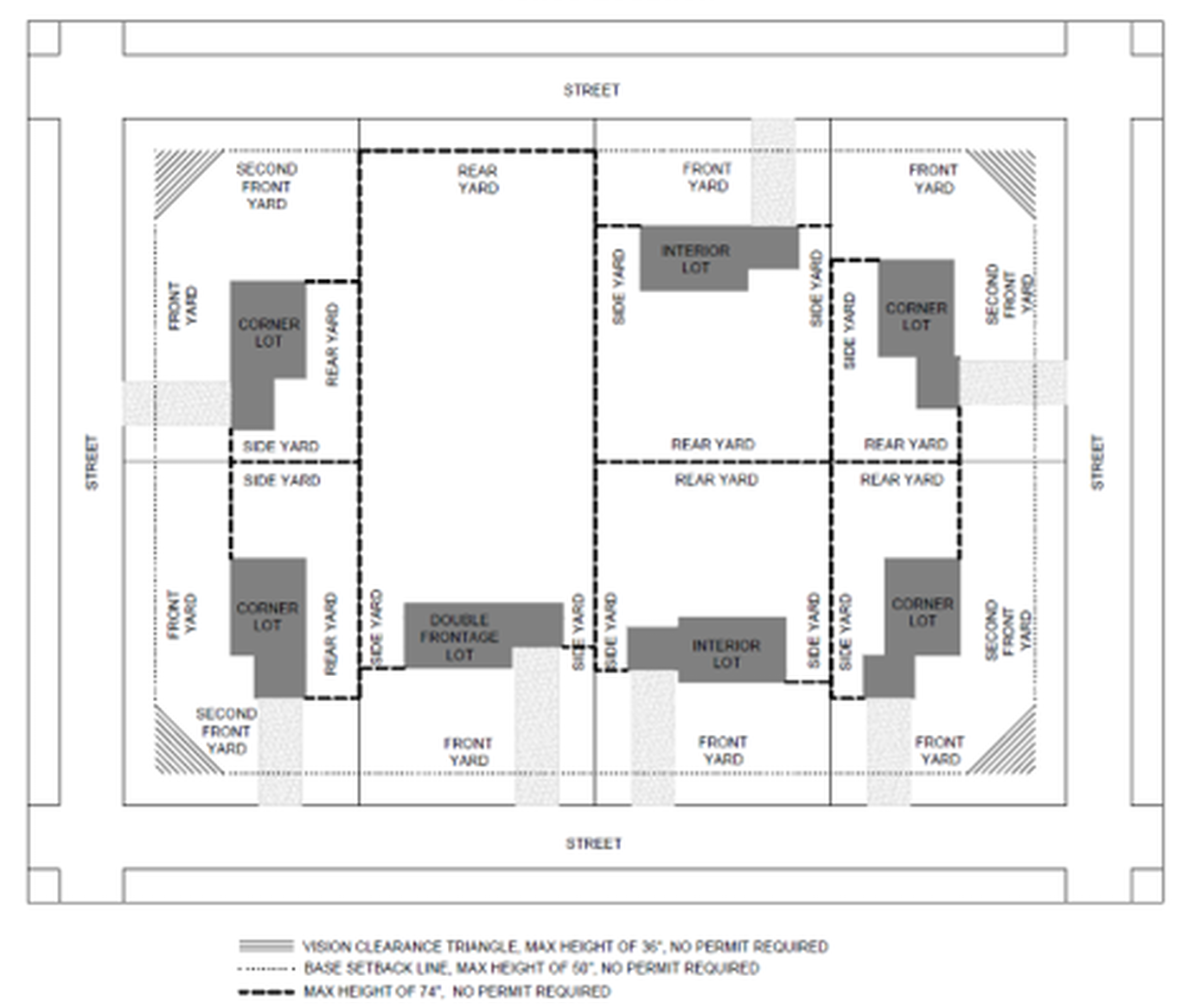
(2)
Location.
(a)
Fences made of maintenance-free materials may be located on the lot line. Such materials include, but are not limited to, cedar, metal fences (chain-link, wrought-iron, aluminum), PVC/recycled materials, removable fencing, pressure-treated wood and other maintenance-free materials, as approved by the Director. Common-lot-line fencing that has a finished side facing both properties and is maintained by both owners with a prior agreement is allowed with a survey. Fences that are not made of maintenance-free materials shall be located at least two feet from the property line.
(b)
Fences shall be located outside of public easement areas unless Plan Commission approval is granted.
(c)
Fences shall not block or impact existing drainage patterns. Any grade changes made in the area of the fence installation must follow the requirements in Section 275-55.
(3)
Construction and maintenance.
(a)
All structural and support components of a fence shall face away from adjacent properties.
(b)
All fences shall be constructed straight and plumb. Any fence that is to be constructed or maintained in other than a straight and plumb condition, including but not limited to certain types of split-rail fences, shall require Plan Commission review and approval.
(c)
Fences in nonresidential districts shall adhere to Section 275-59.
(d)
All fences shall be maintained in good repair at all times. No signs or display shall be allowed on a fence. No materials shall be stored between the fence and the lot line.
(4)
Permits. No permit is required for fences meeting the above criteria. A permit shall be required for:
(a)
Residential fences located in the front yard that exceed 50 inches but not more than 74 inches, provided that all other requirements for fences are met. DCD review and approval is required.
(b)
Residential fences exceeding 74 inches in height, provided that all other requirements for fences are met. Plan Commission review and approval is required.
(5)
Exception.
(a)
A snow fence temporarily constructed for the purpose of catching wind-blown snow shall not be subject to these fence requirements, provided that it shall be installed no earlier than November 1 of each year and shall be removed no later than April 1 each year.
(b)
Windscreens are allowed on a seasonal basis within Institutional and Park Zoning Districts and may display content. Windscreens shall be maintained and in good repair.
I.
Firewood and compost piles.
(1)
Firewood and compost piles with a maximum height of six feet shall be allowed as an accessory use in all zoning districts. Firewood piles that are stacked against a permanent structure have no height restriction.
(2)
Yards. Firewood and compost piles may be located in the rear yard.
(3)
Setbacks. Firewood and compost piles shall be located a minimum of five feet from all property lines.
J.
Home occupations. Home occupations may be allowed as accessory uses in any agricultural or residential district, provided that they comply with the following standards:
(1)
General regulations.
(a)
Home occupations shall be allowed only after staff review and administrative approval in accordance with the procedures set forth in Article Ill of this chapter.
(b)
The total area devoted to a home occupation shall not exceed 20% of the building area of the principal dwelling unit.
(c)
A home occupation shall produce no offensive noise, vibration, dust, odors, smoke, heat, pollution, glare, or radio, electrical, or television interference or otherwise produce a nuisance as determined by the Plan Commission.
(d)
No materials that decompose by detonation shall be allowed in conjunction with a home occupation.
(e)
No home occupation shall be allowed which changes the outside appearance of the dwelling or is visible from the street.
(f)
Materials used in or produced by a home occupation may not be stored or displayed outside the dwelling without Plan Commission approval.
(g)
No more than one nonresident employee shall be employed by a home occupation.
(h)
Retail and wholesale sales shall be prohibited, except for the retail or wholesale sales of products or goods produced or fabricated on the premises as a result of the home occupation.
(i)
The applicant shall demonstrate that there is sufficient off-street parking available to the home occupation. All vehicular parking for both the residence and the home occupation shall be located on the premises.
(j)
A home occupation shall be carried on wholly within the principal dwelling. No home occupation nor any storage of goods, materials, or products connected with a home occupation shall be allowed in any accessory building or detached garage.
(k)
Home occupation uses shall meet all applicable Fire and Building Code safety requirements.
(l)
No home occupation involving visits to the site of the home occupation by customers or the loading or unloading of business-oriented material shall be operated between the hours of 8:00 p.m. and 8:00 a.m.
(2)
Prohibited home occupations. The following uses are prohibited as home occupations:
(a)
Animal hospitals or pet boarding;
(b)
Antique shop;
(c)
Automobile or other motor vehicle repair or paint shops;
(d)
Dance studios for more than six students;
(e)
Furniture stripping and/or refinishing;
(f)
Gift shops;
(g)
Gun or ammunition sales;
(h)
Manufacturing or assembling items for sale from components not made on the same premises;
(i)
Mortuaries;
(j)
Music studios for more than three students;
(k)
Photographic studios;
(l)
Private clubs;
(m)
Restaurants;
(n)
Small engine repair shops;
(o)
Stables or kennels;
(p)
Tourist homes or boardinghouses; and
(q)
Any other home occupations not meeting the criteria established by this chapter.
K.
Hot tubs.
(1)
Yards. Hot tubs may be located in the side or rear yard.
(2)
Setbacks.
(a)
Hot tubs located in the side yard shall meet the setbacks of the Zoning District.
(b)
Hot tubs located in the rear yard shall be located a minimum of five feet from all property lines.
(3)
Building separation. May be permitted as close as necessary to a principal or accessory building.
L.
Outdoor displays and sales.
(1)
The outside display of merchandise may be allowed as an accessory use in all commercial, manufacturing and industrial districts if all of the following provisions are met:
(a)
The display shall not exceed 500 square feet in commercial districts or 1,000 square feet in the manufacturing and industrial districts; excluding seasonal displays, temporary events or displays approved as part of the plan of operation;
(b)
The display does not obstruct traffic, sidewalks, or fire lanes; and
(c)
The display area is not being used for the storage of merchandise only.
(2)
Display of vehicles for sale. Not more than one automobile, boat, recreational vehicle, or other personal vehicle may be displayed in a driveway or parking lot for sale, unless a sales lot has been approved by the Plan Commission in an appropriate business district. The vehicle must be owned and registered to the occupant of the premises, and such sales shall not occur more than three times in any given year. Vehicles shall not be displayed on lawn areas or within a public right-of-way.
(3)
Outdoor displays placed under permanent canopies for automotive fuel sales shall be permitted.
(4)
Items that are visible and are not located within an approved area for outdoor displays and sales are considered outdoor storage and shall meet the requirements in subsection 275-42 M.
M.
Outdoor storage, permanent. Outdoor storage may be allowed as an accessory use as defined in the use summary tables for each zoning district, subject to Department of Community Development staff review and approval, and provided that such storage is screened from view of any public right-of-way or residential area.
N.
Outdoor storage, temporary. Temporary outdoor storage may be allowed as an accessory use in all zoning districts, subject to the following provisions:
(1)
Temporary outdoor storage units (example: shipping containers/crates) shall abide by the restrictions below:
(a)
An administrative permit application shall be submitted and a zoning permit issued prior to the temporary outdoor storage unit being placed on the property, if it will be stored on the property for more than 30 days.
(b)
Only one temporary outdoor storage unit will be allowed per tax key. The Department of Community Development will review requests for any additional temporary outdoor storage units.
(c)
Temporary outdoor storage units shall not exceed eight feet in height, ten feet in width and 20 feet in length.
(d)
No flammable or explosive materials may be stored in the temporary outdoor storage unit.
(e)
No temporary outdoor storage unit will be used to store materials related to an off-premises business or a home occupation.
(2)
Location:
(a)
Temporary storage units shall be placed on a hard, all-weather surface, driveway or turnaround area. (This does not include areas of dirt or grass.)
(b)
Temporary outdoor storage areas shall be set back a minimum of ten feet from the base setback line and a minimum of five feet from the side and rear lot lines.
(c)
Temporary outdoor storage units will not be allowed to be stored on public access areas, easements or within the City of New Berlin right-of-way.
(3)
Duration:
(a)
Temporary outdoor storage units shall not be stored on a property longer than 30 days unless the property owner submits an administrative permit application requesting a longer duration of time. The total storage of the temporary outdoor storage unit with an application and permit shall not exceed 60 days unless as specified in the next condition.
(b)
Property owners that have applied for and received a valid building permit shall be allowed to store temporary outdoor storage units on the property no longer than 180 days or until final occupancy is issued, whichever comes first.
(c)
If the project has a valid building permit, the property owner shall not be required to apply for an administrative permit.
(d)
If the temporary outdoor storage unit is scheduled lo remain on the property over 180 days, then the property owner shall apply for an administrative permit.
(e)
Once the project or property owner receives final occupancy and/or the building permits have been closed out and final inspected, the property owner must remove the temporary outdoor storage unit within 30 days.
(f)
Temporary outdoor storage units and small homes are prohibited as a permanent use.
O.
Pools. All above ground and in ground pools shall require the issuance of a building permit.
(1)
Yards. Pools may be located in the side or rear yard.
(2)
Setbacks.
(a)
Pools located in the side yard shall meet the setbacks of the zoning district.
(b)
Pools located in the rear yard shall be located a minimum of five feet from all property lines.
(3)
Building separation. A minimum of ten feet of separation is required between pools and any wall or structure overhang.
P.
Refuse containers. Refuse containers may be allowed as an accessory use in all zoning districts, subject lo the following provisions. City-issued trash and recycling bins intended for weekly pickup and dumpsters used by commercial, industrial or multifamily developments for the primary use of everyday garbage disposal or recycling are exempt from this section and shall refer to Chapter 220 of the Municipal Code.
(1)
Refuse containers (example: dumpsters/Bagster bags) shall abide by the restrictions below:
(a)
Only one refuse container will be allowed per tax key. The Department of Community Development will review requests for any additional refuse containers.
(b)
Refuse containers shall not exceed eight feet in height, ten feet in width and 24 feet in length.
(c)
No flammable or explosive materials may be stored in a refuse container.
(d)
No refuse container will be used to store materials related to an off-premises business or a home occupation.
(2)
Location:
(a)
Refuse containers areas shall be set back a minimum of ten feet from the base setback line and a minimum of five feet from the side and rear lot lines.
(b)
Refuse containers will not be allowed to be stored on public access areas, easements or within the City of New Berlin right-of-way.
(3)
Duration:
(a)
Refuse containers shall not be stored on a property longer than 15 days, unless the property owner submits an administrative permit application requesting a longer duration of time. The total storage of a refuse container with an application and permit shall not exceed 75 days.
(b)
Property owners that have applied for and received a valid building permit for an addition, remodel or alteration shall be allowed to store a refuse container on the property no longer than 180 days.
(c)
Permits for new construction shall be allowed to store a refuse container until final occupancy. To prevent construction debris from leaving the site, refuse containers must be changed regularly.
Q.
Retaining walls. See subsection 275-55 A(5).
R.
Small wind energy systems.
(1)
Authority. This subsection is adopted pursuant to authority granted pursuant to Wisconsin Statutes, §§ 62.23(7) and 66.0401.
(2)
Purpose. The purpose and intent of this subsection is to oversee the permitting of small wind energy systems and to preserve and protect public health, safety and welfare without significantly increasing the cost or decreasing the efficiency of a small wind energy system.
(3)
Definitions. Refer to Section 275-70.
(4)
General regulations. A small wind energy system shall comply with the use regulations of the applicable zoning district and with the following requirements:
(a)
A wind tower for a small wind energy system shall be set back a distance equal its total height from:
[1]
Any public right-of-way, unless written permission is granted by the governmental entity with jurisdiction over said road right-of-way.
[2]
Any overhead utility line, unless written permission is granted by the affected utility.
[3]
Any property line abutting the property that is not residentially zoned, unless written permission is granted by the owner of the abutting property.
(b)
Access. All ground-mounted electrical and control equipment shall be labeled or secured to prevent unauthorized access. The tower shall be designated and installed so as lo not provide step bolts or a ladder readily accessible to the public for a minimum height of 12 feet above the ground.
(c)
The tower shall be designed and installed so that the distance between the bottom of the blade at its lowest point of rotation shall not be less than 20 feet above the ground.
(d)
Electrical wires. All electrical wires associated with the small wind energy system, other than wires necessary to connect the wind generator lo the lower wiring, the lower wiring to the disconnect junction box, and the grounding wires, shall be located underground.
(e)
Lighting. The wind lower and generator shall not be artificially lighted unless such lighting is required by the Federal Aviation Administration. The wind generator and lower shall remain painted or finished the color or finish that was originally applied by the manufacturer and was approved by the Director of Community Development.
(f)
Signs. All signs other than the manufacturer's or installer's identification, appropriate warning signs or owner identification on a wind generator tower building, or other structure associated with the small wind energy system visible from any public road, shall be prohibited.
(g)
The small wind energy systems, including the tower and associated structure, shall comply with all applicable state building codes, construction and electrical codes and the national electrical codes.
(h)
Utility notification and interconnection. Small wind energy systems that connect to the electrical utility shall comply with the Public Service Commission of Wisconsin Rules for Interconnecting Distributed Generation Facilities.
(i)
Noise. Audible noise due to wind energy system operations shall not exceed 50 dBA for any period of time when measured at the exterior of any residence, school, hospital, church or public library and the property line of the adjacent neighbors existing on the date of the approved clean energy system permit. In the event audible noise due to wind energy system operations contains a steady pure tone such as a whine, screech or hum not produced under normal operating conditions, it is prohibited. In the event the ambient noise level exceeds the applicable standards given above, the applicable standard shall be adjusted so as to equal the ambient noise level.
(5)
Small wind energy system permit.
(a)
An applicant for a small wind energy system permit shall provide the following:
[1]
A survey map showing property lines and physical dimensions, including the location, dimensions and types of existing structures on the property, location of the proposed small wind energy system tower, right-of-way of any public road that is contiguous with the property, and the overhead utility lines.
[2]
Wind energy system specifications include the manufacturer and model, rotor diameter, tower height, tower type and kilowatt specifications.
[3]
Information regarding noise anticipated to be attributed to the wind energy system.
(b)
The small wind energy system permit shall expire if the small wind energy system is not installed and functioning within 12 months from the date the permit is issued.
(6)
Abandonment. The small wind energy system is deemed to be abandoned if it is out of service for a continuous twelve-month period. If the City provides a notice of abandonment, the small wind energy system must be removed at the owner's expense within 90 days of the notice of abandonment. If the owner fails to remove the wind energy system, the City may pursue a legal action to have the wind energy system removed at the owner's expense, including the applicable legal fees. The owner shall have the right to respond to the notice of abandonment within 30 days of receipt of the notice. The City shall withdraw the notice of abandonment if the owner provides information that demonstrates the small wind energy system has not been abandoned.
(7)
The Director of Community Development shall issue the small wind energy system permit, provided that it complies with the limitations and conditions as set forth herein, as well as applicable provisions of the Wisconsin Administrative Code and Wisconsin statutes. In the event that the application is rejected, the Director of Community Development shall notify the applicant in writing and provide a written statement of the reasons why the application was rejected. The applicant may appeal the decision of the Director of Community Development to the Plan Commission.
S.
Solar energy conversion systems. Solar energy conversion systems (including solar collectors attached to the principal structure and solar collectors erected as an accessory structure) may be allowed as an accessory use in all zoning districts and shall be subject to the following provisions:
(1)
Application. Applications for the erection of a solar energy conversion system shall conform to the application and approval procedure for a building permit set forth in Section 275-25 of this chapter and the Electrical Code. In addition, the application shall include a copy of any solar easements obtained from adjacent property owners.
(a)
A building permit application submittal for a solar energy conversation system shall require a complete set of plans, including a site plan and any structure details drawn to scale. This plan set will be reviewed to ensure that a solar panel does not negatively impact the public health, safety and welfare.
(2)
Construction. Solar energy conversion systems shall be constructed and installed in conformance with all applicable state and local building and zoning codes.
(3)
Location and height. Solar energy conversion systems shall meet all setback and yard requirements for the district in which they are located. Solar energy conversion systems shall conform to all height requirements of this chapter.
T.
Sport courts, tennis courts and permanent volleyball courts.
(1)
Yards. Sport courts, tennis courts and permanent volleyball courts may be located in the rear yard.
(2)
Setbacks. Sport courts, tennis courts and permanent volleyball courts shall be located a minimum of five feet from all property lines.
U.
Swing sets and gym sets.
(1)
Yards. Swing sets and gym sets may be located in the rear yard.
(2)
Setbacks. Swing sets and gym sets shall be located a minimum of five feet from all property lines.
(Amended 9-23-2014 by Ord. No. 2529; 1-12-2016 by Ord. No. 2558; 10-9-2018 by Ord. No. 2607; 6-11-2019 by Ord. No. 2620; 10-13-2020 by Ord. No. 2642; 8-24-2021 by Ord. No. 2652; 4-25-2023 by Ord. No. 2668; Ord. No. 2702, § IX, 3-11-2025)
Sec. 275-43. - Temporary uses, structures and special events.
A.
Application process. As applicable, temporary uses, structures and special events shall obtain a permit. Applications and necessary materials shall be submitted to staff and may be subject to application fees and developer deposit fees. The temporary use, structure or special event shall be reviewed in accordance with the provisions of this section and other applicable sections of this chapter. Temporary uses, structures, and special events requiring a permit include:
(1)
Festivals, food truck festivals, art/craft fairs, outdoor markets, plan flower sales, circuses, concerts, wine/food tastings, beer gardens, races, parades, block parties, sporting events, exhibitions, outdoor seating/dining, pop up live music, car shows, fundraisers/outings (e.g., golf outings/company picnics), game day/nights (bingo/trivia), outdoor movie theater, material storage and associated work for Municipal projects as approved by the City, and/or other similar events unless approved as part of an existing plan of operation or an approved calendar of events.
(2)
The use of public streets, rights-of-way or sidewalks.
(3)
An event that creates a substantial impact on the operations of the City, surrounding neighbors or neighborhoods and requires public safety and City services above and beyond their normal functions, at the discretion of City staff.
(4)
Events held on private property that are open to the public may be classified as a special event if there is a significant impact on the City's operations and residents.
B.
Submittal requirements. An application will be considered complete if it contains all the information required under this section.
(1)
Completed application shall be submitted prior to the event.
(a)
Class I events, as outlined in DHS 110.44(20r), with more than 5,000 people, including personnel, volunteers, vendors, and attendees shall be filed with the City at least 120 days prior to the proposed event.
(b)
Class II events with 501 to 5,000 people, including personnel, volunteers, vendors, and attendees shall be filed with the City at least 90 days prior to the proposed event
(c)
Class III events with 151 to 500 people, including personnel, volunteers, vendors, and attendees shall be filed with the City at least 45 days prior to the proposed event.
(d)
Class IV events with 150 people or less, including personnel, volunteers, vendors, and attendees shall be filed with the City at least 15 days prior to the proposed event.
(2)
Deposits for Class I Events. Application fee in the form of a deposit shall be submitted to the City for all Class I events. The deposit shall be used to cover City staff review, planning time and coordination to review the application itself and through the completion of the event. Staff will use their direct billable hours to debit the submitted deposit amount. Should the deposit itself go down to zero, the applicant shall replenish the deposit to the original amount. Any remaining deposit funds after the permit is issued or denied shall be returned to the applicant. The deposit will start at $1,000.
(3)
Detailed plan of operation including the following information:
(a)
A description, date, time and location of the event. Special events in residential neighborhoods may require notification of adjacent neighbors. Include proposed site requests, including but not limited to: amplified music or entertainment and the hours, fireworks, closure of public streets or rights-of-way meeting the requirements of Section 230-6 of the Municipal Code, parking, electricity, temporary structures, temporary fencing, waste/recycling collection and disposal, and portable restrooms and hand wash stations. Additional items to consider include additional security personnel, emergency plan for inclement weather, potable water for consumption on site, and medical/first aid kits.
(b)
The estimated maximum number of participants, spectators and vendors at the proposed event. If the event is a multi-day event, it should be noted the estimated attendance per day.
(c)
Whether alcohol will be sold or served at the event.
(d)
Whether food and/or merchandise will be sold at the event.
C.
Time limits. Temporary use, structure and special event permits shall be valid for a specified period of time. A permit shall lapse if not used within the dates approved.
D.
Required findings. The application shall be approved as submitted or in a modified form if the Director of the Department of Community Development finds that:
(1)
The proposed temporary use, structure, or special event will be located, operated, and maintained in a manner consistent with the policies of the New Berlin Comprehensive Plan and the provisions of this chapter;
(2)
The approval of the application will not be detrimental to property or improvements in the surrounding area or detrimental to public health, safety or general welfare. The City may require that the permit holder provide written notice 15 days in advance of the special event to any property owners or tenants as determined during the City department's review. Notice shall include the type of event, name of the special event sponsor(s), date, time and location, event coordinator's name and contact information during the event; and
(3)
The proposed temporary use, structure or special event complies with all applicable standards of this section, unless otherwise expressly stated.
(4)
Special Events requiring a road closure, except for City run events, shall comply with the following standards:
(a)
A public street shall not be barricaded for recreational purposes for more than 12 hours.
(b)
The applicant shall provide evidence of written consent of not less than 80% of the property owners abutting the portion of the street to be closed. The applicant is also required to provide evidence that all abutting property owners have been advised of the request for closure.
(c)
Road closures are only permitted for local streets that are public, not arterial streets that are public. The applicant shall be required to provide a map showing the portion of the street to be closed and where the barricades will be placed.
(e)
The applicant must be the owner of a property on the street where the event is to be held and shall assume responsibility under the permit for the event, which includes compliance with all City Ordinances, the clean-up of the public right of way, and the return of all City barricades within 48 hours of the event.
(f)
Barricades to close the street must remain in place for the duration of the event. The applicant must ensure that a drive lane through the blockaded street area of not less than 15 feet in width shall be provided so that all City emergency service vehicles are able to access properties within the blocked street.
(g)
If alcohol is being served at the event, it may only be to persons of age and may not be provided to any uninvited guests. Alcohol cannot be sold.
(h)
Grills may be permitted in the right-of-way, subject to the limitations of this section. Smokers, fireplaces, fire pits, chimineas, and inflatable play structures are prohibited in the right-of-way.
(i)
All waste and debris must be cleaned up and properly disposed of after the event ends. Public rights-of-way must be restored to the condition that existed prior to the commencement of the event.
(j)
If complaints are received by the Police Department which are not satisfactorily resolved, the Police Department shall have the authority to revoke the permit and to terminate the event.
(k)
A permit request may be denied if complaints have been received regarding Special Events on the same street in the past, or if the applicant has failed to comply with the requirements of any City Permits in the past.
(l)
Special Events requiring a road closure shall not occur on holidays.
(5)
The City may approve temporary events on City property or within public rights-of-way if the additional conditions are met:
(a)
A certificate of insurance (COI) is required to be submitted for the event prior to the event occurring. It shall include the following:
[1]
COI limits shall name the City of New Berlin as additionally insured.
[2]
The parties agree to indemnify and hold harmless the other from any and all claims for injury or property damage to the extent that such claims arise out of the negligence of their employees, representatives, agents, contractors or officers as a result of this Agreement. Any indemnity that the City would agree to would be subject to the following limitations: Notwithstanding the forgoing, nothing contained within this agreement is intended to be a waiver or estoppel of the City of New Berlin or its insurer's ability to rely upon the limitations, defenses and immunities contained within Wisconsin law, including, but not limited to, those contained within Wis. Stats., §§ 893.80, 895.52 and 345.05. To the extent that indemnification is available and enforceable, the City of New Berlin or its insurer shall not be liable in indemnity or contribution for an amount greater than the limits of liability for municipal claims established by Wisconsin law. The City's obligation to indemnify hereunder is subject to the availability and limits of applicable insurance coverage. Under no circumstances shall the City of New Berlin be required to indemnify the contractor for its own negligent or intentional conduct.
[3]
Each party shall provide the other with a certificate of insurance naming each other as an additional insured. The amount of such insurance shall be mutually agreed between the parties. Each party waives their right of subrogation against the other. Both parties' insurance policies shall have a noncancellation provision except upon 30 days' written notice to the other party.
(b)
City services. All requests by the applicants for City services must be made at the time of application. The applicant shall be responsible for reimbursement to the City for any city personnel, services, equipment, and facilities provided for the special event. Reimbursement costs shall be calculated to include wages, overtime and fringe benefits and is due within 30 days of receipt of invoice. The City reserves the right to require full or partial payment of estimated costs in advance. All permit, signage and barricade costs are due prior to the special event.
(c)
Cleaning/damage deposit. The applicant may be required to submit to the City a deposit depending on the size and number of attendees. The deposit will be refunded to the applicant after an inspection of the premises is conducted and the City determines there is no loss or cleaning costs. The applicant shall be fully responsible for necessary cleanup associated with the permitted event, which must be completed no later than 12 hours after the conclusion of the event. The City reserves the right to retain the entire deposit if cleanup is not satisfactorily completed in the time frame specified.
[1]
A deposit of $5,000 shall be submitted for a Class I Special Event.
[2]
A deposit of $200 shall be submitted for a Class II Special Event.
(d)
And any other conditions that may be established by the Mayor, City Attorney, Board or Commission, and/or City staff that seeks to protect the City.
E.
Conditions of approval. In approving a temporary use, structure, or special event permit, the Director of the Department of Community Development may impose reasonable conditions, including, but not limited to, limitations on hours, illumination, storage, and parking, necessary to:
(1)
Achieve the general purposes of this section and the specific purposes of the zoning district in which the temporary use will be located or be consistent with the New Berlin Comprehensive Plan;
(2)
Protect the public health, safety, and general welfare; and
(3)
Ensure the operation and maintenance of the temporary use, structure, or special event in a manner compatible with existing uses on adjoining properties and in the surrounding area.
F.
Temporary construction, security, or real estate sales offices.
(1)
General. The owner of a construction project may place on the construction site a temporary office for use by construction, security, or real estate sales personnel.
(2)
Location. The temporary office shall be located on the lot on which construction or development is occurring and shall not be located within 25 feet of any abutting residential use.
(3)
Sanitation. Sanitation and plumbing requirements may be waived by the Director, provided that adequate facilities are available elsewhere on the site.
(4)
Time limits. The office shall be removed within 15 days after final inspection of the permanent structure or expiration of the corresponding building permit, whichever event occurs first. In the case of residential development projects, the office must be removed within 15 days of the sale or lease of all dwelling units.
G.
Staff shall have the authority to review and send items to the appropriate board, commission and/or Council for their review and approval if there are potential effects on surrounding land uses.
(Amended 10-9-2018 by Ord. No. 2607; 10-13-2020 by Ord. No. 2642; Ord. No. 2702, § X, 3-11-2025)