
New Lenox City Zoning Code
ARTICLE IX
LANDSCAPING REQUIREMENTS10
Editor's note— Ord. No. 1370, § 1, adopted Dec. 12, 2001, provided for the amendment of art. IX, §§ 106-421—106-427 in its entirety to read as herein set out. Formerly, said article pertained to the same subject matter as enacted by Code 1981. See the Code Comparative Table.
Cross reference— Disposal of landscape waste, § 70-47; vegetation, ch. 98.
Sec. 106-421.- Purpose of article; applicability of article.
This article is established to create uniform landscape, screening and tree preservation standards for development of property in the village and to provide for review of plans therefor, in order to ensure that the village remains attractive, safe and comfortable. This article governs all single-family detached and two-family attached developments receiving preliminary plat approval after December 18, 2001, and all commercial, industrial and multi-family developments. All requirements contained in this article shall be provided on-site for the affected development, except those pertaining to the exterior parkway.
(Ord. No. 1370, § 1, 12-12-2001)
Sec. 106-422. - Definitions.
The following words, terms and phrases, when used in this article, shall have the meanings ascribed to them in this section, except where the context clearly indicates a different meaning. The definitions in this section apply uniquely to this article and supersede any conflicting definitions found in section 106-2. The rules for interpretation found in section 106-2(a) shall be applicable to these definitions.
Best management practices (BMPs) means land planning and engineering practices designed to control adverse storm water related effects. BMPs include devices such as, but not limited to, swales, filter strips, infiltration trenches and detention basins designed to remove pollutants, reduce runoff rates and volumes, and protect aquatic habitats.
Exterior parkway means the unpaved portion of the public street right-of-way or private road easement adjacent to a property (see figures 1 and 2). Foundation area means the ground area immediately adjacent to a building on all sides thereof. Foundation areas extend a minimum of six feet in all directions from the foundation of the building (see figures 1 and 2).
Interior parkway means a landscaped open space extending a specified distance from all public street rights-of-way or private street easements as shown in table 1, below (see figures 1 and 2).
TABLE 1. INTERIOR PARKWAY
REQUIREMENTS
* Refer to Section 106-182(f)(3) for the required interior parkway.
** Property zoned PUD shall meet or exceed perimeter screening required of the most appropriate standard zoning district as determined by the planning and development administrator or designee.
Landscaped open space means land covered by trees, shrubs, turf grasses or ground cover. Impervious surfaces such as buildings, parking lots, walkways or patios are not considered landscaped open space.
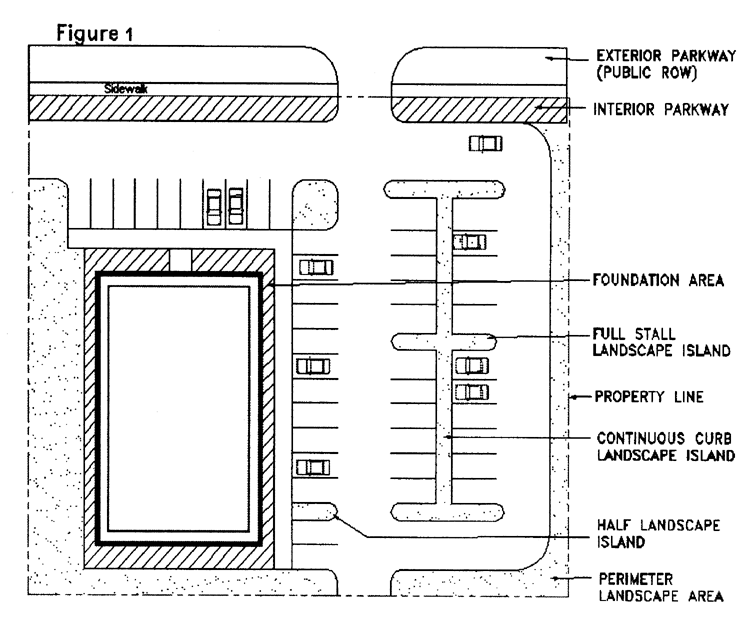
Figure 1
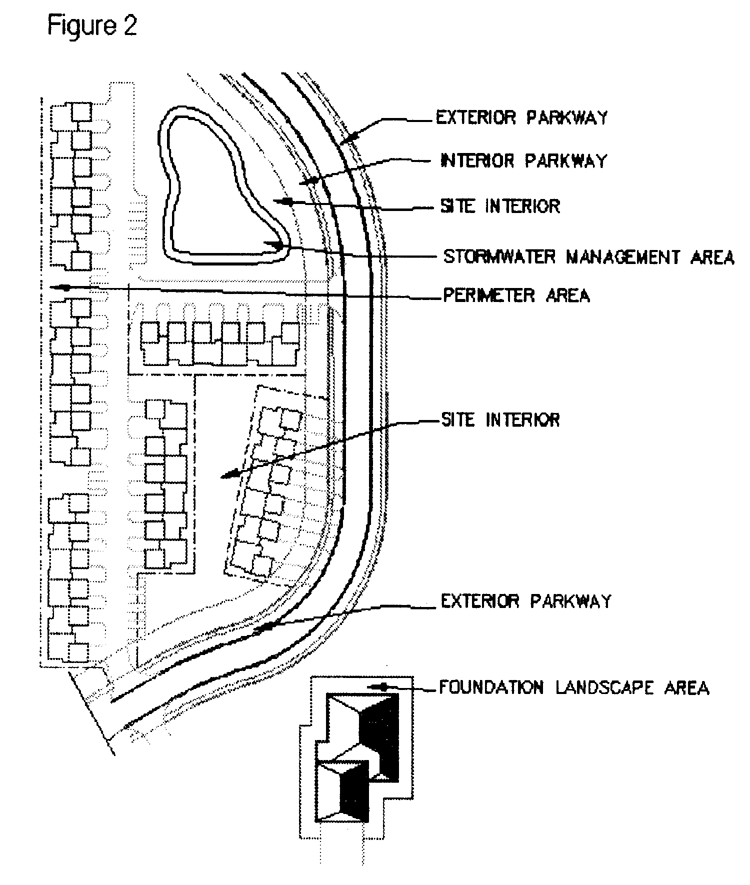
Figure 2
Naturalized landscape area means ecologically sensitive landscaping that uses regionally native plant species to create, improve or restore specialized and self-sustaining plant communities (prairie, woodland, etc.).
Overstory (large) tree means a self-supporting woody plant having at least one well-defined stem or trunk and normally attaining a mature height and spread of at least 30 feet, and having a trunk that may, at maturity, be kept clear of leaves and branches at least eight feet above grade.
Perimeter landscape area means an area around the periphery of a property not facing a public road. The perimeter landscape area extends from the property line to the nearest building face, parking area or access drive, exclusive of the foundation area and the interior parkway (see figures 1 and 2).
Protected tree means an existing tree designated on the landscape plan to remain after construction.
Site interior means the open space area behind and between buildings on a site with multiple structures, excluding the interior parkway, foundation area and perimeter landscape area (see figures 1 and 2).
Understory (ornamental) tree means a self-supporting woody plant having at least one well-defined stem or trunk and normally attaining a mature height and spread of less than 30 feet with branching less than 8 feet above grade.
(Ord. No. 1370, § 1, 12-12-2001; Ord. No. 1428, § 1, 11-12-2004; Ord. No. 1935, § 5, 3-24-2008; Ord. No. 2040, §§ 1, 2, 5-18-2009)
Sec. 106-423. - Plan requirements; installation of landscaping.
(a)
Plan requirements. The following shall establish the standards for the preparation and submission, if required, of plans for landscaping, screening and tree preservation:
(1)
Uses requiring landscape plan. A landscape plan approved by the village board on the basis of the standards set forth in this article shall be required for all multi-family, commercial, and industrial development, and single-family and two-family residential developments receiving preliminary plat approval after December 18, 2001.
(2)
Contents of plan. All landscape plans shall include or have attached thereto the following information:
a.
North arrow, scale, and date of plan and any subsequent revisions.
b.
The location and dimensions of all existing and proposed buildings, structures, parking lots and driveways, roadways and rights-of-way, sidewalks, bicycle paths, ground signs, refuse disposal areas, fences, freestanding electrical equipment, light fixtures, fire hydrants, other surface utility structures, and other freestanding structural features as determined by the planning and development administrator or designee, such as tot lots and other recreational facilities, setbacks and easements. The landscape plan shall be drawn at a scale not smaller than one inch equals 50 feet.
c.
The location, quantity, size, and both scientific and common names of all proposed plant materials.
d.
Existing and proposed contours, including the location of all proposed berming, at a one-foot contour interval. Also included shall be the location, extent and general elevations of all detention and retention areas and drainageways.
e.
Specification of the type and boundaries of all proposed ground cover, including both scientific and common names of all proposed plant materials.
f.
The designation, location, type and size of all existing trees four inches and larger in diameter measured one foot above natural grade. Any trees to be removed shall be clearly identified. Trees measuring between two and one-half and four inches in diameter, which will be used to meet landscape requirements, shall also be indicated. If required for reasons of clarity, this information may be placed on an additional illustration. Where existing trees are grouped in a dense cluster, an overall tree mass may be used without a specific delineation of individual trees. If this technique is used, protected trees used to meet site landscape requirements must be tagged on-site and identified on the plan in tabular form.
g.
A table for each required landscaped area, including but not limited to, exterior parkway, interior parkway, perimeter area and storm water management area, indicating the total plant units summarized by species and type. Existing trees to be preserved and credit given towards the requirements of this article should be so noted.
h.
Details of all fences and walls proposed to be constructed on the site.
i.
Elevations, cross sections, sightline exhibits and other site or construction details determined to be necessary by the planning and development administrator or designee.
j.
Symbols representing proposed plant material shall be drawn to scale showing two-thirds to full mature size and labeled as to quantity and type.
(b)
Installation of landscaping. All required landscaping for residential developments shall be treated as public improvements; the developer shall post a letter of credit as surety for the satisfactory completion of these improvements as approved by the village board and processed in accordance with the procedures adopted as Resolution 98-13. For nonresidential developments, landscaping shall be installed prior to the issuance of a certificate of occupancy. A temporary certificate of occupancy may be issued for nonresidential developments with occupancies granted from October 1 to April 30 provided the applicant presents the village with a cash bond to cover the cost of the landscape improvements. The cash bond shall be based upon 150 percent of a certified quote or the bid from the landscape contractor. The expiration date of any such bond shall be no later than November 1 following the issuance of the temporary occupancy permit. The village will call the bond if the subject improvements are not completed by the November 1 date.
(Ord. No. 1370, § 1, 12-12-2001; Ord. No. 2040, §§ 3—5, 5-18-2009)
Sec. 106-424. - Design standards.
The following shall establish standards for the landscape improvements required to be installed as part of the development of new subdivisions, buildings, structures and uses of land governed by this chapter:
(1)
General standards and objectives. Every development shall provide sufficient landscaping so that:
a.
Neighboring properties are shielded from the negative visual influence of that development.
b.
The development is shielded from the negative impacts of adjacent uses, including streets or railroads.
c.
The appearance and desirability of the development contributes to the overall attractiveness and economic health of the village.
(2)
Minimum landscaped open space. For each parcel of land to be developed, the minimum landscaped open space shall comply with the standards established in section 106-425 of this chapter. In zoning districts for which no minimum landscaped open space requirements are specified, a minimum of 15 percent of the total parcel shall be devoted to landscaped open space area. section 106-425 of this chapter details landscape requirements for various portions of the total landscaped open space.
(3)
Flexibility in applying standards. To meet the objectives outlined in subsection (1) of this section, the landscape requirements in this section are hereby established. These standards provide specific requirements for site landscaping. However, the village recognizes that, because of the wide variety of types of developments and the relationships between them, some flexibility in applying the standards set forth in section 106-425 of this section are appropriate as long as the intent of the specified requirements is met. The Planning and Development Administrator or his/her designee may administratively vary up to 25 percent of any specific requirement of this chapter. Any deviation of 25 percent or more from the requirements of any specific requirement of this article shall require a variation. Whenever the village allows or requires deviation from the requirements set forth in this section, it shall enter on the face of the landscape plan the reasons for allowing or requiring deviation from the requirements of this section.
(Ord. No. 1370, § 1, 12-12-2001)
Sec. 106-425. - Required landscaping.
(1)
Requirements for specific areas. This article regulates landscaping of seven distinct areas of a parcel as follows: exterior parkway, interior parkway, perimeter area, foundation area, parking lots, site interior, and stormwater management areas. Figures 1 and 2 provide graphic illustrations of each area. Some landscaping quantities are given in plant units. Table 2 provides plant unit values for plant types. All parcels subject to landscaping requirements must incorporate a minimum number of plant species in the design as shown in table 3.
TABLE 2:
PLANT UNIT VALUES
*Note: Where a linear length may result in a fraction of a plant unit required, the required number of plant units shall be rounded up to the next whole value. Height is at time of planting.
TABLE 3: REQUIRED NUMBER OF SPECIES
(2)
Each area shall be landscaped in accordance with the following criteria:
a.
Exterior parkway landscaping. Except for access drives, exterior parkways shall be landscaped per the following requirements:
1.
Number of trees. One tree shall be required for each 40 lineal feet of street frontage.
2.
Location. Trees shall be planted halfway between the curb and sidewalk, no less than 30 feet apart, at least ten feet from all driveways, manholes and fire hydrants and at least 30 feet from all streetlights. No tree shall be planted closer than 40 feet from an intersection as measured from the adjacent property corner. This distance is necessary to provide the necessary line of sight at the intersection.
3.
Size. Trees planted shall be at least 2½ inches in caliper measured six inches above grade.
4.
Species. All trees planted in exterior parkways shall be chosen from the list of italicized large deciduous trees found in table 6, section 106-427. No tree species shall comprise more than 30 percent of all parkway tree plantings, unless authorized by the community development director or designee. No more than five trees of the same species shall be planted adjacent to one another.
5.
All trees shall comply with the specifications found in chapter 78, article IV, section 78-145.
6.
Large deciduous trees shall not be planted under utility wires. Subject to approval by the planning and development administrator or designee, understory (ornamental) trees may be allowed under utility wires. Recommended understory trees include: Amur Maple, Serviceberry (Amelanchier aborea), Eastern Redbud, Japanese Tree Lilac, Crabapple species (fruitless and apple scab resistant cultivars only), Thornless Crus-galli Hawthorn, Corneliacherry Dogwood, Autumn Blaze Pear, Korean Sun Pear and Magnolia varieties. A mature tree height shall be provided to ensure no future conflicts with overhead utilities.
b.
Interior parkway landscaping. An interior parkway shall be provided in all nonresidential zoning districts with the depths specified in table 1, above. Except for access drives, interior parkways shall be landscaped as follows:
1.
Sites with parking between a public right-of-way or private road easement and the building. Where parking is provided between a public right-of-way or private road easement and the building, landscaping in a quantity equal to 75 plant units per 100 lineal feet of perimeter length shall be provided. Species and design considerations shall determine plant spacing. A maximum of 25 percent of the parking lot frontage may be left unscreened to permit design flexibility (see figure 3). However, when the landscape plan indicates a single row of shrubs, the entire parking lot frontage shall be screened. The remainder of the interior parkway shall be planted with ground cover, flowers or grass. Whenever the grade level of a parking lot after construction is three feet or more below the existing grade of the adjacent public street or private road, the required number of plant units in the interior parkway shall be 50.
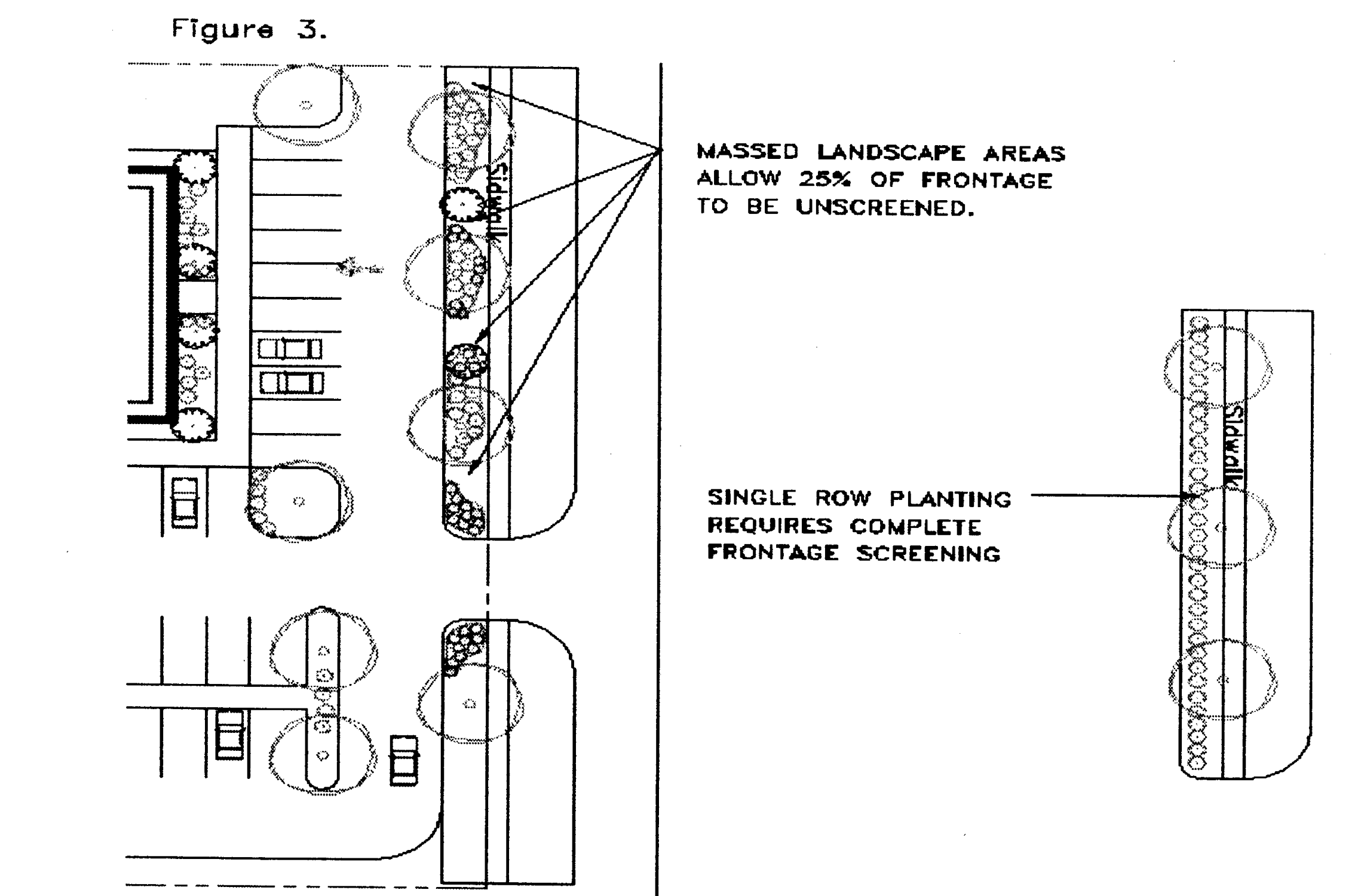
Figure 3
2.
Sites without parking between a public right-of-way or private road easement and the building. Where no parking spaces will be located between a public right-of-way or private road easement and the building, landscaping in a quantity equal to 50 plant units per 100 lineal feet of perimeter length shall be provided. Species and design considerations shall determine plant spacing. The remainder of the interior parkway shall be planted with shrubs, ground cover, flowers or grass.
c.
Perimeter landscape area.
1.
Generally. The appropriateness of proposed perimeter screening will depend upon the relationship between the proposed use of the property and adjacent properties, and adjacent street classification. Three types of perimeter screening have been defined. Type-1 perimeter landscape screening shall generally be required between residential and nonresidential uses. Type-2 perimeter landscape screening shall generally be required to provide screening of parking areas between adjacent nonresidential uses. Type-3 perimeter landscape screening shall generally be required between multi-family uses and all other residential uses, and for all residential developments adjacent to an arterial or collector roadway as designated in the Comprehensive Plan. For any screening with a fence or masonry wall, required landscape elements must be installed between the fence and the property line. No perimeter landscaping shall be installed in the public right-of-way or on land designated for private roads.
2.
Required screening when adjacent property is developed. Tables 4 and 5 in this section shall be used to determine the requirements for perimeter screening between uses. Where the adjacent property has already been developed, the required screening shall be governed by the existing use. Table 4 details screening and buffering requirements where the adjacent property has been developed. In cases where a mixed-use development exists on the adjacent parcel, the predominant use on that site shall determine the required screening.
TABLE 4. PERIMETER SCREENING REQUIREMENTS ADJACENT TO EXISTING USE
Adjacent Property Existing Use
Notes:
1. Type 1 screening.
2. Type 2 screening.
2*. Type 2 screening unless site is adjacent to an arterial or collector designated in the Comprehensive Plan, in which case type 3 screening shall be required.
3. Type 3 screening.
3* Type 3 screening shall only be required when the site is adjacent to an arterial or collector designated in the Comprehensive Plan.
When a proposed use is adjacent to a property zoned PUD, the zoning administrator shall determine appropriate screening required based on the most appropriate standard zoning district.3.
Required screening when adjacent property is undeveloped. Table 5 in this section shall be used to determine required screening where the adjacent property is undeveloped. Current county or village zoning shall determine the appropriate screening treatment unless the property is zoned Ag, in which case the comprehensive plan shall be used to determine the anticipated use and the resulting screening requirements.
TABLE 5.
PERIMETER SCREENING REQUIREMENTS ADJACENT TO UNDEVELOPED PROPERTY
Adjacent Property Existing Zoning
Notes:
1. Type 1 screening.
2. Type 2 screening.
2*. Type 2 screening unless site is adjacent to an arterial or collector designated in the Comprehensive Plan, in which case type 3 screening shall be required.
3. Type 3 screening.
3*. Type 3 screening shall only be required when the site is adjacent to an arterial or collector designated in the Comprehensive Plan.
When a proposed use is adjacent to a property zoned PUD, the planning and development administrator shall determine appropriate screening required based on the most appropriate standard zoning district.
4.
Type 1 screening. Type 1 perimeter landscape requirements are designed to provide a substantial buffer between uses. Where type 1 screening is required on tables 4 or 5, one of the following three buffering alternatives shall be required. The property owner may select the buffering alternative that best meets the configuration of the site and the proposed development. All fences, walls and hedges shall comply with section 106-11(7).
i.
Alternate A: The buffering area shall be a minimum of eight feet in width for this alternative. An opaque brick or other approved masonry wall six feet high shall be constructed along the entire perimeter, excluding the area within the required front yard setback. The wall may be continued within the front yard provided the height is reduced to three feet. If the proposed usage is for a mining operation or for a related building or structure for screening, crushing, mining, washing or storage, the required masonry wall shall be eight feet high. In addition, landscaping in a quantity equal to 25 plant units per 100 lineal feet of perimeter length shall be provided. Species and design considerations shall determine plant spacing. A minimum of 30 percent of the required plant units must be from evergreen species.
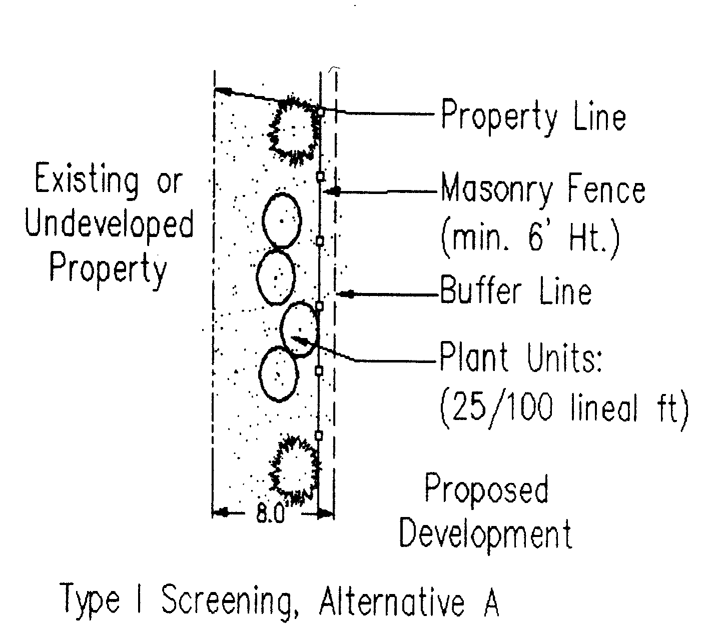
Alternative A
ii.
Alternate B: A minimum 12-foot wide buffer area shall be required for this alternative. A solid fence with a height of six feet shall be constructed along the entire perimeter, excluding the area within the required front yard setback. The fence may be continued within the front yard provided the height is reduced to three feet.
If determined necessary by the community development director or designee due to a change in grade between adjoining properties, the fence height shall increase to a maximum of eight feet in height, excluding the area within the required front yard setback. A cross-section or sightline exhibit may be required by the community development director or designee for review in making this determination. The fence may continue within the front yard provided the height is reduced to three feet.
If the proposed use is for a mining operation or for a related building or structure for screening, crushing, mining, washing or storage, the required fence shall be eight feet in height.
All fences required under this section shall be maintenance-free and consist of linear low-density polyethylene reinforced with galvanized steel, or other approved material, and meet the following specifications:
a)
Shall be stable in cold and hot extremes of negative 30 degrees Fahrenheit to plus 130 degrees Fahrenheit;
b)
Shall be wind resistant, capable of withstanding minimum 90 miles per hour sustained wind and minimum 110 miles per hour wind gusts;
c)
Shall be fade resistant and ultraviolet stabilized; and
d)
Shall be sound-absorbing and capable of blocking a minimum of 95 percent of direct sound.
In addition to the required fence, landscaping equal to 50 plant units per 100 lineal feet of perimeter length shall be provided. Species and design considerations shall determine plant spacing. A minimum of 30 percent of the required plant units must be from evergreen species.
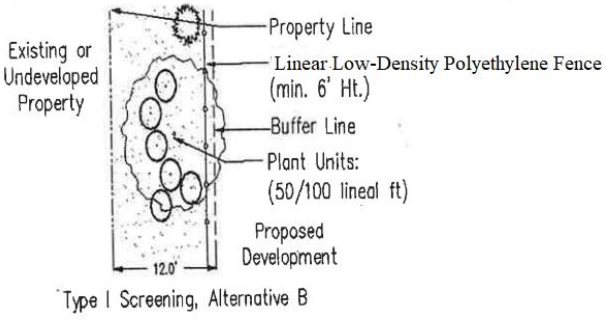
Alternative B
iii.
Alternate C: A minimum 25-foot buffer area shall be required for this alternative. A berm at least three feet in height measured from both sides with a maximum 3:1 slope shall be constructed along the entire perimeter. Breaks in the berm may be provided as appropriate to accommodate drainage. Landscaping in a quantity equal to 100 plant units per 100 lineal feet of perimeter length shall be provided. Species and design considerations shall determine plant spacing. The berm shall be screened along at least 75 percent of the perimeter length. A minimum of 30 percent of the required plant units must be from evergreen species.
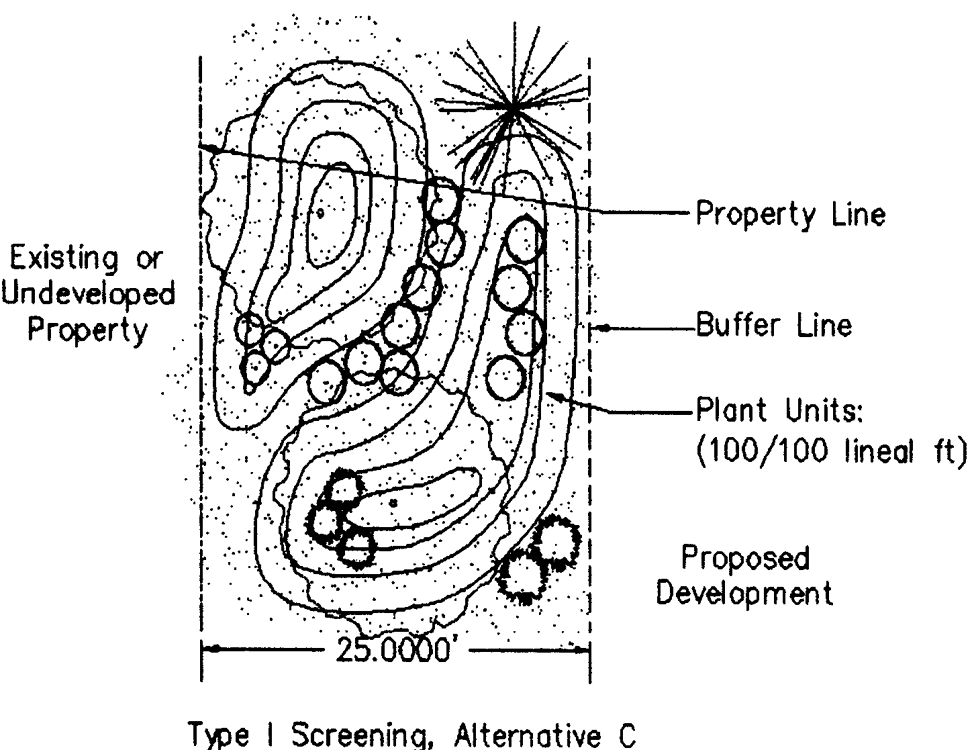
Alternative C
5.
Type 2 screening. Type 2 perimeter landscape screening is required between adjacent nonresidential uses to screen parking areas from adjacent uses. Where a parking lot will be placed along a perimeter such that parked cars will face the abutting property, a minimum 10-foot buffer area shall be required. Landscaping in a quantity equal to 50 plant units per 100 lineal feet of perimeter length shall be provided. A minimum of 30 percent of the required plant units must be from evergreen species. Species and design considerations shall determine plant spacing. Landscape screening shall be continuous along the entire parking area. Shrubs shall be a minimum of three feet in height when planted to screen a parking lot from adjacent nonresidential uses. If the proposed use is for a mining operation or for a related building or structure for screening, crushing, mining, washing or storage, an 8-foot high fence or wall shall be provided along the perimeter in lieu of parking lot screening.
Where there will not be any parked cars facing the abutting property, a minimum 4-foot buffer shall be required. Landscape screening shall be continuous along the entire perimeter buffer area.
6.
Type 3 screening. Type 3 perimeter landscape screening is generally required between multi-family uses and all other residential areas, and for all residential developments adjacent to an arterial or collector designated in the Comprehensive Plan. Where a type 3 screen is required according to tables 4 or 5, berming, trees and shrubs shall be provided to create a visual separation between properties. For all residential developments adjacent to an arterial or collector, a minimum 30-foot buffer area shall be required for this type. For all residential developments adjacent to I-80 or I-355, a minimum 50-foot buffer area shall be required for this type. For all other cases where a type 3 screen is required, a minimum 20-foot buffer area shall be required for this type. Minimum berm height shall be three feet, with no berm having a slope greater than 3:1. Landscaping in a quantity equal to 75 plant units per 100 lineal feet of perimeter length shall be provided. Species and design considerations shall determine plant spacing. A minimum of 30 percent of the required plant units must be from evergreen species.
d.
Foundation area landscaping. A minimum six-foot wide landscape area is required adjacent to building walls, exclusive of driveways, access walks, and service and delivery areas. Planting should emphasize softening large expanses of building walls, accenting building entrances and architectural features, and screening mechanical equipment. At the discretion of the village board, foundation area landscaping along the front elevation of the building or any building elevation facing a public street may be provided through the use of above-ground planting containers or boxes meeting the intent of this section. Where extended roofs or canopies are used to provide a covered walkway adjacent to buildings, foundation plantings are not required. However, landscaping is recommended to separate vehicular areas from buildings.
e.
Parking lot landscaping. Landscaping shall be required within all parking lots containing 20 or more parking spaces, to meet the following standards:
1.
There shall be a minimum seven-foot wide (measured from back of curb) curbed planting island at the end of every parking row. The depth of the planting island shall be equal to the depth of the parking stall. There shall be a minimum of one large deciduous tree per island. Branching shall start no less than six feet above the pavement measured from pavement level (see figure 4).
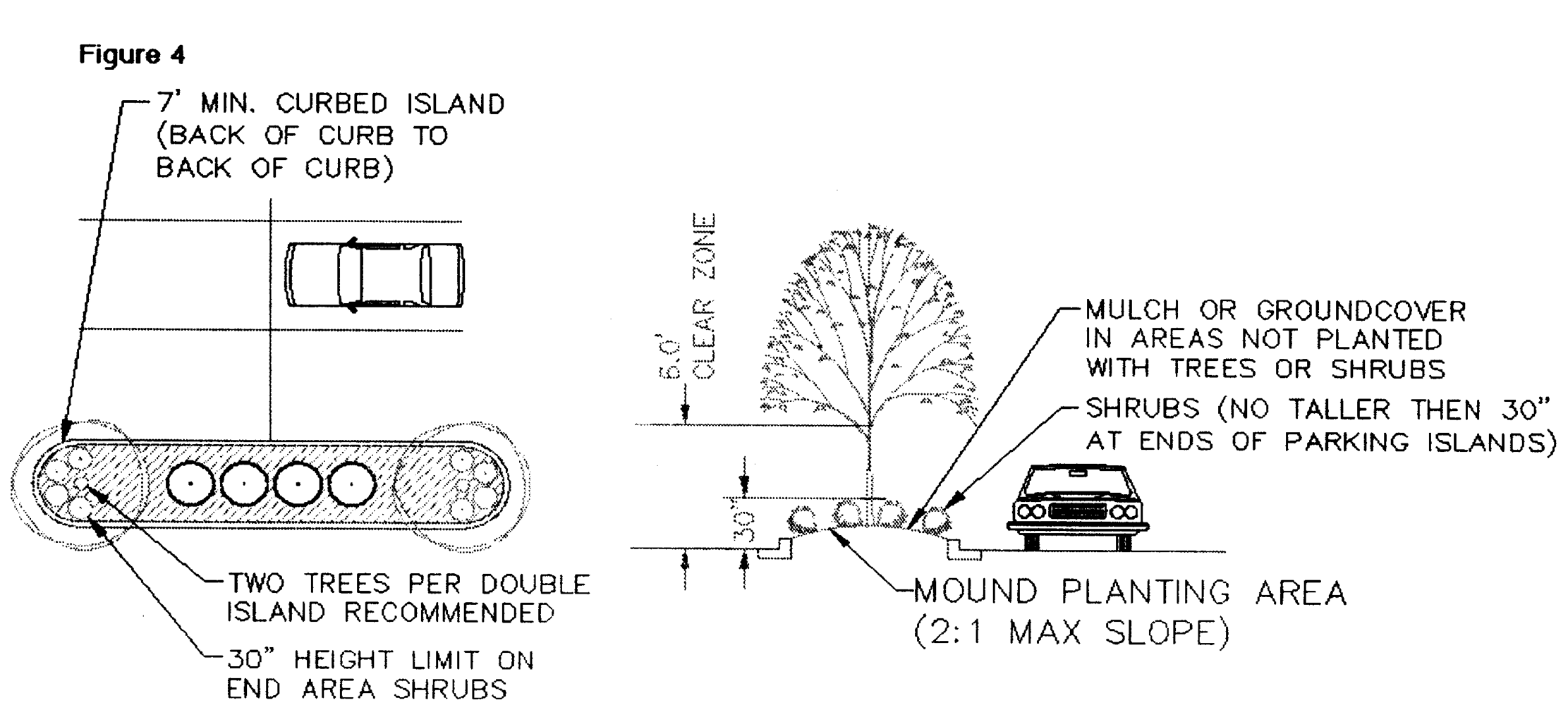
Figure 4
2.
To break up long expanses of parking rows, landscape islands are required. One of the following four alternatives shall be used to divide parking rows of 20 or more parking spaces (see figure 5):
i.
Alternative A: A continuous curbed landscape island between rows may be provided in lieu of full stall planting islands between parking bays. Where such a continuous island is provided, it shall be a minimum of seven feet in width and shall contain a minimum of one large deciduous tree per 20 spaces (see figure 5). Branching shall start no less than six feet above the pavement measured from pavement level.
ii.
Alternative B: A maximum of 20 parking spaces is permitted in any length of parking bay. A curbed island at least seven feet wide, and as deep as the parking stalls, shall be provided to divide the bay length. There shall be a minimum of one large deciduous tree per island. Branching shall start no less than six feet above the pavement, measured from pavement level.
iii.
Alternative C: Smaller curbed islands at the head of and between parking stalls may be permitted. If smaller curbed planting islands are appropriate, they shall be a minimum of six and one-half feet by six and one-half feet (measured from back of curb to back of curb) and shall be provided at the rate of two small islands for every full-size island required under alternative B. There shall be a minimum of one large deciduous tree per island. Branching shall start no less than six feet above the pavement, measured from pavement level.
iv.
Alternative D: At the discretion of the village board, parking lot landscaping may be provided in an alternative manner, such as through the use of native plantings within a bio-swale or other best management practice (BMP).
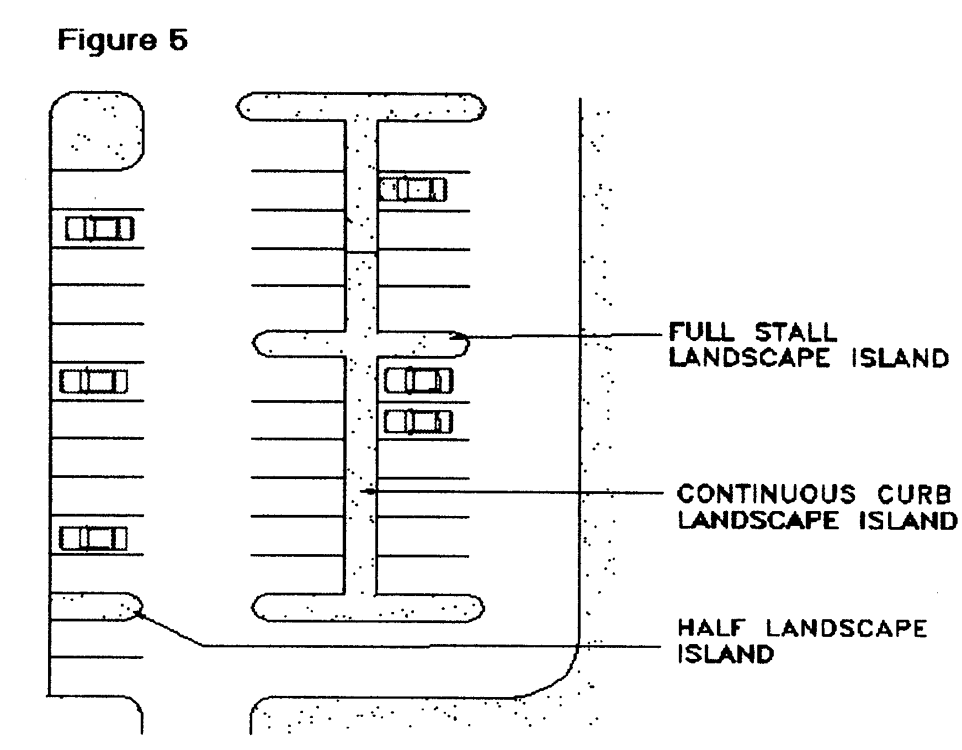
Figure 5
3.
In addition to required trees, an appropriate planting of shrubs, ground cover plants, flowers, sod lawn and mulch shall be provided within all landscape islands. To ensure visibility, shrubs shall not exceed a mature height of 30 inches above the pavement on landscape islands at the end of parking rows.
4.
In cases where a proposed light pole or fixture to be placed within a curbed landscape island conflicts with a required large deciduous tree, an understory (ornamental) tree as approved by the planning and development administrator or designee may be substituted in its place. The curbed landscape island shall contain a minimum of five additional plant units, such as ground cover and/or shrubs, to offset the loss of the large deciduous tree.
5.
Parking lot landscape islands shall not be used for snow storage. Separate snow storage areas shall be designated on the landscape plan.
6.
A minimum five-foot wide curbed planting bed or other width determined by the village board shall separate drive-through lanes from adjacent driveways, parking lot drive aisles or other vehicular areas. A continuous row of shrubs and ground cover shall be placed within this area. The village board may waive the requirement for a curbed planting bed separation between a drive-through and other vehicular areas, subject to additional landscaping being placed in other areas of the site to properly screen the drive-through from adjacent uses.
f.
Site interior landscaping.
1.
In developments with more than one structure, the open space between buildings shall be appropriately landscaped to provide:
i.
Screening of adjacent dwelling units.
ii.
Screening and shading to improve energy efficiency.
iii.
A visually appealing living environment.
2.
Open space areas within the interior of a site should generally contain a minimum of 20 plant units per 5,000 square feet of open space .
g.
Storm water management areas.
1.
In all zoning districts, storm water management areas shall be appropriately landscaped on all sides adjacent to residential uses or to a public or private roadway. The perimeter of the storm water management area shall be calculated as the lineal perimeter of the smallest regular geometric figure needed to completely encompass the pond when measured at the high water level.
2.
In all developments, landscaping in a quantity equal to 35 plant units per 100 lineal feet of perimeter length shall be provided along the stormwater area perimeter. Species and design considerations shall determine plant spacing. Designs shall encourage natural groupings of plant elements.
3.
If the storm water management screening requirements conflict with requirements for other landscaping areas, then the provisions requiring the greater number of plant units shall apply.
4.
In addition to the above, native landscaping may be permitted for storm water management areas at the discretion of the village board, subject to the following:
i.
Identification of all seed mixes, including, but not limited to, prairie, wet prairie and emergent wetland, and planting rates shall be noted on the plans. The mature height of all seed mixes shall be provided. The requirement of 35 plant units per 100 lineal feet of storm water area perimeter length shall be applicable for the balance of the required storm water area perimeter.
ii.
A separate letter of credit shall be submitted to cover the naturalized landscape improvements. The letter of credit shall include the estimated cost of naturalized landscape installation, monitoring and establishment management. The establishment period for native landscaping shall be three years from the date of completion of the installation.
iii.
The developer shall utilize a naturalized landscape specialist. Naturalized landscapes shall be installed and managed by individuals or companies with qualifications and/or experience with such landscapes. Qualifications are to be provided to the village through the submittal of references, photographs, resumes and/or other means that demonstrate the individual's or company's ability to install and/or manage naturalized landscapes.
iv.
In order to ensure long-term maintenance of any naturalized landscape area not dedicated to a public agency after establishment and approval by the village, the property owner or owners' association shall hire a naturalized landscape specialist for routine inspections and maintenance, and shall provide the specialist's contact information to the village. To further ensure long-term maintenance if the owner or owners' association fails in its responsibilities, the village shall require the establishment of a special service area.
v.
The owner, owners' association or other responsible party shall provide the village with a report on the naturalized landscaping noting any concerns and required actions to correct any problems every five years after the date the naturalized area is first established and approved by the village.
vi.
An educational pamphlet explaining the environmental benefits, aesthetics, plant and wildlife habitat, and restrictions concerning mowing, cutting, dumping and placement of gardens or other structures within a naturalized detention area shall be created by the developer and shall be distributed to all buyers at the time of closing on each lot in the development.
(3)
Design requirements. Functional activities within and adjoining the development site must be considered in the design of landscape improvements, including consideration of the following:
a.
Service area screening. Service areas shall be screened from view through the use of evergreen plant materials or solid structural, non-plant material walls compatible with the proposed building design.
1.
Trash dumpsters and other waste receptacles or equipment shall be screened with three-sided brick or other approved solid, non-plant material walls at least six feet in height, with a solid, attractive single or double access gate on one side only. The trash enclosure material shall match the materials and colors of the principal building.
2.
All utility equipment (meters, transformers, etc.) shall be provided with appropriate planting screens. All ground-mounted dish antennas shall be adequately screened from adjoining properties by an opaque wall, fence, hedge or berm.
3.
All garage doors and loading areas shall be fully screened so as not to be visible from adjoining property zoned for any residential use.
4.
All outside storage facilities permitted in an industrial district shall be effectively screened from public rights-of-way, residential land uses, adjacent commercial uses and, unless waived by the community development director or designee, from all adjacent industrial uses by a solid wall or fence at least eight feet in height, and landscape screening shall be provided in addition to the fence or wall, installed along the outside perimeter of the fence or wall, equal to or exceeding the height of the materials to be stored outdoors.
All outside storage permitted in a commercial district shall be effectively screened from public rights-of-way, residential land uses and all non-residential uses by a solid wall or fence, and landscape screening shall be provided in addition to the fence or wall, installed along the outside perimeter of the fence or wall, equal to or exceeding the height of the materials to be stored outdoors. In no case shall stored materials exceed the height of the provided screening.
b.
Intersection visibility. Landscaping must be designed and installed to minimize potential obstruction of critical sight lines. Landscape planting shall be so designed as to avoid obstruction of a motorist's vision at the intersections of outlet access drives and ring roads, access roads or municipal streets. Unobstructed visibility between two feet and six feet above the height of the paved surface of the access road must be maintained at all intersections. To maintain this visibility, no shrubs or other landscape material which will reach a mature height greater than two feet shall be permitted within ten feet of the right-of-way of a major arterial, or five feet from the right-of-way of a lesser roadway, for a distance of 40 feet from the right-of-way intersection (see figure 6). Trees are not allowed in these critical visibility areas.
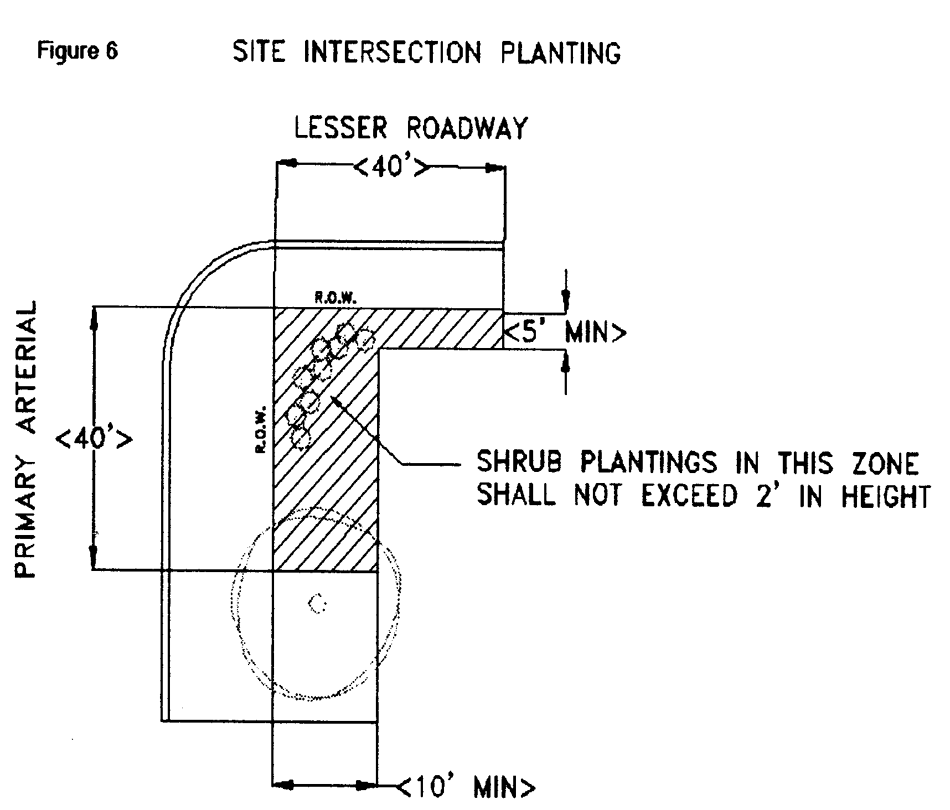
Figure 6
c.
Parking area planters. All parking area planters shall be over-excavated to a 2.5-foot depth for their entire width and length, shall be backfilled with an appropriate mix of black dirt, top soil, peat moss and nutrients to replace the excavated material, and shall be compacted, leaving a crowned or mounded top. Clay and stone shall not be used as backfill. Parking area planters shall be maintained so that the level of backfill is consistent with the top of curb.
d.
Slope of berms. Berming shall not exceed a maximum slope of 3:1, except in parking islands, where the maximum slopes shall not exceed 2:1.
e.
Mulch. Mulch materials shall be shredded bark or other organic material best suited for the area in compliance with the American Standards of Nursery Stock published by the American Association of Nurserymen. Lava rock or large diameter (1½-inch diameter plus) bark chips ("chunk bark") are not acceptable. Gravel and stone mulches are not permitted, unless specifically approved in writing by the village. Mulch beds at the time of planting shall extend a minimum of two feet beyond the center of the shrub. Mulching shall be renewed on an annual basis, at a minimum, to ensure optimum plant health of the landscaping elements.
f.
Fences. All wood fences proposed to be used to meet perimeter screening requirements shall be of red cedar, redwood, cypress or other approved decay-resistant treated wood, at least six feet high, and of solid construction. Wood fences shall be not less than 75 percent opaque, with all supporting posts exposed to the lot interior. Stockade type fences are not permitted.
(Ord. No. 1370, § 1, 12-12-2001; Ord. No. 1428, §§ 2, 3, 11-12-2004; Ord. No. 2040, §§ 6—17, 5-18-2009; Ord. No. 2675, §§ 1, 2, 11-13-2017; Ord. No. 3021, §§ 1, 2, 10-10-2022; Ord. No. 3087, § 1, 12-11-2023)
Sec. 106-426. - Standards for plant materials; planting guidelines.
The following guidelines shall be considered in reviewing design and implementation of landscape plans in conjunction with review of site plans and special use permits:
(1)
General standards for plant materials. Materials plans in any development shall comply with the following requirements:
a.
The quality and size of plant materials selected shall comply with the latest edition of the American Standards of Nursery Stock, published by the American Association of Nurserymen, unless otherwise noted.
b.
Plant material used in conformance with the provisions of this article shall be selected to provide climate hardiness of plant material, disease and pest resistance and stress tolerance, adaptability of proposed plant material to the particular microclimate (sun, shade, dry or wet soils,) in which it is located, inclusion of native plant material where appropriate, and overall year round ornamental effect.
c.
Plant material shall be healthy, free of insects and diseases, physical damage (bark bruises, cracked branches, scrapes), and exhibit a central leader when applicable.
d.
The use of stone, rock or gravel shall not be used as ground cover within any landscaped area, unless authorized by the village board when used as a decorative accent or as part of an appropriate landscape concept.
e.
No artificial plants of any type shall be used to meet the requirements of this article in any landscape areas within the parcel.
f.
Minimum sizes for plant materials at time of installation for all landscape areas shall be as follows:
1.
Deciduous trees shall be a minimum of two and one-half inches caliper when installed. Evergreen trees shall be a minimum of six feet in height when installed.
2.
Deciduous shrubs (other than dwarf varieties) shall be a minimum of four feet in height at time of installation if used as a perimeter screen planting, and 30 inches in height for all other installations. Dwarf varieties and plants normally measured by spread shall be a minimum of 24 inches in height/spread.
3.
Ground cover shall be so planted and spaced that complete coverage can be obtained within two years after the date of installation.
g.
Property owners shall be responsible for maintaining all landscaping shown on the approved landscape plans throughout the life of the development. In particular, landscaping shall be watered as often as needed to maintain optimum plant health. All dead plants shall be replaced with plants that meet original requirements. No changes shall be permitted without approval of the planning and development administrator, subject to Resolution 08-04. Annual flowerbeds shall be replanted each year with flowers adapted to the village.
(2)
Guidelines for planting trees. The trees recommended in subsection (4) of this section have minimal maintenance requirements. However, all trees must receive a certain degree of care, especially during and immediately after planting. To protect an investment in a new tree, the developer shall ensure that proper horticultural techniques are followed. The following recommendations are provided as a guide for planting based on current horticultural practice:
a.
The best times for planting are early spring and each fall.
b.
Planted trees and shrubs shall be at least three feet from the back of curb along head-in parking spaces to prevent damage from car overhangs. Mulch, lawn or planted ground cover shall be utilized in this three-foot area. Aligning trees with the strip between parking stalls will further help avoid damage.
c.
Tree pits should be dug at least one foot wider than the root ball.
d.
Especially in areas where construction activity compacted the soil, the bottom of the pit shall be scarified or loosened with a pickaxe or shovel.
e.
After a pit is dug, subsurface drainage conditions should be observed. Where poor drainage exists, special provisions shall be made to ensure proper drainage around the tree.
f.
Backfill shall include a proper mix of soil, peat moss and nutrients. All roots must be completely covered. Backfill shall be thoroughly watered as it is placed around the roots.
g.
Plants shall remain plumb and level. Newly planted trees must be supported with stakes and ties to hold the tree firmly in place. Stakes and ties should be removed after one year.
h.
A three-inch saucer shall be provided at the outer edge of the rootball to form a basin around the trunk of the tree. This saucer helps catch and retain moisture. At least two inches of mulch should be spread over plant beds, not including the saucer, in order to retain moisture and keep down weeds.
i.
The lower trunks of new trees must be wrapped with burlap or paper to prevent evaporation and sunscald. The wrapping shall remain on the tree for at least one year.
j.
Conscientious post-planting care, especially watering, pruning and fertilizing, is a must for street and parking lot trees. Branches of new trees may be reduced by as much as one-third to prevent excessive evaporation.
(3)
Guidelines for planting shrubs. Shrubs planted for screening purposes shall be given a proper growing environment. Many of the guidelines for tree planting listed in subsection (2) of this section also apply to shrubs. However, because specific requirements vary considerably between shrub types, this section does not attempt to specify the needs of all shrubs.
(4)
Recommended trees, shrubs and ground covers. The lists in table 6 in section 106-427 indicate plantings that will meet the landscape requirements of this article. The lists are by no means comprehensive and are intended merely to suggest the types of flora that would be appropriate for these purposes. Plants were selected for inclusion on these lists according to four principal criteria:
a.
General suitability for the climate and soil conditions of this area;
b.
Ease of maintenance;
c.
Tolerance of city conditions; and
d.
Availability from area nurseries.
(Ord. No. 1370, § 1, 12-12-2001; Ord. No. 2040, §§ 18, 19, 5-18-2009)
Sec. 106-427. - Recommended trees, shrubs and ground covers.
TABLE 6. RECOMMENDED TREES, SHRUBS AND GROUND COVERS
(1)
Large evergreen trees.
(2)
Large deciduous trees.
(3)
Small deciduous trees.
(4)
Large deciduous shrubs.
(5)
Large evergreen shrubs.
(6)
Small evergreen shrubs.
(7)
Small deciduous shrubs.
(8)
Ground covers.
Notes:
Trees listed in italics are recommended for use as street trees or in parking areas.
Trees used in parking areas and as street trees shall be of a fruitless species.
Certain species may not be recommended from time to time due to current biological threats or other recognized industry practices.
(Ord. No. 1370, § 1, 12-12-2001; Ord. No. 2040, §§ 20, 21, 5-18-2009; Ord. No. 2675, § 3, 11-13-2017)

