
Noblesville Township
City Zoning Code
City Zoning Code
ARTICLE 10
US 31 OVERLAY DISTRICT
1.- PURPOSE AND INTENT
It is the purpose of the United States Highway 31 overlay district (the "US 31 overlay") to promote the public health, safety, comfort, convenience, and general welfare by providing for consistent and coordinated treatment of the properties adjacent and adjoining the US Highway 31.
US Highway 31 is a 4-lane, limited access highway. It is the further purpose of the US 31 overlay to preserve the aesthetic qualities of those bordering properties through:
A.
The promotion of coordinated development,
B.
The establishment of architectural standard,
C.
The establishment of lot development standards will encourage substantial capital investments, and
D.
Encourage capital investment and economic development by promoting increased density and mixed-use developments.
Several figures are referenced within this article. These figures are intended to illustrate the specific subjects of the paragraphs in which they are referenced and may not illustrate a structure that fully complies with all standards of this ordinance.
2. - APPLICABILITY
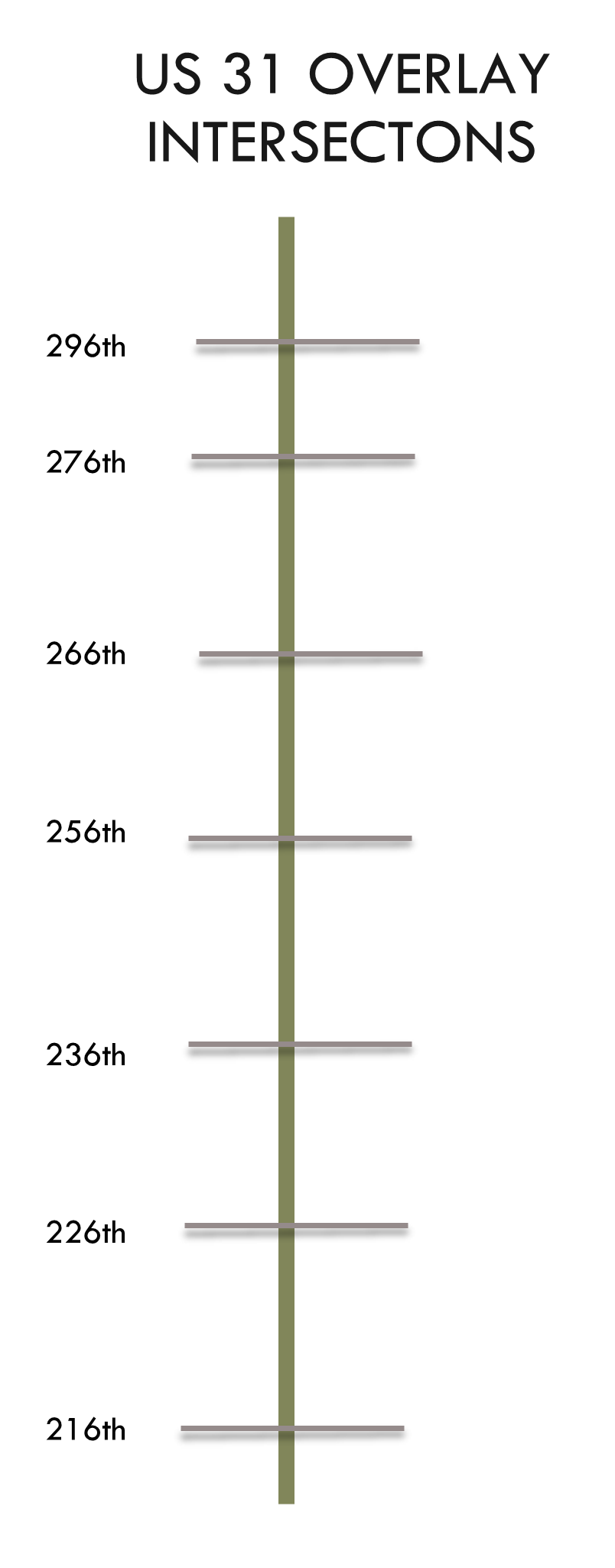
The boundaries of the US 31 overlay are hereby established for an area approximately two thousand six hundred and forty (2,640) feet (Dunbar Road) on the west side of the US 31 right- of-way line in Adams Township, Hamilton County, extending from 216th Street to 296th Street.
The provisions of this article shall apply to any petition, application, development plan, or improvement location permit for real estate within the US 31 overlay.
Development standards provided herein are intended to expand those permitted in the underlying zoning classification and may be more restrictive than the underlying zoning classification. If a conflict between districts occurs, the more restrictive shall apply.
3. - ADMINISTRATION
The director is hereby authorized to determine whether the standards of this article shall apply to the entire lot or if the standards of this article may be limited only to the proposed improvements for lots that were developed or improved prior to the effective date of this article. The following factors shall be taken into consideration:
A.
The extent and location of the proposed improvements (e.g., drainage, landscaping, parking, buildings) on the lot.
B.
The extent of conflicts in applying the standards of this article with existing and/or planned improvements.
Disclaimer on rezoning. The US 31 overlay criteria and standards do not change the zoning of land. The provisions of the US 31 overlay apply to all zoning classifications and to land uses that are designated as nonconforming.
US 31 overlay committee. The plan commission shall establish a "US 31 overlay committee" to review development plans and make recommendations to the appropriate plan commission approval body and/or executive director.
4. - REFERENCE ARTICLES/SECTIONS
Permitted use table
Signs
Parking
Planned unit development standards
5. - DEVELOPMENT STANDARDS
A.
Massing. In general single, large structures that consume the lot shall be avoided.
i.
Lot widths 100'-300' shall have up to 2 principal buildings. Cumulative minimum building width shall be 75% of the lot width.
ii.
Lot widths over 300' shall a minimum of 2 principal buildings. Cumulative minimum building width shall be 75% of the lot width.
6. - DEVELOPMENT STANDARDS FOR PARCELS DIRECTLY ADJACENT TO DUNBAR RD
7. - PUBLIC NETWORK
A.
All new streets shall connect to primary and collector streets.
B.
New streets shall maintain and/or enhance the county road grid.
C.
No dead-end streets are permitted.
D.
Round-abouts are permitted.
8. - ARCHITECTURAL DESIGN REQUIREMENTS
In addition to any provisions that apply to the underlying zoning district, the architectural plan of any building proposed to be built in the US 31 overlay must be compatible with other buildings and structures in the same and adjacent developments.
A.
General design theme standards. Architectural variation is encouraged. These architectural requirements are intended to provide consistent architectural quality among buildings and other improvements within the corridor. All structures shall be thoughtfully designed in a manner that visually and functionally complements the existing topography.
B.
Orientation. All structures shall front the nearest public right-of-way. No garage/warehouse doors shall be allowed on the façade facing US 31.
C.
Building elevation.
i.
Primary façade. All building façade shall have a defined base or foundation, a middle or modulated wall, and pitched roof or articulated three-dimensional cornice as illustrated in figure 1 Building Modulation.

FIGURE 1 BUILDING MODULATION
ii.
Corner feature. Structures located at a major intersection shall have a building corner feature that is architecturally significant.
iii.
Parking garage façade. Must have 2 or more materials and have an architectural design that breaks-up the monotony of openings and shall compliment the style of the primary building.
iv.
Step-backs. Step-back (or change of plane) façades are encouraged. Any step-back shall be a minimum of 12'.
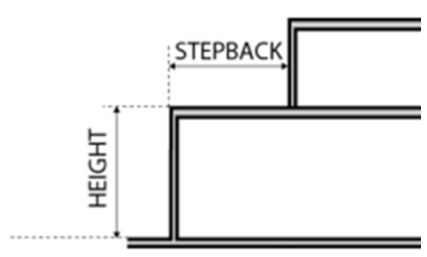
FIGURE 2 BUILDING STEP-BACK
v.
No wall that faces a street or pedestrian way shall be blank or have uninterrupted materials.
D.
Building materials.
i.
Masonry or glazing materials shall be the preferred and primary exterior building material used on buildings within the corridor.
ii.
Masonry materials shall be used to create a wainscot or brick-wrap effect around buildings.
iii.
A minimum of sixty percent (60%) of each building façade, exclusive of windows, doors and loading berths, shall be covered with masonry or glazing materials.
iv.
No more than twenty-five percent (25%) of each building façade, exclusive of windows, doors and loading berths, may be covered with metal, fiber cement siding, polymeric cladding, EIFS, stucco, or vinyl exterior building materials.
v.
EIFS shall not be permitted within 8-feet of the ground level.
vi.
Increased and enhanced use of masonry material and other architectural ornamentation shall be required around building entrances and on building façades visible from US 31.
vii.
Buildings shall be constructed with the same building material quality and level of architectural detail on all building façades (e.g., 360-degree architecture).
viii.
Main entrances.
a.
All buildings shall be designed with a main entrance and at least two (2) window openings associated with the main entrance.
b.
Building entrances shall be clearly defined and articulated by multiple architectural elements such as lintels, pediments, pilasters, columns, awnings, porticos, and other design elements appropriate to the architectural style and details of the building.
ix.
Windows.
a.
All window designs shall be compatible with the style, materials, color, details, and proportion of the building. The number of windowpanes, the number of window openings, window trim and other architectural design elements designed to accent the windows shall be consistent with and complementary to the architectural style of the building (see FIGURE 3 WINDOW DESIGN).

FIGURE 3 WINDOW DESIGN
b.
Window trim and other architecture design elements designed to accent the windows shall be required for all windows. Acceptable design elements include shutters, keystones, masonry arches, awnings, decorative stone frames, masonry rowlock frames.
x.
Awnings.
a.
Fixed or retractable awnings are permitted if they complement the building's architectural style, material, colors, and details.
b.
Awnings shall be made of a nonreflective material.
c.
All awnings shall be kept in good repair.
d.
Awnings used to comply with the architectural design requirements of this article shall not be removed unless the building façade would otherwise comply with such architectural design requirements without such awnings.
xi.
Openings.
a.
Design elements of the building façade shall be organized such that openings (including windows, doors, loading berths, faux windows and architectural or painted elements resembling openings) line up horizontally and vertically with other openings.
b.
Openings in a building façade shall be arranged in a balanced, relatively uniform fashion (see FIGURE 4: OPENING BALANCE).
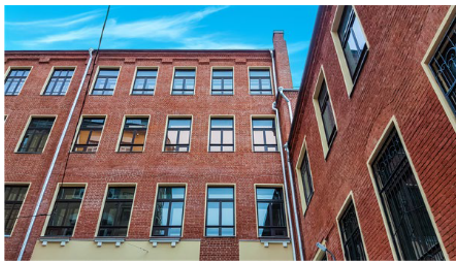
FIGURE 4 OPENING BALANCE
c.
Exceptions may be permitted if openings are organized in an aesthetically pleasing manner and constitute an essential artistic design element appropriate for the building type, scale, orientation, location, and site.
xii.
Gutters and downspouts. Shall be visually integrated with the architectural style of the structure. The color of gutters and downspouts shall be selected to complement or to be consistent with the building materials.
xiii.
Roof.
a.
Flat roofs.
i.
Flat roofs are permitted if edged by a parapet wall with an articulated, three- dimensional cornice as illustrated in FIGURE 5 ARTICULATED CORNICE.
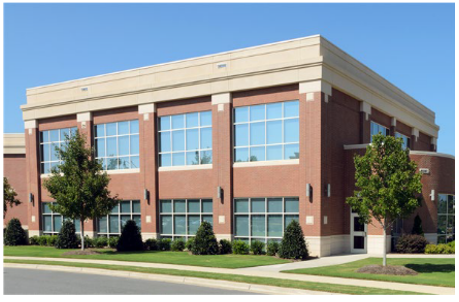
FIGURE 5 ARTICULATED CORNICE
ii.
Parapet walls shall be fully integrated into the architectural design of the building to create seamless design transitions between the main building mass and roof-mounted architectural elements (which may include screening elements for roof-mounted equipment).
iii.
Modulation or variation of the roofs and/or roof lines are required. Buildings shall comply with at least one of the following:
1.
A building with a flat roof shall have varying roof height sections, as illustrated in FIGURE 6 FLAT ROOF VARIATION. A varied roof section shall have a minimum roof height difference of five (5) feet from an adjacent roof section. The maximum horizontal roof line length without variation shall be sixty percent (60%) of the total length of the building façade's roof line.
FIGURE 6 FLAT ROOF
2.
A roof line modulation shall include a vertical change in the visible roof line of at least four (4) feet, with a minimum aggregate modulation length of forty percent (40%) of each building façade. The maximum horizontal roof line length without modulation shall be sixty (60) feet, or forty (40) feet for buildings with a gross floor area less than ten thousand (10,000) square feet.
iv.
All visible vents, attic ventilators, turbines, flues, and other visible roof penetrations shall be: (a) painted to match the color of the roof or flat black; and (b) oriented to minimize their visibility from adjacent lots and streets.
b.
Pitched roofs.
i.
Pitched roofs shall be simply and symmetrically pitched and only in the configuration of gables and hips, with pitches ranging from 4:12 to 14:12.
ii.
If standing seam panels are used then they shall be: (1) gray, black, dark blue, dark green, barn red or deep brown; and (2) made of a nonreflective material.
iii.
Modulation of the roofs and/or roof lines shall be required in order to eliminate the appearance of box-shaped buildings.
E.
Drive-thrus and fueling stations. This section shall apply to parcels adjacent major intersections.
i.
Drive-thru windows and lanes shall not be permitted in between the US 31 right-of-way line and the building façade nearest to said right-of-way line (e.g., front yard).
ii.
Vehicular fuel pumps and canopies shall be setback a minimum of thirty (30) feet farther from the US 31 right-of-way line than the front yard of the principal building to which fuel pumps or canopies are appurtenant or associated.
F.
Accessory buildings. All Accessory buildings shall be architecturally compatible with the principal building(s) with which they are associated and not located between the primary façade and US 31.
G.
US 31 frontage (access) roads. Frontage/access roads adjacent/parallel to the US 31 corridor are discouraged.
H.
Parking. Only one bay of parking may be in the US 31 front yard. See parking article for additional requirements.
I.
Open space. The protection to streams, waterbodies, distinctive topography, wooded areas, wetlands, environmentally sensitive areas is encouraged. Minimum width of the open space shall be no less than 30'.
J.
Miscellaneous requirements.
i.
Utilities. All new utility services and service revisions necessary for development shall be underground. Hookup to water, storm, and sanitary sewer systems is required.
ii.
Loading berths.
a.
Loading berths shall be oriented in a manner so they are not visible from US 31 and in a manner that minimizes their visibility from other rights-of-way and adjacent properties.
b.
The use of loading berth enclosures shall be utilized where appropriate to accomplish the design objectives of this subsection.
c.
All loading berths shall be adjacent to the principal building and located entirely within the side or rear yard.
d.
Loading berths shall be screened to the extent reasonably necessary by installing solid, opaque walls or fences (chain link fences or a variation thereof shall not be permitted). Mounds or berms may also be utilized, or utilized in combination with walls or fence enclosures, to provide screening. Special attention shall be given to accomplish the design objectives herein for visibility of loading berths from adjacent properties and rights-of-way.
e.
Loading berth walls and fences shall be softened by installing the following adjacent to such screens, except no landscaping shall be required adjacent to access and delivery doors or gates:
i.
One (1) ornamental or evergreen tree every thirty (30) feet.
ii.
Five (5) shrubs every thirty (30) feet.
iii.
Mechanical equipment.
a.
Screening of mechanical equipment, satellite dishes and other similar improvements shall be completely and permanently screened from view of rights-of-way and adjoining properties.
b.
When attached to the ground, screening methods shall include a mound/berm or an opaque wall or fence enclosure of a material that matches or complements the principal building.
c.
When roof-mounted, screening methods shall include parapet walls, enclosures or other similar architectural treatment that matches or complements the principal building.
iv.
Walls and fencing.
a.
The following wall and fence types are permitted: Masonry material, decorative metal (wrought iron, or wrought iron in appearance) or finished wood (stained or painted). In areas requiring security, decorative metal fencing with a spiked or curved top profile or razor/concertina/barbed wire mounted inside a solid fence or wall is recommended. This type of fence shall only be permitted with the express written approval of the director and may not be permitted in all cases based on the visibility of the fence.
b.
The following wall and fence types are prohibited in areas visible from outside the lot on which such walls or fences are installed: Nonsolid and/or unfinished wood, chain link (with or without slats), nondecorative corrugated metal, electrified fences, and razor/ concertina/barbed wire.
c.
Walls and fencing shall not be in an established front yard.
v.
Outside storage of refuse. No outside, unenclosed storage of refuse shall be permitted on any lot. All refuse shall be contained in completely enclosed facilities; no refuse containers or enclosures shall be visible from US Highway 31.

