
North Redington Beach
City Zoning Code
City Zoning Code
ARTICLE VI
SUPPLEMENTAL DISTRICT REGULATIONS
DIVISION 2. - SATELLITE ANTENNAS[6]
Cross reference— Franchises, app. A.
DIVISION 3. - WIRELESS COMMUNICATION FACILITIES[7]
Cross reference— Franchises, app. A.
Sec. 98-350. - Business of outdoor advertising prohibited.
The business of outdoor advertising shall be a prohibited land use in all zoning districts.
(Ord. No. 2017-786, § 4, 4-26-2017)
Sec. 98-351. - Application of district regulations.
(a)
Except as hereinafter provided:
(1)
No building or structure or part thereof hereafter shall be erected, constructed, reconstructed, moved or structurally altered, unless in conformity with the regulations specified for the district in which such building or structure is located.
(2)
Notwithstanding the provisions of subsection (a)(1) of this section, a variance will not be required for construction, reconstruction, moving or structural alteration which does not add to or otherwise impact upon an existing nonconformity.
(3)
No building or other structure hereafter shall be erected or altered:
a.
To accommodate or house a greater number of families;
b.
To have narrower or smaller rear yards, front yards, side yards or other open spaces than required by this chapter;
c.
In any other manner contrary to the provisions of this chapter.
(4)
No part of a yard or other open space or off-street parking space required about or in connection with any building or structure for the purpose of complying with this chapter shall be included as part of a yard, open space, or off-street parking space similarly required for any other building. (In other words, no duplication so that two different structures require only the same open space.)
(5)
No yard or lot now existing or hereafter created shall be reduced in size or area below the minimum requirements set forth in this chapter. Within each district, regulations set forth in this chapter shall be minimum regulations and apply to each class or kind or building or land.
(b)
All territory which may hereafter be annexed or otherwise become part of the town or added to its present area by filling, establishment of official bulkhead lines or other means, shall be considered to be zoned in the same manner as contiguous territory inside previous town limits until classified or changed otherwise.
(c)
Prima facie evidence of certain uses in residential zoning district. Prima facie evidence of certain uses located in any residential zoning district, consisting of rentals for periods of less than 90 days and advertising or holding out to the public as a place rented for periods of less than 90 days shall include, but not be limited to, one or more of the following:
(1)
Registration or licensing for short-term or transient rental use by the state under F.S. Chapters 212 (Florida Tax and Revenue Act) and 509 (Public Lodging Establishments);
(2)
Advertising or holding out a dwelling unit for tourist housing or vacation rental use;
(3)
Reservations, booking arrangements or more than one signed lease, sublease, assignment or any other occupancy agreement for compensation, trade, or other legal consideration addressing or overlapping any period of less than 90 days; or
(4)
Use of an agent or other third person to make reservations or booking arrangements.
(Code 1985, § 22-246; Ord. No. 96-454, § I, 9-5-1996; Ord. No. 97-470, § 1, 3-13-1997; Ord. No. 2006-619, § II, 2-9-2006)
Sec. 98-352. - Land grading.
It shall be prohibited for any person to fill land or to change the grading, slope, or drainage of any lot, piece or parcel of land without prior application, approval and permit to do so. A separate permit shall not be required when the grading is included on a permit for construction of any structure. Any such filling or change of grade shall provide water runoff to the bay or to the streets and drainage structures. The runoff will traverse other public or private property only through established drainage easements.
(Code 1985, § 22-247)
Sec. 98-353. - Utility installations.
No electrical, mechanical or plumbing facilities or equipment, rough-in plumbing or electrical connections, fixtures or outlets will be installed below the base flood elevation as defined in section 78-1.
(Code 1985, §§ 22-153(3)(b), 22-168(3)(b), 22-198(1)(c))
Cross reference— Utilities, ch. 70.
Sec. 98-354. - Pervious paving or alternates.
(a)
For new construction or reconstruction of existing driveways or parking lots, pervious paving, or a subsurface drainage and retention system designed by a Florida registered professional engineer, with a minimum absorption factor of 50 percent shall be required for all parking spaces which exceed the minimum off-street parking requirements.
(b)
In lieu of the pervious paving in subsection (a) of this section, retention areas to hold an equivalent amount of stormwater runoff may be permitted on the same lot, or the two methods may be employed so long as the absorption factor or retention capability total the amount prescribed in subsection (a) of this section.
(Code 1985, §§ 22-153(11), 22-168(11), 22-183(5), 22-198(7), 22-213(5), 22-228.1(8))
Sec. 98-355. - Retention of stormwater required.
In all districts, the retention of stormwater shall be as required in this section and chapter 70, article V of this Code. All new accessory uses or accessory structures or expansion of accessory uses or existing structures which increase the existing impervious surface of a lot or parcel by 20 percent or more shall be required to provide on-site retention of stormwater equivalent to the first one inch of rainfall. This shall be calculated based upon the square footage of the increased impervious surface multiplied by 0.0833 to equal required cubic feet of retention volume. Where possible, overflow from the retention site should be through vegetated areas rather than channelized or piped.
(Code 1985, §§ 22-153(9), 22-168(9), 22-183(3), 22-198(4), 22-213(3), 22-228.1(6))
Sec. 98-356. - Moving structures.
No building shall be moved into and placed within the town limits unless such building conforms to the standard for new construction and pursuant to permit obtained under the same conditions and with like qualifications for new construction.
(Code 1985, § 22-248)
Sec. 98-357. - Temporary dwellings.
No trailer, lean-to, garage, tent or other type of temporary structure may be used for living purposes.
(Code 1985, § 22-249)
Sec. 98-358. - Fence/wall.
(a)
There shall be no fence/wall higher than four feet except as noted in subsections (b) and (i) of this section.
(b)
(1)
On properties with residential structures, a manufactured fence/wall not to exceed six feet in height may be constructed along the side of the property for the length of the residential structure on that side or the length of an adjacent residential structure on the other side.
(2)
On non-waterfront properties, a manufactured fence/wall not to exceed six feet in height may be constructed from the front building line of the property to the rear property line, and along the entire rear property line.
(3)
Upon written consent of the adjacent property owner, a hedge may be six feet in height from the rear setback line to the seawall or the property line. If the consent is withdrawn, the hedge must be trimmed to a height not to exceed four feet.
(c)
Shrubbery, trees and hedgerows are excluded from the height limitation between the front and rear setback lines. Shrubbery and hedgerows shall not exceed four feet in height from the setback lines to the property line or seawall. Individual trees, not constituting a hedgerow, may be planted within the setback area.
(d)
Fence/walls may be constructed in the setback area. However, no fence/wall shall be constructed in the right-of-way. Plantings shall be allowed which do not obstruct visibility for vehicular traffic from either direction in the roadway or from driveway ingress and egress.
(e)
A fence shall have its finished side facing out.
(f)
Notwithstanding section 315 of the Standard Swimming Pool Code, adopted in section 18-60, no fence/wall or screen enclosure shall be required around a swimming pool.
(g)
Any fence/wall constructed along a seawall be designed to allow for entry and exit of floodwater.
(h)
For property bordering the Gulf of Mexico, a safety rail made of corrosion-resistant metal not exceeding four feet in height may be constructed on top of or east of the seawall. The safety rail shall not exceed a thickness of three inches nor a width of four inches. Vertical members shall not be placed closer than three inches from the adjacent vertical member and shall not exceed a thickness of four inches nor a width of four inches.
(i)
In order to more clearly delineate and create a buffer between single-family residential and commercial, multifamily or public ownership zoning, the installation of a fence/wall or hedgerow may be allowed by special exception, and may be constructed in either single-family residential, multifamily residential, public ownership or commercial zoning categories after application to the town and approval by the board of commissioners. All new construction in commercial or multifamily zones shall be required to create a buffer to affected residential zones by the installation of a fence/wall or hedgerow after application to the town and approval by the board of commissioners. Fees as may be required for these special exceptions will be waived. The following criteria shall be considered in determining the granting of special exception as may be allowed in this subsection:
(1)
Basic need and necessity for a buffer zone.
(2)
The minimum necessary height of the fence/wall or hedgerow to accomplish its purpose.
(3)
Actual setback from property lines of the fence/wall or hedgerow to accomplish its purpose.
(4)
Type of material to be utilized for the fence/wall or hedgerow as to its value to accomplish its purpose.
(Code 1985, § 22-250; Ord. No. 96-444, § I, 1-11-1996; Ord. No. 2002-557, § I, 6-13-2002; Ord. No. 2002-558, § I, 7-11-2002; Ord. No. 2008-666, § I, 3-13-2008; Ord. No. 2010-695, § I, 8-12-2010; Ord. No. 2013-733, § 1, 7-11-2013; Ord. No. 2021-834, § 1, 9-9-2021)
Sec. 98-359. - Building on two or more lots.
Where the building or structure (otherwise permissible) is built upon two or more contiguous lots or parcels of land owned by the same owner, no rear or side setback line shall be required so as to deny the right to place the structure upon both or more of such contiguous lots or parcels of land in the same ownership, so long as the front and sides and rear setback line is observed as though the parcel of land built upon is treated as a single lot with front, rear and sideline setbacks of the structure or structures thereon measured respectively from the outside perimeter only.
(Code 1985, § 22-251)
Sec. 98-360. - Uses likely to cause nuisance or financial burden to town or impair public welfare.
Notwithstanding any use or construction or improvement authorized elsewhere in this chapter, no building or structure or facility or improvement shall be allowed anywhere within the corporate limits of the town which may, in the reasonable opinion of the board of commissioners, result in a public nuisance, in a private nuisance, or which, because of its demands or size or shape or dimensions or contemplated use, is likely to impair or overload or overtax any existing public utility or any other public service or any essential public facility within the town; or which, foreseeably within a reasonable period of time is likely to require substantial expense to the town for additional or extended public utility or public facility service; or which is likely to impair materially the public health or public safety or public welfare. If, however, the contemplated use or improvement will not violate the police powers, but foreseeably within a reasonable period of time will cause substantial increase or added expense to the town or its inhabitants via expansion of its sewer system or other public utility service, such use may be permitted only upon compliance with such reasonable permits, conditions, restrictions and financial arrangements as the town sees fit to impose as necessary or proper to protect its interest and make reasonably sure the proposed improvement will not be a financial burden on the town or its inhabitants.
(Code 1985, § 22-252)
Sec. 98-361. - Docks and piers.
(a)
No dock or pier may extend more than 36 feet beyond the established seawall line. The side setback for docks shall be as provided in specific zoning district setback requirements. The deck of any dock shall not exceed the height allowed for seawalls [4.25(NAVD) equivalent to 5.0(NGVD)]. No dock may be constructed or used that will interferes with equal access or use of a dock by any other property owner.
(b)
Boardwalks, docks and piers are prohibited on the Gulf of Mexico.
(c)
No boathouse or covered docks, covered boat lifts or covered davits are permitted in the town.
(d)
Tie poles shall not be in the required setbacks and shall not exceed a maximum height of ten feet above mean sea level nor shall the height be less than five feet above mean sea level. Tie poles, davits or boat lifts and/or boats suspended on davits or a boat lift or moored at the dock may not extend more than 54 feet beyond the established seawall line, nor more than 54 feet beyond the line of mean tide if no seawall or past the extended side property lines. No tie pole, davit and/or boat suspended on davits may be constructed or used that will interferes with equal access or use of a dock or tie pole by any other property owner.
(e)
In single-family districts docks are to serve only the residence; in other districts docks are to serve only the principal use. No vessel without a permit may be moored at any dock that is not registered or documented in the name of the owner or occupant or a legal entity controlled by the owner or occupant. A permit may be granted for one additional vessel for one period of 14 days during any six-month period in the same manner as permits are issued under section 30-101. Vessels may not extend beyond the interior of the extended property lines.
(f)
In addition to the above, dock construction on properties whose extended property lines intersect less than 36 feet from the seawall will also conform to the following:
(1)
Docks will be built in the center one-third of the property at the seawall.
(2)
The dock can extend beyond the established seawall line only to the point that the extended property lines meet the dock, but in no event in excess of 36 feet.
(3)
An agreement signed by both adjoining property owners must accompany the application for permit.
(g)
The term dock shall also include floating docks.
(h)
Docks are accessory uses to the principal structure. No dock shall be constructed until an application for a building permit is submitted for the principal structure. No use of the dock is allowed until construction has commenced on the principal structure.
(Code 1985, § 6-76(d)—(g); Ord. No. 2000-544, § I, 1-11-2001; Ord. No. 2004-586, § I, 9-9-2004; Ord. No. 2007-639, § I, 3-8-2007; Ord. No. 2007-640, § I, 3-8-2007; Ord. No. 2007-645, § I, 6-14-2007; Ord. No. 2010-691, § I, 6-10-2010; Ord. No. 2010-701, § II, 12-9-2010; Ord. No. 2012-718, § I, 6-14-2012)
County Code cross reference—Docks, § 166-321 et seq.
Cross reference— Seawalls and marine structures, § 18-136 et seq.; waterways and marine activities, ch. 74.
Sec. 98-362. - Swimming pools.
(a)
In the CT, CL and RM districts, swimming pools shall be constructed in compliance with existing setback requirements and may be constructed in the front, rear or side of the property. For multifamily residences on the water, the swimming pool shall be at least 15 feet from the front or side property lines. If the property is not on the water, the pool shall be placed at least 15 feet from the front, rear, and side property lines.
(b)
In single-family residential districts, all swimming pools shall be in the rear yard and shall not interfere with the seawall tiebacks and shall comply with the side setback requirements.
(c)
In-ground pools shall not be higher than the dwelling slab level. Water features (waterfalls, spas, etc.) shall not exceed 30 inches in height above the pool.
(d)
Aboveground pools are prohibited.
(Code 1985, § 6-20(c)—(e); Ord. No. 98-499, § I, 4-9-1998; Ord. No. 2008-662, § I, 3-13-2008; Ord. No. 2022-846, § 1, 4-14-2022)
Sec. 98-363. - Portable hydrotherapeutic whirlpools and spas.
(a)
Portable hydrotherapeutic whirlpools and spas means any pool having a maximum water depth of 48 inches and seat depth of 24 inches.
(b)
Portable hydrotherapeutic whirlpools and spas shall not exceed the depths described above and shall be prohibited in setbacks.
(Ord. No. 98-499, § II, 4-9-1998)
Sec. 98-364. - Home occupation.
The use of the dwelling unit for an occupation which is secondary to its use for residential purposes is permissible in the town, provided:
(1)
The employees of the business who work at the residential dwelling must also reside in the residential dwelling, except that up to a total of two employees or independent contractors who do not reside at the residential dwelling may work at the business. The business may have additional remote employees that do not work at the residential dwelling.
(2)
As viewed from the street, the use of the residential property must be consistent with the uses of the residential areas that surround the property. External modifications made to a residential dwelling to accommodate a home-based business must conform to the residential character and architectural aesthetics of the neighborhood.
(3)
The home-based business may not conduct retail transactions at the structure other than the residential dwelling; however, incidental business uses and activities may be conducted at the residential property.
(4)
Parking related to the business activities of the home-based business must comply with local zoning requirements and the need for parking generated by the business may not be greater in volume than would normally be expected at a similar residence where no business is conducted. Vehicles and trailers used in connection with the business must be parked in legal parking spaces that are not located within the right-of-way, on or over a sidewalk, or on any unimproved surfaces at the residence.
(5)
The business activities must comply with any relevant local or state regulations with respect to signage and equipment or processes that create noise, vibration, heat, smoke, dust, glare, fumes, or noxious odors.
(6)
All business activities must comply with any relevant local, state, and federal regulations with respect to the use, storage, or disposal of any corrosive, combustible, or other hazardous or flammable materials or liquids.
(Ord. No. 2003-569, § I, 7-10-2003; Ord. No. 2022-841, § 1, 2-10-2022)
Sec. 98-365. - Regulations for dogs in approved outdoor seating areas.
In accordance with the provisions of F.S. § 509.233, the following procedures for allowing patrons' dogs within certain designated outdoor portions of food service seating areas are established.
(1)
a.
In order to protect the health, safety, and general welfare of the public, the town shall require participating public food service establishments to apply for and receive a permit before allowing patrons' dogs on their premises. The town may require from the applicant all such information as it deems reasonably necessary to enforce the provisions of this section, but shall require, at a minimum, the following information:
1.
The name, location, and mailing address of the public food service establishment.
2.
The name, mailing address, and telephone contact information of the permit applicant.
3.
A diagram and description of the outdoor area to be designated as available to patrons' dogs, including dimensions of the designated area; a depiction of the number and placement of tables, chairs, and restaurant equipment, if any; the entryways and exits to the designated outdoor area; the boundaries of the designated area and of other areas of outdoor dining not available for patrons' dogs; any fences or other barriers; surrounding property lines and public rights-of-way, including sidewalks and common pathways; and such other information reasonably required by the permitting authority. The diagram or plan shall be accurate and to scale but need not be prepared by a licensed design professional.
4.
A description of the days of the week and hours of operation that patrons' dogs will be permitted in the designated outdoor area.
b.
1.
All public food service establishment employees shall wash their hands promptly after touching, petting, or otherwise handling dogs. Employees shall be prohibited from touching, petting, or otherwise handling dogs while serving food or beverages or handling tableware or before entering other parts of the public food service establishment.
2.
Patrons in a designated outdoor area shall be advised that they should wash their hands before eating. Waterless hand sanitizer shall be provided at all tables in the designated outdoor area.
3.
Employees and patrons shall be instructed that they shall not allow dogs to come into contact with serving dishes, utensils, tableware, linens, paper products, or any other items involved in food service operations.
4.
Patrons shall keep their dogs on a leash at all times and shall keep their dogs under reasonable control.
5.
Dogs shall not be allowed on chairs, tables, or other furnishings.
6.
All table and chair surfaces shall be cleaned and sanitized with an approved product between seating of patrons. Spilled food and drink shall be removed from the floor or ground between seating of patrons.
7.
Accidents involving dog waste shall be cleaned immediately and the area sanitized with an approved product. A kit with the appropriate materials for this purpose shall be kept near the designated outdoor area.
8.
A sign or signs reminding employees of the applicable rules shall be posted on premises in a manner and place as determined by the town.
9.
Reserved.
10.
A sign or signs shall be posted in a manner and place as determined by town that places the public on notice that the designated outdoor area is available for the use of patrons and patrons' dogs.
11.
Dogs shall not be permitted to travel through indoor or nondesignated outdoor portions of the public food service establishment, and ingress and egress to the designated outdoor portions of the public food service establishment must not require entrance into or passage through any indoor area of the food establishment.
c.
A permit issued pursuant to this section shall not be transferred to a subsequent owner upon the sale of a public food service establishment but shall expire automatically upon the sale of the establishment. The subsequent owner shall be required to reapply for a permit pursuant to this section if the subsequent owner wishes to continue to accommodate patrons' dogs.
(Ord. No. 2010-702, § I, 12-9-2010)
Sec. 98-366. - Marinas prohibited.
No marina may be constructed or operated in any zoning district.
(Ord. No. 2011-715, § I, 11-10-2011)
Sec. 98-367. - Lightning rods and storm detection systems.
(a)
Definitions.
(1)
Lightning rod shall mean a grounded metallic rod set up, placed, or mounted on a structure or building to protect from lightning or with the intent to divert lightning.
(2)
Storm detection systems, storm radar systems, or SRS shall be used interchangeably in this chapter, and shall mean a tower device that provides weather updates to citizens utilizing such properties upon which the device is located; these systems warn users of inclement weather and or lightning; such devices contain storm tracking and lightning warning systems to give early warnings signals as necessary and may contain a cellular communications component housed with the storm detection system.
(b)
Lightning rods and/or storm detection systems on rooftops, or mounts anchored to structures shall be subject to the compliance of the following criteria:
(1)
Design; all new lightning rods and/or storm detection systems shall be designed to mitigate visual impacts by use of criteria in this section.
(2)
Height: lightning rods and/or storm detection systems located on rooftops or anchored to structures shall not exceed 13 feet above the maximum height allowed in the zoning district in which the structure is located or the present height of the structure in place, whichever is less.
(3)
No part of any lightning rod and/or storm detection system shall be located closer than eight feet to any power line.
(4)
There shall be no more than one lightning rod or storm detection system per roof top.
(5)
All lightning rods and storm detection systems shall be installed and maintained in accordance with all applicable building, zoning, and land use code requirements.
(c)
Lightning rods and storm detection systems that have been lawfully erected prior to the effective date of this ordinance shall be considered legal nonconforming uses.
(d)
Any violation of this division shall be subject to the code enforcement provisions of Chapter 2 of the Town of North Redington Beach Code of Ordinances or to any other lawful means of enforcement.
(Ord. No. 2018-796, § 2, 4-12-2018)
Sec. 98-368. - Parking construction and design requirements.
(a)
General construction requirements.
(1)
All driveway and off-street parking areas shall be constructed of asphaltic concrete, concrete, pavers, or equal on a properly constructed and compacted base unless an alternative is approved by the town.
(2)
No slag, rock, pea gravel or other loose type of material shall be used.
(3)
All driveway aprons within the public rights-of-way shall be constructed of concrete. Residential driveway aprons within the public rights-of-way may be constructed of pavers.
(4)
All points of ingress/egress from parking areas to public rights-of-way shall be constructed only upon approval from the town or other public agency having jurisdiction over the right-of-way.
(b)
Single-family and two-family residential.
(1)
For each single family and two-family zoning lots there shall be no more than two driveways providing access to one street, however, in the case of corner lots, no more than three driveways shall be permitted for any lot.
(2)
The minimum width of any driveway shall be 12 feet, measured along the property line.
(c)
All other uses.
(1)
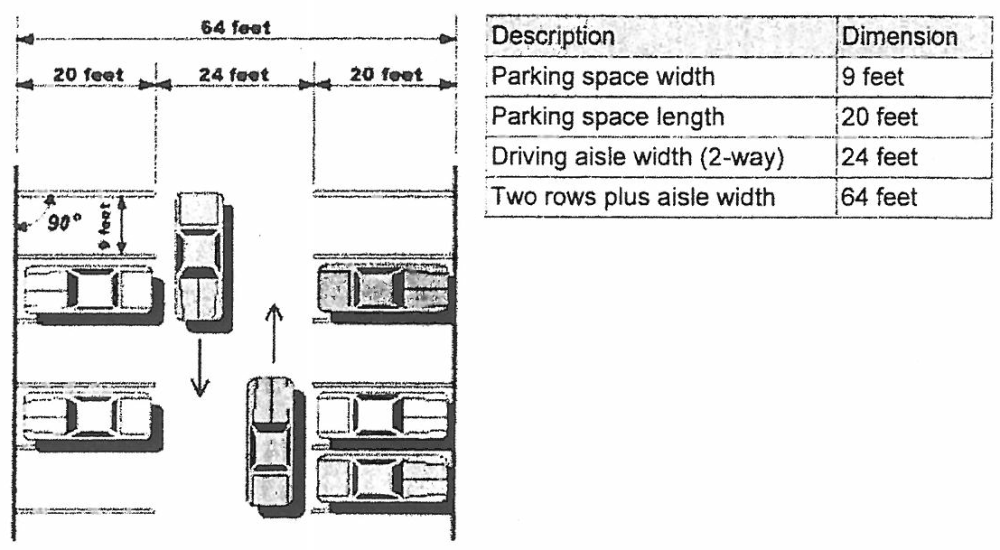
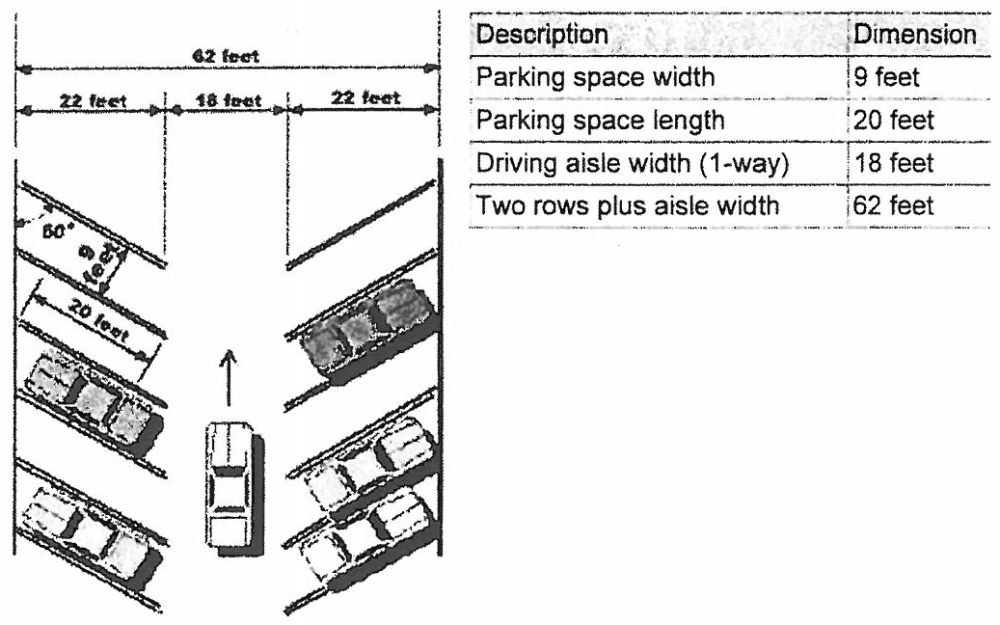
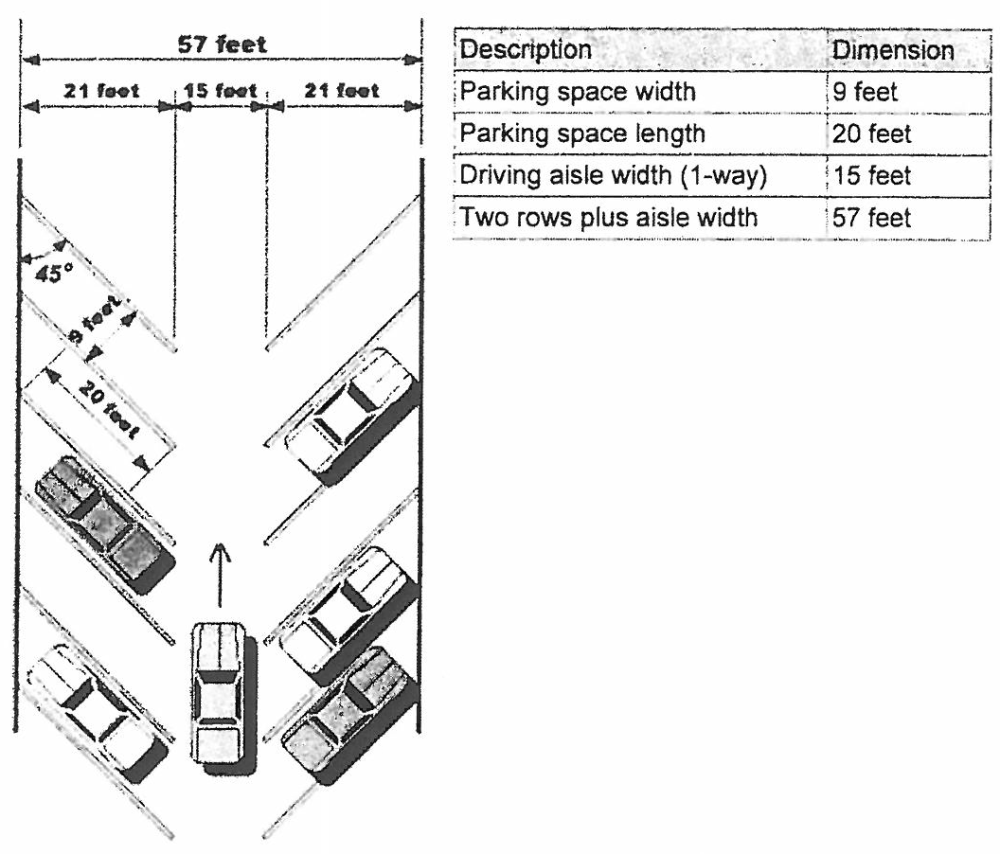
In additional to meeting the general construction requirements of paragraph (a) above, all off-street parking areas shall be designed and constructed in accordance with the dimensional requirements illustrated below, except that in developments requiring more than 50 total parking spaces, a maximum of 25 percent of such spaces may be designed for compact car parking and may be as small as eight feet by 16 feet in dimension. Any such space provided must be identified by legible signage as a compact car parking space. The board of commissioners may allow for the modification of the requirements in this section for commercial properties as the board of commissioners may deem appropriate
a.
Parallel. The dimensional requirements for parallel parking spaces are nine feet in width and 24 feet in length.
b.
Perpendicular - 90 Degree. The dimensional requirements for this configuration are:
c.
Angled - 60 Degree. The standard dimensions for this configuration are:
d.
Angled - 45 Degree. The standard dimensions for this configuration are:
(Ord. No. 2020-824, § 2, 9-10-2020; Ord. No. 2022-847, § 1, 4-14-2022)
Sec. 98-369. - Playground equipment.
(a)
Definitions.
(1)
Playground equipment shall mean any kind of structure or apparatus upon or around which a person may engage in play-like activities, including, but not limited to, climbing, swinging, hanging, crawling, jumping, stepping, whether over across, under through or upon for enjoyment, exercise or as part of relating to others of any age. Playground equipment includes, but is not limited to, swings, slides, and climbing apparatus.
(2)
Portable playground equipment shall mean any playground equipment as defined by (a)(1) which is not affixed to the ground and is readily movable.
(3)
Permanent playground equipment means any playground equipment as defined by (a)(1) which is affixed to the ground or is not capable nor designed to be readily movable.
(b)
Permitted area. Permanent playground equipment is permitted only within the buildable area of the rear yard of a lot and must be fully within the setback area of the lot's zoning district.
(Ord. No. 2022-848, § 1, 5-12-2022)
Sec. 98-381. - Definitions.
The following words, terms and phrases when used in this division, shall have the meanings ascribed to them in this section, except where the context clearly indicates a different meaning:
Satellite antennas means any parabolic or spherical device greater than one meter in diameter which receives television or other signals from orbiting satellites or other devises.
Web- or mesh-type antennas means an antenna primarily constructed out of web or mesh material so that it does not substantially impair visibility.
(Code 1985, § 22-253(a), (b); Ord. No. 2008-670, § I, 7-10-2008)
Cross reference— Definitions generally, § 1-2.
Sec. 98-382. - Requirements.
(a)
Residential zoning districts east of Gulf Boulevard. In all residential zoning districts east of Gulf Boulevard, the following requirements shall apply:
(1)
A satellite antenna shall not have a diameter greater than ten feet. There shall be no more than one satellite antenna per lot.
(2)
Only web- or mesh-type antennas are permitted for satellite antennas.
(3)
A building permit is required for each satellite antenna.
(4)
Satellite antennas and related guide wires shall be considered accessory structures and shall meet setback requirements. A building permit shall be required prior to the construction and installation.
(5)
Satellite antennas shall be appropriately finished to avoid bright light reflection. No advertising or signage of any type is permitted on the antenna.
(6)
All satellite antennas shall be placed in the rear or side yard and shall not be placed forward of the front corner of the main structure.
(b)
Special exception. If it can be demonstrated that the requirements in this subsection unreasonably restrict the reception of satellite signals or causes an undue burden upon the property owner, or would otherwise violate the provisions of federal law, the planning and zoning board may grant special exceptions as to height, size, type of antenna, infringement on setbacks, or placement in the front yard. The building inspector shall not allow a special exception for the placement in the front yard, unless it can be demonstrated that there exists no other reasonable alternative.
(Code 1985, § 22-253(c); Ord. No. 2000-541, § XIX, 9-7-2000; Ord. No. 2001-546, § I, 4-12-2001; Ord. No. 2008-670, § II, 7-10-2008)
Sec. 98-401. - Purpose and intent.
The purpose and intent of this division is to regulate the establishment of wireless communication support facilities in recognition of the public need and demand for advanced telecommunication and information technologies and services balanced against the impacts such facilities may have on properties within the town. This balance shall be established by:
(1)
Providing for the appropriate location and development criteria for wireless communication support facilities and wireless communication antennae within the town;
(2)
It is of the highest priority to the town that wireless communication support facilities be encouraged to be located in and surrounded by commercial uses;
(3)
Minimizing the adverse effects of such facilities through careful design, siting and screening criteria; and
(4)
Maximizing the use of existing and future wireless communication support facilities and encouraging multiple users on such facilities.
(Ord. No. 97-475, § III(a), 3-13-1997)
Sec. 98-402. - Wireless communication antennae.
(a)
To encourage collocation and to minimize the number of wireless communication support facilities within the town, wireless communication antennae shall be considered a permitted accessory use in all zoning districts when placed on or attached to any structure which constitutes a principal use, including existing wireless communication support facilities, provided that any wireless communication antennae shall not extend more than 20 feet above the tallest portion of the structure on or to which it is attached except as limited in section 98-402(d).
(b)
Wireless communication antennae shall require no personnel on the premises except as necessary for maintenance and repair.
(c)
If a wireless communication antennae requires an accessory equipment storage area, it shall be no greater than six feet in height and shall meet all zoning requirements.
(d)
Not more than two wireless communication antennae shall be allowed on any site used as a single-family dwelling unit. These wireless communication antennae shall be used solely to provide service to that single-family dwelling unit, shall not be used for any commercial purpose, and shall not exceed 12 feet above the roof line.
(e)
All wireless communication antennae shall be designed to blend into or meet the aesthetic character of the principle (primary) structure where reasonably practical taking into consideration the location of the wireless communication antennae and the line of sight angle and distance from the right-of-way and neighboring uses.
(f)
No accessory equipment storage areas shall be allowed in any government rights-of-way.
(g)
The installation of a wireless communication antennae in CL or CT zoning district must be reviewed by the planning and zoning board. The planning and zoning board shall review all such requests and shall approve such requests that meet the requirements of this division.
(Ord. No. 97-475, § III(b), 3-13-1997)
Sec. 98-403. - Wireless communication support facilities.
(a)
General criteria. General criteria for wireless communication support facilities shall be as follows:
(1)
All wireless communication support facilities shall be constructed in compliance with all applicable construction codes.
(2)
The wireless communication support facility shall comply with all applicable Federal Aviation Administration requirements.
(3)
The wireless communication support facility shall not be used for advertising purposes and shall not contain any signage thereon.
(4)
The wireless communication support facility may be located on a zoning lot containing other principal uses. The wireless communication support facility may be located within an area smaller than the minimum lot size of the applicable zoning district provided the zoning lot complies with the applicable minimum lot size for the existing principal use or is a legal nonconforming or grandfathered lot. The area within which the wireless communication support facility is located shall be the area subject to the requirements of this section, rather than the entire zoning lot, unless otherwise provided in this division.
(5)
The wireless communication support facility shall meet all requirements of the zoning district in which it is located which do not directly conflict with this division.
(6)
The wireless communication support facility shall have a landscaped buffer so that the base of the wireless communication support facility and accessory equipment storage area shall be screened from view. Such landscaped buffer may be placed on the site in a manner which will maximize the aesthetic and environmental benefits while at the same time providing the visual buffer required hereby. Such landscaped buffer shall consist of hedges planted leaf to leaf which shall reach a height of not less than six feet at maturity and shade trees of at least three inches diameter breast height planted every 30 feet along the approved buffer of a species approved by the planning and zoning board unless safety requirements require otherwise.
(7)
The construction of the wireless communication support facility shall be of monopole design unless it can be demonstrated that such design is not feasible to accommodate the user or collocation.
(8)
The application shall contain information showing the geographic search area within which the proposed wireless communication support facility must be located and shall also provide locations of all structures of similar height within and adjacent to the search area.
(9)
If collocation or location as a permitted accessory use is not part of the application then the applicant must demonstrate in the application as to why collocation or location as a permitted accessory use is not possible.
(10)
Wireless communication support facilities shall not have a shiny or reflective finish.
(11)
The applicant shall provide such financial assurances to the town as the town may reasonably require which shall insure the payment of the cost of removal of the wireless communication support facility when abandoned if the real property and wireless communication support facility do not provide substantial security for the lien provided for the removal of abandoned wireless communication support facilities by the town (for example: letter of credit, bond, cash held by the town).
(b)
Review criteria for all new wireless communication support facilities. Review criteria for all new wireless communication support facilities shall be as follows:
(1)
A new wireless communication support facility shall not be approved unless it can be demonstrated by the applicant that there is a need for the new wireless communication support facility which cannot be met by placing wireless communication antennae on an existing wireless communication support facility or on other structures or replacement of an existing wireless communication support facility. Information concerning the following factors, which shall be provided by the applicant, shall be considered in determining that such need exists:
a.
Insufficient structural capacity of existing wireless communication support facilities or other suitable structures and infeasibility of reinforcing or replacing an existing wireless communication support facility;
b.
Unavailability of suitable locations to accommodate system design or engineering on existing wireless communication support facility or other structures;
c.
Radio frequency interference or other signal interference problems at existing wireless communication support facility or other structures;
d.
A comparative evaluation (which may include cost studies) for the placement of a new wireless communication support facility versus the utilization of existing wireless communication support facilities, other structures (such as buildings or power transmission poles), the availability of alternative technologies or the placement of multiple smaller height wireless communication support facilities as alternatives to provide the same level of service. However, the fact that the use of an existing wireless communication support facility or other structure would cost more than the cost of constructing a new wireless communication support facility will not, absent other factors which include that the additional cost not be unreasonable, justify approval;
e.
Other factors which demonstrate the reasonable need for the new wireless communication support facility, which may include submittal of a copy of the Federal Communications Commission application and approval.
(2)
The applicant must include a statement in the application of its good faith intent to allow the collocation of the wireless communication antennae of other entities, provided that the cost of modifying the wireless communication support facility to accommodate the collocation wireless communication antennae is borne by the collocating entity.
(3)
The applicant shall send a written notice to all potential users of the new wireless communication support facility offering an opportunity for collocation. The list of potential users shall be based on those entities who have requested approval of wireless communication support facility in the past, current Federal Communications Commission license holders and any other entities requesting to be included on the list. Copies of the notice letters shall be provided to the town at the time the application is filed. If, during a period of 30 days after the notice letters are sent to potential users, a user or users request, in writing, to collocate on the new wireless communication support facility, the applicant shall accommodate the request, unless collocation is not reasonably possible based on the criteria of subsection (b) of this section.
(4)
The wireless communication support facility shall not exceed 150 feet in height and wireless communication support facilities over 100 feet in height shall be designed for collocation of at least one other wireless communication antennae.
(5)
The wireless communication support facility shall meet all criteria and requirements of subsection (a) of this section.
(6)
The installation of a wireless communication support facility in any zoning district must be reviewed by the planning and zoning board. The planning and zoning board shall review all such wireless communication support facilities and shall approve such wireless communication support facilities that meet the requirements of this division.
(Ord. No. 97-475, § III(c), 3-13-1997)
Sec. 98-501. - Intent
With the approval of Florida Constitutional Amendment #2 (Use of Marijuana for Debilitating Medical Conditions), the board of commissioners believes it is in the best interest of the citizens of North Redington Beach to ban medical marijuana treatment center dispensing facilities from being located within the town, because there are significant safety and security issues that exist for any establishment involved in the dispensing of medical marijuana, because they maintain large drug inventories and are compelled to conduct business in cash, and because their activities have not yet been sanctioned by federal law. Further, such businesses are inherently attractive targets for criminals, and it is therefore essential that the town prohibit such facilities to protect businesses and the community, to protect and advance the public health, safety and welfare, and to prevent the creation of attractive nuisances. The prohibition of medical marijuana treatment center dispensing facilities contained herein shall be enforced, unless pre-empted by state law or regulations.
(Ord. No. 2017-792, § 2, 12-14-2017)
Sec. 98-502. - Prohibition.
Medical marijuana treatment center dispensing facilities as defined in Ch. 381, F.S. are prohibited from siting, locating, opening or operating within the incorporated limits of the Town of North Redington Beach, Florida, as may be amended from time to time through annexation or otherwise.
(Ord. No. 2017-792, § 2, 12-14-2017)
Sec. 98-503. - Enforcement.
Any violation of this division shall be subject to the code enforcement provisions of Chapter 2 of the Town of North Redington Beach Code of Ordinances or to any other lawful means of enforcement.
(Ord. No. 2017-792, § 2, 12-14-2017)
Sec. 98-504. - Area embraced.
The regulations of this division shall be solely applicable to, and extend to, all properties, facilities, buildings or uses solely located within the town limits of the Town of North Redington Beach.
(Ord. No. 2017-792, § 2, 12-14-2017)

