
Nye County Unincorporated
City Zoning Code
City Zoning Code
CHAPTER 17
04 PAHRUMP REGIONAL PLANNING DISTRICT
569
563
588
590
562
509
593
597
583
564
600
592
601
616
587
582
581
598
594
17.04.010: Short Title
This chapter shall be known, and may be cited as the ZONING ORDINANCE OF THE PAHRUMP REGIONAL PLANNING DISTRICT. (Ord. 285, 2004)
17.04.020: Authority And Purpose
- This chapter is adopted pursuant to the Planning and Zoning Act of the State of Nevada1 and to any other authority provided by law or as such statutes may be amended. The provisions of this chapter are in addition to the regulations set forth in Nevada Revised Statutes chapter 278 and are supplemental thereto.
- The purpose of this chapter is:
- To preserve the quality of air and water resources.
- To promote the conservation of open space and the protection of other natural and scenic resources from unreasonable impairment.
- To provide for recreational needs.
- To protect life and property in areas subject to floods, landslides and other natural disasters.
- To develop a timely, orderly and efficient arrangement of transportation and public facilities and services, including facilities and services for bicycles.
- To ensure that the development on land is commensurate with the character and the physical limitations of the land.
- To take into account the immediate and long range financial impact of the application of particular land to particular kinds of development, and the relative suitability of the land for development.
- To promote health and the general welfare.
- To ensure the development of an adequate supply of housing for the community, including the development of affordable housing.
- To ensure the protection of existing neighborhoods and communities, including the protection of rural preservation neighborhoods if applicable.
- To be in accordance with the Master Plan for land use.
- It is the intent of the Nye County Commissioners that these regulations be applied with reasonable consideration given to the character of the planning district and its peculiar suitability for particular uses, and with a view to conserving the value of buildings and encouraging the most appropriate use of land throughout the planning district. (Ord. 285, 2004)
Notes:
1NRS 278.
17.04.030: Jurisdiction
- The provisions of this chapter shall apply to all of the following activities occurring within the Pahrump Regional Planning District of Nye County, Nevada:
- Determination, establishment, enforcement and amendment of zoning districts; and
- Granting of waivers and conditional use permits and other special exceptions.
- When necessary to further its purposes, this chapter shall be amended by the Nye County Board of County Commissioners. (Ord. 285, 2004)
17.04.040: Forms And Documents
All forms and documents referred to in this chapter shall be made available by, and may be obtained from, the Nye County Planning Department. (Ord. 285, 2004)
17.04.050: Zoning Administrator
For the purposes of this chapter, the Nye County Planning Director is hereby appointed as the Zoning Administrator (Administrator). Upon the written permission of the Planning Director, the Assistant Planning Director is hereby authorized to act in the capacity of Zoning Administrator. (Ord. 285, 2004)
17.04.060: Fees
Reasonable fees sufficient to recover incurred costs may be charged pursuant to a resolution adopted by the Nye County Board of County Commissioners. (Ord. 285, 2004)
17.04.070: Enforcement And Penalties
- Any person, firm or corporation who, after fourteen (14) days of receiving written notification of violation of any of the provision(s) of this chapter, knowingly continues to violate said provision(s) of this chapter is guilty of a misdemeanor.
- Each such person is guilty of a separate offense for each and every day or portion thereof during which violation of any of the provisions of this chapter is committed, continued or permitted.
- Upon conviction of any violation of this chapter, such person(s) shall be punished by a fine of not more than one thousand dollars ($1,000.00) or by imprisonment for not more than six (6) months in the Nye County Jail, or by both such fine and imprisonment.
- Any building or structure hereafter set up, erected, built, moved or maintained or any use of property hereafter contrary to the provisions of this chapter shall be, and the same is declared to be, unlawful and a public nuisance, and the County may immediately commence action or actions, proceeding or proceedings, for the abatement thereof in a manner provided by law and shall take such other steps and shall apply to such court or courts as may have jurisdiction to grant such relief as will abate or remove such building, structure or use and restrain and enjoin any person from setting up, erecting, building, moving and maintaining any such building or structure, or using any property contrary to the provisions of this chapter. (Ord. 285, 2004)
- Unpermitted Work and Use of the Property
- Any building or structure hereafter set up, erected, built, moved or maintained or any use of property hereafter contrary to the provisions of this chapter without the required approvals shall be subject to and the persons, firms, companies, partnerships or corporations responsible for a violation of this Code shall pay a violation fee in addition to the required application fee, as well as be subject to any other applicable enforcement measures provided in this chapter of the NCC. The
violation fee shall be up to four (4) times the amount of the of the land use application fee as set forth in the adopted fee schedule. The payment of such violation fee shall not exempt any persons, firms, companies, partnerships or corporations from compliance with other provisions of this code nor from any other penalty prescribed by law. For purpose of this chapter a firm is defined as a business made up of two or more, in any combination, of the following: persons, companies, partnerships or corporate entities.
- The planning department may, in considering the amount of the violation fee to assess, take into consideration whether the zoning administrator or their designee has determined that a permit application has been pursued in a timely manner and in
good faith by the persons, firm or corporation responsible for a violation of this Code, and whether the assessment of a reduced violation fee is in the best interest of the County.
- Any building or structure hereafter set up, erected, built, moved or maintained or any use of property hereafter contrary to the provisions of this chapter without the required approvals shall be subject to and the persons, firms, companies, partnerships or corporations responsible for a violation of this Code shall pay a violation fee in addition to the required application fee, as well as be subject to any other applicable enforcement measures provided in this chapter of the NCC. The
violation fee shall be up to four (4) times the amount of the of the land use application fee as set forth in the adopted fee schedule. The payment of such violation fee shall not exempt any persons, firms, companies, partnerships or corporations from compliance with other provisions of this code nor from any other penalty prescribed by law. For purpose of this chapter a firm is defined as a business made up of two or more, in any combination, of the following: persons, companies, partnerships or corporate entities.
- Withhold Permit/Application
- The County may deny or withhold all permits, certificates, applications or other forms of authorization on any land or structure or improvements upon a determination that there is an uncorrected violation of a provision of this Code or of a condition or qualification of a permit, certificate, application, approval, or other authorization previously granted by the County. This enforcement provision shall apply regardless of whether the current owner or applicant is responsible for the violation in question.
- The County may deny or withhold all permits, certificates, applications, or other forms of authorization on any land or structure or improvements owned or being developed by persons, firms, companies, partnerships or corporations who own, develop, or otherwise cause an uncorrected violation of a provision of this Code or of a condition or qualification of a permit, certificate, application or other authorization previously granted by the County. This provision shall apply regardless of whether the property for which the permit or other approval is sought is the property in violation.
- County will expediently address any withheld applications with applicants.
- The County may deny or withhold all permits, certificates, applications or other forms of authorization on any land or structure or improvements upon a determination that there is an uncorrected violation of a provision of this Code or of a condition or qualification of a permit, certificate, application, approval, or other authorization previously granted by the County. This enforcement provision shall apply regardless of whether the current owner or applicant is responsible for the violation in question.
Amended by Ord. 569 on 12/15/2020
17.04.075: Appeals
- Any decision of the Planning Commission, County Commission or any other person appointed or employed by the county who is authorized to make administrative decisions regarding the use of land, may be appealed in writing to the Nye County Commission by any person aggrieved by such a decision. Appeals shall be handled in accordance with title 16, chapter 16.36 of this Code. (Ord. 285, 2004)
17.04.080: Interpretation, Conflict, Separability And Constitutionality
- In their interpretation and application, the provisions of this chapter shall be held to be the minimum requirements. More stringent provisions may be required if it is demonstrated that such provisions are necessary to promote the public health, safety and welfare.
- Where the conditions imposed by any provision of this chapter are either more restrictive or less restrictive than comparable conditions imposed by any other provision of this chapter or any other applicable law, ordinance, resolution, or rule of any kind, the regulations which are more restrictive and impose higher standards or requirements shall govern.
- The provisions of this chapter are separable. If a section, sentence, clause, or phrase of this chapter is adjudged by a court of competent jurisdiction to be invalid or unconstitutional, the decision shall not affect the remaining portions of this chapter. (Ord. 285, 2004)
17.04.090: Development Under Prior Regulations (Grandfathering)
- Uses: Existing uses may continue either in compliance with these regulations or as legal nonconforming uses subject to the requirements of section 17.04.905 of this chapter. (Ord. 285, 2004)
17.04.095: Private Deed Restrictions
- The provisions of the zoning ordinance are not intended to affect any deed restriction, covenant, easement or any other private agreement or restriction on the use of land; provided, that where the provisions of the zoning ordinance are more restrictive or impose higher standards than any such private restriction, the requirements of the zoning ordinance shall control. Where the provisions of any private restriction are more restrictive or impose higher standards than the provisions of the zoning ordinance, such private restrictions shall control if properly enforced by a person having the legal right to enforce such restrictions; private restrictions shall not be enforced by the County. (Ord. 285, 2004)
17.04.100: Generally
The words and terms used in this chapter shall be defined as follows. All words used in the singular shall include the plural and the plural the singular. Each gender shall include the others; any tense shall include the other tenses. The word "shall" is mandatory and the word "may" is permissive. (Ord. 448, 2013)
17.04.110: Definitions
ABANDONMENT: The relinquishment of property, or a cessation of the use of the property, by the owner or lessee without any intention of transferring rights to the property to another owner or of resuming the use of the property.
ABUT: To physically touch or border upon, or to share a common property line but not overlap.
ACCESS: Clear and unobstructed approach usable by motor vehicles to a legally granted access easement or dedicated public way.
ACCESSORY BUILDING: A subordinate building, the use of which is incidental to that of the principal building and located on the same lot as the principal building, which may be structurally attached to the principal building or detached. All accessory buildings whether attached to the principal building or detached must comply with the building setbacks for accessory buildings.
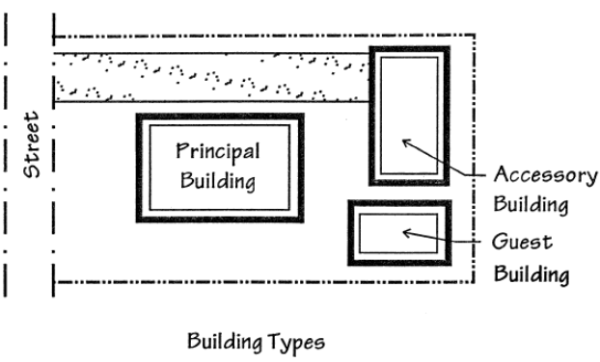
ACCESSORY USE: A use incidental to the principal use of the property, located on the same lot or parcel of land.
ACREAGE, GROSS: The total acreage of a lot or parcel including lands originally dedicated from the parcel for street right-of-way.
ACREAGE, NET: The acreage of a lot or parcel minus any land dedicated or otherwise reserved for any adjoining street(s).
ADULT USES: "Adult uses", because of their very nature, are recognized as having serious objectionable operational characteristics, particularly when located in areas near schools, churches, or residential land uses. The primary control or regulation is for the purpose of preventing proliferation of adult uses, and the location of adult uses near schools, churches, or residential land uses to safeguard youth and nonconsenting adults from exposure to adult uses.
Adult Bookstore: An establishment which merchandises printed material or movies which are intended to appeal to the prurient interest of the reader.
Adult Entertainment Cabaret: A public or private establishment which features nude or topless entertainers, bottomless entertainers, strippers, exhibitions, contests, or similar entertainment wherein T-shirts, blouses, or similar garments worn by participants are saturated with liquid so as to result in the exposure, highlighting or outlining of the participant's "specified anatomical areas" as defined herein. Typical production shows offered by resort hotels that include topless entertainers shall not be considered as adult entertainment cabaret provided that a separation and/or barrier that prevent physical contact between performers and customers are maintained at all times during each performance.
Adult Mini-Motion Picture Theater: An enclosed area with a capacity for less than fifty (50) persons used for presenting material distinguished or characterized by an emphasis on matter depicting, describing or relating to specified sexual activities or specified anatomical areas, for observation by patrons therein, including closed circuit television viewings.
Adult Motion Picture Theater: A motion picture theater whose program, during the time of its operation, contains one or more motion pictures which are rated "X" by the Code Rating Administration of the Motion Picture Association of America, or are not rated, and whose program is intended to appeal to the prurient interests of the viewer.
Adult Picture Arcade Theater: Any premises where there is maintained one or more machines or contrivances to show still or motion pictures, or television sets, designated for viewing by one or more customers used for presenting material distinguished or characterized by an emphasis on matter depicting, describing or relating to specified sexual activities or specified anatomical areas, and for which any charge, consideration or payment is required. This definition includes peepshows which exhibit motion pictures by means of coin operated projection machine.
Commercial Nude Establishment: Any commercial business other than an adult entertainment cabaret that has persons who perform services and/or are visible to the public while displaying or failing to cover the "specified anatomical areas" defined herein.
Motion Picture: Includes television viewing, regardless of whether picture presentation originated with closed circuit, live broadcast, cassette, or other recording.
Sex Novelty Shop: An establishment selling sex articles, materials, items, or devices which are neither books, films nor pictures, tapes nor discs which are designed or sold for the stimulation of human genital organs or sexual gratification including, but not limited to, dildos, vibrators, marital aids and artificial vaginas.
Specified Anatomical Areas:
- Less than completely and opaquely covered:
- Human genitals/pubic region.
- Buttock.
- Female breast, or male breast if surgically augmented to appear as a female breast, below a point immediately above the top of the areola.
- Human male genitals in a discernibly turgid state, even if completely and opaquely covered.
Specified Sexual Activities:
- Human genitals in a state of sexual stimulation or arousal.
- Acts of human masturbation, sexual intercourse or sodomy.
- Fondling or other erotic touching of human genitals, pubic region, buttock or female breast.
Theater - Nonadult: See definition of movie theater.
AGRICULTURAL COMMERCIAL USES (INDOOR): Facilities for agricultural related industries including the growing, raising, and processing of various types of agricultural products, completely contained and operated within an enclosed principal building and/or accessory structure. For purposes of this title, agricultural uses such as slaughterhouses, commercial meatpacking plants, commercial swine operations, commercial dairies, commercial poultry, rabbit, or goat operations, concentrated animal feeding facilities, livestock auction yards, and other similar high intensity indoor agricultural uses that may be conducted within buildings or structures are excluded from this definition.
AIRPORT RELATED USES: Include, but are not limited to, runways, taxiways, tarmacs, terminals, hangars, towers and parking areas.
ALLEY: A public thoroughfare or way which affords only a secondary means of access to abutting property not intended for general traffic.
AMUSEMENT PARK: A facility, primarily outdoors, that may include structures and buildings, where there are various devices for entertainment, including rides, booths for the conduct of games or sale of items, buildings for shows and entertainment, and restaurants and souvenir sales.
ANIMAL: Every wild or domesticated living creature, except members of the human race.
ANIMAL, AGRICULTURE CARE PROJECT: Must be sponsored and monitored by a multimember animal husbandry society that provides the participants with direction and guidance in the raising of animals and an opportunity to exhibit the animals at the end of the project.
ANIMAL, EXOTIC: Any animal not customarily confined or cultivated by humans for domestic or commercial purposes. This term includes, but is not limited to: antelope, anteaters, kangaroos, wallabies, as well as exotic domestic cattle such as ankole, gayal and yak.
ANIMAL RELATED BUSINESSES: Includes, but is not limited to, the following uses: animal rescues, animal sanctuaries, commercial kennels, commercial stables, grooming facilities, pet stores.
ANIMAL RESCUE: An establishment owned or operated by a licensed profit or nonprofit organization whose primary function is to provide temporary care and comfort to animals. Animal rescue operations existing prior to the adoption hereof, shall not be required to obtain a conditional use permit, under the following conditions:
- Must comply with all Federal, State and County regulations.
- Any Code Compliance Officer, animal control officer, Sheriff's officer, or other authorized representative of the County shall have the authority to enter upon the property or into the facility except by means of force when they have reason to believe that the provisions of any applicable State law or the regulations of Nye County are being violated.
- Inspection of animals and their habitat shall be conducted annually by a nationally or regionally established organization or agency, as designated by the Nye County Animal Control Office. Copies of the inspection reports shall be maintained at the Nye County Animal Control Office.
ANIMAL SANCTUARY: An establishment owned or operated by a licensed profit or nonprofit organization whose primary function is to provide lifetime care and comfort to animals. Animal sanctuaries existing prior to the adoption hereof, shall not be required to obtain a conditional use permit, under the following conditions:
- Must comply with all Federal, State and County regulations.
- Any Code Compliance Officer, animal control officer, Sheriff's officer, or other authorized representative of the County shall have the authority to enter upon the property or into the facility except by means of force when they have reason to believe that the provisions of any applicable State law or the regulations of Nye County are being violated.
- Inspection of animals and their habitat shall be conducted annually by a nationally or regionally established organization or agency, as designated by the Nye County Animal Control Office. Copies of the inspection reports shall be maintained at the Nye County Animal Control Office.
ANIMAL SHELTER, GOVERNMENT OPERATED: Any premises designated by the County for the purpose of impounding and caring for animals coming into the County's custody.
ANIMAL, SPECIAL CONDITIONS: Animals that, due to unique husbandry, handling, recapture and enclosure requirements, consist of the following: baboons (genus Papio), chimpanzees (genus Pan), drills and mandrillas (genus Mandrillus), gelada baboons (genus Theropithecus), gibbons (genus Hylobates), gorillas (genus Gorilla), macaques (genus Macaca), orangutans (genus Pongo), siamangs (genus Symphalangus), cheetahs (Acinonyx jubatus), clouded leopards (Neofelis nebulosa), cougars, panthers (Puma concolor), jaguars (Panthera onca), leopards (Panthera pardus), lions (Panthera leo), snow leopards (Panthera uncia), tigers (Panthera tigris), African wild dogs (Lycaon pictus), dingoes (Canus dingo), jackals (4 species: Canus aureus, mesomelas, simensis, adustus), maned wolf (Chysocyon brachyurus), wolves (Canus lupus, Canus rufus), wolf hybrids, bears (family Ursidae), elephants (family Eliphantidae), hyenas (family Hyaenidae), wolverines (Gulo gulo), wild hybrids of those listed.
Properties maintaining special conditions animal(s) that are existing prior to the adoption hereof, shall not be required to obtain a conditional use permit, under the following conditions:
- Must comply with all Federal, State and County regulations.
- Any Code Compliance Officer, animal control officer, Sheriff's officer, or other authorized representative of the County shall have the authority to enter upon the property or into the facility except by means of force when they have reason to believe that the provisions of the conditional use permit or any applicable State law or the regulations of Nye County are being violated.
- All special conditions animals shall be registered with the Nye County Animal Control Office.
- All permits issued through Nevada Wildlife Department or the USDA or any other agency shall be current and kept on file in the Nye County Animal Control Office.
- Inspection of animals and their habitat shall be conducted annually by a nationally or regionally established organization or agency, as designated by the Nye County Animal Control Office. Copies of the inspections reports shall be maintained at the Nye County Animal Control Office.
ANIMAL, WILD: Any animal that is now or historically has been found in the wild, or in the wild state, within the boundaries of the United States. For example, this term includes, but is not limited to: deer, elk, skunk, opossum, raccoon, mink, armadillo, coyote, squirrel, fox, wolf, cougar, bobcat and lynx. This term does not include mustangs or burros.
APIARY: Bees and beekeeping.
APPROVED PLANS: On and off-site improvement plans that have been reviewed and approved by the Department of Public Works or its representative, or any required State agency. Approved plans include street, water, sewer, drainage, grading, lighting, parking, and any and all other plans as may be required.
ARTERIAL, COLLECTOR: Streets designed to collect traffic from residential and commercial developments, where direct lot access is limited.
ARTERIAL, LOCAL: Roadways designed to provide direct lot access to abutting properties as well as on street parking.
ARTERIAL, MAJOR: Streets that move high volumes of traffic quickly and efficiently, with limited access, where direct lot access is prohibited.
ARTERIAL, MINOR: Designed for mobility and access, where direct lot access is prohibited, however intersecting spacing is allowed more frequently than on major arterials.
ARTERIAL STREET: A higher order street than all residential streets (see streets and highways plan). Conveys traffic between population and business centers.
AUTOMOBILE REPAIR FACILITY: A building, or portion thereof, held out or used for the housing, servicing, repairing, performing bodywork and painting of motor vehicles, but not including the storage of dismantled or wrecked motor vehicles, parts thereof, or junk.
AUTOMOBILE SERVICE STATION: An establishment retailing motor fuels and lubricants directly to the public on the premises; including incidental sale of minor auto accessories, services, and maintenance, but not repair work.
AUTOMOBILE WRECKER/SALVAGE YARD: An establishment that cuts up, compresses, or otherwise disposes of motor vehicles. Should the establishment also store and sell salvaged auto parts, it functions as a junkyard.
BOCC: See definition of Board of County Commissioners.
BANK: A standard financial establishment for the custody, loan, exchange, or issue of money, for the extension of credit, and for facilitating the transmission of funds. Such establishments include savings and loans, credit unions, or other related facilities but do not include quick check cashing or similar agencies.
BAR: Premises used primarily for the sale or dispensing of liquor by the drink for on site consumption and where food may be available for consumption on the premises as accessory to the principal use. "Bar" also includes an area within a restaurant, casino, theater or any other area where liquor is sold accessory to the principal use. See also definition of liquor sales establishment.
BED AND BREAKFAST INNS: A house with a permanent resident and a subordinate use of up to eight (8) guestrooms which may be rented for short term overnight lodging with breakfast served to overnight guests only; some or all guestrooms may be in accessory living quarters.
BILLBOARD: See section 17.04.770 of this chapter for sign regulations.
BLOCK: A tract of land within a subdivision entirely bounded by streets, highways or ways, except alleys; and the exterior boundary or boundaries of the subdivision.
BOARD OF COUNTY COMMISSIONERS: The Nye County Board of County Commissioners.
BOARDING AND ROOMING HOUSE: A dwelling unit, or part thereof in which, for compensation, lodging and meals are provided.
BODY ART: The practice of physical body adornment by permitted establishments and practitioners using, but not limited to, the following: body piercing, tattooing, cosmetic tattooing, branding, and scarification. This definition shall not include the piercing of earlobes.
BREEDER: A dealer, operator or other person who is responsible for the operation of a commercial establishment engaged in the business of breeding dogs or cats for sale or trade. One who sells, trades, or gives away, twenty five (25) or more cats or dogs in one year, which were born and raised on his or her premises. The term does not include a person who breeds dogs or cats as a hobby.
BREEDER, HOBBY: A person who breeds dogs or cats as a hobby. One who sells, trades, or gives away, twenty four (24) or less cats or dogs in one year, which were born and raised on his or her premises.
BROTHEL: Any establishment having a source of income or compensation derived from the practice of "prostitution" as defined in this section, and which has a fixed place of business where any person engages in or carries on any of the activities as defined in the definition of "house of prostitution" of section 9.20.020 of this Code.
BUFFER: An area within a property or site, generally adjacent to and parallel with the property line, either consisting of natural existing vegetation or created by the use of trees, shrubs, fences, and/or berms, designed to limit the view of and/or sound from the site to adjacent sites or properties.
BUILDING: Any structure having a roof supported by columns or walls and intended for the shelter, housing, or enclosure of any individual, animal, process, equipment, goods, or materials of any kind.
BUILDING, ACCESSORY: See definition of accessory building.
BUILDING DEPARTMENT: The officer, department or agency who is charged with the enforcement of the provisions of all ordinances and regulations pertaining to the erection, construction, reconstruction, alteration, conversion, movement, arrangement, or use of buildings or structures within the district.
BUILDING, GUEST: See definition of guest building.
BUILDING HEIGHT: The vertical distance from the finished grade to the top of the highest roof beams on a flat or shed roof, the deck level on a mansard roof, and the average distance between the eaves and the ridge level for gable, hip, and gambrel roofs. Mechanical equipment, chimneys, air conditioners, antennas, elevators, church spires and steeples, water towers, and similar appurtenances that are usually located on top of buildings are excluded from height restrictions. No excluded element can exceed a building height restriction by more than twenty five feet (25').
BUILDING, PRINCIPAL: A building in which is conducted the principal use of the lot upon which it is located.
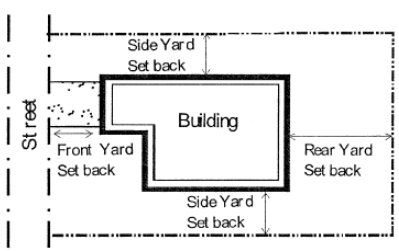
BUILDING SETBACK: The distance between the property line and the nearest portion of a building on the property. See also definition of yard.
BULK FUEL STATION: A place where petroleum products and related materials are stored for subsequent resale to distributors or retail dealers or outlets.
BULK REGULATIONS: Standards and controls that establish the maximum size of buildings and structures on a lot and the buildable area within which the building can be located, including coverage, setbacks, height, floor area ratio, and yard requirements.
CC&Rs: See definition of protective covenants (deed restrictions).
CAMPING TRAILER: See definition of recreational vehicle.
CARPORT: An accessory building having one or more open sides, intended for vehicle parking.
CEMETERY: Land designated and used for the interment of the dead, including columbariums, crematoriums, mausoleums, and mortuaries when operated in conjunction with and within the boundary of such cemetery.
CHEMICAL MANUFACTURING: Establishments engaged in the transformation of materials or substances into new products using, in whole or in part, chemical processes. Chemical manufacturing includes the assembling of component parts, the creation of products, and the blending of materials, such as lubricating oils, plastics, resins, or liquors.
CHILDCARE FACILITY: An establishment operated and maintained for the purposes of furnishing care on a temporary or permanent basis, during the day or overnight, to five (5) or more children under eighteen (18) years of age, if compensation is received for the care of any of those children. Childcare facility does not include:
- The home of a natural parent or guardian, foster home or maternity home;
- A home in which the only children received, cared for and maintained are related within the third degree of consanguinity or affinity by blood, adoption or marriage to the person operating the facility; or
- A home in which a person provides care for the children of a friend or neighbor for not more than four (4) weeks, or longer in cases of medical hardship, if the person who provides the care does not regularly engage in that activity.
CLASSIC CAR: See definition of vehicle, classic.
CLUSTER DEVELOPMENT: A development approach in which building lots may be reduced in size and buildings sited closer together, usually in groups or clusters, provided that the total development density does not exceed that which could be constructed on the site under conventional zoning and subdivision regulations. The additional land that remains undeveloped is then preserved as open space and recreational land.
COMMERCIAL COACH: A structure without motive power which is designed and equipped for human occupancy for industrial, professional, or commercial purposes.
COMMERCIAL FARMING: The growing or production of field crops or raising of livestock for the sole purpose of profit through sales.
COMMON INTEREST COMMUNITY: Real estate with respect to which a person, by virtue of his ownership of a unit within the community, is obligated to pay for real estate other than that unit. "Ownership of a unit" does not include holding a leasehold interest of less than twenty (20) years in a unit, including options to renew.
COMMON OPEN SPACE: Land within or related to a common interest community or planned unit development, not dedicated for public use, and not individually owned, which is designed and intended for the common use or enjoyment of the residents and/or owners of the community or development. Common open space may include complementary structures and improvements as are necessary and appropriate for the benefit and enjoyment of the residents or owners of the community or development.
CONDITIONAL USE: A use that has the potential to have adverse effects on adjacent, or local, properties. Conditional uses are permitted in a particular zoning district upon showing that such use in a specified location will comply with all the conditions and safeguards for the location or operation of the use as specified in the zoning ordinance and if it is authorized by the Planning Commission.
CONDITIONAL USE PERMIT: A permit issued by the Planning Commission stating that the conditional use meets all conditions set forth in all applicable ordinances and has met with the approval of the Planning Commission after a public hearing has been held.
CONDOMINIUM: A unit of real estate in a common interest community which is designated for separate ownership.
CONGREGATE LIVING FACILITY: Apartments and dwellings with communal dining facilities and services such as housekeeping, organized social and recreational activities, transportation services and other services appropriate for the residents.
CONVENTIONAL DEVELOPMENT: Development other than planned unit, cluster or common interest community development.
CORRECTIONAL FACILITY, PRISON: A facility for the confinement of persons convicted of a felony and sentenced to incarceration in excess of one year.
COTTAGE INDUSTRY: An industry where the creation of products and services is home-based, rather than factory-based. While products and services created by cottage industry are often unique and distinctive given the fact that they are usually not mass-produced, producers in this sector often face numerous disadvantages when trying to compete with much larger factory-based companies, an industry whose labor force consists of family units or individuals working at home with their own equipment.
CUL-DE-SAC: A local street with only one outlet that provides for an adequate turning area for vehicular traffic at its terminus.
DEED RESTRICTIONS: See definition of protective covenants (deed restrictions).
DENSITY: The permitted number of dwelling units per gross acre of land to be developed.
DEPARTMENT OF PLANNING: The Nye County Department of Planning, or as renamed.
DESIGN STANDARDS: The standards that set forth specific design requirements that deal with the arrangement and engineering of site details such as lot size and configuration, buildings, streets, utilities and plantings that must be adhered to.
DETENTION FACILITY (PRIVATE): A facility where persons are detained awaiting trial or sentence, or refugees or illegal immigrants are confined together temporarily pending administrative proceedings.
DEVELOPER: The legal or beneficial owner or owners of a lot or of any land included in a proposed development. Also, the holder of an option or contract to purchase, or any other person having enforceable proprietary interest in such land.
DEVELOPMENT: A planning or construction project involving substantial property improvement and, usually, a change of land use character within the site. Development includes the division of land.
DEVELOPMENT REGULATION: Zoning, land division, subdivision, site plan, official map, floodplain regulation, or other governmental regulation of the use and development of land.
DRIVEWAY: A paved or unpaved area used for ingress or egress of vehicles, and allowing access from a street to a building or other structure or facility.
DUPLEX: A building containing two (2) single-family dwelling units totally separated from each other by an unpierced wall extending from ground to roof.
DUST CONTROL PLAN: A plan to formalize a project specific fugitive Dust Control Program.
DWELLING, ATTACHED: A one-family dwelling attached to two (2) or more one-family dwellings by common vertical walls.
DWELLING, DETACHED: A dwelling that is not attached to any other dwelling by any means.
DWELLING, OR DWELLING UNIT: A structure or the part of a structure that is occupied as, or designed or intended for occupancy as, a residence or sleeping place by one person who maintains a household or by two (2) or more persons who maintain a common household.
DWELLING UNIT: One or more rooms, designed, occupied, or intended for occupancy as a separate living quarter, with cooking, sleeping, and sanitary facilities provided within the dwelling unit for the exclusive use of a single family.
EASEMENT: A right-of-way granted, but not dedicated, for limited use of private land for a public or quasi-public purpose and within which the owner of the property shall not erect any permanent structures.
FACTORY BUILT HOUSING: A residential building, dwelling unit or habitable room thereof which is either wholly manufactured or is in substantial part manufactured at an off site location to be wholly or partially assembled on site, but does not include a mobile home.
FAMILY: A group of individuals not necessarily related by blood, marriage, adoption, or guardianship living together in a dwelling unit as a single housekeeping unit under a common housekeeping management plan based on an intentionally structured relationship providing organization and stability.
FAMILY BURIAL PLOT: A plot of land used for interments of family members without charge.
FAMILY RANCH: A property containing a single-family residence that may include, but is not limited to, a riding school, private arena, breeding, schooling, training, grooming and therapeutic riding for personal use, remuneration or exchange for not more than thirty (30) students or clients per month and typically not more than three (3) students or clients at any one time.
FARMERS MARKET: A public market where farmers and other vendors gather to sell various fresh fruit, vegetables, meat and other foods directly to consumers.
FARROWING PEN: A pen or pens used for the birthing of a litter of pigs.
FEEDLOT: A confined area or structure, pen or corral, used to fatten livestock prior to final shipment.
FLEA MARKET: An occasional or periodic market held in an open area or structure where groups of individual sellers offer goods, including commodities, wares, and portable personal property for sale to the public.
FLOOR AREA RATIO: The gross floor area of all buildings or structures on a lot divided by the total lot area.
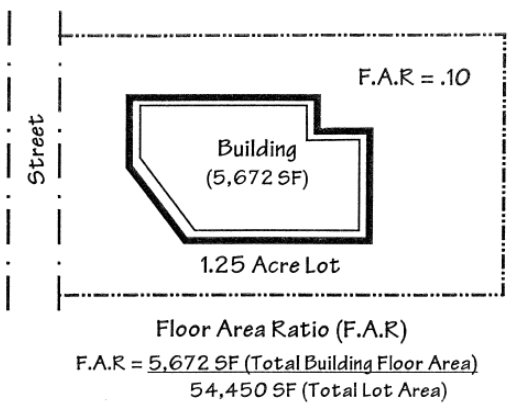
FOOTLAMBERT: One footlambert is the luminance of a surface uniformly emitting, transmitting, or reflecting one lumen, a means of measuring the amount of illumination generated by light fixtures.
FOUNDRY: An establishment in which metal is melted and poured into molds.
FUEL DISPENSING FACILITY: An establishment retailing motor fuels and lubricants directly to the public on the premises. See also definition of automobile service station.
FUNERAL AND INTERMENT SERVICES: Establishments primarily engaged in the provision of services involving the care, preparation or disposition of human dead other than in cemeteries. Typical uses include crematories, columbariums, mausoleums or mortuaries. The term mortuary shall include preparation and temporary storage of the dead while awaiting interment. A place where only mourning and verbalizations of respect are performed, but where no preparation of the dead occurs shall be considered religious assembly.
GAMBLING ESTABLISHMENT, GAMING: Any place where gaming is operated and maintained. "Gaming" means and includes all games of chance or devices and any slot machines played for money or for checks or tokens redeemable in money, except, for the purposes of these regulations only, "gaming" shall not be construed to include slot machines when such slot machines are operated incidental or accessory to the conduct of a business permitted under the provisions of these regulations.
GARAGE, PRIVATE OR PARKING: A structure intended for the noncommercial storage of motor vehicles.
GARAGE, PUBLIC: A building for the storage of motor vehicles or boats as a commercial venture.
GARAGE SALE: The sales of household goods on one's property for a fixed amount of time.
GARBAGE: Animal and vegetable waste resulting from the handling, storage, sale, preparation, cooking, and serving of foods.
GRAFFITI: Any unauthorized inscription, word, figure or design that is marked, etched, scratched, drawn, painted on or affixed to the public or private property, real or personal, of another, which defaces the property.
GRANDFATHERING: A lawful nonconforming use.
GRAVEL PIT: An open land area where sand, gravel, and rock fragments are mined or excavated for sale or off tract use.
GROOMING FACILITY: A place where animals are cleaned and groomed.
GROSS FLOOR AREA: The total enclosed area of all floors in a building with a clear height of more than six feet (6'), measured to the outside surface of the exterior walls. Parking facilities, driveways and airspace above the atria ground floor are excluded from gross floor area calculations.
GROUP HOME (BUILDING): Any facility in which the licensee regularly provides care for no less than seven (7) and no more than twelve (12) children. (NAC 432A.110)
GUEST BUILDING: An accessory building on a residential lot with a principal residence, which is used for residential purposes. Guest buildings must be affixed to real property, no more than one thousand five hundred (1,500) square feet and do not include recreational vehicles.
HALFWAY HOUSE FOR RECOVERING ALCOHOLICS AND DRUG ABUSERS: A residence that provides housing and a living environment for alcohol and drug abusers and is operated to facilitate their reintegration into the community, but does not provide any treatment for alcohol or drug abuse.
HOME FOR INDIVIDUAL RESIDENTIAL CARE: A home in which a natural person furnishes food, shelter, assistance and limited supervision, for compensation, to not more than two (2) persons who are aged, infirm, mentally retarded or handicapped, unless the persons receiving those services are related within the third degree of consanguinity or affinity to the person providing those services. The term does not include a halfway house for recovering alcohol and drug abusers.
HOME OCCUPATION: Also known as a home based business, is any activity carried out for gain by a resident with no other headquarters location and is conducted as, an accessory use at the resident's dwelling unit. Home occupations are subject to article VI of this chapter.
HOSPITAL: A building used for the accommodation of the sick, injured, or infirm, including clinics, sanatoriums, convalescent and rest homes, boarding hospitals, and homes for children or the aged.
HOTEL OR RESORT HOTEL: Every building or structure kept as, used as, maintained as, or held out to the public to be, a place where sleeping or rooming accommodations are furnished to the transient public, whether with or without meals, including, without limitation, a lodging house or rooming house where transient trade is solicited.
INTERMEDIATE CARE FACILITY: A residential facility usually occupied by persons not requiring hospitalization or a skilled nursing facility, but who require rooms, meals, personal care, and health monitoring services under the supervision of a professional nurse. Intermediate care facilities may provide other services such as recreation, social, and cultural activities, financial services, and transportation.
JAIL: A city, town or county facility for the confinement of persons convicted of a misdemeanor or gross misdemeanor and sentenced to incarceration for a period of one year or less. Also, a facility where persons are detained awaiting trial or sentence.
JUNK: Old or scrap copper, brass, rope, rags, batteries, paper, trash, rubber debris, waste or junked, dismantled or wrecked or abandoned motor vehicles, or parts thereof, iron, steel, and other old or scrap ferrous, or nonferrous material, and all other secondhand used or castoff articles or material of any kind.
JUNKYARD: An establishment or place of business which is maintained, operated, or used for storing, keeping, processing, buying, or selling junk, or for the maintenance or operation of an automobile graveyard or scrap metal processing facility, and the term shall include garbage dumps and sanitary fills.
KENNEL, BREEDER'S: Any enclosure, premises, building, structure, lot, or area where more than three (3) dogs of a recognized, registered breed over six (6) months of age are kept, harbored, or maintained as follows:
- For showing in recognized dog shows, field or obedience trials.
- For working or hunting.
- For improving the variety or breed in temperament or conformation with a view to exhibition in shows or trials or for use as working dogs in hunting.
KENNEL, COMMERCIAL: A place where any number of dogs or cats are boarded and kept for commercial purposes, including breeding, boarding, and/or training. This term does not include State inspected veterinary hospitals, or the County Animal Control Shelter. Commercial kennels existing prior to the adoption hereof, shall not be required to obtain a conditional use permit, under the following conditions:
- Must comply with all Federal, State and County regulations.
- Any Code Compliance Officer, animal control officer, Sheriff's officer, or other authorized representative of the County shall have the authority to enter upon the property or into the facility except by means of force when they have reason to believe that the provisions of any applicable State law or the regulations of Nye County are being violated.
- Inspection of animals and their habitat shall be conducted annually by the Nye County Animal Control Office or by a nationally or regionally established organization or agency approved by the Nye County Animal Control Office. Copies of the inspection reports shall be maintained at the Nye County Animal Control Office.
KITCHEN: A room used for cooking and for the preparation of food.
LANDFILL: A disposal site in which refuse and earth, or other suitable cover material, are deposited and compacted in accordance with an approved plan.
LIQUOR: Alcoholic or spirituous fluid, either distilled or fermented, such as brandy, wine, whiskey, beer, etc.
LIQUOR SALES ESTABLISHMENT: Liquor sales establishments shall be organized into the following classes:
- Class I, Packaged Liquor Sales Establishment: Any establishment selling liquor to individuals in its original corked or unopened package for consumption off premises, and includes convenience-liquor-grocery stores and other similar types of stores.
- Class II, Retail Liquor Sales Establishment - Bar: Any establishment selling at retail liquor by the drink for consumption on premises, and in a bar setting, which may or may not include a restaurant as an accessory use.
- Class III, Special Club Liquor Sales Establishment: Any establishment dispensing liquor by the drink for consumption on premises only, and which is restricted in use to members and guest(s) accompanied by a member.
- Class IV, Liquor Manufacturer: Any establishment that manufactures liquor for sale to the public which includes distilleries, wineries, meaderies and breweries.
LIVE/WORK: A residential occupancy, by a single housekeeping unit, of one or more rooms or floors in a building which includes: a) cooking space and sanitary facilities in conformance with County building standards; and b) adequate working space accessible from the living area, reserved for, and regularly used by, one or more persons residing therein.
LIVESTOCK: All manner of farm or agricultural animals, including, but not limited to, horses, mules, mustangs, burros, cattle, buffalo, swine, goats, sheep, chickens, turkeys, and other farm fowl.
LOADING SPACE: An off street space or berth of not less than ten feet by forty five feet (10' x 45') on the same lot or contiguous to a building or group of buildings for temporary parking of vehicles while handling merchandise or materials.
LOT: A lot with fixed legal boundaries and a legal means of access; or a space within an approved manufactured home park or recreational vehicle park.
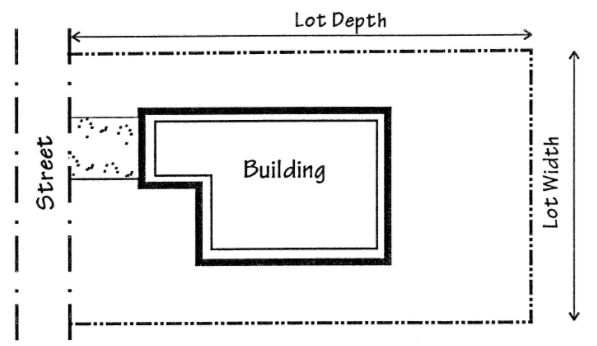
LOT DEPTH: The average distance between the front and rear lines.
LOT WIDTH: The average width of a lot.
MANUFACTURED BUILDING: Includes any modular building or any building constructed using one or more modular components, but does not include a recreational park trailer.
MANUFACTURED HOME:
- A structure which is:
- Built on a permanent chassis;
- Designed to be used with or without a permanent foundation as a dwelling when connected to utilities;
- Transportable in one or more sections; and
- Eight feet (8') or more in body width or forty feet (40') or more in body length when transported, or, when erected on site, contains three hundred twenty (320) square feet or more.
- The term includes:
- The plumbing, heating, air conditioning and electrical systems of the structure.
- Any structure:
- Which meets the requirements of subsections A1 through A3 of this definition, and with respect to which the manufacturer voluntarily files a certification required by the Secretary of Housing and Urban Development and complies with the standards established under the National Manufactured Housing Construction and Safety Standards Act of 1974, 42 USC section 5401 et seq.; or
- Built in compliance with the requirements of chapter 461 of Nevada Revised Statutes.
- The term does not include a recreational park trailer.
MASTER PLAN: A comprehensive long range plan intended to guide the growth and development of a community or region. A Master Plan includes analyses, recommendations, and proposals for the community's population, economy, housing, transportation, community facilities, land use and other subject matter as may be appropriate to the community.
MINING: The acts and processes involved in extracting ore from a mineral deposit and shall be deemed generally to include hauling, blasting, milling, and refining.
MIXED USE OR MIXED USE DEVELOPMENT: The combination of commercial, office, or residential uses on a single lot or within a single integrated development on multiple lots. A mixed use is a commercial development for the purpose of determining development standards.
MOBILE HOME:
- A structure which is:
- Built on a permanent chassis;
- Designed to be used with or without a permanent foundation as a dwelling when connected to utilities; and
- Transportable in one or more sections.
- The term includes the design of the body and frame and the plumbing, heating, air conditioning and electrical systems of the mobile home.
- The term does not include a recreational park trailer, travel trailer, commercial coach or manufactured home or any structure built in compliance with the requirements of chapter 461 of Nevada Revised Statutes.
MOBILE HOME PARK: An area, parcel, or tract of land having a minimum of five (5) acres gross, and as its principal use the rental, leasing, or occupancy of space by three (3) or more mobile homes on a permanent or semipermanent basis, including accessory buildings, structures, or uses customarily incidental thereto.
MOBILE HOME SPACE: A portion of land within a mobile home park used or intended to be used for parking of one mobile home, including the land covered by the mobile home, required yards, building setbacks, and parking area and attached and/or detached accessory buildings and structures and open space.
MODULAR HOME: See definition of manufactured home.
MOTEL: A building containing two (2) or more accommodations for sleeping used mainly by travelers with an individual, private on site parking area attached or accessible to each unit.
MOTOR HOME: See definition of recreational vehicle.
MULTI-FAMILY DWELLING: A building containing two (2) or more dwelling units, including units that are located one over the other.
MULTIPET PERMIT: A residential property where a total of eleven (11) or more dogs and cats are kept by the owner for personal pleasure; the animals are not kept for commercial purposes. Dogs trained for search and rescue or service animals shall not be counted toward the number of dogs and cats for the purposes of multipet permit.
NRS: Nevada Revised Statutes.
NET LOT AREA: The area of a lot excluding easements.
NONCOMMERCIAL AGRICULTURE: The raising of livestock, small animals, poultry, and the farming of agriculture and horticulture for the use and enjoyment of the family residing on a lot or parcel, provided the use is not for commercial purposes. 4-H, FFA and other such organizations' project animals are noncommercial.
NONCONFORMING BUILDING OR STRUCTURE: A structure or portion thereof which was lawfully erected or altered, but which does not comply with the regulations applicable to new structures in the zoning district in which it is located.
NONCONFORMING USE, LAWFUL: A use which was lawfully established and maintained, but which does not comply with the use regulations applicable to new uses in the zoning district in which it is located; the use of any land, building or structure which does not conform with currently applicable use regulations, but which complied with use regulations in effect at the time the use was established.
NUISANCE: Shall be deemed to consist of permitting filth heaps, garbage, unprotected sewage or drainage pipes or boxes, cesspools, obstructions to the safe and convenient passage of vehicles and pedestrians through and over the public highways, streets and alleys, anything that is injurious to health, or indecent and offensive to the senses, or an obstruction to the free use of property, so as to interfere with the comfortable enjoyment of life and property.
OFF STREET PARKING SPACE: A parking space provided in a parking lot, parking structure, or a private driveway.
OPEN BURNING: Any fire from which the products of combustion are emitted into the atmosphere without passing through a stack or chimney.
OPEN SPACE: Any parcel or area of land or water essentially unimproved and set aside, dedicated, designated, or reserved for the public or private use or enjoyment of owners and occupants of land adjoining or neighboring such open space.
OPERATOR: A person responsible for the operation of any animal related business.
ORE: A mineral or an aggregate of minerals from which a valuable constituent can be profitably mined or extracted.
OUTDOOR ADVERTISING STRUCTURE: See section 17.04.770 of this chapter for sign regulations.
OUTDOOR SALES DISPLAY AREA: A paved area for the display and sale of goods, including vehicles, manufactured and mobile homes and other small and large scale items.
OWNER: Any person owning, keeping, possessing, harboring, or having the care, custody or control of any animal.
PARCEL OF LAND: Any unit of land.
PARK MODEL RECREATIONAL DWELLING UNIT: A manufactured dwelling unit that is primarily designed to provide temporary or permanent living quarters for recreational or seasonal use, is built on a single chassis, has a gross trailer area not exceeding four hundred (400) square feet in the set up mode, and is certified by the manufacturer as complying with the American National Standard Institute (ANSI) standard A119.5 for recreational park trailers.
PARK MODEL RECREATIONAL VEHICLE PARK: A parcel or tract of land having as its principal use the transient rental or permanent occupancy of two (2) or more spaces which are designed, intended, approved, or used for park model recreational dwelling units, including any permissive accessory buildings, structures, or uses.
PARKING SPACE: A permanently maintained space on a lot or parcel, suitable for the parking of one automobile; and sized in accordance with the standard details and specifications.
PET STORE: An establishment where live animals are kept for wholesale or retail sale, barter or hire.
PLANNED COMMUNITY: A common interest community that is not a condominium or a cooperative. A condominium or cooperative may be part of a planned community.
PLANNED UNIT DEVELOPMENT: An area of land controlled by a landowner, which is to be developed as a single entity for a number of dwelling units, the plan for which does not correspond to lot size, bulk or type of dwelling, density or lot coverage and required open space to the regulations established in any one residential district created, from time to time, under the provisions of any zoning ordinance enacted pursuant to law.
PLANNING COMMISSION: The Governing Body of the Pahrump Regional Planning District as appointed by the Board of County Commissioners.
PROSTITUTION: Engaging in sexual conduct for a fee.
PROTECTIVE COVENANTS (DEED RESTRICTIONS): A list of restrictions and covenants of proper record in the County Recorder's Office, that runs with the land and is binding on all property owners in the protected area, for a stipulated period of time with extension provisions therefor, and which shall be enforced by the property owners in said protected area by appropriate civil action. The covenants may include, but are not limited to, the following: the establishment of minimum front, side, and rear yards; minimum dwelling sizes and types; the prohibition of multi-family dwellings, trailers, trade or business, and other activities obnoxious or offensive; the provision of street planting or watercourses; and the exclusion of signs and/or other matters related to or restricted in the protected area. Deed restrictions are not enforced by public agencies such as the County.
QUARRY, STONE: A place where rock, ore, stone, and similar materials are excavated for sale or for off tract use.
RPC: See definition of Regional Planning Commission.
RECREATIONAL VEHICLE: A vehicular structure primarily designed as temporary living quarters for travel, recreational, or camping use, which is self-propelled, mounted upon, or drawn by a motor vehicle. The term includes motor homes, conventional travel trailers, fifth wheel trailers, and other similar types of self-propelled or towable trailers, and camping type of units. The term recreational vehicle does not include the term park model recreational dwelling unit (see definition of park model recreational dwelling unit).
RECREATIONAL VEHICLE PARK: A parcel or tract of land having as its principal use the transient rental of two (2) or more spaces for recreational vehicles including accessory buildings, structures, or uses.
REFORMATORY: Facilities that work to rehabilitate young or first time offenders and help them learn a trade before their release.
RENEWABLE ENERGY: Energy which comes from natural resources such as sunlight, wind, rain, tides, and geothermal heat, which are naturally replenished.
RENEWABLE ENERGY GENERATING FACILITY: Any facility or installation such as a wind generator, hydroelectric unit or solar collecting or concentrating array, including the corresponding power generation, energy storage and transmission facilities, which is designed and intended to produce renewable energy for primarily off site use.
REQUIRED AREA: The minimum area of a lot or parcel necessary to permit its use under the provisions of this chapter.
REQUIRED WIDTH: The average width of a lot or parcel of land necessary to permit its use under the provisions of this chapter.
RESIDENTIAL INDUSTRY: The creation, construction, fabrication, or assembly of artwork or craftwork within a dwelling, or a permitted accessory building thereto.
- Specific uses permitted: Pottery work, jewelry making, metalwork, woodworking, homemade clothing, leatherwork, lapidary, painting, sculpture, and similar uses.
- Residential district; public display: No public display of stock in trade for sale shall be allowed outside the dwelling or accessory buildings, nor shall the use change the residential character of the dwelling.
- Nuisances: The use shall not cause any sustained, unpleasant or unusual noises, vibrations, noxious fumes or odors, nor cause any parking or traffic congestion within the immediate area thereof.
RESTAURANT: An establishment where food and drink are prepared, served, and consumed primarily within the principal building. A restaurant shall be allowed to serve liquor to its guests without complying with the conditional use permit provisions of this chapter. A restaurant shall not be allowed a bar area without a conditional use permit.
ROADWAY: The actual road surface area from curb line to curb line, which may include travel lanes, parking lanes, and deceleration and acceleration lanes. Where there are no curbs, the roadway is that portion between the edges of the paved or hard surface width.
ROOM: A divided portion of the interior of a dwelling, excluding bathrooms, kitchen, closets, hallways, and porches.
SALVAGE: The utilization of materials saved from destruction or waste.
SANDPIT: See definition of gravel pit.
SANITARY STATION: A facility used for removing and disposing of wastes from recreational vehicle holding tanks.
SCHOOL: An educational institution which offers the kind of instruction required to be taught in the public schools of the State.
SERVICE, SEARCH AND RESCUE ANIMAL: An animal that is trained to alert a person with a variety of disabilities and medical conditions or an animal that is trained for search and rescue operations.
SERVICE STATION: See definition of automobile service station.
SEXUALLY ORIENTED BUSINESS (SOB): See definition of adult uses.
SIGHT TRIANGLE EASEMENT: A triangular shaped easement over a portion of land established at street intersections, in which nothing, with the exception of street hardware, is erected, placed, planted, or allowed to grow in such a manner as to limit or obstruct the sight distance of motorists entering or leaving the intersection.
SIGN: See section 17.04.770 of this chapter for sign regulations.
SINGLE-FAMILY RESIDENCE: A dwelling unit, including factory built housing, manufactured homes, residential facilities for groups with ten (10) or fewer unrelated persons with disabilities, halfway houses and homes for residential care, and residential establishments that have been built in compliance with the standards for single-family residential dwellings of the Building Code most recently adopted by the International Conference of Building Officials, or the National Manufactured Home Construction and Safety Standards Act (commonly known as the HUD Code), designed, occupied, or intended for occupancy as a separate living quarters, with cooking, sleeping, and sanitary facilities provided within the dwelling unit for the exclusive use of a single family.
SLAUGHTERHOUSE: A place where animals are butchered.
SOLAR PHOTOVOLTAIC FACILITY - TWENTY MEGAWATTS MAXIMUM: A facility which uses solar cells to convert solar radiation into electricity, generating a maximum of twenty (20) megawatts of power.
SPECIAL EXCEPTION: Permission to depart from design and/or improvement standards such as parking areas, street standards, etc. Special exceptions must be based on specific criteria such as hardship, special reasons, change of circumstances, etc., and the Planning Commission must make findings before granting exceptions.
SPECIAL USE: See definition of conditional use.
SPECIAL USE PERMIT: See definition of conditional use permit.
STABLE, COMMERCIAL: A facility where livestock are kept for commercial purposes such as auctions, riding academies, rental, roping and rodeo arenas, breeding, schooling, training and grooming for remuneration or exchange. The term shall not include a facility where the practice of veterinary medicine is performed. Commercial stables existing prior to the adoption hereof, shall not be required to obtain a conditional use permit, under the following conditions:
- Must comply with all Federal, State and County regulations.
- Any Code Compliance Officer, animal control officer, Sheriff's officer, or other authorized representative of the County shall have the authority to enter upon the property or into the facility except by means of force when they have reason to believe that the provisions of any applicable State law or the regulations of Nye County are being violated.
- Inspection of animals and their habitat shall be conducted annually by the Nye County Animal Control Office or by a nationally or regionally established organization or agency approved by the Nye County Animal Control Office. Copies of the inspection reports shall be maintained at the Nye County Animal Control Office.
STANDARD DETAILS AND SPECIFICATIONS: The document entitled "Standard Details and Specifications for Public Improvements Within the Pahrump Regional Planning District", as adopted by the Nye County Board of County Commissioners.
START OF CONSTRUCTION: Means the date the building permit was issued, provided the actual start of construction, repair, reconstruction, rehabilitation, addition placement, or other improvement was within one hundred eighty (180) calendar days of the permit date. The actual start of construction means either the first placement of permanent construction of a structure on a site, such as the pouring of slab or footings, the installation of piles, the construction of columns, or any work beyond the stage of excavation; or the placement of a manufactured home on a foundation. Permanent construction does not include land preparation, such as clearing, grading and filling; nor does it include excavation for a basement, footings, piers, or foundations or the erection of temporary structures; nor does it include the installation on the property of accessory buildings, such as garages or sheds not occupied as dwelling units or not part of the main structure.
STREET: See definition of roadway.
STRUCTURE: Any construction except a fence, tent, trailer, or vehicle, including signs, but not fences or walls used as fences.
STRUCTURE, PERMANENT: A structure intended and installed to exceed one year's duration.
STRUCTURE, TEMPORARY: A structure intended and installed not to exceed one year's duration and to be removed entirely at the expiration thereof.
SUBDIVISION: The division of any land or portion thereof, vacant or improved, shown on the last preceding tax roll as a unit or contiguous units, which is divided or proposed to be divided, either immediately or in the future, into five (5) or more lots, parcels, sites, units, or plots of land for the purpose of any transfer, development, or proposed transfer or development unless exempted pursuant to Nevada Revised Statutes 278.320.
SUBSISTENCE FARMING: The growing of field crops or raising of livestock for food for household use, cottage industry or sale at a farmer’s markets. This does not include the cultivation or production of hemp.
TEMPORARY LIVING FACILITY: Any structure including a recreational vehicle, travel trailer, mobile or manufactured home, or any such structure designed to be used as a dwelling unit, and that is not permanently affixed to a parcel.
TEMPORARY USE PERMIT: A permit issued by the Zoning Administrator stating that the temporary use meets all conditions set forth in all applicable ordinances and has met with the approval of the Zoning Administrator.
TOWNHOUSE: A one-family dwelling in a row of at least three (3) such units in which each unit has its own front and rear access to the outside, no unit is located over another unit, and each unit is separated from any other unit by one or more vertical common fire resistant walls.
TRANSITIONAL PRISON TO COMMUNITY FACILITY: A supervised residential center where individuals who are completing a sentence, including prerelease programs, reside for a defined period of time for counseling, job placement assistance, and similar services to assist in transitioning from institutional to community living.
TRAVEL TRAILER: See definition of recreational vehicle.
VEHICLE: Except as otherwise provided in Nevada Revised Statutes 482.36348, "vehicle" means every device in, upon or by which any person or property is or may be transported or drawn upon a public highway.
VEHICLE, ABANDONED: As used in Nevada Revised Statutes 487.220 to 487.300, inclusive, unless the context otherwise requires, "abandoned vehicle" means a vehicle:
- That the owner has discarded; or
- Which has not been reclaimed by the registered owner or a person having a security interest in the vehicle within fifteen (15) days after notification pursuant to Nevada Revised Statutes 487.250.
VEHICLE, CLASSIC: A motor vehicle manufactured at least twenty five (25) years before the current date, or because of its limited production or exceptional workmanship is a rarity or of historic interest and has been, or is in the process of being restored, maintained, or preserved by automobile enthusiasts.
VEHICLE, HISTORIC: A motor vehicle that is twenty five (25) or more years old or has unique technology, styling, or marketing significance such that it is sought after by automobile enthusiasts and collectors.
VEHICLE, INOPERABLE: Any motor vehicle that cannot be moved under its own power, or cannot be operated lawfully on a public street or highway due to removal of, damage to, or inoperative condition of, any component or part necessary for movement or lawful operation.
VEHICLE, JUNK: Any motor vehicle that is totally unusable as an operable vehicle or a source of parts for restoration of a classic or historic vehicle.
VEHICLE, UNREGISTERED: Any motor vehicle that is not registered with the State of Nevada.
VETERINARY FACILITY (Large And Small Animal): Any establishment operated by a veterinarian to provide dental, medical or surgical treatment, boarding, care and grooming for large and small animals. A veterinary hospital may have adjacent to it or in conjunction with it, or as an integral part of it, indoor and outdoor pens, stalls, cages, or kennels for quarantine or observation.
VETERINARY FACILITY (SMALL ANIMAL): Any establishment operated by a veterinarian to provide dental, medical or surgical treatment, boarding, care and grooming for small animals. A veterinary clinic may have adjacent to it or in conjunction with it, or as an integral part of it, indoor pens, cages, or kennels for quarantine or observation, in a completely enclosed building.
WAIVER, HARDSHIP: A departure from the bulk regulations of the zoning ordinance that, if such requirements were applied to a specific lot, would significantly interfere with the use of the property. The Planning Commission must make findings before granting hardship waivers, and waiver conditions must be met.
WAIVER, PLANNING: A waiver granted for relief from bulk regulations that would result in an opportunity for improved zoning and planning that would benefit the community. The Planning Commission must make findings before granting planning waivers and waiver conditions must be met.
WOLF HYBRID: Any canine which has had a wolf ancestor within the previous four (4) generations. This definition shall include a wolf or wolf hybrid as a sire or dam, grandsire or dam, great grandsire or dam or great great grandsire or dam. An animal shall also be considered a wolf hybrid if it has been advertised, registered or otherwise described or represented as a wolf-dog hybrid by its owner or former owner as having wolf ancestry.
YARD: An open space that lies between the principal or accessory building or buildings and the nearest lot line. The minimum required yard as set forth in this chapter is unoccupied and unobstructed from the ground upward except as otherwise allowed in this chapter.
YARD, FRONT: A yard lying between the foundation of the building and the front lot line and extending across the full width of the lot or parcel.
YARD, REAR: A yard between the foundation of building and the rear lot line and extending across the full width of the lot or parcel.
YARD SALE: See definition of garage sale.
YARD, SIDE: A yard lying between the side lot line and the foundation of building and extending from the front yard line to the rear yard line.
ZONING ADMINISTRATOR: The Nye County Planning Director or designee(s) acting in the capacity of Zoning Administrator.
ZONING ENFORCEMENT OFFICER: Empowered to perform advanced Code enforcement work to ensure compliance with ordinances and codes governing zoning violations. (Ord. 556, 2020: Ord. 531, 2018)
Amended by Ord. 563 on 7/21/2020
Amended by Ord. 588 on 12/6/2022
17.04.120: Zoning Districts
- Zoning Districts Established: In order to classify, regulate, restrict, and segregate the use of lands; the location, use, bulk and heights of structures; and to carry out the purposes of this chapter, zoning districts are hereby established by this section as follows:
- Residential Districts:
RH-9.5 Rural Homestead Residential RH-4.5 Rural Homestead Residential RE-2 Rural Estates Residential RE-1 Rural Estates Residential SE Suburban Estates Residential VR-20 Village Residential VR-10 Village Residential VR-8 Village Residential MF Multifamily Residential MH Mobile Home Park - Nonresidential Districts:
NC Neighborhood Commercial GC General Commercial CM Commercial Manufacturing TC Town Center CC Calvada Commercial M Medical and Medical Support VC Visitor Commercial BO Business Opportunity Overlay MU Mixed Use LI Light Industrial HI Heavy Industrial - Special Districts:
AO Airport Overlay Zone SO Special Projects Overlay Zone OS Open Space, Parks, and Recreation BR Brothel OU Open Use HF Highway Frontage R Reserve CF Community Facilities PUD Planned Unit Development
- Residential Districts:
- Zoning District Regulations: Each of the zoning districts contains general provisions, purpose, scope, height, lot, and setback requirements, permissive and conditional uses, and in some cases design standards. (Ord. 395, 2010: Ord. 382, 2009: Ord. 339, 2007: Ord. 338, 2007: Ord. 336, 2007: Ord. 311, 2006: Ord. 285, 2004)
17.04.200: Residential Districts
- General Provisions For Residential Districts:
- Zone Map Amendment Required: All new developments in residential zoning districts shall be subject to the zone map amendment procedure as set forth in article VIII of this chapter.
- Development Agreement Required: All approved subdivision developments in residential zoning districts greater than four (4) dwelling units shall, as part of the subdivision approval process, and at the Board's sole discretion, enter into a development agreement pursuant to title 16, chapter 16.32 of this Code as a condition of zone map amendment approval.
- Site Development Plan Required: All developments in the residential zoning districts greater than four (4) dwelling units shall comply with the site development plan submittal requirements in article IX of this chapter. Such site plan may be submitted as part of an application for a tentative map.
- Building Separation: All buildings located on a single parcel within a residential zoning district must be separated by a minimum of five feet (5') unless a greater separation is required within a specific residential district. Buildings on a single parcel within a residential zoning district may be allowed to be separated by less than five feet (5') if the buildings are in compliance with all applicable requirements of the adopted Building and Fire Codes and the applicant obtains approval of an administrative waiver.
- Off Street Parking: Off street parking in multi-family residential zones shall meet the requirements of article VI of this chapter. All off street parking shall be in compliance with the Americans With Disabilities Act.
- Landscaping: Landscaping requirements in residential and multi-family residential zones shall meet the requirements of article VI of this chapter.
- Lighting: Lighting requirements in residential zones shall meet the requirements of article VI of this chapter.
- Screening, Walls And Fences: Screening, walls and fences in residential zones shall meet the requirements of article VI of this chapter.
- Signage: Signage in residential zones shall meet the requirements of article VI of this chapter.
- Manufactured Homes: Notwithstanding any other provisions in this Code, manufactured homes are hereby recognized as a "permissive use" in all zoning districts which recognize single-family dwellings as a "permissive use", provided that all manufactured homes outside of mobile home parks must be permanently affixed to a foundation and converted to real property, except when located within an RH Zone. In addition, manufactured homes located within a VR Zone must be in conformance with the following:
- The manufactured home shall be placed on a foundation permanently affixed to the residential lot and qualify and constitute real property, as established by chapter 361 of the Nevada Revised Statutes.
- Any elevated foundations shall be masked architecturally in a manner to blend and harmonize with exterior siding materials utilized on the manufactured home.
- As provided in the Nevada Revised Statutes, the provisions of this section do not abrogate recorded restrictive covenants prohibiting manufactured homes nor do the provisions apply within the boundaries of a historic district established pursuant to Nevada Revised Statutes 384.005 or 384.100.
- Home Occupations: Home occupations, home based businesses and residential industry are permissive in residential districts and must comply with article VI of this chapter.
- Garage Sales: All garage sales are limited to twelve (12) days during any twelve (12) consecutive month period, and may not operate for more than three (3) consecutive days during each occurrence.
- Temporary Living Facilities: Temporary living facilities may be permitted under certain conditions subject to the approval of a temporary use permit.
- Lot Size Calculations: All lot size calculations shall be measured as net lot area.
- Prohibited Uses: Any use not listed within a specific zoning district shall not be permitted within such zoning district until such time as a zoning ordinance text amendment has been approved in conformance with article VIII of this chapter.
- Projections Into Required Yards, Residential Districts:
- Awnings, open fire balconies, fire escape stairs, window type refrigeration units not exceeding one and one-half (11/2) tons or one and one-half (1 1/2) horsepower rating, suspended or roof evaporative coolers, and forced air furnaces, may project not more than five feet (5') over any required yard, provided that they shall be no closer than two feet (2') to any lot line.
- Cornices and eaves may project over any required yard, provided that they shall be no closer than two feet (2') to any lot line.
- Sills, belt courses and similar ornamental features may project not more than six inches (6") over or into any required yard.
- Unroofed terraces, patios, steps or similar features may project into any required yard, provided that projections into required front yards shall not exceed ten feet (10'). Roofed or covered terraces, patios, steps or similar features may project into the required rear yard no closer than ten feet (10') to the rear lot line, provided two (2) sides of the covered feature remain open.
- Fireplaces may be allowed to encroach into required yards no closer than two feet (2') to any lot line.
- Carports may be allowed to encroach into required side yards, provided that two (2) sides of the carport remain open, that no portion of the carport structure is closer than three feet (3') to any side lot line, and all drainage from the roof of the structure shall be onto the property itself.
- Ground mounted heating and cooling systems may protrude no more than three feet (3') into required side and rear yards.
- Swimming pools may protrude into required side and rear yards, but must be no less than five feet (5') from the wall of the pool to the property line.
- Agriculture Animal Care Project: On parcels that are less than one acre (gross) in size the following conditions and safeguards shall be used in deciding upon applications for this use:
- Must be accessory to a residential principal use.
- The animal care project must be sponsored and monitored by a multimember animal husbandry society that provides the participants with direction and guidance in the raising of animals and an opportunity to exhibit the animals at the end of the project.
- No animal shall be kept for a period of more than six (6) months.
- Adjacent property owners must sign a statement of agreement.
- No project animal shall exceed forty five (45) pounds.
- Accessory Buildings And Accessory Uses, And Storage Of Recreational Vehicles:
- Unlawful: It is unlawful to construct, erect, or locate an accessory building or accessory use on any lot or parcel without an existing principal residential dwelling unit or principal building, unless otherwise provided in this chapter.
- Recreational Vehicles: The storage of a recreational vehicle is permissive once the principal residential dwelling unit has been issued a Certificate of Occupancy and the recreational vehicle has been disconnected from all utilities and is no longer serving as a temporary living facility.
- Nonresidential Uses: An accessory building or accessory use may be permitted on a lot or parcel for nonresidential uses only where the principal use is established on the adjacent lot or parcel and both properties are under the same ownership.
- Temporary Use Permit: During construction of a principal residential dwelling unit and upon the issuance of a building permit, temporary occupancy of a recreational vehicle or a travel trailer in any residential zoning district may be allowed with the approval of a temporary use permit, pursuant to this chapter.
- Farming Or Ranching Operation: When used in conjunction with a bona fide functioning farming or ranching operation on a lot or parcel in the Rural Homestead (RH) or Rural Estates (RE) Zoning Districts:
- When used as a temporary living facility, a recreational vehicle is allowed with the approval of a temporary use permit, pursuant to this chapter.
- When used as an accessory building, an accessory building is allowed with the approval of a temporary use permit, pursuant to this chapter.
- Accessory Building Or Accessory Use: An accessory building or accessory use is allowed prior to the installation of a permanent structure, only after all applicable permits have been issued and all impact fees have been paid in conjunction with the construction of the permanent structure.
- Appeals: The Planning Director shall determine when buildings or uses are accessory. If the applicant or permittee disagrees with the Planning Director's determination, the applicant or permittee may appeal the decision of the Planning Director, in accordance with title 16, chapter 16.36 of this Code. (Ord. 537, 2018)
- Zone Map Amendment Required: All new developments in residential zoning districts shall be subject to the zone map amendment procedure as set forth in article VIII of this chapter.
17.04.210: RH-9.5 Rural Homestead Residential
- Scope: The following regulations shall apply to the RH-9.5 Rural Homestead Residential Zones. No new building or structure shall be erected, or parcel developed in an RH-9.5 Zone unless in conformance with the provisions identified herein.
- Purpose: The RH-9.5 Rural Homestead Residential Zones are intended to provide low density uses with a minimum lot size of nine and one-half (9.5) gross acres, where animals may be kept as well as accessory buildings in a quiet, rural setting without maintaining a large agricultural operation. The RH-9.5 Rural Homestead Residential Zone is appropriate in rural areas where urban services will not be provided for an extended period of time.
- Height, Lot And Setback Requirements:
MINIMUM BUILDING SETBACKSMinimum lot size 9.5 gross acres Minimum lot width 300 feet Minimum lot depth 300 feet Maximum building height 35 feet Note:Use Front Side Rear Street Side Principal residential buildings 50 feet 25 feet 100 feet 50 feet Principal buildings for nonresidential uses1 50 feet 50 feet 50 feet 50 feet Accessory buildings 50 feet 10 feet 10 feet 50 feet
1Principal buildings include institutional uses, quasi-public, churches, etc. - Permissive Uses:
Accessory buildings not to be used for residential purposes provided that the floor area of any single accessory building, or combined floor area of multiple accessory buildings, shall not exceed one hundred thousand (100,000) square feet.
Buildings for the sale and display of products grown/raised on the premises.
Churches, temples, mosques and related facilities and accessory uses.
Family ranch.
Farms for the raising/growing of tree and bush crops and/or field crops for commercial or household use.
Hobby breeder.
Home occupations, home based businesses and residential industry (subject to the general provisions for residential zones section).
Keeping of livestock or other large animals for commercial or household use, not including commercial slaughtering.
One guest residence not to exceed one thousand five hundred (1,500) square feet.
One single-family residence per lot.
Public, quasi-public and institutional uses.
Recreational vehicles or mobile homes as temporary residences subject to the issuance of a temporary use permit in article VIII of this chapter. - Uses Subject To A Conditional Use Permit: The following are subject to a conditional use permit as provided for in articles V and VIII of this chapter:
Adult daycare facilities.
Agricultural commercial uses (indoor).
Animal rescue (see definitions in this chapter).
Animal sanctuary (see definitions in this chapter).
Animal, special conditions (see definitions in this chapter).
Apiary.
Bed and breakfast inns.
Breeder, commercial establishment.
Cemeteries.
Childcare facilities.
Family burial plots.
Farrowing pens.
Feedlots.
Gravel pit.
Intermediate care facilities.
Kennel, commercial (see definitions in this chapter).
Multipet permit.
Public or private recreation areas, including campgrounds.
Stable, commercial (see definitions in this chapter).
Temporary living facilities. - Uses Not Listed As Permissive Or Conditional: In those instances where a requested use is not listed above, the zoning administrator may determine whether the requested use meets the purpose and intent of the district, and is similar to other uses allowed in the district, as permitted uses, special uses or accessory uses. In those instances where the applicant disagrees with the director's determination, the applicant may appeal the decision to the planning commission. (Ord. 508, 2017)
Amended by Ord. 590 on 1/3/2023
17.04.215: RH-4.5 Rural Homestead Residential
- Scope: The following regulations shall apply to the RH-4.5 rural homestead residential zones. No new building or structure shall be erected, or parcel developed in an RH-4.5 zone unless in conformance with the provisions identified herein.
- Purpose: The RH-4.5 rural homestead residential zones are intended to provide low density uses with a minimum lot size of four and one-half (4.5) gross acres, where animals may be kept as well as accessory buildings in a quiet, rural setting without maintaining a large agricultural operation. The RH-4.5 rural homestead residential zone is appropriate in rural areas where urban services will not be provided for an extended period of time.
- Height, Lot And Setback Requirements:
MINIMUM BUILDING SETBACKSMinimum lot size 4.5 gross acres Minimum lot width 250 feet Minimum lot depth 250 feet Maximum building height 35 feet Note:Use Front Side Rear Street Side Principal residential buildings 40 feet 25 feet 100 feet 40 feet Principal buildings for nonresidential uses1 40 feet 40 feet 40 feet 40 feet Accessory buildings 40 feet 10 feet 10 feet 40 feet
1Principal buildings include institutional uses, quasi-public, churches, etc. - Permissive Uses:
Accessory buildings not to be used for residential purposes provided that the floor area of any single accessory building, or combined floor area of multiple accessory buildings, shall not exceed fifty thousand (50,000) square feet.
Buildings for the sale and display of products grown/raised on the premises.
Churches, temples, mosques and related facilities and accessory uses.
Family ranch.
Farms for the raising/growing of tree and bush crops and/or field crops for commercial or household use.
Hobby breeder.
Home occupations, home based businesses and residential industry (subject to the general provisions for residential zones section).
Keeping of livestock or other large animals for commercial or household use, not including commercial slaughtering.
One guest residence not to exceed one thousand five hundred (1,500) square feet.
One single-family residence per lot.
Public, quasi-public and institutional uses.
Recreational vehicles or mobile homes as temporary residences subject to the issuance of a temporary use permit in article VIII of this chapter. - Uses Subject To A Conditional Use Permit: The following are subject to a conditional use permit as provided for in articles V and VIII of this chapter:
Adult daycare facilities.
Agricultural commercial uses (indoor).
Animal rescue (see definitions in this chapter).
Animal sanctuary (see definitions in this chapter).
Animal, special conditions (see definitions in this chapter).
Apiary.
Bed and breakfast inns.
Breeder, commercial establishment.
Cemeteries.
Childcare facilities.
Farrowing pens.
Feedlots.
Intermediate care facilities.
Kennel, commercial (see definitions in this chapter).
Multipet permit.
Public or private recreation areas.
Public or private schools.
Stable, commercial (see definitions in this chapter).
Temporary living facilities. - Uses Not Listed As Permissive Or Conditional: In those instances where a requested use is not listed above, the zoning administrator may determine whether the requested use meets the purpose and intent of the district, and is similar to other uses allowed in the district, as permitted uses, special uses or accessory uses. In those instances where the applicant disagrees with the director's determination, the applicant may appeal the decision to the planning commission. (Ord. 508, 2017)
17.04.220: RE-2 Rural Estates Residential
- Scope: The following regulations shall apply to the RE-2 rural estates residential zones. No new building or structure shall be erected, or parcel developed in an RE-2 zone unless in conformance with the provisions identified herein.
- Purpose: RE-2 rural estates residential zones are intended to provide and preserve low density single-family residential living areas with minimum lot sizes of two (2) gross acres, where livestock or other large animals may be kept as well as accessory buildings in a semirural setting. The RE-2 rural estates residential zone is transitional in relationship to more urbanized residential areas of higher density.
- Height, Lot And Setback Requirements:
MINIMUM BUILDING SETBACKSMinimum lot size 2 gross acres Minimum lot width 150 feet Minimum lot depth 150 feet Maximum building height 35 feet Note:Use Front Side Rear Street Side Principal residential buildings 25 feet 10 feet 40 feet 25 feet Principal buildings for nonresidential uses1 25 feet 25 feet 40 feet 25 feet Accessory buildings 25 feet 5 feet 5 feet 25 feet
1Principal buildings include institutional uses, quasi-public, churches, etc. - Permissive Uses:
Accessory buildings not to be used for residential purposes, provided that the floor area of any single accessory building, or combined floor area of multiple accessory buildings, shall not exceed twenty thousand (20,000) square feet.
Churches, temples, mosques and related facilities and accessory uses.
Family ranch.
Subsistence farming.
Hobby breeder.
Home occupations, home based businesses and residential industry (subject to the general provisions for residential zones section).
One guest residence not to exceed one thousand five hundred (1,500) square feet.
One single-family residence per lot.
Public, quasi-public and institutional uses.
Recreational vehicles or mobile homes as temporary residences subject to the issuance of a temporary use permit. - Uses Subject To A Conditional Use Permit: The following are subject to a conditional use permit as provided for in articles V and VIII of this chapter:
Adult daycare facilities.
Animal rescue (see definitions in this chapter).
Animal sanctuary (see definitions in this chapter).
Animal, special conditions (see definitions in this chapter).
Bed and breakfast inns.
Breeder, commercial establishment.
Cemeteries.
Childcare facilities.
Commercial kennel.
Intermediate care facilities.
Multipet permit.
Public or private recreation areas.
Public or private schools.
Stable, commercial (see definitions in this chapter).
Temporary living facilities. (Ord. 555, 2019: Ord. 508, 2017)
Amended by Ord. 562 on 7/21/2020
17.04.225: RE-1 Rural Estates Residential
- Scope: The following regulations shall apply to the RE-1 rural estates residential zones. No new building or structure shall be erected, or parcel developed in an RE-1 zone unless in conformance with the provisions identified herein.
- Purpose: RE-1 rural estates residential zones are intended to provide and preserve low density single-family residential living areas with minimum lot sizes of one gross acre, where livestock or other large animals may be kept as well as accessory buildings in a semirural setting. The RE-1 rural estates residential zone is transitional in relationship to more urbanized residential areas of higher density.
- Height, Lot And Setback Requirements:
Note:Minimum lot size 1 gross acres1 Minimum lot width 100 feet Minimum lot depth 100 feet Maximum building height 35 feet
1Application for a planned unit development overlay can allow for minimum lot size to be reduced to 8,000 square feet (net) subject to conditions.
MINIMUM BUILDING SETBACKSNote:Use Front Side Rear Street Side Principal residential buildings 25 feet 10 feet 40 feet 25 feet Principal buildings for nonresidential uses1 25 feet 25 feet 40 feet 25 feet Accessory buildings 25 feet 5 feet 5 feet 25 feet
1Principal buildings include institutional uses, quasi-public, churches, etc. - Permissive Uses:
Accessory buildings not to be used for residential purposes, provided that the floor area of any single accessory building, or combined floor area of multiple accessory buildings, shall not exceed ten thousand (10,000) square feet.
Churches, temples, mosques and related facilities and accessory uses.
Family ranch.
Subsistence farming.
Home occupations, home based businesses and residential industry (subject to the general provisions for residential zones section).
One guest residence not to exceed one thousand five hundred (1,500) square feet.
One single-family residence per lot.
Public, quasi-public and institutional uses.
Recreational vehicles or mobile homes as temporary residences subject to the issuance of a temporary use permit. - Uses Subject To A Conditional Use Permit: The following are subject to a conditional use permit as provided for in articles V and VIII of this chapter:
Adult daycare facilities.
Bed and breakfast inns.
Breeder, commercial establishment.
Cemeteries.
Childcare facilities.
Commercial kennel.
Intermediate care facilities.
Multipet permit.
Public or private recreation areas.
Public or private schools.
Stable, commercial (see definitions in this chapter).
Temporary living facilities. (Ord. 555, 2019: Ord. 508, 2017)
Amended by Ord. 562 on 7/21/2020
17.04.230: SE Suburban Estates Residential
- Scope: The following regulations shall apply to the SE Suburban Estates Residential Zones. No new building or structure shall be erected, or parcel developed in an SE Zone unless in conformance with the provisions identified herein.
- Purpose: SE Suburban Estates Residential Zones are intended to provide and preserve areas of low density single-family residential living where keeping of livestock is prohibited. The minimum lot size in the SE Zone is one gross acre.
- Height, Lot And Setback Requirements:
Note:Minimum lot size 1 gross acres1 Minimum lot width 100 feet Minimum lot depth 100 feet Maximum building height 35 feet
1Application for a Planned Unit Development Overlay can allow for minimum lot size to be reduced to 8,000 square feet (net) subject to conditions.
MINIMUM BUILDING SETBACKSNote:Use Front Side Rear Street Side Principal residential buildings 25 feet 10 feet 40 feet 25 feet Principal buildings for nonresidential uses1 25 feet 25 feet 40 feet 25 feet Accessory buildings 25 feet 5 feet 5 feet 25 feet
1Principal buildings include institutional uses, quasi-public, churches, etc. - Permissive Uses:
Accessory buildings not to be used for residential purposes, provided that the floor area of any single accessory building, or combined floor area of multiple accessory buildings, shall not exceed ten thousand (10,000) square feet.
Churches, temples, mosques and related facilities and accessory uses.
Farms for the raising/growing of tree and bush crops and/or field crops for commercial or household use.
Home occupations, home based businesses and residential industry (subject to the general provisions for residential zones section).
One guest residence not to exceed one thousand five hundred (1,500) square feet.
One single-family residence per lot.
Public, quasi-public and institutional uses.
Recreational vehicles or mobile homes as temporary residences subject to the issuance of a temporary use permit. - Uses Subject To A Conditional Use Permit: The following are subject to a conditional use permit as provided for in articles V and VIII of this chapter:
Adult daycare facilities.
Bed and breakfast inns.
Breeder, commercial establishment.
Cemeteries.
Childcare facilities.
Commercial kennel.
Intermediate care facilities.
Multipet permit.
Public or private schools.
Temporary living facilities. (Ord. 555, 2019: Ord. 534, 2018)
Amended by Ord. 509 on 10/18/2016
Amended by Ord. 562 on 7/21/2020
Amended by Ord. 593 on 5/2/2023
17.04.240: VR-20 Village Residential
- Scope: The following regulations shall apply to the VR-20 Village Residential Zones. No new building or structure shall be erected, or parcel developed in a VR-20 Zone unless in conformance with the provisions identified herein.
- Purpose: The VR-20 Village Residential Zone is intended as an area for lower density residential uses in a suburban environment, the principal purpose is for single-family residential development, and to preclude incompatible uses. The minimum lot size in the VR-20 Zone is twenty thousand (20,000) square feet. The VR-20 Zone is appropriate where suburban characteristics are desired and full public services are available.
- Height, Lot And Setback Requirements:
Note:Minimum lot size 20,000 square feet1 Minimum lot width (interior lot) 70 feet Minimum lot width (corner lot) 80 feet Minimum lot depth 100 feet Maximum building height 35 feet
1Application for a planned unit development overlay can allow for minimum lot size to be reduced to 8,000 square feet (net) subject to conditions.
MINIMUM BUILDING SETBACKSNotes:Use Front Side Rear Street Side Principal residential buildings 20 feet2 10 feet/5 feet3 20 feet 20 feet Principal buildings for nonresidential uses1 25 feet 25 feet 35 feet 25 feet Accessory buildings 20 feet 5 feet 5 feet 20 feet
1Principal buildings include institutional uses, quasi-public, churches, etc.
2Front loading garages must be set back 25 feet.
3Minimum separation between buildings on adjacent lots shall be 15 feet. - Permissive Uses:
Accessory buildings not to be used for residential purposes, provided that the floor area of any single accessory building, or combined floor area of multiple accessory buildings, shall not exceed three thousand (3,000) square feet.
Home occupations, home based businesses and residential industry (subject to the general provisions for residential zones section).
One guest residence not to exceed one thousand five hundred (1,500) square feet.
One single-family residence per lot. - Uses Subject To A Conditional Use Permit: The following are subject to a conditional use permit as provided for in articles V and VIII of this chapter:
Adult daycare facilities.
Bed and breakfast inns.
Childcare facilities.
Churches, temples, mosques and related facilities and accessory uses.
Intermediate care facilities.
Public or private recreation areas.
Public or private schools.
Public, quasi-public and institutional uses.
Temporary living facilities. (Ord. 492, 2015)
17.04.245: VR-10 Village Residential
- Scope: The following regulations shall apply to the VR-10 Village Residential Zones. No new building or structure shall be erected, or parcel developed in a VR-10 Zone unless in conformance with the provisions identified herein, and no subdivision map application shall be submitted which proposes to divide land into lots smaller than twenty thousand (20,000) net square feet unless a Planned Unit Development (PUD) Zoning Overlay or a development agreement has been approved by the Board of County Commissioners.
- Purpose: The VR-10 Village Residential Zone is intended as an area for moderate density residential uses in a suburban environment, the principal purpose is for single-family residential development, and to preclude incompatible uses. The minimum lot size in the VR-10 Zone is ten thousand (10,000) square feet. The VR-10 Zone is appropriate where suburban characteristics are desired and full public services are available.
- Height, Lot And Setback Requirements:
Note:Minimum lot size 10,000 square feet1 Minimum lot width (interior lot) 70 feet Minimum lot width (corner lot) 80 feet Maximum building height 35 feet
1Application for a Planned Unit Development Overlay can allow for minimum lot size to be reduced to 8,000 square feet (net) subject to conditions.
MINIMUM BUILDING SETBACKSNotes:Use Front Side Rear Street Side Principal residential buildings 20 feet1 10 feet/5 feet2 20 feet 20 feet Principal buildings for nonresidential uses3 20 feet 15 feet 15 feet 20 feet Residential and nonresidential accessory buildings 20 feet 5 feet 5 feet 20 feet
1Front loading garages must be set back 25 feet.
2Minimum separation between buildings on adjacent lots shall be 15 feet.
3Principal buildings include institutional uses, quasi-public, churches, etc. - Permissive Uses:
Accessory buildings not to be used for residential purposes, provided that the floor area of any single accessory building, or combined floor area of multiple accessory buildings, shall not exceed one thousand five hundred (1,500) square feet.
Animal, agricultural care project.
Home occupations, home based businesses (subject to the general provisions for residential zones section).
One guest residence not to exceed one thousand five hundred (1,500) square feet.
One single-family residence per lot. - Uses Subject To A Conditional Use Permit: The following are subject to a conditional use permit as provided for in articles V and VIII of this chapter:
Adult daycare facilities.
Childcare facilities.
Churches, temples, mosques and related facilities and accessory uses.
Intermediate care facilities.
Public or private recreation areas.
Public or private schools.
Public, quasi-public and institutional uses.
Temporary living facilities. (Ord. 520, 2017)
17.04.250: VR-8 Village Residential
- Scope: The following regulations shall apply to the VR-8 Village Residential Zones. No new building or structure shall be erected, or parcel developed in a VR-8 Zone unless in conformance with the provisions identified herein, and no subdivision map application shall be submitted which proposes to divide land into lots smaller than twenty thousand (20,000) net square feet unless a Planned Unit Development (PUD) Zoning Overlay or a development agreement has been approved by the Board of County Commissioners.
- Purpose: The VR-8 Village Residential Zone is intended as an area for moderate density residential uses in a suburban environment, the principal purpose is for single-family residential development, and to preclude incompatible uses. The minimum lot size in the VR-8 Zone is eight thousand (8,000) square feet. The VR-8 Village Residential Zone is appropriate where suburban characteristics are desired and full public services are available. The minimum district size is forty (40) acres net.
- Height, Lot And Setback Requirements:
Note:Minimum lot size 8,000 square feet1 Minimum lot width (interior lot) 60 feet Minimum lot width (corner lot) 70 feet Maximum building height 35 feet
1Application for a Planned Unit Development Overlay can allow for minimum lot size to be reduced to 8,000 square feet (net) subject to conditions.
MINIMUM BUILDING SETBACKSNotes:Use Front Side Rear Street Side Principal residential buildings 20 feet1 10 feet/5 feet2 15 feet 10 feet Principal buildings for nonresidential uses3 20 feet 15 feet 15 feet 20 feet Residential and nonresidential accessory buildings 15 feet1/20 feet 10 feet 10 feet 15 feet
1Front loading garages must be set back 20 feet.
2Minimum separation between buildings on adjacent lots shall be 15 feet.
3Principal buildings include institutional uses, quasi-public, churches, etc. - Permissive Uses:
Accessory buildings not to be used for residential purposes, provided that the floor area of any single accessory building, or combined floor area of multiple accessory buildings, shall not exceed one thousand (1,000) square feet.
Animal, agricultural care project.
Home occupations, home based businesses (subject to the general provisions for residential zones section).
One single-family residence per lot. - Uses Subject To A Conditional Use Permit: The following are subject to a conditional use permit as provided for in articles V and VIII of this chapter:
Adult day-care facilities.
Childcare facilities.
Churches, temples, mosques and related facilities and accessory uses.
Intermediate care facilities.
Public or private recreation areas.
Public or private schools.
Public, quasi-public and institutional uses.
Temporary living facilities. (Ord. 520, 2017)
17.04.260: MF Multifamily Residential
- Scope: The following regulations shall apply to the MF Multifamily Residential Zones. No new building or structure shall be erected, or parcel developed in an MF Multifamily Residential Zone unless in conformance with the provisions identified herein.
- Purpose: The MF Multifamily Residential Zone is intended as an area for moderate and high density residential uses in a more urban environment, the principal purpose is for single-family attached, and single-family detached and multi-family residential development, and to preclude incompatible uses. The MF Multifamily Residential Zone is appropriate where more urban living characteristics are desired and full public services and infrastructure are available.
- Height, Lot And Setback Requirements:
Notes:Minimum lot size 15,000 square feet1 Minimum lot area per DU 3,500 square feet Lot width (interior lot) 80 feet Lot width (corner lot) 85 feet Maximum building height 35 feet2 36 feet3
1Duplex, triplex, fourplex and townhomes.
2Apartments.
MINIMUM BUILDING SETBACKSNotes:Use Front Side Rear Street Side Minimum Building Separation Principal residential buildings (attached or detached) 20 feet1 5 feet each side 15 feet 10 feet 10 feet Principal nonresidential buildings1 20 feet 5 feet 15 feet 10 feet 10 feet Residential/garages accessory buildings2 20 feet 5 feet 15 feet 10 feet 5 feet
1Principal nonresidential buildings include quasi-public, churches, etc.
2Garages and storage buildings. - Permissive Uses:
Accessory buildings not in excess of five hundred (500) square feet per unit.
Duplex.
Fourplex.
Home occupations, home based businesses (subject to the general provisions for residential zones section).
Townhome residence (up to 4 units).
Triplex. - Uses Subject To A Conditional Use Permit: The following are subject to a conditional use permit as provided for in articles V and VIII of this chapter:
Apartments (more than 4 units).
Bed and breakfast inns.
Childcare facilities.
Churches, temples, mosques and related facilities and accessory uses.
Condominiums.
Congregate living facilities.
Group homes.
Intermediate care facilities.
Public or private recreation areas.
Public or private schools.
Public, quasi-public and institutional uses.
Single-family detached residence
Townhome residence (more than 4 units). (Ord. 521, 2017)
Amended by Ord. 597 on 6/27/2023
17.04.270: MH Mobile Home Park
- Scope: The following regulations shall apply to the MH Mobile Home Park Residential Zones. No new building or structure shall be erected, or parcel developed in an MH Mobile Home Park Zone unless in conformance with the provisions identified herein.
- Purpose: MH Mobile Home Park Zone is intended for development, placement and occupancy of mobile homes or manufactured homes for residential purposes on rented or leased sites in mobile home parks, and to preclude incompatible uses and maintain standards of public health, safety and welfare. The minimum lot area that may be utilized for a mobile home park is five (5) net acres.
- Height, Lot And Setback Requirements:Notes:
Minimum lot size 5 acres Minimum area of a mobile home space 4,000 square feet1 2,880 square feet2 Minimum width of a mobile home space 40 feet1 28 feet2 Maximum building height 25 feet Minimum mobile home separation 10 feet
1For mobile homes greater than 14 feet in width.
2For mobile homes 14 feet in width or less.
MINIMUM BUILDING SETBACKSUse Public ROW Park Boundary Internal Street Mobile homes 25 feet 20 feet 10 feet Site built principal and accessory buildings 25 feet 5 feet 10 feet - Permissive Uses: Mobile home parks and accessory uses including:
Accessory buildings not in excess of one thousand five hundred (1,500) square feet for park purposes, or two hundred (200) square feet for accessory buildings serving individual mobile homes.
Caretaker's residence.
Community recreation buildings and facilities, for use by residents only, including, but not limited to, the following and provided that all buildings and structures are architecturally compatible:- Car washes.
- Laundromats.
- Parks.
- Storage facilities.
- Swimming pools.
- Tennis courts.
Management offices. - Uses Subject To A Conditional Use Permit: The following are subject to a conditional use permit as provided for in articles V and VIII of this chapter:
Childcare facilities.
Churches, temples, mosques and related facilities and accessory uses.
Home occupations (subject to article VI of this chapter).
Public or private recreation areas.
Public or private schools.
Public, quasi-public and institutional uses. (Ord. 353, 2008: Ord. 285, 2004)
17.04.300: Commercial Districts
- General Regulations For Commercial Districts:
- Uses Conducted: All uses shall be conducted wholly within a building except parking lots and similar uses which are conducted in the open or other permitted outdoor storage areas as listed within the general and commercial manufacturing districts.
- Warehousing Prohibited: Warehousing or the indoor storage of goods or material beyond that normally incidental to permitted uses shall be prohibited.
- Zone Map Amendment Required: All developments in commercial zoning districts shall be subject to the zone map amendment procedure as set forth in article VIII of this chapter.
- Site Development Plan Required: All development in the commercial zoning district shall comply with the site development plan submittal requirements in article IX of this chapter.
- Off Street Parking: Off street parking for all commercial uses shall meet the requirements of article VI of this chapter. All off street parking shall be in compliance with the Americans With Disabilities Act.
- Landscaping: Landscaping for all commercial uses shall meet the requirements of article VI of this chapter.
- Lighting: Lighting for all commercial uses shall meet the requirements of article VI of this chapter.
- Screening: Screening, walls and buffering for all commercial uses shall meet the requirements of article VI of this chapter.
- Signage: Signage in commercial zones shall meet the requirements of article VI of this chapter.
- Lot Size Calculations: All lot size calculations shall be measured as net lot area.
- Accessory Uses: All accessory uses shall be located to the rear of the principal use.
- Principal Uses: Principal uses shall be established on property prior to accessory uses. (Ord. 339, 2007)
17.04.310: NC Neighborhood Commercial
- Scope: The following regulations shall apply to the NC neighborhood commercial zones. No new building or structure shall be erected, or parcel developed in an NC zone unless in conformance with the provisions identified herein.
- Purpose: The NC neighborhood commercial zones are intended to provide small and medium scale commercial development, where the floor area occupied by any one use, or combined floor area of principal and accessory uses is less than seventy five thousand (75,000) square feet in floor area. Office, service, institutional and commercial uses in this district shall provide for the day to day needs of residential areas.
- Height, Lot And Setback Requirements:MINIMUM BUILDING SETBACKS
Minimum lot size 5,000 square feet Minimum lot width 50 feet Minimum lot depth 100 feet Maximum building height 32 feet Note:Use Front Side Rear Street Side Principal and accessory structures 15 feet 0 feet1 15 feet1 15 feet
120 feet when adjacent to residential uses. - Permissive Uses:
Accessory uses customarily incidental thereto, providing they are not closer than ten feet (10') to any main building on the same or adjoining lot.
Adult daycare facility.
Antique sales.
Art gallery/studio.
Bakery.
Bank.
Barber and beauty shops.
Bed and breakfast inns.
Childcare facilities, provided such uses comply with the requirements set forth in article V of this chapter.
Churches, temples, mosques and related facilities and accessory uses.
Convenience store.
Dog grooming.
Greenhouses and nurseries.
Grooming facility.
Kennel, commercial (indoor only).
Kennels.
Laundry and dry cleaning pick up and drop off.
Ministorage facilities with or without a caretaker's residence.
Office.
On premises advertising in connection with uses set forth in this section shall be subject to requirements of article VI of this chapter; however in no instance shall an on premises sign be permitted as a principal use.
Park and ride temporary facilities (not to exceed 50 stalls).
Pet store.
Print shop.
Printing and desktop publishing shops.
Professional services (doctors, realtors, attorneys, etc.).
Public or private recreation areas including campgrounds.
Public or private schools.
Public, quasi-public and institutional uses.
Restaurants, including fast food and drive-in establishments. Alcoholic drinks may be sold under a license for sale of beer, wine and spirits.
Retail sales (food, merchandise, hardware, etc.).
Supermarket, grocery store.
Veterinary facility (small animal).
Veterinary hospitals. - Uses Subject To A Conditional Use Permit: The following are subject to a conditional use permit as provided for in articles V and VIII of this chapter:
Auction houses, indoor.
Body art.
Fuel dispensing facility.
Funeral and interment services.
Liquor sales establishments (classes I, II and III).
Recreational vehicle park (subject to article VI of this chapter). - Uses Not Listed As Permissive Or Conditional: In those instances where a requested use is not listed above, the zoning administrator may determine whether the requested use meets the purpose and intent of the district, and is similar to other uses allowed in the district, as permitted uses, special uses or accessory uses. In those instances where the applicant disagrees with the director's determination, the applicant may appeal the decision to the planning commission. (Ord. 379, 2009: Ord. 354, 2008: Ord. 346, 2007: Ord. 311, 2006: Ord. 285, 2004)
17.04.320: GC General Commercial
- Scope: The following regulations shall apply to the GC general commercial zone. No new building or structure shall be erected, or parcel developed in a GC general commercial zone unless in conformance with the provisions identified herein.
- Purpose: The GC general commercial zone is intended to provide large community scale commercial development, where the square footage of a lot is greater than twenty thousand (20,000) square feet (net). Office, service, and commercial uses in this district shall provide for retail needs with proximity to major arterial roadways as an amenity to the service provider.
- Height, Lot And Setback Requirements:MINIMUM BUILDING SETBACKS
Minimum lot size 20,000 square feet Minimum lot width 150 feet Minimum lot depth 100 feet Maximum building height 48 feet Note:Use Front Side Rear Street Side Principal and accessory structures 20 feet 0 feet1 30 feet 20 feet
130 feet when adjacent to residential uses. - Permissive Uses:
All permissive uses in the neighborhood commercial district.
Accessory uses customarily incidental thereto, providing they are not closer than ten feet (10') to any main building on the same or adjoining lot.
Antenna, up to sixty five feet (65') in height.
Arcades.
Auto car wash/auto detail.
Automobile repair facility.
Automobile sales and storage (new or used).
Automobile service station.
Bank.
Banquet hall.
Bicycle sales/repair/rental.
Cabinet, carpenter, electrician shop, etc.
Caretaker's residence. The purpose is to permit limited residential uses within this zone for the purpose of providing security to a development. No more than one caretaker's residence shall be permitted per individually owned commercial building. The residence shall not exceed the floor area of the associated business.
Catering service.
Clinic.
Copying, blueprinting.
Dance club (excluding adult entertainment).
Dog grooming.
Draperies.
Drive-through restaurant.
Dry cleaning laundry, clothes pressing.
Fitness centers/gyms.
Funeral and interment services.
Golf driving range, miniature golf course, baseball batting range.
Grooming facility.
Hospital for animals, with one outdoor pen, provided fencing or other suitable device is employed.
Institution.
Liquor sales establishments (classes I, II and III), provided a two hundred foot (200') distance requirement from the structure in which the use is located to the nearest property line of an existing church/synagogue, school, childcare center, public library, community recreation facility, or parks. Applications for such uses must be accompanied by the straight line drawing required pursuant to subsection 17.04.920P of this chapter.
Ministorage facilities.
Museum.
Office and professional services.
On premises advertising in connection with uses set forth in this section shall be subject to requirements of article VI of this chapter; however in no instance shall an on premises sign be permitted as a principal use.
Park and ride temporary facilities.
Parking lot.
Pet store.
Pharmacy.
Plant nurseries, including outdoor sales.
Print shop.
Professional services.
Public utility structure.
Restaurant.
Retail sales, such as clothing stores, jewelry shops, office supplies, floral shops, candy stores, video rentals, etc.
Social halls, lodges, fraternal organizations and clubs.
Theaters, but not including drive-ins.
Travel bureau.
Veterinary facility (small animal). - Uses Subject To A Conditional Use Permit: The following are subject to a conditional use permit as provided for in articles V and VIII of this chapter:
Agricultural products salesroom or shop.
Amusement parks.
Body art.
Check cashing, payday loans or similar uses.
Collection agency.
Commercial parking lot.
Convalescent or nursing home.
Fireworks sales.
Flea markets/swap meets.
Fuel dispensing facility.
Gaming establishments.
Golf courses, except miniature golf.
Hospital sanatorium.
Hotel/motel/resort.
Kennel, commercial.
Live/work units providing services listed as permissive or conditional within this zoning district.
Multi-family residence.
Off premises sign (subject to article VI of this chapter).
Outdoor sales display areas, with the exception of new and used automobile sales, lumberyards, garden centers, and other commercial displays that are commonly displayed in an outdoor setting on a permanent basis.
Pawnshops.
Private school.
Public and private recreational areas and facilities such as country clubs and swimming pools.
Public school/institute.
Rail/motor freight terminal or bus storage.
Recreational vehicle park, subject to article VI of this chapter.
Retail sales with fifty percent (50%) outdoor display.
Showroom (building supplies, etc.).
Storage yards for construction equipment, including incidental vehicle repair.
Veterinary facility (large animal). - Uses Not Listed As Permissive Or Conditional: In those instances where a requested use is not listed above, the zoning administrator may determine whether the requested use meets the purpose and intent of the district, and is similar to other uses allowed in the district, as permitted uses, special uses or accessory uses. In those instances where the applicant disagrees with the director's determination, the applicant may appeal the decision to the planning commission.
- General Development Standards: In addition to the general development standards in article VI of this chapter, the following shall apply:
- All building elevations shall provide appropriate design components, including, but not limited to, color variation, reveal lines, window treatment, variation in materials, columns, horizontal or vertical alterations, cornices, or other similar architectural treatment.
- Building elevations shall incorporate appropriate design components, including, but not limited to, an arcade system, tower, trellis system, or other architectural components that provide variety in the massing of the project.
- Building entrances shall be clearly defined and recessed or framed by a sheltering element such as an awning, arcade or portico in order to provide shelter from the summer sun and winter weather.
- Integrated architectural treatment shall be provided for building exteriors on all four (4) sides, except where allowed otherwise by the zoning administrator.
- Building design and location shall address solar orientation to provide shelter from the summer sun.
- Buildings shall provide sun/shade control measures that include, but are not limited to, recessed windows (minimum 4 inches), awnings, and other projecting architectural elements.
- Loading areas, storage, and refuse areas shall generally be located to the rear of the property and in locations that minimize exposure to residential uses and high pedestrian traffic areas.
- Walls and opaque fencing shall screen all loading areas, storage, and refuse areas from view, and shall be integrated into the design of the building.
- Roof mounted equipment shall be screened from public view by roof forms, and painted the color of the roof.
- Additional Development Standards When Adjacent To Residential: For commercial projects proposed adjacent to a residential zone, the following shall apply:
- A minimum six foot (6') high opaque decorative wall shall be required on the property line abutting the residential zone to visually screen the parking and circulation areas. Decorative walls shall be consistent with the design of the overall project.
- Pathways for pedestrians, bicycles, and motorized vehicles that maintain or enhance a continuity of access between the residential and commercial uses shall be provided as required by the Nye County planning department. Such pathways may also include enhanced entryways with monuments, trellises, decorative paving, and other architectural features.
- Truck deliveries shall be limited to the hours between six o'clock (6:00) A.M. and nine o'clock (9:00) P.M. Monday through Friday, and between eight o'clock (8:00) A.M. and nine o'clock (9:00) P.M. Saturday and Sunday.
- For drive-through establishments, speaker boxes and menu boards shall be oriented away from residential uses.
- Projects With Multiple Parcels: For commercial projects on multiple lots, the following shall apply:
- Projects that employ shared parking and cross access agreements may distribute required parking across multiple parcels, in compliance with subsection 17.04.730E4 of this chapter.
- A master sign program shall be required to ensure consistent signage throughout the project site and to address monumentation signage along street frontages. The master sign program shall be subject to approval by the zoning administrator.
- Deviations from lot size, lot width, and lot depth requirements may be approved for proposed commercial development that involves multiple, contiguous lots, provided such deviations are necessary to achieve superior site planning, and development agreements for shared access and parking are approved by Nye County and duly recorded.
- Landscaping: In addition to the landscape requirements in article VI of this chapter, the following shall apply:
- Landscaping shall serve to buffer and screen public views of parking, loading, trash areas, drive-through facilities, and service yards.
- Areas not occupied by buildings, parking areas, or walkways shall be permanently landscaped with a combination of live vegetation, ground cover, and decorative hardscape.
- Site Development Plan Review: In addition to the site development plan review and approval procedures in article IX of this chapter, the following shall apply for properties fronting on State Highway 160 and Highway 372:
- During site development plan review of properties fronting on State Highway 160 and Highway 372, developers shall coordinate with the Nye County planning department and the Nevada department of transportation to determine appropriate access location and traffic mitigation measures, if necessary.
- Cross access easements shall be required for properties fronting on State Highway 160 and Highway 372. Cross access easements shall be no less than thirty feet (30') in width. (Ord. 379, 2009: Ord. 346, 2007: Ord. 338, 2007)
17.04.330: CM Commercial Manufacturing
- Scope: The following regulations shall apply to the CM commercial manufacturing zone. No new building or structure shall be erected, or parcel developed in a CM zone unless in conformance with the provisions identified herein.
- Purpose: The CM commercial manufacturing zone is intended to provide for areas that may be suitable for the development of nonretail oriented warehousing, manufacturing and commercial service businesses and to prohibit the development of incompatible uses. Connection to public water and sewer is required.
- Conformance: The CM zone shall be deemed to correspond to certain areas of the mixed use district, the general commercial, or business park/light industrial designations of the master plan land use map, where access to paved arterial roads is available and connection to public water and sewer or an approved engineered system and commercial water are required.
- Height, Lot And Setback Requirements:MINIMUM BUILDING SETBACKS
Minimum lot size 10,000 square feet Minimum lot width 100 feet Maximum building height 48 feet Lot coverage 75 percent Use Front Interior Side Rear Street Side (Corner) Principal 20 feet 20 feet 20 feet 20 feet Accessory structures 30 feet 20 feet 15 feet 20 feet - Permissive Uses:
Agricultural machinery salesroom and repair shop in conjunction with new sales only.
Antique restoration.
Auctions and auction houses.
Automobile restoration; inoperable and dismantled vehicles shall be stored on the property behind opaque fencing.
Automobile sales (new and used) and rental.
Automotive service facilities including manufacture and repair garage.
Bicycle manufacturing/sales/repair/rental.
Blacksmith.
Boat and RV storage.
Body art.
Broadcast facility/recording studio.
Building materials, storage and sales yard.
Cabinet, carpenter, electrician shop, etc.
Car/truck wash.
Construction/heavy equipment sales and rental.
Contractor storage yards.
Copying, blueprinting, printing and publishing.
Embroidery, silk screen production.
Gymnasium/fitness centers.
Handcraft industries, small scale manufacturing.
Hardware store.
Heating and cooling sales and installation.
Home improvement center.
Indoor shooting ranges/galleries.
Insulation sales and installation.
Janitorial services.
Laboratory, medical/dental.
Laundries and dry cleaning plants.
Light manufacturing, processing, assembly, fabricating, and similar uses provided that:- All such uses and related activities take place indoors.
- No use shall disseminate smoke, gas, dust, odor or other atmospheric pollutant outside of buildings.
- No use creates offensive noise, vibration, heat or glare.
- Uses generate a minimum amount of truck traffic, relative to shipping needs.
Metal fabrication, machine/welding shops.
Ministorage facilities.
Monument sales.
Motor freight terminal or bus storage.
Office and office parks.
Print shop.
Public or private utility structure.
Research and development facilities.
Security services.
Showroom (building supplies, etc.).
Silk screening.
Transportation services including bus and limousines.
Truck and trailer rental.
Truss manufacturing.
Upholstering shop.
Veterinary facility (large animal). - Uses Subject To A Conditional Use Permit: The following are subject to a conditional use permit as provided for in articles V and VIII of this chapter:
Aircraft sales, maintenance, repair and assembly.
Caretaker's residence for the purpose of providing on site security. No more than one caretaker's residence shall be permitted per lot.
Cellular communications towers and related facilities.
Construction/agriculture equipment repair.
Fireworks sales.
Paint and body shop provided that:- No outside storage of parts or damaged vehicles.
- All repairs shall take place within an enclosed building.
- All painting shall take place within an EPA approved painting booth.
Truck and freight terminals.
Warehouses, wholesaling, and distribution.
Wastewater treatment plant. - Uses Not Listed As Permissive Or Conditional: In those instances where a requested use is not listed above, the zoning administrator may determine whether the requested use meets the purpose and intent of the district, and is similar to other uses allowed in the district, as permitted uses, special uses or accessory uses. In those instances where the applicant disagrees with the director's determination, the applicant may appeal the decision to the planning commission. (Ord. 339, 2007)
17.04.400: Mixed Use Districts
- General Regulations For Mixed Use Zones:
- Uses Conducted: Except as otherwise specified in a specific zone, all uses shall be conducted wholly within a building except parking lots and similar uses which are conducted in the open.
- Warehousing Prohibited: Warehousing or the indoor storage of goods or material beyond that normally incidental to permitted uses shall be prohibited.
- Zone Map Amendment Required: All developments in mixed use zoning districts shall be subject to the zone map amendment procedure as set forth in article VIII of this chapter.
- Site Development Plan Required: With the exception of single-family residential use and multi-family of less than five (5) units, all development in mixed use zoning districts shall comply with the site plan submittal requirements in article IX of this chapter.
- Off Street Parking: With the exception of single-family residential use and multi-family of less than five (5) units, off street parking in all mixed use zoning districts shall meet the requirements of article VI of this chapter.
- Landscaping: With the exception of single-family residential use and multi-family of less than five (5) units, landscaping in all mixed use zoning districts shall meet the requirements of article VI of this chapter, unless otherwise specified.
- Lighting: With the exception of single-family residential use and multi-family of less than five (5) units, lighting in all mixed use zoning districts shall meet the requirements of article VI of this chapter, unless otherwise specified.
- Screening: With the exception of single-family residential use and multi-family of less than five (5) units, screening, walls and buffering requirements in all mixed use zoning districts shall meet the requirements of article VI of this chapter, unless otherwise specified.
- Signage: With the exception of single-family residential use and multi-family of less than five (5) units, signage in mixed use zoning districts shall meet the requirements of article VI of this chapter, unless otherwise specified.
- Home Occupations: Home occupations are permitted in single-family and multi-family homes and must comply with article VI of this chapter. (Ord. 338, 2007)
17.04.402: TC Town Center
- Scope: The following regulations shall apply to the TC town center zone. No new building or structure shall be erected, or parcel developed in the TC town center zone unless in conformance with the provisions identified herein.
- Purpose: The TC zone is intended to develop and function as the heart of the Pahrump regional planning district, where residents and visitors converge in a pedestrian oriented environment to shop, conduct business, socialize, and recreate. Development within the town center is encouraged to include a variety of commercial, retail, institutional, multi-family residential, live/work units, and mixed use projects. Retail and commercial developments should be designed with a neighborhood commercial character in mind, where the floor area occupied by any one use, or combined floor area of principal and accessory uses, is not more than seventy five thousand (75,000) square feet in floor area.
Properties shall only be rezoned to the TC town center zone if they are contiguous to properties already zoned TC. All rezone applications must be accompanied by a site development plan. - Height, Lot And Setback Requirements:Note:
Minimum lot size 3,200 square feet Minimum lot width 30 feet Minimum lot depth 80 feet Maximum building height 35 feet1
1Certain architectural elements and features, including, but not limited to, roof variations, towers, spires, cupolas, etc., may exceed the maximum building height by 15 percent if such features are determined to be consistent with the town center design guidelines by the zoning administrator.
MINIMUM BUILDING SETBACKSNotes:Use Front Interior Side Rear Street Side Principal and accessory structures 0 feet 0 feet1 25 feet 0 feet2
120 feet when residential projects are adjacent to nonresidential uses.
2Except that the building may not encroach into the clear site triangle. - Permissive Uses:
Accessory uses that are ancillary to the primary use.
Adult daycare facilities.
Banks.
Barber and beauty shops.
Bed and breakfast inns.
Childcare facilities, provided such uses comply with the requirements set forth in article V of this chapter.
Churches, temples, mosques and related facilities and accessory uses.
Clinics, medical or dental.
Dance clubs (excluding adult entertainment).
Dog grooming.
Dry cleaning laundry, clothes pressing, pick up and drop off.
Fitness centers, gyms.
General commercial services, including computer repair shops, locksmith shops, plumbing shops, hardware supply stores, etc.
Liquor sales establishments (classes I, II, and III).
Live/work units.
Offices and professional services.
Outdoor vendors.
Pharmacies.
Plant nurseries, including outdoor sales.
Public amenities, including town squares, plazas, promenades, parks, and other public gathering places.
Public, quasi-public and institutional structures, facilities, and uses.
Recreational uses, such as bowling alleys, arcades, skating rinks, etc.
Restaurants, cafes, and sandwich shops, not including drive-through. Alcoholic drinks may be sold under a license for sale of beer, wine and spirits.
Retail sales, such as clothing stores, jewelry shops, office supplies, floral shops, candy stores, video rentals, etc.
Social halls, lodges, fraternal organizations and clubs, and banquet halls.
Supermarkets, grocery stores.
Theaters, but not including drive-ins. - Uses Subject To A Conditional Use Permit: The following are subject to a conditional use permit as provided for in articles V and VIII of this chapter:
Convalescent or nursing homes.
Gaming establishments.
Hotels/motels/resorts.
Mixed use developments - vertically or horizontally integrated (e.g., office located above retail or residential located above retail).
Multi-family residences.
Outdoor displays.
Parking lots/structures.
Public or private schools.
Restaurants, drive-through. - Uses Not Listed As Permissive Or Conditional: In those instances where a requested use is not listed above, the zoning administrator may determine whether the requested use meets the purpose and intent of the district, and is similar to other uses allowed in the district, as permitted uses, special uses, or accessory uses. In those instances where the applicant disagrees with the administrator's determination, the applicant may appeal the decision to the planning commission.
- General Development Standards: Future development shall consist of a high aesthetic quality that is appropriate for a town center.
- Buildings fronting on two (2) streets shall provide equal architectural articulation along each side, as well as provide an enhanced corner treatment.
- Loading areas shall be located to the rear portion of the property, or away from residential uses and high traffic pedestrian areas.
- Walls and opaque fencing shall screen all storage, service, and refuse areas from view, and shall be integrated into the design of the building.
- Roof mounted equipment shall be screened from public view by roof forms, and painted the color of the roof.
- Development shall adhere to the town center design guidelines in order to ensure compatible and harmonious projects within the TC zone.
- All uses, unless otherwise authorized by the planning commission through a conditional use permit, shall be conducted entirely within an enclosed building except for outdoor vendors.
- Landscaping: In addition to the landscape requirements in article VI of this chapter, the following shall apply:
- Landscaping shall serve to buffer and screen public views of parking, loading, trash areas, drive-through facilities, and service yards.
- Areas not occupied by buildings, parking areas, or walkways shall be permanently landscaped with a combination of live vegetation, ground cover, and decorative hardscape.
- Landscaping shall consist of drought tolerant vegetation and shall incorporate permanent, automatic low water consuming irrigation facilities, such as drip irrigation fixtures.
- Landscaping shall be utilized to buffer adjacent residential uses from commercial uses.
- Parking: In addition to the parking requirements in article VI of this chapter, the following shall apply:
- Parking lot landscaping shall provide adequate shading and canopy cover, achieved by a minimum of one tree for every eight (8) parking stalls, which should be distributed equally throughout the parking lot.
- Parking areas adjacent to residential property shall be adequately screened with six foot (6') high landscaping and/or a wall or fence, or other method to prevent automobile headlights from shining into residential areas.
- In accordance with the town center design guidelines, decorative paving is permitted as an alternative to asphalt and concrete paving.
- Signage: In addition to the signage requirements in article VI of this chapter, the following shall apply; where a conflict occurs, the town center zone shall prevail:
- Wall Signs: Wall signs may be permitted subject to the following:
- Multi-Tenant Center: Each commercial and office business shall be entitled to one sign per street frontage or along a common use parking lot with no direct street frontage. Wall signs may occupy up to ten percent (10%) of the building or wall, based on the lease area of each tenant, and must be placed over the respective tenant's space.
- Individual Buildings: Individual commercial or office buildings are permitted a total of two (2) signs, but not more than one per each side of the building. Wall signs may occupy up to ten percent (10%) of the wall face on which the sign is located.
- Placement: Wall signs shall not extend above the cornice of the building unless it is incorporated as an integral part of the architecture of the building and approved by the planning department.
- Freestanding Signs: Freestanding on premises signs may be permitted subject to the following:
- Multi-Tenant Center: Multi-tenant buildings or multiple building shopping centers or office complexes shall be entitled to one freestanding complex identification sign per street frontage. The maximum sign area shall be calculated at 0.25 square feet per linear foot of frontage, up to a maximum of fifty (50) square feet per sign.
- Individual Buildings: Properties with one commercial or office building shall be permitted one freestanding sign, not to exceed fifty (50) square feet, provided that the building has a minimum of one hundred feet (100') of street frontage.
- Projecting Signs: Projecting signs oriented toward pedestrians are encouraged. Hanging, blade, and projecting signs are not included in sign area calculation, provided the projecting sign does not exceed four (4) square feet in size. Projecting signs must maintain an eight foot (8') clearance from the base elevation.
- Awnings: Where incorporated into the design of the building to provide building ornamentation and shade, businesses may utilize a maximum of twenty five percent (25%) of the awning panel for signage.
- Informational Signs: Signs designed and oriented to direct pedestrian traffic are permitted for multi-tenant centers or complexes. Businesses are permitted one sign per entrance to the building or complex at a maximum of eighteen (18) square feet.
- Menu Boards: Two (2) restaurant menu boards, mounted on a wall or window, are permitted in order to display the menu and/or daily specials.
- Second Floor Businesses: Businesses maintained exclusively on the second floor of a two-story building may be allowed up to fifty percent (50%) of the sign area authorized for businesses conducted in single-story buildings.
- Prohibited: Off premises signs and billboards are prohibited.
- Unified Appearance: Multi-tenant centers shall coordinate all signage to ensure that there is a unified appearance for all wall and freestanding signs.
- Wall Signs: Wall signs may be permitted subject to the following:
- Outdoor Display: Outdoor displays shall comply with the following:
- Outdoor display of merchandise must be related to the permitted use;
- Sidewalk/parking lot sales shall be limited to four (4) days at a time, up to twelve (12) times per year;
- Remain outside of the public right of way;
- Allow adequate ingress and egress to the building; and
- Fit compatibly with the building and surrounding properties.
- Outdoor Vendors: Outdoor vendors shall comply with the following:
- Obtain required permits from all county departments;
- Obtain property owner approval prior to locating on the property;
- Remain mobile at all times. No permanent structures are permitted;
- A certificate of insurance is required of all vendors;
- Vending areas shall not occupy more than forty (40) square feet;
- Vendors shall not operate between the hours of nine o'clock (9:00) P.M. and eight o'clock (8:00) A.M.;
- Allow for free and safe passage of pedestrians and automobiles;
- Vendors shall not create unreasonable noises in order to attract attention to the stand or merchandise; and
- Vendors shall provide adequate trash receptacles in order to accommodate any trash or refuse generated by such vending. (Ord. 338, 2007)
17.04.403: CC Calvada Commercial
- Scope: The following regulations shall apply to the CC Calvada commercial zone. No new building or structure shall be erected, or parcel developed in the CC Calvada commercial zone unless in conformance with the provisions identified herein.
- Purpose: The CC Calvada commercial zone is intended to provide a zone that allows for commercial and residential land uses. Mixed use development is encouraged where such development integrates compatible uses, including some combination of residential, retail, office and public uses, within a single lot or project site. Such compatible uses may also be integrated into a single building where retail and/or office uses are located on the lower level and office and/or residential uses are located on the upper level.
- Height, Lot And Setback Requirements:Note:
Minimum lot size 5,000 square feet Minimum lot width 50 feet Minimum lot depth 100 feet Maximum building height 35 feet1
1Certain architectural elements and features, including, but not limited to, roof variations, towers, spires, cupolas, etc., may exceed the maximum building height by 15 percent upon approval from the zoning administrator.
MINIMUM BUILDING SETBACKSNote:Use Front Interior Side Rear Street Side Principal and accessory structures 0 feet 0 feet 20 feet 0 feet1
1Except that the building may not encroach into the clear site triangle. - Permissive Uses:
Accessory uses.
Adult daycare facilities.
Banks.
Barber and beauty shops.
Bed and breakfast inns.
Catering service.
Childcare facilities, provided such uses comply with the requirements set forth in article V of this chapter.
Clinics, medical or dental.
Dog grooming.
Dry cleaning laundry, clothes pressing, pick up and drop off.
Fitness centers, gyms.
General commercial services, including computer repair shops, locksmith shops, plumbing shops, hardware supply stores, etc.
Liquor sales establishments (classes I, II, and III).
Live/work units.
Offices and professional services.
Pharmacies.
Plant nurseries, including outdoor sales.
Print shop.
Public amenities, including town squares, plazas, promenades, parks, and other public gathering places.
Public, quasi-public and institutional structures, facilities, and uses.
Recreational uses, such as bowling alleys, arcades, skating rinks, etc.
Restaurants, cafes, and sandwich shops. Alcoholic drinks may be sold under a license for sale of beer, wine and spirits.
Retail sales, such as clothing stores, jewelry shops, office supplies, floral shops, candy stores, video rentals, etc.
Social halls, lodges, fraternal organizations and clubs, and banquet halls.
Supermarkets, grocery stores.
Theaters, but not including drive-ins. - Uses Subject To A Conditional Use Permit: The following are subject to a conditional use permit as provided for in articles V and VIII of this chapter:
Churches, temples, mosques and related facilities and accessory uses.
Convalescent or nursing homes.
Dance clubs (excluding adult entertainment).
Gaming establishments.
Hotel/motel/resort.
Mixed use developments, vertically or horizontally integrated (e.g., office located above retail or residential located above retail).
Multi-family residences.
Parking lots/structures.
Public or private schools.
Restaurants, drive-through. - Commercial Uses Prohibited In Mixed Use Projects: The following commercial uses are prohibited on a site containing residential uses:
Bars and cocktail lounges.
Dog grooming, animal sales.
Drive-through services associated with any commercial use.
Dry cleaning laundry.
Gaming establishments.
Hotel/motel/resort. - Uses Not Listed As Permissive Or Conditional: In those instances where a requested use is not listed above, the zoning administrator may determine whether the requested use meets the purpose and intent of the district, and is similar to other uses allowed in the district, as permitted uses, special uses, or accessory uses. In those instances where the applicant disagrees with the administrator's determination, the applicant may appeal the decision to the planning commission.
- General Development Standards: In addition to the general development standards in article VI of this chapter, the following shall apply:
- All building elevations shall provide appropriate design components, including, but not limited to, color variation, reveal lines, window treatment, variation in materials, columns, horizontal or vertical alterations, cornices, or other similar architectural treatment.
- Building elevations shall incorporate appropriate design components, including, but not limited to, an arcade system, tower, trellis system, or other architectural components that provide variety in the massing of the project.
- Building entrances shall be clearly defined and recessed or framed by a sheltering element such as an awning, arcade or portico in order to provide shelter from the summer sun and winter weather.
- Integrated architectural treatment shall be provided for building exteriors on all four (4) sides, except where allowed otherwise by the zoning administrator.
- Building design and location shall address solar orientation to provide shelter from the summer sun.
- Buildings shall provide sun/shade control measures that include, but are not limited to, recessed windows (minimum 4 inches), awnings, and other projecting architectural elements.
- Loading areas, storage, and refuse areas shall generally be located to the rear of the property and in locations that minimize exposure to residential uses and high pedestrian traffic areas.
- Walls and opaque fencing shall screen all loading areas, storage, and refuse areas from view, and shall be integrated into the design of the building.
- Roof mounted equipment shall be screened from public view by roof forms, and painted the color of the roof.
- Multi-Family Development Standards: Multi-family developments proposed within the CC Calvada commercial zone shall conform to the development standards of the MF multifamily residential zone. In addition, the following shall apply:
- Where not part of a mixed use development, multi-family uses shall not be permitted on properties that front on Calvada Boulevard and Pahrump Valley Boulevard.
- Mixed Use Development Standards: The following are development standards for mixed use projects in the CC Calvada commercial zone:
- Live/work units shall be constructed as a single unit, with the living space located to the rear or upper level of the unit.
- Public areas such as courtyards shall be incorporated into the design of mixed use developments. Environmental conditions such as sun, shade, and winds shall be considered in the positioning of such public areas and amenities.
- Residential dwelling units may be allowed on properties that front on Calvada Boulevard and Pahrump Valley Boulevard only as part of a mixed use development, provided that commercial uses are located along the street frontage.
- Residential dwelling units proposed within mixed use developments shall have a minimum floor area of four hundred fifty (450) square feet, exclusive of private open space or garages.
- Residential dwelling units proposed within mixed use developments shall be provided with an enclosed private area. Private patios for ground floor units shall be not less than one hundred (100) square feet in area, with a minimum dimension of eight feet (8'). Private balconies for dwelling units located entirely above the ground floor shall not be less than seventy (70) square feet in area, with a minimum dimension of seven feet (7').
- Truck deliveries for commercial uses shall be limited to the hours between six o'clock (6:00) A.M. and eight o'clock (8:00) P.M. on weekdays, eight o'clock (8:00) A.M. and eight o'clock (8:00) P.M. on Saturday. No truck deliveries shall be made on Sundays.
- No use, activity or process shall produce continual vibrations or noxious odors that are perceptible, without instruments, by the average person at the property lines of the site, or within the interior of residential units on the site.
- Outdoor lighting associated with commercial uses shall not adversely impact surrounding residential uses, but shall provide sufficient illumination for access and security purposes. Such lighting shall not blink, flash, oscillate, or be of unusually high intensity or brightness.
- Residential dwelling units shall be designed to ensure the security of residents, through the provision of secured entrances and exits that are separate from the nonresidential uses, and that are directly accessible to parking areas. Nonresidential and residential uses shall not have common entrance hallways or common balconies. These separations shall be shown on the development plan, and the separations shall be permanently maintained.
- Landscaping: In addition to the landscape requirements in article VI of this chapter, the following shall apply:
- Landscaping shall serve to buffer and screen public views of parking, loading, trash areas, drive-through facilities, and service yards.
- Areas not occupied by buildings, parking areas, or walkways shall be permanently landscaped with live vegetation, ground cover, and/or decorative hardscape.
- Landscaping shall consist of drought tolerant vegetation and shall incorporate permanent, automatic low water consuming irrigation facilities, such as drip irrigation fixtures.
- Landscaping shall be utilized as a buffer for adjacent residential uses.
- Parking: In addition to the parking requirements in article VI of this chapter, the following shall apply:
- Parking lot landscaping shall provide adequate shading and canopy cover, achieved by a minimum of one tree for every eight (8) parking stalls, which shall be distributed equally throughout the parking lot.
- Parking areas adjacent to residential property shall be adequately screened with six foot (6') high landscaping and/or a wall or fence.
- Signage: In addition to the signage requirements in article VI of this chapter, the following shall apply; where a conflict occurs, the CC Calvada commercial zone shall prevail:
- Wall Signs: Wall signs may be permitted subject to the following:
- Multi-Tenant Center: Each commercial and office business shall be entitled to one sign per street frontage or along a common use parking lot with no direct street frontage. Wall signs may occupy up to ten percent (10%) of the building or wall, based on the lease area of each tenant, and must be placed over the respective tenant's space.
- Individual Buildings: Individual commercial or office buildings are permitted a total of two (2) signs, but not more than one per each side of the building. Wall signs may occupy up to ten percent (10%) of the wall face on which the sign is located.
- Placement: Wall signs shall not extend above the cornice of the building unless it is incorporated as an integral part of the architecture of the building and approved by the planning department.
- Freestanding Signs: Freestanding on premises signs may be permitted subject to the following:
- Multi-Tenant Center: Multi-tenant buildings or multiple building shopping centers or office complexes shall be entitled to one freestanding complex identification sign per street frontage. The maximum sign area shall be calculated at 0.25 square feet per linear foot of frontage, up to a maximum of fifty (50) square feet per sign.
- Individual Buildings: Properties with one commercial or office building shall be permitted one freestanding sign, not to exceed fifty (50) square feet, provided that the building has a minimum of one hundred feet (100') of street frontage.
- Projecting Signs: Projecting signs oriented toward pedestrians are encouraged. Hanging, blade, and projecting signs are not included in sign area calculation, provided the projecting sign does not exceed four (4) square feet in size. Projecting signs must maintain an eight foot (8') clearance from the base elevation.
- Awnings: Where incorporated into the design of the building to provide building ornamentation and shade, businesses may utilize a maximum of twenty five percent (25%) of the awning panel for signage.
- Informational Signs: Signs designed and oriented to direct pedestrian traffic are permitted for multi-tenant centers or complexes. Businesses are permitted one sign per entrance to the building or complex at a maximum of eighteen (18) square feet.
- Menu Boards: Two (2) restaurant menu boards, mounted on a wall or window are permitted in order to display the menu and/or daily specials.
- Second Floor Businesses: Businesses maintained exclusively on the second floor of a two-story building may be allowed up to fifty percent (50%) of the sign area authorized for businesses conducted in single-story buildings.
- Prohibited: Off premises signs and billboards are prohibited.
- Unified Appearance: Multi-tenant centers shall coordinate all signage to ensure that there is a unified appearance for all wall and freestanding signs. (Ord. 379, 2009: Ord. 338, 2007)
- Wall Signs: Wall signs may be permitted subject to the following:
17.04.404: M Medical And Medical Support
- Scope: The following regulations shall apply to the M medical and medical support zone. No new building or structure shall be erected, or parcel developed, in the M medical and medical support zone unless in conformance with the provisions identified herein.
- Purpose: The M medical and medical support zone is intended to provide an area for hospitals, medically related services, and medical support services.
- Height, Lot And Setback Requirements:Note:
Minimum lot size 5,000 square feet Minimum lot width 50 feet Minimum lot depth 100 feet Maximum building height 35 feet1
1May be exceeded with approval from the Pahrump regional planning commission.
MINIMUM BUILDING SETBACKSNote:Use Front Side Rear Street Side Principal and accessory structures 0 feet 0 feet 20 feet 0 feet1
120 feet when adjacent to residential uses. - Permissive Uses:
Accessory/complementary uses, such as gift shops, cafeterias, and other uses customarily incidental to the permitted uses.
Adult daycare facility.
Congregate living facilities.
Convalescent, nursing, and rest homes.
Home healthcare agencies.
Hospices.
Hospitals.
Medical, dental, eye, and other human healthcare offices or clinics.
Medical equipment supply centers.
Medical laboratories.
Medical research and development centers.
Medically related schools or institutions.
Multi-family housing.
Outpatient centers.
Pharmacies.
Sanitariums. - Uses Subject To A Conditional Use Permit: The following are subject to a conditional use permit as provided for in articles V and VIII of this chapter:
Ambulance and transportation services, not including service and repairs.
Heliports, used in conjunction with medical facilities. - Uses Not Listed As Permissive Or Conditional: In those instances where a requested use is not listed above, the zoning administrator may determine whether the requested use meets the purpose and intent of the district, and is similar to other uses allowed in the district, as permitted uses, special uses, or accessory uses. In those instances where the applicant disagrees with the administrator's determination, the applicant may appeal the decision to the planning commission.
- Multi-Family Development Standards: Multi-family developments proposed within the M medical and medical support zone shall conform to the development standards of the MF multifamily residential zone.
- General Development Standards: In addition to the general development standards in article VI of this chapter, the following shall apply:
- All building elevations shall provide appropriate design components, including, but not limited to, color variation, reveal lines, window treatment, variation in materials, columns, horizontal or vertical alterations, cornices, or other similar architectural treatment.
- Building elevations shall incorporate appropriate design components, including, but not limited to, an arcade system, tower, trellis system, or other architectural components that provide variety in the massing of the project.
- Building entrances shall be clearly defined and recessed or framed by a sheltering element such as an awning, arcade or portico in order to provide shelter from the summer sun and winter weather.
- Integrated architectural treatment shall be provided for building exteriors on all four (4) sides, except where allowed otherwise by the zoning administrator.
- Building design and location shall address solar orientation to provide shelter from the summer sun.
- Buildings shall provide sun/shade control measures that include, but are not limited to, recessed windows (minimum 4 inches), awnings, and other projecting architectural elements.
- Loading areas, storage, and refuse areas shall generally be located to the rear of the property and in locations that minimize exposure to residential uses and high pedestrian traffic areas.
- Walls and opaque fencing shall screen all loading areas, storage, and refuse areas from view, and shall be integrated into the design of the building.
- Roof mounted equipment shall be screened from public view by roof forms, and painted the color of the roof.
- Landscaping: Nonresidential development in the M medical and medical support zone shall adhere to the landscaping requirements in article VI of this chapter. In addition, the following shall apply:
- Landscaping shall serve to buffer and screen public views of parking, loading, trash areas, drive-in facilities, and service yards.
- Areas not occupied by buildings, parking areas, or walkways shall be permanently landscaped with a combination of live vegetation, ground cover, and decorative hardscape.
- Additional Development Standards When Adjacent To Residential: For nonresidential projects proposed adjacent to a residential zone, the following shall apply:
- A minimum six foot (6') high opaque decorative wall shall be required on the property line abutting the residential zone to visually screen the parking and circulation areas. Decorative walls shall be consistent with the design of the overall project.
- Pathways for pedestrians, bicycles, and motorized vehicles that maintain or enhance a continuity of access between the residential and commercial uses shall be provided as required by the Nye County planning department. Such pathways may also include enhanced entryways with monuments, trellises, decorative paving, and other architectural features.
- Truck deliveries shall be limited to the hours between six o'clock (6:00) A.M. and nine o'clock (9:00) P.M. Monday through Friday, and between eight o'clock (8:00) A.M. and nine o'clock (9:00) P.M. Saturday and Sunday.
- Signage: Nonresidential development in the M medical and medical support zone shall adhere to the signage requirements in article VI of this chapter as they apply to the MU mixed use zone.
- Complementary Uses: Complementary uses, such as cafeterias, gift shops, and other uses customarily incidental to the permitted use, are subject to the following:
- Complementary uses shall be subordinate to the hospital or permitted use.
- Each individual complementary use located within the primary use building shall occupy a maximum of ten percent (10%) of the square footage of floor area. All of the complementary uses combined shall not exceed twenty percent (20%) of the floor area square footage of the primary use building. (Ord. 338, 2007)
17.04.405: VC Visitor Commercial
- Scope: The following regulations shall apply to the VC visitor commercial zone. No new building or structure shall be erected, or parcel developed in the VC visitor commercial zone unless in conformance with the provisions identified herein.
- Purpose: The VC visitor commercial zone is intended to provide for and encourage the orderly development of commercial areas designed to serve the needs of tourists and the vacationing and motoring public, consistent with the overall development of the community. All uses within this district shall be oriented toward the promotion, accommodation and service of tourism and associated needs of the commercial tourist related activities and services. This district is envisioned to present a sense of arrival and/or gateway presence through the enhancement of both design and location. The provisions of this zone are intended to ensure that tourist commercial areas will be compatible with adjacent development.
- Height, Lot And Setback Requirements:
Minimum lot size 1 acre Minimum project size 1 acre Minimum lot width 200 feet Minimum lot depth 200 feet Maximum building height 48 feet
MINIMUM BUILDING SETBACKSNote:Use Front Side Rear Street Side Principal and accessory structures 15 feet 0 feet1 15 feet1 15 feet
130 feet when adjacent to residential uses. - Permissive Uses:
Accessory uses.
Automobile service (automobile gas, maintenance and repair service; no body repair).
Bank.
Barber and beauty shop.
Bed and breakfast inn.
Convenience store.
Drive-through restaurant.
Dry cleaning laundry, clothes pressing, pick up and drop off.
Museum.
Public, quasi-public and institutional structures, facilities, and uses.
Rental car facility.
Restaurants, cafes, and sandwich shops. Alcoholic drink may be sold under a license for sale of beer, wine and spirits.
Theaters, but not including drive-ins.
Tourist retail sales, such as souvenirs, film, magazines and other products customarily provided to meet the needs of the traveling public.
Travel bureau. - Uses Subject To A Conditional Use Permit: The following are subject to a conditional use permit as provided for in articles V and VIII of this chapter:
Amusement parks.
Convention facility.
Gaming establishments.
Golf courses, except miniature golf.
Hotel/motel/resort.
Public and private recreational areas and facilities such as country clubs and swimming pools.
Recreational vehicle park, subject to article VI of this chapter.
Stable, commercial. - Uses Not Listed As Permissive Or Conditional: In those instances where a requested use is not listed above, the zoning administrator may determine whether the requested use meets the purpose and intent of the district, and is similar to other uses allowed in the district, as permitted uses, special uses, or accessory uses. In those instances where the applicant disagrees with the administrator's determination, the applicant may appeal the decision to the planning commission.
- General Development Standards: In addition to the general development standards in article VI of this chapter, the following shall apply:
- All building elevations shall provide appropriate design components, including, but not limited to, color variation, reveal lines, window treatment, variation in materials, columns, horizontal or vertical alterations, cornices, or other similar architectural treatment.
- Building elevations shall incorporate appropriate design components, including, but not limited to, an arcade system, tower, trellis system, or other architectural components that provide variety in the massing of the project.
- Building entrances shall be clearly defined and recessed or framed by a sheltering element such as an awning, arcade or portico in order to provide shelter from the summer sun and winter weather.
- Integrated architectural treatment shall be provided for building exteriors on all four (4) sides, except where allowed otherwise by the zoning administrator.
- Building design and location shall address solar orientation to provide shelter from the summer sun.
- Buildings shall provide sun/shade control measures that include, but are not limited to, recessed windows (minimum 4 inches), awnings, and other projecting architectural elements.
- Loading areas, storage, and refuse areas shall generally be located to the rear of the property and in locations that minimize exposure to residential uses and high pedestrian traffic areas.
- Walls and opaque fencing shall screen all loading areas, storage, and refuse areas from view, and shall be integrated into the design of the building.
- Roof mounted equipment shall be screened from public view by roof forms, and painted the color of the roof.
- Additional Development Standards When Adjacent To Residential: For nonresidential development that is adjacent to a residential use, the following shall apply:
- A minimum six foot (6') high opaque decorative wall shall be required on the property line abutting the residential zone to visually screen the parking and circulation areas. Decorative walls shall be consistent with the design of the overall project.
- Pathways for pedestrians, bicycles, and motorized vehicles that maintain or enhance a continuity of access between the residential and commercial uses shall be provided as required by the Nye County planning department. Such pathways may also include enhanced entryways with monuments, trellises, decorative paving, and other architectural features.
- Truck deliveries shall be limited to the hours between six o'clock (6:00) A.M. and nine o'clock (9:00) P.M. Monday through Friday, and between eight o'clock (8:00) A.M. and nine o'clock (9:00) P.M. Saturday and Sunday.
- For drive-through establishments, speaker boxes and menu boards shall be oriented away from residential uses.
- Landscaping: In addition to the landscape requirements in article VI of this chapter, the following shall apply:
- Landscaping shall serve to buffer and screen public views of parking, loading, trash areas, drive-in facilities, and service yards.
- Areas not occupied by buildings, parking areas, or walkways shall be permanently landscaped with live vegetation, ground cover, and/or decorative hardscape.
- Signage: Commercial development in the VC visitor commercial zone shall adhere to the signage requirements in article VI of this chapter as they apply to the GC general commercial zone.
- Site Development Plan Review: Commercial development in the VC visitor commercial zone shall adhere to the site development plan review and approval procedures in article IX of this chapter as they apply to commercial development. For properties fronting on State Highway 372, the following shall apply:
- During site development plan review of properties fronting on State Highway 372, developers shall coordinate with the Nye County planning department and the Nevada department of transportation to determine appropriate access location and traffic mitigation measures, if necessary.
- Cross access easements shall be required for properties fronting on State Highway 372. Cross access easements shall be no less than thirty feet (30') in width.
- Streetscape Improvements: For nonresidential development in the VC visitor commercial zone, the following shall apply:
- Streetscape improvements including, but not limited to, right of way landscaping, special lighting fixtures, and enhanced sidewalk paving, shall be provided for the length of street frontage of the project site.
- Such improvements shall be in accordance with any community gateway streetscape plan approved by Nye County or in the absence of an approved plan, in accordance with the requirements of Nye County. (Ord. 346, 2007: Ord. 338, 2007)
17.04.406: BO Business Opportunity Overlay
- Scope: The following regulations shall apply to the BO business opportunity overlay zone. No new building or structure shall be erected, or parcel developed in the BO business opportunity overlay zone unless in conformance with the provisions identified herein.
- Purpose: The BO business opportunity overlay zone is intended to protect the existing single-family residential character of an area, while providing the opportunity to develop small scale commercial development, where the total floor area occupied by commercial development is not more than ten thousand (10,000) square feet.
- Applicability: The BO business opportunity overlay zone may only be applied to properties designated as mixed use by the Pahrump regional planning district master plan, and which is zoned residential.
- Height, Lot And Setback Requirements: Proposed development within the BO business opportunity overlay zone shall conform to the height, lot and setback requirements of the underlying zone. For underlying zones that allow minimum lot sizes of less than one acre, proposed development shall conform to the height, lot and setback requirements of the RE-1 rural estates residential zone. Commercial development shall comply with the following standards:
- Height: The maximum height for commercial development shall be twenty five feet (25').
- Setbacks: Commercial development shall conform to the setback requirements of the underlying zone for "principal buildings for nonresidential use".
- Lot Size: Commercial development is only permitted on properties of one acre or greater.
- Permissive Uses:
Accessory buildings not to be used for residential purposes, provided that the floor area of any single accessory building, or combined floor area of multiple accessory buildings, shall not exceed ten thousand (10,000) square feet.
Adult daycare facilities.
Antique sales.
Art gallery/studio.
Bakery.
Barber and beauty shops.
Bed and breakfast inns.
Farms for the raising/growing of tree and bush crops and/or field crops for commercial or household use.
Greenhouses and nurseries.
Home occupations (subject to subsection 17.04.200A, "General Provisions For Residential Districts", of this chapter).
Intermediate care facilities.
Office.
One guest residence not to exceed one thousand five hundred (1,500) square feet.
One single-family residence per lot.
Professional services (doctors, realtors, attorneys, etc.).
Public or private recreation areas.
Public, quasi-public and institutional uses.
Retail sales (food, merchandise, hardware, etc.).
Temporary living facilities. - Uses Subject To A Conditional Use Permit: The following are subject to a conditional use permit as provided for in articles V and VIII of this chapter:
Childcare facilities.
Churches, temples, mosques and related facilities and accessory uses.
Keeping of livestock or other large animals for commercial or household use, including riding academies and commercial stables.
Public or private schools. - Uses Not Listed As Permissive Or Conditional: In those instances where a requested use is not listed above, the zoning administrator may determine whether the requested use meets the purpose and intent of the district, and is similar to other uses allowed in the district, as permitted uses, special uses, or accessory uses. In those instances where the applicant disagrees with the administrator's determination, the applicant may appeal the decision to the planning commission.
- Site Development Plan Review: Commercial uses proposed within the BO business opportunity overlay zone shall adhere to the site development plan review and approval procedures in article IX of this chapter as they apply to commercial development.
- General Development Standards: In addition to the general development standards in article VI of this chapter, the following shall apply:
- Roof mounted equipment shall be screened from public view by roof forms, and painted the color of the roof.
- A nonresidential and residential use may be developed on a single lot, provided that the nonresidential use is located to the front of the lot, that direct access is provided to the residential use, and that both uses meet all applicable development standards.
- Commercial Development Standards: Commercial uses proposed within the BO business opportunity overlay zone shall comply with the following:
- Commercial buildings shall be designed to be compatible with surrounding single-family residential areas through architectural style and the use of materials such as wood, stucco, rock, brick, or other materials approved by the Nye County planning department.
- A minimum six foot (6') high opaque decorative wall shall be required on a property line abutting a residential zone to visually screen the parking and circulation areas. Decorative walls shall be consistent with the design of the overall project.
- Truck deliveries shall be limited to the hours between six o'clock (6:00) A.M. and eight o'clock (8:00) P.M. on weekdays, eight o'clock (8:00) A.M. and eight o'clock (8:00) P.M. on Saturday. No truck deliveries shall be made on Sundays.
- All outdoor lighting shall be equipped with automatic timing devices. All outdoor lighting shall be turned off between nine o'clock (9:00) P.M. and seven thirty o'clock (7:30) A.M. Sunday through Thursday, and between ten thirty o'clock (10:30) P.M. and seven thirty o'clock (7:30) A.M. Friday through Saturday. Lighting for security purposes shall be permitted beyond the hours stated above, provided that lighting does not go beyond the property line.
- Landscaping: In addition to the landscape requirements in article VI of this chapter, the following shall apply:
- Landscaping shall serve to buffer and screen public views of parking, loading, and trash areas.
- Areas not occupied by buildings, parking areas, or walkways shall be permanently landscaped with live vegetation, ground cover, and/or decorative hardscape.
- Signage: Development in the BO business opportunity overlay zone shall adhere to the signage requirements in article VI of this chapter as they apply to residential zones. In addition, the following shall apply:
- Nonresidential developments shall be permitted a freestanding monument sign not to exceed thirty (30) square feet in area or four feet (4') in height.
- Monument signs shall be set back a minimum of two feet (2') from the front property line and ten feet (10') from side property line.
- Monument signs shall be designed to be compatible with single-family residential through the use of materials such as wood, stucco, rock, brick, or other materials approved by the Nye County planning department. (Ord. 379, 2009: Ord. 346, 2007: Ord. 338, 2007)
17.04.407: AO Airport Overlay Zone
- Scope: The following regulations shall apply to the airport overlay (AO) zone. No new building or structure shall be erected, or parcel developed in the airport overlay zone unless in conformance with the provisions identified herein.
- Purpose: The airport overlay zone is intended to protect the single-family residential character of an area while providing the opportunity to develop aircraft hangars and related accessory structures on residentially zoned lots, and to allow airport related uses such as aircraft sales, maintenance, repair and assembly on commercially or industrially zoned lots.
- Applicability: The airport overlay zone may be applied to any properties designated as mixed use, general commercial, or business park/light industrial, village residential, rural estates, or suburban estates by the Pahrump regional planning district master plan.
- Height, Lot And Setback Requirements: Proposed development within the airport overlay zone shall conform to the height, lot and setback requirements of the underlying zone, with the following exceptions for single-family residences and accessory structures on residential lots:
MINIMUM SETBACKS FOR HANGARS/AIRCRAFT STRUCTURES RESIDENCES AND ACCESSORY STRUCTURESMaximum building height on any lot is twenty five feet (25').Use Front Side Rear Street Side Hangars 25 feet 5 feet/10 feet 20 feet 15 feet Residential buildings on residential lots 25 feet 5 feet/10 feet 20 feet 15 feet Accessory buildings on residential lots 25 feet 5 feet/10 feet 20 feet 15 feet
On all properties abutting a taxi way on any property line, a minimum thirty feet (30') setback is required for all structures on any side abutting the taxi way. - Permissive Uses: For all lots with an underlying zone of general commercial (GC) or light industrial (LI): The use regulations for the underlying zone or zones shall determine the permissive uses. However, in addition to the uses allowed by the underlying zone, all lots in the airport overlay zone with an underlying zone of general commercial (GC) or light industrial (LI) shall be permitted the following uses:
Aircraft sales.
Airport related offices/lounges.
Airport related uses.
Hangars/aircraft structures.
Maintenance, repair, or assembly of aircraft.
For all lots with an underlying zone of village residential (VR), rural estates (RE), or suburban estates (SE): The use regulations for the underlying zone or zones shall determine the permissive uses. In addition to the uses allowed by the underlying zone, all lots in the airport overlay zone with an underlying zone of village residential (VR), rural estates (RE), or suburban estates (SE) shall be permitted to develop aircraft hangars or other airport related accessory structures of any size with or without an existing or planned primary single family residence. All hangars and other aircraft related accessory structures shall comply with the building height and setback requirements of the AO zone as specified herein. - Uses Not Listed As Permissive Or Conditional: In those instances where a requested use is not listed above, the zoning administrator may determine whether the requested use meets the purpose and intent of the district, and is similar to other uses allowed in the district, as permitted uses, conditional uses, or accessory uses. In those instances where the applicant disagrees with the administrator's determination, the applicant may appeal the decision to the planning commission.
- Site Development Plan Review: Commercial and industrial uses proposed within the AO airport overlay zone shall adhere to the site development plan review and approval procedures in article IX of this chapter as they apply to commercial and industrial development. (Ord. 553, 2019: Ord. 382, 2009)
17.04.408: SO Special Projects Overlay Zone
- Scope: The following regulations shall apply to the special projects overlay (SO) zone. No new parcel development shall occur in the special projects overlay zone unless in conformance with the provisions identified herein.
- Purpose: The special projects overlay zone is intended to allow for the location and development of unique land development projects containing a minimum of eighty (80) acres, containing one focal point of development, which also provides supportive uses to the focal point development.
- The special projects overlay zone is intended to allow residential use in combination with commercial, industrial, renewable energy, education or recreational uses, when the amount of residential use is supportive, such as live-work facilities, of a transient nature, such as RV parks or hotels/motels, or as a use provided as part of a club or membership.
- The special projects overlay zone is not intended to replace or supplement the subdivision regulations of this code. Any proposed special project development that is viewed to be a subversion of the subdivision regulations shall be required to adhere to the subdivision regulations.
- Applicability: The special projects overlay zone may be applied to any parcel within the Pahrump regional planning district so long as the criteria set forth herein have been met.
- Special Projects Categories: Special projects developments shall be categorized into one of the following:
- Commercial Special Project: Projects which are commercial in nature, suited to a commercial zoning district independently, but are combined with supportive and/or complementary uses and services, which may include any combination of uses.
- Recreational Special Project: Projects which are geared towards recreation, tourism, entertainment, or related types of uses, but are combined with supportive and/or complementary uses, which may include any combination of uses.
- Industrial Special Project: Projects which are industrial in nature, suited to an industrial zoning district independently, but are combined with supportive and/or complementary uses, which may include any combination of uses.
- Renewable Energy Special Project: Projects which provide renewable energy generating facilities as the focal point, for consumption on site or off site, and are combined with supportive and/or complementary uses, which may include any combination of uses.
- Educational Related Special Project: Projects which include college campuses and similar types of educational facilities as the focal point, and are combined with other supportive and/or complementary uses, which may include any combination of uses.
- Residential Special Projects: Projects which are residential in nature, suited to a residential zoning district independently, but are combined with supportive and/or complementary uses and services, which may include any combination of uses.
- Preapplication Meeting Required: Prior to a zone change application to apply the special projects overlay zone beginning the hearing process, the developer shall schedule a preapplication meeting with appropriate members of Nye County administration, Nye County sheriff, planning, public works, relevant utility company including water, sewer and electric, Pahrump Valley fire department, Pahrump building safety, and any other relevant agents as may be necessary to discuss the following items:
- Type of special project development.
- Proposed location and vicinity for proposed special project development.
- Adequate public facilities.
- Density.
- Phasing.
- Feasibility.
- Development agreement requirements.
- Neighborhood meeting requirements.
- In certain instances, the developer may be required to hold a neighborhood meeting with all property owners within two thousand five hundred feet (2,500') of the property boundaries of the proposed subject property to address concerns and mitigate potential nuisances.
- Physical or cultural features to be preserved or used as a focal point.
- Specific development standards.
- General Development Standards: While it is understood that each special project development will have unique design themes and standards, there are certain general design standards that will be required for each development, as follows:
- Each special project development shall participate in site development plan review as identified in article IX of this chapter.
- Each special project development shall provide appropriate design components, including, but not limited to, integrated architectural treatments, color variations, materials, horizontal and vertical relief, and building elevations.
- Any roof mounted equipment shall be screened from public view by roof forms and painted the color of the roof.
- Landscaping buffers, setbacks, screening walls and fences shall be appropriate for each project and will provide adequate screening as necessary for surrounding uses.
- Night lighting of the subject property shall not trespass or pollute neighboring properties or produce a glare that will impair the view of motorists in the vicinity. (Ord. 395, 2010)
17.04.410: MU Mixed Use
- Scope: The following regulations shall apply to the MU mixed use zones. No new building or structure shall be erected, or parcel developed in an MU mixed use zone unless in conformance with the provisions identified herein.
- Purpose: The MU mixed use zones are intended to provide small scale commercial development and residential development. Office, service, institutional and commercial uses in this district shall provide for the day to day needs of residential areas.
- Height, Lot And Setback Requirements:
Minimum lot size 7,000 square feet Minimum lot width 50 feet Minimum lot depth 100 feet Maximum building height 36 feet
MINIMUM BUILDING SETBACKSNote:Use Front Side Rear Street Side Principal and accessory structures 20 feet 0 feet1 30 feet 20 feet
120 feet when adjacent to residential uses. - Permissive Uses:
All NC neighborhood commercial permissive uses.
Accessory buildings not to be used for residential purposes, provided that the floor area of any single accessory building, or combined floor area of multiple accessory buildings, shall not exceed one thousand five hundred (1,500) square feet, except on residential lots larger than seven thousand (7,000) square feet, the accessory building shall be governed by the corresponding residential zone, i.e., a 1.25 acre lot can have an accessory structure up to ten thousand (10,000) square feet.
Antique stores.
Churches, including religious schools.
On premises advertising in connection with uses set forth in this section shall be subject to requirements of article VI of this chapter.
Professional offices.
Public, quasi-public institutional uses.
Recreational uses, both outdoor and indoor including skating rinks, bowling alleys, theaters, etc.
Single-family detached housing is permissive when it fronts on roadways classified as minor arterial, collector or local. Multi-family, attached housing is allowed along beltway, major, minor and local roadway classifications. - Uses Subject To A Conditional Use Permit: The following are subject to a conditional use permit as provided for in articles V and VIII of this chapter:
GC general commercial permissive uses.
Body art.
Concert hall and convention center.
Congregate living facilities.
Home occupations and service occupations from the home and subject to article VI of this chapter.
Park model recreational vehicle parks (subject to article VI and section 17.04.785 of this chapter).
Public and private clubs and all appurtenances thereto including golf courses, equipment rooms, tennis courts, outdoor amphitheaters and other recreational uses.
Recreational vehicle parks (subject to article VI of this chapter). - Uses Not Listed As Permissive Or Conditional: In those instances where a requested use is not listed above, the zoning administrator may determine whether the requested use meets the purpose and intent of the district, and is similar to other uses allowed in the district, as permitted uses, special uses or accessory uses. In those instances where the applicant disagrees with the director's determination, the applicant may appeal the decision to the planning commission. (Ord. 396, 2010: Ord. 299, 2005: Ord. 285, 2004)
17.04.420: Industrial Districts
- General Regulations For Industrial Districts:
- Uses Conducted: All uses shall be conducted wholly within a building except parking lots and similar uses which are conducted in the open.
- Zone Map Amendment Required: All developments in industrial zoning districts shall be subject to the zone map amendment procedure as set forth in article VIII of this chapter.
- Site Development Plan Required: All development in the industrial zoning district shall comply with the site development plan submittal requirements in article IX of this chapter.
- Off Street Parking: Off street parking for all uses shall meet the requirements of article VI of this chapter. All off street parking shall be in compliance with the Americans with disabilities act.
- Landscaping: Landscaping for all industrial uses shall meet the requirements of article VI of this chapter.
- Lighting: Lighting for all industrial uses shall meet the requirements of article VI of this chapter.
- Screening: Screening, walls and buffering in all industrial zones shall meet the requirements of article VI of this chapter.
- Signage: Signage in industrial zones shall meet the requirements of article VI of this chapter.
- Lot Size Calculations: All lot size calculations shall be measured as net lot area. (Ord. 285, 2004)
17.04.430: LI Light Industrial
- Scope: The following regulations shall apply to the LI light industrial zones. No new building or structure shall be erected, or parcel developed in an LI zone unless in conformance with the provisions identified herein.
- Purpose: The LI light industrial zone is intended to provide for corporate offices, research and development facilities, office parks and compatible light industrial uses in attractive planned developments that can accommodate complementary neighborhood scale commercial uses. The LI light industrial zone is appropriate in locations which are suitable based upon adjacent land uses, access to transportation and the availability of public services and facilities.
- Height, Lot And Setback Requirements:MINIMUM BUILDING SETBACKS
Minimum lot size 0.5 acre Minimum lot width (interior lot) 100 feet Maximum building height 40 feet Note:Use Front Side Rear Street Side All principal and accessory structures 20 feet 10 feet1 20 feet 20 feet
120 feet when adjacent to residential or commercial uses. - Permissive Uses:
Animal shelter, government operated.
Call centers.
Fast food restaurants with drive-through.
Fuel dispensing facilities.
Indoor recreation facilities, fitness centers, gyms.
Light manufacturing, processing, assembly, fabricating, auto repair facility and similar uses provided that:- All such uses and related activities take place indoors.
- No use shall disseminate smoke, gas, dust, odor or other atmospheric pollutant outside of buildings.
- No use creates offensive noise, vibration, heat or glare.
- Uses generate a minimum amount of truck traffic, relative to shipping needs.
Bakeries.
Cafes and restaurants.
Coffee shops.
Convenience stores.
Copy shops and printing services.
Daycare center.
Dry cleaning, pick up and drop off.
Other similar uses.
Office parks.
Public, quasi-public and institutional uses.
Renewable energy generating facility.
Research and development facilities.
Warehousing and ancillary offices under one hundred thousand (100,000) square feet in size. - Uses Subject To A Conditional Use Permit: The following are subject to a conditional use permit as provided for in articles V and VIII of this chapter:
Airport related uses.
Automobile service facilities.
Cellular towers and related facilities.
Cemeteries, pet.
Kennel, commercial.
Liquor sales establishments (classes I, II and III).
Rail/motor freight terminal.
Sexually oriented businesses.
Veterinary facility (large and small animal). - Uses Not Listed As Permissive Or Conditional: In those instances where a requested use is not listed above, the zoning administrator may determine whether the requested use meets the purpose and intent of the district, and is similar to other uses allowed in the district, as permitted uses, special uses or accessory uses. In those instances where the applicant disagrees with the director's determination, the applicant may appeal the decision to the planning commission. (Ord. 394, 2010: Ord. 346, 2007: Ord. 325, 2006: Ord. 299, 2005: Ord. 285, 2004)
17.04.440: HI Heavy Industrial
- Scope: The following regulations shall apply to the HI heavy industrial zones. No new building or structure shall be erected, or parcel developed in an HI heavy industrial zone unless in conformance with the provisions identified herein.
- Purpose: The HI heavy industrial zone is intended to provide for more intense industrial uses engaged in basic processing or manufacturing of products from raw materials and with tolerable levels of noise, dust, odor, vibration or smoke and to preclude encroachment of land uses such as residential uses that could be in conflict with the industrial and manufacturing environment. The HI heavy industrial zone is appropriate in locations which are suitable based upon adjacent land uses, access to transportation and the availability of public services and facilities.
- Height, Lot And Setback Requirements:MINIMUM BUILDING SETBACKS
Minimum lot size 1 acre Minimum lot width (interior lot) 150 feet Maximum building height 40 feet Note:Use Front Side Rear Street Side All principal and accessory structures 20 feet 10 feet1 20 feet 25 feet
120 feet when adjacent to residential uses. - Permissive Uses:
All permissive uses allowed in the light industrial zone.
Automobile repair facility.
Cellular towers and related facilities.
Cemeteries, pet.
Freight terminals.
Heavy manufacturing, processing, assembly, fabricating, and similar uses.
Outdoor storage provided that:- Any area(s) dedicated to such use are screened from public view, subject to article VI of this chapter.
- Drive aisles are paved or treated with an acceptable dust palliative. Warehousing, distribution and ancillary office uses.
- Uses Subject To A Conditional Use Permit: The following are subject to a conditional use permit as provided for in articles V and VIII of this chapter:
Asphalt or concrete batch plants.
Automobile wrecker/salvage yard.
Bulk fuel station.
Chemical manufacturing.
Cold storage facilities.
Fireworks, retail, wholesale and manufacturing.
Foundry.
Gravel/sand pit.
Junkyards.
Landfills.
Manufactured home storage and construction/demolition.
Manufacturing of hazardous, noxious, or corrosive products; byproducts of fish, meat or animals including slaughterhouses, fertilizer, glue, etc.
Manufacturing, processing, transfer or storage of explosives or certain other highly hazardous substances.
Matches manufacturing.
Milling.
Mining.
Motor freight terminal.
Off road/motor cross track or driving school.
Ore dump.
Outdoor manufacturing.
Oxygen manufacturing.
Paint manufacturing.
Plastic product manufacturing.
Public, quasi-public and institutional uses.
Quarry, stone.
Racetrack, auto and motorcycle.
Rock crushing and stripping.
Sexually oriented businesses.
Storage of hazardous materials. - Uses Not Listed As Permissive Or Conditional: In those instances where a requested use is not listed above, the zoning administrator may determine whether the requested use meets the purpose and intent of the district, and is similar to other uses allowed in the district, as permitted uses, special uses or accessory uses. In those instances where the applicant disagrees with the director's determination, the applicant may appeal the decision to the planning commission. (Ord. 336, 2007: Ord. 299, 2005: Ord. 285, 2004)
17.04.460: Special Districts
- General Regulations For Special Districts:
- Building Separation: All buildings located on a single parcel within a special district must be separated by a minimum of ten feet (10') unless a greater separation is required within a specific residential district.
- Landscaping: Except for unimproved areas of the open space, parks, and recreation zone, landscaping in all special districts shall meet the requirements of article VI of this chapter.
- Lighting: Except for unimproved areas of the open space, parks, and recreation zone, lighting in all special districts shall meet the requirements of article VI of this chapter.
- Screening: Except for unimproved areas of the open space, parks, and recreation zone, screening and walls in special districts shall meet the requirements of article VI of this chapter.
- Off Street Parking: Off street parking for all uses shall meet the requirements of article VI of this chapter. All off street parking shall be in compliance with the Americans with disabilities act.
- Signage: Signage in special districts shall meet the requirements of article VI of this chapter.
- Animals: For residential uses on properties greater than one net acre in size, animals are permitted.
- Home Occupations: Home occupations may be permissive in special districts and must comply with article VI of this chapter.
- Lot Size Calculations: All lot size calculations shall be measured as net lot area.
- Manufactured Homes: All manufactured homes outside of mobile home parks must be permanently affixed to a foundation and converted to real property. In addition, manufactured homes located within an OU open use zone must be in conformance with the following:
- The manufactured home shall be placed on a foundation permanently affixed to the residential lot and qualify and constitute real property, as established by chapter 361 of the Nevada Revised Statutes.
- Any elevated foundations shall be masked architecturally in a manner to blend and harmonize with exterior siding materials utilized on the manufactured home.
- As provided in the Nevada Revised Statutes, the provisions of this section do not abrogate recorded restrictive covenants prohibiting manufactured homes nor do the provisions apply within the boundaries of a historic district established pursuant to Nevada Revised Statutes 384.005 or 384.100. (Ord. 338, 2007: Ord. 285, 2004)
17.04.465: OS Open Space, Parks, And Recreation
- Scope: The following regulations shall apply to the OS open space, parks, and recreation zone. No new building or structure shall be erected, or parcel developed in the OS open space, parks, and recreation zone unless in conformance with the provisions identified herein.
- Purpose: The OS open space, parks, and recreation zone is intended to preserve and enhance public and private open, natural, and improved park and recreational areas. This includes providing opportunities for outdoor recreation, protecting sensitive or fragile environmental areas, preserving scenic qualities, and providing pedestrian and bicycle transportation connections.
- Height, Lot And Setback Requirements:
Minimum lot size n/a Minimum lot width n/a Minimum lot depth n/a Maximum building height 35 feet
MINIMUM BUILDING SETBACKSNotes:Use Front Side Rear Street Side Outdoor activity facilities1 50 feet for properties abutting a residentially zoned or occupied property2 Structures 1 foot for each foot of building height
1Including athletic fields, campgrounds, swimming pools, tennis courts, etc., where the primary use is an outdoor activity.
2Playground facilities may be set back a minimum of 25 feet from residentially zoned or occupied property if nonilluminated. - Permissive Uses:
Biological, habitat, and nature reserves.
Bodies of water, major floodplains, and natural drainage corridors.
Parks and playgrounds with no ancillary facilities. - Uses Subject To A Conditional Use Permit: The following are subject to a conditional use permit as provided for in articles V and VIII of this chapter:
Amusement parks.
Animal racetracks.
Athletic fields.
Campgrounds.
Camps, education and recreation.
Cellular towers and related facilities, concealed or disguised only.
Cemeteries.
Commercial farming.
Country clubs.
Dairies, feedlots, farrowing pens, and other animal confinement facilities and ranches.
Fairgrounds.
Farmers' markets.
Fishing and recreational lakes.
Flea markets, swap meets.
Golf courses.
Golf driving ranges, miniature golf courses, baseball batting ranges.
Gymnasiums or physical fitness centers.
Hunting clubs.
Interpretive centers.
Outdoor amphitheaters.
Parks with ancillary facilities, including recreation centers, bathroom facilities, etc.
Public utilities.
Racetrack, auto and motorcycle.
Recreation facilities.
Riding academies.
Rifle ranges.
Rodeo arenas.
Swimming pools.
Tennis courts. - Uses Not Listed As Permissive Or Conditional: In those instances where a requested use is not listed above, the zoning administrator may determine whether the requested use meets the purpose and intent of the district, and is similar to other uses allowed in the district, as permitted uses, special uses, or accessory uses. In those instances where the applicant disagrees with the administrator's determination, the applicant may appeal the decision to the planning commission.
- General Development Standards: Future development shall provide for passive and active open space uses and recreational activities that are available to the public.
- Those areas in the BLM lands designated as wildlife habitat reserves shall be limited to passive and informal recreational activities, such as walking, cycling, and equestrian trails.
- Buildings and structures shall be located such that the least amount of open space is disturbed and that the buildings will not detract from the open space character. (Ord. 555, 2019: Ord. 338, 2007)
17.04.470: BR Brothel
- Scope: The following regulations shall apply to the BR brothel zones. All uses in a BR zone shall require approval of a conditional use permit. No new building or structure shall be erected, or parcel developed in a BR brothel zone unless in conformance with the provisions identified herein.
- Purpose: The BR brothel zone is intended to allow or regulate adult uses and licensed houses of prostitution, and to implement such safeguards as to ensure that any possible adverse effects of such businesses will not be experienced by minors, nor contribute to the blighting or downgrading of surrounding neighborhoods.
- Height, Lot And Setback Requirements:MINIMUM BUILDING SETBACKS
Minimum lot size 0.5 acre Lot width (interior lot) 150 feet Maximum building height 25 feet
Use Front Side Rear Street Side All principal and accessory structures 50 feet 25 feet 25 feet 50 feet - Uses Subject To A Conditional Use Permit: The following are subject to a conditional use permit as provided for in articles V and VIII of this chapter:
Licensed houses of prostitution and accessory residential uses.
Sexually oriented businesses.
Other accessory uses associated with the above including, but not limited to, liquor sales establishments, restaurant, massage parlors, private recreation facilities, etc. (Ord. 285, 2004)
17.04.480: OU Open Use District
- Purpose: The purpose of the OU open use district is to allow the placement of single-family residences on a legal existing lot without having to request a zone change.
- Scope: All of the unincorporated area of the Pahrump regional planning district not specifically placed in any other zoning district classification by this chapter or by any amendment thereto, is hereby classified in this district, and subject to age and design standards for mobile homes according to Nevada Revised Statutes 278.02095. Any use other than a single-family residence on a legal existing lot shall require a zone map amendment consistent with the master plan, zoning reference map and this chapter.
- Height, Lot And Setback Requirements:The following apply to all lots established prior to July 1, 2004:
Density 1 dwelling unit per lot Lot width (interior lot) 150 feet Maximum building height 35 feet
MINIMUM BUILDING SETBACKFront Side Rear Street Side For lots that are 2,000 square feet to 2,800 square feet: All principal and accessory structures 3 feet 5 feet 7.5 feet 5 feet For lots that are 2,801 square feet to 6,000 square feet: All principal and accessory structures 5 feet 3 feet 5 feet 5 feet For lots that are 6,001 square feet to 9,000 square feet: All principal and accessory structures 15 feet 5 feet 10 feet 7 feet For lots that are 9,001 square feet to 13,000 square feet: All principal and accessory structures 15 feet 5 feet 15 feet 15 feet For lots that are 13,001 square feet to 25,000 square feet: All principal and accessory structures 25 feet 5 feet on one side and 10 feet on the other 10 feet 10 feet For lots that are 25,001 square feet and larger: All principal and accessory structures 25 feet 5 feet on one side and 10 feet on the other 10 feet 20 feet - Permissive Uses: One single-family residence or manufactured home with one detached guest building, on any legally created lot prior to adoption of this chapter and subject to properly permitted water well(s) or community water, and individual sewage disposal system(s) or community sewage. The open use zone only permits development on legal, existing parcels. Future divisions of land and lot splits require rezoning consistent with the master plan, zoning reference map, and the requirements of the zoning ordinance.
- Required Area: In cases where lots are served by community water and sewerage systems, the minimum lot size is six thousand (6,000) square feet net.
- Accessory Buildings: Accessory buildings not to be used for residential purposes, provided that the floor area of any single accessory building, or combined floor area of multiple accessory buildings, shall not exceed ten thousand (10,000) square feet. (Ord. 290, 2004)
17.04.490: HF Highway Frontage District
- Purpose: The HF highway frontage district applies to many properties having frontage on Nevada State Routes 372 and 160, and on Bell Vista Avenue west of SR 160.
- Permissive Uses: The following uses are permissive within the HF district:
Any existing legal use development prior to adoption of this chapter shall be considered a legal nonconforming use (see section 17.04.905 of this chapter) and shall be permissive consistent with the master plan, adopted on November 19, 2003. All new development must first be rezoned consistent with the adopted master plan, zoning reference map and this chapter, and shall follow the submittal requirements for a zone map amendment as set forth in article VIII of this chapter. (Ord. 285, 2004)
- Permissive Uses: The following uses are permissive within the HF district:
17.04.500: R Reserve
- Purpose: The purpose of the R reserve zones is to provide a zone district category for large parcels of land in transition from public land designation to private ownership. All land use decisions shall follow those recommended on the Pahrump regional planning district land use map and master plan. The general regulations of the open use district apply to the reserve district.
- Scope: This zone shall apply only to federal, state, county, town, Native American and other publicly owned lands. It is intended that these lands remain as a reserve until such time they are released to the private sector, more intense development is appropriate and the Pahrump water basin has been balanced.
- Permissive Uses: The following uses are permissive within the R district:
Any permissive use in the open use district provided that the development occurs on a parcel not less than forty (40) acres (net) in size. Forty (40) acre parcels can be further subdivided only on approval of a zone change and applicable site plan and lot division by the RPC and BOCC.
All other uses are prohibited unless an application is filed for a zone map amendment. (Ord. 285, 2004)
17.04.510: CF Community Facilities
- Scope: The following regulations shall apply to the CF community facilities zone. No new building or structure shall be erected, or parcel developed in a CF community facilities zone unless full public services are available and in conformance with the provisions identified herein.
- Purpose: The CF community facilities zone is established in order to provide for the location and development of sites suitable for necessary public buildings, structures, uses and accessory uses, and related private buildings, structures, uses, and accessory uses, open space and community recreational facilities. The development standards shall be specified in the conditional use permit process and within a development agreement.
- Special Distance Requirements: The following distance requirements shall apply to certain facilities where persons are detained awaiting trial or sentencing or where persons have been convicted and are confined as a result of sentencing:
Type Of Incarceration Facility Special Distance Requirements Prison The facility must be located at least 50,000 feet (9.5 miles) from all residential zoning districts. Detention facility (private) The facility must be located at least 50,000 feet (9.5 miles) from all residential zoning districts. - Permissive Uses:
Animal shelter, government operated.
Farmers' market.
Golf course.
Government offices.
Hospital.
Jail (city, town or county facility).
Juvenile detention facility (city, town or county facility).
Library.
Museum.
Parks and open space.
Recreational facility.
School, primary and secondary. - Uses Subject To A Conditional Use Permit: The following uses are subject to a conditional use permit as provided for in articles V and VIII of this chapter as deemed appropriate:
Accessory uses and structures.
Airport/airstrip.
Cemetery.
College or university.
Communication building, antennas and towers.
Concert hall and convention center.
Correctional facility, or prison.
Detention facility (private).
Electric substations.
Emergency care facility.
Exposition halls.
Fairground.
Gravel pit, temporary during construction.
Hazardous materials storage.
Heliport.
Jail (private).
Juvenile detention facility (private).
Place of worship.
Prison.
Public or private utility facilities and structures.
Reformatory.
Stormwater retention/detention facilities.
Temporary government facilities.
Transitional prison to community facility.
Water supply and treatment facility. - Public/Quasi-Public Buildings, Facilities And Uses Not Listed As Conditional: In those instances where a requested use is not listed above, the zoning administrator may determine whether the requested use meets the purpose and intent of the district, and is similar to other uses allowed in the district, as permitted uses, special uses or accessory uses. In those instances where the applicant disagrees with the administrator's determination, the applicant may appeal the decision to the planning commission. (Ord. 388, 2010)
17.04.600: Standards And Conditions
This article sets forth the standards and conditions for planned unit developments. (Ord. 285, 2004)
17.04.610: Purpose
In certain instances, the purpose of the zoning regulations and zones, as set forth in this chapter, may be achieved by the development of planned units which do not conform in all respects with the use patterns set forth in the zoning reference map or with the zoning regulations prescribed therefor. A planned unit development may include a combination of different dwelling types, with different setbacks, and a variety of land uses, including public, quasi-public, commercial or industrial uses, as separate or combined development, which complement each other and are designated to be in harmony with existing and proposed land uses in the vicinity. In order to provide for the locations of well planned development which conform with the purpose of this article, although they may deviate in certain respects from the zoning regulations otherwise applicable to the site, the planning commission may recommend and the governing body may approve planned unit developments as overlay zones. Such development shall meet the objectives of the land use plan in the Pahrump regional planning district master plan update. (Ord. 285, 2004)
17.04.620: Applicability
This article supersedes the planned unit development regulations found in title 16, chapter 16.28 of this code. (Ord. 285, 2004)
17.04.630: Zones
- The establishment of a planned unit development for only residential purposes may be accomplished in RE-1, SE, VR, and MF zones and not in any other zones.
- The establishment of a planned unit development for residential purposes that includes public, quasi-public, and/or commercial areas may be accomplished in any combination of TC, MU, MF or GC zones, as required to permit the proposed uses and not in any other zone.
- The establishment of a planned unit development for only commercial or industrial purposes may be accomplished in any combination of GC, LI or HI zones as required to permit the proposed uses and not in any other zone. (Ord. 338, 2007: Ord. 311, 2006: Ord. 285, 2004)
17.04.640: Permissive Uses
- The use regulations for the underlying zone or zones shall determine the uses permissive in a planned unit development.
- Within "planned unit residential developments" only residential use shall be allowed.
- Within "planned unit developments" residential, public, quasi-public, commercial or industrial uses shall be allowed.
- Industrial land uses shall not be mixed with commercial or residential uses.
- The use regulations for the underlying zone or zones shall determine the uses permissive and the averaged density in a planned unit development. The proposed uses shall be located in the zone in which they are specifically permitted. The size of accessory buildings shall be determined by that permissive in the underlying zone. (Ord. 285, 2004)
17.04.650: Density And Intensity Of Use Of Land
- Living areas of buildings shall cover no more than thirty five percent (35%) of a residential lot. The total of the living area, porches, carport, storage rooms and stairways shall not exceed fifty percent (50%) of a residential lot.
- Minimum single-family residential lot size shall be eight thousand (8,000) square feet.
- In the case of a planned unit development which is proposed to be developed over a period of years the standards may, to encourage the flexibility of density, design and types intended by the provisions of this chapter, authorize a departure from the density or intensity of use established for the entire planned unit development in the case of each section to be developed. The board of county commissioners may allow for a greater concentration of density or intensity of land use within a section of development whether it is earlier or later in the development than the other sections. The county must approve a greater concentration of density or intensity of land use for any section to be developed and shall require an offset by a smaller concentration in any completed prior stage or by an appropriate reservation of common open space. The commission shall defer the precise location of any such common open space until an application for final approval is filed so that flexibility of development can be maintained. (Ord. 285, 2004)
17.04.660: Common Open Space And Parks
- Amount And Location: For a planned unit residential development a minimum of fifteen percent (15%) of the total amount of land to be used for residential lots shall be set aside for common open space. Any common open space resulting from the application of standards for density or intensity of land use must be set aside for the use and benefit of the residents or owners of the planned unit development.
- Dedication Of Land:
- The landowner shall not be required to dedicate land for public use and maintenance; but should the landowner dedicate any common open space or park(s) the board of county commissioners may accept said dedication of any land for public use and maintenance.
- Should any land be set aside for common open space or park(s) which is not dedicated and accepted by the county the planned unit development must be organized as a common interest community in one of the forms permitted by chapter 116 of Nevada Revised Statutes. Any association for the common interest community may not be dissolved or dispose of any common open space or park(s) by sale or otherwise without first offering to dedicate the common open space or park(s) to the county. Any such offer of dedication must be accepted or rejected by the county within one hundred twenty (120) days.
- Parks shall be developed at a rate of five (5) acres per one thousand (1,000) people. The average household size multiplied by the density shall be used to calculate the acreage of required parks.
- Maintenance By County Upon Failure Of Association Or Other Organization To Maintain; Notice; Hearing; Period Of Maintenance:
- At any time after the establishment of a planned unit development, should the common interest community, association or another organization fail to maintain the common open space or park(s) in a reasonable order and condition in accordance with the plan, the county may serve written notice upon that association or other organization or upon the residents of the planned unit development, setting forth the manner in which the association or other organization has failed to maintain the common open space or park(s) in reasonable condition. The notice must include a demand that the deficiencies of maintenance be cured within thirty (30) days after receipt of the notice and must state the date and place of the hearing thereon. The hearing must be within fourteen (14) days of the receipt of the notice.
- At the hearing the county may modify the terms of the original notice as to the deficiencies and may give an extension of time within which they must be cured. If the deficiencies set forth in the original notice or in the modification thereof are not cured within the thirty (30) day period, or any extension thereof, the county, in order to preserve the taxable values of the properties within the planned unit development and to prevent the common open space or park(s) from becoming a public nuisance, may enter upon the common open space or park(s) and maintain it for one year.
- Entry and maintenance does not vest in the public any right to use the common open space or park(s) except when such a right is voluntarily dedicated to the public by the owners. Before the expiration of the period of maintenance, the county shall, upon its own initiative or upon the request of the association or other organization previously responsible for the maintenance of the common open space or park(s), call a public hearing upon notice to the association or other organization or to the residents of the planned unit development to be held by the county. At this hearing the association or other organization or the residents of the planned unit development may show cause why the maintenance by the county need not, at the election of the county, continue for a succeeding year.
- If the county determines that the association or other organization is ready and able to maintain the common open space or park(s) in a reasonable condition, the county shall cease its maintenance at the time specified.
- If the county determines the association or other organization is not ready and able to maintain the common open space or park(s) in a reasonable condition, the county may, in its discretion, continue the maintenance of the common open space or park(s) during the next succeeding year subject to a similar hearing and determination in each year thereafter.
- The decision of the county in any case referred to in this section constitutes a final administrative decision.
- Assessment Of Costs Of Maintenance By County; Lien:
- The total cost of the maintenance undertaken by the county is assessed ratably against the properties within the planned unit development that have a right of enjoyment of the common open space or park(s), and becomes a tax lien on the properties. The county, at the time of entering upon the common open space or park(s) to maintain it, must file a notice of the lien in the Nye County recorder's office upon the properties affected by the lien within the planned unit development. (Ord. 285, 2004)
- The total cost of the maintenance undertaken by the county is assessed ratably against the properties within the planned unit development that have a right of enjoyment of the common open space or park(s), and becomes a tax lien on the properties. The county, at the time of entering upon the common open space or park(s) to maintain it, must file a notice of the lien in the Nye County recorder's office upon the properties affected by the lien within the planned unit development. (Ord. 285, 2004)
17.04.670: Minimum Standards Of Design
- Minimum Site Area:
- The minimum site area shall be five (5) acres net in size.
- Drainage:
- All drainage on internal public and private streets shall be as required by the department of public works. All common driveways shall drain to either storm drains or a street section.
- Fire Hydrants And Fire Lanes:
- Fire hydrants and fire lanes shall be provided as required by the fire chief of the town of Pahrump. Fire lanes may be grass areas.
- Exterior Lighting:
- Exterior lighting within the development shall be on all public and private streets. Public and private streets shall be lighted. Lighting shall be subject to article VI of this chapter.
- Jointly Owned Areas; Agreements For Maintenance And Use:
- Whenever any property or facility such as parking lots, parks, storage areas, swimming pools or other areas, is owned jointly, a proper maintenance and use agreement shall be recorded as a covenant with the property.
- Parking:
- Residential Lots: Off street parking requirements for residential lots shall be not less than the following:
- Single-Family: At least two (2) paved or double layer chip sealed parking spaces for each single-family unit, including duplexes;
- Multi-Unit: At least two (2) paved or double layer chip sealed parking spaces for each dwelling unit in each multiple arrangement, including townhouses, apartments, etc.
- Concept Plan: Off street parking spaces must be shown on the concept plan. Parking requirements are subject to article VI of this chapter.
- Nonresidential Lots: Off street parking spaces shall be required in accordance with the "Standard Details And Specifications For Public Improvements" and article VI of this chapter.
- Parks And Recreation Areas: A parking plan shall be required for all parks and recreation areas, and shall be in compliance with the requirements of the "Standard Details And Specifications For Public Improvements" document.
- Comply With Standards: All off street parking facilities shall comply with recognized standards and dimensions of layout commensurate with individual design limitation, and in accordance with any requirements within the "Standard Details And Specifications For Public Improvements" and article VI of this chapter.
- Gross Weight: Parking areas shall be used solely for vehicles less than eight thousand five hundred (8,500) pounds in gross weight in residential areas. Sales, storage, repair work, dismantling or servicing of any kind shall not be permitted in parking areas of vehicles. This shall not preclude, however, routine noncommercial repair and maintenance of a private vehicle on a sporadic basis.
- Oversized Vehicles: This section shall not apply to areas specifically designated for the parking of oversized vehicles.
- Residential Lots: Off street parking requirements for residential lots shall be not less than the following:
- Setback From Street And Yards:
- Perimeter Streets: The building in any allowed land use shall not be constructed or altered closer than twenty five feet (25') of the right of way boundary of a perimeter street.
- Front Yards: On lots having front and rear access to interior streets the front yard shall be designated on the map.
- Front Yard Setbacks: Front yard setbacks shall be a minimum of fifteen feet (15') from the property line.
- Internal Corner Lots: On internal corner lots there shall be no planting, fences, shrubbery or other obstruction to vision more than two and one-half feet (21/2') higher than the street centerline and within twenty five feet (25') of the intersection of any two (2) property lines on any corner lot.
- External Corner Lots: External corner lots shall comply with the sight triangle easement requirements of the "Standard Details And Specifications For Public Improvements" document.
- Side Yards: Side yards shall be not less than ten feet (10') on each side.
- Rear Yards: Rear yards shall not be less than ten feet (10').
- Sanitary Sewers And Water Systems:
- Sanitary sewers and water systems shall be installed and maintained as required by the pertinent state agencies. Sanitary sewers and water systems that are not located in public streets shall be located in easements provided for that purpose.
- Streets; Design And Construction:
- The streets within a planned unit development may be private or public based on the recommendation of the public works director, with public dedications subject to acceptance by Nye County.
- All private streets shall be constructed as required by the "Standard Details And Specifications For Public Improvements" document. The construction of all streets shall be inspected by the public works department.
- All public streets shall conform to the design standards approved by the board of county commissioners.
- The streets within a planned unit development may be private or public based on the recommendation of the public works director, with public dedications subject to acceptance by Nye County.
- Streets; Names And Numbers, Signs:
- All private streets shall be named and numbered as required by the county commission. A sign comparable to street name signs and bearing the words "Private Street" shall be mounted directly below the street name sign. All street signage and hardware shall be the responsibility of the landowner and shall conform to the design standards approved by the board of county commissioners.
- Site information signs in planned developments shall follow a design theme that is related and complementary to other elements of the overall site design.
- Utilities:
- Electrical: All internal electrical shall be provided underground.
- Community Antenna Television (CATV) And Telephone: If CATV and telephone are provided they shall be provided underground. (Ord. 285, 2004)
17.04.680: Purpose And Provisions For Enforcement And Modification
- Purpose: The enforcement and modification of the provisions of the plan are to further the mutual interest of the residents and owners of the planned unit development and of the public in the preservation of the integrity of the plan as finally approved. The enforcement and modification of provisions must be drawn also to ensure that modifications, if any, in the plan will not impair the reasonable reliance of the residents and owners upon the provisions of the plan or result in changes that would adversely affect the public interest.
- Enforcement By County:
- The provisions of the plan relating to the following must run in favor of the county and are enforceable in law by the county without limitation on any powers of regulation of the county:
- The use of land and the use, bulk, and locations of buildings and structures;
- The quantity and location of common open space;
- The intensity or density of residential units; and
- The ratio of residential to nonresidential uses.
- The provisions of the plan relating to the following must run in favor of the county and are enforceable in law by the county without limitation on any powers of regulation of the county:
- Enforcement By Residents:
- All provisions of the plan shall run in favor of the residents of the planned unit residential development but only to the extent expressly provided in the plan and in accordance with the terms of the plan and to that extent such provisions, whether recorded by plat, covenant, easement or otherwise may be enforced at law or equity by the residents acting individually, jointly or through an organization designated in the plan to act on their behalf.
- No provisions of the plan exist in favor of residents on the planned unit residential development except as to those portions of the plan which have been finally approved and have been recorded.
- Modification Of Plan By County:
- All provisions of the plan authorized to be enforced by the county may be modified, removed or released by the county, except grants or easements relating to the service or equipment of a public utility unless expressly consented to by the public utility subject to the following conditions:
- No such modification, removal or release of the provisions of the plan by the county may affect the rights of the residents of the planned unit residential development to maintain and enforce those provisions.
- No modification, removal or release of the provisions of the plan by the county shall be permitted except upon a finding by the county following a public hearing that it:
- Is consistent with the efficient development and preservation of the entire planned unit development;
- Does not adversely affect either the enjoyment of land abutting upon or across the street from the planned unit development or the public interest; and
- Is not granted solely to confer a private benefit upon any person.
- All provisions of the plan authorized to be enforced by the county may be modified, removed or released by the county, except grants or easements relating to the service or equipment of a public utility unless expressly consented to by the public utility subject to the following conditions:
- Modification By Residents:
- Residents of the planned unit residential development may, to the extent and in the manner expressly authorized by the provisions of the plan, modify, remove or release their rights to enforce the provisions of the plan, but no such action may affect the right of the county to enforce the provisions of the plan. (Ord. 285, 2004)
- Residents of the planned unit residential development may, to the extent and in the manner expressly authorized by the provisions of the plan, modify, remove or release their rights to enforce the provisions of the plan, but no such action may affect the right of the county to enforce the provisions of the plan. (Ord. 285, 2004)
17.04.690: Procedures For Authorization
- Applicability And Purposes: In order to provide an expeditious method for processing a plan for a planned unit development under the terms of this chapter and to avoid the delay and uncertainty which would arise if it were necessary to secure approval by a multiplicity of local procedures of a plat or subdivision or resubdivision, as well as approval of a change in the zoning regulations otherwise applicable to the property, it is hereby declared to be in the public interest that all procedures with respect to the approval or disapproval of a planned unit development and its continuing administration must be consistent with all of the provisions set out in this chapter.
- Proceedings For Tentative Plan Approval:
- Application To Be Filed By Landowner: An application for tentative approval of the plan for a planned unit development must be filed by or on behalf of the landowner.
- Application; Form: The application for tentative approval shall be made on forms provided by the Nye County planning department.
- Filing Fees; Place Of Filing: The fee for filing the application shall be established by the board of county commissioners. The form and fee shall be filed with the Nye County planning department.
- Tentative Map: Should the application for tentative approval include a tentative subdivision map, tentative approval of the planned unit development shall not be granted until the tentative subdivision map has been submitted for review and comment by the agencies specified in Nevada Revised Statutes 278.335.
- Planning, Zoning And Subdivisions Determined By County: All planning, zoning and subdivision matters relating to the platting, use and development of the planned unit development and subsequent modifications of the regulations relating thereto to the extent modification is vested in the county must be determined and established by the county.
- Unless otherwise specified in this chapter, the planning commission shall have the authority conferred upon it pursuant to title 16, chapter 16.24 of this code relating to actions on divisions of land, variances, special and conditional use permits and other special exceptions, that may be required.
- Application; Contents: The following information shall be provided in the application for a planned unit development:
- The location and size of the site and the nature of the landowner's interest in the land proposed to be developed.
- The density of land use to be allocated to parts of the site to be developed.
- The location and size of any common open space and the form of organization proposed to own and maintain any common open space.
- The use and approximate height, bulk and location of buildings and other structures.
- The ratio of residential to nonresidential use.
- The feasibility of proposals for disposition of sanitary waste and storm water.
- The substance of covenants, grants or easements or other restrictions proposed to be imposed upon the use of the land, buildings and structures including proposed easements or grants for public utilities.
- The provisions for parking of vehicles and the location and width of proposed streets and public ways.
- The required modifications in any zoning regulations or districts otherwise applicable to the subject property.
- In the case of plans which call for development over a period of years, the schedule showing the proposed times within which applications for final approval of all sections of the planned unit development are intended to be filed.
- Recommendations And Report To Be Provided By The Pahrump Regional Planning Commission: After accepting an application as complete for a planned unit development the county shall afford the planning commission a maximum of sixty (60) days to recommend approval, conditional approval or disapproval of the planned unit development in a written report filed with the county.
- Public Hearing; Notice; Time Limited For Concluding Hearing; Extension Of Time: After the filing of an application pursuant to this article, a public hearing on the application shall be held by the board of county commissioners, public notice of which shall be given in the manner prescribed by for hearings on amendments to a zoning ordinance. The board of county commissioners may continue the hearing from time to time and may refer the matter to the planning staff for a further report, but the public hearing or hearings shall be concluded within sixty (60) days after the date of the first public hearing unless the landowner consents in writing to an extension of the time within which the hearings shall be concluded.
- Grant, Denial Or Conditioning Of Tentative Plan Approval By Minute Order; Specifications For Final Approval: The county shall, by minute action:
- Grant tentative approval of the plan as submitted;
- Grant tentative approval subject to specified conditions not included in the plan as submitted; or
- Deny tentative approval to the plan.
If tentative approval is granted with regard to the plan as submitted or with regard to the plan with conditions, the board of county commissioners shall, as part of its action, specify the drawings, specifications and form of performance bond that shall accompany an application for final approval.
- Minute Order; Findings Of Fact Required: The grant or denial of tentative approval by minute action must set forth the reasons for the grant with or without conditions, or for the denial, and the minutes must set forth with particularly in what respects the plan would or would not be in the public interest, including, but not limited to, findings of the following:
- In what respects the plan is or is not consistent with the statement of objectives of a planned unit development.
- The extent to which the plan departs from any zoning and subdivision regulations otherwise applicable to the property, including, but not limited to, density, bulk and use, and the reasons why these departures are or are not deemed to be in the public interest.
- The ratio of residential to nonresidential use in the planned unit development.
- The purpose, location and amount of the common open space in the planned unit development, the reliability of the proposals for maintenance and conservation of the common open space, and the adequacy or inadequacy of the amount and purpose of the common open space as related to the proposed density and type of residential development.
- The physical design of the plan and the matter in which the design does or does not make adequate provisions for public services, provide adequate control over vehicular traffic and further the amenities of light and air, recreation and visual enjoyment.
- The relationship, beneficial or adverse, of the proposed planned unit development to the neighborhood of which it is proposed to be established.
- In the case of a plan which proposes development over a period of years, the sufficiency of the term and conditions intended to protect the interests of the public, residents and owners of the planned unit development and the integrity of the plan.
- Minute Order; Specification Of Time For Filing Application For Final Approval: Unless the time is specified in an agreement entered into pursuant to Nevada Revised Statutes 278.0201, if a plan is granted tentative approval, with or without conditions, the county shall set forth in the minute action the time within which an application for final approval of the plan must be filed or, in the case of a plan which provides for development over a period of years, the periods within which application for final approval of each part thereof must be filed. A copy of the minutes must be mailed to the landowner.
- Status Of Plan After Tentative Approval; Revocation Of Tentative Approval:
- Tentative approval of a plan does not qualify a plat of the planned unit development for recording or authorize development or the issuance of any building permits. A plan which has been given tentative approval as submitted, or which has been given tentative approval with conditions which have been accepted by the landowner, may not be modified, revoked or otherwise impaired by action of the county pending an application of final approval, without the consent of the landowner. Impairment by action of the county is not stayed if an application for final approval has not been filed or in the case of development over a period of years application for approval of the several parts has not been filed, within the time specified in the minutes granting tentative approval.
- The tentative approval must be revoked and the portions of the area included in the plan for which final approval has not been given is subject to any related ordinances if:
- The landowner elects to abandon the plan or any part thereof and so notifies the county in writing; or
- The landowner fails to file application for the final approval within the required time.
- Proceedings For Final Approval:
- Application For Final Approval; Public Hearing Not Required If Substantial Compliance With Plan Tentatively Approved:
- An application for final approval may be for all the land included in a plan or to the extent set forth in the tentative approval of a section thereof. The application must be made to the county within the time specified by the minutes granting tentative approval.
- The application must include such maps, drawings, specification, covenants, easements, conditions and form of performance bond as were set forth in the minutes at the time of tentative approval and a final map is required by the provisions of Nevada Revised Statutes 278.010 through 278.630, inclusive.
- A public hearing on an application for final approval of the plan or any part thereof, is not required if the plan, or any part thereof, submitted for final approval is in substantial compliance with the plan which has been given tentative approval.
- What Constitutes Substantial Compliance With Plan Tentatively Approved: The plan submitted for final approval is in substantial compliance with the plan previously given tentative approval if any modification by the landowner of the plan as tentatively approved does not:
- Vary the proposed gross residential density or intensity of use;
- Vary the proposed ratio of residential to nonresidential use;
- Involve a reduction of the area set aside for common open space or the substantial relocation of such area;
- Substantially increase the floor area proposed for nonresidential use;
- Substantially increase the total ground areas covered by buildings or involve a substantial change in the height of buildings.
A public hearing need not be held to consider modifications in the location and design of streets or facilities for water and/or disposal of storm water and sanitary sewage.
- Plan Not In Substantial Compliance; Alternative Procedures; Public Hearing; Final Action:
- If the plan, as submitted for final approval, is not in substantial compliance with the plan as given tentative approval, the county shall, within thirty (30) days of the date of the filing of the application for final approval, notify the landowner in writing setting forth the particular ways in which the plan is not in substantial compliance.
- The landowner may:
- Treat such notification as a denial of final approval;
- Refile this plan in a form which is in substantial compliance with the plan as tentatively approved;
- File a written request with the county that it hold a public hearing on its application for final approval.
- If the landowner elects the alternatives set out in subsection C3b of this section it may refile its plan or file a request for a public hearing, as the case may be, on or before the last day of the time within which said landowner was authorized by the minutes granting tentative approval to file for final approval, or thirty (30) days from the date landowner receives notice of such refusal, whichever is later.
- Any such public hearing shall be held within thirty (30) days after request of the hearing is made by the landowner or notice thereof shall be given and hearings shall be conducted in the manner prescribed in Nevada Revised Statutes 278A.480.
- Within twenty (20) days after the conclusion of the hearing, the county shall by minute action either grant final approval to the plan or deny final approval to the plan. The grant or denial of final approval of the plan shall, in cases arising under this section, contain the matters required with respect to the application for tentative approval by Nevada Revised Statutes 278A.500.
- Action Brought Upon Failure Of County To Grant Or Deny Final Approval: If the county fails to act either by grant or denial of final approval of the plan within the time prescribed, the landowner, may, after thirty (30) days' written notice to the county file a complaint in the district court in and for the county.
- Certification And Recordation Of Plan; Effect Of Recordation; Modification Of Approved Plan; Fees Of County Recorder: A plan which has been given final approval by the county, must be certified without delay by the county and filed as record in the office of the Nye County recorder before any development occurs in accordance with that plan.
- The Nye County recorder shall not file for record any final plan unless it includes:
- Final map of the entire final plan or an identifiable phase of the final plan as required by the provisions of Nevada Revised Statutes 278.010 to 278.630, inclusive;
- The certifications required pursuant to Nevada Revised Statutes 116.2109; and
- The same certificates of approval as are required under Nevada Revised Statutes 278.377 or evidence that:
- The approval was requested more than thirty (30) days before the date on which the request for filing is made; and
- The county has not refused its approval.
- Except as otherwise provided in this subsection after the plan is recorded, any zoning and subdivision regulations otherwise applicable to the land included in the plan cease to apply. If the development is completed in identifiable phases, then each phase can be recorded. Any zoning and subdivision regulations cease to apply after the recordation of each phase to the extent necessary to allow development of that phase.
- Pending completion of the planned unit development or of the part that has been finally approved, no modification of the provisions of the plan or any part finally approved, may be made, nor may it be impaired by any act of the county except with the consent of the landowner.
- The Nye County recorder shall collect a fee as required pursuant to Nevada Revised Statutes 278A.570.4 for the recording or the filing of any final map, plat or plan. The fee must be deposited in the Nye County general fund.
- The Nye County recorder shall not file for record any final plan unless it includes:
- Rezoning And Resubdivision Required For Further Development Upon Abandonment Of Or Failure To Carry Out Approved Plan: No further development may take place on the property included in the plan until the property is resubdivided and is reclassified by an enactment of an amendment to any zoning ordinance if:
- The plan, or any section thereof, is given approval and, thereafter the landowner abandons the plan or the section thereof as finally approved and gives written notification thereof to the county; or
- The landowner fails to carry out the planned unit development within the specified period of time after the final approval has been granted. (Ord. 285, 2004)
- Application For Final Approval; Public Hearing Not Required If Substantial Compliance With Plan Tentatively Approved:
17.04.700: Conditions And Safeguards For Conditional Use Permits
- Specific Conditions And Safeguards For Individual Conditional Uses: The following specific conditions and safeguards for individual conditional uses shall be used in deciding upon applications for conditional use permits, for uses listed subject to a conditional use permit in districts referenced in article III of this chapter.
- Airport Related Uses: The following conditions and safeguards shall be used in deciding upon applications for this use:
- Must comply with all applicable federal aviation administration requirements and standards.
- Must comply with all state and county regulations.
- Amusement Park: The following conditions and safeguards shall be used in deciding upon applications for this use:
- The use shall have direct access to a county maintained arterial or collector street.
- Must comply with all federal, state and county regulations.
- All animals shall be treated in a humane manner.
- Any code compliance officer, animal control officer, sheriff's officer, or other authorized representative of the county shall have the authority to enter upon the property or into the facility except by means of force when they have reason to believe that the provisions of the conditional use permit or any applicable state law or the regulations of Nye County are being violated.
- All special conditions animals shall be registered with the Nye County animal control office.
- Inspection of animals and their habitat shall be conducted annually by a nationally or regionally established organization or agency or the Nye County animal control office. Copies of the inspection reports shall be maintained at the Nye County animal control office.
- Failure to comply with any of the provisions of the approved conditional use permits shall be deemed just cause for revocation of any approvals.
- Must comply with all federal, state and county regulations.
- All animals shall be treated in a humane manner.
- Any code compliance officer, animal control officer, sheriff's officer, or other authorized representative of the county shall have the authority to enter upon the property or into the facility except by means of force when they have reason to believe that the provisions of the conditional use permit or any applicable state law or the regulations of Nye County are being violated.
- All special conditions animals shall be registered with the Nye County animal control office.
- Inspection of animals and their habitat shall be conducted annually by a nationally or regionally established organization or agency or the Nye County animal control office. Copies of the inspections reports shall be maintained at the Nye County animal control office.
- Failure to comply with any of the provisions of the approved conditional use permits shall be deemed just cause for revocation of any approvals.
- Must comply with all federal, state and county regulations.
- All animals shall be treated in a humane manner.
- Any code compliance officer, animal control officer, sheriff's officer, or other authorized representative of the county shall have the authority to enter upon the property or into the facility except by means of force when they have reason to believe that the provisions of the conditional use permit or any applicable state law or the regulations of Nye County are being violated.
- All special conditions animals shall be registered with the Nye County animal control office.
- All permits issued through Nevada wildlife department or the USDA or any other agency or organization shall be current and kept on file in the Nye County animal control office.
- Inspection of animals and their habitat shall be conducted annually by the permitting agency or the Nye County animal control office. Copies of the inspections reports shall be maintained at the Nye County animal control office.
- Failure to comply with any of the provisions of the approved conditional use permits shall be deemed just cause for revocation of any approvals.
- Automobile Repair Garage: The following conditions and safeguards shall be used in deciding upon applications for this use:
- All repairs shall be performed within a building.
- All vehicles awaiting repair shall be screened from view.
- Must comply with federal and state regulations for handling of waste.
- Automobile Wrecker/Salvage Yard: The following conditions and safeguards shall be used in deciding upon applications for this use:
- Must comply with all federal and state regulations.
- Must be located a minimum of three hundred feet (300') from the boundary of any state highway right of way.
- Must be fenced with solid fencing a minimum of eight feet (8') in height.
- A maximum of ten (10) guests shall be allowed.
- Must provide proper and sufficient on site vehicle parking.
- All lighting must be soft downward directed, fully shielded, and not intrusive to the surrounding neighborhood.
- Body Art: The following conditions and safeguards shall be used in deciding upon applications for this use:
- Must comply with all federal, state and county regulations.
- Bulk Fuel Station: The following conditions and safeguards shall be used in deciding upon applications for this use:
- Must comply with all state and county regulations.
- Cemeteries, Human: The following conditions and safeguards shall be used in deciding upon applications for this use:
- All requirements of the Nevada Revised Statutes regarding the interment of human dead shall be met.
- A minimum lot size of five (5) acres is provided.
- Must front onto a collector or arterial street.
- There shall be a twelve foot (12') landscape buffer around the perimeter of the property:
- If chainlink fencing is constructed along the property line, landscape buffer may be reduced to eight feet (8'). Landscaping shall be placed on the street side of the fence.
- If a decorative block wall is constructed along the property line, landscape buffer may be reduced to six feet (6'). Landscaping shall be placed on the street side of the fence.
- There shall be adequate space within the site for the parking and maneuvering of funeral corteges.
- No interment shall take place within twenty five feet (25') of any property line.
- All structures shall be set back a minimum of twenty five feet (25') from any lot line.
- All applicable federal, state, and local regulations governing animal cemeteries have been met.
- A minimum lot size of seven thousand (7,000) square feet is provided.
- No interment shall take place within thirty feet (30') of the front lot line.
- All structures shall be set back a minimum of twenty five feet (25') from any boundary line.
- No burial site shall be located within one hundred feet (100') of a well or septic system.
- Check Cashing, Payday Loans And Similar Uses: The following conditions and safeguards shall be used in deciding upon applications for this use:
- Must comply with all federal, state and county regulations.
- Must have a minimum separation of one thousand five hundred feet (1,500') from any other existing or proposed check cashing, payday loan or similar use as measured in a radius from the front doors of each establishment.
- Must submit a certificate and radius drawing prepared by a professional land surveyor, engineer or architect, licensed in the state of Nevada, which depicts the radial distance of one thousand five hundred feet (1,500') from the front door of the proposed establishment and shows the location of any other existing or proposed check cashing, payday loan or similar use within the radius.
- Must have a minimum separation of five hundred feet (500') from any school, residence, or properties zoned residential.
- Chemical Manufacturing: The following conditions and safeguards shall be used in deciding upon applications for this use:
- Should a chemical being used or manufactured be listed as a highly hazardous substance at Nevada Revised Statutes 459.3816, compliance with Nevada Revised Statutes 278.147 is required.
- An emergency response plan must be submitted to, and approved by, the Nye County department of emergency management.
- All structures in which chemicals are manufactured or stored must be located a minimum three hundred thirty feet (330') from residentially zoned property, or existing residences.
- Must comply with all federal, state and county regulations.
- Childcare Facility: Childcare facilities which are owned and operated by and located on the grounds of, adjacent to, or in close proximity to, a church/synagogue shall not be regulated by these regulations as a childcare facility. Also, "accommodation facilities" as defined at Nevada administrative code 432A.012 shall be exempt from the requirements of this subsection. The following conditions and safeguards shall be used in deciding upon applications for this use:
- A paved circular driveway, twenty feet (20') in width with a minimum inside radius of twenty feet (20'), in an area, a minimum of thirty feet (30') from the entrance of the facility where the children are picked up or dropped off, in which cars shall not park or back up shall be provided.
- A fenced outdoor play area for the children shall be provided unless exempted pursuant to state regulations. The use of any outdoor play area shall be limited to between eight o'clock (8:00) A.M. and six o'clock (6:00) P.M. if the fenced play area is within one hundred feet (100') of existing residences unless otherwise specifically approved by the planning commission.
- The location and extent of the facility shall not adversely affect the character of the existing neighborhood.
- The childcare facility shall be of a design, intensity and scale to serve the surrounding neighborhood and to be compatible with the surrounding land uses and zoning.
- Concrete Or Asphalt Batch Plant: The following conditions and safeguards shall be used in deciding upon applications for this use:
- Must comply with federal, state and county regulations.
- Must be set back one thousand feet (1,000') from a residential property line.
- Must provide paved or double layer chip sealed access.
- Must provide opaque screening or walls surrounding the perimeter of the property.
- Congregate Living Facility: The following conditions and safeguards shall be used in deciding upon applications for this use:
- Each facility shall provide adequate parking spaces as required in the standard details and specifications.
- Must comply with federal, state and county regulations.
- Correctional Facility: The following conditions and safeguards shall be used in deciding upon applications for this use:
- All correctional facilities shall have direct frontage onto a paved or double layer chip sealed collector or arterial street.
- At the time of the conditional use request, the operator of the correctional facility shall provide information, and if approved, shall utilize adequate measures to prevent the unauthorized exit of the inmates. The more dangerous the inmates are to the public, the more elaborate and secure the security measures shall be.
- Buffers and screening shall be required.
- The facility shall comply with all applicable federal, state and county regulations.
- The facility must be located at least fifty thousand feet (50,000') from a residential district.
- Dairies: The following conditions and safeguards shall be used in deciding upon applications for this use:
- Livestock and manure must be located a minimum three hundred thirty feet (330') from adjoining properties.
- Pest control and dust control plans must be submitted to and approved by the planning commission.
- Dairies must be located at least one thousand five hundred feet (1,500') from residential properties.
- Facilities For Use, Manufacture, Processing, Transfer, Or Storage Of Explosives Or Certain Other Highly Hazardous Substances: Special procedures for processing of a conditional use permit for these uses were adopted into law during the 1999 Nevada legislative session. These procedures are outlined at Nevada Revised Statutes 278.147, and shall be followed in making recommendations on applications for these uses to the board of county commissioners. The highly hazardous substances to which this conditional use applies are found at Nevada Revised Statutes 459.9533.
- Family Burial Plot: The following conditions and safeguards shall be used in reviewing applications for this use:
- Any person wishing to designate property owned by them as a family cemetery must first have the following:
- Documentation of ownership of 9.5 acres gross.
- Documentation that the health division of the department of human resources has been notified of the designation as required by Nevada Revised Statutes 451.067(2).
- Any person wishing to designate property owned by them as a family cemetery must provide a map indicating the compass bearing and distance to an established property corner.
- Location must be a minimum one hundred fifty feet (150') (radial offset) from any private or public water source, creek bed, spring, septic tank or leachfield.
- Location must be a minimum of one hundred fifty feet (150') from any property line or road right of way.
- Farrowing pens must be located a minimum of three hundred thirty feet (330') from adjoining properties.
- Any person wishing to designate property owned by them as a family cemetery must first have the following:
- Feedlot: The following conditions and safeguards shall be used in deciding upon applications for this use:
- Must comply with all state and county regulations.
- Must be located at least one thousand five hundred feet (1,500') from residential properties.
- Fireworks, Retail, Wholesale Or Manufacturing: The following conditions and safeguards shall be used in deciding upon applications for this use:
- Must comply with all state and county regulations.
- Must be located at least one thousand five hundred feet (1,500') from residential properties.
- Flea Market: The following conditions and safeguards shall be used in deciding upon applications for this use:
- The use shall have direct access to a paved or double layer chip sealed collector or arterial street.
- Must comply with state and county regulations.
- Foundry: The following conditions and safeguards shall be used in deciding upon applications for this use:
- Must comply with all state and county regulations.
- Fuel Dispensing Facility: The following conditions and safeguards shall be used in deciding upon applications for this use:
- The use shall have direct access to a paved or double layer chip sealed collector or arterial road.
- Must comply with all state and county regulations.
- Gaming Establishment: The following conditions and safeguards shall be used in deciding upon applications for this use:
- Must comply with all state and county regulations.
- Gravel/Sand Pit: Should the applicant apply for or hold a current mining permit as defined in this section a gravel/sand pit permit is not required. The following conditions and safeguards shall be used in deciding upon applications for this use:
- A dust control plan must be submitted to and approved by Nye County.
- No excavation or storage of sand or gravel shall occur within three hundred thirty feet (330') of residentially or commercially zoned property.
- Intermediate Care Facility: The following conditions and safeguards shall be used in deciding upon applications for this use:
- Parking shall be provided as required by the standard details and specifications.
- All intermediate care facilities containing more than fifteen (15) residents shall have direct access to a collector or arterial street.
- All intermediate care facilities shall comply with all applicable state and county regulations.
- Junkyard: The following conditions and safeguards shall be used in deciding upon application for this use:
- No junkyard/automotive graveyard shall be established within one thousand feet (1,000') of the nearest edge of any roadway maintained by the county and visible from main traveled way of any roadway.
- All junkyards visible from the main travelway shall be screened so as not to be visible from the main travelway of such roads. Screening may consist of any of the following methods: a six foot (6') chainlink fence with plastic strips through the links full length and nontransparent; a six foot (6') redwood or cedar fence; a six foot (6') high block wall; a six foot (6') concrete masonry unit wall. All fencing shall be built to county standards from new materials only.
- Kennel, Commercial: The following conditions and safeguards shall be used in deciding upon applications for this use:
- Must comply with all federal, state and county regulations.
- All animals shall be treated in a humane manner.
- Any code compliance officer, animal control officer, sheriff's officer, or other authorized representative of the county shall have the authority to enter upon the property or into the facility except by means of force when they have reason to believe that the provisions of the conditional use permit or any applicable state law or the regulations of Nye County are being violated.
- Inspection of animals and their habitat shall be conducted annually by a nationally or regionally established organization or agency or the Nye County animal control office. Copies of the inspection reports shall be maintained at the Nye County animal control office.
- Failure to comply with any of the provisions of the approved conditional use permits shall be deemed just cause for revocation of any approvals.
- Landfill: The following conditions and safeguards shall be used in deciding upon applications for this use:
- Must comply with federal, state and county regulations.
- Liquor Sales Establishment (Class I, Packaged): The following conditions and safeguards shall be used in deciding upon applications for this use:
- Must comply with federal, state and county regulations.
- Must have access to a Nye County maintained road.
- Must have adequate off street parking.
- Must have adequate lighting completely surrounding the structure in which the use is located.
- Must have a minimum distance of two hundred feet (200') from the structure in which the use is located to the nearest property line of an existing church/synagogue, school, childcare center, public library, community recreation facility, parks or property zoned for any such use.
- Liquor Sales Establishment (Class II, Bar And Class III, Special Club): The following conditions and safeguards shall be used in deciding upon applications for this use:
- Must comply with federal, state and county regulations.
- Must have access to a Nye County maintained road.
- Must have adequate off street parking.
- Must have adequate lighting completely surrounding the structure in which the use is located.
- Must not locate within one thousand five hundred feet (1,500') of any community use including a church/synagogue, school, childcare facility, public library, community recreation facility, or park.
- Must submit a certificate and straight line drawing prepared by a professional land surveyor, licensed in the state of Nevada, which depicts the distances to property boundary lines within one thousand five hundred feet (1,500') of any established community use which includes a: church/synagogue, school, childcare facility, public library, community recreation facility, or park.
- Licensed Houses Of Prostitution: The following conditions and safeguards shall be used in deciding upon applications for this use:
- Must comply with all state and county regulations.
- Must not locate within one thousand five hundred feet (1,500') of any community use including a: church/synagogue, school, childcare facility, public library, community recreation facility, parks, residentially zoned property, and distances from proposed structures to public use streets.
- Must submit a certificate and straight line drawing prepared by a professional land surveyor, licensed in the state of Nevada, which depicts the distances to property boundary lines within one thousand five hundred feet (1,500') of any established community use which includes a: church/synagogue, school, childcare facility, public library, community recreation facility, park, residentially zoned property, and distances from proposed structures to public use streets.
- Livestock Sales And Shipping: The following conditions and safeguards shall be used in deciding upon applications for this use:
- Must comply with all state, interstate and county regulations.
- Manufactured Home Storage And Construction/Demolition: The following conditions and safeguards shall be used in deciding upon applications for this use:
- Must comply with all state and county regulations.
- Must be adequately fenced.
- Matches Manufacturing: The following conditions and safeguards shall be used in deciding upon applications for this use:
- Must comply with all state and county regulations.
- Milling: Should the applicant apply for or hold a current mining permit as defined in this section a milling permit is not required. The following conditions and safeguards shall be used in deciding upon applications for this use:
- Must comply with all state and county regulations.
- Mining: The following conditions and safeguards shall be used in deciding upon applications for this use:
- Must comply with federal, state and county regulations.
- Nonconforming Use (Grandfathered Use): The following conditions and safeguards shall be used in deciding upon applications for this use:
- Expansion must comply with current zoning ordinance and site development requirements.
- Off Premises Advertising Sign: The following conditions and safeguards shall be used in deciding upon applications for this use:
- Must comply with federal, state and county regulations.
- No use of a mechanical electrical power generator shall be allowed to establish electrical service to any off premises advertisement.
- Off premises signs must be in conformance with all requirements of the signage section of article VI of this chapter.
- The maximum height shall be thirty five feet (35') from grade to the highest point of the sign.
- Ore Dump: Should the applicant apply for or hold a current mining permit as defined in this section an ore dump permit is not required. The following conditions and safeguards shall be used in deciding upon applications for this use:
- Must comply with federal, state and county regulations.
- Outdoor Sales Display Areas, Including New And Used Automobile Sales: The following conditions and safeguards shall be used in deciding upon applications for this use:
- Display shall be limited to paved or double layer chip sealed areas.
- The total area of outdoor display shall not exceed forty percent (40%) of the net lot area.
- Oxygen Manufacturing: The following conditions and safeguards shall be used in deciding upon applications for this use:
- Must comply with state and county regulations.
- Paint Manufacturing: The following conditions and safeguards shall be used in deciding upon applications for this use:
- Must comply with all state and county regulations.
- Must comply with all state and county regulations.
- Must comply with the development standards of section 17.04.785 of this chapter.
- Must be located in the MU zone.
- Must be appropriately screened from neighboring properties through the use of landscaped berms, walls, or other appropriate screening material.
- Park model recreational vehicle parks shall have two (2) or more means of ingress/egress. Crash gated emergency exits shall be provided upon recommendation of the fire protection authority.
- A minimum of fifteen percent (15%) of the gross park area shall be provided as recreational open space and shall be landscaped in an approved manner. Areas for the required open space may include:
- Required buffers and setbacks not including any park model recreational dwelling unit space setbacks or any surface areas designed and intended for vehicular traffic or parking.
- Drainage channels may be included but only if so designed, developed and landscaped for recreational use.
- Community recreational facilities such as clubhouse, swimming pool and spa areas, dog runs, laundry, restrooms, picnic areas, etc.
- Water features.
- Must be accessible via a full width paved county maintained road or state highway.
- Construction permit(s) shall be issued, and inspections shall be conducted for all water, sewer, building, sanitation, streets, and any required off tract improvements by the division of building and safety in accordance with current procedures.
- Pawnshops: The following conditions and safeguards shall be used in deciding upon applications for this use:
- Must comply with all federal, state and county regulations.
- Must have a minimum separation of one thousand five hundred feet (1,500') from any other existing or proposed pawnshop as measured in a radius from the front doors of each establishment.
- Must submit a certificate and radius drawing prepared by a professional land surveyor, engineer or architect, licensed in the state of Nevada, which depicts the radial distance of one thousand five hundred feet (1,500') from the front door of the proposed establishment and shows the location of any other existing or proposed pawnshops within the radius.
- Plastic Products Manufacturing: The following conditions and safeguards shall be used in deciding upon applications for this use:
- Must comply with all state and county regulations.
- Quarry, Stone: Should the applicant apply for or hold a current mining permit as defined in this section a stone quarry permit is not required. The following conditions and safeguards shall be used in deciding upon applications for this use:
- Must comply with all state and county regulations.
- Racetrack, Automobile And Motorcycle: The following conditions and safeguards shall be used in deciding upon applications for this use:
- Must comply with all state and county regulations.
- Must be located at least two (2) miles from residential areas.
- Must construct a six foot (6') wall to retain noise.
- Racetrack, Animal: The following conditions and safeguards shall be used in deciding upon applications for this use:
- Must comply with all state and county regulations.
- Must be located at least two (2) miles from residential areas.
- Recreational Vehicle Park: The following conditions and safeguards shall be used in deciding upon applications for this use:
- Must comply with all state and county regulations.
- Must comply with the development standards of section 17.04.780 of this chapter.
- Must be located in a GC, NC or MU zone.
- Must be appropriately screened from neighboring properties through the use of landscaped berms, walls, or other appropriate screening material.
- Recreational vehicle (RV) parks shall have two (2) or more means of ingress/egress. Crash gated emergency exits shall be provided upon recommendation of the fire protection authority.
- A minimum of fifteen percent (15%) of the gross park area shall be provided as recreational open space and shall be landscaped in an approved manner. Areas for the required open space may include:
- Required buffers and setbacks not including any RV space setbacks or any surface areas designed and intended for vehicular traffic or parking.
- Drainage channels may be included but only if so designed, developed and landscaped for recreational use.
- Community recreational facilities such as clubhouse, swimming pool and spa areas, dog runs, laundry, restrooms, picnic areas, etc.
- Water features.
- Must be accessible via a full width paved county maintained road or state highway.
- Construction permit(s) shall be issued, and inspections shall be conducted for all water, sewer, building, sanitation, streets, and any required off tract improvements by the division of building and safety in accordance with current procedures.
- Rock Crushing And Stripping: Should the applicant apply for or hold a current mining permit as defined in this section a rock crushing and stripping permit is not required. The following conditions and safeguards shall be used in deciding upon applications for this use:
- Must comply with all state and county regulations.
- Sexually Oriented Business, Adult Use: The following conditions and safeguards shall be used in deciding upon applications for this use:
- Must comply with all state and county regulations.
- Must be located in a LI or HI zone.
- Must not locate within one thousand five hundred feet (1,500') of any community use including a: church/synagogue, school, childcare facility, public library, community recreation facility, park, residentially zoned property, and distances from proposed structures to public use streets.
- Must submit a certificate and straight line drawing prepared by a professional land surveyor, engineer or architect, which depicts the distances to property boundary lines within one thousand five hundred feet (1,500') of any established community use which includes a: church/synagogue, school, childcare facility, public library, community recreation facility, park, residentially zoned property, and distances from proposed structures to public use streets.
- Slaughterhouse: The following conditions and safeguards shall be used in deciding upon applications for this use:
- All slaughtering, butchering and related operations shall be conducted within enclosed buildings.
- All offal shall be stored in watertight and odortight containers.
- Must comply with all federal and state regulations.
- All animal holding areas shall be located a minimum of six hundred sixty feet (660') from adjoining property lines.
- Pest control and dust control plans must be submitted to and approved by the planning commission.
- Must comply with all federal, state and county regulations.
- All animals shall be treated in a humane manner.
- Any code compliance officer, animal control officer, sheriff's officer, or other authorized representative of the county shall have the authority to enter upon the property or into the facility except by means of force when they have reason to believe that the provisions of the conditional use permit or any applicable state law or the regulations of Nye County are being violated.
- Inspection of animals and their habitat shall be conducted annually by a nationally or regionally established organization or agency or the Nye County animal control office. Copies of the inspection reports shall be maintained at the Nye County animal control office.
- No building or structure housing animals shall be located closer than twenty feet (20') from any property line or the setbacks of the zoning district, whichever are more restrictive.
- Failure to comply with any of the provisions of the approved conditional use permits shall be deemed just cause for revocation of any approvals.
- Temporary Living Facility: A temporary living facility shall be allowed in the case of medical hardship. The following information must be provided upon application:
- The applicant shall provide proof, in the form of a letter from a physician, that a medical hardship exists which requires that the infirm, ill or injured resident have continuous supervision.
- One year after the approval or renewal of the temporary living facility permit, the applicant shall provide to the planning department adequate proof, in the form of a letter from a physician, that the hardship still exists.
- If for any reason the infirm, ill or injured resident ceases to reside in the temporary living facility the facility must be removed from the property within thirty (30) days.
- The applicant shall present adequate proof that the use is temporary and shall be for a limited period.
- The use shall be approved for a one year period and may be renewed for additional one year periods upon providing proof as outlined above.
- Towers, Communication: The following conditions and safeguards shall be used in deciding upon applications for this use:
- Architecturally integrated with its surroundings so that it appears to be an architectural feature of a building or other structure and its nature as a facility for personal wireless service is not readily apparent;
- Collocated with a facility for personal wireless service approved, or capable of being approved, by the planning commission, if the facility for personal wireless service that is the subject of the application is architecturally integrated as described in subsection A52a of this section, at least to the extent that the facility for personal wireless service with which it is to be collocated is architecturally integrated;
- The tower may be constructed on an existing building or structure owned by a public utility or on property owned by the state or by the county; or
- If constructed on an existing building or structure not owned by a public utility, architecturally compatible with the building or structure. (Ord. 396, 2010: Ord. 384, 2010: Ord. 377, 2009: Ord. 347, 2007: Ord. 346, 2007: Ord. 311, 2006: Ord. 310, 2006: Ord. 285, 2004)
- Airport Related Uses: The following conditions and safeguards shall be used in deciding upon applications for this use:
Amended by Ord. 583 Section 17.04.700.A.49 on 9/7/2022
17.04.720: General Development Standards
- Purpose: The standards set forth in this article are intended to encourage development that will ensure harmony with adjacent properties and existing/future uses, sufficient open space and complementary uses under conditions which assure mitigation of impacts such as drainage, traffic, noise, odor and light in the area in which certain land uses are located.
- Rural Area Exemption For Agricultural Uses: For parcels designated as rural density residential (RDR) in the master plan and zoned rural homestead (RH) or rural estates (RE), nothing contained in this section shall require the installation of parking lots, driveways, landscaping, lighting, fencing, drainage or other site improvements for the use or occupation of land, buildings or greenhouses for farming or agricultural purposes, unless specifically required as a condition of approval of a special or conditional use permit.
- Agricultural Uses In Urban Or Nonrural Areas Not Exempt: Greenhouses, farming or agricultural uses on parcels of land not designated as rural density residential (RDR) in the master plan and zoned rural homestead (RH) or rural estates (RE) shall not be exempt from the development standards and shall be processed through the applicable site development plan procedures.
- Exemptions: Any exemption granted to the property owner under subsection B of this section shall be open to review and may be canceled at any time upon a determination by the zoning administrator that the property is not being used for authorized farming or agricultural uses.
- Appeals: Any person aggrieved by a decision of the zoning administrator to grant, deny or cancel an exemption may appeal to the planning commission in the manner provided by ordinance for appeal of an administrative decision. (Ord. 490, 2015)
17.04.730: Parking
- Required: Permanent off street parking and loading facilities shall be provided for all buildings and uses, designed and maintained in accordance with the provisions of this chapter. Said provision, design and maintenance shall be the responsibility of the owner of the property on which is located the use for which off street parking is required.
- Scope: Any development permits for new construction, building additions, renovations or changes or expansions in land use shall not be approved if the changes result in a parking deficit.
- Location: Unless otherwise specified, all required off street parking shall be located on the premises. With the exception of single-family detached residential development and single-family attached development up to four (4) residential units, off street parking spaces shall be designed to prevent backing out from a parking space onto, or pulling into a parking space directly from a public or platted private roadway.
- Construction And Design Requirements:
- Site Access: Unobstructed access to a public street right of way or platted private roadway shall be provided, utilizing a driveway or driveways intersecting the street or roadway at an angle of ninety degrees (90°).
- Internal Drive Aisles: Internal drive aisles shall be designed in accordance with the following specifications:
- Two-way drive aisle: Twenty four feet (24');
- One-way drive aisle: Eighteen feet (18');
- One-way drive aisle feeding thirty degree (30°) parking spaces: Fifteen feet (15');
- One-way drive aisle feeding forty five degree (45°) parking spaces: Twelve feet (12');
- Dead end internal drive aisles up to one hundred fifty feet (150') in length shall terminate with a stub-out containing a depth of at least four feet (4'). One-way dead end internal drive aisles exceeding one hundred fifty feet (150') in length shall be prohibited.
- Parking Space Geometry And Layout: Off street parking spaces shall be allowed in either one of the following orientations: Parallel (0 degrees), acute angled, head in (30 degrees and 45 degrees) and perpendicular, head in (90 degrees) parking. Angles shall be determined in relation to the feeder drive aisle and shall be designed in accordance with the following specifications:
- Parking spaces shall have a minimum width of nine feet (9'), as measured perpendicular to the driver's side of the parking space.
- With the exception of parallel parking spaces, minimum parking stall lengths shall be measured along the driver's side of the parking space as emanating from the feeder drive aisle according to the prescribed stall lengths:
- Ninety degree (90°) spaces: Twenty feet (20');
- Thirty degree (30°) spaces: Twenty one feet (21');
- Forty five degree (45°) spaces: Twenty two feet (22'); and
- Zero degree (0°) (parallel) spaces: Twenty three feet (23').
- Parking spaces shall be located no less than six feet (6') from an intersecting drive aisle.
- Angled and parallel parking spaces shall not be allowed on dead end internal drive aisles.
- On premises tandem parking requiring the moving of any vehicle in order to enter or leave an adjacent space shall be prohibited in nonresidential and multi-family residential development.
- Parking and circulation areas shall be visually and functionally segmented into smaller subareas separated by landscaping and/or pedestrian walkways. Single subareas shall be limited to no more than one hundred fifty (150) parking spaces.
- Parking subareas shall be linked to the main pedestrian connection(s) leading to the main entrance(s) of the building(s) by means of additional pedestrian connections which are designed in accordance with subsection D10 of this section.
- Surface: All required off street parking spaces shall consist of improved all weather surfacing with a minimum of two inches (2") compacted asphaltic concrete over a ninety five percent (95%) compacted base or double layer chip sealed using an approved dust palliative.
- Markings: Off street parking and circulation areas shall be striped or otherwise marked so that individual spaces and driving lanes are clearly indicated. Directional markers shall be painted on the driveway surface or placed on standard signage in accordance with the "Manual On Uniform Traffic Control Devices".
- Wheel Stops: Wheel stops shall be provided on parking spaces that abut a public or platted private roadway, a common lot line separating a development from an unassociated contiguous property, or pedestrian connections or walkways that are either six feet (6') or less in width or have no distinguishable grade separations or barriers.
- Screening Of Parking And Circulation Areas: Parking and circulation areas having greater than one hundred feet (100') of frontage along a public roadway or platted private roadway and contain fifty (50) parking spaces or more shall have continuous screening in the form of masonry walls, earth berms, drought tolerant landscaping, wrought iron fencing with or without masonry pilasters, or any combination thereof. Screening shall be between a minimum height of thirty inches (30") and a maximum height of thirty six inches (36") and shall not encroach into the clear sight triangle as measured from the abutting edge of street right of way into the property. Walls and fencing shall be architecturally compatible with building materials and colors prevailing on site and in accordance with section 17.04.760 of this chapter.
- Lighting: Lighting facilities shall be so installed and shielded as to reflect downward, minimize upward light pollution, and prevent light trespass onto adjacent properties in accordance with section 17.04.750 of this chapter.
- Landscaping: On site landscaping within parking and circulation areas shall be installed in accordance with section 17.04.740 of this chapter. All vegetation and trees in the landscaping and screening areas shall be maintained in a healthy growing condition. Dead or dying trees and vegetation shall be replaced immediately and the planting areas within both public and private property shall be kept free of trash.
- Pedestrian Connections And Walkways: Pedestrian walkways and connections shall be provided within parking and circulation areas to maintain a distinct separation between vehicular and pedestrian traffic; all on site walkways and connections shall be designed in accordance with the following specifications:
- On site pedestrian walkways and connections shall be a minimum of six feet (6') in clear, unobstructed width, and shall be clearly and permanently demarcated either with special or textured pavements, grade separations, or pavement markings as approved by the Nye County public works department.
- Pedestrian walkways shall be provided along each building facade abutting a parking and circulation area. Loading zones or loading areas shall not be considered as parking or circulation areas. Smooth grade transitions or ramping between the walkway and the parking area shall be accommodated where necessary and practical.
- Pedestrian connections within the parking and circulation areas of an overall development or shopping center shall be provided between all buildings, facilities, elements and public spaces. Direct pedestrian connections shall also be provided from all existing or proposed street sidewalks to the primary customer entrance(s) of the nearest principal building(s) on a site and to all pad sites within a shopping center.
- Pedestrian walkways with primary building entrances shall contain natural vegetative shading or such architectural elements as, but not limited to, awnings, porte-cocheres, overhangs, canopies or similar treatments and projections.
- Natural vegetative shading that will ultimately provide adequate shade casting and pedestrian clearance shall be installed along all pedestrian connections.
- Landscaping or necessary site amenities shall not encroach into a pedestrian connection or walkway.
- Conventional Parking Accommodations:
- Total Number Of Spaces: The total number of required permanent off street parking spaces shall be the composite on site total of individual requirements in accordance with the following table:
TABLE 17.04.730 - 2Land Use Total Required Off Street Parking Spaces Commercial uses: Automotive repair, paint and body 1:200 square feet GFA, 5 spaces minimum Automotive sales or rental 1:500 square feet GFA, 1:20 vehicle display spaces Automotive service station 1:250 square feet GFA, 3:1 service bay Car wash, full or self-service (not associated with convenience store or service station) 1:250 square feet GFA, 3:1 queue lane (5 additional spaces if no building exists) Daycare, adult or child 1:250 square feet GFA Financial institution (excluding check cashing, household finance, payday loan company) 1:250 square feet GFA Fitness center, gymnasium 1:250 square feet GFA Flea market, swap meet 1:200 gross site area if market is an open air venue; use "large scale retail" requirements if enclosed Funeral parlor, crematorium 1:100 square feet GFA or 1:5 seats General retail and service 1:250 square feet GFA Large scale retail, showroom, shopping center (each 50,000 square feet GFA or greater) 1.5:500 square feet GFA Laundromat, self-service 1:3 machines Miniwarehouse, self-storage 5 spaces minimum Restaurant, fast food 1:100 square feet GFA Restaurant, other 1:4 seats Retail with outdoor display (not automobile sales) 1:250 square feet GFA, 1:2,500 square feet outside display area Entertainment/recreational uses: Amusement, indoor 1:250 square feet GFA Amusement, outdoor 1:600 square feet gross site area Bowling alley 4:1 lane, 1:250 square feet GFA Gaming establishment 8:1,000 square feet GFA Miniature golf, golf course 3:1 hole, 1:300 square feet GFA clubhouse (golf course) or 1:250 square feet GFA indoor area (miniature golf) Nightclub, lounge, bar, tavern, dance club 1:4 seats or 1:100 square feet GFA Stable, horse riding facility 1:3 stalls or corrals, 1:250 square feet GFA public area Tennis court 4:1 court, 1:250 square feet GFA clubhouse Institutional uses: Facility: congregate care, assisted living, independent living, intermediate care 1:3 beds, 1:500 square feet GFA Home: nursing and convalescent, hospice, rest, skilled nursing facility 1:1 bed, 1:500 square feet GFA Hospital, sanitarium 1.5:1 bed, 1:500 square feet GFA Public/government facilities 1:300 square feet GFA School, postsecondary 1:1 faculty member, 1:3 students School, primary 1:1 faculty member, 4:1 classroom School, secondary 1:1 faculty member, 1:5 students Intensive uses: Industrial, manufacturing and production 1:500 square feet GFA Salvage, outdoor storage, junkyard, recycling operation 1:10,000 square feet gross site area, 5 spaces minimum Terminal operations 1:1,000 square feet GFA Warehousing, distribution 1:1,000 square feet GFA Office uses: Call center 6.5:1,000 square feet GFA General office, laboratory/research 1:250 square feet GFA Medical and dental office, clinic 1:150 square feet GFA School, trade or vocational 1:250 square feet GFA Places of assembly: Convention center, exposition hall 1:100 square feet GFA Place of worship 1:5 seats Private club 1:300 square feet GFA Social hall, banquet hall 1:250 square feet GFA Stadium, arena, sports field 1:5 seats Theater, indoor or outdoor 1:5 seats Residential/lodging uses: Accessory dwelling 1:1 dwelling unit Bed and breakfast 1:1 room, 2 additional spaces Congregate living facility 1:3 beds Hotel, motel, resort 1:1 room, 1:100 GFA of meeting/public areas Multi-family 2:1 dwelling unit, with additional 0.50:1 bedroom for each unit in excess of 2 bedrooms Single-family, including mobile home, 2-, 3- and 4-plex, townhouse, condominium 2 spaces minimum, with additional 0.50:1 bedroom in excess of 2 bedrooms - Demands And Requirements Not Indicated: Demands and requirements not clearly indicated in this section shall be determined by the zoning administrator or appointed designee based on the particular use and its particular off street parking demands.
- On Street Parking: No on street parking shall be counted toward the minimum required number of parking spaces.
- Reciprocal Parking: Shared or reciprocal parking can be utilized when a mixture of various uses creating staggered peak parking demands are encompassed within a single distinctive development. Shared parking should be used to discourage vast amounts of pavement or in situations where atypical site constraints have an effect on minimum parking requirements. Shared parking shall be allowed only under the following conditions:
- Shared parking shall be limited to nonresidential uses and allowed up to twenty percent (20%) of the required number of parking spaces for the new use, provided that it does not impact or constrain more than twenty percent (20%) of the contributive parking.
- Shared parking shall be located on two (2) contiguous lots or parcels and within two hundred fifty feet (250') from the building or use that it will serve;
- Shared parking shall be located in a safe, convenient and noncircuitous manner for the benefit of pedestrians.
- Shared parking shall be provided either through a recorded final map, recorded parcel map, record of survey or through a recorded agreement between affected interested parties. Copies of the required documentation shall accompany any development application.
- The allowance of shared parking shall be discretionary, based upon the merits of each request and specific to the subject site.
- Total Number Of Spaces: The total number of required permanent off street parking spaces shall be the composite on site total of individual requirements in accordance with the following table:
- Accessibility Parking Accommodations: Accessibility parking spaces shall be allowed in either parallel or perpendicular orientations only and in accordance with the following specifications:
- Minimum length for perpendicular accessibility spaces shall be twenty feet (20'). Minimum length for parallel accessibility spaces shall be twenty four feet (24').
- Minimum width for a standard accessibility space shall be eight feet (8'), with accompanying access aisle containing a minimum width of five feet (5'). Access aisles may be either single loading or shared.
- Minimum widths for van accessible spaces shall conform to either of the following:
- Eleven feet (11'), with accompanying access aisle containing a minimum width of five feet (5'); or
- Eight feet (8'), with accompanying access aisle containing a minimum width of eight feet (8').
- Access aisles may be either single loaded or shared.
- A minimum five foot (5') separation shall be maintained between a parallel accessible parking space and an internal drive aisle.
- A minimum five foot (5') separation shall be maintained between two (2) parallel accessible parking spaces along the same internal drive aisle.
TABLE 17.04.730 - 3 (Note: Accessibility logo for demonstration purposes only) - A minimum of one van accessible space shall be provided. One van accessible space shall be required for every six (6) standard accessibility spaces.
- Accessibility spaces shall be installed within two hundred fifty feet (250') from a primary building entrance or the pedestrian connection(s) nearest the primary building entrance.
- Accessibility parking spaces shall be clearly delineated and identified with appropriate striping and signage; construction of spaces and accommodations shall comply with minimum guidelines set forth under both the American national standard (ANSI) and international building code (IBC).
- Waivers to reduce or eliminate accessible parking spaces are prohibited.
- Minimum parking requirements for accessibility spaces are as follows:
TABLE 17.04.730 - 4Total Required Off Street Parking Spaces Minimum Designated Accessible Parking Spaces 1 – 25 1 26 – 50 2 51 – 75 3 76 – 100 4 101 – 150 5 151 – 200 6 201 – 300 7 301 – 400 8 401 – 500 9 501 – 1,000 2% of total More than 1,000 20 spaces minimum, plus 1 for each additional 100 spaces, or fraction thereof, over 1,000
- Freight Loading Areas:
- Scope: Freight loading and off loading shall be performed in designated loading areas or zones only and not in parking spaces or internal drive aisles.
- Location: All site related freight loading and off loading traffic shall not spill over onto a public or private platted roadway, nor shall it encroach onto parking and circulation areas and cause on site traffic congestion.
- Design Of Loading Areas: Freight loading areas that are visible from either a public or platted private roadway or a residentially zoned property shall be screened from view by a six foot (6') high solid masonry wall, as measured from the top of slope of an inclined loading dock. Required site buffer landscaping along the site perimeter shall not constitute required screening.
- Queue (Stacking) Lanes:
- Location: Queue lanes shall be located in accordance with the following guidelines:
- Queue lanes shall be located where potential vehicular spill over onto a public or private platted roadway or alley will not occur.
- Queue lanes shall be located in a manner that will have minimal or no impact on site parking, internal circulation and site ingress and egress.
- Building exits and pedestrian crosswalks shall be situated away from a queue lane entry or exit and away from reader boards, drive-through windows, speaker boxes, or mechanical and automated devices associated with a queue lane.
- Queue lanes and associated devices shall not be situated within fifty feet (50') of an abutting residential zone.
- Design: Queue lanes shall be designed in accordance with the following guidelines:
- Queue lanes shall facilitate a minimum stacking depth of one hundred ten feet (110'), as measured from an initial reader board, drive-through window or mechanical/automated device, whichever is first.
- Queue lanes shall be a minimum width of twelve feet (12').
- Queue lane exits shall have a minimum forward peripheral sight distance of twenty feet (20').
- A bypass lane adjacent to the outermost queue lane shall be provided.
- Queue lanes shall be clearly identified with striping, signage and landscaping as approved by the Nye County Public Works and Planning Departments.
- Location: Queue lanes shall be located in accordance with the following guidelines:
- Miscellaneous Parking Restrictions:
- Permanent Residence: Vehicles such as, but not limited to, passenger coaches, buses, motor homes and travel trailers, are prohibited from use as a permanent residence in any zoning district.
- Short Term Visitors: Short term, temporary and seasonal visitations utilizing motor homes, travel trailers, or similar vehicles within a residential zoning district shall do so in accordance with section 17.04.925 of this chapter. Multiple visitations on a single premises at any one time are prohibited.
- On Street Parking: On street parking of recreational vehicles including, but not limited to, motor homes, travel trailers, boats and all-terrain vehicles, is prohibited.
- Inoperable And Junk Vehicles: Any vehicle which has been inoperative for thirty (30) or more days shall adhere to section 17.04.850 of this chapter. On street parking of such vehicles is prohibited. (Ord. 371, 2009)
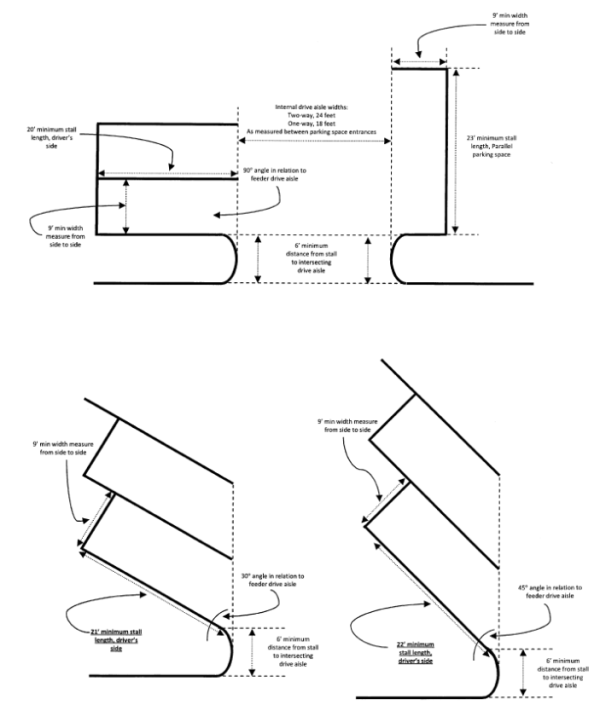
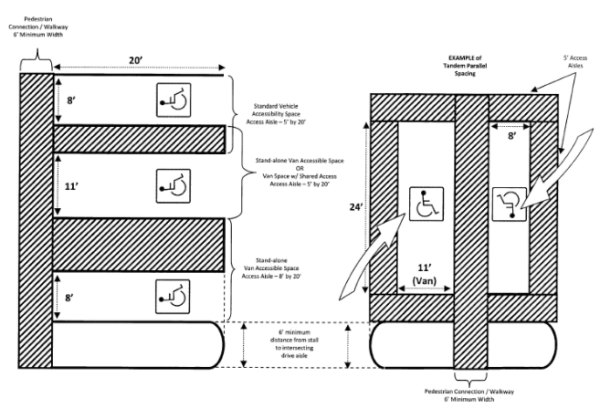
17.04.740: Landscaping
- Purpose: The purpose of this section is to create visually attractive desert-themed, drought tolerant landscapes along streets and commercial corridors, provide shade across large expanses of pavement, provide landscaped areas around multi-family buildings and reduce the impacts of nonresidential uses on residences. All required landscaping must consist of live native, xeric and drought tolerant plants to minimize outdoor water use on landscapes. Outdoor sculptures, shade structures, decorative hardscapes and rock work are encouraged.
- Scope: Wasting water is unlawful per Nevada Revised Statutes 534.0165, 534.020(2), 534.070, and NAC 704.567. Since Pahrump is in a desert with scarce water supplies, the use of xeric and native plants is required. For the purposes of this section, "xeric landscaping" shall mean utilizing plants that are drought tolerant, Great Basin Desert compatible and zero (0) to moderate water use. Use of treated recycled water for irrigation is required wherever such water is available. The use of artificial turf is also permitted.
Development that is processed through the site development plan review procedures pursuant to section 17.04.950 of this chapter, uses authorized by CUP or expansion of legally grandfathered use or building(s) meeting the criteria set forth in section 17.04.905 of this chapter and multi-family development greater than five (5) units shall comply with these requirements. Livestock pastures and vegetable gardens are specifically exempt from these restrictions. - Recommended Plants: Recommended plants, trees and shrubs are included in appendix G of the ground water management plan.
- Landscaping Plan:
- Landscape plans must incorporate water conserving designs which includes appropriate soil, soil amendments, mulching and drainage. All applicants for building permits for construction that have an approved and certified site development plan must submit and have approved by the Zoning Administrator, a landscaping plan prior to issuance of a related building permit. The landscaping plan must show:
- Location of buildings and structures on the property;
- The common names of the plants to be used; if there is no common name or if that name does not clearly indicate the species, the botanical name must be used;
- Planned location of all plants;
- The type and location of watering system/lines, soil amendments and how installation and maintenance will be performed;
- The parties responsible for maintenance of the landscaping;
- The square footage for all landscaping on the site; dimensions of each landscaping area must be provided, along with the quantities and locations of trees and shrubs, and their mature height and spread;
- The location of all underground utility easements, septic, leach field, and any existing or proposed overhead power lines;
- The estimated total landscape water use.
- Type of groundcover, any portion of a landscape area not planted must be covered with decorative rock, bark, mulch or other suitable material for reducing dust and evaporation and improving the aesthetic appearance of the area.
- Salt cedar plants must be identified on the property if any exist. See subsection H, "Prohibited Plantings", of this section.
- Landscape plans must incorporate water conserving designs which includes appropriate soil, soil amendments, mulching and drainage. All applicants for building permits for construction that have an approved and certified site development plan must submit and have approved by the Zoning Administrator, a landscaping plan prior to issuance of a related building permit. The landscaping plan must show:
- Installation And Maintenance:
- Plantings must not obstruct the clear sight triangle views of drivers, see subsection I, figure 2 of this section.
- Landscaping must be installed according to the approved plan; installation must be completed at the time of the related building's occupancy.
- Site grading, must be designed to minimize irrigation water runoff onto streets and to maximize the use of stormwater for on-site irrigation.
- The slope of turf grass areas must exhibit minimal slope or none at all.
- Water conserving irrigation system must be installed along with an automatic rain sensor. All irrigation must be adequately maintained. Landscaping which dies must be replaced by the owner as expeditiously as possible, but in no case, longer than sixty (60) days after notification.
- Appropriate soil, soil amendments and top mulch must be used to absorb and retain water and encourage the formation of deep root systems;
- Plants with similar water requirements should be grouped on the same irrigation line.
- Landscaping Area Requirements:
- Commercial, multi-family and industrial:
- The total landscaped area required must equal not less than ten percent (10%) of the net lot area. For the purposes of this section, "net lot area" means the total area of the lot minus:
- The area of the lot covered by buildings;
- The portions of the lot that are fully screened from view from any adjacent lot or public right-of-way by an opaque wall or fence at least six feet (6') high, no landscaping will be required except buffer landscaping, as applicable;
- Chain link fence with slats does not constitute acceptable full screening.
- The total landscaped area required must equal not less than ten percent (10%) of the net lot area. For the purposes of this section, "net lot area" means the total area of the lot minus:
- Commercial, multi-family and industrial:
- Turf Restrictions:
- Single family residential:
- One thousand five hundred (1,500) square feet is the maximum turf area allowed for single family residential parcels,
- Turf in the front yard is prohibited, except for artificial,
- Turf must be placed at least three feet (3') from all buildings, structures and walls, except for artificial,
- Turf must be at least fifteen feet (15') from the pavement of all streets, except for artificial,
- Planting cool season grasses such as rye and fescue from seeds is prohibited May through August, (the hottest times of the year). Laying sod is permitted.
- All new golf courses must limit turf to 3 - 5 acres of turf per hole, watered with effluent reuse water to the extent possible.
- Farming, ranching and livestock pastures using permitted water rights and in existence prior to the adoption of this section are exempt from turf grass restrictions.
- Single family residential:
- Prohibited Plantings:
- Salt cedar (tamarisk) bushes or trees are specifically prohibited.
- Salt cedars of all sizes must be removed from a property prior to any new development.
- Planting cool season grasses such as rye and fescue from seed is prohibited from May through August.
- Salt cedar (tamarisk) bushes or trees are specifically prohibited.
- Clear Sight Areas: Clear sight areas must be maintained at all entrances and exits of parking areas and driveways in accordance with table VIII: Sight Triangle Easement Requirements of the Standard Details and Specifications for Public Improvements within the Pahrump Regional Planning District.
- No walls, fences, trees, shrubs or any other object other than street hardware may be constructed or installed within the sight triangle easement, unless maintained at less than thirty six inches (36") in height measured from the top of adjacent asphalt, curb, gravel or pavement street surface.
- No walls, fences, trees, shrubs or any other object other than street hardware may be constructed or installed within the sight triangle easement, unless maintained at less than thirty six inches (36") in height measured from the top of adjacent asphalt, curb, gravel or pavement street surface.
- Landscape Buffering And Screening Requirements: Landscape buffer areas are required between residential uses and nonresidential uses. Landscape buffers may be crossed by driveways connecting to adjacent land. No parking is permitted within a required landscape buffer area. The buffer landscaping must consist primarily of drought tolerant trees of an approved variety, which trees must be at least eight feet (8') high at time of planting and capable of reaching a height at maturity of at least twenty feet (20'). Spacing of the trees must be equal to seventy five percent (75%) of the mature canopy diameter of the trees. In no case shall the width of the on-site landscape buffer be less than the requirements listed below.
- Locations and minimum widths:
- Front: Ten feet (10') minimum.
- Side: Five feet (5'). The landscape buffer may be relocated if the lot line is within a common access easement or where overhead powerlines exist.
- Rear: Six feet (6'). The landscape buffer may be relocated if the lot line is within a common access easement or where overhead powerlines exist.
- The buffer landscaping between residential and nonresidential property lines must be maintained on the nonresidential side of the boundary.
- When adjacent properties have similar zoning (i.e., commercial adjacent to commercial or industrial adjacent to industrial) the side and rear landscape buffers may be replaced with a block wall.
- No trees shall be planted in any landscaping buffer that is located below overhead power lines.
- Trees may be relocated to a different landscape buffer within the property, provided the total number of trees required is provided.
- Screened areas: When properties are developed and the public cannot access the rear of the building or lot, the rear landscaping buffer and the portion of the side landscaping buffer that will not be accessed or viewed by the public may be removed or replaced with a block wall.
- Where parking or vehicle circulation areas are adjacent to the landscaping strip, a minimum six foot (6') high opaque wall or fence shall also be required, located along the property line, to visually screen the parking or circulation area from any adjacent residential zone; chain link fence with slats shall not constitute acceptable screening.
- Where perimeter walls are used surrounding residential developments in Village residential, multi-family, Mobile Home Park or Mixed Use Zoning Districts a minimum fifteen feet (15') of perimeter landscaping (which may include the sidewalk) must be installed, but shall not be turf.
- Irrigated landscaping that could adversely impact a block wall may be relocated away from the block wall and all other structures on the property, provided a soils report is submitted with the site development plan.
- The soils report submitted must be prepared by a licensed geotechnical or civil engineer licensed in the State of Nevada, and should indicate minimum separation from irrigation and any block walls or other structures on the property.
- Locations and minimum widths:
- Special Landscape Standards:
- Commercial, industrial and multi-family housing greater than four (4) units must include landscaping as part of their design as shown on a plan submitted pursuant to section 17.04.950 of this chapter and must include live native, xeric and drought tolerant plants and be designed to minimize outdoor water use on landscapes. Outdoor sculptures, shade structures, decorative hardscapes and rock work are encouraged. Existing native trees and shrubs must be preserved to the fullest extent possible. Trees, shrubs and other vegetative landscaping must be trimmed and maintained so as not to interfere with the ability of vehicles to park in any provided parking spaces.
- Off Street Parking Area Trees: Quantity and distribution of trees shall be as follows:
- One tree is required per twenty (20) parking spaces;
- The minimum size of tree planters within off street parking areas shall be thirty six (36) square feet per tree;
- Trees must be drought tolerant shade trees, capable of achieving a mature canopy diameter of at least twenty five feet (25').
- The total number of trees may be reduced by twenty percent (20%) if ten percent (10%) or more of the required parking lot is finished with a permeable surface or pavers.
- Ground Cover: To minimize water consumption, the use of vegetative ground cover other than turf grass is encouraged. Any portion of a landscape area not planted must be covered with decorative rock, bark, mulch or other material suitable for reducing dust and evaporation and improve the aesthetic appearance of the area.
- Any nonliving ground cover areas must be clearly delineated on the landscaping plan.
- Water Features, Ponds And Artificial Lakes:
- Decorative water features and ponds are limited to less than fifty (50) square feet surface area.
- Bodies of water used for recreation purposes that are not one hundred percent (100%) reclaimed water are to be authorized by conditional use permit.
- Swimming pools and spas are encouraged to be covered to mitigate evaporation when not in use.
- Artificial Outdoor Landscaping:
- Artificial turf landscaping:
- Must be constructed of a low-density polyethylene material with a melting point equal to or in excess of one hundred fifty degrees Fahrenheit (150°F), a softening point equal to or in excess of one hundred twenty degrees Fahrenheit (120°F), and a brittle point equal to or in excess of zero degrees Fahrenheit (0°F).
- Shall be a minimum of three (3) colors combined of natural grass colors to mirror living vegetation. The primary color must be green. Product must have UV resistant pigmentation and UV stabilization to prevent fading and allow for longevity.
- Products must be installed and anchored so as to withstand ninety (90) mile per hour wind loads, and anchored to reasonably withstand storm event flooding.
- Products that are torn, broken, faded, damaged or missing must be replaced immediately.
- The use of plastic, vinyl, polyester, silk or glass in artificial outdoor landscaping products is prohibited.
- Artificial turf landscaping:
- Off Street Parking Area Trees: Quantity and distribution of trees shall be as follows:
- Commercial, industrial and multi-family housing greater than four (4) units must include landscaping as part of their design as shown on a plan submitted pursuant to section 17.04.950 of this chapter and must include live native, xeric and drought tolerant plants and be designed to minimize outdoor water use on landscapes. Outdoor sculptures, shade structures, decorative hardscapes and rock work are encouraged. Existing native trees and shrubs must be preserved to the fullest extent possible. Trees, shrubs and other vegetative landscaping must be trimmed and maintained so as not to interfere with the ability of vehicles to park in any provided parking spaces.
- Water Conservation Standards - New Construction:
- Wasting water is unlawful per Nevada Revised Statutes 534.0165, 534.020(2), 534.070, and NAC 704.567:
- Automatic irrigation systems are required for all common areas, residential and commercial landscaped areas,
- Overhead spray must be minimized and restricted to turf grass and flower beds; all other landscaped areas must use low volume drip lines,
- Large radius spray heads adjacent to roads or sidewalks are prohibited,
- Runoff or spraying water directly onto roads, paths, sidewalks or other non-turf areas is prohibited,
- Overhead spray watering during high wind events is prohibited.
- Wasting water is unlawful per Nevada Revised Statutes 534.0165, 534.020(2), 534.070, and NAC 704.567:
- Watering Restrictions And Watering Schedules - New Construction:
- Watering Schedules: All common areas, residential dwellings and commercial areas must comply with watering schedules issued by Nye County Water District (NCWD) which sets forth the days, time of day and duration of time allowed for outdoor watering.
- From November 1 through February watering is limited to one day a week.
- From September 1 through October and March 1 through April, watering is limited to three (3) days per week.
- From May 1 through August, watering is allowed seven (7) days of the week.
- Summer watering restrictions allow landscape watering any day of the week through August.
- Watering newly installed sod is allowed daily for up to thirty (30) days once per calendar year.
- Additional Watering Restrictions:
- From May 1 until October 1 sprinkler and drip system watering is prohibited from eleven o'clock (11:00) A.M. to seven o'clock (7:00) P.M. (Ord. 514, 2017)
- From May 1 until October 1 sprinkler and drip system watering is prohibited from eleven o'clock (11:00) A.M. to seven o'clock (7:00) P.M. (Ord. 514, 2017)
- Watering Schedules: All common areas, residential dwellings and commercial areas must comply with watering schedules issued by Nye County Water District (NCWD) which sets forth the days, time of day and duration of time allowed for outdoor watering.
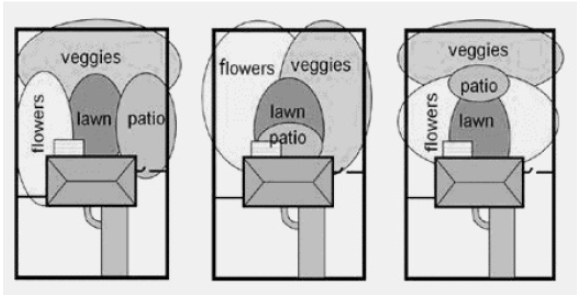
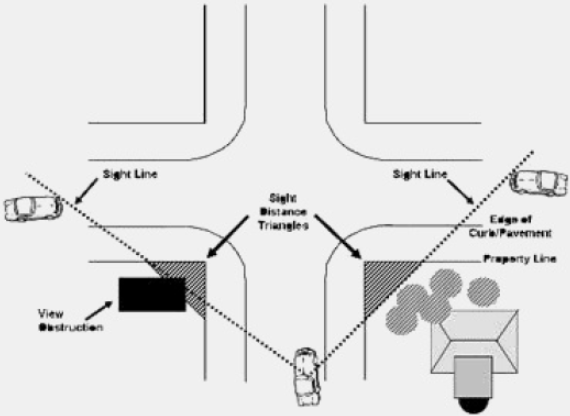
17.04.750: Lighting
- Definitions: Unless specifically defined below, words or phrases used in this section shall be interpreted so as to give them the meaning they have in common usage and to give this sectionits most reasonable application.
AREA LIGHT: Light that produces over 1,800 lumens (See Addendum 1 for light output of various lamps). Area lights include, but are not limited to, streetlights, parking lot lights and yard lights.
AVERAGE FOOTCANDLE: The level of light measured at an average point of illumination between the brightest and darkest areas. The measurement can be made at the ground surface or at four to five feet (4' to 5') above the ground.
BALLAST: A device used with a discharge lamp to obtain the necessary voltage, current, and/or wave form for starting and operating the lamp.
BULB: The source of electric light. To be distinguished from the whole assembly (see "luminaire").
CANDELA (cd): Unit of luminous intensity.
COMMISSION: The Nye County Board of County Commissioners.
EIGHTY FIVE DEGREE FULL CUTOFF TYPE FIXTURES: Fixtures that do not allow light to escape above an eighty five degree (85º) angle measured from a vertical line from the center of the lamp extended to the ground.
EXISTING LIGHTING: Any and all lighting installed prior to the effective date of this chapter.
EXTERIOR LIGHTING: Temporary or permanent lighting that is installed, located or used in such a manner to cause light rays to shine outside. Fixtures that are installed indoors that are intended to light something outside are considered exterior lighting for the intent of this chapter.
FIXTURE: The assembly that holds the lamp in a lighting system. It includes the elements designed to give light output control, such as a reflector (mirror) or refractor (lens), the ballast, housing, and the attachment parts.
FLOODLIGHT: Light that produces up to one thousand eight hundred (1,800) lumens (See Addendum 1 for light output of various lamps) and is designed to "flood" a well-defined area with light. Generally, floodlights produce from one thousand (1,000) to one thousand eight hundred (1,800) lumens.
FLUX (RADIANT FLUX): Unit is erg/sec or watts.
FOOTCANDLE: Illumination produced on a surface one foot (1') from a uniform point source of one candela. Measured by a light meter.
FULL CUTOFF FIXTURES: Fixtures, as installed, that are designed or shielded in such a manner that all light rays emitted by the fixture, either directly from the lamps or indirectly from the fixture, are projected below a horizontal plane running through the lowest point on the fixture where light is emitted.
GLARE: Intense light that results in discomfort and/or a reduction of visual performance and visibility.
HOLIDAY LIGHTING: Festoon-type lights, limited to small individual bulbs on a string, where the spacing of bulbs is not closer than three (3) inches and where the output per bulb is no greater than fifteen (15) lumens.
IESNA: Illuminating Engineering Society of North America (IES or IESNA), the professional society of lighting engineers, including those from manufacturing companies, and others professionally involved in lighting.
ILLUMINANCE: Density of luminous flux incident on a surface. Unit is footcandle or lux.
LAMP: The source of electric light: the bulb and its housing. To be distinguished from the whole assembly (see "luminaire").
LIGHT: The form of radiant energy acting on the retina of the eye to make sight possible; brightness; illumination; a lamp, as defined above.
LIGHTING: Any or all parts of a luminaire that function to produce light.
LIGHT POLLUTION: Any adverse effect of man-made light including, but not limited to, light trespass, uplighting, the uncomfortable distraction to the eye, or any man-made light that diminishes the ability to view the night sky. Often used to denote urban sky glow.
LIGHT TRESPASS: Light falling where it is not wanted or needed, generally caused by a light on a property that shines onto the property of others.
LUMEN: Unit of luminous flux; the flux emitted within a unit solid angle by a point source with a uniform luminous intensity of one (1) candela. One (1) footcandle is one (1) lumen per square foot. One (1) lux is one (1) lumen per square meter.
LUMINAIRE: The complete lighting unit, including the lamp, the fixture, and other parts.
LUMINANCE: At a point and in a given direction, the luminous intensity in the given direction produced by an element of the surface surrounding the point divided by the area of the projection of the element on a plane perpendicular to the given direction. Units: candelas per unit area. The luminance is the perceived brightness that we see, the visual effect of the illuminance, reflected, emitted or transmitted from a surface.
NONESSENTIAL: Lighting that is not necessary for an intended purpose after the purpose has been served. Does not include any lighting used for safety and/or public circulation purposes. Example: For purposes of this chapter, lighting for a business sign is considered essential during business hours, however, is considered nonessential once the business is closed.
PARTIALLY SHIELDED: The bulb of the fixture is shielded by a translucent siding and the bulb is not visible at all. Light may be emitted at the horizontal level of the bulb.
PLANNING COMMISSION: The Pahrump Regional Planning Commission.
RECESSED: When a light is built into a structure or portion of a structure such that the light is fully cut off and no part of the light extends or protrudes beyond the underside of a structure or portion of a structure.
SHIELDED: When the light emitted from the fixture is projected below a horizontal plane running through the lowest point of the fixture where light is emitted. The bulb is not visible with a shielded light fixture, and no light is emitted from the sides of the fixture. Also considered a full-cutoff fixture.
TEMPORARY LIGHTING: Lighting that is intended to be used for a special event for seven (7) days or less.
UPLIGHTING: Lighting that is directed in such a manner as to shine light rays above the horizontal plane. - Title: This section, together with the amendments thereto, shall be known and may be cited the "Pahrump Regional Planning District Dark Sky Ordinance."
- Purposes: The general purpose of this section is to protect and promote the public health, safety and welfare, the quality of life, and the ability to view the night sky, by establishing regulations and a process of review for exterior lighting. This section establishes standards for exterior lighting in order to accomplish the following:
- To protect against direct glare and excessive lighting;
- To provide safe roadways for motorists, cyclists and pedestrians;
- To protect and reclaim the ability to view the night sky, and thereby help preserve the quality of life;
- To prevent light trespass in all areas of the PRPD;
- To promote efficient and cost-effective lighting;
- To ensure that sufficient lighting can be provided where needed to promote safety and security;
- To allow for flexibility in the style of lighting fixtures;
- To provide lighting guidelines.
- Scope: All exterior lighting installed after the effective date of this section in any and all zoning districts in the PRPD shall be in conformance with the requirements established by this section and any other applicable ordinances. All existing lighting installed prior to the effective date of this section in any and all zoning districts in the PRPD shall be addressed as follows:
- All existing lighting located on a subject property that is part of an application for a PRPD design review, conditional use, or subdivision permit, or building permit is required to be brought into conformance with this section. Conformity shall occur prior to issuance of certificate of occupancy, final inspection, or final plat recordation, when applicable. For other permits, the applicant shall have a maximum of thirty (30) days from date of permit issuance to bring the lighting into conformance.
- All existing exterior commercial lighting that is not in conformance with this section shall be brought into conformance with this section five (5) years from the date of adoption of this section.
- All existing lighting that does not meet the requirement of this PRPD Dark Sky Ordinance requirement which states that "any parking, yard, or building illumination in [any] zoning [district] shall be so directed as to protect adjacent properties from glare and direct lighting" is required to be brought into conformance within five (5) years from the date of adoption of this section.
- All existing exterior residential lighting, not affected by Subsections C.1. and C.2. above, that does not comply with this section is required to be brought into conformance with this section within five (5) years from the date of adoption of this section.
- Criteria: The Board of County Commissioners, Zoning Administrator, Nye County Building Official and/or the Planning Commission shall have the authority to require new lighting, and existing lighting, to meet the requirements of this section.
- All applications for design review, conditional use, subdivision and/or building permits shall include lighting plans showing location, type, height, and lumen output of all proposed and existing fixtures. The applicant shall provide enough information to verify that lighting conforms to the provisions of this section. The Planning Commission and/or Planning Director shall have the authority to request additional information in order to achieve the purposes of this section.
- All exterior lighting shall be full cutoff fixtures with the light source fully shielded, with the following exceptions:
- Luminaires that have a maximum output of two hundred sixty (260) lumens per fixture, regardless of number of bulbs, (equal to one twenty (20) watt incandescent light), may be left unshielded provided the fixture has an opaque top to keep light from shining directly up.
- Luminaires that have a maximum output of one thousand (1,000) lumens per fixture, regardless of number of bulbs (equal to one sixty (60) watt incandescent light), may be partially shielded, provided the bulb is not visible, and the fixture has an opaque top to keep light from shining directly up.
- Floodlights with external shielding may be angled provided that no light escapes above a twenty five degree (25º) angle measured from the vertical line from the center of the light extended to the ground, and only if the light does not cause glare or light to shine on adjacent property or public rights-of-way. Floodlights with directional shielding are encouraged. Photocells with timers that allow a floodlight to go on at dusk and off by 11:00 p.m. are encouraged.
- Holiday lights as defined are exempt from the requirements of this chapter for the six and one half (6 1/2) month period from November 1 to April 15, except that flashing holiday lights are prohibited on commercial properties. Flashing holiday lights on residential properties are discouraged. Holiday lights are encouraged to be turned off after bedtime and after close of businesses.
- Sensor-activated lighting may be unshielded provided it is located in such a manner as to prevent direct glare and lighting into properties of others or into a public right of way, and provided the light is set to only go on when activated and to go off within five (5) minutes after activation has ceased, and the light shall not be triggered by activity off the property.
- Vehicular lights and all temporary emergency lighting needed by the Fire and Sheriff Departments, or other emergency services shall be exempt from the requirements of this section.
- Light Trespass: It is the intent of this section to eliminate and prevent light trespass through the proper installation of lighting fixtures. All existing and/or new exterior lighting shall not cause light trespass and shall be such as to protect adjacent properties from glare and excessive lighting.
- IESNA Guidelines: The Planning Commission may require that any new lighting or existing lighting that comes before them meet the standards for footcandle output as established by IESNA.
- All nonessential exterior commercial and residential lighting is encouraged to be turned off after business hours and/or when not in use. Lights on a timer are encouraged. Sensor-activated lights are encouraged to replace existing lighting that is desired for security purposes.
- Area Lights:
- All area lights, including streetlights and parking area lighting, shall be full cutoff fixtures and are required to be eighty five degree (85º) full cutoff type fixtures. Streetlights shall be high pressure sodium, low pressure sodium, LED, or metal halide, unless otherwise determined by the Board that another type is more efficient. Streetlights along residential streets shall be limited to a seventy (70) watt high pressure sodium (hps) light and shall have a four inch (4") tall sheet metal shroud installed around the perimeter of the lens to direct light downward. Streetlights along nonresidential streets or at intersections shall be limited to one hundred (100) watts hps, except that lights at major intersections on state highways shall be limited to two hundred (200) watts hps. If the Board permits a light type other than high pressure sodium, then the equivalent output shall be the limit for the other light type. For example: a one hundred (100) watt high pressure sodium lamp has a roughly equivalent output as a fifty five (55) watt low pressure sodium lamp, or a one hundred (100) watt metal halide lamp.
- Parking area lights are encouraged to be greater in number, lower in height and lower in light level, as opposed to fewer in number, higher in height and higher in light level. Parking lot lighting shall not exceed IESNA-recommended footcandle levels.
- All freestanding area lights within a residential zone, that are privately owned, except streetlights, shall be mounted at a height equal to or less than the value 3 + (D/3), where D is the distance in feet to the nearest property boundary or shrouded to direct light downward. The County may assist the residential customer with the shrouding.
- Luminaire Mounting Height: Freestanding luminaires shall be no higher than twenty five (25) feet above the stand/pole base, except that luminaires used for playing fields shall be exempt from the height restriction provided all other provisions of this chapter are met and the light is used only while the field is in use, and except that streetlights used on major roads may exceed this standard if necessary as determined by the Board, as advised by a lighting engineer. Building-mounted luminaires shall be attached only to walls, and the top of the fixture shall not exceed the height of the parapet or roof, whichever is greater.
- Up Lighting: Up lighting is prohibited in all zoning districts, except in cases where the fixture is shielded by a roof overhang or similar structural shield from the sky and a Nevada licensed architect or engineer has stamped a prepared lighting plan that ensures that the light fixture(s) will not cause light to extend beyond the structural shield, and except as specifically permitted in this section.
- Flag Poles: Upward flagpole lighting is permitted for governmental flags only, and provided that the maximum lumen output is one thousand three hundred (1,300) lumens. Flags are encouraged to be taken down at sunset to avoid the need for lighting.
- Service Stations: The average lumen lighting level for new and existing service stations is required to be no greater than thirty (30) lumens, as set by the IESNA for urban service stations.
- Canopy Lights: All lighting shall be recessed sufficiently so as to ensure that no light source is visible from or causes glare on public rights-of-way or adjacent property.
- Landscape Lighting: Lighting of vegetation is discouraged and shall be in conformance with this section. Uplighting is prohibited.
- Towers: All radio, communication, and navigation towers that require lights shall have dual lighting capabilities. For daytime, the white strobe light may be used, and for nighttime, only red lights shall be used.
- Temporary Lighting: Temporary lighting that conforms to the requirements of this section shall be allowed. Nonconforming temporary exterior lighting may be permitted administratively by the Planning Department with the issuance of a temporary use permit after considering the public and/or private benefits which will result from the temporary lighting; any annoyance or safety problems that may result from the use of the temporary lighting; and the duration of the temporary nonconforming lighting. The applicant shall submit an application for a temporary use permit with a detailed description of the proposed temporary nonconforming lighting to the Planning Department.
- Neon Lights: Neon lights are only permitted for businesses and required to be turned off during nonbusiness hours.
- Notification:
- Nye County Planning Department permits shall include a statement asking whether the subject property of the proposed work includes any exterior lighting.
- Within thirty (30) days of the enactment of this chapter, the Planning Commission shall send a copy of the PRPD Dark Sky Ordinance with a cover letter to all local electricians and local electric suppliers listed in the local 2018 telephone books, as well as to the Pahrump Chamber of Commerce.
- Responsibility Of County:
- The County will commit to changing all lighting within County rights of way and on County owned property to meet the requirements of this section. The County may meet the requirements of this section by removing unnecessary streetlights and installing a sheet metal shroud around the lens to direct light downward.
- Nye County will assist property owners and/or occupants to correct any nonconforming lighting through consulting with the owner/occupant and assisting in the provision of shields.
- Violations, Legal Actions And Penalties: If, after investigation, the Zoning Administrator or Code Enforcement Officer finds that any provision of this section is being violated, the official shall give notice by hand delivery or by certified mail, return receipt requested, of such violation to the owner and/or to the occupant of such premises, demanding that the violation be abated within thirty (30) days of the date of hand delivery or of the date of mailing of the notice. The Planning Department staff shall be available to assist in working with the violator to correct said violation. If the violation is not abated within the sixty (60) day period, the Zoning Administrator/Code Enforcement Officer may institute actions and proceedings, either legal or equitable, to enjoin, restrain or abate any violations of this section and to collect the penalties for such violations.
- Penalty: A violation of this section or any provision thereof, shall be punishable by a civil penalty of one hundred dollars ($100) and each day of violation after the expiration of the sixty (60) day period provided in Subsection W. above shall constitute a separate offense for the purpose of calculating the civil penalty. (Ord. 552, 2019)
17.04.760: Screening, Walls, And Fences
- Scope: This chapter applies to all properties in the Pahrump Regional Planning District with opaque screening, walls and/or fences.
- Purpose: The purpose of this section is to allow for the construction of opaque, privacy and perimeter screening, walls, and fences at a limited scale, compatible with the neighboring uses, and as to promote an attractive streetscape. Buffers are encouraged to create visual harmony when different land uses abut each other.
- Measurement Of Height:
- Front Yard: Opaque screening, walls, or fences which occupy any portion of required front yard, except within a sight triangle easement, shall be measured either:
- Above finished grade along the fence line; or
- Above the curb grade; or
- Above the nearest edge of the street pavement in the absence of a curb structure along the street right-of-way line; or
- Above the finished lot grade along the side property line.
- Front Yard: Opaque screening, walls, or fences which occupy any portion of required front yard, except within a sight triangle easement, shall be measured either:
- Maximum Height:
- Front Yard: An opaque screening, wall, or fence may occupy any portion of a required front yard, except within the sight triangle easement, provided that such screening, walls, or fences do not exceed the following heights:Note:
Districts Maximum Height RH 6 feet1 OU, RE, SE, VR, MF 4 feet1 HF, MU, NC, TC, GC 6 feet Perimeter wall subdivision 6 feet LI, HI, BR 6 feet1
1An opaque screening, wall or fence greater than 4 feet but not to exceed 8 feet may be permitted within the front yard so long as no portion of such wall is closer than 15 feet to the front property line. - Other Yards: An opaque screening, wall, or fence may occupy any portion of a front, side or rear yard, except within the required front yard and except within a sight triangle easement, provided that such opaque screening, walls, or fences do not exceed the following heights:
Districts Maximum Height RH 8 feet OU, RE, SE, VR, MF 8 feet HF, MU, NC, TC, GC 8 feet Perimeter wall subdivision 8 feet LI, HI, BRD 8 feet - Facing Public Streets: Solid, opaque walls or fences which face public streets shall not exceed eight feet (8') in height on the public street side.
- Perimeter Walls: Perimeter walls shall be set back fifteen feet (15') from the back of the curb to accommodate a ten foot (10') landscape strip for all residential subdivisions, and PUDs.
- Exceptions For Residential Districts: Decorative features one foot (1') in height are permitted, such as lights or finials on top of columns which a required front yard and street side yard.
- Obstructions: Planted hedges, shrubs, or trees shall not obstruct a public right-of-way.
- Front Yard: An opaque screening, wall, or fence may occupy any portion of a required front yard, except within the sight triangle easement, provided that such screening, walls, or fences do not exceed the following heights:
- Required Screening:
- Screening shall be required for all HI uses and must be in the form of opaque walls or fences with a minimum height of six feet (6').
- Any junkyard, salvage yard, or automobile storage facility shall be screened with a minimum height of six feet (6').
- Dismantled vehicles must be screened from the front yard in residential, commercial or industrial districts. Screening for this purpose must be in the form of opaque walls, fences or hedges with a minimum height of six feet (6').
- Special Screening Requirements For Certain Uses: In addition to the above requirements additional screening requirements apply where a principal business is:
- Junkyard, or outdoor vehicle storage where the vehicles are typically not moved for one week or more and abuts a residential zone or is separated only by public right-of-way from a residential zone, a minimum six foot (6') high opaque wall or fence shall be required to visually screen the parking or display area from the adjacent residential zone; chainlink fence with slats shall constitute acceptable screening. (Ord. 285, 2004)
- Junkyard, or outdoor vehicle storage where the vehicles are typically not moved for one week or more and abuts a residential zone or is separated only by public right-of-way from a residential zone, a minimum six foot (6') high opaque wall or fence shall be required to visually screen the parking or display area from the adjacent residential zone; chainlink fence with slats shall constitute acceptable screening. (Ord. 285, 2004)
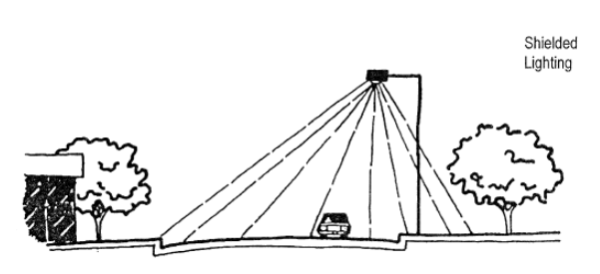
17.04.770: Signage Requirements
- Scope: Outdoor advertising structures and signs may be permitted subject to the limitations and provisions set forth herein. This section is intended to provide specifications and regulations for most sign types. Signs not described or regulated by this chapter should not be used or constructed without specific approval of the Planning and Zoning Commission. The provisions of this Code shall apply to all signs erected in the Pahrump Regional Planning District.
- Purpose And Intent: The purposes of these sign regulations are:
- To encourage the effective use of signs as a means of communication;
- To maintain and enhance the aesthetic environment and the valley's ability to attract sources of economic development and growth;
- To improve pedestrian and traffic safety;
- To minimize the possible adverse effect of signs on public and private property; and
- To provide for consistent and fair application and enforcement of the regulations pertaining to signs.
- Applicability:
- Generally: A sign may be erected, placed, established, painted, created or maintained in the PRPD only in conformance with the standards, procedures, exemptions and other requirements of this chapter.
- Nonapplicable Situations: Nothing in this chapter shall apply to displays of the following kinds:
- Official notices of any court, public body or officer;
- Notices posted by utility or other quasi-public agent in the performance of a public duty or by any person giving due legal notice;
- Directional, warning or informational signs or structures either required by law or established by local authority, institutional or group notices of a public or semipublic nature;
- Lettering attached to an operational motor vehicle;
- Those signs located within a building or on private property that will not be visible from any public right-of-way or adjoining properties; and
- Grandfathered signs.
- Definitions: Words and phrases used in this chapter shall have the meanings set forth in this chapter:
ABANDONED SIGN: A sign which remains on a property which has been vacated or which remains unused and does not display a currently valid advertising message, or although in use exists in a deleterious state or in disrepair.
ALTERATION: Changing or rearranging any structural part, sign face, enclosure, lighting, component, control, or location of a sign.
ANIMATED SIGN: A sign with parts or sections which revolve or move or which have flashing or intermittent lights, but not including "time and temperature" signs or electronic message signs (see also definition of electronic message sign).
AWNING SIGN: A sign that is mounted to a building or canopy. The framework is usually covered with a light fabric or other materials that may be translucent. The awning cover may contain advertising or identifying copy, graphics or design and may be back lighted. Awnings used strictly as protective structures for windows and doors and having no sign copy or design are not signs and may display the building address only.
BACKLIGHTING: Illumination positioned inside or behind a sign face such as behind raised letters and awnings or inside sign cabinets, the lighting source of which is not itself visible to the observer. This may also be called "internally lighted".
BEACON LIGHT: See definition of searchlight/beacon.
BILLBOARD: A sign that directs attention to a business, commodity, service, entertainment or attraction that is sold, offered, or exists at a location other than the premises upon which the sign is located.
CHANGEABLE COPY SIGN: A sign on which the text or copy may be changed manually or electrically, including, but not limited to, electronic message signs, time and temperature displays, price signs for gas stations, or movie theater listings.
CLEARANCE: The height of the lower edge of the face of a freestanding sign from the finished grade.
ELECTRONIC MESSAGE SIGN: A display consisting of an LED or an array of internal light sources, panels, or disks that are computerized or electronically activated.
EXTERNAL ILLUMINATION: Lighting which is mounted so as to illuminate a sign from a position outside of the sign structure. This may also be called "externally lighted".
FREESTANDING SIGN: A sign that is self-supported by poles, pylons, or other structural supports mounted in the ground.
HEIGHT: The vertical measurement from the adjacent street grade or normal grade to the top of the highest attached component of the sign.
ILLEGAL SIGN: Any sign that was constructed, modified or expanded after the adoption of this Code not lawfully constructed or erected in compliance with regulations identified in this chapter.
ILLUMINATION: A sign equipped with artificial lighting devices and/or neon for the purpose of improving the sign's visibility.
INFLATED SIGN: Any advertising device that is supported by heated or forced air or lighter than air gases.
LAWFUL NONCONFORMING SIGN: A sign including structural supports which lawfully existed at the time the zoning or land use ordinance became effective but which does not presently conform to all the requirements of this chapter.
MARQUEE SIGN: A roofed structure affixed to and supported by the building and projecting beyond the face of the building for purpose of advertising the business or service offered within the building to which such sign is affixed.
MONUMENT SIGN: A freestanding sign the base of which is at least as wide as ninety percent (90%) of the sign width, and mounted permanently in the ground.
MOVABLE SIGN: Any sign prominently displayed to identify, advertise, direct, or promote, any person, product, company, or entity of service, which is movable in nature such as "A-frames", pedestal, signs on vehicles, banners attached to freestanding poles, or similar signs that are not permanently installed in the ground.
OFF PREMISES SIGN: Any billboard or advertising display indicating the business transacted, services rendered, goods sold or produced, name of business, person, firm or corporation, which is not available or not located on the same premises as the display.
ON PREMISES SIGN: Any freestanding sign or wall display strictly incidental to a lawful use of the premises on which it is located indicating the business transacted at, services rendered, goods sold or produced on the premises, name of the business, or name of the person, firm or corporation occupying the premises. A sign located on an access drive which is the primary means of vehicular access to a development from a dedicated street shall be considered on premises, even if it is located on or through an adjacent property to a dedicated street.
POLITICAL SIGNS: Any display used for the purpose of appealing or opposing, directly or indirectly, any candidate or political measure during an electoral campaign.
PORTABLE READER SIGN: A reader sign that is mounted on a portable framework and intended for temporary use.
PROJECTING SIGN: A sign that is attached to and projects from a building, pole or other support.
PROMOTIONAL SIGNAGE: Temporary devices such as banners, streamers, flags, balloons, pennants, trailer signs and inflated signs which advertise special prices or events at the business and not only the name of the business.
PUBLIC PROPERTY: Land identified by the Nye County Planning Department and based on what is defined as public property according to official documents of Nye County. Examples of such lands are lands owned or managed by the Bureau of Land Management, Nye County, U.S. Forestry, Native American tribes, and the State of Nevada.
READER SIGN: A changeable copy display that allows for the manual or electrical changing of the copy or text.
REPAIR: The replacement of frame and support material of an existing sign with the same material with no change in the support system of the existing sign.
ROOF SIGN: A sign which is supported wholly or in part by and which projects over a roof.
ROUTINE MAINTENANCE: Normal repair and upkeep of the structural integrity and appearance of a nonconforming outdoor advertising structure. The term does not include an increase in the size or height of the structure of any addition or enhancement to the structure that increases the visual effect of the structure or increases the impact of the use of the land in the area around the structure.
SEARCHLIGHT/BEACON: An apparatus on a swivel or stationary which projects a beam of light greater than five hundred thousand (500,000) candlelight wattage.
SHOPPING CENTER: An integrated shopping complex comprised of five (5) or more retail stores.
SIGN: An outdoor advertisement making a material or service known.
SIGN AREA: The portion of a sign used for display purposes and excluding the frame and supports. Only one side of a double faced sign shall be used for computing the sign area when the signs are parallel (no greater than 2 feet apart) or diverge from a common edge by an angle not greater than thirty degrees (30°). For signs that do not have defined display areas, sign area shall be the area of the smallest rectangle or square that will frame the display.
SIGN SETBACK: Sign setback is the distance from the current or future right-of-way line, and/or perimeter property line, measured horizontally to the closest point of projection of the display, sign or structure.
TEMPORARY SIGN: Any identification, advertising, directional, or promotional device which is not permanently constructed or attached and which must be removed according to the provisions of this chapter.
WALL SIGN: A sign that is painted on, fastened to, or erected against the wall of a building. - General Sign Regulations In All Zones:
- Signs Allowed In All Zones, No Permit Required:
- Construction signs having an area not in excess of thirty two (32) square feet in residential zones and sixty (60) square feet in all other zones, provided such signs are erected no more than sixty (60) days prior to construction, are confined to the site of construction, and are removed not more than thirty (30) days after completion of construction and prior to occupancy.
- Government signs for traffic control, for direction to public facilities, or for regulatory notice, warning or other public purposes.
- Nonilluminated real estate signs provided they are removed within seven (7) days of the sale, rental or lease of the subject property and provided that such signs not exceed more than sixteen (16) square feet of area, shall not be illuminated and shall be set back at least two feet (2') from all property lines.
- Political signs provided the signs are located and removed in accordance with Nevada Revised Statutes and this Code and comply with the following minimum requirements:
- Location: If located along a County maintained road or street, political signs must:
- Be placed a minimum of ten feet (10') off the edge of pavement and appropriately secured to the ground.
- Be placed a minimum of three feet (3') from the flow line of the bar ditch. (Flow lines of County bar ditches are typically 8 to 10 feet from the edge of pavement.)
- Sign Size, Area And Height:
- Maximum sign area shall be thirty two (32) square feet, with maximum dimensions of four feet (4') tall, excluding frame and supports, by eight feet (8') wide.
- Maximum allowed sign height shall be six feet (6'), including sign frames and supports.
- Maximum sign width shall be eight feet (8').
- No sign exceeding thirty inches (30") in height, including frame and supports, shall be placed within the sight triangle easement. Sight triangle easements must be maintained at all points of ingress and egress to parking areas and driveways and at all two- and four-way intersections pursuant to the diagram below.
- For all roads with a speed limit of less than forty five (45) mph, a thirty foot (30') clear sight triangle must be maintained.
- For all roads with a speed limit of forty five (45) mph or greater, a sixty foot (60') clear sight triangle must be maintained.
- Timeframe: Political signs are only permitted to be placed a minimum of sixty (60) calendar days prior to the primary election so long as the sign concerns a candidate, party or question for that primary or the ensuing general election. Political signs must be removed within fifteen (15) calendar days after the primary election if the candidate, party or question is not to be voted on at the ensuing general election or the general election in any other case. Political signs must be removed fifteen (15) calendar days after any general or special election.
- Compliance: Any such political sign found in violation of the provisions of this section must be brought into conformance immediately upon written notification to the owner of the sign, either by e-mail or mail, return receipt requested. If the violator fails to make appropriate corrections within three (3) business days from receipt of notification, the Code Compliance Office or an authorized designee shall remove any signs in violation and impound those signs. Any signs that have been impounded and not claimed within thirty (30) calendar days of removal will become the property of Nye County and will be disposed of at the discretion of the County.
- Location: If located along a County maintained road or street, political signs must:
- Temporary directional signs subject to the following:
- Purpose: Temporary directional signs will be allowed to advertise and provide directions toward a residential subdivision during the construction of the subdivision.
- Area: Signs may not be larger than eighteen inches by twenty four inches (18" x 24") and must be constructed of durable materials.
- Display Period: Temporary directional signs may be used while a subdivision is under construction, and while units within the subdivision are being sold. The temporary directional sign shall be removed within seven (7) days of the sale of the last unit within the subdivision which it is advertising.
- Setback: Temporary directional signs are subject to the same setback requirements as permanent freestanding signs.
- Issuance: Temporary directional signs must be approved by the Zoning Administrator before the placement of any sign. A location plan must be submitted for approval.
- Permit Conditions: The Zoning Administrator may issue a permit for temporary directional real estate development signs for up to six (6) months. Any such permit is subject to review at any time. In granting a temporary real estate directional sign permit, the Zoning Administrator will also determine the total number of temporary directional signs which may be displayed and the locations where they may be displayed.
- Community Directional Ladder Signs Permitted: Ladder style directional signs to be shared by more than one development are not in violation of this chapter or the limitations of this section. Such directional signs must be approved by the Zoning Administrator.
- Master Plan sign programs are authorized within the boundaries of approved master planned developments. The Zoning Administrator is authorized to grant approval to master plan sign programs.
- Prohibited Locations: No advertising display shall be placed in any of the following locations:
- Within the existing and future planned right of way of any highway, road or other public easement, or within an existing and future planned right of way;
- Within any stream or drainage channel;
- In any location that may obstruct views of approaching traffic within any defined sight triangle easement as defined in the "Standard Details Specifications For Public Improvements Within The Pahrump Regional Planning District".
- So as to interfere with, mislead, obstruct the view of or be confused with any directional, warning, danger signal or informational sign or structure, either required by law or established by local authority;
- Above a canopy or marquee, or upon a roofline; and
- No signs shall be attached to any tree, public utility poles or structures, or traffic control devices, posts or signs.
- Prohibited Displays: Displays of the following nature are prohibited, unless otherwise approved by the zoning administrator:
- Imitations or simulations of any directional, warning, danger or informational signs;
- Illumination of such brilliance and/or position as to blind or dazzle the vision of travelers;
- Misleading, erroneous or false information and advertising; and
- Those that emit any sound as part of the advertising message;
- Maintenance: All signs, advertising displays and structures as regulated by this chapter shall be maintained by the owner of the sign and/or property owner, and shall be kept free and clear of all obnoxious substances, materials, rubbish or weeds.
- Sign Setback: Signs not in excess of eight feet (8') in height shall be set back a minimum of two feet (2') from the front property line, signs exceeding eight feet (8') in height shall be set back a minimum of ten (10) from the front property line. No sign shall be erected within twenty feet (20') of a residential property line, or within ten feet (10') of any other side property line unless such sign is to be jointly utilized by the two (2) adjacent properties.
- Lighting (If Used): Sign illumination shall be in the form of backlighting or down lighting; up lighting shall be prohibited to protect and preserve views and enjoyment of the night sky. No lighting may interfere with roadway visibility. Strobe lighting is prohibited.
- Curbing And Landscaping: Freestanding signs shall be located within a concrete curb, the support of which shall be located no closer than two feet (2') from the required curb. The area within the curb shall be landscaped.
- Animated Signs: Animated signs are prohibited. No sign shall gyrate, blink, flash, strobe or be audible in any animated fashion, except that gaming establishment, casinos shall be exempt.
- Nonconforming Signs: All freestanding signs (including off premises signs) shall be treated as nonconforming structures, as subject to section 17.04.905 of this chapter.
- Abandoned Signs: Abandoned off premises or freestanding signs must be removed or repaired within fifteen (15) days notification by any county or town official or designee.
- Signs Allowed In All Zones, No Permit Required:
- Signs Permitted In Residential Zones:
- Wall Signs: Only one wall sign not exceeding two (2) square feet in area per dwelling unit may be permitted to indicate the name and address of the occupant or home occupation.
- Yard Sale/Garage Sale Signs: Yard sale and/or garage sale signs may be permitted while the yard sale is active and must be removed within twenty four (24) hours of the termination of the yard sale.
- Entry Signs: In single-family, multi-family, and mobile home park residential districts, up to two (2) wall mounted subdivision identification signs not in combined excess of forty eight (48) square feet, shall be permitted at each primary entrance to the subdivision, complex or park.
- Building Identification Signs: One downlit sign not exceeding twelve (12) square feet may be permitted for each apartment or condominium building provided that such sign contains no advertising matter except the name and street address of the apartment or condominium building.
- Nonresidential Signs: Non residential uses, including model homes, shall be permitted one freestanding monument sign per street frontage not to exceed sixty (60) square feet in area or six feet (6') in height, and may also be permitted wall signage in accordance with the requirements for commercial zones. All model home signage must be removed prior to the issuance of a certificate of occupancy for the home.
- Signs Permitted In Commercial Zones:
- Wall Signs: Wall signs may be permitted in all commercial zoning districts subject to the following:
- Wall signs (except for marquee signs) shall not project more than twenty four inches (24") from the wall face upon which the sign is mounted.
- Wall signs may occupy up to fifteen percent (15%) of the building or wall face upon which the sign is mounted. In multi-tenant structures such as in line commercial shopping centers, individual wall signage shall be calculated based on the lease area of each tenant, not the entire building.
- Marquee Signs: Marquee signs may be permitted in all commercial zones subject to the following:
- No sign attached to any marquee may project below the marquee and not have more than fifty percent (50%) of the sign projecting above the top of the marquee.
- The sign may not exceed the height of the wall to which the marquee is attached, and no external bracing to the wall or top of the marquee may be allowed.
- Changeable Copy Signs: Changeable copy signs may be allowed as wall mounted or freestanding signs with an area of up to one hundred (100) square feet.
- Freestanding On Premises Signs: Freestanding on premises signs may be permitted subject to the following:
- Sign Height: Sign height is subject to the following:
- Signs in NC and MU zones may be allowed up to a height of twenty five feet (25').
- Signs in GC zones may be allowed up to a height of thirty five feet (35').
- Signs located directly across the street from planned or existing residential uses may not exceed ten feet (10') in height.
- Number Of Signs: Each commercial use may be permitted at least one freestanding sign. Developments with double street frontage, or over one hundred fifty (150) linear feet of street frontage may be permitted two (2) freestanding signs, and one additional sign for each additional one hundred feet (100') of linear street frontage.
- Sign Aesthetics: All signs must be architecturally compatible with the principal structure through use of similar finish, texture, embellishment and color.
- Signs in NC and MU zones must be monument signs.
- Signs in GC zones that are supported by a single or two (2) column structural support, such pole(s) or column(s) must utilize a decorative cover that is at least twenty five percent (25%) as wide as the width of the sign to conceal the pole or column. The decorative cover must utilize finish, texture and colors that are compatible with the principal structure(s).
- Sign Area: Sign area is subject to the following:
- Uses with a gross floor area of up to forty thousand (40,000) square feet may be permitted signs with a sign area of up to one hundred (100) square feet.
- Uses with a gross floor area in excess of forty thousand (40,000) square feet may be permitted signs with a sign area of up to one hundred fifty (150) square feet.
- Uses with a gross floor area in excess of eighty thousand (80,000) square feet may be permitted signs with a sign area of up to two hundred (200) square feet.
- Sign Separation: Signs must maintain a minimum separation of fifty feet (50').
- Shopping Center Signs: Shopping centers must coordinate the signage of all uses within the shopping center to ensure that individual sign structures can accommodate multiple users, and so that each freestanding sign is of uniform design and character.
- Sign Height: Sign height is subject to the following:
- Wall Signs: Wall signs may be permitted in all commercial zoning districts subject to the following:
- Signs Permitted In Industrial Zones:
- Wall Signs: Wall signs may be permitted in all industrial zoning districts subject to the following:
- Wall signs shall not project more than twenty four inches (24") from the wall face upon which the sign is mounted.
- Wall signs may occupy up to fifteen percent (15%) of the building or wall face upon which the sign is mounted.
- Changeable Copy Signs: Changeable copy signs may be allowed as wall mounted or freestanding signs with an area of up to one hundred (100) square feet.
- Freestanding On Premises Signs: Freestanding on premises signs may be permitted subject to the following:
- Sign Height: Signs in industrial zoning districts may be allowed at a height of up to thirty five feet (35').
- Number Of Signs: Each industrial use may be permitted at least one freestanding sign. Developments with double street frontage, or over one hundred fifty (150) linear feet of street frontage may be permitted two (2) freestanding signs, and one additional sign for each additional one hundred feet (100') of linear street frontage.
- Sign Aesthetics: All signs must be architecturally compatible with the principal structure through use of similar finish, texture, embellishment and color.
- Signs that are supported by a single or two (2) column structural support, such pole(s) or column(s) must utilize a decorative cover that is at least twenty five percent (25%) as wide as the width of the sign to conceal the pole or column. The decorative cover must utilize finish, texture and colors that are compatible with the principal structure(s).
- Sign Area: Sign area is subject to the following:
- Uses with a gross floor area of up to forty thousand (40,000) square feet may be permitted signs with a sign area of up to one hundred (100) square feet.
- Uses with a gross floor area in excess of forty thousand (40,000) square feet may be permitted signs with a sign area of up to one hundred fifty (150) square feet.
- Uses with a gross floor area in excess of eighty thousand (80,000) square feet may be permitted signs with a sign area of up to two hundred (200) square feet.
- Sign Separation: Signs must maintain a minimum separation of fifty feet (50').
- Office Park/Industrial Park Signs: Such developments must coordinate the signage of all uses within the development to ensure that individual sign structures can accommodate multiple users, and so that each freestanding sign is of uniform design and character.
- Wall Signs: Wall signs may be permitted in all industrial zoning districts subject to the following:
- Off Premises Signs:
- Zoning Requirement: Off premises signs may be allowed in GC and HI Zoning Districts with the approval of a conditional use permit.
- Sign Location: The leading edge of an off premises sign must be within one hundred feet (100') of State Highway 160 or State Highway 372. Off premises signs are prohibited south of Caas Road and north of Bell Vista along State Highway 160, and west of Leslie or east of Highway 160 on Highway 372.
- Setback: Off premises signs shall be set back not less than ten feet (10'), as measured from the leading edge of the sign, from all rights-of-way, and twenty five feet (25') from all other property lines.
- Stacking: An off premises sign may not be stacked upon another off premises sign.
- Size:
- No off premises sign shall exceed thirty five feet (35') in height, or forty eight feet (48') in width.
- No off premises sign shall have a surface area greater than three hundred (300) square feet. For the purpose of this requirement only one side of a back to back off premises sign shall be counted, however two (2) opposing faces shall not exceed forty five degrees (45°) from parallel.
- Name Of Manufacturer Displayed: No off premises (billboard) advertising display shall be permitted unless the name of the manufacturer or the manager of the sign is permanently displayed thereon and is visible from the roadway adjacent to the property.
- Separation: All separation distances shall be measured in a radius fashion from the center of the sign face in accordance with the following:
- Off premises signs shall have a minimum separation of seven hundred fifty feet (750') from all other existing off premises signs on the same side of the street.
- Off premises signs shall have a minimum separation of two hundred feet (200') from any intersection of roadways or any other existing off premises sign on the opposite side of the street.
- Off premises signs shall have a minimum separation of one hundred feet (100') from any on premises sign.
- Off premises signs shall have a minimum separation of five hundred feet (500') from any residential zone boundary.
- Billboard Aesthetics:
- Lighting: Off premises signs shall be illuminated with low level and indirect downlighting; no strobe lighting or lighting that would impair the vision of a driver shall be permitted. No light may shine or reflect light outside the perimeter of the sign in any direction;
- Color: Earth tone colors indigenous to the Pahrump Valley shall be used to paint the support(s) of the structure and the frame around the sign;
- Number Of Supports: A maximum of two (2) supports will be permitted;
- Material: No signs made of canvas shall be permitted; nor may signs have streamers, balloons, pennants, banners, or wind driven devices as part of the sign or attached to the sign;
- Projections And Emission: No sign may emit a noise via an artificial device; nor may signs emit smoke, fire or odor; nor may signs have extensions or projections from the perimeter of the sign. (Ord. 532, 2018: Ord. 303, 2005: Ord. 285, 2004)
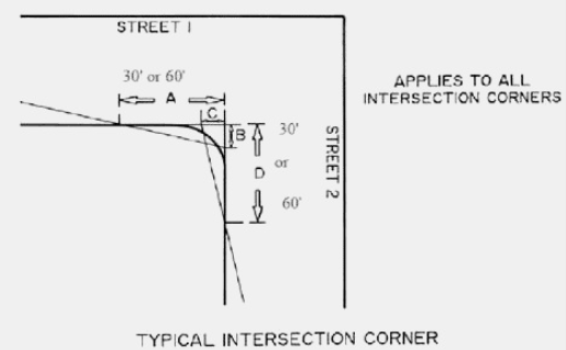
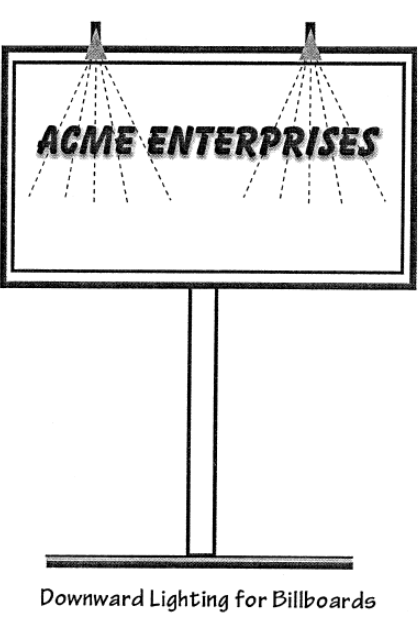
Amended by Ord. 564 on 6/16/2020
17.04.780: Recreational Vehicle Parks
- Requirements:
- Location: Recreational vehicle parks shall be allowed only in the General Commercial (GC), Neighborhood Commercial (NC), Visitor Commercial (VC), Mixed Use (MU), and Special Projects Overlay (SO) Zoning Districts subject to approval of a conditional use permit. No portion of the subject property shall be subject to flooding, subsidence or erosion, and no permits for the development of an RV park shall be issued within an "area of special flood hazard" (zones A, AE, AH, AO, A99, V or VE) as indicated on the current flood insurance rate maps (FIRM), unless the application is accompanied with a technical drainage study and mitigation plan.
- Density: Park density shall not exceed twelve (12) RVs per net acre (density calculation shall be based on net acres, i.e., excluding any adjacent publicly dedicated public rights of way).
- RV Requirements: All RVs allowed in an RV park shall be currently licensed, insured and ready for highway use (excluding park models). An RV is ready for highway use if it is on its wheels or jacking system with wheels attached, is attached to the site only by quick disconnect type utilities and security devices, and has no permanently attached porches, cabanas or other additions. Park model RVs shall be allowed in RV parks only in designated park model areas of the park, and shall not exceed more than twenty percent (20%) of the total area of the RV park. Any proposed park model designated areas must be shown on the conceptual site plan. Park models shall not have permanently attached porches, cabanas or other additions.
- Conceptual Site Plan: All proposed RV parks shall require the submittal of a conceptual site plan. The conceptual site plan shall be prepared in accordance with Nye County code governing conceptual site plans, and shall be submitted with all conditional use permit (CUP) applications for RV parks. Conceptual site plans for RV parks must depict the proposed dimensions and location of each proposed RV space, and shall contain a detailed diagram of a typical RV space as well as a diagram of a typical pull through space (if pull through spaces are proposed). All proposed amenities such as clubhouses, laundry rooms, exercise facilities, walking paths, picnic areas, etc., must be clearly depicted and described on the conceptual site plan.
- Conceptual Infrastructure Plan: All proposed RV parks shall require the submittal of sufficient information relating to proposed road improvements, water supply, sewage treatment facilities, utilities, and flood control/drainage improvements. A financial analysis shall be submitted showing the estimated cost to connect to existing central water and sewer systems.
- Market Analysis: A general summary shall be submitted describing the number and size of existing RV parks and number of existing RV spaces, the vacancy rates of RV parks in the vicinity and a general comparison of the amenities of the proposed RV park to the existing RV parks.
- Expiration: All conditional use permits authorizing the construction of an RV park shall expire one year following the date of approval, unless all required construction permits have been obtained and physical construction of the park has started. Once construction of the park has begun, the conditional use permit shall expire three (3) years following the date of issuance of the CUP unless the park has been completed in accordance with all plans and code requirements, and a certificate of occupancy has been issued, or unless an extension of time is approved. Any request for an extension of time must be submitted a minimum of thirty (30) days prior to the expiration date and shall contain the specific circumstances, reasons and justification for the extension, which shall be decided by the planning commission. Alternative time schedules or phasing plans may be proposed by an applicant for consideration and approval by the planning commission.
- Site Development Plan: Following the issuance of a conditional use permit for the construction of an RV park, an engineered site development plan shall be provided showing all proposed development including: landscaping plans, sewage disposal method and details of distribution, water supply method and details of distribution, ingress/egress, parking, location, size and number of spaces, location of all community recreation buildings and facilities, laundry, sanitation facilities including refuse areas, and all other requirements in accordance with Nye County code governing site development plans.
- Development Standards: The following development standards shall apply:
- Minimum RV Park Site Area: Ten (10) net acres dedicated strictly for RV park use;
- Minimum Net Area Per RV Space: Twelve hundred (1,200) square feet;
- Minimum Setback From Street Right Of Way: Minimum setback of any on site building or RV from any public street right of way: Twenty five feet (25');
- Minimum Setback From Adjacent Property Line: Minimum setback of any on site building or RV from any adjacent residential use property line: Fifty feet (50'), and shall be landscaped using xeriscaping/low water use landscaping concepts and materials in a manner so as to provide a buffer;
- Minimum Setback From Private Access Street: Five feet (5');
- Minimum Distance Between RVs: Minimum distance between RVs shall be as follows:
- Front to front with access streets: Forty feet (40').
- Side to side: Fifteen feet (15').
- End to end: Fifteen feet (15').
- Side to end: Fifteen feet (15').
- Installation Of Park Models: The installation of every park model shall comply with all applicable county building codes and ordinances, including obtaining building permits. All park models must be installed in accordance with the standards established by the Recreational Vehicle Industry Association (RVIA) and the American National Standards Institute (ANSI).
- Units Anchored To Ground: Park model recreational dwelling units shall be anchored to the ground in accordance with applicable county building codes and ordinances and the manufacturer's installation guidelines.
- Additions Attached Permanently To Park Models: Permanently attached porches, carports, awnings, and other similar additions to park model units shall not be allowed.
- Room Additions: Room additions attached to recreational vehicles including park models shall not be allowed.
- Storage Buildings: Storage buildings on individual RV spaces shall be prohibited.
- Tent Camping: Five percent (5%) of the gross land area may be used for tent camping.
- Camping Or Sleeping Cabins: Camping or sleeping cabins may be provided with no utilities (electric, gas, propane, etc.), may be skid mounted and may not exceed a ratio of one per twenty five (25) RV sites. Any camping or sleeping cabins shall be included in the overall park density calculation.
- Exceptions Or Variances: Any exceptions or variances from the above development standards may be considered by the planning commission in accordance with the process outlined in this code.
- Water Facilities:
- An accessible, adequate, safe and potable supply of water for domestic purposes shall be provided for each RV space.
- The development of a private water supply to serve the development may be made only upon the express approval granted by the bureau of health protection services of the Nevada state health division and the Nevada division of water resources. When a public supply of water is reasonably available, connection shall be made thereto and its supply shall be used exclusively.
- The water supply system shall be designed, constructed and located in such a manner that neither underground nor surface contamination will reach the water supply from any source, and shall be constructed and maintained in compliance with state health regulations.
- Where water is obtained from sources other than a public water supply, water sampling and testing shall occur in accordance with state health regulations, and any costs incurred shall be borne by the property owner/park management.
- RVs that have a water service connection for an outside source of supply, shall have an approved or listed check valve or other approved type backflow prevention device installed in the water supply piping adjacent to the water service connection. The installation of potable water supply piping or fixture or appliance connections shall be made in a manner to preclude the possibility of backflow.
- The water distribution system shall be designed and maintained to provide a minimum pressure acceptable to the Nevada state health division.
- Sanitation Facilities:
- An accessible, adequate, safe sewer connection shall be provided for each RV space.
- A minimum of one sanitary sewage dump station that complies with all requirements of the state health regulations shall be provided.
- Separate toilet facilities for men and women shall be provided and shall be centrally and conveniently located.
- Toilet facilities for each gender shall be provided in either separate buildings or in the same building separated by a solid wall. Two (2) flush toilets, two (2) showers and two (2) washbasins (1 per each gender) shall be provided for every fifteen (15) RV spaces.
- Each toilet and shower shall be in a private compartment with a door to ensure privacy. A minimum of one toilet and shower for each gender shall be constructed in accordance with ADA standards.
- All such sanitation facilities shall be subject to approval by the planning commission and shall be shown on the site plan when filed.
- All plumbing fixtures, drains, appurtenances, and appliances designed or used to receive or discharge liquid waste shall be connected to the recreational vehicle drainage system in a manner provided by the ANSI/NFPA standard for recreational vehicles.
- Refuse Collection And Storage:
- The storage, collection and disposal of refuse in the park shall be conducted so that no health hazards or air pollution is created.
- All refuse or garbage shall be stored in approved locations and in containers sufficiently sized so that sanitary conditions can be maintained at all times.
- Refuse containers shall be provided in sufficient number and capacity to properly store all refuse and garbage.
- Refuse containers shall be situated within a one hundred fifty foot (150') radius of any RV space.
- Refuse and garbage shall be collected weekly, or more frequently as necessary, and shall be disposed of in an approved manner.
- Refuse collection areas shall be screened from view by fencing and landscaping.
- Fire Protection:
- All RV parks shall be subject to the rules and regulations of the fire protection authority and all applicable laws.
- In all RV parks, there shall be installed and maintained fire hydrants and fire extinguishers of the number, type, size and location as may be required by the fire protection authority. Extinguishers may be installed in lieu of faucets and hose upon approval of the fire protection authority.
- RV parks shall be kept free of litter, rubbish and other flammable materials.
- Recreational Facilities And Open Space:
- Swimming pools including required fences, if provided, shall not be located in any required front yard, in any utility easement, or less than fifty feet (50') from any lot line. All mechanical equipment related to the maintenance of the swimming pools shall be located not less than ten feet (10') from any lot line.
- Swimming pools, if provided, shall be maintained in accordance with applicable laws, shall be adequately protected or fenced to discourage unauthorized access, and shall have fencing with a self-locking gate adequate to restrain all access to the pool when the pool is not being used. Swimming pool fences shall be designed in accordance with section 15.16.094 of this code.
- All pools and spas shall comply with applicable state health regulations. For the purpose of cleaning pool filters and back flushing the system, no discharge shall be made into a septic tank or sanitary sewer. Either a separate french drain shall be provided, or discharge may be made into an existing natural or manmade drainage channel or storm sewer system and conveyed into the public right of way in a manner so as not to create a public nuisance. All discharge to be performed in accordance with Nevada division of environmental protection (NDEP) requirements as applicable at the discretion of the utility service provider.
- All RV parks shall be provided with at least one recreational area or open space accessible from all spaces. The size of such open space shall not be less than ten percent (10%) of the gross park area and shall be landscaped utilizing xeriscaping/low water use landscaping concepts and materials. The open space area(s) may contain natural grass turf, provided that the total combined area of all natural grass turf within the park does not exceed five percent (5%) of the gross park area. Artificial turf shall be exempt from any size limitations prescribed in this section.
- A minimum of a five foot ten inch (5'10") decorative block wall or alternative equivalent such as a landscaped berm at the discretion and upon approval of the planning commission shall be installed along the perimeter of any RV park adjacent to residentially zoned property.
- General Requirements:
- Every owner or operator of an RV park having spaces for lease or rent shall maintain any and all records that may be required by local and state laws and regulations.
- A business license shall be obtained from the appropriate agency for any RV park where spaces or memberships are rented, leased or sold, and shall be renewed as required.
- Any exposed ground surfaces in all parts of the RV park shall be planted, paved or covered with an approved material that is capable of preventing soil erosion and eliminating objectionable dust.
- No barnyard animals or poultry shall be permitted in an RV park, except that horses may be allowed in specifically designated areas upon approval by the planning commission.
- Dogs, cats or other pets are not permitted to run at large or create any nuisance within the park.
- An area of sufficient size and enclosed via chainlink fencing or other appropriate material shall be provided as a designated exercise area for dogs, and equipment to accommodate cleanup after "curbing" of one's pet shall be provided by the operator of the park.
- Each RV park constructed, operated and licensed shall be limited solely and only to RVs, and shall not be converted or used as a manufactured home park without full compliance of all requirements governing manufactured home parks and obtaining a conditional use permit (CUP).
- Each RV space shall be provided with an electrical outlet supplying at least one hundred ten (110) volts and providing a minimum of thirty (30) amp service, and that is grounded and weatherproofed and in compliance with all state and local codes.
- All electrical installations, systems, and equipment shall comply with the most recently adopted electrical code of the National Fire Protection Association (NFPA).
- All utilities shall be located underground with no exceptions, including the wiring of interior light poles.
- No RV park shall be occupied until a final approved inspection by the building inspector has been obtained.
- Traffic Impact Analysis; Access; Parking:
- A traffic impact analysis shall be required for all RV parks.
- Access to the RV park shall be designed to minimize congestion and traffic hazards at the entrance or exit and allow safe movement of traffic on adjacent streets. All traffic ingress and egress shall be through controlled entrances and exits or crash gated as approved by the fire protection authority. An office or other suitable check-in or registration area shall be provided within the RV park, which must have a minimum of two (2) designated RV parking spaces. If an RV park contains a convenience store, the store must have its own separate traffic entrances and exits.
- All internal streets and driveways shall be properly signed.
- Each RV space shall have sufficient parking and maneuvering space.
- No on street parking of any vehicle shall be allowed adjacent to RV park spaces, but may be allowed adjacent to open space areas if a minimum ten foot (10') wide parking lane is constructed to accommodate parked vehicles.
- One visitor parking space shall be provided for each ten (10) RV spaces. Visitor parking areas shall be appropriately signed and may be situated in various locations throughout the park.
- All internal streets shall be paved a minimum of twenty four feet (24') wide with a thirty foot (30') right of way. Such streets shall be paved with an approved dust free material.
- Dead ended streets shall be prohibited, and turnaround areas shall be provided with a minimum ninety foot (90') diameter measured at the outside of the traveled way.
- 1.25 percent of the RV spaces and parking areas shall be accessible in accordance with the ADA regulations.
- Accessory Buildings And Service Facilities:
- Accessory buildings shall be limited to:
- One permanent caretaker's dwelling, consisting of site built construction, park model or manufactured home shall be allowed.
- A separate office building may be provided for the park's business office. Miscellaneous items such as snacks, ice, soda, water, newspapers and souvenirs, etc., may be sold at the park's business office.
- One convenience store shall be allowed. A "convenience store" shall be defined as a small retail store that offers a range of everyday items such as groceries, ready to eat food products, toiletries, alcoholic beverages, soft drinks, coffee, tobacco products, over the counter medicines, and magazines and newspapers, etc. Such stores may also offer money order and wire transfer services. Gasoline/fuel dispensing pumps may be provided only for convenience stores located within the general commercial (GC) zoning district. Convenience stores shall comply with all requirements of the site development plan process and must have their own separate vehicular entrances and exits.
- Clubhouse, pool and spa buildings, storage buildings for use by the park owner/management and laundry. Storage buildings shall not be located on individual RV spaces. Laundry facilities must contain at least one washer and one dryer for every twenty five (25) RV spaces in the park. (Ord. 493, 2015)
- Accessory buildings shall be limited to:
17.04.785: Park Model Recreational Vehicle And/or Tiny Home Parks
- Park Model Recreational Vehicle and/or Tiny Home Parks:
- No Portion Subject To Flooding: No portion of the subject property shall be subject to flooding, subsidence or erosion, and no permits for the development of a park model RV and/or Tiny Home park shall be issued within an "area of special flood hazard" (zones A, AE, AH, AO, A99, V or VE) as indicated on the current flood insurance rate maps (FIRM), unless the application is accompanied with a technical drainage study and mitigation plan.
- Park Density: Park density shall not exceed thirteen (13) park model recreational dwelling units or Tiny Homes per acre.
- Dwelling Units Allowed: Only park model recreational dwelling units and Tiny Homes that meet the intent of NRS 278.253 shall be allowed in a park model and/or Tiny Home RV park.
- Minimum Development Standards: The following minimum development standards shall apply:
- Minimum park model RV and/or Tiny Home park site area: Five (5) net acres;
- Minimum net site area per park model recreational dwelling unit or Tiny Home space: Two thousand (2,000) square feet;
- Minimum width of each park model recreational dwelling unit or Tiny Home space: Forty feet (40');
- Minimum setback of any on site building or park model recreational dwelling unit or Tiny Home from any public street right of way: Twenty five feet (25');
- Minimum setback of any on site building or park model recreational dwelling unit or Tiny Home from any adjacent residential use property line: Fifty feet (50'), and shall be landscaped in a manner so as to provide a buffer;
- Minimum park model recreational dwelling unit or Tiny Home setback from private access street: Five feet (5');
- Minimum distance between park model recreational dwelling units and Tiny Homes shall be as follows:
- Front to front with access streets: Forty feet (40').
- Side to side: Fifteen feet (15').
- End to end: Fifteen feet (15').
- Side to end: Fifteen feet (15').
- Units Anchored To Ground: Park model recreational dwelling unit and/or Tiny Homes shall be anchored to the ground in accordance with applicable county building codes and ordinances.
- A Tiny Home NOT built on a permanent foundation may only be issued a certificate of occupancy for the tiny house that is tied to the specific parcel of land on which the tiny house is located. If the tiny house is moved from that parcel, the owner of the tiny house must obtain a new certificate of occupancy.
- A Tiny Home NOT built on a permanent foundation may only be issued a certificate of occupancy for the tiny house that is tied to the specific parcel of land on which the tiny house is located. If the tiny house is moved from that parcel, the owner of the tiny house must obtain a new certificate of occupancy.
- Date Of Models: Park model dwelling units installed within a park model RV park shall be 1976 or newer models.
- Tiny homes shall be 2018 or newer as that is when the International Residential Code included them in their documents.
- Tiny homes shall be 2018 or newer as that is when the International Residential Code included them in their documents.
- Installation Of Units: The installation of every park model recreational dwelling unit and/or Tiny Home shall comply with all applicable county building codes and ordinances, including obtaining building permits in accordance with the international residential code, international building code, international plumbing code, international mechanical code, international fuel gas code, international fire code, international property maintenance code and all others as adopted by the Nye County board of county commissioners.
- Additions Attached Permanently: Permanently attached porches, carports, awnings, and other similar additions shall be allowed, provided that all required construction permits and inspections are obtained from the building safety division, and provided that a ten foot (10') separation between structures on adjacent spaces is maintained.
- Room Additions: Room additions which expand the total living area to greater than four hundred (400) square feet are not permitted.
- Storage Buildings: Storage structures are limited to a maximum of two hundred (200) square feet of floor area and shall not exceed ten feet (10') in height at the highest dimension. The storage structure shall be ground set, and there shall be no other storage units allowed on the space. A ten foot (10') separation between structures on adjacent spaces shall be maintained.
- Community Water and Sewer:
- An accessible, adequate, safe and potable supply of water for domestic purposes shall be provided for each park model space and/or Tiny Home.
- The development of a community water supply to serve the development may be made only upon the express approval granted by the bureau of health protection services of the Nevada state health division and the Nevada division of water resources. When a public supply of water is available, connection shall be made thereto and its supply shall be used exclusively.
- The water supply system shall be designed, constructed and located in such a manner that neither underground nor surface contamination will reach the water supply from any source, and shall be constructed and maintained in compliance with state health regulations.
- Where water is obtained from sources other than a public water supply, water sampling and testing shall occur in accordance with state health regulations, and any costs incurred shall be borne by the property owner/park management.
- The water distribution system shall be designed and maintained to provide a minimum pressure acceptable to the Nevada state health division.
- Community Sewerage:
- Every park model recreational dwelling unit and Tiny Home shall be properly connected to a community sewerage system connection in accordance with all applicable state and county building and health codes and requirements.
- If a clubhouse, laundry room, or other similar community amenities or facilities are provided, separate toilet facilities for men and women shall be provided.
- Refuse Collection And Storage:
- The storage, collection and disposal of refuse in the park shall be conducted so that no health hazards or air pollution is created.
- All refuse or garbage shall be stored in approved locations and in containers sufficiently sized so that sanitary conditions can be maintained at all times.
- Refuse containers shall be provided in sufficient number and capacity to properly store all refuse and garbage.
- Refuse and garbage shall be collected weekly or more frequently as necessary and shall be disposed of in an approved manner.
- Refuse collection areas shall be screened from view by fencing and landscaping.
- Fire Protection:
- All park model RV and Tiny Home parks shall be subject to the rules and regulations of the fire protection authority and all applicable laws.
- In all park model RV and Tiny Home parks, there shall be installed and maintained fire hydrants and fire extinguishers of the number, type, size and location as may be required by the fire protection authority. Extinguishers may be installed in lieu of faucets and hose upon approval of the fire protection authority.
- Park model RV and Tiny Home parks shall be kept free of litter, rubbish and other flammable materials.
- Recreational Facilities And Open Space:
- Swimming pools including required fences, if provided, shall not be located in any required front yard, in any utility easement, or less than fifty feet (50') from any lot line. All mechanical equipment related to the maintenance of the swimming pools shall be located not less than ten feet (10') from any lot line.
- Must follow all locally adopted building and swimming pool and spa codes and state laws.
- Swimming pools, if provided, shall be maintained in accordance with applicable laws, shall be adequately protected or fenced to discourage unauthorized access, and shall have fencing with a self-locking gate adequate to restrain all access to the pool when the pool is not being used. Swimming pool fences shall be designed in accordance with section 15.16.094 of this code.
- All pools and spas shall comply with applicable state health regulations. For the purpose of cleaning pool filters and back flushing the system, no discharge shall be made into a septic tank or sanitary sewer. Either a separate french drain shall be provided, or discharge may be made into an existing natural or manmade drainage channel or storm sewer system and conveyed into the public right of way in a manner so as not to create a public nuisance.
- All park model RV and Tiny Home parks shall be provided with at least one recreational area or open space accessible from all spaces. The size of such open space shall not be less than ten percent (10%) of the gross park area and shall be landscaped in an approved manner.
- General Requirements:
- Every owner or operator of a park model RV or Tiny Home park shall maintain any and all records that may be required by local and state laws and regulations.
- A business license shall be obtained from the appropriate agency for any park model RV and Tiny Home park and shall be renewed as required.
- Any exposed ground surfaces in all parts of the park model RV or Tiny Home park shall be planted, paved or covered with an approved material that is capable of preventing soil erosion and eliminating objectionable dust.
- No barnyard animals or poultry shall be permitted in a park model RV or Tiny Home park.
- Dogs, cats or other pets are not permitted to run at large or cause any nuisance within the park.
- An area of sufficient size and enclosed via chain-link fencing or other appropriate material shall be provided as a designated exercise area for dogs.
- Each park model RV and/or Tiny Home park constructed, operated and licensed shall be limited solely and only to park model recreational dwelling units and/or Tiny Homes and shall not be converted or used for any other use without full compliance with all requirements for the new use.
- All utilities shall be located underground with no exceptions, including the wiring of interior light poles.
- No park model RV or Tiny Home park shall be occupied until a final approved inspection by the building inspector has been obtained.
- Traffic Impact Analysis/Access/Parking:
- A traffic impact analysis shall be required for all park model RV and Tiny Home parks.
- Access to the park model RV and/or Tiny Home park shall be designed to minimize congestion and traffic hazards at the entrance or exit and allow safe movement of traffic on adjacent streets. All traffic ingress and egress shall be through controlled entrances and exits or crash gated as approved by the fire protection authority.
- All internal streets and driveways shall be properly signed.
- Each park model and/or Tiny Home space shall have a minimum of two (2) vehicle parking spaces containing a minimum area of three hundred sixty (360) square feet.
- No on street parking of any vehicle shall be allowed adjacent to park model recreational dwelling or Tiny Home unit spaces, but may be allowed adjacent to open space areas if a minimum ten foot (10') wide parking lane is constructed to accommodate parked vehicles.
- One visitor parking space shall be provided for each ten (10) park model or Tiny Home spaces. Visitor parking areas shall be appropriately signed and may be situated in various locations throughout the park.
- All internal streets shall be paved a minimum of twenty four feet (24') wide with a thirty foot (30') right of way. Such streets shall be paved with an approved dust free material.
- Dead ended streets shall be prohibited, and turnaround areas shall be provided with a minimum ninety foot (90') diameter measured at the outside of the traveled way.
- Accessory Buildings And Service Facilities:
- Accessory buildings shall be limited to:
- One permanent caretaker's dwelling, consisting of either site built construction or manufactured home shall be allowed and may be used as the business office of the park model RV or Tiny Home park.
- A separate office building may be provided for the park's business office.
- One convenience grocery store shall be allowed only for park model RV and/or Tiny Home parks that are greater than ten (10) acres in size.
- Clubhouse, pool and spa buildings, and laundry. Laundry facilities must contain at least one washer and one dryer for every thirty five (35) park model or Tiny Home spaces in the park.
- Accessory buildings shall be limited to:
- Site Development Plan: For the purposes of site development plan review the following shall be provided or designed and approved by the appropriate agency:
- Water system and connections.
- Sewer system and connections.
- Supply of natural gas, liquid petroleum, gas or oil.
- Electrical supply, equipment and connections.
- Protection of exposed equipment.
- Fire protection.
- Management of solid waste.
- Drainage and grading.
- Certificate Of Occupancy:
- A park model RV park, or a space within a park model RV park, or part thereof, must not be occupied or used unless or until it has been issued a certificate of occupancy pursuant to NAC 461A.
- Tiny Homes not built on a permanent foundation may only be issued a certificate of occupancy for the tiny house that is tied to the specific parcel of land on which the tiny house is located. If the tiny house is moved from that parcel, the owner of the tiny house must obtain a new certificate of occupancy.
- Restriction On Length Of Occupancy: Once properly installed in accordance with all applicable codes and regulations, a park model recreational dwelling unit and/or Tiny Home may remain indefinitely within the park, and there is no established time limit or restrictions as to the length of occupancy of the unit.
- Impact Fees: For the purposes of impact fee calculations, park model recreational dwelling units and/or Tiny Homes shall be considered "residential dwelling units (detached)" and as such shall require the payment of impact fees in accordance with the adopted impact fee ordinance. (Ord. 396, 2010)
- Definitions:
- Tiny Home: A dwelling that is 400 square feet or less in floor area excluding lofts.
Adopted by Ord. 600 on 9/19/2023
17.04.790: Mobile Home Parks
- General:
- Each mobile home lot shall be numbered or designated by street number, or other suitable means, and the lot lines defined by corner markers or other suitable means. Each lot shall abut on a driveway or other clear area, with unobstructed access to a public street. Mobile homes shall be parked on such lots so that a spacing of at least ten feet (10') is maintained between adjacent mobile homes, excepting noncombustible awnings. The site development plan must indicate the location of the MH stand on each lot.
- No mobile home shall be parked so that any part of such mobile home will obstruct any roadway or walkway.
- A perimeter landscape buffer shall be required adjacent to all public streets to which a mobile home park abuts. Such landscaping shall be a minimum of ten feet (10') in width and utilize drip irrigation and xeric or drought tolerant plants and trees.
- Service Buildings:
- Where community recreation structures are provided, an adequate and sufficient number of toilet and lavatory facilities, separate for each sex and in accordance with the appropriate Plumbing Code, shall be installed. Such facilities shall be housed in a building, or buildings, of comparable construction to that meeting State and local requirements.
- All food establishments, swimming pools and vending or dispensing machines shall meet all State and local laws, rules and regulations.
- Surfaced and lighted walkways shall be provided to all service buildings.
- Accessory Structures:
- Carports, ramadas and porches may be erected, constructed or maintained on a mobile lot only as an accessory structure to a mobile home located on the same lot, and shall meet all State and local building laws, rules and regulations pertaining to structures.
- Mobile homes may not be used as accessory structures for the purpose of storage.
- Access Roads:
- Access roads shall be provided to each mobile home lot. Access roads shall be surfaced with asphaltic concrete or equivalent. Each access road shall:
- Connect with a street or highway;
- Have a minimum width of fourteen feet (14') for one-way traffic and twenty four feet (24') for two-way traffic with eight feet (8') of additional width for each parallel parking lane; and
- Be well marked in the daytime and adequately lighted at night.
- Access roads shall be provided to each mobile home lot. Access roads shall be surfaced with asphaltic concrete or equivalent. Each access road shall:
- Utilities:
- Connection Required: A mobile home shall not be occupied unless it is properly placed on a mobile home lot and connected to water, sewerage and electrical or gas utilities.
- Information Required: For the purposes of site development plan review submitted as part of a zone district boundary amendment detailed utility plans are not required. Prior to permit issuance the following shall be provided or designed and approved by the appropriate agency in accordance with NAC 461A:
- Water system and connections.
- Sewer system and connections.
- Supply of natural gas, liquid petroleum, gas or oil.
- Electrical supply, equipment and connections.
- Protection of exposed equipment.
- Fire protection.
- Management of solid waste.
- Drainage and grading.
- Certificate Of Occupancy:
- A mobile home park or lot within a mobile home park, or part thereof, must not be occupied or used unless or until it has been issued a certificate of occupancy pursuant to NAC 461A. (Ord. 285, 2004)
- A mobile home park or lot within a mobile home park, or part thereof, must not be occupied or used unless or until it has been issued a certificate of occupancy pursuant to NAC 461A. (Ord. 285, 2004)
17.04.800: Home Occupations
- Scope: This section applies to all licensed home occupations and residential industries within the residential zoning districts.
- Purpose: The purpose of this section is to provide for limited business uses in association with a dwelling unit where such uses are clearly incidental and secondary to the use of the premises as a dwelling and will not alter the exterior appearance of the residence to insure the residential integrity of the neighborhood. Residential industry shall be allowed in the single-family residential zoning districts on lots that are twenty thousand (20,000) square feet or larger. To this end, these regulations minimize odor, noise, nuisance traffic, hazardous material usage, and other possible side effects of commercial uses being conducted in residential areas.
- Requirements: Requirements are as follows:
- The use of the dwelling or permitted accessory structure for purposes of the home occupation, home-based business or residential industry shall be clearly incidental and subordinate to its use for residential purposes. The home-based business or residential industry shall be conducted entirely within the dwelling unit or a permitted accessory structure.
- On parcels less than one acre in size and regardless of the zoning, the home occupation or residential industry:
- Shall be carried on only by the family members who reside on premises. Employees are permitted so long as they do not report for work at the property.
- Within a dwelling unit, the home occupation, home-based business or residential industry shall not exceed twenty five percent (25%) of the gross floor area of the dwelling unit.
- Within an attached or detached accessory building, the home occupation, home-based business or residential industry shall not exceed fifty percent (50%) of the gross floor area of the accessory building.
- Under no circumstances shall the existence of a home occupation, home based-business or residential industry change the residential character of the property.
- For the home occupation, home-based business or residential industry on parcels of land greater than one acre in size and regardless of the zoning:
- Up to three (3) employees are permitted, in addition to family members who reside on premises.
- Within a dwelling unit on property greater than one acre in size, the home occupation, home-based business or residential industry shall not exceed thirty five percent (35%) of the gross floor area of the dwelling unit.
- Within an attached or detached accessory building, the home occupation, home-based business or residential industry may occupy fifty percent (50%) of the gross floor area of the accessory building.
- Under no circumstances shall the existence of a home occupation, home-based business or residential industry change the residential character of the property.
- On parcels less than one acre in size and regardless of the zoning, the home occupation or residential industry:
- Signage, if any must conform to section 17.04.770 of this article.
- No addition, alteration, or remodeling which would change the residential character of the unit.
- No home occupation, home-based business or residential industry which would or might produce noise, fumes or odor, industry smoke, or electrical disturbance or in any way interfere with the peace, contentment, and general welfare of the area.
- Prohibited home occupation, home-based business or residential industry include: automotive or equipment repair, automotive body or fender repair, commercial preparation of food for service on the premises, sexually-oriented businesses, liquor sales or distribution, undertaking or funeral homes, medical or dental clinics, businesses related to or involving explosives or highly hazardous substances as defined by Nevada Revised Statutes 459.9533, or any business activity that is regulated through the conditional use permit procedures.
- Beauty and barber shop including aesthetician services may be permitted in accordance with State regulations, and shall be limited to no employees and providing service to one customer at a time.
- The use of special equipment or the repair or the manufacture of goods or equipment may be subject to conditions.
- There shall be no outdoor storage of goods or materials, supplies or solid wastes associated with the home-based business or residential industry. Merchandise shall not be displayed in a manner to be visible from outside of the dwelling or accessory structure.
- Truck deliveries to a home occupation, home-based business or residential industry shall be limited to delivery by Federal or private mail and/or express package delivery services.
- Any additional parking shall be approved by the Zoning Administrator. If additional parking is provided, it shall be provided on an improved (asphalt or concrete), chip-seal, gravel (type II), chat, brick, stone, special paving blocks, or other such similar type of durable surface.
- Home occupation, home-based business and residential industry are assigned to the holder of the home-based business license and are not appurtenant to the land or structure. (Ord. 517, 2017)
- The use of the dwelling or permitted accessory structure for purposes of the home occupation, home-based business or residential industry shall be clearly incidental and subordinate to its use for residential purposes. The home-based business or residential industry shall be conducted entirely within the dwelling unit or a permitted accessory structure.
17.04.805: Mobile Food Vending
A. Scope: This section applies to all mobile food vending units within the Pahrump Regional Planning District.
B. Purpose: The purpose of this section is to provide regulations for vendors that are mobile in nature with respect to food and beverage sales
C. Definitions: For purposes of this section, the following definition applies:
COTTAGE FOOD OPERATION: As defined in NRS Chapter 446.866.
ENVIRONMENTAL HEALTH SPECIALIST: This person will conduct establishment inspections and investigate illnesses and other public health problems. The Environmental Health Specialist’s functions include permitting, education, enforcement, consultation, and emergency response to prevent and mitigate environmental health hazards and to promote and protect public health and the environment in the following areas: food protection; bottled water plants and distributors; cosmetic plants; public accommodations; recreational vehicle parks; institutional environmental health; recreational swimming areas and waters; individual sewage disposal systems; invasive body decoration; and emergency preparedness.
PRODUCER CERTIFICATES: Are issued by the Nevada Department of Agriculture to farmers who sell raw and unprocessed crops of their own production, including honey and eggs.
PRODUCER VENDOR CERTIFICATE: Is required in Nevada to sell produce not grown by that vendor or produce that is grown in another state and brought into Nevada for sale.
SPECIAL EVENT: Covers all aspects of special events which operates at a fixed location for a temporary period of time, not to exceed two (2) weeks. Some examples include, but are not limited to, swap meets, flea markets, craft fairs, farmers markets, trade shows, conventions, consumer shows, community or association picnics, fairs, carnivals, fundraisers or similar transitory gatherings.
D. Home Office: A home office used in support of the mobile food vending business is permitted, provided that:
1. The home office is clearly incidental and subordinate to the residential use.
2. The home office shall not exceed twenty percent (20%) of the gross floor area of the residence.
3. There will be no signage advertising the mobile business at the residence.
4. There shall be no addition, alteration or remodeling which would change the residential character of the residence.
5. There shall be no outdoor storage of goods or materials, supplies or solid wastes associated with the mobile food vending business at the residence.
6. Truck deliveries to a residence in support of a mobile food vending or service provider business shall be limited to daily delivery by Federal or private mail and/or express package delivery services.
7. There shall be no visitors or customers to the mobile food vending home office.
8. Must obtain a Town of Pahrump Business License and all other applicable permits and licenses from state, federal and local agencies.
E. Requirements: Any person desiring to operate a mobile food vending unit in the Pahrump Regional Planning District must first obtain County approval as provided herein:
1. Applicant for mobile food vending is required to provide upon initial application;
a. a valid Health Department certificate for the mobile food vending unit to be used,
c. written permission from each property owner,
d. location mobile unit will be parked,
e. show distance from proposed food unit to all property lines and structures, and
f. list of items that will be sold.
2. A Mobile Food Vending Unit must meet all state vehicle construction, identification, and water system tank/wastewater system design requirements per the Nevada Division of Public and Behavioral Health Food Establishment Mobile Vehicle Guide. The Division of Public and Behavioral Health Food Establishment Mobile Vehicle Guide is available either from Nye County’s website or the Nye County Planning Department.
3. Applicant shall maintain the mobile food vending unit in proper working order, and the unit shall be properly and legally licensed, registered and insured.
4. Applicant shall show Proof of vehicle insurance liability in the amount of $100,000/$300,000 and property damage in the amount of $25,000. The Owner Name and/or Business Entity Insurance should list VIN Numbers of Vehicle and/or Trailer.
5. A mobile unit must not operate from a specific fixed location for more than four (4) hours, unless approved by the Town of Pahrump or Nye County. This does not apply to Special Events.
1. If restrooms are not available to the food employees, a mobile food vending unit may not remain parked longer than one (1) hour at any one location unless prior approval is received from the Environmental Health Specialist.
a. Mobile food vending units located at active construction sites, farmers markets and special events are exempt from the provisions of this chapter.
b. Should the operator of a mobile food vending unit wish to remain in one location longer than the above stated limits, the following procedures shall be followed:
(1) Must be a special event and have obtained prior approval from the Environmental Health Specialist.
6. Parking a mobile food vending unit in a Nye County or State right-of-way is strictly prohibited. Customer parking must follow Nye County dust control ordinance, Title 15, Chapter 15.28 of this Code.
7. It is unlawful for any mobile food vendor to sell, solicit or park a vehicle within one thousand (1,000) feet in any direction from the extreme outside perimeter of school property during the hours that schools are in session and for one (1) hour after the close of the school session.
8. Mobile food vending units shall maintain a minimum separation of three hundred feet (300') from entry door of existing restaurants.
9. Any person violating any of the provisions of this section or failing to comply with any of the mandatory requirements of any ordinance of the County is guilty of a misdemeanor. Except in cases where a different punishment is prescribed by an ordinance of the County, any person convicted of a misdemeanor under the ordinances of Nye County shall be punished by a fine not to exceed one thousand dollars ($1,000.00) or by imprisonment not to exceed six (6) months, or by both such fine and imprisonment, unless otherwise specified. (Ord. 500, 2016)
10. Any person wanting to sell raw and unprocessed crops of their own production, including honey and eggs shall obtain a Producer Certificate issued by the Nevada Department of Agriculture. A Producer Vendor Certificate is required in Nevada to sell produce not grown by that vendor or produce that is grown in another state and brought into Nevada for sale. (NRS 576.128).
11. A mobile food vending permit is not transferable from one mobile food vehicle to another vehicle.
12. Any proposed change in location, equipment or operation of a mobile unit must receive prior approval from the Health Authority and the Nye County Planning Department.
F. Prohibited:
1. No food items can be sold on street corners other than in an approved mobile food vending unit. This includes tamales, honey, fruits and vegetables, and eggs.
2. Items sold on the private property of the natural person who manufactures or prepares the food item or at a location where the natural person who manufactures or prepares the food item sells the food item directly to a consumer, including, without limitation, a farmers’ market licensed pursuant to chapter 244 or 268 of NRS, flea market, swap meet, church bazaar, garage sale or craft fair, by means of an in-person transaction that does not involve selling the food item by telephone or via the Internet unless approved by the Environmental Health Specialist
Amended by Ord. 592 on 3/21/2023
17.04.810: Model Homes
- Scope: This section applies to all model homes within the Pahrump Regional Planning District.
- Purpose: The purpose of this section is to establish the regulations pertaining to the location and use of model homes.
- Requirements: Model homes shall be permissive in all residential and commercial zones subject to the following requirements:
- Residential Zones; Conditions:
- Maximum Number: In a single-family residential subdivision, a maximum of six (6) model residences shall be allowed. For multi-family residential (condos or townhomes) or manufactured home developments, a maximum of eight (8) model residences shall be allowed.
- Time Limit: Model homes located within a subdivision must be converted to a residential use when the last unit in the subdivision has been sold. The time limit does not apply to models located in apartment complexes or manufactured home parks, provided the residential character of the model is maintained, and all manufactured homes are properly installed.
- Constructed Prior To Recordation Of Final Map: Model homes may be constructed prior to recordation of a final map provided that:
- A final map is submitted showing the location where the residences will be located and where off site improvements have been completed.
- Paved access and adequate access controls must be provided to all structures.
- The final map must record within one year from the date permits are issued for the homes.
- The final map may not be revised after the permits for the models or units have been issued.
- The model residences shall meet the minimum setbacks required from the future lot lines to be established by the subdivision as required by Code.
- The issuance of a building permit will not be construed as a commitment by the County to record the final map or to approve any zoning matter.
- Block walls are permitted on the proposed lot lines.
- A minimum of five (5) on site parking spaces, or suitable on street parking, shall be provided, and the spaces shall be in compliance with ADA parking requirements and this Code. The parking lot shall be paved or improved with an approved surface material per this Code.
- Landscaping of a drought tolerant variety must be provided in the front yards in accordance with landscaping requirements of this Code.
- Sanitary facilities shall be provided within the model residence. No outdoor facilities are allowed.
- A temporary sales trailer may be used if permitted by the Planning Department and properly installed, provided that:
- The trailer is not used for more than ninety (90) days;
- The sales trailer is a "Gelco style" modular unit with a finished exterior, no glaring surface, with walls made of T-111 plywood or comparable materials and composition roof or comparable material. Travel trailers, field office type units, and motor homes are not acceptable;
- The primary use of such temporary sales offices shall be to provide information concerning the initial approved subject subdivision. No other uses may be established at this facility.
- Conversion To Residential Use: Model homes not located within a subdivision or development must be converted to a residential use when no longer used as a model home.
- Commercial Zones; Conditions:
- Model homes must be in conjunction with a real estate, architect, developer, or homebuilder's (or similar) office.
- A minimum of five (5) on site parking spaces shall be provided, and the spaces shall be in compliance with ADA parking requirements and this Code. The parking lot shall be paved or improved with an approved surface material per this Code.
- Landscaping of a drought tolerant variety must be provided at a ratio of fifty (50) square feet of landscaping for each one hundred (100) square feet of gross floor area.
- Sanitary facilities shall be provided within the model residence. No outdoor facilities are allowed. (Ord. 387, 2010)
- Residential Zones; Conditions:
17.04.820: Manufactured Homes And Factory-Built Homes
- Intent: Manufactured homes and factory-built homes installed within the Pahrump Regional Planning District ("PRPD") must comply with the requirements of Federal law, Nevada State law, and this Code unless a waiver or exception specified in this section is granted under the terms of this section.
- Scope: This section applies to all installations of manufactured homes and factory-built homes within the PRPD. This section does not apply to manufactured homes or factory-built homes installed in approved manufactured home parks or subdivisions, which have been designed or designated, or both, for manufactured homes or factory-built homes with alternative standards approved and memorialized in CC&Rs, park rules or an approved Special Plan of Development.
- Manufactured Homes And Factory-Built Homes Placed In Certain Zoning Districts:
- Manufactured homes and factory-built homes placed within the PRPD in the RE-1, SE and all VR Zoning Districts must:
- Be permanently affixed to the land and converted to real property through the Assessor's Office;
- Be manufactured within the six (6) years immediately preceding the date on which it is affixed to the land;
- Have exterior siding and roofing which is similar in color, material and appearance to the exterior siding and roofing primarily used on other single-family residential dwellings within one thousand feet (1,000') of the property line on which the manufactured home or factory-built home will be affixed;
- Consist of one or more sections;
- Consist of at least four hundred (400) square feet of living area; and
- Be installed on an approved permanent foundation with perimeter supporting wall in compliance with Nevada Manufactured Housing Division standards and exterior backfilled to within twelve inches (12") of the floor elevation.
- Manufactured homes and factory-built homes placed within the PRPD in the RH-9.5, RH-4.5 and RE-2 Zoning Districts must:
- Be permanently affixed to the land and converted to real property through the Assessor's Office;
- Be manufactured within the ten (10) years immediately preceding the date on which it is affixed to the land;
- Have exterior siding and roofing which is similar in color, material and appearance to the exterior siding and roofing primarily used on other single-family residential dwellings within one thousand feet (1,000') of the property line on which the manufactured home or factory-built home will be affixed;
- Consist of one or more sections;
- Consist of at least four hundred (400) square feet of living area; and
- Be installed on an approved permanent foundation with perimeter supporting wall in compliance with Nevada Manufactured Housing Division standards and exterior backfilled to within twelve inches (12") of the floor elevation.
- Manufactured homes and factory-built homes placed within the PRPD in the RE-1, SE and all VR Zoning Districts must:
- Applications For Approval Of Installation Of Manufactured Homes Or Factory-Built Homes:
- Generally: Except when specifically set out otherwise in this section, applications for approval of the installation of a manufactured home or factory-built home shall be filed with and on forms provided by the Planning Department, which is charged with responsibility for its receipt, fee collection, if any, processing and distribution.
- Application Requirements: The application for approval of the installation of a manufactured home or factory-built home must include the following:
- Name of applicant;
- Name of the manufacturer of the manufactured home or factory-built home;
- Model number and serial number of the manufactured home or factory-built home;
- Manufacture date (month and year); and
- Photographs of the manufactured home or factory-built home (interior and exterior), if the manufactured home or factory-built home is more than six (6) years old at the time of the proposed installation.
- Waivers And Exceptions:
- Waivers:
- The Pahrump Regional Planning Commission ("PRPC") may grant a waiver, in accordance with section 17.04.915 of this chapter, for the installation of any manufactured home or factory-built home that does not conform with the design standards enumerated in subsection C1c, C1d, or C1e or C2b, C2c, C2d, or C2e of this section.
- Exceptions:
- An exception to subsection C2a or C2f of this section, or both, may be granted for elevated (above-ground) installations only in FEMA designated flood zone areas, areas of poor soils, or rough terrain where permanently affixing to the land is not practical, provided installation would not have an adverse impact on surrounding properties. The Planning Director shall determine whether an exception shall be granted. If the applicant disagrees with the Planning Director's determination, the applicant may appeal the Planning Director's decision in accordance with title 16, chapter 16.36 of this Code.
- Waivers:
- Pre-HUD Homes: Under no circumstances shall the placement of a pre-HUD mobile home (factory-built homes produced prior to the June 15, 1976 United States Department of Housing and Urban Development manufactured home construction standards) be allowed anywhere within the PRPD.
- Compliance With Applicable Laws: All manufactured homes and factory-built homes must be installed in accordance with Federal and Nevada State regulations and this Code, inspected by the appropriate government agencies, and have the appropriate installation labels placed in the windows, as required by the Nevada Housing Division, Manufactured Housing, prior to occupancy.
- Pad Design Requirements: A manufactured home owner or factory-built homeowner and installer must follow the pad design requirements in the Nye County Building Code applicable to the location of the installation. (Ord. 536, 2018)
Amended by Ord. 601 on 11/7/2023
Amended by Ord. 616 on 4/15/2025
17.04.850: Abandoned, Unregistered, Wrecked Or Dismantled Junk Motor Vehicles
- Purpose: The purpose of this section is to prohibit abandoned and junk vehicles and to facilitate the expeditious removal or proper storage of inoperable, unregistered, junk or dismantled motor vehicles (including abandoned mobile homes1) which constitute a nuisance, a safety hazard, interfere with the enjoyment of property, reduce the value of private property, extend and aggravate scenic blight, degrade the environment, or adversely affect the public health, safety and welfare of the Pahrump Regional Planning District and its residents.
- Scope: This article applies to all zoning districts within the Pahrump Regional Planning District and all nuisances as defined in article II of this chapter.
- Restrictions:
- A person shall not leave an abandoned or a junk motor vehicle upon private property within the Pahrump Regional Planning District for a period in excess of thirty (30) days, after which time such abandoned or junk motor vehicle shall be subject to mandatory removal. Any vehicle stored on private property which is determined to be an immediate safety hazard and in an unsafe condition, may be subject to removal.
- The presence of a junk and abandoned motor vehicle on private property within the Pahrump Regional Planning District is declared a public nuisance.
- Unless he first obtains a license pursuant to Nevada Revised Statutes 487.050 or 487.410, a person shall not for any reason keep more than two (2) unregistered vehicles on real property owned by him or under his possession or control if the vehicles are no longer intended for or in condition for lawful use on the highway.
- The provisions of Nevada Revised Statutes 487.205 to 487.300 inclusive apply to all unregistered, inoperable and abandoned vehicles in the Pahrump Regional Planning District.
- The provisions of subsection C3 of this section do not apply to:
- Premises used by a licensed dealer, manufacturer, distributor or rebuilder.
- Vehicles to be restored or used as a source of parts in conjunction with the operation or maintenance of a fleet of vehicles for the carriage of persons or property.
- Premises used as a farm, ranch, mine or repair shop for motor vehicles.
- Any person engaged in the restoration of one or more vehicles entitled to registration as a horseless carriage or otherwise having classic or historic significance.
- Determination Of Junk, Inoperable, Abandoned Or Unregistered Vehicle As A Nuisance:
- Determination and declaration of any vehicle as junk, inoperable, abandoned, or unregistered, and as such a nuisance, and not classic or historic shall be made by a committee appointed by the regional planning commission. The committee shall be made up of the code enforcement officer and four (4) car enthusiasts. The committee shall meet and make a determination within fourteen (14) days after the owner has been notified of a complaint being received by Nye County or identified by the code enforcement officer.
- Every person who abandons a junk motor vehicle is responsible for the proper storage or the cost of removal and disposition of such motor vehicle.
- A junk or abandoned motor vehicle remaining on private property for more than thirty (30) days shall be determined to be a nuisance as regulated by section 17.04.860 of this chapter.
- More than two (2) unregistered or inoperable vehicles and their parts that are not contained within an accessory building or garage must be stored in the rear yard behind the principal structure. More than two (2) unregistered or inoperable vehicles and their parts may also be stored in side yards if they are screened from view from the public street using opaque screening, opaque fencing, or opaque walls at least six feet (6') in height and in compliance with section 17.04.760 of this chapter, and do not encroach into the minimum building setback for the side yard. An inoperable and/or unregistered vehicle not in compliance with this subsection for a period of more than ninety (90) days shall be determined to be a nuisance as regulated by section 17.04.860 of this chapter. (Ord. 285, 2004)
Notes:
1NRS 487
17.04.860: Nuisances Prohibited
- Purpose: The purpose of this section is to prohibit those items or activities that constitute a nuisance, a safety hazard, impede traffic in the streets or alleys, interfere with the enjoyment of property, reduce the value of private property, extend and aggravate scenic blight, degrade the environment, or adversely affect the public health, safety and welfare of the Pahrump regional planning district and its residents.
- Scope: This article applies to all zoning districts within the Pahrump regional planning district and all nuisances as defined in article II of this chapter. Nuisances do not pertain to classic and/or historic vehicles.
- Restrictions:
- A person shall not maintain a nuisance on his or her property; a nuisance includes, but is not limited to, the following:
- Insecure Or Unsafe Buildings Or Conditions; Garbage: All insecure or unsafe buildings, walls, chimneys, stacks or other structures, all filth, garbage, offal, ashes, all nauseous, flammable and unhealthful matter, all partially burned buildings and structures, and all debris resulting from fires and demolition or abandonment of structures. This section applies to all junk or abandoned vehicles determined to be a nuisance under section 17.04.850 of this chapter.
- A person shall not maintain a nuisance on his or her property; a nuisance includes, but is not limited to, the following:
- Abandoned, Discarded Or Unused Objects: Abandoned, discarded or unused objects or equipment such as vehicles, machinery, furniture, stoves, household appliances, cans, containers, boxes, waste, old building materials, trash and other refuse.
- Outside Storage: Outside storage of equipment, building materials and other property, unless fully screened from view from outside the property or fully enclosed.
- Smoke Or Air Pollution: Excessive emission or dense smoke and air pollution caused by excessive soot, cinders, fly ash, dust, noxious acids, fumes, and gases within the county.
- Noise: Excessive noise which is injurious to health or which interferes unreasonably with the comfortable enjoyment of life or property within the Pahrump regional planning district.
- Rural Homestead District Exception From Outdoor Storage:
- Due to the size of the lots (5 acre minimum) and the rural nature of these areas, the rural homestead zone shall be exempt from the regulations as follows below:
- Outdoor storage shall be permitted provided it is not within one hundred feet (100') of the front setback or fifty feet (50') from any side or rear property line.
- Due to the size of the lots (5 acre minimum) and the rural nature of these areas, the rural homestead zone shall be exempt from the regulations as follows below:
- Required Notices For Junk Or Abandoned Motor Vehicles On Public Property:
- Junk or abandoned motor vehicles on public property shall be removed and disposed of in accordance with the Nevada Revised Statutes and this chapter.
- Notice Of Unhealthful Condition To Property Owner:
- When it appears to the satisfaction of the code enforcement officer and/or the Pahrump regional planning commission that there exists on any premises within the Pahrump regional planning district any insecure or unsafe building, walk, chimney, stack or other structure, or any filth, garbage, offal, ashes, shavings, weeds, grass, leaves, manure, paper, boards, partially burned structures or any nauseous, flammable or unhealthful matters, or any unenclosed or dangerous excavation or any undrained cesspool or standing water that may constitute a menace to the health, safety or welfare of the residents of the Pahrump regional planning district, the zoning administrator and/or code enforcement officer shall issue a citation or notice to the person creating, maintaining, causing or committing such condition, and to the person owning, or in possession, charge or control of the real property upon which such condition is maintained or exists to appear before the county commission at a specified time and place and show cause why such condition should not be abated or removed.
- The code enforcement officer shall cause:
- Such notice to be mailed by certified mail, return receipt requested to any of the persons specified in this subsection J at his/her last known residence or business mailing address.
- A copy of the notice to be posted upon the premises where such condition is deemed to exist.
- The notice shall require:
- Commencement of work for the removal of the nuisance within seven (7) days after personal receipt or fourteen (14) days after posting and mailing of the notice, and removal of the nuisance within an agreed upon reasonable time after the commencement of work; or
- Within said seven (7) or fourteen (14) days, request, in writing, that the hearing be held before the county commission to determine if in fact a nuisance does exist, whether the nuisance should be abated or removed, or that there is no nuisance.
- The code enforcement officer shall cause:
- When it appears to the satisfaction of the code enforcement officer and/or the Pahrump regional planning commission that there exists on any premises within the Pahrump regional planning district any insecure or unsafe building, walk, chimney, stack or other structure, or any filth, garbage, offal, ashes, shavings, weeds, grass, leaves, manure, paper, boards, partially burned structures or any nauseous, flammable or unhealthful matters, or any unenclosed or dangerous excavation or any undrained cesspool or standing water that may constitute a menace to the health, safety or welfare of the residents of the Pahrump regional planning district, the zoning administrator and/or code enforcement officer shall issue a citation or notice to the person creating, maintaining, causing or committing such condition, and to the person owning, or in possession, charge or control of the real property upon which such condition is maintained or exists to appear before the county commission at a specified time and place and show cause why such condition should not be abated or removed.
- Hearing Before County Commission:
- Presentation Of Evidence: The county commission may proceed to take evidence at the hearing, after notice as provided in subsection J of this section, and all persons cited to appear or having any interest in the real property involved shall be entitled to be heard and to present evidence for the consideration of the county commission.
- Property Owner Failure To Appear: Failure of any property owner to appear before the county commission at the time provided for the hearing gives the county commission jurisdiction to proceed with the hearing and the power to enforce any of the provisions of this chapter.
- Order To Repair, Abate Or Remove:
- If, after the hearing, in the judgment of a majority of the county commission, a condition constituting a menace to the health, safety or welfare of the residents of the Pahrump regional planning district is maintained or exists upon the described parcel or parcels of real property, the county commission shall order the same to be repaired, abated or removed within such reasonable time as the county commission shall designate.
- Abatement By County:
- Failure Of Owner To Abate: If the work to repair, abate or remove the conditions constituting a menace to health, safety or welfare of the residents of the Pahrump regional planning district is not commenced or completed within the time fixed and designated by the county commission at the hearing and no extension is granted by the county commission, the county commission shall cause the work of repair, abatement or removal to be done.
- Statement Of Work And Costs:
- The person doing such work shall file with the county clerk a verified statement of the work done and of all expenses and costs incurred in connection therewith, together with a description of the parcel or parcels of real property upon which the work was done.
- The county commission shall thereupon determine if such costs and expenses were proper and shall, by resolution, adopt or revise the statement and require the county clerk to deliver a certified copy of the resolution and a certified copy of the verified statement of the work done and all expenses and costs incurred, as determined proper or as corrected by the county commission, to the county assessor of Nye County.
- Cost A Lien Against The Property:
- The county assessor of Nye County shall levy the sum or sums in the statement upon the respective lot or lots as a tax and shall enter the same in the general assessment roll next thereafter to be made, in a column for special assessments. The amount so levied shall be collected and enforced with the other taxes in the assessment roll and in the same manner as other county taxes, and shall continue to be a lien upon the premises assessed from the date of assessment until paid.
- Civil, Criminal Action By County:
- Nothing contained in this chapter shall prevent the maintenance of an action by the Pahrump regional planning district against any person to collect the expenses or repair, abatement or removal or the criminal prosecution for a violation of this chapter by any person creating, maintaining, causing or committing a nuisance or owning or in possession, charge or control of the real property upon which a nuisance is created, maintained, caused or committed.
- Private Actions: The provisions of this chapter shall not in any way preclude or supersede any action for abatement of nuisances by private persons.
- Hardship: In cases where nuisance violations are a result of an economic or physical hardship, a nuisance abatement referral program shall be considered to assist in mitigating the violation. (Ord. 285, 2004)
17.04.880: Adoption And Amendment Of Zoning District Maps
- The county commission shall prepare and adopt maps setting forth specific zoning districts as prescribed in this chapter and any amendments thereto, for each lot or parcel within the planning district. Said maps shall, to the extent practicable, be in conformity with the master plan of the Pahrump regional planning district.
- Any zoning district boundary amendment shall, to the extent practicable, be in conformity with the master plan of the Pahrump regional planning district and the zoning reference map. Any amendment to the zoning district boundaries shall be accomplished in compliance with chapter 278 of the Nevada Revised Statutes, and this article. (Ord. 285, 2004)
17.04.885: Interpretation Of Zoning District Boundaries
- Zoning district boundaries are intended to parallel street lines or to follow lot or property lines as they exist at the time of passage of this chapter or amendments hereto, unless specifically shown otherwise. Where a zoning district boundary line divides a parcel of land into several zoning districts the separate zoning districts shall be described by legal description. In the event of further uncertainty, the planning commission shall interpret intent as to the boundary location. (Ord. 285, 2004)
17.04.890: Zoning Ordinance Text Amendment Procedure
- Initiation Of A Text Amendment Proposal: A proposal for a text amendment may be initiated at the direction of the board of county commissioners or the regional planning commission, upon the recommendation of the zoning administrator, or by a property owner.
- Justification Letter: For a proposed text amendment initiated by a property owner an application shall be in the form of a written justification letter with any fee(s) required pursuant to a resolution of the board of county commissioners submitted to the Nye County planning department. The justification letter must explain the exact nature of the text amendment to the zoning ordinance that is requested. The property owner should describe the proposed text amendment in a format that clearly indicates the proposed amendment(s); the reason(s) supporting the amendment(s); and specific circumstances, if any, requiring the amendment(s).
- Previously Denied Or Withdrawn Text Amendment Applications: Unless the application is expressly denied without prejudice, the same text amendment shall not be accepted by the zoning administrator within six (6) months of final action on the previous amendment. If the second amendment is denied, no subsequent text amendment shall be accepted by the zoning administrator within three (3) years of the final denial of the previous amendment.
- A text amendment application that is withdrawn from consideration by the applicant after notices have been sent shall be subject to the same time limitations for resubmittal as described above for the first denial of an application. The time limitations shall not become effective if, after consideration of the timing and circumstances of the withdrawal, the board of county commissioners specifically approved the withdrawal without prejudice.
- A text amendment application that is withdrawn from consideration by the applicant prior to notices being sent may be resubmitted at any time.
- Public Hearing And Final Action Process: Public hearing and final action on proposed text amendments shall be as follows:
- Regional Planning Commission Recommendation: The regional planning commission shall be afforded the opportunity to discuss proposed text amendments and provide its written report and recommendations to the board of county commissioners. A public hearing is not required. Recommendations may be for adoption, adopt with modifications, or do not adopt. In considering its recommendations concerning a proposed text amendment, the regional planning commission shall determine:
- Whether or not the proposed text amendment conforms to the master plan.
- Whether or not any land uses, which would be allowed by approving the proposed text amendment, will be compatible with existing land uses and zoning districts.
- Whether or not growth and development factors in the community indicate the need for or appropriateness of the text amendment.
- Whether or not the proposed text amendment would serve to provide clarity or readability, correction of an oversight or other improvement in the application of the zoning ordinance.
- Board Of County Commissioners Public Hearing: After receipt of the report and recommendation(s) of the regional planning commission the board of county commissioners shall conduct a public hearing in accordance with Nevada Revised Statutes 278.260.2. The board of county commissioners shall cause notice of the time and place of the hearing at least ten (10) days before the hearing to be:
- Published in an official newspaper, or a newspaper of general circulation, in the region; and
- Mailed to each tenant of a mobile home park if that park is located within three hundred feet (300') of a specific property in question.
- Board Of County Commissioners' Action: After the public hearing, the board of county commissioners shall determine whether or not to adopt, or amend and adopt, the proposed text amendment(s). (Ord. 392, 2010)
- Regional Planning Commission Recommendation: The regional planning commission shall be afforded the opportunity to discuss proposed text amendments and provide its written report and recommendations to the board of county commissioners. A public hearing is not required. Recommendations may be for adoption, adopt with modifications, or do not adopt. In considering its recommendations concerning a proposed text amendment, the regional planning commission shall determine:
17.04.895: Zoning District Boundary Amendment (Zone Change) Procedure
- Initiation Of Zone Change: Whenever public necessity, safety and general welfare may require, a zone change may be initiated at the direction of board of county commissioners or planning commission, or upon the recommendation of the zoning administrator. A zone change may also be initiated by the following:
- Property Owner Or Agent: A zone change application may be submitted by a property owner or agent of a property owner with written, notarized consent of the property owner.
- Governmental Ownership: With respect to property that is owned by the state of Nevada or the United States of America, a zone change application is sufficient if it is signed and acknowledged by a prospective purchaser of that property and who has entered into a contract with the governmental entity to obtain ownership of the property. A copy of that contract must be submitted along with the application.
- Nonproperty Owner: A zone change application is sufficient if it is signed and acknowledged by a lessee, a contract purchaser or an optionee of the property for which the zone change is sought. However, interest in that property must exist in a written agreement with the owner of record. The owner of record must authorize the lessee, contract purchaser or optionee to sign the application. This agreement must further stipulate that the owner of record consents to the filing and processing of the application and agrees to be bound by the requested zone change.
- Multiple Ownership: In the case of multiple ownership of a parcel (not held in a limited liability corporation, partnership or trust), all of the owners of record shall be required to sign the application or acknowledge in writing that the owners of record consent to the filing and processing of the application and agree to be bound by the requested zone change.
- Limited Liability Corporation, Partnership Or Trust: In cases of a limited liability corporation, partnership or trust, applicants shall attach the page(s) from the recorded agreement showing who is authorized to sign on behalf of the members.
- Application Form: An application for a zone change shall be on a form provided by the Nye County planning department. The application shall be signed, notarized and acknowledged by the qualifying applicant of each parcel of the property and the application filed with the planning department, together with any fee(s) required pursuant to a resolution of the board of county commissioners.
- All Parcels Of Land Included Within A Single Zone Change Application Must Be Contiguous: Any noncontiguous portions shall be considered a separate application and shall require a separate application form and other required documentation and fee(s).
- Determination Of Completeness: Within ten (10) business days of submission, the zoning administrator shall review the zone change application and determine if the application is complete pursuant to subsection E of this section.
- Information Required To Be Filed With A Zone Change Application: In addition to the requirements of the document submittal requirements, the applicant shall also provide the following information:
- Letter Of Justification: A letter stating the justification(s) for the approval of the zone change application, including an analysis of the impact on adjacent properties, and any actions proposed to minimize any detrimental impacts of the zone change.
- Legal Description Or Map: A legal description or detailed map indicating the existing zoning designation, and the proposed zoning designation, of the subject property. A zone change may follow the parcel lines identified on the Nye County assessor's parcel map(s); however, if a proposed zoning district boundary line divides a parcel of land into several zoning districts, the separate zoning districts must be described by legal description, and a detailed map must be provided.
- Map To Scale: A map of the property drawn to scale correlating with the legal description and clearly showing the subject property's location in relation to adjacent properties lying within three hundred feet (300') of the boundary of subject property, and showing all existing uses of properties within three hundred feet (300').
- Conceptual Site Development Plan: A conceptual site development plan prepared in accordance with the requirements of article IX of this chapter is required.
- Burden Of Proof: The applicant bears the burden of proof to establish that the approval of the zone change is warranted; therefore, any and all relevant information and documentation related to this proof must accompany the application.
- Previously Denied Or Withdrawn Zone Change Applications:
- An application for a zone change in which all or any part was the subject of a previously denied application which proposed a change to the same zoning classification, or to a less restrictive classification, or for the same use or a similar density that has been previously denied or withdrawn after notices have been sent, shall not be accepted until the following periods have elapsed from the date of denial or withdrawal:
- After the first disapproval or withdrawal: One year.
- After the second or a subsequent denial or withdrawal: Three (3) years.
- The time periods described in subsections F1a and F1b of this section shall not become effective if, after consideration of the timing and circumstances of the withdrawal, the planning commission or county commission specifically approved the withdrawal without prejudice.
- In cases where an application was previously denied on the grounds that it did not conform to the master plan, and the master plan is subsequently amended whereby the application would now be considered in conformance, the time periods described in subsections F1a and F1b of this section shall be extinguished.
- An application for a zone change in which all or any part was the subject of a previously denied application which proposed a change to the same zoning classification, or to a less restrictive classification, or for the same use or a similar density that has been previously denied or withdrawn after notices have been sent, shall not be accepted until the following periods have elapsed from the date of denial or withdrawal:
- Planning Commission Public Hearing: The planning commission shall hold at least one public hearing in accordance with the requirements of Nevada Revised Statutes 278.260 when considering any application for a zone change, at which it shall review all proposed changes and amendments and shall hear all evidence offered by the petitioner and by parties of interest. Such hearing shall be held within forty five (45) days of the application filing. At least ten (10) days before the hearing, a notice of the public hearing shall be:
- Published in an official newspaper, or a newspaper of general circulation, in the region;
- Mailed to each tenant of a mobile home park if that park is located within three hundred feet (300') of a specific property in question;
- Mailed to the applicant;
- Mailed to each owner, as listed on the assessor's records, of real property located within three hundred feet (300') of the portion of the boundary being changed; and
- Mailed to the Pahrump town board.
- Planning Commission Action: After public hearing, the planning commission may recommend approval, approval with conditions, or denial of an application for a zone change. Within fifteen (15) calendar days after the conclusion of the public hearing the planning commission shall file a written report with the county commission that the application be granted as requested, granted subject to specific conditions, or denied. The commission's recommendation shall be transmitted to the county clerk and a copy mailed to the applicant. Failure by the planning commission to file a report with the board of county commissioners shall be deemed as a recommendation for approval by the planning commission.
- Considerations: In considering whether to approve or deny an application, the planning commission may consider a zone change on only a portion of the land described in the application or may amend all or a portion of the application to a more restrictive zoning classification. The planning commission shall, in its recommendation to the county commission, include the reason(s) for the decision, and if the decision is to approve the zone change, any modifications, conditions or limitations that the planning commission may impose. In determining whether to approve, conditionally approve or deny an application, the planning commission shall consider:
- Whether or not the proposed zone change conforms to the master plan, the zoning reference map and this chapter.
- Whether or not the uses, which would be allowed on the subject property by approving the zone change, will be compatible with the surrounding land uses and zoning districts.
- Whether or not growth and development factors in the community indicate the need for or appropriateness of the zone change.
- Whether or not street or highway facilities providing access to the property are, or will be, adequate in size to meet the requirements of the proposed zone change.
- Whether or not public facilities are adequate to meet the requirements of the proposed zone change.
- Change To A More Restrictive Zoning Classification: During the planning commission's deliberations, if the applicant proposes to amend the zone change application to a more restrictive zoning classification, the commission may act on the request.
- Significant Changes To Application: If the applicant proposes significant changes to the zone change application during the planning commission's deliberations, or if new information is presented that significantly changes the nature and scope of the application, the request shall be referred back to the zoning administrator for further evaluation.
- County Commission Public Hearing:
- Notice Of Hearing: Subsequent to receipt of the planning commission's recommendation on the application, a date shall be set for public hearing of the matter before the county commission. The public hearing shall be conducted in accordance with publication and notification requirements contained in subsection G of this section.
- Consideration: The county commission shall at such public hearing on the application, consider the planning commission's recommendation and hear all evidence offered by the applicant and parties in interest.
- Approve Or Deny Petition: At the conclusion of the public hearing, or within fifteen (15) calendar days thereafter, the county commission shall approve or deny the petition. Any approval shall include a description and map of the property approved for zone change and any conditions agreed to by the petitioner.
- Effective Date Of Approval: A zone change shall become effective fifteen (15) days after the date of final approval by the county commission, unless an appeal is filed within fifteen (15) days after the date of final approval.
- Expiration Of Approval:
- For a zone change subject to no conditions, the zone change and any associated applications will not expire unless otherwise stated as a specific condition of approval. Development of the property must conform to the plans as submitted with revisions as specified by the planning commission or BOCC.
- For a zone change subject to "special" conditions of approval and any associated applications, the property owner must comply with all conditions, otherwise the approval will expire in three (3) years after the date of approval at five o'clock (5:00) P.M. (holidays and weekends will not extend the expiration day) and the zoning will revert to the zoning in effect prior to approval of the zone change application. Any extension of time must be applied for prior to that date and time. Development of the property must conform to the plans as submitted with revisions as specified by the planning commission or BOCC.
- Extensions Of Time:
- Extension Of Time; Administrative: An extension of time of an approved zone change application may be granted by the zoning administrator in the following situations:
- If a tentative map has been submitted for the same property, the zone change application may be extended to match the expiration date of the tentative map;
- If a building permit application is submitted prior to the expiration date of the zone change application. The zone change application may be extended to match the time limit for the issuance of the building permit, not to exceed six (6) months; or
- If a building permit has been issued, construction commenced, and the project has been under continuous construction.
- Application: An application for an administrative extension of time may be made by submittal of a justification letter, including any required fee(s), to the zoning administrator.
- Extension Of Time; Public Hearing: For all other circumstances, an extension of time may be requested. A request to extend the application shall be submitted before five o'clock (5:00) P.M. of the day the approval is due to expire, or the last working day prior to expiration. The zoning administrator shall be responsible to ensure compliance with public hearing noticing requirements.
- Extension Of Time; Administrative: An extension of time of an approved zone change application may be granted by the zoning administrator in the following situations:
- One Year Wait On Denials And Withdrawals, Rehearing: After the denial, or withdrawal after notices have been sent, of a zoning district boundary amendment, no application for a zoning district amendment for the same or similar zoning district on the same property may be accepted for one year immediately following the date of the denial or withdrawal. This subsection shall not apply to applications denied or withdrawn without prejudice, which may be refiled within one year. The board reserves unto itself the authority to rehear a denied application where the board finds by majority vote that extenuating circumstances or additional information for consideration exists. In such cases the request for a decision to rehear a denied application must be placed on a meeting agenda of the board at the request of a board member. Should the board agree to rehear the matter a public hearing before the board shall be scheduled pursuant to this section. (Ord. 347, 2007: Ord. 310, 2006: Ord. 299, 2005: Ord. 294, 2004: Ord. 285, 2004)
17.04.900: Classification Of Buildings Or Uses
- The express enumeration in this chapter of a particular class of building or use in any district shall be determined a prohibition of such building or use in all other districts unless so specified.
- Uses not specifically included in any zoning district and not specifically excluded by this chapter may be included in that district pursuant to a zoning ordinance text amendment.
- The planning commission may reclassify a use when such reclassification does not violate the intent of this chapter, and provided said commission publishes newspaper notification and holds at least one public hearing thereon in accordance with Nevada Revised Statutes chapter 278. (Ord. 285, 2004)
17.04.905: Grandfathered Uses
- Continuance Of Use: A lawful use of land or buildings not in conformance with the regulations prescribed in this chapter existing at the time of the adoption of the original ordinance may be continued as follows in this section.
- Expansion Of Grandfathered Buildings And Uses: A grandfathered use of land or building shall not be extended or expanded, nor additional structures be added, except as set forth below. Minor modifications, incidental repairs and maintenance necessary to said continuing condition is permitted.
- Residential Buildings And Uses Located In Commercial And Industrial Zones:
- Grandfathered single-family residences located in commercial or industrial zoning districts may be enlarged or expanded, and residential accessory buildings and structures such as garages, storage sheds, carports, patio covers, decks and similar structures may be added to any parcel containing a grandfathered single-family residence, without the requirement to obtain a conditional use permit, provided an application for the proposed expansion or addition is submitted to and approved by the zoning administrator.
- Any enlargement or expansion of a grandfathered single-family residence or the addition of a residential accessory building or structure on a parcel containing a grandfathered single-family residence shall comply with the building setbacks and height restrictions of the most applicable residential zoning district. For example, the addition of a residential garage on a one acre lot located in the general commercial zoning district must comply with the building setbacks and height limitations of the rural estates residential (RE-1) zoning district.
- Grandfathered residential buildings or structures located in commercial or industrial zones may be used only for residential purposes. However, such buildings or structures may be altered, remodeled, reconstructed, or converted to nonresidential uses so long as any such alteration, remodel, reconstruction, or conversion complies with all applicable development standards and requirements of the zoning district in which it is located and complies with all applicable federal, state and county requirements pertaining to building, electrical, fire, plumbing, accessibility or other codes or regulations for commercial and industrial construction.
- Conditional Use Permit Required For Expansion Of Grandfathered Commercial And Industrial Buildings And Uses: The expansion of a grandfathered use of land or building, other than a single-family residence or the addition of a residential accessory building or structure to a lot containing a grandfathered single-family residence, shall require the approval of a conditional use permit. A conditional use permit to allow the expansion of a grandfathered commercial or industrial use may be granted only upon finding that the proposed expansion complies with the following requirements:
- The expansion of the land area of the grandfathered use shall not result in a greater than one hundred percent (100%) increase in the land area of the existing grandfathered use, nor increase the land area of the grandfathered use by more than five (5) acres, whichever is less;
- The expansion of any grandfathered building or structure shall not result in greater than a one hundred percent (100%) increase of the gross floor area of the existing building or structure;
- Neither the existing grandfathered use nor the proposed expanded area or expanded building or buildings shall be located within one thousand feet (1,000') of an existing residential dwelling unit;
- The expansion shall not increase average daily vehicle trips (ADTs) by more than one hundred percent (100%) of the traffic generated by the existing grandfathered use, nor shall the expansion contribute more than one hundred (100) additional average daily vehicle trips to the existing use, whichever is less.
- The land area of the proposed expansion must be located on the same parcel of land containing the existing nonconforming use, or be located on a parcel of land adjacent to and contiguous to the existing grandfathered use (for purposes of this section, parcels will be considered adjacent and contiguous if the parcels share an adjoining parcel line or are separated only by a street right-of-way or utility easement).
- Residential Buildings And Uses Located In Commercial And Industrial Zones:
- Abandonment Of Grandfathered Use: A lawful use of grandfathered land or buildings, including house trailers, which is operationally abandoned or discontinued for a period of six (6) consecutive months or more, shall not be resumed.
- Repair And Construction Of Damaged Buildings: Grandfathered buildings which have been damaged or destroyed by natural calamity or fire, may be repaired or reconstructed within eighteen (18) months from the date of damage, with an application for a building permit placed within six (6) months from the date of damage, provided the repaired building is appropriate to, and is not an expansion of, the previous use.
- Compliance: Provisions of this section shall comply with the uses of property or to buildings, which may become nonconforming by reason of amendment or supplement to this chapter or the land use plan.
- Changing To Another Nonconforming/Grandfathered Use: A grandfathered use, building or structure may not be changed to any other nonconforming use.
- Change Of Ownership: A grandfathered use can continue with a change of ownership of the property.
- Sexually Oriented Businesses:
- Any sexually oriented business lawfully operating on December 21, 2004, that is in violation of the sexually oriented business conditions and safeguards of article V of this chapter shall be deemed a nonconforming use. The nonconforming use will be permitted to continue for a period not to exceed thirty six (36) months, unless sooner terminated for any reason or voluntarily discontinued for a period of six (6) months or more. Such nonconforming uses shall not be increased, enlarged, extended, or altered except that the use may be changed to a conforming use. If two (2) or more sexually oriented businesses are within one thousand five hundred feet (1,500') of one another and otherwise in a permissible location, the sexually oriented business which was first established and continually operating at a particular location is the conforming use and the later established business(es) is/are nonconforming.
- A sexually oriented business lawfully operating as a conforming use is not rendered a nonconforming use by the location, subsequent to the grant or renewal of the sexually oriented business license, of a use listed in subsection H1 of this section within one thousand five hundred feet (1,500') of the sexually oriented business. This provision applies only to the renewal of a valid license, and does not apply when an application for a license is submitted after a license has expired or been revoked.
- Restoration Of Grandfathered Uses:
- Any property owner may apply for a conditional use permit to request an extension of time for a grandfathered use which has been operationally abandoned, but has not yet lost its grandfathered status (i.e., the grandfathered use has not been operationally abandoned for a period of 6 consecutive months or more).
- A property owner may apply for a waiver to allow relief from the six (6) month time provision for abandonment of grandfathered uses, to allow for additional time in which a grandfathered use may be operationally abandoned before it is considered to have lost its grandfathered status.
- In the case of a property that has lost its grandfathered status, the property owner may apply for a conditional use permit to allow the previously grandfathered use of land or building to restart on the subject property. (Ord. 463, 2014)
17.04.910: Zoning Review Required
- A zoning review application shall be submitted to the Planning Department prior to the start of any construction or improvement which may require a building permit for any residence, accessory building, garage, or structure including but not limited to patios and carports; the placement of a manufactured home; construction that involves modification or expansion of an existing building or structure; non-roof mounted panels for solar or electrical panel installation; lot development, including well, septic, leach fields, electrical pedestal, driveway, perimeter fencing, inground swimming pools, or inground spas.
- The zoning review application shall be complete after the following requirements, when applicable, have been provided or complied with:
- A plot plan to scale;
- A directional arrow indicating north on the plot plan;
- All development, both existing and proposed;
- Setbacks and property dimensions;
- Distances between all structures;
- Street names of streets adjacent to the subject property;
- Easements with locations and dimensions;
- Driveway location and an encroachment permit, if applicable, in accordance with title 12, chapter 12.08, "Excavations And Encroachments", of this Code;
- Existing and proposed rights-of-way;
- HOA approval, if applicable;
- Proof of ownership, along with a copy of the assessor's Parcel Map;
- Dust Control Plan or signed Dust Control Acknowledgement Form (applicant must show entire area of disturbance on the plot plan);
- One of the following: a) proof of owned or purchased water rights if drilling a well, b) an "Intent to Serve Letter" from utility company that will be providing water and/or sewer services, or c) approval from Nevada Division of Water Resources ("NDWR") that water rights have been relinquished to allow the drilling of a domestic well;
- If new construction, locations and distances separating the well, septic system, and leach lines, including setbacks to all property lines, buildings or inground swimming pools and spas, and setbacks or distances to all existing well and septic system locations on all adjacent properties to the best of applicant's knowledge;
- If drilling a well or installing a septic system without new construction, locations of proposed well, septic system, and leach lines, including setbacks or distances to all existing well and septic system locations on all adjacent properties to the best of applicant's knowledge; and
- All applicable fees have been paid.
- A zoning review application approval is valid for one hundred eighty (180) calendar days from the date of approval, and expires after one hundred eighty (180) calendar days if work is not commenced for the proposed use or plan of development for which the zoning review was obtained. The Zoning Administrator may extend a zoning review application not more than one time for an additional one hundred eighty (180) calendar days for good cause shown. Upon the issuance of a building permit or approval to construct from other Federal, State or County agencies, the zoning review shall track along the same expiration time frames and policies as the building permit or other approval.
- Amendment: If the applicant wishes to amend the zoning review application, the applicant can request an amendment within thirty (30) calendar days of approval without a fee. If amendment is requested more than thirty (30) calendar days after approval, a new application will need to be submitted and new fees paid, unless one of the below exceptions is applicable.
- Exceptions:
- If amendment is needed due to amending utility locations, applicant will have up to one hundred eighty (180) calendar days to amend the application without a fee; or
- If the approved project requires a change that does not add to or delete from any portion of the original proposed plan, the applicant will have up to sixty (60) calendar days to amend the application without a fee.
- Any zoning review application submitted prior to the effective date of this chapter shall expire one hundred eighty (180) calendar days after the effective date. (Ord. 540, 2018)
17.04.915: Waivers And Special Exception Procedures
- Authority To Grant: The Planning Commission and Zoning Administrator shall have the power to grant waivers and exceptions from the strict interpretation of this chapter under the conditions and criteria as set forth in this section.
- Planning Commission Duties; Limitations Of Actions: The Planning Commission shall hear and decide applications for waivers and exceptions from regulations and requirements of this chapter. All actions of the Planning Commission shall be limited to administrative actions only, and in order to ensure the intent and purpose of this chapter shall apply in special cases as herein defined. The Planning Commission shall have specific authority to grant waivers and exceptions; however, any action that has in effect changed the entire land use district of this chapter shall be deemed a violation of the Planning Commission's power and this chapter and be of no force and effect; however, the Planning Commission may recommend to the Board of County Commissioners that an amendment to this chapter be considered.
- Zoning Administrator; Authorities And Duties Related To Waivers And Special Exceptions: The Zoning Administrator (Administrator) (Director of Planning per section 17.04.050 of this chapter) shall schedule public hearings before the Planning Commission in accordance with this section and shall submit to the Planning Commission a written report of its findings and recommendations on each application for a waiver or special exception. Pursuant to Nevada Revised Statutes 278.319, the Director of Planning may grant a deviation of less than ten percent (10%) from the requirements for land use established within a zoning district without conducting a hearing. Any action that has in effect granted a waiver or exception of ten percent (10%) or more shall be deemed a violation of the Zoning Administrator's power and this chapter and be of no force and effect; however, the Zoning Administrator may recommend to the Planning Commission that an amendment to this chapter be considered.
- Planning Commission Procedure: Any person requesting a waiver or exception by the Planning Commission shall present a valid application. It shall include:
- The provisions or regulations of this chapter from which the property or structure is sought to be waived or excepted.
- A legal description of the property involved.
- A conceptual site development plan in conformance with article IX of this chapter.
- Elevations of all proposed buildings or alterations in sufficient detail to meet the requirements of the Planning Commission.
- Evidence of ability and intent of applicant to proceed with actual construction in accordance to submitted plans within six (6) months of filing date.
- Filing fees as set by resolution of the Board of County Commissioners.
- Planning Commission Evidence: Each online application shall be verified via the online attestation statement by the owner of the land and/or buildings affected or by its acknowledged agent. The applicant shall present adequate evidence showing, and the Planning Commission shall find that:
- There are special circumstances or conditions applying to the property under consideration which make compliance with the provisions of this chapter difficult and a cause of hardship to, and abridgement of, a property right of the owner of said property;
- Such circumstances or conditions do not apply generally to other properties in the same land use district;
- The granting of the waiver or exception is necessary to substantiate justice to the applicant or owner of the property; and
- The granting of the waiver will not result in material damage or prejudice to other properties in the vicinity nor be detrimental to public health, safety, and general welfare; or
- Relief would provide an opportunity for improved zoning and planning that would benefit the community.
- Zoning Administrator Procedure: Any person requesting a waiver or exception by the zoning administrator shall present a valid application. It shall include:
- The provisions or regulations of this chapter from which the property or structure is sought to be waived or excepted.
- A legal description of the property involved.
- A conceptual site development plan in conformance with article IX of this chapter, and including the following:
- Elevations of all proposed buildings or alterations in sufficient detail to show the setbacks, building separations, or square footages of buildings or alterations and calculations to show the requested waiver or exception is less than ten percent (10%) of the requirement of this chapter.
- If the subject property is located within an area governed by a homeowners' association (HOA), the applicant must present at time of filing of the application a letter from the HOA approving the proposed development on the subject property, specifically stating they are aware of the applicant's intent to apply for a waiver and they approve the size, height, setback and/or location on the subject property.
- An applicant applying for a waiver or exception, in addition to the above listed submittal requirements must provide written consent of the owner(s) of any adjacent property that would be affected by the waiver or exception.
- Evidence of ability and intent of applicant to proceed with actual construction in accordance to submitted plans within six (6) months of filing date.
- Filing fees as set by resolution of the board of county commissioners.
- Zoning Administrator Evidence: Each online application shall be verified via the online attestation statement by the owner of the land and/or buildings affected or by its acknowledged agent. The applicant shall present adequate evidence showing, and the planning director shall find that:
- There are special circumstances or conditions applying to the property under consideration which makes compliance with the provisions of this chapter difficult and a cause of hardship to, and abridgement of, a property right of the owner of said property;
- The requested waiver is less than ten percent (10%) of the requirements of this chapter;
- Such circumstances or conditions do not apply generally to other properties in the same land use district;
- The granting of the waiver or exception is necessary to substantiate justice to the applicant or owner of the property; and
- The granting of the waiver will not result in material damage or prejudice to other properties in the vicinity nor be detrimental to public health, safety and general welfare; or
- Relief would provide an opportunity for improved zoning and planning that would benefit the community.
- Planning Commission Hearing Notice: Upon the filing of a complete application for a waiver the zoning administrator shall set the matter, not later than sixty five (65) days thereafter, for a public hearing before the planning commission. The zoning administrator shall give notice setting forth the time, place and purpose of such hearing in accordance with Nevada Revised Statutes 278.315.
- Planning Commission Hearing: The planning commission shall hear and consider evidence and facts from the testimony of any person at the public hearing, or shall consider written communications from any person relative to the application. The right to present such evidence shall not be denied because of nonrequirement of notification as stipulated in this section.
- Planning Commission Findings: Unless the public hearing is continued to a future date, after closure of the public hearing the planning commission must evaluate the evidence presented and determine whether or not to grant the waiver or special exception. In granting a waiver or special exception, the planning commissioner must find that:
- There are special circumstances or conditions applying to the property under consideration which makes compliance with the provisions of this chapter difficult and a cause of hardship to, and abridgement of, a property right of the owner of said property; or
- Such circumstances or conditions do not apply generally to other properties in the same land use district;
- The granting of the waiver or exception is necessary to substantiate justice to the applicant or owner of the property; and
- The granting of the waiver or exception will not result in material damage or prejudice to other properties in the vicinity nor be detrimental to public health, safety and general welfare; or
- Relief would provide an opportunity for improved zoning and planning that would benefit the community.
- Zoning Administrator Findings: Upon submittal of a complete application for a zoning administrator waiver or exception, the zoning administrator must evaluate the evidence presented and determine whether or not to grant the waiver or special exception. In granting a waiver or special exception, in addition to the findings of the planning commission, the zoning administrator must find that:
- The requested waiver is less than ten percent (10%) of the requirements of this chapter.
- The adjacent property owner(s) have no objection to the granting of the waiver.
- The requested waiver is approved by an established homeowners' association (HOA) covering the subject property.
- Conditions: The planning commission, or zoning administrator, in approving any waiver or exception, may require conditions under which the lot or parcel may be used or the building constructed, which in the commission's or zoning administrator's opinion will prevent material damage or prejudice to adjacent properties. Any such conditions as required must be complied with and violation of the same shall result in revocation of the permission granted by the waiver. Further use shall constitute a violation of this chapter and shall be punishable as herein provided. All waivers shall carry the following conditions:
- Conformance to plans approved as part of the waiver.
- Subject to review in two (2) years, if determined necessary by the planning commission or zoning administrator.
- Request for Reconsideration of Conditions: The applicant may request reconsideration of any or all of the standard conditions or special conditions as listed in the final action memo. Applicant’s request shall be scheduled for a public hearing before the Planning Commission within forty-five (45) calendar days of applicant’s request.
- Appeal: Any applicant or other person aggrieved by a decision of the zoning administrator may appeal in writing to the regional planning commission in accordance with subsection 16.36.080C of this code. Any applicant or other person aggrieved by a decision of the planning commission may appeal that decision in writing to the board of county commissioners in accordance with title 16, chapter 16.36 of this code.
- Previously Denied Or Withdrawn Waiver And Special Exception Applications: An application for a waiver or special exception which was the subject of a previously denied application which requested the same waiver or special exception on the same property that has been previously denied or withdrawn after notices have been sent, shall not be accepted until the following periods have elapsed from the date of denial or withdrawal:
- After the first denial or withdrawal: Six (6) months.
- After the second or subsequent denial or withdrawal: Six (6) months.
The time periods described in subsections O1 and O2 of this section shall not become effective if, after consideration of the timing and circumstances of the denial or withdrawal, the zoning administrator or planning commission specifically denied the application or approved the withdrawal without prejudice. (Ord. 398, 2010)
Amended by Ord. 588 on 12/6/2022
17.04.920: Conditional Use Permit Procedures
- Intent; Generally:
- In addition to zoning procedures and requirements relating generally to issuance of building permits and certificates of occupancy, conditional use permit procedures are hereby established. It is intended that these procedures shall assure special examination, review, and findings by appropriate agents, agencies, or bodies of the county or region in connection with proposed actions particularly specified in this section and in article V of this chapter.
- Conditional use permit procedures and requirements as set out herein are intended to apply in relation to use, occupancy, location, construction, design, character, scale, manner of operation, or the necessity for making complex or unusual determinations, and to assure consideration of the particular circumstances of each case and the establishment of such conditions and safeguards as are reasonably necessary for protection of the public interest generally, and of adjacent or local properties, and the region as a whole.
- In establishing conditional use permit procedures, it is intended to increase efficiency and reduce time required for processing applications by relating administrative responsibilities and procedural requirements to the degree of complexity and potential impact of the matters being considered.
- A conditional use permit is a grant of authority under the terms of this chapter from and by the Pahrump regional planning commission to an applicant for the use of property in the manner set out in the grant of a conditional use permit. Uses or occupancies requiring conditional use permits, and the type of conditional use permit required in each instance, are set out in the regulations in this chapter.
- In addition to the listing of such uses, the board of county commissioners intends that both the general standards, and the more specific requirements established in this chapter, shall be used by the planning commission to direct deliberations upon applications for the approval of conditional uses. It is the express intent of the board of county commissioners to delineate the areas of concern connected with each conditional use and to provide standards by which applications for such use permits shall be evaluated.
- Conditional Use Permit: It is intended that conditional use permits shall be required when certain uses are likely to have adverse effects on adjacent and local properties.
- Conditional Use Permits Decided By Planning Commission: The planning commission shall be solely responsible for decisions on all applications for conditional use permits. The planning commission shall handle all applications according to the provisions of this chapter, and may make referrals to other agencies, bodies, or officers, for review, analysis, or technical findings.
- Hearing Notice: Upon the filing of a complete application for a conditional use permit, the zoning administrator shall:
- Set a date and time for public hearing on the matter not to exceed sixty five (65) days after filing of the application. The zoning administrator shall review the application at its next scheduled meeting and shall determine what, if any, other materials are required and referrals to make to other agencies, bodies, or officers, for review, analysis, or technical findings.
- The zoning administrator shall give notice setting forth the time, place and purpose of such hearing in accordance with Nevada Revised Statutes 278.315.
- Hearing: The planning commission shall hear and consider evidence and facts from the testimony of any person at the public hearing, or shall consider written communications from any person relative to the application. The right to present such evidence shall not be denied because of nonrequirement of notification as stipulated in this section.
- Action By The Planning Commission: The planning commission shall take one of the following actions on an application for approval of conditional use permits:
- Approval of the application, as submitted.
- Approval of the application, with conditions and safeguards attached; such conditions and safeguards shall be for the protection of the public health, safety, morals and general welfare.
- Disapproval of the application.
- Appeal: Any applicant or other person aggrieved by a decision of the planning commission may appeal in writing to the board of county commissioners in accordance with title 16, chapter 16.36 of this code.
- Time Requirements To Be Specified In Conditions On Conditional Use Permits; Limitations On Extension: In granting any conditional use permit, the planning commission may, as a condition, specify a reasonable limitation of time within which action under such conditional use permit shall be begun or completed, or both. Failure to meet such time limitation shall result in cancellation of the conditional use permit unless, upon application to the planning commission and on due cause shown, the planning commission shall extend the time limitations originally set. Application of such extension shall be filed not less than thirty (30) calendar days prior to the date of expiration.
- Renewal Procedures For Conditional Use Permits Which Require Renewal: Prior to the expiration of a conditional use permit, the permit holder shall, within sixty (60) days of expiration apply for renewal of the permit. If the applicant fails to apply for the renewal, it shall expire and the use shall be removed or discontinued. To apply for renewal, the applicant shall provide to the zoning administrator, on forms and in a manner prescribed by the planning department, the following:
- A renewal application;
- A signed statement indicating that conditions of the original approval have not changed;
- Renewal fee, if applicable; and
- Any additional requirements as outlined in the specific standards for individual conditional uses.
When the applicant has supplied all necessary information the zoning administrator shall set a date and time for public hearing and a "Notice Of Public Hearing To Consider A Request For A Renewal Of A Conditional Use Permit" shall be issued in accordance with this section.
- Relation Of Conditional Use Permits To Building Or Occupancy Permits And Uses Not Requiring Building Or Occupancy Permits: Where building or occupancy permits are required by other codes or ordinances of the county, no such building or occupancy permits shall be issued where this chapter requires conditional use permits unless and until any and all such conditional use permits required have been obtained. Where uses or occupancies do not require building or occupancy permits, but are otherwise subject to the requirements of this chapter, no such use or occupancy shall be initiated or maintained unless and until any and all conditional use permits required herein, in relation thereto, have been obtained.
- Conditional Use Permits To Be Issued Or Disapproved In Accordance With Procedures, Standards, And Requirements Of This Chapter: Conditional use permits relating to this chapter shall be required only where specific provision therefor is made by this chapter. No application for a conditional use permit shall be accepted or approved unless specific provisions for the particular conditional use permit appear in this chapter.
- Conditional use permits in relation to zoning shall be issued or disapproved only in accordance with the procedures, standards, and requirements of this chapter. Where the planning commission finds that applications for conditional use permits demonstrate that general and special standards and requirements for such permits are met, the planning commission shall issue such permit, subject to conditions and safeguards, as deemed necessary by the planning commission or as required in the particular circumstances of the case and as authorized and limited at section 17.04.700 of this chapter.
- Where applications for conditional use permits indicate that actions proposed therein, or the manner in which they are proposed to be conducted, do not meet the standards and requirements of this chapter, and could not practically and reasonably be made to do so by attachment of conditions and safeguards so authorized and limited, such applications and permits shall be denied.
- General Findings For Making Determinations: The planning commission shall review the particular facts and circumstances of each proposal in and shall find adequate evidence showing that the proposed use:
- Will be harmonious with and in accordance with the general objectives or with any specific objectives of the master plan of current adoption, the zoning reference map and this chapter;
- Will be designed, constructed, operated, and maintained so as to be harmonious and appropriate in appearance with the existing or intended character of the general vicinity and that such a use will not change the essential character of the same area;
- Will not be hazardous or disturbing to existing or future neighboring uses;
- Will be a substantial improvement to property in the immediate vicinity and to the community as a whole;
- Will be served adequately by essential public facilities and services, such as highways, streets, police and fire protection, drainage structures, refuse disposal, or schools; or that the persons or agencies responsible for the establishment of the proposed use shall be able to provide adequately any such service;
- Will not create excessive additional requirements at public cost for public facilities and services and will not be detrimental to the economic welfare of the community;
- Will not involve uses, activities, processes, materials and equipment, and conditions of operation that will be detrimental to any persons, property, or the general welfare by reason of excessive production of traffic, noise, smoke, fumes, glares or odors;
- Will be consistent with the intent and purposes of this chapter.
- Applications For Conditional Use Permits, Generally: Except when specifically set out otherwise in this chapter, applications for conditional use permits shall be filed with the zoning administrator, who is charged with responsibility for their receipt, fee collection, processing and distribution.
- Applications For Conditional Use Permits; When Filed; Who May File: Conditional use permit applications may be filed only by the property owner, its formally designated agent with power of attorney, or a lessee with formal and sufficient consent of the property owner, and applications may be made only for conditional use permits specifically authorized or required by this chapter.
- Application Forms; Supplementary Materials: Applications for conditional use permits shall be made on forms provided for that purpose, and shall be accompanied by such plans, reports, or other information, exhibits, or documents as may be reasonably required to make the necessary findings in the case.
- Application Forms; Materials That Are Required: Where applicable to the activity or development for which a conditional use permit is requested and where necessary to a decision on the application for a conditional use permit, all applications shall provide the following:
- A completed proper application form as provided by the planning department.
- The name, address, and phone number of the applicant or its agent with power of attorney, and owner's written, notarized approval if property ownership is other than the applicant.
- The legal description and physical address of the property of the proposed activity.
- Materials that are required for liquor sales establishments include a straight line drawing depicting the distances to property boundary lines within two hundred feet (200') for class I establishments, and one thousand five hundred feet (1,500') for class II and III establishments, and the uses of those properties.
- A conceptual site development plan prepared in accordance with the requirements of article IX of this chapter shall be required for all conditional use permit applications, which shall be submitted with the CUP application.
- Application Forms; Materials That May Be Required For All Conditional Use Permits: Where applicable to the activity of development for which a conditional use permit is requested and where necessary to a decision on the application for conditional use permit, any of the following elements may be required:
- Statement describing in detail the character and intended use of the development or activity.
- General location map, showing relation of the site or activity for which the conditional use permit is sought to major streets, schools, existing utilities, shopping areas, important physical features in and adjoining the project or activity and the like.
- Application Forms; Completion Before Processing: For purposes of establishing time limitations on processing, no application shall be deemed to have been filed unless and until the application shall have been completed, and all plans, reports or other information, exhibits, or documents required by this chapter shall have been provided, and all fees, due at the time of filing, shall have been paid.
- Application Forms; Supplementary Materials: During processing of any application, if it is determined by the planning commission that additional information is required to make the necessary findings bearing on its approval, disapproval, or conditions and safeguards to be attached, such information may be requested. Failure to supply such supplementary information may be used as grounds for disapproval of the permit. Such supplemental information shall be supplied at least ten (10) working days prior to hearing on the application.
- Zoning Administrator Report Required: As appropriate to the nature of the permit involved and the particular circumstances of the case, the zoning administrator shall report to the planning commission on the following standards in addition to any other standards and requirements set forth concerning the kind of permit being considered:
- Ingress And Egress: Due consideration shall be given to adequacy of ingress and egress to the property and structures and uses thereon, with particular reference to automotive and pedestrian safety and convenience, traffic flow and control, and access in case of fire or other emergency.
- Off Street Parking And Loading: Due consideration shall be given to off street parking and loading facilities as related to adjacent streets, with particular reference to automotive and pedestrian safety and convenience, internal traffic flow and control, arrangement in relation to access in case of fire or other emergency, and screening and landscaping.
- Refuse And Service Areas: Due consideration shall be given to the location, scale, design, and screening of refuse and service areas; to the manner in which refuse is to be stored; to the manner of refuse collection, deliveries, shipments, or other service activities, in relation to the location and nature of uses on adjoining properties; and the location and character of adjoining public ways.
- Lighting: Due consideration shall be given to the proposed lighting for the premises, with particular reference to traffic safety, glare, and compatibility and harmony with adjoining and nearby property and the character of the area.
- Utilities: Due consideration shall be given to utilities required, with particular reference to availability and capacity of systems, location of connections, and potentially adverse appearance or other adjoining and nearby property and the character of the area.
- Drainage: Due consideration shall be given to provision for drainage, with particular reference to the effect on adjoining and nearby properties and on general drainage systems in the area.
- Roads: Due consideration shall be given to the provision of paved, double layer chip sealed, or roads treated with a dust palliative.
- Control Of Potentially Adverse Effects Generally: In addition to consideration of detailed elements indicated above, as appropriate to the particular kind of permit and the circumstances of the particular case, due consideration shall be given to potentially adverse effects generally on adjoining and nearby properties, the area, the neighborhood, or the county, of the use or occupancy as proposed, or its location, construction, design, character, scale or manner of operation. Where such potentially adverse effects are found, consideration shall be given to special remedial measures appropriate in the particular circumstances of the case, including screening or buffering, landscaping, control of manner or hours of operation, alteration of proposed design or construction of buildings, relocation of proposed open space or alteration of use of such space, or such other measures as are required to assure that such potential adverse effects will be compatible and harmonious with other development in the area to a degree which will avoid substantial depreciation of the value of nearby property.
- Conditions And Safeguards: The planning commission shall have authority to attach to the grant of any such conditional use permit such conditions and safeguards as may be necessary for the purposes of this chapter in the particular case. Such conditions and safeguards, if attached to grant of the conditional use permit, shall be based upon and consistent with the general standards, and considerations and standards applicable to the kind of conditional use permit involved as set out in section 17.04.700 of this chapter, and to other provisions relating to the particular kind of permit. The requirement for any such conditions or safeguards shall be supported by stated reasons therefor, based upon such consideration and standards, and no such condition or safeguard shall establish special limitations or requirements beyond those reasonably necessary for the accomplishment of the purpose for which attached. Failure to comply with conditions and safeguards, when attached to a grant of a conditional use permit, shall be deemed a violation of this chapter.
- Compliance With Conditions; Responsibility Of Applicant To Submit Written Report: The responsibility for compliance with any conditions or safeguards attached to a granted conditional use permit shall lie with the applicant. For all approved conditional use permits, the applicant shall submit a written compliance report to the planning department not later than six (6) months following the issuance of the conditional use permit, outlining the status of compliance with any such conditions or safeguards attached to the granted conditional use permit. Thereafter, the applicant shall submit annually a written compliance report to the planning department outlining the status of any conditions or safeguards attached to the granted conditional use permit.
- Modifications In Approved Conditional Uses: The planning commission must approve any modifications in approved conditional uses.
- Request for Reconsideration of Conditions: The applicant may request reconsideration of any or all the conditions or safeguards as listed in the final action memo. Applicant's request shall be scheduled for a public hearing before the Planning Commission within forty-five (45) calendar days of the applicant's request.
- Withdrawal Of Application For Permit; Effect Of Withdrawal: An application for a conditional use permit may be withdrawn by the applicant at any time prior to decision without limitation on resubmittal. Any required processing fee is nonrefundable.
- Actions Following Decisions On Conditional Use Permits: Following decisions on conditional use permits, the following actions shall be taken:
- Notification Of Applicant In Cases Of Approval: Where conditional use permits are approved, with or without conditions and safeguards, a copy shall be transmitted by the planning commission to the applicant within five (5) working days of the decision.
- Notification Of Applicant In Cases Of Disapproval: Where applications for conditional use permits are disapproved, applicants shall be so informed by the Planning Commission in writing, within five (5) working days of the decision, with a summary of the reasons therefor and notice that complete records on the case are available in a location specified, and are public records.
- Notification Of Affected County Agencies In Cases Of Approval: Where conditional use permits are approved, with or without conditions and safeguards, affected agencies or officials shall be informed by the Planning Commission within five (5) working days of the decision by copy of the permit, including any conditions and safeguards attached thereto. As appropriate to the circumstances of the case, upon such notification, such agencies or officials shall proceed to decide matters concerning any building permit, occupancy permit, or other action dependent upon issuance of the conditional use permit, without further action by the applicant therefor, and shall perform their duties with regard to administration, inspection, or enforcement in the case.
- Notification Of Affected County Agencies In Cases Of Disapproval: Where conditional use permits are disapproved, affected agencies or officials shall be informed by the Planning Commission within five (5) working days by copy of notification provided to the applicant.
- Permits To Apply To Property, Not Person: When granted, a conditional use permit, together with any conditions or safeguards attached thereto, shall apply to the land, structure, or use for which it was issued, and shall not apply to a particular person. The use shall be allowed to continue should the property transfer into different ownership.
- Cessation Of Use: A conditional use permit shall automatically expire and become null and void without further action if, after construction the use has been completed or the use commenced, the use is relocated to a different parcel or location. Additionally, a conditional use permit shall automatically expire and become null and void without further action if, after construction the use has been completed or the use commenced, the use is discontinued or ceases for twelve (12) months or more on the parcel or location where the use was being conducted, or twenty four (24) months or more if the building or structure in which the use was being conducted has been damaged or partially destroyed by fire, flood, wind, or other calamity. A use is considered to have been discontinued if any required licenses or permits for the use have expired. If reconstruction has commenced within one year of the fire, flood, wind, or other calamity, the conditional use permit shall not expire, providing reconstruction is continuous and building permits do not expire.
- Previously Disapproved Or Withdrawn Conditional Use Permit Applications: An application for a conditional use permit which was the subject of a previously disapproved application which proposed the same use on the same property that has been previously disapproved or withdrawn after notices have been sent, shall not be accepted until the following periods have elapsed from the date of disapproval or withdrawal:
- After the first disapproval or withdrawal: Six (6) months.
- After the second or a subsequent disapproval or withdrawal: Eighteen (18) months.
The time periods described in subsections CC1 and CC2 of this section shall not become effective if, after consideration of the timing and circumstances of the disapproval or withdrawal, the Planning Commission specifically disapproved the application or approved the withdrawal without prejudice. (Ord. 456, 2014)
Amended by Ord. 587 on 12/6/2022
17.04.925: Temporary Use Permits
- Purpose: The purpose of this section is to create procedures for temporary use permits for specific uses of land or activities of a short-term, seasonal, or limited period of time on a particular lot or parcel as set forth in this section.
- Types Of Uses That May Be Allowed Pursuant To A Temporary Use Permit:
- Temporary Dwelling Units: The placement of a temporary manufactured home, mobile home, manufactured building, commercial coach, recreational vehicle, or factory-built housing for temporary residential purposes may be allowed as follows with a temporary use permit:
- Watchman's Quarters: On a lot or parcel in the General Commercial (GC), Commercial Manufacturing (CM), Light Industrial (LI), or Heavy Industrial (HI) Zoning Districts, when used as a watchman's quarters.
- "Watchman's quarters" is defined as one accessory single-family dwelling unit located within a principal commercial or industrial non-residential structure, or detached from but on the same parcel of land as the principal commercial or industrial non-residential structure, for occupancy by the owner, operator, or employee of the principal use acting as caretaker, custodian or security personnel, together with his or her immediate family, if applicable.
- Evidence of an active commercial or industrial operation will be required. Evidence includes, but is not limited to, an active business license for the commercial or industrial operation. The absence of an active business license for the commercial or industrial operation will automatically terminate the temporary use permit.
- The temporary use permit must be renewed annually, pursuant to the renewal procedures set forth in this section.
- Farming Or Ranching Operation: On a lot or parcel in the Rural Homestead (RH) or Rural Estates (RE) Zoning Districts when used as a temporary residence in conjunction with a bona fide functioning farming or ranching operation. The temporary use permit must be renewed every two (2) years, pursuant to the renewal procedures set forth in this section.
- During Principal Residential Dwelling Unit Construction: On a lot or parcel in any residential zoning district when placed on the same lot or parcel of land and utilized as a temporary residence during the construction of an on-site principal residential dwelling unit.
- A building permit as required by this Code and State law must be issued, and impact fees paid, if applicable, prior to issuance of a temporary use permit.
- If construction of the on-site principal residential dwelling unit has not been completed within one year of the approval of the temporary use permit, the temporary use permit must be renewed, if applicable, pursuant to the renewal procedures set forth in this section.
- The temporary use permit shall terminate upon expiration of the building permit or within thirty (30) calendar days of the issuance of a Certificate of Occupancy.
- Alleviate Hardship: On a lot or parcel with a principal residential dwelling unit thereon in any residential zoning district when used to alleviate hardship.
- A temporary use permit may be granted in the following situations to alleviate hardship:
- A residence for an aged, invalid, or physically or mentally disabled person who requires care;
- A residence used by an attendant caring for an aged, invalid or physically or mentally disabled person;
- Evidence demonstrating need, including, but not limited to, letters from a physician, as defined by Nevada Revised Statutes chapter 630, may be required.
- All permittees under this subsection must renew their temporary use permit annually, pursuant to the renewal procedures set forth in this section.
- A temporary use permit may be granted in the following situations to alleviate hardship:
- Recreational Vehicle, Temporary Seasonal Use: A recreational vehicle within all residential zoning districts shall be allowed as a temporary, seasonal use for a maximum of one hundred twenty (120) calendar days per calendar year without a temporary use permit. Occupancies exceeding seven (7) consecutive days shall require connection to an approved permanent wastewater disposal system (i.e., individual septic system or public sewer system) and an approved permanent water supply (i.e., private domestic well or public water system).
- Watchman's Quarters: On a lot or parcel in the General Commercial (GC), Commercial Manufacturing (CM), Light Industrial (LI), or Heavy Industrial (HI) Zoning Districts, when used as a watchman's quarters.
- Accessory Building With Farming Or Ranching Operation: An accessory building may be permitted on a lot or parcel in the Rural Homestead (RH) or Rural Estates (RE) Zoning Districts when used as a temporary structure in conjunction with a bona fide functioning farming or ranching operation. The temporary use permit must be renewed every two (2) years, pursuant to the renewal procedures set forth in this section.
- Construction Of Major Development Projects: The following situations during the construction of major development projects shall be allowed without obtaining a temporary use permit, subject to the following conditions:
- Contractor's office and storage yards on the site of an active major development project, so long as the project remains in active status.
- Office trailers for security purposes on the site of an active major development project, so long as the project remains in active status.
- Temporary Advertising Devices: Banners, balloons, inflatables or other devices used to attract attention outdoors shall be allowed for the purpose of advertising a grand opening event or special sales event, without obtaining a temporary use permit, subject to the following conditions:
- The use of such temporary advertising devices shall not exceed sixty (60) calendar days per business in a calendar year.
- Temporary advertising devices shall not be placed within or overhang any public right-of-way, or be placed in any manner which creates a hazard or impacts drivers' sight visibility.
- Temporary advertising devices must be placed only on the site in which the business is located.
- Outdoor Sales Events: Certain temporary outdoor sales events shall be allowed without obtaining a temporary use permit.
- The following outdoor sales events shall be allowed without obtaining a temporary use permit, subject to the following conditions:
- Farmer's markets, outdoor sidewalk sales, parking lot sales, art and craft shows, stands for the sale of jewelry, furs, rugs and similar home-type products, stands for the sale of produce, subject to not more than fifty two (52) calendar days per calendar year.
- RV, boat, and auto sales, provided that a DMV temporary sales event permit has been approved, subject to not more than six (6) sales events per calendar year.
- Christmas tree sales lots, subject to not more than fifty (50) calendar days of site occupation and operation per calendar year.
- Pumpkin sales lots, subject to not more than thirty (30) calendar days of site occupation and operation per calendar year.
- Temporary uses not described or temporary uses which exceed the timeframes established herein may be authorized by the Planning Director. Any such temporary use shall require the submittal of a temporary use permit application.
- The following outdoor sales events shall be allowed without obtaining a temporary use permit, subject to the following conditions:
- Temporary Directional Signs: Temporary weekend directional signs are subject to the following:
- Purpose: Temporary weekend directional signs will be allowed to advertise and provide directions toward a residential subdivision during the construction of the subdivision.
- Area: Temporary weekend directional signs may not be larger than eighteen inches by twenty-four inches (18" x 24") and must be constructed of durable materials.
- Display Period: Temporary weekend directional signs may be used while a subdivision is under construction, and while units within the subdivision are being sold with the approval of a temporary use permit;
- Maximum placement distance of any temporary weekend directional sign from its respective residential subdivision project shall be 4 miles as measured along a radial line whose axis is located at any point on the project.
- Minimum spacing between temporary weekend directional signs relating to the same project is three hundred (300) feet, provided however, two (2) signs may be placed within ten (10) feet of each other at locations where the path of travel turn direction.
- Temporary weekend directional signs shall be placed at least 25 feet from any street intersection or driveway and not block or overhang any sidewalk or other established pedestrian way.
- Temporary weekend directional signs may only be installed after 6 PM on Friday or on the day before any Federal, State, or City holiday that may occur throughout the week, and all signs shall be removed by 6 AM on Monday or by the same time on the day after such holiday.
- Temporary weekend directional signs shall be made of plastic, or some other weather resistant material approved by the Zoning Administrator and shall be attached to a single metal stake. Signs mounted on wooden stakes are prohibited.
- Maximum placement distance of any temporary weekend directional sign from its respective residential subdivision project shall be 4 miles as measured along a radial line whose axis is located at any point on the project.
- Maximum number of temporary weekend directional signs allowed is seventy (70) signs per subdivision.
- Setback: Temporary weekend directional signs are subject to the same setback requirements as permanent freestanding signs.
- Issuance: A Temporary Use Permit for temporary weekend directional signs must be approved by the Zoning Administrator before the placement of any sign. A location plan must be submitted for approval.
- Illegally Placed Signs: Any sign that is installed without prior approval or in violation of this chapter shall be removed within twenty-four (24) hours of receiving notice from the code compliance officer at the sign owner’s expense.
- Permit Conditions: The Zoning Administrator may issue a Temporary Use Permit for temporary weekend directional signs for up to twenty-four (24) months. The Temporary Use Permit is subject to review at any time. In granting a temporary weekend directional sign Temporary Use Permit, the Zoning Administrator will also determine the additional special conditions as needed to protect the health and welfare of the public.
- Purpose: Temporary weekend directional signs will be allowed to advertise and provide directions toward a residential subdivision during the construction of the subdivision.
- Subdivision Development Continuous Directional Signs:
- Subdivision development continuous directional signs are not considered “on premise” or “off premise” signs.
- Purpose: Continuous directional signs will be allowed to advertise and provide directions toward a residential subdivision during the construction of the subdivision.
- Area: Signs may not be larger than sixty (60) square feet and must be constructed of durable materials.
- Display Period: Signs may be used while a subdivision is under construction, and while units within the subdivision are being sold with the approval of a Temporary Use Permit;
- Continuous directional signs may be used while a subdivision is under construction, and while units within the subdivision are being sold. The continuous directional signs shall be removed within seven (7) days of the sale of the last unit within the subdivision which it is advertising.
- Maximum number of signs allowed is four (4) signs per subdivision.
- Setback: Continuous directional signs are subject to the same setback requirements as permanent freestanding signs as found in NCC 17.04.770.
- Issuance: A Temporary Use Permit for directional signs must be approved by the Zoning Administrator before the placement of any sign. A location plan must be submitted for approval.
- Illegally Placed Signs: Any sign that is installed without out prior approval or in violation of this chapter shall be removed within twenty-four (24) hours of receiving notice from the code compliance officer at the sign owner’s expense.
- Permit Conditions: The Zoning Administrator may issue a Temporary Use Permit for continuous directional signs for up to twenty-four (24) months. The Temporary Use Permit is subject to review at any time. In granting a continuous directional sign Temporary Use Permit, the Zoning Administrator will also determine the additional special conditions as needed to protect the health and welfare of the public.
- A Building Permit will be required prior to the construction of any continuous directional sign.
- Applicant shall submit a property owner’s authorization for the sign placement at time of application for the Temporary Use Permit.
- The approval of the Final Map for the subdivision is required prior to placement of continuous directional signs.
- A sign review and approval from the Planning Department will be required prior to the placement of a continuous directional sign.
- Temporary Dwelling Units: The placement of a temporary manufactured home, mobile home, manufactured building, commercial coach, recreational vehicle, or factory-built housing for temporary residential purposes may be allowed as follows with a temporary use permit:
- Application Procedures Temporary Use Permits:
- Generally: For uses requiring a temporary use permit, applications for temporary use permits shall be filed with the Planning Department either in-person at the Planning Department or through the Planning Department's on-line application portal. The Planning Department is charged with responsibility for their receipt, fee collection, if any, processing and distribution.
- When Filed; Who May File: Temporary use permit applications may be filed only by the property owner, its formally designated agent with power of attorney, or a lessee with formal and sufficient consent of the property owner, and applications may be made only for temporary use permits specifically authorized or required by this section.
- Completion Before Processing: For purposes of establishing time limitations on processing, no application shall be deemed to have been filed unless and until the application shall have been completed, and all plans, reports or other information, exhibits, or documents required by this section shall have been provided, and all fees, due at the time of filing, shall have been paid.
- Decision On Application: The Planning Director shall determine whether an application for a temporary use permit shall be approved or disapproved within thirty (30) calendar days of submission of the complete application to the Planning Director. After the Planning Director makes a determination on the application, the Planning Director shall provide written notice of the decision to the applicant.
- Appeal: If the Planning Director disapproves the temporary use permit application, the applicant may appeal the decision of the Planning Director, in accordance with title 16, chapter 16.36 of this Code.
- Service on the permittee: The written notification may be sent to the permittee by personal service, registered or certified mail with return receipt requested to the permittee's address as specified on the temporary use permit application, or by electronic delivery within the on-line application portal or via email.
- Application Forms:
- Materials That Are Required: Where applicable to the use for which a temporary use permit is requested and where necessary to a decision on the application for a temporary use permit, all applicants shall provide the following:
- A completed proper application form as provided by the Planning Department;
- The name, address, and phone number of the applicant or its agent with power of attorney, and property owner's written, notarized approval if property ownership is other than the applicant;
- The legal description and physical address of the property of the proposed use;
- A statement describing in detail the character and intended use of the property; and
- An application fee, pursuant to a fee schedule adopted by resolution of the Board of County Commissioners.
- Processing: During processing of any application, if it is determined by the Planning Director that additional information is required to make the necessary findings bearing on its approval, disapproval, or conditions and safeguards to be attached, such information may be requested. Failure to supply such supplementary information may be used as grounds for disapproval of the permit application.
- Materials That Are Required: Where applicable to the use for which a temporary use permit is requested and where necessary to a decision on the application for a temporary use permit, all applicants shall provide the following:
- Conditions And Safeguards: The Planning Director shall have authority to attach to the approval of a temporary use permit such conditions and safeguards as may be necessary for the purposes of this section in the particular case. Such conditions and safeguards, if attached to the approval of a temporary use permit, shall be based upon and consistent with the general standards, and considerations and standards applicable to the type of temporary use permit involved as set out in this section, and to other provisions relating to the particular type of permit. The requirement for any such conditions or safeguards shall be supported by stated reasons therefor, based upon such consideration and standards, and no such condition or safeguard shall establish special limitations or requirements beyond those reasonably necessary for the accomplishment of the purpose for which attached. Failure to comply with conditions and safeguards, when attached to the approval of a temporary use permit, shall be deemed a violation of this section, resulting in the suspension or revocation of the temporary use permit under subsections J and K of this section.
- Compliance With Conditions; Responsibility Of Applicant To Submit Written Report: The responsibility for compliance with any conditions or safeguards attached to an approved temporary use permit shall lie with the permittee. For all approved temporary use permits, the permittee shall submit a written compliance report to the Planning Department not later than six (6) months following the approval of the temporary use permit, outlining the status of compliance with any such conditions or safeguards attached to an approved temporary use permit. Thereafter, the permittee shall submit annually a written compliance report to the Planning Department outlining the status of any conditions or safeguards attached to an approved temporary use permit.
- Modifications To Approved Temporary Use Permits: The Planning Director must approve any modifications to approved temporary use permits.
- Withdrawal Of Application For Permit; Effect Of Withdrawal: An application for a temporary use permit may be withdrawn by the applicant at any time before a determination has been made by the Planning Director, and shall have no effect on future applications for the same proposed use.
- Previously Disapproved Temporary Use Permit Applications: An application for a temporary use permit which was the subject of a previously disapproved application which proposed the same use on the same property shall not be accepted until the following periods have elapsed from the date of disapproval:
- After the first disapproval: Six (6) months after the date which applicant received written notice of disapproval from the Planning Director; or
- After the second or a subsequent disapproval: Eighteen (18) months after the date which applicant received written notice of disapproval from the Planning Director.
The time periods described above shall not become effective if, after consideration of the timing and circumstances of the disapproval, the Planning Director specifically disapproved the application without prejudice.
- Grounds: Any of the following conditions or occurrences are grounds for the suspension of a temporary use permit:
- Any violation of the terms or conditions of the temporary use permit;
- Any misrepresentation made in an application for a temporary use permit;
- Any act or failure to act by the permittee or its agents in connection with the use for which the temporary use permit was obtained which creates or tends to create or constitute a public nuisance;
- Refusing or neglecting to comply with any provision of this section; or
- Any act or failure to act by the permittee or its agents which the Planning Director determines is detrimental to the public health, safety, morals or general welfare of the public.
- Suspension Procedure:
- The Planning Director, without prior notice, may suspend any temporary use permit pursuant to any one or more of the grounds listed above. The Planning Director shall provide written notice of the reasons for suspension of the temporary use permit to the permittee. The permittee shall have fourteen (14) calendar days from the date of receipt of the notice to correct or mitigate the grounds which caused the suspension. Upon correction or mitigation of the grounds which caused the suspension, the Planning Director shall determine whether to rescind the suspension of the temporary use permit.
- If the permittee does not correct or mitigate the grounds which caused the suspension, or if the Planning Director determines that the corrective or mitigating actions are not sufficient, the Planning Director may proceed with revocation procedures, pursuant to this section.
- Appeal: If the permittee disagrees with the suspension, the permittee may appeal the decision of the Planning Director, in accordance with title 16, chapter 16.36 of this Code. If, after correction or mitigation of the grounds which caused the suspension, the Planning Director determines that the grounds still exist and does not rescind the suspension, the permittee may appeal the decision of the Planning Director in accordance with title 16, chapter 16.36 of this Code.Suspension Of Temporary Use Permit:
- Service on the permittee: The written notification may be sent to the permittee by personal service, registered or certified mail with return receipt requested to the permittee's address as specified on the temporary use permit application, or by electronic delivery within the on-line application portal or via email.
- Revocation Of Temporary Use Permit:
- Grounds: Any of the following conditions or occurrences are grounds for the revocation of a temporary use permit:
- Permittee failed to sufficiently correct or mitigate the grounds that caused the suspension of the temporary use permit;
- Any violation of the terms or conditions of the temporary use permit;
- Any misrepresentation made in an application for a temporary use permit;
- The use for which the temporary use permit was originally approved no longer exists, as determined by the Planning Director; or
- Any act or failure to act by the permittee or its agents which the Planning Director determines is detrimental to the public health, safety, morals or general welfare of the public.
- Revocation Procedure: The Planning Director may revoke any temporary use permit pursuant to any one or more of the grounds listed above. The Planning Director shall provide written notice of the reasons for revocation of the temporary use permit to the permittee.
- Appeal: If the permittee disagrees with the revocation, the permittee may appeal the decision of the Planning Director, in accordance with title 16, chapter 16.36 of this Code.
- Service on the permittee: The written notification may be sent to the permittee by personal service, registered or certified mail with return receipt requested to the permittee's address as specified on the temporary use permit application, or by electronic delivery within the on-line application portal or via email.
- Reinstatement: Any permittee who had his or her temporary use permit revoked may reapply for a temporary use permit six (6) months after the date which applicant received written notice of disapproval from the Planning Director for the revocation.
- Grounds: Any of the following conditions or occurrences are grounds for the revocation of a temporary use permit:
- Renewal Procedures for Temporary Use Permits: For those temporary use permits that require renewal, thirty (30) calendar days prior to the expiration of the temporary use permit, the permittee shall submit an application for renewal. If the permittee fails to apply for renewal, the temporary use permit shall expire and the use shall be removed or discontinued.
- Apply: To apply for renewal, the permittee shall provide to the Planning Department, on forms and in a manner prescribed by the Planning Department, the following:
- A renewal application;
- A signed statement indicating that conditions of the original approval have not changed; and
- A renewal fee, pursuant to a fee schedule adopted by resolution of the Board of County Commissioners.
- Additional Information: During processing of any renewal application, the Planning Director may request additional information to prove that conditions of the original approval have not changed. Failure to supply such supplementary information may be used as grounds for disapproval of the renewal application.
- Completion Before Processing: For purposes of establishing time limitations on processing, no renewal application shall be deemed to have been filed unless and until the renewal application shall have been completed, and all plans, reports or other information, exhibits, or documents required by this chapter shall have been provided, and all fees, due at the time of filing, shall have been paid.
- Review: When the permittee has supplied all necessary information, the Planning Director shall review the renewal application materials. The Planning Director shall make a determination regarding whether the temporary use permit shall be renewed, and shall provide written notice to the permittee of his or her decision, within twenty one (21) calendar days of the date of receipt of the renewal application by the Planning Department.
- Denial Of Renewal: If the temporary use permit is not approved for renewal, the Planning Director shall provide written notice of the reasons for denial of the renewal application. The permittee may appeal the decision of the Planning Director in accordance with title 16, chapter 16.36 of this Code.
- Approval Of Renewal: If the temporary use permit is approved for renewal, the Planning Director shall provide written notice of the approval and a new temporary use permit.
- Service on the permittee: The written notification may be sent to the permittee by personal service, registered or certified mail with return receipt requested to the permittee's address as specified on the temporary use permit application, or by electronic delivery within the on-line application portal or via email.
- Apply: To apply for renewal, the permittee shall provide to the Planning Department, on forms and in a manner prescribed by the Planning Department, the following:
- Revocation, Expiration or Termination of Temporary Use Permit: Following the revocation, expiration or termination of a temporary use permit, the manufactured home, mobile home, manufactured building, commercial coach, recreational vehicle, or factory-built housing must be removed from the property within thirty (30) calendar days of the date of revocation, expiration or termination of the temporary use permit. In cases where a travel trailer or recreational vehicle has been utilized for the purposes of the temporary use permit, said travel trailer or recreational vehicle may remain on the subject property, where allowed, but must be disconnected from any and all utilities and cease to be used for the purposes outlined in this section. (Ord. 528, 2018)
Amended by Ord. 582 Section B.6, B.7 on 8/16/2022
Amended by Ord. 581 Section C.1, C.6, J.4, K.4, L.4.c on 9/7/2022
17.04.930: Master Plan Amendment Procedures
- Scope: The following Master Plan amendment procedures shall apply to all properties within the Pahrump Regional Planning District.
- Purpose: The "Pahrump Regional Planning District Master Plan Update" (hereinafter referred to as "Master Plan") serves as a pattern and guide for the orderly physical growth and development of the Pahrump Regional Planning District (PRPD). The purpose of the Master Plan amendment procedures is to ensure that the Master Plan remains timely, dynamic, and responsive to community values. The Master Plan is a tool used to guide the Pahrump Regional Planning Commission and Board of County Commissioners during proceedings regarding land use applications.
- Nonconformance To Master Plan: Zone district boundary amendment (zone change) applications that do not conform to the Master Plan shall not be accepted for review and processing unless in compliance with the provisions identified herein.
- Conformance To Master Plan Required: These Master Plan amendment procedures are consistent with and further the goals, policies and objectives of the Master Plan. It is the intent of the Board of County Commissioners that regulatory decisions pursuant to this chapter are consistent with the Master Plan. All zone change requests must conform to the adopted Land Use Plan of the Master Plan. A property owner who seeks to develop at densities, intensities or with uses that are not permitted under the current plan designation on the property may initiate a Master Plan amendment.
- Conformance Does Not Guarantee Approval: Conformance with the Master Plan does not guarantee approval of a zoning district boundary amendment (zone change) application and shall not be construed to obligate the Commission or Board to approve the maximum density or intensity of the uses permitted within an approved land use category. Land use applications are subject to the discretion of the Commission or Board within the general guidelines for determining such applications. The final determination of the merits of any land use application will be made during the public hearing process.
- Zone Change Application: The following procedures are not the zone change procedures, and a separate zone change application must be approved in accordance with section 17.04.895 of this article prior to implementing any approved Master Plan amendment.
- Correction Of Errors: The Board of County Commissioners hereby reserves unto itself the right, by majority vote, to direct amendments to the master plan without compliance with the application submittal requirements for the purposes of correcting scrivener's errors, addressing oversights, inconsistencies, or other land use related inequities in the master plan. All review and hearing procedures must be followed.
- Initiation Of Amendments: The board of county commissioners or the planning commission may initiate a master plan amendment. An owner of real property or the property owner's authorized agent may initiate an amendment through an application filed with the planning department. Citizen advisory boards established by the board of county commissioners may petition the planning commission to initiate an amendment.
- Submittal Requirements And Procedures:
- Determination Of "Major" Or "Minor" Master Plan Amendment Applications: Submittal requirements and procedures are dependent upon whether an application constitutes a "major" or "minor" amendment.
- Major Amendment: The following criteria shall be used to determine if an application qualifies as a major amendment:
- Any change from a nonresidential land use to a residential land use on twenty (20) or more gross acres;
- Any change from one category of residential to another category of residential where increased densities or intensities are proposed on fifty (50) or more gross acres; or
- Any change from a residential land use category to a nonresidential land use category on ten (10) or more gross acres.
- Minor Amendment: The following criteria shall be used to determine if an application qualifies as a minor amendment:
- Any change not qualifying as a major amendment shall be determined to be a minor amendment; or
- Any change from one category of residential to another category of residential that would reduce densities or intensities.
- Major Amendment Submittal: A major amendment application may be submitted at any time; however, the board of county commissioners shall consider amendments to the master plan no more than four (4) times per year. In order for an application to be included within one of the amendment cycles, the application must be submitted to the Nye County planning department on or before the last working day of December, March, June or September (no later than 4:00 P.M.). Applications accepted by the December deadline shall be presented to the Pahrump regional planning commission (PRPC) the following March, applications accepted by the March deadline shall be presented to the PRPC in June, applications by the June deadline shall be presented to the PRPC in September, and applications accepted by the September deadline shall be presented to the PRPC in December. All applications shall be forwarded by the PRPC to the board of county commissioners for public hearing within sixty (60) days from the date of the PRPC meeting.
- Minor Amendment Submittal: A minor amendment application may be submitted at any time and will be scheduled for public hearing based on the application submittal date.
- Major Amendment: The following criteria shall be used to determine if an application qualifies as a major amendment:
- Application Submittal Appointment: Applicants must request to schedule a Pre-Application meeting through the online application portal, with the Planning Department. A staff member of the Planning Department will discuss the master plan amendment with the applicant and advise the applicant of the documentation requirements, how to navigate the online application portal and provide the applicant with code references to assist in completing their submittal. No application shall be deemed complete until all information is received, and only complete applications shall be accepted. The applicant will be advised via email and via the online application portal if the submittal is complete or requires additional information.
- Application Submittal Requirements: An application for a master plan amendment shall consist of the following materials and information:
- Form: Application, must be completed online through the application portal.
- Fee: A separate fee shall be collected for each land use map amendment application and text amendment. The application fee for a master plan amendment is set by resolution of the board. This fee is nonrefundable unless the application is withdrawn by the applicant or property owner prior to advertising the matter for public hearing before the regional planning commission.
- Owner Affidavit: The application must be signed and notarized by all owners of the property subject to the application request and uploaded to the attachment section of the online application as a PDF.
- Impact Reports: All major master plan amendments shall require the following described separate impact reports as PDF's. Impact reports and maps provided with the application must be prepared by a qualified engineer or architect, drawn using standard engineering scales (e.g., scale 1" = 100', 1" = 200', 1" = 500', etc.) clearly depicting the area subject to the request in relationship to the exterior property lines. All dimensions shall be clearly labeled, and appropriate symbols and line types shall be included in the map legend to depict the map intent. This map must include a vicinity map showing the surrounding properties within three hundred feet (300') of the subject property, indicating ownership, land use and current master plan designation.
- Traffic Impact Report: The application must include an analysis of how the proposed change would impact the adjacent streets and nearby major intersections within three (3) miles of the subject property. For the purposes of this subsection "major intersection" is defined as any intersection on section line or quarter section line rights of way.
- School Impact Report: The application must include the estimated number of students in each grade level to be generated based on the projected land uses. The location of schools within the project area, current student capacities of those schools, and the current bus routes and bus stops in the area must also be included.
- Park Impact Report: The application must include an analysis of existing parks within three (3) miles of the project site including park(s) size and recreational facilities within the park(s).
- Fire And Sheriff Facilities Report: The application must include the location of fire and sheriff facilities including current staffing levels as well as an analysis of the equipment and other apparatus available at those facilities. Projected response time(s) for emergency services to the project site must also be included.
- Determination Of "Major" Or "Minor" Master Plan Amendment Applications: Submittal requirements and procedures are dependent upon whether an application constitutes a "major" or "minor" amendment.
- Review And Hearing Procedures:
- Agency Review: An agency review memorandum shall be circulated to the Nye County sheriff and public works director, Pahrump town board and manager, Pahrump fire chief, Nye County school district, appropriate citizen advisory boards, and other local, county, state and other interested agencies; and the memorandum shall be mailed to the applicant. The memorandum shall include brief descriptions of the proposed amendment(s) with maps identifying the properties involved. Each agency shall review the application(s) and forward its comments to the planning department within fifteen (15) days of mailing.
- Staff Evaluation And Report: Planning staff shall evaluate the application(s) and agency comments; and shall recommend approval, modified approval, or denial. A staff report shall be prepared including staff findings on the following considerations:
- Does the proposed master plan amendment:
- Promote the adopted policies related to housing, safety, streets and highways, and adequate public facilities; and not adversely affect the policies and action programs of the master plan.
- Address oversights, inconsistencies, scrivener's errors or land use related inequities in the plan without adversely impacting the public health, safety or welfare.
- Address significant changes that have occurred in a particular area since the adoption of the master plan, and represent a more desirable utilization of land.
- Provide for land uses compatible with existing and planned adjacent land uses and promote the desired pattern of orderly physical growth of the planning district based on projected population growth with the least amount of impairment to the natural resources, and provide for the efficient expenditure of funds for public services.
- Constitute an overall improvement to the master plan not solely for the good or benefit of a particular landowner or owners at a particular point in time.
- Adversely impact all or a portion of the planning area by:
- Altering acceptable land use patterns to the detriment of the master plan; or
- Requiring public expenditures for larger and more expensive infrastructure, such as street improvements, sewer, or water systems than are needed to support the proposed land uses.
- Adversely impact planned uses because of increased traffic.
- Affect the livability of the area or the health or safety of present and future residents.
- Adversely impact the natural environment or scenic quality of the area in contradiction to the master plan.
- Will the proposed amendment be consistent with the specific goals and policies contained within the master plan.
- Would the proposed amendment be better addressed through an amendment of the zoning ordinance.
- Would the proposed amendment cause potential conflicts with any other policies or action programs of the master plan.
- Would the proposed amendment require amendment of the zoning ordinance or any other planning, zoning or building related ordinance. If so, approval shall be conditioned upon the applicant's:
- Submittal of an application for a master plan or ordinance text amendment;
- Providing how the new language of the master plan or ordinance should read; and
- Noting other places in the master plan or ordinance that may require amendment or different cross referencing as a result of the amendment.
- Does the proposed master plan amendment:
- Planning Commission Hearing And Action:
- The planning commission shall conduct at least one public hearing in accordance with Nevada Revised Statutes 278.210 for the purpose of receiving evidence related to the application; providing the applicant and all other interested parties an opportunity to speak; and to review the evidence and staff report to determine if the proposed amendment is consistent with the goals, objectives and policies of the master plan, and the considerations required pursuant to subsection J2 of this section.
- Notice of the public hearing shall be provided, outlining the request and providing the date, time and location of the planning commission hearing, by:
- Publication in at least one newspaper of general circulation within the planning district pursuant to Nevada Revised Statutes; and
- The planning department providing notice of the public hearing (by U.S. mail) to owners of property within the same distance of the subject site as required for a zoning district boundary amendment (zone change).
- The planning commission shall approve, modify and approve, or deny any amendment via adoption of a resolution in accordance with Nevada Revised Statutes 278.210(3), carried by the affirmative vote of not less than two-thirds (2/3) of the total membership of the commission. The resolution shall contain the commission's findings on the matter; and shall refer to the maps, descriptive matter and other matter intended by the commission to constitute the amendment. The action taken shall be recorded on the map, plan and/or other descriptive matter by the identifying signatures of the secretary and chairperson of the commission.
- The planning commission shall not approve increased densities or an increase of the land use intensities proposed in the original application.
- An attested copy of any approved amendment to the master plan adopted by the planning commission must be certified to the board of county commissioners.
- All applications, regardless of action taken by the planning commission, shall be forwarded to the board, unless specifically withdrawn by the applicant.
- County Commission Hearing And Action:
- Before adopting any master plan amendment, the board shall hold at least one public hearing in accordance with Nevada Revised Statutes 278.220, with notice of the hearing provided by publication in at least one newspaper of general circulation within the county pursuant to Nevada Revised Statutes.
- When considering adoption of a master plan amendment adopted by the planning commission the board shall make part of the record its affirmation, modification or rejection of the findings provided in the planning commission's resolution, as well as any other findings that the board deems to be relevant.
- The board may affirm a master plan amendment denied by the planning commission with a simple majority vote of the total membership of the board.
- The board may reverse a master plan amendment denied by the planning commission with a simple majority vote of the total membership of the board.
- The board may consider adoption of a master plan amendment that was approved, or modified and approved, by the planning commission with a simple majority vote of the total membership of the board.
- If the board proposes to make changes or additions to a master plan amendment approved by the planning commission the proposed change(s) or addition(s) shall be remanded to the planning commission for a report thereon, and an attested copy of the report has been filed with the board. Failure of the planning commission so to report within forty (40) days, or such longer period as may be designated by the board, after such reference shall be deemed to be approval of the proposed change or addition.
- Effective Date: An amendment to the master plan shall become effective immediately upon determination by the board of county commissioners that the amendment is in conformance with the master plan.
- One Year Wait On Denials: After the denial of a master plan amendment, no application for a master plan amendment for the same or similar amendment on the same property may be accepted for one year immediately following the date of the denial. This section shall not apply to applications denied without prejudice, which may be refiled within one year.
- Proposed Modifications To Previously Approved Amendments To The Master Plan: Proposed modifications of an approved amendment to the master plan shall require a new application following the same procedure required for the initial application. (Ord. 310, 2006: Ord. 294, 2004)
Amended by Ord. 598 on 7/6/2023
Amended by Ord. 594 on 1/17/2024
17.04.950: Commercial/Industrial Site Development Plan Procedures
- Intent; Generally:
- Required: An approved and certified site development plan shall be required prior to the issuance of any building permit, certificate of occupancy, or other construction or development permit for the following development activities within the Pahrump regional planning district (PRPD):
- New development other than single-family residential;
- New development authorized under an approved conditional use permit; and
- Any expansion of a legally grandfathered use or building meeting the criteria set forth in section 17.04.905 of this chapter.
- Required: An approved and certified site development plan shall be required prior to the issuance of any building permit, certificate of occupancy, or other construction or development permit for the following development activities within the Pahrump regional planning district (PRPD):
- Scope: The provisions of this chapter shall apply to all new or expanded commercial, industrial, institutional, mixed use or multi-family residential development. Communications towers, utility structures, and renewable energy mechanisms not associated with an energy production facility require the approval of the zoning administrator based on adopted guidelines.
- Definitions: For the purposes of this chapter, the following definitions shall apply:
ADEQUATE PUBLIC FACILITIES: Those public facilities or services as described in the "Adequate Public Facilities Plan And Policy For The Pahrump Regional Planning District" which meet established minimum standards specified therein.
ADMINISTRATIVE EXCEPTION: A deviation from site development plan application time limits, schedules, or requirements, as outlined under this chapter, that is granted by the zoning administrator upon the conclusion that such a grant will be in the public's best interest and will not compromise the spirit and intent of this title.
ALTERNATIVE REVIEW SCHEDULE: A deviation from the technical review schedule for a category-I site development plan application that is less stringent than that which is outlined under this chapter.
APPROVED SITE DEVELOPMENT PLAN: A final determination that a site development plan application is eligible for certification; conditions deemed necessary and appropriate to carry out the purposes of this title may be attached to an approved site development plan.
BUSINESS DAY OR WORKDAY: Any day Monday through Friday, county recognized holidays excluded.
CALENDAR DAY: A twenty four (24) hour day reckoned from twelve o'clock (12:00) midnight to twelve o'clock (12:00) midnight as denoted on a calendar.
CERTIFICATION OF A SITE DEVELOPMENT PLAN: An official administrative endorsement that: 1) ratifies the final determination of the technical review group; 2) confirms that a proposed development meets minimum development requirements; and 3) authorizes the issuance of construction and grading permits for the proposed development.
CONCEPTUAL SITE PLAN: A drawing showing basic information related to a proposed development project such as proposed location of buildings, parking areas, driveways and landscaping.
DEFICIENT SITE DEVELOPMENT PLAN: A determination that a site development plan is ineligible for certification due to observed errors, omissions or flaws that require correction to the initial or revised application submittal.
DENIED SITE DEVELOPMENT PLAN: A final determination that a site development plan application is ineligible for certification because either: 1) the proposed development outlined in the application does not meet minimum development requirements; or 2) the applicant did not comply with the technical review procedures and schedules set forth in this chapter.
DETERMINATION: A decision issued by a member of the technical review group following an examination of a site development plan application.
DEVELOPMENT STANDARD OR DEVELOPMENT REQUIREMENT: Refer to definition of "development regulation" in section 17.04.110 of this chapter.
ELECTRONIC COPY: An electronic or digital copy of a component that is necessary to the review of a site development plan application; examples of this type of media may include, but are not limited to, PDF files (portable document format created from a source document or electronically scanned image), DWG and DWF files (Autodesk CAD files), or DGN files (MicroStation files).
EXPEDITED REVIEW SCHEDULE: A deviation from the technical review schedule for a category-I site development plan application that places more stringent time lines on both the technical review group and the applicant to facilitate the accelerated progress of an application.
EXTENSION OF TIME: A deviation from time limits imposed on either an active site development plan application or an established entitlement which provides for additional time beyond that outlined under this chapter to carry out the purposes of the application or entitlement.
FINAL DETERMINATION: A conclusion issued by a member of the technical review group regarding the eligibility of a site development plan application for certification, thereby completing the technical review process.
FLOOD DAMAGE PREVENTION PERMIT (FLOOD PERMIT): A permit obtained from the Nye County floodplain administrator prior to starting any development within a special flood hazard area.
PREDEVELOPMENT MEETING: A courtesy, free of charge evaluation of a pending site development plan application by the technical review group prior to its formal submittal in order to promote efficiency during the application process. The intent of this meeting is to identify potential deficiencies and problems, categorize the pending application, and evaluate the need for an alternative technical review schedule. The predevelopment meeting shall have substantial bearing on the technical review of the formal application.
SITE DEVELOPMENT PLAN APPLICATION: An application to review either: 1) new or redeveloping nonresidential, multi-family, mixed use or institutional development, or 2) legally grandfathered uses or buildings subject to a proposed expansion or modification, in order to determine its eligibility for certain development entitlements.
TECHNICAL REVIEW GROUP: The primary group that consists of a definitive core membership composed of members of the Nye County planning department, Nye County floodplain administrator, Nye County public works department, Pahrump building and safety department and the Pahrump Valley fire/rescue department and is responsible for: 1) the technical review and evaluation of a site development plan application to determine its conformance to minimum local and statutory development regulations, the master plan and any associated county adopted development plans, and any conditions imposed by an authorized governmental body or court of law; and 2) the final determination on the eligibility of the application for certification pursuant to obtaining subsequent development entitlements. - Authority To Review: A site development plan application shall be submitted to the Nye County planning department, and the application shall be reviewed and approved by the technical review group. Other agencies or utility and service providers may offer supplemental comment at the discretion of the technical review group.
- Administrative Exceptions: A request for an administrative exception to deviate from time limits, schedules, or application submittal requirements outlined in this chapter must be submitted in writing to the Nye County planning department and must include both an explanation of the circumstances prompting the request and a justification for granting the relief.
- Application Categories: Site development plan applications shall be categorized as follows:
- Category-I (Full Review Process); Intent: This category is intended for new development projects or major expansions of existing development. This is the complete review process typically used for new development projects on bare land with no existing buildings, and for major expansions of existing buildings. This application category shall apply to all new development other than single-family residential development. All new development projects proposed on undeveloped land require a complete review under this category. This category shall also apply to any expansions of more than fifty percent (50%) of the square footage of the gross floor area of the existing building floor area. All development standards apply to this category.
- Category-II (Modified Review Process); Intent: This category is intended to be used for redevelopment of existing uses or minor expansions where relief from standards is appropriate. This review process is used for redevelopment of existing buildings or minor expansions of fifty percent (50%) or less of the existing gross floor area, where relief from current development standards is appropriate. This application category is intended to provide discretionary administrative relief from current development requirements in response to identifiable peculiarities or unusual circumstances specific to a new permissive development or a permissive redevelopment project. This category typically applies to small redevelopment projects or proposed minor improvements to land which is already developed, and also typically applies to expansions of grandfathered uses or reinstatement of abandoned or discontinued uses. Under this category, administrative relief from plan submittal requirements may be granted by the technical review group as deemed appropriate based on the particular development circumstances.
- The zoning administrator shall grant an administrative exception to allow a category-II application to facilitate new permissive development in accordance with the following findings:
- Approval of a category-II application will neither create adverse area impacts nor compromise public health and safety; and
- Identifiable constraints, conditions or circumstances unique to either the project or the surrounding area may render certain requirements of a category-I application either excessive or disproportionate; and
- Additional amenities and design standards in excess of minimum requirements, other than the promise for increased employment and additional tax revenues, are being offered to advance the master plan, enhance the surrounding area and benefit the overall community; and
- All department heads representative of the core technical review group concur with the granting of such a request.
- The zoning administrator shall grant an administrative exception to allow a category-II application to facilitate the permissive redevelopment of existing improved property in accordance with the following findings:
- Approval of a category-II application will neither create adverse area impacts nor compromise public health and safety; and
- Minimal to no site modifications will be necessary to bring the existing development into compliance with current development and design standards; and
- The amount of repair, modification or expansion of an existing building is less than fifty percent (50%) of the site's existing gross floor area; and
- All department heads representative of the core technical review group concur with the granting of such a request.
- The zoning administrator shall grant an administrative exception to allow a category-II application to facilitate new permissive development in accordance with the following findings:
- Category-III (Conceptual Site Development Plan Review Process); Intent: This category is intended to be used for development which has previously been approved through the development process where the proposed use is the same or less intensive than the previously approved use. This type of review is appropriate where development is proposed for properties where infrastructure is already in place or where a development agreement has already been approved and the proposed use is within the scope of the approved development agreement, proposed development within an existing commercial subdivision where drainage and traffic improvements have already been completed, or tenant improvements where there is a proposed change of use. A conceptual site development plan must include the information detailed in section 17.04.970 of this chapter.
- Application And Review Procedures: The following application and review procedures for site development plan applications shall apply:
- Predevelopment Meeting: A prospective applicant may request the technical review group to conduct one predevelopment meeting of a pending application prior to its formal submittal. The predevelopment meeting is strongly encouraged and no fees are charged to the applicant for this meeting.
- Acceptance Review: As provided for under Nevada Revised Statutes 278.02327, and upon receipt of a new site development plan application, the planning department shall conduct an acceptance review of the application on the date of its submittal to determine if the submitted application contains the items necessary to conduct a technical review.
- Application intake times and guidelines shall be determined by the zoning administrator or appointed designee.
- Acceptance review of a new application shall not involve any review for accuracy or veracity of information contained within the application.
- An application shall be rejected if any required item is either missing or incomplete, or if any required fees are not paid in full. An applicant with a rejected application must resubmit in accordance with application intake times and guidelines.
- An administrative exception to grant an alternative technical review schedule for a category-I application may be requested if extraordinary or exceptional circumstances could potentially compromise the ability of either the technical review group or the applicant to carry out the provisions of this chapter.
- The zoning administrator may grant an administrative exception for the expedited review of a category-I application provided that the technical review group has a minimum of three (3) business days' notice of a pending application prior to its submittal.
- Category-II and III applications shall not be eligible for an administrative exception to allow an alternative review schedule.
- Submittal Requirements: The following provisions shall govern the initial submittal of a category-I site development plan application:
- A complete category-I site development plan application shall consist of the following documents:
- One completed site development plan application form and any fees necessary to process the application;
- One letter of intent providing a description of the proposed development;
- One cover sheet, and one electronic copy;
- One or more sheets for general and special notes, and one electronic copy;
- One site design and layout plan, and one electronic copy;
- One site landscaping plan, and one electronic copy;
- One preliminary site grading and drainage plan for any required on site and off site public improvements, and one geotechnical report specific to those improvements, if necessary. All documents shall be stamped with the professional engineer's official stamp, signed and dated. One electronic copy of these documents shall be furnished.
- Grading and drainage plan shall follow site development plan submittal requirements stipulated in this section.
- Either forty five thousand (45,000) square feet or seventy percent (70%) of impervious coverage shall require a drainage study (with comments of approval to follow submission). Individual lots created after the effective date hereof which are included in a regional drainage plan shall be exempt.
- Grading and drainage plan shall consist of the submission of an engineered plan and must be reviewed for consideration of approval by the public works department.
- Every development shall adhere to Nevada drainage law as it pertains to honoring the natural drainage flow path;
- One preliminary site utilities layout plan, and one electronic copy;
- One set of building elevations showing proposed architectural details, building and site lighting, on premises signage and building heights, and one electronic copy;
- One letter of affidavit attesting that adequate public facilities are already in place to support the proposed development, if necessary; and
- Either a traffic study related document, along with electronic copies thereof, or fees in lieu of the traffic study document.
- Submittal fees (see applicable planning and public works fee schedules).
- The applicant shall furnish the technical review group with a minimum of five (5) paper copies of any required cover sheets, plans and elevations.
- The technical review group shall establish guidelines regarding both document and application format and composition as they may affect both the acceptance review and technical review processes.
- Proposed changes to document and application guidelines shall be publicly agendized for action at a regular meeting of the RPC and shall go into effect after ten (10) business days from the date of approval.
- Any person aggrieved by an approved change in format and composition, as allowed under this chapter, may appeal the regional planning commission's decision regarding the change to the board of county commissioners within twenty (20) calendar days of the RPC's decision.
- A complete category-I site development plan application shall consist of the following documents:
- Technical Review: A new site development plan application shall be accepted, a case identification number shall be assigned to the application, and technical review of the application shall proceed once it has been deemed complete.
- The 3-2-1 review schedule: The technical review of a site development plan application of a proposed property that does not require a waiver to development standards shall be conducted, and the applicant shall be duly notified of a determination, in accordance with the following schedule:
- Initial technical review cycle: A review period consisting of fifteen (15) business days starting from the date that the application is deemed complete (equivalent to 3 weeks);
- Second technical review cycle: A review period consisting of ten (10) business days starting from the date that revisions in response to staff comments are received from the applicant (equivalent to 2 weeks);
- Final technical review cycle: A review period consisting of five (5) business days starting from the date that final revisions in response to staff comments are received from the applicant (equivalent to 1 week).
- If a site development plan application requires a waiver to development standards, then any component of the application subject to planning department technical review shall be subject to approval by the RPC. The remaining balance of the application shall be submitted and reviewed in accordance with the prescribed technical review schedule once waiver approval from the RPC has been obtained.
- The technical review group may request the applicant to provide additional data, maps, plans or statements that are deemed necessary and appropriate to exercise an adequate review of the application in accordance with this chapter.
- Any revisions of a site development plan in response to technical review comments shall not be subject to another acceptance review.
- All determinations issued by the technical review group shall be classified as either "deficient", "approved", "approved with conditions" or "denied".
- If any core member of the technical review group fails to issue an appropriate determination in accordance with the prescribed technical review schedule, then the portion of the overall site development plan application for which the core member is responsible may be deemed "approved" upon agreement of the other group members.
- Any applicant driven changes during the review process that introduce project phasing or substantial changes in land use, site design or layout shall restart the review process. Any necessary additional fees shall be paid, and the application shall be reviewed under the development standards and submittal requirements in place when the application was restarted. The application life span shall be renewed.
- Upon obtaining final determinations of "approved" from each core member of the technical review group, the applicant shall submit the final site development plan to the Nye County planning department for certification within a period not to exceed five (5) working days, or else both the approval and the application shall be declared null and void.
- A site development plan application shall expire, and shall become null and void for all purposes, if it is not approved and certified in accordance with this chapter within one hundred eighty (180) calendar days from the date the application was deemed complete. The planning department shall send a written notice to the applicant thirty (30) calendar days prior to expiration, informing the applicant of the approaching expiration of the site development plan.
- An applicant may request an administrative exception to grant a onetime extension of an active application within thirty (30) days prior to the date of expiration. A time extension may be requested for up to one hundred eighty (180) days beyond the original expiration date. If granted, the review schedule for the extended application shall be subject to the discretion of the zoning administrator. No subsequent requests for additional exceptions shall be granted.
- The 3-2-1 review schedule: The technical review of a site development plan application of a proposed property that does not require a waiver to development standards shall be conducted, and the applicant shall be duly notified of a determination, in accordance with the following schedule:
- Appellate Rights: An applicant who is aggrieved by a final determination of the technical review group may submit a written request to the Nye County planning department for appellate relief from the RPC within twenty (20) calendar days from the date of the final determination, or else the final determination shall stand.
- Once a written request for appellate relief has been received, the request shall be scheduled for the next available public hearing of the RPC in accordance with established deadlines and department policies.
- Upon the consideration of the request for appellate relief, the RPC may affirm, reverse or modify the final determination of the technical review group, or it may remand the application back to the technical review group for further assessment.
- The RPC may attach additional conditions to the final determination of the technical review group if deemed necessary and appropriate to advance the master plan and benefit the overall community.
- Entitlements Of Certification: A certified site development plan shall expire, and shall become null and void for all purposes, if construction or grading permits necessary to the execution of the certified application are not issued within one year from the date of certification.
- The holder of a certified site development plan may request an administrative exception to grant a onetime extension of up to one year beyond the original expiration date within thirty (30) days prior to the date of expiration.
- A certified site development plan shall apply to the land, buildings or use for which it was issued, and not to a particular person. The use shall be allowed to continue should a transfer in ownership of the subject property occur.
- Withdrawal Of Application: A site development plan application may be withdrawn by the applicant at any time prior to a final determination without any limitations on subsequent application submittals. Requests for a refund of any application related fees shall be submitted in writing to the Nye County planning department and shall be subject to administrative discretion.
- Administrative Amendments: An administrative amendment to an approved site development plan application may be submitted to the Nye County planning department either to rectify minor traffic, utility, or grading and drainage issues observed in the field or to respond to minor changes in the expectations of the approved plan.
- The zoning administrator may approve such amendments, provided that:
- The proposed amendment, and any successive amendment requests, do not result in an increase in overall gross floor area that exceeds twenty five percent (25%) of the approved original plan;
- The proposed amendment does not result in either a parking or landscaping deficit, significant changes in the overall building configurations of the approved plan, significant changes to the internal circulation of the approved plan, or adverse area traffic patterns;
- The proposed amendment does not require a waiver to development standards as outlined in this code;
- The proposed amendment is not in response to a change in land uses as stated in the approved plan.
- Any proposed amendments to an approved plan that do not meet all of the specified thresholds shall require a new site development plan application.
- The zoning administrator shall establish the guidelines and review procedures necessary to process an administrative amendment to an approved plan.
- The zoning administrator may approve such amendments, provided that:
- Sunset Provisions: The following provisions shall govern all outstanding site development plan applications that were submitted between April 5, 2005, and the effective date hereof:
- Any active site development plan applications that have not been approved shall become null and void after December 31, 2012.
- Any approved site development plan applications, excluding phased developments (such as utility structures) that have been previously approved, that have not been implemented through the issuance and maintenance of construction or grading permits shall become null and void after December 31, 2012. The Nye County planning department shall provide written notification of a pending expiration to each holder of an approved application no less than ninety (90) days prior to the expiration date.
- An administrative exception to grant onetime extension of up to one year beyond the expiration dates established herein for any outstanding site development plan application may be requested within thirty (30) days prior to the date of expiration.
- An applicant who is denied an extension of time may file a written appeal to the board of county commissioners within twenty (20) calendar days after the date of the final determination, or the final determination shall stand. (Ord. 510, 2016)
17.04.970: Conceptual Site Development Plan Requirements
- Intent; Generally:
- Conceptual site plans are intended to provide basic information related to proposed development projects, such as land use, location of buildings, parking, landscaping, character, scale, and manner of operation, in order to allow adequate consideration and review of the particular circumstances of each case by elected and appointed officials, government agencies, and the public.
- Submittals: A conceptual site plan must include the following information:
- A conceptual site plan professionally drawn to scale that shows the following information:
- A north arrow;
- Property dimensions;
- All existing and proposed buildings, structures and their generic uses (i.e., office, retail, etc.);
- Proposed building setbacks;
- Proposed drainage paths;
- Proposed driveway locations and traffic flow;
- Conceptual parking configuration;
- Proposed open space;
- Proposed landscaping;
- Proposed street names; and
- Names of adjoining streets. (Ord. 347, 2007)
- A conceptual site plan professionally drawn to scale that shows the following information:

