
Oakwood City Zoning Code
ARTICLE III
- DISTRICTS AND USES
DIVISION 5. - COMPREHENSIVE PLAN AMENDMENT[6]
Editor's note— Ord. No. 2020-CO-11-807, § 1, adopted Feb. 8, 2021, set out provisions intended for use as §§ 54-89—54-98. For purposes of classification, and at the editor's discretion, these provisions have been included as §§ 54-645—54-654.
Sec. 54-69.- Use, occupancy and erection.
No building, structure, land, open space or water shall hereafter be used or occupied and no building or structure or part thereof shall hereafter be erected, constructed, reconstructed, moved, structurally altered or maintained, and no new use or change shall be made or maintained of any building, structure, land, open space or water, unless in conformity with all the regulations herein specified for the district in which it is located.
(Ord. No. 220, art. VII, § 701, 4-11-1994)
Sec. 54-70. - Minimum requirements.
Within each district, the regulations set forth shall be minimum requirements and shall apply uniformly to each class or kind of building, structure or land.
(Ord. No. 220, art. VII, § 702, 4-11-1994)
Sec. 54-71. - Height limitations.
(a)
No building or structure shall hereafter be erected, constructed, reconstructed, or altered, except as otherwise specifically exempted in this article, to exceed the maximum height for the district in which said building or structure is located; provided, however, that the city council may permit buildings and structures to exceed height limitations upon approval of a conditional use as specified in these regulations.
(b)
The height limitations established herein shall not apply to:
(1)
Chimneys;
(2)
Smokestacks;
(3)
Church spires and steeples;
(4)
Domes;
(5)
Flagpoles;
(6)
Public monuments;
(7)
Observation towers;
(8)
Water towers;
(9)
Noncommercial radio and television towers;
(10)
Electricity transmission towers;
(11)
Utility poles; and
(12)
Similar structures.
(Ord. No. 220, art. VII, § 703, 4-11-1994)
Sec. 54-72. - Every use must be upon a lot.
No building or structure shall be erected or use established unless upon a lot of record as defined by these regulations except as otherwise provided herein.
(Ord. No. 220, art. VII, § 704, 4-11-1994)
Sec. 54-73. - One principal building on a lot.
Only one principal building and its accessory buildings may hereafter be erected on any one lot intended for such use; provided, however, that more than one multiple dwelling, office, institutional, commercial or industrial building may be located upon a lot, subject to setbacks and separation as provided in these regulations.
(Ord. No. 220, art. VII, § 705, 4-11-1994)
Sec. 54-74. - Separation between principal buildings.
No principal building shall be located closer than 20 feet to another principal building.
(Ord. No. 220, art. VII, § 706, 4-11-1994)
Sec. 54-75. - Reduction in lot size prohibited.
No lot shall be reduced, divided or changed in size so that lot width, size of yards, lot area per dwelling unit or any other requirement of these regulations is not maintained, unless said reduction or division is necessary to provide land which is acquired for a public purpose.
(Ord. No. 220, art. VII, § 707, 4-11-1994)
Sec. 54-76. - Annexation.
Any land area subsequently added to the incorporated area of the city shall at the time of annexation be classified in one or more zoning districts in accordance with article II of this chapter.
(Ord. No. 220, art. VII, § 708, 4-11-1994)
Sec. 54-77. - Street frontage requirement.
No building or structure shall hereafter be erected on a lot, and no lot shall be subdivided, that does not abut for at least 30 feet on a public street.
(Ord. No. 220, art. VII, § 709, 4-11-1994)
Sec. 54-78. - Use prohibited when not specified.
Unless otherwise stated, any use not specifically permitted in a use district as provided in these regulations shall be prohibited in that district.
(Ord. No. 220, art. VII, § 710, 4-11-1994)
Sec. 54-79. - Accessory buildings and uses.
(a)
Accessory buildings and uses shall be permitted only in side or rear yards, except as otherwise provided by these regulations.
(b)
Accessory buildings and uses shall be permitted only if they meet the following:
(1)
Accessory buildings and uses shall be set back a minimum of five feet from any lot line.
(2)
Where a building housing an accessory use is structurally attached to the principal building, it shall be subject to and must conform to all regulations applicable to the principal building and shall not be considered an accessory building.
(3)
In the case of double frontage lots, accessory buildings shall observe front yard requirements on both streets.
(4)
Detached accessory buildings shall be located a minimum of ten feet from the principal building on a lot.
(Ord. No. 220, art. VII, § 711, 4-11-1994)
Sec. 54-80. - Regulations for specific accessory structures.
The following specified accessory structures shall conform to the following regulations:
(1)
Fences and walls. All fences and walls shall conform to the following:
a.
A permit shall be obtained from the zoning administrator.
b.
No fence or wall shall be erected closer than two feet from a public right-of-way or in such a manner as to obstruct vision on a public right-of-way.
c.
Barbed wire top strands six feet above the ground may be permitted in agricultural, commercial and industrial zoning districts.
(2)
Gasoline pumps. Gasoline pumps and pump island shall be set back a minimum of 25 feet from any public right-of-way or property line.
(3)
Canopies and carports. Canopies and other attached or detached structures intended for cover shall be set back a minimum of ten feet from any public right-of-way or property line.
(4)
Temporary portable structures. Temporary portable structures shall not be used as a permanent or temporary office, classroom, store or for-hire work space in any district; provided, however, that such temporary portable structures may be used for a temporary construction office for a licensed contractor in any district, upon issuance of a permit by the zoning administrator. Said permit shall be temporary but renewable once after a period of six months. Additionally, such temporary portable structures may be used for temporary facility space in Districts M-1 and M-2 when expansion and/or construction is in progress. Said permit shall be limited to six months with extensions being considered by the zoning administrator on a case by case basis. The permit shall automatically expire 90 days after issuance of a certificate of occupancy by the city.
(5)
Swimming pools. Swimming pools shall conform to the following:
a.
Swimming pools accessory to residences shall be enclosed by a security fence a minimum of four feet in height. Said fence shall provide security against unauthorized use of the swimming pool, and all pools shall meet the requirements of the International Swimming Pool and Spa Code on swimming pools.
b.
A permit shall be obtained from the zoning administrator for siting and construction of a swimming pool. Swimming pools which are operated as an accessory use to hotels, motels or other uses shall be restricted to use by the patrons/guests of the principal use on the subject property and shall not be opened to the general public for a fee.
(Ord. No. 220, art. VII, § 712, 4-11-1994; Ord. No. 2012-CO-03-691, § 1, 4-9-2012; Ord. No. 2020-CO-11-806, § 4, 2-8-2021)
Sec. 54-81. - Home occupations.
(a)
A home occupation as defined by these regulations requires an initial review by the city staff with an annual renewal review by the city staff and approval by the city council. Requests for renewal and review shall be submitted to the city clerk no later than October 15 annually. Staff reviews and city council consideration shall be based on the following criteria:
(1)
The owner of the dwelling engaged in the home occupation must be an occupant of the dwelling.
(2)
The home occupation shall be clearly incidental and secondary to the residential use of the dwelling and shall not change the residential character of the building or lot.
(3)
Only vehicles used primarily as passenger vehicles shall be permitted on the premises in connection with the conduct of the approved home occupation.
(4)
No external alterations of the dwelling solely for the accommodation of a home occupation are permitted, with the exception of one additional outside entrance for business use.
(5)
One non-illuminated, non-animated business identification sign or nameplate not exceeding four square feet in area indicating the name and/or occupation of the occupant shall be permitted.
(6)
Home occupations are not permitted, in whole or part, within accessory buildings.
(7)
A business license shall be obtained from the city prior to the operation of any home occupation. Said business license shall require approval by the zoning administrator upon completion of an annual site review that said license is in compliance with all building/zoning regulations consistent with the City's Office/Professional Zoning District.
(8)
The following uses are allowable as home occupations (not all inclusive):
a.
Tutoring, consultation and instruction in music, dance, arts, crafts and similar subjects, limited to six students at one time;
b.
Day care centers serving six or less persons;
c.
Professional services (e.g., attorneys, architects, accountants, realtors, insurance and travel agents; secretarial services and answering services);
d.
Mail order and general offices not involving storage of equipment, materials or vehicles;
e.
Phone solicitations;
f.
Beauty salons and barbershops limited to two patrons at a time;
g.
Food catering and home products sales agents.
(b)
The failure of a home occupation licensee to comply with any of the conditions in paragraph (a) of this section shall be reasonable grounds for revocation of a home occupation business license.
(Ord. No. 2010-CO-01-656, § 1, 2-8-2010)
Editor's note— Ord. No. 2010-CO-01-656, § 1, adopted Feb. 8, 2010, deleted § 54-81 in its entirety and enacted new provisions to read as herein set out. Prior to amendment, § 54-81 pertained to similar subject matter. See Code Comparative Table for derivation.
Sec. 54-82. - Visibility at intersections.
No fence, wall, sign, hedge or planting which obstructs the sight lines at elevations between 2.5 and 12 feet above any roadway shall be placed or permitted to remain on any corner lot within the triangular area formed by the street right-of-way lines, or such lines extended, and a line connecting such right-of-way lines at points 25 feet from the intersection of the right-of-way lines.
(Ord. No. 220, art. VII, § 714, 4-11-1994)
Sec. 54-83. - Vehicle parking in residential zoning districts.
(a)
Locations limited. In single-family residential zoning districts, the parking of automobiles is permitted in garages, carports or outdoors in designated hard surfaced areas (concrete, asphalt or all-weather surfacing). Unenclosed parking shall not exceed 35 percent of the front yard of a lot. Parking shall be permitted only in designated hard surfaced areas (concrete, asphalt or all-weather surfacing) and shall not be permitted outside such surfaced areas (i.e., no parking in yards). Two additional parking places in designated hard surfaced areas (concrete, asphalt or all-weather surfacing) may be provided in the rear or side of a residence.
(b)
Recreational vehicles. Parking or storage of such recreational equipment or vehicles shall not take place on any vacant residential lot. In residential zoning districts, recreational equipment such as boats, boat trailers, travel trailers, recreational vehicles, pick-up campers or coaches, motorized dwellings, motor coaches, tent trailers and other similar vehicles may be parked or stored only in side or rear yards, carports or in an enclosed building. If stored regularly in a side or rear yard, the vehicle shall be parked in designated hard surfaced areas (concrete, asphalt or all-weather surfacing). Recreational vehicles may be parked or stored anywhere on residential premises for a period not to exceed 24 hours during loading and unloading. The temporary use of recreational vehicles such as motor homes, travel trailers and tent trailers at private residences shall be permitted but limited to a maximum duration in time of 21 days. Such parking or use shall be limited to one recreational vehicle. Connection to city sewer system is prohibited.
(c)
Commercial vehicles. Parking or storage of commercial vehicles shall not take place on any vacant residential lot. It shall be unlawful to park or store commercial vehicles (self-propelled or towed vehicles with a gross vehicle weight rating or gross combination weight rating or gross vehicle weight or gross combination weight, whichever is greater, in excess of 10,000 pounds) or school buses in front yards of residential zoning districts. One commercial vehicle may be parked or stored in a side or rear yard of a lot in a residential zoning district. If stored regularly in a side or rear yard, the vehicle shall be parked in designated hard surfaced areas (concrete, asphalt or all-weather surfacing). Administrative relief may be given by the city manager to use alternative pervious materials due to environmental impacts.
(Ord. No. 220, art. VII, § 715, 4-11-1994; Ord. No. 2015-CO-03-727, § 1, 5-11-2015)
Sec. 54-84. - Abandoned, wrecked or junked vehicles and materials.
(a)
It shall be unlawful to place, abandon, leave, keep, or store junk and salvage materials, including nonfunctioning motor vehicles, appliances, machinery, equipment or parts thereof, out-of-doors upon any public or private land within the city, except within the confines of a licensed junkyard or salvage yard or within designated public disposal areas.
(b)
Whenever it shall appear to the zoning administrator that this section is being violated, he shall, in writing, notify the owner or tenant in possession of the land on which the violation exists to abate such violation by removing the materials to a conforming location, or into an enclosed garage, barn or other building within ten days of the mailing of the notice.
(c)
If the tenant or owner of the premises on which the violation exists fails to abate the violation within the required time after notice, then the city, by and through its agents, shall abate the violation, charge the cost thereof to the legal owner of the premises, and the legal owner of the premises shall be required to pay the cost of such abatement to the city.
(Ord. No. 220, art. VII, § 716, 4-11-1994)
Sec. 54-85. - Subdivision plats must meet zoning requirements.
No proposed plat of a subdivision nor any plat of resubdivision shall hereafter be approved by the city council or by the planning commission unless the lots within such plat equal or exceed the minimum size and width requirements set forth in the various zoning districts in these regulations and unless such plat fully conforms with the statutes of the state and regulations of the city council.
(Ord. No. 220, art. VII, § 717, 4-11-1994)
Sec. 54-86. - Yard and garage sales.
(a)
Deposit and permit. Every person desiring to conduct a yard or garage sale in the city shall register for same with the city clerk at city hall and upon making a $25.00 deposit shall be assigned a permit number, which shall be displayed during the sale.
(b)
Completion of sale and refund of deposit. After the yard or garage sale is conducted, all signs and trash collected on the premises shall be removed within 24 hours after the sale. After the premises have been inspected by an officer of the police department and it is shown that the signs have been removed and trash collected, the parties having been given a permit can return the permit to the city clerk at city hall and the $25.00 deposit will be refunded.
(c)
Number of sales limited. On any one premises, there shall be no more than three yard or garage sales during a calendar year. Any individual conducting more than three authorized sales per year shall be liable for a city business license.
(d)
Signs. No signs advertising a yard or garage sale shall be placed on traffic directional signs.
(e)
Signs for nonresident sales prohibited. It shall be unlawful for anyone residing outside the city to advertise a yard or garage sale, which is to be conducted outside the city limits by the placing of signs on street rights-of-way, highway rights-of-way and utility poles within the corporate limits of the city. The chief of police is hereby authorized to remove said signs.
(f)
Maintenance of traffic movement. Any person conducting a yard or garage sale shall be responsible for the street being kept clear for the movement of traffic during the time of said sale.
(g)
Limitation on items to be sold. Yard and garage sales will be allowed for the sale of household goods and clothing, provided that no person, group or organization involved in the sale of such household goods shall offer for sale other items or goods which have been purchased for the purpose of resale.
(Ord. No. 220, art. VII, § 718, 4-11-1994)
Sec. 54-87. - Design standards and requirements for accessory apartments.
All accessory apartments shall conform to the following:
(1)
Only one accessory apartment for a total of two dwelling units per lot shall be permitted.
(2)
The lot must meet the minimum lot size for the zoning district in which it is located, and there must be a minimum lot area of 6,000 square feet each for both dwellings.
(3)
One additional off-street parking space for the accessory apartment is required, which must be located in a side or rear yard.
(4)
The heated floor area for an accessory apartment shall be at least 400 square feet and shall not exceed the size of the principal dwelling.
(5)
Accessory apartments shall not be permitted on a lot in conjunction with a home occupation.
(6)
Accessory apartments created or converted as a part of the principal dwelling must have its entrance at the side or in the rear rather than the front of the principal dwelling, and the apartment shall have an architectural treatment (brick, wood, stucco, etc.) substantially similar to that of the principal dwelling.
(7)
Accessory apartments must observe the principal building setbacks established in section 54-88 and maximum lot coverage in section 54-631 for the zoning district in which it is located.
(8)
The county health department must certify that existing/proposed water, sanitary sewer and/or septic tank facilities are adequate to serve both the principal dwelling and the accessory apartment.
(9)
Accessory apartments created as a separate building detached from the principal dwelling must meet the following standards and requirements (this includes manufactured homes):
a.
Foundation. Each dwelling must be placed on a permanent foundation.
b.
If a manufactured home, it shall be installed in compliance with the rules and regulations for manufactured homes made and promulgated by the state safety fire commissioner, as may be amended from time to time.
c.
All towing devices, wheels, axles and hitches must be removed or skirted.
d.
Skirting. Each dwelling shall be completely skirted with an appropriate barrier, properly ventilated, to enclose the area between the bottom of the structure and the ground. Such skirting shall not be required for those homes with a complete masonry or concrete perimeter foundation.
e.
The entire exterior of the dwelling shall be coated or finished with a nonmetallic substance such as hardboard siding, wood paneling, "masonite" or other building material approved by the zoning administrator. Conditions requiring unit design enhancements, such as color, roof pitch, window detailing and roofing materials may be attached to the conditional use approval by the city council to ensure the unit is compatible with adjacent and nearby residences.
f.
In addition to the requirements of subsections (9)a through (9)e of this section, each dwelling shall be established in accordance with the installation instructions from the manufacturer, as appropriate.
(Ord. No. 220, art. VII, § 719, 4-11-1994)
Sec. 54-88. - Minimum setback and buffer requirements by zoning district.
The following table contains minimum setbacks and buffer requirements by zoning district:
*See sections 54-431 and 54-432.
NOTE. Additional setbacks may be required for specific uses as provided in permitted uses sections of particular zoning districts.
(A) When development in this district abuts an A-1, R-1 or R-2 zoning district boundary, a buffer with a minimum width of 50 feet shall be provided along the entire property line abutting said zoning district.
(B) When development in this district abuts an A-1, R-1 or R-2 zoning district boundary, a buffer with a minimum width of 75 feet shall be provided along the entire property line abutting said district. A 50-foot-wide buffer shall be required when this district abuts an R-3, R-4, MHP or O-P zoning district.
(C) When development within this district abuts an A-1, R-1 or R-2 zoning district boundary, a buffer with a minimum width of 75 feet shall be provided along the entire property line abutting said zoning district. A 50-foot-wide buffer shall be required when this district abuts an R-3, R-4, MHP or O-P zoning district.
(D) There shall be a 50-foot landscape buffer between all residential developments. Setbacks and separation between buildings within the same development shall meet the same setbacks as the development in the R-1, R-2, R-3 and R-4 zoning categories.
(Ord. No. 220, art. XX, § 2001, 4-11-1994; Ord. No. 2022-CO-03-829, § 1, 6-13-2022)
Sec. 54-107.- Administration and interpretation.
The provisions of this chapter shall be administered by the zoning administrator who shall be appointed by the city council and serve at its pleasure. The zoning administrator shall be responsible for interpretation of the provisions of these regulations and for maintenance of the official zoning map.
(Ord. No. 220, art. XXI, § 2101, 4-11-1994)
Sec. 54-108. - Enforcement.
The provisions of these regulations shall be enforced by the zoning administrator.
(Ord. No. 220, art. XXI, § 2102, 4-11-1994)
Sec. 54-109. - Development permit required.
(a)
A development permit shall be required for any proposed use of lands or buildings to indicate and ensure compliance with all provisions of these regulations before any building permit is issued or any improvement, grading, land disturbing activity or alteration of lands or buildings commences; provided, however, that development permits for individual structures within approved single-family residential subdivisions or for single-family dwelling units on individual lots shall not be required. If a land disturbance permit is required pursuant to the city's soil erosion and sediment control regulations set forth in chapter 20, article V, the development permit and land disturbance permit shall be considered one and the same.
(b)
All development permits shall be issued by the zoning administrator, who shall in no case approve a development permit for the use, construction, or alteration of any land or building if the land or building as proposed to be used, constructed or altered would be in violation of any of the provisions of these regulations or any other codes and laws. Development permits shall be valid for two years from its issuance.
(c)
If work described in any development permit has not begun within 120 days from the date of issuance thereof, said permit shall expire, and further work shall not proceed until a new development permit has been obtained.
(Ord. No. 220, art. XXI, § 2103, 4-11-1994)
Sec. 54-110. - Building permit required.
(a)
No building, structure or sign, except as specifically exempted by these regulations, shall be erected, moved, extended, enlarged or structurally altered, nor shall any excavation or filling of any lot for the construction of any building be commenced, until the zoning administrator has issued a building permit for such work in conformity with the provisions of these regulations.
(b)
All building permits shall be issued by the zoning administrator. In cases of uncertainty regarding whether a proposed building or structure conforms to any provisions within these regulations, the planning director shall make the determination. Building permits shall become invalid unless the work authorized by it shall have been commenced within 90 days of its date of issue, or if the work authorized by it is suspended or abandoned for a period of six months or more.
(Ord. No. 220, art. XXI, § 2104, 4-11-1994)
Sec. 54-111. - Certificate of occupancy required.
(a)
A certificate of occupancy issued by the zoning administrator is required in advance of occupancy or use of any lot or change or extension in the use of any lot; any building or structure hereafter erected; or any change in the use of an existing building or structure.
(b)
All certificates of occupancy shall be issued by the zoning administrator, and no such certificate shall be issued unless the proposed use of a building or land conforms to the applicable provisions of these regulations. Business licenses shall not be issued until the business conforms to the regulations of the district in which it is located and a valid certificate of occupancy is issued.
(Ord. No. 220, art. XXI, § 2105, 4-11-1994)
Sec. 54-112. - Penalties for violation.
Any person, firm or corporation violating, neglecting or refusing to comply with any of the provisions of these regulations shall be guilty of a misdemeanor and, upon conviction, shall be fined not less than $50.00 nor more than $200.00 for each offense, or as determined by the court of proper jurisdiction. Each day such violation continues shall constitute a separate offense.
(Ord. No. 220, art. XXI, § 2106, 4-11-1994)
Sec. 54-113. - Remedies.
In case any building or structure is or is proposed to be erected, constructed, reconstructed, altered, converted or maintained, or any building structure or land is or is proposed to be used in violation of any provision of these regulations, the zoning administrator or any other appropriate authority may, in addition to other remedies, and after due notice to the owner of the violation, issue a citation for violation of these regulations requiring the presence of the violator in the court of proper jurisdiction; or institute injunction, or other appropriate action or proceeding to prevent such unlawful erection, construction, reconstruction, alteration, conversion, maintenance or use to correct or abate such violation or to prevent the occupancy of such building, structure or land. Where a violation of these regulations exists with respect to a structure or land, the zoning administrator may, in addition to other remedies, require that utility service be withheld therefrom until such time as the structure or premises is no longer in violation of these regulations.
(Ord. No. 220, art. XXI, § 2107, 4-11-1994)
Subdivision IV. - Reserved[2]
Editor's note— At the request of the city, the provisions of Subdivision IV, §§ 54-243—54-258, pertaining to signs have been deleted.
Sec. 54-645.- Reference to comprehensive plan.
The city council has by resolution adopted a comprehensive plan and from time to time may amend or readopt the comprehensive plan. The comprehensive plan can include but is not limited to character area maps and future land use maps, descriptions of and policies for character areas, principles for determining consistency with character areas, descriptions of future land uses, general land use policies, and land use policies for specific types of land uses.
(Ord. No. 2020-CO-11-807, § 1, 2-8-2021)
Sec. 54-646. - Intentions.
(a)
It is the intent of the City Council of Oakwood that applications for rezoning filed by private property owners be consistent with the Oakwood Comprehensive Plan, as adopted by resolution and as may be amended or readopted by resolution from time to time.
(b)
This division shall govern determinations by the director of community development as to whether a rezoning application is consistent with the adopted comprehensive plan.
(c)
This division shall govern the processing of applications filed by private property owners to amend the adopted comprehensive plan.
(d)
In amending the comprehensive plan on its own initiative, the city council shall not be required to follow the procedures and requirements of this division.
(Ord. No. 2020-CO-11-807, § 1, 2-8-2021)
Sec. 54-647. - Consistency of rezoning application with comprehensive plan required.
(a)
No application for rezoning shall be filed by a private property owner, and the director of community development shall not process a rezoning application, unless the director of community development has determined in advance of processing that the application and requested change of zoning district is consistent with the adopted comprehensive plan.
(b)
Such determination of consistency may or may not be in writing if approved for processing but shall be provided in writing if a rezoning application is rejected for reason of inconsistency with the comprehensive plan. If approved by resolution of the city council, the department may assess a fee for a determination of consistency when a request for determination of consistency is filed in writing by a private property owner in advance of filing a rezoning application.
(c)
An application for rezoning which has been approved for processing by the community development department shall be prima facie evidence that the application for rezoning has been determined by the director to be consistent with the comprehensive plan.
(Ord. No. 2020-CO-11-807, § 1, 2-8-2021)
Sec. 54-648. - Determination of consistency.
(a)
Responsibility. The director of Community Development shall be responsible for making official determinations whether a proposed rezoning application is consistent with the comprehensive plan, and such determination shall be considered an administrative decision subject to appeal by the applicant for said determination, following procedures for appeal of an administrative decision specified in Section 54-30 hereof.
(b)
Consistency matrix and comprehensive plan text. In making decisions as to whether a rezoning application is consistent with the comprehensive plan, the director shall determine whether the property to be rezoned is consistent with the character map and consistent with the future land use map, based on the following consistency matrix, as well as, the policies and principles of the text of the comprehensive plan. Such additional considerations may include the policies for the character area in which the private property is located, principles for ensuring consistency with the adopted character maps, descriptions of land use categories, general land use policies, and land use policies for specific types of land uses.
(c)
Property with more than one character area or future land use designation. Any rezoning application for property that is designated as being in more than one character area, or in more than one future land use category (i.e., split between two or more designations), shall be considered inconsistent with the character map and future land use map if the rezoning application is inconsistent with any one of the character areas or any one of the future land use categories the subject property is designated.
Table 54-1
Character, Land Use and Zoning District Consistency Matrix
(d)
Determination. The Community Development director shall determine that the zoning district applied for, or to be applied for, is one of the following:
(1)
Consistent with both maps. "Consistent with the character map and consistent with the future land use map." Rezoning applications determined by the director to be consistent with both the character map and future land use map designations for the subject property shall be determined to be consistent with the comprehensive plan and approved for processing; or
(2)
Inconsistent with both maps. "Inconsistent with the character map and inconsistent with the future land use map." Rezoning applications determined by the director to be inconsistent with both the character map and future land use map designations for the subject property shall be determined to be inconsistent with the comprehensive plan and shall not be approved for processing until or unless a comprehensive plan amendment is applied for and approved; or
(3)
Inconsistent with character map. "Inconsistent with the character map but consistent with the future land use map." Rezoning applications determined by the director to be inconsistent with the character map shall require a comprehensive plan amendment to amend the character map be applied for and approved prior to acceptance of the rezoning application for processing.
(4)
Inconsistent with future land use map. "Consistent with the character map but inconsistent with the future land use map." Rezoning applications determined by the director to be inconsistent with the future land use map shall require a comprehensive plan amendment to amend the future land use map be applied for and approved prior to acceptance of the rezoning application for processing.
(Ord. No. 2020-CO-11-807, § 1, 2-8-2021; Ord. No. 2023-CO-03-853, § 7, 4-10-2023)
Sec. 54-649. - Initiation of comprehensive plan amendment.
A private property owner who has received a determination from the director that a proposed rezoning application is inconsistent with the comprehensive plan may file an application to amend the character map or future land use map, or both, of the adopted comprehensive plan, as it pertains to the property owned, in accordance with the requirements of this division; provided, however, that an application for a comprehensive plan amendment affecting the same property shall not be considered by the city council more often than once every 12 months unless the city council upon application approves a reduction in the waiting period as it deems appropriate for extenuating circumstances.
(Ord. No. 2020-CO-11-807, § 1, 2-8-2021)
Sec. 54-650. - Application requirements.
All applications for a comprehensive plan amendment by a private property owner shall be completed on the department's application form and include such attachments as necessary to identify the property that is the subject of the application. A non-refundable fee as set by the city council from time to time, shall accompany the application. Completed forms, attachments, fees, and any additional information the applicant deems pertinent, shall be filed with the community development department.
(Ord. No. 2020-CO-11-807, § 1, 2-8-2021)
Sec. 54-651. - Review for completeness.
The community development department shall review the application for completeness within five working days of the posted application submission deadline for receipt of said application. Incomplete applications will be returned to the applicant and shall not be processed.
(Ord. No. 2020-CO-11-807, § 1, 2-8-2021)
Sec. 54-652. - Procedures and criteria.
(a)
The city council may adopt an annual schedule for comprehensive plan amendments. The schedule may include application submittal deadlines, public advertising dates, planning commission meeting date and city council hearing date. The schedule hearings do not have to follow the annual annexation and rezoning schedule published by the city, so long as all legal advertising for public hearings can be met.
(b)
Comprehensive plan amendments filed by private property owners shall require the same procedures as those required for a rezoning application, as more fully specified in article II, including but not limited to, public notice, hearing and review by the Oakwood City Planning Commission, and hearing and final decision by the city council.
(c)
A traffic study, a hydrology study, and/or other studies of the impact of the proposed land use change or development implied in the comprehensive plan amendment may be recommended by the community development department or required by the planning commission or the city council as they may deem necessary for adequate consideration and a fully informed decision on an application for comprehensive plan amendment.
(Ord. No. 2020-CO-11-807, § 1, 2-8-2021)
Sec. 54-653. - Criteria for consideration of comprehensive plan amendments.
The community development department, the planning commission and the city council may consider the following criteria in evaluating comprehensive plan amendments filed by private property owners, giving due weight or priority to those factors particularly appropriate to the circumstances of the application:
(1)
The extent to which a change in the economy, land use or development opportunities of the area has occurred.
(2)
The extent to which the proposed character area and/or future land use designation is in compliance with the goals and policies of the comprehensive plan.
(3)
The extent to which the proposed designation would require changes in the provision of public facilities and services.
(4)
The extent to which the proposed designation would impact the public health, safety and welfare.
(5)
The extent to which additional land area needs to be made available or developed for a specific type of use.
(6)
The extent to which area demographics or projections are not occurring as projected.
(Ord. No. 2020-CO-11-807, § 1, 2-8-2021)
Sec. 54-654. - Approval of comprehensive plan amendments.
Approval of a comprehensive plan amendment by the city council in no way implies automatic approval of a rezoning application, annexation application, concept plan, site plan, civil plans and/or other plans, plats and documents required by city codes as part of the building and development process established by the city.
(Ord. No. 2020-CO-11-807, § 1, 2-8-2021)
Sec. 54-140. - Use districts.
For the purpose of this chapter, the city is hereby divided into the following use districts:
(Ord. No. 220, art. IV, § 401, 4-11-1994)
Sec. 54-141. - Official zoning map.
(a)
The location and boundaries of the districts listed in section 54-140 are hereby established as shown on a map entitled "Official Zoning Map of the City of Oakwood, Georgia." Said map, together with all explanatory matter thereon, is hereby adopted by reference and declared to be a part of this chapter.
(b)
The official zoning map shall be identified by the signature of the mayor, attested by the city clerk, and bear the seal of the city or that of a notary public under the following words: "This is to certify that this is the Official Zoning Map referred to in Article IV of the Zoning Ordinance, City of Oakwood, Georgia," together with the date of the adoption of the ordinance from which this chapter is derived. The official zoning map may be reproduced so that additional copies of said map may be made available, upon proper certification as described in this subsection.
(c)
If in accordance with the provisions of this chapter and the applicable laws of the state, changes are made in boundaries or other matter portrayed on the official zoning map, such changes shall be entered on the official zoning map promptly after the amendment has been approved by the city commission, with appropriate entry or indication of such amendment on the official zoning map. The formal action by the city commission to change the boundaries of the official zoning map shall be sufficient to make such zoning district change effective. Upon such changes, the zoning administrator is authorized to enter such changes on the official zoning map, and readoption of the said map shall not be required.
(d)
No changes of any nature shall be made in the official zoning map or matter shown thereon except in conformity with the procedures set forth in this chapter. Any unauthorized change of whatever kind by any person shall be considered a violation of this chapter.
(e)
Regardless of the existence of purported copies of the official zoning map which may from time to time be made or published, the official zoning map shall be located in the office of the zoning administrator and shall be the final authority as to the current zoning status of land and water areas, buildings, and other structures in the city.
(Ord. No. 220, art. IV, § 402, 4-11-1994)
Sec. 54-142. - Replacement of official zoning map.
(a)
In the event that the official zoning map becomes damaged, destroyed, lost, or difficult to interpret because of the nature or number of changes and additions, the city council may adopt a new official zoning map which shall supersede the prior official zoning map. The new official zoning map may correct drafting or other errors or omissions in the prior official zoning map, but no such correction shall have the effect of amending the original official zoning map or any subsequent amendment thereof. The new official zoning map shall be identified by the signature of the mayor, attested by the city clerk, and bear the seal of the city or a notary public under the following words:
"This is to certify that this Official Zoning Map supersedes and replaces the Official Zoning Map adopted (date of adoption of map being replaced) as part of the Zoning Ordinance of the City of Oakwood, Georgia."
(b)
Unless the prior official zoning map has been lost, or has been totally destroyed, the prior map or any significant parts thereof remaining shall be preserved, together with all available records pertaining to its adoption or amendment.
(Ord. No. 220, art. IV, § 403, 4-11-1994)
Sec. 54-143. - Interpretation of district boundaries.
District boundaries shall be interpreted as follows:
(1)
Where boundaries are indicated as approximately following the centerline of streets or highways, street right-of-way lines or railroad right-of-way lines or such lines extended, such centerline, street right-of-way lines, or railroad right-of-way lines shall be construed to be such boundaries.
(2)
Where boundaries are indicated as approximately following the corporate limit line of the city, such corporate limit line shall be construed to be such boundaries.
(3)
Where boundaries are indicated as approximately following property lines or such lines extended, such property lines or such lines extended, as indicated by boundary survey, deed or legal description maintained in the official file of said zoning adoption or amendment, if available, shall be construed to be such boundaries.
(4)
Where boundaries are indicated as approximately following the centerline of streambeds or river beds, such centerline shall be construed to be such boundaries.
(5)
In the case where the exact location of a boundary cannot be determined by the foregoing methods, the city council shall, upon application, determine the location of the boundary.
(Ord. No. 220, art. IV, § 404, 4-11-1994)
Sec. 54-144. - District boundary line divides a lot of single ownership.
Where a boundary line as appearing on the official zoning map divides a lot in single ownership at the time of the enactment of these regulations, the requirements for the district in which the greater portion of the lot lies may be extended to the balance of the lot without recourse or amendment procedure, provided that this provision shall not apply to a double frontage lot. In the case of a double frontage lot, the restrictions of the district applying to the adjoining lots which front on the same street as the lot frontage in question shall apply.
(Ord. No. 220, art. IV, § 405, 4-11-1994)
Sec. 54-145. - Designation after street abandonment.
Where a public street, alley or other right-of-way is officially vacated or abandoned, the regulations applicable to the property to which it reverted shall apply to such vacated or abandoned public street, alley, or right-of-way.
(Ord. No. 220, art. IV, § 406, 4-11-1994)
Sec. 54-174. - Purpose and intent.
(a)
Within the districts established by this chapter, there exist certain incompatible lots, buildings, structures, signs and uses of land which were lawful before these regulations were adopted but which would be prohibited, regulated or restricted under the terms of these regulations or future amendments.
(b)
It is the intention of this subdivision to permit these nonconformities to continue but that nonconformities shall not be enlarged upon, expanded or extended, nor be used as grounds for variances or for adding other structures or uses prohibited elsewhere in the same district.
(Ord. No. 220, art. V, § 501, 4-11-1994)
Sec. 54-175. - Nonconforming lots of record.
(a)
In any district, notwithstanding limitations imposed by other provisions of these regulations, a single-family dwelling and customary accessory buildings or any other permitted use may be erected on any single lot of record existing at the effective date of adoption or amendment of these regulations, even though such lot fails to meet the requirements for area or width, or both, applicable to the particular district involved, provided that building setbacks are observed and the lot shall otherwise conform to the regulations for the district in which the lot is located.
(b)
Except for those lots described in subsection (a) of this section, if two or more lots or combinations of lots and portions of lots with continuous frontage in single ownership are of record at the time of adoption or amendment of these regulations, and if all or part of the lots do not meet the requirements for lot width and area as established by these regulations, the lands involved shall be considered an undivided parcel for the purposes of these regulations, and no portion of said parcel shall be used which does not meet lot width and area requirements established by these regulations, nor shall any division of the parcel be made which leaves remaining any lot with width or area below the applicable requirements.
(Ord. No. 220, art. V, § 502, 4-11-1994)
Sec. 54-176. - Continuance of nonconforming use.
(a)
The lawful use of any building, structure, sign or land existing at the time of enactment of these regulations may be continued, subject to the limitations of section 54-177, even though such use does not conform with the provisions of these regulations, except that the use of a principal building, structure or land containing a nonconforming use shall not be:
(1)
Changed to another nonconforming use;
(2)
Re-established after discontinuance or abandonment for six months. For purposes of this section, a use shall be considered discontinued or abandoned if it has not been actively engaged in any principal nonconforming activity during the subject period;
(3)
Expanded, enlarged or extended, unless such use is changed to a use permitted in the district in which such use is located;
(4)
Rebuilt, altered or repaired after damage exceeding 50 percent of its replacement value at the time of destruction as determined by the building official, and provided such rebuilding, alteration or repair is completed within one year of such damage;
(5)
Moved in whole or in part to any other portion of the lot occupied by such use, except in conformity with these regulations.
(b)
Nothing in this article shall be deemed to prevent the strengthening or restoring to a safe condition any building, structure, or portion thereof, declared to be unsafe by an official charged with protecting the public safety or health, upon order of such official.
(c)
Changes in ownership or tenancy of a nonconforming use are permitted.
(Ord. No. 220, art. V, § 503, 4-11-1994)
Sec. 54-177. - Expansion of nonconforming buildings.
A nonconforming building which contains a conforming use may be expanded, enlarged or extended, provided that any such additions meet the applicable yard and building setbacks, buffer and landscape strip requirements and all other regulations for the district in which it is located. This section shall not, however, be construed as to authorize the expansion of a nonconforming building for a use which is not permitted by the regulations for the district within which such building is located.
(Ord. No. 220, art. V, § 504, 4-11-1994)
Sec. 54-178. - Buildings under construction.
Nothing in this subdivision shall be deemed to require a change in the plans, construction, or designated use of any building on which actual construction was lawfully begun prior to the adoption of the ordinance from which these regulations are derived.
(Ord. No. 220, art. V, § 505, 4-11-1994)
Sec. 54-210. - Off-street parking and loading spaces required.
(a)
Off-street automobile parking and loading spaces shall be provided, as specified in this subdivision, for uses and structures hereafter established in all districts at the time of initial construction of any principal building, unless otherwise exempted from this subdivision. For developments phased in timing, parking and loading requirements may also be phased in accordance with the requirements applying for each particular time phase of development.
(b)
Any building or use that is subsequently enlarged or converted to another use shall meet the off-street parking and loading space requirements of this subdivision, for the enlarged or new use.
(c)
Required parking and loading spaces shall be maintained and shall not be encroached upon by refuse containers, signs or other structures, unless an equal number of spaces are provided elsewhere in conformance with these regulations.
(d)
Required parking and loading spaces shall be provided with vehicular access to a public street or alley.
(e)
Off-street parking and loading facilities required shall be located contiguous to the principal building or use. However, as much as 25 percent of the required number of parking spaces may be located within 200 feet of the principal building or use, provided proof of ownership of such premises is provided to the zoning administrator. Such distance shall be measured between the nearest point of the parking facility and the nearest point of the principal building or use. If this option of utilizing nearby parking is utilized, then the parking area may not be discontinued or otherwise converted to another is utilized meets the minimum required number of off-street parking spaces.
(f)
All residential driveways, excluding apartments, shall be a minimum of 26 feet from the back of sidewalk to the face of the garage as measured along the shortest length of the driveway.
(g)
All residential units, excluding apartments, shall have at a minimum, a two-car garage.
(Ord. No. 220, art. VI, § 601, 4-11-1994; Ord. No. 2022-CO-03-829, § 2, 6-13-2022; Ord. No. 2023-CO-03-853, § 3, 4-10-2023)
Sec. 54-211. - Minimum number of off-street parking spaces required.
The minimum number of required off-street parking spaces for each type of permitted use shall be as indicated in the following table. For uses not specifically listed, the off-street parking requirements shall be those of the most similar use as determined by the zoning administrator. When the application of these parking requirements results in a fractional space requirement, the fractional space requirement shall be construed to mean one additional space.
(Ord. No. 220, art. VI, § 602, 4-11-1994; Ord. No. 2022-CO-03-829, § 2, 6-13-2022)
Sec. 54-212. - Application to multiple shifts of staff/employees.
When an entity covered heretofore in section 54-211 has more than one shift of staff/employees, such term shall mean the number of persons engaged in the activities of the entity on the largest shift only.
(Amd. No. 220, § 1(602(a)), 12-24-1998)
Sec. 54-213. - Handicapped parking requirements.
Each parking area of six or more spaces devoted to uses other than residential shall provide handicapped parking spaces (a minimum of 12 feet in width) counted as a part of the total parking required, in accordance with the following scale:
(Ord. No. 220, art. VI, § 603, 4-11-1994)
Sec. 54-214. - Parking space and lot design flexibility.
Individual parking spaces shall be a minimum of 160 square feet. The angle of design for parking spaces and parking lots may be 30, 45, 60, 90 degrees or parallel to the curb, provided that sufficient maneuvering aisle width is provided subject to the approval of the zoning administrator.
(Ord. No. 220, art. VI, § 604, 4-11-1994)
Sec. 54-215. - Minimum number of off-street loading spaces required.
(a)
On the same lot with every building, structure or part thereof, erected or occupied for manufacturing, storage, warehouse, truck freight terminal, goods display, department store, wholesale store, market, hotel, hospital, mortuary, laundry, dry cleaning, retail business or other uses similarly involving the receipt or distribution of vehicles, materials or merchandise, there shall be provided and maintained on the lot adequate space for the standing, loading and unloading services to avoid undue interference with public use of streets and alleys.
(b)
Such loading and unloading space, unless otherwise adequately provided for, shall be an area 12 feet by 60 feet, with 14-foot height clearance, and shall be provided according to the following schedule.
(1)
For the uses described in subsection (a) of this section, one loading space shall be provided for the first 25,000 square feet of gross floor area or fractional part thereof.
(2)
Uses in excess of 25,000 square feet shall provide loading spaces according to the following schedule:
(c)
All plans for off-street loading areas shall be subject to the approval of the zoning administrator.
(Ord. No. 220, art. VI, § 605, 4-11-1994)
Sec. 54-216. - Parking and loading area design requirements; improvement of parking lots.
All parking areas containing more than five spaces shall meet the following requirements:
(1)
They shall be graded to ensure proper drainage, surfaced with concrete or asphalt, and maintained in good condition free of obstructions.
(2)
Parking areas shall not be used for the sale, repair, dismantling or servicing of any vehicle, equipment, materials or supplies.
(3)
Each parking space shall be clearly marked, and directional arrows or signs shall be provided wherever necessary. Markers, directional arrows and signs shall be properly maintained at all times.
(4)
A parking lot pavement setback of ten feet from any public street right-of-way and five feet from any exterior property line shall be provided, except where access points and interconnections to other parcels have been approved. The parking lot pavement setback shall be increased to 25 feet where such lot abuts a residential district. Concrete or other suitable curb stops shall be installed so as to prevent vehicle encroachment onto setback areas.
(5)
Not less than ten percent of the total area devoted to parking shall be landscaped open space.
(6)
Any lighting facilities installed shall be so arranged to prevent the direct illumination of adjacent residential properties or public streets. All lighting facilities installed for shopping center parking areas shall have a minimum maintained illumination of 0.6 footcandles with a uniformity rate of 4:1 (average:minimum).
(7)
A site plan indicating property lines, parking areas, location of parking spaces, pavement set backs, drainage facilities, paving materials, access and other features required to ensure compliance with this subdivision shall be submitted to the zoning administrator. A permit shall be required prior to the construction of new parking areas, or for the expansion or alteration of existing parking areas.
(Ord. No. 220, art. VI, § 606, 4-11-1994; Amd. of 9-22-2008)
Sec. 54-217. - Parking areas must be appropriately zoned.
Parking areas, parking lots or parking garages which constitute the principal use of a lot shall only be permitted in C-1, C-2, M-1, and M-2 zoning districts. In cases where parking areas, parking lots or parking garages exist or are proposed to serve as accessory parking for a particular building or use, regardless of whether such parking is required by this subdivision, such land, area or lot, including all access drives, shall require the same or less restrictive zoning district as that within which such building or use it serves is located. Similarly, in cases where accessory parking serves a building or use which requires, or was approved as, a conditional use, such parking area and access drives shall require the same conditional use approval as that for which such conditional use or building it serves.
(Ord. No. 220, art. VI, § 607, 4-11-1994)
Sec. 54-307. - Purpose and intent.
The R-1 Single-Family Residential District is intended to establish and preserve quiet, stable single-family residential neighborhoods at low densities, free from other uses except those which are compatible with and convenient to the residents of such a district.
(Ord. No. 220, art. IX, § 901, 4-11-1994; Ord. No. 2022-CO-03-829, § 3, 6-13-2022)
Sec. 54-308. - Permitted uses.
The following uses are permitted in the R-1 Single-Family Residential District:
(1)
Single-family detached dwellings, not including mobile or manufactured homes.
(2)
Accessory buildings and uses customarily incidental to the principal residential use of the property, including guest houses (not accessory apartments) home gardens, noncommercial greenhouses, and shelters or enclosures for household pets. Noncommercial livestock is a permitted accessory use on lots with a minimum area of two acres, provided that any buildings or enclosures for the maintenance or shelter of animals shall be set back a minimum of 150 feet from any property line.
(3)
Churches, temples, synagogues and places of worship, and their solely owned and operated customary accessory facilities, including cemeteries, provided such uses are located on a lot with a minimum area of two acres, principal buildings are setback a minimum of 50 feet from any property line, and parking areas are located outside of the required front yard and separated from any side or rear property line by a minimum six foot high, opaque fence or wall, or a densely planted landscape strip of at least ten feet in width.
(4)
Parks, playgrounds, community centers, tennis courts, swimming pools, golf courses and other recreational facilities, operated on a nonprofit basis.
(5)
Public and semipublic buildings and uses, as defined in section 54-1.
(6)
Schools, public elementary, middle and secondary.
(7)
Schools, parochial and private offering courses in general education substantially similar to that of a public school, not offered for profit.
(Ord. No. 220, art. IX, § 902, 4-11-1994)
Sec. 54-309. - Conditional uses.
The following are conditional uses in the R-1 Single-Family Residential District:
(1)
Accessory apartments, as defined in section 54-1, subject to compliance with section 54-87.
(2)
Home occupations, subject to the requirements of section 54-81.
(Ord. No. 220, art. IX, § 903, 4-11-1994)
Sec. 54-310. - Area, height, density, building materials and placement requirements.
The area, height, density and placement requirements in the R-1 Single-Family Residential District are as specified in sections 54-88 and 54-631. Front elevations shall be minimum 60 percent brick and/or stone and a maximum of 40 percent fiber cement siding or stucco with the remaining elevations being brick, stone, stucco or fiber cement siding or any combination thereof.
(Ord. No. 220, art. IX, § 904, 4-11-1994; Ord. No. 2022-CO-03-829, § 3, 6-13-2022)
Sec. 54-339. - Purpose and intent.
The R-2 Duplex Residential District is intended to establish and preserve quiet, stable single-family residential neighborhoods at low-medium densities, free from other uses except those which are compatible with and convenient to the residents of such a district.
(Ord. No. 220, art. X, § 1001, 4-11-1994; Ord. No. 2022-CO-03-829, § 4, 6-13-2022; Ord. No. 2023-CO-03-853, § 4, 4-10-2023)
Sec. 54-340. - Permitted uses.
The following uses are permitted in the R-2 Duplex Residential District:
(1)
Accessory buildings and uses customarily incidental to the principal residential use of the property, including home gardens, noncommercial greenhouses, land shelters or enclosures for household pets.
(2)
Churches, temples, synagogues and places of worship, and their solely owned and operated customary accessory facilities, including cemeteries, provided such uses are located on a lot with a minimum area of two acres, principal buildings are setback a minimum of 50 feet from any property line, and parking areas are located outside of the required front yard and separated from any side or rear property line by a minimum of six-foot-high, opaque fence of wall, or a densely planted landscape strip of at least two feet width.
(3)
Parks, playgrounds, community centers, tennis courts, swimming pools, golf courses and other recreational facilities, operated on a nonprofit basis.
(4)
Public and semipublic buildings and uses, as defined in section 54-1.
(5)
Schools, public elementary, middle and secondary.
(6)
Schools, parochial and private offering courses in general education substantially similar to that of a public school, not offered for profit.
(7)
Duplexes.
(Ord. No. 220, art. X, § 1002, 4-11-1994; Ord. No. 2022-CO-03-829, § 4, 6-13-2022; Ord. No. 2023-CO-03-853, § 4, 4-10-2023)
Sec. 54-341. - Conditional uses.
The following are conditional uses in the R-2 Duplex Residential District:
Home occupations, subject to the requirements of section 54-81.
(Ord. No. 220, art. X, § 1003, 4-11-1994; Ord. No. 2023-CO-03-853, § 4, 4-10-2023)
Sec. 54-342. - Area, height, density, building materials and placement requirements.
The area, height, density and placement requirements in the R-2 Duplex Residential District are as specified in sections 54-88 and 54-631. Front elevations shall be minimum 60 percent brick and/or stone and a maximum of 40 percent fiber cement siding or stucco with the remaining elevations being brick, stone, stucco or fiber cement siding or any combination thereof.
(Ord. No. 220, art. X, § 1004, 4-11-1994; Ord. No. 2022-CO-03-829, § 4, 6-13-2022; Ord. No. 2023-CO-03-853, § 4, 4-10-2023)
Sec. 54-373. - Purpose and intent.
The R-3 Moderate Density Residential District is intended to establish and preserve quiet, stable residential neighborhoods at moderate densities, free from other uses except those which are compatible with and convenient to the residents of such district.
(Ord. No. 220, art. XI, § 1101, 4-11-1994; Ord. No. 2022-CO-03-829, § 5, 6-13-2022; Ord. No. 2023-CO-03-853, § 5, 4-10-2023)
Sec. 54-374. - Permitted uses.
The following uses are permitted in the R-3 Moderate Density Residential District: Single-family attached dwellings, (townhouses) which are subject to the townhouse regulations specified in section 54-376.
(Ord. No. 220, art. XI, § 1102, 4-11-1994; Ord. No. 2022-CO-03-829, § 5, 6-13-2022; Ord. No. 2023-CO-03-853, § 5, 4-10-2023)
Sec. 54-375. - Area, height, density, building materials and placement requirements.
The area, height, density and placement requirements in the R-3 Moderate Density Residential District are as specified in sections 54-88 and 54-631.
Front elevations shall be a minimum of 60 percent brick and/or stone and a maximum of 40 percent fiber cement siding or stucco with the remaining elevations being brick, stone, stucco or fiber cement siding or any combination thereof.
(Ord. No. 220, art. XI, § 1103, 4-11-1994; Ord. No. 2022-CO-03-829, § 5, 6-13-2022; Ord. No. 2023-CO-03-853, § 5, 4-10-2023)
Sec. 54-376. - Townhouse development regulations.
All developments containing fee simple townhouses shall conform to the following requirements:
(1)
Lots. Each townhouse shall be located on its own lot of record, and subdivision plat approval shall be required in accordance with the city's subdivision regulations set forth in chapter 44.
(2)
Minimum lot size, frontage, width. Each townhouse lot shall contain a minimum lot area of 2,000 square feet. The minimum lot width and frontage for each lot shall be 26 feet. The following footnote is incorporated herein by reference thereto. [3]
(3)
Setbacks. Between buildings, there shall be a side yard of not less than 30 feet. The rear setback shall be a minimum of 30 feet. Dwelling units which form a part of a single building shall have the front setbacks and rooflines varied/staggered by a minimum of two feet. The following footnote is incorporated herein by reference thereto. [4]
(4)
Maximum units per building. No more than six townhouses shall be permitted to form any building.
(5)
Streets. All streets within a townhouse development shall be built to city specifications as provided in chapter 44, the city's subdivision regulations, and dedicated to the city.
(6)
Parking. Off-street parking facilities shall be grouped in bays, either adjacent to streets or in the interior of blocks. No off-street parking space shall be more than 100 feet by the most direct pedestrian route from the door of the dwelling unit it is intended to serve. See also section 54-211.
(7)
Street trees. Street trees shall be required in accordance with the district overlay requirements contained in the Downtown District Design Standards. If the development is not within a district overlay, then the Downtown District Design Standards for Local Streets shall apply.
(8)
Parking base and pavement shall be provided in accordance with chapter 44, section 44-144, street paving and base for minor streets.
(9)
No parking shall be allowed other than in properly designated parking spaces. Additionally, no parking is allowed on streets, sidewalks and/or curbs in accordance with chapter 44. Appropriate signage approved by the city shall be posted internally at all entrances to the townhouse complex.
(Ord. No. 220, art. XI, § 1104, 4-11-1994; Ord. No. 2023-CO-03-853, § 5, 4-10-2023)
Minimum width of a townhouse dwelling unit is also 26 feet.
--- (4) ---
Notwithstanding anything to the contrary, the setbacks applicable herein, all driveways for buildings permitted herein shall be a minimum of 26 feet in length as measured from the back of the sidewalk (house side) to the building as applied to the shortest length of the driveway.
Sec. 54-377. - Perimeter screening required.
(a)
The City of Oakwood finds it necessary to assist in providing privacy for its citizens from existing public street rights-of-way and motoring public. Further, the screening will aid in the reduction and abatement of noise and light generated from the public street rights-of-way.
(b)
Where the rear sides of a townhouse can be viewed from a public right-of-way, a perimeter screening of at least a 15-foot opaque vegetated screening buffer as described in (1) of this section or a 10-foot opaque screen buffer with a fence and screening vegetation as described in (2) of this section.
(1)
Vegetated screening buffer.
a.
Minimum of six foot in height at time of planting.
b.
Visually opaque at time of planting and remain such seasonally.
c.
A mixture of trees and shrubs shall be incorporated throughout the 15-foot width.
d.
Native plant material is preferred over exotic plants and no one single plant type shall be used throughout the buffer.
e.
If the use is located within one of the city's district overlays, the DDRC shall review and approve the plant material according to the district overlay standards.
(2)
Opaque screening buffer with a fence.
a.
Fence shall be complimentary and similar in style to the development's architecture and materials.
b.
Fence shall be constructed of weather and rot resistant materials.
c.
Fence shall be no less than six feet in height at the time of construction.
d.
Chain link or vinyl fencing shall be prohibited.
e.
A mixture of trees and shrubs shall be incorporated throughout the ten-foot width.
f.
Native plant material is preferred over exotic plants and no one single plant type shall be used throughout the buffer.
g.
If the use is located within one of the city's district overlays, the DDRC shall review and approve the plant material according to the district standards.
(Ord. No. 2023-CO-03-853, § 5, 4-10-2023)
Sec. 54-396. - Purpose and intent.
The R-4 Multiple-Family Residential is intended to provide suitable land for medium to high densities in areas served by public water and sanitary sewer.
(Ord. No. 220, art. XII, § 1201, 4-11-1994; Ord. No. 2011-CO-04-669, § 1, 7-11-2011; Ord. No. 2022-CO-03-829, § 6, 6-13-2022; Ord. No. 2023-CO-03-853, § 6, 4-10-2023)
Sec. 54-397. - Permitted uses.
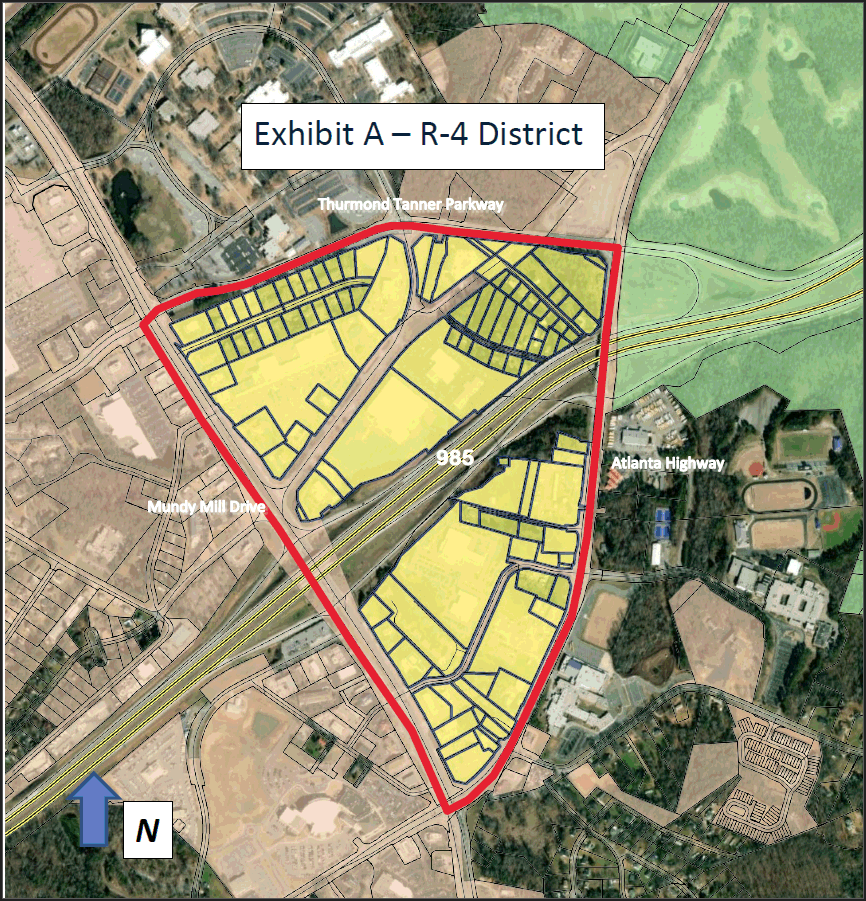
The following is the only use permitted in the R-4 Multiple-Family Residential District: Apartments. The R-4 District consists of all property within the area created and bounded as follows: Beginning at the intersection of Atlanta Highway and Mundy Mill Road and thence running north along Mundy Mill Road to its intersection with Thurmon Tanner Parkway and thence running east along Thurmon Tanner Parkway to its intersection with Atlanta Highway and thence running south along Atlanta Highway to its intersection with Mundy Mill Road and the Point of Beginning. Said R-4 District is further delineated on Exhibit "A" attached hereto and incorporated herein by reference thereto. The following footnote is incorporated herein by reference thereto. [5]
(Ord. No. 220, art. XII, § 1202, 4-11-1994; Ord. No. 2021-CO-09-819, § 2, 10-11-2021; Ord. No. 2022-CO-03-829, § 6, 6-13-2022; Ord. No. 2023-CO-03-853, § 6, 4-10-2023)
The City of Oakwood finds that the size, scale and character of multi-family residential uses directly affects adjacent land uses and the public health, safety and welfare. The City finds that highway oriented multi-family residential uses are incompatible with single family neighborhoods and are inconsistent with the needs of the City. The City desires to be an oasis with a small town feel with open space protected from unregulated growth and density. The City desires to be a diverse community that is an open walking community that interacts person to person. The City strives to have governmental services open to all supported by fair taxes balanced between residential, commercial and industrial. The City wants to keep its trees and green spaces and attract others who are concerned about our environment, our water and our air - all for our public safety, health and welfare. Thus, the purpose and intent of the R-4 Residential District set forth in Exhibit "A" is to: (1) Provide for multi-family residential housing types that are compatible with single-family neighborhoods and commercial nodes; (2) Encourage the development of multi-family housing with limited neighborhood serving commercial uses; (3) Improve the aesthetics of the built environment; (4) Protect existing stable single-family neighborhoods from uses and building forms which are incompatible with their scale, character and needs and (5) Improve the quality of air and water through provisions for the plaiting of trees and greenspace protection.
Sec. 54-398. - Area, height, density and placement requirements.
The area, height, density and placement requirements in the R-4 Multiple-Family Residential District are as specified in sections 54-88 and 54-631.
Front elevations shall be a minimum 60 percent brick and/or stone and a maximum of 40 percent fiber cement siding or stucco with the remaining elevations being brick, stone, stucco or fiber cement siding or any combination thereof.
(Ord. No. 220, art. XII, § 1203, 4-11-1994; Ord. No. 2022-CO-03-829, § 6, 6-13-2022; Ord. No. 2023-CO-03-853, § 6, 4-10-2023)
Sec. 54-399. - Apartment development standards.
The apartment development standards for the R-4 Multiple-Family Residential District are as follows:
(1)
Site plan review, to include exterior lighting plan, by the planning commission and approval by the city council shall be required.
(2)
Apartment buildings shall be constructed with a separation of at least 30 feet.
(3)
No principal building shall be constructed less than 40 feet from any property line.
(4)
Each apartment development shall have a minimum of 20 percent of the development's total land area as landscaped open space and recreational area provided for the use of its residents.
(5)
Exterior lighting of the development shall be provided in accordance with the requirements established in the Downtown Development Design Standards for lighting chapter 5.
(6)
All streets, private drives and entrances, within an apartment complex shall be built to city specifications as provided in chapter 44, the city's subdivision regulations and Downtown Development Design Standards, latest adopted versions. Where conflict exists between the requirements, the more strict application/interpretation shall apply.
(7)
Parking base and pavement shall be provided for in accordance with chapter 44, section 44-144, street paving and base for minor streets. Parking standards and off-street parking shall be provided for in accordance with chapter 2 subsection II of the Downtown Development Design Standards.
(8)
Sidewalks, pedestrian access and pedestrian crossings shall be provided in accordance with the Downtown Development Design Standards. (Minimum of 2' BOC grass strip 5' sidewalk). All developments shall have sidewalks connecting ground level parking to the public sidewalks and to all building entrances.
(9)
No parking shall be allowed other than in properly designated parking spaces. Additionally, no parking is allowed on sidewalks and/or curbs. Appropriate signage approved by the city shall be posted internally at all entrances to the apartment complex.
(Ord. No. 220, art. XII, § 1204, 4-11-1994; Ord. No. 2022-CO-03-829, § 6, 6-13-2022; Ord. No. 2023-CO-03-853, § 6, 4-10-2023)
Sec. 54-400. - Perimeter screening required.
(a)
The City of Oakwood finds it necessary to assist in providing privacy for its citizens from existing public street rights-of-way and motoring public. Further, the screening will aid in the reduction and abatement of noise and light generated from the public street rights-of-way.
(b)
Where the rear sides of an apartment house can be viewed from a public right-of-way, a perimeter screening of at least a 15-foot opaque vegetated screening buffer as described in (1) of this section or a ten-foot opaque screen buffer with a fence and screening vegetation as described in (2) of this section.
(1)
Vegetated screening buffer.
a.
To the district overlay standards. Minimum of six foot in height at time of planting.
b.
Visually opaque at time of planting and remain such seasonally.
c.
A mixture of trees and shrubs shall be incorporated throughout the 15-foot width.
d.
Native plant material is preferred over exotic plants and no one single plant type shall be used throughout the buffer.
e.
If the use is located within one of the city's district overlays, the DDRC shall review and approve the plant material according
(2)
Opaque screening buffer with a fence.
a.
Fence shall be complimentary and similar in style to the development's architecture and materials.
b.
Fence shall be constructed of weather and rot resistant materials.
c.
Fence shall be no less than six feet in height at the time of construction.
d.
Chain link or vinyl fencing shall be prohibited.
e.
A mixture of trees and shrubs shall be incorporated throughout the ten-foot width.
f.
Native plant material is preferred over exotic plants and no one single plant type shall be used throughout the buffer.
g.
If the use is located within one of the city's district overlays, the DDRC shall review and approve the plant material according to the district standards.
(Ord. No. 2023-CO-03-853, § 6, 4-10-2023)
Sec. 54-429. - Purpose and intent.
The MHP Mobile Home Park District is intended to provide areas for mobile home pads, which are leased rather than subdivided for individual ownership, that are served by public water, sanitary sewer and recreational amenities.
(Ord. No. 220, art. XIII, § 1301, 4-11-1994)
Sec. 54-430. - Permitted uses.
The following uses are permitted in the MHP Mobile Home Park District:
(1)
Mobile homes and manufactured homes within mobile home parks, but not including mobile homes on individual lots under separate ownership. Replacement of nonconforming mobile homes in a conforming or nonconforming mobile home park is permitted. Commercial uses or home occupations within individual mobile or manufactured homes are not permitted.
(2)
Administration buildings and customary laundry and service buildings.
(3)
Community centers and recreation facilities intended to serve residents of the district.
(4)
Customary accessory uses and structures clearly incidental to one or more permitted uses and structures.
(5)
Public and semipublic buildings and uses.
(Ord. No. 220, art. XIII, § 1302, 4-11-1994)
Sec. 54-431. - Mobile home park development regulations.
Development for mobile home parks in the MHP Mobile Home Park District shall conform to the following regulations:
(1)
Site plan approval required. All mobile home park developments shall require site plan review by the planning commission and approval by the city council.
(2)
Location and frontage. A mobile home park district development shall be located on property with a minimum frontage of 200 feet on a public street.
(3)
Street requirement. Interior roads serving the development shall be constructed to city standards as specified in chapter 44, the city's subdivision regulations, and in addition shall have a minimum pavement width of 20 feet. If dedicated to the public, the roads within the development shall have a minimum right-of-way width of 40 feet.
(4)
Lot area and width. A mobile home district development shall have a minimum area of 15 contiguous acres and a lot width of at least 200 feet.
(5)
Density. The maximum density of a mobile home district development is 12 units per acre.
(6)
Recreation and other community facilities. Not less than ten percent of the total area of the development shall be devoted to recreation and other community use facilities for those mobile home parks designed for or containing ten or more mobile homes.
(7)
Perimeter setback required. No mobile home or other building or structure shall be located closer than 40 feet to any mobile home park perimeter property boundary.
(8)
Perimeter screening required. A landscaped screen consisting of dense evergreen trees and/or shrubs and having a minimum width of 35 feet adjacent to all public rights-of-way and 15 feet along all other property lines shall be required. A minimum six-foot-high, opaque fence or wall may be erected along property lines not abutting a public right-of-way in lieu of such landscaped screen. All perimeter screening must be maintained.
(9)
Utilities. All mobile home parks shall be served by approved public water and public sanitary sewer systems.
(10)
Refuse collection. Each mobile home park shall provide refuse collection pads at locations convenient to each mobile home space, but in no case more than 50 feet from the street serving each mobile home.
(11)
Space numbering. Each mobile home space shall be provided with a sign, not less than one square foot in area, which indicates the appropriate space number or address.
(Ord. No. 220, art. XIII, § 1303, 4-11-1994)
Sec. 54-432. - Mobile home and mobile home space requirements.
Each mobile home shall be located on a separate pad in accordance with the following regulations:
(1)
Space size and width. Each mobile home space within the development shall contain a minimum space size of 3,500 square feet and a minimum space width of 20 feet.
(2)
Setbacks. Each mobile home shall be set back a minimum of ten feet from the front space line or street right-of-way, three feet from the side space line, and five feet from the rear space line.
(3)
Foundations and tie-downs. Each mobile home shall be supported by piers and foundations and shall be anchored to the ground in accordance with building code requirements, to secure the mobile home against uplift, sliding, rotation and overturning.
(4)
Recreation vehicles. Recreational vehicles in mobile home parks shall be limited to motor homes and travel trailers which have toilet, bath, and kitchen facilities and such use shall be limited to 120 days with no extensions.
(Ord. No. 220, art. XIII, § 1304, 4-11-1994)
Sec. 54-463. - Purpose and intent.
The C-1 Neighborhood Business District is intended to provide areas for limited small-scale commercial uses of a convenience nature serving nearby residential neighborhoods as opposed to a regional market. The district is not intended to accommodate automotive or other types of more intensive commercial activities that are of such magnitude or type that would result in the generation of excessive traffic, noise, odors, pollution, safety hazards, or other adverse impacts which would detract from the desirability of adjacent properties for residential use. In general, the neighborhood business district includes offices and retail and service establishments but excludes those highway-oriented, high traffic generating uses and those which involve use of chemicals and outside sales, storage or display. Institutionalized residential facilities are considered compatible uses in this district.
(Ord. No. 220, art. XIV, § 1401, 4-11-1994)
Sec. 54-464. - Permitted uses.
The following uses are permitted in the C-1 Neighborhood Business District:
(1)
Accessory uses and structures normally incidental to principal permitted uses and structures.
(2)
Art galleries and museums.
(3)
Churches, temples, synagogues and places of worship, and their customary accessory uses and structures, including cemeteries.
(4)
Clubs, lodges, fraternal institutions and other places of public assembly for membership groups, nonprofit or for profit, not to exceed 10,000 square feet of gross floor area.
(5)
Continuing care retirement communities.
(6)
Convalescent homes.
(7)
Day care centers.
(8)
Finance, insurance and real estate establishments.
(9)
Nursing homes.
(10)
Offices.
(11)
Personal care homes, family, group and congregate.
(12)
Public and semipublic buildings and uses.
(13)
Single-family residences operated as principal use or in conjunction with one or more permitted uses. Home occupations are permitted as accessory uses, without being subject to the limitations of section 54-81.
(14)
Restaurants, but not including drive-in or drive-through facilities.
(15)
Retail trade establishments (enclosed) except and excluding retail establishments selling liquor by the package.
(16)
Schools, public elementary, middle and secondary, and public and private colleges and universities.
(17)
Schools, parochial, private vocational, technical, business and others, nonprofit or operated for profit.
(18)
Services, business.
(19)
Services, health.
(20)
Services, personal.
(21)
Shopping centers.
(Ord. No. 220, art. XIV, § 1402, 4-11-1994; Amd. No. 220, § 1, 11-9-2009)
Sec. 54-465. - Conditional uses.
The following uses are permitted in the C-1 Neighborhood Business District:
(1)
Planned unit developments, with a minimum lot size of ten acres.
(2)
Pet grooming, which as a conditional use does not include the overnight boarding or kenneling of household pets.
(Ord. No. 220, art. XIV, § 1403, 4-11-1994; Ord. No. 2025-CO-01-888, § 2, 2-10-2025)
Sec. 54-466. - Area, height, density and placement requirements.
The area, height, density and placement requirements in the C-1 Neighborhood Business District are as specified in sections 54-88 and 54-631.
(Ord. No. 220, art. XIV, § 1404, 4-11-1994)
Sec. 54-486. - Purpose and intent.
The C-2 Highway Business District is intended to provide adequate space for various types of general business uses that serve residents on a community level rather than neighborhood level, including the retailing of major goods and services of large scale, automotive and other types of more intensive commercial activities and establishments that rely on highway-oriented, passerby traffic. Institutionalized residential facilities are considered compatible uses in this district.
(Ord. No. 220, art. XV, § 1501, 4-11-1994)
Sec. 54-487. - Permitted uses.
The following uses are permitted in the C-2 Highway Business District:
(1)
Any use permitted in the C-1 Neighborhood Business District as enumerated in section 54-464, but not subject to any specified square footage limitations.
(2)
Accessory uses and structures normally incidental to permitted principal uses.
(3)
Automobile sales lots, new and/or used.
(4)
Commercial recreation facilities, enclosed only.
(5)
Contractor's establishments, building, electrical and plumbing.
(6)
Convalescent homes, nursing homes, group homes, rehabilitation centers, sanitariums and similar institutionalized residential facilities involving professional care and treatment.
(7)
Hospitals.
(8)
Mini-warehouses and ministorage facilities, where no individual storage stall or compartment exceeds 500 square feet of total floor area.
(9)
Parking garages and parking lots.
(10)
Residence for caretaker or night watchman.
(11)
Restaurants, including drive-in and drive-through facilities.
(12)
Retail trade establishments, unenclosed, and open air businesses.
(13)
Services, automotive, including service stations.
(14)
Services, lodging.
(15)
Services, miscellaneous.
(16)
Transportation, communication and utility facilities.
(17)
Warehousing and storage uses which occupy no more than 20,000 square feet of floor area.
(18)
Wholesale and wholesale distribution establishments which occupy no more than 20,000 square feet of floor area.
(19)
Retail trade establishments selling liquor by the package only as sole tenants of a freestanding building meeting all parking and setback requirements so long as the parcel on which said retail establishment is located does not adjoin property zoned for use of a church in any zoning classification or as Oakwood R-1, R-2, R-3, R-4 or MHP.
(Ord. No. 220, art. XV, § 1502, 4-11-1994; Amd. No. 220, § 2, 11-9-2009)
Sec. 54-488. - Conditional uses.
The conditional uses in the C-2 Highway Business District are commercial recreation facilities, unenclosed.
(Ord. No. 220, art. XV, § 1503, 4-11-1994)
Sec. 54-489. - Area, height, density and placement requirements.
The area, height, density and placement requirements in the C-2 Highway Business District are as specified in sections 54-88 and 54-631.
(Ord. No. 220, art. XV, § 1504, 4-11-1994; Amd. No. 220, § 1, 2-12-2007)
Sec. 54-517. - Purpose and intent.
The O-P Office Professional District is intended to establish and preserve a compatible land use arrangement and provide suitable areas for the development of offices and professional enterprises, medical and dental facilities, and institutions. This district is also intended to apply to areas with a transitional character, where such permitted uses provide a buffer or transition between more intensive nonresidential and residential districts. This district is most appropriately located on non-local (collector and arterial) streets.
(Ord. No. 220, art. XVI, § 1601, 4-11-1994)
Sec. 54-518. - Permitted uses.
The following uses are permitted in the O-P Office Professional District:
(1)
Colleges and universities.
(2)
Convalescent homes, nursing homes, group homes, continuing care retirement communities, rehabilitation centers, sanitariums and similar institutionalized residential facilities involving professional care and treatment, provided such use is located on property fronting an arterial or collector street, that no such dwelling is located closer than 100 feet to a R-1 district boundary, and provided a copy of the approved state license or permit is filed with the zoning administrator prior to the issuance of a certificate of occupancy.
(3)
Finance, insurance and real estate establishments.
(4)
Lodges, clubs, fraternal institutions and other places of public assembly for membership groups, operated on a nonprofit basis.
(5)
Offices, medical, professional, insurance, real estate and general, but not involving retail sales of any kind.
(6)
Personal care homes, family, group and congregate provided that no such buildings shall be located closer than 100 feet to a R-1 district boundary, provided a copy of the approved state license or permit is filed with the zoning administrator prior to the issuance of a certificate of occupancy.
(7)
Single-family residences operated as a principal use or in conjunction with one or more permitted uses.
(8)
Schools, nonprofit or operated for profit.
(9)
Services, health.
(Ord. No. 220, art. XVI, § 1602, 4-11-1994; Ord. No. 2020-CO-11-806, § 5, 2-8-2021)
Sec. 54-519. - Conditional uses.
The following are conditional uses in the O-P Office Professional District:
(1)
Planned unit developments, with a minimum lot size of ten acres.
(2)
Commercial recreation facilities, enclosed when developed in conjunction with one or more permitted uses.
(3)
Services, business.
(4)
Services, miscellaneous.
(5)
Services, personal.
(Ord. No. 220, art. XVI, § 1603, 4-11-1994)
Sec. 54-520. - Area, height, density and placement requirements.
The area, height, density and placement requirements in the O-P Office Professional District are as specified in sections 54-88 and 54-631.
(Ord. No. 220, art. XVI, § 1604, 4-11-1994)
Sec. 54-549. - Purpose and intent.
The M-1 Light Industrial District is established with the purpose of reserving certain areas with relatively level topography, adequate water and sewerage facilities, and access to arterial streets for industrial operations, but where such area's proximity to residential and other districts makes it desirable to limit industrial operations to those that are not objectionable by reason of the emission of noise, vibration, smoke, dust, gas, fumes, odors or radiation and that do not create fire or explosion hazards or other objectionable conditions. Uses within this district do not require substantial quantities of water for manufacturing operations and do not necessarily require rail, air and water transportation. Certain commercial uses having an open storage characteristic, or which are most appropriately located as neighbors of industrial uses, are also included within this district.
(Ord. No. 220, art. XVII, § 1701, 4-11-1994)
Sec. 54-550. - Permitted uses.
The following uses are permitted in the M-1 Light Industrial District:
(1)
Accessory uses and structures normally incidental to permitted principal uses, including offices, showrooms and administrative facilities.
(2)
Contractor's establishments.
(3)
Distribution of products and merchandise.
(4)
Dry cleaning plants.
(5)
Exterminators and pest control businesses.
(6)
Junkyards and used auto parts yards, subject to screening requirements on all four sides of the lot on which said use is located.
(7)
Kennels.
(8)
Lumberyards, planing mills and sawmills.
(9)
Machine shops.
(10)
Mini-warehouse and mini-storage facilities.
(11)
Parking garages and parking lots.
(12)
Public and semipublic buildings, uses and structures.
(13)
Racetracks for animals or motor-driven vehicles, provided the site contains a minimum of 15 acres.
(14)
Radio and television broadcasting towers.
(15)
Repair of household appliances.
(16)
Recycling plants, including any processing activities.
(17)
Research and scientific laboratories.
(18)
Residences for caretaker or night watchman.
(19)
Sign fabrication and painting shops.
(20)
Services, automotive.
(21)
Storage buildings and storage yards.
(22)
Soft drink bottling and distributing plants.
(23)
Transportation, communication and utility facilities.
(24)
Welding shops.
(25)
Wholesaling, wholesale distribution and warehousing facilities.
(26)
Wrecked motor vehicle compounds and wrecker services, subject to screening requirements on all four sides of the lot on which said use is located.
(27)
Offices: medical, professional and general.
(28)
Physical fitness facilities and health clubs.
(Ord. No. 220, art. XVII, § 1702, 4-11-1994; Ord. No. 2021-CO-05-814, § 1, 6-14-2021)
Sec. 54-551. - Area, height, density and placement requirements.
The area, height, density and placement requirements in the M-1 Light Industrial District are as specified in sections 54-88 and 54-631.
(Ord. No. 220, art. XVII, § 1703, 4-11-1994)
Sec. 54-581. - Purpose and intent.
The M-2 Heavy Industrial District is established with the purpose of reserving certain areas with relatively level topography, adequate water and sewerage facilities, and access to arterial streets for industrial operations, which are objectionable by reason of the emission of noise, vibration, smoke, dust, gas, fumes, odors or radiation and that do create fire or explosion hazards or other objectionable conditions. Uses within this district may require substantial quantities of water for manufacturing operations and may require rail, air and water transportation. Conditional uses permitted in this district are primarily those known to create a severe safety hazard or to be major producers of air pollution, this being subject to state and/or federal environmental controls. This district is generally not suitable adjacent to residential districts.
(Ord. No. 220, art. XVIII, § 1801, 4-11-1994)
Sec. 54-582. - Permitted uses.
The following uses are permitted in the M-2 Heavy Industrial District:
(1)
Any use permitted in the M-1 Light Industrial District, as enumerated in section 54-550.
(2)
Asphalt plants.
(3)
Canning establishments.
(4)
Ceramic production facilities.
(5)
Cold storage, frozen food lockers and ice manufacture.
(6)
Concrete, cement, clay, mortar and plaster production.
(7)
Extraction or removal of sand, gravel, top soil, clay, dirt, precious metals, gems, or other natural resources.
(8)
Feed, grain, or fertilizer manufacture or storage.
(9)
Food processing plants, including fish and poultry facilities.
(10)
Manufacturing, processing and assembling of the following products: chemicals, floor coverings, glass, machinery, metals, rubber, textiles, tobacco, and wood, unless more specifically listed under conditional uses.
(11)
Residences for a caretaker or night watchman.
(Ord. No. 220, art. XVIII, § 1802, 4-11-1994)
Sec. 54-583. - Conditional uses.
The following are conditional uses in the M-2 Heavy Industrial District:
(1)
Acid plants.
(2)
Asphaltic concrete hot mix and cutback asphalt plants.
(3)
Automotive and light-duty truck manufacturing.
(4)
Bulk gasoline terminals and bulk gasoline plants.
(5)
Cement manufacturing plants.
(6)
Coating of cans, coils, fabrics, vinyl, metal furniture, appliance surfaces, wire, paper, and flat wood paneling.
(7)
Conical burners.
(8)
Cotton gins.
(9)
Cupola furnaces for metallurgical melting.
(10)
External floating roof tanks.
(11)
Fertilizer manufacturing plants.
(12)
Fiberglass insulation manufacturing plants.
(13)
Hazardous waste receiving, handling and disposal facilities.
(14)
Incinerators, including biomedical waste.
(15)
Kaolin processing facilities.
(16)
Landfills and materials recovery facilities.
(17)
Petroleum liquid storage.
(18)
Pulp mills.
(19)
Solvent metal cleaning.
(20)
Volatile organic liquid handling and storage.
(Ord. No. 220, art. XVIII, § 1803, 4-11-1994)
Sec. 54-584. - Area, height, density and placement requirements.
The area, height, density and placement requirements in the M-2 Heavy Industrial District are as specified in sections 54-88 and 54-631.
(Ord. No. 220, art. XVIII, § 1804, 4-11-1994)
Sec. 54-602. - Purpose and intent.
The A-1 Agricultural District is established to maintain those areas with land characteristics such as soil moisture, temperature and content suitable for farming, dairying, forestry operations and other agricultural activities; to protect land used or needed for food production and other agricultural uses from encroachment by untimely and unplanned residential, commercial or industrial development; to permit the continuation of agricultural uses in areas where development is anticipated, but where the present application of zoning controls for future, more intensive uses would be unreasonable and premature; prevent the subdivision of land for residential development that requires public services such as paved roads, water and sanitary sewer; and to preserve the rural, open space character of certain areas.
(Ord. No. 220, art. XIX, § 1901, 4-11-1994)
Sec. 54-603. - Permitted uses.
The following uses are permitted in the A-1 Agricultural District:
(1)
Agricultural uses, including the production of field crops, fruits, nuts and vegetables; the raising of livestock and poultry; dairying; horticulture; forestry and fisheries; and other uses involving agricultural operations.
(2)
Animal hospitals.
(3)
Antique shops.
(4)
Cemeteries.
(5)
Churches, temples, synagogues and places of worship.
(6)
Dwellings, single-family, provided each dwelling is located on a lot that is a minimum of three acres and a minimum lot width of 200 feet.
(7)
Farm buildings, including barns, chicken houses, grain storage facilities, implement sheds, and structures accessory to agricultural use.
(8)
Home occupations.
(9)
Horse stables.
(10)
Kennels.
(11)
Marinas and boat storage yards.
(12)
Mobile and manufactured modular homes, provided each home is located on a lot that is a minimum of three acres and a minimum lot width of 200 feet.
(13)
Nurseries and greenhouses; plants, trees and shrubs.
(14)
Produce stands, provided products sold are those grown or produced on the premises.
(15)
Public and semipublic buildings and uses.
(16)
Schools, public elementary and secondary, and public and private colleges and universities.
(17)
Schools, parochial, private and others offering courses in general education not operated for profit.
(Ord. No. 220, art. XIX, § 1902, 4-11-1994)
Sec. 54-604. - Conditional uses.
The following are conditional uses in the A-1 Agricultural District:
(1)
Farm supply stores and agricultural-related businesses, such as agricultural implement sales and service, auction facilities, feed and grain stores and other businesses not involving sales or services to the general public, provided such business is located on property a minimum of two acres that fronts on a state or federal highway, and provided such buildings or uses are not located within 500 feet of abutting property zoned or utilized for single-family or mobile home use.
(2)
Boardinghouses, dormitories and lodginghouses for agricultural workers, provided such dwellings are located on a farm with a minimum size of 20 acres, provision is made to meet all applicable public health requirements, and provided such lodging is intended only for the temporary or seasonal housing of farm workers.
(3)
Clubs, lodges, fraternal institutions and other places of assembly for nonprofit membership groups, provided such use is located on property a minimum of two acres that fronts on a state or federal highway.
(4)
Radio and television broadcasting towers, including studios or offices, provided such use is not located within 500 feet of abutting property zoned or utilized for a residence, and provided the height of such tower does not exceed 150 feet without specific authorization from the Federal Aviation Administration and Federal Communications Commission.
(Ord. No. 220, art. XIX, § 1903, 4-11-1994)
Sec. 54-605. - Area, height, density and placement requirements.
The area, height, density and placement requirements in the A-1 Agricultural District are as specified in sections 54-88 and 54-631.
(Ord. No. 220, art. XIX, § 1904, 4-11-1994)
Sec. 54-629. - Purpose and intent.
(a)
It is the intent of the planned development districts to permit and encourage the development of property which would:
(1)
Allow greater flexibility with respect to development standards and site planning considerations;
(2)
Be in the best interest of the city in terms of its long-range development plans;
(3)
Permit the establishment or mixture of uses which without proper design and planning might not be compatible with surrounding uses or zoning districts.
(b)
The planned development is a permanent designation and shall result only from a specific and separate application for amendment as set forth herein and approved by the city council. Planned development districts are separate zoning districts and shall follow the same amendment procedures as other districts. Unless otherwise stated in this section, the development standards and the land uses which are presented with the application for amendment shall, if approved, become the standards for the subject property and shall become a part of the zoning regulations.
(Amd. No. 220, § 1(2001), 2-12-2007; Ord. No. 2022-CO-03-829, § 7, 6-13-2022)
Sec. 54-630. - District classifications.
The following shall be classified as planned development districts subject to the provisions of this article and to the special provisions for each district:
(Amd. No. 220, § 1(2004.1), 2-12-2007; Ord. No. 2022-CO-03-829, § 7, 6-13-2022)
Sec. 54-631. - Minimum lot width, lot size, floor area and density requirements.
The minimum lot width, lot size, floor area and density requirements shall be stated clearly in the application, zoning documents and on all plans as follows:
(Ord. No. 220, art. XX, § 2002, 4-11-1994; Amd. No. 220, § 1, 7-13-1998; Ord. of 11-10-2008, § 1(2002); Ord. No. 2022-CO-03-829, § 7, 6-13-2022)
Sec. 54-632. - Conditions required for a planned district rezoning consideration.
An area may be considered for rezoning to a planned development district if two of the following conditions exists:
(1)
More than one land use is proposed for development on a single parcel;
(2)
Separate land uses which would not otherwise be permitted to locate within the same zoning district are proposed for development on one or more adjacent parcels under single or separate ownership;
(3)
Exception or variation from the size, setback, frontage, density, uses or other standards which are required in the other conventional zoning districts are being proposed as part of a comprehensive development plan. All exceptions and variances must be clearly stated in the development summary with specific code sections stated from which the exception or variance is requested. Variance and exception must be clearly labeled and drawn on the rezoning concept plan as a typical minimum lot standard. Exception and variance request which do not specifically list the code section from which exception or variance is desired shall be considered invalid and the requirements of the underlying zoning noted in section 54-633 shall be applied.
(Amd. No. 220, § 1(2002.1), 2-12-2007; Ord. No. 2022-CO-03-829, § 7, 6-13-2022)
Sec. 54-633. - Requirements for all planned development.
All proposed planned development district applications shall conform to the following specific requirements:
(1)
The site proposed for planned development district classification must contain an area of five acres or more unless otherwise stated in this code or specifically approved by the city council due to special and unusual circumstances. No tract of land shall be considered for a planned development classification which has an area less than one acre except when such tract abuts a nonresidential zoning district or abuts a district with the same zoning classification as that for which the application is filed. In no case shall the minimum tract size be less than the minimum lot area requirements for the comparable conventional district (see Sections 54-88 and 54-631 for area requirements) as specified for each planned development classification in this subdivision. (Note. The comparable conventional zoning districts listed in the regulations are as follows: O-P for a planned office development, C-1 for a planned commercial development and M-1 for a planned industrial development.)
(2)
The site must abut a public street for a distance of at least 100 feet.
(3)
A suitable plan shall be prepared for the development and this plan shall include the following elements where applicable:
a.
A boundary survey or composite boundary drawing drawn to scale by a registered engineer, architect, land surveyor or landscape architect showing the exact dimensions of the parcels of land under consideration.
b.
Master plan. A preliminary master plan of the planned development shall be submitted to the zoning administrator at the time of filing for rezoning to the planned development zoning district. The preliminary master plan shall contain a list of the proposed uses. Any use not specifically designated as a permitted use shall be prohibited. The plan shall represent an overall land use concept which is in keeping with the spirit and intent of the planned development district as described in this article. Said plan shall be prepared by an architect, landscape architect, engineer or land surveyor whose state registration is current and valid and the plan shall exhibit such seal or other to validate such. The plan shall become a condition of the rezoning and any variations to said plan after rezoning approval that would increase the area of a specific land use proposed in the development shall require approval of the planning commission and city council as a zoning change.
1.
A site plan drawn to scale and indicating all property dimensions, platting and street systems, proposed building sites, sizes, types of use proposed for buildings, plans for protection of abutting properties, means of ingress and egress, access and circulation arrangements, off-street parking and loading facilities, lighting plans, proposed reservations or dedications for streets and other public facilities and, if requested, a contour map of the site;
2.
The plan shall give the name of the developers and of the development (if any), a north arrow and scale;
3.
If the proposal includes the subdivision of land for any purpose or for the provision of new public streets, a proposed lot and street layout shall be submitted as part of the application. Any proposed variation from the standards set forth in Chapter 44, the city's subdivision regulations, shall be listed and explained. If the plan is approved, a preliminary plat and final plat shall be submitted as provided by the subdivision regulations in Chapter 44.
c.
A written report shall also be submitted which will explain the type, nature, size, intent and characteristics of the proposed development. This report shall include, where applicable:
1.
A general description of the proposed development and its location;
2.
The proposed standards for development including restrictions on the use of the property, density standards, setback requirements and any proposed restrictive covenants;
3.
An explanation of reasons the proposed development standards are necessary and if the proposed standards in this section vary from existing standards in the zoning regulations;
4.
Plans for the provision of utilities including water, sewer and drainage facilities;
5.
Plans and methods for protection of abutting properties, including screening buffers;
6.
Data stating the total number of acres (or square feet) proposed for each type of land use and buildings, including public facilities within the proposed development; Use regulations. Within the planned development district, land and structures shall be used in accordance with the list of proposed uses as submitted in the master plan (see section 8.1.2). Any use not specifically designated as a permitted use shall be prohibited.
7.
Additional relevant data as may be required by the zoning administrator.
(Amd. No. 220, § 1(2002.2), 2-12-2007; Ord. No. 2022-CO-03-829, § 7, 6-13-2022)
Sec. 54-634. - Procedures for planned development districts.
(a)
Any request pertaining to the establishment of a planned development district shall be considered an amendment to the zoning regulations and shall be administered and processed in accordance with the regulations set forth herein and in article II of this chapter.
(b)
All data, plans and specifications presented as part of the planned development district shall, if approved, be adopted as an amendment to the zoning regulations and shall be the standards of development for that particular planned development.
(c)
All further development on the property shall conform to the standards adopted for the district regardless of any change in ownership. Any proposed changes to the approved standards shall be treated as amendments to the zoning regulations and must be considered in accordance with the procedures set forth herein and in article II of this chapter. Appeals based upon hardship or an alleged misinterpretation of this chapter by the zoning administrator shall be processed in accordance with procedures set forth in article II of this chapter. In no case shall the approved land uses be appealed.
(d)
The violation of any provision of the planned development standards as submitted and approved under the provisions herein shall constitute a violation of these regulations.
(Amd. No. 220, § 1(2003), 2-12-2007; Ord. No. 2022-CO-03-829, § 7, 6-13-2022)
Sec. 54-635. - Planned residential development (PRD).
(a)
No property rezoned to a planned residential development classification prior to December 7, 2021, shall be expended, amended, or modified so as to allow an increase in density, as measured by the total number of lots, buildings, or residential square footage, by more than 20 percent of the previously approved request, not shall there be a reduction in the amount of greenspace or open space required by this section. All such property shall otherwise be subject to the provisions of and in compliance with the planned development regulations of this Code in existence at the time of the prior zoning approval.
(b)
Except for changes to a property that already received a planned residential development classification prior to December 7, 2021, with such changes to be within the restrictions per 54-635(a) above, section 54-635 is repealed.
(Amd. No. 220, § 1(2004.2), 2-12-2007; Ord. No. 2022-CO-03-829, § 7, 6-13-2022)
Sec. 54-636. - Planned office development (POD).
(a)
Characteristics. A planned office development should contain orderly, well-designed office and institutional uses upon a site that results in minimum impact upon the surrounding area. The site plans and building designs should produce a development that can be constructed to achieve maximum utilization of space while maintaining a low-intensity office character protected from more intensive commercial and industrial development and protecting any nearby residential uses. Such a development may also include a limited number of residential and commercial uses.
(b)
Required plans. All of the general and special requirements for planned developments shall be provided. The following special items shall also be addressed:
(1)
The site plan shall indicate the proposed size, location, number of stories, and estimated number of employees in each office building.
(2)
The development controls for the district shall be detailed (lot coverage, setbacks, building heights, lot sizes, etc.) If standards are not specifically proposed, then the applicable standards in the O-P Office Professional District, together with screening and buffer requirements, shall apply.
(3)
If residential or commercial uses are proposed in conjunction with the planned office development, then the applicable requirements of the planned commercial development district shall be provided.
(4)
A proposed development schedule and a listing of proposed uses shall be provided.
(Amd. No. 220, § 1(2004.3), 2-12-2007; Ord. No. 2022-CO-03-829, § 7, 6-13-2022)
Sec. 54-637. - Planned commercial development (PCD).
(a)
Characteristics. A planned commercial development shall provide for the maximum attainable commercial usage of property while employing the best aspects of prior site planning and development controls to ensure:
(1)
Protection of surrounding residential uses;
(2)
Safe access by motorists;
(3)
Minimum traffic congestion; and
(4)
A development which is consistent with long-range plans of the city. A limited number of carefully planned residential uses may also be included in a planned commercial development.
(b)
Required plans. All of the general and special requirements for planned developments shall be provided. The following special items shall also be addressed:
(1)
The site plan shall indicate the proposed size, location and number of stories of each commercial structure.
(2)
The entrances, exits and number and location of all parking spaces shall be shown in detail, together with all loading and no parking zones.
(3)
The proposed methods and location of all buffers shall be described.
(4)
The proposed exterior lighting shall be shown.
(5)
All proposed signs, advertising or identification graphics shall be indicated, showing their number, size, height and location.
(6)
The type and number of uses proposed for the commercial development shall be indicated.
(7)
The development controls for the district shall be stated (lot coverage, setbacks, building heights, lot sizes, etc.). If standards are not specifically proposed, then the applicable standards in the C-1 Commercial District shall apply.
(Amd. No. 220, § 1(2004.4), 2-12-2007; Ord. No. 2022-CO-03-829, § 7, 6-13-2022)
Sec. 54-638. - Planned industrial development (PID).
(a)
Characteristics. A planned industrial development should consist of land which has been designated for a planned, organized and controlled industrial use or for multiple but compatible industrial uses in a planned industrial park. The standards employed should be designed to encourage the formation and continuance of a compatible environment for the planned industrial uses and the surrounding land uses. Carefully planned office and commercial uses may be incorporated as part of a planned industrial development.
(b)
Required plans. All of the general and special requirements for planned developments shall be provided. The following specific items shall also be addressed:
(1)
A site plan indicating the proposed site preparation and grading, streets and parking areas, loading zones, outdoor storage areas, rail facilities, storm drainage, water, gas and sewage systems and all buffer areas.
(2)
The development controls for the district shall be detailed (lot coverage, setbacks, building heights, lot sizes, etc.). If standards are not specifically proposed, then the applicable standards in the M-1 Light Industrial District, together with the screening and buffer requirements, shall apply.
(3)
If office or commercial uses are proposed in conjunction with the planned industrial development, then the applicable requirements in the planned office development or the planned commercial development district shall be provided.
(4)
A proposed development schedule and listing of proposed uses shall be provided.
(Amd. No. 220, § 1(2004.5), 2-12-2007)

