
Ocean City City Zoning Code
ARTICLE I
- IN GENERAL
Sec. 110-1.- Title.
This chapter, including the zoning maps made a part hereof, shall be known as the "Zoning Ordinance of the Town of Ocean City."
(Code 1999, § 110-1; Ord. No. 1993-1, § 105-1.1, 1-19-1993)
Sec. 110-2. - Definitions.
The following words, terms and phrases, when used in this chapter, shall have the meanings ascribed to them in this section, except where the context clearly indicates a different meaning:
Accessory attached use (commercial) means one which is clearly incidental to or customarily found in connection with and is located on the same commercial lot as the principal use of the premises and located within or attached internally to the principal use. When the term "accessory" is used in this chapter, it shall have the same meaning as the term "accessory use."
Accessory building means a subordinate building, the use of which is clearly incidental to or customarily found in connection with and located on the same lot as the main building or principal use of the premises and is not attached by any common wall or by a common roof to the main building, except as otherwise provided in this chapter.
Accessory building (residential) means a subordinate building, the use of which is clearly incidental to or customarily found in connection with and located on the same lot as the main residential building or principal use of the premises and is not attached by any common wall or by a common roof to the main building, except as otherwise provided in this chapter.
Accessory detached building (commercial) means a subordinate building, the use of which is clearly incidental to or customarily found in connection with and located on the same lot as the main commercial building or principal use of the premises and is not attached by any common wall or by a common roof to the main building, except as otherwise provided in this chapter.
Accessory detached use (commercial) means one which is clearly incidental to or customarily found in connection with and is located on the same lot as the principal use of the premises. When the term "accessory" is used in this chapter, it shall have the same meaning as the term "accessory use."
Accessory room means any room in a dwelling unit other than a bedroom, bathroom, kitchen or one living room or living-dining room combination, including, but not necessarily limited to, a den, library, family room, game room, patio room, Florida room, bar, nursery, habitable attic etc.
Accessory use means one which is clearly incidental to or customarily found in connection with and is located on the same lot as the principal use of the premises. When the term "accessory" is used in this chapter, it shall have the same meaning as the term "accessory use."
Accessory use (residential) means one which is clearly incidental to or customarily found in connection with and is located on the same residential lot as the principal use of the premises. When the term "accessory" is used in this chapter, it shall have the same meaning as the term "accessory use."
Administrator means the zoning administrator of Ocean City.
Alley means a narrow public thoroughfare not exceeding 20 feet in width which provides a secondary means of access to abutting properties and is not intended for general traffic circulation.
Amusement arcade means a business establishment offering for public use five or more of any form of game machine, instrument or apparatus operated by coin, slug or similar medium, but not including automatic machines for vending food, soft drinks or tobacco and outside service vending machines.
Amusement attraction means any building or structure around, over or through which people may move or walk, without the aid of any moving device integral to the building or structure, that provides amusement, pleasure, thrills or excitement.
Amusement park means a tract or area used principally as a location for amusement structures or rides.
Amusement ride means any device that carries or conveys passengers along, around or over a fixed area for the purpose of giving its passengers amusement, pleasure, thrills, or excitement.
Apartment means a building or portion thereof containing three or more dwelling units with independent cooking and bathroom facilities, often including buildings in condominium ownership and management.
Arterial street means a street so designated on the major thoroughfare plan of Ocean City.
Attic means the unfinished space above maximum building height, located between the ceiling assembly and the roof assembly.
Attic, habitable, means a finished habitable space within an attic above maximum building height. Habitable floor area is limited to not more than 50 percent of the building's upper floor footprint, and an additional 25 percent of a building's upper floor footprint may be used for other non-habitable purposes such as a bathroom, closet, storage, utility space, and an open unenclosed deck.
Automobile filling stations means any area of land, including buildings and other structures thereon, that is used to dispense motor vehicle fuels and oils and which may sell replacement or accessory parts at retail, so long as bulk storage of flammable liquids is underground.
Automobile service stations means any area of land, including buildings and other structures thereon, that is used to dispense motor vehicle fuels, oils, compressed air, water and replacement of accessory parts and where complete motor vehicle repairs and services are conducted, excluding junk and automobile wrecking businesses, so long as bulk storage of flammable liquids is underground.
Awning. See Canopy.
Barracks means living quarters in one large open area accommodating multiple beds for the sleeping/living room and an adjacent shared toilet/bathroom with shared showers. Supporting facility spaces are relatively minimal and may include laundry rooms, mail and vending areas, or multi-purpose spaces.
Base density means the lot area per dwelling unit requirements stipulated in the district regulations.
Base density calculation (residential). Residential density shall be calculated by dividing the total area of a lot by the minimum lot area requirement by residential type for the zoning district in which the development is to occur. Density calculations shall be rounded down to the nearest whole number.
Basement means that portion of a building between the floor and ceiling which is wholly or partly below grade and having more than one-half of its height below grade.
Board means the board of zoning appeals of Ocean City.
Boardinghouse. See Roominghouse.
Buildable area means the area of that part of a lot not included within the yards or open spaces herein required.
Buildable width means the width of that part of a lot not included within the yards or open spaces herein required.
Building means any structure having a roof supported by columns or walls for the housing or enclosure of persons or property of any kind.
Building, completely enclosed, means any building having no outside openings other than ordinary doors, windows, and ventilators.
Building, detached, means a building which is not attached to any other building, but which is separated by a yard space from all other buildings.
Building, height of, means the vertical distance from base flood elevation, freeboard or grade, whichever is greater, to the highest point where the exterior walls meet the roof. The area above the maximum building height (attic) may be used for habitable attic space in compliance with all applicable provisions of the Code.
Bulk means the three-dimensional space within which a structure is permitted to be built on a lot and which is defined by maximum height, yard setbacks, and open space regulations.
Cannabis means the plant Cannabis sativa L, and any part of the plant, including all derivatives, extracts, cannabinoids, isomers, acids, salts, and salts of isomers, whether growing or not, with a delta-9-tetrahydrocannabinol concentration greater than 0.3% on a dry weight basis, and this shall include cannabis products, cannabis-infused products, cannabis concentrate and edible cannabis products as defined by sections 1-101 and 36-101 of the Alcoholic Beverages and Cannabis Article of the Maryland Annotated Code, as amended from time to time.
Cannabis concentrate means as defined by section 36-101 of the Alcoholic Beverages and Cannabis Article of the Maryland Annotated Code, as amended from time to time.
Cannabis dispensary means an entity licensed under Title 36 of the Alcoholic Beverages and Cannabis Article of the Annotated Code of Maryland, and the Town, that acquires, possesses, repackages, transports, sells, distributes, or dispenses cannabis or cannabis products, including tinctures, aerosols, oils, and ointments, related supplies, and educational materials for use by qualifying patients, caregivers, or consumers through a storefront or through a delivery service, based on license type.
Cannabis-infused product means as defined by section 36-101 of the Alcoholic Beverages and Cannabis Article of the Maryland Annotated Code, as amended from time to time.
Canopy means a roof-like cover supported from the ground or the deck, floor or walls of a building, for protection from sun or weather.
Club, private, means buildings and facilities owned or operated by a corporation, association, person for a social, educational or recreational purpose, but not primarily for profit which inures to any individual and not primarily to render a service which is customarily carried on as a business.
Cocktail lounge means a room or other portion of a restaurant which serves alcoholic beverages and is accessory to the principal use as a restaurant.
Commercial means any activity conducted with the intent of realizing a profit from the sale of goods or services to others.
Commission means the planning commission of Ocean City.
Conditional use means a use which may be authorized by the Mayor and City Council of Ocean City within specified districts and which use is subject to review and approval under the terms and procedures provided in this chapter, together with such conditions and restrictions imposed thereon.
Convalescent home means a building where regular nursing care is provided for more than one person not a member of the family which resides on the premises.
Convenience/carryout food store means an establishment which sells packaged and/or prepared foods and beverages and other convenience items for consumption off the premises and where no seating is provided.
Court means any open space, unobstructed from ground to sky, other than a yard, that is on the same lot with, and bounded on two or more sides by, the walls of a building.
Day care facility means a caretaking facility for children, other than a family day care home as herein defined, providing daytime adult supervision for children not members of the caregiver's family and which shall not provide overnight lodging.
Department means the department of planning and community development of Ocean City.
Development right means one of several types of rights associated with property ownership. A development right is the ability to improve property within the parameters of applicable development regulations.
Dining room means the same as the term "restaurant," except that a dining room is limited to a facility which contains only one room in which food and beverages are served and consumed except in dwelling usage.
District means a part, zone, or geographic area within Ocean City within which certain zoning or development regulations apply.
Dormer means an element of a building that projects from a pitched roof, which includes a window for light or ventilation, which does not exceed the ridgeline of the main building, and which does not exceed 75 percent of the horizontal surface of the building roof area. Location of dormers shall include a minimum setback of four feet from the gable end of the main roof, and shall not project beyond the main structure wall.
Dormitory means a building or space in a building in which group sleeping accommodations are provided for more than 16 persons who are not members of the same family in a series of closely associated rooms, under joint occupancy and single management, with or without meals, and without individual cooking facilities, but including a common kitchen facility for food preparation, cooking, eating and dish washing.
Dry nightclub means an establishment which:
1)
Has music, either live or electronically produced or transmitted;
2)
Has space available for dancing, social discourse or other social activities, whether or not these activities take place;
3)
Allows admission by payment of a direct or indirect charge, including minimum purchase requirement, fee, donation, or any form of consideration, or by the purchase, possession or presentation of a ticket or token;
4)
Is not licensed by the board of license commissioners of the county to sell or serve alcoholic beverages; and
5)
Is not owned and operated by the federal, state or local government. The term "dry nightclub" does not include bona fide restaurants, theaters, schools, service clubs, veteran's organizations, churches, catering halls, and similar establishments.
Dwelling means a building or portion thereof designed or used for residential occupancy, including hotels, motels, motor lodges, roominghouses, boardinghouses and lodginghouses, but not including mobile homes or manufactured housing.
Dwelling, efficiency unit, means a one-story room, the size of which may not exceed 500 square feet, that is not susceptible to permanent division and that contains a kitchen or kitchenette and not more than one bathroom, both of which must be located at the same end of the room. An efficiency or room which is larger than 500 square feet is considered to be a one-bedroom unit, for the purposes of this Code.
Dwelling, multiple-family, means a building designed for or occupied exclusively by three or more families living independently of each other, or un-subdivided two-family dwellings.
Dwelling, single-family, means a building designed for or occupied exclusively by one family.
Dwelling, two-family, means a building designed for or occupied exclusively by two families living independently of each other.
Dwelling unit means a room or group of rooms occupied or rented, or intended to be occupied or rented, as a single residential unit providing complete, independent living facilities for one or more persons, including permanent provisions for living, sleeping, eating, cooking and sanitation.
Employee housing, accessory, means living quarters within a portion of a main building or in an accessory building located on the same lot with the main building, used for persons employed on the premises.
Employee housing, non-accessory, means living quarters within a building located in proximity to one or more employers, used for persons employed within the corporate limits of the Town of Ocean City.
Essential services means facilities such as wires, lines, cables or pipes and supporting structures thereof that are reasonably necessary to provide local properties with water, sewer, gas, electric, telecommunications or similar services. The term "essential services" shall not include any cross-county electric transmission lines, telephone trunk lines, microwave stations, transmission pipelines, trunk water lines, interceptor sewer buildings, treatment plants, pumping or regulator stations, or substations.
Exhibition room means a room used to display items for observation, review or inspection only, and not intended as a place of assembly otherwise.
Existing building means any building which has been issued a certificate of occupancy or has been legally occupied.
Family. For the purpose of maintaining the character of the single-family residential district and to provide affordable housing in other districts, the following definitions apply in the districts as noted:
(1)
R-1, single-family residential, and MH, mobile home districts. The term "family" means an individual or two or more persons living together, sharing household expenses, occupying and using the entire premises as a single housekeeping unit with a single culinary facility and legally sharing in the ownership or possession of the premises and not exceeding the number of occupants allowed by the building code, housing code, fire code, and if rented, the rental housing code.
(2)
R-2A, low density multiple-family; R-2, medium residential, R-3, general residential, all commercial districts, and the mixed use and overlay districts. The term "family" means an individual or two or more persons living together. sharing household expenses, sharing household duties and occupying and using the entire premises as a single housekeeping unit with a single culinary facility, not exceeding the number of occupants allowed by building and housing code, fire code, and if rented, the rental housing code.
Editor's note— The effective date of this definition shall be January 1, 2025, except that any rental leases in effect on the effective date of this definition shall not be affected by this definition until the end of the current rental term.
Family day care home means a residential dwelling unit of a person licensed by the state, office of child care licensing and regulation, where care is provided for no more children than as regulated by the state.
Fast food restaurant means an establishment whose principal business is the sale of pre-prepared or rapidly prepared food directly to the customer in a ready-to-consume state, for consumption either within the restaurant building or off-premises.
Floor area, gross, means the sum of the gross horizontal areas of the several floors of a building measured from the exterior face of exterior walls or from the centerline of a wall separating two buildings.
Floor area (public).
(1)
Commercial and industrial buildings or buildings containing mixed uses. The sum of the gross horizontal areas of the several floors of a building measured from the exterior faces of the exterior walls or from the centerline of walls separating two buildings, including square footage of decks, patios, porches or other exterior seating areas, but not including:
a.
Attic space providing headroom of less than seven feet.
b.
Storage areas, work areas, refuse areas, utility areas or other similar areas not normally accessible to customers or to the general public.
c.
Exterior steps, fire escapes, or enclosed stair towers.
d.
Public or employee restrooms.
e.
Accessory off-street parking spaces.
f.
Accessory off-street loading spaces.
g.
Open air patio (the term "open air" means without an enclosure of any kind).
(2)
Residential buildings. The sum of the gross horizontal areas of the several floors of a dwelling, exclusive of garages, basements and open porches, measured from the exterior faces of the exterior walls.
(3)
Offices, including medical, professional, banks, savings and loans, real estate or offices containing mixed uses. The sum of the gross horizontal areas of the several floors of a building measured from the exterior faces of the exterior walls or from the centerline of walls separating two buildings, but not including:
a.
Attic space providing headroom of less than seven feet.
b.
Storage areas, refuse areas, utility areas or other similar areas not normally accessible to customers or to the general public.
c.
Exterior steps, fire escapes, or enclosed stair towers.
d.
Accessory off-street parking spaces.
e.
Accessory off-street loading spaces.
f.
Open air patio (the term "open air" means without an enclosure of any kind).
Freeboard means an additional amount of height above the base flood elevation used as a factor of safety (e.g., 1, 2 or 3 feet as established by section 38-71, above the base flood elevation) in determining the level at which a structure's lowest floor must be elevated or floodproofed to be in accordance with community floodplain regulations found in chapter 38 - Floods.
Frontage.
(1)
Lot frontage. The distance for which the front boundary line of the lot and the street line are coincident.
(2)
Street frontage. All of the property on one side of a street between two intersecting streets (crossing or terminating), measured along the line of the street, or if the street is dead-ended, then all of the property abutting on one side between an intersecting street and the dead end of the street.
Garage, parking, means a building or portion thereof designed or used for the temporary storage of motor vehicles.
Grade. Grade elevation shall be measured at the crown of the improved street upon which a building fronts, measured at the point perpendicular to the midpoint of the lot line. In the case of a lot which fronts on more than one improved street, the grade elevation is the average elevations of the crowns of the two streets, measured at the points perpendicular to the midpoints of the lot lines. For a building located in the interior of a block which fronts only upon an alley, the grade elevation is the average elevations of the crowns of the streets on opposite sides of the block. Grade for buildings fronting on the boardwalk (or Atlantic Avenue) is determined as above without consideration of the boardwalk (or Atlantic Avenue) or any alleys.
Home occupation means an occupation or activity which is clearly incidental and secondary to the use of the premises for residential purposes and which is carried on by a member of the family residing on the premises in accordance with section 110-908.
Hospital means a building or group of buildings having room facilities for overnight patients, used for providing services for the inpatient medical or surgical care of sick or injured humans, and which may include related facilities, central service facilities and staff offices: provided, however, that such related facility must be incidental and subordinate to the main use and must be an integral part of the hospital operations.
Hotel. Regardless how owned or titled, a hotel is a building or group of buildings which shall:
(1)
Be operated exclusively as a place of temporary lodging for compensation.
(2)
Be open to the public generally rather than to a limited group.
(3)
Contain a public lobby and guest registration office with guestrooms and suites.
(4)
Provide full-time on-site management, guest registration personnel, daily maid service and maintenance to all guestrooms and suites.
(5)
Limit the number of different guestroom and suite keys to the number of guestrooms and suites approved by Ocean City; rooms or suites shall not be subdivided or used to provide more separate living areas than approved by Ocean City.
(6)
Not have individual utility connections metered separately, including water, sewer, and electric, to individual guestrooms and suites.
(7)
Maintain a sign with the name of the hotel on the outside of the property, with the word "hotel" prominently displayed.
(8)
Maintain records for all guestrooms and suites, for at least the most recent two years, including names and addresses of guests and term of stay, and make said records available for inspection by the department on 24 hours' notice.
(9)
Comply with the minimum lot area per dwelling unit specified in the district regulations.
(10)
Not be construed to include any building or structure defined as a multiple-family dwelling in this chapter for the purpose of calculating lot area per unit and off-street parking per dwelling unit. In the case of mixed use dwelling types, the required minimum lot area per unit and parking requirements shall equal the sum of the requirements of the various uses computed separately.
Hotel guestroom means a one-story room, the size of which may not exceed 500 square feet, that is not susceptible to permanent division and which may contain a kitchen or kitchenette and not more than one bathroom, both of which must be located at the same end of the room.
Hotel guest suite means a one-story single dwelling unit not exceeding 700 square feet of gross floor area, which may contain a kitchenette and not more than one bathroom, bedroom area and a living area.
Industrialized building means a building assembly or system of building subassemblies manufactured in its entirety, or in substantial part, off site and transported to the point of use for installation or erection, with or without other specified components, as a finished building or as a part of a finished building comprising two or more industrialized building units. All industrialized buildings shall be approved and certified as required by the Annotated Code of Maryland.
State Law reference— Certification of industrialized buildings, Ann. Code of Md., Public Safety article, § 12-306.
Junk means dilapidated automobiles, trucks, tractors and other such vehicles and parts thereof; dilapidated wagons, trailers and other kinds of vehicles and parts thereof; scrap building materials, scrap contractor's equipment, tanks, casks, cans, barrels, boxes, drums, piping, bottles, glass, old iron, machinery, rags, paper, excelsior, hair, mattresses, beds or bedding or any other kind of scrap or waste material which is stored, kept, handled or displayed.
Landscaping means the permanent planting or emplacement of living plants for the purpose of protecting, preserving and promoting the aesthetic appeal, scenic beauty, character and value of the properties within Ocean City and to promote public health and safety through the reduction of noise pollution, stormwater runoff, air pollution, visual pollution and light glare.
Loading space means a space within the main building or on the same lot providing for the standing, loading or unloading of trucks.
Lodginghouse means a building or portion thereof that does not qualify as a one or two-family dwelling, that provides sleeping accommodations for a total of 16 or fewer people on a transient or temporary basis, without personal care services, with or without meals, but without separate cooking facilities for individual occupants. Lodginghouses allow transient guests within a residence that is also occupied by the owner or primary residents of the dwelling unit.
Lot means a parcel of land occupied or intended for occupancy by a use permitted in this chapter, and having its principal frontage upon a street.
Lot area means the total horizontal area within the lot lines of the lot, excluding any street or alley rights-of-way.
Lot, corner, means a lot or parcel of land abutting upon two or more streets at their intersection, or upon two parts of the same street forming an interior angle of less than 135 degrees.
Lot, depth of, means the average horizontal distance between the front and rear lot lines.
Lot, interior, means a lot other than a corner lot.
Lot line means a line of record bounding a lot which divides one lot from another lot or from a public or private street or other right-of-way.
Lot, through (double-frontage), means a lot having a frontage on two approximately parallel streets or places.
Lot width means the horizontal distance between the side lot lines, measured at the required front yard line.
Manufactured housing means a factory-built, single-family structure that is manufactured under the authority of the National Manufactured Home Construction and Safety Standards Act of 1974, is transportable in one or more sections, is built on a permanent chassis, and is used as a place of human habitation; but which is not constructed with a permanent hitch or other device allowing transport of the unit other than for the purpose of delivery to a permanent site, and which does not have wheels or axles permanently attached to its body or frame.
Manufactured housing and mobile home park means a parcel of land under single ownership that has been planned and improved for the placement of manufactured housing and mobile homes for dwelling purposes.
Marina means a place for docking pleasure boats or providing services to pleasure boats and the occupants thereof; including minor servicing and repair to boats while in the water, the sale of fuel and supplies and the provision of lodging, food, beverages and entertainment as accessory uses. A yacht club shall be considered as a marina, but a hotel, motel, multiple-family dwelling, single-family dwelling, or similar use where docking of boats is incidental to the permitted use shall not be considered a marina.
Micro dispensary means a micro license issued in accordance with the Alcoholic Beverages and Cannabis Article section 36-401 and 36-401(c)(2) of the Annotated Code of Maryland.
Mobile home means a transportable, factory-built home, built on a permanent chassis, designed to be used as a year-round residential dwelling and built prior to the enactment of the Federal Manufactured Housing Construction and Safety Standards Act of 1974, which became effective June 15, 1976.
Motel means the same as the term "hotel," except the rooms are directly accessible from an outdoor parking area. The term "motel" includes motor court, tourist court, motor lodge, motor inn, and the like.
Nightclub means an establishment in which the primary use is the sale of alcoholic beverages and which provides entertainment and/or an area for dancing.
Noncommercial means any activity conducted for personal use or enjoyment without the intent of realizing a profit or recovering costs through the sale of goods or services, or any use or activity conducted by a nonprofit organization.
Nonconforming building or structure means any building or structure which lawfully existed prior to the adoption, revision or amendment of the ordinance from which this chapter is derived, which does not comply with the applicable bulk, density (lot area per dwelling unit), and parking regulations of the district in which it is located.
Nonconforming lot means a lot of record which legally existed prior to the adoption, revision or amendment of the ordinance from which this chapter is derived, which does not conform to the requirements of this chapter as to width of lot, depth of lot or minimum lot area.
Nonconforming use means any lawfully existing use of a building or other structure or of land which existed prior to the adoption, revision or amendment of the ordinance from which this chapter is derived, which does not conform to the applicable use regulations of the district in which it is located.
Nonprofit means a type of activity conducted exclusively for the purpose of providing the community or its members with a service or facility, with no part of its net income inuring to the benefit of any shareholder or individual.
Nursing home. See Convalescent home.
On-site consumption establishment means an entity licensed pursuant to Section 36-401(c)(4) of the Alcoholic Beverages and Cannabis Article of the Maryland Annotated Code that allows cannabis to be consumed (smoked, vaped or otherwise ingested) on premises.
Open space means a common use area for recreation, conservation of natural resources, public and private noncommercial social and recreational areas and centers, and marinas. The term "open space" shall not include space devoted to roads and parking.
Outdoor display of merchandise means display of any merchandise outdoors for exhibit only as authorized by the board of zoning appeals.
Parking space, off-street, means a designated area, on a lot or located in a structure, used for the off-street parking of a motor vehicle.
Permitted use means a use which is or may be lawfully established as authorized by the district regulations, provided it conforms with all requirements and regulations for the district in which such use is located.
Premises means a lot, together with all buildings, structures and uses thereon.
Private means any land or structure not owned and operated by a public or quasipublic jurisdiction or organization.
Public means any land or structure owned and operated by a public or quasipublic jurisdiction or agency for the public benefit.
Receiving area, in a TDR program, means the designated zones to which development rights may be transferred from property in a sending area.
Regulations means the whole body of regulations, text, charts, tables, diagrams, maps, notations, references and symbols contained or referred to in this chapter.
Restaurant means any establishment where food and drink are prepared, served and consumed and whose design or principal method of operation is characterized by customers being provided with an individual menu and being served their food and drink by a restaurant employee at the same table or counter at which said items are consumed. A minimum of 51 percent of gross sales must be created by the sale of food.
Roominghouse means a building or portion thereof that does not qualify as a one or two-family dwelling, that provides sleeping accommodations for a total of 16 or fewer people on a transient or temporary basis, where, for compensation and by prearrangement for definite periods, lodging, meals, or lodging and meals are provided.
Satellite dish antenna means a device incorporating a reflective surface that is solid, open mesh, or bar configured and is in the shape of a shallow dish, cone, horn, or cornucopia used to transmit and/or receive radio or electromagnetic waves between terrestrially and/or orbitally based uses.
Sending area, in a TDR program, means the designated zones from which development rights may be severed from property to be transferred to property in a receiving area.
Sexually oriented business means any of those businesses as set forth and defined as the same in chapter 14, entitled Businesses, of this Code.
Shopping center, community, means a group of two or more business establishments containing more than 40,000 square feet gross floor area designed as a large scale commercial center offering a shopping environment for the general public.
Shopping center, neighborhood, means a group of two or more business establishments designed to provide primarily for retail shopping, personal service uses, and indoor recreational activities to meet the daily needs of residents and vacationers in the vicinity of their neighborhood.
Sign. For definitions pertaining to signs, see section 110-880.
Site plan means a drawing illustrating a proposed development and prepared in accordance with the specifications of article II, division 8, of this chapter.
Small wind energy system means a wind energy conversion system consisting of a wind turbine (rotor, blades, generator, alternator, tail), a tower, and associated control or conversion electronics, and which is intended to primarily reduce on-site consumption of utility power.
Special exception means a use or structure which may be authorized by the board of zoning appeals that would not be appropriate generally or without restriction throughout a district but which, if controlled, could be appropriate within that district. Such uses and structures may be permitted as special exceptions only if specific provision for such use or structure is made in the applicable district regulations.
Storage structure means any structure that is used for storage and does not have a door or other entranceway into a dwelling unit and that does not have water fixtures within its confines, the use of which is limited solely to storage of inanimate objects.
Story means that portion of a building, other than a basement, included between the surface of any floor and the surface of the floor next above it, or, if there is no floor next above it, then the space between such floor and the ceiling next above it. The first story shall be considered the lowest story of which the ceiling is seven feet or more above the average grade, as defined in this chapter.
Street means a public or private thoroughfare which affords the principal means of access to abutting property.
Street line means a dividing line separating a lot, tract or parcel of land from a contiguous street.
Structure means anything erected, the use of which has fixed location on the ground or attachment to something having a fixed location on the ground, including, but not limited to, buildings, swimming pools, fences, walls, signs, and towers.
Subdivision means the division of a lot, tract, or parcel of land into two or more lots, tracts, parcels, or other divisions of land for the purpose, whether immediate or future, of sale or of building development. The term "subdivision" includes resubdivision and, when appropriate to the context, relates to the process of resubdividing or to the land or territory subdivided.
Swimming pool means any portable pool or permanent structure containing a body of water 18 inches or more in depth and 250 square feet or more of water surface area and intended for recreational purposes, including a wading pool, but not including an ornamental reflecting pool or fish pond or other type of pool located and designed so as not to create a hazard or be used for swimming or wading.
Tavern means an establishment used primarily for the serving of alcoholic beverages by the drink to the general public and where food or packaged alcoholic beverages may be served or sold only as accessory to the primary use.
Total height (small wind energy system) means the distance measured from ground level to the blade extended at its highest point. For a rooftop installation, height is measured from the point on the roof where the base of the system is fixed to the blade extended to its highest point.
Townhouse means a single-family dwelling forming one of a group or series of three or more attached single-family dwelling units subdivided into individual ownership separated from one another by party walls without doors, windows or other provisions for human passage or visibility through such walls from basement to roof, and having roofs which may extend from one of the dwelling units to another.
Transfer of development rights (TDR) means a process by which development rights may be transferred from one parcel of land in a sending area to another parcel of land in a receiving area for a maximum base density increase of 25 percent.
Variance means a modification only of bulk or area requirements where such modification will not be contrary to the public interest and where owing to conditions peculiar to the property, and not the results of any action taken by the applicant, a literal enforcement of this chapter would result in unnecessary hardship or practical difficulty.
Water-related recreational activity means any recreational activity that is related to the use of tidal waters in their natural state, including, but not limited to, jet skis, parasailing, sailboats, motor boats and paddle boats, but not including any amusement place, amusement attraction, amusement ride, amusement park, water slide or any ride or amusement device of any kind or description that is subject to regulation by the state department of labor, licensing and regulation under title 09, subtitle 12, chapters 62, 63, 64 and 65 of the Code of Maryland Regulations and/or Ann. Code of Md., Business Regulation article, § 3-101 et seq.
Waterway means any body of water, including any creek, lagoon, canal, river, bay or any other body of water, but not including a swimming pool.
Waterway line means a line marking the normal division between land and a waterway as established by the department.
Yard means an open space, other than a court, on a lot and unoccupied and unobstructed from the ground upward, except as otherwise provided in this chapter.
Yard, front, means a yard extending across the front of a lot between the side lot lines and measured between the street line and the main building or any projections thereof except as otherwise provided in this chapter. On corner lots, the front yard shall be considered as parallel to the street upon which the lot has its least dimension.
Yard, rear, means a yard extending across the rear of a lot between the side lot lines and measured between the rear lot line and the main building or any projection thereof except as otherwise provided in this chapter.
Yard, side, means a yard extending from the front yard to the rear yard and measured between the side lot line and the side of the main building or any projection thereof except as otherwise provided in this chapter.
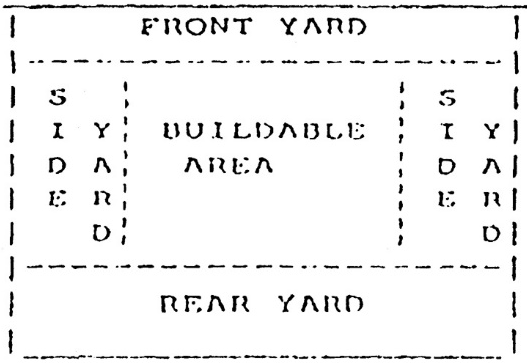
Yards
(Code 1999, § 110-2; Ord. No. 1993-1, § 105-3.2, 1-19-1993; Ord. No. 1997-1, 3-3-1997; Ord. No. 2000-1, 2-7-2000; Ord. No. 2000-17, 6-19-2000; Ord. No. 2001-23, 12-3-2001; Ord. No. 2008-2, 2-19-2008; Ord. No. 2009-6, 4-20-2009; Ord. No. 2010-26, 9-20-2010; Ord. No. 2013-15, 11-4-2013; Ord. No. 2016-04, 3-21-2016; Ord. No. 2019-06, 5-20-2019; Ord. No. 2019-11, 7-1-2019; Ord. No. 2021-23, 12-20-2021; Ord. No. 2023-12, 7-17-2023; Ord. No. 2023-21, 1-16-2024; Ord. No. 2024-20, 8-19-2024; Ord. No. 2025-02, 2-3-2025; Ord. No. 2025-29, 11-3-2025)
Sec. 110-3. - Rules of construction.
The following general rules shall apply to the regulations of this chapter:
(1)
The singular number includes the plural, and the plural the singular, unless the context clearly indicates the contrary.
(2)
Words used in the present tense include the past and future tenses, and the future the present.
(3)
The term "shall" is mandatory and not discretionary. The term "may" is permissive.
(4)
The term "building" or "structure" includes any part thereof, and the term "building" includes the term "structure."
(5)
Words and terms not defined herein shall be interpreted in accord with their normal dictionary meanings and customary usage.
(6)
The term "person" includes a firm, association, organization, partnership, trust, company or corporation, as well as an individual.
(Code 1999, § 110-3; Ord. No. 1993-1, § 105-3.1, 1-19-1993)
Sec. 110-4. - Interpretation; conflicting regulations.
(a)
In interpreting and applying the provisions of this chapter, they shall be held to be the minimum requirements for the promotion of the public health, safety, or general welfare.
(b)
Whenever there is conflict between the minimum requirements of this chapter, the more restrictive requirement shall be enforced.
(c)
It is not intended, by this chapter, to interfere with or abrogate or annul any easements, covenants or other agreements between parties; provided, however, that where this chapter imposes a greater restriction upon the use of buildings or premises or upon the height of buildings, or requires larger open spaces than are imposed or required by other resolutions, ordinances, rules or regulations, or by easements, covenants or agreements, the provisions of this chapter shall govern.
(Code 1999, § 110-4; Ord. No. 1993-1, §§ 105-5.8, 105-32.1, 1-19-1993)
State Law reference— Conflicts, Ann. Code of Md., Land Use article, § 1-202.
Sec. 110-6. - Territorial applicability.
This chapter shall apply to the incorporated territory of Ocean City.
(Code 1999, § 110-6; Ord. No. 1993-1, § 105-1.2, 1-19-1993)
Sec. 110-7. - Purpose of regulations and districts.
The zoning regulations and districts, as herein established, are intended to promote the health, safety and general welfare of the residents and tourists of Ocean City by implementing Ocean City's comprehensive plan to serve the following purposes: to lessen congestion in the streets; to secure safety from fire, panic, and other dangers; to provide adequate light and air; to prevent the overcrowding of land; to avoid undue concentration of population; to facilitate the adequate provision of transportation, water, sewerage, parks, and other public requirements; to conserve the value of buildings and other structures; to encourage the most appropriate use of land throughout Ocean City; and to divide Ocean City into zoning districts of such character, number, shape, and area as are best suited to effect the foregoing purposes.
(Code 1999, § 110-7; Ord. No. 1993-1, § 105-2.1, 1-19-1993)
Sec. 110-8. - Compliance with regulations required.
(a)
No building or land shall hereafter be used, and no building or part thereof shall be erected, reconstructed, converted, enlarged, moved or structurally altered, unless in conformity with the regulations as set forth in this chapter.
(b)
No premises shall be used, and no buildings hereafter erected or structurally altered shall be used, occupied or changed in use, until a certificate of compliance shall have been issued by the department, stating that the building or proposed use of a building or premises complies with the building laws and the provisions of these regulations.
(Code 1999, § 110-8; Ord. No. 1993-1, § 105-5.1, 1-19-1993)
Sec. 110-9. - Uses not specifically permitted are prohibited.
For the purpose of this chapter, permitted uses are listed for the various districts. Unless the contrary is clear from the context of the lists or other regulations of this chapter, uses not specifically listed are prohibited.
(Code 1999, § 110-9; Ord. No. 1993-1, § 105-5.5, 1-19-1993)

