
Oxford City Zoning Code
ARTICLE 7
- Use-Specific Regulations
Section 7.01 - Public Utility Facilities
1.
All electrical power substations must be enclosed within a chain link fence, or similar fence, or be so designed to be inaccessible to unauthorized persons. Electrical power substations in all zones except manufacturing must be enclosed by a planting screen with a minimum height of eight feet and of sufficient depth and density to screen the structure from view. Setback requirements for buildings apply to power substations and are measured from the fencing enclosure except that setbacks along property lines adjacent to streets and alleys may not be less than 15 feet regardless of other setback requirements and that such enclosures may not be constructed closer than 10 feet of adjoining properties. Utility lines must approach the substation from the side opposite the main traffic artery where possible. Distribution lines may be run underground from any orientation.
2.
Public or privately owned utility stations other than electrical power substations must be enclosed by a planting screen of such height, depth and density to screen the structure from view. Fencing is required where such structures present hazards to animals or people. Structures extending above the ground in excess of two feet must comply with the same regulations as required for power substations.
3.
Should proposed utility installations be of a nature that would cause a noise level of 12 decibels above the ambient noise level at any given time measured at a point on the property line nearest the sound source, such proposal must be approved the Planning Commission.
4.
Should the public utility company not be able to comply with the above regulations, he may submit a proposed site plan of the desired installation to the Planning Commission for approval and recommendation to the City Council. The site plan must include the following:
a)
Site of physical plant including height of structure, length and width including that of fencing
b)
Setbacks
c)
Means of access
d)
Landscaping plan
e)
Streets and alleys
f)
Any proposed lighting indicating screening of same as necessary to protect adjacent property owners from glare
g)
Other features pertaining to the particular installation.
Section 7.02 - Telecommunication Towers, Antennas and Satellite Dishes
1.
Definitions. As used in this Section, the following words and terms have the meanings as defined herein:
a)
Antenna: An electromagnetic device which conducts radio signals through an attached cable or wave guide, to or from a radio transmitter or receiver. "Antenna" includes devices commonly referred to as "whips", "panels" and "parabolic dishes". "Antenna" includes an antenna used in conjunction with microwave, cellular or personal communication service systems and any other type of telecommunication systems now or hereafter in use.
b)
Co-location site: A parcel of land or other site on which the antennas and related equipment of more than one party are located.
c)
Communication facilities: Towers, antennas and equipment, collectively.
d)
Equipment: All equipment and facilities used in conjunction with one or more towers and/or antennas, including, but not limited to, electronic systems, generators, fuel tanks and fuel.
e)
Fiber-optics: Light transmissions through very fine flexible glass, by internal reflection.
f)
Monopole: Any self-supporting wooden pole or any self-supporting metal or concrete pole designed to support an antenna; provided, that the word "monopole" does not include a latticed steel or metal tower, a tower which requires guy wires for support or a tower which has more than one source of support, such as a tower with more than one leg.
g)
Residential property: Any land located in a Residential District.
h)
Tower: Any telecommunication Monopole (as defined hereinbefore) including Monopoles used for microwave, cellular or personal communication service systems and any other telecommunication systems now or hereafter in use. As used in this article, "tower" includes any telecommunication tower installed or constructed within the city prior to the effective date of this Ordinance, regardless of whether such tower is a Monopole or another type of tower.
i)
Tower compound: A parcel of land or a building on which communication facilities are located
2.
Required Approvals. No party may construct a tower, install an antenna or equipment within the city unless such party first obtains permission to do so from the Commission and obtains a building permit from the city.
In considering whether to issue a permit for a tower, an antenna or equipment, the Commission will apply the criteria contained in this Section.
3.
Applicability. Communication facilities may be constructed and installed in any zoning district, provided they comply with the provisions of this Section. All towers, antennas and equipment constructed or installed, whether on a new or existing tower compound, after the effective date of this Ordinance and any changes or additions to any tower or antenna in existence before the effective date of this Ordinance, are subject to this Section. A tower which is proposed to be built on a co-location site is subject to the same requirements and conditions as all other towers. Routine maintenance of, and repairs to, the communication facilities, may be performed without the approval of the Commission.
4.
Public hearing. The Commission will hold a public hearing with respect to each application for the construction of a tower and/or the installation of the equipment to be used in connection with the first antenna to be placed on the tower. The installation of any additional antenna on the same tower, and the equipment used in connection with such additional antenna, would be subject to the approval of the mayor and would not require a hearing or approval of the Commission unless:
a)
the tower compound is to be enlarged or there is a change in the size or location of the existing tower; or
b)
the mayor considers it appropriate that such application be referred to the Commission for review and consideration; in either case a public hearing will be held, subject to all the conditions and requirements of a public hearing on an application for the construction of the initial tower on a tower compound.
The City will, by United States certified or registered mail, provide such property owners with notice of the public hearing. If, at the meeting of the Commission during which the public hearing is held or was scheduled to have been held, it is announced that the public hearing is continued or postponed to a certain specific date, no notice of such continued or postponed hearing will be given.
5.
Co-location. A new tower may not be constructed if space is available, on an economically reasonable basis, on an existing tower which is structurally and technically able to support the proposed antenna. An affidavit that reasonable effort has been made by the applicant to locate the proposed antenna on an existing tower must be submitted with the application for the construction of a new tower. Such affidavit must comply with the provisions of §7.02.10.g. Each tower constructed must be designed to provide for the installation of additional antennas to the fullest extent practicable, taking into consideration the structural and technical limitations of the type of tower proposed to be constructed.
6.
Review Criteria. In considering whether to permit communication facilities to be constructed and/or installed at a certain location, the Commission will consider the following public health, safety, and general welfare criteria:
a)
Structural safety of towers: Towers must comply with wind-load and other structural standards contained in applicable building and technical codes adopted by the Council, and the electronic industries associations code, so as not to endanger the health and safety of people in the event of the structural failure of a tower. The Zoning Official will determine whether towers comply with the requirement of this subsection.
b)
Appearance of tower compounds: To the extent practicable, towers and tower compounds must be designed, through the use of building materials, colors, textures, screening and landscaping, so that their appearance is compatible with surrounding land uses. The Commission may require that planting and a decorative fence or wall be constructed around a tower compound to help accomplish this end.
c)
Compliance with rules and regulations: All communication facilities must comply with all applicable rules, regulations and other requirements of the FCC and other governmental agencies having jurisdiction over them, including but not limited to, the State of Alabama and the health department of the applicable county. The Commission may require that satisfactory evidence of such compliance be furnished by the applicant.
7.
Development Criteria. The Zoning Official will review all applications for towers, antennas, or equipment for compliance with the provisions of this Section. By a vote of at least 2/3 of the members of the Commission present at the public hearing, the Commission may waive any one or more of the following requirements if the circumstances justify such waiver and provided the reasons for such waiver are included in the minutes of the meeting of the Commission at which such waiver was granted.
a)
All towers must be monopoles.
b)
Each tower compound must be large enough to provide room for a structure to contain the equipment for at least one additional antenna.
c)
The centerline of a tower may not be located nearer than 100 ft from the boundary line of any residential property. If the land on which a tower compound is located, and all land which abuts the tower compound, is in a nonresidential zoning district (including land in a Planned Development District used for nonresidential purposes) the centerline of the tower may not be closer than 50 ft from the boundary line of such property. The Commission may reduce the foregoing setback requirements in exceptional cases where, due to unusual topographic conditions, the enforcement of such setback requirements would result in unnecessary hardship; provided that the setback may not be reduced to less than the minimum setback required in the applicable district and that the reduction of the setback requirements may not, in the opinion of the Commission, be contrary to the health, safety and general welfare of the public.
d)
Towers must be constructed of wood, galvanized steel or concrete and retain their natural finish so as to reduce their visibility. Towers must be properly maintained.
e)
No signs or other forms of advertising, including signs displaying the name of the owner or user of the tower or antenna, may be attached to, or depicted on, a tower or antenna.
f)
Towers may not be illuminated except as provided herein. Lights for security and maintenance purposes may be installed on structures which contain equipment. Such light must be pointed downward from a height of not more than 10 ft and may not exceed a maximum of 150 watts. Such lights must be located and directed so that they do not shine or reflect onto or toward any residential property.
g)
Each tower compound must be surrounded and fully secured by a dark colored, vinyl-coated or galvanized steel chain link security fence or masonry wall or combination thereof, at least eight ft in height.
h)
All tower compounds must be surrounded by a landscaped buffer which must, to a height of at least eight ft, effectively screen the view of the tower compound from adjacent public ways and residential property. The buffer, which may be located in the required setback area, must consist of a landscaped strip, at least four ft in depth, located outside of the security fence. The landscaped strip must be planted with a combination of trees, shrubs, vines, and/or ground covers capable of attaining, at maturity, a height as high as the security fence and which will enhance and partially screen the outward appearance of the security fence. For tower compounds located within 1,000 ft of residential property or areas of special aesthetic concerns, such as schools, the Commission may require wider landscaped buffer areas and other items, such as decay-resistant, solid wood fences, earth beams and masonry walls. All fences, walls and landscaping must be kept in good condition and repair maintained in a neat manner by the owner or user of the tower.
In the application for permission to construct a new tower or to install an additional antenna on an existing tower, the applicant must include of the name and address of the party who will be responsible for maintenance and repair of the communication facilities, and any fences, walls and landscaped buffer areas. If a different person becomes responsible for such maintenance and repair, the owner of the tower must give the Zoning Official written notice of such person's name and address.
i)
In isolated, nonresidential areas, alternative landscaping methods, such as the use of a dark colored, vinyl-coated or galvanized steel chain link security fence in combination with evergreen shrubs, trees, vines, and/or other plantings, may be permitted on the condition that if the areas surrounding such tower compounds become developed, the Commission may require the owner of the tower compound to comply with the requirements of §7.02.7.h above.
j)
Existing mature tree growth and natural land forms must be preserved to the maximum extent practicable. In some cases, such as tower compounds located on large wooded lots, preservation of a substantial amount of natural growth around the perimeter of the tower compound may be taken into consideration by the Commission in determining the extent of the buffer required.
k)
A parking area and driveway with all-weather surfaces must be provided for each tower compound to provide adequate access for maintenance and repairs and for vehicles providing emergency services. Subject to the approval of the Commission and to an appropriate agreement with the owner thereof, access may be by means of, and parking may be provided on, an adjoining property. Subject to the approval of the Commission, one or more public streets adjoining the tower compound may serve as the parking area.
8.
Removal of Unused Towers. Any tower which is no longer in use for its permitted purpose must be removed at the owner's expense. Within 10 working days of sending notice to the FCC of the intent of the owner to cease use of the tower, the owner must provide the mayor with a copy of such notice. The owner must remove the tower and all communication facilities used in connection with it within 90 calendar days from the day the tower ceases to be used or by such earlier date as may be required by the FCC. If the owner does not remove the tower from the tower compound within the 90-day period, or shorter period if prescribed by the FCC, the owner of the property on which the tower is located, if different from the owner of the tower, must remove it from such land within 90 calendar days of receiving written notice form the city to do so. If neither the owner of the tower nor the owner of the property removes the tower within the time prescribed, the city may, but is not obligated to, remove the tower. If the city removes the tower it is entitled to recover the cost of doing so from the owner of the tower and/or the owner of the property. Notwithstanding the foregoing, a tower used by more than one party may continue to be used for telecommunication purposes as long as the tower is used for such purposes by at least one party. Any party who ceases to use a tower used by more than one party must remove its antenna from the tower and must remove its equipment from the tower compound within 90 calendar days after it ceases to use the tower, or within such shorter period as may be prescribed by the FCC, so that the tower and compound will be available for use by another party. If the tower is located on property owned by the City of Oxford or the Oxford Board of Education, the city or the board, respectively, has the right to purchase the tower for $100.00 when it ceases to be used for telecommunication purposes by all parties who have an antenna located on the tower. Such right to purchase must be exercised by the city or the board within 60 calendar days of the date the city receives notice that the owner of the tower intends to cease use of the tower for its permitted purpose.
9.
Receiving Antennas. A building permit is required for receiving antennas over 18 inches in diameter. A receiving antenna located in a residential zoning district is considered to be an accessory structure. A receiving antenna located in a nonresidential zoning district must be screened on at least three sides if it is located on the roof of a building or on the top of any other structure, and it must be screened on four sides if it is located at ground level.
10.
Application. In addition to other items and information required by this Ordinance, all applications for a permit to construct a new tower or to locate an antenna or additional equipment on an existing tower compound, must include the following:
a)
A list of the names and addresses of all owners of property any part of which is located within 500 ft of any part of the tower compound or proposed tower compound upon which the tower, antenna or equipment are to be located. For the purpose of this Section, the owner of property is considered to be the person shown as the owner of such property according to the records of the tax assessor of the applicable county. The application must be accompanied by the certification by the applicant, a surveyor or an attorney that the list of property owners was obtained from said tax assessor and that the list contains the names and addresses of all owners of property within 500 ft of such tower compound.
b)
Statement of impact on health, safety, and welfare: A brief written statement concerning the steps the applicant has taken to comply with all applicable rules, regulations, and requirements concerning health and safety matters related to the proposed communication facilities.
c)
Site plans: A site plan, prepared by a surveyor, scaled to not less than one inch equals 50 ft, showing the location and dimensions of the subject property, as well as the location of setback lines, driveways, parking areas, fencing, landscaping, and generators and the location, size and type of any fuel tanks. The site plan must be prepared by a licensed and must also show:
1)
all parcels located within 500 ft of any part of the tower compound
2)
zoning classification of the property and of all parcels within 500 of the compound
3)
the latitude, longitude, section, township, range, tax parcel identification number, street address and the site identification number of the proposed tower compound. If any part of the tower compound is or will be located within 1,000 ft of a boundary line of the city, the following information must be clearly indicated:
(i)
the distance from such boundary line
(ii)
the name of the adjacent municipality
(iii)
the zoning classification of the land in such municipality within 1,000 ft of the proposed tower compound.
4)
such other information as may be required by the Commission to determine compliance with the requirements of this Ordinance. If the proposed tower is to be located on a portion of a larger property, its location with respect to the boundary lines of such property must be shown on the site plan.
d)
Elevation views: a silhouette and elevation view of the proposed or existing tower, as applicable, all other communication facilities, and the tower compound, describing colors and materials to be used for the communication facilities and any fencing or walls. The configuration of proposed antenna arrays must be shown on the silhouette. The proposed location of future, additional antenna arrays must be shown on the silhouette by dashed lines.
e)
Frequency band and wattage: The frequency band and maximum wattage of proposed communication facilities.
f)
The estimated life of the tower, the antenna and the equipment.
g)
Affidavit: An affidavit of the applicant stating that: 1) there is no existing tower from which the area to be served from the proposed new tower can be served; or 2) the applicant has made good faith efforts to have its antenna installed on an existing or proposed tower (from which the area proposed to be served by the new tower could be served) and has been unable to do so and giving a detailed written narrative of the efforts made by the applicant to use such existing or proposed tower.
h)
Certification of Shared Use Design. If the tower to be used is one on which there is already one or more antennas, the application must be accompanied by a certification by an engineer, qualified to make such certification, certifying that the tower is able to accommodate the proposed antenna, as well as the antennas already located on the tower, in a safe and functional manner.
To help defray the costs of processing applications, reviews and otherwise administering the provisions of this Section, the applicant must submit a non-refundable application fee of $250 as well as any costs incurred by the City for public notice.
11.
Foundation Survey, As-Built Certification. After the foundation for a tower is poured, a foundation survey, prepared by a surveyor, showing the location of the foundation of the tower, must be furnished to the Zoning Official, and no further work may be done with respect to the construction of the tower until the Zoning Official has approved, in writing, the foundation, including its location. Upon the completion of the tower and installation of an antenna, or upon the location of an additional antenna upon an existing tower, the tower and antenna or the antenna, as the case may be, may not be put into operation until a qualified engineer furnishes the City written certification that the tower and the antenna were built and installed, or the antenna was installed, if the antenna was installed on an existing tower, in accordance with the plans submitted to the city including the installation of any required buffers, fencing and walls.
12.
Inspection Fee. To determine whether tower compounds are in compliance with the requirements of this Section, the city will make, or have made on its behalf an annual inspection of the communication facilities on each tower compound including the walls, fences and landscaping, for which an annual inspection fee of $200.00 is imposed. If more than one antenna is located on a tower, the annual inspection fee is $300.00. The fee is due January of each year and is delinquent if not paid by January 31 of such year. To help defray the cost of collecting fees, an additional fee, in the amount equal to 10% of the fee is payable for each month, or portion of a month, after January in which the fee remains unpaid. If the fee is not paid within 90 calendar days of its due date, the city may withdraw its permission for the location of communication facilities on the tower compound, in which event; all communication facilities must be removed within 90 calendar days of the date on which the owner of the tower receives such notice.
The fee is payable by, and is the responsibility of the owner of the tower, even if additional antennas located on the tower are owned by other parties. If there is more than one owner of the tower, each owner will be jointly and severally liable for the entire amount of the fee and any additional fees due because of delinquency in payment. Within a reasonable time after inspection has been completed, the city will give the owner written notice, by United States registered or certified mail, of any aspects of the communication facilities or the tower compound not in compliance with this Section. If such problems or deficiencies are not corrected within 30 calendar days of the date such notice is sent to the owner, any person found to be in violation of these requirements and all other applicable ordinances, rules or regulations of the city with respect to any communication facilities or tower compound will, upon conviction, be punished by a fine of not less than $1.00 nor more than $500.00, at the discretion of the court trying the case. Each day any violation of this Ordinance continues constitutes a separate offense. The purpose of the inspection is to determine whether the facilities are in compliance with this Section, not to address the safety or structural soundness of the facilities.
Section 7.03 - Cluster Development
1.
Intent.
a)
To provide flexibility to achieve the most effective development on lands constrained by natural hazards that may limit the amount or type of development
b)
To promote the creation of accessible green space
c)
To protect sensitive, environmental land features to promote the public health and safety
d)
To reduce erosion, sedimentation, land disturbance, and removal of vegetation
e)
To promote development of walking and bicycling facilities and greenways within new developments that can be connected to adjacent neighborhoods and activity centers; and
f)
To reduce perceived density by providing access to and views of open space.
2.
Applicability. The Cluster Development option is available, upon approval by the Commission, for single-family detached residential development of at least three acres in the E-1, R-1, R-2, R-3 and GH Districts. The applicant must comply with all other provisions of this Ordinance and all other applicable regulations, except those incompatible with the provisions herein.
3.
Ownership of Development Site. If held in multiple ownership, the site must be developed according to a single plan with common authority and common maintenance responsibility as approved by the City Attorney.
4.
Density Determination.
a)
The maximum number of lots is determined by dividing the total area of the proposed subdivision by the most restrictive of the following: minimum lot size of the applicable district or by regulations as determined by City and/or County Health Department standards for septic tanks, or by other density limitations, such as watershed protection requirements, as applicable to the site. In making this calculation, the following may not be included in the total area of the tract:
1)
Designated floodway
2)
Bodies of open water over 5,000 sf of contiguous area
3)
Wetlands, as defined by the Army Corps of Engineers
b)
The above notwithstanding, the maximum permitted density is 12 units/acre net residential area or nine units per gross acre.
c)
The minimum total area for front, rear and side yards is 2.5 times the ground floor area of the dwelling unit. A minimum 20 ft of space between residential buildings must be provided.
5.
Application Requirements.
a)
Site Analysis Map. The applicant must prepare and submit a site analysis map concurrently with the development plan and/or preliminary plat. The purpose of the site analysis map is to ensure that important site features have been identified prior to the creation of the site design, and that the proposed open space will meet the requirements herein. For specific submittal requirements, refer to the Appendix.
b)
Cluster Development Plan. The applicant must prepare a Cluster Development Plan, which yields no more lots than identified under §7.03.4. The Cluster Development Plan must identify open spaces to be protected and include an open space management plan (see §7.03.7), and must be submitted prior to the issuance of a grading permit.
c)
Instrument of Permanent Protection. An instrument of permanent protection, as described in §7.03.8, must be placed on the open space at the time of issuance of a grading permit.
6.
Other Requirements. The Applicant must adhere to all other requirements of the applicable district and the Subdivision Regulations.
7.
Open Space Management Plan. For the purposes of this Section, "open space" is defined as the portion of a Cluster Development that has been set aside for permanent protection. Activities within the open space are restricted in perpetuity through the use of a legal instrument approved by the City Attorney.
a)
Standards.
1)
The minimum open space must comprise at least 25% of the gross tract area.
2)
The following priority conservation areas must be included within the open space, unless the applicant demonstrates that this would constitute an unusual hardship and be counter to the purposes of the Cluster Development:
(i)
The 100-year floodplain;
(ii)
Riparian zones of at least 75 ft width along all perennial and intermittent streams;
(iii)
Slopes above 25% of at least 10,000 sf contiguous area;
(iv)
Wetlands, as defined by the Corps;
(v)
Existing trails that connect the site to neighboring areas; and
(vi)
Archaeological sites, cemeteries and burial grounds.
3)
The following are considered Secondary Conservation Areas and should be included within the open space to the maximum extent feasible:
(i)
Important historic sites;
(ii)
Existing healthy, native forests of at least one-acre contiguous area;
(iii)
Individual existing healthy trees greater than eight inches caliper; and
(iv)
Other significant natural features and scenic viewsheds, particularly those that can be seen from public roads.
4)
Utility rights-of-way and small areas of impervious surface may be included within the protected open space but cannot be counted towards the 25% minimum area requirement (exception: historic structures and existing trails may be counted). Large areas of impervious surface, such as portions of streets, parking and loading areas, are excluded from calculating open space.
5)
At least 25% of the open space must be suitable for passive recreational use.
6)
At least 50% of the open space must be in a contiguous tract, which may be divided by a local street whose area is excluded from the open space. The layout of open space in a Cluster Development should allow connection to neighboring areas of open space.
7)
The open space must be directly accessible to the largest practicable number of lots and/or buildings within the site. Non-abutting lots must be provided with safe, convenient access to the open space through sidewalks or off-street walkways.
b)
Permitted Uses of Open Space.
1)
Conservation of natural, archeological or historical resources;
2)
Meadows, woodlands, wetlands, wildlife corridors, game preserves, or similar conservation-oriented areas;
3)
Passive recreation areas, such as open fields, walking or bicycle trails;
4)
Active recreation areas, provided that they are limited to no more than 20% of the total open space and are not located within priority conservation areas. Active recreation areas may include impervious surfaces. Active recreation areas in excess of this limit must be located outside of the protected open space.
5)
Landscaped stormwater management facilities, community and individual wastewater disposal systems located on soils particularly suited to such uses. Such facilities must be located outside of Primary Conservation Areas;
6)
Easements for drainage, access, and underground utility lines;
7)
Other conservation-oriented uses compatible with the purposes of this Section.
c)
Prohibited Uses of Open Space:
1)
Golf courses;
2)
Roads, parking lots and similar impervious surfaces, except as specifically authorized in the previous subsections;
3)
Agricultural and forestry activities not conducted according to accepted best management practices;
4)
Impoundments; and
5)
Other activities as determined by the applicant and recorded on the legal instrument for permanent protection.
d)
Ownership and Management of Open Space. See §3.11.
8.
Legal Instrument for Protection of Open Space. The open space must be protected in perpetuity by a binding legal instrument recorded with the deed. The instrument for permanent protection must include clear restrictions on use of the open space, including all restrictions contained in this Subsection, and any restrictions the applicant chooses to place on the open space. The instrument must be one of the following:
a)
A permanent conservation easement in favor of either:
1)
a land trust or similar conservation-oriented non-profit organization with legal authority to accept such easements. The organization must be bona fide and in perpetual existence and the conveyance instruments must contain an appropriate provision for retransfer in the event the organization becomes unable to carry out its functions; or
2)
a governmental entity with an interest in pursuing goals compatible with the purposes of this Subsection, and if the entity accepting the easement is not the City, then a third right of enforcement favoring the City must be included in the easement.
b)
A permanent restrictive covenant for conservation purposes in favor of a governmental entity.
c)
An equivalent legal tool that provides permanent protection, as approved by the City Attorney.
9.
Tax Assessment of Open Space. Once a legal instrument for permanent protection has been placed upon the open space, the County Tax Assessor may be requested to reassess the open space at a lower value to reflect its more limited use.
Section 7.04 - Home Occupations
1.
Where permitted, Home Occupations must comply with the following requirements:
a)
Home occupations are limited to office use only (e.g. personal computer, telephones, fax).
b)
There may be no change in the outside appearance of the building or premises, or other visible evidence of the conduct of such home occupation. Signage identifying the home occupation is prohibited.
c)
No home occupation may be conducted in any accessory building.
d)
The use of the dwelling unit for the Home Occupation must be clearly incidental and subordinate to its use for residential purposes by its occupants, and not more than 25% of the floor area of the dwelling unit may be used in the conduct of the Home Occupation;
e)
No person other than members of the family residing on the premises may be engaged in such operation.
f)
No traffic may be generated by the Home Occupation in greater volumes than would normally be expected in a residential neighborhood, and any need for parking generated by the conduct of such Home Occupation must be met off the street and other than in a required front yard.
g)
No individual sales or service may be offered within the dwelling unit of the house.
h)
There may be no bulk pick-up or delivery of merchandise or materials.
i)
The home occupation must not create a disturbance (noise, vibration, glare, fumes, odors, electrical interference, etc.) or blight of any nature, which may reasonably be considered a nuisance.
j)
No more than one home occupation may be conducted in a dwelling unit.
2.
Any person who desires to engage in a Home Occupation must apply for a license from the Business License Office of the City. Applicants must sign a certification provided by the Business License Office that such business will be conducted in accordance with the requirements of this Section.
Section 7.05 - Mini-warehouses
1.
No storage of volatile, toxic or explosive materials is permitted, either inside the structure(s) or on the premises.
2.
Storage spaces may not be used for commercial activities. However, this does not include periodic auctions, which are held on the premises to dispose of items which have been abandoned and/or for which the lease time has expired.
3.
The Commission may require screening around the perimeter of the site as part of any required Conditional Use or Site Plan approval. Any outdoor storage must be screened as required in §10.02.
Section 7.06 - Wrecking and Junk Yards
1.
No automobile wrecking yard, salvage yard or junkyard may be established closer than 300 ft to an established residential district.
2.
All outdoor storage of salvage and wrecking operations must be completely contained within a fence or wall of not less than six nor more than 10 ft in height. Such fence must be designed in accordance with §10.04. Existing wrecking, salvage or junk yard must comply within one year of the effective date of this requirement. An extension of up to 90 days may be considered upon written request to the Board of Adjustment.
3.
The storage of wrecked automobile, junk, or salvaged materials may not exceed the height of the required screen fence or wall.
Section 7.07 - Accessory Dwellings
1.
Accessory dwellings are only permitted as an accessory use to a permitted single-family detached dwelling.
2.
Area and Dimensional Requirements.
a)
Accessory dwellings are permitted only on lots with a minimum lot size of 10,250 sf.
b)
The minimum habitable floor area is 300 sf and the maximum habitable floor area is 30% of the gross floor area of the principal dwelling. Detached accessory dwellings are subject to §3.10 Accessory Structures.
c)
Setbacks. If detached from the principal dwelling, accessory dwellings must be to the rear of the principal dwelling or within the upper floor of a detached garage or similar permitted accessory structure and must be set back as otherwise required of accessory structures.
3.
Additional Requirements.
a)
One parking space, in addition to that required for the principal dwelling, must be provided.
b)
Accessory dwellings, whether attached or detached, must maintain the appearance of the principal dwelling, including colors, materials, and style, and may not create additional entrances toward the front of the property.
c)
Accessory dwellings may not be separately metered, including electricity, water and gas.
Section 7.08 - Bed and Breakfasts
Bed and breakfasts may only be permitted in single-family detached dwellings, must be operated by the owner and resident of the dwelling, and must comply with the following provisions:
1.
Use Regulations. All guest rooms must be located within the principal structure. Individual guest rooms may contain no cooking facilities, and no food preparation or cooking is allowed.
2.
Parking. For each and every approved guest room, one parking space must be provided, in addition to the spaces required for the residence. Such additional required parking spaces must be screened from adjacent properties and arranged so that each space has direct access to a driveway. Recreational vehicle parking is prohibited except on lots one acre or larger in size. Where allowed, recreational vehicle parking must be located away from view from public rights-of-way and from neighboring properties to maximum extent practicable.
Section 7.09 - Multifamily Dwellings
Where permitted, multifamily dwellings involving the development of more than one acre, containing more than eight dwelling units, or containing more than one building are subject to the following provisions. Where there is any conflict between the provisions herein and the provisions of §4.05 R-3 Residential District, the more restrictive govern.
1.
The site must be planned to limit disruption of steep slopes and natural drainage systems.
2.
Arrangement. Multifamily buildings must be oriented toward streets, interior drives and improved open spaces, not adjacent properties. A multifamily building may be aligned along a parking area provided it is also oriented toward a street, interior drive or improved open space.
a)
Building entrances must face and be clearly visible from streets, interior drives or interior open space. This does not apply to entrances to individual dwelling units.
b)
Building entrances must be accessible from the street, interior drive or open space they face.
3.
Parking
a)
In addition to the base requirements in Article 8 Parking, visitor parking must be provided at a rate of two additional spaces per five dwelling units.
b)
Parking lots must be located to the side or rear of buildings, and may not be located closer to a public street than the front building line.
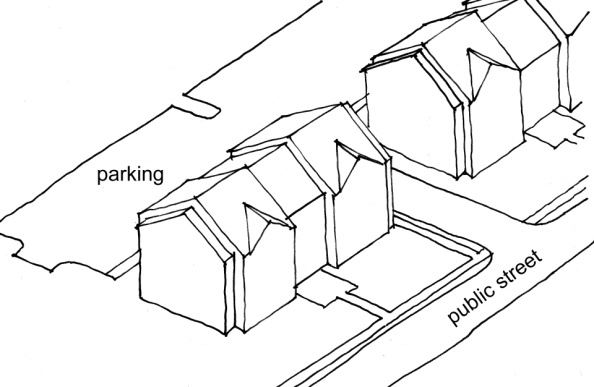 | 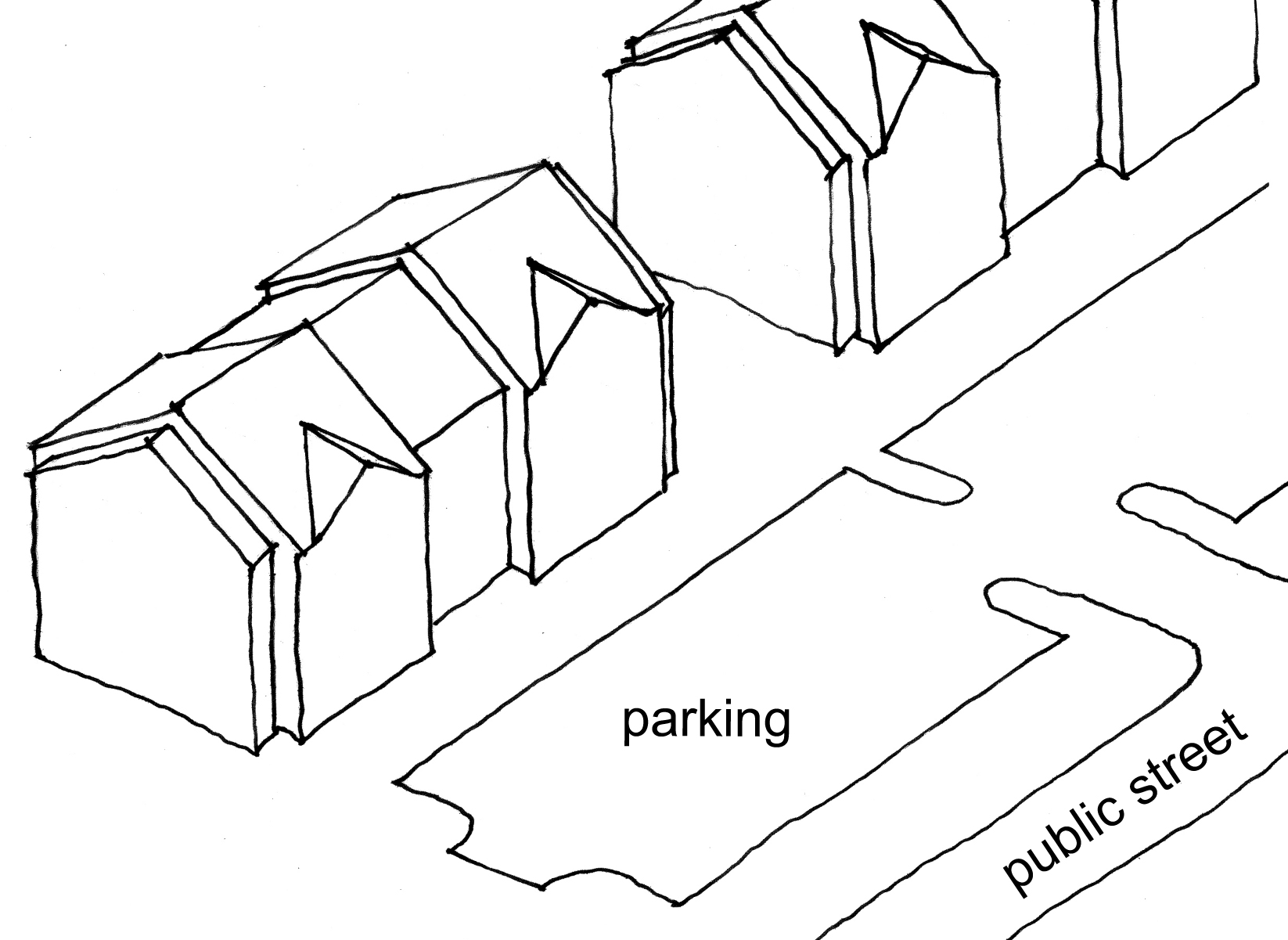 |
| Left: Permissible location of off-street parking. | Right: Parking between multifamily buildings and public street not permitted. |
c)
Where provided, common or individual garage parking areas must be located away from public street views
d)
When located to the side of buildings and adjacent to a public street, parking areas may not occupy more than 30% of the public street frontage.
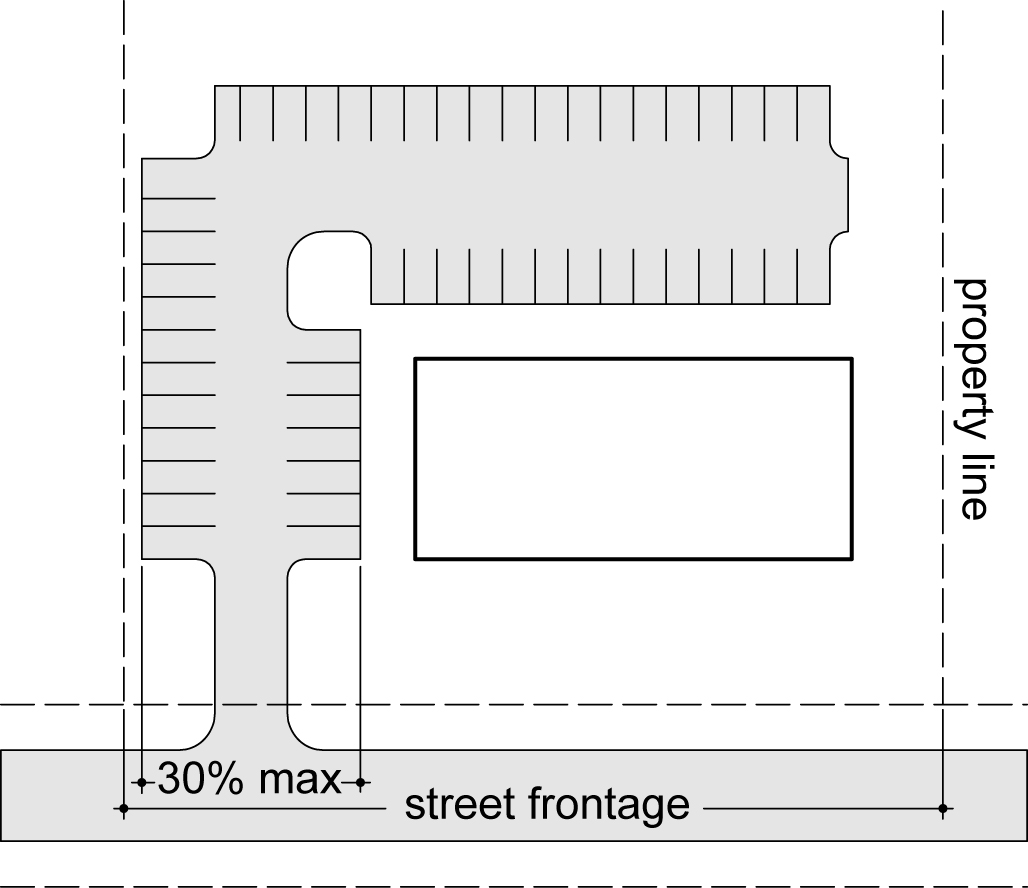
Maximum width of parking area facing public street when located to side of building.
e)
The storage of boats, campers, and recreational vehicles is not permitted in required parking areas and, where provided, must be screened through landscaping, fences and/or walls from public view.
4.
Access
a)
Private drives that provide access from a public street must be designed in accordance with Table 7-1. Where parallel parking is provided along the drive, each parking lane must be a minimum of seven ft measured from face of curb. Trees must be installed at least two ft from the back of curb.
b)
The number and width of vehicular access points along a public street must be minimized. On corner lots, driveway access must be located along the street of lesser classification and located as far as practicable from the street intersection.
5.
Open Space. At least 20% of the site must be reserved as open space. At least 10% of the site must be improved and maintained as open space for the use of the residents and guests. All proposed common open spaces must be included in the Site Plan submittal.
6.
Stormwater Management. Stormwater retention or detention facilities must be integrated into the design of parking areas and common open spaces as landscape amenities and should include low impact design techniques such as swales and rain gardens. The use of cisterns to capture stormwater for on-site irrigation is also encouraged. Stormwater management facilities located within a common open space may be counted as improved open space.
7.
Service, Loading and Waste Collection. Each development must have a service area for waste collection, located behind the front building line and away from public views but otherwise accessible to vehicles collecting such waste and to residents. The location of such areas must minimize negative visual, noise, odor and other impacts to adjoining streets, on-site dwellings and adjacent developments. Each such area must be paved and screened in accordance with §10.02 Screening.
8.
Storage Units. For each dwelling unit, dedicated storage space of at least 280 cubic feet must be provided.
9.
Fire Protection
a)
No portion of any building may be located farther from a fire hydrant than may be reached with 500 ft of hose.
b)
Every multifamily building must be accessible to fire trucks as required and approved by the Fire Department. Provided adequate clearance, such access may be located along an interior drive, within a parking lot or within any open area adjoining a building.
c)
No parking spaces may be located between buildings and fire truck access areas.
10.
Buffers. Buffers must be provided between lower intensity uses on abutting lots in accordance with §10.01 Buffers.
11.
Pedestrian Access Standards
a)
Walkways must connect the pedestrian circulation system to adjacent public streets.
b)
If not already provided, a publicly accessible sidewalk of at least five ft in width must be provided along all public street frontages. The sidewalk must be located within the right-of-way or within an easement provided for such purposes.
c)
Walkways must connect the main entrances of all buildings and building entrances to parking areas and common areas and facilities. For buildings fronting on a public street, a public sidewalk may be counted toward this standard.
d)
Walkways must be provided to connect to any public trails or similar bicycle-pedestrian facilities adjoining the site.
e)
Standards for Pathways
1)
Walkways must be of concrete or masonry pavers and at least five ft wide except that walkways serving no more than four units may be four ft wide.
2)
Except as provided in Item 3 below, walkways must be clearly defined and designed so as to be separated from vehicular use areas through the use of raised curbs, elevation changes, bollards, landscaping, different paving materials, and/or other similar methods. Striping alone does not meet this requirement.
3)
Walkways may be within a vehicular drive if the drive provides access to 16 or fewer parking spaces and the entire drive is surfaced with paving blocks, bricks, or other special paving. Trees and other landscaping elements must be integrated into the design of such shared auto/pedestrian court.
12.
Open Space Standards
a)
All common open spaces and recreational areas must be well maintained in a safe and orderly condition. Open spaces must be oriented to receive adequate sunlight.
b)
Improved open space must be consolidated into one or a few central locations to assure accessibility and usability.
c)
Open space and recreational areas are counted toward the 10% improved open space requirements in §7.09.5 as follows:
1)
Required setback areas do not count unless they otherwise meet the standards of this Subsection. Spaces must be large enough to support leisure and recreational activity; no dimension may be less than 15 ft.
2)
Children's playground area must be provided in the amount of 50 sf per unit. The minimum size of any playground is 3,000 sf. Children's play areas must be located so that they are visible from dwelling units and near pedestrian activity. This requirement does not apply to age-restricted developments, such as senior housing.
3)
Covered private balconies, porches, decks, or patios may be used to meet up to 25% of the required open space. To qualify, such spaces must be at least 35 sf in area with no dimension less than five ft. Such spaces are not counted when they are completely inset into the building; they must project at least two ft beyond the wall plane.
13.
Privacy and Security Standards
a)
When a multifamily building is located adjacent to a public street, any stairway must be enclosed within the building. For street-facing buildings upper floor units must be accessed from within the building interior or from an exterior walkway that overlooks an interior courtyard or similar common area. Exterior stairs may only be permitted for buildings within the interior of the development and not located along a public street.
b)
Separation must be provided between windows of ground floor dwelling units and adjacent walkways, parking areas and common open spaces, including:
1)
A horizontal separation of at least 10 ft in depth including a landscaped bed containing at least one row of shrubs with a mature height of at least three ft; and/or
2)
Vertical separation so that the bottom edge of a window is at least five ft above the grade of the adjacent walkway, parking area or common open space. Developments are encouraged to raise the ground floor of residential buildings at least 30 inches above the sidewalk or parking area to enhance residents' privacy.
14.
Lighting Standards. Lighting should eliminate adverse impacts of light spillover; provide attractive lighting fixtures and layout patterns that contribute to safety and to a unified exterior lighting design; and provide exterior lighting for safe vehicular and pedestrian access to and within a development.
a)
Plan Required. Applicants must submit a lighting plan subject to the requirements herein for Commission approval.
b)
Pedestrian Lighting. Pedestrian-level, bollard lighting, ground-mounted lighting, or other low, glare-controlled fixtures mounted on building or landscape walls must be used to light walkways.
c)
Lighting Height. Light poles and lighting structures may be no more than 20 ft high.
d)
Building-Mounted Lighting. Building-mounted lighting is limited to accent lighting used to illuminate architectural features, entrances and adjoining walkways, with a maximum height of 20 ft. Building-mounted lighting may not be used to illuminate parking areas.
e)
Illumination Level. Pedestrian areas, driveways, and parking areas must be illuminated to a minimum average of one footcandle.
f)
Spillover Glare. Light fixtures must have full cut-off lenses or hoods to prevent glare and light spillover onto adjacent properties, buildings, and roadways.
15.
Architectural Guidelines. All building elevations must reflect consistent design, textures, colors, and features. All walls is articulated and fenestrated to provide visual interest.
a)
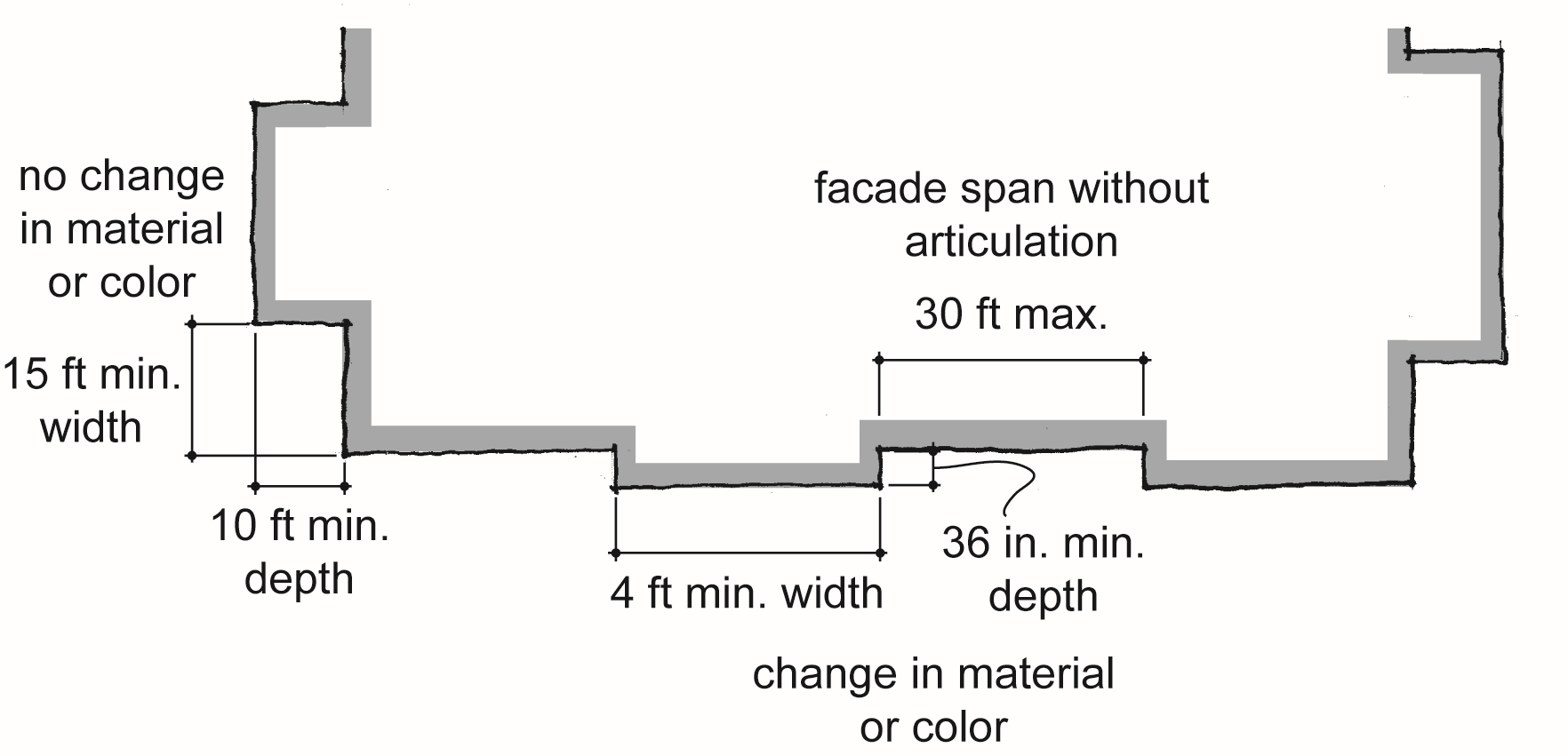
Building Articulation. Multifamily dwellings should include the following architectural design features at intervals of no more than 30 ft along all facades facing a street, common open space, and common parking area:
1)
Vertical building articulation. Minimum depth and width of articulation is 36 inches and four ft, respectively, if corresponding with a change in color or building material and/or roofline. Otherwise, minimum depth and width of articulation is 10 ft and 15 ft, respectively. Projecting balconies, including those that are partially recessed, may count toward this requirement.
2)
Articulation of the "base, middle and top". This typically includes a distinctive design for the portion of the elevation along the foundation and ground floor, consistent articulation of middle floors, and a distinctive roofline.
b)
Diversity of Building Types. Multi-building developments must provide different architectural designs to achieve visual interest and variety, particularly where multiple buildings front on the same public street. Changes in building colors or reversal of facade designs are not sufficient alone to comply with this standard. Variations must be provided in a combination of at least two of the following: vertical articulation (meeting the requirements of Paragraph a above), fenestration, building materials, and roof design.
c)
Accessory structures. Accessory structures must be consistent in design, materials and finish as multifamily buildings.
d)
Roof Design
1)
Pitched roofs must have a minimum 5:12 pitch. Alternative roof designs will be considered provided design elements are included to help the building and its roofline fit into the site's context.
2)
All buildings must incorporate variations in the roofline. The maximum length of any continuous roofline is 60 ft. The use, alone, of dormers and/or gables is not sufficient to comply with this requirement.
[3)]
Eaves must extend beyond the supporting wall at least 16 inches.
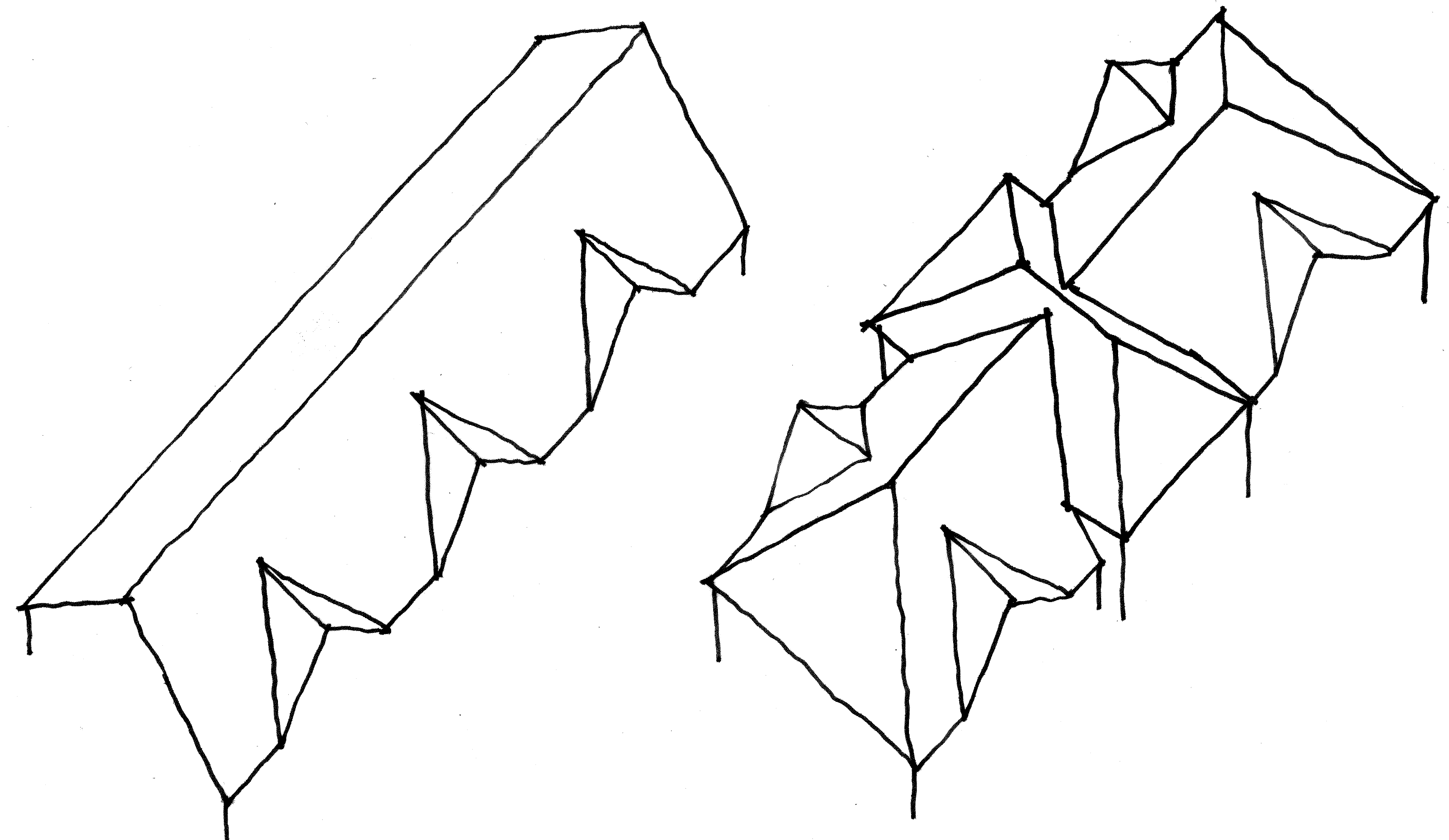
Left: Continuous roofline exceeds 60 ft. Right: Acceptable variation in roof design.
16.
Building Details and Materials
a)
Changes in material should occur at the horizontal divisions between the base, middle and top and on inside corners. "Heavier" materials such as masonry should be used on the base.
b)
Exterior Finishes. Building facades must incorporate a coordinated color scheme, which must include a limited number of complementary colors that are used throughout the development; and in the case of developments with multiple buildings, primary facade colors may alternate from building to building provided trim colors, materials and/or other design features visually tie together individual buildings. Neutral or earth tone colors are recommended. Gloss finishes may be used for trim and accent. Fluorescent and metallic paints are prohibited.
c)
Windows
1)
Windows facing the street are required. At least 15% of each street-facing facade must be fenestration. All other facades must have a minimum fenestration area of 10%.
2)
Windows must be recessed at least two inches from the wall plane or window trim must be used at least four inches in width with color that contrasts with the base building color. Exceptions will be considered where the design includes other distinctive window or facade treatment that adds visual interest to the building.
d)
Preferred Building Materials
1)
Brick or other masonry, including cementitious siding. When used for the facade of any building, concrete blocks must be split, rock- or ground-faced and may not exceed 25% of the masonry area of the facade. To add visual interest, the use of specialized textures and/or colors used effectively with other building materials and details are encouraged. Plain concrete block or plain concrete may be used only as foundation material if the foundation material is not exposed more than three ft above finished grade at the foundation wall.
2)
Exterior insulation and finish system (EIFS) and similar troweled finishes (stucco) must be trimmed in wood, masonry, or other approved materials and must be sheltered from extreme weather by roof overhangs or other methods.
3)
Horizontal wood siding. Composite boards manufactured from wood or other products, such as hardboard or plankboard, may be used when the board product is less than six inches wide.
e)
Prohibited Materials. The following materials are prohibited in visible locations unless an exception is granted based on the integration of the material into the overall design of the structure.
1)
Plywood siding (including T-111 or similar plywood), except when used as a component in board and batten siding.
2)
Metal siding
3)
Highly tinted or mirrored glass (except stained glass)
4)
Corrugated fiberglass
5)
Chain link fencing (except for temporary purposes)
6)
Crushed colored rock/crushed tumbled glass
7)
Noncorrugated and highly reflective sheet metal
f)
Vinyl siding is acceptable when the board size is less than six inches wide. However, it may not be used adjacent to grade. Vinyl siding cannot be painted, which limits opportunities for changing building colors as part of future renovations.
17.
Landscaping. In addition to any required parking lot landscaping, buffers and screening, landscaping must include the following:
a)
Foundation Planting. All street-facing elevations must have landscaping along the foundation meeting the following standards:
1)
The landscaped area must be at least three ft wide.
2)
There must be at least one three-gallon shrub for every three lineal feet of foundation.
3)
Additional planting and groundcover must fully cover the remainder of the landscaped area.
b)
Recommended landscaping techniques include the following:
1)
Preservation of existing trees whenever possible
2)
Use of plants that require low amounts of water, including native species
3)
Use of low-impact development techniques, including pervious pavement, swales, and rain gardens, to manage stormwater in parking lots
4)
Planting of trees along street frontages at appropriate spacing
5)
Use of both evergreen and deciduous plants to maintain year-round color and interest
c)
An irrigation method must be included in the landscaping plan. Irrigation is required immediately after planting and May through October thereafter or as recommended by a landscape professional. Developers should consider installing underground irrigation systems whenever possible to avoid drought loss.
18.
Additional Standards
a)
Traffic Impact Study and Plan. A traffic impact study and plan, prepared by a Traffic Engineer in accordance with generally accepted standards for traffic studies, must be furnished with the Site Plan. The study must show, in detail satisfactory to the Zoning Official, the effect that the proposed development will have on traffic flow in the vicinity and must identify what additional traffic signals or devices will be needed adjacent to the site because of the proposed development. The developer must pay the cost of any such signals and/or devices, if the Commission deems them necessary.
b)
Drainage Study and Plan. A drainage study and plan, prepared by an engineer, must be furnished with the Site Plan. The plan must be based on properly conducted studies and must show, in detail satisfactory to the Zoning Official, the effect that the proposed development will have on the site and neighboring land. The plan must include drainage, grading, excavation, topography, erosion and sedimentation, stormwater detention and floodplain management controls. The plan must provide for such structures and devices as may be required to handle a 100-year rain event, 24-hour storm.
c)
Additional Requirements. The Commission and/or the Zoning Official may impose additional requirements to protect the health, safety and welfare of the residents of the multifamily development and neighboring residents.
19.
Definitions. For the purposes of this Section, the following terms are defined as follows:
a)
Articulation, articulated. Changes in the depth along the building facade such as attached columns, wall recesses, horizontal banding, cornices, etc. to provide depth and variety to the facade.
b)
Fenestration, fenestrated. Window and door openings on a facade.
c)
Low Impact Development (LID). A site planning and engineering design approach to managing stormwater runoff that emphasizes conservation and use of natural features, infiltration, and on-site storage and treatment involving landscape elements integrated into the design of the site. This approach uses engineered small-scale hydrologic controls to replicate predevelopment hydrology through infiltrating, filtering, storing, evaporating, and detaining runoff close to its source.
d)
Open Space, Improved. Open space that has been created or modified by man including but not limited to parks, playgrounds, swimming pools, plazas, landscaped green spaces.
e)
Pervious pavement. Paving materials that allow water to penetrate into the ground below, including concrete paving blocks, concrete grid pavers, perforated brick pavers and similar paving materials. This does not include compacted gravel.
f)
Rain garden. A planted depression or hole that allows stormwater runoff from impervious surfaces to be absorbed into the ground.
g)
Swale. An open, grassed or vegetated channel used to partially treat stormwater, attenuate flooding potential and convey stormwater.
Section 7.10 - Boarding Houses
1.
The owner or lessee must reside within the dwelling used as a boarding house with said structure serving clearly as that person's permanent residence.
2.
The living quarters of the permanent residents and boarders must be in the principal dwelling and no separate structure on the premises may be used for dwelling purposes.
3.
No separate exterior doorways for individual boarding rooms are permitted.
4.
Not more than two parking spaces are permitted forward of the front building line.
Section 7.11 - Liquor Lounge
During any 90 day period, the gross receipts from the serving of meals and food must constitute at least 51% of the total gross receipts of the business. Liquor lounges must also comply with applicable requirements of the Chapter 4 of the City of Oxford Code of Ordinances.
Section 7.12 - Keeping of Chickens or Honeybees
In the E-1, R-1 and R-2 Districts, the keeping of chickens and honeybees is permitted subject to the following:
1.
Chickens or bees may be kept only on the premises of an occupied single-family detached dwelling and only in the rear yard.
2.
Keeping of Chickens
a)
Not more than six hens are permitted; roosters are prohibited.
b)
Except when under the personal control of the resident, chickens must be confined within a coop or run at all times.
c)
Coops and runs are subject to the setback requirements in §3.10 Accessory Structures. No structure for the keeping of chickens may be located within 50 ft of the nearest dwelling.
d)
A coop may not exceed 120 sf in area.
e)
The activity and associated structures must be maintained in a condition such that no odors or noises are produced that create a nuisance for adjoining properties.
3.
Keeping of Honeybees
a)
Not more than four beehives are permitted, except that one additional beehive is permitted for each 2,500 sf of additional lot area above the minimum lot size of the applicable district.
b)
Beehives must be set back no less than 20 ft from the nearest property line.
c)
There must be an adequate, accessible water source on site and located within 50 ft of the beehive(s).
d)
If the landing platform of a hive faces and is within 25 ft of any lot line, there must be a flight path barrier (fence, structure or plantings) not less than six ft in height, located in front of the hive.

