
Paducah City Zoning Code
ARTICLE III
- GENERAL REGULATIONS
Sec. 126-61. - Applicability of article.
Except as herein specified, the following provisions shall be applied within all zoning districts.
(Code 1968, app. A, § 40; Code 1996, § 156.035; Code 1997, § 126-61; Ord. No. 76-10-1339, 10-26-1976)
Sec. 126-62. - Access control.
No point of access shall be allowed within twenty-five (25) feet of the intersection of the right-of-way of right-angle streets. No curb or right-of-way shall be cut or altered without acquiring a permit from the office of the City Engineer.
(Code 1968, app. A, § 40.01; Code 1996, § 156.036; Code 1997, § 126-62; Ord. No. 76-10-1339, 10-26-1976)
Sec. 126-63. - Nonconforming uses.
(a)
Continuation generally. The lawful use of a building or land existing at the time of the adoption of the ordinance from which this article is derived and amendments hereto may be continued, although such use does not conform to the provisions of this article, except as otherwise provided herein.
(b)
Specific standards.
(1)
A nonconforming use or structure existing at the time of the adoption of this article, which was conforming at the time of its erection, may be continued in use, although such use does not conform to the provisions of such regulations.
(2)
With the formal authorization of the Board of Adjustment granted after a public hearing duly advertised and after its determination that the properties in the general vicinity will not be adversely affected by the change, an existing nonconforming use may be changed to a new nonconforming use in the same or a more restrictive zone classification.
(3)
A building or structure which is the subject of a nonconforming use may be maintained and repaired, but may not be enlarged or moved on the lot on which it is situated.
(4)
A building or structure which does not comply with the dimensional requirements of this article may be maintained, repaired, altered or moved, provided that every portion so enlarged or moved shall be made to conform to all the regulations of the zone in which the structure is located.
(5)
A building or structure which is nonconforming, either with respect to its use or with respect to dimensional requirements on the lot where it is situated, which is damaged or destroyed by any cause to the extent of more than seventy-five (75) percent of its value or area, shall not be repaired or rebuilt except in conformance with the provisions of this article.
(6)
Additions to nonconforming structures. On any lot where there is an existing principal structure which was conforming at the time it was constructed, but which has become nonconforming with respect to front, rear or side yard requirements, and which otherwise complies with the use and dimensional requirements of this article, an addition to that structure may be constructed which similarly does not conform to the front, rear or side yard requirements; provided the newly created nonconformity is no nearer to the front, side or rear lot line than the previously nonconforming existing structure.
(Code 1968, app. A, §§ 40.02, 40.021; Code 1996, § 156.037; Code 1997, § 126-63; Ord. No. 76-10-1339, 10-26-1976)
Sec. 126-64. - Lots.
(a)
Reduction of lot size. No lot, even though it may consist of one (1) or more adjacent lots in the same ownership at the time of passage of this article, shall be reduced in size so that lot width, size of yards, lot area or any other requirement of this article is not maintained. This section shall not apply when a portion of a lot is acquired for public purpose.
(b)
Multiple principal structures on a lot. One (1) principal structure may be erected on any one (1) lot. When more than one (1) principal structure of different use types on the same lot is proposed, multiple principal structures may be allowed as provided for in section 126-176 with a development plan.
(c)
Public street frontage. Unless otherwise provided in this article, no building shall be erected on a lot which does not abut for at least twenty-five (25) feet on a public street.
(d)
Existing lots. If an owner of a plot of land consisting of one (1) or more adjacent lots does not own sufficient continuous land to enable such owner to conform to the minimum lot size requirements provided herein, such plot of land may nevertheless be used as a building site. Only single-family dwellings shall be constructed under this provision and shall be principally permitted provided the statutory setbacks are met and the FAR shall not be less than ten (10) percent.
(e)
Variances to setback lines. Front yard setback lines may be varied where the average depth of principal buildings on adjoining properties is less than the depth prescribed elsewhere in this article. In such case, the front yard shall not be less than the average depth of existing front yards on the two (2) lots immediately adjoining.
(Code 1968, app. A, §§ 40.03, 40.05—40.07; Code 1996, § 156.038; Code 1997, § 126-64; Ord. No. 76-10-1339, 10-26-1976; Ord. No. 92-6-4778, 6-9-1992; Ord. No. 2002-5-6501, 5-7-2002; Ord. No. 2016-7-8391, § 1, 7-19-2016; Ord. No. 2021-08-8697, § 1, 8-10-2021)
Sec. 126-65. - Traffic visibility at intersections.
(a)
There shall be provided a triangular space at the street corner of a corner lot, free from any kind of obstruction to vision between the heights of two and one-half (2½) and twelve (12) feet above established grade, determined by a diagonal line connecting two (2) points measured fifteen (15) feet equidistant from the street right-of-way corner along each property line.
(b)
The provisions of this section do not apply to the Central Business District (B-2 Downtown Business Zone and B-2-T Downtown Business Townlift Zone), nor shall the requirements of this section be deemed to prohibit any necessary retaining wall.
(c)
The Board of Adjustment may either reduce or increase the requirements of this section for the interest of safety where unusual or special conditions warrant consideration.
(Code 1968, app. A, §§ 40.10, 40.101, 40.102; Code 1996, § 156.039; Code 1997, § 126-65; Ord. No. 76-10-1339, 10-26-1976)
Sec. 126-66. - Height limitation exceptions.
The height limitations of this article shall not apply to place of worship spires, belfries, cupolas and domes not intended for human occupancy, monuments, water towers, transmission towers, smokestacks, chimneys, derricks and aerials.
(Code 1968, app. A, § 40.11; Code 1996, § 156.040; Code 1997, § 126-66; Ord. No. 76-10-1339, 10-26-1976; Ord. No. 2010-5-7675, § 1, 5-11-2010)
Sec. 126-67. - Common open space.
The residential lot size and area can be reduced to provide a common open space equal to the total reduction of the lot area, thus maintaining the required density. The purpose of this provision is to allow for variety in subdivision design, reduce costs associated with streets and utilities construction, and reduce grading, sodding, and maintenance costs of open space in the City's neighborhoods. When this option in the subdivision of land is taken, the lot area and yards shall not be reduced such that the total side yard is less than that required in the zone in which the project is located.
(Code 1968, app. A, § 40.12; Code 1996, § 156.041; Code 1997, § 126-67; Ord. No. 76-10-1339, 10-26-1976)
Sec. 126-68. - Conditional uses.
(a)
Generally. Conditional uses are allowed only by specific approval of the Board of Adjustment (also referred to herein as "Board") and only in the zone in which they are listed; however, the following uses are permitted in all zones:
(1)
Public utility installations;
(2)
Government buildings and uses; and
(3)
Public and parochial schools.
(b)
Application and review procedure.
(1)
Upon receipt of an application for a conditional use, the Board shall proceed with a hearing on the application in the manner prescribed in this chapter.
Following the hearing and upon an affirmative finding by the Board that:
a.
The proposed conditional use is to be located in a zone wherein such use may be permitted; and
b.
The conditional use is consistent with the spirit, purpose and intent of this chapter, will not substantially and permanently injure the appropriate use of neighboring property, and will serve the public convenience and welfare;
c.
Then the Board shall grant the conditional use.
(2)
The Board of Adjustment may approve or deny any application for a conditional use permit. If a conditional use permit is approved, the Board may attach conditions to the approval such as time limitations, requirements that one (1) or more things be done before construction can be initiated or conditions of a continuing nature. Any such condition shall be recorded in the Board's minutes and on the conditional use permit, along with a reference to the specific section of this article or any other applicable ordinance of the City listing the conditional use under consideration.
(3)
The Board of Adjustment shall have the power to revoke conditional use permits for noncompliance with the conditions thereof. Furthermore, the Board shall have the right of action to compel offending structures or uses to be removed at the cost of the violator and may have judgment in personam for such cost.
(4)
Approved conditional use permits shall be recorded at the expense of the applicant in the office of the County Court Clerk.
(5)
Approval of a conditional use permit does not exempt the applicant from complying with all the requirements of building, housing and other codes and regulations of the City.
(6)
In any case in which a conditional use permit has not been exercised within one (1) year from its date of issuance, such conditional use may be revoked following a public hearing held by the Board of Adjustment in accordance with KRS Ch. 424. "Exercised," as set forth in this subsection, shall mean that binding contracts for the construction of the main building or other improvements have been let or, in the absence of contracts, that the principal building or other improvements are under construction to a substantial degree, or that prerequisite conditions involving substantial investment are under contract, in development, or completed. When construction is not a part of the use, "exercised" shall mean that the user is operating in compliance with the conditions as designated in the permit.
(7)
The enforcement officer shall review all conditional use permits, except those for which all conditions have been permanently satisfied, at least once each year. The enforcement officer shall have the power to inspect the land or structure where the conditional use is located in order to determine if the landowner is complying with all of the conditions listed on the conditional use permit.
(8)
If the landowner is not complying with all of the conditions listed on the conditional use permit, the enforcement officer shall report this fact in writing to the Chairperson of the Board of Adjustment. The report of the enforcement officer shall state specifically the manner in which the landowner or occupant is not complying with the conditions on the conditional use permit. A copy of this report shall be furnished to the landowner at the same time (as nearly as is possible) it is furnished to the Chairperson of the Board. The Board shall hold a hearing on the report within a reasonable time, and notice of the time and place of the hearing shall be furnished to the landowner and/or occupant at least one (1) week prior to the hearing.
(9)
If the Board of Adjustment finds that the facts alleged in the report of the enforcement officer are true, and that the landowner and/or occupant has taken no action to comply with the conditions (as originally placed on the permit) between the date of the report and the date of the hearing, the Board may authorize the administrative official to revoke the conditional use permit and take the necessary legal action to cause the termination of the activity which the conditional use permit authorizes.
(10)
Once the Board of Adjustment has completed a conditional use permit and all the conditions required are of such type that they can be completely and permanently satisfied, the administrative official, upon request by the applicant, may make a determination that the conditions have been satisfied and enter the facts which indicate that the conditions have been satisfied and the conclusions in the margin of the copy of the conditional use permit which is on file with the County Court Clerk; thereafter the use in question, if it continues to meet the other requirements of this article, will be considered a permitted use.
(Code 1968, app. A, § 40.13; Code 1996, § 156.042; Code 1997, § 126-68; Ord. No. 76-10-1339, 10-26-1976; Ord. No. 2010-5-7675, § 1, 5-11-2010; Ord. No. 2021-09-8702, 9-14-2021)
Sec. 126-69. - Mobile home parks.
Mobile home parks or trailer parks shall be conditional uses only in the R-3 and R-4 Residential Zones and shall comply with the following requirements:
(1)
Minimum area requirements. No mobile home park shall be permitted on an area of less than five (5) acres; however, the developer may develop the park in stages as long as the developer complies with an overall plan.
(2)
Lot requirements. Individual lots within a mobile home park shall not be less than four thousand (4,000) square feet in area with only one (1) mobile home per lot. Minimum lot width shall be forty (40) feet.
(3)
Setback. No mobile home or structure shall be located closer to any street than the minimum front yard setback provision of the zone in which it is located. No mobile home shall be located closer than fifteen (15) feet to any building within the park or to any property line of the park.
(4)
Spacing. No mobile home shall be located within twenty (20) feet of another mobile home except that a minimum end-to-end clearance of not less than fifteen (15) feet shall be permitted.
(5)
Screening. The entire perimeter of the mobile home park or trailer park, except for designated entrance and exit ways, shall be provided with a landscape screen. The landscape screen shall be as provided in section 126-3 with a planting width of at least five (5) feet. The planting screen shall be set back at least fifteen (15) feet from any property line which abuts a public thoroughfare or street. Where screening is required, building setback lines shall be computed from the interior edge of the screen. In the case of a planting screen, the interior edge of the screen is defined as a line located two (2) feet on center toward the interior from the most interiorly located plant member of the planting screen.
(6)
Streets. All mobile home spaces shall abut upon a street of not less than thirty (30) feet in width. All streets shall have a pavement width of not less than twenty (20) feet, and access to a public street. All streets within a mobile home park shall be hard surfaced and well lighted.
(7)
Utilities. All lots within the mobile home park shall be provided with all required facilities, to include, as a minimum, water, sewer and electrical facilities meeting standards specified by city and State regulations. Each mobile home shall be properly connected with said utilities.
(8)
Accessory structures. No accessory buildings or structures, including patios and pads, shall be located within five (5) feet of any individual lot (mobile home space) line, or closer than ten (10) feet to any property line of the park.
(9)
Plan approval.
a.
Because mobile home parks are permitted only as conditional uses, the prospective developer, before attempting to obtain a building permit or beginning any construction, shall prepare a plan showing the bearings and lot dimensions of the parcel the prospective developer intends to develop, the location with respect to the City, the general layout or design the prospective developer intends to follow, and improvements the prospective developer intends to install on the land. The prospective developer shall then present the proposal to the Planning Commission.
b.
Before approving the intended development plan, the Planning Commission may make suggestions to the developer in order to ensure proper design standards to minimize traffic difficulties, to safeguard adjoining properties, and to ensure that the residential characteristics of the neighborhood are preserved and that the public health, safety and welfare are protected.
c.
Upon approval by the Planning Commission, the developer shall follow the procedure set forth in section 126-68.
(10)
Storage of trailers or boats. Trailers used exclusively for the purpose of traveling or camping and which do not exceed dimensions of eight (8) feet by twenty-four (24) feet, as well as boats which do not exceed these dimensions, may be stored in the rear yard of any lot provided yard requirements are maintained and that the trailer is not used as a dwelling.
(Code 1968, app. A, § 40.14; Code 1996, § 156.043; Code 1997, § 126-69; Ord. No. 76-10-1339, 10-26-1976)
Sec. 126-70. - Planned unit development (PUD).
The purpose of this section is to establish a more flexible procedure for the approval of development plans to encourage proper design by providing for the submission of such development plans by prospective developers. Tracts of land may be developed as a unit according to the following provisions:
(1)
Land deemed one (1) lot. Any parcel of land including any interior streets which is designed and used for a planned unit development may be deemed to be one (1) lot.
(2)
Applicability of zoning provisions. In any planned unit development, although it is permissible to depart from literal conformance with the individual lot dimension and area provisions, there shall be no decrease in the total equivalent lot area, parking area and loading/unloading area provisions that would be necessary for the equivalent amount of individual lot development. The Planning Commission may allow reductions in these provisions upon proof by the developer that efficiencies of large-scale development may permit such reductions without destroying the intent of this article.
(3)
Application requirements.
a.
An application for the establishment of a planned unit development shall be filed with the Department of Planning twenty-one (21) days prior to the meeting at which it is to be acted on and shall contain the following information:
1.
The proposed name and location of the PUD;
2.
The names and address of all adjacent property owners and owners of the proposed PUD;
3.
Vicinity map;
4.
A complete and accurate legal description of the proposed PUD property;
5.
A tabulation of the total acreage of the site designated for various uses (i.e., parking, all structures, residential or commercial areas, streets, parks, playgrounds, etc.);
6.
Location of all structures in the PUD and proposed building densities (units per acre);
7.
Major or minor subdivision plat, if the site is being subdivided;
8.
Proposed circulation pattern, including private and public streets;
9.
Parking layout with two (2) spaces per dwelling unit.
10.
Detailed landscaping plans, including and designating the type of buffer or landscape screens placed between abrupt changes of land use.
11.
Detailed engineering plans or final subdivision plat showing site grading, street improvements, drainage and public utility locations.
12.
Other conditions as applicable to the planned unit development.
13.
Covenants and any other agreements concerning construction, operation and administration of the area such as green areas, housing corporations, etc.
b.
Access points to the same arterial street shall be at least three hundred thirty (330) feet apart.
(4)
Procedure for approval.
a.
Upon receipt of an application and site plan of the proposed development, the Planning Commission shall hold a public hearing. The Planning Commission shall have the authority to attach conditions to said plans to ensure there is no departure from the intent of this article.
b.
Upon approval of all the above by the Planning Commission, building permits may be issued by the Fire Prevention Division provided all conditions have been met.
c.
Construction shall be initiated within one (1) year from the date of approval by the Planning Commission. The Planning Commission may grant an extension to the petitioner, provided that:
1.
A formal written request for the extension is presented to the Planning Commission at least ninety (90) days prior to the deadline; and
2.
The written request explains the reasons that construction was not initiated within the time allotted. The Planning Commission shall inform the petitioner of the final decision within thirty-one (31) days from the receipt of the request.
d.
If the PUD is developed in stages, the total area will be reviewed at the public hearing and each successive stage shall be approved according to subsection (5)b of this section.
e.
The site of the approved PUD shall be marked on the official zoning map of the City.
(5)
Staff approval. In the event a proposal conforms with the requirements of the underlying zone, staff may approve said proposal in accordance all applicable ordinances and site plan requirements.
(Code 1968, app. A, § 40.15; Code 1996, § 156.044; Code 1997, § 126-70; Ord. No. 76-10-1339, 10-26-1976; Ord. No. 85-1-2639, 1-22-1985; Ord. No. 92-9-4834, 9-1-1992; Ord. No. 97-9-5715, § 3, 9-9-1997; Ord. No. 2022-04-8727, § 1, 4-12-2022)
Sec. 126-71. - Off-street parking and loading areas.
(a)
Intent. It shall be the intent of this section to provide guidance for district parking and loading/unloading standards as required by this chapter. Unless otherwise provided for in the individual district's regulations, this section shall govern. Furthermore this section is intended to:
(1)
Ensure that adequate maneuvering, circulation and points of ingress and egress are provided;
(2)
Provide an adequate number of off-street parking spaces and loading/unloading bays and maneuvering areas for every property use;
(3)
Ensure that individual parking sizes will be large enough for the intended use of specific properties;
(4)
Provide a safe and efficient interface between the street and road system and the parking and loading/unloading areas.
(b)
General regulations. The following parking and loading/unloading requirements represent minimum standards. Applicants are urged to properly assess their respective needs and provide additional space as needed.
(1)
Location on other property. If the required parking spaces cannot reasonably be provided on the same lot on which the principal use is conducted, such spaces may be provided on other off-street property within four hundred (400) feet of the main entrance to the principal use. Such spaces shall be associated with the principal use and shall not thereafter be reduced or encroached upon in any manner. Furthermore, when parking space must be provided on such other property, a written agreement signed by the owners of the subject properties must accompany the application for parking layout.
(2)
Variances. When it can be clearly shown that an intended use shall require less parking or loading/unloading area than that which is required by this section because of significant variation in operation or activity, the Planning Commission may grant a reduction in the parking and loading/unloading requirements.
(3)
Applicability. Off-street parking and loading/unloading shall be provided for any new building constructed, for new uses or conversions of existing conforming buildings, or for enlargements of existing structures.
a.
For new uses, conversions or enlargements of existing conforming buildings, off-street parking, loading and unloading in compliance with these regulations shall be provided for the entire facility.
b.
For enlargements of existing structures which do not conform to these regulations, required parking must equal the sum of those spaces furnished by the use prior to the enlargement and the number of spaces required by these regulations for any additional use area.
c.
For buildings and sites containing storage buildings available for rent to the public, improved surfacing and design requirements of subsection (g) of this section, shall be required, regardless, if parking is required. For enlargements of existing facilities, complete conformance of this section is required.
(4)
Multiple uses on site. For sites with more than one (1) use, the parking requirement shall be the sum of spaces required for each use, except as adjusted pursuant to subsection (j) of this section.
(5)
Exemptions. Any use within the B-2, B-2-T and in the H-1 business districts is exempt from the off-street parking requirements provided by subsection (e) of this section. Any off-street parking facility constructed in these districts after the effective date of the ordinance from which this section is derived must comply with the design standards set forth in subsections (d), (f), (g) and (h) of this section.
(c)
Design approval. All lots or portions of lots being developed for vehicular parking which contain at least four (4) spaces, or at least one (1) loading/unloading area that provides one (1) space, shall have the design approval of the Planning Department and the Department of Engineering prior to issuance of a building permit. Those administrative officials shall ensure that the intent and specific provisions of this section are observed.
(d)
Off-street parking requirements for residential land uses:
(e)
Off-street parking requirements for nonresidential land uses.
GFA — Gross floor area measured in square feet.
GLA — Gross leasable area measured in square feet.
When computing number of seats and GFA or GLA for parking, where no individual seating (such as and like sports facilities and places of worship) is provided, every twenty-four (24) inches will be considered a seat.
When calculating GFA and GLA, fractions up to one-half (½) shall be disregarded, and fractions of one-half or more shall require one (1) parking space.
When calculating the required parking for a specific intended use that does not appear in this section, the Zoning Administrator shall make a determination of a similar use that does appear in this section.
(f)
Number of off-street loading spaces.
(g)
General design requirements; maintenance standards.
(1)
Aisles and access drives. Off-street areas for maneuvering and circulation shall equal the number of spaces or area required and shall be of useable shape and surface and have convenient ingress and egress. Aisles and access drives shall be designed so as to provide adequate vehicular maneuvering upon the property being served and in no case shall off-street parking areas be permitted which encourage or require the backing onto or maneuvering within any public right-of-way, except residential uses and in alley ways. However, residential parking areas shall not permit backing onto arterial streets, or streets designated as Federal or State highways.
(2)
Traffic circulation controls. Where raised channeling devices, internal landscaping, and other similar geometrics are utilized, they shall count as being of useable shape and surface as required in subsection (g)(1) of this section.
(3)
Surfacing. Where parking and loading areas are provided for four (4) or more vehicles, and maneuvering extensions thereof, they shall be improved within six (6) months of application with any base material with an asphaltic, bituminous, cement or other properly bound surface, so as to be durable and dustless, and shall be graded and drained so as to dispose of all surface water accumulation within the areas without carrying said water accumulation over a public sidewalk. The aforementioned surface and drainage requirements shall be reviewed and approved by the Engineering Department.
(4)
Lighting. Any lighting used to illuminate such off-street parking and loading/unloading areas shall be so arranged as to reflect away from any adjoining properties or uses and any public right-of-way.
(5)
Traffic visibility sight triangle required. All points of ingress and egress shall maintain seven (7) foot sight triangles. Landscaping shall not exceed twenty-four (24) inches in height above grade.
(6)
Areas greater than minimum standards. When parking or loading/unloading areas beyond the minimum standards are provided, all other design requirements as described herein shall be observed.
(7)
Maintenance. Parking lots and loading/unloading areas shall be kept reasonably free of dirt, trash and other loose debris. These areas shall also be reasonably well maintained and free of pot-holes and other decay.
(8)
Access design requirements. Functional classification of streets shall be determined by the Department of Planning.
a.
Entrances and exits. One-way entrances and exits shall be at least fifteen (15) feet wide. Two (2) way entrances and exits shall be at least twenty-four (24) feet wide for minor streets and thirty (30) feet wide for arterial or collector streets.
b.
Curb cuts. All curb cuts shall be subject to review and approval by the Department of Engineering and Environmental Services.
c.
Minimum space sizes.
1.
Employee parking: Nine (9) by eighteen (18) feet (Including the following uses: lots solely for employee parking, offices, financial institutions, personal services, restaurants, and retail trades where bagged or bulky goods are not transferred; and other similar uses as determined by the Zoning Administrator.)
2.
Public parking: Ten (10) by eighteen (18) feet (Including the following uses: supermarkets, convenience stores, take-out restaurants, department stores, furniture outlets, and other similar uses that transfer large or bulky items; also medical offices, hospitals, clinics and nursing homes; and all other similar uses as determined by the Zoning Administrator.)
3.
Parking garages: Eight (8) feet, eight (8) inches by eighteen (18) feet.
4.
Parallel parking: Ten (10) by twenty-four (24) feet.
5.
Handicap parking: Sixteen (16) by eighteen (18) feet (first space) thirteen (13) by eighteen (18) feet above first space. One (1) of every six (6) handicapped spaces, or fraction thereof, must be van accessible (sixteen (16) by eighteen (18) feet).
6.
Loading/unloading: Ten (10) by fifty (50) by fourteen (14) feet.
d.
Screening requirements. Screening shall be provided as per section 126-72.
(h)
Layout and dimensions of spaces.
(1)
Parking areas. See Illustration No. 1 in the appendix at the end of this chapter.
(2)
Loading areas.
(i)
Parking requirements for persons with disabilities.
(1)
Parking lots in excess of four (4) spaces shall provide persons with disabilities parking at the following rate or as may be required by Kentucky Building Code or the American Disabilities Act, whichever is more stringent:
(2)
These represent minimum requirements for all property uses; applicants are encouraged to provide additional space if known that their particular use dictates additional space.
(j)
Adjustment for mixed use developments. The Planning Commission may authorize an adjustment in the total parking requirement for separate uses located on the same site or for separate uses located on adjoining sites and served by a common parking facility. An application for such an adjustment must include a site plan showing the location of parking and extent of various uses, the requested reduction in the parking requirement, and supporting data addressing why such a reduction should be permitted.
(Code 1968, app. A, § 40.16; Code 1996, § 156.045; Code 1997, § 126-71; Ord. No. 76-10-1339, 10-26-1976; Ord. No. 92-5-4772, 5-19-1992; Ord. No. 93-8-5004, 8-31-1993; Ord. No. 99-9-6111, § 1, 9-14-1999; Ord. No. 2008-3-7399, 3-11-2008; Ord. No. 2010-5-7675, § 1, 5-11-2010; Ord. No. 2011-8-7851, § 3, 8-23-2011; Ord. No. 2013-11-8097, § 1, 11-26-2013)
Sec. 126-72. - Homeless shelters.
The purpose of this section is to establish regulations for the location of homeless shelters in the R-3, R-4, B-1, B-3, M-1, M-2 and M-3 zones. Objectives include minimizing land use conflicts and ensuring that there are adequate services for homeless individuals within the vicinity of the shelter.
(1)
Definition. The term "shelter for the homeless" means housing that is limited to occupancy of three hundred sixty-five (365) days or less by a homeless person.
(2)
Conditional use permit required. Homeless shelters shall only be permitted in the zones listed herein upon receipt of a conditional use permit. The operation of all shelters for the homeless within the City shall be contingent upon receiving a conditional use permit from the Board of Adjustment in accordance with section 62-58.
(3)
Each shelter for the homeless shall comply with the following conditions:
a.
A shelter for the homeless shall provide a minimum of two hundred (200) square feet of heated building space per resident.
b.
Shelters for the homeless may not be located within one thousand (1,000) feet of any other shelter for the homeless, or from any use which could be classified as a shelter for the homeless.
c.
Operation.
1.
Shelters for the homeless shall be fully contained within a building owned and/or operated by a government agency or nonprofit organization.
2.
The operator of a shelter for the homeless shall provide continuous, on-site supervision by an employee and/or volunteer during all hours of operation.
3.
No retail sales shall take place on the property of any shelter for the homeless.
4.
A shelter for the homeless may house no more than fifty (50) residents.
5.
All homeless shelters shall create and adopt a Code of Conduct that shall be enforced at all times. The Code of Conduct shall include at a minimum the following language:
(i)
Possession or use of illegal drugs is not permitted on the premises.
(ii)
Alcohol is not permitted on the premises.
(iii)
Federal and State gun control laws shall be strictly enforced on the premises.
(iv)
Violence is not permitted on the premises.
(v)
Fires are not permitted on the premises.
(vi)
Loitering in the surrounding neighborhood is not permitted.
(vii)
Littering on the premises or surrounding neighborhood is not permitted.
6.
A copy of said Code of Conduct shall be provided to the Zoning Administrator of the City for review by the Board of Adjustment.
7.
Adequate external lighting shall be provided for security purposes. The lighting shall be stationary, directed away from adjacent properties and public rights-of-way, and of intensity compatible with the neighborhood.
8.
The development shall provide laundry facilities or laundry services adequate for the number of residents.
9.
The development may provide one (1) or more of the following specific common facilities for the exclusive use of the residents and staff:
(i)
Central cooking and dining room.
(ii)
Recreation room.
(iii)
Counseling center.
(iv)
Child care facilities.
(v)
Other support services.
10.
For the purposes of noise abatement in residential districts, organized outdoor activities may only be conducted between the hours of 8:00 a.m. and 9:00 p.m.
11.
Staff and services shall be available to assist residents in obtaining permanent shelter and income.
12.
The operator of a shelter for the homeless shall have a written management plan including, as applicable, provisions for staff training, neighborhood outreach, security, screening of residents to ensure compatibility with services provided at the facility, and for training, counseling, and treatment programs for residents.
13.
Homeless shelters located in residential districts, when not developed in an individual dwelling unit format, shall not be subject to the underlying zoning district's maximum unit density standard, but the number of beds shall be limited to six (6) times the maximum number of dwelling units which would otherwise be permitted.
14.
Shelters for homeless shall be located within two thousand, five hundred (2,500) feet of a public transportation route.
(Code 1997, § 126-72; Ord. No. 2011-12-789, § 1, 12-20-2011; Ord. No. 2015-11-8325, § 1, 11-17-2015)
Sec. 126-73. - Home occupations.
Home occupations are conditionally permitted uses and shall be approved in compliance with the following regulations:
(1)
Nature of use. Home occupations may include the office or studio in the residence of the following:
a.
Doctor;
b.
Dentist;
c.
Artist;
d.
Lawyer;
e.
Engineer;
f.
Tailor;
g.
Teacher (with musical instruction limited to one (1) pupil at a time);
h.
Realtor;
i.
Insurance agent;
j.
Other similar uses except a barbershop, beauty shop, tearoom or animal hospital (see definition of home occupation, section 126-3).
(2)
Use restrictions. The following restrictions shall be placed on the above home occupations:
a.
Must be conducted exclusively by the resident and no more than one (1) employee.
b.
Not more than one-fourth (¼) of one (1) floor of the residence shall be used.
c.
Alterations and construction shall be allowed, provided that the external character and appearance of the building remains unchanged and the requirements of this article are met.
d.
An indirectly lighted sign of not over one (1) square foot shall be permitted and shall be attached flat against the dwelling.
(3)
Conditions. The Board of Adjustment may attach conditions to its approval which are necessary to preserve the character of the district in which the proposed use will be located.
(4)
Staff approval. Staff may approve home occupations when the proposed home occupation meets the following provisions:
a.
No employees who do not reside at the residence.
b.
No storage of stock or goods.
c.
No customers may come to the residence.
d.
No signage on the property.
e.
Home occupation must be clearly incidental and subordinate to the residential use.
f.
Property owner must register their name and address with the Department of Planning.
g.
Business owner must obtain a business license.
(Code 1968, app. A, § 40.18; Code 1996, § 156.047; Code 1997, § 126-73; Ord. No. 76-10-1339, 10-26-1976; Ord. No. 2005-11-7036, § 5, 11-8-2005; Ord. No. 2022-06-8741, § 1, 6-28-2022)
Sec. 126-74. - High-rise apartment development.
The purpose of this section is to establish a procedure for the development of high-rise apartments, which is otherwise prohibited by the area and density requirements of the respective zoning districts.
(1)
Definition. The term "high-rise apartment" shall be any residential structure that is four (4) stories or more in height and contains a minimum of sixteen (16) individual dwelling units.
(2)
Requirements. It is the intent of this section to handle each development of this nature as a separate entity and to provide, through Commission approval, a flexibility in the design of each.
a.
Yard requirements.
1.
Front yard: Fifty (50) feet.
2.
Side yard: Twenty-five (25) feet.
3.
Rear yard: Fifty (50) feet.
b.
Area requirements. Lot area required: 2.5 acres minimum.
c.
Maximum building height. There shall be no maximum height provided all minimum yard requirements are increased three (3) feet for each story above four (4) stories or sixty (60) feet.
d.
Floor area to lot area ratio. There shall be no less than four (4) square feet of overall lot area for each square foot of floor area.
e.
Minimum parking requirements. Parking requirements shall be set according to the intended use of the high-rise development and an acceptable ratio established for each separate development, e.g., elderly units, one (1) space for each three (3) units. The Planning Commission shall determine what is deemed to be an acceptable ratio.
(3)
Approval procedure.
a.
Upon receipt of an application and a site plan of the proposed total development, the Planning Commission shall hold a public hearing in the manner set out in KRS ch. 100. At this time, the Commission shall set the above-stated requirements.
b.
If approval is granted at the public hearing, the developer shall then submit engineering, architectural and landscaping plans for review by the City Engineer and the Planning Commission.
c.
Upon approval by the above, building permits and certificates of occupancy may be issued, provided all conditions have been met and all other requirements completed.
(Code 1968, app. A, § 40.19; Code 1996, § 156.048; Code 1997, § 126-74; Ord. No. 76-10-1339, 10-26-1976)
Sec. 126-75. - Approval of site plans and parking layouts.
All site plans and parking layouts, except on lots serving single-family dwellings, shall be developed in accordance with this article and approved by the Planning and Zoning Administrator and City Engineer, after which a permit for development may be issued by the Building Inspector. If the site plan and parking layout does not meet with the approval of the Zoning Administrator and the City Engineer, the developer may appeal their decision to the Planning Commission.
(Code 1968, app. A, § 40.20; Code 1996, § 156.049; Code 1997, § 126-75; Ord. No. 76-10-1339, 10-26-1976)
Sec. 126-76. - Sign regulations.
(a)
Purpose. It is the purpose of this section to establish regulations for the control of signs within the zoning jurisdiction of the City of Paducah. The intent of this section is to support the use of signs to aid the public in the identification of businesses, activities and to assist the public in its orientation within the City. It is also the intent of this section to protect the public from the confusion created by the objectionable effects of advertising excesses, from the danger of unsafe signs and from the degradation of the aesthetic qualities of the City. Further, it is the intent of this section to protect constitutional rights to free speech. These regulations promote the health, safety and general welfare through a system of reasonable, non-arbitrary and non-discriminatory control of the placement, character, size, height, location and illumination of signs.
(b)
Findings. The City of Paducah finds that the standards and procedures in this chapter:
(1)
Implement the goals and policies of the comprehensive plan by establishing uniform standards and procedures to control the size, type, number, design, placement, illumination and maintenance of signs.
(2)
Protect public health and safety by:
a.
Minimizing visual distractions and obstructions that contribute to traffic accidents;
b.
Prohibiting signs that constitute a traffic hazard or obstruct the visibility of motorists, bicyclists or pedestrians, or cause confusion by virtue of visual similarity to traffic control signs;
c.
Reducing hazards caused by signs that overhang or project over public rights-of-way;
d.
Providing more visual open space; and
e.
Preventing potential deterioration of the City's appearance and attractiveness that would create a blighting influence.
(3)
Encourage signs that are attractive and function for the type of establishment to which they pertain;
(4)
Encourage signs that are in scale and architectural harmony with the project site, project buildings, adjacent buildings and development in the zone or neighborhood in which they are located;
(5)
Reduce visual clutter and physical obstructions caused by the proliferation of signs that could diminish the City's image, property values and quality of life;
(6)
Keep signs within a reasonable scale with respect to buildings to which they relate;
(7)
Encourage the upgrading, updating or removal of signs that are poorly maintained, out of character with their surroundings or do not conform to this chapter; and
(8)
Prevent signs that are potentially dangerous to the public due to structural deficiencies and disrepair.
(c)
Applicability and message neutrality.
(1)
Applicability. Any sign erected, placed, established or created that is visible from a public right-of-way, adjacent property or outdoor area of public property shall be in conformance with the standards, procedures and requirements of this chapter. All signs that are not expressly allowed by this chapter or exempt hereunder are prohibited.
(2)
Message neutrality. This chapter regulates signs in a manner consistent with the speech freedoms of both the United States and the Kentucky Revised Statutes and is content neutral. Notwithstanding any other provision of this chapter, no sign is subject to any limitation based on its content.
(3)
Pursuant to City of Austin, Texas v. Regan National Advertising of Austin, LLC; any city official may read a sign to determine whether it is on-premise or off-premise as defined under advertising sign below.
(d)
Definitions. The following words, terms and phrases, when used in this section, shall have the meanings ascribed to them, except where the context clearly indicates a different meaning:
(1)
Abandoned sign. A sign that:
a.
By reason of neglect, damage or deterioration requires repair; and
b.
The owner, or other party responsible for maintaining the sign, fails to undertake and complete the repairs within thirty (30) days after written notice to do so from the City.
(2)
Advertising sign. A sign which directs attention to a business, product, service, activity or entertainment; sold or offered elsewhere than on the premises where such sign is located. Such signs include billboards and off-premises signs.
(3)
Air-inflated sign. A sign which maintains shape by air pressurization.
(4)
Animated sign. Any sign depicting action, motion, light or color changes through electrical or mechanical means.
(5)
Area of sign.
a.
The area of a sign shall be considered to include all lettering, wording and accompanying designs and symbols, together with the background on which they are displayed, any frame around the sign and any "cutouts" or extensions, but shall not include any supporting structure or bracing.
b.
The area of a sign shall consist of individual letters or symbols attached to or painted on a surface, building, wall, or window, and shall be considered to be that of the smallest rectangle which encompasses all elements of said sign.
c.
The area of a sign which is other than rectangular in shape shall be determined as the area of the smallest rectangle which encompasses all elements of said sign.
d.
The area of a sign which consists of a three-dimensional object shall be considered to be the area of the largest vertical cross-section of that object.
e.
Only one (1) side shall be counted in computing the area of a double-faced sign.
(6)
Awning. A fabric overhead projection from a building façade intended to provide shelter from wind, sun or rain for passing pedestrians and window shoppers.
(7)
Banner. Any sign of lightweight fabric, vinyl or similar material.
(8)
Building marker. Any sign indicating only the name of a building, the date of construction or incidental information about its construction, which is cut into a masonry surface or made of a permanent material and permanently affixed to the building.
(9)
Campus sign. A sign which is located within a campus-style environment which consists of at least three (3) acres of real property, such as a school, college, religious institution, performance hall, convention center or other like environment as approved by the Planning Commission. Such signs may include electronic message signs.
(10)
Canopy sign. A sign that is part of, or customarily attached to; a gasoline canopy.
(11)
Directional sign. Any non-commercial sign of an instructional nature displayed for the convenience of the public.
(12)
Electronic message sign. A variable message sign that displays computer-generated messages or utilizes other electronic means of changing copy. These signs include, but are not limited to; displays using incandescent lamps, light emitting diodes (LEDs), liquid crystal displays (LCDs) or a flipper matrix. Electronic message signs may not change more than once every eight (8) seconds with no more than two (2) seconds of transition or animation.
(13)
Flag. Any fabric, banner or bunting containing distinctive colors, patterns or symbols; used as a symbol of a government, political subdivision, the official flag of any institution, a business or for civic purposes. Only business or trade flags are considered signs within the scope of this chapter.
(14)
Freestanding sign. A sign that is permanently attached to the ground and is wholly independent of any building or other structure. The term "freestanding sign" includes, but is not limited to; any ground sign, hanging sign, landscape wall sign, drive-thru facility sign, monument sign, multi-tenant sign, pillar sign or pole sign defined as follows:
a.
Drive-thru facility sign. An outdoor sign which is part of drive-thru or drive-in facilities. This type of sign may include, but is not limited to; a changeable point of purchase display that allows the retailer to list products and prices.
b.
Ground sign. A freestanding sign, other than a pole sign, which is:
1.
Supported by at least two (2) architectural support structures;
2.
Pedestrian scale or low to the ground; and
3.
Not directly in contact with the ground.
c.
Hanging sign. A sign suspended from the underside of, or attached to the side of, posts or structures.
d.
Landscape wall sign. A sign consisting of individual letters mounted on a screen, perimeter wall or retaining wall.
e.
Monument sign. A sign in which the entire bottom of the sign is in contact with the ground, or which is mounted on a solid base at least two-thirds (⅔) of which is the sign face, providing a solid and continuous background for the sign from the ground to the top of the sign.
f.
Multi-tenant sign. A sign structure designated with two (2) or more removable panels to identify the tenants in a building with more than one (1) tenant or in a development with more than one (1) building.
g.
Pillar sign. A slender, three-dimensional freestanding vertical sign.
h.
Pole sign. A freestanding sign normally supported by one (1), but sometimes by more than one (1), pole and otherwise separated from the ground by air space.
(15)
Ghost sign. A sign painted on the exterior wall of a building or structure that has been weathered and faded to the extent it has lost its original brightness of color and visibility. Such signs shall be at least fifty (50) years old.
(16)
Historical marker. A plaque or sign use to commemorate and visually educate the public about the people, places and events that are significant to local, state and national history.
(17)
Home occupation sign. A sign placed on a residential property for commercial purposes as approved by the Board of Adjustment.
(18)
Identification sign. A sign which indicates only the name and address of a building and/or management.
(19)
Illuminated indirectly. The use of an external light source to illuminate a sign.
(20)
Incidental sign. A sign, handbill or poster which is placed to advertise or announce a specific event, whether on or off the property said event shall take place.
(21)
Internal illumination. Internal lighting that shines through plastic or other translucent material.
(22)
Interstate system. That portion of the national system of Interstate highways and officially designated as such by the Kentucky Transportation Cabinet.
(23)
Message board. A permanent sign used to convey information by means of changeable lettering or graphics, including electronic message boards.
(24)
Mobile sign. A sign which is affixed to a frame having wheels and capable of being carried, attached to a vehicle or otherwise portable, and designed to stand free from a building or other structure. Signs designed to be affixed to the surface of real estate shall be deemed freestanding signs and not mobile signs, but the mere removal of wheels or temporary securing of a sign to the surface of real estate shall not prevent it being a mobile sign within this definition.
(25)
Neon sign. A sign with exposed neon lighting or a sign with neon lighted transparent material.
(26)
Projecting sign. A sign attached directly to the wall of a building or other structure and extends in a perpendicular direction outward.
(27)
Obsolete sign. Any sign remaining after a building, structure or premise is vacated for a six-month period of time.
(28)
Pennant. Any light material such as plastic or fabric, suspended from rope, wire or string, usually in series, designed to move in the wind.
(29)
Pole banner. A sign made out of cloth, fabric or other lightweight material, with only such material for backing, and designed for hanging from light poles, light posts or other structures.
(30)
Roof sign. A sign attached to the part of a building considered to be the roof, the roof being that part of a building that protects the interior portion of said building. Signs on the mansard of a roof are permissible, but shall not project above the roofline.
(31)
Sign. Any device, object, display or part thereof; used to advertise, identify, display or attract attention to an object, person, institution, organization, business, product, service, event or location by any means; including words, letters, figures, design, symbols, fixtures, colors, illumination or projected image.
(32)
Sign face. The area or display surface used for the sign contents.
(33)
Sign height. The vertical distance to the highest point of a sign structure, as measured from the average grade at the base of the structure.
(34)
Sight visibility triangle. The area formed by the intersection of a public street, a driveway and a line connecting a point on the right-of-way.
(35)
Spotlight/beacon. Any light with one (1) or more beams directed into the atmosphere or directed at one (1) or more points not on the same lot as the light source; also, any light with one (1) or more beams that rotate or move.
(36)
Strobe light. Intermittently flashing spotlight.
(37)
Streamer. A sign made of a string of ribbons, tinsel, pennants or similar devices.
(38)
Subdivision monument sign. A monument sign located at an entrance of a subdivision and is associated with the identification of the subdivision.
(39)
Temporary sign. A sign intended to be displayed for a limited period of time including, but not limited to; the following:
a.
Construction sign. A sign placed on a site during construction of a building or development project including the rehabilitation, remodeling or renovation of a building.
b.
Garage/ yard sale sign. A sign placed typically on a residential property, generally at the same time as garage sales or yard sales.
c.
Home tour sign. Directional arrows to homes on a home tour.
d.
Political sign. A sign displayed prior to an election, political campaign, referendum or ballot proposition put to the voters as part of City, State or Federal elections.
e.
Real estate sign. A sign displayed on a property which is for sale, lease or rent.
f.
Special event sign. A sign displayed to advertise a non-commercial event exempt from a special event permit, such as on-premise church or school activities.
(40)
Wall sign. Any sign, including a fascia sign, which is attached parallel to the face of a wall of a building or other structure.
(41)
Window sign. A sign displayed on or within a window, visible from outside the building.
(e)
Prohibited signs. The following signs shall be prohibited, except as otherwise provided in this chapter:
(1)
Signs that interfere with the free use of building entrances and exits, including emergency exits;
(2)
Reserved.
(3)
Signs that impede light and ventilation otherwise required by City ordinance, code or regulation;
(4)
Signs in a public right-of-way other than those allowed in this chapter;
(5)
Signs within a sight visibility triangle that conflict with section 126-65 of the Paducah Zoning Ordinance;
(6)
Signs on vehicles or trailers that are parked or located so they can be seen from a street right-of-way and for the primary purpose of displaying the sign. It shall be prima facie evidence that the primary purpose of a vehicle or trailer is to display a sign if the vehicle or trailer is parked on the same property for a continuous period exceeding seventy-two (72) hours. The intent of this subsection is to prohibit the use or display of signs on vehicles and trailers to otherwise circumvent the purpose and intent of the sign code;
(7)
Air-inflated signs;
(8)
Strobe lights, animated signs, moving signs, attention attracting devices or beacons;
(9)
Signs painted directly onto structures;
(10)
Obsolete signs;
(11)
Any sign or sign structure determined by the City to be structurally unsafe or a hazard to safety or health by reason of inadequate maintenance, dilapidation or abandonment;
(12)
Obscene signs;
(13)
Mobile signs;
(14)
Roof signs;
(15)
Streamers, pennants and similar signs or devices, except when attached to an allowed temporary sign;
(16)
Signs that emit any noise or odor;
(17)
Freestanding signs that overhang any part of a building;
(18)
Abandoned signs;
(19)
Advertising signs exceeding six (6) square feet in area; and
(20)
Feather flags.
(f)
Exempt signs. The following signs are exempt from the permit requirements of these sign regulations. No sign, including exempt signs, may be posted within a street right-of-way without written approval from the Director of Engineering or designee:
(1)
Government signs that are placed by government officers in the performance of their professional/elected duties.
(2)
Temporary or permanent signs erected by public utility or construction companies in the performance of their professional duties.
(3)
Vehicle signage when painted directly on a vehicle or attached magnetically.
(4)
Temporary signage as defined in subsection (g).
(5)
Historical markers;
(6)
Government flags;
(7)
Signs carried by a person;
(8)
One warning sign per street frontage with a maximum area of three (3) square feet;
(9)
Window signs which obscure a maximum of twenty-five (25) percent of transparent or translucent surfaces;
(10)
Signs preempted from regulation by state or federal law;
(11)
Identification signs; and
(12)
Ghost signs.
(g)
Temporary signs.
(1)
Temporary signs generally. Except as otherwise allowed in this chapter, all temporary signs not classified as exempt signs shall:
a.
Be allowed on private property only. Sandwich board signs may be allowed on public rights-of-way in accordance with subsection (7).
b.
Be placed only by the property owner or with the property owner's permission.
c.
Not diminish public safety such as placement in a sight visibility triangle.
d.
Not be mounted on a roof.
e.
Not be illuminated indirectly or internally.
f.
Be in place for a period not to exceed sixty-seven (67) consecutive days, at which time the sign must be removed or replaced with a different sign. The same sign may not be replaced within thirty (30) days. A different sign may replace the sign in question.
(2)
Construction signs. During a construction period, signs may be placed to announce construction.
a.
Such signs shall not exceed sixteen (16) square feet in residential and one hundred (100) square feet in non-residential zones.
(3)
Wall and freestanding temporary signs. Temporary wall and freestanding signs shall:
a.
Be a maximum of twenty (20) square feet when located in residential zones;
b.
Be a maximum of fifty (50) square feet when located in non-residential zones; and
c.
Be limited to one (1) sign per parcel for each street frontage.
(4)
Pole banners.
a.
Be a maximum of twelve and one-half (12.5) square feet when located in residential zones.
b.
Be a maximum of sixteen and one-half (16.5) square feet when located in non-residential zones.
c.
All banners shall be securely affixed to a mounting structure.
d.
Banners shall not be hung as canopy signs, flown as flags or used as any other form of permanent sign.
e.
Banner materials shall be weather-resistant.
f.
Poles and materials must be compatible and compliant with design standards if placed in a historic district.
g.
The City reserves the right to remove any pole banner at any time.
(5)
Street banners.
a.
In order to promote events of a civic and public nature in the Downtown or other commercial areas; any person, firm, corporation or organization may hang a vertical banner on cantilevered arms in designated locations. Further, pennants, flags or banners may be affixed to utility poles equipped by the City for such purposes.
b.
Generally, it shall be unlawful for any person to suspend any banner across or along any street, sidewalk or other public way of the City for any purpose.
c.
Banners reflecting a price, a business, or the promotion of goods or services are prohibited.
d.
Banners may reflect only one (1) theme at any given time within a district (Downtown, Wallace Park or Fountain Avenue for example). Different districts may have different themes at the same time.
e.
Banners shall not exceed one hundred fifty (150) square feet and not cause any interference or disruption in vehicular or pedestrian traffic.
f.
The City reserves the right to remove any banner at any time.
(6)
Special events. No more than two (2) signs promoting a special event may be placed no more than sixty (60) days prior to the event and shall be removed no later than forty-eight (48) hours after the event has ended. Such signs shall be placed on the property on which the event shall take place and shall not exceed thirty-two (32) square feet.
(7)
Sandwich board signs.
a.
Sandwich board signs shall be no taller than thirty-six (36) inches in height and no wider than twenty-four (24) inches;
b.
One (1) such sign may only be placed on a sidewalk that has a minimum of eight (8) feet in width and in front of the business associated with such sign;
c.
All signs must be compliant with ADA standards and maintain a minimum of five (5) feet of clearance from tables, chairs, bike racks or other appurtenances at all times. Placement shall not interfere with pedestrian or vehicular traffic.
d.
The sign must be constructed of weather resistant materials and shall be maintained in good repair.
(8)
During times of election. During times of primary, state or federal elections involving candidates from federal, state or local office that represents the district in which the property is located or involves an issue on the ballot within the district where the property is located, one (1) additional temporary sign per issue or candidate shall be allowed per parcel.
(9)
Additional temporary signs are allowed on each street frontage as follows:
a.
During times of sale or rent. One (1) additional temporary sign may be located on a property subject to the following parameters:
1.
The owner consents and the property is being offered for sale or rent through a licensed real estate agent;
2.
The property is offered for sale or rent by the property owner through advertising in local media; and
3.
Such sign shall not exceed four (4) square feet.
b.
During times property is open to the public. One (1) additional temporary sign may be located on the property on a day when the property owner is opening the property to the public; however, the owner may not use this type of sign for more than fifteen (15) days a year. Such sign may not exceed four (4) square feet.
c.
One (1) additional temporary sign shall be allowed upon submittal of a final development application or issuance of a building permit and shall terminate upon the issuance of any certificate of occupancy or for approval to connect to electric power for the work authorized by the building permit. Such sign shall not exceed four (4) square feet.
(h)
Permit requirements.
(1)
No sign regulated by this chapter shall be displayed, erected, relocated or altered unless all necessary permits have been issued by the City of Paducah. Applicants shall submit an application to the Fire Prevention Division before any permit may be issued.
(2)
Applicants shall obtain approval from the Historic and Architectural Review Commission (HARC) for signage proposed within the H-1, H-2 and NSZ Zones.
(3)
Signs shall only be erected or constructed in compliance with the approved permit.
(4)
Applicants shall obtain permits, including electrical permits.
(5)
Signs allowed pertaining to a legal, nonconforming use shall be subject to the regulations of the zone in which the nonconforming use is located.
(i)
Signs exempt from permit requirements. The following signs shall not require a permit:
(1)
Incidental signs.
(2)
Historic markers.
(3)
Temporary signs.
(j)
Nonconforming signs.
A legal nonconforming sign may continue in existence as long as it is properly maintained in good condition. These provisions shall not prevent the repair or restoration to a safe condition of any sign, but a nonconforming sign shall not be:
(1)
Changed to another nonconforming sign except where only the face or copy is changed;
(2)
Structurally altered so as to increase the degree of nonconformity of the sign;
(3)
Expanded or enlarged;
(4)
Reestablished after its removal; or
(5)
Moved to a new location on the building or lot.
(k)
Illegal signs. All illegal signs shall be subject to immediate enforcement action. Enforcement of this section shall be carried out pursuant to Chapter 42 of the Paducah Code of Ordinances. Appeals stemming from signage enforcement shall be to the Paducah Board of Adjustment, pursuant to KRS 100.261.
(l)
General regulations.
(1)
All signs shall be constructed of approved materials and shall be designed to meet the structural requirements of the applicable building code.
(2)
No sign shall be erected or maintained where by reason of its position, illumination, size, shape or color; it may obstruct, impair, obscure, interfere with the view of, or be confused with any traffic-control sign, signal or device.
(3)
No internally illuminated sign or electronic message sign shall be allowed within fifty (50) feet of property in any residential zone.
(4)
No sign shall be placed in any public right-of-way except as provided herein.
(5)
Traffic visibility at intersections shall be preserved in accordance with section 126-65 of the Paducah Zoning Ordinance.
(6)
No sign shall be attached to any tree, fence or utility pole except by a governmental body or agency.
(7)
All signs shall be adequately maintained. Such maintenance shall include proper alignment, continued readability and preservation of the sign with paint or other preservatives. Electronic message signs shall be free of burned-out lights.
(8)
All signs placed upon private property must have the written consent of the property owner or the owner's agent.
(9)
The area of a freestanding sign shall not include poles, supports or other structures used solely for support and do not contain advertising of any kind. Message boards are allowed as accessory signs on freestanding or wall signs. The area of the message board shall be included in the total allowable sign area.
(10)
Interior electronic message signs that change not more than once every thirty (30) seconds shall be allowed in the B-1, B-2, B-3, HBZ, HM, M-1, M-2 and M-3 Zones. Such signs shall be no larger than thirty (30) percent of the window.
(11)
Interior electronic signs that change not more than once every thirty (30) seconds shall be allowed in the B-2-T and H-1 Zones. Such signs shall be no larger than four (4) square feet. Only one (1) such sign shall be allowed per structure.
(12)
Advertising signs shall follow the performance standards for the underlying zone and will be counted toward the total number of signs and cumulative square footage for all signs for the lot thereon.
(13)
Directional signs indicating an entrance, exit or location of parking shall be permitted provided such signs do not exceed four (4) square feet in area for each sign and the height shall not exceed thirty (30) inches above grade. There shall be no more than four (4) directional signs per lot.
(m)
Signs allowed by specific zoning district. Any sign not specifically allowed shall be prohibited.
(n)
Residential and Mixed-Use Zones (R-1, R-2, R-3, R-4, NSZ, NCCZ and MU)
(1)
Single-family and two-family dwellings: One (1) building marker not exceeding one (1) square foot for each single-family residence or each side of a two-family structure.
a.
Every parcel shall be entitled to two (2) signs not exceeding thirty-six (36) square inches to be placed in any of the following locations:
1.
On the front of every building, residence or structure;
2.
On each side of an authorized U.S. Postal Service mailbox; and
3.
On one (1) post which measures no more than forty-eight (48) inches in height and four (4) inches in width.
(2)
Multi-family dwellings:
a.
One (1) freestanding sign that shall not exceed thirty-two (32) square feet, eight (8) feet in height and shall have a front yard setback of ten (10) feet;
b.
One (1) wall sign that shall not exceed twelve (12) square feet.
(3)
Incidental signs which shall not exceed two (2) square feet.
(4)
Home occupation. One (1) wall sign not exceeding one (1) square foot.
(5)
Subdivision. One (1) subdivision monument sign per entrance into a residential subdivision not to exceed thirty-two (32) square feet, eight (8) feet in height and shall have a setback of ten (10) feet.
(6)
Buildings used for religious or educational activities and cemeteries:
a.
One (1) freestanding sign that shall not exceed thirty-two (32) square feet, eight (8) feet in height and shall have a front yard setback of ten (10) feet;
b.
One (1) wall sign that shall not exceed twelve (12) square feet;
c.
One (1) message board that shall not exceed thirty-two (32) square feet and eight (8) feet in height. Such sign may be an electronic message sign, subject to the following:
1.
Be at least one hundred fifty (150) feet away from any residential dwelling or a mixed-use dwelling with a residential component.
2.
Such sign must decrease in brightness or intensity by at least thirty (30) percent during the hours between 9:00 p.m. and 6:00 a.m.
3.
A message board may be located on a freestanding sign. However, the total height of the message board and freestanding sign may not exceed eight (8) feet in height.
d.
Incidental signs which shall not exceed two (2) square feet.
(7)
Principally or conditionally permitted commercial uses in the R-4, NSZ, NCCZ and MU Zones:
a.
One (1) freestanding sign that shall not exceed thirty-two (32) square feet, eight (8) feet in height and shall have a front yard setback of ten (10) feet.
b.
Wall signs shall be allowed for each tenant or lessee. Such signs shall not exceed twenty (20) percent of the face of the structure or each individual tenant or lessee space.
(8)
No electronic message sign or electronic message boards shall be allowed in any residential zone, except for the Mixed-Use Zone, wherein one (1) electronic message sign or board per parcel may be allowed fifty (50) feet from any residential structure or mixed-use structure with a residential component. Such signs shall not exceed thirty-two (32) square feet.
(9)
If a proposed sign is larger than allowed within adopted covenants in the MU Zone, it shall be referred to the Planning Commission as part of an Amendment to a Development Plan.
(o)
Professional, commercial and industrial zones (B-1, B-2, B-3, HBZ, M-1, M-2, M-3, HM, POP and A-1).
(1)
One (1) freestanding sign per street frontage; additionally, one (1) freestanding sign for every three hundred (300) linear feet of street frontage.
a.
Freestanding signs shall not exceed seventy-five (75) square feet, twenty-five (25) feet in height and shall have a minimum setback of five (5) feet. When street frontage permits two (2) signs, the freestanding signs may be combined into one (1) freestanding sign that shall not exceed one hundred ten (110) square feet. For buildings with more than one (1) occupying business, this freestanding sign may list all businesses within the building.
b.
Monument type freestanding signs shall not exceed sixty (60) square feet, eight (8) feet in height and shall have a minimum setback of five (5) feet.
(2)
There shall be a maximum of four (4) wall, canopy or awning signs per building or structure. The maximum allowed area for all signage in these zones is thirty-two (32) square feet or twenty (20) percent of the wall area to which the sign, canopy or awning is attached, whichever is greater. A maximum of the first thirty (30) feet of the height of the façade shall be used to calculate the square footage area of a wall sign. Awnings shall have at least seven (7) feet of clearance when fully extended. When a building contains two (2) or more separate businesses, these requirements shall be applied separately to the wall area of the portion of the building occupied by the individual business.
(3)
One (1) message board either attached to a wall sign or freestanding sign not to exceed thirty-two (32) square feet may be added to such signs provided the total square footage does not exceed seventy-five (75) square feet and twenty-five (25) feet in height.
(4)
One (1) drive-thru facility sign for each drive-thru lane, walk-up window or drive-up curbside. Drive-thru facility signs shall not exceed fifty-five (55) square feet and eight (8) feet in height.
(5)
One (1) temporary sign per street frontage.
(6)
Theater marquee signs.
a.
A marquee shall not exceed thirty-two (32) square feet, shall not project more than eight (8) feet from the building face and shall have a minimum clearance of ten (10) feet.
(7)
Incidental signs shall not exceed two (2) square feet.
(8)
Subdivision. One (1) subdivision monument sign per entrance into a commercial or industrial subdivision not to exceed forty-eight (48) square feet and ten (10) feet in height. Such sign shall have a setback of 10 (ten) feet.
(9)
Single-family, two-family and multi-family dwellings shall follow the provisions of subsection (n).
(10)
Perforated signs shall be allowed; however, they shall be either 50/50 or 60/40 perforation. No perforated sign shall be placed over ingress/egress door.
(11)
Neon signs are allowed.
(p)
Historic Downtown area (B-2-T, H-1 and H-2)
(1)
Wall signs. One (1) wall sign per building façade shall be allowed, provided that such signs shall be constructed so that each letter runs parallel to the street upon which the business abuts, shall be affixed to the exterior wall of the building and shall not protrude from the wall a distance of more than eighteen (18) inches. Wall signs shall be a maximum size of fifty (50) square feet. Building facades with more than fifty (50) feet of street frontage are allowed a maximum sign area of one and one-half (1.5) square feet per linear foot of street frontage subject to a one hundred (100) square foot maximum.
a.
Internal illumination shall be allowed only when the letters themselves are lit and not the background in the B-2-T Zone.
b.
Wall signs may be illuminated indirectly in the H-1 and H-2 Zones.
(2)
Freestanding signs shall not exceed twelve (12) square feet.
(3)
All signs in the H-1 and H-2 Zones shall be subject to the requirements of section 126-115 (c) and (g).
(4)
Projecting signs. One (1) projecting sign per building façade on a street frontage shall be allowed, provided that such sign may project from a building no more than four (4) feet horizontally and have a maximum area of six (6) square feet.
a.
The projecting sign shall start no more than six (6) inches from the exterior wall of the building;
b.
Shall be mounted by a metal bracket projecting from the wall of the building;
c.
Shall be located within two (2) feet of the centerline of the building;
d.
May be internally lit;
e.
May be made of wood, metal alucobond, reinforced canvas or polyurethane foam; and
f.
If the structure has a secondary entrance to a separate business or dwelling within the principle structure, one (1) additional projecting sign shall be allowed. Secondary signs shall not exceed one (1) square foot and shall be installed above the secondary entrance.
(5)
Awning signs. Signs on awnings shall be a maximum size of fifty (50) square feet and may be illuminated indirectly.
(6)
Sandwich board signs are allowed if the business does not have a projecting sign.
(7)
Neon signs are allowed.
(q)
Murals. Murals may be applied to any structure or thoroughfare in the City. Following are specific regulations for their application:
(1)
Definition of mural. Any inscription, artwork, marking, design or lawful graffiti under this section that is marked, etched, scratched, drawn or painted on structures or on thoroughfares in the City of Paducah. Murals proposed on thoroughfares are only permitted in the H-2 Historic Neighborhood Zone.
(2)
Artwork versus signage.
a.
Murals that do not contain any wording, symbols or graphics related to an activity, event or business may fill the entire façade.
b.
Any portion of a mural that contains any name, identification, description, display or device which directs attention to a product, place, activity, person, institution or business or otherwise provides information to the public shall be treated as a sign for the portion containing said name, identification, description, display or device and the artistic portion of the mural may fill the entire façade. The sign portion of the mural must follow the signage regulations for the particular zone they are located in.
(3)
Murals in the historic zones. Murals of any kind in the public right-of-way must obtain approval from the Creative and Cultural Council. Murals on private property must obtain approval from the Historic Architecture Review Commission in the H-1 Historic Commercial Zone, H-2 Historic Neighborhood Zone or the NSZ Neighborhood Services Zone.
(4)
Blatant graffiti. Graffiti applied to any surface in an unlawful way shall not be considered murals and shall be subject to any and all remedies available to the City of Paducah.
(5)
Consent and maintenance. Any person, group, corporation or business that wishes to create a mural in conformance with this chapter must obtain the property owners written consent if the person, group, corporation or business does not own the subject property. The consent between the parties shall also describe the maintenance of the mural upon creation and shall be made available to the City of Paducah upon request. Any mural that falls into disrepair shall be subject to any and all remedies available to the City of Paducah.
(r)
Additional signage allowed in specific commercial and industrial zones.
(1)
Downtown Business Zone (B-2). In addition to the signage allowed above, the following signs shall be allowed:
a.
Sandwich board signs if the associated business does not have a projecting sign.
b.
Projecting signs. One (1) projecting sign per building façade shall be allowed, subject to the requirements of (p) (4) above.
(2)
General Business, Highway Business, Light Industrial and Heavy Industrial Zones (B-3, HBZ, M-1, M-2, M-3). In addition to the signage allowed in subsection (o), the following signs shall be allowed:
a.
Shopping malls larger than one hundred thousand (100,000) square feet may have one (1) freestanding sign per street frontage with a maximum of two hundred fifty (250) square feet and a maximum height of thirty (30) feet. All other shopping malls may have one (1) freestanding sign per street frontage with a maximum of seventy-five (75) square feet and a maximum height of twenty-five (25) feet. Anchor tenants of a shopping mall may utilize any exterior wall of the mall for a wall sign, provided all other regulations are followed. Malls that contain stores with exterior ingress/egress may utilize a hanging sign as well, provided such sign does not exceed six (6) square feet.
b.
One (1) Interstate sign for those businesses which lie within a two thousand five hundred (2,500) foot radius of the center point of an Interstate interchange overpass. This Interstate sign shall take the place of the allowed freestanding sign outlined in subsection (o) above. These businesses may have a combination of any two (2) of these signs: Interstate sign and wall signs or freestanding signs and wall sign. Interstate signs shall be subject to the following restrictions:
1.
Individual signs shall not exceed two hundred fifty (250) square feet.
2.
Ninety (90) feet in height.
3.
The signs base shall be at least ninety (90) feet from any residentially zoned property.
(3)
Advertising signs are allowed in the B-3, HBZ, M-1, M-2 and M-3 Zones along state and federal highways. Such signs shall be no larger than seven-hundred (700) square feet and must be at least one thousand (1,000) feet apart.
(s)
Planned unit development (PUD). A sign's height, size, location and design features shall be determined by the sign requirements set forth in the underlying zone.
(t)
Replacement advertising signs. In the event the owner of an advertising sign desires to remove the sign and construct another advertising sign at the same or different location, the owner may apply for a permit from the Fire Prevention Division. A permit for a replacement advertising sign may be issued only upon the satisfaction of the following conditions:
(1)
The number of advertising signs owned by the same owner do not exceed the current amount at which time the permit is applied for.
(2)
The replacement advertising sign shall not exceed the face area and number of faces of the replaced sign.
(3)
The owner has filed an application for permit for a replacement sign within a period of one (1) year following the removal of the advertising sign to be replaced.
(4)
The owner submits reasonable proof of existence of the original advertising sign as of the effective date of this section.
(5)
The replacement advertising sign shall comply with the other requirements as set forth in this section.
(u)
Advertising on Interstate Highways. No advertising sign shall be allowed adjacent to Interstate or limited-access highways except in conformance with the setback requirements established by the Kentucky Transportation Cabinet and the requirements of this Zoning Ordinance with respect to the zoning district involved and subsection (s) above.
(v)
Substitution clause. The owner of any sign which is allowed by this chapter may substitute noncommercial speech in lieu of any other commercial speech or noncommercial speech. This substitution of copy may be made without any additional approval or permitting. The purpose of this provision is to prevent any inadvertent favoring of commercial speech over noncommercial speech or favoring of any particular noncommercial speech over any other noncommercial speech. This provision prevails over any more specific provision to the contrary.
(Ord. No. 2022-04-8728, § 1, 4-12-2022; Ord. No. 2022-10-8752, § 1, 10-25-2022; Ord. No. 2023-12-8797, § 1, 12-12-2023)
Editor's note— Ord. No. 2022-04-8728, § 1, adopted April 12, 2022, repealed the former § 126-76, and enacted a new § 126-76 as set out herein. The former § 126-76 pertained to similar subject matter and derived from the Code of 1997, § 126-76; Ord. No. 2002-6588, adopted October 22, 2002; Ord. No. 2003-8-6671, adopted August 12, 2003; Ord. No. 2004-2-6766, adopted February 24, 2004; Ord. No. 2004-5-6815, adopted May 25, 2004; Ord. No. 2005-1-6919, adopted January 24, 2005; Ord. No. 2005-3-6935, adopted March 8, 2005; Ord. No. 2005-11-7029, adopted November 8, 2005; Ord. No. 2006-3-7087, adopted March 28, 2006; Ord. No. 2006-9-7177, adopted September 26, 2006; Ord. No. 2006-11-7208, adopted November 28, 2006; Ord. No. 2007-4-7269, adopted April 10, 2007; Ord. No. 2007-11-7355, adopted November 13, 2007; Ord. No. 2008-5-7421, adopted May 27, 2008; Ord. No. 2008-10-7480, adopted October 28, 2008; Ord. No. 2010-7-7701, adopted July 13, 2010; Ord. No. 2010-8-7730, adopted August 24, 2010; Ord. No. 2012-5-7922, adopted May 8, 2012; Ord. No. 2012-6-7932, adopted June 26, 2012; Ord. No. 2012-10-7979, adopted October 9, 2012; Ord. No. 2013-9-8080, adopted September 24, 2013; Ord. No. 2013-11-8098, adopted November 26, 2013; Ord. No. 2014-5-8137, May 13, 2014; Ord. No. 2015-2-8217, February 24, 2015; Ord. No. 2015-9-8296, adopted September 15, 2015; Ord. No. 2016-7-8392, adopted July 19, 2016 and Ord. No. 2020-8-8648, adopted August 12, 2020.
Sec. 126-77. - Waiver of yard requirements when structure is modified for person with disability accessibility.
Where necessary, the Building Inspector and Zoning Administrator may waive the yard requirements for residential and commercial structures that are retrofitting or modifying the exterior of existing structures for person with disability accessibility purposes. No such waiver will be granted for new construction.
(Code 1996, § 156.051; Code 1997, § 126-77; Ord. No. 93-3-4915, 3-16-1993)
Sec. 126-78. - Adult entertainment activities.
(a)
Intent and purpose.
(1)
In order to prevent crime, protect the City's retail trade, and maintain property values, and generally to protect and preserve the quality of its neighborhoods, commercial districts and the quality of urban life, this section regulates the location of adult establishments by dispersing them throughout the City. In the development and execution of this section, it is recognized that there are some uses which, because of their very nature, are recognized as having serious objectionable operational characteristics, particularly when several of them are concentrated under certain circumstances thereby having a deleterious effect upon the use and enjoyment of adjacent areas.
(2)
Special regulation of these uses is necessary to ensure that these adverse effects will not contribute to the blighting or downgrading of the surrounding neighborhood. These special regulations are itemized in this section. The primary control or regulation is for the purpose of preventing a concentration of these uses in any one (1) area. Uses subject to these controls are the following.
(b)
Specified use list.
(1)
Adult amusement arcade.
(2)
Adult bookstore.
(3)
Adult motion picture theater.
(4)
Adult stage show theater.
(5)
Adult videocassette rental center.
(6)
Cabaret.
(7)
Commercial sexual entertainment center.
(8)
Massage parlor.
(c)
Definitions. The following words, terms and phrases, when used in this section, shall have the meanings ascribed to them in this subsection, except where the context clearly indicates a different meaning:
Adult amusement arcade means an establishment having as one (1) of its principal uses one or more of the following: customer-operated motion picture devices, peep shows, viewing area and/or similar devices, for display of material distinguished or characterized by an emphasis on depiction of sexual activities, as hereinafter defined, or which offer persons who expose to view of the customers the bare female breast below a point immediately above the top of the areola, human genitals, pubic region or buttocks, even if partially or completely covered by translucent material, or human or simulated male genitals in a discernible turgid state, even if completely or opaquely covered.
Adult bookstore means an establishment having as one (1) of its principal uses the sale, rent or display of pictures, books, periodicals, magazines, appliances and similar materials which are distinguished or characterized by their emphasis on depiction of sexual activities as hereinafter defined, or an establishment with a substantial segment or section devoted to the sale, rental or display of such material.
Adult entertainment center means any use or building or portion thereof which contains or is used for commercial entertainment where the patron directly or indirectly is charged a fee to engage in personal contact with or to allow personal contact by employees, devices or equipment or by personnel provided by the establishment or view a series of dance routines, strip performances or other choreography provided by the establishment which appeals to the prurient interest of the patron, to include but not be limited to bath houses, massage parlors and related or similar activities. Any permitted, conditionally permitted or accessory uses allowed within any zone shall not be interpreted to include adult entertainment center.
Adult motion picture theater means an establishment having or advertising as having as one (1) of its principal uses the presentation of motion pictures, slide projections and other similar material having as a dominant theme or characterized or distinguished by an emphasis on matter depicting, describing or relating to sexual activities, as hereinafter defined, for observation by persons therein.
Adult stage show theater means an establishment having or advertising as having as one (1) of its principal uses the presentation of live performances of humans or animals having as a dominant theme or characterized or distinguished by an emphasis on matter depicting, describing or relating to sexual activities, as hereinafter defined, for observation by persons therein.
Adult videocassette rental center means a commercial establishment which has as one (1) of its principal uses the rental or sale of videocassettes, or other forms of media, which depict material characterized or distinguished by an emphasis on matter depicting, describing or relating to sexual activities, as hereinafter defined, and which does not provide an on-premises showing of such material.
Cabaret means an establishment which features, as a principal use of its business, entertainers and/or waiters and/or bartenders, male or female impersonators and/or other persons, either male or female, who expose to public view of the patron of said establishment at any time the bare female breast below a point immediately above the top of the areola, human genitals, pubic region or buttocks, even if partially or completely covered by translucent material, and/or human or simulated male genitals in a discernible turgid state, even if completely and opaquely covered.
Commercial sexual entertainment center means any other commercial establishment not otherwise described herein which make available material, services or entertainment appealing to adult sexual interests, including, but not limited to, bath houses, swingers clubs or similar establishments, services or goods that are advertised by or on behalf of the establishment in a manner patently designed to appeal to such adult sexual interests.
Massage parlor means an establishment for treating the human body by rubbing, stroking, kneading, tapping or similar treatment with the hand which and promotes its service in a manner designed to appeal to the patron's sexual interest.
Measurement. Measurement shall be made by measuring the shortest distance between boundaries. Measurements shall be made on a horizontal plane.
Principal use means a significant portion of the use. The following criteria shall establish principal use:
(1)
Contains ten (10) percent of its stock in trade in material or uses as described herein.
(2)
Contains ten (10) percent of its useful occupied floor area to materials and uses as described herein.
(3)
Contains more than one hundred (100) square feet of occupied floor space for the display, sale, or storage of materials or uses as described herein.
(4)
Exterior signs or advertising that premises as a business for materials or activities as described herein.
Sexual activities means the depiction of human genitals in a state of arousal, acts of human masturbation, sexual intercourse or sodomy, bestiality, or holding or other erotic touching of human genitals, pubic region, buttocks or breasts.
(d)
Location requirements.
(1)
The above specified uses list shall only be permitted in the M-1 Light Industrial Zone. The provisions of sections 126-111(1)a and 126-112(1) do not apply to this section.
(2)
New establishments may not locate within one thousand (1,000) feet of any other lawfully operating adult entertainment establishment. Measurements shall be made as described in subsection (c) of this section.
(3)
The above specified uses list shall not be operated or maintained within four hundred (400) feet of a residentially zoned district, and/or within 400 feet of a place of worship, a State-licensed day care facility, a school or a public park. Measurements shall be made as described in subsection (c) of this section.
(4)
New establishments may not locate to a site if fifty (50) percent or more of the tracts, or land area, within a circular area, as described herein, are residential in character. Vacant lots suitable for residential character, shall be considered residential in character. The radius of such circular area shall be one thousand (1,000) feet. The center of such circular area shall correspond to the midpoint of a line joining the two (2) most distant points on the boundary of the tract on which the enterprise is located.
(e)
Nonconforming uses. Nonconforming uses shall be governed by section 126-63.
(f)
Screening requirements. Adult entertainment establishments as listed in subsection (b) of this section shall screen all adjacent property owners. The street side may not be exempted. The screening height shall be a minimum of six (6) feet, and shall be at least eighty (80) percent opaque. Screening materials: The approved screen shall consist of wooden fences and landscape materials. The use of chainlink and barbed wire is no a suitable screen.
(g)
Sign requirements. Adult entertainment establishments as listed in subsection (b) of this section shall be allowed a cumulative of fifty (50) square feet of sign space as described in section 126-76. Sign heights shall not exceed twenty-five (25) feet. Nothing herein shall exempt compliance with other city sign code requirements. The provisions of subsection 126-76(i) do not apply to this section.
(Code 1996, § 156.052; Code 1997, § 126-78; Ord. No. 94-9-5202, 9-20-1994; Ord. No. 95-9-5360, 9-12-1995; Ord. No. 97-10-5746, § 1, 10-28-1997; Ord. No. 98-7-5900, § 1, 7-21-1998; Ord. No. 2010-5-7675, § 1, 5-11-2010)
Sec. 126-79. - Qualified manufactured homes.
Qualified manufactured homes are permitted in the R-2, R-3 and R-4 Zones for single-family residential purposes with the following provisions which shall be made prior to occupancy. Qualified manufactured homes shall be subject to the zone requirements for single-family residential structures in addition to the following:
(1)
Manufactured homes must be a qualified manufactured home that meets the following criteria:
a.
Is manufactured on or after July 15, 2002.
b.
Is affixed to a permanent foundation, is connected to the appropriate facilities and is installed in compliance with KRS 227.570. The term "permanent foundation" means a system of supports that is:
1.
Capable of transferring, without failure, into soil or bedrock, the maximum design load imposed by or upon the structure.
2.
Constructed of concrete.
3.
Placed at a depth below grade adequate to prevent frost damage.
c.
Has a width of at least twenty (20) feet at its smallest width measurement or is two (2) stories in height.
d.
The structure must be oriented on the lot or parcel so that its main entrance door faces the street.
e.
Is not located in a manufactured home land-lease community. Manufactured homes in a land-lease community shall comply with section 126-69.
f.
The structure is compatible, in terms of assessed value, with single-family housing stock located within a one-eighth (⅛) mile or less radius.
(2)
Compatibility standards. Proposed qualified manufactured homes shall meet the following compatibility standards as they relate to single-family housing stock within a one-eighth (⅛) mile or less of the site.
a.
The square feet of living space shall be within one thousand (1,000) square feet of living space on the ground floor as other housing stock, but in no case shall be less than one thousand (1,000) square feet in the R-2 Zone and nine hundred (900) square feet in the R-3 and R-4 Zones.
b.
The roof pitch shall be within two (2) inches of rise as other housing stock but in no case shall be less than 3:12.
c.
The exterior finishing materials shall be consistent with other housing stock.
(3)
All wheels, springs, axles, lights and towing apparatus shall be removed.
(4)
The roof covering shall be shingle or metal.
(5)
The foundation shall be screened with masonry block or brick.
(6)
If no single-family structures exist within one-eighth (⅛) of a mile or if the home is proposed in a commercial or industrial zone, the following minimum standards shall apply:
a.
The structure shall have a gable or hipped roof pitched at least three (3) inches of rise over twelve (12) inches of run, covered with shingles, ribbed metal or standing seam metal.
b.
The structure shall be sided with wood, aluminum, vinyl, brick or stucco.
(7)
One (1) qualified manufactured home shall be located on one (1) lot. However, if a qualified manufactured home is proposed to abridge one or more property lines due to limited space, a deed must be recorded at the McCracken County Clerk's office showing each lot or parcel as lot or parcel A, B, C, etc. within one (1) legal description. A copy of said deed shall be submitted to the Department of Planning within three (3) months of application approval. In no case shall a qualified manufactured home abridge a property line if it can fit onto one (1) lot.
(8)
No type of manufactured housing shall be permitted in the following zones: R-1 Low Density Residential Zone, NSZ Neighborhood Services Zone, NCCZ Neighborhood Commercial Corridor Zone, H-1 Historic Commercial Zone, H-2 Historic Neighborhood Zone, POP Planned Office Park, HM Hospital Medical Zone, MU Mixed-Use Zone, B-2-T Downtown Business Townlift Zone and A-1 Civic Center Zone.
(Code 1997, § 126-79; Ord. No. 97-9-5714, § 2, 9-9-1997; Ord. No. 97-10-5749, § 2, 10-28-1997; Ord. No. 2003-6-6651, § 1, 6-10-2003; Ord. No. 2005-8-7004, § 2, 8-23-2005; Ord. No. 2022-04-8727, § 1, 4-12-2022)
Sec. 126-80. - Gaming and gambling facilities.
(a)
For the purpose of this section, a gaming or gambling facility is one that operates as its principal use betting games, or games of chance for prizes. These include, but are not limited to, bingo parlors, horse tracks, coin-operated electronic or mechanical devices and card games.
(b)
No principal permitted use for gaming or gambling as set forth in subsection (a) of this section may operate within two hundred (200) feet of any residential district.
(Code 1997, § 126-80; Ord. No. 98-7-5900, § 2, 7-21-1998)
Sec. 126-81. - Density adjustments for residential developments.
The purpose of this section is to provide a flexible procedure for residential density adjustments while retaining orderly development by ensuring appropriate locations, desirable densities and compatible land use relationships. All other regulations of this article shall, where applicable, be observed.
(1)
This section will allow for increased residential densities while preserving historical structures. These provisions apply to developments in the R-2 and R-3 districts including which include five (5) or more dwelling units.
a.
Housing in an existing structure or structures listed individually on the National Register of Historic Places.
b.
For a development in which residential units, an applicant may reduce the required site area per residential unity by fifty (50) percent.
c.
Exterior preservation work is done in substantial compliance with the Secretary of Interior of the United States in the publication, Standards of Rehabilitation, current edition, as approved by the Commission.
d.
There is an approved development plan per section 126-176.
(2)
New housing intended for sale to owner occupants in R-2, R-3, and R-4 Zones: For a development in which single family detached residential units are intended for individual sale to owner occupants, an applicant may reduce the required site area per residential unit by up to twenty (20) percent, with an approved development plan per section 126-176.
(3)
Open space site area reductions for new housing intended for sale to owner occupants in R-2, R-3 and R-4 Zones: For a development in which residential units are intended for individual sale to owner occupants, an applicant may reduce the required site area per residential unit by up to twenty (20) percent of the buildable area for open space. Open space is defined as land used for recreation, agriculture, resource protection or buffers. Open space should be left in a natural state except in the case of recreation uses which may contain impervious surfaces.
(Code 1997, § 126-81; Ord. No. 99-9-6112, § 1, 9-14-1999)
Sec. 126-82. - Cellular antenna tower regulations.
(a)
Purpose. The purposes of these regulations are: to provide for the safest and most efficient integration of cellular antenna towers for cellular telecommunications services or personal communications services within the community; to provide for such facilities in coordination with the recommendations of the comprehensive plan; and to allow for such facilities with the intention of furthering the public health, safety, and general welfare.
(b)
Preapplication conference. Applicants are encouraged to notify the Planning Commission to discuss proposals, to allow for early coordination, and to identify those items that are in conformance/nonconformance with the comprehensive plan, zoning ordinance, and the provisions of these regulations.
(c)
Definitions. The following words, terms and phrases, when used in this section, shall have the meanings ascribed to them in this subsection, except where the context clearly indicates a different meaning:
Alternative cellular antenna tower means manmade trees, clock towers, bell towers, steeples, light poles and similar alternative-design mounting structures that accommodate, camouflage, minimize or conceal the presence of cellular antennas or cellular antenna towers that are constructed primarily for the purpose of accommodating cellular antennas or cellular antenna towers or are reconstructed for the purpose of accommodating cellular antennas or cellular antenna towers. This does not include existing structures erected for another primary purpose, but which subsequently have cellular antennas attached to or located within them, without any reconstruction of the original structure. For the provisions of these regulations, an alternative cellular antenna tower is considered a cellular antenna tower.
Antennas or related equipment means transmitting, receiving, or other equipment used to support cellular telecommunications service or personal communications service. This definition does not include towers.
Cellular antenna tower means a tower constructed for, or an existing facility that has been adapted for, the locations of transmission or related equipment to be used in the provision of cellular telecommunications services or personal communications services.
Cellular telecommunications service means a retail telecommunications service that uses radio signals transmitted through cell sites and mobile switching stations.
Co-location means locating two (2) or more transmission antennas or related equipment on the same cellular antenna tower.
Guyed cellular antenna tower means a type of wireless transmission tower that is supported by thin guy wires.
Lattice cellular antenna tower means a self-supporting tower with multiple legs and cross bracing of structural steel.
Monopole cellular antenna tower means a slender self-supporting tower on which wireless antennas can be placed.
Personal communication service has the meaning as defined in 47 USC 332(c).
Planning commission means the Paducah Planning Commission.
Uniform application means an application to construct a cellular antenna tower submitted to a Planning Commission in conformity with KRS 100.985—100.987.
Utility means as defined in KRS 278.010(3).
(d)
General. Cellular antenna towers for cellular telecommunications services or personal communications services may be allowed in any zone after a Planning Commission review in accordance with the following procedures to ascertain agreement with the adopted comprehensive plan and the regulations contained within this chapter:
(1)
Applicability. Every utility, or a company that is engaged in the business of providing the required infrastructure to a utility, that proposes to construct a cellular antenna tower shall submit a completed uniform application to the Planning Commission. Where the Planning Commission finds that circumstances or conditions relating to the application of an alternative cellular antenna tower are such that one (1) or more of the requirements of the uniform application listed below are not necessary or desirable for the protection of surrounding property or the public health, safety, and general welfare, and that such special conditions or circumstances make one (1) or more said requirements unreasonable, the Planning Commission, or its duly authorized representative, may modify or waive such requirement of the uniform application, either permanently or on a temporary basis. Any such modification or waiver shall be requested by the applicant, and the applicant shall submit a written justification for each requested modification or waiver. The Planning Commission shall not regulate the placement of antennas or related equipment on an existing structure.
(2)
Application requirements. Applications for the construction of cellular antenna towers for cellular telecommunications services or personal communications services shall include the following:
a.
The full name and address of the applicant.
b.
The applicant's articles of incorporation, if applicable.
c.
A geotechnical investigation report signed and sealed by a professional engineer registered in the State that includes boring logs and foundation design recommendations.
d.
A written report, prepared by a professional engineer or land surveyor, of findings as to the proximity of the proposed site to flood hazard areas.
e.
Clear directions to the proposed site, including highway numbers and street names, if applicable, with the telephone number of the person who prepared the directions.
f.
The lease or sale agreement for the property on which the tower is proposed to be located, except that, if the agreement has been filed in abbreviated form with the County clerk, an applicant may file a copy of the agreement as recorded by the County clerk and, if applicable, the portion of the agreement that specifies, in the case of abandonment, a method that the utility will follow in dismantling and removing the proposed cellular antenna tower including a timetable for removal.
g.
The identity and qualifications of each person directly responsible for the design and construction of the proposed tower.
h.
A site development plan, signed and sealed by a professional engineer or surveyor licensed in Kentucky, that shows the proposed location of the tower and all easements and existing structures within five hundred (500) feet of the proposed site on the property on which the tower will be located, and all easements and existing structures within two hundred (200) feet of the access drive, including the intersection with the public street system. Additionally the development plan shall show the following:
1.
A survey, prepared by a surveyor licensed in state. The survey shall be in accordance with all of the requirements of the Paducah Subdivision Ordinance and KRS ch. 100, that shows lease lines or property line, which upon approval, shall be recorded.
2.
A vertical profile sketch of the tower, signed and sealed by a professional engineer registered in Kentucky, indicating the height of the tower and the placement of all antennas.
3.
The tower and foundation design plans and a description of the standard according to which the tower was designed, signed, and sealed by a professional engineer registered in state.
4.
A map, drawn to a scale no less than one (1) inch equals two hundred (200) feet, that identifies every structure and every owner of real estate within five hundred (500) feet of the proposed tower.
5.
A statement that every person who, according to the records of the property valuation administrator, owns property within five hundred (500) feet of the proposed tower or property contiguous to the site upon which the tower is proposed to be constructed, has been:
(i)
Notified by certified mail, return receipt requested, of the proposed construction which notice shall include a map of the location of the proposed construction.
(ii)
Given the telephone number and address of the local Planning Commission.
(iii)
Informed of such person's right to participate in the Planning Commission's proceedings on the application.
6.
A list of the property owners who received the notice, together with copies of the certified letters sent to the listed property owners.
7.
A statement that the Mayor of Paducah has been notified, in writing, of the proposed construction and a copy of the notification.
8.
A statement that the Paducah-McCracken County Barkley Regional Airport has been notified, in writing, of the proposed construction and a copy of the notification.
9.
A statement that:
(i)
A written notice, of durable material at least two (2) feet by four (4) feet in size, stating that "[Name of applicant] proposes to construct a telecommunications tower on this site" and including the addresses and telephone numbers of the applicant and the Planning Commission, has been posted in a visible location on the proposed site; and
(ii)
A written notice, at least two (2) feet by four (4) feet in size, stating that "[Name of applicant] proposes to construct a telecommunications tower near this site" and including the addresses and telephone numbers of the applicant and the Planning Commission, has been posted on the property nearest to the public road.
10.
A statement that notice of the location of the proposed construction has been published in the Paducah Sun newspaper.
11.
A brief description of the character of the general area in which the tower is proposed to be constructed, which includes the existing land use for the specific property involved.
12.
A statement that the applicant has considered the likely effects of the installation on nearby land uses and values and has concluded that there is no more suitable location reasonably available from which adequate service to the area can be provided, and that there is no reasonably available opportunity to locate its antennas and related facilities on an existing structure, including documentation of attempts to locate its antennas and related facilities on an existing structure, if any, with supporting radio frequency analysis, where applicable, and a statement indicating that the applicant attempted to locate its antennas and related facilities on a tower designed to host multiple wireless service providers' facilities or on an existing structure, such as a telecommunications tower or other suitable structure capable of supporting the applicant's antennas and related facilities.
13.
A map of the area in which the tower is proposed to be located, that is drawn to scale, and that clearly depicts the necessary search area within which an antenna tower should, pursuant to radio frequency requirements, be located.
14.
A grid map that shows the location of all existing cellular antenna towers and that indicates the general position of proposed construction sites for new cellular antenna towers within an area that includes:
(i)
All of City; and
(ii)
A one-half (½) mile area outside the boundaries of the City, if that area contains either existing or proposed construction sites for cellular antenna towers.
(3)
Confidentiality of application. All information contained in the application and any updates, except for any map or other information that specifically identifies the proposed location of the cellular tower then being reviewed, shall be deemed confidential and proprietary within the meaning of KRS 61.878. The Planning Commission shall deny any public request for the inspection of this information, whether submitted under Kentucky's open Records Act or otherwise, except when ordered to release the information by a court of competent jurisdiction. Any person violating this subsection shall be guilty of official misconduct in the second (2nd) degree as provided under KRS 522.030. The confidentiality of the applications and any updates of the application can be waived by the written authorization of the applicant.
(4)
Application fee. An applicant for the construction of cellular antenna towers for cellular telecommunications services or personal communications services shall pay an application fee of $2,500.00.
(5)
Processing of application. Applications for the construction of cellular antenna towers for cellular telecommunications services or personal communications services shall be processed as follows:
a.
At least one (1) public hearing on the proposal shall be held, at which hearing interested parties and citizens shall have the opportunity to be heard. Notice of the time and place of such hearing shall be published at least once, in the Paducah Sun newspaper, provided that one (1) publication occurs not less than seven (7) calendar days nor more than twenty-one (21) calendar days before the occurrence of such hearing.
b.
Notice of the proposed shall be posted on the site at least fourteen (14) days in advance of the hearing. The notice shall consist of a written notice, of durable material at least two (2) feet by four (4) feet in size, stating that ""Name of applicant" proposes to construct a telecommunications tower on this site" and including the addresses and telephone numbers of the applicant and the Planning Commission. Notice of the proposal shall also be posted on the property nearest to the public road. This notice shall consist of a written notice, of durable material at least two (2) feet by four (4) feet in size, stating that ""Name of applicant" proposes to construct a telecommunications tower near this site" and including the addresses and telephone numbers of the applicant and the Planning Commission.
c.
Notice of the hearing shall be given at least fourteen (14) days in advance of the hearing, by certified mail, return receipt requested, to the owner of every parcel of property within five hundred (500) feet of the proposed tower or property contiguous to the site upon which the tower is proposed to be constructed. The notice shall include a map of the location of the proposed construction, the telephone number and address of the Planning Commission and shall inform the addressee of the addressee's right to participate in the Planning Commissioner's proceedings on the application. Records maintained by the property valuation administrator may be relied upon conclusively to determine the identity and address of said owner. In the event a property is in condominium of cooperative forms of ownership, then the person notified by mail shall be the President or Chairperson of the owner group that administers property commonly owned by the condominium or cooperative owners. A joint notice may be mailed to two (2) or more co-owners of an adjoining property who are listed in the property valuation administrator's records as having the same address.
d.
Upon holding the hearing, the Planning Commission shall, within sixty (60) days commencing from the date that the application is received by the Planning Commission, or within a date specified in a written agreement between the Planning Commission and the applicant, make its final decision to approve or disapprove the uniform application. If the Planning Commission fails to issue a final decision within sixty (60) days, and if there is no written agreement between the Planning Commission and the utility to a specific date of the Planning Commission to issue a decision, it shall be presumed that the Planning Commission has approved the utility's uniform application.
(e)
Design standards. The applicant shall provide information demonstrating compliance with the requirements contained herein. Potential sites that should be considered (in order from most-preferred to least-preferred) include existing utility towers, industrial zones, commercial zones, and government buildings and properties. Where the Planning Commission finds that circumstances or conditions relating to the particular application are such that one (1) or more of the requirements listed below are not necessary or desirable for the protection of the surrounding property or the public health, safety, and general welfare, and that such special conditions or circumstances make one (1) or more said requirements unreasonable, the Planning Commission, or its duly authorized representative, may modify or waive such requirement, either permanently or on a temporary basis. Any such modification or waiver shall be requested by the applicant, and the applicant shall submit a written justification for each requested modification or waiver.
(1)
Monopoles. Monopole cellular antenna towers shall be permitted in any zone. Lattice and guyed cellular antenna towers shall be permitted in any zone except for residential zones.
(2)
Minimum lot size. Regardless of the minimum lot sizes listed in the specific zoning districts, or the Paducah Subdivision Ordinance, the lot size may be the minimum necessary to comply with the objectives and standards of this section.
(3)
Setbacks. Setbacks for all structures constructed in connection with guyed or lattice cellular antenna towers, except fences and/or guy wires, shall be a minimum distance from the property line or lease line equal to at least one-half (½) the height of the tower, but not less than fifty (50) feet. All structures constructed in connection with monopole or alternative cellular antenna tower shall comply with the applicable setback requirements established for other structures within the applicable zoning district. Alternative cellular antenna towers that are to be located as part of a utility service facility (e.g., power pole or telephone pole) shall comply with setback requirements applicable to such utility service facilities, if any.
(4)
Height. A cellular antenna tower, or alternative antenna tower structure, may be constructed to a maximum height of two hundred (200) feet regardless of the maximum height requirements listed in the specific zoning district. This also applies to any tower taller than fifteen (15) feet constructed on the top of another building or structure, with the height being the overall height of building/structure and tower together, measured from the grade to the highest point. The Planning Commission may allow antennas greater than two hundred (200) feet in height upon review of the applicant's justification that the additional height meets the criteria identified in subsection (f) of this section.
(5)
Construction standards. The cellular antenna tower shall be constructed in compliance with the current ANSI/EIA/TIA 222-F standard and other applicable State standards.
(6)
Illumination. Cellular antenna towers shall not be illuminated, except in accordance with other State or Federal regulations.
(7)
Staffing. The site shall be unstaffed. Personnel may periodically visit the site for maintenance, equipment modification, or repairs. To accommodate such visits, ingress/egress shall be only from approved access points.
(8)
Fencing. Woven wire or chainlink (eighty (80) percent open) or solid fences made from wood or other materials (less than fifty (50) percent open) shall be used to enclose the site. Such fences shall not be less than four (4) feet and no more than eight (8) feet in height, and may be located within the front, side, or rear yard.
(9)
Screening. Screening shall be provided by evergreen trees, with a minimum height of six (6) feet, planted in a staggered pattern at a maximum distance of fifteen (15) feet on center. The screening shall be placed in an area between the property line, or lease line, and a ten (10)-foot setback. Screening shall be required when located in or adjacent to a residential zone.
(10)
Surfacing. All driveways and off-street parking areas shall be paved with a durable surface such as asphalt or concrete.
(11)
Signs. There shall be no signs permitted, except those displaying emergency information, owner contact information, warning or safety instructions, or signs that are required by a Federal, State, or local agency. Such signs shall not exceed six (6) square feet in area.
(12)
Number of service providers. All new cellular antenna towers shall be designed and constructed to accommodate a minimum of three (3) service providers.
(13)
Lease agreements. All option and site lease agreements shall not prohibit the possibility of co-location, and in the case of abandonment, shall include a method that the utility will follow in dismantling and removing the proposed cellular antenna tower including a timetable for removal.
(14)
Other approvals required. Approval of the Federal Aviation Administration (FAA) and the Kentucky Airport Zoning Commission (KAZC) or documentation where approval is not required shall be submitted prior to the issuance of a building permit for the construction of the cellular antenna tower.
(f)
Criteria.
(1)
Approval or disapproval of the proposal shall be based upon an evaluation of the proposal's agreement with the comprehensive plan and zoning regulations.
a.
The Planning Commission may require the applicant to make a reasonable attempt to co-locate additional transmitting or related equipment. The Planning Commission may provide the location of existing cellular antenna towers on which the commission deems the applicant can successfully co-locate its transmitting and related equipment. If the Planning Commission requires the applicant to attempt co-location, the applicant shall provide the Planning Commission with a statement indicating that the applicant has:
1.
Successfully attempted to co-locate on towers designed to host multiple wireless service providers' facilities or existing structures such as a telecommunications tower or another suitable structure capable of supporting the applicant's facilities, and that identifies the location of the tower or suitable structure on which the applicant will co-locate its transmission and related facilities; or
2.
Unsuccessfully attempted to co-locate on towers designed to host multiple wireless service provider's facilities or existing structure such as a telecommunications tower or another suitable structure capable of supporting the applicant's facilities and that:
(i)
Identifies the location of the towers or other structures on which the applicant attempted to co-located; and
(ii)
Lists the reasons why the co-location was unsuccessful in each instance.
b.
The Planning Commission may deny a uniform application to construct a cellular antenna tower based on an applicant's unwillingness to attempt to co-locate additional transmitting or related equipment on any new or existing towers or other structures.
c.
The Planning Commission shall not regulate the placement of a cellular antenna tower on the basis of the environmental effects of radio frequency emissions to the extent that the proposed facility complies with the regulations of the Federal Communications Commission concerning radio frequency emissions.
(g)
Amendments. Any amendments to plans, except for minor adjustments as determined by the Planning Commission, or it duly authorized representative, shall be made in accordance with the procedure required by subsection (e) of this section, subject to the same limitations and requirements as those under which such plans were originally approved.
(Code 1997, § 126-82; Ord. No. 2003-11-6722, § 1, 11-11-2003)
Sec. 126-83. - Landscape regulations.
(a)
Purpose. The purpose and intent of this section is to improve the appearance of vehicular use areas (VUAs) and property abutting public rights-of-way; to require screening between incompatible land uses; and to protect, preserve and promote the aesthetic appeal, character and value of the surrounding neighborhoods; to promote public health and safety through the reduction of noise pollution and air pollution.
(b)
Landscape review procedure. This section applies to all developments subject to site plan review with the exception of single-family developments. The requirements stated in this section shall be addressed during the applicable site plan review process.
(1)
New sites currently undeveloped. No new site development, building, or structure shall be constructed or vehicular use area created unless landscaping is provided as required by the provisions of this section.
(2)
Existing sites currently developed. Improvements to an existing site that include building additions or vehicular use area expansions shall be required to bring only the new improvements into compliance with this section.
(c)
General requirements.
(1)
All landscaping materials shall be installed in a sound manner and according to accepted good construction and planting procedures. Any landscape material, which fails to meet the minimum requirements of this article at the time of installation, shall be removed and replaced with acceptable materials. The owner, lessee, tenant or occupant shall be responsible for the continued proper maintenance of all landscaping materials and shall keep them in a proper, neat and orderly appearance free from refuse, debris, noxious weeds and unwanted grass at all times. All unhealthy or dead plant material shall be replaced within four (4) months or by the next fall or spring planting season, whichever comes first. Other defective landscape material shall be replaced or repaired within two (2) months. Plant material shall not be severely pruned such that the natural growth pattern or characteristic form is significantly altered. Topping or heading back trees, as defined by the International Society of Arboriculture, is prohibited. The severe cutting of limbs to stubs larger than three (3) inches in diameter is prohibited. Utility companies are exempt from this requirement.
(2)
Paducah, Kentucky is located within the USDA Plant Hardiness Zone 7a.
(3)
Existing trees shall be:
a.
Preserved where possible as determined by the Zoning Administrator or designee.
b.
Inventoried on properties proposed for new development to include:
1.
All trees greater than or equal to four (4) inches in diameter at breast height (dbh),
2.
Trees growing immediately adjacent to and/or over the property from adjacent properties,
3.
Trees in public rights-of-way immediately adjacent to the property,
4.
Tree dripline/extent of tree canopy shall be shown on site plans,
5.
Tree protection zone (TPZ) shall be established, at a minimum, to the extent of the drip line of trees to be preserved.
(4)
Surfaces denuded of vegetation shall be seeded or sodded to prevent soil erosion.
(5)
Sight triangles: See section 126-65.
(6)
Trees larger in diameter (dbh) than fifteen (15) inches shall be considered "Significant" and shall be preserved intact without damage, unless approval is given for removal by the Zoning Administrator or designee.
a.
A TPZ shall be determined and remain undisturbed throughout the extent of construction.
b.
Trees larger than thirty (30) inches in diameter (dbh) shall be considered "Historic" and shall be labeled as such on submitted site plans.
(7)
Tree protection fencing shall be established around the limits of the TPZ, typically the extent of the tree dripline.
(8)
Proposed trees shall be selected from a list of approved trees. Deviations from the approved list shall be submitted to the Department of Planning for approval prior to acceptance.
(9)
Trees or other plant materials identified on a list of unacceptable trees and plant materials shall not be selected or installed on any development.
(10)
Trees and understory vegetation shall only be approved as selected from the approved list of trees for utility trees.
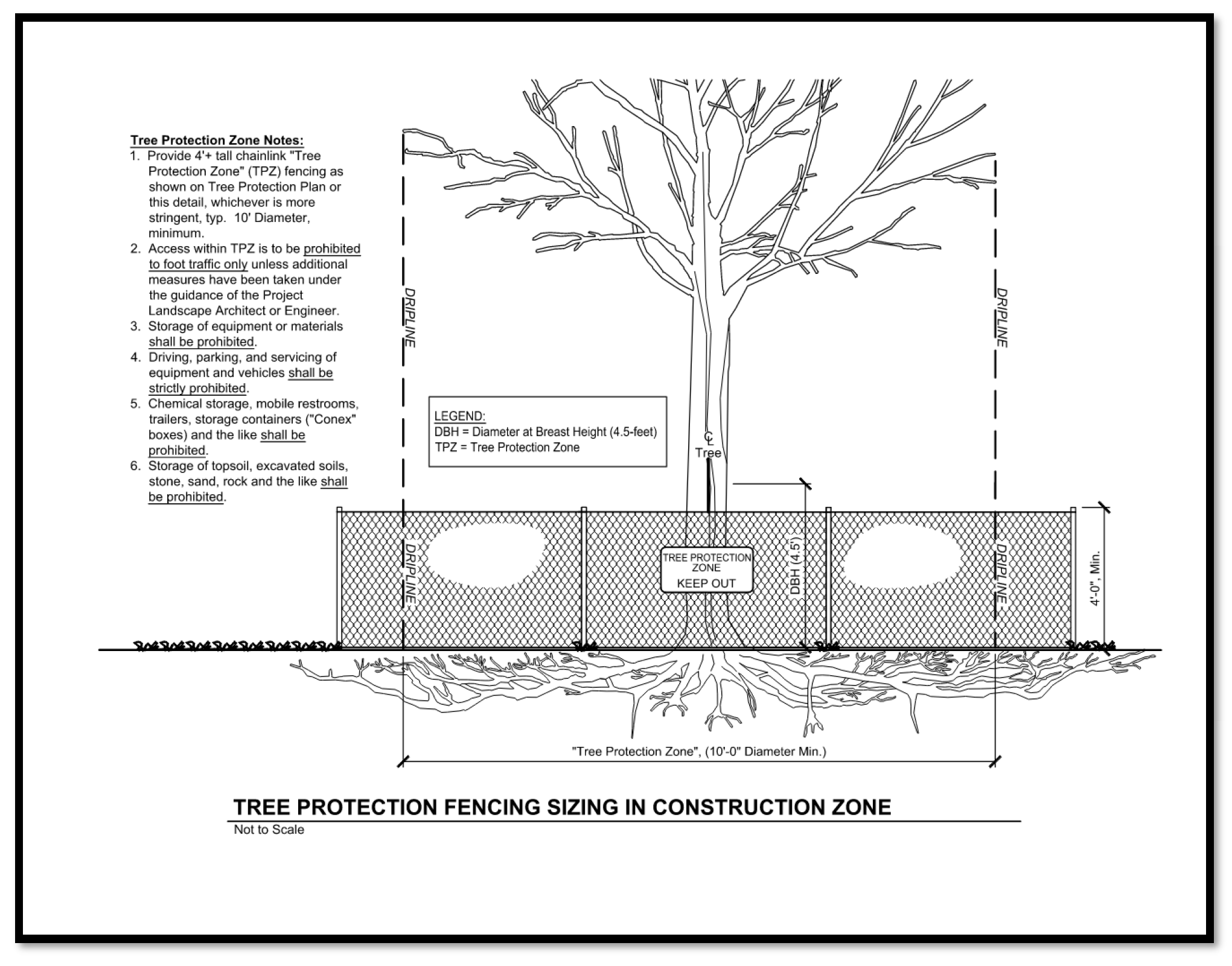
(d)
Landscaping.
(1)
All parking lots of more than four (4) parking spaces shall include planted trees in accordance with schedule 1, below:
Schedule 1
(2)
Shade/canopy trees shall be at least two and one-half (2½) inches in diameter at a point twelve (12) inches above the ground when planted, ornamental/understory trees shall be at least one and three-fourths (1¾) inches in diameter at the point twelve (12) inches above ground when planted and approved multi-stemmed trees shall be a minimum of seven (7) feet tall. All trees shall be protected from potential damage by vehicles. Thirty (30) percent of required trees shall be placed within the perimeter of the actual parking surface area in those parking lots of over twenty (20) spaces, spaced not closer together than twenty (20) feet.
(3)
Interior landscaping for vehicular use areas (VUAs). Landscaping shall include trees, shrubs, flowers or other living matter and shall be provided for vehicular use areas in accordance with the following standards:
a.
A minimum of five (5) percent of the total VUA shall be landscaped and the landscaping shall be dispersed throughout the paved area. The VUA landscaping shall only be required for uses that have more than twenty (20) parking spaces.
b.
The VUA landscaping shall contain a variety of trees and be dispersed in the form of planting islands or peninsulas throughout the VUA. The minimum size of a planting island or peninsula containing a tree(s) within the VUA shall be two hundred (200) square feet with minimum dimensions of ten (10) feet by twenty (20) feet or a minimum of eighty (80) square feet if a tree is not proposed.
c.
No more than one (1) tree shall be planted per two hundred (200) square feet of islands or peninsulas.
d.
Planting islands within the VUA shall be required at the end of every other parking row, when parking rows are provided in the interior portions of the parking lot. (Illustration #1)
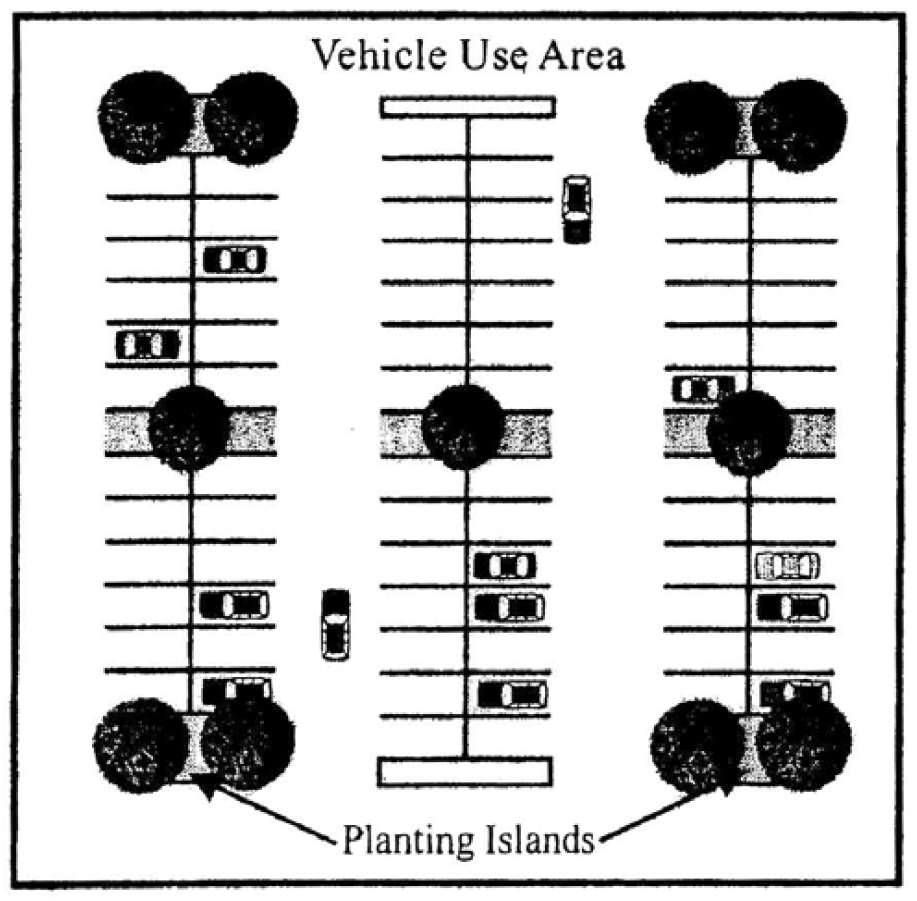
Illustration #1
1.
All planting islands shall be planted with grass, low ground cover, shrubs, flowers or any combination of these. Hard surfaces or gravel are not permitted in lieu of plant materials.
2.
All planting islands shall have a minimum of six (6) inch curbs installed to protect the planting area from vehicular traffic.
3.
All plant material (other than grass, or ground cover) located within landscape islands where vehicle overhangs are needed shall be setback a minimum of two (2) feet, six (6) inches from the edge of pavement or the face of the curb.
4.
Sign landscaping. Landscaping shall be located around the base of freestanding signs. The landscaping shall be ornamental in nature with shrubs, flowers and other ornamental plant materials. Sign landscaping is not required for freestanding signs permitted before the adoption of this article. The amount of landscape area required shall be one (1) square foot of landscape area per one (1) square foot of sign area. At least fifty (50) percent of the required landscaping area shall be planted with trees and/or shrubs.
5.
Building landscaping. Any blank facade or portion of a facade of a building that is not used for outdoor display, storage or loading/unloading shall be required to provide the following landscaping if the wall is visible from a public right-of-way. Blank facades shall be classified as any wall that does not have windows used for display or entry doors for employees or the general public. Buildings, which are ten thousand (10,000) square feet or smaller shall be exempt, form the requirements of this section.
(i)
Trees shall be provided on an average of at least one (1) tree per forty (40) linear feet of blank facade as defined above and shrubs shall be provided on an average of at least one (1) shrub per ten (10) linear feet of blank facade. This landscaping is not required to be placed in a linear design, but shall be required to be dispersed throughout the length of the building facade.
(ii)
Facades that abut VUAs shall have a minimum eight (8) feet wide planting area. This planting area can be reduced by four (4) feet if sidewalks are installed.
(e)
Screening requirements. The necessity and type of screening required varies greatly with each particular situation. Therefore, it is the intent of this section to provide a discretionary measure in deciding the appropriate height, width and type of screening necessary, with the following provisions:
(1)
Where a business zone abuts a City or County residential zone, a screen shall be required along the boundary of the business property adjacent to the residential property.
(2)
Where an industrial zone abuts a City or County residential zone, a screen shall be required along the boundary of the industrial property adjacent to the residential property.
(3)
Where on any lot, or portion thereof; automobiles, appliances and their component parts are under repair or reduction, a screen shall be required.
(4)
Off-street parking lots shall be screened when located adjacent to or in a residential zone.
(5)
Mobile home parks shall provide a screen along their property lines as required by section 126-69(5).
(6)
Commercial or industrial businesses shall provide a screen between the commercial or industrial business and any residential use located adjacent to it, irrespective of zone.
(7)
Fences in a residential zone, which may be placed along a boundary for the purpose of providing privacy or security to the resident, shall follow the following height limitations: (Illustration #2)
a.
Front yard: Four (4) feet. Fences shall be of a decorative design (chain-link, barbed wire, stock wire, chicken wire and similar type fences are not permitted in the front yard).
b.
Side yard: Six (6) feet.
c.
Rear yard: Eight (8) feet.
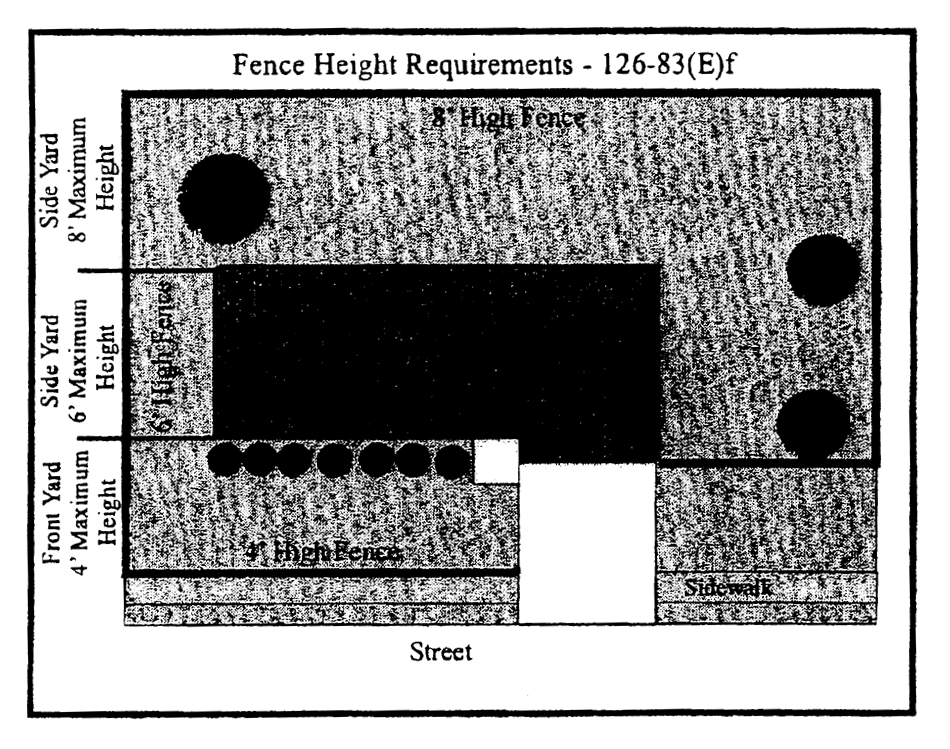
Illustration #2
d.
For the purpose of this section, the term "fence" shall be interpreted to include any type of fence, wall, trellis or structure placed for the purpose of this section.
e.
All fences shall be constructed of durable materials and shall be installed to withstand the elements. Fences shall be maintained in good repair at all times.
f.
Uses specified above as requiring screening shall provide a visual obstruction from adjacent properties in conformance with the following standards:
1.
The screen may be composed of view-obscuring vegetation, wall, fence or berm.
2.
The items may be used individually or in combination. Fences constructed of chain-link, barbed wire, stock wire, chicken wire or other similar type fences are not permitted when used for screening.
3.
The result shall be a semi-opaque eighty (80) percent screen, which obscures views from the ground to a height of the object being screened; however, the screen is not required to exceed eight (8) feet.
4.
Plant materials shall be at least two (2) feet tall at the time of installation and reach the desired height within three (3) to five (5) years.
5.
When a combination of features is proposed, one-fourth (1/4) of the surface area of walls, fences or berms that face off-site must be covered with plant material within three (3) to five (5) years.
6.
Screening areas shall be sufficient to allow for the mature growth of plant materials when used.
(8)
A developer shall submit a site plan to the Planning and Zoning Administrator and shall show the proposed type of screening to be located along the boundary of the developer's property.
(f)
Enforcement.
(1)
Inspections will be conducted by the Department of Planning after the installation of landscaping to ensure compliance with the submitted and approved site plan.
(2)
The removal or destruction of landscape material previously approved by the City shall constitute a violation of this chapter. Replacement of landscape material shall be of like size as that which was removed or destroyed.
(3)
Violation of this article shall be grounds for the refusal of a certificate of occupancy, require replacement of landscape material, and/or will subject those in violation to the established fines and penalties of this chapter.
(g)
Waiver of requirements. The Planning Commission shall have the authority to grant a waiver of any of the requirements in this section upon written request, which outlines the rationale for the waiver. The Planning Commission shall review each written request and grant a waiver only:
(1)
Under unusual or extreme circumstances which cause an unreasonable hardship such as the size of the lot.
(2)
When an innovative or alternative approach can be made which still meets the intent and purpose of this section.
(Code 1997, § 126-83; Ord. No. 2005-1-6911, § 1, 1-11-2005; Ord. No. 2006-11-7203, § 1, 11-14-2006; Ord. No. 2022-06-8741, § 1, 6-28-2022)
Sec. 126-84. - Bed and breakfast.
The purpose of this section is to establish a procedure for the location of a bed and breakfast in the R-2 and R-3 Residential Zones.
(1)
Conditional use permit required. To ensure compliance with provisions of this zoning chapter and to protect the character of residential neighborhoods in the City, a conditional use permit for a bed and breakfast in the R-2 and R-3 zone shall be obtained from the Board of Adjustment.
(2)
Procedure. Applications for a conditional use permit for a bed and breakfast shall be submitted to the Board of Adjustment in compliance with section 126-68 of the zoning regulations. Applications will be reviewed by the Paducah Planning Commission and forwarded to the Board of Adjustment with the Planning Commission's recommendations for action. The Board of Adjustment will then act upon the application. Upon approval of an application, a conditional use permit for a bed and breakfast will be issued, which permit shall state the conditions attached thereto, and any time limitations imposed thereon. The permit shall not be issued unless the applicant has met all of the conditions listed below, and the applicant has agreed in writing to comply with all said conditions and any other conditions, which the Board of Adjustment approved. Conditions placed on all bed and breakfast in an R-2 or R-3 zone. A bed and breakfast is principally permitted in the R-4 zone. A bed and breakfast may be permitted in the R-2 and R-3 zone with a conditional use permit provided it meets the following criteria:
a.
The bed and breakfast may be housed in an existing structure or new structure. The structure must comply with the Kentucky Building Code and all other applicable State and local statutes, ordinances, and regulations.
b.
The bed and breakfast must not have more than five (5) guestrooms for rent.
c.
A bed and breakfast must be in a one-family dwelling.
d.
The owner must reside in the bed and breakfast.
e.
A morning meal must be served on-premises and included within the room charge for guests of the facility and shall be the only meal provided.
f.
Off-street parking must be provided as noted: two (2) spaces for the owner and/or manager, and one (1) space per guestroom. The Planning Commission may waive this requirement based on submitted evidence of adequate on-street and off-street parking.
g.
One sign not exceeding two (2) square feet in area identifying the name of the bed and breakfast. The Board of Adjustment shall regulate the sign location. Lighted signs are prohibited in the R-2 and R-3 Zones.
h.
Entrances to all guestrooms must be on the interior of the structure. Secondary, exterior entrances to guestrooms shall be permitted only for access to patios, verandas, or balconies.
i.
The architectural style and physical size of the structure shall be in harmony with the residential character of the neighborhood.
j.
The site must be planned and landscaped so as to minimize the impact on neighboring properties and in order to retain the residential character of the neighborhood. A landscape plan shall be submitted to the Planning Commission for review.
(3)
Additional uses allowable. The Board of Adjustment may allow the following uses so long as they are a part of, and incidental to, the bed and breakfast: souvenir sales that are limited to registered guests with no on-site signage.
(4)
Conditions. The Board of Adjustment may attach conditions to its approval which are necessary to preserve the character of the district in which the proposed use will be located.
(Code 1997, § 126-84; Ord. No. 2005-11-7036, § 1, 11-8-2005)
Sec. 126-85. - Awnings and canopies.
(a)
Generally. Awnings/canopies shall be permitted in all zoning districts within the City subject to the following requirements.
(b)
Awnings/canopies on private property. Awnings/canopies on private property shall meet the minimum yard requirements of the zone in which the awning is proposed to be located.
(c)
Awnings/canopies over public areas. Awnings/canopies over public areas in the City shall be arranged without posts and shall provide a clearance of not less than seven (7) feet from sidewalk to the lowest point of the framework, awning cover, including any fringe, apron, skirt, valance or drop. No awnings/canopies above sidewalk shall be closer to the vertical plane of the curb than two (2) feet and in no case shall any awning/canopy project from the face of the building more than eight (8) feet. Awnings/canopies within the B-2-T and B-2 zoning districts shall protrude no further than four (4) feet from the face of the building. The Chief Building Inspector may waive the four (4) feet dimension when sufficient evidence has been submitted that the proposed awnings/canopies will not interfere with the emergency access to underground power sources.
(d)
Application. No awnings/canopies, except as specifically exempted herein, shall be displayed, erected, relocated or altered until a permit has been issued by the Fire Prevention Division. An application for a permit shall include, but shall not be limited to the following:
(1)
A completed application form.
(2)
A site plan and/or building elevations drawn to scale showing the locations of the proposed location of the awnings/canopies on the lot and/or building, including setbacks.
(3)
Detailed awning information including type of construction, method of installation and/or erecting and other similar information.
(Code 1997, § 126-85; Ord. No. 2006-3-7079, § 1, 3-14-2006; Ord. No. 2006-6-7134, § 1, 6-13-2006; Ord. No. 2022-04-8727, § 1, 4-12-2022)
Sec. 126-86. - Accessory structures.
(a)
Generally.
(1)
The purpose of this section is to provide regulations for the placement of accessory structures in the City. Accessory structures shall be located on the same or adjacent lots of the same ownership as the principal building. Accessory structures may only be placed on adjacent lots that have the same street frontage as the principal structure and the lot is of sufficient size to be used as a building site, pursuant to section 126-64(d). Where part of the wall of an accessory structure is a part of the wall of the principal building in a substantial manner, such accessory structure shall be considered as part of the principal building.
a.
Accessory structures may only be located in the rear or side yard, not in any front yard except as provided herein. In the case of accessory structures placed on adjacent lots, the front yard of the principal structure shall be extended and maintained across said adjacent lots.
b.
Setbacks; rear and side yards.
1.
Side yard setbacks may not be less than the principal building setback for the zoning district.
2.
Rear yard setbacks do not apply to accessory structures.
(2)
Setbacks from principal building. Accessory structures must be a minimum distance of five (5) feet from the principal building or other accessory building.
(3)
The height of the accessory structure in the R-1, R-2, R-3, R-4 and H-2 shall not exceed the height of the principal building or zoning district maximum height whichever is less. The height of the accessory structures in all other zoning districts shall not exceed the zoning district maximum height.
(4)
The total building foot print area of all accessory buildings in residential zones shall not exceed the gross floor area of the principal building.
(b)
Accessory structures may include, but not be limited to, the following:
(1)
Garage.
(2)
Carport.
(3)
Greenhouse.
(4)
Playhouse.
(5)
Pump house.
(6)
Pergola.
(7)
Storage shed.
(8)
Tool shed.
(9)
Swimming pool.
(10)
Work shop.
(11)
Dog pen.
(12)
Satellite dish.
(13)
Personal communication tower.
(14)
Structures for hobbies, recreational activities or artistic activities. Only the occupant of the principal building may carry on such use. Such use shall not fall within the definition of a home occupation or business.
(c)
Special requirements for certain accessory structures.
(1)
Swimming pools. Pools permanently or semi-permanently constructed below or above grade shall be protected by a five (5) foot or higher fence containing a latching gate to keep children and animals from having unsupervised access. Above ground pools that exceed the height of four (4) feet shall be exempt from fence requirements except that the steps shall be secured with a five (5) foot fence to protect the entrance.
(d)
Projections into required yard setbacks.
(1)
The following structures are permitted within required setbacks, provided that compliance is maintained with the traffic visibility standards of the City.
(2)
Landscaping features, included, but not limited to, ornamental pools, planting boxes, sculptures, arbors, trellises, fences, and birdbaths. Fences shall comply with section 126-83(e)(1)c.4.
(3)
Sculptures. Sculpture size shall not exceed twenty (20) percent of the street side facade area. (See Illustrative Figure 1.) Sculptures shall not be required to receive a Certificate of Appropriateness from the Historical and Architectural Review Commission.
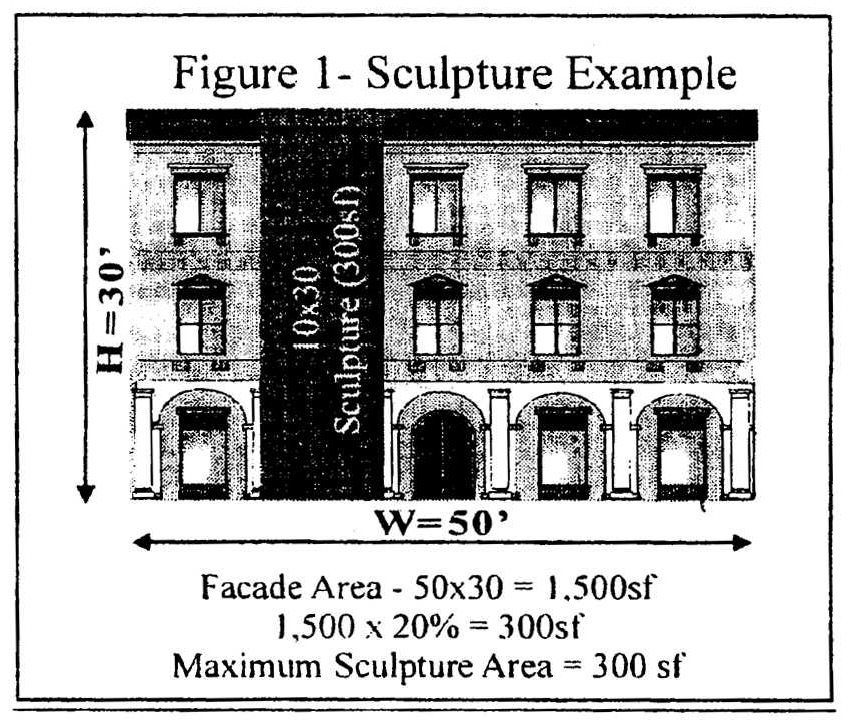
(4)
At-grade patios, play equipment, outdoor furniture, ornamental entry columns and gates, flagpoles, lampposts, mailboxes, HVAC equipment, address posts, outdoor fireplaces, refuse collection containers, public utility lines, poles and retaining walls.
(5)
Person with disability ramps that do not exceed four (4) feet in height may project no more than eight (8) feet into the front yard setback.
(6)
Steps that do not exceed four (4) feet in height.
(e)
The following attached structures will be permitted to project into the specified yard setback for the following distances:
(1)
Cornices, overhanging eaves and gutters, windowsills, bay windows, or similar architectural features, chimneys and fireplaces, fire escapes, fire balconies and satellite dishes may project no more than 2½ feet into any required yard setback, but in no case closer than three (3) feet to any property line or encroach on any existing utility easement and in compliance with the Kentucky Building Code.
(2)
Open unenclosed porches (excluding screened or glassed) may project no more than five (5) feet into a front or rear yard provided such porch does not exceed fifty (50) square feet in surface area. Open unenclosed decks may project into the rear yard, provided that it does not come closer than ten (10) feet from the rear property line or encroach on any existing utility easements.
(3)
Open unenclosed carports which are attached to and part of the principal structure and which are unenclosed on all exterior sides except for necessary supports may project into side or rear yard setback but shall be no closer than fifteen (15) feet to a side or rear yard adjoining a street right-of-way and no closer than five (5) feet to a side property line or encroach on any existing utility easements.
(4)
Gas pump islands and associated canopy can project into any yard setback; however, no gas pump island shall be located closer than twenty-four (24) feet to a street right-of-way line nor will any portion of a canopy be allowed to encroach into the public right-of-way.
(f)
If an adjacent lot is proposed to be utilized for an accessory structure, the lot must be of sufficient size as required in section 126-64(d). If the adjacent lot is not of sufficient size to be used as a building site, then a waiver of subdivision will be required to abolish the interior property lines.
(Code 1997, § 126-86; Ord. No. 2006-9-7178, § 1, 9-26-2006; Ord. No. 2016-7-8393, § 1, 7-19-2016)
Sec. 126-87. - Mobile food vehicles and food tents.
(a)
Purpose and intent. In order to promote a new dynamic for the citizens of Paducah, create new jobs, increase quality of life and diversify dining options; this section of this chapter has been adopted to allow mobile food vehicles and food tents to operate under specific guidelines.
(b)
Definitions. The following words, terms and phrases shall have the meanings ascribed to them in this section, except where the context clearly indicates a different meaning:
Food tent means a temporary structure with or without sidewalls or drops, constructed of fabric or pliable material supported by any manner except by air or the contents that it protects, used for the purposes of serving food or beverage to the general public.
Mobile food administrator means the Director of Planning or designee. The Administrator shall be responsible for the administration, oversight and enforcement of the provisions under this section.
Mobile food vehicle means a vehicle-mounted, vehicle-towed or vehicle-carried food service establishment that engages in the sale and preparation of food or beverages in individual portions to the general public.
Mobile food vendor means a person that prepares or serves food or beverages to the general public from a mobile food vehicle.
(c)
Exemptions. This section shall not apply to ice-cream or coffee trucks that move from place-to-place and are stationary in the same location for no more than ten (10) minutes at a time. This section also does not apply to food vending push carts, food stands, mobile food vehicles in operation under a special event permit, mobile food vehicles intended to be stationary, such as; but not limited to, in a mobile food vehicle court and food tents in the Highway Business District.
(d)
Zoning locations. Mobile food vehicles may operate in the following zones: B-1, B-2, B-2-T, B-3, HBD, M-1, M-2, M-3, A-1, POP and HM Zones. A mobile food vehicle may operate on a parcel that contains non-residential uses in the MU, H-2, NSZ and NCCZ Zones and in Planned Unit Developments (PUDs). All other zones are expressly prohibited, except in public parks as described herein.
(e)
Location and hours. Mobile food vehicles are permitted on City of Paducah right-of-way (ROW). Mobile food vehicles are expressly prohibited from locating on State of Kentucky ROW. Mobile Food Vehicles may not locate within one hundred (100) feet of the principal entrance of any restaurant where more than fifty (50) percent of sales are derived from food, without the express written consent of said restaurant(s).
(1)
The mobile food vendor must obtain written permission from the property owner to locate on private property and said permission must be made available to the mobile food administrator. Mobile food vehicles may locate in public parking lots with written approval from the mobile food administrator. Vehicles in the ROW may be asked to be moved in the event of street cleaning, snow removal, parades, construction or other events as deemed necessary, in the sole opinion, of the Mobile Food Administrator. Mobile food vehicles in private parking lots may be asked to be moved in the event sufficient parking is not available. Written permission must be granted from the Paducah Parks Services Director or designee; or the McCracken County Judge Executive or designee (depending on ownership) if the mobile food vendor proposes to operate in a public park.
(2)
In no case shall a mobile food vehicle obstruct traffic or pedestrian flow. A mobile food vendor shall ensure that a minimum of four (4) feet of unobstructed sidewalk remains open for pedestrian traffic. Mobile food vehicles parked in the ROW shall not occupy more than two (2) parking spaces. No stop sign, yield sign, school crossing sign or any other traffic-control sign or signal shall be obstructed. No ingress/egress of any driveway or alley shall be obstructed. No fire hydrant or fire lane shall be obstructed.
(3)
Mobile food vehicles may operate within the hours of 6:00 a.m. to 11:00 p.m. Mobile food vehicles may operate until 2:00 a.m. if the mobile food vehicle is located on private property and the principal business located on the private property is open. Mobile food vehicles may not be left overnight in public parking lots or on City ROW.
(f)
Self-contained units and appurtenances. All mobile food vehicles shall have self-contained water and wastewater. No gray water or grease shall be dumped upon any street, sidewalk or down a stormwater drain. Mobile food vehicles on private property may utilize electric power from the property being occupied or an adjacent property, but only when written consent is obtained to do so. No power cable, extension cord or other equipment shall be extended across any street, alley or sidewalk. If a power cable, extension cord or other electrical equipment is extended across a parking lot, said equipment must be protected from vehicle movements in accordance with the National Electrical Code requirements.
(1)
No tables, chairs, umbrellas or other appurtenances shall be allowed on public property.
(2)
All mobile food vehicles shall be in compliance with regulations established by the Cabinet for Health and Family Services, Department for Public Health, Division of Public Health Protection and Safety and/or the Purchase District Health Department.
(g) Garbage disposal. All mobile food vendors must provide one (1) or more garbage receptacles for their patrons. All mobile food vendors must keep the area around their vehicles free from litter, refuse and garbage.
(h)
Serving articles and alcoholic beverages. Patrons shall be provided with single-service articles, such as plastic utensils, plastic or Styrofoam cups and paper or Styrofoam plates. Mobile food vehicles shall not serve any alcoholic beverage unless permitted as part of a special event.
(i)
Special events. Mobile food vehicles are prohibited from vending two thousand five hundred (2,500) feet from special event permitted areas; including, but not limited to, Barbeque on the River and Quilt Week unless the mobile food vehicle is permitted by the City; the City Parks Services Department and/or the permit holder responsible for the special event. Mobile food vehicles shall comply with all aspects of applicable provisions of the National Fire Protection Association (NFPA) Code 1 (2018 Edition), Chapter 50 (Commercial Cooking), and any future amendments thereto adopted by the NFPA, unless specifically omitted by amendment to this article.
(j)
Noise. No mobile food vehicle may emit bells, music, horns or other audible sounds used to attract customers. Strobe lights, flashing lights or other repetitious lighting are prohibited. The noise level from the food truck motor and generator must comply with the City's Noise Ordinance. Generators shall not be permitted on Broadway between Water Street and North 7th Street/Clarence Gaines Street, 2nd Street or within one hundred (100) feet of a residence, unless a generator is utilized that produces a noise level of seventy-two (72) decibels or less.
(k)
Application and permitting.
(1)
Mobile food permitrequired. Any operator of a mobile food vehicle must apply for and receive, on an annual basis, a mobile food zoning compliance permit (the "mobile food permit") from the Mobile Food Administrator. The mobile food permit is required for each mobile food vehicle. The mobile food permit shall be prominently displayed on the mobile food vehicle along with other permits as required by this chapter.
(2)
Application. Every mobile food vendor desiring to operate a mobile food vehicle shall submit an application for a mobile food permit to the Mobile Food Administrator. All mobile food vendors shall obtain necessary inspections and permits otherwise required by the City of Paducah, the Purchase District Health Department, and any other local, State or Federal agencies or departments, including a current City business license and any other inspections and permits required by the Paducah Fire Prevention Division, in order to vend in the City limits. In addition to the information required in the application, the Mobile Food Administrator may request other information reasonably required. The mobile food permit application shall not be considered complete until the Mobile Food Administrator has all information as required by the application.
(3)
Issuance of mobile food permit. Once the application is considered complete, the Mobile Food Administrator shall issue or deny the mobile food permit within fourteen (14) business days. If the Mobile Food Administrator is satisfied that the application and mobile food vehicle conform to the requirements of this chapter and other pertinent laws and ordinances, a mobile food permit shall be issued to the applicant. If the application and mobile food vehicle does not conform to the requirements of this chapter or other pertinent laws or ordinances, the Mobile Food Administrator shall not issue the mobile food permit, but shall inform the applicant of the denial. Such denial, when requested, shall be in writing and state the reasons for denial. The mobile food permit shall be valid for one (1) calendar year from the date of issuance, unless the mobile food permit is revoked pursuant to this chapter.
(4)
Permit renewal. Every mobile food permit, unless suspended or revoked for a violation of any provision of this chapter or other requirement or ordinance of the City, can be renewed annually prior to expiration. An application for renewal of a mobile food permit shall be made through the Mobile Food Administrator. Upon the mobile food permit's expiration, the holder of the mobile food permit forfeits the right to renew and the mobile food vendor must reapply for a new mobile food permit.
(5)
Inspections after permitting. Permitted operations will be inspected periodically and without notice by representatives of various City departments to ensure compliance with this chapter.
(6)
Operation without permit. Any mobile food vehicle operating without a valid mobile food permit may be deemed a public safety hazard and may be ticketed and impounded. The penalty for operating without a mobile vehicle permit shall be the same as section 126-178.
(7)
Revocation of permit. The Mobile Food Administrator may revoke a mobile food permit if it is discovered that:
a.
An applicant obtained the mobile food permit by knowingly providing false information on the application;
b.
The continuation of the mobile food vendor's use of the mobile food permit is a threat to public health or safety, or if the mobile food vendor otherwise presents a threat to public health or safety; or
c.
The mobile food vendor or mobile food vehicle violates regulations of this article or any other City ordinance.
(8)
Appeal ofrevocation. If a mobile food permit is revoked, the Mobile Food Administrator shall state the specific reasons for the revocation. Any mobile food vendor whose mobile food permit has been revoked may appeal such denial by submitting a written request for a hearing to the Mobile Food Administrator within ten (10) days of revocation. An informal hearing shall be conducted within thirty (30) days of the Mobile Food Administrator's receipt of said appeal by a panel comprised of the Chairman of the City Planning Commission, the City Manager and the Director of the Fire Prevention Division. The panel shall consider whether the revocation was justified and whether good cause exists to reinstate the mobile food permit. The panel shall issue its decision on the appeal in a written opinion within ten (10) business days; the written opinion will be sent via first class mail to the mobile food vendor at the address listed on the mobile food vehicle application. The decision resulting therefrom shall be final. Following the revocation of a mobile food permit, a vendor must wait one (1) year before reapplying for a new mobile food permit.
(l)
Food tents. Food tents shall be principally permitted in the B-2 Zone and as promulgated through the higher-intensity zones. In addition to the following, food tents shall follow subsections (e)—(j) of this section as applicable.
(1)
Festivals/events. Food tents may be utilized only as part of a private festival or event such as, but not limited to; Food Truck Fridays or block parties.
(2)
Approvals. Food tents shall receive necessary approvals from the Fire Prevention Division and the Purchase District Health Department. Food tents shall be required to pass an on-site inspection by the Fire Prevention Division.
(3)
Cooking. No cooking shall take place under a food tent unless the tent meets the requirements of the National Fire Protection Association standard #701. All cooking areas must be kept isolated from the public.
(4)
Separation. Food tents shall be located further than twenty (20) feet from another tent or other structure.
(Ord. No. 2017-05-8486, § 1(126-88), 5-9-2017; Ord. No. 2021-04-8683, § 1, 4-13-2021; Ord. No. 2021-08-8698, § 1, 8-10-2021; Ord. No. 2022-06-8741, § 1, 6-28-2022)
Sec. 126-88. - Reasonable accommodation for recovery homes.
(a)
Definitions. For the purposes of this article, the following terms are defined as follows:
(1)
Certifying organization. Certifying organization, as used in this article, means:
a.
The Kentucky Recovery Housing Network;
b.
The National Alliance for Recovery Residences;
c.
Oxford House, Inc.; and
d.
Any other organization that develops and administers professional certification programs requiring minimum standards for the operation of recovery residences that has been recognized and approved by the Cabinet for Health and Family Services.
(2)
Fair housing laws. The Federal Fair Housing Amendments Act of 1988 (FHA) and the provisions of KRS 344.600 et seq., as may be amended from time to time (fair housing laws).
(3)
Group home. A residential facility for the care of multiple unrelated individuals living in a single housekeeping unit and recognized as handicapped individuals under the Fair Housing Act and American with Disabilities Act. A group home shall be considered a recovery home for all purposes consistent herewith, even if such home includes multiple unrelated individuals.
(4)
Handicapped. Person with disabilities; for the purposes herein, has the meaning set forth in the Federal Fair Housing Act and the American with Disabilities Act and is an individual who has a physical or mental impairment that limits one (1) or more of the major life activities of such individual, is regarded as having such impairment, or has a record of such impairment. While a person recovering from substance abuse is considered a person with a disability under 42 U.S.C. § 3602 (h), a person who is currently engaged in illegal use of a controlled substance is not.
(5)
Operator. An individual or business entity, whether for profit or non-profit, which provides residential services at a recovery home.
(6)
Reasonable accommodation. The act of making a dwelling unit or housing facility readily accessible to, and usable by, a person with disabilities, through the removal of constraints in the City's land use, zoning, permit and processing procedures. All requested or proposed accommodations may not be reasonable and the reasonableness of a request will be determined by the City.
(7)
Recovery home. A recovery home means a single-family dwelling unit inhabited or intended to be inhabited by unrelated individuals recovering from a drug and/or alcohol addiction, considered as a handicapped individual under State or Federal law, which promotes use disorder recovery through abstinence from intoxicating substances; and shall not include facilities which provide on-site supportive services to residents including the following: mental health services; clinical rehabilitation services; social services; medical, dental, nutritional or other health care services; financial management services; legal services; vocational services or other similar supportive services.
(8)
Recovery support services. Recovery support services means activities that are directed primarily toward recovery from substance use disorders and includes; but is not limited to, mutual aid self-help meetings, recovery coaching, spiritual coaching, group support and assistance in achieving and retaining gainful employment. Recovery support services does not include any medical, clinical, behavioral health or other substance use treatment service for which a license or other approval is required under State law.
(b)
Purpose.
(1)
Fair Housing Laws impose an affirmative duty on local governments to make reasonable accommodation in their land use, zoning regulations and land-use practices when such accommodation may be necessary to afford handicapped individuals an equal opportunity to housing in accordance therewith.
(2)
In furtherance of the purposes of the Fair Housing Laws, this section is intended to: preserve the residential character of predominately single-family residential neighborhoods; ensure that inhabitants of recovery homes are actually entitled to reasonable accommodation; limit the secondary impacts of recovery homes by reducing noise, lighting and traffic; preserve safety, provide adequate on-street or off-street parking; provide an accommodation for handicapped individuals that is reasonable and actually bears some resemblance to the opportunities afforded non-handicapped individuals to use and enjoy a dwelling in a residential neighborhood and to encourage living environments that will enhance opportunities for handicapped individuals to remain in recovery. Pursuant to Fair Housing Laws, this article is also created to provide handicapped individuals reasonable accommodation in zoning regulations to ensure equal access to housing and facilitate the development of housing for individuals with such recognized handicaps when the same may act as a barrier to fair housing opportunities.
(3)
There is hereby established a procedure for making requests for reasonable accommodation in land use and zoning regulations to comply fully with the intent and purpose of Fair Housing Laws. Unless a recovery home has been granted reasonable accommodation as provided in this article, recovery homes shall comply with zoning regulations applicable to the zone in which they are located.
(c)
Applicability. Reasonable accommodation within the context of the land use and zoning regulations means providing individuals with recognized handicaps flexibility in the application of land use regulations, zoning regulations, policies, practices and procedures, or even waiving certain requirements, when it is necessary to eliminate barriers to housing opportunities.
(d)
Notice to the public of availability of accommodating process. Notice of the availability of reasonable accommodation shall be prominently displayed and provided to requesting individuals, advising the public of the availability of the procedure for eligible applicants.
(e)
Application for requesting reasonable accommodation.
(1)
Forms for requesting reasonable accommodation shall be available in the Planning Department and online.
(2)
An application for reasonable accommodation may be made by:
a.
Any handicapped individual or his or her representative;
b.
The owner of the real property intended for use as a recovery home for handicapped individuals; or
c.
The operator of an entity providing residential services at the location.
(3)
Requests for reasonable accommodation shall be in writing and provide the following information:
a.
Name, address and phone number of the applicant requesting reasonable accommodation;
b.
Name, address and phone number of the house manager who is responsible for the day-to-day operation of the facility, if any;
c.
Address of the property for which accommodation is requested;
d.
Name, address and phone number of the property owner(s) if not the applicant;
e.
If the applicant/ operator is not the property owner, a copy of any lease agreement bet ween applicant/ operator and owner must be provided as well as written approval from the property owner to operate a recovery home at the proposed location;
f.
Detailed description of the requested accommodation with reference to any known regulation, policy or procedure from which relief is sought;
g.
Reason that the requested accommodation may be necessary for the handicapped individual(s) to use the dwelling;
h.
Copy of the recovery home rules and regulations including intake procedures and relapse policy;
i.
Blank copies of all forms that residents or potential residents are required to complete;
j.
An affirmation by the applicant or operator that only handicapped residents shall reside at the recovery home;
k.
Where the applicant is not an intended occupant, but instead intends to operate the home for financial or charitable purposes, a copy of any agreement between the applicant/ operator and the property owner setting forth or concerning any fee arrangement or financial reimbursement applicable to each resident of the recovery home; and
l.
Copy of certification by a certifying organization, either permitting the individual or entity to operate a recovery home, or indicating the individual or entity is otherwise exempt from certification requirements pursuant to KRS 222.502(b), or proof that the recovery home has applied for certification with a certifying organization or the Cabinet for Health and Family Services.
(4)
Any information obtained related to an individual's handicap or medical condition shall be considered confidential, shall be retained in a manner so as to respect the privacy rights of the applicant and shall not be made available for public inspection unless otherwise required by law.
(5)
A request for reasonable accommodation to the regulations, policies, practices and procedures may be filed at any time that the accommodation may be necessary to ensure equal access to housing. A reasonable accommodation shall not affect an individual's obligations to comply with all ordinances and laws not at issue in the requested accommodation.
(6)
If an applicant needs assistance in making the request for reasonable accommodation, the applicant shall submit a request for assistance to the Director of Planning and assistance in filing an appropriate request shall be provided.
(7)
An applicant may seek relief from the strict application of the provisions of this article by submitting such request in writing to the Director of Planning setting forth specific reasons as to why accommodation over and above the provisions set forth herein is necessary.
(8)
No application fee shall be charged, except that entities operation a dwelling for-profit shall comply with section 106-65 of the Paducah Code of Ordinances.
(f)
Grounds for reasonable accommodation.
(1)
In determining whether to grant a reasonable accommodation, the Director shall consider the totality of the following factors:
a.
That the property will be used by an individual with a recognized handicap protected under Fair Housing Laws;
b.
Special needs created by the recognized handicap;
c.
Potential benefit that can be accomplished by the requested modification;
d.
Potential impact on properties within the vicinity, including impacts on parking, ingress and egress, traffic, lighting and noise;
e.
Physical attributes of the property and dwelling structure;
f.
Alternate accommodations that may provide an equivalent level of benefit;
g.
Whether the requested accommodation would impose an undue financial or administrative burden on the City;
h.
Whether the requested accommodation would require a fundamental alteration in the nature of a City function or service, including in the City's overall zoning scheme and neighborhood development; and
i.
Whether granting the request would be consistent with the City's Comprehensive Plan.
(2)
In making a determination of whether the requested accommodation would require a fundamental alteration in the immediate neighborhood, the City's overall zoning scheme, overall neighborhood development or the City's Comprehensive Plan, an analysis shall be required of the number of recovery homes already accommodated within any specific neighborhood such that the accommodation of the request with an additional recovery home would institutionalize a predominately single-family dwelling neighborhood.
(3)
The Director shall not be required to undertake an investigation of the occupants' handicap. A recovery home certified by a certifying organization, or which has applied for Certification with a certifying organization or the Cabinet for Health and Family Services, and which has a drug testing and relapse policy shall constitute proof of status as handicapped for purposes of this section.
(g)
Distance requirement.
(1)
No recovery home shall be located within six hundred fifty (650) feet, as measured from the closest property lines, of any other recovery home, except as delineated in subsection (g)(2) herein.
(2)
Recovery homes in existence at the time of enactment of this section, as referenced in section (j)(1) herein, which provide proof of certification by a certifying organization and compliance with requirements of the Cabinet for Health and Family Services on July 1, 2024, shall not be required to cease operation due to proximity of less than six hundred fifty (650) feet from the property lines of another recovery home.
(3)
Upon revocation of a permit as set forth in sections (j)(6) or (n)(1) herein, recovery homes in existence at the time of enactment of this section, as referenced in section (j)(1) herein shall no longer be excepted from the distance requirement. Upon reapplication for a permit, if any, such recovery home shall be required to meet the distance requirement set forth herein.
(h)
Reviewing authority.
(1)
Requests for reasonable accommodation shall be reviewed by the Director of Planning using the criteria set forth herein.
(2)
The Director shall issue a written decision either granting or denying a temporary permit to operate a recovery home in the intended location, in accordance with section (k) herein. A temporary permit may be issued in accordance with section (j) if, upon initial review, the factors set forth in section (f)(1), (2) and (i)(2)—(9) weigh in favor of granting the reasonable accommodation.
(3)
The Director shall issue a written decision on a request for reasonable accommodation within thirty (30) days of receipt of proof of certification or denial of certification by a certifying organization or the Cabinet for Health and Family Services and may either grant, grant with modifications or deny a request for reasonable accommodation in accordance with the required findings set forth below.
(4)
If necessary to reach a determination on the request, the Director may request further information from the applicant consistent with Fair Housing Laws, specifying in detail the information that is required. In the event that a request for additional information is made, the thirty-day period to issue a decision shall be stayed until the applicant responds to the request.
(i)
Required findings. The written decision to grant, grant with modifications or deny a request for reasonable accommodation shall be consistent with Fair Housing Laws and based on the following factors:
(1)
The recovery home shall have applied for certification with a certifying organization or the Cabinet for Health and Family Services and otherwise in good standing with the Cabinet for Health and Family Services, as required by KRS 222.502.
a.
Should the recovery home fail to have applied for certification with the Cabinet for Health and Family Services or a Certifying Organization, or otherwise fail to be in good standing with the Cabinet for Health and Family Services as required by KRS 222.502, and not otherwise exempt from certification pursuant to KRS 222.502(b), the Director's inquiry shall end and the Director need not consider any remaining factors.
(2)
Whether the recovery home will be used by individuals with a recognized handicap as defined herein and protected under Fair Housing Laws.
(3)
Whether the requested accommodation is necessary to make housing available to an individual with a recognized handicap protected under the Fair Housing Laws.
(4)
Whether the requested accommodation would impose an undue financial or administrative burden on the City.
(5)
Whether the requested accommodation would require a fundamental alteration in the nature of the City's land use or zoning regulations, codes or related programs.
(6)
Whether the requested accommodation will fundamentally alter the neighborhood due to changes in noise, lighting, parking, traffic or other factors deemed appropriate at the discretion of the Director.
(7)
Whether the requested accommodation will result in a direct threat to the health, safety or welfare of other individuals or cause physical damage to the property of others.
(8)
Whether the requested accommodation is necessary to make facilities of a similar nature economically viable in light of the particularities of the relevant market and market participants.
(9)
Whether the existing supply of facilities of a similar nature is already sufficient to provide individuals with a recognized handicap an equal opportunity to live in a residential setting.
(10)
Whether the applicant has previously had reasonable accommodation revoked or suspended, including the reasons therefore.
(j)
Temporary permit.
(1)
Recovery homes in existence at time of enactment: The Planning Director shall issue a temporary permit to the operator of a recovery home already in existence prior to enactment of this section which has applied for Certification with a certifying organization or the Cabinet for Health and Family Services and provided proof of such application. Upon Certification by a certifying organization or the Cabinet for Health and Family Services and provision of proof of certification by the Cabinet for Health and Family Services, a recovery home in existence prior to enactment of this section shall not be required to submit a request for reasonable accommodation as otherwise required herein, but shall be required to submit additional documentation annually.
(2)
Recovery homes not in existence at time of enactment: The Planning Director may issue a temporary permit to the operator of a recovery home which is not already in existence prior to the enactment of this section and which has submitted an application for certification with a certifying organization or the Cabinet for Health and Family Services, if upon initial review; the factors set forth in section (f)(1), (2) and (i)(2)—(9) herein weigh in favor of granting the reasonable accommodation.
(3)
A temporary permit shall authorize the occupancy of a recovery home until such time as a certifying organization or the Cabinet for Health and Family Services approves or denies the recovery home's application.
(4)
A temporary permit shall indicate only that the recovery home has applied for certification and is in good standing with the certifying organization or the Cabinet for Health and Family Services. A temporary permit is not a determination that the recovery home will likely be certified or finally granted reasonable accommodation.
(5)
The temporary permit shall be valid until the certifying organization or the Cabinet for Health and Family Services grants or denies certification following a site visit at the intended or temporarily permitted location.
(6)
In the event the recovery home's application for certification is denied by a Certifying Organization or the Cabinet for Health and Family Services, the recovery home's temporary permit shall be revoked.
(k)
Written decision on the request for reasonable accommodation.
(1)
The written decision on the request for reasonable accommodation shall explain in detail the basis of the decision, including the Director's findings as set forth in subsection (j) herein.
(2)
The written decision shall give notice of the applicant's right to appeal and to request reasonable accommodation in the appeals process as set forth below.
(3)
The notice of decision shall be sent to the applicant by certified mail.
(4)
The written decision of the Director shall be deemed final unless an applicant appeals the decision to the Board of Adjustment within the prescribed time period pursuant to KRS 100.261(1).
(5)
In the event the Director fails to render a written decision within thirty (30) days, the request shall be forwarded to the City Manager's Office for final determination, which shall make such written determination within fifteen (15) days thereof.
(6)
While a request for reasonable accommodation is pending, all ordinances, laws and regulations otherwise applicable to the property shall remain in full force and effect.
(7)
The Director shall maintain records of requests for reasonable accommodation and the response thereto, including final written decisions.
(l)
Appeals.
(1)
An applicant may appeal an adverse decision within thirty (30) days of the date of the written decision. Appeals from the adverse decision shall be made in writing to the Board of Adjustment.
(2)
Appeals shall be filed in the Planning Department.
(3)
All appeals shall contain a statement of the grounds for the appeal.
(4)
Nothing in this procedure shall preclude an aggrieved individual from seeking any other State or Federal remedy available.
(m)
Requirements of recovery homes following written decision granting reasonable accommodation. Following the written determination that a recovery home is entitled to reasonable accommodation, the recovery home shall be subject to the following:
(1)
Insurance and mortgage notification requirement.
a.
The operator of any recovery home shall maintain and provide proof to the City of general liability and homeowners/renters insurance coverage in an amount deemed appropriate by the operator of the recovery home and the certifying organization.
b.
The operator shall be required to provide proof to the City that any mortgage lien holder on the subject property has been notified of the use of the premises as a recovery home.
(2)
Good neighbor policy. The recovery home shall maintain a good neighbor policy that shall direct occupants to be considerate of neighbors, including refraining from engaging in excessively loud or obnoxious behavior that would unduly interfere with a neighbor's use and enjoyment of their dwelling unit. The good neighbor policy shall establish a written protocol for accepting complaints from neighbors and for the house manager/operator to follow when a neighbor complaint is received.
(3)
Parking. The recovery home shall not permit occupants or visitors to park on unfinished, grass or dirt surfaces. Occupant parking shall not be permitted to interfere with the ingress and egress of the home or neighboring properties.
(4)
Maintenance of records. The recovery home operator shall maintain records for a period of one (1) year following eviction, or involuntary termination, of an occupant. Nothing herein shall require an operator to violate any provision of state or federal law regarding confidentiality of health care information.
(5)
The operator shall screen occupants for registry pursuant to KRS 17.510. The operator shall ensure that no occupant resides in the recovery home in violation of KRS 17.545.
(6)
Compliance with applicable codes. The recovery home shall remain in full compliance with all applicable building, electrical, fire, property maintenance, and nuisance codes.
(7)
The operator shall be responsible for filing with the City:
a.
Any updates or changes to policies, procedures, ownership or operating entity within thirty (30) days;
b.
Any changes in certification or licensure with the Cabinet for Health and Family Services and/or certifying organization within seven (7) days; and
c.
Updated / renewed proof of insurance as required in (m)(1), certification, and registry with the Cabinet for Health and Family Services annually, on or before April 15.
(n)
Suspension and revocation.
(1)
A recovery home, including those with temporary permits pursuant to subsection (j), shall be subject to suspension or revocation of accommodation, subject to notice and a right to a hearing, due to any of the following conditions indicating that the accommodation is either no longer reasonable or no longer appropriate under State or Federal law:
a.
Any applicant, property owner, operator or staff person has provided materially false or misleading information in the request for accommodation or omitted any pertinent information.
b.
Any applicant, property owner, operator or staff person has been convicted of, or pleaded nolo contendere, within the last ten (10) years, to any of the following:
1.
Any sex offense for which a person is required to register as a sex offender under KRS 17.510;
2.
Arson offenses;
3.
Violent felonies involving bodily harm to another person; or
4.
Unlawful sale or distribution of controlled substances.
c.
Any operator that accepts residents, other than a house manager or staff member, who are not handicapped as defined under Fair Housing Laws.
d.
The Recovery home is denied or loses certification by a certifying organization or the Cabinet for Health and Family Services or otherwise fails to comply with the requirements of KRS 222.502 or KRS 222.506.
e.
The operator fails to immediately take measures to remove any resident who no longer meets the definition of handicapped as defined under Fair Housing Laws, due to current illegal use or abuse of a controlled substance or addiction.
f.
Significant or repeated violations of this section or any other applicable laws, ordinances and/or regulations.
(2)
Prior to revocation of the permit or temporary permit providing accommodation, the operator of a recovery home shall be provided written notice of the City's intent to suspend or revoke an accommodation, including the reasons for such suspension or revocation. The operator shall have the right to request a hearing to contest the intent in writing within five (5) business days of receipt of the notice of intent to suspend or revoke the accommodation. The request for hearing shall be filed with the Planning Department.
(3)
Upon written request, a hearing shall be scheduled before the Board of Adjustment, in accordance with KRS 100.261.
(4)
Appeals from the Board of Adjustment shall follow KRS 100.347.
(Ord. No. 2024-06-8814, § A, 6-11-2024)
Sec. 126-97. - Cryptocurrency mining.
This activity typically involves the solving of algorithms as part of the development and maintenance of a blockchain which is a type of distributed ledger maintained on a peer-to-peer network. Typical physical characteristics of cryptocurrency mining include specialized computer hardware for mining operations as well as equipment to cool the hardware and operating space. For the purposes of the associated regulations, cryptocurrency mining does not include the exchange of cryptocurrency nor does it encompass the use, creation or maintenance of all types of peer-to-peer distributed ledgers.
(1)
Definitions.
a.
Blockchain. A system in which a record of transactions made in a cryptocurrency are maintained across several computers that are linked in a peer-to-peer network.
b.
Cryptocurrency. A digital currency in which transactions are verified and records maintained by a decentralized system using cryptography, rather than by a centralized authority, such as a bank.
c.
Cryptocurrency mining. The process where specialized computers, also known as nodes or mining rigs, validate blockchain transactions for a specific cryptocoin and, in turn, receive a mining reward for their computational effort.
d.
Distributed ledger. A type of database that is shared, replicated and synchronized among the members of a decentralized network. The distributed ledger records transactions, such as the exchange of assets or data, among the participants in the network.
e.
Peer-to-peer network. A network of computers configured to allow certain files and folders to be shared with everyone or with selected users.
(2)
Locations. Proposed cryptocurrency mining may take place in the following zones, subject to the following:
a.
B-3 (General Business Zone). All cryptocurrency mining operations shall take place in an enclosed building not to exceed one hundred five thousand (105,000) square feet.
b.
M-1 (Light Industrial), M-2 (Heavy Industrial) and M-3 (High Density Heavy Industrial). All cryptocurrency mining operations, server farms or data centers, including all ancillary equipment for purposes such as cooling, shall be designed, constructed, operated and maintained so as to be harmonious and appropriate with the existing or intended character of the surrounding properties. No smoke, noise, odor, glare, heat, vibration or dust shall extend beyond the property line.
c.
POP (Planned Office Park). Cryptocurrency mining operations shall be a principal permitted use, subject to the following:
1.
All cryptocurrency mining operations, server farms or data centers and all ancillary equipment, shall be located at least five hundred (500) feet from any residential property line or residential zone in the City of Paducah or in McCracken County.
2.
A screen of evergreen vegetation shall be installed at all property lines. Said vegetation shall be installed pursuant to section 126-83 of the Paducah Zoning Ordinance.
(3)
General regulations.
a.
Electric and magnetic fields shall not be created that adversely affect the public health, safety and welfare including, but not limited to; interference with the normal operation of equipment or instruments including normal radio, television, telephone or cell phone reception from off the premises where the mining is conducted.
b.
The mining activity will not cause electrical interference or fluctuations in line voltage on and off the operating premises.
c.
Adequate capacity shall be available on the applicable supply lines and associated substations to ensure capacity is available for other needs of the area served.
d.
Commercial cryptocurrency mining is prohibited as a home occupation or accessory to any other land use.
(Ord. No. 2022-04-8727, § 1, 4-12-2022)
Sec. 126-98. - Accessory dwelling unit (ADU).
Accessory dwelling units (ADUs) shall be principally permitted in every zone in the City. ADUs shall not constitute a dwelling unit for purposes of calculating density. All ADUs are subject to the following:
(1)
One (1) ADU may be permitted per single-family residential dwelling per lot. The property owner must reside in either the principal dwelling or the ADU as their permanent residence.
(2)
ADUs are permitted in the rear yard only.
(3)
The maximum ADU size is fifty (50) percent of the rear yard behind the principal dwelling, not to exceed the ground floor area of the principal dwelling.
(4)
ADUs are permitted on lots that do not meet the minimum lot area or width standards for the underlying zone. However, setbacks of the underlying zone must be met.
(5)
The maximum height of ADUs shall not exceed the height of the principal dwelling.
(6)
One (1) additional parking space shall be required.
(7)
An ADU may be utilized as a short-term rental or special event short-term rental, subject to the requirements contained within the Paducah Zoning Ordinance.
(Ord. No. 2022-04-8727, § 1, 4-12-2022; Ord. No. 2022-10-8752, § 1, 10-25-2022)

