
Paradise City Zoning Code
CHAPTER 17
38 - OFF-STREET PARKING AND LOADING REGULATIONS
17.38.100 - Purpose.
Off-street parking and loading facilities are required to ensure functional, aesthetic and secure off-street parking and loading areas. The regulations and design standards of this chapter are intended to ensure usefulness of facilities, to protect public safety, and where appropriate, to mitigate potential adverse impacts on adjacent land uses.
(Ord. 264 §2(part), 1995; Ord. 214 §2(part), 1992)
17.38.200 - Basic regulations—Vehicle parking.
A.
Unless stipulated by other provisions of this title, off-street parking facilities shall be provided for any new building or land use established. Off-street parking facilities shall be provided for any addition or enlargement of an existing building or use, or any change of occupancy or manner of operation that would result in additional parking spaces being required; provided, that the additional parking shall be required only for the addition, enlargement or change and not for the entire building or use.
B.
Facilities being used for off-street parking on the effective date of this ordinance codified in this title shall not be reduced in capacity to less than the number of parking spaces required, or altered in design or function to less than the minimum standards prescribed by this title, except as provided by Section 17.38.350 of this chapter.
C.
For sites with more than one land use, or for adjacent sites served by a common parking facility, the parking requirement shall be the total number of spaces required for each site or use, except as provided by Section 17.38.600 of this chapter.
D.
Parking facilities constructed or substantially reconstructed subsequent to the effective date of the ordinance codified in this title, shall conform to the design standards set forth in Sections 17.38.900 and 17.38.1000 of this chapter.
E.
Required parking facilities shall be maintained for the duration of the land use for which it is required. Such facilities shall be used exclusively for the temporary parking of motor vehicles or light trucks, and shall not be used for the sale, display or storage of merchandise, or for the storage or repair of vehicles or equipment, except as permitted by this title.
F.
Required parking facilities shall be on the same site as the land use for which required, except as authorized pursuant to Section 17.38.500 of this chapter.
G.
A land use may be required to provide more parking spaces than prescribed by this title as determined by the town engineer.
H.
Parking must be beyond all yard setbacks, except the town engineer may increase or decrease the parking setback distance from the centerline of a public street, based on the quality of sight distance, at his discretion.
(Ord. No. 524, § 1, 8-7-2012; Ord. 264 §2(part), 1995; Ord. 214 §2(part), 1992)
17.38.300 - Schedule of off-street parking requirements.
A.
Parking facilities for each land use shall be provided according to the minimum requirements set forth in Section 17.38.1000 of this chapter, applied as follows:
1.
When application of Section 17.38.1000 results in a fractional parking requirement, a fraction of 0.5 or greater shall be resolved to the higher whole number.
2.
For purposes of this section, requirements shall be based on gross floor area, but excluding enclosed or covered areas used for off-street parking or loading.
3.
When requirements are based on seats or capacity, Uniform Building Code provisions applicable at the time of determination shall be used to define capacity.
B.
Notwithstanding the provisions of Section 17.38.1000, or if alternately addressed by other provisions of this title, a minimum of four (4) off-street parking spaces shall be provided for a new commercial, industrial or multiple-family residential land use.
(Ord. 319 §2, 1999; Ord. 264 §2(part), 1995; Ord. 214 §2(part), 1992)
17.38.350 - Exceptions.
A.
The parking requirements set forth in Section 17.38.1000 of this chapter may be reduced by up to twenty (20) percent by the planning director, or by the planning commission or the town council upon appeal, via the granting of an administrative permit processed in accordance with Section 17.45.240 of this title. An administrative permit authorizing a reduction in required off-street parking spaces shall be granted only when all of the following findings are determined, based on substantial evidence:
1.
The specific characteristics of the land use for which the reduction is requested (e.g., hours of operation, mixed use projects, site characteristics, number of employees, characteristics of surrounding land uses, proximity to regional transit lines or public parking, etc.) do not necessitate the number of parking spaces that would otherwise be required by this chapter;
2.
Information provided by the applicant for a reduction in required parking documents the need for fewer parking spaces (e.g., market studies, sales receipts, documentation of customer volume and frequency, parking standards for the proposed land use required by other jurisdictions, etc.); and
3.
The reduced parking standards will be adequate to accommodate all parking demands generated by the proposed land use and will not be detrimental to the public's health, safety and general welfare.
(Ord. No. 524, § 2, 8-7-2012)
17.38.400 - Parking for compact cars.
In a parking facility of six (6) or more spaces a maximum of thirty-three (33) percent of the spaces may be designed for small or compact cars. Spaces for compact vehicles shall be located in a manner affording desirability and usability equivalent to standard spaces.
(Ord. 319 §3, 1999; Ord. 264 §2(part), 1995; Ord. 214 §2(part), 1992)
17.38.500 - Off-site or remote parking.
A.
The planning director may authorize a portion or the total of the parking spaces required for a land use to be located on another site (i.e., off-site or remote parking). An application request for remote parking shall require submission of: (1) its applicable application filing fee, (2) a detailed and scaled site plan of the proposed parking, and (3) a written statement addressing the relevant factors listed in subsection B. of this section.
B.
In determining whether to approve an application for off-site or remote parking, the planning director shall consider all relevant factors, including:
1.
The location of the land use and the proposed off-site parking, and the existing and potential parking demand created by other land uses in the vicinity;
2.
The characteristics of the land use, including employee and customer parking demand, hours of operation, and projected convenience and frequency of use of off-site parking;
3.
Convenience and safety of pedestrian access between off-site parking and the use;
4.
Difficulty or impracticality of providing all required parking on the same site as the land use it serves;
5.
The recommendations of the town engineer.
C.
The planning director may require such guarantees as deemed necessary to assure continued availability and usability of any off-site (remote) parking.
(Ord. 319 §5, 1999)
17.38.600 - Parking for mixed use developments.
A.
The planning director may authorize an adjustment in the total parking requirement for separate land uses located on the same site, or for separate uses located on adjacent sites and served by a common parking facility. A request for adjustment shall require submission of a site plan and a written statement addressing the relevant factors listed in subsection D. of this section.
B.
The total parking requirement for all land uses served by a parking facility, determined separately for each use, may be reduced by an amount not to exceed the following:
C.
A parking facility subject to adjustment under this section shall be designed as a common, unified parking facility providing reasonably equivalent accessibility and convenience to all land uses which the parking is intended to serve.
D.
In determining whether to approve an adjustment for mixed uses, the planning director shall consider all relevant factors, including:
1.
The characteristics of each land use and the differences in projected peak parking demand, including days or hours of operation;
2.
Potential reduction in vehicle movements afforded by multipurpose use of the parking facility by employees, customers, or residents of the uses served;
3.
Potential improvements in parking facility design, circulation, and access afforded by a joint parking facility;
4.
The recommendations of the town engineer.
E.
The planning director may require such guarantees as deemed necessary to assure the continued availability of parking, and adequacy of maintenance and operating agreements to retain the usability of the parking facility.
(Ord. 319 §6, 1999; Ord. 264 §2(part), 1995; Ord. 214 §2(part), 1992)
17.38.700 - Handicapped and/or disabled facilities.
A.
Parking spaces for serving handicapped and/or disabled persons shall be established in each parking facility in accordance with the regulations of Section 1129B of Title 24, California Code of Regulations.
B.
Handicapped and/or disabled parking space facilities may be permitted to be established with a location within a yard setback area subject to town approval and issuance of an administrative permit.
(Ord. No. 496, § 3, 3-9-2010; Ord. 264 §2(part), 1995; Ord. 227 §9, 1993; Ord. 214 §2(part), 1992)
17.38.800 - Off-street loading.
A.
Each off-street loading space required by this title shall be of sufficient size to park commercial vehicles loading and unloading merchandise and materials on the property on which a space is located, together with such additional area which the town engineer determines is necessary to safely maneuver a vehicle between the loading space and any public right-of-way or any road, street or alley adjoining the property.
B.
Private off-street loading space for the handling of goods, materials and equipment shall be provided as follows:
1.
Buildings fifteen thousand (15,000) square feet or greater of gross floor area (including building conversions): one off-street loading space, plus one additional space for each additional thirty thousand (30,000) square feet of gross floor area.
2.
Buildings less than fifteen thousand (15,000) square feet or greater of gross floor area shall not be required to install an off-street loading space.
(Ord. No. 524, § 3, 8-7-2012; Ord. 264 §2(part), 1995; Ord. 214 §2(part), 1992)
17.38.900 - Facility design standards.
A.
Use of Standards. The design standards established by this section are basic guidelines for design, construction and maintenance of parking and loading facilities. The town engineer may authorize minor variation or adjustment to the design, function, attractiveness, or protection to adjoining uses in a manner equal to or greater than the specific requirements of this section.
B.
Basic Dimensions. The following basic dimensions apply to parking and loading spaces:
C.
Design. Basic facility design dimensions are illustrated in Section 17.38.1100. Additional guidelines relating to internal design and layout, turning radii, pavement, slope, signage, pedestrian circulation, construction materials, and other design features may be adopted by resolution of the planning commission upon recommendation of the planning director and town engineer.
D.
Landscaping. The following basic standards shall apply, except where conflicts may arise with the landscape ordinance of the town, in which case the landscape ordinance shall prevail.
1.
Each parking facility shall provide interior landscaping, including shade trees where appropriate, in accord with the following schedule. Where possible, existing trees shall be incorporated into landscaped areas. Interior landscaping shall be distributed throughout the parking facility to reduce the visual impact of large paved areas.
2.
Each parking facility having twelve (12) or more spaces shall provide a perimeter landscaped strip at least five (5) feet wide where the facility adjoins a property line. Perimeter landscaping shall be continuous, except for necessary access to the site or to the parking facility.
3.
Landscaped areas shall be provided with irrigation facilities, and shall be protected with curbs or equivalent barriers.
E.
Paving and Drainage. The following standards shall apply:
1.
All parking and loading facilities shall be graded and provided with permanent storm drainage facilities.
2.
Surfacing, curbing and drainage improvements shall be sufficient to preclude free flow of water onto adjacent properties or streets, and to provide adequate drainage within the facility.
3.
The surfacing of parking and loading facilities may be required to be paved, chipsealed or an equivalent improvement as deemed appropriate by the town engineer.
F.
Safety Features. The following standards shall apply:
1.
Safety barriers, protective bumpers or curbing, and directional markings shall be provided to assure safety, efficient utilization, protection to landscaping, and to prevent encroachment onto adjoining public or private property.
2.
Visibility of and between pedestrians, bicyclists and motorists shall be assured within the parking facility and at all access driveways.
3.
Internal circulation patterns, and the location and traffic direction of all access drives, shall be designed and maintained in accord with accepted principles of traffic engineering and traffic safety.
G.
Lighting. Aboveground lighting fixtures shall be designed to reflect away from any residential land use, and to minimize glare and reflection onto adjoining properties.
H.
Noise. Areas used for primary circulation, frequent idling of vehicle engines or loading activities shall be designed and located to minimize impacts on adjoining properties, including provisions for screening or sound baffling and shall comply with the regulations of the town noise ordinance.
I.
Maintenance. Parking and loading facilities shall be maintained to assure desirability and usefulness, free of refuse, debris or other accumulated matter. Landscaping, screening, fencing, signing, lighting, surfacing, striping, and other features shall be maintained in a usable manner.
(Ord. 264 §2(part), 1995; Ord. 227 §10, 1993; Ord. 214 §2(part), 1992)
17.38.950 - In-lieu parking fees.
A.
With development of new or expanded land uses upon real properties within any portion of a "C-C" (community-commercial) or "C-S" (community-services) zoning district, in lieu of providing off-street parking spaces as required by the provisions of Section 17.38.1000 of this chapter, such requirements may be satisfied subject to town of Paradise approval by:
1.
Payment to the town of Paradise, prior to the issuance of a building permit or other permit which may be required, of a sum of money for each parking space required by this chapter in an amount prescribed by the town council. The funds so deposited shall be retained by the town and shall be exclusively for the purpose of acquiring and developing public off-street parking facilities and related public transportation facilities;
2.
The town council shall, by resolution and following a public hearing, establish and/or modify the amount of money that may be deposited in lieu of providing the off-street parking facilities required by this chapter;
3.
The town council shall have the sole determination as to when and where the off-street public parking facilities contemplated to be provided pursuant to this chapter shall be acquired and developed.
B.
In the event a property owner or developer, having made a monetary deposit pursuant to subsection A of this section, subsequently brings his real property into compliance with the provisions of this chapter before the town of Paradise has expended or otherwise obligated or committed any of the money so deposited for the development of off-street parking facilities in the vicinity of such use, then upon certification of compliance furnished by the public works director to the town manager, the amount so deposited shall be refunded to the depositor.
(Ord. 319 §7, 1999)
17.38.1000 - Off-street parking requirements.
Requirements for off-street parking are as set forth in this section as follows:
(Ord. No. 611, § 11, 10-12-2021; Ord. No. 594, § 8, 4-14-2020; Ord. No. 556, § 2, 4-14-2015; Ord. No. 524, § 4, 8-7-2012; Ord. No. 496, § 4, 3-9-2010; Ord. 319 §§ 8, 9, 1999; Ord. 264 § 2(part), 1995; Ord. 214 § 2(part), 1992)
Editor's note— Ord. No. 594 shall take effect thirty (30) days after the date of its passage/adoption.
17.38.1100 - Minimum parking facility requirements.
Minimum parking facility requirements are as set forth in this section. The lesser dimension requirements refer to compact vehicles.
(Ord. 264 §2(part), 1995; Ord. 214 §2(part), 1992)
17.38.1150 - Minimum parking facility standards.
The diagrams as set forth in this section depict the applicable minimum design standard for parking facilities.
Diagrams for Section 17.38.1150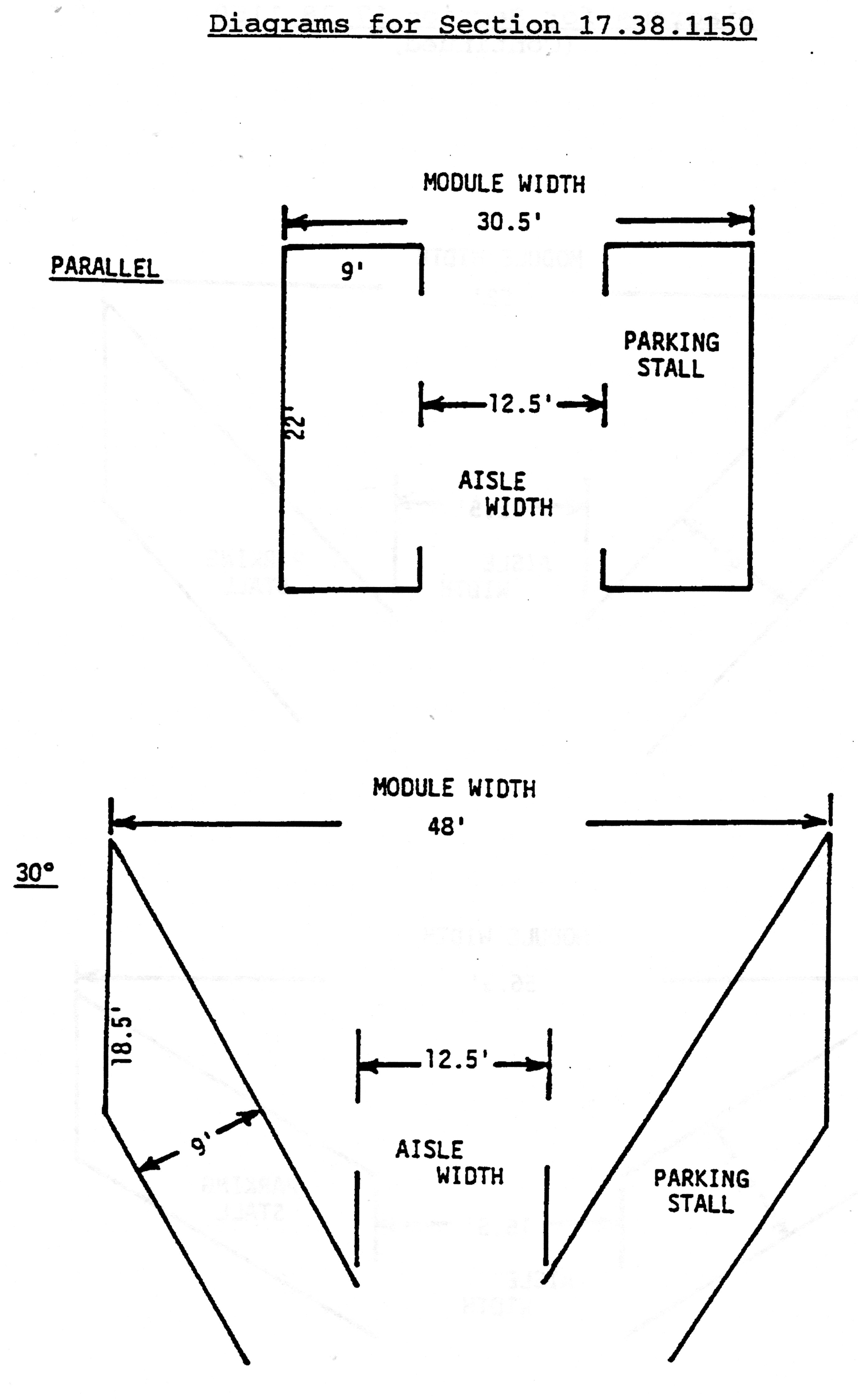
Diagrams for 17.38.1150
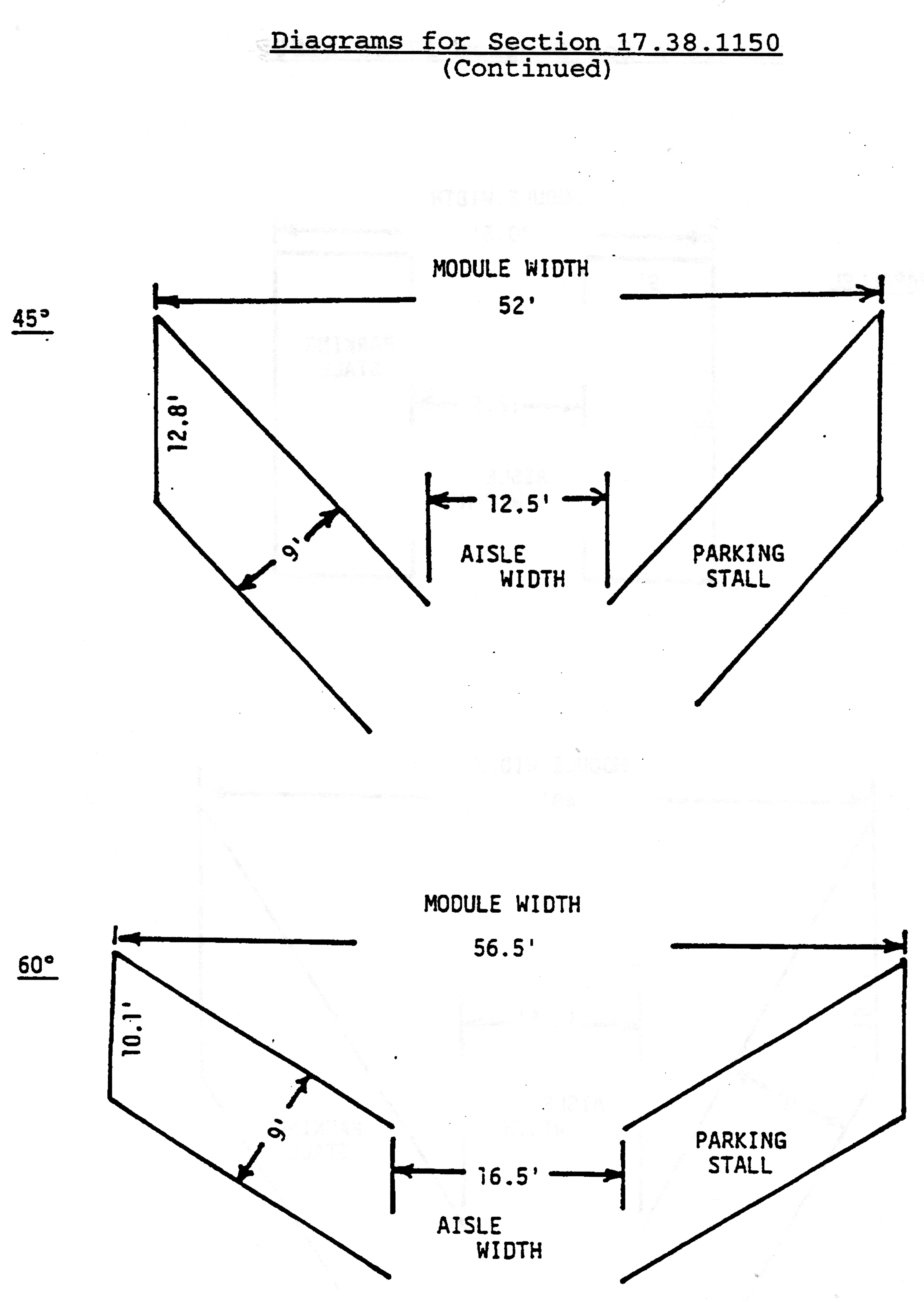
Diagrams for 17.38.1150
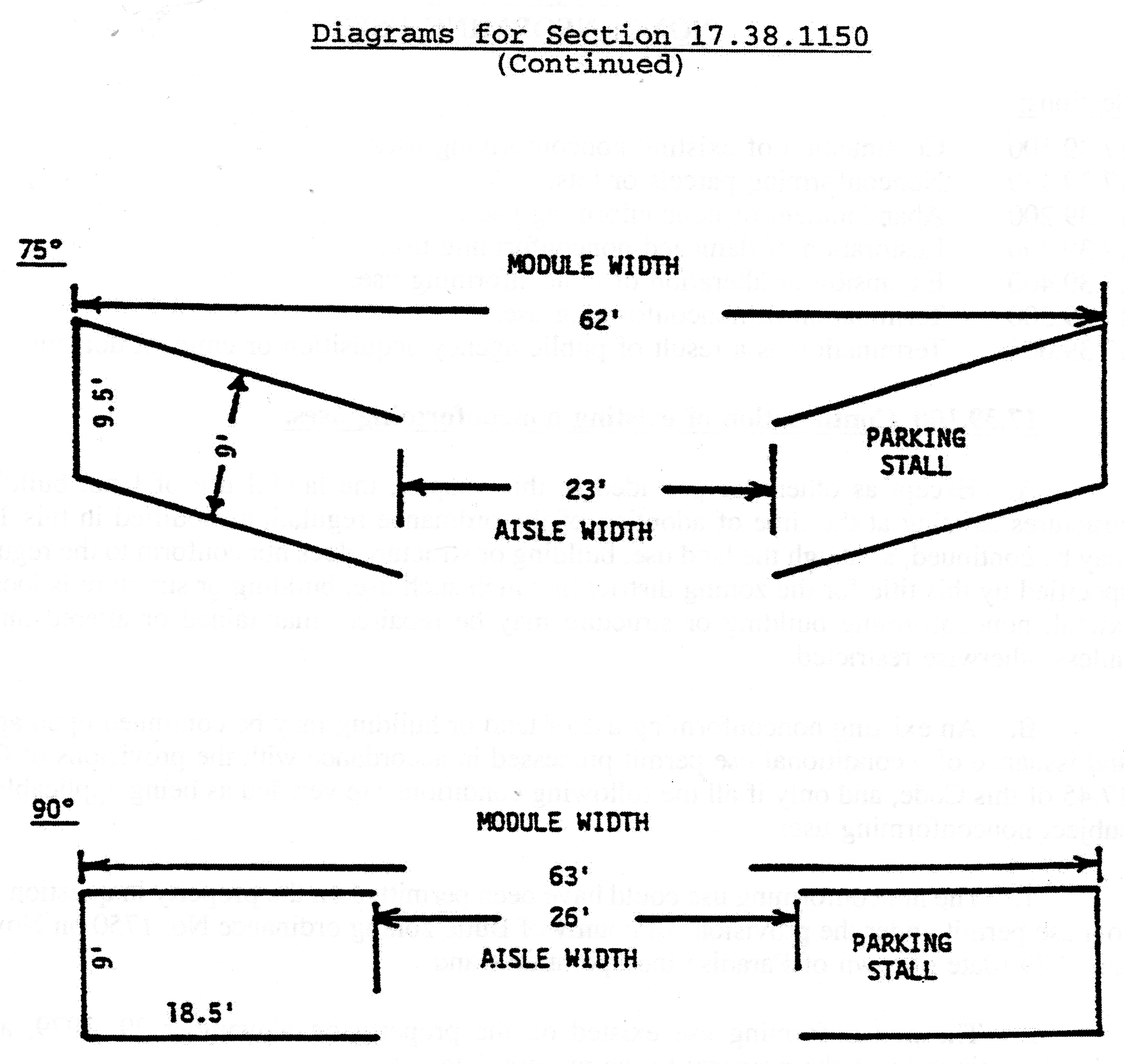
Diagrams for 17.38.1150
(Ord. 264, § 2(part), 1995; Ord. 214, § 2(part), 1992)

