
Paynesville City Zoning Code
ARTICLE I
- IN GENERAL
Sec. 36-1. - Penalties and enforcement.
Unless otherwise specifically provided in this chapter, violations of this chapter shall be subject to penalties as provided in section 1-11. Alternatively, the provisions of this chapter may be enforced by civil action including actions to abate or eliminate a public nuisance injunctive relief.
(Ord. No. 36(3rd Series), § 1, 9-12-2022)
Sec. 36-2. - Intent and purpose.
(a)
Generally.
(1)
The ordinance from which this chapter is derived is enacted pursuant to the authority conferred by M.S.A. § 462.357 for the purposes of:
a.
Promoting and protecting the public health, safety, and general welfare of the inhabitants of the city;
b.
Protecting and conserving the character, social and economic stability of agricultural, residential, commercial, industrial, and other use areas;
c.
Securing the most appropriate use of land;
d.
Preventing the overcrowding of the land and undue congestion of population;
e.
Providing adequate light, air, and reasonable access;
f.
Facilitating adequate and economical provision of transportation, water supply and sewage disposal; and
g.
Planning for location of schools, recreation facilities and other public requirements.
(2)
This chapter sets minimum and maximum standards for the height and size of buildings, the size of yards and other open spaces, the density of population, the location and use of buildings and land for trade, commerce, industry, residence and other purposes; creates districts for said purposes and establishes the boundaries thereof; provides for changes in regulations, restrictions and boundaries of such districts; defines certain terms used herein; and provides for enforcement and administration.
(3)
Except in the most unusual of circumstances, a variance to the chapter will be denied; see section 36-55.
(4)
Except as specifically otherwise permitted, uses, buildings, structures or premises not conforming to the requirements of this chapter are deemed to be a public nuisance.
(b)
Adult uses.
(1)
The purpose and intent of adult use regulations set forth in this chapter is to serve a substantial government interest in attempting to preserve the quality and vitality of neighborhoods, curtail the depression of property values, restrain increased criminal activity, and slow the spread of sexually transmitted diseases.
(2)
Adult use entertainments, because of their very nature, are recognized as having serious objectionable operational characteristics that have a deleterious effect on the use and enjoyment of adjacent areas. These secondary effects are especially evident where such uses are concentrated.
(3)
One of the chapter's objectives is to disperse the adult uses through separation requirements from other adult uses and from other significantly incompatible uses. The article allows adult uses only in the I-1 light industrial district.
(4)
The secondary effects associated with adult use include increased level of criminal activity, increased risk of exposure to sexually transmitted diseases, depression of property values and a significant change in the character of surrounding neighborhoods.
(5)
However, it is recognized that such regulations cannot de facto constitute a prohibition of adult uses. Otherwise, a protected form of expression would vanish. The adult use regulations as set forth in this chapter represent a balancing of competing interest: reduction of objectionable secondary effects through the regulation of adult uses versus the protected rights of owners, operators and performers and patrons of those adult uses.
(Ord. No. 36(3rd Series), § 1, 9-12-2022)
Sec. 36-3. - Jurisdiction, application, and interpretation.
(a)
Jurisdiction. The jurisdiction of this chapter shall apply to all of the area within the city.
(b)
Application and interpretation.
(1)
In their application and interpretation, the provisions of this chapter shall be held to be the minimum requirements for the promotion of the public health, safety, and welfare.
(2)
Where the conditions imposed by any provision of this chapter are either more or less restrictive than comparable conditions imposed by any law, ordinance, statute, resolution or regulation of any kind, the regulations which are more restrictive or which impose higher standards or requirements shall prevail.
(3)
No structure shall be erected, converted, enlarged, reconstructed, or altered without first obtaining a building permit and no structure or land shall be used for any purpose or in any manner which is not in conformity with the provisions of this chapter.
(4)
Except as herein provided, no building, structure or premises shall herein be used or occupied and no building permit shall be granted that does not conform to the requirements of this chapter.
(c)
Lots of record. All lots which are part of a subdivision legally recorded with the county recorder, and lots described by metes and bounds, the deed to which has been recorded in the office of the county recorder prior to the effective date of the ordinance from which this chapter is derived, shall be considered to be lots of record and shall thereby be considered a legally buildable lot even though such lots may not conform to the minimum requirements of this chapter, provided the setback requirements of this chapter are complied with insofar as practical.
(Ord. No. 36(3rd Series), § 1, 9-12-2022)
Sec. 36-4. - Rules and definitions.
(a)
Rules. For purposes of this chapter, words used in the singular number includes the plural, and the plural the singular; the present tense includes the past and future tenses and the future the present; the term "shall" is mandatory, the term "may" is permissive; all measured distances shall be to the nearest integral foot; whenever a word or term defined hereinafter appears in the text of this chapter, its meaning shall be construed as set forth in such definition thereof.
(b)
Definitions. The following words, terms, and phrases, when used in this chapter, shall have the meanings ascribed to them in this subsection, except where the context clearly indicates a different meaning:
Accessory building means a subordinate building or structure on the same lot or part of the main building, occupied by or devoted exclusively to an accessory use.
Accessory use means a use naturally and normally incidental to, subordinate to, and auxiliary to the principal permitted use of the premises.
Adult arcade means an establishment where, for any form of consideration, one or more motion picture projectors, slide projectors or similar machines for viewing by five or fewer persons are each used to show films, motion pictures, videocassettes, slides, or other photographic reproductions that are characterized by an emphasis upon the depiction or description of specified sexual activities or specified anatomical areas.
Adult bookstore means an establishment that has as a substantial portion of its stock-in-trade and offers for sale, for any form of consideration, any one or more of the following:
(1)
Books, magazines, periodicals or other printed matter, or photographs, films, motion pictures, videocassettes, slides, or other visual representations that are characterized by an emphasis upon the depiction or description of specified sexual activities or specified anatomical areas; or
(2)
Instruments, devices, or paraphernalia that are designed for use in connection with specified sexual activities.
Adult cabaret means a nightclub, bar, restaurant or similar establishment that regularly features live performances that are characterized by the exposure of specified anatomical areas or by specified sexual activities, or films, motion pictures, videocassettes, slides or other photographic reproductions in which a substantial portion of the total presentation time is devoted to the showing of material that is characterized by an emphasis upon the depiction or description of specified sexual activities or specified anatomical areas.
Adult motion picture theater means an establishment where, for any form of consideration, films, motion pictures, videocassettes, slides, or similar photographic reproductions are shown, and in which a substantial portion of the total presentation time is devoted to the showing of material characterized by an emphasis on the depiction or description of specified sexual activities or specified anatomical areas.
Adult theater means a theater, concert hall, auditorium or similar establishment characterized by activities featuring the exposure of specified anatomical areas or by specified sexual activities.
Adult use establishments include, but are not limited to: adult arcade, adult bookstore, adult cabaret, adult motion picture theater, adult theater, or sexual encounter establishment.
Agriculture use means the use of land for agricultural purposes, including farming, dairying, pasturage agriculture, horticulture, floriculture, viticulture, and animal and poultry husbandry and the necessary accessory uses for storing the products. The term shall include incidental retail sales by the producer of products raised on the farm.
Alley means a public right-of-way which affords a secondary means of access to abutting property. For the purpose of this chapter, alleys shall not be considered streets.
Animal includes any mammal, reptile, amphibian, fish, bird (including all fowl and poultry) or other member commonly accepted as part of the animal kingdom. Animals may be classified as follows:
(1)
Domestic Animals. These are animals commonly accepted as domesticated household pets. Unless otherwise defined, domestic animals shall include dogs, cats, caged birds, caged gerbils, caged hamsters, caged guinea pigs, domesticated rabbits, fish, non- poisonous, non-venomous and non-constricting reptiles or amphibians or other similar animals.
(2)
Farm Animals. Those animals commonly associated with farm or performing work in agricultural settings. Unless otherwise defined, farm animals shall include members of the equine family (horses, mules), bovine family (bulls, cows), sheep, poultry (chicken, turkeys), fowl (ducks, geese), swine (including Vietnamese pot belly pigs), goats, bees, ratitae (ostriches and emus), farm raised cervidae (caribou and mule deer) llamas and alpacas and other animals associated with a farm, ranch or stable.
(3)
Non-Domesticated Animals. Those animals commonly considered to be naturally wild and not naturally trained or domesticated or which are commonly considered to be inherently dangerous to the health, safety, and welfare of people. Unless otherwise defined, non-domestic animals shall include:
a.
Any member of the large cat family (family Felidae) including lions, tigers, cougars, bobcats, leopards, and jaguars but excluding commonly accepted domesticated house cats.
b.
Any naturally wild member of the canine family (family canidae) including wolves, foxes, coyotes, dingoes, and jackals but excluding commonly accepted domesticated dogs.
c.
Any crossbreed such as a crossbreed between a wolf and a dog, unless the crossbreed is commonly accepted as a domestic house pet.
d.
Any member or relative of the rodent family including any skunk (whether or not de-scented), racoon, squirrel or ferret but excluding those members otherwise defined or commonly accepted as domesticated house pets.
e.
Any poisonous, venomous, constricting or inherently dangerous member of the reptile or amphibian family including rattlesnakes, boa constrictors, pit vipers, crocodiles, and alligators.
f.
Any other animal which is not explicitly listed above but which can be reasonably defined by the terms of this section, including but not limited to bears, deer, monkeys, and game fish.
Antenna means any structure or device used to collect or transmit electrical magnetic waves, including, but not limited to directional antennas, such as panels, microwave dishes and satellite dishes, and omni-directional antennas, such as whip antennas.
Apartment means a dwelling unit within a house or building containing one or more units.
Apartment building means a building containing four or more apartments.
Area means for the purpose of lot coverage and setback, includes the surface area of the roof to the extent of overhangs of the structure (the whole roof including overhangs).
Assembly means putting together component parts.
Automobile gasoline service station means a building or structure designed or used for the retail sale or supply of fuels, lubricants, air, water, and other operating commodities for motor vehicles, and including the customary space and facilities for the installation of such commodities on or in such vehicles, but not including special facilities for the painting, major repair, or similar servicing thereof.
Automobile repair garage means any building or premises primarily used for the repair or mechanical maintenance of motor vehicles or trailers.
Automobile service station means any building or premises primarily used for dispensing of gasoline or diesel fuel.
Automobile wrecking yard, junkyard, or salvage yard means a place maintained for keeping, storing or piling in commercial quantities, whether temporarily, irregularly or continually; buying or selling at retail or wholesale any old, used or secondhand materials of any kind, including used motor vehicles, machinery, and/or parts thereof, cloth, rugs, clothing, paper, rubbish, bottles, rubber, iron or other metals, or articles which from its worn condition render it practically useless for the purpose for which it was made and which is commonly classed as junk. The term "auto wrecking yard" or "junkyard" shall include a lot or yard for the keeping of unlicensed motor vehicles or the remains thereof for the purpose of dismantling, sale of parts, sale as scrap, storage, or abandonment. This shall not prohibit the keeping of one unlicensed motor vehicle within a garage or other structure in residential districts or two unlicensed motor vehicles, not including farm implements, within a farm in the agricultural district.
Basement/cellar means that portion of a floor of a building which is wholly or partially, up to 50 percent, underground or below grade.
Bed and breakfast residence means an owner-occupied, single-family residence that provides lodging and meals to registered guests.
Bluff means the topographic feature such as a hill, cliff, or embankment having all of the following characteristics:
(1)
Part or all of the feature is located in a shoreland area;
(2)
The slope rises at least 25 feet above the ordinary high-water level of the waterbody;
(3)
The grade of the slope from the top of the bluff to a point 25 feet or more above the ordinary high-water level averages 30 percent or greater; and
(4)
The slope must drain toward the waterbody.
An area with an average slope of less than 18 percent over a distance for 50 feet or more shall not be considered part of the bluff.
Bluff impact zone means a bluff and land located with 20 feet from the top of a bluff.
Board of adjustment means the city council shall be the board exercising the authority to grant zoning amendments, conditional use permits and variances from the numeric requirements of this chapter, and to hear and decide appeals from an administrative decision or enforcement order of the zoning administrator.
Boardinghouse or rooming house means any dwelling occupied in any such manner that certain rooms in excess of those used by members of the immediate family and occupied as a home or family unit are leased or rented to persons outside of the family, without any attempt to provide therein cooking or kitchen accommodations, providing that accommodations are not provided for more than ten persons.
Body piercing means penetrating or making a hole in or through the human body to place jewelry or objects of metal, plastic, wood, bone, or other foreign material on an area for cosmetic purposes.
Boundary line means any line indicating the bounds or limits of any tract or parcel of land; also, a line separating the various use districts as shown on the zoning map.
Brewery means a facility used for the production of malt liquor as defined under M.S.A. § 340A.
Brew pub means an establishment offering a food menu in addition to malt liquor produced by an associated brewery.
Buffer area means a landscaped area intended to separate and/or partially obstruct the view of adjacent land uses or properties from one another.
Buildable area means that part of the lot remaining after required setbacks have been provided.
Building means any structure, either temporary or permanent, having a roof, and used or built for the shelter or enclosure of any person, animal, or personal property of any kind. When any portion thereof is completely separated from every other part thereof by division walls from the ground up and without openings, each portion of such building shall be deemed as a separate building. No building shall be located within the setback or interfere with any easement which interferes with the rights of the holder of that easement.
Building height means the vertical distance measured from the average ground level to the highest point of the roof surface.
Building, principal, means a building or structure in which is the main or principal use of the lot on which the building or structure is situated is conducted.
Building setback line means a line representing the distance which the building must be set back from the street right-of-way line or other property line.
Business means any occupation, employment, or enterprise wherein merchandise is exhibited or sold, or where services are offered for compensation.
Campground means an area or tract of land used or occupied by campers using tents or other portable shelters or vehicles designed specifically as their temporary housekeeping accommodations.
Camping trailers means any of the following:
(1)
Camping trailer: A folded structure mounted on wheels and designed for travel, recreation, and vacation uses.
(2)
Motor home: A portable, temporary dwelling to be used for travel, recreation, and vacation, constructed on an integral part of a self-propelled vehicle.
(3)
Pickup coach: A structure designed to be mounted on a truck chassis for use as a temporary dwelling for travel, recreation, and vacation.
(4)
Travel trailer: A vehicular, portable structure built on a chassis, designed to be used as a temporary dwelling for travel, recreation, and vacation.
Canopy and awning means any projecting structure, moveable or stationary, that is attached to and supported by a building.
Carwash means a building that provides facilities for washing and cleaning motor vehicles, which may use production line methods with a conveyor, blowing, or other mechanical devices, and which may employ some hand labor. Also referred to as automobile wash.
Carport means a structure permanently attached to a dwelling having a roof supported by columns, but not otherwise enclosed.
Cemetery means land used for the burial of the dead or remainders of the dead, including grave yards, burial grounds, tombs, columbariums, catacombs, vaults, and other repositories.
Church or place of religious worship means an institution, together with its accessory building and uses, where people regularly assemble to participate in or hold religious services, meetings, and other related activities, and which building, together with its accessory buildings and uses, is maintained, and controlled by a religious body organized to sustain public worship, including church cemeteries.
Clear-cutting means the removal of an entire stand of trees.
Clinic means a place used for the diagnosis and treatment of sick, ailing, infirm, injured persons, and those persons who are in need of medical attention. Overnight care facilities are not provided at the clinic.
Club or lodge means land, buildings or premises owned or operated by a corporation, association, or group of individuals for a social, educational, recreational, charitable, political, or patriotic purpose and such land, building, or premises are not available for unrestricted public access and use.
Commercial use means an occupation, employment or enterprise that is carried on for profit by the owner, lessee, or licensee.
Comprehensive plan means a compilation of goals, policy statements, standards, programs, and maps for guiding the physical, social, and economic development, both public and private, of the municipality and its environs (the surrounding area or district), as defined in the Minnesota Municipal Planning Act includes any unit or part of such plan separately adopted and any amendment to such plan or parts thereof.
Conditional use means a use which, because of unique characteristics, cannot be classified as a permitted use in any particular district. After due consideration, in each case, of the impact of such use upon neighboring land and of the public desirability for the particular use at the particular location, a conditional use permit may be granted.
Condominium means the legal arrangement by which separate units in a development are individually owned but in which the common areas are owned, controlled, and maintained through an organization consisting of all the individual owners.
Crematorium means a place where a dead body is reduced to ashes by fire, especially as a funeral rite.
Cul-de-sac means a local street, one end of which is closed and consists of a circular turn around.
Daycare facility means any state licensed facility, public or private, which for gain or otherwise, regularly provides one or more persons with care, training, supervision, habilitations, rehabilitation, or development guidance on a regular basis for periods of less than 24 hours per day, in a place other than the person's home. A daycare facility includes, but is not limited to: family daycare home, group family daycare homes, daycare centers, day nurseries, nursery schools, daytime activity centers, day treatment programs, day services.
Deck means a structure that may or may not have railings or access to the ground, but does not contain walls or a roof. May also be referred to as a balcony.
Display outside means a class of storage outside of the principle building where merchandise is visible and may involve active sales as well as passive sales (where items can be taken inside for actual purchase). Outside display of merchandise may be temporary or permanent, depending upon conditions of the permit and zoning district requirements of this chapter.
District zoning means any section of the incorporated area of the city within which certain uniform regulations and requirements or various combinations thereof apply under the provisions of this chapter.
Drive thru/in means any portion of a building from which business is translated, or is capable of being transacted, directly with customers located in a motor vehicle.
Driveway means a private way used by vehicles to gain access to an individual lot, parcel of land or private garage.
Dwelling means a building or portion thereof, designed exclusively for residential occupancy, including one-family, two-family and multiple-family dwellings, but not including motels, hotels, boardinghouses, and garage space.
Dwelling, multiple, means a building designed with three or more units for occupancy by three or more families living independently of each other, but share hallways and main entrances and exits.
Dwelling, single-family, means a dwelling occupied by only one family, and so designed and arranged as to provide cooking and kitchen accommodations and sanitary facilities for one family only.
Dwelling, two-family, means a dwelling so designed and arranged to provide cooking and kitchen accommodations and sanitary facilities for occupancy by two families.
Easement means the right to make use of another's property which is created by agreement or by some other legal means. Examples of an easement would be an easement for a trail or utility or to allow access to a lake, river, or other location across one's property. No building or structure shall be placed in a manner that interferes with the rights of the holder of that easement.
Equal degree of encroachment means a method of determining the location of encroachment lines so that the hydraulic capacity of floodplain lands on each side of a stream are reduced by an equal amount when calculating the increases in flood stages due to floodplain encroachments.
Essential services means the erection, construction, alteration or maintenance by public utilities or municipal departments or commissions of underground or overhead gas, electrical, communications, steam or water transmissions or distribution systems, including poles, wires, mains, drains, sewers, pipes, conduits, cables, fire alarm boxes, police call boxes, traffic signals, hydrants, towers, and other similar equipment and accessories in connection therewith, but not including buildings, reasonably necessary for the furnishing of adequate service by such public utilities or municipal departments or commissions for the public health, safety or general welfare.
Family means any number of persons living together in rooms comprising a single housekeeping unit and related by blood, marriage, or adoption, or any unrelated person who resides therein as though a member of the family including the domestic employees thereof. Any group of persons not so related but inhabiting a single house shall, for the purpose of this chapter, be considered to constitute one family for each five persons, exclusive of domestic employees, contained in each such group.
Farming means the cultivating or pasturing of a parcel of land or using it for the raising of livestock or fowl for commercial purposes.
Farmstead means property on which structures and a farm dwelling are located for management, storage and general farm operation.
Fence means any artificially constructed barrier of any approved material or combination of materials erected to enclose or screen areas of land.
Flood means a temporary rise in stream flow or stage that results in inundation of the areas adjacent to the channel.
Flood fringe means that portion of the floodplain outside of the floodway.
Flood areas mean land that is subject to either permanent or temporary flooding from any causes whatsoever. This includes lands that are flooded by overflowing streams, rivers, or lakes or by heavy rainfalls or seasonal runoff.
Floodplain means those areas adjoining a watercourse which have been or hereafter may be covered by the regional flood.
Floodproofing means a combination of structural provisions, changes or adjustments to properties and structures subject to flooding, primarily for the reduction or elimination of flood damages.
Floodway means the channel of the watercourse and those portions of the adjoining floodplains which are reasonably required to carry and discharge the regional flood.
Funeral home means a building or part thereof used for human funeral services. A funeral home shall not include facilities for cremation, unless allowed by a conditional use permit; see section 36-53.
Such building may contain space and facilities for:
(1)
Embalming and the performance of other services used in the preparation of the dead for burial.
(2)
The performance of autopsies and other surgical procedures on the dead.
(3)
The storage of caskets, funeral urns, and other related funeral supplies.
(4)
The storage of funeral vehicles.
(5)
Funeral chapel
Garage, community means any space or structure for the storage of motor vehicles or personal property for the use of two or more occupants of property in the vicinity and having no public shop or service therein.
Garage, private means an accessory building designed or used for the storage of automobiles, trucks, buses, or personal property owned and used by the occupants of the building to which it is accessory.
Group home means a residential facility, licensed (group home). A facility required to be licensed by the state or county that provides one or more persons with 24 hour per day substitute care, food, lodging, training, education, supervision, rehabilitation, or treatment that cannot be furnished in that person's own home. The licensed residential facilities (group homes) are limited to those facilities licensed and/or regulated by the department of human services and the department of health. This does not include licensed facilities whose primary purpose is to treat juveniles who have violated criminal statutes related to sex offenses or facilities licensed by the department of corrections.
Home occupation means any gainful occupation or profession engaged in by the occupant of a dwelling/residence at or from that dwelling/residence and carried on in the dwelling unit. Incidental garage or yard sales, Avon, Tupperware, Thirty-One, Mary Kay, Pampered Chef, similar one-time parties or working from home for someone else are not home occupations.
Home occupations shall be allowed as a temporary use in specified zoning districts if home occupation meets the following conditions:
(1)
The home occupation must be incidental to and secondary to the principal use of the premises as a dwelling/residence.
(2)
Not more than 25 percent of the gross floor area of the dwelling/residence shall be used for the home occupation as shown on the application for a temporary use permit.
(3)
No articles for sale shall be displayed so as to be visible from any street.
(4)
No employees not residing in the dwelling/residence or contracted to work on site in the home occupation.
(5)
The home occupation shall not use mechanical or electrical equipment which interferes unreasonably with the normal quiet of the residential neighborhood.
(6)
The home occupation shall not create odor, dust, noise, glare, or vibrations noticeable beyond the residential/dwelling lot.
(7)
The home occupation shall not generate on-street parking or excessive traffic.
(8)
The home occupation shall not require any physical alterations of the home which alter the character or appearance of the residence/dwelling.
Permissible home occupations include, but are not limited to, the following: art studio, seamstress, upholster, special offices of a clergyman, lawyer, architect, engineer, accountant, or real estate agent or appraiser, when located in a dwelling unit occupied by the same, and teaching, with musical, dancing, and other instruction limited to three pupils at a time.
Excluded from the temporary use are those permissible home occupations that don't have customers.
Hospital means an institution providing health services for humans, in-patients and medical or surgical care for the sick or injured. Includes related facilities such as laboratories, outpatient departments, training facilities, central service facilities, staff offices, and overnight accommodations for patients.
Hotel/motel means a facility offering transient lodging accommodations on a daily or weekly rate to the general public and may provide additional services such as restaurants, meeting rooms, and recreational facilities.
Impervious surface means all structures with a roof (includes the roof area of all structures for the purpose of this chapter and calculation of lot coverage limits).
Impervious surface (for the purpose of the shoreland overlay district) means a constructed hard surface that prevents or retards entry of water into the soil and causes water to run off the surface in greater quantities and at an increased rate of flow than prior to development, including rooftops; decks; sidewalks; patios; swimming pools; parking lots; concrete, asphalt, gravel driveways, or other similar surfaces.
Industrial, heavy means a use engaged in the basic processing and manufacturing of materials or products predominately from extracted or raw material, or a use engaged in storage or manufacturing process using flammable, or explosive materials, or a storage or manufacturing process that potentially involves hazardous or commonly recognized offensive conditions.
Industrial, light means a use engaged in the manufacture, predominately from previous prepared materials, of finished products or parts, including processing, fabrication, assembly, treatment, packaging, storage, sales, and distribution of such products.
Junk, junkyard includes:
(1)
Any accumulation of unlicensed, unregistered, or inoperable motor vehicles;
(2)
Any accumulation of inoperable machinery, mechanical equipment, agricultural implements, motorized vehicles, bicycles, boats, outboard motors, or components thereof;
(3)
Any accumulation of household furniture, furnishings, or appliances or parts or components thereof;
(4)
Any accumulation of household waste, metal, lumber, glass, paper, rubber, concrete, yard waste or other material, whether organic or inorganic, resulting from building construction, renovation, remodeling, demolition, or otherwise accumulated;
(5)
Any accumulation of fallen tree or brush materials including wood, branches, and leaves, except as immediately processed into lumber, wood for fuel or other such ultimate use and neatly stacked or stored.
It is determined that the uses, structures, and activities and causes of blight or blighting factors described in this article, if allowed to exist, will result in blighted and undesirable neighborhoods, so as to be harmful to the welfare, health, and safety of the public. No person shall maintain or permit to be maintained any causes of blight or blighting factors upon any property such as follows:
(1)
With the exception of a permitted junkyard or salvage yard, the storage or accumulation of junk or other refuse shall not be kept outside of an enclosed structure. Building materials may be kept outside of an enclosed structure for a maximum of 30 days following the expiration of a building permit for which such material has been acquired. For purposes of this subsection, the term "junk" is defined as any material or substance which does not serve, nor is it intended to serve, any useful purpose or the purpose for which it was originally intended. Junk is considered to include but not be limited to refuse, empty cans, bottles, debris, used furniture and appliances, and so forth.
(2)
In any area the existence of a structure which, because of fire, wind, natural disaster, or physical deterioration, is no longer suitable as a dwelling, nor useful for any other purpose for which it was intended, is prohibited.
(3)
In any area zoned for residential purposes, the existence of a vacant dwelling, garage, or other outbuilding, unless such building is kept securely locked, the windows are kept glazed or neatly boarded up, and is otherwise protected to prevent entrance thereto by vandals, is prohibited.
(4)
In any area, the storage of junk automobiles is prohibited. For the purpose of this subsection, the term "junk automobile" shall include any motor vehicle, part of a motor vehicle, or former motor vehicle, stored in the open, which is not currently licensed for use upon the highways of the state and is either:
a.
Unusable or inoperable because of lack of or defects in component parts;
b.
Unusable or inoperable because of damage from collision, deterioration, or having been cannibalized;
c.
Beyond repair and therefore not intended for future use as a motor vehicle; or
d.
Being retained on the property for possible use of salvageable parts.
Kennel means an establishment licensed to operate a facility housing dogs, cats, or other household pets and where grooming, breeding, boarding, training, or selling of animals is conducted as a business or commercial use.
Laundromat means a business that provides washing and drying machines to be used by customers on the premises.
Livestock means domesticated animals raised in an agriculture setting to provide labor and produce commodities such as meat, eggs, milk, fur, leather, and wool.
Lot means a tract or parcel of land.
Lot area means the area of a horizontal plane within the lot lines.
Lot, conforming means a lot that conforms to the minimum width, area, and frontage requirements of this chapter.
Lot, corner means a lot situated at the junction of two or more intersecting streets, or a lot at the point of deflection in alignment of a single street, the interior angle of which is 135 degrees or less.
Lot coverage means the part or percentage of the lot occupied by buildings or structures, including accessory buildings or structures.
Lot depth means the shortest horizontal distance between the front lot line and the rear lot line measured from a 90-degree angle from the street right-of-way within the lot boundaries.
Lot frontage means the front of a lot shall be, for purposes of complying with this chapter, that boundary abutting a public right-of-way having the least width. Parcels that front more than one public right-of-way (double or triple fronted) and have structures with multiple entrances will use the facility address as the front.
Lot line/property line means a property boundary line of any lot held in single or separate ownership: except that where any portion of the lot extends into the abutting street or alley, the lot line shall be deemed to be the street or alley right-of-way.
Lot, nonconforming means a lot or parcel of land that has less than the required minimum area, width, and frontage as required by this chapter.
Lot of record means a lot which is part of a subdivision, the map of which has been recorded in the office of the county recorder, or a lot described by metes and bounds, the deed to which has been recorded in the office of the county recorder prior to the effective date of the ordinance from which this chapter is derived.
Lot width means the shortest horizontal distance between the side lot lines measured at the front right-of-way line.
Manufactured home/mobile home means a structure transportable in one or more sections which in the traveling mode is eight feet or more in width or 40 feet (the length of the manufactured home less the tongue for towing), or when erected on-site is 320 or more square feet, and which is built on a permanent chassis and designed to be used as a dwelling with or without permanent foundation when connected to required utilities, and includes the plumbing, heating and air conditioning and electrical systems contained therein, and which meets all the requirements established under M.S.A. § 327.31, as it may be amended from time to time, the Manufactured Home Building Code.
Manufactured home park/mobile home park. Any site, lot, or tract of land upon which two or more manufactured homes are located, either free of charge or for compensation, and includes any building, structure, tent, vehicle, or enclosure used or intended to be used as part of the equipment of the manufactured home park.
Manufacturing means making or production of goods on a large scale by hand, machine, or both.
Medical marijuana as defined in M.S.A. § 152.22, Subd. 6, means any species of the genus cannabis plant, or any mixture or preparation of them, including full plant extracts and resins, and is delivered in the form of:
(1)
Liquid, including but not limited to, oil.
(2)
Pill.
(3)
Vaporized delivery method with use of liquid, or oil, but which does not require the use of dried leaves or plant form.
(4)
Any other method, including smoking.
Medical marijuana dispensary means any distribution facility authorized by the commissioner of health under M.S.A. Chapter 152.
Modular home means a non-mobile housing unit that is basically fabricated at a central factory and transported to a building site where final installations are made, permanently affixing the module to the site, and bears a seal from the state stating that the unit is approved by the state building inspector certifying that the unit is a manufactured building and complies with the state building code. A modular home shall be congruous to a single-family dwelling.
Net area means the area open to the public.
Nonconforming building, structure, or use means a building, structure or use which does not conform with the district regulations in which it is situated.
Nonconforming use means a use that does not comply with the use regulations of this chapter.
Nursing homes means a place, residence, or home used for the boarding and care of the elderly or persons who are dependent upon the service of others.
Official zoning map means a map established by the governing body, in accordance with state statutes, showing streets, highways and zoning districts.
Off-street loading space means a space accessible from a street, alley, or driveway for use by trucks or other vehicles while loading or unloading merchandise or materials. Such space shall be of size as to accommodate one vehicle of the type typically used in the particular business.
Open space, common means open space within or related to a development designed and intended for the common use or enjoyment of the occupants of the development. Parking or driveways shall not be considered permitted open space.
Ordinary high-water mark is defined in M.S.A. § 103G.005 and includes a mark delineating the highest water level which has been maintained for a sufficient period of time to leave evidence upon the landscape. The ordinary high-water mark is commonly that point where the natural vegetation changes from predominantly aquatic to predominantly terrestrial.
Outside storage means the storage of goods, materials, equipment, manufactured products, or similar items outside any enclosed building.
Packaging means placing goods into containers.
Park means any public or private land available for recreational, educational, cultural, or aesthetic use.
Parking lot means an off-street area used for the temporary parking of motor vehicles.
Parking space means an area sufficient in size to store one standard automobile, which has adequate access to a public street or alley. Not less than 9 × 20 feet.
Patio means an attached or unattached structure at ground level that does not contain walls or a roof, and is not used for parking purposes.
Permitted use means a use which may be lawfully established in a particular district, provided it conforms with all requirements and performance standards, if any, of such district.
Principal structure or use means the permitted or conditional use of a property or structure. Also, may be defined as the main and predominate use of land or structures as distinguished from a secondary or accessory use.
Public land means the land owned or operated by the city, school district, county, state, or other governmental unit.
Public waters means any waters of the state which serve a beneficial public purpose, as defined by M.S.A. § 103G.005, as amended.
Ramp means a structure attached or unattached to a principal or accessory building constructed at a slope that meets the uniform building code requirements for the purposes of providing access to a building.
Recreational vehicle means a vehicle that is built on a single chassis, is 400 square feet or less when measured at the largest horizontal projection, is designed to be self-propelled or permanently towable by a light duty truck, and is designed primarily not for use as a permanent dwelling but as temporary living quarters for recreational, camping, travel, or seasonal use. For the purposes of this section, the term "recreational vehicle" shall be synonymous with the term "travel trailer/travel vehicle."
Regional flood means a flood which is representative of large floods known to have occurred generally in the state and reasonably characteristic of what can be expected to occur on an average frequency in the magnitude of 100 years recurrence interval.
Regulatory flood protection elevation means a point not less than one foot above the water surface profile associated with the regional flood plus any increases in flood heights attributable to encroachments on the floodplain. It is the elevation to which uses regulated by this article are required to be elevated or floodproofed.
Setback means the minimum horizontal distance between a building and the lot line (building overhang is part of the building).
Sewing means to create, make, or repair garments or other goods with needle and thread, for example, a seamstress or tailor.
Screen means the utilization of a fence, wall, vegetation, or other approved means, in order to conceal from view.
Shelter means a non-profit, charitable, or religious organization providing boarding and/or lodging and ancillary services on the premises to person or persons in need of shelter.
Shoreland means the land located within the following distances from public waters:
(1)
1,000 feet from the normal high-water mark of a lake, pond, or flowage;
(2)
300 feet from a river or stream, or the landward extent of a floodplain designated by this chapter on such a river or stream, whichever is greater. The practical limits of shorelands may be less than the statutory limits wherever the waters involved are bounded by natural or manmade topographic divides which extend landward from the waters for lesser distances.
Specified anatomical areas means and includes any of the following:
(1)
Less than completely and opaquely covered human genitals, pubic region, buttocks, anus or female breasts below a point immediately above the top of the areolae; or
(2)
Human male genitals in a discernibly turgid state, even if completely and opaquely covered.
Specified sexual activities means and includes any of the following:
(1)
The fondling or other erotic touching of human genitals, pubic region, buttocks, anus, or female breasts;
(2)
Sex acts, actual or simulated, including intercourse, oral copulation, or sodomy;
(3)
Masturbation, actual or simulated; or
(4)
Excretory functions as part of or in connection with any of the activities set forth in subsections (1)—(3) of this definition.
Short term rental means a dwelling or portion of a dwelling, rented for a period of less than 30 days. No more than one rental of a short term rental dwelling or portion thereof shall be permitted per day. Use of a short term rental dwelling for any commercial events (such as a small conference center, private retreat center) is prohibited. Per hour rental is prohibited. Short term rentals are only permitted for residential uses.
Storage facility means a commercial building or group of buildings that contain varying sizes of individual compartmentalized and controlled stalls or lockers for the storage of customer's goods or wares.
Story means that portion of a building included between the surface of any floor and the surface of the floor next above it, or the space between such floor and the ceiling next above it. A basement shall be considered a story if its ceiling is over five feet above the average established grade.
Structure means anything which is built, constructed or erected, an edifice or building of any kind above ground level, or any piece of work artificially built up and/or composed of parts joined together in some definite manner. Excluding temporary pools, dog houses, swing sets, clothes lines, raised flower beds or gardens, and dog kennels which don't require a permit. No structure except as specifically provided herein shall be located within the setbacks. No structure shall be placed in a manner that interferes with the rights of the holder of that easement.
Swimming pool means any structure intended for swimming or recreational bathing. This includes in-ground, above ground and on-ground swimming pools that remain up year round.
Taproom means an establishment offering for consumption malt liquor produced in an on-premises or adjacent brewery. M.S.A. § 340A rules apply.
Tattooing means the marking of the skin of a person with insertion of permanent colors by introducing them through puncture of the skin.
Temporary pool means a pool which is removed after the end of a swimming season. Remove does not mean empty, it means remove.
Temporary structure means any structure which is moved or constructed to temporarily meet the needs of a landowner in a commercial or industrial district who has lost the use of a permanent structure which has been destroyed or seriously damaged by fire, storm, or other natural disaster.
Townhouse/Row house means single-family attached units in structures housing three or more dwelling units contiguous to each other, only by the share of one common wall, and each dwelling unit shall have separate and individual front and rear entrances.
Use means the purpose for which land or buildings thereon are designed, arranged, or intended to be occupied or used, or for which they are occupied or maintained.
Variance means the waiving of specific literal provisions of this chapter in instances where their strict enforcement would cause practical difficulties because of circumstances unique to the individual property under consideration. Variances are to be granted only when it is demonstrated that a waiving of the provision will be in harmony with the general purpose and intent of this chapter and when the variance is consistent with the comprehensive plan. Furthermore, the applicant must show that there are practical difficulties in complying with this chapter.
Yard means an open space on the lot which is unoccupied and unobstructed from the ground level to the sky.
Yard, front means a yard extending across the front of the lot between the side lot lines and lying between the front line of the lot and the nearest line of the principal building.
Yard, rear means a yard extending across the full width of the lot and lying between the rear line of the lot and the nearest line of the principal building.
Yard, side means a yard between the side line of the lot and the nearest line of the principal building and extending from the front line of the lot to the rear yard.
Zoning administrator means the person assigned by the city council to perform the administrative responsibilities under this chapter.
Zoning, district means any section of the incorporated area of the city within which certain uniform regulations and requirements or various combinations thereof apply under the provisions of this chapter.
(Ord. No. 36(3rd Series), § 1, 9-12-2022; Ord. No. 55(3rd Series), § 1, 12-9-2024)
Sec. 36-5. - General requirements.
(a)
Intent. The intent of this section is to establish general development performance standards. The regulations provided herein shall apply equally to all districts except where special provisions provide otherwise.
(b)
Parking and loading requirements.
(1)
In all zoning districts, with the exception of allowed uses in the C-1 district, off-street parking facilities for motor vehicles for the use of occupants, employees and patrons of the buildings or structures hereafter erected, altered or extended after the effective date of the ordinance from which this chapter is derived shall be provided and maintained as herein prescribed.
(2)
Parking of automobiles and other motor vehicles is permitted in the front and side yards in industrial districts if a greenspace of eight feet in width is retained between the road right-of-way or side lot line.
a.
Loading space shall not be construed as supplying off-street parking space.
b.
When units or measurements used in determining the number of required parking spaces result in requirement of a fractional space, any fraction up to and including one-half shall be disregarded and fractions over one-half shall require one parking space.
c.
Whenever a use requiring off-street parking is increased in floor area and such use is located in a building existing on or before the effective date of the ordinance from which this chapter is derived, additional parking space for the additional floor area shall be provided and maintained in amounts hereafter specified for that use.
Floor area means the gross floor area used or intended to be used for services to the public such as customers.
d.
Off-street parking facilities for dwellings shall be provided and located on the same lot or parcel of land as the building they are intended to serve.
e.
The location of required off-street parking facilities for other than dwellings shall be within 300 feet of the building they are intended to serve, measured from the nearest point of the off-street parking facilities and the nearest point of the building or structure.
f.
Where a use is not specifically mentioned, off-street parking requirements shall be the same as for similar uses.
g.
Nothing in the ordinance from which this chapter is derived shall be construed to prevent collective provisions of off-street parking facilities for two or more buildings or uses, provided, collectively, that such facilities shall not be less than the sum of the requirements for the various individual uses computed separately in accordance with the requirements in the subsections below.
h.
Nothing in this chapter shall prevent the extension of or an addition to a building or structure into an existing parking area which is required for the original building or structure when the same amount of space taken by the extension or addition is provided by an enlargement of the existing parking area, or an additional area within 300 feet of such building.
i.
The amount of required off-street parking space for new uses or buildings, additions thereto and additions to existing buildings as specified in subsection (b)(1) of this section shall be determined in accordance with the following, and the space so required shall be irrevocably reserved for such use.
1.
Two-family and townhouse units: Two spaces per unit.
2.
Boarding/rooming/halfway/transient housing: At least two parking spaces for each three persons for whom accommodations are provided for sleeping.
3.
Multiple-family dwellings: Two spaces per unit.
4.
Motels/hotels: One space per each rental unit plus one additional space for each ten units and one space for each employee on any shift.
5.
Church, funeral home, theatre, auditorium, sports arena: At least one parking space for each three and one-half seats based on the largest area of assembly.
6.
Hospitals: Two spaces per each bed.
7.
Medical, dental or hospital outpatient clinic: One space for each 110 square feet of net floor area or seven and one-half spaces per doctor, whichever number of parking spaces is greater.
8.
Nursing home or similar facilities: Four spaces plus one for each three beds for which accommodations are offered and one space for each employee on the work shift that has the maximum number of employees.
9.
Elderly (senior citizen) housing/Assisted living: three-fourths space per unit and one space for each employee on the work shift that has the maximum number of employees.
10.
Office buildings and professional offices: One space for each 250 square feet of floor area.
11.
Bowling alley: At least five parking spaces for each alley, plus additional spaces as may be required herein for related uses contained within the principal structure.
12.
Gas station: At least four off-street parking spaces plus two off-street parking spaces for each service stall. Those facilities designed for sale of other items than strictly automotive products, parts and/or service shall be required to provide additional parking in compliance with other applicable sections of this chapter.
13.
Retail store and service establishment: At least one off-street parking space for each 200 square feet of retail floor area.
14.
Retail sales and service business with 50 percent of gross floor area devoted to storage, warehouse and/or industry: One space for each 200 square feet devoted to public sales and/or service plus one space for each 500 square feet of storage area or one space for each employee on the work shift that has the maximum number of employees.
15.
Restaurants, drive ins, takeout establishments, cafes, private clubs serving food and/or drinks, bars, taverns, nightclubs: At least one space for each 60 square feet of customer occupancy space. 16. Auto repair, boats and marine sales and repair: Eight off-street parking spaces, plus one additional space for each 800 square feet of floor area over 1,000 square feet.
17.
Manufacturing, fabricating, or processing of a product or material; warehouse, storage, handling of bulk goods, post offices: At least eight spaces, plus one space for each two employees on each shift based on maximum planned employment or at a minimum one space for each 700 square feet of floor area.
18.
Car wash:
(i)
Automatic drive through, serviced: A minimum of two spaces for vehicles waiting or one space for each employee on the maximum shift, whichever is greater.
(ii)
Self-service: A minimum of two spaces for vehicles waiting for service.
(iii)
Gas station car wash: Zero in addition to that required for the station.
20.
School parking, elementary and junior high: One space per seven students based on design capacity.
21.
School parking, senior high: One space per three students based on design capacity, plus one space per classroom in addition to auditorium and gymnasium parking requirements.
22.
Group home: Two spaces plus one for every three beds.
j.
In all districts where off-street parking lots are permitted or required, such off-street parking lots shall be constructed and maintained subject to the following regulations:
1.
Adequate ingress and egress shall be provided.
2.
Such parking lots shall be maintained in a usable dustproof condition, such as concrete, blacktop, or properly treated crushed rock, or some other permanently surfaced area and shall be kept graded and drained to dispose of surface water.
3.
Whenever such parking lot boundary adjoins property zoned for residential use, a setback of eight feet from the line shall be required.
4.
Necessary curbs or other protections against damage to adjoining properties, streets and sidewalks shall be provided and maintained.
5.
Plans for the construction of any such parking lot must be approved by the city engineer before construction is started. No such land shall be used for parking until approved by the city engineer.
(c)
Accessory buildings.
(1)
In all districts, except industrial, detached accessory buildings shall be located no closer to the right-of-way than the principle building and shall be set back a minimum of 20 feet from the right-of-way. When located within ten feet of the rear overhang of the principle building, they shall comply with all yard requirements applicable to the principle building in the district. Where accessory buildings are to be located more than ten feet from the rear overhang of the principle building, they shall not be located closer than five feet from an adjoining side or rear lot line.
All detached accessory buildings shall be set back a minimum of 20 feet from the front street right-of-way line and a minimum of 20 feet from all other street right-of-way lines (when double fronted) except alleys and a minimum of 20 feet from all other street right-of-way lines (when triple fronted), except alleys.
Accessory buildings are further limited not to exceed 19 feet in height to the highest point on the roof's surface.
(2)
All garages shall, if the vehicle entrance backs upon a public street or alley, be set back at least ten feet from the public alley right-of-way.
(3)
In no case shall the door of any structure, building, or improvement, except a fence, be erected or constructed so as to extend beyond any lot line.
(4)
In an industrial district, accessory buildings and uses may occupy any of the ground area which the principal building is permitted to occupy. Accessory buildings such as buildings for parking attendants, guard shelters, gate houses and transformer buildings may be located in front or side yards in the industrial district. Parking of automobiles and other motor vehicles is permitted in the front and side yards in industrial districts if bordered by a yard area five feet in width between parking and any road right-of-way.
(d)
General fencing, screening, landscaping, and storage.
(1)
All materials and equipment, except as provided in the district provisions of this chapter, shall be stored within a building or structure, or screened so as not to be visible from adjoining properties, except the following:
a.
Usable laundry equipment (clotheslines).
b.
Recreational equipment and vehicles.
c.
Construction and landscaping material currently being used on the premises.
d.
Barbecue grill.
e.
City provided garbage and recycling carts.
f.
Motor vehicles and trailers which are operable and licensed.
(2)
Corner lots.
a.
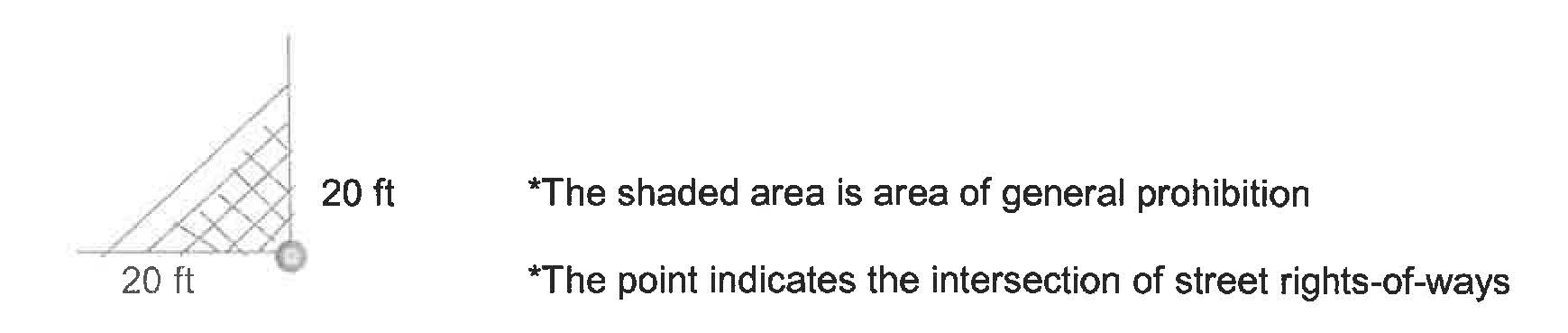
Prohibitions: Generally, it is prohibited to have fences, walls, structures, coniferous trees, or other obstructions on corner lots within 20 feet from the intersection of the two streets rights-of-way which create a corner lot.
b.
Exceptions: Within the 20 feet from the intersection of the two street rights of way, which create the corner lot, it is permissible to have either:
1.
Objects not exceeding 30 inches in height; or
2.
A chain link fence not exceeding four feet in height with standard chain link fence openings and no screening.
(3)
Height. No fence shall exceed eight feet in height and, in the case of grade separation, the height shall be determined on the basis of measurement from the average point between the highest and lowest grade.
(4)
Setback. Fences shall be set back a minimum of two feet from all property lines to allow the property owner to maintain it, unless it is agreed upon in writing by the abutting property owner(s) in a document that shall be recorded with the county.
(5)
No permit will be issued until the applicant provides the original recorded document to the city.
(6)
In all commercial and industrial districts adjacent to residential districts and not divided by streets there shall be provided along the property line a 20-foot-wide planting strip composed of grass, trees, and shrubs. A screening fence may be utilized when approved by the planning board. Such fence shall not exceed eight feet in height nor be less than six feet in height and shall screen not less than 80 percent per square yard of area.
(7)
In all zoning districts, the lot area remaining after providing for parking, driveways, loading, sidewalks, or other requirements shall be planted and maintained in grass, sodding, shrubs, native plantings, or other landscaping techniques.
(8)
Except in the agricultural zone, no above ground fence or wall shall be constructed to include an electrically charged element or barbed wire.
(9)
Approved materials. All fences in all districts shall be constructed of stone, concrete, brick, finished wood, wire hog panels, wire cattle panels, ribbed steel chained link or vinyl. Ribbed steel in or abutting residential districts shall be colored steel. The finished side of the fence, or that side of the fence without exposed support or posts, shall face the neighboring property or streets. All fences shall include posts and the posts must be treated for ground contact. Non-boarder fences around gardens and animal enclosures are exempt from permits.
(10)
Maintenance. Every fence or wall shall be maintained in a good and safe condition at all times. Every damaged or missing element of any fence or wall shall be repaired or replaced immediately.
(11)
Right-of-way setbacks. No fence, wall, hedge, or other screening device shall be permitted to encroach on any public right-of-way.
(e)
Unplatted property improvements:
(1)
Any person desiring to improve unplatted property shall submit to the city engineer a survey of the premises and information on the location and dimensions of proposed buildings, location of easements crossing the property and other information which may be necessary to ensure conformance to the provisions of this Code.
(2)
All buildings shall be so placed so that they will not obstruct future streets which may be constructed by the city in conformity with existing streets and according to the system and standards employed by the city.
(3)
The planning board shall review the lot survey to determine if the division and creation of the property was in compliance with the statutes and regulations applicable at the time of the division. If the planning board finds that the division of the property was in compliance with legal requirements applicable at the time of the division, the lot shall be recognized and development of the property shall be allowed in the conformance to the building and zoning regulations. If the planning board finds that the division of the property was not in compliance with legal requirements applicable at the time of the division, the lot shall not be recognized and current standards and procedures for platting shall be imposed.
(f)
Dwelling unit restrictions.
(1)
No basement, cellar, garage, tent, or accessory building shall at any time be used as a residence or dwelling unit, temporarily or permanently except as part of a completed residential structure.
(2)
Except in the case of planned unit developments provided for herein, not more than one principal building shall be located on a lot.
(3)
On a through lot (a lot fronting on two parallel streets) or a corner lot, both street right-of-way lines shall be front lot lines for applying yard and parking requirements.
(g)
General performance standards.
(1)
Sewage. All sewage facilities shall be connected to community sewer facilities when available. Where sewers are not constructed or in operation, all sewage facilities shall be connected to approved septic tanks and disposal fields. This provision shall not apply to temporary construction sites, or portable toilet.
(2)
Lighting. Any lighting used to illuminate an off-street parking area, sign or other structure shall be arranged as to deflect light away from any adjoining residential zone or from the public streets. Direct or sky-reflected glare, where light from floodlights or from high temperature processes such as combustion or welding, shall not be directed into an adjoining property. The source of lights shall be hooded or controlled in some manner so as not to light adjacent property or public rights-of-way. Any light or combination of lights which cast light on a public street shall not exceed one foot-candle (measure of brightness) as measured from the centerline of the street. Any light or combination of lights which cast light on residential property shall not exceed 0.4 foot-candles (measure of brightness) as measured from the property.
a.
Exterior lighting. All exterior lighting in all districts shall be shielded to reduce glare going upward or extending substantially beyond the property intended to be lit, to reduce glare and to reflect away from residential districts or adjacent residences in such a way as not to exceed 3 foot-candles measured at the residency boundary.
b.
All lighting in all districts used for external illumination of buildings shall be placed and shielded so as to not interfere with the visions of persons on adjacent roadways or adjacent properties.
c.
Outdoor lighting shall be maintained so that such lighting is stationary and constant in intensity and color at all times when in use.
d.
The following types of light trespass are prohibited:
1.
Any light not designed for roadway illumination that produces direct or reflective glare that could disturb the operation of a motor vehicle.
2.
Any light that may be confused with, or construed as, a traffic control device, except as authorized by state, federal or local government.
e.
Unshielded light. The use of an unshielded light, including incandescent lightbulbs hung or strung on poles, wires, or any other support to illuminate buildings, structures, outdoor areas, outdoor storage or display areas are prohibited, except on a temporary basis in areas where special events, carnivals, fairs, other similar activities are held and only when such activities are taking place.
f.
Exceptions. A light placed on the ground and aimed upwards so as to illuminate a flag is allowed, but shall be placed in such a manner as to not cast light on adjoining properties.
1.
Temporary holiday lighting can be displayed no more than 45 days prior to or 45 days post the holiday.
(3)
Emissions.
a.
Smoke. The emission of smoke by any use shall be in compliance with and regulated by the Minnesota Pollution Control Standard, and as subsequently expanded, modified or amended.
b.
Dust and other particulate matter. The emission of dust, fly ash or other particulate matter by any use shall be in compliance with and regulated by the Minnesota Pollution Control Standard, and as subsequently expanded, modified or amended.
c.
Odors. The emission of odorous matter in such quantity as to be offensive shall not be permitted. The emission of odor by any use shall be in compliance with and regulated by the Minnesota Pollution Control Standard, and as subsequently expanded, modified or amended.
d.
Noise. All noise shall be muffled so as not to be objectionable due to intermittence, beat frequency or shrillness and, as measured at any property line, shall comply with standards established by the Minnesota Pollution Control Standards noise pollution control, and as subsequently expanded, modified or amended.
(h)
Height and yard exceptions.
(1)
Chimneys, air conditioning or HVAC, drive-in movie theater screens, smoke stacks, water towers, radio or television towers, antennas, monuments, cupolas, flagpoles, radio or cell, television towers, steeples and mechanical appurtenances pertaining to and necessary to the permitted use of the district in which they are located shall not be included in calculating the height of the principal structure.
(2)
Outside stairways, fire escapes, porches, platforms, decks, balconies, boiler flues, heating or cooling units, generators and other similar projections shall be considered as part of the building and not allowed as part of the required space for yards or unoccupied space such as setbacks. This provision shall not apply to one fireplace or one chimney, not more than eight feet in length and projecting not more than 30 inches into the allowable side yard space, nor cornices not exceeding 16 inches in width, nor to platforms, terraces, or steps below the ground level. Unenclosed projections which extend into a front, rear, or side yard not more than five feet shall not be a violation of the setback requirement in the residential districts.
(3)
Handicapped accessible ramp. A non-permanent handicap accessible ramp that cannot meet the setback and grade requirement may apply for a placement permit and sign a ramp agreement for a one year waiver. Thereafter, the applicant may obtain an extension of the waiver annually, provided that the ramp shall be removed when the handicap need no longer exists.
(i)
Intermodal containers.
(1)
No intermodal containers shall be placed on a parcel of real estate zoned A, R, R-1, R-1A, R-2, RM, or any other future residential district, except for temporary construction uses as allowed herein.
(2)
Intermodal containers are allowed in commercial and industrial districts, but only after obtaining a placement permit from the city building official specifying the location of placement. The use of intermodal containers shall be for storage only. They shall not be used for human habitation or storage of hazardous materials, refuse or debris.
(3)
Intermodal containers may be used on a temporary basis for construction work where a building permit has been issued for a parcel of property only after issuance of a placement permit by the zoning administrator specifying the location of placement. Any temporary intermodal container shall be removed within 30 days after the expiration, revocation, or finalization of the building permit for the property.
(4)
Placement permits for intermodal containers shall ensure that:
a.
Such containers do not occupy any required off-street parking spaces, loading areas or fire lanes within any zoning district.
b.
Such containers do not block, obstruct, or reduce in any manner any required exits, windows, vent shafts, parking spaces, and/or access driveways.
c.
Such containers conform to the setback requirements of the zoning district where they will be placed.
d.
Such containers shall not be permitted in a location nearer to the public street than the main building, except for projects where the intermodal container is being used for temporary construction where there is an active building permit.
e.
Such containers shall not be stacked on top of each other or on top of any other structure unless specifically permitted within an industrial zone. In any event, no more than three containers shall be allowed to be stacked.
f.
Such containers shall be structurally sound, stable and in good repair. Any intermodal container that becomes unsound, unstable, or otherwise dangerous, shall be immediately repaired or removed from the property.
(Ord. No. 36(3rd Series), § 1, 9-12-2022; Ord. No. 55(3rd Series), § 3, 12-9-2024)
Sec. 36-6. - Nonconforming uses.
(a)
General provisions. Any nonconformity, including the lawful use or occupation of land or premises existing at the time of adoption of the ordinance from which this chapter is derived or an additional control under this chapter, may be continued, including thorough repair, replacement, restoration, maintenance, or improvement, but not including expansion, unless:
(1)
The nonconformity or occupancy is discontinued for a period of more than one year; or
(2)
Any nonconforming use is destroyed by fire or other peril to the extent of greater than 50 percent of its market value, and no building permit has been applied for within 180 days of when the property is damaged. In the event that a building permit is applied for within 180 days of when the property is damaged, the city may impose reasonable conditions upon a building permit in order to mitigate any newly created impact on adjacent property.
(3)
Any subsequent use or occupancy of the land or premises shall be a conforming use or occupancy.
(b)
Enlargements, expansions, or extensions of nonconforming uses.
(1)
A nonconforming use shall not be enlarged to a greater height nor extended to occupy a greater area of land than was occupied at the effective date of the adoption or amendment of the ordinance from which this chapter is derived.
(2)
A nonconforming use may be extended throughout any part of a structure that was manifestly arranged or designed for the use, but shall not be extended to occupy any land or a larger area of land outside of the structure.
(3)
A nonconforming structure may be altered under certain circumstances. However, a nonconformity shall not be increased. For example, if a setback of a structure is nonconforming, no addition or alteration may be made to the nonconforming side of the structure unless the addition or alteration meets the setback requirements or a variance is granted.
(4)
On a building devoted in whole or in part to a nonconforming use, work may be done on ordinary repairs or on repair of walls, roofs, fixtures, wiring or plumbing, provided that the cubic content of the building as it existed at the time of the adoption or amendment of the ordinance from which this chapter is derived is not increased.
(c)
Change of use. A nonconforming use cannot be changed to a comparable nonconforming use. Whenever a nonconforming use has been changed to a conforming use, it shall not thereafter be changed to a nonconforming use.
(d)
Public nuisances. To prevent and abate nuisances and to protect the public health, welfare and safety, no junkyard may continue as a nonconforming use for more than one year after the effective date of the ordinance from which this chapter is derived, except that a junkyard may continue as a nonconforming use in a commercial or industrial district if within that period it is completely enclosed within a building or within a continuous solid fence of not greater than eight feet in height and not less than six feet in height, or other approved screening, which screens completely the operation of the junkyard. Approval of the fence or screening design shall be obtained from the planning board.
(e)
Proposed structures. The proposed structure which will, under this chapter or an amendment hereof become nonconforming, but for which a building permit has been lawfully granted prior to the effective date of the ordinance from which this chapter is derived or an amendment hereof, may be completed in accordance with the approved plans, provided construction is not abandoned for a period of more than 120 days, and continues to completion within two years. Such structure and use shall thereafter be a legal nonconforming structure and/or use.
(Ord. No. 36(3rd Series), § 1, 9-12-2022; Ord. No. 41(3rd Series), § 2, 2-13-2023)
Sec. 36-7. - Temporary structures.
(a)
Generally.
(1)
Except as otherwise provided herein, temporary structures are prohibited.
(2)
A temporary structure may be constructed or placed upon any lot or parcel of land within any commercial or industrial district when an existing structure on the lot or parcel of land has been destroyed or seriously damaged by fire, storm, or other natural disaster, by obtaining a permit for the temporary structure.
(3)
The purpose of permits for temporary structures is to provide the city with a means of accommodating the needs of a business which has suffered a loss of facilities as a result of fire, storm, or other natural disaster.
(4)
Application for a temporary structure permit shall be made to the zoning administrator on a form to be provided by the city together with the payment of the required fee.
(5)
Upon receipt of a complete application and the required fee, a permit for a temporary structure shall be issued for a period of not more than 180 days. The period for which a temporary permit is issued shall be based upon estimates of the time required to repair or replace the damaged permanent structure as set forth in the application for the permit for the temporary structure. The period of the temporary permit may be extended upon completion of an application for an extension of the permit for a temporary structure. Fees for temporary permits shall be fixed, determined, and amended by the council and adopted by resolution. Such resolution shall be kept on file and open to public inspection in the office of the zoning administrator and shall be uniformly enforced.
(b)
Family health care dwellings. As permitted by state law, the city has elected to opt out of the provisions of M.S.A. § 462.3593 regarding temporary family health care dwellings.
(Ord. No. 36(3rd Series), § 1, 9-12-2022)
Sec. 36-8. - Splitting of lots and parcels.
Refer to chapter 30, article V.
(Ord. No. 36(3rd Series), § 1, 9-12-2022)
Sec. 36-9. - Excavating, mining, filling, and grading.
(a)
Purpose and intent. The purpose and intent of this section is to promote the health, safety, and welfare of the community and to establish reasonable uniform limitations, standards, safeguards and controls for excavating, mining, filling, and grading within the city.
(b)
Definitions. The following words, terms, and phrases, when used in this section, shall have the meanings ascribed to them in this subsection, except where the context clearly indicates a different meaning:
Earthwork or work the earth means excavating, mining, filling, or grading.
Excavating or mining means:
(1)
The removal of the natural surface of the earth, whether sod, dirt, soil, sand, gravel, stone, or other matter, creating a depression.
(2)
Any area where the topsoil or overburden has been removed for the purpose of removing earthly deposits or minerals.
(3)
Any area that is being used for stockpiling, storage, and processing of sand, gravel, black dirt, clay and other minerals.
Filling or grading means to change the contour of the land.
Overburden means those materials which lie between the surface of the earth and the material deposit to be extracted.
Restoration means to renew land to self-sustaining long-term use which is compatible with contiguous land uses, present and future, in accordance with the standards set forth in this chapter.
Topsoil means that portion of the overburden which lies closest to the earth's surface and supports the growth of vegetation.
(c)
Permit required. Except as otherwise provided in this section, it shall be unlawful for anyone to work the earth without having first obtained a written permit from the city authorizing the same, in accordance with this section. Active earthwork operations that predate the ordinance from which this section is derived that do not have a permit shall cease operations or obtain an earthwork permit within six months after the adoption of the ordinance from which this section is derived. Current permit holders shall come into compliance with the terms of this section no later than the renewal date of such permit holder's earthwork permit. Excavating, mining, filling and grading permits may only be issued by the city council. Excavating, mining, filling and grading permits shall only be issued in areas zoned A-1 agricultural district. Violations of this section by failure to obtain an appropriate permit or by violations of the conditions of such a permit issued shall constitute a misdemeanor.
(d)
Exception from permit requirement. The following activities do not require an earthwork permit:
(1)
Excavation for a foundation, cellar, or basement of a building if a building permit has been issued.
(2)
Grading a lot in conjunction with building if a building permit has been issued.
(3)
Excavation by a federal, state, county, city, or other government agency in connection with construction or maintenance of streets, highways, or utilities.
(4)
Curb cuts, utility hookups or roadway openings for which another permit has been issued by the city.
(5)
Plowing and tilling for agricultural purposes.
(6)
Earthwork in accordance with a development agreement entered into pursuant to the city's subdivision regulations. If the development agreement requires that a letter of credit or other security be posted, the letter of credit or other security must be posted before any excavation takes place.
(7)
Earthwork in accordance with an approved site plan review, conditional use permit, interim use permit or wetland alteration permit. If the approved site plan review, conditional use permit, interim use permit or wetland alteration permit requires a letter of credit or other security to be posted, the letter of credit or other security must be posted before any excavation takes place.
(e)
Exempt earthwork. All earthwork that is exempt from obtaining a permit pursuant to subsection (d) of this section shall:
(1)
Comply with all erosion control standards.
(2)
Maintain natural or existing drainage patterns.
(3)
Comply with the city's other ordinance requirements.
(4)
Comply with any wetland protection regulations.
(f)
Application for earthwork permits. An application for an earthwork permit shall be made in writing on such form as the council may, from time to time, designate and shall include the following information:
(1)
The correct legal description of the premises where pursuant to this section the earthwork activity is proposed to occur.
(2)
The name and address of the operator who will be performing the earthwork and the owner of the land, together with proof of ownership. If the operator and the owner are different, both must sign the application.
(3)
The primary highways, streets, or other public ways within one mile of the boundaries of the property upon which the earthwork will occur and along which material excavated or removed shall be transported in normal operations.
(4)
A map depicting the area where the proposed earthwork is to occur.
(5)
Specifications of the following, using appropriate maps, photographs, and surveys:
a.
Proposed grading plan.
b.
Proposed stockpile sites.
c.
The physical relationship of the proposed designated site to the community and existing development.
d.
Site topography and natural features, including the location of watercourses and water bodies.
e.
A description and quantity of material to be excavated.
f.
The depth of water tables throughout the area.
g.
The location and depth of wells and buried garbage, water, and fill.
h.
The purpose of the operation.
i.
The estimated time required to complete the operation.
j.
The proposed months of the year during which the operation would take place and the proposed hours of the day during which the operation would take place.
k.
A tree survey indicating the location and types of all trees over six inches in diameter. In heavily wooded areas only the boundaries of the tree areas must be indicated on the survey.
l.
Any proposals for screening of the operation.
m.
The plan of the operation, including the processing, nature of the processing and equipment, the location of any plant and the source of water, as well as the proposed method of disposal of water or re-use.
n.
Plans for drainage, erosion control, sedimentation, and dust control.
o.
A restoration plan providing for the orderly and continuing restoration of all disturbed land to a condition equal to or better than that which existed prior to the earthwork.
p.
A statement identifying the applicant's intent regarding response to complaints and resolving of conflict that may arise as a result of complaints.
q.
An environmental assessment worksheet, if required by the city.
r.
A wetland alteration permit, if required.
(g)
Processing of earthwork permit applications.
(1)
Except as otherwise provided herein, the city council shall review earthwork permit applications and shall approve the permit if it is in compliance with this section and other applicable laws, ordinances and regulations.
(2)
A permit may be approved subject to conditions necessary to ensure compliance with the requirements and purpose of this section. When such conditions are established, they shall be set forth specifically in the permit. Conditions may, among other matters, limit the size, kind or character of the proposed operation, require the construction of structures, require the staging of extraction over a time period, require the alteration of site design to ensure compliance with the standards of this section, require controls for dust and noise, require a bond or letter of credit in an amount sufficient to ensure site restoration should the permit holder default, or such other requirements as may be reasonable given the size and location of the proposed earthwork.
(h)
Termination of permit.
(1)
An earthwork permit may be terminated for violation of this section or any condition of such permit. No earthwork permit may be terminated until the city council has held a public hearing to determine whether such permit shall be terminated, at which time the operator shall be afforded an opportunity to contest the termination. The city council may establish certain conditions, which if not complied with, will result in immediate suspension of operations until the public hearing to consider termination of the permit can be held.
(2)
It shall be unlawful to conduct earthwork after a permit has been terminated.
(i)
Annual permits.
(1)
Earthwork permits shall be renewed annually. The purpose of the annual renewal is to monitor compliance with the conditions of approval. The head of the public works department, after consultation with appropriate staff, may issue renewal permits upon satisfactory proof of compliance with the issued permit and this section. If the head of the public works department denies the renewal permit, the applicant may appeal the decision to the city council by filing a notice of appeal with the city administrator within ten days after the head of the public works department denies the renewal of the permit.
(2)
Request for renewal of an earthwork permit shall be made 60 days prior to the expiration date of the permit. If application for renewal is not made within the required time, all operations shall be terminated, and reinstatement of the permit may be granted only upon compliance with the procedures set forth in this section for an original permit.
(3)
An earthwork permit which is limited in duration may only be extended or modified by the city council.
(j)
Issuance of permits. Issuance of permits imposes no liability on the city and relieves the permittee of no responsibilities. Neither the issuance of a permit under this section, nor compliance with the conditions thereof shall relieve any person from any responsibility otherwise imposed by law for damages to persons or property; nor shall the issuance of any permit under this section serve to impose any liability on the city, its officers, or employees, for any injury or damage to persons or property. A permit issued pursuant to this section does not relieve the permittee of the responsibility of securing and complying with any other permit which may be required under any other law, ordinance, or regulation.
(k)
Fees. To defray the administrative costs of processing applications for permits for earthwork, a nonrefundable fee shall be paid by the applicant at the time of the application for a permit. The amount of the fee shall be set by the council, adopted by resolution and uniformly enforced. This fee, from time to time, may be amended by the council by resolution. The fee may vary by the size of the area within which earthwork will be conducted. A separate fee may be set for renewal permits.
(l)
Agreement; irrevocable letter of credit or bond. Prior to issuance of an earthwork permit, there shall be executed by the operator and landowner and submitted to the city an agreement to construct such required improvements and to comply with such conditions of approval as may be established by the city council. The agreement shall run with the land and be recorded against the title to the property. The agreement may, where deemed appropriate by the council, be required to be accompanied by a bond or letter of credit acceptable to the city in the amount of the costs of complying with the agreement as determined by the council. The adequacy of the letter of credit or bond shall be reviewed annually by the city in consideration of requests for renewal of the permit. Upon a request for renewal of the permit, the amount of a letter of credit or bond may be increased to reflect inflation or changes in conditions and may also be decreased to reflect completion of substantial portions of required work. The city may draw against the letter of credit or bond for noncompliance with the agreement and shall use the proceeds to cure any default.
(m)
Setbacks. Mining for the purposes of selling sand, gravel, black dirt, clay or other materials shall not be conducted within:
(1)
100 feet of an existing street or highway.
(2)
30 feet of an easement for an existing public utility.
(3)
300 feet of the boundary of an adjoining property not being used in mining, except that aggregate processing that creates objectionable noise and dust, including, but not limited to, crushing operations, must be set back 1,500 feet from the boundary of adjoining property not in mining use.
(n)
Fencing. During operations permitted under this section, any area where excavation slopes are steeper than one foot vertical to one and one-half feet horizontal shall be fenced, unless the city affirmatively determines that they do not impose a safety hazard. Water storage basins shall be fenced unless the city affirmatively determines that the basins do not pose a safety hazard. Unless otherwise approved by the city, required fencing shall be a minimum six foot high chain-link fence meeting the state department of transportation standards for right-of-way fencing. An initial fencing plan must be approved by the city council. The public works director may subsequently authorize changes in the plan to accommodate changing conditions.
(o)
Appearance and screening. The following standards are required at the site of an operation permitted under this section:
(1)
Machinery must be kept in good repair. Abandoned machinery, inoperable equipment, and rubbish must be removed from the site.
(2)
All buildings and equipment that have not been used for a period of one year shall be removed from the site.
(3)
All equipment and temporary structures shall be removed and dismantled not later than 90 days after termination of the extraction operation or expiration of the permit.
(4)
Where practical, stockpiles of overburden and materials shall be used as a part of the screening for the site.
(5)
Where the city determines it is appropriate to screen off-site views, the perimeter of the site shall be planted with coniferous trees, bermed, or otherwise screened. Trees shall be at least four feet in height at the time of planting.
(6)
Existing trees and ground cover shall be preserved to the extent feasible by selective cutting, transplanting of trees, shrubs, and other ground cover along all setback areas.
(7)
Noxious weeds shall be eradicated.
(p)
Operations; noise; hours; explosives, dust, water pollution; topsoil preservation. The following operating standards shall be observed at the site of any operation permitted under this section:
(1)
The maximum noise level at the perimeter of the site shall be within limits set by the state pollution control agency and the U.S. Environmental Protection Agency.
(2)
Earthwork shall be performed only during those times established by the city council as part of the permit. Unless otherwise provided in the permit, such activity may only take place between the hours of 7:00 a.m. and 6:00 p.m. Monday through Friday, and 10:00 a.m. through 6:00 p.m. on Saturday. Such activity is prohibited on Sundays, New Year's Day, Memorial Day, Fourth of July, Thanksgiving, Christmas Eve Day and Christmas Day.
(3)
Operations shall use all practical means to eliminate vibration on adjacent property from equipment operation.
(4)
Operators shall comply with all applicable city, county, state, and federal regulations for the protection of water quality, including the state pollution control agency and the U.S. Environmental Protection Agency regulations for the protection of water quality. No waste products or processed residue shall be deposited in any lake, stream, or natural drainage system. All wastewater shall pass through a sedimentation basin before drainage into a stream.
(5)
Operators shall comply with all city, county, state and federal regulations for the protection of wetlands.
(6)
Operators shall comply with all requirements of any watershed district where the property is located.
(7)
All topsoil shall be retained at the site until complete restoration of the site has taken place according to the restoration plan.
(8)
Operators shall use all practical means to reduce the amount of dust, smoke and fumes caused by the operations. When atmospheric or other conditions make it impossible to prevent dust from migrating offsite, operations shall cease.
(9)
To control dust and minimize tracking sand, gravel and dirt onto public roadways, internal private roads from a mine to any public roadways shall be paved with asphalt or concrete for a distance of at least 300 feet to the intersection with a public roadway. All internal roadways shall be swept to minimize dust according to a schedule established by the city. The city must approve alternatives to paved internal roadways that accomplish the same purpose.
(10)
All haul routes to and from the mine shall be approved by the city and shall only use streets that can safely accommodate the traffic.
(q)
Restoration standards. The following restoration standards shall apply to the site of any operation permitted under this section:
(1)
The plan must be consistent with the city's comprehensive plan and this chapter.
(2)
Restoration shall be a continuing operation occurring as quickly as possible after the extraction operation has moved sufficiently into another part of the extraction site.
(3)
All banks and slopes shall be left in accordance with the operating plan submitted with the permit application.
(4)
Slopes, graded areas and backfill areas shall be surfaced with adequate topsoil to secure and hold ground cover. Such ground cover shall be tended as necessary until it is self-sustaining.
(5)
All water areas resulting from excavation shall be eliminated upon restoration of the site. In unique instances where the city council has received proposals for water bodies at the time of approval of the overall plan and has determined that such would be appropriate as an open space or recreational amenity in subsequent re-use of the site, water bodies may be permitted.
(6)
No part of the restoration area which is planned for uses other than open space or agricultural shall be at an elevation lower than the minimum required for a connection to a sanitary or storm sewer. The city may waive this requirement if the site could not reasonably be served by gravity sewer notwithstanding the proposed operation. Finished grades shall be consistent with the established plan for the property restoration.
(7)
A landscape plan shall be provided illustrating reforestation, ground cover, wetland restoration and other features.
(r)
Waiver. The city council may allow deviation from the standards set forth herein:
(1)
For operations that existed prior to the enactment of the ordinance from which this section is derived when it is not feasible to comply because of pre-existing conditions.
(2)
When, because of topographic or other conditions, it is not possible to comply.
(3)
When alternatives that accomplish the purpose and intent of the standards set forth in this section are agreed upon by the city and the operator.
(Ord. No. 36(3rd Series), § 1, 9-12-2022)
Sec. 36-10. - Signs.
(a)
Findings. The city council finds that the lack of a comprehensive, constitutionally sound ordinance regulating signs within the city limits of the City of Paynesville constitutes a threat to public health, safety and welfare because, among other concerns, signs could be erected without regard to the manner in which the size or location of the sign interferes with traffic site lines, endangering or distracting drivers and pedestrians, and that signs could be constructed in a manner or from such materials as are structurally unsound or vulnerable to collapse endangering persons or property in the vicinity of the sign. The council further finds that exterior signs have a substantial impact on the character and quality in the environment in which they are located. Such signs provide an important medium through which individuals can convey a variety of messages. Signs can create traffic hazards, aesthetic concerns and detriments to property values thereby threatening the public health, safety, and welfare.
(b)
Intent and purpose. It is not the intent or purpose of this section to regulate the message displayed on any sign. It is not the intent or purpose of this section to regulate a design or display not defined as a sign or any sign which cannot be viewed from outside a building. The purpose and intent of this section is:
(1)
To regulate the number, location, size, type, illumination, and other physical characteristics of sign within the city limits in order to promote public health, safety and welfare.
(2)
To maintain, enhance and improve the aesthetic environment of the city by preventing visual clutter that is harmful to the appearance of the community.
(3)
To improve the visual appearance of the city while providing for effective means of communication, consistent with constitutional guarantees and the city's goals with regard to public safety and aesthetics.
(4)
Provide for fair and consistent enforcement of sign regulations set forth herein under the zoning authority of the city.
(c)
Effect. A sign may be erected, displayed, or maintained in the city only if in conformity with the provisions of this section. The effect of this section, as more specifically set forth herein, is to:
(1)
Allow for a wide variety of sign types in certain commercial and industrial zones and a more limited variety of sign types in other zones, subject to standards set forth in this section.
(2)
Allow certain small, unobtrusive signs incidental to the principle use of the site in all zones when in compliance with the requirements of this section.
(3)
Prohibit signs whose location, size, illumination, or other physical characteristics negatively affecting the environment where the communication can be accomplished by means having lesser impact on the environment and the public health, safety and welfare.
(4)
Provide for enforcement of the provisions of this section.
(d)
Definitions. The following words, terms, and phrases, when used in this section, shall have the meanings ascribed to them in this subsection, except where the context clearly indicates a different meaning:
Area in calculating area the frame of a sign shall not be used. If letters or graphics are mounted directly on a wall or fascia or in such a way as to be without a frame, the dimensions for calculating the square footage shall be the area extending six inches beyond the periphery formed around such letters or graphics in a plain figure bounded by straight lines connecting the outermost points thereof. Each surface utilized to display a message or to attract attention shall be measured as a separate sign and shall be calculated in the overall square footage.
For example, a sign that is two feet by four feet displaying a message or attracting attention on only one side would be eight square feet, but if that sign is double-sided containing a message or attracting attention on both sides of the sign, then it contains 16 square feet. Symbols, flags, pictures, wording, figures or other forms of graphics painted on or attached to windows, walls, awnings, freestanding structures, suspended by balloons, or kites, or on persons, animals, or vehicles, are considered a sign and are included in calculating the overall square footage.
Awning means a roof like cover, often fabric, plastic, metal or glass designed and intended for protection from weather or as a decorative embellishment, and which projects from a wall or roof of a structure primarily over a window, sidewalk or the like. Any part of an awning which also projects over a door shall be counted as an awning.
Awning sign means a building sign or graphic printed on or in some fashion attached directly to the awning material.
Balloon sign means a sign consisting of a bag made of lightweight material supported by helium, hot or pressurized air.
Building sign means any sign attached or supported by any building.
Changeable copy sign means a sign or portion thereof with characters, letters or illustrations that can be changed or rearranged without altering the face or surface of the sign. The term "changeable copy sign" does not include signs upon which characters, letters or illustrations change or rearrange only once in a 24-hour period or where change must be made manually.
Commercial speech means speech advertising a business, profession, commodity, service or entertainment.
Electrical sign means any sign which uses electricity for lighting or any other purpose.
Elevation means the view from the side, front or rear of a given structure.
Elevation area means the area of all walls that face any lot line.
Erect means constructing, building, raising, assembling, placing, affixing, attaching, creating, painting, drawing or in any other way bringing into being or establishing.
Flag means any fabric or similar lightweight material attached at one end of the material, usually to a staff or pull, so as to allow movement of the material as a result of wind movement and which contains distinctive colors, patterns, symbols, emblems, insignia, or other symbolic devices.
Freestanding sign means any sign which has supporting framework that is placed on, or anchored in, the ground and which is independent from any building or other structure.
Grade means the final ground elevation after construction. Earth mounding criteria for landscaping and screening is not part of the final grade for design height computation.
Height of sign means the height of the sign shall be computed as the vertical distance measured from the base of the sign at grade to the top of the highest attached component of the sign.
Illuminated sign means any sign which contains an element designed to emanate artificial light internally or externally.
Lot or parcel means the area of land designated by a county parcel identification number.
Noncommercial speech means dissemination of messages not classified as commercial speech which include, but are not limited to, messages concerning political, religious, social, ideological, public service and informational topics.
Off-premises sign means a commercial speech sign which directs the attention of the public to a business, activity conducted or product sold or offered at a location not on the same lot where such sign is located. For purposes of this section, easements and other appurtenances shall be considered to be outside of such lot and any sign located or proposed to be located in an easement or other appurtenance shall be considered to be off-premises signs.
On-premises signs means signs which identify or advertise an establishment, person, activity, goods, products for services located on the premises where the sign is installed.
Owner of lot means the legal owner of the lot according to the records of the county recorder.
Pull sign means any freestanding sign which has its supportive structures anchored in the ground and which has a sign face elevated above ground level by pulls or beams and with the area below the sign space open.
Sign means any letter, word, or symbol, poster, picture, statuary, reading matter or representation in the nature of an advertisement, announcement, message or visual communication, whether painted, posted, printed, affixed or constructed, including all associated brackets, braces, supports, wires and structures, which is displayed for informational or communicative purposes.
Sign face means the surface of the sign upon, against or through which the message of the sign is exhibited.
Sign structure means any structure including supports, uprights, bracing and framework which supports or is capable of supporting any sign.
Zones mean:
(1)
Agricultural zones — All areas zoned "A" under the provisions of this chapter.
(2)
Residential zones — All areas zoned, "R", "R-1", "R-2", "R-1A" or "R-M" under the provisions of this chapter.
(3)
Commercial zones — All those areas zoned "C-1" or "C-2" under this chapter.
(4)
Industrial zones — All those areas zoned "I-1" or "I-2" under this chapter.
(e)
Permit required. Except as provided in (f) below, no sign shall be erected, altered, re-constructed, maintained or moved in the city without first securing a permit from the city. The content of the message or speech displayed on the sign shall not be reviewed or considered in determining whether to approve or deny the sign permit. Application for a permit shall be in writing addressed to the zoning administrator of the city and shall contain the following information:
(1)
The name and address of the applicant, owner of the sign and the lot on which the sign is to be placed.
(2)
The address at which the sign is to be erected.
(3)
The lot, block, and addition at which the signs are to be erected and the streets on which they are to front.
(4)
A complete set of plans showing the necessary elevations, setbacks, size, and details to fully and clearly represent the construction in place of the signs.
(5)
The type of the sign. (i.e. awning sign, balloon sign, off-premises sign, on-premises sign, pull sign, etc.).
(6)
Certification by the applicant indicating that the application complies with the requirements of this section.
(7)
If the proposed on or off-premises sign is along a state trunk highway or interstate highway, the application shall be accompanied by proof that the applicant has obtained a permit from the state for the sign, if necessary. The application shall be submitted to the zoning administrator which shall approve or deny the sign permit no more than 30 days from receipt of a complete application, including the applicable fee. All permits not approved or denied by the zoning administrator within 30 days shall be deemed approved. If the permit is denied, the zoning administrator shall prepare a written notice of denial within ten days of their decision, describing the right to appeal and send it by certified mail, return receipt requested, to the applicant. Appeals will be made to the planning board.
(f)
Exception to permit requirement. The following signs shall not require a permit:
(1)
Signs 16 square feet or less in size.
(2)
All signs of any size containing non-commercial speech may be posted in any number from 46 days before the state primary in a state general election until ten days following the state general election.
(3)
Any non-commercial flag.
(4)
Signage on a permitted sign structure and changing the copy, but not increasing the overall square footage of the signage. As long as the type of sign is permitted in the zoning district.
(5)
Signs painted on buildings.
(6)
Signs attached to structures that have already been permitted on a parcel.
(g)
General sign regulations.
(1)
Illuminated signs.Illuminated signs may be permitted, but devices giving off an intermittent or rotating beam of light shall be prohibited. Floodlighting shall be focused upon the sign. No lighting for signs shall directly reflect light beams onto any public street or residence.
(2)
Interference with a traffic signal. No sign shall, by reason of position, shape, or color, interfere in any way with the proper functioning or purpose of a traffic sign or signal.
(3)
Intersections. No sign in excess of six square feet per surface, with no more than two surfaces shall be less than 30 feet from the intersection (corner) of two street rights-of-way or the intersection of a street right-of-way and a railroad, provided that advertising may be affixed to or located adjacent to a building closer to such intersection in such manner as not to cause any greater obstruction of vision than is caused by the building itself.
(4)
Road right-of-way. All signs and sign structures shall be outside of the right-of-way of public roads and be setback five feet from the front road right-of-way, except as otherwise permitted in the central downtown district under the provisions of subsection (m)(2) of this section.
(5)
Adjacent property line setback. All signs shall be set back from adjacent property lines, excluding the front road right-of-way setback which is addressed in (g)(4) above, one foot for each one foot in height of the sign, except that in all commercial and industrial districts signs shall be set back five feet from adjacent property lines regardless of height, except where those commercial or industrial properties abut residential districts, in which case signs shall be set back 20 feet from the common boundary line with the abutting residential property.
(6)
Obstructions prohibited. No sign shall be permitted to obstruct any fire escape, stairway, or opening in a building intended to provide ingress or egress.
(h)
Signs allowed in all zoning districts. The following signs are allowed in all districts without a permit where otherwise required:
(1)
A real estate sign for the purpose of selling, renting, or leasing a single parcel, not in excess of 32 square feet per surface and with no more than two surfaces, may be placed within the front yard of the property.
(2)
There shall be no more than one temporary sign on any lot, and such sign shall not exceed 32 square feet per surface and with no more than two surfaces, which may remain on site a maximum of ten days not to exceed 90 days in a calendar year.
(3)
Election signs, provided such signs are not placed more than 46 days before the state primary, in a state general election, and are removed within ten days following the election to which the sign is related and otherwise comply with subsection (f)(2) of this section.
(4)
Names of buildings, dates of erection, commemorative tablets and the like, when carved into stone, concrete or similar materials or made of bronze, steel, aluminum or other permanent type of construction.
(5)
Signs on private property requesting "No Trespassing", "No Hunting", etc.
(6)
Any signs authorized by a governmental unit, such as directional, street name, traffic, safety, danger and parking signs.
(7)
One area identification sign, such as "John Doe Heights Addition", not to exceed 32 square feet per surface with no sign having more than two surfaces, shall be allowed for each street entrance to a development or municipality.
(i)
Signs in agricultural districts.
(1)
Sign setbacks within agricultural districts are as follows:
a.
All signs and sign structures shall be outside of the road right-of-way of public roads and set back five feet from the front road right-of-way.
b.
All signs shall be setback from adjacent property lines other than the road right-of-way one foot for each one foot of height in the sign.
c.
No sign in excess of six square feet per surface, with no more than two surfaces, shall be less than 30 feet from the intersection (corner) of any two street rights-of-way, or the intersection of a street right-of-way and a railroad, provided that advertising may be affixed to or located adjacent to a building closer to such intersection in a manner as not to cause any greater obstruction of vision than is caused by the building itself.
(2)
The following signs are allowed in agricultural districts and the provisions of section 36-10(e)(f) above define the circumstances under which a permit is required or an exemption to the permit requirement applies:
a.
One name plate sign for each dwelling unit not to exceed two square feet in area per surface, and no sign shall be so constructed as to have more than two surfaces.
b.
Symbols, statues, sculptures and integrated architectural features on buildings may be illuminated by flood lights provided the source of light is not visible from a public right-of-way or adjacent property.
c.
No sign shall exceed six feet in height above the average grade level, except for the purpose of selling or promoting, which shall not exceed ten feet.
d.
For the purpose of selling or promoting a multiple lot residential project, one sign not exceeding 64 square feet per surface with no more than two surfaces may be erected on the project site.
e.
Crop demonstration signs advertising the use of a particular variety, brand, or type of agricultural plant, chemical or tillage.
f.
Agricultural product signs indicating that the proprietor of a farm is a dealer in seed, fertilizer, or other agricultural products only when such dealership is incidental to the primary agricultural business of the farm.
g.
A non-residential use that is allowed by conditional use permit within an agricultural district is allowed one electronic and changeable copy sign provided, however, that such sign shall:
1.
Not be lit up from dusk to dawn.
2.
Be located at least 50 feet from the property line with any adjoining residential use.
(3)
Regulation of signs in an agricultural district are as follows:
a.
No sign shall be erected or maintained which extends or projects over a sidewalk or street right-of-way.
b.
No sign which is erected or maintained flat against any building or structure shall extend or project more than 12 inches over the sidewalk or street right-of-way.
c.
Any electrical sign which is permitted must be installed in accordance with the current electrical code and a separate permit including, but not limited to, a placement permit from the city must be obtained prior to placement.
d.
Permitted changeable copy signs, including, but not limited to, digital signs, which have a capacity of making transitions between images, must display each image for no less than seven seconds before the commencement of a transition to another image. Any transition must occur in less than two seconds to minimize the distraction created by transitioning images.
(4)
Prohibited signs in an agricultural district are as follows:
a.
Any sign, signal, marking or device which purports to be or is an imitation of or resembles any traffic control device, railroad sign or signal, or emergency vehicle signal, or which attempts to direct the movement of traffic, or which hides from view or interferes with the effectiveness of any official traffic control device or any railroad sign or signal.
b.
Signs painted, attached or in any other manner affixed to trees, rocks, or similar natural surfaces, or attached to public utility poles, bridges, towers, or similar public structures.
c.
Any sign which would obstruct a fire escape, stairway or opening in a building intended to provide ingress or egress.
d.
Signs with rotating beams or flashing illumination.
e.
Signs painted on or attached to a vehicle where the vehicle is parked on the property primarily for its signage value.
f.
Changeable copy signs except as permitted herein.
(j)
Signs in residential districts.
(1)
Sign setbacks within residential districts are as follows:
a.
All signs and sign structures shall be outside of the street right-of-way of public roads and set back five feet from the front street right-of-way.
b.
All signs shall be set back from adjacent property lines other than the street right-of-way one foot for each one foot of height in the sign.
c.
No sign in excess of six square feet per surface, with no more than two surfaces, shall be less than 30 feet from the intersection (corner) of any two street rights-of-way, or the intersection of a street right-of-way and a railroad, provided that advertising may be affixed to or located adjacent to a building closer to such intersection in a manner as not to cause any greater obstruction of vision than is caused by the building itself.
(2)
The following signs are allowed in residential districts and the provisions of section 36-10(e)(f) above define the circumstances under which a permit is required or an exemption to the permit requirement applies:
a.
One name plate sign for each dwelling unit not to exceed two square feet in area per surface, and no sign shall be so constructed as to have more than two surfaces.
b.
Symbols, statues, sculptures, and integrated architectural features on buildings may be illuminated by flood lights provided the source of light is not visible from a public right-of-way or adjacent property.
c.
No sign shall exceed six feet in height above the average grade level, except for the purpose of selling or promoting, which shall not exceed ten feet.
d.
For the purpose of selling or promoting a multiple lot residential project, one sign not exceeding 64 square feet per surface with no more than two surfaces may be erected on the project site.
e.
A non-residential use that is allowed by conditional use permit within a residential district is allowed one electronic and changeable copy sign provided, however, that such sign shall:
1.
Not be lit up from dusk to dawn.
2.
Be located at least 50 feet from the property line with any adjoining residential use.
(3)
Regulation of signs in residential districts are as follows:
a.
No sign shall be erected or maintained which extends or projects over a sidewalk or street right-of-way.
b.
No sign which is erected or maintained flat against any building or structure shall extend or project more than 12 inches over the sidewalk or street right-of-way.
c.
Any electrical sign which is permitted must be installed in accordance with the current electrical code and a separate permit including, but not limited to, a placement permit from the city must be obtained prior to placement.
d.
Permitted changeable copy signs, including, but not limited to, digital signs, which have a capacity of making transitions between images, must display each image for no less than seven seconds before the commencement of a transition to another image. Any transition must occur in less than two seconds to minimize the distraction created by transitioning images.
(4)
Prohibited signs in a residential district are as follows:
a.
Any sign, signal, marking or device which purports to be or is an imitation of or resembles any traffic control device, railroad sign or signal, or emergency vehicle signal, or which attempts to direct the movement of traffic, or which hides from view or interferes with the effectiveness of any official traffic control device or any railroad sign or signal.
b.
Signs painted, attached or in any other manner affixed to trees, rocks, or similar natural surfaces, or attached to public utility poles, bridges, towers, or similar public structures.
c.
Any sign which would obstruct a fire escape, stairway or opening in a building intended to provide ingress or egress.
d.
Signs with rotating beams or flashing illumination.
e.
Signs painted on or attached to a vehicle where the vehicle is parked on the property primarily for its signage value.
f.
Changeable copy signs except as permitted herein.
(k)
Signs in a "C-1" central downtown district.
(1)
Sign setbacks within "C-1" central downtown districts are as follows:
a.
All signs and sign structures shall be outside of the road right-of-way of public roads and set back five feet from the front road right-of-way, except that signs extending or projecting over a sidewalk, street or highway, is not applicable in the central downtown district so that awnings with business signs or other business signs attached to the main building structure of a premises in the central downtown district may extend or project out over the sidewalk, street or highway.
b.
All signs shall be setback from adjacent property lines other than the road right-of-way one foot for each one foot of height in the sign, except where a commercial property abuts a residential district, in which case signs shall be set back 20 feet from the common boundary with the abutting residential property.
c.
No sign in excess of six square feet per surface, with no more than two surfaces, shall be less than 30 feet from the intersection (corner) of any two street rights-of-way, or the intersection of a street right-of-way and a railroad, provided that advertising may be affixed to or located adjacent to a building closer to such intersection in a manner as not to cause any greater obstruction of vision than is caused by the building itself.
(2)
The following regulations shall apply in the "C-1" central downtown district and the provisions of sections 36-10(e), (f) above define the circumstances under which a permit is required or an exemption to the permit requirement applies:
a.
The total aggregate square footage of sign space per lot, including all sign surfaces, shall not exceed 300 square feet.
b.
No sign shall extend in height above the parapet wall of any principal building.
c.
No sign shall be mounted on a structure on or above the roof line.
d.
For the purpose of selling or promoting a commercial project, one sign not to exceed 128 square feet with no more than two surfaces, may be erected upon the project site.
e.
An on-premises sign allowed in the "C-1" district which is not attached to a building, may be up to a maximum of 35 feet in height.
f.
Changeable copy signs, including, but not limited to, digital signs, which have a capacity of making transitions between images, must display each image for no less than seven seconds before the commencement of a transition to another image. Any transition must occur in less than two seconds to minimize the distraction created by transitioning images.
g.
Electrical signs must be installed in accordance with the current electric code and a separate permit from the city must be obtained prior to placement. Illumination for electrical signs shall be so constructed and maintained that the source of light is not visible from the public right-of-way or residential property.
(3)
Prohibited signs in "C-1" central downtown districts are as follows:
a.
Any sign, signal, marking or device which purports to be or is an imitation of or resembles any traffic control device, railroad sign or signal, or emergency vehicle signal, or which attempts to direct the movement of traffic, or which hides from view or interferes with the effectiveness of any official traffic control device or any railroad sign or signal.
b.
Signs painted, attached or in any other manner affixed to trees, rocks, or similar natural surfaces, or attached to public utility poles, bridges, towers, or similar public structures.
c.
Any sign which would obstruct a fire escape, stairway, or opening in a building intended to provide ingress or egress. No signs in a central business district shall be placed in or around city planters. Temporary signs on the city right-of-way shall be placed as close to the property owner's building as possible so as to not interfere with foot traffic on sidewalks.
d.
Signs with rotating beams or flashing illumination.
e.
Signs painted on or attached to a vehicle where the vehicle is parked on the property primarily for its signage value.
f.
Changeable copy signs except as permitted herein.
(l)
Signs in "C-2" highway commercial districts and in all industrial districts, including "I-1" light industrial districts, and "I-2" heavy industrial districts, are as follows:
(1)
Sign setbacks within the C-2 commercial district and industrial districts are as follows:
a.
All signs and sign structures shall be outside of the road right-of-way of public roads and set back five feet from the front road right-of-way.
b.
All signs shall be setback from adjacent property lines other than the road right-of-way five feet from adjacent property lines regardless of height, except where a commercial/industrial property abuts a residential district, in which case signs shall be set back 20 feet from the common boundary with the abutting residential property.
c.
No sign in excess of six square feet per surface, with no more than two surfaces, shall be less than 30 feet from the intersection (corner) of any two street rights-of-way, or the intersection of a street right-of-way and a railroad, provided that advertising may be affixed to or located adjacent to a building closer to such intersection in a manner as not to cause any greater obstruction of vision than is caused by the building itself.
(2)
The following regulations shall apply in the "C-2" highway commercial districts and in "I-1" light industrial and "I-2" heavy industrial districts. The provisions of sections 36-10(e), (f) above define the circumstances under which a permit is required or an exemption to the permit requirement applies. In addition:
a.
All signs permitted in "C-1" central downtown district shall be permitted in the "C-2" highway commercial district, "I-1" light industrial district and "I- 2" heavy industrial district. Except, however, the aggregate square footage of sign space per lot, including all sign surfaces shall not exceed 600 square feet.
b.
Off-premises signs (billboards) may be permitted as a conditional use in any industrial districts and in "C-2" highway commercial district providing that:
1.
No off-premises sign (billboard) shall be located within 500 feet of parks, historical sites, public picnic or rest areas, or within 200 feet of church or school property.
2.
No off-premises sign (billboard) shall be located closer than 750 feet from any other off-premises sign (billboard).
3.
Off-premises signs shall not exceed 35 feet above the average ground level at the base of the sign (top of the sign to the ground).
4.
The maximum area of any off-premises sign shall not exceed 400 square feet per side (for example, 10 × 40, and there shall be no more than two facings per sign).
5.
Off-premises signs may not be stacked one on top of the other.
6.
Off-premises signs are subject to all general sign limitations set forth herein including, but not limited to, the maximum height limits and distances from intersections. For a complete listing see subsection (g) of this section.
7.
All off-premises signs shall be constructed on and supported by a single pole.
8.
All signs must meet the city airport zoning regulations.
c.
Changeable copy signs, including, but not limited to, digital signs, which have a capacity of making transitions between images, must display each image for no less than seven seconds before the commencement of a transition to another image. Any transition must occur in less than two seconds to minimize the distraction created by transitioning images.
d.
The top of a sign, including its superstructure, shall not be higher than the roof of the building to which the sign is attached or, if the sign is not attached to a building, shall not be higher than 35 feet.
e.
No sign shall be erected or maintained which extends or projects over a sidewalk, street or highway. No sign which is erected or maintained flat against any building structure shall extend or project more than 12 inches over the sidewalk, street or highway.
f.
Electrical signs must be installed in accordance with the current electric code and a separate permit from the city must be obtained prior to placement. Illumination for electrical signs shall be so constructed and maintained that the source of light is not visible from the public right-of-way or residential property.
(3)
Prohibited signs in "C-2" highway commercial district, "I-1" light industrial district and "I-2" heavy industrial district, are as follows:
a.
Any sign, signal, marking or device which purports to be or is an imitation of or resembles any traffic control device, railroad sign or signal, or emergency vehicle signal, or which attempts to direct the movement of traffic, or which hides from view or interferes with the effectiveness of any official traffic control device or any railroad sign or signal.
b.
Signs painted, attached or in any other manner affixed to trees, rocks or similar natural surfaces, or attached to public utility poles, bridges, towers or similar public structures.
c.
Any sign which would obstruct a fire escape, stairway or opening in a building intended to provide ingress or egress.
d.
Signs with rotating beams or flashing illumination.
e.
Signs painted on or attached to a vehicle where the vehicle is parked on the property primarily for its signage value.
f.
Changeable copy signs not in compliance with subsection (m) of this section.
(m)
Regulation; public right-of-way.
(1)
General. Except as hereinafter provided, no sign shall be erected or maintained which extends or projects over a sidewalk, street, or highway. No sign which is erected or maintained flat against any building or structure shall extend or project more than 12 inches over the sidewalk, street, or highway; provided it meets the minimum clearance requirement for height.
(2)
Exceptions. The general prohibition against signs extending or projecting over a sidewalk, street, or highway, is not applicable in the central downtown district so that awnings with business signs or other business signs attached to the main building structure of a premises in the central downtown district may extend or project out over the sidewalk, street, or highway.
(n)
Electrical signs. Electrical signs must be installed in accordance with the current electric code and a separate permit from the city must be obtained prior to placement. Illumination for electrical signs shall be so constructed and maintained that the source of light is not visible from the public right-of-way or residential property.
(o)
Changeable copy signs. Changeable copy signs, including, but not limited to, digital signs which have the capacity of making transitions between images, must display each image for no less than seven seconds before the commencement of a transition to another image. Any transition must occur in less than two seconds to minimize the distraction created by transitioning images.
(p)
Fees. To defray the costs of processing requests for permits for signs, a fee shall be paid by the applicant at the time that the applicant requests a permit. If a refund is requested, the building permit refund policy will be followed. The amount of the permit fee shall be set by the council, adopted by resolution and enforced uniformly with each application. The fee will be a flat fee. The fee may, from time to time, be amended by council resolution.
(q)
Illumination limitations. Illumination for signs shall be so constructed and maintained that the source of light is not visible from the public right-of-way or residential property.
(r)
Noncommercial signs. Noncommercial speech signs are permitted anywhere that advertising or business signs are permitted, subject to the same regulations as would apply to commercial speech signs in the same location.
(s)
Nonconforming signs; compliance. It is recognized that signs exist within zoning districts which were lawful before the ordinance from which this section is derived was enacted, but will be prohibited under the terms of this section. It is the intent of this section that nonconforming signs shall not be enlarged upon or expanded, nor be used as grounds for adding other signs or uses prohibited elsewhere in the same district. It is further the intent of this section to permit legal nonconforming signs existing on the effective date of the ordinance from which this section is derived to continue as nonconforming signs, provided such signs are safe, are maintained so that the structure of the sign is sound and the sign does not become unsightly and not become abandoned or removed subject to the following provisions:
(1)
No sign shall be enlarged or altered in a way which increases its nonconformity.
(2)
If the use of the nonconforming sign or structure is discontinued for a period of one year, the sign or sign structure shall not be re-constructed or used except in conformity with the provisions of this section.
(3)
Should such nonconforming sign or sign structure be damaged or structure be destroyed by any means to an extent greater than 50 percent of its market value and all required permits for its reconstruction have not been applied for within 180 days of when the sign or sign structure was damaged, it shall not be reconstructed or used except in conformity with the provisions of this section.
(4)
Should such sign or sign structure be moved for any reason for any distance whatsoever, it shall thereafter conform with the regulations of the zoning district in which it is located after it is moved.
(5)
No existing sign devoted to use not permitted by the zoning code in the zoning district in which it is located shall be enlarged, expanded or moved except in changing the sign to a sign permitted in the zoning district in which it is located.
(6)
When a building loses its non-conforming status, all signs devoted to the structure shall be removed and all signs painted directly on the structure shall be re-painted in a neutral color or color which will harmonize with the structure.
(t)
Illegal nonconforming signs. A legal nonconforming sign becomes an illegal nonconforming sign and subject to the violation provisions of this section if:
(1)
The sign is relocated or replaced.
(2)
The structure or size of the sign is altered in any way except toward compliance with this article. This does not refer to change of copy or normal maintenance.
(u)
Effect of issuance of a permit. Neither the issuance of a permit under this section, nor compliance with the conditions thereof, shall relieve any person from any responsibility otherwise imposed by state, federal or other law or rules for damages to persons or property, nor shall the issuance of a permit under this section serve to impose any liability on the city, its officers or employees, for any injury or damage to persons or property. A permit issued pursuant to this section does not relieve the permittee of the responsibility for securing and complying with any other permit which may be required under any other law or regulation.
(v)
Maintenance. All signs shall be properly maintained by the permit holder. Permits for signs which fall into disrepair or become unused, may be revoked and the sign may be ordered removed upon 45 days' notice to cure the specific problem. The permit holder is entitled to request a hearing on any order for removal. That hearing would be before the full planning board and report and recommendation forwarded to the city council pursuant to section 2-329.
(Ord. No. 36(3rd Series), § 1, 9-12-2022; Ord. No. 41(3rd Series), § 1, 2-13-2023; Ord. No. 55(3rd Series), § 4, 12-9-2024; Ord. No. 59(3rd Series), §§ 1, 2, 12-22-2025)
Sec. 36-11. - Towers and antennas.
(a)
Purpose. In order to accommodate the communication needs of residents and businesses while protecting the public health, safety and general welfare of the city, the council finds that these regulations are necessary in order to:
(1)
Facilitate the provision of wireless telecommunications services to residents and businesses of the city;
(2)
Minimize adverse visual effects of towers through careful design and siting standards;
(3)
Avoid potential damage to adjacent properties from tower failure through structural standards and setback requirements; and
(4)
Maximize the use of existing and approved towers and buildings to accommodate new wireless telecommunications antennas in order to reduce the number of towers needed to serve the community.
(b)
Area-specific requirements for towers and antennas. Towers shall be allowed only in the following residentially zoned areas:
(1)
Towers supporting amateur radio antennas and conforming to all applicable provisions of this Code shall be allowed in any part of the yard area of residentially zoned parcels.
(2)
Towers supporting commercial antennas and conforming to all applicable provisions of this Code shall be allowed only in the following residentially zoned locations:
a.
Church sites where the antenna support structure is fully camouflaged as part of a bell tower steeple or similar structure;
b.
Park sites, when compatible with the nature of the park;
c.
Government buildings, hospitals, schools, utility, and institutional sites, not including the public right-of way;
d.
Agricultural areas not within 600 feet of a residence.
(3)
Antennas in public rights-of-way. Wireless telecommunications facilities and antennas may co-locate with existing poles or towers in the city, county, or state right-of-way within any zoning district only when in compliance with the requirements. No wireless telecommunications facilities or antennas may be located on decorative light poles installed by the city, or within any historic district established hereafter.
(c)
Co-location requirements. All commercial wireless telecommunications towers erected, constructed, or located within the city shall comply with the following requirements:
(1)
A proposal for a new commercial wireless telecommunications service tower shall not be approved unless the city council finds that the telecommunications equipment planned for the tower cannot be accommodated on an existing or improved tower or building within a one-fourth mile search radius of the proposed tower due to one or more of the following reasons:
a.
The planned equipment would exceed the structural capacity of the existing or approved tower or building, as documented by a qualified and licensed professional engineer, and the existing or approved tower cannot be enforced, modified, or replaced to accommodate planned or equivalent equipment at a reasonable cost.
b.
The planned equipment would cause interference materially impacting the usability of other existing or planned equipment at the tower or building as documented by a qualified licensed professional engineer and interference cannot be presented at a reasonable cost.
c.
Existing or approved towers or buildings within the search radius cannot accommodate the planned equipment at a height necessary to function reasonably as documented by a qualified and licensed professional engineer.
d.
Other unforeseen reasons make it infeasible to locate the planned telecommunications equipment upon an existing or approved tower or building.
(2)
Any proposed commercial wireless telecommunications service tower shall be designed, structurally, electrically, and in all respects to accommodate both the applicant's antenna and comparable antennas for at least two additional users if the tower is over 100 feet in height, or for at least one additional user if the tower is over 50 feet in height. Towers must be designed to allow for future re-arrangement of antennas upon the tower and to accept antennas mounted at varying heights.
(d)
Tower construction requirements. All towers constructed or located within the city and all wiring therefore shall comply with applicable federal, state and Code provisions.
(e)
Tower and antenna design requirements. Proposed or modified towers and antennas shall meet the following design requirements:
(1)
Towers and antennas shall be designed to blend into the surrounding environment through the use of color and camouflaging architectural treatment, except in instances where color is dictated by federal or state authorities such as the Federal Aviation Administration. The use of color or design features to attract attention to the towers are prohibited.
(2)
Commercial wireless communications service towers shall be of a monopole design unless the city determines that an alternative design would better blend into the surrounding environment.
(f)
Tower setbacks. Towers shall conform with each of the following minimum setback requirements:
(1)
Towers shall meet the setbacks of the underlying zoning district with the exception of industrial zoning districts, where towers may encroach into the rear setback area, provided that the rear property line abuts another industrially zoned property and the tower does not encroach upon any easements.
(2)
Towers shall be set back from the planned public right-of-way by a minimum distance equal to one-half of the height of the tower, including all antennas and attachments.
(3)
Towers shall not be located between a principle structure and a street right-of-way with the following exceptions:
a.
In an industrially zoned district, towers may be placed within a side yard abutting an internal industrial street.
b.
On sites adjacent to public streets on all sides, towers may be placed within a side yard abutting a local street.
c.
Temporary towers erected in support of special events may be placed between a principle structure and street right-of-way subject to time limitations placed on the temporary tower.
(4)
A tower's setback may be reduced or its location in relation to a public street varied, at the sole discretion of the city council, to allow the integration of a tower into an existing or proposed structure such as a church steeple, light standard, power line support device, or similar structure.
(g)
Tower height.
(1)
Within all residential districts on residential properties, the maximum height of a tower, including all antennas and other attachments, must not exceed 30 feet.
(2)
Within all residential districts on nonresidential properties, the maximum height of a tower, including all antennas and other attachments, must not exceed one foot for each three feet the tower is setback from the nearest residential use up to a maximum height of 75 feet.
(3)
Within a nonresidential district, the maximum height of any tower on a nonresidential property must not exceed one foot for every two feet the tower is set back from the nearest residential use, up to a maximum height of 75 feet in a nonindustrial zoning district, and 120 feet in an industrial zoning district.
(4)
Notwithstanding the provisions of subsections (g)(1) through (3) of this section, all towers must comply with airport-related height limitations.
(h)
Tower lighting. Towers shall not be illuminated by artificial means and shall not display strobe lights unless such lighting is specifically required by the Federal Aviation Administration or other federal or state authority for a particular tower. When incorporated into an approved design, light fixtures used to illuminate ball fields, parking lots or similar areas, may be attached to the tower.
(i)
Signs and advertising. The use of any tower for signs other than warning or equipment information signs is prohibited. Towers must not be colorful or designed in any manner to draw attention.
(j)
Associated equipment. Ground equipment associated with a tower or wireless telecommunications facility shall be screened by vegetative or other screening compatible with the surrounding environment deemed necessary by the city. When associated ground equipment is housed in a building or structure, that building or structure shall be architecturally designed to blend into the surrounding environment and shall meet the minimum tower setback requirements of this section. Ground equipment associated with a wireless telecommunications facility may be located on residentially used property only within a utility easement adjacent to a public right-of-way, and in conformance with any limitations set forth in chapter 28.
(k)
Discontinued or unused towers or portions of towers. Discontinued or unused towers or portions of towers shall be removed as follows:
(1)
Unused towers and associated facilities shall be removed within 12 months of the cessation of operations at the site unless a time extension is granted. In the event a tower is not removed within 12 months of cessation of operation at the site, the tower and associated facilities may be removed by the city and the costs of removal assessed against the property.
(2)
Unused portions of towers shall be removed within six months of the time of antenna relocation.
(3)
The placement of wireless telecommunications antennas on roofs, walls and existing towers may be approved by the city, provided that the antenna meets the requirements of this Code after submittal of:
a.
A site plan.
b.
A report prepared by a qualified licensed professional engineer indicating the existing structure or tower's suitability to accept the wireless telecommunications antenna and the proposed method of affixing the tower to the structure, along with details of all fixtures and couplings, and the precise point of attachment.
(l)
Maintenance. Towers and antennas shall be maintained in good condition free from rust, graffiti, peeling paint or other blemish.
(m)
Antenna designs and mounts. The applicant shall use antenna designs and mounts that minimize visual impact.
(n)
Variances. The following standards shall apply to variance requests for towers, antennas or wireless telecommunications facilities:
(1)
The viability of Code complying locations for the proposed tower, antenna or wireless telecommunications facility.
(2)
The impact of a tower, antenna or wireless telecommunications facility at the proposed site relative to the impact of the tower, antenna or wireless telecommunications facility at a Code complying alternative location.
(3)
The extent to which there is a significant gap in coverage surrounding the proposed tower, antenna or wireless telecommunications facility or other evidence of inadequate service due to antenna location.
(4)
The extent to which the proposed tower, antenna or wireless telecommunications facility is the lease intrusive, lowest impact design available.
(5)
The extent to which the height of the proposed tower, antenna or wireless telecommunications facility could be reduced and still provide adequate coverage.
(6)
The extent to which the size of the proposed accessory equipment could be reduced.
(7)
The feasibility of placing the proposed accessory equipment underground.
(o)
Temporary towers. The following standard applies to structures that meet the definition of a tower that are not intended to be permanent:
(1)
Temporary towers erected in response to emergencies may be approved for up to three months. Emergency towers must meet Code requirements applicable to permanent towers.
(2)
Temporary towers erected for no more than 24 hours do not require prior approval.
(3)
Temporary towers erected to support special events may be approved for up to seven days.
(Ord. No. 36(3rd Series), § 1, 9-12-2022)

